[...]orgs
echnology of telepresence
the measurement of time ==> changes in human existence
the idea of *science = intervention + grasping*
•grasping ==> active dimension of acquiring knowledge is a genuinely contstructive activity (=/= a representational task of trying to represent external structures)
--> experiment & instruments (==> how theoretical entities come to be proven as real)
◦experimental-manipulative realism (Hacking)
◦modelistic constructive realism (Giere)
◦instrumental realism (Ihde)
[*]performance: conception + production + witnessing of material events, the experience of which is meaning generating in that these events give us back more than what we put into them
(Crease > Ihde)
experimentation need to be both:
•[*]hermeneutical: who experimental intentions and practices arise and evolve out of and already existing involvement with, and understanding of a concrete situation
•[*]phenomenology: (taking its point of departure from what is called embodiment) the experiences of a unified being, which cannot be understood apart from concrete human experience
philosopher --> values experts --> (fit into various) applied ethics contexts
Ihde rejecting a normativity that is predetermined by a dystopian/utopian cast
“let the things speak for themselves” (after they have been critically interrogated)
...................................
Galison
(employing) kinesthetic-tactile body experiences in Einstein's Gedanken-experimenten --> notions of the equivalence of gravity and acceleration
perceptual experience in relative train movement
clock watching in different space-time particularities
“On the Electrodynamics of Moving Bodies”
Einstein's special relativity --> begins with basic assumptions about the behavior of clocks, rulers, and bodies in force-free motion
Einstein's rethinking of *distant simultaneity* (part philosophy & part physics)
-judgment of simultaneous event: “that train arrives here at 7 o'clock" = "the pointing of the small hand of my watch to 7 and the arrival of the train are simultaneous events”
electrodynamics always depended on a view about kinematics : how clocks and rulers behaved in the absence of force
1891 Germany Leipzig was the site of one of the first electrically distributed time systems (to bind distant clocks to a single central clock) --> railroad lines
piecemeal ruin of time
•an inconvenience for the traveler
•actual difficulty of vital importance for the railway business and military
means of consistent calibration
🕓 coordinated time --> material-economic necessity + cultural imaginary
==> 1900 blossoming of chronometric patents: on remote alarms, remote regulation of pendula, telephonic, even wireless-transmission of time
}--> pass through the Swiss patent office in Bern & Einstein's desk --> Einstein's expertise on electromechanical devices (1902)
electromagnetic clock coordination : transforming small electrical currents into high-precision rotatory movements
}--> “time is money” --Galison--> no old-fashioned mechanical, hydraulic, or pneumatic system would do--electricity was the key to the future (a future that would only come about properly if humankind broke with its mechanical clock past riven by anarchy, incoherence, and routinization)
distant simultaneity --> political, profitable, pragmatic =/= anarcho-clockism
#title
international bureau of measurement
Einstein agonizing over the nature of moving bodies and electrodynamics
=/= ether: the centerpiece of nineteenth-century physical theories
kinematics: geometry of motion, behavior of matter in the absence of force
metaphysics of Einstein's relativity theory --Galison--> underlined through some of the most symbolized mechanisms of modernity ~ determining train arrival times using electromagnetically coordinated clocks (was precisely the technological issue that had been racking Europe 1902) : symbol of the interconnected sped-up world of modernity
*centralized time* distribution was the temporal-physical glory of the unified German empire
turn-of-the-century Euro-American world --> overlapping networks of coordination: webs of train tracks, telegraph lines, meteorological networks, longitude surveys under the watchful, increasingly universal, clock system
--> Einstein's special theory of relativity was (an imaginative) machine <-- Galison's technological reading of (Einstein's) most theoretical paper
Einstein had opened the zone of unification (but in the process:)
•he removed Berlin as the Zeitzentrum
•designed a machine that upended the very category of metaphysical centrality
post world war I
all the activities of man, whether conscious or unconscious (sleeping, eating, meditating, playing) take place in time; without order, without specified plans, we risk falling into anarchy (physical, intellectual and moral misery)
--Favarger--> the remedy: the precise measurement and determination of time with the rigor of an astronomical observatory
(to) democratize time : time rigor must be distributed electrically
(=/= gears and magnets)
Galison's exploring the material culture of clock coordination is to set Einstein's place in a universe of meaning --avoid--> two problematic positions (*on the relation of things to thoughts*):
1. materialism or empiricism: inductive, observation-centered account of scientific development (~ that ideas emerge causally and univalently from the disposition of objects and the impressions they make upon us) ==> “theory = provisional addition”
2. antipositivist movement of the 1960s and 1970s (that programmes, paradigms, and conceptual schemes came first ==reshape==> experiments and instruments all the way down) “thoughts fully structured things”
1902 --> triumph of the *electrical over the mechanical* was already symbolically wired to dreams of modernity
*electrical chronocoordination --signified--> political, cultural, technical unity all at once [*Einheitszeit = imperial empire (~= democracy, world citizenship, and antianarchism)]
*patent office: grandstand seat for the great parade of modern technologies
==> Einstein (eliminating the master clock + raising the conventionally set time to a physical principle ==> modern 20th century physics of relativity)
...................................
James Ash
on videogame designer (<-- i am applying that to technical animators)
distribution and transmission of media affects
[animators] work to create the potential for *positively affective encounters to occur* (encounters which increase the body’s capacity to act & produce associated positive senses of intensity)
creating critically and commercially successful
*producing contingency* (that designers attempt to manage and control)
rigging
the code space of the software environment + embodied techniques hackers generate (in response to that environment)
*structural determination + emergent practice*
a key aspect of media today --Stiegler--> [*]selection: a decision is made to broadcast one story over another
testing --> calculative logics of anticipation and preemption --shape--> the contingency of the event
the actual practices of riggers (technical animator)
animation industry
the ways in which affect can be actively manipulated for commercial and economic ends in the design and production of consumer services and good
***technologies are affectively engineered*** <--Thrift--Ash-- microbiopolitics of the subliminal: doing without thinking, practices of anticipatory manipulation ==> position consumers of media as passive dupes (<-- زیرپوستی *hypodermic model of media power*)
--✕--> Ash: affective manipulation is necessarily a fragile achievement that is prone to failure and always reliant upon being continually reworked in the creative responses users develop in relation to the designed environments with which they interact [---> go to fandom and fan culture]
animation design (videogame): is a complex, problematic, and ongoing struggle between:
•the openness and performative play of contingency & chance (which emerge through the techniques and intelligences that users develop as they become skilled at these games)
•the mechanical systems and calculative rationalities through which these environments are designed
affective properties of contingency ==> commercially and critically successful
rig: assemblage of human and nonhuman actor
staging, managing, and controlling event [movement] within the limited computational architecture
(asking with Ash) how agency is distributed in the assemblages of various human and technical actors that make up rigging?
rig =/= architecture
shaping corporeal dispositions
(entertainment industry does work) to maintain and guard the contingent as a positive force
contingency: the unexpected, the random, the singular, the unrepeatable, or the surprising (that which cannot be pinned down by any process that attempts to pin it down) =/= boring
(Dastur, Dewsbury, Delanda)
--> you need *open skill: contingent tactically oriented understanding* (contextually-appropriate responsiveness, context-dependent ways, regulated improvisation) <-- hacker's talent
(Deleuzian) [*]affect: the outcome of an encounter between two or more bodies (which can be human or inhuman, organic or inorganic), which either increases or decreases a body's capacity for action
captivation --> the specificity of the ecological relationship between user and (image) environment
(game) design
cultivation of the right kinds of affects through quantitative variables in the game's database ~= (Latour's) laboratories: theatres of proof (through a process of decontextualization, the scientific experiment which isolates the factors it wants to study, an entity becomes nameable & calculable ==> predictable & knowable)
•Latour's laboratory --render--> a particular object/process =/=
•game develop --render--> contingency (contingent events [within an already existing horizon of expectation / coded structure])
emergence of intelligences (of the users) --> (Massumi's) analogue: something that cannot be purely reduced to measurement through quantitative states or mathematical modelling (for example vision --into--> imagination, noise in the ear --into--> music in the heart [body operating as transducer] --> *transduce energy*) =/= digital: exhaustively possibilistic (control represented and manipulated through discrete quantitative states)
![atlas cartography Olearius map Sa'di perspectiv tool diagram planetary shathiat [source: Sina Seifee]](images/ajayeb/0161.jpg "--> lear
atlas cartography Olearius map Sa'di perspectiv tool diagram planetary shathiat
[source: Sina Seifee]") game design as an essentially the *anticipatory practice* (practices that attempt to plan, preempt, and rationalise the potentiality of future events in order to bring this potentiality within a logic of calculation -Anderson)
game design as an essentially the *anticipatory practice* (practices that attempt to plan, preempt, and rationalise the potentiality of future events in order to bring this potentiality within a logic of calculation -Anderson)
•shape the potential actions of potential users --> rendering contingency visible
somatic bodily techniques + analytical ways of conceptualizing and responding to situations (within the game, or animation task in a software) --> reduce them to abstract and codified tendencies ~= rig
(design:) rendering contingency visible through the practices of testing --> build affect into anticipatory practices
airport: rigged architecture (passenger is faced with a situation in which forwards or backwards are the only directions they may go)
3D animation --> [using] digital (a form of calculative abstraction) + [to create positive encounter with] analogue body subject (irreducible to purely digital or discrete mathematical states)
rigging ~~--> envelopment: complex forms of difference (between the analogue and the digital) are transduced and rendered visible
event as a process of ecological emergence (outcome of a material assemblage of various entities, forces, and rules working together to encourage and prohibit specific forms of movement and action) --help--> *how the potential for events to happen are being designed into environments* (preemption, both digital and physical)
mania for what is surprising, for what immediately sweeps us away and impresses us for fleetingness as the basic law of constancy <--Heidegger-- a logic that is central to our experience of modern technology
~/=
games involve the development of techniques for interacting with them that subsist over longer periods of time within the body
•(gamer's) body <==shaped== through the creative responses generated by users in relation to the images they experience
•(game's) responses ==bring==> into being different bodily capacities and modes of attunement, which cannot be intentionally determined (by those who produce the images through the processes of design)
correct mixture of contingency and structure
...................................
prosthesis + castration complex --> “cyberspace: having your everything amputated”
prosthetic skill ~= mastery of the phantom limb
--> rigging
prosthetic --> vivid illustration of the human-technology relations in terms of the body [=/=? hyperobjects]
(set of) architectural metaphors --provide--> foundation of the university
-(in the case of rigging) mechanical metaphors --provide--> foundation of moving bodies
prosthetic technology (like the *magic lantern*)
***technology of theory***
rigging and the question of morphological correspondence (homology: systematic similarity) --> isomorphic systems of relations
•isomorphic: 1-1 mapping, structure-preserving mapping --✕--> breakable objects
homology: principle of rigging, essentially the same (parts might have different shapes and be employed for different purposes) --> geometrical similarity --> ‘abstraction: materials of organization’ [position + structure] (Geoffroy > Hubert)
~~✕--> Deleuze and Guattari's body without organs [anatomical: pure plane of immanence (~ *rig = abstract animal*)]
--> (thinkers of) *organic folding* + *comparative biological intuition* --> *science of form*
•analogue: a part or organ in one animal that has the same function as another part or organ in a different animal (--> rig is the analogue of the animal's body)
•homotypy (homotype: serially repeated parts) --> Goethe
homology: a morphological correspondence determined primarily by relative position and connection ~= rigging
--Darwin--> material ancestors (replaced metaphysical archetypes)
philosophical anatomy <~~?--> rigging
•dialectics is the search for rational laws which are active in nature
•discontent with merely empiricism
•transcendental (philosopher) ==> morphologist
rigging: (step away form ordinary perception and) building internal homologies (=/= external ressemblance)
==> comprehensible order (--> systematic animation)
~=> complexities and accidents (are also part of it)
--> rational morphology
--> mathematization of space [--> analytic geometry (not necessarily Euclidean or rigid bodies, but also curved spaces, n-dimensional spaces, particle spaces, volumetric space, phase space, etc.) (looking at the animal) ==> abstract, proliferation of types --> rig] {--Lefebvre--> social critique of abstract space --> rigged}
-the way i learned 3D animation, the space of the software was a n-dimensional spaces (X, Y, Z, time, texture, audio, constraining, etc.)
automaton
a bit of machinery exhibiting somewhat complex behavior --rigging--> programming movement ==produce==> a working simulacrum of a living organism
•(in the days of magic) “name of god” was the rig for golem [?]
•(in the time of Newton) automaton: clockwork music box
•(in 19th century) automaton: glorified heat engine
•(in 20th century) intelligent building [~= rig]
•(perhaps rigging is our age's) desire to produce and study automata [~= computational mechanization, kinematic model]
(abstractly) automaton: a set of physically unspecified states, input, output, and operational rules
Galileo --> geometrical concept of space (=/= differentiated qualitatively)
principles
1. rigging --> a form of understanding =/= form of sensibility
2. in animation (physics) the choice of geometry is pragmatic (=/= analytic, a priori) ---> go to visualization: empiricist conception of geometry
(rigging --> transformations are applied to) geometrical properties: characterized by an invariance with respect to certain transformations [for example a line] --> make it ready for action or animation
...................................
railway
primary symbolic artifacts of the 19th century
railroad + its carriages should be considered as one machine : “a railway, like a vast machine”
...................................
(affective arousal) images of beauty amid urgencies of death =/=> trigger the responses one hopes
...................................
(Deleuzian) [*]event: impact of chaos on the body
most problems don't have solutions --Grosz-->
concepts =/= solutions to problems
problems ==> ways of living =/= answers
concepts: align materiality with incorporeality
identify politics =/= the right to speak about the world, matter, nature
the reign of the i --> who am i, who recognizes me, what can i become --> the right to consumption
...................................
process ontology of transing : one of many reembodied sensory arts in transgender practices
--> viral vectoring
*flexible global cognition*
discrete threats of knowing
discrete threats of mattering
[*]trans: materialization of process
[*]transdisciplinary: materialization of labors (in & beyond academia) ==Katie==> possibility of care
animal studies --often--> encodes & decodes human
~
relational
trans
multiple
chimeric
liminal
--> relationships that bind humans to their nonhuman companions [...to virtual explosive demons of Charmed TV series --> how we embody animals and how they embody us? rigging demons (my digital folk tale), rigging as sensory medium (a mode of nearness), bodies bound through appropriation]
(in apass:)
zoosemiotic registers
meaning making registers
bodily contact zones
(Charmed demons state of trans:) modes of incorporation, intimacy, inhabitation
--> tranimals: trans animals, range of kinds of sapience and being in various distributed cognitions, syntaxes,and embodiments (and affects)
animals become “animals” not just in terms of plurality but in terms of a plurality that is located within spatiotemporal coordinations
(Kelley, Hayward > Katie)
‘here’ and ‘there’ ~ material partials
...
sensuous trafficking
from inorganic to organic
transcode sensoria
as refrain
by which life gets lived
play enjoyed
augmented states of being emerge
*distributed cognitions* (populated digitalities) ==Hayles==> abandonment of mastery (anthropomorphic fantasies of control)
my text rigging demons = (an unmetabolized knowledge,) play between technical animator programming + CG interface + soap opera + my affective involvement --> speciation bestiary style
not only tranimals, but national restructuring, political economies of sciences, images, culture industries, and technologies reordering in infrastructural assemblages are also sensuous refrains
•some becomings and assemblages might refuse these refrains and *demand ontological primacy*
Leigh Star
for some kinds of tasks we (humans) are highly distributed --> remembering: ***much of our memories are in other people*** (libraries and homes)
part of our selves extend beyond the skin in every imaginable way <--phantom limb
--Katie--> embodiments (and beings) are distributed among memories, capacities, corporealities
demon dematerialization --> body dissolve (vanquish) --> relinquish --> networking materializing forces --> this text
the state of cut in manga series Attack on Titan
•affective wounds
•affective formations that break the skin
•restructuring
•chaotic and unpredictable nature
•your avatar (your monster): sensuously augmented elements of self
•territory registers
•materially real scales of involvement
•
play = double consciousness --> being in both states (is & is not, assertion & rejection) --creates--> its own commentary in itself about itself <-- intense and pleasurable interactive dynamism <-- meta communications performed by embodied selves at multiple levels (of organic and social systems)
commercial entertainment drawing on understandings of mammalian-affective structure : transmedia + mammalian animalities + AI agents (~= rigging)
Disney = interactive dramas of mammalian behavior of psychological bonding
3D application: interactive microworld of augmented assemblage of objects and beings and tools and zoons, visualization of mulistable cognition
= a form of globally restructuring knowledge work + embodied learning + economies
exosome explosive demons, as significant other?
we love to create worlds (that is why we make and watch soap operas)
careful negotiation of meaning and tools (in apass, not careful always)
...................................
![map cartography trajectory unknown figure diagram composition [source: Al Istakhri, Kitab al masalik wa l mamalik, Book of roads and kingdoms]](images/ajayeb/0162.jpg "--> s
map cartography trajectory unknown figure diagram composition
[source: Al Istakhri, Kitab al masalik wa l mamalik, Book of roads and kingdoms]")
![interference animal jewellery treasure ganj mountain force intensification material plane intra-action percept media data plot [source: https://commons.wikimedia.org/wiki/File:Prachtk%C3%A4fer_aus_der_Grube_Messel.JPG]](images/ajayeb/0094.jpg "--> s
interference animal jewellery treasure ganj mountain force intensification material plane intra-action percept media data plot
[source: https://commons.wikimedia.org/wiki/File:Prachtk%C3%A4fer_aus_der_Grube_Messel.JPG]")
![encyclopedic universal social chicken table title optic scopic [source: unknown]](images/ajayeb/0180.jpg "--> s
encyclopedic universal social chicken table title optic scopic
[source: unknown]")
![map empty space progress gaze geometry exhibition speed frontispiece [source: David Teniers der Jüngere, Ansicht der Stadt Valenciennes 1656. Öl auf Leinwand, 177 x 205 cm, Koninklijk Museum voor Schone Kunsten, Antwerpen.]](images/ajayeb/0116.jpg "--> s
map empty space progress gaze geometry exhibition speed frontispiece
[source: David Teniers der Jüngere, Ansicht der Stadt Valenciennes 1656. Öl auf Leinwand, 177 x 205 cm, Koninklijk Museum voor Schone Kunsten, Antwerpen.]")
![animating power footnote feeling metamorphic transformation desire think imagine attention difference worlding interruption story [source: Adilnor Collection - al-Jawahir al-Khams]](images/ajayeb/0101.jpg "--> s
animating power footnote feeling metamorphic transformation desire think imagine attention difference worlding interruption story
[source: Adilnor Collection - al-Jawahir al-Khams]") (Katie -->) [*]web: a material example of a then counter-intuitive convergence and recombination, one across forms of inscription and meaning making devices[...]in that fictional everywhere of “everyone's” lives
(Katie -->) [*]web: a material example of a then counter-intuitive convergence and recombination, one across forms of inscription and meaning making devices[...]in that fictional everywhere of “everyone's” lives
![Galileo telescope optics affect medium interaction exteriority [source: astrofiliveronesi.it]](images/ajayeb/0109.jpg "--> s
Galileo telescope optics affect medium interaction exteriority
[source: astrofiliveronesi.it]")
![Fascia body tissue matter animal heyvan hayula terrestrial locomotion flex jell [source: anatomytrains.com]](images/ajayeb/0148.jpg "--> s
Fascia body tissue matter animal heyvan hayula terrestrial locomotion flex jell
[source: anatomytrains.com]") emerging posthumanities: humans are only some of the agencies self-organizing in altering systems of things + people + worldly processes --Katie--> being inside and moved around literally by the very material and conceptual structures you are analyzing and writing about -->
emerging posthumanities: humans are only some of the agencies self-organizing in altering systems of things + people + worldly processes --Katie--> being inside and moved around literally by the very material and conceptual structures you are analyzing and writing about -->
•transdisciplinary consciousness: telescoping out to engage infrastructures in their layered accretions رشد
•witing (saying what counts) [has to] diverge perpendicularly across the normative --> performative = demonstration + simulation
•knowledge workings --embed--> within culture industries + transnational educational restructuring projects
![cosmic order world soul woman panpsychism psyche intensity conscious potential Sadra [source: Robert Fludd]](images/ajayeb/0155.jpg "--> s
cosmic order world soul woman panpsychism psyche intensity conscious potential Sadra
[source: Robert Fludd]")
![wonder story assemblage composition affect tale report whirlpool animal media techne waterbody fish [source: NOAA]](images/ajayeb/0102.jpg "--> s
wonder story assemblage composition affect tale report whirlpool animal media techne waterbody fish
[source: NOAA]")
![animal turtle tortoise possum cat deer fish snake raccoon [source: John Lawson 1709]](images/ajayeb/0043.jpg "--> s
animal turtle tortoise possum cat deer fish snake raccoon
[source: John Lawson 1709]") writing technologie (~= activities + skills + devices in layered assemblages + material + conceptual inscription) --literalize--> tensions in grammatology:
writing technologie (~= activities + skills + devices in layered assemblages + material + conceptual inscription) --literalize--> tensions in grammatology:
•between writing's many possible referent/sign relationships in historical progression <-- Ignace Gelb
•call to account of assumptions about writing's derivations from speech built into the assertion of these relationships <-- Derrida
![attention frigatebird media sea anthropology information [source: wikimedia, photograph by Mario Müller]](images/ajayeb/0173.jpg "--> s
attention frigatebird media sea anthropology information
[source: wikimedia, photograph by Mario Müller]")
![ouroboros snake erect mortality morality beast [source: ]](images/ajayeb/0003.jpg "--> s
ouroboros snake erect mortality morality beast
[source: ]") my writing on Charmed and rigging --> a mime of writing, mime understanding [#simulacra of knowledge], (using Katie's word) a literalizing attempt to work/write in the middle of writing technologies
my writing on Charmed and rigging --> a mime of writing, mime understanding [#simulacra of knowledge], (using Katie's word) a literalizing attempt to work/write in the middle of writing technologies
![brittlestar intrinsic discursive predator body bodily boundary container world stage difference differential production aqua media arm [source: Wikimedia Commons]](images/ajayeb/0167.jpg "--> s
brittlestar intrinsic discursive predator body bodily boundary container world stage difference differential production aqua media arm
[source: Wikimedia Commons]") ...................................
...................................
 lord of the rings (and similar movies) ~= new forms of evangelization
---> go to propaganda
![time scale model [source: Nick Strobel]](images/ajayeb/0063.jpg "--> s
time scale model
[source: Nick Strobel]")
![world snow white poison gift life cinderella [source: Jon Rafman]](images/ajayeb/0085.jpg "--> s
world snow white poison gift life cinderella
[source: Jon Rafman]")
![mineral karibibite oumlil stone fire [source: minfind.com]](images/ajayeb/0016.jpg "--> s
mineral karibibite oumlil stone fire
[source: minfind.com]") temporality, time, day & night:
temporality, time, day & night:
in ajayeb:
گویند که در حدود مغرب حیوانی است. چون آفتاب برآید، حالی بچّه بزاید و بچّه را در آفتاب نهد. به یک روز بزرگ گردد. چون آفتاب فرو رود، بمیرد و بچّه آبستن گردد. دیگر روز که آفتاب برآید، بمیرد وعمر وی یک شب و دو روز بود.
![image projection forest light table round multi-media performance security system representation hack child Linux interface predation [source: Jurassic Park movie 1993]](images/ajayeb/0113.jpg "--> s
image projection forest light table round multi-media performance security system representation hack child Linux interface predation
[source: Jurassic Park movie 1993]") به حدود مکران وتیردابه یست بزرگ از دریا براید و در آفتاب مینگرد و بیهوش گردد تا به وقت زوال چنان شود که مرده، ملاحان با وی بازی کنند، چو آفتاب فرو رود زنده گردد، در آفتاب جان بدهد و از وی سیر نگردد
به حدود مکران وتیردابه یست بزرگ از دریا براید و در آفتاب مینگرد و بیهوش گردد تا به وقت زوال چنان شود که مرده، ملاحان با وی بازی کنند، چو آفتاب فرو رود زنده گردد، در آفتاب جان بدهد و از وی سیر نگردد
![Munes al-Abrar moon fish twelve birds taxon [source: Folio from a Mu'nis al-Abrar fi Deqa'iq al-Ash'ar / top: The Moon and Fish; bottom: Twelve different birds in 2 registers]](images/ajayeb/0080.jpg "--> s
Munes al-Abrar moon fish twelve birds taxon
[source: Folio from a Mu'nis al-Abrar fi Deqa'iq al-Ash'ar / top: The Moon and Fish; bottom: Twelve different birds in 2 registers]") از اسکندر رومی پرسیدند که در عالم چه دیدی از عجایب؟ گفت در مشارق و مغارب گردیدم اعجوبه دیدم به چین و ماچین. در مفازهٔ درختها دیدم رسته، بوی مشک از آن میدمید و از بامداد که آفتاب برآمدی تا وقت زوال از زمین برمیخاستی و پس از زوال به زمین فرو شدی، به وقت غروب تمام به زمین فرو رفته بودی، روز دگر که آفتاب بر آمدی درختها سر از آب بر آوردی.
از اسکندر رومی پرسیدند که در عالم چه دیدی از عجایب؟ گفت در مشارق و مغارب گردیدم اعجوبه دیدم به چین و ماچین. در مفازهٔ درختها دیدم رسته، بوی مشک از آن میدمید و از بامداد که آفتاب برآمدی تا وقت زوال از زمین برمیخاستی و پس از زوال به زمین فرو شدی، به وقت غروب تمام به زمین فرو رفته بودی، روز دگر که آفتاب بر آمدی درختها سر از آب بر آوردی.
![media literature German discourse database deutsch Sprache language computer link text Bild Ton Video station [source: widrichfilm.com]](images/ajayeb/0117.jpg "--> s
media literature German discourse database deutsch Sprache language computer link text Bild Ton Video station
[source: widrichfilm.com]") ...................................
...................................
in Nezami (with the notion of bamdad بامداد morning):
![wind fact environment affect plot story literature ajayeb wonder inflow signifier nature culture representation [source: Qaswini]](images/ajayeb/0124.jpg "--> s
wind fact environment affect plot story literature ajayeb wonder inflow signifier nature culture representation
[source: Qaswini]") چو برزد بامدادان خازن چین به درج گوهرین بر قفل زرین
چو برزد بامدادان خازن چین به درج گوهرین بر قفل زرین
![wonder child animal ocean assemblage species camera media photography spiderman leg strange [source: lolzhumor.com]](images/ajayeb/0156.jpg "--> s
wonder child animal ocean assemblage species camera media photography spiderman leg strange
[source: lolzhumor.com]") چو بر زد بامدادن بور گلرنگ غبار آتشین از نعل بر سنگ
چو بر زد بامدادن بور گلرنگ غبار آتشین از نعل بر سنگ
![wood grain Laura Marks Islamic art form techne shape force intensification [source: wikimedia]](images/ajayeb/0073.jpg "--> s
wood grain Laura Marks Islamic art form techne shape force intensification
[source: wikimedia]") بامدادان که صبح زرین تاج کرسی از زر نهاد و تخت از عاج
بامدادان که صبح زرین تاج کرسی از زر نهاد و تخت از عاج
بامدادان که روز روشن گشت شب تاریک فرش خود بنوشت
صبح یک زخمی دو شمشیری داد مه را ز خون خود سیری
![ice fire eye [source: https://commons.wikimedia.org/wiki/File:Greenland_Kangerlussuaq_icesheet.jpg]](images/ajayeb/0013.jpg "--> c
ice fire eye
[source: https://commons.wikimedia.org/wiki/File:Greenland_Kangerlussuaq_icesheet.jpg]") چو صبح از دم گرگ برزد زبان به خفتن درآمد سگ پاسبان
چو صبح از دم گرگ برزد زبان به خفتن درآمد سگ پاسبان
خروس غنوده فرو کوفت بال دهل زن بزد بر تبیره دوال
![optics reflection mirror sun knowledge metaphore vision raytracing model animal image [source: Opticae Thesaurus]](images/ajayeb/0152.jpg "--> s
optics reflection mirror sun knowledge metaphore vision raytracing model animal image
[source: Opticae Thesaurus]") که چون بامدادان چراغ سپهر جمال جهان را برافروخت چهر
که چون بامدادان چراغ سپهر جمال جهان را برافروخت چهر
به جلوه برآورد خورشید دست عروسانه بر کرسی زر نشست
به نیک اختری روزی از بامداد که شب روز را تاج بر سر نهاد
![stone human geology intensification matter flow catalog [source: Gall stones | Walz Elektronik]](images/ajayeb/0140.jpg "--> s
stone human geology intensification matter flow catalog
[source: Gall stones | Walz Elektronik]")
![ajayeb rigs existence hierarchy snake world donya [source: Sina Seifee]](images/ajayeb/0028.jpg "--> s
ajayeb rigs existence hierarchy snake world donya
[source: Sina Seifee]") چو آمد زلف شب در عطر رسائی به تاریکی فرو شد روشنائی
چو آمد زلف شب در عطر رسائی به تاریکی فرو شد روشنائی
برون آمد ز پرده سحر سازی شش اندازی بجای شیشه بازی
![photo camera space stone tech self [source: ESA/Rosetta/Philae/CIVA]](images/ajayeb/0157.jpg "--> s
photo camera space stone tech self
[source: ESA/Rosetta/Philae/CIVA]") چو مشگین جعد شب را شانه کردند چراغ روز را پروانه کردند
چو مشگین جعد شب را شانه کردند چراغ روز را پروانه کردند
به زیر تختهنرد آبنوسی نهان شد کعبتین سندروسی
بر آمد مشتری منشور بر دست که شاه از بند و شاپور از بلا رست
چو شد دوران سنجابی وشق دوز سمور شب نهفت از قاقم روز
سر از البرز بر زد جرم خورشید جهان را تازه کرد آیین جمشید
![moon index Iran Sa'di world refraction poiesis poetics [source: Sina Seifee]](images/ajayeb/0067.jpg "--> s
moon index Iran Sa'di world refraction poiesis poetics
[source: Sina Seifee]") شباهنگام کاین عنقای فرتوت شکم پر کرد ازین یک دانه یاقوت
شباهنگام کاین عنقای فرتوت شکم پر کرد ازین یک دانه یاقوت
به دشت انجرک آرام کردند بنوشانوش میدر جام کردند
در آن صحرا فرو خفتند سرمست ریاحین زیر پای و باده بر دست
چو روز از دامن شب سر برآورد زمانه تاج زرین بر سر آورد
بر آن پیروزه تخت آن تاجداران رها کردند می بر جرعه خواران
![Eocene mammalian selves self minor celestial impact world now time species storytelling [source: Esther van Hulsen]](images/ajayeb/0052.jpg "--> s
Eocene mammalian selves self minor celestial impact world now time species storytelling
[source: Esther van Hulsen]") سپیده دم چو دم بر زد سپیدی سیاهی خواند حرف ناامیدی
سپیده دم چو دم بر زد سپیدی سیاهی خواند حرف ناامیدی
هزاران نرگس از چرخ جهانگرد فرو شد تا بر آمد یک گل زرد
چو شب زلف سیاه افکند بر دوش نهاد از ماه زرین حلقه در گوش
![natural history museum Isfahan Esfehan wunderkammer visualization animal [source: commons.wikimedia]](images/ajayeb/0181.jpg "--> s
natural history museum Isfahan Esfehan wunderkammer visualization animal
[source: commons.wikimedia]") شبا هنگام کز صحرای اندوه رسیدی آفتابش بر سر کوه
شبا هنگام کز صحرای اندوه رسیدی آفتابش بر سر کوه
سیاهی بر سپیدی نقش بستی علم برخاستی سلطان نشستی
![rigs diagram moon finger Sa'di yar fish nakhshab reflection [source: Sina Seifee]](images/ajayeb/0005.jpg "--> s
rigs diagram moon finger Sa'di yar fish nakhshab reflection
[source: Sina Seifee]")
![ocean rigs rigging soft body rigid ware construction name [source: Christian Schnellhammer]](images/ajayeb/0149.jpg "--> s
ocean rigs rigging soft body rigid ware construction name
[source: Christian Schnellhammer]") چو شب روی از ولایت در کشیدی سپاه روز رایت بر کشیدی
چو شب روی از ولایت در کشیدی سپاه روز رایت بر کشیدی
night in Nezami's Khamse:
فرو زنده شبی روشنتر از روز جهان روشن به مهتاب شبافروز
شبی باد مسیحا در دماغش نه آن بادی که بنشاند چراغش
ز تاریکی در آن شب یک نشان بود که آب زندگی دروی نهان بود
سوادی نه بر آن شبگون عماری جز آن عصمت که باشد پردهداری
صبا گرد از جبین جان زدوده ستاره صبح را دندان نموده
شبی بود از در مقصود جوئی مراد آن شب ز مادر زاد گوئی
ازین سو زهره در گوهر گسستن وز آن سو مه به مروارید بستن
زمین در مشک پیمودن به خروار هوا در غالیه سودن صدفوار
ز مشک افشانی باد طربناک عبیرآمیز گشته نافه خاک
دماغ عالم از باد بهاری هوا را ساخته عود قماری
سماع زهره شب را در گرفته مه یک هفته نصفی بر گرفته
ثریا بر ندیمی خاص گشته عطارد بر افق رقاص گشته
جرس جنبانی مرغان شبخیز جرسها بسته در مرغ شبآویز
دد و دام از نشاط دانه خویش همه مطرب شده در خانه خویش
اگر چه مختلف آواز بودند همه با ساز شب دمساز بودند
![wedge space mathematics strata Manuel Delanda data plot [source: Laura Moriarty]](images/ajayeb/0071.jpg "--> s
wedge space mathematics strata Manuel Delanda data plot
[source: Laura Moriarty]") ...................................
...................................
climate in Nezami:
![Qazwini ajayeb fish mermaid [source: Princeton University Library]](images/ajayeb/0020.jpg "--> s
Qazwini ajayeb fish mermaid
[source: Princeton University Library]") یکی شب از شب نوروز خوشتر چه شب کز روز عید اندوه کشتر
یکی شب از شب نوروز خوشتر چه شب کز روز عید اندوه کشتر
سماع خرگهی در خرگه شاه ندیمی چند موزون طبع و دلخواه
![wood grain form techne invention art fiber arrangement poiesis [source: https://commons.wikimedia.org/wiki/File:Plain_quarter_sawn.png]](images/ajayeb/0068.jpg "--> s
wood grain form techne invention art fiber arrangement poiesis
[source: https://commons.wikimedia.org/wiki/File:Plain_quarter_sawn.png]") زمستان گشته چون ریحان ازو خوش که ریحان زمستان آمد آتش
زمستان گشته چون ریحان ازو خوش که ریحان زمستان آمد آتش
...................................
in Shahnameh (night):
چو شب گردش روز پرگار زد فروزنده را مهره در قار زد
![travel Hafez aesthetics Spain decorative influence path way frontispiece [source: Johann August Corvinus - Die Anlandung Konigs Caroli in Catalonien, und Erfolgter Einzung in Barcelona - raremaps.com]](images/ajayeb/0084.jpg "--> s
travel Hafez aesthetics Spain decorative influence path way frontispiece
[source: Johann August Corvinus - Die Anlandung Konigs Caroli in Catalonien, und Erfolgter Einzung in Barcelona - raremaps.com]")
![shahname Ferdosi Div Rostam pit kill articulation agon [source: Adilnor Collection]](images/ajayeb/0065.jpg "--> s
shahname Ferdosi Div Rostam pit kill articulation agon
[source: Adilnor Collection]") سوی خانه رفتند هر سه چوباد شب آمد بخفتند پیروز و شاد
سوی خانه رفتند هر سه چوباد شب آمد بخفتند پیروز و شاد
چو خورشید زد عکس برآسمان پراگند بر لاژورد ارغوان
![anthropos wonder body human monster marvel [source: Ambroise Pare - On Monsters and Marvels]](images/ajayeb/0062.jpg "--> s
anthropos wonder body human monster marvel
[source: Ambroise Pare - On Monsters and Marvels]") به شادی درآمد شب دیریاز چو خورشید رخشنده بگشاد راز
به شادی درآمد شب دیریاز چو خورشید رخشنده بگشاد راز
شب تیره تا شد بلند آفتاب همی گشت با نوذر افراسیاب
شب تیره تا برکشد روز چاک نیایش کنم پیش یزدان پاک
![surgeon monster marvel encyclopedia curiosity human animal nature figure fish waterbody [source: On Monsters and Marvels by Ambroise Paré 1510]](images/ajayeb/0131.jpg "--> s
surgeon monster marvel encyclopedia curiosity human animal nature figure fish waterbody
[source: On Monsters and Marvels by Ambroise Paré 1510]") شب تیره چون روی زنگی سیاه ستاره نه پیدا نه خورشید و ماه
شب تیره چون روی زنگی سیاه ستاره نه پیدا نه خورشید و ماه
تو خورشید گفتی به بند اندرست ستاره به خم کمند اندرست
ز شبگیر تا تیره شد آفتاب همی خون به جوی اندر آمد چو آب
![cat ass morality animal erect [source: Bestiary, England 15th century (København, Kongelige Bibliotek, GkS 1633)]](images/ajayeb/0035.jpg "--> s
cat ass morality animal erect
[source: Bestiary, England 15th century (København, Kongelige Bibliotek, GkS 1633)]") به روز درخشان شب آمد سیاه چپ و راست لشکر بیاراستند
به روز درخشان شب آمد سیاه چپ و راست لشکر بیاراستند
![technology dictionary encyclopedia navigation rhetorics [source: Le Larousse pour tous: nouveau dictionnaire encyclopédique 1907]](images/ajayeb/0132.jpg "--> s
technology dictionary encyclopedia navigation rhetorics
[source: Le Larousse pour tous: nouveau dictionnaire encyclopédique 1907]") ...................................
...................................
in old Farsi:
پرچم = دم گاو بزرگ
خانه = اتاق
هیجان = مستی جنسی (حیوان نر)، جنبش دریا
دانستن to know = توانستن to be able to
خسته شدن getting tired = مجروح شدن getting injured
سرشتن to create = مخلوط کردن to mix, compose
راه بردن = شناختن، بلد بودن
raftan = eshal gerftan
dashtan = motevaghef kardan
afzudan = toghyan kardan
![kinetic kinect machine vision glitch Amazon rain forest nature culture technology interface enfold digital travel journey perception tactile reality dream surface 3D motion mimesis [source: Sina Seifee]](images/ajayeb/0114.jpg "--> s
kinetic kinect machine vision glitch Amazon rain forest nature culture technology interface enfold digital travel journey perception tactile reality dream surface 3D motion mimesis
[source: Sina Seifee]")
TRAVEL*
![system cosmology hierarchy matter being planet Venus Mars Luna moon [source: Eudes Picard]](images/ajayeb/0007.jpg "--> s
system cosmology hierarchy matter being planet Venus Mars Luna moon
[source: Eudes Picard]") -Adam Olearius (ambassador, translator, Russian+Persian)
-Adam Olearius (ambassador, translator, Russian+Persian)
-Sa'di (poet, traveler, theorist of love and friendship, )
-Sana+Sina (artist, researcher, translator, )
world? what is late today? trans-late: beyond being late --> travel and arriving late
travel, trans, transportation, poetry, disruption in travel, traumatic travel, log,
![scale model planet cosmology [source: Nick Strobel]](images/ajayeb/0064.jpg "--> s
scale model planet cosmology
[source: Nick Strobel]") traumatic travel:
traumatic travel:
poetic source/act
related to refuging
voyage
exploration
![sea bird frigatebird architecture life hunger social [source: wikimedia, Duncan Wright, USFWS]](images/ajayeb/0174.jpg "--> s
sea bird frigatebird architecture life hunger social
[source: wikimedia, Duncan Wright, USFWS]")
![animating power footnote feeling metamorphic transformation desire think imagine attention difference worlding interruption story [source: Adilnor Collection - al-Jawahir al-Khams]](images/ajayeb/0099.jpg "--> s
animating power footnote feeling metamorphic transformation desire think imagine attention difference worlding interruption story
[source: Adilnor Collection - al-Jawahir al-Khams]") investigate poetry and travel in the 12th century and 16th century and 21st century encounter
investigate poetry and travel in the 12th century and 16th century and 21st century encounter
translational worlding between German Iranian cross-cultural speculative narratives that we fabulate with artistic and research methodologies
trajectory, destined beings, translations, transportation, routs, paths, maps,
transportation system
translation system
error in destination(?) [ontology of ‘error’ in 12th, 16th, 21st]
mutation in the garden(?)
technological system of destiny -?-> Sa'di
the flow of energy and material : dejle-biaban continuity
![fire rigs darkness black box fossil beyond list [source: Sina Seifee]](images/ajayeb/0029.jpg "--> s
fire rigs darkness black box fossil beyond list
[source: Sina Seifee]") which agential force or travel agency Sa'di or Olearius or Sana or Sina is enrolled or registered in, that it sends them off to far distances?
which agential force or travel agency Sa'di or Olearius or Sana or Sina is enrolled or registered in, that it sends them off to far distances?
pure political plays?
the question of ambassadorship
ambassadorial activities of Sana and Sina
the question of diplomacy
ambassador: storytelling, acting,
comparative thinking, comparative research, comparative translational methodology : *self in world* tech., lit., dis.,
which technologies (of composing, of writing, of figuring) are installed for Sa'di in the 12th century and for Adam Olearius in the 16th century that allows them to imagine and engage in/with what we call today *mondial*?
(Sa'di + Olearius:)
chance encounter, failures, writing, making figures, loving, making friends, their acts of worlding (?), composing worlds, (de-compose?)
technicity: armillary sphere, Globe of Gottorf, Golestan, drawings, star constellations with astrological and mythological symbols, inside-outside model of the cosmos,
--> they both have concerns of *global consciousness* --> and their differences: two (or more) different world knowledges
GPS: global system position, concern of both Sa'di and Olearius
an excuse to read and investigate their worldings? translations between worlds, and sewing, tearings, and so on during the Safaviten and the Russian Tsar 16th century cosmology and models of reciprocity
(Translation is always interpretive, critical, and partial.)
![simulation representation child human model earth world grasp understanding tangibility memory device vision science [source: Ender's Game film 2013]](images/ajayeb/0145.jpg "--> s
simulation representation child human model earth world grasp understanding tangibility memory device vision science
[source: Ender's Game film 2013]") intersection of multiple hierarchies:
intersection of multiple hierarchies:
-the Safaviten order (Isfahan architecture)
-the Duke of Holstein-Gottorp order (family architecture, court and mathematic)
-Tsar order (urban)
-literature of reciprocity***
![documentary history storytelling journey mind universe cartography [source: Cosmos (TV Series 2014)]](images/ajayeb/0169.jpg "--> s
documentary history storytelling journey mind universe cartography
[source: Cosmos (TV Series 2014)]") Sana keywords: distortion, displacement, distance, alternation, collage, blur (noun), noise, voice-over, subtle changes, micro-macro, micro-politic, rhythm, turbulence, fragmentation, metaphor, persistence, repetition, disturbance,
Sana keywords: distortion, displacement, distance, alternation, collage, blur (noun), noise, voice-over, subtle changes, micro-macro, micro-politic, rhythm, turbulence, fragmentation, metaphor, persistence, repetition, disturbance,
(unexpected)
--> separation ??? =/=? compose
![Sohrevardi cosmology angel vector animal movement evolution harkate johari rouge field force divine Islam flow mortality excess [source: Sina Seifee & many others]](images/ajayeb/0059.jpg "--> s
Sohrevardi cosmology angel vector animal movement evolution harkate johari rouge field force divine Islam flow mortality excess
[source: Sina Seifee & many others]") media/mediums: new narratives (script, score, etc.), image archive, garden (material and semiotic site), performance poetry, land-art, video
media/mediums: new narratives (script, score, etc.), image archive, garden (material and semiotic site), performance poetry, land-art, video
why video: using performative materials, enactments and staging of speculative narratives, experimental film making, editing, cheap visual effects, animation and drawing. by using the local geography and landscape of Eckernförde, employment of fragmented scores and modest embodiment, experimental acting and storytelling, the video as a generous medium holds and hosts all our gathered materials, and enables a linear but expansive experience. we will write short scripts based on stories from Olearius's travel logs in Iran and Sa'di's Golestan in order to put them into tests after 8 and 3 centuries, and produce intensity and curiosity for a richer way of relating to our shared cultural heritages and literacies.
![moon wonder creation inflow follow rise [source: Qazwini book of ajayeb]](images/ajayeb/0058.jpg "--> s
moon wonder creation inflow follow rise
[source: Qazwini book of ajayeb]") practical: we will explore all the mentioned ideas and storylines as starting points to create interest for material-discursive practices of ‘worlding’ and ‘encountering’ in cross-techno-cultural intersections.
practical: we will explore all the mentioned ideas and storylines as starting points to create interest for material-discursive practices of ‘worlding’ and ‘encountering’ in cross-techno-cultural intersections.
...................................
![polaritons layered two-dimensional materials [source: http://www.nature.com/nmat/journal/v16/n2/full/nmat4792.html]](images/ajayeb/0009.jpg "--> s
polaritons layered two-dimensional materials
[source: http://www.nature.com/nmat/journal/v16/n2/full/nmat4792.html]") [working] title:
[working] title:
Das Gesicht des Paradies
the cast of one Globe to another
Globe of Gottorf of Golestan
“Each serving diligently in its own appointed place”
“Deliverance from the yoke of bondage”
The Globe of Gottorf and deliverance from the yoke of bondage
The cast of Golestan and the magnitude prison of Globe
Das Gesicht des Paradies und schlichtendes Gottorfer Riesenglobus
Adam Olearius and Sa'di in bondage
![web archive environmental scan wonder [source: Qazwini / ids.lib.harvard.edu]](images/ajayeb/0127.jpg "--> er
web archive environmental scan wonder
[source: Qazwini / ids.lib.harvard.edu]") magnetic fields of
magnetic fields of
intermediate category
contiguous mass of flowers and tulips
magnitude prison
Others adopt Hell
...instead you are in paradise
![Platinum crystal hayula gas material movement harkat [source: commons.wikimedia]](images/ajayeb/0088.jpg "--> s
Platinum crystal hayula gas material movement harkat
[source: commons.wikimedia]")
![animal pig wolf dog nature ajayeb matter becoming articulation people [source: Harmen Jansz. Muller ca. 1540 - metmuseum.org]](images/ajayeb/0072.jpg "--> c
animal pig wolf dog nature ajayeb matter becoming articulation people
[source: Harmen Jansz. Muller ca. 1540 - metmuseum.org]") traveling
traveling
post travel
![frog mouse crow lake human assemblage Kelile Demne [source: lithographed editions of Anwār-i Suhaylī - Kalīlah wa Dimnah - 1261]](images/ajayeb/0120.jpg "--> s
frog mouse crow lake human assemblage Kelile Demne
[source: lithographed editions of Anwār-i Suhaylī - Kalīlah wa Dimnah - 1261]") Paradise Roads
Paradise Roads
Gesicht
Globe of Gottorf and Golestan of Sa'di
![Ferdosi Shahname river water passing flow detour [source: UCB]](images/ajayeb/0060.jpg "--> s
Ferdosi Shahname river water passing flow detour
[source: UCB]") foreign affairs
foreign affairs
...................................
![fire wilderness deer heyvan animal [source: https://commons.wikimedia.org/wiki/File:Deerfire_high_res.jpg]](images/ajayeb/0026.jpg "--> s
fire wilderness deer heyvan animal
[source: https://commons.wikimedia.org/wiki/File:Deerfire_high_res.jpg]") Planthroposcene, the age of gardens
Planthroposcene, the age of gardens
...................................
![Europe union science technology visualization identity image map [source: Kurzgesagt]](images/ajayeb/0159.jpg "--> s
Europe union science technology visualization identity image map
[source: Kurzgesagt]") [...] remembering is not a replay of a string of moments, but an enlivening and reconfiguring of past and future that is larger than any individual. [...] The past is never finished. It cannot be wrapped up like a package, or a scrapbook, or an acknowledgment; we never leave it and it never leaves us behind.
[...] remembering is not a replay of a string of moments, but an enlivening and reconfiguring of past and future that is larger than any individual. [...] The past is never finished. It cannot be wrapped up like a package, or a scrapbook, or an acknowledgment; we never leave it and it never leaves us behind.
Barad's mother's question: “what good is there in offering recognition that can't be recognized?”
![wonder technology exhibition media image world system planet fuse [source: Frank Vincentz / Wunder des Sonnensystems, Ausstellung im Gasometer Oberhausen]](images/ajayeb/0138.jpg "--> s
wonder technology exhibition media image world system planet fuse
[source: Frank Vincentz / Wunder des Sonnensystems, Ausstellung im Gasometer Oberhausen]") [...] there is only the ongoing practice of being open and *alive to each(other)* meeting
[...] there is only the ongoing practice of being open and *alive to each(other)* meeting
“How to disrupt patterns of thinking that see the past as finished and the future as not ours or only ours?”
![Andromeda Perseus killing beast ocean form abyss tail [source: Piero di Cosimo - Liberazione di Andromeda / commons.wikimedia.org]](images/ajayeb/0129.jpg "--> s
Andromeda Perseus killing beast ocean form abyss tail
[source: Piero di Cosimo - Liberazione di Andromeda / commons.wikimedia.org]") ...................................
...................................
![evidence fact model subduction trench mathematics [source: Laura Moriarty]](images/ajayeb/0070.jpg "--> s
evidence fact model subduction trench mathematics
[source: Laura Moriarty]") When we read or hear any language statement from the past, we translate.
When we read or hear any language statement from the past, we translate.
...................................
![nature crystal matterial [source: http://www.nature.com/]](images/ajayeb/0033.jpg "--> s
nature crystal matterial
[source: http://www.nature.com/]") the ways Olearius remains non-Iranian all the way
the ways Olearius remains non-Iranian all the way
...................................
![drawing human anthrop community sociality flow object affect media [source: Hanno Demuth]](images/ajayeb/0146.jpg "--> s
drawing human anthrop community sociality flow object affect media
[source: Hanno Demuth]") Conley's notion of “Haptic Eye” (in line with Marks)
Conley's notion of “Haptic Eye” (in line with Marks)
dilate the way (here?), we can't elsewhere
![Margerie glacier and Mount Fairweather fire ice [source: https://commons.wikimedia.org/wiki/File:Margerie_Glacier_and_Mount_Fairweather_2.jpg]](images/ajayeb/0015.jpg "--> c
Margerie glacier and Mount Fairweather fire ice
[source: https://commons.wikimedia.org/wiki/File:Margerie_Glacier_and_Mount_Fairweather_2.jpg]") the lines that Olearius draws have their origin in their process, in the line, and in the support that line receives,
the lines that Olearius draws have their origin in their process, in the line, and in the support that line receives,
the drawing that causes the line
the hand that sees
a hand that perceives
![Eocene mammalian selves self minor celestial impact world now time species storytelling [source: Esther van Hulsen]](images/ajayeb/0061.jpg "--> s
Eocene mammalian selves self minor celestial impact world now time species storytelling
[source: Esther van Hulsen]") the reciprocity between seeing and drawing is that which metabolizes Olearius --(the interchangeability of the visual and verbal)--> “simultaneous process of subjectivation and objectivation” (of sensation)
the reciprocity between seeing and drawing is that which metabolizes Olearius --(the interchangeability of the visual and verbal)--> “simultaneous process of subjectivation and objectivation” (of sensation)
study of the Persian object
![Wunderkammer exhibition collection environment writing [source: Alison and Peter Smithson et al., Parallel of Life and Art]](images/ajayeb/0143.jpg "--> c
Wunderkammer exhibition collection environment writing
[source: Alison and Peter Smithson et al., Parallel of Life and Art]") gradually discovering what is in the image
gradually discovering what is in the image
to the image
(already knowing what it is)
how the screen/surface inflicting things far and near
(an) art of viewing
![graph diagram species scene pleistocene sadistic science life earth data plot [source: https://en.wikipedia.org/wiki/File:Extinction_intensity.svg]](images/ajayeb/0093.jpg "--> s
graph diagram species scene pleistocene sadistic science life earth data plot
[source: https://en.wikipedia.org/wiki/File:Extinction_intensity.svg]") how the eye and the object of my vision constitute each other
how the eye and the object of my vision constitute each other
![assemblage fabricate auto making path framework technology Flugblatt pamphlet encycloped [source: Zock Het Eens Op p.99]](images/ajayeb/0130.jpg "--> s
assemblage fabricate auto making path framework technology Flugblatt pamphlet encycloped
[source: Zock Het Eens Op p.99]")
![Triassic ecosystem marine reptiles system time relationship history [source: Henry De la Beche 1830. University of Bristol]](images/ajayeb/0123.jpg "--> s
Triassic ecosystem marine reptiles system time relationship history
[source: Henry De la Beche 1830. University of Bristol]") optical visuality
optical visuality
erotically charged moment
--> the distanced is sensed
![vision subject object optics visuality position apparatus organism media [source: Athanasius Kircher / Deutsche Fotothek]](images/ajayeb/0103.jpg "--> s
vision subject object optics visuality position apparatus organism media
[source: Athanasius Kircher / Deutsche Fotothek]") *world laid bare
*world laid bare
lay: to place down in a position of rest, or in a horizontal position
bare: naked, open
a political aesthetic: a seeing hand relates to prehension (Greifen) of the world at large, the world at its imagined totality, *a world in which any ocular grasp is utopian* (and is always politically invested)
![rig sort algorithm machine language series leg arm line map connect [source: stackoverflow.com/questions/18840088/advanced-sorting-algorithm]](images/ajayeb/0150.jpg "--> s
rig sort algorithm machine language series leg arm line map connect
[source: stackoverflow.com/questions/18840088/advanced-sorting-algorithm]") celestial sphere
celestial sphere
|
terrestrial sphere
|
the insular eye
...................................
![european union communicative process [source: europa.eu, Frank Toussaint]](images/ajayeb/0177.jpg "--> s
european union communicative process
[source: europa.eu, Frank Toussaint]") [a map] it tells a story, an itinerary [...] it whets the imagination. It propels narrative but also, dividing our attention, prompts reverie and causes our eyes to look both inward, at our own geographies, and outward, to rove about the frame and to engage, however we wish, the space[...]
[a map] it tells a story, an itinerary [...] it whets the imagination. It propels narrative but also, dividing our attention, prompts reverie and causes our eyes to look both inward, at our own geographies, and outward, to rove about the frame and to engage, however we wish, the space[...]
(طرز بیان tarz-e bayan) idiolect of the geographer and cartographer
![ajayeb form tiger animal snake [source: Cambridge Online University Library]](images/ajayeb/0024.jpg "--> s
ajayeb form tiger animal snake
[source: Cambridge Online University Library]") is composed of signs that do not transcribe speech. Riddled with speech and writing
is composed of signs that do not transcribe speech. Riddled with speech and writing
a “map” that plots and colonizes the imagination of the public it is said to “invent” and, as a result, to seek to control.
![crossing technology detour existence space psychology urbanism Latour [source: https://en.wikipedia.org/wiki/File:Bnot_Ya%27akov_Bridge_1912.jpg]](images/ajayeb/0095.jpg "--> s
crossing technology detour existence space psychology urbanism Latour
[source: https://en.wikipedia.org/wiki/File:Bnot_Ya%27akov_Bridge_1912.jpg]") an image that locates and patterns the imagination of its spectators
an image that locates and patterns the imagination of its spectators
When it takes hold, [a map] encourages its public to think of the world in concert with its own articulation of space.
![allegory boat wolf eagle river wedding temperament optic Da Vinci [source: http://www.leonardodavinci.net]](images/ajayeb/0044.jpg "--> c
allegory boat wolf eagle river wedding temperament optic Da Vinci
[source: http://www.leonardodavinci.net]") (the advent of bird-eye-view culture)
(the advent of bird-eye-view culture)
A map underlines what a film [or text] is and what it does, but it also opens a rift or brings into view a site where a critical and productively interpretive relation with the film [or text] can begin.
![optic visuality system Enlightenment measurement phenomenon [source: physics.kenyon.edu]](images/ajayeb/0006.jpg "--> s
optic visuality system Enlightenment measurement phenomenon
[source: physics.kenyon.edu]") *locational imaging*
*locational imaging*
As the person who gazes upon a map works through a welter of impressions about the geographical information it puts forward—along with his or her own fantasies and pieces of past or anticipated memory in dialogue with the names, places, and forms on the map[...]
![space human technoscience monitor system control room architecture extension culture interface outer outside euro house void [source: Harald Bischoff / DLR - German Space Operations Center]](images/ajayeb/0139.jpg "--> s
space human technoscience monitor system control room architecture extension culture interface outer outside euro house void
[source: Harald Bischoff / DLR - German Space Operations Center]") (Olearius drawings and frontispieces) establishes a geography, manufactured from cartographic elements
(Olearius drawings and frontispieces) establishes a geography, manufactured from cartographic elements
![nature material computation atom science knowledge representation zoom simulation innovation wealth Hydrogen asymmetry [source: http://www.nature.com/]](images/ajayeb/0135.jpg "--> s
nature material computation atom science knowledge representation zoom simulation innovation wealth Hydrogen asymmetry
[source: http://www.nature.com/]") When a geography is given a sense of identification, of difference, doubt, a discerning gaze, or a critical reverie [the people, animals, subjects in the map cannot see how they are being mapped]
When a geography is given a sense of identification, of difference, doubt, a discerning gaze, or a critical reverie [the people, animals, subjects in the map cannot see how they are being mapped]
(how certain places are made to become the) simulacra of others*
![cartography globe [source: tucoo.com]](images/ajayeb/0178.jpg "--> c
cartography globe
[source: tucoo.com]") perspective, visual style, narrative economy, scale, [...], the stakes of mimesis, and reception
perspective, visual style, narrative economy, scale, [...], the stakes of mimesis, and reception
story about the demise of nation and its cartographer:
(Dreamtigers by J. L. Borges)
In my childhood I was a fervent worshiper of the tiger: not the jaguar, the spotted “tiger” of the Amazonian tangles and the isles of vegetation that float down the Paraná, but that striped, Asiatic, royal tiger, that can only be faced by a man of war, on a castle atop an elephant. I used to linger endlessly before one of the cages at the zoo; I judged vast encyclopedias and books of natural history by the splendor of their tigers. (I still remember those illustrations: I who cannot rightly recall the brow or the smile of a woman.) Childhood passed away, and the tigers and my passion for them grew old, but still they are in my dreams. At that submerged or chaotic level they keep prevailing. And so, as I sleep, some dream beguiles me, and suddenly I know I am dreaming. Then I think: this is a dream, a pure diversion of my will; and now that I have unlimited power, I am going to cause a tiger.
Oh, incompetence! Never can my dreams engender the wild beast I long for. The tiger indeed appears, but stuffed or flimsy, or with impure variations of shape, or of an implausible size, or all too fleeting, or with a touch of the dog or the bird.
![species science egg opacity [source: Jurassic Park 1993]](images/ajayeb/0039.jpg "--> s
species science egg opacity
[source: Jurassic Park 1993]") ****
****
The one that is in the other forever betrays its differences with respect to its surrounding milieu in the field of the frame.
cartography at the time of its emergence in early modern print-culture [...] maps were tipped into books to call attention to the aspect and format of a medium for which seeing and reading were of a same character.
![movement worlding passing technology network life survive house detour translate device metamorphic [source: Jono Podmore]](images/ajayeb/0112.jpg "--> s
movement worlding passing technology network life survive house detour translate device metamorphic
[source: Jono Podmore]") toward productive, critical, and even creative speculation
toward productive, critical, and even creative speculation
a map in a movie begs and baits us to ponder the fact that who we are or whomever we believe ourselves to be depends, whether or not our locus is fixed or moving, on often unconscious perceptions about where we come from and may be going.
![snake star wunderkammer dichotomy lexicon taxonomy nova techne [source: Johannes Stradanus, nova reperta]](images/ajayeb/0074.jpg "--> s
snake star wunderkammer dichotomy lexicon taxonomy nova techne
[source: Johannes Stradanus, nova reperta]") To be able to say who one is depends on believing in the illusion that consciousness is in accord with where it is felt in respect at once to itself and to its milieus.***
To be able to say who one is depends on believing in the illusion that consciousness is in accord with where it is felt in respect at once to itself and to its milieus.***
maps ==> that we are naturally in the world
![polaritons layered two-dimensional materials [source: http://www.nature.com/nmat/journal/v16/n2/full/nmat4792.html]](images/ajayeb/0010.jpg "--> s
polaritons layered two-dimensional materials
[source: http://www.nature.com/nmat/journal/v16/n2/full/nmat4792.html]") ontology is a function of geography
ontology is a function of geography
*** Figures in a topographic field are as they are because geography is destiny ***
![snake person assemblage semiotics [source: https://en.wikipedia.org/wiki/File:Northern_Water_Snake.jpg]](images/ajayeb/0077.jpg "--> s
snake person assemblage semiotics
[source: https://en.wikipedia.org/wiki/File:Northern_Water_Snake.jpg]") (can be defined in a narrow sense) Identity: the consciousness of belonging (or longing to belong) to a place and of being at a distance from it.
(can be defined in a narrow sense) Identity: the consciousness of belonging (or longing to belong) to a place and of being at a distance from it.
map:
•a guarantee for “taking place”
•a sign of prevarication (a map is inserted both to establish a fallacious authenticity of a place and to invent new or other spaces)
![monkey animal urban city travel personhood border boundary [source: Jon Rafman]](images/ajayeb/0086.jpg "--> s
monkey animal urban city travel personhood border boundary
[source: Jon Rafman]") We find ourselves immediately undone by the weightless fact that we have no reason to be where we are.
We find ourselves immediately undone by the weightless fact that we have no reason to be where we are.
rhetoric of invisibility
![ajayeb wonder world past [source: https://de.wikipedia.org/wiki/Datei:SevenWondersOfTheWorld.jpg]](images/ajayeb/0055.jpg "--> s
ajayeb wonder world past
[source: https://de.wikipedia.org/wiki/Datei:SevenWondersOfTheWorld.jpg]") maps are of a spatial scale
maps are of a spatial scale
the history of cartography is marked by the appropriation, control, and administration of power (as David Buisseret [1992], Michel Foucault [1975 and 1994 (1967)], J. Brian Harley [1988 and 2001], Denis Wood [1992], and others have shown)
![world multi species contingency assemblage human animal dog space society place [source: Peter Westenberg / constantvzw.org]](images/ajayeb/0090.jpg "--> s
world multi species contingency assemblage human animal dog space society place
[source: Peter Westenberg / constantvzw.org]") symbolic and political effectiveness of cartographic diagrams
symbolic and political effectiveness of cartographic diagrams
(to leave open) the art of living with space itself
![wonder ray light water mechanism knowledge image diagram [source: Athanasius Kircher]](images/ajayeb/0153.jpg "--> s
wonder ray light water mechanism knowledge image diagram
[source: Athanasius Kircher]") what it means to be located and discerned in the world
what it means to be located and discerned in the world
![Stromatolite stone rock fire media [source: Boston University 1984, NASA Environmental Science. Snapshot of video]](images/ajayeb/0128.jpg "--> s
Stromatolite stone rock fire media
[source: Boston University 1984, NASA Environmental Science. Snapshot of video]") they lead the viewer “all over the map”
they lead the viewer “all over the map”
regime of the “image-fact” --> implicit cartography
an abstract point of view on reality that is analyzed
![map worlding geometry civilization space social [source: Tavarikh Al-Osman]](images/ajayeb/0048.jpg "--> s
map worlding geometry civilization space social
[source: Tavarikh Al-Osman]") Conley > Bazin is close in spirit to the first sentence of Ptolemy's Geography in which cosmography is likened to the construction of a world map in the way a painter executes the portrait of the sitter, while topography is seen as a local view (of a city) in the way that the same painter depicts an isolated or detached piece, such as an eye or an ear.
Conley > Bazin is close in spirit to the first sentence of Ptolemy's Geography in which cosmography is likened to the construction of a world map in the way a painter executes the portrait of the sitter, while topography is seen as a local view (of a city) in the way that the same painter depicts an isolated or detached piece, such as an eye or an ear.
(my deep interest:) spatial histories that procede us
![fish ajayeb river water world life species [source: https://standrewsrarebooks.wordpress.com]](images/ajayeb/0042.jpg "--> s
fish ajayeb river water world life species
[source: https://standrewsrarebooks.wordpress.com]") Renaissance
Renaissance
*art: various and always mobile articulation of space
*writings: spatially conceived and materially determined --> they explore surfaces and volumes
*cartography: component of the literary imagination of the early modern age
{narratives of the Renaissance tell of the construction of the subject through a venture--a plotted itinerary--into the realm of death and back again} (# Adventure Time)
![leonardo da vinci water flow physics [source: Leonardo da Vinci]](images/ajayeb/0001.jpg "--> s
leonardo da vinci water flow physics
[source: Leonardo da Vinci]") construction of space in disciplines that pertain to geometry*
construction of space in disciplines that pertain to geometry*
treating writing as a function of extension [according to Conley, Self-Made Map]
writing holds, penetrates, delineates, and explores space; it maps itself in relation to an autonomous signature--born of the congress of space
early modern: a growth of a composite writing that moves between diagrammatical and discursive inspiration ~=> creation of self
![cosmology world [source: https://fineartamerica.com/]](images/ajayeb/0049.jpg "--> s
cosmology world
[source: https://fineartamerica.com/]") (i have a relation with ajayeb, or any ‘old’ text, in that of “the pleasure these works afford is due the ways that they allow us to invent imaginary realms of space through our illusion of having ‘first-hand’ contact with them” -->? creation of my “self”)
(i have a relation with ajayeb, or any ‘old’ text, in that of “the pleasure these works afford is due the ways that they allow us to invent imaginary realms of space through our illusion of having ‘first-hand’ contact with them” -->? creation of my “self”)
in a world in which we discover our heritage as gratuitous beings --> a partial and universal history of ourselves
we are products of individual and collective histories
geographic literature
![stromatolite rock fire [source: http://www.orstentype.com/?page_id=11]](images/ajayeb/0017.jpg "--> s
stromatolite rock fire
[source: http://www.orstentype.com/?page_id=11]") the sudden birth and growth of mapping (between 15th and 17th century):
the sudden birth and growth of mapping (between 15th and 17th century):
•in Renaissance admiration for antiquity Ptolemy esteemed as the world's founding geographer
•in growth of scientific revolution quantification and measurement was stressed, the human body and the geographic landscape of the natural world became topics of interest
•plotting and perspective: in representation art a “saturated reality” began to animate paintings + the invention of artificial perspective ==> new ways of gridding and plotting the world
•political unification, or nation building, to use maps to construct systems of defense
•*emerging self and to the self's relation to the idea of national space
new modes of surveying and plotting the world influence representation of the private and public domains of the individual writer
![ajayeb rigs existence hierarchy snake world donya [source: Sina Seifee]](images/ajayeb/0126.jpg "--> s
ajayeb rigs existence hierarchy snake world donya
[source: Sina Seifee]") theatricalization of the self --> a consciousness of its autonomy (through modes of positioning [in gridded and textual reality])
theatricalization of the self --> a consciousness of its autonomy (through modes of positioning [in gridded and textual reality])
--> a new cartographic impulse:
•changing conditions of information
•new taxonomies
•new relations that individuals hold with space
•emerging sense of national identity
the self would acquire its identity through the creation of a space that bears the presence (or the reminder) of the mapping of its signature
its “foundational fantasy” depends on (an alliance with) a strongly marked geographic consciousness
![deer stone kurgan stelae fire [source: UKRAINE ASKANIA NOVA. Kurgan stelae - Koerganstele 1964]](images/ajayeb/0027.jpg "--> s
deer stone kurgan stelae fire
[source: UKRAINE ASKANIA NOVA. Kurgan stelae - Koerganstele 1964]") mimes the construction (of a world)
mimes the construction (of a world)
contemporary politics of statecraft
![text writing reading note index structure space [source: Abu Rayhan Al-Biruni Institute of Oriental Studies]](images/ajayeb/0046.jpg "--> s
text writing reading note index structure space
[source: Abu Rayhan Al-Biruni Institute of Oriental Studies]") ...to locate a mobile site of anguish to project the portrait (of epic and lyrical scope) of a national subject?
...to locate a mobile site of anguish to project the portrait (of epic and lyrical scope) of a national subject?
...between experience and fantasy for the sake of producing imaginary conquests in the shape of self-aggrandizement?
ingenieur du moi
medium engineers
![cartography body image map Shiraz place [source: ]](images/ajayeb/0172.jpg "--> c
cartography body image map Shiraz place
[source: ]") imaginary space, nation, selfhood
imaginary space, nation, selfhood
*** the self-possessed individual ***
![cosmology world [source: https://fineartamerica.com/]](images/ajayeb/0034.jpg "--> s
cosmology world
[source: https://fineartamerica.com/]") (Conley calls) writing “cartographic” insofar as tensions of space and of figuration inhere in fields of printed discourse
(Conley calls) writing “cartographic” insofar as tensions of space and of figuration inhere in fields of printed discourse
(although his understanding of writing as ‘effects of recorded speech’ is not interesting)
(and he ties to fast cartography to expansion and conquest, allegorical propaganda of cartographer's presence)
living conditions of vocal exchange
![Culebra viperina snake lake forest trickster wonder intra-action human anthropos assemblage plot [source: depaseoporlanaturaleza.blogspot.be]](images/ajayeb/0075.jpg "--> s
Culebra viperina snake lake forest trickster wonder intra-action human anthropos assemblage plot
[source: depaseoporlanaturaleza.blogspot.be]") visible coordinates that enclose, frame, quantify
visible coordinates that enclose, frame, quantify
a process of discovery --that--> maps its movement as it goes
-making a fetish of progress and accuracy
-vital, narcissistic illusion that the world begins with our birth and expands through our perception of it
![thunder stone rock fire transportation affect [source: Engraving by I.F.Schley of the drawing by Y.M.Felten. 1770 - https://commons.wikimedia.org/wiki/File:Thunder_Stone.jpg]](images/ajayeb/0082.jpg "--> s
thunder stone rock fire transportation affect
[source: Engraving by I.F.Schley of the drawing by Y.M.Felten. 1770 - https://commons.wikimedia.org/wiki/File:Thunder_Stone.jpg]") isolario: illustrating the islands of the world, a genre
isolario: illustrating the islands of the world, a genre
“national” subjects attached to the geographies that they are both mapping and describing
graphic construction of the self
Olearius's globe of Gottorf (=/= Morton's hyperobject): the effect of totality, of having engineered a world through its own labors. [Ptolemaic-Aristotlian machinery of the spheres, which hold the fixed stars in place, stars in a trace on the relatively stable horizon of earth and sky (in which meteor deviation from this harmonious arrangement or celestial machinery was considered disastrous)]
**self become autonomous <== fixed to an illusion of a geographic truth, it can be detached from the coordinates that mark its point of view, its history, its formation, and the aesthetics (and politics) of its signature. [and with Sana, through Sa'di, we start with this position, rehearsing criticism studies in terms of the birth of the subject and of subjectivity in early modern Europe]
![distance grid telescope zoom measurement Ihde [source: galileo.rice.edu]](images/ajayeb/0108.jpg "--> s
distance grid telescope zoom measurement Ihde
[source: galileo.rice.edu]") terrae incognitae: the unknown, graphically inscribed, and to be conquered
terrae incognitae: the unknown, graphically inscribed, and to be conquered
“nomination is a mode of symbolic appropriation that furnishes virgin territories with a memory, with a gridding that dispossesses space of its alterity and that makes of it an object of discovery subjected to the constraints of linguistic reference, that intends that at every identifiable site there correspond a name” (Conley > Christian Jacob > Mallarme)
![ganj earth stratum desire projection pit treasure mountain ghaf research ajayeb [source: noorbaran90.ir]](images/ajayeb/0137.jpg "--> s
ganj earth stratum desire projection pit treasure mountain ghaf research ajayeb
[source: noorbaran90.ir]") lodged in the corporal space of an image of “man”
lodged in the corporal space of an image of “man”
![fire rigs darkness black box fossil beyond tool [source: Sina Seifee]](images/ajayeb/0030.jpg "--> s
fire rigs darkness black box fossil beyond tool
[source: Sina Seifee]") spectral presence of death
spectral presence of death
navel: construed to be a site where the relation of the unknown has its first noticeable, physical trace, [...] the site of a ruptured attachment
-as an embodiment of the relation to the unknown
-the subject desires to give birth to himself or herself
![demand child lecture speech [source: Peter Blegvad - Leviathan]](images/ajayeb/0057.jpg "--> s
demand child lecture speech
[source: Peter Blegvad - Leviathan]") artificial self-birthing and self-monumentalization
artificial self-birthing and self-monumentalization
--> creation of a universe of wise (hakimane حکیمانه)
![bird ajayeb wonder existance taxon species [source: Qazwini - https://www.nlm.nih.gov/hmd/arabic/natural_hist4.html]](images/ajayeb/0040.jpg "--> s
bird ajayeb wonder existance taxon species
[source: Qazwini - https://www.nlm.nih.gov/hmd/arabic/natural_hist4.html]") it is so strange in Olearius: the process of detachment that constitutes every subject's psychogenesis inspires a geographic desire (to retrace one's tenuous “roots,” which are woven through the visible register of language, the audible areas of images...) -- with Conley
it is so strange in Olearius: the process of detachment that constitutes every subject's psychogenesis inspires a geographic desire (to retrace one's tenuous “roots,” which are woven through the visible register of language, the audible areas of images...) -- with Conley
Olearius's being: at one with the local, national, global, and cosmic space in which he or she visualizes an origin associated with a site of birth --> womb: the reassuring rectitude of the map, which is both a material and paternal image of seemingly timeless symbolic order
tensions between the visible and the invisible
(what is taken to be evident or “visible” meets what remains invisible or outside of language; #amazon project)
to grid the relation of the visible and the invisible (in cartography and writing)
their certain mobility of flux and indeterminacy (in Descartes becomes a subliminal practice)
the ideological dimensions of known and unknown become crystallized
*the viewer is urged to look at things transversally [=/= tangency: having contact at a single point or along a line without crossing] --> reader invents the process of subjectivity when analyzing the differential patterns that are working in the cartographic document
--> *double bind: of cosmic and local space, of viewer included and excluded from the discourse, of weakened deixis [deictic, words or expressions that rely absolutely on context] (or dialogue) ---> mobilizes subjectivity
![mirror source knowledge embodiment filter veil tele scope sun light could unknowing raytrace [source: Ars Magna Lucis]](images/ajayeb/0104.jpg "--> s
mirror source knowledge embodiment filter veil tele scope sun light could unknowing raytrace
[source: Ars Magna Lucis]") quasi-spatial conquest (through the extension of the delimited field of the known in the channel of a ‘polar relation with the unknown,’ according to mappings that envisage the progression of a deferred knowledge) [Conley > Rosolato --> technologies that construct early modern space (--also with Olearius)]
quasi-spatial conquest (through the extension of the delimited field of the known in the channel of a ‘polar relation with the unknown,’ according to mappings that envisage the progression of a deferred knowledge) [Conley > Rosolato --> technologies that construct early modern space (--also with Olearius)]
...to produce a great geography of introspection
![text writing reading note index structure space [source: Abu Rayhan Al-Biruni Institute of Oriental Studies]](images/ajayeb/0047.jpg "--> s
text writing reading note index structure space
[source: Abu Rayhan Al-Biruni Institute of Oriental Studies]") cosmic and affective space
cosmic and affective space
illusion of a universe of infinite curvature
![nature things Serres philosophy universe atom writing world [source: De rerum natura by Lucretius (c. 99 BC – c. 55 BC) / ibiblio.org/]](images/ajayeb/0121.jpg "--> s
nature things Serres philosophy universe atom writing world
[source: De rerum natura by Lucretius (c. 99 BC – c. 55 BC) / ibiblio.org/]") *the impossible “point of view” given to the observer of early world maps*
*the impossible “point of view” given to the observer of early world maps*
map =/=? mystical narrative --?--> depends on an itinerary through space and language
![model home Heidegger pigs house building Bildung Dasein being wedge space mathematics data plot hierarchy wolf death architecture line [source: De Agostini / Getty Images]](images/ajayeb/0136.jpg "--> s
model home Heidegger pigs house building Bildung Dasein being wedge space mathematics data plot hierarchy wolf death architecture line
[source: De Agostini / Getty Images]") mysticism
mysticism
only adjectival forms of the term had occurred (in Renaissance and before), suggesting that the nonsubstantive status of mystical activities made them more ‘real’ than we might believe ** (de Certeau)
the development of atlas-structures and of two-dimensional --> attenuation (taz'if تضعيف) of the mixture of scientific and mystical dimensions
incunabulum --> Cartesian method
from a half-named sense of the unknown --to--> a clearly articulated relation with the unknown****
[*]perspectival object: the positioning and mapping of the self in and about the world in its ongoing construction of psychogenesis + aesthetics + history of perspective + clinical practice*--> a series of junctures between a viewer and what he or she sees, projects, fantasizes, and remembers
--> body's location in the world ***
![Persia native scene scenic oriental frontispiece monument architecture curtain paradise [source: ]](images/ajayeb/0163.jpg "--> s
Persia native scene scenic oriental frontispiece monument architecture curtain paradise
[source: ]") excess of mastery
excess of mastery
absolute quest of power
*to make meaning enigmatic(?)
![Delphinus surgeon monster marvel encyclopedia curiosity human animal nature figure fish [source: On Monsters and Marvels by Ambroise Paré 1510]](images/ajayeb/0133.jpg "--> s
Delphinus surgeon monster marvel encyclopedia curiosity human animal nature figure fish
[source: On Monsters and Marvels by Ambroise Paré 1510]") with Sana, we are engaged in an anti-globe making, a transitional object rather than a ‘glory globe,’ “a field of diagonical or interdiscursive ‘play’ between impressions and memories”
with Sana, we are engaged in an anti-globe making, a transitional object rather than a ‘glory globe,’ “a field of diagonical or interdiscursive ‘play’ between impressions and memories”
in our exhibition, we are working the gridded/allegorized cartographic discourse/consciousness through appeal to spatial rhetoric
(reworking) the new form of a self-produced “geography” of writing (emerging in 16th century)
-we are perhaps inclined with the figure of Rhizome (from Deleuze and Guattari), the unifying lines and connections that produce an image of...
[in a fairly common obsession, amateurs of maps ofen seek to find the names of the places where they were born or raised. but when Sana's father wanted to erase his name from the map Sana made with his itineraries we betrayed this originary site]
-schizoanalytic cartographies, Guattari on: conditions of enunciation, structures of individual and collective subjectivity)
-we say (in our work with Olearius): reading can be an actively vagrant, nomadic examination of ideological materials
...an attempt to create in an ever recurring, mobile, and modular structures that endow themselves with renewed form
![matterial substance interface [source: https://www.allegorithmic.com/products/substance-designer]](images/ajayeb/0032.jpg "--> s
matterial substance interface
[source: https://www.allegorithmic.com/products/substance-designer]") *the cartographic project invents a relation with the past
*the cartographic project invents a relation with the past
[*]projective identification: an illusion that tells who, where, and what these maps are about, and specifies the power that they wish to appropriate in diplomatic (and military) areas
![wonder story assemblage composition affect tale report whirlpool animal media techne tail [source: reed-cpa.com]](images/ajayeb/0098.jpg "--> s
wonder story assemblage composition affect tale report whirlpool animal media techne tail
[source: reed-cpa.com]") [*]perspectival object: is the concept that shifts the spectator from a passive role to that of an engaged traveler who moves through the time and space of a given body of words, images, and sensation --passage-into--> vital and marginal areas where imagination, fact, history, and self are combined
[*]perspectival object: is the concept that shifts the spectator from a passive role to that of an engaged traveler who moves through the time and space of a given body of words, images, and sensation --passage-into--> vital and marginal areas where imagination, fact, history, and self are combined
plastic and lexical attributes
![horse fire [source: http://tifhiggins.blogspot.be/2015/09/horses-other-animals-of-valley-fire.html]](images/ajayeb/0031.jpg "--> s
horse fire
[source: http://tifhiggins.blogspot.be/2015/09/horses-other-animals-of-valley-fire.html]") confused pictorial and lexical properties
confused pictorial and lexical properties
[*]pictogram: alphabetical shapes + bodily form + memory of a seemingly archaic past of confusion and violence + +
pictogram is mobile, it moves between one register of cognition and another, it resembles the rebus [word puzzle representing form of pictures or symbols; (Latin: “by things”) a kind of word puzzle which uses pictures to represent words or parts of words, for example H + picture of ear = Hear] and calligram [a poem with (a phrase or single word) in which the typeface or handwriting is important], it conflates language and image and is thus liable to move in many unpredictable directions**** (@Luiza, Sina)
pictogram mobilizes wit[--animates--> imaginary & real movement] and laughter <== “short circuiting of rational thinking” (Bastide) }--> for the construction of a psychogeography
-a pictogram attached to the place that it both represents and remotivates --> *old maps are preoccupied with information at the specific point where it can be written, only at the very site of its pertinence* (Jacob)
![world multi species contingency assemblage human animal dog space society place [source: Peter Westenberg / constantvzw.org]](images/ajayeb/0091.jpg "--> s
world multi species contingency assemblage human animal dog space society place
[source: Peter Westenberg / constantvzw.org]") fragments of remembered writing
fragments of remembered writing
the labor of interpretation consists exactly in opening onto surprise [...] immediate rediscovery of the known (... Mijolla-Mellor) ♥
![field, geometry, architecture, navigational space, life, line, linear, map, eye, view [source: Lynn Randolph - Living Lines]](images/ajayeb/0154.jpg "--> s
field, geometry, architecture, navigational space, life, line, linear, map, eye, view
[source: Lynn Randolph - Living Lines]") *
*
ideograms, mimetic figures, miming the objects
that disrupts and affirms the sate of things
a stenographic form that telescopes language and extends into space as it signals a point where memory and national identity are being schematized
a childhood experience
![astronomy geography celestial cosmology tail sea water body collect abyss Andromeda Perseus beast [source: Joachim Wtewael (1566–1638) - towerweb.net]](images/ajayeb/0165.jpg "--> s
astronomy geography celestial cosmology tail sea water body collect abyss Andromeda Perseus beast
[source: Joachim Wtewael (1566–1638) - towerweb.net]") the subject uses the illusion of a given spatial and historical order to create an imaginary world of impressions that tie his or her body to a mobility of space and place
the subject uses the illusion of a given spatial and historical order to create an imaginary world of impressions that tie his or her body to a mobility of space and place
signature, affixed to the edges in the spandrels between a map and its borders, is both ungrounded and necessary
![media literature German discourse lecture space deutsch Sprache language university performance found object [source: medienpuls-bayern.de]](images/ajayeb/0115.jpg "--> s
media literature German discourse lecture space deutsch Sprache language university performance found object
[source: medienpuls-bayern.de]") authenticating effect
authenticating effect
a sense of self-distance and power are obtained in the enactment of a signature
Conley argues that: the individual who comes to be named as such can only do so when he or she gains the required illusion of having a real place in the world or, failing that, of experiencing movement in space and language that redeems the labor of living
![technology machinery hall rocket cabinet wonder wunder transportation poetry religion [source: Hall of the Rocket Machinery at Tsiolkovsky State Museum of the History of Cosmonautics in Kaluga - https://commons.wikimedia.org/wiki/File:Zal_raketnoi_techniki.JPG]](images/ajayeb/0083.jpg "--> s
technology machinery hall rocket cabinet wonder wunder transportation poetry religion
[source: Hall of the Rocket Machinery at Tsiolkovsky State Museum of the History of Cosmonautics in Kaluga - https://commons.wikimedia.org/wiki/File:Zal_raketnoi_techniki.JPG]") cartography
cartography
•compass for verbal plotting
•turning the reader's gaze toward a productive consideration of its visible form
--*-- the dialogue and its dialogic echoes --*--
statecraft: fortification, centralization, extensive rebuilding (of national borders)
(Iran, Germany, Princess Bubblegum from Adventure Times)
--> (perspectival signature) existential relation with space
-Princess Bubblegum naturalized story: total control of now alienated bodies in a machine-determined future; (her jokingly horrible) mission to promote scientific management of every phase of society;
Princess Bubblegum = rational management in advanced monopoly capitalism
![fire ice Parinacota volcano geology time [source: https://commons.wikimedia.org/wiki/File:Parinacota_volcano.jpg]](images/ajayeb/0014.jpg "--> c
fire ice Parinacota volcano geology time
[source: https://commons.wikimedia.org/wiki/File:Parinacota_volcano.jpg]") the cartographers create a “cultural entity” that, it is claimed, is only represented in the maps [...] also brought into being ... the authority that underwrote their own discourse ==> they make themselves
the cartographers create a “cultural entity” that, it is claimed, is only represented in the maps [...] also brought into being ... the authority that underwrote their own discourse ==> they make themselves
[*]colonialization is based on a culture's perceived need to acquire a protective zone between itself and the world in order to gain authority
(also) “it becomes increasingly difficult to find a stable signified to which the whole thesaurus of exotic signifiers may be referred” [Greenblatt]
![ajayeb mountain earth pit Sina wonder mother matter horizon name people distance [source: scan from Qaswini's Ajayeb al Makhlughat]](images/ajayeb/0096.jpg "--> s
ajayeb mountain earth pit Sina wonder mother matter horizon name people distance
[source: scan from Qaswini's Ajayeb al Makhlughat]")
![snake animal ajayeb [source: Ibn Bakhtishu's Manafi' al-Hayawan - http://patriciapasso.com/2016/04/25/iconografia-y-significado-de-la-serpiente-en-distintas-culturas-de-oriente-y-occidente/]](images/ajayeb/0037.jpg "--> s
snake animal ajayeb
[source: Ibn Bakhtishu's Manafi' al-Hayawan - http://patriciapasso.com/2016/04/25/iconografia-y-significado-de-la-serpiente-en-distintas-culturas-de-oriente-y-occidente/]") topophilia
topophilia
(i have been trying to reverse the movement of) transition from cosmography to topography
cartographic truth --> silent agenda (--> power structures)
![soul body image phantom limb subjectivity ego psychology topology morphology postural schema Grosz [source: USD Biology]](images/ajayeb/0171.jpg "--> s
soul body image phantom limb subjectivity ego psychology topology morphology postural schema Grosz
[source: USD Biology]") motivation and demotivation of proper names and their implied referents
motivation and demotivation of proper names and their implied referents
...................................
![ajayeb book taxon categorical classification [source: A 14th-century AD manuscript of Zakariya ibn Muhammad al-Qazwini's Aja'ib al-makhluqat (The Wonders of Creation; Persian: ﻋﺟﺎﺋب اﻟﻣﺧﻠوﻗﺎت )]](images/ajayeb/0079.jpg "--> s
ajayeb book taxon categorical classification
[source: A 14th-century AD manuscript of Zakariya ibn Muhammad al-Qazwini's Aja'ib al-makhluqat (The Wonders of Creation; Persian: ﻋﺟﺎﺋب اﻟﻣﺧﻠوﻗﺎت )]") Allegories of the Continent
Allegories of the Continent
Persianisch, Persiae,
![sky destiny logic influence inflow intra-action environment [source: tumblr]](images/ajayeb/0122.jpg "--> s
sky destiny logic influence inflow intra-action environment
[source: tumblr]") ...................................
...................................
[Mary Louis Pratt]
![snake skin assemblage river organism environment Barad [source: Sean Gagnon (commons.wikimedia)]](images/ajayeb/0164.jpg "--> s
snake skin assemblage river organism environment Barad
[source: Sean Gagnon (commons.wikimedia)]") “Our” Dr. Livingstone was a grand nephew of the “real” Dr. Livingstone in Africa. English Canada was still colonial in the 1950s: reality and history were somewhere else, embodied in British men.
“Our” Dr. Livingstone was a grand nephew of the “real” Dr. Livingstone in Africa. English Canada was still colonial in the 1950s: reality and history were somewhere else, embodied in British men.
The syllables wound through our lives, threading together by force of repetition things that were distant, discontinuous and unreal. Living stone. This is how empire makes the world meaningful to its subjects, how it weaves itself into the everyday.
![ajayeb wonder [source: unknown]](images/ajayeb/0054.jpg "--> on
ajayeb wonder
[source: unknown]") ...empire made us part of a history that was somewhere else made by people who were not us. At the same time, when it came to Africa, we knew who we were. Sunday school missionary stories built the color line into our imaginations. That was part of their job, to create us as subjects of empire, give us our place in the order.
...empire made us part of a history that was somewhere else made by people who were not us. At the same time, when it came to Africa, we knew who we were. Sunday school missionary stories built the color line into our imaginations. That was part of their job, to create us as subjects of empire, give us our place in the order.
The book aims to be both a study in genre and a critique of ideology. Its predominant theme is how travel books written by Europeans about non-European parts of the world created the imperial order for Europeans “at home” and gave them their place in it. I ask how travel writing made imperial expansion meaningful and desirable to the citizenries of the imperial countries, even though the material benefits of empire accrued mainly to the few. Travel books, I argue, gave European reading publics a sense of ownership, entitlement and familiarity with respect to the distant parts of the world that were being explored, invaded, invested in, and colonized. Travel books were very popular. They created a sense of curiosity, excitement, adventure, and even moral fervor about European expansionism. They were, I argue, one of the key instruments that made people “at home” in Europe feel part of a planetary project; a key instrument, in other words, in creating the “domestic subject” of empire.
![woman laugh snake mirror abyss animal landscape morality erect nature [source: Matali' al-Saadet (The Book of Felicity)]](images/ajayeb/0045.jpg "--> s
woman laugh snake mirror abyss animal landscape morality erect nature
[source: Matali' al-Saadet (The Book of Felicity)]") the rise of natural history
the rise of natural history
These case studies are shaped by a number of shared questions. With what codes has travel and exploration writing produced “the rest of the world” for European readerships at particular points in Europe’s expansionist process?
codifications of reality
![Blickmaschinen gaze system visuality vision technique observer perspective situated knowledges positionality [source: Werner Nekes collection]](images/ajayeb/0141.jpg "--> s
Blickmaschinen gaze system visuality vision technique observer perspective situated knowledges positionality
[source: Werner Nekes collection]") the emanating glow of the civilizing mission
the emanating glow of the civilizing mission
the cash flow of development
(it habitually blinds itself to) the reverse dynamic
![water dynamic architecture space solid rigid soft flow fluid liquid society sociality heyvan [source: Der Jungbrunnen by Lucas Cranach 1472–1553]](images/ajayeb/0151.jpg "--> s
water dynamic architecture space solid rigid soft flow fluid liquid society sociality heyvan
[source: Der Jungbrunnen by Lucas Cranach 1472–1553]") obsessive need to present and re-present its peripheries
obsessive need to present and re-present its peripheries
It becomes dependent on its others to know itself
important historical transitions alter the way people write, because they alter people’s experiences and the way people imagine, feel and think about the world they live in.
![stone energy field matter hayula story nunhuman agency [source: Emanuel Swedenborg]](images/ajayeb/0144.jpg "--> s
stone energy field matter hayula story nunhuman agency
[source: Emanuel Swedenborg]") [...]how European travel writing interacted with enlightenment natural history to produce a Eurocentered form of global or “planetary” consciousness.
[...]how European travel writing interacted with enlightenment natural history to produce a Eurocentered form of global or “planetary” consciousness.
[Pratt considers] the classificatory schemes of natural history in relation to the vernacular peasant knowledges they sought to displace.
![stone fire india saint Patthar Baba [source: anilkgupta1954,]](images/ajayeb/0038.jpg "--> s
stone fire india saint Patthar Baba
[source: anilkgupta1954,]") tourist propaganda
tourist propaganda
testimonio
oral history
If one studies only what the Europeans saw and said, one reproduces the monopoly on knowledge and interpretation that the imperial enterprise sought.
![moon indexicality finger drawing diagram moon finger Sa'di yar fish nakhshab reflection wonder [source: Sina Seifee & many others]](images/ajayeb/0011.jpg "--> s
moon indexicality finger drawing diagram moon finger Sa'di yar fish nakhshab reflection wonder
[source: Sina Seifee & many others]") the passport: contact zone, like the flirting gaze of an Iranian woman with German ambassadors in Olearius images
the passport: contact zone, like the flirting gaze of an Iranian woman with German ambassadors in Olearius images
Transculturation is a phenomenon of the contact zone.
metropolitan modes of representation
creating (your own) autonomous decolonized cultures
dynamics of creole self-fashioning
Pratt's “contact zone”: the space of imperial encounters, the space in which peoples geographically and historically separated come into contact with each other and establish ongoing relations, usually involving conditions of coercion, radical inequality, and intractable conflict.
![lens beauty decoration science telescope embodiment aesthetics ornamentation divine rich care attention encode decryption value meaning mystery [source: Galileo Galilei Objective lens, Padua, late 1609 n a frame made of ebony and ivory - Istituto e Museo di Storia della Scienza, Florence / astronomy2009.org]](images/ajayeb/0125.jpg "--> s
lens beauty decoration science telescope embodiment aesthetics ornamentation divine rich care attention encode decryption value meaning mystery
[source: Galileo Galilei Objective lens, Padua, late 1609 n a frame made of ebony and ivory - Istituto e Museo di Storia della Scienza, Florence / astronomy2009.org]") “contact language”: an improvised language that develops among speakers of different tongues who need to communicate with each other consistently, usually in the context of trade.
“contact language”: an improvised language that develops among speakers of different tongues who need to communicate with each other consistently, usually in the context of trade.
“colonial frontier” --> “contact zone” shifts the center of gravity and the point of view
...the space and time where subjects previously separated by geography and history are co-present, the point at which their trajectories now intersect
![cosmology angels nature history king relationship aesthetic [source: Zubdat al-Tawarikh - Luqman ibn Husayn al-Ashuri - 1593]](images/ajayeb/0051.jpg "--> s
cosmology angels nature history king relationship aesthetic
[source: Zubdat al-Tawarikh - Luqman ibn Husayn al-Ashuri - 1593]") a “contact” perspective emphasizes how subjects get constituted in and by their relations to each other
a “contact” perspective emphasizes how subjects get constituted in and by their relations to each other
* travelers and travelees *
in terms of co-presence, interaction, interlocking understandings and practices, and often within radically asymmetrical relations of power
![snake world [source: ]](images/ajayeb/0004.jpg "--> s
snake world
[source: ]") ***strategies of innocence*** (constructed in relation to older imperial rhetorics of conquest)
***strategies of innocence*** (constructed in relation to older imperial rhetorics of conquest)
--> main protagonist of the anti-conquest is a figure (Pratt sometimes calls) the “seeing-man”: (an admittedly unfriendly label for) the white male subject of European landscape discourse--he whose imperial eyes passively look out and possess
the idioms of travel and exploration
![medicine writing footnote animate feeling awareness knowledge tool story [source: Kitāb al-Raḥmah fī al-ṭibb wa-al-ḥikmah (The Book of Mercy Concerned with Medicine and Wisdom) by Muḥammad al-Mahdawī ibn ‘Alī ibn Ibrāhīm al-Ṣanawbarī (d. 1412/ 815) / nlm.nih.gov]](images/ajayeb/0119.jpg "--> s
medicine writing footnote animate feeling awareness knowledge tool story
[source: Kitāb al-Raḥmah fī al-ṭibb wa-al-ḥikmah (The Book of Mercy Concerned with Medicine and Wisdom) by Muḥammad al-Mahdawī ibn ‘Alī ibn Ibrāhīm al-Ṣanawbarī (d. 1412/ 815) / nlm.nih.gov]") two processes in Northern Europe (“planetary consciousness”):
two processes in Northern Europe (“planetary consciousness”):
•the emergence of natural history as a structure of knowledge
•the turn toward interior exploration
+
•Bourgeois forms of subjectivity consolidated themselves
•new territorial phase of capitalism propelled by searches for raw materials began
•coastal trade extended inland
•
ways of reading and focusing rhetorical analysis
![ajayeb world cosmos [source: Cambridge Online University Library]](images/ajayeb/0023.jpg "--> s
ajayeb world cosmos
[source: Cambridge Online University Library]") ...................................
...................................
[Brancaforte]
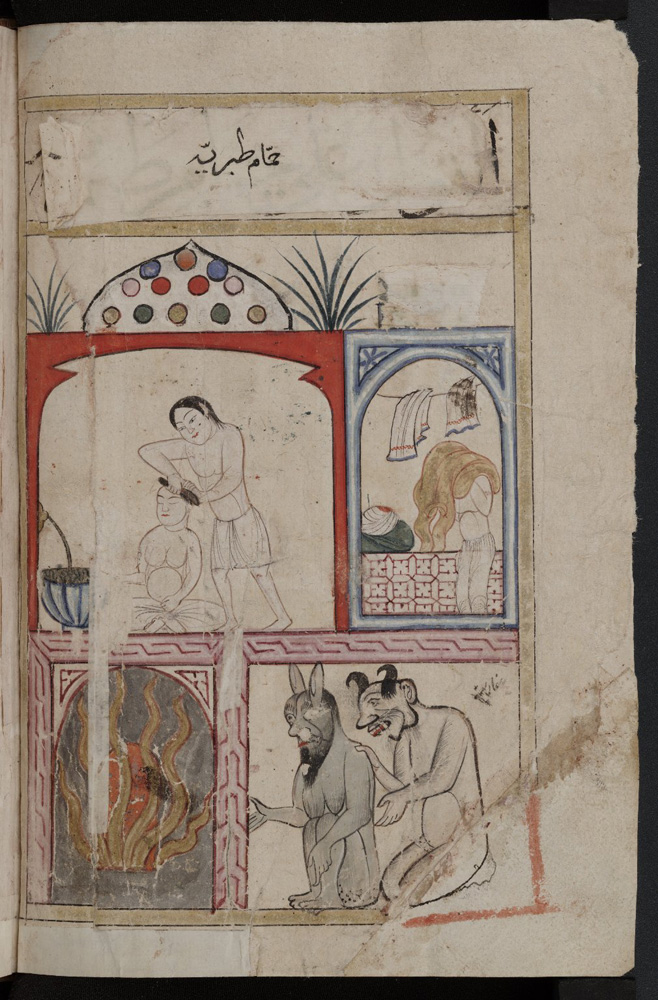 word + image
art + science
visual + discursive
the reality that he [Olearius] has experienced
![firefly condensed precision prisma poesis cartography refraction [source: wikimedia]](images/ajayeb/0160.jpg "--> s
firefly condensed precision prisma poesis cartography refraction
[source: wikimedia]") Conley: “the mass of textual material that accompanies single-sheet or atlas maps tends to reveal its ideological perspective in the gaps between a silent, spatial, schematic rendering of an area (in visual form) and a voluble [por harf پرحرف], copious, emphatic, printed discourse that strives to tell of the invisible history that the image cannot put into words”
Conley: “the mass of textual material that accompanies single-sheet or atlas maps tends to reveal its ideological perspective in the gaps between a silent, spatial, schematic rendering of an area (in visual form) and a voluble [por harf پرحرف], copious, emphatic, printed discourse that strives to tell of the invisible history that the image cannot put into words”
questions of
•authorship
•political power
•intellectual influence
![nature material computation dell science knowledge representation microscope zoom [source: http://www.nature.com/]](images/ajayeb/0066.jpg "--> s
nature material computation dell science knowledge representation microscope zoom
[source: http://www.nature.com/]") Meerwunder, exotic curiosities from the sea
Meerwunder, exotic curiosities from the sea
“we were about a gun-shot's distance”
![Lucretius Nature of Things ray enlightenment index influence finger language animal bestiary anthrop [source: Michael Burghers 1682 (commons.wikimedia)]](images/ajayeb/0166.jpg "--> s
Lucretius Nature of Things ray enlightenment index influence finger language animal bestiary anthrop
[source: Michael Burghers 1682 (commons.wikimedia)]") in the age of incipient European colonialist expansion
in the age of incipient European colonialist expansion
a truly Baroque (bestseller) work, Vermehrte Newe Beschreibung der Muscowitischen and Persischen Reyse
(in terms of Oriental drama)
erudition (fazl فضل) + adventure }-> in narrative
•it is Adventure Time
![cosmography Qazwini water energy flow fluid architecure [source: Tusi - Online Cambridge University Library]](images/ajayeb/0036.jpg "--> s
cosmography Qazwini water energy flow fluid architecure
[source: Tusi - Online Cambridge University Library]") proto-ethnography
proto-ethnography
acquire eyewitness information about a relatively unknown part of the world
-(with Olearius's style we can hear) ethnography's mantra: “writing from the ground” --> attention to the shakenness of difference (encountered or imagined) [Stewart bringing my attention to the writing affect:] “ground” sends people bouncing, takes place as a threshold, hits the senses as a set of provocations. “Writing matters if objects of analysis are to be understood as emergent forms with qualities, intensities, and trajectories that can be described or evoked. Writing is not epiphenomenal to thought but its medium. As it sidles up to worlds, disparate and incommensurate things throw themselves together.” (Stewart 2012)
(the ground of Iran on which Olearius stands cannot be summarized in a literalized description, under the spell of a kind of cartographic shorthand [tond-nevisi تند نويسى، مختصر نويسى], into a strangely idealist paradigm that imagines the things of the world)
*writing can be:
•the practice of writing ourselves into our worlds as emergent and disparate ensembles --> speculative concept of ‘worlding.’ [to consider our] writing as an inscription that configures the spaces of form and event in daily living
•Stewart slowed ethnographic practice: Why does writing matter in ethnography? How do forms of writing change cultural theory? What questions do forms of writing raise about subjects and objects, forms of attention, the possibility of thinking through description? How do you describe a scene, a character, an event, a situation, a collective sensibility, a difference, a world? What does it mean to add density and texture to ethnographic description? What can ethnography do?
•attuned to the *forms and forces* unfolding in scenes and encounters --> *apparatus of conceptualization* [pulled into (a tricky) alignment with (your field's) immanent concerns and with the concerns of the worlds.] your (anthropological) objects have to “be walked around,” “approached from precise angles,” and seen as “states of being,” emergent, or suspended in potentiality, or collapsing, or residual, roosting on live matter. *culture ~= [*]the cultural: “a resonant and magnetizing field that registered in people and things living through events and conditions.” we try to describe sensibilities hitting people and traversing [...] things:
◦bodies of thought
◦assemblages of infrastructures and institutions
◦new ecologies
◦the rhythms of a daily living
◦the strangely connective tissue (produced by handheld devices and social media)
}--> to compose a register of the lived affects of the things that took place in a social-aesthetic-material-political worlding [=/= “to track the predetermined effects of abstractable logics and structures."] ***singularities*** take place as a series of precisions (across sociality, materiality, infrastructure, etc.) they are “events of,” emerged in the lived problematics of a present ==> they could be brought to bear, deployed, maneuvered, suffered, or played with. [*]affects: “registering of life as an assemblage of elements thrown, in the course of events, into a contact aesthetic” [=/= the side effects of systems, codes, or imaginaries (located in an elsewhere)]
•return (anthropology) to sense and sensation (<== affect) (Olearius missed this, the “world” is proposed to him anchored in the consciousness of [his] humanist subject or its categories of thought. he misses Iran as a world charged with affect, which is a prolific, mixed-use contact zone in an ongoing state of transition that leaves [Iranian] people “improvising with already-felts” [~=? Golestan Sa'di]) -- affect added an affirmative critique that registers surprise at what and how things happen.
[*]affective subject: “a person who waits in the company of others for things to arrive, one who learns to sense out what's coming and what forms it might take, one who aims to notice what crystallizes and how things ricochet and rebound in a social-natural-aesthetic ecology of compositions and thresholds of expressivity.” --> “For the affective subject, there is always the weight of the world in what can be hoped for and what must be feared, in what flourishes and what matters.”
[*]Life: “an experiment of being in a world, of finding ways to be in circuits of force and form, an aspiration to get something out of the alchemical transmogrifications of things that twist off on trajectories far beyond humanist models of suffering or the usual hyperlegible registers of normativity and the state.” --> “[Life] takes place in the inhuman gestures of demons and angels, in the struggles of addicts and the rage of racists, in the endurance of the unbelievably injured or the oddly still curious.” (Stewart)
•a world deliteralized (with no endemic divide between a naturalized given order and the exceptionalism of event)
•things, to become recognizable as something to be in or near, or else to oppose and resist
•(affect --Deleuze-->) differential ontology: the prolific generativity of difference and connection taking place in a field of possibilities. affect studies now hitting:
◦anthropology
◦new materialism
◦object-oriented ontology
◦naturecultures
◦multispecies work
◦science studies
◦new ecologies
--> “the generativity and volatility of life as such, to its capacity to actively shift or harden into forms of peace or violence, pleasure and pain, collectivities and chaos.”
[...] it looks for ways to describe what precedes and exceeds the categorical in the labors of living through historical presents.
[...] affect-inflected [study] leans into its descriptive objects with an eye to their hardenings into something recognizable (=/= what is often called ‘critical thinking’: habits of snapping, to catch the world in a lie, dualist dead ends of modernist humanist social science, independent logic of data, the conviction that something is wrong --> paranoid approaches to the world)
•ethnographic method of mattering, [why conceptuality might take radically different forms in Iran?] attention to the still unfolding [--> Foad's (mental habit of) describing the fixed object of destiny (of Iran).] how to move in the manner of things slipping in and out of existence? the way a world (in this case: Iran) elaborates in prolific forms, taking off in directions. the Iranian real is alchemical, traveling in circuits of impact and reaction, in which things happen. we must train ourselves on an effort to describe the iterations/durations/modes of “being taking place.”
Said: “the idea of representation is a theatrical one: the Orient is the stage on which the whole East is confined. on this stage will appear figures whose role it is to represent the larger whole from which they emanate...”
[when we use “theater” in a cartographic sense it refers to the dynamic space where the “I” or the “self” sees itself engaged in a public space (of kin, of others, of economic and political forces)]
![planet, cyber, robot species, transform, interface, partial digestion, moon, 3�*�'�1�G� (�.�*� [source: The Transformers The Movie 1986]](images/ajayeb/0182.jpg "--> s
planet, cyber, robot species, transform, interface, partial digestion, moon, 3�*�'�1�G� (�.�*�
[source: The Transformers The Movie 1986]") the theatrical arts: spoken work + visual spectacle --> rise of opera
the theatrical arts: spoken work + visual spectacle --> rise of opera
[--> rise of natural history]
observers of the differences between their civilization and that of the Persians, their standards of measure were those of the West:
Xenophon
Herodotus
Quintus Curtius Rufus
Strabo
Pausanias
Ammianus Marcellinus
Barnabas Brissonius
Pietro Bizzarri
Johannes de Laet
Thomas Herbert
Hans Schiltberger
Hans Christoph von Teufel
Stefan Kakasch
Anthony Jenkinson
Anthony and Robert Sherley
Thomas Coryat
Pietro della Valle
Garcai de Silva y Figueroa
Jean Babtiste Tavernier
Raphael du Mans
Olearius (1636)
Engelbert Kaempfer
![life earth transcendence chasing Acacia facsiculifera seedling process form endosymbiosis [source: https://commons.wikimedia.org/wiki/File:Acacia_facsiculifera_seedling.jpg]](images/ajayeb/0105.jpg "--> s
life earth transcendence chasing Acacia facsiculifera seedling process form endosymbiosis
[source: https://commons.wikimedia.org/wiki/File:Acacia_facsiculifera_seedling.jpg]") a Greek invented dichotomy:
a Greek invented dichotomy:
(Greek) small democracies =/= (Persian) powerful empire
modestia (cult of the simple and good) =/= superbid (pride)
law =/= monarch
‘conflict’ is a theme
![rock material sensation [source: Sina Seifee 4/4/2016]](images/ajayeb/0019.jpg "--> s
rock material sensation
[source: Sina Seifee 4/4/2016]") Europe/Persia reasons for contact according to Cambridge History of Iran:
Europe/Persia reasons for contact according to Cambridge History of Iran:
1- religious incentive (moharek محرک)
2- both against the Ottoman Turks
3- commercial incentive
4- travelers passed through Persia
Duke Frederick's commercial venture that would put the tiny territory on the map, as it were, and eliminate all its debts [...] with Adam Olearius chosen to chronicle the mission as its official secretary
“Duke's stated aim in sending the embassy to Persia was to establish a trade route with Persia and obtain exclusive rights to export silk from the area, thus squeezing out the other European competition, especially the Dutch”
![pidgin minimal unambiguous message telegraphic code dubious literacy [source: dailymaverick.co.za]](images/ajayeb/0179.jpg "--> s
pidgin minimal unambiguous message telegraphic code dubious literacy
[source: dailymaverick.co.za]") his methodology
his methodology
(Olearius's citational mobilization) a typical Baroque writer, he cites classical and Renaissance sources copiously and compares them to each other, thus paying homage to the scholarly tradition
•list the main features of a subject under discussion
•quote classical and contemporary authorities --> elicit different opinions
•
*correction of faulty source material imperative*
Harvey's new theory of the circulation of blood
![animating power footnote feeling metamorphic transformation desire think imagine attention difference worlding interruption story [source: Adilnor Collection - al-Jawahir al-Khams]](images/ajayeb/0100.jpg "--> s
animating power footnote feeling metamorphic transformation desire think imagine attention difference worlding interruption story
[source: Adilnor Collection - al-Jawahir al-Khams]") Olearius:
Olearius:
•seasickness could be caused by motion of the waves
•“monsters” living along the Siberian coast are wrong
•
![Teguise Guatiza image sym life poesis poiesis biomic Haraway [source: wikipedia]](images/ajayeb/0170.jpg "--> s
Teguise Guatiza image sym life poesis poiesis biomic Haraway
[source: wikipedia]") Olearius's methodology is that of a comparatist
Olearius's methodology is that of a comparatist
he juxtaposes (the customs and social structures of the people he meets with those of his native land)
Olearius's trip ==> production of (superior maps)
Olearius ==> maps
Qazwini ==> lists
Sa'di ==> de-vice
![constellation category [source: NASA; ESA; G. Illingworth, D. Magee, and P. Oesch]](images/ajayeb/0041.jpg "--> s
constellation category
[source: NASA; ESA; G. Illingworth, D. Magee, and P. Oesch]") Olearius's The Vermehrte Newe Beschreibung includes large, detailed, fold-out maps describing...
Olearius's The Vermehrte Newe Beschreibung includes large, detailed, fold-out maps describing...
as well our technique in our work, with Sana
-our work/contribution includes placing maps and figures with the flux of discourse (=/= Olearius)
description of (the Persian) “natives” and their “nature” --> a codification of his human hosts
![interaction urban distance measurement vision percept organism Ihde responce environment [source: galileo.rice.edu]](images/ajayeb/0110.jpg "--> s
interaction urban distance measurement vision percept organism Ihde responce environment
[source: galileo.rice.edu]") traditional western stereotypes regarding exotic eroticism
traditional western stereotypes regarding exotic eroticism
Shah Safi's banquet (sur سور) corresponds fully to a European's notion of what an oriental feast should entail
![Iran flower Sa'di war poetry literature proximity metaphysics [source: Shahram Razavi]](images/ajayeb/0111.jpg "--> s
Iran flower Sa'di war poetry literature proximity metaphysics
[source: Shahram Razavi]") he marks the poles of Persian culture: as the site, on the one hand, of voluptuous, erotic encounters, and of unnatural cruelty and despotism on the other hand --> meant for the moral edification/codification of its western readers. (readers were taught about different countries + taught to be better European persons [with proper differences])
he marks the poles of Persian culture: as the site, on the one hand, of voluptuous, erotic encounters, and of unnatural cruelty and despotism on the other hand --> meant for the moral edification/codification of its western readers. (readers were taught about different countries + taught to be better European persons [with proper differences])
Baroque's excess of information
(as Pierre also noted in my style of language)
![home Heidegger pigs house building Bildung Dasein being [source: Xin Zhui - Lady Dais of the Han dynasty - oberlin.edu]](images/ajayeb/0087.jpg "--> s
home Heidegger pigs house building Bildung Dasein being
[source: Xin Zhui - Lady Dais of the Han dynasty - oberlin.edu]") Beschreibung
Beschreibung
*** the customs of the observed peoples ***
-->(language of pictorial representation emphasized)
![wind raind text rewriting fold structure footnote palimpsest description poetry architecture stories [source: On Numerology attributed to Zosimos (d. 1100/493) / nlm.nih.gov]](images/ajayeb/0118.jpg "--> s
wind raind text rewriting fold structure footnote palimpsest description poetry architecture stories
[source: On Numerology attributed to Zosimos (d. 1100/493) / nlm.nih.gov]") temporal displacements [in his frames pictures]
temporal displacements [in his frames pictures]
inscriptions, conveying a sense of movement
scorpion bites Olearius (“Ich vom Scorpion gestochen” --> oriental danger) --> specimen scorpion (--> immobilized and tamed) --> back in the Kunstkammer --> Duke's cabinet of curiosities (--> on display)
["his” experience =/= Sa'di's technologies of writing]
![world cosmology [source: The Gods of the Egyptians Vol. II]](images/ajayeb/0106.jpg "--> s
world cosmology
[source: The Gods of the Egyptians Vol. II]") Olearius + Hakwirdi --> Golestan of Sa'di
Olearius + Hakwirdi --> Golestan of Sa'di
Sa'di's influence on German baroque literature:
•Grimmelshausen (Simplicissimus)
•Lohenstein (Ibrahim Bassa and Ibrahim Sultan)
•Gryphius (Catherina von Georgien)
•Montesquieu (Letters Persanes)
•Goethe (West-östlicher Divan)
Jens from Kiel library, like Olearius, is appointed court librarian, by state/Duke, given the task of cataloging and expanding the ducal/official collection, and developing the Duke's Kunstkammer/Wunderkammer
![elephant situated knowledges parable perspective relativism [source: http://www.tendergrassfedmeat.com/index.php?s=sammati_tarka_prakarana]](images/ajayeb/0025.jpg "--> s
elephant situated knowledges parable perspective relativism
[source: http://www.tendergrassfedmeat.com/index.php?s=sammati_tarka_prakarana]") Gotterffische Kunstkammer --> “Wunderbuch” (book of wonders), with its insistence on the concepts of writing + drawing
Gotterffische Kunstkammer --> “Wunderbuch” (book of wonders), with its insistence on the concepts of writing + drawing
Olearius's genre of frontispiece, his engraved title pages --follow--> Norbert: kluger Vater or fleissiger Praeceptor
clever father / industrious preceptor مرشد مربى #Pir [--> “our common father in heaven"], wants to introduce his children and students to something in arts or sciences, “make them understand” by means of his mouth + pen :
*analogy/simile: showing something grand by showing them something small --> an astronomer shows on a small hand-globe (*globo coelesti*) the make-up of the great heaven with all its visible bodies, where a point means a star ~(in the same way)~> the geographer represents on a small terestrial globe (*globo terrestri*) the entire circle of the earth with all its landscapes ~(in the same way)~> “our common father in heaven,” the Lord, his revealed Word, he wrote for us (his children and students) the great book of wonders --recognize--> Himself
}--> (the concepts of) microcosm & macrocosm : something small (a dot on a globe) stands for something else, larger than itself (a city) ==> individual objects of study or curiosities of nature, that are collected and presented to a reader/observer, represent a greater whole ==> interconnectedness --> “the great chain of being” ~-> God teaches humans by means of natural wonders #ajayeb
}==> (microcosmic world of the) frontispiece = visual macrocosm of the larger book, *the textual macrocosm* that it introduces
[my video atlas in Eckernförde was reworking with frontispiece as it is meant to intrigue the reader with its complex set of visual images (taken from classical coins and medals, from devices and emblems), to be decoded after reading the book that follows. Olearius brings all desciplines onto the stage of his's world: ethnography, history, natural science, geography, architecture, and literature --> this is very baroque _+]
Olearius's didactic program: to entertain while instructing
(tasavof's) world as *mundus symbolicus* <== cosmos of significance (~= art + history + nature)
[Das grosse Wunderbuch die Welt]
![woman horse text dragon assemblage [source: Gottingen University Library]](images/ajayeb/0107.jpg "--> s
woman horse text dragon assemblage
[source: Gottingen University Library]") *theatrum mundi*
*theatrum mundi*
staging of nature (~ ajayeb) : nature in all its various manifestations (animal, vegetable, and mineral) must be displayed on a stage (of the title page, on the compartments of Kunstkammer)
•an arch of gateway resting on a platform or plinth (--> a basic model provided by classical architecture for the majority of Renaissance and Baroque stagings), a design that recalls the structures of allegorical tableaux used for triumphal entries into Italian and Dutch Renaissance cities, on order to honor the hero of the day
•(early modern title page *iconographic program*) incorporating the feature of the triumphal arch in order to signify the symbolic entry into the written work [<-- we don't need to do this!!] --> *formal monumental opening* (leading the “reader” to the ‘interior of’)--> Olearius's frontispiece (monumental, awe-inspiring works that aimed to spark the viewer's interest):
◦(to commemorate) official functions at the court
◦literary activities
[*]baroque: ***the art of not rejecting anything*** (el arte de no renunciar a nada -Montesinos)
(am i baroque?)
![geography language sign metamorphosis earth geomorphology semiotics [source: Upper Gotvand Dam / mehrnews.com]](images/ajayeb/0092.jpg "--> s
geography language sign metamorphosis earth geomorphology semiotics
[source: Upper Gotvand Dam / mehrnews.com]") different types of frontispiece:
different types of frontispiece:
1. divided into geometrical compartments (german origin?)
2. depicting a particular scene (german invention) [images/elements chosen/included for doctrinal and controversial significance]
3. single cartouche (school of Fontainebleau), a predilection for Mannerist irrationality and illusionism; interlocking, complicated scroll-work and strapwork; imitating the three-dimensional scrolling, with edges curling forward around the inscription; fantastic architectural structures, and grotesque figures and monsters taken from classical mythology
4. architectural title page (with the most monumental and most three-dimensional character), arrangement of sculpture-like allegorical figures or personifications
shifts from the techniques of woodcut --to--> engraving (--to-->? digital) ==> greater pictorial detail & better illusionism
![ajayeb book fish species face head body magnetism island [source: Tusi, ʿAjā'ib al-makhlūqāt wa gharā'ib al-mawjūdāt]](images/ajayeb/0056.jpg "--> s
ajayeb book fish species face head body magnetism island
[source: Tusi, ʿAjā'ib al-makhlūqāt wa gharā'ib al-mawjūdāt]") *Sa'di's advice and devices* [title]
*Sa'di's advice and devices* [title]
(Sa'di's relationship to) ‘the accumulated knowledge’(==> device)
[*]device (symbolum): a combination of a picture and a personal motto. a private adage (امثال و حکم) or clever aphorism --> heraldic image --fusion~=> device: a personal message by means of which a knight would define himself--developed from the chivalric tradition** ==?==> Sa'di's moral devices
-theoretical advice and examples of devices
-a craftsmann, a painter or goldsmith, would then supply the visual form of the idea that the learned scholar created
(moral) device --discuss--> general qualities and characteristics such as courage, nobility, obligation ==> (genre of) [*]emblem: --(pictorial + verbal)-striving--> for *universal applicability*
*emblem <-- the desire to understand the mysteries of antiquity, especially ancient Edgyptian hieroglyphs (in obelisks, sphinxes, lions), which were thought to represent a secret language [original wisdom of early man] (<== concerns of Renaissance [for example Hieroglyphica written in Greek by Horapollo 14th century])
(what are my ‘hieroglyphics’ in ajayeb?) Renaissance humanists wanting to research and understand antiquity, also wiched to *make it come alive*, by using hieroglyphics + Pythogorean symbols (were added, since metaphors and allegories of the ancients supposedly derived from the wisdom of Edgyptian priests)
ancient mythologies and medieval allegories in Renaissance applied hieroglyphic science:
•ancient coins (interpreted as hieroglyphics)
•biblical imagery
•medieval animal
•plant books
•cabalistic number mysticism
•old testament motifs
}==> emblematics became a kind of a language, that scholars and then readers of the vulgar tongue deciphered in books and then applied to a number of fields in daily life
spiritual symbols of allegory and myth + factual/fractal world --common--> visual art
}--> ‘title page’ : interplay of symbol & reality <-- interaction of different spheres of imagery:
•historical characters
•living people
•stuff of geography
•stuff of astronomy
•architectural views
•(in the 14th century scholars began to collect) ancient coins (and medals) [one side: great events, historic individuals -and- the reverse: depicted allegorical subjects, gods or the *fates*, allegorical personifications inherited from the middle ages [arts and vices]] ~--> *moralizing nature of (someone's) ‘specifications’* [--> frontispiece: personifications as simulated sculptures in niches flanking the archway]
![magnetic protein biocompass [source: http://www.nature.com/nmat/journal/v15/n2/full/nmat4484.html]](images/ajayeb/0008.jpg "--> s
magnetic protein biocompass
[source: http://www.nature.com/nmat/journal/v15/n2/full/nmat4484.html]") Sa'di =/= author's portrait updated ~ Olearius
Sa'di =/= author's portrait updated ~ Olearius
Olearius had three printing presses installed in his house, and required that the engravers live and work there, under his direct supervision
![jackdaw world learning fable story partridge future [source: https://en.wikipedia.org/wiki/File:Western_Jackdaw_on_Inisheer_(perched).jpg]](images/ajayeb/0081.jpg "--> s
jackdaw world learning fable story partridge future
[source: https://en.wikipedia.org/wiki/File:Western_Jackdaw_on_Inisheer_(perched).jpg]") “Concerning the Changeability of Worldy Things, and the Wonder and Praise of Virtue”
“Concerning the Changeability of Worldy Things, and the Wonder and Praise of Virtue”
‘flaming hearts’ symbolizing “their” union
![elephant seal baby water body assemblage camera [source: Jane Dawson]](images/ajayeb/0147.jpg "--> s
elephant seal baby water body assemblage camera
[source: Jane Dawson]") symbolism (of the frontispiece tries to) contain the subject matter (of the text that follows)
symbolism (of the frontispiece tries to) contain the subject matter (of the text that follows)
the triumph of death (but with a happy end for the deceased) # Adventure Time
![Wunderkammer exhibition collection environment writing [source: Alison and Peter Smithson et al., Parallel of Life and Art]](images/ajayeb/0142.jpg "--> c
Wunderkammer exhibition collection environment writing
[source: Alison and Peter Smithson et al., Parallel of Life and Art]") “that which i wish for is not mortal” (Duke's motto)
“that which i wish for is not mortal” (Duke's motto)
“virtue lives on after the funeral rites”
his home, name, heraldry, figure, allows the viewer to grasp the entire span of the deceased's life (and death) *at a single glance*
![landscape cartography mapping affect architecture narrative space heaven paradise sky God environment embodiment technique [source: Sina Seifee]](images/ajayeb/0097.jpg "--> s
landscape cartography mapping affect architecture narrative space heaven paradise sky God environment embodiment technique
[source: Sina Seifee]") horn of plenty
horn of plenty
cupid is astride (with a leg on each side of)
astrilized
![lexicon global architecture interpreter translator standard language international diplomacy vocabulary [source: LexiconUSA]](images/ajayeb/0158.jpg "--> s
lexicon global architecture interpreter translator standard language international diplomacy vocabulary
[source: LexiconUSA]") *winged sphere*
*winged sphere*
winged fame trumpets the deceased's accomplishments
christian mastery over the infidel--who is blinded to the true faith
![snake serpent person reptile limb assemblage body [source: hiveminer.com]](images/ajayeb/0076.jpg "--> s
snake serpent person reptile limb assemblage body
[source: hiveminer.com]") a group of international admirers
a group of international admirers
**methods used in Europe to disseminate information about foreign people** during the early modern era:
•Flugblatt (broad-sheet or broadside, 14th century), a medium directed at the illiterate classes (that needed visual cue) [included: news about battles, astrological prediction, sighting of comet, birth of a monstrous creature (animal or human), execution of a famous criminal, tales of witches, devils, religious or political propaganda]
Flugblatt counterparts:
◦Flugshrift (flying writ, flying pamphlet), popularized by Martin Luther, four pages with woodcut gracing, for audience with ability and leisure to read longer tracts
•illustrated costume book. with Mannerist strapwork, grotesque, garlands, allegorical personifications; in scenes representing the original reason why humans need to wear clothing
•(Norbert when he uses “we” in his language) --> *author*: active, nude, individual with his scissors, not dressed for battle, who will actively clothe the other figures ... [in frontispiece to Hans Weigel's Trachtenbuch the personifications of the non-Europeans are all prepared for battle] (male warriors in female continents [continents are usually represented by female figures, derived from biblical and classical sources such as Roman coins]) {Amerindian's headdress once was removed from its original ethnographic context, “decontextualized,” and then “recontextualized in a different setting --> europeans might have thought that it was a skirt. the reverse is the story of shalite شلیته?}
![sheep horn form social evolution sign meaning hand twist [source: 2011 - S&P Weaver - Saltmarsh Ranch]](images/ajayeb/0134.jpg "--> s
sheep horn form social evolution sign meaning hand twist
[source: 2011 - S&P Weaver - Saltmarsh Ranch]") mid 16th century also saw the development of the periodical newssheet (adapted from broadside)
mid 16th century also saw the development of the periodical newssheet (adapted from broadside)
consisting of image and text--work together in order to provide meaning for the design --> view needed to combine ==> a composing/composer subjectivity
allegorical putti (symbolizing industry)
inscription at their feet
flora beside each of them
Olearius's frontispiece for Orientalischen Reise:
•mixture of realistic and fantastic
•illusionistic cloths denote a process not only of uncovering, but of discovery as well (theatrical curtains pulled back to reveal the true subject: the paradisical scene of “natives”) [the scenic event of arrival in any civilized zone is embodied by the monument of the natives]
•flora and fauna of Paradise
to place the viewer in (an atrium-like building)
![cosmology world [source: https://fineartamerica.com/]](images/ajayeb/0050.jpg "--> s
cosmology world
[source: https://fineartamerica.com/]") monumental inscription
monumental inscription
(our anti-globe video in the exhibition =/=?) a scene showing a robed man standing on a globe ~-> “You lead me through your counsel”
the explorer writes his observation into his *magnum opus*, the traveler account (just as God writes in “das grosse Wunderbuch die Welt”)
=/= my amazon project
textual proclamation of the author's faith
Olearius's translation of the sufi lore collected by the celebrated Persian poet Sa'di, in a condensed visual form, (acknowledged later by Goethe) with the help of Hakwirdi
Brancaforte: Golestan speaks to an audience that has recently suffered from the ravages of war (or predicting it?!)
-Golestan (“valley of roses”) written soon after the bloodbath is therefore a document of its time composed by a man of reason who always stresses the practical [praised by Olearius as a “lustiger Kopff” (funloving spirit)]--appealing to a classical authority
-blending personal experience, humorous insights, and aphorisms (of an ethical/didactic nature)
-Muhammadian like the manner of Virgil-->{the past as legacy, disposing with the divine mechanism, purchase Virgil's tomb and worshipped it, poetry as a tool of divination, embodiment of experience, pastoral and erotic, attraction toward people of any gender, agriculture as man's struggle against a hostile natural world, way of a comparison with foreign marvels,}
religious relativism in Olearius's orientalism --> in deference to his christian audience and as a dependent of the Gottorf court--he disparages islam (verführischer Glauben, seductive belief)
-he is also a forerunner to the comparative religious studies (when he uses the word “Gott/God” rather than the name “Allah”)
-manipulating Hakwirdi's voice in the propagandistic confrontation between the great religions --> Olearius speaking for his persian friend: who feels the customs of his homeland do not measure up to those of his adopted country [like Norbert!]
‘other's blindness’: (a *textual disclaimer* of) the other who exists in spiritual and religious darkness =/= pictorial depiction
(in Persianischer Rosenthal the entire) ***enterprise of translation*** (from Farsi to German) is cloaked in highly metaphoric language, charged with fostering the development of the german language + nationalized sentiment, “our German language that used to lie beneath the dust of contempt now shines forth once again” (<-- i meet this all the time when i was living and working in Germany)
“Die Persianer” in Olearius is an ambiguous term, it could stand for either Sa'di or the text of the Golestan, or Hakwirdi, but this “Persians” is to be “let inside, wearing a German coat,” Olearius's body is charged with teaching “the Persian to speak German” (--> integration)
other translations of Golestan:
•Andre du Ryer
•Johan Ochsenbach
•Georg Gentius
*Golestan
taut and well-translated epigrams
end-rhyme poems
a ‘treasury’ of rhetorical and poetical motifs
a voluminous index of sayings
-*short and astute speeches* (ایجاز ijaz ناقلا naghola)
*the genre of aphorism* = "apophthegma” (concise saying --> fit for advice, --> emblem)
(clever and) *sharp* ==> memorable
practical advice for individuals (members of the bourgeois, merchants) who wanted to climb the social ladder and learn *how to behave at court*
Golestan was considered a rich sourch of (such) “oriental wisdom”
(why Olearius is so into Sa'di's Golestan:) the aphorisms try to convey mental images or pictures [...] the apophthegma are the verbal equivalent of the images of the frontispiece --Brancaforte--> both genres try to convey a great deal of information in a condensed form (verbal or pictorial) [--> this is also why i am into Olearius and Sa'di #baroque]
(frontispiece + Golestan's) architectural framework --serving--> organizing structure; formal entrance to the scene
[]
relation to the soverign in Sa'di
in Golestan, the tales speak of the love or affection between a man and a young male. however, in the introduction to his translation, Olearius notes that he has subsituted the term “girl, lover, person, or human being” for “youth,” so that it will not offend young people who read the book --> (resisting the) jocular moralistic-didactic use of the momoerotic motif a much deeper understanding of Sufi terminology and motivation than one can expect from a 17th century translator
Olearius normalizes the discourse (of sufi) for fear of offending the sensibilities of his reading public
angelic piety
Englische Frömmigkeit
...................................
the lionskin story
lion symbolizing the element of fire as well as purification
astrological relationship between lion and sun, in the image of Mithras, entwined by snake, symbolizing the path of the sun
mithraic influences survived into the islamic era as well, and became even more prevalent with the safavid dynasty --> lion imagery became strongly associated with Ali, the fist imam in twelver shi'ism
cosmic imagery and forms of address
the persian sun/lion symbol becomes intelligible for a european audience, when it is represented as a symbol of royalty
the lionskin, in Olearius's title, Persianischer Rosenthal
the animal's interior surface contains the writing, which provides the information about Persian society
Finn and Jake (given to wanderlust and creative risk) in Adventure Time --> “more powerful through spoils”
(this tradition goes back to Hercules, trophy, skin of the beast,)
“slain and flayed, exposed to the European audience, the lion/skin serves as a background on which the German author inscribes the story[/history]” (Brancaforte)
[Brancaforte studying] the early modern European frontispieces that were associated with the Orient
...superfluity of details mannered and cluttered with unread decorative motifs set in an unreadable space
[16th century frontispiece; my work is sometimes like that]
=/= (Rubin's title pages:) portrayed in an intelligible space, imbued with dramatic light effects, with a sense of movement, monumental architecture with three-dimensional figures moving in a readable illusionistic space
‘stretched-out animal skin with the head in the top center’ --> Rubin's artistic vocabulary [--> followed in today way of layout]
lion = saint's attribute --transformed--> medium for writing
--> (underscoring the) significance of **trophy**: subjugating a wild dangerous animal and then displaying it proudly for all to admire
Olearius's choice of lionskin:
1- dramatic visual introduction (to Golestan)
2- piques the reader's interest in the work
3- stands for dangerous exotic land (Persia) that has been symbolically tamed and displayed for the Western viewer
4- material of writing + material being written about
deictic
the rigor mortis of the body
the dramatic pose of the Persian husband
the curtain-like skin
the “emblematic corpse” on a “stage”
to serve as ‘exemplum’ tamsil تمثيل
+ martyr-like European hero who suffers the slings and arrows of outrageous Tatars
}--> theater of cruelty
bellicosity (amade be jang آماده به جنگ)
reader/viewer is horrified & fascinated --provide--> a tale of *oriental atrocities* --set-for--> stage adventure stories that follow...
...................................
less obviously, from standard geographical texts of the Islamic world. yet with its emphasis on direct observation and critical objectivity, the map also points the way toward the more exacting “scientific” standards of the Enlightenment.
maps are cultural artifacts
Persia: exotic + faraway
map ==> analysis
a map--like a frontispiece--is comprised of both visual and textual elements, combining word and image; it represents a type of text, or discourse, that needs to be analyzed in detail in order to be “read” correctly
maps are never completely translatable (nor readable)
language translates into historical practice
![Anaplastic astrocytoma Glial fibrillary acidic protein process philosophy device language [source: https://commons.wikimedia.org/wiki/File:Anaplastic_astrocytoma_-_gfap_-_very_high_mag.jpg]](images/ajayeb/0089.jpg "--> langua
Anaplastic astrocytoma Glial fibrillary acidic protein process philosophy device language
[source: https://commons.wikimedia.org/wiki/File:Anaplastic_astrocytoma_-_gfap_-_very_high_mag.jpg]") carto-literacy
carto-literacy
rhetorical device, ekphrasis: description
graph-o suggests both picture and writing *
the cartographic enterprises under Duke Frederick III of Schleswig-Holstein-Gottorf
mathematical principles + projection methods
14th century, seeks to include “ancient and modern discoveries in one verbal and visual description”
early modern age military and strategic situation of europe
establish fortifications
(Harley:) behind most cartographers there is a patron
mapping so became the business of the state and cartography is early nationalized
-global empire building
-preservation of the nation-state
-local assertion of individual property rights
}--> in each of these contexts the dimensions of polity and territory were fused in images which were part of the intellectual apparatus of power **
individual niches [on] architectural plinth
in Newe Landesbeschreibung: “in the beginning of the world, God created everything at once, with his clever/intelligent finger, using measure, weight and number ... because God is not a God of disorder, but wants everything to proceed in a proper manner and with the proper differentiation.” (translated in Vision of Persia, p.123)
illustrious predecessors
through their patronage and linked to the noble art of geography
the map is framed by scale bars (the cartouche [of title] rests on a kind of architectural base in which a scale bar is contained)***
(graticules, more details,)
typography plays a role in emphasizing (novelty?)
geographical purview (meydan-e did, چشم رس، ميدان ديد) of the rulers
map and approval
different layers of information in the map: by looking at it all at once, it is difficult to comprehend the entire story that the author/artist are trying to tell. by examining individual visual elements in the map, and then linking them to the text, one can trace the different narratives extant--manifest and latent--in the work (Brancaforte on Olearius cartographic work)
(this visual rhetoric is also what i am using in my storytellings) (i also need to be careful with my collages: (not?) to map out creations that are totalities much greater than its author's own appreciation or conscious knowledge of them; to emerge an often confused and paradoxical but signatory “self” in the liminal/marginal areas of the page)
•“the mass of textual material that accompanies single-sheet or atlas maps tends to reveal its ideological perspective in the gaps between a silent, spatial, schematic rendering of an area (in visual form) and a voluble (por-harf پرحرف، روان، سليس، چرب و نرم، خوش زبان), copious (mofasal مفصل), emphatic (mo'akad تاکيد شده), printed discourse that strives to tell of the invisible history that the image cannot put into words.” (Conley)
grid, superimposed on the map
a common topos in Persian painting: a male protagonist expecting the female to pour wine or some other liquid into the shallow bowl he is holding
this ‘anticipation of drink’ is construed (in the title of Olearius map of persia) as a gesture of welcome and hospitality; providing the viewer with an iconic image of two “typical” inhabitants and their form of dress --> “promise and peril” [riches to be found + dangers encountered; treasures + giant snakes]
this continues today: the image of an iranian woman in native dress
on the Persians’ inner nature and customs
the dedicatory cartouche's [special effects]: ruler's name, capitalized, special style of italics
establishing the Duke's geographical purview --> linked to foreign territories
through ‘knowledge’ and ‘discovery’ --> learn about Safavid Persia
(Conley)
(cartography during early modern age afforded to) the emerging self and the self's relation to the idea of national space
between raw perception and creative imagination
surveying and plotting the world
the drama of european literature: an unforeseen theatricalization of the self in the 15th-17th century
-the self seems to be produced in the form of a subject, as a paradoxical being divided between a representation of the conditional relations it is producing and the composite nature of the simultaneously aural and visual medium of print
-growth of cartography parallels that of the coming of autobiography --> mapping is responsible for the consciousness that leads to the production of the fashioned self
rise of:
•autobiography
•opera
•natural history
Olearius multiplicity of roles
artist, geographer, historian, tourist, merchant, diplomat,
Olearius's production of self
mantle of artist is passed on to the author, who asserts himself and his new status in pictorial form
[in the corner of the map of Flensborg from Newe Landsbeschreibung] a hat obscures the specific character traits of the individual [artist/cartographer], and the image opts instead to emphasize the professional activity of the geographer [==> *expert: a new subject ruled by laws of classification or ideology, an expert cosmographer or topographer]
+ beautiful theories of a fire that burned in the human heart
he stick to his calculations despite the criticism he receives from colleagues and friends
Olearius's scientific reticence (kam-guyi کم گويى)
he quotes (without attribution) Athanasius Kircher: “some think that the earth, as well as the heavens have their intelligent angels or spirits which move inside them and thus bring the waters out of their depth” (Vision of Persia p.153)
therefore the waters were driven by a natural power through the hidden veins of the earth and rose up into the mountains, just as in a human being the blood rises from the liver to the heart and moves upward to the head through the vena cava. --?--> Harvey's discovery of the circulation of blood
...cartographic literature both reflected and brought about changing perceptions of the world
about Marco Polo
Gabriel: Marco Polo did not have the influence on geography that one might have expected [...] he had no corresponding education, had been unable to make astronomical observation, and the results of these thrown-together maps was complete chaos [!]
the shape-shifting Caspian sea
*** Tabula Asiae ***
Olearius's travel account also seeks to be encyclopedic
...describe and judges the deviations from the European norm
common
barbarous
destruction of the body itself
Munster's final judgment:
“[Perisans] do not speak much and are more apt to act than to speak. they like the uncleanness or lust of the body; they are measured in their eating habits; they seldom keep to what they promise unless it is to their advantage” --> a laconic (mojez موجز) group of people who are frugal (sarfeju صرفه جو) in their habits, rarely keep their word unless it is to their advantage and are also oversexed ==> they are indeed different from the Europeans
discourse of analogy
cartographic evidence
a book of others
the ways it fashions received information
“Ortelius's innovation in the science of cartography is that he attends less to the “big picture” of the world than to putting together an illustrated summery of possibly infinite number of fragmentary parts (Conley)
--> “segmentable” units of an infinite possibility of scale and focus (#Goolge maps)
[]
Blue Map of Persia
influence of Ptolemy on the early islamic cartographers, in the time of Ma'mun
the notion of the inhabitable world being divided into seven horizontal bands called ‘climata’ or agalim/aghalim/ اقلیم(a geographical model derived probably from Persia)
*encircling ocean* surrounded the known world, and that usually have south at the top, probably to emphasize the importance of Mecca
system of Climes
(book of) notification: tanbih تنبیه
...pioneer on the road toward a (geographically) correct picture of Persia
_Persienbild_
...................................
“drawn from life”
the imagery and allegorical figures found on the frontispiece are learned signifiers belonging to a visual world that reflects and prefigures the verbal description that forms the body of the work
Olearius designs a brilliant visual program
visual table of contents
his nascent (dar tavalod درحال تولد) nationalist feelings
he translates both:
•the literature of the Persian poet
•the visual code of the land (he has visited)
traces of the author within the map
signs of the hidden power relation
depiction of the exotic “other” --> represented visually and typologically categorized, be it within the map itself, or in the boundary areas, in the margins of the representational space**
--?--> Timuri jiz
patronage
naming
“es gab eine lustige perspective”
of note in this scene [shah Safi's banquet for the Hostein embassy] is the woman alongside the right wall, who seems to be flirting coquettishly with a German looking in her direction, thus establishing a kind of contact between the two cultures
the monarch's true nature is laid bare
“you see me from the outside, as a pleasant young man in years, but on the murderous interior i am a tyrant.”
the scene of Eastern opulence and decadence corresponds to a 17th century (or even 21st century) Westerner's conception of an Oriental court
oriental stage
...................................
صورت الأرض surate al-arz (face of earth)
اصطخری Istakhri, 10th century, translated into German by Mordtmann
he met another celebrated traveler, Ibn Haukul ابن حوقل
...................................
Verran: *innovating to effect the discipline of deductive proof in ancient Greek*
(i found out--Pierre also noted--that in my work i tend to) inspire a baroque style of empirical analysis
[*]baroque
--> now you see it, now you don't
--> (a thread of innovation in) mixing words and visuals
--> wonder-filled difference
--> sensibility concerned with collective way finding through complexity
*baroque sensibility* loves unlikely juxtaposition
*baroque form lives with passionate intensity*
****forms of non-explanation [=/= to reflect of ‘what is’ from a meta position****]:
•juxtaposition
•stories
•framing
•reframing
•folds --> working within the ‘folds’
•working on the edge
-
--> *pushing and pulling at the interfaces we feel ourselves enmeshed in* [<-- that is exactly the description of what i do. #amazon project]
to recognize stories of entrepreneurship as stories of working relations between people, technology, and nature
@Setareh
acknowledge our “understanding of”(s)
(taking diagrams as involved only in) epistemic practices linking the mess of the actual and the ideal of the future =/= (account of diagrams that focuses on their unique) contribution in rhetoric --> *collective way-finding* (that #Olearius works agains for iranians and german, and Sa'di's version)
[diagrams:]
•(graphs, images, visuals that fill the) two-dimensional physical spaces
•screened images that cover the surfaces of a *tapestry*
•visuals performing in a graphic register in *tension* with linguistic registers (Verran) --> figurations designed to work with text --> open up a space for imagining their capacities as *agential devices* --> (how) diagrams intervene in the organization and governance of institutions --> *diagrams as objects of governance and organization* embeding working imaginaries (such as in the imperial enterprise of the Duke Frederick that Olearius worked for) --and--> diagramatic devices of technoscience ==> enforcing *non-equivocation* and *non-contradiction* : the standard rhetoric of Western scientific thought and argument - - --> ***devices enacting norm***
[*]diagrams: a juncture: text-graphic / graphic-text as an ephemeral clot لخته of material semiotic resources where words are embedded in graphics as much as graphics are buried in words
...not collaborate enough to benefit from each other's insights
[representing passage of a domain of innovation from past to future]
is there a way representing the many differences at play? are there other ways apart from one arrow pointing towards one futre? the answer was swift: “no, that would not be wise. we need to demonstrate that we stand united [as an industry, nation, family,,,]” --> it was mutually and tacitly agreed that this is how innovation happens : man-made devices ride into the future on arrows of progressive tinkering with heterogeneous things
(Verran reading/naming of) normative iconography of technological innovation
assumptions of technological innovation:
•physics as fundamental knowledge (--> the translation of kinetic energy to electrical energy and the variables that influence the efficiency of that translation) [--(this is)--> knowledge relating to environmental and social contextualization of the techniques described by physics ==> constitution of environmental robustness ==achieving==> social acceptability] --> the rhetoric of a diagram embeding that assumption:
◦‘additive’ : that knowledge becomes relevant at ‘later’ stages in the life of the model asserted by the diagram. the purview of the ‘additive’ diagram : negotiation and strategy reside in the realm of subjectivity, therefore cannot be represented }==> subjects, those who do the organizing and the giverbing, do not belonge to the ‘core’ that the diagram claims to represent : [subject]--[emptiness]--[dieagram]
--> rendering innovation as a ‘general event’ of an ‘unspecifiable future’ that is progressed towards + idealizing sites [= times and places (of these affairs)] [not allowing the questioning of these sites as obligatory passage points (for innovation)]
--> claiming for itself a capacity to realistically map a stable system
(diagram of technological innovation: a cartography of stable entities and stable relations) =/= a complex and emergent system embedding ambiguity and contradiction
--> promoting an organizational regime that proceeds by conforming to standards of non-contradiction and non-equivocation in its rhetoric =/= baroque baldachin (arshe عرشه) (with other than representation capacities) explicitly recognizing complexity, openness, and emergence --offering--> [enabling graphics to offer] pilotage خلبانى
***every tool should pose not only technically complicated questions rather fundamental ones***
branched tree diagram: saying that knowledge of the ‘branches’ includes a conception of the truck, suggesting: to understand is to understand how the truck generates the branches, and that is what is learnt and transmitted by specialists (Stengers, @Eszter)
Verran > Stengers working on the “gods and demons that populate physics”
[...] rejection and enclosure within the domain of ‘nonscientific’ or ‘simply subjective’ (of anything that cannot be reduced to the canon of the ‘simple’ model)
[Stengers]
(Verran on) the capacities of numbers to interpellate (رسما سوال کردن، استيضاح کردن) their users
diptych قاب دو لوحى
model of meaning-making that diagrams initiate (spatially + linguistically)
articulated sets of relations
a particularly efficacious form of certainty-generating rhetoric by ancient Greek mathematicians (appropriated by thier politicians), according to Netz: meaning-making in geometry proceeds in a particular way, a way that generates deductive proof --> (Netz's notion of) oral performance origins of meaning-making with diagrammatic device =/= (Verran's) graphics embedded within flows of words --> relations graphically plotted frame the relations plotted in flows of words (and reversed): diagrams labile ناپايدار in their forms of participation in collectives***
{my research on premodern systematic investigation of strange singularities of the labile phenomena [lability: liable to err and fall, slip, glide, flow] in the middle ages --helps--> how in the absence of authoritative *source of knowledge* in artistic research environments such as apass, *styles of knowing* mime and intertwine in poetics, practice, and politics}
speaking from diagram (offering possibilities of pilotage of the emergent relations) =/= speaking to diagram (a form of presentation, a proposed ‘found’ past in an idealized future, proposing as a realistic map of a given)
@Eszter: the question of recognizing the complexity of manipulating sets of relations expressed graphically --> developing (in my self) a contrast which offers possibilities for rhetorically distinguishing between ‘speaking from’ and ‘speaking to’ ==> shifts that can effect moves in collective meaning-making
wordy texts
(Star Trek's) displaying “our” modern commonplaces out of the place they are coming from --> makes me vomit
-in US sci-fi TV series we face that we are still Aristotlian, in our regulation of speech, we live under the regime of non-contradiction and of non-equivocation (tie up our public life in it) (--> when i say this is not my story, i am talking about another tradition of speech regulation)
proto-Baroque theater
*ambiguous monarchy*
absolutism has never been a feature of Iran monarchies
(who?) put an end to the complex, emergent baroque polity
a baroque sensibility was no longer salient in the Danish monarchical context and the baldachin became war booty --> that is how Adventure Time's sensibility is now
[Verran & Winthereik briliant thinking and literature:] “baldachin was designed to perform within the tense shifting landscape of partnerships associated with an aristocracy vigorously reorganizing itself as it emerged out of the crisis of the late medieval.”
there was a shift from ‘vertical to horizontal social integration’ (Christianson) with a better-off peasantry and a surge in the urban middle classes, and secular magnate families (najibzade نجيب زاده)
the baldachin was a device that performed in a force field--a wary but indomitable alliance of crown and noble magnates --> baldachin as a diagram in association with texts, the speech, and bodily gesture of court events
diagram: ambiguously and ambivalently ‘spoken from’ (--> proposing how a just society might be achieved) and ‘spoken to’ (--> a vivid vision of a just polity)
a figuration that equivocates over what a just society is
baroque diagram's felicity and ability to assist **collective passage through complexity**
tapestry (فرش / منقوش --> is concerned with collective way-finding ~ pilotage) and diagram }--> has to do with the collective
baldachin and the (innovation) model as material semiotic devices that intervene in the ‘happening of the real’ (Lury & Wakeford, Winthereik & Verran)
-they press upon others their presence as *participating entities* and offer *pilotage*
the model perfroms by eschewing اجتناب contradiction and equivocation =/= the baldachin (my graphs, atlases) elaborately figures both equivocation and contradiction --> *it equivocates about contradiction*
[equivocate: in Medieval Latin perfect passive participle of aequivocō “I am called by the same name”, doubtful signification]
Verran (in baroque form juxtaposing an engineering object with an art object) identifies diagrams as capable of effecting *dual rhetorical shifts*, effect possibilities of moving between speaking from and speaking to --> open up possibilities for equivocatign our contradictions + (representing =) *equivocating over what exactly is represented*[<-- in apass this is what i always do, in a way my project]
(@apass, attending to iconography opens up a space for asking:)
****what are doing here together?
****what kind of pilotage does this diagram offer and to whom?
(a way of abandoning the idea that these objects are essentially different) --> attending an object as:
•story
•diagram
•
...................................
intermingling the sexuality and materiality of bodies with the transcendental concepts and questions of spirituality and religion
to re-insert the body back into religious imagery
queer religious imagery
culture-jam
weaving their desire and bodies back into an exclusionary narrative
(un)critical faith
sexuality, gender, and bodily regulation in ...
deep inextricability of religious and secular discourses in constructing the body, as well as the ways in which such discourses alone can never tell the complete story of gendered and sexual bodies and practices (Wetzel)
...................................
Saadia Toor
() within the neo-Orientalist discourse [~= liberal modernity as embodied by ‘the West’ and Barbarism as connoted by Islam] ‘the Muslim’ enemy is today configured as both misogynyst and homophobic (with an essentialized Islam comfortably posited as the roots of illiberalism[= presented as the mark and the evidence of Islam's radical alterity from Western civilization])==> “civilizing missions” [such as my orientation course (as an ideological cover) in Germany] + [Hoda's bottom-lined subjugated self puts her on such “mission” (‘to rescue women’ and) ends any discussion with her (about women, or Islam)] }==> essentialized and monolithic (and flattened) ‘Islam’ emptied of history, diversity, complexity, and dissent نفاق -- devoid of any internal complexity and in fact incapable of effecting change from within
[--> critical use of #islamicated instead of “islamic"]
organic intellectuals (of the empire)
(authentic) native informants
brave and courageous ‘victims’ of Islam
•Rushdie one of the strongest voices within the clash of civilizations framework, in popular support for the Global War on Terror
•Manji's narrow polemic and cultivating a persona (of young smart queer woman) ==> new Orientalism
•Hirsi Ali an authentic ‘victim’ (“I used to be a Muslim; I know what I am talking about” -saying things that liberal ‘politically correct’ discourse will not allow Whites/non-Muslims/Westerners to say)
}--> ideology of Empire --> [a neo-colonial project:] discursive construction of an essentialized Islam
a range of “misogynist cultural” practices:
•FGM (female genital mutilation)
•honor killings
•the ‘cult of virginity’
--> they all predate islam and are common to Animists and Christians of the sub-Saharan region as well as Ethiopian Jews
liberal rhetoric of saving Muslim women
when some illustratives are pitched as a sensitive response to racist Islamophobia, but taking part in the mainstream discourse on Islam and homosexuality
‘Islamic-ness’ of the subject-matter
(the strange idea) that all Muslim countries are Islamic
part fiction, part ideological label, part minimal designation of a religion called islam (or “west”)
-How really useful is “Islam” as a concept for understanding Morocco and Saudi Arabia and Syria and Indonesia (or Iran)? [Said asks]
return them to the ‘chardivari’
(Toor's notion of) ‘patriarchal opportunism’ : “whereby patriarchal structures from families to nation-states strategically select elements from an ideological ‘toolbox’ in their attempt to gain support for the sexual regulation of women.”
Toor showing how impossible it is to think of ‘Islam’ as being the source of Muslim women's problems:
•(an ordinary story) runaway marriage --to--> a battle for the consolidation of class and patriarchal power played on a national stage; a case (of Saima) abounding in the established and familiar postcolonial binaries of East/West, tradition/modernity, public/private, sacred/profane
*class struggle is itself always already a gendered process, both discursively and materially*
clash between different and competing patriarchies or patriarchal arrangements --> the status of women within kin-networks --> the role of marriage in consolidating class power ==hence==> the rhetoric of marriage as something too important to be left to the men and women concerned (in Pakistan: ‘marriages = cementing relations between men’) --> “controlling female sexuality across class lines” [--> a very specific anxiety over female (sexual) agency* + complexities of patriarchy within Pakistani society] }--> “Among other things, they demonstrate that ‘Islam'--whether as a basis for individual/national identity, as a religious and cultural system, or as a set of injunctions encoded in theological and juridical textual sources--is always/already an internally contested discourse rather than a monolithic and internally coherent thing.”
(--> understanding of) the ways in which ‘the law’ itself is constructed and operationalized; delightful colonial legacy called the “Family Laws” (part of the penal codes of India, Pakistan, and Bangladesh);
•zina (zena, illicit sex, adultery, premarital sex) --> far from being an expression of religious piety at the familial or state level, the zina law is wielded as a potent weapon of control and extortion by families of ‘disobedient’ women + the rights that the moral authority of Islam grants the women against their families }=/= the manner in which the mainstream media in the West constructs the role of Islam in the lives of Muslim women (~ everything to do with Muslims is explained by ‘Islam’) =/= Khan's research on incarcerated women leads her to conclude that poverty is an important causal factor in the imprisonment of women under the charge of zina in Pakistan (structural adjustment policies imposed on Pakistan by the World Bank and IMF from the 1980s on) --> larger global political and economic processes
•a transgender couple charged with perjury under the Pakistan Penal Code, and not under ‘Islamic law.’ Supreme Court would rule in their favor, the judgment drew on the presence of the figure of Hermaphrodite in Ancient Greece to Islam + discussed with sympathy by mainstream media + well-organized and politically savvy hijra community in Pakista
}--> @Hoda, since she is interested in women's status under purportedly Islamic regimes
}==> Islam is not the overarching motor within purportedly Muslim societies that mainstream discourse would have us believe
(Rastegar > Toor:) “it is typical of much human rights discourse in the Third World to focus on [...] practices of regulating women's bodies, especially those identified with Islamic law, while ignoring socioeconomic concern.” @Hoda
Toor's two distinctions [=/= collapsing all forms of ‘Islamization’ resulting in a serious misunderstanding of the social processes at work]:
•‘Islamization from below’ : rise of (voluntary) public piety among Muslims, adoption of particular styles of facial hair by men and of various forms of hijab by women
•‘Islamization from above’ : the ways in which structures of power—from families to states—deploy ‘Islam’ in order to control women (and men)
(Toor:) Shah's cogent critique of the fetishization of the ‘community’ in ethnographic literature
a society defined by ‘a history of’
•dictatorial regimes (with support of the U.S.)
•(under siege from joint pressures of) a corrupt ruling class
•a heavy debt burden
•predatory and conspicuous consumption
•ongoing (neo)colonial intervention
==> cultural identity becomes a contentious issue & women's bodies become sites (for these cultural politics and the class struggles they embody)
~=> regulation of women sexuality : the key hegemonic move through which consent across social classes can be secured**
the increasing interconnectedness of different parts of the world at economic, political, and cultural levels (= globalization) ==> intensification in the dynamics of social change ==> anxiety ==> (greater) regulation of women (in kin-networks as a response to political, social and cultural anxieties under globalization)
[This was just as true of Europe during the period of capitalist modernization in the 18th and 19th centuries, and of colonized and decolonizing societies in the mid-20th century =/= Islamic exceptionalism = a form of Orientalism operative today : an exclusive focus on ‘Islam']
haq bakhshwana (in rural Punjab): the daughter of a propertied family is ‘married’ to the Qur'an, or, in some cases, to a tree—so as to prevent her share of the family property transferring to her husband's family --> women are both the property of their kin (symbolically and sometimes literally) while having rights to property themselves
Toor suggesting in her analysis a healthy dose of skepticism towards projects that present the ‘Muslim world’ --and asking how (in a Foucauldian sense) is ‘Islam'[~ the idea that something stable and immutable called ‘Islam’ exists anywhere] being deployed, by whom, and for what purpose? “Is it being used as an ideological tool, does it serve as a spiritual haven, or is it invoked as an identitarian response to the ravages of a globalized world?” (Toor)
(unpack we must)
***to unpack different islams (for different actors who deploy it)
‘islam’ certainly cannot be unproblematically deployed as the explanatory ‘variable’
Toor in her example cases showing that the ‘islam connection,’ when it is there, is varied, complex, and sometimes contradictory (=/= mainstream discourse on Islam)
(i want Hoda to make her categorical labor harder, i want her to make historically and socially contextual analysis, not just take shortcuts towards generalization predetermined by a priori categories (of Iran, Islam, women), rather to begin with the empirical reality)
...................................
a new legible object of analysis (in writing culture): qualities, trajectories, aesthetics ==> writing became tactile and compositional, an attunement, a response, “a vigilant protection of a worlding” (Stewart)
*writing = a way of thinking*
[*]precarity: register of the singularity of emergent phenomena, the way that they accrete, accrue and wear out
(=/= recognizing self-identical objects, metaculturally marked)
forms of perceiving (seeing, thinking) are themselves emergent
a writing that hones attention to the way that a thing (like precarity, etc.) starts to take form as:
•a composition
•a recognition
•a sensibility
•some collection of:
•materialities
•laws
•movements
obvious: totalizing dramatizations of the thing in itself
precarity can take the form of:
•fraility (living in it and through it)
•a sea change
•a darkening atmosphere
•a hard fall
•the barely perceptible sense of a reprieve
•
ordinary things (=/= melodrama) they matter because they shimmer precariously
...seasons magnetized to tones of voice and a quality of light
place (=/= immpasive corporeality) : affective charges:
•a mantel of redemption
•a glacier of impatience
•a high desert of anxiety dissected by fault lines of rage
}--performed--> in **little scenes of recognition** (--> “visceral complicity of those laying claim to a composed tactility[...]” =/= naturalized order per se)
(Tehran's?) drawn curtains: physical shadow of a state of hardening, a rotting from the inside out
(...curtained people, they suck the) *gestural sensory attachments of seeing and being seen* (into a world in which things are dark)
precarity ==?==> intimacy (of people in place)
(in winter with T-shirt and sandals) the townie body unfazed by the cold, endearing, a little heroic
an imaginary --> a logic of some sort --> abstracted ==> become a thing in itself
or, a thing simultaneously virtual and concrete
like the road, made not of dreams per se, but of laws, of ordinary practices, military surges, and construction technologies
...intensities pass from body to body:
•human bodies
•animal bodies
•machine bodies
•bodies of thought
•ecosystems
•visceralities and noumena
•histories
•the seamless habitus of supermarkets and credit cards
•
(Stewart's) precarity's form: compositional + decompositional
attachments, temps, materialities, states of being
[*]description: a writing culture lodged in emergence, generativity, potentiality
things that come into form through an assemblage of affects, routes, conditions, sensibilities, habits
what it means to meet the world:
(Stewart) *as a nearing* [=/= raw material for exploitation]
(Heidegger) as the ringing between composing subjects and objects
(McCormack) felt as ways of going on in the world
(Deleuze) as increases and decreases, brightening and darkening
() in a cartography distributed across a field of intensities and durations
[=/= rush to incorporate them into a representational order of political or moral significance]
...................................
[*]epistemology = stories of knowledge from before that somehow we are still living with now (#fable)
Geroulanos -->{ Ardrey --to--> Kubrick's african genesis : “weapon fathered man”
technology + prehistory (in postwar period)
“tool ==> man"}
...................................
knowing images
epistemic image : knowledge-based pictorial gestures (in my work without) --> organization + collecting + demonstrating theories + scientific tools + direct references to natural objects
--> searchable interfaces (+ desire for condensed information)
(**list ==> searchable**)
(Apianus's early modern cognitive horizon -->) eye: another organ used to calibrate settings
activated eye --> new empirical pursuits
my epistemic images : work of an image fetishist
bestiary: animal character diagnosis
[horses]
(from) genre of taking care of the animal: veterinary --to--> chiromancy: profiling of the animal conditioned through the serial nature of list (==> control)
...................................
Brancaforte
readings of the apparatuses framing Olearius's books
tradition of representing Persia in the West (Xenophon and Herodotus)
narrative elements of Olearius’ works remain largely unexamined
Brentjes
elm naghli علم نقلی (artistic research knowledge) =/= elm aghli علم عقلی (rationality)
(science) elm in Iran <== (10th century written in Persian:) limits of the world [hodud al-alam] + pharmacological medicine + (translated ~= adaptations of) astrology
10th century --> gradual decline in literacy in Arabic ==> Persian treaties on sciences
rag-shenasi (knowledge of the pulse) --> Avicenna
روضة المنجمین
rowzat (روضة to look) [~/=? nozhat نزهت] ~= garden ~= astrological site
-(iran) university garden =/= (greek) university gymnasium
book: expository discourse (رساله توضیحی، تفسیری، نمایشی)
•poems on the subject
•تحسین و تمجید lengthy laudatory adjectives to describe the dedicatee:
◦patronage of the courts
◦the teaching circles
◦the family lineages of professions
◦the existence of “amateurs de sciences” (the private individuals interested in science)
•anecdotes (historical or legendary)
•questions and answers
•observation on the usefulness and the excellence of knowledge in general
...................................
ethnography:
•set of methods for knowing about social relations [--> storytelling] (=/=?)
•cultural-analytical scholarship [--> analysis]
ethnography: [*]ethnographic stories = generalizations that intervene (~= instruments that make intervention possible <-- a knowledge product in contemporary sci & tech studies STS)
ethnography: stories that have in them a capacity represent the world in ways that are generative for the people and practices that the stories are about + authors (+ their peers + readers)
****(from) postmodern concern about the authority of the author --to--> a concern about partiality and generative critique****
@apass #feedback
(Verran giving voice to what my concern and interest is in artistic research environment)
the question of how to re-present others (their diverse practices) on good faith? <-- moral
~~> the bad idea of “good faith =/= bad faith” ==> assume a moral high ground that we have no reason to argue in favor of
altering oneself to good faith = altering oneself to the possibility of double vision
(in ethnography) good faith: writing generalizing stories that intervene, because of the partiality of research and analysis (not despite of it)
•good faith analysis: having faith in it being possible to write stories that are generative for *some of* the practices we study + for *some of* our peers
(stories --Verran-->) two moments of generalizing:
1. *onemany* form ==enable==> abstracting
2. *whole-parts* form ==bring==> a situating moment
~={ Star Wars apocalyptic stories (single vision) + lived social bodily realities = (Harawayian) many-headed monster }--> #Tehran index
ethnographic research is always embedded in multi-stakeholder situations
the Verran is proposing
=/= writing stories that narrate what collaborators hope to hear
=/= hardening the categories of the everyday
[*]generalization: (performative) ways of making and negotiating different realities
(Hinde -->) adequate story: objects that *find* audiences ~= *pointing to* (<-- performative) ~/= *pointing for* (<--Verran-- invite them to do work to see their own ontological commitments)
@apasa, research on performativity entailles when not to be performative
ethnographic story: re-performance / re-presentation of some here-now
•description: storytelling event
working indexically with an infinitely complex here-now
indexicality depends on posing a somewhere or something else that is real in a different manner ~= performativity
(Hacking:) we recognize the collective enactment of knowledge practices in devising re-presentations --Verran--> ethnographic story: (first ans foremost) making reality (=/= the idea that reality gives rise to re-presentations)
a generalization: a unified text, narrative, exemplifying and enacting a particular time and space --condense--> here-now
}--> recognizing how ethnographic stories deal with necessarily being just one of infinitely many possible stories of a herenow
(John Law:) ethnography: a method of assemblage : enactment of presence, manifest absence, and absence as otherness
#Tehran index
attending to indexes for herenow that embed two logics generalization: one-many & whole-parts
1. one kind of story embeds a logic of one-many generalization --> represents its here-now as an example of something in general [--> story = evidence base of a general statement about human, world, erc.]--Kwa--> *romantic*
3. one kind of story embeds a logic of whole-parts generalization --> presents its here-now by first building this world [--> story = an emergent entity on a vague whole]--Kwa--> *baroque*
20th century history of complexity theory
*romantic =/= baroque ways of doing complexity*
--Verran--> we should use both simultaneously ~= Haraway cyborg double vision
---> go to Latour's analysis of Ambassadors painting (~= illustration of an ethnographic story)
•technique of anamorphosis: invite the viewer to shift their perspective --> *they are invited to do the work of recognizing the alternative logics of generalization*
•agential instrumentality
•dual logic: ambassadors & skull
•skull/brownish object --signal--> a ‘viewer’ must ‘lean over’ in order to see the database (in Verran's example) as authoritative & as autonomous and *capable of making new kinds of knower* emerge (worker, storyteller, ethnographer)
-
my image assemblages are whole-part generalizations, one-many pictures, vague whole with emergent parts
#workshop on training two modes of generalization, use of drawing and image making, writing ethnographic stories
(artists typically make the mistake of making these two identical -->)
*indicator =/= outcome*
•indicator: for example you implement something
•outcome: a change in behavior (= accomplished indicator)
*one-many generalization*
x is one of many possible stories about X in general (--Latour--> purification:) spacetime specificities are transformed into general claims }--> abstracting
=/=
*whole-parts generalization*
x is a participant on an assemblage where all actors are somehow emerging parts --> one does not yet know what X is or may become (X remains a vague whole) (--Latour--> translation work:) working a number of herenows into the picture }--> situating
--> how to write (ethnographic) stories embedding the dual logic of generalization? = *how to arrive at a non-relativizing non-universalizing description that nevertheless works as a generalization?*
==constitute==> generalization: an irresolvable tension
<-- interventionist potentiel
narratives that allow both:
•information exchange (handling information correctly)
•unexpected cuts in information exchange (cutting the world)
what is gained in the interventionist potentiel [of stories; for example of the skull in Holbein's ambassadeur, magic database in Verran's ethnographic story]?
-enabling double vision
•the worker has to be equally magical about her own monitoring repertoires (apass cloud attitudes)
•to intervene the ideas of smooth and wellfunctioning development bureaucracy
•reflexivity: what the ethnographer sees as she is shifting her position and beginning to focus on a different (whole-parts) generalization [=/= simply a matter of being transparent about one's analytical choices]
(Sina:)
storytelling ~= bullshiting
storytelling ~= analytical social science
deflating claims (for example we have never been modern, etc.) do not afford possibilities for intervening
(why i use comparing stories in my lecture performances -->) the act of [*]comparing : a central aspect of seeking to contain the dual logic in one story --> (Strathern > Holbraad & Pedersen > Verran > ) peculiar intensification of the act of fieldwork
good faith analysis : stories that are explicit about the double vision through foregrounding within the story a figure that enables *switching*
•stories that never intervene in a way that was imagined (before the study was carried out)
(Strathern's) [*]partiality = incomplete + committed : a description is always part of a whole, which can never be known as a totality, and it is political (biased)
lecture performance ~= brining the effect of a story to life as generalization --> infra-ontological + epistemological work
...................................
Kwa
[*]holism: the ideal of integrating all the workings of nature into one whole
1950s --> a special relationship between the holism and the computer (the idea that if the assumption of holism is fed into a computer model, the computer faithfully reproduces it)
early 20th century --> notions of the complex unity of (living) systems ==> romantic conceptions of nature
*complexity = romantic holism =/= reductionist*
romantic tradition of complexity : to see an underlying unity in a world of heterogeneous objects and phenomena (Rousseau, Cuvier, last two thousands years, [is religion romantic?])
romantic scientist's moderate version of Kant's Copernican Revolution:
•Rousseau
•Humboldt --> ***to arrange the facts, not successively on the order in which they have presented themselves, but according to the relations which they have between themselves*** [~~> a sort of paranoia]
◦the idea that to see that Humboldt was able to see takes a “sensitive observer”
•Whitehead --> physical systems with endurance as the measure of their stability
•Tansley --> ecosystem ~= superorganism
•
=/= baroque (--Kwa--> neobaroque):
•Leibniz --> every bit of matter can be conceived as a garden full of plants : each drop of its bodily fluid is also such a garden ==> ***it is the direction of looking that matters *** (mode of attention)
•Deleuze
•Whitehead
•Darwin
•Benjamin
•
bestiary = baroque + romantic
*romantic complexity (looks up) =/= baroque complexity (looks down)*
•looking up: integrate individuals (who appear to be a heterogeneous lot) at the phenomenological level to a single entity at a higher level of organization --> (plants and animals, individuals) are*functionality integrated* [<-- my problem with the notion of community]
◦looking up to the world of platonic forms <-- a process of abstraction
•looking down: a table of companions --> (plants and animals, individuals) are *cooperating*
(romantic conceptions of) society as organism =/= (baroque conception of) organism as society
(historic) baroque
-grand style of 17th century
-(insist on) strong phenomenological realness --> sensuous materiality
-materiality flows out in many directions (=/= confined within) ==> blurring “individual =/= environment”
-inventiveness:
--music--> the ability to produce lots of novel combinations out of a rather limited set of elements
--theater--> (logical development of plot =/=) sequence of monologues and allegories ==> action
Leibniz baroque philosophy --> monad: individuals not linked to form greater systems (they don't even communicate), but they affect each other
--Deleuze--> each monad had its context represented inside itself (as fold) [more important the monad --> richer its world]
metaphors of romanticism:
•organicism
•system --> (in graphical representation) depicted by connecting lives between constituent elements (=/= monad)
•
Whitehead --Deleuze--> a neobaroque philosopher --> possibility of a chaotic side-by-side existence of mutually exclusive realities
(baroque era) harmony: art of counterpoints (bringing together independent voices)
German baroque (Gryphius, Lohenstein) --> nature = [*]ruin: heap of highly significant fragments =/= seamless web (@ERG website)
•fragment: independent individual things with a monadological structure (~/= postmodern understanding of fragment)
•link (between them) = reciprocal reference =/= connection
◦(references remain in their) *allegorical immanence*
•
World War II ~=> systems theories (attempt to explain the structure and behavior of complex objects
Charney + von Neumann
deterministic description of the atmosphere
“long-range forecasting”
computer-based metrology
==> *field* became the essence of atmospheric state (field =/= structure, phenomena such as cyclones, fronts, cyclogenesis, frontogenesis)
<--Lorenz-- a given that the atmosphere is a single whole
romantic & nonromantic Darwin
evolutionary theory
phylogenetic tree
-“war of nature ==> higher animals directly follow”
-individual organisms engage in various interactions with each other ==> speciation
Tansley (fulfilling a romantic expectation with regard to complex systems) --1926--> maintenance of equilibrium by ecosystem ["life = equilibrium"]
=/= Schrödinger (showed that equilibrium is unfit as a metaphor for life) --> life = islands of low entropy (complex locations) in a sea of high entropy (of decreasing complexity)
Lokta
(evolution of) chemical systems = general systems
Patten
ecosystem ecologist
“ecosystem = natural control system” ~= (single equilibrium simple cybernetic) technical control device <-- the metaphor of *automatic machine* (taken literally)
representing whole ecosystems by (mathematized and fit for simulation on digital computers) models
1960s 70s --> system ecology
--lurck--> (romantic trope of) rigorous functionalism [every little plant or insect had its place as a cog on a giant machinery]
Rene Thom
chemical reaction kinetics
biological morphogenesis
catastrophe theory: slight change in a single variable of a system can give rise to sharp discontinuous change
==> existence of multiple equilibria
Slobodkin
game theory
management of natural systems
Prigogine + Stengers
brusselator device (--> strange attractor) --> behavior and evolution of complex systems --illustrate-->
•discontinuous development
•bifurcation (points at which the system may go in either of two directions --> the system behaves as a whole)
local random fluctuations (around a mean) --> bifurcation point --> the system as a whole evolves to a new order
=/= cybernetic system (control center)
=/= steam engine (governor)
Robert May
the more complex a system is, the more likely it is that small fluctuations (will be just large enough) to be critical
complexity ==> unstability
~~~~> chaos theory
(for Prigogine) fluctuation: essential condition for order of physical universe, life, civilization
[the most humble aspect of the behavior of matter:] white noise --(chaotic phenomena)--> order [on macro level]
turbulence <-- cannot be predicted (deterministic approach), but we have empirical certainty that they will appear
55BC --turbulence--> Lucretius’ De Rerum natura (philosophical poem on the nature of things)
(his basic metaphor of) nature: hydrodynamic flow of particles in free fall, in swirls, in vortexes
‘small cause ==> disproportional nonlinearity’ : ‘random collision of some falling atoms ==> constitution of world’
--Serres--> (Lucretius) heterodox tradition (=/= orthodoxe)
romantic & baroque are ***discourse =/= paradigm***
•discourse (available to draw from)
•paradigm (to succeed another paradigm) [<-- to be careful as an artist, the fantasy of genesis]
•since the 19th century romantic complexity had been the more orthodox discourse
•since 1975 baroque complexity became the focus of interest
}=/= new conception of reality
•romantic complexity --favor--> stable structural metaphors (self-correcting cybernetic machine, Gaya, etc.)
◦criteria can be established (more easily) --> delineate emergent wholes (*abstract criteria*)
•baroque complexity --favor--> swarming individuals metaphor (population of individuals in turbulent motion) --> delineate emergent wholes (*situational criteria*)
◦conceptual problem of baroque: there may be higher level order, but what is it?
◾(it is not) stable patterns of communication (<== if patterns exists they are short-lived, individuals take part in several wholes rather than in one)
body = turbulent phenomena par excellence
*****
--Deleuze--> the very idea of “concept” is different in baroque thinking : [*]concept = an allegory, a narrative =/= a symbol of the cosmos <-- romantic idea of concept: a cosmological order that is grasped by the thinking subject
the uncertainty (of the world) in the baroque case is ontological [=/= epistemological --> uncertainty is an effect of not knowing enough]
...................................
(i say in iran, instead of public jurnalism we need more) *public anthropology*
...................................
(Stenger > Stewart > vivid pragmatics ~=)
(McCormack > Stewart > radical) [*]empiricism: if you walk in the woods --encounter--> the unthinkable profusion of forms --> material-aesthetic registers of (mobile & immobile flickering of) is and was (=/= sensory details described)
•[*]description: accidental glimpse of what matters + what shifts its matter in a moment of recognizable though unnamed and partial significance
tonal differences
a spark of color
a modulation in tempo
half-patterned expressivity
--of--> a scene teemingly differentiated and marked by thresholds of matter
when a tree is “charged and transfigured” by a violent sunset
Stewart + Dillard
a thing becomes a call to word
(Harman:) objects themselves, like voices or forms of writing, have style
Stewart > Dillard's causal logic of bizarre but categorical predation:
a small frog perched precariously on a lily pad in a pond, its back end already strangely slumped in the water. Then it suddenly deflates
its skin “ruck, and rumple, and fall’ and then “formless as a pricked balloon, lay in floating folds like blight scum on top of the water”
--suggest--> its style
=/= exempla of a generality
=/= embodiments of something
*points of precision* in moments, scenes, forms, and states of matter
an image synesthetically remembered --> engineered bridges of the purely social or thee purely natural imagine a flatly describable world composed of fully present states of being
...the wind forms blades in the sea like lines on a page
description: an approach to an ungraspable thing --> deliteralizing
remainders
(distributed gap between residents’ reports and police determinations:) [examples of semi-events (half-witnessed):]
•a dangerous-looking animal moving about on a man's property turned out to be a black plastic trash bag blowing in the wind
•threatening graffiti on a lawn were markings made by phone company employees
•a strange noise was wind in the trees
•a report of a man licking the locks on doorways of apartments on North Pleasant Street (--> suggestion of this licking everywhere remained)
•a blood-soaked glove on the ground outside the DB Mart was a pink glove (-- establish--> pattern of possible hands in roads)
-
--Stewart--> **an staging ground for people's perceptive** --> **attention to the weird possibilities emergent in the ordinary**
==> *mysterious patterns with precise details* [= ajayeb] --> (bring into relief) a background, a zone, a worlding in which things become perceptible (in a weirdly realist way)
[explanation =/=] stranger faithfulness to the spirit of the unnamed thing they witnessed ==> moved to make a report (something is a little off)
(if there is grounding it is grounding in) world's variegated poesis --> ([*]description:) to make room ([for its] emergence --into--> theory)
A walker with a routine gets used to the little apparitions of something throwing together in his or her vicinity
(questions of points of contact:) what to do with your eyes?
([against?] positionality of) writing from the ground
(memory of a city:) a contact aesthetic of histories and rogue trajectories set in motion by every object encountered
harshly half-formed world
germinal aesthetics
channels of autonomous objects lay down stakes and swerve at points of contact with the itineraries of other things ==create==> a distributed zone of *robust realism*
the real (of X): transversal arrays of qualities or activities (like musical refrains) give order to materials and situations, human bodies and brains included, as actions undertaken act-back to shape muscles and hone senses
(to sharpen) realist attention to things
[*]life: ontological entertainment
unfulfilled systems littered the kitchen
tangent to an elsewhere
gleamingly restored eighteenth-century perfections <-- Cinderella's mansion
...of autonomous objects lying around...
a zone of randomly abandoned X
against the background of nothing
visceral avoidance
pretty and fresh as blueberry pie
townies (how i am not a townie where i live)
•townie: loyalty to the expressivity of things
sociality of a wedding party (filled with roles and dressings)
crazy ricochet..
perfectly ordinary...
...long-ago layered over the wood (necrotic غانقرايايا)
“expressivity sliced through matter, word, and action, locking them together in a harshly half-formed world”
writing Cinderella diaries --> questions of realism
•what kind of real we enter?
•her realism (bring her) --into--> a rough contact with objects human and non-human
•Cinderella does things to and with them (her animals) [and reverse]
*social pressure ==> (people) make descriptive mistake*
a problematic (for example afterlife of a tragedy) --that--> inspires X --to--> speculative interest in forms
•Cinderella stating to noticing things (rumors, gossip, realism)
•gossip: realist attention to things
the world were his secret
loved the smell of the cold
in the night's dark hours
demanded our co-emotional sharpness
the world literally burst into color on the home side --and--> went gray in the instant of passing over the edge
no one knew their names...
...the energy of small things...
as if the point of living was to...
mosquitoes drew blood...
a helmet of white roots
...painted hyperbright colors in paint so flat it makes my fingertips dry just to look at it
dull dark oversized furniture
collapsed piles...
(nothing ever happens without first) registering a commitment to exhausting webs of complication
learning from mice --> dark little tunnels of limited choice
(Stewart's) points of precision: (of any act or story) what matters is the singularity of an angle of approach (a surprise contact, an opening onto some world's cocomposition, momentary flourishing of some capacity) [=/= a meaning]
shaken profusion in things =/= rush evaluative critique
so ordinary and problematic
so the idea of writing about “clean” started being interested in this website: https://www.politicalconcepts.org, and the desire to write a political entry point for them on the idea of clean in the 20th century
also after i moved to Brussels May 2016, the affect of dirty
to have a little talk or jam on the notion of “clean” and “clean body”
i have been scribbling on its metaphorology for a while, thinking with it about the 20th century political thinking, institutional thinking, criminology, xenophobia, morality, and many other things. it is a key term for me.
•difference and indifference regarding the foreign body and urbanism
•clean's stakes in architecture, toilet, the primordial element of architecture
•the clean body in Marx and its geneology in the left
•origins of morality in Freud
•xenophobia in crosscultural histories, Islam on hygiene and kofr's dirt
•Nazism and racial cleansing --> aesthetics & politics
•Victorian sanitation, sanitas
•pollution
•anality
•animality --> domestic life (Tehran, Brussels, Cologne,)
•metaphorology of ‘fesad’
•loose analogies of clean/dirt
•pure bodies (being threatened by violation of impurities)
•
readings:
-Koolhaas, toilet
-Sennett, Flesh and Stone
-Ashenburg, Dirt on Clean
-Serres, Malfeasance
-Ahmed, pure bodies
-Vom kleinen Maulwurf
-
in terrestrial ecosystems:
detritus
dead particulate organic material (as opposed to dissolved organic material). It typically includes the bodies or fragments of dead organisms as well as fecal material
typically colonized by communities of microorganisms which act to decompose (or remineralize) the material
...................................
(in clinic)
each method enacts an object of its own =/= approaching a single object in different ways
in 19th century Western philosophy, ontology was coined as a powerful word for the given and fixed collection of what there is
(Annemarie Mol)
ontologies ==> there is no longer a singular “it” to look at from different sides
ontologies are not exclusive, they allow for interferences, partial connections, sharing practices =/= mono-realist singularities
[*]politics: (is not one of otherness,) it is about fights; not between people (a politics of who) but between versions of reality (a politics of what)
the value of “what is,” what western philosophy calls “normativity” and its counterfactuals suggesting “what could be” (--> are different ontologies?)
yet ‘ontologies’ is ill-suited for talking about many things:
•ways in which goods and bads are performed in practices --> Xiri
•conjunction with pleasures, pains, ecstasies, fears, ideals, dreams, passions --> apass
•various shapes that processes may take:
◦causal chains
◦back-and-forth conversations
◦tinkering and caring
•theorizing how fingers taste
•what drugs afford to bodies and bodies do with drugs
•migrant ambitions and guarded borders
•garment factories on fire
•soy for Dutch pigs being grown in the Amazon
•(or when we give feedback to eachother in apass??)
•
--Annemarie--> we need to be able to play with other words (other than ontology) @Sina
*valuing
*facting
(let's learn and engage more in valuing, and not facting. not that things or practices “have value” but how they are valued, given value or worth to them)
valuing (when done as ritual nothing follows), might include variations of:
•measuring
•assessing
•appreciating
•qualifying
•tasting
•judging
•critiquing
•praising
•caring
•
***(more than aften) a mode of value developed ‘here’ is put to work ‘there’ [= generalization]
--Annemarie--> (pertinence of) ‘where questions’
(costs of) generalization ==>
•stabilizes what counts ==> silences subjects (<-- do it, but pay the cost)
•fosters proving, not improving
•offers managerial solution, not citizen satisfaction
•
•
(a modern sentence:) people tend to think that their quality of life depends on themselves, that means: what ‘you’ are going to do about ‘you being miserable’
the (good or bad) worlding of university's counter-fact-ism and functionalism
(Manning's mistake:) “evaluation or valuation techniques ==> boosting” (=/= tinkering*)
(in rehabilitation clinic) scale of independence to map the condition of a person --> a process in which valuing is transformed from a ‘tool for improving’ into a ‘tool for proving’
(enough food)
shifts from ‘want’ to ‘need’
counting calories (=/= enjoying food) --> orchestrate guilt (=/= satisfaction) --> limit oneself --> hide hunger
[*counting* (a protestant value?) has been a behavioral technique to produce self-conscious being, still a way of making responsible persons, “counting the number of times they were hit...” *rhetoric of counting (a socio-material practice) ==> civic world witness*]
rumors travel
facts travel
practices travel
clean city --> (19th century quest, classic goal of) hygiene
what do citizens value? <-- let's (take a step back and) ask that (@NRW cultural fund, governmentality Regierungsfähigkeit, the city of Cologne)
[this question is asked by people in certain socio-material practices with stakes in producing citizens, such as professional of cleanness municipal responsibility ==often==> citizens disappear]
-maybe we like the lively dandelions (repertoire of green) and messy weeds (repertoire of clean) that grow in the cracks
being happy with cleanliness
being happy with seeing people cleaning --> seeing municipal care
leanring ‘where question’ from Annemarie: if you are local that doesn't mean you are local --> ***the local is not obvious*** : the local does not explain itself in its own terms, it is rather explained in terms that have traveled from elsewhere --> this is not to isolate the local, this is not against *traveling of terms*, rather, an argument for specificity: to ask ****which terms from elsewhere are relevant here?**** @Tehran:
what at stake there
what effected here
(what it means in my village?)
traveling of knowledge =/= traveling of repertoires of speeking
functions of import and embedding (something from another time or place in your present argument)
*there is no empirical without language*
there is no local without travel
(@Xiri, Hoda, to urgently shift from who to what)
(from) ‘who question’ of politics: who gets to talk? (like “do women get a say?”) --to--> ‘what question’: “what is made of women?”
[metaphors of doing]
(neoliberal legacy of) isolated acting objects =/= complex global-local inequalities
historical traces of the acting in the image of the fighting muscular man throwing a spear [~-> Arash kamangir آرش کمانگیر ~/=? my play with the bow and arrow in apass;] =/= digestion, eating (as “doing something” that you cannot control), plants growing, smelling (is not acting?)
...................................
*assemblages*
-continuities require ‘work’ to constitute them as ‘well-formed assemblages’
-the emergence of a stable assemblage requires ‘translations’
-(we should) search out the catalysts, enablers or inhibitors of processes that interest us
-how varied and multiple qualities of agency unfold as effects in assemblages that encompass both human and nonhuman forms, and how these effects subsequently achieve particular outcomes for different parties
(organic food) market <==emerging== ideological desires of embedded entrepreneurs who innovate within dynamic material-semiotic systems
(Foad stressed that assemblages are characterized by the condition of) ‘territory’: contexts that engender more or less conservative orientations of assemblages toward fixity
(Sina emphasized that assemblages are also characterized by the condition of) ‘abstraction’: the unique character of how an assemblage mobilizes new compositions of material and expressive thing
}--> relational territories of heterogeneous stuff territorialized [by value] and abstracted [by price]
can we trace consumption as it unfolds?
-family assemblages are characterized as collections of distinct but related units, things that are never the same twice, but somehow hold together and maintain coherent pathways through time
(Price and Epp)
-(for people who move often) ‘home’: something that needs to be continually recreated by combining all sorts of elements in imaginative ways--home is a hybrid (=/= simply there waiting for them)
an “I love you” --enter--> assemblages in manners that catalyse (or inhibit) ongoing hybrid relations
levels of analysis is always unexpected [=/= purification]
modern separation between ‘believing in unicorns’ and ‘managing environmental disasters’ [~/=? ajayeb] ~ modern separations/boundaries: science/mythology/politics/religion/leisure (<--Latour/Haraway-- this is a problem) ==> ***purify components of our cultures***
‘program of intervention’: a purposeful attempt to construct realities by enlisting various allies : intermediaries establishing alliances between products, institutions, celebrities and consumers in ways that improve sales and mobilize stable relationships --> institutions attempt to strategically shape assemblages
(Law, Moor, Araujo, Ruiz)
marketers may try to establish stable brand images by mobilising networks of celebrities, scientists, consumption communities and various media outlets --but--> are contested, there is no ‘lead actor’ in assemblages
[*]marketing: iterative attempts to weave together networks of products, services or brands with heterogeneous allies in order to extend the usefulness of a particular market offering across wider consumption assemblages in time and space
-marketers think in terms of catalyzing interactions and consistencies amongst stubborn, messy and dynamic assemblages of spaces, representations, things and consumers
knowing: an intervention in the world
(Bettany)
[*]ethnography: stories that have in them a capacity to represent the world in ways that are generative for the people and practices that the stories are about @constantvzw
(Winthereik and Verran)
in the case of data streaming: what are the people, objects, texts and practices that constitute processes of assembling?
-in our research let's not prioritize either people or things in advance ==> unexpected sources of influence in markets and consumer cultures @Foad
-to map together material/technological as well as linguistic aspects of consumer culture: narratives, phenomenological techniques, etc.
-consumers ‘become’ during consumption
*[?why become interested in] consumption/markets: hybrid networks of narratives, objects, devices and practices (that [it seems] are necessary to create conditions for any ‘human’ action)*
(still use other more old-fashioned research techniques: depth interviews [Xiri], phenomenological methods [], hermeneutic analysis [Sina], etc.)
-(how to account for) tech-mediated flows of information and knowledge that pass through the massive assemblages of the Internet
-majority of interactions are technology-to-technology and system-to-system interactions
this assemblage-thinking is against[?]:
•Virilio's way of ‘questioning technology'--for him: “to be a subject or to be subjected, that is the question.” he sees crisis in the temporal dimensions of the present moment: the lack of a future-oriented longer time-frame connects “real time”, pollution, and economic inequalities. All of them result from a lack of shared responsibility for the future. (<-- noted by Hubert); or: “The now immaterial environment is connected to the “terminal” body of men and women with interactive prostheses who become the virtual equivalent of the well-equipped invalid.”
•Guattari's machinic (=/= simple construction partes extra partes): omnipresent homogenized capitalist exchange value
•Nancy's ecotechnics: critique of globalization and sovereignty
•Avital's narcotics: on Heidegger: the notion of ‘addicted to technology’ --asking--> under what conditions we could arrive at a *free relation to technology*? being ‘fast’ --> on the run ==> dumps understanding along the way. (for Heidegger) freedom depends upon Dasein's openness to anxiety ==diverts==> addiction [a certain type of being-on-drugs] }--> drugs have something to do with technology? @constantvzw
drugs in warfare: taking pills (or tranced by nohe مداحی جنگ) into superior performance, technologizing himself into the war machine (hero on heroin) --> technically calibrated culture
‘chemical prosthesis’ (a technology of the human) has been part of man-machinic hybridizations
-hallucinated exteriority
-stimulant, opening another hallucinogenre in life, at the edge of being
-our culture is bascially the history of ‘high culture’
(Avital suggests) drugs [master object of considerable libidinal investment] have been about exploring ‘fractal interiorities’ (and not exterior dimensions)
ecstasy of intoxication, forgetfulness, mimetic poisoning (of literature [= singular staging of the imaginary]): as sedative, as cure, as escape [= forced decision upon the subject]
-for Baudelaire opium became the transparency upon which one could review the internal conflict of freedom, the cleave of subjectivity where it encounters the abyss of destructive jouissance.
-(Emma Bovary had busted) a logic of reappropriation, collapsing the dreams of restoring a self
@constantvzw's investment in the critique of hallucinated plenitude and pure communication (enabled by digital media) --> transcendental telepathy (being online/connected over distances in a Facebook sense)
-pleasure and liberty values freely exercised upon a coded body
*hallucinator: a creature of simulacrum*
-what is wrong with the social media stream addict? a transport going nowhere; addictive, artificial, and beside oneself; [genuinely clean or drug free ~=? being exposed to existence, placing one's body in the grips of a temporality that pains]; phantasm of lack in abstinence; (like drugs they are) linked to *a mode of departing*, to desocialization, (like the activity of writing) nonproductive and somehow irresponsible, being-in-drugs (being-in-Facebook) supposedly resists the production of real value (incapable of stabilizing the truth of a real world); figure of drifter/dissident: obsessed and entranced, narcissistic, private, unable to achieve transference; movement of the simulacrum without address;
speed: going nowhere fast
...................................
[Campbell] on marketing theory
bacteria: entities that threaten our secluded sovereign cleanliness
our ideas of bacteria are shaped through the filter of advertisements for antibacterial products
[*]climate change: “[t]he moment I turn the engine of a car and ignite the 165 million-year-old microscopic fossil faunae, connecting me to the 35 billion ancient barrels that are drilled, fracked, refined, and transported every single year. Climate change is in the 100 trillion objects that are in, that are the Earth, traversing the stomach lining of the Burmese python and the Atlantic Meridional Overturning Circulation, which churns a quarter of the planet’s heat flux. Climate change is the daily operations of simplification, extraction, purification, replication, and acceleration--all of which are needed to create the philosophy of ‘progress’ that is embodied by nearly every human in this world.” -Campbell
= *a context which will last for thousands of years and will be the fundamental starting point of every action, every thought, every expression of organization*
==> irreversible *death of difference* (biodiversity), end of “human project” (--✕--> despondency دلسردى)
creative foreclosure of the old World
preparing for an end without apocalypse @Jassem
(we need to) experiment with (organizational forms of) justice, ethics, politics, reason**
Holocene ==> fundamental modes through which we organize still today:
•births of language and religion
•concept of resources and exchange
•invention of all known technology
•development of agriculture
•development of domestication
•development of urbanization
Campbell's posthuman
•computation of life
•laboratorization of life (simple categories of liveness and deadness over the last 30 years)
•miniturization of life
•complexification of life
•automation of life
relation: smallest possible unit of analysis, extremely prosaic and mundane ==> world
theorizing in the way of relation (as in feminist science, actor-network theory, or nonrepresentational theory) ==Haraway==> engendering a more humble, more modest attitude in the human observer --✕--> Meillassoux's non-relational theory
(since Kand) western philosophy has been epistemological [~ investigating human relationship to things =/= ontological]
--> correlations (between thinking and being), we turn things into affordances when we think about them --> correlationism: we only have access to the correlation between thinking (thing-for-us) and being (thing-in-itself) ==> ‘all knowledge is relative’ [=/= realism]
Meillassoux's absolutes:
•there might be something outside thought
lack of a necessary ultimate cause or meaning (facticity) --Meillassoux--> fundarnental source of being (ontological contingency ~ “facticity itself is necessary”) : no ‘higher’ or ‘supreme’ force or reason (metaphysical, physical, spiritual) is guiding it [~ total ontological absence of a necessity] ==> *contingency* is absolutely necessary in the universe
“Everything in the universe is without reason and is therefore capable of becorning otherwise without reason.” --> this has happened already at least 3 times (where new sets of laws enlerge from nowhere):
•Big Bang
•life from non-life (==> new laws of biological life)
•thought
absolute is wider
“two billiard balls strike into each other, resulting in both balls flying off into the air, or fusing together, or turning into two immaculate but rather grumpy mares, or into two maroon but rather affable lilies”
(@apass)
every research agonizes about:
•the ontological status of their ‘objects’ (of enquiry)
•the epistemological status of their knowledge claims
--Campbell--> we need to “go ontological” about consumption, global warming, (hyperobjects)
hyperobjects:
•viscous (literally real, and you cannot throw it away)
•non-local
•larger on the inside than they are on the outside
•they call for forms ofjustice, ethics, politics and reason that are beyond humanist economies of identification and representation
social constructivism ==> everyone's interpretation of the real is legitimate [equal status of interpretation] =/= (Meillassoux's) speculative realism
understand the world at the level of the hyperobject <== we are creating (consumer) objects that are massive in scale and temporality
inter-generational justice (imagining till your grandchildren)
service-dominant logic (of consumer research) =/= object oriented (more than humanist/naturalist trophies)
service: that intangible value extracted from stuff by humans --to--> the increasing ability to separate, transport, and exchange information, apart from embodiment in goods and people
Meillassoux's arche fossil ~=? jinn
witnesses of the universe before humans
objects withdraw infinitely from humans
universal quality of all objects: *reserve*
==> (narcissistic) philosophy of a uniquely lonely human fate [--> popular contemporary depiction of human with one foot in animality and the other in consciousness]
----> then how *withdrawal* (should) play out in social theory?
Lingis's ‘imperative’: worlds are filled up with imperatives (human and nonhuman) that summon us --> enmeshed pre-cognitive, atavistic, technological, embodied modes in which we respond to the world --> how this does not get recuperated into the existing models of sociology
[flipside of withdrawal:] to think of capital: an extraordinarily force overthrowing any imagination of an alternative --> there is no possibility of ‘intervention' in Capital ==> ‘accelerationism’: an inside-out radicalism, believing in unleashing productive forces of human wrought to continue its dynamism : “the only way out is to plunge further in”
Campbell: ‘withdrawal from capital' = passing through the eye of the needle
[that which is expressed in philosophy, political economy, science and science fiction, and in transhumanist, lifehacker, accelerationist movements:] *flight from consumption*
}--✕--> Campbell's *speculative consumption*
what if consumption has something relational about it?
(we must become interested in consumption @apass, Pierre, Foad, constantvzw)
*non-correlationist marketing theory* [=/= correlationism: humans doing things in the world to inanimate objects to make immaterial effects happen ~-> access]
interobjective consumption
...................................
ask anyone to give a definition of ‘food’ --> ‘a source of fuel or energy for the body’ --> most people will give you the engineer's perspective of the world when they are asked =/= the marketers know that everything we buy has a deeper, emotional motivation behind it
innocuous purchase:
•pleasure-seeking
•status seeking
•identity-building benefit
•
ask anyone to give a definition of ‘clothes’ --> ‘textile materials that we use on our skin to provide protection from heat and cold’ =/= marketer will tell you that clothes are portals to different realities
*we don't buy bread --> we buy sustenance for the soul
*we don't buy lightbulbs --> we buy illumination
*we don't buy lipstick --> we buy dreams
****food is not fuel, but fashion****
that means:
•food is a psycho-social comfort blanket
•we use it to compete for status
•we use it to define boundaries between ‘us’ and ‘them’
obesogenic
obesity
‘superwicked’ problem (in social policy):
-those who are causing the problem are attempting to solve it [for example food marketing's power trying to solve obesity (~= putting Dracula in charge of the blood bank)]
-time is running out
(this is absolute bullshit -->) “we simply need more education to finally understand that X (for example junk food) is bad for us”
(Campbell:) fashion brands (with their 400% growth in the last 20 years) have intensified their campaign to change the perception of clothing: from a functional investment in practical shelter to a vital projection, extension and affirmation of one's very identity
(shift in manufacturing and delivering) *fast fashion* (spearheaded by the Italian design house Benetton, but perfected by fashion brands Zara, H&M and Forever 21) mimics luxury fashion trends at very low costs
increasing efficiencies in production ==> increasing inefficiencies in consumption
*psychological dissonance*: the uneasy feeling that your laptop, car, trainers or coffee machine is no longer ‘right’ [stimulated in two principal ways in marketing:]
-1- physical obsolescence (<== down-grading the quality of product)
-2- psychological obsolescence (<== acceleration of the ‘fashion cycle’: the social phenomenon whereby a design moves through bleeding edge to mainstream to despised mainstream)
-3- ***to make clothing (or any product) a vital prop that is needed to create authentic sense of who we are*** (<== protagonist: Chanel-clad Parisian on the rain-soaked cobbles of a Montmartre morning, the sweat-soaked Nikes of a determined athlete in an empty basketball court in the Bronx, etc. disseminated through Instagram, Pinterest and Tumblr. [--> this works together but in reverse in film industry the protagonists wearings and style are used to sell that specific identity who wears them])
}==> *every single person cares about the clothes they wear*
-4- *to re-categorize clothing* (perceptual categories are critical to marketers, for example tourism brands worked hard for decades to change the idea of a holiday abroad from the category of luxury to that of necessity, clothes have moved to the status of a coffee to grab and go) <== equivalencing: degraded quality of the garment allows a decrease in the price [==> powerful psychological effect compounded by the retailscape: shoes in are sold on rails like packets of sweets, T-shirts offered in basins at the check-out, etc.]
***advertising (images) = secular magic***
==inducing==> a powerful desire to indulge in the fantasy of being:
•a solitary and steely-gazed athlete
•a sophisticated and urbane Parisian girl
•
Campbell: “The moment that I say that fashion brands do not affect me is the very moment that they have”
pleasurable daydreaming innate to us all
marketing is often a practice of *breaking taboos* ==guarantees==> brand success
detergent, apparel, car or cosmetics brands ==produce==> the monolithic, repetitive idea of ‘clean flawlessness’ that infiltrates our value systems
clothes = portals to different realities
*enclothed cognition*: the influential way clothes change psychological mood, the way clothes allow us to take up certain social roles more authentically
Alessi: fashion is social (its Latin root ‘factio’: a group of people acting together) =/= Campbell: i use clothes (fashion) as a social grammar to communicate with these others
universal clothing in sci-fi is such a lie, because that would remove one of the primary ways in our culture that we have for expressing ourselves
we need to change the manifestation rather than deny the yearning }--> Campbell proposes: slow fashion, re-categorization of clothing back to investment in long-term, high-quality items
...................................
[title]
nonhuman rationality
(Meillassoux's) speculative realism ==> climate change = a new world (for which we do not have categories)
Meillassoux's concepts { nonhuman + rational --Campbell--> ontologically think about climate change =/= (despondency & passivity) equivocal status of climate change }==> bleak optimism: climate change has already happened + human civilization must learn how to die in a way that is a *creative and just foreclosure of the earth's organizational forms*
organization: an environment-making process
--> drawing of ‘general lines’ in the fabric of the whole ==constitute==> most basic mode of existence
--> making of some sort of cut in the universe to simultaneously create & order an inside from an outside [~ *bracket ‘a’ reality out from an undifferentiated plasmic whole* ~= framing]
==produce==> elements of a reality that can be controlled by human intervention
*how we frame climate change will determine the future of life on earth*
[--Sina--> that is why we need more curatorial skills: variational + organizational]
frame: strategic device, a mode of coping with the hugeness of reality (framing moves:)
1- bounding --> defining, separating, assimilating
2- stabilizing --> fixing, delimiting, controlling
3- bring into view --> empirical, technologies of representation, controlling
frame:
•useful models for viewing reality
•recursive lenses through which that phenomenon is measured and acted upon
climate change and new frames emerge side-by-side:
climate change as:
•externality
•superwicked problem
•anthropocene
**what if climate change is unframeable?** [<-- art is good at dealing with this]
climate change qualities:
•unboundedness: hard to separate what is climate change and what is not
•incalculability: intotalizable effects ==> emergencies and materialities that are beyond known forms of planning and organizing
•unthinkability: it escapes each time we try to capture it empirically, organizationally, psychologically
}--> *questions that have no logical or empirical answer ==> ontological* (they concern its ontology) ~ we do not see its fundamental being
end of empirical/logical = beginning of ontological (secular)
=/=
end of empirical/logical =? beginning of eschatological (nonsecular)
}--Campbell--> **ontologization of climate change**
*climate change = the world we live in =/= a problem within the world*
[*]climate change: the absolute context that determines what is possible + what has replaced a previous world
(i find Meillassoux + Campbell argumentation more convincing than Morton's hyperobject)
climate change as “problem” (that can be framed), “thing”, “within the world” [=/= the world: generative context from where problems emerge ==> forms of organization without precedent] ==problem==>
1. epistemological assumptions (+ expectations + responses)
2. unable to encompass (the qualities of climate change)
3. misrecognition of climate change
speculative realist idea of world
[*]speculative realism: a strategy for thinking, organizing, solving at the *widest rational angle: a form of thinking and acting that is concerned with the fundamental structure of reality in its absolute and unconditioned form (=/= manifestations of phenomena) ==> to deliver metaphysical truths unto the world without deforming them with the forceps انبر جراحى of one's own epistemic apparatus
(as) ontological threat ==Campbell==> escalation and absolutization of ethics (*that is necessary to aithentically occupy it*)
@apass: constant investigation of one's epistemology (=/= ontology) in artistic research
--Sina--> the danger of ontologization...
**massively expansive vista of rationality** =/= disavowing rationality
(the old philosophical idea of) the absolute =/= equivocal status
bleak optimism: organizing without hope <== climate change has already happened
--> how to die : a creative form of foreclosure that unlocks a justice that cannot exist without realizing the ontological dimensions of climate change
frame: general organizing device ==>
•define problems
•diagnose causes
•suggest solutions
(their) argumentative strength ==influence==> organization
frame --> define climate change ==> produce climate change --through--> (the work of:)
•problem-identification
•claim-making
•attribution-laying
•boundary delineation
•counter-framing
•bridging
•amplification
•constructing identity-forming vocabularies and discourses
==> *alter an audience's ideological beliefs*
climate change literature has been dominated by economics, (geo)engineering, legal theory/policy studies ==> solutions (to climate change) --invoke--> markets, technologies, policies (with differing criteria about what constitutes legitimacy, authority, efficacy) }<--Campbell-- *before they get a solution, the phenomenon has already been scientized, politicized, mediatized, organized*
indigenous framing of climate change
drawing from indigenous cultures in the hope that a deeper emotional maturity might lead to a deep engagement with the environment which ultimately bestows life }--> framed as an existential threat ==> (question what it means to be) an ecologically interdependent species with moral agency @Chloe2
eschatological cliche --> “existentially significant activities are no longer possible ==> the loss of meaning” (=/= Cinderella)
[*]frame, framing: enfold audiences into an enclosure that is conceptually accessible
for example
•*ecological modernization* : a frame for climate change that seems to enclose the grreatest number of diverse stakehold[...]