[...]e pop-up book Blickmaschin
•use hylomorphic: assumes form is inscribed onto passive matter (by an agent with a design in mind)
•
(relevance should be worked) non-ironic non-symbolic non-anamorphic non-palindromic non-hylomorphic (?)
...................................
towards writing the end of apass dossier
•practices: workshops, (bow and arrow,) ajayeb.net, rigs --> pop-up book, notes, routines, excess,
•trajectory: bibliography, wonder, ongoingness, ontology,
•productions: study as artwork, reading as artwork, bottom-top approach to writing,
•findings: every research practice: must include “body image”, must include “the image of creativity” especially if you are iranian, must employ ontological attention to differential productions, must rework decompose redefine its root-metaphors, must give extensive equipment list, must trace its social connections in a wider ecology of practices, must include a critique of technology,
•moments of composition: a scene animated by some quality, or... taking place as accidents (or not)
key literature, magic wands:
1st stage:
•Richard Sennett: Flesh and Stonne --> learning about body image
•Manuel Delanda: A 1000 Years of Nonlinear History --> learning about material histories
•Eduardo Kohn: How Forests Thinks --> learning about semiotics
•Timothy Morton: Sublime Objects --> learning about ontology
•Avital Ronnel: (lectures and articles) --> learning about poetics
•Donna Haraway: (lectures and articles) --> learning about rhetorics
2nd stage:
•Martha Kenney: Fables of Attention --> *rationality: mixture of the highly rational and the highly fantastic
•Karen Barad: Posthumanist Performativity, Invertebrate Visions --> learning about apparatus
•Eva Hayward: visualizing apparatuses --> her interest in optics, in the optics in which marine invertebrates and people come together through visualizing apparatuses
•Vinciane Despret: The Becomings of Subjectivity in Animal Worlds --> learning about anthropo-zoo-genetics
•Kathleen Stewart: nonrepresentational theory --> other ways of description
•Katie King: technologies of writing --> a better thinking of locals and globals
•
(curiosity ==>) having to figure out how to do something that i don't already know how to do:
•ongoingness of collective practices of knowledge and concern
•talking about (what is going on with) ajayeb
•paying attention to differential ontologies
•the stuff that happens through face-to-face colleagueship
•to be in productive alliance
•
unalianated critical work = art
Seifee wants to say something
something wants to say Seifee?
i like us to be skilled at
•objective perception
•5 minute perc[...]
(1)[...notes/midday review.txt]%7.9[...]
(Avital) scientific imperative (the demand in the 19th century for an epistemological reliable inquiry in the nature of things) <-- fascination for the freak and the occult <-- on the way to technology
(Baxstrom + Meyers > Philippe Alain-Michaud on Warburg) “in Mnemosyne, photographic reproduction is not merely illustrative but a general plastic medium to which all figures are reduced before being arranged in the space of a panel. In this way, the viewer participates in two successive transformations of the original material: different types of objects (paintings, reliefs, drawings, architecture, living beings) *are unified through photography* before being arranged on the panel stretched with black cloth. The panel is in turn *rephotographed in order to create a unique image*, which will be inserted into a series intended to take the form of a book. The atlas, then, does not limit itself to describing the migrations of images through the history of representation: it reproduces them. In this sense, it is based on a cinematic mode of thought, one that, by using figures, aims at not articulating meaning but at producing effects.”
transgressive approach to the archive:
•Gerhard Richter's Atlas, 2006
•Jean-Luc Godard's Histoire(s) du cinema, 1988
•Christensen's Häxan
•Warburg’ Mnemosyne (presentation of a series of visual cliches and stereotypes, fragments which were most likely already familiar to the viewer ~ figurative givens ==> empirical evidence + media to conjure with)
•Bataille's journal ‘Documents’ 1929–30 --> seizes cliched objects and then systematically empties them out in the course of its own expressions. Bataille and his contributors sought to defamiliarize the cliches, disturbing the placidly deceptive surface of the mundane in their fragmentary, juxtaposing methods of critique and presentation =/= Warburg + Christensen collecting mythological, figurative givens seemingly quite distant from the “really” real
}--> unsettling distances between myth and the everyday
-weave together episodic fragments in order to draw parallels (across domains of sense that cut across time) and correspondences across situations and characters
-Häxan deploys the techniques associated with Warburg's Mnemosyne and Bataille's Documents for purposes of affectively emphasizing the dark, chaotic forces that lurk under the smooth surface of the everyday
(Häxan's episodic structure ==>)
•characters seemingly out of a dead past to live again
•draw the phenomenology of the hysteric
•draw the work's own contemporary time to the surface
promiscuous: neither wholly artistic nor scientific =/=? hybrid artistic and scientific
traverse steep slope between past and future in the form of an event =/= plot
inability to automatically categorize Häxan (or any work of art) <== *[...]
(2)[...notes/Ajayeb notes.txt]%30[...]re. what is the animal holding in my family?
-stories or fables that permit wonder, or allow perhaps to approach crows or cats as creatures who could be capable of contingent cooperation or multispecies companionship. [i am referring to the video of the wild animal taking care of the baby pet, the popular video in social media that triggered the discussion about wild and domesticity during the lunch between my family members. an object that captured the dialectic of desire and disgust in my human family's response to the animal.]--> this is what I call cosmology: beings that depends on their placing within a particular cosmology. cosmology is very much alive --- [animals fitting in the visual rhetoric of web-based digital media is itself to be investigated... social relations, social animal, contemporary cosmology]
-the minimum relationship with feral cats, and rats, and pigeons (and their material environment.) and ambiguity towards them. evoking responses of affection, disgust, fear, and indifference.
-relationships between people, animals and place**** [a place as complex as Tehran's urban environment with its politics, televised operations, its ‘wilderness,’ and technologically mediated stories and rumors that populate its landscape.] --> are we having a Historical change? in epistemic principles --> what is inside and what is outside [keep in mind the historical moment in iran's political isolation. is this reflecting the exclusion of feral animals of everyday life?]
-my family was able to talk differently and find other expressions about violence in the landscape of tehran by applying the animal story (to the head and heart.) [this is also Kelile o Demneh.] the video was a heart-breaker. it had a healing moment, and their resistance to its originality as a tale of friendship is meaningful, the violence is solid and a-priori to companionship, and it supported the story of kinship instead of friendship. This story also promoted the Descartes’ beast-machine hypothesis, that the wild-being is devoid of intentions and is like a timepiece with regular motions, that the animal is object and not subject, beast-machine.
-my mother's relationship to the lions eating their offspring, octopus eating their mate, or cats licking their genitals and dogs filth scavenging--polluters of domestic space, cockroaches “belonging” to an stratum below civilized life, the “out of place” and abject owl, species sexual dispositions and different coupling, suggest difficulty in an anthropocentric expectation of alterity. animals simultaneously despised and admired --- the idea of eating your (so-called) “loved-one” (not a suitable object for affection) refutes cross-species identification according to anthropocentric standards. [windows of opportunity for cross-species bonding, domestic-wanna-be-feral story, myth of mental intention and animal flesh, irreducible heterogeneous ontologies and involvement of human-animal in multiple agencies[...]
(3)[...notes/Mona rat race.txt]%32.5[...]s’ [ajayeb] --> animals supposed to be found in the non-discursive spaces and places of the world) (or on the television)
-Said: ‘imaginative geography’, geographical ‘othering’
-overlappings that we find in telegram social media tehran --> what kinds of ‘animal’ (which animalities) are at stake there in the mobile phone's interface?
In recent years zoos have reinvented themselves as ‘arks’
animals categorically embodied ‘meaty beings,’ and how they are usually “out of place” in the the immediate locality made in Tehran
animals are very good at forging their own beastly places, ‘other’ spaces of that of the human
(this is not about ‘territory’)
who “can” think and act in the world?
who has the “ability” to prompt change?
[my apass research project is in a sence *contemplating the agency* and speculating *relocating qualities* ~-> (re)configuration of the world]
cultural cross-codings has always been constructed between ‘some’ humans and ‘some’ animals
*the “source” of agency, coined in Europe(?) from the sixteenth and seventeenth centuries onwards: self-awareness, intention, thought and language --> properties of “consciousness”
(--> History of Consciousness department in the Humanities Division of the University of California, Santa Cruz. #entities that started to make decision deep in the ocean)
(--> ‘actor-network theory’ ANT; Callon, Law, Latour, Serres. #the key difference here lies in the historical uses and mediations of objects, for humans objects are employed to solidify social bond. ANT sees agency emerging as an effect generated
and performed in configurations of different materials. Latour's work to relocate qualities.)
(--> New Materialism; radical constructionism, all world is a poem)
(--> nonrepresentational theory; Anderson, Harrison, Stewart; critique become vitalist: to watch grass grow, or curious and experimental to face an overbundance of things to be described or imagined; concepts are lived; the subject is present as witness to the moment in which some worlding is about to disclose itself in some form or event. the result is a subject attached to worlds throwing together in a sensory refrain, a literally unbelievable image, or a muscle of sociality or belief. theory: drawn through writing into the ways that people and things venture out into reals. a world in the present tense is always other than its representation [<-- another argument for #excess]. nonrepresentational writing : *a phenomenal method of attending and composing* =/= epiphenomenal: an expression of knowledge already garnered انبار from scholarship. to spin out of critical thinking's bad habits: the prizing of prefabricated good objects over bad objects.)
(--> Singh, Anand; agency as a threshold of life with its own immanent forms of movement and flux, studying spirits and shifts[...]
(4)[...notes/Mona rat race.txt]%33.2[...]ain.
...................................
transitive verb constructions are the ones that require a direct object in order to complete the meaning and to be grammatical. Used in theater, between director and actor, by communicating with transitive verbs actors can perform the language of the director.
my work embodies and communicates a desire to read (and write) texts
[steiner]
in Greek mythology the poet and the seer are blind so that they may, by the antennae of speech, see further.
One thing is clear: every language-act has a temporal determinant. No semantic form is timeless. When using a word we wake into resonance, as it were, its entire previous history. A text is embedded in specific historical time; it has what linguists call a diachronic structure. To read fully is to restore all that one can of the immediacies of value and intent in which speech actually occurs.
The process of diachronic translation inside one’s own native tongue is so constant, we perform it so unawares, that we rarely pause either to note its formal intricacy or the decisive part it plays in the very existence of civilization. By far the greatest mass of the past as we experience it is a verbal construct. History is a speech-act, a selective use of the past tense. Even substantive remains such as buildings and historical sites must be ‘read,’ i.e. located in a context of verbal recognition and placement, before they assume real presence.
...................................
(notes - december 15, 2011)
•Robots making Robots
•what a robot wants (and how it wants it)
•cataloging computer generated stones smoke
•digital to digital convertor
•physical interaction (between a user and a media object, pressing a button, choosing a link, moving the body) versus psychological interaction (the psychological processes of filling-in, hypothesis forming, recall and identification, which are required for us to comprehend any text or image at all)
•Mechanical Monsters
•blown away roof
•Technology: the new nature
•-error and - horror(-terror)
•edge of the earth
•gold and dream, gold price and power law
•the story of the viewer
•fact and perspective (elucidation)
•love at first sight (digital)
•continual production of the new is what allows things to stay the same, (logic of the same)
•noise story
•the ‘content’ of any medium is always another medium (McLuhan)
•The mediation of religion through buildings
•start with metaphor and end with algebra
•a “model” is a system of objects (any kind of objects) that make all of the sentences in a theory true , where a “theory” is a list of sentences in a language.
•metaphors somehow mobilize the difference between the two domains
•arena of alien[...]
(5)[...notes/notes Personen.txt]%45.6[...]st. Fluid, they flow; hot, they cool off. Downfall, death, dispersal; breaks, dichotomies, atoms. Atomic flow is residual : the background of being, white noise. This world set adrift never to return is bestrewn, here and there, at indefinet times and in indefinet places, with pockets, where vortices are born in pseudo returns. Clocks appear with these objects [=/= the universal absolute time standing outside contingency of everything else], spiraling, shifting clocks which from their moment of birth begin to mark the time of death. The Lucretian world is globally entropic, but negatively entropic in certain swirling pockets. Conjunction is negative entropy; the complex thus formed counts the quantity of information set adrift. The event which barely occurs and almost immediately disintegrates minimally resists the irreversible flow, carrying little information. Newtonian time, which is reversible, marks resistance to the irrevocable. It is absent from these sorts of physics, and that is why our forefathers were unable to imagine that Lucretian physics ever existed, with the possible exception of Bergson, who thrived on it. Irreversible time is the master here : the physics of things resists it in spots, but in the flow of the drift; history follows, barely a ripple in the flow. History flows around physics.” (Serres - Hermes p.116)
...events are all of the socio-political order
(if science or physics or episteme classifies things, what classifies physics?)
what classifies what?
Question of epidemiology
slave: material object
master: spatial object
Serres: Lucretius: dichotomies are symptoms of better-connected material things
•history symptom of nature
•time symptom of symptoms
“Mars is only an accident of stable Venus, a temporary relief outside the assembled convention. Mars passes, badly connected.”
Mars is only in transit
a penis captive
(like Lucretius, do I need to distinguish, in ajayeb) the conjunctional, contractual, stable links, (and projections of the constitution of political order?)
what are ajayeb's unstable historical contracts? --> historical contingencies --?-- “there would be nothing without the existence of the former, which quickly disappears around them”
that which disappears from definition, reappears metaphorically
the small amount of linkage between events
(with translation we might ask: with/by what are you translating? --> input and output of the translation cannot be known in advance)
ataraxia: the absence of trouble, peace of the garden (=/= soul made of atoms, unstable) a moral state ==> a physical state
(=/= aporia)
•not perturbed,
•the term was also used to describe the ideal mental state for soldiers entering battle. [-->? the image of the ideal soldier: Keanu Reeves kind of c[...]
(6)[...notes/notes Hermes.txt]%51[...]ir pleasures
(I feel your pleasures =/=) “sense of pain” [an asset of the artist] ==establishes==> awareness of the existence of the body
processing is largely parallel, while, attention is largely serial
disciplines of the modern subject
(in artistic work the unsolved issue remians:) technniques for/of the external control
...................................
[*] which spaciotemporal vectors are embeded in the archive, as a modern feeling of arrow that thrusts forward differentiating past from the future, “archaic” from the “advanced”?
[*] archive produces a “yesterday”
a dangerous arrow of time that is constituted and announced
-how do we attend the histories of implication and attachment?
futurity [aghebat عاقبت, (even) akherat اخرت], the promis of the archive
...................................
trauma: that which it won't tell its story =/= total recall
how can history tell?
history, a compensatory device?
...................................
gist
جان کلام
مراد
[Geoffrey Bowker]
http://www.ics.uci.edu/~gbowker/forget.html
Grand Historiographer, Sima Qin (1994 [ca 100BC]), writing of the burning of the books in 213BC, notes that the Chief Minister adviced the emperor that: Aall who possess literature such as the Songs, the Documents, and the sayings of the hundred schools should get rid of it without penalty. If they have not got rid of it a full thirty days after the order has reached them, they should be branded and sent to do forced labor on the walls. there should be exemption for books concerned with medicine, pharmacy, divination by tortoise-shell and milfoil, the sowing of crops, and the planting of trees (31). In response to this, the Emperor ordered the famous burning of the books - to cite Qin: Athe First Emperor collected up and got rid of the Songs, the Documents, and the sayings of the hundred schools in order to make the people stupid and ensure that in all under Heaven there should be no rejection of the present by using the past. The clarification of laws and regulations and the settling of statutes and ordinances all stared with the First Emperor. He standardized documents.
(to think of) memory as a construction of the present
analyzing organizational memory
organizing analytical memory
memorizing organizational analysis
--> multifaceted stories open to interpretation =/= true/false facts
****remembering: an activity which carries with it its own context****
work on ajayeb and my ongoing commentary on archive and memory is part and parcel of the organizational theory
not to forget that:
•rediscovery is easier than remembering
•statistics --as--> filtering mechanism -[...]
(7)[...notes/khmarchive.txt]%66.5[...]bad news come to unsettle existence, the rumor of climate change may do more to re-organize a social milieu than its actual binding reality --> Chitra Nodir Parey
*there is a “systematic undervaluation of involuntary loss of places and cultures [which] disguises real, experienced but subjective limits to adaptation [and integration*]” (Naveeda > Adger)
(people in interrelation to the Jamuns river...) what may be coming up or downstream or even overhead or below ground, that they are also involved in displacements in situ either because of floods or erosion --> continual throwing up of constitutive elements of social life into the air and their constant re-organization when they return to ground
the erosive tendencies of the river --> the slow movement in place or lateral shifts that lead people to just drop off the scene
(Naveeda: we are in a) landscape not just erosive of relations but also *productive of forgetting* --> adaptation in the present entails an ongoing corruption of memory [--> #Bowker, forms of erasure]***
(#stories of integration in Germany)
...................................
[pre-notes with Delanda's A Thousand Years of Nonlinear History]
what are word-forming resources in farsi?
(not to increase their prestige, rather, to problematize) reservoirs of expressive resources in ajayeb and tehran --> to challenge which international standard?
what are the definitive historical process that create uniform set of linguistic norms in iran?
in my work on ajayeb, also, perhaps i am offering a grammar to the empire---learning system thinking
dictionary --> formal codification of language
regarding my ajayeb hypertext
--✕-->? certain spelling rules, grapheme نويسه [characters A, B, ...], morpheme واژک [smallest meaningful language unit]<br />
--✕--> what are my articulatory shortcuts? (least effort needed)
-how internet press is aiding which minor languages in their struggle against majors?
-and which standards are rising there?
-and what are the hegemonizing effect of my ajayeb hypertext on language and energy? its conservative pressures (on literary imagination) --> my concern with farsi linguistic evolution and its contaminations with other languages
what are my ajayeb hypertext contact situations?
(in my ajayeb) “?q=” =/=? searching device abstract probe head
==>? sorted into homogeneous sets
-->? abstract automata -->{ ajayeb.net ~= a valid-enough mean of transferring the *combinatorial productivity* of automaton [by different (social) dynamics] }-->? #bottom-top approach to writing
my Rigs are about:
•processes responsible for the generation of phrases and sentences
•to produce new strings =/= checkin[...]
(8)[...notes/khmarchive.txt]%67.6[...]ic sense it refers to the dynamic space where the “I” or the “self” sees itself engaged in a public space (of kin, of others, of economic and political forces)]
the theatrical arts: spoken work + visual spectacle --> rise of opera
[--> rise of natural history]
observers of the differences between their civilization and that of the Persians, their standards of measure were those of the West:
Xenophon
Herodotus
Quintus Curtius Rufus
Strabo
Pausanias
Ammianus Marcellinus
Barnabas Brissonius
Pietro Bizzarri
Johannes de Laet
Thomas Herbert
Hans Schiltberger
Hans Christoph von Teufel
Stefan Kakasch
Anthony Jenkinson
Anthony and Robert Sherley
Thomas Coryat
Pietro della Valle
Garcai de Silva y Figueroa
Jean Babtiste Tavernier
Raphael du Mans
Olearius (1636)
Engelbert Kaempfer
a Greek invented dichotomy:
(Greek) small democracies =/= (Persian) powerful empire
modestia (cult of the simple and good) =/= superbid (pride)
law =/= monarch
‘conflict’ is a theme
Europe/Persia reasons for contact according to Cambridge History of Iran:
1- religious incentive (moharek محرک)
2- both against the Ottoman Turks
3- commercial incentive
4- travelers passed through Persia
Duke Frederick's commercial venture that would put the tiny territory on the map, as it were, and eliminate all its debts [...] with Adam Olearius chosen to chronicle the mission as its official secretary
“Duke's stated aim in sending the embassy to Persia was to establish a trade route with Persia and obtain exclusive rights to export silk from the area, thus squeezing out the other European competition, especially the Dutch”
his methodology
(Olearius's citational mobilization) a typical Baroque writer, he cites classical and Renaissance sources copiously and compares them to each other, thus paying homage to the scholarly tradition
•list the main features of a subject under discussion
•quote classical and contemporary authorities --> elicit different opinions
•
*correction of faulty source material imperative*
Harvey's new theory of the circulation of blood
Olearius:
•seasickness could be caused by motion of the waves
•“monsters” living along the Siberian coast are wrong
•
Olearius's methodology is that of a comparatist
he juxtaposes (the customs and social structures of the people he meets with those of his native land)
Olearius's trip ==> production of (superior maps)
Olearius ==> maps
Qazwini ==> lists
Sa'di ==> de-vice
Olearius's The Vermehrte Newe Beschreibung includes large, det[...]
(9)[...notes/note Sana.txt]%91.2- 🔎
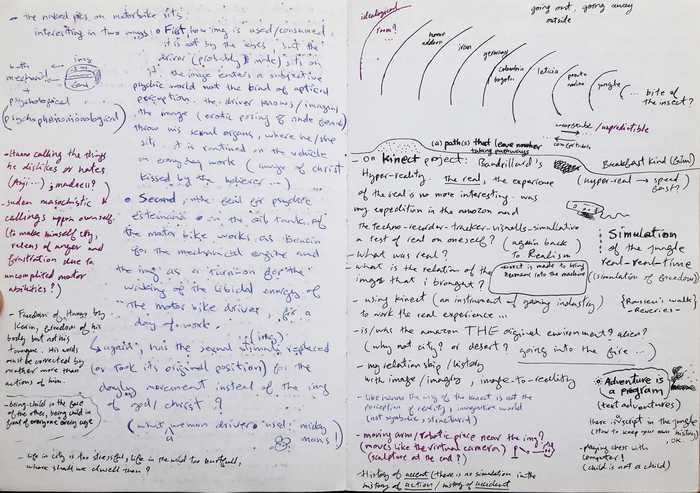
Colombia motorbike sits, libidinal energy of bikders, naked photo, Christ kissed by believer. freedom of Hanno dislikes. sudden masochistic callings. being child. going out going away, room, Iran, Germany, Colombia, Leticia, Puerto Narino, jungle, bite of the insect. kinect, Baudrillard hyper-reality, techno-recorder-tracker-visual-simulator, real-real-time simulation of jungle, kinect made to bring human into the machine. adventure is a program. there is a script in the jungle. how to keep your own history. child is not a child. history of action / history of accidenct
- 🔎
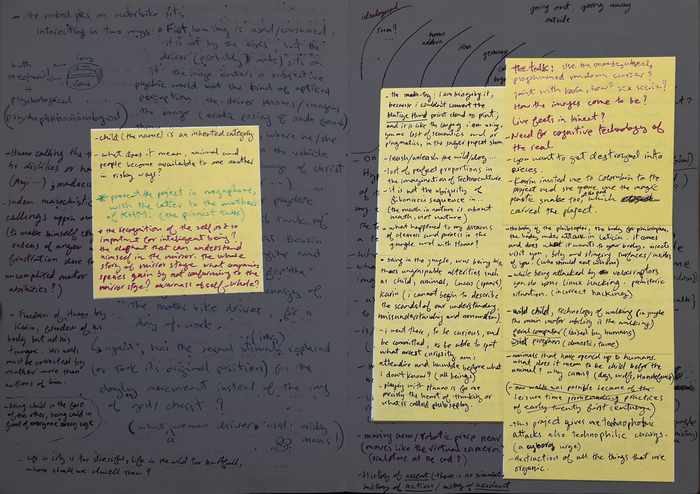
name of the child; animal and people become available; megaphone, KHM mothers; pianist talk; self recognition, intelligence, elephant, mirror-stage, whale story, awareness of self-whale; snake toy, blutige Hund, semantics, playmatics, puppet show; leash/unleash the dog; loss of perfect proportions in the imagination of technoculture; fibonacci nature; what happened to my dreams of cleanness and pureness in the jungle and with Hanno? being with Karin; I went to amazona to be curious and to be commited, to be able to spot what arrest curiosity. playing with Hanno is philosophy. kinect, cognitive technology of the real. you want to get destroyed into pieces. Karin invited me ti Colombia, and gave me the snake toy to think with. the body under attack in Leticia. insect visits you. it comes and does what it wants with your body. prehistoric incorrect hacking. wild child. feral computer. walking. what does it mean to be child before the animal? a cyborg urge.

