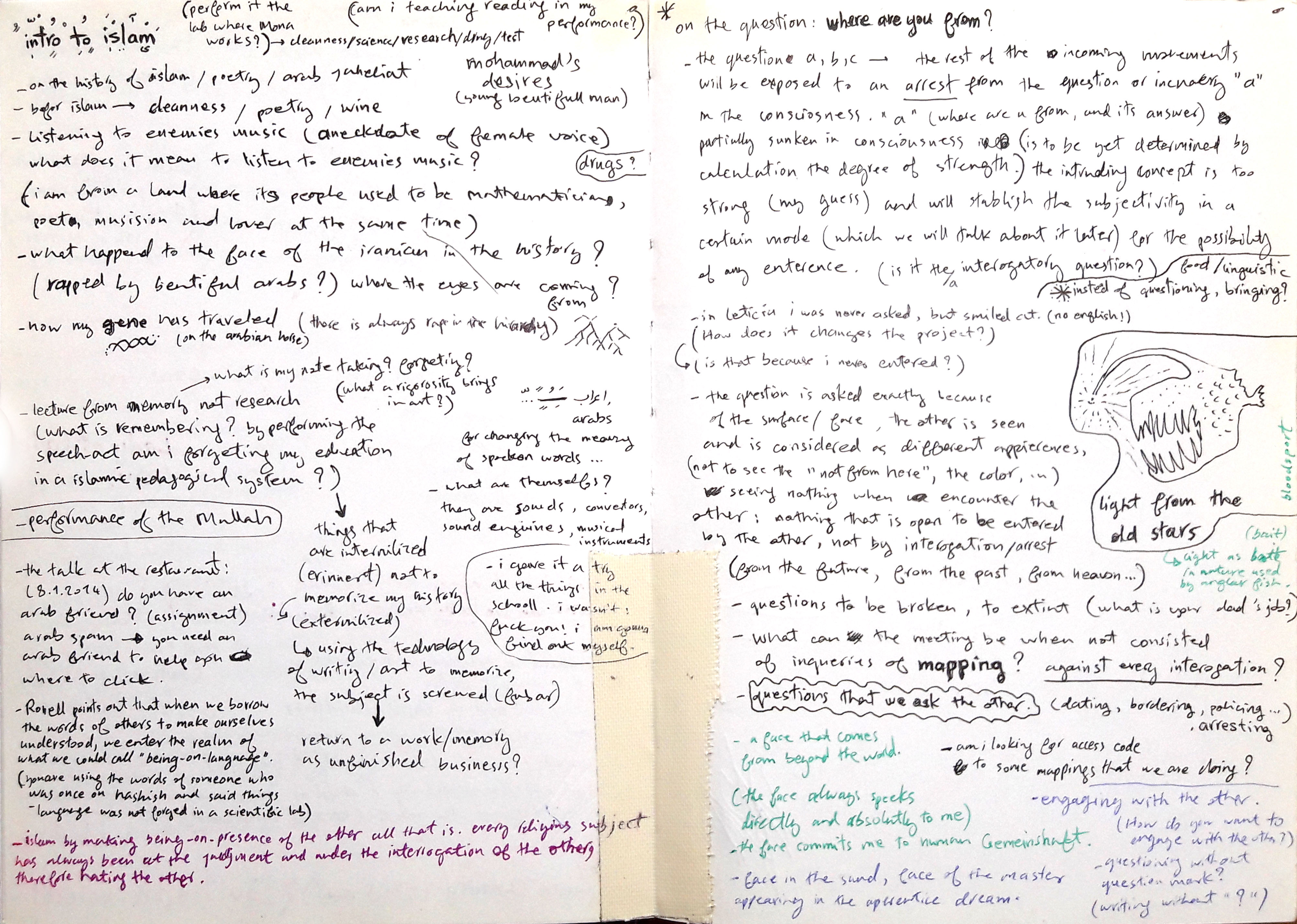
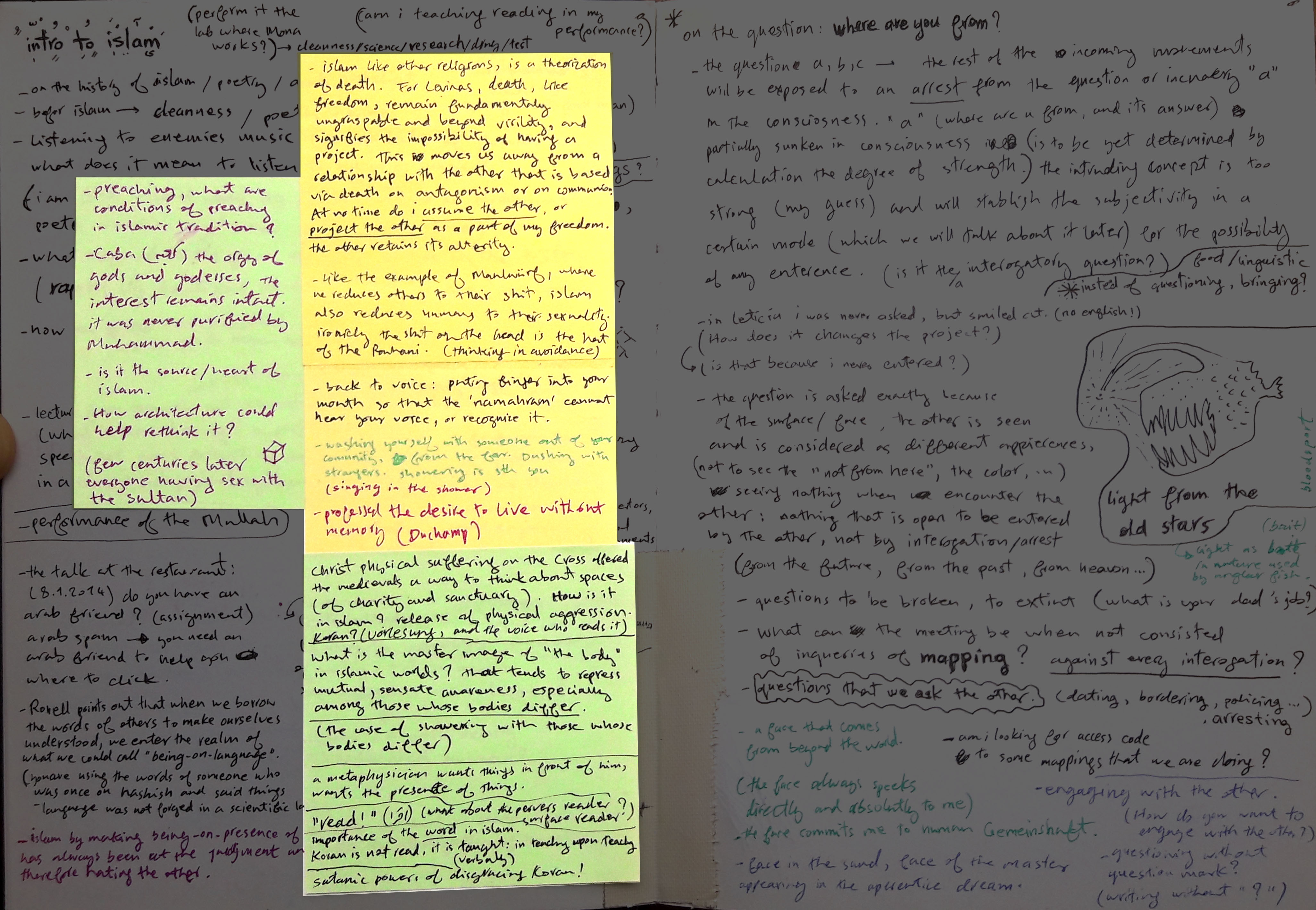
[...]ffirming impossible things” and bring it to the name of women. that means as soon as you name what you mean by ‘women,’ you have told some kind of really impossible lie.
(how my muslim trained sensibilities are working and mattering in my ajayeb research? ways to respond to *the deadliness and the irreplaceable liveliness of religion* [کشندگی و سرزندگی یکتای مذهب], a semiotics with implosion of sign and flesh)--> (i am so happy that) i cannot not know what it is like to be in a believing community (a faith-based community)***
...out of your own particular little historical traditions
*because my research is about ajayeb it can never only be about ajayeb*
you can't do feminist theory without paying attention to the details of women lives
your mode of attention to women in the world ==(shapes)==> your mode of attention to:
•the way databases get set up
•the ways interdisciplinarities get crafted
•how you think about tools and genomics
my main point of my project has been about getting better at how to inherit your histories without trashing them*** (even figuring out how to inherit a history that you don't want to inherit)
(Islam, shyness, kindness, ajayeb, Iran, stuttering, being all too ready to find complexities, )
•to become relaxed about predigested version of ‘this is what ajayeb is about’ (or Tasavof, etc.) --> ‘what is going on there’ (in ajayeb) is so built-in to ideologies of many kinds (of progress, deep ecology, of history, and so on)
•to build a little taxonomy (in apass)
•working to give up the series of self-certainties around secularism ==> giving ways to talk to the religious ones : getting to grasp what the world looks like in faith-based communities (=/= check-list of dogma)
•category thinking: get into differential liveliness (with all sorts of inequalities:) *who gets parsed how* [#archive, #articulation, #storytelling] (and thinking about what it means to take up these relationships in cultures saturated with science and technology)
Xiri was doing her research with categories of victim and opressor, and now they suddenly disappeared from her work. that category change or vocabulary change was suspiciously effortless
*remembering is an extremely creative practice (-note to Hoda-)
memories are like ecotone کناربوم (transition area between two adjacent ecosystems)
#(very important concept partly shaped by practices of Darwin into our lives:) “collect” --> lies (necessary?)
the frenzy of the 1700 of surveying nature and collecting speciment ==> bioinfomatic
‘collect’ promises nontransformation
--> metaphors of archive, information-intense ways of thinking about life on earth
*“demonstration” coined by science
[...]
(1)[...notes/midday review.txt]%8.4[...]s’ are often imported)
(Assmans's) *mosaic division*
(=/= a sort of relaxed attitude towards truth)
divisions ahad never beed asked before whether or not they were the “true” ones. they could be added to one another, translated into one another, piled on top of one another for additional safety --✕--> *contesting the claims to existence of all divinities but one*
==> a connection between the question (irrelevant until then) of worship and a question of an absolute (=/= relative) difference between true and false
[*]iconoclast: “if they are made, then they cannot be real”
monotheism ==allowed==> humans to escape from a too close adhesion چسبنده to the natural world
Moses's project ==> we have exctracted ourselves from the world
(Assmans:) without the transcendence of monotheism we would be left with the mere immanence of the natural world *** [--> the problem of transcendence/immanence as only options of relatedness]
(a bad story:) secular narratives that: the stark immanence of the natural world will save us from an escapist adherence to the transcendent world of beyond [--✕--> my Zolmat text is was about the problematization of that view (transcendent world of beyond) in Islamicated ecological consciousness in ajayeb]
****to move from ideology to recognition**** (of the many different contrasts we have lived by without granting them enough room)
the drab and entirly mythical drama of light overcoming darkness
religious traditio operates by its abilities of two transformation:
1. a radical transformation of the far away into the close and the proximate [#Zolmat] (dead is alive)
2. a positive view of all artificial transformations (=/= tendencyo conserve what it is)
**what happens if religion is allowed to weave its highly specific form of transcendence (salvation?) into the fabric of the other two modes of existence: reproduction and reference?
Leo's dream (and also deep sin): the urge radically to transform *that which is given* into *that which has to be fully renewed* --> alternative, dream of a different world
[=/= to grasp this world (and only this world) otherwise]
...................................
look at spec over the spectacular
(in ajayeb)
i can't give you a dialectical conclusion
maybe a mouth-full
...................................
[Paul Shepard]
our perception of animals as the language of nature in Thinking Animals and The Others; the “natural” way of childrearing in Nature and Madness; and the bear as a dominant sacred animal connecting people ceremonially to the earth in The Sacred Paw.
Octavio Paz reminds us: “The past reappears because it is a hidden present. I am speaking of the real past, whic[...]
(2)[...notes/Ajayeb notes.txt]%13.6[...]transcends, beyond any other abstraction. ==> first light is originated from it: anvare ghahere انوار قاهره (~= anvare fereshtegani انوار فرشتگانی) ~= first maleke mogharab ملک مقرب (or Bahman بهمن, Vahumane وهومنه, first of Zoroastrian Amshaspandan امشاسپندان) ==> (due to their interactions:) second light, second maleke mogharab is created ==> eshragh اشراق ==> eshragh ==> eshragh ==> ...
جسمیتشناسی jesmiat-shenasi?
رب النوع rab-ol-no ~=? God of type, of abstract examples, (Plato's universals? type, general concept --> is always beyond the horizon, the reality of the type lies beyond a related one that it sustains (‘token’) ["Beyond the horizon there lies a Lion, a Lion more Lion than any more lion. And beyond saying ‘lion,’ which calls forth that Lion, lies yet another, who might just look back. And beyond this eyeing one, lies an undying one, one we call ‘Lion’ because she is a kind.” (Kohn, 2009)] --> apply this idea to the fire)
ارباب الانواع arbab-ol-anva ~=? angelology (iranians loved angels and were good at angelologic thinking, it was a technical term in knowledge production regarding *categories and types*) --> Platonic + Zoroastrian + (shiite) Islamicate [via Sohrevardi] cosmologies
-the angel/type that both emerges from and sustains the many lives of its many tokens (~= tashasho تشعشع).
according to ancient iranians, rab-ol-no or the type-God decided its own destination (calculation of its own destiny), but there was no correlation between the ‘type’ and its ‘token,’ there is no whole being created, there is no individuality being created. this general type has its own intellect/sense/reason (sho'ur شعور.) their relationship is of rage and love (ghahr قهر and mohebat محبت,) according to Sohrevardi.
-what question is posed from somewhere (slightly) beyond? a question includes the likeness of its answer (Kohn, 2009)
-the angel of type is all about ‘being in futuro,’ which captures the logic of life's continuity --> “over the horizon” houses this “living future”
-What is the relationship between this angelic world beyond us and the sociocultural worlds we construct?
-“mosol” مثل : the realm of objective “stuff” that exists out there beyond us, on the other.
*Barzakh برزخ =/= anvare pak انوار پاک (pure lights)
Barzakh = seperation, obstacle, pardeh پرده, veil, (shadow? mediation?)
-everything material that can be addressed sensually, an evil negation.
-Barzakh is dark (that is a different kind of Barzakh than what i talked about with Mi? not really, there it is theorized as *shadow* and inter-mediation)
-projections happen in Barzakh
[from MOP with Mi]
We both take interests in morphology of historical forces and intensive thinking under the influe[...]
(3)[...notes/Ajayeb notes.txt]%14.1[...]al, manegerial, capital, ]
(protestants that were never burnt enough)
we (always) remain in contamination [never in innocence --> be attentive to the tropes and will to innocence in each other act text]
in our questioning and studies we (must) remain enmeshed, in a historical conjunction, in a situated way of being “this way” and not “that way”
...................................
[Stengers]
[a kind of] writing (not writing down)
writing is an experience of metamorphic transformation
to discover how to be compromised by ajayeb Nameh
the ways we can be lured into desiring and trusting it
how the assemblages of ajayeb generate metamorphic transformations in our capacity to affect and be affected? --> to feel, think, and imagine
...................................
[Serres]
ajayeb, a time when transport and itinerary were only myth
...................................
[Anand]
the sanctity and blessing of Muslim saints was integrally linked to local ecology and topography
that sanctification of birds and stones alerts us to an Indic and Islamic vision of humans in which we are not separated from and hierarchically superior to nature. Rather, the boundaries that separate stones, animals, humans and gods are porous as well as being non-hierarchical--making possible a “lateral” moral aspiration, where birds and stones can be moral exemplars for humans.
The interlinked sacrality of both ecology and cosmology, of ‘kudrat’ (~ power of nature?) is common to both Hindus and Muslims. ‘Kudrat’ is thus the cosmological aspect of north India's Invisible Religion.
There is a long Islamic tradition of seeing Nature as full of the signs (ayat آیات) of the work and presence of God. The Qur'anic verse “Withersoever you turn, there is the Face of God ( Qur'an 2: 115)” has traditionally been interpreted by the Sufis as meaning that the “order of nature is nothing but the Divine Reality manifesting itself on the plane of phenomenal existence (Nasr 1996, 62).”
description of the garden ---- [accounts of the heaven are filled with descriptions of springs and wells, tanks and streams, gardens and trees and flowers] --> recreating of heaven on earth was tight with natural and animal life forms
where a text or these texts (ajayeb's text and world) is *acclaimed*? today and before, by who? Indo-Pakistan sub-continent? South-Asia? Indo-Iranian regions?
***([who were the] agents through which ‘natural’ responses [to its impulses] are said to operate[?])
the hierarchy of created things [...]
apex in the righteous man, reaches down into the abyss of the inanimate by many gradations (Benjamin 1969b, 104)
“undiminished contac[...]
(4)[...notes/Ajayeb notes.txt]%15.8[...]ing is an experience of metamorphic transformation
to discover how to be compromised by ajayeb Nameh
the ways we can be lured into desiring and trusting it
how the assemblages of ajayeb generate metamorphic transformations in our capacity to affect and be affected? --> to feel, think, and imagine
...................................
[Serres]
ajayeb, a time when transport and itinerary were only myth
...................................
[Anand]
the sanctity and blessing of Muslim saints was integrally linked to local ecology and topography
that sanctification of birds and stones alerts us to an Indic and Islamic vision of humans in which we are not separated from and hierarchically superior to nature. Rather, the boundaries that separate stones, animals, humans and gods are porous as well as being non-hierarchical--making possible a “lateral” moral aspiration, where birds and stones can be moral exemplars for humans.
The interlinked sacrality of both ecology and cosmology, of ‘kudrat’ (~ power of nature?) is common to both Hindus and Muslims. ‘Kudrat’ is thus the cosmological aspect of north India's Invisible Religion.
There is a long Islamic tradition of seeing Nature as full of the signs (ayat آیات) of the work and presence of God. The Qur'anic verse “Withersoever you turn, there is the Face of God ( Qur'an 2: 115)” has traditionally been interpreted by the Sufis as meaning that the “order of nature is nothing but the Divine Reality manifesting itself on the plane of phenomenal existence (Nasr 1996, 62).”
description of the garden ---- [accounts of the heaven are filled with descriptions of springs and wells, tanks and streams, gardens and trees and flowers] --> recreating of heaven on earth was tight with natural and animal life forms
where a text or these texts (ajayeb's text and world) is *acclaimed*? today and before, by who? Indo-Pakistan sub-continent? South-Asia? Indo-Iranian regions?
***([who were the] agents through which ‘natural’ responses [to its impulses] are said to operate[?])
the hierarchy of created things [...]
apex in the righteous man, reaches down into the abyss of the inanimate by many gradations (Benjamin 1969b, 104)
“undiminished contact with the creatural, even with its petrified, inanimate, lowliest stratum, that of the stone… (Hannsen 2000, 150)”. The righteous man's justice consists of his attentiveness to nature, of his giving a hearing to all created things, of understanding the language of even of inert, petrified stones. But the righteous man, in Benjamin's imagination, remains a man. What would he make of Patthar Baba, the stone turned to saint? (Anand)
(our sense of) our own ecological peril and fragility--our shared fate with our neighbors.
[The ajayeb's[...]
(5)[...notes/Ajayeb notes.txt]%15.8[...]t just worked objects.
the capacity to respond and to recognize response
We can never do without technique, without calculation, without reasons, but these practices will never take us into that kind of open where multispecies responsibility is at stake.
Engage them [the dogs] as mindful bodies, in relationships of response?
the practical labor of nonmimetic sharing(?)
[we make ‘knowing’. knowing is always a practice of making, and always embodied. the idea that thinking involves disembodiment of the knowing organ is just insane.]
“articulating bodies to other bodies” ----> disarticulating bodies to rearticulate other bodies
entangled assemblages of relatings knotted at many scales and times with other assemblages, organic and not
...................................
ajayeb is system imagination
...................................
[Naveeda Khan]
Perhaps the question could be posed as, how do we come to grips with the universal, the supra-historical, or even the cosmos within our global present, imagining a local that lays claims upon all three?
is there a Muslim environmental imaginary?
‘Islamic ecology and environmental ethics’ --> the need to center a vibrant materiality or the liveliness of things in the anthropology of Islam (that has been to date largely preoccupied with Muslim polities and subjectivities.)
It should come as no surprise that my own efforts at centering materiality comes through studying how these predominantly Muslim farmers interact with and come to acknowledge nonhuman forms of life (including the figure of Khidr خضر, dogs, river waters, silt, and lightning, to name a few). Finally, I remain concerned to explore how the singularities of these lives, both human and nonhuman, come to be hitched to the global. This research will culminate in a book tentatively titled Ensouling the Anthropocene: Riverine Life and Climate Change in Bangladesh, in which “ensouling” treats the problem of scaling up singularity to the global, intensifying efforts that began with “Of Children and Jinn.” [source: https://culanth.org/curated_collections/19-everyday-islam/discussions/20-interview-with-naveeda-khan-about-of-children-and-jinn]
...................................
(what i am reading in ajayeb)_with Naveeda: “Muslim cosmology and eschatology hold promoise of ecological thought, providing an unexpectedly materialist perspective on our creaturely interconnectedness.”
[ajayeb (and telegram) is full of] gestures of incorporating repugnant [offensive to the mind] others---that one sees reflections on divine creation qua [als] creaturliness
thoroughly disabused
aufklären آگاهیدن آگاییدن
expound تفسیر
incentive مشوق, فتنه انگيز
[...]
(6)[...notes/Ajayeb notes.txt]%17[...]rs
How sin is strengthened 1657
Milk for babes 1661
A message from the spirit of truth 1658
realized eschatology
انا الحق, an-al-hagh
(Damrosch:) the performance of the sign thus entailed a doubly negative aspect: in the person exhibiting it, a conviction of fulfilling a divine mandate in opposition to personal self-interest; and in those who witnessed it, an offense to ordinary social standards that actually served to authenticate it.
*the function of the sign was to bear prophetic witness rather than to get practical results; it fulfilled its purpose simply by being performed*
#shath, shathiat ==> tazkirat, --->{ what the saints of Tasavof (reported by Attar-{his “virtual witnessing” of “awliya” اولیا as a “realized"}, Quakers [as illegal nonconformist sect]) put together was their own writing technology infrastructure** ==> **routinization of charisma** <-- organizational structure ["advices and queries” نفحات الانس nafahat ~-> rationalized systematic intellectualizations]}
pattern of suffering that the believer literally and personally relives
(is Tasavof developed Christian modality of sacrifice? is *passivity imported from elsewhere in Islam*?)
a protagonist, like San'an, like an actor in a mystery play, enacting in a deliberately challenging form, internalized and lived as a potent sign
(Bechwith:) rendered performance of religious materials both practically impossible and conceptually unthinkable
+ exercises their discipline of the senses and the imagination
*undisciplined loss of control in enthusiasm and in this extravagant example*
(stories of) a small group of powerful and vocal actors
***to attend to the local practices of inclusion and exclusion through which some speak and others are spoken for, some act and others are acted upon***
(#ontology)
gentlemanly practices --> (ask) what that legitimacy consisted in and how far it extended?
(wellborn connoisseurs of the new science)
leave the work tacit, and it fades into the wallpaper
•(Leigh Star's) ethnography of infrastructure
•(Bowker's) infra-structural inversion
•(Katie King's) ecology of writing technologies: massive, large-scale infrastructure in dynamic motion, bits changing at differential rates across time, made up of layered sub-systems complexity interconnected and animated by distributed agencies, including people, skills, devices and social powers.
the translation between ([my] deliberately) presentist (meta-)language (of cybernetic systems) and various local languages helps *to rescale particular objects of study*
(my research: “social studies of”) studying animal subjectivity --(changes the way)--> studying infrastructures --requires--> one to think (explicitly) ab[...]
(8)[...notes/Ajayeb notes.txt]%19.9[...]ppiness)
•core sphere
•orientation
--> practical action
•course of action
we come to have our likes, which might even establish what we are like. the bodily horizon could be redescribed as a horizon of likes. to have our likes means *certain things are gathered around us*
[what about “beyond”? =/= near-sphere Zolmat]
[*]orientation: registers the proximity of objects as well as shape what is proximate to the body
(Robin:) happiness does not have an object
(Freud:) anxiety does not have an object
=/= (Ahmed:) correspondence between objects and feelings is not any simple ~~--> proximity, “unattributed happiness”
[...] <-- ( us )"subject” --> ( ♥ )"object”
things --move--> us --make--> things ~~> ...
@Arjang, how happiness is displaced by the how of its arrival
(happiness can often recede or become anxious, when the feeling becomes an object of thought)
what it means for happiness to be thought in these terms (as an end for its own sake)
what it means for apparatus to be thought in these terms (of Agamben)
what it means for ocean to be thought in these terms (of Marialena)
in Islam, how does the good life get imagined through the proximity of objects?
[*]taste: “manifest preferences”: “practical affirmation of an inevitable difference” (Bourdieu)
history becomes second-nature ==> affects become literal ==> (we assume we experience delight because) “it” is delightful
(often with animals) the affective differentiation ==(basis of)==> (an essentially) moral economy
cheerfulness is the most communicative of emotions (♥ Ahmed)
(Ahmed's take on) loving (happily): knowing the peculiarity of a loved other's likes and dislikes, an intimacy with what the other likes and is given --> on conditions that such likes do not take us outside a *shared horizon*
***who/what introduces what feelings to whom?***
‘question of power' = do you go along with it?
sometimes the Iranian orientation is toward maximal comfort of the others
(maintaining) ‘comfort' = (your or some) bodies “go along with it”
bond-->{ affect ==> we search for an object }
...certain objects already circulate as socila goods before we “happen” upon them --> we do not just find happy objects anywhere (--> how happy objects are found in Tasavof? located, lost, transported, sold, advertised, criticized, etc.) *happy objects point us somewhere, a “where” from which we expect so much (--> happy objects of Tasavof [or HOT] {Qur'an, khezr, woman, poetry, .../ قرآن / خضر / زن / شعر}-->their sense of values, practice, styles, and aspirations; where do they point Iranians? beyond, Zolmat, animal, shadow, everyda[...]
(9)[...notes/Ajayeb notes.txt]%20.3[...]/>
the protector of spiders who dies by the bite of a spider
-susceptible bodies entagled in networks of care, life and death, that are not always harmonious to popular narratives of nonviolence
...................................
ajayeb: mythoepic literature in translation from a Middle Persian corpus
-when i say ‘Middle Persian corpus’ what i actually mean is a shared world of ritual, religion, and mythology between Iranian, Urdu, Turkish, Zoroastrianism in Iran and Vedic Hinduism in India, Indo-European inheritance in ancient Iranian culture, South-Southeast Asian literatures, translations and transcreations (and transliteration) of stories (prose, poetry, drama, epic, jokes, parables, figures [that are not always part of the canon], the irreverent بى ادب, ) in Indian and Southeast Asian contexts,
my project is about learning the ‘how’ of cultivating the ability to fruitfully approach texts from different cultures and pasts
-(to study) the radical poetic force of the Persian texts--in ajayeb
-to become enhanced and enchanted in skills of reading wider ranges of linguistic registers
-to open up an approach to a dauntingly complex region of islamicated thought (not the ideological enterprise of “Islam”, which is usually badly politicized in the historical memory of the West. we could get interested in the economics of corruption and technologies of rule, the evolution of government bureaucracies and classificatory schemes, anti-colonial critique,)
ajayeb is on the side of counter-classical traditions of standard Muslem-ness, and its less elite histories and cultural forms,
(intellectual identity:)
cross-dresser of the order
autodidact odds
sufis, merchants, nomads, poets, pilgrims, smugglers, laborers,
religious identity, religious knowledge, religious violence,
medieval persian mysticism:
•oral, temporal nature of speech
•speaking I to the unknown and unknowable Other
•the discourse of love
•apophatic discourse -->? politically subversive
•linguistic fragmentation, edges of meaning
•
...................................
dense and textured stories
(generativity is fueled by) densely felt textures
worlding of the place:
•the material, sensory labor of attending to an emergent and enduring hum
•the force of things amassed of phantom limbs
•actual residue of people “making something of things”
direct materiality of people's shared sense = attending to what is happening
a racist violence in the dark
a space of condensed displacement
watching things arrive in the company of others
*nameable clarities:
•family
•friendship
•love
•collapse
•laughing
•telling stories
[...]
(10)[...notes/Ajayeb notes.txt]%20.7[...]ochism and exorcism
demonic influence
genres of transfiguration and metamorphosis
Christensen shows how those who were once identified as witches are now the objects of medical and social concern in modern life --> shows the potency of her various forms over time
--> Baxstrom + Meyers
(my work on ajayeb is based on that) [there is a largely] unacknowledged historical tendency and predisposition within the human sciences with roots in much older practices of:
•defining social facts
•discovery, interpretation, production of the real itself
[such as bestiary]
method that allows the researcher to sense
interpret and master forces that appear to be nonsensical (yet held to be present: held to be essential to the reality of everyday social life) --> an epistemological concern
privileged space of the irrational in medical discourses in 19th century: (Jonathan Strauss -->) irrationality (nonsense) was a legitimizing force for medicine in that the very incomprehensibility of the mad created a mysterious and extra-social language that the rising medical profession could adapt to its own purposes
“nonsense” of “the native” [--> my start-up engine in Islam lecture series, a privileged site of mysterious incomprehensibility allowed me to to form the methodological basis for a fieldwork for unknown forces of irrational life in distant societies...]
*anthropology: (a distinct human science from the desire to credibly) master nonsense*
(Baxstrom + Meyers)
anthropologists claiming to have assumed the “point of view” of another (~ fieldworker must achieve the cultivated sensed point of view of another) --> distillation of method & disposition (?) <-- when confronted with the question “who are you?” and “what do you do?”
(according to Malinowski: this) privileged relation to the unknown must emerge through the ability to test what is asserted to be real --> a series of subjective trials subsumed within the rubric of “fieldwork”
*presumptions:
•experiential disposition of the analyst ==> understanding of a phenomenon other wise held to be imaginary and fictional
•witnessing and testimony ==> evidence as to the reality beyond the direct experience of the researcher
([Malinowski updated and secularized a much older epistemology of] Luther:) faith = a commitment to the representation of a truth --> Western Christianity's own efforts to discern truth and the nature of the world
proliferation of witches in 15th century Europe
reassuring relief for the pious believer: force Satan (and his followers) from the shadows through an interpretive expertise over the concrete secondary manifestations of God's reality --✕--> (most had no luxury to imagine) *the embrace of life that the devil urges in binary opposition to that of[...]
(11)[...notes/Ajayeb notes.txt]%29[...]-undergone considerable mutations--) by means of our adherence to the imperatives of... trial by fire(?), test of the beyond. ==> our relation to (explanatory and descriptive) language, truth, process, and identity. (---> go to Ferdosi's poetic site)
what kind of grid the fire produces?
beyond cannot be tested, it tests you***
testability? we want everyone and everything tested
after testing the fire...
monitor time according to the pulse of German/Iranian Idealism/Metaphorism,
[God] singular infinity (~= beyondness) --> [death of God] unlimited finiteness
the temporality we associate with informtion technology is originated with fire
what ciruits are installed by this?
how the mediality of talking fire designs an actual real materially enabled?
what reality has stood its ground since Siyavash trial?
what form of trial discovers, exposes, establishes, or perhaps even invents the ground (on which Sudabeh has no standing)?
how my threading between black-box, darkness, and beyond helps us to spot those figures that makes claims of absoluteness?
(energizing the creative imagination in Iranian Islamicate phiosophy?)
interpretation <--?--> experience
fire-tech conscience translated and sublimated into a scientific conscience?
-transvaluation
...................................
[Serres]
technologies concerning heat--thermodynamics--shocked the traditional world and shaped the one we are working in now.
...theories concerning processes of transformation
...stages of alchemical initiations; archaic figure of fire
(ice and fire) is only relatively cold
fire, and transcendental subject
[my body lives still in that space that the society of sudabeh-fire-siyavash has formed, with fixities and social variieties. it is not an euclidian house.]
siyavosh/sohrab is one of the descendants of disseminated spaces, of catastrophic separation of the continuous
when Rostam recognizes the mark of his son, Ferdosi giving a version of recognition scene, connects --> Oedipus
the son, the mother
-we can recognize a typological space: the same and the other: the separated
-the space of the world is described requiring connection
-family tree
-parts are to be joined
-Rostam and Sohrab, Siyavosh and Sudabeh, cannot be composed to form a single homogeneous space. (Rostam and Siyavosh do that)
transsubstantiation
...................................
the “call” comes from me and from beyond and over me.
...................................
against the curtain of fire trial stands a stack of iranian proverbs about stone triggering o[...]
(12)[...notes/fire notes.txt]%41.8[...]orms? What are the operations that connect the form-embedded self to the others?
4 billion years ago, the gravitational force of a mass of hydrogen atoms accumulated into a dense point of critical state. As a result of this formation new fusions released many sip-offs of different energies and materials which we perceive today in our bodies and in the light that reaches our eyeballs from the time immemorial of that hydrogen cloud. This fossil of materiality implies the existence of traces of an ancient reality before the existence of the familiar--the terrestrial life. While these traces are gauged in theoretical experiments in which radioactive ratios of nuclides inform us of such ancestral events, in Amerindian cosmogonies not so differently steered hypothesis are explored. Yawanawa, the origin myth of the people of Pano from the western Amazon, imagines the anterior of the world where nothing existed, yet there only people existed--everything was made of people. Before the diversification and classification of kinds there was a primordial human, as the only substance of which everything eventually fabricated.
Like Yawanawa, Hayula (Persian: هیولا) literally in today's usage with the meaning of unformed monster, is a technical term in Iranian-Islamic cosmology indicating the first principle of everything material of which all other constitutive layers of beings are molded--minerals, plants, animals, etc. Hayula in one hand locates the lowest of the lowest, the bottom of the scalar existence where God resides at the very top, and on the other hand possesses a great anatomical plasticity, a persistent pre-cosmological being that undermines the second law of thermodynamic. First were the object then came the subject--to give away to the results of the stabilization of the infinite potential for transformation contained in Hayula, as universal substance, a matter out of which the world could have come to be formed.
The narratives of the time before form, an era of pre-cosmological beings, primordial people with unlimited and unbound corporeality, is the story of the originality of Hayula's virtual potential for being. Hayula, not fully human, tasting beyond morality (destruction, anthropophagy, etc.), becomes the subjects of other interventions and morphs into spheres and features of the world--of biological aspects, celestial bodies, humanoid zones, etc.
The realm of Hayula comes to interpret, and thus permit and strain, who and how an I can be, at the same time that it provides the vessel for the continuity, the survival, of that I. Here the I is the continuity of an inhabitation of a point of view. It marks a relative position within a hierarchical logic that spans the cosmos, a hierarchy that ranges from the nonhuman to the human realm and from the demons to the realm of the formless. Following the classic joke, that one goes to a place in order to discover the directions of how to kee[...]
(13)[...notes/hayula notes.txt]%43.7[...]ger crowns the end of a labored process of appropriation =/= Western narratives of testing
going after the grail or attempting to reach a metaphysically-laden Castle
...cannot be properly located or possessed
the inaction hero
(?are we accustomed) to viewing the test as a way of mobilizing courage
The Sphinx marks the porous boundary between Western and Eastern domains of questioning and tells of bodies menaced by pulverization: should the riddle not be solved, either the questioner or the questioned must go. Passing the test is a matter of survival of the species for Oedipus, as it is for the interspecial dominatrix of the riddle: la Sphinx dissolves when the young man offers the correct answer.
=/= koan
...................................
My performance here is maybe a form of prayer or invocation[8] not simply to be read as a mere theoretical and discursive statement, and is intended to be a table of digital curses. To reopen the agency of curse in a cultural style that I have come to encounter, it might produce a different but not necessarily better speculative difficulty in discussing about the virtual. A curse[9] (according to Iranian-Islamic mixture of traditions in the milieus of promising and swearing,) is basically a networking function with both mechanical and interventionist properties that translate desire into performance—an intersubjective textual momentum that run virtually into the real world and it may (or may not) run down its target. Much like rumor, curse is contagious and reproductive but unlike the publicity of rumorous velocities, curse insists on secrecy at the same time harvesting its powers for revealing. The reality of the ‘curse’ is ‘assumed’ mostly and that is the virtual nature of this relation (with the materialities of the world that curse inscribes on) that I am interested in.
Curse systematically works with names, to be more accurate, with the notion of the “proper name”[10] invested in the idea of an automatic function that shifts ‘name’ to ‘agency’, virtual to concrete. That is if one knows the proper name, one could raise all actual agencies that act with real consequences—slogans in politics may rely on this typical power of cursing. In the Amazon I was not looking for the proper name of nature, neither theological nor analytical nor the supposed accidental. That means (looking for ways) critically not to be real.
An extended concept of cursing enters visuality in the gaze of the evil eye.[11] The malevolent glare who stamps upon by staring at an accidental moment of encounter in the evil eye, brings together the narrative of the random traveler who casts a gaze in another world of virtual and visual agency, and emphasises the randomness and hideousness of looking. The transaction between the eyes in [...]
(14)[...notes/notes.txt]%49.9[...]lue and intent in which speech actually occurs.
my original repetition
we re-enact in our educated consciousness
in what sense does unperformed music exist?
The same ground, when using the ‘speculative instruments’, the critic, editor, actor, and reader stand on.
When we read or hear any language statement from the past, we translate.
Encode and decode “message”, misleading operative models of translation between different languages and even within a single language.
One treason in translation: words rarely show any outward mark of altered meaning, they body forth their history only in a fully established context.
What material reality has history out of language? --the tasavof verbal linguistic tradition
silence knows no history...?
...to remind you that everything is the condition of madness.
“Tense Past”
..the landscape composed by the past tense, the semantic organization of remembrance... is styled and coded differently by cultures. --miniature illustrating San'an?
The verbal icon made up of all successive translations of Greek literature and philosophy has oriented fundamental movements in Islamic feelings --Farabi, Mirdamad, etc.
My translation of classics is not out of a vital compulsion for immediacy or precise echo. I am not trying to build my own resonant past. Myth of the ‘true past’... different perspectives can co-exist and blur
the metaphysics of the insult, in San'an story
i am interested in the conventions in which texts can be read, in which a semantic statement can be carried over into someone's own idiom. I am teaching how to reread texts of Attar and so forth.
We have civilization because (we have learned) ‘to translate out of time’
übertragen,
handing down thought narrative,
something that also depends on transfer of meaning in space.
Languages conceal and internalize more, perhaps, than they convey outwardly.
Speech-act is most expressive of status and power--when a peer is in earshot. (something that i have been trying to undermine in my lectures)
...calculated to guard some coherence of inner life (while wounding outward)
(motions of) menace and non-information (in top down dialogues)
monosyllables of the oppressed and polysemy of the upper class (the capacity of the same word to mean different things, such differences characterises the language of ideology.)
fracture of words and the maltreatment of grammatical norms, by children, they are a exploited and rebellious class, the child seeks to keep the world open to his own, by refusing to accept the rules of grown-up speech.
Lear note: surrounded by incomprehensible or hostile reality, the child breaks off ve[...]
(15)[...notes/notes Hermes.txt]%50.1[...]ulary without a pause for explanation or so much as a simple definition.
“...a mapping rather than a tracing”
“What distinguishes the map from the tracing is that it is entirely oriented toward an experimentation in contact with the real. The map does not reproduce an unconscious closed in upon itself; it constructs the unconscious”
“It fosters connections between fields, the removal of blockages... “
(removing some blockages of meaning-lock in San'an)
my lecture, emphasizes the rhizomatic to foster imaginative work that challenges typical critical forms.
not to overlook the working of matters, and the exteriority of their relations.
(in a book, a lecture, etc.) there are lines of articulation or segmentarity, strata and territories; but also lines of flight, movements of deterritorialization and destratification.
(what are Attar's Sheikh's actual authority as a teacher?)
(George Makdisi: “Madrasa and University in the Middle Ages”)
[...] “Perhaps the most fundamental difference between the two systems is embodied in their systems of certification; namely, in medieval Europe, the licentia docendi, or license to teach; in medieval Islam, the ijazah, or authorization. In Europe, the license to teach was a license to teach a certain field of knowledge. It was conferred by the licensed masters acting as a corporation, with the consent of a Church authority, in Paris, by the Chancellor of the Cathedral Chapter... Certification in the Muslim East remained a personal matter between the master and the student. The master conferred it on an individual for a particular work, or works.” [...]
feeling cool and correct
(in) a parasitical golden age
what is “education” in a mystical world (or actually a mystical world-view)
how can be undermined or rewired, (“teaching” without education)
magical idealism
from Delphi-magiscism to the San'an
(does San'an actually wants to go to Greece?! but went to Italy?)
اقصای روم
the space we are founding ourselves in is not neutral, not innocent, not un-signed
it is paid for, has a certain architecture, (phallic work)
the intellectual mask...
semiotic of learning and thinking
(Maulwurf,) shit on your head, shit is the origin of all gifts, when a child offers his first donation, “look what I have produced!” I honor you with this Kacke.
--> http://www.sinaseifee.com/VomkleinenMaulwurf.html
how can we bring the variety of animals into the singular butterfly metaphor? (Attar's bird's butterfly effect)
Schmetterling! (parvaneh - پروانه)
(‘schmettern’ in German: v. smash, shatter, slam; blare, fanfare, bellow, roar) --- in schmetter[...]
(16)[...notes/sanaan full text.txt]%52.9[...]>
(an existential evacuation)
committing oneself to erratic wanderings in the desert => translation of a familiar topology into an ontological modality?
the extravagant paradox of proximity and distance
(interiority and exteriority, presence and absence)
civilizational taxonomies (--> versus animist taxonomies, in Attar's animal-birds)
the (sacred boundaries of mysticism) and mystic boundaries of the civilized city
the peripheries of the city became mystic/sacred
mystical channels*
they present worlds immersed in a kind of constructed a priori
two irrational analytical strands:
(1) to isolate the rare technical and conceptual arsenal behind an ethnographically imagined space (San'an's biography missing in Attar's Tazkirat al-Awliya--Attar's obsession with biographies, he is drugged by bios, totally high---he can't let go of them, he cannot detach from the absents, the paternals? his master-complex? has he forgotten to mention his teacher, San'an, in Tazkirat al-Awliya? --Attar is himself San'an? drugged and doped by tastes and spices of his shop, his establishment. OR San'an is Ibn-Sagha (ابن ساقا)? (Ibn-Sagha was a Islamist jurist who lived in Baghdad 11th century, lived Muslim and died christian.) Attar's engagement with remembrance and bios --> is the San'an's narrative also about forgetting? Tazkirat (تذکره) --> Tazakor (تذکر) --> remember! --we are now on how Attar's San'an influences Hafez--(حافظ) The Memorizer. Hafez loves the story of San'an the non-memorizer, San'an loses his ‘hafeze’ (حافظه). (according to Hafez and San'an, the best student is the one who doesn't remember. precisely because they are trying so hard to remind San'an of what they thing ‘he’ is) --> [Indian MATSYENDRANATH amnesia tale, tells the story of a yogi who falls in love with the woman kind--one of his students puts makeup and dances his memory back to him. he must become the woman. there is a queer moment in the origin story of the San'an, which Attar censures(?). he erased his name from the black-list of death-‘the forgottens’, then danced for him as a woman-story-teller. (muse is the mother of memory.) the class struggle has obviously a Bollywood touch to it]-->Attar's source and storage?)
regarding Hafez and San'an, the poet must leave the home, the poet must travel foreign zones, and stay in the foreign. (this is, by the way, Heidegger's reading of the poet.) and that is also one Heideggerian poetic demand that Hafez is failing to reconcile with, when he is turned back, not having the balls to cross the Indian ocean.
(2) importance of an elite rhetorical plane
initiatives towards the horizons of a mystical inquest
(cinematic) mystical landscapes
(what kind of mystical landscapes I am exploring in San'an's story?)
[...]
(17)[...notes/sanaan full text.txt]%53.4[...]psychoanalysis (?)
positionality, placements, displacements
a system that doesn't have access to its own knowledge
historical struggle for the definition of the real
I can't keep clean boundaries
rituals (of promise and contract), (things that) must address anxiety --?--> a religious stamp
what is the San'an text promising the Other? (like every text does, every utterance)
what it cannot *not do?
my childish playful inventiveness and its relationship to weakness.
so I come up week, saying ‘let us do this or that,’ but that is a will to power (?)
we are here to understand the appropriation of meaning.
what does or does not belong to the protocols of reading, etc.
(think in terms of de-appropriation, which entails a form of rigorous hesitation when assuming responsibility for the work or thought of another) is that what I am practicing encountering the work of Attar? as an ally or ancestor or an unknown sidetrack of writing
different modalities of love and loving
I guess what I wanted to ask you is your love
I have been teaching Islam to you?! in a shattered and transgressive way
of course this not teach-according-to-definition
of course every demand is the demand for love
the SM-inserts in San'an story
he is asked to perform some serious Sado-Masochist interactions with nonhuman animals, his favorite book, and Tarsaa as stage-manager
we are left with the task of reading the enigma of something that no longer is. if things ‘were’ we wouldn't need to be thinking, reading, running after them.
(I am reading the enigma of something that no longer is)
precisely Bayazid defines Tasawwuf/Tasavof as something that ‘was’ and had no name and today ‘is not’ and has name.
I am taking in terms of constructions and phantasms
everything that comes at you, which is persecutory, is absorbed. that being able to crucified by the other.
doesn't have an experience to fire aggression
is it possible to be kind in a non-manipulative non-cognitive or non-calculative way?
San'an was booked “elsewhere,” he had a transcendental hearing, he had to take a call
[we should here study a ‘hauntology'---the science of morning-disorder. all prophets have it also]. haunt---the figure is neither present nor absent --> (and “real” presence has always been the religion's obsession)
از شبح به شیخ
از صنع به صنعان
صنع = fake, صانع fabricated, made-up, technological, dead, etc.
صنم = idol
صنع = eidolon
-(eídōlon, “figure, representation”), from εἶδος? (eîdos, “sight[...]
(18)[...notes/sanaan full text.txt]%53.7[...]ain civilizations there comes epochs in which syntax stiffens...
Changing landscape of fact
words, the guardians of meanings, are not immortal.
note on history: past is a language construct, that the past tense of the verb is the sole guarantor of history.
to read: is to restore all that one can of the immediacies of value and intent in which speech actually occurs.
What material reality has history out of language? --the Tasawwuf/Tasavof verbal linguistic tradition
...to remind you that everything is the condition of madness.
(protest against “was” ---> go to Attar's relation with biographies in Tazkirat al-Awliya---he mobilizes ‘personalities’ in the index of his mystic-ontological demand---what would the lack of personality take revenge of Attar?)
we are at a tense past and a past tense---prison tense
..the landscape composed by the past tense, the semantic organization of remembrance... is styled and coded differently by cultures. --miniature illustrating San'an?
The verbal icon made up of all successive translations of Greek literature and philosophy has oriented fundamental movements in Islamic feelings --Farabi, Mirdamad, etc.
My translation of classics is not out of a vital compulsion for immediacy or precise echo. I am not trying to build my own resonant past. Myth of the ‘true past’... different perspectives can co-exist and blur
the metaphysics of the insult, in San'an story
I am interested in the conventions in which texts can be read, in which a semantic statement can be carried over into someone's own idiom. I am teaching how to reread texts of Attar and so forth.
I think we have civilization because (we have learned) ‘to translate out of time’
übertragen,
handing down thought narrative,
something that also depends on transfer of meaning in *space*
San'an's sudden interest in the woman/child (Tarsaa could also be a young boy) reminds us the uniquely vulnerable and creative condition of the childhood
privileged inferiority (of both child and woman)
we are dealing with both intercourse and discourse
how his voice will change after San'an actually gets the girl?
...communication like breathing is subject to obstruction and homicidal breakdowns, under stress of hatred, of boredom, or of sudden panic, great gaps open ...that their previous understanding had been based on a trivial pidgin which had left the heart of meaning untouched.
What is the female speech in San'an?
-the breakdowns and translations in San'an story.
-The sexual translation and breakdown of linguistic exchange in San'[...]
(19)[...notes/sanaan full text.txt]%54.4[...]something other than the predecessor-successor or cause-effect pair (--> this order of structure is coming from Greek geometric,) I am trying an unordered order-of-reason that is more reflexive, symmetric, and intransitive. (the construction of the text represents each chain incomplete and displaced--Attar knows)
towards a general theory of significant sign
Can we correlate the Persian syntax with the metaphysical ambience, internal divisions, and lyric bias of Persian people?
the language-matrix
language, informed by energies proper to itself, more comprehensive and timeless than any who makes use of it...
discourse (die Rede) would not be muffled by the ground---we walk erect [Serres]
jede Sprache ist ein Versuch---*trial
(Humboldt)
different languages penetrate to different depths
--> (every try is a) starting over with *accuracy
ok, we are starting with language from scratch, here
Literaturhaus, house has always been a metaphor for consciousness
how Attar can become interested in other lives other that San'an's that are worth living?
although we see again and again in Islamic social order the hierarchical structured relationships, I like to show the otherwise in mystic stances, and argue that the model doesn't remain static normative from the master-disciple to the authority and dependence lock, that the master-disciple relationship doesn't affirm the divine order.
and San'an is also against the notion that Sufi man is without the need of a feminine principle.
we are presented with will of the Tarsaa, the destination of San'an, and the poetic representation is feminine. the female image is strong. although at the end it has to give up -- she converts to his style. the will of the disciple is not replaced by the will of the guide, the master himself doesn't have a will.
The Tarsaa is supervising San'an's diet, sleep, and speech
[I have become more interested in the term ‘tradition'---and more suspicious of preoccupations such as ‘invention’ as modernized and capitalist terms.]
tradition: an act of memory based on a salience-effect of shared knowledge
(ein Akt der Erinnerung basiert auf einer Hervorspringen-Effekt der gemeinsamen Kenntnisse)
-there is a sequence (where is the individual terms within it?)
-my storytelling is about: describing relations of inversion, extension, inclusion, analogy, etc. between mythical, lyrical, or even scientific ‘beings’ that are (1) *conventional* (recognizable repertoire), and (2) *closed* (refer to certain predefined situations and symbols)
==> I work-with and bypass with these aspects in Attar, Hafez, Ajā'ib al-makhlūqāt, etc.
the performance of ‘stop’ in San'an
sign-functions th[...]
(20)[...notes/sanaan full text.txt]%54.6[...]r the subsoil and the blood.) “Where is the interrogator's alley?” Where is hand to take a blow? Where is force until I cried? Where is intelligence to alert my maker?!”
Wisdom and patience go go go, sweethearts! This is what love is, what pain does is this.
Companions---to console him---were gathered that night. He cried.
@The companions said to him: “Apply skip to this obsession!”
@Sheikh said to them, “Tonight is liver blood!” he continued, “I washed a hundred times while unaware of it.”
@Where the other one said, “Tasbih! (تسبیح) When was that you worked right without Tasbih!”
@Sheikh said, “I closed up on The Round of Tasbih.”
@The other one said, “If you go wrong, repent!”
@“I had repent of:
•the honor of Sheikhness
•the honor of present
•the honor of impossible.”
@Another one said, “Knower of secrets, jump and pull your selves together behind the prayer!”
@Told the journalists, “The altar, to be anything other than my prayer!”
@The other in a long saddle he said, “Reach in privacy and worshiped God now!”
@“If my idol were here, would be beautiful to bow down before him.” said Sheikh.
@Another one asked him, “Do you not penance Islamic is a breath of pain?!”
@Said, “One regret is that I was not previously so in love.”
@Another one said to him “That is the way of duty. The heart suddenly shots up.”
@“If she told that way--Tough-Talk--because of his chest and beautiful.” He answered.
@Another one said to him “Whom became aware of that old would says it was misled in this way.”
@“I said the very name of the pretender; Glass tooooo the Stone!!”
@Another one said to him that “old friends, you left half of the heart.”
@He said that “since Tarsaa was a good kid, heart suffered from this and not ignored it.”
@Another one said to him that “to make friends, tonight we open up towards the Ka'ba.”
(**If the Ka'ba was not told sooner.)
@“My Ka'ba in late sober drunk...”
@Said another one, “This time a determined way, in temples I sit and beg my pardon.”
@The journalist said on its doorstep, “it is Will's apologize that hurts me.”
@Another one said to him “that hell is intercepted. Man is hell!”
@“If Hell is the way,” I said it, “Seven of Hell, burn me a sigh!”
@Another one said to him “that the hope of heaven? Go back and repeat saddle evil!”
@Said the man, “Is a paradise on now?! (of course!) - it is paradise this dormitory.” (--> Naaaareh)
@Another said to him that “the shame of the right with God?!”
@Said, “The fire in my right.”
@“That is...” another one resident said to him “Go! Open a believe that is believing!”
@“But I wonder blasphemy!” replied Sheikh, “Faith disbelieves faith.”
Because he did not speak work, that was the end of treatment.
[...]
(21)[...notes/sanaan full text.txt]%55[...]y life.
I survive rates of cheap dirt.
“Some moan on power, in the opener, but I blow to the self-confidant ‘now.’”
Sunny---from as far away as you think. Although such Sheikh of anxiety jammed in the sun.
Gordon went under to earn some. Yes, it is lost, from the head down.
I burned the ground. Fire burned the universal soul.
Flowers left at the foot of your love. Your enthusiasm on the left hand. The dream of my life: a few more of you, hides from me.
Said the girl from the age of idiocy, “Construction camphor and shroud now!” Because not attuned to cuff?
“Patrol, not going to the game?! In determination I am better than you! When will you find the kingdom?! Because you will not find bread.”
Sheikh said to him “tell another hundred thousand. I do not work but with your grief.”
Lover, young or old, impact on every heart that will love her.
if you are the women, you must have four cards:
1. false prostrates before idols
2. burn into Qur'an
3. see drinking-alcohol
4. observe the faith
(Sheikh's speech got possession of alcohol)
And the other three? I do not know.
What is this that you said to The Other/Girl?---Hands should be washed of parcels of Islam?
He did not paint his sweetheart. He does not love a flavor more than her's. Sheikh said to him that “if I command petty lives the circle of hair on throat...” Said, “Rise and come and drink wine!” Like to drink wine?--Come in roaring!
They took Sheikh to the late magi (a pre-Zoroastrian form of priesthood) as disciples came in screaming...
“Fire!” “Love him!” “Take the water!” etc.
(Tarsaa takes over this time, and did not mind a bit of intelligence, off the tail.)
Following his assistant, drinking, and the use of their work---because there was a wine, love, and sweetheart---it was one hundred thousand. Sheikh saw tooth as the opponent. Pomegranate Sheikh see his smiling trick, fire of passion in his life. Flood bloody hand. The will of the winds and writing.
The circle of her hair in his ears.
Notes of proximity hundred ballads in religion.
Professor was too much memorizing the Qur'an. He went on to claim he was bragging--recalled from *memory--the reasons that wine pumped away, Khomr (خمر), whatever that means. Clean slate blasted his conscience--Love the Beast! The general went to be cleared.
Sheikh, because he was drunk, not forced to love, he was a passionate kind of sea of life.
I saw these in the hands of the drunk fetish.
-Because of the Sheikh, hearts and hands could eat*
Until then that suddenly he asked her neck --> “Oh man! Claimed in love, not meaningful, only if you love walking on hard assets, religion bending the hair of assets, such Zolf (زلف) does not walk in disbelievers. Love do not come lightly.”
Bless was not compatible with Love. Love makes [...]
(22)[...notes/sanaan full text.txt]%55.1[...]hiped idols. Enough! Center of Khomr! People who leave the religion---without doubt this is the mother of all vices. Sheikh said that “the girl remained a sweetheart. All that has been said and what remains, Khomr ate!” Worship the idol of love! I saw one inch of love, and so Sheikh (would be exposed.)
Nearness was struggling to open the year Secret sea wave was in my heart.
Chest particle seek love from ambush.
Ka'ba gave birth to Don Juan's love: prominent wander unseen love.
It was all a bit too much.
Who are you going to get me?
Contact your building, because it is the principle.
I was connected to hope.
Contact finds The Familiar.
*Find a burn in The Separation!
Open the old! Girl said, “Heyyy ‘captured,’ my cabin is expensive and very poor for you! Gold and silver should know about me. When the wireless gold separates the fibers of the head, the sun shall be a person. Wait and be a Man!”
Sheikh said, “A tall cypress wire! To the head! Testament has no good. But you do not have one beautiful Negar (نگار). Finally, keep hands off these practices. Each tail of another type of tail. It had your blood without you. I was working on you. It was intercepted. ...were in love with each: Infidelity and Islam and loss and profit. You wait a few days. You did not like that with me. The friends turned against me, enemies of my soul. ‘He is such and such,’ because I am. Die was not me and not die, because I am. I'm an excellent nature---with you in Hell without you in Heaven.”
The sequel came because Sheikh, man, hell burned that month of her pain, said an unfinished ‘ever’. “I now keep racing pigs a year.” A year has passed, both together. To share in the joys and sorrows of life.
Sheikh's commands will give pigs a year. In hundred pig's anywhere, around dead pigs. You're a nobody, so that's no suspicion.
He was an old-enough risk.
---This risk is within each person.
Meal, that comes out of head's trip. If you are aware of their pig-finals: a hard excuse, that the Ra-man is final.
If you step on the path of forbidding the working-man, (both Betty and nose pig hundred thousand,) catch pigs!
Idols burning The ‘Why’ of Love.
Sheikh shows notorious love.
...also unable so, center of John unable to stay down. Because it caught him, of his help. He fled as ‘The Bad.’
In sadness he took over the territory. (Was helping Among the chest.) Sheikh was already at work, loose: “Today we are going to open the Ka'ba.”
What is the command that must be said in secret?
•Or all the time, because you're christians.
“We, scandal of his altar. We, dislike such you, alone. Around us you are like barbarism. You also fail to your vision.” Saddle earth, early escape without you.
We stayed at the Ka'ba's sit.
Sheikh's speech of my life was filled with pain. “Want[...]
(23)[...notes/sanaan full text.txt]%55.3[...]r pig-finals: a hard excuse, that the Ra-man is final.
If you step on the path of forbidding the working-man, (both Betty and nose pig hundred thousand,) catch pigs!
Idols burning The ‘Why’ of Love.
Sheikh shows notorious love.
...also unable so, center of John unable to stay down. Because it caught him, of his help. He fled as ‘The Bad.’
In sadness he took over the territory. (Was helping Among the chest.) Sheikh was already at work, loose: “Today we are going to open the Ka'ba.”
What is the command that must be said in secret?
•Or all the time, because you're christians.
“We, scandal of his altar. We, dislike such you, alone. Around us you are like barbarism. You also fail to your vision.” Saddle earth, early escape without you.
We stayed at the Ka'ba's sit.
Sheikh's speech of my life was filled with pain. “Want to go anywhere soon?” asked me, “I'm late, girl!” John increases all my fears.
(Both were inspired by my grief. )
Friends return, to what it will be. If they ask of us, right. From wandering to where is commonplace. Blood filled his eyes and mouth full of venom. Remained in the mouth of the dragon. Reza does not have any infidel in the world.
Ironically, old Islam is christian in her hair away.
He was a master of reason and religion.
His hair became ring in his throat.
“If someone is blaming me, tell him ‘Falls in this period are far. In such period, note the dead!’”
No one is safe from deception and danger, the pigs!
Insomuch that cried The Fellowship of Sadness!, the pain of living-shit shift dead.
Eventually they opened the Ka'ba.
John remained in the burning.
Their Sheikh in Rome alone. (Data for the christian faith.)
Then, the astonisheds with life, each one is hiding in the corner.
To assist Ka'ba, Sheikh hit it in the chest.
Devotion was in the hands of theof the thumb.
Enough was enough. @“You were not aware of the sheikh?! Sheikh's Ka'ba was (because of) the trip! As a disciple of Sheikh you return instead?!”
@“But Sheikh's deserted house was empty!” Open disciple of Sheikh asked.
Open the Sheikh all the time!
@“What happened to him was the center of a tiger. How much weight she came to head him? christians ‘hair to hair’ is the way of faith in him. *Love loses hair and tattoos forever. (Overall: the arrest of his obedience.) Pork watches him around the middle of the frame, although much on religion pursued our sheikh, ancient knowledge is anew.”
When disciples heard these stories, they surprised. And moan broke out on their gold.
@The disciple said “In loyalty neither male nor female, disabled men have a hundred thousand sweetheart and one day to work. If you were his friends, to Sheikh, why did not help him advanced?!”
Shame wind, was the last of this assistance.
[...]
(24)[...notes/sanaan full text.txt]%55.3[...] parts of any work left.
I ran man's way because of you. You on me, that I was never aware.
The boiling sea. I did not take my poor. Dean agreed, stuck my hands. Nobody does not help us.”
Sheikh was told from within of that girl christian, “Not familiar with our port, she fell this time on our way.
Go back before it pop idol! And tune up your paid companion.”
Sheikh while returning like wind, opened disciples’ salt---including the head of what was open.
“What's the new single and had repented and several more?! Once again, ‘love you’? Much you repent?!”
Sheikh told of his girl, leaving dead each that hear it.
Sheikh and his companions came days after opening, till it was the ‘smooth’ (Tarsaa) was.
When he saw the yellow gold, lost in rounds, intercepted her coma. Clean bare feet and torn clothes.
The men on the ground, for example. Give it a month since his Sheikh bet his epileptic sore.
Because it takes months in epileptic sleep. Sheikh growth of water.
It looked like the journalist Sheikh. Tears fell like a cloud of spring.
His promises. In his own hands and feet. Said “you burned my soul. I can no longer burn in the curtains of repentance, to be aware. Supply now Islam! (to be intercepted)
He launched the Sheikh of Islam. Fellowship bubbling sentence rejected.
Because it was the idol of the people exposed. Rain tears, the woman waves in between.
San'an, because he was the last governor, heard tasteful faith in the heart.
She was restless taste faith.
“My patience was Sheikh's vault.” Said, “I do not have any patience at parting.
Saddle go full family. Sheikh, Hajj, Pilgrimage, world, I will be as brief as speech, my poor... rather than an adversarial amnesty and not...”
This said in the hands of John, and was half dead. Her sun was hidden under cloud. Sweet life of girl parted, hesitated.
She followed a drop in the ocean.
The sea was actually open.
Including the world, it goes like the wind. He went and we all go.
Saddle such fall much in the way of love. This person is conscious, knows that love. Anything said may be intercepted.
Mercy, despair, deceit, and securely.
This can hear the secrets of the soul, Nasibat (نصیبت) cannot be won without balls. This is certainly the heart and soul, must be heard. Water
and mud reliance should not be heard. War was the heart and soul of
each tail hard. Dirge in that mourning was hard.
...................................
=================
...................................
his mental hygiene, through strange theological appartouses, is not standing intrusions and pollutants of the middle ages trans-religiousity and cross-boundry encounters between the dislikes and those who differ in sexuality.
his hygiene is polluted
but in a peotic reappropriative act [...]
(25)[...notes/sanaan full text.txt]%55.6[...]has always been’
Mohaghegh making a link between Hassan Sabbah and Ahmad Shamlu:
•Sabbah: leader of the Ismaili assassins and keeper of their Nizari fortress at Alamut: that he was said to have never left his inner quarters [the library, courtyard, or bedchamber] for thirty-five years except twice to stand on the rooftop and look out beyond the mountain --> this is the worldview of the eternalist at work. He participated in ‘change,’ manipulated them toward fatally constructive ends even, but did not honor these developments as a journey of any substantial kind.
[flash forward a thousand years...]
•Shamlu: same attitude: when he was asked to comment on his country's most recent uprisings offered the following metaphor: he said to think of the event as when a man who is sleeping on one side of his body for most of the night begins to ache and so rolls over to his other side and continues sleeping --> the movement is not sufficient as to prove impressive
(Mohaghegh stresses in postmodern Middle Eastern thought:) the prominence, variability, and magnification of the willing subject
-Foucault's early outright support for the Iranian Revolution of 1979
-Baudrillard's theoretical flirtation with Islamic terrorism
-Badiou and Zizek's dazzled looks toward the Arab Spring
}--> they mistake fireworks for explosions, and ill-equipped for such far-off archaeological digs
internal saboteur
heritage of deconstruction:
•parody
•parasitism
•mimicry
Rumi points to those madmen who would wash their wounds in blood
... we are no longer interested in the face of the other but only the other's defacement
the destruction that cleanses
the rabidness that is a precipice
(what i am learning from Shahrzad, i wish and my work has been always about the ways of learning: ****to buy my people time to think and breathe in other directions****)
an eastern step: to make language peripatetic (salek سالک wandering from place to place on foot [why not make it to the Wonderland's Alice?]) ==> (a non-regimented) textuality within a body that charges --> *uncivil incarnation*
*killer's freedom*
freedom
-Heidegger: (massive difference between) a self-automating freedom that one attains via a borrowed sacred (handed-over, Frankenstein) and a hard-won-freedom attained through the rending-apart of a closed world (through the intractable سرپيچی)
-Sartre: a self-conscious authorship of the world, condemned to a certain responsibility before the event of one's own existence [--> the problem occurs when someone made it their task, duty, or entertainment to compel the other to experience such freedom]
-Nietzsche: ‘freedom = exclusive gift of the enemy’ ~ ‘respect-for-life = euphemism fo[...]
(27)[...notes/sanaan full text.txt]%56.9[...] of the night-traveler:
•the old boat-passengers once placed under enforced isolation
•the exiles displaced from occupied homelands
•the marauding sectarian factions who patrolled city streets each night (darkness = ideology)
•the slaughtered minorities traversed into non-being
•night-revelers عیاش
•
militant storyteller
phantom ancestors
phantom offsprings
nightclub: a place of nocturnal survival
club manager
lighthouse-keeper
(catastrophic imagination --> fable of) slum = the true face of the city
persecuted, transient, unrescued
(wunderkammer) a cabinet of curiosities (~/?= pandora's box) of subjects, objects, atmospheres, associates, body parts
ontocidal: decimation of Being, both individual and universal
medieval islamic world renders us countless templates linking night to sacred and profane realms: stories of augury, mantic beings, and vatic utterances in circulation from all sides
Thousand and One Nights
god's turbulent relation to obscurity
crescent moon
...brilliant speculative accomplishment of the Golden Age of Islamic Thought now a dark age of its own
معراج miraj (Mohaghegh's Dante's ascension)
sky-voyage of the Prophet Mohammad from Mecca to Jerusalem and then upwards into heavenly spheres, filled with supernatural descriptive passages of guardian angels, paradisiac gardens, hell-bound valleys, meteorological orbits, fatal latitudes and meridians, and the gargantuan throne of God itself
night-journey: spiritual + corporeal --> prophetic night (of strange breathing apparatus <-- angelic wing)
angel's wing [that spans entire worlds] --reopens--> (the relational channel between) desire & fear
(descriptions of seeing an angel's body)
/>
==> sarin, cyclosarin, tabun, soman
==> respiratory failure, diaphragm hyperactivity, fainting, pupil constriction, salivation, myoclonic jerks (muscle spasms), cardiac arrest
}--> synaptic breakdown ==> cholinergic crisis --> captive in a state of poisonous ventilation
buraq: a chimera of: animality + humanoid + gemological (multiplicies) + machinic + vegetal + spectral (virtues) =/= taxonomical purity of creation
•stretch the barometers of hybridity, androgeny, disproportionality
•zig-zagging, levitation, elliptical arcing
•like a horse, smaller than a mule and bigger than a donkey. Its face was like a human's face, and its ears were like the ears of an elephant...Its head was of ruby, its wings of pearl, its rump of coral, its ears of emerald, and its belly of red coral. Its eyes were like glittering stars, and its tail of pearl, and its reins of light
--> vehicle to traverse from geographical to cosmological space
[...]
(28)[...notes/sanaan full text.txt]%60.7[...]
*religious reaction to sensory inputs are aesthetic* <-- they anticipate knowledge to be revealed in the future =/= rest contemplatively in the present
*religious gaze = apocalyptic glance*
=/= Kantian aesthetics (noninstrumental form of enjoyment)
Plato + Aristoteles ==> premodern islamic thinkers --> “beauty = virtue” (harmony of physical and moral)
(problem with) philosophical aesthetics of disinterested contemplations --Elias-->
•ignores majority of human experience
•(favors) apophatic (transcendent + ineffable غیر قابل توصیف) =/= cataphatic (immanent + experiential)
unstable & somatic ways we respond to (and seek out) everyday images
evocative & powerful (<--Sina-- nonartisitic images)
(art or not art) ***aesthetic response***
[*]children's media: aesthetic social imagination
(moral components of:)
cruelty, hurt, disgust, disdain
kindness, happiness, admiration, love
physical, material, somatic relation to the ethereal, metaphysical, intellectual
(?how can we) confidently treat “images = sources of socioculturel information”
(from) Islamic culture --to--> cultures associated with isalm
strong opposition to representational religious art <-- modern Islamic societies --> unproblematic accepting of representational religious materials intended for children
didactic islamic visual media:
•(Kuwait) the 99 --> heroes for each name of the God
•(Pakistan, India, Afghanistan) burqa avenger --> burqa clad superhero against a corrupt view of traditional religion, using veil as costume
•(Pakistan) Ferozsons publisher
•Uysal press
•Timas press (Cem Kiziltug)
•
age-graded sequences of children's religious books --> progressively decreasing use of images
questions (> Elias:)
•are there culturally specific ways of seeing --answer--> yes
•does religion requires its own categories for understanding visuality and sensory systems? --> *religion is a problematic category* <== inherently unstable {religion referring simultaneously to systematic ideological systems, atomized and multivalent beliefs, range of individual and cultural practices}--> constant flux + relative to each other =/= religion: discrete phenomena
•scholars who argue for a transcendental quality to religion
•Durkheim + Weber --> religious = behavioral
•Otto --> location of religion: a fascinating incomprehensible force outside of the human person
•Eliade --> essential unity of the religious (~= commensurate human behavior)
•Elias --> manifestation of belief and ideology in visual written emotive forms --functionalist--> [*]religion = visual art
visua[...]
(29)[...notes/sanaan full text.txt]%62[...]s of knowledge and sets of relations
(in the hope that one of them will pay off)
insistence on a modicum [minimum amount] of consistency
...................................
...enmeshed within a certain unintentional malevolence existing alongside generosity.
-malevolence is something that holds out the possibility of harm rather than actively intending it
-generosity is the willingness to concede to others rather than a nobility of character
(also the dilemma of introducing the jinn to your child)
“exposing” his children to their disruptive yet generative powers
‘exposure of children to evil’
the innate resource of children
(for Zezru) the children are pure, they represent non-evil. they belong to shades. their innocence does not imply a state of passivity.
what regions of experience and expression the child has access to?
innate resources of children
Reynolds
children’s own resources are bolstered by the protection afforded by living and dead kin
a parent (or guardian), cannot know in advance what regions of experience and expression the child has access to or what he or she is capable of
in Islam: children are considered to have a certain strength and prescience that makes them effective as conduits to the world of spirits =/= innocent creatures to be protected
•children are free of religious obligations up to the age when they are seen as maturing
•protected by countercharms and exorcism only to an extent
a certain unintentional malevolence existing alongside generosity
[*]malevolence: something that holds out the possibility of harm (=/= actively intending harm)
[*]generosity: the willingness to concede to others (=/= a nobility of character)
religious differences --materialized-->
•as a malevolent witch
•in a father’s potentially malevolent instrumentalization of his daughter (bringing the jinn home)
parsayi پارسایی
*pious self = composition of a series of *presubjective singularities* (standing alongside one another [within a milieu comprising other such series/seriousnesses])
=/= self-contradictory subject arching toward resolution
=/= norm-bearing subject that has achieved coherence
(*presubjective singularities*)
let's explore how a self moves alone this series of singularities, what brings about movement, and where may it be tending [wohin]
---Naveeda--> presubjective singularities: different versions of oneself that are not sharply distinguished from one another but are nonetheless distinct
[*]subjectivity: whatever you do set yourself apart from others
Maryam's father, has moved from a version of himself that he knew to other versions of himself of whic[...]
(31)[...notes/note jinn.txt]%62.9[...]s among others that **power over life may take**
*tendencies* are not static or ahistorical [- Foad's “tendencies” (to destiny)] --> tendencies may morph and take new shapes --> they can also turn toxic when they are disappointed --> we oscillate from redemption to catastrophe =/= [this is the kind of political act/project we need:] “with Mitra and Varuna (~ region of structural-potential tendencies) we are not giving up hope, but the project becomes more specific: to track the particular degrees of force (many of which may be morally objectionable) and the modes of contract that are available in a polity” -Singh
...gestured to tendencies of thought
@iranian friends
to inhabit Mitra and Varuna is to not give up all political hopes and criticism (=/= dialectical political logic ==> a final purifying battle [~ Mehdi's totall earthquake offering a “higher” synthesis to his Tehran in a destructive scenario])
*** the locus of disappointment (& hope) [for iranian] ***
a concept can:
•shift or reverse the locus of our hopes and disappointments
•gives us coordinates along which to pay closer attention
nondialectical thought =/= law of noncontradiction : you are either for or against (Islam, state, ...)
a kind of life-force that an older generation of social science would have called “agency”:
“she is fearless and has an amazing ability to bring people together”, i was drawn to the vitality that she embody --> Singh understands her life not simply as a unidirectional story of “empowerment” or “agency” [a story many iranians are caught in] but as a *fluctuation between forms of strength and vulnerability*
(condition of life itself:) our particular strengths and vulnerabilities variably express themselves
...pushing a family from a position of relative strength into near destitution
how do we conceptualize relations between potentially hostile neighboring groups? (Singh 2011)
[agonistics & intimacies] --how--> they may traverse different intensities ~~~~> ***differences internal to a life***
agon (contest) --Singh--> agonistic intimacy: a way to understand the co-presence of modes of conflict and cohabitation, (*co-presence of violence and wellness*,) to leave open the possibility of a shared and contested future
jinn: a category of spirit shared by popular hinduism and islam
who, usually turns out, is a lifelong conpanion
*a relation that can be life-giving may also become life-denying
jinn and other minor spirits may also harbor the possibility of madness
[varying thresholds of life]
thinking of the dead, the unborn, spirits, and those participants among living --> what kind of conception of life this requires? --> (Deleuze > Singh's) ***varying thresholds of life*** (=/= Agamben's[...]
(32)[...notes/note jinn.txt]%63.4[...] plenitude?
عجایب ماه #moon's inflow-ence, waxing and waning intensities, fluctuating thresholds, the rise and fall of gods, tutelage of moon, a lunar rather than a solar sense of enlightenment, blemished and inconstant, the moon is nondialectical, *neighbors lunacy*
Derridean moment of negative transcendence
waxing and waning plenitude of that flux
Singh:
•varying thresholds and intensities
•logics of a/not-a
•ethics and energetics @Sana
•
•
*** a shift of even a degree (say, a different mode of contract or force) could be the difference between social life and death, happiness and despair, or exploitation and freedom ***
(Singh teaching me to think about Tehranians)
دروغ بد را با دروغ بهتر جایگزین کنیم نه با حقیقت
Nietzsche's double affirmation, yes yes
Deleuze, “the ass does not know how to say no because he says yes to everything with is no” --> to affirm is “to release, to set free what lives”
--> the idea of “challage your presuppositions” --> this is a dialectical habit of thought: the idea that the signature moment of thinking is a determinate negation (of State, Islam, Europe, etc.) Singh asks: how did this particular mode of reflexivity come to stand in for “true” anthropological thought?
would it have been better to leave things more “fluid” and “complex and contradictory”? @Eszter
ethnographic labor:
1- a form of hunting and gathering impressions
2- sifting الک کردن and cultivating expressions
(my work in apass:) our relation to concepts becomes more explicit, as we turn impressions into considered thoughts
...................................
thinking postcolonial urbanism with Anand Taneja
(this is the question of the limitations of imagination:)
how (for a generation of scholars [or artists]) rural (india) [or syria, Iran, or South Korea] has become simply a space of disasters, statistics, and deaths --✕--> Anand's work is a counter-example [i am learning from him to be attentive to my own imagination's stopping-points. to resist stories that render life in those milieus unthinkable] --> that those spaces are not only of abjection but also of imagination and curiosity --> to think about alternative (conceptual) vocabularies to think about those abjected places, religion, and ajayeb [that does not only negate those milieus]
-to think about religion is super usefull and relevant, because it is also about what secularism is
how people (in rural areas) conceive of vitality and advancement?
*how people imagine a better life?* --> (to think non-unilateral and non-static) *picture of aspiration* (in a world like Tehran; #proposal to research on ‘the image of growth’ رشد roshd,[...]
(33)[...notes/note jinn.txt]%63.8[...]rception [learning from Anand learning from Deleuze and Guattari])--> how one aspect of life leads to another =/= paritioning of the milieu
anthropology of the state : how one engages the state in an every day level
*historically one crucial exit point from the system of ruler-relation was to become ascetic (زهد): disregard for sovereign authority (حاکم hakem, hakemiat) --> a different form of power that one let's to lead to self-rule
[bare life =? life without a way of life --✕--> there is no life without a way of life]
(Singh:) someone's life cut off from their source of vitality
a local body of thought (jinn, etc.)
...................................
(Anand asking) what does it means to live in a city of jinns?
the jinn:
•serves as witnesses of times long gone
•figures of authority whose shrine blesses remembered forms of urban religious life
•forgotten by the amnesia of the postcolonial state
•rendered unislamic by the selective amnesia of revivalist tradition
jinn --> revive that old orientalist trope, constituted not only by bazzar, mosque, and hammam, but also of the antinomian potentials that have long been part of the Islamic tradition
...................................
vita
lives of saints
تذکرة الاولیا Tazkirat al-Awliya
concerned with canonization, education, and collective recollection of contemplative life
(vita as a biological genre recounting the lives of holly men and women in several religious traditions: Bhaktamala, Theravada buddhism, Therigata, etc.)
Singh asking: how would we narrate a scholarly life? (and i add to that: who could be oulia اولیا Arahant [further ones] today? queer or nonhuman)
*participated in the world historical “isms” (--> ajayeb)
--Singh--> narrating a conceptual life, vita
*uncertainties of reception* (in Attar's Tazkirat al-Awliya)
singularity of trajectory of Attar's saints =/= my random sampling of themes
anthropology: to write about anything that exists or imagined
can we talk affirmatively of a postmodern ethnography of ajayeb? =/= “totalizing vision” of culture
recovery of a human voice as a moral imperative (--> Hoda)
(?your history as a) telos of increasingly self-awareness
-Derrida's philosophical style tending to negative transcendence (différance: an absence that transcends ‘a’ and ‘not a’)
-Deleuze's tradition of affirmative immanence
(Singh > Deleuze > Strauss:) structure is composed of “pre-individual singularities” ~ nomadic distribution of potential --immanent--> contradictions, accidents, mutations
pure/impure
suspicious/inauspicious
life/death
heretic -[...]
(34)[...notes/note jinn.txt]%63.9[...]and possibility of repeating itself on the future
...................................
#idea
namaz gestures as alchemical ruse to open portals, kill enemies, transmute objects, and other specs
...................................
Naveeda chapter 1 mosque
mosque =/= shell for prayers
•monumental structures built by the state
old mosque: part of complex devoted to
•learning
•dispensing justice
•channeling charity
oft repeated statement: Pakistan is a mosque [~= one has to learn to inhabit this place, aquire the right etiquette in sharing it] (--> what it means to be Muslim in Pakistan)
•a place of assembly?
•a sacred place?
qabza, ghabze قبضه, violent seizure, forcible possession
(depending on who you ask -->) Pakistan under ghabze by:
•the state
•venal religious figures
•unscrupulous lay muslims
•sectarian groups
•
“narratives of loss --> investment on self-betterment* (+ bettering of one's community) ~= striving
emergence of new independent mosques --> new property arrangements (+ admin + funding) --> growth of civil institutions
city bureaucracy of Islamabad ==Hull==> *uncivil politics* (سیاست غیرمدنی =/= civil society)
(like Tehran) Lahore = urban fabric palimpsest of:
•different eras of history
•political leadership
•social composition
•aesthetic styles
•modalities of social engineering
=/= dissolving the past into hypermodern
*postcolonial ~=> sectarian politics*
local mosque-related politics
سیاست محلی مسجدی
demographic change + population growth + strengthening of sectarian politics = ?
به طور قانونی غیرقانونی
legally illegal mosques
(illegal structures on land legally put aside for this purpose)
presence of bureaucrats within mosques in south Asia (since 19th century)
creating an ideal state by means of the mosque
loud zekr ذکر
mosque: (bearing) traces of the changing fortunes of its worshippers
qabza =/= voice: an individual's singular words and gestures arising from her embodiment *of hey maslak مسلک*
...civil servents
cultivating a modernist
cosmopolitan air
and their educated well-traveled
nuclear families
congregation (جماعت =/=? collective, community)
communal exchange
learning
contemplation
mosque employee hierarchy:
1. khatib خطیب the person who gives sermons during Friday prayers
2. imam امام the person who leads the give obligatory prayers during the day expect Friday
[...]
(35)[...notes/note jinn.txt]%65.3[...] the changing fortunes of its worshippers
qabza =/= voice: an individual's singular words and gestures arising from her embodiment *of hey maslak مسلک*
...civil servents
cultivating a modernist
cosmopolitan air
and their educated well-traveled
nuclear families
congregation (جماعت =/=? collective, community)
communal exchange
learning
contemplation
mosque employee hierarchy:
1. khatib خطیب the person who gives sermons during Friday prayers
2. imam امام the person who leads the give obligatory prayers during the day expect Friday
3. ghari قاری the person who had received enough training to render a pepper recitation of the quran
4. moazen موذن there person who gives the call to prayers, also responsible for cleaning the mosque
ghabze of mosque = expression of ambition (to found religious space) to forge the model Muslim community (beyond daily needs of worship)
***legal exercices & bureaucratic forms = a mode of experimentation*** (in being good [Muslim, intrinsic to Pakistan])
--> to enable civil relation (learning from Naveeda and Femke)
Islam is only one element of a complex weave of politics (involving local leadership, emergent communities of dissent and activism against an indifferent state)
flagging a social problem =/= filling a complaint
jahalat جهالت (=/= common sense + education + good breading)
resentment of uneducated
not class-coded?
--> character (determined by)
•nobility of birth =/= lowly birth
•enlightenment of education =/= ignorant
--Naveeda--> ‘maslak differences ~= grist for the art of war’
rumored
engineered
unfolding
sectarian geography of the city
mobilized in the form of bored policemen
prophet's era intermingled with Pakistan present
masjed zarar
gabze (mosque seizure قبضه مسجد) --explicit--> desire to stake a claim on a new nation-state (Pakistan) = expression of striving:
•tie religious/moral development to the nation-state development
•tie religious/moral development to the imagination of an earlier era of Islam
*expression of striving* in art: opening an art space, studio, school, or an institute (=/= create an institution as a conceptual gesture)
--> tie your development to the nation-state development and to an imagination (of change?)
•anything could be believed about a certain imam
•when someone (or group) attack you, they transform from human to animal
--> skeptical turn towards the world
neighborhood = ties + tensions
...................................
Naveeda chapter 2 Iqbal[...]
(36)[...notes/note jinn.txt]%65.4[...]imentation*** (in being good [Muslim, intrinsic to Pakistan])
--> to enable civil relation (learning from Naveeda and Femke)
Islam is only one element of a complex weave of politics (involving local leadership, emergent communities of dissent and activism against an indifferent state)
flagging a social problem =/= filling a complaint
jahalat جهالت (=/= common sense + education + good breading)
resentment of uneducated
not class-coded?
--> character (determined by)
•nobility of birth =/= lowly birth
•enlightenment of education =/= ignorant
--Naveeda--> ‘maslak differences ~= grist for the art of war’
rumored
engineered
unfolding
sectarian geography of the city
mobilized in the form of bored policemen
prophet's era intermingled with Pakistan present
masjed zarar
gabze (mosque seizure قبضه مسجد) --explicit--> desire to stake a claim on a new nation-state (Pakistan) = expression of striving:
•tie religious/moral development to the nation-state development
•tie religious/moral development to the imagination of an earlier era of Islam
*expression of striving* in art: opening an art space, studio, school, or an institute (=/= create an institution as a conceptual gesture)
--> tie your development to the nation-state development and to an imagination (of change?)
•anything could be believed about a certain imam
•when someone (or group) attack you, they transform from human to animal
--> skeptical turn towards the world
neighborhood = ties + tensions
...................................
Naveeda chapter 2 Iqbal
Naveeda's ethnographic example of a scene of aspiration:
•librarians sit around a table (in a public library) engaged in a heated religious argument that threatens to spill into accusations of blasphemy
•Lahoris resolve to build mosques for their neighborhoods only to preside over the dissolution of their communities in their fights over the mosques
<-- sites of dissonance + aspiration
aspiration --> efforts at being Muslim (in the ways one knows or attached to) marked by a striving to an as-yet-unattained self without presuming that this next self is the final one
<-- tendency (=/= social program)
(=/= see these examples as the lack of consensus in Islam)
Iqbal --Naveeda--> theory of creative workings of time
Naveeda constructing a Pakistani Iqbal
Iqbal presence within:
•everyday acts of striving to be Muslim
•state exertion (official rhetoric)
•public culture of Lahore
**synthetic mode of thought**
--> how South Asian intellectuals created zones of thought by ass[...]
(37)[...notes/note jinn.txt]%65.4[...]earlier era of Islam
*expression of striving* in art: opening an art space, studio, school, or an institute (=/= create an institution as a conceptual gesture)
--> tie your development to the nation-state development and to an imagination (of change?)
•anything could be believed about a certain imam
•when someone (or group) attack you, they transform from human to animal
--> skeptical turn towards the world
neighborhood = ties + tensions
...................................
Naveeda chapter 2 Iqbal
Naveeda's ethnographic example of a scene of aspiration:
•librarians sit around a table (in a public library) engaged in a heated religious argument that threatens to spill into accusations of blasphemy
•Lahoris resolve to build mosques for their neighborhoods only to preside over the dissolution of their communities in their fights over the mosques
<-- sites of dissonance + aspiration
aspiration --> efforts at being Muslim (in the ways one knows or attached to) marked by a striving to an as-yet-unattained self without presuming that this next self is the final one
<-- tendency (=/= social program)
(=/= see these examples as the lack of consensus in Islam)
Iqbal --Naveeda--> theory of creative workings of time
Naveeda constructing a Pakistani Iqbal
Iqbal presence within:
•everyday acts of striving to be Muslim
•state exertion (official rhetoric)
•public culture of Lahore
**synthetic mode of thought**
--> how South Asian intellectuals created zones of thought by assimilating the work of thinkers from different times and parts of the world to their own ==> (develop and sustain a) *cosmopolitanism* [that exceed the limits places on imagination by colonialism, nationalism]
(--in--> both locatedness and translocal ambitions --understand-->) *the openness and connectivity that characterizes the socal*
Iqbal's mode of self-experimentation: he put himself in relation to dynamic individuals and emergent movements and institutions to see how they sat with him and he with them
--Naveeda--> *experimentation does not require the creation of the new* but rather new ways of inhabiting the fundamentals (of religion in Iqbal's case) --toward--> producing the readiness for change
-attitudes of toleration comes with belief in dogma
Mohammad
the prophet's return is creative : insert himself into the sweep of time with a view to control the forces of history ==> create a new world of ideals
*prophetic consciousness: a mode of economizing individual thought and choice by providing readymade judgment, choices, ways of action
Islam is strongly informed by *teleology: final causes and ends
•(a tradition of) biding w[...]
(38)[...notes/note jinn.txt]%65.5[...]>
**synthetic mode of thought**
--> how South Asian intellectuals created zones of thought by assimilating the work of thinkers from different times and parts of the world to their own ==> (develop and sustain a) *cosmopolitanism* [that exceed the limits places on imagination by colonialism, nationalism]
(--in--> both locatedness and translocal ambitions --understand-->) *the openness and connectivity that characterizes the socal*
Iqbal's mode of self-experimentation: he put himself in relation to dynamic individuals and emergent movements and institutions to see how they sat with him and he with them
--Naveeda--> *experimentation does not require the creation of the new* but rather new ways of inhabiting the fundamentals (of religion in Iqbal's case) --toward--> producing the readiness for change
-attitudes of toleration comes with belief in dogma
Mohammad
the prophet's return is creative : insert himself into the sweep of time with a view to control the forces of history ==> create a new world of ideals
*prophetic consciousness: a mode of economizing individual thought and choice by providing readymade judgment, choices, ways of action
Islam is strongly informed by *teleology: final causes and ends
•(a tradition of) biding worshippers to act in this world with the knowledge of brevity of earthly existence (and the certainty that they will meet their maker)
--> perception of time
Bergson --> enabling change in the human perception of time so that humans could see how their present was charged with open-ended potential
(1934:)
•duration: reality of time as a dynamic continuity
•intuition: imaginative means by which humans could perceive duration
(picture of) life = vital impulse through matter
--> (positive account of) evolution: continual discharge of creative ideas (and tendencies) moving through a world of matter
[*]metaphysics: a technique to avoid “false problems”
Bergson's understanding of intellect: denying humans the experience of time as duration ==> Iqbal
how Iqbal rendered (Bergson's) vitalist philosophy (which denied teleology) acceptable to Islam (which strongly is based on teleology):
the idea of a forward-looking aspect to the intelligence permeanting life --> for a Muslim an “ought to be” stands in the forefront inflecting the present well before any final end
human-God copartnership --imply--> advancement of the self as the object of striving {the self arcs towards God and partners with God in order to advance}==> change in the world
“the finite ego must be distinct, though not isolated, from the infinite”
(Iqbal)
Iqbal's striving:
•the end of one's striving is one's *next self*
•nonprogressiv[...]
(39)[...notes/note jinn.txt]%65.5[...] control the forces of history ==> create a new world of ideals
*prophetic consciousness: a mode of economizing individual thought and choice by providing readymade judgment, choices, ways of action
Islam is strongly informed by *teleology: final causes and ends
•(a tradition of) biding worshippers to act in this world with the knowledge of brevity of earthly existence (and the certainty that they will meet their maker)
--> perception of time
Bergson --> enabling change in the human perception of time so that humans could see how their present was charged with open-ended potential
(1934:)
•duration: reality of time as a dynamic continuity
•intuition: imaginative means by which humans could perceive duration
(picture of) life = vital impulse through matter
--> (positive account of) evolution: continual discharge of creative ideas (and tendencies) moving through a world of matter
[*]metaphysics: a technique to avoid “false problems”
Bergson's understanding of intellect: denying humans the experience of time as duration ==> Iqbal
how Iqbal rendered (Bergson's) vitalist philosophy (which denied teleology) acceptable to Islam (which strongly is based on teleology):
the idea of a forward-looking aspect to the intelligence permeanting life --> for a Muslim an “ought to be” stands in the forefront inflecting the present well before any final end
human-God copartnership --imply--> advancement of the self as the object of striving {the self arcs towards God and partners with God in order to advance}==> change in the world
“the finite ego must be distinct, though not isolated, from the infinite”
(Iqbal)
Iqbal's striving:
•the end of one's striving is one's *next self*
•nonprogressive: one's next self could lay ahead, alongside of one, or in one's past
•not to part with their finitude too quickly (no fana dar hagh)
Iqbal's pholosophy -->? aesthetics of the self (~ creation of personality)
--(preoccupied with)--> *muslims crafting and tethering their subjectivity to the commentary world*
Iqbal's self-seeking individuals : actualize qualities attribited to God [(impersonal qualities:) majesty, beauty, grace] (to the best of one's ability) --Naveeda--> (individual impersonality) ***individuality marked by a certain impersonality*** : the more impersonal the qualify that is manifested the more unique one is
=/= [*]modern identity : right-bearing citizen in nation-state, a subject distinguished by the peculiarities of his or her own way of life or point of view or a specific interiority
#integration
=/= Cinderella's (aim and process of) individuation --Sina--> impersonal individuality
[Cinderella's shekayat شکایت]
Iqbal's n[...]
(40)[...notes/note jinn.txt]%65.5[...]-> a theory of human perception + intelligence + their place within the larger picture of natural evolution
-in order ot make islam political they have to reject the supernatural (miracles, keramat, etc.) ---> go to Corbin's critique
*striving to overcome the (so-called) sickness of modernity* --> (now in Europe artists want to become -->) *physician of moral community* (hakim al umat)
habits of Allah
•miracle
•
Iqbal --> the question is not of evidence (whether miracles did not did not happen), rather: whether belief in miracles is usefully to a community : miracles ==> intensify sense of supernatural ==> hold together --> society with *ideal nationality* (not territorial nationality)
}--Naveeda--> (Iqbal is saying that) just as Muslims needed to understand the capaciousness of nature (to be able to engage and value human striving), so too did they need to accord existence to the supernatural <-- quality of striving
Maududi's picture of aspiration
modern Muslim citizenry <--Maududi-- should be created by the state (the idea that state must mould every aspect of human life on consonance with its moral norms and program of social reform ==> *true Islam =/= muslim Islam*
~= Islam is perfect, muslims not
•Asad --> muslim self-transformation (self-directed changed) ==> perfect form of islam
•Maududi --> (Muslims who know themselves to be weak by constitution -->) one erect a state to install change in oneself ==> perfect form of islam
•Iqbal --> striving: individuation without individuality ~= potentiel without concrete ~= experimentation on self
producing the concrete environment within something to make it available to X : enabling =/= entailing
...................................
Naveeda chapter 3 law
Naveeda:
•mosque = site of striving
•law = state's efforts at striving (and inflecting muslim aspiration) [=/= law: site of colonial codification and ossification]
Foucault --> (when the state asks you for) registration: disinterested bureaucratic procedure = state's securing its authority
~/= Derrida --> law = a horizon of aspiration through a register of justice
munir report
semitic theory of state (Jewish, Christian, or Islamic): the object of human life is to prepare ourselves for the next life --> strive for human conduct which ensure for a person better status in the next world
*state --> act upon Muslim bodies to secure their afterlife* (by means of prayers and good work)
}--> define a Muslim:
1. identify the material body upon which am Islamic state is compelled to act (to ensure its afterlife)
2. to protect non-Muslims from the state
3. to protect the state from non-Muslims (kofar)
(for me there is a bi[...]
(41)[...notes/note jinn.txt]%65.7[...]ated by the state (the idea that state must mould every aspect of human life on consonance with its moral norms and program of social reform ==> *true Islam =/= muslim Islam*
~= Islam is perfect, muslims not
•Asad --> muslim self-transformation (self-directed changed) ==> perfect form of islam
•Maududi --> (Muslims who know themselves to be weak by constitution -->) one erect a state to install change in oneself ==> perfect form of islam
•Iqbal --> striving: individuation without individuality ~= potentiel without concrete ~= experimentation on self
producing the concrete environment within something to make it available to X : enabling =/= entailing
...................................
Naveeda chapter 3 law
Naveeda:
•mosque = site of striving
•law = state's efforts at striving (and inflecting muslim aspiration) [=/= law: site of colonial codification and ossification]
Foucault --> (when the state asks you for) registration: disinterested bureaucratic procedure = state's securing its authority
~/= Derrida --> law = a horizon of aspiration through a register of justice
munir report
semitic theory of state (Jewish, Christian, or Islamic): the object of human life is to prepare ourselves for the next life --> strive for human conduct which ensure for a person better status in the next world
*state --> act upon Muslim bodies to secure their afterlife* (by means of prayers and good work)
}--> define a Muslim:
1. identify the material body upon which am Islamic state is compelled to act (to ensure its afterlife)
2. to protect non-Muslims from the state
3. to protect the state from non-Muslims (kofar)
(for me there is a big difference between:)
•islam: achievement of the Arabian nomads (that make the musulman of today live in the past)
•islam: a tradition of intellectual imagination of those who were conquered
Pakistan 1972 constitution --(for the purpose of the constitution of the law)--> non-muslim: a person who does not believe in the absolute and unqualified finality of prophethood of Muhammad, the last of the prophets or claims to be a prophet, in any sense of the word or of any description whatsoever, after Muhammad or recognizes such a claimant as a prophet or a religious reformer
something akin to copyright (trademark law) --> disable non-Muslims from encroaching upon Muslim rights over their tradition (undertaking muslim modes of worship: use of honorific titles and modes of address specific to the prophetic community, building mosques, calling azan, citing from Quran or hadis, etc.)
khatam anbia --> khatm: seal --> aspects of Islam as sealed off and exclusive to muslims
(Pakistan supprim court's affective legal feedback loop) copyrighting islam = a[...]
(44)[...notes/note jinn.txt]%65.7[...])
}--> define a Muslim:
1. identify the material body upon which am Islamic state is compelled to act (to ensure its afterlife)
2. to protect non-Muslims from the state
3. to protect the state from non-Muslims (kofar)
(for me there is a big difference between:)
•islam: achievement of the Arabian nomads (that make the musulman of today live in the past)
•islam: a tradition of intellectual imagination of those who were conquered
Pakistan 1972 constitution --(for the purpose of the constitution of the law)--> non-muslim: a person who does not believe in the absolute and unqualified finality of prophethood of Muhammad, the last of the prophets or claims to be a prophet, in any sense of the word or of any description whatsoever, after Muhammad or recognizes such a claimant as a prophet or a religious reformer
something akin to copyright (trademark law) --> disable non-Muslims from encroaching upon Muslim rights over their tradition (undertaking muslim modes of worship: use of honorific titles and modes of address specific to the prophetic community, building mosques, calling azan, citing from Quran or hadis, etc.)
khatam anbia --> khatm: seal --> aspects of Islam as sealed off and exclusive to muslims
(Pakistan supprim court's affective legal feedback loop) copyrighting islam = affirmation of Muslim nature <--Naveeda-- *a horizon of striving*
}<-- an example of (Iqbalian) reason + revelation
institutionalizing blindness
Iqbal on ahmadies:
•Tipu sultan collapse by the British 1799 = mark of political and psychological subjugation of Muslims --Iqbal--> Ahmadiyya messianic movement = subjugated people explaining to themselves their state of decline (negative enlightenment)
•tolerance = indifference
striving =/= progress
Naveeda chapter 4 jinn
strident --> engaging speech with vivid imagery
differential --> differing knowledge to proper authority
lack of consensus on what X is (among its varient constituents) ==> (problem of) loss of tolerance
(for example Pakistan:)
contradictions between commitments to:
•existing hierarchies
•tribal ties
•universalistic religion (whose version of community transcends those ties)
(Naveeda) thinking of the potential lines of movement among entrenched differences, cited texts, and possible positions generated by selves encountering others in the world
intensities that burn within you + openness to conversation
attention to time --Naveeda--> draw a consistent picture of an Islam with open future
disputation = a form of experimentation: doing and undoing of known forms (in the spirit of striving) [[...]
(46)[...notes/note jinn.txt]%65.8[...]n
institutionalizing blindness
Iqbal on ahmadies:
•Tipu sultan collapse by the British 1799 = mark of political and psychological subjugation of Muslims --Iqbal--> Ahmadiyya messianic movement = subjugated people explaining to themselves their state of decline (negative enlightenment)
•tolerance = indifference
striving =/= progress
...................................
Naveeda chapter 4 jinn
strident --> engaging speech with vivid imagery
differential --> differing knowledge to proper authority
lack of consensus on what X is (among its varient constituents) ==> (problem of) loss of tolerance
(for example Pakistan:)
contradictions between commitments to:
•existing hierarchies
•tribal ties
•universalistic religion (whose version of community transcends those ties)
(Naveeda) thinking of the potential lines of movement among entrenched differences, cited texts, and possible positions generated by selves encountering others in the world
intensities that burn within you + openness to conversation
attention to time --Naveeda--> draw a consistent picture of an Islam with open future
disputation = a form of experimentation: doing and undoing of known forms (in the spirit of striving) [=/= experimentation: innovation in self-making, or social arrangements]
@apass
disputation: a form of interaction (with risks and ill effects [risk of alienation, estrangement of others])
--> [*]becoming: coming to terms with the trajectories and crystalization of tendencies within the transcriptions of the state and in public culture --> **excavating the resources (that this way of being Muslim) give to itself to reflect upon and evaluate (--> renew its inheritance of Islam)
•approaching history from the perspective of plenitude
•approaching history from the perspective of lack
(upsurge of excitement accompanying the creation of Pakistan --Smith--> a tendency [=/= social movement for example reform or piety with identifiable advocacies and trajectories] called) [*]aspiration: sustaining the striving towards an ideal final form (a state, society, self, etc.) =/= achieving
the aspiration of making Pakistan --> to aspire an islamic state ~~Smith--> muslim way of saying that Pakistan should build for itself a good society
--Naveeda--> demand for a state = demand for a society ~= demand for a self
how to read Pakistan's historical records shaped by the *aspiration to strive as Muslims*?
to effect experimentation <==
•disputation (jadal)
•argument (bahs)
•disputation (monazereh)
•debate + polemic
•building mosques
•
tradition and ethics of debate a[...]
(47)[...notes/note jinn.txt]%65.8[...] of consensus on what X is (among its varient constituents) ==> (problem of) loss of tolerance
(for example Pakistan:)
contradictions between commitments to:
•existing hierarchies
•tribal ties
•universalistic religion (whose version of community transcends those ties)
(Naveeda) thinking of the potential lines of movement among entrenched differences, cited texts, and possible positions generated by selves encountering others in the world
intensities that burn within you + openness to conversation
attention to time --Naveeda--> draw a consistent picture of an Islam with open future
disputation = a form of experimentation: doing and undoing of known forms (in the spirit of striving) [=/= experimentation: innovation in self-making, or social arrangements]
@apass
disputation: a form of interaction (with risks and ill effects [risk of alienation, estrangement of others])
--> [*]becoming: coming to terms with the trajectories and crystalization of tendencies within the transcriptions of the state and in public culture --> **excavating the resources (that this way of being Muslim) give to itself to reflect upon and evaluate (--> renew its inheritance of Islam)
•approaching history from the perspective of plenitude
•approaching history from the perspective of lack
(upsurge of excitement accompanying the creation of Pakistan --Smith--> a tendency [=/= social movement for example reform or piety with identifiable advocacies and trajectories] called) [*]aspiration: sustaining the striving towards an ideal final form (a state, society, self, etc.) =/= achieving
the aspiration of making Pakistan --> to aspire an islamic state ~~Smith--> muslim way of saying that Pakistan should build for itself a good society
--Naveeda--> demand for a state = demand for a society ~= demand for a self
how to read Pakistan's historical records shaped by the *aspiration to strive as Muslims*?
to effect experimentation <==
•disputation (jadal)
•argument (bahs)
•disputation (monazereh)
•debate + polemic
•building mosques
•
tradition and ethics of debate and disputation
Carl Schmitt --> political theology
*politics discovers its modernity by repressing the theological foundations of its concept and practice*
theology was always about worldly politics <--> religious transcendence }==> run analysis both ways:
•transcendental coming into play (in some instances)
•worldly life coming into play (in some instances) [immanent quality]
--Singh--> self-making & self-perfecting
}--Naveeda--> religious argumentation : expressive of ongoing striving
**one works on oneself by revisiting and reinh[...]
(48)[...notes/note jinn.txt]%65.8[...]ing striving
**one works on oneself by revisiting and reinhabiting theological conundrums (through words and practice)** [same in artists as well?]
perceived eagerness for debate among lay muslims --> (anxiety over) disputation ==>
•indulgence in abstract thinking
•undermine the tenacity of individual faith
•reduce the hold of the daily obligations of ritual worship
•lead to a diminishing attachment to worldly life or stakes in the social
Veena, Cavell > skepticism:
•philosophical efforts at securing one's knowledge of the world unmediated by sense experience (<-- classical)
•human disappointment with our earthly condition of being distinct and separate from others (<-- social)
•efforts to secure unmediated knowledge of others (<-- social)
•
[Veena (giving historicity and ethnigraphic precision)-->] skepticism ==>
•renders other vulnerable to suspicion
•unsettle social relations
•produce the conditions of possibility for suffering and violence
skepticism <--> aspiration
aspiration =/= clear vision of ends
Pakistan:
•idemtifies itself as an ideological state (Islam) [==Naveeda==> (the possibility of) some experimentation within its apparatus : ***articulation and dispersal of ideology is not linear or cumulative*** it flows in directions other than from the top down]
•inherits the colonial administrative structure + imperatives of government (postcolonial state)
(Sina -->) to be ideological about X : driven to ascertain and adjudicate the others relation to X
(certainly as an achievement)
in islamic ideological states (like Pakistan and Iran) you are allowed to experiment on what is it to be a Muslim
(+ skepticism with respect to those who strive)
•skepticism transforms into an *impersonal force* (that can emerge anywhere and strike anyone) [<-- disembodied aspect of skepticism]
discourse of spiritual diagnosis
(takes place through an evaluation of one's physiology)
Deleuze's symptomatology: a creative act bringing about a change in health + affirmation of a way of life
•striving --> good health
Iqbal --> attentiveness to thr physiological as a means to gauge whether one's spirituality is on the right track
•with Bergson --> concern for the futurity of Islam
•with Nietzsche --> concern for the spiritual health
◦Nietzsche: physician of culture, (understood as political act) “striving and self-diagnosis ==> implicates the individual in the world ==> produce charges in the world”
Naveeda's ethnography method of interviewing:
1. locate traces of X in (context:)
◦everyday life
◦public culture
◦
3. see how this tendency crys[...]
(49)[...notes/note jinn.txt]%65.9[...]/>
•idemtifies itself as an ideological state (Islam) [==Naveeda==> (the possibility of) some experimentation within its apparatus : ***articulation and dispersal of ideology is not linear or cumulative*** it flows in directions other than from the top down]
•inherits the colonial administrative structure + imperatives of government (postcolonial state)
(Sina -->) to be ideological about X : driven to ascertain and adjudicate the others relation to X
(certainly as an achievement)
in islamic ideological states (like Pakistan and Iran) you are allowed to experiment on what is it to be a Muslim
(+ skepticism with respect to those who strive)
•skepticism transforms into an *impersonal force* (that can emerge anywhere and strike anyone) [<-- disembodied aspect of skepticism]
discourse of spiritual diagnosis
(takes place through an evaluation of one's physiology)
Deleuze's symptomatology: a creative act bringing about a change in health + affirmation of a way of life
•striving --> good health
Iqbal --> attentiveness to thr physiological as a means to gauge whether one's spirituality is on the right track
•with Bergson --> concern for the futurity of Islam
•with Nietzsche --> concern for the spiritual health
◦Nietzsche: physician of culture, (understood as political act) “striving and self-diagnosis ==> implicates the individual in the world ==> produce charges in the world”
Naveeda's ethnography method of interviewing:
1. locate traces of X in (context:)
◦everyday life
◦public culture
◦
3. see how this tendency crystallizes
◦at particular points
◦within particular persons
◦within particular texts
◦
5. study this crystallization
◦comes to be overlaid
◦expressed through lived experiences
◦be productive of
◾further movements of the tendency
◾countertendencies
◾its dissipation
◦
jinn <--> striving
Naveeda shiwsyin her research a single worshiper's choice of striving: relay upon a jinn for guidance on better ways to be a Muslim
*striving --> put collectivity (for example family) in jeopardy*
*@apass
...................................
(state pronouncements of) correct way to [?how to] *attach to the prophet*
becoming a knowledgeable religious disputant
Naveeda > Iqbal > the weary self that could not be roused to piety by religious zeal strikes a posture as much of resignation to sin by a nonpracticing Muslim as of a certain pride of withholding oneself from conformism.
--> of one goes to prayer in a mosque it is by one's own choice
...to dismiss differences = the political expression of the petit bourgeoisie
Iqbal's disa[...]
(50)[...notes/note jinn.txt]%66[...]of one goes to prayer in a mosque it is by one's own choice
...to dismiss differences = the political expression of the petit bourgeoisie
Iqbal's disapproval of guidance --variance--> (Sahib) seeking guidance from a jinn for pious pursuits
singularity of Sahib's efforts at improving himself as a Muslim --> (Iqbalian aspiration) posture of the nonconformist
state's fears that the milieu was pervaded by non-Muslim others posting as Muslims --jinn--> [made vivid] *skeptical experience of everyday life as a place of illusion and trance* (---> go to my work on Relaxing Horror Tales for Children and Adults)
bedat بدعت
accretion of customs in the form of innovation
jinn
-what nature of influences jinn introduce into human lives?
•library of religious commentary
•prophetic tales
•magicians’ manuals
•folklore
•ethnography
>
•
--> characterization of jinn
human ~= jinm --> endowed with passion, rational faculties, responsibility for their actions, etc. they eat, grow, procreate, die
constantly evolving relationship between humans and jinns
from pre-islamic --to--> Islamic
both good & bad ascribed to jinn's constitution --to--> to be much more unequivocally associated with evil
the little mischievous nafs نفس that make up a self --> Muslim interiority (projects?)
...in the belief of jinns:
•complex arrangement of cultural memory
•political strategy
•mental illness
•individual subjectivity
•
--✕--> *Naveeda taking the existence of jinn for granted ==> (her effort) to learn more about the family that adopted them and their efforts at striving*
*taking the existence of X for granted ==to==> learn about the people who adopted X*
“Muslim children - how bring them up?” vol 3
(in Islam) child: bring without aghl عقل + ability to communicate with divine beings, without sin
--> always under the threat of being easily led astray
eight-year-old Maryam
-attuned to ways in which this world and the jinn world were mirrored and intertwined
-would look into the palm of her hand to see what the jinn would have her to see
-relayed the requests of human world to the jinn
-bringing forth advice, instruction, expression of desire (from the jinn)
relationship of ventriloquism (between Maryam and jinn)
there was an accepted contiguity of jinn and human selves & possibility of a plurality of voices in Maryam's mediation --> enjoin her family to attend closely to her words
coterminous
هم مرز، هم زمان
Ahmadi in Pakistan
each Muslim group claimed itself the truest of all <-- the idea that *to accept the X'[...]
(51)[...notes/note jinn.txt]%66[...]ovation
jinn
-what nature of influences jinn introduce into human lives?
•library of religious commentary
•prophetic tales
•magicians’ manuals
•folklore
•ethnography
•
--> characterization of jinn
human ~= jinm --> endowed with passion, rational faculties, responsibility for their actions, etc. they eat, grow, procreate, die
constantly evolving relationship between humans and jinns
from pre-islamic --to--> Islamic
both good & bad ascribed to jinn's constitution --to--> to be much more unequivocally associated with evil
the little mischievous nafs نفس that make up a self --> Muslim interiority (projects?)
...in the belief of jinns:
•complex arrangement of cultural memory
•political strategy
•mental illness
•individual subjectivity
•
--✕--> *Naveeda taking the existence of jinn for granted ==> (her effort) to learn more about the family that adopted them and their efforts at striving*
*taking the existence of X for granted ==to==> learn about the people who adopted X*
“Muslim children - how bring them up?” vol 3
(in Islam) child: bring without aghl عقل + ability to communicate with divine beings, without sin
--> always under the threat of being easily led astray
eight-year-old Maryam
-attuned to ways in which this world and the jinn world were mirrored and intertwined
-would look into the palm of her hand to see what the jinn would have her to see
-relayed the requests of human world to the jinn
-bringing forth advice, instruction, expression of desire (from the jinn)
relationship of ventriloquism (between Maryam and jinn)
there was an accepted contiguity of jinn and human selves & possibility of a plurality of voices in Maryam's mediation --> enjoin her family to attend closely to her words
coterminous
هم مرز، هم زمان
Ahmadi in Pakistan
each Muslim group claimed itself the truest of all <-- the idea that *to accept the X's claim to be Muslim = accept one's own annihilation as Muslim*
--Naveeda--> question the limits of contiguity of different forms of life (when copresence was tolerable? when copresence was made intolerable?)
imitato Muhammadi
emulating X (to experience X) --through--> passionate love and ecstatic identification with the X
(for example the prophet: seeing the prophet on one's mind's eye + imitating him)
•sufist approach: prophet is immanent in the world
•varied affective relations to the prophet:
◦ecstatic love
◦reverential love
◦respect
◦
jinns having a dynamic disruptive presence within the human world
Sunni Deobandi[...]
(52)[...notes/note jinn.txt]%66.1[...]/>
3. the state drawn into theological disputation and legal experimentation over how over should attach oneself to the prophet --gesture--> legal experimentation
4. a pious man trying to seek guidance on how to be Muslim from an invisible being (jinn) --gesture--> search for guidance
}--affect--> accompanied by intensity of seriousness, sincerity, excitement, disappointment, sense of loss
}--commitment--> friendship, neighborliness, familial ties
large arsenal of off-color jokes about specialist fogures of all religious traditions in the popular culture of the subcontinent...
•horror stories
•psychological profile of mullas
•weekly skewing of mullas
•mulla jokes
•cartoons
•
political commentary <--> criticism
--> mulla was to blame for everything that was perceived to be wrong (in Pakistan) --> *pervasive skepticism* [also in Iran]
skepticism shadows striving (?)
>
the other of the striving muslim in Pakistan:
•shadowi Shia
•deceiving Ahmadi
•bad-tempered mulla بدمزاج
mulla:
•Iqbal --> ossification of the institution of ulama
•Pakistani state --> ossification of commentary upon Islamic texts
...everyday assertion that one's religiousity is superior to others
mulla = full-fledged maleficent persona
skepticism of daily existence
1. ...(they become skeptical) about his rationality and grounds for his beliefs
2. ...(at some point) anything could be said or believed about him
3. ...(he felt like) everyone around him had turned to animals
4. ...(he presumed) everyday life was one of illusion and appearances [---> go to kelile demne این همه سودا است، مجاز]
}--> actualize the potential for *skepticism that existed in the social fabric*
=/= chance encounter
=//>
=/= pervasive condition
figure of the mulla [~= collective fear + revulsion] --traverse--> the fragmented public culture of the city
[*]ulama: guardian, transmitter, interpreter of shari'a
+ specific claims of knowledge upon:
1. تفسیر tafsir (commentary upon the Quran)
2. فقه figh (jurisprudence)
3. حدیث hadis (sayings of the prophet)
4. کلام kalam (speculative theology)
+ (in Pakistan) personnel in mosque:
1. امام imam
2. خطیب khatib (Frida sermon)
3. قاری ghari
4. موذن muezzin
mulla --derogatory--> one who is overzealous in upholding the letter of the shari'a
(+ additional connotation:)
•ignorant master [---> go to mulla nasruddin: religious master who gets by in life through hypocrisy and cunning + outsmarting those of noble birth and high cultivation]
•gabza agent (seizure of property)
•s[...]
(53)[...notes/note jinn.txt]%66.3[...]tive fear + revulsion] --traverse--> the fragmented public culture of the city
[*]ulama: guardian, transmitter, interpreter of shari'a
+ specific claims of knowledge upon:
1. تفسیر tafsir (commentary upon the Quran)
2. فقه figh (jurisprudence)
3. حدیث hadis (sayings of the prophet)
4. کلام kalam (speculative theology)
+ (in Pakistan) personnel in mosque:
1. امام imam
2. خطیب khatib (Frida sermon)
3. قاری ghari
4. موذن muezzin
mulla --derogatory--> one who is overzealous in upholding the letter of the shari'a
(+ additional connotation:)
•ignorant master [---> go to mulla nasruddin: religious master who gets by in life through hypocrisy and cunning + outsmarting those of noble birth and high cultivation]
•gabza agent (seizure of property)
•sodomizer (one who rapes men)
•a naive fool out of step with his time
>
•
colonial politics in south Asia --> British colonial administration in India see ulama as outdated, deliberately obscurantist, jahel ==> negative stereotype ----> post-colonial period
mullaism:
•Pakistani state --> fossilized state of knowledge on Islam
•Iqbal --> mullaism =/= freedom of ijtihad
(Talal Asad -->) Islamic diskursive tradition is grounded in *argument that anticipates resistance* in the form of doubt, indifference, or lack of understanding ==> it employs the force of reason to bring forth the *willing performance of a practice*
}==produce==> domain of orthodoxy (+ relations of power)
(for Naveeda) anxiety or skepticism ~= sign of aspiration for striving
labbaik: i am here (to follow your orders)
theatrical unteality
...animus lies in the world
[later he] identitues this animus with thr workings of iblis (satan)
...this is a city of whispers [waswasen], a city of mad possession [shar], a city of deviation [ilhad], a city of anxiety [tazadzud], a city of dispersion [intishar]
the ability to smell oneself --> to experience oneself as other
how public culture can ability skepticism as a pervasive condition
mulla jokes --> horror stories = fear + revulsion
(Freudian) eruptive quality of jokes --> joke erupts into everyday life as of from elsewhere
political cartoon: maximum effect through a minimum of details
(mulla) jokes, horror stories, political cartoons --Naveeda--> *exiling the foreignness within*
stories of:
1. mosque in an upscale shopping center
2. sexually predictory mulla
}--> (speaks of:)
1. the perception that there were places in Pakistan where vise was allowed to grow unchecked
2. the menace the ulama introduc[...]
(54)[...notes/note jinn.txt]%66.3[...]ficance of physical death
•spiritual value of somatic phenomena (namely suffering)
the sense of an ending hovers over all spiritual writing in the middle ages
eschatology of:
1. resurrection: a sense of last things that focuses significance in the moment at the end of time when the physical body is reconstituted and judged
[<-- arise from traditions with a much less immanent sense of “last things"]
--emphasis-->
◦time end
◦person embodied
◦humanity collective
2. immortality: the experience of personal death is the moment of judgement
3. apocalypse --> (coerces) **what matters is the here and now** <-- implying a political payoff
==> inflect and deepen the literature (description of plague, visions of heaven and hell)
}--> three eschatology differ:
•what is the person fundamentally
•fate collective or individual
•how and whether time marches
•where the end is located
•
medical eschatology
eschatology (in the west) is perhaps the most paradoxical (and inconsistent) aspect of religiosity
(traditions in which) earthly experience is a moment in an eternal dreaming
Islam, Judaism, Christianity are brooded over by the sense [*]last things: a sense of the end [soon or distant, individual or collective] contradicts itself (explodes itself) <== *it looks for a moment that gives significance to the course of time by finally denying (erasing, ending) that to which it offers significance* }<--- western european middle ages utilizes and deepens this multifold and contradictory tradition (=/= deny, impoverish)
(three types of awareness:)
1- significance of dying and afterlife --> space time of personal collective destiny
2- apocalyptic time -->
3- eschatological imagination -->
purgation
purgatory time
•do pottery while you are in purgatory
•learn ice-skating while you are waiting in zamharir
•
{personal drama of death <--> progressive unfolding of collective history}--> ultimate disposition for individual soul and body ~~> the notion of ***bliss after torment***
torment: individual glimpse of the end
Augustine --> the imperfect but not reprobate
suffering: means of salvation (of we join the agony of Chris on the cross)
pain in this life : inevitable accompaniment to the corrupt body whose weakness and rottenness are indication of the approach of death
an era of exile --promise--> a new exodus from human failure and corruption
[title]
beautitude
Bernard's heaven
painted embodiedness of the blessed (<-- problematic + powerful)
out of time heaven in which the soul is already body-shaped --> somat[...]
(56)[...notes/khmarchive.txt]%74.8[...]/>
The schema of the universe, then, is arranged according to a fourfold plan:
... (4) There is the mundus imaginalis (alame mesal عالم مثال). This is the world which is intermediary between the intelligible world of the beings of pure Light and the sensible world; and the perceiving organ proper to it is the active Imagination. It is the world not of Platonic ideas (muthuli flatunlyah مثل افلاطونی?), but of Forms and Images ‘in suspension’ (muthul mu'allaqah مثل معلق). This term means that such forms are not imminent in a material sub-stratum, as the colour red, for example, is imminent in a red body; they possess ‘epiphanic places’ (mazahir مظاهر) where they manifest themselves like the image ‘in suspension’ in a mirror. This world contains all the richness and variety of the world of sense in a subtle state; it is a world of subsistent and autonomous Forms and Images, the threshold of the malakut {ملکوت}. In it are to be found the mystical cities of Jabalqa جابلقا, Jabarsa جابرسا and Hurqalya هورقلیا.
It appears that Sohrevardi was indeed the first to elaborate the ontology of the inter-world, and the theme once introduced was taken up and expanded by all the mystics and gnostics of Islam.
stories:
The action of these Recitals, in fact, takes place in the ‘alame mesal’ [عالم مثال]. In them, the mystic relates the drama of his personal history on the level of a supra-sensible world, the world of the events of the soul, because the writer, in configurating his own symbols, spontaneously discovers the meaning of the symbols of the divine revelations.
We are not concerned with a series of ‘allegories’ but with the secret hierohistory, invisible to the external senses, which unfolds in the world of the malakut, and with which external and fleeting events symbolize.
سهروردی Sohrevardi's noble venture is not an ‘insurrection’ to islam an external and literalist religion, rather view that sees the integral Islam is spiritual, then Sohrevardi lies at the summit of this spirituality and is nourished by it.
crypto-Shiism شیعه
prophetic philosophy
...................................
Between a scientific treatise, a fable and philosophical discourse, Vampyroteuthis Infernalis imagines a pitch-dark world of an animal living as deep as possible down in the abyss in order to disclose a way of living opposed to the luminous one of the human being.
...................................
analogy of the cave
man with the x-ray vision
...................................
nowhere prosperous
ruinous prosperous
accidental intellects (subjects, qualities, quantities,)
light, self, presence, knowledge
One night darkness had settled in sky a[...]
(57)[...notes/sohrevardi notes.txt]%83.3[...]world of sense in a subtle state; it is a world of subsistent and autonomous Forms and Images, the threshold of the malakut {ملکوت}. In it are to be found the mystical cities of Jabalqa جابلقا, Jabarsa جابرسا and Hurqalya هورقلیا.
It appears that Sohrevardi was indeed the first to elaborate the ontology of the inter-world, and the theme once introduced was taken up and expanded by all the mystics and gnostics of Islam.
stories:
The action of these Recitals, in fact, takes place in the ‘alame mesal’ [عالم مثال]. In them, the mystic relates the drama of his personal history on the level of a supra-sensible world, the world of the events of the soul, because the writer, in configurating his own symbols, spontaneously discovers the meaning of the symbols of the divine revelations.
We are not concerned with a series of ‘allegories’ but with the secret hierohistory, invisible to the external senses, which unfolds in the world of the malakut, and with which external and fleeting events symbolize.
سهروردی Sohrevardi's noble venture is not an ‘insurrection’ to islam an external and literalist religion, rather view that sees the integral Islam is spiritual, then Sohrevardi lies at the summit of this spirituality and is nourished by it.
crypto-Shiism شیعه
prophetic philosophy
...................................
Between a scientific treatise, a fable and philosophical discourse, Vampyroteuthis Infernalis imagines a pitch-dark world of an animal living as deep as possible down in the abyss in order to disclose a way of living opposed to the luminous one of the human being.
...................................
analogy of the cave
man with the x-ray vision
...................................
nowhere prosperous
ruinous prosperous
accidental intellects (subjects, qualities, quantities,)
light, self, presence, knowledge
One night darkness had settled in sky and a darkness that and held the hand of the brother of non-existence had been catered around the lower world.
After sleep came upon me, disappointment resulted.
I was holding a candle.
has two doors, one to the city and the other one to the desert. I went and closed the door
tailors of divine words
I then saw an eleven-layered pot thrown into the desert with some water in it and in the water were some pebbles around which here were a few animals.
The heavenly spheres were absolutely round and a straight line could not have been [drawn] between them. Those eleven levels were colorless and due to their extreme fineness, what was in them could not be veiled.
...................................
{Laura Marks[...]
(58)[...notes/sohrevardi notes.txt]%83.3[...]hat and held the hand of the brother of non-existence had been catered around the lower world.
After sleep came upon me, disappointment resulted.
I was holding a candle.
has two doors, one to the city and the other one to the desert. I went and closed the door
tailors of divine words
I then saw an eleven-layered pot thrown into the desert with some water in it and in the water were some pebbles around which here were a few animals.
The heavenly spheres were absolutely round and a straight line could not have been [drawn] between them. Those eleven levels were colorless and due to their extreme fineness, what was in them could not be veiled.
...................................
{Laura Marks}--[her method of description, “affective analysis”: act of describing, what is going on in your body, prior to the body, and prior to perception--i have to describe well and simply. (sometimes even doesn't go back to the object we are describing) --> to tribute imagination to people]
muslim majority countries (! instead of ‘muslim countries’)
occasional and atomist fabulation --> agency of God
(Occasionalism: God as the cause of things)
Islam's atomism it is not coming from Greek atomism
Mullah Sadra --> Process philosophy: Whitehead, Deleuze, etc.
تشخص tashakhos --> Gilbert Simondon theory of individuation
...so perception does not give complete access to the world (this is Foucauldian)
=> perception seems to have a more protective role (from unnecessary stimuli--in order to safe guard our survival) --Bergson: “it is grass in general that interests the herbivore” --> ‘sensory-motor schema’ is an agent of abstraction (Deleuze)
[@Varinia's “could/should/would”; ‘line of flight’ --> becoming; disturbing the virtual, in her work how is actual/virtual (made impossible to?) distinguished?]
sensory-motor schema:
Within constructivist theories, the sensorimotor schema is held to be the principal unit of knowledge in use during infancy. A sensorimotor schema is a psychological construct which gathers together the perceptions and associated actions involved in the performance of one of the habitual behaviors in the infant's repertoire. The schema represents knowledge generalized from all the experiences of that behavior. It includes knowledge about the context in which the behavior was performed as well as expectations about the effects. Sensorimotor schemas are central to Jean Piaget's explanation of infant development.
[http://link.springer.com/referenceworkentry/10.1007%2F978-1-4419-1428-6_463]
(motions, gestures:)
purposeful =/=? communicative
(Marks on) Invisibility, Legibility (khanayi خوانایی), and Aniconism (that the artist should or must avoid depictions of hu[...]
(59)[...notes/sohrevardi notes.txt]%83.4[...]خوانایی), and Aniconism (that the artist should or must avoid depictions of human beings or icons; an art that refuses to unfold its code, asserting that relationships need not be interpreted--a view developed in the conservative Sunni thought of the later Abbasid caliphate)
(عقل سرخ aghl-e sorkh --> Ulf Langheinrich's works)
the ways ambiguity stimulates imagination
“rubied mind-body”
(...ruined main body)
sense-perceptibles: images, etc. --> matter that is processed by information --> in new media (as Gilbert Simondon put it,) ‘form’ arises almost symptomatically from a ground modulated by information processes
a new level of invisibility--though not immateriality: information
cognitive attention as information to be processed =/=? sensuous material to be experienced --> is this a shift (predicted by Deleuze) from visual to information culture? (--> Trevor Paglen's works characterizes arts of the information age in general---image is the trace, effect, or document.)
the perceptible =/= the legible
aniconic: what we do not see is more significant than what we do --> that the temporal and social are more important than the visible***
“Islamic aniconism emphasizes the word--as written, read, and recited--and the social spaces of worship.”
enfold & unfold
(Deleuze's) Leibniz's monad: smallest unit of matter is the ‘fold’ (and not the point.) Each fold, being connected to the entire plane, has a point of view on the whole ----> ‘plane of immanence’ : a vast surface composed of an infinite number of folds; enfolded --> unfolds ==> actualizes
you might work on a concept, on a percept, on an affect, or on...
(Deleuze's) real = virtual + actual
•actual: exists; a thing, event, concept
•virtual: potential to exist or to pass, all that cannot presently be thought --> *most materiality is virtual*
wood grain (longitudinal arrangement of wood fibers) that guides the artisan to invent --> “thought's powerlessness at the heart of wood” (Marks)
(what is thought's powerlessness at the heart of digital new media?)
calligraphy --(interface)--> Qur'an --(interface)--> the divine
(Gregory Bateson:) information = "the difference that makes a difference”
(@Anouk)
“in Islamic art and new media art, we have two triadic models in which the infinite is mediated to perception by some kind of information.”
worship !~/=>? transcendence
(Who can say what people are really experiencing when, in the course of worship, they gaze at a dome, kneel on a carpet, or let an allegorical painting dazzle their senses? -Marks)
(Deleuze and Guattari acknowledge that) “every body of thought has its own plane of immanence, an unthought [...]
(60)[...notes/sohrevardi notes.txt]%83.5[...]an what we do --> that the temporal and social are more important than the visible***
“Islamic aniconism emphasizes the word--as written, read, and recited--and the social spaces of worship.”
enfold & unfold
(Deleuze's) Leibniz's monad: smallest unit of matter is the ‘fold’ (and not the point.) Each fold, being connected to the entire plane, has a point of view on the whole ----> ‘plane of immanence’ : a vast surface composed of an infinite number of folds; enfolded --> unfolds ==> actualizes
you might work on a concept, on a percept, on an affect, or on...
(Deleuze's) real = virtual + actual
•actual: exists; a thing, event, concept
•virtual: potential to exist or to pass, all that cannot presently be thought --> *most materiality is virtual*
wood grain (longitudinal arrangement of wood fibers) that guides the artisan to invent --> “thought's powerlessness at the heart of wood” (Marks)
(what is thought's powerlessness at the heart of digital new media?)
calligraphy --(interface)--> Qur'an --(interface)--> the divine
(Gregory Bateson:) information = "the difference that makes a difference”
(@Anouk)
“in Islamic art and new media art, we have two triadic models in which the infinite is mediated to perception by some kind of information.”
worship !~/=>? transcendence
(Who can say what people are really experiencing when, in the course of worship, they gaze at a dome, kneel on a carpet, or let an allegorical painting dazzle their senses? -Marks)
(Deleuze and Guattari acknowledge that) “every body of thought has its own plane of immanence, an unthought against which it struggles to give rise to new concepts”, still, they dismiss Chinese, Hindu, Jewish, and Islamic “philosophy” as prephilosophical(!)
intellectual struggle ~= jahd جهد, ejtehad اجتهاد (Averroes) ==> to bring new concepts into the world
yes, Islam assumes an epistemological endpoint, yet this endpoint is never achieved and inspires endless intellectual struggle (Sufi mystics, تفکر اسماعیلی Isma'ili thought) --> engaging with the *divine plane of immanence* {perceptual and contemplative venture into the infinite}
mediation between the divine and the world ~=> a certain manner of unfolding (--> for Sohrevardi: emanation--in terms of a philosophy of light --> universe is a cascade of unfoldings [veil?])
-Farabi: God contained the forms or models of things ==> the spirits of the spheres, active reason, soul, form, and matter
-Avicenna: all existence is contingent; God = 'the uncaused’
(Avicenna's conception of) the nonentity (or antimatter) as the virtual double of every existent ~= (Deleuze and Guattari's) concepts of the virtual and the actual
(Avicenna:) God ==> ex[...]
(61)[...notes/sohrevardi notes.txt]%83.5[...]pt, on an affect, or on...
(Deleuze's) real = virtual + actual
•actual: exists; a thing, event, concept
•virtual: potential to exist or to pass, all that cannot presently be thought --> *most materiality is virtual*
wood grain (longitudinal arrangement of wood fibers) that guides the artisan to invent --> “thought's powerlessness at the heart of wood” (Marks)
(what is thought's powerlessness at the heart of digital new media?)
calligraphy --(interface)--> Qur'an --(interface)--> the divine
(Gregory Bateson:) information = "the difference that makes a difference”
(@Anouk)
“in Islamic art and new media art, we have two triadic models in which the infinite is mediated to perception by some kind of information.”
worship !~/=>? transcendence
(Who can say what people are really experiencing when, in the course of worship, they gaze at a dome, kneel on a carpet, or let an allegorical painting dazzle their senses? -Marks)
(Deleuze and Guattari acknowledge that) “every body of thought has its own plane of immanence, an unthought against which it struggles to give rise to new concepts”, still, they dismiss Chinese, Hindu, Jewish, and Islamic “philosophy” as prephilosophical(!)
intellectual struggle ~= jahd جهد, ejtehad اجتهاد (Averroes) ==> to bring new concepts into the world
yes, Islam assumes an epistemological endpoint, yet this endpoint is never achieved and inspires endless intellectual struggle (Sufi mystics, تفکر اسماعیلی Isma'ili thought) --> engaging with the *divine plane of immanence* {perceptual and contemplative venture into the infinite}
mediation between the divine and the world ~=> a certain manner of unfolding (--> for Sohrevardi: emanation--in terms of a philosophy of light --> universe is a cascade of unfoldings [veil?])
-Farabi: God contained the forms or models of things ==> the spirits of the spheres, active reason, soul, form, and matter
-Avicenna: all existence is contingent; God = 'the uncaused’
(Avicenna's conception of) the nonentity (or antimatter) as the virtual double of every existent ~= (Deleuze and Guattari's) concepts of the virtual and the actual
(Avicenna:) God ==> existence/nonexistence
(Deleuze:) existence <==> nonexistence; (mirror each other?)
virtual (حق hagh ~ truth) <--> actual (حقیقت haghighat ~ reality)
hierarchy of nonexistent things
not everything is cognitive, sometimes it is sensuous material to be experienced
(@Seba, flows of information that “demand” cognitive attention)
-what interfaces Zaher ظاهر and Baten باطن?
{plane of immanence, plane of infinite information, (gender neutral) pregnancy, ventral} Baten <--> Zaher {plane of image information, dor[...]
(62)[...notes/sohrevardi notes.txt]%83.6[...]alism universe suffers in a state of nonreality (or illusion) --> sublimely inventive cosmologies
the current information culture with its lame digital infinity (reiterating paths of vast networks and archives with terrible, clicked, controlling sameness, and only quantitatively new) ==> “dividuals”
ابن عربی Ibn Arabi's locus of divine: pulsation: movement towards God and away from Him
*transcendence is a symptom of immanence, and not the other way around (Marks)
(El Khachhab:) transcendence is not in the world nor out of it. It simply has no location. It functions as an energy, coextensive of matter and does not belong to a separate stratum.
[logical death]
(@Seba) “logical depth”: the amount of (useful) labor enfolded in a message. (Charles Bennett) --> forgotten but constitutive history of *contemporary information culture*
([aspects of] ‘enfoldment’ instead of ‘narrative' @Seba)
(relying on the thoughts and calculations of many thinkers:) ‘deeply enfolded’ instead of ‘complexity’ (~=? ‘the obscured social world’ @Seba)
.finding the direction of Mecca in a complex network of signifiers --> the local value of the work of science or narratology / Islamic culture of astrological experimentation ----> logical depth and enfoldedness index Baten باطن
-(living in a time of animosity,) is Seba wanting to democratize Baten?
descriptive encounters with objects
narrative encounters with objects
--> unfold what is enfolded (and enfold what is unfolded?)
how to commit to (history's) complexity's *dissipation*? and not to discover roots?
my work (now i have the feeling that) a little bit includes working on this bulldozed sites of difference/similarity between Islamic and European cultures
-I behave as if there is (a historical) continuity =/= the idea that things get lost tragically (Benjaminian?)
-we do not know what is lost
**chaotic loss --> to process through a host of errors and phantasms
what is the carrier bag theory of infinite?
عجایب --> (ajayeb's) inexplicable historical objects that suddenly turn up and refuse to be accounted for “fossils” (--> rupture =/= fold: history is deeply enfolded)
[which histories objects of ajayeb enfold and unfold?]
the origin is always complex
(how to) invert the judgment of value that informs us
piecemeal fabrication from alien forms =/= essential secret in history
positivism (esbat-gara اثبات گرا) =/= speculation
transhistorical claims about Islamic art--its ahistorical approach to Islam can contribute to Orientalism, (Nasr's spirituality) =/= to situate Islamic art within the history of ideas of its period, portrayal of a cultural worldview when they succeed (Marks)
Interpret[...]
(64)[...notes/sohrevardi notes.txt]%83.7[...]t of it. It simply has no location. It functions as an energy, coextensive of matter and does not belong to a separate stratum.
[logical death]
(@Seba) “logical depth”: the amount of (useful) labor enfolded in a message. (Charles Bennett) --> forgotten but constitutive history of *contemporary information culture*
([aspects of] ‘enfoldment’ instead of ‘narrative’ @Seba)
(relying on the thoughts and calculations of many thinkers:) ‘deeply enfolded’ instead of ‘complexity’ (~=? ‘the obscured social world’ @Seba)
.finding the direction of Mecca in a complex network of signifiers --> the local value of the work of science or narratology / Islamic culture of astrological experimentation ----> logical depth and enfoldedness index Baten باطن
-(living in a time of animosity,) is Seba wanting to democratize Baten?
descriptive encounters with objects
narrative encounters with objects
--> unfold what is enfolded (and enfold what is unfolded?)
how to commit to (history's) complexity's *dissipation*? and not to discover roots?
my work (now i have the feeling that) a little bit includes working on this bulldozed sites of difference/similarity between Islamic and European cultures
-I behave as if there is (a historical) continuity =/= the idea that things get lost tragically (Benjaminian?)
-we do not know what is lost
**chaotic loss --> to process through a host of errors and phantasms
what is the carrier bag theory of infinite?
عجایب --> (ajayeb's) inexplicable historical objects that suddenly turn up and refuse to be accounted for “fossils” (--> rupture =/= fold: history is deeply enfolded)
[which histories objects of ajayeb enfold and unfold?]
the origin is always complex
(how to) invert the judgment of value that informs us
piecemeal fabrication from alien forms =/= essential secret in history
positivism (esbat-gara اثبات گرا) =/= speculation
transhistorical claims about Islamic art--its ahistorical approach to Islam can contribute to Orientalism, (Nasr's spirituality) =/= to situate Islamic art within the history of ideas of its period, portrayal of a cultural worldview when they succeed (Marks)
Interpreting a cultural artifact for what it might have meant for the people of a past time is always an imposition--(to give preference to certain meanings at the expense of others)
(Marks’) existential phenomenology : one's own experience, sensory and mental, is used as a basis for analysis (to investigate), but does not assume this experience can be generalized.
code: a writing that is executable : a writing whose very nature is to carry out an action
“We are at a point where the Islamic heritage latent in Western modernism can u[...]
(65)[...notes/sohrevardi notes.txt]%83.7[...]eba wanting to democratize Baten?
descriptive encounters with objects
narrative encounters with objects
--> unfold what is enfolded (and enfold what is unfolded?)
how to commit to (history's) complexity's *dissipation*? and not to discover roots?
my work (now i have the feeling that) a little bit includes working on this bulldozed sites of difference/similarity between Islamic and European cultures
-I behave as if there is (a historical) continuity =/= the idea that things get lost tragically (Benjaminian?)
-we do not know what is lost
**chaotic loss --> to process through a host of errors and phantasms
what is the carrier bag theory of infinite?
عجایب --> (ajayeb's) inexplicable historical objects that suddenly turn up and refuse to be accounted for “fossils” (--> rupture =/= fold: history is deeply enfolded)
[which histories objects of ajayeb enfold and unfold?]
the origin is always complex
(how to) invert the judgment of value that informs us
piecemeal fabrication from alien forms =/= essential secret in history
positivism (esbat-gara اثبات گرا) =/= speculation
transhistorical claims about Islamic art--its ahistorical approach to Islam can contribute to Orientalism, (Nasr's spirituality) =/= to situate Islamic art within the history of ideas of its period, portrayal of a cultural worldview when they succeed (Marks)
Interpreting a cultural artifact for what it might have meant for the people of a past time is always an imposition--(to give preference to certain meanings at the expense of others)
(Marks’) existential phenomenology : one's own experience, sensory and mental, is used as a basis for analysis (to investigate), but does not assume this experience can be generalized.
code: a writing that is executable : a writing whose very nature is to carry out an action
“We are at a point where the Islamic heritage latent in Western modernism can usefully inform efforts to make information culture meaningful and responsive” -Marks
(Marks notion of) “Islamic art” --> unity (tohid توحید) of sorts --> unity of the code ==> multiplicity or infinity --> unfolding: {directional (vector) & performative} --[D+G]--> (aesthetics of aniconism:) ‘abstract line’ & ‘haptic space’ ==> embodied perception ~=>? permeable, phenomenological, “nomadic,” contemplative subjectivity
“networks are the haptic space of our age”
qualities of latency
(in secular contexts) calligraphy, letters and words start to look like bodies
(Shii's favorite:) image latent in text --> foliated Kufic, shekaste nasta'ligh (شکسته نستعلیق), etc.
--> relationships are hidden, latent, and interpretable [--> veil]
•fig[...]
(66)[...notes/sohrevardi notes.txt]%83.7[...]le historical objects that suddenly turn up and refuse to be accounted for “fossils” (--> rupture =/= fold: history is deeply enfolded)
[which histories objects of ajayeb enfold and unfold?]
the origin is always complex
(how to) invert the judgment of value that informs us
piecemeal fabrication from alien forms =/= essential secret in history
positivism (esbat-gara اثبات گرا) =/= speculation
transhistorical claims about Islamic art--its ahistorical approach to Islam can contribute to Orientalism, (Nasr's spirituality) =/= to situate Islamic art within the history of ideas of its period, portrayal of a cultural worldview when they succeed (Marks)
Interpreting a cultural artifact for what it might have meant for the people of a past time is always an imposition--(to give preference to certain meanings at the expense of others)
(Marks’) existential phenomenology : one's own experience, sensory and mental, is used as a basis for analysis (to investigate), but does not assume this experience can be generalized.
code: a writing that is executable : a writing whose very nature is to carry out an action
“We are at a point where the Islamic heritage latent in Western modernism can usefully inform efforts to make information culture meaningful and responsive” -Marks
(Marks notion of) “Islamic art” --> unity (tohid توحید) of sorts --> unity of the code ==> multiplicity or infinity --> unfolding: {directional (vector) & performative} --[D+G]--> (aesthetics of aniconism:) ‘abstract line’ & ‘haptic space’ ==> embodied perception ~=>? permeable, phenomenological, “nomadic,” contemplative subjectivity
“networks are the haptic space of our age”
qualities of latency
(in secular contexts) calligraphy, letters and words start to look like bodies
(Shii's favorite:) image latent in text --> foliated Kufic, shekaste nasta'ligh (شکسته نستعلیق), etc.
--> relationships are hidden, latent, and interpretable [--> veil]
•figures arise from text-based, nonfigurative works
•textuality and figurality
...................................
*relevance is hylomorphic, it imposes meaning from the outside
•to represent the nation / to critique the nation
•to self-orientalize / to critique orientalism
•to tell stories that everyone can relate to
•to be expressive / to be conceptual
•
hylomorphic nature
in which ‘matter’ and ‘form’ meld physically in myriad ways yet remain distinct linguistic categories
anamorphic: pertaining to a kind of distorting optical system, anamorphic lense, anamorphic gaze
(تغيير شکل دهنده) a notion of knowledge inquiry
...................................
[...]
(69)[...notes/sohrevardi notes.txt]%83.7[...]ayat is آب حیات =/= abe heyvan آب حیوان) = riazat ریاضت
from the spiritual point of view we are always at the bottom of the pit
rigid bodies
http://download.autodesk.com/global/docs/maya2014/en_us/index.html?=contextId=BULLETNODES
A rigid body is a polygonal or NURBS surface converted to an unyielding shape. Unlike conventional surfaces, rigid bodies collide rather than pass through each other during animation. To animate rigid body motion, you use fields, keys, expressions, rigid body constraints, or collisions with particles.
Maya has two kinds of rigid bodies--active and passive. An active rigid body reacts to dynamics--fields, collisions, and springs--not to keys. A passive rigid body can have active rigid bodies collide with it. You can key its Translate and Rotate attributes, but dynamics have no effect on it.
notes on The Rigid Bodies / (metaphysics of 3D)
the simulacrum / ideal / image --> Plato
mystic geometry --> Pythagoras (--> mathematization of the real, real ‘is’ math)
}--> what does it mean to perform 3D for these two thinkers?
fire simulation in Maya <--> cotton touching fire in Islamic philosophy
(<)> -->{
() manifest image --> shader/topology/raytracing
<> underlying (scientific?) image --> C++ / physics engine / object oriented programming
the mode of production in current 3D-biz creates a sort of cultural collateral or collateral culture (term by Lazzarato). 3D practices are arising as series of activities, not recognized as “work,” rather involved in defining and fixing artistic/cultural standards, tastes, norms, and strategically public opinion.
“is this real or fake?” (you have to click)
--> when the productive mediation is smashed to pieces and replaced by this question.
either it is ‘made’ or ‘real’
[structural imposibility, a double bind, ...]
}--> the image-warrior who violently asks us to choose between the visible and the invisible
( <-)--?--(-> )
...................................
the notion of “general purpose toolkit”
synthesis, patches,
environment --> media
interface --> physical
dataflow programming, rapid prototyping, indeterministic machine paradigms,
one-dimensional array of values
telemetry (duri-sanj دوری سنج)
...................................
an evangelist builds a monument
softimage monument
virtual?
movement and stillness in houdini?
who the 3d software, as an ontological device to recreate and study and understand being, is devided or made-up? the presebce of the notion of movement in it and essence. what is movement and apparition?
[we can have a workshop that teaches houdini just through movement. or a [...]
(71)[...notes/notes on evangelist.txt]%85.2[...]on towards possible (not only existing) tasks ==> aspects of the external/virtual world
body understood in terms of their ability to enter into one's projects =/= spatial location
[what is the body schema of the hacker in CG? (an external world where there is no near or far.) what is experienced as their Gestalt? which grasp is automatically localized? what are their phantom limbs? ==> body immediately known to self]
(body as the) system of possible actions, a virtual body with its phenomenal “place” defined by its task and situation. “My body is wherever there is something to be done.”
kinaestheses, proprioception,
...................................
what ‘play’ does to ‘ego’?
...................................
([is for Lilia (? like Wittgenstein) all ‘certainties'] grounded in the) certainty of the body
{pain <--> certainty}--> trauma + memory
...................................
(Christian Hubert > ) Rudofsky “unfashionable human body” (#veil)
Thomas Friedman “The Golden Straitjacket”
•political-economic garment of globalization era --> Straitjacket
(Cold War era:)
•Mao --> suit
•Nehru --> jacket
•Russian --> fur
•
•Islam --> hejab
(Tasavof-->{for which the body does not remain concrete and material, and soul is ambiguous and polymorphic}, Pythagorean:) veli: soul can clothe itself in different bodies =/= (Aristotle:) soul is the form of a particular living body { soul = organization of the body }--> “..there seems to be no case in which the soul can act or be acted on without involving the body” =/= (Descartes:) soul = enlightened machine (~=? proper organization of the brain)
***The body is a special image --> body image
body, the priveleged image, the world of consiousness (through self-reference), the brain's primary frame of reference [-constructed with libidinal intensity? --> a map of narcissistic investment] (=/= body without organs)
•condition of the subject's access to spatiality (of the [numero-computationally?] built environment)
•anatomy is always “imaginary anatomy”
•the (body-)ego is a formation of body image through primary narcissim (in terms of Oedipus complex)
•body image also incorporate external objects (implements and instruments --> intimate, vital, even libidinally cathected parts of the body) ~--> the “detachable” parts of the body: urine, faeces, saliva, sperm, blood, vomit, hair, nails, skin--all retain something of the cathexis and value of a body
-for Bergson: an image that one know from within by affections, rather than from without by perceptions: body }==> “my body” is the center of actions ==births==> representation
-for Whitehead: “self-knowledge of our bodily event” ==> (organic) conception of nature
-masculinity: body subordinate to the m[...]
(72)[...notes/notes on evangelist.txt]%85.6[...]stic vocabulary [--> followed in today way of layout]
lion = saint's attribute --transformed--> medium for writing
--> (underscoring the) significance of **trophy**: subjugating a wild dangerous animal and then displaying it proudly for all to admire
Olearius's choice of lionskin:
1- dramatic visual introduction (to Golestan)
2- piques the reader's interest in the work
3- stands for dangerous exotic land (Persia) that has been symbolically tamed and displayed for the Western viewer
4- material of writing + material being written about
deictic
the rigor mortis of the body
the dramatic pose of the Persian husband
the curtain-like skin
the “emblematic corpse” on a “stage”
to serve as ‘exemplum’ tamsil تمثيل
+ martyr-like European hero who suffers the slings and arrows of outrageous Tatars
}--> theater of cruelty
bellicosity (amade be jang آماده به جنگ)
reader/viewer is horrified & fascinated --provide--> a tale of *oriental atrocities* --set-for--> stage adventure stories that follow...
...................................
less obviously, from standard geographical texts of the Islamic world. yet with its emphasis on direct observation and critical objectivity, the map also points the way toward the more exacting “scientific” standards of the Enlightenment.
maps are cultural artifacts
Persia: exotic + faraway
map ==> analysis
a map--like a frontispiece--is comprised of both visual and textual elements, combining word and image; it represents a type of text, or discourse, that needs to be analyzed in detail in order to be “read” correctly
maps are never completely translatable (nor readable)
language translates into historical practice
carto-literacy
rhetorical device, ekphrasis: description
graph-o suggests both picture and writing *
the cartographic enterprises under Duke Frederick III of Schleswig-Holstein-Gottorf
mathematical principles + projection methods
14th century, seeks to include “ancient and modern discoveries in one verbal and visual description”
early modern age military and strategic situation of europe
establish fortifications
(Harley:) behind most cartographers there is a patron
mapping so became the business of the state and cartography is early nationalized
-global empire building
-preservation of the nation-state
-local assertion of individual property rights
}--> in each of these contexts the dimensions of polity and territory were fused in images which were part of the intellectual apparatus of power **
individual niches [on] architectural plinth
[...]
(73)[...notes/note Sana.txt]%92[...]
(@apass, attending to iconography opens up a space for asking:)
****what are doing here together?
****what kind of pilotage does this diagram offer and to whom?
(a way of abandoning the idea that these objects are essentially different) --> attending an object as:
•story
•diagram
•
...................................
intermingling the sexuality and materiality of bodies with the transcendental concepts and questions of spirituality and religion
to re-insert the body back into religious imagery
queer religious imagery
culture-jam
weaving their desire and bodies back into an exclusionary narrative
(un)critical faith
sexuality, gender, and bodily regulation in ...
deep inextricability of religious and secular discourses in constructing the body, as well as the ways in which such discourses alone can never tell the complete story of gendered and sexual bodies and practices (Wetzel)
...................................
Saadia Toor
() within the neo-Orientalist discourse [~= liberal modernity as embodied by ‘the West’ and Barbarism as connoted by Islam] ‘the Muslim’ enemy is today configured as both misogynyst and homophobic (with an essentialized Islam comfortably posited as the roots of illiberalism[= presented as the mark and the evidence of Islam's radical alterity from Western civilization])==> “civilizing missions” [such as my orientation course (as an ideological cover) in Germany] + [Hoda's bottom-lined subjugated self puts her on such “mission” (‘to rescue women’ and) ends any discussion with her (about women, or Islam)] }==> essentialized and monolithic (and flattened) ‘Islam’ emptied of history, diversity, complexity, and dissent نفاق -- devoid of any internal complexity and in fact incapable of effecting change from within
[--> critical use of #islamicated instead of “islamic"]
organic intellectuals (of the empire)
(authentic) native informants
brave and courageous ‘victims’ of Islam
•Rushdie one of the strongest voices within the clash of civilizations framework, in popular support for the Global War on Terror
•Manji's narrow polemic and cultivating a persona (of young smart queer woman) ==> new Orientalism
•Hirsi Ali an authentic ‘victim’ (“I used to be a Muslim; I know what I am talking about” -saying things that liberal ‘politically correct’ discourse will not allow Whites/non-Muslims/Westerners to say)
}--> ideology of Empire --> [a neo-colonial project:] discursive construction of an essentialized Islam
a range of “misogynist cultural” practices:
•FGM (female genital mutilation)
•honor killings
•the ‘cult of virginity’
--> they all predate islam and are common to Animists and Ch[...]
(74)[...notes/note Sana.txt]%92.8[...]e mark and the evidence of Islam's radical alterity from Western civilization])==> “civilizing missions” [such as my orientation course (as an ideological cover) in Germany] + [Hoda's bottom-lined subjugated self puts her on such “mission” (‘to rescue women’ and) ends any discussion with her (about women, or Islam)] }==> essentialized and monolithic (and flattened) ‘Islam’ emptied of history, diversity, complexity, and dissent نفاق -- devoid of any internal complexity and in fact incapable of effecting change from within
[--> critical use of #islamicated instead of “islamic"]
organic intellectuals (of the empire)
(authentic) native informants
brave and courageous ‘victims’ of Islam
•Rushdie one of the strongest voices within the clash of civilizations framework, in popular support for the Global War on Terror
•Manji's narrow polemic and cultivating a persona (of young smart queer woman) ==> new Orientalism
•Hirsi Ali an authentic ‘victim’ (“I used to be a Muslim; I know what I am talking about” -saying things that liberal ‘politically correct’ discourse will not allow Whites/non-Muslims/Westerners to say)
}--> ideology of Empire --> [a neo-colonial project:] discursive construction of an essentialized Islam
a range of “misogynist cultural” practices:
•FGM (female genital mutilation)
•honor killings
•the ‘cult of virginity’
--> they all predate islam and are common to Animists and Christians of the sub-Saharan region as well as Ethiopian Jews
liberal rhetoric of saving Muslim women
when some illustratives are pitched as a sensitive response to racist Islamophobia, but taking part in the mainstream discourse on Islam and homosexuality
‘Islamic-ness’ of the subject-matter
(the strange idea) that all Muslim countries are Islamic
part fiction, part ideological label, part minimal designation of a religion called islam (or “west”)
-How really useful is “Islam” as a concept for understanding Morocco and Saudi Arabia and Syria and Indonesia (or Iran)? [Said asks]
return them to the ‘chardivari’
(Toor's notion of) ‘patriarchal opportunism’ : “whereby patriarchal structures from families to nation-states strategically select elements from an ideological ‘toolbox’ in their attempt to gain support for the sexual regulation of women.”
Toor showing how impossible it is to think of ‘Islam’ as being the source of Muslim women's problems:
•(an ordinary story) runaway marriage --to--> a battle for the consolidation of class and patriarchal power played on a national stage; a case (of Saima) abounding in the established and familiar postcolonial binaries of East/West, tradition/modernity, public/private, sacred/profane
*class struggle is itself always already a gendered proces[...]
(80)[...notes/note Sana.txt]%92.8[...]) ‘patriarchal opportunism’ : “whereby patriarchal structures from families to nation-states strategically select elements from an ideological ‘toolbox’ in their attempt to gain support for the sexual regulation of women.”
Toor showing how impossible it is to think of ‘Islam’ as being the source of Muslim women's problems:
•(an ordinary story) runaway marriage --to--> a battle for the consolidation of class and patriarchal power played on a national stage; a case (of Saima) abounding in the established and familiar postcolonial binaries of East/West, tradition/modernity, public/private, sacred/profane
*class struggle is itself always already a gendered process, both discursively and materially*
clash between different and competing patriarchies or patriarchal arrangements --> the status of women within kin-networks --> the role of marriage in consolidating class power ==hence==> the rhetoric of marriage as something too important to be left to the men and women concerned (in Pakistan: ‘marriages = cementing relations between men’) --> “controlling female sexuality across class lines” [--> a very specific anxiety over female (sexual) agency* + complexities of patriarchy within Pakistani society] }--> “Among other things, they demonstrate that ‘Islam'--whether as a basis for individual/national identity, as a religious and cultural system, or as a set of injunctions encoded in theological and juridical textual sources--is always/already an internally contested discourse rather than a monolithic and internally coherent thing.”
(--> understanding of) the ways in which ‘the law’ itself is constructed and operationalized; delightful colonial legacy called the “Family Laws” (part of the penal codes of India, Pakistan, and Bangladesh);
•zina (zena, illicit sex, adultery, premarital sex) --> far from being an expression of religious piety at the familial or state level, the zina law is wielded as a potent weapon of control and extortion by families of ‘disobedient’ women + the rights that the moral authority of Islam grants the women against their families }=/= the manner in which the mainstream media in the West constructs the role of Islam in the lives of Muslim women (~ everything to do with Muslims is explained by ‘Islam’) =/= Khan's research on incarcerated women leads her to conclude that poverty is an important causal factor in the imprisonment of women under the charge of zina in Pakistan (structural adjustment policies imposed on Pakistan by the World Bank and IMF from the 1980s on) --> larger global political and economic processes
•a transgender couple charged with perjury under the Pakistan Penal Code, and not under ‘Islamic law.’ Supreme Court would rule in their favor, the judgment drew on the presence of the figure of Hermaphrodite in Ancient Greece to Islam + discussed with sympathy by mainstream media + well-organized and politically savvy hijra community in Pakista
}--> @Hoda,[...]
(87)[...notes/note Sana.txt]%92.9[...]s or patriarchal arrangements --> the status of women within kin-networks --> the role of marriage in consolidating class power ==hence==> the rhetoric of marriage as something too important to be left to the men and women concerned (in Pakistan: ‘marriages = cementing relations between men’) --> “controlling female sexuality across class lines” [--> a very specific anxiety over female (sexual) agency* + complexities of patriarchy within Pakistani society] }--> “Among other things, they demonstrate that ‘Islam'--whether as a basis for individual/national identity, as a religious and cultural system, or as a set of injunctions encoded in theological and juridical textual sources--is always/already an internally contested discourse rather than a monolithic and internally coherent thing.”
(--> understanding of) the ways in which ‘the law’ itself is constructed and operationalized; delightful colonial legacy called the “Family Laws” (part of the penal codes of India, Pakistan, and Bangladesh);
•zina (zena, illicit sex, adultery, premarital sex) --> far from being an expression of religious piety at the familial or state level, the zina law is wielded as a potent weapon of control and extortion by families of ‘disobedient’ women + the rights that the moral authority of Islam grants the women against their families }=/= the manner in which the mainstream media in the West constructs the role of Islam in the lives of Muslim women (~ everything to do with Muslims is explained by ‘Islam’) =/= Khan's research on incarcerated women leads her to conclude that poverty is an important causal factor in the imprisonment of women under the charge of zina in Pakistan (structural adjustment policies imposed on Pakistan by the World Bank and IMF from the 1980s on) --> larger global political and economic processes
•a transgender couple charged with perjury under the Pakistan Penal Code, and not under ‘Islamic law.’ Supreme Court would rule in their favor, the judgment drew on the presence of the figure of Hermaphrodite in Ancient Greece to Islam + discussed with sympathy by mainstream media + well-organized and politically savvy hijra community in Pakista
}--> @Hoda, since she is interested in women's status under purportedly Islamic regimes
}==> Islam is not the overarching motor within purportedly Muslim societies that mainstream discourse would have us believe
(Rastegar > Toor:) “it is typical of much human rights discourse in the Third World to focus on [...] practices of regulating women's bodies, especially those identified with Islamic law, while ignoring socioeconomic concern.” @Hoda
Toor's two distinctions [=/= collapsing all forms of ‘Islamization’ resulting in a serious misunderstanding of the social processes at work]:
•‘Islamization from below’ : rise of (voluntary) public piety among Muslims, adoption of particular styles of facial hair by men and of various forms of hijab by women[...]
(88)[...notes/note Sana.txt]%92.9[...] families to states—deploy ‘Islam’ in order to control women (and men)
(Toor:) Shah's cogent critique of the fetishization of the ‘community’ in ethnographic literature
a society defined by ‘a history of’
•dictatorial regimes (with support of the U.S.)
•(under siege from joint pressures of) a corrupt ruling class
•a heavy debt burden
•predatory and conspicuous consumption
•ongoing (neo)colonial intervention
==> cultural identity becomes a contentious issue & women's bodies become sites (for these cultural politics and the class struggles they embody)
~=> regulation of women sexuality : the key hegemonic move through which consent across social classes can be secured**
the increasing interconnectedness of different parts of the world at economic, political, and cultural levels (= globalization) ==> intensification in the dynamics of social change ==> anxiety ==> (greater) regulation of women (in kin-networks as a response to political, social and cultural anxieties under globalization)
[This was just as true of Europe during the period of capitalist modernization in the 18th and 19th centuries, and of colonized and decolonizing societies in the mid-20th century =/= Islamic exceptionalism = a form of Orientalism operative today : an exclusive focus on ‘Islam']
haq bakhshwana (in rural Punjab): the daughter of a propertied family is ‘married’ to the Qur'an, or, in some cases, to a tree—so as to prevent her share of the family property transferring to her husband's family --> women are both the property of their kin (symbolically and sometimes literally) while having rights to property themselves
Toor suggesting in her analysis a healthy dose of skepticism towards projects that present the ‘Muslim world’ --and asking how (in a Foucauldian sense) is ‘Islam'[~ the idea that something stable and immutable called ‘Islam’ exists anywhere] being deployed, by whom, and for what purpose? “Is it being used as an ideological tool, does it serve as a spiritual haven, or is it invoked as an identitarian response to the ravages of a globalized world?” (Toor)
(unpack we must)
***to unpack different islams (for different actors who deploy it)
‘islam’ certainly cannot be unproblematically deployed as the explanatory ‘variable’
Toor in her example cases showing that the ‘islam connection,’ when it is there, is varied, complex, and sometimes contradictory (=/= mainstream discourse on Islam)
(i want Hoda to make her categorical labor harder, i want her to make historically and socially contextual analysis, not just take shortcuts towards generalization predetermined by a priori categories (of Iran, Islam, women), rather to begin with the empirical reality)
...................................
a ne[...]
(100)[...notes/note Sana.txt]%93[...]y)
~=> regulation of women sexuality : the key hegemonic move through which consent across social classes can be secured**
the increasing interconnectedness of different parts of the world at economic, political, and cultural levels (= globalization) ==> intensification in the dynamics of social change ==> anxiety ==> (greater) regulation of women (in kin-networks as a response to political, social and cultural anxieties under globalization)
[This was just as true of Europe during the period of capitalist modernization in the 18th and 19th centuries, and of colonized and decolonizing societies in the mid-20th century =/= Islamic exceptionalism = a form of Orientalism operative today : an exclusive focus on ‘Islam']
haq bakhshwana (in rural Punjab): the daughter of a propertied family is ‘married’ to the Qur'an, or, in some cases, to a tree—so as to prevent her share of the family property transferring to her husband's family --> women are both the property of their kin (symbolically and sometimes literally) while having rights to property themselves
Toor suggesting in her analysis a healthy dose of skepticism towards projects that present the ‘Muslim world’ --and asking how (in a Foucauldian sense) is ‘Islam'[~ the idea that something stable and immutable called ‘Islam’ exists anywhere] being deployed, by whom, and for what purpose? “Is it being used as an ideological tool, does it serve as a spiritual haven, or is it invoked as an identitarian response to the ravages of a globalized world?” (Toor)
(unpack we must)
***to unpack different islams (for different actors who deploy it)
‘islam’ certainly cannot be unproblematically deployed as the explanatory ‘variable’
Toor in her example cases showing that the ‘islam connection,’ when it is there, is varied, complex, and sometimes contradictory (=/= mainstream discourse on Islam)
r />
(i want Hoda to make her categorical labor harder, i want her to make historically and socially contextual analysis, not just take shortcuts towards generalization predetermined by a priori categories (of Iran, Islam, women), rather to begin with the empirical reality)
...................................
a new legible object of analysis (in writing culture): qualities, trajectories, aesthetics ==> writing became tactile and compositional, an attunement, a response, “a vigilant protection of a worlding” (Stewart)
*writing = a way of thinking*
[*]precarity: register of the singularity of emergent phenomena, the way that they accrete, accrue and wear out
(=/= recognizing self-identical objects, metaculturally marked)
forms of perceiving (seeing, thinking) are themselves emergent
a writing that hones attention to the way that a thing (like precarity, etc.) starts to take form as:
[...]
(102)[...notes/note Sana.txt]%93.1[...]m of Orientalism operative today : an exclusive focus on ‘Islam']
haq bakhshwana (in rural Punjab): the daughter of a propertied family is ‘married’ to the Qur'an, or, in some cases, to a tree—so as to prevent her share of the family property transferring to her husband's family --> women are both the property of their kin (symbolically and sometimes literally) while having rights to property themselves
Toor suggesting in her analysis a healthy dose of skepticism towards projects that present the ‘Muslim world’ --and asking how (in a Foucauldian sense) is ‘Islam'[~ the idea that something stable and immutable called ‘Islam’ exists anywhere] being deployed, by whom, and for what purpose? “Is it being used as an ideological tool, does it serve as a spiritual haven, or is it invoked as an identitarian response to the ravages of a globalized world?” (Toor)
(unpack we must)
***to unpack different islams (for different actors who deploy it)
‘islam’ certainly cannot be unproblematically deployed as the explanatory ‘variable’
Toor in her example cases showing that the ‘islam connection,’ when it is there, is varied, complex, and sometimes contradictory (=/= mainstream discourse on Islam)
(i want Hoda to make her categorical labor harder, i want her to make historically and socially contextual analysis, not just take shortcuts towards generalization predetermined by a priori categories (of Iran, Islam, women), rather to begin with the empirical reality)
...................................
a new legible object of analysis (in writing culture): qualities, trajectories, aesthetics ==> writing became tactile and compositional, an attunement, a response, “a vigilant protection of a worlding” (Stewart)
*writing = a way of thinking*
[*]precarity: register of the singularity of emergent phenomena, the way that they accrete, accrue and wear out
(=/= recognizing self-identical objects, metaculturally marked)
forms of perceiving (seeing, thinking) are themselves emergent
a writing that hones attention to the way that a thing (like precarity, etc.) starts to take form as:
•a composition
•a recognition
•a sensibility
•some collection of:
•materialities
•laws
•movements
obvious: totalizing dramatizations of the thing in itself
precarity can take the form of:
•fraility (living in it and through it)
•a sea change
•a darkening atmosphere
•a hard fall
•the barely perceptible sense of a reprieve
•
ordinary things (=/= melodrama) they matter because they shimmer precariously
...seasons magnetized to tones of voice and a quality of light
place (=/= immpasive corporeality) : affective [...]
(104)[...notes/note Sana.txt]%93.1[...]precision: (of any act or story) what matters is the singularity of an angle of approach (a surprise contact, an opening onto some world's cocomposition, momentary flourishing of some capacity) [=/= a meaning]
shaken profusion in things =/= rush evaluative critique
so ordinary and problematic
so the idea of writing about “clean” started being interested in this website: https://www.politicalconcepts.org, and the desire to write a political entry point for them on the idea of clean in the 20th century
also after i moved to Brussels May 2016, the affect of dirty
to have a little talk or jam on the notion of “clean” and “clean body”
i have been scribbling on its metaphorology for a while, thinking with it about the 20th century political thinking, institutional thinking, criminology, xenophobia, morality, and many other things. it is a key term for me.
•difference and indifference regarding the foreign body and urbanism
•clean's stakes in architecture, toilet, the primordial element of architecture
•the clean body in Marx and its geneology in the left
•origins of morality in Freud
•xenophobia in crosscultural histories, Islam on hygiene and kofr's dirt
•Nazism and racial cleansing --> aesthetics & politics
•Victorian sanitation, sanitas
•pollution
•anality
•animality --> domestic life (Tehran, Brussels, Cologne,)
•metaphorology of ‘fesad’
•loose analogies of clean/dirt
•pure bodies (being threatened by violation of impurities)
•
readings:
-Koolhaas, toilet
-Sennett, Flesh and Stone
-Ashenburg, Dirt on Clean
-Serres, Malfeasance
-Ahmed, pure bodies
-Vom kleinen Maulwurf
-
in terrestrial ecosystems:
detritus
dead particulate organic material (as opposed to dissolved organic material). It typically includes the bodies or fragments of dead organisms as well as fecal material
typically colonized by communities of microorganisms which act to decompose (or remineralize) the material
...................................
(in clinic)
each method enacts an object of its own =/= approaching a single object in different ways
in 19th century Western philosophy, ontology was coined as a powerful word for the given and fixed collection of what there is
(Annemarie Mol)
ontologies ==> there is no longer a singular “it” to look at from different sides
ontologies are not exclusive, they allow for interferences, partial connections, sharing practices =/= mono-realist singularities
[*]politics: (is not one of otherness,) it is about fights; not between people (a politics of who) but between versions [...]
(106)[...notes/clean notes.txt]%94.1[...]rial reference] (==> fluid liable contagious sacred ==> rituals of separation & demarcation)
•gold and purple style of writing (Golden Bough)
•“ethical meaning =/= magical meaning”
non-sacred magic =/=? sacred
magical belief <--> primitive hygiene
two assumptions of English nineteen century thought:
1. ethical refinement is a mark of advanced civilization
2. magic had nothing to do with morals or religion
}==Frazer==> assigned evolutionary assumptions to human culture three stages of development -->{ “magic: primitive science” --to--> “religion: priestly & political fraud” --to--> “science” }<-- Hegelian dialectic
}--✕--> wisdom and philosophic depth of primitive cultures
Babylonian + Assyrian --> “sin = material impurity” --> blood: sin-remover
(during Homer) Greek thought --> relatively free of ritual pollution
pollution concepts emerge later (expressed in classical drama)
clean and polluted --> man's destiny
(it seemed always we had a clean future)
the bad idea of *medical approach to symbolism*
comparative religion =/= medical materialism
(for example Jewish and Islamic avoidance of eating pork is explained as due to the dangers of eating pork in hot climate)
*hygienic basis* of (some) ancient rites
Moses's dietary rules ~~✕~~> enlightened public health administrator
Yoruba (cult of smallpox diety)
left hand to handle dirt
right hand to eat
(source of impurity -->) all bodily emissions ~/= eating <-- a person is in the middle state of purity
india --> ground does not act as a conductor
iran --> ground acts as a conductor
ritual pollution
ideas of dirt --Douglas-->(also) express symbolic system
European ideas of defilement:
1. dirt avoidance is a matter of hygiene or aesthetics (not religion)
2. the idea of dirt is dominated by a knowledge of pathogenic organisms (<== 19th century discovery of bacteria)
(context of) pathogemicity
(old definition of) [*]dirt: matter out of place
}==>
1. *where there is dirt there is system* (dirt is not an isolated event) -->{ systemic ordering & clarification of matter ==byproduct==> dirt }--> symbolism (symbolic system of purity)
2.
ominous compendium (a garbage collector)
schema: pattern-making tendency of perception
a filtering mechanism which at first only lets in sensations we know how to use
rituals of separation ==> boundaries, margins, internal links --> total structure of thought ==> pollution ideas
book of Leviticus
list of abomination:
•clean: frog,
•dirty: c[...]
(107)[...notes/clean notes.txt]%99.9- 🔎

intro to islam, where are you from question, gene, drug, clean, Lights from the old stars, face that comes from beyond the world, mapping,
- 🔎

islam, preaching, theorization of death, assume the other as part of my freedom, voice, finger in mouth, shower project with bodies that differ, desire to live without memory, the master image of the body, iqra, qur'an,