[...]omplex ways produced other living entities as killable*
[category of killable: a killing that doesn't quite count as killing]
killing your pet when she is too sick = a judgment in responsive relationship that is not equal
to say that “meat culture everywhere and always are acts of violation” is wrong
“post-”, the notion of ‘surpassing’ that is inevitability built into the “post-”, is in our way politically
the project of critique : finding that point of violation where you can say “got you!”, ‘I nailed you’ --> the practice of critique = to define what we are against }==> develop political movement that are fairly self-certain about what we are against ==> you will find yourself (perhaps) property addressing a particular issue but having no ability *to make political connection* (~= to think beyond the category) --> you find yourself crippled
posthumanist think of themselves as “better than”, more in possession of a “real” understanding of the nature of contemporary world, beyond the critique of technology
the politics of it all...
[we have never been -->] human : being on the side of the one who developed technology to realize intention of their mind in the matter [= The Iron Man]
=/= what it is to be people
we don't need fancy epistemological justification (such as posthumanism), people know the world in ordinary ways and we can learn from eachother, in all the (cultural, historical, power, wealth) differences among us [@Leo] --> ***partial translations happen all the time***
to take the risk of making a mistake --[the only way you can]--> affirm something positive : the positive knowledge pins on the possibility of mistake --(@Setareh; Goda wants to avoid mistakes?)
(learning from Foucault:) power = actual arrangement of the world (and not something ‘out there’)
(learning from Derrida:) responsibility is about the excess of it all (and not the irony of it all [*irony: incongruity of expectation and occurrence])
(learning from biology about:) differences organize themselves by ecologies (and not by binaries) --> ecologies have many scales (of temporality and physicality)***
scientific research + artistic research + contemporary philosophical critical inquiry ==> *topographies of difference* [--> important for Goda's use of the term “privilege” flattening differences]
(“+” are exchange zones, i am learning their differences of idioms)
[apass = partners locked into mimesis]
(my problem with the idea of) privilege: a special right, advantage, or immunity granted to a particular group or individual --assume--> the only way for a particular demographic to advance is at the expense of another
•communism which was a form of collectivism (defined itself against privileges) wiped out large populations
•it is easier to politicize gender an[...]
(1)[...notes/midday review.txt]%0.6[...] one that holds and sustains the human.
...................................
my point in animals without narrative is that the apparatus that is working for Attar in his representation of birds is the same as the narrative tool in the so-called wildlife documentary series which produces nature----a sy.
transcend is about traveling from trope to truth (obur az majaz be haghighat عبور از مجاز به حقیقت,) from virtual to concret. but that is too easily reversible. my point is to stop this transference and interrogate the trope itself. my work in amazon book is about this ‘majaz’ (مجاز), an interface that we are inhabiting.
...................................
the main (and only?) question in my work/performance/lecture is ‘when’ the gift will/have pass(ed) on.
--> holding on to, preparing, strategizing, spontaneity, and so on
-my texture aversion and preference in soft/hard fabric of language and material tonality? --> the “inanimate affections” (that give us pleasure in life) --> we often give each other soft gifts as a way to care for one another (@Janina)
*radical affection does not require intentional politics* (Chen)
[Shepard 2004] Stanner (W. E. H. Stanner, White Man Got No Dreaming) describes how the universe became a moral system and consists of three elements: marvels, species diversity, and institutions. Marvels refer to that presence of the unexpected that one always encounters sooner or later in nature, particularly when the terrain reflects something about the mind that implies a common structure. His second element, species diversity, coincides with one of the major moral issues of our time--the extinction of species and reduction of biodiversity.
-“marvels of affinity” is the key to reality, revealing how things are, what is known, and how to behave.
cosmogony (keyhan-zayi کیهان زایی)--how the universe became a moral system
...................................
[modes of existence]
science studies --> science
what was science before science studies? it was engaged in a sort of stupefaction that prevented meaningful study.
we do not take the fight against X (religion, fetish, etc.) for the truth about X.
...................................
[Avital]
i am adding “mama's boy” (bache-nane بچه ننه) to my short bio (nothing is added by “me,” everything is told to me.)
thanks to all the people who have given me their ‘sides’ (didn't necessorily confronted me)
(book, ketabat کتابت)
to do something to resignify and breakup the serenity and the serene closure of the book, as the universiy values it and seals it
-what deals does it seal?
-the commitment to breaking up the book and its metaphysically laden pitch for closural sovereignty.
-linguistic polluta[...]
(2)[...notes/midday review.txt]%2.1[...]what would this structure mean? and how is that expandable?)
#making a cheap horror short-film from one of the ajayebs
#write a X-man short story in Tehran context with iranian everyday characters
•jurassic park --> ajayeb al makhlughat عجایب المخلوقات (horror, sublime, shivering water)
•nonapocalyptic stories and the otherworldly hauntingly familiar in the lost faces of forest (called Tehran?)
(accourding to Egyptian 1550 BCE,) book: a loose collection of magic spells intended to assist a dead person's journey through underworld, and into the afterlife and written by many priests
-are lists the origin of writing? (...way before the installation of the modern scriptural apparatus)
theory-minded academics have rigorously repudiated----or forgotten poetry. ----> poetic deprogrammmg
cohabitation of two sovereign linguistic attitudes----the grammars and behaviors that we associate with figures of literary performance and philosophical positing
18th century
rise of increasingly more mathematical and symbolic logics
more literary types of discursive formations,
Wordsworth, Rilke, and Keats disavowing Paul de Man?!
Freud without Goethe or Schiller?!
Benjamin off Baudelaire?!
Derrida deprived of Mallarme, Ponge, or Celan?!
Heidegger abandoned by Trakl or Holderlin?!
increasing technicization of critical language
colloquy, soliloquy
they are called to witness distinct regions of being ==> assuming the destiny of difference
% denken und dichten is at stake in the *theory of mourning
...................................
[Stengers]
the storyteller : “some people love to divide and classify, while others are bridge-makers--weaving relations that **turn a divide into a living contrast**, one whose power is to affect, to produce thinking and feeling”
(regarding my footnote fetish) ... because writing such footnotes implies *feeling the text* as an *animating power*
philosophy =? a form of textual animation {--> approaching the work of ajayeb}
to turn the [ajayeb] (animist) modes of experience (existence), awareness, and knowledge into living contrasts (intensely powerful bridge-making tools)
can we reappropriate without reanimate? ----> i think if we deconstructively talk about the reappropriations of meaning we might allow animation to constitute itself.
-how to train yourself in spotting relevant questions and unilaterally [einseitig] imposed questions? (their differences) [~? mofti مفتی, fatva فتوا =/= khotbe خطبه]
(to put the ‘question’ at risk)
*milieu-thinking* (to think by the milieu) :
1. no reference to the ground
2. never separating fro[...]
(3)[...notes/midday review.txt]%2.2[...]eties. In this group reading session we are going to study one of the most stubborn and pervasive phantasms in art and sciences, the figure of objectivity, with the Donna Haraway's 1988 essay ‘Situated Knowledges: The Science Question in Feminism and the Privilege of Partial Perspective’. This reading focuses on politics and epistemologies of location, positioning, and situating in our power-sensitive conversations, and what does it mean to become accountable and responsible for one's own noninnocent translations. We begin with her essay on the 2nd of February and talk about each of our practices in particular continuing on the 9th.
she wants to re-figure, not disavow, objectivity
“story-tellers exploring what it means to be embodied in high-tech worlds” =/= technophobia
technophilia is narcissistic : the notion that man invented himself and that man is involved in some kind of narrative of technological escalation whereby the objectification of human intentionality in the world has finally surpassed itself, and man has achieved self-objectification in a machine that will finally name him obsolescence as he is and destroy him in a technological apocalypse figured by the computer. (Haraway) [we need better dog stories =/= (Iron Man:) man, made in the image of a vanished god, takes on superpowers in his secular-sacred ascent, only to end tragic]
“...man making himself (by realizing his intentions in his tools) yet again in the Greatest Story Ever Told.” (your artwork doesn't need to be this kind of story!)
or the Darwinist tale of “Mitochondrial Eve in a neocolonial Out of Africa”
we need stories of companion species, the “very mundane and ongoing sort of tale, one full of misunderstandings, achievements, crimes, and renewable hopes.” (Haraway, La Guin, Tessa Farmer,)
...................................
[Haraway on Ihde]
...technologies are not mediations--that is, something in between us and another bit of the world--rather, technologies are organs, full partners, in what Merleau-Ponty called “infoldings of the flesh.”
infolding =/= interface
•“What happens in the folds is what is important.”
•Interfaces are made out of interacting grappling devices.
•the infolding of others to each other is what makes up the knots we call beings or, perhaps better, following Bruno Latour, things.
“Technologies are always compound. They are composed of diverse agents of interpretation, agents of recording, and agents for directing and multiplying relational action. These agents can be human beings or parts of human beings, other organisms in part or whole, machines of many kinds, or other sorts of entrained things made to work in the technological compound of conjoined forces.”
*animal (in zoological terminology) : a composite of individual organisms, an enclosure of zoons, a company of critters infolded int[...]
(4)[...notes/midday review.txt]%3.8[...]ty and research and hard work.]
-in their notion of “Artist in the Reign of Terror” they ask disturbingly “but many individuals have died and it means nothing?!” with a sneer (artwork as puzkhand پوزخند --> @Ali )
[**“sneer” is a contemptuous or mocking smile, remark, or tone, coming from a family of sarcastic tropes of complaint and ironizated complaining]
-their art-work finds and flourishes in a terrain of terror. in their nonspeculative work there is no “but, what if” or “but, not yet” and therefore no ‘becomings’
-for Hito and Rabih: zeitgenössisch (contemporary) = grausam (atrocious)
-they dichotomize (fact/fiction, real/unreal, etc.), rather than allowing a novel and interesting question to be raised
-what is the state of unknown in one's practice? rather than being a news agency
[negativity?]--> your bad feelings --> غر ghor complaint --(turn it into)--> critique --(start doing)--> research --(get)--> diploma --(turn it into)--> phd --(make your)--> department of studies --(into)--> craft tradition
[you don't have to start with negativity!]
[you don't need to end in your own myth tradition!]
...................................
@Anouk (@her “breathing archive”): (Lev Manovich's) relationship between ‘interface’ and ‘database,’ ‘perceptable’ to ‘information’. [Database as Symbolic Form: http://courses.ischool.berkeley.edu/i290-1/s04/readings/manovich_database.pdf]
what is for Anouk ‘information’? and what is for her the relationship between information, knowledge, interface, and perceptable?
for her what is the relationship between ‘information’ and ‘infinite’? (infinite as the universe of all possible images)
...................................
*Pierre's ‘rights of nerves’ --> “talking to everybody”
[rights of nerves: you are promted to do what you do out of disgust, outrage, fear, or driven by anxiety, you don't know why, you are compelled towards an object or project or thing or unthing]
*Seba: for him “narrative =/= complex” (the question of “complexity's situatedness”) for him: “multiple perspectives ==> coherency (=/= bi-rabt بی ربط, na-ham-dusti ناهمدوستی ?)” (is his idea of “coherency” leads to ‘friendship’? is for Seba ‘amity’ [ravabet-e hasane روابط حسنه] at stake? )
Seba's epistemological object(?): ‘evidence’ (=/?=>! cordial dispositions)
(complexity is the name of our game. Haraway)
...................................
my current work and interest involves the investigation of individualized subject formation (tajarode nafs تجرد نفس ?); interrogating the production of language; and tracing the divisible distinguishing limits between categories of human, animal, and monstrous.
#subjects of interest: The translator, language, the sublime, animals/animality, technicity/mechanicity, the divine/sacred,
[...]
(5)[...notes/midday review.txt]%4.8[...]th the parsable seesaw motif inherit in the pop-up book Blickmaschin
•use hylomorphic: assumes form is inscribed onto passive matter (by an agent with a design in mind)
•
(relevance should be worked) non-ironic non-symbolic non-anamorphic non-palindromic non-hylomorphic (?)
...................................
towards writing the end of apass dossier
•practices: workshops, (bow and arrow,) ajayeb.net, rigs --> pop-up book, notes, routines, excess,
•trajectory: bibliography, wonder, ongoingness, ontology,
•productions: study as artwork, reading as artwork, bottom-top approach to writing,
•findings: every research practice: must include “body image”, must include “the image of creativity” especially if you are iranian, must employ ontological attention to differential productions, must rework decompose redefine its root-metaphors, must give extensive equipment list, must trace its social connections in a wider ecology of practices, must include a critique of technology,
•moments of composition: a scene animated by some quality, or... taking place as accidents (or not)
key literature, magic wands:
1st stage:
•Richard Sennett: Flesh and Stonne --> learning about body image
•Manuel Delanda: A 1000 Years of Nonlinear History --> learning about material histories
•Eduardo Kohn: How Forests Thinks --> learning about semiotics
•Timothy Morton: Sublime Objects --> learning about ontology
•Avital Ronnel: (lectures and articles) --> learning about poetics
•Donna Haraway: (lectures and articles) --> learning about rhetorics
2nd stage:
•Martha Kenney: Fables of Attention --> *rationality: mixture of the highly rational and the highly fantastic
•Karen Barad: Posthumanist Performativity, Invertebrate Visions --> learning about apparatus
•Eva Hayward: visualizing apparatuses --> her interest in optics, in the optics in which marine invertebrates and people come together through visualizing apparatuses
•Vinciane Despret: The Becomings of Subjectivity in Animal Worlds --> learning about anthropo-zoo-genetics
•Kathleen Stewart: nonrepresentational theory --> other ways of description
•Katie King: technologies of writing --> a better thinking of locals and globals
•
(curiosity ==>) having to figure out how to do something that i don't already know how to do:
•ongoingness of collective practices of knowledge and concern
•talking about (what is going on with) ajayeb
•paying attention to differential ontologies
•the stuff that happens through face-to-face colleagueship
•to be in productive alliance
•
unalianated critical work = art
Seifee wants to say something
something wants to say Seifee?
i like us to be skilled at
-[...]
(6)[...notes/midday review.txt]%7.9[...]
with her work we are in the Age of Enlightenment, Age of Reason, resourcing authority and legitimacy, ideals of individual liberty and progress --> Kate's thinking founded on philosophical fictions of the 18th century (--Foucault--> problematic legacy of the Enlightenment)
•the legecy of 20th century: (Kate's dialectical negativity) to define and work in negative way, an ‘exit,’ a ‘way out’ --> transcendental [---> go to Singh, Khan,]
•question of contemporary reality --> Kate does a totalizing elevation (like many other artists)
•the realm of obedience --> artists’ childish attitude of never accepting someone else's authority (#fighting the system; should we fight the system systematically? @Nicolas)
...................................
basically everything i do is related to the question of reading --> make us better readers
my excessive use of footnote --> the most decisive indication of the concerns of a text are to be found in its margins & no ‘proper’ starting/ending point for reading
each of my performances/projects reflect on their own status as examples of reading/misreading =/= achieving correct reading
literature: the problem of misreading (=/= the language it uses)
[with De Man]
i have become sensitive to the systematic avoidance of the problem of reading, of the interpretative or hermeneutic moment, in literary analysis and art
all language-use is tropological (~ rhetorical)
catachresis (the misuse of a word) <--fluid--> metaphor (the non-literal application of a word) <--fluid--> metonymy (in which the name of one thing is put for that of another related to it)
readability: the possibility of producing an essential/definitive reading --> closure =/= further interpretation
a language which would perfectly fit my multiple identity--persian consciousness
emboding (belonging to) two bordering cultures: western university and persian tradition of subjectivity
•mixture of English and Farsi
•spontaneous shift of style
•
•
...................................
learning from academia: committed to excessive rigor + sriousness of purpose
...................................
(Erikson's) developmental stages characterized by a psychosocial crisis of two conflicting forces: (each stage that came before and that follows has its own ‘crisis’)
[conflictual psychosocial crisis --> virtue ~-> (answers to) existential questions]
-(0-18 months) Trust / Mistrust --> Hope
[Can I trust the world?]
==> what constitutes dangerous situations (in life)
world is undependable, unpredictable, and possibly a dangerous place
[*]trust: syntonic quotient
[*]mistrust: diatonic quotient
--> oral stage
-(2-4 years) Autonomy / Shame-Doubt --> Will
[[...]
(7)[...notes/midday review.txt]%9.7[...]br />
people who grew up in iran and former soviet countries --> tajrobeye doganegi تجربه دوگانگی (they lived through contradictory experience) =/=> settle down or grounded subejctivity ثبات sabat
“I like to travel” [~= escape from one's self گریز از خود goriz az khod : need to be everywhere but here]
•zamineye sargardani بیقراری restlessness (~=> escape) --sold--> nomadic
•zamineye narezayati نارضایتی dissatisfaction --sold--> critical
•zamineye konjkavi کنجکاوی curiosity --sold--> knowledge
•zamineye majarajuyi ماجراجویی adventure --sold--> wonder
(a [not always wanted?] form of relatedness in interpersonal relationships)
mentor ~= rahnama راهنما
(when someone is) angry = anxiety + depressed + obsessive–compulsive vasvasi + pessimist bad-bin + negative + offender motejavez
direct speech رک صریح بی پرده rok sarih bi-parde harf zadan = saying the real and truth in the right place that is necessary and almost an obligation =/= parde-dari provocation
...................................
note on the workshop of anarchive in Zsenne apass summer 2018
(my issues with Manning's presentation of) process philosophy --> a system-builder mode of thinking --> *saying something (right) about every single thing at once*
-process philosophy puts forward the will and desire for “change,” therefore it developes a resistant to change (?)
-it tend to be a metaphysics without physics [?!] (when a metaphysics provoke less interest for ‘-physics’ and more for the ‘meta-’ /and why is that a problem?) [==> Barad is much more useful for me now]
-the real question of the workshop remained “how to define what i like (such as ‘anarchive’) that it remains open at all time to the ‘more’ and ‘multi’?” <-- and they provide an elusive non-definition of the term, impoimpossible to pin down. because accourding to Manning when you pin down an idea/practice by its definition it becomes “fixed,” and fixity is categorically bad at all times <-- there is a desire to create a hygienic concept immune to corruption and hierarchy. Manning is alert to certain hierarchies ==> not acknowledging other hierarchies that precisely emerge out of that (--> preserve the ‘health’ of the idea of anarchive. [<-- maybe we need to let concepts rot? --> decompose])
Manning's elusiveness: (i have become hyper-conscious about qualities that endow infinite freedom of thought to human subjects...)
•elusive thought طفره (=/= volatile فرار) --> Spiderman's mode of freedom (-you can never catch him + infinite flexibility + ) (the effect of Spiderman on himself is that his moves are “amazing”)
•elusive thought ~->? mystical
•elusive thought =/= modest thought limited by curiosity
•
“hierarchy as the bad object” ==>
•to e[...]
(8)[...notes/midday review.txt]%10.7[...]elationships)
mentor ~= rahnama راهنما
(when someone is) angry = anxiety + depressed + obsessive–compulsive vasvasi + pessimist bad-bin + negative + offender motejavez
direct speech رک صریح بی پرده rok sarih bi-parde harf zadan = saying the real and truth in the right place that is necessary and almost an obligation =/= parde-dari provocation
...................................
note on the workshop of anarchive in Zsenne apass summer 2018
(my issues with Manning's presentation of) process philosophy --> a system-builder mode of thinking --> *saying something (right) about every single thing at once*
-process philosophy puts forward the will and desire for “change,” therefore it developes a resistant to change (?)
-it tend to be a metaphysics without physics [?!] (when a metaphysics provoke less interest for ‘-physics’ and more for the ‘meta-’ /and why is that a problem?) [==> Barad is much more useful for me now]
-the real question of the workshop remained “how to define what i like (such as ‘anarchive’) that it remains open at all time to the ‘more’ and ‘multi’?” <-- and they provide an elusive non-definition of the term, impossible to pin down. because accourding to Manning when you pin down an idea/practice by its definition it becomes “fixed,” and fixity is categorically bad at all times <-- there is a desire to create a hygienic concept immune to corruption and hierarchy. Manning is alert to certain hierarchies ==> not acknowledging other hierarchies that precisely emerge out of that (--> preserve the ‘health’ of the idea of anarchive. [<-- maybe we need to let concepts rot? --> decompose])
Manning's elusiveness: (i have become hyper-conscious about qualities that endow infinite freedom of thought to human subjects...)
•elusive thought طفره (=/= volatile فرار) --> Spiderman's mode of freedom (-you can never catch him + infinite flexibility + ) (the effect of Spiderman on himself is that his moves are “amazing”)
•elusive thought ~->? mystical
•elusive thought =/= modest thought limited by curiosity
•
“hierarchy as the bad object” ==>
•to escape thinking about your own agency (for example what your name and reputation does? what are the precise responsible consequences of your particular position? your position involves not only the book you write or the argument you make, it involves also your name and reputation, the currency of your gender, your mode of charisma and authority, your affective techniques, your network enacted, and so on.)
•to escape naming the engineering talents and skills that are necessary to assemble (for example the senseLab website)
•to escape epistemological commitment (the question of: **how is my vocabulary crafted for whom?**)
•
it is not clear (but i can maybe guess about it, Manning's commitments are):
•(l[...]
(9)[...notes/midday review.txt]%10.7[...]a of anarchive. [<-- maybe we need to let concepts rot? --> decompose])
Manning's elusiveness: (i have become hyper-conscious about qualities that endow infinite freedom of thought to human subjects...)
•elusive thought طفره (=/= volatile فرار) --> Spiderman's mode of freedom (-you can never catch him + infinite flexibility + ) (the effect of Spiderman on himself is that his moves are “amazing”)
•elusive thought ~->? mystical
•elusive thought =/= modest thought limited by curiosity
•
“hierarchy as the bad object” ==>
•to escape thinking about your own agency (for example what your name and reputation does? what are the precise responsible consequences of your particular position? your position involves not only the book you write or the argument you make, it involves also your name and reputation, the currency of your gender, your mode of charisma and authority, your affective techniques, your network enacted, and so on.)
>
•to escape naming the engineering talents and skills that are necessary to assemble (for example the senseLab website)
•to escape epistemological commitment (the question of: **how is my vocabulary crafted for whom?**)
•
it is not clear (but i can maybe guess about it, Manning's commitments are):
•(learning from Haraway:) what they have witnessed [hierarchies? ==commit==> anti-archive]
•(learning from Despret:) which bodies they care for [the autists? ==commit==> elusive creativity]
•(learning from Kenney:) where are their alliances پیوستگیها [with multiculturalism? ==commit==> democracy's logos of difference]
•(learning from Verran:) how their equipments are crafted [by processual metaphysics? ==commit==> infinity]
•(learning from Stewart:) how their rigor is built [by conceptual description? ==commit==> non-habituality]
(because of her immense intelligence she cannot be normal, but that doesn't mean mean she can prescribe normativity, and issue a command [in terms of the “de-” or “anti-“] or order a claim of reality [in terms of “an-” or “ab-“])
-Manning's “philosophy of event” (=/= multispecies ethnography, i prefer working with the animal idea, because there is no way you can make philosophy out of animal, they always relentlessly contingent and historically materially specific)
-Manning's notion of impersonality ==> ‘people are exchangble’ + ‘the work is what is important and not “you”’ [--> *techniques of impersonality* has being used in sufism and iranian mysticism. i have seen how the special effects of impersonality is used in political projects, making of soldiers, master-disciple relationship, and so on
-look at the cool impersonality of the scientific language (depriving them of their own ideological status)
-early 19th century modern public space was reinventing and operating with impersonality: individuals are systematically[...]
(12)[...notes/midday review.txt]%10.8[...]n, the currency of your gender, your mode of charisma and authority, your affective techniques, your network enacted, and so on.)
•to escape naming the engineering talents and skills that are necessary to assemble (for example the senseLab website)
•to escape epistemological commitment (the question of: **how is my vocabulary crafted for whom?**)
•
it is not clear (but i can maybe guess about it, Manning's commitments are):
•(learning from Haraway:) what they have witnessed [hierarchies? ==commit==> anti-archive]
•(learning from Despret:) which bodies they care for [the autists? ==commit==> elusive creativity]
•(learning from Kenney:) where are their alliances پیوستگیها [with multiculturalism? ==commit==> democracy's logos of difference]
•(learning from Verran:) how their equipments are crafted [by processual metaphysics? ==commit==> infinity]
•(learning from Stewart:) how their rigor is built [by conceptual description? ==commit==> non-habituality]
(because of her immense intelligence she cannot be normal, but that doesn't mean she can prescribe normativity, and issue a command [in terms of the “de-” or “anti-“] or order a claim of reality [in terms of “an-” or “ab-“])
-Manning's “philosophy of event” (=/= multispecies ethnography, i prefer working with the animal idea, because there is no way you can make philosophy out of animal, they always relentlessly contingent and historically materially specific)
-Manning's notion of impersonality ==> ‘people are exchangble’ + ‘the work is what is important and not “you”’ [--> *techniques of impersonality* has being used in sufism and iranian mysticism. i have seen how the special effects of impersonality is used in political projects, making of soldiers, master-disciple relationship, and so on
-look at the cool impersonality of the scientific language (depriving them of their own ideological status)
-early 19th century modern public space was reinventing and operating with impersonality: individuals are systematically habituated not to return the gaze of the other.
=/= i am actually very much attracted to persons. i am interested in their personality. the “you” is what i fall in love with, not the ‘abstract link'--> (Manning's) peripheral perceptivity =/= (i am trying to learn) to describe what is in front of me (which is never easy)]
-Manning's notion of “the problem gives the question to be asked of it” =/= the question problematizes
-focus on “sedimentation” (--> where is the coexistence of contrasts for them?)
“decontextualization”: their technique of concept-making (==> claims of reality, of nunhuman, etc.)
[decontextualization is a very dangerous way of crafting concepts. there are other ways, committed to the contingencies of the historical material world of multispecies. rigor of conceptualization that i[...]
(13)[...notes/midday review.txt]%10.8[...]r />
(because of her immense intelligence she cannot be normal, but that doesn't mean she can prescribe normativity, and issue a command [in terms of the “de-” or “anti-“] or order a claim of reality [in terms of “an-” or “ab-“])
-Manning's “philosophy of event” (=/= multispecies ethnography, i prefer working with the animal idea, because there is no way you can make philosophy out of animal, they always relentlessly contingent and historically materially specific)
-Manning's notion of impersonality ==> ‘people are exchangble’ + ‘the work is what is important and not “you”’ [--> *techniques of impersonality* has being used in sufism and iranian mysticism. i have seen how the special effects of impersonality is used in political projects, making of soldiers, master-disciple relationship, and so on
-look at the cool impersonality of the scientific language (depriving them of their own ideological status)
-early 19th century modern public space was reinventing and operating with impersonality: individuals are systematically habituated not to return the gaze of the other.
=/= i am actually very much attracted to persons. i am interested in their personality. the “you” is what i fall in love with, not the ‘abstract link'--> (Manning's) peripheral perceptivity =/= (i am trying to learn) to describe what is in front of me (which is never easy)]
-Manning's notion of “the problem gives the question to be asked of it” =/= the question problematizes
-focus on “sedimentation” (--> where is the coexistence of contrasts for them?)
“decontextualization”: their technique of concept-making (==> claims of reality, of nunhuman, etc.)
[decontextualization is a very dangerous way of crafting concepts. there are other ways, committed to the contingencies of the historical material world of multispecies. rigor of conceptualization that i am learning from Stewart is about the *quality of an access to part of a world* =/= decontextualization]--so--> i say we need ‘concepts’ and not ‘philosophy’:
*philosophy (as practiced by M&M and Alex): claiming the nature of reality
*concept: a figure you make in order to do a limited situated work
“conceptualization = fortification” استحکامات
(to fortify one's own work with concepts ==> settlement)
Manning's affinity with infinitly, more, and multi --> what is their rigor is doing for them? commits them to the nonhabitual. (resisting to name their habits, depriving them of thier habitual labors) [=/= my work on descriptive practices]
-i want to know about their empirical tools that make translation-work visible (==> decomposition), not their conceptual descriptions [=/= textured description with thick details <== i really think the devil is in the details!! }--> art of noticing things]
-i want to know how Manning is compromised into desiring what[...]
(15)[...notes/midday review.txt]%10.8[...] of the other.
=/= i am actually very much attracted to persons. i am interested in their personality. the “you” is what i fall in love with, not the ‘abstract link'--> (Manning's) peripheral perceptivity =/= (i am trying to learn) to describe what is in front of me (which is never easy)]
-Manning's notion of “the problem gives the question to be asked of it” =/= the question problematizes
-focus on “sedimentation” (--> where is the coexistence of contrasts for them?)
“decontextualization”: their technique of concept-making (==> claims of reality, of nunhuman, etc.)
[decontextualization is a very dangerous way of crafting concepts. there are other ways, committed to the contingencies of the historical material world of multispecies. rigor of conceptualization that i am learning from Stewart is about the *quality of an access to part of a world* =/= decontextualization]--so--> i say we need ‘concepts’ and not ‘philosophy’:
*philosophy (as practiced by M&M and Alex): claiming the nature of reality
*concept: a figure you make in order to do a limited situated work
“conceptualization = fortification” استحکامات
(to fortify one's own work with concepts ==> settlement)
Manning's affinity with infinitly, more, and multi --> what is their rigor is doing for them? commits them to the nonhabitual. (resisting to name their habits, depriving them of thier habitual labors) [=/= my work on descriptive practices]
-i want to know about their empirical tools that make translation-work visible (==> decomposition), not their conceptual descriptions [=/= textured description with thick details <== i really think the devil is in the details!! }--> art of noticing things]
-i want to know how Manning is compromised into desiring what she is doing. [compromise: being exposed or made liable to danger, suspicion, or disrepute. --the way she told the story of her practice had a difficult sense of success in it, of being cool and correct at every turn, uncompromised. (<-- why is this a turn-off for me?)]
for aesthetic, political, ethical reasons i want Manning to address in their work:
•the question of apparatus --> working within an apparatus of thinking in order to get somewhere in a sustained way. i want them to name their apparatus of literary production. how they engage with the interface, data-set, grammar, and literacy of their reservoir.
•the question of infrastructure --> how they balance the possible and the acceptable, the balance of action, tools, and the built environment
•the question of technology --> how they take apart the tool from its context of involvements and referentialities
•the question of political orientation --> how they have accepted the democratization of knowledge and multiculturalism (the idea of “knowledge for everyone” [--> there is a very thin line between th[...]
(17)[...notes/midday review.txt]%10.9[...]zation”: their technique of concept-making (==> claims of reality, of nunhuman, etc.)
[decontextualization is a very dangerous way of crafting concepts. there are other ways, committed to the contingencies of the historical material world of multispecies. rigor of conceptualization that i am learning from Stewart is about the *quality of an access to part of a world* =/= decontextualization]--so--> i say we need ‘concepts’ and not ‘philosophy’:
*philosophy (as practiced by M&M and Alex): claiming the nature of reality
*concept: a figure you make in order to do a limited situated work
“conceptualization = fortification” استحکامات
(to fortify one's own work with concepts ==> settlement)
Manning's affinity with infinitly, more, and multi --> what is their rigor is doing for them? commits them to the nonhabitual. (resisting to name their habits, depriving them of thier habitual labors) [=/= my work on descriptive practices]
-i want to know about their empirical tools that make translation-work visible (==> decomposition), not their conceptual descriptions [=/= textured description with thick details <== i really think the devil is in the details!! }--> art of noticing things]
-i want to know how Manning is compromised into desiring what she is doing. [compromise: being exposed or made liable to danger, suspicion, or disrepute. --the way she told the story of her practice had a difficult sense of success in it, of being cool and correct at every turn, uncompromised. (<-- why is this a turn-off for me?)]
for aesthetic, political, ethical reasons i want Manning to address in their work:
•the question of apparatus --> working within an apparatus of thinking in order to get somewhere in a sustained way. i want them to name their apparatus of literary production. how they engage with the interface, data-set, grammar, and literacy of their reservoir.
•the question of infrastructure --> how they balance the possible and the acceptable, the balance of action, tools, and the built environment
•the question of technology --> how they take apart the tool from its context of involvements and referentialities
•the question of political orientation --> how they have accepted the democratization of knowledge and multiculturalism (the idea of “knowledge for everyone” [--> there is a very thin line between the impulse to democratize and commodify knowledge]; --could multiculturalism be radical capitalism in action?! ...faking diversity to build more diverse companies <-- “lip service”: to just say something but not actually do it)
[--> the hegemony and horror of “different experience” of the so-called different cultures (a form of racism?)]
[multiculturalism =/= trans-species]
[multiculturalism =/= eurasia]
[--> the hegemony and horror of “the completely different” (==>? deskilled society)]
Mann[...]
(18)[...notes/midday review.txt]%10.9[...]their work:
•the question of apparatus --> working within an apparatus of thinking in order to get somewhere in a sustained way. i want them to name their apparatus of literary production. how they engage with the interface, data-set, grammar, and literacy of their reservoir.
•the question of infrastructure --> how they balance the possible and the acceptable, the balance of action, tools, and the built environment
•the question of technology --> how they take apart the tool from its context of involvements and referentialities
•the question of political orientation --> how they have accepted the democratization of knowledge and multiculturalism (the idea of “knowledge for everyone” [--> there is a very thin line between the impulse to democratize and commodify knowledge]; --could multiculturalism be radical capitalism in action?! ...faking diversity to build more diverse companies <-- “lip service”: to just say something but not actually do it)
[--> the hegemony and horror of “different experience” of the so-called different cultures (a form of racism?)]
[multiculturalism =/= trans-species]
[multiculturalism =/= eurasia]
[--> the hegemony and horror of “the completely different” (==>? deskilled society)]
Manning: “in senseLab we work with the people who don't use language, don't write, etc.” (<-- what does that legitimates, conceals, or smuggles? what sorts of hierarchies and ideologies of status emerge out of that?)
-as the philosopher of nonintentionality how did she responded (paranoically?) to our intents when questions where asked?
-as the philosopher of discord how did she responded to disagreement?
(?how do you tell the tale of) *your adventures سلوک and achievements کرامت* (karamat va soluk)
(why self-promoting is such a turn-off? it makes the listener into someone to convince or win over into the Förderung of the speaker. [with Campbell:] self-marketing creates a ‘perverse knowledge’ about the work of the speaker, that means you give information about ‘healthy’ parts of your practice, your achievements and moral/material awards, with the assumption that the listener is going to make a good decision about the ‘halo effects’ of the speaker, but in fact you are made ‘brand literate’)
or [it is seems elementary but neccesory to ask Manning:] what is the difference between advertisement and knowledge?
there are innumerable ways to adapt to the world without creating a philosophical understanding of the world
(Manning) “we feel the force of form. this kind of beauty has nothing to do with an external aesthetic judgment.” (--> how the personal judgment is not worthy of philo when a tsunami is coming or one is on the way of being gang raped?)
during the workshop Manning remains the center of command. she constantly “knows” (better). and she insis[...]
(20)[...notes/midday review.txt]%10.9[...]ticulturalism =/= trans-species]
[multiculturalism =/= eurasia]
[--> the hegemony and horror of “the completely different” (==>? deskilled society)]
Manning: “in senseLab we work with the people who don't use language, don't write, etc.” (<-- what does that legitimates, conceals, or smuggles? what sorts of hierarchies and ideologies of status emerge out of that?)
-as the philosopher of nonintentionality how did she responded (paranoically?) to our intents when questions where asked?
-as the philosopher of discord how did she responded to disagreement?
(?how do you tell the tale of) *your adventures سلوک and achievements کرامت* (karamat va soluk)
(why self-promoting is such a turn-off? it makes the listener into someone to convince or win over into the Förderung of the speaker. [with Campbell:] self-marketing creates a ‘perverse knowledge’ about the work of the speaker, that means you give information about ‘healthy’ parts of your practice, your achievements and moral/material awards, with the assumption that the listener is going to make a good decision about the ‘halo effects’ of the speaker, but in fact you are made ‘brand literate’)
or [it is seems elementary but neccesory to ask Manning:] what is the difference between advertisement and knowledge?
there are innumerable ways to adapt to the world without creating a philosophical understanding of the world
(Manning) “we feel the force of form. this kind of beauty has nothing to do with an external aesthetic judgment.” (--> how the personal judgment is not worthy of philo when a tsunami is coming or one is on the way of being gang raped?)
during the workshop Manning remains the center of command. she constantly “knows” (better). and she insists that through letting go of our critical thinking the participants can understand her notions ==>? how can she not build disciples?!
on production
replacing the name of ‘production’ with ‘but we must leave a trace’ (which exactly do let the notion of production sneak back in under an other name)
(Manning on p.16 5th paragraph is an example of an) unaccountable unsituated abstract claim of reality:
•unaccountable --> where do you stand saying this?
•unsituated --> for whom is this good?
•abstract --> how you are saying it?
the notion of “care for the event”
=/= perspectives
=/= subjects
=/= persons
“occasion itself creates its subjects” (<-- you are a subject inside the occasion, how can you stand out and say that?)
(Manning) creating a concept of care =/= care as actually practiced in different parts of the world by people
(what is the politics of not caring?)
Manning's rhetoric of reasoning: ‘virtuous’
telling soft wisdom tale with an emotional twis[...]
(21)[...notes/midday review.txt]%11[...]world without creating a philosophical understanding of the world
(Manning) “we feel the force of form. this kind of beauty has nothing to do with an external aesthetic judgment.” (--> how the personal judgment is not worthy of philo when a tsunami is coming or one is on the way of being gang raped?)
during the workshop Manning remains the center of command. she constantly “knows” (better). and she insists that through letting go of our critical thinking the participants can understand her notions ==>? how can she not build disciples?!
on production
replacing the name of ‘production’ with ‘but we must leave a trace’ (which exactly do let the notion of production sneak back in under an other name)
(Manning on p.16 5th paragraph is an example of an) unaccountable unsituated abstract claim of reality:
•unaccountable --> where do you stand saying this?
•unsituated --> for whom is this good?
•abstract --> how you are saying it?
the notion of “care for the event”
=/= perspectives
=/= subjects
=/= persons
“occasion itself creates its subjects” (<-- you are a subject inside the occasion, how can you stand out and say that?)
(Manning) creating a concept of care =/= care as actually practiced in different parts of the world by people
(what is the politics of not caring?)
Manning's rhetoric of reasoning: ‘virtuous’
telling soft wisdom tale with an emotional twist at the end and how she did the right thing and came out clean and cool --> rectitude
her text has become all about the achievements of senseLab with a cover of high philosophical abstract conceptualization (~= fortification)
=/= taking *risk* (=/= adventure) of talking about the real problems that you face in doing/thinking
=/= abstraction as the challenge of bringing specificity and imaginative traction
“adventure” is not the name of the game for me, for two reasons:
1. Manning brought her concept of ‘adventure’ to Belgium: the land of Tintin, poster of the moderinst adventure agency sold by the image of the individual blond univerasal truth-seeker exporting company who always wins by definition, Tintin is the one who doesn't have a culture and always others have culture in his stories
2. i have been researching europeans who came for an “adventure” to iran in the last millennium (such as Olearius), and it doesn't look good. when europeans go out of their center to east it is adventure (or anthropology), that means othering and feeling the differences of the other in order to feel outside. but when, for example iranians go to Europe, they never feel they are there for “adventure,” they are there to learn. the mode of adventure plays this role in the colonial dynamic of “going out there”
(my fundamental difference with her is that) for Man[...]
(25)[...notes/midday review.txt]%11[...]6 5th paragraph is an example of an) unaccountable unsituated abstract claim of reality:
•unaccountable --> where do you stand saying this?
•unsituated --> for whom is this good?
•abstract --> how you are saying it?
the notion of “care for the event”
=/= perspectives
=/= subjects
=/= persons
“occasion itself creates its subjects” (<-- you are a subject inside the occasion, how can you stand out and say that?)
(Manning) creating a concept of care =/= care as actually practiced in different parts of the world by people
(what is the politics of not caring?)
Manning's rhetoric of reasoning: ‘virtuous’
telling soft wisdom tale with an emotional twist at the end and how she did the right thing and came out clean and cool --> rectitude
her text has become all about the achievements of senseLab with a cover of high philosophical abstract conceptualization (~= fortification)
=/= taking *risk* (=/= adventure) of talking about the real problems that you face in doing/thinking
=/= abstraction as the challenge of bringing specificity and imaginative traction
“adventure” is not the name of the game for me, for two reasons:
1. Manning brought her concept of ‘adventure’ to Belgium: the land of Tintin, poster of the moderinst adventure agency sold by the image of the individual blond univerasal truth-seeker exporting company who always wins by definition, Tintin is the one who doesn't have a culture and always others have culture in his stories
2. i have been researching europeans who came for an “adventure” to iran in the last millennium (such as Olearius), and it doesn't look good. when europeans go out of their center to east it is adventure (or anthropology), that means othering and feeling the differences of the other in order to feel outside. but when, for example iranians go to Europe, they never feel they are there for “adventure,” they are there to learn. the mode of adventure plays this role in the colonial dynamic of “going out there”
(my fundamental difference with her is that) for Manning (and Alex): “philosophy is a priori to storytelling” [=/= Serres]
-why did i behave the way i did in the workshop?
-was it my politeness, routine, habit of respect? what are the consequences of my specific way of (non)relating to her figure as a master, knower, seer, in relation to that which she offers and represents?
-why the scandalous was responded to, assimilated, burried, swallowed in the way it did in the workshop?
rethinking emergence:
-with the idea of “let it emerge,” was it herself that emerged because of us? (apply emergence-thinking to her figure in the workshop)
-how a collective resentment “emerged” in the participants? (apply emergence-thinking to the participants)
-how hierarchies “emerged” i[...]
(27)[...notes/midday review.txt]%11[...]he achievements of senseLab with a cover of high philosophical abstract conceptualization (~= fortification)
=/= taking *risk* (=/= adventure) of talking about the real problems that you face in doing/thinking
=/= abstraction as the challenge of bringing specificity and imaginative traction
“adventure” is not the name of the game for me, for two reasons:
1. Manning brought her concept of ‘adventure’ to Belgium: the land of Tintin, poster of the moderinst adventure agency sold by the image of the individual blond univerasal truth-seeker exporting company who always wins by definition, Tintin is the one who doesn't have a culture and always others have culture in his stories
2. i have been researching europeans who came for an “adventure” to iran in the last millennium (such as Olearius), and it doesn't look good. when europeans go out of their center to east it is adventure (or anthropology), that means othering and feeling the differences of the other in order to feel outside. but when, for example iranians go to Europe, they never feel they are there for “adventure,” they are there to learn. the mode of adventure plays this role in the colonial dynamic of “going out there”
(my fundamental difference with her is that) for Manning (and Alex): “philosophy is a priori to storytelling” [=/= Serres]
-why did i behave the way i did in the workshop?
-was it my politeness, routine, habit of respect? what are the consequences of my specific way of (non)relating to her figure as a master, knower, seer, in relation to that which she offers and represents?
-why the scandalous was responded to, assimilated, burried, swallowed in the way it did in the workshop?
rethinking emergence:
-with the idea of “let it emerge,” was it herself that emerged because of us? (apply emergence-thinking to her figure in the workshop)
-how a collective resentment “emerged” in the participants? (apply emergence-thinking to the participants)
-how hierarchies “emerged” in the workshop? and what are they?
to be ungraspable for the market ==> ? (marketing the self)
to be unintelligible for the university ==> ? (devitalizing the university)
questions:
•decontextualization, as an artistic ready-at-hand tool of concept-making, does it do good or bad to knowledge and imagination (as it is practiced by the people who use it) and how?
•facing the challenge of bringing specificity and imaginative traction to our objects of attention, how do we build nontranscendental abstractions?
•and, why self-promoting is such a turn-off? (projecting a self-image of being cool and correct)
how do you (not, and why not) tell the tale of your adventures and achievements? or, how can we respond to the ‘demand for the mobilization of desire’ in the economy of attention that Manning brought with herself? and h[...]
(28)[...notes/midday review.txt]%11.1[...]hy the scandalous was responded to, assimilated, burried, swallowed in the way it did in the workshop?
rethinking emergence:
-with the idea of “let it emerge,” was it herself that emerged because of us? (apply emergence-thinking to her figure in the workshop)
-how a collective resentment “emerged” in the participants? (apply emergence-thinking to the participants)
-how hierarchies “emerged” in the workshop? and what are they?
to be ungraspable for the market ==> ? (marketing the self)
to be unintelligible for the university ==> ? (devitalizing the university)
questions:
•decontextualization, as an artistic ready-at-hand tool of concept-making, does it do good or bad to knowledge and imagination (as it is practiced by the people who use it) and how?
•facing the challenge of bringing specificity and imaginative traction to our objects of attention, how do we build nontranscendental abstractions?
•and, why self-promoting is such a turn-off? (projecting a self-image of being cool and correct)
how do you (not, and why not) tell the tale of your adventures and achievements? or, how can we respond to the ‘demand for the mobilization of desire’ in the economy of attention that Manning brought with herself? and how that economy is different from that of apass?
in the spectrum of ‘auto-ism’ (not the pathological term for developmental disorder) ['auto-’: from Greek αὐτo-, “self"] ‘being socially inept, being with oneself,’ we can also locate ‘allism’ ['allo’: from Greek ἄλλος, állos, “other”, “else"] --> allistic: ‘to be skilled at being with the different other (assumed human)’
...................................
eurocentric =/= european
•i actually love “european.” i learn from it all the time. how does the world looks like from here.
•but eurocentrism is horrible. they assume an origin and displace it to any place/time --> it happens when a philosopher tries to be anti-western but assuming the same origins of thinking for everybody else and not taking the time to become interested in the (non)thinking forms of noneuropeans
...................................
#workshop on 3D animation all on Nude Descending a Staircase
inspired by minute 16 of “Pink Slime Caesar Shift” (2018)
“there is much more to you that meet the eye.” the motto of transformation in secular capitalism, sang by Jane Fonda and Transformer Optimus Prime
...................................
researcher's questions
in your obscure (elaborate and awkward) meditations, (?can we ask:) what is sacrificed, what is recooked, canibalized, chewed over, and eventually buried? in which economy of pleasure and pain is this mobilized? which harmful (or hedonistic) sensualism is deployed? which hallucinating enfant is writing? w[...]
(29)[...notes/midday review.txt]%11.1[...] need a corpse (that means you already rule out things such as eating)
archeological anthropology
human-animal stories
hunting each other / together
domestication
Tsing
the greedy beast within us
collaborative garden (feed together)
descriptive practices of poetics and natural history
mission of all atlases to characterize (not simply inventory) phenomena
(to characterize, not invent; mixed in ajayebnameh عجایبالمخلوقات / عجایب نامه?!)
atlases habituate the eye, they are perforce visual
(what ajayebnameh habituates? not the eye?)
to explicate rival cosmologies
one problem of atlases is that they have to decide what nature is
they all have to solve the problem of choice
atlases of characteristic images presented individual cases as exemplary and illustrative of broader classes and casual processes (but not ajayebnameh عجایب نامه, aj bring precise individual instances in its unique stories)
atlas(es) of(/for) the eye
...................................
[the identity of objects:]
Manuel Delanda: Any materialist philosophy must take as its point of departure the existence of a material world that is independent of our minds. But then it confronts the problem of the origin of the enduring identity of the inhabitants of that world: if the mind is not what gives identity to mountains and rivers, plants and animals, then what does? An old answer is “essences,” the answer given by Aristotle. But if one rejects essentialism then there is no choice but to answer the question like this: all objective entities are products of a historical process, that is, their identity is synthesized or produced as part of cosmological, geological, biological, or social history. This need for a concept of “synthesis” or of “production” is what attracted Marx to Hegelian dialectics since it provided him with a model of synthesis: a conflict of opposites or the negation of the negation. Deleuze and Guattari, on the other hand, replace that model of synthesis with what they call a “double articulation”: first, the raw materials that will make up a new entity must be selected and pre-processed; second, they must be consolidated into a whole with properties of its own. A rock like limestone or sandstone, for example, is first articulated though a process of sedimentation (the slow gathering and sorting of the pebbles that are the component parts of the rock). Then it is articulated a second time as the accumulated sediment is glued together by a process of cementation. They use Hjemslev's terms “content” and “expression” as the names for the two articulations, but this is not meant to suggest that the articulations are in any way linguistic in origin. On the contrary: the sounds,[...]
(30)[...notes/Ajayeb notes.txt]%12.9[...]self and) you **don't become modernist again** (~ that means you engage in the conflict of values that has characterized modernist history)
(with work on ajayeb) i am engaged in the project of ***disentangling the entire set of values that constitutes my rightful inheritance***
(the question of) “what treasure have we inherited? how can we claim it?” --> it is so dangerous to answer those questions alone, without each other ==> selfish identities and origins
(eurocentrism, or the former ‘others’ answering it for everyone, without you)
ecologizing
ecological consciousness =? your entire way of life must be modified or else you will disappear as a civilization
(not being the heir of) emancipatory tradition
(if) modernism is Promethean, then green bio economy and clean technology is Promethean even more
(the bad idea of and hype of) technological solution to ecological crises
*renewing everything here and now* is first of all a religious passion
?@Leo
-what modernism did to science is worse than what it did to religion
it deprived it of its energy, restricting it, to *mere furniture of the soul* [--> Iron Man's idea of technology-human relation]
modernism's politicization of science
speaking of science scientifically ==> a scientific ‘worldview’ is deployed
speaking of religion religiously ==> a vague assemblage of pious moral vacuities is taken as an ‘alternative worldview’
}--> they both accept an* unscientific science* and an *irreligious religion*
Latour (quickly dissolving nonsense that accrues as one opposes ‘knowledge’ and ‘belief’):
•science = reference chain (what allow access to the far away) [nothing is out of the reach of reference chain]
•religion = presence (what allow access to the near)
science ~/= concrete, worldly, matter-of-fact, present-at-hand, domain of knowledge (<-- political activism has to work with that kind of knowledge)
what use is it to save your soul, if you forfeit the world? --> sci-fi's real frontier & Noah's project
the transcendence and transubstantiation of science
when nature enters, religion has to leave. in two equally fatal exit strategies:
•to limit itself to the inner sanctum of the soul
•to flee into the supernatural --> that religion will try in vain to imitate scientific instruments (<-- The Magicians TV series) + misinterpreted science [==> taking Bible as if it were geology book (<-- look at the rising Hollywood films that scientifize the events of Bible) -- projects of connecting religion to the world]
‘exit religion’: it will have lost any pretence of influencing the course of events, its impact will only be decorative
[...]
(31)[...notes/Ajayeb notes.txt]%13.6[...]history----interior wild facts----intermingles with his wills, and objectives itself in the web of exterior facts. these are events of ajayebnameh, Shahname شاهنامه, Qur'an قرآن, Grail Cycle and so on, the events of this history (inspire parables? and) make up sacred history (tarikh-e ghodsi تاریخ قدسی) =/= empirical historicity
*the question always remains:
-what *is of this world?
-what is the organ of perception?
-does oneself need to ‘belong’ to this sacred history in order to come to pass (in the Malakut ملکوت)? (being born in it, etc.)
[what was your fetish again? what was your Qibla قبله? what would be...]
platonic ideals, periodization of sacred history
ملا صدرا Mullah Sadra revolutionized the metaphysics of being, in reversing the order of priority of essence (mahiat ماهیت). he gives priority to existence (vojud وجود) : that means, it is the act and mode of existing that determine the nature of essence. the act of existing is in effect capable of multitude of degrees of intensification or of degradation.
(عجایبِ ajayeb-e) man: human-faced demon (ajene ensan-nama اجنه انساننما) / ... / ... / sublime state of perfect Man
-and body passing through a multitude of states : Hayula هیولا? / ... / jesm (جسم corruptible worldly body) / ... / divine body (jesm-e elahi جسم الهی)
Mullah Sadra is the philosopher of metamorphoses and palingenesis (estehaleh-ha استحالهها & rastakhiz-ha رستاخیزها)
*phenomenology of the act of existing*
there was a time (12th century--my favorite) when Avicenna ابن سینا was translated into Latin (in Toledo,) a moment when our cultures in east and west corresponded to the same type, a moment when the concept of science was inseparable from its spiritual context. ----> think of the alchemists for whom the operation undertaken in the laboratory only attained its end if it was accompanied by an interior transmutation of the man--that is to say only if it effected the interior birth (of spiritual man)
Alchemist's chemistry
Nicolas Oresme's geometry
[out of history]
Descartes’ geometry is also out of history, discontinuous
(for Corbin) Modern / Western venture = application of the intelligence to the scientific investigation of a nature that has been desacralised, which must be violated in order to find out its laws (and to subject its forces to the human will)
the dichotomies or dissociation of thought/being, being/action
حیدر آملی Haydar Amuli's delinkings (destroying precisely certain dialectics or dichotomies:)
...................................
Holul حلول, Sodur صدور, Tajasod تجسد
(immanence, transcendence, incarnation)
(the eidos re[...]
(32)[...notes/Ajayeb notes.txt]%14[...]opement of biological individuality (entangled identities at the heart of life mechanisms) in biological sciences of 21st century requires a new imaginative framework and new forms of curiosity equally relevant to natural sciences and artists]
(ajayeb-e gaz) عجایب گاز
co-existence of gasses
planet =/= terrestrial planet
(ajayeb-e graphs) psychotic tree-structure of giant databases, in trans-ing and lines of trans-affecting
-my ajayeb art is going to be the kind that depend on the machine----competent digital
-exploring the iterative and fractal quality of sentences in my digital graph-makings
-attending to the interruptions of syntactical commitments
partial connections (of distinct entities) ~= analogy [analogy allows one part contaminate systematically another part, and vice versa]
-coerced belief
the question of binaries: how we are who we are in relentless relationalities with other entities. in shaping and being shaped by objects, and subject/object is only convenient partial-good-enough for the moment --> **sorting operations** (kPRA0W1kECg), but they are not good descriptions beyond that.
#on Companion Manifesto
(Haraway's) *cyborg*: the “lived social and bodily realities in which people are not afraid of their joint kinship with animals and machines, not afraid of permanently partial identities and contradictory standpoints.” --to--> a much bigger queer family of *companion species* : becoming-with --> the co-constitutive interpenetration of humans and their others (machines, animals, and the environment).
-Haraway is going from ‘rage’ to ‘love’
“historically challenged people” (Schimpfwort? فحش)
half-trained arguments
embodied cross-species sociality
I am trying to inhabit ajayeb critically; neither in celebration nor condemnation (like my sister asked)
what is my context? isis, tech-sci, art, world-wars, stories, terror,
the figures of ajayeb that i am cultivating, do they “more fruitfully inform livable politics and ontologies in current life worlds”?
ajayeb's species bring together human and nonhuman, organic and technological, history and myth, freedom and structure, state and subject, ...
*concrete:
◦a concrescence (growth by assimilation, nemov moshtarek نمو مشترک) of prehensions (seizing, perception but not necessarily cognition) of prehensions (graspings, chang zadan چنگ زدن)
◦an actual occasion
=> beings do not preexist their relatings
the verb of reality is full of nouns with appendages
nature/culture: *local category abstractions* (=/= universal: misplaced concreteness)
subject/object: *potent consequences* (=/= preexisting foundations)
foundation is always contingent (Hara[...]
(33)[...notes/Ajayeb notes.txt]%15.4[...]tology” is a reverberation of a metaphysics that assumes (inherent differences:) “human =/= nonhuman,” “subject =/= object,” “mind =/= body,” “matter =/= discourse”...
...................................
what kind of alphabetico-numerical forefinger can i build that can press a schizophrenic partial systematizing of ajayeb?
...................................
so much (in Iran's literature) still awaits reflection and comprehension (-without comprehensiveness please!)
...................................
...archeology of dying in our civilization
(archeology of our dying civilization)
...................................
Aristotle's narrative: catharsis of emotions --> first arousing pity and fear and then clearing them away
theories of narrative:
•formalist theories (Russian)
•dialogical theories (Bakhtinian)
•New Critical theories
•Chicago school, or neo-Aristotlian theories
•psychoanalytic theories (Freud, Kenneth Burke, Lacan, N. Abraham)
•hermeneutic and phenomenological theories
•structuralist, semiotic, and tropological theories
•Marxist and sociological theories
•reader-response theories
•poststructuralist and deconstructionist theories (Jacques Derrida, Paul de Man)
•feminist theories (Martha Kenney, Haraway, Stengers, Hayward)
•
•
structuralist: that there are typical formal elements or “deep structures” to narratives --> complex performative dimension between the telling of stories and what is told in them
(Paul de Man:) “The paradigm for all texts consists of a figure (or a system of figures) and its deconstruction. But since this model cannot be closed off by a final reading, it engenders, in its turn, a supplementary figural superposition which narrates the unreadability of the prior narration.”
the analytic experience has a narrative character? psychoanalytic dialogue ‘uncovers’ a certain kind of narrative discontinuity maintained in the analysand's efforts
--> meaningful narrative sequences,
and, recaptured memory : a rhetorical product
...................................
-the dominance of the narrative ‘The Origin’ [Ursprung] when we tell nature story, when we call in nature
-the dominance of the narrative ‘The Zoom’ when we tell nature story, (‘The Reveal’ story)
-
ok, it is 06.03.2017, i need to set up a track of commentary, a monogamous relation with ajayeb
and unload the myth that i am going to do something new:
1st: send super-ego away and cleared out --> no judgment
2nd: call the unengaged secretary to just write
3rd: throw some sort of sequencing on the page
4th: call the clean-up agent
5th: at some point super-ego comes and checks it out
6th: negotiation with the super-ego
(Avital,) start modest and small, li[...]
(34)[...notes/Ajayeb notes.txt]%18.7[...]ion)
...learning a new grammar of animacy (with Hayward)
“[...]memories of excess and delight, freaks, fright, and exploitations. Too much sugar. Surprise. And disappointment. Larger than life. Grotesque. Alluring. Captivating. Calling. Their juxtaposition in this contradictory scape of sea, desert, and mountains--surreal”
(the mer-creature) a living condensation and displacement of what people imagined as real
...how little is needed to prompt the imagination: paint, wheels, and wood.
(US/Mexico or land/ocean borders...) a space about who and what cannot move, of who and what falls apart, or of who and what is lost
...................................
(the inter- and trans-action of) learning, playing and thought
in ajayeb what are the:
•animacy hierarchies (--Chen)
•exposed and transparent conditions of possibility (--Hayward) ==> becomings and assemblages
•ontological fixities
•enactment of large-scale fantasies (--Chen)
•
...................................
(Mehran Rad) on description of spring
kofr کفر <--> “nature” (tabi'at طبيعت) <---> bahar بهار <--> bot-khane بت خانه
Manuchehri: نوبهار آمد و آورد گل و یاسمنا باغ همچون تبت و راغ بسان عدنا http://ganjoor.net/manoochehri/divanm/ghaside-ghete/sh1/
Hafez: کنون که در چمن آمد گل از عدم به وجود بنفشه در قدم او نهاد سر به سجود http://ganjoor.net/hafez/ghazal/sh219/
=/= durdastha دوردستها, beyonds
donya دنیا <--> gozar گذر
-->? materialist
Nezami:
بهاری داری ازوی بر خور امروز که هر فصلی نخواهد بود نوروز
گلی کو را نبوید آدمی زاد چو هنگام خزان آید برد باد
(ruse, san'at صنعت -->) hile حیله =/= sho'bade شعبده (shab-bazi شب بازی, neyrang نیرنگ,)
lahn-haye jahan
لحنهای جهان
...................................
(feral?) table of contents
how we know that contents are tabled at all? --> inheritances of taxonomy, natural philosophies aesthetics: tamed facts
#Rigs, my ajayeb diagrams
...................................
ajayeb's histories (~ ajayeb's historically situated relational worldings) =/= societies of individuals in human-only histories (~ Euclidean figures and stories of Man)
(which network is?) a netbag for collecting up what is crucial for ongoing
ajayeb's technotheocratic geoengineering [, it “fixes” some common imaginations the “affairs of life,” and not specifically the “afterlife,” (within the {terminology ~} figural-conceptual powers of syms and material-semiotic time-space of [...]
(36)[...notes/Ajayeb notes.txt]%19.3[...]اسمنا باغ همچون تبت و راغ بسان عدنا http://ganjoor.net/manoochehri/divanm/ghaside-ghete/sh1/
Hafez: کنون که در چمن آمد گل از عدم به وجود بنفشه در قدم او نهاد سر به سجود http://ganjoor.net/hafez/ghazal/sh219/
=/= durdastha دوردستها, beyonds
donya دنیا <--> gozar گذر
-->? materialist
Nezami:
بهاری داری ازوی بر خور امروز که هر فصلی نخواهد بود نوروز
گلی کو را نبوید آدمی زاد چو هنگام خزان آید برد باد
(ruse, san'at صنعت -->) hile حیله =/= sho'bade شعبده (shab-bazi شب بازی, neyrang نیرنگ,)
lahn-haye jahan
لحنهای جهان
...................................
(feral?) table of contents
how we know that contents are tabled at all? --> inheritances of taxonomy, natural philosophies aesthetics: tamed facts
#Rigs, my ajayeb diagrams
...................................
ajayeb's histories (~ ajayeb's historically situated relational worldings) =/= societies of individuals in human-only histories (~ Euclidean figures and stories of Man)
(which network is?) a netbag for collecting up what is crucial for ongoing
ajayeb's technotheocratic geoengineering [, it “fixes” some common imaginations the “affairs of life,” and not specifically the “afterlife,” (within the {terminology ~} figural-conceptual powers of syms and material-semiotic time-space of the Indo-Greco-Arab-Turko-Persian terra taxa)]
•periods of time
•“known” life
•abode (budgah بودگاه, Wohnplatz)
•donya دنيا
-stories that focus on composition rather than intrusion
-stories that focus on ongoingness rather than game-over
(Haraway > Stengers > Latour > Margulis) Gaia, to name complex nonlinear couplings between processes that compose and sustain entwined but nonadditive subsystems as a partially cohering systemic whole
planet-transforming, historically situated, new-enough, worlding relations
(systematic stories are linked) metabolisms, articulations, coproductions
(they must also be) relational, sympoietic, consequential
myth-systems (are set-ups)
(a deadly one: “Man + Tool ==> history”)
names =/= faces (~ morphs of the same)
a thousand names of something else
(what Haraway is naming with) compound-eyed insectile and many-armed optics
winged domains
bird-bodies
(Haraway's spider and) my ajayeb's snake: tasks of thinking, figuring, and storytelling
--✕--> heady facial representation; [Luisa also dislikes this]
•figure of snake (circular serpent) is ajayeb Pe[...]
(37)[...notes/Ajayeb notes.txt]%19.3[...]ational worldings) =/= societies of individuals in human-only histories (~ Euclidean figures and stories of Man)
(which network is?) a netbag for collecting up what is crucial for ongoing
ajayeb's technotheocratic geoengineering [, it “fixes” some common imaginations the “affairs of life,” and not specifically the “afterlife,” (within the {terminology ~} figural-conceptual powers of syms and material-semiotic time-space of the Indo-Greco-Arab-Turko-Persian terra taxa)]
•periods of time
•“known” life
•abode (budgah بودگاه, Wohnplatz)
•donya دنيا
-stories that focus on composition rather than intrusion
-stories that focus on ongoingness rather than game-over
(Haraway > Stengers > Latour > Margulis) Gaia, to name complex nonlinear couplings between processes that compose and sustain entwined but nonadditive subsystems as a partially cohering systemic whole
planet-transforming, historically situated, new-enough, worlding relations
(systematic stories are linked) metabolisms, articulations, coproductions
(they must also be) relational, sympoietic, consequential
myth-systems (are set-ups)
(a deadly one: “Man + Tool ==> history”)
names =/= faces (~ morphs of the same)
a thousand names of something else
(what Haraway is naming with) compound-eyed insectile and many-armed optics
winged domains
bird-bodies
(Haraway's spider and) my ajayeb's snake: tasks of thinking, figuring, and storytelling
--✕--> heady facial representation; [Luisa also dislikes this]
•figure of snake (circular serpent) is ajayeb Persian sf worlding, has ties with the Greek Chthonis (“of the earth,”) is at the same time the image of the continuity of life and the abyssal moral (eating your end, no gag reflex)-->{Gildas Hamel: “the abyssal and elemental forces before they were astralized by chief gods and their tame committees"}
“many critters acoss taxa” (juju جوجو + rade رده)
(I dispute Haraway's notion of “sacred.” popular religion is at many times populated by earthly figures alongside many astralized destructive finitudes.)
Haraway's urgently needed Chthulucene story
[Miyazaki's] biodiverse terra [God flips out] into something very slimy, like any overstressed complex adaptive system at the end of its abilities to absorb insult after insult. (Haraway's wording)
(yes yes we are all ultimately connected to one another,) but the specificity and proximity of connections matters
(Haraway + Latour's) ‘things’ are:
1- collection of entities
2- hard to classify, unsortable, (and probably with bad smell)
Anthropos =/= rich generative home of a multispecies Earth
[...]
(38)[...notes/Ajayeb notes.txt]%19.4[...]taken for granted
affinity and alliance --> exchange (amerindian)
parenthood --> creation/production (modern western)
-the “exchange” (=/= “parenthood”) that Viveiros de Castro talks about fits seamlessly with capitalism's free exchange of knowledge
warrior/shaman/artist --> conductors of perspectives
relative
relational
enmity: full-blown social relationship, extreme exchange
schema of difference
(Amazonian cosmology:) generic attributive proposition = cannibal proposition
==> self: gift of the other (=/= hylomorphism: an active usually exclusively human subject confronts an inert and naturalized object)
**cosmology (~ the hyphen between nature and society is social) =/= naturalism (~ relations between society and nature are natural)**
we are body-objects in ecological interaction with other body-forces
-question for Viveiros de Castro: what would be then the “exchange” between Amerindian perspectivism and Western naturalism? (not only that “we” should learn from Amerindian perspectivism but) what they can learn from us?
European ontology: unextended thought and extended matter (--> Iron Man)
going from questions of representation --to--> questions of ontology
simplification of ontology (--> objects pacified and silenced) ==> complication of epistemology (--> subjects proliferate and chatter) [--> “discursive practices” and “politics of knowledge” are results of that pacification?]
***someone must be wrong, something has to be explained*** (<--?-- we have never been modern, they has ever been primitive)
(Viveiros de Castro)
formerly, savages mistook (their) representations for (our) reality; now, we mistake (our) representations for (other people's) reality. rumor has it we have even be mistaking (our) representations for (our) reality when we “occidentalize”
*culturalism, relativism, textualism --> reduces reality to representation
*cognitivism, sociobiology, evolutionary psychology --> reduces representation to reality
it has been obvious (for more than seventy-five years) that at the heart of the matter, there is no stuff; only form, only relation
...................................
“ajayeb” a term i use inclusively to examine a living and nonliving ‘historical site’ / ‘heritage web’ in order to learn/talk/speculate about what counts as writing ~= writing technologies ==> production of knowledges
(Katie King's) bits of pastpresent, a tool for scale making
~(Weston's) time claims
[*pastpresent: decline epistemologically charged purifications that devout complaints of “presentism” mandate]
-in my research (willing and required to become a beginner) i am asking: why past and present are[...]
(39)[...notes/Ajayeb notes.txt]%23.8[...]lish relationships: humor, kindness, attention, reworking, “re-”, festivity, moderate arousal, silliness, playfulness, support,)
learning making a “fictive kin group in training” (how to learn to notice each other? how to learn to be in the same game?)
to insisted on community without relying on transcendence =/= communion
(community without illusions about itself)
a community that is self-annulling but rigorous (rigorously perverse)
(--the duties of the survivor)
-this is about creating convivial spaces (=/= urban design ideology)
(to set up around) work =/= (bodies of) knowledge
(let's make this an obligation:) to create an atmosphere in which interesting mistakes can get made
let's bring a huge amount of material what we get into trying to digest
--> [an effect of being in Europe ==>] is harem about having a space/time to claim as my own? [it can never be?] an actual space which i can dream of and re-create and hope toward? retrieving a mythic place of origin [that cannot be rebuilt]?
•*the harem girls my ancestors* --> Cinderella
=/= longstanding tradition of seeing the female experience as ‘inherently’ painful (as in the pathos of The Handmaids Tale TV series)
(#harem Manifesto)?
..telos of anything {in apass, my bow and arrow? (=/= a generalized claim) --> it was about knowing the energy of each other and trusting the honesty and coherence of directional postures and responsive movements. [#harem] (*) one's game might be geared to build success according to one's goals, but unless the game engages the other, it is worthless. (* it is about) learning how to wit. (*) my bow and arrow in use, my tropes and abstractions, what are they good for if others don't play/engage with them? to recontextualize ‘method’ and methodology. (*) “incommensurable tacit knowledges of diverse communities of practice” --> “communication” across irreducible difference (where “method” is not what matters most;) (game of) “situated partial connection” ==> subjects
(not always the human language is the medium) two-way conversation =/= naming (~= intention-laden and consciousness-ascribing linguistic practice) --> sometimes not God, logos, or sujet suppose savoir, rather a dog makes you (in whose image?) --> this is about making our categorical labor harder}
it is about a politics disinterested in: self-identity, realization of intention, transcendence, ‘sweet and nice “feminine” worlds and knowledges free of the ravages and productivities of power’ (Haraway 2003), cultural relativism, master-slave discourse,
**mutuality is mutability is contingent is historic** (=/= reciprocity, mo'amele be mesl معامله به مثل --> retaliatory, categorically the relation of enemies)
(things to vandalize:)
•capital claims
•mystical foundations of authorship
•legally p[...]
(40)[...notes/Mona rat race.txt]%32.9[...]only as guids but as witnesses of what they are doing.
the destructive charismatic authoiry in politics
tests if he/she can keep himself together
the charisma of the user on facebook (marat, jonathan, etc., but both are also very good at face to face communication)
...................................
Sennett
we don't know how to use material objects and machines well
craftsmanship: the quest to make physical things well
•how the head and hand are connected
•doing something well for its own sake --> skill (not honoured in modern society)
==> free the craftsman (Sennett)
in many social relations we do not know exactly what we need from others – or what they ought to want from us
cooperation as a craft --> skill of understanding and responding to one another
urban design is a craft in peril (dar khatar)
•too much urban design ==> homogeneous and rigid
•modern built forms ==> only a faint imprint of personal and shared experience
Sennett --> (better understanding of) ‘material craftsmanship + social cooperation’ ==> cities better made
‘homo faber project’: the ancient idea of Man as his or her own maker, man as a maker of life through concrete practices
•limits on desire and will
•the experience of other people's needs (which cannot be reconciled with our own)
+ to recognize and honour what lies beyond us (and before us)
social relations & physical environment
issues of practical skill, tool, meaning, value
***the rebellious child (in me)
United States has become an intensely tribal society
*tribalism* [= adverse to getting along with those who differ, solidarity with others like yourself, & “thinking you know what other people are like without knowing them"], in the form of nationalism, destroyed Europe during the first half of the 20th century
--✕--> complex societies:
•workers flowing across borders
•different ethnicities, races and religions
•diverging ways of sexual and family life
“The ‘self’ is a composite of sentiments, affiliations and behaviors which seldom fit neatly together; any call for tribal unity will reduce this personal complexity.”
-Sennett
(for Aristotle:) city = synoikismos(= coming together of people from diverse family tribes--each *oikos* having its own history, allegiances, property, family gods)
[some my german friends are making us all poor in not recognizing this, that similar people cannot bring a city into existence. city obliges people to think about and deal with others who have different
loyalties to (linguistic differences). Germany, lacking direct experience of others, because of lesser colonial encounters in its history, fall[...]
(41)[...notes/Mona rat race.txt]%33.8[...] be organized):
•slight shift in emphasis
•slight shift in interpretation
•a little re-definition
•a reactive mimicry
•
expendable people targeted for discrimination, injury and death, in a continuing wave of violent economic, psychic, social, political, medical and juridical assaults
Keenan on the possibility that justice might not be simply possible
deconstruction's ethico-political pertinence:
•reference to its thematic or referential considerations of issues (ethics, race, feminism, etc.)
•its formal homologies with political interventions --> deconstruction of authority as liberating ideology-critique
•ruin the categories on which political discourse and reliable knowledge found itself
}==> axiom: ethics and politics are matters of choice : determinations and acts of a subject with an identity (whether strong or weak) held to be [*]free: capable of understanding and integrating that knowledge with a response to the demand to act
[*]subject: name of the time and place in which knowledge can be articulated, *the right to the passage from knowing to doing*
undecidability --> Derrida
unreadability --> de Man
-what is more radically unsettling than criticism? (...reading)
@Sina
“the subject who reads is the subject who choose” ==> responsibility
...................................
Eichmann --> faced a legal forum
Mengele's skull --> faced a scientific forum
}--Keenan--> (two different discursive operations) each *inaugurates* a fundamental concept and practice within the politics and epistemology of war crimes investigations
*cultural turn towards testimony* --> the speech of the witness
[?we are in the] era of the witness --> legitimized and validated victims
dramatic and emotional
trial: form of historical and political pedagogy
not merely to convict the accused but to “reach the hearts of men”
political agency of witnesses (survivors)
narrative in war crime investigations --> document ~= witness --> forensic approach
human remains are the kind of objects from which the trace of the subject cannot be fully removed
exhumation
examination
...................................
Mona is actually concerned with the separation of the spheres of ethics and knowledge
strength <--> “Gewalt” <--> valere <--> Vale <--> value*
vergüenza, a collective sentiment, of one's own dignity and self-esteem, shame
vergüenza ajena --> fremdschämen --> (one of the essential features of aidos/aidôs [αἰδώς]) the Greek personification of modesty
“bashfulness,” “diffidence,”
“respectful,” “reserved,” “revered[...]
(42)[...notes/Mona rat race.txt]%34.5[...]entific proof, and turned it into an apparatus for validity [--> how do we apply or misapply our body in artistic environment for generating truth and validity? to be careful with the context of generalization]
([artist's and] scientist's) body: a technical device, the witness
(companion story -->) ***to embody the way other beings solve their survival problems***
“the business of curling up to start with, and spinning around after each nap” (was vital to success with a dozing wolf) --> Cinderella's choreography of the morning greeting ceremony
limits of endurance
i feld that i, because of my specific superiority as a member of Homo sapiens, together with my intensive technical training, was entitled to *pride of place* =/= being under observation
Mowat's humour =/= Derrida not laughing at his own worries (concerned with: what distinguish animals from man is their “being naked without knowing it”)
•naked body is a pretext, a pre-text for more philosophy
•Derrida is talking to his colleagues (the very people who are **seeking grandiose difference** <-- also artists) =/= a difference that happens to him
•(my problem with the old tiring trend in philosophy [after encounter with Manning]:) looking for locus of things [a generality] : talk about ‘the figure of the cat' = the allegory for all the cats on the earth (~ the felines that traverses our myths and religions, literature and fables)
***what the cat might actually be doing***
(this is my relation to description, what is the world, that cat, the demon, the mice up to? and use my best imaginative crafts and precise descriptive acts, the answers are many. that is not about definition or defining ‘what is’ the cat that visits me or the spider in my room. i only try to well define concepts and not subjects. my style of presenting my research on ajayeb bestiary: narrating the contingency of the differences that happened and mattered to me in particular =/= philosophy)
wolves (=/= nomadic roamer) have strong feelings of property rights and they ritually and regularly mark their boundaries
what am i allowed to do with my body when i am with animals?
(Despret + Strum + Mowat) using one's body to make the animal respond (--> does this make sense with humans? in apass for example --?--> use your body to make them respond =/= react)
--Haraway--> a “good” (actually bad) scientist = learning to be invisible, like a rock to be unavailable, as if data-collecting humankind were not present, seeing the scene of nature close up through a peep-hole, remove from the subject animals’ social environment
•(ignoring animal social cues) imagining the baboons as seeing somebody off-category, not something --> to be a *nonentity* (tolerated but unobtrusive!!)
--> [*]distance: a cognitive and relational perspective {wha[...]
(43)[...notes/Mona rat race.txt]%36.8[...]egradation. [...] Fire suppression frequently has been part of state policies of social control. [...] The vision of fire as destructive, part of the state narrative [...] How has the memory of the traditional use of fire by indigenous communities been suppressed? [...]State political myth has obscured community memories of fire as a force in the forest, and as a tool for human use. [...] Why the indigenous communities of the Sierra Juarez no longer talk about the long-term history of their forests. Clearly, the communities internalized parts of the state-sponsored degradation discourse. (However, discourse analysis is not enough; it is all too easy to treat discourse as a monolithic structure of ideas[...] ) [...] These discourses require a threat, a source of chaos and disorder to which the moral regeneration of the progressive discourse can provide a solution. In the case of the Sierra juarez, forest fires provide this opposition. [...] It is exactly this resistance of the natural world to discursive domination that is one of the themes of this article. [1]
[1]ANDREWSA LVADORMA THEWS - suppressing FIRE AND MEMORY: ENVIRONMENTALDE GRADATIONAN D POLITICALRE STORATION INT HES IERRAJ UAREZO F OAXACA, 1887-2001
...................................
Jinn older and Man
ecology of the Jinn
(Qur'an)
raging fire
scorched by burning fire
striking sparks of fire
and roasting at hell-fire
the fire of Allah, kindled
...
bringing together of two homogeneous blocks of material in a given, already-inhabited space
as if we knew what space and time mean
“the desert bighorn is an animal shaped by ice. [...] the design of wild sheep is very much an expression of arctic cold.” (Meloy)
(what the design of fire is as expression of? what shaped fire? ice?)
(we are shaped also by fire)
how you go from lizard to bird?
it must have been through the behavior of lizard that ‘birdness’ has come to be possible. a certain trait of behavior have allowed the lizard find itself in the air.
ice age
story of fire, story of grass, ...
after the establishment of a land-based flora (Middle Ordovician period, 470 million years ago) and permitting the accumulation of oxygen in the atmosphere it permitted the possibility of wildfire.
Fire also became more abundant when grasses radiated and became the dominant component of many ecosystems, around 6 to 7 million years ago;
...................................
electrical fire
conflict between the “junk” and the “text” that seemed to fascinate
...................................
how to write cold with fire? the medium of fire is incompatible with that of the paper. paper burns fire off! the combustion emerging elements energized by t[...]
(44)[...notes/fire notes.txt]%39.8[...]
[Scott Gilbert]
(all organic beings have been formed on two general laws, according to Darwin:)
(1) unity of type and (2) conditions of existence --> inorganic? fire?
natural selection --> adaptation --> conditions of existence
embryonic homologies --> unity of type
==> “descent with modification” (or decent modifications)
[(embryology =/=) ‘fire’ could transform matters, “change” their class, their type and its unity --> “parvaneh sho!” Rumi wants embryology undermined?]
construct phylogenies
(phylogeny : branching out evolutionarily)
small genetic changes was not sufficient to generate evolutionary novel structures such as teeth, feathers, cnidocysts or mullusk shells (Goldschmidt, 1940) (--> lizards had birdness in it --> potentiality [~-> mutation is not random])
(Waddington then launched into a) critique of the notion of “random mutation,” noting that there are developmental constraints placed on what changes are possible.
...................................
...a perceptual game of risking linearity, collapsing discovery and jurisdiction (a judiciary not a branch of any map of governance)
...................................
(Haraway on Burning Man:) Fire in the North American West has a complicated multispecies history; fire is an essential element for ongoing, as well as an agent of double death, te killing of ongoingness. The material semiotics of fire is our times are at stake.
[]three icons (suggestions by Haraway, three “-cene” tuned tor the touch of its critters):
1- ‘missing ice’ of the Capitalocene
2- ‘flame’ of the Anthropocene
3- ‘red clay pottery’ of the Cthulucene
(Conley >) Rosolato treats perspective in terms of the origins of sensuous affect:
infant's projective activity + infant closes its eyes to fend off menace, hence negotiating with the real in a space and time prior to the mirror stage
...................................
The artful sandwich of Rostam-rock-div provides a thinking mode of who-caries-who: whose being is dependent on whose existence. The earth that the Rostam is laying on, is sacred, on the hands of an ancient creature, who has a very delicate way of “wounding” very much different than Rostam’s quick hit-man style.[23] The div does not “end” Rostam as efficiently as the protagonist might have done it, but introduces the intermediate being of the lithic and the riddle. The div engages in a game. Rostam wants to kill. Finish a job.
The techno-sci-story of the bacteria producing the air, earth and mitochondria,[24] is the one I like to delink-with the Rostam of Shahnameh from its chain of meanings and relations to the div that he must kill. The Rostam-stone-div compilation is about the abyssal div’s death-forming and life-forming powers. Rost[...]
(45)[...notes/fire notes.txt]%41.5[...] the hands of an ancient creature, who has a very delicate way of “wounding” very much different than Rostam’s quick hit-man style.[23] The div does not “end” Rostam as efficiently as the protagonist might have done it, but introduces the intermediate being of the lithic and the riddle. The div engages in a game. Rostam wants to kill. Finish a job.
The techno-sci-story of the bacteria producing the air, earth and mitochondria,[24] is the one I like to delink-with the Rostam of Shahnameh from its chain of meanings and relations to the div that he must kill. The Rostam-stone-div compilation is about the abyssal div’s death-forming and life-forming powers. Rostam, himself coming from certain transvaluative body-buildings, is taking a nap on a billion-years-old stromatolite. Is the div’s self a form of fossilization story of the now? “Do you want to go to the mountain or ocean?” An old form of preying. He introduces an intimate perspective into the geological time-continuum. The thousands-years-old div as geological phenomena (in Ferdowsi + Mu'in diagram:) structure and morphology of a landscape made by bacteria, [“...pay attention to your ‘place’ in] the bedrock I am carrying you on.”
The div Akvan, coming from Akoman and Aka Manah, in Avestan relates more or less to “noxious thinking.” Divs are old and skillful ancient biotic entities with disagreeable characteristics. Their definition is yet open and subject to interpretation. But always disobedient to the sovereign’s project and abyssal in nature, divs promoted another kind of order, other than the old Gods. Their project was always to disillusionize the ideas of divine nondestruction and nontechnological purity. They are on the side of destruction, technology and death. When Rostam captures the great White-Div, Div-e Sepid,[25] a nasty metamorphosical sentient master in “unsympathetic magic” and an expert in the crafts of necromancy [ارتباط با مردگان —> he works with form, apparition and spirit, “dead bodies,” his knowledge-cosmos includes textures of mineral assemblage and recrystallization,[26]] his blood is eventually instrumentalized in bringing back the lost eye-sights and unearthing the captured ones.
The athleticism of Shahnameh doesn’t allow Ferdowsi to have another take on the order of div. The poem will not permit chaos.[27] In Shahnameh, divs are the defeated ones. Ferdowsi’s contest-oriented poetic site is towards the defeat of victory of defeat. For him, transcendence, truth, and growth are generated from the outcome of the scene of contest.[28] He locks “dishonor” indefinitely to “defeat.” The defeated-ones become inescapably monsters, divs. So, upon a Ferdowsian landscape of heroism and agon, the way I am trying to archaeologically (re)locate the being of div on Earth and put him in relationality to the lithic techniques of geo-poiesis, is a way for me to ask: how Ferdow[...]
(46)[...notes/fire notes.txt]%41.6[...] object
surface can be read as an architecture
from mediated encounters with material space to mobilization of cultural space (the exhibition)
memory, imagination, and affect are linked to movement -- embodied in jungle walk?
modernity's desire and fancy for tactile experience, driving and impulse to expand one's universe and eventually to project it, to exhibit personal passionate voyage of imagination -- effects of a spectatorial movement that is evolving further in Selfie. that is the emergence of such sequential virtues motion capturing that comes to inhibit the train of thought = interconnection in the sequence of ideas expressed during a connected discourse and how this sequence leads from one idea to another (modernity).
(i don't do filmic voyage)
...................................
By Consequence, or train of thoughts, I understand that succession of one thought to another which is called, to distinguish it from discourse in words, mental discourse.
“When a man thinketh on anything whatsoever, his next thought after is not altogether so casual as it seems to be. Not every thought to every thought succeeds indifferently.” (— Thomas Hobbes, Leviathan, The First Part: Of Man, Chapter III: Of the Consequence or Train of Imagination)
...................................
the current forms of biotic forests is due to the spreading of seed-dispersing plants millions years ago (what about abiotic? Kinect)
one of issues related with rate/speed is synchronicity
the effects of biotechnically / bioculturaly situated people
Amazon's nature in opposition to slave gardens (slave plantation systems with factory machine) (along with imperial botanical gardens)
for travel and propagation of...
moving material semiotic
part-time organisms
when visuality is looked at in a haptic modality (the tentacular face for example), vision can be figured as touch, not distance. negatively curving in loops and frills, not surveying(/surviving) from above.
...................................
when a depiction (poetic, visual, etc.) is dangerously ambiguous?
are we really immersed in data realities? and that really means we are losing the sight on experiences fetched by our bodies?
co-existing and contradictory incomplete models that ground us in our critically limited existence. what does beyond the (techno-cartographic-episto-cogno-histo-) map's horizon means for this situated “us”?
...................................
(Amanda Boezkes)
the ontological purification apparatus
we are now on an idea of the earth in so to calibrate our sensorial systems to adjust to human-born unpredictabilities that override and neutralize long-standing histories of lo[...]
(47)[...notes/notes.txt]%47.7[...]ing to my level of literacy, and a private thesaurus, part of my subconscious and personal memories, and using the singular and irreducibly specific ensemble of somatic and psychological identity.
Getting out of one's own dictionary of private remembrance, in old age.
A study of translation is a study of language
the ideal of a totally personal voice, of a unique ‘fit’ between an individual's expressive means and his world-image, perused by the poets.
Only when we reflect on it, when we lift the facts from the misleading context of the obvious, that the possible strangeness, the possible ‘unnaturalness’ of the human linguistic order strikes us.
I am interested in this pluralist framework we are living in since the inception of recorded history.
...
It is not a formal hard-edged linguistic relegation, rather a metaphysical speculation
(making a ‘language atlas’?)
constructs of universals / transformational grammars: that have nothing of substance to say about the prodigality of language atlas
my interest in the ajayeb is due to the traces it provides into verbal literacy, a living vulgar language, rather than a dead structure such as mantegh al teir Attar (Mantiq-ut-Tayr).
..vanishing languages and people, their history and morphological structures uncharted, dim into the oblivion, each takes with it a storehouse of consciousness.
An image of man as a language animal of implausible variety and waste.
Cultures (during Attar's?) seem to expend on their vocabulary and syntax acquisitive energies and ostentations entirely lacking in their material lives.
[very interesting point regarding the language of mysticism, Attar and others.]
language riches seem to act as compensatory mechanisms. (having 60 different words in Shahnameh for signifying ‘horse’, doesn't necessitates the material variety of horse in the ancient Iranian culture?)
--starving bands of Amazonian Indians may lavish on their condition more verb tenses than could Plato.
Is my language, or lack of speaking certain languages, a powerful obstacle to the material and social progress of me?
--withering inward by language barriers. Linguistically atomized
interaction of physical and spiritual agencies...
The nominalist mechanism of creation: each time man spoke he re-enacted, he mimed.
(...the early forms and feelings of consciousness in human ancestral pasts)
my reading or performance includes scrutinising configuration of letters and inverting words.
Bad translations communicate too much, limited to what is non-essential in the fabric of the original, missing the bond of meaning.
If translation is a form, then the condition of translatability must be ontologically necessary to certain works.
[...]
(48)[...notes/notes Hermes.txt]%49.6[...]dependent of its empirical realization --> universal
drawing a square on sand, i evoke an idea, i eliminate the empirical, dematerialise reasoning
(what is rematerialised reasoning? aesthetic form..?)
the inevitable fact of the historical existence of mathematics
(math's historicity)
(a different word for every yesterday)
...................................
... one had a discourse which often concluded either with the cosmos in general or with the organic life in particular.
19th century
negentropic islands in entropic sea, pockets of order in rising entropy, crystal depositions sunk in ashes, diamond in the rough
organism = meaning + direction
organism combines memory, invariance, plan, message, loss, redundancy, etc
it is old, mortal, and transmiter of new cycle
تو نیکی میکن و در دجله انداز
to niki mikono dar dejle andaz...
(organism?) is a quasi stable turbulence that a flow produces, the eddy closed upon itself for an instance, which finds its balance in the middle of the current and appears to move upstream, but is in fact undone by the flow and re-formed else where.
Man is one at high temperatures
from the information point of view there is a tremendous background noise
the noise of a complex to which a receptor is linked
this unconsciousness
(no one can call that) information is fortunate
there must be noise in pleasure and information in pain (?!)
---hmmm we can't know this properly?
Find in ajayeb, operating functions:
transformations,
fixations,
energy displacements,
movements of observer,
ambiguity functions,
freudian slip,
exploits of signs,
exploits of energy,
(ajayeb is defined by its resistance to metaphors in a system of language)
یک کلاغ چهل کلاغ yek kalagh chel kalagh is precisely noise in a transmission system along a given circuit from one element to another. From a point of view outside the system ambiguity must be added to increase the system's complexity
theory of change (in sign)
what are the unconsciousnesses of integration?
(many) interlocking (black) boxes
obstacles do organise, noise becomes dialect
they come crashing at our feet
in the forms of eros and death
like surf at the edge of the beach
unconscious is the last black observer of chance
aging, is a process we understand as the drifting of information into background noise
عجایب المخلوقات ajayeb al makhlughat, anamnesis, memory, and everything imaginable
body creates language from information and noise
[...]
(49)[...notes/notes Hermes.txt]%50.3[...]e-interpretation
| |
impossible + providing a
plausible story different story
deconstructive reading (idiosyncratic to the text) ==offer==> multiple & contradictory potential meanings to the text
Derridean approach to meaning making:
•cricular
•paradoxical
~= it requires us to *deconstruct the deconstruction* --> *work against meaning and interpretation*
name of man: (the name of that being who throughout the entire history has dreamed of full presence = the reassuring foundation, the origin =/= play)
[my fable workshop was about this -->] Derridean deconstruction of images -->
•drawing attention to the way image constructs itself in order to implicitly represent a single history (=/= seeking to tell the truth about what X means)
•keeping alive the contradictions within it (=/= solutionizing)
>
(?how to deconstruct [iamges of]) nanotechnology: practice of manipulating all types of living and non-living matter at its atomic level
•corporations portraying nanotechnology as a positive and legitimate force (+ visually close down the possible meanings of its products) = Iron Man
•nanospace: planetary bodies afloat in the darkenss of intergalactic space
•fantastical unserious endeavour
([what is?] my problem with) message شعاری
**advertisement ==> confuse agency & ownership**
the fantastic is rescued by the human (face)
(in advertisement -->) **the ways in which knowledge & reality are marshalled into collective visual consensus**
visual deconstruction --> rigor towards the idiosyncrasy and singularity of any text
restricted economy of the text ==> particular meaning =/= Derrida: moveing from a restricted --to--> general economy of the text
...................................
metaphysics: enterprise of returning (strategically, ideally) to an origin (a priority) thought to be simple, intact, normal, pure, standard, self-identical [=/= to think in terms of derivation, complication, deterioration, accident]
<--Derrida-- (the most constant profound potent metaphysical gesture in Western philosophy:) conceiving simple before the complex, essential before the accidental
}--> logocentric thought: thought which does not adequately attend to the contradictions inherent in its own medium ==> [logocentrism:] (fable) faith in the status of language as a lucid carrier of meaning (=/= attentiveness to the materiality of communication and the implications of such a project)
pecific languages make communication material, and exploring the interplay of terms within a linguistic system (-->? baroque) =/= Enlightenment = Age of Reason (logos)
[...]
(50)[...notes/Derrida old notes.txt]%52[...]nd translations in San'an story.
-The sexual translation and breakdown of linguistic exchange in San'an story.
...having an ‘ear’ for contrasting pressures of sexual discourse or identity
in San'an, man and woman, each respective experience of Eros and language had set them desperately apart.
In whose idiom, male or female, one can grasp (only) falsehood or menace?
...as declaimer of my own stifled, tongue
my performance, corresponding to my level of literacy, and a private thesaurus, part of my subconscious and personal memories, and using the singular and irreducibly specific ensemble of somatic and psychological identity.
the ideal of a totally personal voice, of a unique ‘fit’ between an individual's expressive means and his world-image, perused by the poets.
this is not a formal hard-edged linguistic relegation, rather a metaphysical speculation
*note to self: my interest in the ʿAjā'ib al-makhlūqāt (جائب المخلوقات وغرائب الموجودات) is due to the traces it provides into verbal literacy, a living vulgar language of mix, rather than a dead structure such as Manṭiq-uṭ-Ṭayr (منطق الطیر) of Attar.
Cultures (during Attar's?) seem to expend on their vocabulary and syntax acquisitive energies and ostentations entirely lacking in their material lives.
[very interesting point by Serres regarding the language of mysticism, Attar and others.]
my translation of Attar, an interlinear version of the script, a virtual archetype of translation
think about the presence of interpreters in the building site -- Kafka's literature house
Only if men could use language without perusing meaning to the forbidden edge of the absolute.
‘a poetic vocabulary of concepts’
‘connections or affinities’
pursuit of an inter-lingua for philosophic discourse
as you can see in this writing, I am practicing loosening the tight axiom of relation of A<-->B, something other than the predecessor-successor or cause-effect pair (--> this order of structure is coming from Greek geometric,) I am trying an unordered order-of-reason that is more reflexive, symmetric, and intransitive. (the construction of the text represents each chain incomplete and displaced--Attar knows)
towards a general theory of significant sign
Can we correlate the Persian syntax with the metaphysical ambience, internal divisions, and lyric bias of Persian people?
the language-matrix
language, informed by energies proper to itself, more comprehensive and timeless than any who makes use of it...
discourse (die Rede) would not be muffled by th[...]
(51)[...notes/sanaan full text.txt]%53.9[...]other than my prayer!”
@The other in a long saddle he said, “Reach in privacy and worshiped God now!”
@“If my idol were here, would be beautiful to bow down before him.” said Sheikh.
@Another one asked him, “Do you not penance Islamic is a breath of pain?!”
@Said, “One regret is that I was not previously so in love.”
@Another one said to him “That is the way of duty. The heart suddenly shots up.”
@“If she told that way--Tough-Talk--because of his chest and beautiful.” He answered.
@Another one said to him “Whom became aware of that old would says it was misled in this way.”
@“I said the very name of the pretender; Glass tooooo the Stone!!”
@Another one said to him that “old friends, you left half of the heart.”
@He said that “since Tarsaa was a good kid, heart suffered from this and not ignored it.”
@Another one said to him that “to make friends, tonight we open up towards the Ka'ba.”
(**If the Ka'ba was not told sooner.)
@“My Ka'ba in late sober drunk...”
@Said another one, “This time a determined way, in temples I sit and beg my pardon.”
@The journalist said on its doorstep, “it is Will's apologize that hurts me.”
@Another one said to him “that hell is intercepted. Man is hell!”
@“If Hell is the way,” I said it, “Seven of Hell, burn me a sigh!”
@Another one said to him “that the hope of heaven? Go back and repeat saddle evil!”
@Said the man, “Is a paradise on now?! (of course!) - it is paradise this dormitory.” (--> Naaaareh)
@Another said to him that “the shame of the right with God?!”
@Said, “The fire in my right.”
@“That is...” another one resident said to him “Go! Open a believe that is believing!”
@“But I wonder blasphemy!” replied Sheikh, “Faith disbelieves faith.”
Because he did not speak work, that was the end of treatment.
Woman wave the curtain hearts blood-glucose.<br />
What comes to your meeting unfolds... Leave days, with golden shield. Hinduism night to cast the razor head. Proud the other day. It was like a sea of light absorbing Fountain Creek.
Sheikh quiet in alley of the building, working with street dogs. Stayed on the ground and sat released. Such was the-hair-in-the-mouth. Finished up closeness day and night in his dormitory.
He waited for the sun.
Became ill.
(Soil was the idol bed in his dormitory.)
*The girl was aware of love.
Made a journalist of herself, “What patrol!” said Sheikh restless, who have drunk of the wine of idolatry.
christians meeting in dormitories.
Sheikh confessed to the Other, “Each blow brought a frenzy.” Sheikh asked him, “Do you see the tongue? Therefore stolen heart? Open heart or make me! I need perspective! Several prayers!”
Cute and proud of the passage: a stranger loved and followed.
“John commands thee, althoug[...]
(52)[...notes/sanaan full text.txt]%54.4[...]was drunk-around and was then said to be around the squares. Fire knocked at the door and was working on. ***Heart released the religion itself.*** Ka'ba not to mentioned to the Sheikh; (after several years of good faith.) christian girl will love his work.
It was not conscious pagan.
So looked drunk, drunk worshiped idols. Enough! Center of Khomr! People who leave the religion---without doubt this is the mother of all vices. Sheikh said that “the girl remained a sweetheart. All that has been said and what remains, Khomr ate!” Worship the idol of love! I saw one inch of love, and so Sheikh (would be exposed.)
Nearness was struggling to open the year Secret sea wave was in my heart.
Chest particle seek love from ambush.
Ka'ba gave birth to Don Juan's love: prominent wander unseen love.
It was all a bit too much.
Who are you going to get me?
Contact your building, because it is the principle.
I was connected to hope.
Contact finds The Familiar.
*Find a burn in The Separation!
Open the old! Girl said, “Heyyy ‘captured,’ my cabin is expensive and very poor for you! Gold and silver should know about me. When the wireless gold separates the fibers of the head, the sun shall be a person. Wait and be a Man!”
Sheikh said, “A tall cypress wire! To the head! Testament has no good. But you do not have one beautiful Negar (نگار). Finally, keep hands off these practices. Each tail of another type of tail. It had your blood without you. I was working on you. It was intercepted. ...were in love with each: Infidelity and Islam and loss and profit. You wait a few days. You did not like that with me. The friends turned against me, enemies of my soul. ‘He is such and such,’ because I am. Die was not me and not die, because I am. I'm an excellent nature---with you in Hell without you in Heaven.”
The sequel came because Sheikh, man, hell burned that month of her pain, said an unfinished ‘ever’. “I now keep racing pigs a year.” A year has passed, both together. To share in the joys and sorrows of life.
Sheikh's commands will give pigs a year. In hundred pig's anywhere, around dead pigs. You're a nobody, so that's no suspicion.
He was an old-enough risk.
---This risk is within each person.
Meal, that comes out of head's trip. If you are aware of their pig-finals: a hard excuse, that the Ra-man is final.
If you step on the path of forbidding the working-man, (both Betty and nose pig hundred thousand,) catch pigs!
Idols burning The ‘Why’ of Love.
Sheikh shows notorious love.
...also unable so, center of John unable to stay down. Because it caught him, of his help. He fled as ‘The Bad.’
In sadness he took over the territory. (Was helping Among the chest.) Sheikh was already at work, loose: “Today we are going to open the Ka'ba.”
What is the command that must be said in [...]
(53)[...notes/sanaan full text.txt]%54.7[...]s own external dominion
the other possesses (the talent of) infinity ==> ther other's responsibility is to dispense that infinity ==> ethics (not permitting the other leaving the situation)
***why is the other never allowed the right to isolation, solitude, hermeticism, anticommunalism, or misanthropy?***
it has become frustrating for me to chase these sublime phantoms (of the impossible, the unthinkable, the unknowable) drifting into incessant negative theologies... --?--> self always sees itself as that which it is not =/= (ontological differential of) the earthly dehumanized Eastern subject, the one with a staunch existential verifiability, the one whose trachea or fingertips might be severed by five bullets around the corner, the one who plays with mortal stakes and states of emergency on daily basis, the one of famine, war, or occupation
rapid evacuation
agility
velocity
dexterity
third world subjectivity must transmit itself through the affective matrix of radical coldness
Nietzsche and Sartre locating their own becoming-frigid within the realm of otherless individuation, neither hesitate to look at Eastern corridors
insurgent becomes the writer of (Manning's) impersonal event
touchstone of a rare immunity and a weapon
to evoke the anxiety of the audience (-Hoda?)
“kill him” --> shortening of language to mirror the contradiction of being : most horrifying manifestation of formalized coldness. not just the license to kill, but the mechanistic invocation of the license
the ‘what has always been’
eternal war
همیشه اینجوری بوده --> proposition of the insurgent stoicism یاغی رواقى [~ a self-without-other: has experienced firsthand the detriment of othering, @Foad]
(the rant, the taunt متلک, the insult فحش, the battle cry)
axis of eternity, middle eastern recourse to an original circularity of things
a concept of time as pure circle (from medieval mysticism)
=/=
deconstruction's uncanny
psychoanalysis's trauma
[a technique i use in my lecture-performances, i work reverentially = reverie + reference] --> could be helpful for Eszter
*(colorfulness ==> entanglement)*
the ligature (خط پيوند)
the outliner
unimagined destiny
(little freedom called) curiosity =/= alertness (<-- freedom of nerves)
(my problem with the) discourse of the trace (=/= heritage, tradition studies)
“let's leave a trace” --> you create your own kind of starting from yourself. you have no ancestors and your roots are in your footsteps
(it is never my concern how to leave a trace. rather, reading the fubar that is left by others for me to [...]
(54)[...notes/sanaan full text.txt]%56.2[...]
centers of corruption
pleasure-houses
makeup
games
alcoholic beverages
luxury goods
Marxist tradition:
the underground aesthetic is quickly transfigured into a mainstream aesthetic --always--> in the hands of an authoritarian elite (<-- in apass with Leo we were talking about this)
جنبش mass aesthetic fears becoming official سازمانی
...based on exposing the damage of the global-becoming-local
Al Ahmad traces this “transnational hypnosis” to economic origin (<-- Ali )
(Mohaghegh's judgment on iranian anticolonial ideology:) its ineptitude Ungeeignetheit in realizing the myriad variances that render any medium riddled with paradoxes--derives itself from its concurrent inability to observe the possibility for different subject-positions within the third world
omnipresent deception of modernity
(aesthetic radicalism [ X ) political resistance]
“X” --> limited anticolonialism
(Mohaghegh on)
-Mehrjui's The Cow, offers a moving allegorical journey into the psychic turbulence of a peasant confronted with the obliteration of his premodern world (and thus becomes his lost animal)
-Naderi's Man with a Gun, depicts the material avarice that has overtaken local configurations in the wake of nascent capitalist formations to such a drastic extent that it gives rise to a well-digger's being cheated of his life savings
-Kimiai's The Deers, ...
}--> strong consonance with the anticolonial ideologues (examined thus far)
...caught up in your prose
on Sa'edi’ short story “Dandil” [--> grotesque cultural disaffection of the masses within Sa'edi's Dandil]
-depicting the horrors of daily life within a semicolonized atmosphere of a red-light district of a northern Iranian city
-there is an imagery of closure and suffocation
(Sa'edi revealing:) the material despair of a colonial condition leading (in high speed) to the entropy of cultural-individual ethics
under the overwhelming weight of tangible misery
--cognize--> the immediate material urgency of the third world subject
(Dandilian gathering around to watch the taking of the picture -->) the third world subject has assumed the schizophrenic role of a voyeur himself, spectating his own literal-symbolic rape but not fully understanding it as such, while the real agent of power remains camouflaged in semi-invisibility
(Mohaghegh:) the ideological content of Dandil stands the notion that the technological advancement of the western world has turned the peripheral individual into its unknowing accomplice همدست, a vital participant in the abuse and mutilation of his own locality
(a Dandilian policemen remarking:) “They [westerns] are not beggers like us. they all have private cars. their whores spend four or f[...]
(55)[...notes/sanaan full text.txt]%56.8[...]
(physically:) high blood pressure & hardening of the arterial walls (& drug abuse) ==> decline in brain circulation ==> paranoid reaction
still paranoia has a better prognosis (تشخيص قبلى) than schizophrenia
(paranoia is a limited schizophrenia --> we should open up our paranoiac relating onto the schizophrenic, which is much more interesting)
state of deafness --> paranoia
•in Freud: paranoia --> patient's infantile relation to his father
•for Cameron: one cannot take the role assigned to him by the society ==> hypothetical relationships with other --> paranoia
•Bose: break between the ego and its object, a bond of identity
•Otto Rank: myth of the birth of the hero --> world appears as a whole, or womb (a cosmological projection)
•Lacan: foreclosure, Verwerfung (=/= repression [==> neurosis]): the exclusion of the father, (the fundamental signifier of the Name-of-the-Father is the object of foreclosure) ==> a hole in the symbolic order --but--> sooner or later foreclosed Name-of-the-Father reappears in the real and the subject is unable to assimilate it : *collision with the inassimilable signifier* ==> entry into psychosis ~=> delusion ~-> paranoia
(Heidegger + Manning + Alex's register of good thinking: “doing philosophy is better than knowing philosophy” ...)
[*]'to do philosophy’ --> imaginary register --> knowledge of the ego*
[*]'to know philosophy’ --> symbolic register --> knowledge of the subject*
(in Lacan) connaissance (Knowledge) belongs to the imaginary register =/= savoir (knowing) belongs to the symbolic register (--> you can track down the egocentrism of the philosopher:)
[*]connaissance (Knowledge)-->{self-knowledge of the subject in the imaginary order. based on misrecognition, a fantasy of self-mastery and unity, constitutive of the ego. it has the same structure as paranoia (involving the delusion of absolute knowledge and mastery)}
=/=
[*]savoir (knowing)-->{articulation of signifiers in the subject's symbolic universe, the signifying chain}
i use (sometimes associative) speech in collective research life as a progressive revelation of symbolic knowledge to the subject, where knowledge is the jouissance of the Other =/= “absolute knowledge”
[what ever we say about the symbolic is utterly important: because from the anthropological work of Strauss on the exchange of gifts that regulate kinship relations, emergence of symbolic structures was conceptualized as an essential feature of the human transition from nature to culture, to Saussure's theory of the sign: exchanges of signifiers, to Lacanian psychoanalysis: the impose of symbolic structures on sexuality]
defense: reaction of the ego to certain interior stimuli (and not the external) <-- Freud
(in Lacan:) *defense: permanent symbolic structures of subjectivity[...]
(56)[...notes/sanaan full text.txt]%59.2[...]f thinking about the condition of her women? [the boundaries of patriarchy are not clear]
sometimes recovery from violence does not come from national imaginary and public rituals of mourning and reparation, Veena shows how a certain kind of silence, the refusal to let toxicity circulate, involves everyday spiritual exercises in *digesting the poison in the acts of attending to the ordinary* --> survivors affirming the possibility of life by removing it from the circulation of words gone wild... (--Hoda's lullabies songs of private injuries?)
-silence is never simply a silence
-to be able to affirm certain kinds of silence (is key to a political anthropology)
different rhythms of conflict and cohabitation
questions
-life-giving and life-denying rhythms of ordinary life
-how (a revolutionary) event is grown from the everyday, and must return to it
Singh: progress of ethnographic knowledge --> a sort of movement that include the ***emergence of new answers to earlier questions*** ~= new routes of inquiry
[=/= progress in the sense of a telos of increasing self-awareness]
intellectual vita (can't be all heroic and saintly, tales of adventures and achievements, as in the way Manning presented herself,) rather it can gather up it share of victories and wounds
...................................
everyday life: a life lived on the level of:
•surging affects
•impacts suffered or barely avoided
spawns a series of little somethings dreamed up in the course of things
(Stewart:) “ideologies happen. power snaps into place. structures grow entrenched. identities take place. ways of knowing become habitual at the drop of a hat. but it's ordinary affects that give things the quality of a something to inhabit and animate”
*ordinary registers intensity* (regularly, intermittently, urgently, as a slight shudder)
(one can be) ***confused but attuned***
“we dream of getting by, getting on track, getting away from it all, getting real, having an edge, beating the system, being ourselves, checking out” -Stewart
(socialities, identities, dream worlds, bodily states, public feelings are not simply “good” pr “bad” but always) both powerful and mixed
the talk, once set in motion, expands into a بیشه thicket of stories and social maneuverings
(a scene in a restaurant becomes) maze of inspirations and experiments ♥
-“her brother's stories are shell-shocked and they have no endings. they leave you hanging”
singularity of the event ==> a “we” of all sorts opens in the room
chance event ==>
•a layer of conflict
•a daydream to things
...tuned in to some little something somewhere
“in a video that blankly records an arresting image, you[...]
(57)[...notes/note jinn.txt]%64[...]things* [bringing monotheism, destruction, etc.] ~-> (social and material) milieu thinking (--> to think about Baten in Baten)
(art's will and the judgment of value that informs it...) Kunstwollen's desire to grow and travel
...................................
[Ariella Azoulay]
() the opposition between keeping and putting away, preservation and cancelation.
archive: the home of the dialectic of preservation and cancellation
...when fully lit and relatively flat
Derrida: (archive) “is a question of the future, the question of the future itself, the question of a response, of a promise and of a responsibility for tomorrow.”
archive's Foucauldian “space of appearance”
constructed as ex-territorial and as a receptacle (makhzan) for the past
archive is not a fortress external to our world, with us as its pilgrims
(the ontological performance of filling a document)
(a constellation, aimed at distancing and disturbing us)
collecting --> grouping
extracting --> sharing
cataloguing --> indexing and tagging
...................................
(for Freud:) trauma <~=> memory
(for Nietzsche:) “Man could never do without blood, torture, and sacrifices when he felt the need to create a memory for himself.” ----> ‘ritual’ may be seen as a way to keep memory alive without the experience of pain?
(Bataille after Nietzsche:) ‘sacredness’: the revelation of continuity through the death of a discontinuous being
within the political art domain the “I feel your pain” has sympathetic currency. one is punished by drawing public attention to their pleasures
(I feel your pleasures =/=) “sense of pain” [an asset of the artist] ==establishes==> awareness of the existence of the body
processing is largely parallel, while, attention is largely serial
disciplines of the modern subject
(in artistic work the unsolved issue remians:) technniques for/of the external control
...................................
[*] which spaciotemporal vectors are embeded in the archive, as a modern feeling of arrow that thrusts forward differentiating past from the future, “archaic” from the “advanced”?
[*] archive produces a “yesterday”
a dangerous arrow of time that is constituted and announced
-how do we attend the histories of implication and attachment?
futurity [aghebat عاقبت, (even) akherat اخرت], the promis of the archive
...................................
trauma: that which it won't tell its story =/= total recall
how can history tell?
history, a compensatory device?
...................................
gist
جان کلام
مراد
[Geoffrey Bowker]
[...]
(58)[...notes/khmarchive.txt]%66.4[...]e are riding on metaphores to move in a densely classified world
“There is no way of ever getting access to the past except through classification systems of one sort or another - formal or informal, hierarchical or not” Bowker
•“in the 14th century” --> segmentation of time, system of calendar
•“Iranian” --> discourse of national genius only arose in the 19th century
•“revolution” --> our current conception of ‘revolution’ is marked by the historiographical work of Karl Marx
•(historiographical traditions)
compare first lines of Halaj's biography in Attar and Wikipedia:
•آن فی الله فی سبیل الله آن شیر بیشه تحقیق آن شجاع صفدر صدیق آن غرقه دریای مواج حسین منصور حلاج رحمةالله علیه کار او کاری عجب بود و واقعات غرایب که خاص او را بود که هم در غایت سوز و اشتیاق بود و در شدت لهب و فراق مست و بیقرار و شوریده روزگار بود و عاشق صادق و پاک باز و جد وجهدی عظیم داشت و ریاضتی و کرامتی عجب و عالی همت و رفیع قدر بود او را تصانیف بسیار است [...]
•Mansur al-Hallaj (Arabic: Abū ‘l-Muġīṭ Al-Ḥusayn bin Manṣūr al-Ḥallāğ; Persian: Mansūr-e Ḥallāj) (c. 858 – 26 March 922) (Hijri c. 244 AH – 309 AH) was a Persian mystic, poet and teacher of Sufism [...]
(at the end it is the colonialism that) decides what a disease is [=/= other system/culture (fragile networks) for classifying diseases of the body and spirit, such as ajayeb. (for example see how schizophrenia is classified and understood)]
--> practical ontology
representation of the past
sequencing of the present
==> making it appear that science describes nature --> social power
(at the end you see only those actantshose actants who are strong enough, and shaped in the right way, to impact)
“[...] the loosest classification of work is accorded to those with the most power and discretion, who are able to set their own terms.” Bowker 1996
lingua franca of the medical insurance companies
actor network theory: looking in detail at the role of (relatively) black-boxed hybrids [what scientists are actually manufacturing] in creating the discourse of pure science (as endpoint)
science's objective account of natural order:
•trials of strength
•enrolling of allies
•cascades of inscriptions
•operation of immutable mobiles
--> development of standards
‘Janus face’ of science
[Janus, in ancient Roman is the god of beginnings, gates, transitions, time, duality, doorways, passages, and endings. a god of transitions. having two faces, he looks to the future and to the past. (Greeks had[...]
(59)[...notes/khmarchive.txt]%67.2[...]air societies? and not merely changing the order of sentence to visualize and objectification of unfairness and precariousness of the employment economy, in the exegesis of the writen contract. what would it mean to install an understander (taking a risk), for Sofia, and not a reversal syntaxer (making aware)?
-employer and the employee as different “species” with their different “natural” tendencies to fuck with one another? --> zero-sum game
-the question of symbiotic relatedness (--> psychoanalysis) =/=? contractual relatedness
...................................
to emphasis on the contingent and the contextual
the process of becoming researcher (of science and technology studies : inquiry into the politics and practices of knowledge-making)
vignette (sketch, a brief literary description, narrate scenes from familiar activities)
the question is not ‘how can we care more?’ (as predetermined set of affective practices) rather: **what happens to our work when we pay attention to moments where the question of ‘how to care?’ is insistent but not easily answerable** (‘care’ as an analytic or provocation)
-Kenney
...................................
Manoto TV station program “sher yadet nare” شعر یادت نره respond to the questions of translation (from the UK produced program “Don't Forget the Lyrics” into an Iranian contemporary popular media culture) and memory practices (archival memory act performance pop quiz show mixed with consumer culture TV broadcasting)
...................................
*cognitive companions* (--> coordinating multiple agencies characteristically)
-tiny clay token sheep were enclosed in clay envelopes with markings indicating what was inside (*molding and inscribing clay* was the favored sensory technology for making in Mesopotamia 5000 years ago)
•maybe your makings involves “true writing” that companions preferentially with language
•maybe your makings involves spinning plant and animal fiber and feeling, tying, and untying knots
•processual affirmative re-writings
•systeming meditations
•context-sensitive pushback
•operational closure (of a system)
•fluctuation, entrainment, blocked synchrony
•
[Katie King use of a term, how she shifts it from mechanism to affect:] [*]stigmergy: feeling of being in among and as the self-organizing bits that are system-ing (=/= a method of communication in emergent systems, mechanically defined as “indirect coordination” self-organizing termites and ants or flash mobs or political action)
@apass: how do you provide different *undisciplined ways of envisioning* new kinds of environments, artifacts and practices? (entangle design, science, fact and fiction, boundary objects, system-ing, [*]design: ***making things that tell stories*[...]
(62)[...notes/khmarchive.txt]%70.6[...]lanation:
•over-simplications of complex systems
•pressures for social critique
•to travel as social panic
•retreat to political loyalties (<== confusion overwhelm cognitive schema)
•retreat to political belonging in search of trust
•
(more boundary objects:) many sorting apparatus reframings at varying grains of detail each savoring textures of disciplinary and other precisions amid noncoherent and materializing logics
(constitutive, agential) **cuts are connections**
-to minimize damage and maximize flourishing
differential details --in--> “us” --in--> Bateson's living patterns --in--> starfish's invertebrate radial symmetry --in--> redwood cloning timelines --in--> recursive epigenesis --in--> mechanism and structure in a segmenting egg --in--> human affiliations of power and state and love...
[*]differential consciousness: systems justice sensitive to multiple contexts, *politics of attachment*
@apass's environment (mix of communities of justice and of practice):
belief and disbelief, memberships and belongings, triggered and assembled
****to commit to a well-defined structure of identity for one hour, day, week, month, year**** (=/= Manning)
+ transform that identity according to the requisites of another oppositional ideological tactic (if reading of power's formation require it --> that's how i became more iranian in Europe)
•differential: instantaneous change of one quantity relative to another, a quality that differentiates between similar things (==> derivatives) =/= different
اخرت eschatology
study of end-times [--now--> climate change, global restructuring, ]
-humans are often precariously enduring on the planet
(Cuban Missile Crisis...)
-when urgencies (become too predictive) ==> less sensitivity to the unanticipated --> (Seba's “save the world” =) all too human desires for control or for moral prescriptions
with Katie King --> *systems justice* requires something much more complicated
•we have to work with our extended being
•find out new things about it
-how can we go beyond human intention and systems of control?
-we need, and there are, many ways to minimize damage and maximize flourishing
(*systems humans participate in and do not control*)
(? am i part of this) “we” and “us” gathers sympoietically these boundary objects storing details and affects
the fable of “if it's about everything it is about nothing” --> no!
sharpening focus =/= narrowing focus
workshop for thinking
•with objects
◦moved around
◾in visual play
to take your imaginations along other things
•so their worlds layer and enfold and map out and crochet together
◦so that can be sensed and worked on[...]
(63)[...notes/khmarchive.txt]%70.9[...] generations of feminisms were implicated?
which details were necessary to name others carefully?
what contexts were backdrops for which founding gestures?
affective labor (in apass): frustration, forgetting, unfairness, intensity, ethics, hope, carring attention to detail
[let's not] be quite so willing to deposit our hope in the category of “the new”
objects become sticky
objects become full of affective value
critique
(in apass i have been experimenting with the) effects of reducing complexity
(i am aware of both) the hard work of elegance in explanation & of essentialism in critique
-strategic openings and closings of “black-boxes” (full of memory)
wir
(Katie --> one must wonder) who is being evoked by this ‘we’
to what extent this ‘we’ functions to interpellate the reader into a community that shares a common horizon? (@Sven and Chloe bookshop)
which side, which knowledge world, in what spacetime are ‘we’ on, inside and outside of, bonding and othering?
*tacit forgetting* =/= resolution
**what sorts of boundary objects value irritation?** @Leo
(my irritation in apass with tacit knowledge, spiritualism, Vivero, Manning, process philosophy,,,)
Katie accounts for Ahmed worries that Barad's mattering and some othe black-boxing speech acts are only caricatures of whole arguments, of whole (disciplinizing?) archives, and that they are not conducted at the proper grain of detail, “not attributed to somebody”
attention (in time) -->
•narrow the range of possibility of -ism(s)
•alter the grain of detail ==> *differential focus*
ajayeb.net: an intellectual infrastructure assemblaged and stacked (extensively scaled, intensely scoped) =/= disciplinized archives of references (a knowing that linkages exist and can be assumed and must be consciously made explicit as “new”)
•my “=/=” set the focus of lens unsed in examining --> alter the grain of detail (deliberately and dismissingly) --> a “we” is needed --to--> pull back --to--> include alternate knowledge worlds
ajayeb.net/bibli: bird's-eye view of the bibliographic growth
mobility and detachability of “nots” provoking frission
@ERG's new website: what if the worlding here needs to scope and scale along ranges of detail, indications of shifts from one knowledge world to another assemblaged through boundary objects?
-who gets to say in which knowledge world?
routinized rhetoric about feminism
apparatus: open-ended practices
****(ok yes) “we honestly believe that there are no positions that are epistemologically superior to any other” --but--> at the same time [Katie and i totally] argue with and try to overthrow those i don't agree with****
neutrality (<-- m[...]
(64)[...notes/khmarchive.txt]%72.2[...]relevance: a sense that there is value beyond ourselves (something that is not ourselves, matters) --Stengers--> (daring to connect the) speculative + ethical + practical
(risk of) to renounce *knowledge as a right* + embrace *knowledge's achievement as an event*
[title]
(ego engineering)
***[2]device of anonymity (“to protect people”) ==> distributes expertise, and builds induces performs an asymmetry of roles
•the imperative of deontology
•(can be) a regime of insult
“you, the refugees” --> an anonymous mass marked with **an identity that they had not chosen, and from which they cannot invent themselves**
risk of disclosing
risk of separating
risk of isolating
risk of making people talk while silencing
risk of stealing the words
risk of of drawing the words out from the speaker
risk of retying the secret to its etymology [secretus: to separate, to isolate]
(what we like to think about in apass) to reflect on what anonymity can produce in other research situations
[instead of asking “what the body does/produces?” =/= what Sina's body does for the spider in his room? what Ninja Turtles body does for Iron Man? what anonymous refugee body does for Xiri? what Jane Fonda body does for Laura? etc.]
***anonymity ==> identity***
(the position of “subject” in an investigation is created by erasing the name)
•“feel free to say anything you want” or “speak without fear" = your words will have no consequences
•they are always at risk of putting people in situations where they are unlikely to be interesting & unlikely to be interested
Despret's interview where an exchange really meant something =/= Mette's notion of nothing means anymore except the absurd gesture that announces meaninglessness of itself
inquiry = experience & experimentation, *testing & putting into continuity an ensemble of experiences*
Kimiavi in his film The Garden of Stones, his subject by the very fact that they are now part of the conditions of the environment in relation to which investigator develops skills, desires, knowledge or science
|
*inquiry: set of transformations that the very process of inquiry imposes, concrete and existential transformations for the objects studied just as much as the inquiring subject --> (Kimiavi's) logic of creative experimentation =/= logic of logic of discovery
|
*creative dimension (of every fieldwork):
•(it may) take the form of a device that sparks the creation of thoughts
•(it may) transform the relationship between the enquirer and the one she is addressing
•(it may) disclose some dimensions of the situation that were not visible or felt
•(it may) completely redefine what people actually docile
•
positi[...]
(65)[...notes/khmarchive.txt]%73.3[...] incompatible with capitalist patterns of flow). what is they are asking me is to give a stream of heterogeneous stimuli --> ****how temporality is inhabited****
to diffuse (societies of spectacle) into (a single) integrated society of spectacle (==> separate, isolated, but not introspective individuals)
(film and television in competition with) *daydream* --> a domain of resistance internal to any system of coercion [?]-->
(?is capitalism's contemporary arrangement allowing/playing an) oscillation between spectacular attentiveness and the free play of subjective absorption
~ info/telematic systems simulating the possibility of drift ==> modes of sedentarization
--> (Crary asks) how creative modes of trance, inattention, daydream, and fixation can flourish in the interstices of these circuits? @Sven ...amid technological forms of boredom ~ *modern boredom* [--> cognitive and perceptual synthesis. boredom is involved with the intensification of a sense of selfhood? ~~--> romantic (turned inside out?)]
*perception without awareness* (vilified in art and criticism)
--?--> automaticity: performance under conditions of divided attention
...................................
Manet: disengagement of perception from a model of interiority
Manet's painting discloses some of the important reconfigurations of the status of the observer (that had occurred by the middle of 19th century)
my Olearius video figuratively repositions the observing subject outside of the term of which system of vision?
world present to the subject in relations of reflection?
...three observers by the virtue of their unmediated, unobstructed self-presence
=/= *romanticism: (maintained) resistance to externality*
[compare Manet's balcony with Goya's painting Majas on a Balcony]
(Manet's palette corresponding to) the luminous wavelengths of a new technological lifeworld...
Manet dramatizing (but not lamenting) the evaporation of a cohesive world...
(finely assembled) architecture of solitude and separation [...] in a space of a newly modern individual autonomy
modernization of urban space --> (crucial component of the) regime of perceptual adaptability
diagram = optical system --?--> ocular [~ *rationalizable spatial account of vision*] --> vision as reflexive : property of a subject figured as a geometric point (=/= ambiguity and disorganization of intersubjective relations)
diagram --?--> coherence
(vison, it is not a coin with double sides, it is rather a labyrinth --Lacan--> desiring subject =/= point-to-point optical system)
*palpable immediacy of a modernized presence* (--> to grasp and inhabit it, then dissolution into self-absorption)
(?Sven plays with that) *nebulous obscurity o[...]
(66)[...notes/pigs notes new.txt]%75.9[...]ss and the free play of subjective absorption
~ info/telematic systems simulating the possibility of drift ==> modes of sedentarization
--> (Crary asks) how creative modes of trance, inattention, daydream, and fixation can flourish in the interstices of these circuits? @Sven ...amid technological forms of boredom ~ *modern boredom* [--> cognitive and perceptual synthesis. boredom is involved with the intensification of a sense of selfhood? ~~--> romantic (turned inside out?)]
*perception without awareness* (vilified in art and criticism)
--?--> automaticity: performance under conditions of divided attention
...................................
Manet: disengagement of perception from a model of interiority
Manet's painting discloses some of the important reconfigurations of the status of the observer (that had occurred by the middle of 19th century)
my Olearius video figuratively repositions the observing subject outside of the term of which system of vision?
world present to the subject in relations of reflection?
...three observers by the virtue of their unmediated, unobstructed self-presence
=/= *romanticism: (maintained) resistance to externality*
[compare Manet's balcony with Goya's painting Majas on a Balcony]
(Manet's palette corresponding to) the luminous wavelengths of a new technological lifeworld...
Manet dramatizing (but not lamenting) the evaporation of a cohesive world...
(finely assembled) architecture of solitude and separation [...] in a space of a newly modern individual autonomy
modernization of urban space --> (crucial component of the) regime of perceptual adaptability
diagram = optical system --?--> ocular [~ *rationalizable spatial account of vision*] --> vision as reflexive : property of a subject figured as a geometric point (=/= ambiguity and disorganization of intersubjective relations)
diagram --?--> coherence
(vison, it is not a coin with double sides, it is rather a labyrinth --Lacan--> desiring subject =/= point-to-point optical system)
*palpable immediacy of a modernized presence* (--> to grasp and inhabit it, then dissolution into self-absorption)
(?Sven plays with that) *nebulous obscurity of presence*
uncertain content of the interior
(in Manet:) attentive: fluctuating membrane, delicate pattern of folding and unfolding on to the world
--> rhythm of opening and closing (this “social dispersion of modernity” [--> impassive autosufficiency of the individual observer] has become part of European subjectivity, it is good[?!], and i miss it in middle east postmodernism)
Manet tentative splitting of:
•figural representational facts
•facts of autonomous pictorial substance
(--> now a European tr[...]
(68)[...notes/pigs notes new.txt]%75.9[...]cted self-presence
=/= *romanticism: (maintained) resistance to externality*
[compare Manet's balcony with Goya's painting Majas on a Balcony]
(Manet's palette corresponding to) the luminous wavelengths of a new technological lifeworld...
Manet dramatizing (but not lamenting) the evaporation of a cohesive world...
(finely assembled) architecture of solitude and separation [...] in a space of a newly modern individual autonomy
modernization of urban space --> (crucial component of the) regime of perceptual adaptability
diagram = optical system --?--> ocular [~ *rationalizable spatial account of vision*] --> vision as reflexive : property of a subject figured as a geometric point (=/= ambiguity and disorganization of intersubjective relations)
diagram --?--> coherence
(vison, it is not a coin with double sides, it is rather a labyrinth --Lacan--> desiring subject =/= point-to-point optical system)
*palpable immediacy of a modernized presence* (--> to grasp and inhabit it, then dissolution into self-absorption)
(?Sven plays with that) *nebulous obscurity of presence*
uncertain content of the interior
(in Manet:) attentive: fluctuating membrane, delicate pattern of folding and unfolding on to the world
--> rhythm of opening and closing (this “social dispersion of modernity” [--> impassive autosufficiency of the individual observer] has become part of European subjectivity, it is good[?!], and i miss it in middle east postmodernism)
Manet tentative splitting of:
•figural representational facts
•facts of autonomous pictorial substance
(--> now a European tradition)
(a movement towards “formlessness” very different than eastern chaotic imagination)
Manet's confident inattention to the object and its coherence
fastening together and grounding narrative content
[Manet (and many other 1880 painters) -->] problem of [*]realism: a question of tenuous relation between perceptual synthesis and dissociation
=/= question of mimesis
achieving a *reality-effect* ~= to hold something together, to “contain” things, ***to ward of experiences of disintegration***
(the reality-effect is processed and achieved differently in Iran. how? how iranian artists differ from the perceptual logic of modernity?)
([Elmira and Foad's] engagement with the) ambiguities of visual attentiveness
perceptual logic of modernity (: two powerful tendencies at work):
•*binding together of vision* {an obsessive holding together of perception to maintain the viability of a functional real world}--> sealed
•*dynamic of (psychic/economic) exchange* {dynamic of flux/dispersal}--> barely contained
(Manet's) [...]
(71)[...notes/pigs notes new.txt]%75.9[...]r />
•figural representational facts
•facts of autonomous pictorial substance
(--> now a European tradition)
(a movement towards “formlessness” very different than eastern chaotic imagination)
Manet's confident inattention to the object and its coherence
fastening together and grounding narrative content
[Manet (and many other 1880 painters) -->] problem of [*]realism: a question of tenuous relation between perceptual synthesis and dissociation
=/= question of mimesis
achieving a *reality-effect* ~= to hold something together, to “contain” things, ***to ward of experiences of disintegration***
(the reality-effect is processed and achieved differently in Iran. how? how iranian artists differ from the perceptual logic of modernity?)
([Elmira and Foad's] engagement with the) ambiguities of visual attentiveness
perceptual logic of modernity (: two powerful tendencies at work):
•*binding together of vision* {an obsessive holding together of perception to maintain the viability of a functional real world}--> sealed
•*dynamic of (psychic/economic) exchange* {dynamic of flux/dispersal}--> barely contained
(Manet's) faciality (a site of pictorial effect): casual amorphousness, a surface that no longer discloses interiority or self-reflection
(within 19th + 20th century modernity) face: (par excellence) the substance of expression of the signifier --(D+G)--> **capitalist faciality** (exists to serve a signifying formula): the means by which the signifier takes control, the ways it organizes a certain mode of individuated subjectification and collective madness of a *machine without any content* (Crary > Guattari)
-who returns to the more tightly bound order of faciality? when and why?
--> articulated hierarchy of socialized body
...relative integrity of the face --> a larger mode of conformity to a dominant reality
@Geert
(Deleuze and Guattari:) when head ceases to be coded by the body ==> ‘face’ () --> ‘body (+ head)’ [~ multidimensional polyvocal corporeal code] overcoded by what we call the Face
(////we have to escape the face and facialization!)
indication of bodies in my peers projects in apass:
-kinds of subduing and constrain necessary for the construction of an *organized and inhibited corporeality* (--> Laura's project)
-instruments of domestication
fixed pictorial (--> a holding action) --> social organization
study object of empirical sciences around 1880: perceptual field newly decomposed into various abstract units of sensation + related possibilities of synthesis
+ newly invented nervous disorders (hysteria, etc.)
--> (busy with) failures of the integrity of perception --> disassociated fragments --> (impairment asym[...]
(75)[...notes/pigs notes new.txt]%76[...] object ~ visual information experienced with a primal strangeness:
“perceptual field --✕--> pragmatic plasticity”
flat perception, no determination of depth object
}--> labelled as pathological [=/= my amazon project--was a form agnosia:
•resistance to consuming the world in a productive or social way
•rejection of habitual or conventional patterns of organized perceptual information]
-this is part of the phenomenology of knowledge***
desymbolization of perception --> Foad
{for Janet:} attention: power of mental synthesis (~ the power of subject to form new perception, to have memories)
{for Freud:} attention: dynamic activity of repression
“[a] society recognizes itself and its own positivity through the morbid and pathological forms it identifies and invents” (Crary + Foucault)
subjectivity: provisional assembly of mobile and mutable components --> attentiveness:
•conscious/voluntary {task-oriented, higher behaviour}
•automatic/passive {areas of habitual activity, daydreaming, reverie, somnambulant states}
(the state of) the seated woman
[19th century regime of facility]
Clark's “face of fashion” (= Manet's blanks), fashion would keep one's face from any identity (==> ‘the look’: public, outward, blase, impassive, not bored, not tired, not disdainful, not quite focused on anything)
impersonality -->(Benjamin's modernity:) public space in which, for the first time, individuals are systematically habituated not to return the gaze of the other [~-> “chi dadash!?” or “was guckst du?!"]
-for three centuries, the meaning of human face was explained in terms of rhetoric of language. in 19th century suddenly face occupies a precarious position: it is belonging to a human being as a:
•physiological organism
•privatized, socialized individual subject
--Darwin--> split status of face:
•symptom of an organism's anatomical and physiological functioning
•the mark of the success or failure of a process of self-mastery and control (in the social construction of a normative individual)
*face: (sign of a disquieting) continuum between the somatic and the social*
boarded on a trance
(Bachelard:) reverie: irreality function --> keep the psyche on the fringe of all the brutality of a hostile and foreign nonself (!)
--✕--> reality function --> adapt to reality: to manufacture works which are realities
modern flirtation: refusal and the withdrawal of the self are fused with the phenomenon of drawing attention to the self (in one indivisible act)
-Simmel
Poetics of Reverie (by Bachelard) @Eszter
how Sina works
(in my more recent works i play with) [no] enactment of visual mastery
[no] ocular potency
-my[...]
(76)[...notes/pigs notes new.txt]%76.1[...]--> a principle of nonconvergence --> the binocularity of vision is not united or synthesized on a specific plane or point --> a spliting apart : *unreconciled binocular disparity* (--situates--> difference and nonidentity within the midst of perception)
[=/= convergence (without which a normative attention would be impossible ==> world of focused clarity)]
...as if a single object is seen by two nonreconciled eyes
seamless modulation of normative attention into a dispersed distraction ==?!==> (reassemblage and rebinding into the) *repetitive laws of the unconscious*
...the image of conjugality and adultery simultaneously
-fixed position of limits
Bindung --> figuration of an adulterous liaison
[*]adultery (in the context of modernization): “a cynicism of forms,” merely another effect of a dominant system of exchange (circulation and equivalence)
Tanner
[*]infidelity: capacity to decompose oneself into the plurality of distinctly different essential tendencies, to detach the periphery from the center, and to make interests and activities independent of their integral interconnection [=/=? my work]
Simmel
in Duchampian terminology: (Manet's painting In The Conservatory) blossoming bride and bachelor enmeshed in a verdant anticonjugal machine of perpetual nonfulfilment
cultural corrosion of conjugality <== (one of) larger disintegration of premodern positions (of male and female):
•violent insertion of women into the process of commodity production
*labor and society assume a mass character ==> “women = mass articles” & lose:
•their “natural” qualities (female essence defined by the production of life)
•their poetic aura
traditional positions disrupted by the logic of exchangeability***
greenhouses in 19th century, extended the dwelling and bore witness to the expansion of the private sphere. greenhouse provided a place to stroll in all weathers
--> frozen temporality ~=> memory and history excluded =(congealed present)==> dehistorisized subjectivity
(fundamental) withdrawal of the possibility of *gesture* --Agamben--> part of the particularly modern failure of ethos, of character
[gesture <-->? ethos]
incapacitation: renunciation of *potentia*[~= capacity for being affected, any expansion of practical being <-- Spinoza]
smell of flowers = disintegrated product of their sexual metabolism <-- Freud
D+G becoming woman
*man: molar entity par excellence (=/= becomings are molecular), man constitutes the majority, the standard in which the majority is based: white, male, adult, rational ~ the average european, the subject of enunciation
@Leo
(--> problematized by Grosz ---> go to ajayeb.net/?q=Grosz%2BDeleuze%2[...]
(77)[...notes/pigs notes new.txt]%76.2[...]s in 19th century, extended the dwelling and bore witness to the expansion of the private sphere. greenhouse provided a place to stroll in all weathers
--> frozen temporality ~=> memory and history excluded =(congealed present)==> dehistorisized subjectivity
(fundamental) withdrawal of the possibility of *gesture* --Agamben--> part of the particularly modern failure of ethos, of character
[gesture <-->? ethos]
incapacitation: renunciation of *potentia*[~= capacity for being affected, any expansion of practical being <-- Spinoza]
smell of flowers = disintegrated product of their sexual metabolism <-- Freud
D+G becoming woman
*man: molar entity par excellence (=/= becomings are molecular), man constitutes the majority, the standard in which the majority is based: white, male, adult, rational ~ the average european, the subject of enunciation
@Leo
(--> problematized by Grosz --> go to ajayeb.net/?q=Grosz%2BDeleuze%2BGuattari)
the perpetual self-invention of “free subjectivity” --defining--> modernity
cycle of decoding & recoding :
daring innovation --> hyperanxious self-consolidation --> renewed innovation --> ...
Manet =/= Caravaggio:
•intense optical contact
•tactile contact
•a reciprocal system of investment in the transactional nature of the encounter--infused with the interplay of the social, libidinal, and economic difference
hands as:
•expression of individual consciousness (in Caravaggio)
•instrument of active gesture (in Manet)
activity ~=? simulation of gesture
pointing index finger
confirmation of the impossibility of a direct perception, impossibility of an attention that was an immediate possession of its object (--> Sa'di pointing out to the moon and his lover...)--> every point of fixation is deferral
--✕--> (once?) functioned to denote a plane of transcendence
figuration of utopia --> simultaneous mapping out of death, absence, and finitude of historical subjectivity
Peirce's (nonoptical operation of attentive consciousness =/= Descartes) --> impossibility of direct intuition, of interpretive process
**cognition and perception could only occur indirectly**
index: exercising a real physiological force over the attention -- mesmerized into its particular object of sense.
= *everything that focuses the attention*, (everything that startles us into an index)
--> make something conceptually present which is perceptually absent
installed economy of attraction(/distraction) [in European cities, and its deviation in Tehran differences]
fashion works to bind attention onto its own pseudo-unity
against the living, fashion asserts the rights [...]
(78)[...notes/pigs notes new.txt]%76.3[...]of myth (=/= Wagner)
(--> are we the hairs of Seurat?)
•exposure of technical premises
•subversion of any stable “formation” (or Gestalt, on which the allure of the myth depends)
--Buchloh--> ***avant-garde: a continually renewed struggle over the definition of cultural meaning, the discovery and representation of new audiences, and the development of new strategies to counteract and develop resistence against the tendency of the ideological apparatuses of the culture industry to occupy and control all practices and spaces of representation*** (--> that is why i am interested in Walt Disney and Hollywood and Qur'an)
--> *to produce incompatibilities* (as an artistic strategy, visual or epistemic and otherwise; to make opacity, hostility to virtuosity and expressionism, )
your work could be adjacent to ____
but not identical to ____
your work might be built out if mechanisms for the production of subjective response --but--> it is never reducible to them
@OSP, Femke
Cezanne --> (nonoptical) art of attention
music --> a mode of experience =/= an art of time
(unstable status of an apprentice observer in 1900s) Cezanne = reinvention of synthesis (=/= Manet and Seurat's strategies of binding, homeostasis, fixation)
Crary highlighting the highly contested nature of the questions of attention (possibly of pure perception, presence, etc. in 1890s) --> recreation of attentive presence amid the impact of new conceptualizations and organizations of motion, memory, temporality (+ emerging technological arrangements)
[one of many sites in the late 19th century where a crisis in perception is diagnosed:]
Cezanne + Husserl: attempt to bypass the accumulated cultural and commonsense assumptions about the world as it appears in consciousness (heritage of phenomenology --> Sina, Foad... ~~> and fable of the artist:)
•Cezanne --> forgetting everything and make an image of what you see *beneath the imposed order of humanity* (19th century preoccupation with “innocent vision” <== to be completely estranged from the world <-- Schopenhauer) ==> access to things-in-themselves
•Husserl --> pure form of consciousness *stripped of all accretions of habit and socialization* ==> “seeing essences”
--> their work challenged (sought to exceed) features of perception that apparatuses (of production and consumption) regulated and standardized
Husserl
attempt of description of objectivists in a certain atemporal fixedness =/={attention: heightened awareness of a narrowed or focused range of perception, operation of selection, question of existence of content in consciousness, empathic function which belongs in the sense of intuitional experience ~= psychophysical, associationist, sensationalist, atomistic accounts of perception and cognition ==> how reliable and consi[...]
(80)[...notes/pigs notes new.txt]%78.7[...]n of modernization (a world in which previously stable meanings, signs, social relations were being uprooted, made exchangeable, and put into circulation) Husserl proposes [in a hopeless quest] a monolithe technique of attention (to discern a halo of absolute authenticity around every object or relation) to determine the universal structure of (the authenticity of) subjective lifeworld [unable to go beyond ‘pre-cinematographic conditions’ (~ movement thought only from the anchorage of a static “pose”)]
--Varela--> Husserl's (+ MerleauPonty) turn towards experience (the “things themselves”) was entirely theatrical : lacked any pragmatic dimension [---> go to Despret, Stewart]
what Cezanne did seek to “suspend” (to forget)?
(sensitivity to) perceptual experiences that had been ignored, marginalized, or incompatible (==> unarticulated)--within--> organization of knowledge about vision
}==> (Cezanne's) “attention to anomalous* --> ***engage a discordant exterior*** (that takes a hold on your recognizable world) [<-- our heritage in art]
Cezanne: “perception = process of its formation” : confronting and inhabiting the instability of perception =/= recording the evanescent appearances of the world
(Cezanne + Manet's discovery:) looking at one thing
=X=> fuller and more inclusive grasp of its presence (~ rich immediacy)
==> perceptual disintegration and loss, breakdown as intelligible form ==> invention and discovery of previously unknown religions and organizations of forces
dissolution inherent in attentiveness ==support==> (Cezanne's) radical desymbolization of the world + perpetually modulating set of relations between the exterior and sensations
Cezanne attentive to:
•activity of the eye
•visual sensation
•myriad intricacies of subjective vision
•(physiological) limitations of sensory experience
•the body (its pulsation, temporalities, intersection of that body with a world of transitions, of events, of becomings)
•discontinuous composition of visual field (to its “concentric” format)
19th century scientific research ==>
•comprehensive account of human perception
•disjointed nature of the visual field
•central area of retina: photoreceptor cells
◦peripheral area of retina: sensitive to movement
•subjective visual field <== complex aggregate processes of the eye movement (“short fast jumps” =/= instantaneous intake of an image) --> a new psychological model of the human subject
acuity did not correspond strictly to localized anatomy but rather was the product of a dynamic relation of fovea and periphery as well as external luminous factors
hearing: aggregate perpetual process
Wundt's optical model (polarity between:)
•Blickfeld: field of consciousness
•Blickpunkt: [...]
(81)[...notes/pigs notes new.txt]%78.8[...]
rhythmic =/= harmonic (--> setar / is my whole work about harmonic? horror-nic)
order of displacement
concentration-camp society: ‘people = deterritorialized numbers’ (--> fantasy of full despotism in The Handmaid's Tale)
**the question is not one of good or bad but of specificity** (<-- when i say who what artists say could have a chance of being disputed)
complex = articulated
the Roman legion was a number made up of numbers, articulated in such a way that the segments become mobile, and the figures geometrical, changing, transformational
logistics: the art of external relations
Genghis Khan --> composition of the steppe
Moses --> composition of the desert
nomads as child stealers
(commissars, diplomats, spies, strategists, logisticians) cannot be explained away as a “whim of the sultan”
special numerical body
slave-infidel-foreigner is the one who becomes a soldier and believer while remaining deterritorialized in relation to the lineages and the State --> نظامالملک سیاستنامه
*nomads have no history, they only have geometry*
Iron Man's technological definition: “weapon (destroying people) =/= tool (producing goods)”
weapon --> projection, anything that throws or is thrown
@Pierre *the notion of “problem” is related to the war machine*
introjective: preparing a matter from a distance, in order to bring it to a state of equilibrium or to appropriate it for a form of interiority
(projection: appropriate it for a form of exteriority)
#bow and arrow --> hunt (when speed is associated primarily with the hunted animal) =/= war (speed is an independent variable)
prey =/= enemy
prey =/= motor
(#bow and arrow does --> *abstracts the idea of motor and applying it to itself* =/= generalize the idea of prey by applying it to the enemy)
the economy of hunted animal
ecosystem situated at the origin --> garden of eden / heaven
ecosystem situated at the end --> apocalypse / end-time
discovery of a projecting and projectile system ==> war machine
war machine
breeding + training
insitutes an entire economy of violence
--> *a way of making violence durable*
two ideal models motor:
work =/= free action
•(let's) work: tool meets resistance
•free action: operates only upon the mobile body itself, is not consumed in its effect(?), continues from one moment to the next [--> style of artistic research]. the way in which the elements of the body escape gravitation to occupy absolutely a nonpunctuated space
weapon is moving
tool is moved
tool presupposes work, tool [...]
(82)[...notes/pigs notes new.txt]%80.6[...]pace
my work on ajayeb: to figure a transhistorical assemblage (that is untimely =/= eternal =/= historical) ==> encounter the myth anew =/= demystification: re-conquer the myth
the empire
•communicates with
•conquer
•integrates with
communication (of secret) --?--> adaptation, propagation
saber =/= sword
the flow of matter-movement
conveying singularities and traints of expression
assemblage --differentiates--> phyla (major taxonomic class) ~= flow ==> division into many different phylas + introducing selective discontinuities
technological vitalism
*refract differentiates*, retains, selects, draws together, causes to converge, invents
region of vague and material essences --> essences that are vagabond yet rigorous ==> situate fuzzy aggregates =/= fixed distinct and formed essences
corporeality = formed and perceived thinghood
•inseparable from processes of transformation
•inseparable from expressive qualities
vague = intermediary --> autonomous, stretching itself between things and thoughts --establish--> new relations (--> this is what Manning has adopted from Deleuze and Guattari)
variable intense affects
topological =/= geometrical
hylomorphic model =/= active and affective... (matter-flow can only be followed)
hylomorphic: imposing a form upon matter =/= materiality possessing a nomos : material traits of expression constituting affects (for example surrendering to the wood, then following where it leads by connecting operations to a materiality...)
-the critique of the hylomorphic schema is based on the existence between form and matter, of a zone of medium and intermediary dimension, of energetic... [and what about digital technology?]--> we need more artisan (follows the matter) =/= artist (invents/breaks the matter)
*artisan* --> one who is determined in such a way as to follow a flow of matter, of *machinic phylum* (@OSP, for example metallurgist = one who works inside the mold, the consciousness of thought of the matter-flow + metal the correlate of this consciousness)
[follow a flow of matter = to itinerate, to ambulate]
artisan =/= farmer
artisan =/= animal raiser
[*]artisan: take up craft activity + follow the matter-flow as pure productivity
continous development of form, chromaticism --> a form proper to matter [-->? not in middle east: metaphysics --> metallurgist =/= metamorphosist poet --> chaotic =/= harmonic, nomadic]
not everything is metal, but metal is everywhere (--> what would X-Men say about this)
--D+G--> *thought is born more from metal than from stone*(!!)
metallurgy is minor science, vague science, phenomenology of matter
[...]
(83)[...notes/pigs notes new.txt]%80.8[...] =/= historia
}==> theory of wonder: [@apass]
1. *response to facticity*
2. *response to the singular*
3. *is deeply perspectival*
•William of Newburgh --> (some sort of) probatio (testing, evidence) --base--> rimari (probe, pry into فضولی، با اهرم بلند کردن) =/= admirari (to wonder at)
•Gervais of Tilbury --> facts ==induce==> marvel ~= res gestae (deeds or historical accounts) =/= stories (fabulae, lies) [~= *you cannot be amazed by what you don't believe* (stories of ghosts, vampires, migration of quail, flight of squirrels, etc.)]
•John of Salisbury --> *marvellous singularity* (collection of advice for courtiers and princes) ~ wonder: response to majesty (hidden wisdom, significance) =/= generalizing = moralizing (inductio exemplorum, citing of instructive general causes --> forensic)
•
credible deeply unusual singular event ==> admiratio
[*]perspectival: reaction of a particular “us” to an “other” that is “other” only relative to the particular “us” (<-- this is why ajayebnameh is interesting)
•James of Vitry --> ***cyclopses who all have one eye marvel as much at those who have two eyes as we marvel at them*** (1200)
•Gosswin of Metz & John Mandeville --> turning such perspectivalism into gently ironic comments on themselves
•William of Rubruck --> barefoot travel through harsh terrain and climate required by Franciscan asceticism seems as monstrous a practice in the East as certain Eastern customs appear when reported “back home”
•
**(how? can we simply?) study medieval emotion** =/= wonder stated by historians, travelers, theologians, philosophers, preachers, devotional writers
*traces of emotion* that survive are mediated through texts, pictures, artifacts --Bynum--> we are not entitled either to assume a sort of Darwinian universal emotion, or to think that emotion-behavior is culturally constructed (as to exist only where we find words for it)
***texts may give us access to reactions less through adjectives attached to nouns*** (by calling something “wonderful” or “dreadful” =/= indicating the responses of an implicit reader/viewer)
•a keyword search for “anger” will tend to turn up set pieces on how to control it --> discussions of where it is not
•reactions such as wonder, delight, or terror (do not simply occur) they are *evoked*, sometimes even *staged* --> we can explore what evoked them
finding wonder-words =/= finding wonder (complex semantic field)
wonder-reaction:
•terror
•disgust
•solemn astonishment
•playful delight
in medieval accounts wonder often has:
•a mischievous quality
Bernard of Clairvaux --> spice of stories
11th century --> (naughtily) impish girl saint jokes
Gerald of Wales --> nature's p[...]
(84)[...notes/pigs notes new.txt]%82.2[...]eauty was not merely referred to as wonderful, *it was also described in loving and lyrical language* as signaling a deeper pattern or purpose}
(old Augustinian idea that) the world itself is a miracle --> (homilist Aelfric) wundra (marvels) of God
•it requires no sorcery that the moon waxes and wanes, that the sea agrees with it, that the earth greens in response to its power 🌙
•(recounting the migration of salmon upstream to spawn) they leap from bottom to top with a leap that is marvellous, and except that is is proper to the nature of fish, marvellous
سندباد Sinbad
[fantastical] travelers’ tales (recounted) the *fearsome* and the *ugly* --as--> *wonderful*
to Marco Polo almost every animal he met was a marvel (the horrible crocodile, beautiful giraffe) [described with an earnest and urgent facticity --> ajayeb's tone]
in later middle ages (and in toda popular media) *strangeness appealed* --> stories abounded:
•of fabulous palces
•of stones with marvellous powers
•of monsters
•of mermaids
•of fairies
•of bizarre races with eyes in their chests or enormous umbrella feet
•Marco Polo's awkward and impoverished prose
•Mandeville's credulous tale-telling
•Sinbad: [a powerful sense that] what is wonderful: (is not chickens and peacocks, even cyclopses and cannibals per se, but) **a world that encompasses such staggering diversity** --Bynum--> ******the impulse to chronicle (such things) ~= a critique of the impulse to possess them******
“If you [Alexander the Great] had a body that matched your greedy mind and heart that know no bounds in their desires, or if your body equaled your great cupidity, the great world itself would not suffice to contain you ... Your right hand would hold the East, the left the West. Not content with this, in all your prayers you would be consumed with desire to investigate and find out where that amazing light hid itself, and would dare to climb into the sun’s chariot and ... control its wandering beams. So, too, you desire much that you cannot possess. Having subdued the world and conquered the human race, delighting in blood, you will wage war against trees, wild beasts, rocks and mountain snows. *You will not allow the strange creatures that lurk in the caves to be untouched. Even senseless elements will be compelled to experience your rages.*
--> ***Chatillon's powerful prose understands that marveling at diversity can be the prelude to appropriation***
*marveling at diversity ~=> appropriation*
*impulse to collect/chronicle/list --(critique[sublimated?])-->~?=>(<--)(~/=!!) impulse to posses*
beautiful + horrible + skillfully made ==induce==> wonder
bizzar + rare (~= that which challenges or suddenly illuminates our expectations) + *range of differences* found in the [...]
(85)[...notes/pigs notes new.txt]%82.4[...] being, which freely traverses the surface of the earth, which appears at the head of all other animals over which it reigns, which lives in society, which has invented the sciences and the arts, which has its own notions of good and evil, which gives itself masters, which makes its own laws, etc.”
•anthropocentrism of modern thought (Diderot --> “why do we not introduce man into our work the way he is placed in the universe? why do we not make him a common center?”)
•(18th and 19th century) offering a hierarchy and linking the human to a privileged one among them--to reason, understanding, sensation, the passions, consciousness, the intellect
he can no longer claim to be capable of scientifically understanding the entire world
(Kant in Logic, @apass, three core questions guiding his critical project:)
•what do i know?
•what may i hope for?
•what ought i do?
•what is man?
}--> [*]humanism: mobilization of a foundationalist concept of man
=/= tradition of identifying man with a certain feature, aspect, or property that embodies or expresses his nature
=/= the Platonic-christian idea that man possesses an eternal soul
=/= Feuerbachian-Marxist approach that sees Man as his own goal
=/= the idea of a human nature that is given, foundational, single, or readily available
“death of man”
Heidegger's Letter on Humanism
Kojeve's second note on “the end of history”
Althusser
Foucault's concluding chapter to The Order of Things
Derrida's The Ends of Man
(existentialist entrapment of man in his world, #alienation)
(in Being and Time) Heidegger's Dasein ==>
•stripping man's shared element down to its being-there
•subsumes and displaces the humanity of man
•rejection of the I as an absolute, independent subject that approaches a world largely separate from it
--> from ontic determination --to--> ontico-ontological determination [of human]
*the humanity of Dasein remains and must be understood as derivative of both its ontic and ontological status
metaphysical presupposition (that he cannot claim to be capable of fully describing or understanding natur) -->
(human approached and understood only in terms of) *results* or *side-effects* (of language, existence, history, phenomena):
•in phenomena: man finds himself thrown in the world of phenomena and life; he is not grounded in some transcendental fashion (Heidegger, Kojeve, Malraux, Sartre, Beaufret)
•in language: he is an interpreter of signs and symbols that form part of greater systems independent of his individual will
•in history: he is constructed and operates within cultural, religious, and philosophical limits imposed on him
•
[and] these systems are not consequences of man's creative activity, desire, or[...]
(86)[...notes/sohrevardi notes.txt]%84.7[...]t tradition,) human rights came to operate as a “humanism from below” =/= generic and top-down humanisms (~ monopoly of violence that states held over their individual subjects)
(Geroulanos not arguing that antihumanism was the driving force or the secret heart of intellectual movements and philosophies, nor claiming that it was a single movement, concept, idea, or trend; rather) antihumanism is what emerged from, shaped, and configured a major matrix of concerns
problem with secular humanist utopias --> forging of a ‘new man’ through the mobilization of a specific a priori definition of man required (both):
•man's divinization خداسازى
•man's purge پاکسازى
essentialist definitions of man ==> biologistic, scientistic, political, religious, moralist projects ==>
•lay claim on universality
•prioritize themselves over any such universality
ideologies continue to disguise a *politics of the will* as a universalism
antihumanism = antiredemptive, antimoralist, antimessianist worldview
+ proliferation of tropes --> dooming contemporary man to an existence without meaning or future:
•last man (Nietzsche, Camus, Blanchot)
•death of Man (Malraux, Kojeve, Blanchot, Foucault)
•devirilization of man (Kojeve, Bataille, Queneau)
•terror (Marlaux, Bataille, Kojeve, Merleau-Ponty)
•
Kojeve and Jean Wahl --> antifoundational realism --> new anthropology
antihumanism
a precondition of thought
a fluid matrix of ideas
a philosophical attitude
...................................
Malraux's (literary-metaphysical pursuits [echoes Nietzsche + intellectual Left]) heritage to us (to artists): the alternative to bourgeois individualism [can be achieved] through commitment to a justice based on a quasi-Marxist notion of human dignity --> the *uprooted, cultured, and powerless individual* who struggled against the nation-driven, science-executed destruction wrought by (arid and morally bankrupt) modern warfare [---> go to forensic architecture, apass] --> (the idea that death of man can be averted through) ***a recognition of the heroism of the resistance*** + turn to human creativity
how i have used a non-western voice (“i am from outside the west”) to provide for myself an escape from political categorization + claiming the knowledge of an insider and enjoying the analytical clarity of distance --> i make claims both *expertise in* and cool-headed *distance from* the essence of europe
(technique of) epistolary exchange
(to think of Kantian cosmopolitanism a) a genuine model for commitment =/= outdated illusion
...................................
research method (a heritage of surrealism:) exquisite corpse technique --> (unpredictable and) innocent inv[...]
(88)[...notes/sohrevardi notes.txt]%84.9[...]e --Gernreich--> absolutely central to any critical understanding or experience of the world
@Jassem: desires (always, even in the most strict desire regimes) could lead us astray
(the radical moment) when my body pursues its own ideas (~/= the ideas that i do)
post-structuralist textiles (a different form of political activity) =/= radical politics (such as movements and so on)
that is why i cannot simply critique existing forms for their morality nor simply offer humanist solutions to the problems (of capitalism, Iran, etc.) like Gernreich, i am recognizing that by reinforcing or relaxing shapes and materials of the there-is, i could direct the ways our desires became caught-up in the system's works, or that certain materials only worked in certain ways
affordable (double)knit fabrics: made of variable columns of inter-looping yarns, [they] are made to stretch in a variety of directions =/= non-elasticated woven fabrics
--> texture of the night, (use it) to drape oneself over the arm of a couch, or to run after someone leaving a party a little too early
paths and forms of pleasure that Gernreich hoped to see all young people exploring
[...] Meanwhile ‘Man’ is temporarily bereaved. But they will find a new way. ***And the new way will have important consequences for clothes*** -Gernreich
capitalize: transformation of unexpected --into--> simple --into--> expectable --into--> convention/style
images of hyper-sexualized damsels laid amidst tall grasses (most controversial 19th or 20th century figurations of women) --> [that is not enough--it falls short in showing] the way that these suits clearly encourage their wearers to close their eyes and explore the kinky pleasure found specifically in the way PVC peels from your flesh in one long slurp
plastics don't have the same ‘memory’ as textiles
they don't hold onto the past
they won't stay obediently folded like a cotton calico
vinyl swimsuit
*these designs proliferated a multi-faceted understanding of one's own skin*
-exposed skin feels so starkly and qualitatively different than a torso left to sweat it out under a nearly non-porous plasticine cloth
xxxx
...................................
(we are in) style wars***
critical considerations of style --> think across subjectivities & cultural practices
*aesthetics of mending*
mend: replacing a part or putting together what is torn or broken
(--> regarding ajayeb, reparative, refigurative reading of the past, mending of *those thing that seem beyond repair* --> important for Tehran's landscape of affect and aspiration)
Archer: how arrangement of masculinity (~= acts of violence and wounding) might be *styled otherwise*
<[...]
(89)[...notes/notes on evangelist.txt]%86.8[...] to read it well, it was necessary to begin with the bottom level and, passing through all the intermediary layers, end with the top on] (-what is noise for medieval visual culture?)
-with the stripe: the structure is the figure ==> force certain bodies into genuine non-place --> fields of actual nonsense
-(modern stripe's clarity is a case of) how ideologically saturated, or unnatural, the act of looking is
-(genealogy of stripe --> historical processes:) *yesterday's noise --into--> today's signal*
***power is formally established and formally critiqued through the adaption or the obliteration of patterns*** ==> *pattern manipulation* so strategically necessary [@Laura, Elen] --> (Archer's) call to:
•to take advantage of those aesthetic practices that can direct attention away from a pattern's typical symbolic function (*or responsibilities to secure meaning and certain attending forms of power*)
•to aestheticize the pattern's capacity to function performatively (as a kind of critical figure that is always already inserted within the discourse of everyday life)
[in apass (we have to mark) how and where the negative knowledge about the reliability of linguistic utterance is made available (#feedback)]
(de Man:) the figural dimension of a text “gives the language considerable freedom from referential restraint, but it also makes it epistemologically highly suspect and volatile, since its use can no longer be said to be determined by considerations of truth and falsehood, good and evil, beauty and ugliness, or pleasure and pain”
(?how in our feedbacking instead of linguistic we can be able to) manipulating the figure of the pattern --> (in apass we are constantly busy with) a way to critically and actively resist ideology (of block curator, Vladimir's settlement's ‘order of thing,’ the institution, etc.) or to critically gesture toward and theorize the possibility of “another way"r />
the *genital panic* (forever lodged within the heart of discourses on sexual or gendered difference...)
(to examine) the varied ways that pattern is used to put one in one's place
Nicki Green, Yayoi Kusama, Adriana Varejao, Yinka Shonibare, Craig Calderwood
spaces that lie between the patterned (behaviors...)
[@Leo, heard so many times:] clear (but melancholic) call for the rearticulation of our desires outside capitalist logics of (re)production
using the trope of pattern to deconstruct the politics of desire
“conflict” is something that is desired(?)
queer desires might make something different of conflict(?)
...................................
phantom limb Grosz
(Nietzsche: entire evolution of) spirit = a question of the body (developement of a higher body) --> *the organic rising to y[...]
(90)[...notes/notes on evangelist.txt]%87.5[...]ons, aims, and onjects to elsewhere
-life history of the subject: the systems of psychical meaning and the events rendered meaningful
-body: the history of the subject's explorations and practices + its various accidents and illnesses
(@Sina) breathing difficulties --> (hysterical symptoms for) significance of the public/private division ~ inside/outside division
•visible disorders --> some kind of message *to others* is being transmittes
•invisible disorders --> some kind of message *to another signifier* is being transmittes #Lacan
hypochondria + depersonalization + hysteria ==[through the mediation of body image]==> *the biological or organic body is open to psychical meanings* ~ psychic processes rely on various organic connections (it takes them as its raw material, as its model of expression)
disease (<==)transforms==> body image (<==)affects==> subject's psychological state
body image: mediating position between the organic and the psychical : it is by affecting, modifying, transforming the body image that each (organic & psychical) is able to effect transformation in the other
***Freud's prediction: man would become a prosthetic god*** [~= Iron Man]
body image = (function of) psychology + sociohistorical context + anatomy
the body image is extremely fluid and dynamic : its borders, edges, and contours are osmotic (تراوش کننده), they have the remarkable power of incorporating and expelling outside and inside in an ongoing interchange --> *social*
Schilder's “zones of sensitivity”: bodily orifices + its sensation experienced about one centimeter from the opening (-for example how the diseases of internal organs are not experienced in their precise anatomical locations)
*zones outside the body* --> intrusion into this bodily space is considered as much a violation as penetration of the body itself, the size and form of this surrounding space of safety is individually, sexually, racially, and culturally variable [--> #clean and dirt for my mother; my body image outside space surrounding it when i am in my room is the room itself, every corner, every niche accumulates senses and thoughts...]
the space surrounding the body is not uniform:
•thinner in some places (which more readily tolerate body contact)
•thicker in some places (which are particularly psychically, socially, and culturally “privatized”)
•
-acting uses body image --> body image can shrink or expand; it can give parts to the outside world and can take other parts into itself
-playing setar --> (part of the difficulty of learning how to use instruments, such as setar) the libidinal problem of how they become psychically invested (=/= simply the technical problem of how they are used)
surgeon's body image
in driving, trying [...]
(91)[...notes/notes on evangelist.txt]%88[...] describe the iterations/durations/modes of “being taking place.”
...................................
Said: “the idea of representation is a theatrical one: the Orient is the stage on which the whole East is confined. on this stage will appear figures whose role it is to represent the larger whole from which they emanate...”
[when we use “theater” in a cartographic sense it refers to the dynamic space where the “I” or the “self” sees itself engaged in a public space (of kin, of others, of economic and political forces)]
the theatrical arts: spoken work + visual spectacle --> rise of opera
[--> rise of natural history]
observers of the differences between their civilization and that of the Persians, their standards of measure were those of the West:
Xenophon
Herodotus
Quintus Curtius Rufus
Strabo
Pausanias
Ammianus Marcellinus
Barnabas Brissonius
Pietro Bizzarri
Johannes de Laet
Thomas Herbert
Hans Schiltberger
Hans Christoph von Teufel
Stefan Kakasch
Anthony Jenkinson
Anthony and Robert Sherley
Thomas Coryat
Pietro della Valle
Garcai de Silva y Figueroa
Jean Babtiste Tavernier
Raphael du Mans
Olearius (1636)
Engelbert Kaempfer
a Greek invented dichotomy:
(Greek) small democracies =/= (Persian) powerful empire
modestia (cult of the simple and good) =/= superbid (pride)
law =/= monarch
‘conflict’ is a theme
Europe/Persia reasons for contact according to Cambridge History of Iran:
1- religious incentive (moharek محرک)
2- both against the Ottoman Turks
3- commercial incentive
4- travelers passed through Persia
Duke Frederick's commercial venture that would put the tiny territory on the map, as it were, and eliminate all its debts [...] with Adam Olearius chosen to chronicle the mission as its official secretary
“Duke's stated aim in sending the embassy to Persia was to establish a trade route with Persia and obtain exclusive rights to export silk from the area, thus squeezing out the other European competition, especially the Dutch”
his methodology
(Olearius's citational mobilization) a typical Baroque writer, he cites classical and Renaissance sources copiously and compares them to each other, thus paying homage to the scholarly tradition
•list the main features of a subject under discussion
•quote classical and contemporary authorities --> elicit different opinions
•
*correction of faulty source material imperative*
Harvey's new theory of the circulation of blood
Olearius:
•seasickness could be caused by motion of the waves
•“monsters” living along the Siberian coast are wrong
•
[...]
(92)[...notes/note Sana.txt]%91.2[...]n the compartments of Kunstkammer)
•an arch of gateway resting on a platform or plinth (--> a basic model provided by classical architecture for the majority of Renaissance and Baroque stagings), a design that recalls the structures of allegorical tableaux used for triumphal entries into Italian and Dutch Renaissance cities, on order to honor the hero of the day
•(early modern title page *iconographic program*) incorporating the feature of the triumphal arch in order to signify the symbolic entry into the written work [<-- we don't need to do this!!] --> *formal monumental opening* (leading the “reader” to the ‘interior of’)--> Olearius's frontispiece (monumental, awe-inspiring works that aimed to spark the viewer's interest):
◦(to commemorate) official functions at the court
◦literary activities
[*]baroque: ***the art of not rejecting anything*** (el arte de no renunciar a nada -Montesinos)
(am i baroque?)
different types of frontispiece:
1. divided into geometrical compartments (german origin?)
2. depicting a particular scene (german invention) [images/elements chosen/included for doctrinal and controversial significance]
3. single cartouche (school of Fontainebleau), a predilection for Mannerist irrationality and illusionism; interlocking, complicated scroll-work and strapwork; imitating the three-dimensional scrolling, with edges curling forward around the inscription; fantastic architectural structures, and grotesque figures and monsters taken from classical mythology
4. architectural title page (with the most monumental and most three-dimensional character), arrangement of sculpture-like allegorical figures or personifications
shifts from the techniques of woodcut --to--> engraving (--to-->? digital) ==> greater pictorial detail & better illusionism
*Sa'di's advice and devices* [title]
(Sa'di's relationship to) ‘the accumulated knowledge’(==> device)
[*]device (symbolum): a combination of a picture and a personal motto. a private adage (امثال و حکم) or clever aphorism --> heraldic image --fusion~=> device: a personal message by means of which a knight would define himself--developed from the chivalric tradition** ==?==> Sa'di's moral devices
-theoretical advice and examples of devices
-a craftsmann, a painter or goldsmith, would then supply the visual form of the idea that the learned scholar created
(moral) device --discuss--> general qualities and characteristics such as courage, nobility, obligation ==> (genre of) [*]emblem: --(pictorial + verbal)-striving--> for *universal applicability*
*emblem <-- the desire to understand the mysteries of antiquity, especially ancient Edgyptian hieroglyphs (in obelisks, sphinxes, lions), which were thought to represent a secret language [original wisdom of early man] (<== concerns of Renaissance [for example Hie[...]
(93)[...notes/note Sana.txt]%91.4[...]at which i wish for is not mortal” (Duke's motto)
“virtue lives on after the funeral rites”
his home, name, heraldry, figure, allows the viewer to grasp the entire span of the deceased's life (and death) *at a single glance*
horn of plenty
cupid is astride (with a leg on each side of)
astrilized
*winged sphere*
winged fame trumpets the deceased's accomplishments
christian mastery over the infidel--who is blinded to the true faith
a group of international admirers
**methods used in Europe to disseminate information about foreign people** during the early modern era:
•Flugblatt (broad-sheet or broadside, 14th century), a medium directed at the illiterate classes (that needed visual cue) [included: news about battles, astrological prediction, sighting of comet, birth of a monstrous creature (animal or human), execution of a famous criminal, tales of witches, devils, religious or political propaganda]
Flugblatt counterparts:
◦Flugshrift (flying writ, flying pamphlet), popularized by Martin Luther, four pages with woodcut gracing, for audience with ability and leisure to read longer tracts
•illustrated costume book. with Mannerist strapwork, grotesque, garlands, allegorical personifications; in scenes representing the original reason why humans need to wear clothing
•(Norbert when he uses “we” in his language) --> *author*: active, nude, individual with his scissors, not dressed for battle, who will actively clothe the other figures ... [in frontispiece to Hans Weigel's Trachtenbuch the personifications of the non-Europeans are all prepared for battle] (male warriors in female continents [continents are usually represented by female figures, derived from biblical and classical sources such as Roman coins]) {Amerindian's headdress once was removed from its original ethnographic context, “decontextualized,” and then “recontextualized in a different setting --> europeans might have thought that it was a skirt. the reverse is the story of shalite شلیته?}
mid 16th century also saw the development of the periodical newssheet (adapted from broadside)
consisting of image and text--work together in order to provide meaning for the design --> view needed to combine ==> a composing/composer subjectivity
allegorical putti (symbolizing industry)
inscription at their feet
flora beside each of them
Olearius's frontispiece for Orientalischen Reise:
•mixture of realistic and fantastic
•illusionistic cloths denote a process not only of uncovering, but of discovery as well (theatrical curtains pulled back to reveal the true subject: the paradisical scene of “natives”) [the scenic event of arrival in any civilized zone is embodied by the monument of the natives]
•flora and fauna of Paradise
[...]
(94)[...notes/note Sana.txt]%91.6[...]ndered and sexual bodies and practices (Wetzel)
...................................
Saadia Toor
() within the neo-Orientalist discourse [~= liberal modernity as embodied by ‘the West’ and Barbarism as connoted by Islam] ‘the Muslim’ enemy is today configured as both misogynyst and homophobic (with an essentialized Islam comfortably posited as the roots of illiberalism[= presented as the mark and the evidence of Islam's radical alterity from Western civilization])==> “civilizing missions” [such as my orientation course (as an ideological cover) in Germany] + [Hoda's bottom-lined subjugated self puts her on such “mission” (‘to rescue women’ and) ends any discussion with her (about women, or Islam)] }==> essentialized and monolithic (and flattened) ‘Islam’ emptied of history, diversity, complexity, and dissent نفاق -- devoid of any internal complexity and in fact incapable of effecting change from within
[--> critical use of #islamicated instead of “islamic"]
organic intellectuals (of the empire)
(authentic) native informants
brave and courageous ‘victims’ of Islam
•Rushdie one of the strongest voices within the clash of civilizations framework, in popular support for the Global War on Terror
•Manji's narrow polemic and cultivating a persona (of young smart queer woman) ==> new Orientalism
•Hirsi Ali an authentic ‘victim’ (“I used to be a Muslim; I know what I am talking about” -saying things that liberal ‘politically correct’ discourse will not allow Whites/non-Muslims/Westerners to say)
}--> ideology of Empire --> [a neo-colonial project:] discursive construction of an essentialized Islam
a range of “misogynist cultural” practices:
•FGM (female genital mutilation)
•honor killings
•the ‘cult of virginity’
--> they all predate islam and are common to Animists and Christians of the sub-Saharan region as well as Ethiopian Jews
liberal rhetoric of saving Muslim women
when some illustratives are pitched as a sensitive response to racist Islamophobia, but taking part in the mainstream discourse on Islam and homosexuality
‘Islamic-ness’ of the subject-matter
(the strange idea) that all Muslim countries are Islamic
part fiction, part ideological label, part minimal designation of a religion called islam (or “west”)
-How really useful is “Islam” as a concept for understanding Morocco and Saudi Arabia and Syria and Indonesia (or Iran)? [Said asks]
return them to the ‘chardivari’
(Toor's notion of) ‘patriarchal opportunism’ : “whereby patriarchal structures from families to nation-states strategically select elements from an ideological ‘toolbox’ in their attempt to gain support for the sexual regulation of women.”
Toor showing how impossible it is to think [...]
(95)[...notes/note Sana.txt]%92.7[...]pass??)
•
--Annemarie--> we need to be able to play with other words (other than ontology) @Sina
*valuing
*facting
(let's learn and engage more in valuing, and not facting. not that things or practices “have value” but how they are valued, given value or worth to them)
valuing (when done as ritual nothing follows), might include variations of:
•measuring
•assessing
•appreciating
•qualifying
•tasting
•judging
•critiquing
•praising
•caring
•
***(more than aften) a mode of value developed ‘here’ is put to work ‘there’ [= generalization]
--Annemarie--> (pertinence of) ‘where questions’
(costs of) generalization ==>
•stabilizes what counts ==> silences subjects (<-- do it, but pay the cost)
•fosters proving, not improving
•offers managerial solution, not citizen satisfaction
◦
•
(a modern sentence:) people tend to think that their quality of life depends on themselves, that means: what ‘you’ are going to do about ‘you being miserable’
the (good or bad) worlding of university's counter-fact-ism and functionalism
(Manning's mistake:) “evaluation or valuation techniques ==> boosting” (=/= tinkering*)
(in rehabilitation clinic) scale of independence to map the condition of a person --> a process in which valuing is transformed from a ‘tool for improving’ into a ‘tool for proving’
(enough food)
shifts from ‘want’ to ‘need’
counting calories (=/= enjoying food) --> orchestrate guilt (=/= satisfaction) --> limit oneself --> hide hunger
[*counting* (a protestant value?) has been a behavioral technique to produce self-conscious being, still a way of making responsible persons, “counting the number of times they were hit...” *rhetoric of counting (a socio-material praal practice) ==> civic world witness*]
rumors travel
facts travel
practices travel
clean city --> (19th century quest, classic goal of) hygiene
what do citizens value? <-- let's (take a step back and) ask that (@NRW cultural fund, governmentality Regierungsfähigkeit, the city of Cologne)
[this question is asked by people in certain socio-material practices with stakes in producing citizens, such as professional of cleanness municipal responsibility ==often==> citizens disappear]
-maybe we like the lively dandelions (repertoire of green) and messy weeds (repertoire of clean) that grow in the cracks
being happy with cleanliness
being happy with seeing people cleaning --> seeing municipal care
leanring ‘where question’ from Annemarie: if you are local that doesn't mean you are local --> ***the local is not obvious*** : the local does not explain itself in its own [...]
(96)[...notes/clean notes.txt]%94.1[...]rmance = ideology --> allowing people to act without logic, facts or values through illusion or myth” --> mythology: a storyline crafted by the process of individuals’ incorporation of symbolic resources provided through the marketplace, which then must be negotiated between the cultural contradictions and sphere of the dominant and public viewpoints
functionalism: each part of society is dependent on other parts of society ==> social cohesion
~ “whatever is happening in society is what is supposed to happen” --> “myth: a collective representation that empowers and supports social solidarity”
•Durkheim: “knowledge is socially constructed and the world exists through collected representations”
“personal desire =/= community obligation ==> mythology”
•Eliade: “myth = an account of a creation,” of that which ‘really’ happened --> religion
}--(Belk, Wallendorf, Sherry)--> sacred and profane consumption
•sacred consumption inherent in material objects that embody myth helps to develop social cohesion.
sonsumers resist commodification of cultural resources that in Eliade's view are the embodiment of myth
*consumers’ sacred creation*
[example: temporary consumption community Burning Man: synthesis of community and markets through the exchange of goods and creative acts of art and performance --> community narratives embodying mythological creativity as art and performance ‘construct a temporary cohesiveness']
functionalist perspective of social cohesion: “consumption = means of consumer conformity to culture” --> (cohesion perspective:) ***a positive feeling through the appropriation of creative agency and resistance to challenge the unreflexive consumption at the heart of the marketplace myth***
Barthes ==>
•critical theory: “myth = naturalising socially constructed and historical discourse” ~ dominant societal actors oppress subordinates by normalising markers of segregation and subordination --> the concern is to take the side of the oppressed's language and *emancipation*[= demythologising (dominant ideology)] <== Marx's ‘false consciousness’ (for example capitalist ideology conceals and naturalizes managerial power and implicit subordination of workers) --> either side of a power duality can become valorised
•Hegel: “mythology = ideology aesthetically expressed for easy adoption by society” --> “ideology = an imaginary map”; political breakdowns ==> ideologies become apparent (independent of mythology)
-(Murray and Ozanne:) meanings people attribute to social structures change more slowly than the structures themselves --> reality[= the meanings given to social structure and the objective structures] is contradictory <== *inconsistency between subject and object* (~ societies both create reality and are shaped by it)
}--> consumers as the oppressed class in postindustrial society
Thompson:[...]
(97)[...notes/clean notes.txt]%96[...] spiritual realm of the mind
*eschatological significance attached to technology*
schizoid stance, alternating between the technophobic and the technophilic (--> expressed in avant-garde): Dadaism, Futurism, Cubism, constructivism)
•technocs aestheticized and fetishized: world expos such as the Crystal Palace, garden cities, the cite industrielle, Citta Nuova, the Werknund, etc.
•military machinery of first world war which alienated human life while at the same time making the human inhuman
*technology as revold*
imagined as rebellious and repellent
(human civilization) haunted by the temptation of a reverse evolution which coexists in it with the potential for progress
--> *techno-anxiety: potential infallibility of the technological
(teratology, wider context of studies on monsters)
logic of contemporary technoculture --trope-->
•primitive
•technology
•horror
(Campbell drawing from a larger) intertextual repertoire consisting of advertising, film, and other images in visual culture
--> aesthetic conflation of the primitive, technology, and horror points to three new concepts:
•metamorphing: {<<--** exactly my problem with Manning's process philosophy}
◦(a logic of) ***identity as constant becoming***
◦***emphasis on flow*** (as a necessary way to understand process)
•primal technology =/= (humanist and pervasive) concept of technology as modern, progressive, clean, nonalive
•proto-atavism: evolutionary traits from the future can exist in the present (=/= atavism: evolutionary traits from the past can exist in the present) []
==> type of posthuman biology conception of life
(let's have atavism instead of activism)
Campbell --> *critique the almost universal celebration of flow in contemporary philosophical thought* {<-- yes yes! thank you! ♥}
primitive: a site of primordial simplicity ~= originary unity }<== history of technology <--(told from a western lens)-- gradual progression and sophistication of the technical (for example Black Panther film)
-the presence or absence of specific technologies has often been read as a marker of cultural ‘backwardness’ <== “technology = something that comes from the West (rich-world technologies) and does something to other people in other places such as the “third world” (a well-intentioned framework that denies both agency and contemporaneity to the ‘other’ --> for example Eliasson's Little Sun)
technological progress is not a force unique to modern ‘civilized’ society; it is intimately bound with art and antiquity
•Heidegger (seeks the origin of technology in ancient Greece) --> technology referred to the ways in which realities are brought into the world, a mode of unconcealing reality (hervorbringen) [=/= mere means or instrume[...]
(98)[...notes/clean notes.txt]%96.2[...]hing =/= ontological fixity
•how technology does not oppose nature, but stimulate it (Nissan pathfinder)
•how the morph causes a radical splintering of consciousness (BBC digital faces)
•how morph is the a visualization not of being, but of becoming
--> *flow, universally coded as positive* (sensibility of process and flux considered liberatory)
--> a logic of quick-change (embedded in entertainment and computer industries)
high-technology embodiments:
•cyborg
•foetus
•ecosystem
•database
•genome
•cellular automata
•insects
•
morphing =/= mutating: the visceral, painful, embodied experience that results from ontological boundary clashes
mutating into otherness =/= morphing into otherness
(pain of the flow -->) ***mutation is a concept that stops the flow***
(utopian:) technological imaginary portraying a simple and painless ascent into a silicon existence
chimera: (a term biotechnological discourse uses to refer to) the evolution of elements that do not belong together
[in greek mythology, a savage beast part lion part goat part snake =/= natural order]
•(Iron Man's definition of) technology: an instrument which accords the human with a gradual ascend towards increasing civilization, linear progress and power over her or his environment
•(Black Mirror's definition of) technology: paradoxical scene, a primal instinctual force
(my ajayeb =/=) technological primitivism: (aesthetic that is produced by) the ways “primitive” icons are used in discourses of high technology
technological merges into the mythological
ancient merges with the modern
•eXistenZ film 1999, a high-tech-primitive blend of amphibian eggs and synthetic DNA
portrayal of a symbolically resonant ancient life-source + form of a technical life-source
(Campbell suggesting) atavism: how supposedly primitive evolutionary traits which had disappeared generations ago reappear in contemporary human or animal life
-traits of a former time but still exist in the present
*proto-atavism: (exhibiting of) future evolutionary traits in the present ==> collapsing the quality of linear time [~=? my sleep-walking] (=/= human approaching a state of technological perfection through an orderly ascent of increasing complexity and sophistication)
--> technological progress = nonlinear, punctuated, multiple [<-- used in marketing today]
proto-atavism --argument--> that multiple paradigms of life exist on the peripheries of humanist life ==Campbell==> (how) *human life: a cacophony of co-existing interacting states of past present future existences with no recourse to a single reassuring origin* (=/= singular progression)
(like animal rumors in old bestiaries a[...]
(99)[...notes/clean notes.txt]%96.7[...] understand this in your own work #feedback @apass]
-*Haraway
neutral images of (high-tech) science --> stock of Renaissance visual analogues ==> legitimate lineage + origin story (for technical revolutions)
(Barthes > Campbell) **what sign constructions do westerners use to tell the story of how technology comes to be present in the world?**
-*Campbell reading of Simens’ ad “builing blocks” (2005)
Simens products float into space, as naturally and as pure white snowflake falling to the earth
absence of labor ==herald==> a universe of self-organizing invisible agency
“technology = invisible force that is lighter than air, rearranging itself into whatever seems to be needed” (=/= fashioned, melted, hammered , soldered and generally forced into the natural order)
==> the agency that organizes is non-pollutant, non-disruptive, non-energetic
(from) cacophonous --to--> harmonious [<-- technology seeks its home]
sky above, supra-structure =/= [*]infrastructure: structure from below
--Simens--> [*]technology: apotheosized (تکريم) by extending its self-organizing capabilities, lending it a divinity which is universal, inevitable, natural and just (Simens’ ad ==> Iron Man image)
supra-structure --> new / Star Trek
|
infrastructure --> old / planets they visit
the human body: the most depicted object in advertising
--> research tradition:
humans have more synapses for interprting face
depiction of female body
male body
sex in advertising
racial marked body
(boring questions:)
•whether advertising reflects the world or shape it
•how signs reproduce, create, normalize or subvert the often unequal power structures that exist between male and female bodies
--> **despite potential ambiguity in images we as visual consumers are always presented with a “preferred reading”** @Pierre, Goda --> “image is controlled by discursive limits” (--Sina--> fable of ‘subtlest ideological weapon of advertising’) --Campbell--> paradox of identity construction: the consuming subject chooses among a limited repertoire of “iterated” or preexisting identities provided by marketing and adertising, steering viewers in preferred directions [<-- a fable]
[*]coopt: advertising pretends to acknowledge a competing discourse or ideology, but only pays lip service to it, ignoring its real radical challenge
the idea of advertising: a system that instils (القا، کم کم تزریق کردن) products and services with cultural and social values that are not intrinsic to them [~ magic]
--> highly visible display of ruling-class interests
*advertising = capitalism + aesthetics*
advertising: the pre-eminent way in which the interest of the powerful minority maintain the doc[...]
(100)[...notes/clean notes.txt]%98.1- 🔎
uninstallation, playground, the other, televised state, sickness to technology, working class, door to door, Rumi pleasure principle, listening to enemy's music, the art that you hate, artist as the fantasy of the pilot of fabulous equipments --> Kuball, my drawings were not critiqued enough because they didn't have human face in them? doen't that ring other kinds of beel? (in German or)
- 🔎

Hanno as mixer, adults put, children rub, rubbing food --> potential for mixture and heat, neat sharply cut frames of clean art, love rubs, rubbing exhaust materials put them in a different state, enjoyment, the jungle he knew, child father, is it possible at all not use any violence with children? enfant terrible, enfant impossible, enfant automatic, my ear damage classroom, Colombia, nonminimalist music, display of loudspeakers, amazon, three dogs, uncontinuous loyalty, random presence, no demans and only calls between the three dogs (play, sex, food, attention, etc.), infantile scene of child saying sorry, the child that is not forced, a Hanno shower video Leticia 12/02/2013, self-image, mirror stage, video stage, shayness mirror excessive, Hanno's anticipation, Sina and Karin bringer of language for Hanno, text, reading
- 🔎
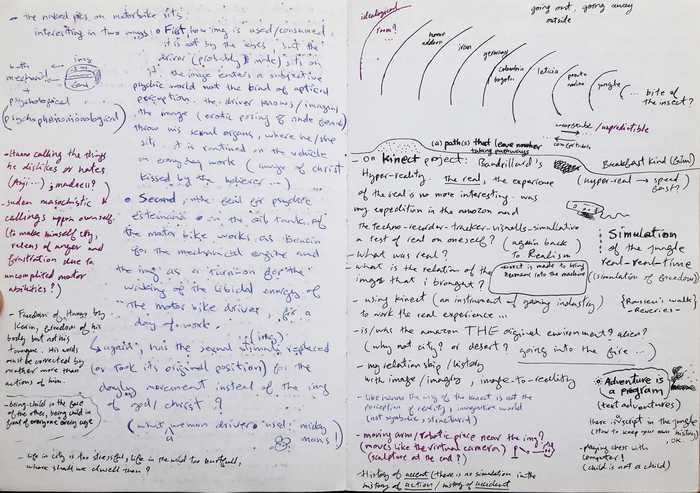
Colombia motorbike sits, libidinal energy of bikders, naked photo, Christ kissed by believer. freedom of Hanno dislikes. sudden masochistic callings. being child. going out going away, room, Iran, Germany, Colombia, Leticia, Puerto Narino, jungle, bite of the insect. kinect, Baudrillard hyper-reality, techno-recorder-tracker-visual-simulator, real-real-time simulation of jungle, kinect made to bring human into the machine. adventure is a program. there is a script in the jungle. how to keep your own history. child is not a child. history of action / history of accidenct
- 🔎
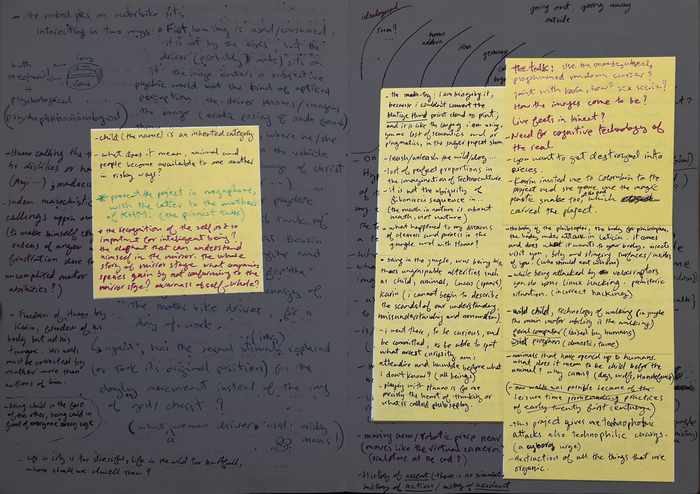
name of the child; animal and people become available; megaphone, KHM mothers; pianist talk; self recognition, intelligence, elephant, mirror-stage, whale story, awareness of self-whale; snake toy, blutige Hund, semantics, playmatics, puppet show; leash/unleash the dog; loss of perfect proportions in the imagination of technoculture; fibonacci nature; what happened to my dreams of cleanness and pureness in the jungle and with Hanno? being with Karin; I went to amazona to be curious and to be commited, to be able to spot what arrest curiosity. playing with Hanno is philosophy. kinect, cognitive technology of the real. you want to get destroyed into pieces. Karin invited me ti Colombia, and gave me the snake toy to think with. the body under attack in Leticia. insect visits you. it comes and does what it wants with your body. prehistoric incorrect hacking. wild child. feral computer. walking. what does it mean to be child before the animal? a cyborg urge.
- 🔎
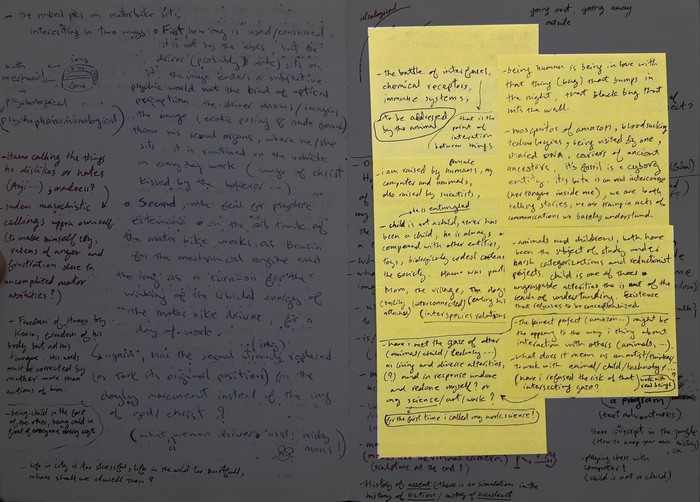
to be addressed by the animal, battle of interfaces, child, Hanno, entangled, my work, mosquito, amazon, DNA, being human = being in love with that thing that bumps to the wall in the night, kinect,