[...]ers
xxxxxx
nces, it is about finding new relations in the existing fabric of the world, problematizing our intuitions into problems, therefore it is important to have the “?”
*Sina: remembering beyond history
--------[how can we enter something and not enter it at the same time?]
*Thiago: nonpresence <--> thinking, without body?!
*Aela: is about the question of distance and inside/outside, by practicing openness, it is about when something enters ‘you’
*Sana: physical-presence =/= imagination (mental activity ~= dream) {She needs to see Miyazaki}
*Roger: we do it all the time, for him it is more about active engagement, role of feelings, moments that you are pushed out by the entity
*Maarten: no! enter =/= not-enter, research depends on definitions
*Juan: layers of realities are involved, it is about expanding the consciousness by charming it into 90% presences, theater gives a yes/no quality to the question of entering, actors, stage as Dystopie of presence
*Xiri: yes! this is often the case, we are between 2nd-chances and being-torn-apart
--------[who told the first joke?]
*Gerald: objects =/= actual life (absurdity and absoluteness of objects) (contemplating about object ==> inner smile)
*Nicolas: father (by not getting it right), not mother (she is not the teller type), the tickler is about lunching possibilities
*Vladimir: God, Vladimir thinks this is theological and therefore axiomatic (that means self-evident or unquestionable)
*Lise: Monty Python, specifically the philosopher soccer video, in the way that makes you laugh
*Elke: God, God said “this is reality” (but we didn't get his joke)
*Steven: some funny kid in the street when he was 5 or 6, and it wasn't really a joke more a story
...................................
i like to set up a synonym-finder machine
(looking at mutations of ...)
--> t[...]
(1)[...notes/midday review.txt]%0[...]
(in the direction of my research; hastily opening the ontological envelope that saves a heart full of “list of specifications”...)
the visit will be to the ‘European Committee for Standardization’ (CEN, French: Comité Européen de Normalization), one of the EU fostered nonprofit public institutions of the cutting-edge development regarding ambitious notion of ‘data,’ ‘systematic knowledge,’ and ‘specifications’. the excursion will be oriented towards a meeting between the participants of advanced performance and scenography studies and the representatives of CEN, and encourages a run between the ontological demands of international economy and contemporary art, their disastrous split, and where their formations meet and intersect.
KEYWORDS: cosmology, experimentation, existence, specification, future, knowledge, irrationality, permanence and substance, technological acts--of naming, a path of becoming--on the grid of technological dominion, suspicious partnership of “advanced democracies” and “high technology"--what allows their mutuality?, standard-testing--which sectors of existence it is traversing?, pre-technological traces of cognitive normalization, the very little difference between specification and “the real thing,” THE origin of the demand for rigorous specification, migration of questions out of the areas of instrumental fitness, human relation to the surrounding world, impoverished zoologies--under techno-epistemo-anthropocentric values, squeezing prehistoric modes of weakening subjectival normativity--a field that today gets heavily technologized,
...................................
to bring our needs and lures towards each other
bring my lure to the table (that thing which i can't stop following)
who/what are you pregnant with?
(that is what you are proposing)
(that is to play with the ‘histories of body and mind’ [Haraway] you inherit --> for me is to play with the pre-subjective singularities)
[inheritance is of great importance for our research. it is about the passing of obligations from something ghost-like. i am sure we have other modes of response available to us other than how Hamlet takes in what is inherited to him, other ways of responding to the ghostly beings that talk to us from death. (inheritance ~= inhabiting spirit [they cannot be possess as a piece of property], reading inflaming flashes of remote spirits [--> is this hear from one another looks like? is technology placed at the source of this reflection?--technology itself answers the call--(Avital)]) could we work with Ophelia's kind of #Wortsalad instead? (Salad-e Kalame, khoresht-e kalame; same thing happens to Shirin of in Khosro Shirin, but unlike Shakespeare, Nezami allows another poetic drift;) Heidegger's “die Sprache spricht” : language is monologue --?--> schizophrenia and schizophrenic discourse --?--> structure of speaking]<[...]
(2)[...notes/midday review.txt]%0.2[...]
(like an octopus in a lure)
...................................
stories that can interrupt death (of our time, anthropocene, etc.)
(example of biology-story into culture-story: (1) ladder of evolution --> progress (2) sperm/egg story --> gender performance)
to change stories so that they are more livable
we live stories
to make mistakes as fast as possible
... move across earth space and narrative space
situated stories
they can't tell everything, but what is needed here
https://en.wikipedia.org/wiki/Refugium_(population_biology)
...................................
ontological choreography
vital sort of play that the participants invent out of a history of body and mind they inherit
...................................
possible performances
*two doors, ?, talk, model, puppet
*using stop-motion animation, clay formation, material animal facial properties
...................................
seeing a car crashing, is seeing a causation, seeing a reasoning, is that logos? is it logos when we see a physical experimentation?
...................................
[Haraway]
the established (dis)order is NOT necessary!
grips of necessity
(the real does/did not have to be or happen that way. the ‘real’ is the result of contingencies and it can be undone by working the contingencies, with skill.)
laboring bodies, playing bodies, sensuous bodies
(feminism:) you can't get freedom outside of mortality
-theology, the negative way of knowing, the necessary discipline of positive affirmation in order to know what is not knowable, is a very helpful tradition
when it comes to language we, humans, will always win over the animals.
we will always be the ones who control the law, the database.
(all is bad news both for the charismatic endangered Bangali tiger and the individual chicken in the food industry.)
fight the divisions and differences
we are in a very bad place for animals and woman
can we do without instrumentalization?
categories of killable--the question of how we kill
the question of one's-own-old-hat
regarding what you are against: we might find ourselves properly addressing a particular issue but having no ability to make political connection, to think beyond the categories
*thinking: a materialist practice with other thinkers--done best as storytelling
for me politics is that to be able to locate ways of life that deserves work, that which deserve opposition, that which deserve our curiosity
disembodiment is a technologically produced effect--many people are very skillful in creating that effect --> effects that are also affect/affectional
(Haraway on writing the cybo[...]
(3)[...notes/midday review.txt]%0.3[...]r international research matter
eco-feminism, veganism is for Haraway is genocidal position, a position that advocates violence, a position dedicated to the destruction of ways of life and living beings including animals, [a position that] *concise all working animals to being nothing but evidence of the destructive and violating imposition of human will on natural stuff*, and “that domestic animals of all kinds are victims and demonstrations of human hubris گستاخى, and they have been made into tools” ~= an extreme developemnt of liberal theory --> the (work) animals are not self-defining subjects, are violations and victims, and should not exisit, except as:
•heritage-animals
•rescue-animals
•wards of guardianship
(my work on ajayeb and question of heritage has been exactly against that position)
the radical anti-food-industry position is a radical liberal theory turns all working animals into (at best) *heritage-animals* ~= animal to be preserved as much as possible separate from human use --> “all human use is bad”
(--✕--> we know that the question of use and instrumentalism cannot for mortal finite beings rid out of liberation theory and practice)
[for example the disposition of the film How to Train Your Dragon: The Hidden World, where at the end dragons are better off their human partners ~ kabutar ba kabutar baz ba baz کبوتر با کبوتر باز با باز]
**killing is not something mortal beings can avoid** (us or them)
*the human beings have regularly and in complex ways produced other living entities as killable*
[category of killable: a killing that doesn't quite count as killing]
killing your pet when she is too sick = a judgment in responsive relationship that is not equal
to say that “meat culture everywhere and always are acts of violation” is wrong
“post-”, the notion of ‘surpassing’ that is inevitability built into the “post-”, is in our way politically
the project of critique : finding that point of violation where you can say “got you!”, ‘I nailed you’ --> the practice of critique = to define what we are against }==> develop political movement that are fairly self-certain about what we are against ==> you will find yourself (perhaps) property addressing a particular issue but having no ability *to make political connection* (~= to think beyond the category) --> you find yourself crippled
posthumanist think of themselves as “better than”, more in possession of a “real” understanding of the nature of contemporary world, beyond the critique of technology
the politics of it all...
[we have never been -->] human : being on the side of the one who developed technology to realize intention of their mind in the matter [= The Iron Man]
=/= what it is to be people
we don't need fancy epistemological just[...]
(4)[...notes/midday review.txt]%0.6[...] and in complex ways produced other living entities as killable*
[category of killable: a killing that doesn't quite count as killing]
killing your pet when she is too sick = a judgment in responsive relationship that is not equal
to say that “meat culture everywhere and always are acts of violation” is wrong
“post-”, the notion of ‘surpassing’ that is inevitability built into the “post-”, is in our way politically
the project of critique : finding that point of violation where you can say “got you!”, ‘I nailed you’ --> the practice of critique = to define what we are against }==> develop political movement that are fairly self-certain about what we are against ==> you will find yourself (perhaps) property addressing a particular issue but having no ability *to make political connection* (~= to think beyond the category) --> you find yourself crippled
posthumanist think of themselves as “better than”, more in possession of a “real” understanding of the nature of contemporary world, beyond the critique of technology
the politics of it all...
[we have never been -->] human : being on the side of the one who developed technology to realize intention of their mind in the matter [= The Iron Man]
=/= what it is to be people
we don't need fancy epistemological justification (such as posthumanism), people know the world in ordinary ways and we can learn from eachother, in all the (cultural, historical, power, wealth) differences among us [@Leo] --> ***partial translations happen all the time***
to take the risk of making a mistake --[the only way you can]--> affirm something positive : the positive knowledge pins on the possibility of mistake --(@Setareh; Goda wants to avoid mistakes?)
(learning from Foucault:) power = actual arrangement of the world (and not something ‘out there’)
(learning from Derrida:) responsibility is about the excess of it all (and not the irony of it all [*irony: incongruity of expectation and occurrence])
(learning from biology about:) differences organize themselves by ecologies (and not by binaries) --> ecologies have many scales (of temporality and physicality)***
scientific research + artistic research + contemporary philosophical critical inquiry ==> *topographies of difference* [--> important for Goda's use of the term “privilege” flattening differences]
(“+” are exchange zones, i am learning their differences of idioms)
[apass = partners locked into mimesis]
(my problem with the idea of) privilege: a special right, advantage, or immunity granted to a particular group or individual --assume--> the only way for a particular demographic to advance is at the expense of another
•communism which was a form of collectivism (defined itself against privileges) wiped out large populations
•it is easier to politiciz[...]
(6)[...notes/midday review.txt]%0.6[...], and so on, that need multidisciplinary thinking.
...................................
•what is ‘feeling’ for Lili
•the issue of ‘similarity’ for Luiza
•zones of connectivity and presubjective singularities for Xiri. (what is even better than justice? kindness?)
(Xiri's use of the implicit element of ‘surprise,’ she is trying to communicate the ‘importance’ of her contents.) (trauma-story almost always silences other stories. -- she is compelled by her own storytelling --> baring witness to the injustice therefore resisting it.) --when the victimized personal veils the larger context of evil, the illusion of the true perpetrators - which is around you. (she stated the danger which is all around us.)
-the issue of immediacy for Xiri
-‘you can only heal what you have wounded’ (Wagner's Parsifal “only the weapon that made it will ever cure the wound.”)--what does this mean for our caring activities? @Sina: is this what you mean by western modern rationalization, and that is why you are thinking within the western/eastern philosophies, is the modern tools the antidote to themselves? (this is too soon for me to say and understand this question.)
what is my ‘will to’?
Xiri wants to abolish injustice?
Thiago, abolish selfishness?
Maarten, abolish weakness?
Aela, abolish entropy?
Sana,
Seba, abolish enmity?
Lili, abolish feelings?
Varinia, abolish obedience? [--what shortens our leash?]
Sina, abolish selfhood?
Vladimir, abolish non-disambiguity?
@Esta, her enunciated need for “framework” [~->? instruments of economization], could she be needing “pathway”: path instead of frame, and way instead of work. [frame =/=? overflowing (--> my method of script?); identity =/=? avidity, hers;]
interplay of scales
the scale of intimacy, (of skin, of shared heartbeats and feelings)
data and surveillance and seduction
intimacy: still an unpredictable force?
intimacy: the biological spring from which affect drinks?
how Esta's proposal is capable of traversing from the lovers’ bed to the wild embrace of the crowd to the alien touch of networks?
[and when i say “abolish,” i am using a word that is about rendering something obsolete, mansukh, canceling, making reading to get rid of it, and this is not the same as destroying.]
@Arianna, ‘cleaning agents,’ to toxicity? how can we learn to live with “toxic animacy”(Chen)? dirt: “consequences overwhelming their cause” (Latour)
-narratives about urgent necessity: that we need to understand more in order to cure, prevent, construct, excel, survive.
*afterlife toxicities (?)
@Lili: cycle of planets instead of heartbeat of a planet. tuning in the soup of planets, instead of getting the pulse of a singular planet. the nebulous milk way of liquid bodies, instead of rigid mass o[...]
(7)[...notes/midday review.txt]%0.8[...]r to what?
-is her model based on the idea that beings exist as individual? (is this a ‘difference’ that her work produces?)
@Agnes: you are a response to the bed, making the bed and being made by its caress and embrace. it is not that you want all the audience in the world to identify with a general question or present this as a universal expression, but what could go beyond localization is precisely this concept that you, like me, transitioning body in your environment (bed or whatever) are outstretches of homeliness and forces that distribute across space and discourse, territories and sensing zones, you are an exchange between self and environment. this is pragmatism. like the variety of bed sheets, we are proposed with answers that vary, before posing any question.
to reformulate the question that was posed to you: how your proposal is capable of traversing from the bed to the wild?
pre-historic personhood
my work is concerned with connections, mediation and passages.
what you take for granted, is in another words, what that you can't not know.
(my proposal:)
the past is not absolute!
the idea is that the mythical became the mythological --> Things could be treasured for their beauty as opposed to
their utility or their numinousness.
(Martha Kenney's) “wild facts”
facts that won't hold still
fables
fables of ajayeb, creatures of imaginations, (im)possible worlds
...................................
your institutional hacks
three things to consider in my work:
projection, immersion, and synthesis
seeking to be at once inside and outside the topic
the issue of topology -- what remains invariant as a result of transformation
suggestive power of the figure
...................................
synthesis =/=? genesis (to originate something, to design)
genesis =/=? apocalypse
...................................
in research, contrast between method and subject, is a tool
(in studying natural history)
in critique, contrast between effect and affect, is a tool
(assumed quality of the object and one's own named experience)
[these tools are perhaps cognitive objects]
...................................
Enlightenment as cultural European phenomenon versus a scientific British one
(the theatrical function of natural philosophy in the England Enlightenment)
the function of natural philosopher in 18th century was to use experimental science machines to turn inert matter into active power, light/fire/heat/etc. to lecture an wealthy and polite fee-paying audience, in order to save them from irrationality, that inside all matter there is life and power, and that life was divine.
(however all this was all s[...]
(8)[...notes/midday review.txt]%0.9[...] to be alone in destroying the boat
•how to move the boat =/= destination
possible workshops for Einat's project:
•moonwalk dance
•database programing --> how to live well with databases, not waging a quixotic war on database designers. we must learn how to read and understand database early in elementary school. databases are fundamental parts of our political social ethical cultural processes...
•regular expression --> how computer programming reads and patterns text
•text-based internet --> cyberfeminism
•intervention in the digital hegemonies (digital ==> cultural ==> material) (changes to the built digital environments, possiblities of reconfiguration --> production of space, articulations about ‘us’)
•what does it mean to look at a code? (a critical introduction to computer programming for artists)
•How to implement a programming language in (JavaScript?)--parsing, regexps, (http://lisperator.net/)
•teaching German with Holderlin's “Andenken” poem
•to create a *feast* (to celebrate is to become free of the habitual, becoming inhabitual. celebration is the tensional coming together of the unlikes --> through which human beings and gods could meet and greet. The festiveness that the celebration encourages constitutes the original Greeting. [Avital])
...................................
what i have beeing trying to mean by saying that i have been dependent on others to create spaces that a telling can happen, is actually a fundamnetal ellement of storytelling: the ***community. i need and depend on community in my tellings. (this has noting to do with the imperative of “communication” or having a “message”)
(is it what Stengers calls to promote an “oikos”?)
[Stengers]
“the *predominance* of the *concern for relevance* (-rabt-) builds up memory and experience”
political ecology : there is NO ks NO knowledge that is (both) relevant and detached
political ecology : relevance + attachment = knowledge
art of staging = designing a scene
[the House TV series, the issue of the protagonist is] the distinguish between the figure of the expert and the figure of the diplomat.
*expert: ones whose practice is not threatend by the issue under discussion --> knowledge = relevance
*diplomat: ones who provide a voice for those whose practice, mode of existence, (and what is offen called) identity are threatened by a decision. to cause the experts second thoughts. --> knowledge ~= decision
[this is core in storytelling] [then, i am political. i used to use the word embassador, but it means also ‘diplomat.’ stories that can hold another story hanging. Sina's shy embassador ~=? ] (but what about the weak ones, the idiot, the one's who ‘rather not’ contribute to the political project?)
-diplomats are situated*
[for *Lili th[...]
(9)[...notes/midday review.txt]%1.2[...]amming for artists)
•How to implement a programming language in (JavaScript?)--parsing, regexps, (http://lisperator.net/)
•teaching German with Holderlin's “Andenken” poem
•to create a *feast* (to celebrate is to become free of the habitual, becoming inhabitual. celebration is the tensional coming together of the unlikes --> through which human beings and gods could meet and greet. The festiveness that the celebration encourages constitutes the original Greeting. [Avital])
...................................
what i have beeing trying to mean by saying that i have been dependent on others to create spaces that a telling can happen, is actually a fundamnetal ellement of storytelling: the ***community. i need and depend on community in my tellings. (this has noting to do with the imperative of “communication” or having a “message”)
(is it what Stengers calls to promote an “oikos”?)
[Stengers]
“the *predominance* of the *concern for relevance* (-rabt-) builds up memory and experience”
political ecology : there is NO knowledge that is (both) relevant and detached
political ecology : relevance + attachment = knowledge
art of staging = designing a scene
[the House TV series, the issue of the protagonist is] the distinguish between the figure of the expert and the figure of the diplomat.
*expert: ones whose practice is not threatend by the issue under discussion --> knowledge = relevance
*diplomat: ones who provide a voice for those whose practice, mode of existence, (and what is offen called) identity are threatened by a decision. to cause the experts second thoughts. --> knowledge ~= decision
[this is core in storytelling] [then, i am political. i used to use the word embassador, but it means also ‘diplomat.’ stories that can hold another story hanging. Sina's shy embassador ~=? ] (but what about the weak ones, the idiot, the one's who ‘rather not’ contribute to the political project?)
-diplomats are situated*
[for *Lili this is also a delima, she is torn apart between her expert self and diplomat who crafts relevance
diplomat--the relevance of feelings --> what is the knowledge in the kiss? (the kiss that she rendered as ‘irrelevant’)] [for me kiss is essentialy important. “it (everything) started with a kiss."]
universal knowledge =/= relevant knowledge
‘trust’ is one of many names for love
“you can never be indifferent to the trust you inspire” (Stengers)
...................................
#workshop: “the magic of the right word”
(against Sherlock Holmes)
(12-step recovery program for people suffering from) addiction to the truth
(to energize the connections to the things that animate us.)
1. gathering, basckets of concepts, objects, things, words, etc.
2. excersises, physi[...]
(10)[...notes/midday review.txt]%1.3[...], then 1 vowel.
-the workshop is about: what other stories (of your object) are possible?
-in the workshop (I take a temporary position to) challenge others to re-tell the story of their ((epistemological) found) objects
-a ‘generative constraint’ might help opening up paths before you, away from our habits of storytelling
-it is about getting a feeling for the resistances and potentials of language in our (sometimes mundane) descriptive practices, “strange richness of missing the letters we need” (Kenney)
the metaphors are dormant in our routines of talking and noticing each other. how then, by traversing the routine, our “knowledge” and “community” took on new meaning, as they get a chance of being rearticulated in different languages (or differenlty infected literature)
~-?==> changing the system of classification (of thought)
-in a way the workshop is about an *approach* to knowledge generation (and not necessarily a rigorous critique nor directly evaluating the production of our knowledges)
***nothing is never merely a metaphor***
[some fables from science studies:]
•Emily Martin's egg/sperm story --> stories of atomism, distribution of agency, ----[The Egg and the Sperm: How Science Has Constructed a Romance Based on Stereotypical Male-Female Roles]
•Hayward's microscope --> tropes of natural history docu, ----[Enfolded Vision: Refracting The Love Life of the Octopus]
•Kenney/Haraway's origin/nature fable --> the omnipotence of the “origin” story in our descriptions and interactions with the natural world
•Scott Gilbert's immunological “bouncer” story =/= immune systems as inclusive agents of symbiosis
•Lynn Margulis: life (made possible) by “combat” [the survival fable that TV series “The 100” and “Kelile Demne” for instance is based on] --✕--> life by networking
•Haraway: the tale of “organism = a system of division of labor with executive functions” (==> extraction of wealth among us)
•Morton's causality-story
•brain/body story --> where the “move” came from?
•Sina's “standing on the shoulders of giants” --> knowledge/continuity, role of authority and humility in science ----[http://www.sinaseifee.com/giants.html]
•Sina's 3 little pigs --> architecture/tech/ echics of encounter --> story of the center and periphery ----[http://www.sinaseifee.com/pigs.html]
•“weapon fathered man” --> Kubrick's african genesis, technology + prehistory (in postwar period) “tool ==> man”
•
fables popular in apass:
•“a work [of art] should speak for itself”
•“the very last stage of the creative process is purely intuitive” --> when people say they stop “reading” or “knowing” when they want to create artwork
•“look really hard inside yourself for what you really want”
•“you are an agent of change” that means art[...]
(11)[...notes/midday review.txt]%1.6[...]ystem
...................................
[modes of existence]
science studies --> science
what was science before science studies? it was engaged in a sort of stupefaction that prevented meaningful study.
we do not take the fight against X (religion, fetish, etc.) for the truth about X.
...................................
[Avital]
i am adding “mama's boy” (bache-nane بچه ننه) to my short bio (nothing is added by “me,” everything is told to me.)
thanks to all the people who have given me their ‘sides’ (didn't necessorily confronted me)
(book, ketabat کتابت)
to do something to resignify and breakup the serenity and the serene closure of the book, as the universiy values it and seals it
-what deals does it seal?
-the commitment to breaking up the book and its metaphysically laden pitch for closural sovereignty.
-linguistic pollutants
-dirty talks
#as a mode of writing, make a folding (fractal) book, style of children books, for ajayeb
(what would this structure mean? and how is that expandable?)
#making a cheap horror short-film from one of the ajayebs
#write a X-man short story in Tehran context with iranian everyday characters
•jurassic park --> ajayeb al makhlughat عجایب المخلوقات (horror, sublime, shivering water)
•nonapocalyptic stories and the otherworldly hauntingly familiar in the lost faces of forest (called Tehran?)
(accourding to Egyptian 1550 BCE,) book: a loose collection of magic spells intended to assist a dead person's journey through underworld, and into the afterlife and written by many priests
-are lists the origin of writing? (...way before the installation of the modern scriptural apparatus)
theory-minded academics have rigorously repudiated----or forgotten poetry. ----> poetic deprogrammmg
cohabitation of two sovereign linguistic attitudes----the grammars and behaviors that we associate with figures of literary performance and philosophical positing
18th century
rise of increasingly more mathematical and symbolic logics
more literary types of discursive formations,
Wordsworth, Rilke, and Keats disavowing Paul de Man?!
Freud without Goethe or Schiller?!
Benjamin off Baudelaire?!
Derrida deprived of Mallarme, Ponge, or Celan?!
Heidegger abandoned by Trakl or Holderlin?!
increasing technicization of critical language
colloquy, soliloquy
they are called to witness distinct regions of being ==> assuming the destiny of difference
% denken und dichten is at stake in the *theory of mourning
...................................
[Stengers]
the storyteller : “some peop[...]
(15)[...notes/midday review.txt]%2.2[...]ort story in Tehran context with iranian everyday characters
•jurassic park --> ajayeb al makhlughat عجایب المخلوقات (horror, sublime, shivering water)
•nonapocalyptic stories and the otherworldly hauntingly familiar in the lost faces of forest (called Tehran?)
(accourding to Egyptian 1550 BCE,) book: a loose collection of magic spells intended to assist a dead person's journey through underworld, and into the afterlife and written by many priests
-are lists the origin of writing? (...way before the installation of the modern scriptural apparatus)
theory-minded academics have rigorously repudiated----or forgotten poetry. ----> poetic deprogrammmg
cohabitation of two sovereign linguistic attitudes----the grammars and behaviors that we associate with figures of literary performance and philosophical positing
18th century
rise of increasingly more mathematical and symbolic logics
more literary types of discursive formations,
Wordsworth, Rilke, and Keats disavowing Paul de Man?!
Freud without Goethe or Schiller?!
Benjamin off Baudelaire?!
Derrida deprived of Mallarme, Ponge, or Celan?!
Heidegger abandoned by Trakl or Holderlin?!
increasing technicization of critical language
colloquy, soliloquy
they are called to witness distinct regions of being ==> assuming the destiny of difference
% denken und dichten is at stake in the *theory of mourning
...................................
[Stengers]
the storyteller : “some people love to divide and classify, while others are bridge-makers--weaving relations that **turn a divide into a living contrast**, one whose power is to affect, to produce thinking and feeling”
(regarding my footnote fetish) ... because writing such footnotes implies *feeling th[...]
(17)[...notes/midday review.txt]%2.2[...][einseitig] imposed questions? (their differences) [~? mofti مفتی, fatva فتوا =/= khotbe خطبه]
(to put the ‘question’ at risk)
*milieu-thinking* (to think by the milieu) :
1. no reference to the ground
2. never separating from milieu
(Virgin Mary requires a milieu [of symbolic efficacy, categories of belief, etc.])
what is the milieu of ajayeb? (ghalamrov قلمرو, mohite ejtemayi محیط اجتمایی, its ecology)
“natural”: that which science will eventually explain ==> nature =/= “natural”
“nature”: that larger, older, and wiser configuration that gets credit for ingenuity (instead of the creature's bodily know-how) by the call of the scientist
عجایب ajayeb's relations to the world, rhizomatic connections to other practices that likewise explore a metamorphic (rather than representational) relation
Earth =/= cradle
Surrealists’ automatism to cultivate lucid trances is missing the techniques of imagination developed by Ibn Arabi, (or by Sohrevardi, and others)
(Breton's subjectivity is still hopelessly European)
=?=> to recuperate our physical force (old good Tasavof-?)
‘ideas’ --> to “animate” humans ~= erotically lure the human soul**
(Plato knew this)
to lure us into relevant metamorphic attention*
(Deleuze and Guattari:) my existence is my very participation in assemblages
in order to determine what is “really” responsible for what [= agency?].
-an agency that doesn't belong to us (who is ‘us’ in Stengers?)
the efficacy of assemblages (in ajayeb)
(assemblage --> landscape [in farsi: چشم انداز cheshm-andaz, is related not to the land but to the eyes, literally meaning the projection of gaze])
(the point is) to play a referential game that puts one at risk (instead of protecting via quote)
(let's immediately turn off that) monotonous little critical or reflexive voice whispering that (the only defense we have against fanaticism and the rule of illusions is that) we should not accept being mystified
commenting =/= touching
(lams kardan لمس کردن =/= ezhare nazar kardan اظهار نظر کردن) --> an issue in art criticism in Iran ایران
[@Foad]
**our senses are not for detached cognition but for participation**(David Abram)
-“The ways the senses themselves have, of throwing themselves beyond what is immediately given, in order to make tentative contact with the other sides of things that we do not sense directly, with the hidden or invisible aspects of the sensible.”
-“suggestions offered by the sensible itself.”
-we never step outside the “flux of participation.”
[...]
(18)[...notes/midday review.txt]%2.3[...]vof-?)
‘ideas’ --> to “animate” humans ~= erotically lure the human soul**
(Plato knew this)
to lure us into relevant metamorphic attention*
(Deleuze and Guattari:) my existence is my very participation in assemblages
in order to determine what is “really” responsible for what [= agency?].
-an agency that doesn't belong to us (who is ‘us’ in Stengers?)
the efficacy of assemblages (in ajayeb)
(assemblage --> landscape [in farsi: چشم انداز cheshm-andaz, is related not to the land but to the eyes, literally meaning the projection of gaze])
(the point is) to play a referential game that puts one at risk (instead of protecting via quote)
(let's immediately turn off that) monotonous little critical or reflexive voice whispering that (the only defense we have against fanaticism and the rule of illusions is that) we should not accept being mystified
>
commenting =/= touching
(lams kardan لمس کردن =/= ezhare nazar kardan اظهار نظر کردن) --> an issue in art criticism in Iran ایران
[@Foad]
**our senses are not for detached cognition but for participation**(David Abram)
-“The ways the senses themselves have, of throwing themselves beyond what is immediately given, in order to make tentative contact with the other sides of things that we do not sense directly, with the hidden or invisible aspects of the sensible.”
-“suggestions offered by the sensible itself.”
-we never step outside the “flux of participation.”
...................................
[Thomas Keenan]
reading: that which happens when we cannot apply the rules --> experience of responsibility =/= moment of security or cognitive certainty
rhetorical reading
who speaks, writes, and reads? not simply humans
“how can we have any chance of finding a way to say what we don't know how to say if we don't pay attention to the silence of the other inside us?”
literature, is then understood as the experience of risk, chance, the undecidable =/= pathos of resolution
(in Western ethical, political, and literary traditions:) responsibility: a matter of articulating what is known with what is done =/= (Keenan:) *responsibility*: an asymmetry or an interruption between the orders of cognition and action
fable --> an exemplary *allegory of decision* (~~> installing or restoring subjectivity)
fables open abyssal aporias:
•to teach ‘singularity’ it offers ‘comparison’
•to underline ‘independence’ it resorts to ‘necessity’
[(the experience of) aporia =?=> morality, politics, responsibility =/= when the path is given]--> Germany is moving towards the removing of aporia [<-- a general panic popular in sci-fi]
(the v[...]
(19)[...notes/midday review.txt]%2.4[...]r “unconscious”) for the shepherd to lose track of his sheep: one is no longer certain where to find the identity of the “speaker” or the “hearer,” ... where to find the identity of an intention.*
--?--> wolf in sheep's clothing [--> also the problem/fantasy of the “integration” project (as the space of ethics and politics)~~>(“Appearances are deceptive” ==> exclusion of the parasite + identification of subjects as the task of responsibility); -what would mean for the German shepherd to lose track of his sheeps? (to go from) the fable of *the oriented sheepfold* --to--> the fable of *losing count*]
-the vexed relation between sheep and wolf, slave and master
(my work is all about: can we please look at) some *other* “interior of the system”
(system never has only one interior [=/= conspiracy: system's singular interiority])
•literature's (ir)responsibility to philosophy
•art's (ir)responsibility to journalism
>
Xanthus the philosopher decides to buy a slave, goes with his students to the slave market, and encounters the disfigured Phrygian Aesop (recently granted the power of speech after assisting a priestess of Isis and hence become too difficult for his previous master to handle). Their first exchange is exemplary, as the philosopher interrogates the slave in order to determine whether “he knows anything,” receives equivocal replies, and finishes by asking, “Do you want me to buy you?”
(Life of Aesop)
thinking fable as language : ‘Fabula’ (narration or account), derived as it is from the Latin root ‘fari’ (to speak) and linked to the Greek ‘phanai’ (to speak or to say), finally implies nothing other than language as such
Mythos and logos, the one is not more true (or more false, deceptive, fictive, etc.) than the other
(to open to the) alterity of an ungoverned figuration
hero: the advhe adventure of an identification that can only occur in the comparison that a fable demands
Horace's dictum: “with a change of names, the fable is told about you” (a trans-subjective movement, a tropological system =/= metaphor or metonymy, )
(for Nietzsche) responsibility: the ability to make and keep one's promises = being (able to be) held accountable (not simply by another but) already in advance by and for oneself : to answer to oneself in the place of the other
•Nietzsche's fable of morality: lamb & bird of prey (“eagle is evil ==> lambs are good”)--> [the fable enacts the victory:] the lambs triumph in gaining the ability (and then the right) to hold the birds of prey responsible for doing what they do, for being what they are --claim--> the strong man is fee to be weak, the bird of prey free to be a lamb ==gain==> the right to make the bird of prey accountable for being a bird of prey
◦morality: a fabulous narrative about [...]
(21)[...notes/midday review.txt]%2.6[...], surmise, premise)
--or--> ungovernable and unrecoverable force of *positing* (position or imposition)
(generation of the pure name in fable of the eagle and the raven:)
non-symmetrical movement from nameless bird --to--> birdless name (a wingless not-eagle)
why fables are important? <-- others and their traces are always working within us already, in a space and time that cannot be reduced to that of consciousness (or self-presence)
•profound linguistic or rhetorical complexity of the call and response
the raven resounds (it does not just start talking) <-- it starts with the others: eagle, wether, shepherd
Lacoue Labarthe --> identification (the self-becoming of the Self) has always been thought as a matter of examples (+ their appropriation) --raven--> (paradoxical imperative) “imitate me in order to be what you are”
wolf in sheep's clothing (Aesop's “A Case of Mistaken Identity”)
a wolf thought that by disguising himself he could get plenty to eat. Putting on a sheep skin to trick the shepherd, he joined the flock at grass without being discovered. At nightfall the shepherd shut him with the sheep in the fold and made fast all round by blocking the entrance. Then, feeling hungry, he picked up his knife and slaughtered an animal for his supper. It happened to be the wolf.
--> a character that does not belong to one can involve one in serious trouble
[*]fable: (name of the) *literary thing* that aime to *teach responsibility* --Keenan--> self-understanding of the free subject (<--fable--we are exposed to something in language that troubles the possibility of that understanding)
[in my lecture performances with] fable [I aim to] offer an allegory-of unreading, of reading without limits and without guarantees --> freedom
governmental concepts:
•subject
•agency
•will
•choice
•freedom
•rights
}--deconstruction--> limitation of ethico-political responsibilities
for Keenan: **question of responsibility = question of freedom**
the free community of rational beings cannot simply be (regulatively) invoked
calculable & programmable law
responsibility: (names the predicament in which) *coincide the necessity/inevitability of action & the failure of law*
•politics (and ethics) --name--> the urgency and necessity of a response
•responsibility (and freedom) --name--> the impossibility of response with guarantee
ethical =/= actual
| |
impossibility =/= totality of what is
***impossible =/= not-possible***
--Derrida--> the impossible occurs at every moment (that belong to the effort of reading)
“have we not acquired the right to say everyth[...]
(22)[...notes/midday review.txt]%2.7[...]eedom
•rights
}--deconstruction--> limitation of ethico-political responsibilities
for Keenan: **question of responsibility = question of freedom**
the free community of rational beings cannot simply be (regulatively) invoked
calculable & programmable law
responsibility: (names the predicament in which) *coincide the necessity/inevitability of action & the failure of law*
•politics (and ethics) --name--> the urgency and necessity of a response
•responsibility (and freedom) --name--> the impossibility of response with guarantee
ethical =/= actual
| |
impossibility =/= totality of what is
***impossible =/= not-possible***
--Derrida--> the impossible occurs at every moment (that belong to the effort of reading)
“have we not acquired the right to say everything?” (Sade)
who reads, and how, a text addressed to no one?
what status does it have?
[Lode Lauwaert]
for Blanchot Sade (libertine aristocrat novelist) was the writer par excellence
we should think about Sade in explicitly revolutionary terms [Sade's work ~= Robespierre's Reign of Terror]
•Sade's ideal of society is a reactive reality (it takes form specifically in reaction to something external) --> undertaken endlessly efforts against modes of social organization that are based on an stable internal point of reference
in Sade:
1. selfishness has an ontological (not a moral) meaning : ‘the essence of man = negation of the value of the other's existence’ (+ a destruction of the positive meaning other people have in normal life) =/= being-for-the-other
2. characters with theocentric universe (who deliver extended theological discussions)
3. blasphemous passages (negation of God's existence) --> Sade’s specific philosophy of nature (reference to nature is enough for a proper understanding of reality)
4. *every type of destruction always ultimately serves nature* --> nature (by virtue of her desire for optimum production) is forced to destroy her products continuously [--then--> how to annihilates nature?] --(essence of Sade's world)--> **radical negation**
each individual negation involves affirmation (of the other, humanity, God, nature) --Blanchot--> (Sade's oeuvre =) a movement of radical negation that is nothing but its *negative power* (it never affirms something)
Sade = permanent resistance + radical negation (of the other)
“nothing resembles the virtue as a great crime.”
(Blanchot > Sade)
Blanchot's interpretation of the Terror + French Revolution (<== Hegel)
revolution --> freedom (formerly situated in a divine sphere) operates from a purely immanent perspective
the idea of efficacy of the freedom --> destroys what is g[...]
(23)[...notes/midday review.txt]%2.8[...]rganization that are based on an stable internal point of reference
in Sade:
1. selfishness has an ontological (not a moral) meaning : ‘the essence of man = negation of the value of the other's existence’ (+ a destruction of the positive meaning other people have in normal life) =/= being-for-the-other
2. characters with theocentric universe (who deliver extended theological discussions)
3. blasphemous passages (negation of God's existence) --> Sade’s specific philosophy of nature (reference to nature is enough for a proper understanding of reality)
4. *every type of destruction always ultimately serves nature* --> nature (by virtue of her desire for optimum production) is forced to destroy her products continuously [--then--> how to annihilates nature?] --(essence of Sade's world)--> **radical negation**
each individual negation involves affirmation (of the other, humanity, God, nature) --Blanchot--> (Sade's oeuvre =) a movement of radical negation that is nothing but its *negative power* (it never affirms something)
Sade = permanent resistance + radical negation (of the other)
“nothing resembles the virtue as a great crime.”
(Blanchot > Sade)
Blanchot's interpretation of the Terror + French Revolution (<== Hegel)
revolution --> freedom (formerly situated in a divine sphere) operates from a purely immanent perspective
the idea of efficacy of the freedom --> destroys what is given radically --✕--> old regimes
--(understood absolutely)--> Saint-Just and Robespierre demanded that the new French citizens lived out their pure freedom in a radical way
break free from:
•(highly personal) pleasures
•(highly personal) affairs
•
Blanchot + Sade --> *one cannot use one's freedom to establish a new political order*
freedom not contaminated by a particular creation --> Reign of Terror = (a horrible state of) “between” the overthrow of the old & the establishment of the new regime
(~~> contemporary Iran's political state's endless resistance)
•endless resistance =/= enduring constitution (~= institution)
•negation =/= affirmation
Sade's three different forms of inconvenience:
1. cruel tableaux vivants --> emotional inconvenience
2. contradictory unreasonableness (for example “religion should be abolished ==> a republican man to be a good husband and father” + “family should be destroyed, all women belong to all men”) --> intellectual inconvenience
3. (grotesque goal of) Sade aims at describing the whole of reality (seeking to say the last word about reality, *to say everything*) --Blanchot--> *the fury of writing* or *the revolt of writing* (Sade = abundant prolific excessive writer, *writing in an exuberant way* [while in prison for 32 years]) --> anesthetic inconvenience
Blanchot's Sade = ideal writer<[...]
(24)[...notes/midday review.txt]%2.9[...]r desire for optimum production) is forced to destroy her products continuously [--then--> how to annihilates nature?] --(essence of Sade's world)--> **radical negation**
each individual negation involves affirmation (of the other, humanity, God, nature) --Blanchot--> (Sade's oeuvre =) a movement of radical negation that is nothing but its *negative power* (it never affirms something)
Sade = permanent resistance + radical negation (of the other)
“nothing resembles the virtue as a great crime.”
(Blanchot > Sade)
Blanchot's interpretation of the Terror + French Revolution (<== Hegel)
revolution --> freedom (formerly situated in a divine sphere) operates from a purely immanent perspective
the idea of efficacy of the freedom --> destroys what is given radically --✕--> old regimes
--(understood absolutely)--> Saint-Just and Robespierre demanded that the new French citizens lived out their pure freedom in a radical way
break free from:
•(highly personal) pleasures
•(highly personal) affairs
•
Blanchot + Sade --> *one cannot use one's freedom to establish a new political order*
freedom not contaminated by a particular creation --> Reign of Terror = (a horrible state of) “between” the overthrow of the old & the establishment of the new regime
(~~> contemporary Iran's political state's endless resistance)
•endless resistance =/= enduring constitution (~= institution)
•negation =/= affirmation
Sade's three different forms of inconvenience:
1. cruel tableaux vivants --> emotional inconvenience
2. contradictory unreasonableness (for example “religion should be abolished ==> a republican man to be a good husband and father” + “family should be destroyed, all women belong to all men”) --> intellectual inconvenience
3. (grotesque goal of) Sade aims at describing the whole of reality (seeking to say the last word about reality, *to say everything*) --Blanchot--> *the fury of writing* or *the revolt of writing* (Sade = abundant prolific excessive writer, *writing in an exuberant way* [while in prison for 32 years]) --> anesthetic inconvenience
Blanchot's Sade = ideal writer
•we should not understand Sade's oeuvre in an intellectual way (there is no message or insight)
◦disappearance of meaning in the materiality of language -->{death of content ==Saussure==> ‘the signifier'}--> reading Sade = accessing the rough meaningless materiality of language itself
•we should not understood Sade's content as a reflection of an authentic self (un moi profond) --> Sade as a person disappears into the background
◦we should not understood his writing as an instrument he uses to express content --> ‘language = an independent reality’ (=/= Sade as a master of language)
(Hegel and) Sartre --> literary works must b[...]
(25)[...notes/midday review.txt]%2.9[...]br />
-(when talking about your project) you are teaching me what makes you move. --> that means i need to learn how to be affected differently (other than my own projects terms) in order to affect (others) differently [# my bow and arrow intervention] ---- to give intense attention to your gestures (expressing desires, expectations, affects) and to respond to them in remarkable way.
critical hedonism (Archer)
--> refusal of the “embodied anxiety”
affective economies (Ahmed)
--> which affective economies animate our own bodies as scholars/artist/... and as people
(asking) is this practice good for the subjects involved?
--> we create (involuntary) differences, the question is, is the world enriched by these differences? (by Sina, Xiri, Aela, etc.)
-(also be careful with) “differences as raw material” in a “delocalized cultural capitalism (geopolitics of knowledge)” --(Renan in conversation with Peran)--> “internal colonialism,” “local difference as an object of study and raw material,” and “cooptation of imagination in the networks of information-connection.”
-(looking for other metaphors of) alignments =/= operational references to co-production
(Marti Peran) “The surplus of images has reached the maximum degree of pollution. In turn, the planetary connection ensures the exchange of images regardless of the visual regimes from which they come from. Images no longer speak anywhere. In this situation, the political task is to return to the linguistic battlefield. It won't be possible to do things differently if we do not start talking differently. The most urgent imperative is a language inventiveness.”
(atomism)
-constant and precarious self-management of molecular projects in a horizon-less future
-artists in the operation of self-making ourselves
#the image i made for Sohrevardi; allegory of Sohrevardi; the image's discursive architecture and its diverse inventiveness; (being careful with being) seductive in staging diversity; --> “an ecology of monologues”? (Renan);
-“The monologue is a linguistic space freed from negotiation.” [...] “Now, it seems that everything could be solved by the universal application of mediation, participation, collaboration processes [etc.] without realizing that this entails the strengthening of the social cohesion model that becomes universally inclusive.” [...] “The monologue, in this perspective, is a form of silence, a way of disappearing. One way to cease-to-be when we are forced to be.” (Peran)
how can i stop and resist “self-exploitation”? --> instead of thinking about transindividualism and commons, etc.
“An artwork executed from fatigue ‘exposes’ its intensity.” (Peran)
A “tired” artwork
(Marti Peran)
a minority that wishes to be a majority
the semiotic body[...]
(26)[...notes/midday review.txt]%3.1[...]rences as raw material” in a “delocalized cultural capitalism (geopolitics of knowledge)” --(Renan in conversation with Peran)--> “internal colonialism,” “local difference as an object of study and raw material,” and “cooptation of imagination in the networks of information-connection.”
-(looking for other metaphors of) alignments =/= operational references to co-production
(Marti Peran) “The surplus of images has reached the maximum degree of pollution. In turn, the planetary connection ensures the exchange of images regardless of the visual regimes from which they come from. Images no longer speak anywhere. In this situation, the political task is to return to the linguistic battlefield. It won't be possible to do things differently if we do not start talking differently. The most urgent imperative is a language inventiveness.”
(atomism)
-constant and precarious self-management of molecular projects in a horizon-less future
-artists in the operation of self-making ourselves
#the image i made for Sohrevardi; allegory of Sohrevardi; the image's discursive architecture and its diverse inventiveness; (being careful with being) seductive in staging diversity; --> “an ecology of monologues”? (Renan);
-“The monologue is a linguistic space freed from negotiation.” [...] “Now, it seems that everything could be solved by the universal application of mediation, participation, collaboration processes [etc.] without realizing that this entails the strengthening of the social cohesion model that becomes universally inclusive.” [...] “The monologue, in this perspective, is a form of silence, a way of disappearing. One way to cease-to-be when we are forced to be.” (Peran)
how can i stop and resist “self-exploitation”? --> instead of thinking about transindividualism and commons, etc.
“An artwork executed from fatigue ‘exposes’ its intensity.” (Peran)
A “tired” artwork
(Marti Peran)
a minority that wishes to be a majority
the semiotic body disciplined to daily exercise and beautification
fatigue, unlike melancholy's passivity, implies performativity.
a way of being ill
(capital gains concentrated in the) self-production of identity
subject occupied full time in itself
the logic of “do it yourself”
obliged to make countless small decisions in all areas
subject mixed up with the incessant movement of its own alienation
*hyperactive life --> poverty of experience*
the banality of “i Like”
(maybe interesting for Laura:) *fatigue* is the instant of stopping and pausing [of exercise and beautification] (after which a diversity might be possible)
[*]fatigue: capable tiredness --> politicizes discomfort
[#we are in the domain of passivity, disappearance and inaction]
Peran suggests a position of fatigue where (some tim[...]
(28)[...notes/midday review.txt]%3.1[...]of identity
subject occupied full time in itself
the logic of “do it yourself”
obliged to make countless small decisions in all areas
subject mixed up with the incessant movement of its own alienation
*hyperactive life --> poverty of experience*
the banality of “i Like”
(maybe interesting for Laura:) *fatigue* is the instant of stopping and pausing [of exercise and beautification] (after which a diversity might be possible)
[*]fatigue: capable tiredness --> politicizes discomfort
[#we are in the domain of passivity, disappearance and inaction]
Peran suggests a position of fatigue where (some time ago) was occupied by melancholy
“is this not a mere “don't like” that re-enters the spiral of our mobilization?”
“we are left with just the option of making an index, a collection of trails and marks [...]”
sunday: “empty time that forces us to fill it through apparently free decisions that, if they are resolved properly, please us and re-constitute us” (Peran)
*freedom of action for self-realization* --> unstoppable egocentric machine
space of perpetual connection (@ERG's website)
(pseudo) communicative action by way of technological devices --> camouflaged alienation
“The promise of self-realization and the demand for visibility organize the mobilization of desire, turning it into work.”
do we need to formulize and formalize our uncomfortable concerns and experiences?
@apass, artist research
i want to *give connections*
...................................
#semester/seminar on destruction
-care, suffer, fubar,
[fubar: “fucked up beyond all recognition"--a term from veterans returning to the United States in 1960s]
#semester on Hojum
(surge,) on performance, media, sculpture, and surplus
Hojum has to do with the hojum (~=? ‘bodies’) of people to get in front of the line, the hojum of enemy, of friend, of information, also includes the plural form of ‘hajm’ (حجم)
#seminar on the history of translation
archaeology, interpretation, spaces of difficult translation, reading out of time, technology and transformational studies, semiotics, poetry, writing,
...................................
#on Situated Knowledges
-approach the text by creating intensity and my own partial perspective
-the elephant parable (against it)
-objectivity (disembodied view from nowhere)
-neutrality (biologically insane)
-marked people (my own story)
-situatedness of the situated
-The cyborg is a figure in which situatedness makes possible adventures with the beyond.
-globalization-as-situatedness: global is precisely space/place/time/situation
-the figure of the so-called scientist gathered around certain metaphors since the[...]
(30)[...notes/midday review.txt]%3.2[...]br />
do we need to formulize and formalize our uncomfortable concerns and experiences?
@apass, artist research
i want to *give connections*
...................................
#semester/seminar on destruction
-care, suffer, fubar,
[fubar: “fucked up beyond all recognition"--a term from veterans returning to the United States in 1960s]
#semester on Hojum
(surge,) on performance, media, sculpture, and surplus
Hojum has to do with the hojum (~=? ‘bodies’) of people to get in front of the line, the hojum of enemy, of friend, of information, also includes the plural form of ‘hajm’ (حجم)
#seminar on the history of translation
archaeology, interpretation, spaces of difficult translation, reading out of time, technology and transformational studies, semiotics, poetry, writing,
...................................
#on Situated Knowledges
-approach the text by creating intensity and my own partial perspective
-the elephant parable (against it)
-objectivity (disembodied view from nowhere)
-neutrality (biologically insane)
-marked people (my own story)
-situatedness of the situated
-The cyborg is a figure in which situatedness makes possible adventures with the beyond.
-globalization-as-situatedness: global is precisely space/place/time/situation
-the figure of the so-called scientist gathered around certain metaphors since the begining of the 17th cebtury, namely ‘objectivity’ and all its related adjectives: neutrality, perspective, universality, disembodiment (for certain race and sex), etc.
-metaphors create perspectives [the view that looks at blind men looking at the elephant]
-situatedness is different than ‘positionality’: a way of systematic error correction
-(resolving) specificity of vision --> scientific objectivity (is achievable)
-Haraway expresses her informed dissatisfaction with (the metaphysical substrate that supports) ‘social constrctivism’ and ‘traditional realism’ --> representationalist belief in the power of the words to mirror preexisting phenomena. they both believe that scientific knowledge (in its representational formats: theoretical concepts, graphs, particle tracks, photographic images, etc.) mediates our access to the material world, whether it represents “nature” or “objects” of science both groups are subscribed to representationalism.
focus on the nature and production of scientific knowledge --(shift to science studies)--> dynamics of the actual practice of science }--> on ongoing pattern of situated activity
-(disembodied scietific) objectivity: that only certain people are allowed to have no body (Gender, race, etc.) and that high science in practice is not acting on textbook objectivity at all.
absent referents, deferred signifieds, spl[...]
(31)[...notes/midday review.txt]%3.2[...]th believe that scientific knowledge (in its representational formats: theoretical concepts, graphs, particle tracks, photographic images, etc.) mediates our access to the material world, whether it represents “nature” or “objects” of science both groups are subscribed to representationalism.
focus on the nature and production of scientific knowledge --(shift to science studies)--> dynamics of the actual practice of science }--> on ongoing pattern of situated activity
-(disembodied scietific) objectivity: that only certain people are allowed to have no body (Gender, race, etc.) and that high science in practice is not acting on textbook objectivity at all.
absent referents, deferred signifieds, split subjects, and the endless play of signifier
Haraway is feeling nervous with two views on objectivity:
(1)the ‘social constructionist’ view on this: getting to know the world ‘effectively’ by practicing the sciences --> knowledge is knowledge-game (on an agonistic power field) ==> science is rhetoric : artifacts and facts are parts of the powerful art of rhetoric ~= practice is persuasion. {this view will use the nasty tools of semiology and deconstruction to insist on the rhetorical nature of truth.} --> Haraway calls this ‘The imagery of force fields’ (also an imagery of high-tech military fields and of automated academic battlefields) {will to power} (for Luiza)
epistemological electroshock therapy
(feminists protecting their) sense of collective historical subjectivity and agency and our “embodied” accounts of the truth --> these are just excuse not to learn
(2)Humanistic Marxism (structuring theory about the domination of nature in the self-construction of man) ([young Marx, influenced by Feuerbach =/= Hegelian idealism, saying that:] man's essential nature is that of a free producer, freely reproducing their own conditions of life [--however--> under capitalism individuals are alienated from their productive activity, etc.])
--> “chance for life”
science: Global System, universal knowledge --> translation, convertibility, mobility
of meanings, and universality
money in capitalism ~= reductionism in science
...when we are talking about genes, social classes, elementary particles, genders, races, or texts
*vision: a sensory system that has been used leap out of the marked body ==> a gaze from nowhere
-“Vision is always a question of the power to see--and perhaps of the violence implicit in our visualizing practices”
-also, the visual metaphor allows one to go beyond fixed appearances, which are only the end products. The metaphor invites us to investigate the varied apparatuses of visual production (including: the prosthetic technologies interfaced with our biological eyes and brains.)
unmarked body: the power to see and not be seen
objectivity in scien[...]
(32)[...notes/midday review.txt]%3.3[...]za)
epistemological electroshock therapy
(feminists protecting their) sense of collective historical subjectivity and agency and our “embodied” accounts of the truth --> these are just excuse not to learn
(2)Humanistic Marxism (structuring theory about the domination of nature in the self-construction of man) ([young Marx, influenced by Feuerbach =/= Hegelian idealism, saying that:] man's essential nature is that of a free producer, freely reproducing their own conditions of life [--however--> under capitalism individuals are alienated from their productive activity, etc.])
--> “chance for life”
science: Global System, universal knowledge --> translation, convertibility, mobility
of meanings, and universality
money in capitalism ~= reductionism in science
...when we are talking about genes, social classes, elementary particles, genders, races, or texts
*vision: a sensory system that has been used leap out of the marked body ==> a gaze from nowhere
-“Vision is always a question of the power to see--and perhaps of the violence implicit in our visualizing practices”
-also, the visual metaphor allows one to go beyond fixed appearances, which are only the end products. The metaphor invites us to investigate the varied apparatuses of visual production (including: the prosthetic technologies interfaced with our biological eyes and brains.)
unmarked body: the power to see and not be seen
objectivity in scientific and technological, late-industrial, militarized, racist, and male-dominant societies
(she asks for:)
“So, I think my problem, and “our” problem, is how to have simultaneously an account of radical historical contingency for all knowledge claims and knowing subjects, a critical practice for recognizing our own “semiotic technologies” for making meanings, and a no-nonsense commitment to faithful accounts of a "real” world, one that can be partially shared and that is friendly to earthwide projects of finite freedom, adequate material abundance, modest meaning in suffering, and limited happiness.”
Haraway asks for an embodied objectivity that is able of accommodating *paradoxes* --> ‘situated knowledges’
-what does she mean when she says “All components of the desire are paradoxical and dangerous, and their combination is both contradictory and necessary.”
(instruments of visualization in multinationalist, postmodernist culture:) disembodiment : to distance to know
the visualizing technologies (--> my amazon project)
a perverse vision that has produced ‘techno-monsters’ (what does she mean by that?)
--> second birthing? transcendence?
[the frankenstein's techno-monsters, is modeled after who? and who is modeled after it? wondrously, murderously walking around...]
(‘second-birthing’: one of the deadly stories of k[...]
(33)[...notes/midday review.txt]%3.3[...]partiality. (being acknowledged and self-critical is not enough!!! how deos she mean?)
-‘perspective’ can never be known in advance --> knowledge potent for constructing worlds less organized by axes/axis of domination
-One cannot “be” either a cell or molecule--or a woman, colonized person, laborer, and so on. ‘passionate detachment’ is about the impossibility of entertaining innocent “identity” politics : seeing from their perspective in order to see well.
-problem with “positionality”: {testimony from the position of ‘oneself'} We are not immediately present to ourselves and the self is assumed finished and whole simply there and original and its (grounding) knowledge is organized around the imagery of vision --✕--> Self-knowledge requires a semiotic-material technology to link meanings and bodies. ***Self-identity is a bad visual system*** --> ‘positionality’ (meaning: ‘acknowledged and self-critical’ partiality) [at best showing in which ways one is not unmarked] is therefore insufficient. {Identity, including self-identity, does not produce science!}
-instead we need a *split and contradictory self* (one who can interrogate positionings and be accountable) [~~/?-> shath شطح (=/= shar’ شرع, or even sharh شرح?), shathiat (شطحیات) in Tasavof (تصوف), rend رند, rendane رندانه]
-so, instead of “being” she proposes “splitting”: heterogeneous multiplicities that are simultaneously salient and incapable of being squashed into isomorphic slots or cumulative lists. --> The knowing self is partial in all its guises, never finished, never whole, stitched together imperfectly [that is what she means by ‘split'] ==> join with another (without claiming to ‘be’ another) {if i am allowed i can map Haraway's “partiality” onto Deleuze's “schizophrenia” --> Greek for “split brain” (Jonathan Crary, Suspensions of Perception, p.38) According to Beuler, “The selectivity which normal attention exercises among the sensory impressions can be reduced to zero, so that almost anything is recorded that reaches the senses.” One reason for the admiration which Deleuze and Guattari professed for the schizophrenic must lie in this complete lack of inhibition (khod-dari خودداری).} (a confusion of voice and sight, rather than clear and distinct ideas) ([to discriminate message types:] *to confuse literal and metaphorical*, the schizophrenic either does not know his responses are metaphorical or cannot say so --> the breakdown of his metacommunicative system : does not know what kind of message a message is --> the schizophrenic looks for hidden meanings everywhere (assuming everything is metaphorical) or tend to accept every message as literal) (Lacan: schizophrenia: breakdown in the signifying chain of language ==> experience of pure material signifiers [<-- personal identity is the effect of the temporal unification of past and future with one's present, and that such an active temporal unification is its[...]
(34)[...notes/midday review.txt]%3.5[...]Deleuze and Guattari professed for the schizophrenic must lie in this complete lack of inhibition (khod-dari خودداری).} (a confusion of voice and sight, rather than clear and distinct ideas) ([to discriminate message types:] *to confuse literal and metaphorical*, the schizophrenic either does not know his responses are metaphorical or cannot say so --> the breakdown of his metacommunicative system : does not know what kind of message a message is --> the schizophrenic looks for hidden meanings everywhere (assuming everything is metaphorical) or tend to accept every message as literal) (Lacan: schizophrenia: breakdown in the signifying chain of language ==> experience of pure material signifiers [<-- personal identity is the effect of the temporal unification of past and future with one's present, and that such an active temporal unification is itself a function of language.])
subjectivity is multidimensional ==> vision is multidimensional
(an instruments of vision:) optics : politics of positioning --> one example of optical illusion: rationality (projected from nowhere comprehensivel)
(some perspective are more guilty : master point of view)
No one ever accused the God of monotheism of objectivity, only of indifference. The god trick is self-identical, and we have mistaken that for creativity and knowledge, omniscience even. (self-identical [having self identity] =/=! creativity/knowledge)
Technology: skilled practices. (How to see? Where to see from? and so on.)
@Sana, ‘observation’ and ‘technologies of positioning’
how to see?
the science question in military
the science question in colonialism
the science question in capitalism
the science question in feminism
...
master theory =/= webbed accounts
(what does she mean when she dichotomises theory and account?)
instead of (creating and mastering) ‘theory’ she proposes webbing ‘accounts’***
-‘webs’ can have the property of being systematic
systematic: deep filaments and tenacious tendrils into time, space, and consciousness. systems are dimensions of world history.
she suggests to be accountable for (the intricacies of) visualization technologies in which we are embedded that we will find metaphors and means for understanding
and intervening in the *patterns of objectification* in the world.
--> politics and epistemologies of location, positioning, and situating
partiality =/= universality
*partiality: view from a body, always a complex, contradictory, *structuring, and structured body* (what does she mean by ‘structuring and structured body’?)
--the sciences and politics of interpretation, translation, stuttering, and the partly understood.
*Feminism: critical vision ==(consequent upon)==> a critical positioning in unhomogeneous gendered[...]
(37)[...notes/midday review.txt]%3.6[...]self-contained (~ fully formalizable)
-no! let's make Rational Knowledge a process of ongoing critical interpretation among “fields” of interpreters and decoders --> a power-sensitive conversation
-accountability and responsibility for translations
. Situated knowledges are about communities, not about isolated individuals
(pinocchio and geppetto parable)
objectivity = positioned rationality
=/= images of escape and transcendence of limits (filled in Hollywood and sci)
faithfulness of our accounts to a “real world” (no matter how mediated for us and no matter how complex and contradictory these worlds may be)
Sex is “resourced” for its representation as gender, which “we” can control
Situated knowledges require that the object of knowledge be pictured as an actor and agent
-which version of “realism” is she argueing for?
“[...] we are not in charge of the world. We just live here and try to strike up noninnocent conversations by means of our prosthetic devices, including our visualization technologies.”
in the rich feminist practice in science (more than anywhere else) passive categories of objects of knowledge are “activated”
The biological female peopling : When female “sex” has been so thoroughly retheorized and revisualized that it emerges as practically indistinguishable from “mind,” --> the ‘difference’ is theorized biologically as situational, not intrinsic, (at every level from gene to foraging pattern, thereby fundamentally changing the biological politics of the body.)
-(example: Emily Martin)
points in SK:
1-finite partial perspectives
2-split and contradictory self
3-objectivity (--> positioned rationality, object of knowledge as an actor, mutual and usually *unequal* structuring, it is about taking risks)
how and why Haraway as a feminist fights for a better Primatology?
(Barad on) Situated Knowledges: are not merely about knowing/seeing from somewhere (as in having a perspective) but about taking account of how the specific prosthetic embodiment of the technologically enhanced visualizing apparatus matters to practices of knowing
-(Haraway's) move from *optics* [a politics of positioning, in Situated Knowledges] to *diffraction* [an optical metaphor for the effort to make a difference in the world, in Modest_Witness]
Katie King: “apparatus of literary production”: a matrix from which “literature” is born.
...the “facticity” of biological discourse that is absent from literary discourse and its knowledge claims. ----> Are biological bodies “produced” or “generated” in the same strong sense as poems? (biological body ~= poem)
“material-semiotic actor”: the object of knowledge as an active, meaning-generating part of apparatus of bodily producti[...]
(39)[...notes/midday review.txt]%3.7[...]oned rationality, object of knowledge as an actor, mutual and usually *unequal* structuring, it is about taking risks)
how and why Haraway as a feminist fights for a better Primatology?
(Barad on) Situated Knowledges: are not merely about knowing/seeing from somewhere (as in having a perspective) but about taking account of how the specific prosthetic embodiment of the technologically enhanced visualizing apparatus matters to practices of knowing
-(Haraway's) move from *optics* [a politics of positioning, in Situated Knowledges] to *diffraction* [an optical metaphor for the effort to make a difference in the world, in Modest_Witness]
Katie King: “apparatus of literary production”: a matrix from which “literature” is born.
...the “facticity” of biological discourse that is absent from literary discourse and its knowledge claims. ----> Are biological bodies “produced” or “generated” in the same strong sense as poems? (biological body ~= poem)
“material-semiotic actor”: the object of knowledge as an active, meaning-generating part of apparatus of bodily production
bodies as objects of knowledge are material-semiotic generative nodes.
“objects” do not preexist as such --> Their boundaries materialize in social interaction. Boundaries are drawn by mapping practices.
world =/= mother/matter/mutter
world ~= coyote (a figure of the always problematic, always potent tie between meaning and bodies. world as coding trickster.)
(feminism) movement rooted in specification and articulation (of [different kinds of] ‘elsewhere’) =/= (assumption of the right or ability to) identities and representation (of identities)
#workshop reading SK (for apass)
Which version of “realism” are you talking about? Recollecting truth and objectivity are activated whenever a ‘point of view’ is produced among other metaphors that we use in our practice and thinking in techno-scientific societies. In this group reading session we are going to study one of the most stubborn and pervasive phantasms in art and sciences, the figure of objectivity, with the Donna Haraway's 1988 essay ‘Situated Knowledges: The Science Question in Feminism and the Privilege of Partial Perspective’. This reading focuses on politics and epistemologies of location, positioning, and situating in our power-sensitive conversations, and what does it mean to become accountable and responsible for one's own noninnocent translations. We begin with her essay on the 2nd of February and talk about each of our practices in particular continuing on the 9th.
she wants to re-figure, not disavow, objectivity
“story-tellers exploring what it means to be embodied in high-tech worlds” =/= technophobia
technophilia is narcissistic : the notion that man invented himself and that man is involv[...]
(40)[...notes/midday review.txt]%3.7[...]strong sense as poems? (biological body ~= poem)
“material-semiotic actor”: the object of knowledge as an active, meaning-generating part of apparatus of bodily production
bodies as objects of knowledge are material-semiotic generative nodes.
“objects” do not preexist as such --> Their boundaries materialize in social interaction. Boundaries are drawn by mapping practices.
world =/= mother/matter/mutter
world ~= coyote (a figure of the always problematic, always potent tie between meaning and bodies. world as coding trickster.)
(feminism) movement rooted in specification and articulation (of [different kinds of] ‘elsewhere’) =/= (assumption of the right or ability to) identities and representation (of identities)
#workshop reading SK (for apass)
Which version of “realism” are you talking about? Recollecting truth and objectivity are activated whenever a ‘point of view’ is produced among other metaphors that we use in our practice and thinking in techno-scientific societies. In this group reading session we are going to study one of the most stubborn and pervasive phantasms in art and sciences, the figure of objectivity, with the Donna Haraway's 1988 essay ‘Situated Knowledges: The Science Question in Feminism and the Privilege of Partial Perspective’. This reading focuses on politics and epistemologies of location, positioning, and situating in our power-sensitive conversations, and what does it mean to become accountable and responsible for one's own noninnocent translations. We begin with her essay on the 2nd of February and talk about each of our practices in particular continuing on the 9th.
she wants to re-figure, not disavow, objectivity
“story-tellers exploring what it means to be embodied in high-tech worlds” =/= technophobia
technophilia is narcissistic : the notion that man invented himself and that man is involved in some kind of narrative of technological escalation whereby the objectification of human intentionality in the world has finally surpassed itself, and man has achieved self-objectification in a machine that will finally name him obsolescence as he is and destroy him in a technological apocalypse figured by the computer. (Haraway) [we need better dog stories =/= (Iron Man:) man, made in the image of a vanished god, takes on superpowers in his secular-sacred ascent, only to end tragic]
“...man making himself (by realizing his intentions in his tools) yet again in the Greatest Story Ever Told.” (your artwork doesn't need to be this kind of story!)
or the Darwinist tale of “Mitochondrial Eve in a neocolonial Out of Africa”
we need stories of companion species, the “very mundane and ongoing sort of tale, one full of misunderstandings, achievements, crimes, and renewable hopes.” (Haraway, La Guin, Tessa Farmer,)
...................................
[Hara[...]
(41)[...notes/midday review.txt]%3.8[...]stion in Feminism and the Privilege of Partial Perspective’. This reading focuses on politics and epistemologies of location, positioning, and situating in our power-sensitive conversations, and what does it mean to become accountable and responsible for one's own noninnocent translations. We begin with her essay on the 2nd of February and talk about each of our practices in particular continuing on the 9th.
she wants to re-figure, not disavow, objectivity
“story-tellers exploring what it means to be embodied in high-tech worlds” =/= technophobia
technophilia is narcissistic : the notion that man invented himself and that man is involved in some kind of narrative of technological escalation whereby the objectification of human intentionality in the world has finally surpassed itself, and man has achieved self-objectification in a machine that will finally name him obsolescence as he is and destroy him in a technological apocalypse figured by the computer. (Haraway) [we need better dog stories =/= (Iron Man:) man, made in the image of a vanished god, takes on superpowers in his secular-sacred ascent, only to end tragic]
“...man making himself (by realizing his intentions in his tools) yet again in the Greatest Story Ever Told.” (your artwork doesn't need to be this kind of story!)
or the Darwinist tale of “Mitochondrial Eve in a neocolonial Out of Africa”
we need stories of companion species, the “very mundane and ongoing sort of tale, one full of misunderstandings, achievements, crimes, and renewable hopes.” (Haraway, La Guin, Tessa Farmer,)
...................................
[Haraway on Ihde]
...technologies are not mediations--that is, something in between us and another bit of the world--rather, technologies are organs, full partners, in what Merleau-Ponty called “infoldings of the flesh.”
infolding =/= interface
•“What happens in the folds is what is important.”
•Interfaces are made out of interacting grappling devices.
•the infolding of others to each other is what makes up the knots we call beings or, perhaps better, following Bruno Latour, things.
“Technologies are always compound. They are composed of diverse agents of interpretation, agents of recording, and agents for directing and multiplying relational action. These agents can be human beings or parts of human beings, other organisms in part or whole, machines of many kinds, or other sorts of entrained things made to work in the technological compound of conjoined forces.”
*animal (in zoological terminology) : a composite of individual organisms, an enclosure of zoons, a company of critters infolded into a one.
compound = composite + enclosure
camera: the technological eye --> philosophical pretension and self-certainty (=/= Christian's camera)
-- camera as a black-box with which to register pictu[...]
(43)[...notes/midday review.txt]%3.8[...]ce as he is and destroy him in a technological apocalypse figured by the computer. (Haraway) [we need better dog stories =/= (Iron Man:) man, made in the image of a vanished god, takes on superpowers in his secular-sacred ascent, only to end tragic]
“...man making himself (by realizing his intentions in his tools) yet again in the Greatest Story Ever Told.” (your artwork doesn't need to be this kind of story!)
or the Darwinist tale of “Mitochondrial Eve in a neocolonial Out of Africa”
we need stories of companion species, the “very mundane and ongoing sort of tale, one full of misunderstandings, achievements, crimes, and renewable hopes.” (Haraway, La Guin, Tessa Farmer,)
...................................
[Haraway on Ihde]
...technologies are not mediations--that is, something in between us and another bit of the world--rather, technologies are organs, full partners, in what Merleau-Ponty called “infoldings of the flesh.”
infolding =/= interface
•“What happens in the folds is what is important.”
•Interfaces are made out of interacting grappling devices.
•the infolding of others to each other is what makes up the knots we call beings or, perhaps better, following Bruno Latour, things.
“Technologies are always compound. They are composed of diverse agents of interpretation, agents of recording, and agents for directing and multiplying relational action. These agents can be human beings or parts of human beings, other organisms in part or whole, machines of many kinds, or other sorts of entrained things made to work in the technological compound of conjoined forces.”
*animal (in zoological terminology) : a composite of individual organisms, an enclosure of zoons, a company of critters infolded into a one.
compound = composite + enclosure
camera: the technological eye --> philosophical pretension and self-certainty (=/= Christian's camera)<br />
-- camera as a black-box with which to register pictures of the outside world in a representational, mentalist semiotic economy
...................................
Vinciane Despret, Isabelle Stengers, Bruno Latour, ”_how they make their subjects interesting,_“
to tell the story of their work of “translation,” of invention.
refuse all loyalty to my homeland and its values
*heuristic: mental shortcuts that ease the cognitive load of making a problem solvable
-trading optimality, completeness, accuracy, or precision for speed
it may *approximate* the exact solution for the problem
-enabling discover or learn something for themselves. (a ‘hands-on’ or interactive heuristic approach to learning)
[(in computing:) proceeding to a solution by trial and error or by rules that are only loosely defined.]
-from Greek heuriskein ‘find’
*contingent: using it with ‘[...]
(45)[...notes/midday review.txt]%3.8[...]selves. (a ‘hands-on’ or interactive heuristic approach to learning)
[(in computing:) proceeding to a solution by trial and error or by rules that are only loosely defined.]
-from Greek heuriskein ‘find’
*contingent: using it with ‘historical’ always produces interesting ways --> contingency relates to a nonteleological [a doctrine explaining phenomena by their ends or purpose] and nonhierarchical multiplicity [when i say ‘dud’ and ‘cauphing’ and interupting ‘tracing’ i am asking for contingent modes of relating and thinking. conceptualizing in terms of the origin of the dud is about hierarchical relations between past and present and teleological reasoning: where is the dud coming from. when i asked ‘who told the first joke?’ i am trying to break and joke with teleological mode of thinking about the category of ‘origin’.]
contingent =/=? analytical (--> Contingent propositions depend on some kind of epistemoloy, whereas analytic propositions are true without regard to any facts about which they speak.) {telos, ghasd قصد --> ghaside قصیده =/= ghazal غزل}
-We call a truth contingent when it *depends on something else* for its truth.
-has to do a lot with our material world
contingent ~= containing-agent*
--Tautological propositions, which must be true
--Contradictions which must necessarily be untrue
--possible propositions
never use contingency alone in a sentence --> historical contingency
never use understanding stand alon in a sentence --> better understanding {'better’ opens situatedness, for who and how “better,” etc.}
Rhetoric <--(has to do with)--> Contingent
Aristotle (in his work on rhetoric) was against contingency. He believed that the “unavoidable and potentially unmanageable presence of multiple possibilities” or the complex nature of decisions creates and invites rhetoric. (=/= Plato saw rhetoric as pure deceit [gul] and positioned it in politics. [you can see he is terrified by the death of his teacher and mentor Socrates by civility.])
rhetoric --> contigent --> epistemic: individuals make meaning through language and determine what constitutes truth
*ontology is death-dealing <--** terrible violence is directed to the non-existing, the never having existed
---> go to the root of exist --> which modes of existence deserve our curiosity?
...................................
(i found a word for it,) my register of @Lili's scream: i see it as ‘nonlaughter’(?)
(*proposal: there is a number when we dial we can listen to her scream on the phone.) (--> stream, technology, tele-, telephone, called,)
(for her) thinking =? knowing (sending =/= receiving)
(an SF scenario:) imagine and describe an alien world where its populace don't practice ‘knowing.’
**scream ==makes==> witnesses**
(fighting ==makes==> coordination)
از ط[...]
(48)[...notes/midday review.txt]%3.9[...]ine and describe an alien world where its populace don't practice ‘knowing.’
**scream ==makes==> witnesses**
(fighting ==makes==> coordination)
از طلبکار به طلبه (az talabkar be talabe)
///the (symbolic?) structuration of ‘demand’ in Lili's presentation:
the ‘sujet supposé savoir’ #sss [~= Pir, (پیر always a paternal metaphor?) that Other whom you ‘call’ who holds (your) deepest truth ---> go to the metaphorology of “depth” =/= “skimming the surface"] (installed by Lacan) is a subject who is in a functional position and one presumes that this subject knows or retains or holds the knowledge (even vital and secret knowledge [this is knowledge-talabkar طلبکار]) that you want. this subject is functionally established. one of the laws of our encounter is that puts the speaker/writer/analyst/text/etc in the (even architectural) center: the subject-supposed-to-know in Lacan the analyst who sits there as a tower of knowledge that mostly withholds what s/he knows --> transferencial energy directed towards him/her --> drama of identification (--> break-out of narcissism for Freud)
-it is one of the (negative?) binding transferential contracts in relation to “the one who speaks”
[*anthropology of exchange* --> Transference: (for Lacan) Each time a man speaks to another in an authentic and full manner, there is, in the true sense, transference, symbolic transference--something which takes place which changes the nature of the two beings present. Later Lacan articulates the transference in sujet supposé savoir: transference is the attribution of knowledge to the Other, the supposition that the Other is a subject who knows. “As soon as the subject who is supposed to know exists *somewhere* ... there is transference.” (Seminar II, p. 232)] [keep in mind that the (post?-)Lacanian theory is about the *constitutive function of the signifier in relation to the subject.* ... for Lacan, What constitutes the person and its identity can now be read as a text, and the author is not the subject, but the trajectory of the signifiers that represent the desire of those who occupy the place of the Other for the subject.]
[about demand: Lacan argues that “demand constitutes the Other as already possessing the ‘privilege’ of satisfying needs,” and that indeed the child's biological needs are themselves altered by “the condition that is imposed on him by the existence of the discourse, to make his need pass through the defiles of the signifier.” ... The subject has never done anything other than demand (since infancy!)] *{question =/= demand}*--> Nancy
[the use of ‘transference’ is a way to account for the relationship between readers and texts. the emphasis in Lacan is on the ‘supposed’ and not on the ‘know’. reader assume that the text ‘knows’. --> What Lacan's understanding of the transference points to is the fact that we must see the meaning of any given text not within the text [...]
(49)[...notes/midday review.txt]%4[...]o speaks”
[*anthropology of exchange* --> Transference: (for Lacan) Each time a man speaks to another in an authentic and full manner, there is, in the true sense, transference, symbolic transference--something which takes place which changes the nature of the two beings present. Later Lacan articulates the transference in sujet supposé savoir: transference is the attribution of knowledge to the Other, the supposition that the Other is a subject who knows. “As soon as the subject who is supposed to know exists *somewhere* ... there is transference.” (Seminar II, p. 232)] [keep in mind that the (post?-)Lacanian theory is about the *constitutive function of the signifier in relation to the subject.* ... for Lacan, What constitutes the person and its identity can now be read as a text, and the author is not the subject, but the trajectory of the signifiers that represent the desire of those who occupy the place of the Other for the subject.]
[about demand: Lacan argues that “demand constitutes the Other as already possessing the ‘privilege’ of satisfying needs,” and that indeed the child's biological needs are themselves altered by “the condition that is imposed on him by the existence of the discourse, to make his need pass through the defiles of the signifier.” ... The subject has never done anything other than demand (since infancy!)] *{question =/= demand}*--> Nancy
[the use of ‘transference’ is a way to account for the relationship between readers and texts. the emphasis in Lacan is on the ‘supposed’ and not on the ‘know’. reader assume that the text ‘knows’. --> What Lacan's understanding of the transference points to is the fact that we must see the meaning of any given text not within the text itself but as a reconstruction between reader and text.] [in other words, transference is ‘a representation of the past’ (childhood and etc.) to the present ]
a pedagogical problem: rapid transferencial turn-over: going from one subject-supposed-to-know to the other (=/= reading)
#the kind of ‘reading’ [encountering a text, artwork, speech, ourselves, etc.] that i am talking about is not about this transferencial energy directed towards the sujet supposé savoir. this practice of reading is about to read together and to read ourselves reading, to an atentiveness to the way we are reading or not-reading or aberating from something and be attentive to that disjunctive movement. what is noncomprehension? what is the experience of nonunderstanding? and so on.
*so, the sujet supposé savoir is the one who is structurally is in a place of knowledge which doesn't mean that subject is filled with or capable of offering power and knowledge but that is projected onto that functional space* --> sujet supposé savoir is merely a spatial determination? (is this related to my interventive lectures in outdoor spaces in order to sabotage ‘what is meant to signify’ of the spatial subject-supposed-to-know?)
*sss is one of[...]
(50)[...notes/midday review.txt]%4.1[...]opposites] (2) *mission* as introduced and lunched by Heidegger, who was on a mission: we have a mission, we have a mission of transmission, we have a mission to inscribe things--not from God but from what has happened to us and been left to us after the death of God (as Nietzsche has announced.) {yes, without a proper address, a state of epistemic alert, and so on} and (3) *task* associated with Benjamin. the Aufgabe is that which inscribes in itself ‘giving up,’ the Aufgabe, it means it is impossible, we take it on as a kind of ethical, political obligation, but in the word Aufgabe is also ‘Gabe’ meaning ‘gift’ in German, it is gift and giving-up. [Derrida beautifully asks to negotiate endlessly with the ‘given,’ even if the Gift that is given is poisonous.] -->{ we can see how operate but also how they contaminate (and leak into each other.) we might have a sense of three of them}
-ontology of “struggling” a way out of Aporia [denotes, in philosophy, a philosophical puzzle or state of puzzlement] --> we can't! --> we must try to work to locate modalities of stagnancy (rokud) without necessarily seeing the Exit. how do we live with these catastrophic markers that mark us?
-Paleonymics: a certain operation according to which one continues to put old words to work. The use of a pre-existing word in a new context. -- we are stuck with old pomping meanings.
--(Stengers) connecting materialism with struggle --> (in apass) we are descendants of this trope
for Luiza, the meaning of ‘infold’? instead of ‘unravel’? --> interface*
(i want to point out the ‘synthesis’ in her work rather than the ‘analysis’ implied in the term ‘unravel’)
Lacoue-Labarthe made Heidegger possible to read for Avital
(and that is what Avital does, make a lot of things possible to read for me)
(to incorporate a) *rigorous hesitation* (=/= Leo's “slowness”)
going step by step in the confrontation (essential to the unfolding of thought)
**not turning ‘weakness’ (or metaphorical weariness) into a (compelling) paraconcept [<-- Levinas does it]
-taking on the the big topoi of the day like a warrior
courage --comes--> from the *abyss of needling fearfulness*
*German romantics invented the always-with-community, a living-with, a Mitsein practice of living life philosophically (full of moments of restricted solitude, pressure zones, etc.)
(office of friendship...) i am friend in a Freudian ambivalence, that means i undermine the friend, try to trap him and catch him off guard
-if you are so calm, then i will try to bring you over to my side of the barricade of obsessional neurotic (a condition in which the mind is intruded upon against her will by images, ideas, or words. consciousness remains lucid and power to reason remains intact ==> temporarily deprivation of individual of freedom of thought and action [<== intrapsychic conflict of sexual o[...]
(51)[...notes/midday review.txt]%4.4[...] “the friend, whether ghostly, futural, or closely bound in time, receives the brunt of the complaint” --friends structurally listens to disappointed expectation, disappointed worldliness
what-should-have-been
On what approved contingencies, contractual loopholes, or transferential coordinates could I possibly befriend another?
metaphysical heritage of friendship (... reconfigured personhood)
(how can I do things without being a psycho about it?)
(How do I know by which politics of friendship, grid or writing practice I am being called up?)
a vocabulary existed to designate, approximate certain routines
R_dzvJYDZXM
CrGJIS3quYY
(30.03.2017) Rabih Mroue and Hito Steyerl duo: concern for injustice and conservative justice call disguised under an elaborated and augmented complaint (in the aesthetic terms of contemporary art market), non-researchers of their subjects and topics, they have no ‘topic’ only ‘resource’ (in the making of their own myth of the figure of artist,) [=/= when something becomes a topic for you, it bounds you to the unsettling commitments of curiosity and research and hard work.]
-in their notion of “Artist in the Reign of Terror” they ask disturbingly “but many individuals have died and it means nothing?!” with a sneer (artwork as puzkhand پوزخند --> @Ali )
[**“sneer” is a contemptuous or mocking smile, remark, or tone, coming from a family of sarcastic tropes of complaint and ironizated complaining]
-their art-work finds and flourishes in a terrain of terror. in their nonspeculative work there is no “but, what if” or “but, not yet” and therefore no ‘becomings’
-for Hito and Rabih: zeitgenössisch (contemporary) = grausam (atrocious)
-they dichotomize (fact/fiction, real/unreal, etc.), rather than allowing a novel and interesting question to be raised
-what is the state of unknown in one's practice? rather than being a news agency
...................................
[negativity?]--> your bad feelings --> غر ghor complaint --(turn it into)--> critique --(start doing)--> research --(get)--> diploma --(turn it into)--> phd --(make your)--> department of studies --(into)--> craft tradition
[you don't have to start with negativity!]
[you don't need to end in your own myth tradition!]
...................................
@Anouk (@her “breathing archive”): (Lev Manovich's) relationship between ‘interface’ and ‘database,’ ‘perceptable’ to ‘information’. [Database as Symbolic Form: http://courses.ischool.berkeley.edu/i290-1/s04/readings/manovich_database.pdf]
what is for Anouk ‘information’? and what is for her the relationship between information, knowledge, interface, and perceptable?
for her what is the relationship between ‘information’ and ‘infinite’? (infinite as the universe of all possible images)
[...]
(52)[...notes/midday review.txt]%4.7[...]tion, knowledge, interface, and perceptable?
for her what is the relationship between ‘information’ and ‘infinite’? (infinite as the universe of all possible images)
...................................
*Pierre's ‘rights of nerves’ --> “talking to everybody”
[rights of nerves: you are promted to do what you do out of disgust, outrage, fear, or driven by anxiety, you don't know why, you are compelled towards an object or project or thing or unthing]
*Seba: for him “narrative =/= complex” (the question of “complexity's situatedness”) for him: “multiple perspectives ==> coherency (=/= bi-rabt بی ربط, na-ham-dusti ناهمدوستی ?)” (is his idea of “coherency” leads to ‘friendship’? is for Seba ‘amity’ [ravabet-e hasane روابط حسنه] at stake? )
Seba's epistemological object(?): ‘evidence’ (=/?=>! cordial dispositions)
(complexity is the name of our game. Haraway)
...................................
my current work and interest involves the investigation of individualized subject formation (tajarode nafs تجرد نفس ?); interrogating the production of language; and tracing the divisible distinguishing limits between categories of human, animal, and monstrous.
#subjects of interest: The translator, language, the sublime, animals/animality, technicity/mechanicity, the divine/sacred,
...................................
the myth of Poros, Penia, and Eros for Aela:
(in Plato's Symposium;) Penia, the “child of poverty,” decides to forcefully impregnate herself with the inebriated Poros, “the personification of plenty,” who is always in opposition with aporia, (~ snafu before aporia,) “puzzlement, which breaks with the logic of identity,” and thus defining aporia. The result of this union is Eros...
poverty + {plenitude × aporia} ==> eros : {agency of passivity + resourcefulness}
1-metaphysical inquiry begins from ‘aporia’
2-rationalist inquiry begins from ‘a priori’
3-empiricist inquiry begins from ‘tabula rasa’ (hakim's beginning)
/
/
4-mystical inquiry begins from ‘affective a posteriori’ (effect, wonder, heyrat, tahayor)
...................................
sci-fi is imagining the elsewhere inside mortality. (==> feminism stakes in SF)
...................................
*make a series of studio photos with white clear backs, two different genders iranians having a physical/verbal fight or some sort of aggressive encounter
*the idea is to write a script for a movie or short series, combining the historical 14th century Iran with the 14th century imaginal beast fables from the ajayeb. the camera creats a non-exotic continuation between the two
...................................
[with Kenney]
-how to let emerge a seriousness as collective matters of care?
-how to stimulate pragmatic questions about how to craft relevant knowled[...]
(53)[...notes/midday review.txt]%4.8[...]im “narrative =/= complex” (the question of “complexity's situatedness”) for him: “multiple perspectives ==> coherency (=/= bi-rabt بی ربط, na-ham-dusti ناهمدوستی ?)” (is his idea of “coherency” leads to ‘friendship’? is for Seba ‘amity’ [ravabet-e hasane روابط حسنه] at stake? )
Seba's epistemological object(?): ‘evidence’ (=/?=>! cordial dispositions)
(complexity is the name of our game. Haraway)
...................................
my current work and interest involves the investigation of individualized subject formation (tajarode nafs تجرد نفس ?); interrogating the production of language; and tracing the divisible distinguishing limits between categories of human, animal, and monstrous.
#subjects of interest: The translator, language, the sublime, animals/animality, technicity/mechanicity, the divine/sacred,
...................................
the myth of Poros, Penia, and Eros for Aela:
(in Plato's Symposium;) Penia, the “child of poverty,” decides to forcefully impregnate herself with the inebriated Poros, “the personification of plenty,” who is always in opposition with aporia, (~ snafu before aporia,) “puzzlement, which breaks with the logic of identity,” and thus defining aporia. The result of this union is Eros...
poverty + {plenitude × aporia} ==> eros : {agency of passivity + resourcefulness}
1-metaphysical inquiry begins from ‘aporia’
2-rationalist inquiry begins from ‘a priori’
3-empiricist inquiry begins from ‘tabula rasa’ (hakim's beginning)
/
/
4-mystical inquiry begins from ‘affective a posteriori’ (effect, wonder, heyrat, tahayor)
...................................
sci-fi is imagining the elsewhere inside mortality. (==> feminism stakes in SF)
...................................
*make a series of studio photos with white clear backs, two different genders iranians having a physical/verbal fight or some sort of aggressive encounter
*the idea is to write a script for a movie or short series, combining the historical 14th century Iran with the 14th century imaginal beast fables from the ajayeb. the camera creats a non-exotic continuation between the two
...................................
[with Kenney]
-how to let emerge a seriousness as collective matters of care?
-how to stimulate pragmatic questions about how to craft relevant knowledge?
speculation is all about pragmatism
capitalist speculation : “one must speculate to accumulate” =/= relating & narrating
scientific speculation & venture capital ==> big epistemic/financial pay-offs or costly dead ends [=/= (Stengers's notion of speculative) *being at risk with ones claims* =/= received notions of authority or rationality]
(an abstract challenge:) to bring specificity and imaginative traction
*sp[...]
(54)[...notes/midday review.txt]%4.9[...]e to accumulate” =/= relating & narrating
scientific speculation & venture capital ==> big epistemic/financial pay-offs or costly dead ends [=/= (Stengers's notion of speculative) *being at risk with ones claims* =/= received notions of authority or rationality]
(an abstract challenge:) to bring specificity and imaginative traction
*speculation is a more feral practice
(wild) speculation [always improper] =/= proper science : rational production of univerasal knowledge
-speculation is not about what there is but what there might be
-speculation is on the side of the possible =/= probable (--> Stengers)
speculative operations (quietly) insist that *another world is here* (--> my ajayeb) =/= the smooth operation of business-as-usual (,, interrupting it)
for my ajayeb, how can i carve out a space to nurture my idea? --> nest-building --position/place--> digging out a bit of earth
*speculative empiricism : scientific + narrative
working with ajayeb so that it might stimulate a specualtive empiricism for composing more livable worlds --> ajayeb's storied biospheres
...................................
the notion of ‘magic’ in popular TV series, such as ‘Harry Potter’ franchise and ‘The Magicians’ among many others, and instrumentalization. magic as information technology that is completely instrumentalized. the capitalist ideology of ‘tool’ and ‘usefulness’ are insinuated heavily in the hipster figures of ‘The Magicians’ in the way that they interupt history and knowledge-burdened living. “stop the history lessen! tell me how do we kill the beast with it?” (the stupidity of the hipster hero moving through the matrix of merely teleological phenomena, stripping pleasure off thinking...)
(utopian?)
what a magic spell is good for if it is not a leverage?
[title]
The Magicians and The Absolute Freedom and Terror
(‘The Magicians’:) magic: instrumentalizing the logos
knowledge is literal --> magic spells are literal {the result of magic spell is predetermined}. in this case, the magic is both an instrument of power and renunciation of knowledge
(Heideggerian) techne of the Western project is an instrumentality that takes over, arrests, or enframes what it desires to manipulate or contain. (Christian Hubert's notes)
=/= poiesis, a bringing-forth (in Heidegger: blooming of the blossom) (also Greek)
“[(for the techno-monster-magicians) everything is] code to be cracked”
a kind of fantasies that Don Ihde calls techno-fantasy, which have been part of the transhumanism since 19th century
the toxic distinction between techne from episteme (since Homer). ‘The Magician’ suggests magic as a technology or tool apart from its context of involvements and referentialities : a hermeneutic or alterity [...]
(55)[...notes/midday review.txt]%4.9[...]pster figures of ‘The Magicians’ in the way that they interupt history and knowledge-burdened living. “stop the history lessen! tell me how do we kill the beast with it?” (the stupidity of the hipster hero moving through the matrix of merely teleological phenomena, stripping pleasure off thinking...)
(utopian?)
what a magic spell is good for if it is not a leverage?
[title]
The Magicians and The Absolute Freedom and Terror
(‘The Magicians’:) magic: instrumentalizing the logos
knowledge is literal --> magic spells are literal {the result of magic spell is predetermined}. in this case, the magic is both an instrument of power and renunciation of knowledge
(Heideggerian) techne of the Western project is an instrumentality that takes over, arrests, or enframes what it desires to manipulate or contain. (Christian Hubert's notes)
=/= poiesis, a bringing-forth (in Heidegger: blooming of the blossom) (also Greek)
>
“[(for the techno-monster-magicians) everything is] code to be cracked”
a kind of fantasies that Don Ihde calls techno-fantasy, which have been part of the transhumanism since 19th century
the toxic distinction between techne from episteme (since Homer). ‘The Magician’ suggests magic as a technology or tool apart from its context of involvements and referentialities : a hermeneutic or alterity relation =/= (Heidegger:) the tool is an embodiment relation
(one of the characters even states that humans without magic invented computers as replacement)
‘The Magician’ dismisses the generation of knowledge in the praxis of tool-use. science/magic is pragmatic relation of equipment or tools as ready-to-hand. the ideology of a knowledge relation: magic (as tool) is present-at-hand --> ontological relationship to the world (----the characters want to go and have an icecream when they are finished with all the magical fights.)
thi>
this notion of magic as tool (=/= epistemological object) in use achieves (what Don Ihde calls) *instrumental transparency* --> It “withdraws” when in use, but becomes conspicuous again when broken or missing [--> this is precisely the standard account of technology in high-techno-scientific capitalist sunny societies] --> the idea that magicians can “forget” (or “lose”) their magic suggests a guarantor of instrumental transparency of magic (or knowledge).
-the popular vision of magic hinges around the desire for total transparency**
-this instrumental rationality is the heart of the modernizing project (which characterizes capitalism) --> the value-free calculable efficiency of administrative processes (--> a project of domination and denial of dependence) (=?=> Auschwitz)
(how to make The Magician's bounded utilitarian individualism unthinkable?)
(Frankfurt School:) technology ~= instrumental reason ~= reification (madiat, jesmiat) as r[...]
(62)[...notes/midday review.txt]%5[...] even states that humans without magic invented computers as replacement)
‘The Magician’ dismisses the generation of knowledge in the praxis of tool-use. science/magic is pragmatic relation of equipment or tools as ready-to-hand. the ideology of a knowledge relation: magic (as tool) is present-at-hand --> ontological relationship to the world (----the characters want to go and have an icecream when they are finished with all the magical fights.)
this notion of magic as tool (=/= epistemological object) in use achieves (what Don Ihde calls) *instrumental transparency* --> It “withdraws” when in use, but becomes conspicuous again when broken or missing [--> this is precisely the standard account of technology in high-techno-scientific capitalist sunny societies] --> the idea that magicians can “forget” (or “lose”) their magic suggests a guarantor of instrumental transparency of magic (or knowledge).
-the popular vision of magic hinges around the desire for total transparency**
-this instrumental rationality is the heart of the modernizing project (which characterizes capitalism) --> the value-free calculable efficiency of administrative processes (--> a project of domination and denial of dependence) (=?=> Auschwitz)
(how to make The Magician's bounded utilitarian individualism unthinkable?)
(Frankfurt School:) technology ~= instrumental reason ~= reification (madiat, jesmiat) as reason
(Habermas:) systems rationality, economic and bureaucratic rationality (==> patterns of meaning rendered functional) =/= communicative processes that sustain the lifeworld
the same Platonic tradition produces: {theory =/= practice} ==> {mind =/= body} ==> {"conceptual” =/= “material"} (and privileging one over the other)
(for the Frankfurt School) truth = "a moment of correct praxis”
what is at stake is the way ‘The Magician’ heroes’ way of non-relating to an entire environment and with it to an implicit “world” that they inhabit.
...that science is an ‘account’ of reality not a ‘tool’ for coping with it
...when the world and the instrument interact
descriptions of the affordances of indissoluble instrument / world complexes are at stake
then how can we think magic/knowledge/science without instrumentalization (‘something in order to’)?
the notion of ‘world’ and ‘worlding’ in other Hollywood sci-fi franchises, and the way a world (for example survival in Mars in ‘The Martian,’ surviving “outer space” in ‘Gravity,’ “pure wonder” and “abyssal unknown” in many Icarusian space exploration moves and movies, the deprived Earth in ‘Interstellar,’ and so on) is rendered dead or dangerous or prosperous, ideologies of anthropocentric extensionalism.
(this directly concerns my ajayeb apass research about the past, because hollywood constantly making science fictions about the past.)
[...]
(64)[...notes/midday review.txt]%5[...]omes conspicuous again when broken or missing [--> this is precisely the standard account of technology in high-techno-scientific capitalist sunny societies] --> the idea that magicians can “forget” (or “lose”) their magic suggests a guarantor of instrumental transparency of magic (or knowledge).
-the popular vision of magic hinges around the desire for total transparency**
-this instrumental rationality is the heart of the modernizing project (which characterizes capitalism) --> the value-free calculable efficiency of administrative processes (--> a project of domination and denial of dependence) (=?=> Auschwitz)
(how to make The Magician's bounded utilitarian individualism unthinkable?)
(Frankfurt School:) technology ~= instrumental reason ~= reification (madiat, jesmiat) as reason
(Habermas:) systems rationality, economic and bureaucratic rationality (==> patterns of meaning rendered functional) =/= communicative processes that sustain the lifeworld
the same Platonic tradition produces: {theory =/= practice} ==> {mind =/= body} ==> {"conceptual” =/= “material"} (and privileging one over the other)
(for the Frankfurt School) truth = "a moment of correct praxis”
what is at stake is the way ‘The Magician’ heroes’ way of non-relating to an entire environment and with it to an implicit “world” that they inhabit.
...that science is an ‘account’ of reality not a ‘tool’ for coping with it
...when the world and the instrument interact
descriptions of the affordances of indissoluble instrument / world complexes are at stake
then how can we think magic/knowledge/science without instrumentalization (‘something in order to’)?
the notion of ‘world’ and ‘worlding’ in other Hollywood sci-fi franchises, and the way a world (for example survival in Mars in ‘The Martian,’ surviving “outer space” in ‘Gravity,’ “pure wonder” and “abyssal unknown” in many Icarusian space exploration moves and movies, the deprived Earth in ‘Interstellar,’ and so on) is rendered dead or dangerous or prosperous, ideologies of anthropocentric extensionalism.
(this directly concerns my ajayeb apass research about the past, because hollywood constantly making science fictions about the past.)
[as much as Matt Damon is schizo-constructing a social environment (on “dead” Mars trying to contact “home”), Cinderella's schizo-affective relation with the talking animals is doing the same: talking back to a world that talks to her, where Matt is only able to talk to home station. I think we have better chances with Cinderella's kind of split personality.]
Modernity --> “Project of Enlightenment” : religion =/= metaphysics --> science + morality + art --> objective science + universal morality + law ----{each with its own “inner logic"}
(Luhmann; transition to modern:) stratified and hiera[...]
(65)[...notes/midday review.txt]%5.1[...]=> Auschwitz)
(how to make The Magician's bounded utilitarian individualism unthinkable?)
(Frankfurt School:) technology ~= instrumental reason ~= reification (madiat, jesmiat) as reason
(Habermas:) systems rationality, economic and bureaucratic rationality (==> patterns of meaning rendered functional) =/= communicative processes that sustain the lifeworld
the same Platonic tradition produces: {theory =/= practice} ==> {mind =/= body} ==> {"conceptual” =/= “material"} (and privileging one over the other)
(for the Frankfurt School) truth = "a moment of correct praxis”
what is at stake is the way ‘The Magician’ heroes’ way of non-relating to an entire environment and with it to an implicit “world” that they inhabit.
...that science is an ‘account’ of reality not a ‘tool’ for coping with it
...when the world and the instrument interact
descriptions of the affordances of indissoluble instrument / world complexes are at stake
then how can we think magic/knowledge/science without instrumentalization (‘something in order to’)?
the notion of ‘world’ and ‘worlding’ in other Hollywood sci-fi franchises, and the way a world (for example survival in Mars in ‘The Martian,’ surviving “outer space” in ‘Gravity,’ “pure wonder” and “abyssal unknown” in many Icarusian space exploration moves and movies, the deprived Earth in ‘Interstellar,’ and so on) is rendered dead or dangerous or prosperous, ideologies of anthropocentric extensionalism.
(this directly concerns my ajayeb apass research about the past, because hollywood constantly making science fictions about the past.)
[as much as Matt Damon is schizo-constructing a social environment (on “dead” Mars trying to contact “home”), Cinderella's schizo-affective relation with the talking animals is doing the same: talking back to a world that talks to her, where Matt is only able to talk to home station. I think we have better chances with Cinderella's kind of split personality.]
Modernity --> “Project of Enlightenment” : religion =/= metaphysics --> science + morality + art --> objective science + universal morality + law ----{each with its own “inner logic"}
(Luhmann; transition to modern:) stratified and hierarchical organization --to--> “functionally differentiated” organization
(project of modernity requires) a universally assumed but nowhere concretely localizable lifeworld*** (=/=? situated knowledges)
modern person : the self-fulfilling and self-justifying observing subject
...................................
(Freud's) ego: the record of abandoned object cathexes
(cathexes ~= electrical charge; the libidinal energy invested in some idea or person or object)
...................................
(15.02.2017) three objects from apass:
-complaint
-e[...]
(66)[...notes/midday review.txt]%5.1[...]science + universal morality + law ----{each with its own “inner logic"}
(Luhmann; transition to modern:) stratified and hierarchical organization --to--> “functionally differentiated” organization
(project of modernity requires) a universally assumed but nowhere concretely localizable lifeworld*** (=/=? situated knowledges)
modern person : the self-fulfilling and self-justifying observing subject
...................................
(Freud's) ego: the record of abandoned object cathexes
(cathexes ~= electrical charge; the libidinal energy invested in some idea or person or object)
...................................
(15.02.2017) three objects from apass:
-complaint
-evidence
-monologue
...................................
on futurity; in SF capital (Mark Fisher) the information (somewhere between cybernetic futurism and “New Economy”) is a direct generator of economic value ==> ‘the information about the future’ circulates as as increasingly important commodity* (Eshun)
SF: engineering feedback between its preferred future and its becoming present --✕--> future --> manufacturing tools capable of intervention (=/=? disruption; the Sun Ra, character in the movie The Place is The Space, disrupts when he enters the youth club.)
@Ale --her--> predatory features/futures : (a space for researching[?] dimensions of) anticipatory designs, projects of emulation, manipulation, parasitism, interpellation into a bright corporate tomorrow <== faces smiling at screens (-->? a bitter joke)
-in her criticism of “eurocentrism” how are afrofuturism and arabfuturism located? (curatorial) let's invite them as her allies in Hansaring Studio.
countermemorial mediated practices
...................................
خودشیفتگی khodshiftegi:
[narcissistic personality disorder]
(exaggerated feeling of) self-importance, self-absorbed, self-perception of being unique, situated within self-presentation, sense of entitlement حق به جانب and self-centeredness schema
adult neurotic's sense of omnipotence --> relic of the old megalomania of infancy (~ all paranoic disorders) (~-> hurt with denial)
(Freud's) primal state: {id ~= ego ~= external world}--(not differentiated)
one could not lay hold of oneself as other ==> narcissism expires
(Lacan's) ego = another }==> the specular ego (in the mirror stage) =/= narcissistic
(‘=/=’ : erotic attraction or aggressive tension)
Nietzsche: the utterance “I am ugly” created “the beautiful”
[does this mean: “I am beautiful” created “the ugly” (in the other and world)?]
sublimation is passion transformed
or, object displacement, transformation of instincts,
a desuxualization (from primary to secondary narcissism) (--> what is [...]
(67)[...notes/midday review.txt]%5.2[...]n process or an open question or a not-knowing, rather the workshop was based on her (finished) ‘notions,’ with her ‘indisputables,’ her ‘literal’ objects; (dance, active, body, imagination, practice, generative, creative, etc.)
•production of the “I” in her work; (a nasty side-effect: collateral individuation) (when were the moments in the workshop that an interesting “we” was created and for whom?)
•the problematic difference between ‘literal’ and ‘metaphorical’ at the footing of her thinking (--> my whole apass research is about this)
•(artist's) imagination as a magic wand that can transform things
*what helped me was the idea of thinking with a ‘dormant metaphor’ (in my own work) and ‘activate’ it, in a way that the problems and pleasures of thinking with that metaphor is felt. by ‘dormant metaphor’ what i mean is an operative word that one is using often and is left uninterrogated. for example the problems of “landscape” as a particular ontological tool for me became apparent only after i committed myself to that metaphor in the course of the interview with Pierre and Alice. to stay with a story, to live its contradictions. (and the position of it in a sentence)
•“it was ‘landscape’ talking; not me!”
•why i was seeing Tehran as the ‘ghostly landscape’? (matter of a confrontation with Tehran? exteriority of my subjecthood is at stake? ~->!? the arbitrary position of “genius loci” : that from a genius position one can see for good. -how to make myself nonarbitrary--not subject to individual determination--in relation to Tehran? --> towards ‘situated knowledge’)
•what kind of material-discursive practices thinking with “landscape” committed me to? [to explore and feel this commitment (and its consequences) is ‘staying with the trouble’ for me]
it felt like Alice believes that people, we, have control over our metaphors, but in the course of the workshop there were many occasions that was not the case:
Sina, landscape --> optics
Esta, building/house --> geometry --> security
Agnes, supermarket --> exchange
Juan, crime --> arrest
Zoumana, garden (~-> fecundity) --> immunity
Eszter, electronic device --> closed
Ekaterina, zoo --> objects of care (~-> animal ~= diseased .--> objectifying or babying them)
* landscape ==>? optic -->? way of disembodied seeing
[artificial perspective {--> (objects are in) proportional variations in a seamless continuum}, gaze of the spectator, exterior space, homogeneous, infinite, systematic,] --> (this is all) *symbolic form*
[(tele/micro)scope <==] landscape <== perspective <-- arbitrary point of the observer
(Descola:) such “objectification of the subjective” ==>
(1) a distance between man and the world
(2) systematizes and stabilizes the external universe
***factuality is not intrin[...]
(69)[...notes/midday review.txt]%5.4[...]
(Massumi > Deleuze's) critique ~= modulation --> actively modulated from within the situation, immanent to it {
-augmenting* (taking a certain tendency to the limit)
-diverting* (deflecting it into a different tendency)
-transmutational* (interacting with other tendencies in a way that invents a whole new direction as a kind of surplus value of interaction)
-or, it can lead to a clash that stops the process
asking people “to be true to what they represent” ==> having them “encapsulated in already arrived-at opinion and judgment” ==> blockage
war of “disqualification” ~ Stengersian non-event
being (represented and) legitimated in proxy war
...................................
@Zoumana; “decadent gardener” that connot keep distinction between kin and pest, nature and culture
what is a garden full of indirections, snakes?
...................................
#my trope-findings, (bilingual nonsystematic comparative thinking for storytelling) (work with Avital?):
•پیر Pir / sujet supposé savoir (--✕-->? پیر فلک Pir-e falak in Hafez)
•غر Ghor / complaint (--> shekayat شکایت, and then, khamush خموش in Hafez)
•تعارف Tarof / greeting
•transcend <--> darajat درجات (-> Attar)
•super-ego <--> Div-mardom دیو مردم (-> Nezami)
•NatureZolmat (ظلمت --> ajayeb)
•آبرو Aberu / economy of value
•طیالارض tey-ol-arz / body scale, intensity and excess
•نگرانی negarani <--> practices of care
on Aberu, I became interested due to my lack of Aberu in presentationl quality and its abundance in other area's of my psychosomatic becoming.
Aberu traverses, calls itself in, animates, and exists for later visits.
-when you are devalued by the marked of bi-aberu, you are less tied to the strictures of shame, and ‘your behavior’ becomes performance material
...................................
agency =? boresh برش, jahd جهد (in Farsi), “agential cut enacts a local causal structure” (Barad)
agency of ‘hemat’ همّت
hemate shahi همّت شاهی, lavazeme hemat لوازم همّت --> apparatus
sufi's hemat ~= magic
...................................
@Seba after accelerate manifesto reading: (what is and how can we not pivot on our work) the measure of the meaningfulness of action. (Seba's notion of losing hope is because he put himself unconsciously in a cost-benefit analysis? “what is the effect of my actions?”) [in practice it is difficult to embody speculative thinking. we are still in the space of thinking in terms of the probable.]
to do hope-work is about ‘not talking (too much) about the future’ =/= commitment in terms of probabilities, refusal to treat your subjects as if they were objects of ma[...]
(72)[...notes/midday review.txt]%5.6[...]e science and art, attentive modes of differential reading and writing, practices of care and concern
•men in my life: Serres, Sennett, Delanda, Levinas, Anand, teaching me a non-guilt-driven knowledge of history and past, a different mode of remembrance which provokes a different mode of response and responsibility
...................................
alive --[]--> dead --[]--> ancestor
what provokes storytelling?
(Harawayian) inhabiting ==> responsibility --> alignment
(a split-self at home with) contradictions ==> dealing with situated knowledge }--> this is about ‘ongoing’
note to self: not to throw away the contaminated concept that we have, (for example ‘human intentionality,’ ‘human rights,’ etc) *but to hold on (while knowing how contaminated it is) to any concept (which are always unsettled) until it gets a particular (situated) job done
(which job i am try to get done with my good and bad concepts?)
where are we headed with our syntax?
“-scene” : the ‘now’ of the species [--> pleistocene image] also, a sharp change in the graph/diagram [https://en.wikipedia.org/wiki/File:Extinction_intensity.svg]
Sa'di, thinking not with the capital T, rather with the flower, with the cut tail of the animaux
competency + competency (of different animal, human, machine, pigeon, etc) [=/= subtraction, taboo, obligation --> deficiency*]
(additive competencies)
“excess” is the name of the world
there is always more that we don't know; what yet has to come; the world is constantly doing stuff; (--✕--> accelerate manifesto, apocalyptic narratives)
(i am drawn to and by excess, and i am engaged in it: in my lectures, talkings, writings, and I take it up also visually in my drawings. my ajayeb hypertext search is contingent and opportunistic, and its searches are non-systematic)
in apass what my project is all about: *loving to tell you about what i am reading* (why it seams too difficult, complicated and impossible to understand!?)
-“to provides a feast of reading pleasures”
holding each other's unasked-for patterns (@Luisa)
taking up each other patterns [which are sometimes obvious, sometimes cryptic]
(what is the other name of the practices of “string figures” in Iran? -->[stars, facts, fabulations, “far”s, patternings,]--> all cosmopolitical, composes the “we”)
•a “we” compositional
•an “ajayeb” compositional
•
anthropocene system thinking
•feedback loops
•thermodynamics & 18th century mathematics (=/= hyperbolic mathematics in ‘crochet’ --> excess of surface, --> story of interface)
•comparative interpretive thinking (a dominant western model of knowledge production--which i am using!)
•modern synthesis: restrictive system theories within evol[...]
(73)[...notes/midday review.txt]%5.9[...]n to and by excess, and i am engaged in it: in my lectures, talkings, writings, and I take it up also visually in my drawings. my ajayeb hypertext search is contingent and opportunistic, and its searches are non-systematic)
in apass what my project is all about: *loving to tell you about what i am reading* (why it seams too difficult, complicated and impossible to understand!?)
-“to provides a feast of reading pleasures”
holding each other's unasked-for patterns (@Luisa)
taking up each other patterns [which are sometimes obvious, sometimes cryptic]
(what is the other name of the practices of “string figures” in Iran? -->[stars, facts, fabulations, “far”s, patternings,]--> all cosmopolitical, composes the “we”)
•a “we” compositional
•an “ajayeb” compositional
•
anthropocene system thinking
•feedback loops
•thermodynamics & 18th century mathematics (=/= hyperbolic mathematics in ‘crochet’ --> excess of surface, --> story of interface)
•comparative interpretive thinking (a dominant western model of knowledge production--which i am using!)
•modern synthesis: restrictive system theories within evolutionary theories
•systems idea
•
*“The global scale takes precedence--because it is the scale of the model.”* Tsing
[title]
Bilingual Stories for Ajayeb NatureCultures
(...stories ‘for’ =/= ...stories ‘of’)
does Brexit and Trumplandia changes the landscape of English use as a language?
the image of pedagogy : semiotic apparatus (& technological) (--> the ritual of Simpson strangling Bart)
(why am i cultivating the) *non-inventive imagination* (and its antimetabole [or chiasmus, chiastic patterns of antithesis]: non-imaginitive invention)
often we find ourselves inventing everything (in political animation) =/= to figure out what are we attached to
(inheriting something =/=? being heir to something)
the scientist inside me begs me to narrow my temporal scale, choose an epoch, let's say middle ages, choose a century let's say 15th, choose a year, choose a day, a moment, a micro-second slice of the cake of the milieu that you are interested in, the instance in the bazar with Halaj in the sun and so on.
(my old school) obligatory knowledge <-- salon of scietific entertainment
}-> (is about creating) proper witness***
the tropes i am building in my current research, do they help build a better Iran? and how?
interms of:
•an ongoingness
•a commitment to a recent future thinking
‘homo-’: stuff of the soil, that figures of bright and sunny image of the same
#rigs and syms*
•games
•technological designs
•plots
•mechanisms
•sfs
•jokes
•jests
•
[...]
(74)[...notes/midday review.txt]%5.9[...]n terms, where an affective impulse is perceived but misconstructed, and which becomes attached to another idea. [can i say that my work in ajayeb, which i named it as ‘organizing my memory, and also, that which comes to mind’ is all about this reconstruction of cognizeds and percepts? is that why i am having less and less unconsciousness in my daily life?!])
-cognizant agah آگاه
-in Freud's model of unconsciousness, the affect itself is not repressed, rather, what is repressed is the idea to which the affect was attached --> displacement
(Lacan's) subject: proper scene of absence and loss*
a theory of the subject that the locus of the signifier settles --> constitution of the subject as “settlement”
([what is?] Eszter's right and will to keep looking for signs of difference. --when she was talking about idiosyncrasies of her countries)
*[with Eszter's “the nation has suffered enough!"] --Lezra--> politics in a sense is precisely concerned with what is or is not *enough*
“it's enough!” --> #demand something or before which I make a claim. it is practical (even technical) or is dealing with being practical
the haunting modifier of “enough”
the *amount* of something (-of suffering in this case) <-- “That's enough coffee”
-we are dealing with materiality and measure
{has that anything to do with the enough of Ekaterina's “good-enough mothers”?}--> true enough-ness for an effect to be achieved
model of emotion ==> materialization of bodies
(emotions construct) bodies as ‘enveloped’
in standard psychological model, fear ‘has’ an object
*(Ahmed's) fear: “passing by” (=/= arriving) of the object, impossibility of containment of object
anxiety is an approach to objects =/= fear is an object's approach
in Freud: self is made by the fear of father
Ahmed's model of ‘impact of fear’
fear does not leat to containment but an expansion --> his/her embrace of the world
•being sealed into a body that takes up less space!
**fear works to restrict some bodies through the movement or expansion of others** (interesting for Mona's work)
[structural possibility:] proximity of fear-object --is--> possibility of future injury
impressions of coherence, “sticking together”
(that is perhaps why dictionaries and bestiaries are interesting: because their elements do not “stick together” in the sense of an affective economy [of inquiry and narrative] #lists)
ontology of insecurity --> (naratives of) crisis ==> “return” (to values) --> fetish
-production of crisis is crucial for insecurity
-declaration/announcement of *crisis* reads the fact/figure/event and transforms is into a fetish object that then acquires a life of its own
-it must be presumed that things are not secure, in and of [...]
(77)[...notes/midday review.txt]%6.6[...] world
•being sealed into a body that takes up less space!
**fear works to restrict some bodies through the movement or expansion of others** (interesting for Mona's work)
[structural possibility:] proximity of fear-object --is--> possibility of future injury
impressions of coherence, “sticking together”
(that is perhaps why dictionaries and bestiaries are interesting: because their elements do not “stick together” in the sense of an affective economy [of inquiry and narrative] #lists)
ontology of insecurity --> (naratives of) crisis ==> “return” (to values) --> fetish
-production of crisis is crucial for insecurity
-declaration/announcement of *crisis* reads the fact/figure/event and transforms is into a fetish object that then acquires a life of its own
-it must be presumed that things are not secure, in and of themselves, in order to justify the imperative to make things secure (again)-->(the word “again” in the rhetoric of safty becomes itself the fetish object with its own life)
[security is bound up with “the not (me/us)"]
being invaded by inappropriate others [in histories of Iranian modes of intersubjectivity: ‘being invaded by the appropriate other’ ~=? being of Tasavof, #slave manifesto, let me know if you want me to kill your master.]
(in the 1999 film Matrix we see the image of the ‘strengthening the will’ of the human community in the face of the nunhuman machine others: Matrix ==> “us”)
(Matrix's) narative logic of an internal strength being posited as responsible for recovery, survival, and moving forward of the human race. (@Maarten, displacements of weakness and strength)
values that garantee survival
technologies that garantee survival
--> they become moral
those who____
speak (against) the “truth” of the world, cause the “ruin” of the world
say your name before talking
it's a Q and A, a lecture
--> it is a violent day
asking for your name is intrusive enough, even before asking where you come from [--> #estizah]
(learning from Heidegger:) abbreviation is already an effect of technology
case of Germany specially
and persian san'at (صنعت techniques and technologies) of subject-making
•‘is’ --> information system
•‘ich’ --> intangible cultural heritage
[#contract, concerning modalities of being-with:] anxiety, Sorge, (~ care?) is *disclosive*, for Heidegger, is an ontologically fundamental mood that opens you up to the possibility of understanding, anxiety is the leading mood that allows understanding
(in Heidegger) anxiety ==> understanding
(in Farsi) negarani نگرانی --> vision بینندگی --> basirat بصیرت ==> ta'amol تأمل (modalities of meditation and speculation)<[...]
(78)[...notes/midday review.txt]%6.6[...] around the body, and so on.)
...................................
[apass opening week 08.05.2017, (my response to) what is “artistic research”?] artistic research is a fancy way of transforming your “weird feelings” about the world into an “inquiry,” so to say, and at the same time resist to be faithful to standard accounts of what counts as a “serious knowledge claim.” So it includes a lot of messy thinking-feeling, embodied practices, affects, poeticity, semi-scientific work, magic, data collection, mutative interpretative reading, forgetting things, detours, rituals, dead-ends, writing under the influence of scarce foreign obscure philosophies, literary drugs, and boldly using metaphors from different disciplines of “study” that one can find. So, on the one hand, it is a term, invented to indicate a “fluid modern personality” within a turn in humanity studies that opens up to ‘what an artist already knows’ or ‘what an artist is allowed not to know’ within their specific historically situated set of tools. And, on the other hand, it indicates an important shift in the education of art, in which the attitude of the artist changes: instead of making things into a “resource” for artistic creation, rather making things into a “topic.” That means a whole new set of relationalities and new forms of attention need to be learned and cultivated, which were historically often absent in the education of art.
-i want to bring a circus inside {--> within}
-my business still with aesthetics (my own image) (narcissistic stuff...)
-to show up as a guy, castrated and very advanced (--> you can only come up castrated unless you are extremely advanced, #harem stuff)
-i am trying to come forward with all the rigor and rhetorics available to me
the death score
Leo correcting his proper name in my mouth. (signature: master of your name --> master of your house)
Leo named his future projection: “Empathoscene”
[sometimes your name is the first doorkeeper (as in Kafka'a Turhüter)]
Eszter's ‘what is there as an obstacle to the freedom of man (?)’ (question marked by me)
--> the spatial gesture of the ‘stop’ (#Selma)
Maarten's version of confusion (stated by himself) is due to that: the messianic horizon is essentially confusing (?)
his autopoiesis and cognitions
Nicolas's notion of “leaking” has to do with marginal non-textual non-accounted-for moments that bleed in absolute non-contractual and non-appropriable event? (the so-called moment when we show things to each other)
•his ‘climate of creativity'~~~_[what does ‘criticism’ mean for him?]
•when he says “gesture,” is he accessing ‘gesture’ having an uncalculable semiotic value =/= ‘performance’ that can be measured in economical terms? [but, what kind of consequential work is gesture doing?]
(Nicolas's o[...]
(79)[...notes/midday review.txt]%6.8[...] a term, invented to indicate a “fluid modern personality” within a turn in humanity studies that opens up to ‘what an artist already knows’ or ‘what an artist is allowed not to know’ within their specific historically situated set of tools. And, on the other hand, it indicates an important shift in the education of art, in which the attitude of the artist changes: instead of making things into a “resource” for artistic creation, rather making things into a “topic.” That means a whole new set of relationalities and new forms of attention need to be learned and cultivated, which were historically often absent in the education of art.
-i want to bring a circus inside {--> within}
-my business still with aesthetics (my own image) (narcissistic stuff...)
-to show up as a guy, castrated and very advanced (--> you can only come up castrated unless you are extremely advanced, #harem stuff)
-i am trying to come forward with all the rigor and rhetorics available to me
the death score
Leo correcting his proper name in my mouth. (signature: master of your name --> master of your house)
Leo named his future projection: “Empathoscene”
[sometimes your name is the first doorkeeper (as in Kafka'a Turhüter)]
Eszter's ‘what is there as an obstacle to the freedom of man (?)’ (question marked by me)
--> the spatial gesture of the ‘stop’ (#Selma)
Maarten's version of confusion (stated by himself) is due to that: the messianic horizon is essentially confusing (?)
his autopoiesis and cognitions
Nicolas's notion of “leaking” has to do with marginal non-textual non-accounted-for moments that bleed in absolute non-contractual and non-appropriable event? (the so-called moment when we show things to each other)
•his ‘climate of creativity'~~~_[what does ‘criticism’ mean for him?]
•when he says “gesture,” is he accessing ‘gesture’ having an uncalculable semiotic value =/= ‘performance’ that can be measured in economical terms? [but, what kind of consequential work is gesture doing?]
(Nicolas's order of inquiry and discovery)
(--> what is at stake is how do you locate the effects of your work. for Nicolas it is locate at the “sides” [which is already problematically prepositioned outside of him] --Ahmed--> ab object can be affective by virtue of its own *location* [...] and the *timing* of its appearence)
[the ‘image of the rigid’ in his presentation]
Kristien's chart:
questions <--> symptoms
answers <--> openings
past <--> diary
for Lilia: apparatus = score
for Eszter: apparatus = preparation {--?--> everything depends on the ways we prepare}
for Sina: apparatus = (chaotic/strange) attractor
for Hoda: apparatus = negative feelings
for
for
(other non-Agambenian notions of apparatus: Katie K[...]
(80)[...notes/midday review.txt]%6.8[...]g
•punishment (operant conditioning)
•habituation
•functional analysis
•*behavior intervention plans*
•automatic thought record
•
i can only guess (with cognitive therapy) at the interior landscape of her reverie, her internal reality (~= psyche) [--> i am reminded by this again that knowing anyone's psyche is impossible, as in psychology is an impossible science]
[*]cognitive therapy: identifying and changing unhelpful or inaccurate thinking, problematic behavior, and *distressing emotional responses*
--> learning to monitor thoughts (in three layers:)
1. core belief [deepest level of our thinking, underlying self-values and perceptions of the world, have an absolute quality: “I am worthless.” “I am inadequate.” “if I fail, I am worthless.” “I am unsafe in the world.” etc.]
2. intermediate beliefs [expectations and assumptions, guidelines we follow, maintaining our anxiety and depression: “Always look for danger and expect it to be there.” “If I don't understand something perfectly, then I'm dumb.” etc.]
3. automatic thoughts [immediate thoughts that go through our mind in response to a situation, usually negative and unquestioned: “She thinks I'm weird.” “I won't pass that test.” “This is too hard. I'll never understand this.” etc.]
types of automatic thoughts:
•evaluation (evaluative thoughts)
•coping strategies
•avoidance
•
[cognitive distortions]
typical mistakes in thinking:
•*all or nothing* / all-or-none thinking (“If I'm not a total success, I'm a failure.”)
•*catastrophizing* [--> middle eastern fortune-telling, omen, foretell the future] ( “I'll be so upset, I won't be able to function at all.”)
•*disqualifying the positive* (positive experiences do not count: “I did that project well, but that doesn't mean I'm competent; I just got lucky.”)
•*emotional reasoning* (“I know I do a lot of things okay at work, but I still feel like I'm a failure.”)
•*labeling* (“I'm a loser.” “He's no good.”)
•*magnification/minimization* (“Getting a mediocre evaluation proves how inadequate I am. Getting high marks doesn't mean I'm smart.”)
•*mental filter* [selective abstraction] (“Because I got one low rating on my evaluation it means I'm doing a lousy job.”)
•*mind reading* [narcissism] (believe to know what others are thinking: “He's thinking that I don't know the first thing about this project.”)
•*overgeneralization* (“[Because I felt uncomfortable at the meeting] I don't have what it takes to make friends.”)
•*personalization* [narcissism] (believe others are behaving negatively because of you: “The repairman was curt to me because I did something wrong.”)
•*should/must* [imperatives] (having a fixed idea of how you or others should behave: “It's terrib[...]
(81)[...notes/midday review.txt]%7.2[...]ons]
typical mistakes in thinking:
•*all or nothing* / all-or-none thinking (“If I'm not a total success, I'm a failure.”)
•*catastrophizing* [--> middle eastern fortune-telling, omen, foretell the future] ( “I'll be so upset, I won't be able to function at all.”)
•*disqualifying the positive* (positive experiences do not count: “I did that project well, but that doesn't mean I'm competent; I just got lucky.”)
•*emotional reasoning* (“I know I do a lot of things okay at work, but I still feel like I'm a failure.”)
•*labeling* (“I'm a loser.” “He's no good.”)
•*magnification/minimization* (“Getting a mediocre evaluation proves how inadequate I am. Getting high marks doesn't mean I'm smart.”)
•*mental filter* [selective abstraction] (“Because I got one low rating on my evaluation it means I'm doing a lousy job.”)
•*mind reading* [narcissism] (believe to know what others are thinking: “He's thinking that I don't know the first thing about this project.”)
•*overgeneralization* (“[Because I felt uncomfortable at the meeting] I don't have what it takes to make friends.”)
•*personalization* [narcissism] (believe others are behaving negatively because of you: “The repairman was curt to me because I did something wrong.”)
•*should/must* [imperatives] (having a fixed idea of how you or others should behave: “It's terrible that I made a mistake. I should always do my best.”)
•*tunnel vision* [cyclopean view] (“My son's teacher can't do anything right. He's critical and insensitive and lousy at teaching.”)
what is the most central belief about herself?
which experiences contributed to the development and maintenance of the her belief?
which positive assumption helped her cope with the core belief?
what is the negative counterpart to this assumption?
which behaviors help her cope wpe with the belief?
*basically there is often no evidence that the automatic thought is true
http://static1.squarespace.com/static/521a7b2ee4b0ee587906d191/t/5774531e03596e22f1d2c844/1467241246388/CBT+Case+Conference+Handouts-1.pdf
(a deep problem with behavior analysis is that it comes from the study of animal learning in the 20th century... observing cats trying to escape from home-made puzzle boxes, and things like that)
(for Eszter:) complex ~= coherent (=/= *contradictory*)
Eszter could benefit from learning about collective behavior sociology
/individual behavior is completely unpredictable
/collective behavior is to a large extent predictable
contagion =/= convergence
(Kelile Demne: evil is convergent)
*contagion: crowds exert a hypnotic influence over their members
*convergent: people who want to act in a certain way come together [...]
(82)[...notes/midday review.txt]%7.3[...]nd reading* [narcissism] (believe to know what others are thinking: “He's thinking that I don't know the first thing about this project.”)
•*overgeneralization* (“[Because I felt uncomfortable at the meeting] I don't have what it takes to make friends.”)
•*personalization* [narcissism] (believe others are behaving negatively because of you: “The repairman was curt to me because I did something wrong.”)
•*should/must* [imperatives] (having a fixed idea of how you or others should behave: “It's terrible that I made a mistake. I should always do my best.”)
•*tunnel vision* [cyclopean view] (“My son's teacher can't do anything right. He's critical and insensitive and lousy at teaching.”)
what is the most central belief about herself?
which experiences contributed to the development and maintenance of the her belief?
which positive assumption helped her cope with the core belief?
what is the negative counterpart to this assumption?
which behaviors help her cope with the belief?
*basically there is often no evidence that the automatic thought is true
http://static1.squarespace.com/static/521a7b2ee4b0ee587906d191/t/5774531e03596e22f1d2c844/1467241246388/CBT+Case+Conference+Handouts-1.pdf
(a deep problem with behavior analysis is that it comes from the study of animal learning in the 20th century... observing cats trying to escape from home-made puzzle boxes, and things like that)
(for Eszter:) complex ~= coherent (=/= *contradictory*)
Eszter could benefit from learning about collective behavior sociology
/individual behavior is completely unpredictable
/collective behavior is to a large extent predictable
contagion =/= convergence
(Kelile Demne: evil is convergent)
*contagion: crowds exert a hypnotic influence over their members
*convergent: people who want to act in a certain way come together --> crowd diffuse responsibility but the behavior itself is claimed to originate within the individuals
*emergent-norm: people find themselves in a vague, ambiguous, confusing situation ==> new norms “emerge” on the spot, which may be at odds with normal social behavior
*value-added: release valve سوپاپ for built-up tension within community
*complex adaptive systems: autopoiesis or self-creation of patterns and new entities
...................................
(footnote on) personality disorder
deviating from ‘orders’ accepted by the individual's culture
-your distinguished and enduring behavioral and mental traits that differ from social norms and expectations
it is in relation to others --> cognition, emotiveness, interpersonal functioning, impulse control ==> personal, social, occupational disruption
egosyntonic personality disorders ar[...]
(83)[...notes/midday review.txt]%7.3[...] and wellbeing?
•fellow-feeling
•sympathy (is expressed by:) returning feeling with like feeling
Sina: if a thinking makes you sad, that thinking is probably wrong?
within the rhetoric of integration a usual terrifying point is in which the duty of the migrant is to attach to a different, happier object
the future of reattachment --> Hoda
-in this integrative narrative, I have to be careful with assumptions that good feelings are open and bad feelings are closed
bad feelings are seen as orientated toward the past =/= my work on past
she said “here is the English-one” meaning the English translation of her poem
--> in the last five years i have been rifting between the difficult space between “here the Farsi-one” and “here the English-one”
...................................
#semester, seminar study the “scene of writing”
keywords: deconstruction, fabrication, articulation, plasticity
[week 1,2,3] encounters between psychoanalysis, deconstruction, writing, concepts of language:
•Derrida --> Freud / “Freud & the Scene of Writing” (43 pages)
•Fleming --> Derrida / “Cultural Graphology Writing After Derrida” (first chapter: The Psychopathology of Writing, 29 pages)
•the schemas of text and the trace, Malabou on plasticity [=/= elasticity] (change of the paradigm of writing as developed in Derrida's Grammatology with the new paradigm of plasticity, her interest in relation between form, materiality and meaning) / “Plasticity at the Dusk of Writing” (28 pages)
[week 4] 20th century sciences and philosophies, the notion of fabrication of concepts:
•Xin Wei --> Whitehead / “Whitehead's Poetical Mathematics” (19 pages)
[week 5] on articulation:
•Deleuze and Guattari / “A Thousand Plateaus” (chapter 3: Double Articulation, 32 pages)
[week 6] feminist and women studies, scene of writing:
•aesthetic tentacularity: Lindsay Kelley & Eva Hayward / “Carnal Light”
[week 7] digital media:
•Flusser on hypertext / “Does Writing Have a Future” (chapter: Supertext, 6 pages)
•Bolter / “Writing Space” (chapter 3 Writing as Technology, 13 pages)
...................................
#workshop little fables of practice, second day storytelling
(proposed initially to Lili:) #imagine and describe an alien world where its populace don't practice ‘knowing’
with this practice we get into questions of (--without directly addressing/announcing them we will provoke a better understanding of what we might think of them:)
•knowing --> (the inseparability of) knowing, being, and doing
•the ‘suppos’ of the supposed to know
•rhetorics, and intrinsicality (“on the inside”)
•response --> (‘knowing’ =) differential accountability =/= differential respons[...]
(84)[...notes/midday review.txt]%7.7[...]n past
she said “here is the English-one” meaning the English translation of her poem
--> in the last five years i have been rifting between the difficult space between “here the Farsi-one” and “here the English-one”
...................................
#semester, seminar study the “scene of writing”
keywords: deconstruction, fabrication, articulation, plasticity
[week 1,2,3] encounters between psychoanalysis, deconstruction, writing, concepts of language:
•Derrida --> Freud / “Freud & the Scene of Writing” (43 pages)
•Fleming --> Derrida / “Cultural Graphology Writing After Derrida” (first chapter: The Psychopathology of Writing, 29 pages)
•the schemas of text and the trace, Malabou on plasticity [=/= elasticity] (change of the paradigm of writing as developed in Derrida's Grammatology with the new paradigm of plasticity, her interest in relation between form, materiality and meaning) / “Plasticity at the Dusk of Writing” (28 pages)
[week 4] 20th century sciences and philosophies, the notion of fabrication of concepts:
•Xin Wei --> Whitehead / “Whitehead's Poetical Mathematics” (19 pages)
[week 5] on articulation:
•Deleuze and Guattari / “A Thousand Plateaus” (chapter 3: Double Articulation, 32 pages)
[week 6] feminist and women studies, scene of writing:
•aesthetic tentacularity: Lindsay Kelley & Eva Hayward / “Carnal Light”
[week 7] digital media:
•Flusser on hypertext / “Does Writing Have a Future” (chapter: Supertext, 6 pages)
•Bolter / “Writing Space” (chapter 3 Writing as Technology, 13 pages)
...................................
#workshop little fables of practice, second day storytelling
(proposed initially to Lili:) #imagine and describe an alien world where its populace don't practice ‘knowing’
with this practice we get into questions of (--without directly addressing/announcing them we will provoke a better understanding of what we might think of them:)
•knowing --> (the inseparability of) knowing, being, and doing
•the ‘suppos’ of the supposed to know
•rhetorics, and intrinsicality (“on the inside”)
•response --> (‘knowing’ =) differential accountability =/= differential responsiveness
•environment
•description (discursive significance)
•world, and sense-making
•geometry (and -metry)
•(intelligibility and) materiality enacted --> question of discourse
•epistemology
•conceptions of space and time
•reflection (as a pervasive trope of knowing) [mirroring, imitation, reflection, tropes of “sameness"]
•material discursive evolving
•mattering; matter and intelligibility, episteme and techne, macro and micro,
•
the workshop is in a way about the trope of knowing, ontology of kno[...]
(85)[...notes/midday review.txt]%7.7[...]to passive matter (by an agent with a design in mind)
•
(relevance should be worked) non-ironic non-symbolic non-anamorphic non-palindromic non-hylomorphic (?)
...................................
towards writing the end of apass dossier
•practices: workshops, (bow and arrow,) ajayeb.net, rigs --> pop-up book, notes, routines, excess,
•trajectory: bibliography, wonder, ongoingness, ontology,
•productions: study as artwork, reading as artwork, bottom-top approach to writing,
•findings: every research practice: must include “body image”, must include “the image of creativity” especially if you are iranian, must employ ontological attention to differential productions, must rework decompose redefine its root-metaphors, must give extensive equipment list, must trace its social connections in a wider ecology of practices, must include a critique of technology,
•moments of composition: a scene animated by some quality, or... taking place as accidents (or not)
key literature, magic wands:
1st stage:
•Richard Sennett: Flesh and Stonne --> learning about body image
•Manuel Delanda: A 1000 Years of Nonlinear History --> learning about material histories
•Eduardo Kohn: How Forests Thinks --> learning about semiotics
•Timothy Morton: Sublime Objects --> learning about ontology
•Avital Ronnel: (lectures and articles) --> learning about poetics
•Donna Haraway: (lectures and articles) --> learning about rhetorics
2nd stage:
•Martha Kenney: Fables of Attention --> *rationality: mixture of the highly rational and the highly fantastic
•Karen Barad: Posthumanist Performativity, Invertebrate Visions --> learning about apparatus
•Eva Hayward: visualizing apparatuses --> her interest in optics, in the optics in which marine invertebrates and people come together through visualizing apparatuses
•Vinciane Despret: The Becomings of Subjectivity in Animal Worlds --> learning about anthropo-zoo-genetics
•Kathleen Stewart: nonrepresentational theory --> other ways of description
•Katie King: technologies of writing --> a better thinking of locals and globals
•
(curiosity ==>) having to figure out how to do something that i don't already know how to do:
•ongoingness of collective practices of knowledge and concern
•talking about (what is going on with) ajayeb
•paying attention to differential ontologies
•the stuff that happens through face-to-face colleagueship
•to be in productive alliance
•
unalianated critical work = art
Seifee wants to say something
something wants to say Seifee?
i like us to be skilled at
•objective perception
•5 minute perception
•rigorously passionate perception
•rhetorical percepti[...]
(87)[...notes/midday review.txt]%7.9[...]ention to differential productions, must rework decompose redefine its root-metaphors, must give extensive equipment list, must trace its social connections in a wider ecology of practices, must include a critique of technology,
•moments of composition: a scene animated by some quality, or... taking place as accidents (or not)
key literature, magic wands:
1st stage:
•Richard Sennett: Flesh and Stonne --> learning about body image
•Manuel Delanda: A 1000 Years of Nonlinear History --> learning about material histories
•Eduardo Kohn: How Forests Thinks --> learning about semiotics
•Timothy Morton: Sublime Objects --> learning about ontology
•Avital Ronnel: (lectures and articles) --> learning about poetics
•Donna Haraway: (lectures and articles) --> learning about rhetorics
2nd stage:
•Martha Kenney: Fables of Attention --> *rationality: mixture of the highly rational and the highly fantastic
◦Karen Barad: Posthumanist Performativity, Invertebrate Visions --> learning about apparatus
•Eva Hayward: visualizing apparatuses --> her interest in optics, in the optics in which marine invertebrates and people come together through visualizing apparatuses
•Vinciane Despret: The Becomings of Subjectivity in Animal Worlds --> learning about anthropo-zoo-genetics
•Kathleen Stewart: nonrepresentational theory --> other ways of description
•Katie King: technologies of writing --> a better thinking of locals and globals
•
(curiosity ==>) having to figure out how to do something that i don't already know how to do:
•ongoingness of collective practices of knowledge and concern
•talking about (what is going on with) ajayeb
•paying attention to differential ontologies
•the stuff that happens through face-to-face colleagueship
•to be in productive alliance
•
unalianated nated critical work = art
Seifee wants to say something
something wants to say Seifee?
i like us to be skilled at
•objective perception
•5 minute perception
•rigorously passionate perception
•rhetorical perception
•sacred perception
•devilish perception
•queer non-perception
•having a taste for iranian stuff perception
•
--> polyskilled web of friends
#Bambi's mother studies:
•other stories possibility, past and history, performative approach to film
•politics of memory, and affect
•patterns of remembrance =/= event recall
•
three childhood memories, stories, from elementary school:
•the mime of “you think (too much)”
•the weird pro hit on the coming ball
•peeping into the toilet
•
my childhood recognizing:
•filaments[...]
(89)[...notes/midday review.txt]%8[...]slim trained sensibilities are working and mattering in my ajayeb research? ways to respond to *the deadliness and the irreplaceable liveliness of religion* [کشندگی و سرزندگی یکتای مذهب], a semiotics with implosion of sign and flesh)--> (i am so happy that) i cannot not know what it is like to be in a believing community (a faith-based community)***
...out of your own particular little historical traditions
*because my research is about ajayeb it can never only be about ajayeb*
you can't do feminist theory without paying attention to the details of women lives
your mode of attention to women in the world ==(shapes)==> your mode of attention to:
•the way databases get set up
•the ways interdisciplinarities get crafted
•how you think about tools and genomics
my main point of my project has been about getting better at how to inherit your histories without trashing them*** (even figuring out how to inherit a history that you don't want to inherit)
(Islam, shyness, kindness, ajayeb, Iran, stuttering, being all too ready to find complexities, )
•to become relaxed about predigested version of ‘this is what ajayeb is about’ (or Tasavof, etc.) --> ‘what is going on there’ (in ajayeb) is so built-in to ideologies of many kinds (of progress, deep ecology, of history, and so on)
•to build a little taxonomy (in apass)
•working to give up the series of self-certainties around secularism ==> giving ways to talk to the religious ones : getting to grasp what the world looks like in faith-based communities (=/= check-list of dogma)
•category thinking: get into differential liveliness (with all sorts of inequalities:) *who gets parsed how* [#archive, #articulation, #storytelling] (and thinking about what it means to take up these relationships in cultures saturated with science and technology)
r />
Xiri was doing her research with categories of victim and opressor, and now they suddenly disappeared from her work. that category change or vocabulary change was suspiciously effortless
*remembering is an extremely creative practice (-note to Hoda-)
memories are like ecotone کناربوم (transition area between two adjacent ecosystems)
#(very important concept partly shaped by practices of Darwin into our lives:) “collect” --> lies (necessary?)
the frenzy of the 1700 of surveying nature and collecting speciment ==> bioinfomatic
‘collect’ promises nontransformation
--> metaphors of archive, information-intense ways of thinking about life on earth
*“demonstration” coined by science
...................................
(with Scout Calvert) the ways the digital apparatuses are working, and the kinds of tensions and creativities between the cyber infrastructures and the other kinds i[...]
(90)[...notes/midday review.txt]%8.5[...]m having always multiple books open, at least two, is that how connection occur for me? #simultaneity]
(Stewart) “I remember childhood as a collection of arresting images”
that hinge on sensory details and open onto luminous scenes of affect [--> Feherlofia/Fehérlófia 1981, Son of the White Horse film. (we must resist calling this film “psychedelic”)
“[...]family as a viscerality through screen images of”
...sudden, repetitive eruption of images of alcoholism, accidents, violence, cancers
*technologies of family, church, law, and nation* (lay confident claim to affect as a capturable content of known and expected “feelings,” but affect itself--that which surges into view along the jumpy border of the actual and the virtual--is their raw material and their only renewable resource. Stewart)
(a sidestep? what) brings an uncanny, alien presence into the field of vision
*an object insists on being seen* (through the tricks of trauma, through the seductions of compulsive beauty,, , ) ~~--> aesthetic event of the senses [@Hoda]
spectacular graphics of disaster
watching: inhabiting the power of the tuned-in spectator; becoming an active participant in [TV's] logic of image (production and) recognition
--✕--> catharsis of mean-spirited
--✕--> festering (cherkin چرکین) alienation
--*--> vitality of the game itself
the image on the screen <--(game)--> the walking simulacrum of social life
the loop of the citizen as consumer
***Mimesis in a State of Shock*** @Hoda
-the link between shock and a cushioned recluse is direct, seductive, and mimetic
“When affect makes its jump between the visible thing, the idea, and the social sensibility, it can leave in its wake uncanny connections between otherwise disparate states of arrest, like shock and recluse گوشه نشينی” (Stewart)
@Hoda: affect jumps into view as the shock of an unassimilated trauma
cocoon room
holing up in your living room ==> “out there” ==> search for the arresting presence
spectrality and concrete substance
(?when am i) “relaxing” the jumpy move of affect
*Stewart's “jump of affect”
tactile image --(satisfies)--> move of affect --(actualizes)--> something tempting/haunting
-affecting presence at rest
-[in glamour magazines] models frozen in time and space stare back at you in a scene that stages the jump from fantasy to actual body/image and back
-jump from ideal to matter to ideal
-what to wear as the magic of affect itself
copy ~= contact
movies, ads, malls, car phones, daydreams,
modernity's mimetic machine
(“middle class” [or what pe[...]
(91)[...notes/midday review.txt]%8.9[...]ly re-present it over and over, *miming the original haunting impact.* (Stewart > Hal Foster)
-the subject surging to bear an affect, surging toward an actualization, passionate connection of the subject who goes with the flow in an intoxicated moment (=/= sober distance)
(Hoda's impact of) shocked subjectivity (--> the real understood as traumatic) --> conjure up memories of death --?--> communal grieving
{referential vs. simulacral readings @Hoda, Marialena (‘referential object for’ / ‘empathetic object in’ /or ‘criticality of’ [<-- i don't agree with these clear cuts of ”/"]; what is “the reality of suffering and death” (or “reality and suffering of death”) for Hoda? (Xiri's interest in her) object's “total integration” into the political economy}
(Stewart's) signs of the senses
satisfaction in the making of sign-shrine
(question of satisfaction at Hoda:) satisfaction as a force, and end, in itself spoken through the bright, blunt, sensate aesthetics of the sign
-something slashes [= a wound made by cutting] at itself and spits at the world (/ politics of slashing --> poetics of slashing / the young girls who “cut” themselves so they can feel alive or, literally “come to their senses”) -- dramas of surge and arrest --> They do not ask for interpretation or construct the subject who would assign them a meaning, [they refuse] reference to “underlying systems” of signification that make them readable as texts
-something refuses to disappear
-(Hoda's land is) the land of sheer circulations --> (the question of) equilibriums --> how can she with her audience (let's say “we”) enter the unnatural calm of another form of arrest? to feel the scene resist synaesthesia
a state of the senses making contact with pen and paper (and matches)
(my enduring love of watching images, my) optical eye
“[...] young embodiments of a modern middle-ground-in-the-making came face-to-face with an otherness that compelled a closer look” --> violently affective contact
surged toward the scene of their confident excitement
impact ==> the social
#storytelling, compelled to repeat the event as the sentience of it still reverberated in their senses
a grounded writing, that sends people bouncing, takes place as a threshold, hits the senses as a set of provocations, or presents as *a problematic sensed in circuits of reaction already set in motion* @apass
(working with Stewart) writing affect #workshop
a practice of writing ourselves into our worlds as *emergent and disparate ensembles* --> we need the speculative concept of worlding (a term that wins philosophy, criticism, digital studies, and cultural study) in Tehran urgently
-the workshop offers a process of sharing, hearing, questioning, and proposing--for oneself and for the sake of others ==> to start to [...]
(92)[...notes/midday review.txt]%9.1[...]'s land is) the land of sheer circulations --> (the question of) equilibriums --> how can she with her audience (let's say “we”) enter the unnatural calm of another form of arrest? to feel the scene resist synaesthesia
a state of the senses making contact with pen and paper (and matches)
(my enduring love of watching images, my) optical eye
“[...] young embodiments of a modern middle-ground-in-the-making came face-to-face with an otherness that compelled a closer look” --> violently affective contact
surged toward the scene of their confident excitement
impact ==> the social
#storytelling, compelled to repeat the event as the sentience of it still reverberated in their senses
a grounded writing, that sends people bouncing, takes place as a threshold, hits the senses as a set of provocations, or presents as *a problematic sensed in circuits of reaction already set in motion* @apass
(working with Stewart) writing affect #workshop
a practice of writing ourselves into our worlds as *emergent and disparate ensembles* --> we need the speculative concept of worlding (a term that wins philosophy, criticism, digital studies, and cultural study) in Tehran urgently
-the workshop offers a process of sharing, hearing, questioning, and proposing--for oneself and for the sake of others ==> to start to think through a project or concept by working with words
-we will learning how to read closely and to give feedback that is most useful for the authors
-working with questions:
•How do forms of writing change cultural theory?
•What questions do forms of writing raise about subjects and objects, forms of attention, the possibility of thinking through description?
•How do you describe a scene, a character, an event, a situation, a collective sensibility, a difference, a world?
•What does it mean to add density and texture to description?
...................................
armies of metaphors and metonymies that are to justify war
...................................
“there is something quite special about the recently discovered entities such as climate. these entities cause us to reflect on our very place on Earth and in the cosmos” ==> hyperobjects (“seem to force something on us”) --> i say every object does that, and it is not recent: ajayeb al makhlughat is about the description of that force
hyperobjects Morton
-an object that is “hyper” in relation to some other entity
-they are viscous: they “stick” to beings that are involved with them
-they are “nonlocal” : local manifestation of hyperobject =/= hyperobject
-they exhibit their effects interobjectively : they can be detected in a space that consists of interrelationships between aesthetic properties of objects\
=/[...]
(93)[...notes/midday review.txt]%9.1[...] that philosophy can only talk within a narrow bandwidth, restricted to the human-world correlate : meaning is only possible between a human mind and ‘what it thinks' = its “objects” (flimsy شل و ول and tenuous رفيق as they are) ~-> the light on in the fridge when you close the door
-Heidegger (towering through) is a correlationist who asserts that without Dasein, it makes no sense whatsoever to talk of the truth of things, which for him implies their very existence--for him idealism, not realism, holds the key to philosophy. (Heidegger's tool-analysis: when equipment--which for all intents and purposes could be anything at all--is functioning, or “executing” [Vollzug], it withdraws from access [Entzug]; that it is only when a tool is broken that it seems to become present-at-hand [vorhanden] --> is this what Femke is proposing to apass?)
Descartes uncritically importing the very scholasticism his work undermined
[*]epistemology:
•how can i know what there are (or are not) real things?
•what gives me (or denies me) access to the real?
•what defines the possibility of access?
•what defines the possibility of possibility?
•Einstein discovered a rippling, flowing spacetime
•Tarkovsky discovered the ‘sensuous material of film stock’ --> ssoci
•Husserl discovered something strange about the objects: no matter how many times you turned around a cion, you never saw the other side as the other side --> the #coin had a dark side that was seemingly irreducible
Morton's (technology of what we know) hyperobject is his sense of an asymmetry between the infinite powers of cognition and the infinite bening of things, yet he doesn't evoke descriptive practices, which could be helpfull--he is missing something, here: “the gap between phenomenon and thing yawns open, disturbing my sense of presence and being in the world.”
“[...] i cannot locate the gap between phenomenon and thing anywhere in my given, phenomenal, experiential, or indeed scientific space” --> Xiri's problem
he disagrees with: (from Plato up until Hume and Kant) that there is some kind of dotted line somewhere on a thing, saying “cut here” --so he concludes: “things are themselves, but we can't point to them directly.” =/= nonrepresentational theory, Stewart is much more useful. we can see Morton's taste for (a masculine) sublime in modeling his hyperobjects
flat ontology: there is hardly any difference between a person and a pincushion. and relationships between them, including causal ones, must be vicarious (نيابتى) and hence aesthetic in nature
(no) realism that only bases its findings on “ontic” data
scientific discoveries are necessarily based on a decision about what real things are
*disaster [ontologic] taking place against a stable background [ontic]*
[...]
(94)[...notes/midday review.txt]%9.4[...]any difference between a person and a pincushion. and relationships between them, including causal ones, must be vicarious (نيابتى) and hence aesthetic in nature
(no) realism that only bases its findings on “ontic” data
scientific discoveries are necessarily based on a decision about what real things are
*disaster [ontologic] taking place against a stable background [ontic]*
causality after Hume and Kant : causality as a feature of phenomena, rather than things in themselves ==> humans are not totally in charge of assigning significance and value to events that can be statistically measured
entities that become visible through post-Humean and post-Kantian statistical causality --> anthropogenic global warming
causal factoid
humiliators [there is no center and we don't inhabit it]:
•Copernicus
•Darwin
•Freud (displacing the human from the very center of psychic activity)
•Marx (displacing human social life with economic organization)
•Heidegger
•Derrida (displacing the human from the center of meaning-making)
•Nietzsche
•Deleuze and Guattari
•
~= there is no edge =/= (film Lucy or Neil Tyson series suggesting that) there is an edge (of time to see everything perfectly), in some (privilaged) transcendental sphere of pure freedom, Lucy's chair literally sitting a VIP box beyond the edge --> anthropocentrism: the idea of a privilaged transcendental sphere
Kant --> (although we are limited in finitude) our transcendental faculties are at least metaphorically floating in space beyond the edge of the universe --> #milieu #tasavof #sufism
...هزار و یک hezaro yek
universe of trillions of finitudes
[*]thing: a rift between what it is and how it appears
(Morton > Herman:) human consciousness wants *to preserve knowledge as a special kind of relation to the world quite different from the relations that raindrops and lizards have to the world* (<-- so dangerous and so difficult to resist [<-- next level of situated knowledges] -->) also want to claim that the very status of [his] utterance is somehow special <== (human) ‘thought’ is given a unique ability to negate and transcend immediate experience
(claims that the human doesn't exist ==>) elevating the strucure of human ‘thought’ to the ontological pinnacle سرمنزل
everything (such as modernity) banks on a certain forms of ontology and epistemology to secure its coordinates
speculative realism, a rogue machinery
saving power:
•expecting an eschatological solution from the sky
•a revolution in consciousness
•a people's army seizing control of the state
•
obsessive robots (that hold open the sliding doors of history j[...]
(95)[...notes/midday review.txt]%9.5[...]ents with other kinds of creatures (in my case: ajayeb) ==> opens new kinds of possibilities for relating and understanding
cosmoecology: multiple beings (gods, jinns, animals, humans, living, dead, etc.) each bearing the consequences of the others’ ways (of living and dying)
‘the ecological question’ is about the needs that ought to be met in the ongoing creation of rapports and connections --> the questions are how does this being achieve the task of holding onto its existence =/= “does this being really exist, or is it not a representation”
==> (Despret:) *we may never know (safely and reliably, either ahead of time or a posteriori) which beings will bear/enjoy the consequences of the concrete attention we give to them*
...................................
on Kate Rich work
feral --> before or without a political state --?--> state of nature [a lot of moral political philosophers of the state asking “What was life like before civil society?"]--> in feral there are only freedoms ==> contracts (}--> what cultural anthropology has to say about that?)
she is in the Rousseauian tradition of *how to establish a ‘political community’ in the face of the problems of ‘commercial society’* (---> go to Rousseau's The Social Contract & Discourse on the Origin and Basis of Inequality Among Men)
fighting the system --> feral tropes --> arsenal of the Enlightenment (Kant's motto: “Dare to think for yourself!” ~= “I don't follow orders!”), application of Reason in the public sphere of human affairs
with her work we are in the Age of Enlightenment, Age of Reason, resourcing authority and legitimacy, ideals of individual liberty and progress --> Kate's thinking founded on philosophical fictions of the 18th century (--Foucault--> problematic legacy of the Enlightenment)
•the legecy of 20th century: (Kate's dialectical negativity) to define and work in negative way, an ‘exit,’ a ‘way out' --> transcendental [---> go to Singh, Khan,]
•question of contemporary reality --> Kate does a totalizing elevation (like many other artists)
•the realm of obedience --> artists’ childish attitude of never accepting someone else's authority (#fighting the system; should we fight the system systematically? @Nicolas)
...................................
basically everything i do is related to the question of reading --> make us better readers
my excessive use of footnote --> the most decisive indication of the concerns of a text are to be found in its margins & no ‘proper’ starting/ending point for reading
each of my performances/projects reflect on their own status as examples of reading/misreading =/= achieving correct reading
literature: the problem of misreading (=/= the language it uses)
[with De Man]
i have become sensitive to the systematic avoidance of the problem of reading, of t[...]
(96)[...notes/midday review.txt]%9.6[...]the systematic avoidance of the problem of reading, of the interpretative or hermeneutic moment, in literary analysis and art
all language-use is tropological (~ rhetorical)
catachresis (the misuse of a word) <--fluid--> metaphor (the non-literal application of a word) <--fluid--> metonymy (in which the name of one thing is put for that of another related to it)
readability: the possibility of producing an essential/definitive reading --> closure =/= further interpretation
a language which would perfectly fit my multiple identity--persian consciousness
emboding (belonging to) two bordering cultures: western university and persian tradition of subjectivity
•mixture of English and Farsi
•spontaneous shift of style
•
•
...................................
learning from academia: committed to excessive rigor + sriousness of purpose
...................................
(Erikson's) developmental stages characterized by a psychosocial crisis of two conflicting forces: (each stage that came before and that follows has its own ‘crisis’)
[conflictual psychosocial crisis --> virtue ~-> (answers to) existential questions]
-(0-18 months) Trust / Mistrust --> Hope
[Can I trust the world?]
==> what constitutes dangerous situations (in life)
world is undependable, unpredictable, and possibly a dangerous place
[*]trust: syntonic quotient
[*]mistrust: diatonic quotient
--> oral stage
-(2-4 years) Autonomy / Shame-Doubt --> Will
[Is it okay to be me?]
venture out to assert their will ==> learning about environment
lack/excess/ridiculed restriction ==> shame --> doubt (in dealing with, handling problems)
--> anal stage
-(4-5 years) Initiative / Guilt --> Purpose
[Is it okay for me to do, move, and act?]
autonomy + masteryastery (--> artists who stay at their own autonomy and mastery are fixated at this age)
discourage the pursuit of independent activities ==> guilt about needs and desires
--> phallic stage
---till here we were in the realm of play---
to master trust, autonomy, and industrious skills
(i have mastered ‘trust,’ failed at ‘autonomy,’ and overdosing ‘industrious skills’)
-(5-12 years) Industry / Inferiority --> Competence
[Can I make it in the world of people and things?]
•beginning to grasp the concepts of space and time in more logical, practical ways
•causality
•reading (is an industrious skills?!)
•recognizing cultural differences (is an industrious skills?!)
•completing the task
--> latency stage
-(13-19 years) Identity / Role Confusion --> Fidelity
[Who am I? Who can I be?]
concerned with how to appear to others
fit into society[...]
(97)[...notes/midday review.txt]%9.7[...]adapt to reality; (neurosis is a descriptive term for ‘hidden psychological mechanisms’ =/= behavior); a form of dissociation: anxiety, hysteria, phobia, repetition, fantasizing, negativity, cynicism, perfectionism,]
◦compulsive need =/= genuine interest in the world
◦neurotic caretaker ==> child develops basic anxiety ==> (imagined) idealized self-image; solution of basic conflict:
◾تسليم compliance --> goodness, love
◾سلطه aggressiveness --> strength, leadership
◾کناره گیر aloofness --> wisdom, independence
•*psychotic: makes a house, take it seriously, invites everyone to come (--> loss of touch with reality)
}=/= richer, more complex, more satisfying personality --> person responds to the world with the full depth of his or her spontaneous feelings
•old world of patience [<== lack of knowledge, sabr konim bebinim chi mishe]
•new [industrial capital] world of opportunity --> proactive (even before action; causing something to happen; world, you set it out;)
...................................
my problem with celebrity is problem with the victorious cause, when an other has hardened into an iconic position, and has become inauthentic with oneself
IHOTcgKYWXg 21:25
hoghe bazi حقه بازی babel
eye = pit of babel چاه بابل, because Harut and Marut, two great magicians where thrown down in a pit under the tower of babel, and the eye have the two in them --> the capacity to bewitch you if you look into them too long
vafa وفا = mardi مردی
three things doesn't do vafa (loyal): horse, sword, women
asb, shamshir, zan (اسب، شمشیر، زن)
death:
جان jan --> father (aflak افلاک)
کالبد تیره kalbod tire corpse --> mother (like earth, every hand can make her fruit, and bi-vafa بیوفا, liabl)
put into words: have I been destroyed?
#workshop on Iranian elementary and post-elementary school books with adult artists
parde پرده ~= tasvir تصویر
damagh-sh دماغش
dar akhar -sh
حکمت مبتنی بر امور بینالذهانی
(hekmat mobtani bar omur-e) beyn-ol-azhajni = common sense
[title]
ajayeb:
کاتب وحی kateb-e vahy
کاتب وحش kateb-e vahsh
کتاب وحی
کتاب وحش
pragmatism --> مصلحت maslahat (chi bayad goft) ==> alternative truth
less concerned with “reality” or good and bad
#project: an experiential field inquiry on how people think about randomness in Tehran.
what was the last little thing or a historical epoch-shaping event that they concider as random?
...................................
(in apass we use consta[...]
(98)[...notes/midday review.txt]%10.3[...]o in them --> the capacity to bewitch you if you look into them too long
vafa وفا = mardi مردی
three things doesn't do vafa (loyal): horse, sword, women
asb, shamshir, zan (اسب، شمشیر، زن)
death:
جان jan --> father (aflak افلاک)
کالبد تیره kalbod tire corpse --> mother (like earth, every hand can make her fruit, and bi-vafa بیوفا, liabl)
put into words: have I been destroyed?
#workshop on Iranian elementary and post-elementary school books with adult artists
parde پرده ~= tasvir تصویر
damagh-sh دماغش
dar akhar -sh
حکمت مبتنی بر امور بینالذهانی
(hekmat mobtani bar omur-e) beyn-ol-azhajni = common sense
[title]
ajayeb:
کاتب وحی kateb-e vahy
کاتب وحش kateb-e vahsh
کتاب وحی
کتاب وحش
pragmatism --> مصلحت maslahat (chi bayad goft) ==> alternative truth
less concerned with “reality” or good and bad
#project: an experiential field inquiry on how people think about randomness in Tehran.
what was the last little thing or a historical epoch-shaping event that they concider as random?
...................................
(in apass we use constantly) ghias قیاس, and not esteghra استقرا (inductive reasoning)
•استقرا inductive reasoning: X ~=> Y (can be strong or weak) --> epistemic uncertainty (generalizing or extrapolating from specific cases to general rules) [this is related to ‘hypothesis formation' = use of specific observations to make generalizations --(?being replaced by)--> discovery-based sciences, in which ‘hypothesis formation' = data-mining, analysis of (large volumes of) experimental data with the goal of finding new patterns or correlations, and further: machine learning and automated theorem proving }--replacing--> (ajayeb's kind of) “natural history” emerged in 16th century (<== describing and classifying plants, animals, minerals) which is becoming more about popular audiences]
•deductive reasoning: X ==> Y (is valid or invalid) --> کل به جزء (applying reductively general rules that hold over a closed domain of discourse)
•[artist's most used process of reasoning:] صغرى کبرى syllogistic reasoning (قیاس): X =/= Y ==> Z (or: some A are B, some B are C ==> some A are C [which is often wrong], nesbat dadan chizi az yek nafar be deigari نسبت دادن چیزی به دیگری) --> premise's pattern of distribution is the key (~ case)
•abductive conclusions: finding the simplest or most likely explanation for the observations [--> many forms of conclusions are due to the lack of time in the process of reasoning. when we give feedback (‘fast diagnosis’ [--[...]
(99)[...notes/midday review.txt]%10.3[...]ental existential choice.
being immoral (destroying men's lives) while being truly ethical (faithfull to her chosen path)
(Nietzsche, the philosopher of) *immoral ethics* (=/= unethical morality)
...................................
[*]death drive (inerested in fucking, cannot being-with): *to lead organic life back into the inanimate state*, to return to an inorganic state (-we are talking symbolically not biologically) [=/= eros (interested in love, life, sex, and being-with, the world is very vivid to eros)]
-->{image of the eskimo piercing through the ice and snow}--> *Destruction as the Cause of Coming Into Being* (for the subject for whom the world is prosaic matter-of-fact =/= vivid)
-(we live in a society that we are no longer interpellated -->) does death drive and archive drive have to do with one another? destruction and archiving...
-girl with the red dancing shoes, undeadness of Laurent, wanting to see himself in the image of that which cannot be destroyed (!!), his unbearable *nostalgia for a lost harmony* [followed by Hoda and Arjang] (-is that why they negate love? because they cannot love but still want to be alive: [the drive] to remain alive after they are dead)
(their relation to the city night:) they drive, Trieb, [in a Lacanian sense: all drives are partial to the death drive (because:)
1- every drive pursues its own extinction
2- every drive involves the subject in repetition
3- every drive is an attempt to go beyond the pleasure principle, to the realm of excess *jouissance*(: enjoyment experienced as suffering @Sana)]
(death drive =/= dying)*
with death drive we are at the dimension of the undead (spectral undeadness is the domain of the drive) --> “horrible fate of being caught in the endless repetitive cycle of wandering around in guilt and pain”
(Lacan:) deep inside they desire to return to the preoedipal fusion with the mother's breast (--?--> to ‘touch’ without love, ‘will’ without desire)
‘death drive’ belongs to the suicidal tendency of (symbolic order of) narcissism : (turning ‘libido’ into a) representation of indestructible life
(in the neurotic's fantasy of the subject with death drive) there is no connection with object <== object is defined as the Other's demand --> they have to ‘fuck’ them
-accourding to Zizek: there is only one drive: death drive, which is such sexualized
Freud: “civilization = a reaction formation” (an effort to counter death drive)
...................................
pedagogies of affect and/or feeling --> @Hoda
understanding, curating, and fomenting public feelings
political/aesthetic imaginaries
bache
بچه: (in Rumi) object sexy-erfani ابژه سکسی عرفانی
(iranians?) mix =/= tangle (?noniranians)
motley
miscellaneous
[...]
(100)[...notes/midday review.txt]%10.6[...]act claim of reality:
•unaccountable --> where do you stand saying this?
•unsituated --> for whom is this good?
•abstract --> how you are saying it?
the notion of “care for the event”
=/= perspectives
=/= subjects
=/= persons
“occasion itself creates its subjects” (<-- you are a subject inside the occasion, how can you stand out and say that?)
(Manning) creating a concept of care =/= care as actually practiced in different parts of the world by people
(what is the politics of not caring?)
Manning's rhetoric of reasoning: ‘virtuous’
telling soft wisdom tale with an emotional twist at the end and how she did the right thing and came out clean and cool --> rectitude
her text has become all about the achievements of senseLab with a cover of high philosophical abstract conceptualization (~= fortification)
=/= taking *risk* (=/= adventure) of talking about the real problems that you face in doing/thinking
=/= abstraction as the challenge of bringing specificity and imaginative traction
“adventure” is not the name of the game for me, for two reasons:
1. Manning brought her concept of ‘adventure’ to Belgium: the land of Tintin, poster of the moderinst adventure agency sold by the image of the individual blond univerasal truth-seeker exporting company who always wins by definition, Tintin is the one who doesn't have a culture and always others have culture in his stories
2. i have been researching europeans who came for an “adventure” to iran in the last millennium (such as Olearius), and it doesn't look good. when europeans go out of their center to east it is adventure (or anthropology), that means othering and feeling the differences of the other in order to feel outside. but when, for example iranians go to Europe, they never feel they are there for “adventure,” they are there to learn. the mode of adventure plays this role in the colonial dynamic of “going out there”
(my fundamental difference with her is that) for Manning (and Alex): “philosophy is a priori to storytelling” [=/= Serres]
-why did i behave the way i did in the workshop?
-was it my politeness, routine, habit of respect? what are the consequences of my specific way of (non)relating to her figure as a master, knower, seer, in relation to that which she offers and represents?
-why the scandalous was responded to, assimilated, burried, swallowed in the way it did in the workshop?
rethinking emergence:
-with the idea of “let it emerge,” was it herself that emerged because of us? (apply emergence-thinking to her figure in the workshop)
-how a collective resentment “emerged” in the participants? (apply emergence-thinking to the participants)
-how hierarchies “emerged” in the workshop? and what are they?
to be ungraspab[...]
(101)[...notes/midday review.txt]%11[...]ttention that Manning brought with herself? and how that economy is different from that of apass?
in the spectrum of ‘auto-ism’ (not the pathological term for developmental disorder) ['auto-’: from Greek αὐτo-, “self"] ‘being socially inept, being with oneself,’ we can also locate ‘allism’ ['allo’: from Greek ἄλλος, állos, “other”, “else"] --> allistic: ‘to be skilled at being with the different other (assumed human)’
...................................
eurocentric =/= european
•i actually love “european.” i learn from it all the time. how does the world looks like from here.
•but eurocentrism is horrible. they assume an origin and displace it to any place/time --> it happens when a philosopher tries to be anti-western but assuming the same origins of thinking for everybody else and not taking the time to become interested in the (non)thinking forms of noneuropeans
...................................
>
#workshop on 3D animation all on Nude Descending a Staircase
inspired by minute 16 of “Pink Slime Caesar Shift” (2018)
“there is much more to you that meet the eye.” the motto of transformation in secular capitalism, sang by Jane Fonda and Transformer Optimus Prime
...................................
researcher's questions
in your obscure (elaborate and awkward) meditations, (?can we ask:) what is sacrificed, what is recooked, canibalized, chewed over, and eventually buried? in which economy of pleasure and pain is this mobilized? which harmful (or hedonistic) sensualism is deployed? which hallucinating enfant is writing? which raw material is being transformed into the gold of humanity?
-the question of will: which world is murdered and repopulated by the act of (your) will alone?
a research method of starting a conversation, for apass
*take me to you reader* --> bring me to theto the subject who you think is reading you, receiving your work in some sort,
...................................
few things (that i hate hysterically) that i think i urgently need (and any artist) to have a very good grasp of (within modern capital economy):
•marketing (--> integrated storytelling)
•fashion (--> manipulative regimes of time and place)
•journalism (explanatory technologies of news and opinion, vox, kurzgesagt, corporate media, immersive journalism, forensic aesthetics)
•politics (=/= political science): achieving and exercising positions of governance that have control over communities
•hollywood/comics (*corporate-produced fiction* --> business-decisions connecting cross-overs; ideas of: customer and merchandise)
i can't shake off the idea that behind every marketing strategy there i a predatory behavior concealed
***there is nothing quite so humiliating and disempowerin[...]
(103)[...notes/midday review.txt]%11.2[...]han and ontologically distinct from the poetics on hand to describe it*
**poetics may quite possibly be all that we have, it certainly isn't all that we are**
[*]politics: permutations of evolving power relations and our reflexive attempts to negotiate and manage them
*affect theory: an effect of the world as much as a frame for viewing it
industry working also on affect, push confidently ahead, operationalizing their own idiosyncratic theories of affect toward the manufacturing of new regimes of technological knowledge on how bodies feel (Apple buying Emotient, SoftBank's emotional robot, collective AI cloud)
spread of populist anti-establishment sentiments
feelings increasingly become the primary field for strategizing, measuring, and experiencing politics with global precarity
•anger on the right
•fear on the left
•anxiety at large
affect: nonconscious intensities variously activating and deactivating bodies
emotion: those feelings that fix into place through a variety of discursive practices
methods of mining feeling
projects of knowing become projects of power : narratives seeking to close the affect-emotion gap
The Flash TV series character's motivation are more experienced as a story, for example, a goal, a personal pep talk, a collective call to arms--and not as momentum and force --> affect's sheer momentum
...effect as affect's long history breaking on a shore
countervailing forces of sense and story
to inspire a sense of critical urgency
affect ==> theory is of the world it so describes
...................................
contemporary tendencies in participatory art:
•**ongoing struggle to find artistic equivalents for political positions**
•tensions between quality and equality, singular and collective authorship
•sub-themes of education and therapy
***invention of a popular mass audience (in Italian Futurist serate 1910 onwards)
the gaps between: theory, practice, cultural policy, audience reception
anarchic and eroticised happening-art
“participation = collectivism =/= capitalism”
@Eszter: (?the “ideological” in) participation in a welfare state social democracy
the ‘project’ as a privileged vehicle of utopian experimentation at a time when a leftist project seemed to have vanished from the political imaginary (in Europe)
*changing identity of the audience across the 20th century* (Bishop & Crary on this topic)
*artistic models of democracy* --tenuous?--> actual forms of democracy
to refute the commodity-object in favour of an elusive experience
(Bishop:) today's participatory art is often at[...]
(104)[...notes/midday review.txt]%11.4[...]e political imaginary (in Europe)
*changing identity of the audience across the 20th century* (Bishop & Crary on this topic)
*artistic models of democracy* --tenuous?--> actual forms of democracy
to refute the commodity-object in favour of an elusive experience
(Bishop:) today's participatory art is often at pains to emphasise process over a definitive image, concept or object. It tends to value what is invisible: a group dynamic, a social situation, a change of energy, a raised consciousness.
hit-and-miss field trips
the more one becomes involved, the harder it is to be objective – especially when a central component of a project concerns the formation of personal relationships
comfortable outsider status: impotent but secure in one's own critical superiority
...................................
only working with (that seems to be) your idea
(the problem of) being always so deliberate and cautious
...................................
Hillman
like the conver of his book (myth of analysis), an internal drama externalized materialized in the media, sci-fi fabulations of violence and war (such as Game of Thrones) are perhaps projects that also craft and give form to what is inside: dragon, torture, journey, landscape, getting caught, etc.
what are art's investments in psychology today?
all (including artists) must envision suffering and illness as something “wrong” =/= the fantasies, feelings, and behavior arising from the imaginal part of ourselves are *archetypal* in their sickness and thus *natural* --> (those odd irrationalities) ***are required for life***
--> then what is there to analyze? (<-- relevant question for apass)
“unconscious” and “psychodynamics” are *fantasies that could be replaced with better ones*
(Hillman's archetypal psychology) **asks the psyche to move with its sickness into life**
(to discover) a sense of soul in the sufferings of Psychopathology : ***something lives in me that is not of my own doing*** (--> demon, psychic force,,,) to take soul with one wherever one goes and to react to life in terms of this soul
symbolic meanings, insights, eros, body, craziness, the *lower aspects of the gods* --> the freedom to imagine and to feel psychic reality
“inner reality” --> called up by ego ==> individuality = to be peculiar, to be peculiarly what one is, with one's own odd patterns of archetypal responses
♥***we are never only persons; we are always also Mothers and Giants and Victims and Heroes and Sleeping Beauties*** (<-- what i am learning from psychoanalysis)
the mythic appears within the language, observation, and theories even of science
recent attempts to move out of analysis: (@Aela)[...]
(106)[...notes/midday review.txt]%11.5[...]r />
rock-solid otherness
sitting on the granite curb... --Stewart--> sitting on a threshold of expressivity
(Stewart's) intercorporeal intermundane world =/= dull naturalism
(dead matter =/=) the capacity to correspond with a multiplicity of continuous worldings that are both plastic and dense --> grounds us
indeterminate lines of force ripple across the phenomena of a field --> materiality ==> ‘our thought: multidimensional contingent overdetermined’
**we remember in stories of accidents, sledding, and labors**
emerging in circulations (or)
resting in stone (or)
the facades of strip malls
compositional writing: an associational register (of connections and differences) that worlds object-reals [real: a tangle of elements thrown together in a radical composition]
social-material world = composition = prismatic --> for people who are:
•attuned to them (or)
•identified with them (or)
•hostile to their existence (or)
•tired of them (or)
•excited to see their outline on the horizon (or)
•sharply excluded from them (or)
•
the way Attar (in the labor of a worlding) write in Tazkirat al-Awliya : describing a saint's biograpphy, is a world, is a compositional node
matter-form worlding landscape and event --> the saint is is sent into a spin
a perspectival agency --> things jump into relation + unglued
Tazkirat al-Awliya: energies distribute across a field of subjects-objects-bodies-trajectories-affects
accrual and loss
...realm of killed off things
perception, context and cause
located nowhere in particular (or)
in some paranoid hyper-place
under what spell did things happen or half-happen or start to happen and fail?
Stewart: theory (drawn through writing) = compositional attunement
difference and repetition (+ potentiality and loss) ==> reals
...................................
knowledge: view from nowhere onto the world =/= knowing: participation in ongoing mutually constitutive processes in the world
...................................
رواقى
stoicism: “detachment ==> clear thinking”
psychological independence <== *stoicism* (<~~)--> causality =/= anxiety
philosophy shows many ‘theories about causality = ways to reduce anxiety’ --Despret--> our experience sometimes require us *to go farther than the instrumental (causal)* and to discover a place where disorder may be reestablished in the movement and contradiction
*anecdotic causality*
([in apass we constantly do] the practice of using) [*]anecdote: expressive causalities*
anecdote: the intersection between the artist (patient) and feedback (therapist) --> circular causality --[...]
(107)[...notes/midday review.txt]%12[...]eral levels) --> a fish pond in which each fish is itself a fish pond
Leibniz's world is created and destroyed by harmonic or discordant correlations
“anxiety as cause”
[Holakouee's manner of interpreting reality -->] best therapy or remedy for anxieties:
•causality
•system: a group of necessary laws and rules
}--> no victim, no bully [~= opening the field of knowledge ~=>? erasing the sense of responsibility]
{Despret}--✕--> our experiences sometimes require us (to go farther that Holakouee's instrumentalism) ****to discover a place where disorder may be reestablished in the movement and contradiction**** [that i believe is urgently needed in Iran today =/= enlightening]
a space regulated by laws of stoic causality is the space where multiplicity can be reestablished --> *notional quasi-causality* [notional: gedanklich, تصور، انديشه]
[an stoic anecdote:]
“When, each evening, the guru sat down to proceed with the evening prayer the ashram's cat was in the way and distracted the monks so, he ordered that the cat should be attached during the evening prayers. A long time after the guru's death the cat continued to be attached during the evening prayer. Then, when the cat finished by dying, another cat was brought to the ashram so that it could be duly attached during the evening prayers. Centuries later the guru's disciples wrote wise treatises on the essential role of the cat in the good order of all prayers.” (DeMerlo)
--(in practice)--> the anecdote becomes the essential element in a chain of expressive causalities. it is the intersection point between several stories united for a time: *familial/familiar time & therapeutic time*
...you retreat behind a rampart which protects you
...the exterior scrutiny and criticism makes your failures heavier
...you refuse *scholastic integration* [you choose a complete rejection of the values suggested by the school, rules, or demands for success] ==> you increase the attention paid to you by the institution concerned with your sort of malfunctioning
...consultation dramatizes the contradition and rigidity of your role assignments
...if an intervenor approaches your problem, you play your idiot role
}--> a *merry-go-round of circular causality* --> the intervenor [looks for the ticket which would allow him to clim on and go around:]
•observe the causal chains
•giving the causal chains a different accent علامت، با تکیه بر صدا نه معنی
•create a global field of observation from which he is necessarily excluded
•
}--help--> anecdotic implication (=/= therapeutic system's theory):
•anecdote becomes the frame of the conversation
•risk of becoming involved in the anecdote's ridiculous fleeting liveliness
•
the anecdo[...]
(109)[...notes/midday review.txt]%12.2[...]e with misunderstanding and partial comprehensions --then--> let's use that to direct our readerly activities to texts that are difficult and different to us --> this is why I don't accept it when artists in research environment withdraw from reading certain positions by saying “this text is too academic.”
what is the state of art after Goya?
sites where political meaning is produced (the impulse to resist or correct inequality, injustice, lack, damage, tension, etc.) =/= attachment site (languages charged with power, inequality)
(i am interested in women) not because of gender [= identity politics, political correctness], but because of their practice and the question they pursue
-the horrific and dangerous idea that I hear under “I am now reading only women authors”
two visualized increases in the industry, science, and popular culture:
1. “how troubled we are” --> world simulation (catastrophic planet)
2. “how amazing we are” --> brain simulation (networks)
world is fubar ==> is interesting and is work to be done =/= paranoia conspiracy
something I learnt from my KHM study --> that technologies are ambiguous =/= Black Mirror TV series
hollywood =? hyperrealism
(art --?--> idealism)
poor cognition <--> boring environment
another sign of illiteracy:
•popping up of dialects or specialized languages (you walk to the next village and there they speak an almost different language than here)
romantic relationship:
dopamine --> love + hot sex [--> pleasure-related cognition]
anterior cingulate cortex --> empathy + comfort [--> impulse control]
برون افکن بنه زیندار نه در مگر کایمن شوی زین مار نه سر
revisit sanaat tashbih simile
tashbih not as alude but as description (literal)
مار نه سر mar-e noh-sar ~/= world
mar-e noh-sar is not a simile for the world (of the reader) but it describes a particular world that is in the image of mar-e noh-sar
haft modaber هفت مدبر
jealousy as affect --underlying--> Farsi ghazal
ابومعشر بلخی Abu Ma'shar Balkhi
الهی - فلک نور
اثیری - ۸ فلک آسمانی
هیولانی - جزء زیر قمر
...................................
***don't read (or make) theory as a means of empowerment*** (a tool to fight or flight oppression)
...................................
[title]
king real
...................................
my problem with
•conceptual art: jumping (transcending) from material to meaning
•viscerality: every expression matters as long as it affects the viewer in the stomach
<[...]
(110)[...notes/midday review.txt]%12.5[...]s long as it affects the viewer in the stomach
...................................
(call of) phenomenology: to return to the appearing of that which appears
political philosophy
political science
political art
...................................
in Tehran (?how are made) the boundaries of jorm (جرم =/= law), gonah (گناه =/= god), and ? (=/= norm)
--> norm, law, sin, akhlagh اخلاق
•[thanks to Gesellschaft =/= Gemeinschaft ==>] jamee جامعه society =/= ejtema اجتماع community = norm + place (+ identity)
◦ ejtemayi اجتماعی social =/= ejamyi اجماعی collective
•tars ترس fear =/= ezterab اضطراب anxiety
•sharm شرم shame =/= khejalat خجالت shyness
آتش آب خشک را پر میکرد از آتش تر
ab-e khosht = piale
atash-e tar = sharab
/>
tar تر = allude آلوده = sabok سبک
khosro shirin
tarof ghabl az bad o bira goftan
shenidan (niushidan) ~= fahmidan فهمیدن
...................................
*negative bias = the negative is more ture*
negative bias: negative stimuli elicit a larger brain response than positive ones
(can then negative bias explain racism? <-- we are shaped by negativity)
positive-negative asymmetry
(in trying to) make sense of the world --> focus more on the negative
bad ==> attention
negative news is more likely to be perceived as truthful
ambiguous stimuli rated as threatening --> survive
(gestalt) law of closure: we perceive pieces of objects as part of a whole when grouped together
to produce counter-knowledge [~= to contest a problem] =/= (we need more) to *seduce our evacuation from the terms that establish the problem*[...]
(111)[...notes/midday review.txt]%12.5[...] but the questions you have does
•generative nature of melancholia [*melancholia ==> teaching*]
•(artist's) writing with pearls of wisdom =/= referential writing
three problematic loci in artistic research:
•garden
•archive
•map
*is every garden zoological? --?--> training for future (imperialism)
good gardener ~= good (feeling, caring) imperialist
-enlightenment approach to captivity --> new sense of civilization (what is proper)
-removing any visible explicit means of captivity (animals appear move freeling, as if they wish to be there) <-- affective engagement
animal ~= border figure allowing institution to move between human world and animal world
science for empire --> mobilization of wonder (human capacity for curiosity that makes us human are mobilized in the service of questionable political goals)
...................................
[*]democracy: ‘farmandahi (commanding) = farmanbari (obeying)’
...................................
...thoughts expire on contact with words as quickly as words expire on contact with thoughts
(Pavic's Khazars)
two examples of metamarketing
1. Pleasantville (1998)
2. The Devil Wears Prada (2006)
(my flourishing in the scholl was always highly) teacher-dependent --?--> being social [=/= genius]
...................................
government (counting heads) =/= complexity (how to make mixity work)
morality --> ‘good =/= bad’ (incarnated in different things) [--> philosophical =/= value system ترجیحات --> sociological]
ethics --> assemblages
...................................
#cat's cradle
nature = figures + stories + images (~= topos, commonplace)
paying attention to nature like a child <-- Haraway
[*]trope: a verse interpolated into a liturgical text عبادات to embellish or amplify its meaning
language --> material-semiotic flesh
liturgical possibilities of nature
•Christian liturgical year
•Zaratusztrian nowruz
•star wars --?--> practice of turning tropes into worlds [--> war of imagess]
•war of words
•
(agonistic fields:)
military combat
sexual domination
security maintenance
market strategy
technical environmental design )<-- does all sorts of boundary crossing)
culturally specific apparatuses of bodily production (--> clean and dirt --> forms of embodiment)
writing: to create metaphors [= reconstitue what counts as knowledge] --> materially implode (~ art, this is what we were practicing in my fable workshop)
technology: a form of life
language: a form of life
create a critique
create a[...]
(112)[...notes/midday review.txt]%12.6[...]led yarn ball --to--> [activist] can't cradle
Galison's intercalation [molecular interweaving] --> exposing an overt technology (the radar wants to be seen as both winner of war + advancing pure physics)
~/=
Haraway's weaving [textile dissection] --> exposing a covert technology (patriarchy, eugenics, colonialism, racism embedded behind the public face of conservation, education, biopolitical establishment)
biology = politics (by other means)
cyborg
•has no original eden it was banished from
•has no dust it can return to
==Haraway==> situated partial knowledges
gendering the laboratory ==>
•modest witness
•new forms of gender (male virility,)
touching the elephant and knowing
touching different part of the world
touching a human body and guessing at the riddle
by touching the different parts => some are running, rotting, flickering, etc.
for doing anatomy you need a corpse (that means you already rule out things such as eating)
archeological anthropology
human-animal stories
hunting each other / together
domestication
Tsing
the greedy beast within us
collaborative garden (feed together)
descriptive practices of poetics and natural history
mission of all atlases to characterize (not simply inventory) phenomena
(to characterize, not invent; mixed in ajayebnameh عجایبالمخلوقات / عجایب نامه?!)
atlases habituate the eye, they are perforce visual
(what ajayebnameh habituates? not the eye?)
to explicate rival cosmologies
one problem of atlases is that they have to decide what nature is
they all have to solve the problem of choice
atlases of characteristic images presented individual cases as exemplary and illustrative of broader classes and casual processes (but not ajayebnameh عجایب نامه, aj bring precise individual instances in its unique stories)
atlas(es) of(/for) the eye
...................................
[the identity of objects:]
Manuel Delanda: Any materialist philosophy must take as its point of departure the existence of a material world that is independent of our minds. But then it confronts the problem of the origin of the enduring identity of the inhabitants of that world: if the mind is not what gives identity to mountains and rivers, plants and animals, then what does? An old answer is “essences,” the answer given by Aristotle. But if one rejects essentialism then there is no choice but to answer the question like this: all objective entities are products of a historical process, that is, their identity is synthesized or prod[...]
(113)[...notes/Ajayeb notes.txt]%12.8[...]tuates? not the eye?)
to explicate rival cosmologies
one problem of atlases is that they have to decide what nature is
they all have to solve the problem of choice
atlases of characteristic images presented individual cases as exemplary and illustrative of broader classes and casual processes (but not ajayebnameh عجایب نامه, aj bring precise individual instances in its unique stories)
atlas(es) of(/for) the eye
...................................
[the identity of objects:]
Manuel Delanda: Any materialist philosophy must take as its point of departure the existence of a material world that is independent of our minds. But then it confronts the problem of the origin of the enduring identity of the inhabitants of that world: if the mind is not what gives identity to mountains and rivers, plants and animals, then what does? An old answer is “essences,” the answer given by Aristotle. But if one rejects essentialism then there is no choice but to answer the question like this: all objective entities are products of a historical process, that is, their identity is synthesized or produced as part of cosmological, geological, biological, or social history. This need for a concept of “synthesis” or of “production” is what attracted Marx to Hegelian dialectics since it provided him with a model of synthesis: a conflict of opposites or the negation of the negation. Deleuze and Guattari, on the other hand, replace that model of synthesis with what they call a “double articulation”: first, the raw materials that will make up a new entity must be selected and pre-processed; second, they must be consolidated into a whole with properties of its own. A rock like limestone or sandstone, for example, is first articulated though a process of sedimentation (the slow gathering and sorting of the pebbles that are the component parts of the rock). Then it is articulated a second time as the accumulated sediment is glued together by a process of cementation. They use Hjemslev's terms “content” and “expression” as the names for the two articulations, but this is not meant to suggest that the articulations are in any way linguistic in origin. On the contrary: the sounds, words, and grammatical patterns of a language are materials that accumulate or sediment historically, then they are consolidated by another process, like the standardization of a dialect by a Royal Academy and its official dictionaries, grammars, and rules of pronunciation.
(synthetic =/=? analytic; [a problematic distinction!] the logical particle “un-” in “no unmarried man is married”) (analytic =/=? contingent)
(Kantian?!) ‘a priori and synthetic’ ==> ‘a posteriori analytic’
[singular entities:]
The question of the “individuation of trajectories” is about mathematical models (which to me are the secret of the success of sc[...]
(114)[...notes/Ajayeb notes.txt]%12.9[...]e the existence of a material world that is independent of our minds. But then it confronts the problem of the origin of the enduring identity of the inhabitants of that world: if the mind is not what gives identity to mountains and rivers, plants and animals, then what does? An old answer is “essences,” the answer given by Aristotle. But if one rejects essentialism then there is no choice but to answer the question like this: all objective entities are products of a historical process, that is, their identity is synthesized or produced as part of cosmological, geological, biological, or social history. This need for a concept of “synthesis” or of “production” is what attracted Marx to Hegelian dialectics since it provided him with a model of synthesis: a conflict of opposites or the negation of the negation. Deleuze and Guattari, on the other hand, replace that model of synthesis with what they call a “double articulation”: first, the raw materials that will make up a new entity must be selected and pre-processed; second, they must be consolidated into a whole with properties of its own. A rock like limestone or sandstone, for example, is first articulated though a process of sedimentation (the slow gathering and sorting of the pebbles that are the component parts of the rock). Then it is articulated a second time as the accumulated sediment is glued together by a process of cementation. They use Hjemslev's terms “content” and “expression” as the names for the two articulations, but this is not meant to suggest that the articulations are in any way linguistic in origin. On the contrary: the sounds, words, and grammatical patterns of a language are materials that accumulate or sediment historically, then they are consolidated by another process, like the standardization of a dialect by a Royal Academy and its official dictionaries, grammars, and rules of pronunciation.
(synthetic =/=? analytic; [a problematic distinction!] the logical particle “un-” in “no unmarried man is married”) (analytic =/=? contingent)
(Kantian?!) ‘a priori and synthetic’ ==> ‘a posteriori analytic’
[singular entities:]
The question of the “individuation of trajectories” is about mathematical models (which to me are the secret of the success of science) but you are correct that it goes beyond that. All entities synthesized historically are individual entities: individual plants and animals; individual species and ecosystems; individual mountains, planets, solar systems, et cetera. Here “individual” means simply “singular or unique,” that is, not a particular member of a general category, but a unique entity that may compose larger individual entities through a relation of part-to-whole, like individual pebbles composing a larger individual rock. A materialist ontology of individual entities is implicit in Deleuze and Guattari and Braudel, so we must give them credit for that, then move on and invent the rest.
[...]
(115)[...notes/Ajayeb notes.txt]%12.9[...] synthesis with what they call a “double articulation”: first, the raw materials that will make up a new entity must be selected and pre-processed; second, they must be consolidated into a whole with properties of its own. A rock like limestone or sandstone, for example, is first articulated though a process of sedimentation (the slow gathering and sorting of the pebbles that are the component parts of the rock). Then it is articulated a second time as the accumulated sediment is glued together by a process of cementation. They use Hjemslev's terms “content” and “expression” as the names for the two articulations, but this is not meant to suggest that the articulations are in any way linguistic in origin. On the contrary: the sounds, words, and grammatical patterns of a language are materials that accumulate or sediment historically, then they are consolidated by another process, like the standardization of a dialect by a Royal Academy and its official dictionaries, grammars, and rules of pronunciation.
(synthetic =/=? analytic; [a problematic distinction!] the logical particle “un-” in “no unmarried man is married”) (analytic =/=? contingent)
(Kantian?!) ‘a priori and synthetic’ ==> ‘a posteriori analytic’
[singular entities:]
The question of the “individuation of trajectories” is about mathematical models (which to me are the secret of the success of science) but you are correct that it goes beyond that. All entities synthesized historically are individual entities: individual plants and animals; individual species and ecosystems; individual mountains, planets, solar systems, et cetera. Here “individual” means simply “singular or unique,” that is, not a particular member of a general category, but a unique entity that may compose larger individual entities through a relation of part-to-whole, like individual pebbles composing a larger individual rock. A materialist ontology of individual entities is implicit in Deleuze and Guattari and Braudel, so we must give them credit for that, then move on and invent the rest.
..rethinking of the disciplinary boundaries (without using labels such as interdisciplinarity, etc.)
we must take in mind that materialism is good to be enriched, but, materialism is not an ‘a priori’!
in my research in apass on ajayeb عجایب, can be theoretical yet anti-methodological?
...Marx is his interest in the oppressed, that is, his anti-Aristotlianism that allows us to conceptualize the self-organizing power of “matter” without the “meaning” that should overcode it.
Delanda: The political economy of Marx is entirely a priori.
[--Laclau--> essentialist conception of both society and social agency in Marxism <== holistic approache : a “founding totality” (expressed at the surface of social life) which presents itself as an intelligible object of ‘kno[...]
(117)[...notes/Ajayeb notes.txt]%12.9[...]success of science) but you are correct that it goes beyond that. All entities synthesized historically are individual entities: individual plants and animals; individual species and ecosystems; individual mountains, planets, solar systems, et cetera. Here “individual” means simply “singular or unique,” that is, not a particular member of a general category, but a unique entity that may compose larger individual entities through a relation of part-to-whole, like individual pebbles composing a larger individual rock. A materialist ontology of individual entities is implicit in Deleuze and Guattari and Braudel, so we must give them credit for that, then move on and invent the rest.
..rethinking of the disciplinary boundaries (without using labels such as interdisciplinarity, etc.)
we must take in mind that materialism is good to be enriched, but, materialism is not an ‘a priori’!
in my research in apass on ajayeb عجایب, can be theoretical yet anti-methodological?
...Marx is his interest in the oppressed, that is, his anti-Aristotlianism that allows us to conceptualize the self-organizing power of “matter” without the “meaning” that should overcode it.
Delanda: The political economy of Marx is entirely a priori.
[--Laclau--> essentialist conception of both society and social agency in Marxism <== holistic approache : a “founding totality” (expressed at the surface of social life) which presents itself as an intelligible object of ‘knowledge’ (in Marxism notion of ‘ideology’) =/= {relational character of any (social) identity + infinite play of differences}= discourse --> ‘the social’ always exceeds the limits of the attempts to constitute ‘society’;
& (in advanced capitalist societies:) identity = the unstable articulation of constantly changing positionalities, ‘social agent = decentered subject’ --> how can we, then, say the subjects misrecognize themselves in this kaleidoscopic movement of differences? =/= (Marxism's notion of) ‘false consciousness’; can we do without (the concept of) ‘misrecognition’?
--> (Laclau suggests) the ideological* (~=? will to totality):
•misrecognition of a positive essence = ultimate suture (بخيه bakhie)
•nonrecognition of any positivity =/= ultimate suture
(society institutes itself <==) closure: nonrecognition of the infinite play of differences }--> ‘ideological ==> social’ ~(the social is impossible without some fixation of meaning) : “utopia is the essence of any communication and social practice” --!,]
[--Delanda--> (the mode of ‘downward thinking’ when we think in terms of) ideology (~ the established relations of a particular society constitutes people's identities) ~= intrinsic: the identity is created by relations {the fantasy of ‘seamless totality'} =/= (Deleuzian) extrinsic: the relations are real but don't determine identities]
[...]
(118)[...notes/Ajayeb notes.txt]%13[...] />
(dynamic between supply and demand. “planning system”?)
... against ... the dualisms that have been transmitted to us in the history of philosophy (matter vs. meaning, micro vs. macro, inorganic vs. organic vs. social, realism vs. social constructivism, etcetera.) and argue in favor of a new ontology according to which “mechanisms are largely causal, but they do not necessarily involve linear causality”
Neo-Materialism =/= Creationism: matter is an inert receptacle for forms that come from the outside imposed by an exterior psychic agency: “Let there be light!”
--> matter has morphogenetic capacities of its own and does not need to be commanded into generating form.
one of the idealisms that have been generated by postmodernism: that we know already how all past discourses have been generated, that we have the secret of all past conceptual systems, and that we can therefore engage in meta-theorizing based on that knowledge
Delanda: I am not convinced that avoiding dualities is the key to a new way of thinking (particularly if one simply adds new ones: modernism-postmodernism, rhizome-tree, power-resistance).
reified generalities that do not really exist: The Market, The State, and The People.
The duality emerges when one ignores the zone of overlap and reifies the averages.
...................................
[in ajayebnameh عجایب نامه...] to map the morphogenetic changes of the real
... bewildering heterogeneity of registers in ajayebnameh عجایب نامه
... treating entities trafficking in the futures
active capacities of description
this is not a project of repopulating the social sciences with nonhuman beings
the symbolic function of language is about detecting salient features of the world that can be organized in contrastive sets
(can we think not in contrasts?)
this is not about trying to think like X, that would be transposition of a relational experience at another scale
(non-religious semiotic model)
bodily disposition ==(produces)==> perspective ==(produces)==> self
the beings in ajayeb (عجایب) are ‘alive’ because of their ability to ‘do things’ in the ways they come to represent and interpret through me
recruiting scores of new actants so as to render the theater of worldly interactions more complex and interesting
what is the sociocultural world we construct?
dream images, vivid mythical scenes,
form travels/passes through us
...................................
[Latour modes of existence]
(to distinguish types of)
incompatible truths
“truth"--is the expression of an encounter w[...]
(119)[...notes/Ajayeb notes.txt]%13.1[...]address:) addressed to us ==> make us exist --> a person
(existing as person is the only way? no no no!) -- the emergence of persons is a local and historical phenomenon that we simply cannot extend to all collectives
(how to extricate ourselves properly from the) notions of Nature, Matter, Object, and Subject
to get around two major *obstacles: (the prevailing notions of) Society and (especially of) Economy (=/=? modes of existence's system of coordinates)
the same beings that made the author of ajayeb speak, got my/our ancestors excited,
*technology: that which we emphasize whenever we pay attention to the unexpected detours {the hiatus of the detour, the zigzag of invention, ruse, trajectory obtained by a certain type of discontinuity} by which existents have to pass in order to subsist. (=/= technological domain technical objects, material world, socio-technical networks,) (~ technically)
-fictional beings adds additional variety to technical beings --> aestheticization of techniques: obsolescence, ruin, adjustment, efficiency
-we must extend ‘fictional beings’ far beyond the narrow domain of art and culture, is to give a whole new meaning to the expression “material culture.”
-1- Technique's zigzagging motion assumes a know-how, a judgment, a constantly reprised evaluation of formidably demanding specifications;
-2- Technical beings leave behind them complex frameworks and combinations of associations which appear difficult to understand once left to themselves, without the folding motion and the detours which enabled them;
-3- relative fragility of technical beings: it establishes combinations and bridges between completely heterogeneous types of beings
*fiction: ...beings be grasped according to a particular relationship between materials and figures which cannot be detached without those two layers losing their specific form of objectivity. {fictionally : materials <--> figures}
fiction objects: everything that folds technical beings --> to derive from them a new type of *alteration* --(generates)--> another world (a world which has the particularity of not being able to be detached in any way from the materials [from which it appears to detach itself.])
*fictional beings:
-they extract materials from forms, figures or small worlds that can neither be detached from these materials nor reduced to them.
-khosh-yomn خوش یمن and shoom شوم (felicity and infelicity) --> pretense (vanemud وانمود); they depend on the always fragile maintenance of the relation between material and form
-*specifications* of “fictional beings” (that leaves in its wake) ==> worlds (unlike fic all other modes fold for their own use by managing to extract from materials)
All continuations of a “course of action” suppose a discontinuity that must be overcome in order to define a t[...]
(123)[...notes/Ajayeb notes.txt]%13.3[...]emiotics* on the issues of context, referent, and enunciation (that anthropology is able to escape)
(i am talking about a semiotics that is not obsessed with the search for “structure”)
{ (fictional beings ~=>) semiotic ~=? ontology }--> science of “sense” (=/= science of “signs”)
-the world itself is articulated
{ the study of sense =?=> extrication from language }--> this bifurcation (enshe'ab), as old as philosophy itself, used the discovery of “reference” as an opportunity to expel the referent to a position outside language.
(Aristotle's narrative : “the imitation of an action” -->) Ricoeur's three types of *mimesis:
1. prefiguration ()
2. configuration (kingdom of the “as if”)
3. refiguration (integration of the imaginative or “fictive” or “as if” into actual) of the field of action;
‘reading’ is configuration (Ricoeurian)
•use of symbols : being able to grasp one thing as standing for something else;
•narrative: competency in the temporal structures governing the syntagmatic order of “followability”
...empirical means to locate the boundaries of capitalism
(to enclose something -->) ontology of the Accounts Book --> Attar's Tazkirat al-Awliya's story of the boy, bird, butcher, accounts book, and the theme of repayment, quittance.
to place everything it does not take into account outside the enclosure and everything it does take into account and that properly belongs to him inside
--> origins of property
...................................
growing interest in *ecology* ==> growing interest in *theology* (--> granted a new relevant)
(Latour's notion of) ecotheology [~= ajayeb]
(how not to consider your self secretly--even under the self-reflectivity--as) the chosen people
renegotiation of values and features:
(if) recently european stopped having been modern ==> the ‘others’ have also stopped having been ‘other’
*the planet will no longer be modernized* (Latour shouting)
geopolitics of difference
“europe" = the modernist great narrative --or--> produce an alternative great narrative of what european cultures (and natures) have been
}--✕--> *contrasting *traits* (that have been elaborated in the course of european history)
“here is my *treasure*, here is my *heart*, if you deprive us of one of these contrasts, we are no longer humans”
to be sensitive to different original origins (=/= eurocentrism)
[different origins that speak also truthfully]
(Olearius drama:) dramatic encounter between the (early) anthropologist's gaze and the various cultures (and natures) he have discovered
...painful history of the anthropologist's gaze
[*]value: what one is ready to die for [...]
(125)[...notes/Ajayeb notes.txt]%13.5[...]lation]
modernism's politicization of science
speaking of science scientifically ==> a scientific ‘worldview’ is deployed
speaking of religion religiously ==> a vague assemblage of pious moral vacuities is taken as an ‘alternative worldview’
}--> they both accept an* unscientific science* and an *irreligious religion*
Latour (quickly dissolving nonsense that accrues as one opposes ‘knowledge’ and ‘belief’):
•science = reference chain (what allow access to the far away) [nothing is out of the reach of reference chain]
•religion = presence (what allow access to the near)
science ~/= concrete, worldly, matter-of-fact, present-at-hand, domain of knowledge (<-- political activism has to work with that kind of knowledge)
what use is it to save your soul, if you forfeit the world? --> sci-fi's real frontier & Noah's project
the transcendence and transubstantiation of science
when nature enters, religion has to leave. in two equally fatal exit strategies:
•to limit itself to the inner sanctum of the soul
•to flee into the supernatural --> that religion will try in vain to imitate scientific instruments (<-- The Magicians TV series) + misinterpreted science [==> taking Bible as if it were geology book (<-- look at the rising Hollywood films that scientifize the events of Bible) -- projects of connecting religion to the world]
‘exit religion’: it will have lost any pretence of influencing the course of events, its impact will only be decorative
(Descola:) ‘naturalism’ is only one of four ways in which connections between humans and nonhumans can be established
contrasts:
*reference chain*
*reproduction*
(Latour use of the term) *contrast* = mode of existence
immutable mobiles: to reach something far away through long arrays of instruments, you need to make sure that *necessities and constants are transported* with as little transformation as possible ==> to “reach” those entities
geometry, mathematical entities, inscriptions of all sorts ==> carry heavy-duty immutable mobiles
(Hoda's immutable mobiles are: [?])
[*]matter = highly elaborated, historically dated, and anthropologically situated hybrids***
(=/= ‘transportation of indisputable necessities through chains of cause and effect’ <-- a category mistake)
(for physicist:) “the ways we know the world = the ways in which the world behaves”
(less for chemist)
(not at all for engineer)
([in a way my work has been about investigating vectors and] *directions*) from knower to what is to be known
the beings of ajayeb face lots of causes and lots of effects
metaphysical consequences of evolutiona[...]
(126)[...notes/Ajayeb notes.txt]%13.7[...]rom ideology to recognition**** (of the many different contrasts we have lived by without granting them enough room)
the drab and entirly mythical drama of light overcoming darkness
religious traditio operates by its abilities of two transformation:
1. a radical transformation of the far away into the close and the proximate [#Zolmat] (dead is alive)
2. a positive view of all artificial transformations (=/= tendencyo conserve what it is)
**what happens if religion is allowed to weave its highly specific form of transcendence (salvation?) into the fabric of the other two modes of existence: reproduction and reference?
Leo's dream (and also deep sin): the urge radically to transform *that which is given* into *that which has to be fully renewed* --> alternative, dream of a different world
[=/= to grasp this world (and only this world) otherwise]
...................................
look at spec over the spectacular
(in ajayeb)
i can't give you a dialectical conclusion
maybe a mouth-full
...................................
[Paul Shepard]
our perception of animals as the language of nature in Thinking Animals and The Others; the “natural” way of childrearing in Nature and Madness; and the bear as a dominant sacred animal connecting people ceremonially to the earth in The Sacred Paw.
Octavio Paz reminds us: “The past reappears because it is a hidden present. I am speaking of the real past, which is not the same as ‘what took place.’ . . . What took place is indeed the past, yet there is something that . . . takes place but does not wholly recede into the past, a constantly returning present.”
...................................
[Corbin]
it is so dangerous to say any thinker, writer, artist, or phiosopher ‘was of his/her own time.’ nobody has ever been in their own time, never. we are constantly out of time.
things occur in Malakut, not in the time of this world.
it is a matter of interior history, exoteric in the etymological sense of the word, subtle history whose events do not take place in the exterior world of objects, but in the subtle world of lived states, events in the Malakut, in the world of the ‘Soul,’ in the ‘Heaven’ or the ‘Hell’ which man carries within himself.
(and this is precisely what is ‘changing someone's story’ is about. ‘let me change the rhythm of your story. let me change your history.’ ~= storytelling)
this history----interior wild facts----intermingles with his wills, and objectives itself in the web of exterior facts. these are events of ajayebnameh, Shahname شاهنامه, Qur'an قرآن, Grail Cycle and so on, the events of this history (inspire parables? and) make up sacred history (tarikh-e ghodsi تاری[...]
(128)[...notes/Ajayeb notes.txt]%13.9[...]his sacred history in order to come to pass (in the Malakut ملکوت)? (being born in it, etc.)
[what was your fetish again? what was your Qibla قبله? what would be...]
platonic ideals, periodization of sacred history
ملا صدرا Mullah Sadra revolutionized the metaphysics of being, in reversing the order of priority of essence (mahiat ماهیت). he gives priority to existence (vojud وجود) : that means, it is the act and mode of existing that determine the nature of essence. the act of existing is in effect capable of multitude of degrees of intensification or of degradation.
(عجایبِ ajayeb-e) man: human-faced demon (ajene ensan-nama اجنه انساننما) / ... / ... / sublime state of perfect Man
-and body passing through a multitude of states : Hayula هیولا? / ... / jesm (جسم corruptible worldly body) / ... / divine body (jesm-e elahi جسم الهی)
Mullah Sadra is the philosopher of metamorphoses and palingenesis (estehaleh-ha استحالهها & rastakhiz-ha رستاخیزها)
*phenomenology of the act of existing*
there was a time (12th century--my favorite) when Avicenna ابن سینا was translated into Latin (in Toledo,) a moment when our cultures in east and west corresponded to the same type, a moment when the concept of science was inseparable from its spiritual context. ----> think of the alchemists for whom the operation undertaken in the laboratory only attained its end if it was accompanied by an interior transmutation of the man--that is to say only if it effected the interior birth (of spiritual man)
Alchemist's chemistry
Nicolas Oresme's geometry
[out of history]
Descartes’ geometry is also out of history, discontinuous
(for Corbin) Modern / Western venture = application of the intelligence to the scientific investigation of a nature that has been desacralised, which must be violated in order to find out its laws (and to subject its forces to the human will)
the dichotomies or dissociation of thought/being, being/action
حیدر آملی Haydar Amuli's delinkings (destroying precisely certain dialectics or dichotomies:)
...................................
Holul حلول, Sodur صدور, Tajasod تجسد
(immanence, transcendence, incarnation)
(the eidos reflected in the mirror--divine in the prophet--remains untouched by the mirror, because the real is not ‘incarnated’ in the eidos, the reflected image)
-alame khiali عالم خیالی: imaginaire/Hollywood
-khiale khallagh خیال خلاق (--> alame mesal عالم مثال =/= alame ajsad عالم اجساد) :
1-khiale mottasel خیال متصل: imagining inherent in human
2-khiale monfasel خیال منفصل: imaginal apart from human
-alame hess ع[...]
(132)[...notes/Ajayeb notes.txt]%14[...]man will)
the dichotomies or dissociation of thought/being, being/action
حیدر آملی Haydar Amuli's delinkings (destroying precisely certain dialectics or dichotomies:)
...................................
Holul حلول, Sodur صدور, Tajasod تجسد
(immanence, transcendence, incarnation)
(the eidos reflected in the mirror--divine in the prophet--remains untouched by the mirror, because the real is not ‘incarnated’ in the eidos, the reflected image)
-alame khiali عالم خیالی: imaginaire/Hollywood
-khiale khallagh خیال خلاق (--> alame mesal عالم مثال =/= alame ajsad عالم اجساد) :
1-khiale mottasel خیال متصل: imagining inherent in human
2-khiale monfasel خیال منفصل: imaginal apart from human
-alame hess عالم حسس: molk ملک --> universe of forgetfulness
Tonekaboni, is against: “mojudate moghayade vahmi faghede tagharor mibashand.” (موجودات مقید وهمی فاقد تقرر میباشند)
--> vahdate vojud وحدت وجود =/= vahdate mojud وحدت موجود
*danger: tarde amre mesali طرد امر مثالی ==> ma'ad dar amre khiali معاد در امر خیالی
death, life, past, and future are not properties of objects, rather of subjects (anha sefate nafs hastand آنها صفات نفس هستند) [Corbin]
and you bestow them to objects that you think they are “dead,” “alive,” “from past,” or “of future”
“khorre” or “khorne” according to zaratustra: a light originated from the essence of the divine being and because of that some apparitions have gained hierarchy, and each human capable of a certain techne.
the idea of a divine presence in *heikal* هیکل
according to Socrates: bodies are frames and tools of the selves (nofus نفوس)
[...]
(133)[...notes/Ajayeb notes.txt]%14[...]
[out of history]
Descartes’ geometry is also out of history, discontinuous
(for Corbin) Modern / Western venture = application of the intelligence to the scientific investigation of a nature that has been desacralised, which must be violated in order to find out its laws (and to subject its forces to the human will)
the dichotomies or dissociation of thought/being, being/action
حیدر آملی Haydar Amuli's delinkings (destroying precisely certain dialectics or dichotomies:)
...................................
Holul حلول, Sodur صدور, Tajasod تجسد
(immanence, transcendence, incarnation)
(the eidos reflected in the mirror--divine in the prophet--remains untouched by the mirror, because the real is not ‘incarnated’ in the eidos, the reflected image)
-alame khiali عالم خیالی: imaginaire/Hollywood
-khiale khallagh خیال خلاق (--> alame mesal عالم مثال =/= alame ajsad عالم اجساد) :
1-khiale mottasel خیال متصل: imagining inherent in human
2-khiale monfasel خیال منفصل: imaginal apart from human
-alame hess عالم حسس: molk ملک --> universe of forgetfulness
Tonekaboni, is against: “mojudate moghayade vahmi faghede tagharor mibashand.” (موجودات مقید وهمی فاقد تقرر میباشند)
--> vahdate vojud وحدت وجود =/= vahdate mojud وحدت موجود
*danger: tarde amre mesali طرد امر مثالی ==> ma'ad dar amre khiali معاد در امر خیالی
death, life, past, and future are not properties of objects, rather of subjects (anha sefate nafs hastand آنها صفات نفس هستند) [Corbin]
and you bestow them to objects that you think they are “dead,” “alive,” “from past,” or “of future”
“khorre” or “khorne” according to zaratustra: a light originated from the essence of the divine being and because of that some apparitions have gained hierarchy, and each human capable of a certain techne.
the idea of a divine presence in *heikal* هیکل
according to Socrates: bodies are frames and tools of the selves (nofus نفوس)
according to Plato, what the self (nafs نفس) does not had essentially that it had to descend into the material world? what the senses told the self that itself could not say?
an islamic-iranian cosmology:
-jabarut جبروت (alame oghule karubi عالم اقول کروبی) (Nous)
-malakut ملکوت (alame nofus عالم نفوس) (Psyche) --organ--> khiale fa'al خیال فعال (= jesme latife nafs جسم لطیف نفس. niruye khial نیروی خیال is trainded still in middle east. this inter-monde is where mater --> immaterial & immater --> material; jesm ruhani جسم روحانی & ruh jesmani روح[...]
(134)[...notes/Ajayeb notes.txt]%14[...]igning in iran:)
ghodsi shodane nahadha = orfi shodane maba'adotabi
قدسی شدن نهادها = عرفی شدن مابعدالطبیعه
sacredization of institutions = secularization of metaphysics
the tragedy is not the affirmation of individualism, it is rather the forgetting of the infinite entity :
non-mystic monotheism ==> a personalized (incarnation of) God (--> everything ‘personal’ is subject to death and negation) ==> entrance of God in collectivism
تغییر ماهیت عالم taghyire mahiate alam (change in the essence of the universe) is the subject of study for iranian ancient philosophies and cosmologies
contemplation (moshahede nazari مشاهده نظری) ~= action
knowledge ~= creating (that insensible speculative world) (the world of ajayeb and its siblings is created and stated in my inner vision)
[hush-e nazari هوش نظری, ability to abstract, is the ability to look from above]
[(jaleb budan-e) heja-e bimani هجای بیمعنی, interest for meaningless morpheme]
(human's function:) the transfigurative function of the transcendental machine (karkhaneye mojarad-sazi کارخانه مجردسازی, by Sheikh Muhammad Tabatabayi)
*ta'vil bayad dar jahate axe harkate jami va moshtarek bashad تأویل باید در جهت عکس حرکت جمعی و مشترک باشد
(interpretation/hermeneutics =/= commons/collectivism)
(according to Sohrevardi:) haghighate lafzi حقیقت لفظی (verbal/literal truth) --> the metaphorical entity
face/surate/صورت/apparition/majaz/مجاز/trope --> truth/reality
(سهروردی Sohrevardi's accord:) up in the highest point in the hierarchy of existence there is nur-al-anvar نورالانوار (light of lights) which its material-removing (dematerialising?) abstraction (tajarode made-zoda تجرد مادهزدا) constantly transcends, beyond any other abstraction. ==> first light is originated from it: anvare ghahere انوار قاهره (~= anvare fereshtegani انوار فرشتگانی) ~= first maleke mogharab ملک مقرب (or Bahman بهمن, Vahumane وهومنه, first of Zoroastrian Amshaspandan امشاسپندان) ==> (due to their interactions:) second light, second maleke mogharab is created ==> eshragh اشراق ==> eshragh ==> eshragh ==> ...
جسمیتشناسی jesmiat-shenasi?
رب النوع rab-ol-no ~=? God of type, of abstract examples, (Plato's universals? type, general concept --> is always beyond the horizon, the reality of the type lies beyond a related one that it sustains (‘token’) ["Beyond the horizon there lies a Lion, a Lion more Lion than any more lion. And beyond saying ‘lion,’ which calls forth that Lion, lies yet another, who might just look back. And beyond this eyeing one, lies[...]
(135)[...notes/Ajayeb notes.txt]%14.2[...]his general type has its own intellect/sense/reason (sho'ur شعور.) their relationship is of rage and love (ghahr قهر and mohebat محبت,) according to Sohrevardi.
-what question is posed from somewhere (slightly) beyond? a question includes the likeness of its answer (Kohn, 2009)
-the angel of type is all about ‘being in futuro,’ which captures the logic of life's continuity --> “over the horizon” houses this “living future”
-What is the relationship between this angelic world beyond us and the sociocultural worlds we construct?
-“mosol” مثل : the realm of objective “stuff” that exists out there beyond us, on the other.
*Barzakh برزخ =/= anvare pak انوار پاک (pure lights)
Barzakh = seperation, obstacle, pardeh پرده, veil, (shadow? mediation?)
-everything material that can be addressed sensually, an evil negation.
-Barzakh is dark (that is a different kind of Barzakh than what i talked about with Mi? not really, there it is theorized as *shadow* and inter-mediation)
-projections happen in Barzakh
[from MOP with Mi]
We both take interests in morphology of historical forces and intensive thinking under the influence of materiality. To traffic in the tropics of an isthmus between the sensible world and the divine that was brought into our discussion, was proposed in my last letter those marvelous creatures living in the logic of precariousness, those who live in another temporality that is eyewitnessed in distanced pasts.
...
We are here on this site in a landscape of memory, in a progressive user-friendliness and a technology that signals our arrival in an Alam-e Barzakh (عالم برزخ), an ontological intermediate realm of images and forms, the creatures that populate this world have the incorporeality of “images,” much like the cyberspace we are born into and populate.
...
Not to remediate Barzakh (برزخ) but to propose a media theory, sketch it, and archive it for later. And there will be things that have to remain impossible to verify by us and in those records, the general-purpose language of the technologies that we choose to archive ourselves with, on the side of forgetting, the site of externalized memories, will not verify histories of presence tattooed under the ear of the elephant of our story, as you whispered somewhere in the dark.
[...]
Yes, vocal works that informed and influenced Qahveh-Khanehe (قهوه خانه) still can be found in some places of tea or cafe houses in Iran. They are called pardeh-Khani (پرده خوانی), here someone who is a pardeh-Dar پردهدر (“-Dar” meaning that who tears apart the pardeh پرده, and pardeh meaning screen or veil--the concept of pardeh always contains “a perpetually hidden message”), ‘Khandan’ (خواندن) meaning in Farsi ‘to read’ or to sing-off a plain of signifiers, is also t[...]
(136)[...notes/Ajayeb notes.txt]%14.3[...]us between the sensible world and the divine that was brought into our discussion, was proposed in my last letter those marvelous creatures living in the logic of precariousness, those who live in another temporality that is eyewitnessed in distanced pasts.
...
We are here on this site in a landscape of memory, in a progressive user-friendliness and a technology that signals our arrival in an Alam-e Barzakh (عالم برزخ), an ontological intermediate realm of images and forms, the creatures that populate this world have the incorporeality of “images,” much like the cyberspace we are born into and populate.
...
Not to remediate Barzakh (برزخ) but to propose a media theory, sketch it, and archive it for later. And there will be things that have to remain impossible to verify by us and in those records, the general-purpose language of the technologies that we choose to archive ourselves with, on the side of forgetting, the site of externalized memories, will not verify histories of presence tattooed under the ear of the elephant of our story, as you whispered somewhere in the dark.
[...]
Yes, vocal works that informed and influenced Qahveh-Khanehe (قهوه خانه) still can be found in some places of tea or cafe houses in Iran. They are called pardeh-Khani (پرده خوانی), here someone who is a pardeh-Dar پردهدر (“-Dar” meaning that who tears apart the pardeh پرده, and pardeh meaning screen or veil--the concept of pardeh always contains “a perpetually hidden message”), ‘Khandan’ (خواندن) meaning in Farsi ‘to read’ or to sing-off a plain of signifiers, is also the verb ‘Darridan,’ (دریدن) [#Derridean acting] meaning to rip apart.
...
I am sorry; I am just entangled in the topologically impossible pardeh, as an interfacial space where the body and instrument of music meet. I am touching with my fingers the ‘first three’ pardehs of Setar ستار, and thinking about to jack into the vague differences between another two magical canvases / magnetic disks: Plane of Destiny (lohe mahfuz لوح محفوظ) and Plane of Memory (lohe hafez لوح حافظ), while listening to the virtual narratives of Ghahveh-Khane theater. Which creatures have you encountered, in your travels, that bypass human installations (of memory)?
...................................
a Zoroastrian data: pre-existential ~ azali ازلی, sabegh-ol-vojud سابق الوجود
atefiate mahsus [عاطفیت محسوس] (queer? a queerness not familiar with mysticism?)
queer is about ‘marahele johare atefi’ (مراحل جوهر عاطفی), mohabat محبت (kindness or love,) without leading to ‘faghre erfani’ (فقر عرفانی)
[i have problem with] (escaping) the ‘pit of nature’ (chahe tabiat چاه طبیعت) in Sohrevardi's thought
-(he inverses the earth from positive to negative geology, sphere becomes pit)
-the project of post-B[...]
(137)[...notes/Ajayeb notes.txt]%14.3[...]ty and whether or not one “buys it.”)
i am “drifting” without anxiety into a new territory (in the philosophical work of ajayebnameh,) drifting involves randomization, fuzziness, and interference. there is no coherent programming nor concerted demand for rigor
(Avital: The origin of the demand for rigor, which has conditioned 20th century Anglo philosophy, “is the positivist's requirement that theories be testable. At the very least, a respectable philosophical theory should be stated with sufficient precision that one can tell what it says about something and whether its predictions about that subject matter are borne out” ---- to be capable of being articulated in the formalism of logic)
Testability furnishes the uninterrogated core of rigor. --> linked to a notion of computational realizability?
how “rigor” enables the displacement of truth by testability----as if the test could provide an unquestionably solid ground for overtaking reflection and other philosophically triggered interferences.
What kind of rigor is “a certain kind of rigor”?
what is being guaranteed if not the ability itself to guarantee
Everything rests on the *promise* of a certain kind of rigor.
the metaphysical fantasy of completion.
colonization of discourse with rigor
The discipline of programming leads to a shift in perspective on traditional issues. It invites--or rather requires--one to adopt what [Daniel] Dennett (1968) calls the design stance toward the mind
{ instrumental epistemology of how something works =/=? discovery }--> how can we suspend this “=/=”
trials and tryouts
[Avital's] phantasm of testing(‘s groundedness and unquestioned solidity)
...time-zone paradox of freezing the future in order to plan, in another register, the time for working through computations.
[...]
(138)[...notes/Ajayeb notes.txt]%14.4[...] (in the philosophical work of ajayebnameh,) drifting involves randomization, fuzziness, and interference. there is no coherent programming nor concerted demand for rigor
(Avital: The origin of the demand for rigor, which has conditioned 20th century Anglo philosophy, “is the positivist's requirement that theories be testable. At the very least, a respectable philosophical theory should be stated with sufficient precision that one can tell what it says about something and whether its predictions about that subject matter are borne out” ---- to be capable of being articulated in the formalism of logic)
Testability furnishes the uninterrogated core of rigor. --> linked to a notion of computational realizability?
how “rigor” enables the displacement of truth by testability----as if the test could provide an unquestionably solid ground for overtaking reflection and other philosophically triggered interferences.
What kind of rigor is “a certain kind of rigor”?
what is being guaranteed if not the ability itself to guarantee
Everything rests on the *promise* of a certain kind of rigor.
the metaphysical fantasy of completion.
colonization of discourse with rigor
The discipline of programming leads to a shift in perspective on traditional issues. It invites--or rather requires--one to adopt what [Daniel] Dennett (1968) calls the design stance toward the mind
{ instrumental epistemology of how something works =/=? discovery }--> how can we suspend this “=/=”
trials and tryouts
[Avital's] phantasm of testing(‘s groundedness and unquestioned solidity)
...time-zone paradox of freezing the future in order to plan, in another register, the time for working through computations.
what are the conditions for thinking ‘through a problem’?
[Avital:] ****“To offset the competitive quality of the research that is being clocked, more philosophy must be allowed to drift in, if only to demystify those ideologies of acceleration that relentlessly run down the slower-paced thinking and an ethics of hesitation.”****
[origin] ==> temporal hysteria ==> [effect]
what tensional drama is occurs in the noncoincidence of planning...?
(planning = modeling, testing, constructing prototypes, development)
regardless of whether the future is foreseeable or not, something has to be maintained as a stable factor
test ~=> stability
***If the test cannot originate knowledge, it at least confirms that there is knowledge. (confirming that cognition occurs)
...tests have to be taken over and over again, if only to fill the **fictional time of the absolute present**
knowledge and test : it is not clear even that something is known until there is a test for it.
(test) is a certain [...]
(140)[...notes/Ajayeb notes.txt]%14.5[...]gor. --> linked to a notion of computational realizability?
how “rigor” enables the displacement of truth by testability----as if the test could provide an unquestionably solid ground for overtaking reflection and other philosophically triggered interferences.
What kind of rigor is “a certain kind of rigor”?
what is being guaranteed if not the ability itself to guarantee
Everything rests on the *promise* of a certain kind of rigor.
the metaphysical fantasy of completion.
colonization of discourse with rigor
The discipline of programming leads to a shift in perspective on traditional issues. It invites--or rather requires--one to adopt what [Daniel] Dennett (1968) calls the design stance toward the mind
{ instrumental epistemology of how something works =/=? discovery }--> how can we suspend this “=/=”
trials and tryouts
[Avital's] phantasm of testing(‘s groundedness and unquestioned solidity)
...time-zone paradox of freezing the future in order to plan, in another register, the time for working through computations.
what are the conditions for thinking ‘through a problem’?
[Avital:] ****“To offset the competitive quality of the research that is being clocked, more philosophy must be allowed to drift in, if only to demystify those ideologies of acceleration that relentlessly run down the slower-paced thinking and an ethics of hesitation.”****
[origin] ==> temporal hysteria ==> [effect]
what tensional drama is occurs in the noncoincidence of planning...?
(planning = modeling, testing, constructing prototypes, development)
regardless of whether the future is foreseeable or not, something has to be maintained as a stable factor
test ~=> stability
***If the test cannot originate knowledge, it at least confirms that there is knowledge. (confirming that cognition occurs)
...tests have to be taken over and over again, if only to fill the **fictional time of the absolute present**
knowledge and test : it is not clear even that something is known until there is a test for it.
(test) is a certain type of metaphysically secured knowledge that needs only to ‘find’ itself
The normatively secured test does not originate knowledge but confirms what already exists as “knowable.”
...generous failure, productive of disclosure
...treaties suspend violence only momentarily, artificially
----only with the help of a discussion of rhetorical codes strong enough to scan the paradoxical logic of testing can we begin to analyze the problem of its unstoppability
...Platonic shredders, what allows us to know whether something is “good” if it has not been put to the test.
Can there be a human being witho[...]
(141)[...notes/Ajayeb notes.txt]%14.5[...]future in order to plan, in another register, the time for working through computations.
what are the conditions for thinking ‘through a problem’?
[Avital:] ****“To offset the competitive quality of the research that is being clocked, more philosophy must be allowed to drift in, if only to demystify those ideologies of acceleration that relentlessly run down the slower-paced thinking and an ethics of hesitation.”****
[origin] ==> temporal hysteria ==> [effect]
what tensional drama is occurs in the noncoincidence of planning...?
(planning = modeling, testing, constructing prototypes, development)
regardless of whether the future is foreseeable or not, something has to be maintained as a stable factor
test ~=> stability
***If the test cannot originate knowledge, it at least confirms that there is knowledge. (confirming that cognition occurs)
...tests have to be taken over and over again, if only to fill the **fictional time of the absolute present**
knowledge and test : it is not clear even that something is known until there is a test for it.
(test) is a certain type of metaphysically secured knowledge that needs only to ‘find’ itself
The normatively secured test does not originate knowledge but confirms what already exists as “knowable.”
...generous failure, productive of disclosure
...treaties suspend violence only momentarily, artificially
----only with the help of a discussion of rhetorical codes strong enough to scan the paradoxical logic of testing can we begin to analyze the problem of its unstoppability
...Platonic shredders, what allows us to know whether something is “good” if it has not been put to the test.
Can there be a human being without a test?
If Mary Shelley had seen the discovery of America as an event that occurred too suddenly, without the stops and protections of gradual inquiry--in sum, as a world-historical shock of intrusive violence that disrupted all sorts of ecologies, material and immaterial, conscious and unconscious--Nietzsche studies the profound disruption to thought that the experimental theater of America directed. (Ronell)
uninterrogated durability (as a first-rate value on earth)
(American) athleticism of identity switching----it means that anyone can in principle try anything out
Dr. Frankenstein's new *experimental jouissance*
experimenting inhabiting acts of promising (calculating or anticipation----acts by which the future can be nailed down)
It is thus that the maddest and most interesting ages of history always emerge, when the “actors,” all kinds of actors, become the real masters. As this happens, another human type is disadvantaged more and more and finally made impossible; (Nietzsche)
[...]
(142)[...notes/Ajayeb notes.txt]%14.5[...]tal jouissance*
experimenting inhabiting acts of promising (calculating or anticipation----acts by which the future can be nailed down)
It is thus that the maddest and most interesting ages of history always emerge, when the “actors,” all kinds of actors, become the real masters. As this happens, another human type is disadvantaged more and more and finally made impossible; (Nietzsche)
flora and fauna
this is not the scientist obsessed with an idée fixe--but one capable of uprooting and going
...invites ambivalence
...dreaming of immense edifices and the permanence promised by contracts written in stone
register(s) of understanding
A new fold in metaphysics, testing--that is, the types of relatedness that fall under this term--asserts another logic of truth.
A kind of questioning, a structure of incessant research, perhaps a modality of being, testing scans the walls of experience, measuring, probing, determining the “what is” of the lived world.
i marvel at...
wonders of...
marvels of...
unheards of...
mazhar ol-ajayeb مظهر العجایب
Motehayeran-e متحیران, Tahayor تحیر ~=? to wonder
dar ahval-e... در احوال
dar khavas-e... در خواص
navader-e... نوادر
sefat-e... صفات
ta'ajob تعجب =/=? heyrat حیرت
the mode of attention in ajayebnameh is tuned by ta'ajob (wonder) away from Iranian mystic preferences over transfixation and rapture (heyrat)
which literary or (not)knowing positions are installed in these two (observational?) stations?
the subject of ta'ajob is moved otherwise
تعجب در باب امر قدسی ta'ajob dar bab-e amr-e ghodsi, wonder in the matters of divine
...................................
Heidegger: die Wissenschaft denkt nicht
Derrida: links science to mourning and memory
Lacan: science is always there, ready to erupt, amaze or blow you away.
Husserl was perhaps the one most freaked out by the historical split (between science and philosophy--and art?)
...a matter of technological selfunderstanding,
...nor do I insist on sustaining the pathos that propels the images...
ethical and political issues are increasingly seem to have more to do with testing than questioning, hesitation, certainty
There is a test ... it claims and so it stands. There is the other test that crashes against walls, collapses certitudes, and lives by failure-lives by dying or, at least destroying.
The one register of testing offers results-certitudes-by which to calculate and count on the *other.*
the culture of Versuch, test or trial
(farhange kushesh, ghasd, sue ghasd, va [...]
(143)[...notes/Ajayeb notes.txt]%14.6[...]
...a matter of technological selfunderstanding,
...nor do I insist on sustaining the pathos that propels the images...
ethical and political issues are increasingly seem to have more to do with testing than questioning, hesitation, certainty
There is a test ... it claims and so it stands. There is the other test that crashes against walls, collapses certitudes, and lives by failure-lives by dying or, at least destroying.
The one register of testing offers results-certitudes-by which to calculate and count on the *other.*
the culture of Versuch, test or trial
(farhange kushesh, ghasd, sue ghasd, va emtehan)
(measuring and) testing that support, among so many others, political, religious, and educational institutions
testing has everything to do with the way the policing of political sites and bodies takes place, in modernity and with our experience of reality in ty in general.
testing ~=/?==><--> the real
(elliptical circuit established between test & real)
Freud was working on to tests which are lost now: Aktualitätsprüfung to distinguish between reality and immediacy
Lacan has linked testing to the subject's creation of a first “outside"----a space that is no longer the same as “reality”
the way the state takes possession of the body presumptively on drugs.
-in this way, drugs are seen as eccentric: what is outside, or moves outside the center, can center it, they are animated by an outside already inside
-how drugs are isolating or how they establish community (of those who are somehow together or with nonpresence.) anything that refigures individuality or collectivity that brings you together with the other and absolutly keeps you apart from the other
drug: Dionysian frenzy, aspirin, religion, dirty language,
-I am sorry I have no drug[...]
(144)[...notes/Ajayeb notes.txt]%14.6[...]runk staggering and out-of-it, they will be beaten the hell out of it, they have to be sober, on alert and self-protective
your pee belongs to the state----new civic readability
{four bodies don't belong to themselves: children, addicts, outlaws, and ghosts, are all busted by the state or certain legislated majority}
destructive (and artistic) modes of production.
test, does it have an essence? Is it pure relationality?
Avital's “speculative telephonics”
Heidegger: sign = cutting edge, Zeichen --Holderlin--> “we're cutting out” =/= (Avital:) schizo knows how to disconnect, how to depart, how to cut the shit
the place where a call can break into a body[=? orificial openings of a subject]
emergency verification: we are still trying to cut into the emergency line (that we are on) after the crashing down of the transcendental signifier
>
in the (technologically enabled) disappearance of long-distance what happens to the ‘elsewhere’ calling to the schizobody?
how our pretechnological ears were (trained) before the telephone?
the “call” comes from me and from beyond and over me.
Telephonics coils itself around a concept of “being there” supported by the recognition that contact has been broken. Still, the break is never clean, just as contact was never continuous. The entire metaphysics of identity, presence and locality is scrambled, bringing with it a certain historical mutation in the relationship of the “self’ to other, to the irreducible precedence, as Derrida puts it in ‘Memoires,’ of the other. The other calls; you answer. But “you” have not yet been constituted, gathered or pulled together prior to the call.
Wortsalad ---- Opheilia's kind of mouth that shoots poesy, one has the feeling that no one is there.
/ precisely when ophelia is about to become the poet Shakespeare strangles her in water to make place for hamlet's tragic autopoiesis /
it is (generally) very difficult to know “who” is talking --> “whom” is being addressed
endure the agony of the being called (a being-on-call, an answering device)
modeling different styles of irony
(what are we) telehearing (?)
language is the history of index finger (“...even when it is placed on the mouth to silence a speaking. The teacher points, the God and the schizophrenic speak through or to the spiritual forefinger [sababe سبابه, angoshte shahadat انگشت شهادت].”)
-Heidegger traces the route of saying from rumor to the spiritualized digitals. The semiotically invested finger comes to manipulate the alphabetico-numerical ordering of ‘Geschick.’ (Avital)
-The spiritual forefinger presses towards schizophrenic partial systematizing.
-Also, it is the bewitching[...]
(147)[...notes/Ajayeb notes.txt]%14.7[...]
the “call” comes from me and from beyond and over me.
Telephonics coils itself around a concept of “being there” supported by the recognition that contact has been broken. Still, the break is never clean, just as contact was never continuous. The entire metaphysics of identity, presence and locality is scrambled, bringing with it a certain historical mutation in the relationship of the “self’ to other, to the irreducible precedence, as Derrida puts it in ‘Memoires,’ of the other. The other calls; you answer. But “you” have not yet been constituted, gathered or pulled together prior to the call.
Wortsalad ---- Opheilia's kind of mouth that shoots poesy, one has the feeling that no one is there.
/ precisely when ophelia is about to become the poet Shakespeare strangles her in water to make place for hamlet's tragic autopoiesis /
it is (generally) very difficult to know “who” is talking --> “whom” is being addressed
endure the agony of the being called (a being-on-call, an answering device)
modeling different styles of irony
(what are we) telehearing (?)
language is the history of index finger (“...even when it is placed on the mouth to silence a speaking. The teacher points, the God and the schizophrenic speak through or to the spiritual forefinger [sababe سبابه, angoshte shahadat انگشت شهادت].”)
-Heidegger traces the route of saying from rumor to the spiritualized digitals. The semiotically invested finger comes to manipulate the alphabetico-numerical ordering of ‘Geschick.’ (Avital)
-The spiritual forefinger presses towards schizophrenic partial systematizing.
-Also, it is the bewitching finger, which makes it rude to point or to press red buttons, for the power of pointing used to be associated with *magical arrests* (thus in Jewish Orthodox marriage ceremonies the wedding ring is said to be placed on this spiritual finger of the woman, to block her potency).
-making the marionette come alive
-history of index finger points to the essential being of language, which is “Saying as Showing.” (Avital reading Heidegger)
-Heidegger shows, “Speaking must have speakers” (not merely in the same way as an effect must have a cause)
(...what must remain unspoken in the sense that it is beyond the reach of speaking)
...decisive disconnectedness in all language tracings.
schizophrenogenic understanding of language (and of anything)
[this is related to the story of the fox and sound, accidental essencing of the index...]
“We are hypnotized things suffering from positive and from negative hallucinations, that is, we see what is not there and often we do not see what is there. In the first place because what it is to be there has no clarity of being. It is as if we cannot see a thing.” (Avital)
(focus the lense on being)
[...]
(150)[...notes/Ajayeb notes.txt]%14.8[...]derlin announces that the “remains” for which poets are responsible.]----> memory (don't let engineers build you archives! (making it about grounding and historicity, instead:) let the poet be responsible for whatever has “remained.”) [this would be Holderlinian advice]
-inappropriable remainder(s)
memory/remember is sojourn
memory and its (peculiar) temporal climate
-how can we not situate remembrance as mourning? (as Holderlin teaches everyone)
remembrance =/=? joyous festivity [----the issue and point in project Persische Abend PARS VIDEO 2014]
the minute you see in a text (@Hoda, Sana, Ali having even) one memory that is clear and guaranteed --> your signals should go on: there is one unrevised (in an original form), no secondary revision, *pure memory* <-- this is a memory that is unnegotiable for them
*on Wind
wind, is a coming that arrives from the future
(compare “going” [staying behind] in Attar, Hafez, and Holderlin) [in San'an nobody is greeting, there is no greet-event. Attar misses: Greeting as pure letting go**]
(Avital on Holderlin:) “[...] in going, comes. Parting is not a mere leave-taking and empty staying behind. Parting is also not a mere going away and disappearing. The poet remains in the rustling wind. to the extent that he goes with its going. [...] Nonetheless. the poet stays with the wind. Accompaniment now shapes the Greeting. As the gusting wind is alternately a coming and a going. so is the Greeting a staying behind that nonetheless flutters away. becoming a going with. [...] The poet's staying behind is crucial. Staying behind is not meant to mark the isolation or even desolation of the poetic act. [...] Neither passive nor active, remaining behind indicates a way of going back, a returning to the source.”
-traveling to the impossible place of the other
-(wind) come and go without touching down or dropping anchor
-the agency, animacy and sentience of the wind is described by ajayeb's sensuous subjects within the wind. one feels enwrapped, enveloped in a sentient being that moves across vast distances, it comes and goes --> the materially textured poetics of description in the ajayeb-e bad باد
the poesy (~ fictional =/= truth, real) (Wahrheit und Dichtung) of ajayeb (are no longer distinguished from each other)
(greeting is the poet/artist's most essential mode of being)
a designed closure or reappropriation that locks the Other into a schema of subjectivity ---- at once promoted and subjected
*(re)fastened to the Greek origin
promoting the ousider to insider (who now holds an Ursprung and origin)
re-appropriation ~=?! an end to alienation {~=?=> the condition of possibility for totalitarianism} [Fynsk]
the illusion (and comfort) of noncastration
...................................
duty of deconstruction: the pr[...]
(153)[...notes/Ajayeb notes.txt]%14.9[...]t located in addition to or beyond other beings
(ajayeb-e gur) عجایب گور
graves -- material and ecological deaths, earth related passings
main actor: Malek al-mot (ملک الموت Angel of death)
ashabe kahf (اصحاب کهف), ashabe raghim (اصحاب رقیم) --> immortality
(ajayeb-e kuh) عجایب کوه
om-ol-jebal (ام الجبال), ghaf (قاف): mother of mountains, all mountains link to her, earth
ecologically significant --> holders of water and Ganj (گنج), nailed the earth, they are your cradles
az ganj be ganj (فرستم به گنج تو از گنج خویش, Ferdosi)
*Ghiamat and Climate
[Haraway]
the metaphysical problem of (our) scale
(what are the scales in ajayeb? what is people in ajayeb? what it means to be animal? and what is their scale?)
ecologies that have many scales (in temporality and physicality): river scale, mountain scale, molecular times, Jinn's time, Ghiamat times, sense scale, ...
the ajayeb's model is (always?) the global scale?
--> how can i seek and describe multiple situated worldings and multiple sorts of translations to engage ajayeb's globalism? (using Haraway's word on Tsing)
-attention to friction ==> (ethnographic accounts of) global interconnection
(some metaphors:) metabolisms, articulations, coproductions (*? of ajayeb's histories)
relational, sympoietic, consequential,
in ajayeb, what is cosmic, what is terran, what is cursed, *?
in ajayeb:
•what are the figures of finitude, destruction, astralized hearing, enactments of generation, the figures that take action, take heart?
•what are the chthonic entities? {the finite complex material systems that can break down =/= stories that personify (Mother Earth) are *misplaced concreteness*. [(i am against) personified =/= figurative (which i love. figures can be tentacular, patterns, processes, stories.) what Foad would say?]}
•what are the gorgeous, luring, dangerous precarities (of the terra)?
•what are (its specific) art science worldings?
*those creatures across taxa (taxon, categorical classification, taxonomic group)
taxonomic conveniences
[with Haraway]
what is the optics of ajayeb?
[that is entertaining being reductive for a moment, but that is productive]
(to help with that, the optics of the anthropocene is the image of the earth from space, Gaia?)
-a cybernetic, systems-theoretic entity, studied in different scales
-various reports (on the state, fictioning the state of the earth?)
-a global kind of system knowledge
-a giant database ----> do i need to formulate my project into a technological practice?
what is the smallest unit of interest in the ajayeb cosmology?
th[...]
(155)[...notes/Ajayeb notes.txt]%15.2[...]onomic group)
taxonomic conveniences
[with Haraway]
what is the optics of ajayeb?
[that is entertaining being reductive for a moment, but that is productive]
(to help with that, the optics of the anthropocene is the image of the earth from space, Gaia?)
-a cybernetic, systems-theoretic entity, studied in different scales
-various reports (on the state, fictioning the state of the earth?)
-a global kind of system knowledge
-a giant database ----> do i need to formulate my project into a technological practice?
what is the smallest unit of interest in the ajayeb cosmology?
the practices of relocating germplasms, including people in form of slaves, all over the earth in order to produce surplus that is transported elsewhere for capital accumulation... (Haraway)
industrial agriculture and plantation
to be storied and studied
the holobiont: host plus of all its microbial symbionts that form ecological units
-recasting the individual as a holobiont; the collective genomes
(Lynn Margulis)
holobionts: “multicellular eukaryotes plus their colonies of persistent symbionts”
(Gilbert, Sapp, and Tauber 326; cited by Kenney)
(thinking with holobionts) the immune system is re-cast not as “defensive weaponry” but as a “socializing and unifying force” [via Kenney] --> “to obey the immune system is to become a citizen of the holobiont”
[this new developement of biological individuality (entangled identities at the heart of life mechanisms) in biological sciences of 21st century requires a new imaginative framework and new forms of curiosity equally relevant to natural sciences and artists]
(ajayeb-e gaz) عجایب گاز
co-existence of gasses
planet =/= terrestrial planet
(ajayeb-e graphs) psychotic treec tree-structure of giant databases, in trans-ing and lines of trans-affecting
-my ajayeb art is going to be the kind that depend on the machine----competent digital
-exploring the iterative and fractal quality of sentences in my digital graph-makings
-attending to the interruptions of syntactical commitments
partial connections (of distinct entities) ~= analogy [analogy allows one part contaminate systematically another part, and vice versa]
-coerced belief
the question of binaries: how we are who we are in relentless relationalities with other entities. in shaping and being shaped by objects, and subject/object is only convenient partial-good-enough for the moment --> **sorting operations** (kPRA0W1kECg), but they are not good descriptions beyond that.
#on Companion Manifesto
(Haraway's) *cyborg*: the “lived social and bodily realities in which people are not afraid of their joint kinship [...]
(156)[...notes/Ajayeb notes.txt]%15.3[...]nd myth, freedom and structure, state and subject, ...
*concrete:
◦a concrescence (growth by assimilation, nemov moshtarek نمو مشترک) of prehensions (seizing, perception but not necessarily cognition) of prehensions (graspings, chang zadan چنگ زدن)
◦an actual occasion
=> beings do not preexist their relatings
the verb of reality is full of nouns with appendages
nature/culture: *local category abstractions* (=/= universal: misplaced concreteness)
subject/object: *potent consequences* (=/= preexisting foundations)
foundation is always contingent (Haraway > Butler)
•scale is contingent
•mutability is contingent
bestiary of agencies
kinds of relatings
in my work on ajayeb i am trying to carefully approach the notions of:
emergence, process, historicity, difference, specificity
-and by that teach myself an artful practice rich with:
co-habitation, co-constitution, contingency
on-the-ground work:
-Verran # Nigeria Yoruba --> “emergent ontologies,” “get on together” (...how can *general* knowledge be nurtured in postcolonial worlds committed to taking *difference* seriously?”)
-Thompson # Kenya --> “ontological choreographies” (...bodies, human and nonhuman, are taken apart and put together in processes)
-Strathern # Papua New Guinean --> “partial connections” (...patterns within which the players are neither wholes nor parts ... necessary counter-intuitive geometries and incongruent translations)
what kind of refigurations i need for the tropic work that feel is required for the for ontological choreography of ajayeb (in technoscience or elsewhere? other societies with liberal or non-liberal individual or state, with other techno-monsters, automated warriors, terrorists, and all the waste, cruelty, indifference, ignorance, and loss that comes with, as well as joy, play, labor, and invention--)?
-how do i narrate this (ajayeb and non-ajayeb, the wondrous and the mundane) co-history?
-how do i embody an art of relating (as is never done once and for all)?
*species : biological kind of reality + scientific expertise necessary to that kind of reality
(what would or could trouble ‘biological kind,’ ‘categories of organism’?)
{ machinic + textual + organic ~-=> species }--> causality-story, origin-story, Real-Presence-story (~transubstantiated signs of the flesh),
•species is about defining difference, rooted in polyvocal fugues of **doctrines of cause**
•one thinks of species as logical category, logical type, visual impression, members of a category that have the same characteristics. but you also say “be specific!” you want the opposite. you want a list of relentless particularities.
•(for Haraway species is about) a particular kind of semiotics where sign and[...]
(157)[...notes/Ajayeb notes.txt]%15.4[...]u also say “be specific!” you want the opposite. you want a list of relentless particularities.
•(for Haraway species is about) a particular kind of semiotics where sign and flesh are tangled
Marx and Freud in shit and gold, primitive scat and civilized metal, in specie
[title]
**ajayeb's technologies of (Persian) subject/object-making**
nature and culture implode into one another (in the relentlessly historically specific ways)
(Haraway > Althusser) **interpellation** (estizah استیضاح) ==> concrete individuals (in the modern state)
*the ideologically loaded narratives ==> life and death, health and illness, longevity and extinction, etc.
{how not to do estizah (our objects, peers)? latent individualization in apass's requirement of ‘intentionality’ from its participants: “no sleep-walking!” [--> art as “explicit intentional act.” Merleau-Ponty's account the body-schema.] [estizah is the site of encounter with the ‘man of law’ in which one becomes a man of law: by asking what is your “name and business,” demanding “proof” of me. one way of responding to that demand of name is to give your name as a performance in an amerindian mode: “three were dead before they knew.” that's my name.] The material ritual practice of ‘recognition’ : “Who is there?” and “It's me!” of the everyday life ==> makes us concrete subject (in the ideology in democracy and law) --> independent agents with self-produced identities. (in capitalist societies) **subject: a self-conscious “responsible” agent whose actions can be explained by his or her beliefs and thoughts.** subject formation defines the limits of each individual; values, desires, and preferences. ---- in a way that I realize that a ‘hailing’ was addressed at me, thinking ‘that means me,’ and the answer is what transforms me into a subject : a “mis-recognition” [--> we can open a dossier on prophet and ‘answering’ the call]; [~-> what Tarof hails?] ---- for Althusser being aware of the other is a form of ideology. (how to recognize ourselves outside of ideology?)} (Foucauldian/Althusserian: passively defined by identity ==> mobilizing around these identities --?--> potential for resistance)
(Althusser's) police officer [محتسب mohtaseb?] --hails--> concrete subject
(Foucault's) expert discourses --hails--> sexuality
(Adorno's) mass media --hails--> passive consumer
(Gauntlett's) uncritical consumption --hails--> assumption --> bad worlding
(Mulvey's) cinema --hails--> male protagonist
(Butler's) boy/girl --hails--> gender identity
(Sina's) تعارف Tarof --hails--> divnity ??
***(crafted faithfully?) more potent the tropes, the truer the story***
(without being distracted by scandals and meta-stories?!)
stories traffic in tropes, figures of speech
(the dogmatic and bizzar idea of) “trope-free communication”
[...]
(158)[...notes/Ajayeb notes.txt]%15.5[...]ness, longevity and extinction, etc.
{how not to do estizah (our objects, peers)? latent individualization in apass's requirement of ‘intentionality’ from its participants: “no sleep-walking!” [--> art as “explicit intentional act.” Merleau-Ponty's account the body-schema.] [estizah is the site of encounter with the ‘man of law’ in which one becomes a man of law: by asking what is your “name and business,” demanding “proof” of me. one way of responding to that demand of name is to give your name as a performance in an amerindian mode: “three were dead before they knew.” that's my name.] The material ritual practice of ‘recognition’ : “Who is there?” and “It's me!” of the everyday life ==> makes us concrete subject (in the ideology in democracy and law) --> independent agents with self-produced identities. (in capitalist societies) **subject: a self-conscious “responsible” agent whose actions can be explained by his or her beliefs and thoughts.** subject formation defines the limits of each individual; values, desires, and preferences. ---- in a way that I realize that a ‘hailing’ was addressed at me, thinking ‘that means me,’ and the answer is what transforms me into a subject : a “mis-recognition” [--> we can open a dossier on prophet and ‘answering’ the call]; [~-> what Tarof hails?] ---- for Althusser being aware of the other is a form of ideology. (how to recognize ourselves outside of ideology?)} (Foucauldian/Althusserian: passively defined by identity ==> mobilizing around these identities --?--> potential for resistance)
(Althusser's) police officer [محتسب mohtaseb?] --hails--> concrete subject
(Foucault's) expert discourses --hails--> sexuality
(Adorno's) mass media --hails--> passive consumer
(Gauntlett's) uncritical consumption --hails--> assumption --> bad worlding
(Mulvey's) cinema --hails--> male protagonist
(Butler's) boy/girl --hails--> gender identity
(Sina's) تعارف Tarof --hails--> divnity ??
***(crafted faithfully?) more potent the tropes, the truer the story***
(without being distracted by scandals and meta-stories?!)
stories traffic in tropes, figures of speech
(the dogmatic and bizzar idea of) “trope-free communication”
*metaplasm, remodeling, remolding,,, inverting meanings, transposing the body of communication,
(in my graphs, or rigs, what a substitution in a string might change the meaning?)
what is the “troping that makes a fleshly difference”?
origin story (~=> establishing origin) ~=> sober scientific report ~=> scales of intelligence ~=> human as master
the “mere” village dog:
-canine Eves surviving in their mitochondrial DNA
-canine Adam through his Y-chromosome legacies
which metaplasmic, remodeled versions of ‘name’ could give ajayeb's being
(in apass I have been against the “what do I want as an[...]
(159)[...notes/Ajayeb notes.txt]%15.5[...]the everyday life ==> makes us concrete subject (in the ideology in democracy and law) --> independent agents with self-produced identities. (in capitalist societies) **subject: a self-conscious “responsible” agent whose actions can be explained by his or her beliefs and thoughts.** subject formation defines the limits of each individual; values, desires, and preferences. ---- in a way that I realize that a ‘hailing’ was addressed at me, thinking ‘that means me,’ and the answer is what transforms me into a subject : a “mis-recognition” [--> we can open a dossier on prophet and ‘answering’ the call]; [~-> what Tarof hails?] ---- for Althusser being aware of the other is a form of ideology. (how to recognize ourselves outside of ideology?)} (Foucauldian/Althusserian: passively defined by identity ==> mobilizing around these identities --?--> potential for resistance)
(Althusser's) police officer [محتسب mohtaseb?] --hails--> concrete subject
(Foucault's) expert discourses --hails--> sexuality
(Adorno's) mass media --hails--> passive consumer
(Gauntlett's) uncritical consumption --hails--> assumption --> bad worlding
(Mulvey's) cinema --hails--> male protagonist
(Butler's) boy/girl --hails--> gender identity
(Sina's) تعارف Tarof --hails--> divnity ??
***(crafted faithfully?) more potent the tropes, the truer the story***
(without being distracted by scandals and meta-stories?!)
stories traffic in tropes, figures of speech
(the dogmatic and bizzar idea of) “trope-free communication”
*metaplasm, remodeling, remolding,,, inverting meanings, transposing the body of communication,
(in my graphs, or rigs, what a substitution in a string might change the meaning?)
what is the “troping that makes a fleshly difference”?
origin story (~=> establishing origin) ~=> sober scientific report ~=> scales of intelligence ~=> human as master
the “mere” village dog:
-canine Eves surviving in their mitochondrial DNA
-canine Adam through his Y-chromosome legacies
which metaplasmic, remodeled versions of ‘name’ could give ajayeb's being
(in apass I have been against the “what do I want as an artist?” question:)
pay attention to significant otherness =/= reflection of one's intentions
what is the name of the game? complexity, flexibility, opportunism, (finite worlds called:) domestic, wild, feral,
[who is naming the world what?
•accelerationism: “game-over”
•capitalism: “resource”
•technophobia: “obsolescence”
•technophilia: “information”
•monotheism: “transition”
•science: “taxa”
•multinationalism: “system”
•modernism: “globe"]
immune systems (in natureculture) determine where organisms, including people, can live and with whom.
“There is n[...]
(160)[...notes/Ajayeb notes.txt]%15.6[...] the body of communication,
(in my graphs, or rigs, what a substitution in a string might change the meaning?)
what is the “troping that makes a fleshly difference”?
origin story (~=> establishing origin) ~=> sober scientific report ~=> scales of intelligence ~=> human as master
the “mere” village dog:
-canine Eves surviving in their mitochondrial DNA
-canine Adam through his Y-chromosome legacies
which metaplasmic, remodeled versions of ‘name’ could give ajayeb's being
(in apass I have been against the “what do I want as an artist?” question:)
pay attention to significant otherness =/= reflection of one's intentions
what is the name of the game? complexity, flexibility, opportunism, (finite worlds called:) domestic, wild, feral,
[who is naming the world what?
•accelerationism: “game-over”
•capitalism: “resource”
•technophobia: “obsolescence”
•technophilia: “information”
•monotheism: “transition”
•science: “taxa”
•multinationalism: “system”
•modernism: “globe"]
immune systems (in natureculture) determine where organisms, including people, can live and with whom.
“There is no time or place at which genetics ends and environment begins” [...]
(Haraway > Gilbert)
“All stages of the life histories of evolving animals had to adapt to eager bacteria colonizing them inside and out.”
To be animal is to become-with bacteria
to inhabit an inter-subjective world, to love is about meeting the other in all the fleshly detail of a mortal relationship (to wit, first, somehow to learn what this other needs and desires)---permanent search for knowledge of the intimate other, with inevitable comic and tragic mistakes in that quest
thinking about animals as “other worlds” in a science fictional sense
scientifically informed, empirically grounded practice
theory ...still a limited discourse and a rough instrument
“who is at home?” --> ask in respect for all of time who and what are emerging in relationship --> (the obligation to ask) who are present and who are emergent? ***
(what are our) categorical labor
labor of training --> somehow all the participants of training are remodeled by it
labor of scale-making
(these are world-making practices, storytellings)
significant otherness-in-connection =/= intention-ascribing idioms of literalist anthropomorphism that sees furry humans in animal bodies and measures their worth in scales of similarity to the rights-bearing, humanist subjects of Western philosophy and political theory ==> assign privileges or guardianship (in place of ownership) in a modernist great chain of being
*action: beautiful, hard, specific, per[...]
(161)[...notes/Ajayeb notes.txt]%15.6[...]s in our bigger semiotic material world, there is never just a life animal on the plate, the chicken has become killable first through linguistic interpretive representation network of semiotic relations. so my question in the birds performance was that how the excess of meaning is related in actuality to the removal of corporeality in Attar's non-birdness Simurgh (سیمرغ) till the chicken in khoresh-e morgh (خورشت مرغ).
...................................
[Scott Gilbert]
(all organic beings have been formed on two general laws, according to Darwin:)
(1) unity of type and (2) conditions of existence --> inorganic? fire?
natural selection --> adaptation --> conditions of existence
embryonic homologies --> unity of type
==> “descent with modification” (or decent modifications)
[(embryology =/=) ‘fire’ could transform matters, “change” their class, their type and its unity --> “parvaneh sho!” (پروانه شو) Rumi مولوی wants embryology undermined?]
construct phylogenies
(phylogeny : branching out evolutionarily)
‘Haeckel claimed that Darwin's ideas included the progressive development of species. “Development and progress” was what characterized evolution. The explicit association of evolution with particular political, religious, and racial views became the hallmark of Haeckel's career. Haeckel proposed a causal parallelism between the embryological development and phylogeny. His “Biogenetic Law” that “Ontogeny Recapitulates Phylogeny” was based on the idea that the successive (and to him, progressive) origin of new species was based on the same laws as the successive and progressive origin of new embryonic structures. Just as the earlier stages of human development developed into the later stages, so earlier species evolved into the later ones. Natural selection would eventually get rid of the earlier species. (In the Welträtsel, Haeckel [1899] would also proclaim that the more evolved humans [i.e., the Aryans] would out-compete and eliminate the more primitive races.) To Haeckel, the evolution of the animal kingdom was the same as individual development not only because the laws behind each were the same but also because the entire animal kingdom was an individual. Here, he was harking back to the views of the Naturphilosophen of the previous century. In other words, the development of advanced species was seen to pass through stages represented by adult organisms of more primitive species.’ (The morphogenesis of evolutionary developmental biology)
inter-cellular digestion
•the evolution of new features was based on changes in developmental stages, not in adult astages (--> that's why the developmental stage is so important, because mutations happen --> work with children)
Ontogeny or morphogenesis: organism's developmental lifespan
Phylogeny: evolutionary historical heritable[...]
(163)[...notes/Ajayeb notes.txt]%15.8[...]ecent modifications)
[(embryology =/=) ‘fire’ could transform matters, “change” their class, their type and its unity --> “parvaneh sho!” (پروانه شو) Rumi مولوی wants embryology undermined?]
construct phylogenies
(phylogeny : branching out evolutionarily)
‘Haeckel claimed that Darwin's ideas included the progressive development of species. “Development and progress” was what characterized evolution. The explicit association of evolution with particular political, religious, and racial views became the hallmark of Haeckel's career. Haeckel proposed a causal parallelism between the embryological development and phylogeny. His “Biogenetic Law” that “Ontogeny Recapitulates Phylogeny” was based on the idea that the successive (and to him, progressive) origin of new species was based on the same laws as the successive and progressive origin of new embryonic structures. Just as the earlier stages of human development developed into the later stages, so earlier species evolved into the later ones. Natural selection would eventually get rid of the earlier species. (In the Welträtsel, Haeckel [1899] would also proclaim that the more evolved humans [i.e., the Aryans] would out-compete and eliminate the more primitive races.) To Haeckel, the evolution of the animal kingdom was the same as individual development not only because the laws behind each were the same but also because the entire animal kingdom was an individual. Here, he was harking back to the views of the Naturphilosophen of the previous century. In other words, the development of advanced species was seen to pass through stages represented by adult organisms of more primitive species.’ (The morphogenesis of evolutionary developmental biology)
inter-cellular digestion
•the evolution of new features was based on changes in developmental stages, not in adult astages (--> that's why the developmental stage is so important, because mutations happen --> work with children)
Ontogeny or morphogenesis: organism's developmental lifespan
Phylogeny: evolutionary historical heritable traits
ontogeny ==> phylogeny
“ontogeny does not recapitulate phylogeny: it creates it” (Garstang, 1922; p. 724)
evolution was not so much a branched chain as a ladder
molecular systematics
evo-devo (evolutionary developmental biology)
each discipline has:
-its own rules of evidence
-its own professors
-its own journals
-its own vocabulary
small genetic changes was not sufficient to generate evolutionary novel structures such as teeth, feathers, cnidocysts or mollusk shells (Goldschmidt, 1940) (--> lizards had birdness in it --> potentiality)
(new species originate as) ***hopeful monsters***
that result from mutations in developmentally important loci (-macrom[...]
(164)[...notes/Ajayeb notes.txt]%15.8[...] historical conjunction, in a situated way of being “this way” and not “that way”
...................................
[Stengers]
[a kind of] writing (not writing down)
writing is an experience of metamorphic transformation
to discover how to be compromised by ajayeb Nameh
the ways we can be lured into desiring and trusting it
how the assemblages of ajayeb generate metamorphic transformations in our capacity to affect and be affected? --> to feel, think, and imagine
...................................
[Serres]
ajayeb, a time when transport and itinerary were only myth
...................................
[Anand]
the sanctity and blessing of Muslim saints was integrally linked to local ecology and topography
that sanctification of birds and stones alerts us to an Indic and Islamic vision of humans in which we are not separated from and hierarchically superior to nature. Rather, the boundaries that separate stones, animals, humans and gods are porous as well as being non-hierarchical--making possible a “lateral” moral aspiration, where birds and stones can be moral exemplars for humans.
The interlinked sacrality of both ecology and cosmology, of ‘kudrat’ (~ power of nature?) is common to both Hindus and Muslims. ‘Kudrat’ is thus the cosmological aspect of north India's Invisible Religion.
There is a long Islamic tradition of seeing Nature as full of the signs (ayat آیات) of the work and presence of God. The Qur'anic verse “Withersoever you turn, there is the Face of God ( Qur'an 2: 115)” has traditionally been interpreted by the Sufis as meaning that the “order of nature is nothing but the Divine Reality manifesting itself on the plane of phenomenal existence (Nasr 1996, 62).”
description of the garden ---- [accounts of the heaven are filled with descriptions of springs and wells, tanks and streams, gardens and trees and flowers] --> recreating of heaven on earth was tight with natural and animal life forms
where a text or these texts (ajayeb's text and world) is *acclaimed*? today and before, by who? Indo-Pakistan sub-continent? South-Asia? Indo-Iranian regions?
***([who were the] agents through which ‘natural’ responses [to its impulses] are said to operate[?])
the hierarchy of created things [...]
apex in the righteous man, reaches down into the abyss of the inanimate by many gradations (Benjamin 1969b, 104)
“undiminished contact with the creatural, even with its petrified, inanimate, lowliest stratum, that of the stone… (Hannsen 2000, 150)”. The righteous man's justice consists of his attentiveness to nature, of his giving a hearing to all created things, of understanding the language of even of inert, petrified stones. But the righteous man, in Ben[...]
(166)[...notes/Ajayeb notes.txt]%16[...]sible Religion.
There is a long Islamic tradition of seeing Nature as full of the signs (ayat آیات) of the work and presence of God. The Qur'anic verse “Withersoever you turn, there is the Face of God ( Qur'an 2: 115)” has traditionally been interpreted by the Sufis as meaning that the “order of nature is nothing but the Divine Reality manifesting itself on the plane of phenomenal existence (Nasr 1996, 62).”
description of the garden ---- [accounts of the heaven are filled with descriptions of springs and wells, tanks and streams, gardens and trees and flowers] --> recreating of heaven on earth was tight with natural and animal life forms
where a text or these texts (ajayeb's text and world) is *acclaimed*? today and before, by who? Indo-Pakistan sub-continent? South-Asia? Indo-Iranian regions?
***([who were the] agents through which ‘natural’ responses [to its impulses] are said to operate[?])
the hierarchy of created things [...]
apex in the righteous man, reaches down into the abyss of the inanimate by many gradations (Benjamin 1969b, 104)
“undiminished contact with the creatural, even with its petrified, inanimate, lowliest stratum, that of the stone… (Hannsen 2000, 150)”. The righteous man's justice consists of his attentiveness to nature, of his giving a hearing to all created things, of understanding the language of even of inert, petrified stones. But the righteous man, in Benjamin's imagination, remains a man. What would he make of Patthar Baba, the stone turned to saint? (Anand)
(our sense of) our own ecological peril and fragility--our shared fate with our neighbors.
[The ajayeb's beings and their neighbors]
...................................
[instead of the struggle against sin (~=? christianity) or the struggle against suffering (~=? Buddhism),] the struggle between (different) sins
...................................
(the reading of ajayeb portraits) the global [and therefore *ethical] consciousness (at the end of 12th century middle-south asia, “the east”)
...................................
[Martha Kenney]
(how not) render ‘wonder’ a strictly historical object(?)
[as basis for building a contemporary ethics]
(wonder is ajib عجیب)
just-so story
in science and philosophy, a just-so story, also called an ad hoc fallacy, is an unverifiable and unfalsifiable narrative explanation for a cultural practice, a biological trait, or behavior of humans or other animals. (wikipedia)
etiological myths
etiology: the study of causation, or origination
the politics technology and the politics of storytelling.
[...] Narratives, along with literary devices, tropes, figures, images and the aesthetics of language, [...]
(169)[...notes/Ajayeb notes.txt]%16.1[...]ه) in ajayeb, this includes:
/ crafting translations with ontological traction (enghebaz انقباض)
/ building empirical tools that make ajayeb's translation-work visible {#pop-up book}
/ translation --> *reconfigure sameness and difference*
/ staying with linguistic differences (in ajayeb) is a way of investigating the ontological commitments embedded in language.
◽ontological --> worlding --> how language participates in shaping our lived worlds in some ways and not others.*** “it is not common for speakers of a language to examine what type of material objects their language commits them to. [this also my question in iranian mystic mix,] rather the difference will be to notice as difficulty in translation.” (Verran)
(for me working on ajayeb is) **lingering in the space of difficult translations**
==> making recourse (motevasel shodan be متوسل شدن به) to a *world of common referents* (space, time, and matter)
[to continue thinking with Verran] on *durations*, *extensions*, and *resistances* (in ajayeb's case)
these three foundation objects need not to be saddled with the history of Western metaphysics and do noy require that common ground be located only in Western territory. “Therefore they offer more promise for cross-cultural translation than the more conceptually nimble [tardast تردست, zerang زرنگ -- like the CEN or google] space, time, and matter. Newborn and awkward to our ears, these strange terms announce themselves as translation tools.” (Kenney)
(thinking with Kenney / Verran:)
workflow on ajayeb:
1- tracing social connections (for which subjects is this useful? which ecology of practices?)
2- making equipment list (materials and methods, an expanded and complicated version of equipment-list, providing accounts of the material-discursive apparatuses that are materializing my empirical objects, =/= exercise in representation or audit hesab-rasi حساب رسی)
3- narrating the relation (re-materializing my found empirical objects, re-enacting the objects)
interpretive cosmology
(ajayeb's objects,) “They represent different storytelling practices that contribute to different kinds of worldings.” [...] (through my engagement,) “They stimulate more compositions and decompositions--stories that narrate different beings and different doings, none of which can claim final ontological authority, but that each to different (ontic) work” (hopefully!)
-worlding: a choreography that generates ontologies (Thompson) --&--> there is no self without a world (Carson)
-not as a voyeur or anthropologist, but breathe in the density and composition of their atmospheres
(people = worlds)
ontic (hasti mojud-shenakhti هستی موجود شناختی): “factual” existence as =/= metaphysical ontologic existence)
[...]
(171)[...notes/Ajayeb notes.txt]%16.3[...]o a *world of common referents* (space, time, and matter)
[to continue thinking with Verran] on *durations*, *extensions*, and *resistances* (in ajayeb's case)
these three foundation objects need not to be saddled with the history of Western metaphysics and do noy require that common ground be located only in Western territory. “Therefore they offer more promise for cross-cultural translation than the more conceptually nimble [tardast تردست, zerang زرنگ -- like the CEN or google] space, time, and matter. Newborn and awkward to our ears, these strange terms announce themselves as translation tools.” (Kenney)
(thinking with Kenney / Verran:)
workflow on ajayeb:
1- tracing social connections (for which subjects is this useful? which ecology of practices?)
2- making equipment list (materials and methods, an expanded and complicated version of equipment-list, providing accounts of the material-discursive apparatuses that are materializing my empirical objects, =/= exercise in representation or audit hesab-rasi حساب رسی)
3- narrating the relation (re-materializing my found empirical objects, re-enacting the objects)
interpretive cosmology
(ajayeb's objects,) “They represent different storytelling practices that contribute to different kinds of worldings.” [...] (through my engagement,) “They stimulate more compositions and decompositions--stories that narrate different beings and different doings, none of which can claim final ontological authority, but that each to different (ontic) work” (hopefully!)
-worlding: a choreography that generates ontologies (Thompson) --&--> there is no self without a world (Carson)
-not as a voyeur or anthropologist, but breathe in the density and composition of their atmospheres
(people = worlds)
ontic (hasti mojud-shenakhti هستی موجود شناختی): “factual” existence as =/= metaphysical ontologic existence)
[ontological interferences in ontic--{regular existence, difference in little beings} for example, ontic is when we ask what time it is, and the answer is on the clock. (snafu is ontic, aporia ontological*) when the ontic is disrupted ==> you have a “day off,” all sort of things can invade and open up, demons come out, there is a suspension of ontic time, a (Heideggerian) holiday]
(Verran) [number are] “always ready to actively re-exist when we do the right actions and say the right words.” (can i do that with ajayeb's objects? how?)
“The moon rose above the river” (en) <--> “upward behind the onstreaming it mooned” (Tlon, a language by Borges with no nouns, only verbs)
(in old Iran, there is a measurement of time based on sa'd سعد and nahs نحس, the time of benevolent spirits and so on. the sensuous time, measurement is affect)
knowledge industry or “scientific[...]
(172)[...notes/Ajayeb notes.txt]%16.3[...]storytelling practices that contribute to different kinds of worldings.” [...] (through my engagement,) “They stimulate more compositions and decompositions--stories that narrate different beings and different doings, none of which can claim final ontological authority, but that each to different (ontic) work” (hopefully!)
-worlding: a choreography that generates ontologies (Thompson) --&--> there is no self without a world (Carson)
-not as a voyeur or anthropologist, but breathe in the density and composition of their atmospheres
(people = worlds)
ontic (hasti mojud-shenakhti هستی موجود شناختی): “factual” existence as =/= metaphysical ontologic existence)
[ontological interferences in ontic--{regular existence, difference in little beings} for example, ontic is when we ask what time it is, and the answer is on the clock. (snafu is ontic, aporia ontological*) when the ontic is disrupted ==> you have a “day off,” all sort of things can invade and open up, demons come out, there is a suspension of ontic time, a (Heideggerian) holiday]
(Verran) [number are] “always ready to actively re-exist when we do the right actions and say the right words.” (can i do that with ajayeb's objects? how?)
“The moon rose above the river” (en) <--> “upward behind the onstreaming it mooned” (Tlon, a language by Borges with no nouns, only verbs)
(in old Iran, there is a measurement of time based on sa'd سعد and nahs نحس, the time of benevolent spirits and so on. the sensuous time, measurement is affect)
knowledge industry or “scientific factory”
how academic labor was implicated in capitalist systems and contemporary forms of knowledge/power
“ruse” (hile حیله, makr مکر, neyrang نیرنگ) --> my tool in work on ajayeb? -//-[مکر زنان ,گربه نره و روباه مکار, minorities associated with this accent: women, animals, machines,] [ruse in Kelile Demne کلیله و دمنه]
ruse: a set of small, mostly unconscious tactics by which workers resist capitalist systems (writing love letters on company's time, factory workers who takes a scrap of fabric home for his children to play with, etc.)
-“[h]ow to subvert the laws of the “scientific factory” through gift-giving, solidarity, and free exchange even when bosses and colleagues will not turn a blind eye” (de Certeau)
(how to?) collectively crafting critiques, commitments, stories, and actions (in the density and composition of ajayeb's atmospheres)
-feeling out their “rhythms, valences, moods, sensations, tempos” (Stewart)
-“real and virtual worlds, future and past worlds, fictional and theoretical worlds, always happening and happening and happening” (Kenney)
talking is also thinking
speculative valences (zarfiat ظرفیت) of wonder --> (throug[...]
(175)[...notes/Ajayeb notes.txt]%16.4[...] good story from the chaos of the data is (not only political challenge @Jassem, but also) an epistemological challenge
(Lynn Margulis)
*endosymbiosis: the theory that eukaryotic cells evolved by incorporating free-swimming bacteria, which later became organelles (cell organ) such as plastids and mitochondria
(ladder =/=) horizontal gene transfer : that the evolution and speciation are driven not by random genetic mutation and natural selection, but by symbiogenesis.
Margulis's attention to bacteria rather than attention to animals ==> different research questions and metaphors, and different empirical objects
(her scholarly crafts are amazing:) “was the moon that pulled the tide of life from its oceanic depths to dry land and up into the air.” (1998)
/science is an interpretative adventure
(Margulis's insight into) the history of consciousness --> the components that fused in symbiogenesis are already conscious entities***, already able to sense light and motion --> we are made through our endosymbiotic histories : our own “sensitivities to wafting (nasim نسیم) plant scents, tasty salted mixtures, police cruiser sirens, loving touches and star light” (2005)
[...] “These avant guard cells of the nasal passages, the taste buds, the inner ear, the touch receptors in the skin and the retinal rods and cones all have in common the presence at their tips of projections (‘cell processes’) called cilia.”
[...] “The spirochete group of bacteria includes many harmless mud-dwellers but it also contains a few scary freaks: the treponeme of syphilis and the borrelias of Lyme disease. We animals got our exquisite ability to sense our surroundings--to tell light from dark, noise from silence, motion from stillness and fresh water from brackish brine--from a kind of bacterium whose relatives we despise.”
re-thinking consciousness
(Kenney) Margulis's speculations: they mattered, they worlded, they gathered
(Williamson:) larvae and adult insects of the same species do not have a common ancestor(!)
(how ?, the capacity for) drastic morphological change --> what would it be like to emerge as a moth with a new body, a new sensorium, with your caterpillar-self only a genomic memory?
reincarnation from one species to another
(need less?) just-so stories --> facts to live with
(need more?) what-if stories --> speculations to savor --(gives taste to)--> *paradigms* --> incommensurable ways of seeing the world and practicing science in it (Kohn) --> seeds for sowing worlds (Haraway) ~--> possibilities for thinking life***
(Kenney's proposal of) “bureau of what-if stories”
(--> Fables of Attention - Wonder in Feminist Theory and Scientific Practice 2013)
(Margulis's) holobiont: multicellular eukaryotes plus their colonies of persistent s[...]
(177)[...notes/Ajayeb notes.txt]%16.7[...]group of bacteria includes many harmless mud-dwellers but it also contains a few scary freaks: the treponeme of syphilis and the borrelias of Lyme disease. We animals got our exquisite ability to sense our surroundings--to tell light from dark, noise from silence, motion from stillness and fresh water from brackish brine--from a kind of bacterium whose relatives we despise.”
re-thinking consciousness
(Kenney) Margulis's speculations: they mattered, they worlded, they gathered
(Williamson:) larvae and adult insects of the same species do not have a common ancestor(!)
(how ?, the capacity for) drastic morphological change --> what would it be like to emerge as a moth with a new body, a new sensorium, with your caterpillar-self only a genomic memory?
reincarnation from one species to another
(need less?) just-so stories --> facts to live with
(need more?) what-if stories --> speculations to savor --(gives taste to)--> *paradigms* --> incommensurable ways of seeing the world and practicing science in it (Kohn) --> seeds for sowing worlds (Haraway) ~--> possibilities for thinking life***
(Kenney's proposal of) “bureau of what-if stories”
(--> Fables of Attention - Wonder in Feminist Theory and Scientific Practice 2013)
(Margulis's) holobiont: multicellular eukaryotes plus their colonies of persistent symbionts
ajayeb's craft and undisciplined tradition can be called empirical, it is an example of an archival research (done by historian.) i wan to highlight the aesthetic quality of this activity.
*aesthetics: how elements are arranged together, how they are composed, how they are brought into relation in the space of a text (Kenney > Latour, Stengers, Bellacasa) (--> La Guin's bag, bundle) }--> rigs
**aesthetics are political because they do consequential relational work**
novels, poetry, feminist theory, speculative fiction, bestiary list categories--these genres of composition *gather together* and *stage* their “matters of care” in ways that perform relations between things and teach their readers to inhabit sometimes unfamiliar, agential world. they are practices of sf worlding.
fiction ==> attitude --> holds things
(emphasis on) worlds that come together through dispersal (vofur وفور), induction (makesh مکش), volatility (farar فرّار), toxicity, drift,
the power that comes with ‘other’ (time/place of) styles of composing
(*bestiary is agential world*, that's why it is so interesting when you are available to it as a child. i am drawn to it --> agency bestiary sets to betray the anthropocentric binary: “active human =/= passive nature”)
(how to tell?) faithful and fantastic stories ==> better companion species
*a shift in humanities scholarship
(feminist science studies, the post hum[...]
(179)[...notes/Ajayeb notes.txt]%16.7[...]ics and politics of sf worlding that generate sensitivities for worlds-to-come (Stengers/Haraway)
latent possible worlds:
* could-have-beens
* almost-weres
* yet-to-comes
*ornamentation --> (inducing) wonder + (connection with) divine
-rich ornamentation --> honor something with our time, care, and attention
-‘encoding’ a writing requires time and attention, decryption ==> value and meaning
mystery of the undecipherable ==> occult knowledge {in a book that enrolls and transforms religious motifs, the experience of reading (or rather not reading) ...evokes the power of occult knowledge, the power of that which is hidden. (Kenney)}
occult knowledge <--> mystery <--> enchantment <--> ornamentation <--> illumination (=/= elucidate, tozihe shafaf توضیح شفاف) <--> wonder
***bibliographic aesthetics are arts of enchantment, vectors for the transmission of value and meaning***
why think and write with the aesthetic?
book as an object? writing as a practice? reading as world-making?***
(to feel) the effect of (our own) language
art: “ontological theater” (=/=? ‘linguistic turn’ {--> Marialena's remark on The Pillow Book, that the film don't care about what is being written. she is a child of the linguistic turn?})
(=/= “return to reality” : “the ontological turn”)
(=/= language as “a necessary evil,” aesthetics characterized as the main instrument of ideological mystification)
~ learn to trust objects figured in unfamiliar ways* (, my bow and arrow?)
[both Haraway (“material-semiotic”) and Barad (“material-discursive”) are working against this kind of split between language and reality, both in the level of analysis (of one's object) and composition (of one's book)]
**where do our power come from if not from evidence?** (@Seba)
--> the *specter of deception* (it happened when i used aesthetics in my questions in my excursion at Vladimir's block, my peers thinking “what if we are beguiled?” --> the suspicious refrains of “trust no one”) =/= “attentive wondering care” (Bynum)
*** to tell enchanted stories --> <== we must struggle against the fear of being tricked ***
-this fear of being tricked ==> Descartes’ beast-machine hypothesis (against nonhuman agency) : the clockwork animal and gods; a site where animality and technicity were collapsed and both were rendered as deceptive.
-Descartes’ beast-machine anxieties are still with us. (being duped by the) trickster agencies of animal-like automata--animals, spirits, and technologies have dubious agencies.
(my work on ajayeb hopefully,) is about cultivating wild facts, to be at risk with our craft, creating beautiful objects that give charismatic form to their matters of care
i don't know in adv[...]
(180)[...notes/Ajayeb notes.txt]%17[...]is --> process of creation
•poetics --> questions of composition and form
}--(attention to)--> form + composition + influence
“i am rubied by your attention”
(ruby: yaghute sorkh یاقوت سرخ) ~-> to describe the effect of an encounter between two
...shifting verbs to nouns and nouns to verb }--> practical
*relational properties of language:
•viscosity (chasbandegi چسبندگی)
•conductivity
•velocity
(=/= daunting)
-collective
-exploratory
-supportive
(what to do with) the unavoidable childishness (and girlish) of wonder and of fables
-does wonder need to grow up?
there is a risk that that which awakens our epistemological appetite will ultimately be unfriendly, unseemly, unsophisticated, unsuitable
•wonder goes beyond what is suitable (Irigaray,) even threatens our status as “serious, adult thinkers” (Stengers)
hoax ==> compels us to do work that is sober and bound closer to reality
the bifurcation of childhood and adulthood gets in the way of thinking
-the child/adult divide as an “achievement” of the Vicorian Era
the context of my ajayeb:
“The Science War”
epistemological differences between sciences
...................................
[Lorraine J. Daston]
the evolving collective sensibility of naturalists
objective order and subjective sensibility
...celestial apparitions, monsters,
how wonder and wonders fortified princely power, rewove the texture of scientific experience, and shaped the sensibility of intellectuals
(webs of cultural significance, material practices, and theoretical derivations)
(cultivate a distinctive scientific self wherein knowing and knower converge) Galison
...................................
*passion maintains a path between (--corporal impressions and movements toward an object):
philosophers <----> physicists
metaphysical research <----> cosmological research
transcendental <----> empirical
architecture of ideality : (sociofamilial) stratification of desire --> ideal ego ==> religiosity, slogans, publicity, terror, --✕--> roots {vegetal, earthly, ideal, heavenly,)
[Irigaray]
(@Ali , what is the source of movement? what is the motivating force behind mobility if not wonder?---in all dimensions)
(both active & passive) wonder ==> move
the “man” (in Nietzsche and Heidegger) thinks he is at the end of his growth, has completed a cycle
“can we look at, contemplate, wonder at the machine from a place where it does not see us?” *** --> the issue is how to be able to wonder at the face of something/somebody that is looking (back) at us. ,,,(@Lili)
surprise: not yet assimilated[...]
(181)[...notes/Ajayeb notes.txt]%17.1[...]
mother who is magnanimous (großmütig) toward the little one
(-subject-[-) wonder {-]-desire-(-} world )
(for Descartes:) object <== alchemy of the subject's passion
places in brain that are (soft and) tender ---> not yet hardened by past impressions
***[for me the] (appearance of something or someone) new modifies the movement (of spirits in an unexpected manner) --> when we are faithful to the perpetual newness of the self, the other, the world --> faithful to becoming ***
Irigaray: *wonder* = passion of encounter (between the most material and the most metaphysical)
wonder:
•passion (of already born) --✕--> reenveloped in love
•touched and moves toward and within the attraction --✕--> nostalgia for the first dwelling
•passion of first encounter --✕--> repetition
[Haraway reading Derrida: on killing,]
(Derrida understood that this structure, this) logic of sacrifice and this exclusive possession of the capacity for response, is what produces the Animal
the death-defying arrogance of ascribing such wondrous positivities to the Human
(Derrida)"The question of the said animal in its entirety comes down to knowing not whether the animal speaks but whether one can know what ‘respond’ means. And how to distinguish a response from a reaction.”
the mistake of forgetting the ecologies of all mortal beings, who live in and through the use of one another's bodies
[this is against ] The naturalistic fallacy is the mirror-image misstep to transcendental humanism.
multispecies contingency
In the idiom of labor, animals are working subjects, not just worked objects.
the capacity to respond and to recognize response
We can never do without technique, without calculation, without reasons, but these practices will never take us into that kind of open where multispecies responsibility is at stake.
Engage them [the dogs] as mindful bodies, in relationships of response?
the practical labor of nonmimetic sharing(?)
[we make ‘knowing’. knowing is always a practice of making, and always embodied. the idea that thinking involves disembodiment of the knowing organ is just insane.]
“articulating bodies to other bodies” ----> disarticulating bodies to rearticulate other bodies
entangled assemblages of relatings knotted at many scales and times with other assemblages, organic and not
...................................
ajayeb is system imagination
...................................
[Naveeda Khan]
Perhaps the question could be posed as, how do we come to grips with the universal, the supra-historical, or even the cosmos with[...]
(182)[...notes/Ajayeb notes.txt]%17.2[...]articulating bodies to rearticulate other bodies
entangled assemblages of relatings knotted at many scales and times with other assemblages, organic and not
...................................
ajayeb is system imagination
...................................
[Naveeda Khan]
Perhaps the question could be posed as, how do we come to grips with the universal, the supra-historical, or even the cosmos within our global present, imagining a local that lays claims upon all three?
is there a Muslim environmental imaginary?
‘Islamic ecology and environmental ethics’ --> the need to center a vibrant materiality or the liveliness of things in the anthropology of Islam (that has been to date largely preoccupied with Muslim polities and subjectivities.)
It should come as no surprise that my own efforts at centering materiality comes through studying how these predominantly Muslim farmers interact with and come to acknowledge nonhuman forms of life (including the figure of Khidr خضر, dogs, river waters, silt, and lightning, to name a few). Finally, I remain concerned to explore how the singularities of these lives, both human and nonhuman, come to be hitched to the global. This research will culminate in a book tentatively titled Ensouling the Anthropocene: Riverine Life and Climate Change in Bangladesh, in which “ensouling” treats the problem of scaling up singularity to the global, intensifying efforts that began with “Of Children and Jinn.” [source: https://culanth.org/curated_collections/19-everyday-islam/discussions/20-interview-with-naveeda-khan-about-of-children-and-jinn]
...................................
(what i am reading in ajayeb)_with Naveeda: “Muslim cosmology and eschatology hold promoise of ecological thought, providing an unexpectedly materialist perspective on our creaturely interconnectedness.”
[ajayeb (and telegram) is full of] gestures of incorporating repugnant [offensive to the mind] others---that one sees reflections on divine creation qua [als] creaturliness
thoroughly disabused
aufklären آگاهیدن آگاییدن
expound تفسیر
incentive مشوق, فتنه انگيز
litany مناجات وعبادت تهليل دار
showmanship (نمايشگرى?)
effektvolle Darstellung, Schauspielproduktion
queasy به طور تهوع آوری لطیف مزاج
(a gedture of) ludic [playfull, spielerisch] transcendence of [the] present
obdurate سرسخت
-showing unfeeling resistance to tender feelings-
(picture of the world as) pristine nature طبیعت بکر being destroyed by humans (--> narcissistic?)
=/= view of theology/religion on ecology
=/= (stories of humans and dogs:) shared creatureliness and companionship entailing a tu[...]
(184)[...notes/Ajayeb notes.txt]%17.3[...]al* (Neveeda > Siegel 1983)
double-edgeed prospect
common curse
“in the riparian contextm land forms and breaks with regular irregularity” [--> #entropy]
shifting its course, the river inducts new affectees into how to live (this way)
-there is a manner in which life proceeds--instead of feeling in step with it one begins to feel out of sync***
#start a geographic learning, riparian thought; thinking by rivers (& not countries)
_->{.\_,;,_/;-=,/
rural cosmology
cosmology of modern science
human conception: flirtation with the failure to arrive
#two moveis:
•Exodus: Riddly Scott + Creation Bible + Big Bang + extinction theory + fluid animation research
•Noah: Nolan + Creation Bible + Darwin + motion graphic research
--> solving a problem proposed by _?_ }--> “the dream catcher” !!!
(in these cinematic examples we see the society imposed to the same spatiotemporal representational framework that science “discovers” in nature)
the insistent entanglements of physicality with the metaphysical
soil: earth rendered in the scientific register
“The alluvial sediments that come in the waters of the Jamuna river either become deposited as silt across floodplains or fall in the river to become ‘chars’” (Naveeda Khan 2014)
...the time of the arrival of clay is not assured
the inability to perpetuate human life*
the materialist metaphysics of Creation in non-elite belief
“you should not let a dog lick you.”
or “pigeon feather containing 40 different microbial diseases.” #clean
or “they are very dirty and will pass their germs to you.”
cross-species fraternity to the assertion of superiority over all animals
pragmatic + theological spoke:
1- divine privileging of humans
2- human right to transcend the ordinary (--> to aspire to God's position)
...lush growth of eucalyptus trees at the edge of the market
--> yesssss things that grow on the edges <-- my life-long attention (the cat who entered the house, the ants, the plants in Tehran, ...) [<== because of my own marginalized being?]
being fated (together)
...although the earth breaks, it reconstitutes
people find themselves in diminished form, or occupying a lesser form of life, or having the status of the resurrected dead, but they will nonetheless always find themselves here at this place in this moment****
...End Times bringing a fearful apocalyptic future into the present, evoking the eternal quest for union with a beloved without end, while not focused on a specific horizon
*foreshprtended horizons*
intensification of existing sce[...]
(185)[...notes/Ajayeb notes.txt]%17.6[...]e society imposed to the same spatiotemporal representational framework that science “discovers” in nature)
the insistent entanglements of physicality with the metaphysical
soil: earth rendered in the scientific register
“The alluvial sediments that come in the waters of the Jamuna river either become deposited as silt across floodplains or fall in the river to become ‘chars’” (Naveeda Khan 2014)
...the time of the arrival of clay is not assured
the inability to perpetuate human life*
the materialist metaphysics of Creation in non-elite belief
“you should not let a dog lick you.”
or “pigeon feather containing 40 different microbial diseases.” #clean
or “they are very dirty and will pass their germs to you.”
cross-species fraternity to the assertion of superiority over all animals
pragmatic + theological spoke:
1- divine privileging of humans
2- human right to transcend the ordinary (--> to aspire to God's position)
...lush growth of eucalyptus trees at the edge of the market
--> yesssss things that grow on the edges <-- my life-long attention (the cat who entered the house, the ants, the plants in Tehran, ...) [<== because of my own marginalized being?]
being fated (together)
...although the earth breaks, it reconstitutes
people find themselves in diminished form, or occupying a lesser form of life, or having the status of the resurrected dead, but they will nonetheless always find themselves here at this place in this moment****
...End Times bringing a fearful apocalyptic future into the present, evoking the eternal quest for union with a beloved without end, while not focused on a specific horizon
*foreshprtended horizons*
intensification of existing scenes of suffering
<br />
...................................
[Delanda]
http://quod.lib.umich.edu/o/ohp/11515701.0001.001/1:4.2/--new-materialism-interviews-cartographies?rgn=div2;view=fulltext
topology =/= Aristotle's geometry (his “genus” and his “species.” )
genus =/= species as a contingent historical individual
species =/= topological animal (a body-plan)
topological properties like connectivity (=/= metric space)
“[...]I surely reject the idea that morphogenesis needs any “mind” to operate. I also reject the neo-Kantian thesis of the linguisticality of experience. [...] Are we to assume that those ancient hunter gatherers lived in an amorphous world waiting for language to give it form?”
“rejecting the linguisticality of experience (according to which every culture lives in its own world) leads to a conception of a shared human experience in which the variation comes not from differences in signification [...]
(186)[...notes/Ajayeb notes.txt]%17.6[...](which is a linguistic notion), but of significance (which is a pragmatic one).”
...................................
*refraction* (vajje.com/search/کسر)
it is insane how the cold-blooded fact of the modern science has singled out individuals and species in a manner of objective study. the idea that one must individualize the subject of research is unacceptable. how we have allowed ourselves to separate the whale from the spontaneous whirlpools that surround it, from its larger group of species. the difference between environment and species is a constructed fabulated “fact” by frontiers of science since the 19th century. the book of ajayeb cultivates its objects with their stories, it fosters compounds and assemblages. not excluding the refractions, fantasying the illusion of so-called objective clarity that tends to categorize life into its own brand of differences (individual and environment, object and subject, live and dead, etc.), but including the ways agents of interpretation are playing part in a compound.
the story captures the rays in their refracted representations, the stories are interpretive objects, objects of engagement
[Eva Hayward]
***things do not have fully determinate boundaries or properties. Things happen ‘in’ and ‘by’ encounter--refraction is one critical mode of encounter***
-the object is always troubled by obscuration
-through refraction, the object is altered by *scale* and *encounter* --> the altered scale allows the object to reveal its specificity, its particularity; boundaries are rendered indeterminate and exist only to the extent that they are continually enacted.
-in ajayeb we can see these forms of refraction in descriptive acts
agential intra-acting: “phenomena do not merely mark the epistemological inseparability of ‘observer’ and ‘observed’; rather, ***phenomena are the ontological inseparability of agentially intra-acting ‘components’” that is, phenomena are ontologically primitive relations--relations without preexisting relata. (Barad)
*mutual constitution of entangled agencies*
never complete, never whole, but deep in composition--materially and semiotically--of conjoined forces that matter.
“dynamic (re)configurings of the world, specific agential practices/intra-actions/performances through which specific exclusionary boundaries are enacted” (Barad)
(now ontologically) spectatorship =/= representation =/= referent
(still? in ajayeb) reader ~= representation ~= citational non-evidence
(Hayward-->) if we recognize that clear vision is always predicated on distorted, bent, and otherwise refracted (and diffracted) light, how might we reconsider theoretical investigations (filmic, philosophical, etc.) that *rely exclusively on untroubled reflectivity*. yes, “clear” vision is secured by corrective measures in the eye (and elsewhere) but[...]
(188)[...notes/Ajayeb notes.txt]%17.7[...]hat clear vision is always predicated on distorted, bent, and otherwise refracted (and diffracted) light, how might we reconsider theoretical investigations (filmic, philosophical, etc.) that *rely exclusively on untroubled reflectivity*. yes, “clear” vision is secured by corrective measures in the eye (and elsewhere) but conversely sight is always multiply altered and realtered by transmedium movement of light.
there is an embedded conceptual tension in refraction between *lucidity* and *degradation*
“as it is” --> the object is always troubled by obscuration
***things do not have fully determinate boundaries or properties. things happen ‘in’ and ‘by’ encounter--refraction is one critical mode of encounter
object is altered by *scale* and *encounter* (through refraction)
--> “empirical perspective” : the *altered scale* also allows the object to reveal its specificity, its particularity; boundaries are rendered indeterminate and exist only to the extent that they are continually enacted.
(Hayward > Barad:)
Phenomena do not merely mark the epistemological inseparability of “observer” and “observed”; rather, phenomena are the ontological inseparability of agentially intra-acting ‘components.’ That is, phenomena are ontologically primitive relations--relations without preexisting relata. [*relatum: one of the objects between which a relation is said to hold. *relata: would-be antecedent (tabar تبار) components of relations.]
reverie of reflectivity =/= refraction (--> makes explicit transforms the tendency of the image to orient representation, foregrounding the threaded visual space between the image and the spectator.)
***dynamic (re)configurings of the world, specific agential practices/intra-actions/performances through which specific exclusionary boundaries are enacted***
(Kaja Silverman, the subject of semiotics)
spectatorships =/=! representations =/=! referents
(ontological distinction: “=/=!”)
the surreal technoscientific look --?--> allowing wondrous but material extensions into the ajayeb domain
in creating a “look” for ajayeb: whether or not a used/user interaction can have ethical dimensions?
refraction is not framework, but a pathway. it engages patterns of interference and exchange
the xeno-sensual in the ajayeb
different differences that are sensed and mediated
...................................
poetic historiography
(historiography: the study of the writing of history and of written histories)
...................................
to begin writing about ajayeb with the citational, ‘avardeand ke...’ (...آوردهاند که)
citation, an important characteristic of fables, is about relational histories.
absence of definitive source (in my old childho[...]
(189)[...notes/Ajayeb notes.txt]%17.8[...]a richly articulated world =/= a world of enthusiastic automata (one who is only moved by itself) observing strange and mute creatures
...................................
[Mersad al-ebad] tabaye-i طبایعی (materialist)
historical specificity(s) of animal-human relationship
(worst-)translated science
...................................
[Haraway, Queering the non/human]
‘companion’ [she starts by showing the danger of the term like any other term]
reducing type is among other things at the heart of racism
types: colonised, enslaved, non-citizen, animal, refugee, [etc.], typological female reduced to her reproductive function,
secular semiotics (never nourished us?)
queering: the job of undoing ‘normal’ categories, [sorting operations]
...patterning, consequences, and the possibility of response.
queer, off-category, sf worlding
(what are the SF worldings of ajayeb?--SF as building alternative ontologies. finding absent but possible presents--whether presented as elsewheres or other times. “[...]an elsewhere from which different [...] articulations of naturecultures and alterity could be explored.”)
“The one who would be normal, in a category of his own” --> ends badly
(human scientist's) deadly one-way test: unable to recognize the presence of the trapped one --> (for him) no one is at home in the categorically Other
[Seed Bag]
...the problem of destruction and wounded flourishing--not simply survival--in exile, diaspora, abduction, and transportation--the earthly gift-burden of the descendents of slaves, refugees, immigrants, travelers, and of the indigenous too.
(In the feminist SF mode,) matter is never “mere” medium to the “informing” seed;
Homebody / traveler
...disruptive details of good stories that don't know how to finish
...................................
[Barad]
[...] remembering is not a replay of a string of moments, but an enlivening and reconfiguring of past and future that is larger than any individual. [...] The past is never finished. It cannot be wrapped up like a package, or a scrapbook, or an acknowledgment; we never leave it and it never leaves us behind.
Barad's mother's question: “what good is there in offering recognition that can't be recognized?”
[...] there is only the ongoing practice of being open and *alive to each(other)* meeting
“How to disrupt patterns of thinking that see the past as finished and the future as not ours or only ours?”
*measurement
** the nature of nature depends on the apparatus that measure it
***--> which measurements are at use in ajayeb?
(what constitutes a measurement for what?)
the str[...]
(190)[...notes/Ajayeb notes.txt]%18.2[...]br />
queer, off-category, sf worlding
(what are the SF worldings of ajayeb?--SF as building alternative ontologies. finding absent but possible presents--whether presented as elsewheres or other times. “[...]an elsewhere from which different [...] articulations of naturecultures and alterity could be explored.”)
“The one who would be normal, in a category of his own” --> ends badly
(human scientist's) deadly one-way test: unable to recognize the presence of the trapped one --> (for him) no one is at home in the categorically Other
[Seed Bag]
...the problem of destruction and wounded flourishing--not simply survival--in exile, diaspora, abduction, and transportation--the earthly gift-burden of the descendents of slaves, refugees, immigrants, travelers, and of the indigenous too.
(In the feminist SF mode,) matter is never “mere” medium to the “informing” seed;
Homebody / traveler
/>
...disruptive details of good stories that don't know how to finish
...................................
[Barad]
[...] remembering is not a replay of a string of moments, but an enlivening and reconfiguring of past and future that is larger than any individual. [...] The past is never finished. It cannot be wrapped up like a package, or a scrapbook, or an acknowledgment; we never leave it and it never leaves us behind.
Barad's mother's question: “what good is there in offering recognition that can't be recognized?”
[...] there is only the ongoing practice of being open and *alive to each(other)* meeting
“How to disrupt patterns of thinking that see the past as finished and the future as not ours or only ours?”
*measurement
** the nature of nature depends on the apparatus that measure it
***--> which measurements are at use in ajayeb?
(what constitutes a measurementrement for what?)
the strangest idea: that we have access to cultural representations and their content (that we lack toward the things represented) (=/= “agential realist ontology” barad-posthumanist.pdf) [Foucault's “words and things” is the name of the game] [--> @Aela, perhaps we can begin with a different starting point, other than the old idea of “humanity's own captivity within language--the starting place of the metaphysics of representation,” perhaps it would be better to begin with a different metaphysics... -->{the term ‘metaphysics’ (far from being the deep origin of high philosophy) actually comes originally from (the writings of) Aristotle on physics, rearranged three centuries after his death by Andronicus of Rhodes}]
materiality itself is always already figured within a linguistic domain as its condition of possibility(?(!))
[ (?(!)) : a contingent question pregnant with wonder]
[my starting point in my lecture/performance is [...]
(191)[...notes/Ajayeb notes.txt]%18.2[...]jayeb?
...................................
so much (in Iran's literature) still awaits reflection and comprehension (-without comprehensiveness please!)
...................................
...archeology of dying in our civilization
(archeology of our dying civilization)
...................................
Aristotle's narrative: catharsis of emotions --> first arousing pity and fear and then clearing them away
theories of narrative:
•formalist theories (Russian)
•dialogical theories (Bakhtinian)
•New Critical theories
•Chicago school, or neo-Aristotlian theories
•psychoanalytic theories (Freud, Kenneth Burke, Lacan, N. Abraham)
•hermeneutic and phenomenological theories
•structuralist, semiotic, and tropological theories
•Marxist and sociological theories
•reader-response theories
•poststructuralist and deconstructionist theories (Jacques Derrida, Paul de Man)
•feminist theories (Martha Kenney, Haraway, Stengers, Hayward)
•
•
structuralist: that there are typical formal elements or “deep structures” to narratives --> complex performative dimension between the telling of stories and what is told in them
(Paul de Man:) “The paradigm for all texts consists of a figure (or a system of figures) and its deconstruction. But since this model cannot be closed off by a final reading, it engenders, in its turn, a supplementary figural superposition which narrates the unreadability of the prior narration.”
the analytic experience has a narrative character? psychoanalytic dialogue ‘uncovers’ a certain kind of narrative discontinuity maintained in the analysand's efforts
--> meaningful narrative sequences,
and, recaptured memory : a rhetorical product
...................................
-the dominance of the narrative ‘The Origin’ [Ursprung] when we tell nature story, when we call in nature
-the dominance of the narrative ‘The Zoom’ when we tell nature story, (‘The Reveal’ story)
-
ok, it is 06.03.2017, i need to set up a track of commentary, a monogamous relation with ajayeb
and unload the myth that i am going to do something new:
1st: send super-ego away and cleared out --> no judgment
2nd: call the unengaged secretary to just write
3rd: throw some sort of sequencing on the page
4th: call the clean-up agent
5th: at some point super-ego comes and checks it out
6th: negotiation with the super-ego
(Avital,) start modest and small, listening to my passion, collects some texts or passages that hold this or that motif that i like or am concerned with, go in there and do a rhetorical reading, see what is going on in the language, allow myself be instructed and taught.
7th: wrap around the work, something of an *infomercial,* there i can[...]
(192)[...notes/Ajayeb notes.txt]%18.8[...]br />
•psychoanalytic theories (Freud, Kenneth Burke, Lacan, N. Abraham)
•hermeneutic and phenomenological theories
•structuralist, semiotic, and tropological theories
•Marxist and sociological theories
•reader-response theories
•poststructuralist and deconstructionist theories (Jacques Derrida, Paul de Man)
•feminist theories (Martha Kenney, Haraway, Stengers, Hayward)
•
•
structuralist: that there are typical formal elements or “deep structures” to narratives --> complex performative dimension between the telling of stories and what is told in them
(Paul de Man:) “The paradigm for all texts consists of a figure (or a system of figures) and its deconstruction. But since this model cannot be closed off by a final reading, it engenders, in its turn, a supplementary figural superposition which narrates the unreadability of the prior narration.”
the analytic experience has a narrative character? psychoanalytic dialogue ‘uncovers’ a certain kind of narrative discontinuity maintained in the analysand's efforts
--> meaningful narrative sequences,
and, recaptured memory : a rhetorical product
...................................
-the dominance of the narrative ‘The Origin’ [Ursprung] when we tell nature story, when we call in nature
-the dominance of the narrative ‘The Zoom’ when we tell nature story, (‘The Reveal’ story)
-
ok, it is 06.03.2017, i need to set up a track of commentary, a monogamous relation with ajayeb
and unload the myth that i am going to do something new:
1st: send super-ego away and cleared out --> no judgment
2nd: call the unengaged secretary to just write
3rd: throw some sort of sequencing on the page
4th: call the clean-up agent
5th: at some point super-ego comes and checks it out
6th: negotiation with the super-ego
(Avital,) start modest and small, listening to my passion, collects some texts or passages that hold this or that motif that i like or am concerned with, go in there and do a rhetorical reading, see what is going on in the language, allow myself be instructed and taught.
7th: wrap around the work, something of an *infomercial,* there i can get a little ego in there, bring myself to the table and situate myself in the world of art/scholarship/thinking/creativity/etc. and say where i am, what question do i bring to the table, what would be my question mark, i am at the table taking my place and this is my question mark, situate myself (=/= autistic, dar-khod-mandegi در خود ماندگی; i can't spin out as kind of rouge and solitary satellite that no one can connect with. i have to make the connections, in a world that is having debates and discursive encounters around my themes. i am *in conversation* --> responding, quoting, tuning,) standing up fo[...]
(193)[...notes/Ajayeb notes.txt]%18.8[...]hat is having debates and discursive encounters around my themes. i am *in conversation* --> responding, quoting, tuning,) standing up for myself and my text, “fake it till you make it,” yes i need to renarcissize and build up, at this phase towards the end i need to perform being assertive and show what i have brought to the table, and if i don't know that then i ask someone to tell me what have i done? where does it belong? how can i situate myself?
8th: sleep-walk, don't look down, don't wake myself up, don't ask why i am doing this
9th: (problematically Deleuzian:) *becoming woman*! (for Deleuze) all writing involves you (no matter how you are gendered or constructed or what you think you are) in becoming woman, which is to say the experience of a powerful submission and the ability to carry off the disappearance of agency or ego kick, subjecting oneself (to the other) before becoming subject.
[(Hayward) woman: vibratory being: sensation <~~(creative-response)~~> environment]
زن شو
...................................
wunderkammer, cabinet of curiosities, is about the world unfinished
...................................
the prefixial nature of ‘trans-’ : across, into, through : a prepositional force
Trans* foregrounds and intensifies the prehensile (گیرکننده), prefixial (pishvandi پیشوندی) nature of ‘trans-’ and implies a suffixial (pasvandi پسوندی) space of attachment that is simultaneously generalizable and abstract yet its function can be enacted only when taken up by particular objects (Hayward & Weinstein)
trans* (prepositionally oriented) “is the process through which thingness and beingness are constituted” [...] “marking the ‘with,’ ‘through,’ ‘of,’ ‘in,’ and ‘across’ that make life possible”
•materializes prepositional movements
the ‘human on board’ no longer possesses critical purchase, it no longer “delineates a normative standard of legibility,” “the elite status of being considered fully human” (how is it in ajayeb?)
(biopolitics of) de-, in-, non-, trans-
a ‘turn’ (= a cause to move, a difference in position ==> a change in nature) enables creatures to migrate from the margins to the center of theoretical interrogatives
Haraway prefering (the energetic expressive capacity of) ‘with’ over ‘and’
-syntactical problem of ‘and’ raised to the power of n
-she puts the emphasis on with-ness --> to reinvigorate (tajdide niru تجدید نیرو) attention to materiality but also matter's contingent force --> intersectional demands of assemblage
“and...and...and”
trans, speciating technology, the drive for suffixial endpoints
(prepositional operations on suffixiated) assemblages of spacetimematterings
**** terrible violence is directed to the non-existing, the never having existed
‘[...]
(196)[...notes/Ajayeb notes.txt]%18.9[...]tious liveliness of matter ==> to deracinate life, to depoliticize worldliness]
to host a guest: an ethics of care, a willingness to remain open to a guest without anticipation or expectation
(hospital =) alter the equation of hostile to hostel. Is this what is meant by hospitality?
Leo's angry and productive underbelly
Leo's take on honesty: real and raw
(gardens are full of) grotesqueness and splendor, death and life, delicacy and treachery, softness and sting
transgenerational
regenerations
liminal: a threshold without a value, a doorway without assurance
that false divide between life and death (somebody animating it)
(Eszter's lace-like interiors)
loss ==shapes==> our relationship to the living (@Jassem)
(*ambivalence of loss and remembering* in the) melancholic calculus of the archive: “what is lost can become what is preserved as part of the self”
-as an environment sickens and dies we harbor the loss
(hope =/= salvation)
...learning a new grammar of animacy (with Hayward)
“[...]memories of excess and delight, freaks, fright, and exploitations. Too much sugar. Surprise. And disappointment. Larger than life. Grotesque. Alluring. Captivating. Calling. Their juxtaposition in this contradictory scape of sea, desert, and mountains--surreal”
(the mer-creature) a living condensation and displacement of what people imagined as real
...how little is needed to prompt the imagination: paint, wheels, and wood.
(US/Mexico or land/ocean borders...) a space about who and what cannot move, of who and what falls apart, or of who and what is lost
...................................
(the inter- and trans-action of) learning, playing and thought
in ajayeb wha[...]
(197)[...notes/Ajayeb notes.txt]%19.2[...]ا <--> gozar گذر
-->? materialist
Nezami:
بهاری داری ازوی بر خور امروز که هر فصلی نخواهد بود نوروز
گلی کو را نبوید آدمی زاد چو هنگام خزان آید برد باد
(ruse, san'at صنعت -->) hile حیله =/= sho'bade شعبده (shab-bazi شب بازی, neyrang نیرنگ,)
lahn-haye jahan
لحنهای جهان
...................................
(feral?) table of contents
how we know that contents are tabled at all? --> inheritances of taxonomy, natural philosophies aesthetics: tamed facts
#Rigs, my ajayeb diagrams
...................................
ajayeb's histories (~ ajayeb's historically situated relational worldings) =/= societies of individuals in human-only histories (~ Euclidean figures and stories of Man)
(which network is?) a netbag for collecting up what is crucial for ongoing
ajayeb's technotheocratic geoengineering [, it “fixes” some common imaginations the “affairs of life,” and not specifically the “afterlife,” (within the {terminology ~} figural-conceptual powers of syms and material-semiotic time-space of the Indo-Greco-Arab-Turko-Persian terra taxa)]
•periods of time
•“known” life
•abode (budgah بودگاه, Wohnplatz)
•donya دنيا
-stories that focus on composition rather than intrusion
-stories that focus on ongoingness rather than game-over
(Haraway > Stengers > Latour > Margulis) Gaia, to name complex nonlinear couplings between processes that compose and sustain entwined but nonadditive subsystems as a partially cohering systemic whole
planet-transforming, historically situated, new-enough, worlding relations
(systematic stories are linked) metabolisms, articulations, coproductions
(they must also be) relational, sympoietic, consequential
myth-systems (are set-ups)
(a deadly one: “Man + Tool ==> history”)
names =/= faces (~ morphs of the same)
a thousand names of something else
(what Haraway is naming with) compound-eyed insectile and many-armed optics
winged domains
bird-bodies
(Haraway's spider and) my ajayeb's snake: tasks of thinking, figuring, and storytelling
--✕--> heady facial representation; [Luisa also dislikes this]
•figure of snake (circular serpent) is ajayeb Persian sf worlding, has ties with the Greek Chthonis (“of the earth,”) is at the same time the image of the continuity of life and the abyssal moral (eating your end, no gag reflex)-->{Gildas Hamel: “the abyssal and elemental forces before they were astralized by chief gods and their tame committees"}
“many critters acoss taxa” (juju جوجو + rade رده[...]
(199)[...notes/Ajayeb notes.txt]%19.3[...]l worldings) =/= societies of individuals in human-only histories (~ Euclidean figures and stories of Man)
(which network is?) a netbag for collecting up what is crucial for ongoing
ajayeb's technotheocratic geoengineering [, it “fixes” some common imaginations the “affairs of life,” and not specifically the “afterlife,” (within the {terminology ~} figural-conceptual powers of syms and material-semiotic time-space of the Indo-Greco-Arab-Turko-Persian terra taxa)]
•periods of time
•“known” life
•abode (budgah بودگاه, Wohnplatz)
•donya دنيا
-stories that focus on composition rather than intrusion
-stories that focus on ongoingness rather than game-over
(Haraway > Stengers > Latour > Margulis) Gaia, to name complex nonlinear couplings between processes that compose and sustain entwined but nonadditive subsystems as a partially cohering systemic whole
planet-transforming, historically situated, new-enough, worlding relations
(systematic stories are linked) metabolisms, articulations, coproductions
(they must also be) relational, sympoietic, consequential
myth-systems (are set-ups)
(a deadly one: “Man + Tool ==> history”)
names =/= faces (~ morphs of the same)
a thousand names of something else
(what Haraway is naming with) compound-eyed insectile and many-armed optics
winged domains
bird-bodies
(Haraway's spider and) my ajayeb's snake: tasks of thinking, figuring, and storytelling
--✕--> heady facial representation; [Luisa also dislikes this]
•figure of snake (circular serpent) is ajayeb Persian sf worlding, has ties with the Greek Chthonis (“of the earth,”) is at the same time the image of the continuity of life and the abyssal moral (eating your end, no gag reflex)-->{Gildas Hamel: “the abyssal and elemental forces before they were astralized by chief gods and their tame committees"}
“many critters acoss taxa” (juju جوجو + rade رده)
(I dispute Haraway's notion of “sacred.” popular religion is at many times populated by earthly figures alongside many astralized destructive finitudes.)
Haraway's urgently needed Chthulucene story
[Miyazaki's] biodiverse terra [God flips out] into something very slimy, like any overstressed complex adaptive system at the end of its abilities to absorb insult after insult. (Haraway's wording)
(yes yes we are all ultimately connected to one another,) but the specificity and proximity of connections matters
(Haraway + Latour's) ‘things’ are:
1- collection of entities
2- hard to classify, unsortable, (and probably with bad smell)
Anthropos =/= rich generative home of a multispecies Earth
[...]
(200)[...notes/Ajayeb notes.txt]%19.4[...]
what is gained and what is lost when “tidying up the archive”? (a german problem)
prescriptions for speech and silence
“politeness phenomena”
‘plain speech’ for Quakers: rejection of ‘idle’ speech. preaching was another version of sacrificing seld-will, and was appropriate speech.
public preaching in particular was also a challenge to social relations and interaction --> a challenge to gender, speaking public was a cultural humiliation for individual women --> the Quaker women practiced preaching as a personal humiliation instrumental to their own salvation [! in a weird way i also did this to my self] #becoming woman-->{a liquefying aspect: “womanhood” was used metaphorically to identify those who could not preach, the surrender of (male) authority to God by men was “female”
•inhibiting woman's prophetic agencies
•“lack of discipline” becomes discipline --!--> forms of discipline that appear “undisciplined” or out of control
(Katie King > Mack:) “Quakers not only bathed in a sea of polymorphous sipritual nature and eroticism; they occasionally wrote as if they had succeeded in floating above gender altogether”
“going naked as a sign” (and Quaker's “plain style”) --> Tasavof, ajayeb, and communication strategies of the so-called new science of the same time (of Quakers)
‘nakedness’ was simultaneously literally his own, a figure of the world, an example of many others, the abstract principle, and the essential truth of the one addressed
-simplicity, economy, and plainness; to reject all the amplifications, digressions, and swellings of style
preferring language of artisans, countrymen, merchants, of wits and scholars
How sin is strengthened 1657
Milk for babes 1661
A message from the spirit of truth 1658
realized eschatology
انا الحق, an-al-hagh
(Damrosch:) the performance of the sign thus entailed a doubly negative aspect: in the person exhibiting it, a conviction of fulfilling a divine mandate in opposition to personal self-interest; and in those who witnessed it, an offense to ordinary social standards that actually served to authenticate it.
*the function of the sign was to bear prophetic witness rather than to get practical results; it fulfilled its purpose simply by being performed*
#shath, shathiat ==> tazkirat, --->{ what the saints of Tasavof (reported by Attar-{his “virtual witnessing” of “awliya” اولیا as a “realized"}, Quakers [as illegal nonconformist sect]) put together was their own writing technology infrastructure** ==> **routinization of charisma** <-- organizational structure ["advices and queries” نفحات الانس nafahat ~-> rationalized systematic intellectualizations]}
pattern of suffering that the believer literally and personally relives
(is T[...]
(201)[...notes/Ajayeb notes.txt]%20.1[...]r />
“going naked as a sign” (and Quaker's “plain style”) --> Tasavof, ajayeb, and communication strategies of the so-called new science of the same time (of Quakers)
‘nakedness’ was simultaneously literally his own, a figure of the world, an example of many others, the abstract principle, and the essential truth of the one addressed
-simplicity, economy, and plainness; to reject all the amplifications, digressions, and swellings of style
preferring language of artisans, countrymen, merchants, of wits and scholars
How sin is strengthened 1657
Milk for babes 1661
A message from the spirit of truth 1658
realized eschatology
انا الحق, an-al-hagh
(Damrosch:) the performance of the sign thus entailed a doubly negative aspect: in the person exhibiting it, a conviction of fulfilling a divine mandate in opposition to personal self-interest; and in those who witnessed it, an offense to ordinary social standards that actually served to authenticate it.
*the function of the sign was to bear prophetic witness rather than to get practical results; it fulfilled its purpose simply by being performed*
#shath, shathiat ==> tazkirat, --->{ what the saints of Tasavof (reported by Attar-{his “virtual witnessing” of “awliya” اولیا as a “realized"}, Quakers [as illegal nonconformist sect]) put together was their own writing technology infrastructure** ==> **routinization of charisma** <-- organizational structure ["advices and queries” نفحات الانس nafahat ~-> rationalized systematic intellectualizations]}
pattern of suffering that the believer literally and personally relives
(is Tasavof developed Christian modality of sacrifice? is *passivity imported from elsewhere in Islam*?)
a protagonist, like San'an, like an actor in a mystery play, enacting in a deliberately challenging form, internalized and lived as a potent sign
(Bechwith:) rendered performance of religious materials both practically impossible and conceptually unthinkable
+ exercises their discipline of the senses and the imagination
*undisciplined loss of control in enthusiasm and in this extravagant example*
(stories of) a small group of powerful and vocal actors
***to attend to the local practices of inclusion and exclusion through which some speak and others are spoken for, some act and others are acted upon***
(#ontology)
gentlemanly practices --> (ask) what that legitimacy consisted in and how far it extended?
(wellborn connoisseurs of the new science)
leave the work tacit, and it fades into the wallpaper
•(Leigh Star's) ethnography of infrastructure
•(Bowker's) infra-structural inversion
•(Katie King's) ecology of writing technologies: massive, large-scale infrastructure [...]
(202)[...notes/Ajayeb notes.txt]%20.1[...]eduction, kenaye کنایه
◦enthusiasm: essentializing identities or ideas
◦members (of Royal Society): naturalizing ranges of inclusion and exclusion
◦*witnessing* rescales the infrastructure. the “work of witnessing” asserts that rhetoic as an element of witnessing is not a thing, not even a performance, but already itself a complex set of infrastructural systems with animating practices and agencies
...readers might submit to the illusion of having effectively witnessed an experiment themselves
*virtual witnessing realized an “enactment” in words*
black-boxing is totally neccessary to use/study infrastructures, they produce the “artifactual richness” [= a kind of archaeological layering of artifacts acquired in bits and pieces over time--(Lucy Suchman)] of systems
*black-boxing makes elegant some elements of the system/s differentially*
each author does it:
•Shapin black-boxing his range of systems to its complexity and elegance
•Haraway appropriating the idea of modest witness for her own feminist purpose
•
three technologies for fact-making (that Shapin and Schaffer name):
1. material
2. literary
3. social
Adrian Johns in The Nature of The Book: particular booksellers could indeed use their *stewardship* of such heterogeneous spaces to further political ideals and interests. behind the scenes and up the stairs, an interested London bookseller became a significant actor in cultural events.
nominal agency
actual person
principle architect
systems move in space, time, and process
some archaeological structures (that one uncover) are stable, some in motion, some evolving, some decaying --> *“there is no way of ever getting access to the past except through classification systems of one sort or another”* (at best) the past could be reordered to better reflect multiple constituencies now and then. (Bowker + Leigh Star)
(my ajayeb research: “epistemic virtues” [or powers] of the 12th century encyclopedic wonder-books,) “epistemological decorum” --> (to capture) “truth-making practices in action” (Shapin)
==> (my commitment to ajayeb:) engendering reflection on the nature of and function of categorization itself
a wonderful bit of meta-language
The Exhausted Receiver
Margaret Cavendish description of a new world, called the Blazing World, her own brand of natural philosophy under the guise of a romance... science for ladies{
1- enthusiasm ==> new science
2- study of natural philosophy ==> cardinal virtues of ladies, modesty and religious reverence
3- leisure activity, appropriate pasttime
*she participated in discussions central to her life and times* (am i participating in discussions central to my life and times?!)
[...]
(204)[...notes/Ajayeb notes.txt]%20.2[...]s for fact-making (that Shapin and Schaffer name):
1. material
2. literary
3. social
Adrian Johns in The Nature of The Book: particular booksellers could indeed use their *stewardship* of such heterogeneous spaces to further political ideals and interests. behind the scenes and up the stairs, an interested London bookseller became a significant actor in cultural events.
nominal agency
actual person
principle architect
systems move in space, time, and process
some archaeological structures (that one uncover) are stable, some in motion, some evolving, some decaying --> *“there is no way of ever getting access to the past except through classification systems of one sort or another”* (at best) the past could be reordered to better reflect multiple constituencies now and then. (Bowker + Leigh Star)
(my ajayeb research: “epistemic virtues” [or powers] of the 12th century encyclopedic wonder-books,) “epistemological decorum” --> (to capture) “truth-making practices in action” (Shapin)
==> (my commitment to ajayeb:) engendering reflection on the nature of and function of categorization itself
a wonderful bit of meta-language
The Exhausted Receiver
Margaret Cavendish description of a new world, called the Blazing World, her own brand of natural philosophy under the guise of a romance... science for ladies{
1- enthusiasm ==> new science
2- study of natural philosophy ==> cardinal virtues of ladies, modesty and religious reverence
3- leisure activity, appropriate pasttime
*she participated in discussions central to her life and times* (am i participating in discussions central to my life and times?!)
Cavendish self-consciously produced herself as a fantastic and singular... (--> is that what i wish to produce?)
-Cavendish strangely shared with Quaker women an experimental life of proliferating genders, of dress, of personhood, og agency, of writing, of personae, but not of this *enabling collectivity*
hermaphroditical view of things: partly artificial, partly natural
status of clothing as a signifier of identity [<-- not always]
crossdressing (#my sticker period)
[modest witness] (--> Haraway's literal and figurative queering of categories)
the rhetoric of the modest witness --> the naked way of writing, undorned, factual, compelling: “naked writing” [crafted in the context of being virtually present at a demonstration, the ‘practice of credible witnessing’ (==> “truth”) in technoscience] was a proper reference point for feminist examination of objectivity and its relationship to a science founded in exclusion of women. the new man of science had to be chaste, modest, heterosexual man who desires yet eschews a sexually dangerous yet chaste and modest woman --> *femal[...]
(206)[...notes/Ajayeb notes.txt]%20.3[...] good life get imagined through the proximity of objects?
[*]taste: “manifest preferences”: “practical affirmation of an inevitable difference” (Bourdieu)
history becomes second-nature ==> affects become literal ==> (we assume we experience delight because) “it” is delightful
(often with animals) the affective differentiation ==(basis of)==> (an essentially) moral economy
cheerfulness is the most communicative of emotions (♥ Ahmed)
(Ahmed's take on) loving (happily): knowing the peculiarity of a loved other's likes and dislikes, an intimacy with what the other likes and is given --> on conditions that such likes do not take us outside a *shared horizon*
***who/what introduces what feelings to whom?***
‘question of power' = do you go along with it?
sometimes the Iranian orientation is toward maximal comfort of the others
(maintaining) ‘comfort’ = (your or some) bodies “go along with it”
bond-->{ affect ==> we search for an object }
...certain objects already circulate as socila goods before we “happen” upon them --> we do not just find happy objects anywhere (--> how happy objects are found in Tasavof? located, lost, transported, sold, advertised, criticized, etc.) *happy objects point us somewhere, a “where” from which we expect so much (--> happy objects of Tasavof [or HOT] {Qur'an, khezr, woman, poetry, .../ قرآن / خضر / زن / شعر}-->their sense of values, practice, styles, and aspirations; where do they point Iranians? beyond, Zolmat, animal, shadow, everyday objects, etc. what are the feelings involving the “points” of alignment wuth these objects?) ~~--> relocation of expectations:
•from beyond to earth
•from global to local
•from future to now
•
in situations where feelings are shared or are in common (which is usually the case in the environments that I am involved with,) how do I usually play a role? ==> (re)location of responsibility
self-exclusion
to make Iran or India or Germany happy “in bed”
(@Sina) *what ever there is in the hear and now, it does not mean you do not have to rebel or not get into trouble.
idiosyncratic likes (or dislikes) =/= jouissance
Ahmed reading many narratives of freedom, in which an indifference is “directed” as the apparent gift of freedom (, father becomes indifferent to what her daughter does as long as it makes her happy) --> the unhappy objects of difference
fantasies of proximity (in sense8 TV series) --> if only we could be closer, we would be as one
the happiness of the characters of sense8 is the promise of “the one”
...................................
how to learn to read the discursive practices of being of ajayeb? the ways each being proposes[...]
(207)[...notes/Ajayeb notes.txt]%20.6[...]ere” from which we expect so much (--> happy objects of Tasavof [or HOT] {Qur'an, khezr, woman, poetry, .../ قرآن / خضر / زن / شعر}-->their sense of values, practice, styles, and aspirations; where do they point Iranians? beyond, Zolmat, animal, shadow, everyday objects, etc. what are the feelings involving the “points” of alignment wuth these objects?) ~~--> relocation of expectations:
•from beyond to earth
•from global to local
•from future to now
•
in situations where feelings are shared or are in common (which is usually the case in the environments that I am involved with,) how do I usually play a role? ==> (re)location of responsibility
self-exclusion
to make Iran or India or Germany happy “in bed”
(@Sina) *what ever there is in the hear and now, it does not mean you do not have to rebel or not get into trouble.
idiosyncratic likes (or dislikes) =/= jouissance
Ahmed reading many narratives of freedom, in which an indifference is “directed” as the apparent gift of freedom (, father becomes indifferent to what her daughter does as long as it makes her happy) --> the unhappy objects of difference
fantasies of proximity (in sense8 TV series) --> if only we could be closer, we would be as one
the happiness of the characters of sense8 is the promise of “the one”
...................................
how to learn to read the discursive practices of being of ajayeb? the ways each being proposes its own (or another's) changing geometry and topology, their boundary-drawing practices, their differential productions, and how each being makes sense of its world
-(the authors and beings of ajayeb,) what are their capacity to discern the reality of their (relational) nature?
-how their determinate position (in their relational nature) is or may be (usefully) (con)figured as *specific connectivity*?vity*? [the question of specific connectivites of ajayeb]--> this requires from me poetics: diffractive descriptive acts
-what are the ajayeb's beings and mine intertwined practices of knowing and being?
the agential cut of the brittlestar is a survival kit: the arm is “cut” and becomes part of the other (predator)
Barad is reading the brittlestar to rework (challenge conventional conceptions of) her discipline's ontologies and boundaries =/= scientist's usual frame of application and amusement of “discovery” that feeds technological advancement, “the excitement and romantic overtones that inevitably accompany the story of the scientist as explorer breaking into new frontiers” (Barad)
(embodiment-->) *bodies are not situated in the world. They are ‘of’ the world (in its dynamic specificity)* (Barad) (@Femke)
[*]objectivity
=/= occupying a determinate position in a given environment
=/= occupying a [...]
(210)[...notes/Ajayeb notes.txt]%20.7[...]read the discursive practices of being of ajayeb? the ways each being proposes its own (or another's) changing geometry and topology, their boundary-drawing practices, their differential productions, and how each being makes sense of its world
-(the authors and beings of ajayeb,) what are their capacity to discern the reality of their (relational) nature?
-how their determinate position (in their relational nature) is or may be (usefully) (con)figured as *specific connectivity*? [the question of specific connectivites of ajayeb]--> this requires from me poetics: diffractive descriptive acts
-what are the ajayeb's beings and mine intertwined practices of knowing and being?
the agential cut of the brittlestar is a survival kit: the arm is “cut” and becomes part of the other (predator)
Barad is reading the brittlestar to rework (challenge conventional conceptions of) her discipline's ontologies and boundaries =/= scientist's usual frame of application and amusement of “discovery” that feeds technological advancement, “the excitement and romantic overtones that inevitably accompany the story of the scientist as explorer breaking into new frontiers” (Barad)
(embodiment-->) *bodies are not situated in the world. They are ‘of’ the world (in its dynamic specificity)* (Barad) (@Femke)
[*]objectivity
=/= occupying a determinate position in a given environment
=/= occupying a particular coordinates in space and time, in culture, and in history
=/= seeing from somewhere [=/= “objectivism” (view from nowhere) or “everywhere” (relativism)]
=/=
(like Barad's brittlestars) which ajayeb's being's bodily dynamism resists (or constructs) the familiar notion that space is preexisting container:
•space: a stage on which actors take their place
•time: the mere uniform ticking of clock
(how ajayeb's worlding is similar or different than the familiar notion of Shakespeare's “world is a stage...”?)
[Barad, poet of matter, time and space:] “Matter does not move in space and time. Matter materializes and dynamically enfolds different spatialities and temporalities.”*
*there is only exteriority within*
--?--> models that position representation as the lens that mediates between the object world and the mind of the knowing subject --> (an optics that reflects) a geometry of absolute exteriority between ontologically and epistemologically distinct kinds =/= ajayeb's diffractive differential materializations
perhaps that arm that got detached from you, could have a chance of not becoming a jettison phantom limb forever haunting the missing amputated ‘you,’ rather, a part of “companion species being helping out”? --> *connectivity does not require physical contiguity* (@Luisa's string “theory”)
[*phantom limb* (a concept every theorist/artist should take seriou[...]
(211)[...notes/Ajayeb notes.txt]%20.7[...]is a flexible distributed growing and regenerating multi-oriented shape-shifting topologically variant dynamical system of diffraction gratings
(rhetoric of) re-veiling, which provokes the seeming need for a revealing of nature
entanglement --> inseparability --> spatially separated particles in an entangled state do not have separate identities
there is no epmirical evidence of such a disjunction ontologies at a particular scale, “micro-world” and “macro-world”
who insists on “quarantining quantum queerness”?
quarantining scale and time
quarantining Sadra to “his” time, or ajayeb to an older another temporality, and therefore irrelevant for us “today”
[*]scale: intra-actively (re)configured in the ongoing intra-active becoming on space-time-mattering
...................................
Khezr and San'an, the most repeated points of reference in tasavof
like you, Hafez, full of struggle, sensation, love,
our resistance and breakdance
(Mehran Rad:) Hafez preferences on Farsi over Arabic:
Deir دیر / Some'e صومعه
Pir پیر / Sheikh شیخ
Parsa پارسا / Zahed زاهد
Parishan پریشان / Tafraghe تفرقه
moshtaghe bandegi مشتاق بندگی
(~? the advanced level of) ‘wannabe slave’
...................................
the dangerous suffixial worlders, prehensile adjective-builder, natural-inhabitant-makers of “-ian” or “-i” or “-isch” to the name of a nation/country ==> Iranian, Afgani, etc. --> makes subjects
in the case of the podcast https://soundcloud.com/norient/afghanistan-sucht-seine-musikalische-identitat-podcast listen to the way the story of the Afgani music is told by norient (“music in the globe”, “multi-modally”) --> articulation of western human rights & disarticulation of other ecology of stories
=/= Charles Amirkhanian radio programm Ode to Gravity
...................................
the protector of spiders who dies by the bite of a spider
-susceptible bodies entagled in networks of care, life and death, that are not always harmonious to popular narratives of nonviolence
...................................
ajayeb: mythoepic literature in translation from a Middle Persian corpus
-when i say ‘Middle Persian corpus’ what i actually mean is a shared world of ritual, religion, and mythology between Iranian, Urdu, Turkish, Zoroastrianism in Iran and Vedic Hinduism in India, Indo-European inheritance in ancient Iranian culture, South-Southeast Asian literatures, translations and transcreations (and transliteration) of stories (prose, poetry, drama, epic, jokes, parables, figures [that are not always part of the canon], the irreverent بى ادب, ) in Indian and Southeast Asian contexts,
my project is about learning the ‘how’ of cultivating th[...]
(212)[...notes/Ajayeb notes.txt]%21[...]ا / Zahed زاهد
Parishan پریشان / Tafraghe تفرقه
moshtaghe bandegi مشتاق بندگی
(~? the advanced level of) ‘wannabe slave’
...................................
the dangerous suffixial worlders, prehensile adjective-builder, natural-inhabitant-makers of “-ian” or “-i” or “-isch” to the name of a nation/country ==> Iranian, Afgani, etc. --> makes subjects
in the case of the podcast https://soundcloud.com/norient/afghanistan-sucht-seine-musikalische-identitat-podcast listen to the way the story of the Afgani music is told by norient (“music in the globe”, “multi-modally”) --> articulation of western human rights & disarticulation of other ecology of stories
=/= Charles Amirkhanian radio programm Ode to Gravity
...................................
the protector of spiders who dies by the bite of a spider
-susceptible bodies entagled in networks of care, life and death, that are not always harmonious to popular narratives of nonviolence
...................................
ajayeb: mythoepic literature in translation from a Middle Persian corpus
-when i say ‘Middle Persian corpus’ what i actually mean is a shared world of ritual, religion, and mythology between Iranian, Urdu, Turkish, Zoroastrianism in Iran and Vedic Hinduism in India, Indo-European inheritance in ancient Iranian culture, South-Southeast Asian literatures, translations and transcreations (and transliteration) of stories (prose, poetry, drama, epic, jokes, parables, figures [that are not always part of the canon], the irreverent بى ادب, ) in Indian and Southeast Asian contexts,
my project is about learning the ‘how’ of cultivating the ability to fruitfully approach texts from different cultures and pasts
-(to study) the radical poetic force of the Persian texts--in ajayeb
-to become enhanced and enchanted in skills of reading wider ranges of linguistic registersr />
-to open up an approach to a dauntingly complex region of islamicated thought (not the ideological enterprise of “Islam”, which is usually badly politicized in the historical memory of the West. we could get interested in the economics of corruption and technologies of rule, the evolution of government bureaucracies and classificatory schemes, anti-colonial critique,)
ajayeb is on the side of counter-classical traditions of standard Muslem-ness, and its less elite histories and cultural forms,
(intellectual identity:)
cross-dresser of the order
autodidact odds
sufis, merchants, nomads, poets, pilgrims, smugglers, laborers,
religious identity, religious knowledge, religious violence,
medieval persian mysticism:
•oral, temporal nature of speech
•speaking I to the unknown and unknowable Other
•the discourse of love
•apophatic discourse -->? politically subversive
•ling[...]
(213)[...notes/Ajayeb notes.txt]%21[...] exhausted
being left behind
being ahead of the curve
being in history
being in a predicament مخمصه
being ready for something--anything
a life's trajectories traverse the materializations of scenes or pulsations
@Foad
atmospheres have:
•gradients
•valences
•moods
•sensations
•tempos
•lifespans
•
an atmospheric fill resonates the edge between the material and the potential
[my recording symptom in 2009 was an atmospheric (not symptomatic) attunement; constant recording; take on the texture and density of a background hum; to produce a felt; barely felt sense of something happening in the house;]
-my father disappearing into violent, abandoning drinking
every person is a nexus of compositional moments
a worlding taking place in difference
!♥ Stewart talking about her stepson becoming a homeless
“People like to simplify the situation of homelessness as if it is a self-evident process of abject poverty without a safety net or as if it's just a matter of personal blame or failure. But it is also an attunement to a singular world's texture and shine. The body has to learn to play itself like a musical instrument in this world's compositions.” [@Luisa, Sven, Foad]
(i lack certain learnings in sensory labor of attuning as a zerang زرنگ person)
(do i also have) the habit of a worlding
trying to find the rhythm of a new bodily life
find lines of attachment
***to become describable as a body (by learning how to affect and to be affected in this world such as it is)***
(in my work on ajayeb i am becoming more and more committed to learn ways of) having stories meant to pull me into the sentience of the world i am in --> give it density, texture*
Stewart (2010) is writing an ajayebnameh of her mother in cancer, stepson becoming a homeless, and her hometown
______________
[*]regionality دهاتی ,داهاتی
-an event that jumps from landscape to bodies and back (Stewart)
--"here"-->{the blue law, the seasons, the color red, place names اسم خیابان [*the past snaps into the present with the recognition of the street names], bodily resonances, materialities bundled together like a sac of leaves, sharp-edged collectivities like race, ethnicity, class, gender, generation and religion, }--> “one ventures from home”
-a thing hollowed out by its labyrinth of edges; incessant interlinking
-a contact aesthetics
-a virtual mapping of things in a state of potential (Thrift)
-a sheer recognition of a sheer recognition: “we are from around here"-->{as *active survivors of the unexpected encounter and knowing readers of emergen[...]
(214)[...notes/Ajayeb notes.txt]%21.2[...]/>
(do i also have) the habit of a worlding
trying to find the rhythm of a new bodily life
find lines of attachment
***to become describable as a body (by learning how to affect and to be affected in this world such as it is)***
(in my work on ajayeb i am becoming more and more committed to learn ways of) having stories meant to pull me into the sentience of the world i am in --> give it density, texture*
Stewart (2010) is writing an ajayebnameh of her mother in cancer, stepson becoming a homeless, and her hometown
______________
[*]regionality دهاتی ,داهاتی
-an event that jumps from landscape to bodies and back (Stewart)
--"here"-->{the blue law, the seasons, the color red, place names اسم خیابان [*the past snaps into the present with the recognition of the street names], bodily resonances, materialities bundled together like a sac of leaves, sharp-edged collectivities like race, ethnicity, class, gender, generation and religion, }--> “one ventures from home”
-a thing hollowed out by its labyrinth of edges; incessant interlinking
-a contact aesthetics
-a virtual mapping of things in a state of potential (Thrift)
-a sheer recognition of a sheer recognition: “we are from around here"-->{as *active survivors of the unexpected encounter and knowing readers of emergent situations*} (Roazan)
-turns spaces into animate envelopes that produce worlds (Sloterdijk)
-a form of worlding--an intimate, compositional process of dwelling that bears, gestures, gestates آبستن, worlds (Heidegger)
-the labored viscerality احشايى of being ‘in’ whatever's happening renders choices, aesthetics, surfaces and materialities *a part of something* (Stewart) ~~apass--> the sentience, of a worlding (lightened by soft scenes of the human condition [played out in:
•forms of pleasure @Sina
•weakness @Maarten
•fun @Elen
•humor @Eszter
•acquiescence رضايت ,تن در دادن @Leo
•self-deprecation اظهاربيميلى @Lili
•the intimacy of قبيح دانستن deprecating others @Xiri
•a bad but human habit @Aela
•some wicked little sorcery @קݙ
•])
-
-an attunement that takes form
-a milieu in which the mouth relaxes into a town accent (نواحی?)
-a disorientation in the face of what lies beyond (Janina)
-a love affair with light and color (Foad)
-uncurtained windows (my mother)
-
-
-->{
•one recognizable entity with qualities
•lived modalities
•a history of its social production and uses
{elements, scenes, encounters, }--they-->{sediment, accrue, circulate, unfold, go flat, }-->{saturate a situation, fly under radar, pull into alignment, fall out of sync, }--> “a regional aesthetic h[...]
(215)[...notes/Ajayeb notes.txt]%21.3[...]
-a disorientation in the face of what lies beyond (Janina)
-a love affair with light and color (Foad)
-uncurtained windows (my mother)
-
-
-->{
•one recognizable entity with qualities
•lived modalities
•a history of its social production and uses
{elements, scenes, encounters, }--they-->{sediment, accrue, circulate, unfold, go flat, }-->{saturate a situation, fly under radar, pull into alignment, fall out of sync, }--> “a regional aesthetic hardens into iconic scenes of living”
calling to eachother in an intimacy of jokes about the things that can happen in their world
voice:
•the tone
•the timing
•the accent
•the phrasing
•the level of force
•the purposefulness of the way that voice lives in light, with trees, in the potentiality of a laugh
•
consistency of a laugh or an edge
***when the muteness of things metamorphoses into an aesthetic phenomenon*** --> singularities incite it
(an actual physical shadow of a state of being)
sing of something amiss:
•depression
•withdrawal
•indifference
•dysfunction
(my mother in Tehran:) a curtained house reduce the gestural economy of seeing and being seen to an occluded vision in which objects are dark, shadowy outlines with black cores, like a world seen through a ripe cataract آب مروارید -->(the house video project i did ‘city of domes’ 2008 http://www.sinaseifee.com/Cathedral.html was actually about that kind of attunement in my mother's house. i was committed to the description of interiority; my allegiance was inward. watchful consciousness in which one witnesses the procession of inner events of light perception <== a sense of lack. sensous grounding of the inner life)
window: a method of worlding in itself, a node of lines of sociality and mood
curtained house --> sign of something amiss (depression, withdrawal, indifference, dysfunction) but “the actual physical shadow of a state of being that broke the circuit of a *gestural economy of seeing and being seen*”
in the maner of my mother: you don't warm up to stranger, you know who you are talking to, you watch what is going on, you help those in the circle
(Stewart describing how in her town) lamps were strongly favored over overhead lighting, lending texture and specifity to the scenes
a pause at a window --> to check in with the unfolding and pleating of a world pulled in and out through the glass <-- this is not just a practice of looking but a mood*, ruminative or touched, for good or bad
•impulse to venture into a place that pulls watchful bodies out of windows
danger
hassle
inordinate distance
#on getting lost with Janina: “this is an adventure and I am not alone.” (anxiou[...]
(216)[...notes/Ajayeb notes.txt]%21.4[...]
how to approach a weighted and reeling [walk as if unable to control one's movements] present?
(to name)
(Stewart > Berlant:) objects and scenes of desire hold promise, keeping whole clusters of affects magnetized to them
-an individual's abstract yet contingent desire to feel like he or she is “in” something or can recognize something [@Lili, Aela]
***promise is always promise to be present to the scene
i am reading in ajayeb the actual lines of potential that a something coming together calls to mind an sets in motion
exert palpable pressures
(working with ajayen equip me with recognizing the) immanent نافذ, obtuse پخ, erratic ويلان (=/= “obvious meaning” of semantic message and symbolic signification;) to pick up density and texture
(in tasavof, in iranian poetry, in ajayeb, in my peer's works, )
-asking: what potential modes of knowing, relating, and attending to things are already somehow persent in them --> potentiality & resonance
(according to Stewart) ordinary affects are more directly compelling than ideologies, as well as more fractious, multiplicitous, and unpredictable than symbolic meaning*** (in short: canon of “Thinking”) --> “bigger” structures and underlying causes obscure the ways in which a reeling present is composed out of heterogeneous and noncoherent singularities
-Sven's ordinary affects and DJings --> his noncoherent singularity ==> a nonrepresentational theory is needed to address them
asking Sven:
•what needs attending to (for you)?
•what/who are you in conversation with?
[scenes and selves]***
•layered textures of a scene
(paying attention to pressure points of ajayeb ==>)
in ajayeb, what is
•maintained as a prized possession
•left to rot
•hardened into little mythic kernal
•morphed into a cold dark edge
•hopeful
•
•
--> things take place as [*]precisions: the pressure points that open onto potentialities are taken up as apparitional things (surat صورت) and then sharpened and repeated in compositions that labor to describe but also flourish on their own terms
my efforts have not been to finally “know” ajayeb, Sven, or Sana, [i have been reluctant to collect them into a good enough story of what's going on with them,] rather to fashion some sort of address that is adequate (and fabulous) to their form
-does the intensity and texture of my routines (talks, writings, etc.) make ajayeb habitable and animate?
-in the last year in apass i have been training myself to become attuned to what a particular scene might offer
#my apass ajayeb project:
(learning) building an idiosyncratic map of connections between a series of singularities --> to cre[...]
(217)[...notes/Ajayeb notes.txt]%21.7[...]orm of a recursive patterning (Anderson + Harrison > Stewart)
•mixed-media compositions of matter and thought-feeling
•the world of ajayeb magnetizes materialities and forms of alertness for me to what's singular and prolific. i am circling through a heritage of (iranian) romanticism and pragmatism to arrive (with Stewart) at “the precision of a worldly composition's mattering forms”
◦*worlding: happens as matter poems composed of sensations, motion, bodies, and objects (--@Luisa)
•an attachment to the forms and forces of emergence and concrescence itself [...] in the actuality of this and that
learning from my mother by moving in the manner of her
we become *sentient* in making massages that courses in-between self and world
[*]pragmatist (thought): a moment like the front edge of an advancing wave crest always becoming more than itself
[*]writing: an experiment that can register years of living out the thing that is just then froming up the world as “...”
love folters and blows
Janina, teaching me, being in love with the surface of the world
@Elen, she shouts: drive! and see what happens to your senses.
Taussig's “I Swear I saw This” is the stuff of ajayeb. he wrote a book about a drawing he made in his notebook when he saw what might have been a woman leaning over what looked like a man lying down at the enterence to a freeway tunnel in Medellin in 2006 --> ajayeb is also about writing about what ‘might’ be or have been.
**a mediation on writing and drawing in a horrible world**
#my drawings in my notebook/papers in our apass meetings
-a hand that draws a scence also draws itself into its corporality, conjuring it in the manner of
-a line records as for what it leads the doodler to see
-“a autobiographical record of a discovery of an event" --> a trace and suspension of a wobbly emergence of alertness (to what my friend might have said) ---> these are lived abstractions
possible paradigms for the convergence of emergence:
•affinity --> Leo
•complexity --> Eszter
•(auto)poiesis --> Hoda
•perception as action --> Elen
•speculative realism --> Zoumana
•radical virtualization --> Aela
--> we are all somehow busy (in apass) with reorienting to the creativity of thought-action crossings
life is germinaly جرثومهای aesthetic, and the aesthetic anywhere is already political* --> Kenney
[title]
ajayeb's stories of natural and dreamed up things
the immaterial matterings of supra-personal imaginal real of ajayeb forms
(different names for the same thing:)
•forms of emergent in the conduct of life (Nietzsche, Foucault attending to the intimate relations between kno[...]
(218)[...notes/Ajayeb notes.txt]%21.9[...]es-trajectories-affects
realm of killed off things
new figures i am learning from Stewart's
•“throwing together”
•“manner of”
•
(in ajayeb) the whale: throwing together of the phenomena of fish and water, sailing, mood, atmosphere, and sensory charge
*ajayeb's descriptive apparauses: a mutating realism of a certain vision of light meeting movement
[*]ajayeb: things that were once named, perhaps written down, (differently than now,) through some kind of trickery (called citation,) and then metastasized (spread throughout a body) into circulation (readings, translations, etc.) are raised, incised, made singular and charged
•ajayeb's stories/reports ~= forms of co-recognition, something witnessed that gets cooked down into something saucy***
•ajayeb's writing: a more-than-representational method of writing attuned to the qualities of phenomena
- ajayeb's fabulations (appear as:)
◦(atmospheric) traces
◦(momentary) might-have-beens
ajayeb = people + matter + real --> *point of figuring compositional reals*
fast-forwarded throught great arcs of *history-in-itelf* or *place-in-itself* in The Time Machine (2002 film)
what are the river and field doing now?
[*]theory: drawn through writing into the ways that people and things venture out into [*]reals:
•a recursive haeccity (Deleuze and Guattari)
•transversal arrays of qualities or activities which, like musical refrains, give order to materials and situations, human bodies and brains included, as actions undertaken act-back to shape muscles and bone senses (Anderson + Harrison)
•a mattering that is about the (contingent and temporary) becoming-determinate (and becoming-indeterminate) of matter and meaning (Barad)
•built out of difference and repetition (Deleuze)
•composed of potentiality and loss (Berlant)
•lean toward that which exists singularly as event, or as a gap, without ground or against the background of nothing (Dewsbury)
[*]reality: a rhythmic alteration between objects, events, and words---an uncreated world---{reverb between word and world --> [*]worling: a transposition of the existing knowledges already possible in a joke or a gesture --> singularities gathering and dissolving, #tools:
•snapshots (shoot of an affect)
•fictocriticism (fiction + theory + criticism; a name for those “critical” inventions which belong to literature while deforming its limits)
•sensory ethnography (ethnographic engagement based on curiosity and attachment) --> drawing
--> paths lit up in a rhythm interrupted
(as an aritist) you can make anything of anything, the questions is, what is it, what is it doing, what is in this consistency of rhythm?}
[*]social:[...]
(220)[...notes/Ajayeb notes.txt]%22.2[...]owing or seeing) qualitatively different worlds }-->* situated knowledges, #elephant parable
no: no --> de-historicizing effects of imposing psycho-cognitive shamanic models of art
no --> purely cognitive significance (of...)
*miniature: a ritual activity, a grave offering, a sympathetic magic, a capture of the power of the original
--> common stories about how miniatures can be interpreted in archaeology
(ontological research approach)_
scale is utterly important because “careful attention to alternative ontologies of scale introduces new interoretive possibilities for...” (Alberti)
*ontology: the sense of a real, solid world
for example the question of “the substance of the world”, everyone has answered that already (reiterating that which makes sense) ==> concept of real --(invent)--> *cosmology (<-- this is not a relativizing gesture) ==(force)==> production of new concepts and materialities
@Eszter: importance of asking the right questions: unless we do, the answers make no difference (Grosz)
scopes and scales ()--> “dimensionally manifold weave of knowledge worlds” (Haraway + Katie) are at stake in:
•science display
•TV series
•ajayeb
•pet video
•emergent transdisciplinary scholarship
•transmedia commercial apparatuses
•
*with reading/enacting ajayeb what is at stake is the “effectivities in realizing knowledge stories” --> epistemological affects
[*]scale
•operates through intensity and not size
•emergent and performative (Jones), (juxtapositions of) scales ==> “interesting psychological and phenomenological effects”
•a flat approach to scale does not separate the social and material, or the micro from the macro ==> [*]size: (emerges as a possibility, as) one means of enacting the potential of another scale; accidental effect of intensity: materialization of intensity and excess ==> humanity***
•is about intensity and excess --> potential for visibility/invisibility and proximity to the original condition of undifferentiated, intensive difference (~=? hayula; perfect formless form)***; intensive different “h” of hayula هیولا...
◦ه
◦ه
◦ه
◦ه
Alberti argues for a form of ontological symmetry between the theory we bring to bear on our evidence and the way that material acts as evidence (@Seba)
*[mesopotamia] chronically unstable bodies
a corpus of zoo-anthropo-biomorphic artifacts and traps
anthropomorphism manifest in distorted corporeal forms and appendages ضميمه
all sorts of dualism are at work in the archaeological imaginary of the region from Amazon to the Andes
marking a body =/= representation of that act
Alberti's ar[...]
(222)[...notes/Ajayeb notes.txt]%22.5[...]◾carrying out specific tasks
•sensing the world in particular way
•sharing capacities and habits with others in what keeps a body as it is and maintains its similarity to other bodies in a group
•coincident with subjectivity* --> you need a body to know
--> (particular differentiation of a body:) body ornaments, clothing, sex, and other so-called cultural markings are no different in kind from the so-called natural markers of bodily difference and capacity: ***clothes ~= claws ~= affects*** --> “sign and substance of capacities and dispositions” (Alberti > Hugh-Jones > Viveiros de Castro)
*marking, molding, painting, adorning, clothing, piercing, and otherwise working on body ~=> to fix a body ==> to stabilize an otherwise wildly unpredictable perspective and world*
*body surfaces of spirits and humans are often brilliant and intensely marked* --> excessive corporeality --> potency of the embodied subject: their “scale” [in timespace tey-ol-arz] as efficacious beings, dense with affective capacities, (the body that is marked with tey-ol-arz incites embodied subjects)--> *trap* (operates along scale) [sufi's termporal “scale” (in tey-ol-arz طیالارض) as her/his efficacious being, dense with affective capacities for Attar in Tazkirat al-Awliya (--> also relevant for pit-story #measurement) --> the figure of the moving sufi across scales of spacetime on geo, works as a trap precisely along this scale --> materialization of intensity and excess ==> humanity]
* bodies ~= artefacts : sites of subjectivity *
*soul: the capacity to transform: a matter of chaning bodies
dead --> ancestor
(transformation is an ontological event: “-->”), @Hoda
for Wari to have a soul is a sign of danger, a sign that some transformation (of perspective) is imminent []
ajayeb is full of stories of instability: one's soul is always vulnerable to ontological predation by another spirit or person ==> one's perspective can always change
“correspond” is keyword in working with ontologies : ‘interpretations correspond with stable ontologies’
(this we must take things as -->) ontological =/= analogical (<-- representation of a world, an ego, etc.)
how to approach (iranian miniatur and) miniaturization?
miniaturization have powerful and often unsettling (because paradoxical) cognitive and perceptual effects* --> these effects (in the case of figurines) enable people to enter “other worlds” (to think, manipulate and influence)
(in figurines) all the senses are implicated ==> “perceptually explosive objects” (Bailey)
•onto-transformative effect of miniaturization
*anthropocentrism of the scale of the human --> default ontological scale, self-evident human-sized body (-->?! the little bike i gave Elen, did i propose that kind of critique?)
-which organs are emphasized in [...]
(223)[...notes/Ajayeb notes.txt]%22.6[...] ?!
-designating a condition of transformability: all bodies contain the potential to transform into other bodies --> intrinsic capacity to be something else --> harkat johari حرکت جوهری
*tey-ol-arz --> intrinsic capacity to be somewhere else; [is tey-ol-arz in tasavof also about scale, body? (intensive difference) (condition of transformability is articulated in tey-ol-arz in terms of geo-temporal scale shift...)--> a moment of indiscernibility between “here” and “there” --> a super-divided being (intensive multiplicity) --> *(a specific form emerges:) a dynamic and intensive corporeality* (--> excessive intensity of all spirits) --> my argument is that tasavof is not the negation of body in favor of soul --> the key is not size or time but intensity or excess ==> to think tey-ol-arz: to think in many kinds of times, flesh, vulnerability, etc.]
tey-ol-arz metaphysics is based on the idea of a radical and infinite superposition of states: insides and outsides ~= heres and theres : are figures and ground to each other (--> #beyond)
--> there is no interior space to the body (~ there is no there/beyond to the body,) just an invisible body
#work on an exposure of work with tey-ol-arz with other interested artists
in Tehran, maybe in my parents house, informal space for opening a discussion in Farsi-English
(involve Pierre? where to get money?)
*campus: (a place where) new kinds of conversations are being invented in stabilized and social forms (sometimes departments, sometimes just research clusters)
i need to make that kind of mini-scale of quasi-organization between Tehran and Brussels: workshops, episodic and travel-mediated knots of practice
**(Alberti 2013 argues that) anything in the immediate, intimate vicinity of people can be subjectivized or personified through exchange and shared affects** --> an argument for ajayeb
‘to know a thing' = 'to subjectivize it’ : to add the maximum amount of intentionality to them (--> #equip them to talk well)
pots made to:
•to communicate (to an audience)
•to establish (relationships)
•to persuade (others of their point of view)
de-subjectivization: sometimes (objects) left deliberately partially subjectivized, semi-potent in their potential to know and be known
the intensely subjectivized pots --> *impede activity and enable knowledge*
•convince
•avtivate
-
•persuade
•communicate
•establish
eyes wide open: inability to see the invisible
*to see is to be seen*
buried pots, relational bodies firmly in place, teaches the dead to see properly, to maintain a perspective (Albeti)
[title]
(with Alberti) trap-thinking for ajayeb storytelling --> to make capable of knowing different[...]
(224)[...notes/Ajayeb notes.txt]%22.7[...]care --> what are babies for iranians (and iranian mothers)? {[*]affect: dispositions or capacities which render the body of every species unique: what it eats, how it moves, how it communicates, where it lives, whether it is gregarious دسته اى or solitary ==(such practices ensure that)==> **individuals act and see in the same ways as their kin** }--> is this what mother does? (has to do with the ability or threat of transformation? -->) *#practices of care and نگرانی negarani are the production of a distinctly human body ~ naturally human ~=> different bodily constitutions of the subject ==> different worlds
a process that crucially entailed inconstancy: a continuous creative response to the exigencies of somatic uncertainty and ontological risk =/= intentional image into a realized product (a bad story of technology)
let's resist:
•the vessel metaphor
•the body's dual character as biological and cultural
archaeologists’ understanding of what bodies and artefacts are ==> a model (based on analogy) ==> “pot =/= body”
****sex and aging, defined as the real “physical characteristics” of the body that underpin human experiences --> usually remains unaltered
(for instance check the TV series Six Feet Under, how David's gay-ness is an intrinsic absolute fact of his body that underpins all his experiences)
we “wear”:
•sex
•aging
•personal feelings
•Iranian, or German, (basically being anything)
•
(basically in all Hollywood imaginings and standard archaeology) artefacts are only assigned secondary agency --> animacy is not considered as inherent attribute of the artefactual *** (Gell)
--✕--> pots as living organisms subject to processes of growth
(Ingold's) ecology of materials is characteristic of work that focuses on the inherent vitality of things (Barad)
*production: an ongoing process that produces both maker and object
(Alberti proposes) a change in focus: (from) *stopped up objects* --(to)--> *leaky things*
in his writing Alberti finishes 3 or 4 times his paragraphs with the same characterization of his field: “chronic instability of a world constantly at risk of transformation”
“if everything can be human, then nothing is human in a clear and distinct way.”
Viveiros de Castro
[*]subjectivity: a condition and outcome of all affective relations =/= a capacity that can be awakened in a seemingly inert thing
=/=?! transference, (is transference an object-oriented account?)
the active nature of materials refers to their recognized capacity to escape form : their untrustworthiness
(a paradime for creative arts:) artifactual production --> animal creativity
([...]
(226)[...notes/Ajayeb notes.txt]%22.9[...]the global” (Haraway)
~= processes responsible for the power and mobility of media, money, politics, sexualities, and knowledge practices*** --> these meanings and powers can be “glocalized”: altered, filled in, indigenized, and reunderstood *within local agencies*(: people, art forms, practices of everyday life)
(globalization processes) ==> academically uncomfortable and sometimes politically reprehensible سزاوار سرزنش forms of hybrid histories
(Katie King's flexible knowledges:) layers of locals and globals
my aim in my research is creating *struggle for understanding* [= many communities involved in reading, writing, interpreting,] --> ***we are all members in these communities struggling for understanding***
Urton paying attention to decompiling intermediaty positions between so-calles reading and writing --> string records --> numerical accounts or maps or... ==> histories and narratives
my research on ajayeb in apass as a practice is about *disassembling and reordering classifications we use to access pasts*
the excursion i did in Vladmir's block was somehow about examining sites of implicitly or explicitly knowledge production in commercialized forms
museum, TV documentry as a metaphor {a richly contaminated set of crafty metaphors and realities} and narrative frame, a momentary melding of pastpresents in imaginative reenactment --> economic globalization figuring in artistic/academic capitalism
(--> ajayeb is also of this kind,) *site of heritage* culture as promoting particular versions of history, nation, science, art, and religion*** --> (the excursion made me) with ajayeb to be careful with ‘the commerce with global knowledge production’ --(what is at stake)--> structure of pasts, peoples, and sensation
*heritage culture ==(impress)==> public histories* --> appropriation of national and personal identities; today (specially in university) no one is “immune from governing pressures of heritage culture or the impression of corporate management assumptions, styles, funding requirements, and money-making imperatives in enterprise culture” (Katie King > Morley & Robins) [i can imagine apass is struggling with this specially in Brussels]
(@Vera's position as a museum tour guide, exploitations of the interpreter/reenactors, who are promised semiprofessional recognition within social historical practice but instead end up as engineers of a “feel good” atmosphere for tourism)
(Katie King > Slaughter & Leslie) *global market:
•fields “close to the market” --(reguire)--> proucts
•fields “peripheral to the market” --(are pushed to)--> pedagogy and public service
(sometimes virtually indistinguishable:) impulse to democratize ~=? commodify knowledge
-they model for museum goers as:
◦reenactors
◦shadows
◦witnesses
◦a play at being “there”:
[...]
(227)[...notes/Ajayeb notes.txt]%24[...] identities; today (specially in university) no one is “immune from governing pressures of heritage culture or the impression of corporate management assumptions, styles, funding requirements, and money-making imperatives in enterprise culture” (Katie King > Morley & Robins) [i can imagine apass is struggling with this specially in Brussels]
(@Vera's position as a museum tour guide, exploitations of the interpreter/reenactors, who are promised semiprofessional recognition within social historical practice but instead end up as engineers of a “feel good” atmosphere for tourism)
(Katie King > Slaughter & Leslie) *global market:
•fields “close to the market” --(reguire)--> proucts
•fields “peripheral to the market” --(are pushed to)--> pedagogy and public service
(sometimes virtually indistinguishable:) impulse to democratize ~=? commodify knowledge
-they model for museum goers as:
◦reenactors
◦shadows
◦witnesses
◽a play at being “there”:
◾on set
◾on site
◾in that past
◾in a past:
◽mentally enacting
◽reenacting
◽experimenting
◽speculating
◽trying to find evidence for various pastpresents
TV camera: like a historical source, arbitrarily selects what it chooses to show, never lies and never understands (Kopkins)
TV documentry's “distributed agencies”: neither [director and screenwriter] can claim priority without wraping a description of these productive processes, and neither can make the TV product without the essential interaction of many people's hands, minds, tools, skills, tasks, objects, and infrastructures --> these distributed agencies (with problems and possibilities) are also necessary in art research ([Katie King:] and in scholarly knowledge production), (building, creating, constructing, laboring means to learn how to become sensative to the contrary requirements, to the exigencies اقتضا, to the pressures of conflicting agencies where none of them is really in command; Latour)
‘industrial model of distributed production’ <--> ‘a version of the responsibilities and pleasures of professional and intellectual autonomy’
-TV shows are animated with folks from our time who invite audience identification as “us”: we are the viewers mentally enacting [~ playing at, reenacting, experimenting, speculating, trying to provide evidence for] various understandings of the so-called past***
melodramas of reenactment and experimentation ==> professional knowledges are elevated, while their bondaries threatend
in the production of an ‘object’ things (and meanings) get lost, they might be registered in “interference”
*anachronism, anachronistic --> #sleep-walking
“slippages in time” within the past as well as between “us” and the past
desire for tales of progress, with som[...]
(228)[...notes/Ajayeb notes.txt]%24[...]s
◦a play at being “there”:
◾on set
◾on site
◾in that past
◾in a past:
◽mentally enacting
◽reenacting
◽experimenting
◽speculating
◽trying to find evidence for various pastpresents
TV camera: like a historical source, arbitrarily selects what it chooses to show, never lies and never understands (Kopkins)
TV documentry's “distributed agencies”: neither [director and screenwriter] can claim priority without wraping a description of these productive processes, and neither can make the TV product without the essential interaction of many people's hands, minds, tools, skills, tasks, objects, and infrastructures --> these distributed agencies (with problems and possibilities) are also necessary in art research ([Katie King:] and in scholarly knowledge production), (building, creating, constructing, laboring means to learn how to become sensative to the contrary requirements, to the exigencies اقتضا, to the pressures of conflicting agencies where none of them is really in command; Latour)
‘industrial model of distributed production’ <--> ‘a version of the responsibilities and pleasures of professional and intellectual autonomy’
-TV shows are animated with folks from our time who invite audience identification as “us”: we are the viewers mentally enacting [~ playing at, reenacting, experimenting, speculating, trying to provide evidence for] various understandings of the so-called past***
melodramas of reenactment and experimentation ==> professional knowledges are elevated, while their bondaries threatend
in the production of an ‘object’ things (and meanings) get lost, they might be registered in “interference”
*anachronism, anachronistic --> #sleep-walking
“slippages in time” within the past as well as between “us” and the past
desire for tales of progress, with some particular “us” on top ~ chronology as essential origin {what we see often in technology tales such as Lucy (2014) or X-Men opening scenes}=/= to mix up who counts as “us” {what i have been trying to do, mixing up with Iran, Germany, etc.} to offer different timescales
•local details that animate generalizations
•archival labors dramatized and experienced as immediacy
•transparency of the material limitations of selection
spectacle of production
critique of the living-history ethos
giving science war pep talks... [TED]
(don't!)
[*]witnessing: “root of the experimental life”
[*]science: important and witnessable
freestanding photo-figures of scientists that work to situate and create scales of importance
commenting and making alliances across space-time with other figures
_[audience and markets]_
au[...]
(231)[...notes/Ajayeb notes.txt]%24.1[...]s are animated with folks from our time who invite audience identification as “us”: we are the viewers mentally enacting [~ playing at, reenacting, experimenting, speculating, trying to provide evidence for] various understandings of the so-called past***
melodramas of reenactment and experimentation ==> professional knowledges are elevated, while their bondaries threatend
in the production of an ‘object’ things (and meanings) get lost, they might be registered in “interference”
*anachronism, anachronistic --> #sleep-walking
“slippages in time” within the past as well as between “us” and the past
desire for tales of progress, with some particular “us” on top ~ chronology as essential origin {what we see often in technology tales such as Lucy (2014) or X-Men opening scenes}=/= to mix up who counts as “us” {what i have been trying to do, mixing up with Iran, Germany, etc.} to offer different timescales
•local details that animate generalizations
•archival labors dramatized and experienced as immediacy
•transparency of the material limitations of selection
spectacle of production
critique of the living-history ethos
giving science war pep talks... [TED]
(don't!)
[*]witnessing: “root of the experimental life”
[*]science: important and witnessable
freestanding photo-figures of scientists that work to situate and create scales of importance
commenting and making alliances across space-time with other figures
_[audience and markets]_
audience polyphony
audience and markets shift and converge in [flexible knowledges] complex address of multiple audiences, in that contradictory nest of niche political and epistemological “markets”
(**the story of the ‘interactive’:) “rich contradictory nestings permit an require visitors to select among possible salient narratives by animating differently layers of locals and globals”
to call oneself in and out of allience and its classifications, that *momentary universalism* shades into other ranges of affiliation and disaffiliation (*)
[...] --> [ ? ] --> salience --> tangible --> literal --> experimental
...................................
conceptualize the intensities of form and force
affect studies has made me feel less alone because before it
...................................
There are [always] other epic and epochal forces in our midst.
...................................
evil eye --> دیو چشم زخم --> غش --> اغشی
...................................
باغ plethora of old and new humanities, selves - with Sardar: There are plants that provide various colors of foliage, or hedges and borders, or climb up fences, or play architectural roles (=/= presumption that w[...]
(232)[...notes/Ajayeb notes.txt]%24.1[...]g science war pep talks... [TED]
(don't!)
[*]witnessing: “root of the experimental life”
[*]science: important and witnessable
freestanding photo-figures of scientists that work to situate and create scales of importance
commenting and making alliances across space-time with other figures
_[audience and markets]_
audience polyphony
audience and markets shift and converge in [flexible knowledges] complex address of multiple audiences, in that contradictory nest of niche political and epistemological “markets”
(**the story of the ‘interactive’:) “rich contradictory nestings permit an require visitors to select among possible salient narratives by animating differently layers of locals and globals”
to call oneself in and out of allience and its classifications, that *momentary universalism* shades into other ranges of affiliation and disaffiliation (*)
[...] --> [ ? ] --> salience --> tangible --> literal --> experimental
...................................
conceptualize the intensities of form and force
affect studies has made me feel less alone because before it
...................................
There are [always] other epic and epochal forces in our midst.
...................................
evil eye --> دیو چشم زخم --> غش --> اغشی
...................................
باغ plethora of old and new humanities, selves - with Sardar: There are plants that provide various colors of foliage, or hedges and borders, or climb up fences, or play architectural roles (=/= presumption that we must have a identity & supposition that we discover our identity & the Socratic “know thyself” as a fundamental human urge) we exist with multiple identities invoked differently in different context. subscribed to an imagined “heritage” ready to kill and be killed to save some “essence” (=/= San'an)
sake of the difference, scum and finest of men
(for example “black”: to be confused: once excluded, now technically empowered, a dominant group in the rainbow, but still practically marginalised by the history that created and continues to operate practical exclusion.)
@Iranians: how much of the Other is actually located within me?
“a perfectly permissible aspiration” --into--> “an instrument of war” (Maalouf)
British identity is based on an assumption of authority that makes the world a familiar place, a proper theatre in which to continue being British. #Olearius
exclude the (unsavoury) foreigners <==> romanticised history and frozen tradition
*history as a deliberate human creation ==> acknowledgement of a common past ==> (a difference called) identity [= “our” similarity against “their” difference,] (submerging, barbarising and differentiating itself from another identity) [for example ancient Greece [...]
(233)[...notes/Ajayeb notes.txt]%24.1[...]know thyself” as a fundamental human urge) we exist with multiple identities invoked differently in different context. subscribed to an imagined “heritage” ready to kill and be killed to save some “essence” (=/= San'an)
sake of the difference, scum and finest of men
(for example “black”: to be confused: once excluded, now technically empowered, a dominant group in the rainbow, but still practically marginalised by the history that created and continues to operate practical exclusion.)
@Iranians: how much of the Other is actually located within me?
“a perfectly permissible aspiration” --into--> “an instrument of war” (Maalouf)
British identity is based on an assumption of authority that makes the world a familiar place, a proper theatre in which to continue being British. #Olearius
exclude the (unsavoury) foreigners <==> romanticised history and frozen tradition
*history as a deliberate human creation ==> acknowledgement of a common past ==> (a difference called) identity [= “our” similarity against “their” difference,] (submerging, barbarising and differentiating itself from another identity) [for example ancient Greece + Rome + Christianity = Europe] ==> monolith ==> conflict and death
•my (jub جوب) gutter photos =/= Tehran's Americanization of the high street.
•my photos of Rima =/= her selfie's merchandised model of individualism
a deep desire for association
various and diverse traditions ==> identity: “the means to synthesise similarity through difference and to see difference as discrete means of expressing basic similarity” (Sardar)
“balance of similarities and differences as a way of locating what it is that makes life worth living and what connects us with the rest of the changing world”
*...continuation of the Enlightenment project of progress through instrumental science. One source of Truth, and one Civilization, continues in its trajectory
garden =/= {North America's arrogance in cosmological proportion as worlded in Hollywood, and science seeing itself as the only manifestation of reality, The Platonic idea that truth is same for everyone}
...................................
[body politics]
Greeks --> body politics --> elaborated images for human society ==> citizen, city
(Haraway on) the junction of natural forces and economic progress in the formative years of capitalist industrialism
(Haraway's emphasize and telling stories about the) union of the political and the physiological
ancient and modern justifications --> differences (seen as natural, given, inescapable ==>) as *moral*
the ‘content’ as well as the soicla function of science --> renderd utopian: (that means) we leave this central, legitimating body of skill and knowledge to undermine our efforts
[we must fight with all our power against utopian([...]
(235)[...notes/Ajayeb notes.txt]%24.2[...]--> “an instrument of war” (Maalouf)
British identity is based on an assumption of authority that makes the world a familiar place, a proper theatre in which to continue being British. #Olearius
exclude the (unsavoury) foreigners <==> romanticised history and frozen tradition
*history as a deliberate human creation ==> acknowledgement of a common past ==> (a difference called) identity [= “our” similarity against “their” difference,] (submerging, barbarising and differentiating itself from another identity) [for example ancient Greece + Rome + Christianity = Europe] ==> monolith ==> conflict and death
•my (jub جوب) gutter photos =/= Tehran's Americanization of the high street.
•my photos of Rima =/= her selfie's merchandised model of individualism
a deep desire for association
various and diverse traditions ==> identity: “the means to synthesise similarity through difference and to see difference as discrete means of expressing basic similarity” (Sardar)
“balance of similarities and differences as a way of locating what it is that makes life worth living and what connects us with the rest of the changing world”
*...continuation of the Enlightenment project of progress through instrumental science. One source of Truth, and one Civilization, continues in its trajectory
garden =/= {North America's arrogance in cosmological proportion as worlded in Hollywood, and science seeing itself as the only manifestation of reality, The Platonic idea that truth is same for everyone}
...................................
[body politics]
Greeks --> body politics --> elaborated images for human society ==> citizen, city
(Haraway on) the junction of natural forces and economic progress in the formative years of capitalist industrialism
(Haraway's emphasize and telling stories about the) union of the political and the physiological
ancient and modern justifications --> differences (seen as natural, given, inescapable ==>) as *moral*
the ‘content’ as well as the soicla function of science --> renderd utopian: (that means) we leave this central, legitimating body of skill and knowledge to undermine our efforts
[we must fight with all our power against utopian(~= dystopian) stories of science ~-> accepting that there are natural objects (bodies) separate from social relations] --> (we must refuse) the damaging distinction between pure and applied science & double ideology of firm scientific objectivity and mere personal subjectivity
we have granted science the role of a *fetish*: an object human beings make only to forget their role in creating it
...agreeing that “nature” is our enemy and that we must control our “natural” bodies (by techniques given us by biomedical science) at all costs to enter the hallowed kingdom of the cultural body polit[...]
(236)[...notes/Ajayeb notes.txt]%24.2[...]th all that has not yet been humanized ♥
[animal body politic]
[the science of animal]
animal sociology (in fables since millennia [--> Kelile Demne stories of natural basis of cultural cooperation and competition]):
•construction of oppressive theories of the body political
•science of animal groups
•a tool in the reproduction of world
•enhancing material power
*animals* (played an importan role in)
•the project of human engineering: the project of design and management of human material for efficient, rational functioning in a scientifically ordered society (or in belief communities)
--> animals were/are:
1- plastic raw material of knowledge (subject to exact laboratory discipline)
2- having special status as natural objects that can show people their origin [--> Attenborough's civilizer films], and therefore their prerational, premanagement, precultural essence
***animal societies have been extensively employed in rationalization and naturalization of the oppressive orders of domination in the human body politic***
3- naturalization of patriarchal division of authority in the body politic and in reduction of the body politic to sexual physiology [--> Tehran's mice cannibalistic libido]
--> animal science of the body [<-- is important for everyone]
we might free nature in freeing ourselves
become aware of “fallacies of the claim to objectivity” and not to “permit facile (باسانى قابل اجرا) rejection of scientific discipline”
we cannot dismiss the layers of domination in the science of animal groups as a film of unfortunate bias or ideology that can be peeled off the healthobjective strata of knowledge below
if you are not freeing others, in freeing yourself, your freedom is total bullshit
(Sina)
for him intelligence is the perfect expression of evolutionary position ==> experimental comparative psychology --> intelligence test --> species, racila, and individual qualities were fundamentally tied to the central index of intelligence
#merchant
*entrepreneur in primate studies* --> (merchant seeing himself) working to foster a rational society based on science and preserved from old ignorance
[transformation of human sex into a scientific problem]
-trading sex for “privilege”:
primate intelligence --allowed--> sexual states --stimulate--> the beginnings of human concepts of social right and privilege
physiology <--economic--> politics }--> scientifically confirmed to life at the organic base of civilization
sex-linked differences,
the primacy of sex in organic and social processes,
scientific managers over women's lives
monkey and apes as:
•natural objects
•un[...]
(238)[...notes/Ajayeb notes.txt]%24.4[...]amoring world
(recognize your acts of naming --> for example naming the sonic outruch of a bird “singing”) --> what birds are actually up to when they sing isn't clear **
Whitman describing the sea itself as a “fierce old mother” whose constant iteration is the whispered word death
(in Iran we have) the problem of speechlessness (~->? Mehdi and Kourosh's talkativeness) ~= a state without agency --> unable to push back at things that impress upon them
***life not having been realy lived until it is narrated (@Ehsan)
(we need) to experience the satisfaction of matching words to the world --> **to feel, at least for a moment, language clicking into place, into a relation with the world that feels seamless and inevitable** -- when language seems to match experience, a kind of fusion between the word and the world : some tift is healed --> “the silken skilled *transremembrance* of a song” -[trans- : exchange of parts, one being fusing with another] --> “floating instant"--a part of the other, grown indistinguishable
the pleasure of recognizing a described world [****] --> work on ajayeb
festidious sense of accuracy
(Doty on) Elizabeth Bishop's poem “The Fish” (concerned with the experience of observing, aiming to track the pathways of scrutiny, *carefully rendered model of an engaged mind ar work*, looking into the fish's shifting eyes that can't be comfortably anthropomorphized. we can only guess if the poet is concerned with defeat, vitory, or survival) =/= Ferdosi's Rostam, or Div
Bishop's examination of the fish happening in the composition of the poem =/= straightforward record of perception
a tradition of seeking, in the vast book of difference (tha American continent offers)
(the poem) interprets a wordless, creaturely presence
baroque: attempt to dramatize the mind in action rather than in repose (Sa'di's baroque tendencies in Golestan)
fusing impressions synesthetically in a startling phrase
peeling scales provoke simile
...mind moving swiftly from observation to reverie
a compelling replica of inquiry ==> enlist the reader's participation in a version of the work of consciousness
descriptive acts --> attempt to render the world (and it is subject to revision)
*examplars of strangeness” (for my ajayeb, #writing Div descriptions)
-let's rewrite Div Sefid and give it more *wealth of detail*==> keeps the Div from becoming a symbol and allows it to *remain creaturely*
#Div poetry, to get close to a lived texture of creature, to allow the senses their complexity synthetic life
**every achieved poem inscribes a perceptual signature in the world**
the work of seeing ==> who is doing the looking, a specific, idiosyncratic sen[...]
(239)[...notes/Ajayeb notes.txt]%24.6[...]t is memory but a story about how we have lived?
-timelessness: the interior landscape of reverie
lyric state of mind : seized by a moment that suddenly seems edgeless, unbounded
-wholly giving oneself over to experiencing an object
-unpointed awareness
-perfectly useless concentration
-entirely occupied
lyric moment is isolate =/= (parts of a) narrative are contiguous
(according to the lyric -->) consciousness or immortality is without date(?)
moment dilates as it is described
creating an alternate sense of duration
the surface of language
the complexity and interest of the surface
thickness means we have to *labor to enunciate* them -- is a way of mirroring the physicality of the world
seamlessness ==> our attention is suspended
(a poem/writing) shift time ==> put us inside a scene
...slip the confines of the body
poem's leap toward transcendence
people slip out of the story they are living all the time (@iranians)
(daily life is full of small moments of:)
•rupture
•disappearance
•interiority
because of her [Bishop's poem The Fish] act of description ==> her encounter with otherness restructures her sense of the world ***
(for Bishop) animal presence engenders an experience of joy
(the animal presence provokes, engenders what in Attar?)
-our speech rushes in where there are no words
ajayebnameh --> our acts of description --> bridges to animal life and evidence of our distance from them
descriptions (actually?) describe the consciousness
various and lusterous enough (to reflect back the complexities of the) self that is doing the looking
description: a mode of thinking
=/= that would make a claim about what reality is }--> that is why i can't read theoretical philosophy about the “real” or “being” anymore (of Simondon for instance), the lack of *description of the speaker's world* in his work [--✕--> every leaf is made up of a complex interaction of shades] --> (is this because i studied drawing?): people who have studied drawing know that *you have little idea what is in front of you* (in the visual landscape)
***what philosophy does to your mode of perception?
‘chain of definitions,’ a catalog of names --?--> a mode of *litany* [مناجات وعبادت تهليل دار (تحلیل دار), colloquy with God (--> #prayer, modes of consciousness and rhetorics used to commune with the divine =/=? “building a tower in order to thunder back at the old thunderer” -Doty)] (--> this has been my mode of consciousness in my lectures)--> a way of accumulating terms of praise (can also easily grow numbing)
*accumulation of descriptive phrases*: a dynamic, forward-mov[...]
(240)[...notes/Ajayeb notes.txt]%24.7[...] />
lush, sensuous, flowering
parallel text to the creature
“you are gorgeous and i am coming” ♥
an approximation, unstoppable as an approachoig sound of approaching organism
testing and smelling
insight and sound --> Lili
an aphrodisiac and a chastening reminder: getting sidetracked by grief
“my portion this time”
*art is a house that tries to be haunted* ♥ (Doty > Dickinson)
قافیه به تنگ آمد ghafie tang, (when a choice is) driven more by sonic than by logic
what kind of game is the sea? @Marialena
lap and drag. crag and gleam
(monosyllables --> are we reading nouns or verbs? tough, playful ocean)
syntactical ambiguity disorients
(Khayam's) desire to die into the world (~ to surrender into the life of things)
[title]
*describer's art*
autumn
a kind of logarithn of decay and rekindling
to describe description
a work of advocacy
to go description-hunting in ajayeb
evocation of sense perception (--> a technique that Adventure Times TV series uses)
...................................
Foucault [_bestiary of the imagination]
...precisely because it puts them into categories of their own, the Chinese encyclopedia localizes their [fantastic entities, fabulous animals, polymorphous and demoniacal faces, creatures breathing fire,,] powers of contagion
encyclopedia ==> quality of monstrosity does not affect any real body (=/= lurk)
animals in the non-place of language, meeting in the immaterial sound of the voice pronouncing their enumeration
“Absurdity destroys the ‘and’ of the enumeration by making impossible the ‘in’ where the things enumerated would be divided up.”
the ‘operating table’
a table --> a tabula, “that enables thought to operate upon the entities of our world, to put them in order, to divide them into classes, to group them according to names that designate their similarities and their differences--the table upon which, since the beginning of time, language has intersected space.” (Foucault, The Order of Things)
...................................
*questionable interpretations
#attention
([art/]aesthetics of noticing)--> appreciation of multispecies landscape, making living ecologies
which sectors/fields of art require artist to go out and notice things?
(engage with which) details of the world --> breaking common sense
our mamalian bias:
•predetermined body shape and size
•run toward death (pre-programmed death =/= history) ==> makes us think in terms of set-life courses
}==> allow us to[...]
(241)[...notes/Ajayeb notes.txt]%25.4[...]decay and rekindling
to describe description
a work of advocacy
to go description-hunting in ajayeb
evocation of sense perception (--> a technique that Adventure Times TV series uses)
...................................
Foucault [_bestiary of the imagination]
...precisely because it puts them into categories of their own, the Chinese encyclopedia localizes their [fantastic entities, fabulous animals, polymorphous and demoniacal faces, creatures breathing fire,,] powers of contagion
encyclopedia ==> quality of monstrosity does not affect any real body (=/= lurk)
animals in the non-place of language, meeting in the immaterial sound of the voice pronouncing their enumeration
“Absurdity destroys the ‘and’ of the enumeration by making impossible the ‘in’ where the things enumerated would be divided up.”
the ‘operating table’
a table --> a tabula, “that enables thought to operate upon the entities of our world, to put them in order, to divide them into classes, to group them according to names that designate their similarities and their differences--the table upon which, since the beginning of time, language has intersected space.” (Foucault, The Order of Things)
...................................
*questionable interpretations
#attention
([art/]aesthetics of noticing)--> appreciation of multispecies landscape, making living ecologies
which sectors/fields of art require artist to go out and notice things?
(engage with which) details of the world --> breaking common sense
our mamalian bias:
•predetermined body shape and size
•run toward death (pre-programmed death =/= history) ==> makes us think in terms of set-life courses
}==> allow us to imagine a standard individual outside of history
(Tsing's) history: overlapping tracks and traces and many trajectories of world-making, human and not human
irreversible time ==> indeterminacy (of history) --> new alliances --> the ability of assemblages to produce historical changes in our common world
what needs to be stated
what needs to be produced
context-dependent --?--> the way things are
architecture of podium <--✕--> labor-process of the actual speaker
how talks are *actually* produced
in your material practices
hybrid in digital manual tactile operations of speaking
noticing ants, spiders, little traps, species cohabiting, mutual coproduction of economics, ecology, labor-studies, house-hold studies, ajayeb-studies, and understanding of the orders of the natural and human world
(Gordon allowing) *algorithms to become stories*
(the technological enablement of some) *disciplines of attention*
“we are al lichen[...]
(243)[...notes/Ajayeb notes.txt]%25.4[...]>
animals in the non-place of language, meeting in the immaterial sound of the voice pronouncing their enumeration
“Absurdity destroys the ‘and’ of the enumeration by making impossible the ‘in’ where the things enumerated would be divided up.”
the ‘operating table’
a table --> a tabula, “that enables thought to operate upon the entities of our world, to put them in order, to divide them into classes, to group them according to names that designate their similarities and their differences--the table upon which, since the beginning of time, language has intersected space.” (Foucault, The Order of Things)
...................................
*questionable interpretations
#attention
([art/]aesthetics of noticing)--> appreciation of multispecies landscape, making living ecologies
which sectors/fields of art require artist to go out and notice things?
(engage with which) details of the world --> breaking common sense
our mamalian bias:
•predetermined body shape and size
•run toward death (pre-programmed death =/= history) ==> makes us think in terms of set-life courses
}==> allow us to imagine a standard individual outside of history
(Tsing's) history: overlapping tracks and traces and many trajectories of world-making, human and not human
irreversible time ==> indeterminacy (of history) --> new alliances --> the ability of assemblages to produce historical changes in our common world
what needs to be stated
what needs to be produced
context-dependent --?--> the way things are
architecture of podium <--✕--> labor-process of the actual speaker
how talks are *actually* produced
in your material practices
hybrid in digital manual tactile operations of speaking
noticing ants, spiders, little traps, species cohabiting, mutual coproduction of economics, ecology, labor-studies, house-hold studies, ajayeb-studies, and understanding of the orders of the natural and human world
(Gordon allowing) *algorithms to become stories*
(the technological enablement of some) *disciplines of attention*
“we are al lichen”: we are all ecosystem composite critters
ants, combining two kinds of noise, half-hazard patterns of interaction
half-hazard contact
half-hazard context
}==> it works (=/= perfection, precision/efficiency of clockwork)
#some Baradian models of intra-action in popular cinema:
•(intra-action received and wielded through discipleship and pre-programmed talent:) The Force in Starwars. [the story don't allow any other story of The Force and its contingencies other that good and evil tool-use of it]
•(intra-action resisted by individual subjectification:) the shadowy monster from the Ups[...]
(245)[...notes/Ajayeb notes.txt]%25.5[...]ory) --> new alliances --> the ability of assemblages to produce historical changes in our common world
what needs to be stated
what needs to be produced
context-dependent --?--> the way things are
architecture of podium <--✕--> labor-process of the actual speaker
how talks are *actually* produced
in your material practices
hybrid in digital manual tactile operations of speaking
noticing ants, spiders, little traps, species cohabiting, mutual coproduction of economics, ecology, labor-studies, house-hold studies, ajayeb-studies, and understanding of the orders of the natural and human world
(Gordon allowing) *algorithms to become stories*
(the technological enablement of some) *disciplines of attention*
“we are al lichen”: we are all ecosystem composite critters
ants, combining two kinds of noise, half-hazard patterns of interaction
/>
half-hazard contact
half-hazard context
}==> it works (=/= perfection, precision/efficiency of clockwork)
#some Baradian models of intra-action in popular cinema:
•(intra-action received and wielded through discipleship and pre-programmed talent:) The Force in Starwars. [the story don't allow any other story of The Force and its contingencies other that good and evil tool-use of it]
•(intra-action resisted by individual subjectification:) the shadowy monster from the Upside Down in The Stranger Things, possessing the character. [the story is based on non-intra-active models and mode of being in the world of multispecies in multi-dimensions, it wants clear boundried subjects encapsulated by psychological ego and self-possession persons, ideas of identity and power --> life insurance system]
•(intra-action resisted by the political modern concrete individualism:) relationship with the phantom of state in The Handmaid's Tale. [ole. [overlapping a flat image of totalitarian society into religion]
...................................
technosphere: (conceptualized as) an unintended muddle of multispecies relationships emerging from contaminated landscapes, dumps
--reconsider-with-> feral technologies: novel and weedy capacities for materially significant change
invasive artificial intelligence
anthropocene: a multidimensional puzzle structured around complexities and ruptures --> when ways of being & ways of belonging can no longer be studied exclusively
(human-nonhuman-machine)
•who orders the technosphere?
•who inhabits the technosphere?
•
...................................
“unmediated experience” --(signals a danger)--> naive realism (+ its polar opposite: naive subjectivism)
soup operatic
operatic (--> opera)
aporetic (--> aporia)
operative (--> secret agent)
[...]
(246)[...notes/Ajayeb notes.txt]%25.5[...]oup operatic
operatic (--> opera)
aporetic (--> aporia)
operative (--> secret agent)
...................................
‘learning’ in biology: (how to overcome X that) its ancestors would have not met
--> stories of ‘trial-and-error’ in animals
the idea of having ‘varying technique’ (closer to human) in regard to biological stasis
how the idea of ‘intelligence’ in animals is construted according to venture capitalism predatory preferences
...................................
mileu --> part of the history of the idea of animal
the living being and its environment, Canguilhem
[mileu: in French “middle,” in the midst of, medium, between, ... set, circle]
(the notion of) *environment* [relentlessly universal and required] --for--> capturing both the experience and existence of living beings
Canguilhem going through the historical stages of the formation of the concept of milieu/environment
-imported into biology in the second half of 18th century from (mechanocal notion) Newton by Lamarck
-later they [1870s Giard, Le Dantec, Houssay, Roule, etc.] take the idea from Lamarck, but they get the word, as an abstract universal term, from Taine
18th century French mechanics ‘milieu’ what Newton understood by ‘fluid’
problem of mechanics:
•(Newtonian:) problem of mechanics: *action at a distance of distinct physical individuals ==> *ether*: fluid medium of action at a distance [--> moon, lunar], continous in air
physics of central forces ==> “environment: a between two centers”
•(Descartes:) collision: the only mode of physical action (‘environment’ has no place in Cartesian physics)
*individuals occupying distinct points in space* --> they cannot act without joing their action [”?!” --> i am very conscious (and suspicious) about that which i feel that i don't understand --> what kind of nununderstander is at work here?]
Newton imported “milieu” into biology
action of an environment
[material racism -->?] (a fluid) strictly defined by its physical properties
•(Lamarck [taking from Newton the *physico-mathematical model of explanation*]:) environment/milieu: set of actions exerted on the living being from outside, “influencing circumstances”
physico-mathematical model of explanation (of living/dead beings) =/=? psycho-material model of explanation
(what would Machiavelli think of mileu?)
animal ethology, habits of animals describable as distinctive and specific characteristics
epistemology: **historical psychology of knowledge**
[*]historicity: should the fact that two or several leading ideas are combined at a given moment in a single theory be interpreted as the sign that (although they may seem to be quite different when [...]
(252)[...notes/Ajayeb notes.txt]%25.6[...]ers to befor, here to its beyond, and so on without cease***
(in iranian poetry) environment: a pure system of relations without supports
*}==> environment: a universal instrument for dissolving *individualized organic synthesis* in the anonymity of universal elements and movements
(for example) metamerism of fish: “fish do not lead their lives themselves, the river has made them lead it, they are *persons without personality* (<== strictly mechanistic use of the notion of environment [<-- Descartes beast machine])
Lamarck: the environment dominates and control the evolution of living beings through the intermediary of *need*(= a subjective notion entailing reference to a positive pole of vital values)
(for Lamarck:) life and environment (which is unaware of it ~(Lamarckian *vitalism*:) ‘there is an originality of life of which the environment takes no account’) are two series of asynchronous events ==>
[*]adaptation: life's renewed effort to “stick” to an indifferent environment
[*]being: the effect of an effort [--?--> striving]
(--> this asynchronicity ==> “us” and “place”)
==> environment does nothing for life --Bichat--> “life: set of functions that resist death” (~-> tales of survival in America sci-fi TV series)
life resists solely by changing its shape in order to survive
Darwin explaining the ‘appearance of new forms’ conjunction of two mechanisms:
1- mechanism of the production of differences ~ variation
2- mechanism of the reduction and criticism of these produced differences ~ vital competition and natural selection
(for Darwin the fundamental biological relationship:) the relationship of the living being to other living beings --> precedence over environment conceived as a set of physical forces
-competition of forces
-accidental morphological variation
(for Darwin:) ‘to live' = to submit an individual difference to the judgment of the set of living beings ~= *die or be part of the jury*
monstrosity: the rule
originality: provisional ordinariness
finalism --Darwin--> selection
***both Lamarck and Darwin denounce finalism and celebrate mechanism
(both, [complementary] biologists to whom) life appears as a datum which they seek to describe without being too concerned about accounting for it analytically [--> not accouting for the analyticallity of their objects?]
Lamarck --> (thinks of life in terms of) *duration*
Darwin --> (thinks of life in terms of) *interdependence*
Darwin's biogeographical environment =/=? Lamarck's environment
Humboldt (and Ritter) --> (19th century) geography: a science conscious of its method and its dignity
(naturalist traveler -->) *Humboldt's “Kosmos” [~ synthesis of knowledge, not aiming to be encyclopedic, but strives ***to arrive at an intuition of the uni[...]
(253)[...notes/Ajayeb notes.txt]%25.7[...] of the statue: in the rose's perfume, the statue is the rose's perfume ==> living organism = respond to sensory stimulation (the physical mileu, light and heat, carbon and oxygen, calcium and gravity)
(Canguilhem asking) where is the living being? <-- Kohn
==> subjects “taking action” =/= objects “in movement”
we see individuals --but--> these are objects
we see centers --but--> these are environments
we see machinists --but--> these are machines
environment of behavior --coincides-with--> geographical environment --coincides-with--> physical environment
“in a human environment, man is obviously subject to a form of determinism, but it is the determinism of artificial creations in which the spirit of invention which calls them into existence is alienated.”
*psycho-technique of engineers*
...to grasp the presence in man of his own originality --> @Maarten, Mobed
as an irreducible center of resistance
“man, even when subordinated to the machine, never manages to grasp himself as a machine. his efficiency is greater the more he is aware of his central situation with regard to the mechanisms intended to serve him” [<-- *a bad story (of The Terminator, The 100, The Magicians, etc.)]
(Darwin, Laeb's) pragmatism: generalization of the notion of adaptation to the theory of knowledge
reference of organis movement to the organims itself as essential
(prepared by Kantor, Tolmann's) teleological behaviorism: recognizing the sense and intention of animal movement
(where, for whom, the individuality of the living organism stops?)
•at its ectodermic borders
•at the cell
•
cell: an environment of infra-cellular elements, it lives in an internal environment which sometimes has the dimensions of an *organ* and sometimes of the *organism*
Uexküll --> Umwelt =/= Umgebung =/= Welt
•*Umwelt* distinguishes the environment of behavior specific to an organism
•*Umgebung*: the ordinary geographical environment
•*Welt*: the universe of science
Umwelt ~ the specific environment of behavior (for the living being): a set of excitations
to be effective it must be anticipated by an attitude of the subject ~ ‘if the living being is not seeking, it won't receive anything’
Buffon & Lamarck --> time and favorable circumstances gradually constitute the living
=/= Uexküll --> time and favorable circumstances are relative to such and such living beings
==> Umwelt: an elective sample in the Umgebung }--> milieu
environment: “man's Umwelt” ~ the ordinary world of his perspective and pragmatic experience
*human suject: creator of techniques and values
==> animal's Umwelt: a centered env[...]
(254)[...notes/Ajayeb notes.txt]%25.9[...]nguilhem's words): the work of a humanity rooted in life before being enlighted by knowledge, (if) it is a fact in the world at the same time as *a vision of the world* ==> it sustains a permanent and necessary relation with perception [--> Barad] & “a living being is not reducible to a meeting point of influences” [--> Kenney]
(a meaning from the biological and physiological point of view:) *need*: an irreducible and thereby absolute system of reference (for the living being who experiences it)
how to do *reconsideration of meaning* in biological sciences?
...................................
i am torn apart between describing the challenges of life within the ruins created by modernization's vast “improvements” and my own country's revolutionary consciousness to emerge fanatically from those ruins
catachresis استعمال غلط کلمه
a figure of speech in which words are misused from their conventional usages
***to use language out of place*** [~~--> oxymoron]
•Marianne Lien's “homeless salmon”
•Hokkaido's “frontier spirit”
•
(i constantly use catachresis in my own language, the abuse of language in describing things. did the mice “speak,” “wrote”? “The choices we make [of words] matter. Words make worlds.” [creatures] are enacted in the semiotic and material practices we weave through them ==opening==> new grounds for conversation)
world's misplacements
catachresis helps Tsing as she grope for language to describe an impossible program: a program dedicated to confusing disciplinary boundaries and to describing the challenges of life within the ruins created by modernization’ vast “improvements” --requires--> a crisis in language
Tsing's non-threatening descriptive biology
multiple rendering of salmon
U.S. and Japanese frontier technologies
(human and nonhuman) enactments of the mixed-up
*landscape*: a lens that refuses the abstraction of human-nonhuman relations in a vacuum
talking fish
acting landscapes
the still-living (~ still-kicking) as a series of misplacements
world produces its own catachresis
Tsing asks “so why is anything still alive?” (in the time of massive human disturbance)
your willingness + my dreaming
•social scientists tried to be more “scientific”: by counting and putting things into boxes (missing the interesting stuff in the sciences, including our relations with other species)
•scientists tried to be more like humanities: decoration (missing the important insights of these fields, such as the fact that ethics is useless as long as the categories it assesses are already set in place)
[*]curiosity: alighting on common excitement to learn about the world and its goings[...]
(259)[...notes/Ajayeb notes.txt]%26.2[...] out of place*** [~~--> oxymoron]
•Marianne Lien's “homeless salmon”
•Hokkaido's “frontier spirit”
•
(i constantly use catachresis in my own language, the abuse of language in describing things. did the mice “speak,” “wrote”? “The choices we make [of words] matter. Words make worlds.” [creatures] are enacted in the semiotic and material practices we weave through them ==opening==> new grounds for conversation)
world's misplacements
catachresis helps Tsing as she grope for language to describe an impossible program: a program dedicated to confusing disciplinary boundaries and to describing the challenges of life within the ruins created by modernization’ vast “improvements” --requires--> a crisis in language
Tsing's non-threatening descriptive biology
multiple rendering of salmon
U.S. and Japanese frontier technologies
(human and nonhuman) enactments of the mixed-up
>
*landscape*: a lens that refuses the abstraction of human-nonhuman relations in a vacuum
talking fish
acting landscapes
the still-living (~ still-kicking) as a series of misplacements
world produces its own catachresis
Tsing asks “so why is anything still alive?” (in the time of massive human disturbance)
your willingness + my dreaming
•social scientists tried to be more “scientific”: by counting and putting things into boxes (missing the interesting stuff in the sciences, including our relations with other species)
•scientists tried to be more like humanities: decoration (missing the important insights of these fields, such as the fact that ethics is useless as long as the categories it assesses are already set in place)
[*]curiosity: alighting on common excitement to learn about the world and its goings on
[*]imagination: staying with (our) obur) observations until we find frames for thinking about pattern and trajectory
to create new genres of translation (==> play)
(the problem of) *unintentional design*
(what i am learning with ajayeb is the art of) paying **close descriptive attention** (to human interactions with other species)
-to re-learn the arts of description, that the art of 20th century is so deprived of
“population genetics and neoclassical economics each made description unnecessary through a calculus in which self-contained individuals could be posited without attention to social relations and histories” (Tsing)
sciences that are designed specifically not to tackle problems of living together
#project on Tehran trees, on anthropogenic landscapes of Tehran
-descriptive methods for the study of social relation and histories
-learning (directly) about worldly objects of Tehran ==> take part in t[...]
(262)[...notes/Ajayeb notes.txt]%26.2[...] of massive human disturbance)
your willingness + my dreaming
•social scientists tried to be more “scientific”: by counting and putting things into boxes (missing the interesting stuff in the sciences, including our relations with other species)
•scientists tried to be more like humanities: decoration (missing the important insights of these fields, such as the fact that ethics is useless as long as the categories it assesses are already set in place)
[*]curiosity: alighting on common excitement to learn about the world and its goings on
[*]imagination: staying with (our) observations until we find frames for thinking about pattern and trajectory
to create new genres of translation (==> play)
(the problem of) *unintentional design*
(what i am learning with ajayeb is the art of) paying **close descriptive attention** (to human interactions with other species)
-to re-learn the arts of description, that the art of 20th century is so deprived of
“population genetics and neoclassical economics each made description unnecessary through a calculus in which self-contained individuals could be posited without attention to social relations and histories” (Tsing)
sciences that are designed specifically not to tackle problems of living together
#project on Tehran trees, on anthropogenic landscapes of Tehran
-descriptive methods for the study of social relation and histories
-learning (directly) about worldly objects of Tehran ==> take part in the kinds of creative play that are the hallmark of the research --> draws readers outside common-sense assumptions
using:
•anthropology --> its expertise in ethnographic methods
•history --> its turn to environmental narration
•biology --> (ecological evolutionary-developmental trends) that have shown how species come into being with each other
•science studies --> its lively juxtaposition of technological and philosophical methods
Tsing: there is no reason that anthropologists cannot study nonhumans using some of the very same methods we use to study humans--or close parallels to them
...................................
walking is the speed of bodily pleasure
the speed for looking for mushrooms
mushrooms jump into your hands with all three pleasures of the unasked for
*they are not the product of your labor* <-- we should be able to work and depend on those things
Tsing saying ‘bismillah’ in her writing
delight ==make==> impression
*noticing* and *coming back* to familiar places is the beginning of appreciation for multispecies interactions
Tehran expansive and overlapping geographies resist common models (which divide the world into “them” and “us”)
[...]
(263)[...notes/Ajayeb notes.txt]%26.3[...]r />
(what i am learning with ajayeb is the art of) paying **close descriptive attention** (to human interactions with other species)
-to re-learn the arts of description, that the art of 20th century is so deprived of
“population genetics and neoclassical economics each made description unnecessary through a calculus in which self-contained individuals could be posited without attention to social relations and histories” (Tsing)
sciences that are designed specifically not to tackle problems of living together
#project on Tehran trees, on anthropogenic landscapes of Tehran
-descriptive methods for the study of social relation and histories
-learning (directly) about worldly objects of Tehran ==> take part in the kinds of creative play that are the hallmark of the research --> draws readers outside common-sense assumptions
using:
•anthropology --> its expertise in ethnographic methods
◾history --> its turn to environmental narration
•biology --> (ecological evolutionary-developmental trends) that have shown how species come into being with each other
•science studies --> its lively juxtaposition of technological and philosophical methods
Tsing: there is no reason that anthropologists cannot study nonhumans using some of the very same methods we use to study humans--or close parallels to them
...................................
walking is the speed of bodily pleasure
the speed for looking for mushrooms
mushrooms jump into your hands with all three pleasures of the unasked for
*they are not the product of your labor* <-- we should be able to work and depend on those things
Tsing saying ‘bismillah’ in her writing
delight ==make==> impression
*noticing* and *coming back* to familiar places is the beginning of appreciation for multispecies interactions
Tehran expansive and overlapping geographies resist common models (which divide the world into “them” and “us”)
lichen: an association of a fungus and an alga or cyanobacteria, where the non-fungal partner fuels lichen metabolism through photosynthesis
assumptions of human constancy --> autocratic military ideology =/= historically webbed interspecies dependence -=> a different cultural research trajectory
(to understand more about) domestication: web of entanglements
=/= neoliberal hard-line [human =/= wild] understanding of “domestication = human control” (ignoring that such relations might change humans too, ignoring the complex relations of interdependency) <== ideological commitment to human mastery (--> Sana's political commitment to liberalism) }==> (fantasies of) *the wild species self-making* =/= fantasies of control
==> life imprisonment and genetic standardization of domestic animals, wi[...]
(267)[...notes/Ajayeb notes.txt]%26.3[...]ically not to tackle problems of living together
#project on Tehran trees, on anthropogenic landscapes of Tehran
-descriptive methods for the study of social relation and histories
-learning (directly) about worldly objects of Tehran ==> take part in the kinds of creative play that are the hallmark of the research --> draws readers outside common-sense assumptions
using:
•anthropology --> its expertise in ethnographic methods
•history --> its turn to environmental narration
•biology --> (ecological evolutionary-developmental trends) that have shown how species come into being with each other
•science studies --> its lively juxtaposition of technological and philosophical methods
Tsing: there is no reason that anthropologists cannot study nonhumans using some of the very same methods we use to study humans--or close parallels to them
...................................
/>
walking is the speed of bodily pleasure
the speed for looking for mushrooms
mushrooms jump into your hands with all three pleasures of the unasked for
*they are not the product of your labor* <-- we should be able to work and depend on those things
Tsing saying ‘bismillah’ in her writing
delight ==make==> impression
*noticing* and *coming back* to familiar places is the beginning of appreciation for multispecies interactions
Tehran expansive and overlapping geographies resist common models (which divide the world into “them” and “us”)
lichen: an association of a fungus and an alga or cyanobacteria, where the non-fungal partner fuels lichen metabolism through photosynthesis
assumptions of human constancy --> autocratic military ideology =/= historically webbed interspecies dependence -=> a different cultural research trajectory
(to understand more about) bout) domestication: web of entanglements
=/= neoliberal hard-line [human =/= wild] understanding of “domestication = human control” (ignoring that such relations might change humans too, ignoring the complex relations of interdependency) <== ideological commitment to human mastery (--> Sana's political commitment to liberalism) }==> (fantasies of) *the wild species self-making* =/= fantasies of control
==> life imprisonment and genetic standardization of domestic animals, wild species are ‘preserved’ in gene banks while their multispecies landscape are destroyed
i want Sana to become a researcher able to know something more about the cultural construction of gender, species, and binds--rather than “freeing” women from their gender, dogs from humans, slaves from masters--which will lead only to the constitution of autocratic liberalism made in the image of human free will and guardianship, another master program...
!?how can i say “let's stay in the[...]
(268)[...notes/Ajayeb notes.txt]%26.3[...]tory
(to understand more about) domestication: web of entanglements
=/= neoliberal hard-line [human =/= wild] understanding of “domestication = human control” (ignoring that such relations might change humans too, ignoring the complex relations of interdependency) <== ideological commitment to human mastery (--> Sana's political commitment to liberalism) }==> (fantasies of) *the wild species self-making* =/= fantasies of control
==> life imprisonment and genetic standardization of domestic animals, wild species are ‘preserved’ in gene banks while their multispecies landscape are destroyed
i want Sana to become a researcher able to know something more about the cultural construction of gender, species, and binds--rather than “freeing” women from their gender, dogs from humans, slaves from masters--which will lead only to the constitution of autocratic liberalism made in the image of human free will and guardianship, another master program...
/>
!?how can i say “let's stay in the prison and study” ...well, maybe i can't
#harem, the question of women confinement (usually at the center of a beautiful dream of order and plenty)
-how can i start and cultivate affection and appreciation for interspecies relations in Tehran today? (--> ways and methods)
-how with my chaotic and extremist iranian freedom-fighter friends we could become allies? (--> network)
-what is my evidences, examples, samples of the lived experience in Tehran? (--> data, stories that stick)
a dichotomy of analysis:
•species found inside human body --> discourse of cohabitation and interdependency
•species found outside human body --> discourse of human impact, management, and control
Engels's just-so story of private property: origin of property was in herds ==> male control of reproduction in human families
cereal domesticated human
in the near east a shift thift towards gathering multiple small-grain grasses is associated with the 10000 years before domestication
focus on landscape --to--> focus on crops
across Eurasia the rise of state (and their specialised civilization) is associated with the spread of intensive cereal agriculture
(Tsing > Connor)
a political configuration:
states encouraged sedentary, stable farms, family-based households, and guaranteed the forms of family property and inheritance (that drew lines within and between families) ==> both women and grain confined and managed to maximise fertility
--Engels--> interspecies love affair
it was in the 19th century that standardization became itself the “modern standard”
[*]plantation: ordered cropping systems worked by non-owners and arranged for expansion
==>
•deepen domestication
•reintensifying plant dependencies
•forcing fertility
<[...]
(270)[...notes/Ajayeb notes.txt]%26.4[...]y “let's stay in the prison and study” ...well, maybe i can't
#harem, the question of women confinement (usually at the center of a beautiful dream of order and plenty)
-how can i start and cultivate affection and appreciation for interspecies relations in Tehran today? (--> ways and methods)
-how with my chaotic and extremist iranian freedom-fighter friends we could become allies? (--> network)
-what is my evidences, examples, samples of the lived experience in Tehran? (--> data, stories that stick)
a dichotomy of analysis:
•species found inside human body --> discourse of cohabitation and interdependency
•species found outside human body --> discourse of human impact, management, and control
Engels's just-so story of private property: origin of property was in herds ==> male control of reproduction in human families
cereal domesticated human
in the near east a shift towards gathering multiple small-grain grasses is associated with the 10000 years before domestication
focus on landscape --to--> focus on crops
across Eurasia the rise of state (and their specialised civilization) is associated with the spread of intensive cereal agriculture
(Tsing > Connor)
a political configuration:
states encouraged sedentary, stable farms, family-based households, and guaranteed the forms of family property and inheritance (that drew lines within and between families) ==> both women and grain confined and managed to maximise fertility
--Engels--> interspecies love affair
it was in the 19th century that standardization became itself the “modern standard”
[*]plantation: ordered cropping systems worked by non-owners and arranged for expansion
==>
•deepen domestication
•reintensifying plant dependencies
•forcing fertility
superaboundance of a single crop (without the ‘love’ [connector romance of people, plant, place] that was key in state-endorsed cereal agriculture)
(in plantation) the plants were exotic and labor was coerced slavery
only with **hierarchy and managed antagonism** in place enormous profits (+ complementary poverty) could be produced
plantation produced the wealth and the modus operandi that allowed Europeans to take over the world
(not technologies and resources, rather) *plantation system made the navies, science, and industrialization possible*
taking the alienation of people (from their crops) for granted
==> human subspecies were formulated and enforced : biology came to signify the difference between free “owner” and coerced “labor” --> racial divisions were produced and reproduced in each dowered marriage and inheritance
-poor families needed more labor, particularly where child labor kept many adul[...]
(272)[...notes/Ajayeb notes.txt]%26.4[...]ndustrialization possible*
taking the alienation of people (from their crops) for granted
==> human subspecies were formulated and enforced : biology came to signify the difference between free “owner” and coerced “labor” --> racial divisions were produced and reproduced in each dowered marriage and inheritance
-poor families needed more labor, particularly where child labor kept many adults alive
-privileged families were charged with the advancements of the race, women must bear its heirs --> late 19th century discourse of scientific hygiene and eugenics اصلاح نژاد informed white women's species segregation
{ boundaries of home = boundaries of love }--> fetishization of the home as the space of purity and interdependence ==> extra-domestic intimacies (within/between species) =
•archaic fantasies (the community, small farmer, etc.)
•passing affairs (feminism, animal rights, etc. )
+
>
outside the home = domain of economic rationality and conflicting individual interests
--> mid 20th century allowed other species accepted: pets are models for family devotion. but the model of the loving and the beloved pet does not spread love; it holds tight inside the family (-Tsing)
[biosocial plan:] other people & other species are judged by their ability to live up to one standard of domestic intimacy (USA or iran):
they love their children and pets ==> imagine themselves as compassionate and moral --> makes them ‘good people’ ==> equip them to make decisions for the whole world ==> moral hierarchy (~ your goodness is qualification for global goodness) ==> other people & other species are judged --> project to improve the world ==> *collateral damage is unfortunate but not inhumane*
urban jungle
jumble of diversity + imperial planners
excessive teams
technique of unmapping, for separating paired projects and effects and places and things. (for example unmap state and capital from diversity places)
•spread obscurity
•to know something from disordered edges (=/= ptoductive edges)
•what grows in the seam (to begin with)
•pleasure of variety beyond the domestic
•how places are differentiated and specific
...................................
Global Futures
(a game of) possibilities of contingent connections
a game that develops our ideas of the productivity--for better or worse--of contingency
a game to appreciate contingent connections [=/= stale and dangerous predictions (==> mithridatism)]
futures of all sorts are forged in the contingencies of strange connections
•foreclosed in the narrow channels of corporate expansion
•clashing state and popular terrorisms
•our best hopes (as well as our inchoate terrors)
*Tsing: “Contingency surrounds us, but we ignor[...]
(273)[...notes/Ajayeb notes.txt]%26.5[...] your goodness is qualification for global goodness) ==> other people & other species are judged --> project to improve the world ==> *collateral damage is unfortunate but not inhumane*
urban jungle
jumble of diversity + imperial planners
excessive teams
technique of unmapping, for separating paired projects and effects and places and things. (for example unmap state and capital from diversity places)
•spread obscurity
•to know something from disordered edges (=/= ptoductive edges)
•what grows in the seam (to begin with)
•pleasure of variety beyond the domestic
•how places are differentiated and specific
...................................
Global Futures
(a game of) possibilities of contingent connections
a game that develops our ideas of the productivity--for better or worse--of contingency
a game to appreciate contingent connections [=/= stale and dangerous predictions (==> mithridatism)]
futures of all sorts are forged in the contingencies of strange connections
•foreclosed in the narrow channels of corporate expansion
•clashing state and popular terrorisms
•our best hopes (as well as our inchoate terrors)
*Tsing: “Contingency surrounds us, but we ignore its power to shape the future.”
**europe's secular prophecy's formulaic tropes for encapsulating time**
•most powerful future-making stories have told of the fulfillment of principles of progress and rationality
•driving force of technology will transform society
•ideal of democracy will be progressively encoded in law
=/=
**anti-progress prophecy's formulaic tropes for encapsulating time**
•national genius of a chosen people will blossom
•human nature will reestablish historic gender roles and racial hierarchies
•the essence of ancient civilizations will rise again to vie and clash
}--> There is no room for contingent connections in any of these predictions
(most important story of our time:) *the story of globalization*:
•the world is entering a global era without political or economic rifts
•nation-states and cultures are increasingly irrelevant
•a global menu of consumerdesires and entrepreneurial standards frames identity and sets individual and collective goals
--> since the end of the Cold War:
•global expansion of a few giant corporations
•the great flows of people from one continent to another
•forging of transnational standards for economics and politics
•development of widely spread audiences for once parochial forms of popular culture
--> Global capitalism is not seamless:
•leapfrogging financial crises
•“antiglobalization” politics springing up
•deflating policymakers’ hopes for a smo[...]
(274)[...notes/Ajayeb notes.txt]%26.6[...]
Global Futures
(a game of) possibilities of contingent connections
a game that develops our ideas of the productivity--for better or worse--of contingency
a game to appreciate contingent connections [=/= stale and dangerous predictions (==> mithridatism)]
futures of all sorts are forged in the contingencies of strange connections
•foreclosed in the narrow channels of corporate expansion
•clashing state and popular terrorisms
•our best hopes (as well as our inchoate terrors)
*Tsing: “Contingency surrounds us, but we ignore its power to shape the future.”
**europe's secular prophecy's formulaic tropes for encapsulating time**
•most powerful future-making stories have told of the fulfillment of principles of progress and rationality
•driving force of technology will transform society
•ideal of democracy will be progressively encoded in law
=/=
**anti-progress prophecy's formulaic tropes for encapsulating time**
•national genius of a chosen people will blossom
•human nature will reestablish historic gender roles and racial hierarchies
•the essence of ancient civilizations will rise again to vie and clash
}--> There is no room for contingent connections in any of these predictions
(most important story of our time:) *the story of globalization*:
•the world is entering a global era without political or economic rifts
•nation-states and cultures are increasingly irrelevant
•a global menu of consumerdesires and entrepreneurial standards frames identity and sets individual and collective goals
--> since the end of the Cold War:
•global expansion of a few giant corporations
•the great flows of people from one continent to another
•forging of transnational standards for economics and politics
•development of widely spread audiences for once parochial forms of popular culture
--> Global capitalism is not seamless:
•leapfrogging financial crises
•“antiglobalization” politics springing up
•deflating policymakers’ hopes for a smooth transition to corporate empire
ultimate fantasy of an *era without politics*
ultimate fantasy of a *more complex evolutionary plan*
=/= contingency & interconnection
principles of (Tsing and Pollman's) Global Futures game:
you tell the story of this coalescence, and if your fellow players accept the story, it makes history: it becomes a part of the world of the game.
the goal is to develop a set of *coalescences* that fulfills a preassigned mission.
whoever tells the best story while completing the mission wins.
you (tell stories in which you) are free to:
•make the world a better place
•hatch a nefarious scheme[...]
(275)[...notes/Ajayeb notes.txt]%26.6[...]he essence of ancient civilizations will rise again to vie and clash
}--> There is no room for contingent connections in any of these predictions
(most important story of our time:) *the story of globalization*:
•the world is entering a global era without political or economic rifts
•nation-states and cultures are increasingly irrelevant
•a global menu of consumerdesires and entrepreneurial standards frames identity and sets individual and collective goals
--> since the end of the Cold War:
•global expansion of a few giant corporations
•the great flows of people from one continent to another
•forging of transnational standards for economics and politics
•development of widely spread audiences for once parochial forms of popular culture
--> Global capitalism is not seamless:
•leapfrogging financial crises
•“antiglobalization” politics springing up
>
•deflating policymakers’ hopes for a smooth transition to corporate empire
ultimate fantasy of an *era without politics*
ultimate fantasy of a *more complex evolutionary plan*
=/= contingency & interconnection
principles of (Tsing and Pollman's) Global Futures game:
you tell the story of this coalescence, and if your fellow players accept the story, it makes history: it becomes a part of the world of the game.
the goal is to develop a set of *coalescences* that fulfills a preassigned mission.
whoever tells the best story while completing the mission wins.
you (tell stories in which you) are free to:
•make the world a better place
•hatch a nefarious scheme
•narrate a true story
[*]coalescence: the historical force that arises from a transformative coming together of disparate groups, institutions, or things:
an unexpected connection ==> a ==> a “historical force"[= something that might change the world]
(parties might be: groups, institutions, ideas, identities, things, or beings. chili peppers and Thai cuisine; African rice producers and the Carolina coast; astrolabes, compasses, and plane tables)
[contemplative mode of togetherness: (in Europe) coalescence انعقاد =/= (in Middle East) confluence تلاقى }--> transnationalism =/= internationalism }~-> forms of alliance that are possible and needed that can be created differentially with “trans-” =/= “inter-“]--> *coalescence is not meaningful nor possible in Middle East?*
example:
•not coalescence story: to say that a cat and a goldfinch are both animals. or to imagine a pet store that sells both
•coalescence story: a cat-feeding fad that requires that cats eat nothing but goldfinches to give the cats a sleeker coat, while goldfinches become seriously endangered because of the program <-- *both cats and goldf[...]
(276)[...notes/Ajayeb notes.txt]%26.6[...]-> Global capitalism is not seamless:
•leapfrogging financial crises
•“antiglobalization” politics springing up
•deflating policymakers’ hopes for a smooth transition to corporate empire
ultimate fantasy of an *era without politics*
ultimate fantasy of a *more complex evolutionary plan*
=/= contingency & interconnection
principles of (Tsing and Pollman's) Global Futures game:
you tell the story of this coalescence, and if your fellow players accept the story, it makes history: it becomes a part of the world of the game.
the goal is to develop a set of *coalescences* that fulfills a preassigned mission.
whoever tells the best story while completing the mission wins.
you (tell stories in which you) are free to:
•make the world a better place
•hatch a nefarious scheme
•narrate a true story
[*]coalescence: the historical force that arises from a transformative coming together of disparate groups, institutions, or things:
an unexpected connection ==> a “historical force"[= something that might change the world]
(parties might be: groups, institutions, ideas, identities, things, or beings. chili peppers and Thai cuisine; African rice producers and the Carolina coast; astrolabes, compasses, and plane tables)
[contemplative mode of togetherness: (in Europe) coalescence انعقاد =/= (in Middle East) confluence تلاقى }--> transnationalism =/= internationalism }~-> forms of alliance that are possible and needed that can be created differentially with “trans-” =/= “inter-“]--> *coalescence is not meaningful nor possible in Middle East?*
example:
•not coalescence story: to say that a cat and a goldfinch are both animals. or to imagine a pet store that sells both
•coalescence story: a cat-feeding fad that requires that cats eat nothing but goldfinches to give the cats a sleeker coat, while goldfinches become seriously endangered because of the program <-- *both cats and goldfinches are changed in the encounter*
coalescence can be unintentional, seriously damage collaborator and the world
missions could be:
•create a revolution
•corrupt a nation's government
•use a natural resource to create havoc
•revitalize an ancient philosophy
•
future-making cards:
icons of historical agency
they represent the world through stereotypes and symbols
used as an ideology about X (=/= as the real thing)
eternal essences as natural objects or cultural codes prevent theories to require things to change =/= Global Futures conceptualization of time and change --> ***forms of human and nonhuman possibility imagined within current discussions of politics and culture***
*world power =/= world time*
[...]
(277)[...notes/Ajayeb notes.txt]%26.7[...]d why not adjustment? =/= extremist position ==> to emerge fanatically from the ruins)--(can we use our imagination not for world scale future speculation, and rather for small adjustment of this space?)
-give expression and meaning to the material culture
--landscape--
using it in the performance: a lens that refuses the abstraction of elements relation in a vacuum (as its optics, not a Blickmaschin)
show us: big stories take their form from seemingly minor contingencies, asymmetrical encounters, and moments of indeterminacy
(with “stranger within” [=? ‘desire within']) are we at the space of complain? <-- dispositions of Beschwerde
a form of protest --> (disenfranchized language of) *mutated rage* --> always innocent ==> agent of delivery
(protest part of) the proud and brutal history of break-out syntax of civic responsibility (=/= adjustment)
rage & ecstasy
ruin --> doom --> rage --> innocence --> delivery: performance
--ruin--
we can and should ***navigate the ruin***
(navigate =/= asset-production)
-capitalist (owning the rhetoric of progress) telling us / teach us to ignore ruins (in the making)
-is there life in ruin? --Tsing--> place of unsettled identities, *in it each of us become ourselves with the help of a less-than ideal collaboration*
bring your curiosity
contaminated diversity [=/= doom: a form of missing that which is contaminated, (an affect typical of Tehran,) one has lost the pulse of the world]
(hard to clasify)
*cultures and species that don't adjust well to disturbance* (<-- we shouldn't lose hope on them)
--> **precarious survival** : in order to live you need help, always subject to the indeterminacy of self and other's transformations (=/= MacGyver selfish gene story) [Sina and Agnes hiking in the need for sticks to walk], ==>? “kinds” and “types” emerge; and you need multiple forms of curiosity
*neoclassical economics (which is today's economic model) (<== modern economy):
•theory of supply and demand
•theory of rational individual choice --> maximize utility and profit (<== methodological individuation: “motivation/action of individual agents ==> causal accounts of social”)
*population genetics (study of evolution from the genetics point of view) (<== evolutionary synthesis + modern biology):
•adaptation
•speciation
•population
•structure
}=={formed in late 19th century and came to power in early 20th century to redefine modern knowledge}==> “survival = fighting for oneself against others” (--> The 100 TV series popular fantasies of survival [~ what does it take to stay alive]) ~= **conquest and expansion** --> selfish gene (theory of individuals not effected by encounters, they use encounters, but not changed by them)
[...]
(278)[...notes/Ajayeb notes.txt]%27.1[...]>
contaminated diversity [=/= doom: a form of missing that which is contaminated, (an affect typical of Tehran,) one has lost the pulse of the world]
(hard to clasify)
*cultures and species that don't adjust well to disturbance* (<-- we shouldn't lose hope on them)
--> **precarious survival** : in order to live you need help, always subject to the indeterminacy of self and other's transformations (=/= MacGyver selfish gene story) [Sina and Agnes hiking in the need for sticks to walk], ==>? “kinds” and “types” emerge; and you need multiple forms of curiosity
*neoclassical economics (which is today's economic model) (<== modern economy):
•theory of supply and demand
•theory of rational individual choice --> maximize utility and profit (<== methodological individuation: “motivation/action of individual agents ==> causal accounts of social”)
*population genetics (study of evolution from the genetics point of view) (<== evolutionary synthesis + modern biology):
•adaptation
•speciation
•population
•structure
}=={formed in late 19th century and came to power in early 20th century to redefine modern knowledge}==> “survival = fighting for oneself against others” (--> The 100 TV series popular fantasies of survival [~ what does it take to stay alive]) ~= **conquest and expansion** --> selfish gene (theory of individuals not effected by encounters, they use encounters, but not changed by them)
=/= ‘what does it take to stay alive’ could be a *matter of finding livable collaborations* = *working across difference* ~-> we don't know who we are, until we interact across difference at multiple levels --Tsing--> **identities are formed in histories of encounters**
neoclassical economics theories:
•supply and demand
•rational individual choice --> maximize utility and profit (<== methodological individuation: “motivation/action of individual agents ==> causal accounts of social”)
-
dreams of modernity: mobilization of a agricultural cooperative movement ==> industrial disengagement + intimacy of family's farm
slow disturbance
mode of inquiry: take small details and ask big questions with them
living in ruins
--Jassem--> maybe is a nightmare story
--Tsing--> maybe is a mushroom story
(capital/genocide/...)
(destroyed by...)
rats, rabbits, and algae seaweed
your abilites to nurture and tell stories --tales--> *life emerging from damaged human comunities* (and blasted landscapes) --> not exactly a story of hope (=/= towards a better sleep, the “less you know better you sleep” kind of story), stories of displacement and losses (due to war and concentration of wealth in our time)
=/= *big narrative of progress* : a single world trajectory and time [=/= *time of surprise*] o[...]
(280)[...notes/Ajayeb notes.txt]%27.2[...]◾structure
}=={formed in late 19th century and came to power in early 20th century to redefine modern knowledge}==> “survival = fighting for oneself against others” (--> The 100 TV series popular fantasies of survival [~ what does it take to stay alive]) ~= **conquest and expansion** --> selfish gene (theory of individuals not effected by encounters, they use encounters, but not changed by them)
=/= ‘what does it take to stay alive’ could be a *matter of finding livable collaborations* = *working across difference* ~-> we don't know who we are, until we interact across difference at multiple levels --Tsing--> **identities are formed in histories of encounters**
neoclassical economics theories:
•supply and demand
•rational individual choice --> maximize utility and profit (<== methodological individuation: “motivation/action of individual agents ==> causal accounts of social”)
-
dreams of modernity: mobilization of a agricultural cooperative movement ==> industrial disengagement + intimacy of family's farm
slow disturbance
mode of inquiry: take small details and ask big questions with them
living in ruins
--Jassem--> maybe is a nightmare story
--Tsing--> maybe is a mushroom story
(capital/genocide/...)
(destroyed by...)
rats, rabbits, and algae seaweed
your abilites to nurture and tell stories --tales--> *life emerging from damaged human comunities* (and blasted landscapes) --> not exactly a story of hope (=/= towards a better sleep, the “less you know better you sleep” kind of story), stories of displacement and losses (due to war and concentration of wealth in our time)
=/= *big narrative of progress* : a single world trajectory and time [=/= *time of surprise*] of which “everybody takes part” (*moving forward together* --> #sci-fi series of transnational crew on a spaceship) ...powerful ways of knowing the world [<==?== renaissance] (--my ajayeb project is about those ways of knowing, stories of what sets the world on motion, such as universalism & cultural relativism)
--> *building communal agenda* ~ (dream of) transculturalism [~ blend communal identities] (<== Jassem and Mia's Norway: humans get richer, more efficient, and more make the natural world work for them), is given to us by “men” (that we don't have to follow)
[*]progress: anthropogentic landscapes haunted by imagined futures
--or--> (you might) leave your home and run into a vast new problem
stability is a privilege
[what is?] the future of your dreams
[what are?] the nunhumans worth noticing
species that signal “i am available”
[capitalist accumulations + insult upon insult upon insult ==>] diversity
diversity: (in Germany, considered archaic and chaotic) collateral damag[...]
(283)[...notes/Ajayeb notes.txt]%27.2[...]er without the contractual
..and i can't tell grave from garden
-perhaps i have been unconsciously working on the question of “why are we here?” or “am i here?”
-cartographies of thinking--&--how i am inscribed in them
(itineraries i am stuck with)
going to a place =/= embrace it as a site
--> always i have a resistance to where i am:
•the ways we lose a sense of place --> displacement
•the ways we experience livability through places
(has to do with my own broken/corrupt/fubar link with ancestry <-- only “your people” can show you how to imagine it, the center/home)
transportation --{traumatic & distruptive}--> transformation
time of surprise ==> nonanimal (udyr)
-nature-culture patchworks
-perspectival and performative
-contaminative and communicative
*fantastic and real vision*
-things that don't fit together, yet, there *are* together --> sym (=/= bifurcation) --> awkward relations & interrupting categories
•(necrophobia)
•schizophrenic relations to...
•deconstruction of presence...
(for you there is also) ***many fantastically large set of contexts within which to say “yes”***
(Tsing's) *contaminated diversity* (complicated, ugly, humbling) [=/= ‘endangered species’ and cultures (innocent victims of human progress)]
-implicates survivors in histories of greed, damage, and destruction --> cacophony of troubled stories --might--> help to learn something about the cultural and natural histories at stake
-difficult to love and relate
joint organs {part plant, part fungus} interspecies phisiology ==> *mushroom*
*tumble: falll down as if collapsing (from upright position), thrown together (in mess, and very difficult to rewind)
=/= transcend
=/= entropy
•bodies tumble into bodies --> monsters
•histories tumble into histories --> ghosts
•stories tumble into stories --> lures
(material lifeworld tumble into) forests tumble into fables tumble into politics tumble into ...
***dispersal & entanglement*** {
•dispersal --> shattered, torn, broken, dispersed, made particulate, whisked away on the breeze (--> smoke, Urashima turning into particls, dud to cough with سرفه sorfe) [<-- Jassem and Mia] --> time is crossed out ويرانه
•entanglement --> patchwork, care, weave, (together, reconnected, acknowledging care and entanglement) [<-- Kirsten] --> time of the hut کاشانه
} “&” --> ??? stories? reciprocal capture ==> immanent new modes of existing (in damage and loss) [<-- Sina] --> time (and things) are diffractivelly/differentially constituted
as humans we also have these qualities:
•our plasticity
•our ability to be affected
•our ability to hy[...]
(284)[...notes/Ajayeb notes.txt]%27.4[...]difficult to rewind)
=/= transcend
=/= entropy
•bodies tumble into bodies --> monsters
•histories tumble into histories --> ghosts
•stories tumble into stories --> lures
(material lifeworld tumble into) forests tumble into fables tumble into politics tumble into ...
***dispersal & entanglement*** {
•dispersal --> shattered, torn, broken, dispersed, made particulate, whisked away on the breeze (--> smoke, Urashima turning into particls, dud to cough with سرفه sorfe) [<-- Jassem and Mia] --> time is crossed out ويرانه
•entanglement --> patchwork, care, weave, (together, reconnected, acknowledging care and entanglement) [<-- Kirsten] --> time of the hut کاشانه
} “&” --> ??? stories? reciprocal capture ==> immanent new modes of existing (in damage and loss) [<-- Sina] --> time (and things) are diffractivelly/differentially constituted
as humans we also have these qualities:
•our plasticity
•our ability to be affected
•our ability to hybridize
(modern human activity, burning man insults ==>) [*]monsters: ajayeb-e wonders of symbiosis (threats of ecological disruption, multispecies entanglement)
(Tsing, a useful figure to think with ==>)
•they help to pay attention to (ancient chimeric) entanglement
•they point to monstrosity of man
•they point toward life's symbiotic entanglement across bodies
monsters: nature suddenly unfamiliar (acting like udyr)
[*]ghosts: phantoms inside [your] (natural) history, layered temporalities of living and dying (==shape==> landscapes), creatures of ambivalent entanglement --> (help us read) *life's enmeshment in landscapes*
suffering from the ill of another species (or people):
•bacteria inside (<== pollution, radiation)
•people next door (<== war, politics)
}--> this is the condition of anthropocene entanglement
[productive horror of our civil performance--Kirsten, Sina, Jassem and Mia:]
temporalities of ruin, body, optics
| | |
matrix of rage, lure, desire
rage (violently affective contact)
--> ghosts: [--> Jassem and Mia's performance ~ “big story"]
•**histories tumbled into histories** (“ghosts” <== bad death <== settler colonialism + expansive capitalism --> they brought with them a peculiar kind of time: looking straight ahead to the future [==> optimization & salvation of a *single past*] --> ruthless ambition & [modernity's time:] metronomic synchrony 🕓)
•animating feral and partial connections
•remind us of an *impossible present* (that we live in)
* (embodied) contingency, asymmetry, indeterminacy *
•hauntings (are not immaterial!) : presumptive absence (presumed in the absence[...]
(285)[...notes/Ajayeb notes.txt]%27.4[...]>
•
•constructing interest (not that ‘you want to know’ --> historically crafted and naturalized modalities of “knowing more”)
•contingent (~ lure, abstraction, fragile [--> they create interested bodies]) =/=? analytical [--> they create disembodied subjects]
[poem can do all of these:]
/proposition --> right/wrong declaratives
/exposition --> systematic explanation
/disposition --> affective orientation ~~> attitude ==> perspectives ==> selves
poet [=/= archivist] can be responsible for the ‘remainders’ --> good at greeting =/= traumatic realism
(1) traumatic realism
(real understood as traumatic:) “shock ==> subject”
a way of figuring that fails to bring the inflicting force (of real) into the symbolic order ==> mime, miming: you bring it into the present literally over and over (re-present)
|
(2) atmospheric attunement
a way of being in the noise
labor-intensive process that stretches across imaginaries [such as travel, house, haunt] --> responding to ” “
actual affects of modes of living brought into being
intimacy with a world [visiting families in Alta]
|
(3) phantom arm
“social = present-absent” (=/= Star Trek's interculturalism) (=/= Lacan's subject: proper sense of absence and loss)
connectivity does not require physical contiguity
-force of piled-up phantom limps
-hum of the palce, dormant noise --> worlding of a place [<-- material and sensory labor of attending to it]
-hauntology =/= Archimedean certainty of presence --> a knowing consciousnes
-so, that lost arm/limb (original part of you) could have a chance of becoming companion species, and not a discarded phantom limb forever haunting the amputated you
|
(4) troubled stories
=/= clear-cut good stories about troubles
stories difficult to like:
•dirty, guilty, survivalist udyr? the evil horse? (we need more description of the evil horse)
Cinderella --> (not) the master of your house, of your name, of you
-sometimes it is not you who makes you
...................................
--Morris--> ghost problem --✕--> possbility of a politcal form
contingent politicization and the accidental in the Southeast Asia
theatrical acts of civil disobedience
democracy protestors
conjure the spirits of those who have been killed
political vengeance
(wherever there is) violence in Southeast Asia (even if this violence is merely the
force that possesses machinery) ==> ghosts
~=
(wherever there is) force that would oppose life (even and perhaps especially by resembling it) ==> ghosts
[the doxa of] {(no preparation) premature death / banished by disbelief ==> unhappy ghost, vindictive melancholy}[= *effect of context*]--in-->
•pulp novels
[...]
(286)[...notes/Ajayeb notes.txt]%27.7[...]r />
the group:
•(has a) monopoly on violence
•manifestation of a will to democracy (for example the way Iranian movements were read by international bodies)
ahistoricism of conspiratorial orientation --> “powerful but secret instrumentalities ==> temporary formations” --misses--> the transformations of social consciousness and political possibility
(to open to the thought of a world beyond you)
narratives of accidental politicization (~ movements emerging from crowds without ever becoming masses or classes)
--✕--> from the state
--✕--> from the transnational media + whose circuits the images of these convergences travel
--> an experience of immediacy (as the origin of politics =/= encounter with representations of the world), sudden activation of an immediate presence in the public sphere --> political conceived as itself being contingent
to resignify and reorient the problem of the political in terms of civilizational difference (rather than ideological, and hence economic, difference)
the so-called nocturnal sudden death syndrome
rapacious female specter
in the fear of being killed by this nearly limitless desire for female dead, men (Thai constructor workers in Singapore) started to paint their nails, attired themselves as women before going to sleep
[seek to accomplish in advance what is feared, emasculation]--> **mimesis of a crisis foretold**
(khwan)
a thread of unspun cotton tied about the wrist --to--> prevent the dissipation of one's vital essence
(mostly men's) satisfaction of commodity desire --entails--> absence from home
woman's work in technology and textile manufacturing and in the tourism sector (whether as service worker or prostitute) --> is deemed lamentable, even contemptible, but still tolerable
anxiety over lost male potency ==?==> widow ghost
the queen had a dream (that all the men in Thailand had vanished)
--> anxiety expressed as *extreme anticipation* (and not as an opposition to the feared object)
-the phenomena materializes what they seek to differ and mime (the force thday the want to stave off)
collective spirit possession
periods of commodification --> waves of witchcraft (traversed Thailand in 1905)
•episodes of disruption
•social crisis
•economic transformation
•attended reordering of social relations (including those of class and gender)
•
(khwan) rite: a try to evade loss by soliciting misrecognition (on the part of the ghost), but they cannot cover over the fact of an already existent loss
working as a repetition compulsion --> the widow ghost (بختک bakhtak?) as an example of death drive
(waking up nightly having felt themselves robbed of breath a[...]
(287)[...notes/Ajayeb notes.txt]%28[...]= encounter with representations of the world), sudden activation of an immediate presence in the public sphere --> political conceived as itself being contingent
to resignify and reorient the problem of the political in terms of civilizational difference (rather than ideological, and hence economic, difference)
the so-called nocturnal sudden death syndrome
rapacious female specter
in the fear of being killed by this nearly limitless desire for female dead, men (Thai constructor workers in Singapore) started to paint their nails, attired themselves as women before going to sleep
[seek to accomplish in advance what is feared, emasculation]--> **mimesis of a crisis foretold**
(khwan)
a thread of unspun cotton tied about the wrist --to--> prevent the dissipation of one's vital essence
(mostly men's) satisfaction of commodity desire --entails--> absence from home
woman's work in technology and textile manufacturing and in the tourism sector (whether as service worker or prostitute) --> is deemed lamentable, even contemptible, but still tolerable
anxiety over lost male potency ==?==> widow ghost
the queen had a dream (that all the men in Thailand had vanished)
--> anxiety expressed as *extreme anticipation* (and not as an opposition to the feared object)
-the phenomena materializes what they seek to differ and mime (the force thday the want to stave off)
collective spirit possession
periods of commodification --> waves of witchcraft (traversed Thailand in 1905)
•episodes of disruption
•social crisis
•economic transformation
•attended reordering of social relations (including those of class and gender)
•
(khwan) rite: a try to evade loss by soliciting misrecognition (on the part of the ghost), but they cannot cover over the fact of an already existent loss
working as a repetition compulsion --> the widow ghost (بختک bakhtak?) as an example of death drive
(waking up nightly having felt themselves robbed of breath and speech)
--Mills+Morris--> capital (not war) as the source of this trauma
trauma that arises in war ~/= injury that is the function of insertion into new and painful economic structures
mastering the wounds produced by capital, depend on:
•not the production of cathartic discharge through aberration or historisization through narrative
•on some kind of socialization or collectivization through which the source of injury can be addressed
(تقدم anteriority =/= causality عليت)
*discernment of cause is precisely the domain of political analysis*
|
in a history that is experienced as the space of contingency, or accident, symptoms are likely to be recognized as cause [...]
(288)[...notes/Ajayeb notes.txt]%28.1[...]witchcraft
--✕--> charges of residual exoticism by reading witchcraft phenomena as sites at which the transformations of modernity are mediated and made available for resignification
-to displace (witchcraft) into the domain of representation --> capacity to resignify the historical real
lethal violence at Marikana (South Africa, August 2012) --> muti magic was a not matter of resurgent tradition (for the black South African analysts), rather, magic was a visceral, strategically instrumentalizable, and absolutely lethal power. the kind that enables people to go to war, the kind that operates at the point where language fails (--?--> the use of poetic mystical enchantment in Iran-Iraq war for sending young soldiers to the battle fields)
witchcraft only becomes visible in the moment of accusation, as a retrospective effect of oracular diagnosis (Evans-Pritchard)
(...no one is sure that he has indeed heard a witch)--Bubandt--> witchcraft: a condition of doubt (=/= a system of belief)
--✕--> Morris questions: doubt =/=? belief
Morris asks --> doubt:
•whether illness is caused by witchcraft?
•whether one's neighbor is a witch?
•*whether one is oneself a witch?*
in Buli (=/= The Magicians TV series, Harry Potter film version of magic):
•witchcraft does not explain the world
•witchcraft is not an alternative mode of reasoning
•witchcraft does not permit anyone to control the forces (that assault and wound human being)
•witchcraft provides neither certitude nor escape from the anxieties that death bears for the living
(the interiority of the other is unknown and unknowable ==>)
[*]witchcraft ==provides==>
•an idiom in which the world's very immunity to explanation is affirmed (often with violent and terrifying consequence)
•figures and narrative forms in which to address (also reproduce) the opacity and ambivalence of sociality
[context:]
the other (like the empty seashell) is unknowable, though we must engage others and seek recognition from them to escape solitude and death [...] in forms of giving and reciprocation that demand generosity but that are also likely to provoke avarice --emerge--> witchcraft: a relentless question about appearances and the problem of knowing what they disclose
doubling of genitalia and mouth in Buli dream imagery
(marriage: to manage witchcraft)
tradition “establishes the ideal format for conviviality” ==ensuring==> sexuality and consumption are made the basis of sociality =/= witchcraft (as a perversion of marriage)
in Buli (against mistranslation or misrecognition of the foreign modern):
•Christian missionization (19th and early 20th century, and again in the 1930s)
•modernist developmentalism and statism under Suharto
•technologization associated[...]
(290)[...notes/Ajayeb notes.txt]%28.4[...]ing is countered and ultimately overcome by reassuring one's self of power of the mind ==> reason sets humanity apart and above the physical world
[*]sublime: *internal turmoil and sensuous displeasure is elevated into the delight and superiority of reason* --> humanity's continued progressing
(Shapiro + Gene Ray: ideological function of the aesthetic category of the) sublime within Kant's critical system is anxiously bound up with deep *metaphysical optimism*
formulation of sublime:
•form (space, time, and intensity) of exposure
•the relation between the supersensible (mind) and the sensible (matter)
•orientational movement (from without to within or vice versa)
•political reckoning
*bodily reasoning =/= object (of sublime) held at a distance
*sublimation of toxicity =/= mental mastery (over perceived threats)
*amplify =/= extinguish (the tensions, agitations, dissident potentiality of large-scale hazards)
*coalescing of underrecognized disturbances =/= compensation
*beginning of a confrontation =/= resolution
foil of human triumph: “transforming the worst into the best” <-- not possible anymore
...~->? potentiality of living otherwise (---> go to Tsing's contaminated diversity, Chen's queer toxicity)
...in these spaces where *enduring and knowing* are coterminous, the feeling of a living dead seeped into the margins of life for those with even minimal symptoms
(chemical phenomenology)
molecular cohabitants who physically hold our world together also encourage our unravelling*** [Shapiro] becoming a pupil of the air [Sloterdijk] is to attune to the aerostolized material culture and more-than-human semiotics [Kohn] within which one is immersed
***
chemical sublime (does not merely refigure a form of sublime in philosophical discourse but) poses an alternative **schema of eventfulness** (or call to action)
...................................
[title]
kulturgeist
...................................
Zizek - Organs without Bodies. Deleuze and Consequences
(i am still at the title:) in your efforts to make ‘body without organ’ (the emergent, non-hierarchical, inclusive, flexible, smart, liquid good object) you might end up creating ‘organ without body’ (monstrous, hierarchical, authoritative, soulless, archaic bad object)
functional specificity of organs =/= to release the decoded and deterritorialized flows of [*]desire: a process of production without reference to any exterior agency (--although--> ‘fascism = desire’)]
an example of body without organ is the ‘ocean’ for Marialena
(for Marialena) ocean [~=? fluid women] (an unstratificated, non-coded flow, sex organs sprout everywhere, no organ is constant as regards either function or position)[...]
(292)[...notes/Ajayeb notes.txt]%29.1[...]scism = desire’)]
an example of body without organ is the ‘ocean’ for Marialena
(for Marialena) ocean [~=? fluid women] (an unstratificated, non-coded flow, sex organs sprout everywhere, no organ is constant as regards either function or position) =/= (male fantasies of) armored body
(Deleuze and Guattari suggest) dismantling of the organism (~ molar organic body) ==>
•hypochondriac body (suffering from imaginary symptoms)
•paranoid body
•schizo body
•drugged body
•masochist body <-- my favourite
•
}--> these are all about the body from the point of view of its *potential* [=/=? method]
}--> we are at (an anthropological / psychoanalytic discourse of) excess and transgression --Artaud-->{ organs: functional articulations forced on the body }==> separation, determination, representation
body without organ =/= body image http://ajayeb.net/?q=body+image
-what feminist theory has to say about that? --Irigaray--> is not the body without organs women's own historical condition?
...the machinic, the inorganic, as well as the notions of loss of self, dispersion, and fluidity are all too familiar to women
(and to non-western subjects, i would say. Tasavof has been advocating body without organ within the context of mysticism in Iran)
are Deleuze and Guattari “cyberpunks, constructing fictions of terminal identity in the nearly familiar language of a techno-surrealism”? ~-> (to dissolve the body ==>) will to regain the world <~~--> [death of the auratic object ==> subject: a condemned and useless vestige alongside the simulacra that precede and envelope it]
...................................
(?we need) political metamorphosis
the tensions between:
[*]artist's “special task” (to oppose intellectual divisions) {(art of) forming, inventing, fabricating concepts (<== Deleuze and Guattari), (a “task” that) proceeds with a plane of immanence (or consistency) ~= self-referential (=/= referential) --> syntagmatic (word associations)}
and: [*]the increasing difficulty to ask questions (as a result of the constant increase in the specialization of the knowledges --> science) {propositions in discursive systems, (a “task” that) proceeds with a plane of reference --> paradigmatic (a worldview) ==>? to *confront chaos* ~= to provide chaos with reference points [<-- artists need to learn this]}****
(my work in lecture-performance: to provide chaos with reference points)
Barad, Stengers, <== stable foundations of physics had broken up and it is time for science to become philosophical
science becomes philosophical philosophy becomes artistic art becomes anthropological anthropology becomes poetic poetry becomes biological biology becomes archaeological archaeology becomes speculative speculation becomes scientific science becomes aesthetic [...]
(293)[...notes/Ajayeb notes.txt]%29.2[...]who is speaking when prayer is returned?
[for] the demonologists of the 15th and 16th century --> “God must exist because Satan is right in front of me!” : reality of witches ==> Satan
Institoris, Sprenger, Johannes Nider,
the name of the witch ~=> sacrilegious and inhuman deeds (subject to verification)
*inquisitors believed that what was reported to them was possible* (still they desired proof) <== interweaving of learned demonology into the fabric of a dominant theology (<-- sovereignty of God ratified primarily through the worldly evidence of Satan) + invisibility of the spiritual world was expressed as an essential given
{for the inquisitor (witch hunter) it was never enough to simply “believe” <==> a narrative must be produced that at least partially satisfied the demands of evidence}--> *interrogation under torture = an experimental form of knowing in crisis*
truth value of a nonsensical confession made sensible --> human belief, action, and social practices
ethnographic style of early French ethnographers --> **learning truth from lie** was essential to representing the “primitive” reality in order to interpret it in its true picture
-Marcel Griaule's approach to fieldwork: “The crime is the fact, the guilty party the interlocutor, and accomplices are all the members of this society. [...]the abundance of pieces of evidence serving to convict appear to facilitate the inquest, but in reality they guide it into labyrinths--labyrinths that are often organized. [...]The inquest must be treated like a strategic operation.”
--> nonsense to be mastered had shifted from the demonic, incredible forces at play for the inquisitor to the misguided tall tales of the native interlocutor [--> same mistake that Federici does in her book Caliban and the Witch. Federici, in search of the manifestations of misogyny, aggressively frames the scene of a feminist encounter with witch-hunt as a kind of antagonistic trial of social organization of the Middle Ages in transition to early capitalism... a mode of attention that is equally didactic and forensic as the witch inquisitors]
recognition of the struggle that lay at the heart of raising testimony to the status of the “really real” --Avital--> Griaule aggressively frames the scene of ethnographic encounter itself as a kind of antagonistic trial (whereby the ghosts and gods of the natives are forced out of the shadows and made concretely apparent to the senses of the anthropologist)
*fieldwork ==> knowledge of hauntings that is itself haunted*
imaginative result of “I-witnessing”
*paradoxical necessity of an expressive element within an objective test in relation to what would other wise be nonsense* is evident in many of the examples of 16th century visual culture --> ajayeb bestiary
trial by ordeal
(illustrated in Eduard Fuch[...]
(294)[...notes/Ajayeb notes.txt]%29.5[...]>
(?every time we have to) show how *the word (that we are using) relates to meaning*
Christensen makes every effort to craft a witch that is real to us : ontological fluidity of a cinematic image ==> “Häxan = word + image + thing”
metoposcopy: the expression of reasoning was to be found on the face, (dating back to Girolamo Cardano and the Renaissance) the operation of reason as the weaving together of images in the mind --> a proto-cinematic theory of the relation between image and thought if ever there was one
•respectable scholar indexes himself through his sources
•authoritarian first-person tenor --> instrumentally impersonal tenor
•establishing the X as a chapter within a much longer constellation of practices, discourses, traditions, and institutions
Kieckhefer --> how the long history of practical natural magic was enfolded into the specificity of European witchcraft in the late Middle Ages
Christ in Limbo --> Christensen's parallel editing ==> moving representation of a terra-centered universe <~~ elaborate wonders found in baroque wunderkammer (meticulously assembled by the German elite)
Renaissance Hermeticism:
writings of Hermes Trimesgistus ~=> foundation for:
•Ficino's relatively mild natural magic
•Pico della Mirandola's Christian Cabalist
•Agrippa's Christian magus
•Tommaso Campanella's (1568–1639) utopian City of the Sun
•Bruno's full-blown Hermetic–Cabalist (through the power of astrology and magic to bypass the Church altogether)
•
...rippling effects of the Hermetic–Cabalist tradition -->
•scrupulously mathematical astrology of Girolamo Cardano
•the rigorously empirical studies of the natural world demanded by Bruno's attempts to operate as a magus
}==> (paved the way for) science of Newton and Copernicus --> a new metaphysics to emerge
attacks on Renaissance magic and the Hermetic–Cabalist tradition (that authorized witch) ==> anti-witch treatises
(case of Giordano Bruno's execution --> Hermetic magic and Cabalism) how in the 16th century: “superstition = crime”
(Christensen attributing) --> Hortus deliciarum, a largely cohesive image of hell to a period when the nature of hell's location and “topography” was a subject of fierce theological debate
-he strategically ignores debates and alternate conceptions of damnation that existed in the 15th and 16th centuries in Europe
[that which you choose] works to amplify affect more than further analysis (--> such as Christensen's attempt to heighten the fiery terror of the scene by billowing smoke ==> عام generic explanation)
...a palpable sexual dimension crepting into Christensen's thesis <-- images of women “sneaking away” to attend Sabbats[...]
(296)[...notes/Ajayeb notes.txt]%29.7[...]th centuries in Europe
[that which you choose] works to amplify affect more than further analysis (--> such as Christensen's attempt to heighten the fiery terror of the scene by billowing smoke ==> عام generic explanation)
...a palpable sexual dimension crepting into Christensen's thesis <-- images of women “sneaking away” to attend Sabbats
Häxan visually grounds itself in citable evidence from the start
•cinema: (as an instrument for “recording reality”) a vehicle for “telling the truth” about the world [in early 1920s]
when documentary was not yet documentary -- fiction wasn't fiction yet either --Chanan-->{
moving pictures = visual tidbits لقمه چرب ونرم
made no demands on literacy (==> spread easily)
whe world on the screen remained anecdotal (and predominantly iconic)
practically inarticulate (in terms of public discourse)}
(1900) visual meaning-making machines that demanded not only attention but belief (by staging as real reenactments) --> mutated the desire to see far-off contemporary events
•--> Attack on a China Mission Station (1900), Hunting Big Game in Africa (1907), and With Captain Scott, R.N., the South Pole (1912), The Battle of the Somme (1916) and With Our Heroes at the Somme (Bei unseren Helden an der Somme, 1917)
(Baxstrom + Meyers) question of mimesis
-what is the relation between a fragmentary visual artifact drawn “from life” and the truth value of any such fragments?
-what sorts of filmmaking practices can felicitously mimic life as such?
[for example in Curtis's In the Land of the War Canoes] status of reenactment ==> prevailing standards of expressing the real
--later --> crypto-structuralist origin myth that falsely represented what “documentary” meant to pre-Griersonian filmmakers ==> “realist” Lumiere =/= the “fanciful” Melies
}--> *gap between witnessing and the real* in Europe (this question of evidence occupied inquisitors and theologians long before the invention of cinema)
preparing viewers for the “diegetic absorption”
(telling of a story by a narrator) diegesis =/= mimesis
the strategy of “reimaging” is methodological and intentional (in the opening minutes of the film Häxan) --> (in European terms, for a very long time:) “knowledge = recitations of the known”
+ creation of new images --> constituting its own evidence for what is at stake
(Christensen designating) **techniques of presentation rather than simple content**
****the “truth” gained by the reproduction of archival images**** <==through== their mobility in the context of their new use
--> (similar to Farocki) Christensen empties out such visual artifacts, expressing through their preestablished frame a meaning that was hidden and resiste[...]
(298)[...notes/Ajayeb notes.txt]%29.8[...]/>
(Warburg's assertion that) donning a mask constitutes an active attempt “to wrest something magical from nature through the transformation of the person”
[putting on a mask --> transformation of the person --> obtaining omething magical from nature]
Christensen formally constructing “the witch” through a cinematic iteration of metoposcopic naturalism
(metoposcopy: a form of divination in which the diviner predicts personality, character, and destiny, based on the pattern of lines on the subject's forehead.)
(Avital) scientific imperative (the demand in the 19th century for an epistemological reliable inquiry in the nature of things) <-- fascination for the freak and the occult <-- on the way to technology
(Baxstrom + Meyers > Philippe Alain-Michaud on Warburg) “in Mnemosyne, photographic reproduction is not merely illustrative but a general plastic medium to which all figures are reduced before being arranged in the space of a panel. In this way, the viewer participates in two successive transformations of the original material: different types of objects (paintings, reliefs, drawings, architecture, living beings) *are unified through photography* before being arranged on the panel stretched with black cloth. The panel is in turn *rephotographed in order to create a unique image*, which will be inserted into a series intended to take the form of a book. The atlas, then, does not limit itself to describing the migrations of images through the history of representation: it reproduces them. In this sense, it is based on a cinematic mode of thought, one that, by using figures, aims at not articulating meaning but at producing effects.”
transgressive approach to the archive:
•Gerhard Richter's Atlas, 2006
•Jean-Luc Godard's Histoire(s) du cinema, 1988
•Christensen's Häxan
•Warburg’ Mnemosyne (presentation of a series of visual cliches and stereotypes, fragments which were most likely already familiar to the viewer ~ figurative givens ==> empirical evidence + media to conjure with)
•Bataille's journal ‘Documents’ 1929–30 --> seizes cliched objects and then systematically empties them out in the course of its own expressions. Bataille and his contributors sought to defamiliarize the cliches, disturbing the placidly deceptive surface of the mundane in their fragmentary, juxtaposing methods of critique and presentation =/= Warburg + Christensen collecting mythological, figurative givens seemingly quite distant from the “really” real
}--> unsettling distances between myth and the everyday
-weave together episodic fragments in order to draw parallels (across domains of sense that cut across time) and correspondences across situations and characters
-Häxan deploys the techniques associated with Warburg's Mnemosyne and Bataille's Documents for purposes of affectively emphasizing the dark, chaotic forces [...]
(299)[...notes/Ajayeb notes.txt]%29.9[...]
--Baxstrom--> Häxan is not grounded in a setting here; it is grounded in the forms of life present in the shot
sense of corporeal alienation from herself --> inhabit a script not her own --> critical to the “success” of witchcraft confessions
witch stereotype:
•Wild Ride
•pact with the Devil solemnized through sexual intercourse-
•cannibalism
•دیگ cauldron as the locus of the rite
•*massed, coordinated, female nature of witchcraft*
judicial machinery of a witch trial required evidence of criminal acts that (by definition) could not be witnessed
in Häxan
-the power of cinema to witness exceeds that of the witch hunter
-what it does is “worse” than rigging the truth --> it aligns itself (not with a concept of truth or the real but) with the power of the witch
(Häxan and many criminal story films) works through instruments of knowing rooted in the *dynamics of the confession*
#ajayeb storytelling
...clumsily rendered, the wriggling demons reflect an interesting set of variations to the witch stereotype, both ontologically and visually
(Maria giving birth to demon children)
Thomas Aquinas's theorization of the *virtual bodies* (of angels)
-angels do not need bodies for their sake but for ours --> unnatural couplings could produce children, but that the bodily essence of devils would rule out the possibility that these children would themselves be demons
16th century author primarily concern with Satan's ability to manipulate and pervert language (including erotic language)
wild flowing hair of the women --> a common visual metaphor for sexual promiscuity and disorder
images of cannibalistic night witches were explicitly a demonological variation on long-standing popular conceptions
...................................
xxxxxx
persistence of witchcraft
how witchcraft might still exist as more than just one of many choices available on a personal empowerment “menu”
-how rituals pertaining to magic came to be understood as a problem of knowledge
*magic binds forces that would otherwise overflow life*
a great subterranean need to “bind” forces that would otherwise exert themselves with impunity and without any greater explanation or meaning
--> enacting a dehistorification of a form of life that would otherwise be overwhelmed by the brutal timeliness of historical being
Baxstrom > de Martino, Janet
making the precarity of our presence an object of knowledge
(firm unquestioning belief =/=) local doubt --sustins--> witchcraft (in Buli -Bubandt)
...face off with a persistent, seemingly eternal, spectral threat
...................................
[...]
(301)[...notes/Ajayeb notes.txt]%30.5[...]r />
[title]
imaging and imagining technologies
the confusion of the empirical (knowledge traversed by our everyday observations, sensations, passions) and the transcendental (construction of an ideal knower, now it is the queer) in apass
figure of man foundational to the human sciences [did not exist in classical thought ~ ajayeb] --move-to--> empirically institute the experience, witnessing, and testimony of an individual human subject = *the central linking relay between evidence, judgement, and the real* --> the ability of a human being alone to serve as the sole source of evidence in an investigation of “the real” (#feedback) [=/= Gilgamesh]
(in Qazwini's ajayebnameh the testimony of an individual human subject is ambiguous)
(Baxstrom + Foucault) *insist on rooting our form of knowledge in the figure of the human being and the human being alone --yet--> our gaze is continually drawn to a host of beings and phenomena (the witch, the spirit, the shaman, etc.) that cannot properly be enfolded back within this figure*
fabled definition (@apass relationship with defining)
fable of anthropology (a disposition with regard of the interlocutor other as truly “other”) -->
“This goal is, briefly, to grasp the native's point of view, his relation to life, to realise his vision of his world. We have to study man, and we must study what concerns him most intimately, that is, the hold which life has on him. In each culture, the values are slightly different; people aspire after different aims, follow different impulses, yearn after a different form of happiness. In each culture, we find different institutions in which man pursues his life-interest, different customs by which he satisfies his aspirations, different codes of law and morality which reward his virtues or punish his defections. To study the institutions, customs, and codes or to study the behavior and mentality without the subjective desire of feeling by what these people live, of realising the substance of their happiness—is, in my opinion, to miss the greatest reward which we can hope to obtain from the study of man.” -George Stocking
...the field-worker must, under the signature of science, achieve the cultivated, sensed point of view of the other
@apass #feedback (a privileged relation with the unknown [of the other artist to whom one gives feedback])
(Baxstrom:) witch hunt = experiential engagement with nonsense
Malinowski --> how can the invisible be forced into visibility or sensibility? ==>
•connect the study of diverse human social practices to the seemingly nonsensical worlds of gods, spirits, and witches that were offered as explanations
•countering hierarchical and polygenetic theories of diversity
•appropriate empirical tests in the face of the doubled, impossible object of know[...]
(302)[...notes/Ajayeb notes.txt]%30.7[...]ce of evidence in an investigation of “the real” (#feedback) [=/= Gilgamesh]
(in Qazwini's ajayebnameh the testimony of an individual human subject is ambiguous)
(Baxstrom + Foucault) *insist on rooting our form of knowledge in the figure of the human being and the human being alone --yet--> our gaze is continually drawn to a host of beings and phenomena (the witch, the spirit, the shaman, etc.) that cannot properly be enfolded back within this figure*
fabled definition (@apass relationship with defining)
fable of anthropology (a disposition with regard of the interlocutor other as truly “other”) -->
“This goal is, briefly, to grasp the native's point of view, his relation to life, to realise his vision of his world. We have to study man, and we must study what concerns him most intimately, that is, the hold which life has on him. In each culture, the values are slightly different; people aspire after different aims, follow different impulses, yearn after a different form of happiness. In each culture, we find different institutions in which man pursues his life-interest, different customs by which he satisfies his aspirations, different codes of law and morality which reward his virtues or punish his defections. To study the institutions, customs, and codes or to study the behavior and mentality without the subjective desire of feeling by what these people live, of realising the substance of their happiness—is, in my opinion, to miss the greatest reward which we can hope to obtain from the study of man.” -George Stocking
...the field-worker must, under the signature of science, achieve the cultivated, sensed point of view of the other
@apass #feedback (a privileged relation with the unknown [of the other artist to whom one gives feedback])
(Baxstrom:) witch hunt = experiential engagement with nonsense
Malinowski --> how can the invisible be forced into visibility or sensibility? ==>
•connect the study of diverse human social practices to the seemingly nonsensical worlds of gods, spirits, and witches that were offered as explanations
•countering hierarchical and polygenetic theories of diversity
•appropriate empirical tests in the face of the doubled, impossible object of knowledge
*method = cultivated ability to craft experience and testimony into a “sensible” explanation of what otherwise would simply be ruled out as “nonsense”
15th century Europe ecclesiastical crisis:
•demons going viral (the viral proliferation of demonic power beyond the grasp of human intuition and thought)
•proliferation of witches (within the general population)
}==> growing power of Satan on earth --> (sign of impending) apocalypse
==> growing fear and great doubt [--> like today!]
Malleus Maleficarum (on witchcraft, a revolution in early[...]
(303)[...notes/Ajayeb notes.txt]%30.7[...]er? and reading about the naming and denunciation of philosophical violence towards the animal became a proxy for philosophical violence towards myself as a foreigner?]
•animal as ancient ancestor (a search for difference with appeal)
•
}--> **as a figure caught up in theoretical and abstract issues** (a philosophical animal) --> animots: paper animals, abstract inexistent animals
=/= Derrida taking up the topic of the animal ==> to oppose a certain humanist hegemony, denouncing philosophical violence towards the animal
•Derrida's rejection of philosophical game par excellence (the game that deals with representations, framework of representation)
♥ the parable of the twelfth camel
An old man, sensing his impending death, called to his side his three sons, to share with them the little he still owned. He said to them: my sons, I have eleven camels. I bequeath half of them to the oldest, a quarter to the second son, and to you, my youngest, I give a sixth. Upon the father's death, the sons found themselves quite perplexed: how to divide their inheritance? A war over the division of goods seemed inevitable. With no apparent solution, the sons went to a neighbouring village to seek advice from an old sage. The old man thought awhile and then shook his head: I cannot resolve this problem. The only thing I can do for you is to give you my old camel. He is not very obedient and often does as he pleases. I don't know if you can use him but I think he may help you divide your inheritance. The sons brought the old camel back with them and divided up the inheritance: the first then received six camels, the second three and the youngest two. This then left the camel of the old sage, which they could return to his owner.
, ,
‘'’ ‘'’ ‘'’ ‘’
this parable reveals particular and essential dimension of all forms of inheritance:
•[Despret:] they place us in a position of obligation --> to work out
•[Sina:] they had to go to the foreign to figure out their inheritance
the sons have to work out the *position of obligation*
*****inheritance (passed on as something that appears impossible) as such requires you to *start from* [=/= about, concerning, with] this inheritance
•“start from” implies precisely the fact of remaining obligated to that *from* which we speak, think, or act [~ learn from & create from events]
•“being obligated” implies learning to do, speak, act, decide, not about these events, not concerning them, not facing or against them, but from them
==> you are bound : *you honor the terms of the problem* (such as it is posed along with its contradictions ~ fubar)
==> (help you to) resist the common sense (or less common sense) solutions
[*]inheriting: an act that demands thought and commitment, an act that calls for our tr[...]
(304)[...notes/Ajayeb notes.txt]%31.3[...]--> the birds made Zahavi interesting
(Despret discovering that) any theory of representation was at once partial and totalizing, because it proposed to elucidate the complex work of relations and encounters from the sole standpoint of the human
(how Despret became) interested in actual practices (with Stengers and Latour), in the way they articulated questions and responded to questions
****stories that scientists [and Disney or Hollywood] develop about animals are also our stories**** --> these stories transform humans and their animals
--Stengers--> sciences (of the contemporaneity) for which: **production of knowledge = production of a way of being** ==> (they do not reveal what animals are, rather) they follow and accompany an act of becoming together : *an act of becoming with the stories that we construct concerning them* (good or bad)
•birds will have been far more interesting starting from the moment that Zahavi proposed to connect their stories to others [~-> how Cinderella became interesting for me when her stories became connected to other stories =/= restructure her story to make her fit my contemporary political correctness]
•sheep will have been far more sophisticated starting from the moment that Thelma Rowell asked them interesting questions
**to ask interesting question: to create conditions in which sheep [beings, your subject] are able to demonstrate an interest in these questions
**interesting research: looking at the conditions that allow beings to become interesting
{ how scientists made their animals agents = how scientists created the conditions for certain responses with respect to what was being asked of the animals }--Despret--> how these changing animals *became real* by way of the very *test of transformation* that had been proposed to them (~ how they were involved in the “process of verification”) --> *to understand the system of truth that was ay the heart of these tests* (=/= to produce an umpteenth critical analysis of “representation” @Pierre)
==> you are under the same constraints as those in whom you had placed your confidence
@Sina: do not construct knowledge about your mother behind her back! --> getting to know what matters (to them, to her) ==> allows transformations to occur
-i usually did both (as mentor in apass), construct knowledge behind people's back [psychosis] & getting to know what matters to them [paranoia]
(Despret discovered) one (unignorable) thing that mattered to scientists was: how animals take an active part in the knowledge that is produced about them
(why working on ajayeb bestiary involves becoming interested in sciences:) you work on animals --immediately--> you are marking on scientists
i remember the way i anticipated where a pigeon, a cat, spider, or ants, would make a home, a niche[...]
(308)[...notes/Ajayeb notes.txt]%31.5[...] meaning to the action
•they do have regularity ==> (it is possible to constitute) *a science of the deceased* [that fits them, one that describe them, that can interpret in the sense of guiding a reply to what they want or request] --> the deceased have:
◦an ecology: milieu is a cruicial issue for them (we sometimes witness real extinction in highly unfavorable niches)
◦an [*]ethology: (a practical science of) ***what beings do and get others to do*** = (a practical science of) **what they are capable of doing** (==> the facts that it describes should only be described using the infinitve) [Despret > Deleuze > Spinoza =/= classical ethology = behavioral biology: studies primarily specific instincts and invariants]
}<--Deleuze-- [ajayebnameh عجایب نامه:] *a practical science of the manners of being* interested in what the thing or the animal can do --> (the bestiary ajayeb's authors) made a kind of register of the powers of the animal (powers of the world) : an *alimentary regime* that is about the modes of existence (including inanimate things: the diamond, what can it do? what tests is it capable? what does it support? we define things by what they can do ==> it opens up forms of experimentation = my ajayeb, Cinderella diaries, Telegram bestiary, Despret's ethology) [=/= interested in what is called the animal classification, one will define the animal above all, whenever possible, by its essence (by what it is)]
--Latour--> reinstituting nature, *one does not learn from beings turned into zombies* (deanimated) ==> (ethology is required to) address an animal defined as non-indifferent: an animal for which the way it is addressed matters
--Despret--> [*]ethology: a practical science of the modes of interrogating and experimenting with ways of being = ****a practical science of the modes of attention**** (that are required by the ways of being of those it aims to study)
working on:
•[with Despret and Katie] How my “special things” belong also to others, and how in this belonging i can unlearn something about my things, call it heritage
•in my own performances, the proposal that “story” and “medium” do not need to fit... is also why my lectures don't produce similar joinings (for the audience)
every phenomena is at the same time experienced, resisted, measured, enunciated, performed, narrated
politics, poetics and affects of finitude
fossil nihilism
...................................
Frankenstein: an all-purpose modifier to denote technological crimes against nature--a criminal only after being left alone by his horrified creator
--Latour--> we have failed to care for our own creations : Frankenstein as a parable for political ecology
to be coextensive with...
to become compositionist: one that [...]
(309)[...notes/Ajayeb notes.txt]%31.8[...]
modernization process of European societies ==> secularity ==> “religion = only one option among other ways of self-fulfilment and human flourishing”
*self-sufficient humanism has never existed on the same scale before in European societies before the Enlightenment*
...................................
#writing for mini-series bestiaries
inspired by the https://www.instagram.com/ajayebedidani/
1. https://www.instagram.com/p/CPYnbZnH2w3/ short episode at night in country X there is a talking apple that speeks in unknown language. character acting, location garden, animation, play with mixed CG architecture
2.
...................................
borderline animals --in--> medieval bestiary
...................................
*alegorical world* --> eastern fables + easter & western animal lore + christian Physiologus [not ancient sciences?!] ~=> bestiary
Physiologus, bestiary --> popular source for sermon writers [<-- relevance for lecture performance]
[email to Mona]
bebin man ye chizi cherto pert sareham kardam. in gharare bere tu catalog alan
*working title for the lecture at Mona's project “Rat Race”:
The Pray and The Visible -- An animal escape case
*short description:
the lecture-performance approaches the idea of the animals’ “friendship” in a historical and speculative look at the anthropomorphic geography of fables from middle-south Asian bestiary till pettube.com uploads.
...................................
...political satire
Obeyd Zakani - mush o gorbe
some of us are woman, child, animal
(coded as a girl)
(man up! woman up! child up! animal up! etc.)
the world that is claiming me, recruiting me, ...
if you are an iranian child you would know some violences...
endangered being, endangered animal, if you are then you know what is a violent care.
*leaving unprotected*
becoming attached, making friends, putting together a family
like other anxious creatures, I can exhibit friendliness (=/= keeping my stubborn alterity intact. how much space for the utter strangeness we are allowed or able to hold?)
an iranian default position
داستانِ dastan-e
according to Heidegger:
thinking <---> thanking
complaining <---> explaining
(to explain =/=? to thank)
(to complain =/=? to think)
[explain : from Latin explain? ?(“I flatten, spread out, make plain or clear, explain”), from ex- ?(“out”) + plan? ?(“I flatten, make level”), from planus ?(“level, plain”); see plain and plane.]
afformations
sexual arousal, and its presence in freindship,
normalcy codes, and institution[...]
(310)[...notes/Mona rat race.txt]%32[...]l sorts of vital ethical and political dispositions)
(#harem)
pro-ject, intro-ject, and ob-ject
the things we introject,
fb
good example, bad example, etc.
if you “understand” someone you are off friendship
understanding presuposses distance and difference
friendship must include disidentification
empathy replacing understanding? (do we really want an “empathic non-understanding”? to enfold the spectator with..)
[empathic non-understanding: a relationship that gives up the self's need for constant affirmation (Laura Marks) --> pulls us instead into a “meterial understanding” of our connection with other animals] ==> challenging the ontological primacy of centers (in general and not only human center stage)
“you are thrown off by this narcisistic extension that the other appropriated by your identification has become” (Avital)
-disproportion is always present and operating
i am not sure if there is an iranian pop song we can agree to like (or to hit ‘like’)
symbolic language
attaching sounds to things/animals/species when they were not visible
(“Never ignore a sound!”)
The jungle is a social space. {biological real, disciplinary boundary making stories}
Children at age six are typically anthropomorphic
...youth “hanging out” in age-specific gangs they are “growing themselves up,” often in a milieu of violence and power
deprivation of (avuncular and) grandparental care =?=> lifelong hostility to one's parents
elderly functions have been lost in disintegration
.
ok. let's put the whip down. the point is just to mention the word whip, and since you are all well trained, it does its job. we are all trained animals, gathered here, calm and curious, want to investigate what or who is training us, whipping our asses, associating our senses with signals he or she or it sends to our bodies, being petted or molested by it...
•strong strangle-holds and deadlines
Tintin and Milou companionship (Milou is the name of Hergé's first girlfriend)
Milou's his internal monologue (addressed to the reader) until Haddock came in the series in The Crab with the Golden Claws.
Hergé always draws Snowy at particular angles
(Tintin in the Land of the Soviets)
[i am relating to my stay at Belgium]
...................................
which orifices are opening up to which kind of phallus?
(the phallus of confession; I open up to you, you are prior to me, you impregnate me,)
my repetition compultions
what offers me hospitality and shelter?
...................................
i am sorry to have to perform some iranian Tarof maneuvers in order to move or move on i[...]
(312)[...notes/Mona rat race.txt]%32.1[...]as become” (Avital)
-disproportion is always present and operating
i am not sure if there is an iranian pop song we can agree to like (or to hit ‘like’)
symbolic language
attaching sounds to things/animals/species when they were not visible
(“Never ignore a sound!”)
The jungle is a social space. {biological real, disciplinary boundary making stories}
Children at age six are typically anthropomorphic
...youth “hanging out” in age-specific gangs they are “growing themselves up,” often in a milieu of violence and power
deprivation of (avuncular and) grandparental care =?=> lifelong hostility to one's parents
elderly functions have been lost in disintegration
.
ok. let's put the whip down. the point is just to mention the word whip, and since you are all well trained, it does its job. we are all trained animals, gathered here, calm and curious, want to investigate what or who is training us, whipping our asses, associating our senses with signals he or she or it sends to our bodies, being petted or molested by it...
•strong strangle-holds and deadlines
Tintin and Milou companionship (Milou is the name of Hergé's first girlfriend)
Milou's his internal monologue (addressed to the reader) until Haddock came in the series in The Crab with the Golden Claws.
Hergé always draws Snowy at particular angles
(Tintin in the Land of the Soviets)
[i am relating to my stay at Belgium]
...................................
which orifices are opening up to which kind of phallus?
(the phallus of confession; I open up to you, you are prior to me, you impregnate me,)
my repetition compultions
what offers me hospitality and shelter?
...................................
i am sorry to have to perform some iranian Tarof maneuvers in order to move or move on ironically Tarof temporarily blocks the movement
-Tarof belongs to the tropes of (less violently appropriative or even nonappropriative[?]) greeting (in strictly iranian sense,) “Greeting rellects the double movement of approach and withdrawal that issues in a passage tracking the movement in history that defines the conditions of historical existence.” (Avital)
[if you don't greet me i vanish in thin air! i am not kidding! i am also freaked out by those who pretend cool and that their arrival and existence dosn't depend on the other greeting them. or, are the already greeted by some other mechanisms that are not immediately visible to me?]
-postponing the encounter
-as a greeting ritual, Tarof at once performs and tests the reliability of social links
-Tarof has everything to do with the poetic act
-i like to open another trackline of research: does Tarof appropriates the [...]
(313)[...notes/Mona rat race.txt]%32.1[...]olden Claws.
Hergé always draws Snowy at particular angles
(Tintin in the Land of the Soviets)
[i am relating to my stay at Belgium]
...................................
which orifices are opening up to which kind of phallus?
(the phallus of confession; I open up to you, you are prior to me, you impregnate me,)
my repetition compultions
what offers me hospitality and shelter?
...................................
i am sorry to have to perform some iranian Tarof maneuvers in order to move or move on ironically Tarof temporarily blocks the movement
-Tarof belongs to the tropes of (less violently appropriative or even nonappropriative[?]) greeting (in strictly iranian sense,) “Greeting rellects the double movement of approach and withdrawal that issues in a passage tracking the movement in history that defines the conditions of historical existence.” (Avital)
[if you don't greet me i vanish in thin air! i am not kidding! i am also freaked out by those who pretend cool and that their arrival and existence dosn't depend on the other greeting them. or, are the already greeted by some other mechanisms that are not immediately visible to me?]
-postponing the encounter
-as a greeting ritual, Tarof at once performs and tests the reliability of social links
-Tarof has everything to do with the poetic act
-i like to open another trackline of research: does Tarof appropriates the Other? (its relations to violence?)
-Tarof-greeting establishes a relationality between... texts and historicity?
-can we understand Tarof that it originates the relation between man and the divine? ---"infinity after you!” (unendlich nach dir!)--intense intimacy of infinite belonging.
-merger of the sacred with terrestrial destinies. you are made a demigod at the moment of Tarof
-a temporary co-belonging, in possession of the Other
-in which sense Tarof offers trace of a relation to an ungraspable alterity?
-between what and how it holds separation? (Tarof's very task is to hold together the separation)
-its relations to the sacred?
-what kind of encounter takes place under the sway of the Tarof?
-repeatability of the Tarof is built into its singular occurrence
-Tarof, a *reciprocal promise* that aims to correspond to the most essential level of the other.
-the greeted is first and newly returned to his essence
-Tarof corrupts greeting
-the story of turtle and two storks in Kelile Demne (کلیله و دمنه): friedship due to adjacency and terms of nearness or farness to the other. (Tarof is activated by and sustains adjacency) --- delicate trajectories of greeting
-how do we greet a dog. the submission necessary in greeting. we submit to it when we greet the dog. hi dog. what would a practical Tarof with dog look like? do we have Tarof with animals? The Tarof's affection it[...]
(319)[...notes/Mona rat race.txt]%32.2[...]minate.
Levinas narrates a greeting, when he was in a concentration camp in germany, they call them dog. then a stray dog shows up and they call him Bobi. when they came back from the dehumanizing labor of the camp, Bobi would run to them every day and greet them. and that was what rehumanize them.
tarof and complaint
(is tarof capable of forming a protest?)
using tropes of traffic in different cultures with relation to tropes of technology, mobility and constitution of freedom. in Germany talking about ‘rail’ and ‘track’, changing tracks, shifting tracks and so on, meaning there is a predefined trajectory systematically mobilizing the individual in plain of possibilities. in US people more use cars and car can go anywhere, park or decide when and in which speed to move on, including complete autonomy on the direction and velocity of movement, accompanying the North-American notion of freedom and relation to destiny. in Iran the movement is also based on personal cars but everyone is stuck in traffic, so there is a freedom of choice implied and is initially available but then on the plain of possibilities there are all sorts of technologically situated block-roads that traffic in and hinder motility. this is also a condition of Tarof. “shoma befarmayid!” (after you!)
*Tarof might be as well a mode of resistance in order not to enter the economy of the other (--> at the mercy of the other), when they say “it's on me.”
•رودربایستی <--> ? a [در رودربایستی گیر کردن] (a --?--> حیا)
shah: one who sits while others stand --> tarof as king's behavior (tarof is adab-e salatin?) ~~--> tasavof's tarof: takalof (=/= javan-mardi: ‘self = guest’)
Khhv0M9n5_g
...................................
every call to speak involves some violation and over-joy, putting oneself in a persecutory way on the line, what Sa'di calls in “Dar Favaede Khamushi” in 4th chapter of his Golestan ‘on the disadvantages of speaking’ or “On the Advantages of Silence” (Written in 1258 CE)
literate or obliterate
infinitely less violent --> that there is never absolutely nonviolent, a value infinitely small but never zero; infinidecimals
degree of violence = 1/x {while “true”: x+1}
(Augustine:)
(Because of the arbitrariness of being:) “to love" = "I want you to be”
[we need to be witnessed:]
because “we have not made ourselves,” we “stand in need of confirmation. We are strangers; we stand in need of being welcomed”
*strangers and exchangers (sarraf)
this is an artistic concern with foreign-policy
[Arendt:] (in 20th century) shifts in the terms in which we locate the ethics and values of responsibility
citizen --> refugee
[demand for clear ethical respon[...]
(336)[...notes/Mona rat race.txt]%32.3[...]/>
[Arendt:] (in 20th century) shifts in the terms in which we locate the ethics and values of responsibility
citizen --> refugee
[demand for clear ethical responsiveness]
*citizen: an entity assumed to occupy the secured interior zones of polity (who generates the affect and discourse of care, concern, responsibility, and rights;)
*refugee: foreign and shifting body with no home base--has become the exemplary locus for any possible cosmopolitan ethics
you feel like a foreign body until you finally get a job, love, being greeted,
(you may remain foreign until the other claims your body: the police, the lover, the employer, some microorganism that make you sick, and so on.)
(Nietzsche's view of) the friend as the future***
Holderlin asking “Wo aber sind die Freunde?” (a central complaint of ethical proportions and political consequence), (that they have not come to the place from which the poet is greeting) scattered or not yet in existence --> nature of future friendship. (is he keeping the friend necessarily remote? out of political reach? Avital's asking, accusing Holderlin of singularization)
-Graeco-Roman model of friendship
-(is there a specific Iranian model of friendship? --?--> Tarof)
-political model of friendship (based on reciprocity)
Greco-Roman --> Mediterranean World
-the “swimming-pool and spa” of the Greeks and Romans?
-wherein the cultural preferences, ideas and sensitivities of these peoples were dominant
-their urbanites and cosmopolitan elites
-mutual knowledge
politics of friendship in Kelileo Demne:
undiscovered treasures...
constantly warning of fall on the asymmetry
nonreciprocity
Kelile-o Demne is about communal forms of fragile human existence
a project of (asserted) nonalienation
-destinal velocities (the Turtle, the storks, etc.)
fictioning totality of nature, therefore, state
States of security, nature of illusion,
finite essence of friendship
(is muslim paradice and general idea of akherat in the way of finitude of friendship? what would friendship for a mojud-e okhravi mean?)
octo-paradisic systems
animal husbandry
[husband: conserve, husband, economize, economise, spouse, mate,]
[husbandry: the practice of cultivating the land or raising stock]
...................................
the national geography documentary crew and the editors fabulating a nature story which comes to hang around in my family's lunch table culture. the iranian mother and eating your children story of the lions. the multi species contingencies. my family culturenaturally hanged on the story of the wild nature, wildness. what does it mean for my family in their specific temporal location in tehran history? the disappearance of Gonjecshk [Sp[...]
(338)[...notes/Mona rat race.txt]%32.4[...]er, the employer, some microorganism that make you sick, and so on.)
(Nietzsche's view of) the friend as the future***
Holderlin asking “Wo aber sind die Freunde?” (a central complaint of ethical proportions and political consequence), (that they have not come to the place from which the poet is greeting) scattered or not yet in existence --> nature of future friendship. (is he keeping the friend necessarily remote? out of political reach? Avital's asking, accusing Holderlin of singularization)
-Graeco-Roman model of friendship
-(is there a specific Iranian model of friendship? --?--> Tarof)
-political model of friendship (based on reciprocity)
Greco-Roman --> Mediterranean World
-the “swimming-pool and spa” of the Greeks and Romans?
-wherein the cultural preferences, ideas and sensitivities of these peoples were dominant
-their urbanites and cosmopolitan elites
-mutual knowledge
politics of friendship in Kelileo Demne:
undiscovered treasures...
constantly warning of fall on the asymmetry
nonreciprocity
Kelile-o Demne is about communal forms of fragile human existence
a project of (asserted) nonalienation
-destinal velocities (the Turtle, the storks, etc.)
fictioning totality of nature, therefore, state
States of security, nature of illusion,
finite essence of friendship
(is muslim paradice and general idea of akherat in the way of finitude of friendship? what would friendship for a mojud-e okhravi mean?)
octo-paradisic systems
animal husbandry
[husband: conserve, husband, economize, economise, spouse, mate,]
[husbandry: the practice of cultivating the land or raising stock]
...................................
the national geography documentary crew and the editors fabulating a nature story which comes to hang around in my family's lunch table culture. the iranian mother and eating your children story of the lions. the multi species contingencies. my family culturenaturally hanged on the story of the wild nature, wildness. what does it mean for my family in their specific temporal location in tehran history? the disappearance of Gonjecshk [Sparrows being replaced by Starlings], parks [numerous stories of devastation], and the anthropocentric state logic [condition of the zoos, hostility towards domestic dogs, etc.]?
-and as is the case with my family, they are so good at changing the subject, and all i have perhaps tried to performe is the ways we can stay with the subject of discussion around our lunch tables, to stay with this particular story and not that. (althought i have been changing the subject constantly myself...)
-the absence (minimum presence) of animal in my family, and the ways the animal story circulate and live there. what is the animal holding in my family?
[...]
(339)[...notes/Mona rat race.txt]%32.4[...]t. (althought i have been changing the subject constantly myself...)
-the absence (minimum presence) of animal in my family, and the ways the animal story circulate and live there. what is the animal holding in my family?
-stories or fables that permit wonder, or allow perhaps to approach crows or cats as creatures who could be capable of contingent cooperation or multispecies companionship. [i am referring to the video of the wild animal taking care of the baby pet, the popular video in social media that triggered the discussion about wild and domesticity during the lunch between my family members. an object that captured the dialectic of desire and disgust in my human family's response to the animal.]--> this is what I call cosmology: beings that depends on their placing within a particular cosmology. cosmology is very much alive --- [animals fitting in the visual rhetoric of web-based digital media is itself to be investigated... social relations, social animal, contemporary cosmology]
-the minimum relationship with feral cats, and rats, and pigeons (and their material environment.) and ambiguity towards them. evoking responses of affection, disgust, fear, and indifference.
-relationships between people, animals and place**** [a place as complex as Tehran's urban environment with its politics, televised operations, its ‘wilderness,’ and technologically mediated stories and rumors that populate its landscape.] --> are we having a Historical change? in epistemic principles --> what is inside and what is outside [keep in mind the historical moment in iran's political isolation. is this reflecting the exclusion of feral animals of everyday life?]
-my family was able to talk differently and find other expressions about violence in the landscape of tehran by applying the animal story (to the head and heart.) [this is also Kelile o Demneh.] the video was a heart-breaker. it had a healing moment, and their resistance to its originality as a tale of friendship is meaningful, the violence is solid and a-priori to companionship, and it supported the story of kinship instead of friendship. This story also promoted the Descartes’ beast-machine hypothesis, that the wild-being is devoid of intentions and is like a timepiece with regular motions, that the animal is object and not subject, beast-machine.
-my mother's relationship to the lions eating their offspring, octopus eating their mate, or cats licking their genitals and dogs filth scavenging--polluters of domestic space, cockroaches “belonging” to an stratum below civilized life, the “out of place” and abject owl, species sexual dispositions and different coupling, suggest difficulty in an anthropocentric expectation of alterity. animals simultaneously despised and admired --- the idea of eating your (so-called) “loved-one” (not a suitable object for affection) refutes cross-species identification according to anthropocentric standards. [windows of opportunity fo[...]
(340)[...notes/Mona rat race.txt]%32.5[...]live --- [animals fitting in the visual rhetoric of web-based digital media is itself to be investigated... social relations, social animal, contemporary cosmology]
-the minimum relationship with feral cats, and rats, and pigeons (and their material environment.) and ambiguity towards them. evoking responses of affection, disgust, fear, and indifference.
-relationships between people, animals and place**** [a place as complex as Tehran's urban environment with its politics, televised operations, its ‘wilderness,’ and technologically mediated stories and rumors that populate its landscape.] --> are we having a Historical change? in epistemic principles --> what is inside and what is outside [keep in mind the historical moment in iran's political isolation. is this reflecting the exclusion of feral animals of everyday life?]
-my family was able to talk differently and find other expressions about violence in the landscape of tehran by applying the animal story (to the head and heart.) [this is also Kelile o Demneh.] the video was a heart-breaker. it had a healing moment, and their resistance to its originality as a tale of friendship is meaningful, the violence is solid and a-priori to companionship, and it supported the story of kinship instead of friendship. This story also promoted the Descartes’ beast-machine hypothesis, that the wild-being is devoid of intentions and is like a timepiece with regular motions, that the animal is object and not subject, beast-machine.
-my mother's relationship to the lions eating their offspring, octopus eating their mate, or cats licking their genitals and dogs filth scavenging--polluters of domestic space, cockroaches “belonging” to an stratum below civilized life, the “out of place” and abject owl, species sexual dispositions and different coupling, suggest difficulty in an anthropocentric expectation of alterity. animals simultaneously despised and admired --- the idea of eating your (so-called) “loved-one” (not a suitable object for affection) refutes cross-species identification according to anthropocentric standards. [windows of opportunity for cross-species bonding, domestic-wanna-be-feral story, myth of mental intention and animal flesh, irreducible heterogeneous ontologies and involvement of human-animal in multiple agencies, normal stories of becoming human, ]
-which animals are regarded as transgressive and ambiguous in Tehran? and which aren't?
-resisting any openness to the idea of feral animal that was expressed in my family, a meaningful discomfort, actually entails the fear of finding that we are not so different from animals, within the violent landscape of contemporary tehran.
-dust. fixation on clearing the dust out
this is one pattern of exchange.
(another interference:)
*In Pinocchio we have the excellent cooperation between the cat and the fox, who are forming a cunning and successful participatory alliance[...]
(341)[...notes/Mona rat race.txt]%32.5[...]ity as a tale of friendship is meaningful, the violence is solid and a-priori to companionship, and it supported the story of kinship instead of friendship. This story also promoted the Descartes’ beast-machine hypothesis, that the wild-being is devoid of intentions and is like a timepiece with regular motions, that the animal is object and not subject, beast-machine.
-my mother's relationship to the lions eating their offspring, octopus eating their mate, or cats licking their genitals and dogs filth scavenging--polluters of domestic space, cockroaches “belonging” to an stratum below civilized life, the “out of place” and abject owl, species sexual dispositions and different coupling, suggest difficulty in an anthropocentric expectation of alterity. animals simultaneously despised and admired --- the idea of eating your (so-called) “loved-one” (not a suitable object for affection) refutes cross-species identification according to anthropocentric standards. [windows of opportunity for cross-species bonding, domestic-wanna-be-feral story, myth of mental intention and animal flesh, irreducible heterogeneous ontologies and involvement of human-animal in multiple agencies, normal stories of becoming human, ]
-which animals are regarded as transgressive and ambiguous in Tehran? and which aren't?
-resisting any openness to the idea of feral animal that was expressed in my family, a meaningful discomfort, actually entails the fear of finding that we are not so different from animals, within the violent landscape of contemporary tehran.
-dust. fixation on clearing the dust out
this is one pattern of exchange.
(another interference:)
*In Pinocchio we have the excellent cooperation between the cat and the fox, who are forming a cunning and successful participatory alliance to trick Pinocchio: the hybrid-robot who doesn't understand his own potentialities and wants to be so-called human, the animal-betrayer. the fact that he can be tricked by the cat/fox is what making him human.
•and Geppetto, oh my god, (he is Yunnos/Jonah?) working on a project inside the fish, colloquial activity and asceticism registered with the fish interiority. Geppetto-pop is refound or saved? by the non-truth seeking robot! --> breaking his self-surveillance as a characterization of pictorial objectivism, a form of moral self-control of natural-philosophical style.
•i rather go with the animal style, the con of Gorb-e nar-e & Rubah-e makar گربه نره و روباه مکار they are opaque and transparent at the same time
•the signifying animal, machine, and human in Pinocchio story is ridiculous!
•towards responding to “opacity” (opacity is complicated philosophical ethical issue regarding animality and humanity) --> refraction. with opacity what is at stake is our “material understanding of our connection with other animals” (Marks, touch 39)
(we are talking[...]
(342)[...notes/Mona rat race.txt]%32.5[...] participatory alliance to trick Pinocchio: the hybrid-robot who doesn't understand his own potentialities and wants to be so-called human, the animal-betrayer. the fact that he can be tricked by the cat/fox is what making him human.
•and Geppetto, oh my god, (he is Yunnos/Jonah?) working on a project inside the fish, colloquial activity and asceticism registered with the fish interiority. Geppetto-pop is refound or saved? by the non-truth seeking robot! --> breaking his self-surveillance as a characterization of pictorial objectivism, a form of moral self-control of natural-philosophical style.
•i rather go with the animal style, the con of Gorb-e nar-e & Rubah-e makar گربه نره و روباه مکار they are opaque and transparent at the same time
•the signifying animal, machine, and human in Pinocchio story is ridiculous!
•towards responding to “opacity” (opacity is complicated philosophical ethical issue regarding animality and humanity) --> refraction. with opacity what is at stake is our “material understanding of our connection with other animals” (Marks, touch 39)
(we are talking about) Fables of Animal Subjectivity [Kenney]
apparatuses of subject formation
...................................
THE prey and THE visible (both are categories of forest life survival stories. also have high stakes in iranian culture, thought, and philosophy)
--> what is important for a living self?
(bab-e) hekayat-e dusti-e kabutar o zagh o mush o bakhe o aahu o ...
بابِ / حکایت دوستی کبوتر و زاغ و موش و باخه و آهو و ...
[everyone?]
[the story of the friendship of these animals; the quality, properties, and pitfalls of relation]
•what is (re)activating the *imaginary friend*? (is it really fully on shut-down?) ---> trap to abstract thought? ---> this ‘abstract thought’ is dangerous for “sadness” to get lost in it, but it is amazing for “joy”
•how much we need sadness?
why jackal is so persistent and play-full (full of “plays”) in Kelile o Demne's bestiary?
bird people
,
fox people
,
arbab-e اربابِ --> dar bab-e در بابِ
(let's do this conversion, we are not “arbab”/master of the story nor ethics or anything else, we like to create “dar bab-e”: doors/openings into different possible path ways)
(it is about teller not fully understanding the story)
‘shekar’ [شکار prey] and ‘ashkar’ [آشکار visible], two entities in play, like the game of stone-paper-scissors, a link in our shared literature that relates the perceptible to the subject of hunt. in a discourse of friendship and enmity, the visible anticipating itself as target for violence, becomes meaningful when we approach it in a game-theoretic-semiotic linkage, relating and tying together[...]
(343)[...notes/Mona rat race.txt]%32.6[...]? (is it really fully on shut-down?) ---> trap to abstract thought? ---> this ‘abstract thought’ is dangerous for “sadness” to get lost in it, but it is amazing for “joy”
•how much we need sadness?
why jackal is so persistent and play-full (full of “plays”) in Kelile o Demne's bestiary?
bird people
,
fox people
,
arbab-e اربابِ --> dar bab-e در بابِ
(let's do this conversion, we are not “arbab”/master of the story nor ethics or anything else, we like to create “dar bab-e”: doors/openings into different possible path ways)
(it is about teller not fully understanding the story)
‘shekar’ [شکار prey] and ‘ashkar’ [آشکار visible], two entities in play, like the game of stone-paper-scissors, a link in our shared literature that relates the perceptible to the subject of hunt. in a discourse of friendship and enmity, the visible anticipating itself as target for violence, becomes meaningful when we approach it in a game-theoretic-semiotic linkage, relating and tying together issues of voyeurism, surveillance, violence, media and mediation, and predation in poetic itineraries.
[business] friendliness, تعارف Tarof and greetings [and its artificial inseminations] (sometimes) is it covering up or masking really predatory behaviors(?)
and in Kelile o Demne,
کلیله و دمنه Kelile o Demne (i am becoming more convinced that) is (all) about the phenomenology of *friendship and the *contract
Sa'di is the theoretician of friendship (“mojaverat” مجاورت) and Kelileo Demne is the theoretician of “sherarat” (شرارت villainy, felony) saying that the closeness of different subjects is catastrophic [--> proper differences between kinds and subjects.] Sa'di is writing golestan گلستان and bustan بوستان at the time of the Mongols threat---it is the news of the Mongols coming and we know about the velocities of news can penetrate within the thick walls of any city. Sa'di is theorizing proximity based on “mohabat” (محبت love, Liebe and kindness), he assembles a setting of ‘garden’ for the coming of Mongols army. Kelileo Demne's project is pessimist pragmatism, mobilizing ethics in a milieu of violence and power.
---> the story of birds entrapped escape away with the cage
---> the story of cat and mouse project
---> bat and owl
---> scorpion and..
Shakespearean villain <== nature [<-- i prefer Ursula, evil corporally located]
modern villain <== power struggle
کلیله و دمنه Kelile Demne is full of disastrous laws of encounter and encounters of law
a sort of a metaphysics of presence (imposing and projecting to and with animals) that regulates the possibility of a pedagogical encounter[...]
(345)[...notes/Mona rat race.txt]%32.7[...]dship, as Avital practices it, should often involve triangulation and the drama of departure?
I found myself (also) tempted to reduce her/him/you to sameness,
“meant to be,” relying on a kind of metaphysical latency.
invasion with little violation(?)
(In rhetoric:) citation = apostrophe [address to an absent or imaginary person, calling to the other]
(i am late. i am transed late. translation and trans-relations has everything to do with latency. )
Avital: For Bataille, friendship is part of the sovereign operation and is linked to reading.
apostrophe (citation) for Derrida is the possibility of postmortem discourse --> memory, acts of bringing back, recalling
can we take out no insurance policies to safeguard thinking or writing or building?
(Lyotard's) différend: a dispute or difference that cannot be resolved by the cognitive or linguistic resources we have at hand --(indicating rather)--> a rupture in the presentation of testimony (~ litigate)
something you could turn your tattooed back on
(#my work on [post-feminist] harem)
(companionship and sexuality and installations of community) --> The Inoperative Community [Bataille, Blanchot, Nancy]
(how to) create community wherever I go?
(establish relationships: humor, kindness, attention, reworking, “re-”, festivity, moderate arousal, silliness, playfulness, support,)
learning making a “fictive kin group in training” (how to learn to notice each other? how to learn to be in the same game?)
to insisted on community without relying on transcendence =/= communion
(community without illusions about itself)
a community that is self-annulling but rigorous (rigorously perverse)
(--the duties of the survivor)
-this is about creating convivial spaces (=/= urban design ideology)
(to set up around) work =/= (bodies of) knowledge
(let's make this an obligation:) to create an atmosphere in which interesting mistakes can get made
let's bring a huge amount of material what we get into trying to digest
--> [an effect of being in Europe ==>] is harem about having a space/time to claim as my own? [it can never be?] an actual space which i can dream of and re-create and hope toward? retrieving a mythic place of origin [that cannot be rebuilt]?
•*the harem girls my ancestors* --> Cinderella
=/= longstanding tradition of seeing the female experience as ‘inherently’ painful (as in the pathos of The Handmaids Tale TV series)
(#harem Manifesto)?
..telos of anything {in apass, my bow and arrow? (=/= a generalized claim) --> it was about knowing the energy of each other and trusting the honesty and coherence of directional postures and responsive movements. [#harem] (*) one's game might be geared to bu[...]
(346)[...notes/Mona rat race.txt]%32.8[...]how to) create community wherever I go?
(establish relationships: humor, kindness, attention, reworking, “re-”, festivity, moderate arousal, silliness, playfulness, support,)
learning making a “fictive kin group in training” (how to learn to notice each other? how to learn to be in the same game?)
to insisted on community without relying on transcendence =/= communion
(community without illusions about itself)
a community that is self-annulling but rigorous (rigorously perverse)
(--the duties of the survivor)
-this is about creating convivial spaces (=/= urban design ideology)
(to set up around) work =/= (bodies of) knowledge
(let's make this an obligation:) to create an atmosphere in which interesting mistakes can get made
let's bring a huge amount of material what we get into trying to digest
--> [an effect of being in Europe ==>] is harem about having a space/time to claim as my own? [it can never be?] an actual space which i can dream of and re-create and hope toward? retrieving a mythic place of origin [that cannot be rebuilt]?
•*the harem girls my ancestors* --> Cinderella
=/= longstanding tradition of seeing the female experience as ‘inherently’ painful (as in the pathos of The Handmaids Tale TV series)
(#harem Manifesto)?
..telos of anything {in apass, my bow and arrow? (=/= a generalized claim) --> it was about knowing the energy of each other and trusting the honesty and coherence of directional postures and responsive movements. [#harem] (*) one's game might be geared to build success according to one's goals, but unless the game engages the other, it is worthless. (* it is about) learning how to wit. (*) my bow and arrow in use, my tropes and abstractions, what are they good for if others don't play/engage with them? to recontextualize ‘method’ and methodology. (*) “incommensurable tacit knowledges of diverse communities of practice” --> “communication” across irreducible difference (where “method” is not what matters most;) (game of) “situated partial connection” ==> subjects
(not always the human language is the medium) two-way conversation =/= naming (~= intention-laden and consciousness-ascribing linguistic practice) --> sometimes not God, logos, or sujet suppose savoir, rather a dog makes you (in whose image?) --> this is about making our categorical labor harder}
it is about a politics disinterested in: self-identity, realization of intention, transcendence, ‘sweet and nice “feminine” worlds and knowledges free of the ravages and productivities of power’ (Haraway 2003), cultural relativism, master-slave discourse,
**mutuality is mutability is contingent is historic** (=/= reciprocity, mo'amele be mesl معامله به مثل --> retaliatory, categorically the relation of enemies)
(things to vandalize:)
•capital claims
[...]
(347)[...notes/Mona rat race.txt]%32.9[...]rder}
it is about a politics disinterested in: self-identity, realization of intention, transcendence, ‘sweet and nice “feminine” worlds and knowledges free of the ravages and productivities of power’ (Haraway 2003), cultural relativism, master-slave discourse,
**mutuality is mutability is contingent is historic** (=/= reciprocity, mo'amele be mesl معامله به مثل --> retaliatory, categorically the relation of enemies)
(things to vandalize:)
•capital claims
•mystical foundations of authorship
•legally protected stores of knowledge
•desire for legitimacy
•control freak of the possibilities of comprehension
•narcissistic comfort of secured sense
•geometrical optics of reflection
(Burroughs:) “steal everything in sight.” (most authors transvaluate theft back into property --> ideologies of “influence”)
narcissistic reappropriation of/as friendship : operate a reduction of the friend to the same or to the friend as other
mystified oneness of the Volk (Germanic trope)
the desired erasure of difference
...................................
friendship in Qur'an:
[44:41] The day on which a friend shall not avail (his) friend aught, nor shall they be helped, (apocalypse is defined when friendship ends)
[42:9] Or have they chosen protecting friends besides Him? But Allah, He (alone) is the Protecting Friend. He quickeneth the dead, and He is Able to do all things. (God is jealous of friends)
[70:10]
And no familiar friend will ask a question of his friend
And friend shall not ask of friend
[32:4] ... Ye have not, beside Him, a protecting friend or mediator.
[29:22] & [42:31] Ye cannot escape in the earth, for beside Allah ye have no protecting friend nor any helper. (God has no friends. You only friends with him.)
[22:13] ...evil friend (friendship with the evil)
[57:15] ...your abode is the fire; it is your friend and evil is the resort.
[19:45] “O my father! I fear lest a Penalty afflict thee from (Allah) Most Gracious, so that thou become to Satan a friend.”
(evil and friend coming adjoint more than once)
[25:28] Alas for me! Ah, would that I had never taken such an one for friend!
...................................
(mode-identifying signs falsified)--(unconsciously?)
manipulative simulation of friendliness
\\
(in Germany) we need ‘detours’ and taking detours =/= having end-goals
we are not built to handle peace --> existence is perhaps ok, but coexistence is a real problem
coexistence includes all sorts of aggressions
burdened with a bird name
(birds of Attar)
20 minutes to propose some itineraries
[...]
(350)[...notes/Mona rat race.txt]%32.9[...]nt
(for Varinia: what about the people feeling guilting and destructive who rush to the judge or the penal system confessing and begging for punishment? --where is the figure of persecutor located at her practice? if at all addressed.)
(@Sana: how do i deal with helplessness? the Hilflosigkeit is primal, [the start-up engine of psychoanalysis, powerlessness and power-failure.] --> (then let's ask) where does it hurt? in the eyes? ears? --for Varinia it hurts on the neck)
-and despair
-and distress
when I punish you...
i cannot say if our encounter is specifically Levinasian
...................................
[Chris Philo and Chris Wilbert]
‘natural’:
-scientist's site of fieldwork
-naturalist's site of biological conservation
-entrepreneur's site of capital accumulation
-poacher's site of prey
-soldier's site of refuge
--> geographies of human struggle, politics, colonialism, capitalism, intervention,
what is shapping in these sites (science labors, natural parks, pig and chicken farms, mobile phones, etc.) human-animal relations (in their widely divergent kinds)?
(technology, ethics, welfare and politics in Tehran)
the ways my mother thinks about the diffission of animals’ bodily wastes beyond the bounds of their immediately present: dog's poop, etc. --> spatial externality of animals (--"they contaminate!”)
in the case of mobile phone animal meme, the human-animal relation does not operates solely through the physical proximity of humans and animals, but rather a wider geography, and networks the interiority of Tehran domestic environments.
-as the house becomes cleaner, the public domain becomes more feral, and the animal more contagious, and the proximity more virtual, and the cross-species relationships and pictural,
-questions of the vital, the dangerous, and the wild (in tehran)
“[...]animals, especially dead ones, enter centrally into what humans can themselves be and do in the world.” (Cockburn)
i am trying to establish an anthropological, sociological and psychological investigations in this matter, calling for a ‘cultural animal geography’ that focuses on the complex entanglings of human-animal relations with space, place, location, environment and landscape. ~-> topology(s) {it means that spaces and places involved make a difference to the very constitution of the relations in play}
[Tehran: wilderness ~ public ~ non-domesticity]
...differing peoples in differing periods and worldly contexts***
societies in a host of settlements, fields, farms, factories, imaginary, literary, psychological and virtual spaces (--> and how animalhuman is socially defined)
technologies of human orderings : telegram? [encountering all kinds of inventiveness that[...]
(351)[...notes/Mona rat race.txt]%33.1[...]tics in Tehran)
the ways my mother thinks about the diffission of animals’ bodily wastes beyond the bounds of their immediately present: dog's poop, etc. --> spatial externality of animals (--"they contaminate!”)
in the case of mobile phone animal meme, the human-animal relation does not operates solely through the physical proximity of humans and animals, but rather a wider geography, and networks the interiority of Tehran domestic environments.
-as the house becomes cleaner, the public domain becomes more feral, and the animal more contagious, and the proximity more virtual, and the cross-species relationships and pictural,
-questions of the vital, the dangerous, and the wild (in tehran)
“[...]animals, especially dead ones, enter centrally into what humans can themselves be and do in the world.” (Cockburn)
i am trying to establish an anthropological, sociological and psychological investigations in this matter, calling for a ‘cultural animal geography’ that focuses on the complex entanglings of human-animal relations with space, place, location, environment and landscape. ~-> topology(s) {it means that spaces and places involved make a difference to the very constitution of the relations in play}
[Tehran: wilderness ~ public ~ non-domesticity]
...differing peoples in differing periods and worldly contexts***
societies in a host of settlements, fields, farms, factories, imaginary, literary, psychological and virtual spaces (--> and how animalhuman is socially defined)
technologies of human orderings : telegram? [encountering all kinds of inventiveness that go on cross-species (human, animal, story, image, media), the kind of semiotic work]
*Space* (de Certeau) : A place (lieu) is the order (of whatever kind) in accord with which elements are distributed in relationships of coexistence. It thus excludes the possibility of two things being in the same location (place.) The law of the ‘proper’ rules in the place: the elements taken into consideration are beside one another, each situated in its own ‘proper’ and distinct location, a location it defines. A place is thus an instantaneous configuration of positions. It implies an indication of stability.
--> space as the ‘scheme of things’ --> species-identifying
=/= imaginal space, animal space, memory, dream, etc.
‘species-identifying’ (classification) in:
•pre-Neolithic totemic societies (Shepard 1993)
•biblical classifications of the different beasts (Leviticus: Sibley 1995)
•ancient and medieval ‘great chain of being’ thinking (Lovejoy 1936)
•Linneaus's Systema naturae
•tabular representations of the natural world (Frangsmyr 1983; Spary 1996)
•...
understandings of what comprises an animal is different in each case.
what should be interested?
“(ela[...]
(353)[...notes/Mona rat race.txt]%33.1[...]
“[...]animals, especially dead ones, enter centrally into what humans can themselves be and do in the world.” (Cockburn)
i am trying to establish an anthropological, sociological and psychological investigations in this matter, calling for a ‘cultural animal geography’ that focuses on the complex entanglings of human-animal relations with space, place, location, environment and landscape. ~-> topology(s) {it means that spaces and places involved make a difference to the very constitution of the relations in play}
[Tehran: wilderness ~ public ~ non-domesticity]
...differing peoples in differing periods and worldly contexts***
societies in a host of settlements, fields, farms, factories, imaginary, literary, psychological and virtual spaces (--> and how animalhuman is socially defined)
technologies of human orderings : telegram? [encountering all kinds of inventiveness that go on cross-species (human, animal, story, image, media), the kind of semiotic work]
*Space* (de Certeau) : A place (lieu) is the order (of whatever kind) in accord with which elements are distributed in relationships of coexistence. It thus excludes the possibility of two things being in the same location (place.) The law of the ‘proper’ rules in the place: the elements taken into consideration are beside one another, each situated in its own ‘proper’ and distinct location, a location it defines. A place is thus an instantaneous configuration of positions. It implies an indication of stability.
--> space as the ‘scheme of things’ --> species-identifying
=/= imaginal space, animal space, memory, dream, etc.
‘species-identifying’ (classification) in:
•pre-Neolithic totemic societies (Shepard 1993)
•biblical classifications of the different beasts (Leviticus: Sibley 1995)
•ancient and medieval ‘great chain of being’ thinking (Lovejoy 1936)
•Linneaus's Systema naturae
•tabular representations of the natural world (Frangsmyr 1983; Spary 1996)
•...
understandings of what comprises an animal is different in each case.
what should be interested?
“(elaborating on Shepard,) Ingold (1994) suggests that hunter-gatherers generally view the distinction between humans and animals as permeable and easily crossed, unlike what is taken as read in much Western science and philosophy.”
when/how you are persuaded to portray yourself as the relevant ‘expert’ in whatever field?
who are the legitimate spokespersons for animals? once Attar, and now biology sci.
(‘the modern constitution’ is as guilty as mysticism's literacy)
...and that strong human sense of the proper place of animals (which they should occupy physically) --> material-conceptual (double) placement ...(‘scheme of things’ [ajayeb] --> animals supposed to be found in the non-disc[...]
(354)[...notes/Mona rat race.txt]%33.1[...]what should be interested?
“(elaborating on Shepard,) Ingold (1994) suggests that hunter-gatherers generally view the distinction between humans and animals as permeable and easily crossed, unlike what is taken as read in much Western science and philosophy.”
when/how you are persuaded to portray yourself as the relevant ‘expert’ in whatever field?
who are the legitimate spokespersons for animals? once Attar, and now biology sci.
(‘the modern constitution’ is as guilty as mysticism's literacy)
...and that strong human sense of the proper place of animals (which they should occupy physically) --> material-conceptual (double) placement ...(‘scheme of things’ [ajayeb] --> animals supposed to be found in the non-discursive spaces and places of the world) (or on the television)
-Said: ‘imaginative geography’, geographical ‘othering’
-overlappings that we find in telegram social media tehran --> what kinds of ‘animal’ (which animalities) are at stake there in the mobile phone's interface?
In recent years zoos have reinvented themselves as ‘arks’
animals categorically embodied ‘meaty beings,’ and how they are usually “out of place” in the the immediate locality made in Tehran
animals are very good at forging their own beastly places, ‘other’ spaces of that of the human
(this is not about ‘territory’)
who “can” think and act in the world?
who has the “ability” to prompt change?
[my apass research project is in a sence *contemplating the agency* and speculating *relocating qualities* ~-> (re)configuration of the world]
cultural cross-codings has always been constructed between ‘some’ humans and ‘some’ animals
*the “source” of agency, coined in Europe(?) from the sixteenth and seventeenth centuries onwards: self-awareness, intention, thought and language --> properties of "consciousness”
(--> History of Consciousness department in the Humanities Division of the University of California, Santa Cruz. #entities that started to make decision deep in the ocean)
(--> ‘actor-network theory’ ANT; Callon, Law, Latour, Serres. #the key difference here lies in the historical uses and mediations of objects, for humans objects are employed to solidify social bond. ANT sees agency emerging as an effect generated
and performed in configurations of different materials. Latour's work to relocate qualities.)
(--> New Materialism; radical constructionism, all world is a poem)
(--> nonrepresentational theory; Anderson, Harrison, Stewart; critique become vitalist: to watch grass grow, or curious and experimental to face an overbundance of things to be described or imagined; concepts are lived; the subject is present as witness to the moment in which some worlding is about to disclose itself in some form or event. the result is a subject at[...]
(355)[...notes/Mona rat race.txt]%33.2[...]s that we find in telegram social media tehran --> what kinds of ‘animal’ (which animalities) are at stake there in the mobile phone's interface?
In recent years zoos have reinvented themselves as ‘arks’
animals categorically embodied ‘meaty beings,’ and how they are usually “out of place” in the the immediate locality made in Tehran
animals are very good at forging their own beastly places, ‘other’ spaces of that of the human
(this is not about ‘territory’)
who “can” think and act in the world?
who has the “ability” to prompt change?
[my apass research project is in a sence *contemplating the agency* and speculating *relocating qualities* ~-> (re)configuration of the world]
cultural cross-codings has always been constructed between ‘some’ humans and ‘some’ animals
*the “source” of agency, coined in Europe(?) from the sixteenth and seventeenth centuries onwards: self-awareness, intention, thought and language --> properties of “consciousness”
(--> History of Consciousness department in the Humanities Division of the University of California, Santa Cruz. #entities that started to make decision deep in the ocean)
(--> ‘actor-network theory’ ANT; Callon, Law, Latour, Serres. #the key difference here lies in the historical uses and mediations of objects, for humans objects are employed to solidify social bond. ANT sees agency emerging as an effect generated
and performed in configurations of different materials. Latour's work to relocate qualities.)
(--> New Materialism; radical constructionism, all world is a poem)
(--> nonrepresentational theory; Anderson, Harrison, Stewart; critique become vitalist: to watch grass grow, or curious and experimental to face an overbundance of things to be described or imagined; concepts are lived; the subject is present as witness to the moment in which some worlding is about to disclose itself in some form or event. the result is a subject attached to worlds throwing together in a sensory refrain, a literally unbelievable image, or a muscle of sociality or belief. theory: drawn through writing into the ways that people and things venture out into reals. a world in the present tense is always other than its representation [<-- another argument for #excess]. nonrepresentational writing : *a phenomenal method of attending and composing* =/= epiphenomenal: an expression of knowledge already garnered انبار from scholarship. to spin out of critical thinking's bad habits: the prizing of prefabricated good objects over bad objects.)
(--> Singh, Anand; agency as a threshold of life with its own immanent forms of movement and flux, studying spirits and shifts in intensity)
(--> )
(--> )
(the dangerous and bizzar idea of) a pure ‘human’ society
‘anthropomorphism’ actually ‘underestimates our human[...]
(356)[...notes/Mona rat race.txt]%33.2[...]ation [<-- another argument for #excess]. nonrepresentational writing : *a phenomenal method of attending and composing* =/= epiphenomenal: an expression of knowledge already garnered انبار from scholarship. to spin out of critical thinking's bad habits: the prizing of prefabricated good objects over bad objects.)
(--> Singh, Anand; agency as a threshold of life with its own immanent forms of movement and flux, studying spirits and shifts in intensity)
(--> )
(--> )
(the dangerous and bizzar idea of) a pure ‘human’ society
‘anthropomorphism’ actually ‘underestimates our humanity,’ in that the ‘anthropos’ and the ‘morphos’ together mean both that which has human shape and that which gives shape to humans (Philo + Wilbert > Latour)
technomorphism, zoomorphism, ...
anthropocentrism of the standard anthropomorphism critique --> human-referenced starting-point
trophies, stuffed parts, drawings
urine, faeces and other dirts
feral =/= wild =/= tame =/= feral
in-between animal-findings and animals finding
appropriate places of animals: in zoo or animations
(the 2016 film Fantastic Beasts and Where to Find Them is about proper zoology and not animal epistemology. here what comes after “Find Them” is crucial.)
(the developement moral identities and psychological interiorities for Pixar's human teller in anthropomorphist films such as Ratatouille.)
-we need to imagine a new animal geography
*territory: “...sites of a completed cycle of parentage and exchanges [...] spaces of insurmountable reciprocity.” (Baudrillard)
(is Baudrillard sentimentalizing animal territoriality? and giving them ‘psychic life’?)
...................................
[Michael Woods]
...through representation an entity becomes ‘immutable mobiles’ (Latour) that allow political debate to take place by presenting to decision-makers convincing representations of things which they have not directly experienced. (--> Hollywood)
...................................
[Avital]
the maternally contacting child is menaced
it is the mother who call(ed) first
mother and child, each the absolute hostage of the Other
to face the immense, faceless Someone
the nature of our encounter is on a timer
ask for subtitle if I go foreign for you. (i might go foreign for you)
in nerves sense, i am pushed and persecuted by the need to quickly tell you everything that I know ---> the pedagogical instant -----> i don't think one can proceed slowly enough and pull the break in the age of rapid and fast food and acceleration.
our verbal velocities could reach no one in a way that would truly mark or unhinge the brutal protocols of lived reality... ?
...who took no p[...]
(358)[...notes/Mona rat race.txt]%33.3[...]lity* (--> Levinas)
not yet guilty, an almost predisposition, an almost inclination toward being guilty, an openness to being guilty (-->? Seba's notion of ‘Schuld’ [~= debt, the obligation to pay or do something]) ~-> super-egoic formation (~=? that which we call “raising awareness”)
Trauma is structuring***
(to be noted that the concern of super-egoic formation rests on the structuring of ‘demand,’ which is not the being of ‘question’ that it wants to be. question is risky and consequential of new articulation)
[disposition: vaz’ وضع, halat حالت, mezaj مزاج, seresht سرشت, khu خو, khim خیم, saz ساز,]
[predisposition: este'dad استعداد, amadegi آمادگی, meyl-e ghabli میل قبلی; a liability or tendency to suffer from a particular condition]
super-ego [that part of you that exercises authority, “I am gonna make you swallow this” --> jouissance] ~=? Div-mardom دیو مردم (paternal correctional voice, “don't drink!” --> Nezami) =/= Div (says “benush!” بنوش)
...................................
(with Haraway;) the relation between what counts as nature and what counts as culture (in Tehran)--judging whether a behavior is the stuff of genes or rearing
the domestic animal is the epoch-changing tool --> (free) wolf/dog (servant) ==> civilization
what are the things we hate in the name of Wilderness (~=> “fall” into culture)
...................................
[lecture at apass, 10.03.2017]
i follow the scribbles of jamming and jam session
welcome to this metaphysical place
like you, i am also sometimes in heaven, sometimes in hell, in no-land, nowhere, elsewhere, in Belgium; also interested deeply in what signals my and our arrival in the metaphysical entity of Belgium. like Christian, as i am fantasizing his excursion that i missed, we went out and walked back into the city, studyin[...]
(360)[...notes/Mona rat race.txt]%33.4[...]hy of violence and nonviolence
...................................
(Freud <--) *liability* (--> Levinas)
not yet guilty, an almost predisposition, an almost inclination toward being guilty, an openness to being guilty (-->? Seba's notion of ‘Schuld’ [~= debt, the obligation to pay or do something]) ~-> super-egoic formation (~=? that which we call “raising awareness”)
Trauma is structuring***
(to be noted that the concern of super-egoic formation rests on the structuring of ‘demand,’ which is not the being of ‘question’ that it wants to be. question is risky and consequential of new articulation)
[disposition: vaz’ وضع, halat حالت, mezaj مزاج, seresht سرشت, khu خو, khim خیم, saz ساز,]
[predisposition: este'dad استعداد, amadegi آمادگی, meyl-e ghabli میل قبلی; a liability or tendency to suffer from a particular condition]
super-ego [that part of you that exercises authority, “I am gonna make you swallow this” --> jouissance] ~=? Div-mardom دیو مردم (paternal correctional voice, “don't drink!” --> Nezami) =/= Div (says “benush!” بنوش)
...................................
(with Haraway;) the relation between what counts as nature and what counts as culture (in Tehran)--judging whether a behavior is the stuff of genes or rearing
the domestic animal is the epoch-changing tool --> (free) wolf/dog (servant) ==> civilization
what are the things we hate in the name of Wilderness (~=> “fall” into culture)
...................................
[lecture at apass, 10.03.2017]
i follow the scribbles of jamming and jam session
welcome to this metaphysical place
like you, i am also sometimes in heaven, sometimes in hell, in no-land, nowhere, elsewhere, in Belgium; also interested deeply in what signals my and our arrival in the metaphysical entity of Belgium. like Christian, as i am fantasizing his excursion that i missed, we went out and walked back into the city, studying what really signals our arrival, when and how and where on the body we feel that we are there. and my guess is that it is always technological. but in an another universe your arrival might be registered by greeting. and in an Iranian sense...
...................................
my lecturing, when it is about going after a term or a metaphor or a subphenomena or a paraconcept, {to arrive at its essential qualities or range, its meaning and historical rootedness, how does it hold things together, what holds it together (in related but different speculative milieu,) its intractable necessity, its ghostly effectiveness, its phenomenological maintenance, in which framework they maneuver, and so on} is a tentative intervention that i reside in the weaker neighborhoods of thought, even vandalizing (authoritative knowledge-)claims of legitimacy and abandoning the controlling of possibi[...]
(361)[...notes/Mona rat race.txt]%33.5[...]/>
•too much urban design ==> homogeneous and rigid
•modern built forms ==> only a faint imprint of personal and shared experience
Sennett --> (better understanding of) ‘material craftsmanship + social cooperation’ ==> cities better made
‘homo faber project’: the ancient idea of Man as his or her own maker, man as a maker of life through concrete practices
•limits on desire and will
•the experience of other people's needs (which cannot be reconciled with our own)
+ to recognize and honour what lies beyond us (and before us)
social relations & physical environment
issues of practical skill, tool, meaning, value
***the rebellious child (in me)
United States has become an intensely tribal society
*tribalism* [= adverse to getting along with those who differ, solidarity with others like yourself, & “thinking you know what other people are like without knowing them"], in the form of nationalism, destroyed Europe during the first half of the 20th century
--✕--> complex societies:
•workers flowing across borders
•different ethnicities, races and religions
•diverging ways of sexual and family life
“The ‘self’ is a composite of sentiments, affiliations and behaviors which seldom fit neatly together; any call for tribal unity will reduce this personal complexity.”
-Sennett
(for Aristotle:) city = synoikismos(= coming together of people from diverse family tribes--each *oikos* having its own history, allegiances, property, family gods)
[some my german friends are making us all poor in not recognizing this, that similar people cannot bring a city into existence. city obliges people to think about and deal with others who have different
loyalties to (linguistic differences). Germany, lacking direct experience of others, because of lesser colonial encounters in its history, falls back on fearful fantasies with the new refugees coming. integration, a bad response to the problems of living with difference]
(Robert Putnam:) people who live in homogeneous local communities appear more sociably inclined towards and curious about others in the larger world : first- hand experience does not weaken stereotypes
-the case of Brussels: withdraw from neighbours who differ --> to hibernate
attitudes
actual behavior
[*]cooperation: an exchange in which the participants benefit from the encounter
can be informal as well as formal: experience of mutual pleasure in a bar exchange gossip
difficult kind of cooperation: join people who:
•have separate or conflicting interests
•do not feel good about each other
•are unequal
•do not understand one another
•(different faith communities)
}==> responsiveness as an ethical disposition[...]
(362)[...notes/Mona rat race.txt]%33.8[...] />
you gain prestige in what you give
*there is a lot of ambiguity about what can be seen and what cannot be seen* (<-- this must be understood for any one who is invested in ‘showing’)
***--> the alternation between what you conceal and what you reveal (is[?] at the heart of thinking about creativity, about reproduction, about the perpetuation of society, about the perpetuation of relations)
exchange wealth between two clan groups
wealth
•has an aesthetic form
•has to be grown as well as exchanged
•must be accumulated privately and secretly
•must be revealed at the *moment of transfer*
•has to take a proper form ~ recognized by others as appropriate
[*]aesthetic = a proper form (at the moment of revelation) that other people have to respond
(--✕--> european notion of aesthetic = eliciting a sense of appreciation of beauty)
(my sister's wedding had/created) an appropriate form
**** exchange situations [shows, exhibitions, events, weddings, etc.] has to appear in a certain form, otherwise people will not recognize it, otherwise they fail to impress people ****
@Foad
-what are Tehran's contemporary contexts in which we can see exchanges working?
younger people are impressing one another in terms of consuming or participation in sports, or mobile phones, or whatever --> they create different kinds of relations (#telegram iran?)
(how among my freinds we impress one another?)
younger people, invest value in different things from what older people do
money does not have anything else but number
things that shine, things that glisten, things that sparkle --> a sense in which these objects *give off a presence* [@Janina] and people are affected by this
*quality of shininess* indicates the successful intervention of ancestral spirits --> a spiritual condition (acquainted with health)
they must display to be regarded as worthwhile
with mobile phones: what is going on here, what is their value, how are they circulating, how do people regard them?
(ibn ebn ابن) people belong because their fathers belonged and so forth + what they give away, the (gift) shells, can be regarded as female : items that have come into men's possessions (=/= Karin's gifts)
-so the shells are passive objects, women are/were (traditionally), classically regarded as objects in a similar way and were given the names of shells
***how to think about vocabulary:***
-i cannot start using economics of the market to describe what i am talking about
-in the vocabulary of gift exchange (Strathern) may be able to find the vocabulary of analysis (like an artist choosing the color)
-Strathern choice: the voc[...]
(363)[...notes/Mona rat race.txt]%34[...]y regarded as objects in a similar way and were given the names of shells
***how to think about vocabulary:***
-i cannot start using economics of the market to describe what i am talking about
-in the vocabulary of gift exchange (Strathern) may be able to find the vocabulary of analysis (like an artist choosing the color)
-Strathern choice: the vocabulary of gift exchange might give her the vocabulary by which to start describing, is an *artificial choice*. the vocabulary of the gift economy gives her a lot of terms in which to understand. but those terms are only useful for the purposes of understanding that particular set of data, and if i then leave that data, and if i follow these objects as they move out of the highlands, and if they became, if they came into an art market, then absolutely what we would be dealing with is commodities[...] --> situated knowledges [#SK], #import function
...................................
>
*literature = the question of reading* (=/= matter of novels and poems)
...................................
what is the language of war?
(Keenan > Weizman:) we need to understand war as discourse --> *war = a threatened discourse*
-The language component of war exists in the gap between the level of destruction which is “possible” and the level of destruction which is “actually applied” in every given situation.
when war is no longer a means but an end in itself(?) -->? Hezbollah
deterrence: a means of controlling a person's behavior through negative motivational influences
“We are law-abiding, and we go wild.”
violence stripped of semiotics
The logic, the reason, of conflict is thus political ... for Clausewitz, politics is essentially logic, logos, discourse, people reasoning with one another, thinking and speaking, exchanging
<br />
@Luis, why conflict could be my concern? because it marks the breakdown of politics, when we can no longer have a conversation, engage in the game, where there is no possibility of further exchange, there is fighting
failure ==> use of force
Saskia Sassen called the attacks of September 11 “A Message From the Global South”
she wrote that the attacks bore witness to a failure in communication or to a “translation problem”
for her the language of September 11 attacks was clear
Sassen's dangerous and depraved rationalization of September 11: south is speaking in a language that needs no translation
the word ‘conflict’ (is coined as a discoursive necessity and) bears with itself an analysis of politics which sees it as a rational enterprise, a structured confrontation or conversation aimed at compromise or reconciliation, the exchange of demands and the negotiation of outcomes --> a Greek tradi[...]
(364)[...notes/Mona rat race.txt]%34.1[...]e*. the vocabulary of the gift economy gives her a lot of terms in which to understand. but those terms are only useful for the purposes of understanding that particular set of data, and if i then leave that data, and if i follow these objects as they move out of the highlands, and if they became, if they came into an art market, then absolutely what we would be dealing with is commodities[...] --> situated knowledges [#SK], #import function
...................................
*literature = the question of reading* (=/= matter of novels and poems)
...................................
what is the language of war?
(Keenan > Weizman:) we need to understand war as discourse --> *war = a threatened discourse*
-The language component of war exists in the gap between the level of destruction which is “possible” and the level of destruction which is “actually applied” in every given situation.
when war is no longer a means but an end in itself(?) -->? Hezbollah
deterrence: a means of controlling a person's behavior through negative motivational influences
“We are law-abiding, and we go wild.”
violence stripped of semiotics
The logic, the reason, of conflict is thus political ... for Clausewitz, politics is essentially logic, logos, discourse, people reasoning with one another, thinking and speaking, exchanging
@Luis, why conflict could be my concern? because it marks the breakdown of politics, when we can no longer have a conversation, engage in the game, where there is no possibility of further exchange, there is fighting
failure ==> use of force
Saskia Sassen called the attacks of September 11 “A Message From the Global South”
she wrote that the attacks bore witness to a failure in communication or to a “translation problem”
for her the language of September 11 attacks was clear
Sassen's dangerous and depraved rationalization of September 11: south is speaking in a language that needs no translation
the word ‘conflict’ (is coined as a discoursive necessity and) bears with itself an analysis of politics which sees it as a rational enterprise, a structured confrontation or conversation aimed at compromise or reconciliation, the exchange of demands and the negotiation of outcomes --> a Greek tradition : to protect politics from irrationality and persuasion, and that State's monopoly of law enforcement is the only legitimate violence --> (as a term) ‘conflict’ carries with itself a telos of consensus (etefagh-e ara اتفاق آرا Übereinstimmung), agreement ==> perfect understanding ~~--> (Greek -->) democracy's dream of overcoming internal opacities of mediation or signification, dream of a final unification, dream of a clear universal language
(Barthes’ fable of) the wo[...]
(365)[...notes/Mona rat race.txt]%34.1[...] September 11 attacks was clear
Sassen's dangerous and depraved rationalization of September 11: south is speaking in a language that needs no translation
the word ‘conflict’ (is coined as a discoursive necessity and) bears with itself an analysis of politics which sees it as a rational enterprise, a structured confrontation or conversation aimed at compromise or reconciliation, the exchange of demands and the negotiation of outcomes --> a Greek tradition : to protect politics from irrationality and persuasion, and that State's monopoly of law enforcement is the only legitimate violence --> (as a term) ‘conflict’ carries with itself a telos of consensus (etefagh-e ara اتفاق آرا Übereinstimmung), agreement ==> perfect understanding ~~--> (Greek -->) democracy's dream of overcoming internal opacities of mediation or signification, dream of a final unification, dream of a clear universal language
(Barthes’ fable of) the woodcutter[~= an agent of change] ==> language = act (without mediation or image, operating *an immediate transformation* ==> politic) :
If I am a woodcutter and I am led to name the tree which I am cutting down [j'abats], whatever the form of my sentence, I speak the tree, I do not speak about it. This means that my language is operative, linked to its object in a transitive way; between the tree and myself, there is nothing but my labor, that is to say, an act. This is a political language: it presents nature to me only to the extent that I am going to transform it, it is a language by which I act the object; the tree is not an image for me, it is simply the meaning of my action. But if I am not a woodcutter, I can no longer speak the tree, I can only speak of it, about it.
@apass @Femke
(Barthes:) political = operative (~ active, transformative, destructive) --> this is an important fable for artists
talking about ‘conflict’ is also like this, is a “political” speech, an “operative” language, it “presents” the object of my action to me, which is democracy, and not Colombia
(some figurative ‘violence of language’ =/= [Austin, Derrida, Butler ==>] i am talking about paying attention to) the language used in a certain manner by certain agents --> studying in KHM media school teaches me to be careful with the erasure of distance, mediation, reference, representation, to be careful with the collapse of hermeneutic (in any discourse) --> the labor of transparency [@Mona @Ali ]
(the very strange claim [made by political leaders] that) force is a kind of language, and not just any language. It is one which solves the problem that seems endemic to all things linguistic, namely: failure, indirection, misunderstanding, drift. [...]that the language of force actively and successfully delivers its message --> a fable: “everybody understands the language of force” (unlike ordinary, diplomatic, po[...]
(366)[...notes/Mona rat race.txt]%34.2[...]istaking an annihilatory gesture for a discursive or political one
there is no language which needs no translation (not even violence)
*translation: an active relation between and within languages =/= to overcome language --> is exaclty where the name politics ought to be reserve (Ranciere) (--> that is why i am doing political work [my work on: discordant objects of reference, misunderstanding, active deconstruction, etc. my ‘personal responsibility’ to insist on space of difficult translation])
unilateralism of an imposition: universality of human rights
(Keenan:) human rights = standardization of the rhetorics of claims we make on each other --therefore--> an open and undefined field of operation (and not some essence about humanity, nor law. Keenan is helping me not to think of human rights as an old fashioned, transcendental, essentialist, ontological discourse, grounding definitional basis, categorically an enemy's discourse)
military urban research (employing critical theory) --> use of theory as the ultimate ‘smart weapon’
-Deleuzian theory influences military tactics and manoeuvres --> a form of discourse between enemies
contemporary military theorists (in US TV series, re-conceptualizing the urban domain)
...military with the spatial and organizational models and modes of operation advanced by Artificial Intelligence, swarm intelligence, Deleuze and Guattari, Gregory Bateson, Foucault, Guy Debord, Bataille,
conflicted peace and peaceful conflict
competitive military buildup
...................................
Keenan on working with images politically --> *politics of exposure (or revelation ~-> forensic)*
(increasingly important dimension of political) *image-making*:
--more--> the event takes place in order to be photographed and reproduced and rebroadcast, transmitted and distributed, copied and viewed --> dissolution of the obvious political spaces =/=
--less--> making visible something that is otherwise hard to see (~= converting observation or visualization into knowledge in hopes that some kind of action will come about, based on the rational, reasonable, deliberate interpretation of those images) (<-- a lot of social justice activists, human rights organizations, and civil society practitioners are still working within this realm of the traditional image)
a bad (revelatory) theory of the (rational democratic) public sphere : “visual representation of things ==> known to a wider public ==> knowledge properly considered ==> wise decisions ==> actions”
=/= (a more properly) political moment of: inscribe images --within--> a narrative or a persuasive project --within--> a campaign that actually narrates them (captions them, makes them more available for some kind of political action) and doesn't just take for granted that their meani[...]
(368)[...notes/Mona rat race.txt]%34.3[...]ith the separation of the spheres of ethics and knowledge
strength <--> “Gewalt” <--> valere <--> Vale <--> value*
vergüenza, a collective sentiment, of one's own dignity and self-esteem, shame
vergüenza ajena --> fremdschämen --> (one of the essential features of aidos/aidôs [αἰδώς]) the Greek personification of modesty
“bashfulness,” “diffidence,”
“respectful,” “reserved,” “revered,” --> vereor (or vereri): in religion, “to fear,” “to revere,” حرمت “to have respect or scruple for.” Vereor belongs to a family of words that derive from the Indo-European root ᵒswer-, meaning “pay attention,” like the Greek horan [ὁϱᾶν] (to look, pay attention, see)
one must take the path in exactly the opposite direction
(let's not be) persons con vergüenza : persons of honor, persons of their word. It is not so much that they keep their promises, but that they are bound by the word that they have given --> they commit to cumplire: “to carry out,” “to accomplish a mission,” [=/= “leaving your post,” Kafka]
vergüenza =/= to attack the community }-->? khashm خشم indignation: rupture of an implicit contract based on norms and conventions
the sentiment (and performance of Tarof in a weird way, and) of verguenza construct relations of social solidarity, the tie --> to give structure to the relationship to the gods (as well as that between persons) --> *aidos* becomes constitutive of shame civilization (that continues to mutate)
shame, sham, to “cover up” shameful parts
aischune[=/= *aidos* (==> *kleos* “fame”) defines the Homeric hero, aidos precisely identifies the definitive requirement of the hero, his “regard” for his philoi (φίλοι royal friend/advisor of the king) and his genos (γένος, social group claiming common descent)]: to dishonor [=/= beauty, in Plato] }--> to disfigure; tied to the body, and in the case of the female body --> blush, as in the sensitive plant
aidos (~= moderation [provoked by the regard and expectations of the other]) =/= *excess* [--> in my lectures i usually don't respect/regard the expectations of the other]-->? that which separates me from the Homeric hero
(these are all about the regulation of the world)--> in a way also that which Mona demands
Mona need to analyse her question of (caused) violence and calamity:
•disposal the Promethean technai [τέχναι] (when she asks “who gave them the tool to kill?”)
•the logos [λόγος] of the arts and discursivity (when she demands conscience and justice [~ dike, another greek tool])
for Aristotle: aidos ==> clean ethics: pathos (an affection that involves the body)
*the form of fear proper to free men* --> properties proper to truth
from aidos [linked to the Latin videre (to see)], to vergüenza [linked to the Greek horan (to see)], we rem[...]
(369)[...notes/Mona rat race.txt]%34.6[...]er countiries in the light of issues pertaining to) transitional justice and the global form of truth
unknown dead imagined as hungry and thirsty ghosts
*the living cannot offer the dead solace because the unknown dead cannot be placed within the grid of genealogical knowledge necessary to make them into benign ancestors*
-the difference between kin and strangers, ancestors and ghosts
**hospitality being offered to the stranger could also become a way of reincorporating the estranged kin**(? -iranian hospitality?)
the intertwined nature of bureaucratic power and ritual action
the dead are haphazardly buried that have to be then contained or transformed through shamanic knowledge and ritual manipulations? -Veena
modern bureaucratic procedures ==> tear apart the continuity of generational connections <-~ the work of ritual to restore connections is engaged
the different ways we come to know something =/= the experience of ‘carrying’ a knowledge
...unknown dead in a milieu in which ancestors and ghosts are not simply distant and abstract concepts but are felt with every sinew of the body, who come to haunt the descendants through dreams and apparitions =/= Ta'zieh: ancestors in contexts in which the relation to the dead is commemorated primarily through national rituals
(in the Jeju uprising/massacre case that Veena studies) ‘victim’: the qualifying condition for genealogical connections to be maintained in imagining kinship as constitutive of the relations between the living and the dead [=/= victim: an appeal to the authority of subjective experience, or the knowledge produced by the State about the dead as victim or traitor]
bureaucrats (victim or traitor?) and shaman (ancestor or ghost?) --> entanglement of different ways of knowing and classifying
(for the survivorss of Jeju after 70 years) inordinate character of knowledge appears in this world as the unbearable burden of not being able to convert your dead kin into ancestors consigning them to a ghostly existence
--> so that the ancestors can rest peacefully in death and less in terms of the discourse of transnational justice or human rights
reputation of a woman --> the marriage prospects of girls --> ideas of purity and honor --Veena--> “poisonous knowledge” secreted by the large-scale abduction of women (in India-Pakistan Partition)
-cultural understanding of sex as especially polluting for a woman
disclosure or a coming to know that a close relative had a hidden history tied to large historical event --> announcing an “otherness” to a close relative with whom one had inhabited a life.
Partition ==> distortion of everyday language itself and its bodying forth
bodily nature of language
poetry suffused with exquisite portraits [...]
(370)[...notes/Mona rat race.txt]%34.8[...] connective tissue, soliciting one's senses
solar light --> brushed up against, even touched, the whale --> translated through the camera --> into film --> into chemical bathes --> into photo-paper --> through my eye as a research assistant
}==> ‘photograph: material, immanent, interconnected’ ==> somatic intelligibility (embodiment) to my own somatic intelligence ~ enacted an encounter between the senses (subjective feelings) and their sense (objective knowledges)
a mutual embodiment <-- shared in the event of the photographic space
experience of these photographs [whale or telegram animal video]: an instance of *sensuous knowledge* --> way we are in some carnal modality able to touch and be touched by the substance of images (to feel a visual atmosphere envelop us)
(Grosz's) [*]perception: flesh's reversibility ~ the flesh touching, seeing, perceiving itself, one fold (provisionally) catching the other in its own selfembrace
human/animal and technological sensorium
-Hayward asking how coral communities create representational ruptures in photographs
-Sina asking how telegram virtual communities create representational ruptures in the real of human-animal of Tehran, how the enfleshed animal mobile phone photograph touch us
}--> liveliness of humananimal encounters [the way in which my aesthetic and ethical senses merge with animals in the flesh]
-how people get along in concrete, metamorphic, phantasmatic ways
**sensible and sensual ensembles of materialized capacities and activities that literally and metaphorically make sense of, and to, ourselves and other animals**
(Ihde >) [*]phenomenology: a philosophical style that emphasizes a certain interpretation of human experience and that, in particular, concerns perception and bodily activity --Hayward--> a theoretical practice grounded on the carnal, fleshy, material foundations of subjectivity as it engages and is transformed by and in the world
we attend to: content + form + context
invertebrates, product of displacement and comparison, a ruinous verb turned noun turned classification --Hayward--> foregrounding and rethinking the syntax, optics, and heterogeneity of vertebrate and invertebrate relationality
accountability and responsibility in the enmeshment of knowing, doing, seeing, and being
(we need less philosophizing and more) *envisioning: an enactment of dynamic en-figurings that imperil boundaries that clearly differentiate self and other without the loss of historical, cultural, and species specificity*
...................................
☾
light has illuminated western stories
•God said, let there be light: and there was light
•solar radiance --> refracted planetary atmosphere --> earth's watery matter --> lively forms
<[...]
(371)[...notes/Mona rat race.txt]%35[...]lly, their kinesthetic bling is registered visually and haptically, which draws our attention to the construction of their enclosure
expressively dense
rendered literal and material
light is of this world
to think diffractively = to apprehend a critical difference within
(the formation of a word from a sound associated with what is named -->) onomatopoetic: designed around the sensation of water
Hayward is drawn (to the Monterey Bay aquarium) ==> trying to sort out the poetics of their display
[they] furnish a simulation of the real thing, soliciting the sensation of unmediated encounter with marine worlds, they *act as sites of ecological hope* --Acampora--> *zooscopic: a totalizing view that conceals meaningful human-animal encounters at the price of reinvigorating anthropocentrism {=/=? zoological vandalism --> what would be an animal social media?}
[in zooscopic experience:] the very structure of the human-animal encounter is disrupted, and the interaction that is sought (encountering the animal) becomes impossibility as the “real” animals disappear and the conditions for seeings are undermined [<-- how telegram does that? if telegram animal media is zooscopic, then i say that is good for Tehran, for the “real” encounters are violent. the idea of “truely seeing animal” is metaphysics]
captivity ==> animal against themselves, “animal = qualified noun, adjectival” [=/= *ajayeb's wilderness* was articulated in a time before the modern zoo]
--Acampora--> zone of species contact mediated by an interruption that voids actual encounter
--✕--> Sina: there has never been an “actual encounter”
--✕--> Hayward: does face-to-face “seeing” matter for organisms of a radically different scale and for whom “eyes” are light receptors rather than picture makers?
-how can we see mediation as a dynamic of encounter, even an ethical one?
(captivity is always mediated)
captivity diffracted
*(telegram's) [*]encounter: sensuous rapport or energetic cadence*
aquariums engage a story of looking + deep roots in imperialism and the process of nation building --> aquarium: a stage of an unspoiled garden in nature, بوته hearth for learning human self from animal other + (clarification of) ontological and epistemological disorders of nature and culture [=/= Tsing's contaminated landscapes]
-18th century: the ocean was taboo, a place of great fear, a cursed world full of monsters lurking in shadowy fathoms, (waters: low and deep =/= air: domain of morality and aspiration, closer to heaven)
-19th century europe victorian glass *aqua vivarium* --> windows that interfaced between human sight and subaqueous scenes (the unknown provoked feelings of bot curiosity and apprehension)--Stott--> for the naturalist the marine or freshwater aquarium provided a[...]
(372)[...notes/Mona rat race.txt]%35.5[...]are undermined [<-- how telegram does that? if telegram animal media is zooscopic, then i say that is good for Tehran, for the “real” encounters are violent. the idea of “truely seeing animal” is metaphysics]
captivity ==> animal against themselves, “animal = qualified noun, adjectival” [=/= *ajayeb's wilderness* was articulated in a time before the modern zoo]
--Acampora--> zone of species contact mediated by an interruption that voids actual encounter
--✕--> Sina: there has never been an “actual encounter”
--✕--> Hayward: does face-to-face “seeing” matter for organisms of a radically different scale and for whom “eyes” are light receptors rather than picture makers?
-how can we see mediation as a dynamic of encounter, even an ethical one?
(captivity is always mediated)
captivity diffracted
*(telegram's) [*]encounter: sensuous rapport or energetic cadence*
aquariums engage a story of looking + deep roots in imperialism and the process of nation building --> aquarium: a stage of an unspoiled garden in nature, بوته hearth for learning human self from animal other + (clarification of) ontological and epistemological disorders of nature and culture [=/= Tsing's contaminated landscapes]
-18th century: the ocean was taboo, a place of great fear, a cursed world full of monsters lurking in shadowy fathoms, (waters: low and deep =/= air: domain of morality and aspiration, closer to heaven)
-19th century europe victorian glass *aqua vivarium* --> windows that interfaced between human sight and subaqueous scenes (the unknown provoked feelings of bot curiosity and apprehension)--Stott--> for the naturalist the marine or freshwater aquarium provided a constantly changing, glass-fronted theater of bizarre and exotic bodies, moving, metamorphosing, interacting and breeding in sensational ways
-aquariums became sacred spaces where cohabited forces of godliness and nature were contained, compartmentalized, and studied --> animal = metonymic of particularly nonhuman environments --> victorian sensibilities
(Darwinan trope...) monstrously minute, potent and parasitic, characterized by missing body parts
efforts to know, classify, and conquer the oceanic (--> capture for visual pleasure) ==> counter-conquest of the home by monsters and sexual deviants
the most prized organisms were “exotics” from non-european environments that fueled ongoing colonialism in the mode of animal husbandry
Hayward:
differences in display technologies
variations in viewer experience and perception
alterations in cross-species encounters
aquarium's promise of immediacy(?)
the rhetoric of animal domination is not the only discourse at work (in aquarium display, telegram, in ajayeb, in zoo, etc.)
Hayward's attention to[...]
(373)[...notes/Mona rat race.txt]%35.5[...]ally work =/= those who are only following a bent in their nature (a necessity of a biological rather than a historical sort)
Baratay --> possibility of writing a history from the animal's point of view
+ epistemic, conceptual, ideological obstacles
when the animals start paying attention to what humans are offering ir demanding, and then either accept, play for time, resist, refuse... stories in which they exhibit unusual skills or behaviors = acculturation: acceptance from the animal (not just humans imposing their will), dialogue between the two, influence of the animal upon the human
(thinking about animals that we raise in order to kill and eat them)
asking breeders: could one in any way way that their animals collaborate with them and work with them?
•the immediate general response is: no --✕--> yet you hear many stories about animals who did in fact participate in the work of those who were raising them : they acted in deliberate ways of their own volition
-do animals work?
the answer to this question will change something --> (Despret's pragmatism) *pragmatic position = involving a question whose answer turns out to have consequences*
(Porcher > Tapper:) relationships between human and nonhuman animals (judging that this relationship must have followed a historical progression similar to that undergone by the relations of production between different groups of men):
1. hunting societies --> communitarian, animals are part of the same world as humans
2. domestication --> slavery
3. pastoralism --> contractual forms of the feudal type
4. industrial societies --> relationships based on means of production and capitalist relationships
Tapper (and Castelluci) raise the possibility that animals may indeed work, they also close these relationships up in a *single schema* of ownership and exploitation
to inherit: (not merely receptive,) implies a task, a pragmatic act = appropriation
**one's heritage is something constructed, and it is constantly transforming itself retroactively** بازگشتی --> it makes us capable of responding and that we in fact respond to our heritage =/= simply carrying on a tradition
***things are inherited, but we become ourselves in carrying out the gesture of inheriting***
(Harawayian) re-member: enact the past, collect and compose ~/= (Despretian) to inherit: giving oneself an account of a certain task, which is more than just remembering
[storymaking] *to make a story = to reconstruct, to fabulate, to offer other presents and futures to the past* [~/= Sina: to fabulate = to give other pasts to the present and future]
how to ask the question of work properly?
you have to consider animals as other than victims, natural and cultural idiots that *n[...]
(374)[...notes/Mona rat race.txt]%35.9[...]ot just humans imposing their will), dialogue between the two, influence of the animal upon the human
(thinking about animals that we raise in order to kill and eat them)
asking breeders: could one in any way way that their animals collaborate with them and work with them?
•the immediate general response is: no --✕--> yet you hear many stories about animals who did in fact participate in the work of those who were raising them : they acted in deliberate ways of their own volition
-do animals work?
the answer to this question will change something --> (Despret's pragmatism) *pragmatic position = involving a question whose answer turns out to have consequences*
(Porcher > Tapper:) relationships between human and nonhuman animals (judging that this relationship must have followed a historical progression similar to that undergone by the relations of production between different groups of men):
1. hunting societies --> communitarian, animals are part of the same world as humans
2. domestication --> slavery
3. pastoralism --> contractual forms of the feudal type
4. industrial societies --> relationships based on means of production and capitalist relationships
Tapper (and Castelluci) raise the possibility that animals may indeed work, they also close these relationships up in a *single schema* of ownership and exploitation
to inherit: (not merely receptive,) implies a task, a pragmatic act = appropriation
**one's heritage is something constructed, and it is constantly transforming itself retroactively** بازگشتی --> it makes us capable of responding and that we in fact respond to our heritage =/= simply carrying on a tradition
***things are inherited, but we become ourselves in carrying out the gesture of inheriting***
(Harawayian) re-member: enact the past, collect and compose ~/= (Despretian) to inherit: giving oneself an account of a certain task, which is more than just remembering
[storymaking] *to make a story = to reconstruct, to fabulate, to offer other presents and futures to the past* [~/= Sina: to fabulate = to give other pasts to the present and future]
how to ask the question of work properly?
you have to consider animals as other than victims, natural and cultural idiots that *need to be liberated* despite themselves --> ‘liberating the world of animals' = 'freeing the human world of the presence of animals’ [---> go to fabulation of animal human in the movie How to Train Your Dragon: The Hidden World]
=/= telegram's animals
*humans and animals must (not just considered together but) always be imagined together*
ceasing to consider “animal = victim” ==> (?how in telegram media) animals involve themselves (since they are not natural and cultural idiots), just as human (br[...]
(375)[...notes/Mona rat race.txt]%35.9[...]mals may indeed work, they also close these relationships up in a *single schema* of ownership and exploitation
to inherit: (not merely receptive,) implies a task, a pragmatic act = appropriation
**one's heritage is something constructed, and it is constantly transforming itself retroactively** بازگشتی --> it makes us capable of responding and that we in fact respond to our heritage =/= simply carrying on a tradition
***things are inherited, but we become ourselves in carrying out the gesture of inheriting***
(Harawayian) re-member: enact the past, collect and compose ~/= (Despretian) to inherit: giving oneself an account of a certain task, which is more than just remembering
[storymaking] *to make a story = to reconstruct, to fabulate, to offer other presents and futures to the past* [~/= Sina: to fabulate = to give other pasts to the present and future]
how to ask the question of work properly?
you have to consider animals as other than victims, natural and cultural idiots that *need to be liberated* despite themselves --> ‘liberating the world of animals' = 'freeing the human world of the presence of animals’ [---> go to fabulation of animal human in the movie How to Train Your Dragon: The Hidden World]
=/= telegram's animals
*humans and animals must (not just considered together but) always be imagined together*
ceasing to consider “animal = victim” ==> (?how in telegram media) animals involve themselves (since they are not natural and cultural idiots), just as human (breeders) are not “exploiting,” but giving, receiving, exchanging, raising, and growing with, their animals
when Despret is putting the question of “do animals work?” to breeders, it is a real experiment : to explore the researcher's propositions with the breeders --> to make them hesitate (~ is about *what does it mean to speculate in such a way?*) [=/= means of knowing through information (to gather data or opinions) : “what do breeders think of X?"]
Despret’ amazing rigour --> the only place that the question (considering whether animals do work) can be brought forward is the place where only the meaning associated with exploitation can matter (in places where both humans and animals are greatly mistreated)
-place where the evidence of such work is found, are places where animals are industrially “produced” --> their behaviors appear very definitely as belonging to a work relationship
director of animal resources --> (in such frame) animal: occupy the place of an obscure underclass, malleable, serviceable, and disposable in the end
moder feeder operations --Porcher--> animals sometimes wanted to help
asking the breeders: could you help us learn how to ask our question so that it has a chance of making sense to other people? ==[...]
(376)[...notes/Mona rat race.txt]%36[...]rs: assertion of their existence)
‘work = a source of recognition’ ==> work =
•a source of pleasure
•a practice in the construction of our identities
•a judgment about beauty (of something being well done that *relies upon the recognition of one's peers* --> this is something i realized in apass) ==> judgment about *bond* (that concerns) the means of the work's doing [and places where humans and animals share things, achieve things together, accomplish themselves] (=/= the work as accomplished): a **reciprocal judgment (of bond & beauty)** [bond: judgment about the conditions of a life lived together ***even in situations that are radically asymmetrical***] through which the breeder and his animal [also participants in apass] may recognize each other
(Haraway's) work: a process that crafts capabilites to answer for + answer to
Despret's notion of ‘judgment of the bond at the center of all relations’ =/= Wittgenestein (famous and meaningless observation: “if animals could speak we would get shouted at every day” : highly anthropocentric notion of animal as victim)
(Porcher's radical idea of) we work with animals in order to be able to live with them, not the other way round
[Tehran's need of] speculative fabulation: stories that whets our appetite for possibilites, that open imagination =/= idyllic story of a golden age
(Despret, Porcher, Haraway) work: locus of unexpected encounter, the possibility of our communication
...................................
eternal turtle
...................................
new zoonotic infectious diseases ==> new human-animal relationship
vast silent reservoir in aquatic birds
confinement, deprivation, stress
global biodiversity crisis --> there is no monopoly on animal cruelty
mass-production of animal suffering
unsanitary practices
(we make) mad cow disease: herbivores --into--> carnivores --into--> cannibals
...................................
*discussion across ideologies*
partisan mindset [--> social belonging]: ideology provides an ostensive set of tools (sometimes unconsciously) for analyzing a complex social world = orientation
•partisan operative mentality یک نوع ذهن عملی
•normal is ontologically privileged over abnormalities (or vice versa)
•left-wing identity politics: reductive us-versus-them mentality + moral panic
i am influenced by the demand of the other [= (Lacanian) socio-psychic projection of a Big Other that stands in for the presence of the ontologically non-existent group narrative] ==> moral grounds for living
(?) reverting back to your material status (as private individuals) =/= looking after ideological stability and economy
thins that don't work with when talking to partisan mentality:
•factual argumentation
•punching[...]
(378)[...notes/Mona rat race.txt]%36.3[...]
scientists aim to find new methods to focus on those behaviors that are most meaningful to the animals themselves
•Shirly Strum --> I tried to let the baboons themselves “tell” me what was ‘important’ (-how a tree can tell you what is important to them?) -with the baboonss: nothing made them believe that she could be a baboon, so she decided after a while that she could try to urinate while staying among the baboons ==> surprise (=/= trying not to disturb the baboons with her body) --> her body (style, gender, smell, look, anime, etc.) made her enter into relationships with the animals in a new mode, **as a living person (like them) she creates with them an embodied proximity** (==> embodied affinities) [<-- Jassem is very good at it. this happens as well in apass research environment between artists]
---> go to Cinderella taking shower with her birds in the attic {urine, noise, surprise}
•Mark Bekoff --> empathy: possibility of sharing feelings involves mirror neurons (“I can feel the animals”) ~= (an experiment to incorporate) *to embody literally*
+ (Burghardt's) use of *critical anthropomorphism* (=/= Walt Disney) use of various forms of information (natural history, perception, behavioral description, autism, Cinderella, etc.)
•Temple Grandin (expert in factory plants for slaughter systems) --> *empathy without pathos* (for her and the animals) [*]world: a swirling mass of tiny details ~ [animal: autistic savant ~= special form of genius]--> a little plastic water bottle lying harmlessly, a shiny reflection, a yellow jacket hanging on a fence, all those turn out to be in their world *wrong details* (“I think the way animals think”) --> ****animals are visual thinkers**** {*you have to see in details*_ <-- how my work changed visually from abstract to baroque while working on the heritage of zoology. #Cinderella: which part of me animals give new powers and meanings? that part is of other beings}
-{Grandin actively transforms mindless animals into meaningful geniuses ==> gives them new powers ==> changes her}--> *animals (or your ghosts, your subjects) are invited to other modes of being, other relationships, new ways to inhabit the human world + to force human beings to address them differently : **disclosing unexpected affinities ==create==> new identities** (=/= empathy: tourism of the soul) --> identities do not pre-exist identification : *****previous construction of affinities ==> identity (is the outcome, the achievement)*****
(Grandin:) *marginal essence --transform--> partial perspective ==> affinities: (Haraway's) just-barely-connections*
}=/= romanticism: the belief that “feeling for another” belongs to some sort of naive state of nature
(#feedback: ways of showing the artists how they actively create the perspective that allows them to “see” --> ‘giving artistic feedback = being an anthropologist on Mars’)
Despret antic[...]
(379)[...notes/Mona rat race.txt]%36.5[...]d will live with the lamb, the leopard will lie down with the goat, the calf and the lion and the yearling together; and a little child will lead them
*nonhuman animals are as much subjects of history as humans are*
-why do we listen to prohpets?
quasi-theological and anthropocentric notions such as that of the great chain of being
(the importance of) changing ourselves as humans ==> change animals
•how changing human habits also gives other animals a chance to change theirs?
[*]ethology: a practice of habits involving distance, knowing activity, politeness, milieu, alliance
(i am interested in women) not because of gender [= identity politics, political correctness], but because of *their practice and the question they pursue*
what parrots talk about
talking birds and primates as subjective interlocutors who can become persons in the exchanges allowed by language
*they never posed the question of knowing what a raven could, through this somewhat maniacal behavior, teach them about what interested it*
-(curious) being always teach you what that being is interested in
very bottom of the ladder of choices...
for Tehran:
1. memory studies
2. kalagh shenasi (raven studies) کلاغ شناسی
ravens, evidently, do not want to obey any of the rules that make research possible: the incivility that excommunicated them from the laboratoies of the behaviorists having already been stigmatized from the time of the Flood (in Noah's ark)
ravens are by all account unreliable <-- calling into question the intelligence of their researchers, the pertinence of their models, and the solidity of their dispositives
---> go to Kelile Demne
*the ravens literally recruit their researcher*
to [*]recruit: they will reveal to him the resolution of an enigma thgma the difficulty and the interest of which would be in accord with what makes them impossible to study
(from) season --to--> season
(from) enigma --to--> findings
(from) hypothesis --to--> tests
suspense and sudden turns ==> transform all that we know about ravens
the ravens present a behavior that has no sense from the point of view of evolution
the “guilty” of the story are given from the beginning
---> go to [Daston's] historian of science (always knew how the story ended): imagine you are the kind of a person who cheats when reading mystery novels, and you read the last page first to know who did it, and then when you read the rest of mystery story, you know everything is building towards this climax, you read it in a very different way than the person who has to retrace all that have been implanted in your way by the author to throw you off the scent of the real villain {==> you lose the past in the [...]
(380)[...notes/Mona rat race.txt]%37.1[...], of giving them *the power to send the researcher/storyteller to work* =/= to disarticulate (what Ferdosi does in Shahnameh to the Div)]
to find an enticement that interests them ~= to let himself be recruited by them
[from Latin “cresc-” grow, rise ==> crescent, crew, decrease, crescendo, recruit]
to trust them = to act like them
@apass feedback (differential knowledge that is created because of not trusting)
the lure could be used to respond to this question: the ravens fall for the trick
...not only do the ravens not respond to questions but they pose new ones
-how could we ask them (the ravens, trees, etc.) to verify our hypothesis (about them)?
*he has no answers =/= he has nine hypothesis*
biological detective stories
curiosity (for the things you discover that you don't know) <== the more you know
more cunning
more imagination
more activities
--to--> obligate ravens to choose between hypothesis
{ Heinrish: “It is still dark, and I'm already being awakened by raven calls! Several birds are flying over Kaflunk making short, high-pitched calls that are unlike the usual quorks. These calls convey excitement. The birds are flying to a kill! I feel it. Even I can understand, and I too am recruited” }--Despret--> ***if this recruitment by nonhumans was able to acquire such an efficacy, it is because the human was transformed by those whose enigma he was trying to understand*** [=/= animal rights activist ==> evidence arrive in the form of a weakened raven that has to be saved]
***letting himself be drawn into their enigma = converting the environment into a little more of himself ==> he learned to become sensitive to what makes the ravens sensitive*** (Cinderella's mice learned that about her)
Heinrish --> I, as a mammal for whom they are not intended, can feel [...] I also feel I can detect a raven's surprise, happiness, bravado, and self-aggrandizement
(recognizing one another ==>) to go by way of what the ravens demand --Cinderella--> *progress often depends more on how well one follows the situation than on how well one controls* (especially when control is difficult)
•one must learn to ask them to give evidence differently and to try to understand *how a raven ponders a question*
and now, when everything is suddenly new, this bird acts as if nothing is out of the ordinary! [...] I can only guess that they see it not as an absolute but as departures from the accepted. when everything is different, then comparisons cease, and almost anything can be accepted -Heinrish
(--> integration)
tame
questions that the other ones do not allow to be asked
tamed and be tamed to better find out what matters from a raven's point of vie[...]
(381)[...notes/Mona rat race.txt]%37.4[...]ges)
(how when why) the fact of recruiting must be linked to demonstrations of bravery
position in the hierarchy
manner of recruiting
shyness: dancing a little dance of hesitation
(Despret's account of how Heinrish succeeded in) recruiting the ravens around his problem <~~~~> *he sufficiently recruited himself to invent pertinent ways of addressing them* ==> the models are now commensurate متناسب with their unpredictability
@apass
Heinrish becomes their expert and their reliable spokesperson ==> (like Pierre) he could now convince and interest his colleagues in terms that count for them (==> enroll other researchers to pose other questions) ==> he could bear witness for them
=/= Hitchcock's the birds --> nature turned to horror, based on in Germany in mid-1990s fifty ravens invaded the idyllie Swabian Alps region... ==> their killing would be necessary
(chain of recruitment:) the German ravens had in thier turn succeeded in recruiting the representative of the american ravens, and Heinrish was able to recruit ecologists, who in their turn mobilized experts and politicians, who themselves modified the habits of the owners of the cows and sheep... [---> go to Tsing's coalescence]
***amazing interspecific recruitment***
Sina --telegram--> visual animal --inventing--> hallucinating --spoiled--> dissociated
Goda --Boicic--> wounded dog --saving--> mothering --> traumatized (left alone)
wolf observers
Heinrish's colleagues who study wolves in Yellowstone Natural Park
the peaceful cohabitation between the wolves and ravens
in Yellowstone when the ravens are in the presence of wolves, do not demonstrate any timidity and do not hesitate a second before eating --> the wolves allow ravens to conquer their fear --> wolves changed the constrains that hold sway over the habits of the ravens
the ravens of much more alert and vigilant than the wolves (the birds serve the wolves as extra eyes and ears)
the prophecy translated in terms of recruitment --Despret--> who could have thought, if not no doubt a descendant of La Fontaine, that it is the ravens who protect the wolves and permit then to eat with their eyes closed? ♥
...................................
[title]
the old taghalob (تقلب cheat)
history of enumeration in the Iran (measurement, weight, scale)
the history of our non-mathematical practices
...................................
time travel (in TV series or literature) --> (regardless if they are dystopian or not) essential for creating sensations of historical continuity
Marzolph on premodern middle eastern narrative culture
seafaring merchant...
sailor's yarns
tales documented in persi[...]
(383)[...notes/Mona rat race.txt]%37.6[...]gram--> visual animal --inventing--> hallucinating --spoiled--> dissociated
Goda --Boicic--> wounded dog --saving--> mothering --> traumatized (left alone)
wolf observers
Heinrish's colleagues who study wolves in Yellowstone Natural Park
the peaceful cohabitation between the wolves and ravens
in Yellowstone when the ravens are in the presence of wolves, do not demonstrate any timidity and do not hesitate a second before eating --> the wolves allow ravens to conquer their fear --> wolves changed the constrains that hold sway over the habits of the ravens
the ravens of much more alert and vigilant than the wolves (the birds serve the wolves as extra eyes and ears)
the prophecy translated in terms of recruitment --Despret--> who could have thought, if not no doubt a descendant of La Fontaine, that it is the ravens who protect the wolves and permit then to eat with their eyes closed? ♥
...................................
[title]
the old taghalob (تقلب cheat)
history of enumeration in the Iran (measurement, weight, scale)
the history of our non-mathematical practices
...................................
time travel (in TV series or literature) --> (regardless if they are dystopian or not) essential for creating sensations of historical continuity
Marzolph on premodern middle eastern narrative culture
seafaring merchant...
sailor's yarns
tales documented in persian literature of the muslim period appear to be offshoots of earlier versions in either indian or arabic literature --> arabic as the lingua franca of the day
Kitab ajayeb al Hind, wonders of india, 10th century by iranian captain Bozorg ibn Sahriyar of Ramhormoz
(Marzolph holisitic assessment [=/= Beyzai's parochial claims of iranianness] of) middle-eastern narrative traditions = arabic + persian + otaman turkish + jewish + christian (+ several other) narrative traditions related to each other and none of which may claim an exclusive position
city of Brass
the Golden City is a legendary city built in africa by Tawil, the brother of the giant Ug, both of whom were born from the incestuous relation between Cain and his sister Anaq. having been deserted for more than a thousand years, the Golden City was later conquered by Egyptians and became the source of their fabulous wealth.
agahi آگاهی knowledge
na javan mard ناجوانمرد impudent one
farz فرض rite
sonat سنت manner
mardi مردی manly combat
[Sina, Ehsan -->] in the manner of *narrative men* --> typical for the thousand and one nights--whose protagonists of merchants (often thrift sons of rich merchants, who embark on travel after they have wasted their fortune with false friends)
•save himself by hi[...]
(384)[...notes/Mona rat race.txt]%37.6[...]yes closed? ♥
...................................
[title]
the old taghalob (تقلب cheat)
history of enumeration in the Iran (measurement, weight, scale)
the history of our non-mathematical practices
...................................
time travel (in TV series or literature) --> (regardless if they are dystopian or not) essential for creating sensations of historical continuity
Marzolph on premodern middle eastern narrative culture
seafaring merchant...
sailor's yarns
tales documented in persian literature of the muslim period appear to be offshoots of earlier versions in either indian or arabic literature --> arabic as the lingua franca of the day
Kitab ajayeb al Hind, wonders of india, 10th century by iranian captain Bozorg ibn Sahriyar of Ramhormoz
(Marzolph holisitic assessment [=/= Beyzai's parochial claims of iranianness] of) middle-eastern narrative traditions = arabic + persian + otaman turkish + jewish + christian (+ several other) narrative traditions related to each other and none of which may claim an exclusive position
city of Brass
the Golden City is a legendary city built in africa by Tawil, the brother of the giant Ug, both of whom were born from the incestuous relation between Cain and his sister Anaq. having been deserted for more than a thousand years, the Golden City was later conquered by Egyptians and became the source of their fabulous wealth.
agahi آگاهی knowledge
na javan mard ناجوانمرد impudent one
farz فرض rite
sonat سنت manner
mardi مردی manly combat
[Sina, Ehsan -->] in the manner of *narrative men* --> typical for the thousand and one nights--whose protagonists of merchants (often thrift sons of rich merchants, who embark on travel after they have wasted their fortune with false friends)
•save himself by his inventiveness, strong determination, physical strength
•there is no single predestined future but a variety of options whose eventual practical course depends on the protagonist's active intervention
•(Sinbad left behind on an island where) the Ruhh has laid its eggs (spirit's eggs تخم های روح 🥚🥚🥚)
•althought most of them kill other people in order to survive, their action is spontaneously motivated by the needs of the moment
•
با هزار زحمت with a thousand efforts
customary formal “hearing is obeying”
pitfalls
“[...]When I returned home, my wife had died. They lifted her up, took me along, and brought us to that cave. With a rope they let me down and blocked the entrance of the cave. After they had lowered the [body of my dead] wife and the [bundle of] clothes and I had regained my senses, I got up and saw a tremendously[...]
(385)[...notes/Mona rat race.txt]%37.6[...]en deserted for more than a thousand years, the Golden City was later conquered by Egyptians and became the source of their fabulous wealth.
agahi آگاهی knowledge
na javan mard ناجوانمرد impudent one
farz فرض rite
sonat سنت manner
mardi مردی manly combat
[Sina, Ehsan -->] in the manner of *narrative men* --> typical for the thousand and one nights--whose protagonists of merchants (often thrift sons of rich merchants, who embark on travel after they have wasted their fortune with false friends)
•save himself by his inventiveness, strong determination, physical strength
•there is no single predestined future but a variety of options whose eventual practical course depends on the protagonist's active intervention
•(Sinbad left behind on an island where) the Ruhh has laid its eggs (spirit's eggs تخم های روح 🥚🥚🥚)
•althought most of them kill other people in order to survive, their action is spontaneously motivated by the needs of the moment
•
با هزار زحمت with a thousand efforts
customary formal “hearing is obeying”
pitfalls
“[...]When I returned home, my wife had died. They lifted her up, took me along, and brought us to that cave. With a rope they let me down and blocked the entrance of the cave. After they had lowered the [body of my dead] wife and the [bundle of] clothes and I had regained my senses, I got up and saw a tremendously large cave. I installed the wick and lit the lamp, chose a place by the side, cleaned it and made a bedstead. And when every two days they threw somebody down there alive, I killed that person with my knife and took the supplies of three days bread and water, until one day they deposited in that cave my former wife’s sister alive, together with her dead husband. When she saw me, she recognized me and consented to marry me. I slept with her and had several children with her. Some time later I started to dig the ground in a corner of the cave with my knife until I had made a [large] hole to the side of the sea. Every day I would sit there, until I finally saw a ship. I attached a piece of cloth to a stick and waved it, until the ship came close and took me and my children aboard. They also asked me the same question [i. e. why my children had heads like horses], I told them my story, and they delivered me to my country. I had many more children with that woman. This is the story of my children and their ancestry.”
moral obligation of contemporary society
...the king would use the slave girl as muslim men would do = for entertainment of all kinds (including sexual intercourse, but not eating them)
relief after hardship فرج بعد از شدت
urdu romance bagh o bahar باغ و بهار
(the considerably older) misogynous mo[...]
(386)[...notes/Mona rat race.txt]%37.7[...]needs of the moment
•
با هزار زحمت with a thousand efforts
customary formal “hearing is obeying”
pitfalls
“[...]When I returned home, my wife had died. They lifted her up, took me along, and brought us to that cave. With a rope they let me down and blocked the entrance of the cave. After they had lowered the [body of my dead] wife and the [bundle of] clothes and I had regained my senses, I got up and saw a tremendously large cave. I installed the wick and lit the lamp, chose a place by the side, cleaned it and made a bedstead. And when every two days they threw somebody down there alive, I killed that person with my knife and took the supplies of three days bread and water, until one day they deposited in that cave my former wife’s sister alive, together with her dead husband. When she saw me, she recognized me and consented to marry me. I slept with her and had several children with her. Some time later I started to dig the ground in a corner of the cave with my knife until I had made a [large] hole to the side of the sea. Every day I would sit there, until I finally saw a ship. I attached a piece of cloth to a stick and waved it, until the ship came close and took me and my children aboard. They also asked me the same question [i. e. why my children had heads like horses], I told them my story, and they delivered me to my country. I had many more children with that woman. This is the story of my children and their ancestry.”
moral obligation of contemporary society
...the king would use the slave girl as muslim men would do = for entertainment of all kinds (including sexual intercourse, but not eating them)
relief after hardship فرج بعد از شدت
urdu romance bagh o bahar باغ و بهار
(the considerably older) misogynous motif of the unfaithful wife
husband and sife being buried together
--> part and parcel of the **narrative stock** talented storytellers would exploit to construct their tales
intertextual references
•cannibal black men
•the one-eyed person whose one eye had been picked out by a bird (a well-known narrative from premodern arabic and persian tradition, a one-eyed character is taken as an ill omen, whereas here he figures as a friendly advisor and helper)
•
--> ***stock characters*** of premodern middle eastern literature
Marzolph --> concider texts as artful creations composed by a talented narrator =/= taking texts as the products of an anonymous popular “fold” tradition that would indiscriminately غيرمشخص lump together all kinds of material ==> belittling the creative act of a single individual
*intertextual allusions (to themes, motifs, concepts familiar to the audience) : a highly effective narative technique for linking new and unknown tales[...]
(387)[...notes/Mona rat race.txt]%37.7[...] characters*** of premodern middle eastern literature
Marzolph --> concider texts as artful creations composed by a talented narrator =/= taking texts as the products of an anonymous popular “fold” tradition that would indiscriminately غيرمشخص lump together all kinds of material ==> belittling the creative act of a single individual
*intertextual allusions (to themes, motifs, concepts familiar to the audience) : a highly effective narative technique for linking new and unknown tales to a web of tradition the audience shares*
...................................
*~._
all the familiar landmarks of your thoughts that you find in somebody else's
عجایب نامه ajayeb (doing it here in europe): the exotic charm of another system of thought (~= its limitation)
[*]zoo: terrible grounds that the child [= us] enjoys = primal scene of conquest (of nation building, of state power) --carceral--> scene of sadistic pleasure, where bodies become “flesh” [<-- telegram is all of this]
(Hayward + Borges)
[*]child: a primal scene = the promise of the social, the human, and the future --> ***child is necessary for the ongoingness of colonialism*** [---> go to the children in The 100 TV series <-- *white child: an explorer of terrible grounds*]
•conscripted labor
•enslavement
•necropolitical economy
•
--elaborating-proliferating--> productive engines of empire
}--Hayward--> how might the effects of colonialism always find children enjoying terrible places?
the subtending (entgegensetzend) logic of the zoo
sadism: the trouble of enjoying terribleness
(Lacanian) imaginary --desires--> coherence (=/= fragmentation) ==generates==> a compromise : an idealization of the self as whole, between the unbearability of interiority and exteriority
*imaginary is unavoidable, the obligatory state of existence (for speaking subjects) ==constitutes==> real effects
•Borges --> imaginary --> a world in pieces (monstrous fragmentation), impossible world of ‘that’
•Lacan --> imaginary --> tentatively precariously constitutes a sense of self through alienation
(Hayward > Borgesian) ****zoo --constitutes--> a primal scene of colonial violence though which fantasy and imagination, dragons and unicorns, are articulated, organized, rendered as “elsewhere” =/=? ajayeb premodern
zoo
one of the most ancient institutions
transformed by the event horizon of modernity
(Fanon dramatizing) colonialization is animated by zoonomia as phantasy: “when the settler seeks to describe the native fully in exact terms he constantly refers to the bestiary”
*we = sadism's children*
how imaginary beings and *fantastic zoology* always carry a colonial logic
[...]
(389)[...notes/Mona rat race.txt]%37.8[...]br />
•Borges --> imaginary --> a world in pieces (monstrous fragmentation), impossible world of ‘that’
•Lacan --> imaginary --> tentatively precariously constitutes a sense of self through alienation
(Hayward > Borgesian) ****zoo --constitutes--> a primal scene of colonial violence though which fantasy and imagination, dragons and unicorns, are articulated, organized, rendered as “elsewhere” =/=? ajayeb premodern
zoo
one of the most ancient institutions
transformed by the event horizon of modernity
(Fanon dramatizing) colonialization is animated by zoonomia as phantasy: “when the settler seeks to describe the native fully in exact terms he constantly refers to the bestiary”
*we = sadism's children*
how imaginary beings and *fantastic zoology* always carry a colonial logic
biological essentialism : a dangerous and reactionary basis upon which to build a politic
...racial and colonial violence of slavery
prison: anti-trans necropolitical institution
+ its abolition: a critique of anti-black legal/sovereign violence and for the radical potentiality of social tranformation
(=/= prison in Orange Is the New Black TV series)
[*]trans: an effect of white supremacist thinking that needs incoherent genders to make gender matter at all****
--Hayward--> when trans becomes ‘this’ (an effect of gender) then it can only serve regimes of power
[Hayward's (expected and a bit cliche)] transfigurations: (cascading provocations) suggesting questions without answering them, to break from an interpretive paradigm that demands solution-making over and against problem-generating
native
a zoological term
Derrida's blackness (skin color): unsovereign and stateless, criminal and beast
(promise of love -->) relinquishing the body to [*]flesh: pre-discoursive material, a zone of non-personhood, a state of anjection (<-- according to Hayward)
anatomo-political)
soma-politics of the body (of the racial-colonial category of the human)
carno-political question of flesh (under the regime of racial capitalism) --> human/animal divide
•animals in the afterlife of slavery are rendered as flesh (under the regime carno-political regimes of racial capitalist valuation) [<-- Hayward's misrecognition of contemporary society as “regime"]
genre of animal
Gossett + Hayward's argument --> the psychic life of zoophobia and zoophilia are tied up with negrophobia and negrophilia ~= species divides (human/animal) are technologies of race (human/black)
maroon: escaped cattle
typography: domain of style, of appearance, of aesthetic
glyph “*”
asterisk
a diminutive star
l[...]
(391)[...notes/Mona rat race.txt]%37.9[...]changing practices of self-fashioning
•affective dispositions: compassion, devotion
•(altruistic question of) how ought to one live?
=/=
what is the mode of a killing?
what is the mood accompanying that killing?
+ ethical repercussions (if any) there of, even of they are not prescribed or proscribed in state or in customary law
*to write nonmorally about [*]ethics: a mode of relatedness, even if the relation is as ephemeral as a mood that may escape measure or description, lying somewhere between mourning and indifference
[=/= to have an a priori moral code based on which we might justify (or predict ahead) our emotional responses to particular killing ~= what constitutes a good life or death]
(mourning =/= indifference)
concept + reality of animals + anthropology of India
everyday affects (while witnessing or executing the death of animals)
doubts and pleasures
cruelties and indifferences
chicken shops
decimated forests of central India
moods:
•ambivalence
•cruelty and pleasure
•senses of devastation
modes and moods of specific commercial and ritual occurrences (in Tehran)
--> ***how does (and does not) killability shade into vitality?***
what does it mean for animals to be alive in a severely depleted habitat?
(what it means to be alive in contemporary Tehran?)
profane: a routine, ritual, process that does not in itself invoke a sacred purpose or value
-how would we measure the distance between the poles of the profane and sacred in terms of the mood and intention surrounding the ritual of killing?
-what is the mood sounding the sacrificial death? (veneration?)
animal sacrifice has a long history in textual and oral forms of Hinduism (as do arguments against it)
آرامش قصاب
butcher's easy hospitality
slow time of sadism
#story
tribe of bonded laborer decide not to sacrifice animals. “what is the use of someone's untimely death causing another?” (and because goats are expensive nowadays). one summer all the brothers get together and call the deity. he possessed my father's brother's son. we said: “baba, we won't give you a goat. eat us if you must.” the spirit began to get angry. he said if i accept this for you, then others will do the same. (after negotiation) he accepted only from one person and not others. the issue is still unresolved.
religiously infused conscience
banality of secular cruelty
long-standing intimacy between violence and the sacred
#story
Nitin is jinn and no jinn wants to marry their daughter to someone who sells chicken for a living. Nitin has debilitating nightmares about dying chickens.
•[...]
(392)[...notes/Mona rat race.txt]%38.6[...]
(there is no “irreducible” ontological gap, disjuncture of temporality, ontological untranslatability, between:)
time of history/capital ~= time of the gods/ritual
both ritual and capital --involve--> exchange relations ==> unpredictable forms of movement (across domains)
•(show of being halal) recitation of kalma with the first bird and the last, assuming comprehensive coverage for the ones who fall between
•Skylard slaughterhouse building hospitals and temples
--> emotional, ritual, commercial traffic across sacred and profane
consumption of neighboring species
*cruelty as play*
(a less cultivated form of pleaser?)
deadended bird
ceased-but-not-killed mouse
not dead, not killed, but not quite a being either
the power to turn animals into things, as of they were never anything else
recognition of playful actually --Singh--> ethics of immanent obligation
([*]collaboration: interrupt each other's train of thought)
(dramatization of) agonistic intimacy : a relationship of proximity and violence between neighboring social groups (the body of neighboring species)
--Taussig--> ritual violence (the most stunning prop is the human: the all too profane body with its various appendages, fluids, undulating surfaces, folds, exists, entrances)
--Veena--> sacrificial violence : dramatization of one's own inevitable death (there is a certain anxiety around violence that is integral to *the imagination of an ethical life* in Hindu texts and practices)
--Sina--> gamer video of zoo
condition of viscerality
a condition of being ransomed to death
Venna --> a major theological transformation (a critique of violence) in a nonmessianic nonsoteriological sense رستگاری شناختی in South Asia took place with the Mahabharata
*cruelty =/= violence*
•the feeling of noncruilty expressed in the unpredictable attachments, at times across species (companionship) in the Mahabharata (Veena) [in Attar? in Kelile and Demne?]
•companionable thinking (Cavell)
•commission species (Haraway)
--✕--> Singh's agonistic intimacy:
1. companionship may also involve forms of mutual violence
2. violence inevitability (in affinity or animus) does not remove a consideration of the mode of violence from the sphere of the ethical --> we must make space for the consideration of:
◦cruelty
◦differential vulnerability
3. certain forms of companionable noncruilty may also breed accompanying forms of cruelty
4. within conditions of death and cruelty *it is not always clear what noncruilty might be*
a bird cursing (presently taking root that will someday come to fruition) a human who is stubbornly inj[...]
(394)[...notes/Mona rat race.txt]%38.7[...]s action
[the strange connection of: action <--> ugliness]
...................................
postsocialist nostalgia: relational expression of a heterogeneous set of desires that operate in an intercultural network
Imre
western European longing for the divided Europe of the Cold War --> Europe’s repressed imperial history
two different modes of remembering:
•history --> official, public and professional modes (associated with commemoration and musealization)
•memory --> unofficial, popular and private modes (frequently associated with nostalgia and consumerism)
literary and cinematic texts that foreground some form of preoccupation with the past
-television (amnesiac qualities) has been accused of undermining memory and perpetuating a sense of ephemerality and transience --✕--> *television is also a powerful mnemonic tool*
***television is both amnesiac & mnemonic*** --> tv's propensity to resonate in different temporalities at once
television: a vehicle for the transformation of and a source of information about the quotidian ~ primary generator of collective memory [<-- this is now social media, Instagram TikTok]
historical drama
pseudo documentary
period drama series
--> providing the viewers with a “useable past” that is always related to and relevant to the concerns of the present
in the postsocialist region, the past has especially sensitive nerve endings in the present
national regimes & individual citizens alike have tried to revive usable paradigms of identity from past periods (to clear away or at least cover up the historical debris left behind)
television as a massive archaeological site
polymorphic, undefinable identity with tentacles in several fields that makes television (and popular internet media) so confusing
(to understand who has stakes) in keeping history and memory practices separate and in minimizing the role of television and other popular media
(internet popular media) television's messy status as a medium
communist parties --> mould television to standardize citizens's everyday domestic life rhythms
•cheerleading docufictions
•educational quiz shows
•uplifting entertainment such as theatrical broadcasts of Russian and European classics
•doctored news
•limited advertising
•domestically produced dramatic series focused firmly on the romanticized historical past
{projective ideals =/= actual experiential realities of socialism}==> layer of ironic distance between [media (television) and its viewers]
(1990s following the Soviet empire's disintegration -->) ironic overidentification ==> nostalgia
--Imre--> evasion of[...]
(395)[...notes/Mona rat race.txt]%38.9[...]s plurinodal rather than centred in European metropolitan headquarters
(postimperial European dimension of) *cultural nationalism <~÷+-> nostalgia*
...utopian national rebirth scenarios for a united Germany --> (promoted by intellectual artists) the bad idea that suppression of German nationalism ==open==> influx of American audio-visual culture (that muat be resisted in order to preserve and nourish German culture in its purest literary manifestation)
= logocentric return to the ethos of German Romanticism [Kulturnation --> certain cultural identity --> cliche-ridden elitist racist implications] + new nationalism =/= results of Western integration over the last forty years
aspirational narrative (of nation...)
postimperial power dynamic:
•western researcher --> has the political capital to afford studying popular media
•eastern researcher --> has to faithfully fulfill the role to represent their national culture (elite achievement)
(Bourdon >Imre) the most obvious European commonality --> **a focus on high culture**
national specificities of memory systems developed around television
nostalgia machine
•Putin --> TV programming to a literary Soviet heritage
•Hungarian FIDESZ --> children’s channel of socialist children’s programmes
•showcase oeuvre of popular performers from the past
•rerunning vintage highbrow content: old films, television series and documentaries
•popular music's capacity to call up depoliticized affective memories
•commercials (--trigger--> postsocialist nostalgia)
•
}--> depoliticized reminiscences ==> an image of (socialist) sociality as a natural connecting glue among citizens gathered around the warm glow of their favourite singers and cabaret actors
FIDESZ = alarming racism + anti-Semitism + drastic neoliberal economic restructuring --> television = interfaces of official state nationalism + commercial purposes of a nostalgia industry
(ghost of dictators in) humorous commercial context:
•Tito in post-Yugoslav republic commercials (as anti-capitalist and anti-commercialist hero)
•Ceausescu in commercials in Romania (old footage of him walking his dog in car tires ads)
•
}--Imre--> (blending) *top-down history lessons* + the work of *popular memory* ==> punctuate contemporary continuities with the communist regime that are taboo in official narratives but prevalent in popular perceptions of history
(==Georgescu==> counter-memory <-- does it assist coming to terms with the past, processing the paralyzing past and the humiliating present of globalization coupled with reactionary state control)
socialist advertising (--> promoted products and services that had not competition in the absence of a real market) ==now[...]
(397)[...notes/Mona rat race.txt]%39.1[...]◾eastern researcher --> has to faithfully fulfill the role to represent their national culture (elite achievement)
(Bourdon >Imre) the most obvious European commonality --> **a focus on high culture**
national specificities of memory systems developed around television
nostalgia machine
•Putin --> TV programming to a literary Soviet heritage
•Hungarian FIDESZ --> children’s channel of socialist children’s programmes
•showcase oeuvre of popular performers from the past
•rerunning vintage highbrow content: old films, television series and documentaries
•popular music's capacity to call up depoliticized affective memories
•commercials (--trigger--> postsocialist nostalgia)
•
}--> depoliticized reminiscences ==> an image of (socialist) sociality as a natural connecting glue among citizens gathered around the warm glow of their favourite singers and cabaret actors
FIDESZ = alarming racism + anti-Semitism + drastic neoliberal economic restructuring --> television = interfaces of official state nationalism + commercial purposes of a nostalgia industry
(ghost of dictators in) humorous commercial context:
•Tito in post-Yugoslav republic commercials (as anti-capitalist and anti-commercialist hero)
•Ceausescu in commercials in Romania (old footage of him walking his dog in car tires ads)
•
}--Imre--> (blending) *top-down history lessons* + the work of *popular memory* ==> punctuate contemporary continuities with the communist regime that are taboo in official narratives but prevalent in popular perceptions of history
(==Georgescu==> counter-memory <-- does it assist coming to terms with the past, processing the paralyzing past and the humiliating present of globalization coupled with reactionary state control)
socialist advertising (--> promoted products and services that had not competition in the absence of a real market) ==now==> a sense of awkwardness (absurdity of an era) --> an oxymoron ==> (the ads’) appeal ==guarantee==> the authenticity of remembering + mutual recognition (among members of the nostalgic community) ----> *longing for a bond specific to an elusive era*
(for late socialism --Imre-->) [*]nostalgia: a popular and essential compensatory gesture to make up for the loss of a contradictory temporality
+
a mode of continuity with an era that was already nostalgic for the unrealized transformative potential (of real socialism)
(Yurchak's) *frozen present* = the time of nostalgia
}<== late socialist culture itself lived in a nostalgic mode, at a certain ironic, knowing distance from what it was supposed to be according to the memories of the heroic 40s-50s and the remnants of socialist propaganda --> *a familiar ironic mode of experiencing history vicar[...]
(398)[...notes/Mona rat race.txt]%39.2[...]he ads’) appeal ==guarantee==> the authenticity of remembering + mutual recognition (among members of the nostalgic community) ----> *longing for a bond specific to an elusive era*
(for late socialism --Imre-->) [*]nostalgia: a popular and essential compensatory gesture to make up for the loss of a contradictory temporality
+
a mode of continuity with an era that was already nostalgic for the unrealized transformative potential (of real socialism)
(Yurchak's) *frozen present* = the time of nostalgia
}<== late socialist culture itself lived in a nostalgic mode, at a certain ironic, knowing distance from what it was supposed to be according to the memories of the heroic 40s-50s and the remnants of socialist propaganda --> *a familiar ironic mode of experiencing history vicariously* (in a way that is experienced in the imagination through the actions of another person)
(looking at televisual nostalgia -->) late socialism ==> an affect & epistemology that can only access the “authentic” through contradiction ambivalence self-reflective irony
<--Holdsworth-- expression of present anxieties about history and memory in general
...................................
___[notes Tehran 2023]___
semiotics: study of the differnce between “what you say ~/= what they understand”
(my fundamentals:)
*sharing =/= communicating*
آشپز دیو سپید
it is said that the White Div had a cook --> exploring the cosmology of Div (in Shahnameh) with food, hunting for eating, bestiary, cooking technology, taste
(inspired by anime JYfdfDU9JUY)
#short story: narrartor describes the story after the defeat of the White Div (Div-e Sefid) by Rostam. “rather than worring about the kingsmen X, he was more interested in what is for dinner...”. there is another being. a baby hayula (non-formity)... what other beings Div hunts for meat? (list, bestiary) “he would think about the next hunt X and get excited about the kabab of X...” “immediately asked for more”
dungeons and dragons --> a non-cartographic space, there are no maps and one only learns by dying many times
dungeon has nothing to do with the medieval prison, it is a deterritorialized habitat, defined precisely by not having a map (or guide) --> are we in a dungeon?
...................................
journalism: professional discursive pursuit (of truth, of propaganda, etc.)
=/= journalism: proximity to the event + the risks that that entails
(Ghazzi's notion of) *affective proximity* : (a mode of consideration, a way) to make sense of local media practitioners’ reporting and witnessing of suffering in their country
--> a media practitioner =/= the event they are representing and participating in
affective proximity : what locals navigate to reconcile th[...]
(399)[...notes/Mona rat race.txt]%39.2[...] (differences + contrasts) =/= social democracy (erasing differences)
globalization = attitude حالت =/= meaning
[cold war: “world ~= (a sort of) problem” --> behaviors had] meaning ==> (base for) power
cold war: war ==> identities
globalization: conflits =/=> identities
...................................
two points
•artistic research: a form of art that uses knowledge as its main medium
•artistic research has no relation to the unknown (=/= an idea of research im in which one faces something unknown or new therefore needs to research)
•my work (in general) has been about the critique of engineering (the talent of engineering)
the fossil of fire goes back before the wild-life
the history of fire related to the history of forest
In the 1950s, government officials in Sierra Juarez of Oaxaca--in southern Mexico--blamed forest destruction upon the local indigenous communities. Fire, as a symbol of disorder, became the target of state control and the subject of a state-sponsored discourse of environmental degradation. [...] Fire suppression frequently has been part of state policies of social control. [...] The vision of fire as destructive, part of the state narrative [...] How has the memory of the traditional use of fire by indigenous communities been suppressed? [...]State political myth has obscured community memories of fire as a force in the forest, and as a tool for human use. [...] Why the indigenous communities of the Sierra Juarez no longer talk about the long-term history of their forests. Clearly, the communities internalized parts of the state-sponsored degradation discourse. (However, discourse analysis is not enough; it is all too easy to treat discourse as a monolithic structure of ideas[...] ) [...] These discourses require a threat, a source of chaos and disorder to which the moral regeneration of the progressive discourse can provide a solution. In the case of the Sierra juarez, forest fires provide this opposition. [...] It is exactly this resistance of the natural world to discursive domination that is one of the themes of this article. [1]
[1]ANDREWSA LVADORMA THEWS - suppressing FIRE AND MEMORY: ENVIRONMENTALDE GRADATIONAN D POLITICALRE STORATION INT HES IERRAJ UAREZO F OAXACA, 1887-2001
...................................
Jinn older and Man
ecology of the Jinn
(Qur'an)
raging fire
scorched by burning fire
striking sparks of fire
and roasting at hell-fire
the fire of Allah, kindled
...
bringing together of two homogeneous blocks of material in a given, already-inhabited space
as if we knew what space and time mean
“the desert bighorn is an animal shaped by ice. [...] the design [...]
(400)[...notes/fire notes.txt]%39.7[...]o research)
•my work (in general) has been about the critique of engineering (the talent of engineering)
the fossil of fire goes back before the wild-life
the history of fire related to the history of forest
In the 1950s, government officials in Sierra Juarez of Oaxaca--in southern Mexico--blamed forest destruction upon the local indigenous communities. Fire, as a symbol of disorder, became the target of state control and the subject of a state-sponsored discourse of environmental degradation. [...] Fire suppression frequently has been part of state policies of social control. [...] The vision of fire as destructive, part of the state narrative [...] How has the memory of the traditional use of fire by indigenous communities been suppressed? [...]State political myth has obscured community memories of fire as a force in the forest, and as a tool for human use. [...] Why the indigenous communities of the Sierra Juarez no longer talk about the long-term history of their forests. Clearly, the communities internalized parts of the state-sponsored degradation discourse. (However, discourse analysis is not enough; it is all too easy to treat discourse as a monolithic structure of ideas[...] ) [...] These discourses require a threat, a source of chaos and disorder to which the moral regeneration of the progressive discourse can provide a solution. In the case of the Sierra juarez, forest fires provide this opposition. [...] It is exactly this resistance of the natural world to discursive domination that is one of the themes of this article. [1]
[1]ANDREWSA LVADORMA THEWS - suppressing FIRE AND MEMORY: ENVIRONMENTALDE GRADATIONAN D POLITICALRE STORATION INT HES IERRAJ UAREZO F OAXACA, 1887-2001
...................................
Jinn older and Man
ecology of the Jinn
(Qur'an)
raging fire
scorched by burning fire
striking sparks of fire
and roasting at hell-fire
the fire of Allah, kindled
...
bringing together of two homogeneous blocks of material in a given, already-inhabited space
as if we knew what space and time mean
“the desert bighorn is an animal shaped by ice. [...] the design of wild sheep is very much an expression of arctic cold.” (Meloy)
(what the design of fire is as expression of? what shaped fire? ice?)
(we are shaped also by fire)
how you go from lizard to bird?
it must have been through the behavior of lizard that ‘birdness’ has come to be possible. a certain trait of behavior have allowed the lizard find itself in the air.
ice age
story of fire, story of grass, ...
after the establishment of a land-based flora (Middle Ordovician period, 470 million years ago) and permitting the accumulation of[...]
(401)[...notes/fire notes.txt]%39.7[...]ystems, around 6 to 7 million years ago;
...................................
electrical fire
conflict between the “junk” and the “text” that seemed to fascinate
...................................
how to write cold with fire? the medium of fire is incompatible with that of the paper. paper burns fire off! the combustion emerging elements energized by their contact fuels a sudden blow of increase in their excited entropy. flame. action is the breeze that death digs. foam knows no halt. the focus is noised and seeds location. place penetrates in shattery nozzles originating from thousands of nowheres. inferno's insurance is about aggression of hot.
...................................
A) Accident, Action, Adrenaline, Aggressive, Aid, Aircraft, Alarm, Alert, Ambulance, Apprehension, Arson, Ash, Assess, Assist
B) Bad, Barricades, Battle, Blacken, Blame, Blanket, Blast, Blaze, Blister, Blow out, Breeze, Burning, Burns, Bystander
/>
C) Car, Careless, Catastrophe, Caution, Challenge, Char, Chimney, Choice, Claim, Conflagration, Consume, Consumption, Contain, Control, Coordination, Crackle, Crash
D) Damage, Death, Destruction, Detect, Dig, Direction, Dirty, Dispatch, Drama
E) Electrical, Embers, Emergency, EMT, Engulf, Experience, Explode, Extinguish
F) Facts, Failure, Fared, Fascination, Fell, Fierce, Fire-break, Firefighter, Fireplace, Flames, Flammable, Flash, Foam, Focus, Fright, Fuel
G)
H) Halt, Happening, Holocaust, Home, Hose, Hot, Hot spot, House, Hydrant
I) Inaccessible, Inferno, Injury, Insurance, Interfere, Investigation
J) Judgment, Jurisdiction
K) Kindle, Knowledge
L) Laboring, Life-threatening, Lightening strike, Limitations, Lives, Location, Losses, Luck
M) Malfunction, Matches, Mechanical, Medical attention, Memory, Mesmerize, Misery
N) Needs, Nine-one-one, Noise, Nozzle
O) Observe, Odor, Ordeal, Origin
P) ParP) Paramedic, Penetration, Place, Police, Potency, Potential, Prevention, Progress, Prone, Pumps
Q) Quench, Quick
R) Reaction, Repellent, Requirement, Residue, Risk
S) Safety, Scenario, Set, Shatter, Shelter, Siren fire truck, Situation, Smell, Smoke, Smoke jumper, Smokey the Bear, Smoldering, Smother, Sprinkler system, Statement, Stop, Strategy, Strength, Stressful, Stretcher, Suffering, Susceptible, Swath
T) Tactic, Target, Terror, Thick, Threaten, Trailer, Training, Trees, Trench
U) Uncontrolled, Urgent
V) Victim, Vigilant, Volunteers
W) Watch, Water, Weakness, Weather, Wilderness, Wind, Worse
X) X-ray
Y) Yelling
Z) Zone
(Ajayeb)
Know! That I saw in fire many benefits, insomuch benefits that ‘he’ set in fire, the intellects of India and Greece erred and prostrated this fire-thing and this betrayal stayed in magus [Zoroastrians] and they became fire-worshiper until it became ce[...]
(409)[...notes/fire notes.txt]%39.8[...]l, Coordination, Crackle, Crash
D) Damage, Death, Destruction, Detect, Dig, Direction, Dirty, Dispatch, Drama
E) Electrical, Embers, Emergency, EMT, Engulf, Experience, Explode, Extinguish
F) Facts, Failure, Fared, Fascination, Fell, Fierce, Fire-break, Firefighter, Fireplace, Flames, Flammable, Flash, Foam, Focus, Fright, Fuel
G)
H) Halt, Happening, Holocaust, Home, Hose, Hot, Hot spot, House, Hydrant
I) Inaccessible, Inferno, Injury, Insurance, Interfere, Investigation
J) Judgment, Jurisdiction
K) Kindle, Knowledge
L) Laboring, Life-threatening, Lightening strike, Limitations, Lives, Location, Losses, Luck
M) Malfunction, Matches, Mechanical, Medical attention, Memory, Mesmerize, Misery
N) Needs, Nine-one-one, Noise, Nozzle
O) Observe, Odor, Ordeal, Origin
P) Paramedic, Penetration, Place, Police, Potency, Potential, Prevention, Progress, Prone, Pumps
Q) Quench, Quick
R) Reaction, Repellent, Requirement, Residue, Risk
S) Safety, Scenario, Set, Shatter, Shelter, Siren fire truck, Situation, Smell, Smoke, Smoke jumper, Smokey the Bear, Smoldering, Smother, Sprinkler system, Statement, Stop, Strategy, Strength, Stressful, Stretcher, Suffering, Susceptible, Swath
T) Tactic, Target, Terror, Thick, Threaten, Trailer, Training, Trees, Trench
U) Uncontrolled, Urgent
V) Victim, Vigilant, Volunteers
W) Watch, Water, Weakness, Weather, Wilderness, Wind, Worse
X) X-ray
Y) Yelling
Z) Zone
(Ajayeb)
Know! That I saw in fire many benefits, insomuch benefits that ‘he’ set in fire, the intellects of India and Greece erred and prostrated this fire-thing and this betrayal stayed in magus [Zoroastrians] and they became fire-worshiper until it became certain that the God's guidance offers and just with reason alone work cannot be done fully and if they worship fire of its benefits then in mud there is more benefits than that and in water more benefits than there is in fire and if The Creator wants to make wanderers of a folk he infects them with a substance as he infected the Indians with worshiping cow and Christians with worshiping the hoof of Christ's donkey and the pagans with worshiping idol and matter
and we shall mention the attributes of fire and its properties:
Know! That fire has taken the whole world of universe and no stone and no wood is not uncharged with fire. If a fool takes a piece of wood and asks “where is fire?” I say the way of everything is in manifestation as when two woods strike together made of Margh and Afar,[1] fire will appear or hit stone to metal
[1] According to Jashn-e Sadeh recalls the importance of light, fire and energy; light which comes from God is found in the hearts of his creatures. --> Hushang and the origin of fire
...................................
we are too abstract, we are thinking yes there [...]
(410)[...notes/fire notes.txt]%39.9[...]nd men used mirror to defeat it. unlike the western thought since the greeks in the Narcissus story where mirror is the foundation of self-absorbance and knowledge and madness, the easterns since they did not posses the same brand of selfhood they found mirror strange and uttelized it in curious ways, another optical problem ---> go to mirror and the laughing snake - mar-e ghahghahezan, img]
...through the speaking fire, events “on earth” were finished except for a final judgment by fire --> invention of sin, spiritual existence : selftranscendence. anthropoce separating themselves from earth and its processes
-‘essence’, ‘appearance’, and ‘change’ became sources of anxiety
-other forms of life are now irrelevant to humans
-from now on “you cannot be two things, in two places, or in two times, at once.” , no more overlapping identity ==> alienation from (the domains of) nonhuman life
-the “Persian” new mind, (intanced by fire,) divided the world into material creation and infinite spirit that would shape the philosophy of the civilized world. (Shepard 2004)
(-in my amazon book i am pointing out: Esthetic distancing also made possible the landscape arts and connoisseurship and commercialization as scenery painting, tourism, and recreation. To the credit of the Greeks, they resisted converting the landscape into scenery and wilderness into an aesthetic experience.)
we are not directed towards a measured location, (as his-story tries to make belief)
“After you die, others live.” (Sina)
old world's arboreal simians, monkeys
Anthropos
cultures of Pleistocene
-Pleistocene was the time of glaciation and ice. Much of the world's temperate zones were alternately covered by glaciers during cool periods and uncovered during the warmer interglacial periods when the glaciers retreated. it is when the evolution and expansion of Homo sapiens and by the close of the Pleistocene, humans had spread through most of the world.
Agonic / Hedonic --> my Köln group, agonistic doctrine challenges that mode of personality
ontogenesis---extended in human (the specialized and scheduled development of physical and psychological traits that appear, disappear, or stagnate during the life cycle of the individual.) --> Neoteny (a “state of newness"--a retardation of certain parts of the maturing process.) preprograms life stages, so that our becoming is a lifelong process.
-developement of the self in terms of harmonious relations to other species and nunhumans.
-ontogenetic agenda --- (The agenda is a given; the support depends on a social readiness to nurture, itself a product of successful ontogeny of an older generation.)
-many myths correspond to the ontogenesis. in Ontogeny, timing is everything---narrative.
-aspect of the ontogenetic self---(the modern world has lost the ways to guide the) new[...]
(423)[...notes/fire notes.txt]%40.2[...]into scenery and wilderness into an aesthetic experience.)
we are not directed towards a measured location, (as his-story tries to make belief)
“After you die, others live.” (Sina)
old world's arboreal simians, monkeys
Anthropos
cultures of Pleistocene
-Pleistocene was the time of glaciation and ice. Much of the world's temperate zones were alternately covered by glaciers during cool periods and uncovered during the warmer interglacial periods when the glaciers retreated. it is when the evolution and expansion of Homo sapiens and by the close of the Pleistocene, humans had spread through most of the world.
Agonic / Hedonic --> my Köln group, agonistic doctrine challenges that mode of personality
ontogenesis---extended in human (the specialized and scheduled development of physical and psychological traits that appear, disappear, or stagnate during the life cycle of the individual.) --> Neoteny (a “state of newness"--a retardation of certain parts of the maturing process.) preprograms life stages, so that our becoming is a lifelong process.
-developement of the self in terms of harmonious relations to other species and nunhumans.
-ontogenetic agenda --- (The agenda is a given; the support depends on a social readiness to nurture, itself a product of successful ontogeny of an older generation.)
-many myths correspond to the ontogenesis. in Ontogeny, timing is everything---narrative.
-aspect of the ontogenetic self---(the modern world has lost the ways to guide the) new person emerging at each stage
[from kinfolk complexity and elderhood to medically sustained old age] -- i myself have turned to old folk to do storytelling, as necessity(!?)
one emerging in Pleistocene, is about perceiving one's place in the scheme of things (and not sending people down the pit into darknesses)
WE NOT ONLY LOOKED ‘AT’ ANIMALS, WE ALSO LOOKED ‘INSIDE’ THEM, realizing that they were more kin than indicated by our exteriors. (it wasn't Aristotle first who was performing such procedures)
attaching sounds to things/animals/species when they were not visible
(“Never ignore a sound!”)
inheritance (DNA, etc.) calls upon human society and imagination to invent its exact expressions.
human species’ “theme” is Paleolithic
(those who are “better” live in a natural environment and a cultural system that are closer to) meeting the “expectations” of the genes
Children at age six are typically anthropomorphic
trees structure space
**imagining the possibilities of something else being in there.
(how we were doing it? before fire)
“A meditative stillness that is good for the human soul, suggests poet Gary Snyder, was invented by motionless hunters. That moment of silent reverenc[...]
(424)[...notes/fire notes.txt]%40.2[...]world.
Agonic / Hedonic --> my Köln group, agonistic doctrine challenges that mode of personality
ontogenesis---extended in human (the specialized and scheduled development of physical and psychological traits that appear, disappear, or stagnate during the life cycle of the individual.) --> Neoteny (a “state of newness"--a retardation of certain parts of the maturing process.) preprograms life stages, so that our becoming is a lifelong process.
-developement of the self in terms of harmonious relations to other species and nunhumans.
-ontogenetic agenda --- (The agenda is a given; the support depends on a social readiness to nurture, itself a product of successful ontogeny of an older generation.)
-many myths correspond to the ontogenesis. in Ontogeny, timing is everything---narrative.
-aspect of the ontogenetic self---(the modern world has lost the ways to guide the) new person emerging at each stage
[from kinfolk complexity and elderhood to medically sustained old age] -- i myself have turned to old folk to do storytelling, as necessity(!?)
one emerging in Pleistocene, is about perceiving one's place in the scheme of things (and not sending people down the pit into darknesses)
WE NOT ONLY LOOKED ‘AT’ ANIMALS, WE ALSO LOOKED ‘INSIDE’ THEM, realizing that they were more kin than indicated by our exteriors. (it wasn't Aristotle first who was performing such procedures)
attaching sounds to things/animals/species when they were not visible
(“Never ignore a sound!”)
inheritance (DNA, etc.) calls upon human society and imagination to invent its exact expressions.
human species’ “theme” is Paleolithic
(those who are “better” live in a natural environment and a cultural system that are closer to) meeting the “expectations” of the genes
Children at age six are typically anthropomorphic
trees structure space
**imagining the possibilities of something else being in there.
(how we were doing it? before fire)
“A meditative stillness that is good for the human soul, suggests poet Gary Snyder, was invented by motionless hunters. That moment of silent reverence comes also at the final death stroke when one succumbs to the cycle of life.” (Shepard)
[from predation to hunting (there is a huge epistemological shift) (matter of representation and interpretation)]
mammalian ecology
[(let's) risk everything (instead of risk-reducing) --- issues of representation and agency in thinking ‘with’ animals. textual, metaphor animal in Attar line of thinking]
a distant call in known terrain says it is the there, not the here, where attention should be paid. [far, origins of our tropes, metaphysics? abstraction? =/=? motionless hunters invented motionless meditative worship]
-(kinfolk in) swa[...]
(425)[...notes/fire notes.txt]%40.3[...][from kinfolk complexity and elderhood to medically sustained old age] -- i myself have turned to old folk to do storytelling, as necessity(!?)
one emerging in Pleistocene, is about perceiving one's place in the scheme of things (and not sending people down the pit into darknesses)
WE NOT ONLY LOOKED ‘AT’ ANIMALS, WE ALSO LOOKED ‘INSIDE’ THEM, realizing that they were more kin than indicated by our exteriors. (it wasn't Aristotle first who was performing such procedures)
attaching sounds to things/animals/species when they were not visible
(“Never ignore a sound!”)
inheritance (DNA, etc.) calls upon human society and imagination to invent its exact expressions.
human species’ “theme” is Paleolithic
(those who are “better” live in a natural environment and a cultural system that are closer to) meeting the “expectations” of the genes
Children at age six are typically anthropomorphic
trees structure space
**imagining the possibilities of something else being in there.
(how we were doing it? before fire)
“A meditative stillness that is good for the human soul, suggests poet Gary Snyder, was invented by motionless hunters. That moment of silent reverence comes also at the final death stroke when one succumbs to the cycle of life.” (Shepard)
[from predation to hunting (there is a huge epistemological shift) (matter of representation and interpretation)]
mammalian ecology
[(let's) risk everything (instead of risk-reducing) --- issues of representation and agency in thinking ‘with’ animals. textual, metaphor animal in Attar line of thinking]
a distant call in known terrain says it is the there, not the here, where attention should be paid. [far, origins of our tropes, metaphysics? abstraction? =/=? motionless hunters invented motionless meditative worship]
-(kinfolk in) swamps, brush, and forest (in terms of discerning the *relationships between clues*)
-(indirect) dealing with the escapable (=?=> tracking strategies + symbolic thought)
a central theme: (a banquet/feast at which) the participants--eater and eaten--risk the improvements of mind against the certainty of occasional poor decisions, (faulty memory, carelessness, errors of judgment, and the decrepitude of age and disease.)
-Those who fled had to understand [the limits of distance, the intentions of the others, and] (the ability to control) the abyssal terror that itself would engulf them if they submitted to panic. ==> mind
-“self” emerged as the consequence of “participation,” a calculative and organizational relatoin of the individual within the group? (and perceiving the so-called “inanimate” entities) --- shaped by the game -- a participant amidst other participants oriented by the action
(David Abraham: Perception is Participati[...]
(428)[...notes/fire notes.txt]%40.3[...]/>
“A meditative stillness that is good for the human soul, suggests poet Gary Snyder, was invented by motionless hunters. That moment of silent reverence comes also at the final death stroke when one succumbs to the cycle of life.” (Shepard)
[from predation to hunting (there is a huge epistemological shift) (matter of representation and interpretation)]
mammalian ecology
[(let's) risk everything (instead of risk-reducing) --- issues of representation and agency in thinking ‘with’ animals. textual, metaphor animal in Attar line of thinking]
a distant call in known terrain says it is the there, not the here, where attention should be paid. [far, origins of our tropes, metaphysics? abstraction? =/=? motionless hunters invented motionless meditative worship]
-(kinfolk in) swamps, brush, and forest (in terms of discerning the *relationships between clues*)
-(indirect) dealing with the escapable (=?=> tracking strategies + symbolic thought)
a central theme: (a banquet/feast at which) the participants--eater and eaten--risk the improvements of mind against the certainty of occasional poor decisions, (faulty memory, carelessness, errors of judgment, and the decrepitude of age and disease.)
-Those who fled had to understand [the limits of distance, the intentions of the others, and] (the ability to control) the abyssal terror that itself would engulf them if they submitted to panic. ==> mind
-“self” emerged as the consequence of “participation,” a calculative and organizational relatoin of the individual within the group? (and perceiving the so-called “inanimate” entities) --- shaped by the game -- a participant amidst other participants oriented by the action
(David Abraham: Perception is Participation, in an animistic logic)
mind, memory, --> cognition and communication --> reference --> imitating the animal's calls ==> stylized performances ==> (a repertoire of) symbolized references (sign language?) ==> accumulation of synonims (--> we are already consuming symbolic ambition) --> early metaphores --> narratives get out of hand (--> “concrete” is invented) --> [...] (--> narration of past is invented which is always about the future) --> codification of world without tense or causality in language ----> tense & causality ----> pervasive truths
-this diagram is about the future for the subject whom is using the signs, telling the others where the game animal is and will be. in this text i am trying to pantomime a mimicked reference (of where the [game] animal is), sharing the idea of a thing that is syntaxically there, so we can run it. every utterance is about where i have last seen the “animal,” and how fat or far it is. [running had “magical ends” - Peter Nabokov, ‘Indian Running’ (Santa Barbara: Capra, 1981)]
symbolism --> man traveling within himself --> need to travel outside an infinitely larger reali[...]
(429)[...notes/fire notes.txt]%40.3[...]ons of existence, you can never touch the fire, you can never become ‘bodies’ with fire, it is immune from human activity, endusing one-way communication (auto-governed gusture of comminution), garanteeing an abstract condition of hierarchical power. but stone ‘is’ for touching and bodying, sensuous touch is the matter of stone, intimacy*, sensuous intimacy with the stone, sensuous proximity)
---(rock in water : reef)
-transcontextual; transcontextuality = tanglement {figures running in opposit directions but held together}
nature is a context
*past is a context
*the landscape is full of ghosts (whether we want it or not)
mediated forms
Some examples of exothermic processes:
-spontaneous combustion (~= fire)
-Nuclear fusion (~= sun)
-(in this writing, i am going to take a defenition of fire recovering it from bible, that of the spectacle flame that of the material of specter in the Qur'anic Jinn, and not other forms of exothermic processes)
the issue is reversibility
(“evolution” inevitable? Irreversible?)
[title]
•A Materialist Inquiry into the Beyond
•A Mineral Inquiry into the Beyond
•Genealogy of a Worship: Talking-Fire and Telling-Stone
•Talking-Fire and Telling-Stone - Genealogy of a Worship
•Ajayeb-e Atash
•Fire and the Transcendental Subject
•Zolmat and the Appropriation of the Elsewhere
•Fire and Different Internals of Being
•Black-Box and other Human Extensions
genealogy of a worship (fire)
how can one pray ‘to’ animals? (~ prey upon them)
how can one pray ‘to’ elements?
amenity (of stone) (=/= enmity of fire)
*trial by fire, fire as judge
(test, respond to whether or not something is true or false)
iranian frost, is not the same as ice---ice was still the object of fascination. transforming fire into mosque---atash masjed shod. ‘dudeman’ coming from ‘dud,’ smoke as your ancestery. a telling-smoke was your inheritence, your grandpa. same in Latin: ‘focus’ means both fire-place and ancestral
ether --> azar --> atash
fire = (institutional?)-order ~ justice = law =/= nondialectic
the order of fire =/= agonism [positivly channeled disagreement]
the order of fire is a materialist conception of history, that fire eventually purifies and leave no reason but the reason of harmonious ~= consensus, the ubiquitous Übereinstimmung of fire
athletisism of Shahnameh and fire-trial (contest oriented toward victory of defeat; transcendence, truth, and growth are generated from the outcome of the contest;) is exactly the cancelation of an agonistic notion of defeat (in Shahnameh: dishonor = defeat --> the defeated = the monster, the ‘Div’)
‘agon’ in Latin literaly means arena of competition, the[...]
(430)[...notes/fire notes.txt]%40.5[...]ace, and even material relations, (she is not relating to fire) leading to her losing the boy's game.
under the barbarous mathematics of Rostam, her figure fades into aspects and grammar of men,
fire signaling essence, essencing being (of her, his, it)
[things are still essencing at the distance---what Rostam radically is unable to understand]
(a network of relations and nonrelations depends on the way we address how Ferdosi greets Sudabeh, failed in the exam and examination ==> fire creating a network of relations [Rostam, Siyavosh,] and nonrelations [Sudabeh, King,])
-what are the conditions enabling the delivery of the Sudabeh [to the beyond (of Shahname)]? (of greeting her?) which poetic sites [we don't want to enroll]? (we don't want to enroll in Rostam's department. the tragic hero, he ‘hits’, always after to save his sovereign, good at haft-khan, ending beasts [we are interested in the beasts, and not in his “seven” trails], so hurried in killing that he finshes his own son, not invincible to treachery and that is his end. but what was treachery again? (in Shahnameh) anything other than athletism and boys sord play: female “mouth”)
-Ferdosi resisting any project of fusional gathering
[unlike Sudabeh, Tahmineh--Rostam's wife--was after having a child with him. she gets a pass, passing Ferdosi's test of maternity. is Sudabeh's fault that she doesn't want to mother? And Rudabeh wants Zal az far as he plays the classic male role model in stealing her?]
[there is a moment in Shahname when it conjoins women and [disgust?], enmeshing them] [and why am i taking upon myself to defend woman? interrupting the abyssal enjoyment of the poem in punishing Sudabeh?]----of Ferdosi not allowing a feminine drift and deviation, from the Law. ***it's Father Time.
--> am i reclaiming otherness by enforcement? (recover her? =/=? understand her) why zoom in her? why teaching myself how to trust and desire her? (allowing myself being lured by her. why it is imperative to let ourselvse to be lured by the “her-idea”?) (is Ferdosi mobilizing forces in iranian hearts? militarize them? “jang-avari”) (the point is not to take critical power in disclaming the fire that valorized Siyavash and then take Sudabeh's side. rather the point is to energize the experiences of metamorphic transformation that animated fire of the fire-temple in the mind of Ferdosi. by participating in Sudabeh's case, her assemblage, i am also recovering my own capacity to care for Ferdosi's fire too and accept being mystified by its telling flames. [end of Sudabeh part])
in a world where humans were increasingly rendered particularly lively (than the creatures without nervous systems ~= objects) with intense awarenesses, fire seemed to be even more lively, with an access to a/its/the beyond
(from stone as a fellow being to the fire the authority figure---by the end of Pleistocene)
[...]
(435)[...notes/fire notes.txt]%40.7[...] relations [Rostam, Siyavosh,] and nonrelations [Sudabeh, King,])
-what are the conditions enabling the delivery of the Sudabeh [to the beyond (of Shahname)]? (of greeting her?) which poetic sites [we don't want to enroll]? (we don't want to enroll in Rostam's department. the tragic hero, he ‘hits’, always after to save his sovereign, good at haft-khan, ending beasts [we are interested in the beasts, and not in his “seven” trails], so hurried in killing that he finshes his own son, not invincible to treachery and that is his end. but what was treachery again? (in Shahnameh) anything other than athletism and boys sord play: female “mouth”)
-Ferdosi resisting any project of fusional gathering
[unlike Sudabeh, Tahmineh--Rostam's wife--was after having a child with him. she gets a pass, passing Ferdosi's test of maternity. is Sudabeh's fault that she doesn't want to mother? And Rudabeh wants Zal az far as he plays the classic male role model in stealing her?]
>
[there is a moment in Shahname when it conjoins women and [disgust?], enmeshing them] [and why am i taking upon myself to defend woman? interrupting the abyssal enjoyment of the poem in punishing Sudabeh?]----of Ferdosi not allowing a feminine drift and deviation, from the Law. ***it's Father Time.
--> am i reclaiming otherness by enforcement? (recover her? =/=? understand her) why zoom in her? why teaching myself how to trust and desire her? (allowing myself being lured by her. why it is imperative to let ourselvse to be lured by the “her-idea”?) (is Ferdosi mobilizing forces in iranian hearts? militarize them? “jang-avari”) (the point is not to take critical power in disclaming the fire that valorized Siyavash and then take Sudabeh's side. rather the point is to energize the experiences of metamorphic transformation that animated fire of the fire-temple in the mind of Ferdosi. by participating in Sudabeh's case, her assemblage, i am also recovering my own capacity to care for F for Ferdosi's fire too and accept being mystified by its telling flames. [end of Sudabeh part])
in a world where humans were increasingly rendered particularly lively (than the creatures without nervous systems ~= objects) with intense awarenesses, fire seemed to be even more lively, with an access to a/its/the beyond
(from stone as a fellow being to the fire the authority figure---by the end of Pleistocene)
(Jesus) will baptize you with fire. (the Old Believers)
moses in fire: stop the representation! stop the constant demonstration! show me body! show me a flesh i can feel! put your hand in the fire moses! i am that which is not burning your hand. i am what that lies beyond. you are my creation, you are of mediation. if your body was my creation, your hand would burn.
it is told that Zaratustra had a fire that was everlasting and would not burn.
باور ‘bavar’ ba+var (var = tested ~= just or fairly j[...]
(436)[...notes/fire notes.txt]%40.7[...]in Sudabeh's case, her assemblage, i am also recovering my own capacity to care for Ferdosi's fire too and accept being mystified by its telling flames. [end of Sudabeh part])
in a world where humans were increasingly rendered particularly lively (than the creatures without nervous systems ~= objects) with intense awarenesses, fire seemed to be even more lively, with an access to a/its/the beyond
(from stone as a fellow being to the fire the authority figure---by the end of Pleistocene)
(Jesus) will baptize you with fire. (the Old Believers)
moses in fire: stop the representation! stop the constant demonstration! show me body! show me a flesh i can feel! put your hand in the fire moses! i am that which is not burning your hand. i am what that lies beyond. you are my creation, you are of mediation. if your body was my creation, your hand would burn.
it is told that Zaratustra had a fire that was everlasting and would not burn.
باور ‘bavar’ ba+var (var = tested ~= just or fairly judged)
Ibrahim's case is a *warm var
water trial, drowning women to examine if they are witches
water+fire trial -- azmun-e ab-o-atash آزمون آب و آتش
The Paleozoic was a time of dramatic geological, climatic, and evolutionary change. The Cambrian Period witnessed the most rapid and widespread diversification of life in Earth's history, known as the Cambrian explosion, in which most modern phyla first appeared. Fish, arthropods, amphibians, anapsida, synapsida, euryapsida and diapsida all evolved during the Paleozoic. Life began in the ocean but eventually transitioned onto land, and by the late Paleozoic, it was dominated by various forms of organisms. Great forests of primitive plants covered the continents, many of which formed the coal beds of Europe and eastern North America. Towards the end of the era, large, sophisticated diapsida and synapsida were dominant and the first modern plants (conifers) appeared.
The Paleozoic Era ended with the largest mass extinction in Earth's history, the Permian-Triassic extinction event. The effects of this catastrophe were so devastating that it took life on land 30 million years into the Mesozoic to recover.[4] Recovery of life in the sea may have been much faster.[5]
[4] Sahney, S. & Benton, M.J. (2008). “Recovery from the most profound mass extinction of all time” (PDF). Proceedings of the Royal Society: Biological. 275 (1636): 759-65. doi:10.1098/rspb.2007.1370. PMC 2596898free to read. PMID 18198148.
[5] http://www.economist.com/node/16524904 The Economist
not a naturalistic schema of the geometry of hot point, nor a geometric schema of naturalistic fire.
i am loosening the tight axiom of relation of A<-->B, something other than the predecessor-successor or cause-effect pair (--[...]
(437)[...notes/fire notes.txt]%40.8[...]ation! stop the constant demonstration! show me body! show me a flesh i can feel! put your hand in the fire moses! i am that which is not burning your hand. i am what that lies beyond. you are my creation, you are of mediation. if your body was my creation, your hand would burn.
it is told that Zaratustra had a fire that was everlasting and would not burn.
باور ‘bavar’ ba+var (var = tested ~= just or fairly judged)
Ibrahim's case is a *warm var
water trial, drowning women to examine if they are witches
water+fire trial -- azmun-e ab-o-atash آزمون آب و آتش
The Paleozoic was a time of dramatic geological, climatic, and evolutionary change. The Cambrian Period witnessed the most rapid and widespread diversification of life in Earth's history, known as the Cambrian explosion, in which most modern phyla first appeared. Fish, arthropods, amphibians, anapsida, synapsida, euryapsida and diapsida all evolved during the Paleozoic. Life began in the ocean but eventually transitioned onto land, and by the late Paleozoic, it was dominated by various forms of organisms. Great forests of primitive plants covered the continents, many of which formed the coal beds of Europe and eastern North America. Towards the end of the era, large, sophisticated diapsida and synapsida were dominant and the first modern plants (conifers) appeared.
The Paleozoic Era ended with the largest mass extinction in Earth's history, the Permian-Triassic extinction event. The effects of this catastrophe were so devastating that it took life on land 30 million years into the Mesozoic to recover.[4] Recovery of life in the sea may have been much faster.[5]
[4] Sahney, S. & Benton, M.J. (2008). “Recovery from the most profound mass extinction of all time” (PDF). Proceedings of the Royal Society: Biological. 275 (1636): 759-65. doi:10.1098/rspb.2007.1370. PMC 2596898free to read. PMID 18198148.
[5] http://www.economist.com/node/16524904 The Economist
not a naturalistic schema of the geometry of hot point, nor a geometric schema of naturalistic fire.
i am loosening the tight axiom of relation of A<-->B, something other than the predecessor-successor or cause-effect pair (--> this order of structure is coming from greek geometric,) i am trying an unordered order-of-reason that is more reflexive, symmetric, and intransitive. (in the San'an text, the construction of the text represents each chain incomplete and displaced.)
greet and grid you
...................................
a word on anxiety*
For Kierkegaard and Heidegger, anxiety deals with “nothingness.” It is a breakdown of both world and self. For Goldstein, the drive to overcome anxiety by the conquest of a piece of the world is expressed in the tendency towards order, norms, continuity, and homogen[...]
(439)[...notes/fire notes.txt]%40.8[...]04 The Economist
not a naturalistic schema of the geometry of hot point, nor a geometric schema of naturalistic fire.
i am loosening the tight axiom of relation of A<-->B, something other than the predecessor-successor or cause-effect pair (--> this order of structure is coming from greek geometric,) i am trying an unordered order-of-reason that is more reflexive, symmetric, and intransitive. (in the San'an text, the construction of the text represents each chain incomplete and displaced.)
greet and grid you
...................................
a word on anxiety*
For Kierkegaard and Heidegger, anxiety deals with “nothingness.” It is a breakdown of both world and self. For Goldstein, the drive to overcome anxiety by the conquest of a piece of the world is expressed in the tendency towards order, norms, continuity, and homogeneity. Deleuze and Guattari echo this diagnosis when they claim that striation is negatively motivated by anxiety in the face of all that passes, flows, or varies and erects the constancy and eternity of an in-itelf.
[can we say that the whole enterprise of the beyond is a striation of the unkowable, motivated by anxeity?]
The affect can be inhibited; it can remain in consciousness but attached to another idea, or it can undergo transformation, notably into anxiety.
automatic anxieties
poetry of the others
...................................
my text, like Mohsen Feyz (one of the most brilliant students of Mullah Sadra) will wait for me at the end, greet me at the meeting-place of the Vadegah-e Ghiamat وعدهگاه قیامت (The Resurrection, The Last judgment)
like Mohsen Feyz (one of the most brilliant students of Mullah Sadra,) I hope to meet again this text as it is waiting for me at a “beyond” that Mullah Sadra beautifully and rigorously theorized. At the meeting-place of the Vadegah-e Ghiamat, at The Resurrection, The Last judgment, this text will greet me, as all writing is resurrected and approaching their authors, while we tremble together to the other-side.
#For those who love stones.
better that your tomb be the hearts of men
a symbolic geography of the land of fireplaces, poses a landscape which creats its own generation of eyes.
their minds each a fireplace
...................................
Sohrevardi, in one of his stories, proposes a creature in darkness with no senses, blind and deaf. still he recieves a mail, an incoming call, in the dark.
elsewhere, the agency of fire (khasiate fa'ale atash) <-- bizari az khala (abhorrence of vacuum/void?)
the extraordinary honor of fire is because of its ability to move more sublime than any other. fire is related to movement. stillness is darkne[...]
(444)[...notes/fire notes.txt]%40.9[...]rence of vacuum/void?)
the extraordinary honor of fire is because of its ability to move more sublime than any other. fire is related to movement. stillness is darkness and lack of ‘cause’ --> if you move, you create the ‘cause’ of movement in the world, in the beings that sense that movement, interpret it, and absorb your movement: the movement is semiotic, because it generates/proposes/sustains/initiates causality--not in the sense that your movement has consequence, but it that it risks semiotically in the eyes of the beholder a causation ‘of’ movement prior to the mover.
tabiate atash shabihe jan ast (nature of fire is like essence of life)
(for ancient iranians) fire became thus Qibla
fire: atashe mahsus (sensable fire,) khalife anvare maghul (deputy of intellectual illuminations)
(not stewardship?)
(Empedocles) “only with fire fire can be seen.”
...................................
(what complicates?) the itinerary of claims we make about the world and its contractions
the expansive fields of immanence and trancendence we can read in fire fossil
our contract with Allah
with fire we are at a testing site, at least of the the God of the Old Testament who showed a will to perpetual pursuit, perpetual rupture, fire is a testing device for subsidiary admission policy. this function or figure is precisly that which permeats modern existance
...drafts that describe an outer domain of signification
contaminative and communicative
...................................
in talking about our agreements with fire, i like to read how our rapport to the beyond has mutated (--undergone considerable mutations--) by means of our adherence to the imperatives of... trial by fire(?), test of the beyond. ==> our relation to (explanatory and descriptive) language, truth, process, and identity. (---> go to Ferdosi's poetic site)
what kind of grid the fire produces?
beyond cannot be tested, it tests you***
testability? we want everyone and everything tested
after testing the fire...
monitor time according to the pulse of German/Iranian Idealism/Metaphorism,
[God] singular infinity (~= beyondness) --> [death of God] unlimited finiteness
the temporality we associate with informtion technology is originated with fire
what ciruits are installed by this?
how the mediality of talking fire designs an actual real materially enabled?
what reality has stood its ground since Siyavash trial?
what form of trial discovers, exposes, establishes, or perhaps even invents the ground (on which Sudabeh has no standing)?
how my threading between black-box, darkness, and beyond helps us to spot those figures that makes claims of absolutene[...]
(449)[...notes/fire notes.txt]%41[...]
sang dar darya andakhtan سنگ در دریا انداختن (positive chance, relying on destiny, butterfly effect, questions of agency and responsibility,)
sang andakhtan سنگ انداختن (causality, scale, benefiting from the nature, lever, questions of agency and responsibility,)
sang bendaz baghalet baz she سنگ بنداز بغلت باز شه (stupidity, uselessness, unrewarded hardship, questions of agency and responsibility,)
sang az mum sakhtan سنگ از موم ساختن (impossibility, stupidity, wrongness,)
sang bar shishe zadan سنگ بر شیشه زدن = not drinking wine anymore (breaking the wine glass) (sometimes stone has come to mean the wine glass itself: sang ~= bade باده)
sange ghali سنگ قالی (to put a rock on an iranian carpet so the wind doesn't take it away. the stone is invited into the culture. doesn't matter why. it is there sitting with us.)
as a unit of measurement, it apears that in farsi stone associates with quantitative nature, and in Ajayeb (therefore) fire with qualitative production of nature(?)
atash is pure quality
sang has no quality, it has only quantity
---this is undermind:
a trip to the archive of stones, muze jawaherat tehran (Treasury of National Jewels موزه جواهرات ملی ایران)
ahjare nafise احجار نفیسه (diamond, gold, etc.)
ahjare karime احجار کریمه (zomorod زمرد, yaghut یاقوت, la'l لعل, etc.)
exposure to its antibodies
risks contamination
...................................
(to address) unmarked territory and unmarked destiny
...................................
stones tell destinies, they are old old old, they are carriers of memory, witnesses of the past, no to wipe out its rough-edged remainders
another take on rock: Stromatolite (are the real telling stone, once bacteria) --> fossilization (~= stone) {structure, morphology,
(gaining sale [Stromatolite is bacteria preying] --> predation --> Multicellularity)
-distinguish between biologically formed and abiotic stromatolites is (hopefuly) still open
•a stromatolite from 2000 million years ago made by a comunity of bacteria, the same bacterial who produced oxigen (that we have in the atmosphere today) (Lynn - https://www.youtube.com/watch?v=UlxqeSXyPd8)
•landscape made by bacteria: cyanobacteria became the first microbes to produce oxygen by photosynthesis. (although the excess of free oxygen was toxic to anaerobic inhabitants, therefore responsible for one of the most significant extinction events in Earth's history.)
Stromatolites (/stroʊˈmætəlaɪts, strə-/[1][2]) or stromatoliths (from Greek strōma, str?ma, mattress, bed, stratum, and ?????, lithos, rock) are layered bio-chemical accretionary structures formed in shallow water by the trapping, binding and cementation of sedime[...]
(450)[...notes/fire notes.txt]%41.2[...]robes to produce oxygen by photosynthesis. (although the excess of free oxygen was toxic to anaerobic inhabitants, therefore responsible for one of the most significant extinction events in Earth's history.)
Stromatolites (/stroʊˈmætəlaɪts, strə-/[1][2]) or stromatoliths (from Greek strōma, str?ma, mattress, bed, stratum, and ?????, lithos, rock) are layered bio-chemical accretionary structures formed in shallow water by the trapping, binding and cementation of sedimentary grains by biofilms (microbial mats) of microorganisms, especially cyanobacteria.[3] Fossilized stromatolites provide ancient records of life on Earth by these remains, some of which may date from 3.7 billion years ago.[4][5] Lichen stromatolites are a proposed mechanism of formation of some kinds of layered rock structure that are formed above water, where rock meets air, by repeated colonization of the rock by endolithic lichens.[6][7] (Wikipedia)
*oxygen
[img https://commons.wikimedia.org/wiki/File:Oxygenation-atm-2.svg]
O2 build-up in the Earth's atmosphere. Red and green lines represent the range of the estimates while time is measured in billions of years ago (Ga).
Stage 1 (3.85-2.45 Ga): Practically no O2 in the atmosphere. The oceans were also largely anoxic with the possible exception of O2 gases in the shallow oceans.
Stage 2 (2.45-1.85 Ga): O2 produced, and rose to values of 0.02 and 0.04 atm, but absorbed in oceans and seabed rock.
Stage 3 (1.85-0.85 Ga): O2 starts to gas out of the oceans, but is absorbed by land surfaces. There was no significant change in terms of oxygen level.
Stages 4 and 5 (0.85-present): O2 sinks filled and the gas accumulates.[1]
[1] Holland, Heinrich D. “The oxygenation of the atmosphere and oceans”. Philosophical Transactions of the Royal Society: Biological Sciences. Vol. 361. 2006. pp. 903-915.
metazoan phyla : animal
history of life is tight to hisory of oxygen --> fire
Aerobic metabolism is more efficient than anaerobic pathways
Abiogenesis: the natural process of life arising from non-living matter, how pre-life chemical reactions gave rise to life on Earth
•self-replicating molecules
•RNA world --> catalyze peptide ligation or amino acid polymerization --> protains, specialized biocatalysis --> RNA + iron ==> DNA : data storage
•synthesized from inorganic compounds
•catalysis in chemical systems =?=> molecules necessary for self-replication
•this is a protain writing
*water
Study of zircons has found that liquid water must have existed as long ago as 4.4 Ga, very soon after the formation of Earth [...] water with similar deuterium-to-hydrogen ratio was already available at the time of Earth's formation, as evidenced in ancient “eucrites” meteorites originating from the asteroid Vesta. (w[...]
(451)[...notes/fire notes.txt]%41.3[...]ning flame manifests itself as a positivity out of reach and beyond. the case of fire is different than Deobord spectalcle who speaks: “Everything that appears is good; whatever is good will appear.”
therefore fire specatle is not image, rather social relationship between subjects that are mediated by it
thus the function and phenomenon of separation mediated by fire becomes part and parcel of the unity of the world, from now on
-a new form of the sacred emerged with the discovery of fire's image
-produced new worshipful subjection
the language of the fire as spectacle is composed of signs that talk to Moses, Zaratostra, and others
-in this writing i like to rewind theology and pause at the moment Moses meets Fire in mount sinai, go after some media theoretic specualtions, asking what are the conditions of this (inter)mediated encounter? and what are the consequences of talking to fire? (technicity and affectibilty)
>
(mount sinai : cradle of stone, rendered dead matter when ‘he’ comes out of stone-age)
•the Israelite's God, who appeared “by day as a cloud and by night as a fire” (Exodus 13:21)
[fire and brimstone, an idiomatic expression of signs of God's wrath in the Hebrew Bible (Old Testament) and the New Testament.] --> the fate of the unfaithful
(--> perceptible to the naked of the prohpet)
fire's mechanisms of contemplation
(in my preaching here i won't do what christians used to encourage repentence)
it is important not to put fire in abstract opposition to concret stone activity
mystic order ~?-> spectacular order
the spectalce of fire reciprocal alienation was part and parcel of human social life and its essence underpinning its relations to the real
diversities and contrasts in looking into the image of flame
what is already in society that fire (spectacle) gives expression? the beyond
(fire, we are) governed by its agenda
***monopolization of the realm of appearances*** (excluding other illusions, apparition, tellings, etc.)
-with fire a new brand of storytelling
***fire's spectacular aspect (accumulated to the point that) produces an image-object that is a seperate entity [accumulation --> generality/category --> new object], that of the mediated, from the fire itself, a second objecthood detached from its materiality, introduing transcendent immateriality --?--> metaphysics
-taking over life and existence
from vision to wisdom
categories of visulaity took human cognition hostage, gave rise to a metaphysical tradition/abundance imposing itself upon existence, regulating the perception of material life, philosophizing ‘reality’ to ‘beyond nature’ : *alienated thought* (due to the alienated power of fire) --- immaterial specatle of the afterlife, [...]
(455)[...notes/fire notes.txt]%41.4[...]ganic? fire?
natural selection --> adaptation --> conditions of existence
embryonic homologies --> unity of type
==> “descent with modification” (or decent modifications)
[(embryology =/=) ‘fire’ could transform matters, “change” their class, their type and its unity --> “parvaneh sho!” Rumi wants embryology undermined?]
construct phylogenies
(phylogeny : branching out evolutionarily)
small genetic changes was not sufficient to generate evolutionary novel structures such as teeth, feathers, cnidocysts or mullusk shells (Goldschmidt, 1940) (--> lizards had birdness in it --> potentiality [~-> mutation is not random])
(Waddington then launched into a) critique of the notion of “random mutation,” noting that there are developmental constraints placed on what changes are possible.
...................................
...a perceptual game of risking linearity, collapsing discovery and jurisdiction (a judiciary not a branch of any map of governance)
...................................
(Haraway on Burning Man:) Fire in the North American West has a complicated multispecies history; fire is an essential element for ongoing, as well as an agent of double death, te killing of ongoingness. The material semiotics of fire is our times are at stake.
[]three icons (suggestions by Haraway, three “-cene” tuned tor the touch of its critters):
1- ‘missing ice’ of the Capitalocene
2- ‘flame’ of the Anthropocene
3- ‘red clay pottery’ of the Cthulucene
(Conley >) Rosolato treats perspective in terms of the origins of sensuous affect:
infant's projective activity + infant closes its eyes to fend off menace, hence negotiating with the real in a space and time prior to the mirror stage
...................................
The artful sandwich of Rostam-rock-div provides a thinking mode of who-caries-who: whose being is dependent on whose existence. The earth that the Rostam is laying on, is sacred, on the hands of an ancient creature, who has a very delicate way of “wounding” very much different than Rostam’s quick hit-man style.[23] The div does not “end” Rostam as efficiently as the protagonist might have done it, but introduces the intermediate being of the lithic and the riddle. The div engages in a game. Rostam wants to kill. Finish a job.
The techno-sci-story of the bacteria producing the air, earth and mitochondria,[24] is the one I like to delink-with the Rostam of Shahnameh from its chain of meanings and relations to the div that he must kill. The Rostam-stone-div compilation is about the abyssal div’s death-forming and life-forming powers. Rostam, himself coming from certain transvaluative body-buildings, is taking a nap on a billion-years-old stromatolite. Is the div’s self a form of fossilization story of the now? “D[...]
(457)[...notes/fire notes.txt]%41.5[...]in it --> potentiality [~-> mutation is not random])
(Waddington then launched into a) critique of the notion of “random mutation,” noting that there are developmental constraints placed on what changes are possible.
...................................
...a perceptual game of risking linearity, collapsing discovery and jurisdiction (a judiciary not a branch of any map of governance)
...................................
(Haraway on Burning Man:) Fire in the North American West has a complicated multispecies history; fire is an essential element for ongoing, as well as an agent of double death, te killing of ongoingness. The material semiotics of fire is our times are at stake.
[]three icons (suggestions by Haraway, three “-cene” tuned tor the touch of its critters):
1- ‘missing ice’ of the Capitalocene
2- ‘flame’ of the Anthropocene
3- ‘red clay pottery’ of the Cthulucene
(Conley >) Rosolato treats perspective in terms of the origins of sensuous affect:
infant's projective activity + infant closes its eyes to fend off menace, hence negotiating with the real in a space and time prior to the mirror stage
...................................
The artful sandwich of Rostam-rock-div provides a thinking mode of who-caries-who: whose being is dependent on whose existence. The earth that the Rostam is laying on, is sacred, on the hands of an ancient creature, who has a very delicate way of “wounding” very much different than Rostam’s quick hit-man style.[23] The div does not “end” Rostam as efficiently as the protagonist might have done it, but introduces the intermediate being of the lithic and the riddle. The div engages in a game. Rostam wants to kill. Finish a job.
The techno-sci-story of the bacteria producing the air, earth and mitochondria,[24] is the one I like to delink-with the Rostam of Shahnameh from its chain of meanings and relations to the div that he must kill. The Rostam-stone-div compilation is about the abyssal div’s death-forming and life-forming powers. Rostam, himself coming from certain transvaluative body-buildings, is taking a nap on a billion-years-old stromatolite. Is the div’s self a form of fossilization story of the now? “Do you want to go to the mountain or ocean?” An old form of preying. He introduces an intimate perspective into the geological time-continuum. The thousands-years-old div as geological phenomena (in Ferdowsi + Mu'in diagram:) structure and morphology of a landscape made by bacteria, [“...pay attention to your ‘place’ in] the bedrock I am carrying you on.”
The div Akvan, coming from Akoman and Aka Manah, in Avestan relates more or less to “noxious thinking.” Divs are old and skillful ancient biotic entities with disagreeable characteristics. Their definition is yet open and subject to interpretation. But alway[...]
(458)[...notes/fire notes.txt]%41.6[...]al time-continuum. The thousands-years-old div as geological phenomena (in Ferdowsi + Mu'in diagram:) structure and morphology of a landscape made by bacteria, [“...pay attention to your ‘place’ in] the bedrock I am carrying you on.”
The div Akvan, coming from Akoman and Aka Manah, in Avestan relates more or less to “noxious thinking.” Divs are old and skillful ancient biotic entities with disagreeable characteristics. Their definition is yet open and subject to interpretation. But always disobedient to the sovereign’s project and abyssal in nature, divs promoted another kind of order, other than the old Gods. Their project was always to disillusionize the ideas of divine nondestruction and nontechnological purity. They are on the side of destruction, technology and death. When Rostam captures the great White-Div, Div-e Sepid,[25] a nasty metamorphosical sentient master in “unsympathetic magic” and an expert in the crafts of necromancy [ارتباط با مردگان —> he works with form, apparition and spirit, “dead bodies,” his knowledge-cosmos includes textures of mineral assemblage and recrystallization,[26]] his blood is eventually instrumentalized in bringing back the lost eye-sights and unearthing the captured ones.
The athleticism of Shahnameh doesn’t allow Ferdowsi to have another take on the order of div. The poem will not permit chaos.[27] In Shahnameh, divs are the defeated ones. Ferdowsi’s contest-oriented poetic site is towards the defeat of victory of defeat. For him, transcendence, truth, and growth are generated from the outcome of the scene of contest.[28] He locks “dishonor” indefinitely to “defeat.” The defeated-ones become inescapably monsters, divs. So, upon a Ferdowsian landscape of heroism and agon, the way I am trying to archaeologically (re)locate the being of div on Earth and put him in relationality to the lithic techniques of geo-poiesis, is a way for me to ask: how Ferdowsi is disarticulating div’s owsi is disarticulating div’s bodies to rearticulate other bodies? The humanoid Middle-Ages Persian body, the stoned, the fleshy mineral, the decaying ones, the creaturely, and so on. How can we reversely remetaphorize his tropes? How can we arrive at the stone? How can we unfinish the (death)sentence div is uttered with, and pre-epically recompose him in order to syntactically arrive at his kinship? OK. We are testing questions of nonhuman alterity at Ferdowsi.
...................................
“the mind needs wild animals”
Meloy
more often, there are places where mammal should be but is no longer, *and in this emptiness, too, there is fieldwork to be done*
[*]euphemism: roads that are too civilized
Jesuit padre-historian
Je suis padre (wanna-be-father) historians
(18th century) calling the deserts of Baja California “destitute” without asking the natices if they were misreable
*for many na[...]
(469)[...notes/fire notes.txt]%41.6[...]nous is summed and crystallized
-choice of central metaphor: wants to recapture and transmit, the primary meaning on which it builds, which underlines and determines the *total character of its response* = the total character of its religion
-major religious metaphors of the ancient mesopotamians have a double nature as pointing beyond themselves to things not of this world & yet being and remaining very much of the world
in attempting to interpret religious metaphors, one must seek to bring out as fully as possible its *powers to suggest and recall* the numinous
-to one generations is fresh and powerful may be to another seem old and trite
suggestiveness =/= representaive of its period --> literalness: attention to human purposes and values ==> [flase] sense that all has been explained and understood
human's recognition of dependency upon power not of this world --> religious expressino = transcendent hope and trust (=/= Nietzsche)
*(mesopotamian) numinous = immanence (in feature of confrontation) =/= all transcendence
mesopotamian experience of numinous power = revelation of *indwelling spirit* --> power at the center of something that caused it to be and thrive and flourish =/= Old Testament's numinous = transcendent {---> go to the experience of Moses with the burning bush: ‘God =/= bush’ --> **God happened as it were sojourn there موقتا but he is altogether transcendent, and there is nothing but a purely situational ephemeral relation with the bush}
--✕--> a mesopotamian would have experienced the burning bush differently: numinous power of the bush's being (not just “in” it) --> numinous = immanent =/= transcendent
power speaking to Moses in the desert disassociates itself from the bush and identifies itself as the god of Moses's father --> needs introduction =/= numinous power speaking to the mesopotamian Enkidu in Gilgamesh Epis does not choose to disassociate itself from it locus and so needs no introduction. --{"the sun god heard the word of his mouth; from afar, from the midst of heaven, he kept calling to him.” <-- the power is here seen as immanent in the visible sun, is what animates it and motivates it, *is the god who informs it*}
in Akkadian (the language in which epic of Gilgamesh is written): ‘the word for X = the numinous power in X’
•(word for) visible sun = sun god
•the sumerian word for sky, the visible blue dome overhead, which turns black and full of stars that make their wat across it at night = the name of the numinous power in the sky, its power and its will to be, the sky god
the form given to numinous encounter may adjust to the content revealed in it
*sometimes the form-giving imagination reads details and meaning into a form beyond what is given in simple observation* --> the numinous power in thunderstorm developed from the dark thunde[...]
(473)[...notes/fire notes.txt]%41.9[...]ce to excessive compression: the form of basic matter should not become less that what is right for it
3. the tendency of heavy things to descend and of light things to rise
air = vital spirit that joins things together, resounding spirit if the world instrument
Paraceksian theory of aerial niter
(an active principle) aerial version of earthly gunpowder - responsible for life, combustion, thunder, lightning, (some) illnesses
--> connecting the activity of air + life + weather phenomena
wind: (***in its irreducible qualitative variety***) expression of cosmic spirit + محرک باعث a motive force to be accurately estimated
منجنیق ~= geometry هندسه *pneumatic engineering* : distinction between moving and moved components ==evoke==> motive forces
elaborated pneumatic machines
mechanical clocks
tension of strings
*wind ==> celestial influences*
(Cardano regarded) expansion and contraction of air as symmetrical phenomena, both consisting a source of motive forces
-in the universe the element air had the function of receiving and conveying fiery celestial influences on earth providing health and wellbeing fir living creatures
Telesion (1509-1588)
soul and spirit identified with each other as a very subtle material substance pervading all bodies and making them capable of sensing and reacting to rach other with pleasure or pain
*(man’s) immortal soul did not play any role in determining natural phenomena*
innate heat of living bodies
wind: humid vapours flowing through the air
thinness of wind vapours
16th century
expiration and inspiration of the lungs
Holy Spirit is expressed in the nature of winds
interest in wind and weather was kindled by reports reaching Europe from the East and West Indies about hitherto unknown meteorological phenomena عجایب
orderly majesty of God ==> encyclopedism about the universe + an analogue of a memory system
Jean Bodin
firm believer in and opponent of demonic magic
theater of the whole nature universe naturae theatrum
reason of wind (ratio ventorum):
•sun
•impulse (impulsus) of the angels or demons
sphere of sacrobosco
De sphaera mundi
(On the Sphere of the World, pre-Copernican astronomy)
...our sublunar world
gunpowder theory of thunder ⛈
compact earthly matter from underground whose expansion with expansion so fast that it moves large masses of air, like “salniter in fire or gunpowder which has caught fire”
visualization
making air visible
inverted glass experiment
linking thermal expansion & contraction of pure air to wind formation (Cardano)
(u[...]
(474)[...notes/fire notes.txt]%42.4[...]her a punishment or a benediction”
•angels: efficient cause of winds (in borg macro- and microcosmos)
•(changes in the air --corresponded-->) temperament of living creatures ==> wind
•pulse of the heart caused by the spirit of life
•thermal expansion
•vaporization (+ contraction) of air
•pneumatics
“wind = thermal expansion & contraction of air” --> a vitalistic-alchemical Rosicrucian conception of meteorology and cosmology =/= Descartes’ mechanical-corpuscular view of nature -->{wind <== vapours drawn up from earth and water by solar heat (vapours expanded when heated and when they encountered the opposition of other vapours clouds or mountains they ended up escaping in the one free direction)
•vapour: (made out of) small corpuscles together with even smaller particles filling the gaps between the corpuscles
Froidmont --> wind: (made of) dry and hot exhalations =/= animated (as the stoics dream)
{winds flow towards Earth because of their gravity, like streams and rivers in their beds} gravity ==> wind =/= (direct expression of) celestial power and caused by God’s angels
scorched by rays and reflexes of the sun
denser
Torricelli conceptualized the motion of the hot and cold air masses by thinking them as separated by the walls of a building and in this way he ignored the air’s life-like tendency to expand when heated. instead he reasoned in terms of change of weight applying Archimedes principle
علم کلام
*reflections grounded on literary descriptions of ancient artefacts*
+ based on actual devices
--> wind = source of a potentially infinite quantity of motive force, the multiform expression of a single cosmic principle animating air
inverted glass experiment : a ***demonstration ~= simulacrum*** (of celestial motive forces) [~=? a fable]r />
#a demon working on demonstrations
mechanistic explanations ==> mechanical conceptualization:
•astronomical clocks
•clockwork automata
•computing machines
•optical tricks
--Borrelli--> weatherglass only became interesting when considered as a means of quantifying phenomena
*artefacts and artificial processes that lent themselves to conceptualization in vitalistic terms:
•alchemical experiments
•magnetic compass
•pneumatic engines
•speculate on wind
•falling bodies
•pendulum
(Halley’s) wind: successions of strokes indicating the direction in which a ship would travel under the influence of the wind blowing (at the specific point of the sea...) -~-~-> direction of a virtual invisible motive force
...................................
(?) people rely on singular ontology and multiple epistemolog[...]
(475)[...notes/fire notes.txt]%42.6[...]ing of others (of their accounts of the world) --> for example in Ingold =/= attempting to *gain purchase on other people's world* --> for example Viveiros de Castro's concern is ontological (dialogical) =/= epistemological (monological)
*epistemologies masquerading as ontologies*(?)
•pluralizing the terms [ontologies, knowledges, epistemologies, etc.] --> (sending out the message that) we are good relativists --✕-->? actually allowing alternative theories of reality
([i have talked about this problem elsewhere -->] ontologies are relegated into) hierarchical epistemologies:
•anthropology --> they look at cultures --access--> ontology (nature of things) [==> “culture = ontology"]
•native ontology --> they look at matter: indifferent unchanging universal substance --produce--> epistemology [disguised as ontology] (worldview, perspectives)
}==> **our incommensurability is understood only at the level of epistemological difference**
-when i was iran, we were interested in the western ontologies, their universal theories of matter. people didn't recognize western philosophy as a cultural perspective or different epistemology, but as ontology. this is relation unfortunately is not reciprocal ---> go to Star Trek
-when you read other people's theories of matter, you don't do epistemological inquiry (~= anthropology)
***foreclosed =/= privileged***
tendencies in archeological theorizing:
1. *foreclosure: other peoples’ worlds are avoided, delegated to non-theory, to exotic finger-painting on the surface of matter (=/= what general theories are made of) --> appropriated through absent presence
2. *privileging: other people's worlds are privileged, given serious consideration (alterity is initially embraced) --> appropriated through assimilation
◦in a grand synthesizing theory of matter (~ an enframing mechanism that holds the other enframings within a space of intelligibility) the ethnographic material serves a buttressing tole: indigenous theories resurface as heuristics of analogies for specific cases
ethnographic information is crucial to recognizing the alterity of the past
(Alberti concerned with) how the indigene occupies textual space in Ingold: indigenous words appear in key moments in Ingold's text to seal an argument, or provoke an idea (at the level of analogy)
--Bakhtin--> monologism disguised as dialogism : a single voice playing many parts
analogical thinking:
--Thomas--> (interpretive) open ourselves to the difference of the past
--Alberti--> (appropriative) relies on representationalist logic; using analogies interpretively to the types of past we construct
(Viveires's) *controlled equivocation*
we compare mistaken assumptions on both sides
***interpretation =/= multivocality (p[...]
(476)[...notes/fire notes.txt]%42.7[...]r people's theories of matter, you don't do epistemological inquiry (~= anthropology)
***foreclosed =/= privileged***
tendencies in archeological theorizing:
1. *foreclosure: other peoples’ worlds are avoided, delegated to non-theory, to exotic finger-painting on the surface of matter (=/= what general theories are made of) --> appropriated through absent presence
2. *privileging: other people's worlds are privileged, given serious consideration (alterity is initially embraced) --> appropriated through assimilation
◦in a grand synthesizing theory of matter (~ an enframing mechanism that holds the other enframings within a space of intelligibility) the ethnographic material serves a buttressing tole: indigenous theories resurface as heuristics of analogies for specific cases
ethnographic information is crucial to recognizing the alterity of the past
(Alberti concerned with) how the indigene occupies textual space in Ingold: indigenous words appear in key moments in Ingold's text to seal an argument, or provoke an idea (at the level of analogy)
--Bakhtin--> monologism disguised as dialogism : a single voice playing many parts
analogical thinking:
--Thomas--> (interpretive) open ourselves to the difference of the past
--Alberti--> (appropriative) relies on representationalist logic; using analogies interpretively to the types of past we construct
(Viveires's) *controlled equivocation*
we compare mistaken assumptions on both sides
***interpretation =/= multivocality (polyphony)***
@apass: what other textual strategies can we develop other than polyphonic (multiculturalism at the level of text)?
[!we should say no to] general thing theory : tendency to produce overviews, universal accounts of the material world
•phenomenological world of essences that are revealed
•ecological world of affordances that are at hand
•some social world of false transcendence
-
...................................
mirror
ayene
pieces of metal that soldiers put on the back and legs
چارآینه
جفای فلک آینه گون ==> self (of the poet)
فلک falak --> ayene-gun --> jafa
دل del --> sang --> transforms stone to blood
آینه اسکندری ayene eskandari (was it a telescope? to inform/spy)
ارسطو به فسون و اعداد آن را از قعر دریا برآورد
•math اعداد, tricks فسون
mirror trap دام آینه
at any moment هرآینه
قبله مساز زآینه
mirror =/= qibla
آینه گردان
mirror-stepper = sun
•seven mirrors هفت آینه = planets
[...]
(477)[...notes/fire notes.txt]%42.8[...]lly the ‘universe’ and ‘persons’ where created, and systematically provokes a meshwork of meanings that interrelate notions of energy, form, and selfhood in a premodern intercultural cosmology
[...]
parasitically seeking a host for Hayula nun-human histories
[...]
Memory is not the only and privileged way of connecting the past to the present. One of many crucial and important ways that past comes to effect the present is made over form. Form, with its strange logic and efficiency, has the capacity to freeze time. Life as we know it lies in the results of the processes that future forms come to effect the present. Any being's very survival depends on its ability to access the zones of continuity and possibility in these processes. How we can articulate these forms? What are the operations that connect the form-embedded self to the others?
4 billion years ago, the gravitational force of a mass of hydrogen atoms accumulated into a dense point of critical state. As a result of this formation new fusions released many sip-offs of different energies and materials which we perceive today in our bodies and in the light that reaches our eyeballs from the time immemorial of that hydrogen cloud. This fossil of materiality implies the existence of traces of an ancient reality before the existence of the familiar--the terrestrial life. While these traces are gauged in theoretical experiments in which radioactive ratios of nuclides inform us of such ancestral events, in Amerindian cosmogonies not so differently steered hypothesis are explored. Yawanawa, the origin myth of the people of Pano from the western Amazon, imagines the anterior of the world where nothing existed, yet there only people existed--everything was made of people. Before the diversification and classification of kinds there was a primordial human, as the only substance of which everything eventually fabricated.
Like Yawanawa, Hayula (Persian: هیولا) literally in today's usage with the meaning of unformed monster, is a technical term in Iranian-Islamic cosmology indicating the first principle of everything material of which all other constitutive layers of beings are molded--minerals, plants, animals, etc. Hayula in one hand locates the lowest of the lowest, the bottom of the scalar existence where God resides at the very top, and on the other hand possesses a great anatomical plasticity, a persistent pre-cosmological being that undermines the second law of thermodynamic. First were the object then came the subject--to give away to the results of the stabilization of the infinite potential for transformation contained in Hayula, as universal substance, a matter out of which the world could have come to be formed.
The narratives of the time before form, an era of pre-cosmological beings, primordial people with unlimited and unbound corporeality, is the story of the [...]
(478)[...notes/hayula notes.txt]%42.9[...] of such ancestral events, in Amerindian cosmogonies not so differently steered hypothesis are explored. Yawanawa, the origin myth of the people of Pano from the western Amazon, imagines the anterior of the world where nothing existed, yet there only people existed--everything was made of people. Before the diversification and classification of kinds there was a primordial human, as the only substance of which everything eventually fabricated.
Like Yawanawa, Hayula (Persian: هیولا) literally in today's usage with the meaning of unformed monster, is a technical term in Iranian-Islamic cosmology indicating the first principle of everything material of which all other constitutive layers of beings are molded--minerals, plants, animals, etc. Hayula in one hand locates the lowest of the lowest, the bottom of the scalar existence where God resides at the very top, and on the other hand possesses a great anatomical plasticity, a persistent pre-cosmological being that undermines the second law of thermodynamic. First were the object then came the subject--to give away to the results of the stabilization of the infinite potential for transformation contained in Hayula, as universal substance, a matter out of which the world could have come to be formed.
The narratives of the time before form, an era of pre-cosmological beings, primordial people with unlimited and unbound corporeality, is the story of the originality of Hayula's virtual potential for being. Hayula, not fully human, tasting beyond morality (destruction, anthropophagy, etc.), becomes the subjects of other interventions and morphs into spheres and features of the world--of biological aspects, celestial bodies, humanoid zones, etc.
The realm of Hayula comes to interpret, and thus permit and strain, who and how an I can be, at the same time that it provides the vessel for the continuity, the survival, of that I. Here the I is the continuity of an inhabitation of a point of view. It marks a relative position within a hierarchical logic that spans the cosmos, a hierarchy that ranges from the nonhuman to the human realm and from the demons to the realm of the formless. Following the classic joke, that one goes to a place in order to discover the directions of how to keep out of that place, this project proposal suggests to explore the Hayula's experience of self and how it incorporates destabilizing its, which might permit or prohibit seeing beyond its conditions.
In another level of description we will look at the concept of Hayula as a device in cross-catalytic relations in matter-energy flows, looking at it as a semi metaphorical and physical nonlinear model for structure-generating processes that populate our world. How attractors and transistors consolidated different energy flows of certain intensities to gain access to self-organization? The energy trapped in winds and currents, atmosphere and hydrosphere, solar energy that pla[...]
(479)[...notes/hayula notes.txt]%42.9[...]ts of other interventions and morphs into spheres and features of the world--of biological aspects, celestial bodies, humanoid zones, etc.
The realm of Hayula comes to interpret, and thus permit and strain, who and how an I can be, at the same time that it provides the vessel for the continuity, the survival, of that I. Here the I is the continuity of an inhabitation of a point of view. It marks a relative position within a hierarchical logic that spans the cosmos, a hierarchy that ranges from the nonhuman to the human realm and from the demons to the realm of the formless. Following the classic joke, that one goes to a place in order to discover the directions of how to keep out of that place, this project proposal suggests to explore the Hayula's experience of self and how it incorporates destabilizing its, which might permit or prohibit seeing beyond its conditions.
In another level of description we will look at the concept of Hayula as a device in cross-catalytic relations in matter-energy flows, looking at it as a semi metaphorical and physical nonlinear model for structure-generating processes that populate our world. How attractors and transistors consolidated different energy flows of certain intensities to gain access to self-organization? The energy trapped in winds and currents, atmosphere and hydrosphere, solar energy that plants capture through photosynthesis, has clocked societies for centuries and gave them rhythm. A small fraction of a plant life that has powered most of civilization's past intensifications. Enormous reservoir of oceanic and atmospheric energy fuels a great variety of self-organized structures: tornadoes, cyclones, pressure blocks, and, more importantly for human history, wind circuits. These forms of spontaneous structural generation suggest that inorganic matter is much more variable and creative than we ever imagined.
[...]
...................................
(Wietske Maas)
materiality that is specific to the eye
similar to a plant, the eye is not a simple aperture to absorb light, but a filter to mitigate external stimuli.
unveil vision as a process of chemical contamination and digestion stemming from plants. vision is rooted in the materiality of digestion.
the human eye is an organ complicit with plant photosynthesis.
in fact, seeing is a process of photosynthesis. as much as plant photosynthesis absorbs excessive light and turns it into the carbon structures of sugar molecules, the human eye has to mitigate light and turn it into the neural structure of vision, cognition, and memory. in this process the eye protects itself from the corruptive metabolism of light, tapping into some ancestral mechanism shared with plants.
if human eye protects itself like a plant, we can think of photosynthesis itself as a sort of primeval organ of vision spread out[...]
(481)[...notes/hayula notes.txt]%43[...]vation --> inspection and exposition <-- (different understandings and use of) *touch = curatorial*
professionalisation of curating
short-term education
cultural exchange
@apass feedback: (terrain of) peer engagement --> understanding each other’s practices
education, research, literacy, management, networking, custodianship, audience development
research (overdue) relationship with intelligence --✕--> **research: adventure of charismas**
...to be migratory (in thought, praxis, community)
...subjectivities without a heritage in criticality and art
constraint: a source of self-abundance --Renan--> suffering and risk = opportunities to hybridize with life
curating:
•nutrition and extension
•analysis and transplantation
•=/= content historicization
•=/= data
extraterritoriality
being collocated in all the whispers of the world
wild pollination
artificial breeding
Renan: Institutional work carried by a freelancer, a private individual or a civil servant can improve the publicness of art. It gives confidence to the work of art in public service. This institutionality creates new tasks in art that can be sustained by other practitioners.
@apass
...................................
publication of the miracle
[the miraculous in exhibitions + self-exhibiting miracles]
Renan's *exhibitionary heritage* of miracles
seeing (risk of sight) --> passionate misunderstanding, confusion, rejection
cultural engineering of anthropology of heritage
exhibitionary heritage: a scaffolding that times, locates, and proliferates all that is exhibitionary (like a shower, or rainfall)
curatorial subjectivity
exhibitionary complex
•describe the problems of an exhibitionary heritage
•find solutions to artistic problems in the description of exhibitionary complexes
(the bad idea of interpreting exhibitionary heritage as an) exhibitionary solution to problems that are represented by the works of art --> correlate artistic solutions with exhibitionary problems }<--Renan-- consumes the links between art, exhibits, and curation naturally and atheoretically
creation of art <--✕--> birth of exhibition
(artistic problem ~/= exhibitionary problem)
...using the concepts and tools of exhibition history
the bad idea of the artistic is conceived in exhibitions & the exhibitionary in artworks
postulate matter in terms of
•errors
•questions
(not necessarily in terms of)
•exhibition
•artwork
exhibitionary heritage of
•artistic practices --> the miracle in ideas/objects
•curatorial practi[...]
(483)[...notes/hayula notes.txt]%44.5[...]even miracles can be interpreted art historically, that they are worthy of belief
Julia Scher (first two weeks of April (1-14.04) and last two weeks of June (14-30.06))
Marie-Luise Angerer (last two weeks of June)
Luis Negrón van Grieken (free)
Christian Sievers
Daniela Kinateder
David Hahlbrock
Zilvinas Lilas
Matthias Müller
Phil Collins
Heide Hagebölling
Mischa Kuball
Andreas Henrich
Ute Hörner
Peter Friedrich Stephan
////////////////////
i am using these spaces basically as their potential for being a host for something else, rather than pointing their pure site specificity.
my work has worked (for me?) whenever it was an intervention to/for its objecthood as a being-in-art-form or for my own fantasies. the problem/matter of exhibition.
the theoretical work would base on reading shyness as for a philosophical opening for the practical part of the diploma that comes afterward. By this way of writing i operate myself, breaking free from the process of offering philosophical evidence.
•Maulwurfe in the Moschee (shit on the head looks like Turban(!), about action and taking the action and getting the call, over doing of anything, revenge program, revelation to other's transmission, talking about shit in a mosque, etc.)
•king lear in the Hochzeitssalon (space for speech act, ritual, marriage of daughters, etc.)
•islam intro in the Biologie Zentrum Uni Köln (hygiene in islam, work on memory relation to research, reciting Koran brings the dead as witness, etc.)
////////////////////
shyness is prescribed for woman, it exists in religion as a female virtue
thinking in yoga posing (thinking, thanking), the thanking pose and the always thinking pose in yoga.
intervention is not always attacking the other-as-stupid, but rather how do you perform your intervention in that sense that is that YOU are stupid before the other
the moment of madness in encountering art, understanding has to go through that madness
i am going to have a smooth transition from my amazon project to my diplom, via animal talk?
--> ‘face’ in performance. (read Haraway, Levinas, Derrida)
face is linked to sensibility and vision in an intimate way. something that resists categorization, containment or comprehension, infinitely foreign. it is not the biological face. it is the idea of infinity within oneself. this idea of infinity which the face encapsulates is for Levinas the key means by which thought is brought into relation with what goes beyond its capacity. and this is crucial in art and specifically in performance art for encountering something such as face, face of the performer or the face of the work. th[...]
(484)[...notes/notes Personen.txt]%44.6[...] question is why?)
saying becomes totally exposed in its approach to the other. in limited social situations it creates risks of embarrassment or rebuttal and perhaps sounding psychotic. something that will strip away all protective layers, whether cultural or literal, from the body (of knowledge). it can also be masochistically painful for the subject. the absolute saying is a trauma, with vulnerability and passivity even is a bodily way, where the ethical being is: one penetrated by the other. (saying is ethical while said is juridical.)
--> ‘psychology’ not only what we do but why we do. the science that should be studied so much in art, specially in performance art. the how of human behavior, feelings and emotions.
the psychological space, the intermediary space of the ethical relation, shyness and commitment to the other. “i am infinitely more demanding of myself than of others”. (is this the realm of shyness being before god?)
--> ‘intelligence’ in the sense that what do i pay attention to and why, and what do i ignore and why, and how do i put it together. (synthesizing)
--> ‘cornered’ someone that is cornered ontologically. can not shy out of the corner.
--> ‘present’ of presence signifies nowness. The movement of time makes things present by making them now. What is the relation of this “making present” to the world? Is the movement of time ultimately to be traced to that of the world? On such a view, we take the successive nows that constitute time’s movement as a function of the world. Their origin is the successive impressions we receive from its objects. We, thus, come to affirm that nowness is the world’s presence to us in the impressions it leaves. Augustine gives the classic expression of this position when he writes: “It is in you, O my mind, that I measure time. ... What I measure is the impress produced in you by the things as they pass and [the impressions] abiding in you when they have passed."2 The impress is registered as the present now. We register the abiding impression left in the mind as the remembered now. If, however, we break the tie between presence and the world, we have to say that the impress is the result of our own activity. The impression that results in the now comes, in other words, not from the world, but from ourselves. It is a result of our affecting ourselves. In Derrida’s words, its origin is “the auto-affection” of consciousness.
--> ‘consciousness’ Since it involves the self-awareness that demands self-presence, the question of language expands once again. In answering it, we must inquire into the nature of consciousness.
--> ‘veil’ unveiled. a sign of difference, a kind of timidity? is shyness same as veil? is it a sheer projection? are we (am i) subdued?
--> ‘exhibitionist ambitions’ and idealized structures. the exhibitionist ambitions of these artists forswear all obj[...]
(485)[...notes/notes Personen.txt]%44.8[...]’s presence to us in the impressions it leaves. Augustine gives the classic expression of this position when he writes: “It is in you, O my mind, that I measure time. ... What I measure is the impress produced in you by the things as they pass and [the impressions] abiding in you when they have passed."2 The impress is registered as the present now. We register the abiding impression left in the mind as the remembered now. If, however, we break the tie between presence and the world, we have to say that the impress is the result of our own activity. The impression that results in the now comes, in other words, not from the world, but from ourselves. It is a result of our affecting ourselves. In Derrida’s words, its origin is “the auto-affection” of consciousness.
--> ‘consciousness’ Since it involves the self-awareness that demands self-presence, the question of language expands once again. In answering it, we must inquire into the nature of consciousness.
>
--> ‘veil’ unveiled. a sign of difference, a kind of timidity? is shyness same as veil? is it a sheer projection? are we (am i) subdued?
--> ‘exhibitionist ambitions’ and idealized structures. the exhibitionist ambitions of these artists forswear all objective orientation. Their own uniqueness and grandiosity is taken for granted. it is not open to debate and need not be founded in a structured manner that is accessible and comprehensible to one's powers of appraisal and judgment. the representatives of postmodernism adopt the stylistic forms, themes and visual material of their art from the boundless treasure trove of art history so readily accessible today. dependence on what has already been formulated. the underlying tone of this art serves to flaunt an unparalleled sense of superiority and grandiose self-confidence. seen in many performance in this time too. (in my painting i have a rational point of view.) i don't want to orient myself towards ambitions, injected by libidinal energy, of my grandiose self-artist. of those, whose prime concern is to show their uniqueness find themselves faced with the question: “what is to be done?”. I too, choose to refuse to pander to the demands of innovation, style and integrity, but at the same time not to work myself up to grandiose self-image of artistic omnipotence.
look at the theory of intelligence for language and other kind of ‘enjoying’ the nature, art or other structures.
how is the philosophy of the sublime (quality of greatness) related to the format of my talks? if my work is not an endeavor on the philosophy of the sublime then what is it?
in this writing i am not going to work in the forms of claims as stages in a logical argument. my approach would we unsubstantial to break free from the process of offering philosophical evidence...
mobilizing forces
scoring system
opposition to shamanism in performance [...]
(489)[...notes/notes Personen.txt]%44.9[...] already been formulated. the underlying tone of this art serves to flaunt an unparalleled sense of superiority and grandiose self-confidence. seen in many performance in this time too. (in my painting i have a rational point of view.) i don't want to orient myself towards ambitions, injected by libidinal energy, of my grandiose self-artist. of those, whose prime concern is to show their uniqueness find themselves faced with the question: “what is to be done?”. I too, choose to refuse to pander to the demands of innovation, style and integrity, but at the same time not to work myself up to grandiose self-image of artistic omnipotence.
look at the theory of intelligence for language and other kind of ‘enjoying’ the nature, art or other structures.
how is the philosophy of the sublime (quality of greatness) related to the format of my talks? if my work is not an endeavor on the philosophy of the sublime then what is it?
in this writing i am not going to work in the forms of claims as stages in a logical argument. my approach would we unsubstantial to break free from the process of offering philosophical evidence...
mobilizing forces
scoring system
opposition to shamanism in performance art, points in The Art of Modernism - Sandro Bocola, for critique on Beuys and Abramovich.
Faced with objects and performances by Joseph Beuys, viewers are as baffled as they are by Marcel Duchamp's Bottle Rack. They do not know what is going on, are unable to relate what they see to any known system and are left entirely to their own devices, i.e. to their own emotional responses, for all the good that does them. They feel affected, and have a vague and almost unwilling sense of being touched at a certain emotional depth, but are unable to interpret these feelings (isn't that the case with most art performances?). Beuys celebrates complex and incomprehensible rituals before an astonished audience. He subjects his person to difficult tasks and appears to be making some kind of sacrifice in doing so. Beuys, after all, wishes to heal. To judge by his statements, he wishes to redeem the German people and indeed all of humankind from their social evils, their petrifaction and impotence. In this sense, he transcends the role of the artist. He sees his audience not, in the traditional sense, as a free counterpart to whom he presents a work (as form and expression of his own self), but as a material to be formed. He appears as the people's tribune, as teacher, seer, healer and prophet, transforming the role of the artist into that of the shaman. Kohut stresses that the effect of messianic and charismatic personalities is not necessarily detrimental under all circumstances. At times of severe crisis, it is not the modestly self-doubting type of personality that is needed (who generally makes up the leading stratum in calmer times). In times of fear, the masses turn to a messianic or char[...]
(490)[...notes/notes Personen.txt]%44.9[...]has happened off stage, now we talk about it. Macbeth, unlike tarantino!
violence is symbolized in many good old art. karaoke, etc.
violence is art-performance is exhibited...
the power of voice in islam, taboo of body.
no one is beheaded in the history of islam. (read tarikhe sakhtkoshi) contrast to French revolution.
i am not going to critique islam, i don't know what it is, just let me perform it.
who performs? someone doing something?
what is the cure for shyness.
‘performing for the other’
silent coming and going of the feminine, (form of shyness?)
when we send the shyest as an ambassador to represent us.
It is a self-defining system of signs referring to signs.
a quiet listener. we have yet no idea what is speak. how taking transforms the mind that talks. conditions of thinking in relation to talking, before or after the mouth that talks. thinking in other languages. if intimacy is saying before thinking, how fits the acts of maulwurfe?
work on shyness, I have to start (slowly) with what i (kind of) know.
“...Nudged on the scene as a kind of shivering being, anxious and shy,..” (kafka, test)
There is the suggestion here, as in Holderlin, that timidity might be a dialect of stupidity. (Finding no way of testing out of these subtle complicities, one falls asleep, exhausted by the distress of proving one's most minimal merit.) (Avital Ronell, The Veils of Servility)
According to Silvan Tomkins, “shame operates only after interest or enjoyment has been activated.”
as Sedgwick has argued, for some people, and most often queer subjects, “shame is simply the first, and remains a permanent, structuring fact of identity: one that ... has its own, powerfully productive and powerfully social metaphoric possibilities.
the idea is that the performance that avows its performanceness acknowledges the difficulty of fitting into roles, finding identities, and managing a self, especially a self vulnerable to the effects of stigma.
is there a queerness in me and my performance? is shyness, they way i do it, queer?
turn the spectator to the reader.
does shame intertwines with queer?
this affect and mode of performance (which normative euro American culture would rather eradicate) can be queered, twisted and turned into endless artful enactments.
queer, as experimental linguistic representational and political artistic performance.
shameless in my shyness. (at the level of affect theory?)
shyness: looking otherwise and feeling differently
to act shamed of exactly that which he is excited. (is this a queer subject?)
queer is not isomorphic with gay or lesbian or any other fixed identity, rather, queerness undoes all iden[...]
(494)[...notes/notes Personen.txt]%45.1[...] i do it, queer?
turn the spectator to the reader.
does shame intertwines with queer?
this affect and mode of performance (which normative euro American culture would rather eradicate) can be queered, twisted and turned into endless artful enactments.
queer, as experimental linguistic representational and political artistic performance.
shameless in my shyness. (at the level of affect theory?)
shyness: looking otherwise and feeling differently
to act shamed of exactly that which he is excited. (is this a queer subject?)
queer is not isomorphic with gay or lesbian or any other fixed identity, rather, queerness undoes all identities into an endless multiplicity and unbecoming. (liquefaction of any solidification)
queer seems to hinge much more radically and explicitly on a person’s undertaking particular, performative acts of experimental self-perception on a filiations.
Indeed, the performativity of both queer and shame can be reiterated differently; the subject can disidentify from such interpolations and re-deploy the abjecting and/or disciplining of the terms in unforeseen ways, which Warhol did.
In surrender the head bends and meets the heart. The head that does not bend has no value, and the head that is stiff will have to bend sometime, either in surrender or in shame. The head that bends in surrender will never have to bend in shame. Shame accompanies arrogance. Shyness accompanies Love. See how children are endowed with shyness, that is natural. Shyness is inherent. Shame is inflicted by society and is acquired. Shame brings guilt and shyness adds to one? beauty. Retain your shyness and drop your shame. (?)
shame is simply the first and remains a permanent, structuring fact of identity: one that has its own, powerfully productive and powerfully social metaphoric possibilities.
deciding not to care how people thing (or feel?), because those are the things i don't want to change! (or i don't think i should want to change) (warhol)
what do i want to change? just having fun with my stuff. can i decide not to care what people think? shyness...
in shame i wish to continue to look (or talk, or make or perform) and be looked at (or spoken to or seen in my performing of myself), but i also do not wish to do so. (Silvan Tomkins)
i am embarrassed to show the shy singing.
chronically embarrassing my self. (Aula presentation, shy singing, ...)
on passivity, note for the reader: not to mistake it for endurance in this discourse. here we are talking about a philosophical term, in relation to the “being” and the “other”...
an architecture that tries to be modest, a performance that tries to be intimidating as much
as it can.
just in time shyness
what are the pitfalls and abyss[...]
(497)[...notes/notes Personen.txt]%45.2[...]deploy the abjecting and/or disciplining of the terms in unforeseen ways, which Warhol did.
In surrender the head bends and meets the heart. The head that does not bend has no value, and the head that is stiff will have to bend sometime, either in surrender or in shame. The head that bends in surrender will never have to bend in shame. Shame accompanies arrogance. Shyness accompanies Love. See how children are endowed with shyness, that is natural. Shyness is inherent. Shame is inflicted by society and is acquired. Shame brings guilt and shyness adds to one? beauty. Retain your shyness and drop your shame. (?)
shame is simply the first and remains a permanent, structuring fact of identity: one that has its own, powerfully productive and powerfully social metaphoric possibilities.
deciding not to care how people thing (or feel?), because those are the things i don't want to change! (or i don't think i should want to change) (warhol)
what do i want to change? just having fun with my stuff. can i decide not to care what people think? shyness...
in shame i wish to continue to look (or talk, or make or perform) and be looked at (or spoken to or seen in my performing of myself), but i also do not wish to do so. (Silvan Tomkins)
i am embarrassed to show the shy singing.
chronically embarrassing my self. (Aula presentation, shy singing, ...)
on passivity, note for the reader: not to mistake it for endurance in this discourse. here we are talking about a philosophical term, in relation to the “being” and the “other”...
an architecture that tries to be modest, a performance that tries to be intimidating as much
as it can.
just in time shyness
what are the pitfalls and abysses of philosophical reflection on and with shyness?
what am i trying to shortcut?
was Socrates intruding in his punk philosopher, stopping people at back allies and perform philosophy. he doesn't hold back, he intrudes, tattooing the body of the other, questioning.
the problem of his project?
i am not shy in the work that i am trying to present publicly (?)
where am i shy?
posture of position or gesture
the moment you stand in front of the audience you stop being authentic.
when we listen to something very carefully and allow ourselves to be moved we can tune in ti=o the art work and absorb its methods. i have found myself moved when i allowed it, by the most childish and stupid works of arts.
open minded and eager to make connections
(jane jacob,) (1) community is spontaneous, the tissues of community are not something that can be planed, that they happen spontaneously. (2) and this only happens when you are at the local scale. so in this sense, design is suspect, because design is set to be post spontaneity.<[...]
(499)[...notes/notes Personen.txt]%45.2[...]le. so in this sense, design is suspect, because design is set to be post spontaneity.
find a way to think locally, and thinking about the city as a product of spontaneous interaction between people who are different. but the design can also make something that has a social character.
we perform an experiment to prove or disprove a hypothesis, we are working within a framework of a closed system, the original proposition governs our procedures and observations, at arriving at yes or no. but when performing the experiment we come across something unforeseen, or prompted by evidence to jump tracks and think about a different issue. then we are working within the framework of an open system. we move beyond yes or no to exploring something emergent, something whose elements was there but whose form was unknown to us. a fancy and careful way of saying “something new”, because it is new to our understanding.
William Empson
art results from overcrowding(?)
when one is responsive rather than assertive one can't imagine where one will end Up: thinking. this responsiveness is different than the state of being active or passive. a passivity that motivates and mobilizes the subject into places that are yet unknown to her/him.
Thinking, as Heidegger says, may be much the same as wandering. my lectures are like wandering.
someone who studies paradoxes, poetry and philosophy
(keeping what you know away from society, history and away from art, not to acknowledge what you have learn)
incompatibility between a particular love and a particular social arrangement for love.
when you play with others, not try to shine and not try to shy. (shyness is dangerous to society)
it is like being lynched by kukluksklan.
curios about somebody else rather than identifying with them.
i really learned how to work with people by learning how to keep people from killing each other in street.
if we are very sympathetic, saying “i know how you feel” is privileging solidarity: “we are all in this together”. but well we can't all be in this together in the same way, so what is it that we do together, despite this fact.
instead of the declaring voice “i believe this or that”, we can say “i would have though” or “perhaps” introducing a zone of ambiguity in people's relationship with each other you might get something social. subjunctive mood (konjuktiv) not only is to zusammenbinden the elements of semantic also to zusammenbinden the the people who are speaking in these terms.
cooperation is a rehearsal not a performance.
public real made of people who don't argue in behalf of their own interest but to think most disinterestedly.
my talks/works is about how we make sense of our environment, the network that we live in and the texts and discourses that we are reading and writing.
<[...]
(500)[...notes/notes Personen.txt]%45.3[...]on. in contrast to subjunctive speech, there is declarative speech is a form of declaration invites submission, and it invites submission because somebody else defines for you clearly what something is about. there is almost an erotic of that, they really now what they are on about, they really know who they are, and you become a spectator to their definiteness. giving yourself up to somebody who seems more defined and more purposive.
cooperation in islam is not a personal experience, it is something that is encoded in very strict ritual. it is not an act of choice. cooperation is not a duty but a desire.
my talk is a fancy and careful way of responding to the voices of other. the ones that are sounding in my ear. (inslam, shakespear, math, that girl in enghelab square, etc.). i am not good at immediate reaction, so i respond with a delay and a lot of playfulness and black holes that come in to be of the part of this, by this relationship to the Other, that is manifesting itself through the language of the Other (islam)
In my performative practice, I seek a way to approach thinking about things that arrests my curiosity. It is a form of commitment to what comes forward and calls for thinking, an attention before what I do not know. My Talks are fancy and careful responding to that otherness, to the voice or face that speaks to you from somewhere that you cannot yet locate. This call could be from a sadistic super-ego inside or Shakespeare or kleinen Maulwurf, der wissen wollte, wer ihm auf den Kopf gemacht hat.
i am not just interested in my own foundational metaphors.
is there an amateurishness at the intersection of art and philosophy that i am drawing?
what is amateur?
the fact that i am giving talks is very much related to the social culture around me, in Germany the culture has a taste to listen and there is an interest for speech. now i get it like in the case of warhol he is rethinking his surrounding culture which is dominated at that time by pop, media and celebrity. i am rethinking the academia and philosophy that is in relationship with the arts, my issues and interests are different than warhol for that matter. i am enthusiastic and extremely interested in the material that i am working with, and at the same time overthrown by it and i believe in it, in the same way that maybe warhol believed in pop culture and business.
the nightmare after performance
the notion of skill in art, performance, life, work
trauma, in the experience of the trauma, the source mixes, and articulate in metaphors and hubric signifiers.
relationship between older works and performances, the issue of skill and technology.
it took 60 years after the developments in tempering metal, for barnors to learn new nigf techniques. this is common in the history of technology, that a tool appears before people know how [...]
(501)[...notes/notes Personen.txt]%45.4[...]e which is dominated at that time by pop, media and celebrity. i am rethinking the academia and philosophy that is in relationship with the arts, my issues and interests are different than warhol for that matter. i am enthusiastic and extremely interested in the material that i am working with, and at the same time overthrown by it and i believe in it, in the same way that maybe warhol believed in pop culture and business.
the nightmare after performance
the notion of skill in art, performance, life, work
trauma, in the experience of the trauma, the source mixes, and articulate in metaphors and hubric signifiers.
relationship between older works and performances, the issue of skill and technology.
it took 60 years after the developments in tempering metal, for barnors to learn new nigf techniques. this is common in the history of technology, that a tool appears before people know how to use it. do we know how we can use computers? when we master a technique, its uses are not immediatly clear.
getting interested in the wrong answer in the four answer question.
no skill develops without a good dose of curiosity. which enables us to think about what might be, rather than what is.
There is a half-remembered discussion of Sigmund Freud I read once in a book and which I have been paraphrasing regularly ever since. It said that for Freud dreams were a way of thinking by doing. You run, you cry, you kiss, you love, you cheat, you argue, you fall, you kill, you eat, you sing, you get lost, you travel back in time, you become somebody else – but you do it all in your head. You do it in your head and so it is thinking, just not a thinking we recognize as thinking. When I am dreaming I am composing thoughts in the way an artist composes a painting or a witch a potion – an assemblage made of bodies and places and actions. An embodied thinking, that is no less eloquent or extraordinary or transformative for being so.
...................................
...One can chat and gossip but it is forbidden to preach, lecture or instruct.”
Claudio Magris’ Micronismi
...................................
(butler)
the structure of address itself
although I did not know in whose voice this person was speaking, whether the voice was his own or not, I did feel that I was being addressed.
To respond to this address seems an important obligation during these times.
It is about a mode of response that follows upon having been addressed, a comportment toward the Other only after the Other has made a demand upon me, accused me of a failing, or asked me to assume a responsibility.
The structure of address is important for understanding how moral authority is introduced and sustained if we accept not just that we address others when we speak, but that in some way we come to exist, as it we[...]
(503)[...notes/notes Personen.txt]%45.5[...] skill develops without a good dose of curiosity. which enables us to think about what might be, rather than what is.
There is a half-remembered discussion of Sigmund Freud I read once in a book and which I have been paraphrasing regularly ever since. It said that for Freud dreams were a way of thinking by doing. You run, you cry, you kiss, you love, you cheat, you argue, you fall, you kill, you eat, you sing, you get lost, you travel back in time, you become somebody else – but you do it all in your head. You do it in your head and so it is thinking, just not a thinking we recognize as thinking. When I am dreaming I am composing thoughts in the way an artist composes a painting or a witch a potion – an assemblage made of bodies and places and actions. An embodied thinking, that is no less eloquent or extraordinary or transformative for being so.
...................................
...One can chat and gossip but it is forbidden to preach, lecture or instruct.”
Claudio Magris’ Micronismi
...................................
(butler)
the structure of address itself
although I did not know in whose voice this person was speaking, whether the voice was his own or not, I did feel that I was being addressed.
To respond to this address seems an important obligation during these times.
It is about a mode of response that follows upon having been addressed, a comportment toward the Other only after the Other has made a demand upon me, accused me of a failing, or asked me to assume a responsibility.
The structure of address is important for understanding how moral authority is introduced and sustained if we accept not just that we address others when we speak, but that in some way we come to exist, as it were, in the moment of being addressed, and something about our existence proves precarious when that address fails.
...the demand that comes from elsewhere, sore, sometimes a nameless elsewhere,...
We think of presidents as wielding speech acts in willful ways, so when the director of a university press, or the president of a university speaks, we expect to know what they are saying, and to whom they are speaking, and with what intent.
...perhaps we should think more seriously about the relation between modes of address and moral authority. (also one of the issues in today's performance art)
narration is always judgment
affective intervention
why should i listen to you?
because i have a voice!
visual culture has different strand from lecture culture. people are able to express themselves with verbal signs long before they can draw anything, using visual sign (picture: a drawing by Hanno). verbal language because of its easy everyday usage has become mundane and instrumental to communication, visual sign due to its learning curve a[...]
(504)[...notes/notes Personen.txt]%45.6[...] listen to you?
because i have a voice!
visual culture has different strand from lecture culture. people are able to express themselves with verbal signs long before they can draw anything, using visual sign (picture: a drawing by Hanno). verbal language because of its easy everyday usage has become mundane and instrumental to communication, visual sign due to its learning curve and skillfulness belonged to the art domain.
...................................
transitive verb constructions are the ones that require a direct object in order to complete the meaning and to be grammatical. Used in theater, between director and actor, by communicating with transitive verbs actors can perform the language of the director.
my work embodies and communicates a desire to read (and write) texts
[steiner]
in Greek mythology the poet and the seer are blind so that they may, by the antennae of speech, see further.
One thing is clear: every language-act has a temporal determinant. No semantic form is timeless. When using a word we wake into resonance, as it were, its entire previous history. A text is embedded in specific historical time; it has what linguists call a diachronic structure. To read fully is to restore all that one can of the immediacies of value and intent in which speech actually occurs.
The process of diachronic translation inside one’s own native tongue is so constant, we perform it so unawares, that we rarely pause either to note its formal intricacy or the decisive part it plays in the very existence of civilization. By far the greatest mass of the past as we experience it is a verbal construct. History is a speech-act, a selective use of the past tense. Even substantive remains such as buildings and historical sites must be ‘read,’ i.e. located in a context of verbal recognition and placement, before they assume real presence.
<br />
...................................
(notes - december 15, 2011)
•Robots making Robots
•what a robot wants (and how it wants it)
•cataloging computer generated stones smoke
•digital to digital convertor
•physical interaction (between a user and a media object, pressing a button, choosing a link, moving the body) versus psychological interaction (the psychological processes of filling-in, hypothesis forming, recall and identification, which are required for us to comprehend any text or image at all)
•Mechanical Monsters
•blown away roof
•Technology: the new nature
•-error and - horror(-terror)
•edge of the earth
•gold and dream, gold price and power law
•the story of the viewer
•fact and perspective (elucidation)
•love at first sight (digital)
•continual production of the new is what allows things to stay the same, (logic of the same)
[...]
(506)[...notes/notes Personen.txt]%45.6[...]t one can of the immediacies of value and intent in which speech actually occurs.
The process of diachronic translation inside one’s own native tongue is so constant, we perform it so unawares, that we rarely pause either to note its formal intricacy or the decisive part it plays in the very existence of civilization. By far the greatest mass of the past as we experience it is a verbal construct. History is a speech-act, a selective use of the past tense. Even substantive remains such as buildings and historical sites must be ‘read,’ i.e. located in a context of verbal recognition and placement, before they assume real presence.
...................................
(notes - december 15, 2011)
•Robots making Robots
•what a robot wants (and how it wants it)
•cataloging computer generated stones smoke
•digital to digital convertor
•physical interaction (between a user and a media object, pressing a button, choosing a link, moving the body) versus psychological interaction (the psychological processes of filling-in, hypothesis forming, recall and identification, which are required for us to comprehend any text or image at all)
•Mechanical Monsters
•blown away roof
•Technology: the new nature
•-error and - horror(-terror)
•edge of the earth
•gold and dream, gold price and power law
•the story of the viewer
•fact and perspective (elucidation)
•love at first sight (digital)
•continual production of the new is what allows things to stay the same, (logic of the same)
•noise story
•the ‘content’ of any medium is always another medium (McLuhan)
•The mediation of religion through buildings
•start with metaphor and end with algebra
•a “model” is a system of objects (any kind of objects) that make all of the sentences in a theory true , where a “theory” is a list of sentences in a language.
•metaphors somehow mobilize the difference between the two domains
•arena of alienation
•Cut the Noise
•mirrors with (/without) memories
•substitutability
•optical appearances (mind ~ eye)
•Dioptrics (science of refraction), catoptrics (reflection),
•that could not be spoken of or represented, because it was empty of discourse and thus of meaning.
•innocence of the eye
•Poor Unfortunate Souls
•being useful, like a prison guard
•autopoetic (complex self-referential systems)
•to take up the motives from the external world
•will-less perception, “the pure eye of genius”
•bringing from the artificial world to the art world
•object oriented programming / subject oriented
•Observer, system and environment
•a system (designed) with a purpose of itself
•magnifying or light-collecting optical device
•social sel[...]
(508)[...notes/notes Personen.txt]%45.7[...] of refraction), catoptrics (reflection),
•that could not be spoken of or represented, because it was empty of discourse and thus of meaning.
•innocence of the eye
•Poor Unfortunate Souls
•being useful, like a prison guard
•autopoetic (complex self-referential systems)
•to take up the motives from the external world
•will-less perception, “the pure eye of genius”
•bringing from the artificial world to the art world
•object oriented programming / subject oriented
•Observer, system and environment
•a system (designed) with a purpose of itself
•magnifying or light-collecting optical device
•social selfish
•un-computational
•gray area
•self-identity is bad visual system
•Vision requires instruments of vision; an optics is a politics of positioning. Instruments of vision mediate standpoints;
•Identity, including self-identity, does not produce science; critical positioning does, that is, objectivity
•docile body
•technological visioning (vector of secret texts, books within books, ancient curses, digital dreams, and medieval cyber-art)
•empty space left by theory and philosophy
•technical visioning
•Technology is never merely “used,” never merely instrumental. It is always ” incorporated” and “lived.”
•In his last paintings, such as the Bride of 1912, Duchamp both elaborated an iconography that combined mechanical and visceral forms and began to move away from any procedures that revealed the artist's hand to create “retinal” or “anecdotal” art.
lemon grass plant, marigold
Saeed 0012063108222
Tehran Wi Fi: 88 57 27 92
newer medium may be ‘nested’ inside of an older medium (or vice versa)
mental life (memory, imagination, fantasy, dreaming, perception, cognition) is mediated and is embodied in the whole range of material media… we not only think about media, we think in them (Mitchell)
The shock of new media is as old as the hills
Franz Reuleux described this correlation: the more primitive the technology, the less attuned the parts of the machine to each other, the greater the degree of play -- the more perfected the technology, the closer the fit, the less play between the individual parts.
(For Winnicott,) play is a psychological state where the boundaries between self and the world remain labile and fluid, (a state which is important not only for the development of the child, but with significant ramifications for human life and culture in general.)
Representation is a distinctive manner of imagining the real, and is a fundamental phenomenon upon which all culture rests.
Henri Lefebvre distinguishes Representations of space and Representational spaces . ... Representational spaces are “directly lived” throug[...]
(510)[...notes/notes Personen.txt]%45.8[...]ranz Reuleux described this correlation: the more primitive the technology, the less attuned the parts of the machine to each other, the greater the degree of play -- the more perfected the technology, the closer the fit, the less play between the individual parts.
(For Winnicott,) play is a psychological state where the boundaries between self and the world remain labile and fluid, (a state which is important not only for the development of the child, but with significant ramifications for human life and culture in general.)
Representation is a distinctive manner of imagining the real, and is a fundamental phenomenon upon which all culture rests.
Henri Lefebvre distinguishes Representations of space and Representational spaces . ... Representational spaces are “directly lived” through associated images and symbols which overlay physical space, making symbolic use of its objects.
the conceiving mind over the perceiving body (vision/touch)
touching was considered “a cruder scanning at close range,” and seeing “a more subtle touching at a distance.”
for Berkeley there is no such thing as visual perception of depth, and Condillac's statue effectively masters space with the help of movement and touch. The notion of vision as [Ouch is adequate to a field of knowledge whose contents are organized as stable positions within an extensive terrain.
•a technological gaze
•way of seeing (Derridean deconstructed)
•high-tech images
•artifact (cultural artifact, social)
•image of the or a body and its environment
•impossible subject-positioning, the codification of flesh, a visualization of scientific narratives and the aestheticization of information, all of which tell us about a longer line of cultural fantasies about information, code and technology. (Norah Campbell)
•Everything said is said by an observe (Maturana and Varela)
•framing the world
•virtual gaze (Baudrillard)
•achieve absolute vision, while seeing nothing.
•very much as real; human and technological, both
•i say this as someone who thinks that we are part of this digital world, but we are not necessarily subject to its terms
•splicing of direct and tactile human perception of reality with another reality, one that is mediated and technical
•the naration is not pure nor whole (why cyborg?)
•place of visibility (/ field of articulability)
•it is an aesthetic dream, dream of ismorphism between the discursive object and the visible object
•exteriorization of the body (relation between face / hand / tool )
•The “exact meeting place” of form, matter, tool, and hand is the touch(Henri Focillon)
•
////////////////////////
In this interconnection of embodied being and environing world, what h[...]
(513)[...notes/notes Personen.txt]%45.8[...]
•a technological gaze
•way of seeing (Derridean deconstructed)
•high-tech images
•artifact (cultural artifact, social)
•image of the or a body and its environment
•impossible subject-positioning, the codification of flesh, a visualization of scientific narratives and the aestheticization of information, all of which tell us about a longer line of cultural fantasies about information, code and technology. (Norah Campbell)
•Everything said is said by an observe (Maturana and Varela)
•framing the world
•virtual gaze (Baudrillard)
•achieve absolute vision, while seeing nothing.
•very much as real; human and technological, both
•i say this as someone who thinks that we are part of this digital world, but we are not necessarily subject to its terms
•splicing of direct and tactile human perception of reality with another reality, one that is mediated and technical
- the naration is not pure nor whole (why cyborg?)
•place of visibility (/ field of articulability)
•it is an aesthetic dream, dream of ismorphism between the discursive object and the visible object
•exteriorization of the body (relation between face / hand / tool )
•The “exact meeting place” of form, matter, tool, and hand is the touch(Henri Focillon)
•
////////////////////////
In this interconnection of embodied being and environing world, what happens in the interface is what is important.
--Don Ihde, Bodies in Technology
At first glance, strapped to the body of critters such as green turtles in Shark Bay, off Western Australia, humpback whales in the waters off southeast Alaska, and emperor penguins in Antarctica, a nifty miniature video camera is the central protagonist. Since the first overwrought seventeenth-century European discussions about the camera lucida and camera obscura, within technoculture the camera (the technological eye)seems to be the central object of both philosophical pretension and selfcertainty, on the one hand, and cultural skepticism and the authenticitydestroying powers of the artificial, on the other hand. The camera--that vault or arched chamber, that judge's chamber--moved from elite Latin to the vulgar, democratic idiom in the nineteenth century only as a consequence of a new technology called photography, or “light-writing.” A camera became a black-box with which to register pictures of the outside world in a representational, mentalist, and sunny semiotic economy, an analogy to the seeing eye in brainy, knowing man, for whom body and mind are suspicious strangers, if also near neighbors in the head. Nonetheless, no matter how gussied up with digitalized optical powers, the camera has never lost its job to function as a judge's chamber, in camera, within which the facts of the world--indeed, the critters of the world--are assayed by the stan[...]
(514)[...otes on kinect performance.txt]%45.9[...]reality, one that is mediated and technical
•the naration is not pure nor whole (why cyborg?)
•place of visibility (/ field of articulability)
•it is an aesthetic dream, dream of ismorphism between the discursive object and the visible object
•exteriorization of the body (relation between face / hand / tool )
•The “exact meeting place” of form, matter, tool, and hand is the touch(Henri Focillon)
•
////////////////////////
In this interconnection of embodied being and environing world, what happens in the interface is what is important.
--Don Ihde, Bodies in Technology
At first glance, strapped to the body of critters such as green turtles in Shark Bay, off Western Australia, humpback whales in the waters off southeast Alaska, and emperor penguins in Antarctica, a nifty miniature video camera is the central protagonist. Since the first overwrought seventeenth-century European discussions about the camera lucida and camera obscura, within technoculture the camera (the technological eye)seems to be the central object of both philosophical pretension and selfcertainty, on the one hand, and cultural skepticism and the authenticitydestroying powers of the artificial, on the other hand. The camera--that vault or arched chamber, that judge's chamber--moved from elite Latin to the vulgar, democratic idiom in the nineteenth century only as a consequence of a new technology called photography, or “light-writing.” A camera became a black-box with which to register pictures of the outside world in a representational, mentalist, and sunny semiotic economy, an analogy to the seeing eye in brainy, knowing man, for whom body and mind are suspicious strangers, if also near neighbors in the head. Nonetheless, no matter how gussied up with digitalized optical powers, the camera has never lost its job to function as a judge's chamber, in camera, within which the facts of the world--indeed, the critters of the world--are assayed by the standard of the visually convincing and, at least as important, the visually new and exciting.
... first we have to plough through some very predictable semiotic road blocks that try to limit us to a cartoonish epistemology about visual self-evidence and the lifeworlds of human-animal-technology compounds.
Gilbert stresses that nothing makes itself in the biological world, but rather reciprocal induction within and between always-in-process critters ramifies through space and time on both large and small scales in cascades of inter- and intra-action. In embryology, Gilbert calls this “interspecies epigenesis."43 Gilbert writes: “I think that the ideas that Lynn [Margulis] and I have are very similar; it's just that she was focusing on adults and I want to extend the concept (as I think the science allows it to be fully extended) to embryos. I believe that the embryonic co-construction of the physical bodies h[...]
(516)[...otes on kinect performance.txt]%45.9[...]e visually convincing and, at least as important, the visually new and exciting.
... first we have to plough through some very predictable semiotic road blocks that try to limit us to a cartoonish epistemology about visual self-evidence and the lifeworlds of human-animal-technology compounds.
Gilbert stresses that nothing makes itself in the biological world, but rather reciprocal induction within and between always-in-process critters ramifies through space and time on both large and small scales in cascades of inter- and intra-action. In embryology, Gilbert calls this “interspecies epigenesis."43 Gilbert writes: “I think that the ideas that Lynn [Margulis] and I have are very similar; it's just that she was focusing on adults and I want to extend the concept (as I think the science allows it to be fully extended) to embryos. I believe that the embryonic co-construction of the physical bodies has many more implications because it means that we were ‘never’ individuals”
caring: becoming subject to the unsettling obligation of curiosity, which requires knowing more at the end of the day than at the beginning
//////////////
Nietzsche also said, at the very beginning of the second treatise of The Genealogy of Morals, that man is a promising animal, by which he meant, underlining those words, an animal that is permitted to make promises (das versprechen darf). Nature is said to have given itself the task of raising, bringing up, domesticating and “disciplining” (heranziichten) this animal that promises.
Microlandscapes:
the talk, also works the notion of mirror stage and what does it mean for us and for the companien species that are entangled. what threads of meaning are taken apart by pulling on the thread of self reflection and self vision, what will gets account as nature for whom and when. the animal that is in charge of her own image is the representation of the universala man.
Appearance of eukaryotic cells around 2 billion years ago is probably the most significant event in the history of life on earth. It gave the creatures with DNA two important things: a nucleus that contained all the genetic materials and an interface to communicate with the world outside of the cell--a complex membrane--to talk with the materials alien to itself. Interface is a critical point of intersection between different life worlds, fields, or levels of organization. They are the areas in which social friction can be experienced and where diffusion of new technology is leading to structural discontinuities (which can be either positive or negative), the interface is where they will occur. The argent issue of interfaces in social interaction and flow between human animal, nonhumans, and computers is today becoming a zone of transition of ephemeral technologies, physical contact, socio-political boundaries, an[...]
(517)[...otes on kinect performance.txt]%46[...]at the very beginning of the second treatise of The Genealogy of Morals, that man is a promising animal, by which he meant, underlining those words, an animal that is permitted to make promises (das versprechen darf). Nature is said to have given itself the task of raising, bringing up, domesticating and “disciplining” (heranziichten) this animal that promises.
Microlandscapes:
the talk, also works the notion of mirror stage and what does it mean for us and for the companien species that are entangled. what threads of meaning are taken apart by pulling on the thread of self reflection and self vision, what will gets account as nature for whom and when. the animal that is in charge of her own image is the representation of the universala man.
Appearance of eukaryotic cells around 2 billion years ago is probably the most significant event in the history of life on earth. It gave the creatures with DNA two important things: a nucleus that contained all the genetic materials and an interface to communicate with the world outside of the cell--a complex membrane--to talk with the materials alien to itself. Interface is a critical point of intersection between different life worlds, fields, or levels of organization. They are the areas in which social friction can be experienced and where diffusion of new technology is leading to structural discontinuities (which can be either positive or negative), the interface is where they will occur. The argent issue of interfaces in social interaction and flow between human animal, nonhumans, and computers is today becoming a zone of transition of ephemeral technologies, physical contact, socio-political boundaries, and metaphor-representation.
Since antiquity, representation has been the foundational concept of aesthetics and semiotics. In the modern era, it has also become a crucial concept in political theory. In a discussion of law and ethnography, Clifford Geertz calls into question the Western distinction between matters of fact and matters of value. “Facts and law we have perhaps everywhere; their polarization we perhaps have not.” Geertz's hermeneutic approach leads him to focus on the relation between the grounding of norms and the representation of fact. Therefore, he concludes, representation is a distinctive manner of imagining the real, and is a fundamental phenomenon upon which all culture rests.
The performance-talk is divided into three tangled narratives, one the social mode of traveling that includes the child--the opposite of the lonely masculine traveler--based on the real experience and a personal story in a trip to Amazon in Colombia with Karin Demuth and her three years old boy--Hanno--, second a multi-headed reading of technologies of interfacing within computer culture and the worlds of other species, the meaning of inter-facing with the other, and third a visual representation of the highly technical images[...]
(518)[...otes on kinect performance.txt]%46[...]s that contained all the genetic materials and an interface to communicate with the world outside of the cell--a complex membrane--to talk with the materials alien to itself. Interface is a critical point of intersection between different life worlds, fields, or levels of organization. They are the areas in which social friction can be experienced and where diffusion of new technology is leading to structural discontinuities (which can be either positive or negative), the interface is where they will occur. The argent issue of interfaces in social interaction and flow between human animal, nonhumans, and computers is today becoming a zone of transition of ephemeral technologies, physical contact, socio-political boundaries, and metaphor-representation.
Since antiquity, representation has been the foundational concept of aesthetics and semiotics. In the modern era, it has also become a crucial concept in political theory. In a discussion of law and ethnography, Clifford Geertz calls into question the Western distinction between matters of fact and matters of value. “Facts and law we have perhaps everywhere; their polarization we perhaps have not.” Geertz's hermeneutic approach leads him to focus on the relation between the grounding of norms and the representation of fact. Therefore, he concludes, representation is a distinctive manner of imagining the real, and is a fundamental phenomenon upon which all culture rests.
The performance-talk is divided into three tangled narratives, one the social mode of traveling that includes the child--the opposite of the lonely masculine traveler--based on the real experience and a personal story in a trip to Amazon in Colombia with Karin Demuth and her three years old boy--Hanno--, second a multi-headed reading of technologies of interfacing within computer culture and the worlds of other species, the meaning of inter-facing with the other, and third a visual representation of the highly technical images recorded by Kinect infrared 3D-scanner/motion-detector. The result of the visualization is a heavily glitchy image, which aims in the performance to link the spatial practice to the perceived and the representational spaces to the lived. Affirming the “unnaturalness” of the image makes it a transposition of universal means of communication--the language--that would like to provide a direct, unmediated, and accurate representation of the jungle.
The performance is an engagement with the notion of companion species elaborated by Donna Haraway, in an experience of walking in a tropical jungle with a computer in one hand and in the other hand the hand of the human child. The work deals with questions of the other-space that is mentally filled with projections and projects. The recording of the walking in the rain forest --as spatial and sensual experience-- is thus dematerialized and has acquired a digital character. The dense and hot environment of the Amazon is replaced by an abstract graphic[...]
(520)[...otes on kinect performance.txt]%46[...]r-representation.
Since antiquity, representation has been the foundational concept of aesthetics and semiotics. In the modern era, it has also become a crucial concept in political theory. In a discussion of law and ethnography, Clifford Geertz calls into question the Western distinction between matters of fact and matters of value. “Facts and law we have perhaps everywhere; their polarization we perhaps have not.” Geertz's hermeneutic approach leads him to focus on the relation between the grounding of norms and the representation of fact. Therefore, he concludes, representation is a distinctive manner of imagining the real, and is a fundamental phenomenon upon which all culture rests.
The performance-talk is divided into three tangled narratives, one the social mode of traveling that includes the child--the opposite of the lonely masculine traveler--based on the real experience and a personal story in a trip to Amazon in Colombia with Karin Demuth and her three years old boy--Hanno--, second a multi-headed reading of technologies of interfacing within computer culture and the worlds of other species, the meaning of inter-facing with the other, and third a visual representation of the highly technical images recorded by Kinect infrared 3D-scanner/motion-detector. The result of the visualization is a heavily glitchy image, which aims in the performance to link the spatial practice to the perceived and the representational spaces to the lived. Affirming the “unnaturalness” of the image makes it a transposition of universal means of communication--the language--that would like to provide a direct, unmediated, and accurate representation of the jungle.
The performance is an engagement with the notion of companion species elaborated by Donna Haraway, in an experience of walking in a tropical jungle with a computer in one hand and in the other hand the hand of the human child. The work deals with questions of the other-space that is mentally filled with projections and projects. The recording of the walking in the rain forest --as spatial and sensual experience-- is thus dematerialized and has acquired a digital character. The dense and hot environment of the Amazon is replaced by an abstract graphic structure, thus bringing a new understanding of the locality of the walk. The noise and the randomness of the technical coloring the surface of the jungle provoke an aesthetic fascination, and an appropriation of the imposible image of the forest.
Traveling to the Amazon to experience its radical Otherness is a European tradition. It unintentional affirms the ideology of a “state of nature” that is prior to culture.
Lacan: i am led to regard the function of the mirror stage as a particular case of the function of the imago, which is to establish a relation between the organism and its reality - or, as they say, between the Innenwelt and the Umwelt.
This developement [...]
(522)[...otes on kinect performance.txt]%46.1[...]n appropriation of the imposible image of the forest.
Traveling to the Amazon to experience its radical Otherness is a European tradition. It unintentional affirms the ideology of a “state of nature” that is prior to culture.
Lacan: i am led to regard the function of the mirror stage as a particular case of the function of the imago, which is to establish a relation between the organism and its reality - or, as they say, between the Innenwelt and the Umwelt.
This developement is experienced as temporal dialectic that decisively projects the function of the individual into history. the mirror stage is a drama whose internal thrust is precipitated from insufficiency to anticipation - and which manufactures for the subject, caught up in the lure of spatial identification, the succession of phantasies that extends from a fragmented body image to a form of its totality that i shall call orthhopaedic - and, lastly, to the assumption of the armour of an alienating identity, which will mark with its rigid structure the subject's entire mental development. thus, to break out of the circle of the Innenwelt into the Umwelt generates the inexhaustible quadrature of the ego's verifications.
Electronic Reserve Text: from Jacques Lacan, Ecrits, New York: W. W. Norton, 1977.
The Mirror Stage as Formative of the Function of the I as Revealed in Psychoanalytic Experience
Delivered at the 16th International Congress of Psychoanalysis, Zurich, July 17, 1949
...................................
Flusser, Gestures - beyond machines (reading)
the project investigates the way in which Seifee as an artist engages tactics of fieldwork, embodiment and materiality (in a manner that reveals or instigates processes of knowing).
(In this moment of increasing standardization and specialization regarding how people learn, art is a space for innovative thinking and experimentation outside given frameworks.)
...our ability to share the experience of the habits of the world that we discover. (Kohn)
...................................
Campbell on Harman's philosophy
(problem of) object-oriented ontology as social theory [insights of object-orientation mechanically applied to the social by Harman, “immaterialism"]
•innovative adaptation of phenomenology
•critique of how objects have been failed by philosophy
•insistence upon an aesthetic attitude of investigation
--but-->
•object-oriented social theory lacks the rigor and imaginative potential to envision the ontology of the social
•the way object-oriented ontology is stuck in a no-man's-land of not-quite-nonhuman-not-quite-human
•as ooo enters social theory it commits a performative fallacy --> missing the fundamental starting point of social theory: ***objects come into the social world a[...]
(530)[...otes on kinect performance.txt]%46.1[...]hdrawal cannot) ---> go to Haraway + Campbell]
}=/= posthuman relationism: realists who draw on contemporary advances in disciplines like geology, biology, mathematics and neurology to make the case that non-human reality is not a sub-set of human reality -->
•commitment to an object-oriented realism (~= Harman)
•occupy an *anthropic* event horizon: their social analyses occur in the shifting, impossible ground hetween the human and the nonhuman (=/= Harman)
•dialectic of object **withdrawal + appeal** (=/= Harman's object withdrawal) ~ ***interaction between objective withdrawal & subjective appeal***
(Moss) earth as making an appeal --Freud--> a demand for work
“when the attention of an experienced person is drawn to the child's state by this path of discharge, [the path of discharge] ... acquires a secondary function of the highest importance, that of cornmunicalion
--> initial helplessness of human beings is the primal source of all moral motives
(child's) creaming and kicking --> appeal (made by the earth) is a combination of demand + accusation
contemporary social theorists are turning towards objects
<==Bennett== object produce a ‘gestalt shift’ in perception
}==Tsing==> (amounts to) a political act <== (turning towards objects) requires us:
•to re-divide the world
•to re-prioritise matler(s)
•to create different causalities
•to follow new agencies
•to produce new spacetimes
•to interrupt the ‘mind-lulling presence of common sense’
}----> acknowledge the importance of traditional *social theory* in identifying gross inequalities + advocate a posthuman relationism that moves *from critique to production* ==> *new and surprising connections between modes of existence* (for example)
•did the typical American diet play any role in engendering the widespread susceptibility to the propaganda leading up to the invasion of Iraq?
•do sand storms make a difference to the spread of socalled sectarian violence?
•does mercury help enact autism?
•what if serious adoption practices for and by the elderly became common?
•what if nations that are worried about low birth rates (Denmark, Germany, Japan, Russia, white America, more) acknowledged that fear of immigrants is a big problem, and that racial purity projects and fantasies drive resurgent pronatalism?
posthuman: a mode of listening for the nonhuman + simultaneously acknowledging the impossibility of fully hearing it --> impossible position ==expand==> our range of socialities, causalities, temporalities and ethics because it contains the **stubborn anthropomorphic residual** within any ‘new’ theory of society
--> (not infinite) co-constitution of the social + the extra-social (vaccines & markets, planetary systems & telescopes, catastrophes & laws, etc.)
[...]
(532)[...otes on kinect performance.txt]%46.3[...]>
(humanistic epistemology ==>) mode of the human:
1. information processor
2. cognitive subject
3. cultural subject
posthuman mode:
1. to widen the temporal range of research (deep future, deep past)
2. take the form of an ethical inquiry (where the human is no longer the center of the world)
3. to think about the ontology of technology
4. the relationship of the human and the nonhuman (sustainability)
20th century --> gene
21st century --> posthuman (postgenetic metaphors)
robotic revolution + biotechnology revolution > agricultural revolution + industrial revolution + information revolution
(consumer research started to develop an outlook that) things are just as complex and social as people
•brand: entities that talk to and interact with other brands, entities that form relationships with humans
(lives that seem to exist in on the edges of simple humanist life:)
•*massive* life of market
•*excessive* life of the brnad image
•*virtual* life of Facebook
•
consumer research focuses on the ontological and epistemological givens of only the consumer
(Turkle theorizing) how consumers change through their relationship with the nonhuman
•children view certain objects in the world around them as having degrees of aliveness
•children who have grown up with computers do not experience a dichotomy between biological and computatinoal processes
•playing with a toy like transformers, the toy shifs from being machines to being robots to being animals --learning--> fluid boundaries between mechanism and flesh
•(the ontological stickiness of the) [*]computer: a mind that is not yet a mind, inanimate yet interactive, it does not think yet neither is it external to thought
(Menser + Aronowitz) television: a complex object constituted by and related to many fields (solid-state physics, politics, etc.)
Latour...
}--> (such way of theorizing ==> precondition of) an era where radically mew technologies produce entities as indefinable complex global (as the Human Genome project) biofuel supply-chains or climate change models [--> also cryptocurrencies, blockchain]
}--Campbell--> consumer researchers are creating new concepts and figurations in order to expand the borders of waht constitutes life [for example “living-product” metaphor]
(the problem of the) [ontological division of] consumer =/= world of objects ==> (ideological move -->) privileges human : it is understood by the human, because the human (the only source of analytical attention) is the only thing doing the consuming, having the experience, making the meaning
figuration: new ways of taking account of the world =/= anthropomorphism
--Haraway--> practices that cr[...]
(533)[...otes on kinect performance.txt]%46.7[...]ings
•becoming a precious antique
•becoming a water blockage
•becoming a source of marine death
•becoming a materially precious thing (in another part of the world)
•
--> **how things actually move, how they transition between many states**
--> *object = data about the object =/= tangible thing* <-- (transition) from thinking of object as the primary reality --to--> perceicing the object as data in computatinoal environments
==?==> (change of the nature of object ==>) radical shift in theorizing consumer behavior
posthumanism
•a key term in contemporary western postindustrial era
•a term htat has been used ti describe a highly technologized future existence
--variationally--> other stories (fables) about technology exists =/=
1. the claim of (often monolithic) novelty of the historical moment in the west
2. that technology is a sterile instrument
3. that technology aids the human in his ascent to ever greater degrees of humanity
(greek tradition -->) *to think deeply about technology, we have to think about its ontology*
•techno-sociology --> Latour
•ecological feminism --> Haraway
•post-Marxism --> Tiziana Terranova
•
•philosophy of tech --> Heidegger: the most dangerous thing we can do is to think of technology as something neutral --> we often make two ***intuitive ideological jumps of reason*** when we think of technology:
1. “technology = means to an end”
2. “technology is created by humans”
}<-- example of anthropological truth (about technology) ~ it is a truth as it appears to human beings & it is an *instrumental truth: truth aimed at getting things done or making things work* =/= [*]technology: the mode by which realities are brought into existence in the world (hervorbringen) {unconcealing ==> a concealment of another reality}= (process of) *poiesis = bring out + conceal*
-the greek word *techne = technology + art* derived from the term episteme (the ways in which one can know reality) ==> ****technology: a type of epistemology, a way of knowing****
}==Heidegger==> *technology needs to be understood beyond its instrumentalist humanist history* --Campbell--> *seeing technology historically as an ancient phenomenon*
technology thought of as something that comes from the west & does something to other people in other placers <-- a framework (even well-intentioned) that denies both agency & contemporaneity to the ‘other’
(-McQuire)
(we are told that)
•the era we exist in is the “information age”
•the world is “networked”
•marheting is “service-dominant”
--Campbell--> what realities do the terms “information” “network” “service-dominant” create, unconceal, conceal?
==> questions of:
-what is the consumer?
-the nature [...]
(534)[...otes on kinect performance.txt]%46.9[...]>
3. visualization of scientific narrative
4. aestheticization of information
(Maturana + Varela) everything said is said by an observer =/= philosopher
marketing communication theory
[*]gaze: (a technical term for) the ways we visually consume images of people and places + the ways images are constructed to entertain & encourage certain ways of seeing
•(using psychoanalysis) Mulvey's gaze: the way in which the camera acts as the eyes and ears of the spectator, presenting ways of framing the world (power-laden + not neutral position) ==> certain understanding of the world is assumed
•Shroeder --> gaze signifies a psychological relationship of power --> the gazer is superior to the object of the gaze [---> go to zoo]
how “human” ways of experiencing the world are gradually being integrated with non-human, technological ways of perceiving and understanding reality:
•Baudrillard --> virtual gaze
•Virilio --> automation of perception (war weaponry --> the idea that in west we have technologies so advanced we achieve absolute vision)
•Balsamo --> cosmetic surgery (~= new visualization technologies) ==> new forms of dominance [---> go to Kardashians TV shows], *replacing the male gaze with a normative disembodied technical gaze
•Haraway --> technocratic gaze
•Strafford --> (starting in enlightenment) *automated spectralization* (in visual presentation of the world) --> the intention and purpose of the gaze became medicalized and technologized [---> go to cartography]
•
}--> (from technoscience to feminism) theorists have noticed a *splicing* of direct and tactile human perception of reality with another reality, one that is mediated and technical ==produce==> a new reality that negotiates the individual's knowledge of the universe in diverse and complex ways (<-- not catastrophic =/= Hörl)
r />
(time of) intellectual and artist upheaval ==> new and surprising modes of imagining the human
1950s concept of cybernetics constituted a fundamental change in thinking about control, communication, information, life itself (+ new language of feedback, autopoiesis, cellular automata, neural net)
1990s
computers + information --> cybernetic theory: (stressed that) information patterns are more important in understanding organisms than materiality
*cybernetic view of the world --> information coded in pattern & randomness =/= material absence & presence*
•(both) human and technological = informational entities
•human = cyborg: (human conceived as) cybernetic organism
[?how] discourses (narratives + metaphors + symbols) of science and technology --Campbell--> use in advertisement to create meaning
**technological imagination --seize--> social imagination**
always reinforcing the [...]
(536)[...otes on kinect performance.txt]%47.1[...]erms of objects and signs
•newly constituted human sciences in regulating and modifying the behavior of individuals.
•it was through these disciplines that the subject in a sense became visible
•passage from the geometrical optics of the seventeenth and eighteenth centuries to physiological optics
•to expose the idiosyncrasies of the “normal” eye
•Retinal afterimages, peripheral vision, binocular vision, and thresholds of attention
•outcome of a complex remaking of the individual as observer into something calculable-and regularizable and of human vision into something measurable and thus, exchangeable.
•standardization of visual imagery
•in the amphitheatre / on the stage / in the Panoptic machine
•dissociation of touch from sight ==> “separation of the senses” and industrial remapping of the body in the nineteenth century
•unloosening of the eye from the network of referentiality incarnated in tactility ==> fitted for the tasks of “spectacular” consumption
•Perception for Benjamin was acutely temporal and kinetic;
•a mobile consumer of a ceaseless succession of illusory commodity-like Images.
•Machines are social before being technical
•desiring machines
•The paintings of J-B. Chardin are lodged within these same questions of knowledge and perception His still lifes, especially, are a last great presentation of the classical object in all its plenitude, before it is sundered irrevocably into exchangeable and ungrounded signifiers or into the painterly traces of an autonomous vision.
•that the very process of becoming tired was in fact perception. “When the eye fixes itself on a single color...
•the clear eye of the world
•The more Schopenhauer involved himself in the new collective knowledge of a fragmented body composed of separate organic systems, subject to the opacity of the sensory organs and dominated by involuntary reflex activity, the more intensely he sought to establish a visuality that escaped the demands of that body.
•the physiological makeup of the subject as the site on which the formation of representations occurs.
•Of these only the cerebrum, together with the sensory nerves attached to it, and the posterior spinal nerve fascicles are intended to take up the motives from the external world. All the other parts, on the other hand, are intended only to transmit the motives to the muscles in which the will directly manifests itself. (Schopenhauer)
•It is knowledge that Simultaneously provided techniques for the external control and domination of the human subject and was the emancipating ground for notions of subjective vision within modernist art theory and experimentation.
...................................
bad visual systems
narcissism as a cultural practice (that also motivates and steers technological inventions)<[...]
(537)[...notes/notes.txt]%47.3[...]lex remaking of the individual as observer into something calculable-and regularizable and of human vision into something measurable and thus, exchangeable.
•standardization of visual imagery
•in the amphitheatre / on the stage / in the Panoptic machine
•dissociation of touch from sight ==> “separation of the senses” and industrial remapping of the body in the nineteenth century
•unloosening of the eye from the network of referentiality incarnated in tactility ==> fitted for the tasks of “spectacular” consumption
•Perception for Benjamin was acutely temporal and kinetic;
•a mobile consumer of a ceaseless succession of illusory commodity-like Images.
•Machines are social before being technical
•desiring machines
•The paintings of J-B. Chardin are lodged within these same questions of knowledge and perception His still lifes, especially, are a last great presentation of the classical object in all its plenitude, before it is sundered irrevocably into exchangeable and ungrounded signifiers or into the painterly traces of an autonomous vision.
•that the very process of becoming tired was in fact perception. “When the eye fixes itself on a single color...
•the clear eye of the world
•The more Schopenhauer involved himself in the new collective knowledge of a fragmented body composed of separate organic systems, subject to the opacity of the sensory organs and dominated by involuntary reflex activity, the more intensely he sought to establish a visuality that escaped the demands of that body.
•the physiological makeup of the subject as the site on which the formation of representations occurs.
•Of these only the cerebrum, together with the sensory nerves attached to it, and the posterior spinal nerve fascicles are intended to take up the motives from the external world. All the other parts, on the other hand, are intended only to transmit the motives to the muscles in which the will directly manifests itself. (Schopenhauer)
•It is knowledge that Simultaneously provided techniques for the external control and domination of the human subject and was the emancipating ground for notions of subjective vision within modernist art theory and experimentation.
...................................
bad visual systems
narcissism as a cultural practice (that also motivates and steers technological inventions)
accelerationism
(Accelerationism may also refer more broadly, and usually pejoratively, to support for the deepening of capitalism in the belief that this will hasten its self-destructive tendencies and ultimately eventuate its collapse.)
Selfie
seems to me the perfect example for this submission of the unconscious to the globalized machine
latest theoretical buzzwords
control over the interpretation of the world
[...]
(538)[...notes/notes.txt]%47.3[...]>
visualizing technologies are without (apparent) limit?
linked to:
-artificial graphic manipulation systems
-computer aided scanners
-colour enhancement techniques
mapping is at stake. what kind of mapping the Kinect image provides? that is opposite to the zeiss lens?
how to go there with the technology and not fuck the world? carefully not give birth to mythical ideological seeing or promising transcendence
Kinect's generative, but not devouring vision
the perversion of the zeiss lens is in that it tries to let the viewer ‘experience’ the moment of discovery in immediate vision of the ‘object’
the exhibition is about a writing of the body that metaphorically emphasizes vision
= and commit to deconstruction and passionate construction.
= and passionate detachment, which is dependent on the impossibility of innocent ‘identity’ politics and epistemologies as strategies for seeing from (any) standpoints, in order to see well. (refer to lecture-performance Standing on the Shoulders of Giants - Sina Seifee 2015, on a critical epistemology of seeing-from-far)
= whom to see with?
Haraway: only partial perspective promises objective vision. This is an objective vision that initiates, rather than closes off, the problem of responsibility for the generativity of all visual practices.
The ‘eyes’ made available in modern technological sciences shatter any idea of passive vision? these prosthetic devices show us that all eyes, including our own organic ones, are active perceptual systems, building in translations and specific ways of seeing, that is, ways of life.
partial way of organizing worlds
is unlocatable irresponsible?
is my visual exhibition a knowledge claim?
To see from below (or the perspective of the mathematics, Kinect, hacker?) is neither easily learned nor unproblematic
ways of being nowhere while claiming to see comprehensively (i did not claim any of these - i didn't try even. i was there traveling with relation to my co-travelers and a technology relation) my issue with the images is their generality and perhaps that is their unlocatablilty. but to situate my knowledge and myself i am not solely depending on the image rhetoric. i was committed to mobile positioning, and that is critical.
mediate vision
knowledge potent for constructing worlds
trying to be less organized by axes of domination
Science has been utopian and visionary from the start? that is one reason ‘we’ need it.
my eye were crafted by the blood of mosquitoes...
translations and exchanges, material and semiotic
what has the property of systematicity in my Amazon?
orientations and responsibility in material semiotic fields of meaning.
[...]
(539)[...notes/notes.txt]%47.4[...]s my visual exhibition a knowledge claim?
To see from below (or the perspective of the mathematics, Kinect, hacker?) is neither easily learned nor unproblematic
ways of being nowhere while claiming to see comprehensively (i did not claim any of these - i didn't try even. i was there traveling with relation to my co-travelers and a technology relation) my issue with the images is their generality and perhaps that is their unlocatablilty. but to situate my knowledge and myself i am not solely depending on the image rhetoric. i was committed to mobile positioning, and that is critical.
mediate vision
knowledge potent for constructing worlds
trying to be less organized by axes of domination
Science has been utopian and visionary from the start? that is one reason ‘we’ need it.
my eye were crafted by the blood of mosquitoes...
translations and exchanges, material and semiotic
what has the property of systematicity in my Amazon?
orientations and responsibility in material semiotic fields of meaning.
is Here, Kinect's vision not immediately a very powerful metaphor or technology (for political epistemological clarification)?
The visual metaphor invites us to investigate the varied apparatuses of visual production, including the prosthetic technologies interfaced with our biological eyes and brains.
should i have an argue for (politics and) epistemologies of location, positioning, and situating?
view from a structuring and structured body
we love stuttering, and the partly understood
Translation is always interpretative, critical, and partial
Amazon (location) resists (the politics of) closure
logic of culture (nature made flexible)
science coded body
black coded body
colonised coded body
coded as self sufficient (when?)
the project and me are not boundary object (i am not tarzan)
suppress the lost text of aristotle on the rhetoric of humor
how can something work and not work?!
mathematical competition
what is the other story (of forest, journey, etc.) that i want urgently tell?
or the rhythm of what story i want to change?
...................................
In 1905 the French neurologists G. Deny and P. Camus recounted the case of Madame I who had lost body awareness. She described her “general insensibility” as follows: “I'm no longer aware of myself as I used to be. I can no longer feel my arms, my legs, my head, and my hair. I have to touch myself constantly in order to know how I am. I have the feeling that my entire body is changed, even at times that it[...]
(542)[...notes/notes.txt]%47.5[...]times that it no longer exists. I touch an object, but it is not I who am touching it. I no longer feel as I used to. I cannot find myself. I cannot imagine myself. My insensibility is frightening, as if everything were empty.” Madame I was unable to recognize the position of her arms and legs and was completely insensitive to pain. According to Israel Rosenfeld's thesis, Madame I was unable to know her body as part of her memory. (her brain could not create a body image) She could not imagine, or create in her mind, images of parents or the houses where she had lived. Lacking a continuous image of herself, she could re-create momentary images only when she was verifying to herself that she had a body. (see Strange, Familiar and Forgotten pp 40-42)
“If all self-reference were destroyed, consciousness and understanding would not be possible.
“Meaning and understanding are parts of the structure of consciousness that emerge from self-reference; they cannot exist without a body image.” (p.55)
“Self-reference is not a hypothetical idea but a demonstrable part of the structure of consciousness; a partial breakdown in the physiological mechanisms that create it give us the phenomenon of phantom limbs.” (p.56)
Two English neurologists, Lord Russell Brain and Henry Head (!) coined the phrase “body image” for the internal image and memory of one's body in space and time. The body image is not only a picture of the body but also an anticipatory plan for the detailed movements of the body, and rather than a fixed structure, it is dynamic and plastic, capable of reorganizing itself radically with the contingencies of experience.
The body image can also incorporate external object, implements, and instruments. When they are being used, they can become intimate, vital, even libidinally cathected parts of the body image.
(Don Ihde:) “To embody one's praxis through technologies is ultimately an existential relation with the world.” (Technology and Lifeworld, p.72)
Embodied relations such as the experience of “seeing through” glasses (or the use of hearing aids, blind man's cane, or driving a car) take the technology into the perceptual-bodily self-experience. The mediating technology becomes part of the body image, and achieves “instrumental transparency”
...................................
(Giuliana Bruno)
This tangible, superficial contact, in fact, is what allows us to apprehend the objects and the spaces of art, turning contact into the communicative interface of a public intimacy. (but not in the Amazonian skin contact) (it is different than Lucretius reflecting upon the nature of things)
(materiality of) cultural surfaces
As a form of dwelling that engages mediation between subjects and with objects, the surface also can be vi[...]
(544)[...notes/notes.txt]%47.6[...]ncorporate external object, implements, and instruments. When they are being used, they can become intimate, vital, even libidinally cathected parts of the body image.
(Don Ihde:) “To embody one's praxis through technologies is ultimately an existential relation with the world.” (Technology and Lifeworld, p.72)
Embodied relations such as the experience of “seeing through” glasses (or the use of hearing aids, blind man's cane, or driving a car) take the technology into the perceptual-bodily self-experience. The mediating technology becomes part of the body image, and achieves “instrumental transparency”
...................................
(Giuliana Bruno)
This tangible, superficial contact, in fact, is what allows us to apprehend the objects and the spaces of art, turning contact into the communicative interface of a public intimacy. (but not in the Amazonian skin contact) (it is different than Lucretius reflecting upon the nature of things)
(materiality of) cultural surfaces
As a form of dwelling that engages mediation between subjects and with objects, the surface also can be viewed as a site for screening and projection.
The surfaces of the screens that surround us today express a new materiality as they convey the virtual transformation of our material relations. And these screens, which have become membranes of contact, exist in our environments in close relation to the surfaces of canvas and walls—also undergoing a process of substantial transformation. And so it is here—in this meeting place that is surface—that art forms are becoming reconnected and creating new, hybrid forms of admixture.
who shares (deep) engagements with superficial matters?
layered space of interaction between subject and object
surface can be read as an architecture
from mediated encounters with material space to mobilization of cultural space (the exhibition)
memory, imagination, and affect are linked to movement -- embodied in jungle walk?
modernity's desire and fancy for tactile experience, driving and impulse to expand one's universe and eventually to project it, to exhibit personal passionate voyage of imagination -- effects of a spectatorial movement that is evolving further in Selfie. that is the emergence of such sequential virtues motion capturing that comes to inhibit the train of thought = interconnection in the sequence of ideas expressed during a connected discourse and how this sequence leads from one idea to another (modernity).
(i don't do filmic voyage)
...................................
By Consequence, or train of thoughts, I understand that succession of one thought to another which is called, to distinguish it from discourse in words, mental discourse.
“Wh[...]
(551)[...notes/notes.txt]%47.7[...]ered space of interaction between subject and object
surface can be read as an architecture
from mediated encounters with material space to mobilization of cultural space (the exhibition)
memory, imagination, and affect are linked to movement -- embodied in jungle walk?
modernity's desire and fancy for tactile experience, driving and impulse to expand one's universe and eventually to project it, to exhibit personal passionate voyage of imagination -- effects of a spectatorial movement that is evolving further in Selfie. that is the emergence of such sequential virtues motion capturing that comes to inhibit the train of thought = interconnection in the sequence of ideas expressed during a connected discourse and how this sequence leads from one idea to another (modernity).
(i don't do filmic voyage)
...................................
By Consequence, or train of thoughts, I understand that succession of one thought to another which is called, to distinguish it from discourse in words, mental discourse.
“When a man thinketh on anything whatsoever, his next thought after is not altogether so casual as it seems to be. Not every thought to every thought succeeds indifferently.” (— Thomas Hobbes, Leviathan, The First Part: Of Man, Chapter III: Of the Consequence or Train of Imagination)
...................................
the current forms of biotic forests is due to the spreading of seed-dispersing plants millions years ago (what about abiotic? Kinect)
one of issues related with rate/speed is synchronicity
the effects of biotechnically / bioculturaly situated people
Amazon's nature in opposition to slave gardens (slave plantation systems with factory machine) (along with imperial botanical gardens)
for travel and propagation of...
moving material semiotic
part-time organisms
when visuality is looked at in a haptic modality (the tentacular face for example), vision can be figured as touch, not distance. negatively curving in loops and frills, not surveying(/surviving) from above.
...................................
when a depiction (poetic, visual, etc.) is dangerously ambiguous?
are we really immersed in data realities? and that really means we are losing the sight on experiences fetched by our bodies?
co-existing and contradictory incomplete models that ground us in our critically limited existence. what does beyond the (techno-cartographic-episto-cogno-histo-) map's horizon means for this situated “us”?
...................................
(Amanda Boezkes)
the ontological purification apparatus
we are now on an idea of the earth in so to calibrate our sensorial systems to adjust to human-born unpredictabilities that overri[...]
(552)[...notes/notes.txt]%47.7[...]ration of geological time) may not be directly available to human sensorium.
not just something that it is difficult to sense, but temporality as a compound entity of other variables. (temperature, etc.)
binding times together
an alternative perspective on (anthropocene) temporality involves developing a poetics of description as a mode of affective and aesthetic amplification
=> developing an experimental poetics of technology as a mode of aesthetic amplification towards a less perspectival visuality -- the writing tends to operate in a more tentacular mode of perception --> sweating on every negative space
+++ sweating again was crucial in our sensorial (and therefore cognitive) relation when we were in Amazon. Kinect and sweating both propose modes of perception other than perspectival shadow casting system of vision.
(organic or inorganic/technological?) processes that constitute the planet/plant
>
=> intimacy with the organic/inorganic/technological processes that constitute the planet
(my work is to create or find out) poetics and the methodologies that register the bite and indexes its significance
(+ bite of the critter on my skins)
(Chakrabarty in The climate of history:) “man's environment did change but changed so slowly as to make the history of man's relation to his environment almost timeless and thus not a subject of historiography at all”
the collapse of this age-old humanist distinction between natural history and human history
plant writing
formulate transitional categories that would be responsive to differentiated modes of activity attuned to the difficulties of depicting natural phenomena that are continuously in flux.
reader of the meteorological registers
envision the temporal flux
the shifting edges (of the Kinect building generics)
(Kinect image) as architectural form composed of different (transitional) materially instantiated temporalities
transposition of qualities
within grammatical and figurative textures (of poetic)
between the material and the metaphorical
modes of materiality
...................................
(W.A.G.E. working artists and greater economy)
for artists who don't have secondary jobs, their mobility--despite being underwritten in many cases by class privilege--is forced. they are wired-up, networked carriers of social and cultural capital set in perpetual motion, transforming cities in their passage through them on the art circuit--sophisticated nomadic clans who travel to survive.
...................................
nature of things (2013, Sina + Elisa)
places marked with zones of limited habitation--you can't live there, you are a visitor
[...]
(555)[...notes/notes.txt]%48.1[...], transforming cities in their passage through them on the art circuit--sophisticated nomadic clans who travel to survive.
...................................
nature of things (2013, Sina + Elisa)
places marked with zones of limited habitation--you can't live there, you are a visitor
a place that is both wasteland and wilderness at the same time
wasteland tourism (museum in chernobyl)
1. the christian tradition: it was our obligation to use up the earth before the apocalypse
2. the romantic view: we humans are the servants of the land, we are its eyes, we are its expression
we are becoming visitors of waste wilderness, most natural and unnatural land simultaneously
...................................
the moment the world enters my body it has already been transformed
for Elisa and me Bochum's forest was a location, with its decay, it's subtropical humidity and toxins, and because of the way it is trapped between the natural and the man-made.
“we are forever collecting ourselves” (Baudrillard)
we have always encountered the world via technology
(now internet)
...................................
(Zoe Todd)
Zapatista (a revolutionary leftist political and militant group based in Chiapas, the southernmost state of Mexico) principles of “walking the world into being” (as locus of thought and practice to decolonize posthumanist geographies)
(for Juanita Sundberg) the zapatista movement theorizes walking as an important practice in building the pluriversale, a world in which many worlds fit. [...] as we humans move, work, play, and narrate with multiplicity of beings in place, we enact historically contingent and radically distinct worlds/ontologies.
the epistemic violence inherent both in academic treatment and dance (they both bring things to life?) (is dance controlled form of violence? does violence always bring things to life contrary to the belief that it kills life?)
(i don't want to) trivialize (Amazon and my Amazon trip) as case-study and neutralize its indigenous ontologies
(John Hartingan:) Anthropocene as “charismatic mega-category”
(of the white intellectual space of the Euro-Western academy)
(which sweeps many competing narratives under its roof?)
(indigenous artists, Rebecca Belmore & Jolene Rickard:) material might act as a bridge, instead of a mirror
(narcissistic obsession of Western civilization/art with material-as-mirror)
(Dwayne Donald:) place-based cultures and knowledge systems
colonialism is basicly “disconnection”, denial of relation
(in its heart is written “we are not related”)
(so few indigenous bodies are present in sites where academic discourse are being forged and practiced) when they are present, they a[...]
(556)[...notes/notes.txt]%48.2[...]entury alternating violently between constructivism and realism, between artificiality and authenticity?
science deserves better than naive worship and naive contempt. its regime of invisibility is uplifting as that of religion and art. the subtlety of its traces requires a new form of care and attention.
(we need new forms of attention)
the more artifactual the inscription, the better its ability to connect, to ally with others, to generate even better objectivity (Kinect?)
Kinect recordings as ethnography?
how to escape from the tyranny of “simply objective”, “purely representative” quasi-scientific illustrations? Freeing one's gaze from this dual obligation accounts....
religious icons and their obsession for real presence
they have never been about presenting something other than absence
scientific imagery
no isolated scientific image has any mimetic power; there is nothing less representational, less figurative, than the pictures produced by science, which are nonetheless said to give us the best grasp of the visible world.
...................................
is Aruz (عروض) interface? surface/face and meaning/inhalt/content dualism in Tasavof, Rumi breakings of Aruz. Tsavof believes that only through appearance one can get into the depth
science, religion, and politics all three take for granted an image of nature.
...................................
(Peter Galison, in iconoclash)
wanting to know with eyes-open
it was by way of intuition “that the mathematical world remains In contact with the real world; and even though pure mathematics could do without it, it is always necessary to come back to intuition to bridge the abyss which separates symbol from reality.”
...................................
(Dipesh Chakrabarty)
(history of nature?) the nature of history as a form of knowledge
(Croce essay 1893 history subsumed under the concept of art) Croce drew on the writings of Ernst Mach and Henri Poincare to argue that “the concepts of the natural sciences are human constructs elaborated for human purposes.” “when we peer into nature, we find only ourselves” we do not “understand ourselves best as part of the natural world” (is that not the image of Narcissus who looks into the nature and can only see himself--nature observation as mirror stage)
so as Roberts puts it “Croce proclaimed that there is no world but the human world, then took over the central doctrine of Vico that we can know the human world because we have made it.”
Croce's idealism “does not mean that rocks, for example, ‘don't exist’ without human beings to think about them. apart from human concern and language, they neither exist nor do not exist, since ‘exist’ is a human concept that has meaning on[...]
(557)[...notes/notes.txt]%48.5[...] of a particular scene, a specific and localized representation only awkwardly adaptable to a mosaic composition from different individuals (Zeiss-lens-camera images)
how scientists deployed mechanical means to police the artist
(for Martin Kusch - objectivity and historiography) truth-to-nature had its rationale in enlightenment sensationalist psychology, with its conception of the self as fragmented, passive, and excessively receptive.
--> to be true to nature was actively to select and interpret sensations and in that way bring them under epistemic control.
--> representation in nanofacture, image is used to actually engineer the whole thing. making and seeing coincide.
eliminating judgment
the device would remove the process of abstraction from the artist's pen
what characterized the creation of late 19th century pictorial objectivity was self-surveillance
(note of Geppetto, Younus, Pinocchio)
personal equation: a systematic error correction
to produce reliable images
While in the early nineteenth century, the burden of representation was supposed to lie in the picture itself, now it fell to the audience. The psychology of pattern recognition in the audience had replaced the metaphysical claims of the author. Mistrusting themselves, they assuaged their fear of subjectivity by transferring the necessity of judgment to the audience.
(Grashey's) police metaphor was entirely appropriate. Not only was the history of late-nineteenth-century photography thoroughly bound up with the history of crime control, the x-ray photography itself was increasingly finding its way into court.
scientific evidence
legal evidence
at issue was, once again, the shifting border between judgment and mechanization, between the possibility (or necessity) of human intervention and the routinized, automatic functioning of the technology.
medico-legal concept of evidence
the image of the x-ray appeared (in court at least) to preempt and displace all other forms of knowledge.
(Allan Poe:) “if we examine a work of ordinary art, by means of a powerful microscope, all traces of resemblance to nature will disappear--but the closest scrutiny of the photographic drawing discloses only a more absolute truth, more perfect identity of aspect with the thing represented.”
trompe l'oeil (new note)
in X-ray, the encryption of information takes place in the technology itself
photographs did not carry a transparent meaning
once so policed, and presumably only then, could the photographic process be elevated to a special epistemic status, putting it in a category of its own
in contrast to drawings, photograms were tarnished by th[...]
(559)[...notes/notes.txt]%48.7[...]blance to nature will disappear--but the closest scrutiny of the photographic drawing discloses only a more absolute truth, more perfect identity of aspect with the thing represented.”
trompe l'oeil (new note)
in X-ray, the encryption of information takes place in the technology itself
photographs did not carry a transparent meaning
once so policed, and presumably only then, could the photographic process be elevated to a special epistemic status, putting it in a category of its own
in contrast to drawings, photograms were tarnished by the crudeness imposed by the limited palette of the color raster. Given the choice, the author clearly favored the crude but mechanical photographic process. Accuracy had to be sacrificed on the altar of objectivity. (is Kinect pure mechanical? why i have been insisting to remove my hands?! why i was craving for objectivity?)
=> to leave imperfections in the photograph as a literal mark of objectivity
testimony to objectivity
rejection of subjective temptation
sophistication could corrupt an individual? (you can be accurate but not sophisticated) (not cleaning up the image of plates)
The moral narrative surrounding this mechanical construction of pictorial objectivity took many forms. As we have argued, pictures (properly constructed) served as talismanic guards against frauds and system builders, aesthetes and idealizers.
extending the mystique of the visual to the dense symbolic presentation of functions and graphs
inscription instruments
(Marey, method grafique) “the graphical method translates all these changes in the activity of forces into an arresting form that one could call the language of the phenomena themselves, as it is superior to all other modes of expression.”
graphical representation could cut across the artificial boundaries of natural language to reveal nature to all people,
they were the words of nature itself
the search for this rendition of objective representation was a moral as much as technical, quest.
morality of self-restraint
(for the scientific atlas makers of the later nineteenth century,) the machine aided where the will failed. (at once a powerful and polyvalent symbol,) the machine was fundamental to the very idea of mechanical objectivity.
the machine, in the form of new scientific instruments, embodied a positive ideal of the observer: patient, indefatigable, ever alert, probing beyond the limits of the human senses. (what other relationships exist with the machine? other than this self-disciplined observer)
(rhetoric of) wonder-working machine
the machine, (now in the form of techniques of mechanical reproduction,) held out the p[...]
(560)[...notes/notes.txt]%48.8[...]element that makes objectivity synonymous with truth
C. aperspectival element that identifies objectivity with the escape from and all perspectives
it is tempting to collapse all of objectivity into the view from nowhere. this temptation to simplify by conflation should be resisted, for the highest expressions of objectivity in one mode may seem worthless when judged by the standards of another mode.
(as humans we must deal with our personal, idiosyncratic, perspectival perception)
photo: accurate rendering of sensory appearances
objectivity is a multifarious, mutable thing, capable of new meanings and new symbols: in both a literal and figurative sense, scientists of the late-nineteenth-century created a new image of objectivity
...................................
we must consider the paths people and trees have taken
entangled networks of matter and meaning
“i don't mind being ‘close to nature.’ but i know what they mean when they say that, and it's not what i mean.”
--Linda Noel, Koyungkawi poet and acorn mush maker
oaks were travelers and mixers
...................................
(Tomaz Mastnak)
Botanical decolonization
planting and displanting of humans and plants are elements of the same multispecies colonial endeavor
native plants as a discursive field
complex and unmarked ways that plants have been sorted out as ‘native’ or ‘nonnative’
(as a measure of perfection and ‘civility’) gardening was also the key to the survival of colonies
(for Bacon) ‘plantation’ meant in the first place to ‘Plant in’ people
‘plantation in a pure soile’ (founding a colony)
once we see colonialism as the literal planting and displanting of peoples, animals, and plants--as inscribing a dominadomination into blood and soil founded in the fantasy of molding ecosystems with godlike arrogance--it becomes clear how colonialism ushered in the anthropocene
native plants, by implication, were uncultivated. in the imperial imaginary this distinction between cultivated and native plants was isomorphic with people as well.
‘nature’, like the uncultivated native, was to be dominated by ‘culture’. such ‘government of nature’ found its metropolitan manifestation in botanic gardens. (species collected for scientific reasons, for aesthetic and ideological benefit)
government of nature
invasive animals
the real issue is that we still live in a colonial environment. we live with the legacy of botanical colonization without even knowing it. this legacy is not mere background to social and political life.
Nazis’ attempted eradication of Impatiens parviflora from their own native forests (Gröning[...]
(561)[...notes/notes.txt]%48.9[...]s of the ‘noble eco-savage’ and the ‘ecological Indian’ have been shown to be inaccurate (Krech, 1999; Whelan, 1999)
(the notion of the Anthropocene implies) an ecology in which humans are immanent to the natural world
...................................
(eyes are) visual possibilities
“eyes” (are always) made available [...] with a wonderfully detailed, active, partial way of organizing worlds... [Haraway, SK]
...................................
lecture khm Luis
trans or cross ecological movement, from amazon to shahname, because i like it and i care for thoses ecologies.
and because we can't keep clean. i love to talk about clean and dirt. maybe some other time. if we can say anything about the world is that it is dirty and excessive and lunetic. literally lunar. the moon. if you think your bio and biology is not scheduled by moon or lunar forces think again.
do i need a bit of ego to sustain this skin-encapsulated organism (pointing to myself. this is another pointi dance)
tech interface amaz div device literature
...................................
[Avital]
in the conflict of rhetorics, the victory never goes to any but the third language. The task of this language is to release the prisoners: to scatter the signifieds, the catechisms
to enter areas of conflict [...] fragile zone where non-knowledge dominates knowledge
Self-dissolving and regathering, the subject became linked to the possibility of a new autonomy, and opium illuminated in this case (Baudelaire, though under De Quincey’s influence, was to use it differently) an individual who finally could not identify with his ownmost autonomy but found himself instead subjected to heroic humiliation in the regions of the sublime. Opium became the transparency upon which one could review the internal conflict of freedom, the cleave of subjectivity where it encounters the abyss of destructive jouissance.
mapping the body as an intensive conflictual site
scenography and rhetoric of armed conflict
(Avital on) the maternal trace in the technological revealing from Heidegger to the Bushies
the readers and nonreader
the scene of the proto-pedagogy (involves only two persons): The master and pupil together produce an allegory of being struck, enlightened
(for Levinas:) expérience =/= épreuve
•experience --> a knowing of which the self is master is always said
•épreuve (text, trial, proof) --> the idea of life and of a critical ‘verification’ which overflows the self of which it is only the ‘scene’ ~~> a test site in which the self is placed at absolute risk, life submitted to incessant probes, find themselves subjected to the rigors of the épreuve
conflict's another logic of rigor in cer[...]
(562)[...notes/notes.txt]%49.1[...]ce literature
...................................
[Avital]
in the conflict of rhetorics, the victory never goes to any but the third language. The task of this language is to release the prisoners: to scatter the signifieds, the catechisms
to enter areas of conflict [...] fragile zone where non-knowledge dominates knowledge
Self-dissolving and regathering, the subject became linked to the possibility of a new autonomy, and opium illuminated in this case (Baudelaire, though under De Quincey’s influence, was to use it differently) an individual who finally could not identify with his ownmost autonomy but found himself instead subjected to heroic humiliation in the regions of the sublime. Opium became the transparency upon which one could review the internal conflict of freedom, the cleave of subjectivity where it encounters the abyss of destructive jouissance.
mapping the body as an intensive conflictual site
scenography and rhetoric of armed conflict
(Avital on) the maternal trace in the technological revealing from Heidegger to the Bushies
the readers and nonreader
the scene of the proto-pedagogy (involves only two persons): The master and pupil together produce an allegory of being struck, enlightened
(for Levinas:) expérience =/= épreuve
•experience --> a knowing of which the self is master is always said
•épreuve (text, trial, proof) --> the idea of life and of a critical ‘verification’ which overflows the self of which it is only the ‘scene’ ~~> a test site in which the self is placed at absolute risk, life submitted to incessant probes, find themselves subjected to the rigors of the épreuve
conflict's another logic of rigor in certain types of non-Western practices (such as Zen and yogic teachings)
the pupil is led to an inner experience without interiority, to understanding without cognition, without a history ==> subjectivity
the Zen pupil, often a wanderer, listens differently, stilling herself to consider the sonic eventfulness of growing grass
...understanding no longer crowns the end of a labored process of appropriation =/= Western narratives of testing
going after the grail or attempting to reach a metaphysically-laden Castle
...cannot be properly located or possessed
the inaction hero
(?are we accustomed) to viewing the test as a way of mobilizing courage
The Sphinx marks the porous boundary between Western and Eastern domains of questioning and tells of bodies menaced by pulverization: should the riddle not be solved, either the questioner or the questioned must go. Passing the test is a matter of survival of the species for Oedipus, as it is for the interspecial dominatri[...]
(563)[...notes/notes.txt]%49.1[...]d
(for Levinas:) expérience =/= épreuve
•experience --> a knowing of which the self is master is always said
•épreuve (text, trial, proof) --> the idea of life and of a critical ‘verification’ which overflows the self of which it is only the ‘scene’ ~~> a test site in which the self is placed at absolute risk, life submitted to incessant probes, find themselves subjected to the rigors of the épreuve
conflict's another logic of rigor in certain types of non-Western practices (such as Zen and yogic teachings)
the pupil is led to an inner experience without interiority, to understanding without cognition, without a history ==> subjectivity
the Zen pupil, often a wanderer, listens differently, stilling herself to consider the sonic eventfulness of growing grass
...understanding no longer crowns the end of a labored process of appropriation =/= Western narratives of testing
going after the grail or attempting to reach a metaphysically-laden Castle
...cannot be properly located or possessed
the inaction hero
(?are we accustomed) to viewing the test as a way of mobilizing courage
The Sphinx marks the porous boundary between Western and Eastern domains of questioning and tells of bodies menaced by pulverization: should the riddle not be solved, either the questioner or the questioned must go. Passing the test is a matter of survival of the species for Oedipus, as it is for the interspecial dominatrix of the riddle: la Sphinx dissolves when the young man offers the correct answer.
=/= koan
...................................
My performance here is maybe a form of prayer or invocation[8] not simply to be read as a mere theoretical and discursive statement, and is intended to be a table of digital curses. To reopen the agency of curse in a cultural style that I have come to encounter, it might produce a different but not necessarily better speculative difficulty in discussing about the virtual. A curse[9] (according to Iranian-Islamic mixture of traditions in the milieus of promising and swearing,) is basically a networking function with both mechanical and interventionist properties that translate desire into performance—an intersubjective textual momentum that run virtually into the real world and it may (or may not) run down its target. Much like rumor, curse is contagious and reproductive but unlike the publicity of rumorous velocities, curse insists on secrecy at the same time harvesting its powers for revealing. The reality of the ‘curse’ is ‘assumed’ mostly and that is the virtual nature of this relation (with the materialities of the world that curse inscribes on) that I am interested in.
Curse systematically works with names, to be more accurate, with the notion of the [...]
(564)[...notes/notes.txt]%49.2[...]out cognition, without a history ==> subjectivity
the Zen pupil, often a wanderer, listens differently, stilling herself to consider the sonic eventfulness of growing grass
...understanding no longer crowns the end of a labored process of appropriation =/= Western narratives of testing
going after the grail or attempting to reach a metaphysically-laden Castle
...cannot be properly located or possessed
the inaction hero
(?are we accustomed) to viewing the test as a way of mobilizing courage
The Sphinx marks the porous boundary between Western and Eastern domains of questioning and tells of bodies menaced by pulverization: should the riddle not be solved, either the questioner or the questioned must go. Passing the test is a matter of survival of the species for Oedipus, as it is for the interspecial dominatrix of the riddle: la Sphinx dissolves when the young man offers the correct answer.
=/= koan
...................................
My performance here is maybe a form of prayer or invocation[8] not simply to be read as a mere theoretical and discursive statement, and is intended to be a table of digital curses. To reopen the agency of curse in a cultural style that I have come to encounter, it might produce a different but not necessarily better speculative difficulty in discussing about the virtual. A curse[9] (according to Iranian-Islamic mixture of traditions in the milieus of promising and swearing,) is basically a networking function with both mechanical and interventionist properties that translate desire into performance—an intersubjective textual momentum that run virtually into the real world and it may (or may not) run down its target. Much like rumor, curse is contagious and reproductive but unlike the publicity of rumorous velocities, curse insists on secrecy at the same time harvesting its powers for revealing. The reality of the ‘curse’ is ‘assumed’ mostly and that is the virtual nature of this relation (with the materialities of the world that curse inscribes on) that I am interested in.
Curse systematically works with names, to be more accurate, with the notion of the “proper name”[10] invested in the idea of an automatic function that shifts ‘name’ to ‘agency’, virtual to concrete. That is if one knows the proper name, one could raise all actual agencies that act with real consequences—slogans in politics may rely on this typical power of cursing. In the Amazon I was not looking for the proper name of nature, neither theological nor analytical nor the supposed accidental. That means (looking for ways) critically not to be real.
An extended concept of cursing enters visuality in the gaze of the evil eye.[11] The malevolent glare who stamps upon by staring at an accidental moment of encounter in [...]
(565)[...notes/notes.txt]%49.2[...]es menaced by pulverization: should the riddle not be solved, either the questioner or the questioned must go. Passing the test is a matter of survival of the species for Oedipus, as it is for the interspecial dominatrix of the riddle: la Sphinx dissolves when the young man offers the correct answer.
=/= koan
...................................
My performance here is maybe a form of prayer or invocation[8] not simply to be read as a mere theoretical and discursive statement, and is intended to be a table of digital curses. To reopen the agency of curse in a cultural style that I have come to encounter, it might produce a different but not necessarily better speculative difficulty in discussing about the virtual. A curse[9] (according to Iranian-Islamic mixture of traditions in the milieus of promising and swearing,) is basically a networking function with both mechanical and interventionist properties that translate desire into performance—an intersubjective textual momentum that run virtually into the real world and it may (or may not) run down its target. Much like rumor, curse is contagious and reproductive but unlike the publicity of rumorous velocities, curse insists on secrecy at the same time harvesting its powers for revealing. The reality of the ‘curse’ is ‘assumed’ mostly and that is the virtual nature of this relation (with the materialities of the world that curse inscribes on) that I am interested in.
Curse systematically works with names, to be more accurate, with the notion of the “proper name”[10] invested in the idea of an automatic function that shifts ‘name’ to ‘agency’, virtual to concrete. That is if one knows the proper name, one could raise all actual agencies that act with real consequences—slogans in politics may rely on this typical power of cursing. In the Amazon I was not looking for the proper name of nature, neither theological nor analytical nor the supposed accidental. That means (looking for ways) critically not to be real.
An extended concept of cursing enters visuality in the gaze of the evil eye.[11] The malevolent glare who stamps upon by staring at an accidental moment of encounter in the evil eye, brings together the narrative of the random traveler who casts a gaze in another world of virtual and visual agency, and emphasises the randomness and hideousness of looking. The transaction between the eyes in the evil eye goes both ways to posses both the beholders. The target of the evil eye is always missed[ar] due to the internal conflict of perception and will. The intersection of visions is feared and programmed in the modalities of material talisman and culturally protective performances for the subject from meeting the other’s gaze. But the evil eye is precisely so powerful and real because of its ability to name the uncanny event of encounter. “Nothing is wholly obvious without becoming enigm[...]
(566)[...notes/notes.txt]%49.2[...]uality in the gaze of the evil eye.[11] The malevolent glare who stamps upon by staring at an accidental moment of encounter in the evil eye, brings together the narrative of the random traveler who casts a gaze in another world of virtual and visual agency, and emphasises the randomness and hideousness of looking. The transaction between the eyes in the evil eye goes both ways to posses both the beholders. The target of the evil eye is always missed[ar] due to the internal conflict of perception and will. The intersection of visions is feared and programmed in the modalities of material talisman and culturally protective performances for the subject from meeting the other’s gaze. But the evil eye is precisely so powerful and real because of its ability to name the uncanny event of encounter. “Nothing is wholly obvious without becoming enigmatic.”[12]
[Serres]
does experimentation, in art science, excludes subjectivity? More the importance of experiment on self. Returning the aim back to knowledge, instead of the division of knowledge. Our subjectivity is not an illusion to be overcomed, but that is another part of reality.
Displacement on the space of myth. Myth informs science.
To know is to navigate between local fragments of space , to reject techniques of classification and separation, to implement a philosophy of transport to counter the dogmatism of united and systematic knowledge.
...the itinerary traces the transmission, transformation, and multiplication of messages through diverse spaces of communication.
The spatial language of the writing of the world, geography, language of paths, movements, marks the moment of passage towards a new epistemology.
World is the space of your inscription, scientists. To read and to journey are the one and same act.
Fantastic flow of myth. The sacred and the religious words are spoken at the same time and in the same breath as those of science and of journeys.
Two speakers, united against the phenomenon of interference and confusion. Who's stake is in interrupting communication? The above interlocutors are on the same side, far from the dialogical game.
Demin includes himself in the circuit, blurs the message, renders it unintelligible, and exactly by that assures transmission. Parasite produces by the way of disorder a more complex order.
..penetrative grasp of a text, discovery and recreative apprehension of it life-forms, is impossible to paraphrase or systematize.
..temporal and local settings of one's text. (to master it?)
to read X, is literally, to ‘prepare’ to read X
in certain civilizations there comes epochs in which syntax stiffens...
Changing landscape of fact
unexamined smiles
worn tropes
words, the guardians of meani[...]
(573)[...notes/notes Hermes.txt]%49.3[...]
Demin includes himself in the circuit, blurs the message, renders it unintelligible, and exactly by that assures transmission. Parasite produces by the way of disorder a more complex order.
..penetrative grasp of a text, discovery and recreative apprehension of it life-forms, is impossible to paraphrase or systematize.
..temporal and local settings of one's text. (to master it?)
to read X, is literally, to ‘prepare’ to read X
in certain civilizations there comes epochs in which syntax stiffens...
Changing landscape of fact
unexamined smiles
worn tropes
words, the guardians of meanings, are not immortal.
Metaphysical scandal
note on history: past is a language construct, that the past tense of the verb is the sole guarantor of history.
Dialectics as a method of intellectual chase.
Who first told a joke?
Certain languages are inhospitable to new metaphors.
/>
Language-act
to read: is to restore all that one can of the immediacies of value and intent in which speech actually occurs.
my original repetition
we re-enact in our educated consciousness
in what sense does unperformed music exist?
The same ground, when using the ‘speculative instruments’, the critic, editor, actor, and reader stand on.
When we read or hear any language statement from the past, we translate.
Encode and decode “message”, misleading operative models of translation between different languages and even within a single language.
One treason in translation: words rarely show any outward mark of altered meaning, they body forth their history only in a fully established context.
What material reality has history out of language? --the tasavof verbal linguistic tradition
silence knows no history...?
...to remind you that everythierything is the condition of madness.
“Tense Past”
..the landscape composed by the past tense, the semantic organization of remembrance... is styled and coded differently by cultures. --miniature illustrating San'an?
The verbal icon made up of all successive translations of Greek literature and philosophy has oriented fundamental movements in Islamic feelings --Farabi, Mirdamad, etc.
My translation of classics is not out of a vital compulsion for immediacy or precise echo. I am not trying to build my own resonant past. Myth of the ‘true past’... different perspectives can co-exist and blur
the metaphysics of the insult, in San'an story
i am interested in the conventions in which texts can be read, in which a semantic statement can be carried over into someone's own idiom. I am teaching how to reread texts of Attar and so forth.
We have civilization because (we have learned) ‘to tra[...]
(579)[...notes/notes Hermes.txt]%49.3[...]tory: past is a language construct, that the past tense of the verb is the sole guarantor of history.
Dialectics as a method of intellectual chase.
Who first told a joke?
Certain languages are inhospitable to new metaphors.
Language-act
to read: is to restore all that one can of the immediacies of value and intent in which speech actually occurs.
my original repetition
we re-enact in our educated consciousness
in what sense does unperformed music exist?
The same ground, when using the ‘speculative instruments’, the critic, editor, actor, and reader stand on.
When we read or hear any language statement from the past, we translate.
Encode and decode “message”, misleading operative models of translation between different languages and even within a single language.
One treason in translation: words rarely show any outward mark of altered meaning, they body forth their history only in a fully established context.
What material reality has history out of language? --the tasavof verbal linguistic tradition
silence knows no history...?
...to remind you that everything is the condition of madness.
“Tense Past”
..the landscape composed by the past tense, the semantic organization of remembrance... is styled and coded differently by cultures. --miniature illustrating San'an?
The verbal icon made up of all successive translations of Greek literature and philosophy has oriented fundamental movements in Islamic feelings --Farabi, Mirdamad, etc.
My translation of classics is not out of a vital compulsion for immediacy or precise echo. I am not trying to build my own resonant past. Myth of the ‘true past’... different perspectives can co-exist and blur
the metaphysics of the insult, in San'an story
i am interested in the conventions in which texts can be read, in which a semantic statement can be carried over into someone's own idiom. I am teaching how to reread texts of Attar and so forth.
We have civilization because (we have learned) ‘to translate out of time’
übertragen,
handing down thought narrative,
something that also depends on transfer of meaning in space.
Languages conceal and internalize more, perhaps, than they convey outwardly.
Speech-act is most expressive of status and power--when a peer is in earshot. (something that i have been trying to undermine in my lectures)
...calculated to guard some coherence of inner life (while wounding outward)
(motions of) menace and non-information (in top down dialogues)
monosyllables of the oppressed and polysemy of the upper class (the capacity of the same word to mean different things, such differences characterises the language of ideolo[...]
(580)[...notes/notes Hermes.txt]%49.4[...]because (we have learned) ‘to translate out of time’
übertragen,
handing down thought narrative,
something that also depends on transfer of meaning in space.
Languages conceal and internalize more, perhaps, than they convey outwardly.
Speech-act is most expressive of status and power--when a peer is in earshot. (something that i have been trying to undermine in my lectures)
...calculated to guard some coherence of inner life (while wounding outward)
(motions of) menace and non-information (in top down dialogues)
monosyllables of the oppressed and polysemy of the upper class (the capacity of the same word to mean different things, such differences characterises the language of ideology.)
fracture of words and the maltreatment of grammatical norms, by children, they are a exploited and rebellious class, the child seeks to keep the world open to his own, by refusing to accept the rules of grown-up speech.
Lear note: surrounded by incomprehensible or hostile reality, the child breaks off verbal contact. He seems to choose silence to destroy his imagined enemy. Like murderous Cordelia, children know that silence can destroy another human being.
The multitudinous existence of child has left comparatively few archives.
...the uniquely vulnerable and creative condition of the childhood
privileged inferiority (of both child and woman)
intercourse and discourse
feminine use of subjunctive, in European languages, give a characteristic vibrato to material facts and relations. ... They multiply the facets of reality, they strengthen the adjective to allow it an alternative nominal status.
...obtuse resistant fabric of the world
in every known culture, men have accused women of being garrulous, of wasting words with lunatic prodigality.
The chattering, ranting, gossiping female, the tattle, the scold, the toothless crone her mouth wind-full of speech, is older than fairy-tales.
...men's delight in women's voice when their register is sweet and low.
the change in men's voice, the crowding of cadence, the heightened fluency triggered by sexual excitement. And how men's speech flattens, how it's intonations dull after orgasm.
The motif of the woman or maiden who says very little, in whom silence is a counterpart to chasteness and sacrificial grace, lends a unique pathos to Antigone or Oerepidus..
fabric of obligation, different for men and women within the same community
linguistically programmed conceptualizations vs. biologically determined apprehensions of sense data
...lady Macbeth negates the fierce reality of Macbeth vision
...communication like breathing is subject to obstruction and homicidal breakdowns, under stress o[...]
(582)[...notes/notes Hermes.txt]%49.4[...] female, the tattle, the scold, the toothless crone her mouth wind-full of speech, is older than fairy-tales.
...men's delight in women's voice when their register is sweet and low.
the change in men's voice, the crowding of cadence, the heightened fluency triggered by sexual excitement. And how men's speech flattens, how it's intonations dull after orgasm.
The motif of the woman or maiden who says very little, in whom silence is a counterpart to chasteness and sacrificial grace, lends a unique pathos to Antigone or Oerepidus..
fabric of obligation, different for men and women within the same community
linguistically programmed conceptualizations vs. biologically determined apprehensions of sense data
...lady Macbeth negates the fierce reality of Macbeth vision
...communication like breathing is subject to obstruction and homicidal breakdowns, under stress of hatred, of boredom, or of sudden panic, great gaps open ...that their previous understanding had been based on a trivial pidgin which had left the heart of meaning untouched.
What is the female speech in San'an?
By far the greater proportion of art and historical record has been left by men. The process of ‘sexual translation’ or of the breakdown of linguistic exchange (is seen, almost invariably, from a male focus.)
-the breakdowns and translations in San'an story.
-The sexual translation and breakdown of linguistic exchange in San'an story.
How, when, and who can see or render the genius of women's speech and see the crisis of imperfect or abandoned translations (from both sides)?
...having an ‘ear’ for contrasting pressures of sexual discourse or identity
in San'an, man and woman, each respective experience of eros and language had set them desperately apart.
In whose idiom, male or female, one can grasp (only) falsehood or menace?
...as declaimer of my own stifled, tongue
any model if communication is a model of translation, of transfer of significance. No two localities use words and syntax to signify exactly the same things, to send identical signals (of valuation and inference).
[the matrix space tries to create that assurance of identical signals, the electronic, digital space, grid, systematic, node based-- but linguistic storytelling is not]
In performance, corresponding to my level of literacy, and a private thesaurus, part of my subconscious and personal memories, and using the singular and irreducibly specific ensemble of somatic and psychological identity.
Getting out of one's own dictionary of private remembrance, in old age.
A study of translation is a study of language
the ideal of a totally personal voice, of a unique ‘fit’ between an individual's expressive means an[...]
(586)[...notes/notes Hermes.txt]%49.5[...]level of literacy, and a private thesaurus, part of my subconscious and personal memories, and using the singular and irreducibly specific ensemble of somatic and psychological identity.
Getting out of one's own dictionary of private remembrance, in old age.
A study of translation is a study of language
the ideal of a totally personal voice, of a unique ‘fit’ between an individual's expressive means and his world-image, perused by the poets.
Only when we reflect on it, when we lift the facts from the misleading context of the obvious, that the possible strangeness, the possible ‘unnaturalness’ of the human linguistic order strikes us.
I am interested in this pluralist framework we are living in since the inception of recorded history.
...
It is not a formal hard-edged linguistic relegation, rather a metaphysical speculation
(making a ‘language atlas’?)
constructs of universals / transformational grammars: that have nothing of substance to say about the prodigality of language atlas
my interest in the ajayeb is due to the traces it provides into verbal literacy, a living vulgar language, rather than a dead structure such as mantegh al teir Attar (Mantiq-ut-Tayr).
..vanishing languages and people, their history and morphological structures uncharted, dim into the oblivion, each takes with it a storehouse of consciousness.
An image of man as a language animal of implausible variety and waste.
Cultures (during Attar's?) seem to expend on their vocabulary and syntax acquisitive energies and ostentations entirely lacking in their material lives.
[very interesting point regarding the language of mysticism, Attar and others.]
language riches seem to act as compensatory mechanisms. (having 60 different words in Shahnameh for signifying ‘horse’, doesn't necessitates the material variety of horof horse in the ancient Iranian culture?)
--starving bands of Amazonian Indians may lavish on their condition more verb tenses than could Plato.
Is my language, or lack of speaking certain languages, a powerful obstacle to the material and social progress of me?
--withering inward by language barriers. Linguistically atomized
interaction of physical and spiritual agencies...
The nominalist mechanism of creation: each time man spoke he re-enacted, he mimed.
(...the early forms and feelings of consciousness in human ancestral pasts)
my reading or performance includes scrutinising configuration of letters and inverting words.
Bad translations communicate too much, limited to what is non-essential in the fabric of the original, missing the bond of meaning.
If translation is a form, then the condition of translatability must be ontologically necessary to certain works.
[...]
(588)[...notes/notes Hermes.txt]%49.6[...]rest in the ajayeb is due to the traces it provides into verbal literacy, a living vulgar language, rather than a dead structure such as mantegh al teir Attar (Mantiq-ut-Tayr).
..vanishing languages and people, their history and morphological structures uncharted, dim into the oblivion, each takes with it a storehouse of consciousness.
An image of man as a language animal of implausible variety and waste.
Cultures (during Attar's?) seem to expend on their vocabulary and syntax acquisitive energies and ostentations entirely lacking in their material lives.
[very interesting point regarding the language of mysticism, Attar and others.]
language riches seem to act as compensatory mechanisms. (having 60 different words in Shahnameh for signifying ‘horse’, doesn't necessitates the material variety of horse in the ancient Iranian culture?)
--starving bands of Amazonian Indians may lavish on their condition more verb tenses than could Plato.
Is my language, or lack of speaking certain languages, a powerful obstacle to the material and social progress of me?
--withering inward by language barriers. Linguistically atomized
interaction of physical and spiritual agencies...
The nominalist mechanism of creation: each time man spoke he re-enacted, he mimed.
(...the early forms and feelings of consciousness in human ancestral pasts)
my reading or performance includes scrutinising configuration of letters and inverting words.
Bad translations communicate too much, limited to what is non-essential in the fabric of the original, missing the bond of meaning.
If translation is a form, then the condition of translatability must be ontologically necessary to certain works.
Metaphysics of translation
translation is profoundly philosophic, ethical, and magical. It imports source of life. Alchemy, must retain a vital strangeness and ‘otherness’.
My translation, an interlinear version of the script, a virtual archetype of translation
obsessive awareness of the opaqueness of language, Kafka's continuous parable on the impossibility of genuine human communication. The impossibility of not writing, the impossibility of writing in German, of writing differently.
Presence of interpreters in the building site, Kafka, literature house
in Kafka, great wall = mosaic law ?
Only if men could use language without perusing meaning to the forbidden edge of the absolute.
Alpha & Aleph
...is certain to encompass ‘some terrible meaning’ in one of its secret languages
‘a poetic vocabulary of concepts’
‘connections or affinities’
pursuit of an inter-lingua for philosophic discourse
not to contemplate a mechanical transcription of the origin[...]
(589)[...notes/notes Hermes.txt]%49.6[...]uld Plato.
Is my language, or lack of speaking certain languages, a powerful obstacle to the material and social progress of me?
--withering inward by language barriers. Linguistically atomized
interaction of physical and spiritual agencies...
The nominalist mechanism of creation: each time man spoke he re-enacted, he mimed.
(...the early forms and feelings of consciousness in human ancestral pasts)
my reading or performance includes scrutinising configuration of letters and inverting words.
Bad translations communicate too much, limited to what is non-essential in the fabric of the original, missing the bond of meaning.
If translation is a form, then the condition of translatability must be ontologically necessary to certain works.
Metaphysics of translation
translation is profoundly philosophic, ethical, and magical. It imports source of life. Alchemy, must retain a vital strangeness and ‘otherness’.
My translation, an interlinear version of the script, a virtual archetype of translation
obsessive awareness of the opaqueness of language, Kafka's continuous parable on the impossibility of genuine human communication. The impossibility of not writing, the impossibility of writing in German, of writing differently.
Presence of interpreters in the building site, Kafka, literature house
in Kafka, great wall = mosaic law ?
Only if men could use language without perusing meaning to the forbidden edge of the absolute.
Alpha & Aleph
...is certain to encompass ‘some terrible meaning’ in one of its secret languages
‘a poetic vocabulary of concepts’
‘connections or affinities’
pursuit of an inter-lingua for philosophic discourse
not to contemplate a mechanical transcription of the original
r />
history, the mother of truth.
To define history not as an inquiry into reality, but as it's origin.
Menard, William James
translator's ‘mysterious duty’
if needed, i am anyone
language mysticism studies
...primitive seek expression through ‘imaginative universals’, this rapidly acquired a ‘infinite particularity’
it is only by means of essentially poetic recreation or translation of a given language-world that the new science of myth and history can hope to retrace the growths of consciousness
in apass, inventing a science of myth and history, towards a general theory of significant sign.
Corruption of language and decline of body politics?
Can we correlate the Persian syntax with the metaphysical ambience, internal divisions, and lyric bias of Persian people?
A pivot point must inform and relate
...the shaping agencie[...]
(590)[...notes/notes Hermes.txt]%49.7[...]ion is a form, then the condition of translatability must be ontologically necessary to certain works.
Metaphysics of translation
translation is profoundly philosophic, ethical, and magical. It imports source of life. Alchemy, must retain a vital strangeness and ‘otherness’.
My translation, an interlinear version of the script, a virtual archetype of translation
obsessive awareness of the opaqueness of language, Kafka's continuous parable on the impossibility of genuine human communication. The impossibility of not writing, the impossibility of writing in German, of writing differently.
Presence of interpreters in the building site, Kafka, literature house
in Kafka, great wall = mosaic law ?
Only if men could use language without perusing meaning to the forbidden edge of the absolute.
Alpha & Aleph
...is certain to encompass ‘some terrible meaning’ in one of its secret languages
‘a poetic vocabulary of concepts’
‘connections or affinities’
pursuit of an inter-lingua for philosophic discourse
not to contemplate a mechanical transcription of the original
history, the mother of truth.
To define history not as an inquiry into reality, but as it's origin.
Menard, William James
translator's ‘mysterious duty’
if needed, i am anyone
language mysticism studies
...primitive seek expression through ‘imaginative universals’, this rapidly acquired a ‘infinite particularity’
it is only by means of essentially poetic recreation or translation of a given language-world that the new science of myth and history can hope to retrace the growths of consciousness
in apass, inventing a science of myth and history, towards a general theory of significant sign.
Corruption of language and decline of body politics?
Can we correlate the Persian syntax with the metaphysical ambience, internal divisions, and lyric bias of Persian people?
A pivot point must inform and relate
...the shaping agencies of intellect.
Speech is poiesis and human linguistic articulation is centrally creative.
The language-matrix
language, informed by energies proper to itself, more comprehensive and timeless than any who makes use of it...
There is a phenomenon of linguistic Entfremdung inseparable from the creative genius of the word. (Humboldt)
...conjectures with prophetic brilliance
discourse (Rede) would not be muffled by the ground---we walk erect
jede Sprache ist ein Versuch---trial
(Humboldt)
different languages penetrate to different depths
Literaturehaus, hause has always been a metaphor for consciousness
[...]
(591)[...notes/notes Hermes.txt]%49.7[...]epts’
‘connections or affinities’
pursuit of an inter-lingua for philosophic discourse
not to contemplate a mechanical transcription of the original
history, the mother of truth.
To define history not as an inquiry into reality, but as it's origin.
Menard, William James
translator's ‘mysterious duty’
if needed, i am anyone
language mysticism studies
...primitive seek expression through ‘imaginative universals’, this rapidly acquired a ‘infinite particularity’
it is only by means of essentially poetic recreation or translation of a given language-world that the new science of myth and history can hope to retrace the growths of consciousness
in apass, inventing a science of myth and history, towards a general theory of significant sign.
Corruption of language and decline of body politics?
Can we correlate the Persian syntax with the metaphysical ambience, internal divisions, and lyric bias of Persian people?
A pivot point must inform and relate
...the shaping agencies of intellect.
Speech is poiesis and human linguistic articulation is centrally creative.
The language-matrix
language, informed by energies proper to itself, more comprehensive and timeless than any who makes use of it...
There is a phenomenon of linguistic Entfremdung inseparable from the creative genius of the word. (Humboldt)
...conjectures with prophetic brilliance
discourse (Rede) would not be muffled by the ground---we walk erect
jede Sprache ist ein Versuch---trial
(Humboldt)
different languages penetrate to different depths
Literaturehaus, hause has always been a metaphor for consciousness
cryptotypr : categories of semantic organization
which translates the underlying metaphysics of a language into its overt or surface grammar.
...understanding of those deep-seated dynamics of meaning, of chosen and significant form, (that make up a culture)
it is exceedingly difficult for an outsider to, operating inevitably within the world-frame of his own tongue, to penetrate to the active symbolic depths of a foreign tongue.
---we reach for the bottom and stir up further darkness.
..a careful philosophically and poetically disciplined observation
beautifully logical (discrimination) about: causation, action, result
dynamic or energetic quality, directness of experience.
(these words for Shabnam?)
...all matters of the function of thinking
(why do i want to bring to her, to Shabnam, the quintessence of the rational?)
‘the inner music of meaning’
the german tenderness
german tender---zart
(in Shab[...]
(592)[...notes/notes Hermes.txt]%49.7[...]
...understanding of those deep-seated dynamics of meaning, of chosen and significant form, (that make up a culture)
it is exceedingly difficult for an outsider to, operating inevitably within the world-frame of his own tongue, to penetrate to the active symbolic depths of a foreign tongue.
---we reach for the bottom and stir up further darkness.
..a careful philosophically and poetically disciplined observation
beautifully logical (discrimination) about: causation, action, result
dynamic or energetic quality, directness of experience.
(these words for Shabnam?)
...all matters of the function of thinking
(why do i want to bring to her, to Shabnam, the quintessence of the rational?)
‘the inner music of meaning’
the german tenderness
german tender---zart
(in Shabnam's poetry : the clash between ‘mental’ and ‘psychic’ codes of recognition)
the villain is outside the law (of exchange)
...the court of words---in ikhvano safa animals demonstration
...when the market of life has closed down
faith and substitution of meaning
how can i tear you from your vows, and not myself use vows?
The faiths that are sworn (before every exchange or change)
a word for a woman bound by another sacred word --> breaking your oaths---in the age of ... (message to the tribalist, the son)
Don Juan: yesterday you gave me your word to come to dine with me.
A beautiful woman: yes where must i go?
Don Juan: give me your hand.
a madman /
outside the law of reason, a dog /
outside the law of man, a devil /
outside the law of god, a...
The hypocrite pays in appearance
devil dubing/subtitling the society of reasonable men
..mad dogs
law directs the circulation of goods. What does it mean for an object oriented thought?
Law directs the circulation of goods, women, promise; of representations, insults, jests
i, as the text of sina, will show you that...
An ordering relation is irreflexive, antisymmetric, and transitive
sequential to consequential
(the concern of narrative)
order of reason (one order among many other sequences)
reason has immense consequences, so does aesthetics
betterable better : finding a stronger one---Kelileh Demneh
the case is of a maximum
the tree of the “better”
a whole forest hidden by a single tree
‘possibility’ is always the higher point on the tree
if you kill me now, my time freezes and its order disappears.
(said sheep to the wolf)
relative relations and absolute limit; he is the master of future
where do you come from? : this is of your cla[...]
(594)[...notes/notes Hermes.txt]%49.8[...]or energetic quality, directness of experience.
(these words for Shabnam?)
...all matters of the function of thinking
(why do i want to bring to her, to Shabnam, the quintessence of the rational?)
‘the inner music of meaning’
the german tenderness
german tender---zart
(in Shabnam's poetry : the clash between ‘mental’ and ‘psychic’ codes of recognition)
the villain is outside the law (of exchange)
...the court of words---in ikhvano safa animals demonstration
...when the market of life has closed down
faith and substitution of meaning
how can i tear you from your vows, and not myself use vows?
The faiths that are sworn (before every exchange or change)
a word for a woman bound by another sacred word --> breaking your oaths---in the age of ... (message to the tribalist, the son)
Don Juan: yesterday you gave me your word to come to dine with me.
A beautiful woman: yes where must i go?
Don Juan: give me your hand.
a madman /
outside the law of reason, a dog /
outside the law of man, a devil /
outside the law of god, a...
The hypocrite pays in appearance
devil dubing/subtitling the society of reasonable men
..mad dogs
law directs the circulation of goods. What does it mean for an object oriented thought?
Law directs the circulation of goods, women, promise; of representations, insults, jests
i, as the text of sina, will show you that...
An ordering relation is irreflexive, antisymmetric, and transitive
sequential to consequential
(the concern of narrative)
order of reason (one order among many other sequences)
reason has immense consequences, so does aesthetics
betterable better : finding a stronger one---Kelileh Demneh
the case is of a maximum
the tree of the “better”
a whole forest hidden by a single tree
‘possibility’ is always the higher point on the tree
if you kill me now, my time freezes and its order disappears.
(said sheep to the wolf)
relative relations and absolute limit; he is the master of future
where do you come from? : this is of your clan : irreversible genealogical tree : complete model of kinship (for the ordered structure)
the idea of non-destruction is strange in nature, as if there is a notion of construction in nature, establishes a responsibility.
Care, claims to have suffer
at the end; you are the cause, i am the effect.
Perfect, is free of the psychologism of hypocrisy
•hypocrisy comes from the word to judge
stable structures and dialectical processes are inseparable
(each choice associated [...]
(595)[...notes/notes Hermes.txt]%49.8[...]s, so does aesthetics
betterable better : finding a stronger one---Kelileh Demneh
the case is of a maximum
the tree of the “better”
a whole forest hidden by a single tree
‘possibility’ is always the higher point on the tree
if you kill me now, my time freezes and its order disappears.
(said sheep to the wolf)
relative relations and absolute limit; he is the master of future
where do you come from? : this is of your clan : irreversible genealogical tree : complete model of kinship (for the ordered structure)
the idea of non-destruction is strange in nature, as if there is a notion of construction in nature, establishes a responsibility.
Care, claims to have suffer
at the end; you are the cause, i am the effect.
Perfect, is free of the psychologism of hypocrisy
•hypocrisy comes from the word to judge
stable structures and dialectical processes are inseparable
(each choice associated with a location on the tree)
(best) reason always permits a winning game (?)
might into right and obedience into duty, that is transforming force into factual necessity, by the stronger. Obedience into law. This is Rousseau
means to have access to the inaccessible
the exact sciences the optimal relationship from subject to object, conceived since the classical ages
A slave who, while sleeping, dreams that he is free
(put to the order of slave, a slave presenting a project to his master)
leipniz and Descartes, posit a maximum and minimum strategy in an ordered space.
The universal quantifactor : constant repetition of all, always, never, absolutely, etc. --> “i shall always follow this path.”
“perfect” signifies “optimal”
quantification of a relationship followed to its limits.
The process quantified, the tactics maximised
(“result:” instead of “-->” (“arrows”) in my writing? )
‘to know nature is a game’
experiment is also a game?
With win or lose possibilities, in which there exists a guaranteed winning strategy.
Game is the model of all exact knowledges.
...................................
The Ur-Supe, the original state of life, the marine mixture, the primal liquid state, prebiotic soup, the physiochemical condition for the origin of living beings
a mother emerges from a mother
the earth is in labor, a labor of metamorphosis, transformation, production, generation
beneath the anecdotes and pathos, the text mobilizes with great precision certain findings of rational mechanics
(ice and fire) is only relatively cold
vocabulary =? Model of precision
centers are breasts
periodic br[...]
(596)[...notes/notes Hermes.txt]%49.9[...] for the circulation
two notions structurally stable in encyclopedia: circulation & reservoir
elements + operation =/= structure
analysing a text in terms of encyclopedia, i need to answer two questions: what is reservoir? What is circulation?
question regarding iranian literature reservoir: what is the reservoir? Where is the reservoir? What are its configurations?
(the last question syntactically proposes also the possibility of reconfiguration)
Is it metaphorical? Is it closed?
What is its plan? How it transports according to this plan? What are the circulating elements? What is stable there? What are the transformations when it transports?
Reservoir is libidinal*
capital, quantity of energy, constancy of force,
what can be applied to the pattern of circulations?
(of vocabulary, value, money, desire, etc.)
what blocks circulation? Who or what governs it?
In answering, you reconstruct (the entire set of what you consider interpretive)
application: strategy of conformity
explication: archaic and vague approximation
it is not necessary to introduce methods to read a text: the method is in the text. The text is its own criticism, its own explication, its own application.
Texts that operate = texts that are operated on ==> there are just texts
(there is no dichotomy in the operation)
technologies concerning heat, thermodynamics, shocked the traditional world and shaped the one we are now working in.
...theories concerning processes of transformation.
...stages of alchemical initiations, archaic figure of fire,
How to make the history of science as effective as science itself?
...................................
suddenly science falls silent and mythology speaks
transsubstantiation
the astronomer falls in ==> the truth comes out
(ask maryam's astronomer: what disconnects the connected?)
throw the key to the text
for classification, connection is at stake, space is at stake
the formal invariant is something like a transport
what is worse for classification?
non-connections that are at stake
we shall never be free of space
fire, and transcendental subject
accidents of space (at work upon the multiplicity of spatial varieties
what is the program of topology?
My body lives in as many spaces as the group (the society) has formed.
The euclidian house, the street and its networks, open/closed garden, closed space of the sacred, school and its fix points and social varieties, complex ensemble of flow charts, those of language, of factory of family, of political party, and so forth.
[...]
(600)[...notes/notes Hermes.txt]%50[...]here are just texts
(there is no dichotomy in the operation)
technologies concerning heat, thermodynamics, shocked the traditional world and shaped the one we are now working in.
...theories concerning processes of transformation.
...stages of alchemical initiations, archaic figure of fire,
How to make the history of science as effective as science itself?
...................................
suddenly science falls silent and mythology speaks
transsubstantiation
the astronomer falls in ==> the truth comes out
(ask maryam's astronomer: what disconnects the connected?)
throw the key to the text
for classification, connection is at stake, space is at stake
the formal invariant is something like a transport
what is worse for classification?
non-connections that are at stake
we shall never be free of space
fire, and transcendental subject
accidents of space (at work upon the multiplicity of spatial varieties
what is the program of topology?
My body lives in as many spaces as the group (the society) has formed.
The euclidian house, the street and its networks, open/closed garden, closed space of the sacred, school and its fix points and social varieties, complex ensemble of flow charts, those of language, of factory of family, of political party, and so forth.
..my body is plunged in the intersection of this multiplicity
culture : constructing precise and particular connections between such spatial varieties --> “original intersection”
topology; culture connects and joints, art delinks and disconnects
(the law of incest prohibition connects the disconnected)
pure --> untainted --> separated, enclosed
the discourse of rationality replacing the mythical text --> art becomes science --- the realization of a project is left to reason
siyavosh/sohrab is one of the descendants of disseminated spaces, of catastrophic separation of the continuous
when Rostam recognises the mark of his son, Ferdosi giving a version of recognition scene, connects --> Oedipus
the son, the mother
-we can recognise a typological space: the same and the other: the separated
-the space of the world is described requiring connection
-family tree
-parts are to be joined
-rostam and sohrab, siyavosh and sudabeh, cannot be composed to form a single homogeneous space. (rostam and siyavosh do that)
the presuppose that before discourse there existed a mutual policy of unrelated spaces ~ chaos
-the object or the target of (cultural) discourse is to connect
-to transform a chaos of separate spatial varieties into a space of communication[...]
(602)[...notes/notes Hermes.txt]%50[...]?
a worker of the single space
(we are not)
euclidian space of every possible displace
(what are the displaces and displacements in Ajayeb? Be specific)
(proliferating multiplicities of) unlinked morphologies
(fire text)
to practice dichotomy (and its connected paths) one must know that its clefts follow and overlap the ancient mythical narrative (in which worlds are torn ...)
when geometry is born myth falls silent
(the ancient journey) from islands to catastrophes, from passage to fault, from bridge to well, from relay to labyrinth
the original function
the “new space” is always universal
the space of reason is universal, within it there are no more encounters
one can walk on two or four or three legs ----> how the earth is measured
(before entering the Ajayeb website asking that question?)
(a dangerous) flock of chaotic morphologies
(is this subdued or maintained in Ajayeb?)
(i am also more interested in) the aged Europe asleep beneath the mantle of reason and measure
(Leibniz said that one should listen to) old wives’ tales***
The Old Wives’ Tales
...................................
recapitulation
appropriation
=/= fabrication
creation
what are the ‘forces in motion’ in Ajayeb? What are:
Instruments of leverage,
machines,
producers of forces,
for packing,
for transporting,
as source,
as origine,
the applied geometry of our relation to the world
tools are dominated by form
virtual velocities
objective world
geometric reasoning
industrial revolution, a revolution operating on matter
one takes force or produces it
matte
matter transformed by fire
Turner saw the introduction of fiery matter into culture
an axis of (roaring) fire
matter is no longer left in the prison of diagram, fire desolves it, makes it vibrant, tremble, oscillate, makes it explode into clouds.
New matter ==> new world
fire delivers one from the ice***
steam engine triumphs over forced immobility, inertia
the cut of the reference
product of furnace, the cold product of fusion
old-style riddle
navigate between two pronouns
...................................
properly formed cluster (of letters) = standardization
standard compromises the non-essential, or inessential, those without meaning
what is a logician interested in?
Form --> pathology
misguided sciences
if static is accidental, background noise [...]
(603)[...notes/notes Hermes.txt]%50.1[...] universal
the space of reason is universal, within it there are no more encounters
one can walk on two or four or three legs ----> how the earth is measured
(before entering the Ajayeb website asking that question?)
(a dangerous) flock of chaotic morphologies
(is this subdued or maintained in Ajayeb?)
(i am also more interested in) the aged Europe asleep beneath the mantle of reason and measure
(Leibniz said that one should listen to) old wives’ tales***
The Old Wives’ Tales
...................................
recapitulation
appropriation
=/= fabrication
creation
what are the ‘forces in motion’ in Ajayeb? What are:
Instruments of leverage,
machines,
producers of forces,
for packing,
for transporting,
as source,
as origine,
the applied geometry of our relation to the world
tools are dominated by form
virtual velocities
objective world
geometric reasoning
industrial revolution, a revolution operating on matter
one takes force or produces it
matter transformed by fire
Turner saw the introduction of fiery matter into culture
an axis of (roaring) fire
matter is no longer left in the prison of diagram, fire desolves it, makes it vibrant, tremble, oscillate, makes it explode into clouds.
New matter ==> new world
fire delivers one from the ice***
steam engine triumphs over forced immobility, inertia
the cut of the reference
product of furnace, the cold product of fusion
old-style riddle
navigate between two pronouns
...................................
properly formed cluster (of letters) = standardization
standard compromises the non-essential, or inessential, those without meaning
what is a logician interested in?
Form --> pathology
misguided sciences
if static is accidental, background noise is essential to communication
pathology
spocken: stammering, mispronounciation, regiomil accents, dysphonia, cacophony
technical: background noise, jamming, static, cut-off, hyteresis, various interruptions
to communicate oraly (in performance work with Ali ) is to risk losing meaning in noise.
A successful communication is the exclusion of the third man, the demon, the interference.
Mathematics has triumphed so well over noise
the (un)logical beginning of logic
to render a form independent of its empirical realization --> universal
drawing a square on sand, i evoke an idea, i eliminate the empirical, dematerialise re[...]
(605)[...notes/notes Hermes.txt]%50.2[...]لمخلوقات ajayeb al makhlughat, anamnesis, memory, and everything imaginable
body creates language from information and noise
one who utters language, is the receiver at the end chain, the final observer. But the initial dispatcher is (always) unknown.
Ajayeb, make? a chance-program couple
to perform both:
•i am submerged in (its) signal exchanges
•i observe its global set of exchanges
introspection veers off into experience
as Freud, who started from energy models of thermodynamics, has intuited, everything occurs by a dynamic of language, the subsequent development of thermodynamics into information theory.
Knowledge is always linked to an observer
we are drifting towards noise and black depths of the universe...
knowledge is at most the reversal of drifting, that strange conversion of times, always paid for by additional drift; but this is complexity itself, which was once called being
...................................
Auguste Comte says: in light of previous experience we must acknowledge that impossibility determining, by direct measurement, most of the heights and distances we like to know.
Thales, geometry as ruse
construction of summary
operation of application
use of metrics
in applied sciences
(often) measurement is the essential element of application,
but primary in the touch (sensory)
practice <--> ruse <--> theory
we need a ‘ruse’ to go from practice to theory
(mathematics? Is this why young philosophers are lured into math?)
the length my body cannot reach, sun, horizon, the far side of the river
greek idea of theorize: see
sight: by “placing” measurement, measurement by sighting
greek:
vision is tactile without contact
Descartes knew this better than anyone
inaccessible (is at times) accessible to vision
the ruler (the mode notion of module) has been placed accurately on the thing
the eye is a witness of covering-over
to measure is to relate
but, the ‘relation’ implies a transporting, of the ruler
(we are with this) at the realm of the accessible (=/= metaphysics?)
in the realm of inaccessible, vision must take care of displacement
The goal is either civil or astronomical
civil =/=? astronomical
to ask the object in motion to provide a constant flow of information about the object at rest.
Thales stops time to measure space
time freeze in order to perceive
eternity of mathematical figure
how geometry came to the Greeks?
•a practical genesis: build a reduced model, have a notion of module, bring the distant to the immediate.<[...]
(606)[...notes/notes Hermes.txt]%50.4[...]ement, most of the heights and distances we like to know.
Thales, geometry as ruse
construction of summary
operation of application
use of metrics
in applied sciences
(often) measurement is the essential element of application,
but primary in the touch (sensory)
practice <--> ruse <--> theory
we need a ‘ruse’ to go from practice to theory
(mathematics? Is this why young philosophers are lured into math?)
the length my body cannot reach, sun, horizon, the far side of the river
greek idea of theorize: see
sight: by “placing” measurement, measurement by sighting
greek:
vision is tactile without contact
Descartes knew this better than anyone
inaccessible (is at times) accessible to vision
the ruler (the mode notion of module) has been placed accurately on the thing
the eye is a witness of covering-over
to measure is to relate
but, the ‘relation’ implies a transporting, of the ruler
(we are with this) at the realm of the accessible (=/= metaphysics?)
in the realm of inaccessible, vision must take care of displacement
The goal is either civil or astronomical
civil =/=? astronomical
to ask the object in motion to provide a constant flow of information about the object at rest.
Thales stops time to measure space
time freeze in order to perceive
eternity of mathematical figure
how geometry came to the Greeks?
•a practical genesis: build a reduced model, have a notion of module, bring the distant to the immediate.
•a senatorial genesis: organize a visual representation of that which defies physical contact.
•a civil or epistemological genesis: take astronomy as a starting point, reverse the question of the gnomon.
•a genesis that is either conceptual or esthetic: erase time in order to measure and master space.
exchange of the stable and the variant
in a culture with oral tradition, story takes the place of schema, and theater equates intuition.
In Thales story, the schema is the invariant of the tale instead of the tale being the origin of the schema. To teach the theorem is to tell the pseudo-myth of the origin =/= mythical tales being the dramatization of content
Thales theorem is itself anecdotal in relation to the invariable concept that it expresses its own genre: that of similarity***
from a practice he gets another practice
which messages, and how, answers and questions was covered over the centuries by the scenography of shadow-light opposition?
Descartes story: perspectival geometry, theory of shadows.
Plato's story: the sun of the same, the other and empirical object, cast shadow o[...]
(607)[...notes/notes Hermes.txt]%50.4[...]s a witness of covering-over
to measure is to relate
but, the ‘relation’ implies a transporting, of the ruler
(we are with this) at the realm of the accessible (=/= metaphysics?)
in the realm of inaccessible, vision must take care of displacement
The goal is either civil or astronomical
civil =/=? astronomical
to ask the object in motion to provide a constant flow of information about the object at rest.
Thales stops time to measure space
time freeze in order to perceive
eternity of mathematical figure
how geometry came to the Greeks?
•a practical genesis: build a reduced model, have a notion of module, bring the distant to the immediate.
•a senatorial genesis: organize a visual representation of that which defies physical contact.
•a civil or epistemological genesis: take astronomy as a starting point, reverse the question of the gnomon.
•a genesis that is either conceptual or esthetic: erase time in order to measure and master space.
exchange of the stable and the variant
in a culture with oral tradition, story takes the place of schema, and theater equates intuition.
In Thales story, the schema is the invariant of the tale instead of the tale being the origin of the schema. To teach the theorem is to tell the pseudo-myth of the origin =/= mythical tales being the dramatization of content
Thales theorem is itself anecdotal in relation to the invariable concept that it expresses its own genre: that of similarity***
from a practice he gets another practice
which messages, and how, answers and questions was covered over the centuries by the scenography of shadow-light opposition?
Descartes story: perspectival geometry, theory of shadows.
Plato's story: the sun of the same, the other and empirical object, cast shadow on shaded surface, similarity, the cave of representation.
The tales of origin? --> origin of a technology? Of an optics? Of a geometry?
The ruse of applied mathematics
cultural settings of an architect and an expert builder...
Descartes followed by Descartes
archaic forms of pre-mathematics that run through history
(thinking with geometry must be careful because of its roots in engineering and ruse)
Plato's cave: even flat wall bright, light creates a shaded area; my knowledge is limited to these two shadows. And it is only a shadow of knowledge.
Conclusion of the story of confrontation with solid objects, compact volumes, objective indefinite unknowns.
recognizing the object by its shadow => geometry* (-- transparency and emptiness. the world they constitute is thoroughly knowable)
or
i allow a kernel of shadow within the object --> history[...]
(609)[...notes/notes Hermes.txt]%50.4[...]ediate.
•a senatorial genesis: organize a visual representation of that which defies physical contact.
•a civil or epistemological genesis: take astronomy as a starting point, reverse the question of the gnomon.
•a genesis that is either conceptual or esthetic: erase time in order to measure and master space.
exchange of the stable and the variant
in a culture with oral tradition, story takes the place of schema, and theater equates intuition.
In Thales story, the schema is the invariant of the tale instead of the tale being the origin of the schema. To teach the theorem is to tell the pseudo-myth of the origin =/= mythical tales being the dramatization of content
Thales theorem is itself anecdotal in relation to the invariable concept that it expresses its own genre: that of similarity***
from a practice he gets another practice
which messages, and how, answers and questions was covered over the centuries by the scenography of shadow-light opposition?
Descartes story: perspectival geometry, theory of shadows.
Plato's story: the sun of the same, the other and empirical object, cast shadow on shaded surface, similarity, the cave of representation.
The tales of origin? --> origin of a technology? Of an optics? Of a geometry?
The ruse of applied mathematics
cultural settings of an architect and an expert builder...
Descartes followed by Descartes
archaic forms of pre-mathematics that run through history
(thinking with geometry must be careful because of its roots in engineering and ruse)
Plato's cave: even flat wall bright, light creates a shaded area; my knowledge is limited to these two shadows. And it is only a shadow of knowledge.
Conclusion of the story of confrontation with solid objects, compact volumes, objective indefinite unknowns.<br />
recognizing the object by its shadow => geometry* (-- transparency and emptiness. the world they constitute is thoroughly knowable)
or
i allow a kernel of shadow within the object --> history of science: the solid always envelopes something that can be rendered explicit***
radical negation of interior shadows
pyramid is itself fire, sun passes through it
Plato kills the hen that laid the golden eggs
“the future of the square and the diagonal is decided as much on the sand where we describe them through the language that names them as it is decided in the sky of ideas.”
the realism of transparent idealities is still immersed in a philosophy of representation.
Iconography is replaced by scenography
the shadowless theatre
the inevitable realism is (still) an idealism
without shadow ~= without secret
kernel of an implicit science: what a[...]
(612)[...notes/notes Hermes.txt]%50.4[...]my knowledge is limited to these two shadows. And it is only a shadow of knowledge.
Conclusion of the story of confrontation with solid objects, compact volumes, objective indefinite unknowns.
recognizing the object by its shadow => geometry* (-- transparency and emptiness. the world they constitute is thoroughly knowable)
or
i allow a kernel of shadow within the object --> history of science: the solid always envelopes something that can be rendered explicit***
radical negation of interior shadows
pyramid is itself fire, sun passes through it
Plato kills the hen that laid the golden eggs
“the future of the square and the diagonal is decided as much on the sand where we describe them through the language that names them as it is decided in the sky of ideas.”
the realism of transparent idealities is still immersed in a philosophy of representation.
Iconography is replaced by scenography
the shadowless theatre
the inevitable realism is (still) an idealism
without shadow ~= without secret
kernel of an implicit science: what are the relationships of a technique, (with) of a myth, (with) of a communication.. ?
The idealities implicit in technology --> mobilized in representation
(--> dramatized by myth) : obscure articulation of rigorous knowledge (--> totality of human activity)
the birth of beauty never stops
.
.the eternal geometer
(mathematical science's) sudden fits
...................................
on defeat:
the original power: ‘victorious’ [--> mastery is (so far presented as) victorious]
=/= a song to the pleasures of life, a guilt-free knowledge
-choosing between springtime or plague
[--> “phenomenology of defeat"]
-(can we) be and think (, stay, come from, or arrive) on the side of the *retreat* (whether strategic or historically mandated) ? (@Leo)
retreat --> (re)trace ...{is about the traces of things that are left that need to be read, condition of research practice, but never coming with a full-on truth-telling logos, rather stay in the twilight(ment) and not the blinding sun of an enlightenment}--> learning from Derrida and Avital
-when things start getting internalized --> ‘depressive position’ --> you can manage your relations to the ‘good object’ --> integration [=/~-> the twin-other: melancholia] [=/= when everyone is out to get you --> schizophrenic paranoid position]
...dealing with what we are left with, the reminiscence, die Reste, and so on
(Rousseauian, Heidegger also,) there is too much action, let's back off, let's retreat, let's listen to what the retreat is...
-retreat not as a military tactic, which means you are doing it in order to win something
---->[the story of writ[...]
(614)[...notes/notes Hermes.txt]%50.5[...]/>
...for i am a slave of science
the chain of orders : the new is born of the old =/= angle (interrupts the stoic chain, the chain of cause and effect)
extermination and determination
laws of identity, repetition, and information-free
death at the end of entropy --> sequence of events (from the point of view of plague narrative --> the law is the plague + the reason is the fall [--> everything falls to zero])
the same ~=?! non-being
drops of knowledge
physics of the military*
•sheets of atoms
•well-ordered arranges
•in columns
•the learned science of the teachers
•the structure of division
•Heraclitean physics of war
•chain of reason
•the knowledge of ranks
-
(in nature?) animals are born from flows
animals born from fluid mechanics
the infinite cylinder of parallel consequences, trains of reason rain down in torrent:
•contact space travel, doctor strange kick trip, lucy time travel, matrix clock scene
what is the analogy with the concrete model? In each case
what is the order of the world that is explained by visible phenomenon in each of these cinematic scenes?
The beginning of vortex
causality
perspective
body
(what are?) models in ajayeb:
concretes, quasi-concretes, laws, equations,
vortices, turbulent clouds,
random dispersions,
flows, disequilibrias,
packs, alliances, conventions,
struggles with nature, alliances,
downhills, slopes,
content, norms, results,
the model and theory are both necessitarians
(how can this be explained materially?)
(what is the opposite of ‘people’?)
“physics”: the global contract (=/= global conflict; promise of physics), the general scheme of things (that scientists agree on)<br />
flow did not follow (the general theorem of mechanics)
[@Sana] (why is it important) to describe flow in all its concrete complexity (--> Freud describes psychological flow in his work on libido)
----> formation of living systems
#the mindful stochastic knowledge of phenomenas#
Sohrevardi's work on the soul out of the tangible realm
(if your house or town is on an ocean the chosen model is a fluid one =/= polyhedron crystal) --> how would Sohrevardi choose a model? What would he think of fluid systems? [--> The Solids of...]
what are his rigorous bodies?
in Sohrevardi the *order* is of the ...[?] {of the world? Of the street? Of the code? Laboratory? Of the operative? Civil? Logical? Social? Scholastic?
more phenomenological ~=?(&?) less measured
(the river of phenomena is physics)
they put (ajayeb's) nature outside nature, (placing it in the subject, and[...]
(615)[...notes/notes Hermes.txt]%50.7[...]nes?
The beginning of vortex
causality
perspective
body
(what are?) models in ajayeb:
concretes, quasi-concretes, laws, equations,
vortices, turbulent clouds,
random dispersions,
flows, disequilibrias,
packs, alliances, conventions,
struggles with nature, alliances,
downhills, slopes,
content, norms, results,
the model and theory are both necessitarians
(how can this be explained materially?)
(what is the opposite of ‘people’?)
“physics”: the global contract (=/= global conflict; promise of physics), the general scheme of things (that scientists agree on)
flow did not follow (the general theorem of mechanics)
[@Sana] (why is it important) to describe flow in all its concrete complexity (--> Freud describes psychological flow in his work on libido)
----> formation of living systems
#the mindful stochastic knowledge of phenomenas#
Sohrevardi's work on the soul out of the tangible realm
(if your house or town is on an ocean the chosen model is a fluid one =/= polyhedron crystal) --> how would Sohrevardi choose a model? What would he think of fluid systems? [--> The Solids of...]
what are his rigorous bodies?
in Sohrevardi the *order* is of the ...[?] {of the world? Of the street? Of the code? Laboratory? Of the operative? Civil? Logical? Social? Scholastic?
more phenomenological ~=?(&?) less measured
(the river of phenomena is physics)
they put (ajayeb's) nature outside nature, (placing it in the subject, and so on)
which facts “are” the foundation of materialism?
-(the idea they says) classical knowledge deserves classical philosophy
(#?%$@x*!!!---->) if there are monsters here, go elsewhere(!)
what? / how? --> by contract or by strategy?
<br />
the ‘question’ is always consequential, never naive or frivolous
we need? workers (=/= generals)
we need? contracts (=/= strategy)
(how can i understand my “strategies” and my “contracts” ?! contractual agreements that i use or depend on or produce in my research and work with ajayeb, and in relation to the others in my performances--{my vocabulary, thinking with me, (un)learning with me, etc}--and even prior to the event of our encouter, the binding transferential contract in relation to the one who speaks) ~~--> (and issuing its) betrayal
strategy --(always? [should?] ends with)-->? contract; (for example, making peace treaty after war)
[]
{*strategy, “art of generals,” from French stratégie, from Greek strategia “office or command of a general,” from strategos “general,” from stratos “multitude, army, expedition,” literally “that which is spread out” (--> “structure”) + agos “leader,” from agein “to lead” (--> “act”).[...]
(616)[...notes/notes Hermes.txt]%50.7[...]
Education is conducted by duce
method ~=? path
strategy is not only a form of dynamics or energetics but first of all a topology*
the master pays no attention to the content
murder (increases) along the chain
...if one is the master of justice
freed from violence, he goes forward unnamed
-against the mechanisms of Mars (or moon) , we now let things to come to being as objects, outside the mechanisms that regulate our unregulated violence
-sacred forms a field of knowledge --of-->{intersubjective & polemical relationship}
first, sacred is located elsewhere, placed outside the world, then Nature is born objectively --> in the new contract, the exact word can be spoken
...but a new crisis make it start over again
-the sacred is formed by (this) catastrophic and repetitive dynamic
ruse (kalak کلک, che kalake khubi چه کلک خوبی): the “laws” of nature a projection of a (usually political) constitution on the world; to give a status of a natural necessity to arbitrary power
ruse ~ reason---the dominance of the here and now
no one is better endowed by nature for trickery than a Greek. These masters invented dichotomy, separation, and partition. ... They invented the theory of the specificity of various realms (~ cosmology?)
their divisions and clarifications ==> “we today have the weak and awkward fancy to read the world as polysemic and out of sync”, polytomy {from Greek: πολυ-, poly-, “many” and σῆμα, sêma, “sign” ==> multiple semes or sememes and thus multiple senses. ---(soft/hard) polysemous ontologies---(polytomy =/= homonymy اشتراک لفظی ,یک لفظ =/= synonymy یک معنی)} ~--> the awareness of any metabasis to another genre, “discrete” (--> 3D apps today)
(Greek) mathematic =/= illusionist
“if there is ais a separate field in which no one can keep cards up their sleeves without being resoundingly defeated, it is definitely mathematics.” (Serres)
Greeks theory of segments in the representation of distinct worlds *** (when one uses greek technologies today, which worlds are rendered distinct?)
mathematics, myth, medicine, theory of exchange, ...
Serres's field trip
(Lucretius and our answer to the) what is a living thing?
•! a thing in equilibrium and disequilibrium, a flow, a vortex, heat, etc
•atomist physics
what ‘abundance’ means for Juan?
For me? for Sa'di in golestan...?
abundance is when it seems the artist hasn't put limitations on the flow of signs and meanings.
#my basic methods(?): abundancies, adjacencies,
~-/?--> simplest complex, simplex (concern of comparative topology) ~= the stable network of compositions
my ajayeb h[...]
(617)[...notes/notes Hermes.txt]%50.8[...]ک لفظ =/= synonymy یک معنی)} ~--> the awareness of any metabasis to another genre, “discrete” (--> 3D apps today)
(Greek) mathematic =/= illusionist
“if there is a separate field in which no one can keep cards up their sleeves without being resoundingly defeated, it is definitely mathematics.” (Serres)
Greeks theory of segments in the representation of distinct worlds *** (when one uses greek technologies today, which worlds are rendered distinct?)
mathematics, myth, medicine, theory of exchange, ...
Serres's field trip
(Lucretius and our answer to the) what is a living thing?
•! a thing in equilibrium and disequilibrium, a flow, a vortex, heat, etc
•atomist physics
what ‘abundance’ means for Juan?
For me? for Sa'di in golestan...?
abundance is when it seems the artist hasn't put limitations on the flow of signs and meanings.
#my basic methods(?): abundancies, adjacencies,
~-/?--> simplest complex, simplex (concern of comparative topology) ~= the stable network of compositions
my ajayeb hypertext, what is there the specific ‘law of putting together letters’ ([and atoms?] to produce a text)? That means the question of Greekness and syntax technology, and my reworking articulated
•alphabetical proto cloud (Serres) --?--> without law, random
•what are the laws of ‘good combination’ that i am reworking or resisting or acquiring or answering to, in my ajayeb hypertext? (how composition is reproduced?)
--> (the law enunciates [تلفظ کردن ,مژده دادن] the federated,) * the law repeats the fact =/= the ‘things’ of ajayeb are (still) in the process of being formed (--> the morality of reading that i am working on)
(in the facts of the law there is no space between things and language is reduced to zero)
-language and things are born together with the very same process (Serres - Hermes.) --> stable gathering of elements
•ajayeb's version of the network of primordial elements in communication with each other
my interest in the devil is in the details of my makings (and others)
--> to touch details that establishes a direct contact
...................................
“Venus states the foedus, the contract, as an ego contiugo vos, Venus assembles the atoms, like the compounds. She is not transcendental like the other gods, but immanent in this world, the being of relation. Venus is identical to relation.”
Aphrodite governs
guarantee of repetition
parallel paths
pseudo returns
“Time itself would be nothing without objects situated in space [...] the clock that Lucretius placed right in the middle of nature cannot mark Newtonian time; as the clock is the totality of things, between their birth and death, it marks [...]
(619)[...notes/notes Hermes.txt]%50.9[...] />
•what are the laws of ‘good combination’ that i am reworking or resisting or acquiring or answering to, in my ajayeb hypertext? (how composition is reproduced?)
--> (the law enunciates [تلفظ کردن ,مژده دادن] the federated,) * the law repeats the fact =/= the ‘things’ of ajayeb are (still) in the process of being formed (--> the morality of reading that i am working on)
(in the facts of the law there is no space between things and language is reduced to zero)
-language and things are born together with the very same process (Serres - Hermes.) --> stable gathering of elements
•ajayeb's version of the network of primordial elements in communication with each other
my interest in the devil is in the details of my makings (and others)
--> to touch details that establishes a direct contact
...................................
“Venus states the foedus, the contract, as an ego contiugo vos, Venus assembles the atoms, like the compounds. She is not transcendental like the other gods, but immanent in this world, the being of relation. Venus is identical to relation.”
Aphrodite governs
guarantee of repetition
parallel paths
pseudo returns
“Time itself would be nothing without objects situated in space [...] the clock that Lucretius placed right in the middle of nature cannot mark Newtonian time; as the clock is the totality of things, between their birth and death, it marks a Bergsonian, that is, thermodynamic, time--an irreversible and irrevocable time, marked like the endless flow of atoms, flowing, running, crumbling, (coulant, courant, croulant) toward their downfall and death. Things have weight: they fall, seeking their peaceful rest. Fluid, they flow; hot, they cool off. Downfall, death, dispersal; breaks, dichotomies, atoms. Atomic flow is residual : the background of being, white noise. This world set adrift never to return is bestrewn, here and there, at indefinet times and in indefinet places, with pockets, where vortices are born in pseudo returns. Clocks appear with these objects [=/= the universal absolute time standing outside contingency of everything else], spiraling, shifting clocks which from their moment of birth begin to mark the time of death. The Lucretian world is globally entropic, but negatively entropic in certain swirling pockets. Conjunction is negative entropy; the complex thus formed counts the quantity of information set adrift. The event which barely occurs and almost immediately disintegrates minimally resists the irreversible flow, carrying little information. Newtonian time, which is reversible, marks resistance to the irrevocable. It is absent from these sorts of physics, and that is why our forefathers were unable to imagine that Lucretian physics ever existed, with the possible exception of Bergson, who thrived on it. Irreversible time is the master here : the physics o[...]
(620)[...notes/notes Hermes.txt]%51[...]cted material things
•history symptom of nature
•time symptom of symptoms
“Mars is only an accident of stable Venus, a temporary relief outside the assembled convention. Mars passes, badly connected.”
Mars is only in transit
a penis captive
(like Lucretius, do I need to distinguish, in ajayeb) the conjunctional, contractual, stable links, (and projections of the constitution of political order?)
what are ajayeb's unstable historical contracts? --> historical contingencies --?-- “there would be nothing without the existence of the former, which quickly disappears around them”
that which disappears from definition, reappears metaphorically
the small amount of linkage between events
(with translation we might ask: with/by what are you translating? --> input and output of the translation cannot be known in advance)
ataraxia: the absence of trouble, peace of the garden (=/= soul made of atoms, unstable) a moral state ==> a physical state
(=/= aporia)
•not perturbed,
•the term was also used to describe the ideal mental state for soldiers entering battle. [-->? the image of the ideal soldier: Keanu Reeves kind of coolness in The Matrix film, (the machines are made in the image of the emotional ones.) at the end of the first film, we have an aesthetics (of indifferent and silent:) transcendence + perfect warrior], [another theory is that the freedom from emotional attachment was developed since early middle ages for merchants in order to (in a meddieval sense) *trade* =/= melancholic introspective contemplative efforts of faith]
------[apatheia: eradicating the tendency to react emotionally or egotistically to external events, ~ equanimity, =/= indifference*@Sven; (metriopatheia: men between the excess and deficiency of emotions;) a form of response to the world? ]
@Sven:
•interdifference [open systems between or among (in)differences?] --> interindifference --> entering differences, enter in diff
•intradifference [closed system inside or within (in)differences?]
Nature is rivers and whirl winds
streaming of mortality
Greek preference of ‘fall’ over ‘transition’:
things arrive and occur and only crumble and disintegrate for a unique figurative case*
symptom, a natural object, materialism
{the intersection of independent causal chains ==> river rise of chance occurrence}
@Seba's new planet story workshop & @Sana: what generate things, spinning the wheel, streaming flow, cascades (global fluidity of local solids,) *principles of heat* (that make worlds and bodies,) the *state of disequilibrium* (of the world [for Seba] & of the soul [for Sana])
***what is the name of disturbance?
(i have been proposing Sana to mix physics and psychology)
[...]
(625)[...notes/notes Hermes.txt]%51.1[...]nterdifference [open systems between or among (in)differences?] --> interindifference --> entering differences, enter in diff
•intradifference [closed system inside or within (in)differences?]
Nature is rivers and whirl winds
streaming of mortality
Greek preference of ‘fall’ over ‘transition’:
things arrive and occur and only crumble and disintegrate for a unique figurative case*
symptom, a natural object, materialism
{the intersection of independent causal chains ==> river rise of chance occurrence}
@Seba's new planet story workshop & @Sana: what generate things, spinning the wheel, streaming flow, cascades (global fluidity of local solids,) *principles of heat* (that make worlds and bodies,) the *state of disequilibrium* (of the world [for Seba] & of the soul [for Sana])
***what is the name of disturbance?
(i have been proposing Sana to mix physics and psychology)
what are moral mortals linked to?
anguish and anxiety (in the absence of God, after the death of God)
#archive
thermodynamic time:
“...we have to mark irreversible time on the clock. It ticks away. Irreversibly, marking degradation. The things that were formed in the hollows of the vortices lose their atoms little by little in the downstream flow. [...] time of heat, weight and flow.” (Serres)
(Greek idea of) history is only the translation or transposition of this material principle.
--> (thermodynamic principle of) archive: hollow man up to the erosion of irreversible time
-vector of the progressive civilization going up stream (in the tropic river)
in archive invariability is global =/= irreversibility & chance
([i am more interested in the] obstacles in front of the) well-founded “conjoined world”
system statue
that which can be touched and tested
constant general random invariabilities in primordial path of matter
(**Serres:) morality = physics
(--> the image of physical collision and causality simulation --> morality)
--> what is then the image of the CG artist in the world? The wise man in and of the world, friend of the world, extended to the global universe:
*this is an important moment in Greek Wisdom, man is not an stranger but at home in world, (a disturbance a vortex in turbulent nature,) in contract with Venus =/= (breaking the contract,) man is stranger, fallen from sky, he hates things and fight against them, environment is an enemy --> martial neurosis from Plato to Descartes to Bacon to us
***hatred of objects at the root of knowledge***
messages exchanged:
•I, you, he, we, they,
•this, here, ecce,
•here is the thing itself
man: the one who subordinates every object to relations a[...]
(626)[...notes/notes Hermes.txt]%51.1[...] to mix physics and psychology)
what are moral mortals linked to?
anguish and anxiety (in the absence of God, after the death of God)
#archive
thermodynamic time:
“...we have to mark irreversible time on the clock. It ticks away. Irreversibly, marking degradation. The things that were formed in the hollows of the vortices lose their atoms little by little in the downstream flow. [...] time of heat, weight and flow.” (Serres)
(Greek idea of) history is only the translation or transposition of this material principle.
--> (thermodynamic principle of) archive: hollow man up to the erosion of irreversible time
-vector of the progressive civilization going up stream (in the tropic river)
in archive invariability is global =/= irreversibility & chance
([i am more interested in the] obstacles in front of the) well-founded “conjoined world”
system statue
that which can be touched and tested
constant general random invariabilities in primordial path of matter
(**Serres:) morality = physics
(--> the image of physical collision and causality simulation --> morality)
--> what is then the image of the CG artist in the world? The wise man in and of the world, friend of the world, extended to the global universe:
*this is an important moment in Greek Wisdom, man is not an stranger but at home in world, (a disturbance a vortex in turbulent nature,) in contract with Venus =/= (breaking the contract,) man is stranger, fallen from sky, he hates things and fight against them, environment is an enemy --> martial neurosis from Plato to Descartes to Bacon to us
***hatred of objects at the root of knowledge***
messages exchanged:
•I, you, he, we, they,
•this, here, ecce,
•here is the thing itself
man: the one who subordinates every object to relations among subjects.
(the origin of) theater is submerged in animality : “politics and theater are merely mammalian”
-in comedy and tragedy there is only a question of human relations and there is never an object as such
(Hobbes:) “man is wolf to other men" = man is a subject to objects
*the discovery of the object*
(that there is such a thing as) object is an old original political relation tale
-a scientific invention? -->{always ask, what are the objects and subjects of [(pre)historic] science?}
*** “Aphrodite-pleasure is born of the world and the waters. Mars is in the forum and in the armed crowd. Reduce your relations to a minimum and bring your objects to the fore. Reduce the intersubjective to a minimum and the objective to the maximum. With your back turned on politics, study physics. [...] Forget the sacred, that means: forget the violence that founds it and forget the religious w[...]
(627)[...notes/notes Hermes.txt]%51.2[...] of pure [which is impure? when history changes])
my allegorical covers
meaning of:
•non-disproportion
•nonviolence
Socrates: you are in crisis because you are ignorant of geometry
even: same
odd: other
برهان خلف borhane kholf, irrationality of the absurd
the irrational is mimetic
=======================
“before-after” temporality narrative
Serres's fabulous work on the effects of the style in science
--> styles profile from (a sort of) stability *** -they inspire disciplines and furtilize fields of research, they seizes what is at stake in sciences
who believes that the passage from local to global is always possible?!
Lucretius answer is immediately “no”
in apass each of us is somehow busy with the critique of unidimensional platitude characteristics of our milieus. / Is that the global notion in our researches?
I want to take it up, maybe fulfill, and modify the project sketched out in ajayeb al makhlughat 10 centuries ago.
#my reading act with ajayeb is like the practice of pencil monoprint on paper on a relief surface. The patterns of reading emerge as the pencil moves gently across the paper, pressing down or not. The paper, pencil, pressure, movement, the object behind, the touch of three elements, interactive interfacial patterns of readingwriting with ajayeb's textual corpus*
” [...] the industrialized world is frequently condemned to considering the concrete universe as its representation.”
Stengers + Prigogine
(?what do we have that helps us give up the idea of a) rational nature of the real
observation ==> generalization
measurement ==> precision
which precisions can be achieved by other than measurement?
How not to travel through the universe like free and self-determined gods? (#magicians)
Stengers > Leibniz @Luisa: “movement is produced within a full world, an interdependent world in which nothing can happen that has not been made possible by the state of the set of bodies according to a harmony that determines and checks at every moment the unfolding of the different movements.”
the full and compact nature, version of ajayeb
my work in apass is on a theory of transformation among languages (not about the best point of view =/=> system integrated =/=> trajectories calculated):
•ajayeb's natural language
•system language of differential logic
•english grammar and syntax
•organic and intersubjective space of my peers
•old farsi
•animal
•
“speak of” science
“speak about” science
“speak” science
“speak” metaphysics
speaking t[...]
(628)[...notes/notes Hermes.txt]%51.3[...]/>
what is still at stake in science: the description of a world of processes
...................................
Lezra
In the European imaginary, the public struggle over the “better” word makes the city (the polis) @apass
Derrida calls for patience, take care read on slowly. Kafka: all human errors are impatience. Radical patience, is the necessity to differ, but also to rush in precipitately, one has to make decisions: absolute urgency.
Literature for derrida, reading in my works, is indissociably bound up with questions of politics, democracy and responsibility, religion, nationality and nationalism, identity and law.
E m foster, how can i tell what i think, till i see what i say.
What one finds repeatedly in derrida's work is the uncanny effect by which one is invited to sense the unfolding of all his thinking starting out from anywhere, from any idea, any word, any thought that happen to be at issue. Deconstruction is the name for this?
Derrida proceeds with patience and pleasure, to describe what is going on in a particular text or situation.
Every reading is difficult, Shakespeare, maulwürfe, mathematics. The difficulty of reading is in transforming the ways we are obliged to think about those texts.
The transformation is crucially always already in the texts he reads. Describing what happens when reading a passage of anything. Everything is in Shakespeare, in Plato, in Kafka. The relation between description and transformation is uncanny.
To talk about the logics of supplement is another way of attending the deconstructive effects of the and. To put into effect new discourses, new acts. This description and transformation is deconstruction, is more than a language and no more than a language.
There are always differences, tensions, paradoxes in the text, between what a text says and what a text does.
Derrida always begins (wherever he happens to find himself) in a specific context, which is to say in trying to engage with a specific text or scene of reading.
(Writing is) is winking at someone (you like) while listening to my favorite music.
A writing that is not structurally readable -- iterable -- beyond the death of the addressee, would not be writing.
The supplementarity of digression, a fictional supplementarity. Freud is compelled to tell a story but in the act of doing so, he betrays the annulment or effective impossibility of this story. Sons murder of primordial father. Origin of morality: earliest moral restrictions in primitive society have been explained by us as reactions to a dead which gave those who performed it the concept of crime.
The feeling that a text is especially written ‘for’ derrida... As if waiting for him to come along and poin[...]
(630)[...notes/Derrida old notes.txt]%51.4[...]ing on in a particular text or situation.
Every reading is difficult, Shakespeare, maulwürfe, mathematics. The difficulty of reading is in transforming the ways we are obliged to think about those texts.
The transformation is crucially always already in the texts he reads. Describing what happens when reading a passage of anything. Everything is in Shakespeare, in Plato, in Kafka. The relation between description and transformation is uncanny.
To talk about the logics of supplement is another way of attending the deconstructive effects of the and. To put into effect new discourses, new acts. This description and transformation is deconstruction, is more than a language and no more than a language.
There are always differences, tensions, paradoxes in the text, between what a text says and what a text does.
Derrida always begins (wherever he happens to find himself) in a specific context, which is to say in trying to engage with a specific text or scene of reading.
(Writing is) is winking at someone (you like) while listening to my favorite music.
A writing that is not structurally readable -- iterable -- beyond the death of the addressee, would not be writing.
The supplementarity of digression, a fictional supplementarity. Freud is compelled to tell a story but in the act of doing so, he betrays the annulment or effective impossibility of this story. Sons murder of primordial father. Origin of morality: earliest moral restrictions in primitive society have been explained by us as reactions to a dead which gave those who performed it the concept of crime.
The feeling that a text is especially written ‘for’ derrida... As if waiting for him to come along and point it out.
Freud's story is less the narration of an imaginary event than the simulacrum of narration. Freud's quasi event, is at once of fictional narrative and as narrative as fictive. It is the origin of literature at the same time as the origin of law, derrida suggests.
Kant, Freud, Kafka, what makes important all these thinkers for Derrida has to do with how each in their different way brings out a ghostly or virtual ‘narrativity and fiction’ at the very core of legal thought.
Law is always an idiom. An idiom is an expression with a meaning that cannot be guessed from the meanings of the individual words: its door concerns only you. One's relation to the law is singular.
The drama of naming (@Sonja naming the dance, dancing the name, is she dancing the name of the dance)
john Keats, prospective; Williams Wordsworth, retrospective. Prospective work consists of hopeful preparation, anticipation of future power rather than meditative reflections on past moments of insight and harmony. Oriented towards the future.
All i am doing today, like derrida, can be seen as a graf[...]
(637)[...notes/Derrida old notes.txt]%51.5[...] not be writing.
The supplementarity of digression, a fictional supplementarity. Freud is compelled to tell a story but in the act of doing so, he betrays the annulment or effective impossibility of this story. Sons murder of primordial father. Origin of morality: earliest moral restrictions in primitive society have been explained by us as reactions to a dead which gave those who performed it the concept of crime.
The feeling that a text is especially written ‘for’ derrida... As if waiting for him to come along and point it out.
Freud's story is less the narration of an imaginary event than the simulacrum of narration. Freud's quasi event, is at once of fictional narrative and as narrative as fictive. It is the origin of literature at the same time as the origin of law, derrida suggests.
Kant, Freud, Kafka, what makes important all these thinkers for Derrida has to do with how each in their different way brings out a ghostly or virtual ‘narrativity and fiction’ at the very core of legal thought.
Law is always an idiom. An idiom is an expression with a meaning that cannot be guessed from the meanings of the individual words: its door concerns only you. One's relation to the law is singular.
The drama of naming (@Sonja naming the dance, dancing the name, is she dancing the name of the dance)
john Keats, prospective; Williams Wordsworth, retrospective. Prospective work consists of hopeful preparation, anticipation of future power rather than meditative reflections on past moments of insight and harmony. Oriented towards the future.
All i am doing today, like derrida, can be seen as a grafting (ghalameh zadan) or extension, supplement or prosthesis, an outgrowth from somewhere else, earlier on.
I will attach to the story of maulwürfe like the shit on his head.
Recalling and reinventing Shakespeare, the idea is not to bring it from past to present, something that is already disjointed in time towards the future. I push the characters of King Lear to a future. The deconstructive reading of the play has to do with the opening of the future itself. It is utterly important that you do something unpredictable for yourself. If you are in the business of hate, love suddenly, changing tracks brings the unexplainable to the trajectory. Going in discipline is like riding a train on rails, i am not saying to go off the track and crash or stop, but to change track experimentally and to change gear. The tracks are built for us to move in the field of thought, they don't cover the whole surface, by moving along them we can witness the new to emerge from our interdisciplinary run.
Derrida shows, reminds, that we can never do anything systematically.
Monstrosity in the story Yal-o Ejdeha by Shamlu. Monsters of the deep..
my aim was to show the monstrosity of all the characte[...]
(639)[...notes/Derrida old notes.txt]%51.5[...]ts.
Kant, Freud, Kafka, what makes important all these thinkers for Derrida has to do with how each in their different way brings out a ghostly or virtual ‘narrativity and fiction’ at the very core of legal thought.
Law is always an idiom. An idiom is an expression with a meaning that cannot be guessed from the meanings of the individual words: its door concerns only you. One's relation to the law is singular.
The drama of naming (@Sonja naming the dance, dancing the name, is she dancing the name of the dance)
john Keats, prospective; Williams Wordsworth, retrospective. Prospective work consists of hopeful preparation, anticipation of future power rather than meditative reflections on past moments of insight and harmony. Oriented towards the future.
All i am doing today, like derrida, can be seen as a grafting (ghalameh zadan) or extension, supplement or prosthesis, an outgrowth from somewhere else, earlier on.
/>
I will attach to the story of maulwürfe like the shit on his head.
Recalling and reinventing Shakespeare, the idea is not to bring it from past to present, something that is already disjointed in time towards the future. I push the characters of King Lear to a future. The deconstructive reading of the play has to do with the opening of the future itself. It is utterly important that you do something unpredictable for yourself. If you are in the business of hate, love suddenly, changing tracks brings the unexplainable to the trajectory. Going in discipline is like riding a train on rails, i am not saying to go off the track and crash or stop, but to change track experimentally and to change gear. The tracks are built for us to move in the field of thought, they don't cover the whole surface, by moving along them we can witness the new to emerge from our interdisciplinary run.
Derrida shows, reminds, that we can never do anything systematically.
y.
Monstrosity in the story Yal-o Ejdeha by Shamlu. Monsters of the deep..
my aim was to show the monstrosity of all the characters in King Lear not just Edmond. Edmond is the artist of the self. Shakespeare makes unacceptable characters. King Lear play is intolerable itself, an encounter with the opening of the future itself. Instead of giving in to the normalizing and legitimating representations which identity, recognize, and reduce everything too quickly, why not rather be interested in theoretical monsters, in monstrosities which announce themselves in theoretical reading.
The proper significance is simply and categorically deferred forever, insistent strangeness of the force of deferral, (effecting what derrida has called) the singularity of the here and now.
“explained” is “explained away.”
unreasonable is not concealed necessarily.
Duty to irresponsibility
any phantasmatic o[...]
(640)[...notes/Derrida old notes.txt]%51.5[...]he play has to do with the opening of the future itself. It is utterly important that you do something unpredictable for yourself. If you are in the business of hate, love suddenly, changing tracks brings the unexplainable to the trajectory. Going in discipline is like riding a train on rails, i am not saying to go off the track and crash or stop, but to change track experimentally and to change gear. The tracks are built for us to move in the field of thought, they don't cover the whole surface, by moving along them we can witness the new to emerge from our interdisciplinary run.
Derrida shows, reminds, that we can never do anything systematically.
Monstrosity in the story Yal-o Ejdeha by Shamlu. Monsters of the deep..
my aim was to show the monstrosity of all the characters in King Lear not just Edmond. Edmond is the artist of the self. Shakespeare makes unacceptable characters. King Lear play is intolerable itself, an encounter with the opening of the future itself. Instead of giving in to the normalizing and legitimating representations which identity, recognize, and reduce everything too quickly, why not rather be interested in theoretical monsters, in monstrosities which announce themselves in theoretical reading.
The proper significance is simply and categorically deferred forever, insistent strangeness of the force of deferral, (effecting what derrida has called) the singularity of the here and now.
“explained” is “explained away.”
unreasonable is not concealed necessarily.
Duty to irresponsibility
any phantasmatic organization, whether collective or individual, is the invention of a drug, or of a rhetoric of drugs, be it aphrodisiac or not.
In talk, i respond to the how of a poem or text dictating a kind of addictive reading or desire in the reader.
The project of a text, the project of a theory
according to Freud, when the work of mourning is completed the ego becomes free and uninhabited again. Funeral speeches and related writings, are possibilities that structures the movement of identification. Mourning is the interiorization of the dead other, also its contrary. Politics is figured as first and foremost an organization of the time and space of mourning.
After him, it is all war and crumbling.
We know better than ever today that the dead must be able to work. And to cause to work, perhaps more than ever.
The meaning of meaning [...]
...................................
[*]deconstruction: a sort of strategic device + opening onto its own abyss (one of the most influential approaches to texts) =/= method
Campbell --> Derridean deconstruction is visual
Derrida's thinking helps us take images seriously (as philosophical artefacts)
•organizational image: the aesthetic ambassado[...]
(642)[...notes/Derrida old notes.txt]%51.6[...] we can never do anything systematically.
Monstrosity in the story Yal-o Ejdeha by Shamlu. Monsters of the deep..
my aim was to show the monstrosity of all the characters in King Lear not just Edmond. Edmond is the artist of the self. Shakespeare makes unacceptable characters. King Lear play is intolerable itself, an encounter with the opening of the future itself. Instead of giving in to the normalizing and legitimating representations which identity, recognize, and reduce everything too quickly, why not rather be interested in theoretical monsters, in monstrosities which announce themselves in theoretical reading.
The proper significance is simply and categorically deferred forever, insistent strangeness of the force of deferral, (effecting what derrida has called) the singularity of the here and now.
“explained” is “explained away.”
unreasonable is not concealed necessarily.
Duty to irresponsibility
any phantasmatic organization, whether collective or individual, is the invention of a drug, or of a rhetoric of drugs, be it aphrodisiac or not.
In talk, i respond to the how of a poem or text dictating a kind of addictive reading or desire in the reader.
The project of a text, the project of a theory
according to Freud, when the work of mourning is completed the ego becomes free and uninhabited again. Funeral speeches and related writings, are possibilities that structures the movement of identification. Mourning is the interiorization of the dead other, also its contrary. Politics is figured as first and foremost an organization of the time and space of mourning.
After him, it is all war and crumbling.
We know better than ever today that the dead must be able to work. And to cause to work, perhaps more than ever.
The meaning of meaning [...]
r />
[*]deconstruction: a sort of strategic device + opening onto its own abyss (one of the most influential approaches to texts) =/= method
Campbell --> Derridean deconstruction is visual
Derrida's thinking helps us take images seriously (as philosophical artefacts)
•organizational image: the aesthetic ambassador for the organization (it visualizes + gives aesthetic value to it)
•advertisement: preeminent image of production and consumption of the global economy
image = logocentric vision --need--> problematizing =/= solutionizing
-is there a spirit of critique that is not liberatory in purpose?
Derridean deconstruction: a critical approach --draw--> attention to the operations of method itself (=/= method):
[~? feedback types:]
1. interventionist --advocate--> different/contradictory readings (of images)
2. radical --interest--> roots of meaning-mak[...]
(643)[...notes/Derrida old notes.txt]%51.6[...]tical reading.
The proper significance is simply and categorically deferred forever, insistent strangeness of the force of deferral, (effecting what derrida has called) the singularity of the here and now.
“explained” is “explained away.”
unreasonable is not concealed necessarily.
Duty to irresponsibility
any phantasmatic organization, whether collective or individual, is the invention of a drug, or of a rhetoric of drugs, be it aphrodisiac or not.
In talk, i respond to the how of a poem or text dictating a kind of addictive reading or desire in the reader.
The project of a text, the project of a theory
according to Freud, when the work of mourning is completed the ego becomes free and uninhabited again. Funeral speeches and related writings, are possibilities that structures the movement of identification. Mourning is the interiorization of the dead other, also its contrary. Politics is figured as first and foremost an organization of the time and space of mourning.
After him, it is all war and crumbling.
We know better than ever today that the dead must be able to work. And to cause to work, perhaps more than ever.
The meaning of meaning [...]
...................................
[*]deconstruction: a sort of strategic device + opening onto its own abyss (one of the most influential approaches to texts) =/= method
Campbell --> Derridean deconstruction is visual
Derrida's thinking helps us take images seriously (as philosophical artefacts)
•organizational image: the aesthetic ambassador for the organization (it visualizes + gives aesthetic value to it)
•advertisement: preeminent image of production and consumption of the global economy
image = logocentric vision --need--> problematizing =/= solutionizing
-is there a spirit of critique that is not liberatory in purpose?
Derridean deconstruction: a critical approach --draw--> attention to the operations of method itself (=/= method):
[~? feedback types:]
1. interventionist --advocate--> different/contradictory readings (of images)
2. radical --interest--> roots of meaning-making activity
3. liberatory --seek--> evoke justice (forcing an image to account for itself)
4. ethical --concern--> what is overlooked
5. innovative (productive) --promote--> non-traditional ways of reading (of interpretting, of finding meaning)
intellectual climate in 1960s ==>
•Derrida's deconstruction --> bringing Saussure's own work to its own radical paradoxical conclusion
•Foucault's archeological approach [question the idea that human is an a priori --> how humans have been diagnosed in psychiatry and (ab)normalized in criminal and sexual *discourses* ==produce==> r[...]
(644)[...notes/Derrida old notes.txt]%51.6[...]<== **visual representation works as much through what is not shown as what is shown** (Hall), through feints and deceptions (Mitchel), through gaps and silences (Joy + Venkatesh), through stated and unstated (Stern), through the not seen or said (Rose)
reading: detailed and specific examination (of a piece of text) = لاروب dredging machine --> disturb the text (dissecting patiently and minutely the narrative, structure, syntax, figuration, images, metaphors, metonyms استعمال لفظ در معنای غیرحقیقی majaz) ==(draw out)==> complexities, ambiguities, aporias, ironies, taken-for-grantedness, just-is-ness
--imply--> a critique of objectivity
{revelation = disturbance}-->{alternative meaning = site of simultaneous deconstruction}
dynamics of reading (close reading)
1. working of a text hides itselg (images of soap powder, children's science homework, computer chips, etc.)
2. rigorous inspection of the text
3. text is not immune to interpretation (~ text reconfigures itself according to the touch of history, personality, method, intention, politics, culture of any given interpretation =/= closed space)
*reading = producing meaning* =/= reflecting
•Toyota's advertisement --> an image of gay family life --> the image converges on a notion of multicultural pansexual divergence --> market conditions under which homosexuality is accepted
•Joe Camel campaign --> Joe (from Joseph Old Testament) shortened in colloquial american usages to “Joe”, which by the 1930s began to designate anyone whose real name is unknown or connoted the “most typical” of any category of person [=/= dinosaurs] + camel: beast of burden and of humility (Aesop's fables) and as creatures of uncontrollable lust (from depiction by monks in medieval times to teach moral fables to the public)
performance of a textual sex change operation
(monotonality) monovisuality of the dominant visual message
logocentric: a transcendental signified to which the text refers
Plato's powerful attack on writing as “dead speech”: Socrates and Phaedrus walk in the countryside. Socrates recounts to him a myth about the origin of writing: the king Thamus is presented with a present from his son Theus; the gift of writing. Theus tells his father that the gift will make his people wise as it will improve their memory --✕--> Derrida shows that in the same argument Socrates goes on to describe speech as another sort of writing; he actually uses a writing metaphor to describe the “true nature” of speech “not merely as a knowing, living, animate discourse, but as an inscription of truth in the soul”
deconstruction =/= re-interpretation
| |
impossible + providing a
plausible story different story
deconst[...]
(645)[...notes/Derrida old notes.txt]%51.9[...]ne to interpretation (~ text reconfigures itself according to the touch of history, personality, method, intention, politics, culture of any given interpretation =/= closed space)
*reading = producing meaning* =/= reflecting
•Toyota's advertisement --> an image of gay family life --> the image converges on a notion of multicultural pansexual divergence --> market conditions under which homosexuality is accepted
•Joe Camel campaign --> Joe (from Joseph Old Testament) shortened in colloquial american usages to “Joe”, which by the 1930s began to designate anyone whose real name is unknown or connoted the “most typical” of any category of person [=/= dinosaurs] + camel: beast of burden and of humility (Aesop's fables) and as creatures of uncontrollable lust (from depiction by monks in medieval times to teach moral fables to the public)
performance of a textual sex change operation
(monotonality) monovisuality of the dominant visual message
logocentric: a transcendental signified to which the text refers
Plato's powerful attack on writing as “dead speech”: Socrates and Phaedrus walk in the countryside. Socrates recounts to him a myth about the origin of writing: the king Thamus is presented with a present from his son Theus; the gift of writing. Theus tells his father that the gift will make his people wise as it will improve their memory --✕--> Derrida shows that in the same argument Socrates goes on to describe speech as another sort of writing; he actually uses a writing metaphor to describe the “true nature” of speech “not merely as a knowing, living, animate discourse, but as an inscription of truth in the soul”
deconstruction =/= re-interpretation
| |
impossible + providing a
plausible story different story
deconstructive reading (idiosyncratic to the text) ==offer==> multiple & contradictory potential meanings to the text
Derridean approach to meaning making:
•cricular
•paradoxical
~= it requires us to *deconstruct the deconstruction* --> *work against meaning and interpretation*
name of man: (the name of that being who throughout the entire history has dreamed of full presence = the reassuring foundation, the origin =/= play)
[my fable workshop was about this -->] Derridean deconstruction of images -->
•drawing attention to the way image constructs itself in order to implicitly represent a single history (=/= seeking to tell the truth about what X means)
•keeping alive the contradictions within it (=/= solutionizing)
(?how to deconstruct [iamges of]) nanotechnology: practice of manipulating all types of living and non-living matter at its atomic level
•corporations portraying nanotechnology as a po[...]
(647)[...notes/Derrida old notes.txt]%52[...]>
restricted economy of the text ==> particular meaning =/= Derrida: moveing from a restricted --to--> general economy of the text
...................................
metaphysics: enterprise of returning (strategically, ideally) to an origin (a priority) thought to be simple, intact, normal, pure, standard, self-identical [=/= to think in terms of derivation, complication, deterioration, accident]
<--Derrida-- (the most constant profound potent metaphysical gesture in Western philosophy:) conceiving simple before the complex, essential before the accidental
}--> logocentric thought: thought which does not adequately attend to the contradictions inherent in its own medium ==> [logocentrism:] (fable) faith in the status of language as a lucid carrier of meaning (=/= attentiveness to the materiality of communication and the implications of such a project)
pecific languages make communication material, and exploring the interplay of terms within a linguistic system (-->? baroque) =/= Enlightenment = Age of Reason (logos)
...................................
Beauty and the Beast
or, blast of the clean slate
(goddamn it)
The picture of a relatively undifferentiated and continuous topological space undergoing discontinuous transitions and progressively acquiring detail until it condenses into the measurable and divisible metric space which we inhabit, is a powerful metaphor for the cosmic genesis of spatial structure. (Intensive Science & Virtual Philosophy)
baroque Trauerspiel, classical synthesis, ...
synthesis: synthetic thinking (the combination of ideas into a complex whole)
this is not a reasoning exercise (deducing particularity, etc.)
imagine you find a head. how do you search for the body? (research project)
graduating from ... and approachin[...]
(650)[...notes/sanaan full text.txt]%52.1[...]amine)
the spiritually established death-birth (death of birth and birth of death) at the end of story
Miyazaki's faceless monster (in Spirited Away 千と千尋の神隠し), with his flexible plasticity, has an issue with appearance. he goes from loneliness, to love, to greed, and finally becomes a student body. he has great agency in the beginning and docile in the end, [اسیر صورت --?--> اسیر معنی]
San'an is determined to see it through, the whole process
the German super-ego
the German ego
to carefully inject some of German super-ego to the Iranian ego
(for Anastasia) what is the next war?
ترسا
(to the audience:) you should feel free to make notes, because I am making notes while you are talking, and these kind of lectures I am doing are the process of those note-makings.
I like to interrupt you. the performance is itself an interruption of you, like when we say in a conversation “may I interrupt you” your pace, your velocity, your speech-acts, etc.
what is being ‘interested’ in the history of illusion?
in your process in becoming woman, you might end up becoming a female robot.
(Tarsaa's part)
whose testicles are smashed here?
to the less molested .... (body of the pupil)
psycho-history
human preparedness for inter-relations with technology and technologization
***test some failures
a different brand of anxiety (?)
walking on groundlessness, literature, house of literature?
protest against “was”
give literature in its totality
initiate a program
we don't love our selves nor our neighbors
San'an, when he thinks he is getting close, he has abysses he has to clear
which language the house speaks? or which language German speaks?
house of literature, house is the site of kinship too.
if literature is like a house at all
unreadable algorithm of encounter
...................................
I hope we can get along famously
my work has been really about old forms in the city, how should we build,
tyranny,
packaging (packaging existing knowledge, the way for example the IT industry does it.)
am I against packaging?
rationalizing and separating functions in the city
place, space, face,
in the history, the leg-less-stone and the lying-visage have been together. a study of apparition must include the physical material as well, not as counterparts, rather as its play-mate.
...................................
the structure of space in San'an poetry
[...]
(652)[...notes/sanaan full text.txt]%52.2[...]in your process in becoming woman, you might end up becoming a female robot.
(Tarsaa's part)
whose testicles are smashed here?
to the less molested .... (body of the pupil)
psycho-history
human preparedness for inter-relations with technology and technologization
***test some failures
a different brand of anxiety (?)
walking on groundlessness, literature, house of literature?
protest against “was”
give literature in its totality
initiate a program
we don't love our selves nor our neighbors
San'an, when he thinks he is getting close, he has abysses he has to clear
which language the house speaks? or which language German speaks?
house of literature, house is the site of kinship too.
if literature is like a house at all
unreadable algorithm of encounter
...................................
I hope we can get along famously
my work has been really about old forms in the city, how should we build,
tyranny,
packaging (packaging existing knowledge, the way for example the IT industry does it.)
am I against packaging?
rationalizing and separating functions in the city
place, space, face,
in the history, the leg-less-stone and the lying-visage have been together. a study of apparition must include the physical material as well, not as counterparts, rather as its play-mate.
...................................
the structure of space in San'an poetry
distinction between subject and object, between signifier and signified, encompassing the whole of dualistic logic through its branching patterns, through its definitions of set pathways between root and branch.
the Arborescent model of relationships in San'an story?
The rhizome likewise resists structures of domination, such as the notion of “the mother tongue” in linguistics, though it does admit to ongoing cycles of what Deleuze refers to as “deterritorializing” and “reterritorializing” moments.
...................................
about my performances:
“There is no longer a tripartite division between a field of reality (the world) and a field of representation (the book) and a field of subjectivity (the author). Rather, an assemblage establishes connections between certain multiplicities drawn from each of these orders, so that a book has no sequel nor the world as its object nor one or several authors as its subject.”
(Deleuze - Rhizome)
...consists not in an argument, but in the ecstatic elaboration of a metaphor, a web of interconnected concepts, the development of a new vocabulary without a pause for explanation or[...]
(653)[...notes/sanaan full text.txt]%52.2[...]which language the house speaks? or which language German speaks?
house of literature, house is the site of kinship too.
if literature is like a house at all
unreadable algorithm of encounter
...................................
I hope we can get along famously
my work has been really about old forms in the city, how should we build,
tyranny,
packaging (packaging existing knowledge, the way for example the IT industry does it.)
am I against packaging?
rationalizing and separating functions in the city
place, space, face,
in the history, the leg-less-stone and the lying-visage have been together. a study of apparition must include the physical material as well, not as counterparts, rather as its play-mate.
...................................
the structure of space in San'an poetry
distinction between subject and object, between signifier and signified, encompassing the whole of dualistic logic through its branching patterns, through its definitions of set pathways between root and branch.
the Arborescent model of relationships in San'an story?
The rhizome likewise resists structures of domination, such as the notion of “the mother tongue” in linguistics, though it does admit to ongoing cycles of what Deleuze refers to as “deterritorializing” and “reterritorializing” moments.
...................................
about my performances:
“There is no longer a tripartite division between a field of reality (the world) and a field of representation (the book) and a field of subjectivity (the author). Rather, an assemblage establishes connections between certain multiplicities drawn from each of these orders, so that a book has no sequel nor the world as its object nor one or several authors as its subject.”
(Deleuze - Rhizome)
...consists not in an argument, but in the ecstatic elaboration of a metaphor, a web of interconnected concepts, the development of a new vocabulary without a pause for explanation or so much as a simple definition.
“...a mapping rather than a tracing”
“What distinguishes the map from the tracing is that it is entirely oriented toward an experimentation in contact with the real. The map does not reproduce an unconscious closed in upon itself; it constructs the unconscious”
“It fosters connections between fields, the removal of blockages... “
(removing some blockages of meaning-lock in San'an)
my lecture, emphasizes the rhizomatic to foster imaginative work that challenges typical critical forms.
not to overlook the working of matters, and the exteriority of their relations.
(in a book, a lecture, etc.) there are lines of articulation or segmentarity, s[...]
(654)[...notes/sanaan full text.txt]%52.2[...]erns, through its definitions of set pathways between root and branch.
the Arborescent model of relationships in San'an story?
The rhizome likewise resists structures of domination, such as the notion of “the mother tongue” in linguistics, though it does admit to ongoing cycles of what Deleuze refers to as “deterritorializing” and “reterritorializing” moments.
...................................
about my performances:
“There is no longer a tripartite division between a field of reality (the world) and a field of representation (the book) and a field of subjectivity (the author). Rather, an assemblage establishes connections between certain multiplicities drawn from each of these orders, so that a book has no sequel nor the world as its object nor one or several authors as its subject.”
(Deleuze - Rhizome)
...consists not in an argument, but in the ecstatic elaboration of a metaphor, a web of interconnected concepts, the development of a new vocabulary without a pause for explanation or so much as a simple definition.
“...a mapping rather than a tracing”
“What distinguishes the map from the tracing is that it is entirely oriented toward an experimentation in contact with the real. The map does not reproduce an unconscious closed in upon itself; it constructs the unconscious”
“It fosters connections between fields, the removal of blockages... “
(removing some blockages of meaning-lock in San'an)
my lecture, emphasizes the rhizomatic to foster imaginative work that challenges typical critical forms.
not to overlook the working of matters, and the exteriority of their relations.
(in a book, a lecture, etc.) there are lines of articulation or segmentarity, strata and territories; but also lines of flight, movements of deterritorialization and destratification.
(what are Attar's Sheikh's actual authority as a teacher?)
(George Makdisi: “Madrasa and University in the Middle Ages”)
[...] “Perhaps the most fundamental difference between the two systems is embodied in their systems of certification; namely, in medieval Europe, the licentia docendi, or license to teach; in medieval Islam, the ijazah, or authorization. In Europe, the license to teach was a license to teach a certain field of knowledge. It was conferred by the licensed masters acting as a corporation, with the consent of a Church authority, in Paris, by the Chancellor of the Cathedral Chapter... Certification in the Muslim East remained a personal matter between the master and the student. The master conferred it on an individual for a particular work, or works.” [...]
feeling cool and correct
(in) a parasitical golden age
what is “education” in a mystical world (or actually a mystical world-view)
how can be undermined or rewired, ([...]
(656)[...notes/sanaan full text.txt]%52.3[...]
“It fosters connections between fields, the removal of blockages... “
(removing some blockages of meaning-lock in San'an)
my lecture, emphasizes the rhizomatic to foster imaginative work that challenges typical critical forms.
not to overlook the working of matters, and the exteriority of their relations.
(in a book, a lecture, etc.) there are lines of articulation or segmentarity, strata and territories; but also lines of flight, movements of deterritorialization and destratification.
(what are Attar's Sheikh's actual authority as a teacher?)
(George Makdisi: “Madrasa and University in the Middle Ages”)
[...] “Perhaps the most fundamental difference between the two systems is embodied in their systems of certification; namely, in medieval Europe, the licentia docendi, or license to teach; in medieval Islam, the ijazah, or authorization. In Europe, the license to teach was a license to teach a certain field of knowledge. It was conferred by the licensed masters acting as a corporation, with the consent of a Church authority, in Paris, by the Chancellor of the Cathedral Chapter... Certification in the Muslim East remained a personal matter between the master and the student. The master conferred it on an individual for a particular work, or works.” [...]
feeling cool and correct
(in) a parasitical golden age
what is “education” in a mystical world (or actually a mystical world-view)
how can be undermined or rewired, (“teaching” without education)
magical idealism
from Delphi-magiscism to the San'an
(does San'an actually wants to go to Greece?! but went to Italy?)
اقصای روم
the space we are founding ourselves in is not neutral, not innocent, not un-signed
it is paid for, has a certain architecture, (phallic work)
the intellectual mask...
semiotic of learning and thinking
(Maulwurf,) shit on your head, shit is the origin of all gifts, when a child offers his first donation, “look what I have produced!” I honor you with this Kacke.
--> http://www.sinaseifee.com/VomkleinenMaulwurf.html
how can we bring the variety of animals into the singular butterfly metaphor? (Attar's bird's butterfly effect)
Schmetterling! (parvaneh - پروانه)
(‘schmettern’ in German: v. smash, shatter, slam; blare, fanfare, bellow, roar) --- in schmettern you already have the ‘smashing,’ the butterfly smashing in the windshield, by that we are in the land of technology.
Schmetterlinghaus? (The Imperial Butterfly House in Vienna)
خرمن پروانه
Schmetterling is also a German (Reich Air Ministry) air-to-air missile project developed during the WWII, which is detonated by acoustic[...]
(657)[...notes/sanaan full text.txt]%52.3[...]at is “education” in a mystical world (or actually a mystical world-view)
how can be undermined or rewired, (“teaching” without education)
magical idealism
from Delphi-magiscism to the San'an
(does San'an actually wants to go to Greece?! but went to Italy?)
اقصای روم
the space we are founding ourselves in is not neutral, not innocent, not un-signed
it is paid for, has a certain architecture, (phallic work)
the intellectual mask...
semiotic of learning and thinking
(Maulwurf,) shit on your head, shit is the origin of all gifts, when a child offers his first donation, “look what I have produced!” I honor you with this Kacke.
--> http://www.sinaseifee.com/VomkleinenMaulwurf.html
how can we bring the variety of animals into the singular butterfly metaphor? (Attar's bird's butterfly effect)
Schmetterling! (parvaneh - پروانه)
(‘schmettern’ in German: v. smash, shatter, slam; blare, fanfare, bellow, roar) --- in schmettern you already have the ‘smashing,’ the butterfly smashing in the windshield, by that we are in the land of technology.
Schmetterlinghaus? (The Imperial Butterfly House in Vienna)
خرمن پروانه
Schmetterling is also a German (Reich Air Ministry) air-to-air missile project developed during the WWII, which is detonated by acoustic and photoelectric proximity fuses (Abstandszünder)
(Jason Bahbak Mohaghegh)
time, space, being, death, subversion, pain, transcendence, victory, blood, Nietzsche, Heidegger, Adorno, Benjamin, Baudrillard,
•poetic violence, obscure elsewhere,
•imaginative reservoir.
•political, poetic, spiritual, or aesthetic sources of inspiration.
•the rebel factor
resistance-fight / ideological dictator
artist-forerunner / experimental thinker
constellation of desire
ambush of destruction =>
...internalization of toxicity
to assimilate the poisonous
mithridatic (“mehr-dad” معجون مهرداد)
what is the dominant information in San'an world?
(ideological and) literary apparatus
issues of belonging and desertion
to endure the direct
epistemic fear
I suggest we go through the rhetorical treatises of Middle East political past century
(mystic war:)
the decadent view of the obliterated
(swallowing partial glances of the)
“extinction of society”
drinking it
these signals of vanishing are forms of training?
a formula of continuation?
ancient models of defense****
مکانیزم دفاعی
other mature forms of defense[...]
(658)[...notes/sanaan full text.txt]%52.4[...] others (the chaos-mask / face?, etc.)
one of many existential prototypes, subjectivity constellations, etc.
sliding between hostile and relaxed patterns of ...
with a sixth sense for disappearance
gained attunement to nothing
what are the athleticism of this stillness?
the turn in the thought of the mystic to externalize that same meditative daze!
what if an enthusiasm took hold to transfer this personal, self-contained oblivion onto a universal plane?
a single mood-shift: interiority feels the need to stretch out into exteriority.
without the logic of judgment
(in the aftermath of the 2th century) many visionaries of western thought (--postmoderns--) have emphasized a (desperate) need to inject ambiguity and doubt into our collective imagination
where is absolutism in San'an?
own descent (Abstieg) into paranoia
when in master-disciple relationship one is asked/taught not only read the works of past visionaries: rather to entertain the same mania, drunkenness, cruelty, or absorb temperament that engendered the very materialization of that text.
[Attar asking us to entertain the same mania when reading Tazkirat al-Awliya?]
...lending cryptic terminologies and cosmic ideas
to become an echo of a profound legacy
we ask again: which phantom-sphere is more interesting? more aesthetically and philosophically attractive in its contours, appearances, and orchestrations?
which archive remains in fire throughout?
-which (archival?) constructs promise to survive us?
-things that run on hollow spectacles of meanings and simulations of depth
-adapting old tales to new territories of experience
an apocalyptic significance in the master-disciple relationship
(topology of communication/education)
(mysticism) an excursion into the otherworldly (or the eternal)
lending cryptic terminologies and cosmic ideas a palpable and resurgent quality.
THE pursuit: to become the echo of a profound legacy
the question is not the legitimate/authentic knowledges versus superstitious/mythic doctrines, rather: which phantom-sphere is more arresting? which archive remains in fire throughout?
modern-individuality versus the magnetic power of the sectarian voice..
counter-veiling definitions of freedom: the freedom of infinite mediocritized choices versus the freedom to choose the all-engulfing one thing.
these preferences: on some remote place of calculation or in terms of immediate force?
(this talk might be) a critical rant
(eastern thirds:)
the voice of a strange immunity
sacred crimes
[...]
(659)[...notes/sanaan full text.txt]%52.6[...]San'an?
own descent (Abstieg) into paranoia
when in master-disciple relationship one is asked/taught not only read the works of past visionaries: rather to entertain the same mania, drunkenness, cruelty, or absorb temperament that engendered the very materialization of that text.
[Attar asking us to entertain the same mania when reading Tazkirat al-Awliya?]
...lending cryptic terminologies and cosmic ideas
to become an echo of a profound legacy
we ask again: which phantom-sphere is more interesting? more aesthetically and philosophically attractive in its contours, appearances, and orchestrations?
which archive remains in fire throughout?
-which (archival?) constructs promise to survive us?
-things that run on hollow spectacles of meanings and simulations of depth
-adapting old tales to new territories of experience
an apocalyptic significance in the master-disciple relationship
(topology of communication/education)
(mysticism) an excursion into the otherworldly (or the eternal)
lending cryptic terminologies and cosmic ideas a palpable and resurgent quality.
THE pursuit: to become the echo of a profound legacy
the question is not the legitimate/authentic knowledges versus superstitious/mythic doctrines, rather: which phantom-sphere is more arresting? which archive remains in fire throughout?
modern-individuality versus the magnetic power of the sectarian voice..
counter-veiling definitions of freedom: the freedom of infinite mediocritized choices versus the freedom to choose the all-engulfing one thing.
these preferences: on some remote place of calculation or in terms of immediate force?
(this talk might be) a critical rant
(eastern thirds:)
the voice of a strange immunity
sacred crimes
one is hard pressed to find a truth that does not have a dead body
never-ending allegory of loss and primal innocence
irrational desire of a no-man's land of an eternal immaturity
(an existential evacuation)
committing oneself to erratic wanderings in the desert => translation of a familiar topology into an ontological modality?
the extravagant paradox of proximity and distance
(interiority and exteriority, presence and absence)
civilizational taxonomies (--> versus animist taxonomies, in Attar's animal-birds)
the (sacred boundaries of mysticism) and mystic boundaries of the civilized city
the peripheries of the city became mystic/sacred
mystical channels*
they present worlds immersed in a kind of constructed a priori
[...]
(660)[...notes/sanaan full text.txt]%52.7[...]iate force?
(this talk might be) a critical rant
(eastern thirds:)
the voice of a strange immunity
sacred crimes
one is hard pressed to find a truth that does not have a dead body
never-ending allegory of loss and primal innocence
irrational desire of a no-man's land of an eternal immaturity
(an existential evacuation)
committing oneself to erratic wanderings in the desert => translation of a familiar topology into an ontological modality?
the extravagant paradox of proximity and distance
(interiority and exteriority, presence and absence)
civilizational taxonomies (--> versus animist taxonomies, in Attar's animal-birds)
the (sacred boundaries of mysticism) and mystic boundaries of the civilized city
the peripheries of the city became mystic/sacred
mystical channels*
they present worlds immersed in a kind of constructed a priori
two irrational analytical strands:
(1) to isolate the rare technical and conceptual arsenal behind an ethnographically imagined space (San'an's biography missing in Attar's Tazkirat al-Awliya--Attar's obsession with biographies, he is drugged by bios, totally high---he can't let go of them, he cannot detach from the absents, the paternals? his master-complex? has he forgotten to mention his teacher, San'an, in Tazkirat al-Awliya? --Attar is himself San'an? drugged and doped by tastes and spices of his shop, his establishment. OR San'an is Ibn-Sagha (ابن ساقا)? (Ibn-Sagha was a Islamist jurist who lived in Baghdad 11th century, lived Muslim and died christian.) Attar's engagement with remembrance and bios --> is the San'an's narrative also about forgetting? Tazkirat (تذکره) --> Tazakor (تذکر) --> remember! --we are now on how Attar's San'an influences Hafez--(حافظ) The Memorizer. Hafez loves the story of San'an the non-memorizer, San'an loses his ‘hafeze’ (حافظه). (according to Hafez and San'an, the best student is the one who doesn't remember. precisely because they are trying so hard to remind San'an of what they thing ‘he’ is) --> [Indian MATSYENDRANATH amnesia tale, tells the story of a yogi who falls in love with the woman kind--one of his students puts makeup and dances his memory back to him. he must become the woman. there is a queer moment in the origin story of the San'an, which Attar censures(?). he erased his name from the black-list of death-‘the forgottens’, then danced for him as a woman-story-teller. (muse is the mother of memory.) the class struggle has obviously a Bollywood touch to it]-->Attar's source and storage?)
regarding Hafez and San'an, the poet must leave the home, the poet must travel foreign zones, and stay in the foreign. (this is, by the way, Heidegger's reading of the poet.) and t[...]
(661)[...notes/sanaan full text.txt]%52.7[...]ry answer
omen =~ ‘audire’ (Latin root, to listen)
omens come in the artistic and poetic production--in the poiesis--when the artist is young: the fabulous age of self-assertion, and he or she starts way to big and later is abandoned or abused by it.
(enforcement of an elusive stance from within) the self-enveloped site of the event----the artworks become closer to omens
at once episodic and veiled, protecting their right to invisibility above all else
(perceive themselves as) the merchants of the unreasoned experience.
(as opposed to the mechanisms of instrumental reason) ---- omens
Literatur(ware)haus
warehouse vs. Haus
(at the house of being)
warehouse of the irrational, a cellar-arena of provocation and unrest
I don't have an eloquent language--I am not in the house of language, but Attar is
transmutative
depthforming
sudden exposure to exile space
a postcultural interaction (?) --with no proximity to the past or known present
(am I trying to create proximity to history in my lectures versus my non-proximity in earlier visual works such as “vagabond” 2011 Tehran)
is that to adopt an ******existence without context******?
(in lectures, am I un-separating myself from my own history?)
*reverie (=the mind flees across secluded planes)
exile space =~ refuge, solitude, immobility =? nondialectics
[on Vagabond] --> http://www.sinaseifee.com/Vagabond.html
-domination of the partially unseen in my own film, ‘vagabond’
-did I believe that only the buried dimension is sovereign?
-continuously interlacing experiences of solitude and immobility
-minimalist side of mysticism --> stillness is a catalyst for acceleration?
-nomadic dispositions
-suspended (=the chasm of self-consciousness)
-
aesthetic tactility over aesthetic fantasy
where is the cinematic-mystical ritual happening?
profound separation from the networks of social reality
the subjects betrays its own history
interrupting the transmission of the episteme
the result of mystic disjointment => a renovated perception of all activity as self-forsaking (Tark-e Nafs? ترک نفس), (such that all locations appear scorched in turn)
stab-through and un-brace one once was
San'an's mechanistic commitments, he need to first book out of a place in order to write text, or to book himself in again
the San'an's poem's ‘Will' = instinct for abandonment and anonymity
is this instinct predicting what Attar will write? or explains *why he writes?
[writing as an act of memory and perform?]
the mystic event is predicted b[...]
(668)[...notes/sanaan full text.txt]%52.9[...]I trying to create proximity to history in my lectures versus my non-proximity in earlier visual works such as “vagabond” 2011 Tehran)
is that to adopt an ******existence without context******?
(in lectures, am I un-separating myself from my own history?)
*reverie (=the mind flees across secluded planes)
exile space =~ refuge, solitude, immobility =? nondialectics
[on Vagabond] --> http://www.sinaseifee.com/Vagabond.html
-domination of the partially unseen in my own film, ‘vagabond’
-did I believe that only the buried dimension is sovereign?
-continuously interlacing experiences of solitude and immobility
-minimalist side of mysticism --> stillness is a catalyst for acceleration?
-nomadic dispositions
-suspended (=the chasm of self-consciousness)
-
aesthetic tactility over aesthetic fantasy
where is the cinematic-mystical ritual happening?
profound separation from the networks of social reality
the subjects betrays its own history
interrupting the transmission of the episteme
the result of mystic disjointment => a renovated perception of all activity as self-forsaking (Tark-e Nafs? ترک نفس), (such that all locations appear scorched in turn)
stab-through and un-brace one once was
San'an's mechanistic commitments, he need to first book out of a place in order to write text, or to book himself in again
the San'an's poem's ‘Will' = instinct for abandonment and anonymity
is this instinct predicting what Attar will write? or explains *why he writes?
[writing as an act of memory and perform?]
the mystic event is predicted by an instinct for abandonment and anonymity,
at the same time it mutates the urban environment in which it stage its runaways line.
the cityscape is cast into the frenetic rush of this disavowal, to the extent that it becomes the equivalent of the desert
what are the indentitarian qualifiers that San'an wants or needs to chain-break?
to be honest, Attar's San'an's poetry, is living by a roaming assemblage of assertions. [he wrote his poem in a time when the highly religious Sheikhs would go to monasteries and get drunk with the non-Muslims, getting high with the nonhuman. it is Seljuq (سلجوق) time, medieval Turko-Persian. The Seljuqs were educated in the service of Muslim courts as slaves or mercenaries. The dynasty brought with itself a sense of revival. Under the Seljuqs, New-Persian became the language for historical recording. Attar (عطار) means herbalist, druggist, perfumist or alchemist, and during his lifetime in Persia, much of medicine and drugs were based on herbs. Therefore, by profession he was similar to a modern-day town doctor and pharmacist. Rose oil means ‘attar’. Attar died a violent d[...]
(669)[...notes/sanaan full text.txt]%52.9[...] />
the result of mystic disjointment => a renovated perception of all activity as self-forsaking (Tark-e Nafs? ترک نفس), (such that all locations appear scorched in turn)
stab-through and un-brace one once was
San'an's mechanistic commitments, he need to first book out of a place in order to write text, or to book himself in again
the San'an's poem's ‘Will' = instinct for abandonment and anonymity
is this instinct predicting what Attar will write? or explains *why he writes?
[writing as an act of memory and perform?]
the mystic event is predicted by an instinct for abandonment and anonymity,
at the same time it mutates the urban environment in which it stage its runaways line.
the cityscape is cast into the frenetic rush of this disavowal, to the extent that it becomes the equivalent of the desert
what are the indentitarian qualifiers that San'an wants or needs to chain-break?
to be honest, Attar's San'an's poetry, is living by a roaming assemblage of assertions. [he wrote his poem in a time when the highly religious Sheikhs would go to monasteries and get drunk with the non-Muslims, getting high with the nonhuman. it is Seljuq (سلجوق) time, medieval Turko-Persian. The Seljuqs were educated in the service of Muslim courts as slaves or mercenaries. The dynasty brought with itself a sense of revival. Under the Seljuqs, New-Persian became the language for historical recording. Attar (عطار) means herbalist, druggist, perfumist or alchemist, and during his lifetime in Persia, much of medicine and drugs were based on herbs. Therefore, by profession he was similar to a modern-day town doctor and pharmacist. Rose oil means ‘attar’. Attar died a violent death in the massacre which the Mongols inflicted on Nishapur in April 1221.]
-in his Birds epic, he is bringing an instinct coalition that translates all movement into a devouring collectivity --> the logic of their fading (--of the birds) is the same explosively that that fuels their inception, (why the birds must gather in the first place?!)
once-mystical and now-postmodern tribalism (?)
(“I” threatens the nomadic workings of the pack event)
[there is a pack-event in the San'an's students]
self = migratory sensibility of a subjectivity adrift
the exile does not need to exist / the community is desperate to exist (which is why it degenerates into totalitarian declarations--do the San'an's students have that?)
is Attar, in his poetry, obsessed with constructing mythologies of presence (and being represented)? (when he repeatedly tries to synthesize an “authentic” discipleship, ﻣﺮﯾﺪى, Anhängerschaft?, for the San'an's “teachings”) --whereas the exile, the animal, the shadow, the monster, the machine, the thing, the contagion --> carries none of the anxiety of ontological authenticity
<[...]
(670)[...notes/sanaan full text.txt]%52.9[...]at) must address anxiety --?--> a religious stamp
what is the San'an text promising the Other? (like every text does, every utterance)
what it cannot *not do?
my childish playful inventiveness and its relationship to weakness.
so I come up week, saying ‘let us do this or that,’ but that is a will to power (?)
we are here to understand the appropriation of meaning.
what does or does not belong to the protocols of reading, etc.
(think in terms of de-appropriation, which entails a form of rigorous hesitation when assuming responsibility for the work or thought of another) is that what I am practicing encountering the work of Attar? as an ally or ancestor or an unknown sidetrack of writing
different modalities of love and loving
I guess what I wanted to ask you is your love
I have been teaching Islam to you?! in a shattered and transgressive way
of course this not teach-according-to-definition
of course every demand is the demand for love
the SM-inserts in San'an story
he is asked to perform some serious Sado-Masochist interactions with nonhuman animals, his favorite book, and Tarsaa as stage-manager
we are left with the task of reading the enigma of something that no longer is. if things ‘were’ we wouldn't need to be thinking, reading, running after them.
(I am reading the enigma of something that no longer is)
precisely Bayazid defines Tasawwuf/Tasavof as something that ‘was’ and had no name and today ‘is not’ and has name.
I am taking in terms of constructions and phantasms
everything that comes at you, which is persecutory, is absorbed. that being able to crucified by the other.
doesn't have an experience to fire aggression
is it possible to be kind in a non-manipulative non-cognitive or non-calculative way?
San'an was booked “elsewhere,” he had a transcendental hearing, he had to take a call
[we should here study a ‘hauntology'---the science of morning-disorder. all prophets have it also]. haunt---the figure is neither present nor absent --> (and “real” presence has always been the religion's obsession)
از شبح به شیخ
از صنع به صنعان
صنع = fake, صانع fabricated, made-up, technological, dead, etc.
صنم = idol
صنع = eidolon
-(eídōlon, “figure, representation”), from εἶδος? (eîdos, “sight”), from εἴδω? (eídō, “I see”)
-a phantom, a ghost or elusive entity (=/=? haecceity)
-‘you still see them'---is this an origin of metaphysic?
-eidolon is the image in water, apparition, ‘surat,’ a double / technical. idea comes from the word “to see” in Greek verbs, linked to the notion of ‘eidolon’ is th[...]
(674)[...notes/sanaan full text.txt]%53.1[...]non-manipulative non-cognitive or non-calculative way?
San'an was booked “elsewhere,” he had a transcendental hearing, he had to take a call
[we should here study a ‘hauntology'---the science of morning-disorder. all prophets have it also]. haunt---the figure is neither present nor absent --> (and “real” presence has always been the religion's obsession)
از شبح به شیخ
از صنع به صنعان
صنع = fake, صانع fabricated, made-up, technological, dead, etc.
صنم = idol
صنع = eidolon
-(eídōlon, “figure, representation”), from εἶδος? (eîdos, “sight”), from εἴδω? (eídō, “I see”)
-a phantom, a ghost or elusive entity (=/=? haecceity)
-‘you still see them'---is this an origin of metaphysic?
-eidolon is the image in water, apparition, ‘surat,’ a double / technical. idea comes from the word “to see” in Greek verbs, linked to the notion of ‘eidolon’ is the ‘visible image’ (in ancient optics and theories of perception) [the visible image is what appears to operate San'an's dream]
-why eidolon has the tendency to become an idol that talks back? (San'an practically encounters an eidolon and converts it to an idol. what Tarsaa asks San'an to worship is the confirmation of what sheikh has already done.)
-what is the secret of the vitality of the image that bewitches San'an? why dream/images, works of metaphors have lives of their own and cannot be explained as epistemological windows onto reality?
-San'an is first captive of apparition (صورت), then captive of meaning (معنی)
-originality of the site is abolished by technological register of the ‘sent,’ (the telephonic cyber-space) of the eidolon =?=> displacement (-how San'an loses a sense of place first in order to move)
[in the beginning of Miyazaki's 2013 The Wind Rises 風立ちぬ, a boy, vivid dreaming, meets an Italian aerospace engineer, who is shocked when he hears that the boy thinks he is dreaming. then he deceivingly says to the boy: “yesssss yes you are in a dream, boy” and saying to himself “how naive the boy is."]
-how is it naive to think that you are dreaming? that what you are seeing and hearing is not ‘real’? ----San'an is not naive in that sense. he knows that the dream is not just a projection of his subjectivity. he is not Freudian, or he knows his own subconscious too well.
San'an going to Italy (Vatican?)
a mapping is going on
his cognitive defend system is down (=/= ‘rend’ رند)
رند =? idiot [~=? the one who cannot be tricked]
[rend: the paragon of indifference; an iconoclast; an informal trickster; prone to drunkenness, sin, and heresy; he is forever scorned but *shows no sign of injury*(?!); he is without shame or conformism; he is vivid, energetic, guiltless]
and the question of technology[...]
(677)[...notes/sanaan full text.txt]%53.1[...]entation”), from εἶδος? (eîdos, “sight”), from εἴδω? (eídō, “I see”)
-a phantom, a ghost or elusive entity (=/=? haecceity)
-‘you still see them'---is this an origin of metaphysic?
-eidolon is the image in water, apparition, ‘surat,’ a double / technical. idea comes from the word “to see” in Greek verbs, linked to the notion of ‘eidolon’ is the ‘visible image’ (in ancient optics and theories of perception) [the visible image is what appears to operate San'an's dream]
-why eidolon has the tendency to become an idol that talks back? (San'an practically encounters an eidolon and converts it to an idol. what Tarsaa asks San'an to worship is the confirmation of what sheikh has already done.)
-what is the secret of the vitality of the image that bewitches San'an? why dream/images, works of metaphors have lives of their own and cannot be explained as epistemological windows onto reality?
-San'an is first captive of apparition (صورت), then captive of meaning (معنی)
-originality of the site is abolished by technological register of the ‘sent,’ (the telephonic cyber-space) of the eidolon =?=> displacement (-how San'an loses a sense of place first in order to move)
[in the beginning of Miyazaki's 2013 The Wind Rises 風立ちぬ, a boy, vivid dreaming, meets an Italian aerospace engineer, who is shocked when he hears that the boy thinks he is dreaming. then he deceivingly says to the boy: “yesssss yes you are in a dream, boy” and saying to himself “how naive the boy is."]
-how is it naive to think that you are dreaming? that what you are seeing and hearing is not ‘real’? ----San'an is not naive in that sense. he knows that the dream is not just a projection of his subjectivity. he is not Freudian, or he knows his own subconscious too well.
San'an going to Italy (Vatican?)
a mapping is going on
his cognitive defend system is down (=/= ‘rend’ رند)
رند =? idiot [~=? the one who cannot be tricked]
[rend: the paragon of indifference; an iconoclast; an informal trickster; prone to drunkenness, sin, and heresy; he is forever scorned but *shows no sign of injury*(?!); he is without shame or conformism; he is vivid, energetic, guiltless]
and the question of technology?
how technology breaks up and breaks into all sorts of metaphysical premises
San'an is at a primal scene of aggression?
provoking hostility
there is no sweet device that should supposed to suspend hostility, there is no magic flute in San'an story
why am I taking so many detours? whether this is describable at all
discursive formations
the teacher vs. trainer
the teacher that asks for your interiority**** (love?) any kind of transfers of emotional funds. or other economies of approval
Attar, the great and complicated poet
also [...]
(678)[...notes/sanaan full text.txt]%53.2[...]
why am I taking so many detours? whether this is describable at all
discursive formations
the teacher vs. trainer
the teacher that asks for your interiority**** (love?) any kind of transfers of emotional funds. or other economies of approval
Attar, the great and complicated poet
also my own attachments to certain formations
what kinds of poetic bodies Attar sacrifices?
what cognitive back-up system he uses?
and so on
(the students) cannot cognize (San'an's program)
forecloser, foreclosing you
توقيف
distribution of value, action, and non-action in San'an
to discover San'an where it dwells, what kinds of figures and disfigurations it is responsible for, and what else does it mask culturally?
we also add on cultural anthropological tracks to see which cultures or groups-psychologies practice San'an's teachings and in the service of what--what kind of will to power. because rarely something is practiced and it is not in service of some sort of buffing off a self or something.
(does San'an practice the will to obedience and to listening?)
what (the hell) does he want (from Tarsaa, from her Being)?!!!
to let the other go
I am talking about Attar so we can properly lose him (this is not about finding)
I have to exhaust, frustrate, and abuse my own mystic or non-mystic tendencies and preferences in this
this is kind of a *synonym-finder* machine
we are looking for mutations of San'an's work
after he dreams...
the event (‘vaghee’ واقعه) has (already) happened, he travels to ‘understand’ the “event” and not to ‘find out’ --- (we can also critique ‘event’ or ‘vaghee’ as a violent and omnipotent sublime or a happening-art, versus the fragmented phenomena---associated with femininity)
“tafaroj” (تفرّج) or wondering around in Rome, very different than Sohrevardi's order --> http://sinaseifee.com/sorkh.html
[San'an with a damaged GPS system--why he goes to Italy?]
he is walking the walk,
how does he get through the borders!?
was it a ‘Road to Canossa’?
(Humiliation of Canossa, refers to the trek by Emperor Henry IV from Speyer to Canossa Castle in Emilia-Romagna to obtain the revocation of the excommunication imposed on him by the Pope Gregory VII. He was forced to humiliate himself on his knees waiting for three days and three nights before the entrance gate of the castle, while a blizzard raged in January 1077.)
San'an's event could be that he must encounter the alterity (~= absence of the same) --> he needs the absence of his students and the absence of himself and the absence of his God.
*****Tarsaa takes away San'an's human ID, his masterhood, his members [his parts: his pupils, penc[...]
(679)[...notes/sanaan full text.txt]%53.3[...]r* machine
we are looking for mutations of San'an's work
after he dreams...
the event (‘vaghee’ واقعه) has (already) happened, he travels to ‘understand’ the “event” and not to ‘find out’ --- (we can also critique ‘event’ or ‘vaghee’ as a violent and omnipotent sublime or a happening-art, versus the fragmented phenomena---associated with femininity)
“tafaroj” (تفرّج) or wondering around in Rome, very different than Sohrevardi's order --> http://sinaseifee.com/sorkh.html
[San'an with a damaged GPS system--why he goes to Italy?]
he is walking the walk,
how does he get through the borders!?
was it a ‘Road to Canossa’?
(Humiliation of Canossa, refers to the trek by Emperor Henry IV from Speyer to Canossa Castle in Emilia-Romagna to obtain the revocation of the excommunication imposed on him by the Pope Gregory VII. He was forced to humiliate himself on his knees waiting for three days and three nights before the entrance gate of the castle, while a blizzard raged in January 1077.)
San'an's event could be that he must encounter the alterity (~= absence of the same) --> he needs the absence of his students and the absence of himself and the absence of his God.
*****Tarsaa takes away San'an's human ID, his masterhood, his members [his parts: his pupils, pencils, penises], (that's why he must remember? his ‘members’ returning to him? what is he composed of anyways?!) [memory is a way consistency maintain itself---are we having a disjunction?] [he makes contact, and contact is the medium of language --> and this is his performance]
in this story *the human ID = master*
(self-possession is supposed a primordial property)
-the question is how let yourself be invested with alterity, without becoming a seed of transcendence? (San'an let himself but then fails in the second part) by ‘seed of transcendence’ I mean making a symbol that is of a symbol (the basis of power---state?) ---> is this how San'an's symbolism can be recruited by Iranian war lords?
San'an in the story is shamanistically de-subjectified (by becoming the pig, etc.) instead of becoming hyper-subjectified (game-animal) [something that Abu-Saeed Abu-Al-Kheir almost achieve it?] **a game-animal is for example when dogs go after a dear in the forest, the dear is in this case a game-animal. the San'an's pigsty is not that, he doesn't become wolf or dear or Jinn for that matter!
if I where Tarsaa I would ask San'an to become the Jinn instead of pig.
(Tarsaa is sighted by him initially on her balcony)
balcony's architectural register
San'an might have been fallen in love with the balcony, not the girl!
(we see proof of this later when he goes “down” on her)
“hu hu I found a torture device” says San'an when he sees the girl-balcony assemblage
Tarsaa's morphology--different in every a[...]
(680)[...notes/sanaan full text.txt]%53.3[...]himself and the absence of his God.
*****Tarsaa takes away San'an's human ID, his masterhood, his members [his parts: his pupils, pencils, penises], (that's why he must remember? his ‘members’ returning to him? what is he composed of anyways?!) [memory is a way consistency maintain itself---are we having a disjunction?] [he makes contact, and contact is the medium of language --> and this is his performance]
in this story *the human ID = master*
(self-possession is supposed a primordial property)
-the question is how let yourself be invested with alterity, without becoming a seed of transcendence? (San'an let himself but then fails in the second part) by ‘seed of transcendence’ I mean making a symbol that is of a symbol (the basis of power---state?) ---> is this how San'an's symbolism can be recruited by Iranian war lords?
San'an in the story is shamanistically de-subjectified (by becoming the pig, etc.) instead of becoming hyper-subjectified (game-animal) [something that Abu-Saeed Abu-Al-Kheir almost achieve it?] **a game-animal is for example when dogs go after a dear in the forest, the dear is in this case a game-animal. the San'an's pigsty is not that, he doesn't become wolf or dear or Jinn for that matter!
if I where Tarsaa I would ask San'an to become the Jinn instead of pig.
(Tarsaa is sighted by him initially on her balcony)
balcony's architectural register
San'an might have been fallen in love with the balcony, not the girl!
(we see proof of this later when he goes “down” on her)
“hu hu I found a torture device” says San'an when he sees the girl-balcony assemblage
Tarsaa's morphology--different in every aesthetic moment, a dynamic entity
[person of flesh, thing of illusio, category of mechanism,
ترسا or ترسنده =~ child-being, نصرانی =~ the-other]
Tarsaa is a defferent kind of mediatized body, not that of woman on the television, which produces a wasted body in front of the TV
what kind of hostility is she performing -or making available?
she doesn't accept his marriage proposal
is there a woman hidden under the concept of Tarsaa?
which toxicities or horrors the-woman-of-the-house in the story of San'an conceals precisely with the figure of Tarsaa?
*****Tarsaa doesn't have a father.
-she is autonomous and emancipated
-San'an is of course another legendary non-feminist position
-it's a masculinist story after all, in its plot
medieval narratives of woman's image relating to the so-called sexual self-respect---woman always representing the matter and the material
a comparative literary note on Tarsaa's framework and other female protagonist/antagonists -->
in: Nezami: Khosro-o-Shirin and Leili-o-Majnun (woman is there for the man, to elevate him); Jami: Salaman-o-Absal[...]
(681)[...notes/sanaan full text.txt]%53.3[...]the TV
what kind of hostility is she performing -or making available?
she doesn't accept his marriage proposal
is there a woman hidden under the concept of Tarsaa?
which toxicities or horrors the-woman-of-the-house in the story of San'an conceals precisely with the figure of Tarsaa?
*****Tarsaa doesn't have a father.
-she is autonomous and emancipated
-San'an is of course another legendary non-feminist position
-it's a masculinist story after all, in its plot
medieval narratives of woman's image relating to the so-called sexual self-respect---woman always representing the matter and the material
a comparative literary note on Tarsaa's framework and other female protagonist/antagonists -->
in: Nezami: Khosro-o-Shirin and Leili-o-Majnun (woman is there for the man, to elevate him); Jami: Salaman-o-Absal and Yusof-o-Zoleikha (woman is body and to be avoided); Gorgani: Vis-o-Ramin (woman is autonomous and for herself in the plot of the story)
*this time, he stammers in a situation articulated by her
preserving the ‘good object’
who is doing it and what is the good object for?
(the missing good object, forever)
Tarsaa demands him to drink and not to get drunk
سوی خوکان شتافت
San'an's pig-phobia
introducing the pig in a bird's story
(Hoopoe convincing the Nightingale, Nightingale convincing the ...)
the way of the pig
how earthly we are, we, creatures of earth, how metaphysics forecloses us
Attar keep throwing similies of horizontal and vertical
(simile صنعت تشبيه, شبيه صنع)
scanning through the scandalous moments in San'an...
I want to be German everyday
de-system or to desist, nondialectical negativity
‘Integrieren’ is transitive verb, has a virtual object or project
I am in Ausländerbehörde, the opposite of hospitality?
I have to stop talking opposite rhetoric. but this was not an antithesist opposite, it was a logical opposite
violences of the encounter
San'an's love-story, ist nicht das Tristan und Isolde
‘watch your back’ is the origin of surveillance {?}
I hope I am not interrupting here!
killing it and loving it completely
so we are working (fine-tuning) on phantom noises, parasite emissions, we have a sound-track here
we want to be aware of where we speak from, what kind of other sonic layers are somehow offering themselves, or coughing in (‘sorfe’ سرفه)
to point out the static, dormant, inert, ambient
...................................
and I like to hand myself over
[...]
(690)[...notes/sanaan full text.txt]%53.4[...]>
*this time, he stammers in a situation articulated by her
preserving the ‘good object’
who is doing it and what is the good object for?
(the missing good object, forever)
Tarsaa demands him to drink and not to get drunk
سوی خوکان شتافت
San'an's pig-phobia
introducing the pig in a bird's story
(Hoopoe convincing the Nightingale, Nightingale convincing the ...)
the way of the pig
how earthly we are, we, creatures of earth, how metaphysics forecloses us
Attar keep throwing similies of horizontal and vertical
(simile صنعت تشبيه, شبيه صنع)
scanning through the scandalous moments in San'an...
I want to be German everyday
de-system or to desist, nondialectical negativity
‘Integrieren’ is transitive verb, has a virtual object or project
I am in Ausländerbehörde, the opposite of hospitality?
I have to stop talking opposite rhetoric. but this was not an antithesist opposite, it was a logical opposite
violences of the encounter
San'an's love-story, ist nicht das Tristan und Isolde
‘watch your back’ is the origin of surveillance {?}
I hope I am not interrupting here!
killing it and loving it completely
so we are working (fine-tuning) on phantom noises, parasite emissions, we have a sound-track here
we want to be aware of where we speak from, what kind of other sonic layers are somehow offering themselves, or coughing in (‘sorfe’ سرفه)
to point out the static, dormant, inert, ambient
...................................
and I like to hand myself over
how flowers make sense
(in Iranian metaphysics)
(---> go to Baudelaire's Fleurs du mal)
the rhetoric of desire in San'an, how is it (technologically{?}) determined?
how are things turned on or turned off in San'an? etc.
right at the moment that he is allegedly at an emission of a dream/call, we are dealing (or working) with (the essence of) technology, there is a mitten, trans-mitten, transmitting, emission, etc.
[he is welcoming a call---it was Heidegger who linked thinking with welcoming---to arrive] --- [to San'an, ‘what (the hell) was he thinking!!!?’ both in the sense of the ‘blame’ and the ontology -and epistemology of it]
(how is he revealed to experience the call of a more primal truth? the girl)
[if San'an was medium-reflective he would pose himself with the call/dream and never set foot out or act or take an ego-suicidal mission---but that is also a problem;
*footnote: Hafez trying to travel (to India, invited kindly [...]
(691)[...notes/sanaan full text.txt]%53.4[...]? the girl)
[if San'an was medium-reflective he would pose himself with the call/dream and never set foot out or act or take an ego-suicidal mission---but that is also a problem;
*footnote: Hafez trying to travel (to India, invited kindly with Reisef?rderung (travel grants) from Sultan Ghias al-din himself, singing شکرشکن شوند همه طوطیان هند زین قند پارسی که به بنگاله میرود, he is going to shake India and so on.) but returning by -and because of a language-turn, when he is standing in front of the stormed sea, he turns back to Shiraz via a trope: چه آسان مینمود اول غم دریا به بوی سود غلط کردم که این طوفان به صد گوهر نمیارزد it is so interesting how scholars and other poets are trying to map out his itineraries and travel-logs from his poesies/poiesis. the nagging and complaining Hafez, always annoyed by weather or something, and can't stop saying how much he misses his friends in Shiraz and so on]
(Hafez takes on San'an because he also fucks up the travel, he falls with face down in the mud. for him also travel is traumatic, disruptive, and unpleasant; so they both demand another kind of trans-portation system)
This essence of technology, however, has nothing to do with technology. [this is Heideggerian] --> technology is a means of revealing the truth
[it is not the machines that we are at the age of technology]
technology is always sent to us
in the story we are shifting to ‘send’, this doesn't mean that there is a sovereign subject or some sort of powerful ‘self’ responsible or at the origin of the productive behavior (or accomplishment) of San'an.
(Heidegger collects:)
destiny, destination, schicken, Schicksal, etc.
[ungeschickt =? destinal failure, existential clumsiness]
[~= technical error in destiny. what is the future of error?]
•according to Heidegger, nobody (that also means everybody) can take at the wheel and make certain determinations and destinations
[this is his notion of ‘techne']
•Tarsaa's technical intervention in San'an's destiny
that is another kind of relatedness
you can no longer talk about the subject or object
is one in full possession of oneself? one doesn't belong to oneself or anybody else---that would be a post-Lacanian critique, which is the self-sabotage of the mystic is not necessarily attached to a inevitable devouring authority, “I don't belong to myself or anybody else.” nor God, nor teacher, etc. ==> the self is not necessarily devourable. [what are the certain components of the self of San'an that will remain unavailable, those that underlay a pervasive sense of not-belonging?---> longing (‘vermissen’) the girl/Tarsaa, ‘to-be-longing']
(why) am I including in my speech a rhetoric of faltering, self-sabotage, and [...]
(692)[...notes/sanaan full text.txt]%53.5[...]s. the nagging and complaining Hafez, always annoyed by weather or something, and can't stop saying how much he misses his friends in Shiraz and so on]
(Hafez takes on San'an because he also fucks up the travel, he falls with face down in the mud. for him also travel is traumatic, disruptive, and unpleasant; so they both demand another kind of trans-portation system)
This essence of technology, however, has nothing to do with technology. [this is Heideggerian] --> technology is a means of revealing the truth
[it is not the machines that we are at the age of technology]
technology is always sent to us
in the story we are shifting to ‘send’, this doesn't mean that there is a sovereign subject or some sort of powerful ‘self’ responsible or at the origin of the productive behavior (or accomplishment) of San'an.
(Heidegger collects:)
destiny, destination, schicken, Schicksal, etc.
[ungeschickt =? destinal failure, existential clumsiness]
[~= technical error in destiny. what is the future of error?]
•according to Heidegger, nobody (that also means everybody) can take at the wheel and make certain determinations and destinations
[this is his notion of ‘techne']
•Tarsaa's technical intervention in San'an's destiny
that is another kind of relatedness
you can no longer talk about the subject or object
is one in full possession of oneself? one doesn't belong to oneself or anybody else---that would be a post-Lacanian critique, which is the self-sabotage of the mystic is not necessarily attached to a inevitable devouring authority, “I don't belong to myself or anybody else.” nor God, nor teacher, etc. ==> the self is not necessarily devourable. [what are the certain components of the self of San'an that will remain unavailable, those that underlay a pervasive sense of not-belonging?---> longing (‘vermissen’) the girl/Tarsaa, ‘to-be-longing']
(why) am I including in my speech a rhetoric of faltering, self-sabotage, and hesitation?
should I edit it out? edit out the “I am not sure,” those self-canceling moments from my expression?
(my) thoughts deserve elegant expressions***
translation of this is very unstable
(according to Hölderlin)
we arrive at the truth / the moment that the truth or Das Wahre emerges / the moment it closing in on us, is when we have to say goodbye
(these are rather ‘stances,’ than ‘questions’)
how the poet-Attar serves or is served-up and devastated by language?
blast has a sense of destruction to it, and destruction is good and necessary, it clears away what is already dead and hanging around burdening your being. blast is not a devastation, devastation promises no futurity
-who are you destroyed by?
whom am I addr[...]
(693)[...notes/sanaan full text.txt]%53.6[...]are shifting to ‘send’, this doesn't mean that there is a sovereign subject or some sort of powerful ‘self’ responsible or at the origin of the productive behavior (or accomplishment) of San'an.
(Heidegger collects:)
destiny, destination, schicken, Schicksal, etc.
[ungeschickt =? destinal failure, existential clumsiness]
[~= technical error in destiny. what is the future of error?]
•according to Heidegger, nobody (that also means everybody) can take at the wheel and make certain determinations and destinations
[this is his notion of ‘techne']
•Tarsaa's technical intervention in San'an's destiny
that is another kind of relatedness
you can no longer talk about the subject or object
is one in full possession of oneself? one doesn't belong to oneself or anybody else---that would be a post-Lacanian critique, which is the self-sabotage of the mystic is not necessarily attached to a inevitable devouring authority, “I don't belong to myself or anybody else.” nor God, nor teacher, etc. ==> the self is not necessarily devourable. [what are the certain components of the self of San'an that will remain unavailable, those that underlay a pervasive sense of not-belonging?---> longing (‘vermissen’) the girl/Tarsaa, ‘to-be-longing']
(why) am I including in my speech a rhetoric of faltering, self-sabotage, and hesitation?
should I edit it out? edit out the “I am not sure,” those self-canceling moments from my expression?
(my) thoughts deserve elegant expressions***
translation of this is very unstable
(according to Hölderlin)
we arrive at the truth / the moment that the truth or Das Wahre emerges / the moment it closing in on us, is when we have to say goodbye
(these are rather ‘stances,’ than ‘questions’)
how the poet-Attar serves or is served-up and devastated by language?
blast has a sense of destruction to it, and destruction is good and necessary, it clears away what is already dead and hanging around burdening your being. blast is not a devastation, devastation promises no futurity
-who are you destroyed by?
whom am I addressing here? but more importantly, who or what is addressing me here (in a non-present way)?
San'an/girl/pig assemblage
(what is girl in San'an story? what is animal in San'an story?)
San'an story, as a scenography of sexual difference, and ironization (to make ironic in appearance or effect) of question and answer, Q&As in Attar
there is a dramaturgy of repudiation (when the students ask and blame---everyone is insulted) --> Student is whom that which defines what is *failure* (--'to be fixed’ =? origin of teaching)
{pupil is that which ‘summons’ the master - استاد احضار}
ملامت
[...]
(694)[...notes/sanaan full text.txt]%53.6[...]troyed by?
whom am I addressing here? but more importantly, who or what is addressing me here (in a non-present way)?
San'an/girl/pig assemblage
(what is girl in San'an story? what is animal in San'an story?)
San'an story, as a scenography of sexual difference, and ironization (to make ironic in appearance or effect) of question and answer, Q&As in Attar
there is a dramaturgy of repudiation (when the students ask and blame---everyone is insulted) --> Student is whom that which defines what is *failure* (--'to be fixed’ =? origin of teaching)
{pupil is that which ‘summons’ the master - استاد احضار}
ملامت
...and an idealization of the self, and not the object
[where is the object in San'an poem? where is the shadow, the dead?]
basically here, I am opening a Derridean expanse
...full path of an another Dasein
how far we are from the Dionysian Athenian festival? Lenaia, a dramatic/comic competition of theatrical plays; coming from those of aristocrats and wine-mixing rituals, also where Aristophanes was testing ground and staging and test-audiencing his first texts and performances. and his “The Frogs” won the first prize actually. it is a divine comedy, Dionysus and Heracles etc. and it has a choral interlude sung by the eponymous chorus of frogs, a frog greatest-hits. (on his trip to Rome, is San'an going to encounter other texts?)
the concept of ملامتگر (Malamatgar) or the one who reproaches is both central and peripheral in the story of Sheikh San'an. the story shows the crucial transformation of the students of the sheikh from ‘followers’ to ملامتگر. the stake are high at students’ behavior and not San'an's. the story tells that when your love falls in love with another person--that person, being a pagan gorgeous girl, a pig, or another idol--you must must also fall in as well. it is important to understand whose perspective here is blamed for whose expectations. students’ project is expectation (of Sheikh)--is the pillar in the narrative. the failure to change and ability to experience that other perspective, and in this case the perspective of your significant-other's lover, results into the inception of ملامتگر and that is definitional for the formation of ملامتگر: someone who refuses to exercise another selfhood.
(This is also the central theme of the story of Moses and Khidr, in which Moses as follower/student becomes the Malaamatgar thing. This attitude of Khidr or San'an is provoking their audience to go beyond any version of fixation ---Attar's idea of unfixity of discipleship's authenticity is kind of messed up)
how San'an is over or not over the material and his boner direction or erection is towards which psychoanalytically accessible phallus?
His students are following [...]
(695)[...notes/sanaan full text.txt]%53.7[...]as testing ground and staging and test-audiencing his first texts and performances. and his “The Frogs” won the first prize actually. it is a divine comedy, Dionysus and Heracles etc. and it has a choral interlude sung by the eponymous chorus of frogs, a frog greatest-hits. (on his trip to Rome, is San'an going to encounter other texts?)
the concept of ملامتگر (Malamatgar) or the one who reproaches is both central and peripheral in the story of Sheikh San'an. the story shows the crucial transformation of the students of the sheikh from ‘followers’ to ملامتگر. the stake are high at students’ behavior and not San'an's. the story tells that when your love falls in love with another person--that person, being a pagan gorgeous girl, a pig, or another idol--you must also fall in as well. it is important to understand whose perspective here is blamed for whose expectations. students’ project is expectation (of Sheikh)--is the pillar in the narrative. the failure to change and ability to experience that other perspective, and in this case the perspective of your significant-other's lover, results into the inception of ملامتگر and that is definitional for the formation of ملامتگر: someone who refuses to exercise another selfhood.
(This is also the central theme of the story of Moses and Khidr, in which Moses as follower/student becomes the Malaamatgar thing. This attitude of Khidr or San'an is provoking their audience to go beyond any version of fixation ---Attar's idea of unfixity of discipleship's authenticity is kind of messed up)
how San'an is over or not over the material and his boner direction or erection is towards which psychoanalytically accessible phallus?
His students are following him backward!?
“Authentic disciple of four hundred men, were regressed (zurückschreiten) on a journey with him.” [why Attar is insisting on the authenticity of the disciple and apprenticeship?]
we should always ask where this text comes from.
I try not to pre-program what is going to happen. [here now]
--> https://www.youtube.com/watch?v=D9SIL38hkgw
in the Shams Group music video, the soldiers in the video are having the little-Rumi-packet in their backpacks, along with other suicides. (other soldiers having Holderlin or Nietzsche in their backpacks)
metaphysical strongholds
to keep partnership with the self, so that there can be interlocution
(is this a possible ethics? --> “can I live with myself?”)
what one does to be in consonant with what one is capable of.
(then what is vowel?) vowel switches tracks and resonations
...penetrative grasp of a text, discovery and recreative apprehension of it life-forms, is impossible to paraphrase or systematize.
[Michel Serres]
[...]
(696)[...notes/sanaan full text.txt]%53.7[...]in or Nietzsche in their backpacks)
metaphysical strongholds
to keep partnership with the self, so that there can be interlocution
(is this a possible ethics? --> “can I live with myself?”)
what one does to be in consonant with what one is capable of.
(then what is vowel?) vowel switches tracks and resonations
...penetrative grasp of a text, discovery and recreative apprehension of it life-forms, is impossible to paraphrase or systematize.
[Michel Serres]
...temporal and local settings of one's text. (to master it?)
to read X, is literally, to ‘prepare’ to read X
in certain civilizations there comes epochs in which syntax stiffens...
Changing landscape of fact
words, the guardians of meanings, are not immortal.
note on history: past is a language construct, that the past tense of the verb is the sole guarantor of history.
to read: is to restore all that one can of the immediacies of value and intent in which speech actually occurs.
What material reality has history out of language? --the Tasawwuf/Tasavof verbal linguistic tradition
...to remind you that everything is the condition of madness.
(protest against “was” ---> go to Attar's relation with biographies in Tazkirat al-Awliya---he mobilizes ‘personalities’ in the index of his mystic-ontological demand---what would the lack of personality take revenge of Attar?)
we are at a tense past and a past tense---prison tense
..the landscape composed by the past tense, the semantic organization of remembrance... is styled and coded differently by cultures. --miniature illustrating San'an?
The verbal icon made up of all successive translations of Greek literature and philosophy has oriented fundamental movements in Islamic feelings --Farabi, Mirdamad, etc.
My translation of classics is not out of a vital compulsion for immediacy or precise echo. I am not trying to build my own resonant past. Myth of the ‘true past’... different perspectives can co-exist and blur
the metaphysics of the insult, in San'an story
I am interested in the conventions in which texts can be read, in which a semantic statement can be carried over into someone's own idiom. I am teaching how to reread texts of Attar and so forth.
I think we have civilization because (we have learned) ‘to translate out of time’
übertragen,
handing down thought narrative,
something that also depends on transfer of meaning in *space*
San'an's sudden interest in the woman/child (Tarsaa could also be a young boy) reminds us[...]
(698)[...notes/sanaan full text.txt]%53.8[...]nge of Attar?)
we are at a tense past and a past tense---prison tense
..the landscape composed by the past tense, the semantic organization of remembrance... is styled and coded differently by cultures. --miniature illustrating San'an?
The verbal icon made up of all successive translations of Greek literature and philosophy has oriented fundamental movements in Islamic feelings --Farabi, Mirdamad, etc.
My translation of classics is not out of a vital compulsion for immediacy or precise echo. I am not trying to build my own resonant past. Myth of the ‘true past’... different perspectives can co-exist and blur
the metaphysics of the insult, in San'an story
I am interested in the conventions in which texts can be read, in which a semantic statement can be carried over into someone's own idiom. I am teaching how to reread texts of Attar and so forth.
I think we have civilization because (we have learned) ‘to translate out of time’
übertragen,
handing down thought narrative,
something that also depends on transfer of meaning in *space*
San'an's sudden interest in the woman/child (Tarsaa could also be a young boy) reminds us the uniquely vulnerable and creative condition of the childhood
privileged inferiority (of both child and woman)
we are dealing with both intercourse and discourse
how his voice will change after San'an actually gets the girl?
...communication like breathing is subject to obstruction and homicidal breakdowns, under stress of hatred, of boredom, or of sudden panic, great gaps open ...that their previous understanding had been based on a trivial pidgin which had left the heart of meaning untouched.
What is the female speech in San'an?
-the breakdowns and translations in San'an story.
-The sexual translation and breakdown of linguistic exchange in San'an story.
...having an ‘ear’ for contrasting pressures of sexual discourse or identity
in San'an, man and woman, each respective experience of Eros and language had set them desperately apart.
In whose idiom, male or female, one can grasp (only) falsehood or menace?
...as declaimer of my own stifled, tongue
my performance, corresponding to my level of literacy, and a private thesaurus, part of my subconscious and personal memories, and using the singular and irreducibly specific ensemble of somatic and psychological identity.
the ideal of a totally personal voice, of a unique ‘fit’ between an individual's expressive means and his world-image, perused by the poets.
this is not a formal hard-edged ling[...]
(702)[...notes/sanaan full text.txt]%53.8[...]n story
I am interested in the conventions in which texts can be read, in which a semantic statement can be carried over into someone's own idiom. I am teaching how to reread texts of Attar and so forth.
I think we have civilization because (we have learned) ‘to translate out of time’
übertragen,
handing down thought narrative,
something that also depends on transfer of meaning in *space*
San'an's sudden interest in the woman/child (Tarsaa could also be a young boy) reminds us the uniquely vulnerable and creative condition of the childhood
privileged inferiority (of both child and woman)
we are dealing with both intercourse and discourse
how his voice will change after San'an actually gets the girl?
...communication like breathing is subject to obstruction and homicidal breakdowns, under stress of hatred, of boredom, or of sudden panic, great gaps open ...that their previous understanding had been based on a trivial pidgin which had left the heart of meaning untouched.
What is the female speech in San'an?
-the breakdowns and translations in San'an story.
-The sexual translation and breakdown of linguistic exchange in San'an story.
...having an ‘ear’ for contrasting pressures of sexual discourse or identity
in San'an, man and woman, each respective experience of Eros and language had set them desperately apart.
In whose idiom, male or female, one can grasp (only) falsehood or menace?
...as declaimer of my own stifled, tongue
my performance, corresponding to my level of literacy, and a private thesaurus, part of my subconscious and personal memories, and using the singular and irreducibly specific ensemble of somatic and psychological identity.
the ideal of a totally personal voice, of a unique ‘fit’ between an individual's expressive means and his world-image, perused by the poets.
this is not a formal hard-edged linguistic relegation, rather a metaphysical speculation
*note to self: my interest in the ʿAjā'ib al-makhlūqāt (جائب المخلوقات وغرائب الموجودات) is due to the traces it provides into verbal literacy, a living vulgar language of mix, rather than a dead structure such as Manṭiq-uṭ-Ṭayr (منطق الطیر) of Attar.
Cultures (during Attar's?) seem to expend on their vocabulary and syntax acquisitive energies and ostentations entirely lacking in their material lives.
[very interesting point by Serres regarding the language of mysticism, Attar and others.]
my translation of Attar, an interlinear version of the script, a virtual archetype of[...]
(703)[...notes/sanaan full text.txt]%53.9[...], internal divisions, and lyric bias of Persian people?
the language-matrix
language, informed by energies proper to itself, more comprehensive and timeless than any who makes use of it...
discourse (die Rede) would not be muffled by the ground---we walk erect [Serres]
jede Sprache ist ein Versuch---*trial
(Humboldt)
different languages penetrate to different depths
--> (every try is a) starting over with *accuracy
ok, we are starting with language from scratch, here
Literaturhaus, house has always been a metaphor for consciousness
how Attar can become interested in other lives other that San'an's that are worth living?
although we see again and again in Islamic social order the hierarchical structured relationships, I like to show the otherwise in mystic stances, and argue that the model doesn't remain static normative from the master-disciple to the authority and dependence lock, that the master-disciple relationship doesn't affirm the divine order.
and San'an is also against the notion that Sufi man is without the need of a feminine principle.
we are presented with will of the Tarsaa, the destination of San'an, and the poetic representation is feminine. the female image is strong. although at the end it has to give up -- she converts to his style. the will of the disciple is not replaced by the will of the guide, the master himself doesn't have a will.
The Tarsaa is supervising San'an's diet, sleep, and speech
[I have become more interested in the term ‘tradition'---and more suspicious of preoccupations such as ‘invention’ as modernized and capitalist terms.]
tradition: an act of memory based on a salience-effect of shared knowledge
(ein Akt der Erinnerung basiert auf einer Hervorspringen-Effekt der gemeinsamen Kenntnisse)
-there is a sequence (where is the individual terms within it?)
-my storytelling is about: describing relations of inversion, extension, inclusion, analogy, etc. between mythical, lyrical, or even scientific ‘beings’ that are (1) *conventional* (recognizable repertoire), and (2) *closed* (refer to certain predefined situations and symbols)
==> I work-with and bypass with these aspects in Attar, Hafez, Ajā'ib al-makhlūqāt, etc.
the performance of ‘stop’ in San'an
sign-functions that cannot be stopped
the master-pupil lock
‘locken’ is also to lure, seduce, etc.
thank you for becoming my students, temporarily
we are not locked, and not necessarily unlocked
what is concealed behind the special effects of the awesome signifier in San'an's story?
concealed =/= canceled
in Rumi every wor[...]
(704)[...notes/sanaan full text.txt]%54[...]ness)/Bishe(bushes) and rubs you off,
bush =/= Arbeit/craft]
also, Rumi opens the mechanics of praying in this story, he zooms in Daghughi's performance, the God is force-handed into the pray, because the human prayer temporarily simulates nonexistence (فنا). the prayer becomes Nichts and God takes over both the position of pray and its answer; a site where subjectivity evacuates, almost mechanically generates a form of existential void that God functionally cannot not fill (ejabat - اجابت).
...................................
what time is it for San'an?
switching time-zones, from quotidian to ontological, transcendental to experimental
his jet-lags
exhaustion of metaphysics
I am just alerting to a relation to time
(in a nano-structural sense---are we fast? slow? which all these classics and texts I am having here.)
how much time does it take or took for the San'an's students to hook on to the teacher, to the difficult philosophical program that each teaching brings to bear?
...................................
I am introducing myself to you
...................................
#postscript
***Sheikh-e-San'an*** was the Old Testament itself.
It was the perfection of whatever I say more.
(Was it she at the shrine of Sheikh for fifty years?)
Cherished with the perfect disciple. He was a disciple of Kahn, wow!! (Who is Kahn?!)
Ministry of austerity, day and night; Practiced the science of offspringing. Discovering the (secrets that are) revealed. *It was a life to be had* --->
But Hajj (حج) had claws instead of proximity. He didn't know the meaning of his own extremes. He did not sink any traditions.
•Leaders who were in love with him. Wild-gardens (باغ وحشها) themselves came to him.
*A hairy spiritual man.
trotzdem, in greatness and strong authorities, her illness and frailty found him. And he correctly found the tail—people's definitions of joy and sorrow—an idol in the world of science.
Although the Qibla (قبله) his compass could see, a few nights on still he dreamed, ‘the fall of a shrine in the center.’
Betty would prostrate on durability. (Who is Betty?).
He woke up to the world as a lifesaver, and said, “Alas!” this time, “Joseph has succeeded to fallen well.”
From behind he felt a difficult way.
“I do not know going from this sad life” John said “that if I left the faith.” Not a ton on all the ground.
Where is such Qibla---in Ra? (The ancient Egyptian sun god.)
While it cut the position of the Qibla, it became for him a clear path to justice, and stayed in the Qibla---after it opened.
The punishment be upon him in arboreal (baumig, gro?artig), period.
The master grew suddenly old. “With my *disciples” said he.
Go now! The ea[...]
(707)[...notes/sanaan full text.txt]%54.1[...] />
(Was it she at the shrine of Sheikh for fifty years?)
Cherished with the perfect disciple. He was a disciple of Kahn, wow!! (Who is Kahn?!)
Ministry of austerity, day and night; Practiced the science of offspringing. Discovering the (secrets that are) revealed. *It was a life to be had* --->
But Hajj (حج) had claws instead of proximity. He didn't know the meaning of his own extremes. He did not sink any traditions.
•Leaders who were in love with him. Wild-gardens (باغ وحشها) themselves came to him.
*A hairy spiritual man.
trotzdem, in greatness and strong authorities, her illness and frailty found him. And he correctly found the tail—people's definitions of joy and sorrow—an idol in the world of science.
Although the Qibla (قبله) his compass could see, a few nights on still he dreamed, ‘the fall of a shrine in the center.’
Betty would prostrate on durability. (Who is Betty?).
He woke up to the world as a lifesaver, and said, “Alas!” this time, “Joseph has succeeded to fallen well.”
From behind he felt a difficult way.
“I do not know going from this sad life” John said “that if I left the faith.” Not a ton on all the ground.
Where is such Qibla---in Ra? (The ancient Egyptian sun god.)
While it cut the position of the Qibla, it became for him a clear path to justice, and stayed in the Qibla---after it opened.
The punishment be upon him in arboreal (baumig, gro?artig), period.
The master grew suddenly old. “With my *disciples” said he.
Go now! The early Going.
****It soon turned out to be ‘devised.’
Authentic disciple of four hundred men, were regressed on a journey with him; Would go to the ends of the Ka'ba (کعبه).
Time, variable, filter -- they go from head to foot.
It turned out to be an awesome perspective—a girl sitting on the landscape. (This is Tarsaa - ترسا).
**christian girl and with spiritual attributes.**
In Ra hundred knowledge Allah spirit. The sphere of Jamal Hassan Tower. It was sunny but she envied sun-shots. Yellow coy lovers in him. Here, heart of the hair of a dead lover, around her hair gripping the imagination. Here, pomegranate lives on the beast that pees in Ra.
Saba (صبا) did her hair because he did Moshkin (مشکین). (He didn't have time to do the hair? --but the wind fucked up my hair.)
Leaving it wrinkled up a trait. Both eyes was intrigued lovers. Both eyebrows to arch, was good. Comments on Valentine's Day because he flocked. John, the coquetry, with his arch ‘flocked,’ was closed on May—eyebrow arched. Kurdish, she collected hundreds of human lives that would follow the twists of hair.
LOL, it was thirsty. Feed the hungry world!
“N has thousands of labels,” said he, because of the lack of his mouth. That said, if it was not any of her mouth.
Such eye needl[...]
(708)[...notes/sanaan full text.txt]%54.2[...].
****It soon turned out to be ‘devised.’
Authentic disciple of four hundred men, were regressed on a journey with him; Would go to the ends of the Ka'ba (کعبه).
Time, variable, filter -- they go from head to foot.
It turned out to be an awesome perspective—a girl sitting on the landscape. (This is Tarsaa - ترسا).
**christian girl and with spiritual attributes.**
In Ra hundred knowledge Allah spirit. The sphere of Jamal Hassan Tower. It was sunny but she envied sun-shots. Yellow coy lovers in him. Here, heart of the hair of a dead lover, around her hair gripping the imagination. Here, pomegranate lives on the beast that pees in Ra.
Saba (صبا) did her hair because he did Moshkin (مشکین). (He didn't have time to do the hair? --but the wind fucked up my hair.)
Leaving it wrinkled up a trait. Both eyes was intrigued lovers. Both eyebrows to arch, was good. Comments on Valentine's Day because he flocked. John, the coquetry, with his arch ‘flocked,’ was closed on May—eyebrow arched. Kurdish, she collected hundreds of human lives that would follow the twists of hair.
LOL, it was thirsty. Feed the hungry world!
“N has thousands of labels,” said he, because of the lack of his mouth. That said, if it was not any of her mouth.
Such eye needle-like mouth around the midst of package. Simin (سیمین) was well on his chin. (It was like Jesus in his speech.)
Joseph chewed hundreds of thousands of heart with blood. First in what he overthrew: Hair jewel in the sun.
Burqa (برقع) on the black poetry---Tarsaa took her Burqa off ==> Laden Sheikh's fire broke out, because of the Burqa and the following.
Then a hundred dead in their hair.
Although the Sheikh was far in advance, (Betty will love this:)
•Loss of the hands and feet
•Loss of fire, place, and left (=/= right)
All his heads were destroyed. He was melancholy because of the smoke from the fire. Love that girl! -looting her life.
**Hair on his faith (as disbelief.)
Sheikh's faith and christian purchase!? God bless scandal! Loving that christian girl is going to be difficult.
When the disciples saw this meadow--including the works of Kafdast (کفدست) that they knew--head-to-head were astonished at his job. *They were toppled and stranded*
Gave him very good advice, no treatment.
Love turbulent was keyboard command. Aroma therapy to treat pain?! It was still day to night long.
From eye view, his mouth remained open, because of dark night in black poetry, because it was hidden under the sin of unbelief.
Each LED erupted the night. Old moons came out of it. His love that night was one hundred more. The hearts of the world took their time together. The soil took over and broke mourning. Not a dream, not a trail. “Lord of the day!,” said he, “Do not burn candles or fairies. At ni[...]
(717)[...notes/sanaan full text.txt]%54.2[...]he collected hundreds of human lives that would follow the twists of hair.
LOL, it was thirsty. Feed the hungry world!
“N has thousands of labels,” said he, because of the lack of his mouth. That said, if it was not any of her mouth.
Such eye needle-like mouth around the midst of package. Simin (سیمین) was well on his chin. (It was like Jesus in his speech.)
Joseph chewed hundreds of thousands of heart with blood. First in what he overthrew: Hair jewel in the sun.
Burqa (برقع) on the black poetry---Tarsaa took her Burqa off ==> Laden Sheikh's fire broke out, because of the Burqa and the following.
Then a hundred dead in their hair.
Although the Sheikh was far in advance, (Betty will love this:)
•Loss of the hands and feet
•Loss of fire, place, and left (=/= right)
All his heads were destroyed. He was melancholy because of the smoke from the fire. Love that girl! -looting her life.
**Hair on his faith (as disbelief.)
Sheikh's faith and christian purchase!? God bless scandal! Loving that christian girl is going to be difficult.
When the disciples saw this meadow--including the works of Kafdast (کفدست) that they knew--head-to-head were astonished at his job. *They were toppled and stranded*
Gave him very good advice, no treatment.
Love turbulent was keyboard command. Aroma therapy to treat pain?! It was still day to night long.
From eye view, his mouth remained open, because of dark night in black poetry, because it was hidden under the sin of unbelief.
Each LED erupted the night. Old moons came out of it. His love that night was one hundred more. The hearts of the world took their time together. The soil took over and broke mourning. Not a dream, not a trail. “Lord of the day!,” said he, “Do not burn candles or fairies. At night I was in great austerity. Such a burning pile did not sleep. The liver bloods to the heart, and not backward. Such a pile of Kill and Burn! Hindi night, burn and kill my day! Including in the blood of the night of wonder...”
The head remained steeped in blood.
Every moment of the evening that passes was ‘a percentage’ of ambush;
Day and night, he was fighting liver.
Day and night I was in fever.
“Tonight I am his day. I paid for the day, for this made my night. Tonight will be a day or paste. God would not be burning candles.” Or paste this ambush several signs. Ambush until the Day of Judgment. The shames in the curtains. The night is long and black as her hair. Hundred people intercepted him. Tonight, of melancholy, love will burn. (Wait to pull down the skirt.) Resolve a wake or help me in his love! “Where is the science in my mind that was before?” Or to bring in more reason? **I hand over the child to the territory of Ra. (Or the subsoil and the blood.) “Where is the interrogator's alley?” Where is hand to take a blow? Where is force [...]
(720)[...notes/sanaan full text.txt]%54.3[...]d to him “That is the way of duty. The heart suddenly shots up.”
@“If she told that way--Tough-Talk--because of his chest and beautiful.” He answered.
@Another one said to him “Whom became aware of that old would says it was misled in this way.”
@“I said the very name of the pretender; Glass tooooo the Stone!!”
@Another one said to him that “old friends, you left half of the heart.”
@He said that “since Tarsaa was a good kid, heart suffered from this and not ignored it.”
@Another one said to him that “to make friends, tonight we open up towards the Ka'ba.”
(**If the Ka'ba was not told sooner.)
@“My Ka'ba in late sober drunk...”
@Said another one, “This time a determined way, in temples I sit and beg my pardon.”
@The journalist said on its doorstep, “it is Will's apologize that hurts me.”
@Another one said to him “that hell is intercepted. Man is hell!”
@“If Hell is the way,” I said it, “Seven of Hell, burn me a sigh!”
@Another one said to him “that the hope of heaven? Go back and repeat saddle evil!”
@Said the man, “Is a paradise on now?! (of course!) - it is paradise this dormitory.” (--> Naaaareh)
@Another said to him that “the shame of the right with God?!”
@Said, “The fire in my right.”
@“That is...” another one resident said to him “Go! Open a believe that is believing!”
@“But I wonder blasphemy!” replied Sheikh, “Faith disbelieves faith.”
Because he did not speak work, that was the end of treatment.
Woman wave the curtain hearts blood-glucose.
What comes to your meeting unfolds... Leave days, with golden shield. Hinduism night to cast the razor head. Proud the other day. It was like a sea of light absorbing Fountain Creek.
Sheikh quiet in alley of the building, working with street dogs. Stayed on the ground and sat released. Such was the-hair-in-the-mouth. Finished up closeness day and night in his dormitory.
He waited for the sun.
Became ill.
(Soil was the idol bed in his dormitory.)
*The girl was aware of love.
Made a journalist of herself, “What patrol!” said Sheikh restless, who have drunk of the wine of idolatry.
christians meeting in dormitories.
Sheikh confessed to the Other, “Each blow brought a frenzy.” Sheikh asked him, “Do you see the tongue? Therefore stolen heart? Open heart or make me! I need perspective! Several prayers!”
Cute and proud of the passage: a stranger loved and followed.
“John commands thee, although you will still die of lips.” “...of lips and my losses and profits.” Kuwait was the destination and to me. Do not twist the hair in shit! The shit in my eyes is not drunk.
(Heart on fire, seen as clouds from the top:)
“Without you, my lifeworld begs the center of you. Like rain that clouds the eye, without you, I eye the eye. Devil has seen the stay [...]
(748)[...notes/sanaan full text.txt]%54.4[...]gize that hurts me.”
@Another one said to him “that hell is intercepted. Man is hell!”
@“If Hell is the way,” I said it, “Seven of Hell, burn me a sigh!”
@Another one said to him “that the hope of heaven? Go back and repeat saddle evil!”
@Said the man, “Is a paradise on now?! (of course!) - it is paradise this dormitory.” (--> Naaaareh)
@Another said to him that “the shame of the right with God?!”
@Said, “The fire in my right.”
@“That is...” another one resident said to him “Go! Open a believe that is believing!”
@“But I wonder blasphemy!” replied Sheikh, “Faith disbelieves faith.”
Because he did not speak work, that was the end of treatment.
Woman wave the curtain hearts blood-glucose.
What comes to your meeting unfolds... Leave days, with golden shield. Hinduism night to cast the razor head. Proud the other day. It was like a sea of light absorbing Fountain Creek.
Sheikh quiet in alley of the building, working with street dogs. Stayed on the ground and sat released. Such was the-hair-in-the-mouth. Finished up closeness day and night in his dormitory.
He waited for the sun.
Became ill.
(Soil was the idol bed in his dormitory.)
*The girl was aware of love.
Made a journalist of herself, “What patrol!” said Sheikh restless, who have drunk of the wine of idolatry.
christians meeting in dormitories.
Sheikh confessed to the Other, “Each blow brought a frenzy.” Sheikh asked him, “Do you see the tongue? Therefore stolen heart? Open heart or make me! I need perspective! Several prayers!”
Cute and proud of the passage: a stranger loved and followed.
“John commands thee, although you will still die of lips.” “...of lips and my losses and profits.” Kuwait was the destination and to me. Do not twist the hair in shit! The shit in my eyes is not drunk.
(Heart on fire, seen as clouds from the top:)
“Without you, my lifeworld begs the center of you. Like rain that clouds the eye, without you, I eye the eye. Devil has seen the stay in mourning, the sighting of view—grief remains.”
I saw there was not one inch. I did not like the blood of the wine on the lives of the poor man.
He kicked several men's conquests. I refuse waiting time.
There was **the time of start-stop**. Each night, the ambush of my life. John played on your campus.
Power is on the ground, my life.
I survive rates of cheap dirt.
“Some moan on power, in the opener, but I blow to the self-confidant ‘now.’”
Sunny---from as far away as you think. Although such Sheikh of anxiety jammed in the sun.
Gordon went under to earn some. Yes, it is lost, from the head down.
I burned the ground. Fire burned the universal soul.
Flowers left at the foot of your love. Your enthusiasm on the left hand. The dream of my life: a few more o[...]
(750)[...notes/sanaan full text.txt]%54.4[...]l prayers!”
Cute and proud of the passage: a stranger loved and followed.
“John commands thee, although you will still die of lips.” “...of lips and my losses and profits.” Kuwait was the destination and to me. Do not twist the hair in shit! The shit in my eyes is not drunk.
(Heart on fire, seen as clouds from the top:)
“Without you, my lifeworld begs the center of you. Like rain that clouds the eye, without you, I eye the eye. Devil has seen the stay in mourning, the sighting of view—grief remains.”
I saw there was not one inch. I did not like the blood of the wine on the lives of the poor man.
He kicked several men's conquests. I refuse waiting time.
There was **the time of start-stop**. Each night, the ambush of my life. John played on your campus.
Power is on the ground, my life.
I survive rates of cheap dirt.
“Some moan on power, in the opener, but I blow to the self-confidant ‘now.’”
Sunny---from as far away as you think. Although such Sheikh of anxiety jammed in the sun.
Gordon went under to earn some. Yes, it is lost, from the head down.
I burned the ground. Fire burned the universal soul.
Flowers left at the foot of your love. Your enthusiasm on the left hand. The dream of my life: a few more of you, hides from me.
Said the girl from the age of idiocy, “Construction camphor and shroud now!” Because not attuned to cuff?
“Patrol, not going to the game?! In determination I am better than you! When will you find the kingdom?! Because you will not find bread.”
Sheikh said to him “tell another hundred thousand. I do not work but with your grief.”
Lover, young or old, impact on every heart that will love her.
if you are the women, you must have four cards:
1. false prostrates before idols
2. burn into Qur'an
3. see drinking-alcohol
4. observe the faith
(Sheikh's speech got possession of alcohol)
And the other three? I do not know.
What is this that you said to The Other/Girl?---Hands should be washed of parcels of Islam?
He did not paint his sweetheart. He does not love a flavor more than her's. Sheikh said to him that “if I command petty lives the circle of hair on throat...” Said, “Rise and come and drink wine!” Like to drink wine?--Come in roaring!
They took Sheikh to the late magi (a pre-Zoroastrian form of priesthood) as disciples came in screaming...
“Fire!” “Love him!” “Take the water!” etc.
(Tarsaa takes over this time, and did not mind a bit of intelligence, off the tail.)
Following his assistant, drinking, and the use of their work---because there was a wine, love, and sweetheart---it was one hundred thousand. Sheikh saw tooth as the opponent. Pomegranate Sheikh see his smiling trick, fire of passion in his life. Flood bloody hand. The will of the winds and writing.
The circle of her hair i[...]
(754)[...notes/sanaan full text.txt]%54.5[...]layed on your campus.
Power is on the ground, my life.
I survive rates of cheap dirt.
“Some moan on power, in the opener, but I blow to the self-confidant ‘now.’”
Sunny---from as far away as you think. Although such Sheikh of anxiety jammed in the sun.
Gordon went under to earn some. Yes, it is lost, from the head down.
I burned the ground. Fire burned the universal soul.
Flowers left at the foot of your love. Your enthusiasm on the left hand. The dream of my life: a few more of you, hides from me.
Said the girl from the age of idiocy, “Construction camphor and shroud now!” Because not attuned to cuff?
“Patrol, not going to the game?! In determination I am better than you! When will you find the kingdom?! Because you will not find bread.”
Sheikh said to him “tell another hundred thousand. I do not work but with your grief.”
Lover, young or old, impact on every heart that will love her.
if you are the women, you must have four cards:
1. false prostrates before idols
2. burn into Qur'an
3. see drinking-alcohol
4. observe the faith
(Sheikh's speech got possession of alcohol)
And the other three? I do not know.
What is this that you said to The Other/Girl?---Hands should be washed of parcels of Islam?
He did not paint his sweetheart. He does not love a flavor more than her's. Sheikh said to him that “if I command petty lives the circle of hair on throat...” Said, “Rise and come and drink wine!” Like to drink wine?--Come in roaring!
They took Sheikh to the late magi (a pre-Zoroastrian form of priesthood) as disciples came in screaming...
“Fire!” “Love him!” “Take the water!” etc.
(Tarsaa takes over this time, and did not mind a bit of intelligence, off the tail.)
Following his assistant, drinking, and the use of their work---because there was a wine, love, and sweetheart---it was one hundred thousand. Sheikh saw tooth as the opponent. Pomegranate Sheikh see his smiling trick, fire of passion in his life. Flood bloody hand. The will of the winds and writing.
The circle of her hair in his ears.
Notes of proximity hundred ballads in religion.
Professor was too much memorizing the Qur'an. He went on to claim he was bragging--recalled from *memory--the reasons that wine pumped away, Khomr (خمر), whatever that means. Clean slate blasted his conscience--Love the Beast! The general went to be cleared.
Sheikh, because he was drunk, not forced to love, he was a passionate kind of sea of life.
I saw these in the hands of the drunk fetish.
-Because of the Sheikh, hearts and hands could eat*
Until then that suddenly he asked her neck --> “Oh man! Claimed in love, not meaningful, only if you love walking on hard assets, religion bending the hair of assets, such Zolf (زلف) does not walk in disbelievers. Love do not come lightl[...]
(755)[...notes/sanaan full text.txt]%54.5[...]iling trick, fire of passion in his life. Flood bloody hand. The will of the winds and writing.
The circle of her hair in his ears.
Notes of proximity hundred ballads in religion.
Professor was too much memorizing the Qur'an. He went on to claim he was bragging--recalled from *memory--the reasons that wine pumped away, Khomr (خمر), whatever that means. Clean slate blasted his conscience--Love the Beast! The general went to be cleared.
Sheikh, because he was drunk, not forced to love, he was a passionate kind of sea of life.
I saw these in the hands of the drunk fetish.
-Because of the Sheikh, hearts and hands could eat*
Until then that suddenly he asked her neck --> “Oh man! Claimed in love, not meaningful, only if you love walking on hard assets, religion bending the hair of assets, such Zolf (زلف) does not walk in disbelievers. Love do not come lightly.”
Bless was not compatible with Love. Love makes retention (حافظه) blasphemy.
“If you follow me, you're unbeliever. With my hand on my neck. Will not hang around here, you follow?!”
Sheikh's love have happened to have no enoughs. It happens to be the heart of neglect.
He was drunk at the time. A breath of her head did not exist intoxicated. The foot and the hand could not implement themselves and exposed him: a person—he was a christian.
(Operating harvest, very old, bewildered as Sheikh's compass.)
(The old and young love. Who can be present?)
-----It followed the devastation of lost and drunk. Drunk, and was gone because of lost love. I call that skilled impatient. What do you want me to say?! The pagan consciousness burn the Qur'an's idol, drunk drunk!?
Said his girl “this time, my man! Previously you were raw in love, with wishing patrols; now baked well as a goat, done!”
The news came close to christians, that ‘Sheikh took his soul!’ may he rest in peace.
*The late Ste Sheikh* was drunk-around and was then said to be around the squares. Fire knocked at the door and was working on. ***Heart released the religion itself.*** Ka'ba not to mentioned to the Sheikh; (after several years of good faith.) christian girl will love his work.
It was not conscious pagan.
So looked drunk, drunk worshiped idols. Enough! Center of Khomr! People who leave the religion---without doubt this is the mother of all vices. Sheikh said that “the girl remained a sweetheart. All that has been said and what remains, Khomr ate!” Worship the idol of love! I saw one inch of love, and so Sheikh (would be exposed.)
Nearness was struggling to open the year Secret sea wave was in my heart.
Chest particle seek love from ambush.
Ka'ba gave birth to Don Juan's love: prominent wander unseen love.
It was all a bit too much.
Who are you going to get me?
Contact your building, because it is the principle.
I was connected to h[...]
(762)[...notes/sanaan full text.txt]%54.6[...] idol, drunk drunk!?
Said his girl “this time, my man! Previously you were raw in love, with wishing patrols; now baked well as a goat, done!”
The news came close to christians, that ‘Sheikh took his soul!’ may he rest in peace.
*The late Sheikh* was drunk-around and was then said to be around the squares. Fire knocked at the door and was working on. ***Heart released the religion itself.*** Ka'ba not to mentioned to the Sheikh; (after several years of good faith.) christian girl will love his work.
It was not conscious pagan.
So looked drunk, drunk worshiped idols. Enough! Center of Khomr! People who leave the religion---without doubt this is the mother of all vices. Sheikh said that “the girl remained a sweetheart. All that has been said and what remains, Khomr ate!” Worship the idol of love! I saw one inch of love, and so Sheikh (would be exposed.)
Nearness was struggling to open the year Secret sea wave was in my heart.
Chest particle seek love from ambush.
Ka'ba gave birth to Don Juan's love: prominent wander unseen love.
It was all a bit too much.
Who are you going to get me?
Contact your building, because it is the principle.
I was connected to hope.
Contact finds The Familiar.
*Find a burn in The Separation!
Open the old! Girl said, “Heyyy ‘captured,’ my cabin is expensive and very poor for you! Gold and silver should know about me. When the wireless gold separates the fibers of the head, the sun shall be a person. Wait and be a Man!”
Sheikh said, “A tall cypress wire! To the head! Testament has no good. But you do not have one beautiful Negar (نگار). Finally, keep hands off these practices. Each tail of another type of tail. It had your blood without you. I was working on you. It was intercepted. ...were in love with each: Infidelity and Islam and loss and profit. You wait a few days. You did not like that with me. The friends turds turned against me, enemies of my soul. ‘He is such and such,’ because I am. Die was not me and not die, because I am. I'm an excellent nature---with you in Hell without you in Heaven.”
The sequel came because Sheikh, man, hell burned that month of her pain, said an unfinished ‘ever’. “I now keep racing pigs a year.” A year has passed, both together. To share in the joys and sorrows of life.
Sheikh's commands will give pigs a year. In hundred pig's anywhere, around dead pigs. You're a nobody, so that's no suspicion.
He was an old-enough risk.
---This risk is within each person.
Meal, that comes out of head's trip. If you are aware of their pig-finals: a hard excuse, that the Ra-man is final.
If you step on the path of forbidding the working-man, (both Betty and nose pig hundred thousand,) catch pigs!
Idols burning The ‘Why’ of Love.
Sheikh shows notorious love.
...also unable so, center [...]
(767)[...notes/sanaan full text.txt]%54.6[...] it caught him, of his help. He fled as ‘The Bad.’
In sadness he took over the territory. (Was helping Among the chest.) Sheikh was already at work, loose: “Today we are going to open the Ka'ba.”
What is the command that must be said in secret?
•Or all the time, because you're christians.
“We, scandal of his altar. We, dislike such you, alone. Around us you are like barbarism. You also fail to your vision.” Saddle earth, early escape without you.
We stayed at the Ka'ba's sit.
Sheikh's speech of my life was filled with pain. “Want to go anywhere soon?” asked me, “I'm late, girl!” John increases all my fears.
(Both were inspired by my grief. )
Friends return, to what it will be. If they ask of us, right. From wandering to where is commonplace. Blood filled his eyes and mouth full of venom. Remained in the mouth of the dragon. Reza does not have any infidel in the world.
Ironically, old Islam is christian in her hair away.
He was a master of reason and religion.
His hair became ring in his throat.
“If someone is blaming me, tell him ‘Falls in this period are far. In such period, note the dead!’”
No one is safe from deception and danger, the pigs!
Insomuch that cried The Fellowship of Sadness!, the pain of living-shit shift dead.
Eventually they opened the Ka'ba.
John remained in the burning.
Their Sheikh in Rome alone. (Data for the christian faith.)
Then, the astonisheds with life, each one is hiding in the corner.
To assist Ka'ba, Sheikh hit it in the chest.
Devotion was in the hands of the thumb.
Enough was enough. @“You were not aware of the sheikh?! Sheikh's Ka'ba was (because of) the trip! As a disciple of Sheikh you return instead?!”
@“But Sheikh's deserted house was empty!” Open disciple of Sheikh asked.
Open the Sheikh all the time!
@“What happened to him was the center of a tiger. How much weight she came to head him? christians ‘hair to hair’ is the way of faith in him. *Love loses hair and tattoos forever. (Overall: the arrest of his obedience.) Pork watches him around the middle of the frame, although much on religion pursued our sheikh, ancient knowledge is anew.”
When disciples heard these stories, they surprised. And moan broke out on their gold.
@The disciple said “In loyalty neither male nor female, disabled men have a hundred thousand sweetheart and one day to work. If you were his friends, to Sheikh, why did not help him advanced?!”
Shame wind, was the last of this assistance.
“Could be Right and Loyal? Since its establishment are around the Sheikh's hand, around should be a closed sentence.
Should not be deliberately cut. Tarsaa was the sentence.
This is not to help and agree! You hypocrites!
Each is sweetheart to his sweetheart.
If pagan man should become the failure, [...]
(778)[...notes/sanaan full text.txt]%54.7[...]g me, tell him ‘Falls in this period are far. In such period, note the dead!’”
No one is safe from deception and danger, the pigs!
Insomuch that cried The Fellowship of Sadness!, the pain of living-shit shift dead.
Eventually they opened the Ka'ba.
John remained in the burning.
Their Sheikh in Rome alone. (Data for the christian faith.)
Then, the astonisheds with life, each one is hiding in the corner.
To assist Ka'ba, Sheikh hit it in the chest.
Devotion was in the hands of the thumb.
Enough was enough. @“You were not aware of the sheikh?! Sheikh's Ka'ba was (because of) the trip! As a disciple of Sheikh you return instead?!”
@“But Sheikh's deserted house was empty!” Open disciple of Sheikh asked.
Open the Sheikh all the time!
@“What happened to him was the center of a tiger. How much weight she came to head him? christians ‘hair to hair’ is the way of faith in him. *Love loses hair and tattoos forever. (Overall: the arrest of his obedience.) Pork watches him around the middle of the frame, although much on religion pursued our sheikh, ancient knowledge is anew.”
When disciples heard these stories, they surprised. And moan broke out on their gold.
@The disciple said “In loyalty neither male nor female, disabled men have a hundred thousand sweetheart and one day to work. If you were his friends, to Sheikh, why did not help him advanced?!”
Shame wind, was the last of this assistance.
“Could be Right and Loyal? Since its establishment are around the Sheikh's hand, around should be a closed sentence.
Should not be deliberately cut. Tarsaa was the sentence.
This is not to help and agree! You hypocrites!
Each is sweetheart to his sweetheart.
If pagan man should become the failure, can be sweetheart in the hundreds of thousands.
As was Sheikh whale on the palate, including the Name and Shame---Love the bad name of the base user! @They said an inch longer, “Previously we mentioned many times with him, Its determination to have me with him, the joys and sorrows of our soul. Sell and buy piety scandal! Boy, abolish religion and christians!
Late Sheikh worked on that vision.
He opened one by one, got centered. Because seeing Sheikh's benefit was our help, Sheikh send us return soon. We all looked back on his sentence.” Mystery story...
@After, said it disciple to companions, “If you were to work on further---but not the right place for you---in-presence is your head-to-your-feet. The right to petition, to have in advance.
Any one of the range of the Other is elevated.
When The Right restlessly see you---Sheikh's extradition.
If you avoid the Sheikh himself, what was ‘open’ from The-Right?”
When they heard spokens, of their frustration, a ton of pre-heads.
@He said, “now what profit from this shame?! Ther[...]
(782)[...notes/sanaan full text.txt]%54.8[...]n loyalty neither male nor female, disabled men have a hundred thousand sweetheart and one day to work. If you were his friends, to Sheikh, why did not help him advanced?!”
Shame wind, was the last of this assistance.
“Could be Right and Loyal? Since its establishment are around the Sheikh's hand, around should be a closed sentence.
Should not be deliberately cut. Tarsaa was the sentence.
This is not to help and agree! You hypocrites!
Each is sweetheart to his sweetheart.
If pagan man should become the failure, can be sweetheart in the hundreds of thousands.
As was Sheikh whale on the palate, including the Name and Shame---Love the bad name of the base user! @They said an inch longer, “Previously we mentioned many times with him, Its determination to have me with him, the joys and sorrows of our soul. Sell and buy piety scandal! Boy, abolish religion and christians!
Late Sheikh worked on that vision.
He opened one by one, got centered. Because seeing Sheikh's benefit was our help, Sheikh send us return soon. We all looked back on his sentence.” Mystery story...
@After, said it disciple to companions, “If you were to work on further---but not the right place for you---in-presence is your head-to-your-feet. The right to petition, to have in advance.
Any one of the range of the Other is elevated.
When The Right restlessly see you---Sheikh's extradition.
If you avoid the Sheikh himself, what was ‘open’ from The-Right?”
When they heard spokens, of their frustration, a ton of pre-heads.
@He said, “now what profit from this shame?! There is work, soon rise up!” @“It should be our Right's portals. Pour soil in our petitions. We wear the shirt, all the papers. -In the end we all to our Sheikh.”
Including the Arabs, were leaving hidden day and night, on the right of every one hundred thousand.
Sometimes the pleading shit works lamentation.
As the half-witted shepherd days, anyone official, not eating, not sleeping at night, including the half-witted.
Night's half-witted days neither bread nor water.
The people cry out “Clean!” Ferris was the hard-knock fusion. (Clan's ups and downs.) Including: wore the black of mourning.
And there, before finally boiled down the line, in pray: throw shooting target!
Half-witted henchmen cleaning after opening night,
(have gone behind his back privately.)
Wind dawn, musk times earnings.
Was discovered--on the manifest world--Mustafa came to see, like a moon, in two black hair.
On his right shade the sun. One hundred world dedicated to her hair.
He was walking and smiling.
Harvest was lost!
It is disciple who saw it from a search, “Nabiollah, stuck my hand! Guide-Moon--from whatever deity; my Sheikh was the way that we lost the view.”
Mustafa said so loud, “I got [...]
(786)[...notes/sanaan full text.txt]%54.8[...]ish religion and christians!
Late Sheikh worked on that vision.
He opened one by one, got centered. Because seeing Sheikh's benefit was our help, Sheikh send us return soon. We all looked back on his sentence.” Mystery story...
@After, said it disciple to companions, “If you were to work on further---but not the right place for you---in-presence is your head-to-your-feet. The right to petition, to have in advance.
Any one of the range of the Other is elevated.
When The Right restlessly see you---Sheikh's extradition.
If you avoid the Sheikh himself, what was ‘open’ from The-Right?”
When they heard spokens, of their frustration, a ton of pre-heads.
@He said, “now what profit from this shame?! There is work, soon rise up!” @“It should be our Right's portals. Pour soil in our petitions. We wear the shirt, all the papers. -In the end we all to our Sheikh.”
Including the Arabs, were leaving hidden day and night, on the right of every one hundred thousand.
Sometimes the pleading shit works lamentation.
As the half-witted shepherd days, anyone official, not eating, not sleeping at night, including the half-witted.
Night's half-witted days neither bread nor water.
The people cry out “Clean!” Ferris was the hard-knock fusion. (Clan's ups and downs.) Including: wore the black of mourning.
And there, before finally boiled down the line, in pray: throw shooting target!
Half-witted henchmen cleaning after opening night,
(have gone behind his back privately.)
Wind dawn, musk times earnings.
Was discovered--on the manifest world--Mustafa came to see, like a moon, in two black hair.
On his right shade the sun. One hundred world dedicated to her hair.
He was walking and smiling.
Harvest was lost!
It is disciple who saw it from a search, “Nabiollah, stuck my hand! Guide-Moon--from whatever deity; my Sheikh was the way that we lost the view.”
Mustafa said so loud, “I got out Sheikh to the strap. Thanks to the activities of their work, with the Sheikh's tail---in advance. Among the late Sheikh and Right, it was round a very black dust, *since a very long time.* He took the dust of the road among the darkness. However, I do not intercede night. He will publish on time. It is now the Ra dust, refused to repent. I am certain that the percentage of the universe of sin spit up a repentance off the way. The wave becomes woman, and wipes away the sin of man and woman.”
The man was intoxicatingly joy.
His roar was vibrant.
Among his companions was aware and determination of the reward that went with people weeping and demon.
As far as was Pig-Sheikh, Sheikh saw the fire---among the well-known restlessness.
The bell around the time was broken through, hats thrown together. Also addressed the christian heart.
[...]
(790)[...notes/sanaan full text.txt]%54.9[...]Right's portals. Pour soil in our petitions. We wear the shirt, all the papers. -In the end we all to our Sheikh.”
Including the Arabs, were leaving hidden day and night, on the right of every one hundred thousand.
Sometimes the pleading shit works lamentation.
As the half-witted shepherd days, anyone official, not eating, not sleeping at night, including the half-witted.
Night's half-witted days neither bread nor water.
The people cry out “Clean!” Ferris was the hard-knock fusion. (Clan's ups and downs.) Including: wore the black of mourning.
And there, before finally boiled down the line, in pray: throw shooting target!
Half-witted henchmen cleaning after opening night,
(have gone behind his back privately.)
Wind dawn, musk times earnings.
Was discovered--on the manifest world--Mustafa came to see, like a moon, in two black hair.
On his right shade the sun. One hundred world dedicated to her hair.
He was walking and smiling.
Harvest was lost!
It is disciple who saw it from a search, “Nabiollah, stuck my hand! Guide-Moon--from whatever deity; my Sheikh was the way that we lost the view.”
Mustafa said so loud, “I got out Sheikh to the strap. Thanks to the activities of their work, with the Sheikh's tail---in advance. Among the late Sheikh and Right, it was round a very black dust, *since a very long time.* He took the dust of the road among the darkness. However, I do not intercede night. He will publish on time. It is now the Ra dust, refused to repent. I am certain that the percentage of the universe of sin spit up a repentance off the way. The wave becomes woman, and wipes away the sin of man and woman.”
The man was intoxicatingly joy.
His roar was vibrant.
Among his companions was aware and determination of the reward that went with people weeping and demon.
As far as was Pig-Sheikh, Sheikh saw the fire---among the well-known restlessness.
The bell around the time was broken through, hats thrown together. Also addressed the christian heart.
Sheikh's companions observed him from afar--saw themselves. (He was wearing the garments of shame.)
The inability from the head to the ground.
Sometimes when the cloud bloody tears, when John's sweet fire curtains burned the shit. The regret in his body burned blood.
Secrets of the Qur'an's wisdom, were washed from head to head, including throwing remember, of ignorance and misery.
To his own, wept in prostration. Also had goals for blood-stained eyes. Embarrassment was lost in sweat.
Left in grief and joy, before he went wandering all;
The following day, thanks to John reject all,
Sheikh said that, “Having a secret, may be open before the sun is out. Infidelity arose from the meeting of Ra and faith, Roman pagan God-worship, sea wave suddenly pass[...]
(791)[...notes/sanaan full text.txt]%54.9[...]! God's grace in the sea, the sun shall obviously know he will turn black. Repentance knows that with several of sin, ignite the fire of his repentance.
Must also include his burns.
I make story short, its place: Sheikh will open robe.
•Went with his companions toward the Hejaz.
Saw it after, the christian girl, to sleep: in the sun beside him---the language: “Then walk with Sheikh's center after this time. That is his religion, her soil. Off Evil!
Cleared that is him.
He was in you---no tropes. In fact, I intercepted him open. The released body, to drive his way. Because it was the way you view the way.
That is, along being with his ‘interceptor,’ be more of these ‘intercepted.’”
Because the christian girl was sleeping, she felt the light of the sun.
What a pain in her heart arose!- and the pain of loving it. Fire.
Hands on his heart, the heart of hand, her restless soul did not know what was inside her eggs.
Failed and the absence of a tail, see herself in the wonders of the universe.
Where a world that way, one must be dumb, the way of no tongue. It took all cute -and cheerfulness, like of a rain, collapsed.
Bellowed garment gave run-out.
The soil over the blood ran.
With the painful and incapacitating person, followed the Sheikh and his disciples running.
Also ran bleeding cloud.
Following the footsteps of the running, him in the desert and plains, from which must be passed by.
Welcomed helpless and confused. Welcomed her rubbing face in the dirt.
Said, “O God, work! Private parts of any work left.
I ran man's way because of you. You on me, that I was never aware.
The boiling sea. I did not take my poor. Dean agreed, stuck my hands. Nobody does not help us.”
Sheikh was told from within of that girl christian, “Not familiar with our port, she fell this time on our way.
Go back before it pop idol! And tune up your paid companion.”
Sheikh while returning like wind, opened disciples’ salt---including the head of what was open.
“What's the new single and had repented and several more?! Once again, ‘love you’? Much you repent?!”
Sheikh told of his girl, leaving dead each that hear it.
Sheikh and his companions came days after opening, till it was the ‘smooth’ (Tarsaa) was.
When he saw the yellow gold, lost in rounds, intercepted her coma. Clean bare feet and torn clothes.
The men on the ground, for example. Give it a month since his Sheikh bet his epileptic sore.
Because it takes months in epileptic sleep. Sheikh growth of water.
It looked like the journalist Sheikh. Tears fell like a cloud of spring.
His promises. In his own hands and feet. Said “you burned my soul. I can no longer burn in the curtains of repentance, to be aware. Supply now Islam! (to be intercept[...]
(804)[...notes/sanaan full text.txt]%55[...]one must be dumb, the way of no tongue. It took all cute -and cheerfulness, like of a rain, collapsed.
Bellowed garment gave run-out.
The soil over the blood ran.
With the painful and incapacitating person, followed the Sheikh and his disciples running.
Also ran bleeding cloud.
Following the footsteps of the running, him in the desert and plains, from which must be passed by.
Welcomed helpless and confused. Welcomed her rubbing face in the dirt.
Said, “O God, work! Private parts of any work left.
I ran man's way because of you. You on me, that I was never aware.
The boiling sea. I did not take my poor. Dean agreed, stuck my hands. Nobody does not help us.”
Sheikh was told from within of that girl christian, “Not familiar with our port, she fell this time on our way.
Go back before it pop idol! And tune up your paid companion.”
Sheikh while returning like wind, opened disciples’ salt---including the head of what was open.
“What's the new single and had repented and several more?! Once again, ‘love you’? Much you repent?!”
Sheikh told of his girl, leaving dead each that hear it.
Sheikh and his companions came days after opening, till it was the ‘smooth’ (Tarsaa) was.
When he saw the yellow gold, lost in rounds, intercepted her coma. Clean bare feet and torn clothes.
The men on the ground, for example. Give it a month since his Sheikh bet his epileptic sore.
Because it takes months in epileptic sleep. Sheikh growth of water.
It looked like the journalist Sheikh. Tears fell like a cloud of spring.
His promises. In his own hands and feet. Said “you burned my soul. I can no longer burn in the curtains of repentance, to be aware. Supply now Islam! (to be intercepted)
He launched the Sheikh of Islam. Fellowship bubbling sentence rejected.
Because it was the idol of the people exposed. Rain tears, the woman waves in between.
San'an, because he was the last governor, heard tasteful faith in the heart.
She was restless taste faith.
“My patience was Sheikh's vault.” Said, “I do not have any patience at parting.
Saddle go full family. Sheikh, Hajj, Pilgrimage, world, I will be as brief as speech, my poor... rather than an adversarial amnesty and not...”
This said in the hands of John, and was half dead. Her sun was hidden under cloud. Sweet life of girl parted, hesitated.
She followed a drop in the ocean.
The sea was actually open.
Including the world, it goes like the wind. He went and we all go.
Saddle such fall much in the way of love. This person is conscious, knows that love. Anything said may be intercepted.
Mercy, despair, deceit, and securely.
This can hear the secrets of the soul, Nasibat (نصیبت) cannot be won without balls. This is certainly the heart and soul, must be heard. Wat[...]
(806)[...notes/sanaan full text.txt]%55[...] Once again, ‘love you’? Much you repent?!”
Sheikh told of his girl, leaving dead each that hear it.
Sheikh and his companions came days after opening, till it was the ‘smooth’ (Tarsaa) was.
When he saw the yellow gold, lost in rounds, intercepted her coma. Clean bare feet and torn clothes.
The men on the ground, for example. Give it a month since his Sheikh bet his epileptic sore.
Because it takes months in epileptic sleep. Sheikh growth of water.
It looked like the journalist Sheikh. Tears fell like a cloud of spring.
His promises. In his own hands and feet. Said “you burned my soul. I can no longer burn in the curtains of repentance, to be aware. Supply now Islam! (to be intercepted)
He launched the Sheikh of Islam. Fellowship bubbling sentence rejected.
Because it was the idol of the people exposed. Rain tears, the woman waves in between.
San'an, because he was the last governor, heard tasteful faith in the heart.
She was restless taste faith.
“My patience was Sheikh's vault.” Said, “I do not have any patience at parting.
Saddle go full family. Sheikh, Hajj, Pilgrimage, world, I will be as brief as speech, my poor... rather than an adversarial amnesty and not...”
This said in the hands of John, and was half dead. Her sun was hidden under cloud. Sweet life of girl parted, hesitated.
She followed a drop in the ocean.
The sea was actually open.
Including the world, it goes like the wind. He went and we all go.
Saddle such fall much in the way of love. This person is conscious, knows that love. Anything said may be intercepted.
Mercy, despair, deceit, and securely.
This can hear the secrets of the soul, Nasibat (نصیبت) cannot be won without balls. This is certainly the heart and soul, must be heard. Water
and mud reliance should not be heard. War was the heart and soul of
each tail hard. Dirge in that mourning was hard.
...................................
=================
...................................
his mental hygiene, through strange theological appartouses, is not standing intrusions and pollutants of the middle ages trans-religiousity and cross-boundry encounters between the dislikes and those who differ in sexuality.
his hygiene is polluted
but in a peotic reappropriative act of Attar this will operate in another iteration to produce a more radical transcendence; still again a vital encounter with religious pollution is avoided
[my teacher and prosecutor --> malamat, San'an students]
...................................
[title]
main title:
“Four Eastern Cartographies of Entrapment”
video:
“Writing on Chaos - A Terminal Intimacy”
performance:
“The Reward of The Victim - Towards Poetic Extremism”
[...]
(809)[...notes/sanaan full text.txt]%55.1[...] go.
Saddle such fall much in the way of love. This person is conscious, knows that love. Anything said may be intercepted.
Mercy, despair, deceit, and securely.
This can hear the secrets of the soul, Nasibat (نصیبت) cannot be won without balls. This is certainly the heart and soul, must be heard. Water
and mud reliance should not be heard. War was the heart and soul of
each tail hard. Dirge in that mourning was hard.
...................................
=================
...................................
his mental hygiene, through strange theological appartouses, is not standing intrusions and pollutants of the middle ages trans-religiousity and cross-boundry encounters between the dislikes and those who differ in sexuality.
his hygiene is polluted
but in a peotic reappropriative act of Attar this will operate in another iteration to produce a more radical transcendence; still again a vital encounter with religious pollution is avoided
[my teacher and prosecutor --> malamat, San'an students]
...................................
[title]
main title:
“Four Eastern Cartographies of Entrapment”
video:
“Writing on Chaos - A Terminal Intimacy”
performance:
“The Reward of The Victim - Towards Poetic Extremism”
image assemblage wallpaper:
“Bad Temper - Apocalyptic Climates of Endangered Subjectivity”
delve
delvi
delphi
dilated
dionysian ecotone for performance
defp
dionysian epitom studies for performing ecotone
desfpe
artistic research center for material epitom studies
arcfmes
(art)mes
eccentric center of/for material and performance studies
(eco)maps
dionysian epitom for material and performance studies
demaps
eccentric center of/for epitomized material studies
ecfem
cologne center for social research
ccsr
ecotone
epitom
parc
performance and research center
cream
center for research in epistemology and matter
...................................
***sharjah project***
[general approach of the project:]
this proposal gathers literary forces from the speculative insights of Jason Bahbak Mohaghegh (on ‘radical modes of resistance’) and Edouard Glissant (on ‘modest modes of resistance’) in order to perform a ‘slider’ between hostile and relaxed patterns of “contact” and “nothingness” that has been rotating throughout the past century in the Middle East. the performance of a knowledge-zoom in the hypnotic effects, nondialogue, nonnarrative, and radical exile spaces that have emerged in eastern postmodernism to reverse and supersede th[...]
(814)[...notes/sanaan full text.txt]%55.1[...]d Ali Shariati writings (20th century fatal concepts of the outside), [list to be modified]
[background:]
this form of half-digestive omnivorous work is situated in a larger trajectory of creative investigations, which i have been busy with under “storytelling,” are dealing with the questions of conditions in which non-antagonistic critical encounters between ordered conventions of knowing and chaotic textuality/imagination is possible. to take the mind where it does not belong. to the rogue arsenals of middle eastern reservoir of imagination and its locatable mimicries. to its repetitive scaffoldings, fugitive trajectories, its performances of fatal experience of the text. to unload its corrosive textualities and let them run their acids across one another. this project is interested in both the unleashing and the pleasure of watching the text die.
part of the disposition of this proposal is also the suggestion that the two collaborators of this project, Jassem and Foad, are invested in those notions in their practice. Foad Farahani's poem “farar” enacting contemporary artistic formations and past-compound-mask, and Jassem Hindi transnational poetic agency, are both artists with acute appetite for chaotic imagination. Their instinct for the fusion of nothingness and excess, appearance and disappearance, creation and destruction, is at once carved and unpacked in the literary-poetic mosaics of their work: Foad's use of middle-persian mystic sensibilities and Jassem's combination of intensive encounter with the poetics of apocalypse and acid textuality.
My work has been about: learning/training in the crafts of noticing little traps of semiotic and material trans-species cohabiting, mutual coproduction of economics, ecology, affect-studies, metaphysical household studies, and understanding of the orders of the natural and human world, in the particular history/story of the East. in my projects i take history as the overlapping tracks and traces and many tranjectories of world-making, human and nonhuman. the textual performance of this project is in the effects of my research and practice with the questions of globalism and inheritance: difficult translational spaces, communicative nonunderstanding, relational aesthetics, and the differential sites of reading. and i use performative lectures: a material practice, hybrid in digital manual tactile operations of speaking.
...................................
“Four Masks of an Eastern Postmodernism”
insurgent, poet, mystic, sectarian
| | | |
chaos, violence, illusion, silence
•(sectarianism) apocalyptic writing
•(poetic) will to chaos
•(mystic) exile space
•(insurgent's) otherless subjectivity
یاغی
شاعر
نوچه
زاهد
[performative methodology][...]
(819)[...notes/sanaan full text.txt]%55.2[...]areful about: to give the iranian semantic heritage density and texture, and not privileging it, not to give it a “voice” or “awareness"]
(Mona's disposition:) the assassin = the spectator
(for Ali ) truth has a dead body, (deranged, tortured, raped)
(oriental)[*]exotic: commingling of ***excess & absence*** ~= the third world (middle eastern) becomes all that EU renounces: the indecent, unrefined savage whose raw delirium stood as an offense to your elegance but somehow still enchanting a disenchanted earth
[*]eurocentrism: *carving a mirror into your presumed beginnings* (so it is displaces in elsewheres, as the effect of the mirror ---> go to the discussion of mirror in my amazon project)
[an imaginary mechanism of cutting off what the superego perceives as bad or good aspects of oneself (weakness or power) and projecting them onto someone else “over there” where they can be condemned, punished, praised, or endorsed (--mirror--> relates to images? =/=? introjection: process of symbolic identification --> relates to signifiers)]
iran has become the global instantiation of madness
***dispossessed of sublimity and excised from the world-historical process ==> *ontological vacancy* ==> Taliban extremism, achieving the mutual exercise of the death drive and the pleasure principle***(?!) ~->{rage of the id + libidinal appetite}--> never-ending allegory of loss and primal innocence
margin sedimented its own center
making my own white noise
masochistic + melancholic = ?
infantilizing and self-contained forms of play masquerading itself as autonomy
(fashion makes such monsters:) “self-hating winners of the game”
[civilizational taxonomies]
of globalist division of labor
of democracy (+ its negational counterpart [~ third world] <-- to be very careful about it, i like to develop a bit of paranoia for it)
(in the alterity of ‘the textual’ someone else might be living)
[(who/why does that? -->) translation of] a familiar topography --into--> an ontological modality
state of non-temporality (<--?-- majaz @Hoda) ==> no more locked in the imperishable antagonism of: interiority & exteriority, presence & absence }--(Hoda's)--> extravagant paradox of *proximity & distance*
==✕==> derivative subjectivity
architects of the law (that Elen is against)
(fable of the) “despotism of the oriental way-of-life”
existential homogenization
traumatic obligation
disjointed + cyclical (mind) ==> ? ...
the (faint) whisper of “no more.”
disarray
artificial becomes set in stone as the natural
bankrupt master-discourse
ex[...]
(820)[...notes/sanaan full text.txt]%55.8[...]ns of smoothness/coarseness
militant negotiations of desire
(Dabashi's vertical-horizontal colonialism:)
the third world subject:
1- marginalized by enlightenment discourse
2- materialy exploited under global division of labor
}-->{
alienated by:
1- (horizontally) the epistemic violence of colonialism
2- (vertically) foreign colonial state + indigenous comprador elite (واسطهها و دلالان سرمایهداران خارجی در کشورهای آسیا و آفریقا و آمریکای لاتین)
2- (vertically) subsequent oppression and exploitation of anti-colonial regime
3- (horizontally) global division of labor
navigation of identity
the reward of the victim جایزه قربانی (--> to be beaten)
the reward of the survivor (--> the self-conscious affirmation of having endured and gone beyond)
slave moralities
the *self-with-no-other* (too far gone)
Hegel's master-slave dialectic (an insight into the skeleton of domination): the basic way in which it is always the master (self) who requires recognition from an external entity (the othered slave) [--> Westworld TV series base: master remains in a state of complete dependency for his own self-definition on the slave, whereas the slave can gradually ascend toward an independent consciousness by virtue of his subjection --> “its own being-for-self” (=/= multispecies companionship)]
or
Spikvak's dissolution of the master-slave dialectic: proposition for individuals to imagine themselves as both “receivers and givers” (distinction between ‘agency'[as rationally legislated and institutionally validated] and ‘subjectivity'[as unrepresentability])
--> this intervention is successful in greeting modernity as a global responsibility
***decolonization as a populist mode of resistance
otherless individuation:
•the hermit
•the mercenary
•the maniac
the lowest common denominator turned into a metaphysics
authentic malevolence
*objective cruelty* (of the modern epoch and its dialectic strap) can only be undone by (a non-matching iteration of) *subjective cruelty*
*!!!
local: a forced site of radical alterity
(be careful with the notion of premodern local [~= anti-modern] --> retrieved moment of premodernity. --> rhetoric of retrieve and retrieving / remembering / )
(detachment is a genre)
justice: a sacrosanct universal
to protect one concept above all others, (justice)
undeconstructible call to planetary justive**
original philosopher being called:
-Heidegger support Nazism
-Adorno turned his back on postwar German student movement
[...]
(821)[...notes/sanaan full text.txt]%56[...]eralist rhetoric of universalism and in the wrong hands could even potentially serve as an underhanded discursive alibi for globalization, but must arise from the emergence of a supra-planetary subject within the third world that refuses to recognize the very existence of that which calls itself modernity”
--> insurgent: is an elitist --> he pushes difference to its extremity (<-- i do that!)
*the postcolonial arguments continue ti operate within a domain of critical theory that is always articulated from the space of dorment self* ==>
1- absolute annihilation of the other (<=~ my kind of paranoia?)
2- acceptance/internalization of the other --> being for-itself to behold the existence of the other but “not to make use of it”
“a freedom fighter traces his name in fire, and in the frozen throats
He dies”
(-Adonis)
Mohaghegh's methodological suggestion for how masks are forged:
a man or woman sits kneeling in a bare nondescript room, at which point various concepts are then intermittently released through the ventilation shafts and into the room's atmosphere, one after another, in slow vaporous bombardments that compel their own transfigurations for whoever breathes them. The question of what happens for the immediate circulation/navigation of the self at the center of that room, the imprint or reverberation that a lone concept holds on this hanging form, the way it inscribes and inflects an inescapable existential spasm (like a serum), is of the highest order for our project.
*on Levinas
Levinas's concept of otherness --> its theoretical production is articulated from the ditch of the historical self in modernity (part of the Western philosophical tradition) [...] entrenched within an enlightenment discourse that cannot conceive of a self without mediation through a formulated other =/= *otherless subjectivity*
-Levinas's principle goal is to repair the totalitarian self and not to explore the otherworldly powers of the other --proving--> ***something that might fix the master***
==> self is to be redeemed by otherness, made well by otherness, made sane by otherness ==Mohaghegh==> the other is never entitled to just walk away and seek its own external dominion
the other possesses (the talent of) infinity ==> ther other's responsibility is to dispense that infinity ==> ethics (not permitting the other leaving the situation)
***why is the other never allowed the right to isolation, solitude, hermeticism, anticommunalism, or misanthropy?***
it has become frustrating for me to chase these sublime phantoms (of the impossible, the unthinkable, the unknowable) drifting into incessant negative theologies... --?--> self always sees itself as that which it is not =/= (ontological differential of) the earthly dehumanized Eastern subject, the one with a staunch existentia[...]
(822)[...notes/sanaan full text.txt]%56.1[...]ental reason}
Shariati's writing:
•the third world subject embraces the false consciousness
•self-inflicted cultural betrayal
•predatory-parasitic operation of the colonized imagination }-->
*defilement of the “what once was”
*the elevation of the indigenous as representative of an authentic return
==> ***past as antithesis to the present*** <-- transcendental signified of a precolonial subjectivity [<-- how not to do that while visiting heritage sites such as ajayeb?]
Shariati's defense of the non-western world --> manufacturing an exaggerated imagery of its *now lost grandeur* ==> (its former) essential identity-status
-->{what would Lacan's mirror stage say about this? [--> ‘sudden realization of a complete (specular) image of self =/= infant's primordial sense of her fragmented body’ before it is objectified in the dialectic of identification with the other
[*]subjectivity: spatial relations (--> self-other construct)
[*]the imaginary: the space in which the relation between the ego and its images is developed]
(Mohaghegh:) [eastern] undo the moment of assimilation into a repressive [western] ‘symbolic order'[= the way the subject is organized & how the psyche becomes accessible]
[*]The Real: what cannot be symbolized – what loses it's “reality” once it is symbolized (made conscious) through language ==> the real is traumatic (& sublime?, =/=? media,,) @Hoda}
*cultural extinction*
urgency is (always?) neurotic
(?who and when sends) neurotic demand for an unmediated cognitive intimation
(Khomeini's) omat امت diesenfranchised populace
عناصر گول خورده perceptual perversion
•Khomeini <-- Marcuse (one-dimensional society, that promote a false consciousness which is immune against its falsehood)
•Khomeini <-- Chomsky (how superficial happiness can function as a detraction from the adverse effects of an alienated condition) [<-- Marxist tradition of the “serious” (=/= unreflective state) @Foad, “let everybody be crazed about professional sports or sex scandals or the personalities and their problems --> *consumption becomes ritualized*]
•Shariati <-- Jameson (theory of the “ever-new but always-the-same” within the theatrical operation of political economy)
•Al Ahmad <-- Adorno (skeptical prophecy)
•
}==> principle of utopian potentiality
centers of corruption
pleasure-houses
makeup
games
alcoholic beverages
luxury goods
Marxist tradition:
the underground aesthetic is quickly transfigured into a mainstream aesthetic --always--> in the hands of an authoritarian elite (<-- in apass with Leo we were talking about this)
جنبش mass aesthetic fears becoming official سازمانی
...based on exposing[...]
(823)[...notes/sanaan full text.txt]%56.7[...]ut always-the-same” within the theatrical operation of political economy)
•Al Ahmad <-- Adorno (skeptical prophecy)
•
}==> principle of utopian potentiality
centers of corruption
pleasure-houses
makeup
games
alcoholic beverages
luxury goods
Marxist tradition:
the underground aesthetic is quickly transfigured into a mainstream aesthetic --always--> in the hands of an authoritarian elite (<-- in apass with Leo we were talking about this)
جنبش mass aesthetic fears becoming official سازمانی
...based on exposing the damage of the global-becoming-local
Al Ahmad traces this “transnational hypnosis” to economic origin (<-- Ali )
(Mohaghegh's judgment on iranian anticolonial ideology:) its ineptitude Ungeeignetheit in realizing the myriad variances that render any medium riddled with paradoxes--derives itself from its concurrent inability to observe the possibility for different subject-positions within the third world
omnipresent deception of modernity
(aesthetic radicalism [ X ) political resistance]
“X” --> limited anticolonialism
(Mohaghegh on)
-Mehrjui's The Cow, offers a moving allegorical journey into the psychic turbulence of a peasant confronted with the obliteration of his premodern world (and thus becomes his lost animal)
-Naderi's Man with a Gun, depicts the material avarice that has overtaken local configurations in the wake of nascent capitalist formations to such a drastic extent that it gives rise to a well-digger's being cheated of his life savings
-Kimiai's The Deers, ...
}--> strong consonance with the anticolonial ideologues (examined thus far)
...caught up in your prose
on Sa'edi’ short story “Dandil” [--> grotesque cultural disaffection of the masses within Sa'edi's Dandil]
-depicting the horrors of daily life within a semicolonized atmosphere of a red-light district of a northern Iranian city
-there is an imagery of closure and suffocation
(Sa'edi revealing:) the material despair of a colonial condition leading (in high speed) to the entropy of cultural-individual ethics
under the overwhelming weight of tangible misery
--cognize--> the immediate material urgency of the third world subject
(Dandilian gathering around to watch the taking of the picture -->) the third world subject has assumed the schizophrenic role of a voyeur himself, spectating his own literal-symbolic rape but not fully understanding it as such, while the real agent of power remains camouflaged in semi-invisibility
(Mohaghegh:) the ideological content of Dandil stands the notion that the technological advancement of the western world has turned the peripheral individual into its unknowing accomplice همدست, a vital part[...]
(824)[...notes/sanaan full text.txt]%56.8[...]nial ideologues (examined thus far)
...caught up in your prose
on Sa'edi’ short story “Dandil” [--> grotesque cultural disaffection of the masses within Sa'edi's Dandil]
-depicting the horrors of daily life within a semicolonized atmosphere of a red-light district of a northern Iranian city
-there is an imagery of closure and suffocation
(Sa'edi revealing:) the material despair of a colonial condition leading (in high speed) to the entropy of cultural-individual ethics
under the overwhelming weight of tangible misery
--cognize--> the immediate material urgency of the third world subject
(Dandilian gathering around to watch the taking of the picture -->) the third world subject has assumed the schizophrenic role of a voyeur himself, spectating his own literal-symbolic rape but not fully understanding it as such, while the real agent of power remains camouflaged in semi-invisibility
(Mohaghegh:) the ideological content of Dandil stands the notion that the technological advancement of the western world has turned the peripheral individual into its unknowing accomplice همدست, a vital participant in the abuse and mutilation of his own locality
(a Dandilian policemen remarking:) “They [westerns] are not beggers like us. they all have private cars. their whores spend four or five hours a day just playing around in the beauty shops.” --> for Sa'edi that is the pathological fantasy endemic to the inner workings of a colonized mind. the third world subject perceiving itself as the negational instantiation of occidental greatness ==> swallowing down the civilizational hierarchies of its oppressor's self-projecting image
(preparing for the coming of rapist colonizer) the Dandilians rush to make the Madame's house clean and tidy: “[...]the curtains had been drawn aside. Pots of geranium had been placed on the wall and beside the steps[...]” ~-> Baudrillard's theory of simulation : the Dandilian presenting to the colonizer a Disneyland, *a play of illusions and phantasms* [~->? Dubai: self-affirmation via the domination of the constructed other]
(the american officer leaves the next morning with a mocking laughter and he refuses to play and the Dandilians can't do anything)--> the civilizational dichotomy remains intact in spite of the horrifying events that have transpired, with the trafficked deflowered child serving as a metaphor for the cultural-political mistreatment of the third world under colonial rule
on Akhavan's “Adamak” (“Stick-Figure”) [--> historical treachery committed within Akhavan's nostalgic Stick-Figure]
demonization of the television's arrival
-television as a “magical box” an artificial phenomenon that “entrances” its audience
again the idea of authenticity is largely emphasized here, as the television is perceived as a “foreign” entity and therefore an [...]
(826)[...notes/sanaan full text.txt]%56.8[...]rrival of the Khomeini in tehran airport through a procession of myriad cardboard interact and converse with these mock-images of the imam in a kind of makeshift, state-run passion play
post 1979 iranian cinematic renaissance
•medium of film achieved in the decolonized space
•hooked into the contemporaneity of the localized apocalyptic (infinitesimal becomings)
•present as close an interpretation of the unthinkable strangeness of reality as possible
•on an ongoing desertion of the real
Adorno: “works that make socially univocal discursive judgments thereby negate art as well as themselves” @Laura's judgment on the fascist body (--> can consumption be resistance? @Laura: becoming fascist body ==> ? )
the medium of film-making in present-day iran attempts solely to bring the crypto-vantage of the everyday into obscurity-ridden view (to leave less clear --> my pre-2012 videos ‘Vagabond,’ ‘Constant Prince,’ and ‘city of domes’), allowing for a critical distance on the part of the spectator to examine one's own being-in-the-world in raw, blurred form (the truth is haze itself --> Hoda)
exoticization of the local --> reduce it to a nativist enterprise
(Mohaghegh > Tomlinson:) the everyday culture has ingested foreign elements from exogenous sources, with the various elementss gradually brcoming “naturalized” within it =/= image of pure, internally homogenous, authentic, indigenous culture
Sharjah art foundation of the Emirate's *postcultural imagination*
literary front
Hedayat, Yushij, Shamlu, Forough
Hedayat's The Blind Owl variants of a “will to chaos”
middle eastern avant-garde's vision of the writing-act --sketching--> a fugitive postmodern map of escape from its grasp
[in] moments of great social disorder
==> secret societies, iconoclastic trajectories, a type of consciousness that perceives the catastrophic-apocalyptic hint at each turn
(how an eastern or third world vanguard characterize itself in the heart of major historical tremors:) [listen to their *tone of aggression*:]
Nima: “with my poetry i have driven people into a great conflict; good or bad, they have fallen in confusion; i myself am sitting in a corner, watching them: i have flooded the nest of ants”
Forough: “all those who are involved in creative work have as their motive ... a sort of need to confront and struggle with annihilation”
Shamlu: “the children of the depths,” “the children of the storm,” “the horsemen,” “the bold ones,”
--> definition of the poetic world as a protosectarian space
رابطه مریدی مرادی
دار و دسته
قبيله
(Ali, to a subculture of) persecuted and endangered
==> peripheral narative (marginal leadership) become a[...]
(827)[...notes/sanaan full text.txt]%57.1[...]/>
--> poet must epitomize the last unequivocal administrator of urban violence
does writing have a redemptive (=/=? reparative) function?
the author would necessarily venture to rescue something profound (from the state of dejection)
poet's keyword: *conflagration* حريق, fire --> a middle eastern aesthetics
most iranian writers of the new poetry movement have eviscerated, melted, flooded, iced over, or burned down a city at some point in their artistic career (--> Shamlu's Yal-o Ejdeha یل و اژدها)
cumulative angers
towards a harmful eloquence شيوايى --> Shamlu
pay attention to the hyper-subjective positioning (=/= hospitality, cosmopolitanism, transindivualism) of the “I” of the iranian poet:
*Akhavan: “It is I, your nightly guest, a forlorn gypsy. It is I, an afflicted stone that has been kicked around. It is I, the lowly insult of creation, an untuned melody.”
منم من، میهمان هر شبت، لولی وش مغموم / منم من، سنگ تیپاخورده ی رنجور / منم، دشنام پست آفرینش، نغمه ی ناجور
*Baraheni: “I am the rotten well of history ... Throw your matches down so that I can set the whole world aflame. I am an underground man. My fire alone shall appear on the face of the earth.”
*Shamlu: “It is time that I spit out the entirety of my damnation in an endless uproar / I am the first and last dawn / I am Abel standing on the platform of contempt / I am the honor of the universe, having lashed myself and endured it / Such that the black fire of my agony / shames even Hell for its insignificant holdings.”
--> with the maladjusted eyes if the iranian poet... we are at a far distance from western thought, one that seeks a renovated cosmopolitanism as remedy to the injustices of the cityscape in modernity
Mohaghegh's style of writing [when he talks about Hedayat and iranian avant-garde chaotic atmosphere --> (at once) binds and separates the East-West axis] --he--> abandoning transcendent abstractions and restoring it to the language of annihilative venture
*chaos as mask*
chaos = (one of many) eastern poetic mask
chaotic experience (in the service of a lasting nonstate) =/= essence, Being, structure, historical definitions, temporal-spatial specificity
Mohaghegh puts Hedayat's inventiveness in traction with continental philosophy:
•Schopenhauer: existence = reckless collision of transience and nonsensibility <== *dramatic dissociation of the aesthetic from the historical* (<-- Sana's current stance, for Sana the world is will and representation):
history: will's vicious reign over existence
art: space of escape (from the profanity of history, a rare fleeting opportunity to reimag[...]
(829)[...notes/sanaan full text.txt]%57.4[...]ined by relation to what it is not (separating itself from what it has developed out of)
(Adorno + Frankfurt School:) **subjectivity thrives in the decisive act of interpretation, one through which the ideological saturation of society finds itself unmasked and history is restored to its contestatory complexitoes**
•Sartre: existential liberation + historical “engagement” + artistic subjectivity --> writing = a praxis-based motioning toward futurity [~=? accelerationism]
Adorno/Sartre --> ***واجب indispensable search for a writing act tied to revolutionary desire, negational change, futural hope, pseudosalvatinoal intentionality*** [=/= Hedayat, Nietzsche]
==> invalidating mimesis as a legitimate conceptual category (!?*)
through an account of self and world as *mythopoetic entities* (~= willed immateriality) --> *chaos-consciousness* (interlacing experience + thought + desire) effectively disbands the Marxian hierarchy of true and false consciousness by virtue of its dissolution of all paradigms of historical “reality”
nowhere-zone between desolation and the everything --> experiential anarchy ==> the poet/artist (~= X-Men: Apocalypse film supervillain character watching the news of last millennia on TV) stands as the incarnation of history's redemption, saving it from itself, and therein bringing into perfect totality the fusion of the self, the aesthetic, and historical Being
historicity of the object
historicity of the subject
critical reason =/= instrumental reason
‘aesthetic depiction of reality =/= objective truth of its operation’ --> journalism
(“[*]artist: a creativity independent and existentially self-sufficient entity standing somewhere beyond the matrices of historical circumstance” =/=) Adorno:
1. artwork can struggle to engage directly with the moment ==> find itself invariably entrapped by the artificial presentations and camouflages of the obscenity it challenges ==> “permit the monstrosity of modern society to emerge in full clarity from the phenomena masking it” [--> an epic ==> freezing the dialectic in a rigid back-and-forth of monolithic polarizations and exaggerated narratives of good and evil]
2. delusion of art's distance from the everyday [--> to resurrect the archaic phantom of sovereignty amid a world of unavoidable mechanistic interconnections]
}==> artwork attests to a *fictive template of freedom* clinging to the *delusion of its righteous self-determination* ==> ***a mimetic intercourse between art and historical life*** [<-- this is most desired from artists today]
Adorno's premises (--> “progress”):
•unabashed use of the universalizing abstraction of “humanity”
•detrimental reconfirmation of a world-historical process inagurated by the alliance of enlightenment epistemology and the commodity form
}==> Adorno's paranoiac[...]
(830)[...notes/sanaan full text.txt]%57.5[...]ana's card reading relation to] the desire to divorce history from any potential taxonomy of meaning or intelligibility --Hedayat--> “one is confined in a proud, deceptive consciousness... that rests upon the merciless, the insatiable, the murderous, in the indifference of his ignorance--hanging in dreams”
the poem i wrote in 2010 “our metaphor” https://archive.org/details/ourmetaphor is an example of (my Nietzschean and Hedayatian influence, to address) the indeterminacy and illogic necessarily associated with a chaotic world
(for Nietzsche:) positivism = historical subjectivity's fictive interiority --leads--> decadence of a will to truth, attributing to events a rational look by fixing them within universalizing patterns of signification
Nietzsche: “it is precisely facts that do not exist, only interpretations” =/= fraud of the historical ==>
•Platonic idealism
•messianic grandiosity of the Hegelian world-historical process
◦
•*rational historicism: a discursive phenomenon indispensably linked to enlightenment epistemology and its overriding drive for world-mastery*
}=/= explosiveness of a chaotic universe + experiential immediacy of this creative-destructive effusion نشد
Nietzsche's The Birth of Tragedy (seemingly) a study of the pre-Socratic culture of Dionysian ecstasy --but--> a self-projected hallucination of antiquity ==> *theme of history as subjective dreamscape* (--> my way of working historical ajayeb is Nietzschean[?])
-in Human, All Too Human, Nietzsche wages an archaeological assault against the composition and enforcement of moral and metaphysical (from religion to law, discussion of the ascetic ideal and the origin of ressentiment and slave morality)
misunderstanding of “the will”
Nietzsche's skepticism (is his a priori) --> the link between chaos and a certain poetic evocation
*monumental*: seeking out heroic episodes from the the past as examples of imminent قريب الوقوع greatness within the present and future (resurrecting examples of nobility) <-- an ethos behind which large-scale causes are mobilized (+ antiquarian ~=) [*]archive: a harmless reverence for that which has elapsed, leading largely to a compulsive preservation of faded events for no other purpose than that of ensuring their permanence in memory
=/= [*]critical: the courage for insurgency and disavowal of historical legacy*** ==> realization of an alternative counterfuture in the present
“He is blind to everything behind him, new sounds are muffled and meaningless though his perceptions were never so intimately felt in all their color, light and music, and he seems to grasp them with his five senses together . . . His whole case is most indefensible; it is narrow, ungrateful to the past, blind to danger, deaf to warnings, a small living eddy in a dead sea of night and forgetfulness. And yet this condition[...]
(831)[...notes/sanaan full text.txt]%57.7[...]le poem in my life will mark the destruction of you and your kind”
--> streamsof betrayal, defilement, seclusion, degradation, anonymous deaths
(subversively, through a series of hallucinogenic contraptions) crash the unchained terrain of neo-fantasia into the claustrophobic region of socalled reality
این همه سودا است to return with fascinated sockets to the world-as-illusion
chaos in حکایت باخه و دو بط in Kelile Demne --> history: the myriad series of spectral constructs by which subjectivity comes to be constituted as an ordered entity
chaotic desire --> a temporary pact with radical aloneness --> Hoda
=/= homogenizing abstraction of “human”
(Foad, Hoda, Sartre's) exilic disposition, always alone, always apart
tranjective frenzy
to come down from the mountain and infest the back-alleys --> wtf!
deterritorialization one's owb footprints --> identitatian technologies
@Shervin commission the wanderer: a nameless eyeless character sitting on the outskirts of a wasteland in conversation with his own shadow --> (beyond time and space) as a gesture toward discarded worlds without clocks or maps --> *the will to aimlessness*
(Hedayat in The Blind Owl) “I had no idea in what direction I was going [...] I did not care whether or not I ever arrived at any palce”
Mikhail Bakhtin --> art for iranian artists = (carnivalesque) a site that grants the right to understand, the right to confuse, to tease, to hyperbolize life; the right to parody others while talking; *the right to not be taken literally*, not ‘to be oneself’ [...] the right to rip off masks, the right to rage at others with a primeval (almost cultic) rage--and finally, the right to betray to the public a personal life, down to its most private and prurient little secrets
Baudrillard: the real is no longer possible ==> illusion is no longer possible ==>{impossibility of rediscovering an absolute level = impossibility of staging illusion}--> hollows the inability of existence to escape its own fictive composition (=/= epistemologies of repair, reading, weaving, etc.)
(Hedayat's) techniques of stealing from the reader the most basic hermeneutic device of distinguishing between imaginary and the actual --> Hoda, Ali
***annihilation: ontological death ==> death of ontology***
زنده به گور buried alive, an unmediated experiential sensitivity to the randomness of existence
***chaotic imaginary =/= tyranny of historicity***
--> ahistorical figure, having traversed the borders of language, humanity, time, space, and reality --> Foad's poem (--> world as endless becoming or nightmaze) =/= historicized existential experience (folloing only two distinct path, of subject and object)
*philosophy = learnign how to kill* (=/= Socratic-Platonic ve[...]
(834)[...notes/sanaan full text.txt]%57.8[...]ve writing/thinking really useful for iranians today?)
-transparently nebulous vision of darkened vantages
[Reza, Setareh, Ehsan, Foad, Hoda's conceptual register and incorporating themes:]
annihilation, rage, ecstasy, madness, deception, apocalypse, desertion, contagion, eternity, the shadow
imperative to restlessness
writing-act as inherently antagonistic
borders of subjectivity:
•dominant ideologies of history
•conspiracies of identity
Foad's poem “farar”
textual experience as a prism of subversion, innovation, and becoming
•hardened instinct for ruin kharabat خرابات
•fusion of:
◦appearance & disappearance
◦tragedy & delirium
◦creation & destruction
•(unsteady condition of the writing-act [unpacks itself without origin] where) *nothingness & excess* tangle
bluring of possibility and impossibility
to compose an affective universe without recourse to the myth of origin (*?) ~= to express a singular voice without access to a name
his literary-poetic mosaics
tracking the chaotic imaginary
(subjectivity's) disassociation from the world --> Hedayat's The Blind Owl (<-- an overreactive consciousness?)
*one that owes nothing to what came before*
a consciousness once held hostage
*carving inward and then assuming a combatitive stance*
ever quickening its velocity, only then to exhaust its force and vanish as if exorcised into breathlessness (--> what is this body?) -->{ persistent injury --> chronic wearing-down ==> subjectivity is overcome : *acceptance of cruelty* (=/= death wish) : raising the stakes of existential experience by transmitting the authorial self beyond its own limits and toward its chaotic possibility (=/= death wish)
annihilation epitomized as instance of vicious travel*** --> ?!
thought-scarring affect
(radical modification of consciousness:)
•Kierkegaard: “I die death itself”
•Bataille: “he who does not ‘die’ from being merely a man will never be other than a man” ~~--> Rumi's bemirid بمیرید بمیرید
•Nietzschean call for an experience of the end: “from love of life, one should desire a different death: free, conscious, without accident, without ambush”
•Cioran's futurity that would “let all form become formless, and chaos shwallow the structure of the world in a gigantic maelstrom, that would be tremendous commotion and noise, terror, and explosion, and then let be eternal silence and total forgetfulness”
•Deleuze and Guattari's meditation on life overrun by “desiring machines for whom the self and the non-self, outside and inside, no longer have any meaning whatsoever”
•Benjamin's “destructive character” clearing away
[...]
(835)[...notes/sanaan full text.txt]%58.6[...]s for whom the self and the non-self, outside and inside, no longer have any meaning whatsoever”
•Benjamin's “destructive character” clearing away
an annihilative technique
writing-act and the *conceptual terrain of fatality*
an ecstatic mode
bringing consciousness to sleep
***rage = excess + shadow (~ blackout) }--to--> formlessness [example: Hedayat: author's misshapen hallucination, beggin for an end to subjectivity and existence to “surrender myself to the sleep of oblivion"]
*individous potentials* of the rage (<-- lure of the rage)
-(Sana's) angered disposition
(as a) performativity of ignition and collapse
**rage/anger is always (sees itself as) innocent**
rage proceeds as a state of innocence, a forward moving clearance, to become an agent of sheer delivery, to commit at will
innocence tries to remember ~ that which “remembers” has become foremost innocent. wants its members/phallus back
[rage components: innocence, forgetting, coldness]
--> impact without imprint (--we must always have an imprint of our impacts)
the text becomes existence itself (--> the monsterous consciousness of Hedayat's narrator in The Blind Owl)
every object, event, or image, is synthesized back into the empire of the narrator's own account***** [=/= my work, my storytelling]
...fastened itself to...
(...currents of)
chaos**~~
annihilation**~~
rage**~~
*shadow*
--> **to elicit the transfiguration toward an emergent literature of the inhuman**
•Hedayat's shadow
•Nietzsche use of the shadow as a guarantor of the overman: “how his shadow stands even now behind everyone” , “now light, now shadow of that which must come” , “i will complete it: for a shadow came to me--the most silent, the lightest of all things came to me! the beauty of the superman came to me as a shadow: what are the gods to me now”
tilted destiny
beyond the need for being
chaos experienced as a *deception*
Ali motioning to chaotic discord, his rhetoric of video editing: phantasmatic lawlessness --> surrender the text to a certain sorcery(!), schemes of a textual unreality
=/= restrictive epistemologies of truth
=/= technologies of regulation
convulsive discontinuity (=/= systematicity)
carries the will to execute fantasia
(yet transpiring morphologies that carve in) authoritarian injunctions of being-in-the-world [=/= experimentation]
--> (Ali's mirage:) suffocated prism of reality --> rebellion becomes instinctive
-narrating graphic instances of sociopolitical violence --view--> modernity as a state of permanent collapse
(for Ali :) literature/art = espionage عمل خرابکارانه در مواضع دشمن (=/= [...]
(836)[...notes/sanaan full text.txt]%58.7[...]ng the other]. phallus is the signifier of jouissance within Elen's performance
Elen's retribution of the boy who symbolically ‘have’ the phallus --> (we are back to) castration
**Elen's true woman-power lies with giving up her phallic identification. (the image of innovation in her work: she is still busy with ‘inovative creativity,’ inherently a phallic function). this is a hope, the symbolic phallus ins her work (and in anyone's work) is often in the place of *the lack of the signifier in the Other* (that can never be filled?)
infantile sexuality
jouissance: enjoyment from indirect pleasure (for example enjoyment of organizing pleasure)
Lacan --> pleasure makes us guilty + without guilt there is no pleasure
*chaotic topology of imagination*( --> more like a pile of sugar =/= Freudian topology of consciousness/unconsciousness)--> erasing the boundary between interiority and exteriority
--> (once-unitary) subject ==> an oblique network }--> that is us, iranians
--> schizoid view of nomadological thought
separate methodologies of blurring and fragmentation:
1- shadow
2- mirror image
Hedayat's shadow (his palpable aesthetic-existential operation--in The Blind Owl) [=/= Kafka's metamorphoses]: skeletal transfiguration of a conceivably human form into a *shadow collectivity* [=/= camouflage]
anticipation of oblivion
Hoda, Foad,
(maybe interesting for Hoda:) bitching ~= concerted methodology of confrontation and provocation
to write on chaos
to write as chaos
to write chaos***
[an iranian topology of imagination:]
subjectivity --> deception
literature --> rage
chaos --> annihilation
deserter
textual encounter --> the method by which a chaotic imaginary is uncovered and set loose:
1. lure consciousness into desertion
2. perceive textual artifacts as forces of immanent contagion
3. identify the text as a carrier of shadow-becoming
4. text conceive the setting of inhuman
deserter (position) --> unearthing --> chaotic imagination
...a fractal exteriority that alters and generates vivid, intensified hierarchies of instinct, desire, and knowing*
*exhaustion
damaged allegory of man
*evacuation --> surrender to fugitive trajectory
takes place on amorphous dust
wrenched
shadow-scapes
enterence <--> ejection
•misadventurism of the wanderer
•rogue thought
influx
disintegration
fever
velocity
the deserter mind is made to synchronize the internalization of waste and unrest and to ravage itself
spatiality of the the n[...]
(837)[...notes/sanaan full text.txt]%58.9[...]/>
arc of necessity
the super-power of holding objects suspending in the air --> an intruder topology where everything is held suspend...
{ false subjectivity = hiding place }<-- chaotic imagination overruns it
...................................
Glissant
constrictions of the ‘forced poetics’ of writing (in plastic arts)
grandiose concept of the writer (of writing as an ordering process)
world meant as raw material for a book
Glissant's thoroughgoing exploration of models of disorder/chaos --> (his subversive epitome of) *opacite/opacity* --> realm of the intuitive and indeterminate as a corrective response to the systematizing pressures of assimilation and deculturation
==> to create a more immediate, oral, corporeal language
-inadequate process of attempting to note down, chronicle or relate the experience of opacity
chaos + opacity + resistance (in Glissant)
primordial act of defiance lajbazi
negation = heroic (=/= pedestrian)
Glissant's anonymous and pedestrian form of resistance --> knowledge of camouflaged reality
“The one with whom the poet is enchanted, that he names with each breath. But for whom words are inadequate.”
...in the unexpected expanse of global relating
“a poetics not of the tree but of vegetation”
[poetics of the decentered subject]
epitomise (pure) revolt (--> tree grows to reveal human configurations, fierce and solitary revolt against the plantation system)
modest forms of resistance
fragmentation of fiction --to--> polyphonic quiltwork of stories
[system of imagery]
(Glissant's) insistence on marine symbolism
transforming, restorative power of water
harsh bitter truth of the sea <--> inscrutable, ambiguous nature of the experience
preoccupation with the need to create a literary language --> specificity of lived experience
*narrateur enfant*
narrator distorting and simplifying my experience
“burning with a silent and stubborn multitude”
...................................
Mishra
[the evidence of Europe's advantages -->] an expression of europe in terms of a 19th century progress, which has been be increasingly hard to refute:
place of West in the avant-garde of progress <== manifold achievements of technology, constitutional government, secular state and modern administration <== (a separate and
distinct ‘nation-state’ <==) American and French revolutions
}--> unable to assess by Muslims? ~~?--> the tale of the bewildered Asian:
•dast-e gheyb دست غیب divinely ordained dispensation
•dast-e tag[...]
(838)[...notes/sanaan full text.txt]%59[...]une
•uncreative dynastic rulers
(=/= organized human energy and action)
cultural arrogance
...................................
paranoia (=/= schizophrenia), an instinct (for the original hostility of the world, name of the world is ‘conflict’ =/= instinctual needs for acceptance and for the assignment of a place)
para + nous (~ out of mind, beside the mind) --> part of the everyday life : when you think you are “somebody” or you have “agency” you are on a small dose of paranoid delusion. {do we always need some dose of paranoia to form critical relations with our current condition?
according to Lacan: *Knowledge (connaissance) itself is paranoiac* --> psychoanalytic treatment = inducing controlled paranoia into the human subject***
*preconditions of all human knowledge is the “paranoiac alienation of the ego”* (ego: a [paranoiac] construction formed by identification with the specular image in the mirror stage)}
==> high thoughts and abstract thinkers, especially when they believe “nobody understands them”
==> also promotes you to go to forbidden zones, attack sacrosanctities, breaking taboos, take the side of the miserable and the marginalized, that there is something wrong about The World
==> always dissatisfied with the ‘current situation,’ impulse to correct the current situation (... our condition, our situation), and assuming a defensive stance, (in worse case) with a sense of mission, with deep feelings of powerlessness (and depression, sometimes victimization)
}<==> their own psychological security (~ defense against failure and loss; a fact of relevance for obligation)
it is all about ['having’ or owning a] *perception of reality* (==> belief)
to recognize the intentional in the accidental/coincidental
(a paranoid response to intentionality?)
==> imaginary friend or imaginary enemy
#complain
sisyphus phenomena --> the idea that one is condemned (by the “system”) to do senseless absurd meaningless labor
(Maze Runner film opening sign:) “we are running out of time. you have seen what is happening out there.” ==> insurgent
four types of paranoia:
1. erotic شهوانى (--> what the opposite sex wants from them)
2. persecutory توبیخی (--> under intensive evaluative scrutiny)
3. litigious دعوایی (--> conspiracy)
4. exalted متعالی (--> grandeur)
*attribution error: social perceivers has to overattribute lack of trustworthiness to others
*overperception of causal linking: paranoid perceiver has to interpret others’ action in a disproportional self-referential way ==> they are the target of others’ thoughts and actions
*conspiracy: paranoid perceiver has to overattribute social coherence and coordination to others’ actions
from dysphoric to euphoric self[...]
(839)[...notes/sanaan full text.txt]%59.1[...]م و نشان او را نمی یابم. (id)
describable موصوفی: چیزی که وصفش می توان کرد
بازدید = دیده شدن /آفتاب صفت
دانستن = اعتقاد داشتن /زمین شکل
یادداشت = ذکر /آب نهاد
ماضی استمراری ~~--> ی
فعل متحرک در جمله (بی جایگاهی فعل) ==> خودجوشی و خود انگیختگی اندیشه و کنش کلامی
نوآوری innovation ==> “جهان خود” (your world) [~ آفرینش هنری، سبک خود، etc.]
=/= نحو: پیوند ارگانیک با جهان دیگران
=/= ابداع: poiesis
(we are interested in strange because we are strange ourselves?)
غریب با غریب الف گیرد (؟)
| |
خود ذکر غریب
شعر - شرع - عرش
| | |
؟ قانون جهان منظم
ajayeb (شگفتی رویداد نامتعارف) ==> تبدیل شدن سوژه به ابژه tabdil shodan-e suje be obje
Kelile Demne (indian style) --> story within story
=/=
Attar's Tazkirat al-Awliya --> list
نوشتم باد، آنچه دید.
...از بهر حق عداوت کرد(ن)
غیب --> غریب --> غرایب --> عجایب --> نامه
نفاق =/=؟ contradiction
| |
(در خود) (split)
...................................
amoral, amorphous or polymorphous
to reside under the mark of ambiguity
[to be careful with the figure of trickster -->] trickster represents an archetype of transformation (rebirth?) and a symbol of life, [with] humor, irony (and self-irony), as well as the confrontation between the comic and the tragic --> situates the trickster between the *world's balance and unbalance*
(migration or) migrant: (~= fugitive:) individuals who are reborn existentially precisely through the act of the escape, in order to trick their persecutors ==> survive
[=/= the juggler: Nicolas]
Mohaghegh's proposal: *to lie our way into the lie*
-how and where is my unreal located in my work on bestiaries?
past --> forsaken ancients
outside --> time of disappearance
seduction: immersion in style
our guardian: the thief
(learning from Mohaghegh and Cinderella to be/operate for each other) between:
orchestrator (influence, innovation, experimentation --> laboratory)
partner (equivalence, benefit, reciprocity --> alliance)
slave (captivity, labor, devotion, service, worship --> bondage)
--or--> l.a.b. stands for: laboratory, alliance, bondage {bondage should be part of every [...]
(840)[...notes/sanaan full text.txt]%59.9[...]r />
(thief's, runaway's, insomniac's, hysteric's, sorcerer's, and other night-traveler's) sensorial orchestrations of the dark intervals
morphologies of the night-traveler:
•the old boat-passengers once placed under enforced isolation
•the exiles displaced from occupied homelands
•the marauding sectarian factions who patrolled city streets each night (darkness = ideology)
•the slaughtered minorities traversed into non-being
•night-revelers عیاش
•
militant storyteller
phantom ancestors
phantom offsprings
nightclub: a place of nocturnal survival
club manager
lighthouse-keeper
(catastrophic imagination --> fable of) slum = the true face of the city
persecuted, transient, unrescued
(wunderkammer) a cabinet of curiosities (~/?= pandora's box) of subjects, objects, atmospheres, associates, body parts
ontocidal: decimation of Being, both individual and universal
medieval islamic world renders us countless templates linking night to sacred and profane realms: stories of augury, mantic beings, and vatic utterances in circulation from all sides
Thousand and One Nights
god's turbulent relation to obscurity
crescent moon
...brilliant speculative accomplishment of the Golden Age of Islamic Thought now a dark age of its own
معراج miraj (Mohaghegh's Dante's ascension)
sky-voyage of the Prophet Mohammad from Mecca to Jerusalem and then upwards into heavenly spheres, filled with supernatural descriptive passages of guardian angels, paradisiac gardens, hell-bound valleys, meteorological orbits, fatal latitudes and meridians, and the gargantuan throne of God itself
night-journey: spiritual + corporeal --> prophetic night (of strange breathing apparatus <-- angelic wing)
angel's wing [that spans entire worlds] --reopens--> (the relational channel between) desire & fear
(descriptions of seeing an angel's body)
==> sarin, cyclosarin, tabun, soman
==> respiratory failure, diaphragm hyperactivity, fainting, pupil constriction, salivation, myoclonic jerks (muscle spasms), cardiac arrest
}--> synaptic breakdown ==> cholinergic crisis --> captive in a state of poisonous ventilation
buraq: a chimera of: animality + humanoid + gemological (multiplicies) + machinic + vegetal + spectral (virtues) =/= taxonomical purity of creation
•stretch the barometers of hybridity, androgeny, disproportionality
•zig-zagging, levitation, elliptical arcing
•like a horse, smaller than a mule and bigger than a donkey. Its face was like a human's face, and its ears were like the ears of an elephant...Its head was of ruby, its wings of pearl, its rump of coral, its ears of emerald, and its belly[...]
(841)[...notes/sanaan full text.txt]%60.2[...]an all the gods”) --> temporal
somnolence خواب و بيدارى
==> branches of nonsense pervade (disbanding of the herd)
(cypress سرو) tree
inspector of cosmological space
in theo-terrestrial plane:
1. alluvion: the wash or flow of water against a shore --> inundation
2. alluvium: a deposit of clay, silt, sand, and gravel left by flowing streams in a river valley or delta --> detritus [residuum alone is left to control the universe?]
Ishtar
guardian of prostitutes
surrounded in myth by death and disaster
goddess of contradictory connotations and forces (fair play & enmity, etc,)
Lillith (derived from the Akkadian lilitu: evening creature, specter, or monster)
kidnapping sleeping children
(according to the Babylonian cosmology) night requires (non-identitarian) gods capable of abomination (backstabing)
-recognized by their tangible outlines as actual constellations in the night sky
-related to the more expansive domains of animality, vehicles, and objects
-emanate from a perceptual faculty closer to the child's imagination of cloud-shapes (=/= archetypal meaning)
Tiamat
primordial goddess of the salt sea, darkness, chaos, and creation
from the time of permanent nightfall
a destroyer-deity and yet whose sliced body parts form the heavens and earth
represented as unconscious, reckless annihilation and yet also holding diabolical intelligence
bathed in eternal blackness and yet known as “the glistening one”
Girra
dystopian potentials of technological invention
figure of wicked logos (undoing words)
(leader of the terrible)
non-metaphysical and equally nonhumanist devotion to the artificer (apparatus)
cosmic ballistics: scientific field of mechanics concerned with the launching, propulsion, flight, and effect of projectiles (trajectory and impact)
nocturnality and contagion
snakes and dragons of constellations
paradox (the beast)
instrumentality (the builder)
unleashing (the despoiler)
death-spell
نابودی gesture of *extispicy: ancient Mesopotamian practice of reading animal organs (often a sheep's liver) spattered upon a wall's surface
-a discipline involved less with knowing than with watching
The Egyptian Book of the Dead
philosophy of night, dusk, shadow
egyptian night-deities
-with astounding narrative-theoretical flexibility
-some slither, hunch, fly, or remain seated
-not residing on Olympian heights but rather in the subterranean below
star-covered nude woman
cow arching over the earth
--> night does rule from tr[...]
(843)[...notes/sanaan full text.txt]%60.4[...]
primordial goddess of the salt sea, darkness, chaos, and creation
from the time of permanent nightfall
a destroyer-deity and yet whose sliced body parts form the heavens and earth
represented as unconscious, reckless annihilation and yet also holding diabolical intelligence
bathed in eternal blackness and yet known as “the glistening one”
Girra
dystopian potentials of technological invention
figure of wicked logos (undoing words)
(leader of the terrible)
non-metaphysical and equally nonhumanist devotion to the artificer (apparatus)
cosmic ballistics: scientific field of mechanics concerned with the launching, propulsion, flight, and effect of projectiles (trajectory and impact)
nocturnality and contagion
snakes and dragons of constellations
paradox (the beast)
instrumentality (the builder)
unleashing (the despoiler)
death-spell
نابودی gesture of *extispicy: ancient Mesopotamian practice of reading animal organs (often a sheep's liver) spattered upon a wall's surface
-a discipline involved less with knowing than with watching
The Egyptian Book of the Dead
philosophy of night, dusk, shadow
egyptian night-deities
-with astounding narrative-theoretical flexibility
-some slither, hunch, fly, or remain seated
-not residing on Olympian heights but rather in the subterranean below
star-covered nude woman
cow arching over the earth
--> night does rule from transcendent distances but rather envelops (or swallows) whole the existent into its gut (or uterus) [<-- digestion?]
[metaphysics:] (away from) patriarchal gaze --into--> maternal stomach
Khonsu
•bloodthirsty (eating the organs of royal opponents)
•merciful --> [its creative epithets:] traveler, embracer, pathfinder, defender, “He Who Lives on Hearts”
one who resembles his own waning moon
Nephthys
tied to the night of the soul's traversal
sepulchral
(endow pharaohs) with the vision for “that which is hidden by moonlight”
Apep =/= Ra (the light-god)
giant sea-snake said to lurk again in the primordial gloom
evil lizard, *world encircler*
•defeating Apep: basematerial outputs (spit) --to--> elemental properties (fire) --to--> man-made weaponries (lance, knife) --to--> fetishistic physiologies (the left foot) --to--> sympathetic magic (tearing apart of effigies
(sectarian logic?)
desire for clear reactional materiality [=/= sadistic or paranoiac serial killings]
teratological and semi-demonological turn
interjecting thingness, fiendishness, and monstrosity into our midst
night: indefinite definite ~=> nihili[...]
(844)[...notes/sanaan full text.txt]%60.5[...]eeping in his midst (transfigured)
*night <--tied--> wondering*
*night <--tied--> uprising*
*night <--tied--> possession + dispossession*
*night <--tied--> countdown* شمارش معکوس
*night <--tied--> disappearance*
*night <--tied--> abdication*
*night <--tied--> dismay* جبن
*night <--tied--> obscenity* جبن
***night --to--> bring the mind elsewhere***
Mirza Kuchak Khan
Jangali
...once the leader of the jungle movement; now the jungle will confiscate him
(tactics of the willed unknown)
inspiration <--> madness
horoscope <--> puppetry
sensitivity to lower-grade intimation ==> gaining of subtle lunatic powers (in the arts as well #feedback):
•slight paranoiac ability
•slight manic ability
•slight delusional ability
•slight schizophrenic ability
•slight obsessive ability
•slight melancholic ability
when dreams replace sleep
when the dead pass into the deep of the night
when night's deep appears in those who have disappeared
Blanchot
...................................
Mohaghegh on Blasim's The Madman of Freedom Square
the story of two foreigners known as ‘the blondes’, identical twins of fair hair and complexion who come each morning (their place of origin and purpose unknown) to roam down the main street of a neighborhood called the ‘Darkness District’. This quarter of the capital city is thus named for being the only sector still lacking electricity, and our nar- rator describes the residents there as physically gaunt and existentially worn down. This is an unwell place, and so the sudden arrival of the blondes represents a contrast, a radical anomaly and an enchantment-in-waiting for a zone that otherwise wants nothing more than to lay down and give up forever. We are told that the ambiguity of their circadian walk has an immediate transformative effect on the district; though these figures never speak, they cast gentle glances upon the inhabitants on either side of the street, and this courtesy soon bears miraculous fruit as the wishes of each person, young and old, man and woman, find themselves granted. By day and by night, the Dark- ness District escapes its former wretchedness to become an increasingly scenic area, with the government finally bringing electrical power and the locals planting flow- ers and showing acts of kindness to one another…all in honour of their two strange visitors (with whom we read that everyone has grown enamoured). They even build a stone monument in veneration to these silent newcomers. But then one morning the blondes do not materialize, as a violent coup is underway that sets the district on fire with bombs and missiles; amid the fighting, our narrator is flung against a wall, his life then saved by one [...]
(845)[...notes/sanaan full text.txt]%60.7[...]ins of fair hair and complexion who come each morning (their place of origin and purpose unknown) to roam down the main street of a neighborhood called the ‘Darkness District’. This quarter of the capital city is thus named for being the only sector still lacking electricity, and our nar- rator describes the residents there as physically gaunt and existentially worn down. This is an unwell place, and so the sudden arrival of the blondes represents a contrast, a radical anomaly and an enchantment-in-waiting for a zone that otherwise wants nothing more than to lay down and give up forever. We are told that the ambiguity of their circadian walk has an immediate transformative effect on the district; though these figures never speak, they cast gentle glances upon the inhabitants on either side of the street, and this courtesy soon bears miraculous fruit as the wishes of each person, young and old, man and woman, find themselves granted. By day and by night, the Dark- ness District escapes its former wretchedness to become an increasingly scenic area, with the government finally bringing electrical power and the locals planting flow- ers and showing acts of kindness to one another…all in honour of their two strange visitors (with whom we read that everyone has grown enamoured). They even build a stone monument in veneration to these silent newcomers. But then one morning the blondes do not materialize, as a violent coup is underway that sets the district on fire with bombs and missiles; amid the fighting, our narrator is flung against a wall, his life then saved by one of the blondes (their statue since demolished), and awakens in a mental asylum railing about the speechless aliens who rescued him (and the others)—only to find that no one has any memory of such beings or any trust in his recol- lections of them; he later finds himself strapped with a detonative suicide vest (the final light-bracketed image).
...................................
<br />
Morton on Weber --> sociology is itself (the logistics of) disenchanted in exploring disenchantment
charisma-based society ~=> disenchanted bureaucratic society
charisma: (paranormal) force field that surrounds and penetrate us with *healing + destructive* consequences
(<-- this is super ok as long as that force field is not curated by wannabe spiritual philosopher human)
bestiary: paranormal excluded by religion
agricultural societies monopolized charisma (--> king) --> logistical functioning of the world of agriculture ==> global warming
neolithic privatization of enchantment ==> monotheism
Holocene --> strategy of survival at any cost
(Morton echoing the cliche of artists wanna do magic:) “art is demonic”: it emanates (not designed) from beyond sense that the artist is not in charge of, dangerous causative flicker
~ ‘art = charisma’ [= cause & effect]
[...]
(848)[...notes/sanaan full text.txt]%60.7[...]ss
•visionary excess
herald of epilepsy: Hercules, Buddha, Alexander the Great, Julius Caesar, Napoléon, Lord Byron, Pascal, Van Gogh, Dostoevsky, etc.
foolishness
drunkards
maniacs
the pathologically resentful
the envious
a rapist
a crowd of cheaters
classic neurotics
subjects of delusional rantings
subjects of criminal intent
conscious =/= unconscious =/= drive
contract to his illness
manipulations of care
the sick often find someone who is even sicker to take care of (<-- the case with the Prince)
(according to Nancy -->) literature has always tried to produce the body (which philosophy suppresses)
any discussion of the body risks engaging a double bind (a psychosis):
•failure to produce a discourse on the body
•failure not to produce discourse on the body
--Nancy--> *the sick body* (in a frenzied state of belated, compensatory awakening) --demands--> a reading (interpretive and diagnostic strategies) that often culminate in *an excess of discourse* ==> opens up the space of necessary obscurity by which our bodies come to us
Nancy --> The body does not know; but it is not ignorant either. Quite simply, it is elsewhere. It is from elsewhere, another place, another regime, another register [not an “obscure” knowledge, or a “pre-conceptual” knowledge, or a “global,” “immanent,” or “immediate” knowledge]
•philosophy calls “body” presupposes the determination of something like an
authority of “immediate knowledge,” a contradiction in terms, which inevitably becomes “mediated” (as “sensation,” “perception,” synaesthesia, and as immense reconstitutions of a presupposed “representation”)
the site of nonknowledge that the body traverses --Nancy--> *is related to thought* <-- the body thinks (in a sense) beyond giving or making sense
==> *thought is itself a body*
-Heidegger was the one who unhitched “thought” from philosophical operations and gave it weighs in as body ==> Nancy
in Dostoevsky --> the body commended by *illness* bears a memory trace of the *sacred* (+ finitude of all bodies)
“God is dead = God no longer has a body” ==Nancy==> bodies (bereft of trickle-down symbolicity) will have to be:
•pumped up
•prosthetically amplified
•steroid-enhanced
•“built”
•buffed
•bionically ensured
•drugged
•“medicated”
•cloned
•remade
==> the technobody or replicant will be made to substitute for the lost body of the divine trait
last night he dreamed of (apocalypse technological dominion:) spread of the railroad and the distribution of connectors installed by new technologies as instiga[...]
(849)[...notes/sanaan full text.txt]%60.9[...]hnobody or replicant will be made to substitute for the lost body of the divine trait
last night he dreamed of (apocalypse technological dominion:) spread of the railroad and the distribution of connectors installed by new technologies as instigators of the unsacrificeable...
(in literature) apocalypse = vehicle (a technological momentum)
the unnamed God has vanished together with this unnameable thing...
Myshkin’s illness still binds him to the sacred --> this body retains and persists in making sense, the illness continues to produce sense
...poverty, hunger, deportation, torture, deprivation, ugliness, horror --> bodies sacrificed to nothing
[*]sacrifice: a body's passage to a limit where it becomes the body of a community
(after Christ -->) body is nothing but a wound =/= illness
(when it persists) pain ==> I'm not well, I'm in trouble, therefore I am.
>
jouissance: a pain that succeeds <-- a place where being, utterly exposed, is external to itself
[*]body: surplus of objectivity
our body acts as a traumatic place (that causes a series of failures)
(idiot's seizure) epilepsy
Then suddenly something seemed torn asunder before him; his soul was flooded with intense inner light. The moment lasted perhaps half a second, yet he clearly and consciously remembered the beginning, the first sound of the fearful scream which broke of itself from his breast and which he could not have checked by any effort. Then his consciousness was instantly extinguished and complete darkness followed.
(going to fetal position)
seizure: an enactment of a wish to return to the womb
epilepsy --Sutterman--> sadomasochistic phantasms that feature the self as murdered child
breaking a prized vase
delivering rants in place of conversation
Dostoevsky's idiot:
•repugnant
•uncanny
•a kind of Bataillean reversal (at bottom is unmistakably Christian)
•provokes love
according to Dostoevsky: *idiot ==provoke==> love*
Faust had reported that two souls inhabit his body [==> switching body types] {--> two sick bodies} (hallucinated + internalized)
1. the ailing body --> you can get rid off with drugs (dealt with Mephistopheles)
2. the abandoned body --> inglorious corpse
body doubles reflecting one another (---> go to mirror)
Avital --✕--> movements [such] as Positive Action, Positive Choices, and the marks of similar tags of empowerment that issue from the hope that we know what we’re doing, that we can take charge and act up and affirm our bodies, our selves, that we can now stop being victims and relinquish passivity.
torturer <--> healer
...................................
شط[...]
(850)[...notes/sanaan full text.txt]%61[...]>
(recovering what can be recovered of their industrial lives)
iranian history --> issues of:
•race
•gender
•religion
•elite social and economic networks
•nature of slavery
•value of subaltern history
the idea of (academioc study of) history: study of structures, institutions, abstractions ==> generalizing categories (such as slavery, freedom, modernization, etc.) =/= (biographical turn) towards biography of one woman
****(biography ~~>) *personal experience* =/= (category of) slavery: an abstraction that bunches together and confuses historical instances of displacement, isolation, dependence, unfree labor****
(--Cinderella-->)
personal experience =/= displacement
personal experience =/= isolation
personal experience =/= dependence
personal experience =/= unfree labor
19th century iran (--> estimations:)
•one/two million slaves exported into persian gulf (to Bandar Abbas in iran) from east-african/indian-ocean trade
•two-thirds of the slaves were african woman and girls, almost always destined for residence in wealthy households (as domestic servants and concubines)
1868 census conducted in Tehran: 2.6% of the civilian population of the city was designates as african slaves and/or “household servants”
categories of slave/servant in shii iran:
•nokar نوکر male servantkh
•khedmatkar خدمتکار female servant
•kaniz siah کنیز سیاه female black slave/servant
•khajeh خواجه male black slave/servant
•gholam siah غلام سیاه male black slave/servant
issues of:
•race
•religion
•assimilation --> *enslaved africans were not given (arabic) muslim names, but were assigned persian names as part of the process of assimilation into persian households* [Dade: persian for nanny, nursemaid]
Ziba Khanum
she is remembered by her great-grandchildren as their earliest ancestor
her descendants relate different stories of her origin as part of family lore
she was purchased in Zanzibar, others suggest Mombasa (--> as commodities slaves were classified by country of origin: habashis were regarded as the most beautiful, intelligent, expensive slaves, followed by bambasis, then nubis and zanjis [these term refere to the ports])
modern rationalization for Ziba's sexual relationshipto Haji Muhammad Ali:
•Haji took her a concubine wuth the permission of his wife
•because his wife was sick and could no longer serve him
•master married Ziba after his wife's death
there were no barriers (either legal, religious, moral) to a master taking a slave as his concubine
both *slavery* and *concubinage* were recognize and regulated by islamic law (shari'a)
umm-walad[...]
(853)[...notes/sanaan full text.txt]%61.1[...]t respected position (within the family that they found themselves attached to) <-- **the defining factor was gender, rather than slavery**
for example Ziba Khanum's free life after the death of her master was determined by *gender* more than her previous *slave status* or by *perceptions of race*
babi movement in 1844 iran
baha'i teachings of detachment and resignation in the face of adversity
Ghulam Ali by the end of hi life was the largest landowner in the vity and extremely influential in politics and business affairs [he had three kaniz: Fezzeh (silver), Zaffaron (saffron), Shireen (sweet)]
...complete disappearance of the african diaspora in iran (!!??)
Lee: how Ziba Khanum's life be represented and understood?
Spivak forcefully and poignantly demonstrates the appropriation of subaltern voice of the british imperialist “civilizing mission” by indian nationalists and marxist theorists in support of revolutionary ideologies --> the absent and silent subaltern can be represented in support of any position at all
Spivak suggests that a history of subaltern people (individual or conceived as a class) cannot be written at all + should not be attempted
~/=
Eve Troutt Powell --> *the danger of applying american abolitionist narratives and assumptions of atlantic slavery to very different situations in islamic realms*
(Lee making Spikvak's question specific -->) can Ziba Khanum ever speak? Lee's answer is no
we have no access to her thoughts or her inner life --but--> that does not mean her life is without meaning or value to history
*we must listen for the african voice in iran even when it cannot be heard*
siah siyah سیاه: afro-iranian children (descendants of african woman slaves served as domestic servants and concubines) who remained in iran, married local people, and could live normal lives as iranians (although they might be identified as black)
==> *some percentage of the iranian population is of african descent (especially among the wealthy clases who could afford slaves) <-- this heritage has never hardened into a clear ratial category within the society*
we must regard them as actors *even when we cannot see their choices*
...................................
childhood Elias chap1
[*]childhood: idealized romantic construct, with denied legal rights, reflection of adults about themselves:
•nostalgia for an individual and collective past
•
=/= children vacillate between innocence & awareness, morality & immorality, cruelty & kindness, foolishness & wisdom, , , **children act as sophisticated consumers**
--Elias--> ***children make emotional, political, consumerist choices***
how adults construct childhood --> ***aesthetic social [...]
(854)[...notes/sanaan full text.txt]%61.3[...] apophatic (transcendent + ineffable غیر قابل توصیف) =/= cataphatic (immanent + experiential)
unstable & somatic ways we respond to (and seek out) everyday images
evocative & powerful (<--Sina-- nonartisitic images)
(art or not art) ***aesthetic response***
[*]children's media: aesthetic social imagination
(moral components of:)
cruelty, hurt, disgust, disdain
kindness, happiness, admiration, love
physical, material, somatic relation to the ethereal, metaphysical, intellectual
(?how can we) confidently treat “images = sources of socioculturel information”
(from) Islamic culture --to--> cultures associated with isalm
strong opposition to representational religious art <-- modern Islamic societies --> unproblematic accepting of representational religious materials intended for children
didactic islamic visual media:
•(Kuwait) the 99 --> heroes for each name of the God
•(Pakistan, India, Afghanistan) burqa avenger --> burqa clad superhero against a corrupt view of traditional religion, using veil as costume
•(Pakistan) Ferozsons publisher
•Uysal press
•Timas press (Cem Kiziltug)
•
age-graded sequences of children's religious books --> progressively decreasing use of images
questions (> Elias:)
•are there culturally specific ways of seeing --answer--> yes
•does religion requires its own categories for understanding visuality and sensory systems? --> *religion is a problematic category* <== inherently unstable {religion referring simultaneously to systematic ideological systems, atomized and multivalent beliefs, range of individual and cultural practices}--> constant flux + relative to each other =/= religion: discrete phenomena
•scholars who argue for a transcendental quality to religion
•Durkheim + Weber --> religious = behavioral
•Otto --> location of religion: a fascinating incomprehensible force outside of the human person
•Eliade --> essential unity of the religious (~= commensurate human behavior)
•Elias --> manifestation of belief and ideology in visual written emotive forms --functionalist--> [*]religion = visual art
visual material --serve-->
•aesthetic
•generator of meaning
•generator of affirmation شعاری
•icon
•talisman
•objects imbued with religious function
•token of aspiration
•instrument of aspiration (or other emotions)
•explicit reminder (of good behavior)
•gesture towards a better future : wish images
•
seeing = embodied act (---> go to Gossip Girl)
•(individuals make complicated interpretive choices concerning) what to look at & what they have seen
•*[...]
(855)[...notes/sanaan full text.txt]%61.5[...] and its affects
•emotion --> medicated and sustained
•affect (a very recent idea) --> ephemeral instantaneously rises and dissipates (leaving residual effects)
}<-- a heuristic device (difference) to highlight different kinds of experiences, their perception and impact
affect is under inquiry in understand:
•customer culture
•entertainment industry
•
•(individual located in larger communities)
[*]affect: embodied thought : culturally and corporealy informed cognition = thoughts + apprehension “i am involved”
[emotion = i am involved]
(Elias) arguments in favor of affect (affect-culture):
1. (help us to understand) relationship between *(human) bodies, nature, action*
2. explains cooperative living, sacrifice, generosity, attachment, affection (better than theories that focus on economics, politics, power)
3. critical apparatus for gaining knowledge from human interaction and social movements --understand--> future
(concept of) affect --> productive way of understanding human attitude and behavior
_____________
affect theory
•(Spinoza ==>) Deleuze's ethnology of bodily capacities ==> Massumi
•(Darwin --?-->) Tomkins's psychobiology and differential affect ==> Sedgwick
Tomkins
basic affect transcend culture
durable and socially meaningful
Deleuze
[*]affect = innateness + external stimuli, “entire, vital modulating field of myriad becomings across human and nonhuman”
Spinoza
“no one has yet determined what the body can do”
1. the body's capacity is not determined by the body alone but that it is amplified and assisted by its external context
2. even though we might not understand the videos nature, we can comprehend how a specific body functions in a particular social context
•affectus --> the force of an affecting body =/=
•affectio --> impact of an affecting body on the one affected (==generate==> bodily capacities)
[*]affect: a relational phenomena that draws that draws together: a body + sentient aspects of the human being inhabiting it + social context within which that person is embedded
Massumi
(--> self-professed affect theorists)
[*]affect: essentially bodily, pre-social (=/= asocial), filled with motion, vibratory motion, resonation, a nonconscious (never-to-be-conscious) automatic remainder
visceral perception
precognitive visceral moment (=/= physical reaction)
--> think of affect in virtual terms {virtual: sphere of potential + emergent + indeterminate tendencies}
***conscious perception = narration of affect*** [to perceive = to narrate your affects ---> go to #feedback of artwork: actualization of the affective event (?can it include the excess of affect, the virtual?), feedback: narration of unconsci[...]
(856)[...notes/sanaan full text.txt]%61.9[...]ore explicitly to the surface as impressions grow into thoughts’ --> no! no!
how philosophy relates to and draws on nonphilosophy (is usually geographical*)
more differences:
•geographical: western/non-western
•naional: indian/french
•subdisciplinary: analytic/continental
(trajectories of Derrica, a tradition of) negative transcendence: différance, an absence that transcends “a” and “not a” [=/= (trajectories of Deleuze, a tradition of) affirmative immanence, the self-differentiating intensities of “a”, compresence of “a"]
some Deleuzian terms:
•assemblages
•deterritorization
•becoming
•multiplicities
•excess
•schizophrenia (~ nondialectical thought, a nondialectical expression of different polarities held together. use ‘split’ to create a philosophy, [the ‘split’ metaphore is] an argument for the dynamism and temporality of the structure =/= dialectical historism and the Freudian unconscious) -- schizophrenia marks an unresolved, nondialectical tension
}--> giving me a range of concepts with which to inhabit a plenitude of life --> we need to create/borrow/steal/appropriate a range of concepts with which to inhabit the plenitude of life (in Tehran) that exceeds all the time. (that which the political consciousness of contemporary Tehran fails to grasp.) ***between moments of (my) departure and return (to Iran) lay a whole world, full of life (and hope)***
Deleuze's hostility to dialectics
“we will misunderstand the whole of Nietzsche's work if we do not see ‘against whom’ its principal concepts are directed”
[*]dialectics:
1- the idea of a power of the negative as a theoretical principle manifested in opposition and contradiction
2- the valorization of the “sad passions” as a practical principle --> “the unhappy consciousness is the subject of the whole dialectic” (Nietzsche)
3- the idea of positivity as a theoretical and practical product of negation itself
•Hegelian: a determinate negation, followed by a “higher” synthesis
•Badiou 2000, Jameson 2009, Zizek 200k, a counterwave of contemporary dialecticians
dialectics: a habit of thought--variably expressed in anthropology and philosophy and critical theory
postcolonial theory, critical theory, cultural studies <--(descendants of)-- negative dialectics =/= affirmative nondialectics
to notice (over time) in Tehran:
•relations involving intergenerational servitude and nonnegotiable indebtedness
•expressed relations of power
•other modes of spiritual and material relatedness (that would be lost if i were to tell a story that was only a variant of a master-slave dialectic)*
•ascetic qualities
•activist qualities
•*ways in which state power is implicated (behampichidan به هم پیچیدن) in the lives*
[...]
(858)[...notes/note jinn.txt]%62.7[...]f concepts with which to inhabit the plenitude of life (in Tehran) that exceeds all the time. (that which the political consciousness of contemporary Tehran fails to grasp.) ***between moments of (my) departure and return (to Iran) lay a whole world, full of life (and hope)***
Deleuze's hostility to dialectics
“we will misunderstand the whole of Nietzsche's work if we do not see ‘against whom’ its principal concepts are directed”
[*]dialectics:
1- the idea of a power of the negative as a theoretical principle manifested in opposition and contradiction
2- the valorization of the “sad passions” as a practical principle --> “the unhappy consciousness is the subject of the whole dialectic” (Nietzsche)
3- the idea of positivity as a theoretical and practical product of negation itself
•Hegelian: a determinate negation, followed by a “higher” synthesis
•Badiou 2000, Jameson 2009, Zizek 200k, a counterwave of contemporary dialecticians
dialectics: a habit of thought--variably expressed in anthropology and philosophy and critical theory
postcolonial theory, critical theory, cultural studies <--(descendants of)-- negative dialectics =/= affirmative nondialectics
to notice (over time) in Tehran:
•relations involving intergenerational servitude and nonnegotiable indebtedness
•expressed relations of power
•other modes of spiritual and material relatedness (that would be lost if i were to tell a story that was only a variant of a master-slave dialectic)*
•ascetic qualities
•activist qualities
•*ways in which state power is implicated (behampichidan به هم پیچیدن) in the lives*
how do we piece together a world?
ajayeb.net =/= catalogue of ethnographic curiosities (<-- be very carefull with this kind, #wunderkammer)
encroachment tajavoz تجاوز
super important questions for Iranians:
•(the question of) *how we conceive of the state* and the hopes and disappointments that issue from those conceptions
•are there other ways to conceive sovereignty? [other than the Agambenian conception: the sovereign power exerts a near totalizing force over an abyss of “bare life" = state. (Agamben's) decisionist totalizing authority <-- (Schmitt's) secularized theological concepts <-- (Hobbes’) theological assumption of an omnipotence god] (--✕--> Singh's very nice criticism:) “Agamben's transcendentally negative dialectical concept of sovereingnty entails a totalizing elevation of Varuna (the terrible) in such a way as to wholly eliminate the potentialities, threats, and possibilities of Mitra --> in its contemporary political philosophy most iranians tend this way (in everyday life and forms)
•how might we imagine a political theology that enfolds more ambivalent potentialities? ****
•
(Agamben swinging b[...]
(860)[...notes/note jinn.txt]%62.7[...]alizing elevation of Varuna (the terrible) in such a way as to wholly eliminate the potentialities, threats, and possibilities of Mitra --> in its contemporary political philosophy most iranians tend this way (in everyday life and forms)
•how might we imagine a political theology that enfolds more ambivalent potentialities? ****
•
(Agamben swinging between the heightened extremes of redemption and catastrophe [@Lenna] =/= ) Singh's bipolar concept, reconceptualization (of Dumezil arguing, *force* and *contract* together constitute sovereignty):
[*]Romulus (& Varuna) --> warrior ambitions --> terrible and violent aspect of sovereignty; Varuna (--Foucault-->) as punitive power and force morph into a range of disciplinary mechanisms [*in a way Foucault's entire carrier can be understood as a way of engaging Varuna in different forms]
[*]Numa (& Mitra) --> peaceful elder --> embody contract, the friendlier, pact-making aspect of sovereignty (==> rule of law), producer of welfare and health and productive economy
khoshunat + refah خشونت و رفاه
we have to engage paradoxes of state power: capacity and incapacity (--> my point: the state in Iran is ambiguous.)
#workshop: Studying State Power---in Tehran we must explore theoretical alternatives to the concept of force: consent, contract, Singh's bipolar theory of force and contract, varying ideas of the “magic” of the state, Foucault's governmentality --> contemporary anthropology of the state, we examine varying pictures of state incapacity
•requirements: willingness to engage challenging concepts and texts, weekly online comment, class presentations and participation
•aims: a final essay: to make a coherent argument drawing on anthropological and theoretical literatures on state power
•axis: i work with Singh: that “there is no one correct answer we hope that students will come away with a better sense of the paradoxical coordinates of power such as violence and welfare, central to the making and unmaking of global modernity”
•reading: we will gradually build up towards the more difficult texts and ideas.
•note: You will not necessarily receive a better grade for any external research or new information you bring in but on how well you relate to the texts and ideas we have discussed in class. two student presentations. often a quieter, more considered response will be more highly valued.
[Singh seeks to signal] a wider range of forces (of which “repression” sarkub سرکوب would be one) and forms of contract (modes of give and take that are not exactly captured by the idea of “compassion” rahm رحم) [=/= VOA or BBC's dangerous notion of “informing” iranians’ political awareness]
-these two forms exist as potential tendencies of power, two forms among others that **power over life may take**
*tendencies* are not static or ahistorical[...]
(861)[...notes/note jinn.txt]%62.8[...]
[Singh seeks to signal] a wider range of forces (of which “repression” sarkub سرکوب would be one) and forms of contract (modes of give and take that are not exactly captured by the idea of “compassion” rahm رحم) [=/= VOA or BBC's dangerous notion of “informing” iranians’ political awareness]
-these two forms exist as potential tendencies of power, two forms among others that **power over life may take**
*tendencies* are not static or ahistorical [- Foad's “tendencies” (to destiny)] --> tendencies may morph and take new shapes --> they can also turn toxic when they are disappointed --> we oscillate from redemption to catastrophe =/= [this is the kind of political act/project we need:] “with Mitra and Varuna (~ region of structural-potential tendencies) we are not giving up hope, but the project becomes more specific: to track the particular degrees of force (many of which may be morally objectionable) and the modes of contract that are available in a polity” -Singh
...gestured to tendencies of thought
@iranian friends
to inhabit Mitra and Varuna is to not give up all political hopes and criticism (=/= dialectical political logic ==> a final purifying battle [~ Mehdi's totall earthquake offering a “higher” synthesis to his Tehran in a destructive scenario])
*** the locus of disappointment (& hope) [for iranian] ***
a concept can:
•shift or reverse the locus of our hopes and disappointments
•gives us coordinates along which to pay closer attention
nondialectical thought =/= law of noncontradiction : you are either for or against (Islam, state, ...)
a kind of life-force that an older generation of social science would have called “agency”:
“she is fearless and has an amazing ability to bring people together”, i was drawn to the vitality that she embody --> Singh understands her life not simply as a unidirectional story of “empowerment” or “agency” [a story many iranians are caught in] but as a *fluctuation between forms of strength and vulnerability*
(condition of life itself:) our particular strengths and vulnerabilities variably express themselves
...pushing a family from a position of relative strength into near destitution
how do we conceptualize relations between potentially hostile neighboring groups? (Singh 2011)
[agonistics & intimacies] --how--> they may traverse different intensities ~~~~> ***differences internal to a life***
agon (contest) --Singh--> agonistic intimacy: a way to understand the co-presence of modes of conflict and cohabitation, (*co-presence of violence and wellness*,) to leave open the possibility of a shared and contested future
jinn: a category of spirit shared by popular hinduism and islam
who, usually turns out, is a lifelong conpanion
*a relation that ca[...]
(862)[...notes/note jinn.txt]%62.9[...]t, is a lifelong conpanion
*a relation that can be life-giving may also become life-denying
jinn and other minor spirits may also harbor the possibility of madness
[varying thresholds of life]
thinking of the dead, the unborn, spirits, and those participants among living --> what kind of conception of life this requires? --> (Deleuze > Singh's) ***varying thresholds of life*** (=/= Agamben's “bare life” [--✕--> Singh's starting point: how one thinks about life or vitality not just as bare life]) --> as a way of engaging ancestors (such as Ehsan's little girl ghost [#Ehsan's brilliant storytelling gives the “unbeliever” goosebumps from the intensities, the “incredible feeling of an unknown Nature-affect” that he embodies]), spirits, the undead, and the unborn who subsist alongside the living
*threshold:
•to denote points of passage accross phases of life
•refering to varying degrees of intensity (that may continue after death)--> as a spirit/jinn is preserved or recedes, through possession or in visions or memories, enduring in potentially multiple dimensions
*a memory, a dream, even a hallucination is also a threshold of life*
agency of spirits [jinn, abstract spirit of modernity, secular education, Thakur Baba, , ,] = *a threshold of life* (with its own immanent forms of movement and flux)
[-]lets not call it “disenchantment” or mere nostalgia, but *a shift in the quality of life* --> ethnographic investigation can be a form of heightened attentiveness (to varying thresholds of life [to the intensities of Ehsan's ghost-girl, to the cannibal mice, Tehran's earthquake synthesis of affect, , ,]--(these [Tehran's range of moods and intensities] are)--> waxing and waning گامهای ماه *intensities immanent to a milieu; affecting our ideas of ethics and politics)
the social =? “our” version of the transcendent/immanent metaphysical
how many dimensions is “our” metaphysical composed of (in Tehran)?
(Durkheim starts:) religion = an engagement with a vital animating principle, “a kind of anonymous and impersonal force [...] none possesses it entirely and all share in it”
-spirits, demons, jinns, gods of every rank are the *concrete forms* that capture this energy, this *potentiality*
(later Durkheim reduces this remarkable promising formulation in his signiture from the metaphysical: “the moral authority of society”, ‘religion ==> solidarity انسجام’ }=/= innumerable anthropologists have shown how religion does not necessarily “reawaken solidarity”)
(instead of “the social” lets get interested in more than one dimension of life, lets think, with Singh and Deleuze, of) *vast continuum of human and nonhuman life*
“Baba, I have been troubled for years. What can I do to please my ancestral spirits?”
Beyzai analyzes deities and myths [...]
(863)[...notes/note jinn.txt]%63[...]verything, is like that)
?which concept(s) you use to think through these things:
•bonded and legitimate labor
•power relations
•marriage
•sacrifice
•kinship
•intimacy
•buying
•selling
•
}--> the fabric of human relatedness depends on it
*[lunar enlightenment]*
(Singh's beautiful lunar reterritorialization of “enlighting”:) what kind of light do we assume as our image of plenitude?
عجایب ماه #moon's inflow-ence, waxing and waning intensities, fluctuating thresholds, the rise and fall of gods, tutelage of moon, a lunar rather than a solar sense of enlightenment, blemished and inconstant, the moon is nondialectical, *neighbors lunacy*
Derridean moment of negative transcendence
waxing and waning plenitude of that flux
Singh:
•varying thresholds and intensities
•logics of a/not-a
•ethics and energetics @Sana
•
•
*** a shift of even a degree (say, a different mode of contract or force) could be the difference between social life and death, happiness and despair, or exploitation and freedom ***
(Singh teaching me to think about Tehranians)
دروغ بد را با دروغ بهتر جایگزین کنیم نه با حقیقت
Nietzsche's double affirmation, yes yes
Deleuze, “the ass does not know how to say no because he says yes to everything with is no” --> to affirm is “to release, to set free what lives”
--> the idea of “challage your presuppositions” --> this is a dialectical habit of thought: the idea that the signature moment of thinking is a determinate negation (of State, Islam, Europe, etc.) Singh asks: how did this particular mode of reflexivity come to stand in for “true” anthropological thought?
would it have been better to leave things more “fluid” and “complex and contradictory”? @Eszter
ethnographic labor:
1- a form of hunting and gathering impressions
2- sifting الک کردن and cultivating expressions
(my work in apass:) our relation to concepts becomes more explicit, as we turn impressions into considered thoughts
...................................
thinking postcolonial urbanism with Anand Taneja
(this is the question of the limitations of imagination:)
how (for a generation of scholars [or artists]) rural (india) [or syria, Iran, or South Korea] has become simply a space of disasters, statistics, and deaths --✕--> Anand's work is a counter-example [i am learning from him to be attentive to my own imagination's stopping-points. to resist stories that render life in those milieus unthinkable] --> that those spaces are not only of abjection but also of imagination and curiosity --> to think about alternative (co[...]
(867)[...notes/note jinn.txt]%63.2[...]could be the difference between social life and death, happiness and despair, or exploitation and freedom ***
(Singh teaching me to think about Tehranians)
دروغ بد را با دروغ بهتر جایگزین کنیم نه با حقیقت
Nietzsche's double affirmation, yes yes
Deleuze, “the ass does not know how to say no because he says yes to everything with is no” --> to affirm is “to release, to set free what lives”
--> the idea of “challage your presuppositions” --> this is a dialectical habit of thought: the idea that the signature moment of thinking is a determinate negation (of State, Islam, Europe, etc.) Singh asks: how did this particular mode of reflexivity come to stand in for “true” anthropological thought?
would it have been better to leave things more “fluid” and “complex and contradictory”? @Eszter
ethnographic labor:
1- a form of hunting and gathering impressions
2- sifting الک کردن and cultivating expressions
(my work in apass:) our relation to concepts becomes more explicit, as we turn impressions into considered thoughts
...................................
thinking postcolonial urbanism with Anand Taneja
(this is the question of the limitations of imagination:)
how (for a generation of scholars [or artists]) rural (india) [or syria, Iran, or South Korea] has become simply a space of disasters, statistics, and deaths --✕--> Anand's work is a counter-example [i am learning from him to be attentive to my own imagination's stopping-points. to resist stories that render life in those milieus unthinkable] --> that those spaces are not only of abjection but also of imagination and curiosity --> to think about alternative (conceptual) vocabularies to think about those abjected places, religion, and ajayeb [that does not only negate those milieus]
-to think about religion is super usefull and relevant, because it is also about what secularism is
how people (in rural areas) conceive of vitality and advancement?
*how people imagine a better life?* --> (to think non-unilateral and non-static) *picture of aspiration* (in a world like Tehran; #proposal to research on ‘the image of growth’ رشد roshd, slow growth, [roshd-e bi-raviye رشد بی رویه of toxins and species, and so on] in the context of contemporary Tehran)
-imitations of forms
(i am activating a rhizomatic mode of perception [learning from Anand learning from Deleuze and Guattari])--> how one aspect of life leads to another =/= paritioning of the milieu
anthropology of the state : how one engages the state in an every day level
*historically one crucial exit point from the system of ruler-relation was to become ascetic (زهد): disregard for sovereign authority (حاکم hakem, hakemiat) --> [...]
(868)[...notes/note jinn.txt]%63.3[...]ring impressions
2- sifting الک کردن and cultivating expressions
(my work in apass:) our relation to concepts becomes more explicit, as we turn impressions into considered thoughts
...................................
thinking postcolonial urbanism with Anand Taneja
(this is the question of the limitations of imagination:)
how (for a generation of scholars [or artists]) rural (india) [or syria, Iran, or South Korea] has become simply a space of disasters, statistics, and deaths --✕--> Anand's work is a counter-example [i am learning from him to be attentive to my own imagination's stopping-points. to resist stories that render life in those milieus unthinkable] --> that those spaces are not only of abjection but also of imagination and curiosity --> to think about alternative (conceptual) vocabularies to think about those abjected places, religion, and ajayeb [that does not only negate those milieus]
-to think about religion is super usefull and relevant, because it is also about what secularism is
how people (in rural areas) conceive of vitality and advancement?
*how people imagine a better life?* --> (to think non-unilateral and non-static) *picture of aspiration* (in a world like Tehran; #proposal to research on ‘the image of growth’ رشد roshd, slow growth, [roshd-e bi-raviye رشد بی رویه of toxins and species, and so on] in the context of contemporary Tehran)
-imitations of forms
(i am activating a rhizomatic mode of perception [learning from Anand learning from Deleuze and Guattari])--> how one aspect of life leads to another =/= paritioning of the milieu
anthropology of the state : how one engages the state in an every day level
*historically one crucial exit point from the system of ruler-relation was to become ascetic (زهد): disregard for sovereign authority (حاکم hakem, hakemiat) --> a different form of power that one let's to lead to self-rule
[bare life =? life without a way of life --✕--> there is no life without a way of life]
(Singh:) someone's life cut off from their source of vitality
a local body of thought (jinn, etc.)
...................................
(Anand asking) what does it means to live in a city of jinns?
the jinn:
•serves as witnesses of times long gone
•figures of authority whose shrine blesses remembered forms of urban religious life
•forgotten by the amnesia of the postcolonial state
•rendered unislamic by the selective amnesia of revivalist tradition
jinn --> revive that old orientalist trope, constituted not only by bazzar, mosque, and hammam, but also of the antinomian potentials that have long been part of the Islamic tradition
...................................
vita
lives of saint[...]
(869)[...notes/note jinn.txt]%63.3[...] />
anthropology of the state : how one engages the state in an every day level
*historically one crucial exit point from the system of ruler-relation was to become ascetic (زهد): disregard for sovereign authority (حاکم hakem, hakemiat) --> a different form of power that one let's to lead to self-rule
[bare life =? life without a way of life --✕--> there is no life without a way of life]
(Singh:) someone's life cut off from their source of vitality
a local body of thought (jinn, etc.)
...................................
(Anand asking) what does it means to live in a city of jinns?
the jinn:
•serves as witnesses of times long gone
•figures of authority whose shrine blesses remembered forms of urban religious life
•forgotten by the amnesia of the postcolonial state
•rendered unislamic by the selective amnesia of revivalist tradition
jinn --> revive that old orientalist trope, constituted not only by bazzar, mosque, and hammam, but also of the antinomian potentials that have long been part of the Islamic tradition
...................................
vita
lives of saints
تذکرة الاولیا Tazkirat al-Awliya
concerned with canonization, education, and collective recollection of contemplative life
(vita as a biological genre recounting the lives of holly men and women in several religious traditions: Bhaktamala, Theravada buddhism, Therigata, etc.)
Singh asking: how would we narrate a scholarly life? (and i add to that: who could be oulia اولیا Arahant [further ones] today? queer or nonhuman)
*participated in the world historical “isms” (--> ajayeb)
--Singh--> narrating a conceptual life, vita
*uncertainties of reception* (in Attar's Tazkirat al-Awliya)
singularity of trajectory of Attar's saints =/= my random sampling of themes
anthropology: to write about anything that exists or imagined
can we talk affirmatively of a postmodern ethnography of ajayeb? =/= “totalizing vision” of culture
recovery of a human voice as a moral imperative (--> Hoda)
(?your history as a) telos of increasingly self-awareness
-Derrida's philosophical style tending to negative transcendence (différance: an absence that transcends ‘a’ and ‘not a’)
-Deleuze's tradition of affirmative immanence
(Singh > Deleuze > Strauss:) structure is composed of “pre-individual singularities” ~ nomadic distribution of potential --immanent--> contradictions, accidents, mutations
pure/impure
suspicious/inauspicious
life/death
heretic --> reorder and obliterate the partitioning of categories that compose the structural order of religion [--> Veena on Sikhism and Hinduism: symbolism of Si[...]
(871)[...notes/note jinn.txt]%63.4[...]sing ~= action”
-the appearance of nonhuman objects as evidence (in forums and courts) as records of imperssions [sense perception] --> object = sensor (waiting to be interpreted by justice-seekers) ~-> ***proxy for an absent victim***
[*]forensic: process of making claims of what the evidence is “saying” [--> what is made evident remains in dispute]
“forensic production of evidence (in art) ~= radical rejection of representation” --> *adjudication of information* @Ali
(Keenan:) ideological and formal continuities that run from the geometrically precise drawing of human cargo slave ships [==> public delegitimization ==> collapse of slavery], or infrared images of boats carrying humans across the mediterranean today.
(artist's claim of) “the failure to see” (or “how could they not see the injustice”) (==> “I make them see” ~ violence of slowing down brutality videos, zooming, saturating, freeze-framing, obssesing with the visual details, etc.) --✕--> what we “see” is structured by other factors (race, etc.)
-recourse اعاده
(we can always do aggressive) counter reading --> counter forensic: the technical rhetorical work making evidence speek : “voice + image = task of persuasion” --claiming--> public truth and rights
•(Thrall and Keenan:) alternative modes other than using images (visual evidence, fundamentally a peaceful way of wanting ‘change’): using force(?)
•forensic ~ advocacy ~= configuration of claims and evidence --> claiming is always claiming rights [=/= commitments]}
Keenan: rights are something we claim (=/= something we have) --through-->
1. advocacy
2. forensics
(Spivak's question: can the subaltern speak?) --> (Veena suggests forms of attentiveness to) myriad fluctuations between yes and no (=/= Derrida's notion of absence of voice)
we come to recognize the expressiveness of our interlocutor (in its different and difficult forms)
[...working for the expressivity of others, and not yours]
(Veena research in Sultanpuri:) *theatrical performances of violence created a subjectivity that would not be carried forward in time*
-to what extent subjects posses the knowledge they enact? (~ do we know what we do?) --?--> question of structure and cognition (~ the extent to which we know the structures that we are part of, and what vulnerabilities and events this leaves us open to)
(let's stop throwing easy) political and moral posturing about neoliberalism
...there are only particular regions of the past that we potentially or actually have access to. we do not know in advance which regions of the past life might lead us to, or express through us --Veena--> we are not necessarily *cognizant of the structure*, but may still express *fragments of myth* --> ***nonagentive invocation of politics*** @Hoda (Veena example: right after Sultanpuri carn[...]
(875)[...notes/note jinn.txt]%63.8[...]s the trope of light --Anand--> imagining a lived islam from the perspective of shadows
shadows as the (relational and individual) self
*ruin: draw visitors by making itself the inner rendered as the outer --> a traversal of one's inner self, otherwise hidden to oneself
perspective from the shadow --allows--> to think about tradition paradoxically (about *affective inheritances* in the constitution, transmission, and transformations of the islamic tradition)
Anand --> ****islam as identity =/= islam as inheritance****
islam as inheritance --Spadola--> like a river (#meander)
Anand --> *how older forms of knowing and being coexist and are constantly in conversation and contestation with more modern form*
...to reimagine the very definition and coherence of “discourse”
*(Foucauldian) archaeological work*: full of ruptures, disagreements, and reworkings ranging across an array of texts and conversations from contemporary to colonial records to hadith to eighteenth-century poetry
question of coherence = question of finding a grammar
difficult intellectual commitment to both contingency and coherence
(you can witnessed in Tehran a lot of anti-patriarchal, anti-hierarchical, and anti-identitarian)
[our challenge:] *to make ourselves literate* able to read what is currently illegible to us
Kant's notion of hospitality = translation of the sanskrit upanishads into persian by the mughal prince and philosopher Dara Shukoh (1615-1659)
--Ganeri--> hospitality towards texts and ideas?
*for an intellectual tradition to have the ability to show hospitality to an intellectual stranger*
-Shakry
what does it mean to think through psychoanalysis and islam together, not as a “problem,” but as a creative encounter of ethical engagement?<br />
-how arabic intellectual world showed profound hospitality to Freudian thought
-how iranians showed profound hospitality to western philosophies --witness--> self-confident and enriching ethical encounter with a foreign system of knowledge
گورکانی pre-colonial mughal empire, inheritor of long and unbroken traditions of islamic and indic thought, (from a place of power, privilege, integration) welcomed the upanishads into dialogue with the conceptual world of tasavof
economic, military, and discursive powers of European imperialism ==> epistemological and ontological havoc they wreak on muslim forms of life
•to move back and forth between al-Ghazali (1058-1111) and Freud (1856-1939) <-- without any sense of swimming against the *gushing streams of empty homogeneous time*
•bringing the upanishads, from several hundred years BCE, into conversation with the Quran <-- unconstrained by the *teleology of linear histori[...]
(876)[...notes/note jinn.txt]%64.2[...]estion of humankind
the black sea sparkle with lustrous fires, like the ceiling of a vast hall of ebony encrusted with flashing diamonds
with what a soft sweet light every star glowed
no matter what its magnitude, the stream that flowed from it looked calm and holy
not twinkling
no scintillation
no nictitation
disturbed their pure and lambent gleam
...................................
night dreams (after WIELS's exhibition)
starting with the story of the jinn studying origin of species --> bestiaries
mix of reports from Hedayat'neyrangestan + Shamlu's ketab kuche + Marzolph's topology of persian folklore iranian stories + ajayeb stories --to--> ?
...................................
jin lamp
tree
scared face
book Skala:
royal fairy tales
baba jaga kostliva noha / bony legs
the first worm
>
death skeleton afraid of itself, of its own image
self-reflective
you are following, while being followed, and the one who follows you is being followed...
pop-up book
•endless doors (on top of each other)
•rotation: https://vm.tiktok.com/ZMR4VTo8s/
•rotation: https://vm.tiktok.com/ZMR4Vp8Yb/
•https://vm.tiktok.com/ZMR4Vw7qk/
•https://vm.tiktok.com/ZMR4VttgH/
•moon https://vm.tiktok.com/ZMR4VV2CC/
•Philippines --> aesthetics of poverty [culture of material poverty --> poverty as scenic design and working philosophy] (==> the imperative to eliminate nonessentials =/= my philosophy)
•Iran --> aesthetics of ?
•(?what is) Instagram or TikTok people's appreciation of beauty =/= aesthetics of poverty's coupling expression with survival and change
the idea that becoming sensitive to the aesthetic qualities of local materials ==> increasing one's power of expression
theater director = aesthetic coordinator = sensitivity + selectivity
scenography in artistic research
my early interest in stage design {~ use of backdrops in capturing the essence of a play or story --> a way to *establish setting* [=/= scene] --> sense of (not necessarily authentic) history, calling for the patina of history} ==> my recent scenic paintings --present--> *visual stream of consciousness* ~= diorama ~= to capture the essence of a practice interest optic episteme (--> establish a setting to get caught lured)
(in my work: assumption of)
symbolic use of visual elements --> collective consciousness + revitalized forms ==> vision of a larger culture : capturing a gestalt = everyone can understand
Shake, Rattle and Roll
romance, light sex, and comedy segments---laced in horror
(Tolentino)
horror genre
==> big young stars performing non-icon[...]
(877)[...notes/note jinn.txt]%64.6[...]rking philosophy] (==> the imperative to eliminate nonessentials =/= my philosophy)
•Iran --> aesthetics of ?
•(?what is) Instagram or TikTok people's appreciation of beauty =/= aesthetics of poverty's coupling expression with survival and change
the idea that becoming sensitive to the aesthetic qualities of local materials ==> increasing one's power of expression
theater director = aesthetic coordinator = sensitivity + selectivity
scenography in artistic research
my early interest in stage design {~ use of backdrops in capturing the essence of a play or story --> a way to *establish setting* [=/= scene] --> sense of (not necessarily authentic) history, calling for the patina of history} ==> my recent scenic paintings --present--> *visual stream of consciousness* ~= diorama ~= to capture the essence of a practice interest optic episteme (--> establish a setting to get caught lured)
(in my work: assumption of)
symbolic use of visual elements --> collective consciousness + revitalized forms ==> vision of a larger culture : capturing a gestalt = everyone can understand
Shake, Rattle and Roll
romance, light sex, and comedy segments---laced in horror
(Tolentino)
horror genre
==> big young stars performing non-iconic roles
~= (analogue of [collective]) anxiety (of nation?) : making-do processes and mechanisms of ordinary people + imperative of profit and state formation
--> how (mis)governance get to be represented + how citizenry is enforced and embodied (at the ground level)
Philippines: from Marcos dictatorship --to--> neoliberalism: privatized, deregulated, commercialized, marketized public services
•Crane using psychoanalytical tropes --> horror = everyday terror
[*]horror: excessive communication
•Creed using trope of monstrous-feminine --> horror = gestalten deeds in adjection and castration
•Lim --> *horror = temporal critique* {fantastic local horror =/= historical time, supernaturalism, occult modes of thinking encoded in fantastic narratives}
[Bergson > Lim > Tolentino:] horror --> heterogeneous temporality, heteroglossia: multiple tongues, to disengage in certain (nation) formations
horrific real
translation of historical terror in filmic horror
historical real + filmic mobilization --render--> real as porous & artificial
horror --Tolentino--> transhistorical (transgressional) continuity of the project of desire & pleasure
--> masochistic viewing experience + trajectory of critique
(during Marcos order in Philippines -->) horror genre talks about the popular dialectics of the known & unknown, moral & immoral, inclusion & exclusion, defeat & triumph, struggle & redemption, normal & abnormal, reality & alternative realities, religious & secula[...]
(880)[...notes/note jinn.txt]%64.6[...] a setting to get caught lured)
(in my work: assumption of)
symbolic use of visual elements --> collective consciousness + revitalized forms ==> vision of a larger culture : capturing a gestalt = everyone can understand
Shake, Rattle and Roll
romance, light sex, and comedy segments---laced in horror
(Tolentino)
horror genre
==> big young stars performing non-iconic roles
~= (analogue of [collective]) anxiety (of nation?) : making-do processes and mechanisms of ordinary people + imperative of profit and state formation
--> how (mis)governance get to be represented + how citizenry is enforced and embodied (at the ground level)
Philippines: from Marcos dictatorship --to--> neoliberalism: privatized, deregulated, commercialized, marketized public services
•Crane using psychoanalytical tropes --> horror = everyday terror
[*]horror: excessive communication
•Creed using trope of monstrous-feminine --> horror = gestalten deeds in adjection and castration
•Lim --> *horror = temporal critique* {fantastic local horror =/= historical time, supernaturalism, occult modes of thinking encoded in fantastic narratives}
[Bergson > Lim > Tolentino:] horror --> heterogeneous temporality, heteroglossia: multiple tongues, to disengage in certain (nation) formations
horrific real
translation of historical terror in filmic horror
historical real + filmic mobilization --render--> real as porous & artificial
horror --Tolentino--> transhistorical (transgressional) continuity of the project of desire & pleasure
--> masochistic viewing experience + trajectory of critique
(during Marcos order in Philippines -->) horror genre talks about the popular dialectics of the known & unknown, moral & immoral, inclusion & exclusion, defeat & triumph, struggle & redemption, normal & abnormal, reality & alternative realities, religious & secular
•horror provides a cultural trope for the imagination of the nation
anxious state in horror films --represent--> anxious state in ... (nation-formation, citizenship, etc.) --> irony: (the anxious state) it is not what it is
----> [*]viewing: a sadomasochistic act [you know it is frightful (or garbage) yet enjoy viewing (in KHM we called it hate-watching)] --> pervers pleasure ==> individual and social categories to remain constantly in a flux
intensification of anxiety ~=> carnavalesque moment of drawing pleasure
(in the film) history of a chosen local
logic of absence --> prohibitive history of violence + excess
ritual of horrific foregrounding
scene + coherence of meaning
*horror is performative : it needs to be restaged in order to be evocative of meaning*
sexualization of women integral to the genre of [...]
(881)[...notes/note jinn.txt]%64.7[...]es as alchemical ruse to open portals, kill enemies, transmute objects, and other specs
...................................
Naveeda chapter 1 mosque
mosque =/= shell for prayers
•monumental structures built by the state
old mosque: part of complex devoted to
•learning
•dispensing justice
•channeling charity
oft repeated statement: Pakistan is a mosque [~= one has to learn to inhabit this place, aquire the right etiquette in sharing it] (--> what it means to be Muslim in Pakistan)
•a place of assembly?
•a sacred place?
qabza, ghabze قبضه, violent seizure, forcible possession
(depending on who you ask -->) Pakistan under ghabze by:
•the state
•venal religious figures
•unscrupulous lay muslims
•sectarian groups
•
“narratives of loss --> investment on self-betterment* (+ bettering of one's community) ~= striving
emergence of new independent mosques --> new property arrangements (+ admin + funding) --> growth of civil institutions
city bureaucracy of Islamabad ==Hull==> *uncivil politics* (سیاست غیرمدنی =/= civil society)
(like Tehran) Lahore = urban fabric palimpsest of:
•different eras of history
•political leadership
•social composition
•aesthetic styles
•modalities of social engineering
=/= dissolving the past into hypermodern
*postcolonial ~=> sectarian politics*
local mosque-related politics
سیاست محلی مسجدی
demographic change + population growth + strengthening of sectarian politics = ?
به طور قانونی غیرقانونی
legally illegal mosques
(illegal structures on land legally put aside for this purpose)
presence of bureaucrats within mosques in south Asia (since 19th century)
creating an ideal state by means of the mosque
loud zekr ذکر
mosque: (bearing) traces of the changing fortunes of its worshippers
qabza =/= voice: an individual's singular words and gestures arising from her embodiment *of hey maslak مسلک*
...civil servents
cultivating a modernist
cosmopolitan air
and their educated well-traveled
nuclear families
congregation (جماعت =/=? collective, community)
communal exchange
learning
contemplation
mosque employee hierarchy:
1. khatib خطیب the person who gives sermons during Friday prayers
2. imam امام the person who leads the give obligatory prayers during the day expect Friday
3. ghari قاری the person who had received enough training to render a pepper recitation of the quran
[...]
(883)[...notes/note jinn.txt]%64.8[...]hat make the musulman of today live in the past)
•islam: a tradition of intellectual imagination of those who were conquered
Pakistan 1972 constitution --(for the purpose of the constitution of the law)--> non-muslim: a person who does not believe in the absolute and unqualified finality of prophethood of Muhammad, the last of the prophets or claims to be a prophet, in any sense of the word or of any description whatsoever, after Muhammad or recognizes such a claimant as a prophet or a religious reformer
something akin to copyright (trademark law) --> disable non-Muslims from encroaching upon Muslim rights over their tradition (undertaking muslim modes of worship: use of honorific titles and modes of address specific to the prophetic community, building mosques, calling azan, citing from Quran or hadis, etc.)
khatam anbia --> khatm: seal --> aspects of Islam as sealed off and exclusive to muslims
(Pakistan supprim court's affective legal feedback loop) copyrighting islam = affirmation of Muslim nature <--Naveeda-- *a horizon of striving*
}<-- an example of (Iqbalian) reason + revelation
institutionalizing blindness
Iqbal on ahmadies:
•Tipu sultan collapse by the British 1799 = mark of political and psychological subjugation of Muslims --Iqbal--> Ahmadiyya messianic movement = subjugated people explaining to themselves their state of decline (negative enlightenment)
•tolerance = indifference
striving =/= progress
...................................
Naveeda chapter 4 jinn
strident --> engaging speech with vivid imagery
differential --> differing knowledge to proper authority
lack of consensus on what X is (among its varient constituents) ==> (problem of) loss of tolerance
(for example Pakistan:)
contradictions between commitments to:
•existing hierarchies
•tribal ties
•universalistic religion (whose version of community transcends those ties)
(Naveeda) thinking of the potential lines of movement among entrenched differences, cited texts, and possible positions generated by selves encountering others in the world
intensities that burn within you + openness to conversation
attention to time --Naveeda--> draw a consistent picture of an Islam with open future
disputation = a form of experimentation: doing and undoing of known forms (in the spirit of striving) [=/= experimentation: innovation in self-making, or social arrangements]
@apass
disputation: a form of interaction (with risks and ill effects [risk of alienation, estrangement of others])
--> [*]becoming: coming to terms with the trajectories and crystalization of tendencies within the transcriptions of the state and in public culture [...]
(884)[...notes/note jinn.txt]%65.3[...]br />
Naveeda shiwsyin her research a single worshiper's choice of striving: relay upon a jinn for guidance on better ways to be a Muslim
*striving --> put collectivity (for example family) in jeopardy*
*@apass
...................................
(state pronouncements of) correct way to [?how to] *attach to the prophet*
becoming a knowledgeable religious disputant
Naveeda > Iqbal > the weary self that could not be roused to piety by religious zeal strikes a posture as much of resignation to sin by a nonpracticing Muslim as of a certain pride of withholding oneself from conformism.
--> of one goes to prayer in a mosque it is by one's own choice
...to dismiss differences = the political expression of the petit bourgeoisie
Iqbal's disapproval of guidance --variance--> (Sahib) seeking guidance from a jinn for pious pursuits
singularity of Sahib's efforts at improving himself as a Muslim --> (Iqbalian aspiration) posture of the nonconformist
state's fears that the milieu was pervaded by non-Muslim others posting as Muslims --jinn--> [made vivid] *skeptical experience of everyday life as a place of illusion and trance* (---> go to my work on Relaxing Horror Tales for Children and Adults)
bedat بدعت
accretion of customs in the form of innovation
jinn
-what nature of influences jinn introduce into human lives?
•library of religious commentary
•prophetic tales
•magicians’ manuals
•folklore
•ethnography
•
--> characterization of jinn
human ~= jinm --> endowed with passion, rational faculties, responsibility for their actions, etc. they eat, grow, procreate, die
constantly evolving relationship between humans and jinns
from pre-islamic --to--> Islamic
both good & bad ascribed to jinn's constitution --to--> to be much more unequivocally associated with evil
the little mischievous nafs نفس that make up a self --> Muslim interiority (projects?)
...in the belief of jinns:
•complex arrangement of cultural memory
•political strategy
•mental illness
•individual subjectivity
•
--✕--> *Naveeda taking the existence of jinn for granted ==> (her effort) to learn more about the family that adopted them and their efforts at striving*
*taking the existence of X for granted ==to==> learn about the people who adopted X*
“Muslim children - how bring them up?” vol 3
(in Islam) child: bring without aghl عقل + ability to communicate with divine beings, without sin
--> always under the threat of being easily led astray
eight-year-old Maryam
-attuned to ways in which this world and the jinn world were mirrored and intertwined
[...]
(885)[...notes/note jinn.txt]%65.6[...] />
[*]ulama: guardian, transmitter, interpreter of shari'a
+ specific claims of knowledge upon:
1. تفسیر tafsir (commentary upon the Quran)
2. فقه figh (jurisprudence)
3. حدیث hadis (sayings of the prophet)
4. کلام kalam (speculative theology)
+ (in Pakistan) personnel in mosque:
1. امام imam
2. خطیب khatib (Frida sermon)
3. قاری ghari
4. موذن muezzin
mulla --derogatory--> one who is overzealous in upholding the letter of the shari'a
(+ additional connotation:)
•ignorant master [---> go to mulla nasruddin: religious master who gets by in life through hypocrisy and cunning + outsmarting those of noble birth and high cultivation]
•gabza agent (seizure of property)
•sodomizer (one who rapes men)
•a naive fool out of step with his time
•
colonial politics in south Asia --> British colonial administration in India see ulama as outdated, deliberately obscurantist, jahel ==> negative stereotype ----> post-colonial period
mullaism:
•Pakistani state --> fossilized state of knowledge on Islam
•Iqbal --> mullaism =/= freedom of ijtihad
(Talal Asad -->) Islamic diskursive tradition is grounded in *argument that anticipates resistance* in the form of doubt, indifference, or lack of understanding ==> it employs the force of reason to bring forth the *willing performance of a practice*
}==produce==> domain of orthodoxy (+ relations of power)
(for Naveeda) anxiety or skepticism ~= sign of aspiration for striving
labbaik: i am here (to follow your orders)
theatrical unteality
...animus lies in the world
[later he] identitues this animus with thr workings of iblis (satan)
...this is a city of whispers [waswasen], a city of mad possession [shar], a city of deviation [ilhad], a city of anxiety [tazadzud], a city of dispersion [intishar]
the ability to smell oneself --> to experience oneself as other
how public culture can ability skepticism as a pervasive condition
mulla jokes --> horror stories = fear + revulsion
(Freudian) eruptive quality of jokes --> joke erupts into everyday life as of from elsewhere
political cartoon: maximum effect through a minimum of details
(mulla) jokes, horror stories, political cartoons --Naveeda--> *exiling the foreignness within*
stories of:
1. mosque in an upscale shopping center
2. sexually predictory mulla
}--> (speaks of:)
1. the perception that there were places in Pakistan where vise was allowed to grow unchecked
2. the menace the ulama introduced into everyday life
}==> (the effect of:)
•keeping public at[...]
(886)[...notes/note jinn.txt]%65.9[...]->
•Pakistanis are caught in someone else's game
•growing unfamiliarity of Pakistan
(charges of)
sinfulness
sexual voraciousness
cunning
gluttony
political ambition
worthlessness
corruption
self-destruction
--> continuous efforts to set the mulla outside of oneself (=/= everyday familiarity with the ulama)
***negative stories and cartoons --express--> various degrees of skeptical orientation to the world***
jokes --(descriptive density)--> full expression to skepticism
--{also in Iran}--> making (mulla) grotesquely other ==> inconcevable to imagine any points of relatedness (to mulla)
•scatological jokes
•reworking of official rhetoric for ludic effect
•exaggerated performance of power
}--Mbembe--> “relationship of conviviality with the realm of official power”
vulgarity ==long-term==> *zombification of official figures* (robbed of their humanity --> they cannot be apprehended except through their caricatures)
...................................
to loosen some terms carefully: memory, form, order,
[The arts of memory- Comparative perspectives on a mental artifact. Revised and updated by the author Carlo Severi. Translated by Matthew Carey - Severi - HAU- Journal of Ethnographic Theory]
memory as a domain of social life
archive
“order” constitutes a principle to engender other forms of knowledge
totem poles, simply records the different circumstances that marked a particular social group, were comprised of organized series
occupied with the transmission of ‘names’, but necessarily, paralleled by a form of logical power, implies sequential ordering of different forms of knowledge.
the “art of memory” applies different types of relationships or archival techniques that are not limited to mere numerical calculation: mnemonic, iconographic, and logical techniques.
provide a convincing account of the complex process of ordering
in a measured rigorous way...
what characterizes the system
development of taxonomic principle
system endowed with a high degree of logical power
the idea of pure quantity, based on decimal numbers applicable to wide range of categories: people, objects, units of time or space, etc.
an “art of memory” possessed of rudimentary form of visual salience and an extremely complex ordering of representable knowledge
what matters are system's logical implications and not its visual manifestations
salience
(colors, shapes of knots, folds)
the qualitative categories (meant to be named)
(finding) the organizing princip[...]
(887)[...notes/khmarchive.txt]%66[...]aintains itself
civil society is afraid of personal recollections and perverse databases, digital collections
is khm’s archive a state sponsored memorialization, monuments of a consistent history? (that assumes a sublime ending?)
the immemorial (in memorial)
have a strong philosophy of technology with this project
there is never merely a technological question, always already ontological
who wants to remember, solidify, and memorialize?
and for whom?
building a technological temple of memory, khm aesthetic narrative of its own history?
(first there is one big account of property that all these fragmented histories of numerous people who worked in khm are singed under one signature, of khm)
should we disavow any notion of “spirit” in khm?
we must agree that khm's render of its own history is pure aesthetic what so ever.
we must remain committed to the experimental, when dealing with archival domains in the school of media art where experimentation was in its original conception and foundational roots (as Zielinski expresses in one interview: “+25 KHM: Siegfried Zielinski” https://www.youtube.com/watch?v=S3JQ3aTwu2s)
arte
DAS KURZFILM-MAGAZIN
KURZSCHLUSS
Siegfried Zielinski im Interview
http://cinema.arte.tv/de/artikel/siegfried-zielinski-im-interview
hybrid objects?
is the logistic characteristic of digital data inconsistent with the hybrid objects of art?
Forms of thought, from what Lévi-Strauss called the “systematization [of] what is immediately presented to the senses,”
(Jakobson)
transmutation: cognition involved by the form of translation
data ontology
what is the point of view of rationality in this for usfor us?
(what is the point of view in witchcraft? knowledge is a performative recipe)
what is the point in point of view?
...................................
(Jorge Luis Borges - ‘Funes the Memorious’ in ‘Labyrinths: selected stories & other writings’ 1964)
in Borges story, Funes, the character unable to forget is incapable of the concept of ‘general’
solitary and lucid spectator of [...] an intolerably precise world
not capable of thought
in order to sleep, he had to imagine a direction he would turn his face, made of homogeneous darkness
“To think is to forget differences, generalize, make abstractions.”
Borges ‘homogeneous darkness’ is what we as forgetful immortals afraid of to turn to?
maybe the directions we sleep into, orientation to the cosmos?!
...................................
is archive naturally and necessarily generated (out of regular form of activity)?
a (technologically[...]
(890)[...notes/khmarchive.txt]%66.1[...]Twu2s)
arte
DAS KURZFILM-MAGAZIN
KURZSCHLUSS
Siegfried Zielinski im Interview
http://cinema.arte.tv/de/artikel/siegfried-zielinski-im-interview
hybrid objects?
is the logistic characteristic of digital data inconsistent with the hybrid objects of art?
Forms of thought, from what Lévi-Strauss called the “systematization [of] what is immediately presented to the senses,”
(Jakobson)
transmutation: cognition involved by the form of translation
data ontology
what is the point of view of rationality in this for us?
(what is the point of view in witchcraft? knowledge is a performative recipe)
what is the point in point of view?
...................................
(Jorge Luis Borges - ‘Funes the Memorious’ in ‘Labyrinths: selected stories & other writings’ 1964)
in Borges story, Funes, the character unable to forget is incapable of the concept of ‘general’
solitary and lucid spectator of [...] an intolerably precise world
not capable of thought
in order to sleep, he had to imagine a direction he would turn his face, made of homogeneous darkness
“To think is to forget differences, generalize, make abstractions.”
Borges ‘homogeneous darkness’ is what we as forgetful immortals afraid of to turn to?
maybe the directions we sleep into, orientation to the cosmos?!
...................................
is archive naturally and necessarily generated (out of regular form of activity)?
a (technologically implemented) beyond
the drive to animate and mobilize; and the drive to conserve, to fix, and so forth, are mutually constitutive for modern imagery and media (from museum to archive)
archive performs a strange dialectics
to see the archive as a technological rational question, and engineering assignment, is to naively avoid the thinking about your own activity as a constructive activity
depriving yourself of any tools to act
is archive a tool to act?
the agency of an archive..
“other ways” of composing?
marking its territory? how to make a map without giving way to the territory as an extension of the map?
["Angels Without Wings” A conversation between Bruno Latour and Anselm Franke]
the mechanical extension, Res extensa, the (descartian) extended thing, the visualizing technologies, technical drawings, has been so strong that the temptation so say “well, that's what the world is really like” is very great, especially when your foreground is all of the engineering talents and engineering skills that are necessary to assemble.
to attribute strangeness...
what ‘[...]
(891)[...notes/khmarchive.txt]%66.2[...]
trauma: that which it won't tell its story =/= total recall
how can history tell?
history, a compensatory device?
...................................
gist
جان کلام
مراد
[Geoffrey Bowker]
http://www.ics.uci.edu/~gbowker/forget.html
Grand Historiographer, Sima Qin (1994 [ca 100BC]), writing of the burning of the books in 213BC, notes that the Chief Minister adviced the emperor that: Aall who possess literature such as the Songs, the Documents, and the sayings of the hundred schools should get rid of it without penalty. If they have not got rid of it a full thirty days after the order has reached them, they should be branded and sent to do forced labor on the walls. there should be exemption for books concerned with medicine, pharmacy, divination by tortoise-shell and milfoil, the sowing of crops, and the planting of trees (31). In response to this, the Emperor ordered the famous burning of the books - to cite Qin: Athe First Emperor collected up and got rid of the Songs, the Documents, and the sayings of the hundred schools in order to make the people stupid and ensure that in all under Heaven there should be no rejection of the present by using the past. The clarification of laws and regulations and the settling of statutes and ordinances all stared with the First Emperor. He standardized documents.
(to think of) memory as a construction of the present
analyzing organizational memory
organizing analytical memory
memorizing organizational analysis
--> multifaceted stories open to interpretation =/= true/false facts
****remembering: an activity which carries with it its own context****
work on ajayeb and my ongoing commentary on archive and memory is part and parcel of the organizational theory
not to forget that:
•rediscovery is easier than remembering
•statistics --as--> filtering mechanism --as--> proactive forgetting
•forgetting ==> change of identity ['clean slate’ is very well known state to mysticism, --> clearance(=? is to take away useless theory) and origins in geometry - #Serres]
organizational forgetting --producing/maintaining--> classification systems ==> move from heterogeneous forms of memory operating within multiple frameworks [like ajayeb bestiaries] to the privileging of a form of memory (potential memory) operating within a well-defined information infrastructure subtended by classification systems. (Bowker)
if your work is an intermediary profession invisible and removed at the earliest opportunity from the official record, create a “[name of your practice]-ing interventions classification” (?!) --> a fascinating system that creates a standardized language for describing what is it that your practice does in different or difficult ways
other[...]
(892)[...notes/khmarchive.txt]%66.5[...]many, or Europe,
needed for development of potential memory:
•(forms of) erasure of local context --> to some degree this is always done
•(forms of) classification system --> computerized, affectual, or materially textured categories
* construction is always reconstruction *
artificial memory (characteristic of the 16th century:) “a search for the perfectly proportioned image containing the ‘soul’ of the knowledge to be remembered” --to--> discovery of the right logical category ==> classifying the memorization the world scientifically
classification system ==> filter --> encoding (of information about the environment) ==> coherent framework = memory (Schachter, 1996)
Bowker > Matsuda > Edouard Claparede's experiment (1907) of having a stranger rush into the classroom, do something outrageous, and then have students describe what happened --> “that the past--even of a simple event--was less a record than a sort of taxonomy. Not perceptions, but categorization of familiar types was the major function of memory”
#bambi
pigeonholing of facts
how apass as an organizations is coding for artistic research within the framework of their memory systems?
“There is no room on the [filling] form to write an essay on race identity politics.”
do we need to develop and standardize my discipline-specific nomenclature (in our research microworld) in order to name without ambiguity? --> redefinition of disciplinary boundaries --> shaping of your work so that its future practice converges on potential memory
we murder, they note
they draw from their secret[s]
infrastructure-thinking: Ajayeb Network-Making Minimum Data Set
in ajayeb's literature the very information infrastructure itself (should let be or) is in flux ==> discourses make strange connections between themselves
-in ajayeb the infrastructure assumes the position of every node --> reworked in my #Rigs
“...we are afloat in a sea of multiple, fractured causalities each demanding their own classification systems--and their own apparatus of record collection.” (Bowker)
classification (systems): a warrant and a tool for forgetting, and operating the distribution of this forgetting (in space of scientific memory.)
it tells you what to forget (for example the religious and metaphysical,) and how to forget it
[the formation (training) of artists covers up the formation (production) of artistic knowledge]
-the social story of science is excluded from the organization of the sciences, and held outside of it =/= situated knowledge
-a natural hierarchy of sciences is offered: every discipline needs to remember only a given set of facts --> each type of memory which has been distributed in space will also be sequenced in time (http://ajayeb.net/?q=imperat[...]
(893)[...notes/khmarchive.txt]%66.7[...]m
things to learnd from actor-network approach: (Latour, Callon > Bowker)
•regimes of delegation
•centrality of mediation
•the position that nature and society are not causes but consequences of human scientific and tachnical work
--> “technoscientific societies are powerful precisely because they are so good at delegating and distributing; and that actor-network theory is well position to track and describe the work of delegation and distribution.”
fact is a consequence
(Dewey)
(in a way, my work and interest in ajayeb is about histories of standards in knowledge production, which, i argue, is key to all sorts of other productions) (& the politics of remembrance : the politics and philosophy of classifying certain textual/material activities such that they have a chance of being part of the cultural *potential* memory)-->{Olga, Hoda, Sana}
artists are using a lot of standards (of representations or materials)
(out of) control standards
-there is a huge amount of standards i am depending on in my hypertext
-international diplomacy depends on manufacturing and enforcement of standard vocabulary --> how much are we really in diplomatic businesses?
Google: “To organize the world's information and make it universally accessible and useful”
standards are often:
•making things work together
•enforced by legal bodies
•have their own (significant) inertia --> hard to change, and is not about the technically superior standards winning [DOS, VHS, A4, etc.]
standards --> *aspect of acting in the world* ==> classifications
what are (or have been) the behind the scenes, boring, background processes of the “real” work of ajayeb (and any past and practical politics of knowledge production)? (==> becoming interested in a wider scope of reading: rhetorics, semiotics, objectivity, analysis, architecture,)
•historically creation of the infrastructure
•ubiquity and webbed saturation of classifying and standardizing
•materially textured (layered, tangled)
•their negotiated nature
*distribution of memory (and distribution of representation):
X --> historical contingencies --> a narrative --> practical politics --> standard narrative --> universal category --> erases its own narratological past, (employed internally+externally) deletion of modalities in the development of (scientific) texts; [a modality can be deleted in a number of different ways: [*] it might be distributed (held in another part of the organization than in that which produces the text), [*] built into the infrastructure (the work environment is changed such that the modality is never encountered), etc. =/= #accountability] ==> fact (+ single articulation, only one plot of data) --> mobilizing a set of black-boxes-->{Xiri's “queers,” Eszter's “participants,”: what [...]
(894)[...notes/khmarchive.txt]%67[...]er part of the organization than in that which produces the text), [*] built into the infrastructure (the work environment is changed such that the modality is never encountered), etc. =/= #accountability] ==> fact (+ single articulation, only one plot of data) --> mobilizing a set of black-boxes-->{Xiri's “queers,” Eszter's “participants,”: what goes inside these black-boxes and how they look like, is seen as irrelevant for them. [--> translating from the context of storage to the present situation (one might store a fact for reason X but recall it for reason Y) Latour + Bowker]}
X --> indeterminacy & multiplicity --> conflict --> negotiations --> standard
where to make the cuts in the system, for example, down to what level of detail one specifies a description of work, of an illness, of a setting, [of an animal, of a queerness, of a subjectivity, and so on.]
residual categories {rest, others, miscellaneous,} are ubiquitous
what are the mismatches between subsystems in ajayeb and Qur'an?
--> “cumulative mess trajectory” (Strauss) --> when the trajectories become so tangled that you can't return and the interactions multiply
we are riding on metaphores to move in a densely classified world
“There is no way of ever getting access to the past except through classification systems of one sort or another - formal or informal, hierarchical or not” Bowker
•“in the 14th century” --> segmentation of time, system of calendar
•“Iranian” --> discourse of national genius only arose in the 19th century
•“revolution” --> our current conception of ‘revolution’ is marked by the historiographical work of Karl Marx
•(historiographical traditions)
compare first lines of Halaj's biography in Attar and Wikipedia:
•آن فی الله فی سبیل الله آن شیر بیشه تحقیق آن شجاع صفدر صدیق آن غرقه دریای مواج حسین منصور حلاج رحمةالله علیه کار او کاری عجب بود و واقعات غرایب که خاص او را بود که هم در غایت سوز و اشتیاق بود و در شدت لهب و فراق مست و بیقرار و شوریده روزگار بود و عاشق صادق و پاک باز و جد وجهدی عظیم داشت و ریاضتی و کرامتی عجب و عالی همت و رفیع قدر بود او را تصانیف بسیار است [...]
•Mansur al-Hallaj (Arabic: Abū ‘l-Muġīṭ Al-Ḥusayn bin Manṣūr al-Ḥallāğ; Persian: Mansūr-e Ḥallāj) (c. 858 – 26 March 922) (Hijri c. 244 AH – 309 AH) was a Persian mystic, poet and teacher of Sufism [...]
(at the end it is the colonialism that) decides what a disease is [=/= other system/culture (fragile networks) for classifying diseases of the body and spirit, such as ajayeb. (for example see how schizophrenia is classified and under[...]
(895)[...notes/khmarchive.txt]%67.1[...]/>
‘uninventing X’: changing society and technology in such a way that the X becomes an impossibility. (Donald Mackenzie)
development and maintenance of technical standards is a site of political decisions and struggle
______________
against the idea that “past is a different country, they do things differently there”
***how we are creating different kinds of past (out of the information infrastructures that we build)?
(pointed out by Bowker) the whole notion of big data is coming from the invention of census (amar-giri آمارگیری) in late 18th century, as its predecessor in a genealogy of techniques of government. “big data is grown up around that idea of control” --> statistics: (etymologically) the science of the state*
“I” <== me + my data
heavily informated world
flashbulb memory*
‘what were you doing when #Bambi's mother got shot?’ people have vivid but 80% of the time wronge memories of that day --> we are good at creating certainty in memory, but not very good at recognizing the ways past is differently configured according to different kinds of *memory practice*
the eternal flame file type/format
the psychoanalyst of Tintin
active archiving is about the framing of the present, and not about the future record
*commemoration is behind a lot of the ways in which we create memories and histories (on the web): that there will be someone who has the time to go back and recognize the values we have created --> recognize ourselves as monuments in the world
(thinking with Bowker fL94LVYjhQQ) as new entities will come to being in the world, instead of creating access to what is reconfiguring of the past we lock ourselves into single unitary visions of the past totally unnecessary --> that is exactly what i am trying to do, providing and creating a kind of approach to what would be an access to a reconfiguring of the past, ajayeb as the case in a Farsi speaking world
on way or another, databases are structured objects, they constraint the forms of narrative you can take ==> a restrict set of stories --> when we are dealing with database we don't have an infinite sets of narrative space
i am taking a theological alterity discourse from pre-enlightenment (islamicated cosmology) and puting it in [...?]*** (Latour is putting it in scientific style of faith)
•artistic research practices/discourses
•modern Iran
•modern culture
•
non-contemplative intelligence basing the database in our time (=/= older traditions of sequencing)
...................................
*deterioration of the immanent (eco-, politico-,) ==> corruption of social relations ==> corruption of memory*** (of a shared existence, of coexistence with [Div, jinn, shadow, bird[...]
(896)[...notes/khmarchive.txt]%67.3[...]r orientation جهتگيرى
a looming future
“[how] politics and policies of climate change stand to shortchange the present and the past”
Naveeda Khan exploring the perception of climate change within everyday life
those who live on such formations --[powerful river waters, eroding, accreting, village politics, dynamics of individual lives,]
fret ترش کردن
مزروعى arable lands
thinking rivers:
to consider water as a ‘total social fact’, to think holistically about water [Caton & Orlove] =/= [Naveeda's] climate thinking --> that there is specificity that needs attending: rivers are major conduits هادى of ‘connectivity’ --> domain of localized interactions
-to take the river to convey local, embodied knowledge within the longer temporalities and emergent horizons (associated with climate change,) (new global urgencies produced by climate thinking)
a sufficient sense of the river
(Cavell < Naveeda's) there-ness of the river: “the rivers are a distinctive and significant locale at which human beings, though not only human beings, find their dwelling place.” Cavell responds thus, “The river poetizes the human being because, in providing *the unity of locality and journeying* it conceals and reveals Dasein's being and becoming ‘homely,’ homelike, I might say, homebound.”
in an analytical approach to examine separately [that is ‘to model']: narative actions and [-ian] images
Marks’ understanding of film as conveying the corporeality of objects
[*]milieu
a powerful concept with genealogy across a range of disciplines [physics, biology, geography, literature --> orienting our use of it]
•18th century: the fluid or ether in which physical bodies are immersed ==(that enable their)==> inter-dependence (#shena, shenavar?) --> milieu becomes universal
•19th century: as producing circumstances that changes needs [Lamarck] --> for Darwin milieu only produced change (at the level of the organism's phenotype)
•milieu rendered as complexes of elements whose actions mutually limit each other and in which the effects of causes become causes in turn, modifying the causes that gave rise to them. (Canguilhem)
umwelt: organisms privilege certain stimuli and response, thus, suggesting to Canguilhem that it isn't merely ‘need’ mediating between organism and milieu (as in Lamarck's formulation) but a prior sense of values that evaluates certain signals as worthy of response over others
--> *the animal finds it simpler to do what it privileges* (Canguilhem 2008)
[*]sense: (from the biological and psychological point of view:) an appreciation of values in relation to a [*]need: (for the one who experuences and lives it:) an irreducible ==([...]
(897)[...notes/khmarchive.txt]%67.4[...]o Canguilhem that it isn't merely ‘need’ mediating between organism and milieu (as in Lamarck's formulation) but a prior sense of values that evaluates certain signals as worthy of response over others
--> *the animal finds it simpler to do what it privileges* (Canguilhem 2008)
[*]sense: (from the biological and psychological point of view:) an appreciation of values in relation to a [*]need: (for the one who experuences and lives it:) an irreducible ==(thereby)==> absolute, system of reference
Naveeda's notion of river's point of view:
“...” while the inorganic, such as a river, lacks the building blocks of life in being produced through the action of geological forces, it too has norms and values that take statistical form or are found (in both sense of the word: discovered and originating) in moments of spontaneous action (---> go to Delanda#)
...village and kinship structures being flexible, there is a high value places on sexual normativity
absence of water --> human suffering --> the death of the river --> emergence of land as property
Naveeda examines 3 films:
•focus on corruption, melodramatic specificities of the film-scale, subtext of pain --> Titash Ekti Nodir Naam
•focus on entropy within the Padma river, *ambivalent expression over the necessity for migration that will undoubtedly be one of the strategies of adaptation for an ocean-facing country such as Bangladesh* --> Padma Nodir Majhi
•(film's anticipation of) how rumors and bad news come to unsettle existence, the rumor of climate change may do more to re-organize a social milieu than its actual binding reality --> Chitra Nodir Parey
*there is a “systematic undervaluation of involuntary loss of places and cultures [which] disguises real, experienced but subjective limits to adaptation [and integration*]” (Naveeda > Adger)
(people in interrelation to the Jamuns river...) what may be coming up or downstream or even overhead or below ground, that they are also involved in displacements in situ either because of floods or erosion --> continual throwing up of constitutive elements of social life into the air and their constant re-organization when they return to ground
the erosive tendencies of the river --> the slow movement in place or lateral shifts that lead people to just drop off the scene
(Naveeda: we are in a) landscape not just erosive of relations but also *productive of forgetting* --> adaptation in the present entails an ongoing corruption of memory [--> #Bowker, forms of erasure]***
(#stories of integration in Germany)
...................................
[pre-notes with Delanda's A Thousand Years of Nonlinear History]
what are word-forming resources in farsi?
(not to increase th[...]
(898)[...notes/khmarchive.txt]%67.5[...]cipation of) how rumors and bad news come to unsettle existence, the rumor of climate change may do more to re-organize a social milieu than its actual binding reality --> Chitra Nodir Parey
*there is a “systematic undervaluation of involuntary loss of places and cultures [which] disguises real, experienced but subjective limits to adaptation [and integration*]” (Naveeda > Adger)
(people in interrelation to the Jamuns river...) what may be coming up or downstream or even overhead or below ground, that they are also involved in displacements in situ either because of floods or erosion --> continual throwing up of constitutive elements of social life into the air and their constant re-organization when they return to ground
the erosive tendencies of the river --> the slow movement in place or lateral shifts that lead people to just drop off the scene
(Naveeda: we are in a) landscape not just erosive of relations but also *productive of forgetting* --> adaptation in the present entails an ongoing corruption of memory [--> #Bowker, forms of erasure]***
(#stories of integration in Germany)
...................................
[pre-notes with Delanda's A Thousand Years of Nonlinear History]
what are word-forming resources in farsi?
(not to increase their prestige, rather, to problematize) reservoirs of expressive resources in ajayeb and tehran --> to challenge which international standard?
what are the definitive historical process that create uniform set of linguistic norms in iran?
in my work on ajayeb, also, perhaps i am offering a grammar to the empire---learning system thinking
dictionary --> formal codification of language
regarding my ajayeb hypertext
--✕-->? certain spelling rules, grapheme نويسه [characters A, B, ...], morpheme واژک [smallest meaningful language unit]
--✕--> what are my articulatory shortcuts? (least effort needed)
-how internet press is aiding which minor languages in their struggle against majors?
-and which standards are rising there?
-and what are the hegemonizing effect of my ajayeb hypertext on language and energy? its conservative pressures (on literary imagination) --> my concern with farsi linguistic evolution and its contaminations with other languages
what are my ajayeb hypertext contact situations?
(in my ajayeb) “?q=” =/=? searching device abstract probe head
==>? sorted into homogeneous sets
-->? abstract automata -->{ ajayeb.net ~= a valid-enough mean of transferring the *combinatorial productivity* of automaton [by different (social) dynamics] }-->? #bottom-top approach to writing
my Rigs are about:
•processes responsible for the generation of phrases and sentences
•to[...]
(899)[...notes/khmarchive.txt]%67.6[...]s whose intensity defines the dynamical state of the structure-generating process
my work on ajayeb is an inquiry (or critique) in the ways we represent the world to ourselves [--> organizing objective referents and label-concepts] <--> a homogenizing social critique?
...................................
what is gained and what is lost when “tidying up the archive” ?
...................................
[Yates]
in the ages before printing a trained memory was vitally important; and the manipulation of images in memory must always to some extent involve the psyche as a whole
** mnemotechnical side of the art is always present **
Mnemosyne, said the Greeks, is the mother of the Muses
occult memory systems <== Renaissance Hermetic tradition --?--> lullism (lullaby? Hoda) <--✕-- rhetoric tradition
the history of memory
the problems of the mental image, of the activation of images, of the grasp of reality through images
...................................
the horror of no longer remembering the reason for forgetting, or, “when the times comes for our battle, the memories'll be the armour”
Thyrza Goodeve
...................................
knowledge infrastructure
how do changes in knowledge infrastructures reinforce or redistributes authority, influence, and power? --> new ways of thinking and acting
create + share + dispute knowledge
(Facebook, Google, etc.:) vast stores of anonymized data to analysis and exploitation, engaging users and publics in new ways
axes of change: [fundamental transformations challenging our understanding of the ways knowledge is processed:]
1- technical systems and standards
2- new modes of analyzing social (re)organization that exploit the extensive traces left behind by users of information
including:
•education
•libraries: changing structures, services, and physical spaces
•publishing industry
•intellectual property
•global flow
•knowledge politics: filter bubble, counter-expertise,
•
unpaind individuals
“sticky” processes and routines --> *most knowledge workers’ salaries are still paid by bricks-and-mortar organizations with hierarchical structures, established insitutional cultures, systems of credit and compensation/
eventual rise of a scientific culture of “extreme openness”
(forms that are) human-readable & machine-readable <-- the move i made from my notebook to ajayeb.net
infrastructure =/= system
infrastructure perspective:
•modular
•multi-layered, multi-scaled (layered nature of infrastructure, navigating among different scales)
•rough[...]
(900)[...notes/khmarchive.txt]%67.8[...]ar
•multi-layered, multi-scaled (layered nature of infrastructure, navigating among different scales)
•rough-cut character
•ecologies/complex adaptive systems
-->** infrastructures consist of numerous systems, each with unique *origins and *goals, which are made to interoperate by means of *standards, socket layers [: a bony hollow into which a structure fits], social norms, and individual behaviors that smooth out connections among them
=/=
system perspective:
•fully coherent
•deliberately engineered
•end-to-end process
(Weinberger's notion of) *stoping point*
“knowledge as a series of stopping points”
•printed journal articles
•books
•textbooks
•(other fixed products)
--[changing to]--> a world where knowledge is perceptually in motion }--> in a way ajayeb.net is part of this transition
we face a world of abundant information, hyperlinked ideas, permission-free resources, highly public interaction, and massive, unresolved disagreement. (Weinberger)
individual expertise is (many argue) being replaced by the wisdom of crowds: noisy and endlessly contentious, but also rich, diverse, and multi-skilled [=/= fantasies of Black Mirror TV series]
wikis of all sorts
(?is my ajayeb.net a) citizen science
vigor and growing utility
“distance matters”
(Olson)
commodification of data : the presentation of datasets as complete, interchangeable products in readily exchanged formats
data-driven science
problem of evaluation
--> ***Do we know things if we cannot explain why they are true?*** (Anderson)
hierachically organized forms of credentialing
in Julia's seminar we were trying to examine: commodified data analysis tools and widely available software skills ==> (larger number of participants to) analyze data and run models
(*a problem with university students:) [students who do appear] more motivated by the university as a *rite of passage* (گذار از بلوغ) and a *lifestyle*
=/= learning
*professors are no longer seen as infallible experts, but as resources whose facts can be checked in real time
(question of) standard / ontology --> (desire for) universality / (need for) change
knowledge of past climates
@apass
(through my love and study for ajayeb --> infrastructure -->) questions for apass:
-what new forms of organization and community are emerging? what power relations do they rely on, create, or destroy? who wins and who loses as knowledge infrastructure change? (questions proposed by a knowledge infrastructure workshop 2012)
-(ways to) encode and reinforce existing interests and relations of power
-(we need) a design c[...]
(901)[...notes/khmarchive.txt]%67.9[...]chnology only” or “social only” story of knowledge infrastructure (and you will find it impossible)
(Brunton's) spam --> co-evolution of technical systems, communities, and social norms
knowledge infrastructures ==carry==> significant distributional consequences --> advancing the interests of some and actively damaging the prospects of others
(ways of producing “raw” date) davulated by “data sharing”:
•*labor-intensive* collecting practices
•site-specific expertise required
}--> long-standing craft traditions
once-vast secretarial ranks (of large organizations) [a British nostalgia for bureaucratic hierarchy fantasized and franchized by Harry Potter]
ajayeb's 13th century's “technologies” for “virtual” witnessing
--imbalance in the structure and distribution of our knowledge--
overrepresentation of research on “charismatic megafauna” (cuddly pandas, expenssive human-like chimps, tigers, hallucinogenic plants, etc.)
*dark continent fallacy*: ignorance (~ non-knowledge) = absence of knowledge : a site, phenomenon, or set of questions that we haven't yet been able or thought to investigate, as: ‘darkness = absence of light’ (--> Star Trek idea of frontier) --@!%--> the relationship between knowledge and non-knowledge may not be as simple or innocent as that
new (forms of) knowledge infrastructures (--> new ways of knowing) ==>
•new questions thinkable --> whole classes of questions, phenomena and forms of knowledge may be lost or rendered unthinkable
•new maps to known territories --> reshape the geography itself
•rework existing (stocks of) knowledge
•reorder our sense of value and structure in the world
•*write new ontologies over old ones* (--> my interest in working with ajayeb)
•embed social norms
knowledge infrastructure ~= sociology of knowledge
= robust internetworks of people, artifacts, and institutions* (--> to attend kno.infs. as wholes, rather than focusing only on their most rapidly evolving elements; #ontology. and attending to the social relations both created and broken) [#to attend to Tehran's new digitally mediated social norms of negative ditributional consequences of change]
any effective sociology of knowledge ought to provide some account of its opposite: the accidental and systematic --> means by which non-knowledge is produced and maintained
**(Robert Proctor's) agnotology: the systematic study of ignorance** [+ Irvin Schick: unknowledge =/= ignorance --> socially constructed lack of knowledge : a conscious absence of socially pertinent knowledge, for example ‘terra incognita --> Western political and economic attention --> enabling colonialism...]
institutional elements of knowledge infrastructure:
•universities
•libraries
•scientific socie[...]
(902)[...notes/khmarchive.txt]%68[...]a” (cuddly pandas, expenssive human-like chimps, tigers, hallucinogenic plants, etc.)
*dark continent fallacy*: ignorance (~ non-knowledge) = absence of knowledge : a site, phenomenon, or set of questions that we haven't yet been able or thought to investigate, as: ‘darkness = absence of light’ (--> Star Trek idea of frontier) --@!%--> the relationship between knowledge and non-knowledge may not be as simple or innocent as that
new (forms of) knowledge infrastructures (--> new ways of knowing) ==>
•new questions thinkable --> whole classes of questions, phenomena and forms of knowledge may be lost or rendered unthinkable
•new maps to known territories --> reshape the geography itself
•rework existing (stocks of) knowledge
•reorder our sense of value and structure in the world
•*write new ontologies over old ones* (--> my interest in working with ajayeb)
•embed social norms
knowledge infrastructure ~= sociology of knowledge
= robust internetworks of people, artifacts, and institutions* (--> to attend kno.infs. as wholes, rather than focusing only on their most rapidly evolving elements; #ontology. and attending to the social relations both created and broken) [#to attend to Tehran's new digitally mediated social norms of negative ditributional consequences of change]
any effective sociology of knowledge ought to provide some account of its opposite: the accidental and systematic --> means by which non-knowledge is produced and maintained
**(Robert Proctor's) agnotology: the systematic study of ignorance** [+ Irvin Schick: unknowledge =/= ignorance --> socially constructed lack of knowledge : a conscious absence of socially pertinent knowledge, for example ‘terra incognita --> Western political and economic attention --> enabling colonialism...]
institutional elements of knowledge infrastructure:
•universities
•libraries
•scientific societies
}--> they all have typically conservative, slow-changing forms* -- because when they change, authority, influence, and power are redistributed; (changes takes decades rather than years) --> a long-time-scale, historically informed framework to situate our thinking --> sustainable, accumulative, and shareable qualitative databases
internet-supported citizen science
the 19th century's Darwin favored ‘genetic form’ --> massive and global shift in modes of classification
standard --> *preserving the meaning of data is a human affair, requiring continuous curation
#knowledge zoom lens --> “the long now” (Bowker)
(it took 200 years for printed book's) *intellectual armature* (that now we consider intuitive:)
(in ajayeb.net i am responding and working all of them)
•index
•table of contents
•bibliography
•foo[...]
(903)[...notes/khmarchive.txt]%68.1[...]ork
-(constantvzw is doing this:) build collaborative sciences
sociotechnical phenomena do not rest within the domain of a single discipline
-comparative analysis techniques
comparison across cases (--> how Kobe in his case-based work produces a critically comparative data?)
creation of compatable data [: properly documented --> facilitate sharing] (--> how for my ajayeb?)
(in your work and research -->) encouraging the identification of crucial similarities and differences
-sustainable and sharable data archives, collected over multiple investigative projects --> ajayeb.net = knowledge/thoughts/notes of multiple projects (--> is this my “data”?)
cyberscholarship
#lens, to scale up qualitative social science <--> deploy data storage, visualization, hypertext, and collective-creation possibilities of the web and social media, *new tools for textual analysis*
...................................
[which] cultures (or stories) permit a graceful listening forth to our seeing[?]
(metaphorical economy of) *mnemonic deep*:
•past is a thing that you escape at all costs, our past explains who we are,
•as palimpsest, The infinite faces of the past can be read off the present face ==> narrative ideal presen
•
the time that the institution of the sciences create:
1- the time of the experiment/field study: going back billions of years, quantum units of time, tree rings; peat mosses; fossil seeds;
2- the time of the scientific enterprise, historiographical stances shared among sets of disciplines
3- the law of nature: the past which scientists create can be read as an eternal present
(total recall:) memory as a metaphor needed by a ‘handicapped’ observer who cannot see a complete system
(same technique was used in Gulf War, Ali's production otion of consensus by flat) encephalogram
Ehsan's transmission sub rosa of information: stories and practices from his wild, discontinuous, ever-changing past
(Lyell's geology of earth:) working from the position that there was no sign of the origin of the earth, nor any portent of its end--what we have access to is a set of records in the landscape which leave the impression of massive upheaval and discontinuity in the past
tools to think past =/=? tools of (our own) archive
“most groups [...] engrave their form in some way upon the soil and retrieve their collective remembrances within the spatial framework thus defined” (Halbwachs 1968 > Bowker)
built: we often don't think of such [reworked natural landscapes] trails in memory terms, because it is not our own personal memory that is being engraved--it is the collective memory of our culture
(my favorite) specializ[...]
(904)[...notes/khmarchive.txt]%68.2[...]a kind of filing cabinet of different kinds of events (=/= ajayeb)
(his work revolving around an understanding of archives)
Lyell's “economy of nature”
principle of division of labor into the profession of geology + into the economy of nature }==> cumulative reports in a stateless present (=/= situated knowledges) ==> calculus of regularity out of apparent chaos and old time
true language of geology
(from a) groundwork --> contemplation of more general questions --> complicated results -->{ indefinite lapse of ages --> the existing causes of change
(?Marialena contributing to) earth's archive
scriptural authority (=/= rigor)
halcyon future
ایام خوب گذشته ayam-e khub-e gozashte/ayande
when the center of calculation is in place, there is no need to move
past --> knowledge developed catastrophically, and analysis were framed in terms of catastrophes
present --> knowledge develops uniformly and analysis are framed in terms of continual steady change
Buchez --> science would be the agent that converged both human and natural history onto isomorphic time*** [fantasy of Star Trek]
symmetry between the past of the geological discipline and of the earth
[title]
Freud's penis
inscription of records onto skin
the changes humanity has brought are (not of physical but of a) moral nature
strange tale! --> it is the bestial part of humanity fitting into the economy of nature, whereas civilized humanity operates in a different dimension to nature ==> creating the temporary appearance of an anomaly in “nature's book”
[title]
*the time of the good record keeper*
time of God
sybarites (an urbanite addicted to luxury and pleasures of the senses)
sycophants (=/= a public informer)
incalculable, irrational past seems to Lyell full of noise and cacophony irregularity
memory ensconced in books (~ filtered memory, rational memory, part of the archive with its very clear point of origin in printing) freed us from instict and brutality [---> go to TED talk ‘big history’ by David Christian, fable of printed record and progress of humanity tale]
(Bowker > Babbage:) until the invention of printing, “the mass of mankind were in many respects almost the creatures of instict” --> “flood of light over the darkened intellects of their thankless countrymen”
(the spirit of 19th century embodied in Babbage) making the ***act of making information*** such a key variable:
(print rational/archival memory ==>) new space and time ==> (need for) regular working of the machines of nature and the world : *regularization of time and the distributio[...]
(905)[...notes/khmarchive.txt]%68.9[...]mly and analysis are framed in terms of continual steady change
Buchez --> science would be the agent that converged both human and natural history onto isomorphic time*** [fantasy of Star Trek]
symmetry between the past of the geological discipline and of the earth
[title]
Freud's penis
inscription of records onto skin
the changes humanity has brought are (not of physical but of a) moral nature
strange tale! --> it is the bestial part of humanity fitting into the economy of nature, whereas civilized humanity operates in a different dimension to nature ==> creating the temporary appearance of an anomaly in “nature's book”
[title]
*the time of the good record keeper*
time of God
sybarites (an urbanite addicted to luxury and pleasures of the senses)
sycophants (=/= a public informer)
incalculable, irrational past seems to Lyell full of noise and cacophony irregularity
memory ensconced in books (~ filtered memory, rational memory, part of the archive with its very clear point of origin in printing) freed us from instict and brutality [---> go to TED talk ‘big history’ by David Christian, fable of printed record and progress of humanity tale]
(Bowker > Babbage:) until the invention of printing, “the mass of mankind were in many respects almost the creatures of instict” --> “flood of light over the darkened intellects of their thankless countrymen”
(the spirit of 19th century embodied in Babbage) making the ***act of making information*** such a key variable:
(print rational/archival memory ==>) new space and time ==> (need for) regular working of the machines of nature and the world : *regularization of time and the distribution of tasks* [--> a mythological operation]<== infrastructural work:
•developement of ct of computing (+ machineries)
•division of labor
Buckland + Babbage ==> complete knowability of the Book of Nature
information and database theory (in genomics --> a core science of our time)
archive ==(is central to ‘thinking about’ & ‘writing down’ of)==> objects being studied
information explosion of the early 19th century + new ways of describing the past
“locality of each geologist will be the terrestrial globe” (--> locality of Olearius)
heroic age --> everyone constructed complete systems (that are thrown up and down in cataclysmic succession [!]) [--> question of artistic research]
...relics of the animate creation of former ages [--> science special effects, museum of continuity,]
[title]
indifinite space as filled with worlds...
colossi
earthquakes
floods
stor[...]
(906)[...notes/khmarchive.txt]%68.9[...]eum of continuity,]
[title]
indifinite space as filled with worlds...
colossi
earthquakes
floods
storms
tranquil variations
“second nature”:
•(from) past
•analytical constructs of extended present
[title]
***an irregular past and a totalizing memory***
(‘chaos’ characterized of/for archive ==> human nature)
moral duty as humans [!!**] --> to recognize stasis at the heart of disorder **** (--> an ancient fable, archetype) *apperceive[~ perceive in terms of a past experience, accumulative perception] synchrony in the midst of diachrony[~ look for historical changes/roots in languages]* + to sync ([*]synchronization: to bring social and natural time into a unified form <--through-- production and storage of records)
@Marialena
the metronomic story
the mnemonic story
>
***spatializing time***
(for humanity) going out in space, to India, to the Orient, or within France to Brittany or the Pyrennees, was going backward in time (~ mapping technique ==> position of “humanity” out there nowhere --> anomalous, moral, short term [--> “impact” of Star Trek crew(~ a cult of people who have unlocked the secret of life and the universe) on the worlds they visit])
==> faceless scientist working in a vast and effective machine (--> Haraway talks about the same)
new memory practices
•***lie at the heart of our ways of knowing (both ourselves and the world)***
•they skew our available ontological space
it seems our contemporary memory practice is highly prosaic [~ german?] (=/= baroque)
[***mythological dimensions of new memory practices:] (*there is a compelling connection between the information revolution as an economic fact and as a statement about the nature of uniof universe:)
19th century rationalization + bureaucracy (==> dramatic new information-processing and communication technologies) ==> today's institutions = **to oppose entropy** @apass
DNA ~= global economy --> nature of existence & new technology synchronized
(--> a history of science as successive decentralization of human) ==> ***eschatological (base of) information revolution*** : every material structure or energy flow (@Ali's pot carrier) could be used/seen to carry information
--> (mediated in 19th century:)
nature of the universe --to--> nature of humanity --to--> organization of economy
information mythology [~ “information” can travel anywhere and be made up of anything ~ “everything is information"] = interface between the social and natural worlds
}==> ‘a general statement about the nature of information' = 'a general statement about the nature of the universe’
(Bowker:) the new memory modality was at root an [...]
(907)[...notes/khmarchive.txt]%69[...]y synchronized
(--> a history of science as successive decentralization of human) ==> ***eschatological (base of) information revolution*** : every material structure or energy flow (@Ali's pot carrier) could be used/seen to carry information
--> (mediated in 19th century:)
nature of the universe --to--> nature of humanity --to--> organization of economy
information mythology [~ “information” can travel anywhere and be made up of anything ~ “everything is information"] = interface between the social and natural worlds
}==> ‘a general statement about the nature of information' = 'a general statement about the nature of the universe’
(Bowker:) the new memory modality was at root an economic process of ordering social and natural space and time so that “objective” information can circulate freely [==> democracy, science]
==> package the world + make it deterministic
--✕--> (we must) make information historical (again)*
...................................
Avital's work has concerned itself [...] with the fact that technology is irremissible. Mary Shelley projected this view of technology with her massive, monumental, commemorative work on the technobody, which was the nameless monster. The problem with (or opening for) technology is that no one is or can stay behind the wheel, finally, and no one is in charge. And the way she has tried to route and circuit the thinking of technology--indeed, in a posthumanist frame--exposes the extent to which it belongs to the domain of testing.
the contiguous neighborhoods of broken experience and rerouted memory
the myths of liveness
[my] problem with television[/news] is that it exists in trauma
-trauma undermines experience and yet acts as its tremendous retainer
*trauma: a memory that one cannot integrate into one's own experience, and as a catastrophic knowledge that one cannot communicate to others
the black-box of talking survival
Robocop: highly complex cyborg (who came equipped with memory traces, superego, id, and--ever displacing the ego--a crypt)
court's frame-by-frame analysis of video --> recording and human memory @Ali
...................................
which ‘well-defined terms,’ *qualities of persistence*, object repository, and identifier resolvers am i using in ajayeb.net?
the performance of digital objects (and identifiers) (not treated as a simple binary property)
*(to retrieve) human- and machine-readable information*
persistence of cited objects (in ajayeb.net)
[*]persistence: a prediction about an archive's commitment and capacity to provide some specific kind of long-term functionality
which objects in ajayeb.net are:
•strictly unchanging
•subject to correction
•subject to[...]
(908)[...notes/khmarchive.txt]%69.1[...]br />
face (slider) --> object monster
(?what is lost at) linking the symbolic space of data-model to the qualities of the researches of participants [which are relational, procedural, and emotional]
s.s.s. (scroller, slider, still-life)
discourse =/= valorizing information
Pierre's fables:
•“nonviolent way”
•“not by chance ...”
*Apologue*
research --> data flow
sieve --> nodes in/of residual
internal categories:
•stickiness
•zoom
•cheat
•persistence
•repetition
•(vulgar)
•
}==> topology:
1. ramp
2. nest
3. skew
ramp: sequential, one dimensional, ‘sliders’
nest: fractal quality, JSON, hierarchical tree, ‘comments’
skew: verb act, streching, ‘2D field picker’
(slider: marking everything)
semantic in flux + persistence
object repository + identifiers
feedback --> quasi object --> structured knower --> data
#workshop in apass 2018 Summer
...a series of data models that was produced during a three days work session in a.pass May 2018.
The aim was to create a “filter" for the artistic research projects of each participants, in order to train in making meta-linguistic abstractions (on a given computer hardware) to construct a “thing” that enables describing the problem of Building Abstractions with Data, to increase/enhance the expressive/descriptive power of the languages we use. It addresses the question of machine/human readability in the digital imperative of computational world we are inhabiting, with the particular case of a.pass artistic research environments for advanced performance studies.
•interested in computational literacy (including data-collection, librarianship) as part of our *diversity-work* and our *articulation-work*
•interested in different languages (english, computer, non-sign languages, etc.) refers to different value systems and to different lived experience
•interested in the *labor of knowledge-work* (in collective digital flesh life)
•interested in shifts in topology (the ongoing reworking of bodily boundaries of each of our research practices)
•
TERMINOLOGY:
*articulation-work: the labor necessary to make technologies fit together seamlessly
*diversity-work: a kind of work in which we learn about the damage we cause, and of how “causes” are understood as “damage”
*librarianship: a work that hooks up people with their technologies
*data abstraction: a *technique of isolating* (the parts of your mini-language that deal with) how data/info objects are ‘represented’ from (the parts of your mini-language that deal with) how data/info objects are ‘used’ (--->[...]
(909)[...notes/khmarchive.txt]%69.9[...] --> data
#workshop in apass 2018 Summer
...a series of data models that was produced during a three days work session in a.pass May 2018.
The aim was to create a “filter" for the artistic research projects of each participants, in order to train in making meta-linguistic abstractions (on a given computer hardware) to construct a “thing” that enables describing the problem of Building Abstractions with Data, to increase/enhance the expressive/descriptive power of the languages we use. It addresses the question of machine/human readability in the digital imperative of computational world we are inhabiting, with the particular case of a.pass artistic research environments for advanced performance studies.
•interested in computational literacy (including data-collection, librarianship) as part of our *diversity-work* and our *articulation-work*
•interested in different languages (english, computer, non-sign languages, etc.) refers to different value systems and to different lived experience
•interested in the *labor of knowledge-work* (in collective digital flesh life)
•interested in shifts in topology (the ongoing reworking of bodily boundaries of each of our research practices)
•
TERMINOLOGY:
*articulation-work: the labor necessary to make technologies fit together seamlessly
*diversity-work: a kind of work in which we learn about the damage we cause, and of how “causes” are understood as “damage”
*librarianship: a work that hooks up people with their technologies
*data abstraction: a *technique of isolating* (the parts of your mini-language that deal with) how data/info objects are ‘represented’ from (the parts of your mini-language that deal with) how data/info objects are ‘used’ (---> i addressed this in my fable workshop in a totally different epistemology)
*model: your object decomposed into *computational compound objects* (each with their own time-varying local state variables)
(representation of data and control over data:)
*modular: localized part of the system that are produced by the perception of the system
*objective: viewing a large system as a collection of distinct objects. concerned with how a computational object can change and yet maintain its identity
*streamous: information that flow in the system. its evaluation is delayed. infinite list
*metadata: machine-readable persistence statements
*digital interface: discrete object of your “research problem” that refers to something outside the cri (outside the digital model)
*topology: a (proposed) body-plan to investigate questions of *connectivity* and *boundaries*, in order to find out what remains invariant as a result of transformation. this will direct us to propose (well-intended but not tested) *transversal objects*.
[...]
(910)[...notes/khmarchive.txt]%70[...]ects are ‘used’ (---> i addressed this in my fable workshop in a totally different epistemology)
*model: your object decomposed into *computational compound objects* (each with their own time-varying local state variables)
(representation of data and control over data:)
*modular: localized part of the system that are produced by the perception of the system
*objective: viewing a large system as a collection of distinct objects. concerned with how a computational object can change and yet maintain its identity
*streamous: information that flow in the system. its evaluation is delayed. infinite list
*metadata: machine-readable persistence statements
*digital interface: discrete object of your “research problem” that refers to something outside the cri (outside the digital model)
*topology: a (proposed) body-plan to investigate questions of *connectivity* and *boundaries*, in order to find out what remains invariant as a result of transformation. this will direct us to propose (well-intended but not tested) *transversal objects*.
to be able to propose: in the culture of each pad+participant+research what connects and joins, what delinks and disconnects.
PRACTICAL:
we want to find out how cri's “filter” translates its politics into metadata
and
what happens in linking the symbolic space of data-model to the (relational, procedural, emotional) qualities of the researches of participants
we will work on the block's opening week feedbacks and process them in this diagram:
feedback --> quasi object --> structured knower --> data
(or technically:)
semantic in flux --> persistence statements --> object repository --> identifiers
(Tuesday, Wednesday, and Thursday are spent on the creation of “quasi objects”)
i propose some (well-intended but not tested) internal categories:
•stickiness
•zoom
•cheat
•persistence
•repetition
•vulgar
(i will describe them later)
and these categories produce three topologies:
1. ramp
2. nest
3. skew
(this is a maneuver to replace the question of ‘strategy’ to ‘topology’, the first act of making quasi-objects)
ramp: sequential, one dimensional, ‘sliders’
nest: fractal, serializable, arborescent, ‘comments’
skew: verb-active, streching, ‘2D field color picker pointer’
each is “queryable” in different ways and propose different difficulties
each of them addapted from an existing technologies (range sliders, commenting, color pickers)
each embeds one of: colors, doings, values
slider: marking everything with decimals
comments: hypertextualizing
field picker: spreading
}--> they are all milieu-makers
[...]
(911)[...notes/khmarchive.txt]%70[...]tity
*streamous: information that flow in the system. its evaluation is delayed. infinite list
*metadata: machine-readable persistence statements
*digital interface: discrete object of your “research problem” that refers to something outside the cri (outside the digital model)
*topology: a (proposed) body-plan to investigate questions of *connectivity* and *boundaries*, in order to find out what remains invariant as a result of transformation. this will direct us to propose (well-intended but not tested) *transversal objects*.
to be able to propose: in the culture of each pad+participant+research what connects and joins, what delinks and disconnects.
PRACTICAL:
we want to find out how cri's “filter” translates its politics into metadata
and
what happens in linking the symbolic space of data-model to the (relational, procedural, emotional) qualities of the researches of participants
we will work on the block's opening week feedbacks and process them in this diagram:
feedback --> quasi object --> structured knower --> data
(or technically:)
semantic in flux --> persistence statements --> object repository --> identifiers
(Tuesday, Wednesday, and Thursday are spent on the creation of “quasi objects”)
i propose some (well-intended but not tested) internal categories:
•stickiness
•zoom
•cheat
•persistence
•repetition
•vulgar
(i will describe them later)
and these categories produce three topologies:
1. ramp
2. nest
3. skew
(this is a maneuver to replace the question of ‘strategy’ to ‘topology’, the first act of making quasi-objects)
ramp: sequential, one dimensional, ‘sliders’
nest: fractal, serializable, arborescent, ‘comments’
skew: verb-active, streching, ‘2D field color picker pointer’
each is “queryable” in different ways and propose different difficulties
each of them addapted from an existing technologies (range sliders, commenting, color pickers)
each embeds one of: colors, doings, values
slider: marking everything with decimals
comments: hypertextualizing
field picker: spreading
}--> they are all milieu-makers
ramp --> arc of necessity
nest --> mosaic divisions
skew --> chromatic/luminous effect (of mixture)
and also:
•to address (in a longer term) how apass performs analysis and prioritization of its own service definition?
•to address (in a longer term) historical/cultural specificities of apass
•to address aspects of apass's exceptionalism (its characters, colors, doings, values)
REPORT:
Geert
zoom / biger picture
perform a zoom<[...]
(912)[...notes/khmarchive.txt]%70.1[...]nd these categories produce three topologies:
1. ramp
2. nest
3. skew
(this is a maneuver to replace the question of ‘strategy’ to ‘topology’, the first act of making quasi-objects)
ramp: sequential, one dimensional, ‘sliders’
nest: fractal, serializable, arborescent, ‘comments’
skew: verb-active, streching, ‘2D field color picker pointer’
each is “queryable” in different ways and propose different difficulties
each of them addapted from an existing technologies (range sliders, commenting, color pickers)
each embeds one of: colors, doings, values
slider: marking everything with decimals
comments: hypertextualizing
field picker: spreading
}--> they are all milieu-makers
ramp --> arc of necessity
nest --> mosaic divisions
skew --> chromatic/luminous effect (of mixture)
and also:
•to address (in a longer term) how apass performs analysis and prioritization of its own service definition?
•to address (in a longer term) historical/cultural specificities of apass
•to address aspects of apass's exceptionalism (its characters, colors, doings, values)
REPORT:
Geert
zoom / biger picture
perform a zoom
Geert and Michael knowledge zoom-level
Geert's strech-work
which cheats
vulgar: direct, =/= suffisticated, =/= nice(in a classical sense), =/= institutional code [--> a cheat], everyday, good taste, context?!!
suggested topology: skew --changed--> nest (tow branches answering yes and no to: “is he cheating?”)
Leo
stickiness ~ residual (left overs of impression), we couldn't find little objects, litte stickies
zoom is tooooo wide, megacategories, “fermentation” is a different zoom level
cheat --> perception/intention, value of non-doing ?, ‘order is cheat’, ritual ==> heal/cope
vulgar: ritual of popular knowledge, =/= social acceptence, communicating emotional needs, guilt on behalf of the vulgars,
suggested topology: skew (with 4 axioms: negativity, positivity, passivity, ritual)
Caterina
sticky: difiicult to remove categories, dirty, quality of trape, almost negative, like honey as an intermediary sticky for other objects to become sticky
zoom: Latina candition macro, ass rincles micro, herself, change of lens is what matters not the zoom level, the macro of the term culture itself
cheat: against the rule of community/aggreement, always cheating the system, against the game, bad relation to the game, lazy relation, faking?
vulgar: ordinary, insultive, perjurative, of the “people”, (Geert:) a marking always coming from above, what television does: non-actual + spectacle, (Elen:) immoral, not original, not elegant, thinking in terms of the ‘same’, group forming, non-individua[...]
(914)[...notes/khmarchive.txt]%70.1[...]earch = mourning
(mourning as the passionate and demonstrative activity of expressing the state of loss or deprivation of a certain object for a certain subject, and demand for its revival or memorialization)
what is the feeling of the document?
*document is a story that (usually) silences other stories*
where our powers to provoke care (could/should) come from (if not from document/evidence)?
is document (in its form and feeling) the best way we have at our disposal to provoke the care of the generations? ...to mark each other with the mark of the care?
putting the narrative into proper sleep
casting the names
-artist has turned herself into a mnemonic device --> suggesting “amnesia” as her context
-artist has become a reminder and (therefore) her audiences have become memorizers
(question of) memory and remembering --> the idea of ‘literal remembrance’ in her performance, re-membering, literally bringing back the “members” of the Kurt Jooss company into the present of her audiences
-the problem with her remembrance is that “there is something that is important to remember” regardless of the person/subject who remembers
indisputability of the Green Table for Olga
the artist has chosen to protect The Green Table's meaning and message (due to her political and ethical commitments [for world peace?]) in a sense her subject of research remains unresearched, her values unevaluated, her moral settlements settled
how can she become interested in decomposing her research-bodies of The Green Table?
can we remain critically ethically responsible in thinking about the “meaning and message” of our subject of study and still be able to decompose it in interesting serious ways? (yes yes)
questions of: thinking, reminding, remaining,
Sofia's documentation
she asks “what is document today?”
-what was document yesterday (that is not anymore today)?
-how the agency and meaning of docu is (or is not) mutating in time?*
-what is beyond the question of documentation and preservation? --> *durational aesthetics*
-is document a limited way of asking questions about what we do and our relationship with time and duration? [you never know what the present brings into the future.]
what art cannot say that document can? “truth”?
when truth was invented where was document standing?
is document today a mere effect of technologies of inscribing?
why we are not talking about “file”?
(---> go to the ontology of evidence and files in X-Files TV series)
is ‘file’ the bedrock of reading today?
document assumes, constructs and promises its own labor of reading
? document is that which reads as referent, truthful, evident, economic value, , ,
[...]
(915)[...notes/khmarchive.txt]%70.5[...]ce?]) in a sense her subject of research remains unresearched, her values unevaluated, her moral settlements settled
how can she become interested in decomposing her research-bodies of The Green Table?
can we remain critically ethically responsible in thinking about the “meaning and message” of our subject of study and still be able to decompose it in interesting serious ways? (yes yes)
questions of: thinking, reminding, remaining,
Sofia's documentation
she asks “what is document today?”
-what was document yesterday (that is not anymore today)?
-how the agency and meaning of docu is (or is not) mutating in time?*
-what is beyond the question of documentation and preservation? --> *durational aesthetics*
-is document a limited way of asking questions about what we do and our relationship with time and duration? [you never know what the present brings into the future.]
what art cannot say that document can? “truth”?
when truth was invented where was document standing?
is document today a mere effect of technologies of inscribing?
why we are not talking about “file”?
(---> go to the ontology of evidence and files in X-Files TV series)
is ‘file’ the bedrock of reading today?
document assumes, constructs and promises its own labor of reading
? document is that which reads as referent, truthful, evident, economic value, , ,
Femke, with multiple understanders of the blended, blending world
the question of the metaphors of the body
manuality
manual understanders
for her “the point of origin” is at stake? --> the “ground” is at once desired and disarticulated for the sake of an idea of situatedness --> politics of positioning
placement, world, Dasein, fall
in CG bodies are articulated in differential vectors, not “grounds” --> does she want to ground the body?
she was mobilizing the metaphors of: body, ground, falling
how is she falling? in which historically contingent practices of grounding is she grounded, building her discourse?
ontology of the variable --> (question of the) figure of variation
her work with the partners of crime, getting in the front line and frontiers of CG working and practical metaphors
...................................
Sofia's textual machine, switching between binary values of faire contract --> staying with the polar syntax of ‘you’ and ‘them’
-how the rotating axis of her machine is able of creating breaks in the syntax of the contract?
-(for her machine: “understanding = an act of application”) --> how new forms of *understanding* could change the ways we might achieve fair societies? and not merely changing the order of sentence to visualize and objectificati[...]
(920)[...notes/khmarchive.txt]%70.6[...]ieties? and not merely changing the order of sentence to visualize and objectification of unfairness and precariousness of the employment economy, in the exegesis of the writen contract. what would it mean to install an understander (taking a risk), for Sofia, and not a reversal syntaxer (making aware)?
-employer and the employee as different “species” with their different “natural” tendencies to fuck with one another? --> zero-sum game
-the question of symbiotic relatedness (--> psychoanalysis) =/=? contractual relatedness
...................................
to emphasis on the contingent and the contextual
the process of becoming researcher (of science and technology studies : inquiry into the politics and practices of knowledge-making)
vignette (sketch, a brief literary description, narrate scenes from familiar activities)
the question is not ‘how can we care more?’ (as predetermined set of affective practices) rather: **what happens to our work when we pay attention to moments where the question of ‘how to care?’ is insistent but not easily answerable** (‘care’ as an analytic or provocation)
-Kenney
...................................
Manoto TV station program “sher yadet nare” شعر یادت نره respond to the questions of translation (from the UK produced program “Don't Forget the Lyrics” into an Iranian contemporary popular media culture) and memory practices (archival memory act performance pop quiz show mixed with consumer culture TV broadcasting)
...................................
*cognitive companions* (--> coordinating multiple agencies characteristically)
-tiny clay token sheep were enclosed in clay envelopes with markings indicating what was inside (*molding and inscribing clay* was the favored sensory technology for making in Mesopotamia 5000 years ago)
•maybe your makings involves “true writing” that companions preferentially with language
•maybe your makings involves spinning plant and animal fiber and feeling, tying, and untying knots
•processual affirmative re-writings
•systeming meditations
•context-sensitive pushback
•operational closure (of a system)
•fluctuation, entrainment, blocked synchrony
•
[Katie King use of a term, how she shifts it from mechanism to affect:] [*]stigmergy: feeling of being in among and as the self-organizing bits that are system-ing (=/= a method of communication in emergent systems, mechanically defined as “indirect coordination” self-organizing termites and ants or flash mobs or political action)
@apass: how do you provide different *undisciplined ways of envisioning* new kinds of environments, artifacts and practices? (entangle design, science, fact and fiction, boundary objects, system-ing, [*]design: ***making things that tell stories*** [=[...]
(921)[...notes/khmarchive.txt]%70.6[...]n
(?what are) our helpers in apass:
•companion imaginations = our collective animalities
◦such imaginations have worlds that layer and enfold and map out and crochet together (--> systems humans participate in and do not control)
•our complex personhood
•our distributed being
•objects we take as cognitive companions
•our significant otherness honored in on-going attentions
•new learnings
•new materialities
•
(?what are our) methodology of companioning with things
...................................
what is happening to me: attention to knowledge making practices (in the context of a literary pleasure)
*sharing = making*
*communicating = making*
clues --for--> contexts --shapes--> how we will take what each other says
(Katie King > Anzaldua:) who and what facilitates such movement among worlds?
home = domination + domestication + love
Katie King:
•why science fiction matters?
•how cultural studies helps us make SF meaningful?
interactive possibilities of media art, commercial production, mass culture
SF = effect of defamiliarization
(problem with Star Trek is that it is over familiar)
Janet, from a lesbian utopian future (death by disease of all the men)
Jeannine, from an alternate present (US never entered WWII)
Jael, where “War Between the Sexes” has become deadly literal
Joanna, the author of the book, Joanna Russ (in a shimmering joking literalization has enfolded into her own story)
my ajayeb studies --> *cultural studies: how cultural products are part of cultural processes* (=/= what makes an art work good) --> getting around the term “art”
-mysteries, romance novels, movies, (bestiaries,) all of them deeply commercial forms of entertainment and often produced in complicated technical collaborations [--> and that's what makes them interesting (=/= simple single authorships)]
-genre, formula, (style, fashion,) are intrinsic to the ways these products are produced and the ways they are enjoyed
genre --> subtle shifts possible across many repetitions (=/= something that happens only one time)
premodern literary forms (bestiary) --> structural variations + their pleasurable effects
fandom (collectivities of fans): venues in which high intensities of engagement and collaboration occur --> social and collaborative, (writing) reengineered with various apparatus, [pre-internet Trekkers:]
•...audio tape each episode and listen to the voices over and over in my bed at night, until I had the dialog memorized
•wrote long letters about each episode several times a week, coast to coast, analyzing each in great detail, and writing out particularly memorable bits of repartee
•
--> SF media fandoms [...]
(923)[...notes/khmarchive.txt]%71[...]net, from a lesbian utopian future (death by disease of all the men)
Jeannine, from an alternate present (US never entered WWII)
Jael, where “War Between the Sexes” has become deadly literal
Joanna, the author of the book, Joanna Russ (in a shimmering joking literalization has enfolded into her own story)
my ajayeb studies --> *cultural studies: how cultural products are part of cultural processes* (=/= what makes an art work good) --> getting around the term “art”
-mysteries, romance novels, movies, (bestiaries,) all of them deeply commercial forms of entertainment and often produced in complicated technical collaborations [--> and that's what makes them interesting (=/= simple single authorships)]
-genre, formula, (style, fashion,) are intrinsic to the ways these products are produced and the ways they are enjoyed
genre --> subtle shifts possible across many repetitions (=/= something that happens only one time)
premodern literary forms (bestiary) --> structural variations + their pleasurable effects
fandom (collectivities of fans): venues in which high intensities of engagement and collaboration occur --> social and collaborative, (writing) reengineered with various apparatus, [pre-internet Trekkers:]
•...audio tape each episode and listen to the voices over and over in my bed at night, until I had the dialog memorized
•wrote long letters about each episode several times a week, coast to coast, analyzing each in great detail, and writing out particularly memorable bits of repartee
•
--> SF media fandoms (=/= SF literary fandoms), first really organized around Star Trek in the late 60s, early 70s and increasingly international, have tended to be dominated by female fans
[*]poaching: how fans and fandoms appropriate commercial products for their own informal uses
*commercial exuberance* <== media franchises (<-- take advantage of the structure of multinational corporations [film and tv production, book, music and video publishing and distribution, theme parks, theaters, book stores, and so on. tie-in novels and coffee table, graphic novels, toys and games, other paraphernalia such as telephones, t-shirts and porcelain plates, music, commercial internet sites and catalog buying, and even scholarly works] + xeroxed fanfic, fiction written and self-published by fans,)
Star Trek = commercial media art =/= “art for art's sake”
-commercial media art is pleasurable precisely because *one instance of it is always insufficient in a very palpable way*
‘not enough’ ==> interactive & an on-going --> multiply collaborative process (across media)
= processes: people engage in varying degrees and forms of intensity and with varying collaborative possibilities -->{fandom: an interactive engagement that is culturally ambiguous =/= ‘society that values property,’ or ‘unique creations by sing[...]
(924)[...notes/khmarchive.txt]%71[...]ies of engagement and collaboration occur --> social and collaborative, (writing) reengineered with various apparatus, [pre-internet Trekkers:]
•...audio tape each episode and listen to the voices over and over in my bed at night, until I had the dialog memorized
•wrote long letters about each episode several times a week, coast to coast, analyzing each in great detail, and writing out particularly memorable bits of repartee
•
--> SF media fandoms (=/= SF literary fandoms), first really organized around Star Trek in the late 60s, early 70s and increasingly international, have tended to be dominated by female fans
[*]poaching: how fans and fandoms appropriate commercial products for their own informal uses
*commercial exuberance* <== media franchises (<-- take advantage of the structure of multinational corporations [film and tv production, book, music and video publishing and distribution, theme parks, theaters, book stores, and so on. tie-in novels and coffee table, graphic novels, toys and games, other paraphernalia such as telephones, t-shirts and porcelain plates, music, commercial internet sites and catalog buying, and even scholarly works] + xeroxed fanfic, fiction written and self-published by fans,)
Star Trek = commercial media art =/= “art for art's sake”
-commercial media art is pleasurable precisely because *one instance of it is always insufficient in a very palpable way*
‘not enough’ ==> interactive & an on-going --> multiply collaborative process (across media)
= processes: people engage in varying degrees and forms of intensity and with varying collaborative possibilities -->{fandom: an interactive engagement that is culturally ambiguous =/= ‘society that values property,’ or ‘unique creations by single artists'}
(such media is) inspirational exactly because *so much is left out*, so much invites elaboration
•gossipy pleasures
•extratextual information
•many layered joke
•alerting the refrain of male friendship
•
like other kinds of SF Star Trek also often does replicate the very aspects of culture and society we find at the root of a range of social injustices, racism, sexism, homophobia, and others
Star Trek, understood by cultural studies, is complexly contradictory, full of progressive possibilities + structures that shut down such possibility
--study--> cultural sites of struggles for power and for competing visions of justice
Kirk speaks Spock's funeral address and movingly says: “his soul was the most human.” --> “human” simultaneously creates unities across races and nationalities (as a universal term for courage or compassion), just as it also valorizes and makes superior the species “human” ==> new inequality between humans and nonhumans
...................................
wmst601fall10.blogspot.com Katie King
zoo spelle[...]
(926)[...notes/khmarchive.txt]%71.1[...]tructure of multinational corporations [film and tv production, book, music and video publishing and distribution, theme parks, theaters, book stores, and so on. tie-in novels and coffee table, graphic novels, toys and games, other paraphernalia such as telephones, t-shirts and porcelain plates, music, commercial internet sites and catalog buying, and even scholarly works] + xeroxed fanfic, fiction written and self-published by fans,)
Star Trek = commercial media art =/= “art for art's sake”
-commercial media art is pleasurable precisely because *one instance of it is always insufficient in a very palpable way*
‘not enough’ ==> interactive & an on-going --> multiply collaborative process (across media)
= processes: people engage in varying degrees and forms of intensity and with varying collaborative possibilities -->{fandom: an interactive engagement that is culturally ambiguous =/= ‘society that values property,’ or ‘unique creations by single artists'}
(such media is) inspirational exactly because *so much is left out*, so much invites elaboration
•gossipy pleasures
•extratextual information
•many layered joke
•alerting the refrain of male friendship
•
like other kinds of SF Star Trek also often does replicate the very aspects of culture and society we find at the root of a range of social injustices, racism, sexism, homophobia, and others
Star Trek, understood by cultural studies, is complexly contradictory, full of progressive possibilities + structures that shut down such possibility
--study--> cultural sites of struggles for power and for competing visions of justice
Kirk speaks Spock's funeral address and movingly says: “his soul was the most human.” --> “human” simultaneously creates unities across races and nationalities (as a universal term for courage or compassion), just as it also valorizes and makes superior the species “human” ==> new inequality between humans and nonhumans
...................................
wmst601fall10.blogspot.com Katie King
zoo spelled backwards
http://www.ediblegeography.com/cross-species-dining-an-interview-with-natalie-jeremijenko-and-mihir-desai/
Jeremijenko @Sarah
edible lures
bio-amplification that happens through the food web
the New York of...
the Brussels of...
(there is always) the Tehran of X [trees, dogs, rats, moms, thugs, etc.] (=/= the X of The Tehran)
approach: targeted drug delivery --> doing focused interventions =/= treating the whole system
links of how *shared interdependent transsex* [shared rearrangement of sex and re/production] is unfolding
-responding to this rearrangement not through fear of the eco-catastrophic assumptions
*shared interdependent* =/= dependence, independence
prefix -sphere =/=[...]
(927)[...notes/khmarchive.txt]%71.1[...]ered joke
•alerting the refrain of male friendship
•
like other kinds of SF Star Trek also often does replicate the very aspects of culture and society we find at the root of a range of social injustices, racism, sexism, homophobia, and others
Star Trek, understood by cultural studies, is complexly contradictory, full of progressive possibilities + structures that shut down such possibility
--study--> cultural sites of struggles for power and for competing visions of justice
Kirk speaks Spock's funeral address and movingly says: “his soul was the most human.” --> “human” simultaneously creates unities across races and nationalities (as a universal term for courage or compassion), just as it also valorizes and makes superior the species “human” ==> new inequality between humans and nonhumans
...................................
wmst601fall10.blogspot.com Katie King
zoo spelled backwards
http://www.ediblegeography.com/cross-species-dining-an-interview-with-natalie-jeremijenko-and-mihir-desai/
Jeremijenko @Sarah
edible lures
bio-amplification that happens through the food web
the New York of...
the Brussels of...
(there is always) the Tehran of X [trees, dogs, rats, moms, thugs, etc.] (=/= the X of The Tehran)
approach: targeted drug delivery --> doing focused interventions =/= treating the whole system
links of how *shared interdependent transsex* [shared rearrangement of sex and re/production] is unfolding
-responding to this rearrangement not through fear of the eco-catastrophic assumptions
*shared interdependent* =/= dependence, independence
prefix -sphere =/= -scape
bioscape --> life and energies (not necessarily “alive”) in relation to an imperfect spherical earth, but also its relations to multiple other possible planes, elements, assemblages, and processes (beyond the biosphere)
(jetscapes, oilscapes, foodscapes, microwavescapes, surveillancescapes, mountainscapes, sunscapes, waterscapes, etc.) -Kier
you could love in a goose's world ==> you are *goosomorphous* (~ producing a goose body & being produced yourself by a new identity --> a not-attributing anthropomorphic love)--> *anthropomorphic: to add new definitions to what it is to be a human being*
[*]anthropo-zoo-genetic practice: practice of domestication, by adding new meanings to X, and new identities that provide these new meanings
“Lorenz is articulated by the setting he created. The setting is articulating new ways of talking, new ways of being human with nonhuman, human with goose, goose with human...” -Despret
de-passion knowledge ==> a world ‘without us’ ==> a world without ‘them’
*impoverished: a world of minds without bodies, of bodies without minds, bodies without hearts, exp[...]
(929)[...notes/khmarchive.txt]%71.1[...]of The Tehran)
approach: targeted drug delivery --> doing focused interventions =/= treating the whole system
links of how *shared interdependent transsex* [shared rearrangement of sex and re/production] is unfolding
-responding to this rearrangement not through fear of the eco-catastrophic assumptions
*shared interdependent* =/= dependence, independence
prefix -sphere =/= -scape
bioscape --> life and energies (not necessarily “alive”) in relation to an imperfect spherical earth, but also its relations to multiple other possible planes, elements, assemblages, and processes (beyond the biosphere)
(jetscapes, oilscapes, foodscapes, microwavescapes, surveillancescapes, mountainscapes, sunscapes, waterscapes, etc.) -Kier
you could love in a goose's world ==> you are *goosomorphous* (~ producing a goose body & being produced yourself by a new identity --> a not-attributing anthropomorphic love)--> *anthropomorphic: to add new definitions to what it is to be a human being*
[*]anthropo-zoo-genetic practice: practice of domestication, by adding new meanings to X, and new identities that provide these new meanings
“Lorenz is articulated by the setting he created. The setting is articulating new ways of talking, new ways of being human with nonhuman, human with goose, goose with human...” -Despret
de-passion knowledge ==> a world ‘without us’ ==> a world without ‘them’
*impoverished: a world of minds without bodies, of bodies without minds, bodies without hearts, expectations, interests, a world of enthusiastic automata observing strange and mute creatures --Despret--> **a poorly articulated (and poorly articulating) world**
•autological subject: discourses, practices, and fantasies about self-making, self-sovereignty, and the value of individual freedom associated with the Enlightenment project of contractual constitutional democracies
Sven, Maarten,
Isabel for whom sex is disseminated
•genealogical society: discourses, practices, and fantasies about various social constraints and psychic assaults on the autological subject by various kinds of inheritances
“liberation denied, liberation achieved” -->
•both visions dependent upon an all-or-nothing approach to social change
•both visions dependent on vision and an unexamined allegiance to the concept of change
...at the self-proclaimed centers of freedom
--Katie--> *how do we know social change when we see it?*
when ‘eye candy’ begins to describe a range of visually induced consumer pleasures
theoretical apparatus:
space-plus-time (space + time) =/= spacetime
-the additive understanding of “+” pictures time and space as two geometric planes that intersect =/= ‘spacetime’ there is no need to explain how they come [...]
(932)[...notes/khmarchive.txt]%71.2[...]> to what extent is the question relevant to what it does?**)
•Ferris wheel on Juhu beach
•the weighting machine at the local station
(Rai + Keenan --> give me) new resources for imagining justice and democracy
all habits are preindividual : where the subject and population meets
photographs (photoshopped life) ==enable==> a hauntology to emerge in the viewing subject
a priori conceptualism =/= a practice of perception that is involved in the emergence of ecologies
like Rai's photos, the image assemblages that i am making are experiments in perception given the ecology of sensation that i am working through
--> attempts to produce an affect that resonants with a conceptual and bodily reasoning =/= philosophy
my telegram collection <== (Stengers) we do not know a priori the difference between what we must take into account and what we can ignore
(for you, X is deterministic, as are the questions that describe it)
[*]emergence: the appearance of the unanalyzable totality of a new entity that renders irrelevant the intelligibility of that which produced it
...................................
Ticineto Clough
media technological developements ==> (often and perhaps necessarily) put the transformation of being and the transformation of knowing out of sync with one another
why Hollywood concerns me:
•reconceptualization of labor from the cinematic mode of production to the affective mode
•the colossal projection of cinema as a guarantor of a culturally uniform memory
relevant for artists too (they cannot ignore this) --> to rethink the ontological grounds of knowing [and representation] (in the wake of) deprivileging or decentering human perception and cognition (and reconcider these artistic tools and episteme:) sensation, affect, matter, energy
*digital media technology is being redefined in terms of a subtraction of human perception as the presumed center of being and feeling* @apass
(media understood in terms of) *nonanthropocentric affect* --> affect = transition, gateway, passages between dimensions ==> ‘everything = media’ (~ entities can feel or whose vibrations can be felt by other entities)
affect --> [*]media: contractions of forces of the world into specific resonating milieus
**mediation = modulation = (vibration =) intensifying or deintensifying rhythmicities and forces, below and above human perception**
[*]human perception: assemblage of measuring that is irreducible to human agency or human agency alone ==> “non-conscious phenomena”
-this is Barad pointing the way to an epistemology put in terms of measuring that affects as it renders effects
(i need to work on such specific epistemology for ajayeb)
<[...]
(933)[...notes/khmarchive.txt]%71.5[...]erminacies understood in terms of) new processes of quantification that recognize the “full densely packed zones of information that are the intensive surrounds of zero and ones
Clough - Goodman - Parisi
*question of knowing = a politics of capacities* (that crosses every scale of matter/energy)
=/= interpellation and determination of the subject
=/= identity politics (politics of difference)
control society = collection of dynamic quasi-subjects (constituted by a grear number of variables) =/= collection of subjects of right (constituted by the partial alienation of their natural rights to the sovereign)
[*]population only reveals probabilistic regularities once considered at the mass level (=/= collection of controlable subjects)
(in both terms of capital and governance) *modulation and mutation are operative in relations of power* (---> go to Campbell)
[*]publics: addresses of communicated affective states (=/= subjects of discourse about and argumentation over narrative knowledge with truth claims)****
--> matters of vitalizing information
*digital technologies have been fundamental to the deterritorialization of the relationship between individual and collectivity* --Terranova--> (digital technologies through provisional capture and dissemination of affect ==>) constitution of publics
[*]biopolitics: a matter of distributing affective capacities unevenly across population (--> is volatile)
***distribution of affect reshapes society*** --requires--> to restore discursive argumentation (over narrative and its truth claims --> *narrative = a form of truth claim*)
(#telegram with Rai, we need more analysis of... in terms) *ecologies of sensation*: media assemblages with emergent properties that impel new tendencies, new forms of attention, new forms of intention, new forms of distraction, new forms of habit, new forms of practice
*politics of intervention: a matter of entering in the middle in order to *modulate* ~= (Rai's) counter-actualization (~= criticism): moving down from the extended, back to the intensive or potentiality (not merely a deconstructive practice, but) an ontologically oriented practice, a performative intervention brining a change of speed, rhythm, vibration --> politics of vibration (Pia's method)
media technological developement ==deploy==> (which?) ontological and epistemological implications
to give criticism more specificity and width
measure and media technologies
...................................
(Rai) [hacking jugaad practices] they operate within and against the plasticity (both neural and spatial) of India's “smart cities”
-feedbacked assemblages of affect, matter, policy, culture, biology, perception, value, force, sensibilities, practices, and discourses
-sensorial, algorithmic[...]
(934)[...notes/khmarchive.txt]%71.6[...]t of multiplicity is transdisciplinarity?
what sort of double consciousness might it array in which political economies?
(Bateson's) distributed being = we don't end at our skin
***what does it mean to say to any particular group of people that we do not end at our skin?!***
what sort of boundary object is this “skin”?
(Keeling > Katie) a book is a wormhole --into--> transdisciplinary universe
*lyricism of surplus*
“the end of the world... work with me”
agencies of valorization (of pricing, of valuing, of mobilizing labor) : political economy of acquiring body parts from the skin's edge
*agencies of capital: worldly processes of economic systems articulating and distributed among, but not reproducing the powers of the state, or of community, family, or nation*
+ other agencies:
•sensory-motor apparatus and affectivities
•thinkings and memory-images distributed across people and media
(sometimes) layered double-bind systems ==> numbing out
queerly valorized --Keeling-->
if Pam Grier is a locus of desire for both heterosexual males and for lesbians such as Lesbian Avengers’ lesbian prtygoers, then her presence on The L Word [TV series] is another way the series seeks to bring these populations together in a shared project of value production
phenomena: topological reconfigurings/entanglements/relationalities/(re)articulations
ongoing reconfis of world ==> = agency =/= attribute
national agendas for innovation and economic positioning
which surplus populations will be enrolled into which kinds of institutions for knowledge work becomes an element of global academic restructuring
restructuring: politicizing funding + ...
intellectual double bind of having:
1. to address many diverging audiences simultaneously under the threat of survival
2. to author knowledges as merely one of multiple agencies with very limited control
==> *posthumanities*
(partial and highly distributed) authorial and receptive agencies --require--> affective labors -->
•sifting among authoritative and alternative knowledges
•clarifying affiliations
•inspiring trust
(Ahmed's material feminism) @apass
whose material was this?
which generations of feminisms were implicated?
which details were necessary to name others carefully?
what contexts were backdrops for which founding gestures?
affective labor (in apass): frustration, forgetting, unfairness, intensity, ethics, hope, carring attention to detail
[let's not] be quite so willing to deposit our hope in the category of “the new”
objects become sticky
objects become full of affective value
critique
(in apass i h[...]
(935)[...notes/khmarchive.txt]%72.1[...]
origin of computing goes back to 19th century insurance industry: modern elimination of risks
social theory of data science
1820s (Babbage’s) difference engine
right at the industrial revolution: division of labor (for Babbage was the highest human achievement)
==> welfare state
the state protects and promotes the economic and social well-being of the citizens
we are living by the rationality of insurance industry (==> operating our lives by technologies of information and computing)
[we can live with it differently]
logic of progress is not the issue, logic of acceleration is the problem
(idea of) frictionless economy ==> must go faster and faster
discourse of stasis =/= how to explore change?
not preserving endangered species, but preserving the possibility of change
desks are information technologies
Bowker > Sina: every critical work (today) must include the centrality of data (and calculation) in our lives
(from premodern) *describe the world* [bestiaries] --to--> (modern necessity to) *calculate the world* [recognizing a calculated world --> my interest in Olearius]
...................................
(Cameron's image of) Terminator: relentless unidirectional progress [that you can't negotiate with] (~= modernity) ==> destruction of cultures and communities --> destroy ourselves
how to live with Terminator = how to live with modernity --> postmodernity
(in the film the Terminator is finally terminated by a determined woman using rather old-fashioned technology)
absolutely will not stop
inside: hyperalloy combat chassis, microprocessor controlled, fully armoured, very tough
outside: living human tissue, flesh, skin, hair, blood --> controlled by a clinical logic: *it cannot be reasoned with*, it cannot be bargained with
its metal skeleton rises from the ashes and carries on with its mission. the skeleton too is chopped to bits, the individual bits come to life and continue with their goal
(for Sardar) modernity is the conceptual equivalent of the Terminator (incepted in European Enlightenment: modernize traditional cultures and relentlessly lead mankind, screaming and protesting, by the nose towards a progressive utopia)
modernity ~=> (witnessed, if not caused:)
•death and elimination of numerous cultures
•destruction of countless communities and histories
•disappearance of hundreds of valuable animal and plant species
•transformed arable land into wastelands and deserts
modernity: the official culture of the world
(Nietzsche, Heidegger -->) it is not possible to think our way out of modernity with the philosophical system of thought and language supplied by modernity
--> Vattimo's (bad) philosophy of crisis:
•history
[...]
(937)[...notes/khmarchive.txt]%72.4[...]r />
Bowker > Sina: every critical work (today) must include the centrality of data (and calculation) in our lives
(from premodern) *describe the world* [bestiaries] --to--> (modern necessity to) *calculate the world* [recognizing a calculated world --> my interest in Olearius]
...................................
(Cameron's image of) Terminator: relentless unidirectional progress [that you can't negotiate with] (~= modernity) ==> destruction of cultures and communities --> destroy ourselves
how to live with Terminator = how to live with modernity --> postmodernity
(in the film the Terminator is finally terminated by a determined woman using rather old-fashioned technology)
absolutely will not stop
inside: hyperalloy combat chassis, microprocessor controlled, fully armoured, very tough
outside: living human tissue, flesh, skin, hair, blood --> controlled by a clinical logic: *it cannot be reasoned with*, it cannot be bargained with
its metal skeleton rises from the ashes and carries on with its mission. the skeleton too is chopped to bits, the individual bits come to life and continue with their goal
(for Sardar) modernity is the conceptual equivalent of the Terminator (incepted in European Enlightenment: modernize traditional cultures and relentlessly lead mankind, screaming and protesting, by the nose towards a progressive utopia)
modernity ~=> (witnessed, if not caused:)
•death and elimination of numerous cultures
•destruction of countless communities and histories
•disappearance of hundreds of valuable animal and plant species
•transformed arable land into wastelands and deserts
modernity: the official culture of the world
(Nietzsche, Heidegger -->) it is not possible to think our way out of modernity with the philosophical system of thought and language supplied by modernity
--> Vattimo's (bad) philosophy of crisis:
•history
what was traditionally referred to as “history” is now perceived as having broken down into an infinity of “histories” that can no longer be (re)combined into a single narrative governed by a central theme
(today:) history = a kind of writing
•progress: *something qualitatively different from what precedes it* (a forward movement in history) --✕--> [now:] welf established technique (of such masters as Foucault, Deleuze, Derrida, Lyotard and Baudrillard:) to deconstruct rational metaphysics in order to open it, to rewrite it and thus to lay the foundation, in terms of a Marxian-inspired historicism, of new truths for a postmodernist thought
•(Vattimo's use of) nihilism as weapon to attack notions of ‘truth’ and ‘reason’ (in western metaphysics) ==>
◦‘logic = (just another kind of) rhetoric’
◦‘truth = will to power (by those who claim to be seeking truth over those[...]
(940)[...notes/khmarchive.txt]%72.4[...]orld (can be expressed in Fascism, Communism, Nationalism, Scientism, Aestheticism, Nuclearism, or in several other secular religions)
[*]secularism: a dishonest kind of religiosity***
(mark of out time:) *necessity of recovering our sense of oneness with nature* <-- our total alienation
[?my artistic research is the very expression of] (Griffin's) postmodernism : a new relationship with the past (and the future) <-- postmodernism acknowledges, appreciates and wants to learn from the wisdom of traditional societies ~= neoconservative religious fundamentalism =/= constructive nihilism
[the strive for a new ‘enchanted science’ (=/= sacred science) that] overcomes the separation between truth and virtue, value and fact, ethics and practical necessity
(Falk's) Disneyland postmodernism:
•abstract affirmation of a holistic harmonious future
•homogenized uniformity (based on a colonizing logic and westernization of the globe)
•reinterpret science and natural reality as confirmatory of a spiritual grounding for human
•holistic possibilities of encompassing conflict
•***postmodernism as an expression of the privileged status of the West***
*greek gnosis is the Terminator in its guise of mystic* (which provided the Enlightenment with its springboard and modernity with its mission to subjugate non-western cultures)
arrogance and authoritarianism are intrinsic in both Greek rationalist and mystical thoughts:
•Socrates --> worshipped reason and was an arrogant and obnoxious man who enjoyed ridiculing ordinary folks
•Buddah --> worshipped nature and produced a totally authoritarian system of thought (as have most philosophers in western history who have appealed to nature for ethics)
new postmodernism's value:
•ecological wisdom
•grassroots democracy
•personal and social responsibility
•non-violence
•decentralization
•community-based economics
•postpatriarchal values
•respect for diversity
•global responsibility
•future focus
*modernity is based on a fundamental value-idea --> secularism (a value whose opposite cannot be chosen as value)*
...................................
importance of scale
archive --> scale of the infinite
...................................
*history of knowledge [in my work on ajayeb] = dream of knowledge (present in the mind) of the people who are not anglophone =/= history of science*
inside and outide the mental map of the historian (of science)
SDzVaBj492s
Daston on *disciplinary neurosis* of the history of science
all timelines are maps (are chronologies, are provincial)
most drawings are maps (are charming)
[Sina:] ****can we have (imagine) s[...]
(941)[...notes/khmarchive.txt]%72.5[...]t systematics of) knowledge**
•epistemological hierarchy (even without the display or existence of *epistemic culture* [dedicated to the persue of knoweldge] --> yet put pressure on communities of learning ==> ideas & practices, for example alchemy was court science par excellence)
•social hierarchy
•rational who can practice them why
(Daston:) the stuck of hands-on knowledge shoots up and then metaphysics plump it --> persue of knowledge becomes collective (with different pressure points)
for many cultures [including Persian]:
•the philology (grammer) is the queen of the sciences
•the stricing prevalence of *dispute: intellectual discourse staged as agonistic duel --> (most of our) ***intellectual life is conducted as polemic***
...................................
the more you study an environment the less your inheritiability of that environment will be (?)
...................................
history: study of past as it it commemorate in traces (textual, physical, etc.) =/= [ajayeb studies =] memory studies: subjective commemoration of the past, collective forms of commemorations (for example the name of streets, or monuments, or unconscious way of navigating in Tajrish square, etc.) --> present in oral interviews
•how the past has been enlisted emotionally, politically, communally,,, (in various causes: construction of autobiography to the construction of national myth) [==> objectivity does not make sense in memory studies]
•it includes (not only that which cab be documented, it rather) includes an element of the subjective : how people feel about what happened in the past, how they reconstruct events of the past but also narratives =/= what happened in the past --Daston--> objectivity (among histories:)
◦cross-checking of sources
◦(19th century technique of) “reading against the grain”: try to discover, from the surviving sources, from what perspective they were written (what historical context they were embedded in) = “critical reading” from the stand point of all of one might say “the illusions of memory” which might cloud an objective impartial records of events (not accepting the narrative that place value in the source) [=/= my work on ajayeb]
◦securing evidence (---> go to archive) : intersection of objectivity with study of history
(since 17th century) memory has been essential to our conceptualization of what does it mean to have a self --> why we are so concerned with memory damage ceases (alzheimer, etc.)
husod3oqLds
many time when we define (say “what X is”), what we are doing is to how to make a term more precise, to make something *artificially operational*
...................................
*sciences of the archive*
depend on longed lived collections
[...]
(942)[...notes/khmarchive.txt]%72.7[...]is
movement of commerce's subject (=/= walking of the Parisian flaneur)
plaque's morbid sentimen --> evades the reduction of signs to mere reference
[*]public art: the art of a world bifurcated by capital --tending--> *monumentality: an exaggerated literality + excess of scale (incapable of irony)
(of image -->) textuality: something lurking off that bids us engage the ambiguity
metonym
critique: (analogy of) a movement toward the outside
a grammatical negative can never efface what it attempts to contradict
a call for judgment hides in the defensive gesture
criminality: departure from (or failure) to recognize a law
new violence
•violence against the sovereignty of local subjects
•violence against an internationalized regime that increasingly claimed exclusive sovereignty for itself
...................................
ethnography of capitalist crisis (a project on:)
•the politics of [*]transparency: the ideological pointing stick by which the market has appropriated for itself the function of regulating the state (where it was the function of the state to regulate the market)
•how capitalism ([Morris] in Thailand) disguises itself as mere monetization
•how money's total and totalizing meditations have come to be experienced in the contrary idioms of immediacy and eternal present-being
•
([i am] learning with Morris) ethnography of crisis
-how capitalism in Thailand disguises itself as mere monetization
-how money's (total and totalizing) mediations have come to be experienced in the contrary idioms of immediacy (and eternal present-being)
-rhetorics of transparency and visibility (conceived in aesthetic domains)
(narcissistic act of) teletechnic encompassment
*spirit mediumship*
[auratic threshold of representation]
(the nationally renowned spirit medium) Chuchad, flamboyant media savvy
daguerreotypy: a demonic receiving device that had the capacity to retain and thereby diminish the photographed subject's substance
(in Thai) kaan thaay [taking, wasting] ruup [picture]
•Thai word for photography
•concomitant transformation and discharge
--✕--> spirit practices were brought into conversation with the mass media
•conceptualized largely in terms of atavism and/or residue (repressed orgiastic impulse buried)
•(located on the periphery of) the *nation's geo-body* [=/= state's formed public]
(from the perspective of rationalist Buddhist orthodoxy [and in the case of iranian superstitions, Holakouee خرافه khorafe] -->) mediumship: (imagined as) a temporal interruption of the nation's modernity
communist occult practices
emasculating magic
phantasmatic triad of n[...]
(943)[...notes/khmarchive.txt]%72.8[...]
...................................
ethnography of capitalist crisis (a project on:)
•the politics of [*]transparency: the ideological pointing stick by which the market has appropriated for itself the function of regulating the state (where it was the function of the state to regulate the market)
•how capitalism ([Morris] in Thailand) disguises itself as mere monetization
•how money's total and totalizing meditations have come to be experienced in the contrary idioms of immediacy and eternal present-being
•
([i am] learning with Morris) ethnography of crisis
-how capitalism in Thailand disguises itself as mere monetization
-how money's (total and totalizing) mediations have come to be experienced in the contrary idioms of immediacy (and eternal present-being)
-rhetorics of transparency and visibility (conceived in aesthetic domains)
(narcissistic act of) teletechnic encompassment
>
*spirit mediumship*
[auratic threshold of representation]
(the nationally renowned spirit medium) Chuchad, flamboyant media savvy
daguerreotypy: a demonic receiving device that had the capacity to retain and thereby diminish the photographed subject's substance
(in Thai) kaan thaay [taking, wasting] ruup [picture]
•Thai word for photography
•concomitant transformation and discharge
--✕--> spirit practices were brought into conversation with the mass media
•conceptualized largely in terms of atavism and/or residue (repressed orgiastic impulse buried)
•(located on the periphery of) the *nation's geo-body* [=/= state's formed public]
(from the perspective of rationalist Buddhist orthodoxy [and in the case of iranian superstitions, Holakouee خرافه khorafe] -->) mediumship: (imagined as) a temporal interruption of the nation's modernity
communist occult practices
emasculating ating magic
phantasmatic triad of nation, religion, monarch
mediums = state's other
[today]
•identification between the local and the global (facilitated by transnational communication systems) compete with those of the nationalism
•*market-based discourses of civic politics in the anticipation of being seen from afar by a multinational media audience*
•
mediumship reborn as...
•circulating along with its own images
•part of an endlessly proliferating series (=/= double of a lost original) in which it merely seeks to be legible as an image of its displaced self
[a figure many artists today want to be: spirit] *medium* (profession of epiphanic discovery) --transmitting--> paranoiac messages --prophesying--> boundary penetration (originated with the state)
(revolution reduced to) the status of mise-en-scene
bourgeois democracy
ma[...]
(945)[...notes/khmarchive.txt]%72.8[...]ation of possession performance
untranslatable utterances [**increasing performance of untranslatability, glossolalia غريبه گفتارى --> contemporary spirit possession performances ==> the truth of the spirits in the mass-mediatized world is not referential and certainly not universal --✕--> the truth of the spirits centers on questions about the difference between noise and information]
mediums embrace technology
mediumship proliferates
mediums and the media provide each other with metaphors
(mediums seek to escape the relationship altogether) in forms of ecstatic nonrepresentation or absolute renunciation
Chuchad cutting his tongue --> disavow disavowal
“[...]he rendered himself voiceless, and the only sounds he could make were those of exhalation and inhalation: sounds of the body as machine”
...the crowd gasped and then repeated --> confused awe & automatism
[a fable:] “Chuchad placed the tongue on a piece of white paper, and the blood quickly diffused into the fibers. For a moment it appeared as though the tongue was writing a blunt, indecipherable hieroglyph. Chuchad then held the paper to his mouth so it was covering his face and pressed the tongue back into its original place. This time, he seemed to be rewriting, or rather, writing in reverse, and the glyph was inscribed on the tongue as though the tongue had been transformed into paper and the paper into pen. Thus did writ- ing make speech possible. The medium pulled the paper away, folded it carefully, and then, with only a little blood reddening his lips, began speaking.” (Morris)
•tongue excision = performative repudiation of mediumship
•voice = the vehicle of a simple exteriorization
•[*]fable: staged risk in the form of a bad example ==> “object of transmission = the truth”
•[*]confession: a mode of accession or conformity to the message
in Buddhism of premodern cosmologies --> a domain of natural signification where there is *a pure identity between signifier and signified*
auxiliary hell جهنم کمکی
[a fable:] scrutiny ==> (meritorious beings:) people in question become miraculously equipped with memory
recorded on luminous jewel-encrusted gold tablets
quaint traditions عجیب و جالب
(i am learning from Morris how not to) reject the cosmology as a symptom of superstition or a relic of bygone times
ubiquity alone is inadequate to demonstrate relevance
(in the story of Yama) in the evildoer's case, speech is not the mere instrument of truth: it is both a symptom and a cause of sin
where the law rules ==>
•there is no difference between *object* and *sign*
•there is no difference between *speech* and *voice*
the language of truth (personified in the speechless child) =/= corruptions[...]
(947)[...notes/khmarchive.txt]%73[...]hers (Savransky)
[*]relevance: a sense that there is value beyond ourselves (something that is not ourselves, matters) --Stengers--> (daring to connect the) speculative + ethical + practical
(risk of) to renounce *knowledge as a right* + embrace *knowledge's achievement as an event*
[title]
(ego engineering)
***[2]device of anonymity (“to protect people”) ==> distributes expertise, and builds induces performs an asymmetry of roles
•the imperative of deontology
•(can be) a regime of insult
“you, the refugees” --> an anonymous mass marked with **an identity that they had not chosen, and from which they cannot invent themselves**
risk of disclosing
risk of separating
risk of isolating
risk of making people talk while silencing
risk of stealing the words
risk of of drawing the words out from the speaker
risk of retying the secret to its etymology [secretus: to separate, to isolate]
(what we like to think about in apass) to reflect on what anonymity can produce in other research situations
[instead of asking “what the body does/produces?” =/= what Sina's body does for the spider in his room? what Ninja Turtles body does for Iron Man? what anonymous refugee body does for Xiri? what Jane Fonda body does for Laura? etc.]
***anonymity ==> identity***
(the position of “subject” in an investigation is created by erasing the name)
•“feel free to say anything you want” or “speak without fear" = your words will have no consequences
•they are always at risk of putting people in situations where they are unlikely to be interesting & unlikely to be interested
Despret's interview where an exchange really meant something =/= Mette's notion of nothing means anymore except the absurd gesture that announces meaninglessness of itself
inquiry = experience & experimentation, *testing & putting into continuity an ensemble of experiences*
Kimiavi in his film The Garden of Stones, his subject by the very fact that they are now part of the conditions of the environment in relation to which investigator develops skills, desires, knowledge or science
|
*inquiry: set of transformations that the very process of inquiry imposes, concrete and existential transformations for the objects studied just as much as the inquiring subject --> (Kimiavi's) logic of creative experimentation =/= logic of logic of discovery
|
*creative dimension (of every fieldwork):
•(it may) take the form of a device that sparks the creation of thoughts
•(it may) transform the relationship between the enquirer and the one she is addressing
•(it may) disclose some dimensions of the situation that were not visible or felt
•(it may) completely redefine what people actually docile
•<[...]
(950)[...notes/khmarchive.txt]%73.3[...] making people talk while silencing
risk of stealing the words
risk of of drawing the words out from the speaker
risk of retying the secret to its etymology [secretus: to separate, to isolate]
(what we like to think about in apass) to reflect on what anonymity can produce in other research situations
[instead of asking “what the body does/produces?” =/= what Sina's body does for the spider in his room? what Ninja Turtles body does for Iron Man? what anonymous refugee body does for Xiri? what Jane Fonda body does for Laura? etc.]
***anonymity ==> identity***
(the position of “subject” in an investigation is created by erasing the name)
•“feel free to say anything you want” or “speak without fear" = your words will have no consequences
•they are always at risk of putting people in situations where they are unlikely to be interesting & unlikely to be interested
Despret's interview where an exchange really meant something =/= Mette's notion of nothing means anymore except the absurd gesture that announces meaninglessness of itself
inquiry = experience & experimentation, *testing & putting into continuity an ensemble of experiences*
Kimiavi in his film The Garden of Stones, his subject by the very fact that they are now part of the conditions of the environment in relation to which investigator develops skills, desires, knowledge or science
|
*inquiry: set of transformations that the very process of inquiry imposes, concrete and existential transformations for the objects studied just as much as the inquiring subject --> (Kimiavi's) logic of creative experimentation =/= logic of logic of discovery
|
*creative dimension (of every fieldwork):
•(it may) take the form of a device that sparks the creation of thoughts
•(it may) transform the relationship between the enquirer and the one she is addressing
•(it may) disclose some dimensions of the situation that were not visible or felt
•(it may) completely redefine what people actually docile
•
positivist sociological approach: to discover a reality already given, already stabilized + procedures asserting this stability + questions wanting to be neutral + a large and distributed sample + a modest investigator: who disappears behind the strength of the data (Haraway)
[*]inquiry: studies what it creates while studying it, and the changes it provokes (<-- we know this in art, @apass)
-can i no longer develop knowledge behind the back of those that i have questioned (my mother...)?
apass, #feedback
it is up to them to make the connection between what they think and what determines their particular way of thinking
summoning =/= mimesis (@Marialena)
@Pierre (from) critical analysis --to--> [...]
(951)[...notes/khmarchive.txt]%73.3[...]st in thinking about and with love (=/= “school of love”)
when you do *field philosophy* --Despret--> [*]field: a field-to-be, a milieu, a collective, a situation =/= field as something that preexists our inquiry
(how in apass i did field philosophy and field inquiry --> i made many times) situation-becoming-a-field (where you can learn something) needed:
•imagination
•tact
•daring
•opportunism
•humour
•
Despret > Claverie on pilgrimage with the Virgin of Medjugorje
she offered to those whom she addressed the most unexpected mode of response
she became interested in the very sophisticated way they think
(=/= social scientist's need to determinate the causes of something [designates it as an anomaly ==> impoverishing the object of study] --> asking “why people believe?” or “how can we explain such an odd thing as people believing in a supernatural being?”)
(she explored and learned with people how they think -->) ****how they take care of what matters for them with thoughts**** --> takes the form (in the pilgrims experience) of [*]hesitation: a sign that identifies that thought is occuring & this thought is taking care of something that matters [---> go to Attar Tazkirat al-Awliya]
forms of hesitation:
•openly contradictory alteration of positions
•a critical position (the apparition is not there)
•a position of belief
•using semantics or syntactic devices that introduce ambivalence
--> Claverie learns to hesitate with them
--Stengers--> ecological practice: a practice that takes into account the fact that the inquiry participates in the ‘milieu’ of those it addresses --> *the practicioner is herself taking care of what matters with thoughts and learns to create (what Despret would call) the relevant *milieu of thought*
Matrix world: “consumer victim =/= resistant hacker fighter” and nothing else
if you are a student of ghosts --> you are competent in sensing the taste of ghosts
{ancestors ate too much salt ==> descendants desire water}--> *intersubjective nature of remembering*
-[Despret > Kwon] true human desires are not those of an isolated individual. it is the individual who feels the desire, whereas the origin of the desirem, like the spirit's phantom salt, may be with someone else, for it is in the presence of this other that the water becomes salty --> ***the desire to remember can be a desire that rises somewhere between the past and the present***
-agencement: the act of commemoration responds to a desire, so one cannot choose whether it emanates from the one who is remembered or the one who takes charge of remembering --> the desire to be remembered & the desire to remember hold together [=/= giving ontological priority to the imagination of the living]
what can i learn f[...]
(952)[...notes/khmarchive.txt]%73.4[...]he inquiry participates in the ‘milieu’ of those it addresses --> *the practicioner is herself taking care of what matters with thoughts and learns to create (what Despret would call) the relevant *milieu of thought*
Matrix world: “consumer victim =/= resistant hacker fighter” and nothing else
if you are a student of ghosts --> you are competent in sensing the taste of ghosts
{ancestors ate too much salt ==> descendants desire water}--> *intersubjective nature of remembering*
-[Despret > Kwon] true human desires are not those of an isolated individual. it is the individual who feels the desire, whereas the origin of the desirem, like the spirit's phantom salt, may be with someone else, for it is in the presence of this other that the water becomes salty --> ***the desire to remember can be a desire that rises somewhere between the past and the present***
-agencement: the act of commemoration responds to a desire, so one cannot choose whether it emanates from the one who is remembered or the one who takes charge of remembering --> the desire to be remembered & the desire to remember hold together [=/= giving ontological priority to the imagination of the living]
what can i learn from Tehran's bestiary, from my mother, from unusual old iranian fables, from telegram animals?
•let myself be instructed by the events that my inquiry creates
•let myself be called by the enigma that will guide me inmy understanding of events
*to be instructed ~= honouring the problem ~= following it up & letting oneself be led by it --> Alice Wonderland chasing rabbits
****questions do not call for explanation or elucidation, questions call for creation**** ~= [*]riddles: the beginnings of stories ==> set those who are summoned by the enigma to work in a particular way: “what manner of living will make it possible to understand these riddless?”
riddle: key + guide
(speaking trope saying senses -->) tropisms =/= meanings
trope = affects that magnetize you
forces that pass through you and steer you
what should i do with ajayeb? = what kind of meaning is requested of me? ****what is my obligation to the meaning i am seeking?**** [=/= Mette's work]
...................................
to bring to BOZAR project with Goda into my interest in geo-feminism
the question of naming, of taxonomy --> a way of being into connectedness
[*]ajayeb studies = **how to inherit natural history otherwise**, how to think about natural history, embracing other (than western) heritages of natural history that enlarges the world for us and the ones we are living with
plantation system:
1. radical simplification, elimination of whole categories of players (in systemic encounters)
2. radical [...]
(953)[...notes/khmarchive.txt]%73.5[...]uested of me? ****what is my obligation to the meaning i am seeking?**** [=/= Mette's work]
...................................
to bring to BOZAR project with Goda into my interest in geo-feminism
the question of naming, of taxonomy --> a way of being into connectedness
[*]ajayeb studies = **how to inherit natural history otherwise**, how to think about natural history, embracing other (than western) heritages of natural history that enlarges the world for us and the ones we are living with
plantation system:
1. radical simplification, elimination of whole categories of players (in systemic encounters)
2. radical substitution, whole domains (plant life, animal life, human labor system in interaction with animals and plants and microbs) are substituted
==> radical break of connection to place
==> release of numbers : value added processes based on the management of numbers
to look at the planetary shape of some of our problems
-scene = condition of...
scenography --> ‘scene’ is a visual spatial way of thinking about what makes the ‘condition’ of something
...................................
(Calvert on The Nature of Difference book @Quinsy)
rise of population genomics
•efforts like Human Genome project --> refusing to afford a genetic basis for race categories
•tools to identify “deep ancestry” (indicating a geographic origin in prehistory)
postracial politics
recreational genomics --mutating--> “race” out of 19th century concept of “blood quantum” that imperfectly signals complex tribal relatedness and membership
(purchasers of) **genome = book of life** ==> racialized and medicalized subjects
*mutated racial discourses*
renaissance of race categories
science has the authority to establish truth claims that scholars in the humanities must reckon with
humanities scholars may avoid a scientific debate because:
1- they feel out of their depths interpreting scientific data
2- they resist scientific authority in response to well-documented instances of scientific exploration of people of color
3- they may have surrendered to science the work of settling matters of fact, keeping hermeneutics and textual matters for themselves
science and technology studies --> *tracing objects through the practices and discourses that produce them as settled matters of fact, made, but not made up*
(tracking) social and legal arrangements ==producing==> race
***science is coded as the interpreter of nature in western discourse*** --> that is why i have to study science in my research on bestiaries
Hammond + Herzig on how scientific practices across disciplines desc[...]
(954)[...notes/khmarchive.txt]%73.6[...]in zamharir
•
{personal drama of death <--> progressive unfolding of collective history}--> ultimate disposition for individual soul and body ~~> the notion of ***bliss after torment***
torment: individual glimpse of the end
Augustine --> the imperfect but not reprobate
suffering: means of salvation (of we join the agony of Chris on the cross)
pain in this life : inevitable accompaniment to the corrupt body whose weakness and rottenness are indication of the approach of death
an era of exile --promise--> a new exodus from human failure and corruption
[title]
beautitude
Bernard's heaven
painted embodiedness of the blessed (<-- problematic + powerful)
out of time heaven in which the soul is already body-shaped --> somatomorphic selves before judgement
apocalyptic moment --> self-referentiality: when the author reflects on the limits of their knowledge and expression
(all) eschatological texts (poems) in some way reflect their status as fiction --assert--> their nature as mediating and contingent
xxxxxx
Trans-ing xeno- unsettles the oversimplified Others necessary for the production of stratification and disallowance, without in the process destroying difference and the ethics of encounter.
the ontological primacy of centers in general
the refracted image
myths of belonging as an anthropocentric narrative, one is worthy of personhood if she is placed in home.
[in the political and fantasy practices of the most inheritors of traditions of white (or not-white, the actual color is not the point) settler colonialism and its ecologies, the introducing species--including ourselves--are always bad --> the extraordinary practice of disavowal (of the ‘creatures of the empire’ #Haraway) --> inheriting the notion of ‘belonging’ and ‘not-belonging’ (in this tradition) disavowal is almost the only way you can “keep” belonging. and one of the ways you practice disavowal and belonging is to exterminate the other (feral pigs, etc.) who “really” don't belong.]
•(which) *practices of belonging* (are not part of (whose?) dreaming?) --> they always turn up in family stories {feral =/= pest}
•how various kinds of species can and cannot get on together?
•who should be killed and lived-with?
•(who exists only under the) categories that come from the cunning of recognition [categories of the traditional, of the subsistence food (ma'ash معاش), of the enacting of a culture in view of tourist public,]
•managed belongingness
In Jean Genet's portrayal of dusk (quoted by Minh-ha 1996:101-102), he captures the ambiguity of this transitional time in the expression ‘entre chien et loup,’ between[...]
(955)[...notes/pigs notes new.txt]%74.5[...]s--are always bad --> the extraordinary practice of disavowal (of the ‘creatures of the empire’ #Haraway) --> inheriting the notion of ‘belonging’ and ‘not-belonging’ (in this tradition) disavowal is almost the only way you can “keep” belonging. and one of the ways you practice disavowal and belonging is to exterminate the other (feral pigs, etc.) who “really” don't belong.]
•(which) *practices of belonging* (are not part of (whose?) dreaming?) --> they always turn up in family stories {feral =/= pest}
•how various kinds of species can and cannot get on together?
•who should be killed and lived-with?
•(who exists only under the) categories that come from the cunning of recognition [categories of the traditional, of the subsistence food (ma'ash معاش), of the enacting of a culture in view of tourist public,]
•managed belongingness
In Jean Genet's portrayal of dusk (quoted by Minh-ha 1996:101-102), he captures the ambiguity of this transitional time in the expression ‘entre chien et loup,’ between dog and wolf, that is, a time of day when one cannot be distinguished from the other, and he also describes it as ‘the hour of metamorphoses when people ‘half hope, half fear’ that a dog will become a wolf’ (our emphasis). This quotation exemplifies the ambiguously ‘unheimlich,’ [...]
security is never secure enough
Jesus knocks at your heart's door
(history's or pig's) happy ending
absence of ambivalence (in animals)
conditions of admission ---> artistic, sexual, natural *selections*
tickets to power-holding cliques that control the resources
phantoms of non-destruction
or
phantoms of ‘constructed adequately’
pausing dogs
mixed messages
who is wanted for dinner?
the moment when the message is finally received --> tech, magic, ethic, morph
poetic historiography
pivotal reading of ancient Greece --- out of day-dream fantasy
[Rickels]
*beauty is interested in action
(pure) beauty re-lingering on primary narcissism, that's why beauty must be administrated, in proper doses.
(my) animal-findings and fairy-tale associations
if dogs communicate through their trainability cats redirect lines of communication through play. the dog waits and watches, the cat looks and looks, which when is your turn to be looked at, can be therapeutic or unnerving.
meeting the cat half-way
[Ingraham]
the house, passed over in history, brings with it a great many dangers
architecture (never touches the object) is enchanted with object discourse
...all of us have been asked to “instrumentalize” architectural [or art] theory according to a particular building
ma[...]
(956)[...notes/pigs notes new.txt]%74.5[...]itical (#integration tale)
--> the (serious) modern soul is directed towards the news, focusing on the present, to employ the moment (#presentism #past-studies)
•fable of “to be at the present moment”
•fable of “to adapt yourself”
perceptual acceleration of modernized social field (work + leisure) ==> new *cosmopolitan individual* (who receives signals from many fars and nears, equipped to ‘attend’ to messages and participate in their circulation ☆ #facebook? --> diffuse anxiety of the other-directed person : gyroscope --> radar)
Arendt:
modernity: fabricating rendered meaningless =/= contemplation: beholding the truth
‘life = being’ ==> ‘contemplation = truth’
Heidegger --> characterization of Greek's primordial self-disclosing look ==> makes presence possible + glaring predatory look --of--> modern subjects = objects of conquest
dystopian story: a promising outburst (always of human) activity [such as science or exploration or artificial intelligence, etc.] that leads in the most deadlines sterile passivity [such as alien predation, industrialisation of mind, global contamination, etc.]
(theatricalization of scientific mistake in the Handmaid TV series: scientific human progress failing ==> abolishing the distinction between private and public consciousness }<-- optics of narcissistic scepticism <== psychological shock of the temporality of process)
19th century: Schopenhauer's early grasp of the link between attention and perceptual disintegration
(for Schopenhauer: [cognitive chaos of] cultural modernity:) temporality ==> subjective anguish
[title]
the timing of intellect
(how come usually intellect does not have time? leaps out of time)
(chaotic successiveness of) perceptions are rendered intellectually coherent --(Schopenhauer)--> (unmotivated movement of the) will holds them together ~= body: will's most immediate objectified form
}==> (modernism's) looking: a purified perception suspended from time and the body's economy
telegram, Facebook
extremely heterogeneous mixture of fragments of representations of every kind constantly crossing one another
-ceaseless pulsing and animations of the body --> temporality of the bodies in Tehran
--✕--> possibility of subjective reflection (in a Cartesian sense) & association of discrete elements
distraction <--suggesting--> sublimation
(from Descartes to Kant) consciousness/cogito = ground of knowledge and certitude (= self-present subject) --✕--> (Schopenhauer recognizing) ending the unquestioned foundational priority of consciousness ==> attention (emerges as a problem)
broken attention
(idea for video documentation: a lagging mirr[...]
(957)[...notes/pigs notes new.txt]%75.5[...]h as alien predation, industrialisation of mind, global contamination, etc.]
(theatricalization of scientific mistake in the Handmaid TV series: scientific human progress failing ==> abolishing the distinction between private and public consciousness }<-- optics of narcissistic scepticism <== psychological shock of the temporality of process)
19th century: Schopenhauer's early grasp of the link between attention and perceptual disintegration
(for Schopenhauer: [cognitive chaos of] cultural modernity:) temporality ==> subjective anguish
[title]
the timing of intellect
(how come usually intellect does not have time? leaps out of time)
(chaotic successiveness of) perceptions are rendered intellectually coherent --(Schopenhauer)--> (unmotivated movement of the) will holds them together ~= body: will's most immediate objectified form
}==> (modernism's) looking: a purified perception suspended from time and the body's economy
telegram, Facebook
extremely heterogeneous mixture of fragments of representations of every kind constantly crossing one another
-ceaseless pulsing and animations of the body --> temporality of the bodies in Tehran
--✕--> possibility of subjective reflection (in a Cartesian sense) & association of discrete elements
distraction <--suggesting--> sublimation
(from Descartes to Kant) consciousness/cogito = ground of knowledge and certitude (= self-present subject) --✕--> (Schopenhauer recognizing) ending the unquestioned foundational priority of consciousness ==> attention (emerges as a problem)
broken attention
(idea for video documentation: a lagging mirror attached in front of the camera's lenses)
(a fable)
looking out the window
perceive a landscape
light of consciousness
distribute over the landscape
then i try
to apprehend a single tree branch
the consciousness that the rest of the landscape was deployed then fades
diminishes into associational debris
into disappearance of representations
real nexus of psychic life
permeated colored enlivened feelings
distribution of feelings
the gradual unfolding
efforts of attention
are forms of volitional activity
impulsive energy to individual imagery
permit them to fade away
therefore, the tree branch, the window, is a process
Dilthey
in Peirce:
[*]attention = anti-optical act of selection [=/= (in traditional epistemological thought) singling out a contemplative object], “the power by which thought at one time is connected with and made to relate to thought at another time”
--✕--> *firstness: self-immediacy, absolu[...]
(958)[...notes/pigs notes new.txt]%75.5[...]tal
the environment grows dim
attentive subject --Ricoeur--> part of the open state of the universe of signs --> juncture of the erotic & the semantic
symbols, in their overloaded semiotic banality, is where the ruse of desire is expressed
(a diagram:) parallel lines --> a principle of nonconvergence --> the binocularity of vision is not united or synthesized on a specific plane or point --> a spliting apart : *unreconciled binocular disparity* (--situates--> difference and nonidentity within the midst of perception)
[=/= convergence (without which a normative attention would be impossible ==> world of focused clarity)]
...as if a single object is seen by two nonreconciled eyes
seamless modulation of normative attention into a dispersed distraction ==?!==> (reassemblage and rebinding into the) *repetitive laws of the unconscious*
...the image of conjugality and adultery simultaneously
-fixed position of limits
Bindung --> figuration of an adulterous liaison
[*]adultery (in the context of modernization): “a cynicism of forms,” merely another effect of a dominant system of exchange (circulation and equivalence)
Tanner
[*]infidelity: capacity to decompose oneself into the plurality of distinctly different essential tendencies, to detach the periphery from the center, and to make interests and activities independent of their integral interconnection [=/=? my work]
Simmel
in Duchampian terminology: (Manet's painting In The Conservatory) blossoming bride and bachelor enmeshed in a verdant anticonjugal machine of perpetual nonfulfilment
cultural corrosion of conjugality <== (one of) larger disintegration of premodern positions (of male and female):
•violent insertion of women into the process of commodity production
*labor and society assume a mass character ==> “women = mass articles” & lose:
•their “natural” qualities (female essence defined by the production of life)
•their poetic aura
traditional positions disrupted by the logic of exchangeability***
greenhouses in 19th century, extended the dwelling and bore witness to the expansion of the private sphere. greenhouse provided a place to stroll in all weathers
--> frozen temporality ~=> memory and history excluded =(congealed present)==> dehistorisized subjectivity
(fundamental) withdrawal of the possibility of *gesture* --Agamben--> part of the particularly modern failure of ethos, of character
[gesture <-->? ethos]
incapacitation: renunciation of *potentia*[~= capacity for being affected, any expansion of practical being <-- Spinoza]
smell of flowers = disintegrated product of their sexual metabolism <-- Freud
D+G [...]
(959)[...notes/pigs notes new.txt]%76.2[...]rence
hands as:
•expression of individual consciousness (in Caravaggio)
•instrument of active gesture (in Manet)
activity ~=? simulation of gesture
pointing index finger
confirmation of the impossibility of a direct perception, impossibility of an attention that was an immediate possession of its object (--> Sa'di pointing out to the moon and his lover...)--> every point of fixation is deferral
--✕--> (once?) functioned to denote a plane of transcendence
figuration of utopia --> simultaneous mapping out of death, absence, and finitude of historical subjectivity
Peirce's (nonoptical operation of attentive consciousness =/= Descartes) --> impossibility of direct intuition, of interpretive process
**cognition and perception could only occur indirectly**
index: exercising a real physiological force over the attention -- mesmerized into its particular object of sense.
= *everything that focuses the attention*, (everything that startles us into an index)
--> make something conceptually present which is perceptually absent
installed economy of attraction(/distraction) [in European cities, and its deviation in Tehran differences]
fashion works to bind attention onto its own pseudo-unity
against the living, fashion asserts the rights of corpse and the sex appeal of the inorganic
(Benjamin)
--> death drive
(supreme cult of the commodity:) fashion: a blossoming forth into a luminous apparition of the new
[==>? withdrawal from fashion = a strategy of freedom]
Adorno: in the age of growing powerlessness of subjective spirit vis a vis social objectivity, fashion registers the alien excess of objectivity in subjective spirit, which is painful yet all the same a corrective of the illusion that subjective spirit exist purely within itself. against its detractors, fashion's most powerful response is that it participates in the individual's impulse, which is saturated with history. (“Aesthetic Theory” p316)
(?what are my time's) rhythms of attentiveness
*mask: a means of mental survival
mask (of masculinity) --> the ability to keep a secret --> *all secrets are (at the end) sexual*
[]should our artistic practices comment or be continuous with the (emerging) world of consumer culture? #make a fashion magazine with Ali and Janina: excursion into the stultifying and emancipatory effects of the fashion commodity. discussion on: jewellery, decoration, women's bodies, show, travel, glitter, ----> kaleidoscopic decomposition and displacement of the glitter object
-Mallarme's La Derniere Mode
==> luminosity of a single object is lost amidst its indefinite reflections on the multiplied and fractured surfaces adjac[...]
(961)[...notes/pigs notes new.txt]%76.3[...] occur indirectly**
index: exercising a real physiological force over the attention -- mesmerized into its particular object of sense.
= *everything that focuses the attention*, (everything that startles us into an index)
--> make something conceptually present which is perceptually absent
installed economy of attraction(/distraction) [in European cities, and its deviation in Tehran differences]
fashion works to bind attention onto its own pseudo-unity
against the living, fashion asserts the rights of corpse and the sex appeal of the inorganic
(Benjamin)
--> death drive
(supreme cult of the commodity:) fashion: a blossoming forth into a luminous apparition of the new
[==>? withdrawal from fashion = a strategy of freedom]
Adorno: in the age of growing powerlessness of subjective spirit vis a vis social objectivity, fashion registers the alien excess of objectivity in subjective spirit, which is painful yet all the same a corrective of the illusion that subjective spirit exist purely within itself. against its detractors, fashion's most powerful response is that it participates in the individual's impulse, which is saturated with history. (“Aesthetic Theory” p316)
(?what are my time's) rhythms of attentiveness
*mask: a means of mental survival
mask (of masculinity) --> the ability to keep a secret --> *all secrets are (at the end) sexual*
[]should our artistic practices comment or be continuous with the (emerging) world of consumer culture? #make a fashion magazine with Ali and Janina: excursion into the stultifying and emancipatory effects of the fashion commodity. discussion on: jewellery, decoration, women's bodies, show, travel, glitter, ----> kaleidoscopic decomposition and displacement of the glitter object
-Mallarme's La Derniere Mode
==> luminosity of a single object is lost amidst its indefinite reflections on the multiplied and fractured surfaces adjacent to it
*insubstantial world (of mode) aligned with (its own) sublime disavowal of the immediate* (, an emptiness and anxiety at the heart of this impossible presence --> “to be out of style = death”)
•its titular concept
•internal movement of its text
artisanal craft
(repetitive forms of:)
primal intuition of absence
transcendental signifier of religion
sacramental authenticity of antiquity
(for Nietsche:) decadence: perpetual adaptability of spectacular culture ~= (one loses one's power of) resistance against stimuli [--> this is Ali ]
=/= existing capacities for action and living
(obsolescence, not the business of the poet. Mallarme)
(the question of resistance is weak. we must ask what are the emergent forms of life caused by t[...]
(962)[...notes/pigs notes new.txt]%76.4[...]pable of being inserted into circulation)
•anything that is part of a code (traditional or established pattern of behaviour, resisting deployment in networks of abstract relations)
(images productive of labor usually end up intermingling the representation of that land as a *tranquil earthly paradise*)
an image: self-evident presence of native workers on the coffee plantation; they remain invisible except as abstract components within flow of capital or as “naturalized” elements within an imaginary landscape
an image: workers gathering and packing beans under midday clouds; a fraudulently homogenous and static image of elements (bodies and land) which have become quantified and exchangeable, part of an unstable system *incapable of immobilization*. it discloses the antinomic coexistence of living labor power (with its irreducible existential temporalities) and the tendency of capital to “circulation without circulation time.” the violence and social devastation underlying this all over distribution of human being within the lush vegetation of an apparently premodern landscape...
(my period of abstract digital image glitch: play of machinic objectivity -->) Muybridge's 1870s photograph of The Horse Motion ==> “*to be outside of* a syntactical and semantic organization that supported historical narrative”
-the machinic objectivity in play does not stake out a subjective position from which a “this happened” or a sense of “having been there” could be authenticated’ [=/= my later lecture-performances]. they are instances of *combinatorial logic* in which the individual images, although ostensibly part of a linear sequence and syntax [--> the way Julia noted ‘adjacency’ in the way i was presenting my image series], have a (‘newly’ in 19th century) ***autonomous, floating identity.*** their immobilization and groundlessness and mutable temporality is also the condition of their detachment from any binding continuities or trajectories, in a *decoding of perceptual experience*[--> also relevant for Foad's ahistorical “intuition"]. {this is could be related to a deeper relation with my youth's reality and its perceptions =/= attachment to binding continuities and trajectories are central to my recent work****}
==>
•rationalization and quantification of movement and time (==> mechanization of the body)
•posing plural scattering of attention (--> Sina)
•possibility of unforeseen perceptual synthesis (outside of any disciplinary imperatives --> Foad)
Kaiserpanorama --> industrialized sequence of disconnected images
Muybridge's work --> repetitive but disjunct series
(Crary shows:) demise of the punctual or anchored classical observer begins in the early 19th century --> a new unstable attentive subject (with a *vision refigured as dynamic, temporal, composite*) ==> consumer/agent of/in [...]
(963)[...notes/pigs notes new.txt]%76.6[...], my lectures (since now 2018) negate a possibility of an attentive closure, even as it fervently attempts to generate its own internal formula for perceptual presence and unity. like Seurat's Parade de Cirque, it operates in a ceaseless play of disclosure and concealment. [is it time to change?])
Seurat preoccupation with nonspecific temporalities
(estrangement from) a dream of instinctual wholeness
harmonious sensory utopia
-my lecture-performances constitute a provisional realm of freedom for an individual observer [~ myself: a psychic, social, imaginary position called being an Iranian--] of a prismatic past, coinciding with a proliferation of discourse [~= shifting plurality of ‘centers']
--> dream of subjective freedom + effects of power
perhaps my work is inseparable from (the consequences of the emergence of) *models of subjective vision*
-use of optical mixture in my work.
how important is the retina (for any artist)? -->(the question of) the seeing body in all of its physiological density + ambiguous position of that body within conceptions of visuality
•chromatic or luminous effects on the body
physiological regime of visuality (beginning with Thomas Young and Goethe, developed by Johannes Müller, Helmholtz and others) =/= renaissance-based pictorial order
collapse of *camera obscura* model of vision --> emergence of *psychological optics*
1890s
construction of various nonreferential models of perception
+
pragmatic functions of an observing subject
--> status of vision and mind
--> nature and value of sensation
--> representation of social facts
central to many developments in the visual culture in the West in late 19th century: *questions of perceptual and cognitive synthesis*
Gestalt theory ==> essential primacy and ethical value of the ‘whole’ ~=> an observer who perceives organized structures, who is marked by innate form-giving and form-apprehending capacities --> an effort to endow human perception with an inherent meaningfulness, coherence, and even orderliness (amid its perceptual decomposition within 20th century spectacular culture) ~~-->[preparing for the perceptual logic of high capitalism:] it was not the attentive subject who identified form from a larger background, but rather the reverse, that “good” form had the capacity to produce attentiveness in a subject
(Gestalt theory was a dream of:)
the reciprocal affirmation of the unity of the individual subject & the unified object of perception
[--> bisect visual filed into: significant “figure” and insignificant “background"]
impression ادراک/برداشت =/= inference استنباط/استنتاج
(Peirce:) color is not an impression, but an inference<[...]
(964)[...notes/pigs notes new.txt]%76.7[...]>
•psychoanalysis
*strong epistemological configurations* ==> a new place of subject (in western culture) linked to formation of certain images of:
•time
•past
•memory
(for Brown Sequard) collective effect of acts of inhibition and dynamogeny ==> hypnotism ==(Charles Henry)==> demonstrating that perception is fundamentally unconscious (consisting of involuntary responses to stimuli) ==Seurat==> *indistinction between the automatism of a hypnotized subject and the perceptual experience of a so-called normal subject* --Foad--> [reading people in a contemporary social phenomena of suggestion and somnambulism (~ sleep-walking):] a bypassing of intellectual process (such as reason and judgement) in an attentive spectator
-{my discussion with Foad was perhaps about the question of social justice (= sufferings and causes are constant and self-evident, singularized principle of value [social injury] located in a particular product [political processes leading to social injustice]) and/against thinking with assemblages (= contextual relational uncertain concept of the social of things and people as system of objects, in which nothing merely rules itself or others, emphasizing heterogeneity and process)... finally saying that Tehran is a relational heterogeneous uncertain system [Sina] and not a destined coerced programmed doom-object [Foad]. question: can we oppose the ideas of suffering and injustice and their expressions as essential qualities in the context of Tehran? what conceptual hybrids or precarious collectives are ethically available or necessary to think with? can injustice and suffering as target of analysis be investigated not as concrete evident necessities [stable essences, as something to defend or fight against] but as distributed changing and changeable always in process, in the contemporary Tehran (specially if you are the one who is suffering)?
-my family dining table: space of arrangement of practices of objects of...
-this discussion for me was about the categories and classifications that we rely on to investigate the world.}
--> Bergson: “in the processes of art we shall find, in a weakened form, a refined and in some measures spiritualized version of the processes commonly used to induce the state of hypnosis [...] an effect of the same kind by the fixity which they suddenly impose upon life, and which a physical contagion carries over to the attention of the spectator.”
1880s and 1890s is exactly the time where many different discourses considered the ways in which external forces and procedures could influence or control both individual and collective subject
-common in French sociological thinkers (Durkheim, Tarde, Le Bon): the primal fact of social life is some system of control or coercion that is imposed on the individual {for example Tarde: “stupefied and feverish beings [in] magical charm of their envir[...]
(965)[...notes/pigs notes new.txt]%78.1[...]ons as essential qualities in the context of Tehran? what conceptual hybrids or precarious collectives are ethically available or necessary to think with? can injustice and suffering as target of analysis be investigated not as concrete evident necessities [stable essences, as something to defend or fight against] but as distributed changing and changeable always in process, in the contemporary Tehran (specially if you are the one who is suffering)?
-my family dining table: space of arrangement of practices of objects of...
-this discussion for me was about the categories and classifications that we rely on to investigate the world.}
--> Bergson: “in the processes of art we shall find, in a weakened form, a refined and in some measures spiritualized version of the processes commonly used to induce the state of hypnosis [...] an effect of the same kind by the fixity which they suddenly impose upon life, and which a physical contagion carries over to the attention of the spectator.”
1880s and 1890s is exactly the time where many different discourses considered the ways in which external forces and procedures could influence or control both individual and collective subject
-common in French sociological thinkers (Durkheim, Tarde, Le Bon): the primal fact of social life is some system of control or coercion that is imposed on the individual {for example Tarde: “stupefied and feverish beings [in] magical charm of their environment [...] it is always more fatiguing to think for oneself [...] man lives in an animated environment [...] he gradually refrains from all intellectual efforts [...] his mind becomes stultified and more and more excited [= somnambulistic] characteristic of many city dwellers [...]"}
the audience in many artworks still today has the sign of the distracted crowd (جمعیت خواب)
(“man without qualities” =) de-individualized = suggestible, hypnotizable
(Fried:)
anti-rococo French painting: a painting had to first attract (call to someone) and then to arrest (bring him to a halt in front of itself) and finally to enthral (hold him there as if spellbound) = the modernizing instrumentality that is fulfilled in cinema today
for Tarde:
“social existence = somnambulism"[= heightened receptivity to suggestion, individuals apt to imitate one another] ==> “social = (a form of) dream”
--> hypnotic aspect of the life of crowds
•“intercerebration”: one brain fascinates the other
•“fashion's suggestibility”: half-conscious observation and mere physical proximity produce a functional social homogeneity
•“fascination”: a genuine neurosis, a kind of polarization of love and faith --> effects of obedience and imitation
•“attention”: transformation of sensation by effort and desire --> the desire for an increase in personal believe
•“plateau”: a flexible figure for [...]
(968)[...notes/pigs notes new.txt]%78.1[...]the spectator.”
1880s and 1890s is exactly the time where many different discourses considered the ways in which external forces and procedures could influence or control both individual and collective subject
-common in French sociological thinkers (Durkheim, Tarde, Le Bon): the primal fact of social life is some system of control or coercion that is imposed on the individual {for example Tarde: “stupefied and feverish beings [in] magical charm of their environment [...] it is always more fatiguing to think for oneself [...] man lives in an animated environment [...] he gradually refrains from all intellectual efforts [...] his mind becomes stultified and more and more excited [= somnambulistic] characteristic of many city dwellers [...]"}
the audience in many artworks still today has the sign of the distracted crowd (جمعیت خواب)
(“man without qualities” =) de-individualized = suggestible, hypnotizable
(Fried:)
anti-rococo French painting: a painting had to first attract (call to someone) and then to arrest (bring him to a halt in front of itself) and finally to enthral (hold him there as if spellbound) = the modernizing instrumentality that is fulfilled in cinema today
for Tarde:
“social existence = somnambulism"[= heightened receptivity to suggestion, individuals apt to imitate one another] ==> “social = (a form of) dream”
--> hypnotic aspect of the life of crowds
•“intercerebration”: one brain fascinates the other
•“fashion's suggestibility”: half-conscious observation and mere physical proximity produce a functional social homogeneity
•“fascination”: a genuine neurosis, a kind of polarization of love and faith --> effects of obedience and imitation
•“attention”: transformation of sensation by effort and desire --> the desire for an increase in personal believe
•“plateau”: a flexible figure for natural, social, and statistical processes and events (including desire) [--?--> Deleuze and Guattari's plateau]
Le Bon:
“social = a particular modality of perception,” as a specific social arrangement that conditions the limits of perceptual experience
(modern) crowd: a viewing machine capable of generating “collective hallucinations,” a place for consumption of illusion, (with a “psychological unity” that occupies spatially remote locations,)
•“observation”: a cognitive model predicated on workable notion of objective reality (a classical epistemological model) that begins to corrode within a field saturated by illusion, hallucination, and whole industries of simulation
-individual subsumed in crowd is incapable of observation --> modern spectacular culture (to be articulated 7 decades later by Guy Debord
the crowd (in Le Bon) is a generalized site on which the accumulated dread and hope associated in the 19th century with social insu[...]
(970)[...notes/pigs notes new.txt]%78.2[...] social whole*
[--> when i look at Brussels from the 14th floor...]
Wagner's cultural program for social reintegration and his belief in the transformative effects of the collective experience of music drama preformed and produced as a ritual communal event
(typical 19th century --> debates about the effects of mass culture --articulated--> “distraction =/= self-conscious contemplative perception” -->) Wagner's deploying the pervasiveness of *distracted modes of cultural consumption* ==> “higher (deeply attentive --advocated--> purified and ethically superior perceptual engagement) =/= lower (distracted)” forms of listening
-his dissatisfaction with traditional theatre that had allowed or encouraged audiences to look at each other at the diverse social texture of the theatre
an attentive, absorbed public (unthinkable in the 18th century ---> go to Sennett)
(still we are suffering -->) [to have] *control over the attentiveness of an audience* to subordinate it to the will of the artist ==> generate a *collective state of reception* (worthy of an art with such social aspiration @Hoda, Ali , Sina, --to which extent my mysticism in art was about my ideas about spectators incapacity for attention in contemporary Tehran?)
19th century theatre --(transform into)--> ***construction of visibility*** (structure the spectators perceptual experience)
“collective act of seeing ==> semblance of a community”
(phantasmagoric character of his work) Wagner:
•eliminating lateral views ==> frontal engagement
•near-complete darkness ==> preventing peripheral distraction
•lowering the orchestra out of sight
--> systematic concealing and mystification of the process of production
--> (Wagner stands for) will to mastery over all aspects of the spectacle ==allow==> calculated production of states of regression, fascination, dream (synchronized sound --> cinema's attentiveness half a century later)
-control over emotional response
-remaking of spectator experience
-production of dreamlike clairvoyant
(-can theater stage be a place of distraction? again)
intelligible relation of distance between viewer and illusory scene
--> the way diorama commanded visual attention
in my stage design drawings from 2009:
•standardized perspectival expectations
•metric relations
•position of spectator
•luminous detached rectangle
-
Wagner's Ring cycle: the last expression of a 19th century fantasy of the recuperation of tragedy and myth ~ the dream that culture could make whole what capitalism has broken --Crary+Lacoue-Labarthe--> [disturbing conviction/dream:] in an age where transcendence is undone, (the vacations of) art can recover an ancient destination and establish the type of mythological figure (in whi[...]
(971)[...notes/pigs notes new.txt]%78.3[...]inner) subjective experience, without grasping how that experience is determined by forces external to the subject**
--trying--> to overcome the degradation and devaluation of experience within a modernizing culture founded on amnesia and obsolescence = collaptof auratic perception
--Crary--> Bergson and others could not see the ways in which *****capitalism itself was a nonfixable duree, a nonrepresentable variation ==> an endless chain of dislocations and destabilizations ==> its own virtual realm of novelty*****
...................................
(Cezanne and Sina's attraction to) rock motifs
various splintering and dispersal of rocks
intermingled with ruins of man-made stone structure
(rock's) precarious status as object
rock = (incarnated) resistance to drift and entropy :
forces of gravity
geological erosion
inexorable disintegration of substance
...
(?like many artists i am looking for incarnations too, for) procedures of binding : transformed representational logic
*operation of fixing, of fastening, within a world in which position no longer has its former meanings*
interpretation of tentatively scenic spaces
(BOZAR Tehran tree project)
•flickering screen of sky and trees
•one stone lies nested or wedged within the embrace of another element
--> (logic of the [phantom]) limbs
eroticized enclosure (seek to grasp and be grasped) --becomes--> diagram of perception (seek to envelope and be enveloped)
Cezanne's discovery: any attempt to stabilize perception ==> disintegration and transformation
•Cezanne --> dispersed perceptual processes
•Freud --> dispersed psychic processes {perception = interface of the nervous system with the world <=~ interface between consciousness and the stored stimuli of wishes, memories, anticipations}r />
(mid 1890s) Bergson + Freud ==> sustained and original consideration of the anti-optical functioning of subjectivity perceptual experience as a nondirectional, acentric, multitemporal event
--> empathic decentering of the observer
+ (widespread) practical and discursive remaking of the observer as subject, vision is no longer a distinct and isolable phenomenon
Freud --> psyche = a perpetually available innocence + infinite reserve of traces
*perception arouse interest on the account of their possible connection with the object wished for* : ‘perception = question of internal excitation’
Cezanne --(in Pineapple and Rocks)--> coexistence (continuity) of:
•an attentiveness that is bound (cathected) onto established (facilitated) patterns [= one's own history + its fixation]
•a perception of animality and novelty [= relaxation of grip, musical, (Deleuze and Guattari's) *antimemory* =/= atemporal fo[...]
(972)[...notes/pigs notes new.txt]%79.4[...]◦management of attention (model of passive automatism)
(from) dreamer --to--> somnambulist --to--> hypnosis --to--> suggestion --to--> hallucination --to--> obsession
Deleuze + Benjamin + Virilio
the idea of *art of automatic movement coincide with fascism*
@Pierre, pass, Foad
scopophilia: a forced ecstatic abjection before the image
=/= mastery
[*]spectacle: (spectacular culture) attention would be made attentive to everything but itself
...................................
“my experience is what i aggree to attend to” (James) ~= affirmation of an autonomous self-choosing world-creating subject liberated from the receptive status of a subject for whom experience was “the mere presence to the senses of an outward order”) --Crary--> historical crisis in the nature of experience: *attention = simulation of + compensation for a chimerical real experience*
(in my text rigging demons --> reconciliation of:)
•individual attentiveness to the fringes, transitions, pulses of one's own particular “pure experience”
•“experience” as immersion in the tangled density of a shared mutually inhabited world
James's conception of selfhood: private property (--in--> Tasavof: the most radical of all possible alienation and disconnection) --Lentricchia--> deployed to preserve a human space of freedom interiorized from the vicissitudes and coercions of the marketplace
**modern attention** + individual evasion of memory (and history) --> habitual & commodified : an imaginary deletion of all that is unbearable in collective and individual experience
in Corridor Crew the perceptual selectivity of the CG hackers sustains efficiency of animation tools + tangled social and psychic machinery of sublimation
(?do i have) agoraphobia --> Simmel
(destructive transformation of) *modernization always preserve and carry over nonsynchronous components of past moments*
Crary, Lefebvre
Piranesi's etching of Rone = foctive and atmospheric prison
Freud's description of piazza: patchwork texture of screens and flashing signs (formless field of attraction @Foad, Sina; multidimensional field of stimuli, urban space: “a theater of memory and a theater of prophecy”) =/= Piranesian dissolution of the axial city (organized views around a coherent even if mobile subjective orientation)
Freud's technique of attention: gleichschwebende Aufmerksamkeit
‘evenly suspended attention’ (giving equal notice to everything, everything in low-level focus without the risk of schizophrenic overload) --define--> **a state of receptivity in the analyst that eill be commensurate with the spoken free association of the patient** --> dealing with a stream of information that has no evident structure or coherence + extracting from that disjunct texture (artwor[...]
(973)[...notes/pigs notes new.txt]%79.8[...]e accidents that both condition and resolve it ==> [all kinds of] deformations, transmutations, passages to the limit, each figure designates an “event”) =/= theorematic(==> essence --theorematic: to go by specific differences from a genus to its species, or by deduction from a stable essence to the properties deriving from it) [--> make your model problematic, not affirmed by theoretical bullshit! --> my performances are about trying to find a way of not being theorematic while doing theory]***** (and they say ‘problematic’ the problem it is not an “obstacle”)
=/= “royal science”: reducing the “problem-element” and subordinate it to the “theorem-element.” State needs to subordinate hydraulic force ==> prevent turbulence (--✕--> Middle East =? distributed turbulence across a smooth space [<-- fucked up], [in smooth space:] vortical movement that can rise up at any point)
•civil
•static
•ordinal
/matter --assigned-to--> content
/form --assigned-to--> expression
~= hylomorphic: implying both a form that organizes matter and a matter prepared for the form (=/= hydraulic) <== *a society divided into governors and governed*
--> State science (appropriates and transforms the elements of:)
=/= “nomadic science” (Homeland TV series suggesting US government is a nomadic science: viewpoint of affections + nomadic operation of rogue CIA operatives + presidential decentralized power dynamic)
•becoming
•heterogeneity
•infinitesimal
•passage
--> in tune with the connection between content and expression, ***essentially laden with singularities*** (--> my lectures? an art, a technique, a science : following the connections between singularities of matter and traits of expression, they seize or determine singularities in the matter =/= constituting a general form)
=/= *chaotic science* (--> what kind of figure of engineer? @Sina)
*the problemata* --> vortices & projections [~~?--> chaotic imagination]
(projected into an abstract knowledge --?--> mapping knowledges)
State science --> Star Trek
imposes its form of Sovereignty on the inventinos of nomad sciencet
to administrate projections --> submit (war machine) to civil and metric rules that strictly limit, control, localize (nomad science)
“rhythm =/= turbulence”
cursing of a river*
Gothic conquered a smooth space --> the cutting of the stone (=/=? digital) + ‘plane of projection’: a plane limit, a series of successive approximations or placings-in-variations
=/= Romanesque remained striated space --> vault depends on the juxtaposition of parallel pillars
--D+G--> ***one does not represent, one engenders and traverses***
[*to engender: give you a baby from behind. *to traverse: zigzagging]
--democracy--> one represents visually
--Sin[...]
(974)[...notes/pigs notes new.txt]%80[...]ent that can rise up at any point)
•civil
•static
•ordinal
/matter --assigned-to--> content
/form --assigned-to--> expression
~= hylomorphic: implying both a form that organizes matter and a matter prepared for the form (=/= hydraulic) <== *a society divided into governors and governed*
--> State science (appropriates and transforms the elements of:)
=/= “nomadic science” (Homeland TV series suggesting US government is a nomadic science: viewpoint of affections + nomadic operation of rogue CIA operatives + presidential decentralized power dynamic)
•becoming
•heterogeneity
•infinitesimal
•passage
--> in tune with the connection between content and expression, ***essentially laden with singularities*** (--> my lectures? an art, a technique, a science : following the connections between singularities of matter and traits of expression, they seize or determine singularities in the matter =/= constituting a general form)
=/= *chaotic science* (--> what kind of figure of engineer? @Sina)
*the problemata* --> vortices & projections [~~?--> chaotic imagination]
(projected into an abstract knowledge --?--> mapping knowledges)
State science --> Star Trek
imposes its form of Sovereignty on the inventinos of nomad sciencet
to administrate projections --> submit (war machine) to civil and metric rules that strictly limit, control, localize (nomad science)
“rhythm =/= turbulence”
cursing of a river*
Gothic conquered a smooth space --> the cutting of the stone (=/=? digital) + ‘plane of projection’: a plane limit, a series of successive approximations or placings-in-variations
=/= Romanesque remained striated space --> vault depends on the juxtaposition of parallel pillars
--D+G--> ***one does not represent, one engenders and traverses***
[*to engender: give you a baby from behind. *to traverse: zigzagging]
--democracy--> one represents visually
--Sina--> one suggests chaotically
roadways (well-centralized administration) =/= bridges (active, dynamic, collective experimentation)
lobby: a group with fluid contours, whose position is very ambiguous in relation to the State it wishes to influence
(for Ibn Khaldun:) war machine: families or lineages + esprit de corps
pouvoir (monopoly of an organic power) =/= puissance (a vortical body in a nomad space)
(to address the) vague = vagabond, nomadic, morphological essences (=/= ideal, royal, imperial essences) = haecceities
{for example the circle is an organic, ideal, fixed essence, but roundness is a vague and fluent essence, distinct both from the circle and things that are round (a vase, a wheel, a sun)}--> State is perpetually producing and reproducing i[...]
(975)[...notes/pigs notes new.txt]%80.1[...]xtaposition of parallel pillars
--D+G--> ***one does not represent, one engenders and traverses***
[*to engender: give you a baby from behind. *to traverse: zigzagging]
--democracy--> one represents visually
--Sina--> one suggests chaotically
roadways (well-centralized administration) =/= bridges (active, dynamic, collective experimentation)
lobby: a group with fluid contours, whose position is very ambiguous in relation to the State it wishes to influence
(for Ibn Khaldun:) war machine: families or lineages + esprit de corps
pouvoir (monopoly of an organic power) =/= puissance (a vortical body in a nomad space)
(to address the) vague = vagabond, nomadic, morphological essences (=/= ideal, royal, imperial essences) = haecceities
{for example the circle is an organic, ideal, fixed essence, but roundness is a vague and fluent essence, distinct both from the circle and things that are round (a vase, a wheel, a sun)}--> State is perpetually producing and reproducing ideal circles =/= war machine makes something round
Agnes drawings --> protogeometry
Agnes = drwaing and linking up smooth space
(is Finn in Adventure Time a man of State ot nomadic scientist? -->) journey-men's associations
nomadic <==form== masons, carpenters, smiths
labor <== regulating the movement of the flow of labor, assigning it channels and conduits, forming corporations, relying on forced manpower recruit
(plane of) consistency ~= composition =/= (place of) organization ~= formation
***everything is about the division of labor*** (--> this is the most critical about apass)
State:
•repress the nomad
•repress the minor science
•oppose vague essences (--> visa and integration)
•operative geometry of the trait
=/= nomad imply a division of labor opposed to the norms of State
Steven: a dynamic connection between support and ornament =/= Alex's hylomorphic schema (the search for laws in extracting constants --> an invariable form for variables [for Alex: the invariable definition of artistic research for variable artists])
compars =/= dispars
(let's go) from matter-form --to--> material-force(= placing the variables themselves in a state of continous variation)
[Sina: let's go instead of thinking about ‘flow’ --to--> ‘force']
force (is full of):
•equations “=”
•adequations (change in the meaning of a term depending upon context)
•inequations “=/=”
•differential equations (functions + derivatives --> useful for modeling and simulating physical phenomena) --> solution of a differential equation is a function =/= algebraic equations (solution of an algebraic equation is a value)
•
(distri[...]
(976)[...notes/pigs notes new.txt]%80.1[...]>
•spatiogeographic
•arithmatic
•affective
principle =/= consequence
-in nomads life what is a principle and what is only a consequence?
{migrant --> goes principally}=/={nomad --> goes as a consequence}
{(sedentary) road --> parcel out a closed space to people}=/={(nomadic) trajectory --> distributes people or animals in an open space, indifinite and noncommunicating}
(space) in the manner of a vortex
migrant leaves behind a milieu that has become amorphous or hostile
forest and house --> both striated?
pigs --> pragmatism or expertise
-the pigs story might not predict the coming of the nomad wolf, but it constitutes the principles of architecture for which an incoming is striated. striated space is the result of the pigs story
عرفان همیشه بیابانی است؟
does mysticism always requires deprivation of life? mysticism ~=? symbolism
[*]godzilla: dramatization of where the mountain recedes, of the earth deterritorializing itself ==> providing the nomad with a territory
*vectors of deterritorialization and local operations* that:
•wolf adds to the forest
•godzilla adds to Tokio
•
#video concept
in tiktok comedy style, a group of iranians (talking Farsi, all acted by one person?) are personifying a govermental response to a godzilla who is roaming in the city.
localized =/= delimited
[the spot where the forest recedes] or the desert advances
گرگ در جنگل / آل در بیابان
.... .\ ____ _
... \_____
. .... \ __ __
.... . \ ____
. ...\ _ ___ _
assigned direction =/= direction of the crossing
(for Deleuze and Guattari) religion: a technique of converting the absolute, making the absolute appear in a particular place --> the sacred place of religion is fundamentally a center that repels the *obscure nomos*[= Bayazid بایزید]
vagabond monotheism
Sascha's relation to the absolute through the space of the machine
electrically tampered ~= electrically tamed
از چادر نشین به هجرت reterritorialization of the spiritual ==> همدستی مهاجر با چادر نشین ==> war machine
/*[khawarij خوارج during the first fitna فتنه اول --> arbitration =/= war machine in which anyone can be Imam]
...when religion becomes a war machine (==> absolute deterritorialization) --> Isis
...a society reduced to the military enterprise --> Avengers
...gravitational verticals --> forest
...generalized parallels --> agriculture
three little pigs can be nomads? --> creating the house and then leave it (as an empty stronghold)
<[...]
(977)[...notes/pigs notes new.txt]%80.4[...]olution --eastern--> abolition of the State
the empires of the orient, africa, america run against wide-open smooth spaces that penetrate them and maintain gaps between their component (*the nomos does not become countryside*, the countryside does not communicate with the town, large-scale animal raising is the affair of the nomads, etc.) =/= Black Panther's fantasy of the african State
psychoanalysis of the dream of the State ? and its relation to its reality
(to establish) a zone of rights over an entire exterior --> rage & innocence
Neon Genesis Evangelion anime series --> war machine striated final merged in a cyber-flux with its human counterpart --> nature dominated (battle to occupy the smooth space)
[what now people want in Iran: not the smooth space a deterritorializing State, rather:]
capture of flows
(need for) fixed paths
well-defined directions --> restrict speed, regulate circulation, relativized movement
--> polics = management of the public ways =/= fluidity of messages and masses
silk road...
Iran State = smooth + striated
State translates: “moving bodies” --to--> “moved bodies”
” ” --> ” “
Star Trek transportation system
sedentary kind of tey-ol-arz طی الارض
what homeless/drunk people do in cities --> reconstitution of a smooth space = a manner of being in space as though it were smooth
***rebellious space is always smooth space***
virtual space is neither striated nor smooth space
multiplication of relative movements ==> smooth space --> the sea becomes the place of the ‘fleet in being’ --> nomadism accompanying a worldwide war machine
@Jassem's rebellious nature =/= Pierre's staying with the striated space (with the trouble, with the institution, )
decimal grouping --> comes from the nomads
three major types of organization:
1. lineal
2. territorial
3. numerical
number ==> lineage
spatium (differentiated space with depth and levels) =/= extensio (immanent center, divisible homologous parts, and symmetrical and reversible relations)
[title]
numbering of numbers
census
taxation
election
(Deleuze and Guattari are wrong about numbers serving to gain mastery over matter --✕--> Verran's work on number in Africa)
State = a teritorial principle (of deterritorialization that links the number to metric magnitudes) --D+G--> “we don't believe that the conditions of independence or autonomy of the number can be found in the State (--> Deleuze and Guattari leftist tendency to purity the State)
(operating war machine -->) numbering number : autonomous arithmetic organization
*numbers appear as soon a[...]
(978)[...notes/pigs notes new.txt]%80.5[...]k on number in Africa)
State = a teritorial principle (of deterritorialization that links the number to metric magnitudes) --D+G--> “we don't believe that the conditions of independence or autonomy of the number can be found in the State (--> Deleuze and Guattari leftist tendency to purity the State)
(operating war machine -->) numbering number : autonomous arithmetic organization
*numbers appear as soon as one distribute something in space =/= distribution of space (that is more the State's business)*
independence of the number in relation to space --> concrete nature of smooth space
--> number: a means of moving =/= means of counting
*middle ages curse sheets and taxa:
•geometry of smooth space
•a minor, operative geometry
=? [*]ajayebnameh: geometry of the trait between the rumers of the world, senses, and writing
vector --> directional number =/= dimentional number =/=? metric number
directions are everywhere
rhythmic =/= harmonic (--> setar / is my whole work about harmonic? horror-nic)
order of displacement
concentration-camp society: ‘people = deterritorialized numbers’ (--> fantasy of full despotism in The Handmaid's Tale)
**the question is not one of good or bad but of specificity** (<-- when i say who what artists say could have a chance of being disputed)
complex = articulated
the Roman legion was a number made up of numbers, articulated in such a way that the segments become mobile, and the figures geometrical, changing, transformational
logistics: the art of external relations
Genghis Khan --> composition of the steppe
Moses --> composition of the desert
nomads as child stealers
(commissars, diplomats, spies, strategists, logisticians) cannot be explained away as a “whim of the sultan”
special numerical body
slave-infidel-foreigner is the one who becomes a soldier and believer while remaining deterritorialized in relation to the lineages and the State --> نظامالملک سیاستنامه
*nomads have no history, they only have geometry*
Iron Man's technological definition: “weapon (destroying people) =/= tool (producing goods)”
weapon --> projection, anything that throws or is thrown
@Pierre *the notion of “problem” is related to the war machine*
introjective: preparing a matter from a distance, in order to bring it to a state of equilibrium or to appropriate it for a form of interiority
(projection: appropriate it for a form of exteriority)
#bow and arrow --> hunt (when speed is associated primarily with the hunted animal) =/= war (speed is an independent variable)
prey =/= enemy
pr[...]
(979)[...notes/pigs notes new.txt]%80.6[...]esupposes work, tool does not define work
***the principle behind all technology is to demonstrate that a technical element remains abstract***, remains entirely undetermined --> as long as one does not relate it to an assemblage it presupposes
tool
-one cannot speak of weapons or tools before defining the constituent assemblages they presuppose and enter into @OSP
the tool is essentially tied to a gensis, a displacement, and an expenditure of force (whose laws reside in work) =/= weapon concerns only the exercise or manifestation of force in space and time (in conformity with free action)
when speed added to displacement ==> ?
tools & weapons = consequences ~/=? causes
the morning star and the battle-axes
variable assemblages of human, animal, and thing
*assemblage*: (passional) compositions of desire[=/= natural determination, spontaneous determination] --D+G--> there is no desire, but assembling/assembled desire
assemblage ==(bring into play)==> [*]passion: effectuations of desire that differ according to the assemblage [=/= Germany]
man-animal-weapon
man-horse-bow
assemblage of speed
...
(what Game of Thrones TV series missed:) military of men --> homosexual eros replaces the zoosexual eros of horesman [--> اسب امام حسین]
State ==>{(training of) worker --to--> (apprenticeship of) soldier}
{affect: active discharge of emotion --> projectile ~ weapon}=/={feeling: displaced, retarded, resisting emotion --> introceptive ~ tool}
martial arts: the not-doing of the warrior ~ the undoing of the subject
effectuated in the void (=/= nothingness)
form-matter =/= motif-support
(the support is as mobile as the motif)
goldsmith's and silversmith's is the barbarian art par excellence
picto-ideographic
short war
live messages
[text that is] ornamental (a way of encoding) =/= scriptural (according to a sacred writing)
tools
weapons
signs
jewellery
jewellery/sign --> expression
model --> free action / work
direction --> projection / introception (#bow and arrow)
(for Deleuze and Guattari:) ***architecture and cooking have an affinity with the State =/= music and drugs have differential traits --> on the side of the nomadic war machine
schizophrenic taste for the tool that moves it away from work and towards free action --> a schizophrenic taste for the weapon that turns it into a means for peace (<-- i prefer not to do this)
everything is ambiguous
rebel: a transitional figure of worker-solder (drawing the worker, on the one hand, and the soldier, on the other)[...]
(981)[...notes/pigs notes new.txt]%80.7[...]tinerate, to ambulate]
artisan =/= farmer
artisan =/= animal raiser
[*]artisan: take up craft activity + follow the matter-flow as pure productivity
continous development of form, chromaticism --> a form proper to matter [-->? not in middle east: metaphysics --> metallurgist =/= metamorphosist poet --> chaotic =/= harmonic, nomadic]
not everything is metal, but metal is everywhere (--> what would X-Men say about this)
--D+G--> *thought is born more from metal than from stone*(!!)
metallurgy is minor science, vague science, phenomenology of matter
metal is neither a thing not an organism, but a *body without organs*
(on the symbolic value of metal and its correspondence with an organic soul but on the immanent power of corporeality)
smiths (Sina, OSP?)
their space is neither the striated space of the sedentary nor the smooth space of the nomad (--> my room and computer desktop) --> #tent, in the manner of a cave or a hole
--> *they are cave dwellers not by nature by by artistry and need*
internal itinerancy, their vague essences ==> their relation to others
--> *smith* [follows the flow of matter ==> (surplus value:) ‘resist the State’, Tamar Yaen Pierre Sina Goda]
=/= *migrant* [existence depends upon and constrained by the logic of the State (with its boundaries and borders) ==> (surplus value:) ‘residual gold in the ruins’, Hoda Sana Rui Flavio Quinsy Elen]
=/= *nomad* [occupies and inhabits smooth space beyond or bellow the State ==> (surplus value:) ‘alternative’, Deborah Xiri Leo Isabel Aela Agnes]
=/= *pastoral transhuman* [rotates through a circuit ==> (surplus value:) ‘erotic inclusivity']
vital forms of nonorganic life
[title]
your strength and your nothingness
transpierce =/= scaling
excavate =/= striating
...vagabond sign of itinerancy سيارى
from hole to hole
a line of variation
***the hybrid metallurgist, a weapon- and toolmaker, communicates with the sedentaries and with the nomads at the same time***
phylum:
--connected-to--> nomad space
--conjugates-with--> sedentary space
(we have both:)
*war machine*:
•opening
•rhizome
•gaps
•detours
•holes
•stems
=/=
*state apparatus*:
•capture phylum
•play the lines of flight
•into code
•into form
war machine collides with States and cities (forces of striation) ==> war
Deleuze and Guattari ask:
-how will the State appropriate the war machine?
(appropriate: subordinates it to its political aims)
from encasement قفسه --to--> (forms of) appropriation تصاحب
Genghis Khan and his fol[...]
(983)[...notes/pigs notes new.txt]%80.9[...]=/= scaling
excavate =/= striating
...vagabond sign of itinerancy سيارى
from hole to hole
a line of variation
***the hybrid metallurgist, a weapon- and toolmaker, communicates with the sedentaries and with the nomads at the same time***
phylum:
--connected-to--> nomad space
--conjugates-with--> sedentary space
(we have both:)
*war machine*:
•opening
•rhizome
•gaps
•detours
•holes
•stems
=/=
*state apparatus*:
•capture phylum
•play the lines of flight
•into code
•into form
war machine collides with States and cities (forces of striation) ==> war
Deleuze and Guattari ask:
-how will the State appropriate the war machine?
(appropriate: subordinates it to its political aims)
from encasement قفسه --to--> (forms of) appropriation تصاحب
Genghis Khan and his followers were able to hold out for a long time by partially integrating themselves into the conquered empires, while at the same time maintaining a smooth space on the steppes to which the imperial centers were subordinated
Timur who constructed a fantastic war machine turned back against the nomads, but who, by that very fact, was obliged to erect a State apparatus all the heavier and more unproductive since it existed only as the empty form of appropriation of that machine
the peace of terror or survival
-the postfascist figure that takes peace as its object directly
-we have seen war machine assign its objective a peace still more terrifying than fascist death
*the unspecified enemy* we have seen it put its counterguerrilla elements into place
two poles of war machine:
1. it takes war for its object and forms a line of destruction prolongable to the limits of the universe
2. when it, with infinitely lower qualities, has as its object not war but the drawing of a *creative line of flight* (the composition of a smooth space and of the movement of people in that space)
an ideological, scientific, or artistic movement can be a potential war machine, to the precise extent to which it draws, in relation to aphylum, a plane of consistency, a creative line of flight, a smooth space of displacement
...................................
0.99993
Daston history of reason
Daston asking: how reason became rationality?
rationality (~= universal calculus of) =/= reasoning
•(a more) ancient ideal --> reasoning [with recourse to the faculty of judgement]
•modern ideal --> (cold war) rationality: a finite well-defined set of rules that can be applied unambiguously in specified settings without recourse to the faculty of judgement[...]
(984)[...notes/pigs notes new.txt]%80.9[...]s object not war but the drawing of a *creative line of flight* (the composition of a smooth space and of the movement of people in that space)
an ideological, scientific, or artistic movement can be a potential war machine, to the precise extent to which it draws, in relation to aphylum, a plane of consistency, a creative line of flight, a smooth space of displacement
...................................
0.99993
Daston history of reason
Daston asking: how reason became rationality?
rationality (~= universal calculus of) =/= reasoning
•(a more) ancient ideal --> reasoning [with recourse to the faculty of judgement]
•modern ideal --> (cold war) rationality: a finite well-defined set of rules that can be applied unambiguously in specified settings without recourse to the faculty of judgement
cold war: crystalline + generality + conclusivess could cope with a world on the brink
--> algorithmic rules as the core of rationality
--> sacrifice of [precious to philosophers] ‘insight’ and ‘understanding’ ascpects of reason
--> automatic: you don't need to understand them to execute them
*the posiblity of a mechanical mind*
Turing's [*]programming: constructing instruction tables
(1794 early French revolution) universal school for future French citizen with arithmetic [3 + 4 = 7] at its core --teach-> “exactitude of the mind” --> children are going to learn:
•the meaning of self evidence [of arithmetic propositions]
•the meaning of justified belief
•formation of ideas
•judgement
•reasoning
}--foundation--> quanitative science of a human realm
first reliable calculator --> 1850
rationality عقلانيت
•history of ever more sophisticated mechanical computers
•how rules themselves became increasingly identified with algorithms
•how algorithms became increasingly identified with mindlessness
Kant --> science as mechanical skill that can be mastered by diligence and determinate rules
tacit knowledge: a manul labor [styles of knowing] that cannot be captured by algorithms
---> go to Encyclopedie (Diderot)...
deskilling calculation ==> economic rationality (economic rationalization): you take the task, decompose it into simplest possible steps, you divide the labor, you hire the least skilled and cheapest labor possible ==Babbage==> increase the efficiency and the costs
•game theory
•rational choice theory
(memory + understanding + judgement + imagination)
*judgement (Daston) and imagination (Sina) are integral to the exercise of reason*
reason in rationality: algorithmic rule governed =/=
•passions اشتياق تعصب
•fantasy وسواس
[...]
(985)[...notes/pigs notes new.txt]%81[...]gly identified with algorithms
•how algorithms became increasingly identified with mindlessness
Kant --> science as mechanical skill that can be mastered by diligence and determinate rules
tacit knowledge: a manul labor [styles of knowing] that cannot be captured by algorithms
---> go to Encyclopedie (Diderot)...
deskilling calculation ==> economic rationality (economic rationalization): you take the task, decompose it into simplest possible steps, you divide the labor, you hire the least skilled and cheapest labor possible ==Babbage==> increase the efficiency and the costs
•game theory
•rational choice theory
(memory + understanding + judgement + imagination)
*judgement (Daston) and imagination (Sina) are integral to the exercise of reason*
reason in rationality: algorithmic rule governed =/=
•passions اشتياق تعصب
•fantasy وسواس<br />
•sloppy thinking درهم وبرهم
•ignorance بى خبرى
•superstition خرافه
•self-deception خود فريبى
the human factor
there is something about human that has always been in odds with reason
Nozick (~ Terminator) --> the rules of procedures that constitute rationality would be valid, would be efficacious, but algorithmic. executed by machine, but opaque to human understanding
~ Wittgenstein --> to follow a rule: a practice taught by example =/= precept
}--> *to understand rules in an algorithmic sense* =/= model, maxim, tacit knowledge
Daston --> there is no simple way, in which historical context determines the form and content of the thinkable. but (as in the case of algorithmic rules and cold war rationality) historical circumstances do light up some parts of the intellectual landscape and darken others
our current understanding of what itt it means to be rational owes a great deal to the power of place and time
•for Kant: judgement = highest faculties =/= for modern (us) judgement is problematic
...................................
[the horror of the contemporary German art:] to deliberate: کنکاش سنجیده و عمدی =/= Janina
(art of [ironic] deliberation =/= chaotic venture, Sina's lecture-performances)
deliberation: thinking then doing it =/= doing then thinking about what you have done (~= communication, intimacy)
...................................
metaphysics of natural law
Daston's rigor: trying to understand why is it so persistant (almost irresistible) that we **extract social and moral norms from nature** (rather than jumping up saying that it is a doomed idea)
[--> got to fable; ikhvano safa court of animals; panchatantra Kelile Demne]
•to merge natural and social orders together
•to make nature meaningful
[...]
(986)[...notes/pigs notes new.txt]%81.1[...]ves)
•animals can feel terror, but only humans can feel horror: the emotion that registers a deep disruption of an order (no matter what kind, a two-headed baby [natural monster] or a mother who kills her two babies [moral monster])
...................................
[title]
itchy eyes
...................................
16th and 17th centuries
times of extraordinary religious, economic, and intellectual upheaval (Europe was deluged by novelties of all kinds: birds of paradise, armadillos, anomalies: solar eclipse, comet, narwhal tusk, etc.)
(Daston >) Bacon [standing on an extremely unstable scientific ground] used monsters and marvels (as a sort of intellectual hygiene) to jolt people out of their assumptions about the natural world
=/= Aristotelian natural philosophy
--> anomaly took center stage of scientific explanations ~= art's investment in the exceptional
==> curiosity becomes a virtue =/= vice
>
•nature is allowed to joke
•nature has the freedom to experiment =/= God
--> ended by:
•18th century's *division of labor*
•19th century's *institution of science*
(two-headed cat's) deformations --> terrifying + electrifying
[*]bestiary = Telegram media from God:
•sign of end
•sign of fecundity, creativity, variety of nature
.../horror/wonder/horror/wonder/horror/wonder/...
“everyone was trafficking in marvels in the 17th century”
Daston
... --> premodern sci --> age of wonder --> modern science --> ...
cabinets of curiosity
(Daston's) chambers of wonders
•to overwhelm you
•to impress the ambassador
for Aristotle, philosophy starts with wonder, but you make it disappear as soon as possible (“wonder = sign of ignorance” of the unlettered and illiterate)
genre of natural history involving the g the marvels of insects --> domesticate the emotion of wonder for things we can explain
Daston =/= (early 20th century) morose and elegiac discourse about the disenchantment of the world
...................................
pessimism ~= realism
(optimism ~= idealism)
...................................
(to move from) eternal truths --to--> eternal archives
(an aesthetic:) archival monuments
despite computer's hype and undeniable capacity and flexibility of computerize databases, the practices of collecting, inventorying, describing, image-making, collating, and publishing have remaining stable since the monumental projects of 19th century: corpus inscriptionum latinarum, carte du ciel, botanical gardens, etc. --> archival projects
...................................
popular and learned interest in monsters
(in the 16th century & 17th century Baconian scientific programm:) treatments of nature and nat[...]
(987)[...notes/pigs notes new.txt]%81.3[...]ropologic --> Solinus
monsters in a context of a whole natural phenomen (bestiary):
earthquakes, floods, volcanic eruptions, celestial apparitions, strange rains (of blood), stones, and miscellanea
(monsters --> shift from) signs of God's wrat --to--> signs of nature's fertility
(by the end of 17th century) --to--> comparative anatomy and embryology (teratology)
(from) اعجوبه prodigy --to--> examples of medical pathology
*peasant and professional had participated to a significant extent in a shared culture of intellectual and religious interest* --✕-->{
(literate culture evolved far more rapidly ==> sharpening of social boundaries of)
city dwellers =/= peasants
urban literate elite =/= unlettered day laboure
--> for the educated layman: (religious associations of) monsters = another manifestation of popular ignorance and superstition --fostering--> uncritical wonder =/= sober investigation of natural cause
prodigy --> contrary to nature --> attributable directly to God (divine displeasure)
-the sunne shal suddenly shine againe in the night, and the moone thre times a day. blood shal drop out of the wood, and the stone shal give his voyce [...] There shalbe a confusion in many places, and the fyre shal oft breake forthe, and the wilde beastes shal change their places, and menstruous women shal beare monstres[...]
•monstrum = prodigium ==> monstrat [monstro: i wonder --> i indict --> i teach, demonstrate] = god's will
•apocalyptic association --> world reformation, the overthrow of the wicked --> vindication of god's elect
(bestiaries were a lot commentaries)
various bestial parts...
bestial vices and errors (of...)
ephemeral literature
displayed and recited publicly
characteristically illustrated
appeal through spoken word & image to the illiterate
Pierre Boaistuau [<== Peucer, Lycosthenes, Swiss surgeon Jakob Rueff, naturalist Konrad Gesner, Pierre Belon]
histoire tragique
histoire prodigieuse (monster literature, bestiary?)
•two-headed woman seen in Bavaria in 1541
•three-legged Siamese twins from 1552
•calf without forelegs reported in 1556
•celebrated monster of Cracow
•
ghoulish tone, religious didacticism, erudite آموزنده, monsters as polemical weapons
“nature's wonder?” --> to “discovre the secret judgment and scourge of the ire of God”
The Scripture sayth, before the ende
Of all thinges shall appeare,
God will wounders straunge thinges send,
As some is sene this yeare.
The selye infantes, voyde of shape,
The calues and pygges so straunge,
With other mo of suche mishape,
Declareth this worldes chaunge.
...monsters began [...]
(988)[...notes/pigs notes new.txt]%81.5[...] and the fyre shal oft breake forthe, and the wilde beastes shal change their places, and menstruous women shal beare monstres[...]
•monstrum = prodigium ==> monstrat [monstro: i wonder --> i indict --> i teach, demonstrate] = god's will
•apocalyptic association --> world reformation, the overthrow of the wicked --> vindication of god's elect
(bestiaries were a lot commentaries)
various bestial parts...
bestial vices and errors (of...)
ephemeral literature
displayed and recited publicly
characteristically illustrated
appeal through spoken word & image to the illiterate
Pierre Boaistuau [<== Peucer, Lycosthenes, Swiss surgeon Jakob Rueff, naturalist Konrad Gesner, Pierre Belon]
histoire tragique
histoire prodigieuse (monster literature, bestiary?)
•two-headed woman seen in Bavaria in 1541
•three-legged Siamese twins from 1552
◾calf without forelegs reported in 1556
•celebrated monster of Cracow
•
ghoulish tone, religious didacticism, erudite آموزنده, monsters as polemical weapons
“nature's wonder?” --> to “discovre the secret judgment and scourge of the ire of God”
The Scripture sayth, before the ende
Of all thinges shall appeare,
God will wounders straunge thinges send,
As some is sene this yeare.
The selye infantes, voyde of shape,
The calues and pygges so straunge,
With other mo of suche mishape,
Declareth this worldes chaunge.
...monsters began to lose their religious resonance
it was unlawful to “delight” in the undesirable
portentous meaning of monster
(from) fear --to--> delight
(from) prodigy --to--> wonder
(from) sermon --to--> table-talk
(from) horrible, terrible, effrayable, espouventable --to--> strange, wonderful, merveilleux (marvelous جالب)
(from) final cause --to--> proximate cause (physical explanations and the natural order)
}==> nature began to assume the role of an autonomous entity with a will (and sense of humour of her own) ~~> natural wonder
wonder literature ([lavishly illustrated bestiary, cosmography, travel literature, geological curiosa, herbal and astrological lore,] of later 16th and 17th century Daston) --> secularization of an interest in (monsters as) prodigies
--part-of--> the great body of common culture
--affinity--> popular 16th century genre of diverses lefons (selections from famous authors)
catalogues of strange instances or hidden properties of animals, vegetables and mineral
(middle class culture in elizabethan england)
prodigies denuded of their supernatural aura & (presented) to surprise and entertain the reader =/= to acquaint the reader with imminent apocalypse and judg[...]
(989)[...notes/pigs notes new.txt]%81.5[...]f woman and virgin
3- mixture of belief and falsity (in our hearts)
(Attar seductively drawn to the wonderful deformed beauty of saints of early sufism)
[title]
failed exorcism
[3]
(Bynum providing a) medieval theory of wonder in the *literature of enlightenment*:
history writing
travel accounts
story collection
عجایبالمخلوقات ajayebnameh: the encyclopedic tradition of the ancient world known as *paradoxology: collection of oddities (monsters, hybrids, distant races, marvelous lands, [telegram beasts, instagram animals]) + antique notions of portents or omen: unusual events that foreshadowed the (usually catastrophic) future + accompanied by a vague sense of dread [it gives you goosebumps]
+ (Ehsan master of) [*]fabulae: (story) told without claims to their ontological status =/= historia
}==> theory of wonder: [@apass]
1. *response to facticity*
2. *response to the singular*
3. *is deeply perspectival*
•William of Newburgh --> (some sort of) probatio (testing, evidence) --base--> rimari (probe, pry into فضولی، با اهرم بلند کردن) =/= admirari (to wonder at)
•Gervais of Tilbury --> facts ==induce==> marvel ~= res gestae (deeds or historical accounts) =/= stories (fabulae, lies) [~= *you cannot be amazed by what you don't believe* (stories of ghosts, vampires, migration of quail, flight of squirrels, etc.)]
•John of Salisbury --> *marvellous singularity* (collection of advice for courtiers and princes) ~ wonder: response to majesty (hidden wisdom, significance) =/= generalizing = moralizing (inductio exemplorum, citing of instructive general causes --> forensic)
•
credible deeply unusual singular event ==> admiratio
[*]perspectival: reaction of a particular “us” to an “other” that is “other” only relative to the particular “us” (<-- this is why ajayebnameh is interesting)
•James of Vitry --> ***cyclopses who all have one eye marvel as much at those who have two eyes as we marvel at them*** (1200)
•Gosswin of Metz & John Mandeville --> turning such perspectivalism into gently ironic comments on themselves
•William of Rubruck --> barefoot travel through harsh terrain and climate required by Franciscan asceticism seems as monstrous a practice in the East as certain Eastern customs appear when reported “back home”
•
**(how? can we simply?) study medieval emotion** =/= wonder stated by historians, travelers, theologians, philosophers, preachers, devotional writers
*traces of emotion* that survive are mediated through texts, pictures, artifacts --Bynum--> we are not entitled either to assume a sort of Darwinian universal emotion, or to think that emotion-behavior is culturally constructed (as to exist only where we find wor[...]
(992)[...notes/pigs notes new.txt]%82.1[...]
beautiful + horrible + skillfully made ==induce==> wonder
bizzar + rare (~= that which challenges or suddenly illuminates our expectations) + *range of differences* found in the world ==> wonder
admirabiles mixturae: events or phenomena in which ontological and moral boundaries are crossed, confused, erased
[*]singularity: absence of cause [--> is enough to induce wonder]
human body appearing as meat to be masticated is an aweful condescension (in worldly terms: an assuming of an inappropriate nature) for God
Peter the Venerable (12th century collection of miracle stories)
reverents (those who returned from the dead)
...a monk who has been poisoned appears in a dream while the murder is under investigation: “When I saw him [the murdered monk], I got up full of joy and began to embrace and kiss him with much affection. Although a deep stupor [sopor] took the place of my outward senses,... I was not unaware that I was sleeping ... And what is more wonderful [mirum], it occurred to me immediately ... that the dead could not remain long with the living ... So I decided to question him quickly, for the vision seemed not a phantasm but true [non fantastica sed verax] ... [The monk attests his faith and affirms that he has been murdered; then he disappears.] I wondered greatly ... then rested my head again ... and immediately he reappeared ... I rushed toward him and ... began to kiss him as before ... I heard the same answers as above concerning his state, his vision of God, the certitude of the Christian faith, and his death ... [Then] I woke up and found my eyes wet and my cheeks warmed by fresh tears.
=/= Hamlet's experience with his father's ghost (--> has no epistemological wonder)
Peter of Tarentaise
confronted with a deformed man, questioned him closely and sent him away unhealed but with a new sense of self-worth
**moral reaction described in heightened emotion-language**
(we see) *the response enacted inside the story*
Julian of Norwich
her most wonder-filled language
because of the incarnation we are a marvelous mixture (medle se mervelous) of sin and grace
the unheards-of... عجایبِ (ajayeb-e)
describing unheard-of prodigy (of green children born from the earth)
👉
William of Newburgh
what he cannot grasp (attingere or rimari) [there must be a “reason"] ==> forced to marvel at (mirari) --means--> a significance or moral use (utilitas)
•mysterious dog discovered in a stone
•a crucifix in the sky
•
}--> rarity + (they have a) secret reason
}--Bynum--> *wonder-reaction = significance-reaction* ~= ****things are signs or portents (not because of their natures or their causes but [from their ontology]) because they indicate or point [from their util[...]
(993)[...notes/pigs notes new.txt]%82.5[...]r />
Julian of Norwich
her most wonder-filled language
because of the incarnation we are a marvelous mixture (medle se mervelous) of sin and grace
the unheards-of... عجایبِ (ajayeb-e)
describing unheard-of prodigy (of green children born from the earth)
👉
William of Newburgh
what he cannot grasp (attingere or rimari) [there must be a “reason"] ==> forced to marvel at (mirari) --means--> a significance or moral use (utilitas)
•mysterious dog discovered in a stone
•a crucifix in the sky
•
}--> rarity + (they have a) secret reason
}--Bynum--> *wonder-reaction = significance-reaction* ~= ****things are signs or portents (not because of their natures or their causes but [from their ontology]) because they indicate or point [from their utility]****
#telegram bestiary
#index finger
monster <-- monstrare: to know
(for theologians, chroniclers, preachers) wonderful = strange + rare + inexplicable (never merely strange or simply inexplicable)
--> it was ***a strange that mattered, that pointed beyond itself to meaning*** (--> #wonders of pits)
(my work for WIELS, Wonders of the Moon – A Thousand Years of Sleepwalking 2020)
•*not* all medieval statements about wonder were synonymous or compatible
•how people acted and reacted necessarily were *not* in very close synchrony with the definition they gave or the ابتذال platitudes they propounded
wonder in medieval texts
=/= increasingly rare exception to an enlightenment sense of unbreachable laws of nature
=/= startle reflex of early modern psychology
=/= appropriation practiced by early modern rulers, explores, conquistadors (adventurer)
(Bynum making the point that) although by late 15th century medieval artists had begun to paint wondering faces with the startle reflex --✕--> it is more difficult to be sure whether a figure confronted with stupendous, bizarre, or dread-filled news is amzed or not
--> ***the amazement had a strong cognitive component*** : you could wonder only were you knew that you failed to understand --entailed--> a passionate desire for the scientia it lacked, it was a stimulus and incentive to investigation
significance-reaction: a flooding with awe, pleasure, dread owing to something deeper *lurking in the phenomenon*
wonder was situated
wonder was perspectival (even if miracles were not)
(medieval theories of) wonder: nonappropriative (empathically not to consume and incorporate), yet based in facticity + singularity
*wonder: to give back the goblet after draining the potion ♥ [--> my mood on telegram animals, to receive their concreteness and specificity]
(Bernard of Clairvaux:) if you do not believe the event, you[...]
(996)[...notes/pigs notes new.txt]%82.6[...]ntury French poets] =/= normal modes of perception about things)
--?--> they way i feel extremely alienated by politics, journalism, fashoin, marketing
...................................
(in the style of temporal and spatial complexity) learning from tv series --> interweaving of:
•flash-backs
•flash-sideways from parallel worlds
•jumping chronologies
•plotlines
•mental images
•uncanny relations of characters to each other
•
***time travel series --signal--> national memory-crisis***
(spatiotemporal) jigsaw ==> audience engagement (in trying to solve the pozzels --> you solve =/= watch)
television =/= realist-modernist-postmodernist cultural trajectories of art
main traidemarks of postmodernity:
•self-reflexivity
•intertextuality
•visual and narrative disorientation
•fragmentation
•contamination of genres
•irony
•pastiche
•hypertextual travel
Batori
consumer capitalism ==Jameson==> erase/lack of history ==> nostalgic revisitation of the past
traumatic events of the past --> self-critical memory-culture --> (in Dark TV series) German national self-understanding [visiting Third Reich + Nietzschean eternal return + wormhole = floating state of identity <-- this is the achievement of the Dark TV series: selling the German nation to their international audience as a commodity]
Dark TV series = national narratives + global postmodern visual practices
space: gray
force: violence
interrelation: neglect
(Dark's stylistic) labyrinthine time-memory mosaic (protagonists meeting with their elder/younger selves, memory images, time travel etc.) --> locate the spectator ==> viewer is encouraged to find a way out of the labyrinth [~=> care for the German characters with their double burden (Nazi + GDR) of traumatic recollections ~=> a positive affirmative identity for contemporary Germany (~~> nationalism =/= sense of existential homelessness)]
}--> *TV series becomes a form of memory* (protagonist = German nation)
(serial poetic of) cliff-hanger structure
maintaining an (absolute) aesthetic continuity
{time: liquid realm =/= history: fixed realm}<--Dark-- protagonists must face when looking for their own identity
new German Cinema (Berlin School) --> ghostliness, constant travel, national division, alienation, rootlessness, inbetween-identity of the protagonists, stuckness in time =/= Heimat: the idea of stable secured community
...................................
labyrinth is architecture at it's best?
space as a limit and space as an environment
the relation of ornament to void space (background)
entering the [...]
(997)[...notes/pigs notes new.txt]%82.7[...]tertextuality
•visual and narrative disorientation
•fragmentation
•contamination of genres
•irony
•pastiche
•hypertextual travel
Batori
consumer capitalism ==Jameson==> erase/lack of history ==> nostalgic revisitation of the past
traumatic events of the past --> self-critical memory-culture --> (in Dark TV series) German national self-understanding [visiting Third Reich + Nietzschean eternal return + wormhole = floating state of identity <-- this is the achievement of the Dark TV series: selling the German nation to their international audience as a commodity]
Dark TV series = national narratives + global postmodern visual practices
space: gray
force: violence
interrelation: neglect
(Dark's stylistic) labyrinthine time-memory mosaic (protagonists meeting with their elder/younger selves, memory images, time travel etc.) --> locate the spectator ==> viewer is encouraged to find a way out of the labyrinth [~=> care for the German characters with their double burden (Nazi + GDR) of traumatic recollections ~=> a positive affirmative identity for contemporary Germany (~~> nationalism =/= sense of existential homelessness)]
}--> *TV series becomes a form of memory* (protagonist = German nation)
(serial poetic of) cliff-hanger structure
maintaining an (absolute) aesthetic continuity
{time: liquid realm =/= history: fixed realm}<--Dark-- protagonists must face when looking for their own identity
new German Cinema (Berlin School) --> ghostliness, constant travel, national division, alienation, rootlessness, inbetween-identity of the protagonists, stuckness in time =/= Heimat: the idea of stable secured community
...................................
labyrinth is architecture at it's best?
space as a limit and space as an environment
the relation of ornament to void space (background)
entering the space (pointing, direction) versus filling the space
in purely perceptual terms, all that is seen is the surface, but as an idea the building involves the whole of its inner, hidden structure; hence not only what is seen, but what alse is known appears.
concept of transparency: is a charachteristic feature of intellectual realism. in a drawing, transparency means the demonstration of knowledge about -or disclosure of- that which is inside, behind and under visible surfaces. (stimulant to the imagination of grave robbers)
is labyrinth or architecture a visual system (window etc.) or a spatial construction (direction, distinction etc.)? when we look at it in this text with the object of cloud...
labyrinth ~=? architecture's ornamental activity
[*]ornament: epression of an excessive force of form, the blossoming of a f[...]
(1001)[...notes/pigs notes new.txt]%82.7[...]ions of technology]
labyrinth --> texture field (a form of emerging visuality)
Jassem + Sina's labyrinthine polychromic activities (==> underlying artistic creation) --> interpret form symbolically through the visual residues of the technical operations
fetish: unnatural participation with things
*field theory*
behaviour of a dynamic system that is extended in space
all fields in nature are quantum fields
•[*]matter: energy bound within fields
•[=/= classical magic --> action at a distance]
•system --> a relation-concept [=/= additive whole]
--> ability to exhibit gradients, or lines of force
self-organization: (the capacity of a field) to generate patterns spontaneously
topological reading is a christian tradition, theory, and practice of interpreting the figurative meaning of the Bible. It is part of Biblical exegesis.
According to ideas developed by the Church Fathers, the literal meaning, or God-intended meaning of the words of the Bible, may be either figurative or non-figurative; for instance, in the Song of Songs (also called Canticles or Song of Solomon), the inspired meaning is always figurative. The typical meaning is the inspired meaning of words referring to persons, things, and actions of the Old Testament which are inspired types of persons, things, and actions of the New Testament.
The early uses of allegory and topology were very close. Later a clearer distinction was made between the allegorical mystical, and tropological moral, styles of interpretation
...................................
(Mitchell:) vision has played the role of the sovereign sense since God looked at his own creation and saw it was good, or perhaps even earlier when he began the act of creation with the division of light from the darkness.
...................................
(Corbin)
Platonic archetypes in terms of Zoroastrian angelology
psalms and invocations to the beings of light
the celestial physics, which limits the number of Intelligences
victoriality
Sovereignty of Light, heralded by Zarathustra زرتشت
(arch)angelic vectors
to grasp the notion of ishraq (eshragh اشراق), the structure of the world that it governs, and the form of spirituality that it determines.
ishragh is at the same time both the ‘illumination’ and the ‘reflection’ (zuhur ظهور) of being
appearance = unveiling
Thus, just as in the sensible world the term signifies the splendor of the morning, the first radiance of the star, in the intelligible Heaven of the soul it signifies the epiphanic moment of knowledge.
the Presence of the philosopher at the mutational appearance of the intelligible Lights
“estrangement[...]
(1002)[...notes/sohrevardi notes.txt]%82.9[...]ons, things, and actions of the Old Testament which are inspired types of persons, things, and actions of the New Testament.
The early uses of allegory and topology were very close. Later a clearer distinction was made between the allegorical mystical, and tropological moral, styles of interpretation
...................................
(Mitchell:) vision has played the role of the sovereign sense since God looked at his own creation and saw it was good, or perhaps even earlier when he began the act of creation with the division of light from the darkness.
...................................
(Corbin)
Platonic archetypes in terms of Zoroastrian angelology
psalms and invocations to the beings of light
the celestial physics, which limits the number of Intelligences
victoriality
Sovereignty of Light, heralded by Zarathustra زرتشت
(arch)angelic vectors
to grasp the notion of ishraq (eshragh اشراق), the structure of the world that it governs, and the form of spirituality that it determines.
ishragh is at the same time both the ‘illumination’ and the ‘reflection’ (zuhur ظهور) of being
appearance = unveiling
Thus, just as in the sensible world the term signifies the splendor of the morning, the first radiance of the star, in the intelligible Heaven of the soul it signifies the epiphanic moment of knowledge.
the Presence of the philosopher at the mutational appearance of the intelligible Lights
“estrangement from their bodies” was for them a philosophical question
(for hayula proj.:)
primordial Flame which is their source, and which Sohrevardi claims to have seen in a vision that revealed to him the authentic ‘Oriental source’. This is the ‘Light of Glory’ that the Avesta names as the Xvarnah (khurrah in Persian, or in the Parsi form fan, farrah فره). Its function is primordial in Mazdean (مزدایی) cosmology and anthropology. It is the effulgent majesty of the beings of light, and it is also the energy which conjoins the being of each being, its vital Fire, its ‘personal angel’ and its destiny...
... the ‘negative’ intelligible dimensions of the ‘longitudinal Order’ (dependence, passive illumination, love as indigence)
produce the Heaven of the Fixed Stars which accords with them. The innumerable stellar individuations of this Heaven {as in the Avicennan schema, each celestial orb is celestial in relation to the Intelligence from which it emanates) are so many emanations which materialize, in a still wholly subtle celestial matter, that part of non-being which conceals--if one thinks of it hypothetically as isolated from its Principle--their being that emanates from the Light of Lights.
... from this second order of Archangels there emanates a new Order of Lights, through th[...]
(1006)[...notes/sohrevardi notes.txt]%82.9[...]r />
(Corbin)
Platonic archetypes in terms of Zoroastrian angelology
psalms and invocations to the beings of light
the celestial physics, which limits the number of Intelligences
victoriality
Sovereignty of Light, heralded by Zarathustra زرتشت
(arch)angelic vectors
to grasp the notion of ishraq (eshragh اشراق), the structure of the world that it governs, and the form of spirituality that it determines.
ishragh is at the same time both the ‘illumination’ and the ‘reflection’ (zuhur ظهور) of being
appearance = unveiling
Thus, just as in the sensible world the term signifies the splendor of the morning, the first radiance of the star, in the intelligible Heaven of the soul it signifies the epiphanic moment of knowledge.
the Presence of the philosopher at the mutational appearance of the intelligible Lights
“estrangement from their bodies” was for them a philosophical question
(for hayula proj.:)
primordial Flame which is their source, and which Sohrevardi claims to have seen in a vision that revealed to him the authentic ‘Oriental source’. This is the ‘Light of Glory’ that the Avesta names as the Xvarnah (khurrah in Persian, or in the Parsi form fan, farrah فره). Its function is primordial in Mazdean (مزدایی) cosmology and anthropology. It is the effulgent majesty of the beings of light, and it is also the energy which conjoins the being of each being, its vital Fire, its ‘personal angel’ and its destiny...
... the ‘negative’ intelligible dimensions of the ‘longitudinal Order’ (dependence, passive illumination, love as indigence)
produce the Heaven of the Fixed Stars which accords with them. The innumerable stellar individuations of this Heaven {as in the Avicennan schema, each celestial orb is celestial in relation to the Intelligence from which it emanates) are so many emanations which materialize, in a still wholly subtle celestial matter, that part of non-being which conceals--if one thinks of it hypothetically as isolated from its Principle--their being that emanates from the Light of Lights.
... from this second order of Archangels there emanates a new Order of Lights, through the intermediary of which the Archangelarchetypes govern and rule over the Species, at least in the case of the higher Species. These are the Angel-Souls, the ‘Animae caelestes’ and ‘Animae humanae’ of Avicenna's angelology.
...................................
transcend the ‘two-dimensional’ space {of the necessary and the possible) of Avicenna's theory of the hierarchical Intelligences.
Intimated beyond the heaven of the Fixed Stars of Peripatetic or Ptolemaic astrology lie innumerable marvelous universes.
In opposition to what was to happen in the West, where the d[...]
(1007)[...notes/sohrevardi notes.txt]%82.9[...]ination’ and the ‘reflection’ (zuhur ظهور) of being
appearance = unveiling
Thus, just as in the sensible world the term signifies the splendor of the morning, the first radiance of the star, in the intelligible Heaven of the soul it signifies the epiphanic moment of knowledge.
the Presence of the philosopher at the mutational appearance of the intelligible Lights
“estrangement from their bodies” was for them a philosophical question
(for hayula proj.:)
primordial Flame which is their source, and which Sohrevardi claims to have seen in a vision that revealed to him the authentic ‘Oriental source’. This is the ‘Light of Glory’ that the Avesta names as the Xvarnah (khurrah in Persian, or in the Parsi form fan, farrah فره). Its function is primordial in Mazdean (مزدایی) cosmology and anthropology. It is the effulgent majesty of the beings of light, and it is also the energy which conjoins the being of each being, its vital Fire, its ‘personal angel’ and its destiny...
... the ‘negative’ intelligible dimensions of the ‘longitudinal Order’ (dependence, passive illumination, love as indigence)
produce the Heaven of the Fixed Stars which accords with them. The innumerable stellar individuations of this Heaven {as in the Avicennan schema, each celestial orb is celestial in relation to the Intelligence from which it emanates) are so many emanations which materialize, in a still wholly subtle celestial matter, that part of non-being which conceals--if one thinks of it hypothetically as isolated from its Principle--their being that emanates from the Light of Lights.
... from this second order of Archangels there emanates a new Order of Lights, through the intermediary of which the Archangelarchetypes govern and rule over the Species, at least in the case of the higher Species. These are the Angel-Souls, the ‘Animae caelestes’ and ‘Animae humanae’ of Avicenna's angelology.
...................................
transcend the ‘two-dimensional’ space {of the necessary and the possible) of Avicenna's theory of the hierarchical Intelligences.
Intimated beyond the heaven of the Fixed Stars of Peripatetic or Ptolemaic astrology lie innumerable marvelous universes.
In opposition to what was to happen in the West, where the development of astronomy eliminated angelology, here it is angelology which takes astronomy beyond the classical schema within which it was confined.
...there proceeds eternally the universe of the Primordial Ruling Lights
... which marks the boundary between the celestial world and the material world of becoming. It is the Heaven of the Fixed Stars which now symbolizes the boundary between the angelic universe of Light and Spirit (Ruh-abad روح آباد) and the dark, material universe of the ‘barzakh’ (برزخ).
The charact[...]
(1008)[...notes/sohrevardi notes.txt]%82.9[...]een in a vision that revealed to him the authentic ‘Oriental source’. This is the ‘Light of Glory’ that the Avesta names as the Xvarnah (khurrah in Persian, or in the Parsi form fan, farrah فره). Its function is primordial in Mazdean (مزدایی) cosmology and anthropology. It is the effulgent majesty of the beings of light, and it is also the energy which conjoins the being of each being, its vital Fire, its ‘personal angel’ and its destiny...
... the ‘negative’ intelligible dimensions of the ‘longitudinal Order’ (dependence, passive illumination, love as indigence)
produce the Heaven of the Fixed Stars which accords with them. The innumerable stellar individuations of this Heaven {as in the Avicennan schema, each celestial orb is celestial in relation to the Intelligence from which it emanates) are so many emanations which materialize, in a still wholly subtle celestial matter, that part of non-being which conceals--if one thinks of it hypothetically as isolated from its Principle--their being that emanates from the Light of Lights.
... from this second order of Archangels there emanates a new Order of Lights, through the intermediary of which the Archangelarchetypes govern and rule over the Species, at least in the case of the higher Species. These are the Angel-Souls, the ‘Animae caelestes’ and ‘Animae humanae’ of Avicenna's angelology.
...................................
transcend the ‘two-dimensional’ space {of the necessary and the possible) of Avicenna's theory of the hierarchical Intelligences.
Intimated beyond the heaven of the Fixed Stars of Peripatetic or Ptolemaic astrology lie innumerable marvelous universes.
In opposition to what was to happen in the West, where the development of astronomy eliminated angelology, here it is angelology which takes astronomy beyond the classical schema within which it was confined.
...there proceeds eternally the universe of the Primordial Ruling Lights
... which marks the boundary between the celestial world and the material world of becoming. It is the Heaven of the Fixed Stars which now symbolizes the boundary between the angelic universe of Light and Spirit (Ruh-abad روح آباد) and the dark, material universe of the ‘barzakh’ (برزخ).
The characteristic term barzakh, when used in eschatology, means the intermediate, and when used in cosmology, it means the inter-world {the ‘mundus imaginalis’). In Sohrevardi's philosophy of the Ishraq it assumes a more general meaning: it designates in general everything that is body, everything that is a ‘screen’ and an ‘interval’, and which of itself is Night and Darkness.
That concept, therefore, that the word barzakh connotes is fundamental to Sohrevardi's system of physics. The barzakh is pure Darkness; it could exist as such even if the Light were to withdraw. Thus, it is not even a potential light, a virtuality in [...]
(1009)[...notes/sohrevardi notes.txt]%83[...]om the Light of Lights.
... from this second order of Archangels there emanates a new Order of Lights, through the intermediary of which the Archangelarchetypes govern and rule over the Species, at least in the case of the higher Species. These are the Angel-Souls, the ‘Animae caelestes’ and ‘Animae humanae’ of Avicenna's angelology.
...................................
transcend the ‘two-dimensional’ space {of the necessary and the possible) of Avicenna's theory of the hierarchical Intelligences.
Intimated beyond the heaven of the Fixed Stars of Peripatetic or Ptolemaic astrology lie innumerable marvelous universes.
In opposition to what was to happen in the West, where the development of astronomy eliminated angelology, here it is angelology which takes astronomy beyond the classical schema within which it was confined.
...there proceeds eternally the universe of the Primordial Ruling Lights
... which marks the boundary between the celestial world and the material world of becoming. It is the Heaven of the Fixed Stars which now symbolizes the boundary between the angelic universe of Light and Spirit (Ruh-abad روح آباد) and the dark, material universe of the ‘barzakh’ (برزخ).
The characteristic term barzakh, when used in eschatology, means the intermediate, and when used in cosmology, it means the inter-world {the ‘mundus imaginalis’). In Sohrevardi's philosophy of the Ishraq it assumes a more general meaning: it designates in general everything that is body, everything that is a ‘screen’ and an ‘interval’, and which of itself is Night and Darkness.
That concept, therefore, that the word barzakh connotes is fundamental to Sohrevardi's system of physics. The barzakh is pure Darkness; it could exist as such even if the Light were to withdraw. Thus, it is not even a potential light, a virtuality in the Aristotlian sense; in relation to Light it is pure negativity, Ahrimanian (اهریمنی) negativity as Sohrevardi understood it. It would be a mistake, then, to attempt to base the causal explanation of a positive fact on this negativity. Every species is an ‘icon’ of its Angel, a theurgy effected by this Angel in the barzakh which in itself is death and absolute night.
the schema of Mazdean cosmology, in which the universe of being is divided into menuk {celestial, subtle) and getik {terrestrial, dense);
{سهروردی}--{*} In Sohrevardi, the perception of the world includes, in structural terms, a metaphysics of essences; existence is simply a way of regarding {e'tebar اعتبار) essence or quiddity--it does not add anything to it in concrete.
The schema of the universe, then, is arranged according to a fourfold plan:
... (4) There is the mundus imaginalis (alame mesal عالم مثال). This is the world which is intermediary between the intelligible world[...]
(1010)[...notes/sohrevardi notes.txt]%83[...]i's philosophy of the Ishraq it assumes a more general meaning: it designates in general everything that is body, everything that is a ‘screen’ and an ‘interval’, and which of itself is Night and Darkness.
That concept, therefore, that the word barzakh connotes is fundamental to Sohrevardi's system of physics. The barzakh is pure Darkness; it could exist as such even if the Light were to withdraw. Thus, it is not even a potential light, a virtuality in the Aristotlian sense; in relation to Light it is pure negativity, Ahrimanian (اهریمنی) negativity as Sohrevardi understood it. It would be a mistake, then, to attempt to base the causal explanation of a positive fact on this negativity. Every species is an ‘icon’ of its Angel, a theurgy effected by this Angel in the barzakh which in itself is death and absolute night.
the schema of Mazdean cosmology, in which the universe of being is divided into menuk {celestial, subtle) and getik {terrestrial, dense);
{سهروردی}--{*} In Sohrevardi, the perception of the world includes, in structural terms, a metaphysics of essences; existence is simply a way of regarding {e'tebar اعتبار) essence or quiddity--it does not add anything to it in concrete.
The schema of the universe, then, is arranged according to a fourfold plan:
... (4) There is the mundus imaginalis (alame mesal عالم مثال). This is the world which is intermediary between the intelligible world of the beings of pure Light and the sensible world; and the perceiving organ proper to it is the active Imagination. It is the world not of Platonic ideas (muthuli flatunlyah مثل افلاطونی?), but of Forms and Images ‘in suspension’ (muthul mu'allaqah مثل معلق). This term means that such forms are not imminent in a material sub-stratum, as the colour red, for example, is imminent in a red body; they possess ‘epiphanic places’ (mazahir مظاهر) where they manifest themselves like the image ‘in suspension’ in a mirror. This world contains all the richness and variety of the world of sense in a subtle state; it is a world of subsistent and autonomous Forms and Images, the threshold of the malakut {ملکوت}. In it are to be found the mystical cities of Jabalqa جابلقا, Jabarsa جابرسا and Hurqalya هورقلیا.
It appears that Sohrevardi was indeed the first to elaborate the ontology of the inter-world, and the theme once introduced was taken up and expanded by all the mystics and gnostics of Islam.
stories:
The action of these Recitals, in fact, takes place in the ‘alame mesal’ [عالم مثال]. In them, the mystic relates the drama of his personal history on the level of a supra-sensible world, the world of the events of the soul, because the writer, in configurating his own symbols, spontaneously discovers the meaning of the symbols of the divine [...]
(1014)[...notes/sohrevardi notes.txt]%83[...]rding to a fourfold plan:
... (4) There is the mundus imaginalis (alame mesal عالم مثال). This is the world which is intermediary between the intelligible world of the beings of pure Light and the sensible world; and the perceiving organ proper to it is the active Imagination. It is the world not of Platonic ideas (muthuli flatunlyah مثل افلاطونی?), but of Forms and Images ‘in suspension’ (muthul mu'allaqah مثل معلق). This term means that such forms are not imminent in a material sub-stratum, as the colour red, for example, is imminent in a red body; they possess ‘epiphanic places’ (mazahir مظاهر) where they manifest themselves like the image ‘in suspension’ in a mirror. This world contains all the richness and variety of the world of sense in a subtle state; it is a world of subsistent and autonomous Forms and Images, the threshold of the malakut {ملکوت}. In it are to be found the mystical cities of Jabalqa جابلقا, Jabarsa جابرسا and Hurqalya هورقلیا.
It appears that Sohrevardi was indeed the first to elaborate the ontology of the inter-world, and the theme once introduced was taken up and expanded by all the mystics and gnostics of Islam.
stories:
The action of these Recitals, in fact, takes place in the ‘alame mesal’ [عالم مثال]. In them, the mystic relates the drama of his personal history on the level of a supra-sensible world, the world of the events of the soul, because the writer, in configurating his own symbols, spontaneously discovers the meaning of the symbols of the divine revelations.
We are not concerned with a series of ‘allegories’ but with the secret hierohistory, invisible to the external senses, which unfolds in the world of the malakut, and with which external and fleeting events symbolize.
سهروردی Sohrevardi's noble venture is not an ‘insurrection’ to islam an external and literalist religion, rather view that sees the integral Islam is spiritual, then Sohrevardi lies at the summit of this spirituality and is nourished by it.
crypto-Shiism شیعه
prophetic philosophy
...................................
Between a scientific treatise, a fable and philosophical discourse, Vampyroteuthis Infernalis imagines a pitch-dark world of an animal living as deep as possible down in the abyss in order to disclose a way of living opposed to the luminous one of the human being.
...................................
analogy of the cave
man with the x-ray vision
...................................
nowhere prosperous
ruinous prosperous
accidental intellects (subjects, qualities, quantities,)
light, self, presence, knowledge
One night darkness had settled in sky and a darkness that and held the hand of the brother of non[...]
(1019)[...notes/sohrevardi notes.txt]%83.1[...]r />
crypto-Shiism شیعه
prophetic philosophy
...................................
Between a scientific treatise, a fable and philosophical discourse, Vampyroteuthis Infernalis imagines a pitch-dark world of an animal living as deep as possible down in the abyss in order to disclose a way of living opposed to the luminous one of the human being.
...................................
analogy of the cave
man with the x-ray vision
...................................
nowhere prosperous
ruinous prosperous
accidental intellects (subjects, qualities, quantities,)
light, self, presence, knowledge
One night darkness had settled in sky and a darkness that and held the hand of the brother of non-existence had been catered around the lower world.
After sleep came upon me, disappointment resulted.
I was holding a candle.
has two doors, one to the city and the other one to the desert. I went and closed the door
tailors of divine words
I then saw an eleven-layered pot thrown into the desert with some water in it and in the water were some pebbles around which here were a few animals.
The heavenly spheres were absolutely round and a straight line could not have been [drawn] between them. Those eleven levels were colorless and due to their extreme fineness, what was in them could not be veiled.
...................................
{Laura Marks}--[her method of description, “affective analysis”: act of describing, what is going on in your body, prior to the body, and prior to perception--i have to describe well and simply. (sometimes even doesn't go back to the object we are describing) --> to tribute imagination to people]
muslim majority countries (! instead of ‘muslim countries’)
occasional and atomist fabulation --> agency of God
(Occasionalism: God as the cause of things)
Islam's atomism it is not coming from Greek atomism
Mullah Sadra --> Process philosophy: Whitehead, Deleuze, etc.
تشخص tashakhos --> Gilbert Simondon theory of individuation
...so perception does not give complete access to the world (this is Foucauldian)
=> perception seems to have a more protective role (from unnecessary stimuli--in order to safe guard our survival) --Bergson: “it is grass in general that interests the herbivore” --> ‘sensory-motor schema’ is an agent of abstraction (Deleuze)
[@Varinia's “could/should/would”; ‘line of flight’ --> becoming; disturbing the virtual, in her work how is actual/virtual (made impossible to?) distinguished?]
sensory-motor schema:
Within constructivist theories, the sensorimotor schema is held to be the principal unit of knowledge in use during infancy. A sensorimotor schema is a psychological c[...]
(1020)[...notes/sohrevardi notes.txt]%83.2[...]agination to people]
muslim majority countries (! instead of ‘muslim countries’)
occasional and atomist fabulation --> agency of God
(Occasionalism: God as the cause of things)
Islam's atomism it is not coming from Greek atomism
Mullah Sadra --> Process philosophy: Whitehead, Deleuze, etc.
تشخص tashakhos --> Gilbert Simondon theory of individuation
...so perception does not give complete access to the world (this is Foucauldian)
=> perception seems to have a more protective role (from unnecessary stimuli--in order to safe guard our survival) --Bergson: “it is grass in general that interests the herbivore” --> ‘sensory-motor schema’ is an agent of abstraction (Deleuze)
[@Varinia's “could/should/would”; ‘line of flight’ --> becoming; disturbing the virtual, in her work how is actual/virtual (made impossible to?) distinguished?]
sensory-motor schema:
Within constructivist theories, the sensorimotor schema is held to be the principal unit of knowledge in use during infancy. A sensorimotor schema is a psychological construct which gathers together the perceptions and associated actions involved in the performance of one of the habitual behaviors in the infant's repertoire. The schema represents knowledge generalized from all the experiences of that behavior. It includes knowledge about the context in which the behavior was performed as well as expectations about the effects. Sensorimotor schemas are central to Jean Piaget's explanation of infant development.
[http://link.springer.com/referenceworkentry/10.1007%2F978-1-4419-1428-6_463]
(motions, gestures:)
purposeful =/=? communicative
(Marks on) Invisibility, Legibility (khanayi خوانایی), and Aniconism (that the artist should or must avoid depictions of human beings or icons; an art that refuses to unfold its code, asserting that relationships need not be interpreted--a view developed in the conservative Sunni thought of the later Abbasid caliphate)
(عقل سرخ aghl-e sorkh --> Ulf Langheinrich's works)
the ways ambiguity stimulates imagination
“rubied mind-body”
(...ruined main body)
sense-perceptibles: images, etc. --> matter that is processed by information --> in new media (as Gilbert Simondon put it,) ‘form’ arises almost symptomatically from a ground modulated by information processes
a new level of invisibility--though not immateriality: information
cognitive attention as information to be processed =/=? sensuous material to be experienced --> is this a shift (predicted by Deleuze) from visual to information culture? (--> Trevor Paglen's works characterizes arts of the information age in general---image is the trace, effect, or document.)
the perceptible =/= the legible
aniconic: wha[...]
(1022)[...notes/sohrevardi notes.txt]%83.2[...]ensorimotor schemas are central to Jean Piaget's explanation of infant development.
[http://link.springer.com/referenceworkentry/10.1007%2F978-1-4419-1428-6_463]
(motions, gestures:)
purposeful =/=? communicative
(Marks on) Invisibility, Legibility (khanayi خوانایی), and Aniconism (that the artist should or must avoid depictions of human beings or icons; an art that refuses to unfold its code, asserting that relationships need not be interpreted--a view developed in the conservative Sunni thought of the later Abbasid caliphate)
(عقل سرخ aghl-e sorkh --> Ulf Langheinrich's works)
the ways ambiguity stimulates imagination
“rubied mind-body”
(...ruined main body)
sense-perceptibles: images, etc. --> matter that is processed by information --> in new media (as Gilbert Simondon put it,) ‘form’ arises almost symptomatically from a ground modulated by information processes
a new level of invisibility--though not immateriality: information
cognitive attention as information to be processed =/=? sensuous material to be experienced --> is this a shift (predicted by Deleuze) from visual to information culture? (--> Trevor Paglen's works characterizes arts of the information age in general---image is the trace, effect, or document.)
the perceptible =/= the legible
aniconic: what we do not see is more significant than what we do --> that the temporal and social are more important than the visible***
“Islamic aniconism emphasizes the word--as written, read, and recited--and the social spaces of worship.”
enfold & unfold
(Deleuze's) Leibniz's monad: smallest unit of matter is the ‘fold’ (and not the point.) Each fold, being connected to the entire plane, has a point of view on the whole ----> ‘plane of immanence’ : a vast surface composed of an infinite number of folds; enfolded --> unfolds ==> actualizes
you might work on a concept, on a percept, on an affect, or on...
(Deleuze's) real = virtual + actual
•actual: exists; a thing, event, concept
•virtual: potential to exist or to pass, all that cannot presently be thought --> *most materiality is virtual*
wood grain (longitudinal arrangement of wood fibers) that guides the artisan to invent --> “thought's powerlessness at the heart of wood” (Marks)
(what is thought's powerlessness at the heart of digital new media?)
calligraphy --(interface)--> Qur'an --(interface)--> the divine
(Gregory Bateson:) information = "the difference that makes a difference”
(@Anouk)
“in Islamic art and new media art, we have two triadic models in which the infinite is mediated to perception by some kind of information.”
worship !~/=>? tra[...]
(1023)[...notes/sohrevardi notes.txt]%83.3[...] in correspondence to existential identities and external/concrete forms (Sadra)
=/= Avital and Kohn --> but they do in amazonian forest semiotics
--> my point of departure with Sadra. i am tracing transfigurative signs of the flesh in practices of storytelling --(or not)--> Sadra emphasizes that imagination is better able to grasp Being: concepts are too static to capture/grasp the act of being (--> are they?! we have to deal with them anyway: wild facts, fables of practice, images are concepts, etc.)
ماهيت quiddity --> that which is understood (=/= being --> that which is experienced)
quiddity in Sadra is like the habits that Peirce and Bergson grudgingly accept as necessary for thought, though they need to be swept away for creativity to emerge. hence the importance of intuition for Bergson and Sadra, and of induction for Peirce. (Marks)
}--> (my departure:) a point of research branch for me: “to swept away quiddity”, is another story possible?
images have the power to multiply --> and other “sticky” things?
(like Sadra and Marks) i also prefer images that do not simply confirm general categories of what can be thought but undermine them with singularities that stimulate the imagination (=/= The Black Mirror tv series)
(destructive delusions, ideological images,) true visions and hallucinations --> the disappointment in hearing the deja vu
-deja vu is the dream of remembering
the divine outside
an immanentized imaginal real to be the source of truthful visions
to read Qur'an (or any text) as if it has been revealed to you
the visions of the imaginal are nonstatice images of things in their act of becoming
-is my ajayeb a modern interpreter of the islamic imaginal realm?
the ajayeb is about the lesser elite stances of the islamicated imagination --> the imaginal ecological consciousness
[title]
*imagination in rational thought [logocentrism]:
myth, symbol, and metaphors used as part of rational dialogue
--✕--> other ways of bringing the unthought [beyond] into the thinkable }--> tasavof
--✕--> other ways of bringing the far into the wondrous (~ the active imaginal) ==> as a basis for practical concepts }--> ajayeb
}--> beyond the official discourse
a time-specific (contingent) truth that intensifies as more people engage with it
[like all the concepts and metaphors we are working and patterning in apass]
...................................
Malabou's plasticity (<--✕-- différance)
the subject is plastic (~= malleable, =/= elastic), it never springs back into its original form, it can explode
[we are now dealing with a (highly adaptable, flexible, and disciplined) rational autonomous subject in a post-ind[...]
(1024)[...notes/sohrevardi notes.txt]%84[...]of little use to women trying **to build a shared politics** [Mehdi is angry at the sculpture community because they embody that failure])
•(to adopt) a radical form of epistemology that denies the possibility of access to a real world and an objective standpoint
•noninvasive knowing (such as Sa'di) and prediction and control (#Olearius)
•(authority and power, as Beyzai is after,) to name/give the world a new identity, a new story
•accurate rendering of an idiosyncratic process of sensory overlap and association
•
•
[*]biology: modern origin story
biology tell tales about origins, about genesis, and about nature
biologizing
[what is the word made of, what is the flesh made of]
***(Haraway highlights) an inherited knowledge through the paternal line: the *word* was Aristotle's Galileo's Bacon's Newton's Linnaeus's Darwin's; the *flesh* was woman's --> and the word was made flesh, naturally
(in Europe, from 15th to 18th century, transformations of [both] metaphors [and social systems]:) female nature --from--> nurturing mother --to--> patient-resournce
--> capitalist forms of patriarchy: *merchant تاجر seeing dialectic of apocalypse* (TV series such as West World, etc.)
[the book of nature]
nature is authored (by somebody)
(power +) autorship ==(fabricates)==> reality
Milton's justification of the ways of God, [to tell stories]
*(how many times we[?] are) forced to read a book in a language that signifies our lack, our difference*
two rhetorical strategies for contesting (جنگیدن برای) a voice (-to set the terms of speech that define good knowledge):
1- reinterpreted the origin story to get it right the second time
2- rebelliously proclaimed a totally new story
(Olearius does the same with iran and his european audience,) [Haraway on] Barash “reveal to the popular audience the inner voice of biology, the cake of nature under the icing of culture, the biogrammer of genes structuring the message of the organism--all that modern people structuring the message of the organism--all so that modern people might come to know themselves and fulfill their potential. Barash maintains that biology is the most powerful tool in the humanist project to know and achieve the self.”
phallic language
sociobiologica reasoning (<-- so dominant)
Star Trek --> sociobiology promises more than knowledge of the self; it also promises, like all humanisms, human unity, a real togetherness of nature beneath the merely verbal icing of culture
in the (rhetoric of persuasion by) patriline [/ patrilineal naming] of sociobiology --> [the “ultimate message” of sociobiology in] (Planet of The Apes, Terminator,) Star Trek:
-[...]
(1025)[...notes/sohrevardi notes.txt]%84.2[...]t World, etc.)
[the book of nature]
nature is authored (by somebody)
(power +) autorship ==(fabricates)==> reality
Milton's justification of the ways of God, [to tell stories]
*(how many times we[?] are) forced to read a book in a language that signifies our lack, our difference*
two rhetorical strategies for contesting (جنگیدن برای) a voice (-to set the terms of speech that define good knowledge):
1- reinterpreted the origin story to get it right the second time
2- rebelliously proclaimed a totally new story
(Olearius does the same with iran and his european audience,) [Haraway on] Barash “reveal to the popular audience the inner voice of biology, the cake of nature under the icing of culture, the biogrammer of genes structuring the message of the organism--all that modern people structuring the message of the organism--all so that modern people might come to know themselves and fulfill their potential. Barash maintains that biology is the most powerful tool in the humanist project to know and achieve the self.”
phallic language
sociobiologica reasoning (<-- so dominant)
Star Trek --> sociobiology promises more than knowledge of the self; it also promises, like all humanisms, human unity, a real togetherness of nature beneath the merely verbal icing of culture
in the (rhetoric of persuasion by) patriline [/ patrilineal naming] of sociobiology --> [the “ultimate message” of sociobiology in] (Planet of The Apes, Terminator,) Star Trek:
•a doctrine of necessary biological determinism of all the chief forms of domination which are especially driven by the motors of ruthless competition and dominance
•(the identification of) the proper expert
•cracking the code of nature's secret voice
•*knowing how to read the word, how to access the value of the coin ==gives==> the power of determination to those who use those tools*
***(?how and which objects of knowledge become/are) a tool in the search for the self --> ending regularly in the discovery of the totalitarian object: nature, gene, word
@Nicolas {(the question of) sulf-fulfillment made possible by revealing the common coin, the medium of exchange, the equivalent that defines reality, the generator of meaning}
skin-encapsulated egos
(epidermis)
code-gene-coin-word
(in Barash's evolutionary biology:) parental investment <--> cost-benefit analysis
(capillarity of power relations)
the import of the questions
****
the rhetoric of expert --> the expert touching the elephant -->{"the experts, then, were assembled to mediate and interpret the marital squabble between scince and humanism and to show their higher unity. and they spoke--individuall[...]
(1026)[...notes/sohrevardi notes.txt]%84.2[...]کردن؟
...................................
*bad geography: insult, tohin, similar to trauma, they don't have an concret external object (yet they create them), it is a register of an event, affectual implosion of a percept
insult dones't exist out there, (tohin kardan vojud khareji nadarad), it is in the inside --> is that why tasavof works and labors with insult?
...................................
(also in apass, dancers and choreographers, are the children of modernism art of De Kooning) reaching inward to find within the body that sublime thing (Deleuze calls) the *figural* [=/= (iranian miniature's) sublimity of the infinite (<-- Aela testing this, under ‘mysticism'~-> state of constant openness ==> transformative relation between self and other)]
we can trace the (seductive power of) fana فنا in contemporary media art (Hoda's sublime digital-rhythmic embodiments? --> transcendental desires remain questionable)
doctrine of the minimal: smallest unit is the atom or point =/=
doctrine of Zaher/Baten: smallest unit is the fold*** ==> zoomorphic writing, infinitesimal
(mysticism:) a system of measurement based (not on the point, rather) on the fold
Star Trek --> extensive universe of the infinite =/=
tasavof --> intensive universe of the infinitesimal
apotropaic, turning away evil ~=
memory sticks, ward off the fear of data loss
...the letter ceases to be a *figure* and becomes a *field*
...................................
#comparative reading of Hedayat's The Benedictions (Afringan آفرینگان) and Sohrevardi's ghorbat gharbia (رساله غربةالغربیة)
...................................
@Ali's knowledge is like ‘face recognition’ (~ cannot say how he cognizes a “know” yet he does)
Ali: daneshe hozuri + politics (which is a secular knowedge, Sachlich, based on scales, measures, and divisions)
*intellect (? can never be merely:)
non-propositional knowledge ~= daneshe hozuri دانش حضوری
~-> the idea of non-mediation and direct awareness ~-> internal memory (~->? belief)
=/= descriptive knowledge, propositional knowledge, knowledge of propositions (“know-that”) ~-> explicit knowing <-- why am i practicing this? (i say things like “this is this...”) and yet not transfering without the ‘knowing subject’ (depending on close interaction, shared understanding, trust, and even love. in combination with my performances that are like that, thinking on the fly =/= storage and retrieval of conceptual knowledge) [in ajayeb.net i pretend i am coding articulated knowledge in explicit aggregation and appropriable without the ‘knowing subject’ but it is not. it is also part of something personal, distributive, and contextual], [my education in setar was tacit and cognitive apprenticeship, situated cog[...]
(1030)[...notes/sohrevardi notes.txt]%84.4[...], nation or state,
“disenchantment of the world = death knell for man” (?)
nonhumanist atheism: determined opposition to foundational concepts of man, knowledge, and truth (=/= critically rethinking problems of anthropotheism, of transcendence, of finitude)
critique of idealism = critique of transcendence
1920s: atheist humanism = idealist arguments about the capacity of the human mind (to transcend and objectively pattern the things that compose the world around it)
might and violence of ideologies relied on definitions of humanity (that made this violence not only plausible and rational, but almost necessary --> communism and colonialism)
Sartre's postwar minimal humanist commitment --> “existentialism = humanism”
-call or claim to failure of foundations and of man's status in the universe ultimately called up a new ethical command --> call for man to decide and to commit politically (--> atheism + political humanisms + old metaphysical commitment)
atheist political theology
Kojeve, Bataille, Sartre, Koyre, Heidegger, Adorno
mysticism of progress, self-perfection, and history
their anti-utopian and antiprogressivist claims and that found expression in: Blanchot (The Most High), Bataille (Summa Atheologica), Camus (The Myth of Sisyphus), Beckett (Endgame)
figuration of finitude
critique of dreams of transparency
replace transcendence with excess or escape (<-- mystical background...)
=/= un-self-conscious humanist mysticism
secular interwar Europe's raising the human subject to all-powerful status ==> techno-scientific apocalypse --> waste of hope in the self and in the rhetoric of equality and humanism
(2)
philosophical antihumanism
human in suspension and deny that it owns or controls his own specificity and particularity
--> negative theology
denial to man of positive knowledge of divine nature
withdrawal from the possibility of first defining what is specifically human
=/= world deemed anthropocentric and subjectivist
•*reformulates the question of man, locating him in conceptual systems led by notions, such as Being, reality, society, or language* (--> to define him “negatively”)
•problematization of human subjectivity
--> modern determinations of “the human”
(Diderot in Encyclopedie:) “man: a sensing, reflecting, thinking being, which freely traverses the surface of the earth, which appears at the head of all other animals over which it reigns, which lives in society, which has invented the sciences and the arts, which has its own notions of good and evil, which gives itself masters, which makes its own laws, etc.”
•anthropocentrism of modern thought (Diderot --> “why do we not introduce man into our work the way he is placed in the universe? why do we not make him a[...]
(1032)[...notes/sohrevardi notes.txt]%84.6[...] etc.”
•anthropocentrism of modern thought (Diderot --> “why do we not introduce man into our work the way he is placed in the universe? why do we not make him a common center?”)
•(18th and 19th century) offering a hierarchy and linking the human to a privileged one among them--to reason, understanding, sensation, the passions, consciousness, the intellect
he can no longer claim to be capable of scientifically understanding the entire world
(Kant in Logic, @apass, three core questions guiding his critical project:)
•what do i know?
•what may i hope for?
•what ought i do?
•what is man?
}--> [*]humanism: mobilization of a foundationalist concept of man
=/= tradition of identifying man with a certain feature, aspect, or property that embodies or expresses his nature
=/= the Platonic-christian idea that man possesses an eternal soul
=/= Feuerbachian-Marxist approach that sees Man as his own goal
=/= the idea of a human nature that is given, foundational, single, or readily available
“death of man”
Heidegger's Letter on Humanism
Kojeve's second note on “the end of history”
Althusser
Foucault's concluding chapter to The Order of Things
Derrida's The Ends of Man
(existentialist entrapment of man in his world, #alienation)
(in Being and Time) Heidegger's Dasein ==>
•stripping man's shared element down to its being-there
•subsumes and displaces the humanity of man
•rejection of the I as an absolute, independent subject that approaches a world largely separate from it
--> from ontic determination --to--> ontico-ontological determination [of human]
*the humanity of Dasein remains and must be understood as derivative of both its ontic and ontological status
metaphysical presupposition (that he cannot claim to be capable of fully describing or understanding natur) -->
(human approached and understood only in terms of) *results* or *side-effects* (of language, existence, history, phenomena):
•in phenomena: man finds himself thrown in the world of phenomena and life; he is not grounded in some transcendental fashion (Heidegger, Kojeve, Malraux, Sartre, Beaufret)
•in language: he is an interpreter of signs and symbols that form part of greater systems independent of his individual will
•in history: he is constructed and operates within cultural, religious, and philosophical limits imposed on him
•
[and] these systems are not consequences of man's creative activity, desire, or will
they are domains in which he finds himself
}--> *the human in man comes to mean less and less* ==> *we can only know what his approach to others (and other things) can reveal*
emergence of the new nonhumanist atheism + the negative philoso[...]
(1034)[...notes/sohrevardi notes.txt]%84.7[...]isite corpse technique --> (unpredictable and) innocent inventiveness
...................................
for Sohrevardi and Avicenna: nature = chah چاه shahr gheyravan (material of nature/world: ghir قیر) --> zolmatkade ظلمت کده
#comparative reading of stranded
ghorbat gharbia --> Crusoe
•daryaye sabz دریای سبز (green sea) = donyaye mahsusat دنیای محسوسات (phenomenological world)
•دایه daye = nafse nabati (vegetal self)- khahar sister = alame made عالم ماده (hayula هیولا) --> (you should) wrap it in azab عذاب
•woman = shahvani شهوانی carnal, pas-mandani پسماندنی (the one who stays, Lot's wife leaving the catastrophic city ~= mashmul-e azab مشمول عذاب) =/= salek سالک wonderer==> ba shahvat nemitavan soluk kard =/= queer mysticism
•maghak مغاک ghaar chah قعر چاه (where abe hayat is آب حیات =/= abe heyvan آب حیوان) = riazat ریاضت
from the spiritual point of view we are always at the bottom of the pit
rigid bodies
http://download.autodesk.com/global/docs/maya2014/en_us/index.html?=contextId=BULLETNODES
A rigid body is a polygonal or NURBS surface converted to an unyielding shape. Unlike conventional surfaces, rigid bodies collide rather than pass through each other during animation. To animate rigid body motion, you use fields, keys, expressions, rigid body constraints, or collisions with particles.
Maya has two kinds of rigid bodies--active and passive. An active rigid body reacts to dynamics--fields, collisions, and springs--not to keys. A passive rigid body can have active rigid bodies collide with it. You can key its Translate and Rotate attributes, but dynamics have no effect on it.
notes on The Rigid Bodies / (metaphysics of 3D)
the simulacrum / ideal / image --> Plato
mystic geometry --> Pythagoras (--> mathematization of the real, real ‘is’ math)
}--> what does it mean to perform 3D for these two thinkers?
fire simulation in Maya <--> cotton touching fire in Islamic philosophy
(<)> -->{
() manifest image --> shader/topology/raytracing
<> underlying (scientific?) image --> C++ / physics engine / object oriented programming
the mode of production in current 3D-biz creates a sort of cultural collateral or collateral culture (term by Lazzarato). 3D practices are arising as series of activities, not recognized as “work,” rather involved in defining and fixing artistic/cultural standards, tastes, norms, and strategically public opinion.
“is this real or fake?” (you have to click)
--> when the productive mediation is smashed to pieces and replaced by this question.
either it is ‘made’ or ‘real’
[structural[...]
(1038)[...notes/notes on evangelist.txt]%85[...]Ihde)
•skill (Merleau-Ponty)
•theory of affordance (Gibson)
•intra-action (Barad)
•detour (Latour)
(Merleau-Ponty's) ‘body schema’ : space of the body = 'space of situation,’ orientation towards possible (not only existing) tasks ==> aspects of the external/virtual world
body understood in terms of their ability to enter into one's projects =/= spatial location
[what is the body schema of the hacker in CG? (an external world where there is no near or far.) what is experienced as their Gestalt? which grasp is automatically localized? what are their phantom limbs? ==> body immediately known to self]
(body as the) system of possible actions, a virtual body with its phenomenal “place” defined by its task and situation. “My body is wherever there is something to be done.”
kinaestheses, proprioception,
...................................
what ‘play’ does to ‘ego’?
([is for Lilia (? like Wittgenstein) all ‘certainties'] grounded in the) certainty of the body
{pain <--> certainty}--> trauma + memory
...................................
(Christian Hubert > ) Rudofsky “unfashionable human body” (#veil)
Thomas Friedman “The Golden Straitjacket”
•political-economic garment of globalization era --> Straitjacket
(Cold War era:)
•Mao --> suit
•Nehru --> jacket
•Russian --> fur
•
•Islam --> hejab
(Tasavof-->{for which the body does not remain concrete and material, and soul is ambiguous and polymorphic}, Pythagorean:) veli: soul can clothe itself in different bodies =/= (Aristotle:) soul is the form of a particular living body { soul = organization of the body }--> “..there seems to be no case in which the soul can act or be acted on without involving the body” =/= (Descartes:) soul = enlightened machine (~=? proper organization of on of the brain)
***The body is a special image --> body image
body, the priveleged image, the world of consiousness (through self-reference), the brain's primary frame of reference [-constructed with libidinal intensity? --> a map of narcissistic investment] (=/= body without organs)
•condition of the subject's access to spatiality (of the [numero-computationally?] built environment)
•anatomy is always “imaginary anatomy”
•the (body-)ego is a formation of body image through primary narcissim (in terms of Oedipus complex)
•body image also incorporate external objects (implements and instruments --> intimate, vital, even libidinally cathected parts of the body) ~--> the “detachable” parts of the body: urine, faeces, saliva, sperm, blood, vomit, hair, nails, skin--all retain something of the cathexis and value of a body
-for Bergson: an image that one know from within by affections, rather than from wi[...]
(1042)[...notes/notes on evangelist.txt]%85.4[...]ndition of the subject's access to spatiality (of the [numero-computationally?] built environment)
•anatomy is always “imaginary anatomy”
•the (body-)ego is a formation of body image through primary narcissim (in terms of Oedipus complex)
•body image also incorporate external objects (implements and instruments --> intimate, vital, even libidinally cathected parts of the body) ~--> the “detachable” parts of the body: urine, faeces, saliva, sperm, blood, vomit, hair, nails, skin--all retain something of the cathexis and value of a body
-for Bergson: an image that one know from within by affections, rather than from without by perceptions: body }==> “my body” is the center of actions ==births==> representation
-for Whitehead: “self-knowledge of our bodily event” ==> (organic) conception of nature
-masculinity: body subordinate to the mind ~=>{ body: site for feminist critique
-for contemporary feminism (Grosz): body is neither a biological nor a sociological category, but rather a point of overlap between physical, symbolic, and material conditions
the ideological representations of a “real” precultural body
[--> idealized in terms of abstract geometry, rendered primal in primates,,,]
“The theory of the body is already a theory of perception.” Merleau-Ponty
(in his studies on body, Christian Hubert quotes John Schumacher quoting) James Gibson: “The optical information to specify the self, including the head, body, arms, and hands, accompanies the optical information to specify the environment. The two sources of information coexist. The one could not exist without the other. When a man sees the world, he sees his nose at the same time; or rather, the world and his nose are both specified and his awareness can shift....The supposedly separate realms of the subjective and objective are actually only poles of attention.” (The Ecological Approach to Visual Perception)
sensuality is co-making
rituals and technologies are links between bodies and societies
(social) techniques for the inscription of locality into bodies
technology as an exteriorization of the functions of the body?
CG stands for:
•computer graphics
•computer games
•creature generator
•categorial grammar --> “==>”, “=/=”, etc
•conceptual graphs --> graph-based knowledge representation and reasoning model
•computational geometry --> geo-info-sys design
•*computational gesture* --> extracorporeal material culture
•
•(complete governance, chaotic God, commanding general, common ground, center of gravity,)
•
the well-equipped invalid (--> embodiment, Virilio)
(Foucault's radical exploration of:) body = (subject to the effects of) rhetoric of technical reason
techniques of punishment (, a “politic[...]
(1046)[...notes/notes on evangelist.txt]%85.5[...]jl? nasta'ligh نستعلیق?}--to--> another language
...................................
painfully queer
*questions for my ajayeb's Rigs and pop-up book:
my rigs and pop-up book are descriptive concepts, that means: they obtain their meaning by reference to a particular physical apparatus ==>? a constructed cut between the object and the agencies of observation
•pop-up book: an instrument with fixed parts ==> concept of “position”
•Rigs on the other hand tries not to exclude other concepts such as “momentum” from having meaning
--> ajayeb's variables require an instrument with moveable parts for their definition (?)
*exclusions (= physical & conceptual constraints) are co-constitutive*
*objectivity (= possibility of unambiguous communication, boundry articulations) --> reference must be made to bodies in order for concepts to have meaning (?)*
•my Rigs and books are about how discursive practices are related to material phenomena
(*)reading: “text” is the interface between the matrialization of “reality” and subjectivation of “reader” --> inseparability of language and reality in ajayeb
(“We are suspended in language in such a way that we cannot say what is up and what is down, The word ‘reality’ is also a word, a word which we must learn to use correctly.” Petersen < Barad)
ajayeb's iterative processes of materialization
عجایب نامه =/= imagined and idealized human-independent reality
ajayeb's stories of historically nunhuman people
in ajayeb's descriptive intra-actions with reality, humans and language are part of the configuaration or ongoing reconfiguring of the world, that is phenomena
we cannot so easily answer where the apparatus “ends”
•(but again, how can I answer) which ontological practices are embodied (or embeded) in (the productive and constraining dimension of regulatory) apparatuses of my ajayeb? (rigs, hypertext, pop-up, etc.)
•(resisting the anti-metaphysics legacy) how can I keep insisting on accountability for the particular exclusions that are enacted in (my) ajayeb and taking up the responsibility to perpetually contest and rework the boundries (of my objectivities)?
(*)effect: marks left on the agencies of observation
enacted =/= having
(agency is the matter of enactment not something that one ‘has’)
(*)disarticulation: the question of who/what gets to be imagined (and in which way)
(Barad's sentences are long in a way for the reader to feel all those particular words in one breath)
(in medical practices) the machine becomes the interface between the objectification of the spacific body under experience (for example the fetus) and subjectivation of the technician, physicianm engineer, and scientist.
[...]
(1052)[...notes/notes on evangelist.txt]%86.2[...]
what about the 3D hacker? what is in flow?
form is ever-emergent =/= pre-determined -->? default
[Alberti on northwest Argentina first millennium ceramic vessels:] potters’ bodies were shaped irrevocably by their skilled practice
objects they made were never complete ==> they were aligned with others’ concerns ==> they were drawn into potters’ social identities --> into the category of potter
*skill and ontoloical risk [--> question at CG artist]
-becoming subject to the processes they are involved in --(this commitment)--> involves them in both the task and its ongoing material consequence
skilled practices situated as the mediator between one realm and the other =/= (in Amazonia) where natural and cultural processes are not distinguished in the same way, skill is conceived far more broadly and is not an exclusively human capacity
(for Kuna) [*]skill: a mark of the maker's openness to alterity, learned in dreams from animals that lost the ability to perform those activities in mythic times, it not only acts upon surfaces or moulds forms; it also transfers qualities
skill matters (=/= gauge of technical action applied to raw material--like the case of The Magicians)
hackers and potters
(potters’ identities were vulnerable, how about hackers after a millennium?)
CG artist's intervensions in 3D materials (concidered active)
(we are living in) an inconstant world in which materials (including computers?) were lively and equally capable of subjectivity
(conventionally conceived) polygon modeling: reproducing, or representing a mental image of a completed body-pot
*?how CG artist can learn, like La Candelaria potters ****to take part in an aesthetics of care that is also a response to the threat of the inconstancy of all forms****, responding to perturbations in the movement of materials, to include knowledge of its inconstancy and of materials always capable of subjectivity
(this is significant for my research on ajayeb, due to the ways iranian culture is attracted to the image, and my self to CG and digital form making)
my relationship with the digital (articulated with Alberti:) that body-polys (body-pots) are ambivalent responses to the threat of inconstancy in a world wherein forms (like statues of myrtle) were only ever apparent --> each making of a body-poly (or pot) is a performance and an improvisation, unscripted and therefore cab go wronge
[Alberti + Budden + Sofaer + Ingold + Hallam]
3D model = partial subject
...................................
in Maya particles are as little ping-pong balls --✕--> relativity theory destroyed the idea of consistent objects
--> extreme forms of realism
Hitchcock's vertigo effect --> a tool i built ye[...]
(1053)[...notes/notes on evangelist.txt]%86.3[...] woman who has nothing better to do than but braid her pubic hair into a futile simulation of the phallus, and who (interestingly enough) accidentally invents weaving as an outcome of this inherently fetishistic gesture” (Archer > Barthes > Freud)
Gernreich working with “the future” as a medium and not as a destination***
-he was keen to work with fashion as a ‘time-based medium’(~ deliver us onto alternative temporalities)
[*]fashion: a distinctly modern clothing regime engineered to materially manipulate “the past” so it may serve as a springboard into “the time to come”, an attempt to create the perfect tension between “right now” and “back then” ==> (fashion serving as one of modern culture's main engines catapults the wearers) towards a time and place where present-day problems can no longer reach them and unknown pleasures are made manifest & continually converting the erratic power of our desires into a kind of motion that can be effectively capitalized upon
(brackets and bracelets)
...momentary and marvelous sensations of free fall (by way of design)
Janina's wardrobe malfunctions
*the fine line between sexual liberation and sexual exploitation (in Space 1999 and Star Trek uniforms)*
(Archer:) “Star Trek's futuristic costumes assert their ‘other-worldliness’ by emphatically exposing as much of a woman's body as possible to a relatively prudish American public during the peak of the sexual revolution. Theiss’ garments were literally devised to slip back into the legacies of shame that had heretofore defined the origin of sexual difference and the litany of unequal gender relations that followed.”
() the artist and his muse (typically gendered image of the fashion designer and his model) --> based on the classical notion of an unhampered and naturally feminine ground of conception =/= masculine drive to be “creative” : (old notion that) “woman is the origin ==> it is up to man (Gernreich) to be original” --> to refashion feminine mater-iality into more meaningful forms
easily inscribed and veiled shame of nudity
*hyper-exposure* and *self-consciousness* (aimed at the shame ‘we,’ who live within ‘the cultures of the textile,’ are possessed by)
...deep-seated knowledge that the textile leaves us continually and hopelessly exposed
*our need to be forever wrapped-up in the text/ile* : endlessly bound by the perpendicular, criss-crossing of one another's desires and the ‘significances’ we ascribe to such satisfying predictability
textile screens
textile’s discursive usefulness: its ability to support and exploit the image of our “alternative” identities
(Lacan's) objet petit a : prediscursive, meaningless thing’
textiles (and the clothing shaped from them) are not “convenient [...]
(1054)[...notes/notes on evangelist.txt]%86.5[...]-into--> convention/style
images of hyper-sexualized damsels laid amidst tall grasses (most controversial 19th or 20th century figurations of women) --> [that is not enough--it falls short in showing] the way that these suits clearly encourage their wearers to close their eyes and explore the kinky pleasure found specifically in the way PVC peels from your flesh in one long slurp
plastics don't have the same ‘memory’ as textiles
they don't hold onto the past
they won't stay obediently folded like a cotton calico
vinyl swimsuit
*these designs proliferated a multi-faceted understanding of one's own skin*
-exposed skin feels so starkly and qualitatively different than a torso left to sweat it out under a nearly non-porous plasticine cloth
xxxx
...................................
(we are in) style wars***
critical considerations of style --> think across subjectivities & cultural practices
*aesthetics of mending*
mend: replacing a part or putting together what is torn or broken
(--> regarding ajayeb, reparative, refigurative reading of the past, mending of *those thing that seem beyond repair* --> important for Tehran's landscape of affect and aspiration)
Archer: how arrangement of masculinity (~= acts of violence and wounding) might be *styled otherwise*
literal fashion victim of war hero
“every man” will put himself on the line, and earn his masculinity via rituals, narratives, and professions that are predicted on brutality--and that he will do this without grievance or hesitation
to be a man under such conditions, is to enter into a deeply gendered dialectic forged through acts of wounding and care that demand “men” to hurt, and “women” to do the work of mending
...the ways modern gender binaries synthesize sexual difference
business of state violence: accepting the notion that our identities are forged through obligatory acts of barbarism
how each of us work to fix identities
to do the maintenance work that modernity requires each of us
relic enduring centuries --> cultural need to materially substantiate the distance that lies between proper and improper forms of masculinity (dandy and war hero)
*routine and spectacular acts of wounding that gender identities presuppose*
--also--> attest to the critical will to desire different forms of masculinity
(artifacts preserved in climate controlled bubbles survive time to tell many stories)
conspicuous ornaments of legend
masculinities (and femininities) secured through woundings
(the work of) the maintenance of a particular form of gossip
towel
complex figuration of gendered social r[...]
(1057)[...notes/notes on evangelist.txt]%86.9[...]gendered social relations
which relics in contemporary Iran are emblematic of how and why the gender binary is imperative?
...relentless and futile acts of tearing and repairing
*we need to imagine how to restyle the relation between wounding and care so we can start to transform the fabric of our society*
(Archer)
@Sina: deconstructing the work of mending ajayeb
[stitches] pierces the substrate it is repairing, performing a modest violence upon what is to be mended, and reminding each of us of our sensitivity, vulnerability, and mortality
(Mark Newport)
linger in the cut produced by the suture (=/= patch over the proper wound)
(what kind of mending dares us?) to consider different, less clear-cut paths of relation and being (--✕--> masculinity's wounded duty)
Freud's fold of castration anxiety, fetishism, and Oedipus complex unfold in feminized form of labor to stitch and sew, to mark the wounds that “men must suffer” --> fashion material ritual, transforming and ideologically reinforcing femininity
...................................
(Janina's distinctive sartorial sensibilities)
(The Flash TV series charachers, each a free-agent entrepreneur, the personification of neoliberal agency)
-performing the affective venture and glamour labor, characteristic of the cultural industries today, (embodying the) hypermediated brand intrusion and suffusion
-using your own self-consciously branded personae to stand out in a cluttered field of visual noise
“famous for being famous” --> the fable of “that which captures our gaze, does not capture our respect”
-fame is built out of material human bodies moving through physical space, engaging and interacting with other material human bodies. it is forged in a social somewhere.
...photographed on the right sidewalks at the right times by the right photographers
-persistent logic of image accumulation and circulation
-photographer’s exceptional status: the ‘decisive moment
-making yourself into a street style sensation through sheer force of will
***practice of distinction*** (--> you have to make it appear that other people are more interested in you than you are in them)
...take someone’s photo, post it online, appropriate their social capital, then ditch them and move on (a game played throughout the fashion industry) <-- constant and well-managed visibility
(the misleading idea of) “style ==> to be picked out of a crowd” [style, that little something extra as vague and indeterminate as Weberian charisma that most people simply do not possess]
-the fashion photographer's eye: the affective instrument through which the photographers feels what she sees (intuitive, embodied, automatic, as a style radar)
street style star <=[...]
(1058)[...notes/notes on evangelist.txt]%87[...]at to those in power”
juxtapose
superimpose
interpose
==>
expose
oppose
depose
an artist like Kruger --> gesture (and not action) --Owens--> *stereotype's transformation of action into gesture*
positionality inscribed in language by the personal pronouns ‘I/we’ and ‘you’ --> manifesting the subject positions of partners in a conversation
(the third-person pronoun is a ‘non-person’ designating an objective existence, and not a subject position)
-linguistic class of deixis: here, now, this, that [--> carnal discourse]
-linguistic class of deictic: I, you [--> directly to the addressee: acquires body, weight, gravity]
she addresses ‘me’ ==> double address : oscillate between the personal and the impersonal ~ inclusion & exclusion --> to welcome...
personal pronouns ~-> ‘shifter’ ==allow==> speakers to ***shift from code to message*** (~ from the abstract to the concrete)
(for Barthes:) operation of messages of the mass media: ***to personalize all information, to make every utterance a direct challenge, not directed at the entire mass of readers, but at each reader in particular*** @constantvzw streaming hypothesis
(‘The Fashion System’)
(a too common) artistic strategy: *contradictory construction of the viewing subject by the stereotype*
(a too common) artistic address: *struggle over the control and positioning of the body in political and ideological terms* [--> in which stereotype plays a decisive role @Laura]
(?do you want me to be your)
worshiper
citizen
consumer
producer
(for Foad, and for most contemporary artists:) [*]stereotype: an instrument of subjection, to produce ideological subjects that can be smoothly inserted into existing institutions of government, economy, and sexual identity
“stereotype = to disavow agency”
(Owens on Kruger)
images of the nonproductive body
stereotype of action: worker, rebel --emphasising--> body's institutionalization: factory, family
for Laura, in fascist media regime: ‘the body is dismantled as a locus of practice and reassembled as a discontinuous series of gestures and poses --> “body = semiotic field” ==> *body inscribed into the register of discourse*
[artistic common views:]
(stereotype uses) deterrence, [according to Baudrillard:] dissuasion, promoting passivity, receptivity, inactivity, docile bodies [<-- i challenged this in my master thesis on shyness and passivity in performance art]
stereotype replaces *physical violence* with *semiotic coercion* (--> that is why it is often seen in art the use of direct physical contact to counter that idea)
stereotype --> rhetoric of intimidation --> it poses a threat to the artist --> the artist bears witness to the state [...]
(1060)[...notes/notes on evangelist.txt]%87.2[...]ubjection, (by reiterating a stereotype) imprint the stereotype directly on the viewer's imagination + (through juxtaposition) force us to decode them
(Foucault's notion of) power = effective immobilization of the social body
(the idea of) woman immobilized (turned to stone) by the power of the gaze
*medusa* had the power to turn to stone all who came within her purview (...is she the one who can turn stone back to person?)
to petrify, a producer of figures
Owens's medusa myth: proto-photographic
Perseus makes the medusa's relationship with her image indexical (and not simply iconic) ==> serve as the support for a long chain of discursive and figurative events... --violence--> the *specular ruse* ['medusa effect'] whereby medusa is inserted into discourse --> she becomes an object of depiction, narration, analysis (she will never get a chance to tell her side of the story)
medusa in:
•Perseus: (in Ovid) turn power into vulnerability and vulnerability into power
•Freud: (in Das Medusenhaupt) displaced representation of female genitalia, as a fetish, an emblem of castration, girl's realization of her own ‘castration’ <== “to decapitate = to castrate”
•Helene Cixous: (in The Laugh of the medusa) as apotrope: “we are going to show them [prists] our sexts”
•Haraway: (in Tentacular Thinking: Anthropocene, Capitalocene, Chthulucene) the lady of the beasts is a potent (apotrope?) --> “dashing the twenty-first-century ships of the heroes [motherless mind children] on a living coral reef”, chthonic powers in Mediterranean and Near Eastern worlds and beyond
•Owens:
Kruger as a model of artist is like Perseus in medusa myth
Lacan's imaginary order: a dual relationship (symmetric & immediate opposite) between consciousness and its other (in the play of reflection in the mirror)
ego: imaginary construct by the capture of the image (in the mirror)
see yourself ==> you are petrified ~ *arrest*
...~->? scopic drive
(Lacan on) evil eye --> arrest movement and literally kill life
(psychological concept of) sature (to join two lips of a wound): pseudo-identification of an initial moment of seeing and a terminal moment of arrest --Owens--> *medusa effect*: imaginary identification of the seer and seen (immediacy, capture, stereotype)
Lacan placing the moment of arrest prior to the moment of seeing --> what happens when we look at a picture : first an arrested gesture (a picture) then the act of seeing (completing the picture)
[*]to pose: to present onself to the gaze of the other as if one were already frozen (immobilized, suspended, a picture), **mimicing the immobilizing power of the gaze** --Owens--> pose forces the gaze to surrender
***to pose = to pose a threat*** ~ apotrope
artist reflects the s[...]
(1061)[...notes/notes on evangelist.txt]%87.3[...] />
James Ash
on videogame designer (<-- i am applying that to technical animators)
distribution and transmission of media affects
[animators] work to create the potential for *positively affective encounters to occur* (encounters which increase the body’s capacity to act & produce associated positive senses of intensity)
creating critically and commercially successful
*producing contingency* (that designers attempt to manage and control)
rigging
the code space of the software environment + embodied techniques hackers generate (in response to that environment)
*structural determination + emergent practice*
a key aspect of media today --Stiegler--> [*]selection: a decision is made to broadcast one story over another
testing --> calculative logics of anticipation and preemption --shape--> the contingency of the event
the actual practices of riggers (technical animator)
animation industry
the ways in which affect can be actively manipulated for commercial and economic ends in the design and production of consumer services and good
***technologies are affectively engineered*** <--Thrift--Ash-- microbiopolitics of the subliminal: doing without thinking, practices of anticipatory manipulation ==> position consumers of media as passive dupes (<-- زیرپوستی *hypodermic model of media power*)
--✕--> Ash: affective manipulation is necessarily a fragile achievement that is prone to failure and always reliant upon being continually reworked in the creative responses users develop in relation to the designed environments with which they interact [---> go to fandom and fan culture]
animation design (videogame): is a complex, problematic, and ongoing struggle between:
•the openness and performative play of contingency & chance (which emerge through the techniques and intelligences that users develop as they become skilled at these games)
•the mechanical systems and calculative rationalities through which these environments are designed
affective properties of contingency ==> commercially and critically successful
rig: assemblage of human and nonhuman actor
staging, managing, and controlling event [movement] within the limited computational architecture
(asking with Ash) how agency is distributed in the assemblages of various human and technical actors that make up rigging?
rig =/= architecture
shaping corporeal dispositions
(entertainment industry does work) to maintain and guard the contingent as a positive force
contingency: the unexpected, the random, the singular, the unrepeatable, or the surprising (that which cannot be pinned down by any process that attempts to pin it down) =/= boring
(Dastur, Dewsbu[...]
(1064)[...notes/notes on evangelist.txt]%88.9[...]eath =/=> trigger the responses one hopes
...................................
(Deleuzian) [*]event: impact of chaos on the body
most problems don't have solutions --Grosz-->
concepts =/= solutions to problems
problems ==> ways of living =/= answers
concepts: align materiality with incorporeality
identify politics =/= the right to speak about the world, matter, nature
the reign of the i --> who am i, who recognizes me, what can i become --> the right to consumption
...................................
process ontology of transing : one of many reembodied sensory arts in transgender practices
--> viral vectoring
*flexible global cognition*
discrete threats of knowing
discrete threats of mattering
[*]trans: materialization of process
[*]transdisciplinary: materialization of labors (in & beyond academia) ==Katie==> possibility of care
animal studies --often--> encodes & decodes human
~
relational
trans
multiple
chimeric
liminal
--> relationships that bind humans to their nonhuman companions [...to virtual explosive demons of Charmed TV series --> how we embody animals and how they embody us? rigging demons (my digital folk tale), rigging as sensory medium (a mode of nearness), bodies bound through appropriation]
(in apass:)
zoosemiotic registers
meaning making registers
bodily contact zones
(Charmed demons state of trans:) modes of incorporation, intimacy, inhabitation
--> tranimals: trans animals, range of kinds of sapience and being in various distributed cognitions, syntaxes,and embodiments (and affects)
animals become “animals” not just in terms of plurality but in terms of a plurality that is located within spatiotemporal coordinations
(Kelley, Hayward > Katie)
‘here’ and ‘there’ ~ material partials
...
sensuous trafficking
from inorganic to organic
transcode sensoria
as refrain
by which life gets lived
play enjoyed
augmented states of being emerge
*distributed cognitions* (populated digitalities) ==Hayles==> abandonment of mastery (anthropomorphic fantasies of control)
my text rigging demons = (an unmetabolized knowledge,) play between technical animator programming + CG interface + soap opera + my affective involvement --> speciation bestiary style
not only tranimals, but national restructuring, political economies of sciences, images, culture industries, and technologies reordering in infrastructural assemblages are also sensuous refrains
•some becomings and assemblages might refuse these refrains and *demand ontological primacy*
Leigh Star
[...]
(1065)[...notes/notes on evangelist.txt]%89.3[...] enjoyed
augmented states of being emerge
*distributed cognitions* (populated digitalities) ==Hayles==> abandonment of mastery (anthropomorphic fantasies of control)
my text rigging demons = (an unmetabolized knowledge,) play between technical animator programming + CG interface + soap opera + my affective involvement --> speciation bestiary style
not only tranimals, but national restructuring, political economies of sciences, images, culture industries, and technologies reordering in infrastructural assemblages are also sensuous refrains
•some becomings and assemblages might refuse these refrains and *demand ontological primacy*
Leigh Star
for some kinds of tasks we (humans) are highly distributed --> remembering: ***much of our memories are in other people*** (libraries and homes)
part of our selves extend beyond the skin in every imaginable way <--phantom limb
>
--Katie--> embodiments (and beings) are distributed among memories, capacities, corporealities
demon dematerialization --> body dissolve (vanquish) --> relinquish --> networking materializing forces --> this text
the state of cut in manga series Attack on Titan
•affective wounds
•affective formations that break the skin
•restructuring
•chaotic and unpredictable nature
•your avatar (your monster): sensuously augmented elements of self
•territory registers
•materially real scales of involvement
•
play = double consciousness --> being in both states (is & is not, assertion & rejection) --creates--> its own commentary in itself about itself <-- intense and pleasurable interactive dynamism <-- meta communications performed by embodied selves at multiple levels (of organic and social systems)
commercial entertainment drawing on understandings of mammalian-affective structure : transmedia + mammalian animalities + AI agents (~= rigging)
Disney = interactive dramas of mammalian behavior of psychological bonding
3D application: interactive microworld of augmented assemblage of objects and beings and tools and zoons, visualization of mulistable cognition
= a form of globally restructuring knowledge work + embodied learning + economies
exosome explosive demons, as significant other?
we love to create worlds (that is why we make and watch soap operas)
careful negotiation of meaning and tools (in apass, not careful always)
...................................
(Katie -->) [*]web: a material example of a then counter-intuitive convergence and recombination, one across forms of inscription and meaning making devices[...]in that fictional everywhere of “everyone's” lives
emerging posthumanities: humans are only some of t[...]
(1066)[...notes/notes on evangelist.txt]%89.4[...]شدن getting injured
سرشتن to create = مخلوط کردن to mix, compose
راه بردن = شناختن، بلد بودن
raftan = eshal gerftan
dashtan = motevaghef kardan
afzudan = toghyan kardan
TRAVEL*
-Adam Olearius (ambassador, translator, Russian+Persian)
-Sa'di (poet, traveler, theorist of love and friendship, )
-Sana+Sina (artist, researcher, translator, )
world? what is late today? trans-late: beyond being late --> travel and arriving late
travel, trans, transportation, poetry, disruption in travel, traumatic travel, log,
traumatic travel:
poetic source/act
related to refuging
voyage
exploration
investigate poetry and travel in the 12th century and 16th century and 21st century encounter
translational worlding between German Iranian cross-cultural speculative narratives that we fabulate with artistic and research methodologies
trajectory, destined beings, translations, transportation, routs, paths, maps,
transportation system
translation system
error in destination(?) [ontology of ‘error’ in 12th, 16th, 21st]
mutation in the garden(?)
technological system of destiny -?-> Sa'di
the flow of energy and material : dejle-biaban continuity
which agential force or travel agency Sa'di or Olearius or Sana or Sina is enrolled or registered in, that it sends them off to far distances?
pure political plays?
the question of ambassadorship
ambassadorial activities of Sana and Sina
the question of diplomacy
ambassador: storytelling, acting,
comparative thinking, comparative research, comparative translational methodology : *self in world* tech., lit., dis.,
which technologies (of composing, of writing, of figuring) are installed [...]
(1067)[...notes/note Sana.txt]%89.7[...] to far distances?
pure political plays?
the question of ambassadorship
ambassadorial activities of Sana and Sina
the question of diplomacy
ambassador: storytelling, acting,
comparative thinking, comparative research, comparative translational methodology : *self in world* tech., lit., dis.,
which technologies (of composing, of writing, of figuring) are installed for Sa'di in the 12th century and for Adam Olearius in the 16th century that allows them to imagine and engage in/with what we call today *mondial*?
(Sa'di + Olearius:)
chance encounter, failures, writing, making figures, loving, making friends, their acts of worlding (?), composing worlds, (de-compose?)
technicity: armillary sphere, Globe of Gottorf, Golestan, drawings, star constellations with astrological and mythological symbols, inside-outside model of the cosmos,
--> they both have concerns of *global consciousness* --> and their differences: two (or more) different world knowledges
GPS: global system position, concern of both Sa'di and Olearius
an excuse to read and investigate their worldings? translations between worlds, and sewing, tearings, and so on during the Safaviten and the Russian Tsar 16th century cosmology and models of reciprocity
(Translation is always interpretive, critical, and partial.)
intersection of multiple hierarchies:
-the Safaviten order (Isfahan architecture)
-the Duke of Holstein-Gottorp order (family architecture, court and mathematic)
-Tsar order (urban)
-literature of reciprocity***
Sana keywords: distortion, displacement, distance, alternation, collage, blur (noun), noise, voice-over, subtle changes, micro-macro, micro-politic, rhythm, turbulence, fragmentation, metaphor, persistence, repetition, disturbance,
(unexpected)
--> separation ??? =/=? compose
r />
media/mediums: new narratives (script, score, etc.), image archive, garden (material and semiotic site), performance poetry, land-art, video
why video: using performative materials, enactments and staging of speculative narratives, experimental film making, editing, cheap visual effects, animation and drawing. by using the local geography and landscape of Eckernförde, employment of fragmented scores and modest embodiment, experimental acting and storytelling, the video as a generous medium holds and hosts all our gathered materials, and enables a linear but expansive experience. we will write short scripts based on stories from Olearius's travel logs in Iran and Sa'di's Golestan in order to put them into tests after 8 and 3 centuries, and produce intensity and curiosity for a richer way of relating to our shared cultural heritages and literacies.
practical: we will explore all the mentioned ideas and storylines as starting points to create interest [...]
(1068)[...notes/note Sana.txt]%89.8[...]erial and semiotic site), performance poetry, land-art, video
why video: using performative materials, enactments and staging of speculative narratives, experimental film making, editing, cheap visual effects, animation and drawing. by using the local geography and landscape of Eckernförde, employment of fragmented scores and modest embodiment, experimental acting and storytelling, the video as a generous medium holds and hosts all our gathered materials, and enables a linear but expansive experience. we will write short scripts based on stories from Olearius's travel logs in Iran and Sa'di's Golestan in order to put them into tests after 8 and 3 centuries, and produce intensity and curiosity for a richer way of relating to our shared cultural heritages and literacies.
practical: we will explore all the mentioned ideas and storylines as starting points to create interest for material-discursive practices of ‘worlding’ and ‘encountering’ in cross-techno-cultural intersections.
...................................
[working] title:
Das Gesicht des Paradies
the cast of one Globe to another
Globe of Gottorf of Golestan
“Each serving diligently in its own appointed place”
“Deliverance from the yoke of bondage”
The Globe of Gottorf and deliverance from the yoke of bondage
The cast of Golestan and the magnitude prison of Globe
Das Gesicht des Paradies und schlichtendes Gottorfer Riesenglobus
Adam Olearius and Sa'di in bondage
magnetic fields of
intermediate category
contiguous mass of flowers and tulips
magnitude prison
Others adopt Hell
...instead you are in paradise
traveling
post travel
Paradise Roads
Gesicht
Globe of Gottorf and Golestan of Sa'di
foreign affairs
...................................
Planthroposcene, the age of gardens
...................................
[...] remembering is not a replay of a string of moments, but an enlivening and reconfiguring of past and future that is larger than any individual. [...] The past is never finished. It cannot be wrapped up like a package, or a scrapbook, or an acknowledgment; we never leave it and it never leaves us behind.
Barad's mother's question: “what good is there in offering recognition that can't be recognized?”
[...] there is only the ongoing practice of being open and *alive to each(other)* meeting
“How to disrupt patterns of thinking that see the past as finished and the future as not ours or only ours?”
...................................
When we read or hear any language statement from the past, we translate.
...................................
the ways Olearius remains non-Iranian all the way
[...]
(1071)[...notes/note Sana.txt]%89.9[...] ‘worlding’ and ‘encountering’ in cross-techno-cultural intersections.
...................................
[working] title:
Das Gesicht des Paradies
the cast of one Globe to another
Globe of Gottorf of Golestan
“Each serving diligently in its own appointed place”
“Deliverance from the yoke of bondage”
The Globe of Gottorf and deliverance from the yoke of bondage
The cast of Golestan and the magnitude prison of Globe
Das Gesicht des Paradies und schlichtendes Gottorfer Riesenglobus
Adam Olearius and Sa'di in bondage
magnetic fields of
intermediate category
contiguous mass of flowers and tulips
magnitude prison
Others adopt Hell
...instead you are in paradise
traveling
post travel
Paradise Roads
Gesicht
Globe of Gottorf and Golestan of Sa'di
foreign affairs
...................................
Planthroposcene, the age of gardens
...................................
[...] remembering is not a replay of a string of moments, but an enlivening and reconfiguring of past and future that is larger than any individual. [...] The past is never finished. It cannot be wrapped up like a package, or a scrapbook, or an acknowledgment; we never leave it and it never leaves us behind.
Barad's mother's question: “what good is there in offering recognition that can't be recognized?”
[...] there is only the ongoing practice of being open and *alive to each(other)* meeting
“How to disrupt patterns of thinking that see the past as finished and the future as not ours or only ours?”
...................................
When we read or hear any language statement from the past, we translate.
...................................
the ways Olearius remains non-Iranian all the way
...................................
Conley's notion of “Haptic Eye” (in line with Marks)
dilate the way (here?), we can't elsewhere
the lines that Olearius draws have their origin in their process, in the line, and in the support that line receives,
the drawing that causes the line
the hand that sees
a hand that perceives
the reciprocity between seeing and drawing is that which metabolizes Olearius --(the interchangeability of the visual and verbal)--> “simultaneous process of subjectivation and objectivation” (of sensation)
study of the Persian object
gradually discovering what is in the image
to the image
(already knowing what it is)
how the screen/surface inflicting things far and near
(an) art of viewing
how the eye and the object of my vision constitute each other
optical visuality
e[...]
(1073)[...notes/note Sana.txt]%89.9[...]en a geography is given a sense of identification, of difference, doubt, a discerning gaze, or a critical reverie [the people, animals, subjects in the map cannot see how they are being mapped]
(how certain places are made to become the) simulacra of others*
perspective, visual style, narrative economy, scale, [...], the stakes of mimesis, and reception
story about the demise of nation and its cartographer:
(Dreamtigers by J. L. Borges)
In my childhood I was a fervent worshiper of the tiger: not the jaguar, the spotted “tiger” of the Amazonian tangles and the isles of vegetation that float down the Paraná, but that striped, Asiatic, royal tiger, that can only be faced by a man of war, on a castle atop an elephant. I used to linger endlessly before one of the cages at the zoo; I judged vast encyclopedias and books of natural history by the splendor of their tigers. (I still remember those illustrations: I who cannot rightly recall the brow or the smile of a woman.) Childhood passed away, and the tigers and my passion for them grew old, but still they are in my dreams. At that submerged or chaotic level they keep prevailing. And so, as I sleep, some dream beguiles me, and suddenly I know I am dreaming. Then I think: this is a dream, a pure diversion of my will; and now that I have unlimited power, I am going to cause a tiger.
Oh, incompetence! Never can my dreams engender the wild beast I long for. The tiger indeed appears, but stuffed or flimsy, or with impure variations of shape, or of an implausible size, or all too fleeting, or with a touch of the dog or the bird.
****
The one that is in the other forever betrays its differences with respect to its surrounding milieu in the field of the frame.
cartography at the time of its emergence in early modern print-culture [...] maps were tipped into books to call attention to the aspect and format of a medium for which seeing and reading were of a same character.
toward productive, critical, and even creative speculation
a map in a movie begs and baits us to ponder the fact that who we are or whomever we believe ourselves to be depends, whether or not our locus is fixed or moving, on often unconscious perceptions about where we come from and may be going.
To be able to say who one is depends on believing in the illusion that consciousness is in accord with where it is felt in respect at once to itself and to its milieus.***
maps ==> that we are naturally in the world
ontology is a function of geography
*** Figures in a topographic field are as they are because geography is destiny ***
(can be defined in a narrow sense) Identity: the consciousness of belonging (or longing to belong) to a place and of being at a distance from it.
map:<[...]
(1074)[...notes/note Sana.txt]%90.1[...]but still they are in my dreams. At that submerged or chaotic level they keep prevailing. And so, as I sleep, some dream beguiles me, and suddenly I know I am dreaming. Then I think: this is a dream, a pure diversion of my will; and now that I have unlimited power, I am going to cause a tiger.
Oh, incompetence! Never can my dreams engender the wild beast I long for. The tiger indeed appears, but stuffed or flimsy, or with impure variations of shape, or of an implausible size, or all too fleeting, or with a touch of the dog or the bird.
****
The one that is in the other forever betrays its differences with respect to its surrounding milieu in the field of the frame.
cartography at the time of its emergence in early modern print-culture [...] maps were tipped into books to call attention to the aspect and format of a medium for which seeing and reading were of a same character.
toward productive, critical, and even creative speculation
a map in a movie begs and baits us to ponder the fact that who we are or whomever we believe ourselves to be depends, whether or not our locus is fixed or moving, on often unconscious perceptions about where we come from and may be going.
To be able to say who one is depends on believing in the illusion that consciousness is in accord with where it is felt in respect at once to itself and to its milieus.***
maps ==> that we are naturally in the world
ontology is a function of geography
*** Figures in a topographic field are as they are because geography is destiny ***
(can be defined in a narrow sense) Identity: the consciousness of belonging (or longing to belong) to a place and of being at a distance from it.
map:
•a guarantee for “taking place”
•a sign of prevarication (a map is inserted both to establish a fallacious authenticity of a place and to invent new or other spaces)
We find ourselves immediately undone by the weightless fact that we have no reason to be where we are.
rhetoric of invisibility
maps are of a spatial scale
the history of cartography is marked by the appropriation, control, and administration of power (as David Buisseret [1992], Michel Foucault [1975 and 1994 (1967)], J. Brian Harley [1988 and 2001], Denis Wood [1992], and others have shown)
symbolic and political effectiveness of cartographic diagrams
(to leave open) the art of living with space itself
what it means to be located and discerned in the world
they lead the viewer “all over the map”
regime of the “image-fact” --> implicit cartography
an abstract point of view on reality that is analyzed
Conley > Bazin is close in spirit to the first sen[...]
(1077)[...notes/note Sana.txt]%90.1[...]lic and political effectiveness of cartographic diagrams
(to leave open) the art of living with space itself
what it means to be located and discerned in the world
they lead the viewer “all over the map”
regime of the “image-fact” --> implicit cartography
an abstract point of view on reality that is analyzed
Conley > Bazin is close in spirit to the first sentence of Ptolemy's Geography in which cosmography is likened to the construction of a world map in the way a painter executes the portrait of the sitter, while topography is seen as a local view (of a city) in the way that the same painter depicts an isolated or detached piece, such as an eye or an ear.
(my deep interest:) spatial histories that procede us
Renaissance
*art: various and always mobile articulation of space
*writings: spatially conceived and materially determined --> they explore surfaces and volumes
*cartography: component of the literary imagination of the early modern age
{narratives of the Renaissance tell of the construction of the subject through a venture--a plotted itinerary--into the realm of death and back again} (# Adventure Time)
construction of space in disciplines that pertain to geometry*
treating writing as a function of extension [according to Conley, Self-Made Map]
writing holds, penetrates, delineates, and explores space; it maps itself in relation to an autonomous signature--born of the congress of space
early modern: a growth of a composite writing that moves between diagrammatical and discursive inspiration ~=> creation of self
(i have a relation with ajayeb, or any ‘old’ text, in that of “the pleasure these works afford is due the ways that they allow us to invent imaginary realms of space through our illusion of having ‘first-hand’ contact with them” -->? creation of my “self”)
in a world in which we discover our heritage as gratuitous beings --> a partial and universal history of ourselves
we are products of individual and collective histories
geographic literature
the sudden birth and growth of mapping (between 15th and 17th century):
•in Renaissance admiration for antiquity Ptolemy esteemed as the world's founding geographer
•in growth of scientific revolution quantification and measurement was stressed, the human body and the geographic landscape of the natural world became topics of interest
•plotting and perspective: in representation art a “saturated reality” began to animate paintings + the invention of artificial perspective ==> new ways of gridding and plotting the world
•political unification, or nation building, to use maps to construct systems of defense
•*emerging self and to the self's relation to the idea of national[...]
(1078)[...notes/note Sana.txt]%90.2[...]hic form that telescopes language and extends into space as it signals a point where memory and national identity are being schematized
a childhood experience
the subject uses the illusion of a given spatial and historical order to create an imaginary world of impressions that tie his or her body to a mobility of space and place
signature, affixed to the edges in the spandrels between a map and its borders, is both ungrounded and necessary
authenticating effect
a sense of self-distance and power are obtained in the enactment of a signature
Conley argues that: the individual who comes to be named as such can only do so when he or she gains the required illusion of having a real place in the world or, failing that, of experiencing movement in space and language that redeems the labor of living
cartography
•compass for verbal plotting
•turning the reader's gaze toward a productive consideration of its visible form
--*-- the dialogue and its dialogic echoes --*--
statecraft: fortification, centralization, extensive rebuilding (of national borders)
(Iran, Germany, Princess Bubblegum from Adventure Times)
--> (perspectival signature) existential relation with space
-Princess Bubblegum naturalized story: total control of now alienated bodies in a machine-determined future; (her jokingly horrible) mission to promote scientific management of every phase of society;
Princess Bubblegum = rational management in advanced monopoly capitalism
the cartographers create a “cultural entity” that, it is claimed, is only represented in the maps [...] also brought into being ... the authority that underwrote their own discourse ==> they make themselves
[*]colonialization is based on a culture's perceived need to acquire a protective zone between itself and the world in order to gain authority
(also) “it becomes increasingly difficult to find a stable signified to which the whole thesaurus of exotic signifiers may be referred” [Greenblatt]
topophilia
(i have been trying to reverse the movement of) transition from cosmography to topography
cartographic truth --> silent agenda (--> power structures)
motivation and demotivation of proper names and their implied referents
...................................
Allegories of the Continent
Persianisch, Persiae,
...................................
[Mary Louis Pratt]
“Our” Dr. Livingstone was a grand nephew of the “real” Dr. Livingstone in Africa. English Canada was still colonial in the 1950s: reality and history were somewhere else, embodied in British men.
The syllables wound through our lives, t[...]
(1079)[...notes/note Sana.txt]%90.6[...]m
the cartographers create a “cultural entity” that, it is claimed, is only represented in the maps [...] also brought into being ... the authority that underwrote their own discourse ==> they make themselves
[*]colonialization is based on a culture's perceived need to acquire a protective zone between itself and the world in order to gain authority
(also) “it becomes increasingly difficult to find a stable signified to which the whole thesaurus of exotic signifiers may be referred” [Greenblatt]
topophilia
(i have been trying to reverse the movement of) transition from cosmography to topography
cartographic truth --> silent agenda (--> power structures)
motivation and demotivation of proper names and their implied referents
...................................
Allegories of the Continent
Persianisch, Persiae,
/>
...................................
[Mary Louis Pratt]
“Our” Dr. Livingstone was a grand nephew of the “real” Dr. Livingstone in Africa. English Canada was still colonial in the 1950s: reality and history were somewhere else, embodied in British men.
The syllables wound through our lives, threading together by force of repetition things that were distant, discontinuous and unreal. Living stone. This is how empire makes the world meaningful to its subjects, how it weaves itself into the everyday.
...empire made us part of a history that was somewhere else made by people who were not us. At the same time, when it came to Africa, we knew who we were. Sunday school missionary stories built the color line into our imaginations. That was part of their job, to create us as subjects of empire, give us our place in the order.
The book aims to be both a study in genre and a critique of ideology. Its predominant theme is how s how travel books written by Europeans about non-European parts of the world created the imperial order for Europeans “at home” and gave them their place in it. I ask how travel writing made imperial expansion meaningful and desirable to the citizenries of the imperial countries, even though the material benefits of empire accrued mainly to the few. Travel books, I argue, gave European reading publics a sense of ownership, entitlement and familiarity with respect to the distant parts of the world that were being explored, invaded, invested in, and colonized. Travel books were very popular. They created a sense of curiosity, excitement, adventure, and even moral fervor about European expansionism. They were, I argue, one of the key instruments that made people “at home” in Europe feel part of a planetary project; a key instrument, in other words, in creating the “domestic subject” of empire.
the rise of natural history
These case studies are s[...]
(1080)[...notes/note Sana.txt]%90.7[...]at particular points in Europe’s expansionist process?
codifications of reality
the emanating glow of the civilizing mission
the cash flow of development
(it habitually blinds itself to) the reverse dynamic
obsessive need to present and re-present its peripheries
It becomes dependent on its others to know itself
important historical transitions alter the way people write, because they alter people’s experiences and the way people imagine, feel and think about the world they live in.
[...]how European travel writing interacted with enlightenment natural history to produce a Eurocentered form of global or “planetary” consciousness.
[Pratt considers] the classificatory schemes of natural history in relation to the vernacular peasant knowledges they sought to displace.
tourist propaganda
testimonio
oral history
>
If one studies only what the Europeans saw and said, one reproduces the monopoly on knowledge and interpretation that the imperial enterprise sought.
the passport: contact zone, like the flirting gaze of an Iranian woman with German ambassadors in Olearius images
Transculturation is a phenomenon of the contact zone.
metropolitan modes of representation
creating (your own) autonomous decolonized cultures
dynamics of creole self-fashioning
Pratt's “contact zone”: the space of imperial encounters, the space in which peoples geographically and historically separated come into contact with each other and establish ongoing relations, usually involving conditions of coercion, radical inequality, and intractable conflict.
“contact language”: an improvised language that develops among speakers of different tongues who need to communicate with each other consistently, usually in the context of trade.
< />
“colonial frontier” --> “contact zone” shifts the center of gravity and the point of view
...the space and time where subjects previously separated by geography and history are co-present, the point at which their trajectories now intersect
a “contact” perspective emphasizes how subjects get constituted in and by their relations to each other
* travelers and travelees *
in terms of co-presence, interaction, interlocking understandings and practices, and often within radically asymmetrical relations of power
***strategies of innocence*** (constructed in relation to older imperial rhetorics of conquest)
--> main protagonist of the anti-conquest is a figure (Pratt sometimes calls) the “seeing-man”: (an admittedly unfriendly label for) the white male subject of European landscape discourse--he whose imperial eyes passively look out and possess
the idioms of travel and explo[...]
(1089)[...notes/note Sana.txt]%90.8[...] for raw materials began
•coastal trade extended inland
•
ways of reading and focusing rhetorical analysis
...................................
[Brancaforte]
word + image
art + science
visual + discursive
the reality that he [Olearius] has experienced
Conley: “the mass of textual material that accompanies single-sheet or atlas maps tends to reveal its ideological perspective in the gaps between a silent, spatial, schematic rendering of an area (in visual form) and a voluble [por harf پرحرف], copious, emphatic, printed discourse that strives to tell of the invisible history that the image cannot put into words”
questions of
•authorship
•political power
•intellectual influence
Meerwunder, exotic curiosities from the sea
“we were about a gun-shot's distance”
>
in the age of incipient European colonialist expansion
a truly Baroque (bestseller) work, Vermehrte Newe Beschreibung der Muscowitischen and Persischen Reyse
(in terms of Oriental drama)
erudition (fazl فضل) + adventure }-> in narrative
•it is Adventure Time
proto-ethnography
acquire eyewitness information about a relatively unknown part of the world
-(with Olearius's style we can hear) ethnography's mantra: “writing from the ground” --> attention to the shakenness of difference (encountered or imagined) [Stewart bringing my attention to the writing affect:] “ground” sends people bouncing, takes place as a threshold, hits the senses as a set of provocations. “Writing matters if objects of analysis are to be understood as emergent forms with qualities, intensities, and trajectories that can be described or evoked. Writing is not epiphenomenal to thought but its medium. As it sidles up to worlds, rlds, disparate and incommensurate things throw themselves together.” (Stewart 2012)
(the ground of Iran on which Olearius stands cannot be summarized in a literalized description, under the spell of a kind of cartographic shorthand [tond-nevisi تند نويسى، مختصر نويسى], into a strangely idealist paradigm that imagines the things of the world)
*writing can be:
•the practice of writing ourselves into our worlds as emergent and disparate ensembles --> speculative concept of ‘worlding.’ [to consider our] writing as an inscription that configures the spaces of form and event in daily living
•Stewart slowed ethnographic practice: Why does writing matter in ethnography? How do forms of writing change cultural theory? What questions do forms of writing raise about subjects and objects, forms of attention, the possibility of thinking through description? How do you describe a scene, a character, an event, a situation, a collective sensibility, a [...]
(1090)[...notes/note Sana.txt]%90.9[...]anner of things slipping in and out of existence? the way a world (in this case: Iran) elaborates in prolific forms, taking off in directions. the Iranian real is alchemical, traveling in circuits of impact and reaction, in which things happen. we must train ourselves on an effort to describe the iterations/durations/modes of “being taking place.”
...................................
Said: “the idea of representation is a theatrical one: the Orient is the stage on which the whole East is confined. on this stage will appear figures whose role it is to represent the larger whole from which they emanate...”
[when we use “theater” in a cartographic sense it refers to the dynamic space where the “I” or the “self” sees itself engaged in a public space (of kin, of others, of economic and political forces)]
the theatrical arts: spoken work + visual spectacle --> rise of opera
[--> rise of natural history]
observers of the differences between their civilization and that of the Persians, their standards of measure were those of the West:
Xenophon
Herodotus
Quintus Curtius Rufus
Strabo
Pausanias
Ammianus Marcellinus
Barnabas Brissonius
Pietro Bizzarri
Johannes de Laet
Thomas Herbert
Hans Schiltberger
Hans Christoph von Teufel
Stefan Kakasch
Anthony Jenkinson
Anthony and Robert Sherley
Thomas Coryat
Pietro della Valle
Garcai de Silva y Figueroa
Jean Babtiste Tavernier
Raphael du Mans
Olearius (1636)
Engelbert Kaempfer
a Greek invented dichotomy:
(Greek) small democracies =/= (Persian) powerful empire
modestia (cult of the simple and good) =/= superbid (pride)
law =/= monarch
‘conflict’ is a theme
Europe/Persia reasons for contact according to Cambridge History of Iran:
1- religious incentive (moharek محرک)
2- both against the Ottoman Turks
3- commercial incentive
4- travelers passed through Persia
Duke Frederick's commercial venture that would put the tiny territory on the map, as it were, and eliminate all its debts [...] with Adam Olearius chosen to chronicle the mission as its official secretary
“Duke's stated aim in sending the embassy to Persia was to establish a trade route with Persia and obtain exclusive rights to export silk from the area, thus squeezing out the other European competition, especially the Dutch”
his methodology
(Olearius's citational mobilization) a typical Baroque writer, he cites classical and Renaissance sources copiously and compares them to each other, thus paying homage to the scholarly tradition
•list the main features of a subject under discussion
•quote classical and contemporary authorities --> elicit different opinions
•
[...]
(1091)[...notes/note Sana.txt]%91.2[...]pace (of kin, of others, of economic and political forces)]
the theatrical arts: spoken work + visual spectacle --> rise of opera
[--> rise of natural history]
observers of the differences between their civilization and that of the Persians, their standards of measure were those of the West:
Xenophon
Herodotus
Quintus Curtius Rufus
Strabo
Pausanias
Ammianus Marcellinus
Barnabas Brissonius
Pietro Bizzarri
Johannes de Laet
Thomas Herbert
Hans Schiltberger
Hans Christoph von Teufel
Stefan Kakasch
Anthony Jenkinson
Anthony and Robert Sherley
Thomas Coryat
Pietro della Valle
Garcai de Silva y Figueroa
Jean Babtiste Tavernier
Raphael du Mans
Olearius (1636)
Engelbert Kaempfer
a Greek invented dichotomy:
(Greek) small democracies =/= (Persian) powerful empire
modestia (cult of the simple and good) =/= superbid (pride)
law =/= monarch
‘conflict’ is a theme
Europe/Persia reasons for contact according to Cambridge History of Iran:
1- religious incentive (moharek محرک)
2- both against the Ottoman Turks
3- commercial incentive
4- travelers passed through Persia
Duke Frederick's commercial venture that would put the tiny territory on the map, as it were, and eliminate all its debts [...] with Adam Olearius chosen to chronicle the mission as its official secretary
“Duke's stated aim in sending the embassy to Persia was to establish a trade route with Persia and obtain exclusive rights to export silk from the area, thus squeezing out the other European competition, especially the Dutch”
his methodology
(Olearius's citational mobilization) a typical Baroque writer, he cites classical and Renaissance sources copiously and compares them to each other, thus paying homage to the scholarly tradition
•list the main features of a subject under discussion
•quote classical and contemporary authorities --> elicit different opinions
•
*correction of faulty source material imperative*
Harvey's new theory of the circulation of blood
Olearius:
•seasickness could be caused by motion of the waves
•“monsters” living along the Siberian coast are wrong
•
Olearius's methodology is that of a comparatist
he juxtaposes (the customs and social structures of the people he meets with those of his native land)
Olearius's trip ==> production of (superior maps)
Olearius ==> maps
Qazwini ==> lists
Sa'di ==> de-vice
Olearius's The Vermehrte Newe Beschreibung includes large, detailed, fold-out maps describing...
as well our technique in our work, with Sana
-ou[...]
(1095)[...notes/note Sana.txt]%91.2[...]en to chronicle the mission as its official secretary
“Duke's stated aim in sending the embassy to Persia was to establish a trade route with Persia and obtain exclusive rights to export silk from the area, thus squeezing out the other European competition, especially the Dutch”
his methodology
(Olearius's citational mobilization) a typical Baroque writer, he cites classical and Renaissance sources copiously and compares them to each other, thus paying homage to the scholarly tradition
•list the main features of a subject under discussion
•quote classical and contemporary authorities --> elicit different opinions
•
*correction of faulty source material imperative*
Harvey's new theory of the circulation of blood
Olearius:
•seasickness could be caused by motion of the waves
•“monsters” living along the Siberian coast are wrong
•
Olearius's methodology is that of a comparatist
he juxtaposes (the customs and social structures of the people he meets with those of his native land)
Olearius's trip ==> production of (superior maps)
Olearius ==> maps
Qazwini ==> lists
Sa'di ==> de-vice
Olearius's The Vermehrte Newe Beschreibung includes large, detailed, fold-out maps describing...
as well our technique in our work, with Sana
-our work/contribution includes placing maps and figures with the flux of discourse (=/= Olearius)
description of (the Persian) “natives” and their “nature” --> a codification of his human hosts
traditional western stereotypes regarding exotic eroticism
Shah Safi's banquet (sur سور) corresponds fully to a European's notion of what an oriental feast should entail
he marks the poles of Persian culture: as the site, on the one hand, of voluptuous, erotic encounters, and of unnatural cruelty and despotism on the other hand --> meant for the moral edification/codification of its western readers. (readers were taught about different countries + taught to be better European persons [with proper differences])
Baroque's excess of information
(as Pierre also noted in my style of language)
Beschreibung
*** the customs of the observed peoples ***
-->(language of pictorial representation emphasized)
temporal displacements [in his frames pictures]
inscriptions, conveying a sense of movement
scorpion bites Olearius (“Ich vom Scorpion gestochen” --> oriental danger) --> specimen scorpion (--> immobilized and tamed) --> back in the Kunstkammer --> Duke's cabinet of curiosities (--> on display)
["his” experience =/= Sa'di's technologies of writing]
Olearius + Hakwirdi --> Golestan of Sa'di
Sa'di's influence on German baroque literat[...]
(1096)[...notes/note Sana.txt]%91.2[...]cabalistic number mysticism
•old testament motifs
}==> emblematics became a kind of a language, that scholars and then readers of the vulgar tongue deciphered in books and then applied to a number of fields in daily life
spiritual symbols of allegory and myth + factual/fractal world --common--> visual art
}--> ‘title page’ : interplay of symbol & reality <-- interaction of different spheres of imagery:
•historical characters
•living people
•stuff of geography
•stuff of astronomy
•architectural views
•(in the 14th century scholars began to collect) ancient coins (and medals) [one side: great events, historic individuals -and- the reverse: depicted allegorical subjects, gods or the *fates*, allegorical personifications inherited from the middle ages [arts and vices]] ~--> *moralizing nature of (someone's) ‘specifications’* [--> frontispiece: personifications as simulated sculptures in niches flanking the archway]
Sa'di =/= author's portrait updated ~ Olearius
Olearius had three printing presses installed in his house, and required that the engravers live and work there, under his direct supervision
“Concerning the Changeability of Worldy Things, and the Wonder and Praise of Virtue”
‘flaming hearts’ symbolizing “their” union
symbolism (of the frontispiece tries to) contain the subject matter (of the text that follows)
the triumph of death (but with a happy end for the deceased) # Adventure Time
“that which i wish for is not mortal” (Duke's motto)
“virtue lives on after the funeral rites”
his home, name, heraldry, figure, allows the viewer to grasp the entire span of the deceased's life (and death) *at a single glance*
horn of plenty
cupid is astride (with a leg on each side of)
astrilized
*winged sphere*
winged fame trumpets the deceased's accomplishments
christian mastery over the infidel--who is blinded to the true faith
a group of international admirers
**methods used in Europe to disseminate information about foreign people** during the early modern era:
•Flugblatt (broad-sheet or broadside, 14th century), a medium directed at the illiterate classes (that needed visual cue) [included: news about battles, astrological prediction, sighting of comet, birth of a monstrous creature (animal or human), execution of a famous criminal, tales of witches, devils, religious or political propaganda]
Flugblatt counterparts:
◦Flugshrift (flying writ, flying pamphlet), popularized by Martin Luther, four pages with woodcut gracing, for audience with ability and leisure to read longer tracts
•illustrated costume book. with Mannerist strapwork, grotesque, garlands, allegorical personification[...]
(1097)[...notes/note Sana.txt]%91.5[...]br />
*winged sphere*
winged fame trumpets the deceased's accomplishments
christian mastery over the infidel--who is blinded to the true faith
a group of international admirers
**methods used in Europe to disseminate information about foreign people** during the early modern era:
•Flugblatt (broad-sheet or broadside, 14th century), a medium directed at the illiterate classes (that needed visual cue) [included: news about battles, astrological prediction, sighting of comet, birth of a monstrous creature (animal or human), execution of a famous criminal, tales of witches, devils, religious or political propaganda]
Flugblatt counterparts:
◦Flugshrift (flying writ, flying pamphlet), popularized by Martin Luther, four pages with woodcut gracing, for audience with ability and leisure to read longer tracts
•illustrated costume book. with Mannerist strapwork, grotesque, garlands, allegorical personifications; in scenes representing the original reason why humans need to wear clothing
•(Norbert when he uses “we” in his language) --> *author*: active, nude, individual with his scissors, not dressed for battle, who will actively clothe the other figures ... [in frontispiece to Hans Weigel's Trachtenbuch the personifications of the non-Europeans are all prepared for battle] (male warriors in female continents [continents are usually represented by female figures, derived from biblical and classical sources such as Roman coins]) {Amerindian's headdress once was removed from its original ethnographic context, “decontextualized,” and then “recontextualized in a different setting --> europeans might have thought that it was a skirt. the reverse is the story of shalite شلیته?}
mid 16th century also saw the development of the periodical newssheet (adapted from broadside)
consisting of image and text--work together in order to provide meaning for the design --> view needed to combine ==> a composing/composer subjectivity
allegorical putti (symbolizing industry)
inscription at their feet
flora beside each of them
Olearius's frontispiece for Orientalischen Reise:
•mixture of realistic and fantastic
•illusionistic cloths denote a process not only of uncovering, but of discovery as well (theatrical curtains pulled back to reveal the true subject: the paradisical scene of “natives”) [the scenic event of arrival in any civilized zone is embodied by the monument of the natives]
•flora and fauna of Paradise
to place the viewer in (an atrium-like building)
monumental inscription
(our anti-globe video in the exhibition =/=?) a scene showing a robed man standing on a globe ~-> “You lead me through your counsel”
the explorer writes his observation into his *magnum opus*, the traveler account (just as God w[...]
(1099)[...notes/note Sana.txt]%91.6[...]cular moralistic-didactic use of the momoerotic motif a much deeper understanding of Sufi terminology and motivation than one can expect from a 17th century translator
Olearius normalizes the discourse (of sufi) for fear of offending the sensibilities of his reading public
angelic piety
Englische Frömmigkeit
...................................
the lionskin story
lion symbolizing the element of fire as well as purification
astrological relationship between lion and sun, in the image of Mithras, entwined by snake, symbolizing the path of the sun
mithraic influences survived into the islamic era as well, and became even more prevalent with the safavid dynasty --> lion imagery became strongly associated with Ali, the fist imam in twelver shi'ism
cosmic imagery and forms of address
the persian sun/lion symbol becomes intelligible for a european audience, when it is represented as a symbol of royalty
the lionskin, in Olearius's title, Persianischer Rosenthal
the animal's interior surface contains the writing, which provides the information about Persian society
Finn and Jake (given to wanderlust and creative risk) in Adventure Time --> “more powerful through spoils”
(this tradition goes back to Hercules, trophy, skin of the beast,)
“slain and flayed, exposed to the European audience, the lion/skin serves as a background on which the German author inscribes the story[/history]” (Brancaforte)
[Brancaforte studying] the early modern European frontispieces that were associated with the Orient
...superfluity of details mannered and cluttered with unread decorative motifs set in an unreadable space
[16th century frontispiece; my work is sometimes like that]
=/= (Rubin's title pages:) portrayed in an intelligible space, imbued with dramatic light effects, with a sense of movement, monumental architecture with three-dimensional figures moving in a readable illusionistic space
‘stretched-out animal skin with the head in the top center’ --> Rubin's artistic vocabulary [--> followed in today way of layout]
lion = saint's attribute --transformed--> medium for writing
--> (underscoring the) significance of **trophy**: subjugating a wild dangerous animal and then displaying it proudly for all to admire
Olearius's choice of lionskin:
1- dramatic visual introduction (to Golestan)
2- piques the reader's interest in the work
3- stands for dangerous exotic land (Persia) that has been symbolically tamed and displayed for the Western viewer
4- material of writing + material being written about
deictic
the rigor mortis of the body
the dramatic pose of the Persian husband
the curtain-like skin
[...]
(1100)[...notes/note Sana.txt]%91.8[...]y frontispiece; my work is sometimes like that]
=/= (Rubin's title pages:) portrayed in an intelligible space, imbued with dramatic light effects, with a sense of movement, monumental architecture with three-dimensional figures moving in a readable illusionistic space
‘stretched-out animal skin with the head in the top center’ --> Rubin's artistic vocabulary [--> followed in today way of layout]
lion = saint's attribute --transformed--> medium for writing
--> (underscoring the) significance of **trophy**: subjugating a wild dangerous animal and then displaying it proudly for all to admire
Olearius's choice of lionskin:
1- dramatic visual introduction (to Golestan)
2- piques the reader's interest in the work
3- stands for dangerous exotic land (Persia) that has been symbolically tamed and displayed for the Western viewer
4- material of writing + material being written about
deictic
>
the rigor mortis of the body
the dramatic pose of the Persian husband
the curtain-like skin
the “emblematic corpse” on a “stage”
to serve as ‘exemplum’ tamsil تمثيل
+ martyr-like European hero who suffers the slings and arrows of outrageous Tatars
}--> theater of cruelty
bellicosity (amade be jang آماده به جنگ)
reader/viewer is horrified & fascinated --provide--> a tale of *oriental atrocities* --set-for--> stage adventure stories that follow...
...................................
less obviously, from standard geographical texts of the Islamic world. yet with its emphasis on direct observation and critical objectivity, the map also points the way toward the more exacting “scientific” standards of the Enlightenment.
maps are cultural artifacts
Persia: exotic + faraway
map ==> analysis
a map--like a frontispiece--is comprised of both visual and textual elements, combining word and image; it represents a type of text, or discourse, that needs to be analyzed in detail in order to be “read” correctly
maps are never completely translatable (nor readable)
language translates into historical practice
carto-literacy
rhetorical device, ekphrasis: description
graph-o suggests both picture and writing *
the cartographic enterprises under Duke Frederick III of Schleswig-Holstein-Gottorf
mathematical principles + projection methods
14th century, seeks to include “ancient and modern discoveries in one verbal and visual description”
early modern age military and strategic situation of europe
establish fortifications
(Harley:) behind most cartographers there is a patron
mapping so became the business of the state and cartography is e[...]
(1101)[...notes/note Sana.txt]%91.9[...]]
+ beautiful theories of a fire that burned in the human heart
he stick to his calculations despite the criticism he receives from colleagues and friends
Olearius's scientific reticence (kam-guyi کم گويى)
he quotes (without attribution) Athanasius Kircher: “some think that the earth, as well as the heavens have their intelligent angels or spirits which move inside them and thus bring the waters out of their depth” (Vision of Persia p.153)
therefore the waters were driven by a natural power through the hidden veins of the earth and rose up into the mountains, just as in a human being the blood rises from the liver to the heart and moves upward to the head through the vena cava. --?--> Harvey's discovery of the circulation of blood
...cartographic literature both reflected and brought about changing perceptions of the world
about Marco Polo
Gabriel: Marco Polo did not have the influence on geography that one might have expected [...] he had no corresponding education, had been unable to make astronomical observation, and the results of these thrown-together maps was complete chaos [!]
the shape-shifting Caspian sea
*** Tabula Asiae ***
Olearius's travel account also seeks to be encyclopedic
...describe and judges the deviations from the European norm
common
barbarous
destruction of the body itself
Munster's final judgment:
“[Perisans] do not speak much and are more apt to act than to speak. they like the uncleanness or lust of the body; they are measured in their eating habits; they seldom keep to what they promise unless it is to their advantage” --> a laconic (mojez موجز) group of people who are frugal (sarfeju صرفه جو) in their habits, rarely keep their word unless it is to their advantage and are also oversexed ==> they are indeed different from the Europeans
discourse of analogy
cartographic evidence
a book of others
the ways it fashions received information
“Ortelius's innovation in the science of cartography is that he attends less to the “big picture” of the world than to putting together an illustrated summery of possibly infinite number of fragmentary parts (Conley)
--> “segmentable” units of an infinite possibility of scale and focus (#Goolge maps)
[]
Blue Map of Persia
influence of Ptolemy on the early islamic cartographers, in the time of Ma'mun
the notion of the inhabitable world being divided into seven horizontal bands called ‘climata’ or agalim/aghalim/ اقلیم(a geographical model derived probably from Persia)
*encircling ocean* surrounded the known world, and that usually have south at the top, probably to emphasize the im[...]
(1102)[...notes/note Sana.txt]%92.2[...]m/aghalim/ اقلیم(a geographical model derived probably from Persia)
*encircling ocean* surrounded the known world, and that usually have south at the top, probably to emphasize the importance of Mecca
system of Climes
(book of) notification: tanbih تنبیه
...pioneer on the road toward a (geographically) correct picture of Persia
_Persienbild_
...................................
“drawn from life”
the imagery and allegorical figures found on the frontispiece are learned signifiers belonging to a visual world that reflects and prefigures the verbal description that forms the body of the work
Olearius designs a brilliant visual program
visual table of contents
his nascent (dar tavalod درحال تولد) nationalist feelings
he translates both:
•the literature of the Persian poet
•the visual code of the land (he has visited)
>
traces of the author within the map
signs of the hidden power relation
depiction of the exotic “other” --> represented visually and typologically categorized, be it within the map itself, or in the boundary areas, in the margins of the representational space**
--?--> Timuri jiz
patronage
naming
“es gab eine lustige perspective”
of note in this scene [shah Safi's banquet for the Hostein embassy] is the woman alongside the right wall, who seems to be flirting coquettishly with a German looking in her direction, thus establishing a kind of contact between the two cultures
the monarch's true nature is laid bare
“you see me from the outside, as a pleasant young man in years, but on the murderous interior i am a tyrant.”
the scene of Eastern opulence and decadence corresponds to a 17th century (or even 21st century) Westerner's conception of an Oriental court
oriental stage
...................................
صورت الأرض surate al-arz (face of earth)
اصطخری Istakhri, 10th century, translated into German by Mordtmann
he met another celebrated traveler, Ibn Haukul ابن حوقل
...................................
Verran: *innovating to effect the discipline of deductive proof in ancient Greek*
(i found out--Pierre also noted--that in my work i tend to) inspire a baroque style of empirical analysis
[*]baroque
--> now you see it, now you don't
--> (a thread of innovation in) mixing words and visuals
--> wonder-filled difference
--> sensibility concerned with collective way finding through complexity
*baroque sensibility* loves unlikely juxtaposition
*baroque form lives with passionate intensity*
****forms of non-explanation [=/= to reflect of [...]
(1103)[...notes/note Sana.txt]%92.3[...] of) oral performance origins of meaning-making with diagrammatic device =/= (Verran's) graphics embedded within flows of words --> relations graphically plotted frame the relations plotted in flows of words (and reversed): diagrams labile ناپايدار in their forms of participation in collectives***
{my research on premodern systematic investigation of strange singularities of the labile phenomena [lability: liable to err and fall, slip, glide, flow] in the middle ages --helps--> how in the absence of authoritative *source of knowledge* in artistic research environments such as apass, *styles of knowing* mime and intertwine in poetics, practice, and politics}
speaking from diagram (offering possibilities of pilotage of the emergent relations) =/= speaking to diagram (a form of presentation, a proposed ‘found’ past in an idealized future, proposing as a realistic map of a given)
@Eszter: the question of recognizing the complexity of manipulating sets of relations expressed graphically --> developing (in my self) a contrast which offers possibilities for rhetorically distinguishing between ‘speaking from’ and ‘speaking to’ ==> shifts that can effect moves in collective meaning-making
wordy texts
(Star Trek's) displaying “our” modern commonplaces out of the place they are coming from --> makes me vomit
-in US sci-fi TV series we face that we are still Aristotlian, in our regulation of speech, we live under the regime of non-contradiction and of non-equivocation (tie up our public life in it) (--> when i say this is not my story, i am talking about another tradition of speech regulation)
proto-Baroque theater
*ambiguous monarchy*
absolutism has never been a feature of Iran monarchies
(who?) put an end to the complex, emergent baroque polity
a baroque sensibility was no longer salient in the Danish monarchical context and the baldachin became war booty --> that is how Adventure Time's sensibility is now
[Verran & Winthereik briliant thinking and literature:] “baldachin was designed to perform within the tense shifting landscape of partnerships associated with an aristocracy vigorously reorganizing itself as it emerged out of the crisis of the late medieval.”
there was a shift from ‘vertical to horizontal social integration’ (Christianson) with a better-off peasantry and a surge in the urban middle classes, and secular magnate families (najibzade نجيب زاده)
the baldachin was a device that performed in a force field--a wary but indomitable alliance of crown and noble magnates --> baldachin as a diagram in association with texts, the speech, and bodily gesture of court events
diagram: ambiguously and ambivalently ‘spoken from’ (--> proposing how a just society might be achieved) and ‘spoken to’ (--> a viv[...]
(1104)[...notes/note Sana.txt]%92.5[...]ns) =/= speaking to diagram (a form of presentation, a proposed ‘found’ past in an idealized future, proposing as a realistic map of a given)
@Eszter: the question of recognizing the complexity of manipulating sets of relations expressed graphically --> developing (in my self) a contrast which offers possibilities for rhetorically distinguishing between ‘speaking from’ and ‘speaking to’ ==> shifts that can effect moves in collective meaning-making
wordy texts
(Star Trek's) displaying “our” modern commonplaces out of the place they are coming from --> makes me vomit
-in US sci-fi TV series we face that we are still Aristotlian, in our regulation of speech, we live under the regime of non-contradiction and of non-equivocation (tie up our public life in it) (--> when i say this is not my story, i am talking about another tradition of speech regulation)
proto-Baroque theater
*ambiguous monarchy*
absolutism has never been a feature of Iran monarchies
(who?) put an end to the complex, emergent baroque polity
a baroque sensibility was no longer salient in the Danish monarchical context and the baldachin became war booty --> that is how Adventure Time's sensibility is now
[Verran & Winthereik briliant thinking and literature:] “baldachin was designed to perform within the tense shifting landscape of partnerships associated with an aristocracy vigorously reorganizing itself as it emerged out of the crisis of the late medieval.”
there was a shift from ‘vertical to horizontal social integration’ (Christianson) with a better-off peasantry and a surge in the urban middle classes, and secular magnate families (najibzade نجيب زاده)
the baldachin was a device that performed in a force field--a wary but indomitable alliance of crown and noble magnates --> baldachin as a diagram in association with texts, the speech, and bodily gesture of court events
diagram: ambiguously and ambivalently ‘spoken from’ (--> proposing how a just society might be achieved) and ‘spoken to’ (--> a vivid vision of a just polity)
a figuration that equivocates over what a just society is
baroque diagram's felicity and ability to assist **collective passage through complexity**
tapestry (فرش / منقوش --> is concerned with collective way-finding ~ pilotage) and diagram }--> has to do with the collective
baldachin and the (innovation) model as material semiotic devices that intervene in the ‘happening of the real’ (Lury & Wakeford, Winthereik & Verran)
-they press upon others their presence as *participating entities* and offer *pilotage*
the model perfroms by eschewing اجتناب contradiction and equivocation =/= the baldachin (my graphs, atlases) elaborately figures bo[...]
(1106)[...notes/note Sana.txt]%92.6[...]epresenting =) *equivocating over what exactly is represented*[<-- in apass this is what i always do, in a way my project]
(@apass, attending to iconography opens up a space for asking:)
****what are doing here together?
****what kind of pilotage does this diagram offer and to whom?
(a way of abandoning the idea that these objects are essentially different) --> attending an object as:
•story
•diagram
•
...................................
intermingling the sexuality and materiality of bodies with the transcendental concepts and questions of spirituality and religion
to re-insert the body back into religious imagery
queer religious imagery
culture-jam
weaving their desire and bodies back into an exclusionary narrative
(un)critical faith
sexuality, gender, and bodily regulation in ...
deep inextricability of religious and secular discourses in constructing the body, as well as the ways in which such discourses alone can never tell the complete story of gendered and sexual bodies and practices (Wetzel)
...................................
Saadia Toor
() within the neo-Orientalist discourse [~= liberal modernity as embodied by ‘the West’ and Barbarism as connoted by Islam] ‘the Muslim’ enemy is today configured as both misogynyst and homophobic (with an essentialized Islam comfortably posited as the roots of illiberalism[= presented as the mark and the evidence of Islam's radical alterity from Western civilization])==> “civilizing missions” [such as my orientation course (as an ideological cover) in Germany] + [Hoda's bottom-lined subjugated self puts her on such “mission” (‘to rescue women’ and) ends any discussion with her (about women, or Islam)] }==> essentialized and monolithic (and flattened) ‘Islam’ emptied of history, diversity, complexity, and dissent نفاق -- devoid of any internal complexity and in fact incapable of effecting change from within
[--> critical use of #islamicated instead of “islamic"]
organic intellectuals (of the empire)
(authentic) native informants
brave and courageous ‘victims’ of Islam
•Rushdie one of the strongest voices within the clash of civilizations framework, in popular support for the Global War on Terror
•Manji's narrow polemic and cultivating a persona (of young smart queer woman) ==> new Orientalism
•Hirsi Ali an authentic ‘victim’ (“I used to be a Muslim; I know what I am talking about” -saying things that liberal ‘politically correct’ discourse will not allow Whites/non-Muslims/Westerners to say)
}--> ideology of Empire --> [a neo-colonial project:] discursive construction of an essentialized Islam
a range of “misogynist cultural” practices:
•FGM (female gen[...]
(1107)[...notes/note Sana.txt]%92.7[...]lete story of gendered and sexual bodies and practices (Wetzel)
...................................
Saadia Toor
() within the neo-Orientalist discourse [~= liberal modernity as embodied by ‘the West’ and Barbarism as connoted by Islam] ‘the Muslim’ enemy is today configured as both misogynyst and homophobic (with an essentialized Islam comfortably posited as the roots of illiberalism[= presented as the mark and the evidence of Islam's radical alterity from Western civilization])==> “civilizing missions” [such as my orientation course (as an ideological cover) in Germany] + [Hoda's bottom-lined subjugated self puts her on such “mission” (‘to rescue women’ and) ends any discussion with her (about women, or Islam)] }==> essentialized and monolithic (and flattened) ‘Islam’ emptied of history, diversity, complexity, and dissent نفاق -- devoid of any internal complexity and in fact incapable of effecting change from within
[--> critical use of #islamicated instead of “islamic"]
organic intellectuals (of the empire)
(authentic) native informants
brave and courageous ‘victims’ of Islam
•Rushdie one of the strongest voices within the clash of civilizations framework, in popular support for the Global War on Terror
•Manji's narrow polemic and cultivating a persona (of young smart queer woman) ==> new Orientalism
•Hirsi Ali an authentic ‘victim’ (“I used to be a Muslim; I know what I am talking about” -saying things that liberal ‘politically correct’ discourse will not allow Whites/non-Muslims/Westerners to say)
}--> ideology of Empire --> [a neo-colonial project:] discursive construction of an essentialized Islam
a range of “misogynist cultural” practices:
•FGM (female genital mutilation)
•honor killings
•the ‘cult of virginity’
--> they all predate islam and are common to Animists and Christians of the sub-Saharan region as well as Ethiopian Jews
liberal rhetoric of saving Muslim women
when some illustratives are pitched as a sensitive response to racist Islamophobia, but taking part in the mainstream discourse on Islam and homosexuality
‘Islamic-ness’ of the subject-matter
(the strange idea) that all Muslim countries are Islamic
part fiction, part ideological label, part minimal designation of a religion called islam (or “west”)
-How really useful is “Islam” as a concept for understanding Morocco and Saudi Arabia and Syria and Indonesia (or Iran)? [Said asks]
return them to the ‘chardivari’
(Toor's notion of) ‘patriarchal opportunism’ : “whereby patriarchal structures from families to nation-states strategically select elements from an ideological ‘toolbox’ in their attempt to gain support for the sexual regulation of women.”
Toor showing how impossib[...]
(1108)[...notes/note Sana.txt]%92.7[...] Hirsi Ali an authentic ‘victim’ (“I used to be a Muslim; I know what I am talking about” -saying things that liberal ‘politically correct’ discourse will not allow Whites/non-Muslims/Westerners to say)
}--> ideology of Empire --> [a neo-colonial project:] discursive construction of an essentialized Islam
a range of “misogynist cultural” practices:
•FGM (female genital mutilation)
•honor killings
•the ‘cult of virginity’
--> they all predate islam and are common to Animists and Christians of the sub-Saharan region as well as Ethiopian Jews
liberal rhetoric of saving Muslim women
when some illustratives are pitched as a sensitive response to racist Islamophobia, but taking part in the mainstream discourse on Islam and homosexuality
‘Islamic-ness’ of the subject-matter
(the strange idea) that all Muslim countries are Islamic
part fiction, part ideological label, part minimal designation of a religion called islam (or “west”)
-How really useful is “Islam” as a concept for understanding Morocco and Saudi Arabia and Syria and Indonesia (or Iran)? [Said asks]
return them to the ‘chardivari’
(Toor's notion of) ‘patriarchal opportunism’ : “whereby patriarchal structures from families to nation-states strategically select elements from an ideological ‘toolbox’ in their attempt to gain support for the sexual regulation of women.”
Toor showing how impossible it is to think of ‘Islam’ as being the source of Muslim women's problems:
•(an ordinary story) runaway marriage --to--> a battle for the consolidation of class and patriarchal power played on a national stage; a case (of Saima) abounding in the established and familiar postcolonial binaries of East/West, tradition/modernity, public/private, sacred/profane
*class struggle is itself always already a gendered process, both discursively and materially*
clash between different and competing patriarchies or patriarchal arrangements --> the status of women within kin-networks --> the role of marriage in consolidating class power ==hence==> the rhetoric of marriage as something too important to be left to the men and women concerned (in Pakistan: ‘marriages = cementing relations between men’) --> “controlling female sexuality across class lines” [--> a very specific anxiety over female (sexual) agency* + complexities of patriarchy within Pakistani society] }--> “Among other things, they demonstrate that ‘Islam'--whether as a basis for individual/national identity, as a religious and cultural system, or as a set of injunctions encoded in theological and juridical textual sources--is always/already an internally contested discourse rather than a monolithic and internally coherent thing.”
(--> understanding of) the ways in which ‘the law’ itself is constructed and operationalize[...]
(1109)[...notes/note Sana.txt]%92.8[...]evel, the zina law is wielded as a potent weapon of control and extortion by families of ‘disobedient’ women + the rights that the moral authority of Islam grants the women against their families }=/= the manner in which the mainstream media in the West constructs the role of Islam in the lives of Muslim women (~ everything to do with Muslims is explained by ‘Islam’) =/= Khan's research on incarcerated women leads her to conclude that poverty is an important causal factor in the imprisonment of women under the charge of zina in Pakistan (structural adjustment policies imposed on Pakistan by the World Bank and IMF from the 1980s on) --> larger global political and economic processes
•a transgender couple charged with perjury under the Pakistan Penal Code, and not under ‘Islamic law.’ Supreme Court would rule in their favor, the judgment drew on the presence of the figure of Hermaphrodite in Ancient Greece to Islam + discussed with sympathy by mainstream media + well-organized and politically savvy hijra community in Pakista
}--> @Hoda, since she is interested in women's status under purportedly Islamic regimes
}==> Islam is not the overarching motor within purportedly Muslim societies that mainstream discourse would have us believe
(Rastegar > Toor:) “it is typical of much human rights discourse in the Third World to focus on [...] practices of regulating women's bodies, especially those identified with Islamic law, while ignoring socioeconomic concern.” @Hoda
Toor's two distinctions [=/= collapsing all forms of ‘Islamization’ resulting in a serious misunderstanding of the social processes at work]:
•‘Islamization from below’ : rise of (voluntary) public piety among Muslims, adoption of particular styles of facial hair by men and of various forms of hijab by women
•‘Islamization from above’ : the ways in which structures of power—from families to states—deploy ‘Islam’ in order to control women (and men)
(Toor:) Shah's cogent critique of the fetishization of the ‘community’ in ethnographic literature
a society defined by ‘a history of’
•dictatorial regimes (with support of the U.S.)
•(under siege from joint pressures of) a corrupt ruling class
•a heavy debt burden
•predatory and conspicuous consumption
•ongoing (neo)colonial intervention
==> cultural identity becomes a contentious issue & women's bodies become sites (for these cultural politics and the class struggles they embody)
~=> regulation of women sexuality : the key hegemonic move through which consent across social classes can be secured**
the increasing interconnectedness of different parts of the world at economic, political, and cultural levels (= globalization) ==> intensification in the dynamics of social change ==> anxiety ==> (greater) regulation of women (in kin-networks as a response to political, social [...]
(1111)[...notes/note Sana.txt]%92.9[...] Muslims, adoption of particular styles of facial hair by men and of various forms of hijab by women
•‘Islamization from above’ : the ways in which structures of power—from families to states—deploy ‘Islam’ in order to control women (and men)
(Toor:) Shah's cogent critique of the fetishization of the ‘community’ in ethnographic literature
a society defined by ‘a history of’
•dictatorial regimes (with support of the U.S.)
•(under siege from joint pressures of) a corrupt ruling class
•a heavy debt burden
•predatory and conspicuous consumption
•ongoing (neo)colonial intervention
==> cultural identity becomes a contentious issue & women's bodies become sites (for these cultural politics and the class struggles they embody)
~=> regulation of women sexuality : the key hegemonic move through which consent across social classes can be secured**
the increasing interconnectedness of different parts of the world at economic, political, and cultural levels (= globalization) ==> intensification in the dynamics of social change ==> anxiety ==> (greater) regulation of women (in kin-networks as a response to political, social and cultural anxieties under globalization)
[This was just as true of Europe during the period of capitalist modernization in the 18th and 19th centuries, and of colonized and decolonizing societies in the mid-20th century =/= Islamic exceptionalism = a form of Orientalism operative today : an exclusive focus on ‘Islam']
haq bakhshwana (in rural Punjab): the daughter of a propertied family is ‘married’ to the Qur'an, or, in some cases, to a tree—so as to prevent her share of the family property transferring to her husband's family --> women are both the property of their kin (symbolically and sometimes literally) while having rights to property themselves
Toor suggesting in her analysis a healthy dose of skepticism towards projects that present the ‘Muslim world’ --and asking how (in a Foucauldian sense) is ‘Islam'[~ the idea that something stable and immutable called ‘Islam’ exists anywhere] being deployed, by whom, and for what purpose? “Is it being used as an ideological tool, does it serve as a spiritual haven, or is it invoked as an identitarian response to the ravages of a globalized world?” (Toor)
(unpack we must)
***to unpack different islams (for different actors who deploy it)
‘islam’ certainly cannot be unproblematically deployed as the explanatory ‘variable’
Toor in her example cases showing that the ‘islam connection,’ when it is there, is varied, complex, and sometimes contradictory (=/= mainstream discourse on Islam)
(i want Hoda to make her categorical labor harder, i want her to make historically and socially contextual analysis, not just take shortcuts towards generalization pre[...]
(1115)[...notes/note Sana.txt]%92.9[...]ntion
==> cultural identity becomes a contentious issue & women's bodies become sites (for these cultural politics and the class struggles they embody)
~=> regulation of women sexuality : the key hegemonic move through which consent across social classes can be secured**
the increasing interconnectedness of different parts of the world at economic, political, and cultural levels (= globalization) ==> intensification in the dynamics of social change ==> anxiety ==> (greater) regulation of women (in kin-networks as a response to political, social and cultural anxieties under globalization)
[This was just as true of Europe during the period of capitalist modernization in the 18th and 19th centuries, and of colonized and decolonizing societies in the mid-20th century =/= Islamic exceptionalism = a form of Orientalism operative today : an exclusive focus on ‘Islam']
haq bakhshwana (in rural Punjab): the daughter of a propertied family is ‘married’ to the Qur'an, or, in some cases, to a tree—so as to prevent her share of the family property transferring to her husband's family --> women are both the property of their kin (symbolically and sometimes literally) while having rights to property themselves
Toor suggesting in her analysis a healthy dose of skepticism towards projects that present the ‘Muslim world’ --and asking how (in a Foucauldian sense) is ‘Islam'[~ the idea that something stable and immutable called ‘Islam’ exists anywhere] being deployed, by whom, and for what purpose? “Is it being used as an ideological tool, does it serve as a spiritual haven, or is it invoked as an identitarian response to the ravages of a globalized world?” (Toor)
(unpack we must)
***to unpack different islams (for different actors who deploy it)
‘islam’ certainly cannot be unproblematically deployed as the explanatory ‘variable’
Toor in her example cases showing that the ‘islam connection,’ when it is there, is varied, complex, and sometimes contradictory (=/= mainstream discourse on Islam)
(i want Hoda to make her categorical labor harder, i want her to make historically and socially contextual analysis, not just take shortcuts towards generalization predetermined by a priori categories (of Iran, Islam, women), rather to begin with the empirical reality)
...................................
a new legible object of analysis (in writing culture): qualities, trajectories, aesthetics ==> writing became tactile and compositional, an attunement, a response, “a vigilant protection of a worlding” (Stewart)
*writing = a way of thinking*
[*]precarity: register of the singularity of emergent phenomena, the way that they accrete, accrue and wear out
(=/= recognizing self-identical objects, metaculturally marked)
forms of perceiving (se[...]
(1116)[...notes/note Sana.txt]%92.9[...]crue and wear out
(=/= recognizing self-identical objects, metaculturally marked)
forms of perceiving (seeing, thinking) are themselves emergent
a writing that hones attention to the way that a thing (like precarity, etc.) starts to take form as:
•a composition
•a recognition
•a sensibility
•some collection of:
•materialities
•laws
•movements
obvious: totalizing dramatizations of the thing in itself
precarity can take the form of:
•fraility (living in it and through it)
•a sea change
•a darkening atmosphere
•a hard fall
•the barely perceptible sense of a reprieve
•
ordinary things (=/= melodrama) they matter because they shimmer precariously
...seasons magnetized to tones of voice and a quality of light
place (=/= immpasive corporeality) : affective charges:
•a mantel of redemption
•a glacier of impatience
•a high desert of anxiety dissected by fault lines of rage
}--performed--> in **little scenes of recognition** (--> “visceral complicity of those laying claim to a composed tactility[...]” =/= naturalized order per se)
(Tehran's?) drawn curtains: physical shadow of a state of hardening, a rotting from the inside out
(...curtained people, they suck the) *gestural sensory attachments of seeing and being seen* (into a world in which things are dark)
precarity ==?==> intimacy (of people in place)
(in winter with T-shirt and sandals) the townie body unfazed by the cold, endearing, a little heroic
an imaginary --> a logic of some sort --> abstracted ==> become a thing in itself
or, a thing simultaneously virtual and concrete
like the road, made not of dreams per se, but of laws, of ordinary practices, military surges, and construction technologiesr />
...intensities pass from body to body:
•human bodies
•animal bodies
•machine bodies
•bodies of thought
•ecosystems
•visceralities and noumena
•histories
•the seamless habitus of supermarkets and credit cards
•
(Stewart's) precarity's form: compositional + decompositional
attachments, temps, materialities, states of being
[*]description: a writing culture lodged in emergence, generativity, potentiality
things that come into form through an assemblage of affects, routes, conditions, sensibilities, habits
what it means to meet the world:
(Stewart) *as a nearing* [=/= raw material for exploitation]
(Heidegger) as the ringing between composing subjects and objects
(McCormack) felt as ways of going on in the world
(Deleuze) as increases and decreases, brightening and darkening
() in a cartography di[...]
(1119)[...notes/note Sana.txt]%93[...]> Persian treaties on sciences
rag-shenasi (knowledge of the pulse) --> Avicenna
روضة المنجمین
rowzat (روضة to look) [~/=? nozhat نزهت] ~= garden ~= astrological site
-(iran) university garden =/= (greek) university gymnasium
book: expository discourse (رساله توضیحی، تفسیری، نمایشی)
•poems on the subject
•تحسین و تمجید lengthy laudatory adjectives to describe the dedicatee:
◦patronage of the courts
◦the teaching circles
◦the family lineages of professions
◦the existence of “amateurs de sciences” (the private individuals interested in science)
•anecdotes (historical or legendary)
•questions and answers
•observation on the usefulness and the excellence of knowledge in general
...................................
ethnography:
•set of methods for knowing about social relations [--> storytelling] (=/=?)
•cultural-analytical scholarship [--> analysis]
ethnography: [*]ethnographic stories = generalizations that intervene (~= instruments that make intervention possible <-- a knowledge product in contemporary sci & tech studies STS)
ethnography: stories that have in them a capacity represent the world in ways that are generative for the people and practices that the stories are about + authors (+ their peers + readers)
****(from) postmodern concern about the authority of the author --to--> a concern about partiality and generative critique****
@apass #feedback
(Verran giving voice to what my concern and interest is in artistic research environment)
the question of how to re-present others (their diverse practices) on good faith? <-- moral
~~> the bad idea of “good faith =/= bad faith” ==> assume a moral high ground that we have no reason to argue in favor of
altering oneself to good faith = altering oneself to the possibility of double vision
(in ethnography) good faith: writing generalizing stories that intervene, because of the partiality of research and analysis (not despite of it)
•good faith analysis: having faith in it being possible to write stories that are generative for *some of* the practices we study + for *some of* our peers
(stories --Verran-->) two moments of generalizing:
1. *onemany* form ==enable==> abstracting
2. *whole-parts* form ==bring==> a situating moment
~={ Star Wars apocalyptic stories (single vision) + lived social bodily realities = (Harawayian) many-headed monster }--> #Tehran index
ethnographic research is always embedded in multi-stakeholder situations
the Verran is proposing
=/= writing stories that narrate what collaborators hope to hear
=/= hardening the categories of the e[...]
(1121)[...notes/note Sana.txt]%93.2[...] that the stories are about + authors (+ their peers + readers)
****(from) postmodern concern about the authority of the author --to--> a concern about partiality and generative critique****
@apass #feedback
(Verran giving voice to what my concern and interest is in artistic research environment)
the question of how to re-present others (their diverse practices) on good faith? <-- moral
~~> the bad idea of “good faith =/= bad faith” ==> assume a moral high ground that we have no reason to argue in favor of
altering oneself to good faith = altering oneself to the possibility of double vision
(in ethnography) good faith: writing generalizing stories that intervene, because of the partiality of research and analysis (not despite of it)
•good faith analysis: having faith in it being possible to write stories that are generative for *some of* the practices we study + for *some of* our peers
>
(stories --Verran-->) two moments of generalizing:
1. *onemany* form ==enable==> abstracting
2. *whole-parts* form ==bring==> a situating moment
~={ Star Wars apocalyptic stories (single vision) + lived social bodily realities = (Harawayian) many-headed monster }--> #Tehran index
ethnographic research is always embedded in multi-stakeholder situations
the Verran is proposing
=/= writing stories that narrate what collaborators hope to hear
=/= hardening the categories of the everyday
[*]generalization: (performative) ways of making and negotiating different realities
(Hinde -->) adequate story: objects that *find* audiences ~= *pointing to* (<-- performative) ~/= *pointing for* (<--Verran-- invite them to do work to see their own ontological commitments)
@apasa, research on performativity entailles when not to be performative
ethnographic story: re-performance / re-presentation of some here-now
•description: storytelling event
working indexically with an infinitely complex here-now
indexicality depends on posing a somewhere or something else that is real in a different manner ~= performativity
(Hacking:) we recognize the collective enactment of knowledge practices in devising re-presentations --Verran--> ethnographic story: (first ans foremost) making reality (=/= the idea that reality gives rise to re-presentations)
a generalization: a unified text, narrative, exemplifying and enacting a particular time and space --condense--> here-now
}--> recognizing how ethnographic stories deal with necessarily being just one of infinitely many possible stories of a herenow
(John Law:) ethnography: a method of assemblage : enactment of presence, manifest absence, and absence as otherness
#Tehran index
attending to indexes for he[...]
(1122)[...notes/note Sana.txt]%93.3[...]realities
(Hinde -->) adequate story: objects that *find* audiences ~= *pointing to* (<-- performative) ~/= *pointing for* (<--Verran-- invite them to do work to see their own ontological commitments)
@apasa, research on performativity entailles when not to be performative
ethnographic story: re-performance / re-presentation of some here-now
•description: storytelling event
working indexically with an infinitely complex here-now
indexicality depends on posing a somewhere or something else that is real in a different manner ~= performativity
(Hacking:) we recognize the collective enactment of knowledge practices in devising re-presentations --Verran--> ethnographic story: (first ans foremost) making reality (=/= the idea that reality gives rise to re-presentations)
a generalization: a unified text, narrative, exemplifying and enacting a particular time and space --condense--> here-now
}--> recognizing how ethnographic stories deal with necessarily being just one of infinitely many possible stories of a herenow
(John Law:) ethnography: a method of assemblage : enactment of presence, manifest absence, and absence as otherness
#Tehran index
attending to indexes for herenow that embed two logics generalization: one-many & whole-parts
1. one kind of story embeds a logic of one-many generalization --> represents its here-now as an example of something in general [--> story = evidence base of a general statement about human, world, erc.]--Kwa--> *romantic*
3. one kind of story embeds a logic of whole-parts generalization --> presents its here-now by first building this world [--> story = an emergent entity on a vague whole]--Kwa--> *baroque*
20th century history of complexity theory
*romantic =/= baroque ways of doing complexity*
--Verran--> we should use both simultaneously ~= Haraway cyborg double vision
---> go to Latour's analysis of Ambassadors painting (~= illustration of an ethnographic story)
•technique of anamorphosis: invite the viewer to shift their perspective --> *they are invited to do the work of recognizing the alternative logics of generalization*
•agential instrumentality
•dual logic: ambassadors & skull
•skull/brownish object --signal--> a ‘viewer’ must ‘lean over’ in order to see the database (in Verran's example) as authoritative & as autonomous and *capable of making new kinds of knower* emerge (worker, storyteller, ethnographer)
-
my image assemblages are whole-part generalizations, one-many pictures, vague whole with emergent parts
#workshop on training two modes of generalization, use of drawing and image making, writing ethnographic stories
(artists typically make the mistake of making these two identical -->)
[...]
(1123)[...notes/note Sana.txt]%93.3[...]ry to life as generalization --> infra-ontological + epistemological work
...................................
Kwa
[*]holism: the ideal of integrating all the workings of nature into one whole
1950s --> a special relationship between the holism and the computer (the idea that if the assumption of holism is fed into a computer model, the computer faithfully reproduces it)
early 20th century --> notions of the complex unity of (living) systems ==> romantic conceptions of nature
*complexity = romantic holism =/= reductionist*
romantic tradition of complexity : to see an underlying unity in a world of heterogeneous objects and phenomena (Rousseau, Cuvier, last two thousands years, [is religion romantic?])
romantic scientist's moderate version of Kant's Copernican Revolution:
•Rousseau
•Humboldt --> ***to arrange the facts, not successively on the order in which they have presented themselves, but according to the relations which they have between themselves*** [~~> a sort of paranoia]
◦the idea that to see that Humboldt was able to see takes a “sensitive observer”
•Whitehead --> physical systems with endurance as the measure of their stability
•Tansley --> ecosystem ~= superorganism
•
=/= baroque (--Kwa--> neobaroque):
•Leibniz --> every bit of matter can be conceived as a garden full of plants : each drop of its bodily fluid is also such a garden ==> ***it is the direction of looking that matters *** (mode of attention)
•Deleuze
•Whitehead
•Darwin
•Benjamin
•
bestiary = baroque + romantic
*romantic complexity (looks up) =/= baroque complexity (looks down)*
•looking up: integrate individuals (who appear to be a heterogeneous lot) at the phenomenological level to a single entity at a higher level of organization --> (plants and animals, individuals) are*functionality integrated* [<-- my problem with the notion of community]
◦looking up to the world of platonic forms <-- a process of abstraction
•looking down: a table of companions --> (plants and animals, individuals) are *cooperating*
(romantic conceptions of) society as organism =/= (baroque conception of) organism as society
(historic) baroque
-grand style of 17th century
-(insist on) strong phenomenological realness --> sensuous materiality
-materiality flows out in many directions (=/= confined within) ==> blurring “individual =/= environment”
-inventiveness:
--music--> the ability to produce lots of novel combinations out of a rather limited set of elements
--theater--> (logical development of plot =/=) sequence of monologues and allegories ==> action
Leibniz baroque philosophy --> monad: individuals not linked to form greater systems (they[...]
(1124)[...notes/note Sana.txt]%93.5[...]ence of mutually exclusive realities
(baroque era) harmony: art of counterpoints (bringing together independent voices)
German baroque (Gryphius, Lohenstein) --> nature = [*]ruin: heap of highly significant fragments =/= seamless web (@ERG website)
•fragment: independent individual things with a monadological structure (~/= postmodern understanding of fragment)
•link (between them) = reciprocal reference =/= connection
◦(references remain in their) *allegorical immanence*
•
World War II ~=> systems theories (attempt to explain the structure and behavior of complex objects
Charney + von Neumann
deterministic description of the atmosphere
“long-range forecasting”
computer-based metrology
==> *field* became the essence of atmospheric state (field =/= structure, phenomena such as cyclones, fronts, cyclogenesis, frontogenesis)
<--Lorenz-- a given that the atmosphere is a single whole
romantic & nonromantic Darwin
evolutionary theory
phylogenetic tree
-“war of nature ==> higher animals directly follow”
-individual organisms engage in various interactions with each other ==> speciation
Tansley (fulfilling a romantic expectation with regard to complex systems) --1926--> maintenance of equilibrium by ecosystem ["life = equilibrium"]
=/= Schrödinger (showed that equilibrium is unfit as a metaphor for life) --> life = islands of low entropy (complex locations) in a sea of high entropy (of decreasing complexity)
Lokta
(evolution of) chemical systems = general systems
Patten
ecosystem ecologist
“ecosystem = natural control system” ~= (single equilibrium simple cybernetic) technical control device <-- the metaphor of *automatic machine* (taken literally)
representing whole ecosystems by (mathematized and fit for simulation on digital computers) models
1960s 70s --> system ecology
--lurck--> (romantic trope of) rigorous functionalism [every little plant or insect had its place as a cog on a giant machinery]
Rene Thom
chemical reaction kinetics
biological morphogenesis
catastrophe theory: slight change in a single variable of a system can give rise to sharp discontinuous change
==> existence of multiple equilibria
Slobodkin
game theory
management of natural systems
Prigogine + Stengers
brusselator device (--> strange attractor) --> behavior and evolution of complex systems --illustrate-->
•discontinuous development
•bifurcation (points at which the system may go in either of two directions --> the system behaves as a whole)
local random fluctuations (around a mean) --> bifurcation point --> the system as a [...]
(1125)[...notes/note Sana.txt]%93.6[...]s)
<--Lorenz-- a given that the atmosphere is a single whole
romantic & nonromantic Darwin
evolutionary theory
phylogenetic tree
-“war of nature ==> higher animals directly follow”
-individual organisms engage in various interactions with each other ==> speciation
Tansley (fulfilling a romantic expectation with regard to complex systems) --1926--> maintenance of equilibrium by ecosystem ["life = equilibrium"]
=/= Schrödinger (showed that equilibrium is unfit as a metaphor for life) --> life = islands of low entropy (complex locations) in a sea of high entropy (of decreasing complexity)
Lokta
(evolution of) chemical systems = general systems
Patten
ecosystem ecologist
“ecosystem = natural control system” ~= (single equilibrium simple cybernetic) technical control device <-- the metaphor of *automatic machine* (taken literally)
representing whole ecosystems by (mathematized and fit for simulation on digital computers) models
1960s 70s --> system ecology
--lurck--> (romantic trope of) rigorous functionalism [every little plant or insect had its place as a cog on a giant machinery]
Rene Thom
chemical reaction kinetics
biological morphogenesis
catastrophe theory: slight change in a single variable of a system can give rise to sharp discontinuous change
==> existence of multiple equilibria
Slobodkin
game theory
management of natural systems
Prigogine + Stengers
brusselator device (--> strange attractor) --> behavior and evolution of complex systems --illustrate-->
•discontinuous development
•bifurcation (points at which the system may go in either of two directions --> the system behaves as a whole)
local random fluctuations (around a mean) --> bifurcation point --> the system as a whole evolves to a new order
=/= cybernetic system (control center)
=/= steam engine (governor)
Robert May
the more complex a system is, the more likely it is that small fluctuations (will be just large enough) to be critical
complexity ==> unstability
~~~~> chaos theory
(for Prigogine) fluctuation: essential condition for order of physical universe, life, civilization
[the most humble aspect of the behavior of matter:] white noise --(chaotic phenomena)--> order [on macro level]
turbulence <-- cannot be predicted (deterministic approach), but we have empirical certainty that they will appear
55BC --turbulence--> Lucretius’ De Rerum natura (philosophical poem on the nature of things)
(his basic metaphor of) nature: hydrodynamic flow of particles in free fall, in swirls, in vortexes
‘small cause ==> disproportional nonlinearity'[...]
(1126)[...notes/note Sana.txt]%93.6[...]s an effect of not knowing enough]
...................................
(i say in iran, instead of public jurnalism we need more) *public anthropology*
...................................
(Stenger > Stewart > vivid pragmatics ~=)
(McCormack > Stewart > radical) [*]empiricism: if you walk in the woods --encounter--> the unthinkable profusion of forms --> material-aesthetic registers of (mobile & immobile flickering of) is and was (=/= sensory details described)
•[*]description: accidental glimpse of what matters + what shifts its matter in a moment of recognizable though unnamed and partial significance
tonal differences
a spark of color
a modulation in tempo
half-patterned expressivity
--of--> a scene teemingly differentiated and marked by thresholds of matter
when a tree is “charged and transfigured” by a violent sunset
Stewart + Dillard
a thing becomes a call to word
(Harman:) objects themselves, like voices or forms of writing, have style
Stewart > Dillard's causal logic of bizarre but categorical predation:
a small frog perched precariously on a lily pad in a pond, its back end already strangely slumped in the water. Then it suddenly deflates
its skin “ruck, and rumple, and fall’ and then “formless as a pricked balloon, lay in floating folds like blight scum on top of the water”
--suggest--> its style
=/= exempla of a generality
=/= embodiments of something
*points of precision* in moments, scenes, forms, and states of matter
an image synesthetically remembered --> engineered bridges of the purely social or thee purely natural imagine a flatly describable world composed of fully present states of being
...the wind forms blades in the sea like lines on a page
description: an approach to an ungraspable thing --> deliteralizing
remainders
(distributed gap between residents’ reports and police determinations:) [examples of semi-events (half-witnessed):]
•a dangerous-looking animal moving about on a man's property turned out to be a black plastic trash bag blowing in the wind
•threatening graffiti on a lawn were markings made by phone company employees
•a strange noise was wind in the trees
•a report of a man licking the locks on doorways of apartments on North Pleasant Street (--> suggestion of this licking everywhere remained)
•a blood-soaked glove on the ground outside the DB Mart was a pink glove (-- establish--> pattern of possible hands in roads)
-
--Stewart--> **an staging ground for people's perceptive** --> **attention to the weird possibilities emergent in the ordinary**
==> *mysterious patterns with precise details* [= ajayeb] --> (bring into relief) a background, a zone, a worlding in which things becom[...]
(1127)[...notes/note Sana.txt]%93.8[...]
shaken profusion in things =/= rush evaluative critique
so ordinary and problematic
so the idea of writing about “clean” started being interested in this website: https://www.politicalconcepts.org, and the desire to write a political entry point for them on the idea of clean in the 20th century
also after i moved to Brussels May 2016, the affect of dirty
to have a little talk or jam on the notion of “clean” and “clean body”
i have been scribbling on its metaphorology for a while, thinking with it about the 20th century political thinking, institutional thinking, criminology, xenophobia, morality, and many other things. it is a key term for me.
•difference and indifference regarding the foreign body and urbanism
•clean's stakes in architecture, toilet, the primordial element of architecture
•the clean body in Marx and its geneology in the left
•origins of morality in Freud
•xenophobia in crosscultural histories, Islam on hygiene and kofr's dirt
•Nazism and racial cleansing --> aesthetics & politics
•Victorian sanitation, sanitas
•pollution
•anality
•animality --> domestic life (Tehran, Brussels, Cologne,)
•metaphorology of ‘fesad’
•loose analogies of clean/dirt
•pure bodies (being threatened by violation of impurities)
•
readings:
-Koolhaas, toilet
-Sennett, Flesh and Stone
-Ashenburg, Dirt on Clean
-Serres, Malfeasance
-Ahmed, pure bodies
-Vom kleinen Maulwurf
-
in terrestrial ecosystems:
detritus
dead particulate organic material (as opposed to dissolved organic material). It typically includes the bodies or fragments of dead organisms as well as fecal material
typically colonized by communities of microorganisms which act to decompose (or remineralize) the material
...................................
(in clinic)
each method enacts an object of its own =/= approaching a single object in different ways
in 19th century Western philosophy, ontology was coined as a powerful word for the given and fixed collection of what there is
(Annemarie Mol)
ontologies ==> there is no longer a singular “it” to look at from different sides
ontologies are not exclusive, they allow for interferences, partial connections, sharing practices =/= mono-realist singularities
[*]politics: (is not one of otherness,) it is about fights; not between people (a politics of who) but between versions of reality (a politics of what)
the value of “what is,” what western philosophy calls “normativity” and its counterfactuals suggesting “what could be” (--> are different ontologies?)
[...]
(1128)[...notes/clean notes.txt]%94[...]re hit...” *rhetoric of counting (a socio-material practice) ==> civic world witness*]
rumors travel
facts travel
practices travel
clean city --> (19th century quest, classic goal of) hygiene
what do citizens value? <-- let's (take a step back and) ask that (@NRW cultural fund, governmentality Regierungsfähigkeit, the city of Cologne)
[this question is asked by people in certain socio-material practices with stakes in producing citizens, such as professional of cleanness municipal responsibility ==often==> citizens disappear]
-maybe we like the lively dandelions (repertoire of green) and messy weeds (repertoire of clean) that grow in the cracks
being happy with cleanliness
being happy with seeing people cleaning --> seeing municipal care
leanring ‘where question’ from Annemarie: if you are local that doesn't mean you are local --> ***the local is not obvious*** : the local does not explain itself in its own terms, it is rather explained in terms that have traveled from elsewhere --> this is not to isolate the local, this is not against *traveling of terms*, rather, an argument for specificity: to ask ****which terms from elsewhere are relevant here?**** @Tehran:
what at stake there
what effected here
(what it means in my village?)
traveling of knowledge =/= traveling of repertoires of speeking
functions of import and embedding (something from another time or place in your present argument)
*there is no empirical without language*
there is no local without travel
(@Xiri, Hoda, to urgently shift from who to what)
(from) ‘who question’ of politics: who gets to talk? (like “do women get a say?”) --to--> ‘what question’: “what is made of women?”
[metaphors of doing]
(neoliberal legacy of) isolated acting objects =/= complex global-local inequalities
historical traces of the acting in the image of the fighting muscular man throwing a spear [~-> Arash kamangir آرش کمانگیر ~/=? my play with the bow and arrow in apass;] =/= digestion, eating (as “doing something” that you cannot control), plants growing, smelling (is not acting?)
...................................
*assemblages*
-continuities require ‘work’ to constitute them as ‘well-formed assemblages’
-the emergence of a stable assemblage requires ‘translations’
-(we should) search out the catalysts, enablers or inhibitors of processes that interest us
-how varied and multiple qualities of agency unfold as effects in assemblages that encompass both human and nonhuman forms, and how these effects subsequently achieve particular outcomes for different parties
(organic food) market <==emerging== ideological desires of embedded entrepreneurs who innovate within dynamic material-semiotic sys[...]
(1129)[...notes/clean notes.txt]%94.2[...]ce ==> unexpected sources of influence in markets and consumer cultures @Foad
-to map together material/technological as well as linguistic aspects of consumer culture: narratives, phenomenological techniques, etc.
-consumers ‘become’ during consumption
*[?why become interested in] consumption/markets: hybrid networks of narratives, objects, devices and practices (that [it seems] are necessary to create conditions for any ‘human’ action)*
(still use other more old-fashioned research techniques: depth interviews [Xiri], phenomenological methods [], hermeneutic analysis [Sina], etc.)
-(how to account for) tech-mediated flows of information and knowledge that pass through the massive assemblages of the Internet
-majority of interactions are technology-to-technology and system-to-system interactions
this assemblage-thinking is against[?]:
•Virilio's way of ‘questioning technology'--for him: “to be a subject or to be subjected, that is the question.” he sees crisis in the temporal dimensions of the present moment: the lack of a future-oriented longer time-frame connects “real time”, pollution, and economic inequalities. All of them result from a lack of shared responsibility for the future. (<-- noted by Hubert); or: “The now immaterial environment is connected to the “terminal” body of men and women with interactive prostheses who become the virtual equivalent of the well-equipped invalid.”
•Guattari's machinic (=/= simple construction partes extra partes): omnipresent homogenized capitalist exchange value
•Nancy's ecotechnics: critique of globalization and sovereignty
•Avital's narcotics: on Heidegger: the notion of ‘addicted to technology’ --asking--> under what conditions we could arrive at a *free relation to technology*? being ‘fast’ --> on the run ==> dumps understanding along the way. (for Heidegger) freedom depends upon Dasein's openness to anxiety ==diverts==> addiction [a certain type of being-on-drugs] }--> drugs have something to do with technology? @constantvzw
drugs in warfare: taking pills (or tranced by nohe مداحی جنگ) into superior performance, technologizing himself into the war machine (hero on heroin) --> technically calibrated culture
‘chemical prosthesis’ (a technology of the human) has been part of man-machinic hybridizations
-hallucinated exteriority
-stimulant, opening another hallucinogenre in life, at the edge of being
-our culture is bascially the history of ‘high culture’
(Avital suggests) drugs [master object of considerable libidinal investment] have been about exploring ‘fractal interiorities’ (and not exterior dimensions)
ecstasy of intoxication, forgetfulness, mimetic poisoning (of literature [= singular staging of the imaginary]): as sedative, as cure, as escape [= forced decision upon the subject]
-for Baudelaire opium became the transparency upon which one could[...]
(1130)[...notes/clean notes.txt]%94.4[...]nsified their campaign to change the perception of clothing: from a functional investment in practical shelter to a vital projection, extension and affirmation of one's very identity
(shift in manufacturing and delivering) *fast fashion* (spearheaded by the Italian design house Benetton, but perfected by fashion brands Zara, H&M and Forever 21) mimics luxury fashion trends at very low costs
increasing efficiencies in production ==> increasing inefficiencies in consumption
*psychological dissonance*: the uneasy feeling that your laptop, car, trainers or coffee machine is no longer ‘right’ [stimulated in two principal ways in marketing:]
-1- physical obsolescence (<== down-grading the quality of product)
-2- psychological obsolescence (<== acceleration of the ‘fashion cycle’: the social phenomenon whereby a design moves through bleeding edge to mainstream to despised mainstream)
-3- ***to make clothing (or any product) a vital prop that is needed to create authentic sense of who we are*** (<== protagonist: Chanel-clad Parisian on the rain-soaked cobbles of a Montmartre morning, the sweat-soaked Nikes of a determined athlete in an empty basketball court in the Bronx, etc. disseminated through Instagram, Pinterest and Tumblr. [--> this works together but in reverse in film industry the protagonists wearings and style are used to sell that specific identity who wears them])
}==> *every single person cares about the clothes they wear*
-4- *to re-categorize clothing* (perceptual categories are critical to marketers, for example tourism brands worked hard for decades to change the idea of a holiday abroad from the category of luxury to that of necessity, clothes have moved to the status of a coffee to grab and go) <== equivalencing: degraded quality of the garment allows a decrease in the price [==> powerful psychological effect compounded by the retailscape: shoes in are sold on rails like packets of sweets, T-shirts offered in basins at the check-out, etc.]
***advertising (images) = secular magic***
==inducing==> a powerful desire to indulge in the fantasy of being:
•a solitary and steely-gazed athlete
•a sophisticated and urbane Parisian girl
•
Campbell: “The moment that I say that fashion brands do not affect me is the very moment that they have”
pleasurable daydreaming innate to us all
marketing is often a practice of *breaking taboos* ==guarantees==> brand success
detergent, apparel, car or cosmetics brands ==produce==> the monolithic, repetitive idea of ‘clean flawlessness’ that infiltrates our value systems
clothes = portals to different realities
*enclothed cognition*: the influential way clothes change psychological mood, the way clothes allow us to take up certain social roles more authentically
Alessi: fashion is s[...]
(1131)[...notes/clean notes.txt]%94.8[...]cence (<== down-grading the quality of product)
-2- psychological obsolescence (<== acceleration of the ‘fashion cycle’: the social phenomenon whereby a design moves through bleeding edge to mainstream to despised mainstream)
-3- ***to make clothing (or any product) a vital prop that is needed to create authentic sense of who we are*** (<== protagonist: Chanel-clad Parisian on the rain-soaked cobbles of a Montmartre morning, the sweat-soaked Nikes of a determined athlete in an empty basketball court in the Bronx, etc. disseminated through Instagram, Pinterest and Tumblr. [--> this works together but in reverse in film industry the protagonists wearings and style are used to sell that specific identity who wears them])
}==> *every single person cares about the clothes they wear*
-4- *to re-categorize clothing* (perceptual categories are critical to marketers, for example tourism brands worked hard for decades to change the idea of a holiday abroad from the category of luxury to that of necessity, clothes have moved to the status of a coffee to grab and go) <== equivalencing: degraded quality of the garment allows a decrease in the price [==> powerful psychological effect compounded by the retailscape: shoes in are sold on rails like packets of sweets, T-shirts offered in basins at the check-out, etc.]
***advertising (images) = secular magic***
==inducing==> a powerful desire to indulge in the fantasy of being:
•a solitary and steely-gazed athlete
•a sophisticated and urbane Parisian girl
•
Campbell: “The moment that I say that fashion brands do not affect me is the very moment that they have”
pleasurable daydreaming innate to us all
marketing is often a practice of *breaking taboos* ==guarantees==> brand success
detergent, apparel, car or cosmetics brands ==produce==> the monolithic, repetitive idea of ‘clean flawlessness’ that infiltrates our value systems
clothes = portals to different realities
*enclothed cognition*: the influential way clothes change psychological mood, the way clothes allow us to take up certain social roles more authentically
Alessi: fashion is social (its Latin root ‘factio’: a group of people acting together) =/= Campbell: i use clothes (fashion) as a social grammar to communicate with these others
universal clothing in sci-fi is such a lie, because that would remove one of the primary ways in our culture that we have for expressing ourselves
we need to change the manifestation rather than deny the yearning }--> Campbell proposes: slow fashion, re-categorization of clothing back to investment in long-term, high-quality items
...................................
[title]
nonhuman rationality
(Meillassoux's) speculative realism ==> climate change = a new world (for[...]
(1132)[...notes/clean notes.txt]%94.8[...]solve God of past injustices ~ meaningless deaths) ==> it is possible that God might emerge in the future --> complete justice has an ontological & real basis }-->
•the possibility of living according to *absolutizating thoughts* (one of Meillassoux's main tactics is to raise the stakes extremely high to show that *ethical commitments are either absolute or not* [--Campbell--> to speak in absolutizating ways about climate change]) (=/= focus on rthical dilemmas as epistemological conundrums and escalation of ethics to the status of a universal absence of justice ==> despondency + cynicism)
(the problem of) critical philosophy wants to avoid dogmatism, but it also incubates dogmatism because in abandoning any ratinoal access to the absolute (they want to be devoid of the slightest pretension to rationality) it renders this space accessible only by dogmatic faith and irrationality
--> (an unintentional and undesirable by-product of healthy scientific scepticism:) the mild sensible scepticism we hold towards “reality” cab be exlpoited to undermine any and all belief in it : climate change ==> logic schism =/= object of/for knowledge (both sceptics and believers use knowledge to deepen their differing positions =/= to elucidate the situation) [---> go to Tsing's coalescence]
correlationism ==activate==> a deeply seeted belief that *we are a necessary part of reality* (a permanent fixture), even when we know rationally that we have not always been
=/= (more ontologically authentic) non-correlationist perspective --> we are a moment in time
--> speculative realism: تدارکی preparatory device, an attitude engine, a strategic lens (to see ‘climate change = world’):
1. climate change has already happened
2. climate change marks the end of human civilization
}--> how do we adjust?
The greatest challenge we face is a philosophical one: *understanding that this civilization is already dead*. The sooner we confront our situation and realize that there is nothing we can do to *save* ourselves, the sooner we can get down to the difficult task of *adapting*, with mortal humility, to our new reality. [=/= declare urgency]
-Scranton
hope =/= optimism
|(?) |(?)
saving =/= adopting
(the world) (to the world)
!!!☠️
[bleak mood]
(climate change -->) multi-leveled death:
•loss of a civilization
•irreversible death of difference (biodiversity)
•ultimate limit of the human project
•
=/= (modernity -->) secret belief that this civilization will last forever
(what could be opportunities for) **creative foreclosure** of the old world --> space for optimism ♥
--> ****preparing for an end without apocalypse**** [= foreclosure, @Goda and Sina dictionaryofapocalypse.com] ([curatorial?] organizing for the end of the world t[...]
(1134)[...notes/clean notes.txt]%95.6[...]>
(the problem of) critical philosophy wants to avoid dogmatism, but it also incubates dogmatism because in abandoning any ratinoal access to the absolute (they want to be devoid of the slightest pretension to rationality) it renders this space accessible only by dogmatic faith and irrationality
--> (an unintentional and undesirable by-product of healthy scientific scepticism:) the mild sensible scepticism we hold towards “reality” cab be exlpoited to undermine any and all belief in it : climate change ==> logic schism =/= object of/for knowledge (both sceptics and believers use knowledge to deepen their differing positions =/= to elucidate the situation) [---> go to Tsing's coalescence]
correlationism ==activate==> a deeply seeted belief that *we are a necessary part of reality* (a permanent fixture), even when we know rationally that we have not always been
=/= (more ontologically authentic) non-correlationist perspective --> we are a moment in time
--> speculative realism: تدارکی preparatory device, an attitude engine, a strategic lens (to see ‘climate change = world’):
1. climate change has already happened
2. climate change marks the end of human civilization
}--> how do we adjust?
The greatest challenge we face is a philosophical one: *understanding that this civilization is already dead*. The sooner we confront our situation and realize that there is nothing we can do to *save* ourselves, the sooner we can get down to the difficult task of *adapting*, with mortal humility, to our new reality. [=/= declare urgency]
-Scranton
hope =/= optimism
|(?) |(?)
saving =/= adopting
(the world) (to the world)
!!!☠️
[bleak mood]
(climate change -->) multi-leveled death:
•loss of a civilization
•irreversible death of difference (biodiversity)
•ultimate limit of the human project
•
=/= (modernity -->) secret belief that this civilization will last forever
(what could be opportunities for) **creative foreclosure** of the old world --> space for optimism ♥
--> ****preparing for an end without apocalypse**** [= foreclosure, @Goda and Sina dictionaryofapocalypse.com] ([curatorial?] organizing for the end of the world that is an escalated absolutizing commitment to divest justly) --> ****organizing without hope*** [=/=? death drive]
(we need دورویی) two-faced {<-- I think artists from Iran and former Soviet Union countries with *double consciousness* تجربه چندگانگی تجربه دوگانگی are good at *hopeless optimism* خوش بین ناامید}
1. acknowledge the unbounded unthinkabile incalculable nature of this new reality
2. a chance to experiment with organizational forms of justice, ethics, politics, reason (that are without precedent)
{[...]
(1135)[...notes/clean notes.txt]%95.6[...]se**** [= foreclosure, @Goda and Sina dictionaryofapocalypse.com] ([curatorial?] organizing for the end of the world that is an escalated absolutizing commitment to divest justly) --> ****organizing without hope*** [=/=? death drive]
(we need دورویی) two-faced {<-- I think artists from Iran and former Soviet Union countries with *double consciousness* تجربه چندگانگی تجربه دوگانگی are good at *hopeless optimism* خوش بین ناامید}
1. acknowledge the unbounded unthinkabile incalculable nature of this new reality
2. a chance to experiment with organizational forms of justice, ethics, politics, reason (that are without precedent)
{(examining growing boundaries of) climate change ==> increasing category expansion ==> epistemologies cannot encompass climage change reality}--Campbell--> (we are) afforded a chance to ontologize it
speculative realism: a mode of commitment to a non-correlated reality --Campbell--> an organizational strategy ==> a mood --> bleak optimism
unthinkability: refusal to let framing occur
...................................
how mythology is being used in consumer research
[...]
[Tillotson and Martin offering various myth typologies to support theorists in evaluation of myth theories and appropriate integration of theoretical advancements in the field of consumer culture theory:] --> how consumer researchers have sailed though every discipline--from psychology, sociology, anthropology and cultural studies, to literary criticism, history and political economy...
myth has been understood in consumer research from five perspective:
•symbolic
•functionalist
•semiotic
•structuralist
•critical theory
•monomythic
Weber{ modern bureaucratization and intellectualization ==> disenchantment of the world }--> modern experience = rationalization and mythological mysticism ==> marketplace, *no institution has been more willing and able to respond to this (Weberian) desire for enchantment than the modern marketplace* ~=> ***normative preference for enchantment = consumption***
--problem--> *the market remains firmly in charge of myth of consumption, its rewards and its consequences* : marketplace mythology has increasingly become an all-encompassing construct of assorted descriptions and theoretical advancements including the sacred, extraordinary, symbolic and transcendental
myth: a way of organizing perceptions of realities
consumer culture theory
{[Mead & Blumer's] symbolic perspective of myth: how symbols are adorned with meaning and that affect social interaction --> symbolic myth research: verbal/nonverbal forms of communication, with an emphasis on how people behave in day-to-day circumstances in the context of socio-his[...]
(1137)[...notes/clean notes.txt]%95.6[...] expression in symbolic form --> “participating in ritual == engaging myth”
}--> **consumer research as hero's journey** : Consumer Behavior Odyssey's travelling across America in a motorhome to learn about self, the world, and other people [@Jassme and Mia] --> transcendental knowledge of the American consumer ==> academic literature
(consumer Odyssey found that) ‘the journey’ holds a sacred status that transforms knowledge generation into new mythological epistemologies and opens up new doors to understanding (of consumption)
&
‘extraordinary experiences as rites of passage’ [--example: white water river rafting --> (emergent themes of) personal growth, communitas harmony with nature translated to other consumer experiences]
‘rites of passage’ [~= ‘monomyth']:
•separation [~= departure]
•transition [~= initiation]
•reintegration [~= return]
(river rafting ~=) ritual ~= enactment of myth
}--(Arnould & Price)--> narrative of service embodies the initiation of the journey
‘extraordinary experience' = event & *enchanted temporal period*
liminality: the threshold of a ritual where ambiguity and disorientation occurs before the ritual has been completed [Van Gennep, Turner]
[Dobscha and Foxman:] how a joyous activity is actually stressful and invokes *transcendent experiences of a mythic journey* --> ‘call to adventure’ in a chaotic retail setting rife with conflict [~= buying (the quintessential perfect) wedding dress at Filene]
consumers engage and overcome conflicts (by enacting power, achievement, and mastery ~ mythic agency) and cross the mythic threshold ==> transform consumption process into extraordinary event
Saussure's “words considered as signifiers to signs where meaning is held” & meaning is dependent on difference (and not on concepts outside language) --structuralism--> “myth = a form of speech that exists before ideas”
==> Strauss: [speech and remembrance ==>] pre-literary societies produce images and narratives that resembled nature and the meaning of the mind --> mythic narrative = embodied resolution of contradiction [=/= archives of achievements]
--Doja--> mythic structures: generalizable forms (common in all types of societies and universal categories of the human mind) ~ “collective structures ==> superstructures = myth”
Strauss: “myths operate in men's minds without their being aware of the fact”
[for example Mauss's gift: obligation of reciprocation = power-relationship creating a binary of giver and receiver ==reciprocity==> synthesis of the gift]
•Geertz's ‘thick description’ (--> an antidote, symbolic anthropology =/= technocratic, mechanistic means of understanding cultures and settings, exercise of bridging perceived binary oppositions and creating triadic arrays of meaning)
•Derrida's random movement [...]
(1138)[...notes/clean notes.txt]%95.8[...]an antidote, symbolic anthropology =/= technocratic, mechanistic means of understanding cultures and settings, exercise of bridging perceived binary oppositions and creating triadic arrays of meaning)
•Derrida's random movement of signifiers (=/= origin as a transcendental anchor to build signification, Strauss's concept of the exemplar model)
Saussure ==>
•Barthes: “myth = manifestation of ideological tendencies of cultures” --> distorts history, depoliticizes speech ==> “language of the bourgeoisie becomes the myth of universal truths, obscuring the power relations and blocking the perspective of power between class, race, gender and other marginalized people” --> perpetuate existing social conditions
=/= Peirce: systems of signification create discourses (~ practices create the meaning behind an individual's interaction with a sign)
}--> ‘advertisers and marketers use signs and symbols to create meaning surrounding their brands. consumers interpret these signs and symbols in different ways’
‘perspective theory’
naturalization of ideological assumptions and how consumers problematize those assumptions in creating individual identity (shared identity and symbolic significance through consumer narratives)
[Thompson and Haytko]
problematization --highlight--> ideological subtexts --formulate--> binary opposition --naturalization--> constructed consumption meaning
four major imaginaries within stock shows:
1. ‘symbolic freedom and independence of rancher life =/= commercial ranching’ ==> mythically relieve anxiety
2. ‘ove and respect for nature =/= need for food and control over nature’
3. ‘community =/= competitive realities of ranching life’
4. mythologising ‘family unification =/= male domination and female subordination’
[symbolic perspective of mythology ==>] “narrative performance = ideology --> allowing people to act without logic, facts or values through illusion or myth” --> mythology: a storyline crafted by the process of individuals’ incorporation of symbolic resources provided through the marketplace, which then must be negotiated between the cultural contradictions and sphere of the dominant and public viewpoints
functionalism: each part of society is dependent on other parts of society ==> social cohesion
~ “whatever is happening in society is what is supposed to happen” --> “myth: a collective representation that empowers and supports social solidarity”
•Durkheim: “knowledge is socially constructed and the world exists through collected representations”
“personal desire =/= community obligation ==> mythology”
•Eliade: “myth = an account of a creation,” of that which ‘really’ happened --> religion
}--(Belk, Wallendorf, Sherry)--> sacred and profane consumption
•sacred consumption inherent in material objects [...]
(1139)[...notes/clean notes.txt]%95.9[...]ugh the appropriation of creative agency and resistance to challenge the unreflexive consumption at the heart of the marketplace myth***
Barthes ==>
•critical theory: “myth = naturalising socially constructed and historical discourse” ~ dominant societal actors oppress subordinates by normalising markers of segregation and subordination --> the concern is to take the side of the oppressed's language and *emancipation*[= demythologising (dominant ideology)] <== Marx's ‘false consciousness’ (for example capitalist ideology conceals and naturalizes managerial power and implicit subordination of workers) --> either side of a power duality can become valorised
•Hegel: “mythology = ideology aesthetically expressed for easy adoption by society” --> “ideology = an imaginary map”; political breakdowns ==> ideologies become apparent (independent of mythology)
-(Murray and Ozanne:) meanings people attribute to social structures change more slowly than the structures themselves --> reality[= the meanings given to social structure and the objective structures] is contradictory <== *inconsistency between subject and object* (~ societies both create reality and are shaped by it)
}--> consumers as the oppressed class in postindustrial society
Thompson: natural health myth (based on ‘cultural creatives’: dominant consumer segment of natural medicine):
•*romantic ideology derived from technologies’ ill effects on humanity and nature --> nature is mythologized as a state of harmony, science and technology as forbidden knowledge
•*gnostic myth emerged from a desire of consumers to bridge technology and spirituality --> “the immune system is metaphorically rendered as a mysterious immaterial force, constituted by intricate mind-body connections and ephemeral energistic forces, which can be brought to practical ends through quasi-magical practices of holistic healing” [Thompson 2004]
}--> advertisers exploit these tensions as conflicting ideologies converge with reality
brand ==> a point of difference + oppositional meanings --> [for example the attraction of the coffee shops that don't personify the Starbucks hegemony ~] anti-hegemonic consumers hold strong preferences for decor that symbolises the counter-culture
(Thompson + Barthes ==> Kristensen, Boye, Askegaard:) how communities develop conceptualizations of right and wrong
*moral systems are inherently ideological* in order to emancipate consumers from these forces critical reflection must occur***
@constant and apass: ***consumers don't escape the market per se but instead reshape collective identity through counter-mythology***
(for example) hipster consumer's attempt to demythologize a consumption ideology in order to protect themselves from mainstream consumers or ‘followers’ (when followers encroach on inside values:) consumers demythologize their consumption practices ==allowing==> new av[...]
(1140)[...notes/clean notes.txt]%96[...] a power duality can become valorised
•Hegel: “mythology = ideology aesthetically expressed for easy adoption by society” --> “ideology = an imaginary map”; political breakdowns ==> ideologies become apparent (independent of mythology)
-(Murray and Ozanne:) meanings people attribute to social structures change more slowly than the structures themselves --> reality[= the meanings given to social structure and the objective structures] is contradictory <== *inconsistency between subject and object* (~ societies both create reality and are shaped by it)
}--> consumers as the oppressed class in postindustrial society
Thompson: natural health myth (based on ‘cultural creatives’: dominant consumer segment of natural medicine):
•*romantic ideology derived from technologies’ ill effects on humanity and nature --> nature is mythologized as a state of harmony, science and technology as forbidden knowledge
•*gnostic myth emerged from a desire of consumers to bridge technology and spirituality --> “the immune system is metaphorically rendered as a mysterious immaterial force, constituted by intricate mind-body connections and ephemeral energistic forces, which can be brought to practical ends through quasi-magical practices of holistic healing” [Thompson 2004]
}--> advertisers exploit these tensions as conflicting ideologies converge with reality
brand ==> a point of difference + oppositional meanings --> [for example the attraction of the coffee shops that don't personify the Starbucks hegemony ~] anti-hegemonic consumers hold strong preferences for decor that symbolises the counter-culture
(Thompson + Barthes ==> Kristensen, Boye, Askegaard:) how communities develop conceptualizations of right and wrong
*moral systems are inherently ideological* in order to emancipate consumers from these forces critical reflection must occur***
@constant and apass: ***consumers don't escape the market per se but instead reshape collective identity through counter-mythology***
(for example) hipster consumer's attempt to demythologize a consumption ideology in order to protect themselves from mainstream consumers or ‘followers’ (when followers encroach on inside values:) consumers demythologize their consumption practices ==allowing==> new avenues of consumption to occur in an emancipated state
(critical theorists:) **market = arena of domination and power struggle**
==> consumerism can be enslaving and manipulative mythology crafted by the ruling class, can be overcome through resistance and demythologizing ==> ***emancipation = (a form of) new consumption arenas (that hold a favourable power dynamic for consumers)***
mythology --> consumer resistance, emancipation and identity projects
neoliberalism:
•community-based meaning of goods
•individuals (able of) attaching meaning to objects in their own self-expressi[...]
(1141)[...notes/clean notes.txt]%96[...]ming =/= (liberatory promises of) ‘flow’
(each articulating opposing fantasies of posthumanism:)
morphing =/= mutating
primal technology
proto-atavism نياکان گرايى --> ***multiple paradigms of life exist on the peripheries of humanist life***
Campbell --> a posthuman biology (an ethical imperative that in a technological age, that life is not just life)
Golem --> perennial horror in western imagination
Jewish psalms of the 6th century
formation of life (golmi: unformed limb) <==emanate== mother's womb & nonhuman earth itself
--exemplifies--> how *western humanist versions of technology tend to create a master-servant dialectic* (master-slave) and anything that threatens this divide invokes horror
(roots embedded in the Romantic tradition:)
•“frankenfood” (mash up original and unexpected food combinations, genetically modified crops)
•genetic engineering technologies
•“revenge of nature”
•“nature out of control” leitmotif
•
*since antiquity (in the west) technology has been simultaneously imbued with magic and rationality, evil and redemption, trickery and transparency [---> go to Baxstrom + Meyers Realizing The Witch]
Descartes: the philosopher who provided the western imagination with the most enduring model of the human --> preoccupation with mechanism as something that pervaded machines, bodies and animals but never the non-material, spiritual realm of the mind
*eschatological significance attached to technology*
schizoid stance, alternating between the technophobic and the technophilic (--> expressed in avant-garde): Dadaism, Futurism, Cubism, constructivism)
•technocs aestheticized and fetishized: world expos such as the Crystal Palace, garden cities, the cite industrielle, Citta Nuova, the Werknund, etc.
•military machinery of first world war which alienated human life while at the same time making the human inhuman
*technology as revold*
imagined as rebellious and repellent
(human civilization) haunted by the temptation of a reverse evolution which coexists in it with the potential for progress
--> *techno-anxiety: potential infallibility of the technological
(teratology, wider context of studies on monsters)
logic of contemporary technoculture --trope-->
•primitive
•technology
•horror
(Campbell drawing from a larger) intertextual repertoire consisting of advertising, film, and other images in visual culture
--> aesthetic conflation of the primitive, technology, and horror points to three new concepts:
•metamorphing: {<<--** exactly my problem with Manning's process philosophy}
◦(a logic of) ***identity as constant becoming***
◦***emphasis on flow*** (as a necessary way to understa[...]
(1143)[...notes/clean notes.txt]%96.2[...] also by necessity a concealment of another reality
*poiesis: bring hither out of concealment forth into unconcealment* --> techne = tech + art
paleolithic hunters (so-called primitive societies) have been shown to have been affluent and technologically advanced
technological primitivism, as aesthetic in subcultures of high-technology, incorporating into their philosophies icons of: shamanism, esotericism, hermeticism, the occult, mythology
=/= my ajayeb.net
horror in commercial images (Campbell's investigation =/= fear appeals that act to discourage or warn)
horror (like primitive) is a historically specific form =/= an eternal constant (~ whay is horrific today might be completely unhorrific tomorrow --> for example ajayeb's horror)
horror = science fiction + primitivism
liberatory/avant-garde horror
female-as-victim
female-as-horror
--> apparatus of phallogocentrism
/>
--Campbell--> *horror works to produce figures that contain within them an overflow of contradictory signs*
20th century high-tech machines induce horror : depiction of *technology out of control* inducing horror in the humanist consciousness (for example Black Mirror TV series)
(both primitive & technical) borderline figures of contemporary culture: replicants, androgynes, zombies, androids, posthumans, avatars, clones, undead
}--> *almost-not-quite ontologies* <-- displacing the unitary subject of classical humanism <== {new processes and quasi objects} <==create== ***{globalization, questions of history, social change, political movements, collapse of communism, fundamentalism, feminism, post-communist nationalism, global immigration flows, transnational projects such as human genome, digital human}***
•mothers
•machine: the scientific, political and discursive field of technology
•monster: emblematizes the historhistory and philosophy of the biological sciences + their relation to difference and different bodies
enlightenment ==> a comprehensive philosophical and scientific discourse of positioning “people of color, native australians, females, slaves (+ scaipods, cynocephali, tailed men, giants) = nearly-human =/=liberal human subject (white male)
-in the interstices between humans and apes, there was plenty of space to locate speculative or imaginary creatures: *similititudines huminis* (beast-men, monsters with human resemblances, degeneracy)
posthuman
•celebratory declaration of the end of humanity as we know it
•heralding an era of:
◦human being will be superseded by technical being (+ ironically promissing to vouchsafe human being for eternity)
◦(liberatory seeks to) displace the arrogance of the human (as the ultimate and sole authorities of meaning)
•replete with ideological positions (ranging from h[...]
(1144)[...notes/clean notes.txt]%96.3[...]]
monstrous logic of ajayeb
monstrous =/= neat categories
teratology
in a wider context of studies of monsters
written texts (not only physical manifestations) ~ defy canonical categories
[*]gothic: (not only a genre,) any type of text that makes coherent interpretation fail*** <== text suffers from an overload of contradictory meanings which make it literally fall apart at the seams
(Derrida:) monster: *species of the nonspecies* = as-yet unnameable which is proclaiming itself --> make people turn their eyes away
-the figure of the monster embodies a means of thinking otherwise
-event of the Derridean text signalling a rupture with the discourses in which it is gestated
--Campbell--> both Derrida and Darwin were engaged in the *practice of revealing monstrosity to the world*
***contemporary Iran = postmodern gothic***
آخوند akhoond: social imaginary of post-industrial society producing teratological monstrous formations <== their technological character transgresses conventions of taxonomical description --Braidotti--> cyber-teratological (fascinatino with grotesque + technological)
-what are the non-unitary subjectivities in Tehran today? (monster = horror + marvel)
monster =/= demonstrate, de-monstrate <-- vision + monstrosity
*monster: sites of otherworldliness* --used--> teratoscopy
1- Greek and Roman --> race of monsters: ethnic entity horrific & fantastic
2- baroque and enlightenment --> began to produce a scientific, wondrous, fantastic, rare, entertaining --(such as: madmen and dwarfs and other marvels participated in the life of his or her town and enjoys certain privileges [...] jesters and fools can transgress social conventions and do things that “normal” human beings cannot afford -Braidotti)
3- genetic turning point in the post-nuclear era --> cybernetic teratology: effects of toxicity and environmental pollution ==> new monsters [--> Tsing]
experience of the world of high-technology
artifacts of visual culture, (TV advertisements) dealing with the tropes of the primitive, technology, horror:
(these artifacts connote دلالت ضمنى long histories of techno-mytho-political dramas)
•Audi spider; where Audi is likened to a preditor, ensnaring, devouring its rivals; Vorsprung durch Technik written in gothic-style jagged, suspended cobwebs {<-- Ridley Scott's alien's technology as dirty; a lair swathed in a thick cobweb-like substance --> *technology as life* <== the dirt and dampness of *dirty technology* suggest an animate, sweating, breathing life-force [~ an aesthetic]} --> horror <== damp dark leaking space containing moulding cocoons of spider --Campbell--> motivation, goals or logic of this life form cannot be recovered within the economy of the human (=/= clean cold unto[...]
(1145)[...notes/clean notes.txt]%96.5[...]
--Campbell--> both Derrida and Darwin were engaged in the *practice of revealing monstrosity to the world*
***contemporary Iran = postmodern gothic***
آخوند akhoond: social imaginary of post-industrial society producing teratological monstrous formations <== their technological character transgresses conventions of taxonomical description --Braidotti--> cyber-teratological (fascinatino with grotesque + technological)
-what are the non-unitary subjectivities in Tehran today? (monster = horror + marvel)
monster =/= demonstrate, de-monstrate <-- vision + monstrosity
*monster: sites of otherworldliness* --used--> teratoscopy
1- Greek and Roman --> race of monsters: ethnic entity horrific & fantastic
2- baroque and enlightenment --> began to produce a scientific, wondrous, fantastic, rare, entertaining --(such as: madmen and dwarfs and other marvels participated in the life of his or her town and enjoys certain privileges [...] jesters and fools can transgress social conventions and do things that “normal” human beings cannot afford -Braidotti)
3- genetic turning point in the post-nuclear era --> cybernetic teratology: effects of toxicity and environmental pollution ==> new monsters [--> Tsing]
experience of the world of high-technology
artifacts of visual culture, (TV advertisements) dealing with the tropes of the primitive, technology, horror:
(these artifacts connote دلالت ضمنى long histories of techno-mytho-political dramas)
•Audi spider; where Audi is likened to a preditor, ensnaring, devouring its rivals; Vorsprung durch Technik written in gothic-style jagged, suspended cobwebs {<-- Ridley Scott's alien's technology as dirty; a lair swathed in a thick cobweb-like substance --> *technology as life* <== the dirt and dampness of *dirty technology* suggest an animate, sweating, breathing life-force [~ an aesthetic]} --> horror <== damp dark leaking space containing moulding cocoons of spider --Campbell--> motivation, goals or logic of this life form cannot be recovered within the economy of the human (=/= clean cold untouched technological artefact)
◦***technology covered in its own dirt --implies--> life --implies--> disorganization --implies--> disintegration of borders between ‘us’ (bounded) and ‘them’ (unbounded) --implies--> loss of control
◦ajayeb-e spider // links the world (of primitive + high-technology), its metamorphosis into automobile ==> its multiple and contradictory genealogy; sight of spider --Freud--> induce crisis of neurotic anxiety (arguing that this fear comes from an unconscious association of the spider with the image of the phallic mother and the web --> threatens to engulf us --> mpnstrous feminine, Ridley Scott's alien = technologized embodiment of the phallic mother)
◾ancient activity of weaving [computer emerges out of the history of wea[...]
(1146)[...notes/clean notes.txt]%96.5[...]nts, damage); mighty industrialized rendering (transformers film series) --> (an X-Men fantasy:) a future world of *ontological mobility* : entities are not fixed, their morphing into other entities is not painful, but a natural instantaneous reaction to their environment [=/= ajayeb]
•BBC digital faces; a giant disembodied head that roams across hilly countryside ~ *an affront to a humanist sensibility of integral bounded being*; filled with tiny selves --> genealogy of monstrous and mythical forms (Matrix 3rd episode the machine face) --> *visualization of the idea that the self possesses no central consciousness* [<-- posthuman: all mental thought, all consciousness and spirit, can be attributed to the operation of micro-material processes distributed in autopoitic (~ self-creating) body] /ERG website
metamorphing
critique of becoming (of consumer)
Cartesian (human logic of a world of fixed entities) =/= posthumanism (polymorphic unfixity, articulating a logic of identity as decentered and in the state of transition)
mutating =/= morphing (universally regarded as positive, apolitical <-- in poststructural theory)--> imagined technological posthumanism which cruises effortlessly and seamlessly through ontologies [like T1000 in Terminator]
digital morphing is a common production device in contemporary visual culture (transformers, X-Men <-- to resist that in our web designs)
morphing =/= ontological fixity
•how technology does not oppose nature, but stimulate it (Nissan pathfinder)
•how the morph causes a radical splintering of consciousness (BBC digital faces)
•how morph is the a visualization not of being, but of becoming
--> *flow, universally coded as positive* (sensibility of process and flux considered liberatory)
--> a logic of quick-change (embedded in entertainment and computer industries)
high-technology embodiments:
•cyborg
•foetus
•ecosystem
•database
•genome
•cellular automata
•insects
•
morphing =/= mutating: the visceral, painful, embodied experience that results from ontological boundary clashes
mutating into otherness =/= morphing into otherness
(pain of the flow -->) ***mutation is a concept that stops the flow***
(utopian:) technological imaginary portraying a simple and painless ascent into a silicon existence
chimera: (a term biotechnological discourse uses to refer to) the evolution of elements that do not belong together
[in greek mythology, a savage beast part lion part goat part snake =/= natural order]
•(Iron Man's definition of) technology: an instrument which accords the human with a gradual ascend towards increasing civilization, linear progress and power over her or his environment
•(Black Mirror's definition[...]
(1149)[...notes/clean notes.txt]%96.6[...]onary traits which had disappeared generations ago reappear in contemporary human or animal life
-traits of a former time but still exist in the present
*proto-atavism: (exhibiting of) future evolutionary traits in the present ==> collapsing the quality of linear time [~=? my sleep-walking] (=/= human approaching a state of technological perfection through an orderly ascent of increasing complexity and sophistication)
--> technological progress = nonlinear, punctuated, multiple [<-- used in marketing today]
proto-atavism --argument--> that multiple paradigms of life exist on the peripheries of humanist life ==Campbell==> (how) *human life: a cacophony of co-existing interacting states of past present future existences with no recourse to a single reassuring origin* (=/= singular progression)
(like animal rumors in old bestiaries ajayeb in a story-starated world) found telegram videos and internet pic used in my image assemblages --> (found images which make it difficult to trace their lineage) in an image-starated world ==construct==> ambivalent visual representations that do not have a signifier in an external “real” world (Baudrillard's rhetoric simulacrum: an object that is a copy of something which does not “exist”)
==Toffoletti==> potentiality: exceeding the bounds of description
(we are living in an) age of **technosubjectivity**
(Margulis theorizes) the symbolic basis of eukaryotic cells
(Dawkins posits) the existence of selfish genes and the extended phenotype
*system theory: human life subsumed radically into an all-encompassing concept of system, of which the human is merely a psychic system, where the only important unit of analysis is systems (human, cell, society, law)
(Sagan's) metametazoa: a multiple creature afloat in the omnisexuality of bacterial exchange
(Octavia Butler's) xenogenesis: polysexual interspecies reproduction
(Haraway's) differential artifactualism: (~= SF, science fiction) a diffractive interruptive mutative anti-reflective monstrous logic (to a humanist eyes) --> generation of novel forms which need not be imagined in the stodgy bipolar terms of hominids ==make==> ontological room for naturecultures
-mixotricha paradoxa: “a mixed up, paradoxical, microscopic bit of hair [...]they are nested in each other's tissues in a myriad of ways that make words like competition and cooperation, or individual and collective, fall into the trash heap of pallid metaphors and bad ontology”
(Thacker speaks for) extrinsic life: the kinds of life that cannot be contained inside itself (such as: the epidemic) ~ lifelike death ==> depict the strangeness of life in a technological era
(diffraction ==>) myopic: eyesight abnormality resulting from the eye's faulty refractive ability --> posthuman: an essentially ethical precondition of life in high-technology
background of [...]
(1151)[...notes/clean notes.txt]%96.8[...])
==Toffoletti==> potentiality: exceeding the bounds of description
(we are living in an) age of **technosubjectivity**
(Margulis theorizes) the symbolic basis of eukaryotic cells
(Dawkins posits) the existence of selfish genes and the extended phenotype
*system theory: human life subsumed radically into an all-encompassing concept of system, of which the human is merely a psychic system, where the only important unit of analysis is systems (human, cell, society, law)
(Sagan's) metametazoa: a multiple creature afloat in the omnisexuality of bacterial exchange
(Octavia Butler's) xenogenesis: polysexual interspecies reproduction
(Haraway's) differential artifactualism: (~= SF, science fiction) a diffractive interruptive mutative anti-reflective monstrous logic (to a humanist eyes) --> generation of novel forms which need not be imagined in the stodgy bipolar terms of hominids ==make==> ontological room for naturecultures
-mixotricha paradoxa: “a mixed up, paradoxical, microscopic bit of hair [...]they are nested in each other's tissues in a myriad of ways that make words like competition and cooperation, or individual and collective, fall into the trash heap of pallid metaphors and bad ontology”
(Thacker speaks for) extrinsic life: the kinds of life that cannot be contained inside itself (such as: the epidemic) ~ lifelike death ==> depict the strangeness of life in a technological era
(diffraction ==>) myopic: eyesight abnormality resulting from the eye's faulty refractive ability --> posthuman: an essentially ethical precondition of life in high-technology
background of posthuman theory:
•metamorphing --> premised on the liberatory potential of flow : processes objects and living systems are thought to be in a constant state of becoming =/= Campbell: flow is not always a liberatory metaphor -->{ (a politics or logic of) *inertia* =/= contemporary politics of flow }
•primal technology --> technology is not always s progressive civilizing inanimate force, rather it is a destructive-constructive rich-poor lively-inanimate force in the world
•proto-atavism --> modes of living at the edges of humanist life
•posthuman biology ==> *monolith of humanist life is myopic*
in a way, in my research i have been seeking ways to acknowledge the place of posthuman ways of being in the world --through-->
•observing the high-tech (cellular automata, database, bibliographic technologies)
•observing the ancient (medieval bestiaries ajayeb al makhlughat ajayeb technologies)
•
...................................
roots of ‘emancipate ourselves’ --in--> “being critical" = ability to be self-reflexive and to translate criticality into action and expressions of art (Renan)
transform knowledge sites --to--> knowledge scenes --> *communities of concept[...]
(1152)[...notes/clean notes.txt]%96.8[...]
what are their interferences and their diffractions?
--> the surprises that come with finding “variations”
(stories about)
vessels & fluids
pain & technicians
patients & doctors
techniques & technologies
(bracketing the practices =/=) foregrounding the practices --> objects come into being and disappear with the practices in which they are manipulated ==> reality multiplies
=/= single passive object in the middle waiting to be seen from the point of view of seemingly endless series of perspectives (SK the elephant parable)
philosophy used to approach knowledge in an epistemological way (~ preconditions for acquiring true knowledge = Alex's question “what is artistic research”) =/= (Annemarie's) *knowledge = a matter of manipulation (=/= reference)* ==> ethnographic interest in knowledge practices (--to--> “what are artist researchers doing?”)
xxxxxxxx
#project: to create a multidisciplinary knowledge program around the relationship between art, marketing and [?], highlighting the imbricated فلس فلس nature of [?] as tangible resources and knowledge
...................................
#project index Tehran theory: to think ethnographically about non-unilateral and non-static picture of aspiration in the context of contemporary Tehran eco-techno-culture
•archive question
•contemporary media technology
•data/knowledge organization
•infrastructure
•epistemology
•Tehran techno-culture multispecies ethnography
•mini worlds
•*how people imagine a better life?* --> (to think non-unilateral and non-static) *picture of aspiration* (in the context of contemporary Tehran)
•imitations of forms
•http://ajayeb.net/?q=sensibilities+hitting+people
•start as collaborative online platform for writings/projects about Tehran emerging ecologies:
◦mice موش
◦mobile phones موبایل
◦monsters هیولا
◦heavens مثل
◦
•on Tehran trees:
◦on anthropogenic landscapes of Tehran
◦descriptive methods for the study of social relation and histories
◦learning (directly) about worldly objects of Tehran ==> take part in the kinds of creative play that are the hallmark of the research --> draws readers outside common-sense assumptions
◾(to enable a) technologically-augmented ecosystem
◾(to enable a) translocal exchange
◦{ [?not to] tokenization and verification of natural assets --> augment & utilize --?--> provoking our relation to nature, hybrid ecosystems in the technosphere }<-- question of governance
◾to explore ways for nonhumans as agents to act with the same importance of humans in/with the world via technology
◦resocializing value (less anthropocentric) --> social impact + [...]
(1153)[...notes/clean notes.txt]%97.1[...]e does the technological take place?
(and when?)
Heidegger --> (latecomers were) addicted to technology
“under what conditions we could arrive at a free relation to technology?”
Heidegger problem with addicted --> *addiction is content with what is merely available* (it never surpasses this limit) =/= anxiety
Avital focus on the *chemical prosthesis*
in war, drugs become another piece of equipment --> taking the pill: technologizing oneself into the war machine
heroin comes from heroisch
technically calibrated culture
drug --> hallucinated exteriority
electronic/drug culture --> (Nancy + Blanchot's) désœuvrement: without an end or program, an unworking that nonetheless occurs
how the *prosthetic subject* is constituted
(Junger's drug, Heidegger's tech, Benjamin's hashish, de Quincey's opium, Duras's alcoholizations:) a saturated text, pushing beyond the materiality of the book though not into any ideality
the right to drugs + the supplementary interiority that they produce
there has never been a war on drugs that is not carried by another type of drug (religion, patriotism, oil, TV)
history of narcotica ~= history of culture
[*]intoxication: (names) a method of mental labor that is responsible for making phantoms appear --> mnemonic apparatus
“you have something in you that must be killed” ==> ambivalent stimulant/tranquilizer
body proper regains its corruptible organic status
self-medication and vitamins become the occupation of every singularity
drugs explore fractal interiorities (=/= seeking an exterior transcendental dimension)
renunciation چشم پوشی، ترک، کناره گیری، قطع علاقه
(addict = nonrenouncer)
virtual reality
cyberprojections
(Dasein's) dependency: a state in which anxiety is still bound
*mimetic poisoning* (of pharmacodependency associated with literature, as sedative, as cure, as escape, etc.) --?--> relationship to law
(our French heritage --> Flaubert: “a thinker should have neither religion nor fatherland nor even any social conviction”) *thinking = radically rupturing*
drugs forced decision upon the subject --> de Quincey
opium: the transparency upon which one could review the internal conflict of freedom (+ encounters the abyss of destructive jouissance)
war against pain
higher forms of drug
*(like any good parasite) drugs travel both inside and out of the boundaries of a narcissistically defended politics* ==producing==> a lexicon of body control and a private property of self
drug's virtual and fugitive patterns
they h[...]
(1161)[...notes/clean notes.txt]%97.4[...] nature,
•separation of human and animal kingdom
•therapeutic approach to human behavior
•secular approach to scientific inquiry
*humanism = epistemology: a way of investigating the world that is consonant with our human intuition--understand--> life as comprising essentially animate or inanimate, self or other, human or nonhuman** [=/= set of diverse beliefs]
horror of surgically implanted biomedical enhancement --> (persistence of the) inviolability of the body as the seat of identity <-- a classic humanist assumption
posthumanism
•speculative philosophy + material reality
•abstract philosophy + empirical science
•ancient + futuristic
•exotic + specialized (telesurgery, amorphous computing) + banal + ubiquitous (automobility, eyeglasses)
•
--> apocalyptic era (intelligent machine takeover)
--> ecological ethics (human not the most important form of life on earth)
***attempt to overcome humanness is an age-old human tendency***
what constitutes life
•women --> Schiebinger
•slaves --> Douzinas
•computer viruses --> Parikka
•cellular automata --> Delanda
•bacteria --> Haraway
•swarms -->Thacker
•
*brand = living system* (--> distinguish themselves from environment, exclude from it what is not, feedback communication with environment, self replicate, evolve, ) =/= cultural product
@Femke
(Campbell arguing that) the human and the posthuman are (ways to describe the forces that are) already present in the human condition:
1.
computation of life
mid 19th century weaving technologies ==> logic of computation ==ontology==> “universe = giant computer” : attempting to uncover what life itself is through a better understanding and appreciation of the power and seeming omnipresence of computational logic
•a discourse [~ a way of talking about the world] (and not only a claim that people make)
--> an example of how dominant technologies are not just instruments but models (through which the world is understood)
‘clockwork universe’ was the model for the last four millennia: clockwork-like essence of cosmos + state + body (=/= romanticism, galvanism, mesmerism, quantum mechanics)
}==>
•consumer as computer/computational (consumer as information processor, consumer as automatic subject =/= psychological agent) <== science of cybernetics, automaticity, feedback
•information (a new powerful substance in mid 20th century), “raw data ==> decisions, models, theories”, a specialized value-free term (=/= fact, learning, wisdom, understanding, enlightenment) --> second half of 20th century: information began to assume a deep and proved privileges place (in politics, cultural imaginary), to informationalize consumer objects:
◦jean[...]
(1162)[...notes/clean notes.txt]%97.6[...]mation, microprocessor)
1990s --> networking (world wide web)
2000s --> sensing and controlling
“my consumption patterns worth so much that they underwrite my acts of consumption” -Hayles
•*cognition = a product* that emerges between the self and its environment (and does not take place exclusively on the brain) --stages--> cognition as a process
4.
complexification of life
complex (feedback loops, emergence, bifurcation) =/= complicated: accurately analysable system having a large number of component and perform sophisticated tasks
•most of the most valuable products today have virtual components (software, money, etc.) that would be unrecognizable 25 years ago
5.
automation of life
(fundamental legal principle of) ius gentium: all humans are the same in so far as they are rational human beings in possession of free will =/= 21st century neuroscientific research
}--Libet--> “free won't” : the mind exists in a climate which says yes, but it can say no
agency is outsourced to systems that increasingly invisiblize from everyday life (software deciding mortgage, Facebook suggest friend, turning car into a moving computer)
dystopian imaginary of Black Mirror TV series --> these developments are a tyrannical force that undermine an a priori and fundamental humanness
--Campbell--> consumer researcher's results will be powerful counter-balances to the often too blindly utopian and dystopian accounts of the future
...................................
[*]advertising: (ubiquitous and contentious) symptom of organization[= corporate entity and/or common practice]
aesthetic ambassador of the organization
--(a way through which)--> **anyone outside the organization mythologizes an imaginary inside**
(its) media:
•***indirect messages of public relations that are embedded deep in the heart of non-advertising genres***
•bombastic and direct appeal of made-for-cinema advertisement and corporate communication
•
how advertising used to be scorned as a practice and profession --> gained responsibility in American culture:
-1 advertising became instrumental in enlisting soldiers during world war I ==> lending it a moral force which served more noble purposes besides commerce
-2 it was elevated through its incorporation into education (first in Harvard University 1924)
-3 it becames adept at referencing styles and commissioning work from the realm of high culture
}--now--> advertising does not just produce culture, but ***culture produces advertising***
(one of the central questions of advertising in contemporary times has been the extent to which) *advertising enframes everything within its discourse and logic*
--Campbell--> ****if advertising is everything, what is it not?**** [@apass] <-- this is a [...]
(1163)[...notes/clean notes.txt]%97.8[...] me" = advertising has achieved its ultimate goal --> *****advertising empowers us to feel distant to it*****
Campbell --> advertising: organizs meaning in the most powerful and generic of senses + a symptom of the organization
1920 - 1930
modern advertising's coming of age (creating compelling signs)
(its signs underwent a qualitative shift in) sophistication
personalized testimonials
*participatory tone of voice* [=/= direct imperative command]
consumer goods embodied values (that had normally been attributed to humans and the natural world) [=/= mere economic entities]
(through the system of advertising: *imagining the product as a benefit sought by the consumer* ~ illumination instead of lighting fixtures, prestige instead of automobiles, sex appeal instead of mere soap,,) *products --offer--> mini-solutions to the dilemmas of modernity[= the pace and scale of rationalization, depersonalization and urbanization brought by modern industrial capitalism ==exerted==> هزینه خسارت a toll on the human psyche]
1950 - 1960
(from) public role of sign identification --to--> private and psychological space of one's mind and interior life
rise of *depth men* (--> Mad Men TV series, people in advertising agencies that reportedly used psychological techniques to uncovers the subconscious needs, desires, insecurities, fears of consumers)
*product = unconscious fulfilments, solutions, comforts and fantasies to them*
[Packard's Betty Crocker cake mix and Esso's Tiger in your Tank campaign --> alleged power of small groups of people to organize meaning on a massive and uncontrolled level]
•freezer = a nostalgic site of security in a threatening environment =/= a device for cooling foodstuffs (*giving of food <--~~> love* + insecurity ==> more food than you can eat)
-more sophisticated motivational research and appeals
****advertising: a form of literacy**** (a new and bewildering code)
sign system of advertising is not static
the generations to come will regard contemporary sign systems as rudimentary and easy to decode
ultra-sophisticated images will appear antiquited and perhaps even humorous (@Goda hating contemporary sign system)
-the way in which advertising today visualizes software, the environment, nanotechnology as seemingly *undeconstructible & transparent* will be staple examples in classroom curricula
(the most obvious and immediate way of conceptualizing) advertising: a system that creates signs with the purpose of communicating meaning =/= Campbell
discipline of marketing --support--> investigation of image consumption
early models of advertising (--> **how we understand the philosophy of what information and communication are**)
•1949 Bell Laboratories --> information: universalized c[...]
(1164)[...notes/clean notes.txt]%97.9[...]
-*Haraway
neutral images of (high-tech) science --> stock of Renaissance visual analogues ==> legitimate lineage + origin story (for technical revolutions)
(Barthes > Campbell) **what sign constructions do westerners use to tell the story of how technology comes to be present in the world?**
-*Campbell reading of Simens’ ad “builing blocks” (2005)
Simens products float into space, as naturally and as pure white snowflake falling to the earth
absence of labor ==herald==> a universe of self-organizing invisible agency
“technology = invisible force that is lighter than air, rearranging itself into whatever seems to be needed” (=/= fashioned, melted, hammered , soldered and generally forced into the natural order)
==> the agency that organizes is non-pollutant, non-disruptive, non-energetic
(from) cacophonous --to--> harmonious [<-- technology seeks its home]
sky above, supra-structure =/= [*]infrastructure: structure from below
--Simens--> [*]technology: apotheosized (تکريم) by extending its self-organizing capabilities, lending it a divinity which is universal, inevitable, natural and just (Simens’ ad ==> Iron Man image)
supra-structure --> new / Star Trek
|
infrastructure --> old / planets they visit
the human body: the most depicted object in advertising
--> research tradition:
humans have more synapses for interprting face
depiction of female body
male body
sex in advertising
racial marked body
(boring questions:)
•whether advertising reflects the world or shape it
•how signs reproduce, create, normalize or subvert the often unequal power structures that exist between male and female bodies
--> **despite potential ambiguity in images we as visual consumers are always presented with a “preferred reading”** @Pierre, Goda --> “image is controlled by discursive limits” (--Sina--> fable of ‘subtlest ideological weapon of advertising’) --Campbell--> paradox of identity construction: the consuming subject chooses among a limited repertoire of “iterated” or preexisting identities provided by marketing and adertising, steering viewers in preferred directions [<-- a fable]
[*]coopt: advertising pretends to acknowledge a competing discourse or ideology, but only pays lip service to it, ignoring its real radical challenge
the idea of advertising: a system that instils (القا، کم کم تزریق کردن) products and services with cultural and social values that are not intrinsic to them [~ magic]
--> highly visible display of ruling-class interests
*advertising = capitalism + aesthetics*
advertising: the pre-eminent way in which the interest of the powerful minority maintain the docility, alienation, or servitude of the majority (--> Goda's und[...]
(1167)[...notes/clean notes.txt]%98.1[...]*entertain* =/= inform (announcement), persuade, *warn*[old original function of advertising]
*to warn = to inform* [<-- 15th century advertising ==> journalism]
ever growing impetus of advertising to reproduce itself in new forms ==> different account of the evolution of new media : advertising creates new media to propagate itself (*two globally pervasive and path-changing forms of media that would not exist without advertising revenue:)
•search engine
•social networking site
(McLuhan's “medium = message” --> that we should look at the structural nature of media rather than what it contains =/=) *message = medium* (in 20th century)--> [*]advertising: species that create media in order to allow it to replicate =/= a thing that we humans create and put in media as an incidental extra to an originary agent of meaning [<-- hylomorphic understanding of advertising]
[in 20th century (task of)] advertising: to render the invisible [qualities, such as: complexity, network, information,,,] into compelling visualities (--into--> public imagination)
•(in organizational discourse) complexity: (--articulate-->) unpredictable, multi-layered, decentered, emergent, globalized (world of Homeland TV series, of apass, of ERG's website: technological + adaptable + multi-layered)
*success <== visualize the complexity of their products* [in the case of ERG: student's knowledge and the institution of university]
(Goldman's landscape of Capital -->) corporate advertising:
•visually depicts the phenomenon of globalization
•affect the cultural imaginary
•shape political sensibilities (with respect to life in high-tech globalism)
amorphous phenomena (that require high-stakes visualization):
•counter-terrorism
•climate change
•
[*]advertising: an institution that organizes meaning, a visual sign system (as powerful as other systems that organize meaning: medicine, law, education,,,) [~/= apass]
--> *a form of literacy* = can be learned + lexicon + grammer (that can be fruitfully investigated)
*advertising = capitalism + aesthetic* ==Campbell==> research in advertising one of the most important research priorities in any discipline today (@apass)
...................................
***marketing = the ultimate social practice of postmodernity***
marketing practices
promotional campaigns
consumption culture
postmodernity: a phenomena specific to the cultural history of western europe and north america --impact--> globe
--Lyotard--> incredulity toward *metanarratives: unified idea systems
--Jameson--> consumer society (marked by:)
◦pastiche: an attitude of a certain detachment (on the part of the individual) where all stylistic expressions of parody, nostal[...]
(1168)[...notes/clean notes.txt]%98.4[...]ion
marketing: a cultural process representing the post-
transnational (corporation) : postmodern cultural change agent
in traditional world of commerce ‘commercial space & time =/= programming space & time’
modernist vacuum created by obsolete notions of what is good or bad (sacred or profane) --> filled by marketing (enters --into--> culture)
fragmentation ==require==> use of many different styles and forms
(ideas and movements which already have made) sensational impact --> spectacle --> commodities
(marketing helped in entrenching) artist selebrity setting new trends and values <-- a postmodern phenomena with its roots in 1960s “anti-” movements
•not challenging or endorsing or committing to any one style, but rebelling by doing “one's own thing” (Madonna's rebellion 1991 --> she will continue to find large audiences as long as she represents and combines the postmodern aspects of critique of the metanarrative and the marketable commercial sensationalism of the fragmented spectacle)
paradoxical nature of postmodern culture <-- fragmentation and discontinuity of their experience
not owning a TV (conscious rejection) + driving a car (integrated into mainstream)
merging of education and marketing
*televisual generation*
(in north america and western europe) the education is taking place mostly outside of three classroom
(modern) institutionalized education --> (postmodern) marketing system : the individual of the postmodern encounters the institutionalized education as obligation, drudgery, and the means to achieve positions
(from) a process of reading issues and questions for exploration --to--> a process of persuasively communicating the necessities of knowing (and following efficient ways of doing things) --> literacy: being able to manipulate and construct (recognize and grasp multi-layered multi-faceted multi-media images --> to impress upon all senses) }<-- marketing is best situated to educate this
[-can a true critical deconstruction of postmodernism start from literacy? ---> go to telegram bestiary text]
***the consumer is also a signifier***
(constructed in the images that are culturally signified, for example the female)
(even metaphorically) putting somebody on the pedestal (stage) ==> exposure to voyeuristic gaze ==> objectification ~=> commodification }--Baudrillard-->
•a liberation (the subject is the object which has the powers of seduction as the focus of desire --> in control)
•a loss of freedom (the subject is culturally signified and constructed for fonctions determined outside its own power --> a property of the other)
*decoupling of culturally signified categories (of gender, etc.)* --marketing[...]
(1169)[...notes/clean notes.txt]%98.8[...]asively communicating the necessities of knowing (and following efficient ways of doing things) --> literacy: being able to manipulate and construct (recognize and grasp multi-layered multi-faceted multi-media images --> to impress upon all senses) }<-- marketing is best situated to educate this
[-can a true critical deconstruction of postmodernism start from literacy? ---> go to telegram bestiary text]
***the consumer is also a signifier***
(constructed in the images that are culturally signified, for example the female)
(even metaphorically) putting somebody on the pedestal (stage) ==> exposure to voyeuristic gaze ==> objectification ~=> commodification }--Baudrillard-->
•a liberation (the subject is the object which has the powers of seduction as the focus of desire --> in control)
•a loss of freedom (the subject is culturally signified and constructed for fonctions determined outside its own power --> a property of the other)
*decoupling of culturally signified categories (of gender, etc.)* --marketing--> (postmodern stance and trend:) male model/actors who represent emotional, nurturing, and sensitive + female model/actors who represent aggressive, powerful, rational (in American advertisement and TV series)
==> “i shop, therefore i am” becomes applicable to men
==> both men and women become ideal consumers --> flourish of market exchange
* * (both male and female) seek authentic self --> (get caught up in) objectification + fragmentation * *
pattern quest: imaging (representing) =/= being, knowing
[image marketing]
*the image does not represent the product, but the product represents the image* -->
•consumers are essentially consumers of symbols
•consumption culture = construction of symbolic environment
}==> tourism as the largest industry in the world (translate your culture images into marketable products ~= consumer fetishes) --> *global culturalism*
[manipulation of symbols]
(from) ethical issue (modern) --to--> stylistic issue (phenomenological, postmodern)
[*]globalization: (create fragmented heterogenized market -->) serve the locals with global universal signs
--> transnational: a highly symbolic communication system that is timeless, contextless, diffused in space, located anonymously, with no known history
marketing is the first institution that adapt to postmodernism
...................................
consumer (--impulse--> “i want”) =/= citizen (“we need”)
Sunstein
consumer sovereignty (matters of personal taste, “are they getting what they want?”, ‘freedom: satisfaction of private preferences’, ) =/= political sovereignty (*government by discussion* + reason-giving in the public domain <-- many/most citizens should have a range of com[...]
(1170)[...notes/clean notes.txt]%98.8[...]oundless --Sagan--> metametazoa: human as a multiple afloat in the omnisexuality or bacterial exchange
•so relational --thacker--> swarm, pack, flock, epidemic [---> go to ERG website's epidemic nodes --> *the image of the relational*]
•so
}<==motivation==
1. considering the strangeness of life forms act as a template ==to==> think differently about life by mobilizing new ***prepositions of connection*** (with, alongside, between, sym-, etc.) ==provoke==> different theoretical insights into how society might work
2. ethical political drive to promote radical inclusivity and to challenge mindsets that fixate on identity and difference (<-- Harawayian) [--> Isabel, Sara]
3. work of decentering the human as the premier valance of the universe (may in turn) ==cultivate==> an ethics that is ecological, in the sense of global and interspecies (<-- Mortonian) [--> Sina]
4. conceiving of the ‘other’ as planetmate, messmate, natureculture, mind-body, etc. (maybe) ==lead==> new conceptions of camaraderie, community, society, friendship [--> artistic research, apass, Viveiros de Castro]
bacteria [also: mushroom, swamp] --> poster-creatures of the flat ontology movement --> challenging classification
replacing Tree of Life with DNA-based model of life (homo sapiens: a micro-ingredient of an astonishing bacterial soup of prokaryotes, archaea, eukaryotes)
*bacteria: the ground zero life forms* -->! ***nearest we can get imagining the Lacanian Real***
we are more bacteria than human
(global) bacterial biome: para-collective (=/= “merely” biological)
*our ways of reacting to bacteria are as political as they are scientific*
...................................
purity & pollution + their deep-seated link with social order and its transgression --Douglas--> {from the idea of poisonous vapours (miasma [unrelated to cleanliness]) --to-->} discovery of pathogenic organisms بيمارى زا ==> modern concept of bacteria
cleansing rituals before the bacteriological age functioned to ward off spirits and restore social order and control (@Elke, @Isabel, the artist as medium)
discovery of germs ==> radical re-conceptualization of dirt (--> it is difficult to think of dirt except in the context of pathogenicity)
if we can abstract pathogenicity and hygiene from our notion of dirt --Douglas--> we are left with the very old definition of [*]dirt: matter out of place
**when we see dirt --> we see a system**
--Campbell--> when we see bacterial images we are seeing something else
***contamination = a violation of some mythical, symbolic, or political system =/= just a physical problem***
bacteria --> symptom of a disturbed system
symptomatic analysis (=/= feedback)
pioneered by Marxist critics, Althusser
[...]
(1171)[...notes/clean notes.txt]%99.2[...]urce of threat” (our sovereign cleanliness) --> *bacteria as other people* مجاز مرسل metonymically (not just metaphorically)
•degenerate human
•homeless man
•transvestite
•street sweeper
•
(cleanliness is always sovereign)
if ”(deep) ideology =/= (critical) thought” --then--> fantasy =/= ?
‘deviant’ mobilizes deep-seated fears and fantasies ==> images that are visually intense + build exceedingly successful brands
critical analysis can move from thinking about symptoms as indirect expressions of deep ideology (paranoia) --to--> *indirect expressinos of structurating fantasies*
(brands know that) ***fantasy =/= ideology***
•Lacan --> even when patients could articulate their symptoms it didn't seem to dissipate ==> symptom was a constitutive core of their own subjectivity
•Zizek --> ideology: fantasy structuring out social reality itself =/= an illusion masking the real state of things
•Marx, Freud, Zizek --> symptom =/= a thing behind which secret content is hidden
for Marx *the secret is in hte form of commodity itself** (<--but-- commodity as a central symptom of capitalism) --Sina--> in the form of the hair-styles in The Magicians TV series
from symptom (veil) --to--> sinthome (screen)
*sinthome* is not directly analysable --Campbell--> images of bacteria are symptoms of the Real, not the symbiotic order, because the Real unsymbolizable
sinthomes organize the subject (without them the subject would be obliterated, Zizek)
(psychoanalytic paradigm --> emerging research in marketing:)
•sustainability practices’ fetishistic disavowal of reality can serve to exacerbate ecological catastrophe
•the inherently narcissistic nature of the consumer needs others to suffer in order to derive pleasure from (consumer) objects
•reinvestigation of consumer desire as jouissance --> a perverse pleasure in the “mad destruction” of our bodies and minds
}--> examples of critical marketing pursuing emancipatory unveiling procedures
--✕--> sinthome can offer:
1. an *analytic strategy for feeling out* the contours of symptoms
2. directing us to a new *question we may ask of texts of all kinds* --> ***why do they take the form that they do?*** [=/= what ideology is beneath them --> at the level of the latent contents (meaning) of a symptom] --bacteria-->
◦why do fantasies about community, sex, death, deviance take the form of the bacteria?
◦what is it about bacteria that is so compelling that it provides a structure for this array of phenomena? (<-- we can ask that at art/artists use of biology)
***the problem of bacteria for humans = the problem of living with others***
bacteria --think--> the problem of surviving in large, alienating, cross-infecting, [...]
(1172)[...notes/clean notes.txt]%99.6[...]n }--> to protect profanity from divinity
hindu --> relative notion of pollution
cow dung is relatively pure to a Brahman priest, impure to a god
*respect <--> pollution*
•khak-e pa خاک پا (feet's dirt)
•dirt/dust as cleansing agent
•
Frazer > Robertson Smith (old testament scholar)
taboo: restriction of man's arbitrary use of natural things + supernatural penalty (--inspire--> fear + precaution) ==> rules of uncleanliness
uncleanliness -->
•supernatural danger
•spiritual state of unworthiness (christianity)
•
i have a savage explanation...
*separation*
clean = set apart = holy
“primitive =/= advanced” :
**hyper attention to the material circumstances of an act** =/= christian (rules of holiness --> motive & disposition of agent is important)
contact with corpse
contact with blood
theology: god man relationship ==> assert (a definition of) nature of human
*most thinking men in the second part of 19th century were amateur anthropologists*
--> confused dialogue between anthropology & theology
(Tylor:) the theory of progression: “civilization = gradual progress from an original state similar to that of savagery” --> the idea of general continuity of human culture [---> go to integration]
“man = long process of (cultural) evolution”
what we do & believe is fossil (petrified appendages)
•Tylor --interest--> what quaint relics can tell us about the past ==found==> folklore
•Smith --interest--> common elements in modern and primitive experience ==found==> social anthropology
Green
theory of moral progress
existence and recognition of specific duties
self-sacrifice
reverence
man = unrealized ideal of a best (God)
*religion <--> ethical values of community life* (=/= speculative thought, exotic mythology, arbitrary relationship of an individual person to supernatural power...)
...
(moralizing human society = community)
(intellectual asset)
Durkheim
fictive abstract nature of religious entities [with no material reference] (==> fluid liable contagious sacred ==> rituals of separation & demarcation)
•gold and purple style of writing (Golden Bough)
•“ethical meaning =/= magical meaning”
non-sacred magic =/=? sacred
magical belief <--> primitive hygiene
two assumptions of English nineteen century thought:
1. ethical refinement is a mark of advanced civilization
2. magic had nothing to do with morals or religion
}==Frazer==> assigned evolutionary assumptions to human culture three stages of development -->{ “magic: primitive s[...]
(1174)[...notes/clean notes.txt]%99.8- 🔎

rumor, parasi, Frankenstein, scene of teaching, desire, Realismus,
- 🔎
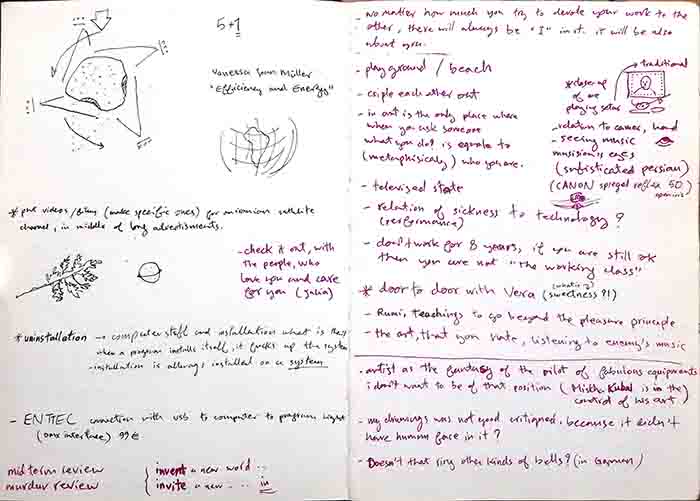
uninstallation, playground, the other, televised state, sickness to technology, working class, door to door, Rumi pleasure principle, listening to enemy's music, the art that you hate, artist as the fantasy of the pilot of fabulous equipments --> Kuball, my drawings were not critiqued enough because they didn't have human face in them? doen't that ring other kinds of beel? (in German or)
- 🔎
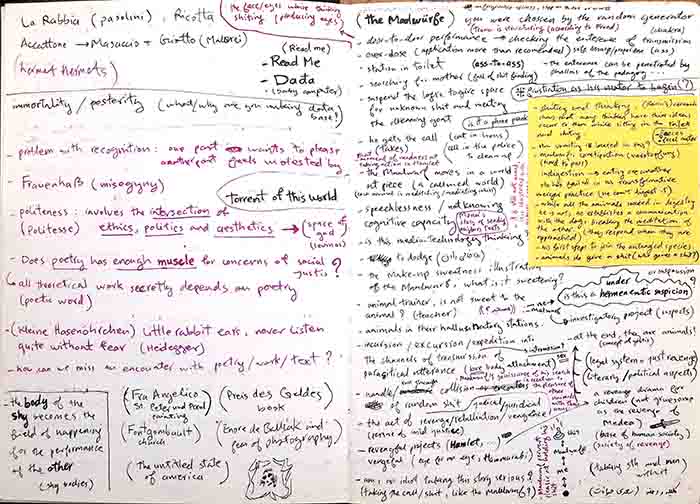
da(d)ta (data + dada), politeness, poetry muscle for social justice, Heidegger's little rabbit ears, the body of the shy becomes the field of happening of the other, the untitled state of America. Maulwurf, under hermeneutic suspicion, Hamlet, Medea, revenge, animal trainer, ass-to-ass,
- 🔎
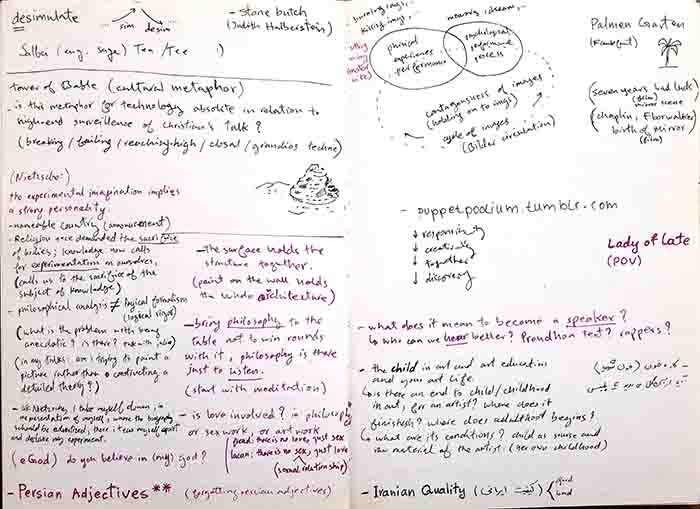
desimulate, tower of Babel, Nietsche, nameable country, religion sacrifice, science experimentation, anecdotic, my talks are paining a picture rather that constructing a detailed theory, biography advertized, Persian Adjectives, contagiousness of images, Lady of Late, what does it mean to become a speaker? who can we hear better? child, Iranian Quality keyfiat-e irani, khun-e shahid
- 🔎

intro to islam, where are you from question, gene, drug, clean, Lights from the old stars, face that comes from beyond the world, mapping,
- 🔎

islam, preaching, theorization of death, assume the other as part of my freedom, voice, finger in mouth, shower project with bodies that differ, desire to live without memory, the master image of the body, iqra, qur'an,
- 🔎

amazon, error, damge obscure dirt glitch break optical perceptual, jungle breaking of bodies, kinect, objects from their culture or raw from jungle, Leticia, Hanno's energy, Hanno's economy of movement, efficiency, wondering eye, meditating eye, with and through the three dogs we connected to a broader jungle, r,a.v. random acts of violation, r.d.i. random dropping of insects, r.s.k. random shapes of kacke/shit, r.p.t. randmom pauses of thinking, footprints of the dogs in the beton, catastrophical growing: what happens if there is no damage in childhood? checking realism with kinect, what happened to our skin?
- 🔎
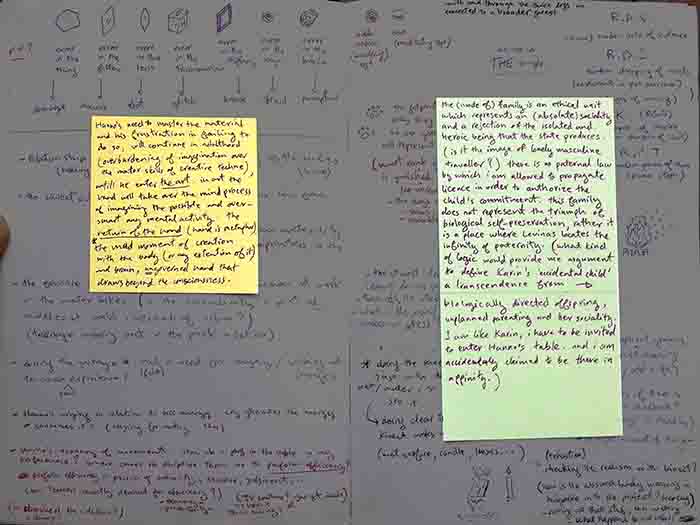
Hanno, imagination, motor skills, creative techne, mind, return of the hand, mad movement of creation, ungoverned hand that draws beyond consciousness, family, ethical unit, isolated and heroic being, lonely masculine traveler, athorize child's commitment, triumph of biological self-preservation, Levinas, infinity of paternity, Karin, accidental child, unplanned parenting, biologically directed offspring, i have to be invited to enter Hanno's table and i am accidentally claimed to be there in affinity
- 🔎

Hanno as mixer, adults put, children rub, rubbing food --> potential for mixture and heat, neat sharply cut frames of clean art, love rubs, rubbing exhaust materials put them in a different state, enjoyment, the jungle he knew, child father, is it possible at all not use any violence with children? enfant terrible, enfant impossible, enfant automatic, my ear damage classroom, Colombia, nonminimalist music, display of loudspeakers, amazon, three dogs, uncontinuous loyalty, random presence, no demans and only calls between the three dogs (play, sex, food, attention, etc.), infantile scene of child saying sorry, the child that is not forced, a Hanno shower video Leticia 12/02/2013, self-image, mirror stage, video stage, shayness mirror excessive, Hanno's anticipation, Sina and Karin bringer of language for Hanno, text, reading
- 🔎
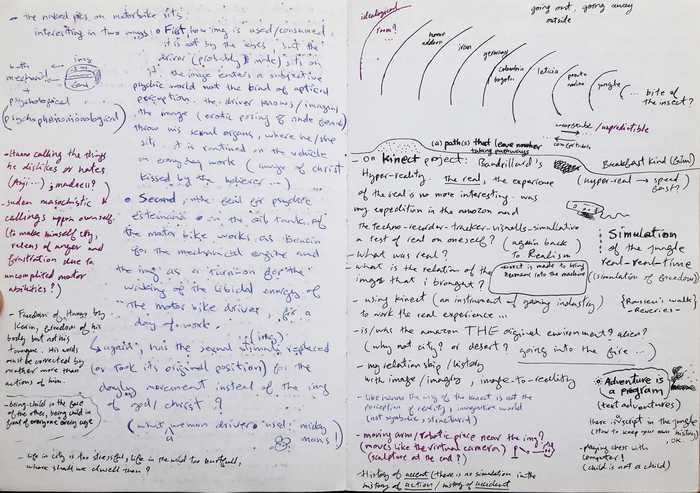
Colombia motorbike sits, libidinal energy of bikders, naked photo, Christ kissed by believer. freedom of Hanno dislikes. sudden masochistic callings. being child. going out going away, room, Iran, Germany, Colombia, Leticia, Puerto Narino, jungle, bite of the insect. kinect, Baudrillard hyper-reality, techno-recorder-tracker-visual-simulator, real-real-time simulation of jungle, kinect made to bring human into the machine. adventure is a program. there is a script in the jungle. how to keep your own history. child is not a child. history of action / history of accidenct
- 🔎
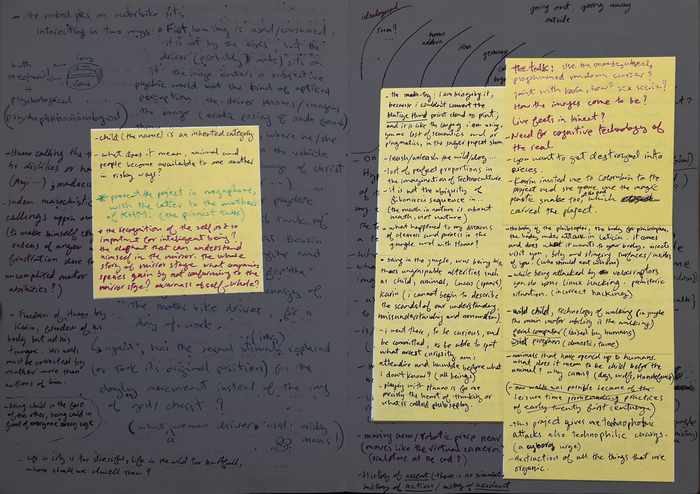
name of the child; animal and people become available; megaphone, KHM mothers; pianist talk; self recognition, intelligence, elephant, mirror-stage, whale story, awareness of self-whale; snake toy, blutige Hund, semantics, playmatics, puppet show; leash/unleash the dog; loss of perfect proportions in the imagination of technoculture; fibonacci nature; what happened to my dreams of cleanness and pureness in the jungle and with Hanno? being with Karin; I went to amazona to be curious and to be commited, to be able to spot what arrest curiosity. playing with Hanno is philosophy. kinect, cognitive technology of the real. you want to get destroyed into pieces. Karin invited me ti Colombia, and gave me the snake toy to think with. the body under attack in Leticia. insect visits you. it comes and does what it wants with your body. prehistoric incorrect hacking. wild child. feral computer. walking. what does it mean to be child before the animal? a cyborg urge.
- 🔎
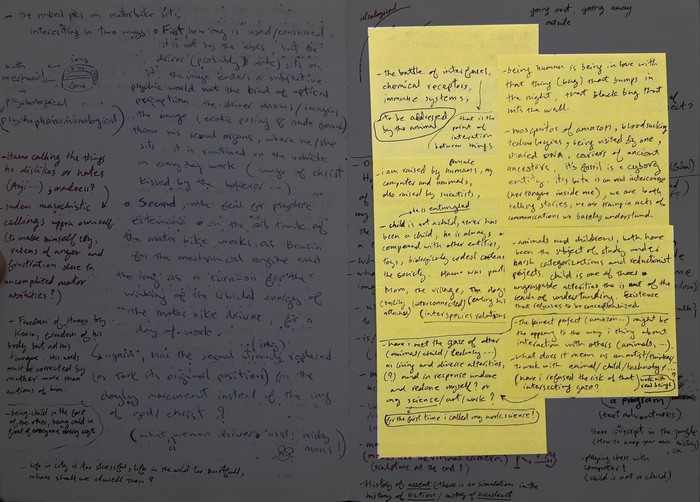
to be addressed by the animal, battle of interfaces, child, Hanno, entangled, my work, mosquito, amazon, DNA, being human = being in love with that thing that bumps to the wall in the night, kinect,
- 🔎
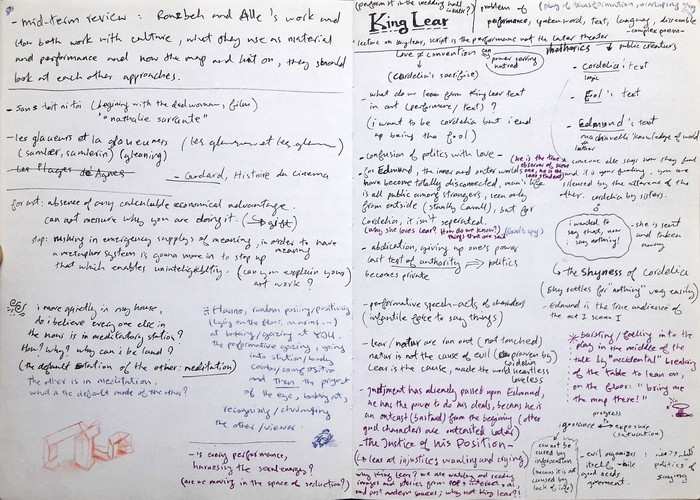
Rouzbeh, Alle, KHM, gift (for art): absence of any calculable economical advantage + can not messure why you are doin it, explain art, my home, meditation of other, King Lear, Cordelia, Fool, Edmund, test of authority, shyness, bring me the map there! politics of saying in Kelile Demne


