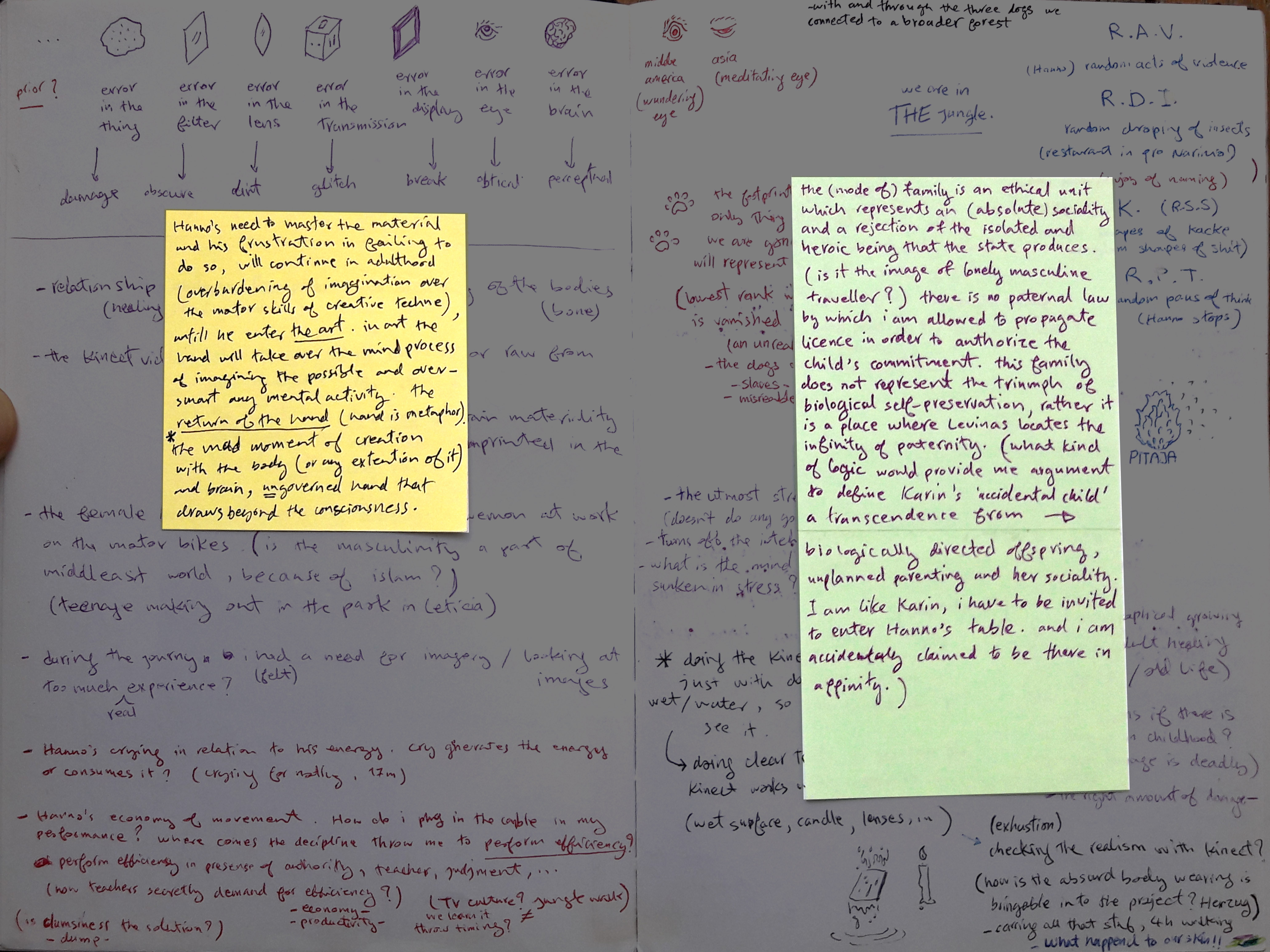
[...] images recorded by Kinect infrared 3D-scanner/motion-detector. The result of the visualization is a heavily glitchy image, which aims in the performance to link the spatial practice to the perceived and the representational spaces to the lived. Affirming the “unnaturalness” of the image makes it a transposition of universal means of communication--the language--that would like to provide a direct, unmediated, and accurate representation of the jungle.
The performance is an engagement with the notion of companion species elaborated by Donna Haraway, in an experience of walking in a tropical jungle with a computer in one hand and in the other hand the hand of the human child. The work deals with questions of the other-space that is mentally filled with projections and projects. The recording of the walking in the rain forest --as spatial and sensual experience-- is thus dematerialized and has acquired a digital character. The dense and hot environment of the Amazon is replaced by an abstract graphic structure, thus bringing a new understanding of the locality of the walk. The noise and the randomness of the technical coloring the surface of the jungle provoke an aesthetic fascination, and an appropriation of the imposible image of the forest.
Traveling to the Amazon to experience its radical Otherness is a European tradition. It unintentional affirms the ideology of a “state of nature” that is prior to culture.
Lacan: i am led to regard the function of the mirror stage as a particular case of the function of the imago, which is to establish a relation between the organism and its reality - or, as they say, between the Innenwelt and the Umwelt.
This developement is experienced as temporal dialectic that decisively projects the function of the individual into history. the mirror stage is a drama whose internal thrust is precipitated from insufficiency to anticipation - and which manufactures for the subject, caught up in the lure of spatial identification, the succession of phantasies that extends from a fragmented body image to a form of its totality that i shall call orthhopaedic - and, lastly, to the assumption of the armour of an alienating identity, which will mark with its rigid structure the subject's entire mental development. thus, to break out of the circle of the Innenwelt into the Umwelt generates the inexhaustible quadrature of the ego's verifications.
Electronic Reserve Text: from Jacques Lacan, Ecrits, New York: W. W. Norton, 1977.
The Mirror Stage as Formative of the Function of the I as Revealed in Psychoanalytic Experience
Delivered at the 16th International Congress of Psychoanalysis, Zurich, July 17, 1949
...................................
Flusser, Gestures - beyond machines (reading)
the project investigates the way in which Seifee as an artist engages tactics of fieldwork, embodiment and[...]
(1)[...otes on kinect performance.txt]%46.8[...]Pratt]
“Our” Dr. Livingstone was a grand nephew of the “real” Dr. Livingstone in Africa. English Canada was still colonial in the 1950s: reality and history were somewhere else, embodied in British men.
The syllables wound through our lives, threading together by force of repetition things that were distant, discontinuous and unreal. Living stone. This is how empire makes the world meaningful to its subjects, how it weaves itself into the everyday.
...empire made us part of a history that was somewhere else made by people who were not us. At the same time, when it came to Africa, we knew who we were. Sunday school missionary stories built the color line into our imaginations. That was part of their job, to create us as subjects of empire, give us our place in the order.
The book aims to be both a study in genre and a critique of ideology. Its predominant theme is how travel books written by Europeans about non-European parts of the world created the imperial order for Europeans “at home” and gave them their place in it. I ask how travel writing made imperial expansion meaningful and desirable to the citizenries of the imperial countries, even though the material benefits of empire accrued mainly to the few. Travel books, I argue, gave European reading publics a sense of ownership, entitlement and familiarity with respect to the distant parts of the world that were being explored, invaded, invested in, and colonized. Travel books were very popular. They created a sense of curiosity, excitement, adventure, and even moral fervor about European expansionism. They were, I argue, one of the key instruments that made people “at home” in Europe feel part of a planetary project; a key instrument, in other words, in creating the “domestic subject” of empire.
the rise of natural history
These case studies are shaped by a number of shared questions. With what codes has travel and exploration writing produced “the rest of the world” for European readerships at particular points in Europe’s expansionist process?
codifications of reality
the emanating glow of the civilizing mission
the cash flow of development
(it habitually blinds itself to) the reverse dynamic
obsessive need to present and re-present its peripheries
It becomes dependent on its others to know itself
important historical transitions alter the way people write, because they alter people’s experiences and the way people imagine, feel and think about the world they live in.
[...]how European travel writing interacted with enlightenment natural history to produce a Eurocentered form of global or “planetary” consciousness.
[Pratt considers] the classificatory schemes of natural history in relation to the vernacular peasant knowledges they sought to displace.<[...]
(2)[...notes/note Sana.txt]%90.9[...]nimals
animals animated by other beings (superhuman, demonic, etc.)
the idea of allegorical exegesis --> “each law about forbidden foods has its deep reasons”
“cloven-hoofed animal which part their hooves : all our actions must betray proper ethical distinction and be directed towards righteousness”
“chewing the cud : memory”
old testament
•blessing: source of all good things
•withdrawal of blessing: source of all dangers
xxxxxx
ment/question) --> doubt --> postponing an immediate answer (“but before you answer...”) --> death of question
*Esteban: not to do: impose an answer, not triggering in the other, expecting an idea of an answer
*Arianna: deep truth involved, process, point of passage (the axis of child traverses your axis) what you say to the other is a container
*Joke: question --to--> invitation, creating the invitation
*Pierre: posting a problem is not about general sentences, it is about finding new relations in the existing fabric of the world, problematizing our intuitions into problems, therefore it is important to have the “?”
*Sina: remembering beyond history
--------[how can we enter something and not enter it at the same time?]
*Thiago: nonpresence <--> thinking, without body?!
*Aela: is about the question of distance and inside/outside, by practicing openness, it is about when something enters ‘you’
*Sana: physical-presence =/= imagination (mental activity ~= dream) {She needs to see Miyazaki}
*Roger: we do it all the time, for him it is more about active engagement, role of feelings, moments that you are pushed out by the entity
*Maarten: no! enter =/= not-enter, research depends on definitions
*Juan: layers of realities are involved, it is about expanding the consciousness by charming it into 90% presences, theater gives a yes/no quality to the question of entering, actors, stage as Dystopie of presence
*Xiri: yes! this is often the case, we are between 2nd-chances and being-torn-apart
--------[who told the first joke?]
*Gerald: objects =/= actual life (absurdity and absoluteness of objects) (contemplating about object ==> inner smile)
*Nicolas: father (by not getting it right), not mother (she is not the teller type), the tickler is about lunching possibilities
*Vladimir: God, Vladimir thinks this is theological and therefore axiomatic (that[...]
(4)[...notes/midday review.txt]%0[...]the other? or is it just for you, the questioner?
-how to resist the interference of double click?
...................................
(in the direction of my research; hastily opening the ontological envelope that saves a heart full of “list of specifications”...)
the visit will be to the ‘European Committee for Standardization’ (CEN, French: Comité Européen de Normalization), one of the EU fostered nonprofit public institutions of the cutting-edge development regarding ambitious notion of ‘data,’ ‘systematic knowledge,’ and ‘specifications’. the excursion will be oriented towards a meeting between the participants of advanced performance and scenography studies and the representatives of CEN, and encourages a run between the ontological demands of international economy and contemporary art, their disastrous split, and where their formations meet and intersect.
KEYWORDS: cosmology, experimentation, existence, specification, future, knowledge, irrationality, permanence and substance, technological acts--of naming, a path of becoming--on the grid of technological dominion, suspicious partnership of “advanced democracies” and “high technology"--what allows their mutuality?, standard-testing--which sectors of existence it is traversing?, pre-technological traces of cognitive normalization, the very little difference between specification and “the real thing,” THE origin of the demand for rigorous specification, migration of questions out of the areas of instrumental fitness, human relation to the surrounding world, impoverished zoologies--under techno-epistemo-anthropocentric values, squeezing prehistoric modes of weakening subjectival normativity--a field that today gets heavily technologized,
...................................
to bring our needs and lures towards each other
bring my lure to the table (that thing which i can't stop following)
who/what are you pregnant with?
<br />
(that is what you are proposing)
(that is to play with the ‘histories of body and mind’ [Haraway] you inherit --> for me is to play with the pre-subjective singularities)
[inheritance is of great importance for our research. it is about the passing of obligations from something ghost-like. i am sure we have other modes of response available to us other than how Hamlet takes in what is inherited to him, other ways of responding to the ghostly beings that talk to us from death. (inheritance ~= inhabiting spirit [they cannot be possess as a piece of property], reading inflaming flashes of remote spirits [--> is this hear from one another looks like? is technology placed at the source of this reflection?--technology itself answers the call--(Avital)]) could we work with Ophelia's kind of #Wortsalad instead? (Salad-e Kalame, khoresht-e kalame; same thing happens to Shirin of in Khosro Shirin, but unlike Shakespeare, Nezami allows another poetic drift;) Heidegger[...]
(5)[...notes/midday review.txt]%0.2[...]"only the weapon that made it will ever cure the wound.”)--what does this mean for our caring activities? @Sina: is this what you mean by western modern rationalization, and that is why you are thinking within the western/eastern philosophies, is the modern tools the antidote to themselves? (this is too soon for me to say and understand this question.)
what is my ‘will to’?
Xiri wants to abolish injustice?
Thiago, abolish selfishness?
Maarten, abolish weakness?
Aela, abolish entropy?
Sana,
Seba, abolish enmity?
Lili, abolish feelings?
Varinia, abolish obedience? [--what shortens our leash?]
Sina, abolish selfhood?
Vladimir, abolish non-disambiguity?
@Esta, her enunciated need for “framework” [~->? instruments of economization], could she be needing “pathway”: path instead of frame, and way instead of work. [frame =/=? overflowing (--> my method of script?); identity =/=? avidity, hers;]
interplay of scales
the scale of intimacy, (of skin, of shared heartbeats and feelings)
data and surveillance and seduction
intimacy: still an unpredictable force?
intimacy: the biological spring from which affect drinks?
how Esta's proposal is capable of traversing from the lovers’ bed to the wild embrace of the crowd to the alien touch of networks?
[and when i say “abolish,” i am using a word that is about rendering something obsolete, mansukh, canceling, making reading to get rid of it, and this is not the same as destroying.]
@Arianna, ‘cleaning agents,’ to toxicity? how can we learn to live with “toxic animacy”(Chen)? dirt: “consequences overwhelming their cause” (Latour)
-narratives about urgent necessity: that we need to understand more in order to cure, prevent, construct, excel, survive.
*afterlife toxicities (?)
@Lili: cycle of planets instead of heartbeat of a planet. tuning in the soup of planets, instead of getting the pulse of a singular planet. the nebulous milk way of liquid bodies, instead of rigid mass of individual blood--Pluto.
@Varinia: (in her dog video, regarding her engagement with the law and the question of comparative thinking:) what is the model for what, what is similar to what?
-is her model based on the idea that beings exist as individual? (is this a ‘difference’ that her work produces?)
@Agnes: you are a response to the bed, making the bed and being made by its caress and embrace. it is not that you want all the audience in the world to identify with a general question or present this as a universal expression, but what could go beyond localization is precisely this concept that you, like me, transitioning body in your environment (bed or whatever) are outstretches of homeliness and forces that distribute across space and discourse, territories and sensing zones, you are an exchange between self and e[...]
(6)[...notes/midday review.txt]%0.8[...]
@Lili: cycle of planets instead of heartbeat of a planet. tuning in the soup of planets, instead of getting the pulse of a singular planet. the nebulous milk way of liquid bodies, instead of rigid mass of individual blood--Pluto.
@Varinia: (in her dog video, regarding her engagement with the law and the question of comparative thinking:) what is the model for what, what is similar to what?
-is her model based on the idea that beings exist as individual? (is this a ‘difference’ that her work produces?)
@Agnes: you are a response to the bed, making the bed and being made by its caress and embrace. it is not that you want all the audience in the world to identify with a general question or present this as a universal expression, but what could go beyond localization is precisely this concept that you, like me, transitioning body in your environment (bed or whatever) are outstretches of homeliness and forces that distribute across space and discourse, territories and sensing zones, you are an exchange between self and environment. this is pragmatism. like the variety of bed sheets, we are proposed with answers that vary, before posing any question.
to reformulate the question that was posed to you: how your proposal is capable of traversing from the bed to the wild?
pre-historic personhood
my work is concerned with connections, mediation and passages.
what you take for granted, is in another words, what that you can't not know.
(my proposal:)
the past is not absolute!
the idea is that the mythical became the mythological --> Things could be treasured for their beauty as opposed to
their utility or their numinousness.
(Martha Kenney's) “wild facts”
facts that won't hold still
fables
fables of ajayeb, creatures of imaginations, (im)possible worlds
your institutional hacks
three things to consider in my work:
projection, immersion, and synthesis
seeking to be at once inside and outside the topic
the issue of topology -- what remains invariant as a result of transformation
suggestive power of the figure
...................................
synthesis =/=? genesis (to originate something, to design)
genesis =/=? apocalypse
...................................
in research, contrast between method and subject, is a tool
(in studying natural history)
in critique, contrast between effect and affect, is a tool
(assumed quality of the object and one's own named experience)
[these tools are perhaps cognitive objects]
...................................
Enlightenment as cultural European phenomenon versus a scientific British one
(the theatrical function of natural philosophy in the En[...]
(7)[...notes/midday review.txt]%0.9[...]your “object”). this bodyguard can be organic, nonorganic, cyborg, any form, but always an agent. tell us why/how this or that feature helps the bodyguard with its task
•generation stories, describe and follow your object in three generations, its child and grandchild
•[for the second day or warm-up first day?] constraint based writing: (Kenney > Christian Bök's “literary genetics” poetics of encryption of data; poetic vectors, to “infect” the language;) describe/story your object (or an operative “verb” within your discourse) with univocalics: without using “e” or only using a single vowel. or, first write with 3, then 2, then 1 vowel.
-the workshop is about: what other stories (of your object) are possible?
-in the workshop (I take a temporary position to) challenge others to re-tell the story of their ((epistemological) found) objects
-a ‘generative constraint’ might help opening up paths before you, away from our habits of storytelling
/>
-it is about getting a feeling for the resistances and potentials of language in our (sometimes mundane) descriptive practices, “strange richness of missing the letters we need” (Kenney)
the metaphors are dormant in our routines of talking and noticing each other. how then, by traversing the routine, our “knowledge” and “community” took on new meaning, as they get a chance of being rearticulated in different languages (or differenlty infected literature)
~-?==> changing the system of classification (of thought)
-in a way the workshop is about an *approach* to knowledge generation (and not necessarily a rigorous critique nor directly evaluating the production of our knowledges)
***nothing is never merely a metaphor***
[some fables from science studies:]
•Emily Martin's egg/sperm story --> stories of atomism, distribution of agency, ----[The Egg and the Sperm: How Science Has Constructed a Romance Basee Based on Stereotypical Male-Female Roles]
•Hayward's microscope --> tropes of natural history docu, ----[Enfolded Vision: Refracting The Love Life of the Octopus]
•Kenney/Haraway's origin/nature fable --> the omnipotence of the “origin” story in our descriptions and interactions with the natural world
•Scott Gilbert's immunological “bouncer” story =/= immune systems as inclusive agents of symbiosis
•Lynn Margulis: life (made possible) by “combat” [the survival fable that TV series “The 100” and “Kelile Demne” for instance is based on] --✕--> life by networking
•Haraway: the tale of “organism = a system of division of labor with executive functions” (==> extraction of wealth among us)
•Morton's causality-story
•brain/body story --> where the “move” came from?
•Sina's “standing on the shoulders of giants” --> knowledge/continuity, role of authority and humility in science ----[http://www.sinaseifee.com/giants.html]
[...]
(8)[...notes/midday review.txt]%1.5[...]y troubling to Aristotle and Aristophanes.
•pardeh-dari پرده دری, hajeb حاجب (after neghabat نقابت is hejabat حجابت [Beyhaghi]) (Nezami in Leili-o-majnun: haft arus-e noh emari bar dargah-e to be pardeh-dari (هفت عروس نو عماری بر درگه تو به پرده داری) --?--> angelology) =/=? hayula(ism) هیولی
...................................
hermeneutics regarding Jurisprudence (feghh فقه) and theology depend on the exegesis of written texts. in both cases the process of understanding is an act of application(?)
interpretation/hermenutice =/= commons/collectivsm
(ta'vil bayad dar jahate axe harkate jami va moshtarek bashad)
...................................
(Kohn) to “provincialize” (rustayi روستایی, bastani باستانی?) language in order to make room for another kind of thought--a kind of thought that is more capacious, one that holds and sustains the human.
/>
my point in animals without narrative is that the apparatus that is working for Attar in his representation of birds is the same as the narrative tool in the so-called wildlife documentary series which produces nature----a sy.
transcend is about traveling from trope to truth (obur az majaz be haghighat عبور از مجاز به حقیقت,) from virtual to concret. but that is too easily reversible. my point is to stop this transference and interrogate the trope itself. my work in amazon book is about this ‘majaz’ (مجاز), an interface that we are inhabiting.
...................................
the main (and only?) question in my work/performance/lecture is ‘when’ the gift will/have pass(ed) on.
--> holding on to, preparing, strategizing, spontaneity, and so on
-my texture aversion and preference in soft/hard fabric of language and material tonality? --> the “inanimate affections” (that give us pleasure inure in life) --> we often give each other soft gifts as a way to care for one another (@Janina)
*radical affection does not require intentional politics* (Chen)
[Shepard 2004] Stanner (W. E. H. Stanner, White Man Got No Dreaming) describes how the universe became a moral system and consists of three elements: marvels, species diversity, and institutions. Marvels refer to that presence of the unexpected that one always encounters sooner or later in nature, particularly when the terrain reflects something about the mind that implies a common structure. His second element, species diversity, coincides with one of the major moral issues of our time--the extinction of species and reduction of biodiversity.
-“marvels of affinity” is the key to reality, revealing how things are, what is known, and how to behave.
cosmogony (keyhan-zayi کیهان زایی)--how the universe became a moral system
[...]
(9)[...notes/midday review.txt]%2.1[...] (resisting a fixed relation to loss) seems unable to mourn
*complaint cannot mourn. [complaint as a form of mourning-disorder]
(is mourning busy with ‘continuity in life’? a world that is not made of connections: zendegi bi/ba tadavom زندگی بی/با تداوم, jahani ke be ham mortabet nist جهانی که به هم مرتبط نیست)
is any critique not a complaint? not throwing something in the field of complaint? (--> Luiza, Lili; certain forms of protest dominates their utterances)
--different morphs of civic grief--
(why am i concerned with complaint of my friends? this is about checking my own infrastructural concerns about zones of encounter and redirecting oversized libidinal aggressions, [and pain-relief? {is my work all about (philosophical/artistic) pain-relief?}])
complaint =/= staying within the boundaries of coded gracefulness
(...credit reserved for non-complainers) ,,, ((minor scales of)) protest and breaking rhymes (of master discourse?) (@Sana, perturbed by manners of injustice; her libido [zist-maye زیست مایه, shur-e hayat شور حیات] is at stake)
--when complaint takes over and you don't even know if there is an injury anymore at the root of it.
(we are traveling behind its possible meaning-fields)
de-shamanization and translation /(non-transparency should rule?!)
are we trapped in a grid of grievance?
different forms of ‘maybe’ (i am trying to install?)
how complaint is then situated in ‘becoming’?
[...] complaint haunts our era of desperate justice (Xiri, Sana, Varinia)
. a calling-system? a GPS that has lost its signal?
maternal super-ego
political passion emerging as a defensive strategy
(@Xiri, is she trying to add-on the super-ego for her concern of social justice?)
so, does complaint prevent the arrival of change or make way for new forms of sociality?
“I can't complain.” --> (a blockbuster;) those in stubborn destitution ----that there is no address in the era of the becoming anonymous of God. ‘Who would pick up your call?’
however, “the friend, whether ghostly, futural, or closely bound in time, receives the brunt of the complaint” --friends structurally listens to disappointed expectation, disappointed worldliness
what-should-have-been
On what approved contingencies, contractual loopholes, or transferential coordinates could I possibly befriend another?
metaphysical heritage of friendship (... reconfigured personhood)
(how can I do things without being a psycho about it?)
(How do I know by which politics of friendship, grid or writing practice I am being called up?)
a vocabulary existed to designate, approximate certain routines
R_dzvJYDZXM
CrGJIS3quYY[...]
(10)[...notes/midday review.txt]%4.6[...]ncapsulated in already arrived-at opinion and judgment” ==> blockage
war of “disqualification” ~ Stengersian non-event
being (represented and) legitimated in proxy war
...................................
@Zoumana; “decadent gardener” that connot keep distinction between kin and pest, nature and culture
what is a garden full of indirections, snakes?
...................................
#my trope-findings, (bilingual nonsystematic comparative thinking for storytelling) (work with Avital?):
•پیر Pir / sujet supposé savoir (--✕-->? پیر فلک Pir-e falak in Hafez)
•غر Ghor / complaint (--> shekayat شکایت, and then, khamush خموش in Hafez)
•تعارف Tarof / greeting
•transcend <--> darajat درجات (-> Attar)
•super-ego <--> Div-mardom دیو مردم (-> Nezami)
•NatureZolmat (ظلمت --> ajayeb)
•آبرو Aberu / economy of value
•طیالارض tey-ol-arz / body scale, intensity and excess
•نگرانی negarani <--> practices of care
on Aberu, I became interested due to my lack of Aberu in presentationl quality and its abundance in other area's of my psychosomatic becoming.
Aberu traverses, calls itself in, animates, and exists for later visits.
-when you are devalued by the marked of bi-aberu, you are less tied to the strictures of shame, and ‘your behavior’ becomes performance material
...................................
agency =? boresh برش, jahd جهد (in Farsi), “agential cut enacts a local causal structure” (Barad)
agency of ‘hemat’ همّت
hemate shahi همّت شاهی, lavazeme hemat لوازم همّت --> apparatus
sufi's hemat ~= magic
...................................
@Seba after accelerate manifesto reading: (what is and how can we not pivot on our work) the measure of the meaningfulness of action. (Seba's notion of losing hope is because he put himself unconsciously in a cost-benefit analysis? “what is the effect of my actions?”) [in practice it is difficult to embody speculative thinking. we are still in the space of thinking in terms of the probable.]
to do hope-work is about ‘not talking (too much) about the future’ =/= commitment in terms of probabilities, refusal to treat your subjects as if they were objects of management --> let's set aside our own hopes, and work to honour the **hopefulness of others** (Deborah Rose)
“And hope is here, all around us. Creatures want to live.” (not in the “future”)
the accelerationists putting things in their cascade of failures, (everything sinks effortlessly into it,) and creating a vanishing point in terms of a western saturated temporality. for them the present is the time of announcing the news of salvation or apocalypse, and has no thickness. (the desire) to step out of history, and i[...]
(11)[...notes/midday review.txt]%5.5[...]essed in motley
mexican garden: a model of motley and devotion, of rapt attention to the birds it draws
what was the imaginary homeland (=/= remembered homeland) for Iranians?
“here, forms and shapes revel themselves through patient inquiry and the luxury of enough carried water to let you trace them.”
to think about X = to change X
we change the subject
we get some info: there are 5 people in the room. but when we bring that information into thought (because of how we feel and of our believes ==>) we start to bend the 5 to 6 or to 50 --> a try to change the reality =/= thinking in calm condition using science, information, conversation
...................................
bipolar --> mood disorder --> relationship of the self with emotions
borderline --> personality disorder --> relationship of the self with the world (of subjects)
narcissist --> personality disorder --> relationship of the ego with the world
...................................
people who grew up in iran and former soviet countries --> tajrobeye doganegi تجربه دوگانگی (they lived through contradictory experience) =/=> settle down or grounded subejctivity ثبات sabat
“I like to travel” [~= escape from one's self گریز از خود goriz az khod : need to be everywhere but here]
•zamineye sargardani بیقراری restlessness (~=> escape) --sold--> nomadic
•zamineye narezayati نارضایتی dissatisfaction --sold--> critical
•zamineye konjkavi کنجکاوی curiosity --sold--> knowledge
•zamineye majarajuyi ماجراجویی adventure --sold--> wonder
(a [not always wanted?] form of relatedness in interpersonal relationships)
mentor ~= rahnama راهنما
(when someone is) angry = anxiety + depressed + obsessive–compulsive vasvasi + pessimist bad-bin + negative + offender motejavez
direct speech رک صریح بی پرده rok sarih bi-parde harf zadan = saying the real and truth in the right place that is necessary and almost an obligation =/= parde-dari provocation
...................................
note on the workshop of anarchive in Zsenne apass summer 2018
(my issues with Manning's presentation of) process philosophy --> a system-builder mode of thinking --> *saying something (right) about every single thing at once*
-process philosophy puts forward the will and desire for “change,” therefore it developes a resistant to change (?)
-it tend to be a metaphysics without physics [?!] (when a metaphysics provoke less interest for ‘-physics’ and more for the ‘meta-’ /and why is that a problem?) [==> Barad is much more useful for me now]
-the real question of the workshop remained “how to define what i like (such as ‘anarchive’) that it remains open at all time to the ‘more’ and ‘multi’?” <-- an[...]
(12)[...notes/midday review.txt]%10.5[...]>
[in ajayebnameh عجایب نامه...] to map the morphogenetic changes of the real
... bewildering heterogeneity of registers in ajayebnameh عجایب نامه
... treating entities trafficking in the futures
active capacities of description
this is not a project of repopulating the social sciences with nonhuman beings
the symbolic function of language is about detecting salient features of the world that can be organized in contrastive sets
(can we think not in contrasts?)
this is not about trying to think like X, that would be transposition of a relational experience at another scale
(non-religious semiotic model)
bodily disposition ==(produces)==> perspective ==(produces)==> self
the beings in ajayeb (عجایب) are ‘alive’ because of their ability to ‘do things’ in the ways they come to represent and interpret through me
recruiting scores of new actants so as to render the theater of worldly interactions more complex and interesting
what is the sociocultural world we construct?
dream images, vivid mythical scenes,
form travels/passes through us
...................................
[Latour modes of existence]
(to distinguish types of)
incompatible truths
“truth"--is the expression of an encounter with forms of existence
to understand the others in the absence of a description of ourselves
(what is realistic?)
to direct attention towards the beings about which humans are interrogating themselves
عجایب ajayeb is a ‘network’ more than anything else, in it “God” has no special privilege, is not located in addition to or beyond other beings
we are seeking to redefine the paths of beings that are unique to ajayeb without giving them substance and without jumping immediately into transcendence. (using Latour words) [transcendence is never gradual, in the places i come from, it is always a shock, happening, a truth-event]
-each word (God, Angle, Jinn جن, fog, etc.) brought into its own network,
-what are contrasts and of category mistakes particular to each
-and their crossings----and what is the vocabulary specific to each crossing
the network of associations necessary for the exercise of religion without bracketing off its ontological requirements.
explanatory rage (tavahoshe roshangari توحش روشنگری) --✕--> networks necessary for religious meaning
(the aim is) deploying the network (of ajayeb)
it is about grasping ajayeb's beings not as substances but as *trajectories*--and give them a more precise *direction.*
what is important in working these modes what kinds [...]
(13)[...notes/Ajayeb notes.txt]%13[...]ories, will not verify histories of presence tattooed under the ear of the elephant of our story, as you whispered somewhere in the dark.
[...]
Yes, vocal works that informed and influenced Qahveh-Khanehe (قهوه خانه) still can be found in some places of tea or cafe houses in Iran. They are called pardeh-Khani (پرده خوانی), here someone who is a pardeh-Dar پردهدر (“-Dar” meaning that who tears apart the pardeh پرده, and pardeh meaning screen or veil--the concept of pardeh always contains “a perpetually hidden message”), ‘Khandan’ (خواندن) meaning in Farsi ‘to read’ or to sing-off a plain of signifiers, is also the verb ‘Darridan,’ (دریدن) [#Derridean acting] meaning to rip apart.
...
I am sorry; I am just entangled in the topologically impossible pardeh, as an interfacial space where the body and instrument of music meet. I am touching with my fingers the ‘first three’ pardehs of Setar ستار, and thinking about to jack into the vague differences between another two magical canvases / magnetic disks: Plane of Destiny (lohe mahfuz لوح محفوظ) and Plane of Memory (lohe hafez لوح حافظ), while listening to the virtual narratives of Ghahveh-Khane theater. Which creatures have you encountered, in your travels, that bypass human installations (of memory)?
...................................
a Zoroastrian data: pre-existential ~ azali ازلی, sabegh-ol-vojud سابق الوجود
atefiate mahsus [عاطفیت محسوس] (queer? a queerness not familiar with mysticism?)
queer is about ‘marahele johare atefi’ (مراحل جوهر عاطفی), mohabat محبت (kindness or love,) without leading to ‘faghre erfani’ (فقر عرفانی)
[i have problem with] (escaping) the ‘pit of nature’ (chahe tabiat چاه طبیعت) in Sohrevardi's thought
-(he inverses the earth from positive to negative geology, sphere becomes pit)
-the project of post-Babylonian autopoietic-self, a self that is defined by the ‘meta-fall’ into the “pit of nature.”
‘andam-shenasi peikare latif’ (اندامشناسی پیکر لطیف)
...................................
[Avital]
what are the ways in which ajayebnameh relates to itself as its own future, its own labor and announced commitments?
(our reading of ajayeb is not a time quiz involving applicability and whether or not one “buys it.”)
i am “drifting” without anxiety into a new territory (in the philosophical work of ajayebnameh,) drifting involves randomization, fuzziness, and interference. there is no coherent programming nor concerted demand for rigor
(Avital: The origin of the demand for rigor, which has conditioned 20th century Anglo philosophy, “is the positivist's requirement that theories be testable. At the very least, a respectable philosophical theory should be stated with sufficient p[...]
(14)[...notes/Ajayeb notes.txt]%14.2[...]ische Abend PARS VIDEO 2014]
the minute you see in a text (@Hoda, Sana, Ali having even) one memory that is clear and guaranteed --> your signals should go on: there is one unrevised (in an original form), no secondary revision, *pure memory* <-- this is a memory that is unnegotiable for them
*on Wind
wind, is a coming that arrives from the future
(compare “going” [staying behind] in Attar, Hafez, and Holderlin) [in San'an nobody is greeting, there is no greet-event. Attar misses: Greeting as pure letting go**]
(Avital on Holderlin:) “[...] in going, comes. Parting is not a mere leave-taking and empty staying behind. Parting is also not a mere going away and disappearing. The poet remains in the rustling wind. to the extent that he goes with its going. [...] Nonetheless. the poet stays with the wind. Accompaniment now shapes the Greeting. As the gusting wind is alternately a coming and a going. so is the Greeting a staying behind that nonetheless flutters away. becoming a going with. [...] The poet's staying behind is crucial. Staying behind is not meant to mark the isolation or even desolation of the poetic act. [...] Neither passive nor active, remaining behind indicates a way of going back, a returning to the source.”
-traveling to the impossible place of the other
-(wind) come and go without touching down or dropping anchor
-the agency, animacy and sentience of the wind is described by ajayeb's sensuous subjects within the wind. one feels enwrapped, enveloped in a sentient being that moves across vast distances, it comes and goes --> the materially textured poetics of description in the ajayeb-e bad باد
the poesy (~ fictional =/= truth, real) (Wahrheit und Dichtung) of ajayeb (are no longer distinguished from each other)
(greeting is the poet/artist's most essential mode of being)
a designed closure or reappropriation that locks the Other into a schema of subjectivity ---- at once promoted and subjected
*(re)fastened to the Greek origin
promoting the ousider to insider (who now holds an Ursprung and origin)
re-appropriation ~=?! an end to alienation {~=?=> the condition of possibility for totalitarianism} [Fynsk]
the illusion (and comfort) of noncastration
...................................
duty of deconstruction: the practice of non-avoidance
(duty =/= your nature)--> the duty of being unwelcomed
vomiting ~= healing
*after the 18th century (seems) all art (artists) wants to be:
•in the privileged place of nonrepresentational work. trying its self with the sublime, that which disturbs and devastates being
•performative = being + doing ~= becoming what it is
() parentheses:
•parental parenthetical remarks
•grammatically set to emphasize --> belonging to the secondary
•whisperi[...]
(15)[...notes/Ajayeb notes.txt]%14.8[...]wing the danger of the term like any other term]
reducing type is among other things at the heart of racism
types: colonised, enslaved, non-citizen, animal, refugee, [etc.], typological female reduced to her reproductive function,
secular semiotics (never nourished us?)
queering: the job of undoing ‘normal’ categories, [sorting operations]
...patterning, consequences, and the possibility of response.
queer, off-category, sf worlding
(what are the SF worldings of ajayeb?--SF as building alternative ontologies. finding absent but possible presents--whether presented as elsewheres or other times. “[...]an elsewhere from which different [...] articulations of naturecultures and alterity could be explored.”)
“The one who would be normal, in a category of his own” --> ends badly
(human scientist's) deadly one-way test: unable to recognize the presence of the trapped one --> (for him) no one is at home in the categorically Other
[Seed Bag]
...the problem of destruction and wounded flourishing--not simply survival--in exile, diaspora, abduction, and transportation--the earthly gift-burden of the descendents of slaves, refugees, immigrants, travelers, and of the indigenous too.
(In the feminist SF mode,) matter is never “mere” medium to the “informing” seed;
Homebody / traveler
...disruptive details of good stories that don't know how to finish
...................................
[Barad]
[...] remembering is not a replay of a string of moments, but an enlivening and reconfiguring of past and future that is larger than any individual. [...] The past is never finished. It cannot be wrapped up like a package, or a scrapbook, or an acknowledgment; we never leave it and it never leaves us behind.
Barad's mother's question: “what good is there in offering recognition that can't be recognized?”
[...] there is only the ongoing practice of being open and *alive to each(other)* meeting
“How to disrupt patterns of thinking that see the past as finished and the future as not ours or only ours?”
*measurement
** the nature of nature depends on the apparatus that measure it
***--> which measurements are at use in ajayeb?
(what constitutes a measurement for what?)
the strangest idea: that we have access to cultural representations and their content (that we lack toward the things represented) (=/= “agential realist ontology” barad-posthumanist.pdf) [Foucault's “words and things” is the name of the game] [--> @Aela, perhaps we can begin with a different starting point, other than the old idea of “humanity's own captivity within language--the starting place of the metaphysics of representation,” perhaps it would be better to begin with a different metaphysi[...]
(16)[...notes/Ajayeb notes.txt]%18[...]c attunement: actual affects of modes of living being brought into being; labor-intensive process that stretches across imaginaries
-the lived spaces and temporalities of:
•home
•work
•school
•blame
•adventure
•illness
•rumination
•pleasure
•down time
•release
•phantasmatic or unthinkable situations
•
--> rhythms of the present /*/*/*/*\
ajayeb reports of world:
-dense entanglement of affect, attention, the senses, and matter
(everything depends on these entanglements)
a condition
a pacing
a scene of absorption
a dream
a being abandoned by the world
a serial immersion in some little world you never knew was there until you got cancer
a dog
a child
a hankering
the next thing
(?how much ajayeb tells the stories of) unraveling of states of attending to what might be happening
not being able to sit still
being exhausted
being left behind
being ahead of the curve
being in history
being in a predicament مخمصه
being ready for something--anything
a life's trajectories traverse the materializations of scenes or pulsations
@Foad
atmospheres have:
•gradients
•valences
•moods
•sensations
•tempos
•lifespans
•
an atmospheric fill resonates the edge between the material and the potential
[my recording symptom in 2009 was an atmospheric (not symptomatic) attunement; constant recording; take on the texture and density of a background hum; to produce a felt; barely felt sense of something happening in the house;]
-my father disappearing into violent, abandoning drinking
every person is a nexus of compositional moments
a worlding taking place in difference
!♥ Stewart talking about her stepson becoming a homeless
“People like to simplify the situation of homelessness as if it is a self-evident process of abject poverty without a safety net or as if it's just a matter of personal blame or failure. But it is also an attunement to a singular world's texture and shine. The body has to learn to play itself like a musical instrument in this world's compositions.” [@Luisa, Sven, Foad]
(i lack certain learnings in sensory labor of attuning as a zerang زرنگ person)
(do i also have) the habit of a worlding
trying to find the rhythm of a new bodily life
find lines of attachment
***to become describable as a body (by learning how to affect and to be affected in this world such as it is)***
(in my work on ajayeb i am becoming more and more committed to learn ways of) having stories meant to p[...]
(18)[...notes/Ajayeb notes.txt]%20.9[...]ttending to the intimate relations between knowledge and power)
•worlding, the mirror play of materiality and its poetic composition (Heidegger)
•planes of expressivity reaching a point of recognition or force (Deleuze and Guattari)
•the shimmer (Barthes)
•rhythm in itself (Lefebvre)
•structures of feeling into political theory (Raymond Williams)
•forms emergent in the conduct of life are immaterial matterings --> *the contact aesthetics* of natural and dreamed up things throwing themselves together (Stewart)
ajayeb is a literally unblievable image, a sociality, a muscle, a world thrown together in a sensory refrain witnessed by a present subject; collective dreamed up nature and historical presents ripe with rhythms and speeds, with streams of matter and thought; ajayeb is a capacious assemblage
ajayeb stories are:
•material-sensory arc of history
•series of absent/present (moments) sensed through forms and events
lostness or reslessness of drifters
fantasies of potential “home”
(a plce of) abjection of state neglect ==> production of future
(Stewart's) the middle-class mobile citizenship and the proper traveling subject
Janina's “i don't know” s
a material semiosis of choices
what are ajayeb promises?
wtinessings, encounters, timeouts, fantasy, distraction,
a 19th century elite tradition of secular pilgrimage to the sacred
pursuit of see-it-yourselfness
a spectacular form of amnesia *
(the joints of my pop-up book) spin around fantastic axes
Stewart: “the state of public transportation in the U.S. is an event in the worlding of bodies in motion”
-a landscape abuzz with connectivity
shape-shifter jumping between composition and concrete
my apass project:
(sharing with you) the pleasure of recognizing a described world (in ajayeb)***
(i can sense the ajayeb's) pleasure in describing the animacy of forms
-describing a world is the pleasure of sensing the incipiency of *form in matter* and fantasy and the effort to draw the lines of form's traces. still palpable even it only imagined (Stewart ***)
(ajayeb's) heady business of making sense out of what happens
-to venture out in the manner of
-ajayeb sings an autopoetic refrain scoring and unfolding
-gesturing into form, a magnet burdened with impressions
textures give way to qualities of form
*before the blizzard: the sea monster
______________
Xh1IgPomwW8 Stewart's experiments coming at the phenomena of worlding through a series of angles organized prismatically:
•precision
[...]
(19)[...notes/Ajayeb notes.txt]%21.7[...]scale shift...)--> a moment of indiscernibility between “here” and “there” --> a super-divided being (intensive multiplicity) --> *(a specific form emerges:) a dynamic and intensive corporeality* (--> excessive intensity of all spirits) --> my argument is that tasavof is not the negation of body in favor of soul --> the key is not size or time but intensity or excess ==> to think tey-ol-arz: to think in many kinds of times, flesh, vulnerability, etc.]
tey-ol-arz metaphysics is based on the idea of a radical and infinite superposition of states: insides and outsides ~= heres and theres : are figures and ground to each other (--> #beyond)
--> there is no interior space to the body (~ there is no there/beyond to the body,) just an invisible body
#work on an exposure of work with tey-ol-arz with other interested artists
in Tehran, maybe in my parents house, informal space for opening a discussion in Farsi-English
(involve Pierre? where to get money?)
*campus: (a place where) new kinds of conversations are being invented in stabilized and social forms (sometimes departments, sometimes just research clusters)
i need to make that kind of mini-scale of quasi-organization between Tehran and Brussels: workshops, episodic and travel-mediated knots of practice
**(Alberti 2013 argues that) anything in the immediate, intimate vicinity of people can be subjectivized or personified through exchange and shared affects** --> an argument for ajayeb
‘to know a thing' = 'to subjectivize it’ : to add the maximum amount of intentionality to them (--> #equip them to talk well)
pots made to:
•to communicate (to an audience)
•to establish (relationships)
•to persuade (others of their point of view)
de-subjectivization: sometimes (objects) left deliberately partially subjectivized, semi-potent in their potential to know and be known
the intensely subjectivized pots --> *impede activity and enable knowledge*
•convince
•avtivate
-
•persuade
•communicate
•establish
eyes wide open: inability to see the invisible
*to see is to be seen*
buried pots, relational bodies firmly in place, teaches the dead to see properly, to maintain a perspective (Albeti)
[title]
(with Alberti) trap-thinking for ajayeb storytelling --> to make capable of knowing different things, invoking, quoting, reciting, citing, exicing, inciting different kinds of knowledge [cit- : to call, start] --> mobilizing #citational apparatuses --> they enter into a ‘type’ of relation particular to each
[*]traps(/pots): bodies fully engage in perspectival communication and battles of will, variously constructed and provided with affects and capacities, capable of knowing different things an[...]
(20)[...notes/Ajayeb notes.txt]%22.5[...]w ontological alterity to inform its content
recursive anthropology --> alterity: a function of the divergence between ethnographic materials and the assumptions the analyst brings to them
(if) ontology: what is ==> alterity: part of what others say ‘what is’ that does not make sense to us
(the danger of) a new metaontological orthodoxy becoming a immutable metaphysic
archeological alterity: things that do not make sense ontologically (escape traditional frameworks)
archeology's new kind of reflexivity
•openness
•wonder: an intentional naivete, naive empiricism (==> sustain altering + enabling meaning, to be besieged & committed to ---> go to Cinderella =/= moving beyond)
•emphasis on descriptive =/= theoretical
•attentiveness to our embodied responses
(a question of critical ontology in archeology -->) how are we to mobilize & manifest (describe & transform) the new past from things? [<-- my question in my research on ajayeb]
•how i am subjectively involved in the past we investigate
•how i am objectively part of those pasts
the all encompassing (nonlinear) descriptive writings of ancient and antiquarian travelers --> what is encountered imposes itself ==force==> a choice ==> description
kinetic activity + the experience of being in the field
aesthetic attentiveness of bestiaries
pragmatic use of the word ontology in archeology --signal--> the potential world-shifting nature of what is being studied
to be ontological = entirety of the analytical apparatus and what is being studied should be included in the analysis
(caught up in the process:) the object of study + analytical scaffolding + method + analyst
the degree to which an approach is willing to do ontology to itself (investigate its own ontological assumptions)
metaphysical archeology + ontological anthropology --> perspective on reality
(assign things to preexisting conceptual structures =/=) looking for ways things can have an impact on your thinking, concepts, ontology ==> unlocking what is most “of the past” about things
...................................
Alberti
Ingold
correspondence: (a pre-conceptual practice -->) epistemological intimacy in the practices of art, science, and anthropology
•a way to understand one's own research process
(archeology: a science of correspondence)
Alberti suggesting to separate arts and crafts (for analytical purposes)
artwork: non-conceptual outcomes of practice
artwork & archeological things --share--> ontological problem of how to make something new [~ *sensations/past never before experienced/thought*] out of (circumscribe[...]
(21)[...notes/Ajayeb notes.txt]%23[...]eality
it has been obvious (for more than seventy-five years) that at the heart of the matter, there is no stuff; only form, only relation
...................................
“ajayeb” a term i use inclusively to examine a living and nonliving ‘historical site’ / ‘heritage web’ in order to learn/talk/speculate about what counts as writing ~= writing technologies ==> production of knowledges
(Katie King's) bits of pastpresent, a tool for scale making
~(Weston's) time claims
[*pastpresent: decline epistemologically charged purifications that devout complaints of “presentism” mandate]
-in my research (willing and required to become a beginner) i am asking: why past and present are so easy to separate?
(~~--> how our vision of past and future creates our present?)
==> directions, spinning dynamics,
in a sense my work on ajayeb is a critique of “presentism"[= overvaluing historically and culturally local constructions of the meaning and importance of a particular set of stories and their conditions of production (of “ours”). (for example the “future” story)]
-->? speculative presentisms (Dinshaw's queer historiography)
*globalization: “that travelogue of distributed, heterogeneous, linked, sociotechnical circulations that craft the world as a net called the global” (Haraway)
~= processes responsible for the power and mobility of media, money, politics, sexualities, and knowledge practices*** --> these meanings and powers can be “glocalized”: altered, filled in, indigenized, and reunderstood *within local agencies*(: people, art forms, practices of everyday life)
(globalization processes) ==> academically uncomfortable and sometimes politically reprehensible سزاوار سرزنش forms of hybrid histories
(Katie King's flexible knowledges:) layers of locals and globals
my aim in my research is creating *struggle for understanding* [= many communities involved in reading, writing, interpreting,] --> ***we are all members in these communities struggling for understanding***
Urton paying attention to decompiling intermediaty positions between so-calles reading and writing --> string records --> numerical accounts or maps or... ==> histories and narratives
my research on ajayeb in apass as a practice is about *disassembling and reordering classifications we use to access pasts*
the excursion i did in Vladmir's block was somehow about examining sites of implicitly or explicitly knowledge production in commercialized forms
museum, TV documentry as a metaphor {a richly contaminated set of crafty metaphors and realities} and narrative frame, a momentary melding of pastpresents in imaginative reenactment --> economic globalization figuring in artistic/academic capitalism
(--> ajayeb is also of this kind,) *site [...]
(22)[...notes/Ajayeb notes.txt]%23.6[...]mechanism of the reduction and criticism of these produced differences ~ vital competition and natural selection
(for Darwin the fundamental biological relationship:) the relationship of the living being to other living beings --> precedence over environment conceived as a set of physical forces
-competition of forces
-accidental morphological variation
(for Darwin:) ‘to live' = to submit an individual difference to the judgment of the set of living beings ~= *die or be part of the jury*
monstrosity: the rule
originality: provisional ordinariness
finalism --Darwin--> selection
***both Lamarck and Darwin denounce finalism and celebrate mechanism
(both, [complementary] biologists to whom) life appears as a datum which they seek to describe without being too concerned about accounting for it analytically [--> not accouting for the analyticallity of their objects?]
Lamarck --> (thinks of life in terms of) *duration*
Darwin --> (thinks of life in terms of) *interdependence*
Darwin's biogeographical environment =/=? Lamarck's environment
Humboldt (and Ritter) --> (19th century) geography: a science conscious of its method and its dignity
(naturalist traveler -->) *Humboldt's “Kosmos” [~ synthesis of knowledge, not aiming to be encyclopedic, but strives ***to arrive at an intuition of the universe***] combining:
•(“oikoumene” tradition of Greek geography:) *the science of the entire human world* [--> ajayeb]
•(“mathematical geography” founded by Eratosthenes, Hipparchus, Ptolemy:) *the science of coordination of human space in relation with the celectial configuration and movements* [--> Olearius]
}==> Earth [considered as a whole]: (stable support for the) *فراز و نشيب vicissitude of history* --> ‘terrestrial space + its configurations’ : object of geographical, geological, sociological, biological knowledger />
(Humboldt) applied a whole system of barometric, thermometric in his investigation. *division of plants* according to different climates ==> “botanical geography” & “zoological geography”
history of the Weltanschauung
*****how Humboldt (and Ritter, [even Simondon does that too]) apply the *category of totality* to their object --> the relations between historical man and the environment ==> *determination of historical relationships*
the relations between the geographical environment and man ==> a spirit
(-->) *doing history*: reading a map, understanding by map the representation of a set of metrical, geodesic, geological, climatological, and descriptive biogeographical data
Loeb + Watson (phototropism in animals):
every movement of the organism in the environment = a movement into which the environment forces the organism ==> **animal = reflex** <-->{Darwinism + Cartesianism ==> behaviorist psycho[...]
(23)[...notes/Ajayeb notes.txt]%25.4[...] =/= Global Futures conceptualization of time and change --> ***forms of human and nonhuman possibility imagined within current discussions of politics and culture***
*world power =/= world time*
time --> evolutionary ladder --> progressive --> supportive trellises of flowering liberalism + critical charts of intensifying capitalism
coercive international development
civilizational paternalism
free-market bullying
...................................
#my theory (=/= reductionist, or psychological identification) on specification of:
spider =/= linear temporality
whale =/= distinction of organism and environment
(?) =/= “single point of view ==> subjective phenomena”
Nagel: the fact that an organism has conscious experience = there is something it is like to be that organism {--> subjective character of experience}--✕--> analyzable in terms of any explanatory system of functional states, or intentional states
Blade Runner's notion of “soul”: ascribed to robots or automata that behave like people though they experience nothing
physicalism: phenomenological features must themselves be given a physical account
...if one travels too far down the phylogenetic tree, people gradually shed their faith that there is experience at all
anyone who has spent some time in an enclosed space with an excited bat
anyone who has spent some time in an enclosed space with an excited whale
anyone who has spent some time in an enclosed space with an excited snake
anyone who has spent some time in an enclosed space with an excited jinn
--> knows what it is to encounter a fundamentally alien form of life
Nagel asking: we must consider whether any method will permit us to extrapolate استقراء to the inner life of the bat from our own case, and if not, what alternative methods there may be for understanding the notion
“our own experience provides the basic material for our imagination, whose range is therefore limited” --> Nagel's view remains secular and in the bounds of his disciplinary field. (religious studies, theology, animal subjectivity studies, art of description, they can be helpful to describe things not in terms of the impressions they make on our senses)
-Nagel is trying with the wrong language at bats: “does it make sense to ask what my experiences are ‘really’ like as opposed to how they appear to me? [...] objective processes can have a subjective nature.”
what it would be like for me to behave as a bat behaves =/= what it is like for a bat to be a bat
schematic conceptions of Eszter
(old model of understanding:)
* --> stimulus (things sparkling) --> perception (hiting the senses) --> apprehension (mind aware without judgement) --> comprehension (ps[...]
(24)[...notes/Ajayeb notes.txt]%26.4[...]•seagull, fish, salmon farming
•interviews
•doom --> delirium, murder, hallucination, whispering,
•ruin (of signs)
•entropy (=/=? emergence)
•
*affliction landscapes* --> Leid: existence thriving in the wound --> anticipation of oblivion
doom, ruin, entropy --> udyr (in norwegian u-: non- or bad, dyr: animal) bad or corrupted animal, nonanimal, monster, (rootless existence)
udyr (gate keepers creepers) <--?--> div (defeated)
--performance--
rotating styles of: folkloric ballads, existential meditation, doomsday rant, elegiac oration, children lullabies --into--> a singular blast of an account of a devastated space --mobilizing--> legend, omen, song, myth, fairy tale, mutated war cry
[these potent signs are sneaking in the work “stranger within,” it is not just a historical dreamscape]
-the masked actors on stage have taken a venom (becoming faceless engravers) to cross into the next level of temporal experience --> ???
-muted rage and ecstasy indeterminacy positioned as creeping towards the midnight of moving & no longer moving... (as human? --> conflicting ways of being human; to acknowledge human & violence;)
--travel--
visiting an alchemy of domestic proclamations (homes) with its own lethal consortiums of drives (conversations); visiting sites of pure participation, the most savage, the most modern, creating a respond characterized as both ultra-alertness and insomnia of anticipation (acts by which the future can be nailed down) ==> becoming a *faceless engraver* (to remain fugitive and errant --> a course of action supposing a discontinuity that must be overcome in order to define a trajectory)
(Jassem and Mia are capable of being) bodies fully engaged in perspectival communication and battles of will, provided with affect and capacities, capable of knowing different things, types of relations they entered into =/=? poltergeist
--research--
trap <--> omen
lava <--> ice
•unstable space
•process ~= performance ~= meeting -->{
◦dinner --> *transaction* (what did you learn from the dinner that you bring?)
◦invite (exchange???)
◦respect & resist
now:
•something need to be named
•something need to be staged
•(something need to be styled)
Jassem's model:
you go through 5 minutes of hell then you arrive and unleash all your powers (--> talk about questions, art, history, self, etc.) then go there and perform together
contract of misunderstanding the “dance” (proposed by Jassem and Mia)
--?!--> categorically dance is misunderstood, dinner is understood
the rawness and minimalism of the performance <--?!--> richness and density of the research
[...]
(25)[...notes/Ajayeb notes.txt]%26.6[...]ging to bear an affect, subject who goes with the flow in an intoxicated moment
•traumatic realism
•(endangered ==>) survival: fighting for “your right against others”
•less-than ideal livable collaborations
•
•constructing interest (not that ‘you want to know’ --> historically crafted and naturalized modalities of “knowing more”)
•contingent (~ lure, abstraction, fragile [--> they create interested bodies]) =/=? analytical [--> they create disembodied subjects]
[poem can do all of these:]
/proposition --> right/wrong declaratives
/exposition --> systematic explanation
/disposition --> affective orientation ~~> attitude ==> perspectives ==> selves
poet [=/= archivist] can be responsible for the ‘remainders’ --> good at greeting =/= traumatic realism
(1) traumatic realism
(real understood as traumatic:) “shock ==> subject”
a way of figuring that fails to bring the inflicting force (of real) into the symbolic order ==> mime, miming: you bring it into the present literally over and over (re-present)
|
(2) atmospheric attunement
a way of being in the noise
labor-intensive process that stretches across imaginaries [such as travel, house, haunt] --> responding to ” “
actual affects of modes of living brought into being
intimacy with a world [visiting families in Alta]
|
(3) phantom arm
“social = present-absent” (=/= Star Trek's interculturalism) (=/= Lacan's subject: proper sense of absence and loss)
connectivity does not require physical contiguity
-force of piled-up phantom limps
-hum of the palce, dormant noise --> worlding of a place [<-- material and sensory labor of attending to it]
-hauntology =/= Archimedean certainty of presence --> a knowing consciousnes
-so, that lost arm/limb (original part of you) could have a chance of becoming companion species, and not a discarded phantom limb forever haunting the amputated you
|
(4) troubled stories
=/= clear-cut good stories about troubles
stories difficult to like:
•dirty, guilty, survivalist udyr? the evil horse? (we need more description of the evil horse)
Cinderella --> (not) the master of your house, of your name, of you
-sometimes it is not you who makes you
...................................
--Morris--> ghost problem --✕--> possbility of a politcal form
contingent politicization and the accidental in the Southeast Asia
theatrical acts of civil disobedience
democracy protestors
conjure the spirits of those who have been killed
political vengeance
(wherever there is) violence in Southeast Asia (even if this violence is merely the
force that possesses machinery) ==> ghosts
~=
(wherever there is) force that would oppose life (even and [...]
(26)[...notes/Ajayeb notes.txt]%27.3[...]messaging, an anonymous call of an ideologically vacant sort)
•ephemeral rumors
•without ideological commitment
•by curiosity (gathered only to find out why others were gathered)
•attraction to spectacle
•to consume, pornographically, the visceral images of police and military violence
•
--> the idea of participation loses its meaning
formation of a crowd
materialization of the state's force
ephemeral mobilization (which later sets the stage for politicization) is a familiar instrument of power
the group:
•(has a) monopoly on violence
•manifestation of a will to democracy (for example the way Iranian movements were read by international bodies)
ahistoricism of conspiratorial orientation --> “powerful but secret instrumentalities ==> temporary formations” --misses--> the transformations of social consciousness and political possibility
(to open to the thought of a world beyond you)
narratives of accidental politicization (~ movements emerging from crowds without ever becoming masses or classes)
--✕--> from the state
--✕--> from the transnational media + whose circuits the images of these convergences travel
--> an experience of immediacy (as the origin of politics =/= encounter with representations of the world), sudden activation of an immediate presence in the public sphere --> political conceived as itself being contingent
to resignify and reorient the problem of the political in terms of civilizational difference (rather than ideological, and hence economic, difference)
the so-called nocturnal sudden death syndrome
rapacious female specter
in the fear of being killed by this nearly limitless desire for female dead, men (Thai constructor workers in Singapore) started to paint their nails, attired themselves as women before going to sleep
[seek to accomplish in advance what is feared, emasculation]--> **mimesis of a crisis foretold**
(khwan)
a thread of unspun cotton tied about the wrist --to--> prevent the dissipation of one's vital essence
(mostly men's) satisfaction of commodity desire --entails--> absence from home
woman's work in technology and textile manufacturing and in the tourism sector (whether as service worker or prostitute) --> is deemed lamentable, even contemptible, but still tolerable
anxiety over lost male potency ==?==> widow ghost
the queen had a dream (that all the men in Thailand had vanished)
--> anxiety expressed as *extreme anticipation* (and not as an opposition to the feared object)
-the phenomena materializes what they seek to differ and mime (the force thday the want to stave off)
collective spirit possession
periods of commodification --> waves [...]
(27)[...notes/Ajayeb notes.txt]%27.6[...]r />
the so-called nocturnal sudden death syndrome
rapacious female specter
in the fear of being killed by this nearly limitless desire for female dead, men (Thai constructor workers in Singapore) started to paint their nails, attired themselves as women before going to sleep
[seek to accomplish in advance what is feared, emasculation]--> **mimesis of a crisis foretold**
(khwan)
a thread of unspun cotton tied about the wrist --to--> prevent the dissipation of one's vital essence
(mostly men's) satisfaction of commodity desire --entails--> absence from home
woman's work in technology and textile manufacturing and in the tourism sector (whether as service worker or prostitute) --> is deemed lamentable, even contemptible, but still tolerable
anxiety over lost male potency ==?==> widow ghost
the queen had a dream (that all the men in Thailand had vanished)
--> anxiety expressed as *extreme anticipation* (and not as an opposition to the feared object)
-the phenomena materializes what they seek to differ and mime (the force thday the want to stave off)
collective spirit possession
periods of commodification --> waves of witchcraft (traversed Thailand in 1905)
•episodes of disruption
•social crisis
•economic transformation
•attended reordering of social relations (including those of class and gender)
•
(khwan) rite: a try to evade loss by soliciting misrecognition (on the part of the ghost), but they cannot cover over the fact of an already existent loss
working as a repetition compulsion --> the widow ghost (بختک bakhtak?) as an example of death drive
(waking up nightly having felt themselves robbed of breath and speech)
--Mills+Morris--> capital (not war) as the source of this trauma
trauma that arises in war ~/= injury that is the function of insertion into new and painful economic structures
mastering the wounds produced by capital, depend on:
•not the production of cathartic discharge through aberration or historisization through narrative
•on some kind of socialization or collectivization through which the source of injury can be addressed
(تقدم anteriority =/= causality عليت)
*discernment of cause is precisely the domain of political analysis*
|
in a history that is experienced as the space of contingency, or accident, symptoms are likely to be recognized as cause (<== the order of anteriority is no longer distinguished from causality)
|
older patriarchal orders might reassert their values
young people being possessed by crowds and then escaping that possession --> the labor to discern other possibilities in relation to the accidental...
accidental encounte[...]
(28)[...notes/Ajayeb notes.txt]%27.7[...]mediation of a primal and autoaffective orality
witches: *technicians of a speech* in which the identity between word and world reaches its maximal extent, when the mere utterance of a spell (even when that utterance is nonverbal) is thought to cause things to happen
zamazama's literacy: the means for communication across difference ==> the mastery of mediation and thus its effacement (=/= signify the secondary mediation of a primary orality)
...a society that is being reconstituted around a commitment to constitutional multilingualism and democratic proceduralism
rituals of governmentality
delay and deferral
fantasy of immediacy -->
•messianic movements
•direct-action politics
•various kinds of violence
•
}==> language
•hollowed out of ambiguity
•pried away from subjectivity
•instrumentalized in slogans and catchphrases (from obsolescent ideological programs)
*violent drive to immediacy* (~= direct-action politics)
(more than) the leakage of affect into a ritually rationalist space
transmission and identification needs and secures the appearance of their exteriority
slogan --> traverse the gap between word and deed, convert the difficult tasks of education and redistribution into the clarion call ~-> pop songs (anyone can utter these words and in so doing find themselves enthralled by the strange sensation of speaking someone else's words and simultaneously experiencing them as one's own)
*slogan: a deeply reified speech (at once vacuous and overfull) at the point were the boundary between language and thing threatens to dissolve -->
•(its communicative function:) *solicitation of identity among speakers*
•(its primary signification:) the fact of *collective utterance* (=/= dialogism)
[*]slogan: literalist response to the mundane crises of mediation (in a political rally) [reduced to the most instrumental dimension]
the awkward trace of dubious literacy (in miners message inscribed on the placard) --> resistance into the communicative process
who/what speaks?
(case of EFF:)
•pidgin, minimal and unambiguous message borders on telegraphic code (men miners)
•typographically standardized form, graphical form of a chant (women demo) --> vocalization of a slogan that anyone can speak ==> resignification and redeployment
(public sphere avowes) necessity of mediation but also of its effacement =/= short circuiting to which the slogan aspires with language that is stripped of ambiguity
messianism: the drive to transcend mediation altogether
(Jassem's mode of) explaining what had happened with all the art of a storyteller and truly Spartican authority
-[Spartan athlete: marked by simplicity, frugality, or avoidance of luxury a[...]
(29)[...notes/Ajayeb notes.txt]%28.4[...]misguided tall tales of the native interlocutor [--> same mistake that Federici does in her book Caliban and the Witch. Federici, in search of the manifestations of misogyny, aggressively frames the scene of a feminist encounter with witch-hunt as a kind of antagonistic trial of social organization of the Middle Ages in transition to early capitalism... a mode of attention that is equally didactic and forensic as the witch inquisitors]
recognition of the struggle that lay at the heart of raising testimony to the status of the “really real” --Avital--> Griaule aggressively frames the scene of ethnographic encounter itself as a kind of antagonistic trial (whereby the ghosts and gods of the natives are forced out of the shadows and made concretely apparent to the senses of the anthropologist)
*fieldwork ==> knowledge of hauntings that is itself haunted*
imaginative result of “I-witnessing”
*paradoxical necessity of an expressive element within an objective test in relation to what would other wise be nonsense* is evident in many of the examples of 16th century visual culture --> ajayeb bestiary
trial by ordeal
(illustrated in Eduard Fuchs)
the case: if the woman floats she is clearly able to contravene the nature and is therefore a witch or heretic; if she sinks, she has made no such pact with Satan
-procedural expertise --> trial by water here functions as *experiment as much as a punishment* designed to reveal an other wise invisible truth
testimony + experimental results + expert inquisitorial interpretation ==> early version of the ‘case study’ (synthesized as evidence in service of accounting for variation that exceeded general laws regarding relations and phenomenon in the world)
Baxstrom + Meyers
(ajayeb's) individual cases: an effective strategy in providing analytic (and empirical) purchase for phenomenon that were other wise invisible to even the discerning eye of the expert <-- **to move away from a reliance on metaphysics**
**medicalization of the invisible**
possession
set the stage for the explicit medicalization of the mobile invisible forces that experts had been struggling to master, explain, and take measures against --> a new mode that was equally *didactic and forensic* (as the theological frameworks deployed by inquisitors and the exorcise of demons by Church)
witchcraft, faith healing, and demonic possession
Bibliotheque diabolique --> case studies to demonstrate the precariousness of misrepresentation and the consequences of ignorance ~= investigations collected by Charcot and his students in their studies of hysteria
•clarifying the link between witchcraft and hysteria
*witch hunting and the exorcism of spirits in the 16th century (--> antiquated forms of inquiry) ~=?! clinical studies of nervous illness in the [...]
(30)[...notes/Ajayeb notes.txt]%29.1[...]ntion of cinema)
preparing viewers for the “diegetic absorption”
(telling of a story by a narrator) diegesis =/= mimesis
the strategy of “reimaging” is methodological and intentional (in the opening minutes of the film Häxan) --> (in European terms, for a very long time:) “knowledge = recitations of the known”
+ creation of new images --> constituting its own evidence for what is at stake
(Christensen designating) **techniques of presentation rather than simple content**
****the “truth” gained by the reproduction of archival images**** <==through== their mobility in the context of their new use
--> (similar to Farocki) Christensen empties out such visual artifacts, expressing through their preestablished frame a meaning that was hidden and resisted
(Baxstrom + Meyers carefully treating the) methodological element of Christensen's image-making practices --in--> Häxan's depiction of the violent moral disorder of the Wild Ride of the witches to their Sabbats
(16th century) Wild Ride: a standard element of both demonological and popular literary accounts of the activities of witches, folding:
•older legends of wild hunters
•restless travels of the dead at night
•tales of the Furious Horde (a super natural band that was not originally associated with witchcraft)
•twisted chaos of the deep forest
Canon Episcopi regarding the power of demonic illusion to deceive women into imagining that they could travel great distances at night, often in the company of the goddess Diana
}--> conjoining of witch image to demonological discourse [<-- an empirically verifiable invention in the late medieval period and the Renaissance]
*the oscillating value of the non-fictive* (of its discrete artifacts)
hybrid human–animal creatures with each “natural” species being traceable within the complete appearance of the demonic creature
(coming into contemporary performance art -->) figures from antiquity:
•Saturn @Ale
•Circe @Bryana (changing men into beasts, games of chance, gambling, tricks, slight of hand, illusion, hybrid animal–human forms of the demons dancing around the “grandmother” with surprisingly young and beautiful appearance --melancholy--> general sense of sexual and societal disorder swirling around a placid, passive female protagonist) + empirical strain of the discourse of the witch
•Sabbat @Jassem
•
-->
pact of the witch
obsessed state of the hysteric
interplay of face and tableau
(Warburg's assertion that) donning a mask constitutes an active attempt “to wrest something magical from nature through the transformation of the person”
[putting on a mask --> transformation of the person --> obtaining omething magical from nature]
[...]
(31)[...notes/Ajayeb notes.txt]%29.4[...]> empirical evidence + media to conjure with)
•Bataille's journal ‘Documents’ 1929–30 --> seizes cliched objects and then systematically empties them out in the course of its own expressions. Bataille and his contributors sought to defamiliarize the cliches, disturbing the placidly deceptive surface of the mundane in their fragmentary, juxtaposing methods of critique and presentation =/= Warburg + Christensen collecting mythological, figurative givens seemingly quite distant from the “really” real
}--> unsettling distances between myth and the everyday
-weave together episodic fragments in order to draw parallels (across domains of sense that cut across time) and correspondences across situations and characters
-Häxan deploys the techniques associated with Warburg's Mnemosyne and Bataille's Documents for purposes of affectively emphasizing the dark, chaotic forces that lurk under the smooth surface of the everyday
(Häxan's episodic structure ==>)
•characters seemingly out of a dead past to live again
•draw the phenomenology of the hysteric
•draw the work's own contemporary time to the surface
promiscuous: neither wholly artistic nor scientific =/=? hybrid artistic and scientific
traverse steep slope between past and future in the form of an event =/= plot
inability to automatically categorize Häxan (or any work of art) <== ***formal strategy rooted in an epistemic virtue***
***(in later Middle Ages) practices such as persecuting witchcraft to meditating on Christ = techniques (of sorting operation) to draw distinctions among visual phenomena, differentiating, say, physical objects from fantasies, dreams, and diabolical or artful deceptions
<--artist-- image-makers specialized in manipulating one thing (their materials) in order that a viewer should see something else ~ *to make something invisible visible* [<-- this is always ideological, and is very common in art]
(#testing) the objective knowledge possessed by the uncanny (in witch's pathological language of diabolic proofs) ==> witch must be experienced in her own milieu, a satanic biome, her state in nature
...................................
typical in 17th century: tacit mutuality of word & image
-artists habitually gave their paintings titles, mottoes, tags and quotations, and their works abound in literary allusions
-explicit interleaving of the verbal and visual
cat feces and dove hearts boiled in the moonlight
stereotype of a debased and corrupted priest
object of the customer's affections
Protestant discourse against the Catholic Church in the 16th century --> artists of the period extended the instrumentalization of slander through the production of proto-pornographic images of bishops, priests, and the pope engaged in myriad obscene acts --dep[...]
(33)[...notes/Ajayeb notes.txt]%29.6[...]e of many choices available on a personal empowerment “menu”
-how rituals pertaining to magic came to be understood as a problem of knowledge
*magic binds forces that would otherwise overflow life*
a great subterranean need to “bind” forces that would otherwise exert themselves with impunity and without any greater explanation or meaning
--> enacting a dehistorification of a form of life that would otherwise be overwhelmed by the brutal timeliness of historical being
Baxstrom > de Martino, Janet
making the precarity of our presence an object of knowledge
(firm unquestioning belief =/=) local doubt --sustins--> witchcraft (in Buli -Bubandt)
...face off with a persistent, seemingly eternal, spectral threat
...................................
Rolley
an anatomical (not geographical knowledge, diabolical atlas) demonological understanding
Renessancian world encounters ==> geo
[*]Renaissance: the age of demonology, the age of cosmographic revolution (--> nature of causality)
-presence of the devil in geographical space
-composite and cross-disciplinary network of nonhuman causality and transmedia writing [demonologists + cosmographers + travellers]
•demonology: identifiable shared discursive field ---> go to Baxstrom
•demon --> gunpowder (according to Rabelais and others) is the diabolical element amongst the classic tricolon: gunpowder, the nautical compass, and the printing press
emergence of a Christian science of the devil (in the medieval West) --> liberation of demons (from supralunar to sublunar --> into earthly realms)
Sabbat: an outpost of hell very much belonging to this world
...................................
*finding ghost is what we are all here for*
...nagging mischief they cause can turn deadly
violently jerks the body of the medium around
occasionally threatening or attacking onlookers
“keep filming” one of the old women whispers behind me --> i do what i am told = i do exactly what i want to do
anthropologist = i cannot directly “see” the demon or the spirit [~ what i am told to see, @apass #feedback], but i am convinced that they are there
(ajayeb --?-->) older practices of defining social facts and the discovery, interpretation, and definition of the read ==> (roots of the predisposition of research:) to sense, interpret, and eventually master forces that appear to be nonsensical and yet are held to be essential to the reality of everyday social life
[mad:] the notion of *irrational* as a privileged space in medical discourses (in France in the 19th century) ==> a mysterious and extra-social language that the rising medical profession could adapt to its own purposes
“nonsense” of the [...]
(34)[...notes/Ajayeb notes.txt]%30.1[...]visible* -->{test ==> felicitous information as to the “true” nature of obscure forces and their operations within empirical real-world contexts}
[ajayeb: (part of the histories of)] systematic, empirical investigation of strange events, singularities, miracles, and other types of staple phenomena ~~--> scientific method and the forms of knowledge that emerged as the foundation of an ensemble of *sciences proper to humans* --> yet has been unable to expel (the unprovable forces) considering the origins and forms of human diversity
[*]anthropology: the desire to credibly master nonsense
[with ajayeb studies i am learing to be] able to argue for a world below the threshold of perception (of medicine, biology, physics --> defined their relation to the nonsensical via a *visibility to come* ==> [embodied in new technologies:] photograph, microscope, telescope)
Deleuze --> when writing of communication between heterogeneous systems --> [we must pay attention to] what is this agent, this force which ensures communication? (<-- role of difference and resemblance)
forensic anthropology
[title]
imaging and imagining technologies
the confusion of the empirical (knowledge traversed by our everyday observations, sensations, passions) and the transcendental (construction of an ideal knower, now it is the queer) in apass
figure of man foundational to the human sciences [did not exist in classical thought ~ ajayeb] --move-to--> empirically institute the experience, witnessing, and testimony of an individual human subject = *the central linking relay between evidence, judgement, and the real* --> the ability of a human being alone to serve as the sole source of evidence in an investigation of “the real” (#feedback) [=/= Gilgamesh]
(in Qazwini's ajayebnameh the testimony of an individual human subject is ambiguous)
(Baxstrom + Foucault) *insist on rooting our form of knowledge in the figure of the human being and the human being alone --yet--> our gaze is continually drawn to a host of beings and phenomena (the witch, the spirit, the shaman, etc.) that cannot properly be enfolded back within this figure*
fabled definition (@apass relationship with defining)
fable of anthropology (a disposition with regard of the interlocutor other as truly “other”) -->
“This goal is, briefly, to grasp the native's point of view, his relation to life, to realise his vision of his world. We have to study man, and we must study what concerns him most intimately, that is, the hold which life has on him. In each culture, the values are slightly different; people aspire after different aims, follow different impulses, yearn after a different form of happiness. In each culture, we find different institutions in which man pursues his life-interest, different customs by which he satisfies his as[...]
(35)[...notes/Ajayeb notes.txt]%30.3[...]/>
جانور دریایی pelagic drifters
[*]drift: to be carried slowly by a current of air or water :
•move passively, aimlessly or involuntarily into a certain situation or condition
•a steady movement or developement from one thing toward another
•*your body is an index of its environment* (= jellyfish: when provoked give off a green glow... *glowing in response to provocation*)
•to be sent adrift as mutation
•the general intention of an argument (--> in writing: *technique of drifting*)
◦poetic joints
◦mixing ontologies into larger organizations
◦
blend of tissue
reorder not only life but also light
-(Sagan -->) life: how matter interacts with interconnected systems that include organisms in their distinct perceiving worlds
-(Uexküll -->) Umwelt: perceptual bubbles (of the most unidentifiable animals: ticks, spiders, inverts) ==> ‘organs of animals are counterparts of lived environments’ : ***animal body: inverted map of its environment*** (mediated by its capacity to interpret habitat through bodily sensation) [Uexküll using music to define the laws of nature: “life = musical response,” effects of *animal capitalism*]
to travel through stages of evolution of the consumer product ~=> becoming a new harmony (<-- using jellyfish as advertising in posthuman consumerism)
-(Lingis -->) [*]sensation: ملقمه amalgamations made of movements and affects that shape the energetic relay between subjects and objects,, an intensity --that--> pressures us --feel--> our cohabitation --in--> a sensible environment --that--> opens outward (=/= simulation of our sensorys or nervous systems) ==> subject is *involved* into the sensuousness of being : *excitation of affect and desire within a sensuous environment ==generate==> substance of self*
•percepts oringinating in environmental harmonization
tranimals invoke the social, affective, sensorial response-abilities of becoming and eating [<-- Hayward's affirmative poetics of trans- --✕--> Stewart's much more complex pattern of description]
-my art work has been more about intensity + techne (= baroque?), than aesthetics ==> ([{when i make images} sharing] our) subjugation to sensation
( sensibility [ ... ) sensuousness ]
|
affect <-- sensation --> affect
affect affect
affect affect affect
affect ::{~body~}::
sensation --distribute--> affects & percepts (across bodies)
excitation (unleashes bodily organization at the site of contact) = zone of an *expressed threshold* =/= zone of contact
multispecies materialities --Grosz--> life folds over itself to embrace its contact with materiality
rabbit mammalizes light<[...]
(36)[...notes/Mona rat race.txt]%34.8[...]ity? to be careful with the context of generalization]
([artist's and] scientist's) body: a technical device, the witness
(companion story -->) ***to embody the way other beings solve their survival problems***
“the business of curling up to start with, and spinning around after each nap” (was vital to success with a dozing wolf) --> Cinderella's choreography of the morning greeting ceremony
limits of endurance
i feld that i, because of my specific superiority as a member of Homo sapiens, together with my intensive technical training, was entitled to *pride of place* =/= being under observation
Mowat's humour =/= Derrida not laughing at his own worries (concerned with: what distinguish animals from man is their “being naked without knowing it”)
•naked body is a pretext, a pre-text for more philosophy
•Derrida is talking to his colleagues (the very people who are **seeking grandiose difference** <-- also artists) =/= a difference that happens to him
•(my problem with the old tiring trend in philosophy [after encounter with Manning]:) looking for locus of things [a generality] : talk about ‘the figure of the cat' = the allegory for all the cats on the earth (~ the felines that traverses our myths and religions, literature and fables)
***what the cat might actually be doing***
(this is my relation to description, what is the world, that cat, the demon, the mice up to? and use my best imaginative crafts and precise descriptive acts, the answers are many. that is not about definition or defining ‘what is’ the cat that visits me or the spider in my room. i only try to well define concepts and not subjects. my style of presenting my research on ajayeb bestiary: narrating the contingency of the differences that happened and mattered to me in particular =/= philosophy)
wolves (=/= nomadic roamer) have strong feelings of property rights and they ritually and regularly mark their boundaries
what am i allowed to do with my body when i am with animals?
(Despret + Strum + Mowat) using one's body to make the animal respond (--> does this make sense with humans? in apass for example --?--> use your body to make them respond =/= react)
--Haraway--> a “good” (actually bad) scientist = learning to be invisible, like a rock to be unavailable, as if data-collecting humankind were not present, seeing the scene of nature close up through a peep-hole, remove from the subject animals’ social environment
•(ignoring animal social cues) imagining the baboons as seeing somebody off-category, not something --> to be a *nonentity* (tolerated but unobtrusive!!)
--> [*]distance: a cognitive and relational perspective {what kind of distance, aesop fables, Kelile Demne, or ajayeb takes or keeps?}
--> learn to be [*]polite: (in the ethical, political, and epistemological s[...]
(37)[...notes/Mona rat race.txt]%36.3[...]Sina --telegram--> visual animal --inventing--> hallucinating --spoiled--> dissociated
Goda --Boicic--> wounded dog --saving--> mothering --> traumatized (left alone)
wolf observers
Heinrish's colleagues who study wolves in Yellowstone Natural Park
the peaceful cohabitation between the wolves and ravens
in Yellowstone when the ravens are in the presence of wolves, do not demonstrate any timidity and do not hesitate a second before eating --> the wolves allow ravens to conquer their fear --> wolves changed the constrains that hold sway over the habits of the ravens
the ravens of much more alert and vigilant than the wolves (the birds serve the wolves as extra eyes and ears)
the prophecy translated in terms of recruitment --Despret--> who could have thought, if not no doubt a descendant of La Fontaine, that it is the ravens who protect the wolves and permit then to eat with their eyes closed? ♥
>
...................................
[title]
the old taghalob (تقلب cheat)
history of enumeration in the Iran (measurement, weight, scale)
the history of our non-mathematical practices
...................................
time travel (in TV series or literature) --> (regardless if they are dystopian or not) essential for creating sensations of historical continuity
Marzolph on premodern middle eastern narrative culture
seafaring merchant...
sailor's yarns
tales documented in persian literature of the muslim period appear to be offshoots of earlier versions in either indian or arabic literature --> arabic as the lingua franca of the day
Kitab ajayeb al Hind, wonders of india, 10th century by iranian captain Bozorg ibn Sahriyar of Ramhormoz
(Marzolph holisitic assessment [=/= Beyzai's parochial claims of iranianness] of) middle-eastern narrative traditions = arabic + persian + otaman turkish + jewish + christian (+ several other) narrative traditions related to each other and none of which may claim an exclusive position
city of Brass
the Golden City is a legendary city built in africa by Tawil, the brother of the giant Ug, both of whom were born from the incestuous relation between Cain and his sister Anaq. having been deserted for more than a thousand years, the Golden City was later conquered by Egyptians and became the source of their fabulous wealth.
agahi آگاهی knowledge
na javan mard ناجوانمرد impudent one
farz فرض rite
sonat سنت manner
mardi مردی manly combat
[Sina, Ehsan -->] in the manner of *narrative men* --> typical for the thousand and one nights--whose protagonists of merchants (often thrift sons of rich merchants, who embark on travel after they have wasted their fortune with false friends)
•save himsel[...]
(38)[...notes/Mona rat race.txt]%37.1[...]e muslim period appear to be offshoots of earlier versions in either indian or arabic literature --> arabic as the lingua franca of the day
Kitab ajayeb al Hind, wonders of india, 10th century by iranian captain Bozorg ibn Sahriyar of Ramhormoz
(Marzolph holisitic assessment [=/= Beyzai's parochial claims of iranianness] of) middle-eastern narrative traditions = arabic + persian + otaman turkish + jewish + christian (+ several other) narrative traditions related to each other and none of which may claim an exclusive position
city of Brass
the Golden City is a legendary city built in africa by Tawil, the brother of the giant Ug, both of whom were born from the incestuous relation between Cain and his sister Anaq. having been deserted for more than a thousand years, the Golden City was later conquered by Egyptians and became the source of their fabulous wealth.
agahi آگاهی knowledge
na javan mard ناجوانمرد impudent one
farz فرض rite
sonat سنت manner
mardi مردی manly combat
[Sina, Ehsan -->] in the manner of *narrative men* --> typical for the thousand and one nights--whose protagonists of merchants (often thrift sons of rich merchants, who embark on travel after they have wasted their fortune with false friends)
•save himself by his inventiveness, strong determination, physical strength
•there is no single predestined future but a variety of options whose eventual practical course depends on the protagonist's active intervention
•(Sinbad left behind on an island where) the Ruhh has laid its eggs (spirit's eggs تخم های روح 🥚🥚🥚)
•althought most of them kill other people in order to survive, their action is spontaneously motivated by the needs of the moment
•
با هزار زحمت with a thousand efforts
customary formal “hearing is obeying”
pitfalls
“[...]When I returned home, my wife had died. They lifted her up, took me along, and brought us to that cave. With a rope they let me down and blocked the entrance of the cave. After they had lowered the [body of my dead] wife and the [bundle of] clothes and I had regained my senses, I got up and saw a tremendously large cave. I installed the wick and lit the lamp, chose a place by the side, cleaned it and made a bedstead. And when every two days they threw somebody down there alive, I killed that person with my knife and took the supplies of three days bread and water, until one day they deposited in that cave my former wife’s sister alive, together with her dead husband. When she saw me, she recognized me and consented to marry me. I slept with her and had several children with her. Some time later I started to dig the ground in a corner of the cave with my knife until I had made a [large] hole to the side of the sea. Every day I would sit there, unt[...]
(39)[...notes/Mona rat race.txt]%37.1[...]f touch in rats, before throwing it into the exploration of the maze...
--Despret--> if the world had probably lost all meaning for this de-sensed rat, the rat itself had lost all meaning for its experimenter (if it ever had one for him)
-this is the goal of the procedure: search out the lowest common denominator, the left-over, the automation, the behavior that from one species to another will render all organisms commensurable تناسب پذير [<-- no!!!!]
the tacit assumption that an animal could ever enter into a relationship with an object is false <--Uexküll-- (to have in mind) to study the most different kinds of animals in their relations to a maze
her attic, Cinderella in the universe of meanings
an epistemological problem --> it is not straightforward to enter into the subjective universe of an animal in interrogating it through an experimental dispositive thought up by a human
[dispositif: referring to machines and devices. as philosophical concept that has been drawn upon by Deleuze, Foucault, Althusser, Agamben, and many others, has been rendered as “apparatus”, social apparatus]
maze --> what this particular experimental dispositive can mean for a rat? how can this *traversing* come to be, from the point of view of the rat (Uexküll calls “familiar path”)? how rats in pretending to respond to the questions of the behaviorists respond in fact to another question?
-behaviorist's question: what is the abstract relation of a being, whatever it may be (that which the behaviorists call an organism) to a natural object?
why do rats always touch the walls as they go along them? --Cinderella-->
•they are haptophiles, they like to touch
•they inscribe the course of their route in their bodies in the form of lines, curves, and turns, or even roughness, textures, sensations of cold or humidity
•letting itself be marked by the space
--Despret--> what do we know about what the body of a rat can sense?
***(from) the why of caused --to--> entering into the regime of meanings***
the rat does not respond to the question of learning, he responds to the question of *an architecture that constitute the world for him*
(how?) the “animal's own world” can (with difficulty) include the human observer as an observer
...the maze can authorize neither the question of the “familiar path” nor that of the meaning of the wall
artifactual: the situation where the being who is interrogated responds to a different question than the one the scientist poses to her
hypothesis of the existence of an artifact ==> the possibility of taking into account the fact that the animal would have a point of view on the situation
(to take measure of) what one's anxiety prompts (in the course of research):
•exp[...]
(40)[...notes/Mona rat race.txt]%37.9[...]al within the group? (and perceiving the so-called “inanimate” entities) --- shaped by the game -- a participant amidst other participants oriented by the action
(David Abraham: Perception is Participation, in an animistic logic)
mind, memory, --> cognition and communication --> reference --> imitating the animal's calls ==> stylized performances ==> (a repertoire of) symbolized references (sign language?) ==> accumulation of synonims (--> we are already consuming symbolic ambition) --> early metaphores --> narratives get out of hand (--> “concrete” is invented) --> [...] (--> narration of past is invented which is always about the future) --> codification of world without tense or causality in language ----> tense & causality ----> pervasive truths
-this diagram is about the future for the subject whom is using the signs, telling the others where the game animal is and will be. in this text i am trying to pantomime a mimicked reference (of where the [game] animal is), sharing the idea of a thing that is syntaxically there, so we can run it. every utterance is about where i have last seen the “animal,” and how fat or far it is. [running had “magical ends” - Peter Nabokov, ‘Indian Running’ (Santa Barbara: Capra, 1981)]
symbolism --> man traveling within himself --> need to travel outside an infinitely larger reality ==> beyond --- different brand(s) of infinity
secular hunting --- the hunt becomes monstrous. i am calling for an old sacred hunt [sustained in myth and ceremony?] of concepts?
-hunt is gestalt(en)
(with our) hopes and tropes
boundary creatures and matters -- fire's function/act was peripheral, was in the threshold world of human passages(?) [then it made an entrance]
humans’ mimetic participation with fire
infinitely complex affinities
to be noted the nuanced differences between talking and telling (harf-zadan/goftan)
*talking* can not be accompanied by a direct object (the talked) and *telling* might not be accompanied by a direct subject (you are told without a direct teller.) so talking is about the talker and telling is about the told, the ear.
(you *ask fire questions, but you *listen to stone what it is telling. [what fire suggesting, offering to the sense? (i am thinking Ajayeb)] with fire you can debate but this debate is bulshit since you are under its spectacularity and authority, superior to the (inflammable) world, became the domminent contemplated object, administrating conditions of existence, you can never touch the fire, you can never become ‘bodies’ with fire, it is immune from human activity, endusing one-way communication (auto-governed gusture of comminution), garanteeing an abstract condition of hierarchical power. but stone ‘is’ for touching and bodying, sensuous touch is the matter of stone, intimacy*, sensuous intimacy with the stone, sensuous prox[...]
(41)[...notes/fire notes.txt]%41.2[...]mbodied human engagement with that world [~ Baradian: there is no such thing as a property that belongs to an independent object]
•body may be the first tool
•properties (or potentials [ajayeb style?]) cannot be listed
X as agent presents us, as shadow shows...
...................................
winds
روح ruh, spirit =/= wind: thermal expansion of air ~ air’s tendency to rarefy and expand under the influence of heat
(recognition of) thermal expansion of air ==> motor of global atmospheric circulation
explaining winds --Borrelli-->
•how rational thought could grasp
•how divine power descended to earth
pneumatic machines
gears, weights, levers, pulleys
****premodern natural phenomena
--more--> exploring and classifying *varieties* of things =/=
--less--> common *causes* of things
varieties =/= causes
cause ==>? highly complex phenomena
| |
[-O-] ==> {t|/?#$^%V!~)&^} <-- premodern science and art today stays here (---> go to Stewart’s attunement to phenomena)
[*]navigation: negotiation between the direction one ‘witches’ to travel & the direction that is ‘possible’ to travel --> wind sense:
temperature
humidity
intensity
regularity
smell
knowledge of astronomy + geography
wind rose --> (connection between:) celestial + astronomical order + terrestrial variety (of land + living creature)
estimate the speed of the ship
throw a log with a rope attached to it overboard, and measure how much rope went overboard within a given period of time
Pliny the Elder --> historia naturalis
Seneca --> naturales quaestiones
air has a natural power of moving itself [==> agency باد]
}<== Seneca’s stoic worldview: conceived the cosmic principle of all life and movement (pneuma) as a subtle substance pervading everything and giving rise, among other things, to all weather phenomena
air = expression of pneuma (alive & live-giving)
all weather = manifestations as transmutations of air
(late medieval encyclopedia -->) *weather = a kind of alchemy of air*
(late medieval wind diagrams -->) wind: cosmic divine powers blowing from the celestial sphere onto earth
Aristotle + Albertus Magnus ==> explanation of the nature and origin of winds in Renaissance meteorological works
air and were then dragged along by the circular movement of the celestial spheres so that they ended up moving horizontally
hot and dry exhalations
aeolipila: a hollow metal sphere (shaped like the face of Aeolus) with a single tiny hole in it
air possessed a force (“vis”) that heat could awaken
16th century [...]
(43)[...notes/fire notes.txt]%43[...]g and in this way he ignored the air’s life-like tendency to expand when heated. instead he reasoned in terms of change of weight applying Archimedes principle
علم کلام
*reflections grounded on literary descriptions of ancient artefacts*
+ based on actual devices
--> wind = source of a potentially infinite quantity of motive force, the multiform expression of a single cosmic principle animating air
inverted glass experiment : a ***demonstration ~= simulacrum*** (of celestial motive forces) [~=? a fable]
#a demon working on demonstrations
mechanistic explanations ==> mechanical conceptualization:
•astronomical clocks
•clockwork automata
•computing machines
•optical tricks
--Borrelli--> weatherglass only became interesting when considered as a means of quantifying phenomena
*artefacts and artificial processes that lent themselves to conceptualization in vitalistic terms:
•alchemical experiments
•magnetic compass
•pneumatic engines
•speculate on wind
•falling bodies
•pendulum
(Halley’s) wind: successions of strokes indicating the direction in which a ship would travel under the influence of the wind blowing (at the specific point of the sea...) -~-~-> direction of a virtual invisible motive force
...................................
(?) people rely on singular ontology and multiple epistemologies
interpretation =? appropriation of other's existential labor (~/= culture)
Alberti's pot: instantiations of a concept of a world that is chronically unstable
(cranial modification, tattooing, treatment of the dead --manage-->) the inherent instability of bodies
•one's perspective is intimately connected to the body one is
}<-- did Alberti say all these things from the pots? no.
in Ingold: the indigenous people are presented as having some kind of privileged access to the workings of the world due to their close relationship to the land
ethics of theory
accounts of non-western
in our reconstruction of the past
usage glossed as a heuristic: an interpretive tool
Alberti --> claims to universality in our theories of matter rely on falsification through assimilation other people's theories of matter
==renforce==> (archeology) academy as an alibi for neocolonialism
(we should stop) searching for the answer to our relationship with the physical world [ontology of everything <-- this is my problem with philosophy] =/= ***accept a role as the point of articulation among sources of theories of matter, tangible evidence of alternative ontologies, communities past and present***
problems:
•*the elision of ontological c[...]
(45)[...notes/fire notes.txt]%43.4[...]me overthrown by it and i believe in it, in the same way that maybe warhol believed in pop culture and business.
the nightmare after performance
the notion of skill in art, performance, life, work
trauma, in the experience of the trauma, the source mixes, and articulate in metaphors and hubric signifiers.
relationship between older works and performances, the issue of skill and technology.
it took 60 years after the developments in tempering metal, for barnors to learn new nigf techniques. this is common in the history of technology, that a tool appears before people know how to use it. do we know how we can use computers? when we master a technique, its uses are not immediatly clear.
getting interested in the wrong answer in the four answer question.
no skill develops without a good dose of curiosity. which enables us to think about what might be, rather than what is.
There is a half-remembered discussion of Sigmund Freud I read once in a book and which I have been paraphrasing regularly ever since. It said that for Freud dreams were a way of thinking by doing. You run, you cry, you kiss, you love, you cheat, you argue, you fall, you kill, you eat, you sing, you get lost, you travel back in time, you become somebody else – but you do it all in your head. You do it in your head and so it is thinking, just not a thinking we recognize as thinking. When I am dreaming I am composing thoughts in the way an artist composes a painting or a witch a potion – an assemblage made of bodies and places and actions. An embodied thinking, that is no less eloquent or extraordinary or transformative for being so.
...................................
...One can chat and gossip but it is forbidden to preach, lecture or instruct.”
Claudio Magris’ Micronismi
...................................
(butler)
the structure of address itself
although I did not know in whose voice this person was speaking, whether the voice was his own or not, I did feel that I was being addressed.
To respond to this address seems an important obligation during these times.
It is about a mode of response that follows upon having been addressed, a comportment toward the Other only after the Other has made a demand upon me, accused me of a failing, or asked me to assume a responsibility.
The structure of address is important for understanding how moral authority is introduced and sustained if we accept not just that we address others when we speak, but that in some way we come to exist, as it were, in the moment of being addressed, and something about our existence proves precarious when that address fails.
...the demand that comes from elsewhere, sometimes a nameless elsewhere,...
We think of presidents as wielding speech acts in willful ways, so when the director of a univers[...]
(46)[...notes/notes Personen.txt]%46.3[...]e worlds, fields, or levels of organization. They are the areas in which social friction can be experienced and where diffusion of new technology is leading to structural discontinuities (which can be either positive or negative), the interface is where they will occur. The argent issue of interfaces in social interaction and flow between human animal, nonhumans, and computers is today becoming a zone of transition of ephemeral technologies, physical contact, socio-political boundaries, and metaphor-representation.
Since antiquity, representation has been the foundational concept of aesthetics and semiotics. In the modern era, it has also become a crucial concept in political theory. In a discussion of law and ethnography, Clifford Geertz calls into question the Western distinction between matters of fact and matters of value. “Facts and law we have perhaps everywhere; their polarization we perhaps have not.” Geertz's hermeneutic approach leads him to focus on the relation between the grounding of norms and the representation of fact. Therefore, he concludes, representation is a distinctive manner of imagining the real, and is a fundamental phenomenon upon which all culture rests.
The performance-talk is divided into three tangled narratives, one the social mode of traveling that includes the child--the opposite of the lonely masculine traveler--based on the real experience and a personal story in a trip to Amazon in Colombia with Karin Demuth and her three years old boy--Hanno--, second a multi-headed reading of technologies of interfacing within computer culture and the worlds of other species, the meaning of inter-facing with the other, and third a visual representation of the highly technical images recorded by Kinect infrared 3D-scanner/motion-detector. The result of the visualization is a heavily glitchy image, which aims in the performance to link the spatial practice to the perceived and the representational spaces to the lived. Affirming the “unnaturalness” of the image makes it a transposition of universal means of communication--the language--that would like to provide a direct, unmediated, and accurate representation of the jungle.
The performance is an engagement with the notion of companion species elaborated by Donna Haraway, in an experience of walking in a tropical jungle with a computer in one hand and in the other hand the hand of the human child. The work deals with questions of the other-space that is mentally filled with projections and projects. The recording of the walking in the rain forest --as spatial and sensual experience-- is thus dematerialized and has acquired a digital character. The dense and hot environment of the Amazon is replaced by an abstract graphic structure, thus bringing a new understanding of the locality of the walk. The noise and the randomness of the technical coloring the surface of the jungle provoke an aesthetic fascination, and an appropriation of the imposible image of the fores[...]
(47)[...otes on kinect performance.txt]%46.8[...]
= and passionate detachment, which is dependent on the impossibility of innocent ‘identity’ politics and epistemologies as strategies for seeing from (any) standpoints, in order to see well. (refer to lecture-performance Standing on the Shoulders of Giants - Sina Seifee 2015, on a critical epistemology of seeing-from-far)
= whom to see with?
Haraway: only partial perspective promises objective vision. This is an objective vision that initiates, rather than closes off, the problem of responsibility for the generativity of all visual practices.
The ‘eyes’ made available in modern technological sciences shatter any idea of passive vision? these prosthetic devices show us that all eyes, including our own organic ones, are active perceptual systems, building in translations and specific ways of seeing, that is, ways of life.
partial way of organizing worlds
is unlocatable irresponsible?
is my visual exhibition a knowledge claim?
To see from below (or the perspective of the mathematics, Kinect, hacker?) is neither easily learned nor unproblematic
ways of being nowhere while claiming to see comprehensively (i did not claim any of these - i didn't try even. i was there traveling with relation to my co-travelers and a technology relation) my issue with the images is their generality and perhaps that is their unlocatablilty. but to situate my knowledge and myself i am not solely depending on the image rhetoric. i was committed to mobile positioning, and that is critical.
mediate vision
knowledge potent for constructing worlds
trying to be less organized by axes of domination
Science has been utopian and visionary from the start? that is one reason ‘we’ need it.
my eye were crafted by the blood of mosquitoes...
translations and exchanges, material and semiotic
what has the property of systematicity in my Amazon?
orientations and responsibility in material semiotic fields of meaning.
is Here, Kinect's vision not immediately a very powerful metaphor or technology (for political epistemological clarification)?
The visual metaphor invites us to investigate the varied apparatuses of visual production, including the prosthetic technologies interfaced with our biological eyes and brains.
should i have an argue for (politics and) epistemologies of location, positioning, and situating?
view from a structuring and structured body
we love stuttering, and the partly understood
Translation is always interpretative, critical, and partial
Amazon (location) resists (the politics of) closure
logic of culture (nature made flexible)
science coded body
black coded body
colonised coded body
coded as self suff[...]
(49)[...notes/notes.txt]%48.2[...]such sequential virtues motion capturing that comes to inhibit the train of thought = interconnection in the sequence of ideas expressed during a connected discourse and how this sequence leads from one idea to another (modernity).
(i don't do filmic voyage)
...................................
By Consequence, or train of thoughts, I understand that succession of one thought to another which is called, to distinguish it from discourse in words, mental discourse.
“When a man thinketh on anything whatsoever, his next thought after is not altogether so casual as it seems to be. Not every thought to every thought succeeds indifferently.” (— Thomas Hobbes, Leviathan, The First Part: Of Man, Chapter III: Of the Consequence or Train of Imagination)
...................................
the current forms of biotic forests is due to the spreading of seed-dispersing plants millions years ago (what about abiotic? Kinect)
one of issues related with rate/speed is synchronicity
the effects of biotechnically / bioculturaly situated people
Amazon's nature in opposition to slave gardens (slave plantation systems with factory machine) (along with imperial botanical gardens)
for travel and propagation of...
moving material semiotic
part-time organisms
when visuality is looked at in a haptic modality (the tentacular face for example), vision can be figured as touch, not distance. negatively curving in loops and frills, not surveying(/surviving) from above.
...................................
when a depiction (poetic, visual, etc.) is dangerously ambiguous?
are we really immersed in data realities? and that really means we are losing the sight on experiences fetched by our bodies?
co-existing and contradictory incomplete models that ground us in our critically limited existence. what does beyond the (techno-cartographic-episto-cogno-histo-) map's horizon means for this situated “us”?
...................................
(Amanda Boezkes)
the ontological purification apparatus
we are now on an idea of the earth in so to calibrate our sensorial systems to adjust to human-born unpredictabilities that override and neutralize long-standing histories of local knowledge.
how an ecological perspective can be incorporated into vision -- become a visuality? -- mobilization of visuality
how an artwork may account for the ways ecological change registers in vision?
geo-aesthetics
information is not energy-specific (Gibson)
theory of affordance : information pick-up process --> threshold between the sense-system of organism and the invariance of the environment
an experience of an observer that is not a property of the observer, it is invariant and relati[...]
(51)[...notes/notes.txt]%48.5[...]br />
identity and difference, rejection of a priori space
how to release the subject from human coordinates? what are references to human coordinates? screen's rectangular frame?
the machine (optical perception) delivers a posthuman, prosthetic enhancement of vision, which announces, first the incipient (initial) normalization of perception as augmented reality and data visualization
displacement of the subjective center of operations
epitomize
subvert
fragmentation brought by mechanization, has an alienating character
its impossibility to give back an image or serve a reflective mirror
it is indifferent to “me”
the exhaustive visualization and documentation of wildlife is effectively concealing its ongoing extinction (one of the reasons i am not using the zeiss-lens-camera recordings)
(for Susan Sontag) taking photographs [...] is a way of certifying experience, also a way of refusing it - by limiting experience to a search for the photographic, by converting experience to a souvenir. [...] the very activity of taking pictures [...] assuages (erleichtern) general feelings of disorientation that are likely to be exacerbated (worsened) by travel.
cognitive activity
giving form to experience, also transforming things into signs, welding image and discourse
the contemporary experience is also made of sharing/tweeting/liking images
the contemporary political economy: communicative capitalism derives surplus value from the volume and velocity of sings and data circulating in the infosphere.
proliferation of cognitive signs is another feature of communicative capitalism, submitting the mind to an ever-increasing pace of perceptual stimuli
(for Berardi) seeing means accelerating perception in the fields of everyday experience, accelerated tautological vision derived from constant passive observation. this is another of communicative capitalism's form of governance, as this kind of vision generates techno-linguistic automatisms by carrying information without meaning
is Kinect image-compilation a creature of infosphere? (boring question?)
normalization of groundless seeing (exemplified in google earth)
“picture does not make an image” (Serge Daney, before and after image)
image against vision
life persists irrationality, not given form by imagination, ceasing to cohere into a higher truth. (Fox, cold world)
...................................
(Ada Smailbegovic)
nature of things (2013, Sina + Elisa)
related to temporalities and velocities (plant politics of movement)
the video registers different rhythms and textures of change in the event of weather
methodological impulse to draw on descripti[...]
(52)[...notes/notes.txt]%48.7[...]ography at all”
the collapse of this age-old humanist distinction between natural history and human history
plant writing
formulate transitional categories that would be responsive to differentiated modes of activity attuned to the difficulties of depicting natural phenomena that are continuously in flux.
reader of the meteorological registers
envision the temporal flux
the shifting edges (of the Kinect building generics)
(Kinect image) as architectural form composed of different (transitional) materially instantiated temporalities
transposition of qualities
within grammatical and figurative textures (of poetic)
between the material and the metaphorical
modes of materiality
...................................
(W.A.G.E. working artists and greater economy)
for artists who don't have secondary jobs, their mobility--despite being underwritten in many cases by class privilege--is forced. they are wired-up, networked carriers of social and cultural capital set in perpetual motion, transforming cities in their passage through them on the art circuit--sophisticated nomadic clans who travel to survive.
...................................
nature of things (2013, Sina + Elisa)
places marked with zones of limited habitation--you can't live there, you are a visitor
a place that is both wasteland and wilderness at the same time
wasteland tourism (museum in chernobyl)
1. the christian tradition: it was our obligation to use up the earth before the apocalypse
2. the romantic view: we humans are the servants of the land, we are its eyes, we are its expression
we are becoming visitors of waste wilderness, most natural and unnatural land simultaneously
...................................
the moment the world enters my body it has already been transformed
for Elisa and me Bochum's forest was a location, with its decay, it's subtropical humidity and toxins, and because of the way it is trapped between the natural and the man-made.
“we are forever collecting ourselves” (Baudrillard)
we have always encountered the world via technology
(now internet)
...................................
(Zoe Todd)
Zapatista (a revolutionary leftist political and militant group based in Chiapas, the southernmost state of Mexico) principles of “walking the world into being” (as locus of thought and practice to decolonize posthumanist geographies)
(for Juanita Sundberg) the zapatista movement theorizes walking as an important practice in building the pluriversale, a world in which many worlds fit. [...] as we humans move, work, play, and narrate with multiplicity of beings in place, we enact histo[...]
(53)[...notes/notes.txt]%48.9[...]br />
varieties of objectivity:
A. mechanical objectivity
B. the metaphysical element that makes objectivity synonymous with truth
C. aperspectival element that identifies objectivity with the escape from and all perspectives
it is tempting to collapse all of objectivity into the view from nowhere. this temptation to simplify by conflation should be resisted, for the highest expressions of objectivity in one mode may seem worthless when judged by the standards of another mode.
(as humans we must deal with our personal, idiosyncratic, perspectival perception)
photo: accurate rendering of sensory appearances
objectivity is a multifarious, mutable thing, capable of new meanings and new symbols: in both a literal and figurative sense, scientists of the late-nineteenth-century created a new image of objectivity
...................................
we must consider the paths people and trees have taken
entangled networks of matter and meaning
“i don't mind being ‘close to nature.’ but i know what they mean when they say that, and it's not what i mean.”
--Linda Noel, Koyungkawi poet and acorn mush maker
oaks were travelers and mixers
...................................
(Tomaz Mastnak)
Botanical decolonization
planting and displanting of humans and plants are elements of the same multispecies colonial endeavor
native plants as a discursive field
complex and unmarked ways that plants have been sorted out as ‘native’ or ‘nonnative’
(as a measure of perfection and ‘civility’) gardening was also the key to the survival of colonies
(for Bacon) ‘plantation’ meant in the first place to ‘Plant in’ people
‘plantation in a pure soile’ (founding a colony)
once we see colonialism as the literal planting and displanting of peoples, animals, and plants--as inscribing a domination into blood and soil founded in the fantasy of molding ecosystems with godlike arrogance--it becomes clear how colonialism ushered in the anthropocene
native plants, by implication, were uncultivated. in the imperial imaginary this distinction between cultivated and native plants was isomorphic with people as well.
‘nature’, like the uncultivated native, was to be dominated by ‘culture’. such ‘government of nature’ found its metropolitan manifestation in botanic gardens. (species collected for scientific reasons, for aesthetic and ideological benefit)
government of nature
invasive animals
the real issue is that we still live in a colonial environment. we live with the legacy of botanical colonization without even knowing it. this legacy is not mere background to social and political life.
[...]
(54)[...notes/notes.txt]%49.6[...] for aesthetic and ideological benefit)
government of nature
invasive animals
the real issue is that we still live in a colonial environment. we live with the legacy of botanical colonization without even knowing it. this legacy is not mere background to social and political life.
Nazis’ attempted eradication of Impatiens parviflora from their own native forests (Gröning and Wolschke-Bulmahn, 1992)
the idea of “borrowing freely from all the world's styles and floras” erases the violent colonial encounter of displacing by replacing it with the figure of the undocumented immigrant
..charging native plant enthusiasts and invasion biologists and managers with xenophobia...
(Davis et al, 2011 article published in journal Nature, title:) “Don't judge species on their origins”, is a misleading phrase; at issue is judging species not on their origins, but on their emplacement.
(Yanagisako and Delaney, 1995) “people think and act in the intersections of discourses”
but not every domain intersects in every instance, and the character of an ‘intersection’ is historically specific. it is a truism to claim that ‘like humans, plants and animal travel’ (Raffles, 2011, page 12). What Raffles fails to address is crucial: how, exactly, do those plants travel? to treat the ‘remaking’ of surroundings as a neutral, benign category, served from the colonial history of globalization, is problematic at best.
treating plants metaphorically only as immigrants, but never as settlers, paradoxically divides human from nature. it elides the forms of displanting--of botanical colonization--that were part and parcel of the colonial encounter.
Myths of the ‘noble eco-savage’ and the ‘ecological Indian’ have been shown to be inaccurate (Krech, 1999; Whelan, 1999)
(the notion of the Anthropocene implies) an ecology in which humans are immanent to the natural world
...................................
(eyes are) visual possibilities
“eyes” (are always) made available [...] with a wonderfully detailed, active, partial way of organizing worlds... [Haraway, SK]
...................................
lecture khm Luis
trans or cross ecological movement, from amazon to shahname, because i like it and i care for thoses ecologies.
and because we can't keep clean. i love to talk about clean and dirt. maybe some other time. if we can say anything about the world is that it is dirty and excessive and lunetic. literally lunar. the moon. if you think your bio and biology is not scheduled by moon or lunar forces think again.
do i need a bit of ego to sustain this skin-encapsulated organism (pointing to myself. this is another pointi dance)
tech interface amaz div device literature
...................................
[...]
(55)[...notes/notes.txt]%49.7[...]tum that run virtually into the real world and it may (or may not) run down its target. Much like rumor, curse is contagious and reproductive but unlike the publicity of rumorous velocities, curse insists on secrecy at the same time harvesting its powers for revealing. The reality of the ‘curse’ is ‘assumed’ mostly and that is the virtual nature of this relation (with the materialities of the world that curse inscribes on) that I am interested in.
Curse systematically works with names, to be more accurate, with the notion of the “proper name”[10] invested in the idea of an automatic function that shifts ‘name’ to ‘agency’, virtual to concrete. That is if one knows the proper name, one could raise all actual agencies that act with real consequences—slogans in politics may rely on this typical power of cursing. In the Amazon I was not looking for the proper name of nature, neither theological nor analytical nor the supposed accidental. That means (looking for ways) critically not to be real.
An extended concept of cursing enters visuality in the gaze of the evil eye.[11] The malevolent glare who stamps upon by staring at an accidental moment of encounter in the evil eye, brings together the narrative of the random traveler who casts a gaze in another world of virtual and visual agency, and emphasises the randomness and hideousness of looking. The transaction between the eyes in the evil eye goes both ways to posses both the beholders. The target of the evil eye is always missed[ar] due to the internal conflict of perception and will. The intersection of visions is feared and programmed in the modalities of material talisman and culturally protective performances for the subject from meeting the other’s gaze. But the evil eye is precisely so powerful and real because of its ability to name the uncanny event of encounter. “Nothing is wholly obvious without becoming enigmatic.”[12]
r class="brkr">
[Serres]
does experimentation, in art science, excludes subjectivity? More the importance of experiment on self. Returning the aim back to knowledge, instead of the division of knowledge. Our subjectivity is not an illusion to be overcomed, but that is another part of reality.
Displacement on the space of myth. Myth informs science.
To know is to navigate between local fragments of space , to reject techniques of classification and separation, to implement a philosophy of transport to counter the dogmatism of united and systematic knowledge.
...the itinerary traces the transmission, transformation, and multiplication of messages through diverse spaces of communication.
The spatial language of the writing of the world, geography, language of paths, movements, marks the moment of passage towards a new epistemology.
World is the space of your inscription, scientists. To r[...]
(57)[...notes/notes.txt]%49.9[...] who believe that) there is only transcendence, (that transcendence is all there is)
(this is also the common mistake in reading Iranian old mystic literature)
cruel hallucinations
laws criss-cross the world
...for i am a slave of science
the chain of orders : the new is born of the old =/= angle (interrupts the stoic chain, the chain of cause and effect)
extermination and determination
laws of identity, repetition, and information-free
death at the end of entropy --> sequence of events (from the point of view of plague narrative --> the law is the plague + the reason is the fall [--> everything falls to zero])
the same ~=?! non-being
drops of knowledge
physics of the military*
•sheets of atoms
•well-ordered arranges
•in columns
•the learned science of the teachers
•the structure of division
•Heraclitean physics of war
•chain of reason
•the knowledge of ranks
-
(in nature?) animals are born from flows
animals born from fluid mechanics
the infinite cylinder of parallel consequences, trains of reason rain down in torrent:
•contact space travel, doctor strange kick trip, lucy time travel, matrix clock scene
what is the analogy with the concrete model? In each case
what is the order of the world that is explained by visible phenomenon in each of these cinematic scenes?
The beginning of vortex
causality
perspective
body
(what are?) models in ajayeb:
concretes, quasi-concretes, laws, equations,
vortices, turbulent clouds,
random dispersions,
flows, disequilibrias,
packs, alliances, conventions,
struggles with nature, alliances,
downhills, slopes,
content, norms, results,
the model and theory are both necessitarians
(how can this be explained materially?)
(what is the opposite of ‘people’?)
“physics”: the global contract (=/= global conflict; promise of physics), the general scheme of things (that scientists agree on)
flow did not follow (the general theorem of mechanics)
[@Sana] (why is it important) to describe flow in all its concrete complexity (--> Freud describes psychological flow in his work on libido)
----> formation of living systems
#the mindful stochastic knowledge of phenomenas#
Sohrevardi's work on the soul out of the tangible realm
(if your house or town is on an ocean the chosen model is a fluid one =/= polyhedron crystal) --> how would Sohrevardi choose a model? What would he think of fluid systems? [--> The Solids of...]
what are his rigorous bodies?
in Sohrevardi the *order* is of the ...[?] {of the world? Of the street? Of the code? Labor[...]
(58)[...notes/notes Hermes.txt]%51.3[...]they seizes what is at stake in sciences
who believes that the passage from local to global is always possible?!
Lucretius answer is immediately “no”
in apass each of us is somehow busy with the critique of unidimensional platitude characteristics of our milieus. / Is that the global notion in our researches?
I want to take it up, maybe fulfill, and modify the project sketched out in ajayeb al makhlughat 10 centuries ago.
#my reading act with ajayeb is like the practice of pencil monoprint on paper on a relief surface. The patterns of reading emerge as the pencil moves gently across the paper, pressing down or not. The paper, pencil, pressure, movement, the object behind, the touch of three elements, interactive interfacial patterns of readingwriting with ajayeb's textual corpus*
” [...] the industrialized world is frequently condemned to considering the concrete universe as its representation."
/>
Stengers + Prigogine
(?what do we have that helps us give up the idea of a) rational nature of the real
observation ==> generalization
measurement ==> precision
which precisions can be achieved by other than measurement?
How not to travel through the universe like free and self-determined gods? (#magicians)
Stengers > Leibniz @Luisa: “movement is produced within a full world, an interdependent world in which nothing can happen that has not been made possible by the state of the set of bodies according to a harmony that determines and checks at every moment the unfolding of the different movements.”
the full and compact nature, version of ajayeb
my work in apass is on a theory of transformation among languages (not about the best point of view =/=> system integrated =/=> trajectories calculated):
•ajayeb's natural language
•system language of differential logic<logic
•english grammar and syntax
•organic and intersubjective space of my peers
•old farsi
•animal
•
“speak of” science
“speak about” science
“speak” science
“speak” metaphysics
speaking the language of dynamics
what is still at stake in science: the description of a world of processes
...................................
Lezra
In the European imaginary, the public struggle over the “better” word makes the city (the polis) @apass
Derrida calls for patience, take care read on slowly. Kafka: all human errors are impatience. Radical patience, is the necessity to differ, but also to rush in precipitately, one has to make decisions: absolute urgency.
Literature for derrida, reading in my works, is indissociably bound up with questions of politics, democracy and responsibility, re[...]
(60)[...notes/notes Hermes.txt]%52[...]ed and doped by tastes and spices of his shop, his establishment. OR San'an is Ibn-Sagha (ابن ساقا)? (Ibn-Sagha was a Islamist jurist who lived in Baghdad 11th century, lived Muslim and died christian.) Attar's engagement with remembrance and bios --> is the San'an's narrative also about forgetting? Tazkirat (تذکره) --> Tazakor (تذکر) --> remember! --we are now on how Attar's San'an influences Hafez--(حافظ) The Memorizer. Hafez loves the story of San'an the non-memorizer, San'an loses his ‘hafeze’ (حافظه). (according to Hafez and San'an, the best student is the one who doesn't remember. precisely because they are trying so hard to remind San'an of what they thing ‘he’ is) --> [Indian MATSYENDRANATH amnesia tale, tells the story of a yogi who falls in love with the woman kind--one of his students puts makeup and dances his memory back to him. he must become the woman. there is a queer moment in the origin story of the San'an, which Attar censures(?). he erased his name from the black-list of death-‘the forgottens’, then danced for him as a woman-story-teller. (muse is the mother of memory.) the class struggle has obviously a Bollywood touch to it]-->Attar's source and storage?)
regarding Hafez and San'an, the poet must leave the home, the poet must travel foreign zones, and stay in the foreign. (this is, by the way, Heidegger's reading of the poet.) and that is also one Heideggerian poetic demand that Hafez is failing to reconcile with, when he is turned back, not having the balls to cross the Indian ocean.
(2) importance of an elite rhetorical plane
initiatives towards the horizons of a mystical inquest
(cinematic) mystical landscapes
(what kind of mystical landscapes I am exploring in San'an's story?)
the dominion of the partially unseen
guarding its inner workings and trajectories
(the cinematic openness also is) guarantor of its constant mutability(?)
the exoteric logic of interiority (reigning since centuries in Iran)
for only the buried dimension is sovereign
secrecy =/= lie
(I am a fan of lie and against secrecy)
talk about a theory of lie
(a talk about a theory of violence)
[the issue of: opposite, omen, and alarm (in art)]
omen =/=? artwork
(omen is a phenomenon that is buried to foretell the future, isn't that an attractive trap for artist's self grandiosity?!)
omen has a binary answer
omen =~ ‘audire’ (Latin root, to listen)
omens come in the artistic and poetic production--in the poiesis--when the artist is young: the fabulous age of self-assertion, and he or she starts way to big and later is abandoned or abused by it.
(enforcement of an elusive stance from within) the self-enveloped site of the event----the artworks become close[...]
(61)[...notes/sanaan full text.txt]%53.4[...]itive back-up system he uses?
and so on
(the students) cannot cognize (San'an's program)
forecloser, foreclosing you
توقيف
distribution of value, action, and non-action in San'an
to discover San'an where it dwells, what kinds of figures and disfigurations it is responsible for, and what else does it mask culturally?
we also add on cultural anthropological tracks to see which cultures or groups-psychologies practice San'an's teachings and in the service of what--what kind of will to power. because rarely something is practiced and it is not in service of some sort of buffing off a self or something.
(does San'an practice the will to obedience and to listening?)
what (the hell) does he want (from Tarsaa, from her Being)?!!!
to let the other go
I am talking about Attar so we can properly lose him (this is not about finding)
I have to exhaust, frustrate, and abuse my own mystic or non-mystic tendencies and preferences in this
this is kind of a *synonym-finder* machine
we are looking for mutations of San'an's work
after he dreams...
the event (‘vaghee’ واقعه) has (already) happened, he travels to ‘understand’ the “event” and not to ‘find out’ --- (we can also critique ‘event’ or ‘vaghee’ as a violent and omnipotent sublime or a happening-art, versus the fragmented phenomena---associated with femininity)
“tafaroj” (تفرّج) or wondering around in Rome, very different than Sohrevardi's order --> http://sinaseifee.com/sorkh.html
[San'an with a damaged GPS system--why he goes to Italy?]
he is walking the walk,
how does he get through the borders!?
was it a ‘Road to Canossa’?
(Humiliation of Canossa, refers to the trek by Emperor Henry IV from Speyer to Canossa Castle in Emilia-Romagna to obtain the revocation of the excommunication imposed on him by the Pope Gregory VII. He was forced to humiliate himself on his knees waiting for three days and three nights before the entrance gate of the castle, while a blizzard raged in January 1077.)
San'an's event could be that he must encounter the alterity (~= absence of the same) --> he needs the absence of his students and the absence of himself and the absence of his God.
*****Tarsaa takes away San'an's human ID, his masterhood, his members [his parts: his pupils, pencils, penises], (that's why he must remember? his ‘members’ returning to him? what is he composed of anyways?!) [memory is a way consistency maintain itself---are we having a disjunction?] [he makes contact, and contact is the medium of language --> and this is his performance]
in this story *the human ID = master*
(self-possession is supposed a primordial property)
-the question is how let yourself be invested with alterity, without becoming a seed of transce[...]
(62)[...notes/sanaan full text.txt]%53.9[...]hat kind of other sonic layers are somehow offering themselves, or coughing in (‘sorfe’ سرفه)
to point out the static, dormant, inert, ambient
...................................
and I like to hand myself over
how flowers make sense
(in Iranian metaphysics)
(---> go to Baudelaire's Fleurs du mal)
the rhetoric of desire in San'an, how is it (technologically{?}) determined?
how are things turned on or turned off in San'an? etc.
right at the moment that he is allegedly at an emission of a dream/call, we are dealing (or working) with (the essence of) technology, there is a mitten, trans-mitten, transmitting, emission, etc.
[he is welcoming a call---it was Heidegger who linked thinking with welcoming---to arrive] --- [to San'an, ‘what (the hell) was he thinking!!!?’ both in the sense of the ‘blame’ and the ontology -and epistemology of it]
>
(how is he revealed to experience the call of a more primal truth? the girl)
[if San'an was medium-reflective he would pose himself with the call/dream and never set foot out or act or take an ego-suicidal mission---but that is also a problem;
*footnote: Hafez trying to travel (to India, invited kindly with Reisef?rderung (travel grants) from Sultan Ghias al-din himself, singing شکرشکن شوند همه طوطیان هند زین قند پارسی که به بنگاله میرود, he is going to shake India and so on.) but returning by -and because of a language-turn, when he is standing in front of the stormed sea, he turns back to Shiraz via a trope: چه آسان مینمود اول غم دریا به بوی سود غلط کردم که این طوفان به صد گوهر نمیارزد it is so interesting how scholars and other poets are trying to map out his itineraries and travel-logs from his poesies/poiesis. the nagging and complaining Hafez, alez, always annoyed by weather or something, and can't stop saying how much he misses his friends in Shiraz and so on]
(Hafez takes on San'an because he also fucks up the travel, he falls with face down in the mud. for him also travel is traumatic, disruptive, and unpleasant; so they both demand another kind of trans-portation system)
This essence of technology, however, has nothing to do with technology. [this is Heideggerian] --> technology is a means of revealing the truth
[it is not the machines that we are at the age of technology]
technology is always sent to us
in the story we are shifting to ‘send’, this doesn't mean that there is a sovereign subject or some sort of powerful ‘self’ responsible or at the origin of the productive behavior (or accomplishment) of San'an.
(Heidegger collects:)
destiny, destination, schicken, Schicksal, etc.
[ungeschickt =? destinal failure, existential clu[...]
(63)[...notes/sanaan full text.txt]%54.1[...]dream/call, we are dealing (or working) with (the essence of) technology, there is a mitten, trans-mitten, transmitting, emission, etc.
[he is welcoming a call---it was Heidegger who linked thinking with welcoming---to arrive] --- [to San'an, ‘what (the hell) was he thinking!!!?’ both in the sense of the ‘blame’ and the ontology -and epistemology of it]
(how is he revealed to experience the call of a more primal truth? the girl)
[if San'an was medium-reflective he would pose himself with the call/dream and never set foot out or act or take an ego-suicidal mission---but that is also a problem;
*footnote: Hafez trying to travel (to India, invited kindly with Reisef?rderung (travel grants) from Sultan Ghias al-din himself, singing شکرشکن شوند همه طوطیان هند زین قند پارسی که به بنگاله میرود, he is going to shake India and so on.) but returning by -and because of a language-turn, when he is standing in front of the stormed sea, he turns back to Shiraz via a trope: چه آسان مینمود اول غم دریا به بوی سود غلط کردم که این طوفان به صد گوهر نمیارزد it is so interesting how scholars and other poets are trying to map out his itineraries and travel-logs from his poesies/poiesis. the nagging and complaining Hafez, always annoyed by weather or something, and can't stop saying how much he misses his friends in Shiraz and so on]
(Hafez takes on San'an because he also fucks up the travel, he falls with face down in the mud. for him also travel is traumatic, disruptive, and unpleasant; so they both demand another kind of trans-portation system)
This essence of technology, however, has nothing to do with technology. [this is Heideggerian] --> technology is a means of revealing the truth
[it is not the machines that we are at the age of technology]
technology is always sent to us
in the story we are shifting to ‘send’, this doesn't mean that there is a sovereign subject or some sort of powerful ‘self’ responsible or at the origin of the productive behavior (or accomplishment) of San'an.
(Heidegger collects:)
destiny, destination, schicken, Schicksal, etc.
[ungeschickt =? destinal failure, existential clumsiness]
[~= technical error in destiny. what is the future of error?]
•according to Heidegger, nobody (that also means everybody) can take at the wheel and make certain determinations and destinations
[this is his notion of ‘techne']
•Tarsaa's technical intervention in San'an's destiny
that is another kind of relatedness
you can no longer talk about the subject or object
is one in full possession of oneself? one doesn't belong to oneself or anybody else---that would be a post-Lacanian critique, which is the self-sabotage of the mystic is not necessarily attached to[...]
(65)[...notes/sanaan full text.txt]%54.2[...]e
artistic research center for material epitom studies
arcfmes
(art)mes
eccentric center of/for material and performance studies
(eco)maps
dionysian epitom for material and performance studies
demaps
eccentric center of/for epitomized material studies
ecfem
cologne center for social research
ccsr
ecotone
epitom
parc
performance and research center
cream
center for research in epistemology and matter
...................................
***sharjah project***
[general approach of the project:]
this proposal gathers literary forces from the speculative insights of Jason Bahbak Mohaghegh (on ‘radical modes of resistance’) and Edouard Glissant (on ‘modest modes of resistance’) in order to perform a ‘slider’ between hostile and relaxed patterns of “contact” and “nothingness” that has been rotating throughout the past century in the Middle East. the performance of a knowledge-zoom in the hypnotic effects, nondialogue, nonnarrative, and radical exile spaces that have emerged in eastern postmodernism to reverse and supersede the question of modernity.
by traversing the domains of revolutionary ideology, avant-garde literature, new-wave cinema, extremist thought, and protests from the limitless imaginative reservoir of their political, poetic, spiritual, and aesthetic predecessors--this projects examines a Middle Eastern navigation of identity (via the concept of the ‘mask’) and its particular modest/hostile modes of resistance (via the concept of the ‘text’). visiting sites such as: subversive epitomes of charismatic authority undertaking a poetic articulation, when chaotic imagination makes contact with nothingness, the will to chaos, and inscription of fatality in literature-as-moral-transaction.
[pressure points:]
mobile within a speculative/suggestive milieu, this project is interested in examining literary sites such as Kelile-o Demne's communal forms of fragile human cohabitation (11th century political/bestial fable), Rumi's simulation of nonexistence (13th century production of schizo-darvish), Hafez's engineering metaphor-factory (14th century imaginal faculty of extreme presence), Hedayat's Buf Koor the Shelley's Frankenstein's monster favorate book (20th century forms of renunciation), Amir Naderi and Forough Farrokhzad films (20th century strategies of withdrawal), Jala Al Ahmad and Ali Shariati writings (20th century fatal concepts of the outside), [list to be modified]
[background:]
this form of half-digestive omnivorous work is situated in a larger trajectory of creative investigations, which i have been busy with under “storytelling,” are dealing with the questions of conditions in which non-antagonistic critical encounters between [...]
(68)[...notes/sanaan full text.txt]%55.8[...] ever arrived at any palce”
Mikhail Bakhtin --> art for iranian artists = (carnivalesque) a site that grants the right to understand, the right to confuse, to tease, to hyperbolize life; the right to parody others while talking; *the right to not be taken literally*, not ‘to be oneself’ [...] the right to rip off masks, the right to rage at others with a primeval (almost cultic) rage--and finally, the right to betray to the public a personal life, down to its most private and prurient little secrets
Baudrillard: the real is no longer possible ==> illusion is no longer possible ==>{impossibility of rediscovering an absolute level = impossibility of staging illusion}--> hollows the inability of existence to escape its own fictive composition (=/= epistemologies of repair, reading, weaving, etc.)
(Hedayat's) techniques of stealing from the reader the most basic hermeneutic device of distinguishing between imaginary and the actual --> Hoda, Ali
***annihilation: ontological death ==> death of ontology***
زنده به گور buried alive, an unmediated experiential sensitivity to the randomness of existence
***chaotic imaginary =/= tyranny of historicity***
--> ahistorical figure, having traversed the borders of language, humanity, time, space, and reality --> Foad's poem (--> world as endless becoming or nightmaze) =/= historicized existential experience (folloing only two distinct path, of subject and object)
*philosophy = learnign how to kill* (=/= Socratic-Platonic versoin of “philosophy = learning how to die”)
Hedayat straying beyond signification, mortality, and ontological or phenomenological framing =/= my work with ajayeb
([why?] many artists do that) ***to make oneself unrecognizable***
consciousness: only a host of many someones
Nietzsche's transvaluation of historical limitations --> experience would no longer find itself entrapped by apparitions of objectivity and cohesion and could theretofore invite chance, risk, and endless experimentation
will to power --> a premediated calculable claim to mastery
Nietzsche: art as an active competitive exchange =/= Schopenhauer's mystical retreat: art to lure aside from the great road of suffering of humanity those who are wretched, exhausted, and sick, and to offer them a brief lustful moment--a little intoxication and madness (--> a view that many artists today hold)
Nietzsche + Hedayat + Aslani + Hoda's immediate acknowledgement of the world-as-unreal =/= obstacle of historicity =/= Sina: I am following a very different critique of historicity in ajayeb
بادیه نشین فلسفی Nietzsche + Hedayat (elicit repercussions for) subordination of history to a kind of literary-philosophical piracy or bedouinism =/= citadel (of geography, civilization, culture)--> many fabricatoins of art ha[...]
(69)[...notes/sanaan full text.txt]%58.4[...] of thought and writing in the Middle East (and to explore their relevance across the topology of world thought at large)
-the fractal nature of his four separate subject-positions point to the *exceptional diversity and heterogeneous makeup of Middle Eastern cultural imaginaries*
...the insurgent carries a hundred masks within one, the poet a hundred more, the mystic a hundred more, and the sectarian a thousand
(@Geert)
[*]modernity: a self-naming historical epoch that redefines/fuses the exercise of power and knowledge and for which the enlightenment, capitalism, colonialism, technology, humanism, ideology, simulation, and the domination of instrumental reason become the main pillars of subjectivity
Mohaghegh offers a list of secondary literature that forms the relevant archive from which his manuscript borrows, and **marks its axis of engagement with preexisting interventions**
#bibliography
Nietzsche's conception of chaos
“nature and mask determine phenomenal being, the phenomenon in its being, as chaos”
(Deleuze interprets Nietzsche's chaos as:) a philosophical overture toward “the pure unformed”
--> the subject is this free, anonymous, and nomadic singularity which traverses men as well as plants and animals independently of the matter of their individuation and the forms of their personality [~~> #write a short story for hayula]
*Eastern insurgent's participation in the chaotic event* --> there is no natural or pure ==> (a more) apocalyptic response ==> to became available
[--> to deal with sense as a predicate مسند or a property دارايى =/=? to deal with sense as an event]
community
(on Eastern postmodern gathering)
(alternative categories that express the potential for “relationality”: assemblage, alignment, circle, swarm, etc. that are based on multiple vantages of intersection and divergence =/=) *community*:
•tends to evoke an essentialist claim
•there is typically some centralized discourse of unity, some absolute principle that binds everyone
•functions as self-enclosed and exclusionary phenomenon
•breeds insularity and protectionism
=/= vulnerable, permeable, susceptible to transformation
=/= riot crowd (open fever and pulsation always searching out new formulations, *new exteriorities* to traverse ==> remains restless, agitated, insatiate)
•community eventually ofers abstract representation of their lived experience (**becoming symbolic**) =/= riot crowd remains material, visceral, a carnavalesque sensation, and therefore formless [--> Elen's response to apass offered “community"]
(with the intention of it lasting, *nothing deserves to stay “as is”* [?!])
*stale archetypes of the collective knowing subject (“they”)*
problem with ‘periphery’
***deadly and deathly delusion t[...]
(70)[...notes/sanaan full text.txt]%58.8[...]) a philosophical overture toward “the pure unformed”
--> the subject is this free, anonymous, and nomadic singularity which traverses men as well as plants and animals independently of the matter of their individuation and the forms of their personality [~~> #write a short story for hayula]
*Eastern insurgent's participation in the chaotic event* --> there is no natural or pure ==> (a more) apocalyptic response ==> to became available
[--> to deal with sense as a predicate مسند or a property دارايى =/=? to deal with sense as an event]
community
(on Eastern postmodern gathering)
(alternative categories that express the potential for “relationality”: assemblage, alignment, circle, swarm, etc. that are based on multiple vantages of intersection and divergence =/=) *community*:
•tends to evoke an essentialist claim
•there is typically some centralized discourse of unity, some absolute principle that binds everyone
•functions as self-enclosed and exclusionary phenomenon
•breeds insularity and protectionism
=/= vulnerable, permeable, susceptible to transformation
=/= riot crowd (open fever and pulsation always searching out new formulations, *new exteriorities* to traverse ==> remains restless, agitated, insatiate)
•community eventually ofers abstract representation of their lived experience (**becoming symbolic**) =/= riot crowd remains material, visceral, a carnavalesque sensation, and therefore formless [--> Elen's response to apass offered “community"]
(with the intention of it lasting, *nothing deserves to stay “as is”* [?!])
*stale archetypes of the collective knowing subject (“they”)*
problem with ‘periphery’
***deadly and deathly delusion that there is a “within”***
-the periphery in its own removed site it circumscribes a sacred boundary
--> exilic consciousness
-interior sense of belonging: remaining an outsider event --> using treachery for the sake of vitality [~~>? Elen's *playful betrayal* (in apass environment) to emerge (and inflect) herself at will]
what makes the exile (=/= the knowing subject) more fascinating is that *it does not need to exist* (--> the ‘need to exist’ lies at the root of the knowing subject's violence)
the community is desperate to exist ==degenerates==> into totalitarian declaration of its rights; obsessed with constructing mythologies of presence (and being represented)
=/= the exile (the animal, the child, the shadow, the monster, the machine, the thing, the contagion) carries none of the anxiety of ontological authenticity. they come and go, as impersonal, nameless, metamorphosing creatures, never too long in the same place, always with some *new game* or *secret to pursue*
communities --> distinctly humanist : importing a kind of micro-universality --> ladem with oppressive suggestions o[...]
(71)[...notes/sanaan full text.txt]%58.8[...]ت
•fusion of:
◦appearance & disappearance
◦tragedy & delirium
◦creation & destruction
•(unsteady condition of the writing-act [unpacks itself without origin] where) *nothingness & excess* tangle
bluring of possibility and impossibility
to compose an affective universe without recourse to the myth of origin (*?) ~= to express a singular voice without access to a name
his literary-poetic mosaics
tracking the chaotic imaginary
(subjectivity's) disassociation from the world --> Hedayat's The Blind Owl (<-- an overreactive consciousness?)
*one that owes nothing to what came before*
a consciousness once held hostage
*carving inward and then assuming a combatitive stance*
ever quickening its velocity, only then to exhaust its force and vanish as if exorcised into breathlessness (--> what is this body?) -->{ persistent injury --> chronic wearing-down ==> subjectivity is overcome : *acceptance of cruelty* (=/= death wish) : raising the stakes of existential experience by transmitting the authorial self beyond its own limits and toward its chaotic possibility (=/= death wish)
annihilation epitomized as instance of vicious travel*** --> ?!
thought-scarring affect
(radical modification of consciousness:)
•Kierkegaard: “I die death itself”
•Bataille: “he who does not ‘die’ from being merely a man will never be other than a man” ~~--> Rumi's bemirid بمیرید بمیرید
•Nietzschean call for an experience of the end: “from love of life, one should desire a different death: free, conscious, without accident, without ambush”
•Cioran's futurity that would “let all form become formless, and chaos shwallow the structure of the world in a gigantic maelstrom, that would be tremendous commotion and noise, terror, and explosion, and then let be eternal silence and total forgetfulness”
•Deleuze and Guattari's meditation on life overrun by “desiring machines for whom the self and the non-self, outside and inside, no longer have any meaning whatsoever”
•Benjamin's “destructive character” clearing away
an annihilative technique
writing-act and the *conceptual terrain of fatality*
an ecstatic mode
bringing consciousness to sleep
***rage = excess + shadow (~ blackout) }--to--> formlessness [example: Hedayat: author's misshapen hallucination, beggin for an end to subjectivity and existence to “surrender myself to the sleep of oblivion"]
*individous potentials* of the rage (<-- lure of the rage)
-(Sana's) angered disposition
(as a) performativity of ignition and collapse
**rage/anger is always (sees itself as) innocent**
rage proceeds as a state of innocence, a forward moving clearance, to become an ag[...]
(72)[...notes/sanaan full text.txt]%59.2[...]he sacred --> resurrection --> redeemer
return of the curse --> vengeance --> enemy
return of the tides --> migration --> sailor
return of the banished --> hatred --> exile
return of the ancient --> power --> idol
return of the text --> evocation --> messenger
return of the threat --> intimidation --> extortionist
return of the dead --> disappearance --> ghost
return of desire --> obsession --> stalker
return of pain --> infection --> virus
return of the discarded --> waste --> vagrant
return of glory --> vindication --> fighter
return of the scene --> concealment --> criminal
return of dust --> mortality --> creation
return of instinct --> animality --> creature
point of no return --> irreversibility --> lost cause
masochistic skepticism
sadistic truth
(Mohaghegh's) *deception theory*
death of God + death of the Human + death of the Real ==> limitless epochal existential era of lying
existential forgery
ingenuity
deceit
treacherous play
fictive double-crossing
elaboration
(thief's, runaway's, insomniac's, hysteric's, sorcerer's, and other night-traveler's) sensorial orchestrations of the dark intervals
morphologies of the night-traveler:
•the old boat-passengers once placed under enforced isolation
•the exiles displaced from occupied homelands
•the marauding sectarian factions who patrolled city streets each night (darkness = ideology)
•the slaughtered minorities traversed into non-being
•night-revelers عیاش
•
militant storyteller
phantom ancestors
phantom offsprings
nightclub: a place of nocturnal survival
club manager
lighthouse-keeper
(catastrophic imagination --> fable of) slum = the true face of the city
persecuted, transient, unrescued
(wunderkammer) a cabinet of curiosities (~/?= pandora's box) of subjects, objects, atmospheres, associates, body parts
ontocidal: decimation of Being, both individual and universal
medieval islamic world renders us countless templates linking night to sacred and profane realms: stories of augury, mantic beings, and vatic utterances in circulation from all sides
Thousand and One Nights
god's turbulent relation to obscurity
crescent moon
...brilliant speculative accomplishment of the Golden Age of Islamic Thought now a dark age of its own
معراج miraj (Mohaghegh's Dante's ascension)
sky-voyage of the Prophet Mohammad from Mecca to Jerusalem and then upwards into heavenly spheres, filled with supernatural descriptive passages of guardian angels, paradisiac gardens, hell-bound valleys, m[...]
(73)[...notes/sanaan full text.txt]%60.7[...]latitudes and meridians, and the gargantuan throne of God itself
night-journey: spiritual + corporeal --> prophetic night (of strange breathing apparatus <-- angelic wing)
angel's wing [that spans entire worlds] --reopens--> (the relational channel between) desire & fear
(descriptions of seeing an angel's body)
==> sarin, cyclosarin, tabun, soman
==> respiratory failure, diaphragm hyperactivity, fainting, pupil constriction, salivation, myoclonic jerks (muscle spasms), cardiac arrest
}--> synaptic breakdown ==> cholinergic crisis --> captive in a state of poisonous ventilation
buraq: a chimera of: animality + humanoid + gemological (multiplicies) + machinic + vegetal + spectral (virtues) =/= taxonomical purity of creation
•stretch the barometers of hybridity, androgeny, disproportionality
•zig-zagging, levitation, elliptical arcing
•like a horse, smaller than a mule and bigger than a donkey. Its face was like a human's face, and its ears were like the ears of an elephant...Its head was of ruby, its wings of pearl, its rump of coral, its ears of emerald, and its belly of red coral. Its eyes were like glittering stars, and its tail of pearl, and its reins of light
--> vehicle to traverse from geographical to cosmological space
journey-to-the-center or exile-to-the-edge
[title]
*the old-hag world*
being-in-the-world = old hag with an ugly face, practice of seduction, artifice, cosmetic embellishment, optical tricks, enhancements
the designer, the seamstress, the architect, the sculptor, the illusionist, the surgeon, the perfumer --> surat صورت =/=? facade
[infernal-geological finale]
I heard a voice, whose intensity caused me to tremble with fear…I said, “O Gabriel, what is this terrible sound?” He answered, “O Muhammad, know that on that day God created hell, a rock slipped from the edge of hell. Until tonight it's been falling down. It has reached the bottom of hell just now.
#darkness, zolmat, rock
•pit's conceptual trinity
•hearing/listening is closely linked to ominous experience (the bell's toll, the wolf's howl, the thunder's rumble)
some passive surrender to vague faith
any suggestion of intuitive-experiential awareness (gnosis)
subject caught-between
sitophobia --> the fear of eating anything
aquaphobia --> the fear of drowning everywhere
between lamenter and euphoriac
islamic insistence on the concealed (unseen face of God) ==> profuse dissension, variance, discord, agitation (infinite faces)
lohe mahfuz
the guarded tablet
quantification
institutionalized record
universal finitude
1. artifacts of hell
◦camphor --> link between the demonic and the aromachological (mast[...]
(76)[...notes/sanaan full text.txt]%60.8[...] the launching, propulsion, flight, and effect of projectiles (trajectory and impact)
nocturnality and contagion
snakes and dragons of constellations
paradox (the beast)
instrumentality (the builder)
unleashing (the despoiler)
death-spell
نابودی gesture of *extispicy: ancient Mesopotamian practice of reading animal organs (often a sheep's liver) spattered upon a wall's surface
-a discipline involved less with knowing than with watching
The Egyptian Book of the Dead
philosophy of night, dusk, shadow
egyptian night-deities
-with astounding narrative-theoretical flexibility
-some slither, hunch, fly, or remain seated
-not residing on Olympian heights but rather in the subterranean below
star-covered nude woman
cow arching over the earth
--> night does rule from transcendent distances but rather envelops (or swallows) whole the existent into its gut (or uterus) [<-- digestion?]
[metaphysics:] (away from) patriarchal gaze --into--> maternal stomach
Khonsu
•bloodthirsty (eating the organs of royal opponents)
•merciful --> [its creative epithets:] traveler, embracer, pathfinder, defender, “He Who Lives on Hearts”
one who resembles his own waning moon
Nephthys
tied to the night of the soul's traversal
sepulchral
(endow pharaohs) with the vision for “that which is hidden by moonlight”
Apep =/= Ra (the light-god)
giant sea-snake said to lurk again in the primordial gloom
evil lizard, *world encircler*
•defeating Apep: basematerial outputs (spit) --to--> elemental properties (fire) --to--> man-made weaponries (lance, knife) --to--> fetishistic physiologies (the left foot) --to--> sympathetic magic (tearing apart of effigies
(sectarian logic?)
desire for clear reactional materiality [=/= sadistic or paranoiac serial killings]
teratological and semi-demonological turn
interjecting thingness, fiendishness, and monstrosity into our midst
night: indefinite definite ~=> nihilistic force of closure
(from) orthodoxy --to--> dramaturgy
(Mohaghegh's theory of) fanatical sovereignty in pagan thought --> ultimate keeping & violation of the law ~= obsessive form & apocalyptic formlessness
(reconciling) *the toxic dialectics of presence & absence* behind every theo-political order : gods walk among us in immanent ambush, hiding in night's open view (of many faces, masks, tongues, robes, tastes, proportions, and gestures), adopt infinite visages, apparels, pseudonyms, and dialects [=/= monochrome trappings of daily identity]
Ahriman =/= fire-god
omnimalevolent side
first destructive spirit
twins of the prim[...]
(77)[...notes/sanaan full text.txt]%61[...]rince)
(according to Nancy -->) literature has always tried to produce the body (which philosophy suppresses)
any discussion of the body risks engaging a double bind (a psychosis):
•failure to produce a discourse on the body
•failure not to produce discourse on the body
--Nancy--> *the sick body* (in a frenzied state of belated, compensatory awakening) --demands--> a reading (interpretive and diagnostic strategies) that often culminate in *an excess of discourse* ==> opens up the space of necessary obscurity by which our bodies come to us
Nancy --> The body does not know; but it is not ignorant either. Quite simply, it is elsewhere. It is from elsewhere, another place, another regime, another register [not an “obscure” knowledge, or a “pre-conceptual” knowledge, or a “global,” “immanent,” or “immediate” knowledge]
•philosophy calls “body” presupposes the determination of something like an
authority of “immediate knowledge,” a contradiction in terms, which inevitably becomes “mediated” (as “sensation,” “perception,” synaesthesia, and as immense reconstitutions of a presupposed “representation”)
the site of nonknowledge that the body traverses --Nancy--> *is related to thought* <-- the body thinks (in a sense) beyond giving or making sense
==> *thought is itself a body*
-Heidegger was the one who unhitched “thought” from philosophical operations and gave it weighs in as body ==> Nancy
in Dostoevsky --> the body commended by *illness* bears a memory trace of the *sacred* (+ finitude of all bodies)
“God is dead = God no longer has a body” ==Nancy==> bodies (bereft of trickle-down symbolicity) will have to be:
•pumped up
•prosthetically amplified
•steroid-enhanced
•“built”
•buffed
•bionically ensured
•drugged
•“medicated”
•cloned
•remade
==> the technobody or replicant will be made to substitute for the lost body of the divine trait
last night he dreamed of (apocalypse technological dominion:) spread of the railroad and the distribution of connectors installed by new technologies as instigators of the unsacrificeable...
(in literature) apocalypse = vehicle (a technological momentum)
the unnamed God has vanished together with this unnameable thing...
Myshkin’s illness still binds him to the sacred --> this body retains and persists in making sense, the illness continues to produce sense
...poverty, hunger, deportation, torture, deprivation, ugliness, horror --> bodies sacrificed to nothing
[*]sacrifice: a body's passage to a limit where it becomes the body of a community
(after Christ -->) body is nothing but a wound =/= illness
(when it [...]
(79)[...notes/sanaan full text.txt]%61.4[...]urifying battle [~ Mehdi's totall earthquake offering a “higher” synthesis to his Tehran in a destructive scenario])
*** the locus of disappointment (& hope) [for iranian] ***
a concept can:
•shift or reverse the locus of our hopes and disappointments
•gives us coordinates along which to pay closer attention
nondialectical thought =/= law of noncontradiction : you are either for or against (Islam, state, ...)
a kind of life-force that an older generation of social science would have called “agency”:
“she is fearless and has an amazing ability to bring people together”, i was drawn to the vitality that she embody --> Singh understands her life not simply as a unidirectional story of “empowerment” or “agency” [a story many iranians are caught in] but as a *fluctuation between forms of strength and vulnerability*
(condition of life itself:) our particular strengths and vulnerabilities variably express themselves
...pushing a family from a position of relative strength into near destitution
how do we conceptualize relations between potentially hostile neighboring groups? (Singh 2011)
[agonistics & intimacies] --how--> they may traverse different intensities ~~~~> ***differences internal to a life***
agon (contest) --Singh--> agonistic intimacy: a way to understand the co-presence of modes of conflict and cohabitation, (*co-presence of violence and wellness*,) to leave open the possibility of a shared and contested future
jinn: a category of spirit shared by popular hinduism and islam
who, usually turns out, is a lifelong conpanion
*a relation that can be life-giving may also become life-denying
jinn and other minor spirits may also harbor the possibility of madness
[varying thresholds of life]
thinking of the dead, the unborn, spirits, and those participants among living --> what kind of conception of life this requires? --> (Deleuze > Singh's) ***varying thresholds of life*** (=/= Agamben's “bare life” [--✕--> Singh's starting point: how one thinks about life or vitality not just as bare life]) --> as a way of engaging ancestors (such as Ehsan's little girl ghost [#Ehsan's brilliant storytelling gives the “unbeliever” goosebumps from the intensities, the “incredible feeling of an unknown Nature-affect” that he embodies]), spirits, the undead, and the unborn who subsist alongside the living
*threshold:
•to denote points of passage accross phases of life
•refering to varying degrees of intensity (that may continue after death)--> as a spirit/jinn is preserved or recedes, through possession or in visions or memories, enduring in potentially multiple dimensions
*a memory, a dream, even a hallucination is also a threshold of life*
agency of spirits [jinn, abstract spirit of moder[...]
(80)[...notes/note jinn.txt]%63.4[...],) a poetry of self-knowledge + rebellion against social convention [+ frenzied violence (vahshat) --> Majnun: an intellectual articulation, literary elaboration, and social proliferation of the “mazhab of love” a dominant strand of sufi theology, ethics, and political thought in the Balkans to Bengal complex]
earlier mode of understanding X as irreligious
discourses that recognize X as islamic
Anand --> *indic nature of islam*
-islam is indexed within the lives of non-Muslim Indians through a form of stranger hospitality
many, besides muslims, have ongoing relations to islamic sacred objects
•embrace of the divine
•efflorescence of relations with nonhumans (snakes and cats)
(Naveeda on) Anand's mournful tone --> forces of restoration = forces of destruction
importance of shadows for an understanding of sensory experience, aesthetics, and divine order
(Naveeda asks for an) alternative approach to the islamic tradition besides the trope of light --Anand--> imagining a lived islam from the perspective of shadows
shadows as the (relational and individual) self
*ruin: draw visitors by making itself the inner rendered as the outer --> a traversal of one's inner self, otherwise hidden to oneself
perspective from the shadow --allows--> to think about tradition paradoxically (about *affective inheritances* in the constitution, transmission, and transformations of the islamic tradition)
Anand --> ****islam as identity =/= islam as inheritance****
islam as inheritance --Spadola--> like a river (#meander)
Anand --> *how older forms of knowing and being coexist and are constantly in conversation and contestation with more modern form*
...to reimagine the very definition and coherence of “discourse”
*(Foucauldian) archaeological work*: full of ruptures, disagreements, and reworkings ranging across an array of texts and conversations from contemporary to colonial records to hadith to eighteenth-century poetry
question of coherence = question of finding a grammar
difficult intellectual commitment to both contingency and coherence
(you can witnessed in Tehran a lot of anti-patriarchal, anti-hierarchical, and anti-identitarian)
[our challenge:] *to make ourselves literate* able to read what is currently illegible to us
Kant's notion of hospitality = translation of the sanskrit upanishads into persian by the mughal prince and philosopher Dara Shukoh (1615-1659)
--Ganeri--> hospitality towards texts and ideas?
*for an intellectual tradition to have the ability to show hospitality to an intellectual stranger*
-Shakry
what does it mean to think through psychoanalysis and islam together, not as a [...]
(81)[...notes/note jinn.txt]%64.6[...]d ==Hull==> *uncivil politics* (سیاست غیرمدنی =/= civil society)
(like Tehran) Lahore = urban fabric palimpsest of:
•different eras of history
•political leadership
•social composition
•aesthetic styles
•modalities of social engineering
=/= dissolving the past into hypermodern
*postcolonial ~=> sectarian politics*
local mosque-related politics
سیاست محلی مسجدی
demographic change + population growth + strengthening of sectarian politics = ?
به طور قانونی غیرقانونی
legally illegal mosques
(illegal structures on land legally put aside for this purpose)
presence of bureaucrats within mosques in south Asia (since 19th century)
creating an ideal state by means of the mosque
loud zekr ذکر
mosque: (bearing) traces of the changing fortunes of its worshippers
qabza =/= voice: an individual's singular words and gestures arising from her embodiment *of hey maslak مسلک*
...civil servents
cultivating a modernist
cosmopolitan air
and their educated well-traveled
nuclear families
congregation (جماعت =/=? collective, community)
communal exchange
learning
contemplation
mosque employee hierarchy:
1. khatib خطیب the person who gives sermons during Friday prayers
2. imam امام the person who leads the give obligatory prayers during the day expect Friday
3. ghari قاری the person who had received enough training to render a pepper recitation of the quran
4. moazen موذن there person who gives the call to prayers, also responsible for cleaning the mosque
ghabze of mosque = expression of ambition (to found religious space) to forge the model Muslim community (beyond daily needs of worship)
***legal exercices & bureaucratic forms = a mode of experimentation*** (in being good [Muslim, intrinsic to Pakistan])
--> to enable civil relation (learning from Naveeda and Femke)
Islam is only one element of a complex weave of politics (involving local leadership, emergent communities of dissent and activism against an indifferent state)
flagging a social problem =/= filling a complaint
jahalat جهالت (=/= common sense + education + good breading)
resentment of uneducated
not class-coded?
--> character (determined by)
•nobility of birth =/= lowly birth
•enlightenment of education =/= ignorant
--Naveeda--> ‘maslak differences ~= grist for the art of war’
rumored
engineered
unfolding
sectarian geography of the city
[...]
(82)[...notes/note jinn.txt]%65.3[...]
--> mulla was to blame for everything that was perceived to be wrong (in Pakistan) --> *pervasive skepticism* [also in Iran]
skepticism shadows striving (?)
the other of the striving muslim in Pakistan:
•shadowi Shia
•deceiving Ahmadi
•bad-tempered mulla بدمزاج
mulla:
•Iqbal --> ossification of the institution of ulama
•Pakistani state --> ossification of commentary upon Islamic texts
...everyday assertion that one's religiousity is superior to others
mulla = full-fledged maleficent persona
skepticism of daily existence
1. ...(they become skeptical) about his rationality and grounds for his beliefs
2. ...(at some point) anything could be said or believed about him
3. ...(he felt like) everyone around him had turned to animals
4. ...(he presumed) everyday life was one of illusion and appearances [---> go to kelile demne این همه سودا است، مجاز]
}--> actualize the potential for *skepticism that existed in the social fabric*
=/= chance encounter
=/= pervasive condition
figure of the mulla [~= collective fear + revulsion] --traverse--> the fragmented public culture of the city
[*]ulama: guardian, transmitter, interpreter of shari'a
+ specific claims of knowledge upon:
1. تفسیر tafsir (commentary upon the Quran)
2. فقه figh (jurisprudence)
3. حدیث hadis (sayings of the prophet)
4. کلام kalam (speculative theology)
+ (in Pakistan) personnel in mosque:
1. امام imam
2. خطیب khatib (Frida sermon)
3. قاری ghari
4. موذن muezzin
mulla --derogatory--> one who is overzealous in upholding the letter of the shari'a
(+ additional connotation:)
•ignorant master [---> go to mulla nasruddin: religious master who gets by in life through hypocrisy and cunning + outsmarting those of noble birth and high cultivation]
•gabza agent (seizure of property)
•sodomizer (one who rapes men)
•a naive fool out of step with his time
•
colonial politics in south Asia --> British colonial administration in India see ulama as outdated, deliberately obscurantist, jahel ==> negative stereotype ----> post-colonial period
mullaism:
•Pakistani state --> fossilized state of knowledge on Islam
•Iqbal --> mullaism =/= freedom of ijtihad
(Talal Asad -->) Islamic diskursive tradition is grounded in *argument that anticipates resistance* in the form of doubt, indifference, or lack of understanding ==> it employs the force of reason to bring forth the *willing performance of a practice*
}==produce==> domain of orthodoxy (+ relations of power)
(for Naveeda[...]
(83)[...notes/note jinn.txt]%66.3[...] 2016 /////////
...................................
[as Holderlin announces that the “remains” for which poets are responsible.]---> memory (don't let engineers build you archives! let the poet be responsible for whatever has “remained.”) [this would be Holderlinian advice]
-inappropriable remainder(s)
memory/remember is sojourn
the importance of archive is today perhaps not in creating one but in reading them.
--how many archive we still need to read and probe and consider, with concepts or para-concepts that we thought we had a hold on.
...................................
being enfolded is often a strategy for survival (?, Marks)
(Akira Mizuta Lippit:) things are not saved by being archived (Borgesian nightmare)
histories for which the present is not ready --> what are those sites where histories slip into latency?
(how not?) ***to enter a culture from outside*** (problem of the prophet, both Moses and Freud) --> *everything depends on the ways we ‘bring’ things* [bringing monotheism, destruction, etc.] ~-> (social and material) milieu thinking (--> to think about Baten in Baten)
(art's will and the judgment of value that informs it...) Kunstwollen's desire to grow and travel
...................................
[Ariella Azoulay]
() the opposition between keeping and putting away, preservation and cancelation.
archive: the home of the dialectic of preservation and cancellation
...when fully lit and relatively flat
Derrida: (archive) “is a question of the future, the question of the future itself, the question of a response, of a promise and of a responsibility for tomorrow.”
archive's Foucauldian “space of appearance”
constructed as ex-territorial and as a receptacle (makhzan) for the past
archive is not a fortress external to our world, with us as its pilgrims
(the ontological performance of filling a document)
(a constellation, aimed at distancing and disturbing us)
collecting --> grouping
extracting --> sharing
cataloguing --> indexing and tagging
...................................
(for Freud:) trauma <~=> memory
(for Nietzsche:) “Man could never do without blood, torture, and sacrifices when he felt the need to create a memory for himself.” ----> ‘ritual’ may be seen as a way to keep memory alive without the experience of pain?
(Bataille after Nietzsche:) ‘sacredness’: the revelation of continuity through the death of a discontinuous being
within the political art domain the “I feel your pain” has sympathetic currency. one is punished by drawing public attention to their pleasures
(I feel your pleasures =/=) “sense of pain” [an asset of the artist] ==establishes==> awareness of the existence of the body
p[...]
(84)[...notes/khmarchive.txt]%66.8[...]>
how the structuring of the record speaks to the structuring of the bodies (of the artists?) we investigate? (@Sofia, Olga)
record -->{
production of human bodies
organizational hierarchies
selective memories
_________
Ribes Bowker - Between Meaning and Machine.pdf
...in the wake of ontologies
in participating in knowledge projects, first we learn about ontologies and then learned how to create them
(we rarely “produce” knowledge, we always participate)
ontology: an information technology for representing specialized knowledge in order to:
•facilitate communication across disciplines
•share data
•enable collaboration
(am i) representing the knowledge of my communities (?) -- what does that mean?
*routinization* (is that which is at stake in ontologies) --?--> *apprehension*: orientation to the informational organization of ones field
(to attend the routinizations and apprehensions in one's own practice --> ontology building)
•my routines of reading, highlighting, writing, idiosyncratic talks, feedbacks, questions, silences,
--> (attend to the) transformative consequences of learning and traversing routines --[+]--> the practice and material tools that accompany the reworking of them {knowledge in informational terms, fables, etc.}--> problematic of inter-operability
--> (and asking) how a (broader) community's interests are at stake with this? {to engage and enrol that community through what activities?} #microworld
(my routines:) with confidence deliberately working with:
•interrupting stories with stories
•partial connection (and its performance)
•moving arguments through by infecting them with other arguments (=/= dialectical)
•mobilizing (multidisciplinary) fields (=/= the imperative of knowing A, B, and C first before you do D)
•mobilizing citation apparatus --> that which gives sense to what enables this work --> deliberately having a conversation with ajayeb al makhlughat
•mobilizing anachronic apparatus --> mobilizing different timescales ==> mixing up what counts as “us” (=/= chronology [?==> belonging])
•remembering what one knows (and organizing, performing, reworking it)
•having stakes in rationality (i constantly criticize rationality, but as you can see, i am not at all throwing it out)
•omnivorous approach
•
wild facts amenable (تابع) to formal representation (formal modeling)
routine: practically enacted, having no existence outside its performance, embedded in the configuration of material resources that enable practical work
[#workshop fables] how, by traversing the routine, “knowledge” and “community” took on new meaning, as they were rearticulated in the different languages
un[...]
(85)[...notes/khmarchive.txt]%67.4[...]h this? {to engage and enrol that community through what activities?} #microworld
(my routines:) with confidence deliberately working with:
•interrupting stories with stories
•partial connection (and its performance)
•moving arguments through by infecting them with other arguments (=/= dialectical)
•mobilizing (multidisciplinary) fields (=/= the imperative of knowing A, B, and C first before you do D)
•mobilizing citation apparatus --> that which gives sense to what enables this work --> deliberately having a conversation with ajayeb al makhlughat
•mobilizing anachronic apparatus --> mobilizing different timescales ==> mixing up what counts as “us” (=/= chronology [?==> belonging])
•remembering what one knows (and organizing, performing, reworking it)
•having stakes in rationality (i constantly criticize rationality, but as you can see, i am not at all throwing it out)
•omnivorous approach
•
/>
wild facts amenable (تابع) to formal representation (formal modeling)
routine: practically enacted, having no existence outside its performance, embedded in the configuration of material resources that enable practical work
[#workshop fables] how, by traversing the routine, “knowledge” and “community” took on new meaning, as they were rearticulated in the different languages
uncertain activities of knowledge
(what i am learning in apass is that) modeling ontologies involves articulating knowledge in ways that sometimes appears alien to that domain community
[asking with Bowker:] for my ontology-building to appear representative, does my community itself have to learn the goals and language of my knowledge modeling? (the question i asked Sven, telling others ‘this or that is the language i am using.’) (i am using a language that is Harawayian, Ronellian, Sadrian)
______________
http://www.ics.uci.edu/~gbowker/actnet.html
...it is easy to get lost in Baudrillard's cool memories of simulacra (1990)
at stake: day to day work of building classification system
things to learnd from actor-network approach: (Latour, Callon > Bowker)
•regimes of delegation
•centrality of mediation
•the position that nature and society are not causes but consequences of human scientific and tachnical work
--> “technoscientific societies are powerful precisely because they are so good at delegating and distributing; and that actor-network theory is well position to track and describe the work of delegation and distribution.”
fact is a consequence
(Dewey)
(in a way, my work and interest in ajayeb is about histories of standards in knowledge production, which, i argue, is key to all sorts of other productions) (& the politics of remembrance : the politics and philoso[...]
(86)[...notes/khmarchive.txt]%67.4[...]programs are both) designed as *abstract machines*
-for ajayeb i designed an abstract machine called ajayeb.net to realize a seamless interchangeability between my artist/research procedures and computer programs
bootstrap: a simple system activating a more complicated system
(i have become hypersensitive to:) progressivist telling of the history of the earth =/= strangely synchronic world where there is no effective arrow of time
[*]synchronization: the work that it takes to bring the various bits of the world into a single archival framework*** (with their metaphors and strategies) ==permit==> cohabitation of discipliness --> **synchronization of the social and natural worlds to the same temporality**
(synchronization is always at work and is technologically determined)
--> conjuring of the social and natural world into forms that render themselves amenable to recording ==> (imperial records) archiving changes the world & creates a record of it --Derrida--> sequential & jussive (imperative)
+ scientific work epitomized the developement and rigorous application of these procedures (---> go to Serres's origin of geometry and greek empire)
***synchronization brings material forms (commodity flow, train travel) together and when geological and historical time are mapped into the same time --> metaphorical & ideological & material interact (==> emerging powerful possibilities) [--> in art we also do a lot of syncing and synchronization (<-- this is perhaps what Pierre meant by saying that researchers are creating their own science)]
time management, a central issue in industrialization
Babbage: clock = regulator of time
industrial world-knowledge ==> importance of the division of the history of the earth into equal periods of time
information drive (a drive *to save as little information as possible about something*)
(Latour's) oligopticon: special places where the micro-structures of macro-phenomena are crafted, local activities become a “bigger” issue (such as parliaments, courtrooms, offices), where different strands of “macro-social” phenomena are weaved
-they see much too little, but what they see, they see it well (=/= total surveillance of panopticon)
watch (from 1800 to 1820 at least 100000 clocks and watches were produced every year)
“clockwork ocean” with waves and cycles of salinity as “balance wheels”
(Bowker > Graham Burnett > Fontaine Maury)
}==> imposing a **temporally mediated qualitative difference between the creator and created** (instantiated on the factory floor and in nature) --> creators stood outside regular space and time (=/= situated knowledges)
(19th century) scientific work = imposition of a representative framework of regular space and time on social and natural time
(science was and st[...]
(87)[...notes/khmarchive.txt]%68.8[...]y had gone from being initially weak to currently king of nature : “industry = second nature”
•art submits to science
•industry recognizes science for its regulator
chaotic spacelike, lacking direction and granularity
working of childhood marked by staccato syncopation (=/= regular rhythms)
machine regularizes “man”: processes synchronizing him to industrial time
mechanical uniformity became the “natural” state of affairs
Facebook within the spirit of industry --> “under the [spirit of industry's] influence, people will begin by grouping themselves more naturally [...] people will come closer together, mass according to their real analogies and according to their real interests [...] the same ideas will circulate in all countries [...] uniformity of costumes [...] the same needs, a similar civilization, will develope everywhere [...] without confusion or violence, relations both as complex and as easy, as peaceful and as profitable as may be” -Charles Dunoyer
ufs (unidentified flying subject)
ufo
arguments about rates of change = about facts of change
eternal, unchanging present
train traveler looking out the window
a Newtonian world of abstract qualities size, shape, quanity, motion
==> space out of the window of a moving train: a new kind of geographical representation, abstract and regular
(a problem in management:) “time had conspired with capital to annihilate space
@Sana
[a ‘second nature’ being created] railway (+ telegraph) ==> commodification + communication
in our trip to Rivage with Marialena we were in terested in signs in the built landscape, the “second nature” in the nature of Rivage, which were “concrete embodiments of the environmental partitioning that made farming possible”
a heterogeneous collection of lived spaces and histories
a heterogeneous collection of lives and spaces
why translation must be a monopoly (according to railway):
you need centralized bureaucracy and effective monopoly in order to operate with efficiency [...] you could not have every train running on its own (loca) time ==> (Bahn railway map =) a representation that permit efficient operation --> *an absolute time and annihilated space*
(industrialization -->) railway/railroads --> basic accounting techniques used by American business enterprise (into the 20th century)
==> infrastructural technology: organizational form (accounting techniques, reports, etc.) synchronized with its own impact on the world (regularizing it) providing both a ***material and metaphorical implusion*** (to order its forms of inquiry/activity)
@apass monday reading
means of new infrastructural technobody ==> technoscient[...]
(88)[...notes/khmarchive.txt]%68.9[...]they visit])
==> faceless scientist working in a vast and effective machine (--> Haraway talks about the same)
new memory practices
•***lie at the heart of our ways of knowing (both ourselves and the world)***
•they skew our available ontological space
it seems our contemporary memory practice is highly prosaic [~ german?] (=/= baroque)
[***mythological dimensions of new memory practices:] (*there is a compelling connection between the information revolution as an economic fact and as a statement about the nature of universe:)
19th century rationalization + bureaucracy (==> dramatic new information-processing and communication technologies) ==> today's institutions = **to oppose entropy** @apass
DNA ~= global economy --> nature of existence & new technology synchronized
(--> a history of science as successive decentralization of human) ==> ***eschatological (base of) information revolution*** : every material structure or energy flow (@Ali's pot carrier) could be used/seen to carry information
--> (mediated in 19th century:)
nature of the universe --to--> nature of humanity --to--> organization of economy
information mythology [~ “information” can travel anywhere and be made up of anything ~ “everything is information"] = interface between the social and natural worlds
}==> ‘a general statement about the nature of information' = 'a general statement about the nature of the universe’
(Bowker:) the new memory modality was at root an economic process of ordering social and natural space and time so that “objective” information can circulate freely [==> democracy, science]
==> package the world + make it deterministic
--✕--> (we must) make information historical (again)*
...................................
Avital's work has concerned itself [...] with the fact that technology is irremissible. Mary Shelley projected this view of technology with her massive, monumental, commemorative work on the technobody, which was the nameless monster. The problem with (or opening for) technology is that no one is or can stay behind the wheel, finally, and no one is in charge. And the way she has tried to route and circuit the thinking of technology--indeed, in a posthumanist frame--exposes the extent to which it belongs to the domain of testing.
the contiguous neighborhoods of broken experience and rerouted memory
the myths of liveness
[my] problem with television[/news] is that it exists in trauma
-trauma undermines experience and yet acts as its tremendous retainer
*trauma: a memory that one cannot integrate into one's own experience, and as a catastrophic knowledge that one cannot communicate to others
the black-box of talking survival
Robocop: highly complex cyborg (who came equipped w[...]
(89)[...notes/khmarchive.txt]%69.5[...]: an (always breakable) association
[*]actionable identifier: an identifier that can be acted upon by widely available interpretive systems --?--> [*]queryable: effectively leading to a story
[*]content: abstract substance ‘usually’ found in strings
[*]history: a list of (not always all the) versions, (a human-readable document that describes the change?)
(ajayeb.net must always help users) guage the persistence commitments and abilities of repositories and archives <-- element names, values, and precise semantics are in flux
*content variance* in ajayeb.net
(how did i or didn't perform/stage setting user expectations in my apass representations of ajayeb.net)
--> (question of) *objects that grow*, identifier assignment policy, content moves away (varies) from its original state
(any) content change ==triggers==> generation of new object identifier
finite, indefinite, lifetime, subinfinite
content in the presence of versions
(Calvert's defining “content” without using the term “meaning”:)
[*]content: abstract substance, found in such strings as writing, speech, images, and music, (=/= form, =/= style)
content that includes an actionalbe id string:
•extraversuioned, offering no direct actionalbe access
•introversioned, version is opaque, shyness?, good for longevity, bad for inferring provenance منشاء
found in the wild
found in ajayeb.net:
•constructed content reference
•scholarly web
•standardized query strings
•the question of landing page --with--> typed links navigable by software
how ajayeb.net performs analysis and prioritization of its own service definition?
how ajayeb.net translates its politics into metadata[~= machine-readable persistence statements]?
which “well-intentioned but untested” set of terms are used and addressed in ad in ajayeb.not?
...................................
[(gendered, racialized, politicized, colonial,,,) narratives of innovation]
(i tended to this field with ajayeb [عجایب المخلوقات: a context of pedagogy and librarianship] -->) library and information science : technologically intensive profession (<-- also many other professions)
علوم بايگانی <--> علوم کتابداری
(my performance and literary interest:) *librarianship and teaching are both professions that resist commodification because they rely on embodied labor and personal interaction*
*people-centric work* (like library science and education)
quantitative =/= qualitative
measurable =/= descriptive
(objective concepts)
--> (Calvert reading) the ostensibly qualitative, measurable, and hence objective concepts of competition and competitiveness stand in contrast with qualitati[...]
(90)[...notes/khmarchive.txt]%69.6[...]ur own’ --> a skill that intertwines historical and personal biography (sometimes trauma) as a feature of *memory encoding*
[*]autopoiesis: a notion, a theory of cellular organization, that makes a fold in history --> reformulating an orientation into an ‘experimental epistemology’
*memoir animated word-worlds worm-holed* (~= my lecture-performances, Katie King's talksites --> speculations gathering with stigmergy, recursive paradox, and a sympoiesis of boundary objects)
#my project: redesigning ajayeb's “writings” among dispersed, diffracted, and emergent methods of attention
-to redesign “aboutness” (as nonrepresentational : recursive relational agency of/about reciprocities in worldly processes)
-to redesign fiction of writing (khipu)
-to redesign @apass archive --> records of how things have happened, with whom, when, with what informational needs (instead of abstractions layered up), sometimes as agencies, sometimes as (in Sandoval's terms) oppositional and differential consciousness, (boundary objects) storing and performing our details and affects and memories
punitive parsimonies of explanation:
•over-simplications of complex systems
•pressures for social critique
•to travel as social panic
•retreat to political loyalties (<== confusion overwhelm cognitive schema)
•retreat to political belonging in search of trust
•
(more boundary objects:) many sorting apparatus reframings at varying grains of detail each savoring textures of disciplinary and other precisions amid noncoherent and materializing logics
(constitutive, agential) **cuts are connections**
-to minimize damage and maximize flourishing
differential details --in--> “us” --in--> Bateson's living patterns --in--> starfish's invertebrate radial symmetry --in--> redwood cloning timelines --in--> recursive epigenesis --in--> mechanism and structure in a segmenting egg --in--> human affiliations of power and state and love...
[*]differential consciousness: systems justice sensitive to multiple contexts, *politics of attachment*
@apass's environment (mix of communities of justice and of practice):
belief and disbelief, memberships and belongings, triggered and assembled
****to commit to a well-defined structure of identity for one hour, day, week, month, year**** (=/= Manning)
+ transform that identity according to the requisites of another oppositional ideological tactic (if reading of power's formation require it --> that's how i became more iranian in Europe)
•differential: instantaneous change of one quantity relative to another, a quality that differentiates between similar things (==> derivatives) =/= different
اخرت eschatology
study of end-times [--now--> climate change, global restructuring, ]
-humans are often preca[...]
(91)[...notes/khmarchive.txt]%71.2[...]h neural and spatial) of India's “smart cities”
-feedbacked assemblages of affect, matter, policy, culture, biology, perception, value, force, sensibilities, practices, and discourses
-sensorial, algorithmic, material, and territorial makeshift infrastructures enabling digital cultures in India today
cultures of pirated workarounds (jugaad) in digital technologies
emergent digital cultures
stratified data
*hacking empiricism: a self-reflective practice of linking a problem to both its ecology of sense and sensation and to its processes and dimensions of change*
•empiricism --> pragmatic experimentations in becoming other
•[*]hacking: (informalized workaround practices) inchoate unvollständig movement of workaround, informal (disorganized), extralegal, democratic, subaltern, collective repurposing of found materials shifting ecologies from relative stasis to absolute flux, at times and usually in the interests of narrow class segments, in innovative and “game-changing” ways
ecologies of workaround practices
...subaltern and autonomous sensibility imprisoned and controlled by forms of monopoly and habituation
...nodes of algorithmic capital
traverse and exceed
islamophobic co-branding of Israel and India
marketing and hacking of digital cultures
social practice / hacking
pragmatic, ad hoc, networked approach (to an obstacle)
sufficient reason proceeding through intuition as much as probability
**what workaround repurposes our relation to technology and technique itself? <--Rai-- collective experiment in pragmatizing in mobile ecologies
heterodox political economy of contemporary digital capitalist control + its parasitical and autonomous pirate kingdoms (Sundaram > Rai)
Foucault --> ****knowledge was not made for understanding, it was made for cutting****
entrepreneurial capture of digital cultures and their hacking (in India)
-what is the force, sense, and value of the habituation (of CG hacking, of pragmatic experimentation habits)? --Sina--> (question of) passage between affective states
-(how can we?) better diagram through connecting relations and functions of force, value, and sense in (pirated & corporate) contemporary digital media infrastructures
(how to understand effectively the knots of) ***technoperceptual*** (becoming, relations, assemblages, habituation)
negotiating the digital (irreducible to capitalist strategies of value capture ~ resistance form)
the ecology of sense and sensation that jugaad events [technical animation CG] operate through (and happen in) *requires specific pirate infrastructures*
Rai's jugaad --affirm--> becoming through a counteractualization of the infrastructures of po[...]
(92)[...notes/khmarchive.txt]%72.1[...]ation)
negotiating the digital (irreducible to capitalist strategies of value capture ~ resistance form)
the ecology of sense and sensation that jugaad events [technical animation CG] operate through (and happen in) *requires specific pirate infrastructures*
Rai's jugaad --affirm--> becoming through a counteractualization of the infrastructures of postdigital cultures
strategic narratives of acts of consumption --> sources of new productivity
(Ris's notion of) ecological: process-oriented historical materialism
interpretation by thinking --through--> assemblages of action --through--> assemblages of thought
collective practices of habituation
([Rai's] methodology of) *affect-as-capacity* --shift--> the focus of attention away from language (discourse and representation) toward habituated and emergent sensations in historically specific media assemblages
transformation of telecommunications in colonial and postcolonial South Asia
(Guattari's) assemblage: a prepersonal practice, a kind of style, a creative mutation that binds an individual or a group consciously or unconsciously
...................................
*traveling the bibliographic among knowledge worlds*
(Katie making a) multimedia bibliographic essay *with an argument* --> working out a practice of *transdisciplinary inspection*
(@apass, a few index of evaluation for such practice:)
•*how well it learns and models how to be affected or moved*
•*how well it opens up unexpected elements of one's own embodiments in lively and re-sensitizing world*
•(what are) *its possibilities for immersive play among sensations and platforms amid media technologies*
•(what are) *its ways of participating in multispecies learning or self-organization across ecologies
•(what are its capacities for) *mattering without owning the action* [--> play]
transdisciplinary connections have been made on the basis of *play*--between: psychiatry, mathematical, logic, linguistic, histories and evolution of communication, ethology, biophysics, cybernetics, natural history + game industry, fine arts design, education, semiotics, animation, new media, children television, system collaborations
--play--> restructure and intermesh, are recruited in nationalisms, economies, political life
}--Katie--> ***what sorts of politics might allow us to scope and scale among these, to “play” with our own consciousness?***
culture industries
questions
-what does it take to be an intellectual actor across knowledge worlds & a trustworthy member of only some? @Jassem
-[what is] to practice knowledge beyond your control? @Lili
-[what is] to sift among forms of evidence requiring tools you do not have? @Lilia
-[what is] to [...]
(93)[...notes/khmarchive.txt]%72.1[...]serts the rights of corpse and the sex appeal of the inorganic
(Benjamin)
--> death drive
(supreme cult of the commodity:) fashion: a blossoming forth into a luminous apparition of the new
[==>? withdrawal from fashion = a strategy of freedom]
Adorno: in the age of growing powerlessness of subjective spirit vis a vis social objectivity, fashion registers the alien excess of objectivity in subjective spirit, which is painful yet all the same a corrective of the illusion that subjective spirit exist purely within itself. against its detractors, fashion's most powerful response is that it participates in the individual's impulse, which is saturated with history. (“Aesthetic Theory” p316)
(?what are my time's) rhythms of attentiveness
*mask: a means of mental survival
mask (of masculinity) --> the ability to keep a secret --> *all secrets are (at the end) sexual*
[]should our artistic practices comment or be continuous with the (emerging) world of consumer culture? #make a fashion magazine with Ali and Janina: excursion into the stultifying and emancipatory effects of the fashion commodity. discussion on: jewellery, decoration, women's bodies, show, travel, glitter, ----> kaleidoscopic decomposition and displacement of the glitter object
-Mallarme's La Derniere Mode
==> luminosity of a single object is lost amidst its indefinite reflections on the multiplied and fractured surfaces adjacent to it
*insubstantial world (of mode) aligned with (its own) sublime disavowal of the immediate* (, an emptiness and anxiety at the heart of this impossible presence --> “to be out of style = death”)
•its titular concept
•internal movement of its text
artisanal craft
(repetitive forms of:)
primal intuition of absence
transcendental signifier of religion
sacramental authenticity of antiquity
(for Nietsche:) decadence: perpetual adaptability of spectacular culture ~= (one loses one's power of) resistance against stimuli [--> this is Ali ]
=/= existing capacities for action and living
(obsolescence, not the business of the poet. Mallarme)
(the question of resistance is weak. we must ask what are the emergent forms of life caused by that? --> might be interesting for Hoda)
(apass's own hoped-for ritual civic theater of the future)*
attention sustained and enhanced by the regular introduction of novelty [...] means of simulating experiences of singularity and identity in the face of the processes of exchangeablity and equivalence
-Guy Debord
for the hysteric: objects are too present --> excess of presence make representation impossible
(for Deleuze history of painting has been about warding off hysteria*)
org[...]
(94)[...notes/pigs notes new.txt]%76.7[...]/>
--> in tune with the connection between content and expression, ***essentially laden with singularities*** (--> my lectures? an art, a technique, a science : following the connections between singularities of matter and traits of expression, they seize or determine singularities in the matter =/= constituting a general form)
=/= *chaotic science* (--> what kind of figure of engineer? @Sina)
*the problemata* --> vortices & projections [~~?--> chaotic imagination]
(projected into an abstract knowledge --?--> mapping knowledges)
State science --> Star Trek
imposes its form of Sovereignty on the inventinos of nomad sciencet
to administrate projections --> submit (war machine) to civil and metric rules that strictly limit, control, localize (nomad science)
“rhythm =/= turbulence”
cursing of a river*
Gothic conquered a smooth space --> the cutting of the stone (=/=? digital) + ‘plane of projection’: a plane limit, a series of successive approximations or placings-in-variations
=/= Romanesque remained striated space --> vault depends on the juxtaposition of parallel pillars
--D+G--> ***one does not represent, one engenders and traverses***
[*to engender: give you a baby from behind. *to traverse: zigzagging]
--democracy--> one represents visually
--Sina--> one suggests chaotically
roadways (well-centralized administration) =/= bridges (active, dynamic, collective experimentation)
lobby: a group with fluid contours, whose position is very ambiguous in relation to the State it wishes to influence
(for Ibn Khaldun:) war machine: families or lineages + esprit de corps
pouvoir (monopoly of an organic power) =/= puissance (a vortical body in a nomad space)
(to address the) vague = vagabond, nomadic, morphological essences (=/= i(=/= ideal, royal, imperial essences) = haecceities
{for example the circle is an organic, ideal, fixed essence, but roundness is a vague and fluent essence, distinct both from the circle and things that are round (a vase, a wheel, a sun)}--> State is perpetually producing and reproducing ideal circles =/= war machine makes something round
Agnes drawings --> protogeometry
Agnes = drwaing and linking up smooth space
(is Finn in Adventure Time a man of State ot nomadic scientist? -->) journey-men's associations
nomadic <==form== masons, carpenters, smiths
labor <== regulating the movement of the flow of labor, assigning it channels and conduits, forming corporations, relying on forced manpower recruit
(plane of) consistency ~= composition =/= (place of) organization ~= formation
***everything is about the division of labor*** (--> this is the most critical about apass)
State:[...]
(95)[...notes/pigs notes new.txt]%80.4[...]al =/= sacrilege توهين به مقدسات]
•a Roman custom (and a Roman intuition): when you are in a place you try to adapt to the local ways of doing things <-- (with Augustine) we are preserved in a proverb [#integration] --grant--> nature with supreme authority as God's proxy
seeking norms in nature --Daston-->
•is this (examples) why we should stop it (at best nature authority is borrowed whether overtly from God or covertly from social conventions ==> it is redundent and we don't need it)
•it is a dangerous weapon in the arsenal of the most repressive and aggressive elements of society
content of norms =/= [*]normativity: a justificatoin that gives any and all norms their force : the quality of telling us what should be (=/= describing how things actually are)
“the starry heavens above ~/= the moral law within” --> Kant's awe: the regularity (of both human law and natural law)
حيرت awe [<==evoke== the cosmic: all encompassing order & exquisitely designed ornament] =/= horror [<==evoke== the unnatural (ajayeb)]
**the recognition of an order** --Daston--> the key to all kinds of norms (--> awe = wonder + fear + respect)
(ancient greek cosmopolitan traverler ethnographer) Herodotus's fable of ‘custom is king of all’ <-- داریوش perian king Darius's anthropological experiment: Greeks won't eat their father's dead body, they burn it =/= Indians won't burn their father's dead body, they eat it
•chaos: nature without order
•anarchy: society without order
}--> past is no guide to present and future : *there are no regularities (of human promises or natural cycles) to support either justice or knowledge*
why duplicate the moral order with an analogical natural order?
why turn to nature for your raw materials (to construct moral order for themselves)?
--> ...
are we now in the position to reclaim norms from nature?
--> yes <== nature exemplifies so many different kinds of order:
•order of the stars and plant =/= order of weather
•order of specific natures =/= order of universal natural laws
•order of local ecologies =/= order of cosmological unities of gravitation
•
which nature? --> any order of nature can be countered with examples of another order equally natural }--Daston--> [*]nature: repository (or wunderkammer) of all imaginable orders****
terror + randomness --> most effective weapon of dictators (you never know when it strikes again)
-horror of Kafka's bureaucracy: negation of regularity, destruction of order, institutionalized anarchy
-one of the most dehumanizing experiences: being completely subject to the will of another (~ slavery) [--> this is the most pleasurable experience in sex and sado masochism]
•nature never insults (its inhumanit[...]
(97)[...notes/pigs notes new.txt]%81.5[...]•celebrated monster of Cracow
•
ghoulish tone, religious didacticism, erudite آموزنده, monsters as polemical weapons
“nature's wonder?” --> to “discovre the secret judgment and scourge of the ire of God”
The Scripture sayth, before the ende
Of all thinges shall appeare,
God will wounders straunge thinges send,
As some is sene this yeare.
The selye infantes, voyde of shape,
The calues and pygges so straunge,
With other mo of suche mishape,
Declareth this worldes chaunge.
...monsters began to lose their religious resonance
it was unlawful to “delight” in the undesirable
portentous meaning of monster
(from) fear --to--> delight
(from) prodigy --to--> wonder
(from) sermon --to--> table-talk
(from) horrible, terrible, effrayable, espouventable --to--> strange, wonderful, merveilleux (marvelous جالب)
(from) final cause --to--> proximate cause (physical explanations and the natural order)
}==> nature began to assume the role of an autonomous entity with a will (and sense of humour of her own) ~~> natural wonder
wonder literature ([lavishly illustrated bestiary, cosmography, travel literature, geological curiosa, herbal and astrological lore,] of later 16th and 17th century Daston) --> secularization of an interest in (monsters as) prodigies
--part-of--> the great body of common culture
--affinity--> popular 16th century genre of diverses lefons (selections from famous authors)
catalogues of strange instances or hidden properties of animals, vegetables and mineral
(middle class culture in elizabethan england)
prodigies denuded of their supernatural aura & (presented) to surprise and entertain the reader =/= to acquaint the reader with imminent apocalypse and judgeme
Certaine Secrete Wonders of Naturer />
portentous events بد شگون
(crocodiles) to be granted honorary monstrous status by virtue of their rarit
many will reade them [monsters], heare them and haue profit by them, that otherwise whould neuer haue knowen them. For many (I suppose) will buye this Booke for the things whereto they are affectioned, that neuer coulde or would have bought, or looked on the bookes, wherein all they are. -Lupton
common and popular forms of escapist literature: *travel books* and *chivalric romanc*
(--> don Quixote)
monstrous races (men with a single giant foot, or huge ears, or their faces on their chests, giants and dwarfs)
medically oriented monster literature
[Daston:] Pare was forced to eliminate a section on lesbianism, with a graphic description of the female genitals, before including Des monstres in later editions of his collected work
A Helpe to Memorie and Disc[...]
(98)[...notes/pigs notes new.txt]%81.8[...]br />
wonder literature ([lavishly illustrated bestiary, cosmography, travel literature, geological curiosa, herbal and astrological lore,] of later 16th and 17th century Daston) --> secularization of an interest in (monsters as) prodigies
--part-of--> the great body of common culture
--affinity--> popular 16th century genre of diverses lefons (selections from famous authors)
catalogues of strange instances or hidden properties of animals, vegetables and mineral
(middle class culture in elizabethan england)
prodigies denuded of their supernatural aura & (presented) to surprise and entertain the reader =/= to acquaint the reader with imminent apocalypse and judgeme
Certaine Secrete Wonders of Nature
portentous events بد شگون
(crocodiles) to be granted honorary monstrous status by virtue of their rarit
many will reade them [monsters], heare them and haue profit by them, that otherwise whould neuer haue knowen them. For many (I suppose) will buye this Booke for the things whereto they are affectioned, that neuer coulde or would have bought, or looked on the bookes, wherein all they are. -Lupton
common and popular forms of escapist literature: *travel books* and *chivalric romanc*
(--> don Quixote)
monstrous races (men with a single giant foot, or huge ears, or their faces on their chests, giants and dwarfs)
medically oriented monster literature
[Daston:] Pare was forced to eliminate a section on lesbianism, with a graphic description of the female genitals, before including Des monstres in later editions of his collected work
A Helpe to Memorie and Discourse (of Wonders, Foreign and Domestic)
*the passages and occurrences of the world* #ajayeb
•the creatures thereof
•the casualties therein
little-known properties of... (wine and water, fish, dogs, cuckolds, hunchbacks and monsters)
popular ignorance
solitary efforts of the professional scholar
culture of the educated layman (lawyer, businessman, government official, and their wives and daughters)
[change in sensibility (&-=>? change in interpretation)]
beginning of the withdrawal of the educated classes from more popular culture
@Goda
monsters (familiar canon of prodigies) became a subject of great fashion and not vulgar
(Daston tracing how) “in the wonder literature, then, monsters--along with the rest of the canon of prodigies--began to cast off their religious associations. this trend was accompanied by a movement to emphasize natural causes over supernatural ones.”
Pare represented [the causes of monstrous births] an elaboration on the natural explanations offered by Aristotle and writers in the Aristotelian tradition (too much or too little seed, maternal i[...]
(99)[...notes/pigs notes new.txt]%81.8[...]know or project its self onto an imagined other --> a passion that reduces to a startle response at the unfamiliar
}=/= historian (and teacher [and performance-lecturer]) vacation (or responsibility) --> (we must aspire to) imagine the kind of nonappropriative perspectival *intensely cognitive* response
middle ages (how they characterize their difference:)
1. theological-philosophical understanding of wonder <== university intellectuals {
◦admiratio =/= scientia ==> knowledge
◦admiratio ~= diversitas (diversity) =/= solitum (the usual, the general)
2. religious discourse about wonder <-- sermons, hagiography, devotional writing, enormously popular genre of *saint's lives* (tazkirat تذکره نویسی) {
◦admiratio =/= imitatio (imitation جعلى) [the readers were urged to wonder at and not immitate the power and extravagant asceticism of holy men and women (in Attar?)]
◾admiratio ~= paradox (coincidence of opposites) [one finds mira (wondrous) again and again in the texts alongside mixta (mixed, composite things, chimera)]
◦admiratio ~/= curiositas (curiosity کنجکاوی)
◦admiratio ~/= disputatio (disputatiousness ستيزه جويى)
3. literature of entertainment: travel accounts, history writing, collection of odd stories called by one author
◦admirari (to wonder at) =/= rimari (to pay into)
◦(collected stories ==> amuse, instruct, move their aristocratic listeners -->) wonder =/= inductio exemplorum (generalizing)
12th 14th centuries
(twin authorities for middle ages) Aristotle + Augustine ==> tradition of understanding wonder as perspectival & psychological ==> theological-philosophical discourse
•Augustine: marvel =/= what we know of nature (=/= nature) --> *lodge the wonderful-ness of things (not in our reaction to them but) in their ontological status*
•Anselm of Canterbury: marvelous =/= natural =/= artificial (voluntary, made by humans)
}--> miracles are objectively wonderful (because produced by God's power alone)
[1]
early middle ages latin texts --> mirabilia (wonder) ~= miracula (miracle)
13th century --> mirabilia (wonder) =/= miracula (miracle) ==ontological==> flatten the impulse to wonder:
1- (tends to) separate out (with hair-splitting distinction) a small number of phenomena as objectively wonder-inducing (*whereas all others no matter how odd are wonderful only to the ignorant*)
2- (suggests that) most events have natural causes: *if philosophers are diligent enough ==> wonder will cease* [= Sherlock Holmes]
◦(1235) William of Augergne --> people do not know how to go about investigating the cause [--> detective]
◦(1325) Oresme --> *vigorous imagining of a retained species + small external appearance + imbalance of some internal disposition ==> marvelous appearance* [--✕--> himsel[...]
(100)[...notes/pigs notes new.txt]%82.2[...]ل) = appropriation = being in society with [---> go to drawing mimetics, literal CG 3D modeling], experiencing, learning, taking into oneself, consuming****
“we, when we take the deeds [of others] for imitation, ought to make the lofty things hidden and humble ones manifest” (like the shape of the seal: sculpted inward is appeared concave when printed) --> mimesis
*the encounter is made possible because an ontological similarity to that other is built into the experiencing self*
golden goblet 🏆
we consume, absorb, incorporate the drink (~= imitate the virtues) =/= we give back (~= we wonder at) the goblet, we wonder at what we cannot in any sense incorporate, or consume, or encompass in our mental categories --> we wonder at mystery, at paradox, at admirabiles mixturae <==Bernard== three hybrids:
1- mixture of God and man
2- mixture of woman and virgin
3- mixture of belief and falsity (in our hearts)
(Attar seductively drawn to the wonderful deformed beauty of saints of early sufism)
[title]
failed exorcism
[3]
(Bynum providing a) medieval theory of wonder in the *literature of enlightenment*:
history writing
travel accounts
story collection
عجایبالمخلوقات ajayebnameh: the encyclopedic tradition of the ancient world known as *paradoxology: collection of oddities (monsters, hybrids, distant races, marvelous lands, [telegram beasts, instagram animals]) + antique notions of portents or omen: unusual events that foreshadowed the (usually catastrophic) future + accompanied by a vague sense of dread [it gives you goosebumps]
+ (Ehsan master of) [*]fabulae: (story) told without claims to their ontological status =/= historia
}==> theory of wonder: [@apass]
1. *response to facticity*
2. *response to the singular*
3. *is deeply perspectival*
/>
•William of Newburgh --> (some sort of) probatio (testing, evidence) --base--> rimari (probe, pry into فضولی، با اهرم بلند کردن) =/= admirari (to wonder at)
•Gervais of Tilbury --> facts ==induce==> marvel ~= res gestae (deeds or historical accounts) =/= stories (fabulae, lies) [~= *you cannot be amazed by what you don't believe* (stories of ghosts, vampires, migration of quail, flight of squirrels, etc.)]
•John of Salisbury --> *marvellous singularity* (collection of advice for courtiers and princes) ~ wonder: response to majesty (hidden wisdom, significance) =/= generalizing = moralizing (inductio exemplorum, citing of instructive general causes --> forensic)
•
credible deeply unusual singular event ==> admiratio
[*]perspectival: reaction of a particular “us” to an “other” that is “other” only relative to the particular “us” (<-- this is why ajayebnameh is interesting)
•James of Vitry --> *[...]
(101)[...notes/pigs notes new.txt]%82.4[...]/>
3. *is deeply perspectival*
•William of Newburgh --> (some sort of) probatio (testing, evidence) --base--> rimari (probe, pry into فضولی، با اهرم بلند کردن) =/= admirari (to wonder at)
•Gervais of Tilbury --> facts ==induce==> marvel ~= res gestae (deeds or historical accounts) =/= stories (fabulae, lies) [~= *you cannot be amazed by what you don't believe* (stories of ghosts, vampires, migration of quail, flight of squirrels, etc.)]
•John of Salisbury --> *marvellous singularity* (collection of advice for courtiers and princes) ~ wonder: response to majesty (hidden wisdom, significance) =/= generalizing = moralizing (inductio exemplorum, citing of instructive general causes --> forensic)
•
credible deeply unusual singular event ==> admiratio
[*]perspectival: reaction of a particular “us” to an “other” that is “other” only relative to the particular “us” (<-- this is why ajayebnameh is interesting)
•James of Vitry --> ***cyclopses who all have one eye marvel as much at those who have two eyes as we marvel at them*** (1200)
•Gosswin of Metz & John Mandeville --> turning such perspectivalism into gently ironic comments on themselves
•William of Rubruck --> barefoot travel through harsh terrain and climate required by Franciscan asceticism seems as monstrous a practice in the East as certain Eastern customs appear when reported “back home”
•
**(how? can we simply?) study medieval emotion** =/= wonder stated by historians, travelers, theologians, philosophers, preachers, devotional writers
*traces of emotion* that survive are mediated through texts, pictures, artifacts --Bynum--> we are not entitled either to assume a sort of Darwinian universal emotion, or to think that emotion-behavior is culturally constructed (as to exist only where we find words for it)
***texts may give us access to reactions less through adjectives attached to nouns*** (by calling something “wonderful” or “dreadful” =/= indicating the responses of an implicit reader/viewer)
•a keyword search for “anger” will tend to turn up set pieces on how to control it --> discussions of where it is not
•reactions such as wonder, delight, or terror (do not simply occur) they are *evoked*, sometimes even *staged* --> we can explore what evoked them
finding wonder-words =/= finding wonder (complex semantic field)
wonder-reaction:
•terror
•disgust
•solemn astonishment
•playful delight
in medieval accounts wonder often has:
•a mischievous quality
Bernard of Clairvaux --> spice of stories
11th century --> (naughtily) impish girl saint jokes
Gerald of Wales --> nature's pranks
}--> moralizing bestiary tradition (taking more pleasure in the animal tales than in theology)
analogies betw[...]
(102)[...notes/pigs notes new.txt]%82.4[...] crowd (more desperate to touch, possess, appropriate) that is frantic over access to a power not only *beyond* but also in its nature *other than* what contains it
(God lodged in decayed body, manifested and hidden behind the crystal and gold)
narrative accounts not only described objects and events that were staged or constructed to produce wonder + they also *teemed with complex wonder-reactions*
--> hagiographer (Attar's) detailed in emotional sensual language the extravagant asceticism and para-mystical manifestations holy women experienced + the amazement such manifestations engendered in others {beauty was not merely referred to as wonderful, *it was also described in loving and lyrical language* as signaling a deeper pattern or purpose}
(old Augustinian idea that) the world itself is a miracle --> (homilist Aelfric) wundra (marvels) of God
•it requires no sorcery that the moon waxes and wanes, that the sea agrees with it, that the earth greens in response to its power 🌙
•(recounting the migration of salmon upstream to spawn) they leap from bottom to top with a leap that is marvellous, and except that is is proper to the nature of fish, marvellous
سندباد Sinbad
[fantastical] travelers’ tales (recounted) the *fearsome* and the *ugly* --as--> *wonderful*
to Marco Polo almost every animal he met was a marvel (the horrible crocodile, beautiful giraffe) [described with an earnest and urgent facticity --> ajayeb's tone]
in later middle ages (and in toda popular media) *strangeness appealed* --> stories abounded:
•of fabulous palces
•of stones with marvellous powers
•of monsters
•of mermaids
•of fairies
•of bizarre races with eyes in their chests or enormous umbrella feet
•Marco Polo's awkward and impoverished prose
•Mandeville's credulous tale-telling
•Sinbad: [a powerful sense that] what is wonderful: (is not chickens and peacocks, even cyclopses and cannibals per se, but) **a world that encompasses such staggering diversity** --Bynum--> ******the impulse to chronicle (such things) ~= a critique of the impulse to possess them******
“If you [Alexander the Great] had a body that matched your greedy mind and heart that know no bounds in their desires, or if your body equaled your great cupidity, the great world itself would not suffice to contain you ... Your right hand would hold the East, the left the West. Not content with this, in all your prayers you would be consumed with desire to investigate and find out where that amazing light hid itself, and would dare to climb into the sun’s chariot and ... control its wandering beams. So, too, you desire much that you cannot possess. Having subdued the world and conquered the human race, delighting in blood, you will wage war against trees, wild beasts, rocks and mountain snows. *You will not[...]
(104)[...notes/pigs notes new.txt]%82.6[...]/>
Bynum --> our research is better when we move only cautiously to understanding, when fear that we may appropriate the “other” leads us not so much to writing about ourselves and our fears as to *crafting our stories with attentive wondering care*
strange view of things --Aquinas--> teaching
==> students:
•gaze in wonder at texts and artifacts
•quick to puzzle over a translation
•slow to project
•slow to appropriate
•quick to assume there is a significance*
(sometimes you need to be binocular: see your society on its own terms + to take a step back and see it as something as realy bizarre and odd --> “strange view of things” [<-- 19th century French poets] =/= normal modes of perception about things)
--?--> they way i feel extremely alienated by politics, journalism, fashoin, marketing
...................................
(in the style of temporal and spatial complexity) learning from tv series --> interweaving of:
•flash-backs
•flash-sideways from parallel worlds
•jumping chronologies
•plotlines
•mental images
•uncanny relations of characters to each other
•
***time travel series --signal--> national memory-crisis***
(spatiotemporal) jigsaw ==> audience engagement (in trying to solve the pozzels --> you solve =/= watch)
television =/= realist-modernist-postmodernist cultural trajectories of art
main traidemarks of postmodernity:
•self-reflexivity
•intertextuality
•visual and narrative disorientation
•fragmentation
•contamination of genres
•irony
•pastiche
•hypertextual travel
Batori
consumer capitalism ==Jameson==> erase/lack of history ==> nostalgic revisitation of the past
traumatic events of the past --> self-critical memory-culture --> (in Dark TV series) German national self-understanding [visiting Third Reich + Nietzschean eternal return + wormhole = floating state of identity <-- this is the achievement of the Dark TV series: selling the German nation to their international audience as a commodity]
Dark TV series = national narratives + global postmodern visual practices
space: gray
force: violence
interrelation: neglect
(Dark's stylistic) labyrinthine time-memory mosaic (protagonists meeting with their elder/younger selves, memory images, time travel etc.) --> locate the spectator ==> viewer is encouraged to find a way out of the labyrinth [~=> care for the German characters with their double burden (Nazi + GDR) of traumatic recollections ~=> a positive affirmative identity for contemporary Germany (~~> nationalism =/= sense of existential homelessness)]
}--> *TV series becomes a form of memory* (protagonist [...]
(105)[...notes/pigs notes new.txt]%82.9[...]re is a significance*
(sometimes you need to be binocular: see your society on its own terms + to take a step back and see it as something as realy bizarre and odd --> “strange view of things” [<-- 19th century French poets] =/= normal modes of perception about things)
--?--> they way i feel extremely alienated by politics, journalism, fashoin, marketing
...................................
(in the style of temporal and spatial complexity) learning from tv series --> interweaving of:
•flash-backs
•flash-sideways from parallel worlds
•jumping chronologies
•plotlines
•mental images
•uncanny relations of characters to each other
•
***time travel series --signal--> national memory-crisis***
(spatiotemporal) jigsaw ==> audience engagement (in trying to solve the pozzels --> you solve =/= watch)
television =/= realist-modernist-postmodernist cultural trajectories of art
main traidemarks of postmodernity:
•self-reflexivity
•intertextuality
•visual and narrative disorientation
•fragmentation
•contamination of genres
•irony
•pastiche
•hypertextual travel
Batori
consumer capitalism ==Jameson==> erase/lack of history ==> nostalgic revisitation of the past
traumatic events of the past --> self-critical memory-culture --> (in Dark TV series) German national self-understanding [visiting Third Reich + Nietzschean eternal return + wormhole = floating state of identity <-- this is the achievement of the Dark TV series: selling the German nation to their international audience as a commodity]
Dark TV series = national narratives + global postmodern visual practices
space: gray
force: violence
interrelation: neglect
(Dark's stylistic) labyrinthine time-memory mosaic (protagonists meeting with their elder/younger selves, memory images, time travel etc.) --> locate the spectator ==> viewer is encouraged to find a way out of the labyrinth [~=> care for the German characters with their double burden (Nazi + GDR) of traumatic recollections ~=> a positive affirmative identity for contemporary Germany (~~> nationalism =/= sense of existential homelessness)]
}--> *TV series becomes a form of memory* (protagonist = German nation)
(serial poetic of) cliff-hanger structure
maintaining an (absolute) aesthetic continuity
{time: liquid realm =/= history: fixed realm}<--Dark-- protagonists must face when looking for their own identity
new German Cinema (Berlin School) --> ghostliness, constant travel, national division, alienation, rootlessness, inbetween-identity of the protagonists, stuckness in time =/= Heimat: the idea of stable secured community
[...]
(106)[...notes/pigs notes new.txt]%82.9[...]l--> national memory-crisis***
(spatiotemporal) jigsaw ==> audience engagement (in trying to solve the pozzels --> you solve =/= watch)
television =/= realist-modernist-postmodernist cultural trajectories of art
main traidemarks of postmodernity:
•self-reflexivity
•intertextuality
•visual and narrative disorientation
•fragmentation
•contamination of genres
•irony
•pastiche
•hypertextual travel
Batori
consumer capitalism ==Jameson==> erase/lack of history ==> nostalgic revisitation of the past
traumatic events of the past --> self-critical memory-culture --> (in Dark TV series) German national self-understanding [visiting Third Reich + Nietzschean eternal return + wormhole = floating state of identity <-- this is the achievement of the Dark TV series: selling the German nation to their international audience as a commodity]
Dark TV series = national narratives + global postmodern visual practices
space: gray
force: violence
interrelation: neglect
(Dark's stylistic) labyrinthine time-memory mosaic (protagonists meeting with their elder/younger selves, memory images, time travel etc.) --> locate the spectator ==> viewer is encouraged to find a way out of the labyrinth [~=> care for the German characters with their double burden (Nazi + GDR) of traumatic recollections ~=> a positive affirmative identity for contemporary Germany (~~> nationalism =/= sense of existential homelessness)]
}--> *TV series becomes a form of memory* (protagonist = German nation)
(serial poetic of) cliff-hanger structure
maintaining an (absolute) aesthetic continuity
{time: liquid realm =/= history: fixed realm}<--Dark-- protagonists must face when looking for their own identity
new German Cinema (Berlin School) --> ghostlghostliness, constant travel, national division, alienation, rootlessness, inbetween-identity of the protagonists, stuckness in time =/= Heimat: the idea of stable secured community
...................................
labyrinth is architecture at it's best?
space as a limit and space as an environment
the relation of ornament to void space (background)
entering the space (pointing, direction) versus filling the space
in purely perceptual terms, all that is seen is the surface, but as an idea the building involves the whole of its inner, hidden structure; hence not only what is seen, but what alse is known appears.
concept of transparency: is a charachteristic feature of intellectual realism. in a drawing, transparency means the demonstration of knowledge about -or disclosure of- that which is inside, behind and under visible surfaces. (stimulant to the imagination of grave robbers)
is l[...]
(107)[...notes/pigs notes new.txt]%83[...] TV series) German national self-understanding [visiting Third Reich + Nietzschean eternal return + wormhole = floating state of identity <-- this is the achievement of the Dark TV series: selling the German nation to their international audience as a commodity]
Dark TV series = national narratives + global postmodern visual practices
space: gray
force: violence
interrelation: neglect
(Dark's stylistic) labyrinthine time-memory mosaic (protagonists meeting with their elder/younger selves, memory images, time travel etc.) --> locate the spectator ==> viewer is encouraged to find a way out of the labyrinth [~=> care for the German characters with their double burden (Nazi + GDR) of traumatic recollections ~=> a positive affirmative identity for contemporary Germany (~~> nationalism =/= sense of existential homelessness)]
}--> *TV series becomes a form of memory* (protagonist = German nation)
(serial poetic of) cliff-hanger structure
maintaining an (absolute) aesthetic continuity
{time: liquid realm =/= history: fixed realm}<--Dark-- protagonists must face when looking for their own identity
new German Cinema (Berlin School) --> ghostliness, constant travel, national division, alienation, rootlessness, inbetween-identity of the protagonists, stuckness in time =/= Heimat: the idea of stable secured community
...................................
labyrinth is architecture at it's best?
space as a limit and space as an environment
the relation of ornament to void space (background)
entering the space (pointing, direction) versus filling the space
in purely perceptual terms, all that is seen is the surface, but as an idea the building involves the whole of its inner, hidden structure; hence not only what is seen, but what alse is known appears.
concept of transparency: is a charachteristic feature of intellectual realism. in a drawing, transparency means the demonstration of knowledge about -or disclosure of- that which is inside, behind and under visible surfaces. (stimulant to the imagination of grave robbers)
is labyrinth or architecture a visual system (window etc.) or a spatial construction (direction, distinction etc.)? when we look at it in this text with the object of cloud...
labyrinth ~=? architecture's ornamental activity
[*]ornament: epression of an excessive force of form, the blossoming of a force that has nothing more to achieve --> fecundity
-ornament shifts among different planes at different speeds ==illusion==> movement and depth
labyrinth --(Deleuze and Guattari)--> “smooth space” [can be explored only by legwork]
labyrinth --> immersion & navigation [--> descriptions of technology]
labyrinth --> texture field (a form of emerging visuality)
[...]
(108)[...notes/pigs notes new.txt]%83[...]y
•critique of abstraction
•celebration of singularity
God = neccessary being واجب الوجود
(tashkhis-e vojud تشخیص وجود) modulation of being <--> individuation (تشخص tashakhos)
ذات مخصوص, فرد مشخص معین, وجود جزئی اشیاء --> موجودی است که از نظر قانونی می تواند موضوع حق قرار بگیرد
=/= شخص ناپیدا =/= hayula
[tashkhis (everyday gesture of recognition of something gheir-shakhsi) ==>? tashakhos]
(Simondon:) individuation is prior to individuals, and individuals are simply symptoms or effects of individuation --> very processual
harkat-e johari حرکت جوهریtranssubstantiation, trans-substantial movement
*harkat-e johari respects the potential for intensification [= the capacity to know, act, and fully participate in the flow of being --and--> continual intensification;] in all things (including hayula)--> Miyazaki's faceless monster's ‘act of beiong’ (is efficaciously real in a Sadrian way)--> *Sadra's great refiguration is that he formulates the ‘act of being’ itself as the most real
-Miyazaki's monster (and Attar's San'an) is moved by love, it is the energy that traverses and transforms them; it is the best thing to be moved by. before, they are, in themselves, illusory and perishing
-Miyazaki's monster episode animation expresses how substance yields to process --> خونابه اى plasmaticness of the animated line: freedom from ossification استخوانى شدن (#Rigs), the ability to dynamically assume any form (Gunning) --> change occurring واقع from within + propelled سوق from without
Sadra's matter: place of nonexistence and absence (=? hayula)
hayula: form of the natural, elemental body
in Sadra:
•the plant(‘s form) (= vegetal soul) is animal
•the animal(‘s form =? surat صورت) (= sensate substance) is human
•the human...
physical acts of perception
(a typical account:) the stronger the imaginal soul, the less distracted it is by the body, the more manifestly imaginal images will appear
fotuhat فتوحات or tazkirat تذکره is the stories of the intensity of their being, actualization, and certainty of effect
(Attar's stuff, articulate Sadra)
saryan-e vojud سریان وجود, *flow of being* (across the perceptible entities we encounter:) [the imaginal power working through them:]
•hear a person's say
•notice a weed growing
•smelling a...
•cognizing an image...
•touching a pig's nose [San'anian]
•
bodily senses can contact the divine presence, make contact, make a call (in Hafez, San'an's miscall)
•the imaginal realm is populated by singularities, every changing and infinit[...]
(109)[...notes/sohrevardi notes.txt]%84.1[...]and that found expression in: Blanchot (The Most High), Bataille (Summa Atheologica), Camus (The Myth of Sisyphus), Beckett (Endgame)
figuration of finitude
critique of dreams of transparency
replace transcendence with excess or escape (<-- mystical background...)
=/= un-self-conscious humanist mysticism
secular interwar Europe's raising the human subject to all-powerful status ==> techno-scientific apocalypse --> waste of hope in the self and in the rhetoric of equality and humanism
(2)
philosophical antihumanism
human in suspension and deny that it owns or controls his own specificity and particularity
--> negative theology
denial to man of positive knowledge of divine nature
withdrawal from the possibility of first defining what is specifically human
=/= world deemed anthropocentric and subjectivist
•*reformulates the question of man, locating him in conceptual systems led by notions, such as Being, reality, society, or language* (--> to define him “negatively”)
•problematization of human subjectivity
--> modern determinations of “the human”
(Diderot in Encyclopedie:) “man: a sensing, reflecting, thinking being, which freely traverses the surface of the earth, which appears at the head of all other animals over which it reigns, which lives in society, which has invented the sciences and the arts, which has its own notions of good and evil, which gives itself masters, which makes its own laws, etc.”
•anthropocentrism of modern thought (Diderot --> “why do we not introduce man into our work the way he is placed in the universe? why do we not make him a common center?”)
•(18th and 19th century) offering a hierarchy and linking the human to a privileged one among them--to reason, understanding, sensation, the passions, consciousness, the intellect
he can no longer claim to be capable of scientifically understanding the entire world
(Kant in Logic, @apass, three core questions guiding his critical project:)
•what do i know?
•what may i hope for?
•what ought i do?
•what is man?
}--> [*]humanism: mobilization of a foundationalist concept of man
=/= tradition of identifying man with a certain feature, aspect, or property that embodies or expresses his nature
=/= the Platonic-christian idea that man possesses an eternal soul
=/= Feuerbachian-Marxist approach that sees Man as his own goal
=/= the idea of a human nature that is given, foundational, single, or readily available
“death of man”
Heidegger's Letter on Humanism
Kojeve's second note on “the end of history”
Althusser
Foucault's concluding chapter to The Order of Things
Derrida's The Ends of Man
(existentialist entrapment of man in his world, #alienation)
[...]
(110)[...notes/sohrevardi notes.txt]%84.9[...]st
“let the things speak for themselves” (after they have been critically interrogated)
...................................
Galison
(employing) kinesthetic-tactile body experiences in Einstein's Gedanken-experimenten --> notions of the equivalence of gravity and acceleration
perceptual experience in relative train movement
clock watching in different space-time particularities
“On the Electrodynamics of Moving Bodies”
Einstein's special relativity --> begins with basic assumptions about the behavior of clocks, rulers, and bodies in force-free motion
Einstein's rethinking of *distant simultaneity* (part philosophy & part physics)
-judgment of simultaneous event: “that train arrives here at 7 o'clock" = "the pointing of the small hand of my watch to 7 and the arrival of the train are simultaneous events”
electrodynamics always depended on a view about kinematics : how clocks and rulers behaved in the absence of force
1891 Germany Leipzig was the site of one of the first electrically distributed time systems (to bind distant clocks to a single central clock) --> railroad lines
piecemeal ruin of time
•an inconvenience for the traveler
•actual difficulty of vital importance for the railway business and military
means of consistent calibration
🕓 coordinated time --> material-economic necessity + cultural imaginary
==> 1900 blossoming of chronometric patents: on remote alarms, remote regulation of pendula, telephonic, even wireless-transmission of time
}--> pass through the Swiss patent office in Bern & Einstein's desk --> Einstein's expertise on electromechanical devices (1902)
electromagnetic clock coordination : transforming small electrical currents into high-precision rotatory movements
}--> “time is money” --Galison--> no old-fashioned mechanical, hydraulic, or pneumatic system would do--electricity was the key to the future (a future that would only come about properly if humankind broke with its mechanical clock past riven by anarchy, incoherence, and routinization)
distant simultaneity --> political, profitable, pragmatic =/= anarcho-clockism
#title
international bureau of measurement
Einstein agonizing over the nature of moving bodies and electrodynamics
=/= ether: the centerpiece of nineteenth-century physical theories
kinematics: geometry of motion, behavior of matter in the absence of force
metaphysics of Einstein's relativity theory --Galison--> underlined through some of the most symbolized mechanisms of modernity ~ determining train arrival times using electromagnetically coordinated clocks (was precisely the technological issue that had been racking Europe 1902) : symbol of the interconnected sped-up world of mode[...]
(111)[...notes/notes on evangelist.txt]%88.9[...]بردن = شناختن، بلد بودن
raftan = eshal gerftan
dashtan = motevaghef kardan
afzudan = toghyan kardan
TRAVEL*
-Adam Olearius (ambassador, translator, Russian+Persian)
-Sa'di (poet, traveler, theorist of love and friendship, )
-Sana+Sina (artist, researcher, translator, )
world? what is late today? trans-late: beyond being late --> travel and arriving late
travel, trans, transportation, poetry, disruption in travel, traumatic travel, log,
traumatic travel:
poetic source/act
related to refuging
voyage
exploration
investigate poetry and travel in the 12th century and 16th century and 21st century encounter
translational worlding between German Iranian cross-cultural speculative narratives that we fabulate with artistic and research methodologies
trajectory, destined beingsings, translations, transportation, routs, paths, maps,
transportation system
translation system
error in destination(?) [ontology of ‘error’ in 12th, 16th, 21st]
mutation in the garden(?)
technological system of destiny -?-> Sa'di
the flow of energy and material : dejle-biaban continuity
which agential force or travel agency Sa'di or Olearius or Sana or Sina is enrolled or registered in, that it sends them off to far distances?
pure political plays?
the question of ambassadorship
ambassadorial activities of Sana and Sina
the question of diplomacy
ambassador: storytelling, acting,
comparative thinking, comparative research, comparative translational methodology : *self in world* tech., lit., dis.,
which technologies (of composing, of writing, of figuring) are installed for Sa'di in the 12th century and for Adam Olearius in the 16th century that allows them to imagine and e[...]
(112)[...notes/note Sana.txt]%89.9[...] />
dashtan = motevaghef kardan
afzudan = toghyan kardan
TRAVEL*
-Adam Olearius (ambassador, translator, Russian+Persian)
-Sa'di (poet, traveler, theorist of love and friendship, )
-Sana+Sina (artist, researcher, translator, )
world? what is late today? trans-late: beyond being late --> travel and arriving late
travel, trans, transportation, poetry, disruption in travel, traumatic travel, log,
traumatic travel:
poetic source/act
related to refuging
voyage
exploration
investigate poetry and travel in the 12th century and 16th century and 21st century encounter
translational worlding between German Iranian cross-cultural speculative narratives that we fabulate with artistic and research methodologies
trajectory, destined beings, translations, transportation, routs, paths, maps,
transportation system
translation system
error in destination(?) [ontology of ‘error’ in 12th, 16th, 21st]
mutation in the garden(?)
technological system of destiny -?-> Sa'di
the flow of energy and material : dejle-biaban continuity
which agential force or travel agency Sa'di or Olearius or Sana or Sina is enrolled or registered in, that it sends them off to far distances?
pure political plays?
the question of ambassadorship
ambassadorial activities of Sana and Sina
the question of diplomacy
ambassador: storytelling, acting,
comparative thinking, comparative research, comparative translational methodology : *self in world* tech., lit., dis.,
which technologies (of composing, of writing, of figuring) are installed for Sa'di in the 12th century and for Adam Olearius in the 16th century that allows them to imagine and engage in/with what we call today *mondial*?
(Sa'di + Olearius:)
chance encounter, failures, writing, making figures, loving, making friends, their acts of worlding (?), composing worlds, (de-compose?)
technicity: armillary sphere, Globe of Gottorf, Golestan, drawings, star constellations with astrological and mythological symbols, inside-outside model of the cosmos,
--> they both have concerns of *global consciousness* --> and their differences: two (or more) different world knowledges
GPS: global system position, concern of both Sa'di and Olearius
an excuse to read and investigate their worldings? translations between worlds, and sewing, tearings, and so on during the Safaviten and the Russian Tsar 16th century cosmology and models of reciprocity
(Translation is always interpretive, critical, and partial.)
intersection of multiple hierarchies:
-the Safaviten order (Isfahan architecture)
-the Duke of Holstein-Gottorp order (family architecture, court and math[...]
(119)[...notes/note Sana.txt]%89.9[...]ion is always interpretive, critical, and partial.)
intersection of multiple hierarchies:
-the Safaviten order (Isfahan architecture)
-the Duke of Holstein-Gottorp order (family architecture, court and mathematic)
-Tsar order (urban)
-literature of reciprocity***
Sana keywords: distortion, displacement, distance, alternation, collage, blur (noun), noise, voice-over, subtle changes, micro-macro, micro-politic, rhythm, turbulence, fragmentation, metaphor, persistence, repetition, disturbance,
(unexpected)
--> separation ??? =/=? compose
media/mediums: new narratives (script, score, etc.), image archive, garden (material and semiotic site), performance poetry, land-art, video
why video: using performative materials, enactments and staging of speculative narratives, experimental film making, editing, cheap visual effects, animation and drawing. by using the local geography and landscape of Eckernförde, employment of fragmented scores and modest embodiment, experimental acting and storytelling, the video as a generous medium holds and hosts all our gathered materials, and enables a linear but expansive experience. we will write short scripts based on stories from Olearius's travel logs in Iran and Sa'di's Golestan in order to put them into tests after 8 and 3 centuries, and produce intensity and curiosity for a richer way of relating to our shared cultural heritages and literacies.
practical: we will explore all the mentioned ideas and storylines as starting points to create interest for material-discursive practices of ‘worlding’ and ‘encountering’ in cross-techno-cultural intersections.
...................................
[working] title:
Das Gesicht des Paradies
the cast of one Globe to another
Globe of Gottorf of Golestan
“Each serving diligently in its own appointed place”
“Deliverance from the yoke of bondage”
The Globe of Gottorf and deliverance from the yoke of bondage
The cast of Golestan and the magnitude prison of Globe
Das Gesicht des Paradies und schlichtendes Gottorfer Riesenglobus
Adam Olearius and Sa'di in bondage
magnetic fields of
intermediate category
contiguous mass of flowers and tulips
magnitude prison
Others adopt Hell
...instead you are in paradise
traveling
post travel
Paradise Roads
Gesicht
Globe of Gottorf and Golestan of Sa'di
foreign affairs
...................................
Planthroposcene, the age of gardens
...................................
[...] remembering is not a replay of a string of moments, but an enlivening and reconfiguring of past and future that is larger than any individual. [...] The past is never finished. It cannot [...]
(120)[...notes/note Sana.txt]%90[...]linear but expansive experience. we will write short scripts based on stories from Olearius's travel logs in Iran and Sa'di's Golestan in order to put them into tests after 8 and 3 centuries, and produce intensity and curiosity for a richer way of relating to our shared cultural heritages and literacies.
practical: we will explore all the mentioned ideas and storylines as starting points to create interest for material-discursive practices of ‘worlding’ and ‘encountering’ in cross-techno-cultural intersections.
...................................
[working] title:
Das Gesicht des Paradies
the cast of one Globe to another
Globe of Gottorf of Golestan
“Each serving diligently in its own appointed place”
“Deliverance from the yoke of bondage”
The Globe of Gottorf and deliverance from the yoke of bondage
The cast of Golestan and the magnitude prison of Globe
Das Gesicht des Paradies und schlichtendes Gottorfer Riesenglobus
Adam Olearius and Sa'di in bondage
magnetic fields of
intermediate category
contiguous mass of flowers and tulips
magnitude prison
Others adopt Hell
...instead you are in paradise
traveling
post travel
Paradise Roads
Gesicht
Globe of Gottorf and Golestan of Sa'di
foreign affairs
...................................
Planthroposcene, the age of gardens
...................................
[...] remembering is not a replay of a string of moments, but an enlivening and reconfiguring of past and future that is larger than any individual. [...] The past is never finished. It cannot be wrapped up like a package, or a scrapbook, or an acknowledgment; we never leave it and it never leaves us behind.
Barad's mother's question: “what good is there in offering recognition that can't be recognized?”
[...] there is only the ongoing practice of being open and *alive to each(other)* meeting
“How to disrupt patterns of thinking that see the past as finished and the future as not ours or only ours?”
...................................
When we read or hear any language statement from the past, we translate.
...................................
the ways Olearius remains non-Iranian all the way
...................................
Conley's notion of “Haptic Eye” (in line with Marks)
dilate the way (here?), we can't elsewhere
the lines that Olearius draws have their origin in their process, in the line, and in the support that line receives,
the drawing that causes the line
the hand that sees
a hand that perceives
the reciprocity between seeing and drawing is that which metabolizes Olearius --(the interchangeability of the visual and verbal)[...]
(121)[...notes/note Sana.txt]%90[...](reworking) the new form of a self-produced “geography” of writing (emerging in 16th century)
-we are perhaps inclined with the figure of Rhizome (from Deleuze and Guattari), the unifying lines and connections that produce an image of...
[in a fairly common obsession, amateurs of maps ofen seek to find the names of the places where they were born or raised. but when Sana's father wanted to erase his name from the map Sana made with his itineraries we betrayed this originary site]
-schizoanalytic cartographies, Guattari on: conditions of enunciation, structures of individual and collective subjectivity)
-we say (in our work with Olearius): reading can be an actively vagrant, nomadic examination of ideological materials
...an attempt to create in an ever recurring, mobile, and modular structures that endow themselves with renewed form
*the cartographic project invents a relation with the past
[*]projective identification: an illusion that tells who, where, and what these maps are about, and specifies the power that they wish to appropriate in diplomatic (and military) areas
[*]perspectival object: is the concept that shifts the spectator from a passive role to that of an engaged traveler who moves through the time and space of a given body of words, images, and sensation --passage-into--> vital and marginal areas where imagination, fact, history, and self are combined
plastic and lexical attributes
confused pictorial and lexical properties
[*]pictogram: alphabetical shapes + bodily form + memory of a seemingly archaic past of confusion and violence + +
pictogram is mobile, it moves between one register of cognition and another, it resembles the rebus [word puzzle representing form of pictures or symbols; (Latin: “by things”) a kind of word puzzle which uses pictures to represent words or parts of words, for example: H + picture of ear = Hear] and calligram [a poem with (a phrase or single word) in which the typeface or handwriting is important], it conflates language and image and is thus liable to move in many unpredictable directions**** (@Luiza, Sina)
pictogram mobilizes wit[--animates--> imaginary & real movement] and laughter <== “short circuiting of rational thinking” (Bastide) }--> for the construction of a psychogeography
-a pictogram attached to the place that it both represents and remotivates --> *old maps are preoccupied with information at the specific point where it can be written, only at the very site of its pertinence* (Jacob)
fragments of remembered writing
the labor of interpretation consists exactly in opening onto surprise [...] immediate rediscovery of the known (... Mijolla-Mellor) ♥
*
ideograms, mimetic figures, miming the objects
that disrupts and affirms the sate of thi[...]
(123)[...notes/note Sana.txt]%90.7[...]
cartographic truth --> silent agenda (--> power structures)
motivation and demotivation of proper names and their implied referents
...................................
Allegories of the Continent
Persianisch, Persiae,
...................................
[Mary Louis Pratt]
“Our” Dr. Livingstone was a grand nephew of the “real” Dr. Livingstone in Africa. English Canada was still colonial in the 1950s: reality and history were somewhere else, embodied in British men.
The syllables wound through our lives, threading together by force of repetition things that were distant, discontinuous and unreal. Living stone. This is how empire makes the world meaningful to its subjects, how it weaves itself into the everyday.
...empire made us part of a history that was somewhere else made by people who were not us. At the same time, when it came to Africa, we knew who we were. Sunday school missionary stories built the color line into our imaginations. That was part of their job, to create us as subjects of empire, give us our place in the order.
The book aims to be both a study in genre and a critique of ideology. Its predominant theme is how travel books written by Europeans about non-European parts of the world created the imperial order for Europeans “at home” and gave them their place in it. I ask how travel writing made imperial expansion meaningful and desirable to the citizenries of the imperial countries, even though the material benefits of empire accrued mainly to the few. Travel books, I argue, gave European reading publics a sense of ownership, entitlement and familiarity with respect to the distant parts of the world that were being explored, invaded, invested in, and colonized. Travel books were very popular. They created a sense of curiosity, excitement, adventure, and even moral fervor about European expansionism. They were, I argue, one of the key instruments that made people “at home” in Europe feel part of a planetary project; a key instrument, in other words, in creating the “domestic subject” of empire.
the rise of natural history
These case studies are shaped by a number of shared questions. With what codes has travel and exploration writing produced “the rest of the world” for European readerships at particular points in Europe’s expansionist process?
codifications of reality
the emanating glow of the civilizing mission
the cash flow of development
(it habitually blinds itself to) the reverse dynamic
obsessive need to present and re-present its peripheries
It becomes dependent on its others to know itself
important historical transitions alter the way people write, because they alter people’s experiences and the way people imagine, feel and think [...]
(124)[...notes/note Sana.txt]%90.8[...]he color line into our imaginations. That was part of their job, to create us as subjects of empire, give us our place in the order.
The book aims to be both a study in genre and a critique of ideology. Its predominant theme is how travel books written by Europeans about non-European parts of the world created the imperial order for Europeans “at home” and gave them their place in it. I ask how travel writing made imperial expansion meaningful and desirable to the citizenries of the imperial countries, even though the material benefits of empire accrued mainly to the few. Travel books, I argue, gave European reading publics a sense of ownership, entitlement and familiarity with respect to the distant parts of the world that were being explored, invaded, invested in, and colonized. Travel books were very popular. They created a sense of curiosity, excitement, adventure, and even moral fervor about European expansionism. They were, I argue, one of the key instruments that made people “at home” in Europe feel part of a planetary project; a key instrument, in other words, in creating the “domestic subject” of empire.
the rise of natural history
These case studies are shaped by a number of shared questions. With what codes has travel and exploration writing produced “the rest of the world” for European readerships at particular points in Europe’s expansionist process?
codifications of reality
the emanating glow of the civilizing mission
the cash flow of development
(it habitually blinds itself to) the reverse dynamic
obsessive need to present and re-present its peripheries
It becomes dependent on its others to know itself
important historical transitions alter the way people write, because they alter people’s experiences and the way people imagine, feel and think about the world they live in.
[...]how European travel writing interacted with enlightenment natural history to produce a Eurocentered form of global or “planetary” consciousness.
[Pratt considers] the classificatory schemes of natural history in relation to the vernacular peasant knowledges they sought to displace.
tourist propaganda
testimonio
oral history
If one studies only what the Europeans saw and said, one reproduces the monopoly on knowledge and interpretation that the imperial enterprise sought.
the passport: contact zone, like the flirting gaze of an Iranian woman with German ambassadors in Olearius images
Transculturation is a phenomenon of the contact zone.
metropolitan modes of representation
creating (your own) autonomous decolonized cultures
dynamics of creole self-fashioning
Pratt's “contact zone”: the space of imperial encounters, the space in which peoples geogr[...]
(126)[...notes/note Sana.txt]%90.9[...]to the distant parts of the world that were being explored, invaded, invested in, and colonized. Travel books were very popular. They created a sense of curiosity, excitement, adventure, and even moral fervor about European expansionism. They were, I argue, one of the key instruments that made people “at home” in Europe feel part of a planetary project; a key instrument, in other words, in creating the “domestic subject” of empire.
the rise of natural history
These case studies are shaped by a number of shared questions. With what codes has travel and exploration writing produced “the rest of the world” for European readerships at particular points in Europe’s expansionist process?
codifications of reality
the emanating glow of the civilizing mission
the cash flow of development
(it habitually blinds itself to) the reverse dynamic
obsessive need to present and re-present its peripheries
It becomes dependent on its others to know itself
important historical transitions alter the way people write, because they alter people’s experiences and the way people imagine, feel and think about the world they live in.
[...]how European travel writing interacted with enlightenment natural history to produce a Eurocentered form of global or “planetary” consciousness.
[Pratt considers] the classificatory schemes of natural history in relation to the vernacular peasant knowledges they sought to displace.
tourist propaganda
testimonio
oral history
If one studies only what the Europeans saw and said, one reproduces the monopoly on knowledge and interpretation that the imperial enterprise sought.
the passport: contact zone, like the flirting gaze of an Iranian woman with German ambassadors in Olearius images
Transculturation is a phenomenon of the contact zone.
metropolitan modes of representation
creating (your own) autonomous decolonized cultures
dynamics of creole self-fashioning
Pratt's “contact zone”: the space of imperial encounters, the space in which peoples geographically and historically separated come into contact with each other and establish ongoing relations, usually involving conditions of coercion, radical inequality, and intractable conflict.
“contact language”: an improvised language that develops among speakers of different tongues who need to communicate with each other consistently, usually in the context of trade.
“colonial frontier” --> “contact zone” shifts the center of gravity and the point of view
...the space and time where subjects previously separated by geography and history are co-present, the point at which their trajectories now intersect
a “contact” perspective emphasizes how subjects ge[...]
(127)[...notes/note Sana.txt]%90.9[...]terpretation that the imperial enterprise sought.
the passport: contact zone, like the flirting gaze of an Iranian woman with German ambassadors in Olearius images
Transculturation is a phenomenon of the contact zone.
metropolitan modes of representation
creating (your own) autonomous decolonized cultures
dynamics of creole self-fashioning
Pratt's “contact zone”: the space of imperial encounters, the space in which peoples geographically and historically separated come into contact with each other and establish ongoing relations, usually involving conditions of coercion, radical inequality, and intractable conflict.
“contact language”: an improvised language that develops among speakers of different tongues who need to communicate with each other consistently, usually in the context of trade.
“colonial frontier” --> “contact zone” shifts the center of gravity and the point of view
...the space and time where subjects previously separated by geography and history are co-present, the point at which their trajectories now intersect
a “contact” perspective emphasizes how subjects get constituted in and by their relations to each other
* travelers and travelees *
in terms of co-presence, interaction, interlocking understandings and practices, and often within radically asymmetrical relations of power
***strategies of innocence*** (constructed in relation to older imperial rhetorics of conquest)
--> main protagonist of the anti-conquest is a figure (Pratt sometimes calls) the “seeing-man”: (an admittedly unfriendly label for) the white male subject of European landscape discourse--he whose imperial eyes passively look out and possess
the idioms of travel and exploration
two processes in Northern Europe (“planetary consciousness”):
•the emergence oence of natural history as a structure of knowledge
•the turn toward interior exploration
+
•Bourgeois forms of subjectivity consolidated themselves
•new territorial phase of capitalism propelled by searches for raw materials began
•coastal trade extended inland
•
ways of reading and focusing rhetorical analysis
...................................
[Brancaforte]
word + image
art + science
visual + discursive
the reality that he [Olearius] has experienced
Conley: “the mass of textual material that accompanies single-sheet or atlas maps tends to reveal its ideological perspective in the gaps between a silent, spatial, schematic rendering of an area (in visual form) and a voluble [por harf پرحرف], copious, emphatic, printed discourse that strives to tell of the invisible history that the image cannot put into words"
[...]
(128)[...notes/note Sana.txt]%91[...]d establish ongoing relations, usually involving conditions of coercion, radical inequality, and intractable conflict.
“contact language”: an improvised language that develops among speakers of different tongues who need to communicate with each other consistently, usually in the context of trade.
“colonial frontier” --> “contact zone” shifts the center of gravity and the point of view
...the space and time where subjects previously separated by geography and history are co-present, the point at which their trajectories now intersect
a “contact” perspective emphasizes how subjects get constituted in and by their relations to each other
* travelers and travelees *
in terms of co-presence, interaction, interlocking understandings and practices, and often within radically asymmetrical relations of power
***strategies of innocence*** (constructed in relation to older imperial rhetorics of conquest)
--> main protagonist of the anti-conquest is a figure (Pratt sometimes calls) the “seeing-man”: (an admittedly unfriendly label for) the white male subject of European landscape discourse--he whose imperial eyes passively look out and possess
the idioms of travel and exploration
two processes in Northern Europe (“planetary consciousness”):
•the emergence of natural history as a structure of knowledge
•the turn toward interior exploration
+
•Bourgeois forms of subjectivity consolidated themselves
•new territorial phase of capitalism propelled by searches for raw materials began
•coastal trade extended inland
•
ways of reading and focusing rhetorical analysis
...................................
[Brancaforte]
word + image
art + science
visual + discursive
the reality that he [Olearius] has experienced
Conley: “the mass of textual material that accompanies single-sheet or atlas maps tends to reveal its ideological perspective in the gaps between a silent, spatial, schematic rendering of an area (in visual form) and a voluble [por harf پرحرف], copious, emphatic, printed discourse that strives to tell of the invisible history that the image cannot put into words”
questions of
•authorship
•political power
•intellectual influence
Meerwunder, exotic curiosities from the sea
“we were about a gun-shot's distance”
in the age of incipient European colonialist expansion
a truly Baroque (bestseller) work, Vermehrte Newe Beschreibung der Muscowitischen and Persischen Reyse
(in terms of Oriental drama)
erudition (fazl فضل) + adventure }-> in narrative
•it is Adventure Time
[...]
(130)[...notes/note Sana.txt]%91[...] as emergent and disparate ensembles --> speculative concept of ‘worlding.’ [to consider our] writing as an inscription that configures the spaces of form and event in daily living
•Stewart slowed ethnographic practice: Why does writing matter in ethnography? How do forms of writing change cultural theory? What questions do forms of writing raise about subjects and objects, forms of attention, the possibility of thinking through description? How do you describe a scene, a character, an event, a situation, a collective sensibility, a difference, a world? What does it mean to add density and texture to ethnographic description? What can ethnography do?
•attuned to the *forms and forces* unfolding in scenes and encounters --> *apparatus of conceptualization* [pulled into (a tricky) alignment with (your field's) immanent concerns and with the concerns of the worlds.] your (anthropological) objects have to “be walked around,” “approached from precise angles,” and seen as “states of being,” emergent, or suspended in potentiality, or collapsing, or residual, roosting on live matter. *culture ~= [*]the cultural: “a resonant and magnetizing field that registered in people and things living through events and conditions.” we try to describe sensibilities hitting people and traversing [...] things:
◦bodies of thought
◦assemblages of infrastructures and institutions
◦new ecologies
◦the rhythms of a daily living
◦the strangely connective tissue (produced by handheld devices and social media)
}--> to compose a register of the lived affects of the things that took place in a social-aesthetic-material-political worlding [=/= “to track the predetermined effects of abstractable logics and structures."] ***singularities*** take place as a series of precisions (across sociality, materiality, infrastructure, etc.) they are “events of,” emerged in the lived problematics of a present ==> they could be brought to bear, deployed, maneuvered, suffered, or played with. [*]affects: “registering of life as an assemblage of elements thrown, in the course of events, into a contact aesthetic” [=/= the side effects of systems, codes, or imaginaries (located in an elsewhere)]
•return (anthropology) to sense and sensation (<== affect) (Olearius missed this, the “world” is proposed to him anchored in the consciousness of [his] humanist subject or its categories of thought. he misses Iran as a world charged with affect, which is a prolific, mixed-use contact zone in an ongoing state of transition that leaves [Iranian] people “improvising with already-felts” [~=? Golestan Sa'di]) -- affect added an affirmative critique that registers surprise at what and how things happen.
[*]affective subject: “a person who waits in the company of others for things to arrive, one who learns to sense out what's coming and what forms it might take, one who aims to notice what crystallizes and how things ricochet and rebound[...]
(131)[...notes/note Sana.txt]%91.1[...]ology
◦new materialism
◦object-oriented ontology
◦naturecultures
◦multispecies work
◦science studies
◦new ecologies
--> “the generativity and volatility of life as such, to its capacity to actively shift or harden into forms of peace or violence, pleasure and pain, collectivities and chaos.”
[...] it looks for ways to describe what precedes and exceeds the categorical in the labors of living through historical presents.
[...] affect-inflected [study] leans into its descriptive objects with an eye to their hardenings into something recognizable (=/= what is often called ‘critical thinking’: habits of snapping, to catch the world in a lie, dualist dead ends of modernist humanist social science, independent logic of data, the conviction that something is wrong --> paranoid approaches to the world)
•ethnographic method of mattering, [why conceptuality might take radically different forms in Iran?] attention to the still unfolding [--> Foad's (mental habit of) describing the fixed object of destiny (of Iran).] how to move in the manner of things slipping in and out of existence? the way a world (in this case: Iran) elaborates in prolific forms, taking off in directions. the Iranian real is alchemical, traveling in circuits of impact and reaction, in which things happen. we must train ourselves on an effort to describe the iterations/durations/modes of “being taking place.”
...................................
Said: “the idea of representation is a theatrical one: the Orient is the stage on which the whole East is confined. on this stage will appear figures whose role it is to represent the larger whole from which they emanate...”
[when we use “theater” in a cartographic sense it refers to the dynamic space where the “I” or the “self” sees itself engaged in a public space (of kin, of others, of economic and political forces)]
the theatrical arts: spoken work + visual spectacle --> rise of opera
[--> rise of natural history]
observers of the differences between their civilization and that of the Persians, their standards of measure were those of the West:
Xenophon
Herodotus
Quintus Curtius Rufus
Strabo
Pausanias
Ammianus Marcellinus
Barnabas Brissonius
Pietro Bizzarri
Johannes de Laet
Thomas Herbert
Hans Schiltberger
Hans Christoph von Teufel
Stefan Kakasch
Anthony Jenkinson
Anthony and Robert Sherley
Thomas Coryat
Pietro della Valle
Garcai de Silva y Figueroa
Jean Babtiste Tavernier
Raphael du Mans
Olearius (1636)
Engelbert Kaempfer
a Greek invented dichotomy:
(Greek) small democracies =/= (Persian) powerful empire
modestia (cult of the simple and good) =/= superbid (pride)
law =/= monarch
‘conflict’ is a theme[...]
(132)[...notes/note Sana.txt]%91.2[...]cal forces)]
the theatrical arts: spoken work + visual spectacle --> rise of opera
[--> rise of natural history]
observers of the differences between their civilization and that of the Persians, their standards of measure were those of the West:
Xenophon
Herodotus
Quintus Curtius Rufus
Strabo
Pausanias
Ammianus Marcellinus
Barnabas Brissonius
Pietro Bizzarri
Johannes de Laet
Thomas Herbert
Hans Schiltberger
Hans Christoph von Teufel
Stefan Kakasch
Anthony Jenkinson
Anthony and Robert Sherley
Thomas Coryat
Pietro della Valle
Garcai de Silva y Figueroa
Jean Babtiste Tavernier
Raphael du Mans
Olearius (1636)
Engelbert Kaempfer
a Greek invented dichotomy:
(Greek) small democracies =/= (Persian) powerful empire
modestia (cult of the simple and good) =/= superbid (pride)
law =/= monarch
‘conflict’ is a theme
Europe/Persia reasons for contact according to Cambridge History of Iran:
1- religious incentive (moharek محرک)
2- both against the Ottoman Turks
3- commercial incentive
4- travelers passed through Persia
Duke Frederick's commercial venture that would put the tiny territory on the map, as it were, and eliminate all its debts [...] with Adam Olearius chosen to chronicle the mission as its official secretary
“Duke's stated aim in sending the embassy to Persia was to establish a trade route with Persia and obtain exclusive rights to export silk from the area, thus squeezing out the other European competition, especially the Dutch”
his methodology
(Olearius's citational mobilization) a typical Baroque writer, he cites classical and Renaissance sources copiously and compares them to each other, thus paying homage to the scholarly tradition
•list the main features of a subject under discussion
•quote classical and contemporary authorities --> elicit different opinions
•
*correction of faulty source material imperative*
Harvey's new theory of the circulation of blood
Olearius:
•seasickness could be caused by motion of the waves
•“monsters” living along the Siberian coast are wrong
•
Olearius's methodology is that of a comparatist
he juxtaposes (the customs and social structures of the people he meets with those of his native land)
Olearius's trip ==> production of (superior maps)
Olearius ==> maps
Qazwini ==> lists
Sa'di ==> de-vice
Olearius's The Vermehrte Newe Beschreibung includes large, detailed, fold-out maps describing...
as well our technique in our work, with Sana
-our work/contribution includes placing maps and figur[...]
(133)[...notes/note Sana.txt]%91.3[...]zed in a different setting --> europeans might have thought that it was a skirt. the reverse is the story of shalite شلیته?}
mid 16th century also saw the development of the periodical newssheet (adapted from broadside)
consisting of image and text--work together in order to provide meaning for the design --> view needed to combine ==> a composing/composer subjectivity
allegorical putti (symbolizing industry)
inscription at their feet
flora beside each of them
Olearius's frontispiece for Orientalischen Reise:
•mixture of realistic and fantastic
•illusionistic cloths denote a process not only of uncovering, but of discovery as well (theatrical curtains pulled back to reveal the true subject: the paradisical scene of “natives”) [the scenic event of arrival in any civilized zone is embodied by the monument of the natives]
•flora and fauna of Paradise
to place the viewer in (an atrium-like building)
monumental inscription
(our anti-globe video in the exhibition =/=?) a scene showing a robed man standing on a globe ~-> “You lead me through your counsel”
the explorer writes his observation into his *magnum opus*, the traveler account (just as God writes in “das grosse Wunderbuch die Welt”)
=/= my amazon project
textual proclamation of the author's faith
Olearius's translation of the sufi lore collected by the celebrated Persian poet Sa'di, in a condensed visual form, (acknowledged later by Goethe) with the help of Hakwirdi
Brancaforte: Golestan speaks to an audience that has recently suffered from the ravages of war (or predicting it?!)
-Golestan (“valley of roses”) written soon after the bloodbath is therefore a document of its time composed by a man of reason who always stresses the practical [praised by Olearius as a “lustiger Kopff” (funloving spirit)]--appealing to a classical authority
-blending personal experience, humorous insights, and aphorisms (of an ethical/didactic nature)
-Muhammadian like the manner of Virgil-->{the past as legacy, disposing with the divine mechanism, purchase Virgil's tomb and worshipped it, poetry as a tool of divination, embodiment of experience, pastoral and erotic, attraction toward people of any gender, agriculture as man's struggle against a hostile natural world, way of a comparison with foreign marvels,}
religious relativism in Olearius's orientalism --> in deference to his christian audience and as a dependent of the Gottorf court--he disparages islam (verführischer Glauben, seductive belief)
-he is also a forerunner to the comparative religious studies (when he uses the word “Gott/God” rather than the name “Allah”)
-manipulating Hakwirdi's voice in the propagandistic confrontation between the great religions --> Olearius speaking [...]
(134)[...notes/note Sana.txt]%91.8[...]t burned in the human heart
he stick to his calculations despite the criticism he receives from colleagues and friends
Olearius's scientific reticence (kam-guyi کم گويى)
he quotes (without attribution) Athanasius Kircher: “some think that the earth, as well as the heavens have their intelligent angels or spirits which move inside them and thus bring the waters out of their depth” (Vision of Persia p.153)
therefore the waters were driven by a natural power through the hidden veins of the earth and rose up into the mountains, just as in a human being the blood rises from the liver to the heart and moves upward to the head through the vena cava. --?--> Harvey's discovery of the circulation of blood
...cartographic literature both reflected and brought about changing perceptions of the world
about Marco Polo
Gabriel: Marco Polo did not have the influence on geography that one might have expected [...] he had no corresponding education, had been unable to make astronomical observation, and the results of these thrown-together maps was complete chaos [!]
the shape-shifting Caspian sea
*** Tabula Asiae ***
Olearius's travel account also seeks to be encyclopedic
...describe and judges the deviations from the European norm
common
barbarous
destruction of the body itself
Munster's final judgment:
“[Perisans] do not speak much and are more apt to act than to speak. they like the uncleanness or lust of the body; they are measured in their eating habits; they seldom keep to what they promise unless it is to their advantage” --> a laconic (mojez موجز) group of people who are frugal (sarfeju صرفه جو) in their habits, rarely keep their word unless it is to their advantage and are also oversexed ==> they are indeed different from the Europeans
<br />
discourse of analogy
cartographic evidence
a book of others
the ways it fashions received information
“Ortelius's innovation in the science of cartography is that he attends less to the “big picture” of the world than to putting together an illustrated summery of possibly infinite number of fragmentary parts (Conley)
--> “segmentable” units of an infinite possibility of scale and focus (#Goolge maps)
[]
Blue Map of Persia
influence of Ptolemy on the early islamic cartographers, in the time of Ma'mun
the notion of the inhabitable world being divided into seven horizontal bands called ‘climata’ or agalim/aghalim/ اقلیم(a geographical model derived probably from Persia)
*encircling ocean* surrounded the known world, and that usually have south at the top, probably to emphasize the importance of Mecca
system of Clim[...]
(135)[...notes/note Sana.txt]%92.3[...]nd (he has visited)
traces of the author within the map
signs of the hidden power relation
depiction of the exotic “other” --> represented visually and typologically categorized, be it within the map itself, or in the boundary areas, in the margins of the representational space**
--?--> Timuri jiz
patronage
naming
“es gab eine lustige perspective”
of note in this scene [shah Safi's banquet for the Hostein embassy] is the woman alongside the right wall, who seems to be flirting coquettishly with a German looking in her direction, thus establishing a kind of contact between the two cultures
the monarch's true nature is laid bare
“you see me from the outside, as a pleasant young man in years, but on the murderous interior i am a tyrant.”
the scene of Eastern opulence and decadence corresponds to a 17th century (or even 21st century) Westerner's conception of an Oriental court
oriental stage
...................................
صورت الأرض surate al-arz (face of earth)
اصطخری Istakhri, 10th century, translated into German by Mordtmann
he met another celebrated traveler, Ibn Haukul ابن حوقل
...................................
Verran: *innovating to effect the discipline of deductive proof in ancient Greek*
(i found out--Pierre also noted--that in my work i tend to) inspire a baroque style of empirical analysis
[*]baroque
--> now you see it, now you don't
--> (a thread of innovation in) mixing words and visuals
--> wonder-filled difference
--> sensibility concerned with collective way finding through complexity
*baroque sensibility* loves unlikely juxtaposition
*baroque form lives with passionate intensity*
****forms of non-explanation [=/= to reflect of ‘what is’ from a meta position****]:
•juxtaposition
•stories
•framing
•reframing
•folds --> working within the ‘folds’
•working on the edge
-
--> *pushing and pulling at the interfaces we feel ourselves enmeshed in* [<-- that is exactly the description of what i do. #amazon project]
to recognize stories of entrepreneurship as stories of working relations between people, technology, and nature
@Setareh
acknowledge our “understanding of”(s)
(taking diagrams as involved only in) epistemic practices linking the mess of the actual and the ideal of the future =/= (account of diagrams that focuses on their unique) contribution in rhetoric --> *collective way-finding* (that #Olearius works agains for iranians and german, and Sa'di's version)
[diagrams:]
•(graphs, images, visuals that fill the) two-dimensional physic[...]
(136)[...notes/note Sana.txt]%92.4[...]’
(costs of) generalization ==>
•stabilizes what counts ==> silences subjects (<-- do it, but pay the cost)
•fosters proving, not improving
•offers managerial solution, not citizen satisfaction
•
•
(a modern sentence:) people tend to think that their quality of life depends on themselves, that means: what ‘you’ are going to do about ‘you being miserable’
the (good or bad) worlding of university's counter-fact-ism and functionalism
(Manning's mistake:) “evaluation or valuation techniques ==> boosting” (=/= tinkering*)
(in rehabilitation clinic) scale of independence to map the condition of a person --> a process in which valuing is transformed from a ‘tool for improving’ into a ‘tool for proving’
(enough food)
shifts from ‘want’ to ‘need’
counting calories (=/= enjoying food) --> orchestrate guilt (=/= satisfaction) --> limit oneself --> hide hunger
[*counting* (a protestant value?) has been a behavioral technique to produce self-conscious being, still a way of making responsible persons, “counting the number of times they were hit...” *rhetoric of counting (a socio-material practice) ==> civic world witness*]
rumors travel
facts travel
practices travel
clean city --> (19th century quest, classic goal of) hygiene
what do citizens value? <-- let's (take a step back and) ask that (@NRW cultural fund, governmentality Regierungsfähigkeit, the city of Cologne)
[this question is asked by people in certain socio-material practices with stakes in producing citizens, such as professional of cleanness municipal responsibility ==often==> citizens disappear]
-maybe we like the lively dandelions (repertoire of green) and messy weeds (repertoire of clean) that grow in the cracks
being happy with cleanliness
being happy with seeing people clele cleaning --> seeing municipal care
leanring ‘where question’ from Annemarie: if you are local that doesn't mean you are local --> ***the local is not obvious*** : the local does not explain itself in its own terms, it is rather explained in terms that have traveled from elsewhere --> this is not to isolate the local, this is not against *traveling of terms*, rather, an argument for specificity: to ask ****which terms from elsewhere are relevant here?**** @Tehran:
what at stake there
what effected here
(what it means in my village?)
traveling of knowledge =/= traveling of repertoires of speeking
functions of import and embedding (something from another time or place in your present argument)
*there is no empirical without language*
there is no local without travel
(@Xiri, Hoda, to urgently shift from who to what)
(from) ‘who question’ of politics: who gets to talk? (like “do women ge[...]
(137)[...notes/clean notes.txt]%94.2[...] --> hide hunger
[*counting* (a protestant value?) has been a behavioral technique to produce self-conscious being, still a way of making responsible persons, “counting the number of times they were hit...” *rhetoric of counting (a socio-material practice) ==> civic world witness*]
rumors travel
facts travel
practices travel
clean city --> (19th century quest, classic goal of) hygiene
what do citizens value? <-- let's (take a step back and) ask that (@NRW cultural fund, governmentality Regierungsfähigkeit, the city of Cologne)
[this question is asked by people in certain socio-material practices with stakes in producing citizens, such as professional of cleanness municipal responsibility ==often==> citizens disappear]
-maybe we like the lively dandelions (repertoire of green) and messy weeds (repertoire of clean) that grow in the cracks
being happy with cleanliness
being happy with seeing people cleaning --> seeing municipal care
leanring ‘where question’ from Annemarie: if you are local that doesn't mean you are local --> ***the local is not obvious*** : the local does not explain itself in its own terms, it is rather explained in terms that have traveled from elsewhere --> this is not to isolate the local, this is not against *traveling of terms*, rather, an argument for specificity: to ask ****which terms from elsewhere are relevant here?**** @Tehran:
what at stake there
what effected here
(what it means in my village?)
traveling of knowledge =/= traveling of repertoires of speeking
functions of import and embedding (something from another time or place in your present argument)
*there is no empirical without language*
there is no local without travel
(@Xiri, Hoda, to urgently shift from who to what)
(from) ‘who question’ of politics: who gets to talk? (like “do women get a say?”) --to--> ‘what question’: “what is made of women?”
[metaphors of doing]
(neoliberal legacy of) isolated acting objects =/= complex global-local inequalities
historical traces of the acting in the image of the fighting muscular man throwing a spear [~-> Arash kamangir آرش کمانگیر ~/=? my play with the bow and arrow in apass;] =/= digestion, eating (as “doing something” that you cannot control), plants growing, smelling (is not acting?)
...................................
*assemblages*
-continuities require ‘work’ to constitute them as ‘well-formed assemblages’
-the emergence of a stable assemblage requires ‘translations’
-(we should) search out the catalysts, enablers or inhibitors of processes that interest us
-how varied and multiple qualities of agency unfold as effects in assemblages that encompass both human and nonhuman forms, and how these effects subsequent[...]
(140)[...notes/clean notes.txt]%94.3[...]ansport going nowhere; addictive, artificial, and beside oneself; [genuinely clean or drug free ~=? being exposed to existence, placing one's body in the grips of a temporality that pains]; phantasm of lack in abstinence; (like drugs they are) linked to *a mode of departing*, to desocialization, (like the activity of writing) nonproductive and somehow irresponsible, being-in-drugs (being-in-Facebook) supposedly resists the production of real value (incapable of stabilizing the truth of a real world); figure of drifter/dissident: obsessed and entranced, narcissistic, private, unable to achieve transference; movement of the simulacrum without address;
speed: going nowhere fast
...................................
[Campbell] on marketing theory
bacteria: entities that threaten our secluded sovereign cleanliness
our ideas of bacteria are shaped through the filter of advertisements for antibacterial products
[*]climate change: “[t]he moment I turn the engine of a car and ignite the 165 million-year-old microscopic fossil faunae, connecting me to the 35 billion ancient barrels that are drilled, fracked, refined, and transported every single year. Climate change is in the 100 trillion objects that are in, that are the Earth, traversing the stomach lining of the Burmese python and the Atlantic Meridional Overturning Circulation, which churns a quarter of the planet’s heat flux. Climate change is the daily operations of simplification, extraction, purification, replication, and acceleration--all of which are needed to create the philosophy of ‘progress’ that is embodied by nearly every human in this world.” -Campbell
= *a context which will last for thousands of years and will be the fundamental starting point of every action, every thought, every expression of organization*
==> irreversible *death of difference* (biodiversity), end of “human project” (--✕--> despondency دلسردى)
creative foreclosure of the old World
preparing for an end without apocalypse @Jassem
(we need to) experiment with (organizational forms of) justice, ethics, politics, reason**
Holocene ==> fundamental modes through which we organize still today:
•births of language and religion
•concept of resources and exchange
•invention of all known technology
•development of agriculture
•development of domestication
•development of urbanization
Campbell's posthuman
•computation of life
•laboratorization of life (simple categories of liveness and deadness over the last 30 years)
•miniturization of life
•complexification of life
•automation of life
relation: smallest possible unit of analysis, extremely prosaic and mundane ==> world
theorizing in the way of relation (as in feminist science, actor-network theory, or nonrepresentational[...]
(145)[...notes/clean notes.txt]%94.6[...]<==forms== historical, religious and state-influenced belief systems, culturally specific themes and ideology
}--> identity and society --responsible-for--> life story --negotiated--> personal myth as interpretive strategy
}==> concepts of ‘consumption’ and ‘identity’ in consumer culture theory
identity work =/= personal myth
[Velliquette + Murray + Creyer:] example of tattoo culture: private and public burrs physically with the attachment of personal meaning to physical marking of the skin and symbolically through the personal stories attached to public brands --> *individuals attach meaning to consumption* <== negotiating the cultural tensions <==throu== perception of self contrasted with the influence of institutional structures (race, class, gender, age) and ideological pressure }==> “meaning = dialectic of object and consumer”
•(Jung's archetype ==>) Joseph Campbell's monomyth: universally applicable narrative of mythology (like in Hollywood films about the hero's rites of passage --> experience of life in accordance with the phenomena of time)
myths/dreams find expression in symbolic form --> “participating in ritual == engaging myth”
}--> **consumer research as hero's journey** : Consumer Behavior Odyssey's travelling across America in a motorhome to learn about self, the world, and other people [@Jassme and Mia] --> transcendental knowledge of the American consumer ==> academic literature
(consumer Odyssey found that) ‘the journey’ holds a sacred status that transforms knowledge generation into new mythological epistemologies and opens up new doors to understanding (of consumption)
&
‘extraordinary experiences as rites of passage’ [--example: white water river rafting --> (emergent themes of) personal growth, communitas harmony with nature translated to other consumer experiences]
‘rites of passage’ [~= ‘monomyth']:
•separation [~= departure]
•transition [~= initiation]
•reintegration [~= return]
(river rafting ~=) ritual ~= enactment of myth
}--(Arnould & Price)--> narrative of service embodies the initiation of the journey
‘extraordinary experience' = event & *enchanted temporal period*
liminality: the threshold of a ritual where ambiguity and disorientation occurs before the ritual has been completed [Van Gennep, Turner]
[Dobscha and Foxman:] how a joyous activity is actually stressful and invokes *transcendent experiences of a mythic journey* --> ‘call to adventure’ in a chaotic retail setting rife with conflict [~= buying (the quintessential perfect) wedding dress at Filene]
consumers engage and overcome conflicts (by enacting power, achievement, and mastery ~ mythic agency) and cross the mythic threshold ==> transform consumption process into extraordinary event
Saussure's “words considered as signifiers to sig[...]
(146)[...notes/clean notes.txt]%95.8[...]mnemonic apparatus
“you have something in you that must be killed” ==> ambivalent stimulant/tranquilizer
body proper regains its corruptible organic status
self-medication and vitamins become the occupation of every singularity
drugs explore fractal interiorities (=/= seeking an exterior transcendental dimension)
renunciation چشم پوشی، ترک، کناره گیری، قطع علاقه
(addict = nonrenouncer)
virtual reality
cyberprojections
(Dasein's) dependency: a state in which anxiety is still bound
*mimetic poisoning* (of pharmacodependency associated with literature, as sedative, as cure, as escape, etc.) --?--> relationship to law
(our French heritage --> Flaubert: “a thinker should have neither religion nor fatherland nor even any social conviction”) *thinking = radically rupturing*
drugs forced decision upon the subject --> de Quincey
opium: the transparency upon which one could review the internal conflict of freedom (+ encounters the abyss of destructive jouissance)
war against pain
higher forms of drug
*(like any good parasite) drugs travel both inside and out of the boundaries of a narcissistically defended politics* ==producing==> a lexicon of body control and a private property of self
drug's virtual and fugitive patterns
they have a secret communications network with the internalized order
Madame Bovary = clinic of phantasms
everything said about technology can be applied to drugs: acceleration, speed, inertia, the third interval
drug/medicine ==>
•deaden the pain
•separate from a poisonous maternal flux
...
•hallucinated plenitude
•pure communication ~= transcendental telepathy
(have in mind that) any substance can function as a drug
“It wasn't clear then whether the body was private property or not, whether the authorities could legislate zoning ordinances, or whether pleasure and liberty were values freely exercised upon a coded body.”
-Avital
my work over the etymology of the signifier --> moon index
(i shoot up trash fiction)
(Freud) *pain is imperious* متکبر
(failing) to meet the requirements of an authentic alterity
(we are) into forgetting and the simulacrum (=/= truth)
•hallucinator: the creature of the simulacrum (par excellence)
(trafficking in) abstract forms of forgetting
the poor
the body-broken
the racially hallucinated other
chemical prosthesis (mushroom or plant) responds to a fundamental structure
drug addict --> a mystical transport going nowhere
drug ad[...]
(147)[...notes/clean notes.txt]%97.4- 🔎
Hanno, imagination, motor skills, creative techne, mind, return of the hand, mad movement of creation, ungoverned hand that draws beyond consciousness, family, ethical unit, isolated and heroic being, lonely masculine traveler, athorize child's commitment, triumph of biological self-preservation, Levinas, infinity of paternity, Karin, accidental child, unplanned parenting, biologically directed offspring, i have to be invited to enter Hanno's table and i am accidentally claimed to be there in affinity