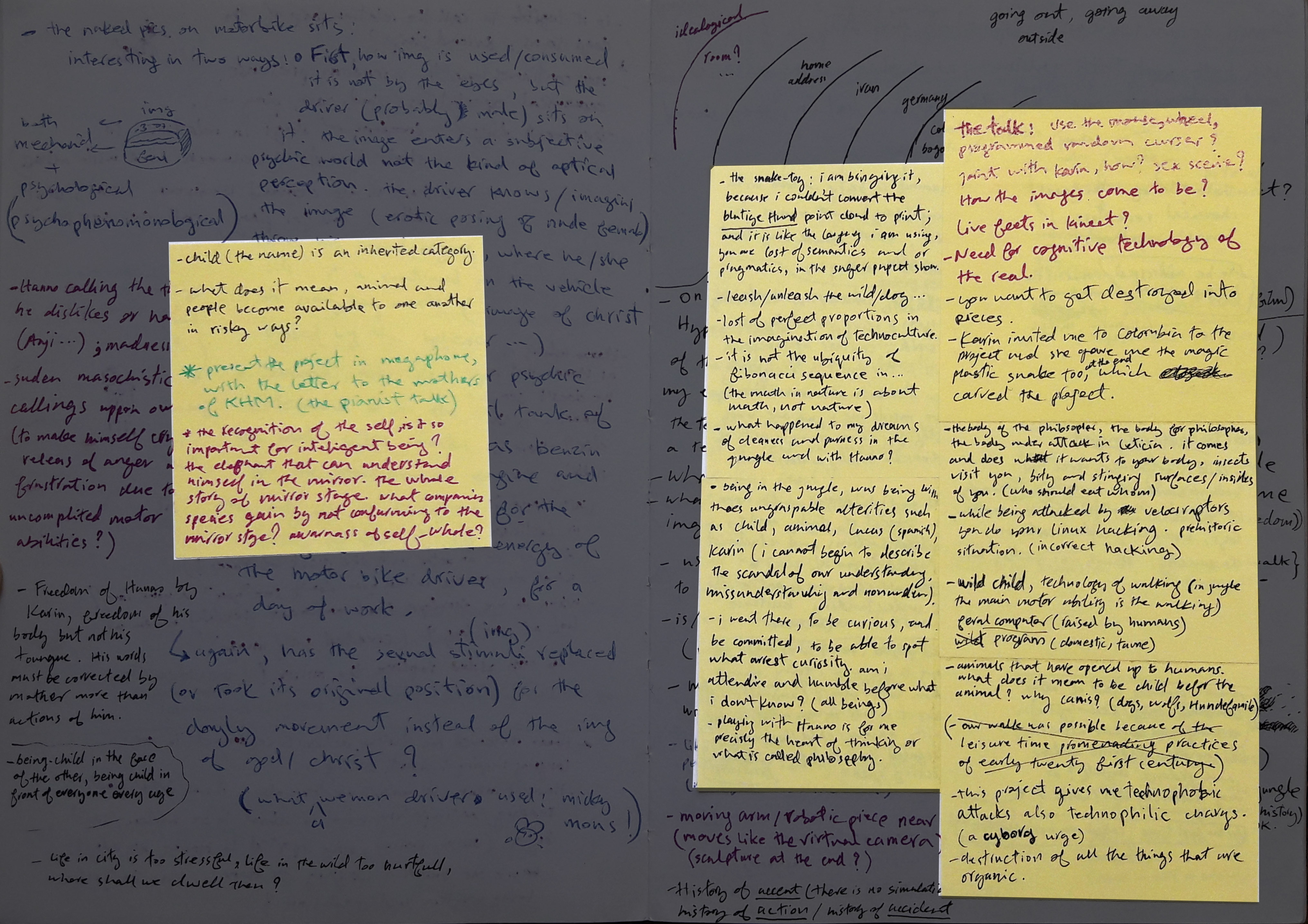
[...]der of evolution --> progress (2) sperm/egg story --> gender performance)
to change stories so that they are more livable
we live stories
to make mistakes as fast as possible
... move across earth space and narrative space
situated stories
they can't tell everything, but what is needed here
https://en.wikipedia.org/wiki/Refugium_(population_biology)
...................................
ontological choreography
vital sort of play that the participants invent out of a history of body and mind they inherit
...................................
possible performances
*two doors, ?, talk, model, puppet
*using stop-motion animation, clay formation, material animal facial properties
...................................
seeing a car crashing, is seeing a causation, seeing a reasoning, is that logos? is it logos when we see a physical experimentation?
...................................
[Haraway]
the established (dis)order is NOT necessary!
grips of necessity
(the real does/did not have to be or happen that way. the ‘real’ is the result of contingencies and it can be undone by working the contingencies, with skill.)
laboring bodies, playing bodies, sensuous bodies
(feminism:) you can't get freedom outside of mortality
-theology, the negative way of knowing, the necessary discipline of positive affirmation in order to know what is not knowable, is a very helpful tradition
when it comes to language we, humans, will always win over the animals.
we will always be the ones who control the law, the database.
(all is bad news both for the charismatic endangered Bangali tiger and the individual chicken in the food industry.)
fight the divisions and differences
we are in a very bad place for animals and woman
can we do without instrumentalization?
categories of killable--the question of how we kill
the question of one's-own-old-hat
regarding what you are against: we might find ourselves properly addressing a particular issue but having no ability to make political connection, to think beyond the categories
*thinking: a materialist practice with other thinkers--done best as storytelling
for me politics is that to be able to locate ways of life that deserves work, that which deserve opposition, that which deserve our curiosity
disembodiment is a technologically produced effect--many people are very skillful in creating that effect --> effects that are also affect/affectional
(Haraway on writing the cyborg manifesto) SK
the physiological state of neutrality is an affective state
(the notion that violent and passion counts as affect and neutrality is without affect is chemically bizarre) -[...]
(1)[...notes/midday review.txt]%0.3[...]کبوتر باز با باز]
**killing is not something mortal beings can avoid** (us or them)
*the human beings have regularly and in complex ways produced other living entities as killable*
[category of killable: a killing that doesn't quite count as killing]
killing your pet when she is too sick = a judgment in responsive relationship that is not equal
to say that “meat culture everywhere and always are acts of violation” is wrong
“post-”, the notion of ‘surpassing’ that is inevitability built into the “post-”, is in our way politically
the project of critique : finding that point of violation where you can say “got you!”, ‘I nailed you’ --> the practice of critique = to define what we are against }==> develop political movement that are fairly self-certain about what we are against ==> you will find yourself (perhaps) property addressing a particular issue but having no ability *to make political connection* (~= to think beyond the category) --> you find yourself crippled
posthumanist think of themselves as “better than”, more in possession of a “real” understanding of the nature of contemporary world, beyond the critique of technology
the politics of it all...
[we have never been -->] human : being on the side of the one who developed technology to realize intention of their mind in the matter [= The Iron Man]
=/= what it is to be people
we don't need fancy epistemological justification (such as posthumanism), people know the world in ordinary ways and we can learn from eachother, in all the (cultural, historical, power, wealth) differences among us [@Leo] --> ***partial translations happen all the time***
to take the risk of making a mistake --[the only way you can]--> affirm something positive : the positive knowledge pins on the possibility of mistake --(@Setareh; Goda wants to avoid mistakes?)
(learning from Foucault:) power = actual arrangement of the world (and not something ‘out there’)
(learning from Derrida:) responsibility is about the excess of it all (and not the irony of it all [*irony: incongruity of expectation and occurrence])
(learning from biology about:) differences organize themselves by ecologies (and not by binaries) --> ecologies have many scales (of temporality and physicality)***
scientific research + artistic research + contemporary philosophical critical inquiry ==> *topographies of difference* [--> important for Goda's use of the term “privilege” flattening differences]
(“+” are exchange zones, i am learning their differences of idioms)
[apass = partners locked into mimesis]
(my problem with the idea of) privilege: a special right, advantage, or immunity granted to a particular group or individual --assume--> the only way for a particular demographic to advance is at the expens[...]
(2)[...notes/midday review.txt]%0.6[...] with? poetics for me? [to write-about =/= to write-with the Book of Wonders. to use a language-tool that produces the most ambiguities and most misunderstandings, but that is the only way, there is no tool that can prommis clarity. evey tool produces its own ‘clear'--for someone, for some purpose. these makings are all tool-specific: making dichotomies, making similarities, making diferences, stc.]
•how far your research can host an encounter with alterity? and how this encounter can help you undo your prommises of communication, positionality, and conceptual buildings? weave new worldling entanglements with the problem--not to solve it, but stay with it. dissolve essential differences between dichitomies such as: knowledge and expression (or ‘knowledge’ and the ‘communication of knowledge’), experimental and ethical, joke and seriousness, interiority and exteriority, mysterious and clear, uncovering and veiling. produce creative impossibilities that do not resolve to bionary answers easily, that unstable possitionality for good, that open for forms of consiounesses to experience thoughts which differ from itself. to think and entertain both particularities and generalities (of logic, ethics, politics, aesthetics, etc.) encounter can be both infinitly singular and general. that is a form of suggestive work that can deal with the specific as well. (think about ‘chicken’ as an anstract idea in our semiotic world and as an individual being in our material world)
•using the notion of delinking (reminded by Juan) with my research on the Book of Wonders. going from parable-thinking --to--> religious-thinking --to--> poststructuralist-thinking --to--> poetic-thinking --to--> riddle-thinking --to--> biological-thinking --to--> deconstructionist-thinking --to--> ...
•this other universe is always at the beyond--the other cosmos is a lure (?)
•all cages have wheels
•boat, as an image for both construction and destruction
•i don't need to be alone in destroying the boat
•how to move the boat =/= destination
possible workshops for Einat's project:
•moonwalk dance
•database programing --> how to live well with databases, not waging a quixotic war on database designers. we must learn how to read and understand database early in elementary school. databases are fundamental parts of our political social ethical cultural processes...
•regular expression --> how computer programming reads and patterns text
•text-based internet --> cyberfeminism
•intervention in the digital hegemonies (digital ==> cultural ==> material) (changes to the built digital environments, possiblities of reconfiguration --> production of space, articulations about ‘us’)
•what does it mean to look at a code? (a critical introduction to computer programming for artists)
•How to implement a programming language in (JavaScript?)--parsing, regexps,[...]
(3)[...notes/midday review.txt]%1.2[...]iounesses to experience thoughts which differ from itself. to think and entertain both particularities and generalities (of logic, ethics, politics, aesthetics, etc.) encounter can be both infinitly singular and general. that is a form of suggestive work that can deal with the specific as well. (think about ‘chicken’ as an anstract idea in our semiotic world and as an individual being in our material world)
•using the notion of delinking (reminded by Juan) with my research on the Book of Wonders. going from parable-thinking --to--> religious-thinking --to--> poststructuralist-thinking --to--> poetic-thinking --to--> riddle-thinking --to--> biological-thinking --to--> deconstructionist-thinking --to--> ...
•this other universe is always at the beyond--the other cosmos is a lure (?)
•all cages have wheels
•boat, as an image for both construction and destruction
•i don't need to be alone in destroying the boat
•how to move the boat =/= destination
...................................
possible workshops for Einat's project:
•moonwalk dance
•database programing --> how to live well with databases, not waging a quixotic war on database designers. we must learn how to read and understand database early in elementary school. databases are fundamental parts of our political social ethical cultural processes...
•regular expression --> how computer programming reads and patterns text
•text-based internet --> cyberfeminism
•intervention in the digital hegemonies (digital ==> cultural ==> material) (changes to the built digital environments, possiblities of reconfiguration --> production of space, articulations about ‘us’)
•what does it mean to look at a code? (a critical introduction to computer programming for artists)
•How to implement a programming language in (JavaScript?)--parsing, regexps, (http://lisperator.net/)
•teaching German with Holderlin's “Andenken” poem
•to create a *feast* (to celebrate is to become free of the habitual, becoming inhabitual. celebration is the tensional coming together of the unlikes --> through which human beings and gods could meet and greet. The festiveness that the celebration encourages constitutes the original Greeting. [Avital])
...................................
what i have beeing trying to mean by saying that i have been dependent on others to create spaces that a telling can happen, is actually a fundamnetal ellement of storytelling: the ***community. i need and depend on community in my tellings. (this has noting to do with the imperative of “communication” or having a “message”)
(is it what Stengers calls to promote an “oikos”?)
[Stengers]
“the *predominance* of the *concern for relevance* (-rabt-) builds up memory and experience”
political ecology : there is NO knowledge that is (both) relevant and detached
political ecology[...]
(5)[...notes/midday review.txt]%1.2[...]ure (?)
•all cages have wheels
•boat, as an image for both construction and destruction
•i don't need to be alone in destroying the boat
•how to move the boat =/= destination
possible workshops for Einat's project:
•moonwalk dance
•database programing --> how to live well with databases, not waging a quixotic war on database designers. we must learn how to read and understand database early in elementary school. databases are fundamental parts of our political social ethical cultural processes...
•regular expression --> how computer programming reads and patterns text
•text-based internet --> cyberfeminism
•intervention in the digital hegemonies (digital ==> cultural ==> material) (changes to the built digital environments, possiblities of reconfiguration --> production of space, articulations about ‘us’)
•what does it mean to look at a code? (a critical introduction to computer programming for artists)
•How to implement a programming language in (JavaScript?)--parsing, regexps, (http://lisperator.net/)
•teaching German with Holderlin's “Andenken” poem
•to create a *feast* (to celebrate is to become free of the habitual, becoming inhabitual. celebration is the tensional coming together of the unlikes --> through which human beings and gods could meet and greet. The festiveness that the celebration encourages constitutes the original Greeting. [Avital])
...................................
what i have beeing trying to mean by saying that i have been dependent on others to create spaces that a telling can happen, is actually a fundamnetal ellement of storytelling: the ***community. i need and depend on community in my tellings. (this has noting to do with the imperative of “communication” or having a “message”)
(is it what Stengers calls to promote an “oikos”?)
[Stengers]
“the *predominance* of the *concern for relevance* (-rabt-) builds up memory and experience”
political ecology : there is NO knowledge that is (both) relevant and detached
political ecology : relevance + attachment = knowledge
art of staging = designing a scene
[the House TV series, the issue of the protagonist is] the distinguish between the figure of the expert and the figure of the diplomat.
*expert: ones whose practice is not threatend by the issue under discussion --> knowledge = relevance
*diplomat: ones who provide a voice for those whose practice, mode of existence, (and what is offen called) identity are threatened by a decision. to cause the experts second thoughts. --> knowledge ~= decision
[this is core in storytelling] [then, i am political. i used to use the word embassador, but it means also ‘diplomat.’ stories that can hold another story hanging. Sina's shy embassador ~=? ] (but what about the weak ones, the [...]
(6)[...notes/midday review.txt]%1.2[...]br />
what i have beeing trying to mean by saying that i have been dependent on others to create spaces that a telling can happen, is actually a fundamnetal ellement of storytelling: the ***community. i need and depend on community in my tellings. (this has noting to do with the imperative of “communication” or having a “message”)
(is it what Stengers calls to promote an “oikos”?)
[Stengers]
“the *predominance* of the *concern for relevance* (-rabt-) builds up memory and experience”
political ecology : there is NO knowledge that is (both) relevant and detached
political ecology : relevance + attachment = knowledge
art of staging = designing a scene
[the House TV series, the issue of the protagonist is] the distinguish between the figure of the expert and the figure of the diplomat.
*expert: ones whose practice is not threatend by the issue under discussion --> knowledge = relevance
*diplomat: ones who provide a voice for those whose practice, mode of existence, (and what is offen called) identity are threatened by a decision. to cause the experts second thoughts. --> knowledge ~= decision
[this is core in storytelling] [then, i am political. i used to use the word embassador, but it means also ‘diplomat.’ stories that can hold another story hanging. Sina's shy embassador ~=? ] (but what about the weak ones, the idiot, the one's who ‘rather not’ contribute to the political project?)
-diplomats are situated*
[for *Lili this is also a delima, she is torn apart between her expert self and diplomat who crafts relevance
diplomat--the relevance of feelings --> what is the knowledge in the kiss? (the kiss that she rendered as ‘irrelevant’)] [for me kiss is essentialy important. “it (everything) started with a kiss."]
universal knowledge =/= relevant knowledge
‘trust’ is one of many names for love
“you can never be indifferent to the trust you inspire” (Stengers)
...................................
#workshop: “the magic of the right word”
(against Sherlock Holmes)
(12-step recovery program for people suffering from) addiction to the truth
(to energize the connections to the things that animate us.)
1. gathering, basckets of concepts, objects, things, words, etc.
2. excersises, physical to-dos (cleaning, cooking, sport, sawing, etc.) while telling (this is about removing the codes of acting and representation process that interupt the telling)
3. everyday mundane talks, no stage. ‘you’ in it. (is it a one-to-one mentoring?)
4. convert into language the objects from the basket, write them down. since we are going to work with sign-language
5. make the connections (probably together)
6. special activities during the workshop? (cooking, drinking, etc.)
[...]
(7)[...notes/midday review.txt]%1.3[...]d “sortal particulars”. trying to talk about ontological assumptions embedded in the English (and any other) language. the diagrams are *rigs*. i am using rigging instead of framework. --> clever technological rigs, are provisional constructions, setup for a specific myth and dismantled after. sometimes old rigs are reused or repurposed for new rigs.
-resist peaceful naturalization
-uncomfortable software
-building/creating technologies as one way to do ontological politics (in postcolonial context)
-my experiments with ajayeb:
-(the danger in using) computer software to archive ajayeb's or ajib knowledge =/= lively collective memory tool
-the software that is slick and seamless runs the risk of the digital media appear as *self-sufficient representations* (<--✕--> living context)
-archived and frozen in time
-sorting operations
(if i continue with digital tech in reading ajayeb i have to ask) how the digitized ajib knowledge can resist appropriation and translation into an idiom that will not sustain its metaphysics****
◦powerful relational work that numbers (also? = =/= --> => etc.) perform -> “numbers are a particularly smooth and manipulable meaning-making tools. they hide their seams well. they are slick and trustworthy” (Porter) --> they are “materialized relations” (how can we tell a story of relations that for example numbers/math materialize?)
◦highlighting parts of ajayeb: as part of a material reading practice --> “highlighting” could easily be understood as metaphor of disembodied vision; highlighting is not about making things clear but about scribbling (bad-khat بدخط) as a mode of attention =/= (Descartes’) “natural light of reason”
%report on fables of objects #workshop (22.02.2017 HWD apass): attention to the sense and feeling of disparity, dispersity, stability, sublimity, authority, epicness, weakness, severity, solidity, scale, (a)social connections, and tangibility in the character of the object of each participants in the stories we wrote. where were active and passive qualities located? how were agencies distributed?
•origin story --> evolution story, love story [the object falls in love with...]
•daily story
•beast feeding story --> training story
evoking temporality of evolutionary time, face-to-face time, historical time, tiny scale time,
-each story has a music, texture of colors, pattern of meaning and affect
•bodyguard --> fantastic creature invented to protect an organism (your “object”). this bodyguard can be organic, nonorganic, cyborg, any form, but always an agent. tell us why/how this or that feature helps the bodyguard with its task
•generation stories, describe and follow your object in three generations, its child and grandchild
•[for the second day or warm-up first day?] constraint based writing: (Kenney > Christian Bök's “l[...]
(8)[...notes/midday review.txt]%1.5[...]ty, sublimity, authority, epicness, weakness, severity, solidity, scale, (a)social connections, and tangibility in the character of the object of each participants in the stories we wrote. where were active and passive qualities located? how were agencies distributed?
•origin story --> evolution story, love story [the object falls in love with...]
•daily story
•beast feeding story --> training story
evoking temporality of evolutionary time, face-to-face time, historical time, tiny scale time,
-each story has a music, texture of colors, pattern of meaning and affect
•bodyguard --> fantastic creature invented to protect an organism (your “object”). this bodyguard can be organic, nonorganic, cyborg, any form, but always an agent. tell us why/how this or that feature helps the bodyguard with its task
•generation stories, describe and follow your object in three generations, its child and grandchild
•[for the second day or warm-up first day?] constraint based writing: (Kenney > Christian Bök's “literary genetics” poetics of encryption of data; poetic vectors, to “infect” the language;) describe/story your object (or an operative “verb” within your discourse) with univocalics: without using “e” or only using a single vowel. or, first write with 3, then 2, then 1 vowel.
-the workshop is about: what other stories (of your object) are possible?
-in the workshop (I take a temporary position to) challenge others to re-tell the story of their ((epistemological) found) objects
-a ‘generative constraint’ might help opening up paths before you, away from our habits of storytelling
-it is about getting a feeling for the resistances and potentials of language in our (sometimes mundane) descriptive practices, “strange richness of missing the letters we need” (Kenney)
the metaphors are dormant in our routines of talking and noticing each other. how then, by traversing the routine, our “knowledge” and “community” took on new meaning, as they get a chance of being rearticulated in different languages (or differenlty infected literature)
~-?==> changing the system of classification (of thought)
-in a way the workshop is about an *approach* to knowledge generation (and not necessarily a rigorous critique nor directly evaluating the production of our knowledges)
***nothing is never merely a metaphor***
[some fables from science studies:]
•Emily Martin's egg/sperm story --> stories of atomism, distribution of agency, ----[The Egg and the Sperm: How Science Has Constructed a Romance Based on Stereotypical Male-Female Roles]
•Hayward's microscope --> tropes of natural history docu, ----[Enfolded Vision: Refracting The Love Life of the Octopus]
•Kenney/Haraway's origin/nature fable --> the omnipotence of the “origin” story in our descriptions and interactions with the nat[...]
(9)[...notes/midday review.txt]%1.5[...] the artificialities that we live with, not finding of matters of fact
◦asking about particularizations (تخصیص) and generalizations (تعمیم)
**literature begins, Blanchot writes, “at the moment when literature becomes a question”** (this is completely different than asking or question-marking in literature) [...] this question “is posed to language by language that has become literature” (the question that the meaning of the text asks is the question asked by literature; [of course at the moment of reading]) [then what is a text before becoming a question? complaining? revolution?]--%(negation wishes to realize itself.)
--> Rorty's critique of Descartes's way of asking questions
we have to be careful with our practice of questioning, because we often end up privileging a group of people by attributing it to “higher” levels cognition and of being “critically” in the world (=/= animal, nonpeople, other people with other ways of being in/with the apperceptive world that don't use the technology of questioning, as it is crafted historically and naturalized in the west for the univerasal method of ‘knowing more’)
...................................
#workshop, reading group
•reading as passionate betrayal. (hunting for precious empirical details, refigurative, reparative, poaching, reading can be a betrayal of textual authority and an act of survival)
•addressing /present* differences, not already pre-figured differences
•(condition of friendship, staying close to the text) staying close as a reader, as someone who could hold the text of the Other, receiving it in the withdrawal / Entzug (drug rehabilitation)
•i am in no position of ‘understanding’ or being clear about the text
•(i understand now that) it is not up to me to tell you how to read
•what makes you write or scratch a text?
(aaaakh... our alphabetico-logical cultures...!)
•if everything is not fundamentally unreadable (snafu) we wouldn't be reading
•it is about to situate the place of a (un)learning
•throwing access to each other (not only in terms of transferential intensity #sss)
•which appetites and tastes are required to fulfill the *ethics and erotics of curiosity* (that I am cultivating and depending on)? flourishing (of my ajayeb) depends on a reading that is more like “mutual partial digestion” (Katie King, Haraway) [=/= “eating well"] the text
•“every time i read X, something new shows up”
my practice of ‘rhetorical reading’ (=/= ‘close reading’; or more like close reading and letting go. “close” is itself a metaphor, a rhetoric of reading;) doesn't work with the idea that there is something ‘in’ the text per se (coded or encoded meaning or some sort of knowledge made and installed by an author), or that the writer wants to say something to the reader, or that the text is symptomatic with meaning and t[...]
(11)[...notes/midday review.txt]%1.7[...]ives: neutrality, perspective, universality, disembodiment (for certain race and sex), etc.
-metaphors create perspectives [the view that looks at blind men looking at the elephant]
-situatedness is different than ‘positionality’: a way of systematic error correction
-(resolving) specificity of vision --> scientific objectivity (is achievable)
-Haraway expresses her informed dissatisfaction with (the metaphysical substrate that supports) ‘social constrctivism’ and ‘traditional realism’ --> representationalist belief in the power of the words to mirror preexisting phenomena. they both believe that scientific knowledge (in its representational formats: theoretical concepts, graphs, particle tracks, photographic images, etc.) mediates our access to the material world, whether it represents “nature” or “objects” of science both groups are subscribed to representationalism.
focus on the nature and production of scientific knowledge --(shift to science studies)--> dynamics of the actual practice of science }--> on ongoing pattern of situated activity
-(disembodied scietific) objectivity: that only certain people are allowed to have no body (Gender, race, etc.) and that high science in practice is not acting on textbook objectivity at all.
absent referents, deferred signifieds, split subjects, and the endless play of signifier
Haraway is feeling nervous with two views on objectivity:
(1)the ‘social constructionist’ view on this: getting to know the world ‘effectively’ by practicing the sciences --> knowledge is knowledge-game (on an agonistic power field) ==> science is rhetoric : artifacts and facts are parts of the powerful art of rhetoric ~= practice is persuasion. {this view will use the nasty tools of semiology and deconstruction to insist on the rhetorical nature of truth.} --> Haraway calls this ‘The imagery of force fields’ (also an imagery of high-tech military fields and of automated academic battlefields) {will to power} (for Luiza)
epistemological electroshock therapy
(feminists protecting their) sense of collective historical subjectivity and agency and our “embodied” accounts of the truth --> these are just excuse not to learn
(2)Humanistic Marxism (structuring theory about the domination of nature in the self-construction of man) ([young Marx, influenced by Feuerbach =/= Hegelian idealism, saying that:] man's essential nature is that of a free producer, freely reproducing their own conditions of life [--however--> under capitalism individuals are alienated from their productive activity, etc.])
--> “chance for life”
science: Global System, universal knowledge --> translation, convertibility, mobility
of meanings, and universality
money in capitalism ~= reductionism in science
...when we are talking about genes, social classes, elementary particles, genders, races, or [...]
(12)[...notes/midday review.txt]%3.3[...]ptual systems, building on translations and specific ways of seeing”
how to see ‘faithfully’... (what does she mean by that?)
appropriating the vision of the less powerful:
to see from the peripheries
to see from the depths
...this not unproblemat (why she uses double negation so often?)
“But how to see from below is a problem requiring at least as much skill with bodies and language, with the mediations of vision, as the ‘highest’ technoscientific visualizations.”
“Science has been utopian and visionary from the start; that is one reason “we” need it.” (what does she mean?)
(“utopian,” “visionary,” other old metaphors in science)
“Passionate detachment” requires more than ‘acknowledged and self-critical’ partiality. (being acknowledged and self-critical is not enough!!! how deos she mean?)
-‘perspective’ can never be known in advance --> knowledge potent for constructing worlds less organized by axes/axis of domination
-One cannot “be” either a cell or molecule--or a woman, colonized person, laborer, and so on. ‘passionate detachment’ is about the impossibility of entertaining innocent “identity” politics : seeing from their perspective in order to see well.
-problem with “positionality”: {testimony from the position of ‘oneself'} We are not immediately present to ourselves and the self is assumed finished and whole simply there and original and its (grounding) knowledge is organized around the imagery of vision --✕--> Self-knowledge requires a semiotic-material technology to link meanings and bodies. ***Self-identity is a bad visual system*** --> ‘positionality’ (meaning: ‘acknowledged and self-critical’ partiality) [at best showing in which ways one is not unmarked] is therefore insufficient. {Identity, including self-identity, does not produce science!}
-instead we need a *split and contradictory self* (one who can interrogate positionings and be accountable) [~~/?-> shath شطح (=/= shar’ شرع, or even sharh شرح?), shathiat (شطحیات) in Tasavof (تصوف), rend رند, rendane رندانه]
-so, instead of “being” she proposes “splitting”: heterogeneous multiplicities that are simultaneously salient and incapable of being squashed into isomorphic slots or cumulative lists. --> The knowing self is partial in all its guises, never finished, never whole, stitched together imperfectly [that is what she means by ‘split'] ==> join with another (without claiming to ‘be’ another) {if i am allowed i can map Haraway's “partiality” onto Deleuze's “schizophrenia” --> Greek for “split brain” (Jonathan Crary, Suspensions of Perception, p.38) According to Beuler, “The selectivity which normal attention exercises among the sensory impressions can be reduced to zero, so that almost anything is recorded that reaches the senses.” One reason for the admiration which Deleuze and Guattari professed for the sc[...]
(13)[...notes/midday review.txt]%3.5[...]ed and it means nothing?!” with a sneer (artwork as puzkhand پوزخند --> @Ali )
[**“sneer” is a contemptuous or mocking smile, remark, or tone, coming from a family of sarcastic tropes of complaint and ironizated complaining]
-their art-work finds and flourishes in a terrain of terror. in their nonspeculative work there is no “but, what if” or “but, not yet” and therefore no ‘becomings’
-for Hito and Rabih: zeitgenössisch (contemporary) = grausam (atrocious)
-they dichotomize (fact/fiction, real/unreal, etc.), rather than allowing a novel and interesting question to be raised
-what is the state of unknown in one's practice? rather than being a news agency
[negativity?]--> your bad feelings --> غر ghor complaint --(turn it into)--> critique --(start doing)--> research --(get)--> diploma --(turn it into)--> phd --(make your)--> department of studies --(into)--> craft tradition
[you don't have to start with negativity!]
[you don't need to end in your own myth tradition!]
...................................
@Anouk (@her “breathing archive”): (Lev Manovich's) relationship between ‘interface’ and ‘database,’ ‘perceptable’ to ‘information’. [Database as Symbolic Form: http://courses.ischool.berkeley.edu/i290-1/s04/readings/manovich_database.pdf]
what is for Anouk ‘information’? and what is for her the relationship between information, knowledge, interface, and perceptable?
for her what is the relationship between ‘information’ and ‘infinite’? (infinite as the universe of all possible images)
...................................
*Pierre's ‘rights of nerves’ --> “talking to everybody”
[rights of nerves: you are promted to do what you do out of disgust, outrage, fear, or driven by anxiety, you don't know why, you are compelled towards an object or project or thing or unthing]
*Seba: for him “narrative =/= complex” (the question of “complexity's situatedness”) for him: “multiple perspectives ==> coherency (=/= bi-rabt بی ربط, na-ham-dusti ناهمدوستی ?)” (is his idea of “coherency” leads to ‘friendship’? is for Seba ‘amity’ [ravabet-e hasane روابط حسنه] at stake? )
Seba's epistemological object(?): ‘evidence’ (=/?=>! cordial dispositions)
(complexity is the name of our game. Haraway)
...................................
my current work and interest involves the investigation of individualized subject formation (tajarode nafs تجرد نفس ?); interrogating the production of language; and tracing the divisible distinguishing limits between categories of human, animal, and monstrous.
#subjects of interest: The translator, language, the sublime, animals/animality, technicity/mechanicity, the divine/sacred,
...................................
the myth of Poros, Penia, and Eros for Aela:
(in Plato's Symposium;) Penia, the “child of povert[...]
(14)[...notes/midday review.txt]%4.8[...]writings, and I take it up also visually in my drawings. my ajayeb hypertext search is contingent and opportunistic, and its searches are non-systematic)
in apass what my project is all about: *loving to tell you about what i am reading* (why it seams too difficult, complicated and impossible to understand!?)
-“to provides a feast of reading pleasures”
holding each other's unasked-for patterns (@Luisa)
taking up each other patterns [which are sometimes obvious, sometimes cryptic]
(what is the other name of the practices of “string figures” in Iran? -->[stars, facts, fabulations, “far”s, patternings,]--> all cosmopolitical, composes the “we”)
•a “we” compositional
•an “ajayeb” compositional
•
anthropocene system thinking
•feedback loops
•thermodynamics & 18th century mathematics (=/= hyperbolic mathematics in ‘crochet’ --> excess of surface, --> story of interface)
•comparative interpretive thinking (a dominant western model of knowledge production--which i am using!)
•modern synthesis: restrictive system theories within evolutionary theories
•systems idea
•
*“The global scale takes precedence--because it is the scale of the model.”* Tsing
[title]
Bilingual Stories for Ajayeb NatureCultures
(...stories ‘for’ =/= ...stories ‘of’)
does Brexit and Trumplandia changes the landscape of English use as a language?
the image of pedagogy : semiotic apparatus (& technological) (--> the ritual of Simpson strangling Bart)
(why am i cultivating the) *non-inventive imagination* (and its antimetabole [or chiasmus, chiastic patterns of antithesis]: non-imaginitive invention)
often we find ourselves inventing everything (in political animation) =/= to figure out what are we attached to
(inheriting something =/=? being heir to something)
the scientist inside me begs me to narrow my temporal scale, choose an epoch, let's say middle ages, choose a century let's say 15th, choose a year, choose a day, a moment, a micro-second slice of the cake of the milieu that you are interested in, the instance in the bazar with Halaj in the sun and so on.
(my old school) obligatory knowledge <-- salon of scietific entertainment
}-> (is about creating) proper witness***
the tropes i am building in my current research, do they help build a better Iran? and how?
interms of:
•an ongoingness
•a commitment to a recent future thinking
‘homo-’: stuff of the soil, that figures of bright and sunny image of the same
#rigs and syms*
•games
•technological designs
•plots
•mechanisms
•sfs
•jokes
•jests
•
[title]
critical bestiaries
critique-bestiary[...]
(15)[...notes/midday review.txt]%5.9[...]from the “mass” =/= craftsmanship is collective and additive --> (in craftsmanship) the performance is myself
•creativity being a form of individuation or separation (@the exploratory shift in Eunkyung's work that Pierre highlighted)
*** craft-work is about additive skill; it is about building on what you know rather than throwing it out *** (=/= capitalist logic of progress, creativity in the sense that ‘something’ where before was ‘nothing’) ---> a different way of building quality (into practices and objects)
...................................
Bakhtin's dialogic, to become a skilled listener : listening = response (=/= simply answering) --> (when we speak) we give other people talismans that are not (perfectly) clear to us----we penetrate and unpack what someone doesn't have the words clearly and response to what they intend --✕--> “common understanding,” “make something work,”
cooperation is about getting deeper into something
>
conditions that more skills are required (and not the opposite)
in modernity everything seams to need to be verbalized. what happens to the unverbalized, the unprogrammatic? --> can you have an implicit right which can't be verbalized? maybe no, maybe this is the limit of the social...
purposiveness: when you hear somebody go “i am going to put clearly what we all want...” you have submitted to that person (almost erotic) --> “they really know who they are” ==> you become a spectator to their definiteness
...................................
who the fuck = theology
how the fuck = empiricism
what the fuck = ontology
how the what the fuck = epistemology
why what the fuck = metaphysics
why the fuck = ethics
why give a fuck = teleology
the fuck itself = phenomenology
fucked up = pathology
fuck all = nihilism
...................................
Aela to Sven: “everytime you disappoint me you gain in depth” (5 April 2017)
...................................
(06.04.2017) %notes after my apass endweek presentation:
•my implicit focus and energy on the body and its organs of gesture that animates us
•loving telling you what i read
•giving you what i don't fully understand =/= gift from above
•(in lecture) to allow language greet the unverbalized
(it is about) organizing my memory
(it is about) that which comes to (my) mind, and “things” coming to minds
(it is about) the things I am told
__[these are perhaps other names of cognition, affect, memory, semiotics, history, inheritance, figuration, interface, thing-relations, huntology,]
__in our shared space where we let eachother in the effect of our languages, I want to practice what comes to mind when I stand in front of you and your work, ask myself ‘what else’ comes to mind? in a sense, my project on ajayeb is that kind [...]
(16)[...notes/midday review.txt]%6.1[...]r her? (question of performativity)
[realistic:] to take possession of essential aspects of the external reality (~-> recreate them in the imagination) [--> empirical?]
[structural:] to experience the external reality as parts of an interconnected and comprehensive whole
[idealistic/symbolist:] to connect the (inner) particular to the general
[romantic:] to make (inner) invisible visible
sublimated gratification of instincts, ambitions and ideals, (homogeneous) gestalt and expression of the self, narcissistic equilibrium, test its viability, haptic art,
“invisible reality and the aesthetics of universality” or a mean by which universal is recognized*
timelessness, wholesomeness, indivisibility, aesthetic standards
-pictorial thinking, movement thinking, affectual thinking, {--> all issued by the notion of “pure” and “purity”? tendency toward idealization? utopian?}
movement (the act) =/= mobility (the possibility)
(is Luisa interested in?) the immanent laws and essential unity of all being
...step to complete nonobjectivity
...objects with their expression of plasticity
-what is the symbolic term in her work?
she said: “space is literal.” --> the wholesome is proclaimed in the artistic act itself (and not as metaphor) --> experienced directly =/= imagined
--> احشايى the viscera (ahsha), visceral theory: affect and embodiment, transmissible physical charges, porous bodies,
@Luisa
kP_AfO7Ms4I
how to create a condition in which she can herself later give access to her thinking and making?
1- propose a curatorial gesture of an assembly: Luisa, Mondrian, Zen master, Malevich; with Bocola and Ahmed;
2- to open an investigation of affective economies for her: abstraction, constructivism, idealism, figurative empathy, symbolism, longing,
3-
4-
(psychoanalysis [@Luisa] allows us to see that) *emotionality involves movement*
associations whereby “feeling” take us across different levels of signification, not all of which can be admitted in the present. (+Ahmed)
-emotions move back and forth (past associations, repression traces on present) and sideways (sticky associations between figures and signs) --> something as the cause of a feeling in someone --> “involving relationships of *difference and displacement*{as the form or language of the unconscious} without positive value” --> affective economies -->{social, material, psychic}
{ psychoanalysis = "absent presence” of historicity-->(sideways movement of feelings) }==offers==> a theory of emotion as economy***
-by economy, Ahmed means, like capital (is about the movement of commodities and money*), an effect of its circulation (--> Luisa)
-the subject is one nodal point in the economy =/= subject as its origin and des[...]
(17)[...notes/midday review.txt]%6.4[...]problematic behavior, and *distressing emotional responses*
--> learning to monitor thoughts (in three layers:)
1. core belief [deepest level of our thinking, underlying self-values and perceptions of the world, have an absolute quality: “I am worthless.” “I am inadequate.” “if I fail, I am worthless.” “I am unsafe in the world.” etc.]
2. intermediate beliefs [expectations and assumptions, guidelines we follow, maintaining our anxiety and depression: “Always look for danger and expect it to be there.” “If I don't understand something perfectly, then I'm dumb.” etc.]
3. automatic thoughts [immediate thoughts that go through our mind in response to a situation, usually negative and unquestioned: “She thinks I'm weird.” “I won't pass that test.” “This is too hard. I'll never understand this.” etc.]
types of automatic thoughts:
•evaluation (evaluative thoughts)
•coping strategies
•avoidance
•
[cognitive distortions]
typical mistakes in thinking:
•*all or nothing* / all-or-none thinking (“If I'm not a total success, I'm a failure.”)
•*catastrophizing* [--> middle eastern fortune-telling, omen, foretell the future] ( “I'll be so upset, I won't be able to function at all.”)
•*disqualifying the positive* (positive experiences do not count: “I did that project well, but that doesn't mean I'm competent; I just got lucky.”)
•*emotional reasoning* (“I know I do a lot of things okay at work, but I still feel like I'm a failure.”)
•*labeling* (“I'm a loser.” “He's no good.”)
•*magnification/minimization* (“Getting a mediocre evaluation proves how inadequate I am. Getting high marks doesn't mean I'm smart.”)
•*mental filter* [selective abstraction] (“Because I got one low rating on my evaluation it means I'm doing a lousy job.”)
•*mind reading* [narcissism] (believe to know what others are thinking: “He's thinking that I don't know the first thing about this project.”)
•*overgeneralization* (“[Because I felt uncomfortable at the meeting] I don't have what it takes to make friends.”)
•*personalization* [narcissism] (believe others are behaving negatively because of you: “The repairman was curt to me because I did something wrong.”)
•*should/must* [imperatives] (having a fixed idea of how you or others should behave: “It's terrible that I made a mistake. I should always do my best.”)
•*tunnel vision* [cyclopean view] (“My son's teacher can't do anything right. He's critical and insensitive and lousy at teaching.”)
what is the most central belief about herself?
which experiences contributed to the development and maintenance of the her belief?
which positive assumption helped her cope with the core belief?
what is the negative counterpart to this assumption?
which behaviors h[...]
(18)[...notes/midday review.txt]%7.2[...]topuses that squirt out a dissembling (mask, cloak, vortäuschen) ink as they withdraw into the ontological shadow
figure of *mill* (the characters and technologies and ideas of the ages mill around in a state of a mild, semiblissful confusion) =/= Eszter's vortex
my intimate impressions “personal" = footprints of hyperobjects, distorted as they always must be by the entity in which they make their mark
situatedness is now a very uncanny place to be, like being the protagonist of a Wordsworth poem of a character in Blade Runner
*cool impersonality of the scientific language* (now is deprived of its ideological status)
the concept of the ‘world’ is no longer operational
can we think environmentally without the idea of ‘the end of the world’?
(Morton asking for) a geophilosophy that doesn't think simply in terms of human events and human significance
Morton: global warming =/= climate change
if one takes the ‘climate change’ as a substitute for ‘global warming’ is like “cultural change” as a substitute for Renaissance, or “change in living conditions” as a substitute for Holocaust
acronyms, abbreviations:
dialoc دیالوک --> decrease in appropriate levels of concern
tomas توماس --> terrain of media and the sociopolitical realm
cohhatg کوهاج --> coincidence of human history and terrestrial geology
hhatg حج --> human history and terrestrial geology
pb پی بی --> philosophy's bandwidth
sdwa صدوا --> substances decorated with accidents -->
ldwa لدوا --> lumps decorated with accidents --> featureless lumps, and those things have accidental properties, like cupcakes decorated with colored sprinkles (arayesh آرایش) }--> this thinking still continues, despite the fact that ‘thought has already made it irrelevant’ --> thamii تامی, (for example birds for Attar are merely decorative features of Attar's social, psychic, and philosophical space)
soth صوث --> speculating outside of the human
sim سیم --> small island of meaning
etimom اتیموم --> everything is made of mind
hhbn هبن --> hand-holding benevolent narrator (-which is vanished)
(auto) cad کد --> (automatic) comforting aesthetic distances
iockat --> intentional objects commonly known as thoughts
atot آتو --> (you only ever perceive your particular) anthropomorphic translations of things
ejich جیش --> exhilarating jump into cognitive hyperspace --> displacement that Copernicus or Derrida does
foe --> fantasies of embeddedness [<-- phenomenology <== grounding of Kant (begining in 1900)]
avaa اوا --> a vertiginous antiliteral abyss
iwen --> intimacy with existing nonhumans
[...]
(19)[...notes/midday review.txt]%9.2[...] (automatic) comforting aesthetic distances
iockat --> intentional objects commonly known as thoughts
atot آتو --> (you only ever perceive your particular) anthropomorphic translations of things
ejich جیش --> exhilarating jump into cognitive hyperspace --> displacement that Copernicus or Derrida does
foe --> fantasies of embeddedness [<-- phenomenology <== grounding of Kant (begining in 1900)]
avaa اوا --> a vertiginous antiliteral abyss
iwen --> intimacy with existing nonhumans
mok --> mathematization of knowing (--> Descartes, Newton) ==> hiding philosophical and ideological decisions made in acts of knowing =/= ontology (as a vital and contested political terrain)
icad --> ideology of “the consumer” and its “demands” (that capital then “meets”) --> adventure of modernity
fvod --> from the viewpoint of “objective” description (a bad way of explicating the objects that are already here)
toc --> troops of critique
towwk توک --> ‘technology of what we know’ (techniques that decide the differences between ‘what we know’ and ‘what is’. Morton's hyperobject is a towwk)
usoc --> uncanny strangeness of existence (work of Heidegger)
lawot --> (something is) ‘laying around in the workshop of thinking’ (let's reuse what appears to be broken lawot)
visist = visit + resist
correlationism: the notion that philosophy can only talk within a narrow bandwidth, restricted to the human-world correlate : meaning is only possible between a human mind and ‘what it thinks' = its “objects” (flimsy شل و ول and tenuous رفيق as they are) ~-> the light on in the fridge when you close the door
-Heidegger (towering through) is a correlationist who asserts that without Dasein, it makes no sense whatsoever to talk of the truth of things, which for him implies their very existence--for him idealism, not realism, holds the key to philosophy. (Heidegger's tool-analysis: when equipment--which for all intents and purposes could be anything at all--is functioning, or “executing” [Vollzug], it withdraws from access [Entzug]; that it is only when a tool is broken that it seems to become present-at-hand [vorhanden] --> is this what Femke is proposing to apass?)
Descartes uncritically importing the very scholasticism his work undermined
[*]epistemology:
•how can i know what there are (or are not) real things?
•what gives me (or denies me) access to the real?
•what defines the possibility of access?
•what defines the possibility of possibility?
•Einstein discovered a rippling, flowing spacetime
•Tarkovsky discovered the ‘sensuous material of film stock’ --> ssoci
•Husserl discovered something strange about the objects: no matter how many times you turned around a cion,[...]
(21)[...notes/midday review.txt]%9.3[...]t defines the possibility of access?
•what defines the possibility of possibility?
•Einstein discovered a rippling, flowing spacetime
•Tarkovsky discovered the ‘sensuous material of film stock’ --> ssoci
•Husserl discovered something strange about the objects: no matter how many times you turned around a cion, you never saw the other side as the other side --> the #coin had a dark side that was seemingly irreducible
Morton's (technology of what we know) hyperobject is his sense of an asymmetry between the infinite powers of cognition and the infinite bening of things, yet he doesn't evoke descriptive practices, which could be helpfull--he is missing something, here: “the gap between phenomenon and thing yawns open, disturbing my sense of presence and being in the world.”
“[...] i cannot locate the gap between phenomenon and thing anywhere in my given, phenomenal, experiential, or indeed scientific space" --> Xiri's problem
he disagrees with: (from Plato up until Hume and Kant) that there is some kind of dotted line somewhere on a thing, saying “cut here” --so he concludes: “things are themselves, but we can't point to them directly.” =/= nonrepresentational theory, Stewart is much more useful. we can see Morton's taste for (a masculine) sublime in modeling his hyperobjects
flat ontology: there is hardly any difference between a person and a pincushion. and relationships between them, including causal ones, must be vicarious (نيابتى) and hence aesthetic in nature
(no) realism that only bases its findings on “ontic” data
scientific discoveries are necessarily based on a decision about what real things are
*disaster [ontologic] taking place against a stable background [ontic]*
causality after Hume and Kant : causality as a feature of phenomena, rather than things in themselves ==> humans are not totally in charge of assigning significance and value to events that can be statistically measured
entities that become visible through post-Humean and post-Kantian statistical causality --> anthropogenic global warming
causal factoid
humiliators [there is no center and we don't inhabit it]:
•Copernicus
•Darwin
•Freud (displacing the human from the very center of psychic activity)
•Marx (displacing human social life with economic organization)
•Heidegger
•Derrida (displacing the human from the center of meaning-making)
•Nietzsche
•Deleuze and Guattari
•
~= there is no edge =/= (film Lucy or Neil Tyson series suggesting that) there is an edge (of time to see everything perfectly), in some (privilaged) transcendental sphere of pure freedom, Lucy's chair literally sitting a VIP box beyond the edge --> anthropocentrism: the idea of a privilaged transcendental sphere<[...]
(23)[...notes/midday review.txt]%9.4[...]hat i fall in love with, not the ‘abstract link'--> (Manning's) peripheral perceptivity =/= (i am trying to learn) to describe what is in front of me (which is never easy)]
-Manning's notion of “the problem gives the question to be asked of it” =/= the question problematizes
-focus on “sedimentation” (--> where is the coexistence of contrasts for them?)
“decontextualization”: their technique of concept-making (==> claims of reality, of nunhuman, etc.)
[decontextualization is a very dangerous way of crafting concepts. there are other ways, committed to the contingencies of the historical material world of multispecies. rigor of conceptualization that i am learning from Stewart is about the *quality of an access to part of a world* =/= decontextualization]--so--> i say we need ‘concepts’ and not ‘philosophy’:
*philosophy (as practiced by M&M and Alex): claiming the nature of reality
*concept: a figure you make in order to do a limited situated work
“conceptualization = fortification” استحکامات
(to fortify one's own work with concepts ==> settlement)
Manning's affinity with infinitly, more, and multi --> what is their rigor is doing for them? commits them to the nonhabitual. (resisting to name their habits, depriving them of thier habitual labors) [=/= my work on descriptive practices]
-i want to know about their empirical tools that make translation-work visible (==> decomposition), not their conceptual descriptions [=/= textured description with thick details <== i really think the devil is in the details!! }--> art of noticing things]
-i want to know how Manning is compromised into desiring what she is doing. [compromise: being exposed or made liable to danger, suspicion, or disrepute. --the way she told the story of her practice had a difficult sense of success in it, of being cool and correct at every turn, uncompromised. (<-- why is this a turn-off for me?)]
for aesthetic, political, ethical reasons i want Manning to address in their work:
•the question of apparatus --> working within an apparatus of thinking in order to get somewhere in a sustained way. i want them to name their apparatus of literary production. how they engage with the interface, data-set, grammar, and literacy of their reservoir.
•the question of infrastructure --> how they balance the possible and the acceptable, the balance of action, tools, and the built environment
•the question of technology --> how they take apart the tool from its context of involvements and referentialities
•the question of political orientation --> how they have accepted the democratization of knowledge and multiculturalism (the idea of “knowledge for everyone” [--> there is a very thin line between the impulse to democratize and commodify knowledge]; --could multiculturalism be radical capitalism in action?! ...faking div[...]
(24)[...notes/midday review.txt]%10.9[...]ce and without jumping immediately into transcendence. (using Latour words) [transcendence is never gradual, in the places i come from, it is always a shock, happening, a truth-event]
-each word (God, Angle, Jinn جن, fog, etc.) brought into its own network,
-what are contrasts and of category mistakes particular to each
-and their crossings----and what is the vocabulary specific to each crossing
the network of associations necessary for the exercise of religion without bracketing off its ontological requirements.
explanatory rage (tavahoshe roshangari توحش روشنگری) --✕--> networks necessary for religious meaning
(the aim is) deploying the network (of ajayeb)
it is about grasping ajayeb's beings not as substances but as *trajectories*--and give them a more precise *direction.*
what is important in working these modes what kinds of possibilities are “afforded” to the investigator, myself. what kind of actor am i?
(specifications of the type of beings that the mode leaves in its wake)
**other beings necessary for its existence**
(my personal/public question, what other beings are necessary for my existence? and therefore for your existence as well.) ----> the heterogeneity of the actors needed for the pursuit of any course of action
*metamorphosis (a mode of existence first detected in psychogenesis?) what we encounter whenever we address the manner in which existents are transformed or transform in order to subsist (zist زیست)
-defined by a certain kind of continuity and obtained by a certain type of discontinuity
-metamorphosis is about crisis, possession, alienation,
-metamorphosis sharply contrasts *cure* (~= ritual)
-allowing for installing unconscious (states,) crush, posses, bewitch, kill,
-beings with specific properties that are invisible, changeable, powerful, favorable, unfavorable
-exploration of transformations
-cosmological specialties
-seniority and extension of metamorphosical beings (of elaborations carried out by all groups in met)
{that which addresses the “me,” the “ego” =/=? that which allows one to resist the forces of metamorphosis}
the iconoclastic episode we are in now, which we must work to make it as short as possible
(to specify) dualisms that make it extraordinarily difficult to maintain ontological pluralism
it is the moderns quasi-subjects (‘person’) who feel themselves to be **directly addressed,** (redressed and saved) --> to exist
(what art suffers now, that i should directly address the modern subject, and other mode of subjectivity or other kinds of addressee and addressing is brutally criticized and irrelativized)
-(love's type of address:) addressed to us ==> make us exist --> a person
(existing as person is the onl[...]
(25)[...notes/Ajayeb notes.txt]%13.2[...]nkt nicht
Derrida: links science to mourning and memory
Lacan: science is always there, ready to erupt, amaze or blow you away.
Husserl was perhaps the one most freaked out by the historical split (between science and philosophy--and art?)
...a matter of technological selfunderstanding,
...nor do I insist on sustaining the pathos that propels the images...
ethical and political issues are increasingly seem to have more to do with testing than questioning, hesitation, certainty
There is a test ... it claims and so it stands. There is the other test that crashes against walls, collapses certitudes, and lives by failure-lives by dying or, at least destroying.
The one register of testing offers results-certitudes-by which to calculate and count on the *other.*
the culture of Versuch, test or trial
(farhange kushesh, ghasd, sue ghasd, va emtehan)
(measuring and) testing that support, among so many others, political, religious, and educational institutions
testing has everything to do with the way the policing of political sites and bodies takes place, in modernity and with our experience of reality in general.
testing ~=/?==><--> the real
(elliptical circuit established between test & real)
Freud was working on to tests which are lost now: Aktualitätsprüfung to distinguish between reality and immediacy
Lacan has linked testing to the subject's creation of a first “outside"----a space that is no longer the same as “reality”
the way the state takes possession of the body presumptively on drugs.
-in this way, drugs are seen as eccentric: what is outside, or moves outside the center, can center it, they are animated by an outside already inside
-how drugs are isolating or how they establish community (of those who are somehow together or with nonpresence.) anything that refigures individuality or collectivity that brings you together with the other and absolutly keeps you apart from the other
drug: Dionysian frenzy, aspirin, religion, dirty language,
-I am sorry I have no drugs to offer you today!
-not everyone in civic societies has the privilege of getting high and mind-altering (that which supposedly suggests vulnerability,) running arround drunk staggering and out-of-it, they will be beaten the hell out of it, they have to be sober, on alert and self-protective
your pee belongs to the state----new civic readability
{four bodies don't belong to themselves: children, addicts, outlaws, and ghosts, are all busted by the state or certain legislated majority}
destructive (and artistic) modes of production.
test, does it have an essence? Is it pure relationality?
Avital's “sp[...]
(26)[...notes/Ajayeb notes.txt]%14.7[...]telephonics”
Heidegger: sign = cutting edge, Zeichen --Holderlin--> “we're cutting out” =/= (Avital:) schizo knows how to disconnect, how to depart, how to cut the shit
the place where a call can break into a body[=? orificial openings of a subject]
emergency verification: we are still trying to cut into the emergency line (that we are on) after the crashing down of the transcendental signifier
in the (technologically enabled) disappearance of long-distance what happens to the ‘elsewhere’ calling to the schizobody?
how our pretechnological ears were (trained) before the telephone?
the “call” comes from me and from beyond and over me.
Telephonics coils itself around a concept of “being there” supported by the recognition that contact has been broken. Still, the break is never clean, just as contact was never continuous. The entire metaphysics of identity, presence and locality is scrambled, bringing with it a certain historical mutation in the relationship of the “self’ to other, to the irreducible precedence, as Derrida puts it in ‘Memoires,’ of the other. The other calls; you answer. But “you” have not yet been constituted, gathered or pulled together prior to the call.
Wortsalad ---- Opheilia's kind of mouth that shoots poesy, one has the feeling that no one is there.
/ precisely when ophelia is about to become the poet Shakespeare strangles her in water to make place for hamlet's tragic autopoiesis /
it is (generally) very difficult to know “who” is talking --> “whom” is being addressed
endure the agony of the being called (a being-on-call, an answering device)
modeling different styles of irony
(what are we) telehearing (?)
language is the history of index finger (“...even when it is placed on the mouth to silence a speaking. The teacher points, the God and the schizophrenic speak through or to the spiritual forefinger [sababe سبابه, angoshte shahadat انگشت شهادت].”)
-Heidegger traces the route of saying from rumor to the spiritualized digitals. The semiotically invested finger comes to manipulate the alphabetico-numerical ordering of ‘Geschick.’ (Avital)
-The spiritual forefinger presses towards schizophrenic partial systematizing.
-Also, it is the bewitching finger, which makes it rude to point or to press red buttons, for the power of pointing used to be associated with *magical arrests* (thus in Jewish Orthodox marriage ceremonies the wedding ring is said to be placed on this spiritual finger of the woman, to block her potency).
-making the marionette come alive
-history of index finger points to the essential being of language, which is “Saying as Showing.” (Avital reading Heidegger)
-Heidegger shows, “Speaking must have speakers” (not merely in the same way as an effec[...]
(27)[...notes/Ajayeb notes.txt]%14.8[...]ory and its (peculiar) temporal climate
-how can we not situate remembrance as mourning? (as Holderlin teaches everyone)
remembrance =/=? joyous festivity [----the issue and point in project Persische Abend PARS VIDEO 2014]
the minute you see in a text (@Hoda, Sana, Ali having even) one memory that is clear and guaranteed --> your signals should go on: there is one unrevised (in an original form), no secondary revision, *pure memory* <-- this is a memory that is unnegotiable for them
*on Wind
wind, is a coming that arrives from the future
(compare “going” [staying behind] in Attar, Hafez, and Holderlin) [in San'an nobody is greeting, there is no greet-event. Attar misses: Greeting as pure letting go**]
(Avital on Holderlin:) “[...] in going, comes. Parting is not a mere leave-taking and empty staying behind. Parting is also not a mere going away and disappearing. The poet remains in the rustling wind. to the extent that he goes with its going. [...] Nonetheless. the poet stays with the wind. Accompaniment now shapes the Greeting. As the gusting wind is alternately a coming and a going. so is the Greeting a staying behind that nonetheless flutters away. becoming a going with. [...] The poet's staying behind is crucial. Staying behind is not meant to mark the isolation or even desolation of the poetic act. [...] Neither passive nor active, remaining behind indicates a way of going back, a returning to the source.”
-traveling to the impossible place of the other
-(wind) come and go without touching down or dropping anchor
-the agency, animacy and sentience of the wind is described by ajayeb's sensuous subjects within the wind. one feels enwrapped, enveloped in a sentient being that moves across vast distances, it comes and goes --> the materially textured poetics of description in the ajayeb-e bad باد
the poesy (~ fictional =/= truth, real) (Wahrheit und Dichtung) of ajayeb (are no longer distinguished from each other)
(greeting is the poet/artist's most essential mode of being)
a designed closure or reappropriation that locks the Other into a schema of subjectivity ---- at once promoted and subjected
*(re)fastened to the Greek origin
promoting the ousider to insider (who now holds an Ursprung and origin)
re-appropriation ~=?! an end to alienation {~=?=> the condition of possibility for totalitarianism} [Fynsk]
the illusion (and comfort) of noncastration
...................................
duty of deconstruction: the practice of non-avoidance
(duty =/= your nature)--> the duty of being unwelcomed
vomiting ~= healing
*after the 18th century (seems) all art (artists) wants to be:
•in the privileged place of nonrepresentational work. trying its self with the sublime, that which disturbs and devastates being
-[...]
(28)[...notes/Ajayeb notes.txt]%15[...]undermined?]
construct phylogenies
(phylogeny : branching out evolutionarily)
‘Haeckel claimed that Darwin's ideas included the progressive development of species. “Development and progress” was what characterized evolution. The explicit association of evolution with particular political, religious, and racial views became the hallmark of Haeckel's career. Haeckel proposed a causal parallelism between the embryological development and phylogeny. His “Biogenetic Law” that “Ontogeny Recapitulates Phylogeny” was based on the idea that the successive (and to him, progressive) origin of new species was based on the same laws as the successive and progressive origin of new embryonic structures. Just as the earlier stages of human development developed into the later stages, so earlier species evolved into the later ones. Natural selection would eventually get rid of the earlier species. (In the Welträtsel, Haeckel [1899] would also proclaim that the more evolved humans [i.e., the Aryans] would out-compete and eliminate the more primitive races.) To Haeckel, the evolution of the animal kingdom was the same as individual development not only because the laws behind each were the same but also because the entire animal kingdom was an individual. Here, he was harking back to the views of the Naturphilosophen of the previous century. In other words, the development of advanced species was seen to pass through stages represented by adult organisms of more primitive species.’ (The morphogenesis of evolutionary developmental biology)
inter-cellular digestion
•the evolution of new features was based on changes in developmental stages, not in adult astages (--> that's why the developmental stage is so important, because mutations happen --> work with children)
Ontogeny or morphogenesis: organism's developmental lifespan
Phylogeny: evolutionary historical heritable traits
ontogeny ==> phylogeny
“ontogeny does not recapitulate phylogeny: it creates it” (Garstang, 1922; p. 724)
evolution was not so much a branched chain as a ladder
molecular systematics
evo-devo (evolutionary developmental biology)
each discipline has:
-its own rules of evidence
-its own professors
-its own journals
-its own vocabulary
small genetic changes was not sufficient to generate evolutionary novel structures such as teeth, feathers, cnidocysts or mollusk shells (Goldschmidt, 1940) (--> lizards had birdness in it --> potentiality)
(new species originate as) ***hopeful monsters***
that result from mutations in developmentally important loci (-macromutations)
Goldschmidt: the gene wasn't a locus or an allele. Rather, it was a unit of development
“to convince evolutionists that evolution is not only a statistical gen[...]
(29)[...notes/Ajayeb notes.txt]%15.8[...]disarticulating bodies to rearticulate other bodies
entangled assemblages of relatings knotted at many scales and times with other assemblages, organic and not
...................................
ajayeb is system imagination
...................................
[Naveeda Khan]
Perhaps the question could be posed as, how do we come to grips with the universal, the supra-historical, or even the cosmos within our global present, imagining a local that lays claims upon all three?
is there a Muslim environmental imaginary?
‘Islamic ecology and environmental ethics’ --> the need to center a vibrant materiality or the liveliness of things in the anthropology of Islam (that has been to date largely preoccupied with Muslim polities and subjectivities.)
It should come as no surprise that my own efforts at centering materiality comes through studying how these predominantly Muslim farmers interact with and come to acknowledge nonhuman forms of life (including the figure of Khidr خضر, dogs, river waters, silt, and lightning, to name a few). Finally, I remain concerned to explore how the singularities of these lives, both human and nonhuman, come to be hitched to the global. This research will culminate in a book tentatively titled Ensouling the Anthropocene: Riverine Life and Climate Change in Bangladesh, in which “ensouling” treats the problem of scaling up singularity to the global, intensifying efforts that began with “Of Children and Jinn.” [source: https://culanth.org/curated_collections/19-everyday-islam/discussions/20-interview-with-naveeda-khan-about-of-children-and-jinn]
...................................
(what i am reading in ajayeb)_with Naveeda: “Muslim cosmology and eschatology hold promoise of ecological thought, providing an unexpectedly materialist perspective on our creaturely interconnectedness.”
[ajayeb (and telegram) is full of] gestures of incorporating repugnant [offensive to the mind] others---that one sees reflections on divine creation qua [als] creaturliness
thoroughly disabused
aufklären آگاهیدن آگاییدن
expound تفسیر
incentive مشوق, فتنه انگيز
litany مناجات وعبادت تهليل دار
showmanship (نمايشگرى?)
effektvolle Darstellung, Schauspielproduktion
queasy به طور تهوع آوری لطیف مزاج
(a gedture of) ludic [playfull, spielerisch] transcendence of [the] present
obdurate سرسخت
-showing unfeeling resistance to tender feelings-
(picture of the world as) pristine nature طبیعت بکر being destroyed by humans (--> narcissistic?)
=/= view of theology/religion on ecology
=/= (stories of humans and dogs:) shared creatureliness and companionship entailing a [...]
(30)[...notes/Ajayeb notes.txt]%17.3[...]esponse.
queer, off-category, sf worlding
(what are the SF worldings of ajayeb?--SF as building alternative ontologies. finding absent but possible presents--whether presented as elsewheres or other times. “[...]an elsewhere from which different [...] articulations of naturecultures and alterity could be explored.”)
“The one who would be normal, in a category of his own” --> ends badly
(human scientist's) deadly one-way test: unable to recognize the presence of the trapped one --> (for him) no one is at home in the categorically Other
[Seed Bag]
...the problem of destruction and wounded flourishing--not simply survival--in exile, diaspora, abduction, and transportation--the earthly gift-burden of the descendents of slaves, refugees, immigrants, travelers, and of the indigenous too.
(In the feminist SF mode,) matter is never “mere” medium to the “informing” seed;
Homebody / traveler
...disruptive details of good stories that don't know how to finish
...................................
[Barad]
[...] remembering is not a replay of a string of moments, but an enlivening and reconfiguring of past and future that is larger than any individual. [...] The past is never finished. It cannot be wrapped up like a package, or a scrapbook, or an acknowledgment; we never leave it and it never leaves us behind.
Barad's mother's question: “what good is there in offering recognition that can't be recognized?”
[...] there is only the ongoing practice of being open and *alive to each(other)* meeting
“How to disrupt patterns of thinking that see the past as finished and the future as not ours or only ours?”
*measurement
** the nature of nature depends on the apparatus that measure it
***--> which measurements are at use in ajayeb?
(what constitutes a measurement for what?)
the strangest idea: that we have access to cultural representations and their content (that we lack toward the things represented) (=/= “agential realist ontology” barad-posthumanist.pdf) [Foucault's “words and things” is the name of the game] [--> @Aela, perhaps we can begin with a different starting point, other than the old idea of “humanity's own captivity within language--the starting place of the metaphysics of representation,” perhaps it would be better to begin with a different metaphysics... -->{the term ‘metaphysics’ (far from being the deep origin of high philosophy) actually comes originally from (the writings of) Aristotle on physics, rearranged three centuries after his death by Andronicus of Rhodes}]
materiality itself is always already figured within a linguistic domain as its condition of possibility(?(!))
[ (?(!)) : a contingent question pregnant with wonder]
[my starting point in my lecture/perform[...]
(31)[...notes/Ajayeb notes.txt]%18.2[...]ng
(Hayward asking:) how can we talk about posthumanism (in 2014) *it is not that we have made humanness a more available category in sixty years, but that those whose humanness was already certain (say, white, able-bodied, men) are in the luxurious position of sloughing off their humanity* (-fuck!)
}=/= trans-differentiations, de-composings[~ marks the loss of composure, of control ==> exposes the composite shape of life. to de-compose is the promise we must keep -Hayward]
racialization of ecological crises (?)
(pollutions felt by who? -the poor, the birds,)
the old tradition of seeing yourself that unwelcomed alienated guest on the earth (آمدنم بهر چه بود)
planetary accountability
(@artists, when and how you are) moved to a closer look**
horrified, disgusted, and drawn in
Hayward: what would an ardently materialist eco-critical race politics look like?
>
[=/= toward materiality: bumptious liveliness of matter ==> to deracinate life, to depoliticize worldliness]
to host a guest: an ethics of care, a willingness to remain open to a guest without anticipation or expectation
(hospital =) alter the equation of hostile to hostel. Is this what is meant by hospitality?
Leo's angry and productive underbelly
Leo's take on honesty: real and raw
(gardens are full of) grotesqueness and splendor, death and life, delicacy and treachery, softness and sting
transgenerational
regenerations
liminal: a threshold without a value, a doorway without assurance
that false divide between life and death (somebody animating it)
(Eszter's lace-like interiors)
loss ==shapes==> our relationship to the living (@Jassem)
(*ambivalence of loss and remembering* in the) melancholic calculus of theof the archive: “what is lost can become what is preserved as part of the self”
-as an environment sickens and dies we harbor the loss
(hope =/= salvation)
...learning a new grammar of animacy (with Hayward)
“[...]memories of excess and delight, freaks, fright, and exploitations. Too much sugar. Surprise. And disappointment. Larger than life. Grotesque. Alluring. Captivating. Calling. Their juxtaposition in this contradictory scape of sea, desert, and mountains--surreal”
(the mer-creature) a living condensation and displacement of what people imagined as real
...how little is needed to prompt the imagination: paint, wheels, and wood.
(US/Mexico or land/ocean borders...) a space about who and what cannot move, of who and what falls apart, or of who and what is lost
...................................
(the inter- and trans-action of) learning, playing and thought
[...]
(32)[...notes/Ajayeb notes.txt]%19.2[...]nnection between ideas, values, and objects
{ affects as contagious =/= (inside/outside) “outside in” model of emotions (for axample, when we say: atmosphere “getting into the individual”)-->[part of the intellectual history of (crowd) psychology and the sociology of emotions] }--> affect becomes an object only given the contingency of how we are affected
“what we will receive as an impression will depend on our affective situation” --> Julia's post-Lacanian feedback: bodies never arrive neutral
*everything depends on the angle of our arrival* (<-- my point in lecture-performances) ~-> **pedagogic encounter is full of angles** (--> is that why i am becoming increasingly pedagogic?)
(by distinguishing between “did/how it work for you” and “did/how it work for the artist” -->) *internal communication =/= external communication* [what goes on inside the text on the level of fictional mediation is not to be confused with the non-fictional realm inhabited by the reader nor by the author]
(we are facing the right way -->) *aligned =/= alienated* (<-- we are out of line with an affective economy)
***(then how to) share an orientation [, also refuse to share an orientation toward certain things]
[an aesthetic question which is moral. how two of my teachers, Julia and Phil, did this?]
to get along =? to share direction
politics of good feelings
(slide between) affective and moral economies
*how feelings participate in making things (good) <--✕--> germanicity
how bodies turn toward things
[*]affect-->{
•messiness of the experiential
•unfolding of bodies into the worlds
•drama of contingency
“hap” -->{
•happening --> chance
•happiness --> stickiness
}--> contingency of what happens as something good --> *worldy question of happenings*
=/= (21st century) hard work, Aufgabe, happiness as an effect of what you do
happiness is
•intentional: directed toward objects --> phenomenological sense
•affective: contanct with objects
happiness puts us into intimate contact with things, [...] even if that something does not present itself as an object of consciousness (Ahmed) --> *coming and going of objects*
“to be affected by something is to evaluate that thing”
#my Rigs? simulate a course of action of description
•near the object?
•near sphere (<== happiness)
•core sphere
•orientation
--> practical action
•course of action
we come to have our likes, which might even establish what we are like. the bodily horizon could be redescribed as a horizon of likes. to have our likes means *certain things are gathered around us*
[what about “beyond”? =/= near-sphere Zolmat]
[*]orientation: registe[...]
(33)[...notes/Ajayeb notes.txt]%20.5[...]{elements, scenes, encounters, }--they-->{sediment, accrue, circulate, unfold, go flat, }-->{saturate a situation, fly under radar, pull into alignment, fall out of sync, }--> “a regional aesthetic hardens into iconic scenes of living”
calling to eachother in an intimacy of jokes about the things that can happen in their world
voice:
•the tone
•the timing
•the accent
•the phrasing
•the level of force
•the purposefulness of the way that voice lives in light, with trees, in the potentiality of a laugh
•
consistency of a laugh or an edge
***when the muteness of things metamorphoses into an aesthetic phenomenon*** --> singularities incite it
(an actual physical shadow of a state of being)
sing of something amiss:
•depression
•withdrawal
•indifference
•dysfunction
(my mother in Tehran:) a curtained house reduce the gestural economy of seeing and being seen to an occluded vision in which objects are dark, shadowy outlines with black cores, like a world seen through a ripe cataract آب مروارید -->(the house video project i did ‘city of domes’ 2008 http://www.sinaseifee.com/Cathedral.html was actually about that kind of attunement in my mother's house. i was committed to the description of interiority; my allegiance was inward. watchful consciousness in which one witnesses the procession of inner events of light perception <== a sense of lack. sensous grounding of the inner life)
window: a method of worlding in itself, a node of lines of sociality and mood
curtained house --> sign of something amiss (depression, withdrawal, indifference, dysfunction) but “the actual physical shadow of a state of being that broke the circuit of a *gestural economy of seeing and being seen*”
in the maner of my mother: you don't warm up to stranger, you know who you are talking to, you watch what is going on, you help those in the circle
(Stewart describing how in her town) lamps were strongly favored over overhead lighting, lending texture and specifity to the scenes
a pause at a window --> to check in with the unfolding and pleating of a world pulled in and out through the glass <-- this is not just a practice of looking but a mood*, ruminative or touched, for good or bad
•impulse to venture into a place that pulls watchful bodies out of windows
danger
hassle
inordinate distance
#on getting lost with Janina: “this is an adventure and I am not alone.” (anxious + hervorheben رهسپار شدن)
(with Janina ♥ we experienced) disorientation, displacement, and the experience of getting lost (are foundational sensory modes of living out regionality)
*wondering out: palpably unpredictable and seductive; a specific disorientation
•half-deliberate exer[...]
(34)[...notes/Ajayeb notes.txt]%21.4[...]fact of an already existent loss
working as a repetition compulsion --> the widow ghost (بختک bakhtak?) as an example of death drive
(waking up nightly having felt themselves robbed of breath and speech)
--Mills+Morris--> capital (not war) as the source of this trauma
trauma that arises in war ~/= injury that is the function of insertion into new and painful economic structures
mastering the wounds produced by capital, depend on:
•not the production of cathartic discharge through aberration or historisization through narrative
•on some kind of socialization or collectivization through which the source of injury can be addressed
(تقدم anteriority =/= causality عليت)
*discernment of cause is precisely the domain of political analysis*
|
in a history that is experienced as the space of contingency, or accident, symptoms are likely to be recognized as cause (<== the order of anteriority is no longer distinguished from causality)
|
older patriarchal orders might reassert their values
young people being possessed by crowds and then escaping that possession --> the labor to discern other possibilities in relation to the accidental...
accidental encounter as the basis of politicization --reiterates-transforms--> narrative of ghostly encounters ~=reveals==> *a fundamental but ultimately inexplicable antithesis exists* (between the way things exists and the possibility that they might be otherwise)
the “accident” makes visible the contingencies of everyday existence
[*]ghost: materialization of the spectral possibility of being absolutely otherwise (we give it a name “death” or “fiction”) and negates it by assuming a material form
...the ethical impulse constantly:
•risks disappearing into a mere chance affair
•risks disappearing in a rule
(Morris -->) spirit possession ==> *an individual learns to contain the effects of lost consciousness* (hence a certain kind of death)--by regularizing it and by surrendering her to his body to a voice that comes from without, almost always in the form of a commandment
*a mode of absolute comformity* --expresses--> desire =/= interest [Marx diagnosis: (how) the ‘interest’ of power appears as the ‘desire’ of the ones who are disenfranchised]
--> simulacrum of a dialogue, reciprocal sociality in a theater where the spirits respond to the questions of mortals
[crowds split between a desire to be in the place of power and an interest in its overthrowing]
the medium: always one called to her task, one who cannot refuse the demands made on her by a ghostly power. in her, power becomes visible.
-and is personal (in form of commandment--and not rule of law)
-the medium, in submitting, keeps alive *a memory of power before the b[...]
(35)[...notes/Ajayeb notes.txt]%28.1[...]cietal disorder swirling around a placid, passive female protagonist) + empirical strain of the discourse of the witch
•Sabbat @Jassem
•
-->
pact of the witch
obsessed state of the hysteric
interplay of face and tableau
(Warburg's assertion that) donning a mask constitutes an active attempt “to wrest something magical from nature through the transformation of the person”
[putting on a mask --> transformation of the person --> obtaining omething magical from nature]
Christensen formally constructing “the witch” through a cinematic iteration of metoposcopic naturalism
(metoposcopy: a form of divination in which the diviner predicts personality, character, and destiny, based on the pattern of lines on the subject's forehead.)
(Avital) scientific imperative (the demand in the 19th century for an epistemological reliable inquiry in the nature of things) <-- fascination for the freak and the occult <-- on the way to technology
(Baxstrom + Meyers > Philippe Alain-Michaud on Warburg) “in Mnemosyne, photographic reproduction is not merely illustrative but a general plastic medium to which all figures are reduced before being arranged in the space of a panel. In this way, the viewer participates in two successive transformations of the original material: different types of objects (paintings, reliefs, drawings, architecture, living beings) *are unified through photography* before being arranged on the panel stretched with black cloth. The panel is in turn *rephotographed in order to create a unique image*, which will be inserted into a series intended to take the form of a book. The atlas, then, does not limit itself to describing the migrations of images through the history of representation: it reproduces them. In this sense, it is based on a cinematic mode of thought, one that, by using figures, aims at not articulating meaning but at producing effects.”
transgressive approach to the archive:
•Gerhard Richter's Atlas, 2006
•Jean-Luc Godard's Histoire(s) du cinema, 1988
•Christensen's Häxan
•Warburg’ Mnemosyne (presentation of a series of visual cliches and stereotypes, fragments which were most likely already familiar to the viewer ~ figurative givens ==> empirical evidence + media to conjure with)
•Bataille's journal ‘Documents’ 1929–30 --> seizes cliched objects and then systematically empties them out in the course of its own expressions. Bataille and his contributors sought to defamiliarize the cliches, disturbing the placidly deceptive surface of the mundane in their fragmentary, juxtaposing methods of critique and presentation =/= Warburg + Christensen collecting mythological, figurative givens seemingly quite distant from the “really” real
}--> unsettling distances between myth and the everyday
-weave together episodic fragments in order[...]
(36)[...notes/Ajayeb notes.txt]%29.9[...]rds myself as a foreigner?]
•animal as ancient ancestor (a search for difference with appeal)
•
}--> **as a figure caught up in theoretical and abstract issues** (a philosophical animal) --> animots: paper animals, abstract inexistent animals
=/= Derrida taking up the topic of the animal ==> to oppose a certain humanist hegemony, denouncing philosophical violence towards the animal
•Derrida's rejection of philosophical game par excellence (the game that deals with representations, framework of representation)
♥ the parable of the twelfth camel
An old man, sensing his impending death, called to his side his three sons, to share with them the little he still owned. He said to them: my sons, I have eleven camels. I bequeath half of them to the oldest, a quarter to the second son, and to you, my youngest, I give a sixth. Upon the father's death, the sons found themselves quite perplexed: how to divide their inheritance? A war over the division of goods seemed inevitable. With no apparent solution, the sons went to a neighbouring village to seek advice from an old sage. The old man thought awhile and then shook his head: I cannot resolve this problem. The only thing I can do for you is to give you my old camel. He is not very obedient and often does as he pleases. I don't know if you can use him but I think he may help you divide your inheritance. The sons brought the old camel back with them and divided up the inheritance: the first then received six camels, the second three and the youngest two. This then left the camel of the old sage, which they could return to his owner.
, ,
‘'’ ‘'’ ‘'’ ‘’
this parable reveals particular and essential dimension of all forms of inheritance:
•[Despret:] they place us in a position of obligation --> to work out
•[Sina:] they had to go to the foreign to figure out their inheritance
the sons have to work out the *position of obligation*
*****inheritance (passed on as something that appears impossible) as such requires you to *start from* [=/= about, concerning, with] this inheritance
•“start from” implies precisely the fact of remaining obligated to that *from* which we speak, think, or act [~ learn from & create from events]
•“being obligated” implies learning to do, speak, act, decide, not about these events, not concerning them, not facing or against them, but from them
==> you are bound : *you honor the terms of the problem* (such as it is posed along with its contradictions ~ fubar)
==> (help you to) resist the common sense (or less common sense) solutions
[*]inheriting: an act that demands thought and commitment, an act that calls for our transformation by the very gift of inheriting --> my work on ajayeb, you start from ajayeb (better than “coughing”?)
Desp[...]
(37)[...notes/Ajayeb notes.txt]%31.3[...]he wild nature, wildness. what does it mean for my family in their specific temporal location in tehran history? the disappearance of Gonjecshk [Sparrows being replaced by Starlings], parks [numerous stories of devastation], and the anthropocentric state logic [condition of the zoos, hostility towards domestic dogs, etc.]?
-and as is the case with my family, they are so good at changing the subject, and all i have perhaps tried to performe is the ways we can stay with the subject of discussion around our lunch tables, to stay with this particular story and not that. (althought i have been changing the subject constantly myself...)
-the absence (minimum presence) of animal in my family, and the ways the animal story circulate and live there. what is the animal holding in my family?
-stories or fables that permit wonder, or allow perhaps to approach crows or cats as creatures who could be capable of contingent cooperation or multispecies companionship. [i am referring to the video of the wild animal taking care of the baby pet, the popular video in social media that triggered the discussion about wild and domesticity during the lunch between my family members. an object that captured the dialectic of desire and disgust in my human family's response to the animal.]--> this is what I call cosmology: beings that depends on their placing within a particular cosmology. cosmology is very much alive --- [animals fitting in the visual rhetoric of web-based digital media is itself to be investigated... social relations, social animal, contemporary cosmology]
-the minimum relationship with feral cats, and rats, and pigeons (and their material environment.) and ambiguity towards them. evoking responses of affection, disgust, fear, and indifference.
-relationships between people, animals and place**** [a place as complex as Tehran's urban environment with its politics, televised operations, its ‘wilderness,’ and technologically mediated stories and rumors that populate its landscape.] --> are we having a Historical change? in epistemic principles --> what is inside and what is outside [keep in mind the historical moment in iran's political isolation. is this reflecting the exclusion of feral animals of everyday life?]
-my family was able to talk differently and find other expressions about violence in the landscape of tehran by applying the animal story (to the head and heart.) [this is also Kelile o Demneh.] the video was a heart-breaker. it had a healing moment, and their resistance to its originality as a tale of friendship is meaningful, the violence is solid and a-priori to companionship, and it supported the story of kinship instead of friendship. This story also promoted the Descartes’ beast-machine hypothesis, that the wild-being is devoid of intentions and is like a timepiece with regular motions, that the animal is object and not subject, beast-machine.
-my mother's relationship to the lions eating their[...]
(38)[...notes/Mona rat race.txt]%32.5[...]ding and composing* =/= epiphenomenal: an expression of knowledge already garnered انبار from scholarship. to spin out of critical thinking's bad habits: the prizing of prefabricated good objects over bad objects.)
(--> Singh, Anand; agency as a threshold of life with its own immanent forms of movement and flux, studying spirits and shifts in intensity)
(--> )
(--> )
(the dangerous and bizzar idea of) a pure ‘human’ society
‘anthropomorphism’ actually ‘underestimates our humanity,’ in that the ‘anthropos’ and the ‘morphos’ together mean both that which has human shape and that which gives shape to humans (Philo + Wilbert > Latour)
technomorphism, zoomorphism, ...
anthropocentrism of the standard anthropomorphism critique --> human-referenced starting-point
trophies, stuffed parts, drawings
urine, faeces and other dirts
feral =/= wild =/= tame =/= feral
in-between animal-findings and animals finding
appropriate places of animals: in zoo or animations
(the 2016 film Fantastic Beasts and Where to Find Them is about proper zoology and not animal epistemology. here what comes after “Find Them” is crucial.)
(the developement moral identities and psychological interiorities for Pixar's human teller in anthropomorphist films such as Ratatouille.)
-we need to imagine a new animal geography
*territory: “...sites of a completed cycle of parentage and exchanges [...] spaces of insurmountable reciprocity.” (Baudrillard)
(is Baudrillard sentimentalizing animal territoriality? and giving them ‘psychic life’?)
...................................
[Michael Woods]
...through representation an entity becomes ‘immutable mobiles’ (Latour) that allow political debate to take place by presenting to decision-makers convincing representations of things which they have not directly experienced. (--> Hollywood)
...................................
[Avital]
the maternally contacting child is menaced
it is the mother who call(ed) first
mother and child, each the absolute hostage of the Other
to face the immense, faceless Someone
the nature of our encounter is on a timer
ask for subtitle if I go foreign for you. (i might go foreign for you)
in nerves sense, i am pushed and persecuted by the need to quickly tell you everything that I know ---> the pedagogical instant -----> i don't think one can proceed slowly enough and pull the break in the age of rapid and fast food and acceleration.
our verbal velocities could reach no one in a way that would truly mark or unhinge the brutal protocols of lived reality... ?
...who took no prisoners (...who can truly say that?)
(I also? take pleasure in) the injurious effects [...]
(39)[...notes/Mona rat race.txt]%33.3[...]/>
super-ego [that part of you that exercises authority, “I am gonna make you swallow this” --> jouissance] ~=? Div-mardom دیو مردم (paternal correctional voice, “don't drink!” --> Nezami) =/= Div (says “benush!” بنوش)
...................................
(with Haraway;) the relation between what counts as nature and what counts as culture (in Tehran)--judging whether a behavior is the stuff of genes or rearing
the domestic animal is the epoch-changing tool --> (free) wolf/dog (servant) ==> civilization
what are the things we hate in the name of Wilderness (~=> “fall” into culture)
...................................
[lecture at apass, 10.03.2017]
i follow the scribbles of jamming and jam session
welcome to this metaphysical place
like you, i am also sometimes in heaven, sometimes in hell, in no-land, nowhere, elsewhere, in Belgium; also interested deeply in what signals my and our arrival in the metaphysical entity of Belgium. like Christian, as i am fantasizing his excursion that i missed, we went out and walked back into the city, studying what really signals our arrival, when and how and where on the body we feel that we are there. and my guess is that it is always technological. but in an another universe your arrival might be registered by greeting. and in an Iranian sense...
...................................
my lecturing, when it is about going after a term or a metaphor or a subphenomena or a paraconcept, {to arrive at its essential qualities or range, its meaning and historical rootedness, how does it hold things together, what holds it together (in related but different speculative milieu,) its intractable necessity, its ghostly effectiveness, its phenomenological maintenance, in which framework they maneuver, and so on} is a tentative intervention that i reside in the weaker neighborhoods of thought, even vandalizing (authoritative knowledge-)claims of legitimacy and abandoning the controlling of possibilities of comprehension.
-(purposeful?) anarchy of questioning, unfolding my thoughts anarchically
*not to work on X in order to get the point across that one remains susceptible (mosta'ed مستعد, dar khatar در خطر, dar ma'raz در معرض) to and in need of X : what X almost was, or is still about to be
(the character of X, and? the X-ian character)
-rather, ask, in what way X allows an approach?
{Avital on} **authority, violent shores of human governance
what happened to authority after the demotion (tanazol-e rotbe تنزل رتبه) of the “big Other” (death of God, State, Pir, and other mostly masculinist idols)?
a primal impulse in the cuing of group formation; pre-givenness of our way of handling private and public spheres of encounter, domestic and foreign affairs;
-disappearance of authority functions as a figure for democ[...]
(40)[...notes/Mona rat race.txt]%33.5[...]democracy (differences + contrasts) =/= social democracy (erasing differences)
globalization = attitude حالت =/= meaning
[cold war: “world ~= (a sort of) problem” --> behaviors had] meaning ==> (base for) power
cold war: war ==> identities
globalization: conflits =/=> identities
...................................
two points
•artistic research: a form of art that uses knowledge as its main medium
•artistic research has no relation to the unknown (=/= an idea of research im in which one faces something unknown or new therefore needs to research)
•my work (in general) has been about the critique of engineering (the talent of engineering)
the fossil of fire goes back before the wild-life
the history of fire related to the history of forest
In the 1950s, government officials in Sierra Juarez of Oaxaca--in southern Mexico--blamed forest destruction upon the local indigenous communities. Fire, as a symbol of disorder, became the target of state control and the subject of a state-sponsored discourse of environmental degradation. [...] Fire suppression frequently has been part of state policies of social control. [...] The vision of fire as destructive, part of the state narrative [...] How has the memory of the traditional use of fire by indigenous communities been suppressed? [...]State political myth has obscured community memories of fire as a force in the forest, and as a tool for human use. [...] Why the indigenous communities of the Sierra Juarez no longer talk about the long-term history of their forests. Clearly, the communities internalized parts of the state-sponsored degradation discourse. (However, discourse analysis is not enough; it is all too easy to treat discourse as a monolithic structure of ideas[...] ) [...] These discourses require a threat, a source of chaos and disorder to which the moral regeneration of the progressive discourse can provide a solution. In the case of the Sierra juarez, forest fires provide this opposition. [...] It is exactly this resistance of the natural world to discursive domination that is one of the themes of this article. [1]
[1]ANDREWSA LVADORMA THEWS - suppressing FIRE AND MEMORY: ENVIRONMENTALDE GRADATIONAN D POLITICALRE STORATION INT HES IERRAJ UAREZO F OAXACA, 1887-2001
...................................
Jinn older and Man
ecology of the Jinn
(Qur'an)
raging fire
scorched by burning fire
striking sparks of fire
and roasting at hell-fire
the fire of Allah, kindled
...
bringing together of two homogeneous blocks of material in a given, already-inhabited space
as if we knew what space and time mean
“the desert bighorn is an animal shaped by ice. [...] the[...]
(41)[...notes/fire notes.txt]%39.7[...]ings, death sentences.
their society and ecology
reaching access to the literacy of fire-work
...................................
(...) --> the black-box --> ka'ba --> an intermediate mechanism to reach beyond the door-knob --> dark medium of worship --> the jinn --> ontology of the envelopment --> an interiority that is exterior --> talking-fire --> mediums of the beyond --> put your ‘thing’ in the fire --> going through the fire --> test some fossils --> ice age --> databases that survive --> promises of futurity --> tech --> black-box is always about the-envelope and the-beyond --> going back to the cave --> monotheism invented darkness (praying in the dark marked singulaity of worship as the begining of subjectivity) --> there is a sudden big shift from telling-stone to talking-fire (introducing the spectacularization of truth-event, where risky aesthetic of fire coded as masculine is traded for a mutuality of slower wilderness a more feminine trope. the telling-stone proposes a totally different ecological model than the survivorship narratives encoded in the trial of the talking-fire. truth became untouchable visual spectacle that can burn and annihilate charging off the haptic closeness of the stone to the ear. truth became the matter of untouchable, visual. the angry truth god came with the fire both as tool of worship and punish (human taking lessens and used fire to discipline the forces of nature) --> the darkness that enveloped the worship, made the absence of light crucial for constructing interiority [note: before going to light-fire the worshipers must wash themselves in Vozu, in Namaz the worshpers wash themselvs before going to the darkness of prayers---is this water that we make vozu the same as ‘abe heyvan’? before going into the hyper space, the ritual plays a key role and a key hole. like all hyper spaces that forwards you yo the beyond the box as well is about deliverence (to the lover?): (for the sake of) salvation ‘rastgari’ is about delivering ‘you’ (--> Ma'ad --> masaleye “enteghal” [be alame digar] [dar tarikh falsafeye eslami irani ---> go to footnote in Motakhabat 2nd volume page44]) --> for *Rumi people is firewood, hizom, inflammables; fire is the present tense, its light is about the future and its ashes about the past: we like ash to perform our archiological readings of old fires and we like its light becsuse it helps us to push through and constatly make-imagine-lighten the future, i this model the present is untouchable.] --> the beyond is beginning to loosen its materiality --> accumulation of synonyms (before language) --> metaphors given birth slowly --> from the Pleistocene to Ordovician --> the accumulation of oxygen --> fire was permitted to exist --> etc.
(keeping a fire burring for a long time is a very strange thing to do. it is utterly Paleolithic to do keep fire, making it stone. it was Muhammad who turned off the lights, literally. when he was born, one the oldest Zoroastrians f[...]
(42)[...notes/fire notes.txt]%40[...]he civilized world. (Shepard 2004)
(-in my amazon book i am pointing out: Esthetic distancing also made possible the landscape arts and connoisseurship and commercialization as scenery painting, tourism, and recreation. To the credit of the Greeks, they resisted converting the landscape into scenery and wilderness into an aesthetic experience.)
we are not directed towards a measured location, (as his-story tries to make belief)
“After you die, others live.” (Sina)
old world's arboreal simians, monkeys
Anthropos
cultures of Pleistocene
-Pleistocene was the time of glaciation and ice. Much of the world's temperate zones were alternately covered by glaciers during cool periods and uncovered during the warmer interglacial periods when the glaciers retreated. it is when the evolution and expansion of Homo sapiens and by the close of the Pleistocene, humans had spread through most of the world.
/>
Agonic / Hedonic --> my Köln group, agonistic doctrine challenges that mode of personality
ontogenesis---extended in human (the specialized and scheduled development of physical and psychological traits that appear, disappear, or stagnate during the life cycle of the individual.) --> Neoteny (a “state of newness"--a retardation of certain parts of the maturing process.) preprograms life stages, so that our becoming is a lifelong process.
-developement of the self in terms of harmonious relations to other species and nunhumans.
-ontogenetic agenda --- (The agenda is a given; the support depends on a social readiness to nurture, itself a product of successful ontogeny of an older generation.)
-many myths correspond to the ontogenesis. in Ontogeny, timing is everything---narrative.
-aspect of the ontogenetic self---(the modern world has lost the ways to guide the) new person emerging at each stage
[from kinfolk complexity and elderhood to od to medically sustained old age] -- i myself have turned to old folk to do storytelling, as necessity(!?)
one emerging in Pleistocene, is about perceiving one's place in the scheme of things (and not sending people down the pit into darknesses)
WE NOT ONLY LOOKED ‘AT’ ANIMALS, WE ALSO LOOKED ‘INSIDE’ THEM, realizing that they were more kin than indicated by our exteriors. (it wasn't Aristotle first who was performing such procedures)
attaching sounds to things/animals/species when they were not visible
(“Never ignore a sound!”)
inheritance (DNA, etc.) calls upon human society and imagination to invent its exact expressions.
human species’ “theme” is Paleolithic
(those who are “better” live in a natural environment and a cultural system that are closer to) meeting the “expectations” of the genes
Children at age six are typically anthropomorphic
trees structure[...]
(43)[...notes/fire notes.txt]%40.2[...]experimental [sex] erotic participation, her attempt at melting his moral ice, which we later find out fire cannot melt***) to break the fabric of obligation (his intense commitment to the father-king combination) =/= tribalism, betraying the patriarchal arrest (the myth of a single god/father and patriarchal faithfulness - *the myth of the strong personality*) ==> Siyavash--patriarcal type of guy who doesn't know how to greet her snaky figure politly--excuses himself of a vital encounter and sustains an ascetic subtraction, and lets Ferdosi--alwayes on God-Fire's side--execute Sudabeh through the bad boy Rostam hyper-masculinity itself. Siyavash/Rostam is utterly non-queer, Siyavash: Rostam's pet project, domesticated, passes the exam. Sudabeh is shocked and screwed-over by the narrative and spectacularisation of the fire's truth-event in an “enactment” plotted by Ferdosi--she is done, she doens't have a deal with fire. She is accused of being Eros, of being garrulous, of wasting words with lunatic prodigality, the chattering, ranting, gossiping female, the tattle, the scold, the toothless crone her mouth wind-full of speech.
smell of Sudabeh: moshk, golab, sharab, infinite odors--she is ‘full of it.’ drugs, toxins, rumorous texts, etc. smell of Siyavosh: nothing. neutral. sober. his silence-treatment appeals to the big father. (king's nose. smelling as justuce method? objective observation, provisional logic of nose, smell of smoke, and fire)
Rostam takes no delight in Sudabeh's voice since its register is nothing sweet nor low.
Siyavash corresponds to a set of idioms and is enraptured in the movement of certain silences in which he can grasp only certain falsehoods or menaces.
so Siyavash is ready to go to-the-fire but not to-the-woman.
(never hesitant, even kills his own son by ignoring his signals) Rostam never daird to look the devil in the eyes (---Sudabeh had?)
the Sudabeh's case is a non-agonistic agon, not to be fooled by its decieving differences from Rostam's combats--both are competition as a form of exclusion. in her case we see forms of social conflict in gender, class, race, and even material relations, (she is not relating to fire) leading to her losing the boy's game.
under the barbarous mathematics of Rostam, her figure fades into aspects and grammar of men,
fire signaling essence, essencing being (of her, his, it)
[things are still essencing at the distance---what Rostam radically is unable to understand]
(a network of relations and nonrelations depends on the way we address how Ferdosi greets Sudabeh, failed in the exam and examination ==> fire creating a network of relations [Rostam, Siyavosh,] and nonrelations [Sudabeh, King,])
-what are the conditions enabling the delivery of the Sudabeh [to the beyond (of Shahname)]? (of greeting her?) which poetic sites [we don't want to enroll]? (we don't want to enroll in Rostam'[...]
(44)[...notes/fire notes.txt]%40.6[...] و آتش
The Paleozoic was a time of dramatic geological, climatic, and evolutionary change. The Cambrian Period witnessed the most rapid and widespread diversification of life in Earth's history, known as the Cambrian explosion, in which most modern phyla first appeared. Fish, arthropods, amphibians, anapsida, synapsida, euryapsida and diapsida all evolved during the Paleozoic. Life began in the ocean but eventually transitioned onto land, and by the late Paleozoic, it was dominated by various forms of organisms. Great forests of primitive plants covered the continents, many of which formed the coal beds of Europe and eastern North America. Towards the end of the era, large, sophisticated diapsida and synapsida were dominant and the first modern plants (conifers) appeared.
The Paleozoic Era ended with the largest mass extinction in Earth's history, the Permian-Triassic extinction event. The effects of this catastrophe were so devastating that it took life on land 30 million years into the Mesozoic to recover.[4] Recovery of life in the sea may have been much faster.[5]
[4] Sahney, S. & Benton, M.J. (2008). “Recovery from the most profound mass extinction of all time” (PDF). Proceedings of the Royal Society: Biological. 275 (1636): 759-65. doi:10.1098/rspb.2007.1370. PMC 2596898free to read. PMID 18198148.
[5] http://www.economist.com/node/16524904 The Economist
not a naturalistic schema of the geometry of hot point, nor a geometric schema of naturalistic fire.
i am loosening the tight axiom of relation of A<-->B, something other than the predecessor-successor or cause-effect pair (--> this order of structure is coming from greek geometric,) i am trying an unordered order-of-reason that is more reflexive, symmetric, and intransitive. (in the San'an text, the construction of the text represents each chain incomplete and displaced.)
greet and grid you
...................................
a word on anxiety*
For Kierkegaard and Heidegger, anxiety deals with “nothingness.” It is a breakdown of both world and self. For Goldstein, the drive to overcome anxiety by the conquest of a piece of the world is expressed in the tendency towards order, norms, continuity, and homogeneity. Deleuze and Guattari echo this diagnosis when they claim that striation is negatively motivated by anxiety in the face of all that passes, flows, or varies and erects the constancy and eternity of an in-itelf.
[can we say that the whole enterprise of the beyond is a striation of the unkowable, motivated by anxeity?]
The affect can be inhibited; it can remain in consciousness but attached to another idea, or it can undergo transformation, notably into anxiety.
automatic anxieties
poetry of the others
...................................
[...]
(45)[...notes/fire notes.txt]%40.8[...]ed bio-chemical accretionary structures formed in shallow water by the trapping, binding and cementation of sedimentary grains by biofilms (microbial mats) of microorganisms, especially cyanobacteria.[3] Fossilized stromatolites provide ancient records of life on Earth by these remains, some of which may date from 3.7 billion years ago.[4][5] Lichen stromatolites are a proposed mechanism of formation of some kinds of layered rock structure that are formed above water, where rock meets air, by repeated colonization of the rock by endolithic lichens.[6][7] (Wikipedia)
*oxygen
[img https://commons.wikimedia.org/wiki/File:Oxygenation-atm-2.svg]
O2 build-up in the Earth's atmosphere. Red and green lines represent the range of the estimates while time is measured in billions of years ago (Ga).
Stage 1 (3.85-2.45 Ga): Practically no O2 in the atmosphere. The oceans were also largely anoxic with the possible exception of O2 gases in the shallow oceans.
Stage 2 (2.45-1.85 Ga): O2 produced, and rose to values of 0.02 and 0.04 atm, but absorbed in oceans and seabed rock.
Stage 3 (1.85-0.85 Ga): O2 starts to gas out of the oceans, but is absorbed by land surfaces. There was no significant change in terms of oxygen level.
Stages 4 and 5 (0.85-present): O2 sinks filled and the gas accumulates.[1]
[1] Holland, Heinrich D. “The oxygenation of the atmosphere and oceans”. Philosophical Transactions of the Royal Society: Biological Sciences. Vol. 361. 2006. pp. 903-915.
metazoan phyla : animal
history of life is tight to hisory of oxygen --> fire
Aerobic metabolism is more efficient than anaerobic pathways
Abiogenesis: the natural process of life arising from non-living matter, how pre-life chemical reactions gave rise to life on Earth
•self-replicating molecules
•RNA world --> catalyze peptide ligation or amino acid polymerization --> protains, specialized biocatalysis --> RNA + iron ==> DNA : data storage
•synthesized from inorganic compounds
•catalysis in chemical systems =?=> molecules necessary for self-replication
•this is a protain writing
*water
Study of zircons has found that liquid water must have existed as long ago as 4.4 Ga, very soon after the formation of Earth [...] water with similar deuterium-to-hydrogen ratio was already available at the time of Earth's formation, as evidenced in ancient “eucrites” meteorites originating from the asteroid Vesta. (wikipedia)
(four elements temporal hierarchy)
earth > water > oxygen(air) > fire
...................................
[with Guy Debord]
fire media theoretic
‘image’ detached into a stream, percieved as generality --> an inversion of life (“visible” negation of life - that has invented a visual form for itsel[...]
(46)[...notes/fire notes.txt]%41.3[...]d multispecies history; fire is an essential element for ongoing, as well as an agent of double death, te killing of ongoingness. The material semiotics of fire is our times are at stake.
[]three icons (suggestions by Haraway, three “-cene” tuned tor the touch of its critters):
1- ‘missing ice’ of the Capitalocene
2- ‘flame’ of the Anthropocene
3- ‘red clay pottery’ of the Cthulucene
(Conley >) Rosolato treats perspective in terms of the origins of sensuous affect:
infant's projective activity + infant closes its eyes to fend off menace, hence negotiating with the real in a space and time prior to the mirror stage
...................................
The artful sandwich of Rostam-rock-div provides a thinking mode of who-caries-who: whose being is dependent on whose existence. The earth that the Rostam is laying on, is sacred, on the hands of an ancient creature, who has a very delicate way of “wounding” very much different than Rostam’s quick hit-man style.[23] The div does not “end” Rostam as efficiently as the protagonist might have done it, but introduces the intermediate being of the lithic and the riddle. The div engages in a game. Rostam wants to kill. Finish a job.
The techno-sci-story of the bacteria producing the air, earth and mitochondria,[24] is the one I like to delink-with the Rostam of Shahnameh from its chain of meanings and relations to the div that he must kill. The Rostam-stone-div compilation is about the abyssal div’s death-forming and life-forming powers. Rostam, himself coming from certain transvaluative body-buildings, is taking a nap on a billion-years-old stromatolite. Is the div’s self a form of fossilization story of the now? “Do you want to go to the mountain or ocean?” An old form of preying. He introduces an intimate perspective into the geological time-continuum. The thousands-years-old div as geological phenomena (in Ferdowsi + Mu'in diagram:) structure and morphology of a landscape made by bacteria, [“...pay attention to your ‘place’ in] the bedrock I am carrying you on.”
The div Akvan, coming from Akoman and Aka Manah, in Avestan relates more or less to “noxious thinking.” Divs are old and skillful ancient biotic entities with disagreeable characteristics. Their definition is yet open and subject to interpretation. But always disobedient to the sovereign’s project and abyssal in nature, divs promoted another kind of order, other than the old Gods. Their project was always to disillusionize the ideas of divine nondestruction and nontechnological purity. They are on the side of destruction, technology and death. When Rostam captures the great White-Div, Div-e Sepid,[25] a nasty metamorphosical sentient master in “unsympathetic magic” and an expert in the crafts of necromancy [ارتباط با مردگان —> he works with form, appar[...]
(48)[...notes/fire notes.txt]%41.6[...]iding glass door, demanding enchiladas.
mark the direction of jet black darkling beetles marching up a red dune like a troop of miniature helmets. east? south?
let black widows live in your soffits.
lie on your back on a breezy sweep of beach and stare at the undersides of magnificent frigate birds. master a hyena's laugh and use it when in the presence of politicians.
admire the make midwife toad, who carries fertilized eggs on his back for a month. understand that certain species of mollusk can change their gender, know that from a ball afloat on tiny filaments inside its fanned shell, a sea scallop can tell which way is up.
crane your neck. worm your way. wolf it down. monkey with things. outfox your foe. quit badgering your tax attorney.
take notes on the deagness of coral, the pea-size heart of a bat. be meticulous. we will need these things so that we may speak.
the human mind is the child of primate evolution and our complex fluid interactions with environment and one another. animals have enrished this social intelligence. they give concrete expression to thoughts and images. they carry the outside world to our inner one and back again. they helped language flower into metaphor, symbol, and ritual. we once sang and danced them, made music from their skin, sinew, and bone. their stories came off our tongues. we ate them. they ate us.
close attention to mollusks and frigate birds and wolves makes us aware ont only of our own human identity but also of how much more there is, an assertion of our imperfect hunger for mystery. ‘without mystery life shrinks,’ wrote biologist Edward O. Wilson. ‘the completely known is a numbing void to all active minds.’”
(Meloy, Eating Stone p142-143)
...................................
Jacobsen on ancient mesopotamian
*religion = response*
[*]numinous: a unique experience of *confrontation with power* not of this world, confrontation with a ‘wholly other’
--> terrifying, demonic dread, awe, sublime majesty, fascinating, demanding unconditional allegiance, etc.
*positive human response [in thought (myth, theology) + in action (culd, worship)] ==> religion*
metaphor: human psychological reaction to the experience [of numinous] by means of analogy
-in metaphors all that is shared by the worshipers of an individual culture or cultural period in their common response to the numinous is summed and crystallized
-choice of central metaphor: wants to recapture and transmit, the primary meaning on which it builds, which underlines and determines the *total character of its response* = the total character of its religion
-major religious metaphors of the ancient mesopotamians have a double nature as pointing beyond themselves to things not of this world & yet being and remaining very much of the world
in attempting to[...]
(50)[...notes/fire notes.txt]%41.8[...] relationships between ritual objects and living being [--> construct its own truthuniverse, supernatural dimension thought of a possible world]
bleeding pearl
parallelism : (a technique of) threading verbal images together
[Severi's early interpretation of] tradition (would need to) preserve the text + instructions to use --by--> verbalizing them (store them in the chant)
Kuna --> description of the position of the speaker (“shaman is now seated there and is saying...”) characterizes the special kind of communication (appropriate for ritual changing)
shaman: novel sort of enunciator (lending his voice to other invisible beings --> plural and contradictory identity)
acoustic mask: a reflexive means to define the ritual identity of the speaker
reflexive application of parallelism
(@Isabel, how to make community without becoming a cult?)
use snake --> capture the imagination of the followers ==> authority
imagistic (iconic mode, sequence of acid) + doctrinal (discursive mode, text, prayer) = pragmatics context of enunciation ==> messianistic religion
both paradoxical & parallelistic
new ways to be faithful...
...................................
exhibition-making and preventive conservation --> inspection and exposition <-- (different understandings and use of) *touch = curatorial*
professionalisation of curating
short-term education
cultural exchange
@apass feedback: (terrain of) peer engagement --> understanding each other’s practices
education, research, literacy, management, networking, custodianship, audience development
research (overdue) relationship with intelligence --✕--> **research: adventure of charismas**
...to be migratory (in thought, praxis, community)
...subjectivities without a heritage in criticality and art
constraint: a source of self-abundance --Renan--> suffering and risk = opportunities to hybridize with life
curating:
•nutrition and extension
•analysis and transplantation
•=/= content historicization
•=/= data
extraterritoriality
being collocated in all the whispers of the world
wild pollination
artificial breeding
Renan: Institutional work carried by a freelancer, a private individual or a civil servant can improve the publicness of art. It gives confidence to the work of art in public service. This institutionality creates new tasks in art that can be sustained by other practitioners.
@apass
...................................
publication of the miracle
[the miraculous in exhibitions + self-exhibiting miracles]
Renan's *exhibitionary heritage* of [...]
(51)[...notes/hayula notes.txt]%44.5[...]e to the other, the commitment of an approach, the one for the other.
one saying enters into the service of the said, that is the thematization of being, purity of its intentions will be inevitably compromised. a saying that must be unsaid. a movement of thought that continues to resist collapsing into a settled expression, freedom from the cage of thematics. this mission (responsibility for the other) can be adequately expressed only through a certain impossible undoing of language. presenting a philosophical other is only possible when we generate a saying saying saying itself.
my performance talk: to situate my subjectivity linguistically (in a nonpresence and a nonplace). (?) (if the stakes are at situating myself, then the question is why?)
saying becomes totally exposed in its approach to the other. in limited social situations it creates risks of embarrassment or rebuttal and perhaps sounding psychotic. something that will strip away all protective layers, whether cultural or literal, from the body (of knowledge). it can also be masochistically painful for the subject. the absolute saying is a trauma, with vulnerability and passivity even is a bodily way, where the ethical being is: one penetrated by the other. (saying is ethical while said is juridical.)
--> ‘psychology’ not only what we do but why we do. the science that should be studied so much in art, specially in performance art. the how of human behavior, feelings and emotions.
the psychological space, the intermediary space of the ethical relation, shyness and commitment to the other. “i am infinitely more demanding of myself than of others”. (is this the realm of shyness being before god?)
--> ‘intelligence’ in the sense that what do i pay attention to and why, and what do i ignore and why, and how do i put it together. (synthesizing)
--> ‘cornered’ someone that is cornered ontologically. can not shy out of the corner.
--> ‘present’ of presence signifies nowness. The movement of time makes things present by making them now. What is the relation of this “making present” to the world? Is the movement of time ultimately to be traced to that of the world? On such a view, we take the successive nows that constitute time’s movement as a function of the world. Their origin is the successive impressions we receive from its objects. We, thus, come to affirm that nowness is the world’s presence to us in the impressions it leaves. Augustine gives the classic expression of this position when he writes: “It is in you, O my mind, that I measure time. ... What I measure is the impress produced in you by the things as they pass and [the impressions] abiding in you when they have passed."2 The impress is registered as the present now. We register the abiding impression left in the mind as the remembered now. If, however, we break the tie between presence and the world, we have to say that the impress[...]
(52)[...notes/notes Personen.txt]%44.8[...] greatness) related to the format of my talks? if my work is not an endeavor on the philosophy of the sublime then what is it?
in this writing i am not going to work in the forms of claims as stages in a logical argument. my approach would we unsubstantial to break free from the process of offering philosophical evidence...
mobilizing forces
scoring system
opposition to shamanism in performance art, points in The Art of Modernism - Sandro Bocola, for critique on Beuys and Abramovich.
Faced with objects and performances by Joseph Beuys, viewers are as baffled as they are by Marcel Duchamp's Bottle Rack. They do not know what is going on, are unable to relate what they see to any known system and are left entirely to their own devices, i.e. to their own emotional responses, for all the good that does them. They feel affected, and have a vague and almost unwilling sense of being touched at a certain emotional depth, but are unable to interpret these feelings (isn't that the case with most art performances?). Beuys celebrates complex and incomprehensible rituals before an astonished audience. He subjects his person to difficult tasks and appears to be making some kind of sacrifice in doing so. Beuys, after all, wishes to heal. To judge by his statements, he wishes to redeem the German people and indeed all of humankind from their social evils, their petrifaction and impotence. In this sense, he transcends the role of the artist. He sees his audience not, in the traditional sense, as a free counterpart to whom he presents a work (as form and expression of his own self), but as a material to be formed. He appears as the people's tribune, as teacher, seer, healer and prophet, transforming the role of the artist into that of the shaman. Kohut stresses that the effect of messianic and charismatic personalities is not necessarily detrimental under all circumstances. At times of severe crisis, it is not the modestly self-doubting type of personality that is needed (who generally makes up the leading stratum in calmer times). In times of fear, the masses turn to a messianic or charismatic personality, not because above all they have recognized his abilities and competence, but because they feel that this leader will satisfy their need to be imperturbably convinced of being right, or because they want to identify with his strength and security.
(caution criticizing beuys and abramovic, you don't know all about them. your criticism is certain aspect of their persona and performance face, in order to make your own point and argument. it is not to understand their works. is this ok?)
when ideas fail, words come in very handy. (Goethe?)
all serious thinking is interpersonal? it is the key to how we think by challenging each other with our ideas.
this is early, i should really give lectures in 20 years.
intimacy: first talking than thinking [...]
(53)[...notes/notes Personen.txt]%45[...]erimental linguistic representational and political artistic performance.
shameless in my shyness. (at the level of affect theory?)
shyness: looking otherwise and feeling differently
to act shamed of exactly that which he is excited. (is this a queer subject?)
queer is not isomorphic with gay or lesbian or any other fixed identity, rather, queerness undoes all identities into an endless multiplicity and unbecoming. (liquefaction of any solidification)
queer seems to hinge much more radically and explicitly on a person’s undertaking particular, performative acts of experimental self-perception on a filiations.
Indeed, the performativity of both queer and shame can be reiterated differently; the subject can disidentify from such interpolations and re-deploy the abjecting and/or disciplining of the terms in unforeseen ways, which Warhol did.
In surrender the head bends and meets the heart. The head that does not bend has no value, and the head that is stiff will have to bend sometime, either in surrender or in shame. The head that bends in surrender will never have to bend in shame. Shame accompanies arrogance. Shyness accompanies Love. See how children are endowed with shyness, that is natural. Shyness is inherent. Shame is inflicted by society and is acquired. Shame brings guilt and shyness adds to one? beauty. Retain your shyness and drop your shame. (?)
shame is simply the first and remains a permanent, structuring fact of identity: one that has its own, powerfully productive and powerfully social metaphoric possibilities.
deciding not to care how people thing (or feel?), because those are the things i don't want to change! (or i don't think i should want to change) (warhol)
what do i want to change? just having fun with my stuff. can i decide not to care what people think? shyness...
in shame i wish to continue to look (or talk, or make or perform) and be looked at (or spoken to or seen in my performing of myself), but i also do not wish to do so. (Silvan Tomkins)
i am embarrassed to show the shy singing.
chronically embarrassing my self. (Aula presentation, shy singing, ...)
on passivity, note for the reader: not to mistake it for endurance in this discourse. here we are talking about a philosophical term, in relation to the “being” and the “other”...
an architecture that tries to be modest, a performance that tries to be intimidating as much
as it can.
just in time shyness
what are the pitfalls and abysses of philosophical reflection on and with shyness?
what am i trying to shortcut?
was Socrates intruding in his punk philosopher, stopping people at back allies and perform philosophy. he doesn't hold back, he intrudes, tattooing the body of the other, questioning.
the problem of his proj[...]
(54)[...notes/notes Personen.txt]%45.2[...] or passive. a passivity that motivates and mobilizes the subject into places that are yet unknown to her/him.
Thinking, as Heidegger says, may be much the same as wandering. my lectures are like wandering.
someone who studies paradoxes, poetry and philosophy
(keeping what you know away from society, history and away from art, not to acknowledge what you have learn)
incompatibility between a particular love and a particular social arrangement for love.
when you play with others, not try to shine and not try to shy. (shyness is dangerous to society)
it is like being lynched by kukluksklan.
curios about somebody else rather than identifying with them.
i really learned how to work with people by learning how to keep people from killing each other in street.
if we are very sympathetic, saying “i know how you feel” is privileging solidarity: “we are all in this together”. but well we can't all be in this together in the same way, so what is it that we do together, despite this fact.
instead of the declaring voice “i believe this or that”, we can say “i would have though” or “perhaps” introducing a zone of ambiguity in people's relationship with each other you might get something social. subjunctive mood (konjuktiv) not only is to zusammenbinden the elements of semantic also to zusammenbinden the the people who are speaking in these terms.
cooperation is a rehearsal not a performance.
public real made of people who don't argue in behalf of their own interest but to think most disinterestedly.
my talks/works is about how we make sense of our environment, the network that we live in and the texts and discourses that we are reading and writing.
how shyness (even) look like? can we recognize it when we see it?
what is feeling comfortable in the presence of strangers? not verbally i mean, physically.
the notion of being comfortable in the presence of difference. being physically comfortable in presence of the people who are not like yourself.
the subjunctive is the language that the shy uses naturally, which is one of the necessary elements of cooperation. in contrast to subjunctive speech, there is declarative speech is a form of declaration invites submission, and it invites submission because somebody else defines for you clearly what something is about. there is almost an erotic of that, they really now what they are on about, they really know who they are, and you become a spectator to their definiteness. giving yourself up to somebody who seems more defined and more purposive.
cooperation in islam is not a personal experience, it is something that is encoded in very strict ritual. it is not an act of choice. cooperation is not a duty but a desire.
my talk is a fancy and careful way of responding to the voices of other. the ones that are[...]
(55)[...notes/notes Personen.txt]%45.4[...]
public real made of people who don't argue in behalf of their own interest but to think most disinterestedly.
my talks/works is about how we make sense of our environment, the network that we live in and the texts and discourses that we are reading and writing.
how shyness (even) look like? can we recognize it when we see it?
what is feeling comfortable in the presence of strangers? not verbally i mean, physically.
the notion of being comfortable in the presence of difference. being physically comfortable in presence of the people who are not like yourself.
the subjunctive is the language that the shy uses naturally, which is one of the necessary elements of cooperation. in contrast to subjunctive speech, there is declarative speech is a form of declaration invites submission, and it invites submission because somebody else defines for you clearly what something is about. there is almost an erotic of that, they really now what they are on about, they really know who they are, and you become a spectator to their definiteness. giving yourself up to somebody who seems more defined and more purposive.
cooperation in islam is not a personal experience, it is something that is encoded in very strict ritual. it is not an act of choice. cooperation is not a duty but a desire.
my talk is a fancy and careful way of responding to the voices of other. the ones that are sounding in my ear. (inslam, shakespear, math, that girl in enghelab square, etc.). i am not good at immediate reaction, so i respond with a delay and a lot of playfulness and black holes that come in to be of the part of this, by this relationship to the Other, that is manifesting itself through the language of the Other (islam)
In my performative practice, I seek a way to approach thinking about things that arrests my curiosity. It is a form of commitment to what comes forward and calls for thinking, an attention before what I do not know. My Talks are fancy and careful responding to that otherness, to the voice or face that speaks to you from somewhere that you cannot yet locate. This call could be from a sadistic super-ego inside or Shakespeare or kleinen Maulwurf, der wissen wollte, wer ihm auf den Kopf gemacht hat.
i am not just interested in my own foundational metaphors.
is there an amateurishness at the intersection of art and philosophy that i am drawing?
what is amateur?
the fact that i am giving talks is very much related to the social culture around me, in Germany the culture has a taste to listen and there is an interest for speech. now i get it like in the case of warhol he is rethinking his surrounding culture which is dominated at that time by pop, media and celebrity. i am rethinking the academia and philosophy that is in relationship with the arts, my issues and interests are different than warhol for that matter. i am enth[...]
(56)[...notes/notes Personen.txt]%45.4[...]ves precarious when that address fails.
...the demand that comes from elsewhere, sometimes a nameless elsewhere,...
We think of presidents as wielding speech acts in willful ways, so when the director of a university press, or the president of a university speaks, we expect to know what they are saying, and to whom they are speaking, and with what intent.
...perhaps we should think more seriously about the relation between modes of address and moral authority. (also one of the issues in today's performance art)
narration is always judgment
affective intervention
why should i listen to you?
because i have a voice!
visual culture has different strand from lecture culture. people are able to express themselves with verbal signs long before they can draw anything, using visual sign (picture: a drawing by Hanno). verbal language because of its easy everyday usage has become mundane and instrumental to communication, visual sign due to its learning curve and skillfulness belonged to the art domain.
...................................
transitive verb constructions are the ones that require a direct object in order to complete the meaning and to be grammatical. Used in theater, between director and actor, by communicating with transitive verbs actors can perform the language of the director.
my work embodies and communicates a desire to read (and write) texts
[steiner]
in Greek mythology the poet and the seer are blind so that they may, by the antennae of speech, see further.
One thing is clear: every language-act has a temporal determinant. No semantic form is timeless. When using a word we wake into resonance, as it were, its entire previous history. A text is embedded in specific historical time; it has what linguists call a diachronic structure. To read fully is to restore all that one can of the immediacies of value and intent in which speech actually occurs.
The process of diachronic translation inside one’s own native tongue is so constant, we perform it so unawares, that we rarely pause either to note its formal intricacy or the decisive part it plays in the very existence of civilization. By far the greatest mass of the past as we experience it is a verbal construct. History is a speech-act, a selective use of the past tense. Even substantive remains such as buildings and historical sites must be ‘read,’ i.e. located in a context of verbal recognition and placement, before they assume real presence.
...................................
(notes - december 15, 2011)
•Robots making Robots
•what a robot wants (and how it wants it)
•cataloging computer generated stones smoke
•digital to digital convertor
•physical interaction (between a user and a media obj[...]
(57)[...notes/notes Personen.txt]%45.6[...]ld not be spoken of or represented, because it was empty of discourse and thus of meaning.
•innocence of the eye
•Poor Unfortunate Souls
•being useful, like a prison guard
•autopoetic (complex self-referential systems)
•to take up the motives from the external world
•will-less perception, “the pure eye of genius”
•bringing from the artificial world to the art world
•object oriented programming / subject oriented
•Observer, system and environment
•a system (designed) with a purpose of itself
•magnifying or light-collecting optical device
•social selfish
•un-computational
•gray area
•self-identity is bad visual system
•Vision requires instruments of vision; an optics is a politics of positioning. Instruments of vision mediate standpoints;
•Identity, including self-identity, does not produce science; critical positioning does, that is, objectivity
◦docile body
•technological visioning (vector of secret texts, books within books, ancient curses, digital dreams, and medieval cyber-art)
•empty space left by theory and philosophy
•technical visioning
•Technology is never merely “used,” never merely instrumental. It is always ” incorporated” and “lived.”
•In his last paintings, such as the Bride of 1912, Duchamp both elaborated an iconography that combined mechanical and visceral forms and began to move away from any procedures that revealed the artist's hand to create “retinal” or “anecdotal” art.
lemon grass plant, marigold
Saeed 0012063108222
Tehran Wi Fi: 88 57 27 92
newer medium may be ‘nested’ inside of an older medium (or vice versa)
mental life (memory, imagination, fantasy, dreaming, perception, cognition) is mediated and is embodied in the whole range of material media… we not only think about media, we think inink in them (Mitchell)
The shock of new media is as old as the hills
Franz Reuleux described this correlation: the more primitive the technology, the less attuned the parts of the machine to each other, the greater the degree of play -- the more perfected the technology, the closer the fit, the less play between the individual parts.
(For Winnicott,) play is a psychological state where the boundaries between self and the world remain labile and fluid, (a state which is important not only for the development of the child, but with significant ramifications for human life and culture in general.)
Representation is a distinctive manner of imagining the real, and is a fundamental phenomenon upon which all culture rests.
Henri Lefebvre distinguishes Representations of space and Representational spaces . ... Representational spaces are “directly lived” through associated images and symbols which overlay physical space[...]
(58)[...notes/notes Personen.txt]%45.8[...]br />
•In his last paintings, such as the Bride of 1912, Duchamp both elaborated an iconography that combined mechanical and visceral forms and began to move away from any procedures that revealed the artist's hand to create “retinal” or “anecdotal” art.
lemon grass plant, marigold
Saeed 0012063108222
Tehran Wi Fi: 88 57 27 92
newer medium may be ‘nested’ inside of an older medium (or vice versa)
mental life (memory, imagination, fantasy, dreaming, perception, cognition) is mediated and is embodied in the whole range of material media… we not only think about media, we think in them (Mitchell)
The shock of new media is as old as the hills
Franz Reuleux described this correlation: the more primitive the technology, the less attuned the parts of the machine to each other, the greater the degree of play -- the more perfected the technology, the closer the fit, the less play between the individual parts.
(For Winnicott,) play is a psychological state where the boundaries between self and the world remain labile and fluid, (a state which is important not only for the development of the child, but with significant ramifications for human life and culture in general.)
Representation is a distinctive manner of imagining the real, and is a fundamental phenomenon upon which all culture rests.
Henri Lefebvre distinguishes Representations of space and Representational spaces . ... Representational spaces are “directly lived” through associated images and symbols which overlay physical space, making symbolic use of its objects.
the conceiving mind over the perceiving body (vision/touch)
touching was considered “a cruder scanning at close range,” and seeing “a more subtle touching at a distance.”
for Berkeley there is no such thing as visual perception of depth, and Condillac's statue effectively masters space with the help of movement and touch. The notion of vision as [Ouch is adequate to a field of knowledge whose contents are organized as stable positions within an extensive terrain.
•a technological gaze
•way of seeing (Derridean deconstructed)
•high-tech images
•artifact (cultural artifact, social)
•image of the or a body and its environment
•impossible subject-positioning, the codification of flesh, a visualization of scientific narratives and the aestheticization of information, all of which tell us about a longer line of cultural fantasies about information, code and technology. (Norah Campbell)
•Everything said is said by an observe (Maturana and Varela)
•framing the world
•virtual gaze (Baudrillard)
•achieve absolute vision, while seeing nothing.
•very much as real; human and technological, both
•i say this as someon[...]
(59)[...notes/notes Personen.txt]%45.8[...]anic embodiment? what have i need to learn in my bodies?)
perverse capacity of the eye
culture disembodies. (nature embodies?)
to distance the knowing subject from everybody and everything
visualizing technologies are without (apparent) limit?
linked to:
-artificial graphic manipulation systems
-computer aided scanners
-colour enhancement techniques
mapping is at stake. what kind of mapping the Kinect image provides? that is opposite to the zeiss lens?
how to go there with the technology and not fuck the world? carefully not give birth to mythical ideological seeing or promising transcendence
Kinect's generative, but not devouring vision
the perversion of the zeiss lens is in that it tries to let the viewer ‘experience’ the moment of discovery in immediate vision of the ‘object’
the exhibition is about a writing of the body that metaphorically emphasizes vision
= and commit to deconstruction and passionate construction.
= and passionate detachment, which is dependent on the impossibility of innocent ‘identity’ politics and epistemologies as strategies for seeing from (any) standpoints, in order to see well. (refer to lecture-performance Standing on the Shoulders of Giants - Sina Seifee 2015, on a critical epistemology of seeing-from-far)
= whom to see with?
Haraway: only partial perspective promises objective vision. This is an objective vision that initiates, rather than closes off, the problem of responsibility for the generativity of all visual practices.
The ‘eyes’ made available in modern technological sciences shatter any idea of passive vision? these prosthetic devices show us that all eyes, including our own organic ones, are active perceptual systems, building in translations and specific ways of seeing, that is, ways of life.
partial way of organizing worlds
is unlocatable irresponsible?
is my visual exhibition a knowledge claim?
To see from below (or the perspective of the mathematics, Kinect, hacker?) is neither easily learned nor unproblematic
ways of being nowhere while claiming to see comprehensively (i did not claim any of these - i didn't try even. i was there traveling with relation to my co-travelers and a technology relation) my issue with the images is their generality and perhaps that is their unlocatablilty. but to situate my knowledge and myself i am not solely depending on the image rhetoric. i was committed to mobile positioning, and that is critical.
mediate vision
knowledge potent for constructing worlds
trying to be less organized by axes of domination
Science has been utopian and visionary from the start? that is one reason ‘we’ need it.
my eye were crafted by [...]
(60)[...notes/notes.txt]%47.4[...]temology of seeing-from-far)
= whom to see with?
Haraway: only partial perspective promises objective vision. This is an objective vision that initiates, rather than closes off, the problem of responsibility for the generativity of all visual practices.
The ‘eyes’ made available in modern technological sciences shatter any idea of passive vision? these prosthetic devices show us that all eyes, including our own organic ones, are active perceptual systems, building in translations and specific ways of seeing, that is, ways of life.
partial way of organizing worlds
is unlocatable irresponsible?
is my visual exhibition a knowledge claim?
To see from below (or the perspective of the mathematics, Kinect, hacker?) is neither easily learned nor unproblematic
ways of being nowhere while claiming to see comprehensively (i did not claim any of these - i didn't try even. i was there traveling with relation to my co-travelers and a technology relation) my issue with the images is their generality and perhaps that is their unlocatablilty. but to situate my knowledge and myself i am not solely depending on the image rhetoric. i was committed to mobile positioning, and that is critical.
mediate vision
knowledge potent for constructing worlds
trying to be less organized by axes of domination
Science has been utopian and visionary from the start? that is one reason ‘we’ need it.
my eye were crafted by the blood of mosquitoes...
translations and exchanges, material and semiotic
what has the property of systematicity in my Amazon?
orientations and responsibility in material semiotic fields of meaning.
is Here, Kinect's vision not immediately a very powerful metaphor or technology (for political epistemological clarification)?
The visual metaphor invites us to investigate the varied apparatuses of visual production, including the prosthetic technologies interfaced with our biological eyes and brains.
should i have an argue for (politics and) epistemologies of location, positioning, and situating?
view from a structuring and structured body
we love stuttering, and the partly understood
Translation is always interpretative, critical, and partial
Amazon (location) resists (the politics of) closure
logic of culture (nature made flexible)
science coded body
black coded body
colonised coded body
coded as self sufficient (when?)
the project and me are not boundary object (i am not tarzan)
suppress the lost text of aristotle on the rhetoric of humor
how can something work and not work?!
mathematical competition
<[...]
(61)[...notes/notes.txt]%47.5[...]visual, etc.) is dangerously ambiguous?
are we really immersed in data realities? and that really means we are losing the sight on experiences fetched by our bodies?
co-existing and contradictory incomplete models that ground us in our critically limited existence. what does beyond the (techno-cartographic-episto-cogno-histo-) map's horizon means for this situated “us”?
...................................
(Amanda Boezkes)
the ontological purification apparatus
we are now on an idea of the earth in so to calibrate our sensorial systems to adjust to human-born unpredictabilities that override and neutralize long-standing histories of local knowledge.
how an ecological perspective can be incorporated into vision -- become a visuality? -- mobilization of visuality
how an artwork may account for the ways ecological change registers in vision?
geo-aesthetics
information is not energy-specific (Gibson)
theory of affordance : information pick-up process --> threshold between the sense-system of organism and the invariance of the environment
an experience of an observer that is not a property of the observer, it is invariant and relational.
that is, it acknowledges that objective information about an environmental system can be obtained both in spite and because of perceptual change. in this respect an indigenous knowledge is not simply an order of cultural perspective, they are rather a form of objective testimony, by the people who are attuned to the environment's invariant structure. they are not simply a traditional or local “point of view.”
in this sense what kind of info is the image of Kinect about the environment? it is not objective info nor culture, what is it? personal testimony? descriptions of a technological reading?!
affordance, as a concept, allows complexity and refusal to reduce environments, objects, and actions to the basic function they may have to the perceiver in her/his/its world -- it permits a level (horizon) of consciousness of the world beyond function.
how a beetle may rest on the retina of bird's eye like pieces of puzzle fitting together
facts of environment
to what extent can an ecological perception become virtualized, represented, and returned to vision as a condition, or style of being? that is how to take conscientious of the ecological beings that we are in any project? -- that is attuning vision to an ecological reality
E. h. Gombrich understood the perception of art as a process of cultivating the visual skills of recognition in the eye itself
historical ways of seeing
any skill we have in spite of environmental variances, is operating from visual schema that are geared to trigger pattern recognition, (art?)
visuality vs vision
the carica[...]
(62)[...notes/notes.txt]%47.8[...]
identity and difference, rejection of a priori space
how to release the subject from human coordinates? what are references to human coordinates? screen's rectangular frame?
the machine (optical perception) delivers a posthuman, prosthetic enhancement of vision, which announces, first the incipient (initial) normalization of perception as augmented reality and data visualization
displacement of the subjective center of operations
epitomize
subvert
fragmentation brought by mechanization, has an alienating character
its impossibility to give back an image or serve a reflective mirror
it is indifferent to “me”
the exhaustive visualization and documentation of wildlife is effectively concealing its ongoing extinction (one of the reasons i am not using the zeiss-lens-camera recordings)
(for Susan Sontag) taking photographs [...] is a way of certifying experience, also a way of refusing it - by limiting experience to a search for the photographic, by converting experience to a souvenir. [...] the very activity of taking pictures [...] assuages (erleichtern) general feelings of disorientation that are likely to be exacerbated (worsened) by travel.
cognitive activity
giving form to experience, also transforming things into signs, welding image and discourse
the contemporary experience is also made of sharing/tweeting/liking images
the contemporary political economy: communicative capitalism derives surplus value from the volume and velocity of sings and data circulating in the infosphere.
proliferation of cognitive signs is another feature of communicative capitalism, submitting the mind to an ever-increasing pace of perceptual stimuli
(for Berardi) seeing means accelerating perception in the fields of everyday experience, accelerated tautological vision derived from constant passive observation. this is another of communicative capitalism's form of governance, as this kind of vision generates techno-linguistic automatisms by carrying information without meaning
is Kinect image-compilation a creature of infosphere? (boring question?)
normalization of groundless seeing (exemplified in google earth)
“picture does not make an image” (Serge Daney, before and after image)
image against vision
life persists irrationality, not given form by imagination, ceasing to cohere into a higher truth. (Fox, cold world)
...................................
(Ada Smailbegovic)
nature of things (2013, Sina + Elisa)
related to temporalities and velocities (plant politics of movement)
the video registers different rhythms and textures of change in the event of weather
methodological impulse to draw on descriptive[...]
(63)[...notes/notes.txt]%48[...]krabarty)
(history of nature?) the nature of history as a form of knowledge
(Croce essay 1893 history subsumed under the concept of art) Croce drew on the writings of Ernst Mach and Henri Poincare to argue that “the concepts of the natural sciences are human constructs elaborated for human purposes.” “when we peer into nature, we find only ourselves” we do not “understand ourselves best as part of the natural world” (is that not the image of Narcissus who looks into the nature and can only see himself--nature observation as mirror stage)
so as Roberts puts it “Croce proclaimed that there is no world but the human world, then took over the central doctrine of Vico that we can know the human world because we have made it.”
Croce's idealism “does not mean that rocks, for example, ‘don't exist’ without human beings to think about them. apart from human concern and language, they neither exist nor do not exist, since ‘exist’ is a human concept that has meaning only within a context of human concerns and purposes” (not saying human symbolic system of thought)
man environment did change but changed so slowly as to make the history of man's relation to his environment almost timeless and thus not a subject of historiography at all. ***
the history of man's relationship to the environment was so slow as to be almost timeless
but now scholars are writing significantly different: destroying the artificial but time-honored distinction between natural and human histories, climate scientists posit that the human beings has become something much larger than the simple biological agent that he or she always has been.
vision of man “as a prisoner of climate” and not of man as the maker of it
is the Anthropocene a critique of the narratives of freedom?
price we pay for the pursuit of freedom
politics: the most common shape that freedom takes in human societies.
politics has never been based on reason alone. (it seems politics is something that is out of control)
(Maslin, Global warming) [Global warming] requires nations and regions to plan for the next 50 years, something that most societies are unable to do because of the very short-term nature of politics.
Anthropocene was neither an ancient nor an inevitable happening
the crisis of climate change calls for thinking simultaneously on both registers, to mix together the immiscible chronologies of capital and species history.
as Gadamer pointed out, Dilthey saw “the individual's private world of experience as the starting point for an expansion that, in a living transposition, fills out the narrowness and fortuitousness of his private experience with the infinity of what is available by re-experiencing the historical world.”
...................................
(Peter Galison, in Image of Objec[...]
(64)[...notes/notes.txt]%48.5[...]cs.
Anthropocene was neither an ancient nor an inevitable happening
the crisis of climate change calls for thinking simultaneously on both registers, to mix together the immiscible chronologies of capital and species history.
as Gadamer pointed out, Dilthey saw “the individual's private world of experience as the starting point for an expansion that, in a living transposition, fills out the narrowness and fortuitousness of his private experience with the infinity of what is available by re-experiencing the historical world.”
...................................
(Peter Galison, in Image of Objectivity)
“let nature speak for itself” (!) a new brand of scientific objectivity that emerged in the 19th century => restrain themselves from imposing their hopes, expectations, generalization, aesthetics, even ordinary language on the image of nature. (the image of nature has never been objective)
the present usage of objectivity can be applied to everything from empirical reliability to procedural correctness to emotional detachment
each component of objectivity opposes a distinct form of subjectivity; each is defined by censuring some (by no means all) aspects of the personal.
personal idiosyncrasies
this ideal of objectivity attempts to eliminate the mediating presence of the observer
the phenomena never sleep and neither should the observer
heroic self-discipline
profoundly moralized vision
and like almost all forms of moral virtuosity it preaches asceticism
human worker whose attention wandered, whose pace slackened, whose hand trembled
the self-recording instrument promised to replace the weary artist
machines offered freedom from will
being true to nature:
-in its method (mechanical)
-in its moral (restrained)
-in its metaphysics (individualised)
early alternative approaches to creating picture that were true to nature, but not objective in the mechanical sense
atlases habituate the eye, they are perforce visual
(contrast to the scientific visual forms of photography where one is on the right place at the right time with the right equipment) the Kinect's total randomness
one problem of atlases is that they have to decide what nature is
they all have to solve the problem of choice: which objects should be presented and from which viewpoint (Kinect choosing mechanism and arbitrariness?) (can we not choose what nature is when we are at it? and when we are at nature?)
rejection of aesthetics (but what seduction exactly betrays? or what does it make accurate?)
average (is truth to nature?)
asceticism of noninterventionist obje[...]
(65)[...notes/notes.txt]%48.6[...]t time with the right equipment) the Kinect's total randomness
one problem of atlases is that they have to decide what nature is
they all have to solve the problem of choice: which objects should be presented and from which viewpoint (Kinect choosing mechanism and arbitrariness?) (can we not choose what nature is when we are at it? and when we are at nature?)
rejection of aesthetics (but what seduction exactly betrays? or what does it make accurate?)
average (is truth to nature?)
asceticism of noninterventionist objectivity
“straight photography” is above all a signature of a particular scene, a specific and localized representation only awkwardly adaptable to a mosaic composition from different individuals (Zeiss-lens-camera images)
how scientists deployed mechanical means to police the artist
(for Martin Kusch - objectivity and historiography) truth-to-nature had its rationale in enlightenment sensationalist psychology, with its conception of the self as fragmented, passive, and excessively receptive.
--> to be true to nature was actively to select and interpret sensations and in that way bring them under epistemic control.
--> representation in nanofacture, image is used to actually engineer the whole thing. making and seeing coincide.
eliminating judgment
the device would remove the process of abstraction from the artist's pen
what characterized the creation of late 19th century pictorial objectivity was self-surveillance
(note of Geppetto, Younus, Pinocchio)
personal equation: a systematic error correction
to produce reliable images
While in the early nineteenth century, the burden of representation was supposed to lie in the picture itself, now it fell to the audience. The psychology of pattern recognition in the audience had replaced the metaphysical claims of the author. Mistrusting themselves, they assuaged their fear of subjectivity by transferring the necessity of judgment to the audience.
(Grashey's) police metaphor was entirely appropriate. Not only was the history of late-nineteenth-century photography thoroughly bound up with the history of crime control, the x-ray photography itself was increasingly finding its way into court.
scientific evidence
legal evidence
at issue was, once again, the shifting border between judgment and mechanization, between the possibility (or necessity) of human intervention and the routinized, automatic functioning of the technology.
medico-legal concept of evidence
the image of the x-ray appeared (in court at least) to preempt and displace all other forms of knowledge.
(Allan Poe:) “if we examine a work of ordin[...]
(66)[...notes/notes.txt]%48.7[...].’ but i know what they mean when they say that, and it's not what i mean.”
--Linda Noel, Koyungkawi poet and acorn mush maker
oaks were travelers and mixers
...................................
(Tomaz Mastnak)
Botanical decolonization
planting and displanting of humans and plants are elements of the same multispecies colonial endeavor
native plants as a discursive field
complex and unmarked ways that plants have been sorted out as ‘native’ or ‘nonnative’
(as a measure of perfection and ‘civility’) gardening was also the key to the survival of colonies
(for Bacon) ‘plantation’ meant in the first place to ‘Plant in’ people
‘plantation in a pure soile’ (founding a colony)
once we see colonialism as the literal planting and displanting of peoples, animals, and plants--as inscribing a domination into blood and soil founded in the fantasy of molding ecosystems with godlike arrogance--it becomes clear how colonialism ushered in the anthropocene
native plants, by implication, were uncultivated. in the imperial imaginary this distinction between cultivated and native plants was isomorphic with people as well.
‘nature’, like the uncultivated native, was to be dominated by ‘culture’. such ‘government of nature’ found its metropolitan manifestation in botanic gardens. (species collected for scientific reasons, for aesthetic and ideological benefit)
government of nature
invasive animals
the real issue is that we still live in a colonial environment. we live with the legacy of botanical colonization without even knowing it. this legacy is not mere background to social and political life.
Nazis’ attempted eradication of Impatiens parviflora from their own native forests (Gröning and Wolschke-Bulmahn, 1992)
the idea of “borrowing freely from all the world's styles and floras” erases the violent colonial encounter of displacing by replacing it with the figure of the undocumented immigrant
..charging native plant enthusiasts and invasion biologists and managers with xenophobia...
(Davis et al, 2011 article published in journal Nature, title:) “Don't judge species on their origins”, is a misleading phrase; at issue is judging species not on their origins, but on their emplacement.
(Yanagisako and Delaney, 1995) “people think and act in the intersections of discourses”
but not every domain intersects in every instance, and the character of an ‘intersection’ is historically specific. it is a truism to claim that ‘like humans, plants and animal travel’ (Raffles, 2011, page 12). What Raffles fails to address is crucial: how, exactly, do those plants travel? to treat the ‘remaking’ of surroundings as a neutral, benign cat[...]
(67)[...notes/notes.txt]%49[...] />
...understanding no longer crowns the end of a labored process of appropriation =/= Western narratives of testing
going after the grail or attempting to reach a metaphysically-laden Castle
...cannot be properly located or possessed
the inaction hero
(?are we accustomed) to viewing the test as a way of mobilizing courage
The Sphinx marks the porous boundary between Western and Eastern domains of questioning and tells of bodies menaced by pulverization: should the riddle not be solved, either the questioner or the questioned must go. Passing the test is a matter of survival of the species for Oedipus, as it is for the interspecial dominatrix of the riddle: la Sphinx dissolves when the young man offers the correct answer.
=/= koan
...................................
My performance here is maybe a form of prayer or invocation[8] not simply to be read as a mere theoretical and discursive statement, and is intended to be a table of digital curses. To reopen the agency of curse in a cultural style that I have come to encounter, it might produce a different but not necessarily better speculative difficulty in discussing about the virtual. A curse[9] (according to Iranian-Islamic mixture of traditions in the milieus of promising and swearing,) is basically a networking function with both mechanical and interventionist properties that translate desire into performance—an intersubjective textual momentum that run virtually into the real world and it may (or may not) run down its target. Much like rumor, curse is contagious and reproductive but unlike the publicity of rumorous velocities, curse insists on secrecy at the same time harvesting its powers for revealing. The reality of the ‘curse’ is ‘assumed’ mostly and that is the virtual nature of this relation (with the materialities of the world that curse inscribes on) that I am interested in.
Curse systematically works with names, to be more accurate, with the notion of the “proper name”[10] invested in the idea of an automatic function that shifts ‘name’ to ‘agency’, virtual to concrete. That is if one knows the proper name, one could raise all actual agencies that act with real consequences—slogans in politics may rely on this typical power of cursing. In the Amazon I was not looking for the proper name of nature, neither theological nor analytical nor the supposed accidental. That means (looking for ways) critically not to be real.
An extended concept of cursing enters visuality in the gaze of the evil eye.[11] The malevolent glare who stamps upon by staring at an accidental moment of encounter in the evil eye, brings together the narrative of the random traveler who casts a gaze in another world of virtual and visual agency, and emphasises the randomness and hideousness of looking. Th[...]
(68)[...notes/notes.txt]%49.2[...]difficulty in discussing about the virtual. A curse[9] (according to Iranian-Islamic mixture of traditions in the milieus of promising and swearing,) is basically a networking function with both mechanical and interventionist properties that translate desire into performance—an intersubjective textual momentum that run virtually into the real world and it may (or may not) run down its target. Much like rumor, curse is contagious and reproductive but unlike the publicity of rumorous velocities, curse insists on secrecy at the same time harvesting its powers for revealing. The reality of the ‘curse’ is ‘assumed’ mostly and that is the virtual nature of this relation (with the materialities of the world that curse inscribes on) that I am interested in.
Curse systematically works with names, to be more accurate, with the notion of the “proper name”[10] invested in the idea of an automatic function that shifts ‘name’ to ‘agency’, virtual to concrete. That is if one knows the proper name, one could raise all actual agencies that act with real consequences—slogans in politics may rely on this typical power of cursing. In the Amazon I was not looking for the proper name of nature, neither theological nor analytical nor the supposed accidental. That means (looking for ways) critically not to be real.
An extended concept of cursing enters visuality in the gaze of the evil eye.[11] The malevolent glare who stamps upon by staring at an accidental moment of encounter in the evil eye, brings together the narrative of the random traveler who casts a gaze in another world of virtual and visual agency, and emphasises the randomness and hideousness of looking. The transaction between the eyes in the evil eye goes both ways to posses both the beholders. The target of the evil eye is always missed[ar] due to the internal conflict of perception and will. The intersection of visions is feared and programmed in the modalities of material talisman and culturally protective performances for the subject from meeting the other’s gaze. But the evil eye is precisely so powerful and real because of its ability to name the uncanny event of encounter. “Nothing is wholly obvious without becoming enigmatic.”[12]
[Serres]
does experimentation, in art science, excludes subjectivity? More the importance of experiment on self. Returning the aim back to knowledge, instead of the division of knowledge. Our subjectivity is not an illusion to be overcomed, but that is another part of reality.
Displacement on the space of myth. Myth informs science.
To know is to navigate between local fragments of space , to reject techniques of classification and separation, to implement a philosophy of transport to counter the dogmatism of united and systematic knowledge.
...the itinerary traces the transmission, transfor[...]
(69)[...notes/notes.txt]%49.2[...]y and that is the virtual nature of this relation (with the materialities of the world that curse inscribes on) that I am interested in.
Curse systematically works with names, to be more accurate, with the notion of the “proper name”[10] invested in the idea of an automatic function that shifts ‘name’ to ‘agency’, virtual to concrete. That is if one knows the proper name, one could raise all actual agencies that act with real consequences—slogans in politics may rely on this typical power of cursing. In the Amazon I was not looking for the proper name of nature, neither theological nor analytical nor the supposed accidental. That means (looking for ways) critically not to be real.
An extended concept of cursing enters visuality in the gaze of the evil eye.[11] The malevolent glare who stamps upon by staring at an accidental moment of encounter in the evil eye, brings together the narrative of the random traveler who casts a gaze in another world of virtual and visual agency, and emphasises the randomness and hideousness of looking. The transaction between the eyes in the evil eye goes both ways to posses both the beholders. The target of the evil eye is always missed[ar] due to the internal conflict of perception and will. The intersection of visions is feared and programmed in the modalities of material talisman and culturally protective performances for the subject from meeting the other’s gaze. But the evil eye is precisely so powerful and real because of its ability to name the uncanny event of encounter. “Nothing is wholly obvious without becoming enigmatic.”[12]
[Serres]
does experimentation, in art science, excludes subjectivity? More the importance of experiment on self. Returning the aim back to knowledge, instead of the division of knowledge. Our subjectivity is not an illusion to be overcomed, but that is another part of reality.
Displacement on the space of myth. Myth informs science.
To know is to navigate between local fragments of space , to reject techniques of classification and separation, to implement a philosophy of transport to counter the dogmatism of united and systematic knowledge.
...the itinerary traces the transmission, transformation, and multiplication of messages through diverse spaces of communication.
The spatial language of the writing of the world, geography, language of paths, movements, marks the moment of passage towards a new epistemology.
World is the space of your inscription, scientists. To read and to journey are the one and same act.
Fantastic flow of myth. The sacred and the religious words are spoken at the same time and in the same breath as those of science and of journeys.
Two speakers, united against the phenomenon of interference and confusion. Who's stake is in inter[...]
(71)[...notes/notes.txt]%49.2[...], geography, language of paths, movements, marks the moment of passage towards a new epistemology.
World is the space of your inscription, scientists. To read and to journey are the one and same act.
Fantastic flow of myth. The sacred and the religious words are spoken at the same time and in the same breath as those of science and of journeys.
Two speakers, united against the phenomenon of interference and confusion. Who's stake is in interrupting communication? The above interlocutors are on the same side, far from the dialogical game.
Demin includes himself in the circuit, blurs the message, renders it unintelligible, and exactly by that assures transmission. Parasite produces by the way of disorder a more complex order.
..penetrative grasp of a text, discovery and recreative apprehension of it life-forms, is impossible to paraphrase or systematize.
..temporal and local settings of one's text. (to master it?)
to read X, is literally, to ‘prepare’ to read X
in certain civilizations there comes epochs in which syntax stiffens...
Changing landscape of fact
unexamined smiles
worn tropes
words, the guardians of meanings, are not immortal.
Metaphysical scandal
note on history: past is a language construct, that the past tense of the verb is the sole guarantor of history.
Dialectics as a method of intellectual chase.
Who first told a joke?
Certain languages are inhospitable to new metaphors.
Language-act
to read: is to restore all that one can of the immediacies of value and intent in which speech actually occurs.
my original repetition
we re-enact in our educated consciousness
in what sense does unperformed music exist?
The same ground, when using the ‘speculative instruments’, the critic, editor, actor, and reader stand on.r />
When we read or hear any language statement from the past, we translate.
Encode and decode “message”, misleading operative models of translation between different languages and even within a single language.
One treason in translation: words rarely show any outward mark of altered meaning, they body forth their history only in a fully established context.
What material reality has history out of language? --the tasavof verbal linguistic tradition
silence knows no history...?
...to remind you that everything is the condition of madness.
“Tense Past”
..the landscape composed by the past tense, the semantic organization of remembrance... is styled and coded differently by cultures. --miniature illustrating San'an?
The verbal icon made up of all successive translations of Greek literature and philosophy has oriented fundamental movements in Islamic feelings [...]
(72)[...notes/notes Hermes.txt]%49.3[...] Attar and others.]
language riches seem to act as compensatory mechanisms. (having 60 different words in Shahnameh for signifying ‘horse’, doesn't necessitates the material variety of horse in the ancient Iranian culture?)
--starving bands of Amazonian Indians may lavish on their condition more verb tenses than could Plato.
Is my language, or lack of speaking certain languages, a powerful obstacle to the material and social progress of me?
--withering inward by language barriers. Linguistically atomized
interaction of physical and spiritual agencies...
The nominalist mechanism of creation: each time man spoke he re-enacted, he mimed.
(...the early forms and feelings of consciousness in human ancestral pasts)
my reading or performance includes scrutinising configuration of letters and inverting words.
Bad translations communicate too much, limited to what is non-essential in the fabric of the original, missing the bond of meaning.
If translation is a form, then the condition of translatability must be ontologically necessary to certain works.
Metaphysics of translation
translation is profoundly philosophic, ethical, and magical. It imports source of life. Alchemy, must retain a vital strangeness and ‘otherness’.
My translation, an interlinear version of the script, a virtual archetype of translation
obsessive awareness of the opaqueness of language, Kafka's continuous parable on the impossibility of genuine human communication. The impossibility of not writing, the impossibility of writing in German, of writing differently.
Presence of interpreters in the building site, Kafka, literature house
in Kafka, great wall = mosaic law ?
Only if men could use language without perusing meaning to the forbidden edge of the absolute.
Alpha & Aleph
...is certain to encompass ‘some terrible meaning’ in one of its secret languages
‘a poetic vocabulary of concepts’
‘connections or affinities’
pursuit of an inter-lingua for philosophic discourse
not to contemplate a mechanical transcription of the original
history, the mother of truth.
To define history not as an inquiry into reality, but as it's origin.
Menard, William James
translator's ‘mysterious duty’
if needed, i am anyone
language mysticism studies
...primitive seek expression through ‘imaginative universals’, this rapidly acquired a ‘infinite particularity’
it is only by means of essentially poetic recreation or translation of a given language-world that the new science of myth and history can hope to retrace the growths of consciousness
in apass, inventing a science of myth and history, tow[...]
(73)[...notes/notes Hermes.txt]%49.7[...]atterns, through its definitions of set pathways between root and branch.
the Arborescent model of relationships in San'an story?
The rhizome likewise resists structures of domination, such as the notion of “the mother tongue” in linguistics, though it does admit to ongoing cycles of what Deleuze refers to as “deterritorializing” and “reterritorializing” moments.
...................................
about my performances:
“There is no longer a tripartite division between a field of reality (the world) and a field of representation (the book) and a field of subjectivity (the author). Rather, an assemblage establishes connections between certain multiplicities drawn from each of these orders, so that a book has no sequel nor the world as its object nor one or several authors as its subject.”
(Deleuze - Rhizome)
...consists not in an argument, but in the ecstatic elaboration of a metaphor, a web of interconnected concepts, the development of a new vocabulary without a pause for explanation or so much as a simple definition.
“...a mapping rather than a tracing”
“What distinguishes the map from the tracing is that it is entirely oriented toward an experimentation in contact with the real. The map does not reproduce an unconscious closed in upon itself; it constructs the unconscious”
“It fosters connections between fields, the removal of blockages... “
(removing some blockages of meaning-lock in San'an)
my lecture, emphasizes the rhizomatic to foster imaginative work that challenges typical critical forms.
not to overlook the working of matters, and the exteriority of their relations.
(in a book, a lecture, etc.) there are lines of articulation or segmentarity, strata and territories; but also lines of flight, movements of deterritorialization and destratification.
(what are Attar's Sheikh's actual authority as a teacher?)
(George Makdisi: “Madrasa and University in the Middle Ages”)
[...] “Perhaps the most fundamental difference between the two systems is embodied in their systems of certification; namely, in medieval Europe, the licentia docendi, or license to teach; in medieval Islam, the ijazah, or authorization. In Europe, the license to teach was a license to teach a certain field of knowledge. It was conferred by the licensed masters acting as a corporation, with the consent of a Church authority, in Paris, by the Chancellor of the Cathedral Chapter... Certification in the Muslim East remained a personal matter between the master and the student. The master conferred it on an individual for a particular work, or works.” [...]
feeling cool and correct
(in) a parasitical golden age
what is “education” in a mystical world (or actually a mystical world-view)
how can be undermined or rewired,[...]
(74)[...notes/sanaan full text.txt]%52.3[...]all locations appear scorched in turn)
stab-through and un-brace one once was
San'an's mechanistic commitments, he need to first book out of a place in order to write text, or to book himself in again
the San'an's poem's ‘Will' = instinct for abandonment and anonymity
is this instinct predicting what Attar will write? or explains *why he writes?
[writing as an act of memory and perform?]
the mystic event is predicted by an instinct for abandonment and anonymity,
at the same time it mutates the urban environment in which it stage its runaways line.
the cityscape is cast into the frenetic rush of this disavowal, to the extent that it becomes the equivalent of the desert
what are the indentitarian qualifiers that San'an wants or needs to chain-break?
to be honest, Attar's San'an's poetry, is living by a roaming assemblage of assertions. [he wrote his poem in a time when the highly religious Sheikhs would go to monasteries and get drunk with the non-Muslims, getting high with the nonhuman. it is Seljuq (سلجوق) time, medieval Turko-Persian. The Seljuqs were educated in the service of Muslim courts as slaves or mercenaries. The dynasty brought with itself a sense of revival. Under the Seljuqs, New-Persian became the language for historical recording. Attar (عطار) means herbalist, druggist, perfumist or alchemist, and during his lifetime in Persia, much of medicine and drugs were based on herbs. Therefore, by profession he was similar to a modern-day town doctor and pharmacist. Rose oil means ‘attar’. Attar died a violent death in the massacre which the Mongols inflicted on Nishapur in April 1221.]
-in his Birds epic, he is bringing an instinct coalition that translates all movement into a devouring collectivity --> the logic of their fading (--of the birds) is the same explosively that that fuels their inception, (why the birds must gather in the first place?!)
once-mystical and now-postmodern tribalism (?)
(“I” threatens the nomadic workings of the pack event)
[there is a pack-event in the San'an's students]
self = migratory sensibility of a subjectivity adrift
the exile does not need to exist / the community is desperate to exist (which is why it degenerates into totalitarian declarations--do the San'an's students have that?)
is Attar, in his poetry, obsessed with constructing mythologies of presence (and being represented)? (when he repeatedly tries to synthesize an “authentic” discipleship, ﻣﺮﯾﺪى, Anhängerschaft?, for the San'an's “teachings”) --whereas the exile, the animal, the shadow, the monster, the machine, the thing, the contagion --> carries none of the anxiety of ontological authenticity
رسوایی - using treachery for the sake of vitality
(‘Verrat'--betraying the student, in order to produce truth-eve[...]
(75)[...notes/sanaan full text.txt]%52.9[...]mething that ‘was’ and had no name and today ‘is not’ and has name.
I am taking in terms of constructions and phantasms
everything that comes at you, which is persecutory, is absorbed. that being able to crucified by the other.
doesn't have an experience to fire aggression
is it possible to be kind in a non-manipulative non-cognitive or non-calculative way?
San'an was booked “elsewhere,” he had a transcendental hearing, he had to take a call
[we should here study a ‘hauntology'---the science of morning-disorder. all prophets have it also]. haunt---the figure is neither present nor absent --> (and “real” presence has always been the religion's obsession)
از شبح به شیخ
از صنع به صنعان
صنع = fake, صانع fabricated, made-up, technological, dead, etc.
صنم = idol
صنع = eidolon
-(eídōlon, “figure, representation”), from εἶδος? (eîdos, “sight”), from εἴδω? (eídō, “I see”)
-a phantom, a ghost or elusive entity (=/=? haecceity)
-‘you still see them'---is this an origin of metaphysic?
-eidolon is the image in water, apparition, ‘surat,’ a double / technical. idea comes from the word “to see” in Greek verbs, linked to the notion of ‘eidolon’ is the ‘visible image’ (in ancient optics and theories of perception) [the visible image is what appears to operate San'an's dream]
-why eidolon has the tendency to become an idol that talks back? (San'an practically encounters an eidolon and converts it to an idol. what Tarsaa asks San'an to worship is the confirmation of what sheikh has already done.)
-what is the secret of the vitality of the image that bewitches San'an? why dream/images, works of metaphors have lives of their own and cannot be explained as epistemological windows onto reality?
-San'an is first captive of apparition (صورت), then captive of meaning (معنی)
-originality of the site is abolished by technological register of the ‘sent,’ (the telephonic cyber-space) of the eidolon =?=> displacement (-how San'an loses a sense of place first in order to move)
[in the beginning of Miyazaki's 2013 The Wind Rises 風立ちぬ, a boy, vivid dreaming, meets an Italian aerospace engineer, who is shocked when he hears that the boy thinks he is dreaming. then he deceivingly says to the boy: “yesssss yes you are in a dream, boy” and saying to himself “how naive the boy is."]
-how is it naive to think that you are dreaming? that what you are seeing and hearing is not ‘real’? ----San'an is not naive in that sense. he knows that the dream is not just a projection of his subjectivity. he is not Freudian, or he knows his own subconscious too well.
San'an going to Italy (Vatican?)
a mapping is going on
his cognitive defend system is down (=/= ‘[...]
(76)[...notes/sanaan full text.txt]%53.1[...]e an idol that talks back? (San'an practically encounters an eidolon and converts it to an idol. what Tarsaa asks San'an to worship is the confirmation of what sheikh has already done.)
-what is the secret of the vitality of the image that bewitches San'an? why dream/images, works of metaphors have lives of their own and cannot be explained as epistemological windows onto reality?
-San'an is first captive of apparition (صورت), then captive of meaning (معنی)
-originality of the site is abolished by technological register of the ‘sent,’ (the telephonic cyber-space) of the eidolon =?=> displacement (-how San'an loses a sense of place first in order to move)
[in the beginning of Miyazaki's 2013 The Wind Rises 風立ちぬ, a boy, vivid dreaming, meets an Italian aerospace engineer, who is shocked when he hears that the boy thinks he is dreaming. then he deceivingly says to the boy: “yesssss yes you are in a dream, boy” and saying to himself “how naive the boy is."]
-how is it naive to think that you are dreaming? that what you are seeing and hearing is not ‘real’? ----San'an is not naive in that sense. he knows that the dream is not just a projection of his subjectivity. he is not Freudian, or he knows his own subconscious too well.
San'an going to Italy (Vatican?)
a mapping is going on
his cognitive defend system is down (=/= ‘rend’ رند)
رند =? idiot [~=? the one who cannot be tricked]
[rend: the paragon of indifference; an iconoclast; an informal trickster; prone to drunkenness, sin, and heresy; he is forever scorned but *shows no sign of injury*(?!); he is without shame or conformism; he is vivid, energetic, guiltless]
and the question of technology?
how technology breaks up and breaks into all sorts of metaphysical premises
San'an is at a primal scene of aggression?
provoking hostility
there is no sweet device that should supposed to suspend hostility, there is no magic flute in San'an story
why am I taking so many detours? whether this is describable at all
discursive formations
the teacher vs. trainer
the teacher that asks for your interiority**** (love?) any kind of transfers of emotional funds. or other economies of approval
Attar, the great and complicated poet
also my own attachments to certain formations
what kinds of poetic bodies Attar sacrifices?
what cognitive back-up system he uses?
and so on
(the students) cannot cognize (San'an's program)
forecloser, foreclosing you
توقيف
distribution of value, action, and non-action in San'an
to discover San'an where it dwells, what kinds of figures and disfigurations it is responsible for, and what else does it mask culturally?
we also add on c[...]
(78)[...notes/sanaan full text.txt]%53.2[...]t he must encounter the alterity (~= absence of the same) --> he needs the absence of his students and the absence of himself and the absence of his God.
*****Tarsaa takes away San'an's human ID, his masterhood, his members [his parts: his pupils, pencils, penises], (that's why he must remember? his ‘members’ returning to him? what is he composed of anyways?!) [memory is a way consistency maintain itself---are we having a disjunction?] [he makes contact, and contact is the medium of language --> and this is his performance]
in this story *the human ID = master*
(self-possession is supposed a primordial property)
-the question is how let yourself be invested with alterity, without becoming a seed of transcendence? (San'an let himself but then fails in the second part) by ‘seed of transcendence’ I mean making a symbol that is of a symbol (the basis of power---state?) ---> is this how San'an's symbolism can be recruited by Iranian war lords?
San'an in the story is shamanistically de-subjectified (by becoming the pig, etc.) instead of becoming hyper-subjectified (game-animal) [something that Abu-Saeed Abu-Al-Kheir almost achieve it?] **a game-animal is for example when dogs go after a dear in the forest, the dear is in this case a game-animal. the San'an's pigsty is not that, he doesn't become wolf or dear or Jinn for that matter!
if I where Tarsaa I would ask San'an to become the Jinn instead of pig.
(Tarsaa is sighted by him initially on her balcony)
balcony's architectural register
San'an might have been fallen in love with the balcony, not the girl!
(we see proof of this later when he goes “down” on her)
“hu hu I found a torture device” says San'an when he sees the girl-balcony assemblage
Tarsaa's morphology--different in every aesthetic moment, a dynamic entity
[person of flesh, thing of illusio, category of mechanism,
ترسا or ترسنده =~ child-being, نصرانی =~ the-other]
Tarsaa is a defferent kind of mediatized body, not that of woman on the television, which produces a wasted body in front of the TV
what kind of hostility is she performing -or making available?
she doesn't accept his marriage proposal
is there a woman hidden under the concept of Tarsaa?
which toxicities or horrors the-woman-of-the-house in the story of San'an conceals precisely with the figure of Tarsaa?
*****Tarsaa doesn't have a father.
-she is autonomous and emancipated
-San'an is of course another legendary non-feminist position
-it's a masculinist story after all, in its plot
medieval narratives of woman's image relating to the so-called sexual self-respect---woman always representing the matter and the material
a comparative literary note on Tarsaa's framework and other female protagonist/antagonists -->
[...]
(79)[...notes/sanaan full text.txt]%53.3[...]/>
...and an idealization of the self, and not the object
[where is the object in San'an poem? where is the shadow, the dead?]
basically here, I am opening a Derridean expanse
...full path of an another Dasein
how far we are from the Dionysian Athenian festival? Lenaia, a dramatic/comic competition of theatrical plays; coming from those of aristocrats and wine-mixing rituals, also where Aristophanes was testing ground and staging and test-audiencing his first texts and performances. and his “The Frogs” won the first prize actually. it is a divine comedy, Dionysus and Heracles etc. and it has a choral interlude sung by the eponymous chorus of frogs, a frog greatest-hits. (on his trip to Rome, is San'an going to encounter other texts?)
the concept of ملامتگر (Malamatgar) or the one who reproaches is both central and peripheral in the story of Sheikh San'an. the story shows the crucial transformation of the students of the sheikh from ‘followers’ to ملامتگر. the stake are high at students’ behavior and not San'an's. the story tells that when your love falls in love with another person--that person, being a pagan gorgeous girl, a pig, or another idol--you must also fall in as well. it is important to understand whose perspective here is blamed for whose expectations. students’ project is expectation (of Sheikh)--is the pillar in the narrative. the failure to change and ability to experience that other perspective, and in this case the perspective of your significant-other's lover, results into the inception of ملامتگر and that is definitional for the formation of ملامتگر: someone who refuses to exercise another selfhood.
(This is also the central theme of the story of Moses and Khidr, in which Moses as follower/student becomes the Malaamatgar thing. This attitude of Khidr or San'an is provoking their audience to go beyond any version of fixation ---Attar's idea of unfixity of discipleship's authenticity is kind of messed up)
how San'an is over or not over the material and his boner direction or erection is towards which psychoanalytically accessible phallus?
His students are following him backward!?
“Authentic disciple of four hundred men, were regressed (zurückschreiten) on a journey with him.” [why Attar is insisting on the authenticity of the disciple and apprenticeship?]
we should always ask where this text comes from.
I try not to pre-program what is going to happen. [here now]
--> https://www.youtube.com/watch?v=D9SIL38hkgw
in the Shams Group music video, the soldiers in the video are having the little-Rumi-packet in their backpacks, along with other suicides. (other soldiers having Holderlin or Nietzsche in their backpacks)
metaphysical strongholds
to keep[...]
(80)[...notes/sanaan full text.txt]%53.7[...] this text comes from.
I try not to pre-program what is going to happen. [here now]
--> https://www.youtube.com/watch?v=D9SIL38hkgw
in the Shams Group music video, the soldiers in the video are having the little-Rumi-packet in their backpacks, along with other suicides. (other soldiers having Holderlin or Nietzsche in their backpacks)
metaphysical strongholds
to keep partnership with the self, so that there can be interlocution
(is this a possible ethics? --> “can I live with myself?”)
what one does to be in consonant with what one is capable of.
(then what is vowel?) vowel switches tracks and resonations
...penetrative grasp of a text, discovery and recreative apprehension of it life-forms, is impossible to paraphrase or systematize.
[Michel Serres]
...temporal and local settings of one's text. (to master it?)
to read X, is literally, to ‘prepare’ to read X
in certain civilizations there comes epochs in which syntax stiffens...
Changing landscape of fact
words, the guardians of meanings, are not immortal.
note on history: past is a language construct, that the past tense of the verb is the sole guarantor of history.
to read: is to restore all that one can of the immediacies of value and intent in which speech actually occurs.
What material reality has history out of language? --the Tasawwuf/Tasavof verbal linguistic tradition
...to remind you that everything is the condition of madness.
(protest against “was” ---> go to Attar's relation with biographies in Tazkirat al-Awliya---he mobilizes ‘personalities’ in the index of his mystic-ontological demand---what would the lack of personality take revenge of Attar?)
we are at a tense past and a past tense---prison tense
..the landscape composed by the past tense, the semantic organization of remembrance... is styled and coded differently by cultures. --miniature illustrating San'an?
The verbal icon made up of all successive translations of Greek literature and philosophy has oriented fundamental movements in Islamic feelings --Farabi, Mirdamad, etc.
My translation of classics is not out of a vital compulsion for immediacy or precise echo. I am not trying to build my own resonant past. Myth of the ‘true past’... different perspectives can co-exist and blur
the metaphysics of the insult, in San'an story
I am interested in the conventions in which texts can be read, in which a semantic statement can be carried over into someone's own idiom. I am teaching how to reread texts of Attar and so forth.
I[...]
(81)[...notes/sanaan full text.txt]%53.8[...] would not be muffled by the ground---we walk erect [Serres]
jede Sprache ist ein Versuch---*trial
(Humboldt)
different languages penetrate to different depths
--> (every try is a) starting over with *accuracy
ok, we are starting with language from scratch, here
Literaturhaus, house has always been a metaphor for consciousness
how Attar can become interested in other lives other that San'an's that are worth living?
although we see again and again in Islamic social order the hierarchical structured relationships, I like to show the otherwise in mystic stances, and argue that the model doesn't remain static normative from the master-disciple to the authority and dependence lock, that the master-disciple relationship doesn't affirm the divine order.
and San'an is also against the notion that Sufi man is without the need of a feminine principle.
we are presented with will of the Tarsaa, the destination of San'an, and the poetic representation is feminine. the female image is strong. although at the end it has to give up -- she converts to his style. the will of the disciple is not replaced by the will of the guide, the master himself doesn't have a will.
The Tarsaa is supervising San'an's diet, sleep, and speech
[I have become more interested in the term ‘tradition'---and more suspicious of preoccupations such as ‘invention’ as modernized and capitalist terms.]
tradition: an act of memory based on a salience-effect of shared knowledge
(ein Akt der Erinnerung basiert auf einer Hervorspringen-Effekt der gemeinsamen Kenntnisse)
-there is a sequence (where is the individual terms within it?)
-my storytelling is about: describing relations of inversion, extension, inclusion, analogy, etc. between mythical, lyrical, or even scientific ‘beings’ that are (1) *conventional* (recognizable repertoire), and (2) *closed* (refer to certain predefined situations and symbols)
==> I work-with and bypass with these aspects in Attar, Hafez, Ajā'ib al-makhlūqāt, etc.
the performance of ‘stop’ in San'an
sign-functions that cannot be stopped
the master-pupil lock
‘locken’ is also to lure, seduce, etc.
thank you for becoming my students, temporarily
we are not locked, and not necessarily unlocked
what is concealed behind the special effects of the awesome signifier in San'an's story?
concealed =/= canceled
in Rumi every word is pass-word. you don't translate a password! (fallacy of the literal)
•all same-sex relationships are hierarchical and dyadic (of two, ‘paarweise’ in German)?
and are based on the cultural diagram of the master-disciple relationship in Sufi orde[...]
(82)[...notes/sanaan full text.txt]%54[...]tension, inclusion, analogy, etc. between mythical, lyrical, or even scientific ‘beings’ that are (1) *conventional* (recognizable repertoire), and (2) *closed* (refer to certain predefined situations and symbols)
==> I work-with and bypass with these aspects in Attar, Hafez, Ajā'ib al-makhlūqāt, etc.
the performance of ‘stop’ in San'an
sign-functions that cannot be stopped
the master-pupil lock
‘locken’ is also to lure, seduce, etc.
thank you for becoming my students, temporarily
we are not locked, and not necessarily unlocked
what is concealed behind the special effects of the awesome signifier in San'an's story?
concealed =/= canceled
in Rumi every word is pass-word. you don't translate a password! (fallacy of the literal)
•all same-sex relationships are hierarchical and dyadic (of two, ‘paarweise’ in German)?
and are based on the cultural diagram of the master-disciple relationship in Sufi orders?
Sufi order =/=? flirtation
mystic, is one mode of subjectivity emerged in the middle eastern thought--- a prototype of closeness and removal.
in Rumi--Masnavi's third book--the un-concentrated Sheikh (- story of Daghughi - شیخ دقوقی) is scandalously abandoned by his devotees. they broke his heart.
[Plot: Daghughi and his disciples are in deep trance beside a beach. a ship comes and sink in a sudden theatrical storm right in front of them, but miraculously the passengers survive. the students check with each other if any of them have prayed for the God's help's redirect to the sinking ship. no, they deduce it must have been their sheikh who saved those people: “he is distracted by the world.” finally when sheikh comes out of his Namaz he turns his head to greet his devotees but only to realize that all of them have left him in silence!]
and then Rumi goes in length in differences between mud and water. [the “prison” of mud for the water, who “belongs” to the sea, and this is a problem, the mud doesn't want to dry, therefore doesn't let go of the water, and so on.]
what the image of the sinking ship has to do with the anti-clarity movements of the Sufis?
[and then suddenly: pishe and bishe (پیشه و بیشه)---lion comes out of Pishe(business)/Bishe(bushes) and rubs you off,
bush =/= Arbeit/craft]
also, Rumi opens the mechanics of praying in this story, he zooms in Daghughi's performance, the God is force-handed into the pray, because the human prayer temporarily simulates nonexistence (فنا). the prayer becomes Nichts and God takes over both the position of pray and its answer; a site where subjectivity evacuates, almost mechanically generates a form of existential void that God functionally cannot [...]
(83)[...notes/sanaan full text.txt]%54.1[...]ou
...................................
#postscript
***Sheikh-e-San'an*** was the Old Testament itself.
It was the perfection of whatever I say more.
(Was it she at the shrine of Sheikh for fifty years?)
Cherished with the perfect disciple. He was a disciple of Kahn, wow!! (Who is Kahn?!)
Ministry of austerity, day and night; Practiced the science of offspringing. Discovering the (secrets that are) revealed. *It was a life to be had* --->
But Hajj (حج) had claws instead of proximity. He didn't know the meaning of his own extremes. He did not sink any traditions.
•Leaders who were in love with him. Wild-gardens (باغ وحشها) themselves came to him.
*A hairy spiritual man.
trotzdem, in greatness and strong authorities, her illness and frailty found him. And he correctly found the tail—people's definitions of joy and sorrow—an idol in the world of science.
>
Although the Qibla (قبله) his compass could see, a few nights on still he dreamed, ‘the fall of a shrine in the center.’
Betty would prostrate on durability. (Who is Betty?).
He woke up to the world as a lifesaver, and said, “Alas!” this time, “Joseph has succeeded to fallen well.”
From behind he felt a difficult way.
“I do not know going from this sad life” John said “that if I left the faith.” Not a ton on all the ground.
Where is such Qibla---in Ra? (The ancient Egyptian sun god.)
While it cut the position of the Qibla, it became for him a clear path to justice, and stayed in the Qibla---after it opened.
The punishment be upon him in arboreal (baumig, gro?artig), period.
The master grew suddenly old. “With my *disciples” said he.
Go now! The early Going.
****It soon turned out to be ‘devised.’
Authentic disciple of four hundred men, were regressed on a journey with him; Would go to the ends of the Ka'ba (کعبه).
Time, variable, filter -- they go from head to foot.
It turned out to be an awesome perspective—a girl sitting on the landscape. (This is Tarsaa - ترسا).
**christian girl and with spiritual attributes.**
In Ra hundred knowledge Allah spirit. The sphere of Jamal Hassan Tower. It was sunny but she envied sun-shots. Yellow coy lovers in him. Here, heart of the hair of a dead lover, around her hair gripping the imagination. Here, pomegranate lives on the beast that pees in Ra.
Saba (صبا) did her hair because he did Moshkin (مشکین). (He didn't have time to do the hair? --but the wind fucked up my hair.)
Leaving it wrinkled up a trait. Both eyes was intrigued lovers. Both eyebrows to arch, was good. Comments on Valentine's Day because he flocked. John, the coquetry, with his arch ‘flocked,’ was closed on May—eyebrow arched. Kurdish, she collected hundreds of human lives that would follow the twists of h[...]
(84)[...notes/sanaan full text.txt]%54.2[...]ck poetry---Tarsaa took her Burqa off ==> Laden Sheikh's fire broke out, because of the Burqa and the following.
Then a hundred dead in their hair.
Although the Sheikh was far in advance, (Betty will love this:)
•Loss of the hands and feet
•Loss of fire, place, and left (=/= right)
All his heads were destroyed. He was melancholy because of the smoke from the fire. Love that girl! -looting her life.
**Hair on his faith (as disbelief.)
Sheikh's faith and christian purchase!? God bless scandal! Loving that christian girl is going to be difficult.
When the disciples saw this meadow--including the works of Kafdast (کفدست) that they knew--head-to-head were astonished at his job. *They were toppled and stranded*
Gave him very good advice, no treatment.
Love turbulent was keyboard command. Aroma therapy to treat pain?! It was still day to night long.
From eye view, his mouth remained open, because of dark night in black poetry, because it was hidden under the sin of unbelief.
Each LED erupted the night. Old moons came out of it. His love that night was one hundred more. The hearts of the world took their time together. The soil took over and broke mourning. Not a dream, not a trail. “Lord of the day!,” said he, “Do not burn candles or fairies. At night I was in great austerity. Such a burning pile did not sleep. The liver bloods to the heart, and not backward. Such a pile of Kill and Burn! Hindi night, burn and kill my day! Including in the blood of the night of wonder...”
The head remained steeped in blood.
Every moment of the evening that passes was ‘a percentage’ of ambush;
Day and night, he was fighting liver.
Day and night I was in fever.
“Tonight I am his day. I paid for the day, for this made my night. Tonight will be a day or paste. God would not be burning candles.” Or paste this ambush several signs. Ambush until the Day of Judgment. The shames in the curtains. The night is long and black as her hair. Hundred people intercepted him. Tonight, of melancholy, love will burn. (Wait to pull down the skirt.) Resolve a wake or help me in his love! “Where is the science in my mind that was before?” Or to bring in more reason? **I hand over the child to the territory of Ra. (Or the subsoil and the blood.) “Where is the interrogator's alley?” Where is hand to take a blow? Where is force until I cried? Where is intelligence to alert my maker?!”
Wisdom and patience go go go, sweethearts! This is what love is, what pain does is this.
Companions---to console him---were gathered that night. He cried.
@The companions said to him: “Apply skip to this obsession!”
@Sheikh said to them, “Tonight is liver blood!” he continued, “I washed a hundred times while unaware of it.”
@Where the other one said, “Tasbih! (تسبیح) When was that you worked right without Tasbih!"
[...]
(85)[...notes/sanaan full text.txt]%54.3[...]s.
Companions---to console him---were gathered that night. He cried.
@The companions said to him: “Apply skip to this obsession!”
@Sheikh said to them, “Tonight is liver blood!” he continued, “I washed a hundred times while unaware of it.”
@Where the other one said, “Tasbih! (تسبیح) When was that you worked right without Tasbih!”
@Sheikh said, “I closed up on The Round of Tasbih.”
@The other one said, “If you go wrong, repent!”
@“I had repent of:
•the honor of Sheikhness
•the honor of present
•the honor of impossible.”
@Another one said, “Knower of secrets, jump and pull your selves together behind the prayer!”
@Told the journalists, “The altar, to be anything other than my prayer!”
@The other in a long saddle he said, “Reach in privacy and worshiped God now!”
@“If my idol were here, would be beautiful to bow down before him.” said Sheikh.
@Another one asked him, “Do you not penance Islamic is a breath of pain?!”
@Said, “One regret is that I was not previously so in love.”
@Another one said to him “That is the way of duty. The heart suddenly shots up.”
@“If she told that way--Tough-Talk--because of his chest and beautiful.” He answered.
@Another one said to him “Whom became aware of that old would says it was misled in this way.”
@“I said the very name of the pretender; Glass tooooo the Stone!!”
@Another one said to him that “old friends, you left half of the heart.”
@He said that “since Tarsaa was a good kid, heart suffered from this and not ignored it.”
@Another one said to him that “to make friends, tonight we open up towards the Ka'ba.”
(**If the Ka'ba was not told sooner.)
@“My Ka'ba in late sober drunk...”
@Said another one, “This time a determined way, in temples I sit and beg my pardon.”
@The journalist said on its doorstep, “it is Will's apologize that hurts me.”
@Another one said to him “that hell is intercepted. Man is hell!”
@“If Hell is the way,” I said it, “Seven of Hell, burn me a sigh!”
@Another one said to him “that the hope of heaven? Go back and repeat saddle evil!”
@Said the man, “Is a paradise on now?! (of course!) - it is paradise this dormitory.” (--> Naaaareh)
@Another said to him that “the shame of the right with God?!”
@Said, “The fire in my right.”
@“That is...” another one resident said to him “Go! Open a believe that is believing!”
@“But I wonder blasphemy!” replied Sheikh, “Faith disbelieves faith.”
Because he did not speak work, that was the end of treatment.
Woman wave the curtain hearts blood-glucose.
What comes to your meeting unfolds... Leave days, with golden shield. Hinduism night to cast the razor head. Proud the other day. It was like a sea of light absorbing Fountain Creek.
Sheikh quiet i[...]
(86)[...notes/sanaan full text.txt]%54.4[...]and beg my pardon.”
@The journalist said on its doorstep, “it is Will's apologize that hurts me.”
@Another one said to him “that hell is intercepted. Man is hell!”
@“If Hell is the way,” I said it, “Seven of Hell, burn me a sigh!”
@Another one said to him “that the hope of heaven? Go back and repeat saddle evil!”
@Said the man, “Is a paradise on now?! (of course!) - it is paradise this dormitory.” (--> Naaaareh)
@Another said to him that “the shame of the right with God?!”
@Said, “The fire in my right.”
@“That is...” another one resident said to him “Go! Open a believe that is believing!”
@“But I wonder blasphemy!” replied Sheikh, “Faith disbelieves faith.”
Because he did not speak work, that was the end of treatment.
Woman wave the curtain hearts blood-glucose.
What comes to your meeting unfolds... Leave days, with golden shield. Hinduism night to cast the razor head. Proud the other day. It was like a sea of light absorbing Fountain Creek.
Sheikh quiet in alley of the building, working with street dogs. Stayed on the ground and sat released. Such was the-hair-in-the-mouth. Finished up closeness day and night in his dormitory.
He waited for the sun.
Became ill.
(Soil was the idol bed in his dormitory.)
*The girl was aware of love.
Made a journalist of herself, “What patrol!” said Sheikh restless, who have drunk of the wine of idolatry.
christians meeting in dormitories.
Sheikh confessed to the Other, “Each blow brought a frenzy.” Sheikh asked him, “Do you see the tongue? Therefore stolen heart? Open heart or make me! I need perspective! Several prayers!”
Cute and proud of the passage: a stranger loved and followed.
“John commands thee, although you will still die of lips.” “...of lips and my losses and profits.” Kuwait was the destination and to me. Do not twist the hair in shit! The shit in my eyes is not drunk.
(Heart on fire, seen as clouds from the top:)
“Without you, my lifeworld begs the center of you. Like rain that clouds the eye, without you, I eye the eye. Devil has seen the stay in mourning, the sighting of view—grief remains.”
I saw there was not one inch. I did not like the blood of the wine on the lives of the poor man.
He kicked several men's conquests. I refuse waiting time.
There was **the time of start-stop**. Each night, the ambush of my life. John played on your campus.
Power is on the ground, my life.
I survive rates of cheap dirt.
“Some moan on power, in the opener, but I blow to the self-confidant ‘now.’”
Sunny---from as far away as you think. Although such Sheikh of anxiety jammed in the sun.
Gordon went under to earn some. Yes, it is lost, from the head down.
I burned the ground. Fire burned the universal soul.
Flowers left at the foot[...]
(87)[...notes/sanaan full text.txt]%54.4[...]e tongue? Therefore stolen heart? Open heart or make me! I need perspective! Several prayers!”
Cute and proud of the passage: a stranger loved and followed.
“John commands thee, although you will still die of lips.” “...of lips and my losses and profits.” Kuwait was the destination and to me. Do not twist the hair in shit! The shit in my eyes is not drunk.
(Heart on fire, seen as clouds from the top:)
“Without you, my lifeworld begs the center of you. Like rain that clouds the eye, without you, I eye the eye. Devil has seen the stay in mourning, the sighting of view—grief remains.”
I saw there was not one inch. I did not like the blood of the wine on the lives of the poor man.
He kicked several men's conquests. I refuse waiting time.
There was **the time of start-stop**. Each night, the ambush of my life. John played on your campus.
Power is on the ground, my life.
I survive rates of cheap dirt.
“Some moan on power, in the opener, but I blow to the self-confidant ‘now.’”
Sunny---from as far away as you think. Although such Sheikh of anxiety jammed in the sun.
Gordon went under to earn some. Yes, it is lost, from the head down.
I burned the ground. Fire burned the universal soul.
Flowers left at the foot of your love. Your enthusiasm on the left hand. The dream of my life: a few more of you, hides from me.
Said the girl from the age of idiocy, “Construction camphor and shroud now!” Because not attuned to cuff?
“Patrol, not going to the game?! In determination I am better than you! When will you find the kingdom?! Because you will not find bread.”
Sheikh said to him “tell another hundred thousand. I do not work but with your grief.”
Lover, young or old, impact on every heart that will love her.
if you are the women, you must have four cards:
1. false prostrates before idols
2. burn into Qur'an
3. see drinking-alcohol
4. observe the faith
(Sheikh's speech got possession of alcohol)
And the other three? I do not know.
What is this that you said to The Other/Girl?---Hands should be washed of parcels of Islam?
He did not paint his sweetheart. He does not love a flavor more than her's. Sheikh said to him that “if I command petty lives the circle of hair on throat...” Said, “Rise and come and drink wine!” Like to drink wine?--Come in roaring!
They took Sheikh to the late magi (a pre-Zoroastrian form of priesthood) as disciples came in screaming...
“Fire!” “Love him!” “Take the water!” etc.
(Tarsaa takes over this time, and did not mind a bit of intelligence, off the tail.)
Following his assistant, drinking, and the use of their work---because there was a wine, love, and sweetheart---it was one hundred thousand. Sheikh saw tooth as the opponent. Pomegranate Sheikh see his smiling trick, fire of passion in his life. Flo[...]
(88)[...notes/sanaan full text.txt]%54.5[...]/>
Said the girl from the age of idiocy, “Construction camphor and shroud now!” Because not attuned to cuff?
“Patrol, not going to the game?! In determination I am better than you! When will you find the kingdom?! Because you will not find bread.”
Sheikh said to him “tell another hundred thousand. I do not work but with your grief.”
Lover, young or old, impact on every heart that will love her.
if you are the women, you must have four cards:
1. false prostrates before idols
2. burn into Qur'an
3. see drinking-alcohol
4. observe the faith
(Sheikh's speech got possession of alcohol)
And the other three? I do not know.
What is this that you said to The Other/Girl?---Hands should be washed of parcels of Islam?
He did not paint his sweetheart. He does not love a flavor more than her's. Sheikh said to him that “if I command petty lives the circle of hair on throat...” Said, “Rise and come and drink wine!” Like to drink wine?--Come in roaring!
They took Sheikh to the late magi (a pre-Zoroastrian form of priesthood) as disciples came in screaming...
“Fire!” “Love him!” “Take the water!” etc.
(Tarsaa takes over this time, and did not mind a bit of intelligence, off the tail.)
Following his assistant, drinking, and the use of their work---because there was a wine, love, and sweetheart---it was one hundred thousand. Sheikh saw tooth as the opponent. Pomegranate Sheikh see his smiling trick, fire of passion in his life. Flood bloody hand. The will of the winds and writing.
The circle of her hair in his ears.
Notes of proximity hundred ballads in religion.
Professor was too much memorizing the Qur'an. He went on to claim he was bragging--recalled from *memory--the reasons that wine pumped away, Khomr (خمر), whatever that means. Clean slate blasted his conscience--Love the Beast! The general went to be cleared.
Sheikh, because he was drunk, not forced to love, he was a passionate kind of sea of life.
I saw these in the hands of the drunk fetish.
-Because of the Sheikh, hearts and hands could eat*
Until then that suddenly he asked her neck --> “Oh man! Claimed in love, not meaningful, only if you love walking on hard assets, religion bending the hair of assets, such Zolf (زلف) does not walk in disbelievers. Love do not come lightly.”
Bless was not compatible with Love. Love makes retention (حافظه) blasphemy.
“If you follow me, you're unbeliever. With my hand on my neck. Will not hang around here, you follow?!”
Sheikh's love have happened to have no enoughs. It happens to be the heart of neglect.
He was drunk at the time. A breath of her head did not exist intoxicated. The foot and the hand could not implement themselves and exposed him: a person—he was a christian.
(Operating harvest, very old, bewildered as Sheikh's compass.)
(The old[...]
(89)[...notes/sanaan full text.txt]%54.5[...]good faith.) christian girl will love his work.
It was not conscious pagan.
So looked drunk, drunk worshiped idols. Enough! Center of Khomr! People who leave the religion---without doubt this is the mother of all vices. Sheikh said that “the girl remained a sweetheart. All that has been said and what remains, Khomr ate!” Worship the idol of love! I saw one inch of love, and so Sheikh (would be exposed.)
Nearness was struggling to open the year Secret sea wave was in my heart.
Chest particle seek love from ambush.
Ka'ba gave birth to Don Juan's love: prominent wander unseen love.
It was all a bit too much.
Who are you going to get me?
Contact your building, because it is the principle.
I was connected to hope.
Contact finds The Familiar.
*Find a burn in The Separation!
Open the old! Girl said, “Heyyy ‘captured,’ my cabin is expensive and very poor for you! Gold and silver should know about me. When the wireless gold separates the fibers of the head, the sun shall be a person. Wait and be a Man!”
Sheikh said, “A tall cypress wire! To the head! Testament has no good. But you do not have one beautiful Negar (نگار). Finally, keep hands off these practices. Each tail of another type of tail. It had your blood without you. I was working on you. It was intercepted. ...were in love with each: Infidelity and Islam and loss and profit. You wait a few days. You did not like that with me. The friends turned against me, enemies of my soul. ‘He is such and such,’ because I am. Die was not me and not die, because I am. I'm an excellent nature---with you in Hell without you in Heaven.”
The sequel came because Sheikh, man, hell burned that month of her pain, said an unfinished ‘ever’. “I now keep racing pigs a year.” A year has passed, both together. To share in the joys and sorrows of life.
Sheikh's commands will give pigs a year. In hundred pig's anywhere, around dead pigs. You're a nobody, so that's no suspicion.
He was an old-enough risk.
---This risk is within each person.
Meal, that comes out of head's trip. If you are aware of their pig-finals: a hard excuse, that the Ra-man is final.
If you step on the path of forbidding the working-man, (both Betty and nose pig hundred thousand,) catch pigs!
Idols burning The ‘Why’ of Love.
Sheikh shows notorious love.
...also unable so, center of John unable to stay down. Because it caught him, of his help. He fled as ‘The Bad.’
In sadness he took over the territory. (Was helping Among the chest.) Sheikh was already at work, loose: “Today we are going to open the Ka'ba.”
What is the command that must be said in secret?
•Or all the time, because you're christians.
“We, scandal of his altar. We, dislike such you, alone. Around us you are like barbarism. You also fail to your vision.” Saddle earth, earl[...]
(90)[...notes/sanaan full text.txt]%54.7[...] and silver should know about me. When the wireless gold separates the fibers of the head, the sun shall be a person. Wait and be a Man!”
Sheikh said, “A tall cypress wire! To the head! Testament has no good. But you do not have one beautiful Negar (نگار). Finally, keep hands off these practices. Each tail of another type of tail. It had your blood without you. I was working on you. It was intercepted. ...were in love with each: Infidelity and Islam and loss and profit. You wait a few days. You did not like that with me. The friends turned against me, enemies of my soul. ‘He is such and such,’ because I am. Die was not me and not die, because I am. I'm an excellent nature---with you in Hell without you in Heaven.”
The sequel came because Sheikh, man, hell burned that month of her pain, said an unfinished ‘ever’. “I now keep racing pigs a year.” A year has passed, both together. To share in the joys and sorrows of life.
Sheikh's commands will give pigs a year. In hundred pig's anywhere, around dead pigs. You're a nobody, so that's no suspicion.
He was an old-enough risk.
---This risk is within each person.
Meal, that comes out of head's trip. If you are aware of their pig-finals: a hard excuse, that the Ra-man is final.
If you step on the path of forbidding the working-man, (both Betty and nose pig hundred thousand,) catch pigs!
Idols burning The ‘Why’ of Love.
Sheikh shows notorious love.
...also unable so, center of John unable to stay down. Because it caught him, of his help. He fled as ‘The Bad.’
In sadness he took over the territory. (Was helping Among the chest.) Sheikh was already at work, loose: “Today we are going to open the Ka'ba.”
What is the command that must be said in secret?
•Or all the time, because you're christians.
“We, scandal of his altar. We, dislike such you, alone. Around us you are like barbarism. You also fail to your vision.” Saddle earth, early escape without you.
We stayed at the Ka'ba's sit.
Sheikh's speech of my life was filled with pain. “Want to go anywhere soon?” asked me, “I'm late, girl!” John increases all my fears.
(Both were inspired by my grief. )
Friends return, to what it will be. If they ask of us, right. From wandering to where is commonplace. Blood filled his eyes and mouth full of venom. Remained in the mouth of the dragon. Reza does not have any infidel in the world.
Ironically, old Islam is christian in her hair away.
He was a master of reason and religion.
His hair became ring in his throat.
“If someone is blaming me, tell him ‘Falls in this period are far. In such period, note the dead!’”
No one is safe from deception and danger, the pigs!
Insomuch that cried The Fellowship of Sadness!, the pain of living-shit shift dead.
Eventually they opened the Ka'ba.
John r[...]
(92)[...notes/sanaan full text.txt]%54.7[...]tiger. How much weight she came to head him? christians ‘hair to hair’ is the way of faith in him. *Love loses hair and tattoos forever. (Overall: the arrest of his obedience.) Pork watches him around the middle of the frame, although much on religion pursued our sheikh, ancient knowledge is anew.”
When disciples heard these stories, they surprised. And moan broke out on their gold.
@The disciple said “In loyalty neither male nor female, disabled men have a hundred thousand sweetheart and one day to work. If you were his friends, to Sheikh, why did not help him advanced?!”
Shame wind, was the last of this assistance.
“Could be Right and Loyal? Since its establishment are around the Sheikh's hand, around should be a closed sentence.
Should not be deliberately cut. Tarsaa was the sentence.
This is not to help and agree! You hypocrites!
Each is sweetheart to his sweetheart.
If pagan man should become the failure, can be sweetheart in the hundreds of thousands.
As was Sheikh whale on the palate, including the Name and Shame---Love the bad name of the base user! @They said an inch longer, “Previously we mentioned many times with him, Its determination to have me with him, the joys and sorrows of our soul. Sell and buy piety scandal! Boy, abolish religion and christians!
Late Sheikh worked on that vision.
He opened one by one, got centered. Because seeing Sheikh's benefit was our help, Sheikh send us return soon. We all looked back on his sentence.” Mystery story...
@After, said it disciple to companions, “If you were to work on further---but not the right place for you---in-presence is your head-to-your-feet. The right to petition, to have in advance.
Any one of the range of the Other is elevated.
When The Right restlessly see you---Sheikh's extradition.
If you avoid the Sheikh himself, what was ‘open’ from The-Right?”
When they heard spokens, of their frustration, a ton of pre-heads.
@He said, “now what profit from this shame?! There is work, soon rise up!” @“It should be our Right's portals. Pour soil in our petitions. We wear the shirt, all the papers. -In the end we all to our Sheikh.”
Including the Arabs, were leaving hidden day and night, on the right of every one hundred thousand.
Sometimes the pleading shit works lamentation.
As the half-witted shepherd days, anyone official, not eating, not sleeping at night, including the half-witted.
Night's half-witted days neither bread nor water.
The people cry out “Clean!” Ferris was the hard-knock fusion. (Clan's ups and downs.) Including: wore the black of mourning.
And there, before finally boiled down the line, in pray: throw shooting target!
Half-witted henchmen cleaning after opening night,
(have gone behind his back privately.)
Wind dawn, musk times [...]
(93)[...notes/sanaan full text.txt]%54.8[...]ground.
Sometimes when the cloud bloody tears, when John's sweet fire curtains burned the shit. The regret in his body burned blood.
Secrets of the Qur'an's wisdom, were washed from head to head, including throwing remember, of ignorance and misery.
To his own, wept in prostration. Also had goals for blood-stained eyes. Embarrassment was lost in sweat.
Left in grief and joy, before he went wandering all;
The following day, thanks to John reject all,
Sheikh said that, “Having a secret, may be open before the sun is out. Infidelity arose from the meeting of Ra and faith, Roman pagan God-worship, sea wave suddenly passed out.
You want to work the intercession of the Apostle? This time thanks to the world.”
What a sugar right now! God's grace in the sea, the sun shall obviously know he will turn black. Repentance knows that with several of sin, ignite the fire of his repentance.
Must also include his burns.
>
I make story short, its place: Sheikh will open robe.
•Went with his companions toward the Hejaz.
Saw it after, the christian girl, to sleep: in the sun beside him---the language: “Then walk with Sheikh's center after this time. That is his religion, her soil. Off Evil!
Cleared that is him.
He was in you---no tropes. In fact, I intercepted him open. The released body, to drive his way. Because it was the way you view the way.
That is, along being with his ‘interceptor,’ be more of these ‘intercepted.’”
Because the christian girl was sleeping, she felt the light of the sun.
What a pain in her heart arose!- and the pain of loving it. Fire.
Hands on his heart, the heart of hand, her restless soul did not know what was inside her eggs.
Failed and the absence of a tail, see herself in the wonders of the universe.
Where a world that way, one must be dumb, the way of no tongue. It took all cute -and cheerfulness, like of a rain, collapsed.
Bellowed garment gave run-out.
The soil over the blood ran.
With the painful and incapacitating person, followed the Sheikh and his disciples running.
Also ran bleeding cloud.
Following the footsteps of the running, him in the desert and plains, from which must be passed by.
Welcomed helpless and confused. Welcomed her rubbing face in the dirt.
Said, “O God, work! Private parts of any work left.
I ran man's way because of you. You on me, that I was never aware.
The boiling sea. I did not take my poor. Dean agreed, stuck my hands. Nobody does not help us.”
Sheikh was told from within of that girl christian, “Not familiar with our port, she fell this time on our way.
Go back before it pop idol! And tune up your paid companion.”
Sheikh while returning like wind, opened disciples’ salt---including the head of what was open.
“What's t[...]
(94)[...notes/sanaan full text.txt]%55[...]used. Welcomed her rubbing face in the dirt.
Said, “O God, work! Private parts of any work left.
I ran man's way because of you. You on me, that I was never aware.
The boiling sea. I did not take my poor. Dean agreed, stuck my hands. Nobody does not help us.”
Sheikh was told from within of that girl christian, “Not familiar with our port, she fell this time on our way.
Go back before it pop idol! And tune up your paid companion.”
Sheikh while returning like wind, opened disciples’ salt---including the head of what was open.
“What's the new single and had repented and several more?! Once again, ‘love you’? Much you repent?!”
Sheikh told of his girl, leaving dead each that hear it.
Sheikh and his companions came days after opening, till it was the ‘smooth’ (Tarsaa) was.
When he saw the yellow gold, lost in rounds, intercepted her coma. Clean bare feet and torn clothes.
The men on the ground, for example. Give it a month since his Sheikh bet his epileptic sore.
Because it takes months in epileptic sleep. Sheikh growth of water.
It looked like the journalist Sheikh. Tears fell like a cloud of spring.
His promises. In his own hands and feet. Said “you burned my soul. I can no longer burn in the curtains of repentance, to be aware. Supply now Islam! (to be intercepted)
He launched the Sheikh of Islam. Fellowship bubbling sentence rejected.
Because it was the idol of the people exposed. Rain tears, the woman waves in between.
San'an, because he was the last governor, heard tasteful faith in the heart.
She was restless taste faith.
“My patience was Sheikh's vault.” Said, “I do not have any patience at parting.
Saddle go full family. Sheikh, Hajj, Pilgrimage, world, I will be as brief as speech, my poor... rather than an adversarial amnesty and not...”
This said in the hands of John, and was half dead. Her sun was hidden under cloud. Sweet life of girl parted, hesitated.
She followed a drop in the ocean.
The sea was actually open.
Including the world, it goes like the wind. He went and we all go.
Saddle such fall much in the way of love. This person is conscious, knows that love. Anything said may be intercepted.
Mercy, despair, deceit, and securely.
This can hear the secrets of the soul, Nasibat (نصیبت) cannot be won without balls. This is certainly the heart and soul, must be heard. Water
and mud reliance should not be heard. War was the heart and soul of
each tail hard. Dirge in that mourning was hard.
...................................
=================
...................................
his mental hygiene, through strange theological appartouses, is not standing intrusions and pollutants of the middle ages trans-religiousity and cross-boundry encounters between the dislikes and those who differ in sex[...]
(95)[...notes/sanaan full text.txt]%55[...]ntestation***
}--> (Sa'edi + Akhavan + ...) ~=> *messianic defender* of the national history : the sole harbinger جلودار of a *return to the real* ☠ [=/= cheerleader]
_,-+-._
.-’ ‘’-._
/ \
‘ ~. \
/ ~`’ ) .=” , )
| I ( ~ (
\ ‘"” `=' +
`.,_ `”;:L0Ve’ *’
`~'~.’ )_Y_0_U!\
*disease becomes temporary cure* (--> practiced by Al Ahmad, Shariati, artists [as irony and with the always problematic conception of the “masses” توده مردم mardom]:)
“[let's] re-employ the same reactionary elements in order to stir the masses, to restore awareness, and to fight superstition”
[still very common within critically-minded humanist social science schollar artists is the tendency to use critical theory (as diverse as it is) *to interrogate reality*
for us ([left inheritance] as postcolonialist, feminist, or biopolitician) the modus operandi of critical theory is to derealize, is to say: “this is an expression of paar.” “this is discursive formation.” “this is material assembly of objects.” ~= (an attempt to say) “this isn't real.” <-- this has been essentially a really powerful force and set of political strategies of the left @apass; this modus operandi is a killer blow for climate change from a leftist perspective (because the climate change is very real) (=/= speculative realism)]
Khomeini's cassette-tape revolution (radio medium infused with anticolonial propaganda) demonstrates the insufficiency of Benjamin's stance that “mechanical reproduction of art changes the reaction of the masses toward art...”
the symbolic fury of Khomeini's voice is only magnified in its cult-value through its transmission over the air waves, testifying more to MacLuhan's interpretation of the persuasive impact of radio
--> technological media in iranian anticolonialism does not elicit the democratizing effect anticipated by Benjamin
from--> metaphysical awe --to--> banalized horror
each year the islamic republic itself reenacts the arrival of the Khomeini in tehran airport through a procession of myriad cardboard interact and converse with these mock-images of the imam in a kind of makeshift, state-run passion play
post 1979 iranian cinematic renaissance
•medium of film achieved in the decolonized space
•hooked into the contemporaneity of the localized apocalyptic (infinitesimal becomings)
•present as close an interpretation of the unthinkable strangeness of reality as possible
•on an ongoing desertion of the real
Adorno: “works that make socially univocal discursive judgments thereby negate art as well as themselves” @Laura's judgment on the fascist body (--> can consumpt[...]
(96)[...notes/sanaan full text.txt]%57[...]d's earliest delusion) [--> meeting child's own defensive and aggressive requirements to avoid psychosis] ==> schizophrenia (symbiotic relatedness --> within an dependence-independence schizophrenic struggle the patient's belief is that if he should improve and become well in the normal sense [if he becomes an individual by separating himself psychologically from her], his mother would become psychotic)
(--Sina--> [*]adulthood: not getting crazy by others [people, pasts, events, objects, etc.] while connecting with them ~ #my definition of storytelling http://ajayeb.net/?q=figuring+out+how+to+inherit)
(a psychodynamic:) ‘desire for individuation ==> drive the mother crazy’ ~ ‘kill the parent ==> really grow up’
Searles's notion of “tends to drive him crazy” (~ schizophrenic) : the initiating of any kind of interpersonal interaction which tends to foster emotional conflict in the other person--which tends to activate various areas of his personality in opposition to one another
maintenance of a functioning ego
•inexperienced or unconsciously sadistic analyst (who makes *premature interpretations*) ==> drive the patient psychotic (weaken the patient's ego to gradually assimilate previously repressed material...)
•stimulate the other person sexually (in a setting where gratification is impossible--for example to behave in a seductive way toward the child) ==> conflict (between sexual needs on the one hand, and rigorous super-ego retaliations)
parental double bind
**simultaneous or rapidly alternating stimulation-and-frustration of other needs** ==Searles==> a disintegrating effect
**chronic pleas for sympathy** --> child's desire and felt-duty to be helpful
Jassem/Sina typically engaging the other in some politico-philosophical debate, in which he talks with machine-gun rapidity expressing himself with a virile kind of forceful, businesslike vigour (while the other feels quite strongly urged to argue some of these points with him, though not being given a chance to say much), while he strolls about on his mobile phone and posing himself physically irrelevant to the other --> when in-fronted with Jassem or Sina, one feels strange (losing your mind, feeling like an insecure child *engaged in such a broadly divided interrelatedness with a parent*) while that feeling appears as simply a ‘crazy’ product of one's own imagination
(is non-verbal interaction always sexual?)
nonsequitur (a typical schizophrenic technique)
(to get free from) the delusion that you had had not one mother but many different ones
a continual unexpected switching from one conversational topic to another without any marked shift in feeling-content is in itself a mode of interpersonal participation which can have a significantly disintegrating effect upon the other person's psychological functioning [...]
(97)[...notes/sanaan full text.txt]%59.3[...]it)
...................................
amoral, amorphous or polymorphous
to reside under the mark of ambiguity
[to be careful with the figure of trickster -->] trickster represents an archetype of transformation (rebirth?) and a symbol of life, [with] humor, irony (and self-irony), as well as the confrontation between the comic and the tragic --> situates the trickster between the *world's balance and unbalance*
(migration or) migrant: (~= fugitive:) individuals who are reborn existentially precisely through the act of the escape, in order to trick their persecutors ==> survive
[=/= the juggler: Nicolas]
Mohaghegh's proposal: *to lie our way into the lie*
-how and where is my unreal located in my work on bestiaries?
past --> forsaken ancients
outside --> time of disappearance
seduction: immersion in style
our guardian: the thief
(learning from Mohaghegh and Cinderella to be/operate for each other) between:
orchestrator (influence, innovation, experimentation --> laboratory)
partner (equivalence, benefit, reciprocity --> alliance)
slave (captivity, labor, devotion, service, worship --> bondage)
--or--> l.a.b. stands for: laboratory, alliance, bondage {bondage should be part of every (artistic or knowledge-intensive) practice}
the question/problem of: incompatibility of past and present, there and here
object of event or journey (expedition, venture,)
story of the “archive of...” : collection of savored differences
the unreal is not always imaginative or speculative
it is sometimes:
a drive (suffering, passion,)
a password (encryption)
a device (machine, guide,)
accidental and chosen
the character’s wisdom, impulse, cunning, courage (endangerment), innocence (purity), violence (rage, atrocity)
intelligence: diabolical perception
...................................
(to achieve) the perfect secret: a secret that when revealed remains a secret (a riddle, a puzzle ~= monster: confrontation of the raw unnamable)
future liar --> to resurrect (in the form of fable or rumor):
•fake archive (=/= real witness)
•buried forged artifacts in some gamble
•
--> future out of sync (hyperbolic commons) ==> (an aesthetic of) temporal deviation [=/= messianic time of revolution, historical time of modernity, chronological time of capitalism,] --> (the task of) **thinking untimely**:
•forgetting
•erasure
•recreative
(Artaud's vampiric schizophrenic untimeliness...)
(Sina + Mohaghegh's) *existential radicalism*
night: underground of time
where other things can happen
a phenomena where people encounter mercilessly anonymous indifferent imper[...]
(98)[...notes/sanaan full text.txt]%60[...]scriptive passages of guardian angels, paradisiac gardens, hell-bound valleys, meteorological orbits, fatal latitudes and meridians, and the gargantuan throne of God itself
night-journey: spiritual + corporeal --> prophetic night (of strange breathing apparatus <-- angelic wing)
angel's wing [that spans entire worlds] --reopens--> (the relational channel between) desire & fear
(descriptions of seeing an angel's body)
==> sarin, cyclosarin, tabun, soman
==> respiratory failure, diaphragm hyperactivity, fainting, pupil constriction, salivation, myoclonic jerks (muscle spasms), cardiac arrest
}--> synaptic breakdown ==> cholinergic crisis --> captive in a state of poisonous ventilation
buraq: a chimera of: animality + humanoid + gemological (multiplicies) + machinic + vegetal + spectral (virtues) =/= taxonomical purity of creation
•stretch the barometers of hybridity, androgeny, disproportionality
•zig-zagging, levitation, elliptical arcing
•like a horse, smaller than a mule and bigger than a donkey. Its face was like a human's face, and its ears were like the ears of an elephant...Its head was of ruby, its wings of pearl, its rump of coral, its ears of emerald, and its belly of red coral. Its eyes were like glittering stars, and its tail of pearl, and its reins of light
--> vehicle to traverse from geographical to cosmological space
journey-to-the-center or exile-to-the-edge
[title]
*the old-hag world*
being-in-the-world = old hag with an ugly face, practice of seduction, artifice, cosmetic embellishment, optical tricks, enhancements
the designer, the seamstress, the architect, the sculptor, the illusionist, the surgeon, the perfumer --> surat صورت =/=? facade
[infernal-geological finale]
I heard a voice, whose intensity caused me to tremble with fear…I said, “O Gabriel, what is this terrible sound?” He answered, “O Muhammad, know that on that day God created hell, a rock slipped from the edge of hell. Until tonight it's been falling down. It has reached the bottom of hell just now.
#darkness, zolmat, rock
•pit's conceptual trinity
•hearing/listening is closely linked to ominous experience (the bell's toll, the wolf's howl, the thunder's rumble)
some passive surrender to vague faith
any suggestion of intuitive-experiential awareness (gnosis)
subject caught-between
sitophobia --> the fear of eating anything
aquaphobia --> the fear of drowning everywhere
between lamenter and euphoriac
islamic insistence on the concealed (unseen face of God) ==> profuse dissension, variance, discord, agitation (infinite faces)
lohe mahfuz
the guarded tablet
quantification
institutionalized record
universal finitude[...]
(99)[...notes/sanaan full text.txt]%60.2[...]licies) + machinic + vegetal + spectral (virtues) =/= taxonomical purity of creation
•stretch the barometers of hybridity, androgeny, disproportionality
•zig-zagging, levitation, elliptical arcing
•like a horse, smaller than a mule and bigger than a donkey. Its face was like a human's face, and its ears were like the ears of an elephant...Its head was of ruby, its wings of pearl, its rump of coral, its ears of emerald, and its belly of red coral. Its eyes were like glittering stars, and its tail of pearl, and its reins of light
--> vehicle to traverse from geographical to cosmological space
journey-to-the-center or exile-to-the-edge
[title]
*the old-hag world*
being-in-the-world = old hag with an ugly face, practice of seduction, artifice, cosmetic embellishment, optical tricks, enhancements
the designer, the seamstress, the architect, the sculptor, the illusionist, the surgeon, the perfumer --> surat صورت =/=? facade
[infernal-geological finale]
I heard a voice, whose intensity caused me to tremble with fear…I said, “O Gabriel, what is this terrible sound?” He answered, “O Muhammad, know that on that day God created hell, a rock slipped from the edge of hell. Until tonight it's been falling down. It has reached the bottom of hell just now.
#darkness, zolmat, rock
•pit's conceptual trinity
•hearing/listening is closely linked to ominous experience (the bell's toll, the wolf's howl, the thunder's rumble)
some passive surrender to vague faith
any suggestion of intuitive-experiential awareness (gnosis)
subject caught-between
sitophobia --> the fear of eating anything
aquaphobia --> the fear of drowning everywhere
between lamenter and euphoriac
islamic insistence on the concealed (unseen face of God) ==> profuse dissension, variance, discord, agitation (infinite faces)
lohe mahfuz
the guarded tablet
quantification
institutionalized record
universal finitude
1. artifacts of hell
◦camphor --> link between the demonic and the aromachological (mastery of the psychological effects of fragrance)
◦chain --> experience of ligatures, cords, shackles
◦nail --> impalement potential
◦stones --> crushing effect
◦drink boiling water (hamim) and filth (ghislin)
◦devils force-feeding them Zaqqum
◦demons were placing fiery bits of corpses into their mouths
◦ichor was dripping from their tongues --Mohaghegh--> ichor interestingly refers both to the mythic substance that runs in the veins of pagan gods and the putrid discharge that oozes from fresh wounds
◦hell-dweller: scorpion, ideal killing-machine, back-biter, poisoned tips
--> ***nonstop leaking of the inward outward***
2. bod[...]
(100)[...notes/sanaan full text.txt]%60.3[...]r />
there can be no other experience of the prophet other than through the record of his words and deeds??!!!
the daily struggle to presence the prophet
علما olama =/= بچه bache
face-to-face =/= via-jinn
face-to-face learning from the olama (the authoritative transmitters) versus a faceless and voiceless jinn with his child serving as its ventriloquist (arusak gardan)
activating competing bodies of knowledge and sets of relations
(in the hope that one of them will pay off)
insistence on a modicum [minimum amount] of consistency
...................................
...enmeshed within a certain unintentional malevolence existing alongside generosity.
-malevolence is something that holds out the possibility of harm rather than actively intending it
-generosity is the willingness to concede to others rather than a nobility of character
(also the dilemma of introducing the jinn to your child)
“exposing” his children to their disruptive yet generative powers
‘exposure of children to evil’
the innate resource of children
(for Zezru) the children are pure, they represent non-evil. they belong to shades. their innocence does not imply a state of passivity.
what regions of experience and expression the child has access to?
innate resources of children
Reynolds
children’s own resources are bolstered by the protection afforded by living and dead kin
a parent (or guardian), cannot know in advance what regions of experience and expression the child has access to or what he or she is capable of
in Islam: children are considered to have a certain strength and prescience that makes them effective as conduits to the world of spirits =/= innocent creatures to be protected
•children are free of religioeligious obligations up to the age when they are seen as maturing
•protected by countercharms and exorcism only to an extent
a certain unintentional malevolence existing alongside generosity
[*]malevolence: something that holds out the possibility of harm (=/= actively intending harm)
[*]generosity: the willingness to concede to others (=/= a nobility of character)
religious differences --materialized-->
•as a malevolent witch
•in a father’s potentially malevolent instrumentalization of his daughter (bringing the jinn home)
parsayi پارسایی
*pious self = composition of a series of *presubjective singularities* (standing alongside one another [within a milieu comprising other such series/seriousnesses])
=/= self-contradictory subject arching toward resolution
=/= norm-bearing subject that has achieved coherence
(*presubjective singularities*)
[...]
(101)[...notes/note jinn.txt]%62.4[...]oice
artificiality of need in the everyday --> this view eclipses what is at stake in the everyday life, what jeopardized it internally and externally
...................................
*the formation of selves within contemporary Muslim societies:
(A) existence of multiple selves within an individual, which is context-dependent and intersubjective. the individual may espouse different self-representations at different moments, these are not viewed as inconsistent to the illusion of wholeness (Ewing 1997)
(B) the subject acts on herself in such a way as to make the norm constitute her as pious self. this is a self that is generated through its particular emergence from and interpenetration with, the norm. (Mahmood 2001)
(C) the self as the realm of presubjective possibilities. in Deleuze words “impersonal and pre-individual singularities” exists within a plane of immanence. “far from being individual or personal, singularities preside (take over and govern) over the genesis of individuals and persons; they are distributed in a ‘potential’ which admits neither Self not I, but which produces them by actualizing or realizing itself, although the figures of this actualization do not at all resemble the realized potential.” the actualizations are in link with his plane of immanence. (Deleuze 1990)
a given individual moves between these qualities without necessarily morphing into entirely different selves --> ***difference internal to being***
(that ‘difference’ is internal to being)
to betray the immediate norm (of this society) (to ensure a continued relationship with them)
but i am already moving to my next self
*ethics of listening
(1) gestures as cultural text (Clifford Geertz)
(2) codes to crack the regulative mechanisms of a society (Pierre Bourdieu)
(3) how thinking proceeds apace with gestures, how gestures gather thought, sounded and unsounded, and how voice is incorporative [tending to incorporate or include things] of these gestures
(Heidegger shows)
metaphysical relation: think ==> speech
(only when one speaks, does he think--not the other way around)
temporality of memory
(...it took them two years to remember to tell me this)
possession: is to be struck by any number of somatic illnesses or psychic effects of mysterious origins (Bown 1993)
mythopoetic (registers of Qur'an)
mythopoetic registers of everyday life
Jinn can trick the humans into looking at a copy of them (and then change form or into formlessness)
the copies of time-honored practice of embodying and transmitting the islamic tradition is now haunted by *modern anxieties*
Asb-e Imam-Hosse[...]
(102)[...notes/note jinn.txt]%62.5[...]ers, and not yours]
(Veena research in Sultanpuri:) *theatrical performances of violence created a subjectivity that would not be carried forward in time*
-to what extent subjects posses the knowledge they enact? (~ do we know what we do?) --?--> question of structure and cognition (~ the extent to which we know the structures that we are part of, and what vulnerabilities and events this leaves us open to)
(let's stop throwing easy) political and moral posturing about neoliberalism
...there are only particular regions of the past that we potentially or actually have access to. we do not know in advance which regions of the past life might lead us to, or express through us --Veena--> we are not necessarily *cognizant of the structure*, but may still express *fragments of myth* --> ***nonagentive invocation of politics*** @Hoda (Veena example: right after Sultanpuri carnage, women were sitting in front of their burnt houses in a position of stillness letting their body grow dirty, sorrowfully embodying pollution and dirt, like Draupadi in Mahabharata proclaiming her violation through public expression of her pollution. but the women did not device a strategy to carry a tactic of everyday life into the realm of the political. it was as if the past has turned this face towards them--not that they had translated this past story into a present tactic of resistance --> living fragments of a myth)
more like a conceptual signpost =/= extended argument
two signature issues of politics:
•sovereignty --> the state
•associational life --> the social contract
[the state is supposed to be a proxy for people to appropriate power (of death?!), rather than laying absolute claim over it]
-how such claim is contested or reformulated in iran?
the figure of the abducted and rescued woman --> sign of authority --> sign of state
having a politics =/=? do politics ~ political act
*agonistic impulse of politics* (often, if not prophetic, a heroic mode of action in terms of escaping the ordinary rather than descend into it [--> Marx]. such as: Antigone's spectacular defiant voice celebrated in philosophical and political thought, stable locus of redemption. usually a rebellion in some sort, craving a socially progressive agonistics --> French Revolution)
--or--> (=/= possibility of an ethnographic) integrity: *attempt to attain a proximity to the vagaries of life* ~~> ordinary works of repair in a life, such as Asha
--or--> *reparative impulse of politics* (=/= agonistic), Shahrzad's non-agonistic socially progressive politics of working under “terror” animated by the question of how we might continue to live together, how the social fabric holds together
--or-->
(it is our/my imperative today) ***to give each other a more open-ended picture of [our] bad objects (caste[...]
(103)[...notes/note jinn.txt]%63.8[...]blage?
my ajayeb: a throng (هجوم) of (neo-English-Farsi) dialects, patois, slangs, and specialized languages
my Rigs... :
•local restrictions of wach word
•the tendency of words to occur next to each other their degree of crystallization
[for my hypertext] (Zellig Harris:) the constraints or demands that words place on one another are transmitted as socially obligatory information [as physical information, the kind measured in bits, not the semantic information used in dictionary definitions.]
socially obligatory ‘information’-[as ‘physical information’ (kind measured in bits) =/= semantic information (used in dictionary definitions)] ==(transmits)==> constraints or demands that words place on one another
(my hypertext ajayeb is an) “informational niche”
[and what about the matter of ‘actual use’?]
ajayeb.net “rules”: a set of normative combinatorial constraints
recursive application of existing constraints ==> new patterns
*process of language: from optimal to obligatory*
(in respect of history: obligatory meanings of Attar, and so on)
--> in my work this flow is reversed: from obligatory (meanings of Attar or ajayeb) to optimal. that is perhaps why sometimes people say that they don't understand me or that I am wonge.
-memory is the matter of statistical fact: (core) meaning ~= “selection”
***the fate of my contribution depends on and is determined by my position in the communicative network
pidgin دست وپا شکسته ومخلوط : creative adaptations
ajayeb.net is a pidgin?
*pidginization: any process of reduction or simplification of linguistic resources {"=/=”, “=”, “==>”, “-->"}
my ajayeb writing:
step 1: redundent simplification of linguistic resources [--> creoles نژاد مخلوط: that segment of a continuum of variation which exhibits the maximum divergence from the standard but which is still connected to other portions of the meshwork (Farsi+English)]
step 2: reenriching itself with features eliminated during step 1 ~ recomplexification of creoles }==(how?!)==>
step 3: diversifying the number and type of uses it can be put to
double articulation: a sorting operation that yields a homogeneous distribution of elements and a consolidation operation that defines more or less permanent structural linkages between sorted materials.
if and when the materials on which a sorting device operates acquire the ability to replicate with variation, a new abstract machine emerges, in the form of a blind probe head capable of exploring a space of possible forms
ajayeb's (specialist) jargon <-- what intensified them? --> ? tech, colonialism, schooling,
what i am trying to do with ajayeb, in making this hypertext, is to connect its s[...]
(104)[...notes/khmarchive.txt]%67.7[...]ividual, twards mass formation,
suggested topology: nest
Eszter
polarized lense
confusion / being confused is ‘cheating’
stickiness absent
suggested topology: nest (with two branches: naive & political leader)
Goda
nothing sticks anymore therefor we go to swamp to stick to relevant objects
swamp as archive (refuge from the capitalist) =/=? cheat
constructing ‘bad example’ (?) --> role model
zooming in losers of capitalism
X-ray kind of lens into the opacity of swamp
(her) treasures in the swamp [--> epistemological buried objects]
criticizing how capitalism zooms for her irrelevant objects
buffoon --> vulgar
suggested topology: skew (the skew is a plain around the edges, gets deeper in the middle, and a narrow way up in the center: the exit)
Elen
presence of the working of subconscious ==provokes==> etymology
very sticki “hell yea!"s
affirmative, sometimes technical knowledge
something sold (“self”) with something morphic on it (“apparition” or ‘surat’ in farsi)
suggested topology: ramp
Hoda
cheat: sharp radical formation, playing ambiguity
totalizing vision lense (“if then all...”)
“because i asked i could feel”
anti-psychological
suggested topology: ramp
Katinka
makeover slider
vulgar: makeover show, e-bay
statements not touching her, something else is sticki object: sympathy?
slider: stack
suggested topology: ramp (makeover)
Nassia
stick: something bodily, heat, sweat, property of objects
zoom is the opposit of body
gaze inside + anatomy
cheating: on people negative / on systems positive
suggested topology: ramp
Laura
osmotic = french kiss
administered (by machine) body
the good example
beauty is invested in...
the (unchanging) core of the cuttle-fish
popular = vulgar
suggested topology: skew (regimented floor plan)
Maurice
cheat --> joker, fool
cute: getting off the leash of institution
bear blurs what...
“but I am just...”
bribe economy --> honest and human
suggested topology: nest
...................................
[title]
archives of open desire
...................................
#drawing exercises in built environment (with Sizek + Mathews https://culanth.org/fieldsights/1542-methods-for-many-anthropocenes-with-andrew-s-mathews)
1. pick a charismatic building/statue/object on your built environment, and draw a form of it, inviting to identify details of the object that reveal aspects of its history or use today
2. compare drawings and use the drawings to tell stories about the object and its use or importance to life in that environment
[...]
(105)[...notes/khmarchive.txt]%70.2[...]w they think -->) ****how they take care of what matters for them with thoughts**** --> takes the form (in the pilgrims experience) of [*]hesitation: a sign that identifies that thought is occuring & this thought is taking care of something that matters [---> go to Attar Tazkirat al-Awliya]
forms of hesitation:
•openly contradictory alteration of positions
•a critical position (the apparition is not there)
•a position of belief
•using semantics or syntactic devices that introduce ambivalence
--> Claverie learns to hesitate with them
--Stengers--> ecological practice: a practice that takes into account the fact that the inquiry participates in the ‘milieu’ of those it addresses --> *the practicioner is herself taking care of what matters with thoughts and learns to create (what Despret would call) the relevant *milieu of thought*
Matrix world: “consumer victim =/= resistant hacker fighter” and nothing else
if you are a student of ghosts --> you are competent in sensing the taste of ghosts
{ancestors ate too much salt ==> descendants desire water}--> *intersubjective nature of remembering*
-[Despret > Kwon] true human desires are not those of an isolated individual. it is the individual who feels the desire, whereas the origin of the desirem, like the spirit's phantom salt, may be with someone else, for it is in the presence of this other that the water becomes salty --> ***the desire to remember can be a desire that rises somewhere between the past and the present***
-agencement: the act of commemoration responds to a desire, so one cannot choose whether it emanates from the one who is remembered or the one who takes charge of remembering --> the desire to be remembered & the desire to remember hold together [=/= giving ontological priority to the imagination of the living]
what can i learn from Tehran's bestiary, from my mother, from unusual old iranian fables, from telegram animals?
•let myself be instructed by the events that my inquiry creates
•let myself be called by the enigma that will guide me inmy understanding of events
*to be instructed ~= honouring the problem ~= following it up & letting oneself be led by it --> Alice Wonderland chasing rabbits
****questions do not call for explanation or elucidation, questions call for creation**** ~= [*]riddles: the beginnings of stories ==> set those who are summoned by the enigma to work in a particular way: “what manner of living will make it possible to understand these riddless?”
riddle: key + guide
(speaking trope saying senses -->) tropisms =/= meanings
trope = affects that magnetize you
forces that pass through you and steer you
what should i do with ajayeb? = what kind of meaning is requested of me? ****what is my obligation to the me[...]
(106)[...notes/khmarchive.txt]%73.5[...]heart” confronted with something “great and unusual”
◦Aquinas --> connect wonder with pleasure = a desire that culminates not so much in knowledge as in encounter with majesty, *wonder: the best way to grab the attention of the soul
◦
}--Bynum--> distinguishing ‘miracle =/= marvel’ ontologically =/= psychologically, perspectivally (or attributing marvels to natural causes) --✕--> eclipse of wonder
wonder as a response was not devalued or dismissed (even in a philosophical and theological tradition that de-wondered anomalies by insisting on an increasingly ordered world, whose laws were decipherable by the wise)
[2]
in the discourse of the homiletic موعظه and hagiographical تاريخ انبياء (tazkirat) --> wonder =/= imitable قابل تقلید (--✕--> the known, the knowable, the usual)
“non imitandum sed admirandum” (not to be immitated but to be marveled at)
heroes and martyrs =/= ordinary faithful
--> (Attar [master of rhetorics] in تذکرة الاولیا uses) a kind of *humility topos* intended to express an author's conviction that the miracle-working charisma of a saint was far beyond the capacity of author and reader alike (channel the attention of the faithful... towards the emulation of ordinary virtues: to control credulity ساده لوحی, extravagant asceticism, straining after flamboyant religiosity)
}--> nonappropriative nature of wonder
Bernard of Clairvaux (medieval piety)
(rhetoric of) wonder =/= curiosity
praying to the affairs of others
praying to the secrets of the universe
wonderful deformed beauty (of Romanesque sculpture)
--> ****imitatio (جعل) = appropriation = being in society with [---> go to drawing mimetics, literal CG 3D modeling], experiencing, learning, taking into oneself, consuming****
“we, when we take the deeds [of others] for imitation, ought to make the lofty things hidden and humble ones manifest” (like the shape of the seal: sculpted inward is appeared concave when printed) --> mimesis
*the encounter is made possible because an ontological similarity to that other is built into the experiencing self*
golden goblet 🏆
we consume, absorb, incorporate the drink (~= imitate the virtues) =/= we give back (~= we wonder at) the goblet, we wonder at what we cannot in any sense incorporate, or consume, or encompass in our mental categories --> we wonder at mystery, at paradox, at admirabiles mixturae <==Bernard== three hybrids:
1- mixture of God and man
2- mixture of woman and virgin
3- mixture of belief and falsity (in our hearts)
(Attar seductively drawn to the wonderful deformed beauty of saints of early sufism)
[title]
failed exorcism
[3]
(Bynum providing a) medieval theory of wonder in [...]
(107)[...notes/pigs notes new.txt]%82.1[...]ansformations of [both] metaphors [and social systems]:) female nature --from--> nurturing mother --to--> patient-resournce
--> capitalist forms of patriarchy: *merchant تاجر seeing dialectic of apocalypse* (TV series such as West World, etc.)
[the book of nature]
nature is authored (by somebody)
(power +) autorship ==(fabricates)==> reality
Milton's justification of the ways of God, [to tell stories]
*(how many times we[?] are) forced to read a book in a language that signifies our lack, our difference*
two rhetorical strategies for contesting (جنگیدن برای) a voice (-to set the terms of speech that define good knowledge):
1- reinterpreted the origin story to get it right the second time
2- rebelliously proclaimed a totally new story
(Olearius does the same with iran and his european audience,) [Haraway on] Barash “reveal to the popular audience the inner voice of biology, the cake of nature under the icing of culture, the biogrammer of genes structuring the message of the organism--all that modern people structuring the message of the organism--all so that modern people might come to know themselves and fulfill their potential. Barash maintains that biology is the most powerful tool in the humanist project to know and achieve the self.”
phallic language
sociobiologica reasoning (<-- so dominant)
Star Trek --> sociobiology promises more than knowledge of the self; it also promises, like all humanisms, human unity, a real togetherness of nature beneath the merely verbal icing of culture
in the (rhetoric of persuasion by) patriline [/ patrilineal naming] of sociobiology --> [the “ultimate message” of sociobiology in] (Planet of The Apes, Terminator,) Star Trek:
•a doctrine of necessary biological determinism of all the chief forms of domination which are especially driven by the motors of ruthless competition and dominance
•(the identification of) the proper expert
•cracking the code of nature's secret voice
•*knowing how to read the word, how to access the value of the coin ==gives==> the power of determination to those who use those tools*
***(?how and which objects of knowledge become/are) a tool in the search for the self --> ending regularly in the discovery of the totalitarian object: nature, gene, word
@Nicolas {(the question of) sulf-fulfillment made possible by revealing the common coin, the medium of exchange, the equivalent that defines reality, the generator of meaning}
skin-encapsulated egos
(epidermis)
code-gene-coin-word
(in Barash's evolutionary biology:) parental investment <--> cost-benefit analysis
(capillarity of power relations)
the import of the questions
****<[...]
(108)[...notes/sohrevardi notes.txt]%84.2[...]
skin-encapsulated egos
(epidermis)
code-gene-coin-word
(in Barash's evolutionary biology:) parental investment <--> cost-benefit analysis
(capillarity of power relations)
the import of the questions
****
the rhetoric of expert --> the expert touching the elephant -->{"the experts, then, were assembled to mediate and interpret the marital squabble between scince and humanism and to show their higher unity. and they spoke--individually, authoratively, joined in debate by the power of editors and panel moderators--in the rhetoric to which we have his version of the history of science adopted, so that the legitimate lineage could be established.”
logic of __[domination, determinism, , ,] embeded in (fashioning) the tool of __[word, , ,]
red-baiting: those who oppose the truth of a selfish world are self-deceiving MArxists
setting the original terms of discourse <-- dont't!
rhetorical inheritance (<-- my research)
somatize our oppression. @Hoda
“what we must begin to give voice to as scientists and feminists is that there is no such thing, or place, as underneath it all.” (Leigh Star)
(@apass) locus for research: us who speak to each other is the changing, moving, complex web of our interactions, in light of the language, power structures, natural environments (internal and external), and beliefs that weave it in time
@Marialena, (strategies emerging from/for) ...feminists to begin with the heritage of names in a patriarchal voice
Museum of Comparative Zoology
* facts are theory laden --> theories are value laden --> values are history laden *
•animal model research is full of illogical shoddy evidence and special pleading (Lila Leibowitz & Ruth Bleier)
•relations of aggression and gender (Freda Salzman)
•similarities in sociobiology and biosociology (Marian Lowe & Ruth Habbard)
•lateralization in neurophysiology (Leigh Star)
•medicalization of moral-political issues through transsexual surgery (Janice Raymond)
•**everything is a cultural institution** (animal studies applied to humans, science is a cultural institution)
•upright stance and times of divergence between ape and hominid lines have been arenas of mortal combat in evolutionary theory more than once
how science becomes official
“evidence becomes a hero of mine”
the heavy hero's burden of telling the hard truth --> a story sold well in iran's intellectualism
(i have become interested instead in extended bibliographies, *to see our alternatives*)
خیس خیس
language plays a major role in generating reality --> what plays major role in[...]
(109)[...notes/sohrevardi notes.txt]%84.3[...]ivities of Sana and Sina
the question of diplomacy
ambassador: storytelling, acting,
comparative thinking, comparative research, comparative translational methodology : *self in world* tech., lit., dis.,
which technologies (of composing, of writing, of figuring) are installed for Sa'di in the 12th century and for Adam Olearius in the 16th century that allows them to imagine and engage in/with what we call today *mondial*?
(Sa'di + Olearius:)
chance encounter, failures, writing, making figures, loving, making friends, their acts of worlding (?), composing worlds, (de-compose?)
technicity: armillary sphere, Globe of Gottorf, Golestan, drawings, star constellations with astrological and mythological symbols, inside-outside model of the cosmos,
--> they both have concerns of *global consciousness* --> and their differences: two (or more) different world knowledges
GPS: global system position, concern of both Sa'di and Olearius
an excuse to read and investigate their worldings? translations between worlds, and sewing, tearings, and so on during the Safaviten and the Russian Tsar 16th century cosmology and models of reciprocity
(Translation is always interpretive, critical, and partial.)
intersection of multiple hierarchies:
-the Safaviten order (Isfahan architecture)
-the Duke of Holstein-Gottorp order (family architecture, court and mathematic)
-Tsar order (urban)
-literature of reciprocity***
Sana keywords: distortion, displacement, distance, alternation, collage, blur (noun), noise, voice-over, subtle changes, micro-macro, micro-politic, rhythm, turbulence, fragmentation, metaphor, persistence, repetition, disturbance,
(unexpected)
--> separation ??? =/=? compose
media/mediums: new narratives (script, score, etc.), image archive, garden (material and semiotic site), performance poetry, land-art, video
why video: using performative materials, enactments and staging of speculative narratives, experimental film making, editing, cheap visual effects, animation and drawing. by using the local geography and landscape of Eckernförde, employment of fragmented scores and modest embodiment, experimental acting and storytelling, the video as a generous medium holds and hosts all our gathered materials, and enables a linear but expansive experience. we will write short scripts based on stories from Olearius's travel logs in Iran and Sa'di's Golestan in order to put them into tests after 8 and 3 centuries, and produce intensity and curiosity for a richer way of relating to our shared cultural heritages and literacies.
practical: we will explore all the mentioned ideas and storylines as starting points to create interest for material-discursive practices of ‘worlding’ and ‘encountering’ in cross-techno-cultural intersections.
[...]
(110)[...notes/note Sana.txt]%89.8[...]ctices of ‘worlding’ and ‘encountering’ in cross-techno-cultural intersections.
...................................
[working] title:
Das Gesicht des Paradies
the cast of one Globe to another
Globe of Gottorf of Golestan
“Each serving diligently in its own appointed place”
“Deliverance from the yoke of bondage”
The Globe of Gottorf and deliverance from the yoke of bondage
The cast of Golestan and the magnitude prison of Globe
Das Gesicht des Paradies und schlichtendes Gottorfer Riesenglobus
Adam Olearius and Sa'di in bondage
magnetic fields of
intermediate category
contiguous mass of flowers and tulips
magnitude prison
Others adopt Hell
...instead you are in paradise
traveling
post travel
Paradise Roads
Gesicht
Globe of Gottorf and Golestan of Sa'di
foreign affairs
...................................
Planthroposcene, the age of gardens
...................................
[...] remembering is not a replay of a string of moments, but an enlivening and reconfiguring of past and future that is larger than any individual. [...] The past is never finished. It cannot be wrapped up like a package, or a scrapbook, or an acknowledgment; we never leave it and it never leaves us behind.
Barad's mother's question: “what good is there in offering recognition that can't be recognized?”
[...] there is only the ongoing practice of being open and *alive to each(other)* meeting
“How to disrupt patterns of thinking that see the past as finished and the future as not ours or only ours?”
...................................
When we read or hear any language statement from the past, we translate.
...................................
the ways Olearius remains non-Iranian all the way
Conley's notion of “Haptic Eye” (in line with Marks)
dilate the way (here?), we can't elsewhere
the lines that Olearius draws have their origin in their process, in the line, and in the support that line receives,
the drawing that causes the line
the hand that sees
a hand that perceives
the reciprocity between seeing and drawing is that which metabolizes Olearius --(the interchangeability of the visual and verbal)--> “simultaneous process of subjectivation and objectivation” (of sensation)
study of the Persian object
gradually discovering what is in the image
to the image
(already knowing what it is)
how the screen/surface inflicting things far and near
(an) art of viewing
how the eye and the object of my vision constitute each other
optical visuality
<[...]
(111)[...notes/note Sana.txt]%89.9[...] of my vision constitute each other
optical visuality
erotically charged moment
--> the distanced is sensed
*world laid bare
lay: to place down in a position of rest, or in a horizontal position
bare: naked, open
a political aesthetic: a seeing hand relates to prehension (Greifen) of the world at large, the world at its imagined totality, *a world in which any ocular grasp is utopian* (and is always politically invested)
celestial sphere
|
terrestrial sphere
|
the insular eye
...................................
[a map] it tells a story, an itinerary [...] it whets the imagination. It propels narrative but also, dividing our attention, prompts reverie and causes our eyes to look both inward, at our own geographies, and outward, to rove about the frame and to engage, however we wish, the space[...]
(طرز بیان tarz-e bayan) idiolect of the geographer and cartographer
is composed of signs that do not transcribe speech. Riddled with speech and writing
a “map” that plots and colonizes the imagination of the public it is said to “invent” and, as a result, to seek to control.
an image that locates and patterns the imagination of its spectators
When it takes hold, [a map] encourages its public to think of the world in concert with its own articulation of space.
(the advent of bird-eye-view culture)
A map underlines what a film [or text] is and what it does, but it also opens a rift or brings into view a site where a critical and productively interpretive relation with the film [or text] can begin.
*locational imaging*
As the person who gazes upon a map works through a welter of impressions about the geographical information it puts forward—along with his or her own fantasies and pieces of past or anticipated memory in dialogue with the names, places, and forms on the map[...]
(Olearius drawings and frontispieces) establishes a geography, manufactured from cartographic elements
When a geography is given a sense of identification, of difference, doubt, a discerning gaze, or a critical reverie [the people, animals, subjects in the map cannot see how they are being mapped]
(how certain places are made to become the) simulacra of others*
perspective, visual style, narrative economy, scale, [...], the stakes of mimesis, and reception
story about the demise of nation and its cartographer:
(Dreamtigers by J. L. Borges)
In my childhood I was a fervent worshiper of the tiger: not the jaguar, the spotted “tiger” of the Amazonian tangles and the isles of vegetation that float down the Paraná, but that striped, Asiatic, royal tiger, that can only be faced by[...]
(112)[...notes/note Sana.txt]%90[...]lso brought into being ... the authority that underwrote their own discourse ==> they make themselves
[*]colonialization is based on a culture's perceived need to acquire a protective zone between itself and the world in order to gain authority
(also) “it becomes increasingly difficult to find a stable signified to which the whole thesaurus of exotic signifiers may be referred” [Greenblatt]
topophilia
(i have been trying to reverse the movement of) transition from cosmography to topography
cartographic truth --> silent agenda (--> power structures)
motivation and demotivation of proper names and their implied referents
...................................
Allegories of the Continent
Persianisch, Persiae,
...................................
[Mary Louis Pratt]
“Our” Dr. Livingstone was a grand nephew of the “real” Dr. Livingstone in Africa. English Canada was still colonial in the 1950s: reality and history were somewhere else, embodied in British men.
The syllables wound through our lives, threading together by force of repetition things that were distant, discontinuous and unreal. Living stone. This is how empire makes the world meaningful to its subjects, how it weaves itself into the everyday.
...empire made us part of a history that was somewhere else made by people who were not us. At the same time, when it came to Africa, we knew who we were. Sunday school missionary stories built the color line into our imaginations. That was part of their job, to create us as subjects of empire, give us our place in the order.
The book aims to be both a study in genre and a critique of ideology. Its predominant theme is how travel books written by Europeans about non-European parts of the world created the imperial order for Europeans “at home” an[...]
(113)[...notes/note Sana.txt]%90.7[...]the nation-state
-local assertion of individual property rights
}--> in each of these contexts the dimensions of polity and territory were fused in images which were part of the intellectual apparatus of power **
individual niches [on] architectural plinth
in Newe Landesbeschreibung: “in the beginning of the world, God created everything at once, with his clever/intelligent finger, using measure, weight and number ... because God is not a God of disorder, but wants everything to proceed in a proper manner and with the proper differentiation.” (translated in Vision of Persia, p.123)
illustrious predecessors
through their patronage and linked to the noble art of geography
the map is framed by scale bars (the cartouche [of title] rests on a kind of architectural base in which a scale bar is contained)***
(graticules, more details,)
typography plays a role in emphasizing (novelty?)
geographical purview (meydan-e did, چشم رس، ميدان ديد) of the rulers
map and approval
different layers of information in the map: by looking at it all at once, it is difficult to comprehend the entire story that the author/artist are trying to tell. by examining individual visual elements in the map, and then linking them to the text, one can trace the different narratives extant--manifest and latent--in the work (Brancaforte on Olearius cartographic work)
(this visual rhetoric is also what i am using in my storytellings) (i also need to be careful with my collages: (not?) to map out creations that are totalities much greater than its author's own appreciation or conscious knowledge of them; to emerge an often confused and paradoxical but signatory “self” in the liminal/marginal areas of the page)
•“the mass of textual material that accompanies single-sheet or atlas maps tends to reveal its ideological perspective in the gaps between a silent, spatial, schematic rendering of an area (in visual form) and a voluble (por-harf پرحرف، روان، سليس، چرب و نرم، خوش زبان), copious (mofasal مفصل), emphatic (mo'akad تاکيد شده), printed discourse that strives to tell of the invisible history that the image cannot put into words.” (Conley)
grid, superimposed on the map
a common topos in Persian painting: a male protagonist expecting the female to pour wine or some other liquid into the shallow bowl he is holding
this ‘anticipation of drink’ is construed (in the title of Olearius map of persia) as a gesture of welcome and hospitality; providing the viewer with an iconic image of two “typical” inhabitants and their form of dress --> “promise and peril” [riches to be found + dangers encountered; treasures + giant snakes]
this continues today: the image of an iranian woman in native dress
on the Persians’ inner[...]
(114)[...notes/note Sana.txt]%92[...]ntrast which offers possibilities for rhetorically distinguishing between ‘speaking from’ and ‘speaking to’ ==> shifts that can effect moves in collective meaning-making
wordy texts
(Star Trek's) displaying “our” modern commonplaces out of the place they are coming from --> makes me vomit
-in US sci-fi TV series we face that we are still Aristotlian, in our regulation of speech, we live under the regime of non-contradiction and of non-equivocation (tie up our public life in it) (--> when i say this is not my story, i am talking about another tradition of speech regulation)
proto-Baroque theater
*ambiguous monarchy*
absolutism has never been a feature of Iran monarchies
(who?) put an end to the complex, emergent baroque polity
a baroque sensibility was no longer salient in the Danish monarchical context and the baldachin became war booty --> that is how Adventure Time's sensibility is now
[Verran & Winthereik briliant thinking and literature:] “baldachin was designed to perform within the tense shifting landscape of partnerships associated with an aristocracy vigorously reorganizing itself as it emerged out of the crisis of the late medieval.”
there was a shift from ‘vertical to horizontal social integration’ (Christianson) with a better-off peasantry and a surge in the urban middle classes, and secular magnate families (najibzade نجيب زاده)
the baldachin was a device that performed in a force field--a wary but indomitable alliance of crown and noble magnates --> baldachin as a diagram in association with texts, the speech, and bodily gesture of court events
diagram: ambiguously and ambivalently ‘spoken from’ (--> proposing how a just society might be achieved) and ‘spoken to’ (--> a vivid vision of a just polity)
a figuration that equivocates over what a just society is
baroque diagram's felicity and ability to assist **collective passage through complexity**
tapestry (فرش / منقوش --> is concerned with collective way-finding ~ pilotage) and diagram }--> has to do with the collective
baldachin and the (innovation) model as material semiotic devices that intervene in the ‘happening of the real’ (Lury & Wakeford, Winthereik & Verran)
-they press upon others their presence as *participating entities* and offer *pilotage*
the model perfroms by eschewing اجتناب contradiction and equivocation =/= the baldachin (my graphs, atlases) elaborately figures both equivocation and contradiction --> *it equivocates about contradiction*
[equivocate: in Medieval Latin perfect passive participle of aequivocō “I am called by the same name”, doubtful signification]
Verran (in baroque form juxtaposing an engineering object with an art obj[...]
(115)[...notes/note Sana.txt]%92.6[...]its public to think of the world in concert with its own articulation of space.
(the advent of bird-eye-view culture)
A map underlines what a film [or text] is and what it does, but it also opens a rift or brings into view a site where a critical and productively interpretive relation with the film [or text] can begin.
*locational imaging*
As the person who gazes upon a map works through a welter of impressions about the geographical information it puts forward—along with his or her own fantasies and pieces of past or anticipated memory in dialogue with the names, places, and forms on the map[...]
(Olearius drawings and frontispieces) establishes a geography, manufactured from cartographic elements
When a geography is given a sense of identification, of difference, doubt, a discerning gaze, or a critical reverie [the people, animals, subjects in the map cannot see how they are being mapped]
>
(how certain places are made to become the) simulacra of others*
perspective, visual style, narrative economy, scale, [...], the stakes of mimesis, and reception
story about the demise of nation and its cartographer:
(Dreamtigers by J. L. Borges)
In my childhood I was a fervent worshiper of the tiger: not the jaguar, the spotted “tiger” of the Amazonian tangles and the isles of vegetation that float down the Paraná, but that striped, Asiatic, royal tiger, that can only be faced by a man of war, on a castle atop an elephant. I used to linger endlessly before one of the cages at the zoo; I judged vast encyclopedias and books of natural history by the splendor of their tigers. (I still remember those illustrations: I who cannot rightly recall the brow or the smile of a woman.) Childhood passed away, and the tigers and my passion for them grew old, but still they are in my dreams. At that submerged or chaotic level they keep prevailing. And so, as I sleep, some dream beguiles me, and suddenly I know I am dreaming. Then I think: this is a dream, a pure diversion of my will; and now that I have unlimited power, I am going to cause a tiger.
Oh, incompetence! Never can my dreams engender the wild beast I long for. The tiger indeed appears, but stuffed or flimsy, or with impure variations of shape, or of an implausible size, or all too fleeting, or with a touch of the dog or the bird.
****
The one that is in the other forever betrays its differences with respect to its surrounding milieu in the field of the frame.
cartography at the time of its emergence in early modern print-culture [...] maps were tipped into books to call attention to the aspect and format of a medium for which seeing and reading were of a same character.
toward productive, critical, and even creative speculation
a map in a movie begs a[...]
(116)[...notes/note Sana.txt]%90.1- 🔎
name of the child; animal and people become available; megaphone, KHM mothers; pianist talk; self recognition, intelligence, elephant, mirror-stage, whale story, awareness of self-whale; snake toy, blutige Hund, semantics, playmatics, puppet show; leash/unleash the dog; loss of perfect proportions in the imagination of technoculture; fibonacci nature; what happened to my dreams of cleanness and pureness in the jungle and with Hanno? being with Karin; I went to amazona to be curious and to be commited, to be able to spot what arrest curiosity. playing with Hanno is philosophy. kinect, cognitive technology of the real. you want to get destroyed into pieces. Karin invited me ti Colombia, and gave me the snake toy to think with. the body under attack in Leticia. insect visits you. it comes and does what it wants with your body. prehistoric incorrect hacking. wild child. feral computer. walking. what does it mean to be child before the animal? a cyborg urge.