[...] ladder of evolution --> progress (2) sperm/egg story --> gender performance)
to change stories so that they are more livable
we live stories
to make mistakes as fast as possible
... move across earth space and narrative space
situated stories
they can't tell everything, but what is needed here
https://en.wikipedia.org/wiki/Refugium_(population_biology)
...................................
ontological choreography
vital sort of play that the participants invent out of a history of body and mind they inherit
...................................
possible performances
*two doors, ?, talk, model, puppet
*using stop-motion animation, clay formation, material animal facial properties
...................................
seeing a car crashing, is seeing a causation, seeing a reasoning, is that logos? is it logos when we see a physical experimentation?
...................................
[Haraway]
the established (dis)order is NOT necessary!
grips of necessity
(the real does/did not have to be or happen that way. the ‘real’ is the result of contingencies and it can be undone by working the contingencies, with skill.)
laboring bodies, playing bodies, sensuous bodies
(feminism:) you can't get freedom outside of mortality
-theology, the negative way of knowing, the necessary discipline of positive affirmation in order to know what is not knowable, is a very helpful tradition
when it comes to language we, humans, will always win over the animals.
we will always be the ones who control the law, the database.
(all is bad news both for the charismatic endangered Bangali tiger and the individual chicken in the food industry.)
fight the divisions and differences
we are in a very bad place for animals and woman
can we do without instrumentalization?
categories of killable--the question of how we kill
the question of one's-own-old-hat
regarding what you are against: we might find ourselves properly addressing a particular issue but having no ability to make political connection, to think beyond the categories
*thinking: a materialist practice with other thinkers--done best as storytelling
for me politics is that to be able to locate ways of life that deserves work, that which deserve opposition, that which deserve our curiosity
disembodiment is a technologically produced effect--many people are very skillful in creating that effect --> effects that are also affect/affectional
(Haraway on writing the cyborg manifesto) SK
the physiological state of neutrality is an affective state
(the notion that violent and passion counts as affect and neutrality is without affect is chemically bizarre)[...]
(1)[...notes/midday review.txt]%0.3[...] you can't get freedom outside of mortality
-theology, the negative way of knowing, the necessary discipline of positive affirmation in order to know what is not knowable, is a very helpful tradition
when it comes to language we, humans, will always win over the animals.
we will always be the ones who control the law, the database.
(all is bad news both for the charismatic endangered Bangali tiger and the individual chicken in the food industry.)
fight the divisions and differences
we are in a very bad place for animals and woman
can we do without instrumentalization?
categories of killable--the question of how we kill
the question of one's-own-old-hat
regarding what you are against: we might find ourselves properly addressing a particular issue but having no ability to make political connection, to think beyond the categories
*thinking: a materialist practice with other thinkers--done best as storytelling
for me politics is that to be able to locate ways of life that deserves work, that which deserve opposition, that which deserve our curiosity
disembodiment is a technologically produced effect--many people are very skillful in creating that effect --> effects that are also affect/affectional
(Haraway on writing the cyborg manifesto) SK
the physiological state of neutrality is an affective state
(the notion that violent and passion counts as affect and neutrality is without affect is chemically bizarre) -- neuro-chemistry of a certain kind of self-collection
refusing the division between material and immaterial
to call information-world immaterial is wrong
(this is the base of my work related to Haraway)
in the case of vision: the material and the semiotic always implode [the apparatus and the flesh] --> the effect of *disembodiment is a technologically produced effect* (that is also always affectional) (we have to get good at producing it)
[...so she was among (1983 Marxist) feminists (and the figure of cyborg is already in circulation for her--about the questions of reproduction technologies related to the situation of women) without biological education--not only that, many of her feminist allies thought of biology as the enemy [--> antinatural rejection of the sciences in feminist the agreement “that ‘nature’ is our enemy and that we must control our ‘natural’ bodies --> escalating logic of counterdomination] so her manifesto is all about that. biology is (a rich fabulous practice and) never innocent, and it is something that ‘we mean’. in the sense of ‘what do you mean?!'] [we are always telling knowledge stories that we need --> noninnocent]
(something is) boring =?=> (something is) wrong
why do i joke? it has to do with storytelling.
anything anybody tells me i tend to believe--wh[...]
(2)[...notes/midday review.txt]%0.4[...]t “that ‘nature’ is our enemy and that we must control our ‘natural’ bodies --> escalating logic of counterdomination] so her manifesto is all about that. biology is (a rich fabulous practice and) never innocent, and it is something that ‘we mean’. in the sense of ‘what do you mean?!'] [we are always telling knowledge stories that we need --> noninnocent]
(something is) boring =?=> (something is) wrong
why do i joke? it has to do with storytelling.
anything anybody tells me i tend to believe--what i learn from whores
working within an apparatus of thinking in order to get somewhere in a sustained way and not to drift into associations as fast as... -->
i can't finish the sentence until i can pay attention to what interrupts it. and if i syntactically require to come to the end of sentence, syntactically commits me to a position i don't hold. the technical requirement of clarity (and coherence--must learn how to do it). my storytelling is about how not to reach the end of sentence. (that Peter noted as suspension)
['thinking pushed into syntax’ --> my work lecture-performances are about a thinking excessing out of syntax. not all argumentation is made in syntax(= how a sentence must end), and turn it into a skill of nonsyntactical pragmatic language craft tradition, advocating the *exceedingly agential* world ~= there is always ‘a whole lot is going on']
the iterative and fractal quality of sentences
partial connections (of distinct entities) ~= analogy
analogy allows one part contaminate systematically another part and vice versa
(Haraway on feminism)
feminist theory is especially good in getting at in particular ways doctrines of nature's work to enforce ways of life on women, on people of color, on the enslaved, on those who do not possess the qualities of mind and self-possession, on those who are on the marked categories to the unmarked. the feminist have been particularly good at getting how genre works. gender, in this regard. [...] --> that female by nature is committed to the species and the male by nature committed to transcendence.
[our inherited binaries -->] formulations of nature: executive/non-executive organs, immanence/transcendence, maintenance/novelty, catabolic(foru-sakht فرو ساخت, sukht سوخت)/anabolic(tarkib-saz ترکیب ساز) functions, ,,
-in Darwin's writing, non-theological account of diversity on earth, we find both interrupters and continuers of these particular notions of nature
the question of model, what is the model for what, what is similar to what?
****how do we do comparative thinking? comparative thinking depends on similarity judgment and difference judgment, and depends on good-enough models, and depends on a certain kind of rhetorical work of *crafting tropes*
--> figures of similarity/difference:
by similarity, or
[...]
(3)[...notes/midday review.txt]%0.5[...]se tools are perhaps cognitive objects]
...................................
Enlightenment as cultural European phenomenon versus a scientific British one
(the theatrical function of natural philosophy in the England Enlightenment)
the function of natural philosopher in 18th century was to use experimental science machines to turn inert matter into active power, light/fire/heat/etc. to lecture an wealthy and polite fee-paying audience, in order to save them from irrationality, that inside all matter there is life and power, and that life was divine.
(however all this was all swept away in the industrial revelation)
William Herschel, an amateur natural philosopher discovering Uranus 1781
(Enlightenment was all about people changing their disciplines)
project of constructing a new theory of heavens
...................................
*i can't give you a direct grasp but i hope i can give slowly accuracy
*the ‘details’ of grasping
(zoom in the ‘grasp’)
from contingencies to certainties
i spend so much time with painting and computers, which were about compositions and hacks
i think there are few fields/figurations/skills we need to get good at: rhetoric, biology, aesthetics
...................................
trope - something other than its literal form
adding an adjective or replacing a name, (one-way movements?) -- let me tell you the story of:
*knowledge --to--> expressed knowledge
*knowledge --to--> knowing
*reality --to--> manifest realities
*real --to--> real enough
*islamic --to--> islamicate (“islamic” has always been a ‘range’ rather than a ‘binary switch’. things become more or less “islamic” in popular/proper belief)
*nature --to--> visual nature
*culture/civilization --to--> collective (emphasizing operation of gathering or composing and heterogeneity of the assembled)
*muslim countries --to--> muslim majority countries
*understanding --to--> better understanding
*what does X mean --to--> what does X mean for you
*body --to--> lived body
*body --to--> lived image
*language --to--> specialized languages
*world --to--> built world / thought world / described world / descripted world
*producing knowledge --to--> participating in knowledge projects
*to explain --to--> to explain in terms of...
*place/location --to--> neighborhood (ask ‘why this neighborhood?’ instead of place)
ajayeb helps me to work on:
-history
-poetics
-animality --> inhabiting material and semiotic positions --> how to find a descriptive act that is not in terms of the impressions it makes on our senses? / this is about the places things take and occupy in our phenomenal world. / it is difficult to discuss the night-sky without [...]
(4)[...notes/midday review.txt]%1[...]ike “mutual partial digestion” (Katie King, Haraway) [=/= “eating well"] the text
•“every time i read X, something new shows up”
my practice of ‘rhetorical reading’ (=/= ‘close reading’; or more like close reading and letting go. “close” is itself a metaphor, a rhetoric of reading;) doesn't work with the idea that there is something ‘in’ the text per se (coded or encoded meaning or some sort of knowledge made and installed by an author), or that the writer wants to say something to the reader, or that the text is symptomatic with meaning and that its intentions needs to be listened to. rather, in a post-Lacanian critique, i work the text like a pattern of language, an organization of space, text as word-sequencer. it is like looking at an image, still starting from top-left to bottom-right of the page, a process of highlighting or embodied attention that produces non-zero clusters of salient words that come to glow different than others. but the way they become highlighted is not due to some idea of significance of the text but because of my--the reader's--interests, past readings and educated meaning-associations. this mode of reading is not at all suggested to newbies in literature, sorry but this requres some degree of advancement in one's abilities and skills of writingreading, that means the reader already enjoys an ongoing well-articulated interest before coming to a particular sitting with a piece of writing, and this means the rhetorical reader's encounter with the text is highly situated and is not a blind date. in this case reading is a radical meaning-making practice full of adventures and preparations, drawings and graphs, diffractions and detours, connections and risks of (mis)understanding in certain ways. this ‘reading’ looks very much ‘writing’ alike.
-the reading becomes *rereading past writing*, re(past)ed(writ)ing, a reading that has writen itself in palimpsestic lines. in a Derridean sense: (one is equiped with the question) “what is writing itself (in this text)”?
-two speculative spheres meet in rhetorical reading: one of the text and one of the reader, but they have to ‘stick’ to one another, the stickiness of your reading matters in consequential ways. this is against the idea that we read and each understand personally whatever.
•my second issue with ‘close reading’: there is no correlation between the speed of reading and comprehension/apprehension
*reading practices*
ontology usually decides what reading is --> *book-binding is reading. editorial compositional reformating and remodeling of the space of the text is reading.
(Stewartian) reading that happens in the writing: you can't do any kind of exegesis of the reading تفسير, rather: *you have to become related to the reading in what you are writing*
in research:
•skills of reading and writing
•(more abstract) skills of conceptualizing and analysing[...]
(5)[...notes/midday review.txt]%1.8[...]g-making practice full of adventures and preparations, drawings and graphs, diffractions and detours, connections and risks of (mis)understanding in certain ways. this ‘reading’ looks very much ‘writing’ alike.
-the reading becomes *rereading past writing*, re(past)ed(writ)ing, a reading that has writen itself in palimpsestic lines. in a Derridean sense: (one is equiped with the question) “what is writing itself (in this text)”?
-two speculative spheres meet in rhetorical reading: one of the text and one of the reader, but they have to ‘stick’ to one another, the stickiness of your reading matters in consequential ways. this is against the idea that we read and each understand personally whatever.
•my second issue with ‘close reading’: there is no correlation between the speed of reading and comprehension/apprehension
*reading practices*
ontology usually decides what reading is --> *book-binding is reading. editorial compositional reformating and remodeling of the space of the text is reading.
(Stewartian) reading that happens in the writing: you can't do any kind of exegesis of the reading تفسير, rather: *you have to become related to the reading in what you are writing*
in research:
•skills of reading and writing
•(more abstract) skills of conceptualizing and analysing
@apass: begin with the generation of research question ==> importance of language
(you flag the importance of language whenever research is marked by question. “?” is a linguistic construct)
•the skill/craft is to select a research question that works better for certain descriptive purposes (than does previous tools)
•(realism:) research question <==outcome== different concerns and emphases
rigor of conceptualization : quality of an access to part of a world “out there”
research method:
•“mapping into knowledge” : co-fabrication between the researcher and the diverse others engaged in the process --> (problem of) ‘positionality ==> data’ (the idea that the researcher produces knowledge or “facts”)
◦positionality ==?==> politically correct jargon in artistic research environment [has positionality backfired into a language of trying to change a public opinion in your favour?]
‘fantasy of the unproblematic mode’
...................................
regarding biographical work according to Pierre, ok i am working even on the border of solipsism
what i am doing is not autopoiesis (self-making, making a poem out of yourself) rather sympoiesis (with-making, with people from different worlds and pasts)
trying to contain every available mode of interpretation in my work
(collecting all the modes of interpretation)
(for the psychoanalyst as writer,) the *unconscious functions as a *trope
unconscious ~=? trope<[...]
(6)[...notes/midday review.txt]%1.9[...]w how to name.”
‘partial perspective’ (what does she mean?)
==> become answerable for what we learn how to see. (Helen Verran: accountability; Isabelle Stengers: milieu thinking; Latour: ground;)
(partial way of organizing world)
unlocatable =? irresponsible (knowledge claims)
partial --> possibility of webs of connections: solidarity in politics and shared conversations in epistemology
-to unfold the problem of relativism: ‘the elephant parable’ promisses seeing equally and fully. “equality” of positioning: relativism (another “god trick”) (!=/= single-vision, totalization) =/= partial locatable] [mythic cartoon of pluralism] [myth of exact knowledges, dream of perfectly known, and politics of closure] --> positioning is at stake here
“all eyes, including our own organic ones, are active perceptual systems, building on translations and specific ways of seeing”
how to see ‘faithfully’... (what does she mean by that?)
appropriating the vision of the less powerful:
to see from the peripheries
to see from the depths
...this not unproblemat (why she uses double negation so often?)
“But how to see from below is a problem requiring at least as much skill with bodies and language, with the mediations of vision, as the ‘highest’ technoscientific visualizations.”
“Science has been utopian and visionary from the start; that is one reason “we” need it.” (what does she mean?)
(“utopian,” “visionary,” other old metaphors in science)
“Passionate detachment” requires more than ‘acknowledged and self-critical’ partiality. (being acknowledged and self-critical is not enough!!! how deos she mean?)
-‘perspective’ can never be known in advance --> knowledge potent for constructing worlds less organized by axes/axis of domination
-One cannot “be” either a cell or molecule--or a woman, colonized person, laborer, and so on. ‘passionate detachment’ is about the impossibility of entertaining innocent “identity” politics : seeing from their perspective in order to see well.
-problem with “positionality”: {testimony from the position of ‘oneself'} We are not immediately present to ourselves and the self is assumed finished and whole simply there and original and its (grounding) knowledge is organized around the imagery of vision --✕--> Self-knowledge requires a semiotic-material technology to link meanings and bodies. ***Self-identity is a bad visual system*** --> ‘positionality’ (meaning: ‘acknowledged and self-critical’ partiality) [at best showing in which ways one is not unmarked] is therefore insufficient. {Identity, including self-identity, does not produce science!}
-instead we need a *split and contradictory self* (one who can interrogate positionings and be accountable) [~~/?-> shath شطح (=/= shar’ شرع, or even sharh شرح?), shathiat (شطحیات) in Tasavof [...]
(9)[...notes/midday review.txt]%3.4[...]to discriminate message types:] *to confuse literal and metaphorical*, the schizophrenic either does not know his responses are metaphorical or cannot say so --> the breakdown of his metacommunicative system : does not know what kind of message a message is --> the schizophrenic looks for hidden meanings everywhere (assuming everything is metaphorical) or tend to accept every message as literal) (Lacan: schizophrenia: breakdown in the signifying chain of language ==> experience of pure material signifiers [<-- personal identity is the effect of the temporal unification of past and future with one's present, and that such an active temporal unification is itself a function of language.])
subjectivity is multidimensional ==> vision is multidimensional
(an instruments of vision:) optics : politics of positioning --> one example of optical illusion: rationality (projected from nowhere comprehensivel)
(some perspective are more guilty : master point of view)
No one ever accused the God of monotheism of objectivity, only of indifference. The god trick is self-identical, and we have mistaken that for creativity and knowledge, omniscience even. (self-identical [having self identity] =/=! creativity/knowledge)
Technology: skilled practices. (How to see? Where to see from? and so on.)
@Sana, ‘observation’ and ‘technologies of positioning’
how to see?
the science question in military
the science question in colonialism
the science question in capitalism
the science question in feminism
...
master theory =/= webbed accounts
(what does she mean when she dichotomises theory and account?)
instead of (creating and mastering) ‘theory’ she proposes webbing ‘accounts’***
-‘webs’ can have the property of being systematic
systematic: deep filaments and tenacious tendrils into time, space, and consciousness. systems are dimensions of world history.
she suggests to be accountable for (the intricacies of) visualization technologies in which we are embedded that we will find metaphors and means for understanding
and intervening in the *patterns of objectification* in the world.
--> politics and epistemologies of location, positioning, and situating
partiality =/= universality
*partiality: view from a body, always a complex, contradictory, *structuring, and structured body* (what does she mean by ‘structuring and structured body’?)
--the sciences and politics of interpretation, translation, stuttering, and the partly understood.
*Feminism: critical vision ==(consequent upon)==> a critical positioning in unhomogeneous gendered social space.
location --> vulnerability ~~> (full of limits and contradictions)
“rational” knowledge : to be free from interpretation, to be free from being represented : [...]
(10)[...notes/midday review.txt]%3.6[...]ed with Haraway was through the way i read her notion of ‘critter,’ juju (جوجو) in Farsi, jako junevar (جک جونور), little life animators often easy and ok to kill, a term in farsi for kids that worlds for them in particular ways
bio (“qualified life”) =/= zoe, juju, “bare life” (Agamben): that which is killable --?!--> that which must be transformed
[stories of originary exclusion and composition of body]
...................................
the form and function are having too tight fit. no no no!
(cities) being inclusive but not integrative
(setar different technique of vibrato and measure for instance in Saba and Ghavami, which part of the finger or body, one works in certain way for one and not for the other musician --> the explicit unpacking of the activity : what was formerly tacit [zemni, khamush, =/= habit] becomes dredged into explicit [=/= expressive] consciousness, precisely because there is a resistance, that there is something not right for the musician ==> reconsidering, reexploring --> the technique then again disappears into the tacit realm --> technique becomes variegated)
**tacit --> explicit (~= that which becomes available for reconsideration)**
when one masters a skill it is about being equipped to address a whole new set of problems
{expertise/mastery: problem solving}=/={craft: problem finding}--> when other things become problematic---the condition (in the craft work) that when you learn how to do one thing you see other things that need to be explored [-> question for Eunkyung's drawing skills and practice]
*craft is more important than art(?) (Sennett)
...the notion that the work art breaks the conventions of practice, that it is something that makes an epistemic break. --> emphasis on innovation (something new)--that is a reflection of sort of 19th century bourgeois ideas of about making art.
•privileging the creative act over the craftsman act
•in innovation the “innovator” is separated from the “mass” =/= craftsmanship is collective and additive --> (in craftsmanship) the performance is myself
•creativity being a form of individuation or separation (@the exploratory shift in Eunkyung's work that Pierre highlighted)
*** craft-work is about additive skill; it is about building on what you know rather than throwing it out *** (=/= capitalist logic of progress, creativity in the sense that ‘something’ where before was ‘nothing’) ---> a different way of building quality (into practices and objects)
...................................
Bakhtin's dialogic, to become a skilled listener : listening = response (=/= simply answering) --> (when we speak) we give other people talismans that are not (perfectly) clear to us----we penetrate and unpack what someone doesn't have the words clearly and response to what they intend --✕--> “common understanding,” “make something [...]
(11)[...notes/midday review.txt]%6[...]oring --> the technique then again disappears into the tacit realm --> technique becomes variegated)
**tacit --> explicit (~= that which becomes available for reconsideration)**
when one masters a skill it is about being equipped to address a whole new set of problems
{expertise/mastery: problem solving}=/={craft: problem finding}--> when other things become problematic---the condition (in the craft work) that when you learn how to do one thing you see other things that need to be explored [-> question for Eunkyung's drawing skills and practice]
*craft is more important than art(?) (Sennett)
...the notion that the work art breaks the conventions of practice, that it is something that makes an epistemic break. --> emphasis on innovation (something new)--that is a reflection of sort of 19th century bourgeois ideas of about making art.
•privileging the creative act over the craftsman act
•in innovation the “innovator” is separated from the “mass” =/= craftsmanship is collective and additive --> (in craftsmanship) the performance is myself
•creativity being a form of individuation or separation (@the exploratory shift in Eunkyung's work that Pierre highlighted)
*** craft-work is about additive skill; it is about building on what you know rather than throwing it out *** (=/= capitalist logic of progress, creativity in the sense that ‘something’ where before was ‘nothing’) ---> a different way of building quality (into practices and objects)
...................................
Bakhtin's dialogic, to become a skilled listener : listening = response (=/= simply answering) --> (when we speak) we give other people talismans that are not (perfectly) clear to us----we penetrate and unpack what someone doesn't have the words clearly and response to what they intend --✕--> “common understanding,” “make something work,”
cooperation is about getting deeper into something
conditions that more skills are required (and not the opposite)
in modernity everything seams to need to be verbalized. what happens to the unverbalized, the unprogrammatic? --> can you have an implicit right which can't be verbalized? maybe no, maybe this is the limit of the social...
purposiveness: when you hear somebody go “i am going to put clearly what we all want...” you have submitted to that person (almost erotic) --> “they really know who they are” ==> you become a spectator to their definiteness
...................................
who the fuck = theology
how the fuck = empiricism
what the fuck = ontology
how the what the fuck = epistemology
why what the fuck = metaphysics
why the fuck = ethics
why give a fuck = teleology
the fuck itself = phenomenology
fucked up = pathology
fuck all = nihilism
...................................
Aela to Sven: “ev[...]
(13)[...notes/midday review.txt]%6.1[...]ared space where we let eachother in the effect of our languages, I want to practice what comes to mind when I stand in front of you and your work, ask myself ‘what else’ comes to mind? in a sense, my project on ajayeb is that kind of training
also in apass i want “to catch you in your acts”
it is my privilege to recognize you (as...)
asking:
1- what do I know?
2- what am I told?
3- (how getting good at to) explain what somebody else said
1- the first question has no clear answer, what i know is not placed somewhere in me, it is always an articulated matter of ‘with’ or in interaction with, it is a sym, changes before i can grasp, knowing is done always with a figure or a thing, it includes all sorts of optics and technologies, (affect theory, media theory, epistemology,)
2- the response to the second question is also not clear, i am not sure what i am told, i don't remember or hear, what i am told is infolded in what i know, (when i started with my islam lecture series i was testing the waters of these two questions and the possibility of staying with them without freaking out of ambiguity or ploting an answer)
3--> #cat's cradle
#on hypertext note:
i am becoming skilled at looking at my notes:
{(1) what are the *skills necessary* [=/= tabula rasa (of the reader, of the audience) of the communo-capitalism's standard of “user-interface"--the strange idea that the interaction and reading doesn't need or must not need learned-efforts or skills, that it should be “easy” and “effortless” --> fallacy of the unskilled listener.] to engage, interact, and get involved with the interface, data-set, grammar, and literacy of (my) reservoir? }--> ** let's ask that question with every apparatus that engages us into desire, movement, articulation, ...
skills --> to become ‘literate’ in this particular way --> situated knowledge includes this situated literacy and skills of reading particular to the object of “text” (in that case how do i address my interest in the pervert reader? the skills of the unlearning*)
the skills necessary for my work to work comes with time, attention, and desire ~-=>? #harem (=/= ladies room)
--> (2) this skills of (my) reservoir, what set of questions or problems equip me to address?
varzidan, varz, varzide, ورزیده
Sennett's love for his subjects is extraordinary (=/= iconoclasm, futurism) and it influences me deeply, his voice and care when he opens his reflection, findings, etc.
ok, again, the ‘skill’ question:
•1--> what are the set of skills needed for my work?
•2--> which problematics these skills equip me to address?
•3--> can i (or should i) not know these problematics in advance?
the bow and arrow --|)-> ♥ in my apass endweek (as sound object) was a relic of our shared physical energetic space, th[...]
(16)[...notes/midday review.txt]%6.2[...]ic, or better, ontologic: they don't vandalize the “thing” itself, but the “nature of the properties” that constructs that thing for us
-rocket sculture (what does it mean for her?)
...................................
[the question of inevitability of anthropical view]
there is no final answer to a kind of question but a lot of answers
through inhabiting a figure you are crafting you find yourself addressing a set of problems
agency: liveliness of artifacts (?). there is some kind of liveliness that is both human and nonhuman
the kind of sociality that joins two categorically separate mode of agencies, is a sociality that constitutes both --> the interaction of humans and machines produced both =/= unilateral action
(my whole point or joke, with the bow and arrow was that the arrow of index finger does not move in one way.)
[=/= another mode that comes to mind is when your intimacy making leads always to yourself, getting laid, literally. that is when your concern becomes only you and someone, sexually interested --> economically, and you don't concern the sociality of your people with each other. #techno-capital singular subjectivity @--> this is super relevant for Sven, maybe: how one becomes interested, invested, and skillful in provoking interesting socialities for friends and peers--and not only for oneself? creating, inciting zones of connectivity]
-[it was not accidental that the rhetoric of drugs came up with Lilia when I suggested the attention to anthropos --> what figures human and otherwise was for her the subject of drug-induced rhetoric of mind-alteration; (this is the anthropos of the Enlightenment Europeans and classical Greece talking:) “in order to get rid of me you must take drugs!” #fable/_ --> being sober(?!), anthropos becoming, human nature, common sense, empiricism and interpretation are at stake here]
-[another thing was the label of “animal” that was passed around as a form of mock, instead of provocations for more conversation, I was stupefied. --how can we go on together and not render each other commitments nonsense?]
“point of view” is an important metaphor
#in my work in apass i am working on descriptive practices [poetics of animal description, histories of nonhuman inscription, etc.] to learn to name latent (and therefore emergent) ontologies, to name ‘what we are doing in new ways,’ which are hard to name. (also refusing not to name the violences of others and yourself. to reckon the nature and scope of the erasures we do in our works.) % why do you think that is important?
#and my shift of attention to peer's works is about that: our domain of practices must make claim on each other <== we inhabit differences together (--> attention and work on:) ‘local category abstractions’ (how do we talk and make each other feel our subjects of interest in apass for example) --> (the cumulative, associat[...]
(28)[...notes/midday review.txt]%6.9[...] (also refusing not to name the violences of others and yourself. to reckon the nature and scope of the erasures we do in our works.) % why do you think that is important?
#and my shift of attention to peer's works is about that: our domain of practices must make claim on each other <== we inhabit differences together (--> attention and work on:) ‘local category abstractions’ (how do we talk and make each other feel our subjects of interest in apass for example) --> (the cumulative, associated and sensed) routines, gestures, and (inter)surfaces of our everyday life in apass, as a group of researchers, that don't necessarily align ==> worlding comes from these things.
[attunement =/= argument]
the name of the world is “detail”
***translation (essentailly imperfect) is the very condition of signification --> trope is the very condition of language
...................................
don't be docile bodies or innocent bystander, do what you have to do to constitute your courage
all i am saying is that: it is not clear what the destiny of art (or of anything) is
...................................
perhaps what i am trying to learn--with apass, ajayeb, writing, harem, etc--is to ask what do i need--which skills, abilities, or literacies--to become equipped to share the experience of the habits of the world (of ajayeb) that i am discovering
...................................
Luisa: “the visual (side)effects of a ‘not being supported’”
effect --> object --> suport --> object2 --> suport3 --> suport4 --> ...
(at one point Marialena pulling away a support box ==> Luisa's cry sound side-effect of a ‘not being supported’)
•?how is it done for her: construction of indifferent objects
•which import function is materializing her ‘objects’? [public import]
I want my friends to become marvelous thinkers makers, I want them to ask interesting questions
Esta: “when we enter the presentation we are researchers, we are not friends” [--> “neutrality” of encounter]
(but i want to explore new places in my work with the people who care for you)
(is this at all possible? to enter with friends a non-friend zone?)
inclusion =/= involvement
(inclusion usually mistaken as literally for physical inclusion)
How Kobe's work can move from a “case-finder agency” to a consequential work? [--> storytellings for making consequential meanings*] that means: what does it mean to live in the consequences of the relations one is enacting?
(when I look at my friends and peers in apass, I can see and feel the knowledges they inhabit in their bodies and the living effects of their languages. I re-figurally feel the figures they embody and their objects whether they assist or resist states of transformation.)
ephemeral things [...]
(29)[...notes/midday review.txt]%7[...]vergent)
*contagion: crowds exert a hypnotic influence over their members
*convergent: people who want to act in a certain way come together --> crowd diffuse responsibility but the behavior itself is claimed to originate within the individuals
*emergent-norm: people find themselves in a vague, ambiguous, confusing situation ==> new norms “emerge” on the spot, which may be at odds with normal social behavior
*value-added: release valve سوپاپ for built-up tension within community
*complex adaptive systems: autopoiesis or self-creation of patterns and new entities
...................................
(footnote on) personality disorder
deviating from ‘orders’ accepted by the individual's culture
-your distinguished and enduring behavioral and mental traits that differ from social norms and expectations
it is in relation to others --> cognition, emotiveness, interpersonal functioning, impulse control ==> personal, social, occupational disruption
egosyntonic personality disorders are most difficult to treat (such as: narcissistic personality disorder, anorexia, gambling problem)
*egosyntonic: in harmony with the needs and goals of the ego [--> defences ==> maladaptive coping skills ~=> anxiety, distress, depression]
*egodystonic: in conflict with the needs and goals of the ego, in conflict with a person's ideal self-image
obsessive-compulsive disorder --> egodystonic
obsessive-compulsive personality disorder --> egosyntonic
Freud: psychic conflict arising when the original lagging instincts come into conflict with the ego (or egosyntonic instincts) [such as: erection problem ==> egodystonic]
...................................
[*]personality disorder: (a type of psychological disorder generally defined by) the lack of insight into the disorder
borderline personality disorder =/= shades of gray
(a view that sees) significances as unfair and uncaring (devaluation) or flawless (idealization)
(a standardized criteria of diagnosis since 1980) a certain class of neurotics who, when in crisis, appeared to straddle the borderline into psychosis
fluctuation in identity --> chaotic identity (=/= chaotic imagination)
*the most treatment-resistant personality type*
-75 percent in female patients
-related to neglect in childhood
borderline personality disorder often comes with very smart people
borderline personality + high intelligence ==>
•parakandegi-e zehn پراکندگی ذهن sporadic and dispersed mind --✕--> hadaf jahat kushesh fa'aliat هدف جهت کوشش فعالیت having a target, direction, effort, activity
•going from one thing to another without consistency in life باری به هر جهت
borderline personality disorder + narcissistic personality disorder [seeing peo[...]
(30)[...notes/midday review.txt]%7.4[...]>
2nd stage:
•Martha Kenney: Fables of Attention --> *rationality: mixture of the highly rational and the highly fantastic
•Karen Barad: Posthumanist Performativity, Invertebrate Visions --> learning about apparatus
•Eva Hayward: visualizing apparatuses --> her interest in optics, in the optics in which marine invertebrates and people come together through visualizing apparatuses
•Vinciane Despret: The Becomings of Subjectivity in Animal Worlds --> learning about anthropo-zoo-genetics
•Kathleen Stewart: nonrepresentational theory --> other ways of description
•Katie King: technologies of writing --> a better thinking of locals and globals
•
(curiosity ==>) having to figure out how to do something that i don't already know how to do:
•ongoingness of collective practices of knowledge and concern
•talking about (what is going on with) ajayeb
•paying attention to differential ontologies
- the stuff that happens through face-to-face colleagueship
•to be in productive alliance
•
unalianated critical work = art
Seifee wants to say something
something wants to say Seifee?
i like us to be skilled at
•objective perception
•5 minute perception
•rigorously passionate perception
•rhetorical perception
•sacred perception
•devilish perception
•queer non-perception
•having a taste for iranian stuff perception
•
--> polyskilled web of friends
#Bambi's mother studies:
•other stories possibility, past and history, performative approach to film
•politics of memory, and affect
•patterns of remembrance =/= event recall
•
three childhood memories, stories, from elementary school:
•the mime of “you think (too much)”
•the weird pro hit on the coming ball
•peeping into the toilet
•
my childhood recognizing:
•filaments (hypha, hyphae, تار) of spider webs
•patterns of ants
•motion color blurings --> that present is “physical if the eye is quick enough” (Stevens)
•
the ways i was engaged as a child in scope-apparatus, micro-macro scales
what other stories, remembrances of the past are possible?
-different apparatuses of attention, reconstruction, and storytelling, that are equipped to hold diffractive patterns of ‘that which comes to mind’
...................................
can we care for “iranians” without “for iran”?
(i can't care less about Iran)
...................................
perhaps artistic research is all about playing cat's cradle (=/= autism) : (you have all sorts of limbs, even phantom limbs) you must learn sustaining the rhythm of accepting and giving, (c[...]
(31)[...notes/midday review.txt]%8[...]•politics of memory, and affect
•patterns of remembrance =/= event recall
•
three childhood memories, stories, from elementary school:
•the mime of “you think (too much)”
•the weird pro hit on the coming ball
•peeping into the toilet
•
my childhood recognizing:
•filaments (hypha, hyphae, تار) of spider webs
•patterns of ants
•motion color blurings --> that present is “physical if the eye is quick enough” (Stevens)
•
the ways i was engaged as a child in scope-apparatus, micro-macro scales
what other stories, remembrances of the past are possible?
-different apparatuses of attention, reconstruction, and storytelling, that are equipped to hold diffractive patterns of ‘that which comes to mind’
...................................
can we care for “iranians” without “for iran”?
(i can't care less about Iran)
>
perhaps artistic research is all about playing cat's cradle (=/= autism) : (you have all sorts of limbs, even phantom limbs) you must learn sustaining the rhythm of accepting and giving, (collaborative) patterning (that requires passion and action) [this is one skill that matters a lot, what i have been trying to teach myself above anything else in the last years] [i am playing that game with Haraway, joining her (and others) in thick, collaborative patterning; generous knottings; thickening the knots, relaying a mutated and resituated pattern for the next play]
•getting the knot, proposing another
•you must learn how to hold still
◦(more and more) in different material and conceptual grains of detail and resolution
•the most important thing in research practices is this patterning, networks reenacted (Katie King)
(Lili's kiss project was about that, blocked intersubjectivity, a matter of “learning to be affected”; can”; can i say that Lili's issue is with the lack of [psychological, or psychic] dialogue? a language that no longer carries metaphor displaces the metaphorical drive: acting out the soul's metaphor in direct [nonverbal] action. the breath in Lili's work, is the same in her suffocated kiss and scream performance, once hold in and one unleashed, lack of a “breather,” of a “converser,” of a partner in cat's cradle.)--[i like to propose a repatterning: in research environments we play a lot “catch me if you can”: to catching you in action, to capture your ‘knowing’ in action, to capture eros or logos in act, --> #beauty is interested in action]
•it is about “understanding living with contradiction” : making choices without necessarily turning the other choices into something an enemy does --> important for collective research life; “[we] need each other's extremes”; *our activisms are not the same*: to open up to our extremes, to open up to what you are not sure of --> to find ways [...]
(33)[...notes/midday review.txt]%8.1[...]== heterogeneous knowledge worlds
•anger <== unevenly distributed power
•fatigue <== exposure to intensity
•tension <== different styles of knowing
unacknowledged suffering --(in past and present)@Hoda--> as well as pleasures
(what do you make out of reading your gender material?)
Greek brainwomb
feminism ~/= feminist theory-->{highly diverse, located in many domains of practices in and out of the university, and understood to be this highly diverse activity}
the talks i have been giving are done by someone with a kind of mind and soul that just makes connections fast. i work orally. the lectures are heavily prepared (and some important ways unprepared in the manner of its performance: all those connections happening during the talk not knowing them beforehand, they happen by the encounter*) and full of cue (سخن رهنما، ايماء، اشارت) and quirk (تزئينات، تناقض گويى، تغيير ناگهانى فکر). my notes and scripting are invisible to my audience, but they are there at work. and it gets people excited. and that's the point. i work with confusion and excitement. i have not been good at laying out groundwork of skills, going to next level and so on. i am working with that feeling of “i am not sure what i am getting, by i think i am getting it”. i also always come back, loop again through the same material, go back to the question we were raising before and ***“watch what is happening to the language”***(Haraway). these are the ways my connections work. artistic and scholarly work works by **modes of attention** [--remember--> your mode of attention (= your mode of abstraction) is doing the foregrounding and the world is not actually built that way. so you make ‘your mode of attention = world’ to inhabit something for a certain time only to do a certain kind of work)] --(because)--> you are always jumping into the middle of something that is ongoing before you, into the middle of many conversations. you are learning how to get it in several ways at once. the hypertext that i have been building also characterizes these kinds of layering upon layering of textual work. teaching myself how to write and how to play with ideas.
working with (Haraway's) kind of good-enough approach to a body of scholarship --> inhabiting many things that i have only got half-digested (=/= through digestion, particular bodies of reading that people need to have mastered in order to argue)
(after five years now i am) feeling myself (a little bit more) competent and confident in (some) scientific literacy and in (some of) the skills of the arts and literature --> ?
after apass: apass was a safe-enough space for my inventive processes, to make interesting mistakes, but do i need a real scholarly undertaking with ajayeb?
i had a lousy education, don't know still how to[...]
(34)[...notes/midday review.txt]%8.2[...] also always come back, loop again through the same material, go back to the question we were raising before and ***“watch what is happening to the language”***(Haraway). these are the ways my connections work. artistic and scholarly work works by **modes of attention** [--remember--> your mode of attention (= your mode of abstraction) is doing the foregrounding and the world is not actually built that way. so you make ‘your mode of attention = world’ to inhabit something for a certain time only to do a certain kind of work)] --(because)--> you are always jumping into the middle of something that is ongoing before you, into the middle of many conversations. you are learning how to get it in several ways at once. the hypertext that i have been building also characterizes these kinds of layering upon layering of textual work. teaching myself how to write and how to play with ideas.
working with (Haraway's) kind of good-enough approach to a body of scholarship --> inhabiting many things that i have only got half-digested (=/= through digestion, particular bodies of reading that people need to have mastered in order to argue)
(after five years now i am) feeling myself (a little bit more) competent and confident in (some) scientific literacy and in (some of) the skills of the arts and literature --> ?
after apass: apass was a safe-enough space for my inventive processes, to make interesting mistakes, but do i need a real scholarly undertaking with ajayeb?
i had a lousy education, don't know still how to write well and coherently and sustain a project. i don't have the skills to pull off my research as a phd, as a scholar. i need someone to work with me line-by-line. i need to go people who have serious educations in my subject, and ask them questions, and read.
and i am missing that kind of connectivity that your writing being read performs. do i need an atmosphere in which my kind of writerly activities are honored and foregrounded, and expected?
can my ajayeb beome a real scholarly project with seriously labor-intensive student work?
hostility =/= indigestibility {they cannot recognize it, it is something else}--> it is not personal, but a historical state of a discourse, and the nature of the kinds of possibilities that being opened up or closed
(in apass) all of us fail each other in different ways all the time*
we can barely read each other's works/books. but we do, and we struggle with each other's works/books
(in apass i am catching my self giving “advice” to others---risk of the advice:) violation of their integrity
*taxonomy: (constantly morphing) tools, they work and get worked, *they are part of situated conversations* (~ “theory conversations” Katie King < Haraway)
(=/= some kind of enemy that you never do)
***almost everybody is organically part of mo[...]
(35)[...notes/midday review.txt]%8.3[...] ==> bioinfomatic
‘collect’ promises nontransformation
--> metaphors of archive, information-intense ways of thinking about life on earth
*“demonstration” coined by science
...................................
(with Scout Calvert) the ways the digital apparatuses are working, and the kinds of tensions and creativities between the cyber infrastructures and the other kinds informational management discourses displace other book discourses *** --> categories explode in library practice
[Calvert donig brilliant discourse analysis of library sciences --> has direct impact on practices of reading#, different kinds of knowers]
techno-biblio-capital: techno-capital and library practices embedded in each other -->{ [*]technology: assemblages of people, computers, software, discourses, techniques and workarounds that make them function; [*]capital: a social arrangement in which buyers of labor power are entitled to profits and the sellers of labor power to wages and all the effects entailed in that arrangement; [*]techno-capital: techniques, discourse and technologies used to naturalize and derive capital from information and information technologies}
*curiosity = a small and local kind of *freedom[= agency within constrain ==enabling==> skillful meanings], curiosity resists control and has the power to defeat one's favourite self-certainties, can also be commodified for consumer culture specializing in providing private pleasure,
techno-capital objectivism: (neutrality of) collection developemnt and format choices --> power-sensitive judgments
“we will engineer ourselves out of that” --> naive technological optimism; *the technological question is cruicial to questions of power and knowledge*
-library science tends to position library as power-neutral spaces
-(Foucault: resistence to power is always present)
“freedom to” is always disciplinary (because there is always a particular subject enjoying that) [citizen of liberal democracy who exercises the freedom of representative government, so much as a consumer who exercises freedom of choice of commodities]
patrons as constituent مولفه (==> new knowledge + themselves as knowers) =/= seamless information consumer discursively produced as an unmarked singular independent self-contained stable universal white male heteronormative technophilic subject [<-- this donesn't realy exisit as a person, rather as discoursive productions]
(now) our electronic recreation is work: our every click is surveilled, generating data about our desires and curiosities that feeds back into our formation as techno-capital subjects (@Sven's enthusiasm with social media--how can Sven has a real chance of producing resistance knowledge?) --> this is not freedom! (-an account of freedom for one entails reciprocal unfreedom for others) --> mixtures of work and play in this new economy, (Calvert > Bateson) the meta-communicative nature [...]
(37)[...notes/midday review.txt]%8.6[...]son's) developmental stages characterized by a psychosocial crisis of two conflicting forces: (each stage that came before and that follows has its own ‘crisis’)
[conflictual psychosocial crisis --> virtue ~-> (answers to) existential questions]
-(0-18 months) Trust / Mistrust --> Hope
[Can I trust the world?]
==> what constitutes dangerous situations (in life)
world is undependable, unpredictable, and possibly a dangerous place
[*]trust: syntonic quotient
[*]mistrust: diatonic quotient
--> oral stage
-(2-4 years) Autonomy / Shame-Doubt --> Will
[Is it okay to be me?]
venture out to assert their will ==> learning about environment
lack/excess/ridiculed restriction ==> shame --> doubt (in dealing with, handling problems)
--> anal stage
-(4-5 years) Initiative / Guilt --> Purpose
[Is it okay for me to do, move, and act?]
autonomy + mastery (--> artists who stay at their own autonomy and mastery are fixated at this age)
discourage the pursuit of independent activities ==> guilt about needs and desires
--> phallic stage
---till here we were in the realm of play---
to master trust, autonomy, and industrious skills
(i have mastered ‘trust,’ failed at ‘autonomy,’ and overdosing ‘industrious skills’)
-(5-12 years) Industry / Inferiority --> Competence
[Can I make it in the world of people and things?]
•beginning to grasp the concepts of space and time in more logical, practical ways
•causality
•reading (is an industrious skills?!)
•recognizing cultural differences (is an industrious skills?!)
•completing the task
--> latency stage
-(13-19 years) Identity / Role Confusion --> Fidelity
[Who am I? Who can I be?]
concerned with how to appear to others
fit into society
(used to be evidenced in career, now in sexual identity -->) superego identity is the accrued confidence that the outer sameness and continuity prepared in the future are matched by the sameness and continuity of one's meaning for oneself
==> sense of identity --> re-establish boundaries (in a potentially hostile world) <-- this is difficult because commitments are asked for before particular identity roles have formed
}--> experiment and explore (in a ‘psychosocial moratorium’ [allowed adolescent role confusion]) ==> firm sense of identity
(experimentation is about identity formation?) --> [according to Erikson] only when identity is established [~ experimentation stopped] the questions “What have I got?” and “What am I going to do with it?” can be asked
[*]identity: to identify the object of one's fidelity***
-identity crisis for persons of genius is frequently prolonged
-->? genital stage
-(20-39 years) Intimacy / Isolation --> Love
[Can I[...]
(38)[...notes/midday review.txt]%9.8[...]es of 1 to 3) ==> creativity / khesasat:
•anal-retentive: to hold back ==> tidy, khasis (~ careful with money), and respectful to authority
•anal-expulsive: relieved whenever in inappropriate times ==> sharing personality, give things away,
subjectivity is porous, flow of thoughts without a thinker, self is unnecessary
‘self’ is such an unnecessary metaphor for the process of awareness and knowing
the question of “who/what am I?” is utterly boring
[title]
might suffer
Freud's penis
ignoria
aghsa اقصا
far, farther, to send far, everywhere places, earth
(+ aknaf) [virtual locality]
--?--> maghsad مقصد (when aghsa overlapse the here and now)
tamrin تمرین üben/training (bazi-e khatarnak) =/=
tajrobe تجربه Erfahrung/experience (experience in accident =/=> getting better at driving; or
failure =/=> science)
--> zehniate shakhshi mobtani bar bardashthaye mobtani bar tajribe ذهنیت شخصی مبتنی بر برداشتهای مبتنی بر تجربه experiential subjectivity
•experience ==> personal perception
•train ==> skill
taghirat va tahavolat-e donya ra az birun ba az bala negah kardan (<-- we need more. [by “we” i mean iranians])
Lili's use of preposition or a conjunction “and” “or” ==> discourse marker
regarding the system, to resist is much more interesting than to complain
i am worried (as adult) about X's death, because earlier (as child) i have wished X's death
neurotic anxiety <== controlling the child (bokon nakon بکن نکن) ~~> fear of punishment
neurotic anxiety: unconscious fear that the *libidinal impulses of the id* will take control (at an inopportune inappropriate time)
شخصیت واقع بین shakhsiat vaghe bin: objectivity montabegh bar subjectivity ==> truth (in science) + commitment based on (accepted) reality [ta'ahod cannot be based on or created by mogheyiat, that means situatedness cannot make us feel/care/hate/commit]
شخصیت موقع بین shakhsiat moghe’ bin: situated subjectivity [--Haraway--> situated objectivity --> commitment based on care]
موقعیت mogheyiat (situtation, circumstance, condition) =/= واقعیت vagheyiat (reality)
(?one should) to live by vagheyiat, not mogheyiat
[i am educated to base research and knowledge both on mogheyiat and on vagheyiat --> crisis of situated knowledge in interpersonal relations: to feel about others based on mogheyiat/situation is a bad idea(?)]
@Hoda: turning mogheyiat into vagheyiat
(verb <--> adjective)
do the right thing (or take the right side) جانب حق را گرفتن [a form of closing off distan[...]
(42)[...notes/midday review.txt]%10[...]ll times <-- there is a desire to create a hygienic concept immune to corruption and hierarchy. Manning is alert to certain hierarchies ==> not acknowledging other hierarchies that precisely emerge out of that (--> preserve the ‘health’ of the idea of anarchive. [<-- maybe we need to let concepts rot? --> decompose])
Manning's elusiveness: (i have become hyper-conscious about qualities that endow infinite freedom of thought to human subjects...)
•elusive thought طفره (=/= volatile فرار) --> Spiderman's mode of freedom (-you can never catch him + infinite flexibility + ) (the effect of Spiderman on himself is that his moves are “amazing”)
•elusive thought ~->? mystical
•elusive thought =/= modest thought limited by curiosity
•
“hierarchy as the bad object” ==>
•to escape thinking about your own agency (for example what your name and reputation does? what are the precise responsible consequences of your particular position? your position involves not only the book you write or the argument you make, it involves also your name and reputation, the currency of your gender, your mode of charisma and authority, your affective techniques, your network enacted, and so on.)
•to escape naming the engineering talents and skills that are necessary to assemble (for example the senseLab website)
•to escape epistemological commitment (the question of: **how is my vocabulary crafted for whom?**)
•
it is not clear (but i can maybe guess about it, Manning's commitments are):
•(learning from Haraway:) what they have witnessed [hierarchies? ==commit==> anti-archive]
•(learning from Despret:) which bodies they care for [the autists? ==commit==> elusive creativity]
•(learning from Kenney:) where are their alliances پیوستگیها [with multiculturalism? ==commit==> democracy's logos of difference]
•(learning from Verran:) how their equipments are crafted [by processual metaphysics? ==commit==> infinity]
•(learning from Stewart:) how their rigor is built [by conceptual description? ==commit==> non-habituality]
(because of her immense intelligence she cannot be normal, but that doesn't mean she can prescribe normativity, and issue a command [in terms of the “de-” or “anti-“] or order a claim of reality [in terms of “an-” or “ab-“])
-Manning's “philosophy of event” (=/= multispecies ethnography, i prefer working with the animal idea, because there is no way you can make philosophy out of animal, they always relentlessly contingent and historically materially specific)
-Manning's notion of impersonality ==> ‘people are exchangble’ + ‘the work is what is important and not “you”’ [--> *techniques of impersonality* has being used in sufism and iranian mysticism. i have seen how the special effects of impersonality is used in political projects, making of soldiers, master-disciple relationship, and so[...]
(43)[...notes/midday review.txt]%10.8[...]ons i want Manning to address in their work:
•the question of apparatus --> working within an apparatus of thinking in order to get somewhere in a sustained way. i want them to name their apparatus of literary production. how they engage with the interface, data-set, grammar, and literacy of their reservoir.
•the question of infrastructure --> how they balance the possible and the acceptable, the balance of action, tools, and the built environment
•the question of technology --> how they take apart the tool from its context of involvements and referentialities
•the question of political orientation --> how they have accepted the democratization of knowledge and multiculturalism (the idea of “knowledge for everyone” [--> there is a very thin line between the impulse to democratize and commodify knowledge]; --could multiculturalism be radical capitalism in action?! ...faking diversity to build more diverse companies <-- “lip service”: to just say something but not actually do it)
[--> the hegemony and horror of “different experience” of the so-called different cultures (a form of racism?)]
[multiculturalism =/= trans-species]
[multiculturalism =/= eurasia]
[--> the hegemony and horror of “the completely different” (==>? deskilled society)]
Manning: “in senseLab we work with the people who don't use language, don't write, etc.” (<-- what does that legitimates, conceals, or smuggles? what sorts of hierarchies and ideologies of status emerge out of that?)
-as the philosopher of nonintentionality how did she responded (paranoically?) to our intents when questions where asked?
-as the philosopher of discord how did she responded to disagreement?
(?how do you tell the tale of) *your adventures سلوک and achievements کرامت* (karamat va soluk)
(why self-promoting is such a turn-off? it makes the listener into someone to convince or win over into the Förderung of the speaker. [with Campbell:] self-marketing creates a ‘perverse knowledge’ about the work of the speaker, that means you give information about ‘healthy’ parts of your practice, your achievements and moral/material awards, with the assumption that the listener is going to make a good decision about the ‘halo effects’ of the speaker, but in fact you are made ‘brand literate’)
or [it is seems elementary but neccesory to ask Manning:] what is the difference between advertisement and knowledge?
there are innumerable ways to adapt to the world without creating a philosophical understanding of the world
(Manning) “we feel the force of form. this kind of beauty has nothing to do with an external aesthetic judgment.” (--> how the personal judgment is not worthy of philo when a tsunami is coming or one is on the way of being gang raped?)
during the workshop Manning remains the center of command. she constantly[...]
(44)[...notes/midday review.txt]%10.9[...]
-how hierarchies “emerged” in the workshop? and what are they?
to be ungraspable for the market ==> ? (marketing the self)
to be unintelligible for the university ==> ? (devitalizing the university)
questions:
•decontextualization, as an artistic ready-at-hand tool of concept-making, does it do good or bad to knowledge and imagination (as it is practiced by the people who use it) and how?
•facing the challenge of bringing specificity and imaginative traction to our objects of attention, how do we build nontranscendental abstractions?
•and, why self-promoting is such a turn-off? (projecting a self-image of being cool and correct)
how do you (not, and why not) tell the tale of your adventures and achievements? or, how can we respond to the ‘demand for the mobilization of desire’ in the economy of attention that Manning brought with herself? and how that economy is different from that of apass?
in the spectrum of ‘auto-ism’ (not the pathological term for developmental disorder) ['auto-’: from Greek αὐτo-, “self"] ‘being socially inept, being with oneself,’ we can also locate ‘allism’ ['allo’: from Greek ἄλλος, állos, “other”, “else"] --> allistic: ‘to be skilled at being with the different other (assumed human)’
...................................
eurocentric =/= european
•i actually love “european.” i learn from it all the time. how does the world looks like from here.
•but eurocentrism is horrible. they assume an origin and displace it to any place/time --> it happens when a philosopher tries to be anti-western but assuming the same origins of thinking for everybody else and not taking the time to become interested in the (non)thinking forms of noneuropeans
...................................
#workshop on 3D animation all on Nude Descending a Staircase
inspired by minute 16ute 16 of “Pink Slime Caesar Shift” (2018)
“there is much more to you that meet the eye.” the motto of transformation in secular capitalism, sang by Jane Fonda and Transformer Optimus Prime
...................................
researcher's questions
in your obscure (elaborate and awkward) meditations, (?can we ask:) what is sacrificed, what is recooked, canibalized, chewed over, and eventually buried? in which economy of pleasure and pain is this mobilized? which harmful (or hedonistic) sensualism is deployed? which hallucinating enfant is writing? which raw material is being transformed into the gold of humanity?
-the question of will: which world is murdered and repopulated by the act of (your) will alone?
a research method of starting a conversation, for apass
*take me to you reader* --> bring me to the subject who you think is reading you, receiving your work in some sort,
<[...]
(45)[...notes/midday review.txt]%11.1[...], people of color, the sick, nonhuman nature --> need to be *patient*
(metaphysical fatigue)
***patience =/= passivity***
self-invisible transcendent subjects out on a noble journey to report on embodied nature
the problem of (pre-discursive:) believing that nature and society are really fundamentally there
--> conjuring tricks of establishing categorical purity (of nature, of culture, of nonhuman, of human)
(Haraway's three webs of discourse:)
1. cultural studies: a set of discourses about the (irreducible specificity of) apparatus of bodily/cultural production (=/= comparative culture studies)
2. feminist theory/project: view from the marked bodies (in stories, discourses, practices), where *the description of the situation is never self-evident* + need for an elsewhere
3. science studies: technologies for establishing matters of facts, ‘technoscience =/= science and technology’, artifacts with politics, science as practice + culture
can't cradle
one person can build up a large repertoire of string figures on a single pair of hands --> the figures can be passed back and forth on the hands of several players
--> *embodied analytical skils* [<-- my goal im apass]
--> making + passing on cultural interesting patterns
=/= making a tangled mess
=/= theory of everything (--> for example string theory, stc.)
=/= war game ==>{models of knowledge building, tropes for one's own practice}
=/= trials of strength passing as critical theory (~ heroic, agonistic encounters)
...................................
Delamont & Williams --> (Haraway's) thread metaphor ~= *metamethod*
(from) [analytical] tangled yarn ball --to--> [activist] can't cradle
Galison's intercalation [molecular interweaving] --> exposing an overt technology (the radar wants to be seen as both winner of war + advancing pure physics)
~/=
Haraway's weaving [textile dissection] --> exposing a covert technology (patriarchy, eugenics, colonialism, racism embedded behind the public face of conservation, education, biopolitical establishment)
biology = politics (by other means)
cyborg
•has no original eden it was banished from
•has no dust it can return to
==Haraway==> situated partial knowledges
gendering the laboratory ==>
•modest witness
•new forms of gender (male virility,)
touching the elephant and knowing
touching different part of the world
touching a human body and guessing at the riddle
by touching the different parts => some are running, rotting, flickering, etc.
for doing anatomy you need a corpse (that means you already rule out things such as eating)
archeological an[...]
(46)[...notes/midday review.txt]%12.8[...]he direction X --> how this morpheme has come to mean (since mid-15th century) “form” and “nature”? (this is about thinking of making)
“physis” requires the different perspectives of the four causes (aitia):
•material --> source of matter
•efficient --> power/motion
•formal --> containing its form
•final --> end
zoopoiesis --> zoopoetics, explorations of how animals (zoo) shape the making of text, study of ‘the literary animal’
...................................
Katie King
“flexible knowledges” on the edge of validity ♥ (--> almost invalid*)
fantasy of education
culture wars
intellectual enterpreneurs
upheavals and connectivities of globalization
changing patterns of interaction
(aren't we here to) change the patterns of interaction
(aren't we here to) change the faith of letters and love stories
reenactments (are fantasy practices and realities) =/= simple, accessible, and democratized (knowledge)
“layers of locals and globals”
[somehow I couldn't feel in his long term project what is Kobe's relation to] (processes and their product that require) developing and learning new skills, pleasures, and communities
-at the end many of us (are busy with or) want to (or inhabit the “will to”) modelling reality
this is also what ajayeb was busy with
***we are always doing both “purification” and “hybridization”
[]we direct our attention simultaneously to the work of purification and the work of hybridization ==> we immediately stop being wholly modern --> *our future begins to change* / *our past begins to change*
[my work on ajayeb (“hybrids down below” {Latour}) is precisely about (this kind of) transformation of pasts and futures] ==> meeting companion species {if my work on ajayeb doesn't teach me how to meet the dog in my street, the pigeon on my window, the juju on the edge of my paper, what is it good for then?!}
(*)companion species: assemblages of living and non-living ‘species’***
(Janina is all along engaged with companion species)
(an strategy:) allocation of responsibility for grasping information
assemblage at various levels and sublevels characterizes *explanations* and *practices*
technoscientific tsunami that will obliterate prior practices and cultures...
(learning to) see old and new forms of confusions, docility, subjectivity, morality, agency, empowerment (when we are together)
(to recognize and make) new sites of negotiation
Alberti: bodies of Minoan figurines “wear” the appropriate gender for a specific ritual practice, they don't “bear” gender (as their essential feature) ==> gender salience is always in question, not a propor presupposition
“sex has emerge[...]
(47)[...notes/Ajayeb notes.txt]%19.9[...]st, like San'an, like an actor in a mystery play, enacting in a deliberately challenging form, internalized and lived as a potent sign
(Bechwith:) rendered performance of religious materials both practically impossible and conceptually unthinkable
+ exercises their discipline of the senses and the imagination
*undisciplined loss of control in enthusiasm and in this extravagant example*
(stories of) a small group of powerful and vocal actors
***to attend to the local practices of inclusion and exclusion through which some speak and others are spoken for, some act and others are acted upon***
(#ontology)
gentlemanly practices --> (ask) what that legitimacy consisted in and how far it extended?
(wellborn connoisseurs of the new science)
leave the work tacit, and it fades into the wallpaper
•(Leigh Star's) ethnography of infrastructure
•(Bowker's) infra-structural inversion
•(Katie King's) ecology of writing technologies: massive, large-scale infrastructure in dynamic motion, bits changing at differential rates across time, made up of layered sub-systems complexity interconnected and animated by distributed agencies, including people, skills, devices and social powers.
the translation between ([my] deliberately) presentist (meta-)language (of cybernetic systems) and various local languages helps *to rescale particular objects of study*
(my research: “social studies of”) studying animal subjectivity --(changes the way)--> studying infrastructures --requires--> one to think (explicitly) about scale and range --> boundaries/connections between one system and another --(what counts as)--> working sub-systems and various essential forms of “black-boxing” (that describe and use these infrastructures)
-Katie King's accounts of black-boxing (that might matter in conversations about) 17th century writing technologies:
◦reification: strategic metonymic reduction, kenaye کنایه
◦enthusiasm: essentializing identities or ideas
◦members (of Royal Society): naturalizing ranges of inclusion and exclusion
◦*witnessing* rescales the infrastructure. the “work of witnessing” asserts that rhetoic as an element of witnessing is not a thing, not even a performance, but already itself a complex set of infrastructural systems with animating practices and agencies
...readers might submit to the illusion of having effectively witnessed an experiment themselves
*virtual witnessing realized an “enactment” in words*
black-boxing is totally neccessary to use/study infrastructures, they produce the “artifactual richness” [= a kind of archaeological layering of artifacts acquired in bits and pieces over time--(Lucy Suchman)] of systems
*black-boxing makes elegant some elements of the system/s differentially*
each author does it[...]
(48)[...notes/Ajayeb notes.txt]%20.2[...]t capacity to define the facts =/= queering confidence: enable a more corporal, inflected, and optically dense, if less elegant, kind of witness (to the matters of fact to emerge in the worlds of technoscience) [--> this is why i was trying to enable that kind of “optically dense” and “less elegant” kind of corporeality in our work on Olearius#]
(Haraway + Potter + Shapin + Schaffer:) elaboration on the idea of modest witness in which “modesty” might flip between either two sides:
1- historically masking a masculine solipsism as a preciously unmarked category: modest witness =/= haec vir : God forbid that the experimental way of life have queer foundations
2- (working across partialities) to create “a more adequate, self-critical technoscience committed to situated knowledges”
a nameless sin about which, without describing, he sought counsel
oratory
tension between dedication and prevarication (zaban bazi زبان بازی)
([let's not] being a member of) a “class” of those whose truth-telling was privileged
in certain sorts of people credibility was embodied
ajayeb.net's style of writing =/= a style of writing driven by the needs of readers who are relatively unskilled (in practical divinity, casuistry, or theology, and so on)
*** what kind of classification work, work of historical representation, is necessary now to show over time with greater clarity, in cooperation with more and more communities of practice, that in the best of all possible worlds, at any given moment, the past could be reordered to better reflect multiple constituencies now and then? ***
(Katie King + Bowker + Leigh Star)
[my ajayeb-making is about] partial connections (across time) ==> communities
([my point in work on ajayeb:] we need) the possbility of competing and shifting claims on individuals (=/= self-making ing individual), rather persons with partial connections (across time) and queer relations with pastpresent ==> negotiating forms of evidence ==> units of analysis ==> past reordered
[with the help of Katie King's figure of writing technologies:] i am interested in and interested to help make historical representations of nonhuman iranians in writing technological ecologies (which are inevitably products of new social movements, new research agendas, new publics of interest, and new contests for historical meaning)
with ajayeb this became immediately my concern: *infrastructures of historical representation*
...................................
(what are the) stickiness of ajayeb's being (?) or, in which affective economy they are ‘passed around’? [social goods, accumulating affects, contagious مسرى? it tends to pick up whatever comes near, or gives us a certain kind of angle on what comes near*]
•wonder
•cause [...]
(49)[...notes/Ajayeb notes.txt]%20.4[...]odally”) --> articulation of western human rights & disarticulation of other ecology of stories
=/= Charles Amirkhanian radio programm Ode to Gravity
...................................
the protector of spiders who dies by the bite of a spider
-susceptible bodies entagled in networks of care, life and death, that are not always harmonious to popular narratives of nonviolence
...................................
ajayeb: mythoepic literature in translation from a Middle Persian corpus
-when i say ‘Middle Persian corpus’ what i actually mean is a shared world of ritual, religion, and mythology between Iranian, Urdu, Turkish, Zoroastrianism in Iran and Vedic Hinduism in India, Indo-European inheritance in ancient Iranian culture, South-Southeast Asian literatures, translations and transcreations (and transliteration) of stories (prose, poetry, drama, epic, jokes, parables, figures [that are not always part of the canon], the irreverent بى ادب, ) in Indian and Southeast Asian contexts,
my project is about learning the ‘how’ of cultivating the ability to fruitfully approach texts from different cultures and pasts
-(to study) the radical poetic force of the Persian texts--in ajayeb
-to become enhanced and enchanted in skills of reading wider ranges of linguistic registers
-to open up an approach to a dauntingly complex region of islamicated thought (not the ideological enterprise of “Islam”, which is usually badly politicized in the historical memory of the West. we could get interested in the economics of corruption and technologies of rule, the evolution of government bureaucracies and classificatory schemes, anti-colonial critique,)
ajayeb is on the side of counter-classical traditions of standard Muslem-ness, and its less elite histories and cultural forms,
(intellectual identity:)
cross-dresser of the order
autodidact odds
sufis, merchants, nomads, poets, pilgrims, smugglers, laborers,
religious identity, religious knowledge, religious violence,
medieval persian mysticism:
•oral, temporal nature of speech
•speaking I to the unknown and unknowable Other
•the discourse of love
•apophatic discourse -->? politically subversive
•linguistic fragmentation, edges of meaning
•
...................................
dense and textured stories
(generativity is fueled by) densely felt textures
worlding of the place:
•the material, sensory labor of attending to an emergent and enduring hum
•the force of things amassed of phantom limbs
•actual residue of people “making something of things”
direct materiality of people's shared sense = attending to what is happening
a racist violence in the dark
a space of condensed displacement
watching things arrive[...]
(50)[...notes/Ajayeb notes.txt]%21[...]gly obvious (but not to most people!) that meanings can be automatically assigned to things and are the basis of those things’ value -->!@Ali
the effect of context
matters of composition, each with a “we”:
•feeble نحيف
•experimental
•eccentric --> Elen
•habitual --> my mother
•generous
•gestural -->
•half turned away
•reached the expressivity of a mood, a tone of voice
•do they lighten things or load them down?
...a composition made explicit in the figure of *the active survivor* and *the knowing reader of impacts* --> a watchfulness-turned-impulse that ends not on meaning but in the haptic, multi-angled, sensorimotor qualities of a world's unimaginable detail
(@Varinia) qualities sensorimotor interactions with environments that are not reducible either to thoughts and imaginings:
•*richness: a scene spied provides infinite detail beyond what you can invent --> #excess
•*bodiliness: the motions of the body affect sensory input
•*insubordinateness: the world has a life of its own; things moved by themselves
•*grabbiness: sensory impacts matter apart from their cognition
--> having a phenomenal experience is having skills with these qualities** [@Hoda]
an ecology of potentialy marked by violence and care
...................................
[Alberti]
we might:
•provide a better understanding
•provoke novel realities/ontologoes (to emerge from material)
•provoke an understanding in the context of the everyday
*(Latour, Whitehead, Law:) archeological entity = ontological entity (by nature) }==> productive of reality
to focus on practices in which all possible elements of the process must be understood as active and creative (--> # equipment list)
*“to take seriously" = to accept at a fundamental level the truth of a claim and to doggedly follow its consequences
(form an ontological and conceptual perspective)
(--> dogs follow consequences)
(indigenous thought is treated as a theoretical discourse on the nature of reality =/= an interesting interpretation of it)--> to take seriously the indigenous metaphysics of multinaturalism [or ajayeb] as a philosophical intervention : to trace out its effects on [our] concepts
multiculturalism: a single objective universe and many cultural interpretations of it
multinaturalism: multiple universes and a single mode of interpretation (Viveiros de Castro)
==> perspective =/= a different “point of view” on (the same way of knowing or seeing) qualitatively different worlds }-->* situated knowledges, #elephant parable
no: no --> de-historicizing effects of imposing psycho-cognitive shamanic models of art
no --> purely cognit[...]
(51)[...notes/Ajayeb notes.txt]%22.4[...]ytelling --> to make capable of knowing different things, invoking, quoting, reciting, citing, exicing, inciting different kinds of knowledge [cit- : to call, start] --> mobilizing #citational apparatuses --> they enter into a ‘type’ of relation particular to each
[*]traps(/pots): bodies fully engage in perspectival communication and battles of will, variously constructed and provided with affects and capacities, capable of knowing different things and of inciting different kinds of knowledge through the types of relations they entered into
______________
archaeological material ~= myrtle (=/= marble)
[*]ontology: a theory and experience of what exists
*hylomorphic model of production (underlined by the substance ontology) ~= marble
=/= myrtle
=/= ajayeb's inscribings
a making which assumes that form is inscribed onto passive matter
that pots accrue (انباشتن منتج) meaning through their processes of manufacture and role in social relations
~ form is brought to matter by an agent with a design in mind (Ingold) --> a concept of material culture in which “brute matter” is shaped by cultural agency
traces of action --> skilled means of representing a mental image
~= ‘design’ (as conventionally conceived) : to ‘project’ future states
[*]perspectivist theory: the conception according to which the universe is inhabited by different sorts of persons, human and nonhuman, which apprehend reality from distinct points of view (Viveiros de Castro)
-it suggests that there is no interior space to the body, only superposition of body and soul: the human form is, as it were, the body within the body, the naked primordial body [hayula]--the soul of the body --> infinite superposition of states #tey-ol-arz
--> the body, not the mind (or ‘soul’), is the seat of knowledge, different parts of the body know in quite distinct ways: (loci/organ of knowledge:)
•hand knowledge (meken una)
•eye knowledge (bedu una) (particularly prominent sometimes...)
•ear knowledge (pabinki una)
•liver knowledge (taka una)
•skin knowledge (bitxi una) <-- knowledge of sun, rain and wind is acquired through the skin
(painting, ear piercing can also facilitate the absorption of knowledge into the body)
[*]bodies ~= artefacts : sites of subjectivity
•the body is fabricated, just like the pot [Alberti]
•as ‘lived experience’ performs, communicates and extends personhood through inscriptive and representational practices that fully incorporate material culture and the surrounding world. (Joyce)
•people are made: bodies are composite transformations of artefacts from the time of myth* [for example] Wari pay much attention to human bodies to ensure proper growth, which is regarded as a collective responsibili[...]
(52)[...notes/Ajayeb notes.txt]%22.8[...]ology]:) *how to anticipate the coming into being of something sensed but as yet not thought?*
(---> go to metaphor)
scientific interpretation and explanation of the past <-~ archeology
{my work: speculative interpretation and explanation of the past [--> prefigure new becomings + intensification and unleashing of ‘i am part of what i seek to understand’ (= my subjectivity)] =/= lock the past into predictability}
•my ‘things’ in ajayeb are to an extent ‘archeological things’
contemporary science --gives--> ontologically relational world (<-- to be acknowledged by art and archeology)
archeology --Alberti--> fostering **a particular sensibility to what is of the past in things**
anthropology: the art of inquiry
(something you can learn from)
[*]archeological sensibility: a pervasive set of attitudes towards traces and remains, towards memory, time and temporality, the fabric of history
-Shanks
craft --Ingold--> knowledge grow from the crucible of our practical and observational engagement with being and things
(Aristotlean poiesis ~~-->) [*]craft: slow and intimate knowledgeable work (of how we get along with the world; that cultivates in oneself the skill for discerning the *meanings that are already there*) --> ontological paring of conceptual language & physical condition
==> meaning and concepts are drawn out of objects (not given to them)
•Haraway --> companion species = biologist + creatures
•Barad --> concepts are literally embodied by the differing physical apparatuses
•
(we need more) art: careful accumulation of skills
21st century historiographic trends in art
artists increasingly *deploy simulacra of archeological practices and motifs* in their work
art practiced as craft (but not all the time) ==allow==> knowledge grow from the insight of being in the folding of life [of infantile grandious fantasy, as well] ~=? anthropology
producing contemporary ruins to draw attention to *the work of the present in the production of the past*
*artists take archeology as muse*
(through borrowing from archeology artists)
•create a kind of intellectual framing
•incorporate archival research
•themes of memory and entropy
•question of absence
•
prosaic nature of archeological research
production of the finds
the way Dion distorts archeological work (allegorizing archeological practice) --Alberti-->
•consequence of sleight of hand
•he is dibbling at, performing being an archeologist
•‘play at’ archeology
=/= Simon Callery
Alberti > Russell
transform archeology from metaphor to allegory --play--> archeology-as-aesthetics [...]
(53)[...notes/Ajayeb notes.txt]%23.4[...]t, to grasp how concepts make their way into things
undisciplinary space (instead of transdisciplinary)
disarticulation: repurposing and disruption of archeological artworks with a political intent in mind
--> cannot escape the anecdotal when it comes to interpretation --> artifacts (for example a neolithic Balkon clay figurine) become symbols for social position ~= allegorizing (=/= speculation)
historical energy (force) of things = something of the past that endures in them
(old and unhelpful definition of) art: impacting nervous system without conceptual mediation (directly impact living bodies) --engender--> material becomings ["art = giving birth"]
--Alberti--> art (and anthropology) need the pre-conceptual: the process of craft (to grasp how concepts make their way into things)
[*]concept: fragment of past world
maker + material ==emerge==> concept
-in artistic research @apass are we dealing with the simulacra of knowledge?
understanding the potters (and artists) who made the ceramics as crafters = understanding them as *intimately connected with a particular world* <-- knowledge of which came through skilled material practice
#feedback
-how does it apply to digital relations?
•practiced caressing of hand over clay forms (~ handling, nurturance) ==> zoomorphic, anthropomorphic bodies (Ingold call it anthropogenic)
•digital interface CG ==> ?
•
-how to read or confront ajayeb bestiary artifacts and think of them as *taking on something of the pre-conceptual labour that went into them*? --> (?how can it) provoke an art-like response [<=~ sleepwalking: no ontological difference between then and now ==> you are confronted with a raw material of affect and concept =/= past artifacts as vehicle for complex belief systems] }==drive==>
•new sensorial experience
•new conceptual work
---> go to description, Stewart
coalescing of language & concept & ...
[*]drawing: (the effect of being) harassed by reality
to be harassed by ajayeb past people animals (struggling in their reality)
---> go to haunted, possession
[*]art: risk of something new
archeology --> intimate knowledge of materials (--> appealing to art, crafter attune to their material)
my lecture-performances = exploring how to make my knowledge present (to myself so it has a chance to be reconsidered) and how things (ajayeb past bestiary telegram animal) affect me and to *allow them to engender their own concepts and meanings*
...................................
(modern western) human: composed of cultural clothing that hides and controls an essentially animal nature =/= (amazoni[...]
(55)[...notes/Ajayeb notes.txt]%23.6[...]ns of the interpreter/reenactors, who are promised semiprofessional recognition within social historical practice but instead end up as engineers of a “feel good” atmosphere for tourism)
(Katie King > Slaughter & Leslie) *global market:
•fields “close to the market” --(reguire)--> proucts
•fields “peripheral to the market” --(are pushed to)--> pedagogy and public service
(sometimes virtually indistinguishable:) impulse to democratize ~=? commodify knowledge
-they model for museum goers as:
◦reenactors
◦shadows
◦witnesses
◦a play at being “there”:
◾on set
◾on site
◾in that past
◾in a past:
◽mentally enacting
◽reenacting
◽experimenting
◽speculating
◽trying to find evidence for various pastpresents
TV camera: like a historical source, arbitrarily selects what it chooses to show, never lies and never understands (Kopkins)
TV documentry's “distributed agencies”: neither [director and screenwriter] can claim priority without wraping a description of these productive processes, and neither can make the TV product without the essential interaction of many people's hands, minds, tools, skills, tasks, objects, and infrastructures --> these distributed agencies (with problems and possibilities) are also necessary in art research ([Katie King:] and in scholarly knowledge production), (building, creating, constructing, laboring means to learn how to become sensative to the contrary requirements, to the exigencies اقتضا, to the pressures of conflicting agencies where none of them is really in command; Latour)
‘industrial model of distributed production’ <--> ‘a version of the responsibilities and pleasures of professional and intellectual autonomy’
-TV shows are animated with folks from our time who invite audience identification as “us”: we are the viewers mentally enacting [~ playing at, reenacting, experimenting, speculating, trying to provide evidence for] various understandings of the so-called past***
melodramas of reenactment and experimentation ==> professional knowledges are elevated, while their bondaries threatend
in the production of an ‘object’ things (and meanings) get lost, they might be registered in “interference”
*anachronism, anachronistic --> #sleep-walking
“slippages in time” within the past as well as between “us” and the past
desire for tales of progress, with some particular “us” on top ~ chronology as essential origin {what we see often in technology tales such as Lucy (2014) or X-Men opening scenes}=/= to mix up who counts as “us” {what i have been trying to do, mixing up with Iran, Germany, etc.} to offer different timescales
•local details that animate generalizations
•archival labors dramatized and experienced as immediacy
•transpare[...]
(56)[...notes/Ajayeb notes.txt]%24[...]ete means of expressing basic similarity” (Sardar)
“balance of similarities and differences as a way of locating what it is that makes life worth living and what connects us with the rest of the changing world”
*...continuation of the Enlightenment project of progress through instrumental science. One source of Truth, and one Civilization, continues in its trajectory
garden =/= {North America's arrogance in cosmological proportion as worlded in Hollywood, and science seeing itself as the only manifestation of reality, The Platonic idea that truth is same for everyone}
...................................
[body politics]
Greeks --> body politics --> elaborated images for human society ==> citizen, city
(Haraway on) the junction of natural forces and economic progress in the formative years of capitalist industrialism
(Haraway's emphasize and telling stories about the) union of the political and the physiological
ancient and modern justifications --> differences (seen as natural, given, inescapable ==>) as *moral*
the ‘content’ as well as the soicla function of science --> renderd utopian: (that means) we leave this central, legitimating body of skill and knowledge to undermine our efforts
[we must fight with all our power against utopian(~= dystopian) stories of science ~-> accepting that there are natural objects (bodies) separate from social relations] --> (we must refuse) the damaging distinction between pure and applied science & double ideology of firm scientific objectivity and mere personal subjectivity
we have granted science the role of a *fetish*: an object human beings make only to forget their role in creating it
...agreeing that “nature” is our enemy and that we must control our “natural” bodies (by techniques given us by biomedical science) at all costs to enter the hallowed kingdom of the cultural body politic as defined by liberal (and radical) theories of political economy
[a traditional reduction of the body:] Freud --> (a theory of body politics:) “culture in the cost of sex” [<-- no!] : human social developement = progressive domination of nature (particularly of human sexual energies) --> *sex as danger and as nature* are central to Freud's system
*** Freud (, Brown, and Firestone) are useful tools in a dissection of the theories of the political and physiological organs of the body politic because they all begin their explanations with sexuality, add a dynamic of culturla repression, and then attempt to liberate again the personal and collective body
civilization = body politic
(in iran:)
personal body =/= social body }--> both not natural
(a fundamental human condition:) through labor, we make ourselves individually and collectively in a constant interaction with all that has not yet [...]
(57)[...notes/Ajayeb notes.txt]%24.3[...]order to suggest, as Proust did, the simultaneity of perception. he [Proust] wanted to dilate the sentence toward its outer limit, so that one would feel the blu of space and time that the unit of syntax held all at once
*finding the words* --> the nature of my attention, the signature of my selfhood
...terms commensurate with the clamoring world
(recognize your acts of naming --> for example naming the sonic outruch of a bird “singing”) --> what birds are actually up to when they sing isn't clear **
Whitman describing the sea itself as a “fierce old mother” whose constant iteration is the whispered word death
(in Iran we have) the problem of speechlessness (~->? Mehdi and Kourosh's talkativeness) ~= a state without agency --> unable to push back at things that impress upon them
***life not having been realy lived until it is narrated (@Ehsan)
(we need) to experience the satisfaction of matching words to the world --> **to feel, at least for a moment, language clicking into place, into a relation with the world that feels seamless and inevitable** -- when language seems to match experience, a kind of fusion between the word and the world : some tift is healed --> “the silken skilled *transremembrance* of a song” -[trans- : exchange of parts, one being fusing with another] --> “floating instant"--a part of the other, grown indistinguishable
the pleasure of recognizing a described world [****] --> work on ajayeb
festidious sense of accuracy
(Doty on) Elizabeth Bishop's poem “The Fish” (concerned with the experience of observing, aiming to track the pathways of scrutiny, *carefully rendered model of an engaged mind ar work*, looking into the fish's shifting eyes that can't be comfortably anthropomorphized. we can only guess if the poet is concerned with defeat, vitory, or survival) =/= Ferdosi's Rostam, or Div
Bishop's examination of the fish happening in the composition of the poem =/= straightforward record of perception
a tradition of seeking, in the vast book of difference (tha American continent offers)
(the poem) interprets a wordless, creaturely presence
baroque: attempt to dramatize the mind in action rather than in repose (Sa'di's baroque tendencies in Golestan)
fusing impressions synesthetically in a startling phrase
peeling scales provoke simile
...mind moving swiftly from observation to reverie
a compelling replica of inquiry ==> enlist the reader's participation in a version of the work of consciousness
descriptive acts --> attempt to render the world (and it is subject to revision)
*examplars of strangeness” (for my ajayeb, #writing Div descriptions)
-let's rewrite Div Sefid and give it more *wealth of detail*==> keeps th[...]
(58)[...notes/Ajayeb notes.txt]%24.6[...]nto account
-this is tricky if you are in Iran's shia martyrdom culture or in the presense of Western authoritative sensual teacher. can there be a deliberate coexistence [an additive epistemological engagement --> *affirmation of the possibility that multiple and contradictory versions coexist*] of (the current enchanted version:) لبخند شهید and (the comming disenchanted version:) secular imprimatur in present iran?]
the dead body is both *biological & sacred*, object & subject, disenchanted & enchanted
disjunctive and controversial (یا “or else”) --(replaced by)--> “and” that challenge medical epistemology (each version “adds” to the current versoin rather than erase it)
•the fact that a smile can be a “natural” phenomenon does not prevent him from having wanted to comfort his family
•the “and” introduces a non-polemical challenge (an *open challenge* that opens up to other narratives) in terms of “there is always something else" = a commitment (that transforms ways of thinking and ways of feeling) [=/= Holakouee's روشنگری enlightened secularism]
the deceased:
•they invite themselves into dreams
•****they make presence of presence felt**** --> through stratagem (ruse of genre, skill in devising plans or schemes)
•they play on coincidences --> (as far as they are connected) anything can be used to make a sign <== **they are opportunists of enigma**
•they thwart all attempts to give meaning to the action
•they do have regularity ==> (it is possible to constitute) *a science of the deceased* [that fits them, one that describe them, that can interpret in the sense of guiding a reply to what they want or request] --> the deceased have:
◦an ecology: milieu is a cruicial issue for them (we sometimes witness real extinction in highly unfavorable niches)
◦an [*]ethology: (a practical science of) ***what beings do and get others to do*** = (a practical science of) **what they are capable of doing** (==> the facts that it describes should only be described using the infinitve) [Despret > Deleuze > Spinoza =/= classical ethology = behavioral biology: studies primarily specific instincts and invariants]
}<--Deleuze-- [ajayebnameh عجایب نامه:] *a practical science of the manners of being* interested in what the thing or the animal can do --> (the bestiary ajayeb's authors) made a kind of register of the powers of the animal (powers of the world) : an *alimentary regime* that is about the modes of existence (including inanimate things: the diamond, what can it do? what tests is it capable? what does it support? we define things by what they can do ==> it opens up forms of experimentation = my ajayeb, Cinderella diaries, Telegram bestiary, Despret's ethology) [=/= interested in what is called the animal classification, one will define the animal above all, whenever possible, by its essence (by what [...]
(59)[...notes/Ajayeb notes.txt]%31.8[...]anages the everyday experience of inequality
cultures in which the *dramaturgical display of yourself* is foregrounded =/= diplomacy as model for social relationships
facebook, an engineered social network organized for display =/= communication
in capitalism, in firms people at the top has more power but less authority, and that is a problem.
in reverse, Lear loses its power but keeps his authority, his lag on administrative change.
authority is a bound, a volunteriy obidience and care-giving
parent-children: something the child needs desperitly, they need direction, they need people not only as guids but as witnesses of what they are doing.
the destructive charismatic authoiry in politics
tests if he/she can keep himself together
the charisma of the user on facebook (marat, jonathan, etc., but both are also very good at face to face communication)
...................................
Sennett
we don't know how to use material objects and machines well
craftsmanship: the quest to make physical things well
•how the head and hand are connected
•doing something well for its own sake --> skill (not honoured in modern society)
==> free the craftsman (Sennett)
in many social relations we do not know exactly what we need from others – or what they ought to want from us
cooperation as a craft --> skill of understanding and responding to one another
urban design is a craft in peril (dar khatar)
•too much urban design ==> homogeneous and rigid
•modern built forms ==> only a faint imprint of personal and shared experience
Sennett --> (better understanding of) ‘material craftsmanship + social cooperation’ ==> cities better made
‘homo faber project’: the ancient idea of Man as his or her own maker, man as a maker of life through concrete practices
•limits on desire and will
•the experience of other people's needs (which cannot be reconciled with our own)
+ to recognize and honour what lies beyond us (and before us)
social relations & physical environment
issues of practical skill, tool, meaning, value
***the rebellious child (in me)
United States has become an intensely tribal society
*tribalism* [= adverse to getting along with those who differ, solidarity with others like yourself, & “thinking you know what other people are like without knowing them"], in the form of nationalism, destroyed Europe during the first half of the 20th century
--✕--> complex societies:
•workers flowing across borders
•different ethnicities, races and religions
•diverging ways of sexual and family life
“The ‘self’ is a composite of s[...]
(60)[...notes/Mona rat race.txt]%33.7[...]tt
we don't know how to use material objects and machines well
craftsmanship: the quest to make physical things well
•how the head and hand are connected
•doing something well for its own sake --> skill (not honoured in modern society)
==> free the craftsman (Sennett)
in many social relations we do not know exactly what we need from others – or what they ought to want from us
cooperation as a craft --> skill of understanding and responding to one another
urban design is a craft in peril (dar khatar)
•too much urban design ==> homogeneous and rigid
•modern built forms ==> only a faint imprint of personal and shared experience
Sennett --> (better understanding of) ‘material craftsmanship + social cooperation’ ==> cities better made
‘homo faber project’: the ancient idea of Man as his or her own maker, man as a maker of life through concrete practices
•limits on desire and will
•the experience of other people's needs (which cannot be reconciled with our own)
+ to recognize and honour what lies beyond us (and before us)
social relations & physical environment
issues of practical skill, tool, meaning, value
***the rebellious child (in me)
United States has become an intensely tribal society
*tribalism* [= adverse to getting along with those who differ, solidarity with others like yourself, & “thinking you know what other people are like without knowing them"], in the form of nationalism, destroyed Europe during the first half of the 20th century
--✕--> complex societies:
•workers flowing across borders
•different ethnicities, races and religions
•diverging ways of sexual and family life
“The ‘self’ is a composite of sentiments, affiliations and behaviors which seldom fit neatly together; any call for tribal unity will reduce this personal complexity.”
-Sennett
(for Aristotle:) city = synoikismos(= coming together of people from diverse family tribes--each *oikos* having its own history, allegiances, property, family gods)
[some my german friends are making us all poor in not recognizing this, that similar people cannot bring a city into existence. city obliges people to think about and deal with others who have different
loyalties to (linguistic differences). Germany, lacking direct experience of others, because of lesser colonial encounters in its history, falls back on fearful fantasies with the new refugees coming. integration, a bad response to the problems of living with difference]
(Robert Putnam:) people who live in homogeneous local communities appear more sociably inclined towards and curious about others in the larger world : first- hand experience does not weaken stereotypes
-t[...]
(62)[...notes/Mona rat race.txt]%33.8[...] coming. integration, a bad response to the problems of living with difference]
(Robert Putnam:) people who live in homogeneous local communities appear more sociably inclined towards and curious about others in the larger world : first- hand experience does not weaken stereotypes
-the case of Brussels: withdraw from neighbours who differ --> to hibernate
attitudes
actual behavior
[*]cooperation: an exchange in which the participants benefit from the encounter
can be informal as well as formal: experience of mutual pleasure in a bar exchange gossip
difficult kind of cooperation: join people who:
•have separate or conflicting interests
•do not feel good about each other
•are unequal
•do not understand one another
•(different faith communities)
}==> responsiveness as an ethical disposition
rituals of civility
as small as ‘please’ and ‘thank you,’ put abstract notions of mutual respect into practice
in the spirit of generosity, let's not write off the banker (or the Mullah) as a human being --> instead of “fuck you” how do we respond to our differences in a difficult social environment such as contemporary Iran --> what skills are needed for this hard cooperation? --Sennett--> dialogic
...................................
what remains from christianity after its self-deconstruction? (Nancy)
(what theology doesn't know about itself?) recovered from the repressive power of religion
Nancy's “shattered love” is the stuff of Hafez
#love (and greeting?) doesn't belong to the realm of giveable things
Lacan's definition of love consists in giving what one does not have, (filling emptiness with emptiness) --> to give something i ‘would’ have? --> (giving that which is not a property, not even one's self,) to give behind or beyond any subject, any self? --> *the giving of the fact that i cannot possess myself* ==> ‘to give' = 'to give up’
***love: to share the impossibility of being a self***
----> (Nancy's) ‘body’ (of political thought): not as an organicity, but of community as the living to share precisely an impossibility of being-in-common (=/= ontologize the community, after the death of God, Rousseau: community of mankind as the foundation of politics --> “man” comes from the “contract” and not reverse)
----> “giving” the (Derridean) ‘gift’ cannot succeed if the giver knows about his/her gift; *unpresentable*
--✕--> politics and the political always implies fulfillment, law, closed space, *closure*
(Pir's) heaven of value
(Bergson's) supplementary soul
there is a nihilistic way in which we destroy
“everything is political” =/= everything is directly ontologically political ==> totalitarianism: everything bel[...]
(63)[...notes/Mona rat race.txt]%33.9[...]ence available again in the contemporary world (~ storytelling) ~/= *storymaking: creation of memories, the construction of a history that renders the present and the future richer in possibilities* [not just for your self and your kind, as Hollywood or the brands do it: personalize experiences at scale]
animals do not appear to work, in the referential framework that emerges from the division of labor / exclusion from labor [the idea of animals have been transformed into “potential instruments of satisfaction"] --> it is held that what animals do, they do it “naturally” : as if answering our needs is the same thing as *acting according to nature* [---> go to cooking manga anime Shokugeki no Soma, the nature of serving]
--Despret--> division of labor: a matter of dividing: those who explicitly really work =/= those who are only following a bent in their nature (a necessity of a biological rather than a historical sort)
Baratay --> possibility of writing a history from the animal's point of view
+ epistemic, conceptual, ideological obstacles
when the animals start paying attention to what humans are offering ir demanding, and then either accept, play for time, resist, refuse... stories in which they exhibit unusual skills or behaviors = acculturation: acceptance from the animal (not just humans imposing their will), dialogue between the two, influence of the animal upon the human
(thinking about animals that we raise in order to kill and eat them)
asking breeders: could one in any way way that their animals collaborate with them and work with them?
•the immediate general response is: no --✕--> yet you hear many stories about animals who did in fact participate in the work of those who were raising them : they acted in deliberate ways of their own volition
-do animals work?
the answer to this question will change something --> (Despret's pragmatism) *pragmatic position = involving a question whose answer turns out to have consequences*
(Porcher > Tapper:) relationships between human and nonhuman animals (judging that this relationship must have followed a historical progression similar to that undergone by the relations of production between different groups of men):
1. hunting societies --> communitarian, animals are part of the same world as humans
2. domestication --> slavery
3. pastoralism --> contractual forms of the feudal type
4. industrial societies --> relationships based on means of production and capitalist relationships
Tapper (and Castelluci) raise the possibility that animals may indeed work, they also close these relationships up in a *single schema* of ownership and exploitation
to inherit: (not merely receptive,) implies a task, a pragmatic act = appropriation
**one's heritage is something constructed, and it [...]
(64)[...notes/Mona rat race.txt]%35.9[...]o retrace all that have been implanted in your way by the author to throw you off the scent of the real villain {==> you lose the past in the image of the present}
+ scientist (who wish to have a) story about *why we believe what we believe now and why it is right* [knowing that everything we know now will be overturned if not now later]--> pathos and progress of science {==> negates science's enormous creativity and capacity for renovation}
-*Foucault showed how many more objects [sexuality, etc.] have histories (that we thought they don't, that they are constant for all humanity for all time for all cultures)
ravens are capable of being silent when they don't care to be noticed
(the raven inviting the others to share in the party, when food is difficult to find + they are experts in hiding food items) eyes of an ethologist --> why do ravens do that which the logic of evolution should prohibit them from doing? --Despret--> this motive will be not only a matter of discovering but also of inscribing in the regime of proof
hierarchical ladder =/= great economy of conflicts
one-upmanship
(raven's) acts that appear to be useless, pertain at once to both the game and to the affirmation of skill
**reciprocity of exchanges of good conduct**
•you are interested in the differences
•you are interested in unexpected strategies
•you take into account the fact that the animal does not cease to transgress the rules and models + that it is unpredictable in its choices (<-- ravens demand this) ==> you adopt other ***criteria of achievement*** [--> in giving #feedback to artists: understanding their ‘criteria of achievement’ (has nothing of an ambitious program about it, but) leaves their program totally open in regards to its realization]
◦for example (Heinrish explains) raven's criteria of achievement: the raven can ****procure resources from the environment and convert them to a little more of itself**** (<-- @apass this is also what artists do, *converting the environment into a little more of itself*)
=/= theory of sociobiology {raven = an umpteenth example of the “all purpose” model of the theory of the “selfish gene” --> altruistic behaviors ==> transmit the greatest possible number of its genes to the population --> ravens who are altruistic recruiters (sharing rare resources), costly from the individual point of view, can reap benefits in regard to evolution ~= *the animal simply obeys a relatively inflexible rule: help your relatives, ignore others, and you will multiply the copies of yourself* --> *your animal will be similar to others and all the variations be nothing but details of the same motive* [=/= Cinderella]}
how does the motive make the “crime” an achievement for the raven?
how (to accord) this achievement (with that which) translate to (the raven's everyday) survival?
[...]
(65)[...notes/Mona rat race.txt]%37.2[...]ry much different than Rostam’s quick hit-man style.[23] The div does not “end” Rostam as efficiently as the protagonist might have done it, but introduces the intermediate being of the lithic and the riddle. The div engages in a game. Rostam wants to kill. Finish a job.
The techno-sci-story of the bacteria producing the air, earth and mitochondria,[24] is the one I like to delink-with the Rostam of Shahnameh from its chain of meanings and relations to the div that he must kill. The Rostam-stone-div compilation is about the abyssal div’s death-forming and life-forming powers. Rostam, himself coming from certain transvaluative body-buildings, is taking a nap on a billion-years-old stromatolite. Is the div’s self a form of fossilization story of the now? “Do you want to go to the mountain or ocean?” An old form of preying. He introduces an intimate perspective into the geological time-continuum. The thousands-years-old div as geological phenomena (in Ferdowsi + Mu'in diagram:) structure and morphology of a landscape made by bacteria, [“...pay attention to your ‘place’ in] the bedrock I am carrying you on.”
The div Akvan, coming from Akoman and Aka Manah, in Avestan relates more or less to “noxious thinking.” Divs are old and skillful ancient biotic entities with disagreeable characteristics. Their definition is yet open and subject to interpretation. But always disobedient to the sovereign’s project and abyssal in nature, divs promoted another kind of order, other than the old Gods. Their project was always to disillusionize the ideas of divine nondestruction and nontechnological purity. They are on the side of destruction, technology and death. When Rostam captures the great White-Div, Div-e Sepid,[25] a nasty metamorphosical sentient master in “unsympathetic magic” and an expert in the crafts of necromancy [ارتباط با مردگان —> he works with form, apparition and spirit, “dead bodies,” his knowledge-cosmos includes textures of mineral assemblage and recrystallization,[26]] his blood is eventually instrumentalized in bringing back the lost eye-sights and unearthing the captured ones.
The athleticism of Shahnameh doesn’t allow Ferdowsi to have another take on the order of div. The poem will not permit chaos.[27] In Shahnameh, divs are the defeated ones. Ferdowsi’s contest-oriented poetic site is towards the defeat of victory of defeat. For him, transcendence, truth, and growth are generated from the outcome of the scene of contest.[28] He locks “dishonor” indefinitely to “defeat.” The defeated-ones become inescapably monsters, divs. So, upon a Ferdowsian landscape of heroism and agon, the way I am trying to archaeologically (re)locate the being of div on Earth and put him in relationality to the lithic techniques of geo-poiesis, is a way for me to ask: how Ferdowsi is disarticulating div’s bodies to rearticulate other bodies? The humanoid Midd[...]
(66)[...notes/fire notes.txt]%41.6[...]r />
apparition is essential or part of the essence or itself the essence
Hayula: mojude mobham o bi-ta'ayon, joz ghove-e mahz va este'dad-e serf nist. (jesme basit)
هیولا: موجود مبهم و بی تعین, جز قوه محض و استعداد صرف نیست
(جسم بسط)
[...]
...................................
(Delanda)
we are taking “real history” as starting-point
-to capture the dynamics of human historical processes, we must allow the nonhuman physics to infiltrate the human society---complex materials that form human culture. --> (for example) water in its several distinct states (solid, liquid, gas) in phase transition (intensity of temperature)---that which human society “see” as material-change
example of spontaneous structural generations are coherent waves:
*solitons* - forming in many different types of materials, from tsunamis (ocean waves) to lasers. --> *attractors* {stable states, which can sustain coherent cycles activity {periodic / chaotic}}
*monsoon* - a wind circuit that has powered all sail ships in Asian waters for centuries---in those urban centers in contact with monsoon, knowledge of its dynamical behavior and skills in tapping its energy accumulated.
“materials” are {-energetic -genetic -linguistic} --> the flow of human and the animal gene we have domesticated
the specific dynamic pattern of turbulent urban evolution in (European) towns should not be view as the result of “progress” but as the result of certain dynamics that intensify the accumulation of knowledge and technologies, and of certain institutional norms and organization. for instance, the 11th century industrial revolution can be viewed in terms of reciprocal stimulation between technologies and institutions, fueled by: -solar energy (agricultural) -gravitational energy (water) --> to power grain wills --> intensified by the flow of money.
*story of the bone*
(organism never forgot its mineral origins)
in organic world, soft tissue (gels and aerosols, muscle and nerve) reigned supreme until 500 million years ago. at that point, some of the conglomerations of fleshy matter-energy that made up life underwent a sudden mineralization, a new material for constructing living creatures emerged: bone. it is almost as if the mineral world that had served as a substratum for the emergence of biological creatures was reasserting itself...
genes as sorting algorithms, are themselves sorted out by selection pressures such as: -climates -predators -parasites
structure-generating processes sort things (1) take heterogeneity [collection of materials---pebbles, genes, roles, etc.] (2) homogenize them [through sorting operations] (2) consolidate them (into more permanent state)
catalyst: a chemical su[...]
(67)[...notes/hayula notes.txt]%43.4[...]arrow from cause to effect [we can see this modality in the creation of institutions]
coal is the product of one of several types of mineralization that organic matter can undergo, and submitted by “civilizations” to deposit intensive exploitation --> flow of nonhuman energy ==> fuel its industrial revolution
industrial age = the crossing of a bifurcation where previous autocatalytic dynamics come to form a self-sustaining autocatalytic loop.
(both) industrial revolution and biological evolution, they lack [rpgressive direction nor consistent drive toward complexification---some species complexity while others simplify
cities as real transformers of matter and energy
cities are open or dissipative (esraf اسراف) systems, with matter-energy flowing in and out continuously
(in autocatalytic loops) the trigger-flow interactions: interlocks a series of separately reproductive systems into a single interactive reproductive system
antimarket ---money--> mining regions ==> intensified coa extraction ==> iron production ---> [steam] mechanical energy ---> cotton textiles ---> flow of profits ===money==> experimentation with coal, iron, steam
skill / know-how = catalytic info
(info capable of bringing together and amplifying flow of energy and materials)
economies of agglomeration (anbashtegi انباشتگی)
the law of diminishing returns (bazdeh nozuli بازده نزولی)
a point at which the level of profits or benefits gained is less than the amount of money or energy invested. (image)
illumination --> coal gas
motorization --> steam
knowledge is an input of production which exacts high transaction costs. only where patents are perfectly enforceable will information be allowed to flow through markets, else antimarkets will prefer to internalize it into their hierarchies. one way a corporate hierarchy may internalize knowledge is by funding a research laboratory.
at some point urban societies would have reached a point of saturation, and the intensification would have ceased. but electricity simultaneously increased the flow of energy and the potential uses of that energy.
automated formal systems ==> victory of analytical over embodied knowledge (the self-taught inventor of the 19th century)
--> unbalance of power between informal and formal knowledge
(factory = planned autocatalytic loop)
the science of centralization
-powerful computers allow the centralized control of geographically dispersed activities---coordinate and monitor compliance with central plans ==> internalization of antimarket institutions
the fully coexistence of the autocatalytic loops:
the digital / the ener[...]
(68)[...notes/hayula notes.txt]%43.5[...]nismic genetic transfers
*health = matter of maintaining an ecology =/= matter of defending a unity*
[*]body: ornately elaborated mosaic of microbes in various states of symbiosis
the fiction of the self
**self is not only corporal but corporate**
-Sagan
telescopic technologies ==> Earth as a living entity ~= gaia: (a species of noble lie) biosphere behaives as a body
-temperature, pH and the distribution of reactive gases have remained extraordinarily stable for hundreds of millions of years
animal body --> exposed to natural selection =/= living Earth
•gaian worldview
•animism
•native Americanism
•deep ecologism
--> inhabits the responsive tissues of a planet-sized complex organism
--threatening--> into the muck of planetary personification New Age joy [---> go to the latest godzilla film industrial apologetics and ecological satanism --> tales of human accountability]
--> *biocentrism* [of our time 2019] ~=> noble fictions
cross-disciplinary science
mythopoetic
atmospheric chemistry
earth: organized, self-contained look of a live creature, full of information, marvelously skilled in handling the sun
-Lovelock
--depending--> on the forever unfinished and eroticized nature of human symbolization
gaia <== narrative integration of cosmology and morality (<-- can we do without it?)
eukaryote made from prokaryotes and of the mesocosmic level of animal and plant bod-ies made from reproducing eukaryotes
(three billion years ago, the oldest type of sex on the planet:)
bacterial omnisexuality --> promiscuous: not delimiting sexual exchanges with species barriers (+ it needs intermediaries such as plasmids or viruses to do so)
--> lateral transfer
omnisexuality: a means of genetically “locking” together once-diverse groups (of prokaryotes)
bacterial crowding ==> life on earth
endosymbiosis: one organism swallow another without digesting it ==> origin of new species [<=/= gradual accumulation of mutations]
cancer <== rampant multiplication of the occasionally vampiric mitochondria
bacteria's bodies are so genetically open, that the very concept of species falsjfies their character as a unique life form
Sagan
this zoological “I” [is open to radical revision?]
model of zoocentrism: encased self
(?what are ajayeb) bestiary's aesthetic model of a difference (=/=? zoocentric model)
--Burgess--> interference patterns generated by a series of symbiotically living form ==> artist
as an organism's connections to the external envimnment grow, that environment becomes its body [=/= Sina]
snail
snail whose house is car[...]
(69)[...notes/hayula notes.txt]%43.9[...]ls for thinking, an attention before what I do not know. My Talks are fancy and careful responding to that otherness, to the voice or face that speaks to you from somewhere that you cannot yet locate. This call could be from a sadistic super-ego inside or Shakespeare or kleinen Maulwurf, der wissen wollte, wer ihm auf den Kopf gemacht hat.
i am not just interested in my own foundational metaphors.
is there an amateurishness at the intersection of art and philosophy that i am drawing?
what is amateur?
the fact that i am giving talks is very much related to the social culture around me, in Germany the culture has a taste to listen and there is an interest for speech. now i get it like in the case of warhol he is rethinking his surrounding culture which is dominated at that time by pop, media and celebrity. i am rethinking the academia and philosophy that is in relationship with the arts, my issues and interests are different than warhol for that matter. i am enthusiastic and extremely interested in the material that i am working with, and at the same time overthrown by it and i believe in it, in the same way that maybe warhol believed in pop culture and business.
the nightmare after performance
the notion of skill in art, performance, life, work
trauma, in the experience of the trauma, the source mixes, and articulate in metaphors and hubric signifiers.
relationship between older works and performances, the issue of skill and technology.
it took 60 years after the developments in tempering metal, for barnors to learn new nigf techniques. this is common in the history of technology, that a tool appears before people know how to use it. do we know how we can use computers? when we master a technique, its uses are not immediatly clear.
getting interested in the wrong answer in the four answer question.
no skill develops without a good dose of curiosity. which enables us to think about what might be, rather than what is.
There is a half-remembered discussion of Sigmund Freud I read once in a book and which I have been paraphrasing regularly ever since. It said that for Freud dreams were a way of thinking by doing. You run, you cry, you kiss, you love, you cheat, you argue, you fall, you kill, you eat, you sing, you get lost, you travel back in time, you become somebody else – but you do it all in your head. You do it in your head and so it is thinking, just not a thinking we recognize as thinking. When I am dreaming I am composing thoughts in the way an artist composes a painting or a witch a potion – an assemblage made of bodies and places and actions. An embodied thinking, that is no less eloquent or extraordinary or transformative for being so.
...................................
...One can chat and gossip but it is forbidden to preach, lecture or instruct.”
Claudio Magris’ Micronismi
[...]
(70)[...notes/notes Personen.txt]%45.5[...]troduced and sustained if we accept not just that we address others when we speak, but that in some way we come to exist, as it were, in the moment of being addressed, and something about our existence proves precarious when that address fails.
...the demand that comes from elsewhere, sometimes a nameless elsewhere,...
We think of presidents as wielding speech acts in willful ways, so when the director of a university press, or the president of a university speaks, we expect to know what they are saying, and to whom they are speaking, and with what intent.
...perhaps we should think more seriously about the relation between modes of address and moral authority. (also one of the issues in today's performance art)
narration is always judgment
affective intervention
why should i listen to you?
because i have a voice!
visual culture has different strand from lecture culture. people are able to express themselves with verbal signs long before they can draw anything, using visual sign (picture: a drawing by Hanno). verbal language because of its easy everyday usage has become mundane and instrumental to communication, visual sign due to its learning curve and skillfulness belonged to the art domain.
...................................
transitive verb constructions are the ones that require a direct object in order to complete the meaning and to be grammatical. Used in theater, between director and actor, by communicating with transitive verbs actors can perform the language of the director.
my work embodies and communicates a desire to read (and write) texts
[steiner]
in Greek mythology the poet and the seer are blind so that they may, by the antennae of speech, see further.
One thing is clear: every language-act has a temporal determinant. No semantic form is timeless. When using a word we wake into resonance, as it were, its entire previous history. A text is embedded in specific historical time; it has what linguists call a diachronic structure. To read fully is to restore all that one can of the immediacies of value and intent in which speech actually occurs.
The process of diachronic translation inside one’s own native tongue is so constant, we perform it so unawares, that we rarely pause either to note its formal intricacy or the decisive part it plays in the very existence of civilization. By far the greatest mass of the past as we experience it is a verbal construct. History is a speech-act, a selective use of the past tense. Even substantive remains such as buildings and historical sites must be ‘read,’ i.e. located in a context of verbal recognition and placement, before they assume real presence.
...................................
(notes - december 15, 2011)
•Robots making Robot[...]
(73)[...notes/notes Personen.txt]%45.6[...]cause of perceptual change. in this respect an indigenous knowledge is not simply an order of cultural perspective, they are rather a form of objective testimony, by the people who are attuned to the environment's invariant structure. they are not simply a traditional or local “point of view.”
in this sense what kind of info is the image of Kinect about the environment? it is not objective info nor culture, what is it? personal testimony? descriptions of a technological reading?!
affordance, as a concept, allows complexity and refusal to reduce environments, objects, and actions to the basic function they may have to the perceiver in her/his/its world -- it permits a level (horizon) of consciousness of the world beyond function.
how a beetle may rest on the retina of bird's eye like pieces of puzzle fitting together
facts of environment
to what extent can an ecological perception become virtualized, represented, and returned to vision as a condition, or style of being? that is how to take conscientious of the ecological beings that we are in any project? -- that is attuning vision to an ecological reality
E. h. Gombrich understood the perception of art as a process of cultivating the visual skills of recognition in the eye itself
historical ways of seeing
any skill we have in spite of environmental variances, is operating from visual schema that are geared to trigger pattern recognition, (art?)
visuality vs vision
the caricaturist does not teach us how to see, but rather instantiates a new code of recognition. a visuality is nested into vision; vision is reciprocally primed to recognize a visuality ***
visuality involves more than pattern recognition
perception is not the tool by which we experience art, but its very content and substance. john Onians concludes that “each painting forms its own ‘eye’.”
what kind of eye the art (of my Kinect) cultivates? (a techno-aesthetic eye?) (the diagrammatic eye?) (referring to the diagram project “sadistic statistics”)
the ways we see ...ly (historically, ecologically, evolutionary, technologically,) more part and parcel of the visuality of the anthropocene
the neuro-aesthetic eye
to “read” environment in terms of info pick-up and accommodation
to simply perceive as we do
but to parlay (double up) our perceptual system into a modality of processing, response, and responsiveness
(the aesthetics of) the visual brain is the contact (not contract) between the individual and the ecosystem
modulation of ethos in landscape?
Kinect is not bringing a knowledge that is neurobiologically imperceptible to the naked eye nor is it technologically making a worldview accessible.
“it is low tech”, its images are born of partial recognition, attunemen[...]
(74)[...notes/notes.txt]%47.8[...]ay, Khomr (خمر), whatever that means. Clean slate blasted his conscience--Love the Beast! The general went to be cleared.
Sheikh, because he was drunk, not forced to love, he was a passionate kind of sea of life.
I saw these in the hands of the drunk fetish.
-Because of the Sheikh, hearts and hands could eat*
Until then that suddenly he asked her neck --> “Oh man! Claimed in love, not meaningful, only if you love walking on hard assets, religion bending the hair of assets, such Zolf (زلف) does not walk in disbelievers. Love do not come lightly.”
Bless was not compatible with Love. Love makes retention (حافظه) blasphemy.
“If you follow me, you're unbeliever. With my hand on my neck. Will not hang around here, you follow?!”
Sheikh's love have happened to have no enoughs. It happens to be the heart of neglect.
He was drunk at the time. A breath of her head did not exist intoxicated. The foot and the hand could not implement themselves and exposed him: a person—he was a christian.
(Operating harvest, very old, bewildered as Sheikh's compass.)
(The old and young love. Who can be present?)
-----It followed the devastation of lost and drunk. Drunk, and was gone because of lost love. I call that skilled impatient. What do you want me to say?! The pagan consciousness burn the Qur'an's idol, drunk drunk!?
Said his girl “this time, my man! Previously you were raw in love, with wishing patrols; now baked well as a goat, done!”
The news came close to christians, that ‘Sheikh took his soul!’ may he rest in peace.
*The late Sheikh* was drunk-around and was then said to be around the squares. Fire knocked at the door and was working on. ***Heart released the religion itself.*** Ka'ba not to mentioned to the Sheikh; (after several years of good faith.) christian girl will love his work.
It was not conscious pagan.
So looked drunk, drunk worshiped idols. Enough! Center of Khomr! People who leave the religion---without doubt this is the mother of all vices. Sheikh said that “the girl remained a sweetheart. All that has been said and what remains, Khomr ate!” Worship the idol of love! I saw one inch of love, and so Sheikh (would be exposed.)
Nearness was struggling to open the year Secret sea wave was in my heart.
Chest particle seek love from ambush.
Ka'ba gave birth to Don Juan's love: prominent wander unseen love.
It was all a bit too much.
Who are you going to get me?
Contact your building, because it is the principle.
I was connected to hope.
Contact finds The Familiar.
*Find a burn in The Separation!
Open the old! Girl said, “Heyyy ‘captured,’ my cabin is expensive and very poor for you! Gold and silver should know about me. When the wireless gold separates the fibers of the head, the sun shall be a person. Wait and be a Man!”
Sheikh said, “A [...]
(76)[...notes/sanaan full text.txt]%54.6[...]to unblock the situation (reactive assemblages causing paranoia) ==> to be able to do something else ~=> to become someone else]
[how to learn your way out of philosophy as philosopher ~= *to apprehend what you know* in a creative way]
loving relatedness --> responding to the wholeness of the other person (relating to a small child or to a psychiatrically ill adult, and so on)
}--> (which is fundamentally) a parental disposition [and the offspring might represent a miscarriage of the parent's wish]
-the problem is that you cannot always know the precise ego-capacities of the other person
-your interventions could be ill-timed or ill-attuned ==> disintegrating effect
questions regarding the processes of feedbacking in apass: to help the other person (not to become aware of truth about themselves or their work, rather) to construct figures about themselves and their relationships with others, figures which could provide the basis for rapid ego-growth and personality-integration. but sometimes it is too fast, the ego regresses, and it becomes an experience of developing psychosis
pathological defense:
•delusions
•hallucinations
•depersonalization
•
skilfully dosed and skilfully timed increments in psychotherapeutic participation [such as premature interpretations demanded usually in feedback sessions] ==> opposite effects (rather than an integrating effect upon the artist researcher)
the schizophrenic patient's individuality resides partly in his symptoms
(Searles > Szalita-Pemow)
?gratifications in the ‘crazy’ symbiotic mode of relatedness (despite the anxiety- and frustration-engendering aspects that it offers)
earlier struggle between child and parent to drive each other crazy --> evolving transference of the patient-therapist relationship --> to crack each other
the economy *feelings of confusion and unreality* for iranians, in public political realm of state and individual symbiosis, as well as intersubjective early childhood and parent symbiosis --> the ways it enters cultural imaginary and artistic expressiveness --> *how and why iranian artists often try to make their audience crazy* [-and myself included, check Sina lecture's chaotic verbalizations of delusional materials --> jouissance of disorganization]
-(in my lectures) am i externalizing my psychosis? [~ romantic]
(mother repeatedly commanding the child ‘Now, think!’ [~ to perceive the secret] ==>) threatened, mistrustful, isolated self ==> finding hidden meanings + sarcastic response [~=> unnerving the other]
small children exposed to unfamiliar and complex situations ==> often experience of ‘you are crazy!’
modern culture of obsessive-compulsive character traits as orderliness, competitiveness, intellectua[...]
(77)[...notes/sanaan full text.txt]%59.6[...]/>
◦gender
◦age
Elias's notion of emotion --> a broad category to index concepts of morally, ethics, politics, aspirational acts,
(everything depends on the ways we remember our [emotional experience of] childhood)
(memory = salad of) fragments of memory + emotions from our experience + emotions experienced by others + what we have been told by others about our childhood
common theory --> age between two and eleven children are most sensitive to external factors ==> most vulnerable to advertising
*age seven*
children are increasingly controlled by symbolic relationships and images (+ make judgment about things)
*under five*
{human characters ~?/= animated characters}--> belief in imaginary characters and monsters, management of emotions
*age two*
(end of) two --> children begin pretending (until age of five)
*over four*
idiosyncratic system of thinking about causality (extraordinary plays larger role than adults)
create and identify emotions in visual images
fantasizing =/= fantastical thinking
(for children) wishing = mental + magical + it exists in relatio to skill [---> go to Cinderella, waiting]
Elias's study of children images (visual material featuring children) in Persianate cultures (turkey, pakistan, iran) --> (role of) ***childhood/children = location of enacted emotion***
childhood + religion + visual culture <-- implementation of ideology in society
turkey, pakistan, iran:
•strongly ideological (like other states)
•multiethnic
•shaped by encounter with colonial empire
•strategic (=/= cultural) engagement with (west) global powers
•belief in the existence of charismatic religious authority
•belief in barkat برکت
Iran special relation to *religious visual art*
(Elias's) aesthetic: social imagination, creating reaction without words (= showing)
=/= telling
=/= nonutilitarian form of contemplation of art
=/= cognitive
Western mid 18th century philosophy ==> “aesthetics”
lower cognitive faculties
experience of sensate body
how the world strikes the body
emotional and affective response
modern aesthetics --> contemplation of beauty (superior to idleness and boredom <-- some sort of failure of moral vigilance)
“art = description of beauty”
==> Kant: aesthetics = sublime beauty (=/= quotidien)
}--> (fable of) the idea that **beauty engenders virtue** --> the beauty must be formal
(social system --> people) interacting with visual objects
making consumer choices [--(is not always)-->] interacting with visual objects in ways that further ideological formations
[...]
(79)[...notes/sanaan full text.txt]%61.4[...]rchive naturally and necessarily generated (out of regular form of activity)?
a (technologically implemented) beyond
the drive to animate and mobilize; and the drive to conserve, to fix, and so forth, are mutually constitutive for modern imagery and media (from museum to archive)
archive performs a strange dialectics
to see the archive as a technological rational question, and engineering assignment, is to naively avoid the thinking about your own activity as a constructive activity
depriving yourself of any tools to act
is archive a tool to act?
the agency of an archive..
“other ways” of composing?
marking its territory? how to make a map without giving way to the territory as an extension of the map?
["Angels Without Wings” A conversation between Bruno Latour and Anselm Franke]
the mechanical extension, Res extensa, the (descartian) extended thing, the visualizing technologies, technical drawings, has been so strong that the temptation so say “well, that's what the world is really like” is very great, especially when your foreground is all of the engineering talents and engineering skills that are necessary to assemble.
to attribute strangeness...
what ‘will’ you inherit?
you have little idea of what will you inherit
(other way of not thinking about your activity now)
*the question of future
[Ronell]
false remembrance, displaced memory, that actually repeatedly represses and disturbs ‘giving’
any remembrance involves forgetting
an official call for design an archive from khm also invoked that the institution is ready to forget, announces institutional forgetting, and disavows remembrance
remember includes the lost-member, bringing my member, the phalus (in English ‘member’ also means the male organ of copulation)
[Hegel, Georg Wilhelm Friedrich. “Das Gedächtnis.” ‘Enzyklopädie Der Philosophischen Wissenschaften Im Grundrisse’ 1817. Web.]
Hegel makes a distinction of two modalities of memory:
(1) ‘Erinnerung’ (internalized memory, which is situated in the heart), (it could also be hallucinatory, might dependent on an interiority that isn't there!);
(2 and this one concerns archive) ‘Gedechnis’ (technological memory, a supplement or prosthetic device that reminds you. ==> it's mechanical, it's on the side of death and forgetting, a kind of memory that needs to be prompted) (to choose the technology of writing/archive the subject of memory is so screwed.)
***everything depends on the ways we remember!
[footnote on German memory]
[blackwellreference.com, entry: “memory, recollection and imagination"]
Plato[...]
(80)[...notes/khmarchive.txt]%66.2[...]rastructure perspective:
•modular
•multi-layered, multi-scaled (layered nature of infrastructure, navigating among different scales)
•rough-cut character
•ecologies/complex adaptive systems
-->** infrastructures consist of numerous systems, each with unique *origins and *goals, which are made to interoperate by means of *standards, socket layers [: a bony hollow into which a structure fits], social norms, and individual behaviors that smooth out connections among them
=/=
system perspective:
•fully coherent
•deliberately engineered
•end-to-end process
(Weinberger's notion of) *stoping point*
“knowledge as a series of stopping points”
•printed journal articles
•books
•textbooks
•(other fixed products)
--[changing to]--> a world where knowledge is perceptually in motion }--> in a way ajayeb.net is part of this transition
we face a world of abundant information, hyperlinked ideas, permission-free resources, highly public interaction, and massive, unresolved disagreement. (Weinberger)
individual expertise is (many argue) being replaced by the wisdom of crowds: noisy and endlessly contentious, but also rich, diverse, and multi-skilled [=/= fantasies of Black Mirror TV series]
wikis of all sorts
(?is my ajayeb.net a) citizen science
vigor and growing utility
“distance matters”
(Olson)
commodification of data : the presentation of datasets as complete, interchangeable products in readily exchanged formats
data-driven science
problem of evaluation
--> ***Do we know things if we cannot explain why they are true?*** (Anderson)
hierachically organized forms of credentialing
in Julia's seminar we were trying to examine: commodified data analysis tools and widely available software skills ==> (larger number of participants to) analyze data and run models
(*a problem with university students:) [students who do appear] more motivated by the university as a *rite of passage* (گذار از بلوغ) and a *lifestyle*
=/= learning
*professors are no longer seen as infallible experts, but as resources whose facts can be checked in real time
(question of) standard / ontology --> (desire for) universality / (need for) change
knowledge of past climates
@apass
(through my love and study for ajayeb --> infrastructure -->) questions for apass:
-what new forms of organization and community are emerging? what power relations do they rely on, create, or destroy? who wins and who loses as knowledge infrastructure change? (questions proposed by a knowledge infrastructure workshop 2012)
-(ways to) encode and reinforce existing interests and relations o[...]
(81)[...notes/khmarchive.txt]%67.9[...]eries of stopping points”
•printed journal articles
•books
•textbooks
•(other fixed products)
--[changing to]--> a world where knowledge is perceptually in motion }--> in a way ajayeb.net is part of this transition
we face a world of abundant information, hyperlinked ideas, permission-free resources, highly public interaction, and massive, unresolved disagreement. (Weinberger)
individual expertise is (many argue) being replaced by the wisdom of crowds: noisy and endlessly contentious, but also rich, diverse, and multi-skilled [=/= fantasies of Black Mirror TV series]
wikis of all sorts
(?is my ajayeb.net a) citizen science
vigor and growing utility
“distance matters”
(Olson)
commodification of data : the presentation of datasets as complete, interchangeable products in readily exchanged formats
data-driven science
/>
problem of evaluation
--> ***Do we know things if we cannot explain why they are true?*** (Anderson)
hierachically organized forms of credentialing
in Julia's seminar we were trying to examine: commodified data analysis tools and widely available software skills ==> (larger number of participants to) analyze data and run models
(*a problem with university students:) [students who do appear] more motivated by the university as a *rite of passage* (گذار از بلوغ) and a *lifestyle*
=/= learning
*professors are no longer seen as infallible experts, but as resources whose facts can be checked in real time
(question of) standard / ontology --> (desire for) universality / (need for) change
knowledge of past climates
@apass
(through my love and study for ajayeb --> infrastructure -->) questions for apass:
-what new forms of organization and communitmmunity are emerging? what power relations do they rely on, create, or destroy? who wins and who loses as knowledge infrastructure change? (questions proposed by a knowledge infrastructure workshop 2012)
-(ways to) encode and reinforce existing interests and relations of power
-(we need) a design community versed in these literatures:
•different social worlds
•conflicting conceptual frameworks
•sociology of science and technology
•sociology of standards (--> standardizing data has proven to be a crucial activity in *scaling up* the sciences) #lens
•boundary objects
•trading zones
•actor networks
•how sharing works in practice
•agreements on shared norms, practices, and technical systems (problematized by Femke, she focuses my attention on how software developers are too quick to construct “ontologies”)
•
==> to scale up the generally lower-level focus of design thinking [--> how my ajay[...]
(82)[...notes/khmarchive.txt]%67.9[...]sition that there was no sign of the origin of the earth, nor any portent of its end--what we have access to is a set of records in the landscape which leave the impression of massive upheaval and discontinuity in the past
tools to think past =/=? tools of (our own) archive
“most groups [...] engrave their form in some way upon the soil and retrieve their collective remembrances within the spatial framework thus defined” (Halbwachs 1968 > Bowker)
built: we often don't think of such [reworked natural landscapes] trails in memory terms, because it is not our own personal memory that is being engraved--it is the collective memory of our culture
(my favorite) specialized archival technology (~= memory practice): list*
synchronization in the 14th century, where information provided the ‘coin’ which allowed multiple endeavors--social and natural, along a (different) material substrate
>
...................................
idio + sync
-idio- (“private,” “one's own,” not capable of engaging in the public sphere, for Athenians: concerned exclusively with private (--> a natural state of ignorance that all persons are born into) (private soldier with no skills?) [~=? mast مست] =/= “polites” ~ police [~=? mohtaseb محتسب (--from--> احتساب, شمارنده, بشمارآورنده)])
-syn- (“with”)
کرم + حلیه
hile + karam
سجده شوریده
خام کن پخته تدبیرها
اول او اول بی ابتداست
آخر او آخر بیانتهاست
کار فلک بود گره در گره
(expelled from the temple of science) the collector and the classifier --> to grosser objects that we can taste, touch, accumulate
the master of ceremonies to a cage of tigers
Bowker on Cr on Charles Lyell
Buckland: (generally speaking) all things on earth can be seen at once objects and archives:
•as objects: they function in the world
•as archives: they maintain traces of their own past
a rock:
•object of lithosphere
•document of its history (striation: past glaciation; strata: complex stories of deposition + radioactive isotopes; journy through the mantle; etc.)
earth: a variable legible palimpsest
(office procedures & computer programs are both) designed as *abstract machines*
-for ajayeb i designed an abstract machine called ajayeb.net to realize a seamless interchangeability between my artist/research procedures and computer programs
bootstrap: a simple system activating a more complicated system
(i have become hypersensitive to:) progressivist telling of the history of the earth =/= strangely synchronic world where there is no [...]
(83)[...notes/khmarchive.txt]%68.3[...]) the ostensibly qualitative, measurable, and hence objective concepts of competition and competitiveness stand in contrast with qualitative, descriptive concepts of both “culture and collaboration”
to open up some of the ‘literature of’
(Calvert working on) the implicit notion that competition and innovation are a natural fit --> the “measure, controlm and automatic” rationality of US-style economic competition
difficult to commodify
difficult to describe
not taking apparent differences (between men and women, human and animal,,) to be timeless, necessary, or inevitable --> descriptive =/= prescriptive (descriptions not intended to be prescriptive) --> *to historicize and denaturalize concepts (of competition, innovation,,)*
Bowker + Leigh Star > Calvert: *things perceived as real are real in their consequences*
market competitiveness has a plethora[~ excess, افراط ,ازدياد] of measures --✕--> profit: the seller-centric proxy measure of consumer interest
“our idealized notion of competition as a generator of innovation black-boxes a host of processes for competition, including unfair practices, externalizing costs, marketing, deception, and deskilling.”
(our idealized notion of:){ competition ==> innovation }--black-boxes--> (a host of) processes for competition:
•unfair practices
•externalizing costs
•marketing
•deception
•deskilling
•
individualistic and social Darwinist overtones
[*]inovation: a form of wishful thinking that aims to bring about the desired transformations without the associated costs in time and human effort (Suchman & Bishop)
(‘labor-intensive artistic work’: noninovative creative work; deepen the density of curiosity;)
capitalism continuously applies new technology designed to fragment and deskill labor, so that labor becomes cheaper and subject to greater control (Wajcman)
(sometimes) obsolescence is created through minor redesigns of consumer commodities
“let's sell more” ~-> undesirable consequences for human rights, global trade in rare metals, and toxic waste disposal
[*]technological determinism and optimism: the belief that the present social arrangements and technologies were the inevitable byproducts of historical developement, and that any problems entailed in our technologies and their production processes can be eliminated with further technological innovations
competetiveness and the technological *savvy* implicit in innovation are themselves markers of contemporary masculinity --> “the enduring force of the identification between technology and manliness is not an inherent biological sex difference. it is instead the result of the historical and cultural construction of gender” (Wajcman)
a bi[...]
(84)[...notes/khmarchive.txt]%69.3[...] have invented or discovered something makes that developement seem inevitable, but things could always have turned out some other way* --> Cowan > Calvert
competition is not a guarantor of innovation, our cultural belief in it can obscure other explanations for innovation --> for example (Wylie showing:) (archaeology's enshrined belief that) male-centered hunting activities dominated prehistoric caloric intakes ==✕==> other hypotheses for the transition to agriculture --✕--> women's leading role in the development of agriculture--arguably the most significant innovation in human history--could finally be detected
[bids for status by denying the feminized and second class aspects of library work] --> ***the labor of care is at the core of library work*** --> *teaching, like technology, is always a relationship, and that relationship is undergrided by the labor of care* (--> affective labor is literally vital to the successful delivery of other kinds of services)***
the ways women are called on to manage their and other's feelings <--✕--> technology is positioned in out culture as rational and precise and therefore (masculine and) unemotional [--> look at the film Lucy]
successful education and mentorship depend on this skill, which, like household labor, is difficult to account for in “competitive” economic analysis
**articulation work**
the labor necessary to make technologies fit together seamlessly --> Leigh Star
(my work begins in) information systems may leave gaps in work processes that require real-time adjustments, or ‘articulation work,’ to complete the processes
(my research: through ajayeb i have been busy with learning to “make friends” with both technologies and theories)
every system is an assemblage --> Calvert applying Haraway's insight and think of technologies as significant prostheses ==> [*]librarianship: a work that (primarily) hooks up people with their technologies
librarians articulate technologies --> they help people adapt technologies
librarian's articulation work is both technological and affective =/= competitive
(in techno-capital) supressing labor costs ==> deskilling
deskilling and de-professionalization under the intertwined guises of competitiveness and innovation
an example of deskilling:
-Haraway: “to be feminized means to be made extremely vulnerable; able to be disassembled, reassembled, exploited as a reserve labor force, seen less as workers than as servers; subjected to time arrangements on and off the paid job that make a mockery of a limited work day; leading to an existence that always borders on being obscene, out of place, and reducible to sex. deskilling is an old strategy newly applicable to formerly privileged workers.”
education has been difficult to comodify, and remains labor in[...]
(87)[...notes/khmarchive.txt]%69.4[...]ds of services)***
the ways women are called on to manage their and other's feelings <--✕--> technology is positioned in out culture as rational and precise and therefore (masculine and) unemotional [--> look at the film Lucy]
successful education and mentorship depend on this skill, which, like household labor, is difficult to account for in “competitive” economic analysis
**articulation work**
the labor necessary to make technologies fit together seamlessly --> Leigh Star
(my work begins in) information systems may leave gaps in work processes that require real-time adjustments, or ‘articulation work,’ to complete the processes
(my research: through ajayeb i have been busy with learning to “make friends” with both technologies and theories)
every system is an assemblage --> Calvert applying Haraway's insight and think of technologies as significant prostheses ==> [*]librarianship: a work that (primarily) hooks up people with their technologies
librarians articulate technologies --> they help people adapt technologies
librarian's articulation work is both technological and affective =/= competitive
(in techno-capital) supressing labor costs ==> deskilling
deskilling and de-professionalization under the intertwined guises of competitiveness and innovation
an example of deskilling:
-Haraway: “to be feminized means to be made extremely vulnerable; able to be disassembled, reassembled, exploited as a reserve labor force, seen less as workers than as servers; subjected to time arrangements on and off the paid job that make a mockery of a limited work day; leading to an existence that always borders on being obscene, out of place, and reducible to sex. deskilling is an old strategy newly applicable to formerly privileged workers.”
education has been difficult to comodify, and remains labor intensive =/= innovations in online education ==> creating inroads in the deskilling and commodification of teaching labor:
•course curriculum --> course content
•teaching --> delivery
*video technologies + internet ==> face-to-face interpersonal relating to be captured and reused --> new depths of commodification
*internet technologies can be used to provide rigorous, asynchronous learning and mentorship, or they can be used to decrease labor costs, but they cannot do much of both simultaneously(? --> question @apass)
Calvert: [...however,] for competition--[or any good/bad object we are working on] to be a useful strategy, it has to happen in a larger context of cooperation and collaboration
(for example the notion of “future” has to happen in a larger context in which different futurities for diverse communities is thinkable)
method <=={
+ sensitivity to the historical moment (multiculturalism, [...]
(88)[...notes/khmarchive.txt]%69.5[...] pluralism"}
responses, abilities, infrastructures, distributed embodiments,
[*]traumas: intensities crowded with affiliations, loyalties, essential truths
(Bateson > Leigh Star > Katie King) *transcontextual* (transcontextual circumstances: moving from one context to another, one world to another, one set of knowledges to another) ==> [*]boundary objects: workaround things, concepts, processes, even routines that permit coordination, sometimes collaboration, without consensus (non-conscious and conscious)--local, supralocaling, and global in material topologies in which spacetimenatureculture may be mixed, developmental yet transtemporal, (they don't create boundaries) *they work to keep boundaries from getting in the way of collaboration* [~=? sleep-walking: ignore or even miss that there are boundaries about, or honor boundaries = differences that should be honored without being stuck there]
---[can i suggest ‘enfolding’ instead of ‘sympoiesis’ for artists?]
****ajayeb: my transcontextual habitat**** [--(Katie King)--> sites where people, objects, animals, ecological processes, academic restructurings, and scales of injustice unfold, enfold]
‘to feel family and parent memories as our own’ --> a skill that intertwines historical and personal biography (sometimes trauma) as a feature of *memory encoding*
[*]autopoiesis: a notion, a theory of cellular organization, that makes a fold in history --> reformulating an orientation into an ‘experimental epistemology’
*memoir animated word-worlds worm-holed* (~= my lecture-performances, Katie King's talksites --> speculations gathering with stigmergy, recursive paradox, and a sympoiesis of boundary objects)
#my project: redesigning ajayeb's “writings” among dispersed, diffracted, and emergent methods of attention
-to redesign “aboutness” (as nonrepresentational : recursive relational agency of/about reciprocities in worldly processes)
-to redesign fiction of writing (khipu)
-to redesign @apass archive --> records of how things have happened, with whom, when, with what informational needs (instead of abstractions layered up), sometimes as agencies, sometimes as (in Sandoval's terms) oppositional and differential consciousness, (boundary objects) storing and performing our details and affects and memories
punitive parsimonies of explanation:
•over-simplications of complex systems
•pressures for social critique
•to travel as social panic
•retreat to political loyalties (<== confusion overwhelm cognitive schema)
•retreat to political belonging in search of trust
•
(more boundary objects:) many sorting apparatus reframings at varying grains of detail each savoring textures of disciplinary and other precisions amid noncoherent and materializing logics
(constitutive, agential) **cuts [...]
(93)[...notes/khmarchive.txt]%70.8[...]d provide *materials for agency*
[*]play: metacommunicative media*, a double consciousness (in which the player is well aware of the artificiality of the play situation) [=/= immersive fallacy: the idea that games get better and better as they become whatever that thing “more real” is ==> implications for the meaning of: rigor, representation, evidence, method, assessment]
(animal and children learn to play --learn-->) there are some ways *play self =/= everyday self* & [they learn] to perform this separation in interactive cognitive and social communication *forms of not* : they amuse themselves by performing the communication “this is not it”:
•the puppy nips, but not hard enough to injure --> violence? not. --> the nip actually hurts a bit
•the teen kisses in spin the bottle, but not the person they like the most --> sex? not. --> the kissing blush and stammer
•my body is reacting as if i am in danger, but really i am in front of a computer --> reality? not.
•
}--> double consciousness
(Katie > Bateson) *play creates its own commentary in itself about itself as an intense and pleasurable interactive dynamism* = metacommunication: communicative + neurological + hormonal
***good signaling skills make nonabusive play on the edge of double bind possible***
(skills of) transcontextual movement without falling apart
finding out:
•which bits are active
•which bits are context
•which bits can be made explicit
•which rules are perceptible
•which distributed embodiments, cognitions, and infrastructures are in play
(these are the skills needed for the kind of game we play in apass)
playing/gaming (now covers): gambling, economic game theory, game art, design, learning, role playing, system theory --> *playing with our distributed being* [Katie's accounting for digital]
-what the hell are my hormonal plays? (not always including another person)
(for Haraway [*]wording:) game of cat's cradle (across a range of transmedia) pictured, described, metacommunicated, performed, extended, *relayed*
(my image assemblages: writing:) techno-organic polyglot polymorphic wiring diagrams
to pattern
to relay (passing something along, relaying =/= sharing)
to perceive multiform
rewarded by dopamine
triggered by pleasure, anticipation, yawning fields for memory [--> my ajayeb study], learning and unlearning, tenacious addictive repetitions
tools: drawing, role playing, gaming, writing, critiquing, reviewing, costuming, songwriting, singing, webby community building, techy arts, fans advocating their interests in films
--> shaping environments and contexts for imagination and cognition
*wording: a practice of displaying + crafting worlds, of sharing + enjoying expertise, of noticing tiny det[...]
(94)[...notes/khmarchive.txt]%71.9[...]secret to its etymology [secretus: to separate, to isolate]
(what we like to think about in apass) to reflect on what anonymity can produce in other research situations
[instead of asking “what the body does/produces?” =/= what Sina's body does for the spider in his room? what Ninja Turtles body does for Iron Man? what anonymous refugee body does for Xiri? what Jane Fonda body does for Laura? etc.]
***anonymity ==> identity***
(the position of “subject” in an investigation is created by erasing the name)
•“feel free to say anything you want” or “speak without fear" = your words will have no consequences
•they are always at risk of putting people in situations where they are unlikely to be interesting & unlikely to be interested
Despret's interview where an exchange really meant something =/= Mette's notion of nothing means anymore except the absurd gesture that announces meaninglessness of itself
inquiry = experience & experimentation, *testing & putting into continuity an ensemble of experiences*
Kimiavi in his film The Garden of Stones, his subject by the very fact that they are now part of the conditions of the environment in relation to which investigator develops skills, desires, knowledge or science
|
*inquiry: set of transformations that the very process of inquiry imposes, concrete and existential transformations for the objects studied just as much as the inquiring subject --> (Kimiavi's) logic of creative experimentation =/= logic of logic of discovery
|
*creative dimension (of every fieldwork):
•(it may) take the form of a device that sparks the creation of thoughts
•(it may) transform the relationship between the enquirer and the one she is addressing
•(it may) disclose some dimensions of the situation that were not visible or felt
•(it may) completely redefine what people actually docile
•
positivist sociological approach: to discover a reality already given, already stabilized + procedures asserting this stability + questions wanting to be neutral + a large and distributed sample + a modest investigator: who disappears behind the strength of the data (Haraway)
[*]inquiry: studies what it creates while studying it, and the changes it provokes (<-- we know this in art, @apass)
-can i no longer develop knowledge behind the back of those that i have questioned (my mother...)?
apass, #feedback
it is up to them to make the connection between what they think and what determines their particular way of thinking
summoning =/= mimesis (@Marialena)
@Pierre (from) critical analysis --to--> pragmatism
***we do not think or act “because” of social determination, but rather “with” them*** ~= better Cinderella (learning pragmatism from Cinde[...]
(97)[...notes/khmarchive.txt]%73.3[...] both collectively funded and collected from many sources) vibrant sites of knowledge generation + of power (for those who generate knowledge through libraries in turn diffuse this knowledge through other places and other people)
without a robust definition of power ==Calvert==> librarians have been unable to see or articulate how libraries have been in the service of disciplining subjugating power (a power that is productive not just for readers but of readers)
..weak appeals to market freedom
...................................
service-dominant logic = an enframing act --> a way of framing the world (which like all logics) chooses what to include and what to exclude from its frame of investigation and theory --Campbell--> how it enframes the world
marketing history --> (delineated between) “material (raw) resources =/= immaterial (dynamic) resources”
resources-assets-capabilities
(in math)
operand: passive objects that are manipulated (3, 5)
operator: specific actions that act upon operands (+, x)
importance of the operand resource
-the relative role of operand resources began to shift in the late 20th century as humans began to realize that skills and knowledge were the most important types of resources
operand resource: (raw material and land) an act is performed on them =/= operant resource: (technologies, knowledge, skill) those employed to act on operand resources
}--> a conceptual separation with roots in Greek philosophy:
•Plato: “material embodiment = distraction to true knowledge”
•Descartes: privileging of mental life over physical matter
==> we inherit this style of philosophy (in the west) that values formal abstract objectless thinking as the standard canonical way of knowing the world
--> *information age*:
•endorses the pre-eminence of the immaterial and disembodies (mind, skill, mental life) over the material and embodied (brute matter, physicality)
•celebrate a *culture of demateriality*
•
=/= object oriented philosophy:
•Heidegger's theory of tool-being
•Latour's displacement of the human proposed by the actor-network theory
•Merleau-Ponty's sensual phenomenology
•
(continental philosophy + analytical philosophy in West -->) **philosophies of access** to the world : they assume that the human-world gap is the privileged site of all rigorous philosophy
interest in human access to objects [--> correlationism: if things exists, they do so only for us] =/=? interest in objects
(in marketing literature)
•operant resources:
human sophisticated
cultural strategic
active dynamic
agentic immaterial
specialized intelligent
relational primary
*infinite*
[...]
(98)[...notes/khmarchive.txt]%74.1[...]xclude from its frame of investigation and theory --Campbell--> how it enframes the world
marketing history --> (delineated between) “material (raw) resources =/= immaterial (dynamic) resources”
resources-assets-capabilities
(in math)
operand: passive objects that are manipulated (3, 5)
operator: specific actions that act upon operands (+, x)
importance of the operand resource
-the relative role of operand resources began to shift in the late 20th century as humans began to realize that skills and knowledge were the most important types of resources
operand resource: (raw material and land) an act is performed on them =/= operant resource: (technologies, knowledge, skill) those employed to act on operand resources
}--> a conceptual separation with roots in Greek philosophy:
•Plato: “material embodiment = distraction to true knowledge”
•Descartes: privileging of mental life over physical matter
==> we inherit this style of philosophy (in the west) that values formal abstract objectless thinking as the standard canonical way of knowing the world
--> *information age*:
•endorses the pre-eminence of the immaterial and disembodies (mind, skill, mental life) over the material and embodied (brute matter, physicality)
•celebrate a *culture of demateriality*
•
=/= object oriented philosophy:
•Heidegger's theory of tool-being
•Latour's displacement of the human proposed by the actor-network theory
•Merleau-Ponty's sensual phenomenology
•
(continental philosophy + analytical philosophy in West -->) **philosophies of access** to the world : they assume that the human-world gap is the privileged site of all rigorous philosophy
interest in human access to objects [--> correlationism: if things exists, they do so only for us] =/=? interest in objects
(in marketing literature)
•operant resources:
human sophisticated
cultural strategic
active dynamic
agentic immaterial
specialized intelligent
relational primary
*infinite*
--link--> to notions of progrss and achievement in contemporary society
•operand resources:
inhuman machine-like
basic stuff
functional physical
inanimate raw
inert less important
secondary lesser
tangible subordinate
*finite*
service-dominant logic {
•operant --> infinite --> human's skill
•operand --> finite --> world's material
service-dominant logic ==> a cut (“=/=”) --> operant resources will take these sluggish raw inherently secondary materials and act on them to whisk them into something valuable
--Barad--> every act of observation makes a “cut” in wh[...]
(100)[...notes/khmarchive.txt]%74.1[...]lebrate a *culture of demateriality*
•
=/= object oriented philosophy:
•Heidegger's theory of tool-being
•Latour's displacement of the human proposed by the actor-network theory
•Merleau-Ponty's sensual phenomenology
•
(continental philosophy + analytical philosophy in West -->) **philosophies of access** to the world : they assume that the human-world gap is the privileged site of all rigorous philosophy
interest in human access to objects [--> correlationism: if things exists, they do so only for us] =/=? interest in objects
(in marketing literature)
•operant resources:
human sophisticated
cultural strategic
active dynamic
agentic immaterial
specialized intelligent
relational primary
*infinite*
--link--> to notions of progrss and achievement in contemporary society
•operand resources:
inhuman machine-like
basic stuff
functional physical
inanimate raw
inert less important
secondary lesser
tangible subordinate
*finite*
service-dominant logic {
•operant --> infinite --> human's skill
•operand --> finite --> world's material
service-dominant logic ==> a cut (“=/=”) --> operant resources will take these sluggish raw inherently secondary materials and act on them to whisk them into something valuable
--Barad--> every act of observation makes a “cut” in what is otherwise an indissolubly unauflösbare entangled natural-cultural universe : *every new way of observation cuts open new logics ==> undermines what is known + what can be known*
[*]operand resources: resources which require action to create benefit
--✕--> crucial scenarios where operand resources (forests, sea beds, topsoil) require the opposite of action (unused or underused) in order to create or maintain (their intrinsic) value
*value-in-use: somthing is assessed according to the use a consumer has for it
*value-in-underuse --> (tourism's) deserted beaches, unspoiled countryside, uninhabited ruins
for example brand management implicitly leverages the concept of *value-in-underuse*
brands are often valuable for the very fact that they are underused : when their use is confined to small communities, enabling them to maintain their cultural capital (exclusivity or authenticity)
*vlaue-in-context: value is conceived as something that is collectively co-created by multiple actors
for example in service-dominant logic an operant resource like *brand vlaue* is one which is externally-based and dynamically determined in the context (cannot be own by a single actor) --> *consumers might co-derive affective cognitive social value in creating the brand but economic value that a[...]
(101)[...notes/khmarchive.txt]%74.1[...]cified settings without recourse to the faculty of judgement
cold war: crystalline + generality + conclusivess could cope with a world on the brink
--> algorithmic rules as the core of rationality
--> sacrifice of [precious to philosophers] ‘insight’ and ‘understanding’ ascpects of reason
--> automatic: you don't need to understand them to execute them
*the posiblity of a mechanical mind*
Turing's [*]programming: constructing instruction tables
(1794 early French revolution) universal school for future French citizen with arithmetic [3 + 4 = 7] at its core --teach-> “exactitude of the mind” --> children are going to learn:
•the meaning of self evidence [of arithmetic propositions]
•the meaning of justified belief
•formation of ideas
•judgement
•reasoning
}--foundation--> quanitative science of a human realm
first reliable calculator --> 1850
rationality عقلانيت
•history of ever more sophisticated mechanical computers
•how rules themselves became increasingly identified with algorithms
•how algorithms became increasingly identified with mindlessness
Kant --> science as mechanical skill that can be mastered by diligence and determinate rules
tacit knowledge: a manul labor [styles of knowing] that cannot be captured by algorithms
---> go to Encyclopedie (Diderot)...
deskilling calculation ==> economic rationality (economic rationalization): you take the task, decompose it into simplest possible steps, you divide the labor, you hire the least skilled and cheapest labor possible ==Babbage==> increase the efficiency and the costs
•game theory
•rational choice theory
(memory + understanding + judgement + imagination)
*judgement (Daston) and imagination (Sina) are integral to the exercise of reaof reason*
reason in rationality: algorithmic rule governed =/=
•passions اشتياق تعصب
•fantasy وسواس
•sloppy thinking درهم وبرهم
•ignorance بى خبرى
•superstition خرافه
•self-deception خود فريبى
the human factor
there is something about human that has always been in odds with reason
Nozick (~ Terminator) --> the rules of procedures that constitute rationality would be valid, would be efficacious, but algorithmic. executed by machine, but opaque to human understanding
~ Wittgenstein --> to follow a rule: a practice taught by example =/= precept
}--> *to understand rules in an algorithmic sense* =/= model, maxim, tacit knowledge
Daston --> there is no simple way, in which historical context determines the form and content of the thinkable. but (as in the case of algorithmic rules and cold war rationali[...]
(102)[...notes/pigs notes new.txt]%81[...]the impulse to chronicle (such things) ~= a critique of the impulse to possess them******
“If you [Alexander the Great] had a body that matched your greedy mind and heart that know no bounds in their desires, or if your body equaled your great cupidity, the great world itself would not suffice to contain you ... Your right hand would hold the East, the left the West. Not content with this, in all your prayers you would be consumed with desire to investigate and find out where that amazing light hid itself, and would dare to climb into the sun’s chariot and ... control its wandering beams. So, too, you desire much that you cannot possess. Having subdued the world and conquered the human race, delighting in blood, you will wage war against trees, wild beasts, rocks and mountain snows. *You will not allow the strange creatures that lurk in the caves to be untouched. Even senseless elements will be compelled to experience your rages.*
--> ***Chatillon's powerful prose understands that marveling at diversity can be the prelude to appropriation***
*marveling at diversity ~=> appropriation*
*impulse to collect/chronicle/list --(critique[sublimated?])-->~?=>(<--)(~/=!!) impulse to posses*
beautiful + horrible + skillfully made ==induce==> wonder
bizzar + rare (~= that which challenges or suddenly illuminates our expectations) + *range of differences* found in the world ==> wonder
admirabiles mixturae: events or phenomena in which ontological and moral boundaries are crossed, confused, erased
[*]singularity: absence of cause [--> is enough to induce wonder]
human body appearing as meat to be masticated is an aweful condescension (in worldly terms: an assuming of an inappropriate nature) for God
Peter the Venerable (12th century collection of miracle stories)
reverents (those who returned from the dead)
...a monk who has been poisoned appears in a dream while the murder is under investigation: “When I saw him [the murdered monk], I got up full of joy and began to embrace and kiss him with much affection. Although a deep stupor [sopor] took the place of my outward senses,... I was not unaware that I was sleeping ... And what is more wonderful [mirum], it occurred to me immediately ... that the dead could not remain long with the living ... So I decided to question him quickly, for the vision seemed not a phantasm but true [non fantastica sed verax] ... [The monk attests his faith and affirms that he has been murdered; then he disappears.] I wondered greatly ... then rested my head again ... and immediately he reappeared ... I rushed toward him and ... began to kiss him as before ... I heard the same answers as above concerning his state, his vision of God, the certitude of the Christian faith, and his death ... [Then] I woke up and found my eyes wet and my cheeks warmed by fresh tears.
[...]
(105)[...notes/pigs notes new.txt]%82.4[...] practical concepts }--> ajayeb
}--> beyond the official discourse
a time-specific (contingent) truth that intensifies as more people engage with it
[like all the concepts and metaphors we are working and patterning in apass]
...................................
Malabou's plasticity (<--✕-- différance)
the subject is plastic (~= malleable, =/= elastic), it never springs back into its original form, it can explode
[we are now dealing with a (highly adaptable, flexible, and disciplined) rational autonomous subject in a post-industrial and global world]
neuronal subject
mojud-e dahri-e ma'ghul
...................................
[...] اسم اعظمِ
esme a'zam
reality has an autor --> author always has a proper name
Alice (in wonderland): words can have many meanings
Haraway: the question is: which one (of many meanings) is to be {the master (meaning)}--> problem of art criticism in iran --> *let's resource aesthetics* / in iran we need more “making-with” and “make-kin” rather than “criticize” or “grounding” (of criticism) or...
[*]master: one with power to dispose something, male head of house, conqueror, a man skilled in something --> *one holding this title*
-->[*]to author: to have the power to originate, to name [#Beyzai seeking to produce natural iranian knowledge] (Sohrevardi who learned to write and speak, also must decipher a text, the book of nature, authored legitimately by islamicated inheritances...)
-Haraway discussing women's travail to construct a voice, to have authority, to author a text, to tell a story
-modes of telling (that we adopt in our attempt to produce authority)
(اسم اعظم esme a'zam -->) knowers--on top --> (usual tricks) to recede while substituting a fetish (of self) --✕--> subject and object can cohabit without the master-slave domination
sexist science
?am i laying: a foundation for an epistemological [...]
?do iranians need this:
•theories which are the heritage of Greek science (and of the scientific revolution of the 17th century)
•an epistemology (informing our inquiries) be a family member to existing theories (of representation and philosophical-realism [that which Holakouee promotes for “modern” iranian]) (--> to avoid the problem of epistemological anarchism: an epistemology that justifies not taking a stand on the nature of things is of little use to women trying **to build a shared politics** [Mehdi is angry at the sculpture community because they embody that failure])
•(to adopt) a radical form of epistemology that denies the possibility of access to a real world and an objective standpoint
•noninvasive knowing (such as Sa'di) and prediction and control (#Olearius)
•(authority and power, as Beyzai i[...]
(106)[...notes/sohrevardi notes.txt]%84.1[...]s own computer, named categories by oneself, horde of text files and renders, etc}--> these are (en-/de-)crypting extended bodies constructed of language
subjectively constructed phenomenon of the communed fold interpreted : the 3D computer programm
(=/= romantic refusal of all mediation)
-what is the nature of the technology involved in CG?
•what is the source of the somatic sense of place, if not the body (since Greeks) and animality (since Deleuze + Guattari), in the case of CG? --?-->{the way a good farmer will pick up soil and feel the dirt in his hands}
(Greek word) ‘soma’ refers to a corpse (in Homer,) not a living body (--> #lived-body)
Neither the living body as an entity nor the Mind as an entity had a name.
for Aristotle, ‘thinking’ part of the soul, had an existence from any connection to the body.
“to experience the world is the very nature of body inside out.” (Christian Hubert > John Schumacher)
a community whose members are aware of each others’ passive presence is different forms
(active =/= present)
these are issues of social subject in a technically mediated world
to look at CG embodiment relations:
•fold (Ihde)
•skill (Merleau-Ponty)
•theory of affordance (Gibson)
•intra-action (Barad)
•detour (Latour)
(Merleau-Ponty's) ‘body schema’ : space of the body = 'space of situation,’ orientation towards possible (not only existing) tasks ==> aspects of the external/virtual world
body understood in terms of their ability to enter into one's projects =/= spatial location
[what is the body schema of the hacker in CG? (an external world where there is no near or far.) what is experienced as their Gestalt? which grasp is automatically localized? what are their phantom limbs? ==> body immediately known to self]
(body as the) system of possible actle actions, a virtual body with its phenomenal “place” defined by its task and situation. “My body is wherever there is something to be done.”
kinaestheses, proprioception,
...................................
what ‘play’ does to ‘ego’?
...................................
([is for Lilia (? like Wittgenstein) all ‘certainties'] grounded in the) certainty of the body
{pain <--> certainty}--> trauma + memory
...................................
(Christian Hubert > ) Rudofsky “unfashionable human body” (#veil)
Thomas Friedman “The Golden Straitjacket”
•political-economic garment of globalization era --> Straitjacket
(Cold War era:)
•Mao --> suit
•Nehru --> jacket
•Russian --> fur
•
•Islam --> hejab
(Tasavof-->{for which the body does not remain concrete and material, and soul is ambiguous and polymorphic}, Pythagorean:) veli: soul can clothe itself in [...]
(107)[...notes/notes on evangelist.txt]%85.4[...]br />
(in medical practices) the machine becomes the interface between the objectification of the spacific body under experience (for example the fetus) and subjectivation of the technician, physicianm engineer, and scientist.
...some ontologies:
•classical realist: posit some fixed notion of being that is prior to signification
•Kantian transcendentalism: being completely inaccessible to language
•linguistic monism: being completely of language
•Baradian agential realism: phenomena are constitutive of reality
...................................
kinetic, energies expressed in variables
integrated definitions:
•movements of an isolated body
•in detachment with the rest of the world
•linear function of time
•all energy is kinetic
•value of “potential energy” is zero
...................................
metallurgy concerns matter in movement
matter-flow
what about the 3D hacker? what is in flow?
form is ever-emergent =/= pre-determined -->? default
[Alberti on northwest Argentina first millennium ceramic vessels:] potters’ bodies were shaped irrevocably by their skilled practice
objects they made were never complete ==> they were aligned with others’ concerns ==> they were drawn into potters’ social identities --> into the category of potter
*skill and ontoloical risk [--> question at CG artist]
-becoming subject to the processes they are involved in --(this commitment)--> involves them in both the task and its ongoing material consequence
skilled practices situated as the mediator between one realm and the other =/= (in Amazonia) where natural and cultural processes are not distinguished in the same way, skill is conceived far more broadly and is not an exclusively human capacity
(for Kuna) [*]skill: a mark of the maker's openness to alterity, learned in dreams from animals that lost the ability to perform those activities in mythic times, it not only acts upon surfaces or moulds forms; it also transfers qualities
skill matters (=/= gauge of technical action applied to raw material--like the case of The Magicians)
hackers and potters
(potters’ identities were vulnerable, how about hackers after a millennium?)
CG artist's intervensions in 3D materials (concidered active)
(we are living in) an inconstant world in which materials (including computers?) were lively and equally capable of subjectivity
(conventionally conceived) polygon modeling: reproducing, or representing a mental image of a completed body-pot
*?how CG artist can learn, like La Candelaria potters ****to take part in an aesthetics of care that is also a response to the threat of the inconstancy of all forms**[...]
(108)[...notes/notes on evangelist.txt]%86.3[...]a today --Stiegler--> [*]selection: a decision is made to broadcast one story over another
testing --> calculative logics of anticipation and preemption --shape--> the contingency of the event
the actual practices of riggers (technical animator)
animation industry
the ways in which affect can be actively manipulated for commercial and economic ends in the design and production of consumer services and good
***technologies are affectively engineered*** <--Thrift--Ash-- microbiopolitics of the subliminal: doing without thinking, practices of anticipatory manipulation ==> position consumers of media as passive dupes (<-- زیرپوستی *hypodermic model of media power*)
--✕--> Ash: affective manipulation is necessarily a fragile achievement that is prone to failure and always reliant upon being continually reworked in the creative responses users develop in relation to the designed environments with which they interact [---> go to fandom and fan culture]
animation design (videogame): is a complex, problematic, and ongoing struggle between:
•the openness and performative play of contingency & chance (which emerge through the techniques and intelligences that users develop as they become skilled at these games)
•the mechanical systems and calculative rationalities through which these environments are designed
affective properties of contingency ==> commercially and critically successful
rig: assemblage of human and nonhuman actor
staging, managing, and controlling event [movement] within the limited computational architecture
(asking with Ash) how agency is distributed in the assemblages of various human and technical actors that make up rigging?
rig =/= architecture
shaping corporeal dispositions
(entertainment industry does work) to maintain and guard the contingent as a positive force
contingency: the unexpected, the random, the singular, the unrepeatable, or the surprising (that which cannot be pinned down by any process that attempts to pin it down) =/= boring
(Dastur, Dewsbury, Delanda)
--> you need *open skill: contingent tactically oriented understanding* (contextually-appropriate responsiveness, context-dependent ways, regulated improvisation) <-- hacker's talent
(Deleuzian) [*]affect: the outcome of an encounter between two or more bodies (which can be human or inhuman, organic or inorganic), which either increases or decreases a body's capacity for action
captivation --> the specificity of the ecological relationship between user and (image) environment
(game) design
cultivation of the right kinds of affects through quantitative variables in the game's database ~= (Latour's) laboratories: theatres of proof (through a process of decontextualization, the scientific experiment[...]
(114)[...notes/notes on evangelist.txt]%89[...]d environments with which they interact [---> go to fandom and fan culture]
animation design (videogame): is a complex, problematic, and ongoing struggle between:
•the openness and performative play of contingency & chance (which emerge through the techniques and intelligences that users develop as they become skilled at these games)
•the mechanical systems and calculative rationalities through which these environments are designed
affective properties of contingency ==> commercially and critically successful
rig: assemblage of human and nonhuman actor
staging, managing, and controlling event [movement] within the limited computational architecture
(asking with Ash) how agency is distributed in the assemblages of various human and technical actors that make up rigging?
rig =/= architecture
shaping corporeal dispositions
(entertainment industry does work) to maintain and guard the contingent as a positive force
contingency: the unexpected, the random, the singular, the unrepeatable, or the surprising (that which cannot be pinned down by any process that attempts to pin it down) =/= boring
(Dastur, Dewsbury, Delanda)
--> you need *open skill: contingent tactically oriented understanding* (contextually-appropriate responsiveness, context-dependent ways, regulated improvisation) <-- hacker's talent
(Deleuzian) [*]affect: the outcome of an encounter between two or more bodies (which can be human or inhuman, organic or inorganic), which either increases or decreases a body's capacity for action
captivation --> the specificity of the ecological relationship between user and (image) environment
(game) design
cultivation of the right kinds of affects through quantitative variables in the game's database ~= (Latour's) laboratories: theatres of proof (through a process of decontextualization, the scientific experiment which isolates the factors it wants to study, an entity becomes nameable & calculable ==> predictable & knowable)
•Latour's laboratory --render--> a particular object/process =/=
•game develop --render--> contingency (contingent events [within an already existing horizon of expectation / coded structure])
emergence of intelligences (of the users) --> (Massumi's) analogue: something that cannot be purely reduced to measurement through quantitative states or mathematical modelling (for example vision --into--> imagination, noise in the ear --into--> music in the heart [body operating as transducer] --> *transduce energy*) =/= digital: exhaustively possibilistic (control represented and manipulated through discrete quantitative states)
game design as an essentially the *anticipatory practice* (practices that attempt to plan, preempt, and rationalise the potentiality of future events in order to bring this pot[...]
(115)[...notes/notes on evangelist.txt]%89[...]and rendered visible
event as a process of ecological emergence (outcome of a material assemblage of various entities, forces, and rules working together to encourage and prohibit specific forms of movement and action) --help--> *how the potential for events to happen are being designed into environments* (preemption, both digital and physical)
mania for what is surprising, for what immediately sweeps us away and impresses us for fleetingness as the basic law of constancy <--Heidegger-- a logic that is central to our experience of modern technology
~/=
games involve the development of techniques for interacting with them that subsist over longer periods of time within the body
•(gamer's) body <==shaped== through the creative responses generated by users in relation to the images they experience
•(game's) responses ==bring==> into being different bodily capacities and modes of attunement, which cannot be intentionally determined (by those who produce the images through the processes of design)
correct mixture of contingency and structure
...................................
prosthesis + castration complex --> “cyberspace: having your everything amputated”
prosthetic skill ~= mastery of the phantom limb
--> rigging
prosthetic --> vivid illustration of the human-technology relations in terms of the body [=/=? hyperobjects]
(set of) architectural metaphors --provide--> foundation of the university
-(in the case of rigging) mechanical metaphors --provide--> foundation of moving bodies
prosthetic technology (like the *magic lantern*)
***technology of theory***
rigging and the question of morphological correspondence (homology: systematic similarity) --> isomorphic systems of relations
•isomorphic: 1-1 mapping, structure-preserving mapping --✕--> breakable objects
homology: principle of rigging, essentially the same (parts might have different shapes and be employed for different purposes) --> geometrical similarity --> ‘abstraction: materials of organization’ [position + structure] (Geoffroy > Hubert)
~~✕--> Deleuze and Guattari's body without organs [anatomical: pure plane of immanence (~ *rig = abstract animal*)]
--> (thinkers of) *organic folding* + *comparative biological intuition* --> *science of form*
•analogue: a part or organ in one animal that has the same function as another part or organ in a different animal (--> rig is the analogue of the animal's body)
•homotypy (homotype: serially repeated parts) --> Goethe
homology: a morphological correspondence determined primarily by relative position and connection ~= rigging
--Darwin--> material ancestors (replaced metaphysical archetypes)
philosophical anatomy <~~?--> rigging
•dialectics is the search f[...]
(116)[...notes/notes on evangelist.txt]%89.1[...] of globally restructuring knowledge work + embodied learning + economies
exosome explosive demons, as significant other?
we love to create worlds (that is why we make and watch soap operas)
careful negotiation of meaning and tools (in apass, not careful always)
...................................
(Katie -->) [*]web: a material example of a then counter-intuitive convergence and recombination, one across forms of inscription and meaning making devices[...]in that fictional everywhere of “everyone's” lives
emerging posthumanities: humans are only some of the agencies self-organizing in altering systems of things + people + worldly processes --Katie--> being inside and moved around literally by the very material and conceptual structures you are analyzing and writing about -->
•transdisciplinary consciousness: telescoping out to engage infrastructures in their layered accretions رشد
◾witing (saying what counts) [has to] diverge perpendicularly across the normative --> performative = demonstration + simulation
•knowledge workings --embed--> within culture industries + transnational educational restructuring projects
writing technologie (~= activities + skills + devices in layered assemblages + material + conceptual inscription) --literalize--> tensions in grammatology:
•between writing's many possible referent/sign relationships in historical progression <-- Ignace Gelb
•call to account of assumptions about writing's derivations from speech built into the assertion of these relationships <-- Derrida
my writing on Charmed and rigging --> a mime of writing, mime understanding [#simulacra of knowledge], (using Katie's word) a literalizing attempt to work/write in the middle of writing technologies
...................................
lord of the rings (and similar movies) ~= new forms of evangelization
---> go to propaganda
temporality, time, day & night:
in ajayeb:
گویند که در حدود مغرب حیوانی است. چون آفتاب برآید، حالی بچّه بزاید و بچّه را در آفتاب نهد. به یک روز بزرگ گردد. چون آفتاب فرو رود، بمیرد و بچّه آبستن گردد. دیگر روز که آفتاب برآید، بمیرد وعمر وی یک شب و دو روز بود.
به حدود مکران وتیردابه یست بزرگ از دریا براید و در آفتاب مینگرد و بیهوش گردد تا به وقت زوال چنان شود که مرده، ملاحان با وی بازی کنند، چو آفتاب فرو رود زنده گردد، در آفتاب جان بدهد و از وی سیر نگردد
از اسکندر رومی پرسیدند که در عالم چه دیدی از ع[...]
(117)[...notes/notes on evangelist.txt]%89.4[...]mpbell proposes: slow fashion, re-categorization of clothing back to investment in long-term, high-quality items
...................................
[title]
nonhuman rationality
(Meillassoux's) speculative realism ==> climate change = a new world (for which we do not have categories)
Meillassoux's concepts { nonhuman + rational --Campbell--> ontologically think about climate change =/= (despondency & passivity) equivocal status of climate change }==> bleak optimism: climate change has already happened + human civilization must learn how to die in a way that is a *creative and just foreclosure of the earth's organizational forms*
organization: an environment-making process
--> drawing of ‘general lines’ in the fabric of the whole ==constitute==> most basic mode of existence
--> making of some sort of cut in the universe to simultaneously create & order an inside from an outside [~ *bracket ‘a’ reality out from an undifferentiated plasmic whole* ~= framing]
==produce==> elements of a reality that can be controlled by human intervention
*how we frame climate change will determine the future of life on earth*
[--Sina--> that is why we need more curatorial skills: variational + organizational]
frame: strategic device, a mode of coping with the hugeness of reality (framing moves:)
1- bounding --> defining, separating, assimilating
2- stabilizing --> fixing, delimiting, controlling
3- bring into view --> empirical, technologies of representation, controlling
frame:
•useful models for viewing reality
•recursive lenses through which that phenomenon is measured and acted upon
climate change and new frames emerge side-by-side:
climate change as:
•externality
•superwicked problem
•anthropocene
**what if climate change is unframeable?** [<-- art is good at dealing with this]
climate change qualities:
•unboundedness: hard to separate what is climate change and what is not
•incalculability: intotalizable effects ==> emergencies and materialities that are beyond known forms of planning and organizing
•unthinkability: it escapes each time we try to capture it empirically, organizationally, psychologically
}--> *questions that have no logical or empirical answer ==> ontological* (they concern its ontology) ~ we do not see its fundamental being
end of empirical/logical = beginning of ontological (secular)
=/=
end of empirical/logical =? beginning of eschatological (nonsecular)
}--Campbell--> **ontologization of climate change**
*climate change = the world we live in =/= a problem within the world*
[*]climate change: the absolute context tha[...]
(118)[...notes/clean notes.txt]%94.9[...]ntradictory genealogy; sight of spider --Freud--> induce crisis of neurotic anxiety (arguing that this fear comes from an unconscious association of the spider with the image of the phallic mother and the web --> threatens to engulf us --> mpnstrous feminine, Ridley Scott's alien = technologized embodiment of the phallic mother)
◾ancient activity of weaving [computer emerges out of the history of weaving; the first computers were based on the logic of the loom, quintessence of women's work (Plant, Babbage, Campbell)] --> *contemporary technoculture is an era of insectophilia* (love of insects and arachnids, spiders ants bees worms etc.)<== these insects embody the logic of high-technology which values decenterdness, microprocessing, and swarm intelligence. colonies, swarms, teems ==acts==> *metaphor & epistemology & ontology* to understand decenterdness, rhizomaticity, distribution and microprocessing ==> *insect aesthetic* [#use the term collapse as marketing storytelling, divided entities now mixed with eachother to induce mixed feelings in the audience --> chimera in advertisement]
◽matrix, from the latin ‘mater' = womb, the term matrix possessing the potential to nurture & to trap (---> go to Matrix film series)
◽Arachne: a younge woman, was so skilful at weaving that she was rash enough to challenge the goddess Athene to a contest. she was transformed into a spider and was doomed to weave forever
•Nike mutant foot; to convey the feeling that running with these shoes is like running in bare feet (--> chimera?); the mutant foot evokes a worn and labored transition from human to posthuman which leaves behind traces of pain; ‘foot of the future’ contains within it the supplement of its embodied visceral human existence, a potent reminder of the human within the posthuman. Nike mutant foot *suffers from origin horror* (= no secure telos of origin which can link back to a primary source of either technology or organicism) we cannot trace it back to an originary ideal category of existence ==> it horrifies
•Nissan pathfinder; shape-shifting technology, moves between the animal and technical --> *automobile metamorphoses without any trace of its metamorphosis* (it bears no marks, scatches, dents, damage); mighty industrialized rendering (transformers film series) --> (an X-Men fantasy:) a future world of *ontological mobility* : entities are not fixed, their morphing into other entities is not painful, but a natural instantaneous reaction to their environment [=/= ajayeb]
•BBC digital faces; a giant disembodied head that roams across hilly countryside ~ *an affront to a humanist sensibility of integral bounded being*; filled with tiny selves --> genealogy of monstrous and mythical forms (Matrix 3rd episode the machine face) --> *visualization of the idea that the self possesses no central consciousness* [<-- posthuman: all mental thought, all consciousness and spirit, can be attributed to the operat[...]
(119)[...notes/clean notes.txt]%96.6[...]s --> institutionalization of the generational rebellion --> postmodernism*** ==>
•postmodern cultural critique rely on intuition + experiential sensibilities (in seeking a better world)
•postmodern consumer feels more justified in playful enjoyment of the simulation (=/= constantly seeking the somber reminders of “reality”)
hyperreality ==> “loss of history” : historical phenomena = collage with visual excitement = journalism
*voyeuristic exposure to the spectacle = cultural pastiche of the contemporary world*
--> #integration of the hollywood films (nested: music brand names become sub-spectacle within the spectacle of the film) --> (we are immersed in) an era of *metamarketing: marketing itself is marketed (becomes a prominent spectacle ---> go to Devil wears prada movie)
blurring of genres in news programs (Vox news), soap operas (), games ()
decontextualization + spectacle
the duality of ‘appearance =/= essence’ is dead in postmodernity --> cereal strategic decision-making in marketing : ****image = positioning****
-consumer always seeks an essence (in adopting a product)
-consumer of postmodern culture play the game of “surface” (they increasingly acquire the skills of recognizing the images and the positions these images offer)
[*]marketing: institution of simulation, imaginary, hype
(forms of) persuasive communication : transformational propositions ==> simulating potential experiences (=/= true or false discourse)
2- [*]fragmentation: the consumer engages in a series of independent, separate, unconnected acts --each--> require a different product
+ fleeting moments of exciting scenes and images
(postmodern) transcendence of the (modernist) necessity to *understand connections*
***artists of all kinds are increasingly assuming the role of marketing institutions***
the consumers (of postmodernity) are encouraged to play the game of *image-switching* (caring mother, efficient manager, elegant partner, gourmet homemaker --each--> require a different style {labeled as consumer liberation}) =/= central character
[---> go to Deleuze and Guattari's schizophrenia of late capitalism]
disconnected from authentic self ==> (enormous potential for) creativity in manufactured representations
~~--> market becomes a pastiche
postsuburban transformation
complex interaction of high-technology production + socio-spatial configuration + spectacular shopping environment = ubiquitous shopping malls (--acquired--> postmodern theatrical character, fragmented experience of all cultures)
unrestricted ability to use signifiers [?pushed back by some emerging sensibilities of cultural appropriation, political correctness, gender policing, religious, etc.]
--> marketing competition r[...]
(120)[...notes/clean notes.txt]%98.5- 🔎
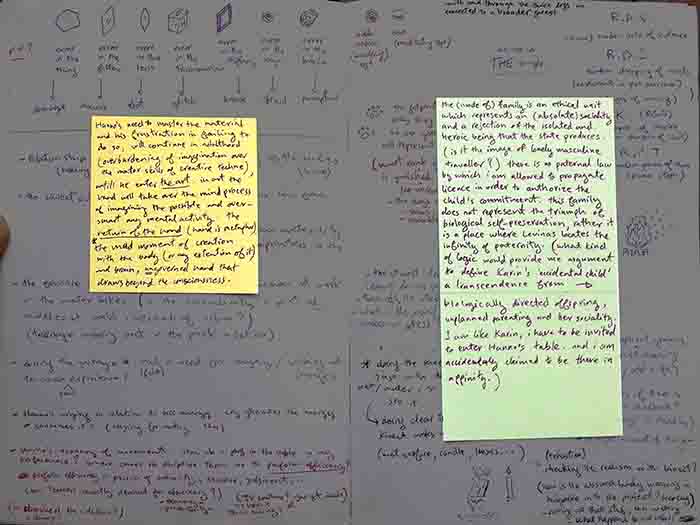
Hanno, imagination, motor skills, creative techne, mind, return of the hand, mad movement of creation, ungoverned hand that draws beyond consciousness, family, ethical unit, isolated and heroic being, lonely masculine traveler, athorize child's commitment, triumph of biological self-preservation, Levinas, infinity of paternity, Karin, accidental child, unplanned parenting, biologically directed offspring, i have to be invited to enter Hanno's table and i am accidentally claimed to be there in affinity
