[...]tament
•blessing: source of all good things
•withdrawal of blessing: source of all dangers
xxxxxx
-to--> invitation, creating the invitation
*Pierre: posting a problem is not about general sentences, it is about finding new relations in the existing fabric of the world, problematizing our intuitions into problems, therefore it is important to have the “?”
*Sina: remembering beyond history
--------[how can we enter something and not enter it at the same time?]
*Thiago: nonpresence <--> thinking, without body?!
*Aela: is about the question of distance and inside/outside, by practicing openness, it is about when something enters ‘you’
*Sana: physical-presence =/= imagination (mental activity ~= dream) {She needs to see Miyazaki}
*Roger: we do it all the time, for him it is more about active engagement, role of feelings, moments that you are pushed out by the entity
*Maarten: no! enter =/= not-enter, research depends on definitions
*Juan: layers of realities are involved, it is about expanding the consciousness by charming it into 90% presences, theater gives a yes/no quality to the question of entering, actors, stage as Dystopie of presence
*Xiri: yes! this is often the case, we are between 2nd-chances and being-torn-apart
--------[who told the first joke?]
*Gerald: objects =/= actual life (absurdity and absoluteness of objects) (contemplating about object ==> inner smile)
*Nicolas: father (by not getting it right), not mother (she is not the teller type), the tickler is about lunching possibilities
*Vladimir: God, Vladimir thinks this is theological and therefore axiomatic (that means self-evident or unquestionable)
*Lise: Monty Python, specifically the philosopher soccer video, in the way that makes you laugh
*Elke: God, God said “this is reality” (but we didn't get his joke)
*Steven: some funny kid in the street when he was 5 or 6, and it wasn't really a joke more a story
...................................
[...]
(1)[...notes/midday review.txt]%0[...]French: Comité Européen de Normalization), one of the EU fostered nonprofit public institutions of the cutting-edge development regarding ambitious notion of ‘data,’ ‘systematic knowledge,’ and ‘specifications’. the excursion will be oriented towards a meeting between the participants of advanced performance and scenography studies and the representatives of CEN, and encourages a run between the ontological demands of international economy and contemporary art, their disastrous split, and where their formations meet and intersect.
KEYWORDS: cosmology, experimentation, existence, specification, future, knowledge, irrationality, permanence and substance, technological acts--of naming, a path of becoming--on the grid of technological dominion, suspicious partnership of “advanced democracies” and “high technology"--what allows their mutuality?, standard-testing--which sectors of existence it is traversing?, pre-technological traces of cognitive normalization, the very little difference between specification and “the real thing,” THE origin of the demand for rigorous specification, migration of questions out of the areas of instrumental fitness, human relation to the surrounding world, impoverished zoologies--under techno-epistemo-anthropocentric values, squeezing prehistoric modes of weakening subjectival normativity--a field that today gets heavily technologized,
...................................
to bring our needs and lures towards each other
bring my lure to the table (that thing which i can't stop following)
who/what are you pregnant with?
(that is what you are proposing)
(that is to play with the ‘histories of body and mind’ [Haraway] you inherit --> for me is to play with the pre-subjective singularities)
[inheritance is of great importance for our research. it is about the passing of obligations from something ghost-like. i am sure we have other modes of response available to us other than how Hamlet takes in what is inherited to him, other ways of responding to the ghostly beings that talk to us from death. (inheritance ~= inhabiting spirit [they cannot be possess as a piece of property], reading inflaming flashes of remote spirits [--> is this hear from one another looks like? is technology placed at the source of this reflection?--technology itself answers the call--(Avital)]) could we work with Ophelia's kind of #Wortsalad instead? (Salad-e Kalame, khoresht-e kalame; same thing happens to Shirin of in Khosro Shirin, but unlike Shakespeare, Nezami allows another poetic drift;) Heidegger's “die Sprache spricht” : language is monologue --?--> schizophrenia and schizophrenic discourse --?--> structure of speaking]
[speaking asserts a certain temporal priority which we must undermine]
-listening *before* speaking
-“We hear language speaking” (Heidegger); a non-organic speaking; language is not equipped with organs of speech? (Avital)
[...]
(2)[...notes/midday review.txt]%0.2[...]ak in the philosophical and biological headquarters (and steal their stories, their abstractions, etc.)
exchanging and sharing instruments and languages
this is about building something that is ‘good enough’ to get you through...
these practices doesn't necessarily produce ‘separate entities’ (indivis)
am i fantasizing creating a monolithic structure of ideas?
critique is an art that tangles with what you are proposing
(like an octopus in a lure)
...................................
stories that can interrupt death (of our time, anthropocene, etc.)
(example of biology-story into culture-story: (1) ladder of evolution --> progress (2) sperm/egg story --> gender performance)
to change stories so that they are more livable
we live stories
to make mistakes as fast as possible
... move across earth space and narrative space
situated stories
they can't tell everything, but what is needed here
https://en.wikipedia.org/wiki/Refugium_(population_biology)
...................................
ontological choreography
vital sort of play that the participants invent out of a history of body and mind they inherit
...................................
possible performances
*two doors, ?, talk, model, puppet
*using stop-motion animation, clay formation, material animal facial properties
...................................
seeing a car crashing, is seeing a causation, seeing a reasoning, is that logos? is it logos when we see a physical experimentation?
...................................
[Haraway]
the established (dis)order is NOT necessary!
grips of necessity
(the real does/did not have to be or happen that way. the ‘real’ is the result of contingencies and it can be undone by working the contingencies, with skill.)<ill.)
laboring bodies, playing bodies, sensuous bodies
(feminism:) you can't get freedom outside of mortality
-theology, the negative way of knowing, the necessary discipline of positive affirmation in order to know what is not knowable, is a very helpful tradition
when it comes to language we, humans, will always win over the animals.
we will always be the ones who control the law, the database.
(all is bad news both for the charismatic endangered Bangali tiger and the individual chicken in the food industry.)
fight the divisions and differences
we are in a very bad place for animals and woman
can we do without instrumentalization?
categories of killable--the question of how we kill
the question of one's-own-old-hat
regarding what you are against: we might find ourselves properly addressing a particular issue but having no ability to make political connec[...]
(4)[...notes/midday review.txt]%0.3[...]self-possession, on those who are on the marked categories to the unmarked. the feminist have been particularly good at getting how genre works. gender, in this regard. [...] --> that female by nature is committed to the species and the male by nature committed to transcendence.
[our inherited binaries -->] formulations of nature: executive/non-executive organs, immanence/transcendence, maintenance/novelty, catabolic(foru-sakht فرو ساخت, sukht سوخت)/anabolic(tarkib-saz ترکیب ساز) functions, ,,
-in Darwin's writing, non-theological account of diversity on earth, we find both interrupters and continuers of these particular notions of nature
the question of model, what is the model for what, what is similar to what?
****how do we do comparative thinking? comparative thinking depends on similarity judgment and difference judgment, and depends on good-enough models, and depends on a certain kind of rhetorical work of *crafting tropes*
/>
--> figures of similarity/difference:
by similarity, or
by contiguity, or
by part-whole, or
...
(this is ‘building’ *among* us)
(how do i decide to compare two things? Shirin and Ophelia, etc)
models are built rhetorics
history of models
the power of models is that they are not the ‘same as’
circuits of meaning and power that flow through (materials and bodies)
mondial ~? situated knowledge
the idiom ‘situated’ makes people think ‘local’ (instead of global)
by situated she means the ‘knot’ which always means some place and somewhere, but that someplace/somewhere could be in materiality a distributed digital network. the situated is always open. the point is that it is not nowhere and no place.
epidemic friendly
the flow of disease are major international research matter
eco-feminism, veganism is for Haraway is genoc genocidal position, a position that advocates violence, a position dedicated to the destruction of ways of life and living beings including animals, [a position that] *concise all working animals to being nothing but evidence of the destructive and violating imposition of human will on natural stuff*, and “that domestic animals of all kinds are victims and demonstrations of human hubris گستاخى, and they have been made into tools” ~= an extreme developemnt of liberal theory --> the (work) animals are not self-defining subjects, are violations and victims, and should not exisit, except as:
•heritage-animals
•rescue-animals
•wards of guardianship
(my work on ajayeb and question of heritage has been exactly against that position)
the radical anti-food-industry position is a radical liberal theory turns all working animals into (at best) *heritage-animals* ~= animal to be preserved as much as possible separate from human use --> “all huma[...]
(5)[...notes/midday review.txt]%0.5[...]lationship that is not equal
to say that “meat culture everywhere and always are acts of violation” is wrong
“post-”, the notion of ‘surpassing’ that is inevitability built into the “post-”, is in our way politically
the project of critique : finding that point of violation where you can say “got you!”, ‘I nailed you’ --> the practice of critique = to define what we are against }==> develop political movement that are fairly self-certain about what we are against ==> you will find yourself (perhaps) property addressing a particular issue but having no ability *to make political connection* (~= to think beyond the category) --> you find yourself crippled
posthumanist think of themselves as “better than”, more in possession of a “real” understanding of the nature of contemporary world, beyond the critique of technology
the politics of it all...
[we have never been -->] human : being on the side of the one who developed technology to realize intention of their mind in the matter [= The Iron Man]
=/= what it is to be people
we don't need fancy epistemological justification (such as posthumanism), people know the world in ordinary ways and we can learn from eachother, in all the (cultural, historical, power, wealth) differences among us [@Leo] --> ***partial translations happen all the time***
to take the risk of making a mistake --[the only way you can]--> affirm something positive : the positive knowledge pins on the possibility of mistake --(@Setareh; Goda wants to avoid mistakes?)
(learning from Foucault:) power = actual arrangement of the world (and not something ‘out there’)
(learning from Derrida:) responsibility is about the excess of it all (and not the irony of it all [*irony: incongruity of expectation and occurrence])
(learning from biology about:) differences organize themselves by ecologies (and not by binaries) --> ecologies have many scales (of temporality and physicality)***
scientific research + artistic research + contemporary philosophical critical inquiry ==> *topographies of difference* [--> important for Goda's use of the term “privilege” flattening differences]
(“+” are exchange zones, i am learning their differences of idioms)
[apass = partners locked into mimesis]
(my problem with the idea of) privilege: a special right, advantage, or immunity granted to a particular group or individual --assume--> the only way for a particular demographic to advance is at the expense of another
•communism which was a form of collectivism (defined itself against privileges) wiped out large populations
•it is easier to politicize gender and sexuality --to--> demand change
@Leo: the question of (should this be the way of) ‘how do we inhabit our situation and to make connection with each other’ --> (?can i suggest to Leo) to drop t[...]
(6)[...notes/midday review.txt]%0.6[...]et. tuning in the soup of planets, instead of getting the pulse of a singular planet. the nebulous milk way of liquid bodies, instead of rigid mass of individual blood--Pluto.
@Varinia: (in her dog video, regarding her engagement with the law and the question of comparative thinking:) what is the model for what, what is similar to what?
-is her model based on the idea that beings exist as individual? (is this a ‘difference’ that her work produces?)
@Agnes: you are a response to the bed, making the bed and being made by its caress and embrace. it is not that you want all the audience in the world to identify with a general question or present this as a universal expression, but what could go beyond localization is precisely this concept that you, like me, transitioning body in your environment (bed or whatever) are outstretches of homeliness and forces that distribute across space and discourse, territories and sensing zones, you are an exchange between self and environment. this is pragmatism. like the variety of bed sheets, we are proposed with answers that vary, before posing any question.
to reformulate the question that was posed to you: how your proposal is capable of traversing from the bed to the wild?
pre-historic personhood
my work is concerned with connections, mediation and passages.
what you take for granted, is in another words, what that you can't not know.
(my proposal:)
the past is not absolute!
the idea is that the mythical became the mythological --> Things could be treasured for their beauty as opposed to
their utility or their numinousness.
(Martha Kenney's) “wild facts”
facts that won't hold still
fables
fables of ajayeb, creatures of imaginations, (im)possible worlds
...................................
your institutional hacks
three things to consider in my work:
projection, immersion, and synthesis
seeking to be at once inside and outside the topic
the issue of topology -- what remains invariant as a result of transformation
suggestive power of the figure
...................................
synthesis =/=? genesis (to originate something, to design)
genesis =/=? apocalypse
...................................
in research, contrast between method and subject, is a tool
(in studying natural history)
in critique, contrast between effect and affect, is a tool
(assumed quality of the object and one's own named experience)
[these tools are perhaps cognitive objects]
...................................
Enlightenment as cultural European phenomenon versus a scientific British one
(the theatrical function of natural philosophy in the England Enlightenment)
the function of natural phil[...]
(7)[...notes/midday review.txt]%0.9[...]om the bed to the wild?
pre-historic personhood
my work is concerned with connections, mediation and passages.
what you take for granted, is in another words, what that you can't not know.
(my proposal:)
the past is not absolute!
the idea is that the mythical became the mythological --> Things could be treasured for their beauty as opposed to
their utility or their numinousness.
(Martha Kenney's) “wild facts”
facts that won't hold still
fables
fables of ajayeb, creatures of imaginations, (im)possible worlds
...................................
your institutional hacks
three things to consider in my work:
projection, immersion, and synthesis
seeking to be at once inside and outside the topic
the issue of topology -- what remains invariant as a result of transformation
suggestive power of the figure
...................................
synthesis =/=? genesis (to originate something, to design)
genesis =/=? apocalypse
...................................
in research, contrast between method and subject, is a tool
(in studying natural history)
in critique, contrast between effect and affect, is a tool
(assumed quality of the object and one's own named experience)
[these tools are perhaps cognitive objects]
...................................
Enlightenment as cultural European phenomenon versus a scientific British one
(the theatrical function of natural philosophy in the England Enlightenment)
the function of natural philosopher in 18th century was to use experimental science machines to turn inert matter into active power, light/fire/heat/etc. to lecture an wealthy and polite fee-paying audience, in order to save them from irrationality, that inside all matter there is le is life and power, and that life was divine.
(however all this was all swept away in the industrial revelation)
William Herschel, an amateur natural philosopher discovering Uranus 1781
(Enlightenment was all about people changing their disciplines)
project of constructing a new theory of heavens
...................................
*i can't give you a direct grasp but i hope i can give slowly accuracy
*the ‘details’ of grasping
(zoom in the ‘grasp’)
from contingencies to certainties
i spend so much time with painting and computers, which were about compositions and hacks
i think there are few fields/figurations/skills we need to get good at: rhetoric, biology, aesthetics
...................................
trope - something other than its literal form
adding an adjective or replacing a name, (one-way movements?) -- let me tell you[...]
(8)[...notes/midday review.txt]%1[...]
trope - something other than its literal form
adding an adjective or replacing a name, (one-way movements?) -- let me tell you the story of:
*knowledge --to--> expressed knowledge
*knowledge --to--> knowing
*reality --to--> manifest realities
*real --to--> real enough
*islamic --to--> islamicate (“islamic” has always been a ‘range’ rather than a ‘binary switch’. things become more or less “islamic” in popular/proper belief)
*nature --to--> visual nature
*culture/civilization --to--> collective (emphasizing operation of gathering or composing and heterogeneity of the assembled)
*muslim countries --to--> muslim majority countries
*understanding --to--> better understanding
*what does X mean --to--> what does X mean for you
*body --to--> lived body
*body --to--> lived image
*language --to--> specialized languages
*world --to--> built world / thought world / described world / descripted world
*producing knowledge --to--> participating in knowledge projects
*to explain --to--> to explain in terms of...
*place/location --to--> neighborhood (ask ‘why this neighborhood?’ instead of place)
ajayeb helps me to work on:
-history
-poetics
-animality --> inhabiting material and semiotic positions --> how to find a descriptive act that is not in terms of the impressions it makes on our senses? / this is about the places things take and occupy in our phenomenal world. / it is difficult to discuss the night-sky without first breaking it up into constellations. (Matthew Carey)
i have been building my own islamology or islam-studies department, through a low-voice critical mildly blasphemic rant about imagination
(anthropology of non-experimental imagination in the islamicated worlds)
[there is a difference between **experimental imagination** and imagination]
we are at the edge of extinctions
many species and lives are migrating to “where” and nowheres, pushing to the oblivion.
my issue with the ‘timing of understanding’ --> i don't want to be understood by you, i want to be loved by you ==> messenger + message --> so how do i produce lovers? (=/= Don Juan's type of love) --> there is a genius in your everyday talks that transforms me and has nothing to do with understanding (with the information that i grasp)
(using Martha Kenney thinking:)
i am interested in crafting words, phrases, and languages that reworlds us. (reworlding is about reorienting us in the world differently. --> is that what i meant by changing the rhythm of somebody's story?) what is important for me is ***what words ‘do’ rather what words ‘point at.’*** --> if not evidence then ‘what’?! *****the magic of the right word*****
...................................
communicating knowledge is always also making it[...]
(9)[...notes/midday review.txt]%1.1[...] powerful relational work that numbers (also? = =/= --> => etc.) perform -> “numbers are a particularly smooth and manipulable meaning-making tools. they hide their seams well. they are slick and trustworthy” (Porter) --> they are “materialized relations” (how can we tell a story of relations that for example numbers/math materialize?)
◦highlighting parts of ajayeb: as part of a material reading practice --> “highlighting” could easily be understood as metaphor of disembodied vision; highlighting is not about making things clear but about scribbling (bad-khat بدخط) as a mode of attention =/= (Descartes’) “natural light of reason”
%report on fables of objects #workshop (22.02.2017 HWD apass): attention to the sense and feeling of disparity, dispersity, stability, sublimity, authority, epicness, weakness, severity, solidity, scale, (a)social connections, and tangibility in the character of the object of each participants in the stories we wrote. where were active and passive qualities located? how were agencies distributed?
•origin story --> evolution story, love story [the object falls in love with...]
•daily story
•beast feeding story --> training story
evoking temporality of evolutionary time, face-to-face time, historical time, tiny scale time,
-each story has a music, texture of colors, pattern of meaning and affect
•bodyguard --> fantastic creature invented to protect an organism (your “object”). this bodyguard can be organic, nonorganic, cyborg, any form, but always an agent. tell us why/how this or that feature helps the bodyguard with its task
•generation stories, describe and follow your object in three generations, its child and grandchild
•[for the second day or warm-up first day?] constraint based writing: (Kenney > Christian Bök's “literary genetics” poetics of encryption of data; poetic vectors, to “infect” the language;) describe/story your object (or an operative “verb” within your discourse) with univocalics: without using “e” or only using a single vowel. or, first write with 3, then 2, then 1 vowel.
-the workshop is about: what other stories (of your object) are possible?
-in the workshop (I take a temporary position to) challenge others to re-tell the story of their ((epistemological) found) objects
-a ‘generative constraint’ might help opening up paths before you, away from our habits of storytelling
-it is about getting a feeling for the resistances and potentials of language in our (sometimes mundane) descriptive practices, “strange richness of missing the letters we need” (Kenney)
the metaphors are dormant in our routines of talking and noticing each other. how then, by traversing the routine, our “knowledge” and “community” took on new meaning, as they get a chance of being rearticulated in different languages (or differenlty infected literature)
~-?==> changing t[...]
(10)[...notes/midday review.txt]%1.5[...]on to) challenge others to re-tell the story of their ((epistemological) found) objects
-a ‘generative constraint’ might help opening up paths before you, away from our habits of storytelling
-it is about getting a feeling for the resistances and potentials of language in our (sometimes mundane) descriptive practices, “strange richness of missing the letters we need” (Kenney)
the metaphors are dormant in our routines of talking and noticing each other. how then, by traversing the routine, our “knowledge” and “community” took on new meaning, as they get a chance of being rearticulated in different languages (or differenlty infected literature)
~-?==> changing the system of classification (of thought)
-in a way the workshop is about an *approach* to knowledge generation (and not necessarily a rigorous critique nor directly evaluating the production of our knowledges)
***nothing is never merely a metaphor***
[some fables from science studies:]
•Emily Martin's egg/sperm story --> stories of atomism, distribution of agency, ----[The Egg and the Sperm: How Science Has Constructed a Romance Based on Stereotypical Male-Female Roles]
•Hayward's microscope --> tropes of natural history docu, ----[Enfolded Vision: Refracting The Love Life of the Octopus]
•Kenney/Haraway's origin/nature fable --> the omnipotence of the “origin” story in our descriptions and interactions with the natural world
•Scott Gilbert's immunological “bouncer” story =/= immune systems as inclusive agents of symbiosis
•Lynn Margulis: life (made possible) by “combat” [the survival fable that TV series “The 100” and “Kelile Demne” for instance is based on] --✕--> life by networking
•Haraway: the tale of “organism = a system of division of labor with executive functions” (==> extraction of wealth among us)
•Morton's causality-story
•brain/body story --> where the “move” came from?
•Sina's “standing on the shoulders of giants” --> knowledge/continuity, role of authority and humility in science ----[http://www.sinaseifee.com/giants.html]
•Sina's 3 little pigs --> architecture/tech/ echics of encounter --> story of the center and periphery ----[http://www.sinaseifee.com/pigs.html]
•“weapon fathered man” --> Kubrick's african genesis, technology + prehistory (in postwar period) “tool ==> man”
•
fables popular in apass:
•“a work [of art] should speak for itself”
•“the very last stage of the creative process is purely intuitive” --> when people say they stop “reading” or “knowing” when they want to create artwork
•“look really hard inside yourself for what you really want”
•“you are an agent of change” that means art or thinking or being ought to be operative, active, transformative, (even destructive) and that is “political” [--> this fable in found in language; ---> go to[...]
(11)[...notes/midday review.txt]%1.6[...] of agency, ----[The Egg and the Sperm: How Science Has Constructed a Romance Based on Stereotypical Male-Female Roles]
•Hayward's microscope --> tropes of natural history docu, ----[Enfolded Vision: Refracting The Love Life of the Octopus]
•Kenney/Haraway's origin/nature fable --> the omnipotence of the “origin” story in our descriptions and interactions with the natural world
•Scott Gilbert's immunological “bouncer” story =/= immune systems as inclusive agents of symbiosis
•Lynn Margulis: life (made possible) by “combat” [the survival fable that TV series “The 100” and “Kelile Demne” for instance is based on] --✕--> life by networking
•Haraway: the tale of “organism = a system of division of labor with executive functions” (==> extraction of wealth among us)
•Morton's causality-story
•brain/body story --> where the “move” came from?
•Sina's “standing on the shoulders of giants” --> knowledge/continuity, role of authority and humility in science ----[http://www.sinaseifee.com/giants.html]
•Sina's 3 little pigs --> architecture/tech/ echics of encounter --> story of the center and periphery ----[http://www.sinaseifee.com/pigs.html]
•“weapon fathered man” --> Kubrick's african genesis, technology + prehistory (in postwar period) “tool ==> man”
•
fables popular in apass:
•“a work [of art] should speak for itself”
•“the very last stage of the creative process is purely intuitive” --> when people say they stop “reading” or “knowing” when they want to create artwork
•“look really hard inside yourself for what you really want”
•“you are an agent of change” that means art or thinking or being ought to be operative, active, transformative, (even destructive) and that is “political” [--> this fable in found in language; ---> go to Barthes’ fable of the woodcutter]
•
no need for “conflict” nor “hero”
(in the way we give feedback, relate, narrate, story, and tell eachother our matters of care and concern, and where we create zones of attachment; both in your “art work” and the mundane everyday of ‘getting on together’ --> interrupting one's own framework)
...................................
#workshop, on question, feedback method, to improve the questions we ask each other
-what are the questions (i could ask) that make you the most articulate?
-the question that asks what are the good questions that offer an interesting becoming for those to whom the question is addressed
-to ask: does this apparatus has stakes in docility or availability?
-more interesting questions ==enable==> more articulated answers ==> more articulated identities
-asking (questions) (is not about ‘you want to know,’) is about constructing interest ==> chance of interesting answers
-asking about the differential productions, “=/=” or “=” or “==>” in each other practice[...]
(12)[...notes/midday review.txt]%1.6[...]=> chance of interesting answers
-asking about the differential productions, “=/=” or “=” or “==>” in each other practices. these assessments are propositional and poetic remarks, guessing the artificialities that we live with, not finding of matters of fact
◦asking about particularizations (تخصیص) and generalizations (تعمیم)
**literature begins, Blanchot writes, “at the moment when literature becomes a question”** (this is completely different than asking or question-marking in literature) [...] this question “is posed to language by language that has become literature” (the question that the meaning of the text asks is the question asked by literature; [of course at the moment of reading]) [then what is a text before becoming a question? complaining? revolution?]--%(negation wishes to realize itself.)
--> Rorty's critique of Descartes's way of asking questions
we have to be careful with our practice of questioning, because we often end up privileging a group of people by attributing it to “higher” levels cognition and of being “critically” in the world (=/= animal, nonpeople, other people with other ways of being in/with the apperceptive world that don't use the technology of questioning, as it is crafted historically and naturalized in the west for the univerasal method of ‘knowing more’)
...................................
#workshop, reading group
•reading as passionate betrayal. (hunting for precious empirical details, refigurative, reparative, poaching, reading can be a betrayal of textual authority and an act of survival)
•addressing /present* differences, not already pre-figured differences
•(condition of friendship, staying close to the text) staying close as a reader, as someone who could hold the text of the Other, receiving it in the withdrawal / Entzug (drug rehabilitation)
•i am in no position of ‘understanding’ or being clear about the text<br />
•(i understand now that) it is not up to me to tell you how to read
•what makes you write or scratch a text?
(aaaakh... our alphabetico-logical cultures...!)
•if everything is not fundamentally unreadable (snafu) we wouldn't be reading
•it is about to situate the place of a (un)learning
•throwing access to each other (not only in terms of transferential intensity #sss)
•which appetites and tastes are required to fulfill the *ethics and erotics of curiosity* (that I am cultivating and depending on)? flourishing (of my ajayeb) depends on a reading that is more like “mutual partial digestion” (Katie King, Haraway) [=/= “eating well"] the text
•“every time i read X, something new shows up”
my practice of ‘rhetorical reading’ (=/= ‘close reading’; or more like close reading and letting go. “close” is itself a metaphor, a rhetoric of reading;) doesn't work with the idea that there is something ‘in’ the text per se [...]
(13)[...notes/midday review.txt]%1.7[...]...]”
sunday: “empty time that forces us to fill it through apparently free decisions that, if they are resolved properly, please us and re-constitute us” (Peran)
*freedom of action for self-realization* --> unstoppable egocentric machine
space of perpetual connection (@ERG's website)
(pseudo) communicative action by way of technological devices --> camouflaged alienation
“The promise of self-realization and the demand for visibility organize the mobilization of desire, turning it into work.”
do we need to formulize and formalize our uncomfortable concerns and experiences?
@apass, artist research
i want to *give connections*
...................................
#semester/seminar on destruction
-care, suffer, fubar,
[fubar: “fucked up beyond all recognition"--a term from veterans returning to the United States in 1960s]
#semester on Hojum
(surge,) on performance, media, sculpture, and surplus
Hojum has to do with the hojum (~=? ‘bodies’) of people to get in front of the line, the hojum of enemy, of friend, of information, also includes the plural form of ‘hajm’ (حجم)
#seminar on the history of translation
archaeology, interpretation, spaces of difficult translation, reading out of time, technology and transformational studies, semiotics, poetry, writing,
...................................
#on Situated Knowledges
-approach the text by creating intensity and my own partial perspective
-the elephant parable (against it)
-objectivity (disembodied view from nowhere)
-neutrality (biologically insane)
-marked people (my own story)
-situatedness of the situated
-The cyborg is a figure in which situatedness makes possible adventures with the beyond.
-globalization-as-situatedness: global is precisely space/place/time/situation
-the figure of the so-called scientist gathered around certain metaphors since the begining of the 17th cebtury, namely ‘objectivity’ and all its related adjectives: neutrality, perspective, universality, disembodiment (for certain race and sex), etc.
-metaphors create perspectives [the view that looks at blind men looking at the elephant]
-situatedness is different than ‘positionality’: a way of systematic error correction
-(resolving) specificity of vision --> scientific objectivity (is achievable)
-Haraway expresses her informed dissatisfaction with (the metaphysical substrate that supports) ‘social constrctivism’ and ‘traditional realism’ --> representationalist belief in the power of the words to mirror preexisting phenomena. they both believe that scientific knowledge (in its representational formats: theoretical concepts, graphs, particle tracks, photographic images, etc.) mediates our access to the material world, whether it [...]
(14)[...notes/midday review.txt]%3.2[...]both groups are subscribed to representationalism.
focus on the nature and production of scientific knowledge --(shift to science studies)--> dynamics of the actual practice of science }--> on ongoing pattern of situated activity
-(disembodied scietific) objectivity: that only certain people are allowed to have no body (Gender, race, etc.) and that high science in practice is not acting on textbook objectivity at all.
absent referents, deferred signifieds, split subjects, and the endless play of signifier
Haraway is feeling nervous with two views on objectivity:
(1)the ‘social constructionist’ view on this: getting to know the world ‘effectively’ by practicing the sciences --> knowledge is knowledge-game (on an agonistic power field) ==> science is rhetoric : artifacts and facts are parts of the powerful art of rhetoric ~= practice is persuasion. {this view will use the nasty tools of semiology and deconstruction to insist on the rhetorical nature of truth.} --> Haraway calls this ‘The imagery of force fields’ (also an imagery of high-tech military fields and of automated academic battlefields) {will to power} (for Luiza)
epistemological electroshock therapy
(feminists protecting their) sense of collective historical subjectivity and agency and our “embodied” accounts of the truth --> these are just excuse not to learn
(2)Humanistic Marxism (structuring theory about the domination of nature in the self-construction of man) ([young Marx, influenced by Feuerbach =/= Hegelian idealism, saying that:] man's essential nature is that of a free producer, freely reproducing their own conditions of life [--however--> under capitalism individuals are alienated from their productive activity, etc.])
--> “chance for life”
science: Global System, universal knowledge --> translation, convertibility, mobility
of meanings, and universality
money in capitalism ~= reductionism in science
...when we are talking about genes, social classes, elementary particles, genders, races, or texts
*vision: a sensory system that has been used leap out of the marked body ==> a gaze from nowhere
-“Vision is always a question of the power to see--and perhaps of the violence implicit in our visualizing practices”
-also, the visual metaphor allows one to go beyond fixed appearances, which are only the end products. The metaphor invites us to investigate the varied apparatuses of visual production (including: the prosthetic technologies interfaced with our biological eyes and brains.)
unmarked body: the power to see and not be seen
objectivity in scientific and technological, late-industrial, militarized, racist, and male-dominant societies
(she asks for:)
“So, I think my problem, and “our” problem, is how to have simultaneously an account of radical historical contingency[...]
(15)[...notes/midday review.txt]%3.3[...]conditions of life [--however--> under capitalism individuals are alienated from their productive activity, etc.])
--> “chance for life”
science: Global System, universal knowledge --> translation, convertibility, mobility
of meanings, and universality
money in capitalism ~= reductionism in science
...when we are talking about genes, social classes, elementary particles, genders, races, or texts
*vision: a sensory system that has been used leap out of the marked body ==> a gaze from nowhere
-“Vision is always a question of the power to see--and perhaps of the violence implicit in our visualizing practices”
-also, the visual metaphor allows one to go beyond fixed appearances, which are only the end products. The metaphor invites us to investigate the varied apparatuses of visual production (including: the prosthetic technologies interfaced with our biological eyes and brains.)
unmarked body: the power to see and not be seen
objectivity in scientific and technological, late-industrial, militarized, racist, and male-dominant societies
(she asks for:)
“So, I think my problem, and “our” problem, is how to have simultaneously an account of radical historical contingency for all knowledge claims and knowing subjects, a critical practice for recognizing our own “semiotic technologies” for making meanings, and a no-nonsense commitment to faithful accounts of a “real” world, one that can be partially shared and that is friendly to earthwide projects of finite freedom, adequate material abundance, modest meaning in suffering, and limited happiness.”
Haraway asks for an embodied objectivity that is able of accommodating *paradoxes* --> ‘situated knowledges’
-what does she mean when she says “All components of the desire are paradoxical and dangerous, and their combination is both contradictory and necessary.”
(instruments of visualization in multinationalist, postmodernist culture:) disembodiment : to distance to know
the visualizing technologies (--> my amazon project)
a perverse vision that has produced ‘techno-monsters’ (what does she mean by that?)
--> second birthing? transcendence?
[the frankenstein's techno-monsters, is modeled after who? and who is modeled after it? wondrously, murderously walking around...]
(‘second-birthing’: one of the deadly stories of killing: in the first-birthing we have merely birth to the earthly soil from the woman, and then the achievement of the tragically self-realized purpose of tragic consiousness, concretized and distilled by Sartre) “dire myths of self-birthing”... --> we must resist the stories of guilt laden knowledge and consciousness
unrestricted vision
presented as utterly transparent
***particularity and embodiment (of all vision) [not necessarily organic]
[...]
(16)[...notes/midday review.txt]%3.3[...]s multidimensional ==> vision is multidimensional
(an instruments of vision:) optics : politics of positioning --> one example of optical illusion: rationality (projected from nowhere comprehensivel)
(some perspective are more guilty : master point of view)
No one ever accused the God of monotheism of objectivity, only of indifference. The god trick is self-identical, and we have mistaken that for creativity and knowledge, omniscience even. (self-identical [having self identity] =/=! creativity/knowledge)
Technology: skilled practices. (How to see? Where to see from? and so on.)
@Sana, ‘observation’ and ‘technologies of positioning’
how to see?
the science question in military
the science question in colonialism
the science question in capitalism
the science question in feminism
...
master theory =/= webbed accounts
(what does she mean when she dichotomises theory and account?)
instead of (creating and mastering) ‘theory’ she proposes webbing ‘accounts’***
-‘webs’ can have the property of being systematic
systematic: deep filaments and tenacious tendrils into time, space, and consciousness. systems are dimensions of world history.
she suggests to be accountable for (the intricacies of) visualization technologies in which we are embedded that we will find metaphors and means for understanding
and intervening in the *patterns of objectification* in the world.
--> politics and epistemologies of location, positioning, and situating
partiality =/= universality
*partiality: view from a body, always a complex, contradictory, *structuring, and structured body* (what does she mean by ‘structuring and structured body’?)
--the sciences and politics of interpretation, translation, stuttering, and the partly understood.
*Feminism: critical vision ==(consequent upon)==> a critical positioning in unhomogeneous gendered social space.
location --> vulnerability ~~> (full of limits and contradictions)
“rational” knowledge : to be free from interpretation, to be free from being represented : to be fully self-contained (~ fully formalizable)
-no! let's make Rational Knowledge a process of ongoing critical interpretation among “fields” of interpreters and decoders --> a power-sensitive conversation
-accountability and responsibility for translations
. Situated knowledges are about communities, not about isolated individuals
(pinocchio and geppetto parable)
objectivity = positioned rationality
=/= images of escape and transcendence of limits (filled in Hollywood and sci)
faithfulness of our accounts to a “real world” (no matter how mediated for us and no matter how complex and contradictory these worlds may be)
Sex is “r[...]
(17)[...notes/midday review.txt]%3.6[...]
*animal (in zoological terminology) : a composite of individual organisms, an enclosure of zoons, a company of critters infolded into a one.
compound = composite + enclosure
camera: the technological eye --> philosophical pretension and self-certainty (=/= Christian's camera)
-- camera as a black-box with which to register pictures of the outside world in a representational, mentalist semiotic economy
...................................
Vinciane Despret, Isabelle Stengers, Bruno Latour, ”_how they make their subjects interesting,_“
to tell the story of their work of “translation,” of invention.
refuse all loyalty to my homeland and its values
*heuristic: mental shortcuts that ease the cognitive load of making a problem solvable
-trading optimality, completeness, accuracy, or precision for speed
it may *approximate* the exact solution for the problem
-enabling discover or learn something for themselves. (a ‘hands-on’ or interactive heuristic approach to learning)
[(in computing:) proceeding to a solution by trial and error or by rules that are only loosely defined.]
-from Greek heuriskein ‘find’
*contingent: using it with ‘historical’ always produces interesting ways --> contingency relates to a nonteleological [a doctrine explaining phenomena by their ends or purpose] and nonhierarchical multiplicity [when i say ‘dud’ and ‘cauphing’ and interupting ‘tracing’ i am asking for contingent modes of relating and thinking. conceptualizing in terms of the origin of the dud is about hierarchical relations between past and present and teleological reasoning: where is the dud coming from. when i asked ‘who told the first joke?’ i am trying to break and joke with teleological mode of thinking about the category of ‘origin’.]
contingent =/=? analytical (--> Contingent propositions depend on some kind of epistemoloy, whereas analytic propositions are true without regard to any facts about which they speak.) {telos, ghasd قصد --> ghaside قصیده =/= ghazal غزل}
-We call a truth contingent when it *depends on something else* for its truth.
-has to do a lot with our material world
contingent ~= containing-agent*
--Tautological propositions, which must be true
--Contradictions which must necessarily be untrue
--possible propositions
never use contingency alone in a sentence --> historical contingency
never use understanding stand alon in a sentence --> better understanding {'better’ opens situatedness, for who and how “better,” etc.}
Rhetoric <--(has to do with)--> Contingent
Aristotle (in his work on rhetoric) was against contingency. He believed that the “unavoidable and potentially unmanageable presence of multiple possibilities” or the complex nature of decisions creates and invites rhetoric. (=/= Plato saw [...]
(18)[...notes/midday review.txt]%3.9[...]reek heuriskein ‘find’
*contingent: using it with ‘historical’ always produces interesting ways --> contingency relates to a nonteleological [a doctrine explaining phenomena by their ends or purpose] and nonhierarchical multiplicity [when i say ‘dud’ and ‘cauphing’ and interupting ‘tracing’ i am asking for contingent modes of relating and thinking. conceptualizing in terms of the origin of the dud is about hierarchical relations between past and present and teleological reasoning: where is the dud coming from. when i asked ‘who told the first joke?’ i am trying to break and joke with teleological mode of thinking about the category of ‘origin’.]
contingent =/=? analytical (--> Contingent propositions depend on some kind of epistemoloy, whereas analytic propositions are true without regard to any facts about which they speak.) {telos, ghasd قصد --> ghaside قصیده =/= ghazal غزل}
-We call a truth contingent when it *depends on something else* for its truth.
-has to do a lot with our material world
contingent ~= containing-agent*
--Tautological propositions, which must be true
--Contradictions which must necessarily be untrue
--possible propositions
never use contingency alone in a sentence --> historical contingency
never use understanding stand alon in a sentence --> better understanding {'better’ opens situatedness, for who and how “better,” etc.}
Rhetoric <--(has to do with)--> Contingent
Aristotle (in his work on rhetoric) was against contingency. He believed that the “unavoidable and potentially unmanageable presence of multiple possibilities” or the complex nature of decisions creates and invites rhetoric. (=/= Plato saw rhetoric as pure deceit [gul] and positioned it in politics. [you can see he is terrified by the death of his teacher and mentor Socrates by civility.])
rhetoric --> contigent --> epistemic: individuals make meaning through language and determine what constitutes truth
*ontology is death-dealing <--** terrible violence is directed to the non-existing, the never having existed
---> go to the root of exist --> which modes of existence deserve our curiosity?
...................................
(i found a word for it,) my register of @Lili's scream: i see it as ‘nonlaughter’(?)
(*proposal: there is a number when we dial we can listen to her scream on the phone.) (--> stream, technology, tele-, telephone, called,)
(for her) thinking =? knowing (sending =/= receiving)
(an SF scenario:) imagine and describe an alien world where its populace don't practice ‘knowing.’
**scream ==makes==> witnesses**
(fighting ==makes==> coordination)
از طلبکار به طلبه (az talabkar be talabe)
///the (symbolic?) structuration of ‘demand’ in Lili's presentation:
the ‘sujet supposé savoir’ #sss [~= Pir, (پیر always a paternal[...]
(19)[...notes/midday review.txt]%3.9[...]>
1- archive ~--> sortability
2- translation ~--> linearity
==> universality (that both these stories claim)
(my work on hypertext apass ajayeb graph rigs, is to deal within these conditions of storying. my shift of interest)
...................................
(“dealing” @Luiza:)
(or in Lili's term “..a way to tackle issues”)
[with Avital]
*modalities of dealing-with:
-parasitism
-(under the spell) drugs =/= struggle (according to Marxian protocol: one is drugged and disabled [Date-rape-drug as an incapacitating agent] and neutralized by state apparatus, drugs are administrated and spend in all sorts of insidious ways.)
on the discourse of stupidity: Marx (in writing to Engels says that he) believed that proletariat are stupid. Marx's insight to replace the other drugs that have put so many into a stupor. people with Religion are not around, they are praying somewhere to some hallucination [this is Marx, Freud, Nietzsche, and others in 20th century] --> ideological stuporous drugs, ‘everyone is stoned on something’ =/= alert and lucid. [highly problematic!]
-this is about a body recognizing its ‘enemy’ (the figure of enemy for every and each of us and the way we “recognize” it, as historical bodies and minds inheriting the boys of 20th century.) ---- the state of the struggle depends on certain metaphorologies on ‘clean’ that are problematic and phantasmatic and on the loose. --> [the issue is that there is no “clean body”.] how to do dirty work? (--> for ‘morality’ and ‘clean’ go to Freud on the origin on morality: morality began as we stopped sniffing our asses and stood erect, nose in the air, away from the dirt [that we are] --> morality's phobic appropriations and designations, [Lacan: from the genital order to the sublime; az kun be fayakon از کون به فیکون %--> #ouroboros #serpent], [so when we stood up, stood erect, our genitals became center, exposing ourselves to the other, sexually centered exposure], [], [],)
-Marxian: language/tool/art as a virus that infiltrates ideological structures
-Lacoue-Labarthe: in 20th century there are three fundamental modalities of “dealing-with,” three modes of relatedness to our concerns, our anxieties, our worries, our work, our projects [three major motifs for the thinkers that continue to provoke our thoughts]: (1) *struggle* that would be the Marxian motor, the modality in terms of concern for social justice. [Delanda on Marx --> a model of synthesis: a conflict of opposites] (2) *mission* as introduced and lunched by Heidegger, who was on a mission: we have a mission, we have a mission of transmission, we have a mission to inscribe things--not from God but from what has happened to us and been left to us after the death of God (as Nietzsche has announced.) {yes, without a proper address, a state of epistemic alert, and so on} and (3) *task* associated with Benjamin. the Aufgabe is[...]
(20)[...notes/midday review.txt]%4.3[...]” ?!! [~~> pointed to or relevant for Lili also]
***complaint : the disenfranchised (az hagh mahrum shodeh از حق محروم شده) language of muted rage***
what is (let's) bitching together?
is religion one long complaint? (--'reformation’ as a cover-up)
the “i prefer,” non-need, non-preference
*forms of relatedness--in certain societies the opening self of sociality consists in complaining. (starter-utterances; social encounter involves nagging about your friends, parents, lovers, etc.) --making friends is via complaining. (this is about the conditions of Mitsein, being-with) {non-affirmation ~/=? complaint; we mistake so easily non-affirmation with complaining. (is this Lili's take? her complaints about the insufficiencies of being.)} --> is complaint parasitized by calls for retribution?
Klage (complaint) --to--> Anklage (accusation)
*complaint remains a repetitive fixation that feeds rather than exhausting its course (/Avital, aw9Cv_wQ4CQ) -- it does not finish itself off, or move up the ladder of transformation [important for Sana], actually increases pain --> so, (according to the analyst:) complain is jacking up one's suffering (the Analytiker can't take it anymore)
Avital > Kittler: the Ach of Sprache, (in our historical language usage:) literature or language as complaint. sigh in literature (also pointed out by Lili)
--the modern techo-monster Faust opens with the complain
**what is then a proper address?
...the wish for more
-do machines complaint or lament?
@Luiza; (one of sub-phenomenon of utterance) *blush* registers a complaint(?)
(--> to be noted that certain white skin-colors considered racistly “capable” of displaying moral anxiety.)
-a level of affect and meaning that remains at the loss of words, between shame and excitement, confession and disavow. blush speaks for her at moment when she cannot stand up for herself?
-or it betrays her with a sudden spread of skin-mapping releasing a secret or indexing a moral blemish (lakedar لکه دار), a pigmentation... (how to read it?)
-blush manages to register a complaint and it signs off [concludes] at an unspoken accusation...
-blossoming of senses, cultural significance, who is capable of blushing? --> (decency's) *outrage* (--> libidinally charged, prompting a political arousal --> still a vitality stirs in the complaint--*the complaint can bring movement*) [Luiza's climate of resistance and her integrated modality of ‘struggle'] --> **inner life of morality**
-flush?
[complaint,] is it issued from a place of impotence or does it have the potential to move mountains? (Avital--Sina's emergency supply of meaning)
can it arrive at any destination whatsoever?
‘complain’ and ‘explain’ relationships
(laughter as a form of complaining)
‘complain’ and ‘politeness’ relationships
what compl[...]
(21)[...notes/midday review.txt]%4.6[...]ublime, animals/animality, technicity/mechanicity, the divine/sacred,
...................................
the myth of Poros, Penia, and Eros for Aela:
(in Plato's Symposium;) Penia, the “child of poverty,” decides to forcefully impregnate herself with the inebriated Poros, “the personification of plenty,” who is always in opposition with aporia, (~ snafu before aporia,) “puzzlement, which breaks with the logic of identity,” and thus defining aporia. The result of this union is Eros...
poverty + {plenitude × aporia} ==> eros : {agency of passivity + resourcefulness}
1-metaphysical inquiry begins from ‘aporia’
2-rationalist inquiry begins from ‘a priori’
3-empiricist inquiry begins from ‘tabula rasa’ (hakim's beginning)
/
/
4-mystical inquiry begins from ‘affective a posteriori’ (effect, wonder, heyrat, tahayor)
...................................
sci-fi is imagining the elsewhere inside mortality. (==> feminism stakes in SF)
...................................
*make a series of studio photos with white clear backs, two different genders iranians having a physical/verbal fight or some sort of aggressive encounter
*the idea is to write a script for a movie or short series, combining the historical 14th century Iran with the 14th century imaginal beast fables from the ajayeb. the camera creats a non-exotic continuation between the two
...................................
[with Kenney]
-how to let emerge a seriousness as collective matters of care?
-how to stimulate pragmatic questions about how to craft relevant knowledge?
speculation is all about pragmatism
capitalist speculation : “one must speculate to accumulate” =/= relating & narrating
scientific speculation & venture capital ==> big epistemic/financial pay-offs or costly dead ends [=/= (Stengers's notion of speculative) *being at risk with ones claims* =/= received notions of authority or rationality]
(an abstract challenge:) to bring specificity and imaginative traction
*speculation is a more feral practice
(wild) speculation [always improper] =/= proper science : rational production of univerasal knowledge
-speculation is not about what there is but what there might be
-speculation is on the side of the possible =/= probable (--> Stengers)
speculative operations (quietly) insist that *another world is here* (--> my ajayeb) =/= the smooth operation of business-as-usual (,, interrupting it)
for my ajayeb, how can i carve out a space to nurture my idea? --> nest-building --position/place--> digging out a bit of earth
*speculative empiricism : scientific + narrative
working with ajayeb so that it might stimulate a specualtive empiricism for composing more livable worlds --> ajayeb's storied biospheres
[...]
(22)[...notes/midday review.txt]%4.9[...]ing specificity and imaginative traction
*speculation is a more feral practice
(wild) speculation [always improper] =/= proper science : rational production of univerasal knowledge
-speculation is not about what there is but what there might be
-speculation is on the side of the possible =/= probable (--> Stengers)
speculative operations (quietly) insist that *another world is here* (--> my ajayeb) =/= the smooth operation of business-as-usual (,, interrupting it)
for my ajayeb, how can i carve out a space to nurture my idea? --> nest-building --position/place--> digging out a bit of earth
*speculative empiricism : scientific + narrative
working with ajayeb so that it might stimulate a specualtive empiricism for composing more livable worlds --> ajayeb's storied biospheres
...................................
the notion of ‘magic’ in popular TV series, such as ‘Harry Potter’ franchise and ‘The Magicians’ among many others, and instrumentalization. magic as information technology that is completely instrumentalized. the capitalist ideology of ‘tool’ and ‘usefulness’ are insinuated heavily in the hipster figures of ‘The Magicians’ in the way that they interupt history and knowledge-burdened living. “stop the history lessen! tell me how do we kill the beast with it?” (the stupidity of the hipster hero moving through the matrix of merely teleological phenomena, stripping pleasure off thinking...)
(utopian?)
what a magic spell is good for if it is not a leverage?
[title]
The Magicians and The Absolute Freedom and Terror
(‘The Magicians’:) magic: instrumentalizing the logos
knowledge is literal --> magic spells are literal {the result of magic spell is predetermined}. in this case, the magic is both an instrument of power and renunciation of knowledge
(Heideggerian) techne of the Western project is an instrumentality that takes over, arrests, or enframes what it desires to manipulate or contain. (Christian Hubert's notes)
=/= poiesis, a bringing-forth (in Heidegger: blooming of the blossom) (also Greek)
“[(for the techno-monster-magicians) everything is] code to be cracked”
a kind of fantasies that Don Ihde calls techno-fantasy, which have been part of the transhumanism since 19th century
the toxic distinction between techne from episteme (since Homer). ‘The Magician’ suggests magic as a technology or tool apart from its context of involvements and referentialities : a hermeneutic or alterity relation =/= (Heidegger:) the tool is an embodiment relation
(one of the characters even states that humans without magic invented computers as replacement)
‘The Magician’ dismisses the generation of knowledge in the praxis of tool-use. science/magic is pragmatic relation of equipment or tools as ready-[...]
(23)[...notes/midday review.txt]%5[...]nd feel this commitment (and its consequences) is ‘staying with the trouble’ for me]
it felt like Alice believes that people, we, have control over our metaphors, but in the course of the workshop there were many occasions that was not the case:
Sina, landscape --> optics
Esta, building/house --> geometry --> security
Agnes, supermarket --> exchange
Juan, crime --> arrest
Zoumana, garden (~-> fecundity) --> immunity
Eszter, electronic device --> closed
Ekaterina, zoo --> objects of care (~-> animal ~= diseased .--> objectifying or babying them)
* landscape ==>? optic -->? way of disembodied seeing
[artificial perspective {--> (objects are in) proportional variations in a seamless continuum}, gaze of the spectator, exterior space, homogeneous, infinite, systematic,] --> (this is all) *symbolic form*
[(tele/micro)scope <==] landscape <== perspective <-- arbitrary point of the observer
(Descola:) such “objectification of the subjective” ==>
(1) a distance between man and the world
(2) systematizes and stabilizes the external universe
***factuality is not intrinsic, it is rhetoric (that we live with)
history of the idea of nature
‘ajayeb's architects of a naturalistic cosmology who establish hierarchies and discontinuities among them =/= cosmogenesis of modernity's subjectivity's illusions of continuity
[Descola's “configurations of continuity"]
(ajayeb creates) hierarchical order according to the levels of the exchange of information that is reputed to be possible.
-which parties are set on the same level of reality (in ajayeb)?
(what are the human and nonhuman) proliferation of forms in ajayeb (?)
who are the “mothers of games” there? snake, Div, etc. (spirits that protect the game)
technical know-how to create intersubjectibjective ambience/ambivalence --> regulated relations between one person and another }--these are--> cultivated plots
how can i, starting with apass, learn to create theaters of a subtle sociability (in which beings with different forms of language and physical aspect are ontologically indistinguishable)?
the category of “persons”: variations in the modes of communication that are made possible by an apprehension of perceived qualities that are unequally distributed
whose dialects are mutually intelligible?
human narcissism : that if a being possess a soul is only then capable of recognizing humans
---then let's give everyone souls!
...................................
(Massumi > Deleuze's) critique ~= modulation --> actively modulated from within the situation, immanent to it {
-augmenting* (taking a certain tendency to the limit)
-diverting* (deflecting it into a different tendency)
-transmutational* (i[...]
(25)[...notes/midday review.txt]%5.5[...] of ‘hemat’ همّت
hemate shahi همّت شاهی, lavazeme hemat لوازم همّت --> apparatus
sufi's hemat ~= magic
...................................
@Seba after accelerate manifesto reading: (what is and how can we not pivot on our work) the measure of the meaningfulness of action. (Seba's notion of losing hope is because he put himself unconsciously in a cost-benefit analysis? “what is the effect of my actions?”) [in practice it is difficult to embody speculative thinking. we are still in the space of thinking in terms of the probable.]
to do hope-work is about ‘not talking (too much) about the future’ =/= commitment in terms of probabilities, refusal to treat your subjects as if they were objects of management --> let's set aside our own hopes, and work to honour the **hopefulness of others** (Deborah Rose)
“And hope is here, all around us. Creatures want to live.” (not in the “future”)
the accelerationists putting things in their cascade of failures, (everything sinks effortlessly into it,) and creating a vanishing point in terms of a western saturated temporality. for them the present is the time of announcing the news of salvation or apocalypse, and has no thickness. (the desire) to step out of history, and is made void in the process of realization, the idea that “everything is possible.” they experience their freedom as universal freedom * (noted by Blanchot.) [--> the problem with all male action heroes...]
(is this a kind of “game-over” discourse?)
*time (thinking with Haraway)
the sequential palindromic time (in Western-related cultures) [جناس قلب palindrome: from the Greek roots palin “again” and dromos “way, direction”; a word, phrase, number, or other sequence of characters which reads the same backward as forward; (un)parsable palindromic motifs;]
there are many sorts of temporalities in West, but the most naturalized and intuitive, ready-to-hand (and black-boxed) version of it is the “past, present, future.” the notion of ‘present’ becomes a (mathematical) vanishing point, a pivot or a point rather than itself a thickness, an inaccessible past being transmuted into a future that is always to come. [=/= the lived time of the flesh]
--> what counts as a responsible person in temporality? (@Seba, @Pierre's “future”)
in my work on ajayeb in apass, i choose to give account to responsibility in a way *to face those who come before rather than to face the future*, this is about a switch in the direction of attention.
•narratable memory with named people turned to ancestors and moved into dreaming time
•past: quiet country --> bear the mark of the care of generation, inhabits both living and dying --> recuperation (behbud بهبود, ramagh رمق)
•present: wilderness --> ongoingness (thickened with creatures)
[in (my reading?) ajayeb's temporality] th[...]
(26)[...notes/midday review.txt]%5.7[...]sable palindromic motifs;]
there are many sorts of temporalities in West, but the most naturalized and intuitive, ready-to-hand (and black-boxed) version of it is the “past, present, future.” the notion of ‘present’ becomes a (mathematical) vanishing point, a pivot or a point rather than itself a thickness, an inaccessible past being transmuted into a future that is always to come. [=/= the lived time of the flesh]
--> what counts as a responsible person in temporality? (@Seba, @Pierre's “future”)
in my work on ajayeb in apass, i choose to give account to responsibility in a way *to face those who come before rather than to face the future*, this is about a switch in the direction of attention.
•narratable memory with named people turned to ancestors and moved into dreaming time
•past: quiet country --> bear the mark of the care of generation, inhabits both living and dying --> recuperation (behbud بهبود, ramagh رمق)
•present: wilderness --> ongoingness (thickened with creatures)
[in (my reading?) ajayeb's temporality] things come from the past and the future simultaneously
what i respond to = what i inherit
science (in the way that is presented) is outside history, and becomes simply that which is “the case” of the world
**everything that one does is inside time, but that which is acquired (becomes a view onto a scene) and is outside of time**
***(dangerous) ways of being outside of the time of the thick present*** (Haraway)
‘-scene’: a thick presence of now, has many durations in it
(my work on ajayeb's past tense trans-species affair) is about those with whom one must get on together, in the enacting of responsibility for those who came before. how not to exit time? (= “staying with the trouble”)
trans-species affair then and now
(in our) multi-dimensional inhabiting of spa[...]
(27)[...notes/midday review.txt]%5.7[...]ore. how not to exit time? (= “staying with the trouble”)
trans-species affair then and now
(in our) multi-dimensional inhabiting of space with critters (you can't only talk about capital, land, labor without having a multispecies affair)
Badiou's points on accelerate:
•unifying us around negativity
•future of western world
•question of private property --> key of soical organization
...................................
#work on video series (with? Christian, Esta,)
messy short videos (for youtube or other places)
1. critique of magic in cinema
2. representation of knowledge in cinema
3.
to perform past and present alarmingly simultaneously, to intermix the directions of causation and influence, they cannot be linear and progressive, against a production of present [presentism]
#create identity research center for/with my work
1. harem (حرم)
2. ajayeb (عجایب)
3. wortsalad
4. erklammern (with Foad)
5. san'at-e mojarad-sazi (صنعت مجردسازی with Foad)
6. garden (باغ)
7.
#what am i learning from Hiwa's Chicago Boys project?
history, recent region departures, study group, music, jam, more and more people together with their voices and stories, faces, sing, play, discomfort in instrument, tour, collectivity, sojourn in stage, conviviality, cover song,
-when i look at the videos of the project i feel like i want to do or be part of something like that, i want those qualities, i want the way people are looking and feeling like there.
#i am learning from Kohn that the survival is complicated, from Haraway that world works by excess and therefore filled with hope, with Sennett and Delanda a better account of socio-material history, from Ahmed a different understanding of psychoanalysis, from Barad poetry and argumentation, from Scher the effort needed to become interested, from Kenney that there is no need for a “standard language” to describe your interventions or to produce a body of knowledge about your matters of concern,
(this is one place that i am recognizing and foregrounding a binary structure:)
•women in my life: Avital, Haraway, Ahmed, Scher, Barad, Despret, teaching me science and art, attentive modes of differential reading and writing, practices of care and concern
•men in my life: Serres, Sennett, Delanda, Levinas, Anand, teaching me a non-guilt-driven knowledge of history and past, a different mode of remembrance which provokes a different mode of response and responsibility
...................................
alive --[]--> dead --[]--> ancestor
what provokes storytelling?
(Harawayian) inhabiting ==> responsibility --> alignment
(a split-self at home with) contradiction[...]
(28)[...notes/midday review.txt]%5.8[...]
1. critique of magic in cinema
2. representation of knowledge in cinema
3.
to perform past and present alarmingly simultaneously, to intermix the directions of causation and influence, they cannot be linear and progressive, against a production of present [presentism]
#create identity research center for/with my work
1. harem (حرم)
2. ajayeb (عجایب)
3. wortsalad
4. erklammern (with Foad)
5. san'at-e mojarad-sazi (صنعت مجردسازی with Foad)
6. garden (باغ)
7.
#what am i learning from Hiwa's Chicago Boys project?
history, recent region departures, study group, music, jam, more and more people together with their voices and stories, faces, sing, play, discomfort in instrument, tour, collectivity, sojourn in stage, conviviality, cover song,
-when i look at the videos of the project i feel like i want to do or be part of something like that, i want those qualities, i want the way people are looking and feeling like there.
#i am learning from Kohn that the survival is complicated, from Haraway that world works by excess and therefore filled with hope, with Sennett and Delanda a better account of socio-material history, from Ahmed a different understanding of psychoanalysis, from Barad poetry and argumentation, from Scher the effort needed to become interested, from Kenney that there is no need for a “standard language” to describe your interventions or to produce a body of knowledge about your matters of concern,
(this is one place that i am recognizing and foregrounding a binary structure:)
•women in my life: Avital, Haraway, Ahmed, Scher, Barad, Despret, teaching me science and art, attentive modes of differential reading and writing, practices of care and concern
•men in my life: Serres, Sennett, Delanda, Levinas, Anand, teaching me a non-guilt-driven knowledge of history and past, a different mode of remembrance which provokes a different mode of response and responsibility
...................................
alive --[]--> dead --[]--> ancestor
what provokes storytelling?
(Harawayian) inhabiting ==> responsibility --> alignment
(a split-self at home with) contradictions ==> dealing with situated knowledge }--> this is about ‘ongoing’
note to self: not to throw away the contaminated concept that we have, (for example ‘human intentionality,’ ‘human rights,’ etc) *but to hold on (while knowing how contaminated it is) to any concept (which are always unsettled) until it gets a particular (situated) job done
(which job i am try to get done with my good and bad concepts?)
where are we headed with our syntax?
“-scene” : the ‘now’ of the species [--> pleistocene image] also, a sharp change in the graph/diagram [https://en.wikipedia.org/wiki[...]
(29)[...notes/midday review.txt]%5.8[...]res, study group, music, jam, more and more people together with their voices and stories, faces, sing, play, discomfort in instrument, tour, collectivity, sojourn in stage, conviviality, cover song,
-when i look at the videos of the project i feel like i want to do or be part of something like that, i want those qualities, i want the way people are looking and feeling like there.
#i am learning from Kohn that the survival is complicated, from Haraway that world works by excess and therefore filled with hope, with Sennett and Delanda a better account of socio-material history, from Ahmed a different understanding of psychoanalysis, from Barad poetry and argumentation, from Scher the effort needed to become interested, from Kenney that there is no need for a “standard language” to describe your interventions or to produce a body of knowledge about your matters of concern,
(this is one place that i am recognizing and foregrounding a binary structure:)
•women in my life: Avital, Haraway, Ahmed, Scher, Barad, Despret, teaching me science and art, attentive modes of differential reading and writing, practices of care and concern
•men in my life: Serres, Sennett, Delanda, Levinas, Anand, teaching me a non-guilt-driven knowledge of history and past, a different mode of remembrance which provokes a different mode of response and responsibility
...................................
alive --[]--> dead --[]--> ancestor
what provokes storytelling?
(Harawayian) inhabiting ==> responsibility --> alignment
(a split-self at home with) contradictions ==> dealing with situated knowledge }--> this is about ‘ongoing’
note to self: not to throw away the contaminated concept that we have, (for example ‘human intentionality,’ ‘human rights,’ etc) *but to hold on (while knowing how contaminated it is) to any concept (which are always unsettled) until it gets a particular (situated) job done
(which job i am try to get done with my good and bad concepts?)
where are we headed with our syntax?
“-scene” : the ‘now’ of the species [--> pleistocene image] also, a sharp change in the graph/diagram [https://en.wikipedia.org/wiki/File:Extinction_intensity.svg]
Sa'di, thinking not with the capital T, rather with the flower, with the cut tail of the animaux
competency + competency (of different animal, human, machine, pigeon, etc) [=/= subtraction, taboo, obligation --> deficiency*]
(additive competencies)
“excess” is the name of the world
there is always more that we don't know; what yet has to come; the world is constantly doing stuff; (--✕--> accelerate manifesto, apocalyptic narratives)
(i am drawn to and by excess, and i am engaged in it: in my lectures, talkings, writings, and I take it up also visually in my drawings. my ajayeb hypertext search is [...]
(30)[...notes/midday review.txt]%5.8[...]t clearly what we all want...” you have submitted to that person (almost erotic) --> “they really know who they are” ==> you become a spectator to their definiteness
...................................
who the fuck = theology
how the fuck = empiricism
what the fuck = ontology
how the what the fuck = epistemology
why what the fuck = metaphysics
why the fuck = ethics
why give a fuck = teleology
the fuck itself = phenomenology
fucked up = pathology
fuck all = nihilism
...................................
Aela to Sven: “everytime you disappoint me you gain in depth” (5 April 2017)
...................................
(06.04.2017) %notes after my apass endweek presentation:
•my implicit focus and energy on the body and its organs of gesture that animates us
•loving telling you what i read
•giving you what i don't fully understand =/= gift from above
•(in lecture) to allow language greet the unverbalized
(it is about) organizing my memory
(it is about) that which comes to (my) mind, and “things” coming to minds
(it is about) the things I am told
__[these are perhaps other names of cognition, affect, memory, semiotics, history, inheritance, figuration, interface, thing-relations, huntology,]
__in our shared space where we let eachother in the effect of our languages, I want to practice what comes to mind when I stand in front of you and your work, ask myself ‘what else’ comes to mind? in a sense, my project on ajayeb is that kind of training
also in apass i want “to catch you in your acts”
it is my privilege to recognize you (as...)
asking:
1- what do I know?
2- what am I told?
3- (how getting good at to) explain what somebody else said
1- the first question has no clear answer, what i know is not placed somewhere in me, it is always an articulated matter of ‘with’ or in interaction with, it is a sym, changes before i can grasp, knowing is done always with a figure or a thing, it includes all sorts of optics and technologies, (affect theory, media theory, epistemology,)
2- the response to the second question is also not clear, i am not sure what i am told, i don't remember or hear, what i am told is infolded in what i know, (when i started with my islam lecture series i was testing the waters of these two questions and the possibility of staying with them without freaking out of ambiguity or ploting an answer)
3--> #cat's cradle
#on hypertext note:
i am becoming skilled at looking at my notes:
{(1) what are the *skills necessary* [=/= tabula rasa (of the reader, of the audience) of the communo-capitalism's standard of “user-interface"--the strange idea that the interaction and reading doesn't need or must not need learned-efforts or skills, that it should be “eas[...]
(31)[...notes/midday review.txt]%6.1[...] --> experienced directly =/= imagined
--> احشايى the viscera (ahsha), visceral theory: affect and embodiment, transmissible physical charges, porous bodies,
@Luisa
kP_AfO7Ms4I
how to create a condition in which she can herself later give access to her thinking and making?
1- propose a curatorial gesture of an assembly: Luisa, Mondrian, Zen master, Malevich; with Bocola and Ahmed;
2- to open an investigation of affective economies for her: abstraction, constructivism, idealism, figurative empathy, symbolism, longing,
3-
4-
(psychoanalysis [@Luisa] allows us to see that) *emotionality involves movement*
associations whereby “feeling” take us across different levels of signification, not all of which can be admitted in the present. (+Ahmed)
-emotions move back and forth (past associations, repression traces on present) and sideways (sticky associations between figures and signs) --> something as the cause of a feeling in someone --> “involving relationships of *difference and displacement*{as the form or language of the unconscious} without positive value” --> affective economies -->{social, material, psychic}
{ psychoanalysis = "absent presence” of historicity-->(sideways movement of feelings) }==offers==> a theory of emotion as economy***
-by economy, Ahmed means, like capital (is about the movement of commodities and money*), an effect of its circulation (--> Luisa)
-the subject is one nodal point in the economy =/= subject as its origin and destination
**the movement between signs converts into affect
feeling <--> fetish commodity
in Freudian model, the movement between objects is intrapsychic --> trace of how histories remain alive in the present*** [regarding ajayeb's histories, histories that “stick” and which does not need to be declared, #fohshe heyuan/heyvan فحش حیوان/حیوون sideways movements...]
-(ajayeb's) past histories of naming
objects, the author of emotions
(how) emotions align subjects
_“surfacing” of individual_
(Ahmed suggests that) emotions are not simply “within” nor “without” but that they create the very effect of the surfaces or boundaries of bodies and worlds.
narrative = production of the ordinary
•(which crimes against persons become crimes against place? -‘us’-)
•“body of the nation”
•scene of “our injury” (--> also in Iran: “our” historical injury)
•(the fucking) right to defense --> ‘home’ itself becomes to be mobilized as a defense against terror, becomes transformed into the symbolic space of the nation #[example of when the approach (to/by objects) itself becomes a fetish object*] --> “staying at home”: a form of mobilization [---> go to three little pigs] ----[...]
(32)[...notes/midday review.txt]%6.4[...]ion, constructivism, idealism, figurative empathy, symbolism, longing,
3-
4-
(psychoanalysis [@Luisa] allows us to see that) *emotionality involves movement*
associations whereby “feeling” take us across different levels of signification, not all of which can be admitted in the present. (+Ahmed)
-emotions move back and forth (past associations, repression traces on present) and sideways (sticky associations between figures and signs) --> something as the cause of a feeling in someone --> “involving relationships of *difference and displacement*{as the form or language of the unconscious} without positive value” --> affective economies -->{social, material, psychic}
{ psychoanalysis = "absent presence” of historicity-->(sideways movement of feelings) }==offers==> a theory of emotion as economy***
-by economy, Ahmed means, like capital (is about the movement of commodities and money*), an effect of its circulation (--> Luisa)
-the subject is one nodal point in the economy =/= subject as its origin and destination
**the movement between signs converts into affect
feeling <--> fetish commodity
in Freudian model, the movement between objects is intrapsychic --> trace of how histories remain alive in the present*** [regarding ajayeb's histories, histories that “stick” and which does not need to be declared, #fohshe heyuan/heyvan فحش حیوان/حیوون sideways movements...]
-(ajayeb's) past histories of naming
objects, the author of emotions
(how) emotions align subjects
_“surfacing” of individual_
(Ahmed suggests that) emotions are not simply “within” nor “without” but that they create the very effect of the surfaces or boundaries of bodies and worlds.
narrative = production of the ordinary
•(which crimes against persons become crimes against place? -‘us’-)
•“body of the nation”
•scene of “our injury” (--> also in Iran: “our” historical injury)
•(the fucking) right to defense --> ‘home’ itself becomes to be mobilized as a defense against terror, becomes transformed into the symbolic space of the nation #[example of when the approach (to/by objects) itself becomes a fetish object*] --> “staying at home”: a form of mobilization [---> go to three little pigs] ---- “the constitution of open cultures involves the projection of what is closed onto others, and hence the concealment of what is closed and contained ‘at home’” (Ahmed ♥) {ouvrir le fermé, fermé le ouvert}
•alert citizens, amre be ma'ruf va nahye az monkar امر به معروف و نهی از منک --> meta-ontology of tosiye توصیه
•suspicious others
•saving women from religious fundamentalism
•negativity of latent (could-be-ness ==> opens up the power to detain, police pishgiri پلیس پیشگیری[...]
(33)[...notes/midday review.txt]%6.4[...]f feelings) }==offers==> a theory of emotion as economy***
-by economy, Ahmed means, like capital (is about the movement of commodities and money*), an effect of its circulation (--> Luisa)
-the subject is one nodal point in the economy =/= subject as its origin and destination
**the movement between signs converts into affect
feeling <--> fetish commodity
in Freudian model, the movement between objects is intrapsychic --> trace of how histories remain alive in the present*** [regarding ajayeb's histories, histories that “stick” and which does not need to be declared, #fohshe heyuan/heyvan فحش حیوان/حیوون sideways movements...]
-(ajayeb's) past histories of naming
objects, the author of emotions
(how) emotions align subjects
_“surfacing” of individual_
(Ahmed suggests that) emotions are not simply “within” nor “without” but that they create the very effect of the surfaces or boundaries of bodies and worlds.
narrative = production of the ordinary
•(which crimes against persons become crimes against place? -‘us’-)
•“body of the nation”
•scene of “our injury” (--> also in Iran: “our” historical injury)
•(the fucking) right to defense --> ‘home’ itself becomes to be mobilized as a defense against terror, becomes transformed into the symbolic space of the nation #[example of when the approach (to/by objects) itself becomes a fetish object*] --> “staying at home”: a form of mobilization [---> go to three little pigs] ---- “the constitution of open cultures involves the projection of what is closed onto others, and hence the concealment of what is closed and contained ‘at home’” (Ahmed ♥) {ouvrir le fermé, fermé le ouvert}
•alert citizens, amre be ma'ruf va nahye az monkar امر به معروف و نهی از منک --> meta-ontology of tosiye توصیه
◦suspicious others
•saving women from religious fundamentalism
•negativity of latent (could-be-ness ==> opens up the power to detain, police pishgiri پلیس پیشگیری)
origins of bad feeling
threat to violate the pure bodies [vulnerable and damaged bodies of the white woman and child]
*affect is economic* --> it circulates between signifiers in relationships of difference and displacement --> they align subjects --> effect of collective --> (in Ahemd's economical model of emotions) they work to bind subjects together : the nonresidence of emotions is what makes them “binding” --> her notion of economy =/= {inside/outside model --> positive residence of emotions: “I have an emotion” or “something makes me feel a certain way"}--> “fear does not come from within the subject, nor does it reside in its object”
-([@Hoda's take on witness] alignment of the individual with the collective:) the accumulation of affectiv[...]
(37)[...notes/midday review.txt]%6.4[...]f ‘impact of fear’
fear does not leat to containment but an expansion --> his/her embrace of the world
•being sealed into a body that takes up less space!
**fear works to restrict some bodies through the movement or expansion of others** (interesting for Mona's work)
[structural possibility:] proximity of fear-object --is--> possibility of future injury
impressions of coherence, “sticking together”
(that is perhaps why dictionaries and bestiaries are interesting: because their elements do not “stick together” in the sense of an affective economy [of inquiry and narrative] #lists)
ontology of insecurity --> (naratives of) crisis ==> “return” (to values) --> fetish
-production of crisis is crucial for insecurity
-declaration/announcement of *crisis* reads the fact/figure/event and transforms is into a fetish object that then acquires a life of its own
-it must be presumed that things are not secure, in and of themselves, in order to justify the imperative to make things secure (again)-->(the word “again” in the rhetoric of safty becomes itself the fetish object with its own life)
[security is bound up with “the not (me/us)"]
being invaded by inappropriate others [in histories of Iranian modes of intersubjectivity: ‘being invaded by the appropriate other’ ~=? being of Tasavof, #slave manifesto, let me know if you want me to kill your master.]
(in the 1999 film Matrix we see the image of the ‘strengthening the will’ of the human community in the face of the nunhuman machine others: Matrix ==> “us”)
(Matrix's) narative logic of an internal strength being posited as responsible for recovery, survival, and moving forward of the human race. (@Maarten, displacements of weakness and strength)
values that garantee survival
technologies that garantee survival
--> they become moral
those who____<br />
speak (against) the “truth” of the world, cause the “ruin” of the world
...................................
say your name before talking
it's a Q and A, a lecture
--> it is a violent day
asking for your name is intrusive enough, even before asking where you come from [--> #estizah]
(learning from Heidegger:) abbreviation is already an effect of technology
case of Germany specially
and persian san'at (صنعت techniques and technologies) of subject-making
•‘is’ --> information system
•‘ich’ --> intangible cultural heritage
[#contract, concerning modalities of being-with:] anxiety, Sorge, (~ care?) is *disclosive*, for Heidegger, is an ontologically fundamental mood that opens you up to the possibility of understanding, anxiety is the leading mood that allows understanding
(in Heidegger) anxiety ==> understanding
(in Farsi) negarani نگرانی --> vision بینند[...]
(38)[...notes/midday review.txt]%6.6[...]es in itself?
•there is nothing natural about here and us being here. (spatiotemporally clock tells us not only what time it is, but also where and who we are: how “time-teller” is spatially architecturally phallically positioned: in the center, on the top, wrapped around the body, and so on.)
...................................
[apass opening week 08.05.2017, (my response to) what is “artistic research”?] artistic research is a fancy way of transforming your “weird feelings” about the world into an “inquiry,” so to say, and at the same time resist to be faithful to standard accounts of what counts as a “serious knowledge claim.” So it includes a lot of messy thinking-feeling, embodied practices, affects, poeticity, semi-scientific work, magic, data collection, mutative interpretative reading, forgetting things, detours, rituals, dead-ends, writing under the influence of scarce foreign obscure philosophies, literary drugs, and boldly using metaphors from different disciplines of “study” that one can find. So, on the one hand, it is a term, invented to indicate a “fluid modern personality” within a turn in humanity studies that opens up to ‘what an artist already knows’ or ‘what an artist is allowed not to know’ within their specific historically situated set of tools. And, on the other hand, it indicates an important shift in the education of art, in which the attitude of the artist changes: instead of making things into a “resource” for artistic creation, rather making things into a “topic.” That means a whole new set of relationalities and new forms of attention need to be learned and cultivated, which were historically often absent in the education of art.
-i want to bring a circus inside {--> within}
-my business still with aesthetics (my own image) (narcissistic stuff...)
-to show up as a guy, castrated and very advanced (--> you can only come up castrated unless you are extremely advanced, #harem stuff)
-i am trying to come forward with all the rigor and rhetorics available to me
the death score
Leo correcting his proper name in my mouth. (signature: master of your name --> master of your house)
Leo named his future projection: “Empathoscene”
[sometimes your name is the first doorkeeper (as in Kafka'a Turhüter)]
Eszter's ‘what is there as an obstacle to the freedom of man (?)’ (question marked by me)
--> the spatial gesture of the ‘stop’ (#Selma)
Maarten's version of confusion (stated by himself) is due to that: the messianic horizon is essentially confusing (?)
his autopoiesis and cognitions
Nicolas's notion of “leaking” has to do with marginal non-textual non-accounted-for moments that bleed in absolute non-contractual and non-appropriable event? (the so-called moment when we show things to each other)
•his ‘climate of creativity'~~~_[w[...]
(39)[...notes/midday review.txt]%6.8[...]ern becomes only you and someone, sexually interested --> economically, and you don't concern the sociality of your people with each other. #techno-capital singular subjectivity @--> this is super relevant for Sven, maybe: how one becomes interested, invested, and skillful in provoking interesting socialities for friends and peers--and not only for oneself? creating, inciting zones of connectivity]
-[it was not accidental that the rhetoric of drugs came up with Lilia when I suggested the attention to anthropos --> what figures human and otherwise was for her the subject of drug-induced rhetoric of mind-alteration; (this is the anthropos of the Enlightenment Europeans and classical Greece talking:) “in order to get rid of me you must take drugs!” #fable/_ --> being sober(?!), anthropos becoming, human nature, common sense, empiricism and interpretation are at stake here]
-[another thing was the label of “animal” that was passed around as a form of mock, instead of provocations for more conversation, I was stupefied. --how can we go on together and not render each other commitments nonsense?]
“point of view” is an important metaphor
#in my work in apass i am working on descriptive practices [poetics of animal description, histories of nonhuman inscription, etc.] to learn to name latent (and therefore emergent) ontologies, to name ‘what we are doing in new ways,’ which are hard to name. (also refusing not to name the violences of others and yourself. to reckon the nature and scope of the erasures we do in our works.) % why do you think that is important?
#and my shift of attention to peer's works is about that: our domain of practices must make claim on each other <== we inhabit differences together (--> attention and work on:) ‘local category abstractions’ (how do we talk and make each other feel our subjects of interest in apass for example) --> (the cumulative, associated and sensed) routines, gestures, and (inter)surfaces of our everyday life in apass, as a group of researchers, that don't necessarily align ==> worlding comes from these things.
[attunement =/= argument]
the name of the world is “detail”
***translation (essentailly imperfect) is the very condition of signification --> trope is the very condition of language
...................................
don't be docile bodies or innocent bystander, do what you have to do to constitute your courage
all i am saying is that: it is not clear what the destiny of art (or of anything) is
...................................
perhaps what i am trying to learn--with apass, ajayeb, writing, harem, etc--is to ask what do i need--which skills, abilities, or literacies--to become equipped to share the experience of the habits of the world (of ajayeb) that i am discovering
...................................
Luisa: “the visual (side)effects of a ‘not being supported'"[...]
(41)[...notes/midday review.txt]%7[...]t's also why it is so easy to silence me.
i have been also busy with the timing of understanding. how to keep understanding open and ongoing? there is this standard general sense that becomes very upset when things are not immediately understood (#double-click democratization of communication,) my workings have been perhaps invested in keeping my own (not-fully-)understood alive for a while. if things were instantly understandable we wouldn't be here.
...................................
question at Hoda
how to make her interested in metaphysics? in queer studies and practices
physics is the river of phenomena
meta: above, among, beyond
ontological commitment to:
sense of wonder
sense of sadness
sense of madness
what (else) literature can be if not elegy?
sonic level of sign-making and significance in her act
soft-spoken adjectives
>
“sigh”: poetry's start-up engine, aaaahh
somewhere between lament and mourning
proper address of the mother
which ‘scene of modern or classical language’ you are opening?
‘sigh’ is important, sigh initiates (many including german and iranian) literature
iranian historical comfort zones
where literature starts with sigh
when and how did you learn to sigh?
sigh is from the family of the specialized languages of complaining?
temporal climate of your remembrance (as mourning) --> related to the past?
mourning and memory are sojourn for her
incorporating the object of (her) loss
(holding onto) the unhappy objects of difference
anger, pain, misery, ...
which (good or bad) feelings saturates her poem?
question of saturation
which feelings modified by which poetics sutures which wounds? زخمبندی
or to be more psychoanalytically correct: where is the wound?
my own affirmative exposure of the unhappy effects of her poetry
what is the image of the ‘better life’ in her poetry?
somehow in the literary habitus she is moving, the origin of descriptive/inscriptive saying is made by an initial violation
Hoda's poem, which energies does it unleash in her?
sokhan-e ranj سخن رنج
شعر غنایی Lyric poetry, a formal type of poetry which is defined by or dedicated to expressing so-called personal emotions or feelings.
the Lyre, a string instrument in Greek classical antiquity, is tuning the technicality of this ‘form’
historical contingencies of “personal feelings”
?what is more singular than your “personal” highs, trips, crashes, “feelings” ==> a text telling about itself (its ownmost experience of something that is radically singular)
-rhetoric of singularity
-(my point is that the[...]
(42)[...notes/midday review.txt]%7.6[...]>
sigh is from the family of the specialized languages of complaining?
temporal climate of your remembrance (as mourning) --> related to the past?
mourning and memory are sojourn for her
incorporating the object of (her) loss
(holding onto) the unhappy objects of difference
anger, pain, misery, ...
which (good or bad) feelings saturates her poem?
question of saturation
which feelings modified by which poetics sutures which wounds? زخمبندی
or to be more psychoanalytically correct: where is the wound?
my own affirmative exposure of the unhappy effects of her poetry
what is the image of the ‘better life’ in her poetry?
somehow in the literary habitus she is moving, the origin of descriptive/inscriptive saying is made by an initial violation
Hoda's poem, which energies does it unleash in her?
sokhan-e ranj سخن رنج
شعر غنایی Lyric poetry, a formal type of poetry which is defined by or dedicated to expressing so-called personal emotions or feelings.
the Lyre, a string instrument in Greek classical antiquity, is tuning the technicality of this ‘form’
historical contingencies of “personal feelings”
?what is more singular than your “personal” highs, trips, crashes, “feelings” ==> a text telling about itself (its ownmost experience of something that is radically singular)
-rhetoric of singularity
-(my point is that the expression of your) innermost experience (is often signed by someone else)
--> “distributed biographies,” thinking about sociality of perception
her poem is her textual body (<--> sexual body)
ecstasy
is subjectivity (permanently for Hoda) ecstatic?
this is the question of ‘where is the subject’? according to different practices with ecstasy we are outside ourselves. (in religiorselves. (in religion that is precisely where the ‘inside’ is located)
-permanent or structural ecstasy is clearly political
-ecstasy is disruptive
how much should I be invested or interested as a friend for your happiness and wellbeing?
•fellow-feeling
•sympathy (is expressed by:) returning feeling with like feeling
Sina: if a thinking makes you sad, that thinking is probably wrong?
within the rhetoric of integration a usual terrifying point is in which the duty of the migrant is to attach to a different, happier object
the future of reattachment --> Hoda
-in this integrative narrative, I have to be careful with assumptions that good feelings are open and bad feelings are closed
bad feelings are seen as orientated toward the past =/= my work on past
she said “here is the English-one” meaning the English translation of her poem
--> in the last five years[...]
(43)[...notes/midday review.txt]%7.6[...]use hylomorphic: assumes form is inscribed onto passive matter (by an agent with a design in mind)
•
(relevance should be worked) non-ironic non-symbolic non-anamorphic non-palindromic non-hylomorphic (?)
...................................
towards writing the end of apass dossier
•practices: workshops, (bow and arrow,) ajayeb.net, rigs --> pop-up book, notes, routines, excess,
•trajectory: bibliography, wonder, ongoingness, ontology,
•productions: study as artwork, reading as artwork, bottom-top approach to writing,
•findings: every research practice: must include “body image”, must include “the image of creativity” especially if you are iranian, must employ ontological attention to differential productions, must rework decompose redefine its root-metaphors, must give extensive equipment list, must trace its social connections in a wider ecology of practices, must include a critique of technology,
•moments of composition: a scene animated by some quality, or... taking place as accidents (or not)
key literature, magic wands:
1st stage:
•Richard Sennett: Flesh and Stonne --> learning about body image
•Manuel Delanda: A 1000 Years of Nonlinear History --> learning about material histories
•Eduardo Kohn: How Forests Thinks --> learning about semiotics
•Timothy Morton: Sublime Objects --> learning about ontology
•Avital Ronnel: (lectures and articles) --> learning about poetics
•Donna Haraway: (lectures and articles) --> learning about rhetorics
2nd stage:
•Martha Kenney: Fables of Attention --> *rationality: mixture of the highly rational and the highly fantastic
•Karen Barad: Posthumanist Performativity, Invertebrate Visions --> learning about apparatus
•Eva Hayward: visualizing apparatuses --> her interest in optics, in the optics in which marine invertebrates and people come together through visualizing apparatuses
•Vinciane Despret: The Becomings of Subjectivity in Animal Worlds --> learning about anthropo-zoo-genetics
•Kathleen Stewart: nonrepresentational theory --> other ways of description
•Katie King: technologies of writing --> a better thinking of locals and globals
•
(curiosity ==>) having to figure out how to do something that i don't already know how to do:
•ongoingness of collective practices of knowledge and concern
•talking about (what is going on with) ajayeb
•paying attention to differential ontologies
•the stuff that happens through face-to-face colleagueship
•to be in productive alliance
•
unalianated critical work = art
Seifee wants to say something
something wants to say Seifee?
i like us to be skilled at
•objective perception
•5 minute perception
•rigorously passionat[...]
(44)[...notes/midday review.txt]%7.9[...]et: The Becomings of Subjectivity in Animal Worlds --> learning about anthropo-zoo-genetics
•Kathleen Stewart: nonrepresentational theory --> other ways of description
•Katie King: technologies of writing --> a better thinking of locals and globals
•
(curiosity ==>) having to figure out how to do something that i don't already know how to do:
•ongoingness of collective practices of knowledge and concern
•talking about (what is going on with) ajayeb
•paying attention to differential ontologies
•the stuff that happens through face-to-face colleagueship
•to be in productive alliance
•
unalianated critical work = art
Seifee wants to say something
something wants to say Seifee?
i like us to be skilled at
•objective perception
•5 minute perception
•rigorously passionate perception
•rhetorical perception
•sacred perception
•devilish perception
•queer non-perception
•having a taste for iranian stuff perception
•
--> polyskilled web of friends
#Bambi's mother studies:
•other stories possibility, past and history, performative approach to film
•politics of memory, and affect
•patterns of remembrance =/= event recall
•
three childhood memories, stories, from elementary school:
•the mime of “you think (too much)”
•the weird pro hit on the coming ball
•peeping into the toilet
•
my childhood recognizing:
•filaments (hypha, hyphae, تار) of spider webs
•patterns of ants
•motion color blurings --> that present is “physical if the eye is quick enough” (Stevens)
•
the ways i was engaged as a child in scope-apparatus, micro-macro scales
what other stories, remembrances of the past are possible?
-different apparatuses of attention, reconstruction, and storytelling, that are equipped to hold diffractive patterns of ‘that which comes to mind’
...................................
can we care for “iranians” without “for iran”?
(i can't care less about Iran)
...................................
perhaps artistic research is all about playing cat's cradle (=/= autism) : (you have all sorts of limbs, even phantom limbs) you must learn sustaining the rhythm of accepting and giving, (collaborative) patterning (that requires passion and action) [this is one skill that matters a lot, what i have been trying to teach myself above anything else in the last years] [i am playing that game with Haraway, joining her (and others) in thick, collaborative patterning; generous knottings; thickening the knots, relaying a mutated and resituated pattern for the next play]
•getting the knot, proposing another
[...]
(45)[...notes/midday review.txt]%8[...]of scholarship --> inhabiting many things that i have only got half-digested (=/= through digestion, particular bodies of reading that people need to have mastered in order to argue)
(after five years now i am) feeling myself (a little bit more) competent and confident in (some) scientific literacy and in (some of) the skills of the arts and literature --> ?
after apass: apass was a safe-enough space for my inventive processes, to make interesting mistakes, but do i need a real scholarly undertaking with ajayeb?
i had a lousy education, don't know still how to write well and coherently and sustain a project. i don't have the skills to pull off my research as a phd, as a scholar. i need someone to work with me line-by-line. i need to go people who have serious educations in my subject, and ask them questions, and read.
and i am missing that kind of connectivity that your writing being read performs. do i need an atmosphere in which my kind of writerly activities are honored and foregrounded, and expected?
can my ajayeb beome a real scholarly project with seriously labor-intensive student work?
hostility =/= indigestibility {they cannot recognize it, it is something else}--> it is not personal, but a historical state of a discourse, and the nature of the kinds of possibilities that being opened up or closed
(in apass) all of us fail each other in different ways all the time*
we can barely read each other's works/books. but we do, and we struggle with each other's works/books
(in apass i am catching my self giving “advice” to others---risk of the advice:) violation of their integrity
*taxonomy: (constantly morphing) tools, they work and get worked, *they are part of situated conversations* (~ “theory conversations” Katie King < Haraway)
(=/= some kind of enemy that you never do)
***almost everybody is organically part of more than one conversation at a time*** (Haraway)
(this is so important to recognize specially in collaborative research environments such as apass)
(in political movement:) working to a kind of clarity of ideological position ==> to do certain kinds of things (that are harder to do if you don't have them [those ideological positions] in the world) --> they are used as *tools* to produce what got called *political correctness* --> always producing those who count and those who don't count*
=/=? feminist movement = ***a kind of vulnerability to not being who you thought you were*** : openness to risk, less of a defensiveness, less of an attack mentality, not shaping each other up into vanguards پيشقراول --> (towards thinking) differential/oppositional consciousness (=/= father, single kind of creators)
“you can know if you are wrong in rather interesting, situated ways”
@Leo
[...]
(46)[...notes/midday review.txt]%8.3[...]escriptively very apt for what goes on in artistic moves [<-- to be careful of]
**to risk a feeling of (despair, of...)
the ways some of us risk things intellectually and emotionally different than each other
prima donna: doing whatever one does without any particular effort to nuance anything
*multiple impossibilities
learning from religion, the ways of which the name of God has become an impossible category. both catholics and muslim shia (#islam) are wellprepared for feeling this way, some kind of recognition of impossible thing. let's take that “being good at recognizing and affirming impossible things” and bring it to the name of women. that means as soon as you name what you mean by ‘women,’ you have told some kind of really impossible lie.
(how my muslim trained sensibilities are working and mattering in my ajayeb research? ways to respond to *the deadliness and the irreplaceable liveliness of religion* [کشندگی و سرزندگی یکتای مذهب], a semiotics with implosion of sign and flesh)--> (i am so happy that) i cannot not know what it is like to be in a believing community (a faith-based community)***
...out of your own particular little historical traditions
*because my research is about ajayeb it can never only be about ajayeb*
you can't do feminist theory without paying attention to the details of women lives
your mode of attention to women in the world ==(shapes)==> your mode of attention to:
•the way databases get set up
•the ways interdisciplinarities get crafted
•how you think about tools and genomics
my main point of my project has been about getting better at how to inherit your histories without trashing them*** (even figuring out how to inherit a history that you don't want to inherit)
(Islam, shyness, kindness, ajayeb, Iran, stuttering, being all too ready to find complexities, )
•to become relaxed about predigested version of ‘this is what ajayeb is about’ (or Tasavof, etc.) --> ‘what is going on there’ (in ajayeb) is so built-in to ideologies of many kinds (of progress, deep ecology, of history, and so on)
•to build a little taxonomy (in apass)
•working to give up the series of self-certainties around secularism ==> giving ways to talk to the religious ones : getting to grasp what the world looks like in faith-based communities (=/= check-list of dogma)
•category thinking: get into differential liveliness (with all sorts of inequalities:) *who gets parsed how* [#archive, #articulation, #storytelling] (and thinking about what it means to take up these relationships in cultures saturated with science and technology)
Xiri was doing her research with categories of victim and opressor, and now they suddenly disappeared from her work. that cat[...]
(47)[...notes/midday review.txt]%8.5[...]ed for feeling this way, some kind of recognition of impossible thing. let's take that “being good at recognizing and affirming impossible things” and bring it to the name of women. that means as soon as you name what you mean by ‘women,’ you have told some kind of really impossible lie.
(how my muslim trained sensibilities are working and mattering in my ajayeb research? ways to respond to *the deadliness and the irreplaceable liveliness of religion* [کشندگی و سرزندگی یکتای مذهب], a semiotics with implosion of sign and flesh)--> (i am so happy that) i cannot not know what it is like to be in a believing community (a faith-based community)***
...out of your own particular little historical traditions
*because my research is about ajayeb it can never only be about ajayeb*
you can't do feminist theory without paying attention to the details of women lives
your mode of attention to women in the world ==(shapes)==> your mode of attention to:
•the way databases get set up
•the ways interdisciplinarities get crafted
•how you think about tools and genomics
my main point of my project has been about getting better at how to inherit your histories without trashing them*** (even figuring out how to inherit a history that you don't want to inherit)
(Islam, shyness, kindness, ajayeb, Iran, stuttering, being all too ready to find complexities, )
•to become relaxed about predigested version of ‘this is what ajayeb is about’ (or Tasavof, etc.) --> ‘what is going on there’ (in ajayeb) is so built-in to ideologies of many kinds (of progress, deep ecology, of history, and so on)
•to build a little taxonomy (in apass)
•working to give up the series of self-certainties around secularism ==> giving ways to talk to the religious ones : getting to grasp what the world looks like in faith-based communities (=/= check-list of dogma)
•category thinking: get into differential liveliness (with all sorts of inequalities:) *who gets parsed how* [#archive, #articulation, #storytelling] (and thinking about what it means to take up these relationships in cultures saturated with science and technology)
Xiri was doing her research with categories of victim and opressor, and now they suddenly disappeared from her work. that category change or vocabulary change was suspiciously effortless
*remembering is an extremely creative practice (-note to Hoda-)
memories are like ecotone کناربوم (transition area between two adjacent ecosystems)
#(very important concept partly shaped by practices of Darwin into our lives:) “collect” --> lies (necessary?)
the frenzy of the 1700 of surveying nature and collecting speciment ==> bioinfomatic
‘collect’ promises nontransformation
--> metaphors of archive, informati[...]
(48)[...notes/midday review.txt]%8.5[...]e cognitive sensation amid multiple affectivities are continually teased between assertion and rejection
-a doubled unconscious connoisseurship of realist conventions pressured at new horizons
[Katie King]
...................................
(women's) mini-encounters with god --> kind of materiality of god that don't fit any of the available categories
now-but-not-then quality of continuities
Haraway's deep commitment to the ties of science and competence, pleasure, empowerment, ([*]science:) this craft where you did this incredibly fragile, important, hard work of asking questions of the world in such a way that you might have half a chance of knowing if you are wrong***
you get it “there” ==> (you have a chance of) figuring out something else*
(sustainable life ways that involve) breeds =/= factory farming
Haraway's problem with veganism's moral, wholistic, complex claim that they make on us (also a necessary kind of contemporary witness): that people's practices with animals as food and fiber and work animals, turning into nothing but museum pieces at best. vegans deadly imagination sometimes don't get what they kill: most kinds of animals that have long histories in close association with people.
there is no relationship to this world that does not involve extensive killig (Haraway)
up-to-the-minute technologies
complicated issues around security apparatuses and different national struggles
histories of dispossession and genocide
“do you believe?" = "do you believe in a list of dogma?”
totally wrong question: do you believe in God?
[should i go to Berlin after apass?] a parochial person دهاتی (in the pressure of the seriously elite places): you could be here, you could succeed here, but never belong here
Haraway's ‘literal’ makings:
•“companion” is about whom you are at table literally*
•to be homo sapiens is to be in multispecies interdependencies literally*
my issue with the image of the free floating meaning network popular in artists’ thinking: yes meanings foreground and background. they swirl, but they don't swirl at random
...................................
MOU (memorandum of understanding)-->{@Esta + Zoumana + Hoda
*memorandum: memo, reminder, note, تذکره --?--> passport : آنچه موجب یادآوری شود --> آنچه موجب دخول شود
a legal document describing an agreement between parties less formal than a contract
[1994 U.S.-North Korea nuclear pact, the MOU between Bush and Kerry for 2004 debates,]
...................................
batlagh باتلاق
it is (perhaps the most) important to help trans[...]
(51)[...notes/midday review.txt]%8.7[...]e ages mill around in a state of a mild, semiblissful confusion) =/= Eszter's vortex
my intimate impressions “personal" = footprints of hyperobjects, distorted as they always must be by the entity in which they make their mark
situatedness is now a very uncanny place to be, like being the protagonist of a Wordsworth poem of a character in Blade Runner
*cool impersonality of the scientific language* (now is deprived of its ideological status)
the concept of the ‘world’ is no longer operational
can we think environmentally without the idea of ‘the end of the world’?
(Morton asking for) a geophilosophy that doesn't think simply in terms of human events and human significance
Morton: global warming =/= climate change
if one takes the ‘climate change’ as a substitute for ‘global warming’ is like “cultural change” as a substitute for Renaissance, or “change in living conditions” as a substitute for Holocaust
acronyms, abbreviations:
dialoc دیالوک --> decrease in appropriate levels of concern
tomas توماس --> terrain of media and the sociopolitical realm
cohhatg کوهاج --> coincidence of human history and terrestrial geology
hhatg حج --> human history and terrestrial geology
pb پی بی --> philosophy's bandwidth
sdwa صدوا --> substances decorated with accidents -->
ldwa لدوا --> lumps decorated with accidents --> featureless lumps, and those things have accidental properties, like cupcakes decorated with colored sprinkles (arayesh آرایش) }--> this thinking still continues, despite the fact that ‘thought has already made it irrelevant’ --> thamii تامی, (for example birds for Attar are merely decorative features of Attar's social, psychic, and philosophical space)
soth صوث --> speculating outside of the human
sim سیم --> small island of meaning
etimom اتیموم --> everything is made of mind
hhbn هبن --> hand-holding benevolent narrator (-which is vanished)
(auto) cad کد --> (automatic) comforting aesthetic distances
iockat --> intentional objects commonly known as thoughts
atot آتو --> (you only ever perceive your particular) anthropomorphic translations of things
ejich جیش --> exhilarating jump into cognitive hyperspace --> displacement that Copernicus or Derrida does
foe --> fantasies of embeddedness [<-- phenomenology <== grounding of Kant (begining in 1900)]
avaa اوا --> a vertiginous antiliteral abyss
iwen --> intimacy with existing nonhumans
mok --> mathematization of knowing (--> Descartes, Newton) ==> hiding philosophical and ideological decisions made in acts of knowing =/= ontology (as a vital and contested political terrain)
i.[...]
(53)[...notes/midday review.txt]%9.3[...]in space beyond the edge of the universe --> #milieu #tasavof #sufism
...هزار و یک hezaro yek
universe of trillions of finitudes
[*]thing: a rift between what it is and how it appears
(Morton > Herman:) human consciousness wants *to preserve knowledge as a special kind of relation to the world quite different from the relations that raindrops and lizards have to the world* (<-- so dangerous and so difficult to resist [<-- next level of situated knowledges] -->) also want to claim that the very status of [his] utterance is somehow special <== (human) ‘thought’ is given a unique ability to negate and transcend immediate experience
(claims that the human doesn't exist ==>) elevating the strucure of human ‘thought’ to the ontological pinnacle سرمنزل
everything (such as modernity) banks on a certain forms of ontology and epistemology to secure its coordinates
speculative realism, a rogue machinery
saving power:
•expecting an eschatological solution from the sky
•a revolution in consciousness
•a people's army seizing control of the state
•
obsessive robots (that hold open the sliding doors of history just as they appear to be snapping shut, imprisoning us in modernity forever)
*distance*: (the schizophrenic defense, “object in mirror,”) a psychic and ideological construct designed to protect me from the nearness of things
-the concept of ‘nature’ is (such) an “object in mirror” (#amazon project)
بنداز دور mythical land away --> a dis-dimension called ‘away’ (door دور) in iran (door andakhtan دور انداختن)
(there is no away on this surface we are in) --> throw away: an optical effect : there is no loger distances our image from us in a nice, aesthetically manageable way, but sticks to us --> we are glued to our phenomenological situation (--> entanglement of equipment and quanta =/= three pigs)
a threatening proximity
“i do not feel ‘at home’ in the biosphere” (yet it surrounds them and penetrates them) --> most humans feel that way. how one's entire physical being is caught in its meshwork of narezayati نارضایتی
(physical existence carrying with it) a trace of unreality --> آمدنم بهر چه بود : “i am not sure where i am anymore. i am at home in feeling not at home.”
one's normal sense of time as a container
Ehsan's ghost/sheikh film --> demonic in that through them causalities flow like electricity
ambient, latin ‘ambo’ means ‘on both sides’
the old art theories that separated sweetness and power collapse
sweetness, it turns out, just is power: the most powerful thing
weather as monster
baby learns to distinguis[...]
(55)[...notes/midday review.txt]%9.5[...]ok into them too long
vafa وفا = mardi مردی
three things doesn't do vafa (loyal): horse, sword, women
asb, shamshir, zan (اسب، شمشیر، زن)
death:
جان jan --> father (aflak افلاک)
کالبد تیره kalbod tire corpse --> mother (like earth, every hand can make her fruit, and bi-vafa بیوفا, liabl)
put into words: have I been destroyed?
#workshop on Iranian elementary and post-elementary school books with adult artists
parde پرده ~= tasvir تصویر
damagh-sh دماغش
dar akhar -sh
حکمت مبتنی بر امور بینالذهانی
(hekmat mobtani bar omur-e) beyn-ol-azhajni = common sense
[title]
ajayeb:
کاتب وحی kateb-e vahy
کاتب وحش kateb-e vahsh
کتاب وحی
کتاب وحش
>
pragmatism --> مصلحت maslahat (chi bayad goft) ==> alternative truth
less concerned with “reality” or good and bad
#project: an experiential field inquiry on how people think about randomness in Tehran.
what was the last little thing or a historical epoch-shaping event that they concider as random?
...................................
(in apass we use constantly) ghias قیاس, and not esteghra استقرا (inductive reasoning)
•استقرا inductive reasoning: X ~=> Y (can be strong or weak) --> epistemic uncertainty (generalizing or extrapolating from specific cases to general rules) [this is related to ‘hypothesis formation' = use of specific observations to make generalizations --(?being replaced by)--> discovery-based sciences, in which ‘hypothesis formation' = data-mining, analysis of (large volumes of) experimental data with the goal of finding new patterns or correlations, and further: machine learning and automated theorem proving }--replacing--> (ajayeb's kind of) “natural history” emerged in 16th century (<== describing and classifying plants, animals, minerals) which is becoming more about popular audiences]
•deductive reasoning: X ==> Y (is valid or invalid) --> کل به جزء (applying reductively general rules that hold over a closed domain of discourse)
•[artist's most used process of reasoning:] صغرى کبرى syllogistic reasoning (قیاس): X =/= Y ==> Z (or: some A are B, some B are C ==> some A are C [which is often wrong], nesbat dadan chizi az yek nafar be deigari نسبت دادن چیزی به دیگری) --> premise's pattern of distribution is the key (~ case)
•abductive conclusions: finding the simplest or most likely explanation for the observations [--> many forms of conclusions are due to the lack of time in the process of reasoning. when we give feedback (‘fast diagnosis’ [--> is that why Lacan is useful?]) in apass we have initi[...]
(56)[...notes/midday review.txt]%10.3[...]bar omur-e) beyn-ol-azhajni = common sense
[title]
ajayeb:
کاتب وحی kateb-e vahy
کاتب وحش kateb-e vahsh
کتاب وحی
کتاب وحش
pragmatism --> مصلحت maslahat (chi bayad goft) ==> alternative truth
less concerned with “reality” or good and bad
#project: an experiential field inquiry on how people think about randomness in Tehran.
what was the last little thing or a historical epoch-shaping event that they concider as random?
...................................
(in apass we use constantly) ghias قیاس, and not esteghra استقرا (inductive reasoning)
•استقرا inductive reasoning: X ~=> Y (can be strong or weak) --> epistemic uncertainty (generalizing or extrapolating from specific cases to general rules) [this is related to ‘hypothesis formation' = use of specific observations to make generalizations --(?being replaced by)--> discovery-based sciences, in which ‘hypothesis formation' = data-mining, analysis of (large volumes of) experimental data with the goal of finding new patterns or correlations, and further: machine learning and automated theorem proving }--replacing--> (ajayeb's kind of) “natural history” emerged in 16th century (<== describing and classifying plants, animals, minerals) which is becoming more about popular audiences]
•deductive reasoning: X ==> Y (is valid or invalid) --> کل به جزء (applying reductively general rules that hold over a closed domain of discourse)
•[artist's most used process of reasoning:] صغرى کبرى syllogistic reasoning (قیاس): X =/= Y ==> Z (or: some A are B, some B are C ==> some A are C [which is often wrong], nesbat dadan chizi az yek nafar be deigari نسبت دادن چیزی به دیگری) --> premise's pattern of distribution is the key (~ case)
•abductive conclusions: finding the simplest or most likely explanation for the observations [--> many forms of conclusions are due to the lack of time in the process of reasoning. when we give feedback (‘fast diagnosis’ [--> is that why Lacan is useful?]) in apass we have initially 2 minutes to make conclusions from observations, which later is deepened in the duration of block --> کلی گویی = making sense of what is going here in order to guess what is going on elsewhere]
•
(?am i learning about and moving my art into) formal sciences: language tools concerned with characterizing abstract structures described by sign systems ==> providing information/knowledge about the structures used to describe the world
-a formal logical system with its content targeted at the real things
-all their statements are analytic
=/= synthetic statements (propositions are true by how their meaning relates to the world)
‘natural sciences’ using tools from formal sciences and validated by ‘peer revi[...]
(57)[...notes/midday review.txt]%10.3[...]sary to assemble (for example the senseLab website)
•to escape epistemological commitment (the question of: **how is my vocabulary crafted for whom?**)
•
it is not clear (but i can maybe guess about it, Manning's commitments are):
•(learning from Haraway:) what they have witnessed [hierarchies? ==commit==> anti-archive]
•(learning from Despret:) which bodies they care for [the autists? ==commit==> elusive creativity]
•(learning from Kenney:) where are their alliances پیوستگیها [with multiculturalism? ==commit==> democracy's logos of difference]
•(learning from Verran:) how their equipments are crafted [by processual metaphysics? ==commit==> infinity]
•(learning from Stewart:) how their rigor is built [by conceptual description? ==commit==> non-habituality]
(because of her immense intelligence she cannot be normal, but that doesn't mean she can prescribe normativity, and issue a command [in terms of the “de-” or “anti-“] or order a claim of reality [in terms of “an-” or “ab-“])
-Manning's “philosophy of event” (=/= multispecies ethnography, i prefer working with the animal idea, because there is no way you can make philosophy out of animal, they always relentlessly contingent and historically materially specific)
-Manning's notion of impersonality ==> ‘people are exchangble’ + ‘the work is what is important and not “you”’ [--> *techniques of impersonality* has being used in sufism and iranian mysticism. i have seen how the special effects of impersonality is used in political projects, making of soldiers, master-disciple relationship, and so on
-look at the cool impersonality of the scientific language (depriving them of their own ideological status)
-early 19th century modern public space was reinventing and operating with impersonality: individuals are systematically habituated not to return the gaze of the other.
=/= i am actually very much attracted to persons. i am interested in their personality. the “you” is what i fall in love with, not the ‘abstract link'--> (Manning's) peripheral perceptivity =/= (i am trying to learn) to describe what is in front of me (which is never easy)]
-Manning's notion of “the problem gives the question to be asked of it” =/= the question problematizes
-focus on “sedimentation” (--> where is the coexistence of contrasts for them?)
“decontextualization”: their technique of concept-making (==> claims of reality, of nunhuman, etc.)
[decontextualization is a very dangerous way of crafting concepts. there are other ways, committed to the contingencies of the historical material world of multispecies. rigor of conceptualization that i am learning from Stewart is about the *quality of an access to part of a world* =/= decontextualization]--so--> i say we need ‘concepts’ and not ‘philosophy’:
*philosophy (as practiced by M&M and Ale[...]
(58)[...notes/midday review.txt]%10.8[...]k is what is important and not “you”’ [--> *techniques of impersonality* has being used in sufism and iranian mysticism. i have seen how the special effects of impersonality is used in political projects, making of soldiers, master-disciple relationship, and so on
-look at the cool impersonality of the scientific language (depriving them of their own ideological status)
-early 19th century modern public space was reinventing and operating with impersonality: individuals are systematically habituated not to return the gaze of the other.
=/= i am actually very much attracted to persons. i am interested in their personality. the “you” is what i fall in love with, not the ‘abstract link'--> (Manning's) peripheral perceptivity =/= (i am trying to learn) to describe what is in front of me (which is never easy)]
-Manning's notion of “the problem gives the question to be asked of it” =/= the question problematizes
-focus on “sedimentation” (--> where is the coexistence of contrasts for them?)
“decontextualization”: their technique of concept-making (==> claims of reality, of nunhuman, etc.)
[decontextualization is a very dangerous way of crafting concepts. there are other ways, committed to the contingencies of the historical material world of multispecies. rigor of conceptualization that i am learning from Stewart is about the *quality of an access to part of a world* =/= decontextualization]--so--> i say we need ‘concepts’ and not ‘philosophy’:
*philosophy (as practiced by M&M and Alex): claiming the nature of reality
*concept: a figure you make in order to do a limited situated work
“conceptualization = fortification” استحکامات
(to fortify one's own work with concepts ==> settlement)
Manning's affinity with infinitly, more, and multi --> what is their rigor is doing for them? commits them to the nonhabitual. (resisting to name their habits, depriving them of thier habitual labors) [=/= my work on descriptive practices]
-i want to know about their empirical tools that make translation-work visible (==> decomposition), not their conceptual descriptions [=/= textured description with thick details <== i really think the devil is in the details!! }--> art of noticing things]
-i want to know how Manning is compromised into desiring what she is doing. [compromise: being exposed or made liable to danger, suspicion, or disrepute. --the way she told the story of her practice had a difficult sense of success in it, of being cool and correct at every turn, uncompromised. (<-- why is this a turn-off for me?)]
for aesthetic, political, ethical reasons i want Manning to address in their work:
•the question of apparatus --> working within an apparatus of thinking in order to get somewhere in a sustained way. i want them to name their apparatus of literary production. how they engage with the inte[...]
(59)[...notes/midday review.txt]%10.8[...]d our reflexive attempts to negotiate and manage them
*affect theory: an effect of the world as much as a frame for viewing it
industry working also on affect, push confidently ahead, operationalizing their own idiosyncratic theories of affect toward the manufacturing of new regimes of technological knowledge on how bodies feel (Apple buying Emotient, SoftBank's emotional robot, collective AI cloud)
spread of populist anti-establishment sentiments
feelings increasingly become the primary field for strategizing, measuring, and experiencing politics with global precarity
•anger on the right
•fear on the left
•anxiety at large
affect: nonconscious intensities variously activating and deactivating bodies
emotion: those feelings that fix into place through a variety of discursive practices
methods of mining feeling
projects of knowing become projects of power : narratives seeking to close the affect-emotion gap
The Flash TV series character's motivation are more experienced as a story, for example, a goal, a personal pep talk, a collective call to arms--and not as momentum and force --> affect's sheer momentum
...effect as affect's long history breaking on a shore
countervailing forces of sense and story
to inspire a sense of critical urgency
affect ==> theory is of the world it so describes
...................................
contemporary tendencies in participatory art:
•**ongoing struggle to find artistic equivalents for political positions**
•tensions between quality and equality, singular and collective authorship
•sub-themes of education and therapy
***invention of a popular mass audience (in Italian Futurist serate 1910 onwards)
the gaps between: theory, practice, cultural policy, audience reception
anarchic and eroticised happening-art
“participation = collectivism =/= capitalism”
@Eszter: (?the “ideological” in) participation in a welfare state social democracy
the ‘project’ as a privileged vehicle of utopian experimentation at a time when a leftist project seemed to have vanished from the political imaginary (in Europe)
*changing identity of the audience across the 20th century* (Bishop & Crary on this topic)
*artistic models of democracy* --tenuous?--> actual forms of democracy
to refute the commodity-object in favour of an elusive experience
(Bishop:) today's participatory art is often at pains to emphasise process over a definitive image, concept or object. It tends to value what is invisible: a group dynamic, a social situation, a change of energy, a raised consciousness.
hit-and-miss field trips
the [...]
(60)[...notes/midday review.txt]%11.4[...]attended the epopteia)
shaman
an initiator
guru of the body*
root metaphor of psychology (?)
(until 1700: pattern = patron) --Hillman--> to discover this pattern [the general myth of our field] = to search for our patron: the father who creates and is the creative principle in us
[because] [we are uncertain of what we are:] we are uncertain of our author, from whom would come both our authority and our authenticity
tracing things back --> preserves of the mother-childhood and family (dominanting psychology) --> we come to her: ***materialism = maternalism (in acceptable disguise)***
...................................
(with the critical bestiaries magazine idea) is my work about defining a new mode of cultural discourse?
...................................
-philosophy (like mathematics) is a priori disciplines (or has an a priori methodology) at its core
-the posibility of *true answers* for “artistic questions”(?) --? can anybody outside your field be made to care whether you're right?
a priori =/= contingent
higher-order truths of...
self-supporting community of experts (= trap)
“philosophy is garbage, but the history of garbage is scholarship” -Burton Dreben
...................................
act of cultural and economic exchange
act of reciprocal exchange, of creative mutuality (to benefit in a myriad of ways related to our professional status, our institutional ‘worth,’ the social and cultural capital perceived to be attached to the ‘networks’ in which we operate)
[to interrogate] concepts of artistic labor and value
time, labor, and the creative investment that was embodied within [the object that you make]
[you might start with] requiring a catalogue containing critical essays to institutionally ‘legitimate’ your exhibition --yet--> sophisticated, playful and interesting ways to comment on and engage
*numerous ways in which cultural forms (in this case contemporary art) are simultaneously entangled in a number of spheres of meaning, value and mediation* ==> activate ongoing dialogue
[*]capitalist marketplace:
•people in both established and emerging ‘global’ economies forced to fulfill their everyday needs
•‘the market’ is naturalised and reified within social relations in ways we don't necessarily always recognise or acknowledge --> suffused and sublimated within creative production, our lexicon and gestures
(19th century anthropology's) the idea of [*]alterity: understanding how ‘other,’ ‘primitive’ societies operated ‘outside’ of modernity --assumption--> ‘small scale’ societies exchange (barter, gift exchange, and so on) would always, with evolution, give way to more ‘sophisticated’ means of trade
•Malinowski (study of the Kula ring) --> form of producing and reifying power[...]
(61)[...notes/midday review.txt]%11.6[...]to be seen as both winner of war + advancing pure physics)
~/=
Haraway's weaving [textile dissection] --> exposing a covert technology (patriarchy, eugenics, colonialism, racism embedded behind the public face of conservation, education, biopolitical establishment)
biology = politics (by other means)
cyborg
•has no original eden it was banished from
•has no dust it can return to
==Haraway==> situated partial knowledges
gendering the laboratory ==>
•modest witness
•new forms of gender (male virility,)
touching the elephant and knowing
touching different part of the world
touching a human body and guessing at the riddle
by touching the different parts => some are running, rotting, flickering, etc.
for doing anatomy you need a corpse (that means you already rule out things such as eating)
archeological anthropology
human-animal stories
hunting each other / together
domestication
Tsing
the greedy beast within us
collaborative garden (feed together)
descriptive practices of poetics and natural history
mission of all atlases to characterize (not simply inventory) phenomena
(to characterize, not invent; mixed in ajayebnameh عجایبالمخلوقات / عجایب نامه?!)
atlases habituate the eye, they are perforce visual
(what ajayebnameh habituates? not the eye?)
to explicate rival cosmologies
one problem of atlases is that they have to decide what nature is
they all have to solve the problem of choice
atlases of characteristic images presented individual cases as exemplary and illustrative of broader classes and casual processes (but not ajayebnameh عجایب نامه, a[...]
(62)[...notes/Ajayeb notes.txt]%12.8[...]rld: if the mind is not what gives identity to mountains and rivers, plants and animals, then what does? An old answer is “essences,” the answer given by Aristotle. But if one rejects essentialism then there is no choice but to answer the question like this: all objective entities are products of a historical process, that is, their identity is synthesized or produced as part of cosmological, geological, biological, or social history. This need for a concept of “synthesis” or of “production” is what attracted Marx to Hegelian dialectics since it provided him with a model of synthesis: a conflict of opposites or the negation of the negation. Deleuze and Guattari, on the other hand, replace that model of synthesis with what they call a “double articulation”: first, the raw materials that will make up a new entity must be selected and pre-processed; second, they must be consolidated into a whole with properties of its own. A rock like limestone or sandstone, for example, is first articulated though a process of sedimentation (the slow gathering and sorting of the pebbles that are the component parts of the rock). Then it is articulated a second time as the accumulated sediment is glued together by a process of cementation. They use Hjemslev's terms “content” and “expression” as the names for the two articulations, but this is not meant to suggest that the articulations are in any way linguistic in origin. On the contrary: the sounds, words, and grammatical patterns of a language are materials that accumulate or sediment historically, then they are consolidated by another process, like the standardization of a dialect by a Royal Academy and its official dictionaries, grammars, and rules of pronunciation.
(synthetic =/=? analytic; [a problematic distinction!] the logical particle “un-” in “no unmarried man is married”) (analytic =/=? contingent)
(Kantian?!) ‘a priori and synthetic’ ==> ‘a posteriori analytic’
[singular entities:]
[...]
(63)[...notes/Ajayeb notes.txt]%12.9[...]tion like this: all objective entities are products of a historical process, that is, their identity is synthesized or produced as part of cosmological, geological, biological, or social history. This need for a concept of “synthesis” or of “production” is what attracted Marx to Hegelian dialectics since it provided him with a model of synthesis: a conflict of opposites or the negation of the negation. Deleuze and Guattari, on the other hand, replace that model of synthesis with what they call a “double articulation”: first, the raw materials that will make up a new entity must be selected and pre-processed; second, they must be consolidated into a whole with properties of its own. A rock like limestone or sandstone, for example, is first articulated though a process of sedimentation (the slow gathering and sorting of the pebbles that are the component parts of the rock). Then it is articulated a second time as the accumulated sediment is glued together by a process of cementation. They use Hjemslev's terms “content” and “expression” as the names for the two articulations, but this is not meant to suggest that the articulations are in any way linguistic in origin. On the contrary: the sounds, words, and grammatical patterns of a language are materials that accumulate or sediment historically, then they are consolidated by another process, like the standardization of a dialect by a Royal Academy and its official dictionaries, grammars, and rules of pronunciation.
(synthetic =/=? analytic; [a problematic distinction!] the logical particle “un-” in “no unmarried man is married”) (analytic =/=? contingent)
(Kantian?!) ‘a priori and synthetic’ ==> ‘a posteriori analytic’
[singular entities:]
The question of the “individuation of trajectories” is about mathematical models (which to me are the secret of the success of science) but you are correct that it goes beyond that. All entities synthesized historically are individual entities: individual plants and animals; individual species and ecosystems; individual mountains, planets, solar systems, et cetera. Here “individual” means simply “singular or unique,” that is, not a particular member of a general category, but a unique entity that may compose larger individual entities through a relation of part-to-whole, like individual pebbles composing a larger individual rock. A materialist ontology of individual entities is implicit in Deleuze and Guattari and Braudel, so we must give them credit for that, then move on and invent the rest.
..rethinking of the disciplinary boundaries (without using labels such as interdisciplinarity, etc.)
we must take in mind that materialism is good to be enriched, but, materialism is not an ‘a priori’!
in my research in apass on ajayeb عجایب, can be theoretical yet anti-methodological?
...Marx is his interest in the oppres[...]
(65)[...notes/Ajayeb notes.txt]%12.9[...]ies of its own. A rock like limestone or sandstone, for example, is first articulated though a process of sedimentation (the slow gathering and sorting of the pebbles that are the component parts of the rock). Then it is articulated a second time as the accumulated sediment is glued together by a process of cementation. They use Hjemslev's terms “content” and “expression” as the names for the two articulations, but this is not meant to suggest that the articulations are in any way linguistic in origin. On the contrary: the sounds, words, and grammatical patterns of a language are materials that accumulate or sediment historically, then they are consolidated by another process, like the standardization of a dialect by a Royal Academy and its official dictionaries, grammars, and rules of pronunciation.
(synthetic =/=? analytic; [a problematic distinction!] the logical particle “un-” in “no unmarried man is married”) (analytic =/=? contingent)
(Kantian?!) ‘a priori and synthetic’ ==> ‘a posteriori analytic’
[singular entities:]
The question of the “individuation of trajectories” is about mathematical models (which to me are the secret of the success of science) but you are correct that it goes beyond that. All entities synthesized historically are individual entities: individual plants and animals; individual species and ecosystems; individual mountains, planets, solar systems, et cetera. Here “individual” means simply “singular or unique,” that is, not a particular member of a general category, but a unique entity that may compose larger individual entities through a relation of part-to-whole, like individual pebbles composing a larger individual rock. A materialist ontology of individual entities is implicit in Deleuze and Guattari and Braudel, so we must give them credit for that, then move on and invent the rest.
..rethinking of the disciplinary boundaries (without using labels such as interdisciplinarity, etc.)
we must take in mind that materialism is good to be enriched, but, materialism is not an ‘a priori’!
in my research in apass on ajayeb عجایب, can be theoretical yet anti-methodological?
...Marx is his interest in the oppressed, that is, his anti-Aristotlianism that allows us to conceptualize the self-organizing power of “matter” without the “meaning” that should overcode it.
Delanda: The political economy of Marx is entirely a priori.
[--Laclau--> essentialist conception of both society and social agency in Marxism <== holistic approache : a “founding totality” (expressed at the surface of social life) which presents itself as an intelligible object of ‘knowledge’ (in Marxism notion of ‘ideology’) =/= {relational character of any (social) identity + infinite play of differences}= discourse --> ‘the social’ always exceeds the limits of the attempts to constitute ‘s[...]
(66)[...notes/Ajayeb notes.txt]%12.9[...]and social practice” --!,]
[--Delanda--> (the mode of ‘downward thinking’ when we think in terms of) ideology (~ the established relations of a particular society constitutes people's identities) ~= intrinsic: the identity is created by relations {the fantasy of ‘seamless totality'} =/= (Deleuzian) extrinsic: the relations are real but don't determine identities]
what are artists (particular <-=> general) propositions (Angebot)?
•proposition: a declarative that can be right or wrong =/= a sentence, grammatical entities
•exposition: a systematic interpretation/explanation of a specific topic
•disposition: an affective orientation, knowledge attitude
[Marx's ruthlessness: criticism must not be afraid of its own conclusions]
what are the sources of “value” in ajayeb?
(sun, photosynthetic, micro-organisms, etc.)
fermentation, photosynthesis, respiration
ajayeb is the (shared, individual, or experienced) “memory” of which organizational layer or process of which communities of practice?
rethinking “invisible hand”
(dynamic between supply and demand. “planning system”?)
... against ... the dualisms that have been transmitted to us in the history of philosophy (matter vs. meaning, micro vs. macro, inorganic vs. organic vs. social, realism vs. social constructivism, etcetera.) and argue in favor of a new ontology according to which “mechanisms are largely causal, but they do not necessarily involve linear causality”
Neo-Materialism =/= Creationism: matter is an inert receptacle for forms that come from the outside imposed by an exterior psychic agency: “Let there be light!”
--> matter has morphogenetic capacities of its own and does not need to be commanded into generating form.
one of the idealisms that have been generated by postmodernism: that we know already how all past discourses have been generated, that we have the secret of all past conceptual systems, and that we can therefore engage in meta-theorizing based on that knowledge
Delanda: I am not convinced that avoiding dualities is the key to a new way of thinking (particularly if one simply adds new ones: modernism-postmodernism, rhizome-tree, power-resistance).
reified generalities that do not really exist: The Market, The State, and The People.
The duality emerges when one ignores the zone of overlap and reifies the averages.
...................................
[in ajayebnameh عجایب نامه...] to map the morphogenetic changes of the real
... bewildering heterogeneity of registers in ajayebnameh عجایب نامه
... treating entities trafficking in the futures
active capacities of description
this is not a project of repopulating[...]
(67)[...notes/Ajayeb notes.txt]%13.1[...]lienation,
-metamorphosis sharply contrasts *cure* (~= ritual)
-allowing for installing unconscious (states,) crush, posses, bewitch, kill,
-beings with specific properties that are invisible, changeable, powerful, favorable, unfavorable
-exploration of transformations
-cosmological specialties
-seniority and extension of metamorphosical beings (of elaborations carried out by all groups in met)
{that which addresses the “me,” the “ego” =/=? that which allows one to resist the forces of metamorphosis}
the iconoclastic episode we are in now, which we must work to make it as short as possible
(to specify) dualisms that make it extraordinarily difficult to maintain ontological pluralism
it is the moderns quasi-subjects (‘person’) who feel themselves to be **directly addressed,** (redressed and saved) --> to exist
(what art suffers now, that i should directly address the modern subject, and other mode of subjectivity or other kinds of addressee and addressing is brutally criticized and irrelativized)
-(love's type of address:) addressed to us ==> make us exist --> a person
(existing as person is the only way? no no no!) -- the emergence of persons is a local and historical phenomenon that we simply cannot extend to all collectives
(how to extricate ourselves properly from the) notions of Nature, Matter, Object, and Subject
to get around two major *obstacles: (the prevailing notions of) Society and (especially of) Economy (=/=? modes of existence's system of coordinates)
the same beings that made the author of ajayeb speak, got my/our ancestors excited,
*technology: that which we emphasize whenever we pay attention to the unexpected detours {the hiatus of the detour, the zigzag of invention, ruse, trajectory obtained by a certain type of discontinuity} by which existents have to pass in order to subsist. (=/= technological domain technical objects, material world, socio-technical networks,) (~ technically)
-fictional beings adds additional variety to technical beings --> aestheticization of techniques: obsolescence, ruin, adjustment, efficiency
-we must extend ‘fictional beings’ far beyond the narrow domain of art and culture, is to give a whole new meaning to the expression “material culture.”
-1- Technique's zigzagging motion assumes a know-how, a judgment, a constantly reprised evaluation of formidably demanding specifications;
-2- Technical beings leave behind them complex frameworks and combinations of associations which appear difficult to understand once left to themselves, without the folding motion and the detours which enabled them;
-3- relative fragility of technical beings: it establishes combinations and bridges between completely heterogeneous types of beings
*fiction: ...beings be grasped according to a p[...]
(68)[...notes/Ajayeb notes.txt]%13.3[...]r />
...empirical means to locate the boundaries of capitalism
(to enclose something -->) ontology of the Accounts Book --> Attar's Tazkirat al-Awliya's story of the boy, bird, butcher, accounts book, and the theme of repayment, quittance.
to place everything it does not take into account outside the enclosure and everything it does take into account and that properly belongs to him inside
--> origins of property
...................................
growing interest in *ecology* ==> growing interest in *theology* (--> granted a new relevant)
(Latour's notion of) ecotheology [~= ajayeb]
(how not to consider your self secretly--even under the self-reflectivity--as) the chosen people
renegotiation of values and features:
(if) recently european stopped having been modern ==> the ‘others’ have also stopped having been ‘other’
*the planet will no longer be modernized* (Latour shouting)
geopolitics of difference
“europe" = the modernist great narrative --or--> produce an alternative great narrative of what european cultures (and natures) have been
}--✕--> *contrasting *traits* (that have been elaborated in the course of european history)
“here is my *treasure*, here is my *heart*, if you deprive us of one of these contrasts, we are no longer humans”
to be sensitive to different original origins (=/= eurocentrism)
[different origins that speak also truthfully]
(Olearius drama:) dramatic encounter between the (early) anthropologist's gaze and the various cultures (and natures) he have discovered
...painful history of the anthropologist's gaze
[*]value: what one is ready to die for / what makes life not worth living if one is deprived of it
european history tied to the elaboration of:
•science as value (--✕--> apodictic truth, social construction, etc.)
•law as value (--✕--> power, rhetoric, etc.)
•politics as value (--✕--> [*]social: the name of what is assembled--associated)
•
•
scientific ties
legal ties
political ties
=/= social associates
so difficult to enunciate something religiously because of *the ease with which it is accounted for by other types of explanation* (especially social explanation)
in apass we need to practice saying: “I don't want to take that or this contrast into account any more” (because you want to do something else for a moment)
--> you return to a project --and--> i have been fighting so that (myself and) you **don't become modernist again** (~ that means you engage in the conflict of values that has characterized modernist history)
(with work on ajayeb) i am engaged in the project of ***disentangling the entire set of values that constitutes my [...]
(69)[...notes/Ajayeb notes.txt]%13.6[...]ully]
(Olearius drama:) dramatic encounter between the (early) anthropologist's gaze and the various cultures (and natures) he have discovered
...painful history of the anthropologist's gaze
[*]value: what one is ready to die for / what makes life not worth living if one is deprived of it
european history tied to the elaboration of:
•science as value (--✕--> apodictic truth, social construction, etc.)
•law as value (--✕--> power, rhetoric, etc.)
•politics as value (--✕--> [*]social: the name of what is assembled--associated)
•
•
scientific ties
legal ties
political ties
=/= social associates
so difficult to enunciate something religiously because of *the ease with which it is accounted for by other types of explanation* (especially social explanation)
in apass we need to practice saying: “I don't want to take that or this contrast into account any more” (because you want to do something else for a moment)
--> you return to a project --and--> i have been fighting so that (myself and) you **don't become modernist again** (~ that means you engage in the conflict of values that has characterized modernist history)
(with work on ajayeb) i am engaged in the project of ***disentangling the entire set of values that constitutes my rightful inheritance***
(the question of) “what treasure have we inherited? how can we claim it?” --> it is so dangerous to answer those questions alone, without each other ==> selfish identities and origins
(eurocentrism, or the former ‘others’ answering it for everyone, without you)
ecologizing
ecological consciousness =? your entire way of life must be modified or else you will disappear as a civilization
(not being the heir of) emancipatory tradition
(if) modernism is Promethean, then green bio economy and clean technology is Promethean even more
(the bad idea of and hype of) technological solution to ecological crises
*renewing everything here and now* is first of all a religious passion
?@Leo
-what modernism did to science is worse than what it did to religion
it deprived it of its energy, restricting it, to *mere furniture of the soul* [--> Iron Man's idea of technology-human relation]
modernism's politicization of science
speaking of science scientifically ==> a scientific ‘worldview’ is deployed
speaking of religion religiously ==> a vague assemblage of pious moral vacuities is taken as an ‘alternative worldview’
}--> they both accept an* unscientific science* and an *irreligious religion*
Latour (quickly dissolving nonsense that accrues as one opposes ‘knowledge’ and ‘belief’):
•science [...]
(72)[...notes/Ajayeb notes.txt]%13.6[...]two equally fatal exit strategies:
•to limit itself to the inner sanctum of the soul
•to flee into the supernatural --> that religion will try in vain to imitate scientific instruments (<-- The Magicians TV series) + misinterpreted science [==> taking Bible as if it were geology book (<-- look at the rising Hollywood films that scientifize the events of Bible) -- projects of connecting religion to the world]
‘exit religion’: it will have lost any pretence of influencing the course of events, its impact will only be decorative
(Descola:) ‘naturalism’ is only one of four ways in which connections between humans and nonhumans can be established
contrasts:
*reference chain*
*reproduction*
(Latour use of the term) *contrast* = mode of existence
immutable mobiles: to reach something far away through long arrays of instruments, you need to make sure that *necessities and constants are transported* with as little transformation as possible ==> to “reach” those entities
geometry, mathematical entities, inscriptions of all sorts ==> carry heavy-duty immutable mobiles
(Hoda's immutable mobiles are: [?])
[*]matter = highly elaborated, historically dated, and anthropologically situated hybrids***
(=/= ‘transportation of indisputable necessities through chains of cause and effect’ <-- a category mistake)
(for physicist:) “the ways we know the world = the ways in which the world behaves”
(less for chemist)
(not at all for engineer)
([in a way my work has been about investigating vectors and] *directions*) from knower to what is to be known
the beings of ajayeb face lots of causes and lots of effects
metaphysical consequences of evolutionary theory
***(Latour's positive veiw on) to be a Darwinian: you have to abandon the notion that all of those ‘organisms’ rest in ‘nature’ --> [*]organim: a hybrid production of representation & reference
*the widespread ideology of the *blind watch maker* : a blind cause acting from behind and reaching the optimum haphazardly
(has substituted the ‘mere transportation of indisputable necessities’ for *the risks taken by individual organisms to perpetuate, sustain, and reproduce themselves*)
&
*the widespread ideology of the *intelligent designer* :an intelligence dragging organisms towards the optimum by some predefined plans
}--> both are grounded in the *ideology of making and mechanism* ==>
•organisms are erased as individual actors
•organisms are transformed into the carriers if indisputable necessities
--> both tried to save individual organims from their apparent meaninglessness by adding to them an overarching narrative recited by an otherworldly divinity
(‘necessit[...]
(73)[...notes/Ajayeb notes.txt]%13.7[...]nd only this world) otherwise]
...................................
look at spec over the spectacular
(in ajayeb)
i can't give you a dialectical conclusion
maybe a mouth-full
...................................
[Paul Shepard]
our perception of animals as the language of nature in Thinking Animals and The Others; the “natural” way of childrearing in Nature and Madness; and the bear as a dominant sacred animal connecting people ceremonially to the earth in The Sacred Paw.
Octavio Paz reminds us: “The past reappears because it is a hidden present. I am speaking of the real past, which is not the same as ‘what took place.’ . . . What took place is indeed the past, yet there is something that . . . takes place but does not wholly recede into the past, a constantly returning present.”
...................................
[Corbin]
it is so dangerous to say any thinker, writer, artist, or phiosopher ‘was of his/her own time.’ nobody has ever been in their own time, never. we are constantly out of time.
things occur in Malakut, not in the time of this world.
it is a matter of interior history, exoteric in the etymological sense of the word, subtle history whose events do not take place in the exterior world of objects, but in the subtle world of lived states, events in the Malakut, in the world of the ‘Soul,’ in the ‘Heaven’ or the ‘Hell’ which man carries within himself.
(and this is precisely what is ‘changing someone's story’ is about. ‘let me change the rhythm of your story. let me change your history.’ ~= storytelling)
this history----interior wild facts----intermingles with his wills, and objectives itself in the web of exterior facts. these are events of ajayebnameh, Shahname شاهنامه, Qur'an قرآن, Grail Cycle and so on, the events of this histor[...]
(74)[...notes/Ajayeb notes.txt]%13.9[...] of existing that determine the nature of essence. the act of existing is in effect capable of multitude of degrees of intensification or of degradation.
(عجایبِ ajayeb-e) man: human-faced demon (ajene ensan-nama اجنه انساننما) / ... / ... / sublime state of perfect Man
-and body passing through a multitude of states : Hayula هیولا? / ... / jesm (جسم corruptible worldly body) / ... / divine body (jesm-e elahi جسم الهی)
Mullah Sadra is the philosopher of metamorphoses and palingenesis (estehaleh-ha استحالهها & rastakhiz-ha رستاخیزها)
*phenomenology of the act of existing*
there was a time (12th century--my favorite) when Avicenna ابن سینا was translated into Latin (in Toledo,) a moment when our cultures in east and west corresponded to the same type, a moment when the concept of science was inseparable from its spiritual context. ----> think of the alchemists for whom the operation undertaken in the laboratory only attained its end if it was accompanied by an interior transmutation of the man--that is to say only if it effected the interior birth (of spiritual man)
Alchemist's chemistry
Nicolas Oresme's geometry
[out of history]
Descartes’ geometry is also out of history, discontinuous
(for Corbin) Modern / Western venture = application of the intelligence to the scientific investigation of a nature that has been desacralised, which must be violated in order to find out its laws (and to subject its forces to the human will)
the dichotomies or dissociation of thought/being, being/action
حیدر آملی Haydar Amuli's delinkings (destroying precisely certain dialectics or dichotomies:)
...................................
Holul حلول, Sodur صدور, Tajasod تجسد
(immanence, transcendence, incarnation)
(the eidos reflected in the mirror--divine in the prophet--remains untouched by the mirror, because the real is not ‘incarnated’ in the eidos, the reflected image)
-alame khiali عالم خیالی: imaginaire/Hollywood
-khiale khallagh خیال خلاق (--> alame mesal عالم مثال =/= alame ajsad عالم اجساد) :
1-khiale mottasel خیال متصل: imagining inherent in human
2-khiale monfasel خیال منفصل: imaginal apart from human
-alame hess عالم حسس: molk ملک --> universe of forgetfulness
Tonekaboni, is against: “mojudate moghayade vahmi faghede tagharor mibashand.” (موجودات مقید وهمی فاقد تقرر میباشند)
--> vahdate vojud وحدت وجود =/= vahdate mojud وحدت موجود
*danger: tarde amre mesali طرد امر مثالی ==> ma'ad dar amre khiali معاد در امر خیالی
death, life, past, and future are not properti[...]
(83)[...notes/Ajayeb notes.txt]%14[...]jects (anha sefate nafs hastand آنها صفات نفس هستند) [Corbin]
and you bestow them to objects that you think they are “dead,” “alive,” “from past,” or “of future”
“khorre” or “khorne” according to zaratustra: a light originated from the essence of the divine being and because of that some apparitions have gained hierarchy, and each human capable of a certain techne.
the idea of a divine presence in *heikal* هیکل
according to Socrates: bodies are frames and tools of the selves (nofus نفوس)
according to Plato, what the self (nafs نفس) does not had essentially that it had to descend into the material world? what the senses told the self that itself could not say?
an islamic-iranian cosmology:
-jabarut جبروت (alame oghule karubi عالم اقول کروبی) (Nous)
-malakut ملکوت (alame nofus عالم نفوس) (Psyche) --organ--> khiale fa'al خیال فعال (= jesme latife nafs جسم لطیف نفس. niruye khial نیروی خیال is trainded still in middle east. this inter-monde is where mater --> immaterial & immater --> material; jesm ruhani جسم روحانی & ruh jesmani روح جسمانی ==> constant happenings of historic nature ==> Ma'ad معاد) --> amre mesali امر مثالی
-molk ملک (omure mshhud امور مشهود) (Sarx)
[Ashtiani, 2nd vol, p44, footnote]
ensane okhravie daraye badan (انسان اخروی دارای بدن) --> nash'eye jesmanie alame akherat (نشئه جسمانی عالم آخرت)
(baghaye) badane okhravie alame made (بقای بدن اخروی عالم ماده) --> hades zamanie (حادث زمانی)
لطیف latif ~= immaterial
actual/real ~= a dream between earth and sky
asemanhaye napeydaye nojumi آسمانهای ناپیدای نجومی (celectial skies invisible)
dadehaye vsible)
dadehaye vahyi دادههای وحی (data of revelation)
Avicenna (selselemaratebe ebn-sinaie oghul سلسله مراتب ابن سینایی عقول):
[each aghl عقل or angle with its own sky and nafs نفس ==> a whole universe for itself]
sending from one aghl to the other, till the 10th aghl = unlimited human nafs
10th aghl ~= philosopher's active aghl ~= ruh al ghodos روح القدس
(سهروردی) in Sohrevardi: angle and nafs are in the same trip
aghle hayulayi عقل هیولایی
[Averroesian/ابن رشدی =/= Avicennian/ishraghi/اشراقی] ==> destruction of the intermediate world of angles ==> secularization :
sociology <-- theology <-- angelology
(divine materiliazation --> social materialization)
totalitarianism <== ideology <-- spirituality (~=? intellectual immaterialism)
(?signing in iran:)
ghodsi[...]
(85)[...notes/Ajayeb notes.txt]%14.1[...]’ there is no whole being created, there is no individuality being created. this general type has its own intellect/sense/reason (sho'ur شعور.) their relationship is of rage and love (ghahr قهر and mohebat محبت,) according to Sohrevardi.
-what question is posed from somewhere (slightly) beyond? a question includes the likeness of its answer (Kohn, 2009)
-the angel of type is all about ‘being in futuro,’ which captures the logic of life's continuity --> “over the horizon” houses this “living future”
-What is the relationship between this angelic world beyond us and the sociocultural worlds we construct?
-“mosol” مثل : the realm of objective “stuff” that exists out there beyond us, on the other.
*Barzakh برزخ =/= anvare pak انوار پاک (pure lights)
Barzakh = seperation, obstacle, pardeh پرده, veil, (shadow? mediation?)
-everything material that can be addressed sensually, an evil negation.
-Barzakh is dark (that is a different kind of Barzakh than what i talked about with Mi? not really, there it is theorized as *shadow* and inter-mediation)
-projections happen in Barzakh
[from MOP with Mi]
We both take interests in morphology of historical forces and intensive thinking under the influence of materiality. To traffic in the tropics of an isthmus between the sensible world and the divine that was brought into our discussion, was proposed in my last letter those marvelous creatures living in the logic of precariousness, those who live in another temporality that is eyewitnessed in distanced pasts.
...
We are here on this site in a landscape of memory, in a progressive user-friendliness and a technology that signals our arrival in an Alam-e Barzakh (عالم برزخ), an ontological intermediate realm of images and forms, the creatures that populate this world have the incorporeality of “images,” much like the cyberspace we are born into and populate.
...
Not to remediate Barzakh (برزخ) but to propose a media theory, sketch it, and archive it for later. And there will be things that have to remain impossible to verify by us and in those records, the general-purpose language of the technologies that we choose to archive ourselves with, on the side of forgetting, the site of externalized memories, will not verify histories of presence tattooed under the ear of the elephant of our story, as you whispered somewhere in the dark.
[...]
Yes, vocal works that informed and influenced Qahveh-Khanehe (قهوه خانه) still can be found in some places of tea or cafe houses in Iran. They are called pardeh-Khani (پرده خوانی), here someone who is a pardeh-Dar پردهدر (“-Dar” meaning that who tears apart the pardeh پرده, and pardeh meaning screen or veil--the concept of pardeh always contains “a perpetually hidden message”), ‘Khandan’ (خواندن) m[...]
(86)[...notes/Ajayeb notes.txt]%14.3[...]ow* and inter-mediation)
-projections happen in Barzakh
[from MOP with Mi]
We both take interests in morphology of historical forces and intensive thinking under the influence of materiality. To traffic in the tropics of an isthmus between the sensible world and the divine that was brought into our discussion, was proposed in my last letter those marvelous creatures living in the logic of precariousness, those who live in another temporality that is eyewitnessed in distanced pasts.
...
We are here on this site in a landscape of memory, in a progressive user-friendliness and a technology that signals our arrival in an Alam-e Barzakh (عالم برزخ), an ontological intermediate realm of images and forms, the creatures that populate this world have the incorporeality of “images,” much like the cyberspace we are born into and populate.
...
Not to remediate Barzakh (برزخ) but to propose a media theory, sketch it, and archive it for later. And there will be things that have to remain impossible to verify by us and in those records, the general-purpose language of the technologies that we choose to archive ourselves with, on the side of forgetting, the site of externalized memories, will not verify histories of presence tattooed under the ear of the elephant of our story, as you whispered somewhere in the dark.
[...]
Yes, vocal works that informed and influenced Qahveh-Khanehe (قهوه خانه) still can be found in some places of tea or cafe houses in Iran. They are called pardeh-Khani (پرده خوانی), here someone who is a pardeh-Dar پردهدر (“-Dar” meaning that who tears apart the pardeh پرده, and pardeh meaning screen or veil--the concept of pardeh always contains “a perpetually hidden message”), ‘Khandan’ (خواندن) meaning in Farsi ‘to read’ or to sing-off a plain of signifiers, is also the verb ‘Darridan,’ (دریدن) [#Derridean acting] meaning to rip apart.
...
I am sorry; I am just entangled in the topologically impossible pardeh, as an interfacial space where the body and instrument of music meet. I am touching with my fingers the ‘first three’ pardehs of Setar ستار, and thinking about to jack into the vague differences between another two magical canvases / magnetic disks: Plane of Destiny (lohe mahfuz لوح محفوظ) and Plane of Memory (lohe hafez لوح حافظ), while listening to the virtual narratives of Ghahveh-Khane theater. Which creatures have you encountered, in your travels, that bypass human installations (of memory)?
...................................
a Zoroastrian data: pre-existential ~ azali ازلی, sabegh-ol-vojud سابق الوجود
atefiate mahsus [عاطفیت محسوس] (queer? a queerness not familiar with mysticism?)
queer is about ‘marahele johare atefi’ (مراحل جوهر عاطفی), mohabat محبت (kindness or love,) without leading to [...]
(87)[...notes/Ajayeb notes.txt]%14.3[...]
test ~=> stability
***If the test cannot originate knowledge, it at least confirms that there is knowledge. (confirming that cognition occurs)
...tests have to be taken over and over again, if only to fill the **fictional time of the absolute present**
knowledge and test : it is not clear even that something is known until there is a test for it.
(test) is a certain type of metaphysically secured knowledge that needs only to ‘find’ itself
The normatively secured test does not originate knowledge but confirms what already exists as “knowable.”
...generous failure, productive of disclosure
...treaties suspend violence only momentarily, artificially
----only with the help of a discussion of rhetorical codes strong enough to scan the paradoxical logic of testing can we begin to analyze the problem of its unstoppability
...Platonic shredders, what allows us to know whether something is “good” if it has not been put to the test.
Can there be a human being without a test?
If Mary Shelley had seen the discovery of America as an event that occurred too suddenly, without the stops and protections of gradual inquiry--in sum, as a world-historical shock of intrusive violence that disrupted all sorts of ecologies, material and immaterial, conscious and unconscious--Nietzsche studies the profound disruption to thought that the experimental theater of America directed. (Ronell)
uninterrogated durability (as a first-rate value on earth)
(American) athleticism of identity switching----it means that anyone can in principle try anything out
Dr. Frankenstein's new *experimental jouissance*
experimenting inhabiting acts of promising (calculating or anticipation----acts by which the future can be nailed down)
It is thus that the maddest and most interesting ages of history always emerge, when the “actors,” all kinds of actors, become the real masters. As this happens, another human type is disadvantaged more and more and finally made impossible; (Nietzsche)
flora and fauna
this is not the scientist obsessed with an idée fixe--but one capable of uprooting and going
...invites ambivalence
...dreaming of immense edifices and the permanence promised by contracts written in stone
register(s) of understanding
A new fold in metaphysics, testing--that is, the types of relatedness that fall under this term--asserts another logic of truth.
A kind of questioning, a structure of incessant research, perhaps a modality of being, testing scans the walls of experience, measuring, probing, determining the “what is” of the lived world.
i marvel at...
wonders of...
marvels of...
unheards of...
[...]
(88)[...notes/Ajayeb notes.txt]%14.5[...]spend violence only momentarily, artificially
----only with the help of a discussion of rhetorical codes strong enough to scan the paradoxical logic of testing can we begin to analyze the problem of its unstoppability
...Platonic shredders, what allows us to know whether something is “good” if it has not been put to the test.
Can there be a human being without a test?
If Mary Shelley had seen the discovery of America as an event that occurred too suddenly, without the stops and protections of gradual inquiry--in sum, as a world-historical shock of intrusive violence that disrupted all sorts of ecologies, material and immaterial, conscious and unconscious--Nietzsche studies the profound disruption to thought that the experimental theater of America directed. (Ronell)
uninterrogated durability (as a first-rate value on earth)
(American) athleticism of identity switching----it means that anyone can in principle try anything out
Dr. Frankenstein's new *experimental jouissance*
experimenting inhabiting acts of promising (calculating or anticipation----acts by which the future can be nailed down)
It is thus that the maddest and most interesting ages of history always emerge, when the “actors,” all kinds of actors, become the real masters. As this happens, another human type is disadvantaged more and more and finally made impossible; (Nietzsche)
flora and fauna
this is not the scientist obsessed with an idée fixe--but one capable of uprooting and going
...invites ambivalence
...dreaming of immense edifices and the permanence promised by contracts written in stone
register(s) of understanding
A new fold in metaphysics, testing--that is, the types of relatedness that fall under this term--asserts another logic of truth.
A kind of questioning, a structure of incessant research, perhaps a modality of being, testing scans the walls of experience, measuring, probing, determining the “what is” of the lived world.
i marvel at...
wonders of...
marvels of...
unheards of...
mazhar ol-ajayeb مظهر العجایب
Motehayeran-e متحیران, Tahayor تحیر ~=? to wonder
dar ahval-e... در احوال
dar khavas-e... در خواص
navader-e... نوادر
sefat-e... صفات
ta'ajob تعجب =/=? heyrat حیرت
the mode of attention in ajayebnameh is tuned by ta'ajob (wonder) away from Iranian mystic preferences over transfixation and rapture (heyrat)
which literary or (not)knowing positions are installed in these two (observational?) stations?
the subject of ta'ajob is moved otherwise
تعجب در باب امر قدسی ta'ajob dar bab-e amr-e ghodsi, wonder in the matters of divine[...]
(89)[...notes/Ajayeb notes.txt]%14.6[...]questioning, a structure of incessant research, perhaps a modality of being, testing scans the walls of experience, measuring, probing, determining the “what is” of the lived world.
i marvel at...
wonders of...
marvels of...
unheards of...
mazhar ol-ajayeb مظهر العجایب
Motehayeran-e متحیران, Tahayor تحیر ~=? to wonder
dar ahval-e... در احوال
dar khavas-e... در خواص
navader-e... نوادر
sefat-e... صفات
ta'ajob تعجب =/=? heyrat حیرت
the mode of attention in ajayebnameh is tuned by ta'ajob (wonder) away from Iranian mystic preferences over transfixation and rapture (heyrat)
which literary or (not)knowing positions are installed in these two (observational?) stations?
the subject of ta'ajob is moved otherwise
تعجب در باب امر قدسی ta'ajob dar bab-e amr-e ghodsi, wonder in the matters of divine
...................................
Heidegger: die Wissenschaft denkt nicht
Derrida: links science to mourning and memory
Lacan: science is always there, ready to erupt, amaze or blow you away.
Husserl was perhaps the one most freaked out by the historical split (between science and philosophy--and art?)
...a matter of technological selfunderstanding,
...nor do I insist on sustaining the pathos that propels the images...
ethical and political issues are increasingly seem to have more to do with testing than questioning, hesitation, certainty
There is a test ... it claims and so it stands. There is the other test that crashes against walls, collapses certitudes, and lives by failure-lives by dying or, at least destroying.
The one register of testing offers results-certitudes-by which to calculate and count on the *other.*
the culture of Versuch, test or trial
(farhange kushesh, ghasd, sue ghasd, va emtehan)
(measuring and) testing that support, among so many others, political, religious, and educational institutions
testing has everything to do with the way the policing of political sites and bodies takes place, in modernity and with our experience of reality in general.
testing ~=/?==><--> the real
(elliptical circuit established between test & real)
Freud was working on to tests which are lost now: Aktualitätsprüfung to distinguish between reality and immediacy
Lacan has linked testing to the subject's creation of a first “outside"----a space that is no longer the same as “reality”
the way the state takes possession of the body presumptively on drugs.
-in this way, drugs are seen as eccentric: what is outside, or moves outside the center, can center it, they are animated by an outside already i[...]
(90)[...notes/Ajayeb notes.txt]%14.6[...] are all busted by the state or certain legislated majority}
destructive (and artistic) modes of production.
test, does it have an essence? Is it pure relationality?
Avital's “speculative telephonics”
Heidegger: sign = cutting edge, Zeichen --Holderlin--> “we're cutting out” =/= (Avital:) schizo knows how to disconnect, how to depart, how to cut the shit
the place where a call can break into a body[=? orificial openings of a subject]
emergency verification: we are still trying to cut into the emergency line (that we are on) after the crashing down of the transcendental signifier
in the (technologically enabled) disappearance of long-distance what happens to the ‘elsewhere’ calling to the schizobody?
how our pretechnological ears were (trained) before the telephone?
the “call” comes from me and from beyond and over me.
Telephonics coils itself around a concept of “being there” supported by the recognition that contact has been broken. Still, the break is never clean, just as contact was never continuous. The entire metaphysics of identity, presence and locality is scrambled, bringing with it a certain historical mutation in the relationship of the “self’ to other, to the irreducible precedence, as Derrida puts it in ‘Memoires,’ of the other. The other calls; you answer. But “you” have not yet been constituted, gathered or pulled together prior to the call.
Wortsalad ---- Opheilia's kind of mouth that shoots poesy, one has the feeling that no one is there.
/ precisely when ophelia is about to become the poet Shakespeare strangles her in water to make place for hamlet's tragic autopoiesis /
it is (generally) very difficult to know “who” is talking --> “whom” is being addressed
endure the agony of the being called (a being-on-call, an answering devicedevice)
modeling different styles of irony
(what are we) telehearing (?)
language is the history of index finger (“...even when it is placed on the mouth to silence a speaking. The teacher points, the God and the schizophrenic speak through or to the spiritual forefinger [sababe سبابه, angoshte shahadat انگشت شهادت].”)
-Heidegger traces the route of saying from rumor to the spiritualized digitals. The semiotically invested finger comes to manipulate the alphabetico-numerical ordering of ‘Geschick.’ (Avital)
-The spiritual forefinger presses towards schizophrenic partial systematizing.
-Also, it is the bewitching finger, which makes it rude to point or to press red buttons, for the power of pointing used to be associated with *magical arrests* (thus in Jewish Orthodox marriage ceremonies the wedding ring is said to be placed on this spiritual finger of the woman, to block her potency).
-makin[...]
(91)[...notes/Ajayeb notes.txt]%14.8[...]r />
how our pretechnological ears were (trained) before the telephone?
the “call” comes from me and from beyond and over me.
Telephonics coils itself around a concept of “being there” supported by the recognition that contact has been broken. Still, the break is never clean, just as contact was never continuous. The entire metaphysics of identity, presence and locality is scrambled, bringing with it a certain historical mutation in the relationship of the “self’ to other, to the irreducible precedence, as Derrida puts it in ‘Memoires,’ of the other. The other calls; you answer. But “you” have not yet been constituted, gathered or pulled together prior to the call.
Wortsalad ---- Opheilia's kind of mouth that shoots poesy, one has the feeling that no one is there.
/ precisely when ophelia is about to become the poet Shakespeare strangles her in water to make place for hamlet's tragic autopoiesis /
it is (generally) very difficult to know “who” is talking --> “whom” is being addressed
endure the agony of the being called (a being-on-call, an answering device)
modeling different styles of irony
(what are we) telehearing (?)
language is the history of index finger (“...even when it is placed on the mouth to silence a speaking. The teacher points, the God and the schizophrenic speak through or to the spiritual forefinger [sababe سبابه, angoshte shahadat انگشت شهادت].”)
-Heidegger traces the route of saying from rumor to the spiritualized digitals. The semiotically invested finger comes to manipulate the alphabetico-numerical ordering of ‘Geschick.’ (Avital)
-The spiritual forefinger presses towards schizophrenic partial systematizing.
-Also, it is the bewitching finger, which makes it rude to point or to press red buttons, for the power of pointing used to be associated with *magical arrests* (thus in Jewish Orthodox marriage ceremonies the wedding ring is said to be placed on this spiritual finger of the woman, to block her potency).
-making the marionette come alive
-history of index finger points to the essential being of language, which is “Saying as Showing.” (Avital reading Heidegger)
-Heidegger shows, “Speaking must have speakers” (not merely in the same way as an effect must have a cause)
(...what must remain unspoken in the sense that it is beyond the reach of speaking)
...decisive disconnectedness in all language tracings.
schizophrenogenic understanding of language (and of anything)
[this is related to the story of the fox and sound, accidental essencing of the index...]
“We are hypnotized things suffering from positive and from negative hallucinations, that is, we see what is not there and often we do not see what is there. In the first place because what it is to be there has no clarity of being[...]
(92)[...notes/Ajayeb notes.txt]%14.8[...]speare strangles her in water to make place for hamlet's tragic autopoiesis /
it is (generally) very difficult to know “who” is talking --> “whom” is being addressed
endure the agony of the being called (a being-on-call, an answering device)
modeling different styles of irony
(what are we) telehearing (?)
language is the history of index finger (“...even when it is placed on the mouth to silence a speaking. The teacher points, the God and the schizophrenic speak through or to the spiritual forefinger [sababe سبابه, angoshte shahadat انگشت شهادت].”)
-Heidegger traces the route of saying from rumor to the spiritualized digitals. The semiotically invested finger comes to manipulate the alphabetico-numerical ordering of ‘Geschick.’ (Avital)
-The spiritual forefinger presses towards schizophrenic partial systematizing.
-Also, it is the bewitching finger, which makes it rude to point or to press red buttons, for the power of pointing used to be associated with *magical arrests* (thus in Jewish Orthodox marriage ceremonies the wedding ring is said to be placed on this spiritual finger of the woman, to block her potency).
-making the marionette come alive
-history of index finger points to the essential being of language, which is “Saying as Showing.” (Avital reading Heidegger)
-Heidegger shows, “Speaking must have speakers” (not merely in the same way as an effect must have a cause)
(...what must remain unspoken in the sense that it is beyond the reach of speaking)
...decisive disconnectedness in all language tracings.
schizophrenogenic understanding of language (and of anything)
[this is related to the story of the fox and sound, accidental essencing of the index...]
“We are hypnotized things suffering from positive and from negative hallucinations, that is, we see what is not there and often we do not see what is there. In the first place because what it is to be there has no clarity of being. It is as if we cannot see a thing.” (Avital)
(focus the lense on being)
the mode of awesomeness and dissolvement with awe is the prescriptive utterance in the case of ajayeb, the ‘wonders of...’ translated from “ajayeb-e...” triggering the verb “ta'ajob” تعجب
(using Avital's words) But if we were to remain in this mood, then, despite appearances, we would not be awestruck, or even struck, by the [text]: we would have missed the encounter with it. In fact, our astonishment would mean that we took the entity of the ajayeb for an object, one created by an author [...] admire a product [by God] and be pleased by a cultural achievement.----Gazwini is making this mistake with God.
-how can we resist the “ta'ajob” or wonderment in reading ajayeb?
-we would not have allowed ourselves to be greeted by the enlisted creatures o[...]
(93)[...notes/Ajayeb notes.txt]%14.8[...]t [by God] and be pleased by a cultural achievement.----Gazwini is making this mistake with God.
-how can we resist the “ta'ajob” or wonderment in reading ajayeb?
-we would not have allowed ourselves to be greeted by the enlisted creatures of ajayeb, be met by its poetic Greeting.
-reading the promises of ajayeb----(and keep in mind that) everything in the Greeting is offered to the greeted as a sort of promise
Ungleiche is a figure
by getting on top of the material, we have not let it speak its word
(not to master or master over the material of ajayeb)
“If we allow ourselves to be greeted by the poem instead of overwhelming it with our knowledge and facility for reformatting poetry according to cultural or philological codes, then we are faced with the enigma from which the poem cannot be wrested by our acquired habits of mastery.” (Avital on Heidegger's Holderlin's Andenken)
***Mastery is not a content but a habit.***
disposition from knowing is required if we are to let the word of ajayeb speak to us (in the form of greeting)
[as Holderlin announces that the “remains” for which poets are responsible.]----> memory (don't let engineers build you archives! (making it about grounding and historicity, instead:) let the poet be responsible for whatever has “remained.”) [this would be Holderlinian advice]
-inappropriable remainder(s)
memory/remember is sojourn
memory and its (peculiar) temporal climate
-how can we not situate remembrance as mourning? (as Holderlin teaches everyone)
remembrance =/=? joyous festivity [----the issue and point in project Persische Abend PARS VIDEO 2014]
the minute you see in a text (@Hoda, Sana, Ali having even) one memory that is clear and guaranteed --> your signals should go on: there is one unrevised (in an original form), no secondary revision, *pure memory* <-- this is a memory that is unnegotiable for them
*on Wind
wind, is a coming that arrives from the future
(compare “going” [staying behind] in Attar, Hafez, and Holderlin) [in San'an nobody is greeting, there is no greet-event. Attar misses: Greeting as pure letting go**]
(Avital on Holderlin:) “[...] in going, comes. Parting is not a mere leave-taking and empty staying behind. Parting is also not a mere going away and disappearing. The poet remains in the rustling wind. to the extent that he goes with its going. [...] Nonetheless. the poet stays with the wind. Accompaniment now shapes the Greeting. As the gusting wind is alternately a coming and a going. so is the Greeting a staying behind that nonetheless flutters away. becoming a going with. [...] The poet's staying behind is crucial. Staying behind is not meant to mark the isolation or even desolation of the poetic act. [...] Neither passive nor active, remaining behind indicates a way of going back, a returning to the source."[...]
(94)[...notes/Ajayeb notes.txt]%14.9[...]ho now holds an Ursprung and origin)
re-appropriation ~=?! an end to alienation {~=?=> the condition of possibility for totalitarianism} [Fynsk]
the illusion (and comfort) of noncastration
...................................
duty of deconstruction: the practice of non-avoidance
(duty =/= your nature)--> the duty of being unwelcomed
vomiting ~= healing
*after the 18th century (seems) all art (artists) wants to be:
•in the privileged place of nonrepresentational work. trying its self with the sublime, that which disturbs and devastates being
•performative = being + doing ~= becoming what it is
() parentheses:
•parental parenthetical remarks
•grammatically set to emphasize --> belonging to the secondary
•whispering ~ “this isn't much, but let me insert, inject”
•disavowal of the text
•denial
•confession
•pumping the text to its opposite meaning
•turns everything around --> a noble feeling
•
(Avital > Nietzsche:) destruction: commitment to futurity
affirms life, clears out the nonsense
=/= devastation: destruction without future
-if you are stuck with monumental history, and if you are burdened, carrying too much baggage (historically, aesthetically) ==> you are weighted down and cannot move forward
the image of hybrid being in ajayebnameh, half animal half human, is being both wild and tamed, vahshi-ram وحشی رام
...................................
(the word) wonder, it worlds.
...................................
work in ajayeb is about the phenomenon of understanding that is to be found in modes of experience that lie outside the universal claims of modern scientific method (--the experiences of art, of philosophy, and of history itself.)
in the hermeneutic universe i am building, Iran is made of China is made of India is made of Afghanistan is made of Iraq is made of Greece is made of ...
(can I say that my work has been all about Iran-centrism?)
gaps in cultural space that epistemology has not filled
hermeneutics =/=? epistemology
history of truth
*making an ecological landscape of ajayeb cosmology, that means making visible the connection between beings and contact zones among animate and inanimate and nonhuman:
diamond <--> snake
fire <--> speech
fire <--> animals
wind <--> future
cow <--> angel
water <--> light
darvishi درویشی <--> Div دیو
earth <--> Bahman بهمن
mars <--> wolf, pig
moon <--> effect of Gabriel's wings
earth <--> woman/enmity/illusio
mountain <--> ganj گنج
jinn جن <--> climate
Div <--> stone
climate <--> ghiamat قیامت[...]
(95)[...notes/Ajayeb notes.txt]%15[...] performative = being + doing ~= becoming what it is
() parentheses:
•parental parenthetical remarks
•grammatically set to emphasize --> belonging to the secondary
•whispering ~ “this isn't much, but let me insert, inject”
•disavowal of the text
•denial
•confession
•pumping the text to its opposite meaning
•turns everything around --> a noble feeling
•
(Avital > Nietzsche:) destruction: commitment to futurity
affirms life, clears out the nonsense
=/= devastation: destruction without future
-if you are stuck with monumental history, and if you are burdened, carrying too much baggage (historically, aesthetically) ==> you are weighted down and cannot move forward
the image of hybrid being in ajayebnameh, half animal half human, is being both wild and tamed, vahshi-ram وحشی رام
...................................
(the word) wonder, it worlds.
...................................
work in ajayeb is about the phenomenon of understanding that is to be found in modes of experience that lie outside the universal claims of modern scientific method (--the experiences of art, of philosophy, and of history itself.)
in the hermeneutic universe i am building, Iran is made of China is made of India is made of Afghanistan is made of Iraq is made of Greece is made of ...
(can I say that my work has been all about Iran-centrism?)
gaps in cultural space that epistemology has not filled
hermeneutics =/=? epistemology
history of truth
*making an ecological landscape of ajayeb cosmology, that means making visible the connection between beings and contact zones among animate and inanimate and nonhuman:
diamond <--> snake
fire <--> speech
fire <--> animals
wind <--> future
cow <--> angel
water <--> light
darvishi درویشی <--> Div دیو
earth <--> Bahman بهمن
mars <--> wolf, pig
moon <--> effect of Gabriel's wings
earth <--> woman/enmity/illusio
mountain <--> ganj گنج
jinn جن <--> climate
Div <--> stone
climate <--> ghiamat قیامت
khidr خضر <--> life/death giving
(ajayeb-e chah) عجایب چاه
wonders of pits --> wonders of moon (Moghana مقنع, bringing a moon out of a pit, mah-e nakhshab ماه نخشب) [Moghana's work on mirror], [neiranjat نیرنجات and telesmat طلسمات (of Moghana’) ~=? ruse, tech],
[signifier of wonder:] mahi (ماهی fish) [reflection of the moon in water] --> mah (ماه moon) --> pointing at helal-e mah (هلال ماه half-moon) --> mouth of the beloved (یار yar) [registered in poetry of Sa'di سعدی] --> wonder finger on the open mouth
-also, Galileo's new[...]
(97)[...notes/Ajayeb notes.txt]%15.1[...]tor: Malek al-mot (ملک الموت Angel of death)
ashabe kahf (اصحاب کهف), ashabe raghim (اصحاب رقیم) --> immortality
(ajayeb-e kuh) عجایب کوه
om-ol-jebal (ام الجبال), ghaf (قاف): mother of mountains, all mountains link to her, earth
ecologically significant --> holders of water and Ganj (گنج), nailed the earth, they are your cradles
az ganj be ganj (فرستم به گنج تو از گنج خویش, Ferdosi)
*Ghiamat and Climate
[Haraway]
the metaphysical problem of (our) scale
(what are the scales in ajayeb? what is people in ajayeb? what it means to be animal? and what is their scale?)
ecologies that have many scales (in temporality and physicality): river scale, mountain scale, molecular times, Jinn's time, Ghiamat times, sense scale, ...
the ajayeb's model is (always?) the global scale?
--> how can i seek and describe multiple situated worldings and multiple sorts of translations to engage ajayeb's globalism? (using Haraway's word on Tsing)
-attention to friction ==> (ethnographic accounts of) global interconnection
(some metaphors:) metabolisms, articulations, coproductions (*? of ajayeb's histories)
relational, sympoietic, consequential,
in ajayeb, what is cosmic, what is terran, what is cursed, *?
in ajayeb:
•what are the figures of finitude, destruction, astralized hearing, enactments of generation, the figures that take action, take heart?
•what are the chthonic entities? {the finite complex material systems that can break down =/= stories that personify (Mother Earth) are *misplaced concreteness*. [(i am against) personified =/= figurative (which i love. figures can be tentacular, patterns, processes, stories.) what Foad would say?]}
•what are the gorgeous, luring, dangerous precarities (of the terra)?
•what are (its specific) art science worldings?
*those creatures across taxa (taxon, categorical classification, taxonomic group)
taxonomic conveniences
[with Haraway]
what is the optics of ajayeb?
[that is entertaining being reductive for a moment, but that is productive]
(to help with that, the optics of the anthropocene is the image of the earth from space, Gaia?)
-a cybernetic, systems-theoretic entity, studied in different scales
-various reports (on the state, fictioning the state of the earth?)
-a global kind of system knowledge
-a giant database ----> do i need to formulate my project into a technological practice?
what is the smallest unit of interest in the ajayeb cosmology?
the practices of relocating germplasms, including people in form of slaves, all over the earth in order to produce surplus that is transported elsewhere for capital accumulation... (Harawa[...]
(99)[...notes/Ajayeb notes.txt]%15.2[...]nd lines of trans-affecting
-my ajayeb art is going to be the kind that depend on the machine----competent digital
-exploring the iterative and fractal quality of sentences in my digital graph-makings
-attending to the interruptions of syntactical commitments
partial connections (of distinct entities) ~= analogy [analogy allows one part contaminate systematically another part, and vice versa]
-coerced belief
the question of binaries: how we are who we are in relentless relationalities with other entities. in shaping and being shaped by objects, and subject/object is only convenient partial-good-enough for the moment --> **sorting operations** (kPRA0W1kECg), but they are not good descriptions beyond that.
#on Companion Manifesto
(Haraway's) *cyborg*: the “lived social and bodily realities in which people are not afraid of their joint kinship with animals and machines, not afraid of permanently partial identities and contradictory standpoints.” --to--> a much bigger queer family of *companion species* : becoming-with --> the co-constitutive interpenetration of humans and their others (machines, animals, and the environment).
-Haraway is going from ‘rage’ to ‘love’
“historically challenged people” (Schimpfwort? فحش)
half-trained arguments
embodied cross-species sociality
I am trying to inhabit ajayeb critically; neither in celebration nor condemnation (like my sister asked)
what is my context? isis, tech-sci, art, world-wars, stories, terror,
the figures of ajayeb that i am cultivating, do they “more fruitfully inform livable politics and ontologies in current life worlds”?
ajayeb's species bring together human and nonhuman, organic and technological, history and myth, freedom and structure, state and subject, ...
*concrete:
◦a concrescence (growth by assimilation, nemov moshtarek نمو مشترک) of prehensions (seizing, perception but not necessarily cognition) of prehensions (graspings, chang zadan چنگ زدن)
◦an actual occasion
=> beings do not preexist their relatings
the verb of reality is full of nouns with appendages
nature/culture: *local category abstractions* (=/= universal: misplaced concreteness)
subject/object: *potent consequences* (=/= preexisting foundations)
foundation is always contingent (Haraway > Butler)
•scale is contingent
•mutability is contingent
bestiary of agencies
kinds of relatings
in my work on ajayeb i am trying to carefully approach the notions of:
emergence, process, historicity, difference, specificity
-and by that teach myself an artful practice rich with:
co-habitation, co-constitution, contingency
on-the-ground work:
-Verran # Nigeri[...]
(100)[...notes/Ajayeb notes.txt]%15.4[...]with other entities. in shaping and being shaped by objects, and subject/object is only convenient partial-good-enough for the moment --> **sorting operations** (kPRA0W1kECg), but they are not good descriptions beyond that.
#on Companion Manifesto
(Haraway's) *cyborg*: the “lived social and bodily realities in which people are not afraid of their joint kinship with animals and machines, not afraid of permanently partial identities and contradictory standpoints.” --to--> a much bigger queer family of *companion species* : becoming-with --> the co-constitutive interpenetration of humans and their others (machines, animals, and the environment).
-Haraway is going from ‘rage’ to ‘love’
“historically challenged people” (Schimpfwort? فحش)
half-trained arguments
embodied cross-species sociality
I am trying to inhabit ajayeb critically; neither in celebration nor condemnation (like my sister asked)
>
what is my context? isis, tech-sci, art, world-wars, stories, terror,
the figures of ajayeb that i am cultivating, do they “more fruitfully inform livable politics and ontologies in current life worlds”?
ajayeb's species bring together human and nonhuman, organic and technological, history and myth, freedom and structure, state and subject, ...
*concrete:
◦a concrescence (growth by assimilation, nemov moshtarek نمو مشترک) of prehensions (seizing, perception but not necessarily cognition) of prehensions (graspings, chang zadan چنگ زدن)
◦an actual occasion
=> beings do not preexist their relatings
the verb of reality is full of nouns with appendages
nature/culture: *local category abstractions* (=/= universal: misplaced concreteness)
subject/object: *potent consequences* (=/= preexisting foundations)
foundation is always contingent (Haraway > Butler)
•scale is contingent
•mutability is contingent
bestiary of agencies
kinds of relatings
in my work on ajayeb i am trying to carefully approach the notions of:
emergence, process, historicity, difference, specificity
-and by that teach myself an artful practice rich with:
co-habitation, co-constitution, contingency
on-the-ground work:
-Verran # Nigeria Yoruba --> “emergent ontologies,” “get on together” (...how can *general* knowledge be nurtured in postcolonial worlds committed to taking *difference* seriously?”)
-Thompson # Kenya --> “ontological choreographies” (...bodies, human and nonhuman, are taken apart and put together in processes)
-Strathern # Papua New Guinean --> “partial connections” (...patterns within which the players are neither wholes nor parts ... necessary counter-intuitive geometries and incongruent translations)
what kind of refigurations i need for the tropic[...]
(101)[...notes/Ajayeb notes.txt]%15.4[...]tically; neither in celebration nor condemnation (like my sister asked)
what is my context? isis, tech-sci, art, world-wars, stories, terror,
the figures of ajayeb that i am cultivating, do they “more fruitfully inform livable politics and ontologies in current life worlds”?
ajayeb's species bring together human and nonhuman, organic and technological, history and myth, freedom and structure, state and subject, ...
*concrete:
◦a concrescence (growth by assimilation, nemov moshtarek نمو مشترک) of prehensions (seizing, perception but not necessarily cognition) of prehensions (graspings, chang zadan چنگ زدن)
◦an actual occasion
=> beings do not preexist their relatings
the verb of reality is full of nouns with appendages
nature/culture: *local category abstractions* (=/= universal: misplaced concreteness)
subject/object: *potent consequences* (=/= preexisting foundations)
>
foundation is always contingent (Haraway > Butler)
•scale is contingent
•mutability is contingent
bestiary of agencies
kinds of relatings
in my work on ajayeb i am trying to carefully approach the notions of:
emergence, process, historicity, difference, specificity
-and by that teach myself an artful practice rich with:
co-habitation, co-constitution, contingency
on-the-ground work:
-Verran # Nigeria Yoruba --> “emergent ontologies,” “get on together” (...how can *general* knowledge be nurtured in postcolonial worlds committed to taking *difference* seriously?”)
-Thompson # Kenya --> “ontological choreographies” (...bodies, human and nonhuman, are taken apart and put together in processes)
-Strathern # Papua New Guinean --> “partial connections” (...patterns within which the players are neither wholes nor parts ... necessary counter-intuitive geometries and incongruent translations)
what kind of refigurations i need for the tropic work that feel is required for the for ontological choreography of ajayeb (in technoscience or elsewhere? other societies with liberal or non-liberal individual or state, with other techno-monsters, automated warriors, terrorists, and all the waste, cruelty, indifference, ignorance, and loss that comes with, as well as joy, play, labor, and invention--)?
-how do i narrate this (ajayeb and non-ajayeb, the wondrous and the mundane) co-history?
-how do i embody an art of relating (as is never done once and for all)?
*species : biological kind of reality + scientific expertise necessary to that kind of reality
(what would or could trouble ‘biological kind,’ ‘categories of organism’?)
{ machinic + textual + organic ~-=> species }--> causality-story, origin-story, Real-Presence-story (~transubstantiated signs of the flesh),
•species is about defining difference, ro[...]
(102)[...notes/Ajayeb notes.txt]%15.4[...] trying to carefully approach the notions of:
emergence, process, historicity, difference, specificity
-and by that teach myself an artful practice rich with:
co-habitation, co-constitution, contingency
on-the-ground work:
-Verran # Nigeria Yoruba --> “emergent ontologies,” “get on together” (...how can *general* knowledge be nurtured in postcolonial worlds committed to taking *difference* seriously?”)
-Thompson # Kenya --> “ontological choreographies” (...bodies, human and nonhuman, are taken apart and put together in processes)
-Strathern # Papua New Guinean --> “partial connections” (...patterns within which the players are neither wholes nor parts ... necessary counter-intuitive geometries and incongruent translations)
what kind of refigurations i need for the tropic work that feel is required for the for ontological choreography of ajayeb (in technoscience or elsewhere? other societies with liberal or non-liberal individual or state, with other techno-monsters, automated warriors, terrorists, and all the waste, cruelty, indifference, ignorance, and loss that comes with, as well as joy, play, labor, and invention--)?
-how do i narrate this (ajayeb and non-ajayeb, the wondrous and the mundane) co-history?
-how do i embody an art of relating (as is never done once and for all)?
*species : biological kind of reality + scientific expertise necessary to that kind of reality
(what would or could trouble ‘biological kind,’ ‘categories of organism’?)
{ machinic + textual + organic ~-=> species }--> causality-story, origin-story, Real-Presence-story (~transubstantiated signs of the flesh),
•species is about defining difference, rooted in polyvocal fugues of **doctrines of cause**
•one thinks of species as logical category, logical type, visual impression, members of a category that have the same characteristics. but you also say “be specific!” you want the opposite. you want a list of relentless particularities.
•(for Haraway species is about) a particular kind of semiotics where sign and flesh are tangled
Marx and Freud in shit and gold, primitive scat and civilized metal, in specie
[title]
**ajayeb's technologies of (Persian) subject/object-making**
nature and culture implode into one another (in the relentlessly historically specific ways)
(Haraway > Althusser) **interpellation** (estizah استیضاح) ==> concrete individuals (in the modern state)
*the ideologically loaded narratives ==> life and death, health and illness, longevity and extinction, etc.
{how not to do estizah (our objects, peers)? latent individualization in apass's requirement of ‘intentionality’ from its participants: “no sleep-walking!” [--> art as “explicit intentional act.” Merleau-Ponty's account the body-schema.] [estizah is the site of encounter with the ‘ma[...]
(103)[...notes/Ajayeb notes.txt]%15.5[...]loss that comes with, as well as joy, play, labor, and invention--)?
-how do i narrate this (ajayeb and non-ajayeb, the wondrous and the mundane) co-history?
-how do i embody an art of relating (as is never done once and for all)?
*species : biological kind of reality + scientific expertise necessary to that kind of reality
(what would or could trouble ‘biological kind,’ ‘categories of organism’?)
{ machinic + textual + organic ~-=> species }--> causality-story, origin-story, Real-Presence-story (~transubstantiated signs of the flesh),
•species is about defining difference, rooted in polyvocal fugues of **doctrines of cause**
•one thinks of species as logical category, logical type, visual impression, members of a category that have the same characteristics. but you also say “be specific!” you want the opposite. you want a list of relentless particularities.
•(for Haraway species is about) a particular kind of semiotics where sign and flesh are tangled
Marx and Freud in shit and gold, primitive scat and civilized metal, in specie
[title]
**ajayeb's technologies of (Persian) subject/object-making**
nature and culture implode into one another (in the relentlessly historically specific ways)
(Haraway > Althusser) **interpellation** (estizah استیضاح) ==> concrete individuals (in the modern state)
*the ideologically loaded narratives ==> life and death, health and illness, longevity and extinction, etc.
{how not to do estizah (our objects, peers)? latent individualization in apass's requirement of ‘intentionality’ from its participants: “no sleep-walking!” [--> art as “explicit intentional act.” Merleau-Ponty's account the body-schema.] [estizah is the site of encounter with the ‘man of law’ in which one becomes a man of law: by asking what is your “name and business,” demanding “proof” of me. one way of responding to that demand of name is to give your name as a performance in an amerindian mode: “three were dead before they knew.” that's my name.] The material ritual practice of ‘recognition’ : “Who is there?” and “It's me!” of the everyday life ==> makes us concrete subject (in the ideology in democracy and law) --> independent agents with self-produced identities. (in capitalist societies) **subject: a self-conscious “responsible” agent whose actions can be explained by his or her beliefs and thoughts.** subject formation defines the limits of each individual; values, desires, and preferences. ---- in a way that I realize that a ‘hailing’ was addressed at me, thinking ‘that means me,’ and the answer is what transforms me into a subject : a “mis-recognition” [--> we can open a dossier on prophet and ‘answering’ the call]; [~-> what Tarof hails?] ---- for Althusser being aware of the other is a form of ideology. (how to recognize ourselves outside of ideology?)} (Foucauldian/Althusserian: passively de[...]
(104)[...notes/Ajayeb notes.txt]%15.5[...] “troping that makes a fleshly difference”?
origin story (~=> establishing origin) ~=> sober scientific report ~=> scales of intelligence ~=> human as master
the “mere” village dog:
-canine Eves surviving in their mitochondrial DNA
-canine Adam through his Y-chromosome legacies
which metaplasmic, remodeled versions of ‘name’ could give ajayeb's being
(in apass I have been against the “what do I want as an artist?” question:)
pay attention to significant otherness =/= reflection of one's intentions
what is the name of the game? complexity, flexibility, opportunism, (finite worlds called:) domestic, wild, feral,
[who is naming the world what?
•accelerationism: “game-over”
•capitalism: “resource”
•technophobia: “obsolescence”
•technophilia: “information”
•monotheism: “transition”
•science: “taxa”
•multinationalism: “system”
- modernism: “globe"]
immune systems (in natureculture) determine where organisms, including people, can live and with whom.
“There is no time or place at which genetics ends and environment begins” [...]
(Haraway > Gilbert)
“All stages of the life histories of evolving animals had to adapt to eager bacteria colonizing them inside and out.”
To be animal is to become-with bacteria
to inhabit an inter-subjective world, to love is about meeting the other in all the fleshly detail of a mortal relationship (to wit, first, somehow to learn what this other needs and desires)---permanent search for knowledge of the intimate other, with inevitable comic and tragic mistakes in that quest
thinking about animals as “other worlds” in a science fictional sense
scientifically informed, empirically grounded practice
theory ...still a limited discourse and a rough instrument
“who is at home?” --> ask in respect for all of time who and what are emerging in relationship --> (the obligation to ask) who are present and who are emergent? ***
(what are our) categorical labor
labor of training --> somehow all the participants of training are remodeled by it
labor of scale-making
(these are world-making practices, storytellings)
significant otherness-in-connection =/= intention-ascribing idioms of literalist anthropomorphism that sees furry humans in animal bodies and measures their worth in scales of similarity to the rights-bearing, humanist subjects of Western philosophy and political theory ==> assign privileges or guardianship (in place of ownership) in a modernist great chain of being
*action: beautiful, hard, specific, personal;
=/= abstract scales
differential sensibility =?=> situated emergence =?=> more livable worlds ~ ontological choreography[...]
(105)[...notes/Ajayeb notes.txt]%15.6[...]aking
(these are world-making practices, storytellings)
significant otherness-in-connection =/= intention-ascribing idioms of literalist anthropomorphism that sees furry humans in animal bodies and measures their worth in scales of similarity to the rights-bearing, humanist subjects of Western philosophy and political theory ==> assign privileges or guardianship (in place of ownership) in a modernist great chain of being
*action: beautiful, hard, specific, personal;
=/= abstract scales
differential sensibility =?=> situated emergence =?=> more livable worlds ~ ontological choreography
category of “rights” don't just exist (preformed to be uncovered,) rather we enter into a rights relationship with an other (animal or human)--> Hearne's “reciprocal possession”
-morality is a species-specific capacity
~ if i have X, my X has a human (which is me)
off-leash and cliff-enclosed @Varinia
(Haraway:) time-space scales co-constituted by human, animal, and inanimate agencies
1. evolutionary time (at the level of the planet earth) --> naturalcultural species
2. face-to-face time (at the scale of individual lifetimes) --> mortal bodies
3. historical time (at the scale of decades, populations, nations)
to tell (detailed love and training) stories at these levels
this is about distributed agencies in “layers of locals and globals,”
...................................
my interests lies really with the ecological cosmologies in my neighborhood (iran, old, middle east, far east, past, present,)
that is why i was interested in the birds of Attar, pig of san'an, wolf of the pigs, crow of the partridge, and so on.
so things take positions in our bigger semiotic material world, there is never just a life animal on the plate, the chicken has become killable first through linguistic interpretive representation network of semiotic relations. so my question in the birds performance was that how the excess of meaning is related in actuality to the removal of corporeality in Attar's non-birdness Simurgh (سیمرغ) till the chicken in khoresh-e morgh (خورشت مرغ).
...................................
[Scott Gilbert]
(all organic beings have been formed on two general laws, according to Darwin:)
(1) unity of type and (2) conditions of existence --> inorganic? fire?
natural selection --> adaptation --> conditions of existence
embryonic homologies --> unity of type
==> “descent with modification” (or decent modifications)
[(embryology =/=) ‘fire’ could transform matters, “change” their class, their type and its unity --> “parvaneh sho!” (پروانه شو) Rumi مولوی wants embryology undermined?]
construct phylogenies
(phylogeny : branching out evolutionarily)
‘Haec[...]
(106)[...notes/Ajayeb notes.txt]%15.7[...]ased on the same laws as the successive and progressive origin of new embryonic structures. Just as the earlier stages of human development developed into the later stages, so earlier species evolved into the later ones. Natural selection would eventually get rid of the earlier species. (In the Welträtsel, Haeckel [1899] would also proclaim that the more evolved humans [i.e., the Aryans] would out-compete and eliminate the more primitive races.) To Haeckel, the evolution of the animal kingdom was the same as individual development not only because the laws behind each were the same but also because the entire animal kingdom was an individual. Here, he was harking back to the views of the Naturphilosophen of the previous century. In other words, the development of advanced species was seen to pass through stages represented by adult organisms of more primitive species.’ (The morphogenesis of evolutionary developmental biology)
inter-cellular digestion
•the evolution of new features was based on changes in developmental stages, not in adult astages (--> that's why the developmental stage is so important, because mutations happen --> work with children)
Ontogeny or morphogenesis: organism's developmental lifespan
Phylogeny: evolutionary historical heritable traits
ontogeny ==> phylogeny
“ontogeny does not recapitulate phylogeny: it creates it” (Garstang, 1922; p. 724)
evolution was not so much a branched chain as a ladder
molecular systematics
evo-devo (evolutionary developmental biology)
each discipline has:
-its own rules of evidence
-its own professors
-its own journals
-its own vocabulary
small genetic changes was not sufficient to generate evolutionary novel structures such as teeth, feathers, cnidocysts or mollusk shells (Goldschmidt, 1940) (--> lizards had birdness in it --> potentiality)
(new species originate as) ***hopeful monsters***
that result from mutations in developmentally important loci (-macromutations)
Goldschmidt: the gene wasn't a locus or an allele. Rather, it was a unit of development
“to convince evolutionists that evolution is not only a statistical genetical problem but also one of the developmental potentialities of organism”
(Waddington 1953 claimed:) ...in conventional studies of evolution, the animal is considered either as genotype (and studied by geneticists) or as phenotype [Erscheingungsbild ] (and is studied by taxonomists)
(Waddington then kaunched into a) critique of the notion of “random mutation,” noting that there are developmental constraints placed on what changes are possible.
•“we think of development as a cybernetic process, involving stablization through feed-back and other mechanisms.”
(Francois Jacob) “Evolution by tink[...]
(107)[...notes/Ajayeb notes.txt]%15.8[...]of organism”
(Waddington 1953 claimed:) ...in conventional studies of evolution, the animal is considered either as genotype (and studied by geneticists) or as phenotype [Erscheingungsbild ] (and is studied by taxonomists)
(Waddington then kaunched into a) critique of the notion of “random mutation,” noting that there are developmental constraints placed on what changes are possible.
•“we think of development as a cybernetic process, involving stablization through feed-back and other mechanisms.”
(Francois Jacob) “Evolution by tinkering” (sare-ham-bandi سرهم بندی)
(Leigh van Valen 1973) “evolution is the control of development by ecology”
phenotypic plasticity
developmental plasticity
organism: an epigenetic materialism****** (Hertwig 1894)
(Hertwig concludes: it has been shown [...] that much of what Weismann would explain by) determinants within the egg must have cause outside the egg.
[***egg and its outside]
[the causality drama is not that which came first, the chicken or the egg, but what inside the egg that has cause outside the egg]
context-dependent sex
genetic assimilation
life history strategies
teratology (kaj-rikht-shenasi کج ریخت شناسی, naghes-al-khelghe-shenasi ناقص الخلقه شناسی)
...................................
rewriting technique criteria (of the gene) [from new biological headquarters]
retro-transposon: a DNA sequence that can change its position within a genome, sometimes creating or reversing mutations and altering the cell's genetic identity and genome size
(we have uterus because of bacterial transposons)
intestinal
enzyme, macromolecular biological catalysts, accelerating chemical reaction
using hallucinogenic to cure autism (!?)
bacterial --> social
“individual" = an island to be colonized (by bacteria), [we are] a niche (upon niche (upon niche)) for bacteria
immunall agencise are not (has never been) defensive, they selectively inclusive, they facilitate symbiosis, allowing the possibility of microbes become part of the body
co-metabolism
host-diet
four major symbiosis (symbiotic things) that ruled the planet:
1. rhizobacteria/legumes for nitrogen fixation
2. mycorrhizal interaction with plant roots and seeds
3. endophytic fungal protection against dessication
4. coral reefs and tidal seagrass ecosystems sustain oceanic biodiversity
}--containing--> smaller symbiotic webs we call “organism” <==[product of]== (ancient symbiosis we call) “cells + (ancient symbiosis we call) “genomes”
ritual defense of a dissertation, matter of opponent
a medical theater of dissection,[...]
(108)[...notes/Ajayeb notes.txt]%15.9[...] />
a medical theater of dissection, laid out on table with the working-class barber-surgeons laying bare structures for the disquisition (tafahos تفحص) of the professor --> (the ways we are in this) *multi-imaginative theater* (~ congnitive emotional apparatus) --> infectious joy, the situatedness of the joy is infectious
we (should always) work in the context of joy
lost for details (for the fleshiness of ‘this’), not as a general principal or an example for something else
*the tale of detail* --> a small detail that wrenches the self into something that was not before
(the tale of understanding)
Gilbert's bio-sym-poetic joy --> knowledge-making
(Gilbert's) genomic fragment in the picture of mutual-benefit life --?--> metropolitan life insurance company
[--> *apparatuses of thinking* have thick trading zones between ecology and economics up to and including today, that is the mutal adaptation in real world, producing problems for us]
(how we go?) from one life-table to another life-table
(for example from mathematics of life insurance to population biology ~=> co-developement of disciplines; 19th century laboratories + practices of political economy;)
[matters of historical, economical, manegerial, capital, ]
(protestants that were never burnt enough)
we (always) remain in contamination [never in innocence --> be attentive to the tropes and will to innocence in each other act text]
in our questioning and studies we (must) remain enmeshed, in a historical conjunction, in a situated way of being “this way” and not “that way”
...................................
[Stengers]
[a kind of] writing (not writing down)
writing is an experience of metamorphic transformation
to discover how to be compromised by ajayeb Nameh
the ways we can be lured into desiring and trusting it
how the assemblages of ajayeb generate metamorphic transformations in our capacity to affect and be affected? --> to feel, think, and imagine
...................................
[Serres]
ajayeb, a time when transport and itinerary were only myth
...................................
[Anand]
the sanctity and blessing of Muslim saints was integrally linked to local ecology and topography
that sanctification of birds and stones alerts us to an Indic and Islamic vision of humans in which we are not separated from and hierarchically superior to nature. Rather, the boundaries that separate stones, animals, humans and gods are porous as well as being non-hierarchical--making possible a “lateral” moral aspiration, where birds and stones can be moral exemplars for humans.
The interlinked sacrality of both ecology and cosmo[...]
(109)[...notes/Ajayeb notes.txt]%16[...]br />
apex in the righteous man, reaches down into the abyss of the inanimate by many gradations (Benjamin 1969b, 104)
“undiminished contact with the creatural, even with its petrified, inanimate, lowliest stratum, that of the stone… (Hannsen 2000, 150)”. The righteous man's justice consists of his attentiveness to nature, of his giving a hearing to all created things, of understanding the language of even of inert, petrified stones. But the righteous man, in Benjamin's imagination, remains a man. What would he make of Patthar Baba, the stone turned to saint? (Anand)
(our sense of) our own ecological peril and fragility--our shared fate with our neighbors.
[The ajayeb's beings and their neighbors]
...................................
[instead of the struggle against sin (~=? christianity) or the struggle against suffering (~=? Buddhism),] the struggle between (different) sins
...................................
(the reading of ajayeb portraits) the global [and therefore *ethical] consciousness (at the end of 12th century middle-south asia, “the east”)
...................................
[Martha Kenney]
(how not) render ‘wonder’ a strictly historical object(?)
[as basis for building a contemporary ethics]
(wonder is ajib عجیب)
just-so story
in science and philosophy, a just-so story, also called an ad hoc fallacy, is an unverifiable and unfalsifiable narrative explanation for a cultural practice, a biological trait, or behavior of humans or other animals. (wikipedia)
etiological myths
etiology: the study of causation, or origination
the politics technology and the politics of storytelling.
[...] Narratives, along with literary devices, tropes, figures, images and the aesthetics of language, inhabit and inform even our most reliable knowledge-making practices.
storytelling as one of the consequential material practices
[storytelling is material practice]
[where there is a situated perspectives there is storytelling]
it is “practicing generous reading”
and “technique of refiguration” --> create alternative forms of knowledge
[figuration ~ storytelling apparatuses]
(Haraway, Primate Vision)
•“Attention to narrative is not instead of attention to science, ...”
•[there is no way that we can] escape the particular pleasures and dangers embedded in the story-laden sciences.
•[what are the things that] could only be explained by cultural, not scientific, genealogies [?] --> ideological apparition[s]
•Something new was required to account for change; the logic informed a kind of paternal creation myth [........] unchanging “matrix” for the generative principle of change. (In Zihlman's st[...]
(111)[...notes/Ajayeb notes.txt]%16.1[...]"technique of refiguration” --> create alternative forms of knowledge
[figuration ~ storytelling apparatuses]
(Haraway, Primate Vision)
•“Attention to narrative is not instead of attention to science, ...”
•[there is no way that we can] escape the particular pleasures and dangers embedded in the story-laden sciences.
•[what are the things that] could only be explained by cultural, not scientific, genealogies [?] --> ideological apparition[s]
•Something new was required to account for change; the logic informed a kind of paternal creation myth [........] unchanging “matrix” for the generative principle of change. (In Zihlman's story logic, both gathering and hunting emerged as repatternings, not opposites, in changed conditions of constraint and opportunity. Narratives of both gathering and hunting ways of life produced genders and citizens.)
•tool-weapon equation in masculinist scientific narratives
/>
as careful scrutiny of wonders and marvels becomes a mainstay in European intellectual life, 17th century natural philosophers began to understand *wonder, *curiosity, and *attention as cloesly aligned and mutually defining.
epistemological beast fable
unnatural history
knowledge-making practices of other times and places
tracing the web of horror and delight
Serres reminds us the beast fable tradition is as much about biomimicry as anthropomorphizing.
finding ways of “going-on together” (Verran)
“by experience and by affinity, some of us begin not with Pasteur, but with the monster, the outcast” (S. Leigh Star)
(ajayeb's) (politics of) administering discrete objects ----(number sys)
(why should we engage in refiguration?)
(there are always a) multitude of agencies unfolding as the world is continuously reconfigured (=/= to explain away: when multiplultiple objects are collapsed into one.)
-“Within this dynamic world it is impossible to imagine that one single story or one narrative style can capture all of the liveliness and exuberance; ***we need to deploy multiple stories about agency. Some meticulously empirical, some imaginative. Some on the quantum scale, some on the people scale. Different agential narratives enable different ways of responding and relating.” (Kenney)
postcolonial moments: “occasions for theorizing, for telling differences and samenesses in new ways” (Verran)
#to create ‘aerating’ (tahviyeh تهویه) in ajayeb, this includes:
/ crafting translations with ontological traction (enghebaz انقباض)
/ building empirical tools that make ajayeb's translation-work visible {#pop-up book}
/ translation --> *reconfigure sameness and difference*
/ staying with linguistic differences (in ajayeb) is a way of investigating the ontological c[...]
(112)[...notes/Ajayeb notes.txt]%16.2[...]erences and samenesses in new ways” (Verran)
#to create ‘aerating’ (tahviyeh تهویه) in ajayeb, this includes:
/ crafting translations with ontological traction (enghebaz انقباض)
/ building empirical tools that make ajayeb's translation-work visible {#pop-up book}
/ translation --> *reconfigure sameness and difference*
/ staying with linguistic differences (in ajayeb) is a way of investigating the ontological commitments embedded in language.
◽ontological --> worlding --> how language participates in shaping our lived worlds in some ways and not others.*** “it is not common for speakers of a language to examine what type of material objects their language commits them to. [this also my question in iranian mystic mix,] rather the difference will be to notice as difficulty in translation.” (Verran)
(for me working on ajayeb is) **lingering in the space of difficult translations**
==> making recourse (motevasel shodan be متوسل شدن به) to a *world of common referents* (space, time, and matter)
[to continue thinking with Verran] on *durations*, *extensions*, and *resistances* (in ajayeb's case)
these three foundation objects need not to be saddled with the history of Western metaphysics and do noy require that common ground be located only in Western territory. “Therefore they offer more promise for cross-cultural translation than the more conceptually nimble [tardast تردست, zerang زرنگ -- like the CEN or google] space, time, and matter. Newborn and awkward to our ears, these strange terms announce themselves as translation tools.” (Kenney)
(thinking with Kenney / Verran:)
workflow on ajayeb:
1- tracing social connections (for which subjects is this useful? which ecology of practices?)
2- making equipment list (materials and methods, an expanded and complicated version of equipment-list, providin[...]
(113)[...notes/Ajayeb notes.txt]%16.3[...]s,] [ruse in Kelile Demne کلیله و دمنه]
ruse: a set of small, mostly unconscious tactics by which workers resist capitalist systems (writing love letters on company's time, factory workers who takes a scrap of fabric home for his children to play with, etc.)
-“[h]ow to subvert the laws of the “scientific factory” through gift-giving, solidarity, and free exchange even when bosses and colleagues will not turn a blind eye” (de Certeau)
(how to?) collectively crafting critiques, commitments, stories, and actions (in the density and composition of ajayeb's atmospheres)
-feeling out their “rhythms, valences, moods, sensations, tempos” (Stewart)
-“real and virtual worlds, future and past worlds, fictional and theoretical worlds, always happening and happening and happening” (Kenney)
talking is also thinking
speculative valences (zarfiat ظرفیت) of wonder --> (through wonder, which) response-abilities are activated (?)
ajayeb is crafted responsive stories about life --> question of responsibility --> what kind of responsibilities are activated in the SF worlding (including reading it now) of ajayeb?
(work on ajayeb is about a practice of [writing] history as) *worlding the past*, to take the alterity of the past seriously and to be moved by textual encounter
-how can we not be subsumed by the sameness of the here-and-now? (collapsing of difference into sameness)
(my work on ajayeb is about) learning to tell better stories about the past*
*writing ~= (wonder:) a careful attention to differences in the practice of worlding the past. (demanding like a cat walking on our keyboard, interrupting you [Kenney])
(digital reading practices of) data mining =/= reading for the reactions of an implicit reader --> what the scholar of ajayeb (in the medieval) might have felt?
ajayebnameh is grounded in the history and materiality of scientific practices:
“Nature is neither knowable ...nor unknowable ...Nature is that about which ‘relevant knowledge’ may be produced. If we pay due attention to it, we can learn, discern relations, and multiply entities and ratios.” (Stengers 2011)
eliminativism: the belief that one story or one set of practices (usually called rational or scientific) can explain nature.
a materialist understanding of ajayeb demands an interpretive adventure of how, with matter (in Stengersian way), we get sensitivity, life, memory, consciousness, passions and thought... =/= inert or mechanistic notion of matter
which metaphors stage nature as “witty agent and actor”?
speculative commitment --> learn how to relate differently ~-> (help us) name what we are doing in new and useful ways**** (Verran)
the egg from outside it doesn't seem to be doing anything --> to give the egg the power to cha[...]
(114)[...notes/Ajayeb notes.txt]%16.4[...]ual worlds, future and past worlds, fictional and theoretical worlds, always happening and happening and happening” (Kenney)
talking is also thinking
speculative valences (zarfiat ظرفیت) of wonder --> (through wonder, which) response-abilities are activated (?)
ajayeb is crafted responsive stories about life --> question of responsibility --> what kind of responsibilities are activated in the SF worlding (including reading it now) of ajayeb?
(work on ajayeb is about a practice of [writing] history as) *worlding the past*, to take the alterity of the past seriously and to be moved by textual encounter
-how can we not be subsumed by the sameness of the here-and-now? (collapsing of difference into sameness)
(my work on ajayeb is about) learning to tell better stories about the past*
*writing ~= (wonder:) a careful attention to differences in the practice of worlding the past. (demanding like a cat walking on our keyboard, interrupting you [Kenney])
(digital reading practices of) data mining =/= reading for the reactions of an implicit reader --> what the scholar of ajayeb (in the medieval) might have felt?
ajayebnameh is grounded in the history and materiality of scientific practices:
“Nature is neither knowable ...nor unknowable ...Nature is that about which ‘relevant knowledge’ may be produced. If we pay due attention to it, we can learn, discern relations, and multiply entities and ratios.” (Stengers 2011)
eliminativism: the belief that one story or one set of practices (usually called rational or scientific) can explain nature.
a materialist understanding of ajayeb demands an interpretive adventure of how, with matter (in Stengersian way), we get sensitivity, life, memory, consciousness, passions and thought... =/= inert or mechanistic notion of matter
which metaphors stage nature as “witty agent and actor”?
speculative commitment --> learn how to relate differently ~-> (help us) name what we are doing in new and useful ways**** (Verran)
the egg from outside it doesn't seem to be doing anything --> to give the egg the power to challenge (our) well-defined categories
-how can we relate to the egg without breaking it? (ontological + ethical) --> *pragmatism*: an art of consequences, an art of paying attention =/= the logic of the omelet justifying cracked eggs
ajayeb is all about the ***staging of nature***
{Latour:} reductionism offer an enormously ‘useful’ handle to allow scientists to insert their instrumentarium, their paradigms and produce a long series of practical effects.
(efficient handles =/= staging of nature)
we must learn to tell trickster stories {a speculative sense that activates possibilities for thinking, feeling, and knowing within coyote nature =/= a closed[...]
(115)[...notes/Ajayeb notes.txt]%16.5[...] “more than one but less than many"]
-practices of *doing accuracy* --> storytellers
relationships between story and evidence --> an invitation to invent new forms of accuracy that might be unfamiliar or awkward but could be epistemologically narrativelly politically generative (Kenney)
(sometimes: story ==> data) the work to craft just one good story from the chaos of the data is (not only political challenge @Jassem, but also) an epistemological challenge
(Lynn Margulis)
*endosymbiosis: the theory that eukaryotic cells evolved by incorporating free-swimming bacteria, which later became organelles (cell organ) such as plastids and mitochondria
(ladder =/=) horizontal gene transfer : that the evolution and speciation are driven not by random genetic mutation and natural selection, but by symbiogenesis.
Margulis's attention to bacteria rather than attention to animals ==> different research questions and metaphors, and different empirical objects
(her scholarly crafts are amazing:) “was the moon that pulled the tide of life from its oceanic depths to dry land and up into the air.” (1998)
/science is an interpretative adventure
(Margulis's insight into) the history of consciousness --> the components that fused in symbiogenesis are already conscious entities***, already able to sense light and motion --> we are made through our endosymbiotic histories : our own “sensitivities to wafting (nasim نسیم) plant scents, tasty salted mixtures, police cruiser sirens, loving touches and star light” (2005)
[...] “These avant guard cells of the nasal passages, the taste buds, the inner ear, the touch receptors in the skin and the retinal rods and cones all have in common the presence at their tips of projections (‘cell processes’) called cilia.”
[...] “The spirochete group of bacteria includes many harmless mud-dwellers but it also contains a few scary freaks: the treponeme of syphilis and the borrelias of Lyme disease. We animals got our exquisite ability to sense our surroundings--to tell light from dark, noise from silence, motion from stillness and fresh water from brackish brine--from a kind of bacterium whose relatives we despise.”
re-thinking consciousness
(Kenney) Margulis's speculations: they mattered, they worlded, they gathered
(Williamson:) larvae and adult insects of the same species do not have a common ancestor(!)
(how ?, the capacity for) drastic morphological change --> what would it be like to emerge as a moth with a new body, a new sensorium, with your caterpillar-self only a genomic memory?
reincarnation from one species to another
(need less?) just-so stories --> facts to live with
(need more?) what-if stories --> speculations to savor --(gives taste to)--> *paradigms* --> incommensurable ways of seeing the world and practi[...]
(116)[...notes/Ajayeb notes.txt]%16.6[...] and fresh water from brackish brine--from a kind of bacterium whose relatives we despise.”
re-thinking consciousness
(Kenney) Margulis's speculations: they mattered, they worlded, they gathered
(Williamson:) larvae and adult insects of the same species do not have a common ancestor(!)
(how ?, the capacity for) drastic morphological change --> what would it be like to emerge as a moth with a new body, a new sensorium, with your caterpillar-self only a genomic memory?
reincarnation from one species to another
(need less?) just-so stories --> facts to live with
(need more?) what-if stories --> speculations to savor --(gives taste to)--> *paradigms* --> incommensurable ways of seeing the world and practicing science in it (Kohn) --> seeds for sowing worlds (Haraway) ~--> possibilities for thinking life***
(Kenney's proposal of) “bureau of what-if stories”
(--> Fables of Attention - Wonder in Feminist Theory and Scientific Practice 2013)
(Margulis's) holobiont: multicellular eukaryotes plus their colonies of persistent symbionts
ajayeb's craft and undisciplined tradition can be called empirical, it is an example of an archival research (done by historian.) i wan to highlight the aesthetic quality of this activity.
*aesthetics: how elements are arranged together, how they are composed, how they are brought into relation in the space of a text (Kenney > Latour, Stengers, Bellacasa) (--> La Guin's bag, bundle) }--> rigs
**aesthetics are political because they do consequential relational work**
novels, poetry, feminist theory, speculative fiction, bestiary list categories--these genres of composition *gather together* and *stage* their “matters of care” in ways that perform relations between things and teach their readers to inhabit sometimes unfamiliar, agential world. they are practices of sf worlding.
fiction ==> attitude --> holds things
(emphasis on) worlds that come together through dispersal (vofur وفور), induction (makesh مکش), volatility (farar فرّار), toxicity, drift,
the power that comes with ‘other’ (time/place of) styles of composing
(*bestiary is agential world*, that's why it is so interesting when you are available to it as a child. i am drawn to it --> agency bestiary sets to betray the anthropocentric binary: “active human =/= passive nature”)
(how to tell?) faithful and fantastic stories ==> better companion species
*a shift in humanities scholarship
(feminist science studies, the post humanities, the ecological humanities, animal studies, queer theory,) humanities scholars have represented their matters of care with an aesthetic (and therefore political) commitment to narrating stories with an emphasis on the relationality among agencies, forces, phenomena, and entities us[...]
(118)[...notes/Ajayeb notes.txt]%16.7[...]ralistic fallacy is the mirror-image misstep to transcendental humanism.
multispecies contingency
In the idiom of labor, animals are working subjects, not just worked objects.
the capacity to respond and to recognize response
We can never do without technique, without calculation, without reasons, but these practices will never take us into that kind of open where multispecies responsibility is at stake.
Engage them [the dogs] as mindful bodies, in relationships of response?
the practical labor of nonmimetic sharing(?)
[we make ‘knowing’. knowing is always a practice of making, and always embodied. the idea that thinking involves disembodiment of the knowing organ is just insane.]
“articulating bodies to other bodies” ----> disarticulating bodies to rearticulate other bodies
entangled assemblages of relatings knotted at many scales and times with other assemblages, organic and not
...................................
ajayeb is system imagination
...................................
[Naveeda Khan]
Perhaps the question could be posed as, how do we come to grips with the universal, the supra-historical, or even the cosmos within our global present, imagining a local that lays claims upon all three?
is there a Muslim environmental imaginary?
‘Islamic ecology and environmental ethics’ --> the need to center a vibrant materiality or the liveliness of things in the anthropology of Islam (that has been to date largely preoccupied with Muslim polities and subjectivities.)
It should come as no surprise that my own efforts at centering materiality comes through studying how these predominantly Muslim farmers interact with and come to acknowledge nonhuman forms of life (including the figure of Khidr خضر, dogs, river waters, silt, and lightning, to name a few). Finally, I remain concerned to explore how the singularities of these lives, both human and nonhuman, come to be hitched to the global. This research will culminate in a book tentatively titled Ensouling the Anthropocene: Riverine Life and Climate Change in Bangladesh, in which “ensouling” treats the problem of scaling up singularity to the global, intensifying efforts that began with “Of Children and Jinn.” [source: https://culanth.org/curated_collections/19-everyday-islam/discussions/20-interview-with-naveeda-khan-about-of-children-and-jinn]
...................................
(what i am reading in ajayeb)_with Naveeda: “Muslim cosmology and eschatology hold promoise of ecological thought, providing an unexpectedly materialist perspective on our creaturely interconnectedness.”
[ajayeb (and telegram) is full of] gestures of incorporating repugnant [offensive to the mind] others---that one sees reflections on divine creation qua [als] creaturliness
[...]
(119)[...notes/Ajayeb notes.txt]%17.3[...]human right to transcend the ordinary (--> to aspire to God's position)
...lush growth of eucalyptus trees at the edge of the market
--> yesssss things that grow on the edges <-- my life-long attention (the cat who entered the house, the ants, the plants in Tehran, ...) [<== because of my own marginalized being?]
being fated (together)
...although the earth breaks, it reconstitutes
people find themselves in diminished form, or occupying a lesser form of life, or having the status of the resurrected dead, but they will nonetheless always find themselves here at this place in this moment****
...End Times bringing a fearful apocalyptic future into the present, evoking the eternal quest for union with a beloved without end, while not focused on a specific horizon
*foreshprtended horizons*
intensification of existing scenes of suffering
[Delanda]
http://quod.lib.umich.edu/o/ohp/11515701.0001.001/1:4.2/--new-materialism-interviews-cartographies?rgn=div2;view=fulltext
topology =/= Aristotle's geometry (his “genus” and his “species.” )
genus =/= species as a contingent historical individual
species =/= topological animal (a body-plan)
topological properties like connectivity (=/= metric space)
“[...]I surely reject the idea that morphogenesis needs any “mind” to operate. I also reject the neo-Kantian thesis of the linguisticality of experience. [...] Are we to assume that those ancient hunter gatherers lived in an amorphous world waiting for language to give it form?”
“rejecting the linguisticality of experience (according to which every culture lives in its own world) leads to a conception of a shared human experience in which the variation comes not from differences in signification (which is a linguistic notion)otion), but of significance (which is a pragmatic one).”
...................................
*refraction* (vajje.com/search/کسر)
it is insane how the cold-blooded fact of the modern science has singled out individuals and species in a manner of objective study. the idea that one must individualize the subject of research is unacceptable. how we have allowed ourselves to separate the whale from the spontaneous whirlpools that surround it, from its larger group of species. the difference between environment and species is a constructed fabulated “fact” by frontiers of science since the 19th century. the book of ajayeb cultivates its objects with their stories, it fosters compounds and assemblages. not excluding the refractions, fantasying the illusion of so-called objective clarity that tends to categorize life into its own brand of differences (individual and environment, object and subject, live and dead, etc.), but including the ways agents of inte[...]
(120)[...notes/Ajayeb notes.txt]%17.6[...]e ontologically primitive relations--relations without preexisting relata. [*relatum: one of the objects between which a relation is said to hold. *relata: would-be antecedent (tabar تبار) components of relations.]
reverie of reflectivity =/= refraction (--> makes explicit transforms the tendency of the image to orient representation, foregrounding the threaded visual space between the image and the spectator.)
***dynamic (re)configurings of the world, specific agential practices/intra-actions/performances through which specific exclusionary boundaries are enacted***
(Kaja Silverman, the subject of semiotics)
spectatorships =/=! representations =/=! referents
(ontological distinction: “=/=!”)
the surreal technoscientific look --?--> allowing wondrous but material extensions into the ajayeb domain
in creating a “look” for ajayeb: whether or not a used/user interaction can have ethical dimensions?
refraction is not framework, but a pathway. it engages patterns of interference and exchange
the xeno-sensual in the ajayeb
different differences that are sensed and mediated
...................................
poetic historiography
(historiography: the study of the writing of history and of written histories)
...................................
to begin writing about ajayeb with the citational, ‘avardeand ke...’ (...آوردهاند که)
citation, an important characteristic of fables, is about relational histories.
absence of definitive source (in my old childhood favorite radio show, by bring an endless list of fantastic source and bodies of lures) allows monsters to flourish and me the full range of my passionate crafts. ajayeb's compelling mystery demands (from me) an unorthodox and omnivorous approach (hame-chiz-khar همه چیز خوار).
اما راویان اخبار و ناقلان آثار و طوطیان شکرشکن شیرین گفتار و خوشه چینان خرمن سخن دانی و صرافان سر بازار معانی و چابک سواران میدان دانش توسن خوش خرام سخن را بدینگونه به جولان در آورده اند که ...
•Mirabile dictu... (miraculous to say...)
towards Despret's talking parrots
parrots (shekar-shekan) (and philosophers) really like to control the exchange, to keep control of a conversation : their refusal to let another individual choose the topic of conversation
***(parrots have) a pragmatic rather than a referential conception of language
[am i also referential (=/= pragmatic) in my conception of language?]--> to teach a being to speak presupposes not only a tolerance of but also *a profound interest in misunderstanding* (this ‘profound interest in misunderstanding’ is precisely both cognitive and political aspec[...]
(121)[...notes/Ajayeb notes.txt]%17.8[...]many propositions of intentionality:
•one makes say (@Sven)
•one makes ask
•one puts oneself ‘in’ the place of
•one doesn't interpret
•one experiments
•
--> these are perhaps non-immediate form of knowledge
--> these practices inscribe the animal and human in the world of “speaking” [@Marialena]
--> these are “perspectives” that “populate” our world
(each) [*]perspective is made up of translation of intentions*
(animal breeders are perspectivists)
situations of the exchange ~= situations of subjectivity --> adopting perspectives (--> <--) judge intentions }--> ‘response’
[*]intersubjectivity: accepting the proposal of subjectivity; becoming what the other suggests; acting in the manner in which the other addresses you [--> my apass bow and arrow, was about this suggestivity]
the apparatus of question (that you suggest,) activates some modes of existence rather than others
...shared perspectives, shared intelligences and intentions, resemblances, inversions and exchanges of properties (between humans and animals)
...................................
my practice and work on ajayeb is grounded in the history and materiality of scientific practices
...................................
(ajayeb's) particular and exceptional nature
...................................
(Despret)
“anthropo-zoo-genetic” : a practice that constructs animals and human
(how can i design an apparatus for ajayeb) to perform availability?
(build) questions that construe and construct signs that ‘make a world’ for the animal (entity of the ajayeb)
-how can i offer possible interesting becoming to the animals of ajayeb, in offering a way for them to articulate the system, (not to make a system that articulates them)
(in experimenting with ajayeb) how can i involve my body, involve my knowledge, involve my responsibility, involve my future?
-how to let them adopt me?
-to produce an ajayeb body to allow a ajayeb world to affect me
the world of ajayeb is a richly articulated world =/= a world of enthusiastic automata (one who is only moved by itself) observing strange and mute creatures
...................................
[Mersad al-ebad] tabaye-i طبایعی (materialist)
historical specificity(s) of animal-human relationship
(worst-)translated science
...................................
[Haraway, Queering the non/human]
‘companion’ [she starts by showing the danger of the term like any other term]
reducing type is among other things at the heart of racism
types: colonised, enslaved, non-citizen, animal, refugee, [etc.], typological female reduced to her reproductive function,
[...]
(126)[...notes/Ajayeb notes.txt]%18.1[...]
my practice and work on ajayeb is grounded in the history and materiality of scientific practices
...................................
(ajayeb's) particular and exceptional nature
...................................
(Despret)
“anthropo-zoo-genetic” : a practice that constructs animals and human
(how can i design an apparatus for ajayeb) to perform availability?
(build) questions that construe and construct signs that ‘make a world’ for the animal (entity of the ajayeb)
-how can i offer possible interesting becoming to the animals of ajayeb, in offering a way for them to articulate the system, (not to make a system that articulates them)
(in experimenting with ajayeb) how can i involve my body, involve my knowledge, involve my responsibility, involve my future?
-how to let them adopt me?
-to produce an ajayeb body to allow a ajayeb world to affect me
the world of ajayeb is a richly articulated world =/= a world of enthusiastic automata (one who is only moved by itself) observing strange and mute creatures
...................................
[Mersad al-ebad] tabaye-i طبایعی (materialist)
historical specificity(s) of animal-human relationship
(worst-)translated science
...................................
[Haraway, Queering the non/human]
‘companion’ [she starts by showing the danger of the term like any other term]
reducing type is among other things at the heart of racism
types: colonised, enslaved, non-citizen, animal, refugee, [etc.], typological female reduced to her reproductive function,
secular semiotics (never nourished us?)
queering: the job of undoing ‘normal’ categories, [sorting operations]
...patterning, consequences, and the possibility of response.
queer, off-category, sf worlding
(what are the SF worldings of ajayeb?--SF as building alternative ontologies. finding absent but possible presents--whether presented as elsewheres or other times. “[...]an elsewhere from which different [...] articulations of naturecultures and alterity could be explored.”)
“The one who would be normal, in a category of his own” --> ends badly
(human scientist's) deadly one-way test: unable to recognize the presence of the trapped one --> (for him) no one is at home in the categorically Other
[Seed Bag]
...the problem of destruction and wounded flourishing--not simply survival--in exile, diaspora, abduction, and transportation--the earthly gift-burden of the descendents of slaves, refugees, immigrants, travelers, and of the indigenous too.
(In the feminist SF mode,) matter is never “mere” medium to the “informing” seed;
Homebody / travele[...]
(127)[...notes/Ajayeb notes.txt]%18.2[...]als with separately attributable properties**** (==> Newtonian physics of independent objects, @Heike)
*Newtonian framework --> meaphysics of individualism
1- that the world is composed of individual objects with individually determinate boundaries and properties whose well-defined values can be represented by abstract universal concepts that have determinate meanings independent of the specifices of practice (--this is exactly what Marialena should be carefull about: abstract univerality of ‘language,’ and the independency of her ‘recorder’)
2- that measurement involves continuous determinable interactions such as the values of the properties obtained can properly be assigned to the premeasurement properties of objects separate from the agencies of observation
(*)concept: specific material arrangements, concepts are defined by the circumstances required for their measurement
(is Luisa's “wholesomeness” also about a feeling for inseparability?)
deployments of power <--> body--{bodies, functions, physiological processes, sensations, pleasures,}
matter is not an end product, rather an active factor in further materializations
(*** matter materializes ***)
matter's ongoing historicity
precise causal nature of productive practices ==> differential constitutions are marked
ajayeb: a host of material-discursive forces
*for ajayeb i need to rework notions of:
•discursive practices
•materialization
•agency
•causality
*without:
•resorting to the optics of transparency
•the geometric of absolute exteriority or interiority
•theorization of human as either pure cause or pure effect
*any entity's ontology (its cast identity) is always open for future's reworkings* (Barad)
adding a Greek fused syntactical molding to the individual, ‘trans-’ is not enough, we have to make the postulation of individuality unthinkable, and that needs work
{how to make things unthinkable? not available to think with. what should be an “unthinkable” theory of relations?}
(Descartes's epistemology --> representationalist structure of words, knowers, and things)--> transparency of measurement (transparency of language) =/= Bohr's epistemological framework (after his empirical findings of an inherent discontinuity in measurement ----%> wave-particle duality paradox) ~-> Barad's “causal relationship between specific exclusionary practices embodied as specific material configurations of the world [~= discursive practices, (con)figurations rather than “words"] and specific material phenomena [~= relations rather than “things"]”
(*)position (~ specific physical arguments, [=/= well-defined abstract concepts, inherit attribute of independently existing objects]---> go to critique of ‘positio[...]
(128)[...notes/Ajayeb notes.txt]%18.4[...]cific exclusionary boundaries are enacted”
(perpetually) open to:
•rearrangements
•rearticulations
•(and other) reworkings (--> [in my amazon project:] getting the instrumentation to work in a particular way for a particular purpose)
(boundaries are always ‘enacted,’ not ‘made’)
(*)reality: “things"-in-phenomena, ongoing ebb and flow of agency *****
-shifting boundaries and properties that stabilize and destabilize
(*)world: a dynamic process of intra-activity in the “ongoing reconfiguring of locally determinate causal structures” [~= contingency] with determinate boundaries, properties, meanings, and patterns of marks on bodies *****
(*)universe: agential intra-activity in its becoming
(*)word: material-discursive practices ==> boundaries are constituted (for example the differential constitution of “humans” and “nonhumans”; @Varinia)
==> meaning (=/= ideational, andisheyi اندیشهای) --> specific material (re)configuring of the world
(*)discourse: that which constrains and enables what can be said, practices that define what counts as meaningful (statement)***
(learning from Foucault, discursive practices are the local sociohistorical [=/= transcendental, phenomenological, ideational] material conditions that enable and constrain disciplinary knowledge practices) *actual historically situated social conditions:
•speaking
•writing
•thinking
•calculating
•measuring
•filtering
•concentrating
•
--> statements + subjects emerge from a field of possibilities =/= statement as utterance of (originating) consciousness of a unified subject
(*)discursive practices: specific material (re)configurings of the world ==> local determinations of boundaries, properties, and meanings are differentially enacted
(*)meaning: ongoing performance of the world in its differential intelligibility (=/= a property of individual/groups of words)
**local causal structures --> one component {effect} is marked by another component {cause} (in their ‘differential articulation’ [~= intelligibility]) }--> in science this is called “measurement”
(question at Juan's work on clay:) (what could challenge?) the representationalism's construal of matter as a passive blank site awaiting the active inscription of culture (<~=> the relationship between materiality and discourse positioned as one absolute exteriority) ~~--> Butler's incomplete reworking of “causality” ==> her (anthropocentric, ensan ashrafe makhlughat انسان اشرف مخلوقات) theory of materiality is limited to an account of the materialization of human body --> the construction of the contours of the human body
(Butler: performativity understood as iterative citationality)
(intelligibility is not always a human-based af[...]
(129)[...notes/Ajayeb notes.txt]%18.6[...]>
“distributed being and cognition”
...attendant mammalian attachment
individuating indifference
(anthropocene's iteration of the) expansionist logic of manifest destiny
-situated knowledges (Haraway)
-trans-knowledges (Hayward)
[*]trans- : *promise of moving across without holding tightly to the locations that it is moving from*, crossing of spacetime, a movement within relationship [~/=? inheritance, the experience of being tied to a long string that is stretching and is connected to somewhere]
coalitional thinking = trans-knowledge --Hayward--> (~= my work: heuristic + trans-) a thought here, then a reflection, perhaps a question that prompts another story, and probably a walk full of pointing and talking, walking on scales [on burdens and atrocities of abundance] (--> I use:) translation, transfiguration, transformation, trans-differentiation, transcription
-what happens to knowing when it is crossing, trans- materializes that process of movements, *marks the where-ness of with-ness*
my stories of getting to know one another and recognizing affinities in apass
environmental injustices always play themselves on bodies of knowledges and histories as well
-how does my lectures, a heuristic way of knowing through trans-, could or should “provide insights” into injustices and inequalities?
-how i have, as an iranian or foreigner, differently marked body and history entry points into understanding and acting on problems?
neritic
oceanic
benthic
minute biota
micro-viruses, bacteria, and endless cycles of decay and regeneration
...the water formed nearly three billion years ago
pulsing temporalities...
(you and things are) surprise =/= accident
dispossessions. dislocations. disease. greed. racism.
the always-limited, limiting promise of prosperity
[*]racism: an environmental catastrophe, toxic by-product of the industry called racial thinking and un-thinking (the fantasy attached to what race is thought to be), a deadly ambivalence or refusal to see how race is at work in our lives
-humanness not yet available to all humans
[*]posthumanism (and its tools of “becoming animal” as effects of power writing about itself): privilege of having been human --> a racing, sexing, and classing ethos that cannot see itself as such
= a pretense of not already understanding humanness as a trans-, re-, and decomposing
(Hayward asking:) how can we talk about posthumanism (in 2014) *it is not that we have made humanness a more available category in sixty years, but that those whose humanness was already certain (say, white, able-bodied, men) are in the luxurious position of sloughing off their humanity* (-fuck!)
}=/= trans-differentiations, de-co[...]
(131)[...notes/Ajayeb notes.txt]%19.1[...]r کفر <--> “nature” (tabi'at طبيعت) <---> bahar بهار <--> bot-khane بت خانه
Manuchehri: نوبهار آمد و آورد گل و یاسمنا باغ همچون تبت و راغ بسان عدنا http://ganjoor.net/manoochehri/divanm/ghaside-ghete/sh1/
Hafez: کنون که در چمن آمد گل از عدم به وجود بنفشه در قدم او نهاد سر به سجود http://ganjoor.net/hafez/ghazal/sh219/
=/= durdastha دوردستها, beyonds
donya دنیا <--> gozar گذر
-->? materialist
Nezami:
بهاری داری ازوی بر خور امروز که هر فصلی نخواهد بود نوروز
گلی کو را نبوید آدمی زاد چو هنگام خزان آید برد باد
(ruse, san'at صنعت -->) hile حیله =/= sho'bade شعبده (shab-bazi شب بازی, neyrang نیرنگ,)
lahn-haye jahan
لحنهای جهان<br />
...................................
(feral?) table of contents
how we know that contents are tabled at all? --> inheritances of taxonomy, natural philosophies aesthetics: tamed facts
#Rigs, my ajayeb diagrams
...................................
ajayeb's histories (~ ajayeb's historically situated relational worldings) =/= societies of individuals in human-only histories (~ Euclidean figures and stories of Man)
(which network is?) a netbag for collecting up what is crucial for ongoing
ajayeb's technotheocratic geoengineering [, it “fixes” some common imaginations the “affairs of life,” and not specifically the “afterlife,” (within the {terminology ~} figural-conceptual powers of syms and material-semiotic time-space of the Indo-Greco-Arab-Turko-Persian terra taxa)]
•periods of time
•“known” life
•abode (budgah بودگاه, Wohnplatz)
•donya دنيا
-stories that fot focus on composition rather than intrusion
-stories that focus on ongoingness rather than game-over
(Haraway > Stengers > Latour > Margulis) Gaia, to name complex nonlinear couplings between processes that compose and sustain entwined but nonadditive subsystems as a partially cohering systemic whole
planet-transforming, historically situated, new-enough, worlding relations
(systematic stories are linked) metabolisms, articulations, coproductions
(they must also be) relational, sympoietic, consequential
myth-systems (are set-ups)
(a deadly one: “Man + Tool ==> history”)
names =/= faces (~ morphs of the same)
a thousand names of something else
(what Haraway is naming with) compound-eyed insectile and many-armed optics
winged domains
bird-bodies
(Haraway's spider and) my ajayeb's snake: tasks of thinking, figur[...]
(133)[...notes/Ajayeb notes.txt]%19.3[...] contents
how we know that contents are tabled at all? --> inheritances of taxonomy, natural philosophies aesthetics: tamed facts
#Rigs, my ajayeb diagrams
...................................
ajayeb's histories (~ ajayeb's historically situated relational worldings) =/= societies of individuals in human-only histories (~ Euclidean figures and stories of Man)
(which network is?) a netbag for collecting up what is crucial for ongoing
ajayeb's technotheocratic geoengineering [, it “fixes” some common imaginations the “affairs of life,” and not specifically the “afterlife,” (within the {terminology ~} figural-conceptual powers of syms and material-semiotic time-space of the Indo-Greco-Arab-Turko-Persian terra taxa)]
•periods of time
•“known” life
•abode (budgah بودگاه, Wohnplatz)
•donya دنيا
-stories that focus on composition rather than intrusion
-stories that focus on ongoingness rather than game-over
(Haraway > Stengers > Latour > Margulis) Gaia, to name complex nonlinear couplings between processes that compose and sustain entwined but nonadditive subsystems as a partially cohering systemic whole
planet-transforming, historically situated, new-enough, worlding relations
(systematic stories are linked) metabolisms, articulations, coproductions
(they must also be) relational, sympoietic, consequential
myth-systems (are set-ups)
(a deadly one: “Man + Tool ==> history”)
names =/= faces (~ morphs of the same)
a thousand names of something else
(what Haraway is naming with) compound-eyed insectile and many-armed optics
winged domains
bird-bodies
(Haraway's spider and) my ajayeb's snake: tasks of thinking, figuring, and storytelling
--✕--> heady facial representation; [Luisa also dislikes this]
•figure of snake (circular serpent) is ajayeb Persian sf worlding, has ties with the Greek Chthonis (“of the earth,”) is at the same time the image of the continuity of life and the abyssal moral (eating your end, no gag reflex)-->{Gildas Hamel: “the abyssal and elemental forces before they were astralized by chief gods and their tame committees"}
“many critters acoss taxa” (juju جوجو + rade رده)
(I dispute Haraway's notion of “sacred.” popular religion is at many times populated by earthly figures alongside many astralized destructive finitudes.)
Haraway's urgently needed Chthulucene story
[Miyazaki's] biodiverse terra [God flips out] into something very slimy, like any overstressed complex adaptive system at the end of its abilities to absorb insult after insult. (Haraway's wording)
(yes yes we are all ultimately connected to one another,) but the specificity an[...]
(136)[...notes/Ajayeb notes.txt]%19.3[...]ategorically separate mode of agencies
•
#my findings/questions, so far:
•animal subjectivity ~=? human imagination
•bestiary ~=? affect + episteme
•medieval bestiaries: world ~= phenomena
•definition ~=? ontological choreography ==> worlds are created
•metaphores of self ~-> body image ~=? image of world
•list ~=? reason
•
I found myself oriented towards a kind of ‘multispecies ethnography’: a new way of writing and mode of research in which creatures previously appearing on the margins of interest--as part of the landscape, as food for humans, as symbols (for mystic projects)--have been pressed into the foreground of interest.
(what are my) symbolic + symbiotic attachments
what/who is coughing, counting, working, communicating sited between divine and bestial in ajayeb?
-is my ajayeb a (dead/alive) multispecies art project? studying Indo-Arab-Iranian illuminated manuscripts as to be reading a paper in ecology or molecular biology or art.
unlike Alex Arteaga's question of “inevitable altruism” {started from “conscious human subjects” and ended there} (in his talk 30.05.2017 apass,) I would insist on giving an account of the metaphors of ‘self’ in the history of body and mind (that matters to ‘you’) [my findings of self: maginc lantern, iceberg's tip (==> unconsciousness), wasteland/wilderness, greedy beast within, ... {--> these are all (classical) basis for “higher” cognitive capacities}] [also I am against Alex's notion of “destablizing stabilities as the task of artistic research.” I choose to refuse to put what is in flux against what is stable or attempting to stabilize. (I am in alignment with Katie King sharpening for me that) we constantly share our stage, settings, performances, sensoria, reenactments among agencies and species, creating varying stabilities, some fragile, some robust]
*account--synonymous with: description, information, list, reason, record, statement, story, sum, tale
-a contractual relationship
-giving an itemized account of recent transactions and resulting balance (of your metaphors = material-discursive apparatuses that are materializing your found empirical objects)
-accountability is always also about remaking those relations that produced your objects
-detailed explanation of money held in trust, to count, enumerate* -->{telling =? enumerating}
counting your senses
*accountability is about your ‘import’ functions (like in a programming language when you import a library of functions)
--> count: an agent of sorting that separates units or groups of a collection --> list, listed --> to have importance and worth ~-> country ---{? unexpected countries}
--0--> ‘count’ is also a word technologically tethered, origin of computing
(Kirksey > Leigh Star) to begin with the question, ‘cui bono?’ (for whose benef[...]
(138)[...notes/Ajayeb notes.txt]%19.5[...] an unexpected way. (Despert > Leibniz)
anthropomorphism is always someone's anthropomorphism
anthropomorphism is always someone's common sense
{(becoming interested in) individual (detailed nuances of) difference =/= when “model” becomes the goal}--> standard model (of natural science) --> a presupposed specific idea of “science” --> use a technical, highly theoretical language ==> epistemological objectification of animals (--> representation of animals as natural objects) ~= desubjectified animals
(safeguards of) authorship and meaning (won't allow Attar) ==ask==> |X| what is your “subject” interested in? what matters to them?
(Attar never looked for varieties--in anecdotes, in little stories, in individual bird biographies -->{these are the materials that I am collecting from my family telegram group posted animal videos})
thinking with the bird
looking with it (=/= looking at it) --and--> and knowing its intentions
both humans and nonhumans create narratives, rather than just telling them. (there are socialities in which) they both create/disclose new scripts ~~--> inhabiting an existential world ~-> full of actors and living adventures, that give them:
•a history
•a bibliography
•a personality
•
(and) a full repertoire of:
•will
•intention
•agency
•
to recreate similarities between scientific and mundane practices (<-- neccesory for making companionship)
*agency is an equipment
*(greeting) rituals ~=perform==> social links* --> assess reliability
--> I am interested in ritual in its mundane sense =/= performance-art ritual {*}--> who are they in the (becoming in) ritual? (--> who is “Evamaria” in her performance-art ritual?) --> which meaning you embody?
the difference between response and reaction (not so clear [as I thought]) #passive reacting beings...
(this difference) structures the way we see “passivity”
(tracing) “objectivity(s)” (in one's own culture's dominant epistemologies) --> “audience” poker-face in art & science (-adviced to be as neutral as possible, to be unavailable, to be no one) [=/= harem --(is about)--> domesticating practices] [--> (in order to query the ways) audience habituating the performer / scientists habituating their animals*], --> scientists are getting it, why the artists and their audience don't get it!? }--(ontological risk)--> ***the performer is a social subject*** : (category changes in everyday life)
•when I am by myself: I am an orangutan, sometimes snake, I am ‘something’
•when I am with others: I turn to human
•when I am “objective”: I am off-category, I am not ‘something’ (-super strange!)
}==> the ‘Other’ [not only the police officer,] always estizah (interpellation استيضاح) you(?)<[...]
(139)[...notes/Ajayeb notes.txt]%19.7[...]to recognize and make) new sites of negotiation
Alberti: bodies of Minoan figurines “wear” the appropriate gender for a specific ritual practice, they don't “bear” gender (as their essential feature) ==> gender salience is always in question, not a propor presupposition
“sex has emerged as a salient attribute of the pot's character as a pot”
when zoomorphic figures are present...
ajayeb's zoomorphic figures with their salient attributes are not “purposed” necessarily being to encode their belief-system onto objects that we may read today--like story-board--but rather to make interventions into the world of human-nonhuman relations. to either assist or resist such transformations
[terms sharpened with Alberti + Katie King]
museum studies
(Hayward:) freedom --> initiative in shaping a narrative, a visible body, where one is able to engage and resist [@Xiri] --> contradicts itself because one is really not free from the policing of the physical body --> coming into a [...] body (==> reality and disillusion in public spaces) -->{ narrative, flesh, is filled with memory, emotions, and complexity [@Hoda]
*crafting a space for existence may involve:
•unfolding history
•mapping normative processes
•immersing a “body” in vulnerability (*)
deploy =/= unveiling
sort out =/= debunking هدايت
glocalizing
Katie King reading Hayward: [...] assembling apparatuses for enfolding visions of instrumental, subjective and cognitive technologies among ciliated (مودار, ریشهدار) bodies
...................................
technologies of the literal
grain of analysis, timescale, noting/creating hybrid objects of study
[comparing the incomparable --> lumping --then--> splitting]
***starting off a research project which eventually hopes to have something to say about that hybrid “thing”*** ...with some despised members of a particular time period (--> switching those who count as major or minor characters), promises to make it possible to build in *a range of genders (not just two), a range of writing technologies, a range of self-effacing acts, and a range of publics*, while working from a particular place and time
***there are many different interests creating the pasts***, the possible worlds...
(Leigh Star > Katie King > Sina) “comparing the incomparable”
here i am trying an outline of my interrelated research practices in a preliminary character, the intersection of which I am just at the beginning to understand
ajayeb: writing technologies of the 12th century Iran
plain style
soing naked as a sign
dress and address
ecology of writing technologies
[...]
(140)[...notes/Ajayeb notes.txt]%20[...] at stake:) “this is the culture within which contingent facts [= the real case about the world, the object world] can be established with all the authority, but none of the considerable problems, of transcendental truth. this self-invisibility is the specifically modern, European, masculine, scientific form of the virtue of modesty. this is the form of modesty that pays off its practitioners in the coin of epistemological and social power. *this kind of modesty is one of the founding virtues of what we call modernity.* [...] and so he is endowed with the remarkable power to establish the facts.”
-“he [the civic man of reason] bears witness”: he is objective, he guarantees the clarity and purity of objects, as contestable representations, or as construced documents in their potent capacity to define the facts =/= queering confidence: enable a more corporal, inflected, and optically dense, if less elegant, kind of witness (to the matters of fact to emerge in the worlds of technoscience) [--> this is why i was trying to enable that kind of “optically dense” and “less elegant” kind of corporeality in our work on Olearius#]
(Haraway + Potter + Shapin + Schaffer:) elaboration on the idea of modest witness in which “modesty” might flip between either two sides:
1- historically masking a masculine solipsism as a preciously unmarked category: modest witness =/= haec vir : God forbid that the experimental way of life have queer foundations
2- (working across partialities) to create “a more adequate, self-critical technoscience committed to situated knowledges”
a nameless sin about which, without describing, he sought counsel
oratory
tension between dedication and prevarication (zaban bazi زبان بازی)
([let's not] being a member of) a “class” of those whose truth-telling was privileged
in certain sorts of people credibility was embodied
ajayeb.net's style of writing =/= a style of writing driven by the needs of readers who are relatively unskilled (in practical divinity, casuistry, or theology, and so on)
*** what kind of classification work, work of historical representation, is necessary now to show over time with greater clarity, in cooperation with more and more communities of practice, that in the best of all possible worlds, at any given moment, the past could be reordered to better reflect multiple constituencies now and then? ***
(Katie King + Bowker + Leigh Star)
[my ajayeb-making is about] partial connections (across time) ==> communities
([my point in work on ajayeb:] we need) the possbility of competing and shifting claims on individuals (=/= self-making individual), rather persons with partial connections (across time) and queer relations with pastpresent ==> negotiating forms of evidence ==> units of analysis ==> past reordered
[with t[...]
(141)[...notes/Ajayeb notes.txt]%20.4[...] witness (to the matters of fact to emerge in the worlds of technoscience) [--> this is why i was trying to enable that kind of “optically dense” and “less elegant” kind of corporeality in our work on Olearius#]
(Haraway + Potter + Shapin + Schaffer:) elaboration on the idea of modest witness in which “modesty” might flip between either two sides:
1- historically masking a masculine solipsism as a preciously unmarked category: modest witness =/= haec vir : God forbid that the experimental way of life have queer foundations
2- (working across partialities) to create “a more adequate, self-critical technoscience committed to situated knowledges”
a nameless sin about which, without describing, he sought counsel
oratory
tension between dedication and prevarication (zaban bazi زبان بازی)
([let's not] being a member of) a “class” of those whose truth-telling was privileged
in certain sorts of people credibility was embodied
ajayeb.net's style of writing =/= a style of writing driven by the needs of readers who are relatively unskilled (in practical divinity, casuistry, or theology, and so on)
*** what kind of classification work, work of historical representation, is necessary now to show over time with greater clarity, in cooperation with more and more communities of practice, that in the best of all possible worlds, at any given moment, the past could be reordered to better reflect multiple constituencies now and then? ***
(Katie King + Bowker + Leigh Star)
[my ajayeb-making is about] partial connections (across time) ==> communities
([my point in work on ajayeb:] we need) the possbility of competing and shifting claims on individuals (=/= self-making individual), rather persons with partial connections (across time) and queer relations with pastpresent ==> negotiating forms of evidence ==> units of analysis ==> past reordered
[with the help of Katie King's figure of writing technologies:] i am interested in and interested to help make historical representations of nonhuman iranians in writing technological ecologies (which are inevitably products of new social movements, new research agendas, new publics of interest, and new contests for historical meaning)
with ajayeb this became immediately my concern: *infrastructures of historical representation*
...................................
(what are the) stickiness of ajayeb's being (?) or, in which affective economy they are ‘passed around’? [social goods, accumulating affects, contagious مسرى? it tends to pick up whatever comes near, or gives us a certain kind of angle on what comes near*]
•wonder
•cause ==> ?
•
}--> social bond is always rather sensational*
(Ahmed suggests) thinking through affect as “sticky"[...]
(142)[...notes/Ajayeb notes.txt]%20.4[...]br />
([let's not] being a member of) a “class” of those whose truth-telling was privileged
in certain sorts of people credibility was embodied
ajayeb.net's style of writing =/= a style of writing driven by the needs of readers who are relatively unskilled (in practical divinity, casuistry, or theology, and so on)
*** what kind of classification work, work of historical representation, is necessary now to show over time with greater clarity, in cooperation with more and more communities of practice, that in the best of all possible worlds, at any given moment, the past could be reordered to better reflect multiple constituencies now and then? ***
(Katie King + Bowker + Leigh Star)
[my ajayeb-making is about] partial connections (across time) ==> communities
([my point in work on ajayeb:] we need) the possbility of competing and shifting claims on individuals (=/= self-making individual), rather persons with partial connections (across time) and queer relations with pastpresent ==> negotiating forms of evidence ==> units of analysis ==> past reordered
[with the help of Katie King's figure of writing technologies:] i am interested in and interested to help make historical representations of nonhuman iranians in writing technological ecologies (which are inevitably products of new social movements, new research agendas, new publics of interest, and new contests for historical meaning)
with ajayeb this became immediately my concern: *infrastructures of historical representation*
...................................
(what are the) stickiness of ajayeb's being (?) or, in which affective economy they are ‘passed around’? [social goods, accumulating affects, contagious مسرى? it tends to pick up whatever comes near, or gives us a certain kind of angle on what comes near*]
•wonder
•cause ==> ?
•
}--> social bond is always rather sensational*
(Ahmed suggests) thinking through affect as “sticky”: affect is what sticks, or what sustains or preserves the connection between ideas, values, and objects
{ affects as contagious =/= (inside/outside) “outside in” model of emotions (for axample, when we say: atmosphere “getting into the individual”)-->[part of the intellectual history of (crowd) psychology and the sociology of emotions] }--> affect becomes an object only given the contingency of how we are affected
“what we will receive as an impression will depend on our affective situation” --> Julia's post-Lacanian feedback: bodies never arrive neutral
*everything depends on the angle of our arrival* (<-- my point in lecture-performances) ~-> **pedagogic encounter is full of angles** (--> is that why i am becoming increasingly pedagogic?)
(by distinguishing between “did/how it work for you” and “did/how it work for the artist” -->) *[...]
(143)[...notes/Ajayeb notes.txt]%20.4[...] forms of evidence ==> units of analysis ==> past reordered
[with the help of Katie King's figure of writing technologies:] i am interested in and interested to help make historical representations of nonhuman iranians in writing technological ecologies (which are inevitably products of new social movements, new research agendas, new publics of interest, and new contests for historical meaning)
with ajayeb this became immediately my concern: *infrastructures of historical representation*
...................................
(what are the) stickiness of ajayeb's being (?) or, in which affective economy they are ‘passed around’? [social goods, accumulating affects, contagious مسرى? it tends to pick up whatever comes near, or gives us a certain kind of angle on what comes near*]
•wonder
•cause ==> ?
•
}--> social bond is always rather sensational*
(Ahmed suggests) thinking through affect as “sticky”: affect is what sticks, or what sustains or preserves the connection between ideas, values, and objects
{ affects as contagious =/= (inside/outside) “outside in” model of emotions (for axample, when we say: atmosphere “getting into the individual”)-->[part of the intellectual history of (crowd) psychology and the sociology of emotions] }--> affect becomes an object only given the contingency of how we are affected
“what we will receive as an impression will depend on our affective situation” --> Julia's post-Lacanian feedback: bodies never arrive neutral
*everything depends on the angle of our arrival* (<-- my point in lecture-performances) ~-> **pedagogic encounter is full of angles** (--> is that why i am becoming increasingly pedagogic?)
(by distinguishing between “did/how it work for you” and “did/how it work for the artist” -->) *internal communication =/= external communication* [what goes on inside the text on the level of fictional mediation is not to be confused with the non-fictional realm inhabited by the reader nor by the author]
(we are facing the right way -->) *aligned =/= alienated* (<-- we are out of line with an affective economy)
***(then how to) share an orientation [, also refuse to share an orientation toward certain things]
[an aesthetic question which is moral. how two of my teachers, Julia and Phil, did this?]
to get along =? to share direction
politics of good feelings
(slide between) affective and moral economies
*how feelings participate in making things (good) <--✕--> germanicity
how bodies turn toward things
[*]affect-->{
•messiness of the experiential
•unfolding of bodies into the worlds
•drama of contingency
“hap” -->{
•happening --> chance
•happiness --> stickiness
}--> contingency of what happens as something good --[...]
(146)[...notes/Ajayeb notes.txt]%20.5[...]orizon could be redescribed as a horizon of likes. to have our likes means *certain things are gathered around us*
[what about “beyond”? =/= near-sphere Zolmat]
[*]orientation: registers the proximity of objects as well as shape what is proximate to the body
(Robin:) happiness does not have an object
(Freud:) anxiety does not have an object
=/= (Ahmed:) correspondence between objects and feelings is not any simple ~~--> proximity, “unattributed happiness”
[...] <-- ( us )"subject” --> ( ♥ )"object”
things --move--> us --make--> things ~~> ...
@Arjang, how happiness is displaced by the how of its arrival
(happiness can often recede or become anxious, when the feeling becomes an object of thought)
what it means for happiness to be thought in these terms (as an end for its own sake)
what it means for apparatus to be thought in these terms (of Agamben)
what it means for ocean to be thought in these terms (of Marialena)
in Islam, how does the good life get imagined through the proximity of objects?
[*]taste: “manifest preferences”: “practical affirmation of an inevitable difference” (Bourdieu)
history becomes second-nature ==> affects become literal ==> (we assume we experience delight because) “it” is delightful
(often with animals) the affective differentiation ==(basis of)==> (an essentially) moral economy
cheerfulness is the most communicative of emotions (♥ Ahmed)
(Ahmed's take on) loving (happily): knowing the peculiarity of a loved other's likes and dislikes, an intimacy with what the other likes and is given --> on conditions that such likes do not take us outside a *shared horizon*
***who/what introduces what feelings to whom?***
‘question of power' = do you go along with it?
sometimes the Iranian orientation is toward maximal comfort of the others
(maintaining) ‘comfort' = (your or some) bodies “go along with it”
bond-->{ affect ==> we search for an object }
...certain objects already circulate as socila goods before we “happen” upon them --> we do not just find happy objects anywhere (--> how happy objects are found in Tasavof? located, lost, transported, sold, advertised, criticized, etc.) *happy objects point us somewhere, a “where” from which we expect so much (--> happy objects of Tasavof [or HOT] {Qur'an, khezr, woman, poetry, .../ قرآن / خضر / زن / شعر}-->their sense of values, practice, styles, and aspirations; where do they point Iranians? beyond, Zolmat, animal, shadow, everyday objects, etc. what are the feelings involving the “points” of alignment wuth these objects?) ~~--> relocation of expectations:
•from beyond to earth
•from global to local
•f[...]
(147)[...notes/Ajayeb notes.txt]%20.6[...](the authors and beings of ajayeb,) what are their capacity to discern the reality of their (relational) nature?
-how their determinate position (in their relational nature) is or may be (usefully) (con)figured as *specific connectivity*? [the question of specific connectivites of ajayeb]--> this requires from me poetics: diffractive descriptive acts
-what are the ajayeb's beings and mine intertwined practices of knowing and being?
the agential cut of the brittlestar is a survival kit: the arm is “cut” and becomes part of the other (predator)
Barad is reading the brittlestar to rework (challenge conventional conceptions of) her discipline's ontologies and boundaries =/= scientist's usual frame of application and amusement of “discovery” that feeds technological advancement, “the excitement and romantic overtones that inevitably accompany the story of the scientist as explorer breaking into new frontiers” (Barad)
(embodiment-->) *bodies are not situated in the world. They are ‘of’ the world (in its dynamic specificity)* (Barad) (@Femke)
[*]objectivity
=/= occupying a determinate position in a given environment
=/= occupying a particular coordinates in space and time, in culture, and in history
=/= seeing from somewhere [=/= “objectivism” (view from nowhere) or “everywhere” (relativism)]
=/=
(like Barad's brittlestars) which ajayeb's being's bodily dynamism resists (or constructs) the familiar notion that space is preexisting container:
•space: a stage on which actors take their place
•time: the mere uniform ticking of clock
(how ajayeb's worlding is similar or different than the familiar notion of Shakespeare's “world is a stage...”?)
[Barad, poet of matter, time and space:] “Matter does not move in space and time. Matter materializes and dynamically enfolds different spatialities and temporalities.”*
*there is only exteriority within*
--?--> models that position representation as the lens that mediates between the object world and the mind of the knowing subject --> (an optics that reflects) a geometry of absolute exteriority between ontologically and epistemologically distinct kinds =/= ajayeb's diffractive differential materializations
perhaps that arm that got detached from you, could have a chance of not becoming a jettison phantom limb forever haunting the missing amputated ‘you,’ rather, a part of “companion species being helping out”? --> *connectivity does not require physical contiguity* (@Luisa's string “theory”)
[*phantom limb* (a concept every theorist/artist should take seriously), in Descartes: used as an illustration of the deception to which the inner senses are prone.
“fossil images,” persistence of pathological excitation to the peripheral nerves. (the condition of ‘amputees’ for the one who re-members and buil[...]
(148)[...notes/Ajayeb notes.txt]%20.7[...]” for a recovery of what was “always already” missing --> Freud: libidinal memorial to the lost limb (@Elen's kind of mourning for preoedipal (~= precastrated) body, and her (erroneous) localization of it on the motorbike)
Grosz: “It is only through controlled use of the phantom that the artificial limb can (gradually) take the place of the lost limb”
#body image]
ecologies of reflection and diffraction --> resolution of nature
[*]diffraction: an effect that limits the ability of a lens (or a system of lenses) *to resolve an image*
•(to evolve a creative tension,) a trade-off, between the resolution of detail and diffraction effects, between geometrical and physical optics
ajayeb's ecologies mixed (less of) reflection and (much more of) diffraction, are taken from a yet not detachments of the experience of phenomena and the apparatuses of its description, of percepts and affects
#my findings of composites of ajayeb:
•animals varying number of legs --?--> animal + movement
•fantastic creatures --?--> animal + environment + affect
•fable poetics --?--> animal + apparatus of description
•tentative citationality [other name of “rumor”?] --?--> nonhuman + human relational histories
•remembering is an extremely creative (& imaginative) practice
•
--> ongoing, open-ended articulation of the world (<-- my work on ajayeb)
--> these are the diffraction patterns in ajayeb that are (artistically, politically, ethnically) significant for me (?)
--> these are instances of resistance against biomimesis in ajayeb (?) [biomimesis is involved with mirroring, imitation, or reflection, and other tropes of “sameness"] =/= trans-materialities of the creatures of the world, they transgress the sacrosanct divides between techne and episteme
(many creatures of our shared world have) evolved in intra-action with their environment, and old bestiaries, such as ajayeb, critically inhabit a mode of description and affect situated within the intra-activity of technologies of writing and perception
•the creatures of the mud know better not to get caught up in a “geometrical optics of knowing”
we are seeking a different genus of knowing =/= mediating machine, inscription devices, lenses, panopticons, and various other epistemological tools that many science studies and cultural studies scholars fancy. (is that also what Marialena fancies? her list of tools)
[*]intelligibility: an ontological performance of the world in its ongoing articulation
not a specifically human capacity, intelligibility does not require an (usually human) inttelective agent
the problem with design is that designers (as well as scientists and engineers) are busy with building ‘enhanced communication networks’ and principles of ‘usefulness’, in the way they relate to the “forms” of nature
[...]
(149)[...notes/Ajayeb notes.txt]%20.8[...]ies by the bite of a spider
-susceptible bodies entagled in networks of care, life and death, that are not always harmonious to popular narratives of nonviolence
...................................
ajayeb: mythoepic literature in translation from a Middle Persian corpus
-when i say ‘Middle Persian corpus’ what i actually mean is a shared world of ritual, religion, and mythology between Iranian, Urdu, Turkish, Zoroastrianism in Iran and Vedic Hinduism in India, Indo-European inheritance in ancient Iranian culture, South-Southeast Asian literatures, translations and transcreations (and transliteration) of stories (prose, poetry, drama, epic, jokes, parables, figures [that are not always part of the canon], the irreverent بى ادب, ) in Indian and Southeast Asian contexts,
my project is about learning the ‘how’ of cultivating the ability to fruitfully approach texts from different cultures and pasts
-(to study) the radical poetic force of the Persian texts--in ajayeb
-to become enhanced and enchanted in skills of reading wider ranges of linguistic registers
-to open up an approach to a dauntingly complex region of islamicated thought (not the ideological enterprise of “Islam”, which is usually badly politicized in the historical memory of the West. we could get interested in the economics of corruption and technologies of rule, the evolution of government bureaucracies and classificatory schemes, anti-colonial critique,)
ajayeb is on the side of counter-classical traditions of standard Muslem-ness, and its less elite histories and cultural forms,
(intellectual identity:)
cross-dresser of the order
autodidact odds
sufis, merchants, nomads, poets, pilgrims, smugglers, laborers,
religious identity, religious knowledge, religious violence,
medieval persian mysticism:
•oral, temporal nature of speech
•speaking I to the unknown and unknowable Other
•the discourse of love
•apophatic discourse -->? politically subversive
•linguistic fragmentation, edges of meaning
•
...................................
dense and textured stories
(generativity is fueled by) densely felt textures
worlding of the place:
•the material, sensory labor of attending to an emergent and enduring hum
•the force of things amassed of phantom limbs
•actual residue of people “making something of things”
direct materiality of people's shared sense = attending to what is happening
a racist violence in the dark
a space of condensed displacement
watching things arrive in the company of others
*nameable clarities:
•family
•friendship
•love
•collapse
•laughing
•telling stories
•violence
•place
•
--> [...]
(150)[...notes/Ajayeb notes.txt]%21[...]ressivity of something coming into existence” (Stewart)
we take the world for what it's up to
[*]atmospheric attunement: actual affects of modes of living being brought into being; labor-intensive process that stretches across imaginaries
-the lived spaces and temporalities of:
•home
•work
•school
•blame
•adventure
•illness
•rumination
•pleasure
•down time
•release
•phantasmatic or unthinkable situations
•
--> rhythms of the present /*/*/*/*\
ajayeb reports of world:
-dense entanglement of affect, attention, the senses, and matter
(everything depends on these entanglements)
a condition
a pacing
a scene of absorption
a dream
a being abandoned by the world
a serial immersion in some little world you never knew was there until you got cancer
a dog
a child
a hankering
the next thing
(?how much ajayeb tells the stories of) unraveling of states of attending to what might be happening
not being able to sit still
being exhausted
being left behind
being ahead of the curve
being in history
being in a predicament مخمصه
being ready for something--anything
a life's trajectories traverse the materializations of scenes or pulsations
@Foad
atmospheres have:
•gradients
•valences
•moods
•sensations
•tempos
•lifespans
•
an atmospheric fill resonates the edge between the material and the potential
[my recording symptom in 2009 was an atmospheric (not symptomatic) attunement; constant recording; take on the texture and density of a background hum; to produce a felt; barely felt sense of something happening in the house;]
-my father disappearing into violent, abandoning drinking
every person is a nexus of compositional moments
a worlding taking place in difference
!♥ Stewart talking about her stepson becoming a homeless
“People like to simplify the situation of homelessness as if it is a self-evident process of abject poverty without a safety net or as if it's just a matter of personal blame or failure. But it is also an attunement to a singular world's texture and shine. The body has to learn to play itself like a musical instrument in this world's compositions.” [@Luisa, Sven, Foad]
(i lack certain learnings in sensory labor of attuning as a zerang زرنگ person)
(do i also have) the habit of a worlding
trying to find the rhythm of a new bodily life
find lines of attachment
***to become describable as a body (by learning how to affect and to be affected in this world[...]
(152)[...notes/Ajayeb notes.txt]%21.2[...]aders of emergent situations*} (Roazan)
-turns spaces into animate envelopes that produce worlds (Sloterdijk)
-a form of worlding--an intimate, compositional process of dwelling that bears, gestures, gestates آبستن, worlds (Heidegger)
-the labored viscerality احشايى of being ‘in’ whatever's happening renders choices, aesthetics, surfaces and materialities *a part of something* (Stewart) ~~apass--> the sentience, of a worlding (lightened by soft scenes of the human condition [played out in:
•forms of pleasure @Sina
•weakness @Maarten
•fun @Elen
•humor @Eszter
•acquiescence رضايت ,تن در دادن @Leo
•self-deprecation اظهاربيميلى @Lili
•the intimacy of قبيح دانستن deprecating others @Xiri
•a bad but human habit @Aela
•some wicked little sorcery @קݙ
•])
-
-an attunement that takes form
-a milieu in which the mouth relaxes into a town accent (نواحی?)
-a disorientation in the face of what lies beyond (Janina)
-a love affair with light and color (Foad)
-uncurtained windows (my mother)
-
-
-->{
•one recognizable entity with qualities
•lived modalities
•a history of its social production and uses
{elements, scenes, encounters, }--they-->{sediment, accrue, circulate, unfold, go flat, }-->{saturate a situation, fly under radar, pull into alignment, fall out of sync, }--> “a regional aesthetic hardens into iconic scenes of living”
calling to eachother in an intimacy of jokes about the things that can happen in their world
voice:
•the tone
•the timing
•the accent
•the phrasing
•the level of force
•the purposefulness of the way that voice lives in light, with trees, in the potentiality of a laugh
•
consistency of a laugh or an edge
***when the muteness of things metamorphoses into an aesthetic phenomenon*** --> singularities incite it
(an actual physical shadow of a state of being)
sing of something amiss:
•depression
•withdrawal
•indifference
•dysfunction
(my mother in Tehran:) a curtained house reduce the gestural economy of seeing and being seen to an occluded vision in which objects are dark, shadowy outlines with black cores, like a world seen through a ripe cataract آب مروارید -->(the house video project i did ‘city of domes’ 2008 http://www.sinaseifee.com/Cathedral.html was actually about that kind of attunement in my mother's house. i was committed to the description of interiority; my allegiance was inward. watchful consciousness in which one witnesses the procession of inner events of light perception <== a sense of lack. sensous grounding of the inner life)
window: a method of worlding in itself, a no[...]
(153)[...notes/Ajayeb notes.txt]%21.3[...] of disorientation
-the enactment of disorientation poised on the edge of the accidental
-with Janina somehow we found ourselves in an exercise of orientation/disorientation as it is attaching me to place, childhood, some buttom line humanity (called Ungeschicktheit) that depends on giving up competence*** (and often finding oursevels orienting with that rainbow caterpillar disoriented on your forehand)
---our shared ‘should-have-been-obvious'es with Janina
---Janina's misshapen forces*** --somehow--> reach a plane of expressivity (for me--because i love her?)
---the event, its affective structure, is familiar from childhood and strangely satisfying, like a loop i had to make, *an emotive-agentive place i had to check in with* --?--> Janina + Sina forms of belonging
(sometimes that place is a fully-invested connection and weighted, like home)
***forms of belonging: tactile + full of force + tentative + risky /--{"+” : are, and, yet}
>
--> an ecology of paths that matter by means of the things that happen in a present in which we are *lost yet attuned*
--> all the ways that people and things venture out into reals [my mother, Sina, Janina, ...]
[*]town: currents of difference, affiliation, history, ordinary dullness and comforts, characters and their stories
psyching out ethnicity
(my old attunement:) the fear of cockroaches
the miracle mile of computer technology
the elitism of the historical societies
localness nests in:
•tastes
•bodies
•neigborhoods
•a valley
•a state
•a geographical region
“in each scene of the production of history there are events that are storied or otherwise pulled into play” (Stewart)
Stewart on salem witch trials
the accusations spiraled through families, catching people up like magnetic strips
“wicked little sorceries” -->{jumpy moments that suddenly lay the charge of a half-known intensity onto ordinary people and roads, regionality becomes a wicked little sorcery. a vortex that pulls possible forms into life into a moment's alignment}, {the adjective ‘wicked’ marking *excess* of all kinds}
astrology
fortune-telling
*an attunement to specters*
-a farmer admitted getting into ‘the snare of the devil’ because he had a large family and ‘the world went hard with him.’
robustness in cold weather
[title]
making of edges and scenes in ajayeb
character or texture of an edge
(ajayeb is made of elements that were) a thing sensed with certainty (yet made up of a shifting, edgy composite)
[a sentient shadow called jinn, God, darkness of a pit, a cycle, etc.]
--or--> made scenic *as a site of a world's potential* (= ajayeb)
--the[...]
(154)[...notes/Ajayeb notes.txt]%21.5[...]Aela
--> we are all somehow busy (in apass) with reorienting to the creativity of thought-action crossings
life is germinaly جرثومهای aesthetic, and the aesthetic anywhere is already political* --> Kenney
[title]
ajayeb's stories of natural and dreamed up things
the immaterial matterings of supra-personal imaginal real of ajayeb forms
(different names for the same thing:)
•forms of emergent in the conduct of life (Nietzsche, Foucault attending to the intimate relations between knowledge and power)
•worlding, the mirror play of materiality and its poetic composition (Heidegger)
•planes of expressivity reaching a point of recognition or force (Deleuze and Guattari)
•the shimmer (Barthes)
•rhythm in itself (Lefebvre)
•structures of feeling into political theory (Raymond Williams)
•forms emergent in the conduct of life are immaterial matterings --> *the contact aesthetics* of natural and dreamed up things throwing themselves together (Stewart)
ajayeb is a literally unblievable image, a sociality, a muscle, a world thrown together in a sensory refrain witnessed by a present subject; collective dreamed up nature and historical presents ripe with rhythms and speeds, with streams of matter and thought; ajayeb is a capacious assemblage
ajayeb stories are:
•material-sensory arc of history
•series of absent/present (moments) sensed through forms and events
lostness or reslessness of drifters
fantasies of potential “home”
(a plce of) abjection of state neglect ==> production of future
(Stewart's) the middle-class mobile citizenship and the proper traveling subject
Janina's “i don't know” s
a material semiosis of choices
what are ajayeb promises?
wtinessings, encounters, timeouts, fantasy, distraction,
a 19th century elite tradition of secular pilgrimage to the sacred
pursuit of see-it-yourselfness
a spectacular form of amnesia *
(the joints of my pop-up book) spin around fantastic axes
Stewart: “the state of public transportation in the U.S. is an event in the worlding of bodies in motion”
-a landscape abuzz with connectivity
shape-shifter jumping between composition and concrete
my apass project:
(sharing with you) the pleasure of recognizing a described world (in ajayeb)***
(i can sense the ajayeb's) pleasure in describing the animacy of forms
-describing a world is the pleasure of sensing the incipiency of *form in matter* and fantasy and the effort to draw the lines of form's traces. still palpable even it only imagined (Stewart ***)
(ajayeb[...]
(157)[...notes/Ajayeb notes.txt]%21.9[...]...across a field of subjects-objects-bodies-trajectories-affects
realm of killed off things
new figures i am learning from Stewart's
•“throwing together”
•“manner of”
•
(in ajayeb) the whale: throwing together of the phenomena of fish and water, sailing, mood, atmosphere, and sensory charge
*ajayeb's descriptive apparauses: a mutating realism of a certain vision of light meeting movement
[*]ajayeb: things that were once named, perhaps written down, (differently than now,) through some kind of trickery (called citation,) and then metastasized (spread throughout a body) into circulation (readings, translations, etc.) are raised, incised, made singular and charged
•ajayeb's stories/reports ~= forms of co-recognition, something witnessed that gets cooked down into something saucy***
•ajayeb's writing: a more-than-representational method of writing attuned to the qualities of phenomena
•ajayeb's fabulations (appear as:)
◦(atmospheric) traces
◦(momentary) might-have-beens
ajayeb = people + matter + real --> *point of figuring compositional reals*
fast-forwarded throught great arcs of *history-in-itelf* or *place-in-itself* in The Time Machine (2002 film)
what are the river and field doing now?
[*]theory: drawn through writing into the ways that people and things venture out into [*]reals:
•a recursive haeccity (Deleuze and Guattari)
•transversal arrays of qualities or activities which, like musical refrains, give order to materials and situations, human bodies and brains included, as actions undertaken act-back to shape muscles and bone senses (Anderson + Harrison)
•a mattering that is about the (contingent and temporary) becoming-determinate (and becoming-indeterminate) of matter and meaning (Barad)
•built out of difference and repetition (Deleuze)
•composed of potentiality and loss (Berlant)
•lean toward that which exists singularly as event, or as a gap, without ground or against the background of nothing (Dewsbury)
[*]reality: a rhythmic alteration between objects, events, and words---an uncreated world---{reverb between word and world --> [*]worling: a transposition of the existing knowledges already possible in a joke or a gesture --> singularities gathering and dissolving, #tools:
•snapshots (shoot of an affect)
•fictocriticism (fiction + theory + criticism; a name for those “critical” inventions which belong to literature while deforming its limits)
•sensory ethnography (ethnographic engagement based on curiosity and attachment) --> drawing
--> paths lit up in a rhythm interrupted
(as an aritist) you can make anything of anything, the questions is, what is it, what is it doing, what is in this consistency[...]
(159)[...notes/Ajayeb notes.txt]%22.2[...] (to emerge from material)
•provoke an understanding in the context of the everyday
*(Latour, Whitehead, Law:) archeological entity = ontological entity (by nature) }==> productive of reality
to focus on practices in which all possible elements of the process must be understood as active and creative (--> # equipment list)
*“to take seriously" = to accept at a fundamental level the truth of a claim and to doggedly follow its consequences
(form an ontological and conceptual perspective)
(--> dogs follow consequences)
(indigenous thought is treated as a theoretical discourse on the nature of reality =/= an interesting interpretation of it)--> to take seriously the indigenous metaphysics of multinaturalism [or ajayeb] as a philosophical intervention : to trace out its effects on [our] concepts
multiculturalism: a single objective universe and many cultural interpretations of it
multinaturalism: multiple universes and a single mode of interpretation (Viveiros de Castro)
==> perspective =/= a different “point of view” on (the same way of knowing or seeing) qualitatively different worlds }-->* situated knowledges, #elephant parable
no: no --> de-historicizing effects of imposing psycho-cognitive shamanic models of art
no --> purely cognitive significance (of...)
*miniature: a ritual activity, a grave offering, a sympathetic magic, a capture of the power of the original
--> common stories about how miniatures can be interpreted in archaeology
(ontological research approach)_
scale is utterly important because “careful attention to alternative ontologies of scale introduces new interoretive possibilities for...” (Alberti)
*ontology: the sense of a real, solid world
for example the question of “the substance of the world”, everyone has answered that already (reiterating that which makes sense) ==> concept of real --(invent)--> *cosmology (<-- this is not a relativizing gesture) ==(force)==> production of new concepts and materialities
@Eszter: importance of asking the right questions: unless we do, the answers make no difference (Grosz)
scopes and scales ()--> “dimensionally manifold weave of knowledge worlds” (Haraway + Katie) are at stake in:
•science display
•TV series
•ajayeb
•pet video
•emergent transdisciplinary scholarship
•transmedia commercial apparatuses
•
*with reading/enacting ajayeb what is at stake is the “effectivities in realizing knowledge stories” --> epistemological affects
[*]scale
•operates through intensity and not size
•emergent and performative (Jones), (juxtapositions of) scales ==> “interesting psychological and phenomenological effects”
•a flat approach to scale does n[...]
(160)[...notes/Ajayeb notes.txt]%22.4[...]es” are, the more reality you can claim** [= (Latour's notion of) truth]
[critique of human exceptionalism ==>] open ontology --> contingent categories: phenomena and assemblages are temporary, contingent, and unbounded
flat ontology: one made exclusively of unique, singular individuals, differing in spatio-temporal scale but not in ontological status --symmetry--> *to get at differences without determining what they are in advance* (<-- useful for ajayeb studies)
•archaeological types/objects: reified sets of relations
•job of the archaeologists: establish alternative taxonomies of being
ruin memories
nonrepresentational =/={"world of ideas =/= world of things” ~= the ideas must correspond to a truth demonstrable in the world of things}
(Lucas's) materialization: we can still say things about the past with great certainty
theories + apparatuses + material remains
ontological realism --claim--> objectivity and truth may be contingent but are nonetheless demonstrable and robust
archaeologist ontological approach: working on “material pasts in the present” ~= ‘how past actually gathers in the present’ =/= “material record = fragmentary evidence of history”
•(material's temporary sensitivity ==>) [*]residue: the idea of memory objects, material entities in which the memory of a moment in time is recorded
(it is precisely the) past --endures-in--> assemblage
interpretive endeavors <--characterize-- extension of the meaning of the social
•ontology as a new interpretive tool
•additive (=/= reconstructive)
Alberti's approach (in ontological equivalence of bodies and pots in anthropomorphic ceramics from northwest Argentina...):
social ontology --> reconstruct the ontologies of past societies [<~~ my work on ajayeb]
ontological archaeology's background in feminism, queer, and phenomenological
approaches ==> interest in the body
influence of the animal turn in archaeology
nonanthropocentric zoological studies
(nomenological explorations of animal representations in Attar and tasavof)
what kinds of beings existed within the social universe of pre-Columbian Andean peoples
(renovated concept of) animism: ethnographic meta-analogy for past ontologies --> models of relationality for archaeologists to interpret material patterning in the archaeological record
investigations of personhood
(building toward a) taxonomy of past ontologies --✕--> ontological critique
(Alberti >) Viveiros de Castro's project: to systemize amerindian thought into a metaphysics such that it can have a reciprocal effect on anthropological thought and “naturalist” or Western metaphysics
ontological realism [...]
(161)[...notes/Ajayeb notes.txt]%23.1[...]e the complex topology of relational realities:
•Latour --> network: things exists as a consequence of the strength of their articulation
•Ingold --> meshwork =/= Aristotelian hylomorphism
•Barad --> entanglement = Quantum physics + queer theory ==> properties belong to the phenomena in question =/= inherent to things
•DeLanda --> assemblage: how humans + nonhumans produced communities that changed in composition and through time in neolithic and bronze age
assemblage --replace--> context
assemblage = phenomena --> temporary, contingent, unbounded
Latourian critique of categories =/= beyond human correlationalism
pluralizing ontology ==> charges of relativism <-- ‘objective knowledge =/= contingent foundations’ }--> nonrepresentational approach =/= over interpretation, abstraction
archeology operates by seeking strong and effective articulations between theories, apparatuses, material remains
ontological realism (=/= naturalism, constructivist) --> objectivity and truth are contingent, but also demonstrable and robust
@Chloe
material record: an expression of **how past gathers in the present** (=/= fragmentary evidence of history <-- forensic approach)
past continuously unfolding and therefore changing
Alberi --> (social) ontology: a new interpretive tool
additive work (=/= reconstructive)
archeological accounts of other's ontologies
animal turn in archeology --> nonanthropocentric zoological studies
Willerselv
Viveiros de Castro
Amazona --> animism (more than any other anthropological material) has provided modes of relationality to archeologists to interpret material patterning in archeological records --> [*]animism: an ethnographic meta-analogy for past ontologies
•blurring between nature and culture
•relationship with other-than-human agencies (animal, spirit, artifact)
==✕==> ontological critique
Viveiros de Castro --> systemize amerindian thought into a metaphysics ==> to have an reciprocal effect on anthropological thought (western naturalist metaphysics)
reference to a “common world”
new animism ==> ontology becomes another name for culture
Alebrti outlining:
•anthropological project that considers ontology as a critical question productive of conceptual engagement
•work of archeologists who theorize and practice archeology on the basis of indigenous theories
}--> where new animists turn to animism for a source of analogies, critical ontology turns to animism for a source of theory
perspectivism: multiple natures (worlds) + singular culture (way of knowing those worlds) [~ working from *commonality* rather than *alterity*] --> a theoretical bomb =/= analo[...]
(162)[...notes/Ajayeb notes.txt]%23.2[...]/>
archeological things carry both sensation & *residue of concepts* with them (~~> artistic research =/= artworks)
==> resurrect the conceptual potential immanent to the specific arrangement of materials (and their temporary forms)
(ontological dilemma [of both art and archeology]:) *how to anticipate the coming into being of something sensed but as yet not thought?*
(---> go to metaphor)
scientific interpretation and explanation of the past <-~ archeology
{my work: speculative interpretation and explanation of the past [--> prefigure new becomings + intensification and unleashing of ‘i am part of what i seek to understand’ (= my subjectivity)] =/= lock the past into predictability}
•my ‘things’ in ajayeb are to an extent ‘archeological things’
contemporary science --gives--> ontologically relational world (<-- to be acknowledged by art and archeology)
archeology --Alberti--> fostering **a particular sensibility to what is of the past in things**
anthropology: the art of inquiry
(something you can learn from)
[*]archeological sensibility: a pervasive set of attitudes towards traces and remains, towards memory, time and temporality, the fabric of history
-Shanks
craft --Ingold--> knowledge grow from the crucible of our practical and observational engagement with being and things
(Aristotlean poiesis ~~-->) [*]craft: slow and intimate knowledgeable work (of how we get along with the world; that cultivates in oneself the skill for discerning the *meanings that are already there*) --> ontological paring of conceptual language & physical condition
==> meaning and concepts are drawn out of objects (not given to them)
•Haraway --> companion species = biologist + creatures
•Barad --> concepts are literally embodied by the differing physical apparatuses
•
<br />
(we need more) art: careful accumulation of skills
21st century historiographic trends in art
artists increasingly *deploy simulacra of archeological practices and motifs* in their work
art practiced as craft (but not all the time) ==allow==> knowledge grow from the insight of being in the folding of life [of infantile grandious fantasy, as well] ~=? anthropology
producing contemporary ruins to draw attention to *the work of the present in the production of the past*
*artists take archeology as muse*
(through borrowing from archeology artists)
•create a kind of intellectual framing
•incorporate archival research
•themes of memory and entropy
•question of absence
•
prosaic nature of archeological research
production of the finds
the way Dion distorts archeological work (allegorizing archeolog[...]
(163)[...notes/Ajayeb notes.txt]%23.4[...] ‘archeological things’
contemporary science --gives--> ontologically relational world (<-- to be acknowledged by art and archeology)
archeology --Alberti--> fostering **a particular sensibility to what is of the past in things**
anthropology: the art of inquiry
(something you can learn from)
[*]archeological sensibility: a pervasive set of attitudes towards traces and remains, towards memory, time and temporality, the fabric of history
-Shanks
craft --Ingold--> knowledge grow from the crucible of our practical and observational engagement with being and things
(Aristotlean poiesis ~~-->) [*]craft: slow and intimate knowledgeable work (of how we get along with the world; that cultivates in oneself the skill for discerning the *meanings that are already there*) --> ontological paring of conceptual language & physical condition
==> meaning and concepts are drawn out of objects (not given to them)
•Haraway --> companion species = biologist + creatures
•Barad --> concepts are literally embodied by the differing physical apparatuses
•
(we need more) art: careful accumulation of skills
21st century historiographic trends in art
artists increasingly *deploy simulacra of archeological practices and motifs* in their work
art practiced as craft (but not all the time) ==allow==> knowledge grow from the insight of being in the folding of life [of infantile grandious fantasy, as well] ~=? anthropology
producing contemporary ruins to draw attention to *the work of the present in the production of the past*
*artists take archeology as muse*
(through borrowing from archeology artists)
•create a kind of intellectual framing
•incorporate archival research
•themes of memory and entropy
•question of absence
•
prosaic nature of archeological research
production of the finds
the way Dion distorts archeological work (allegorizing archeological practice) --Alberti-->
•consequence of sleight of hand
•he is dibbling at, performing being an archeologist
•‘play at’ archeology
=/= Simon Callery
Alberti > Russell
transform archeology from metaphor to allegory --play--> archeology-as-aesthetics through performance [--> risk of undermining and reinforcing art as a subjective practice concerned with only aesthetics and affective]
craft: a model for careful practices and knowing the world =/= artwork: a model for how to break out of disciplinary frames and how to think of the ontology of archeological things [--> what Sennett calls epistemic breaking]
questions for the art:
•what effect is produced?
•how does this effect wrench [...]
(164)[...notes/Ajayeb notes.txt]%23.5[...]estions for the art:
•what effect is produced?
•how does this effect wrench from its materiality what has not been perceived or sensed before?
--> for archeology same question, from the material that remain from the past in the present
(the traditional task of art:)
•defamiliarization: to estrange our common consciousness and sensations of the world
•place of immanence: to project the coming of something materially new that is latent in our current reality. to *treat facts as events* that are about to come into being
•art is non-conceptual : impacting the nervous system without conceptual mediation --> sensations are monumentalized in the artwork for the future
•
...to treat the material of the past as anticipating something new
(my research and work on bestiary:)
•how can we produce new works that challenge us to think and experience archeological things (ajayeb) in new ways without resort to explanation or interpretation through a process of disarticulation, repurposing, and disruption of archeological artworks with a political intent in mind? (interpretive framework)
•how to allow ajayeb to continue to operate effectively on us?
both affective and historical force (of ajayeb)
art engenders material becomings (classical definition)
art engenders imaginative becomings
learning from archeology: to be pre-conceptual : the process of craft, to grasp how concepts make their way into things
undisciplinary space (instead of transdisciplinary)
disarticulation: repurposing and disruption of archeological artworks with a political intent in mind
--> cannot escape the anecdotal when it comes to interpretation --> artifacts (for example a neolithic Balkon clay figurine) become symbols for social position ~= allegorizing (=/= speculation)
historical energy (force) of things = something of the past that endures in them
(old and unhelpful definition of) art: impacting nervous system without conceptual mediation (directly impact living bodies) --engender--> material becomings ["art = giving birth"]
--Alberti--> art (and anthropology) need the pre-conceptual: the process of craft (to grasp how concepts make their way into things)
[*]concept: fragment of past world
maker + material ==emerge==> concept
-in artistic research @apass are we dealing with the simulacra of knowledge?
understanding the potters (and artists) who made the ceramics as crafters = understanding them as *intimately connected with a particular world* <-- knowledge of which came through skilled material practice
#feedback
-how does it apply to digital relations?
•practiced caressing of hand over clay forms (~ handling, nurtur[...]
(165)[...notes/Ajayeb notes.txt]%23.5[...]alized in the artwork for the future
•
...to treat the material of the past as anticipating something new
(my research and work on bestiary:)
•how can we produce new works that challenge us to think and experience archeological things (ajayeb) in new ways without resort to explanation or interpretation through a process of disarticulation, repurposing, and disruption of archeological artworks with a political intent in mind? (interpretive framework)
•how to allow ajayeb to continue to operate effectively on us?
both affective and historical force (of ajayeb)
art engenders material becomings (classical definition)
art engenders imaginative becomings
learning from archeology: to be pre-conceptual : the process of craft, to grasp how concepts make their way into things
undisciplinary space (instead of transdisciplinary)
disarticulation: repurposing and disruption of archeological artworks with a political intent in mind
--> cannot escape the anecdotal when it comes to interpretation --> artifacts (for example a neolithic Balkon clay figurine) become symbols for social position ~= allegorizing (=/= speculation)
historical energy (force) of things = something of the past that endures in them
(old and unhelpful definition of) art: impacting nervous system without conceptual mediation (directly impact living bodies) --engender--> material becomings ["art = giving birth"]
--Alberti--> art (and anthropology) need the pre-conceptual: the process of craft (to grasp how concepts make their way into things)
[*]concept: fragment of past world
maker + material ==emerge==> concept
-in artistic research @apass are we dealing with the simulacra of knowledge?
understanding the potters (and artists) who made the ceramics as crafters = understanding them as *intimately connected with a particular world* <-- knowledge of which came through skilled material practice
#feedback
-how does it apply to digital relations?
•practiced caressing of hand over clay forms (~ handling, nurturance) ==> zoomorphic, anthropomorphic bodies (Ingold call it anthropogenic)
•digital interface CG ==> ?
•
-how to read or confront ajayeb bestiary artifacts and think of them as *taking on something of the pre-conceptual labour that went into them*? --> (?how can it) provoke an art-like response [<=~ sleepwalking: no ontological difference between then and now ==> you are confronted with a raw material of affect and concept =/= past artifacts as vehicle for complex belief systems] }==drive==>
•new sensorial experience
•new conceptual work
---> go to description, Stewart
coalescing of language & concept &[...]
(166)[...notes/Ajayeb notes.txt]%23.6[...]r />
European ontology: unextended thought and extended matter (--> Iron Man)
going from questions of representation --to--> questions of ontology
simplification of ontology (--> objects pacified and silenced) ==> complication of epistemology (--> subjects proliferate and chatter) [--> “discursive practices” and “politics of knowledge” are results of that pacification?]
***someone must be wrong, something has to be explained*** (<--?-- we have never been modern, they has ever been primitive)
(Viveiros de Castro)
formerly, savages mistook (their) representations for (our) reality; now, we mistake (our) representations for (other people's) reality. rumor has it we have even be mistaking (our) representations for (our) reality when we “occidentalize”
*culturalism, relativism, textualism --> reduces reality to representation
*cognitivism, sociobiology, evolutionary psychology --> reduces representation to reality
it has been obvious (for more than seventy-five years) that at the heart of the matter, there is no stuff; only form, only relation
...................................
“ajayeb” a term i use inclusively to examine a living and nonliving ‘historical site’ / ‘heritage web’ in order to learn/talk/speculate about what counts as writing ~= writing technologies ==> production of knowledges
(Katie King's) bits of pastpresent, a tool for scale making
~(Weston's) time claims
[*pastpresent: decline epistemologically charged purifications that devout complaints of “presentism” mandate]
-in my research (willing and required to become a beginner) i am asking: why past and present are so easy to separate?
(~~--> how our vision of past and future creates our present?)
==> directions, spinning dynamics,
in a sense my work on ajayeb is a critique of “presentism"[= overvaluing historically and culturally local constructions of the meaning and importance of a particular set of stories and their conditions of production (of “ours”). (for example the “future” story)]
-->? speculative presentisms (Dinshaw's queer historiography)
*globalization: “that travelogue of distributed, heterogeneous, linked, sociotechnical circulations that craft the world as a net called the global” (Haraway)
~= processes responsible for the power and mobility of media, money, politics, sexualities, and knowledge practices*** --> these meanings and powers can be “glocalized”: altered, filled in, indigenized, and reunderstood *within local agencies*(: people, art forms, practices of everyday life)
(globalization processes) ==> academically uncomfortable and sometimes politically reprehensible سزاوار سرزنش forms of hybrid histories
(Katie King's flexible knowledges:) layers of locals and globals
my aim in my [...]
(167)[...notes/Ajayeb notes.txt]%23.9[...]ality. rumor has it we have even be mistaking (our) representations for (our) reality when we “occidentalize”
*culturalism, relativism, textualism --> reduces reality to representation
*cognitivism, sociobiology, evolutionary psychology --> reduces representation to reality
it has been obvious (for more than seventy-five years) that at the heart of the matter, there is no stuff; only form, only relation
...................................
“ajayeb” a term i use inclusively to examine a living and nonliving ‘historical site’ / ‘heritage web’ in order to learn/talk/speculate about what counts as writing ~= writing technologies ==> production of knowledges
(Katie King's) bits of pastpresent, a tool for scale making
~(Weston's) time claims
[*pastpresent: decline epistemologically charged purifications that devout complaints of “presentism” mandate]
-in my research (willing and required to become a beginner) i am asking: why past and present are so easy to separate?
(~~--> how our vision of past and future creates our present?)
==> directions, spinning dynamics,
in a sense my work on ajayeb is a critique of “presentism"[= overvaluing historically and culturally local constructions of the meaning and importance of a particular set of stories and their conditions of production (of “ours”). (for example the “future” story)]
-->? speculative presentisms (Dinshaw's queer historiography)
*globalization: “that travelogue of distributed, heterogeneous, linked, sociotechnical circulations that craft the world as a net called the global” (Haraway)
~= processes responsible for the power and mobility of media, money, politics, sexualities, and knowledge practices*** --> these meanings and powers can be “glocalized”: altered, filled in, indigenized, and reunderstood *within local agencies*(: people, art forms, practices of everyday life)
(globalization processes) ==> academically uncomfortable and sometimes politically reprehensible سزاوار سرزنش forms of hybrid histories
(Katie King's flexible knowledges:) layers of locals and globals
my aim in my research is creating *struggle for understanding* [= many communities involved in reading, writing, interpreting,] --> ***we are all members in these communities struggling for understanding***
Urton paying attention to decompiling intermediaty positions between so-calles reading and writing --> string records --> numerical accounts or maps or... ==> histories and narratives
my research on ajayeb in apass as a practice is about *disassembling and reordering classifications we use to access pasts*
the excursion i did in Vladmir's block was somehow about examining sites of implicitly or explicitly knowledge production in commercialized forms
[...]
(168)[...notes/Ajayeb notes.txt]%23.9[...]istemologically charged purifications that devout complaints of “presentism” mandate]
-in my research (willing and required to become a beginner) i am asking: why past and present are so easy to separate?
(~~--> how our vision of past and future creates our present?)
==> directions, spinning dynamics,
in a sense my work on ajayeb is a critique of “presentism"[= overvaluing historically and culturally local constructions of the meaning and importance of a particular set of stories and their conditions of production (of “ours”). (for example the “future” story)]
-->? speculative presentisms (Dinshaw's queer historiography)
*globalization: “that travelogue of distributed, heterogeneous, linked, sociotechnical circulations that craft the world as a net called the global” (Haraway)
~= processes responsible for the power and mobility of media, money, politics, sexualities, and knowledge practices*** --> these meanings and powers can be “glocalized”: altered, filled in, indigenized, and reunderstood *within local agencies*(: people, art forms, practices of everyday life)
(globalization processes) ==> academically uncomfortable and sometimes politically reprehensible سزاوار سرزنش forms of hybrid histories
(Katie King's flexible knowledges:) layers of locals and globals
my aim in my research is creating *struggle for understanding* [= many communities involved in reading, writing, interpreting,] --> ***we are all members in these communities struggling for understanding***
Urton paying attention to decompiling intermediaty positions between so-calles reading and writing --> string records --> numerical accounts or maps or... ==> histories and narratives
my research on ajayeb in apass as a practice is about *disassembling and reordering classifications we use to access pasts*
the excursion i did in Vladmir's block was somehow about examining sites of implicitly or explicitly knowledge production in commercialized forms
museum, TV documentry as a metaphor {a richly contaminated set of crafty metaphors and realities} and narrative frame, a momentary melding of pastpresents in imaginative reenactment --> economic globalization figuring in artistic/academic capitalism
(--> ajayeb is also of this kind,) *site of heritage* culture as promoting particular versions of history, nation, science, art, and religion*** --> (the excursion made me) with ajayeb to be careful with ‘the commerce with global knowledge production’ --(what is at stake)--> structure of pasts, peoples, and sensation
*heritage culture ==(impress)==> public histories* --> appropriation of national and personal identities; today (specially in university) no one is “immune from governing pressures of heritage culture or the impression of corporate management assumptions, styles, funding requirements, and money-[...]
(170)[...notes/Ajayeb notes.txt]%23.9[...]cesses) ==> academically uncomfortable and sometimes politically reprehensible سزاوار سرزنش forms of hybrid histories
(Katie King's flexible knowledges:) layers of locals and globals
my aim in my research is creating *struggle for understanding* [= many communities involved in reading, writing, interpreting,] --> ***we are all members in these communities struggling for understanding***
Urton paying attention to decompiling intermediaty positions between so-calles reading and writing --> string records --> numerical accounts or maps or... ==> histories and narratives
my research on ajayeb in apass as a practice is about *disassembling and reordering classifications we use to access pasts*
the excursion i did in Vladmir's block was somehow about examining sites of implicitly or explicitly knowledge production in commercialized forms
museum, TV documentry as a metaphor {a richly contaminated set of crafty metaphors and realities} and narrative frame, a momentary melding of pastpresents in imaginative reenactment --> economic globalization figuring in artistic/academic capitalism
(--> ajayeb is also of this kind,) *site of heritage* culture as promoting particular versions of history, nation, science, art, and religion*** --> (the excursion made me) with ajayeb to be careful with ‘the commerce with global knowledge production’ --(what is at stake)--> structure of pasts, peoples, and sensation
*heritage culture ==(impress)==> public histories* --> appropriation of national and personal identities; today (specially in university) no one is “immune from governing pressures of heritage culture or the impression of corporate management assumptions, styles, funding requirements, and money-making imperatives in enterprise culture” (Katie King > Morley & Robins) [i can imagine apass is struggling with this specially in Brussels]
(@Vera's position as a museum tour guide, exploitations of the interpreter/reenactors, who are promised semiprofessional recognition within social historical practice but instead end up as engineers of a “feel good” atmosphere for tourism)
(Katie King > Slaughter & Leslie) *global market:
•fields “close to the market” --(reguire)--> proucts
•fields “peripheral to the market” --(are pushed to)--> pedagogy and public service
(sometimes virtually indistinguishable:) impulse to democratize ~=? commodify knowledge
-they model for museum goers as:
◦reenactors
◦shadows
◦witnesses
◦a play at being “there”:
◾on set
◾on site
◾in that past
◾in a past:
◽mentally enacting
◽reenacting
◽experimenting
◽speculating
◽trying to find evidence for various pastpresents
TV camera: like a historical source, arbitrarily selects what it chooses to show, ne[...]
(172)[...notes/Ajayeb notes.txt]%24[...]mir's block was somehow about examining sites of implicitly or explicitly knowledge production in commercialized forms
museum, TV documentry as a metaphor {a richly contaminated set of crafty metaphors and realities} and narrative frame, a momentary melding of pastpresents in imaginative reenactment --> economic globalization figuring in artistic/academic capitalism
(--> ajayeb is also of this kind,) *site of heritage* culture as promoting particular versions of history, nation, science, art, and religion*** --> (the excursion made me) with ajayeb to be careful with ‘the commerce with global knowledge production’ --(what is at stake)--> structure of pasts, peoples, and sensation
*heritage culture ==(impress)==> public histories* --> appropriation of national and personal identities; today (specially in university) no one is “immune from governing pressures of heritage culture or the impression of corporate management assumptions, styles, funding requirements, and money-making imperatives in enterprise culture” (Katie King > Morley & Robins) [i can imagine apass is struggling with this specially in Brussels]
(@Vera's position as a museum tour guide, exploitations of the interpreter/reenactors, who are promised semiprofessional recognition within social historical practice but instead end up as engineers of a “feel good” atmosphere for tourism)
(Katie King > Slaughter & Leslie) *global market:
•fields “close to the market” --(reguire)--> proucts
•fields “peripheral to the market” --(are pushed to)--> pedagogy and public service
(sometimes virtually indistinguishable:) impulse to democratize ~=? commodify knowledge
-they model for museum goers as:
◦reenactors
◦shadows
◦witnesses
◦a play at being “there”:
◾on set
◾on site
◾in that past
◾in a past:
◽mentally enacting
◽reenacting
◽experimenting
- speculating
◽trying to find evidence for various pastpresents
TV camera: like a historical source, arbitrarily selects what it chooses to show, never lies and never understands (Kopkins)
TV documentry's “distributed agencies”: neither [director and screenwriter] can claim priority without wraping a description of these productive processes, and neither can make the TV product without the essential interaction of many people's hands, minds, tools, skills, tasks, objects, and infrastructures --> these distributed agencies (with problems and possibilities) are also necessary in art research ([Katie King:] and in scholarly knowledge production), (building, creating, constructing, laboring means to learn how to become sensative to the contrary requirements, to the exigencies اقتضا, to the pressures of conflicting agencies where none of them is really in command; Latour)
‘industrial model of distributed production’ <--> ‘a version[...]
(174)[...notes/Ajayeb notes.txt]%24[...] (specially in university) no one is “immune from governing pressures of heritage culture or the impression of corporate management assumptions, styles, funding requirements, and money-making imperatives in enterprise culture” (Katie King > Morley & Robins) [i can imagine apass is struggling with this specially in Brussels]
(@Vera's position as a museum tour guide, exploitations of the interpreter/reenactors, who are promised semiprofessional recognition within social historical practice but instead end up as engineers of a “feel good” atmosphere for tourism)
(Katie King > Slaughter & Leslie) *global market:
•fields “close to the market” --(reguire)--> proucts
•fields “peripheral to the market” --(are pushed to)--> pedagogy and public service
(sometimes virtually indistinguishable:) impulse to democratize ~=? commodify knowledge
-they model for museum goers as:
◦reenactors
◦shadows
◦witnesses
◦a play at being “there”:
◾on set
◾on site
◾in that past
◾in a past:
◽mentally enacting
◽reenacting
◽experimenting
◽speculating
◽trying to find evidence for various pastpresents
TV camera: like a historical source, arbitrarily selects what it chooses to show, never lies and never understands (Kopkins)
TV documentry's “distributed agencies”: neither [director and screenwriter] can claim priority without wraping a description of these productive processes, and neither can make the TV product without the essential interaction of many people's hands, minds, tools, skills, tasks, objects, and infrastructures --> these distributed agencies (with problems and possibilities) are also necessary in art research ([Katie King:] and in scholarly knowledge production), (building, creating, constructing, laboring means to learn how to become sensative to the contrary requirements, to the exigencies اقتضا, to the pressures of conflicting agencies where none of them is really in command; Latour)
‘industrial model of distributed production’ <--> ‘a version of the responsibilities and pleasures of professional and intellectual autonomy’
-TV shows are animated with folks from our time who invite audience identification as “us”: we are the viewers mentally enacting [~ playing at, reenacting, experimenting, speculating, trying to provide evidence for] various understandings of the so-called past***
melodramas of reenactment and experimentation ==> professional knowledges are elevated, while their bondaries threatend
in the production of an ‘object’ things (and meanings) get lost, they might be registered in “interference”
*anachronism, anachronistic --> #sleep-walking
“slippages in time” within the past as well as between “us” and the past
desire for tales of progress, with some particular “us” on t[...]
(175)[...notes/Ajayeb notes.txt]%24[...]res of professional and intellectual autonomy’
-TV shows are animated with folks from our time who invite audience identification as “us”: we are the viewers mentally enacting [~ playing at, reenacting, experimenting, speculating, trying to provide evidence for] various understandings of the so-called past***
melodramas of reenactment and experimentation ==> professional knowledges are elevated, while their bondaries threatend
in the production of an ‘object’ things (and meanings) get lost, they might be registered in “interference”
*anachronism, anachronistic --> #sleep-walking
“slippages in time” within the past as well as between “us” and the past
desire for tales of progress, with some particular “us” on top ~ chronology as essential origin {what we see often in technology tales such as Lucy (2014) or X-Men opening scenes}=/= to mix up who counts as “us” {what i have been trying to do, mixing up with Iran, Germany, etc.} to offer different timescales
•local details that animate generalizations
•archival labors dramatized and experienced as immediacy
•transparency of the material limitations of selection
spectacle of production
critique of the living-history ethos
giving science war pep talks... [TED]
(don't!)
[*]witnessing: “root of the experimental life”
[*]science: important and witnessable
freestanding photo-figures of scientists that work to situate and create scales of importance
commenting and making alliances across space-time with other figures
_[audience and markets]_
audience polyphony
audience and markets shift and converge in [flexible knowledges] complex address of multiple audiences, in that contradictory nest of niche political and epistemological “markets”
(**the story of the ‘interactive’:) “rich contradictory nestings permit an require visitors to select among possible salient narratives by animating differently layers of locals and globals”
to call oneself in and out of allience and its classifications, that *momentary universalism* shades into other ranges of affiliation and disaffiliation (*)
[...] --> [ ? ] --> salience --> tangible --> literal --> experimental
...................................
conceptualize the intensities of form and force
affect studies has made me feel less alone because before it
...................................
There are [always] other epic and epochal forces in our midst.
...................................
evil eye --> دیو چشم زخم --> غش --> اغشی
...................................
باغ plethora of old and new humanities, selves - with Sardar: There are plants that provide various colors of foliage, or hedges and borders, or climb up f[...]
(176)[...notes/Ajayeb notes.txt]%24.1[...]nto other ranges of affiliation and disaffiliation (*)
[...] --> [ ? ] --> salience --> tangible --> literal --> experimental
...................................
conceptualize the intensities of form and force
affect studies has made me feel less alone because before it
...................................
There are [always] other epic and epochal forces in our midst.
...................................
evil eye --> دیو چشم زخم --> غش --> اغشی
...................................
باغ plethora of old and new humanities, selves - with Sardar: There are plants that provide various colors of foliage, or hedges and borders, or climb up fences, or play architectural roles (=/= presumption that we must have a identity & supposition that we discover our identity & the Socratic “know thyself” as a fundamental human urge) we exist with multiple identities invoked differently in different context. subscribed to an imagined “heritage” ready to kill and be killed to save some “essence” (=/= San'an)
sake of the difference, scum and finest of men
(for example “black”: to be confused: once excluded, now technically empowered, a dominant group in the rainbow, but still practically marginalised by the history that created and continues to operate practical exclusion.)
@Iranians: how much of the Other is actually located within me?
“a perfectly permissible aspiration” --into--> “an instrument of war” (Maalouf)
British identity is based on an assumption of authority that makes the world a familiar place, a proper theatre in which to continue being British. #Olearius
exclude the (unsavoury) foreigners <==> romanticised history and frozen tradition
*history as a deliberate human creation ==> acknowledgement of a common past ==> (a difference called) identity [= “our” similarity against “their” difference,] (submerging, barbarising and differentiating itself from another identity) [for example ancient Greece + Rome + Christianity = Europe] ==> monolith ==> conflict and death
•my (jub جوب) gutter photos =/= Tehran's Americanization of the high street.
•my photos of Rima =/= her selfie's merchandised model of individualism
a deep desire for association
various and diverse traditions ==> identity: “the means to synthesise similarity through difference and to see difference as discrete means of expressing basic similarity” (Sardar)
“balance of similarities and differences as a way of locating what it is that makes life worth living and what connects us with the rest of the changing world”
*...continuation of the Enlightenment project of progress through instrumental science. One source of Truth, and one Civilization, continues in its trajectory
garden =/= {North America's arrogance in cosmological proportion as worlded in Hollywood, and science seeing itself as the only manifestation of reality[...]
(177)[...notes/Ajayeb notes.txt]%24.2[...]resources allocation model
with the social integration aspect:
•cooperative coordination through leadership and social position
with the purely physiological understanding of reproductive and embryological phenomena
*Garden of Industry*
dominance as a natural property (with a physical-chemical base)
a cross ideological exercise (is not possible): science cannot be reclaimed for liberating purposes by simply reinterpreting observations or changing terminology --> (Princess Bubblegum) denying a dialectical interaction with the animals in the project of self-creation through scientific labor
(let's switch to a deeper look at primates, not as models of human beings, rather:) how they live and relate to their environment in ways that may have little to do with us [this is so helpful for everyone and is why i am interested in animal body politics] and that will surely reform our sense of relation to nature in our theories of the body politic [--> #body image]
-bodies and societies that do not depend on dominance hierarchies
--> [my work with ajayeb bestiary early animal science is about learning] ***how to build natural sciences to underpin new relations with the world*** [and that ‘history’ is not like something you hand it to someone like a cake you baked]
...................................
قورباغه زدن با شلنگ بیرون پریدن گلوله قرمز
مورچه روی برگ روی آب
آجر پرتاب کردن گربه بالای درخت
مورچه سوزاندن با ذرهبین
سوسک سوزاندن با آب داغ
جوجه ته چاه
heyvan, heyvun, heyvunak, heyvunaki
حیوان، حیوون، حیوانک، حیوونکی
...................................
(delight in) our *sensous involvement* with the *materials of language* (Lyn Hejinian)
Doty
all we see is slippery, nuanced, elusive
***“the world is wily, and doesn't want to be caught”*** (Susan Mitchell)
perception is simultaneous and layered
(elements of the) sensorium: continuous, comples response to things perpetually delivered by the senses, the encompassing sphere that is such a large part of our subjectivity
we are englobed entirely (by the reports of our senses) --> a seamless weft of ‘information’(=/= the data the senses offer)
dark, suggestive blur of shapes and colors
what we can take in is a partial rendering of the world
[dog's nose reading] ...a universe of scents--historical, multifaceted--presents itself to the canine “reader”
(Doty) ...deer cannot see red or orange, a biologist writes, but apparently can see blue much better that we can. who can even imagine what that would mean, for blue to be--well, [...]
(180)[...notes/Ajayeb notes.txt]%24.5[...]دن با شلنگ بیرون پریدن گلوله قرمز
مورچه روی برگ روی آب
آجر پرتاب کردن گربه بالای درخت
مورچه سوزاندن با ذرهبین
سوسک سوزاندن با آب داغ
جوجه ته چاه
heyvan, heyvun, heyvunak, heyvunaki
حیوان، حیوون، حیوانک، حیوونکی
...................................
(delight in) our *sensous involvement* with the *materials of language* (Lyn Hejinian)
Doty
all we see is slippery, nuanced, elusive
***“the world is wily, and doesn't want to be caught”*** (Susan Mitchell)
perception is simultaneous and layered
(elements of the) sensorium: continuous, comples response to things perpetually delivered by the senses, the encompassing sphere that is such a large part of our subjectivity
we are englobed entirely (by the reports of our senses) --> a seamless weft of ‘information’(=/= the data the senses offer)
dark, suggestive blur of shapes and colors
what we can take in is a partial rendering of the world
[dog's nose reading] ...a universe of scents--historical, multifaceted--presents itself to the canine “reader”
(Doty) ...deer cannot see red or orange, a biologist writes, but apparently can see blue much better that we can. who can even imagine what that would mean, for blue to be--well, more? ♥
“All accounts, it seems, are partial; thus all perception might be said to be tentative (versuchsweise), an opportunity for interpretation, a guessing game.”
Doty putting it into a single sentence in order to suggest, as Proust did, the simultaneity of perception. he [Proust] wanted to dilate the sentence toward its outer limit, so that one would feel the blu of space and time that the unit of syntax held all at once
*finding the words* --> the nature of my attention, the signature of my selfhood
...terms commensurate with the clamoring world
(recognize your acts of naming --> for example naming the sonic outruch of a bird “singing”) --> what birds are actually up to when they sing isn't clear **
Whitman describing the sea itself as a “fierce old mother” whose constant iteration is the whispered word death
(in Iran we have) the problem of speechlessness (~->? Mehdi and Kourosh's talkativeness) ~= a state without agency --> unable to push back at things that impress upon them
***life not having been realy lived until it is narrated (@Ehsan)
(we need) to experience the satisfaction of matching words to the world --> **to feel, at least for a moment, language clicking into place, into a relation with the world that feels seamless and inevitable** -- when language seems to match exper[...]
(181)[...notes/Ajayeb notes.txt]%24.5[...]breathing fire,,] powers of contagion
encyclopedia ==> quality of monstrosity does not affect any real body (=/= lurk)
animals in the non-place of language, meeting in the immaterial sound of the voice pronouncing their enumeration
“Absurdity destroys the ‘and’ of the enumeration by making impossible the ‘in’ where the things enumerated would be divided up.”
the ‘operating table’
a table --> a tabula, “that enables thought to operate upon the entities of our world, to put them in order, to divide them into classes, to group them according to names that designate their similarities and their differences--the table upon which, since the beginning of time, language has intersected space.” (Foucault, The Order of Things)
...................................
*questionable interpretations
#attention
([art/]aesthetics of noticing)--> appreciation of multispecies landscape, making living ecologies
which sectors/fields of art require artist to go out and notice things?
(engage with which) details of the world --> breaking common sense
our mamalian bias:
•predetermined body shape and size
•run toward death (pre-programmed death =/= history) ==> makes us think in terms of set-life courses
}==> allow us to imagine a standard individual outside of history
(Tsing's) history: overlapping tracks and traces and many trajectories of world-making, human and not human
irreversible time ==> indeterminacy (of history) --> new alliances --> the ability of assemblages to produce historical changes in our common world
what needs to be stated
what needs to be produced
context-dependent --?--> the way things are
architecture of podium <--✕--> labor-process of the actual speaker
how talks are *actually* produced
in your material practicesr />
hybrid in digital manual tactile operations of speaking
noticing ants, spiders, little traps, species cohabiting, mutual coproduction of economics, ecology, labor-studies, house-hold studies, ajayeb-studies, and understanding of the orders of the natural and human world
(Gordon allowing) *algorithms to become stories*
(the technological enablement of some) *disciplines of attention*
“we are al lichen”: we are all ecosystem composite critters
ants, combining two kinds of noise, half-hazard patterns of interaction
half-hazard contact
half-hazard context
}==> it works (=/= perfection, precision/efficiency of clockwork)
#some Baradian models of intra-action in popular cinema:
•(intra-action received and wielded through discipleship and pre-programmed talent:) The Force in Starwars. [the story don't allow any other story of The Force and its contingenc[...]
(182)[...notes/Ajayeb notes.txt]%25.5[...]ultispecies relationships emerging from contaminated landscapes, dumps
--reconsider-with-> feral technologies: novel and weedy capacities for materially significant change
invasive artificial intelligence
anthropocene: a multidimensional puzzle structured around complexities and ruptures --> when ways of being & ways of belonging can no longer be studied exclusively
(human-nonhuman-machine)
•who orders the technosphere?
•who inhabits the technosphere?
•
...................................
“unmediated experience” --(signals a danger)--> naive realism (+ its polar opposite: naive subjectivism)
soup operatic
operatic (--> opera)
aporetic (--> aporia)
operative (--> secret agent)
...................................
‘learning’ in biology: (how to overcome X that) its ancestors would have not met
--> stories of ‘trial-and-error’ in animals
the idea of having ‘varying technique’ (closer to human) in regard to biological stasis
how the idea of ‘intelligence’ in animals is construted according to venture capitalism predatory preferences
...................................
mileu --> part of the history of the idea of animal
the living being and its environment, Canguilhem
[mileu: in French “middle,” in the midst of, medium, between, ... set, circle]
(the notion of) *environment* [relentlessly universal and required] --for--> capturing both the experience and existence of living beings
Canguilhem going through the historical stages of the formation of the concept of milieu/environment
-imported into biology in the second half of 18th century from (mechanocal notion) Newton by Lamarck
-later they [1870s Giard, Le Dantec, Houssay, Roule, etc.] take the idea from Lamarck, but they get the word, as an abstract universal term, from Taine
18th century French mechanics ‘milieu’ what Newton understood by ‘fluid’
problem of mechanics:
•(Newtonian:) problem of mechanics: *action at a distance of distinct physical individuals ==> *ether*: fluid medium of action at a distance [--> moon, lunar], continous in air
physics of central forces ==> “environment: a between two centers”
•(Descartes:) collision: the only mode of physical action (‘environment’ has no place in Cartesian physics)
*individuals occupying distinct points in space* --> they cannot act without joing their action [”?!” --> i am very conscious (and suspicious) about that which i feel that i don't understand --> what kind of nununderstander is at work here?]
Newton imported “milieu” into biology
action of an environment
[material racism -->?] (a fluid) strictly defined by its physical properties
•(Lamarck [taking from Newton the *physico-math[...]
(187)[...notes/Ajayeb notes.txt]%25.6[...]em of mechanics: *action at a distance of distinct physical individuals ==> *ether*: fluid medium of action at a distance [--> moon, lunar], continous in air
physics of central forces ==> “environment: a between two centers”
•(Descartes:) collision: the only mode of physical action (‘environment’ has no place in Cartesian physics)
*individuals occupying distinct points in space* --> they cannot act without joing their action [”?!” --> i am very conscious (and suspicious) about that which i feel that i don't understand --> what kind of nununderstander is at work here?]
Newton imported “milieu” into biology
action of an environment
[material racism -->?] (a fluid) strictly defined by its physical properties
•(Lamarck [taking from Newton the *physico-mathematical model of explanation*]:) environment/milieu: set of actions exerted on the living being from outside, “influencing circumstances”
physico-mathematical model of explanation (of living/dead beings) =/=? psycho-material model of explanation
(what would Machiavelli think of mileu?)
animal ethology, habits of animals describable as distinctive and specific characteristics
epistemology: **historical psychology of knowledge**
[*]historicity: should the fact that two or several leading ideas are combined at a given moment in a single theory be interpreted as the sign that (although they may seem to be quite different when subject of analysis) they ultimately have a common origin whose meaning and often even existence are forgotten when they are considered separately?
(Canguilhem beautifully brings the question of epistemology into his terms)
the *origin* ==commands==> the *meaning* ==commands==> the *use*
Comte's general biological theory of the environment
Comte employing a neologism --> “the fluid in which a body is immersed” (--confirming--> the mechanical origin of the notion,) “the total set of external circumstances necessary for the existence of every organism” [=/= Barad's intra-active model of explanation]
==> (rhetoric of) *dialectical conception of the relations between the organism and the environment* --instances such as “suited/adapted organism” and “favorable environment” [=/=? affordance theory]
Comte seeking a guarantee of his dialectical connection in the Newtonian principal of action and reaction:
organism --> variable
environment --> function
theory of the environment in Comte: (strictly mechanistic meaning of the word...) world --to--> man
Comte --> Lamarck: “milieu = circumstances = surrounding environment” ==suggest==> intuition of a *centered or focused formation* --> circle, sphere
***circumstances and surroundings still preserve a symbolic value, but milieu forgoes reference to any other relation other than that of a positi[...]
(189)[...notes/Ajayeb notes.txt]%25.6[...]onal ordinariness
finalism --Darwin--> selection
***both Lamarck and Darwin denounce finalism and celebrate mechanism
(both, [complementary] biologists to whom) life appears as a datum which they seek to describe without being too concerned about accounting for it analytically [--> not accouting for the analyticallity of their objects?]
Lamarck --> (thinks of life in terms of) *duration*
Darwin --> (thinks of life in terms of) *interdependence*
Darwin's biogeographical environment =/=? Lamarck's environment
Humboldt (and Ritter) --> (19th century) geography: a science conscious of its method and its dignity
(naturalist traveler -->) *Humboldt's “Kosmos” [~ synthesis of knowledge, not aiming to be encyclopedic, but strives ***to arrive at an intuition of the universe***] combining:
•(“oikoumene” tradition of Greek geography:) *the science of the entire human world* [--> ajayeb]
◦(“mathematical geography” founded by Eratosthenes, Hipparchus, Ptolemy:) *the science of coordination of human space in relation with the celectial configuration and movements* [--> Olearius]
}==> Earth [considered as a whole]: (stable support for the) *فراز و نشيب vicissitude of history* --> ‘terrestrial space + its configurations’ : object of geographical, geological, sociological, biological knowledge
(Humboldt) applied a whole system of barometric, thermometric in his investigation. *division of plants* according to different climates ==> “botanical geography” & “zoological geography”
history of the Weltanschauung
*****how Humboldt (and Ritter, [even Simondon does that too]) apply the *category of totality* to their object --> the relations between historical man and the environment ==> *determination of historical relationships*
the relations between the geographical environment and man ==> a spirit
(-->) *doing history*: reading a map, understanding by map the representation of a set of metrical, geodesic, geological, climatological, and descriptive biogeographical data
Loeb + Watson (phototropism in animals):
every movement of the organism in the environment = a movement into which the environment forces the organism ==> **animal = reflex** <-->{Darwinism + Cartesianism ==> behaviorist psychology*}
(Watson:) [*]psychology: program of the analytical investigation of the ‘stimulus-response couple'[= conditions of the living being's adaptation to the environment through the experimental production of relations between stimulation and response] (<-- one of physical determinism) ==> consciousness nullified as illusory
(the living being's situation:) “its being = a conditioning” (--> as artists we still have to deal with this idea or image, it is about the reality the artist receives and what they make of it)
process of reducti[...]
(191)[...notes/Ajayeb notes.txt]%25.8[...](in the time of massive human disturbance)
your willingness + my dreaming
•social scientists tried to be more “scientific”: by counting and putting things into boxes (missing the interesting stuff in the sciences, including our relations with other species)
•scientists tried to be more like humanities: decoration (missing the important insights of these fields, such as the fact that ethics is useless as long as the categories it assesses are already set in place)
[*]curiosity: alighting on common excitement to learn about the world and its goings on
[*]imagination: staying with (our) observations until we find frames for thinking about pattern and trajectory
to create new genres of translation (==> play)
(the problem of) *unintentional design*
(what i am learning with ajayeb is the art of) paying **close descriptive attention** (to human interactions with other species)
-to re-learn the arts of description, that the art of 20th century is so deprived of
“population genetics and neoclassical economics each made description unnecessary through a calculus in which self-contained individuals could be posited without attention to social relations and histories” (Tsing)
sciences that are designed specifically not to tackle problems of living together
#project on Tehran trees, on anthropogenic landscapes of Tehran
-descriptive methods for the study of social relation and histories
-learning (directly) about worldly objects of Tehran ==> take part in the kinds of creative play that are the hallmark of the research --> draws readers outside common-sense assumptions
using:
•anthropology --> its expertise in ethnographic methods
•history --> its turn to environmental narration
•biology --> (ecological evolutionary-developmental trends) that have shown how species ccies come into being with each other
•science studies --> its lively juxtaposition of technological and philosophical methods
Tsing: there is no reason that anthropologists cannot study nonhumans using some of the very same methods we use to study humans--or close parallels to them
...................................
walking is the speed of bodily pleasure
the speed for looking for mushrooms
mushrooms jump into your hands with all three pleasures of the unasked for
*they are not the product of your labor* <-- we should be able to work and depend on those things
Tsing saying ‘bismillah’ in her writing
delight ==make==> impression
*noticing* and *coming back* to familiar places is the beginning of appreciation for multispecies interactions
Tehran expansive and overlapping geographies resist common models (which divide the world into “them” and “us”)[...]
(196)[...notes/Ajayeb notes.txt]%26.3[...]cal evolutionary-developmental trends) that have shown how species come into being with each other
•science studies --> its lively juxtaposition of technological and philosophical methods
Tsing: there is no reason that anthropologists cannot study nonhumans using some of the very same methods we use to study humans--or close parallels to them
...................................
walking is the speed of bodily pleasure
the speed for looking for mushrooms
mushrooms jump into your hands with all three pleasures of the unasked for
*they are not the product of your labor* <-- we should be able to work and depend on those things
Tsing saying ‘bismillah’ in her writing
delight ==make==> impression
*noticing* and *coming back* to familiar places is the beginning of appreciation for multispecies interactions
Tehran expansive and overlapping geographies resist common models (which divide the world into “them” and “us”)
lichen: an association of a fungus and an alga or cyanobacteria, where the non-fungal partner fuels lichen metabolism through photosynthesis
assumptions of human constancy --> autocratic military ideology =/= historically webbed interspecies dependence -=> a different cultural research trajectory
(to understand more about) domestication: web of entanglements
=/= neoliberal hard-line [human =/= wild] understanding of “domestication = human control” (ignoring that such relations might change humans too, ignoring the complex relations of interdependency) <== ideological commitment to human mastery (--> Sana's political commitment to liberalism) }==> (fantasies of) *the wild species self-making* =/= fantasies of control
==> life imprisonment and genetic standardization of domestic animals, wild species are ‘preserved’ in gene banks while their multispecies landscape are destroyed
i want Sana to become a researcher able to know something more about the cultural construction of gender, species, and binds--rather than “freeing” women from their gender, dogs from humans, slaves from masters--which will lead only to the constitution of autocratic liberalism made in the image of human free will and guardianship, another master program...
!?how can i say “let's stay in the prison and study” ...well, maybe i can't
#harem, the question of women confinement (usually at the center of a beautiful dream of order and plenty)
-how can i start and cultivate affection and appreciation for interspecies relations in Tehran today? (--> ways and methods)
-how with my chaotic and extremist iranian freedom-fighter friends we could become allies? (--> network)
-what is my evidences, examples, samples of the lived experience in Tehran? (--> data, stories that stick)
a dichotomy of analysis:
•species f[...]
(199)[...notes/Ajayeb notes.txt]%26.3[...] />
•pleasure of variety beyond the domestic
•how places are differentiated and specific
...................................
Global Futures
(a game of) possibilities of contingent connections
a game that develops our ideas of the productivity--for better or worse--of contingency
a game to appreciate contingent connections [=/= stale and dangerous predictions (==> mithridatism)]
futures of all sorts are forged in the contingencies of strange connections
•foreclosed in the narrow channels of corporate expansion
•clashing state and popular terrorisms
•our best hopes (as well as our inchoate terrors)
*Tsing: “Contingency surrounds us, but we ignore its power to shape the future.”
**europe's secular prophecy's formulaic tropes for encapsulating time**
•most powerful future-making stories have told of the fulfillment of principles of progress and rationality
- driving force of technology will transform society
•ideal of democracy will be progressively encoded in law
=/=
**anti-progress prophecy's formulaic tropes for encapsulating time**
•national genius of a chosen people will blossom
•human nature will reestablish historic gender roles and racial hierarchies
•the essence of ancient civilizations will rise again to vie and clash
}--> There is no room for contingent connections in any of these predictions
(most important story of our time:) *the story of globalization*:
•the world is entering a global era without political or economic rifts
•nation-states and cultures are increasingly irrelevant
•a global menu of consumerdesires and entrepreneurial standards frames identity and sets individual and collective goals
--> since the end of the Cold War:
•global expansion of a few giant corporations
•the great flows of people from one continent to another
•forging of transnational standards for economics and politics
•development of widely spread audiences for once parochial forms of popular culture
--> Global capitalism is not seamless:
•leapfrogging financial crises
•“antiglobalization” politics springing up
•deflating policymakers’ hopes for a smooth transition to corporate empire
ultimate fantasy of an *era without politics*
ultimate fantasy of a *more complex evolutionary plan*
=/= contingency & interconnection
principles of (Tsing and Pollman's) Global Futures game:
you tell the story of this coalescence, and if your fellow players accept the story, it makes history: it becomes a part of the world of the game.
the goal is to develop a set of *coalescences* that fulfills a preassigned mission.
whoever tells the best story while completing the missio[...]
(200)[...notes/Ajayeb notes.txt]%26.6[...]these predictions
(most important story of our time:) *the story of globalization*:
•the world is entering a global era without political or economic rifts
•nation-states and cultures are increasingly irrelevant
•a global menu of consumerdesires and entrepreneurial standards frames identity and sets individual and collective goals
--> since the end of the Cold War:
•global expansion of a few giant corporations
•the great flows of people from one continent to another
•forging of transnational standards for economics and politics
•development of widely spread audiences for once parochial forms of popular culture
--> Global capitalism is not seamless:
•leapfrogging financial crises
•“antiglobalization” politics springing up
•deflating policymakers’ hopes for a smooth transition to corporate empire
ultimate fantasy of an *era without politics*
ultimate fantasy of a *more complex evolutionary plan*
=/= contingency & interconnection
principles of (Tsing and Pollman's) Global Futures game:
you tell the story of this coalescence, and if your fellow players accept the story, it makes history: it becomes a part of the world of the game.
the goal is to develop a set of *coalescences* that fulfills a preassigned mission.
whoever tells the best story while completing the mission wins.
you (tell stories in which you) are free to:
•make the world a better place
•hatch a nefarious scheme
•narrate a true story
[*]coalescence: the historical force that arises from a transformative coming together of disparate groups, institutions, or things:
an unexpected connection ==> a “historical force"[= something that might change the world]
(parties might be: groups, institutions, ideas, identities, things, or beings. chili peppers and Thai cuisine; African rice producers and the Carolina coast; astrolabes, compasses, and plane tables)
[contemplative mode of togetherness: (in Europe) coalescence انعقاد =/= (in Middle East) confluence تلاقى }--> transnationalism =/= internationalism }~-> forms of alliance that are possible and needed that can be created differentially with “trans-” =/= “inter-“]--> *coalescence is not meaningful nor possible in Middle East?*
example:
•not coalescence story: to say that a cat and a goldfinch are both animals. or to imagine a pet store that sells both
•coalescence story: a cat-feeding fad that requires that cats eat nothing but goldfinches to give the cats a sleeker coat, while goldfinches become seriously endangered because of the program <-- *both cats and goldfinches are changed in the encounter*
coalescence can be unintentional, seriously damage collaborator and the world
mi[...]
(201)[...notes/Ajayeb notes.txt]%26.6[...]groups, institutions, ideas, identities, things, or beings. chili peppers and Thai cuisine; African rice producers and the Carolina coast; astrolabes, compasses, and plane tables)
[contemplative mode of togetherness: (in Europe) coalescence انعقاد =/= (in Middle East) confluence تلاقى }--> transnationalism =/= internationalism }~-> forms of alliance that are possible and needed that can be created differentially with “trans-” =/= “inter-“]--> *coalescence is not meaningful nor possible in Middle East?*
example:
•not coalescence story: to say that a cat and a goldfinch are both animals. or to imagine a pet store that sells both
•coalescence story: a cat-feeding fad that requires that cats eat nothing but goldfinches to give the cats a sleeker coat, while goldfinches become seriously endangered because of the program <-- *both cats and goldfinches are changed in the encounter*
coalescence can be unintentional, seriously damage collaborator and the world
missions could be:
•create a revolution
•corrupt a nation's government
•use a natural resource to create havoc
•revitalize an ancient philosophy
•
future-making cards:
icons of historical agency
they represent the world through stereotypes and symbols
used as an ideology about X (=/= as the real thing)
eternal essences as natural objects or cultural codes prevent theories to require things to change =/= Global Futures conceptualization of time and change --> ***forms of human and nonhuman possibility imagined within current discussions of politics and culture***
*world power =/= world time*
time --> evolutionary ladder --> progressive --> supportive trellises of flowering liberalism + critical charts of intensifying capitalism
coercive international development
civilizational paternalism
free-market bullying
...................................
#my theory (=/= reductionist, or psychological identification) on specification of:
spider =/= linear temporality
whale =/= distinction of organism and environment
(?) =/= “single point of view ==> subjective phenomena”
Nagel: the fact that an organism has conscious experience = there is something it is like to be that organism {--> subjective character of experience}--✕--> analyzable in terms of any explanatory system of functional states, or intentional states
Blade Runner's notion of “soul”: ascribed to robots or automata that behave like people though they experience nothing
physicalism: phenomenological features must themselves be given a physical account
...if one travels too far down the phylogenetic tree, people gradually shed their faith that there is experience at all
anyone who has spent [...]
(204)[...notes/Ajayeb notes.txt]%26.7[...]r transformation --> persistent forms)
fantastic peasant
a piece of hanging cloth that suggests horrors to receptacle receiving eyes
•landscape --> sounds
•poems
•divisions in Norway (<== second world war)
•sami cultural disappearance
◦domestic violence
◦racism
◦refugee geopolitics
•seagull, fish, salmon farming
•interviews
•doom --> delirium, murder, hallucination, whispering,
•ruin (of signs)
•entropy (=/=? emergence)
•
*affliction landscapes* --> Leid: existence thriving in the wound --> anticipation of oblivion
doom, ruin, entropy --> udyr (in norwegian u-: non- or bad, dyr: animal) bad or corrupted animal, nonanimal, monster, (rootless existence)
udyr (gate keepers creepers) <--?--> div (defeated)
--performance--
rotating styles of: folkloric ballads, existential meditation, doomsday rant, elegiac oration, children lullabies --into--> a singular blast of an account of a devastated space --mobilizing--> legend, omen, song, myth, fairy tale, mutated war cry
[these potent signs are sneaking in the work “stranger within,” it is not just a historical dreamscape]
-the masked actors on stage have taken a venom (becoming faceless engravers) to cross into the next level of temporal experience --> ???
-muted rage and ecstasy indeterminacy positioned as creeping towards the midnight of moving & no longer moving... (as human? --> conflicting ways of being human; to acknowledge human & violence;)
--travel--
visiting an alchemy of domestic proclamations (homes) with its own lethal consortiums of drives (conversations); visiting sites of pure participation, the most savage, the most modern, creating a respond characterized as both ultra-alertness and insomnia of anticipation (acts by which the future can be nailed down) ==> becoming a *faceless engraver* (to remain fugitive and errant --> a course of action supposing a discontinuity that must be overcome in order to define a trajectory)
(Jassem and Mia are capable of being) bodies fully engaged in perspectival communication and battles of will, provided with affect and capacities, capable of knowing different things, types of relations they entered into =/=? poltergeist
--research--
trap <--> omen
lava <--> ice
•unstable space
•process ~= performance ~= meeting -->{
◦dinner --> *transaction* (what did you learn from the dinner that you bring?)
◦invite (exchange???)
◦respect & resist
now:
•something need to be named
•something need to be staged
•(something need to be styled)
Jassem's model:
you go through 5 minutes of hell then you arrive and un[...]
(205)[...notes/Ajayeb notes.txt]%26.9[...]omes) with its own lethal consortiums of drives (conversations); visiting sites of pure participation, the most savage, the most modern, creating a respond characterized as both ultra-alertness and insomnia of anticipation (acts by which the future can be nailed down) ==> becoming a *faceless engraver* (to remain fugitive and errant --> a course of action supposing a discontinuity that must be overcome in order to define a trajectory)
(Jassem and Mia are capable of being) bodies fully engaged in perspectival communication and battles of will, provided with affect and capacities, capable of knowing different things, types of relations they entered into =/=? poltergeist
--research--
trap <--> omen
lava <--> ice
•unstable space
•process ~= performance ~= meeting -->{
◦dinner --> *transaction* (what did you learn from the dinner that you bring?)
◦invite (exchange???)
◦respect & resist
now:
•something need to be named
•something need to be staged
•(something need to be styled)
Jassem's model:
you go through 5 minutes of hell then you arrive and unleash all your powers (--> talk about questions, art, history, self, etc.) then go there and perform together
contract of misunderstanding the “dance” (proposed by Jassem and Mia)
--?!--> categorically dance is misunderstood, dinner is understood
the rawness and minimalism of the performance <--?!--> richness and density of the research
(“<--?!-->” : question of reference?)
(not to make the performance mimetic)?
(but make it mnemonic --> designed to aid the memory)?
(but not anticipatory ==> omen)
for Jassem and Mia:
•what is the sign of danger?
•what is the sign of death?
•what is the sign of transformation of perspective (=/= change of perspective)?
•
chronically unstable bodies (--> mesopotamian)
anthropomorphism manifest in distorted corporeal forms and appendages ضميمه
a world conceived of inherently volatile (bodies?) --> site of subjectivity
intentional activation (?) --> affective capacities (in...?)
trap --> operate along scale
...................................
entropy <--> atrophy
•entropy: energy no longer available for doing mechanical work (--> random ~=? violence)
•atrophy: the material, sensory labor of attending to loss, ***labor of looking at damage***
wasting away; withering; decrease in size caused by disuse
the feeling of being in the middle of something dirty, inevitable, watching it unfold
[deculturation: making a culture ‘previous']
(~ the imapct of capitalism/colonialism on indigenous)--> [nightmare image of social[...]
(206)[...notes/Ajayeb notes.txt]%27[...]>
•
chronically unstable bodies (--> mesopotamian)
anthropomorphism manifest in distorted corporeal forms and appendages ضميمه
a world conceived of inherently volatile (bodies?) --> site of subjectivity
intentional activation (?) --> affective capacities (in...?)
trap --> operate along scale
...................................
entropy <--> atrophy
•entropy: energy no longer available for doing mechanical work (--> random ~=? violence)
•atrophy: the material, sensory labor of attending to loss, ***labor of looking at damage***
wasting away; withering; decrease in size caused by disuse
the feeling of being in the middle of something dirty, inevitable, watching it unfold
[deculturation: making a culture ‘previous']
(~ the imapct of capitalism/colonialism on indigenous)--> [nightmare image of social entropy] destablizing effects of non-meaning (~ nonanimal Udyr monster) --> (representing as) existential-cultural atrophy
[Cinderella doesn't experience atrophy after insult upon insult =/= Bambi's memory]
transculturalism ~ “seeing oneself in the other”
*language and materiality interact within an unstable locus of historicity* (specific historical conditions) [--> a european model of conviviality]
<== modern globalism --> reinventing of the new common culture /humanism [<==> coalescence: meeting, intermingling of different people and species and cultures and goods --> could be damaging and unintentional, hurting the world: decay, emergent, atrophy, new identities, crisis in language, confusing boundaries, challenges of life,,,]
(origins of bad feeling -->) looking at:
•damaged bodies
•damaged subjectivities
•damaged communities
•damaged relations ==> Udyr monster
•damaged ecologies
•damaged histories ==> insomnia
•
(@Jassem and Mia) is there (only) death at the end of entropy?
sequence of events from the point of view of plague narrative
extermination + determination, laws of identity, repetition
the material despair of a colonial capital modern condition leading in high speed to the entropy of cultural-individual ethics, under the overwhelming weight of tangible misery --(Jassem and Mia)--> cognize the immediate material urgency of the endangered subjectivity
--faceless--
nonanimal --> nonhuman + nonanimal ==> destabilizing effects
with their flexible plasticity, has an issue with appearance --> subjectivity's disassociation from the world
[in no (or which) calculus of assurance are they moving?]
ruined main body (of the performance)
ruin is (a fictional being) adding additional variety to technical being (frontier technologies) of Norway
-obsolescence (and why not adjustment? =[...]
(207)[...notes/Ajayeb notes.txt]%27[...]sting away; withering; decrease in size caused by disuse
the feeling of being in the middle of something dirty, inevitable, watching it unfold
[deculturation: making a culture ‘previous']
(~ the imapct of capitalism/colonialism on indigenous)--> [nightmare image of social entropy] destablizing effects of non-meaning (~ nonanimal Udyr monster) --> (representing as) existential-cultural atrophy
[Cinderella doesn't experience atrophy after insult upon insult =/= Bambi's memory]
transculturalism ~ “seeing oneself in the other”
*language and materiality interact within an unstable locus of historicity* (specific historical conditions) [--> a european model of conviviality]
<== modern globalism --> reinventing of the new common culture /humanism [<==> coalescence: meeting, intermingling of different people and species and cultures and goods --> could be damaging and unintentional, hurting the world: decay, emergent, atrophy, new identities, crisis in language, confusing boundaries, challenges of life,,,]
(origins of bad feeling -->) looking at:
•damaged bodies
•damaged subjectivities
•damaged communities
•damaged relations ==> Udyr monster
•damaged ecologies
•damaged histories ==> insomnia
•
(@Jassem and Mia) is there (only) death at the end of entropy?
sequence of events from the point of view of plague narrative
extermination + determination, laws of identity, repetition
the material despair of a colonial capital modern condition leading in high speed to the entropy of cultural-individual ethics, under the overwhelming weight of tangible misery --(Jassem and Mia)--> cognize the immediate material urgency of the endangered subjectivity
--faceless--
nonanimal --> nonhuman + nonanimal ==> destabilizing effects
with their flexible plasticity, has an issue with appearance --> subjectivity's disassociation from the world
[in no (or which) calculus of assurance are they moving?]
ruined main body (of the performance)
ruin is (a fictional being) adding additional variety to technical being (frontier technologies) of Norway
-obsolescence (and why not adjustment? =/= extremist position ==> to emerge fanatically from the ruins)--(can we use our imagination not for world scale future speculation, and rather for small adjustment of this space?)
-give expression and meaning to the material culture
--landscape--
using it in the performance: a lens that refuses the abstraction of elements relation in a vacuum (as its optics, not a Blickmaschin)
show us: big stories take their form from seemingly minor contingencies, asymmetrical encounters, and moments of indeterminacy
(with “stranger within” [=? ‘desire within']) are we at the space of complain? <-- disposi[...]
(209)[...notes/Ajayeb notes.txt]%27[...]imal --> nonhuman + nonanimal ==> destabilizing effects
with their flexible plasticity, has an issue with appearance --> subjectivity's disassociation from the world
[in no (or which) calculus of assurance are they moving?]
ruined main body (of the performance)
ruin is (a fictional being) adding additional variety to technical being (frontier technologies) of Norway
-obsolescence (and why not adjustment? =/= extremist position ==> to emerge fanatically from the ruins)--(can we use our imagination not for world scale future speculation, and rather for small adjustment of this space?)
-give expression and meaning to the material culture
--landscape--
using it in the performance: a lens that refuses the abstraction of elements relation in a vacuum (as its optics, not a Blickmaschin)
show us: big stories take their form from seemingly minor contingencies, asymmetrical encounters, and moments of indeterminacy
(with “stranger within” [=? ‘desire within']) are we at the space of complain? <-- dispositions of Beschwerde
a form of protest --> (disenfranchized language of) *mutated rage* --> always innocent ==> agent of delivery
(protest part of) the proud and brutal history of break-out syntax of civic responsibility (=/= adjustment)
rage & ecstasy
ruin --> doom --> rage --> innocence --> delivery: performance
--ruin--
we can and should ***navigate the ruin***
(navigate =/= asset-production)
-capitalist (owning the rhetoric of progress) telling us / teach us to ignore ruins (in the making)
-is there life in ruin? --Tsing--> place of unsettled identities, *in it each of us become ourselves with the help of a less-than ideal collaboration*
bring your curiosity
contaminated diversity [=/= doom: a form of missing that which is contaminated, (an affect typical of Tehran,) one has lost the pulse of the world]
(hard to clasify)
*cultures and species that don't adjust well to disturbance* (<-- we shouldn't lose hope on them)
--> **precarious survival** : in order to live you need help, always subject to the indeterminacy of self and other's transformations (=/= MacGyver selfish gene story) [Sina and Agnes hiking in the need for sticks to walk], ==>? “kinds” and “types” emerge; and you need multiple forms of curiosity
*neoclassical economics (which is today's economic model) (<== modern economy):
•theory of supply and demand
•theory of rational individual choice --> maximize utility and profit (<== methodological individuation: “motivation/action of individual agents ==> causal accounts of social”)
*population genetics (study of evolution from the genetics point of view) (<== evolutionary synthesis + modern biology):
•adaptation
•speciation
-[...]
(210)[...notes/Ajayeb notes.txt]%27.1[...] Agnes hiking in the need for sticks to walk], ==>? “kinds” and “types” emerge; and you need multiple forms of curiosity
*neoclassical economics (which is today's economic model) (<== modern economy):
•theory of supply and demand
•theory of rational individual choice --> maximize utility and profit (<== methodological individuation: “motivation/action of individual agents ==> causal accounts of social”)
*population genetics (study of evolution from the genetics point of view) (<== evolutionary synthesis + modern biology):
•adaptation
•speciation
•population
•structure
}=={formed in late 19th century and came to power in early 20th century to redefine modern knowledge}==> “survival = fighting for oneself against others” (--> The 100 TV series popular fantasies of survival [~ what does it take to stay alive]) ~= **conquest and expansion** --> selfish gene (theory of individuals not effected by encounters, they use encounters, but not changed by them)
=/= ‘what does it take to stay alive’ could be a *matter of finding livable collaborations* = *working across difference* ~-> we don't know who we are, until we interact across difference at multiple levels --Tsing--> **identities are formed in histories of encounters**
neoclassical economics theories:
•supply and demand
•rational individual choice --> maximize utility and profit (<== methodological individuation: “motivation/action of individual agents ==> causal accounts of social”)
-
dreams of modernity: mobilization of a agricultural cooperative movement ==> industrial disengagement + intimacy of family's farm
slow disturbance
mode of inquiry: take small details and ask big questions with them
living in ruins
--Jassem--> maybe is a nightmare story
--Tsing--> maybe is a mushroom story
(capital/genocide/...)r />
(destroyed by...)
rats, rabbits, and algae seaweed
your abilites to nurture and tell stories --tales--> *life emerging from damaged human comunities* (and blasted landscapes) --> not exactly a story of hope (=/= towards a better sleep, the “less you know better you sleep” kind of story), stories of displacement and losses (due to war and concentration of wealth in our time)
=/= *big narrative of progress* : a single world trajectory and time [=/= *time of surprise*] of which “everybody takes part” (*moving forward together* --> #sci-fi series of transnational crew on a spaceship) ...powerful ways of knowing the world [<==?== renaissance] (--my ajayeb project is about those ways of knowing, stories of what sets the world on motion, such as universalism & cultural relativism)
--> *building communal agenda* ~ (dream of) transculturalism [~ blend communal identities] (<== Jassem and Mia's Norway: humans get richer, more efficient, and more [...]
(211)[...notes/Ajayeb notes.txt]%27.2[...]” or “am i here?”
-cartographies of thinking--&--how i am inscribed in them
(itineraries i am stuck with)
going to a place =/= embrace it as a site
--> always i have a resistance to where i am:
•the ways we lose a sense of place --> displacement
•the ways we experience livability through places
(has to do with my own broken/corrupt/fubar link with ancestry <-- only “your people” can show you how to imagine it, the center/home)
transportation --{traumatic & distruptive}--> transformation
time of surprise ==> nonanimal (udyr)
-nature-culture patchworks
-perspectival and performative
-contaminative and communicative
*fantastic and real vision*
-things that don't fit together, yet, there *are* together --> sym (=/= bifurcation) --> awkward relations & interrupting categories
•(necrophobia)
•schizophrenic relations to...
•deconstruction of presence...
>
(for you there is also) ***many fantastically large set of contexts within which to say “yes”***
(Tsing's) *contaminated diversity* (complicated, ugly, humbling) [=/= ‘endangered species’ and cultures (innocent victims of human progress)]
-implicates survivors in histories of greed, damage, and destruction --> cacophony of troubled stories --might--> help to learn something about the cultural and natural histories at stake
-difficult to love and relate
joint organs {part plant, part fungus} interspecies phisiology ==> *mushroom*
*tumble: falll down as if collapsing (from upright position), thrown together (in mess, and very difficult to rewind)
=/= transcend
=/= entropy
•bodies tumble into bodies --> monsters
•histories tumble into histories --> ghosts
•stories tumble into stories --> lures
(material lifeworld tumble into) forests tumble into fablesfables tumble into politics tumble into ...
***dispersal & entanglement*** {
•dispersal --> shattered, torn, broken, dispersed, made particulate, whisked away on the breeze (--> smoke, Urashima turning into particls, dud to cough with سرفه sorfe) [<-- Jassem and Mia] --> time is crossed out ويرانه
•entanglement --> patchwork, care, weave, (together, reconnected, acknowledging care and entanglement) [<-- Kirsten] --> time of the hut کاشانه
} “&” --> ??? stories? reciprocal capture ==> immanent new modes of existing (in damage and loss) [<-- Sina] --> time (and things) are diffractivelly/differentially constituted
as humans we also have these qualities:
•our plasticity
•our ability to be affected
•our ability to hybridize
(modern human activity, burning man insults ==>) [*]monsters: ajayeb-e wonders of symbiosis (threats of ecological disruption, multispecies entang[...]
(212)[...notes/Ajayeb notes.txt]%27.4[...]spersal & entanglement*** {
•dispersal --> shattered, torn, broken, dispersed, made particulate, whisked away on the breeze (--> smoke, Urashima turning into particls, dud to cough with سرفه sorfe) [<-- Jassem and Mia] --> time is crossed out ويرانه
•entanglement --> patchwork, care, weave, (together, reconnected, acknowledging care and entanglement) [<-- Kirsten] --> time of the hut کاشانه
} “&” --> ??? stories? reciprocal capture ==> immanent new modes of existing (in damage and loss) [<-- Sina] --> time (and things) are diffractivelly/differentially constituted
as humans we also have these qualities:
•our plasticity
•our ability to be affected
•our ability to hybridize
(modern human activity, burning man insults ==>) [*]monsters: ajayeb-e wonders of symbiosis (threats of ecological disruption, multispecies entanglement)
(Tsing, a useful figure to think with ==>)
◦they help to pay attention to (ancient chimeric) entanglement
•they point to monstrosity of man
•they point toward life's symbiotic entanglement across bodies
monsters: nature suddenly unfamiliar (acting like udyr)
[*]ghosts: phantoms inside [your] (natural) history, layered temporalities of living and dying (==shape==> landscapes), creatures of ambivalent entanglement --> (help us read) *life's enmeshment in landscapes*
suffering from the ill of another species (or people):
•bacteria inside (<== pollution, radiation)
•people next door (<== war, politics)
}--> this is the condition of anthropocene entanglement
[productive horror of our civil performance--Kirsten, Sina, Jassem and Mia:]
temporalities of ruin, body, optics
| | |
matrix of rage, lure, desire
rage (violently affective contact)
/>
--> ghosts: [--> Jassem and Mia's performance ~ “big story"]
•**histories tumbled into histories** (“ghosts” <== bad death <== settler colonialism + expansive capitalism --> they brought with them a peculiar kind of time: looking straight ahead to the future [==> optimization & salvation of a *single past*] --> ruthless ambition & [modernity's time:] metronomic synchrony 🕓)
•animating feral and partial connections
•remind us of an *impossible present* (that we live in)
* (embodied) contingency, asymmetry, indeterminacy *
•hauntings (are not immaterial!) : presumptive absence (presumed in the absence)
lures
--> monsters: [--> Kirsten's objects ~ small stories, little niches with ghostly contours (like a car's tire) ~ things growing in abundant]
•**bodies tumbled into bodies** (“monsters” <== assets and wastes (animal entanglement with the burning man) <-- bad symbiosis)
* unspectacular afterlife of disca[...]
(216)[...notes/Ajayeb notes.txt]%27.4[...]r />
(modern human activity, burning man insults ==>) [*]monsters: ajayeb-e wonders of symbiosis (threats of ecological disruption, multispecies entanglement)
(Tsing, a useful figure to think with ==>)
•they help to pay attention to (ancient chimeric) entanglement
•they point to monstrosity of man
•they point toward life's symbiotic entanglement across bodies
monsters: nature suddenly unfamiliar (acting like udyr)
[*]ghosts: phantoms inside [your] (natural) history, layered temporalities of living and dying (==shape==> landscapes), creatures of ambivalent entanglement --> (help us read) *life's enmeshment in landscapes*
suffering from the ill of another species (or people):
•bacteria inside (<== pollution, radiation)
•people next door (<== war, politics)
}--> this is the condition of anthropocene entanglement
[productive horror of our civil performance--Kirsten, Sina, Jassem and Mia:]
temporalities of ruin, body, optics
| | |
matrix of rage, lure, desire
rage (violently affective contact)
--> ghosts: [--> Jassem and Mia's performance ~ “big story"]
•**histories tumbled into histories** (“ghosts” <== bad death <== settler colonialism + expansive capitalism --> they brought with them a peculiar kind of time: looking straight ahead to the future [==> optimization & salvation of a *single past*] --> ruthless ambition & [modernity's time:] metronomic synchrony 🕓)
•animating feral and partial connections
•remind us of an *impossible present* (that we live in)
* (embodied) contingency, asymmetry, indeterminacy *
•hauntings (are not immaterial!) : presumptive absence (presumed in the absence)
lures
--> monsters: [--> Kirsten's objects ~ small stories, little niches with ghostly contours (like a car's tire) ~ things growing in abundant]
•**bodies tumbled into bodies** (“monsters” <== assets and wastes (animal entanglement with the burning man) <-- bad symbiosis)
* unspectacular afterlife of discarded things * (debris of capitalist waste)
•weaving magical figures, conjuring fictions
•constant speculation, that are fed and touched, reparative and tender
•textured, formful, colorful
*lure: things that evoke or capture feelings and responses ==> to lure out relational responses
desire (superposition)
--> optics: (a form of distance) [--> Sina's stories ~ superposition [different scales] of dispersed times [~ unruly temporalities], multiple practice of knowing smallbig spacetime mattering]
•**positions tumbled into positions** (tumbled into politics: some instruments of seeing producing perspectives are more guilty than others)
* (disembodied) multiple practices of knowing --> landscapes: arrangement[...]
(217)[...notes/Ajayeb notes.txt]%27.5[...]◽propositions
◾abstractions --> (i love) ideas: to animate humans, erotic lure for soul ==> *metamorphic attention*
|
•omen --> potent sign of alarm
|
•evil {category crossing monsters [~= ajayeb's context of evil], force of liberation, beauty, complexity}
|
•Ursula's sea (from little mermaid):
◦the way she says “yes” {multisensorial call “yes” and “more"}
◦her laughter {develish perception, perceptual joke, joy of corrupting her morality [~ her heroism: who the hero is and how to live happily ever after]}
◦fish-story --> aqua culture
|
•Ursula La Guin --> Urashima story
|
•finish with evil laughter
(follow the departure from ‘evil’ to ‘misunderstanding’ or ‘perspective’ in Disney's animated movies)
[according to *creation ancestral dreamings*(~ founding ancestors):] shape-shifter (are not only haunted, but also are) creators of biotic life, founders of kin groups (of humans and ghosts)
...................................
the wind (of...?) carries ghosts--signs of past ways of life still charged in the present ... stories of those winds as they blow over haunted landscapes ... ghosts are the traces of more-than-human histories through which ecologies are made and unmade
*haunted --> presence of past
*landscapes --> arrangement of living spaces
*ghosts --> disturb us in their indeterminacy
-cracked cement
-worlds have ended many times before @Jassem
-which ‘endings’ come with which ‘death of’?
•a leaf
•a city
•a friendship
•a small promise
•a small story
•
***endings ==grow==> landscapes***
[title]
shadow biology
Jassem: make sami complicated
project's two categories:
•nature --> perverse
•culture --> endangered (--therefore?--> innocent, pure)
-homesick
-seasick
-sickened in home
چیقزستن
شخصیت توصیفی --> descriptive? (drift in describing)
شخصیت حاشیهای --> digressive نامربوط پرت, excursions superficial relevances, off the subject [=/= انحرافی]
شخصیت خود محور --> rotating along the axis of ego, tangled subjective schemas with objective reality, talking regardless of the listener [egoist: vampire without self-reflection =/= narcissistic personality]
شخصیت مقایسهای --> comparing?
}=/= (always asking) how do you make a subject of conversation out of what you are concerned with --> make ‘your subjects’ into ‘subjects of conversation’ with others --> موضوع
•غیر قابل حل کردن =/=
•تفکیک کردن
(مطرح کردن به صورت که تکه تکه کرد)
[*]research[...]
(219)[...notes/Ajayeb notes.txt]%27.6[...]صورت که تکه تکه کرد)
[*]research: problem of entering a culture from outside
points of the lecture:
-a nano-expose
-of kicking off this...
-not dramatically pitched at you
-cartography of collapse and sublime
-coming down or crushing down the watching post
-(disclosures and) promises of frontier technology
-
ghosts of the project:
/poltergeist --> not really capable of knowing different things and different types of relations they are entered into, bad at perspectival communication
/Hamlet's father --> wanting you to remember ~= revenge
/Cinderella --> doesn't show any psychological symptoms (she has no psychology?), she is not the master of anything, not even her name
/ruin --> place of unsettled identities
questions of:
•doom [=/= adjustment, management]: “contamination = end”
•subject surging to bear an affect, subject who goes with the flow in an intoxicated moment
•traumatic realism
•(endangered ==>) survival: fighting for “your right against others”
•less-than ideal livable collaborations
•
•constructing interest (not that ‘you want to know’ --> historically crafted and naturalized modalities of “knowing more”)
•contingent (~ lure, abstraction, fragile [--> they create interested bodies]) =/=? analytical [--> they create disembodied subjects]
[poem can do all of these:]
/proposition --> right/wrong declaratives
/exposition --> systematic explanation
/disposition --> affective orientation ~~> attitude ==> perspectives ==> selves
poet [=/= archivist] can be responsible for the ‘remainders’ --> good at greeting =/= traumatic realism
(1) traumatic realism
(real understood as traumatic:) “shock ==> subject”
a way of figuring that fails to bring the inflicting force (of real) into the symbolic order ==> mime, miming: you bring it into the present literally over and over (re-present)
|
(2) atmospheric attunement
a way of being in the noise
labor-intensive process that stretches across imaginaries [such as travel, house, haunt] --> responding to ” “
actual affects of modes of living brought into being
intimacy with a world [visiting families in Alta]
|
(3) phantom arm
“social = present-absent” (=/= Star Trek's interculturalism) (=/= Lacan's subject: proper sense of absence and loss)
connectivity does not require physical contiguity
-force of piled-up phantom limps
-hum of the palce, dormant noise --> worlding of a place [<-- material and sensory labor of attending to it]
-hauntology =/= Archimedean certainty of presence --> a knowing consciousnes
-so, that lost arm/limb (original part of you) could have a chance of becoming companion s[...]
(220)[...notes/Ajayeb notes.txt]%27.7[...]ud--> sudden, unexpected event incapacitates the psyche (and its maturation) to such an extent that it will relate to the world only as accidentally existing --> [*]accident/trauma: the experience of the occurrence as having no reason [--causality as a principle of understanding]
accident ~=&==>
•trauma
•condition of possibility of a political opening to the future (one whose form is not determined a priori)
•condition of possibility of en ethical opening to the future (without guarantee)
•
}--Morris--> *accident: the name of a certain kind of freedom*
(it is initially tempting to suggest:) ghosts: symptoms of trauma, particular form of a repetition compulsion, externalized and made public, (untimeliness of an event that robs it of the structure of causality within which it could be more properly interpreted), a form of neurosis =/= Morris's reading of Southeast Asia ghosts
•recognition does not stave off fear
•anxiety does not stave off trauma
reflective interpretation
narrativized interpretation
abstract interpretation
dissociation (in spirit possession) ==> (allows other individuals to witness) the loss of consciousness ==> memory traces of history become legible
(change the focus in trauma studies, a reorientation of perspective:)
missed encounter (~ wound) --to--> poorly anticipated encounter (~ accident)
(Caruth's argument:) **[*]trauma: a discourse that opens up ethical possibilities with its demand for a recognition of the need for historicization (of the relationship between destruction and survival)**
****(Morris as an anthropologist call for analysis of the accidental -->) to better comprehend *how history exceeds individual intentions* + how particular conceptions of history may enable more consequential action on the part of historical agents****
==> (to move from) affective symptoms of an overwhelming experience [@Hoda] --to--> the question of effectivity beyond representation
--> to construe an ethical relation to history--in terms of open relation to futurity [=/= an (impossible) mastery of the past]
every artist researcher should investigate:
•how anxiety is informing you
•how trauma is informing you
the question of the political understood as: (@Femke, OSP)
•the question of contingent factors
•the question of unexpected exposures
•the question of (relatively) unconscious processes
(and not of control)
neoliberal economic logics --> image of massness (=/= consciousness of one's collective interests) ==> condition the possibility of social action (movements characterized by a schema in which exposure to events leads to politicization) <-- an older genre of politicization narrative [~ individuals describe their encounter with social injustice, ex[...]
(221)[...notes/Ajayeb notes.txt]%27.9[...]t rather) as the result of a situational convergence (from which an ideological project had yet to be fabricated)
(to understand) your relationship to the political as *subjection to force* (and hence) ~=> *the violation of subjectivity* (=/= acceding to a fuller subjectivity)
they were just there (summoned to events the nature of which they did not know in advance) --> *ephemeral mobilization*:
•by anonymous calls (precipitated objectless gatherings by cell phone messaging, an anonymous call of an ideologically vacant sort)
•ephemeral rumors
•without ideological commitment
•by curiosity (gathered only to find out why others were gathered)
•attraction to spectacle
•to consume, pornographically, the visceral images of police and military violence
•
--> the idea of participation loses its meaning
formation of a crowd
materialization of the state's force
ephemeral mobilization (which later sets the stage for politicization) is a familiar instrument of power
the group:
•(has a) monopoly on violence
•manifestation of a will to democracy (for example the way Iranian movements were read by international bodies)
ahistoricism of conspiratorial orientation --> “powerful but secret instrumentalities ==> temporary formations” --misses--> the transformations of social consciousness and political possibility
(to open to the thought of a world beyond you)
narratives of accidental politicization (~ movements emerging from crowds without ever becoming masses or classes)
--✕--> from the state
--✕--> from the transnational media + whose circuits the images of these convergences travel
--> an experience of immediacy (as the origin of politics =/= encounter with representations of the world), sudden activation of an immediate presence in the public sphere --> political conceived as itself being contingent
to resignify and reorient the problem of the political in terms of civilizational difference (rather than ideological, and hence economic, difference)
the so-called nocturnal sudden death syndrome
rapacious female specter
in the fear of being killed by this nearly limitless desire for female dead, men (Thai constructor workers in Singapore) started to paint their nails, attired themselves as women before going to sleep
[seek to accomplish in advance what is feared, emasculation]--> **mimesis of a crisis foretold**
(khwan)
a thread of unspun cotton tied about the wrist --to--> prevent the dissipation of one's vital essence
(mostly men's) satisfaction of commodity desire --entails--> absence from home
woman's work in technology and textile manufacturing and in the tourism sector (whether as service worker or prostitute) --> is deeme[...]
(227)[...notes/Ajayeb notes.txt]%28[...]ream (that all the men in Thailand had vanished)
--> anxiety expressed as *extreme anticipation* (and not as an opposition to the feared object)
-the phenomena materializes what they seek to differ and mime (the force thday the want to stave off)
collective spirit possession
periods of commodification --> waves of witchcraft (traversed Thailand in 1905)
•episodes of disruption
•social crisis
•economic transformation
•attended reordering of social relations (including those of class and gender)
•
(khwan) rite: a try to evade loss by soliciting misrecognition (on the part of the ghost), but they cannot cover over the fact of an already existent loss
working as a repetition compulsion --> the widow ghost (بختک bakhtak?) as an example of death drive
(waking up nightly having felt themselves robbed of breath and speech)
--Mills+Morris--> capital (not war) as the source of this trauma
trauma that arises in war ~/= injury that is the function of insertion into new and painful economic structures
mastering the wounds produced by capital, depend on:
•not the production of cathartic discharge through aberration or historisization through narrative
•on some kind of socialization or collectivization through which the source of injury can be addressed
(تقدم anteriority =/= causality عليت)
*discernment of cause is precisely the domain of political analysis*
|
in a history that is experienced as the space of contingency, or accident, symptoms are likely to be recognized as cause (<== the order of anteriority is no longer distinguished from causality)
|
older patriarchal orders might reassert their values
young people being possessed by crowds and then escaping that possession --> the labor to discern other possibilities in relation to the accidental...
accidental encounter as the basis of politicization --reiterates-transforms--> narrative of ghostly encounters ~=reveals==> *a fundamental but ultimately inexplicable antithesis exists* (between the way things exists and the possibility that they might be otherwise)
the “accident” makes visible the contingencies of everyday existence
[*]ghost: materialization of the spectral possibility of being absolutely otherwise (we give it a name “death” or “fiction”) and negates it by assuming a material form
...the ethical impulse constantly:
•risks disappearing into a mere chance affair
•risks disappearing in a rule
(Morris -->) spirit possession ==> *an individual learns to contain the effects of lost consciousness* (hence a certain kind of death)--by regularizing it and by surrendering her to his body to a voice that comes from without, almost always in the form of [...]
(228)[...notes/Ajayeb notes.txt]%28.1[...]mortals
[crowds split between a desire to be in the place of power and an interest in its overthrowing]
the medium: always one called to her task, one who cannot refuse the demands made on her by a ghostly power. in her, power becomes visible.
-and is personal (in form of commandment--and not rule of law)
-the medium, in submitting, keeps alive *a memory of power before the bureaucratization of state*
young inmates entering into insurgent movement largely on the basis of contacts with older ideologues (with whom they had contact solely because they were incarcerated in spaces reserved for political prisoners
consciousness as reason --> double sense of being unmoored from explanatory and thus causal logics rooted in the idea of interest and expressed as a faith in the liberatory capacity of knowledge
bearers of popular political agency
mediatized neoliberalizing world
(identification with middle classness [its universal interests] -->) aspiring to classlessness
spirit mediums dressing themselves in the costumes of ancient priests
inadvertent and accidental politicization ~=> an awkward form --> opening to the liberation of the political from historical determination and its various teleologies
the fall of Soviet socialism ==>
•disorientation of structures within which opposition to the injustices of the capitalism could be articulated
•more ethical conception of democracy
(rethinking the conditions of) posibility for political organization (and political forms)
-(let's not) programmatic politics --reverting--> to a parodic reinstantiation of older oligarchic forms
-(let's not) reduction of accidental to trauma [~= incapacity to speak]
crowd: a context in which one can become subject to powers that exceed one --> for which spirit possession offers a normative form
the crowd lends people an instrument by which they can become audible (to the extend that they lose their own particular voice) ~= the medium lends a body to the spirit who can speaks in a voice from elsewhere
[*]crowd: a mode of the (political) sublime : one dies as a subject to be recognized as a citizen(= one who has a voice)
*sorcery: the translation of one fact into the form of another*
an antecedent rendered as cause
when we say something needs retrospection, it means narration (that allows the accidental to appear as that which will recur, not an anxious anticipation, but *a resolute commitment to an ethics of the event) =/= retrospection structured only by the question of origin (--> an approach to *curing trauma*)
(sustainable forms of) social good and distributive justice
ghosts ~= signs of reason's failure
•failure =/= absence of rational facul[...]
(230)[...notes/Ajayeb notes.txt]%28.2[...] in the mode of the accidental
Morris's ‘giving up ghosts’ --> ***an acknowledgment of the accidental ground on which reason enacts the enabling violence of its regulative ideals***
-*enabling violence* --{trauma =/= accident}--> accidental events (such as the convergence of a crowd in a street in Bangkok) can precisely be rendered as the “ground” of socially transformative politics and institutional interventions (without original motivations)
(?what is at stake in elaborating the relationship between [Derrida's]:)
•grounding --> gesture of rational calculation and decision making
•running ground --> moment of accident when the boat touches bottom and is immobilized
(we can never) guarantee its own effectivity
(cannot know that if it is effect or cause)
([can we ever?] resist) melancholy eschatology
(?) the gesture of politicization must be made repeatedly---often in situations that arise as though accidentally
...how the experience of the political as accidental (in popular mobilization during the 1990s) was also (at least partly) written into the interior of another discourse about the impossibility of change [~ neoliberalism's triumph and the end of history]
binarism of the war on terror resignifies older more disparate conflicts, and cultivates subjects who conceive of the political in these narrow oppositional terms --> to define the political as opposition between friends and enemies
***power always works by claiming that the future is already determined by a past narrated from its perspective*** (<-- that is why my work is about the past) --> [my work:] *learning to think otherwise about both the past and the future*
(the failure of political imagination in only speculating about the future)
*(the basis of) the political: transcendence of the accidental*
Morris shows how the potential force of the political depends on the recognition that it is not merely that which can be relegated to the past
...................................
(Bubandt > Morris > in Buli, North Maluku in Indonesia) witchcraft: ambivalent aporia, the interminable problem of life ~= empty seashell (shell in which there might or might not be an occupant, provides the de-sexualized figure for doubt that saturates the consciousness of those who inhabit the world of witchcraft, an internally split subject)
anthropology of witchcraft
--✕--> charges of residual exoticism by reading witchcraft phenomena as sites at which the transformations of modernity are mediated and made available for resignification
-to displace (witchcraft) into the domain of representation --> capacity to resignify the historical real
lethal violence at Marikana (South Africa, August 2012) --> muti magic was a not matter of resurgent tradition (for the black South[...]
(231)[...notes/Ajayeb notes.txt]%28.3[...]s and enemies
***power always works by claiming that the future is already determined by a past narrated from its perspective*** (<-- that is why my work is about the past) --> [my work:] *learning to think otherwise about both the past and the future*
(the failure of political imagination in only speculating about the future)
*(the basis of) the political: transcendence of the accidental*
Morris shows how the potential force of the political depends on the recognition that it is not merely that which can be relegated to the past
...................................
(Bubandt > Morris > in Buli, North Maluku in Indonesia) witchcraft: ambivalent aporia, the interminable problem of life ~= empty seashell (shell in which there might or might not be an occupant, provides the de-sexualized figure for doubt that saturates the consciousness of those who inhabit the world of witchcraft, an internally split subject)
anthropology of witchcraft
--✕--> charges of residual exoticism by reading witchcraft phenomena as sites at which the transformations of modernity are mediated and made available for resignification
-to displace (witchcraft) into the domain of representation --> capacity to resignify the historical real
lethal violence at Marikana (South Africa, August 2012) --> muti magic was a not matter of resurgent tradition (for the black South African analysts), rather, magic was a visceral, strategically instrumentalizable, and absolutely lethal power. the kind that enables people to go to war, the kind that operates at the point where language fails (--?--> the use of poetic mystical enchantment in Iran-Iraq war for sending young soldiers to the battle fields)
witchcraft only becomes visible in the moment of accusation, as a retrospective effect of oracular diagnosis (Evans-Pritchard)
(...no one is sure that he has indeed heard a witch)--Bubandt--> witchcraft: a condition of doubt (=/= a system of belief)
--✕--> Morris questions: doubt =/=? belief
Morris asks --> doubt:
•whether illness is caused by witchcraft?
•whether one's neighbor is a witch?
•*whether one is oneself a witch?*
in Buli (=/= The Magicians TV series, Harry Potter film version of magic):
•witchcraft does not explain the world
•witchcraft is not an alternative mode of reasoning
•witchcraft does not permit anyone to control the forces (that assault and wound human being)
•witchcraft provides neither certitude nor escape from the anxieties that death bears for the living
(the interiority of the other is unknown and unknowable ==>)
[*]witchcraft ==provides==>
•an idiom in which the world's very immunity to explanation is affirmed (often with violent and terrifying consequence)
•figures and narrative forms in which to address (also reproduce)[...]
(232)[...notes/Ajayeb notes.txt]%28.4[...], and again in the 1930s)
•modernist developmentalism and statism under Suharto
•technologization associated with natural resource-based capitalism
}--scenario--> effort to become modern ==> enter an order of truth and knowledge (=/= dissimulation and doubt)
valorization of reciprocity (in Halmahera)
Morris asks: is not the coimbrication of doubt/belief precisely what the discourses of the Enlightenment science, namely knowledge through revelation of what is, promised to replace?
(Bubandt's assumptions in Kant/Morris terms:)
•doubt <== anxiety, fear, suspicion, rage (--> affective dimension)
•doubt <== an incapacity to transcend the aporia that defines the relation between the empirical and the transcendental (--> epistemological dimension)
“I have never seen a cannibal witch” --> anthropology's epistemological conundrum (an a priori postulate) --Kant--> an irreducible impasse between the empirical and the transcendental, of the incapacity of sensory experience (intuition) to provide the basis of absolute knowledge (=/= merely general knowledge)
Foucault --> intuition cannot ground knowledge of the absolute ~=> knowledge of individual human beings and their empirical histories cannot provide knowledge of “the human”
Evans-Pritchard --> witchcraft satisfies the demands for an explanation of the singular event: this death, of this individual, in this moment (not death in general)
~-> for Bubandt, witchcraft: reproduction and valorization of this aporia (between the transcendental and the empirical)
James Siegel naming the witch (not only a political history but an investigation into the entire history of anthropological discourse on witchcraft and sorcery)
-he links the crisis of recognition brought on by the collapse of an authoritarian state that *had appropriated for itself the function of recognition*, to the rise of witchcraft accusations, to efforts to name a witch --> witches and not witchcraft were seen to proliferate after the fall of Suharto
•how the labor to designate the source of a menace that exceeds the empirical and that fails to explain the singular is inevitably failed
•the misrecognizing belief that eliminating witches could eliminate witchcraft
discern death drive in the very place that there is an effort to escape death
{ radical empiricism = close reading }==> attentive listening
...................................
https://www.journals.uchicago.edu/doi/full/10.1086/689012
(two competing conceptions and aspirations,) two paradigms of communication:
•an ideal public sphere that recognizes the task of mediation but also requires its effacement
•to bypass mediation through apparently immediate forms of speech that range from visual slogans to messianic utterances that can be heard even by the d[...]
(233)[...notes/Ajayeb notes.txt]%28.5[...]gically heterogeneous ==> epochal and ontological schemata of mediatic displacement must thus be rethought
structure: an eruption of the mediaticity of the medium onto the horizon of reflexive consciousness (Kittler)
(in still decolonizing nations) the function of mediation has implicitly emerged as an agonistic exchange about the very possibility of exchange (not of deliberation) --> possibility of political representationalism
..stranded in its imaginary between the twin phantasms of the mining town in postapartheid South Africa
aspiring to a radical openness and threatened by it...
limits and the contradictions of democratic consciousness
environment as a monstrous hybrid of statistical hysteria and narrative compulsion as well as real violence (that takes its shape under conditions of largely racialized economic inequality)
[i have been working and listening to that which] call our attention to ***other spaces, identities, and structures of obligation*** (=/= defensive strategies)
cell phones
•technological mediums of absent voices
•lighting up, buzzing, or ringing
•ciphers of a profane immanence
•fetishes in which are concealed the histories of mining and labor elsewhere
•promise contact with elsewhere + obstacles to the desire for full presence and the performative power of words ==> frustrated desire
a public whose membership cannot be known in advance--even when exclusionary limits are constitutive of its domain --> [*]public sphere: social formations enabled by technomedia phenomena (=/= spaces of rational deliberation and consensus making--as in liberal political theory, public sphere characterized by deliberative processes)
*scenes of overhearing* --> public speaking makes that overhearing its goal
“migrant pirates of deindustrialization” (speak only to threaten) --> liberal opposition between language and violence ~~--> the rhetorical grace appropriate to leadership (inauguration speech of Obama, his charisma emanated from his identification with a righteous struggle --> *his being more than himself* [<-- young artist selflessness syndrome in aspiration with the right politcal cause])
zamazamas’ illiteracy, not eligible for a public sphere that depends on literacy. for without literacy, they cannot submit to the law. *defined in its essence by legality* (sustained by a desired opposition between language and violence)
a signature (sign your own name): a form of writing recognizable across all (mainly romanized) languages and is the ideal condition of possibility of recognition from within its constitutional order
mimic the address of someone wit charisma (~= authority)
(Morris on) mediaticity of speech (and not merely of media technologies)
Morris reading of a scene (of quotidian[...]
(236)[...notes/Ajayeb notes.txt]%28.6[...]rate such a violation?)
...in the shadow of communicational technology's fashion industry
...bountiful banality of the technologies and artifacts of mass reproducibility
[...] --> lithography --(superseded by)--> photography --(gives way to)--> cinema --(transformed by)--> sound technology --(displaced by)--> integrated and multiplatform digital media --> [...]
(teleological fantasy:) ontologized in epochal schema (these sequences become something more and different) --> analog media are said to be displaced by digital media ==> logic of representation gives way to that of information
=/= (Morris questioning) the conflation of media with mediation, which is itself symptomatic of both a technological determinism and an effort to ontologize technology --> a crises of mediation (not media): the communicative aspiration and the presumptive unity of medium and message in language are brought to their limit (--> media technologies play a role in this drama, but they do not explain it. @OSP & Femke)
-women's understanding of improper English of Zuma's speech: a communicational fail that (from their perspective) is associated with illegality, corruption, and violence
(not to embrace) the kind of logocentric historiography that imagines literacy to constitute a secondary mediation of a primal and autoaffective orality
witches: *technicians of a speech* in which the identity between word and world reaches its maximal extent, when the mere utterance of a spell (even when that utterance is nonverbal) is thought to cause things to happen
zamazama's literacy: the means for communication across difference ==> the mastery of mediation and thus its effacement (=/= signify the secondary mediation of a primary orality)
...a society that is being reconstituted around a commitment to constitutional multilingualism and democratic proceduralism
rituals of governmentality
delay and deferral
fantasy of immediacy -->
•messianic movements
•direct-action politics
•various kinds of violence
•
}==> language
•hollowed out of ambiguity
•pried away from subjectivity
•instrumentalized in slogans and catchphrases (from obsolescent ideological programs)
*violent drive to immediacy* (~= direct-action politics)
(more than) the leakage of affect into a ritually rationalist space
transmission and identification needs and secures the appearance of their exteriority
slogan --> traverse the gap between word and deed, convert the difficult tasks of education and redistribution into the clarion call ~-> pop songs (anyone can utter these words and in so doing find themselves enthralled by the strange sensation of speaking someone else's words and simultaneously experiencing them as one's own)
*slogan: a deepl[...]
(237)[...notes/Ajayeb notes.txt]%28.7[...]mo) --> vocalization of a slogan that anyone can speak ==> resignification and redeployment
(public sphere avowes) necessity of mediation but also of its effacement =/= short circuiting to which the slogan aspires with language that is stripped of ambiguity
messianism: the drive to transcend mediation altogether
(Jassem's mode of) explaining what had happened with all the art of a storyteller and truly Spartican authority
-[Spartan athlete: marked by simplicity, frugality, or avoidance of luxury and comfort]
(leftist activist:) those who claim better representational capacities (because the representative function has been confused with a governing function) + aspiration for something beyond this representation
performance of moral righteousness
exclusion at the threshold of liberation
unconscious mythopoetic structures
insistence on being clandestine = claim of importance
offering oneself in the role of “leader” in the pursuit of immediacy
strike as an ecstatic experience of collectivity and self-presencing =/= self-representation, mediation
Marx's view of the role of the individual in history, in his Eighteenth Brumaire, that *the identity of the workers’ interests does not automatically become the basis of a sense of community* --> workers are blocked in their capacities for self-representation ==> ***eloquent appropriation of the workers’ possible but interrupted capacity for self-representation***
~~> messianism & sublime
(in liberal electoral democratic order:) “having a voice = the mark of political subjectivity” --> (a very bad definition of) power: making oneself heard and heard in a manner to which others must respond
(sensation of presence and immediacy heightened in) face-to-face --> transcendent experience of communication --> that “there be no loss or dissipation between speaking and being heard”
(messianic utterance of) slogan <--> immediacy
-->? banishing ambiguity at the expensive of signification
aspiration to immediacy + communicative fullness --> simple *oppositional corrective*
a substantialized, corporealized figuration of power vs. EFF make themselves into pure proxies
(pedagogy, a horrible and wrong idea of) “perfect transmission of intention ==> production of consensus”
...................................
[explosion of accuracies]
...................................
after death there is:
•rumer
•afterlife
•
...................................
(Nicholas Shapiro shows in his research on) people in ordinary toxic homes: *their apprehension of conventionally insensible domestic chemical exposure was informed by sustained attention to barely perceptible alteration of somati[...]
(238)[...notes/Ajayeb notes.txt]%28.8[...]ject)
functional specificity of organs =/= to release the decoded and deterritorialized flows of [*]desire: a process of production without reference to any exterior agency (--although--> ‘fascism = desire’)]
an example of body without organ is the ‘ocean’ for Marialena
(for Marialena) ocean [~=? fluid women] (an unstratificated, non-coded flow, sex organs sprout everywhere, no organ is constant as regards either function or position) =/= (male fantasies of) armored body
(Deleuze and Guattari suggest) dismantling of the organism (~ molar organic body) ==>
•hypochondriac body (suffering from imaginary symptoms)
•paranoid body
•schizo body
•drugged body
•masochist body <-- my favourite
•
}--> these are all about the body from the point of view of its *potential* [=/=? method]
}--> we are at (an anthropological / psychoanalytic discourse of) excess and transgression --Artaud-->{ organs: functional articulations forced on the body }==> separation, determination, representation
body without organ =/= body image http://ajayeb.net/?q=body+image
-what feminist theory has to say about that? --Irigaray--> is not the body without organs women's own historical condition?
...the machinic, the inorganic, as well as the notions of loss of self, dispersion, and fluidity are all too familiar to women
(and to non-western subjects, i would say. Tasavof has been advocating body without organ within the context of mysticism in Iran)
are Deleuze and Guattari “cyberpunks, constructing fictions of terminal identity in the nearly familiar language of a techno-surrealism”? ~-> (to dissolve the body ==>) will to regain the world <~~--> [death of the auratic object ==> subject: a condemned and useless vestige alongside the simulacra that precede and envelope it]
...................................
(?we need) political metamorphosis
the tensions between:
[*]artist's “special task” (to oppose intellectual divisions) {(art of) forming, inventing, fabricating concepts (<== Deleuze and Guattari), (a “task” that) proceeds with a plane of immanence (or consistency) ~= self-referential (=/= referential) --> syntagmatic (word associations)}
and: [*]the increasing difficulty to ask questions (as a result of the constant increase in the specialization of the knowledges --> science) {propositions in discursive systems, (a “task” that) proceeds with a plane of reference --> paradigmatic (a worldview) ==>? to *confront chaos* ~= to provide chaos with reference points [<-- artists need to learn this]}****
(my work in lecture-performance: to provide chaos with reference points)
Barad, Stengers, <== stable foundations of physics had broken up and it is time for science to become philosophical
science becomes philosophical philosophy becomes artistic [...]
(239)[...notes/Ajayeb notes.txt]%29.2[...] Christensen: “witchcraft = unrecognized manifestations of clinical hysteria and psychosis”
excessiveness of Häxan's reenactment --> construct the witch's material, invisible, mobile force
(Häxan's objectivity) had no expectation that the real will simply “speak for itself”
Häxan's reception in the 1920s --> to energize a negative, conceptually dogmatic discourse that formed and hardened cinematic taxonomies [particularly the division between “documentary” (nonfiction) and “feature” (fictional) films]
experimentation + evidence making
sexual intercourse, cannibalism, cauldron --solemnize--> pact with the devil
evidentiary thinking
elaborated visualization of the witch stereotype
--> complex nature of *sensual explorations of the flesh* through masochism and exorcism
demonic influence
genres of transfiguration and metamorphosis
Christensen shows how those who were once identified as witches are now the objects of medical and social concern in modern life --> shows the potency of her various forms over time
--> Baxstrom + Meyers
(my work on ajayeb is based on that) [there is a largely] unacknowledged historical tendency and predisposition within the human sciences with roots in much older practices of:
•defining social facts
•discovery, interpretation, production of the real itself
[such as bestiary]
method that allows the researcher to sense
interpret and master forces that appear to be nonsensical (yet held to be present: held to be essential to the reality of everyday social life) --> an epistemological concern
privileged space of the irrational in medical discourses in 19th century: (Jonathan Strauss -->) irrationality (nonsense) was a legitimizing force for medicine in that the very incomprehensibility of the mad created a mysterious and extra-social language that the rising medical profession could adapt to its own purposes
“nonsense” of “the native” [--> my start-up engine in Islam lecture series, a privileged site of mysterious incomprehensibility allowed me to to form the methodological basis for a fieldwork for unknown forces of irrational life in distant societies...]
*anthropology: (a distinct human science from the desire to credibly) master nonsense*
(Baxstrom + Meyers)
anthropologists claiming to have assumed the “point of view” of another (~ fieldworker must achieve the cultivated sensed point of view of another) --> distillation of method & disposition (?) <-- when confronted with the question “who are you?” and “what do you do?”
(according to Malinowski: this) privileged relation to the unknown must emerge through the ability to test what is asserted to be real --> a series of subjective trials subsumed within the rubric of “fieldwork"[...]
(240)[...notes/Ajayeb notes.txt]%29.3[...]wski's) anthropologists: fieldworkers as truth-tellers returning from the dark corners of the real (the witches are no longer explicitly the target of the inquiry)
Häxan's real object: the specter of sheer nonsense
hunt (even in objective scientific mastery) --> fueled by a desire operationalized in a method of being close enough to something to sense it
...................................
(?every time we have to) show how *the word (that we are using) relates to meaning*
Christensen makes every effort to craft a witch that is real to us : ontological fluidity of a cinematic image ==> “Häxan = word + image + thing”
metoposcopy: the expression of reasoning was to be found on the face, (dating back to Girolamo Cardano and the Renaissance) the operation of reason as the weaving together of images in the mind --> a proto-cinematic theory of the relation between image and thought if ever there was one
•respectable scholar indexes himself through his sources
•authoritarian first-person tenor --> instrumentally impersonal tenor
•establishing the X as a chapter within a much longer constellation of practices, discourses, traditions, and institutions
Kieckhefer --> how the long history of practical natural magic was enfolded into the specificity of European witchcraft in the late Middle Ages
Christ in Limbo --> Christensen's parallel editing ==> moving representation of a terra-centered universe <~~ elaborate wonders found in baroque wunderkammer (meticulously assembled by the German elite)
Renaissance Hermeticism:
writings of Hermes Trimesgistus ~=> foundation for:
•Ficino's relatively mild natural magic
•Pico della Mirandola's Christian Cabalist
•Agrippa's Christian magus
•Tommaso Campanella's (1568–1639) utopian City of the Sun
•Bruno's full-blown Hermetic–Cabalist (through the power of astrology and magic to bypass the Church altogether)
•
...rippling effects of the Hermetic–Cabalist tradition -->
•scrupulously mathematical astrology of Girolamo Cardano
•the rigorously empirical studies of the natural world demanded by Bruno's attempts to operate as a magus
}==> (paved the way for) science of Newton and Copernicus --> a new metaphysics to emerge
attacks on Renaissance magic and the Hermetic–Cabalist tradition (that authorized witch) ==> anti-witch treatises
(case of Giordano Bruno's execution --> Hermetic magic and Cabalism) how in the 16th century: “superstition = crime”
(Christensen attributing) --> Hortus deliciarum, a largely cohesive image of hell to a period when the nature of hell's location and “topography” was a subject of fierce theological debate
-he strategically ignores debates and alternate conceptions of damnation that existed in the 1[...]
(241)[...notes/Ajayeb notes.txt]%29.7[...]ng magical from nature]
Christensen formally constructing “the witch” through a cinematic iteration of metoposcopic naturalism
(metoposcopy: a form of divination in which the diviner predicts personality, character, and destiny, based on the pattern of lines on the subject's forehead.)
(Avital) scientific imperative (the demand in the 19th century for an epistemological reliable inquiry in the nature of things) <-- fascination for the freak and the occult <-- on the way to technology
(Baxstrom + Meyers > Philippe Alain-Michaud on Warburg) “in Mnemosyne, photographic reproduction is not merely illustrative but a general plastic medium to which all figures are reduced before being arranged in the space of a panel. In this way, the viewer participates in two successive transformations of the original material: different types of objects (paintings, reliefs, drawings, architecture, living beings) *are unified through photography* before being arranged on the panel stretched with black cloth. The panel is in turn *rephotographed in order to create a unique image*, which will be inserted into a series intended to take the form of a book. The atlas, then, does not limit itself to describing the migrations of images through the history of representation: it reproduces them. In this sense, it is based on a cinematic mode of thought, one that, by using figures, aims at not articulating meaning but at producing effects.”
transgressive approach to the archive:
•Gerhard Richter's Atlas, 2006
•Jean-Luc Godard's Histoire(s) du cinema, 1988
•Christensen's Häxan
•Warburg’ Mnemosyne (presentation of a series of visual cliches and stereotypes, fragments which were most likely already familiar to the viewer ~ figurative givens ==> empirical evidence + media to conjure with)
•Bataille's journal ‘Documents’ 1929–30 --> seizes cliched objects and then systematically empties them out in the course of its own expressions. Bataille and his contributors sought to defamiliarize the cliches, disturbing the placidly deceptive surface of the mundane in their fragmentary, juxtaposing methods of critique and presentation =/= Warburg + Christensen collecting mythological, figurative givens seemingly quite distant from the “really” real
}--> unsettling distances between myth and the everyday
-weave together episodic fragments in order to draw parallels (across domains of sense that cut across time) and correspondences across situations and characters
-Häxan deploys the techniques associated with Warburg's Mnemosyne and Bataille's Documents for purposes of affectively emphasizing the dark, chaotic forces that lurk under the smooth surface of the everyday
(Häxan's episodic structure ==>)
•characters seemingly out of a dead past to live again
•draw the phenomenology of the hysteric
•draw the work's own contempor[...]
(242)[...notes/Ajayeb notes.txt]%29.9[...] demon children)
Thomas Aquinas's theorization of the *virtual bodies* (of angels)
-angels do not need bodies for their sake but for ours --> unnatural couplings could produce children, but that the bodily essence of devils would rule out the possibility that these children would themselves be demons
16th century author primarily concern with Satan's ability to manipulate and pervert language (including erotic language)
wild flowing hair of the women --> a common visual metaphor for sexual promiscuity and disorder
images of cannibalistic night witches were explicitly a demonological variation on long-standing popular conceptions
...................................
xxxxxx
persistence of witchcraft
how witchcraft might still exist as more than just one of many choices available on a personal empowerment “menu”
-how rituals pertaining to magic came to be understood as a problem of knowledge
*magic binds forces that would otherwise overflow life*
a great subterranean need to “bind” forces that would otherwise exert themselves with impunity and without any greater explanation or meaning
--> enacting a dehistorification of a form of life that would otherwise be overwhelmed by the brutal timeliness of historical being
Baxstrom > de Martino, Janet
making the precarity of our presence an object of knowledge
(firm unquestioning belief =/=) local doubt --sustins--> witchcraft (in Buli -Bubandt)
...face off with a persistent, seemingly eternal, spectral threat
...................................
Rolley
an anatomical (not geographical knowledge, diabolical atlas) demonological understanding
Renessancian world encounters ==> geo
[*]Renaissance: the age of demonology, the age of cosmographic revolution (--> nature of causality)
-presence of the devil in geographical space
-composite and cross-disciplinary network of nonhuman causality and transmedia writing [demonologists + cosmographers + travellers]
•demonology: identifiable shared discursive field ---> go to Baxstrom
•demon --> gunpowder (according to Rabelais and others) is the diabolical element amongst the classic tricolon: gunpowder, the nautical compass, and the printing press
emergence of a Christian science of the devil (in the medieval West) --> liberation of demons (from supralunar to sublunar --> into earthly realms)
Sabbat: an outpost of hell very much belonging to this world
...................................
*finding ghost is what we are all here for*
...nagging mischief they cause can turn deadly
violently jerks the body of the medium around
occasionally threatening or attackin[...]
(243)[...notes/Ajayeb notes.txt]%30.5[...]n or the spirit [~ what i am told to see, @apass #feedback], but i am convinced that they are there
(ajayeb --?-->) older practices of defining social facts and the discovery, interpretation, and definition of the read ==> (roots of the predisposition of research:) to sense, interpret, and eventually master forces that appear to be nonsensical and yet are held to be essential to the reality of everyday social life
[mad:] the notion of *irrational* as a privileged space in medical discourses (in France in the 19th century) ==> a mysterious and extra-social language that the rising medical profession could adapt to its own purposes
“nonsense” of the “native”
(Baxstrom's work on witch craze [in 16th century] --arguing-->) the problem of establishing proof in reference to the invisible forces has durably shaped our modes of investigating human social and cultural life
[ajayebnameh =/=]
social or cultural anthropology in the 21st century = (human sciences’ contemporary equivalent of the) *old efforts to master the invisible* -->{test ==> felicitous information as to the “true” nature of obscure forces and their operations within empirical real-world contexts}
[ajayeb: (part of the histories of)] systematic, empirical investigation of strange events, singularities, miracles, and other types of staple phenomena ~~--> scientific method and the forms of knowledge that emerged as the foundation of an ensemble of *sciences proper to humans* --> yet has been unable to expel (the unprovable forces) considering the origins and forms of human diversity
[*]anthropology: the desire to credibly master nonsense
[with ajayeb studies i am learing to be] able to argue for a world below the threshold of perception (of medicine, biology, physics --> defined their relation to the nonsensical via a *visibility to come* ==> [embodied in new technologies:] photograph, microscope, telescope)
Deleuze --> when writing of communication between heterogeneous systems --> [we must pay attention to] what is this agent, this force which ensures communication? (<-- role of difference and resemblance)
forensic anthropology
[title]
imaging and imagining technologies
the confusion of the empirical (knowledge traversed by our everyday observations, sensations, passions) and the transcendental (construction of an ideal knower, now it is the queer) in apass
figure of man foundational to the human sciences [did not exist in classical thought ~ ajayeb] --move-to--> empirically institute the experience, witnessing, and testimony of an individual human subject = *the central linking relay between evidence, judgement, and the real* --> the ability of a human being alone to serve as the sole source of evidence in an investigation of “the real” (#feedback) [=/= Gilgamesh]
([...]
(245)[...notes/Ajayeb notes.txt]%30.6[...]sions that were not ‘procured’ [ritualized torture of the witch trial to generate evidence] but rather ‘volunteered’ and ‘enacted’ (without the aid of inquisitor)
<== individual turmoil (=/= juridical manipulation)
==> medicalization (of the invisible forces) --> (a new mode) *didactic & forensic*
17th century --> a shift in the empirical approach to invisible forces
clinical hysteria --> fascination with a power that (by definition) destabilizes binaries such as inner/outer
@Pierre, apass? #feedback
****symptomology: discovering without learning****
--> physicians in relation to haunted nun, mobilized by attention, considers the deployment of a knowledge in the new and visible form of an appearing [of the other's nonsenses (~ artwork --> the object of feedback: an inconsistent invisible object of inquiry renamed and reimagined by the feedback)]
Charcot [in his storied career of the father of modern neurology] dealing with relations between religious ecstasy, magic, witchcraft, and “nervous disease” <-- great doctor's decision to compile <-- discernible
•weyer --> appealed to people's better nature and reason
•Bourneville --> appealed to an appraisal of history in service of a project on modernity
}--> to demonstrate the precariousness of interpretation & the consequences of ignorance
}--> (errors of) demonologists and exorcists rooted in (what was characterized as) the mistaken conceptualization of their object of investigation
now antiquated *forms of inquiry* --> 16th century's witch-hunting and exorcism of spirits ~/= 19th century's clinical studies of nervous illness <-- conceptual scaffolding of the emergent science (by Charcot and his students) --> *visible effects of primary invisible forces* involved a *long term labor of social interpretation* that required the mutation of old categories and the creation of new ones...
}==> (19th century's new definition of the) witch: misdiagnosed hysterics of the middle ages <--{ susceptibility of women to witchcraft <== “feminine weakness” }
physical signs of witchcraft recorded centuries earlier --> detailed indexing of symptoms such as:
•religious ferver and stigmatization
•psychosomatic indicators such as blue edema or swelling with local cyanosis and hypothermia and autographic skin (that would appear intensely red after touch)
primitive practices ==> the word “medicine” (derived from the name Medea: the mother of witchcraft)
•epilepsy --> the sacred disease ([perceived] to result from hostile magic --rethought--> to result in terms of individual physiological disorder)
•hysteria [from the greek “uterus"] --> hold a special place in the moral imaginary
indigent madwoman: in the 17th century nearly 10000 women (destitute women, the insane, “idiots,” [...]
(246)[...notes/Ajayeb notes.txt]%31[...]ated with) possession:
•anesthesias
•amnesias
•subconscious acts
•somnambulisms
•fixed ideas
•
***conceptually arranged abyss between outer and inner states ==> *literal mastery of nonsense* ==> gaining empirical purchase over forces openly acknowledged to be invisible and insensible in themselves***
•the exorcists (building upon the techniques of inquisitors and witch-hunters) take on possession acted as the *bridge across this abyss*
•the neurologists and psychologists draw unknowable forces out of the inner voids via the *symptom* --Malinowski--> witches, spirits, demons acting as middlemen and guids (=/= explicit target of inquiry) in the field of worker's journey to the dark cornerss of the real
----> (Baxstrom's anthropological insight is useful in artistic feedback, for) in apass: (we use exorcist technique + clinical symptomology) to bridge across the abyss between the artwork and artist (~ the enunciation and enunciator) --Sina--> ‘enunciation is the guide to an enunciator’ #feedback
Levy-Bruhl's haughty binarized “us and them” (his focus on “the primitive” as a category of social analysis and his insistence upon an unbridgeable epistemic gap) --> darker history of human sciences: an embarrassing historical curiosity... *an unsunstainable position* --Baxstrom--> Levy-Bruhl lost his position in th canon because the logic of his arguments regarding the forces that shaped the life-worlds of non-western people denied the possibility of a field researcher's being able to assume the *point of view* of the native in the bold manner that Malinowski declared was not only possible but actually the highest aspiration for anthropology [--> also the aspiration for critical feedback?]
(counterepistemological) Levy-Bruhl =/= Malinowski --> ([*]feedback: an art of engagement informed by critical relatedness and) **anthropological expertise grounded in the careful cultivation of a *sympathetic knowledge of the other* as a way of empirically knowing that other** : *method of sympathetic association*
in apass --> the laboratory of the times located in the person of the researcher himself
grounded Levy-Bruhl's science in the real <== he rejected a focus on a knowable singular subject in favor of a science based on the ability to detect and interpret the invisible forces that worked to produce a particular “mentality” [of the artist in the case of bad feedback]
(Levy-Bruhl's mistake:) systematic interrogation and illumination of mobile invisible forces that produced beings wholly unlike us =/={ method of sympathetic association --> participant observation: the felicity of evidence produced through the qualitative experiential methodological instruments [--> comes to define the modes of critical relatedness in apass]
(since 15th century) investigators ==> staking one[...]
(247)[...notes/Ajayeb notes.txt]%31.2[...] not acknowledged as already manifest in the state of things}
obligation (is much more demanding than) =/= right
(Sina:) obligation =/= commitment
[*]being obligatet = agreeing to expose oneself to failure, refusing to construct the words of order that would protect oneself from the requirements of the activity
{not all activities arise from obligations = not all activities put themselves at risk, not all activities make an effort to present themselves politically}
Haraway's writing technique: a remedy for indifference and contempt --> *becoming attached to the multiple threads that make up the fabric of the world*
(Despret obligated to hear) the blackbird sang as if the world itself depended on its song --and-->
*the importance of things came to dwell in its voice*
*the blackbird made importance exist in another way*
*importance became incorporated in the world*
and this importance rises like a question [a question that comes after “what matters for..."] --Despret--> how can i now write in such a way as to be worthy of what matters, with a similar insistence, for another being? (my question in Cinderella diaries)
...................................
my history (of continuous interest, or what created the next “-->”):
iran / visual arts --> germany / lecture and performance --> research / heritage study --> case / ajayeb bestiary --> epistemology / animal --> science / anthropology
...................................
home funerals put into practice an important dimensino of the lives lived by the deceased --> participates actiively in the instauration of their existence
-instauration: [re-storying] restoring, participating in a transformation that leads to a certain existence = to more existence, in the case of the deceased: both a biographical supplement and the accomplishment of an existence in another realm of reality ==Souriau==> brilliance of reality (of the dead): regards of the existence of the deceased, provided we agree on the right regime of reality that can be granted to them --> (envisioning definition of the mode of existence)==enable==> to account for what the deceased do and what they have others do ==> describe how they interfere in the lives of the living --✕--> (we avoid the trap of) the tradition that captures and generally freezes the problem, separating the ways of being into two categories: “physical existence =/= psychological existence” ==> the deceased = non-existence, fantasy, belief, hallucinations... (<-- bad for ajayeb)
vigil
the deceased retain thier full relatinoal capacity
the midwives stress that it is important to carry on talking to them, with love, soflty, carefully choosing one's words...
death --> passage --> a medico-scientifice time frame in which the living have work to do (=/= the work of mourning)
body remain[...]
(249)[...notes/Ajayeb notes.txt]%31.7[...]ng”
*self-sufficient humanism has never existed on the same scale before in European societies before the Enlightenment*
...................................
#writing for mini-series bestiaries
inspired by the https://www.instagram.com/ajayebedidani/
1. https://www.instagram.com/p/CPYnbZnH2w3/ short episode at night in country X there is a talking apple that speeks in unknown language. character acting, location garden, animation, play with mixed CG architecture
2.
...................................
borderline animals --in--> medieval bestiary
...................................
*alegorical world* --> eastern fables + easter & western animal lore + christian Physiologus [not ancient sciences?!] ~=> bestiary
Physiologus, bestiary --> popular source for sermon writers [<-- relevance for lecture performance]
[email to Mona]
bebin man ye chizi cherto pert sareham kardam. in gharare bere tu catalog alan
*working title for the lecture at Mona's project “Rat Race”:
The Pray and The Visible -- An animal escape case
*short description:
the lecture-performance approaches the idea of the animals’ “friendship” in a historical and speculative look at the anthropomorphic geography of fables from middle-south Asian bestiary till pettube.com uploads.
...................................
...political satire
Obeyd Zakani - mush o gorbe
some of us are woman, child, animal
(coded as a girl)
(man up! woman up! child up! animal up! etc.)
the world that is claiming me, recruiting me, ...
if you are an iranian child you would know some violences...
endangered being, endangered animal, if you are then you know what is a violent care.
*leaving unprotected*
becoming attached, making friends, putting together a family
like other anxious creatures, I can exhibit friendliness (=/= keeping my stubborn alterity intact. how much space for the utter strangeness we are allowed or able to hold?)
an iranian default position
داستانِ dastan-e
according to Heidegger:
thinking <---> thanking
complaining <---> explaining
(to explain =/=? to thank)
(to complain =/=? to think)
[explain : from Latin explain? ?(“I flatten, spread out, make plain or clear, explain”), from ex- ?(“out”) + plan? ?(“I flatten, make level”), from planus ?(“level, plain”); see plain and plane.]
afformations
sexual arousal, and its presence in freindship,
normalcy codes, and institutionalizations of friendship (--> friendship insures the modeling of all sorts of vital ethical and political dispositions)
(#harem)
pro-ject, intro[...]
(250)[...notes/Mona rat race.txt]%32[...]te what or who is training us, whipping our asses, associating our senses with signals he or she or it sends to our bodies, being petted or molested by it...
•strong strangle-holds and deadlines
Tintin and Milou companionship (Milou is the name of Hergé's first girlfriend)
Milou's his internal monologue (addressed to the reader) until Haddock came in the series in The Crab with the Golden Claws.
Hergé always draws Snowy at particular angles
(Tintin in the Land of the Soviets)
[i am relating to my stay at Belgium]
...................................
which orifices are opening up to which kind of phallus?
(the phallus of confession; I open up to you, you are prior to me, you impregnate me,)
my repetition compultions
what offers me hospitality and shelter?
...................................
i am sorry to have to perform some iranian Tarof maneuvers in order to move or move on ironically Tarof temporarily blocks the movement
-Tarof belongs to the tropes of (less violently appropriative or even nonappropriative[?]) greeting (in strictly iranian sense,) “Greeting rellects the double movement of approach and withdrawal that issues in a passage tracking the movement in history that defines the conditions of historical existence.” (Avital)
[if you don't greet me i vanish in thin air! i am not kidding! i am also freaked out by those who pretend cool and that their arrival and existence dosn't depend on the other greeting them. or, are the already greeted by some other mechanisms that are not immediately visible to me?]
-postponing the encounter
-as a greeting ritual, Tarof at once performs and tests the reliability of social links
-Tarof has everything to do with the poetic act
-i like to open another trackline of research: does Tarof appropriates the Other? (its relations to violence?)
-Tarof-greeting establishes a relationality between... texts and historicity?
-can we understand Tarof that it originates the relation between man and the divine? ---"infinity after you!” (unendlich nach dir!)--intense intimacy of infinite belonging.
-merger of the sacred with terrestrial destinies. you are made a demigod at the moment of Tarof
-a temporary co-belonging, in possession of the Other
-in which sense Tarof offers trace of a relation to an ungraspable alterity?
-between what and how it holds separation? (Tarof's very task is to hold together the separation)
-its relations to the sacred?
-what kind of encounter takes place under the sway of the Tarof?
-repeatability of the Tarof is built into its singular occurrence
-Tarof, a *reciprocal promise* that aims to correspond to the most essential level of the other.
-the greeted is first and newly returned to his essence
-Tarof corrupts greeting
-the story of turtle and two storks [...]
(251)[...notes/Mona rat race.txt]%32.2[...] prior to me, you impregnate me,)
my repetition compultions
what offers me hospitality and shelter?
...................................
i am sorry to have to perform some iranian Tarof maneuvers in order to move or move on ironically Tarof temporarily blocks the movement
-Tarof belongs to the tropes of (less violently appropriative or even nonappropriative[?]) greeting (in strictly iranian sense,) “Greeting rellects the double movement of approach and withdrawal that issues in a passage tracking the movement in history that defines the conditions of historical existence.” (Avital)
[if you don't greet me i vanish in thin air! i am not kidding! i am also freaked out by those who pretend cool and that their arrival and existence dosn't depend on the other greeting them. or, are the already greeted by some other mechanisms that are not immediately visible to me?]
-postponing the encounter
-as a greeting ritual, Tarof at once performs and tests the reliability of social links
-Tarof has everything to do with the poetic act
-i like to open another trackline of research: does Tarof appropriates the Other? (its relations to violence?)
-Tarof-greeting establishes a relationality between... texts and historicity?
-can we understand Tarof that it originates the relation between man and the divine? ---"infinity after you!” (unendlich nach dir!)--intense intimacy of infinite belonging.
-merger of the sacred with terrestrial destinies. you are made a demigod at the moment of Tarof
-a temporary co-belonging, in possession of the Other
-in which sense Tarof offers trace of a relation to an ungraspable alterity?
-between what and how it holds separation? (Tarof's very task is to hold together the separation)
-its relations to the sacred?
-what kind of encounter takes place under the sway of the Tarof?
-repeatability of the Tarof is built into its singular occurrence
-Tarof, a *reciprocal promise* that aims to correspond to the most essential level of the other.
-the greeted is first and newly returned to his essence
-Tarof corrupts greeting
-the story of turtle and two storks in Kelile Demne (کلیله و دمنه): friedship due to adjacency and terms of nearness or farness to the other. (Tarof is activated by and sustains adjacency) --- delicate trajectories of greeting
-how do we greet a dog. the submission necessary in greeting. we submit to it when we greet the dog. hi dog. what would a practical Tarof with dog look like? do we have Tarof with animals? The Tarof's affection itself cannot be separated from a desire to dominate.
Levinas narrates a greeting, when he was in a concentration camp in germany, they call them dog. then a stray dog shows up and they call him Bobi. when they came back from the dehumanizing labor of the camp, Bobi would run to them every day and gr[...]
(253)[...notes/Mona rat race.txt]%32.2[...]
politics of friendship in Kelileo Demne:
undiscovered treasures...
constantly warning of fall on the asymmetry
nonreciprocity
Kelile-o Demne is about communal forms of fragile human existence
a project of (asserted) nonalienation
-destinal velocities (the Turtle, the storks, etc.)
fictioning totality of nature, therefore, state
States of security, nature of illusion,
finite essence of friendship
(is muslim paradice and general idea of akherat in the way of finitude of friendship? what would friendship for a mojud-e okhravi mean?)
octo-paradisic systems
animal husbandry
[husband: conserve, husband, economize, economise, spouse, mate,]
[husbandry: the practice of cultivating the land or raising stock]
...................................
the national geography documentary crew and the editors fabulating a nature story which comes to hang around in my family's lunch table culture. the iranian mother and eating your children story of the lions. the multi species contingencies. my family culturenaturally hanged on the story of the wild nature, wildness. what does it mean for my family in their specific temporal location in tehran history? the disappearance of Gonjecshk [Sparrows being replaced by Starlings], parks [numerous stories of devastation], and the anthropocentric state logic [condition of the zoos, hostility towards domestic dogs, etc.]?
-and as is the case with my family, they are so good at changing the subject, and all i have perhaps tried to performe is the ways we can stay with the subject of discussion around our lunch tables, to stay with this particular story and not that. (althought i have been changing the subject constantly myself...)
-the absence (minimum presence) of animal in my family, and the ways the animal story circulate and live there. what is the animal holding in my family?
-stories or fables that permit wonder, or allow perhaps to approach crows or cats as creatures who could be capable of contingent cooperation or multispecies companionship. [i am referring to the video of the wild animal taking care of the baby pet, the popular video in social media that triggered the discussion about wild and domesticity during the lunch between my family members. an object that captured the dialectic of desire and disgust in my human family's response to the animal.]--> this is what I call cosmology: beings that depends on their placing within a particular cosmology. cosmology is very much alive --- [animals fitting in the visual rhetoric of web-based digital media is itself to be investigated... social relations, social animal, contemporary cosmology]
-the minimum relationship with feral cats, and rats, and pigeons (and their material environment.) and ambiguity towards them. evoking responses of affection, disgust, fear, and indifference.
-re[...]
(254)[...notes/Mona rat race.txt]%32.4[...]perhaps to approach crows or cats as creatures who could be capable of contingent cooperation or multispecies companionship. [i am referring to the video of the wild animal taking care of the baby pet, the popular video in social media that triggered the discussion about wild and domesticity during the lunch between my family members. an object that captured the dialectic of desire and disgust in my human family's response to the animal.]--> this is what I call cosmology: beings that depends on their placing within a particular cosmology. cosmology is very much alive --- [animals fitting in the visual rhetoric of web-based digital media is itself to be investigated... social relations, social animal, contemporary cosmology]
-the minimum relationship with feral cats, and rats, and pigeons (and their material environment.) and ambiguity towards them. evoking responses of affection, disgust, fear, and indifference.
-relationships between people, animals and place**** [a place as complex as Tehran's urban environment with its politics, televised operations, its ‘wilderness,’ and technologically mediated stories and rumors that populate its landscape.] --> are we having a Historical change? in epistemic principles --> what is inside and what is outside [keep in mind the historical moment in iran's political isolation. is this reflecting the exclusion of feral animals of everyday life?]
-my family was able to talk differently and find other expressions about violence in the landscape of tehran by applying the animal story (to the head and heart.) [this is also Kelile o Demneh.] the video was a heart-breaker. it had a healing moment, and their resistance to its originality as a tale of friendship is meaningful, the violence is solid and a-priori to companionship, and it supported the story of kinship instead of friendship. This story also promoted the Descartes’ beast-machine hypothesis, that the wild-being is devoid of intentions and is like a timepiece with regular motions, that the animal is object and not subject, beast-machine.
-my mother's relationship to the lions eating their offspring, octopus eating their mate, or cats licking their genitals and dogs filth scavenging--polluters of domestic space, cockroaches “belonging” to an stratum below civilized life, the “out of place” and abject owl, species sexual dispositions and different coupling, suggest difficulty in an anthropocentric expectation of alterity. animals simultaneously despised and admired --- the idea of eating your (so-called) “loved-one” (not a suitable object for affection) refutes cross-species identification according to anthropocentric standards. [windows of opportunity for cross-species bonding, domestic-wanna-be-feral story, myth of mental intention and animal flesh, irreducible heterogeneous ontologies and involvement of human-animal in multiple agencies, normal stories of becoming human, ]
-which animals are regarded as transgressive and ambigu[...]
(255)[...notes/Mona rat race.txt]%32.5[...]y of each other and trusting the honesty and coherence of directional postures and responsive movements. [#harem] (*) one's game might be geared to build success according to one's goals, but unless the game engages the other, it is worthless. (* it is about) learning how to wit. (*) my bow and arrow in use, my tropes and abstractions, what are they good for if others don't play/engage with them? to recontextualize ‘method’ and methodology. (*) “incommensurable tacit knowledges of diverse communities of practice” --> “communication” across irreducible difference (where “method” is not what matters most;) (game of) “situated partial connection” ==> subjects
(not always the human language is the medium) two-way conversation =/= naming (~= intention-laden and consciousness-ascribing linguistic practice) --> sometimes not God, logos, or sujet suppose savoir, rather a dog makes you (in whose image?) --> this is about making our categorical labor harder}
it is about a politics disinterested in: self-identity, realization of intention, transcendence, ‘sweet and nice “feminine” worlds and knowledges free of the ravages and productivities of power’ (Haraway 2003), cultural relativism, master-slave discourse,
**mutuality is mutability is contingent is historic** (=/= reciprocity, mo'amele be mesl معامله به مثل --> retaliatory, categorically the relation of enemies)
(things to vandalize:)
•capital claims
•mystical foundations of authorship
•legally protected stores of knowledge
•desire for legitimacy
•control freak of the possibilities of comprehension
•narcissistic comfort of secured sense
•geometrical optics of reflection
(Burroughs:) “steal everything in sight.” (most authors transvaluate theft back into property --> ideologies of “influence”)
narcissistic reappropriation of/as friendship : operate a reduction of the friend to the same or to the friend as other
mystified oneness of the Volk (Germanic trope)
the desired erasure of difference
...................................
friendship in Qur'an:
[44:41] The day on which a friend shall not avail (his) friend aught, nor shall they be helped, (apocalypse is defined when friendship ends)
[42:9] Or have they chosen protecting friends besides Him? But Allah, He (alone) is the Protecting Friend. He quickeneth the dead, and He is Able to do all things. (God is jealous of friends)
[70:10]
And no familiar friend will ask a question of his friend
And friend shall not ask of friend
[32:4] ... Ye have not, beside Him, a protecting friend or mediator.
[29:22] & [42:31] Ye cannot escape in the earth, for beside Allah ye have no protecting friend nor any helper. (God has no friends. You only friends with him.)
[22:13[...]
(256)[...notes/Mona rat race.txt]%32.9[...]mal’ (which animalities) are at stake there in the mobile phone's interface?
In recent years zoos have reinvented themselves as ‘arks’
animals categorically embodied ‘meaty beings,’ and how they are usually “out of place” in the the immediate locality made in Tehran
animals are very good at forging their own beastly places, ‘other’ spaces of that of the human
(this is not about ‘territory’)
who “can” think and act in the world?
who has the “ability” to prompt change?
[my apass research project is in a sence *contemplating the agency* and speculating *relocating qualities* ~-> (re)configuration of the world]
cultural cross-codings has always been constructed between ‘some’ humans and ‘some’ animals
*the “source” of agency, coined in Europe(?) from the sixteenth and seventeenth centuries onwards: self-awareness, intention, thought and language --> properties of “consciousness”
(--> History of Consciousness department in the Humanities Division of the University of California, Santa Cruz. #entities that started to make decision deep in the ocean)
(--> ‘actor-network theory’ ANT; Callon, Law, Latour, Serres. #the key difference here lies in the historical uses and mediations of objects, for humans objects are employed to solidify social bond. ANT sees agency emerging as an effect generated
and performed in configurations of different materials. Latour's work to relocate qualities.)
(--> New Materialism; radical constructionism, all world is a poem)
(--> nonrepresentational theory; Anderson, Harrison, Stewart; critique become vitalist: to watch grass grow, or curious and experimental to face an overbundance of things to be described or imagined; concepts are lived; the subject is present as witness to the moment in which some worlding is about to disclose itself in some form or event. the result is a subject attached to worlds throwing together in a sensory refrain, a literally unbelievable image, or a muscle of sociality or belief. theory: drawn through writing into the ways that people and things venture out into reals. a world in the present tense is always other than its representation [<-- another argument for #excess]. nonrepresentational writing : *a phenomenal method of attending and composing* =/= epiphenomenal: an expression of knowledge already garnered انبار from scholarship. to spin out of critical thinking's bad habits: the prizing of prefabricated good objects over bad objects.)
(--> Singh, Anand; agency as a threshold of life with its own immanent forms of movement and flux, studying spirits and shifts in intensity)
(--> )
(--> )
(the dangerous and bizzar idea of) a pure ‘human’ society
‘anthropomorphism’ actually ‘underestimates our humanity,’ in that the ‘anthropos’ and the ‘morphos’ together mean both that w[...]
(257)[...notes/Mona rat race.txt]%33.2[...]unts as nature and what counts as culture (in Tehran)--judging whether a behavior is the stuff of genes or rearing
the domestic animal is the epoch-changing tool --> (free) wolf/dog (servant) ==> civilization
what are the things we hate in the name of Wilderness (~=> “fall” into culture)
...................................
[lecture at apass, 10.03.2017]
i follow the scribbles of jamming and jam session
welcome to this metaphysical place
like you, i am also sometimes in heaven, sometimes in hell, in no-land, nowhere, elsewhere, in Belgium; also interested deeply in what signals my and our arrival in the metaphysical entity of Belgium. like Christian, as i am fantasizing his excursion that i missed, we went out and walked back into the city, studying what really signals our arrival, when and how and where on the body we feel that we are there. and my guess is that it is always technological. but in an another universe your arrival might be registered by greeting. and in an Iranian sense...
...................................
my lecturing, when it is about going after a term or a metaphor or a subphenomena or a paraconcept, {to arrive at its essential qualities or range, its meaning and historical rootedness, how does it hold things together, what holds it together (in related but different speculative milieu,) its intractable necessity, its ghostly effectiveness, its phenomenological maintenance, in which framework they maneuver, and so on} is a tentative intervention that i reside in the weaker neighborhoods of thought, even vandalizing (authoritative knowledge-)claims of legitimacy and abandoning the controlling of possibilities of comprehension.
-(purposeful?) anarchy of questioning, unfolding my thoughts anarchically
*not to work on X in order to get the point across that one remains susceptible (mosta'ed مستعد, dar khatar در خطر, dar ma'raz در معرض) to and in need of X : what X almost was, or is still about to be
(the character of X, and? the X-ian character)
-rather, ask, in what way X allows an approach?
{Avital on} **authority, violent shores of human governance
what happened to authority after the demotion (tanazol-e rotbe تنزل رتبه) of the “big Other” (death of God, State, Pir, and other mostly masculinist idols)?
a primal impulse in the cuing of group formation; pre-givenness of our way of handling private and public spheres of encounter, domestic and foreign affairs;
-disappearance of authority functions as a figure for democracy in crisis; loss of authority and the loss of the enemy opens up abysses in boundaries that have kept the world recognizable
maternal (runs of) interference (or motherly Wechsel) --?--> still pumping effects of authority
authority of the breast
to slave tyranny
[...]
(258)[...notes/Mona rat race.txt]%33.5[...]itics, no family, no pride of accomplishment can exist without it
for Arendt, authority is an undeletable term, key to any grasp of politics
authority =/= rhetoric of persuasion
Plato's authority of philosophy: in an effort both to memorialize and to exact revenge for the verdict on Socrates. (as if Socrates didn't have any bullying tendencies in his persuasive energies.)
a recovery operation
the ‘need’ for authority
(Arendt:) “It was after Socrates’ death that Plato began to discount persuasion (and argument) as insufficient for the guidance of men and to seek for something liable to compel them without using external means of violence.” ==> a power that renounces power; coercion without violence, (invention of hell, is it nonviolent?! a more earthbound rhetoric of persuasion?!)
(when we are out of master/slave relationship) expert knowledge commands confidence and obtains compliance (without force nor persuasion); soft coercion associated with reason --> Plato's philosopher-king --> **“Authority establishes relationality prior to command, promising compliance in the absence of force or argument”** (Avital)
aspects of the authority that might take in or shake up the other without harm
historical comfort zones ...and ...the ongoing torment of worldlessness
(Avital,) are the mourners of authority masking another loss for which “authority” would be a cover?
Greek way of handling:
domestic affairs --> persuasion
foreign affairs --> force and violence
*authority of the Father
ontological proof of God's existence (Kojeve contends) rests on the metaphysical placement of divine authority as the authority of the Father, who is seen as cause*
--> paternal authority in power and political authority --> as author of a work who exerts authority over the ‘Oeuvre’
father/judge/Pir: the principal figure holding together political and ethical qualities of existence ~ imago (in psychoanalysis is an idealized image of someone--usually a parent--formed in childhood), firm but benevolent caretaking, funding sources of divine authority, hierarchical hold, categorical imperative, a secure ground from which commands can be issued, “Achtung!”,
-authority subsists on borrowed transcendence
-authority produces effects of respectful adherence
-softening the space of committed citizenry (ground for political relatedness)
-is it possible to keep authority separate from respect? what this seclusion assures?
(Pir's authority nearing the) sublime regions of human relatedness
Kojeve > What accounts for the unconditional surrender of human reactivity?
legitimate principle of coercion
God is always the God of our ancestors --> character of “tradition”
where violence begins or what gets counted as violenc[...]
(259)[...notes/Mona rat race.txt]%33.6[...]f Man as his or her own maker, man as a maker of life through concrete practices
•limits on desire and will
•the experience of other people's needs (which cannot be reconciled with our own)
+ to recognize and honour what lies beyond us (and before us)
social relations & physical environment
issues of practical skill, tool, meaning, value
***the rebellious child (in me)
United States has become an intensely tribal society
*tribalism* [= adverse to getting along with those who differ, solidarity with others like yourself, & “thinking you know what other people are like without knowing them"], in the form of nationalism, destroyed Europe during the first half of the 20th century
--✕--> complex societies:
•workers flowing across borders
•different ethnicities, races and religions
•diverging ways of sexual and family life
“The ‘self’ is a composite of sentiments, affiliations and behaviors which seldom fit neatly together; any call for tribal unity will reduce this personal complexity.”
-Sennett
(for Aristotle:) city = synoikismos(= coming together of people from diverse family tribes--each *oikos* having its own history, allegiances, property, family gods)
[some my german friends are making us all poor in not recognizing this, that similar people cannot bring a city into existence. city obliges people to think about and deal with others who have different
loyalties to (linguistic differences). Germany, lacking direct experience of others, because of lesser colonial encounters in its history, falls back on fearful fantasies with the new refugees coming. integration, a bad response to the problems of living with difference]
(Robert Putnam:) people who live in homogeneous local communities appear more sociably inclined towards and curious about others in the larger world : first- hand experience does not weaken stereotypes
-the case of Brussels: withdraw from neighbours who differ --> to hibernate
attitudes
actual behavior
[*]cooperation: an exchange in which the participants benefit from the encounter
can be informal as well as formal: experience of mutual pleasure in a bar exchange gossip
difficult kind of cooperation: join people who:
•have separate or conflicting interests
•do not feel good about each other
•are unequal
•do not understand one another
•(different faith communities)
}==> responsiveness as an ethical disposition
rituals of civility
as small as ‘please’ and ‘thank you,’ put abstract notions of mutual respect into practice
in the spirit of generosity, let's not write off the banker (or the Mullah) as a human being --> instead of “fuck you” how do we respond to our differences in a difficult soci[...]
(260)[...notes/Mona rat race.txt]%33.8[...]ing that is otherwise hard to see (~= converting observation or visualization into knowledge in hopes that some kind of action will come about, based on the rational, reasonable, deliberate interpretation of those images) (<-- a lot of social justice activists, human rights organizations, and civil society practitioners are still working within this realm of the traditional image)
a bad (revelatory) theory of the (rational democratic) public sphere : “visual representation of things ==> known to a wider public ==> knowledge properly considered ==> wise decisions ==> actions”
=/= (a more properly) political moment of: inscribe images --within--> a narrative or a persuasive project --within--> a campaign that actually narrates them (captions them, makes them more available for some kind of political action) and doesn't just take for granted that their meaning follows automatically
the way performative dimension involves a kind of action that doesn't pass through the same cognitive circuits or the same process of knowing (in images)
•living by the image
•vulnerable to the exposure of the distortion or falseness of the image
to get a rich sense of the political context in which you operate (knowing about the history, knowing what the local forces are, who the actors are, and so on) =/= ethically-self-confident political movement reassured by the quality of their own good intentions ==> skip over a lot of local analysis, research, or interaction
...is it a humanitarian catastrophe (a crisis of suffering) or genocide (a crisis of an
ideological sort)
quasi-raw material of images --> recoding, contextualization, narration,
the bad stories and failures (in our lifetime) that do need to be excavated and thought about
Keenan --> *the fantasy of being able to move so directly from knowledge to action that one almost skips the moment of knowledge altogether* --example-->{ Barthes in his woodcutter: a woodcutter in cutting the tree manages to avoid language (something that needs no translation, the woodcutter in unilateral relation to the tree), in which “language” is representation, knowledge as representation, “act the things” --> Barthes skips over all the opacities and paradoxes and difficulties of representation and just goes after the tree directly
*there are demands which are placed on you that won't wait for the knowledge that is necessary* (or situations in which you might feel as though you've been overwhelmed by too much knowledg)
[*]responsibility: (when) one has to act in a way for which the knowledge doesn't provide a full alibi ~ one's action is in some important way disconnected, or not entirely saturated by one's knowledge
every event (take September 11) is rich in translation, a moment when an enormous number of competing narrative frames were already available for un[...]
(262)[...notes/Mona rat race.txt]%34.4[...]ogy-critique
•ruin the categories on which political discourse and reliable knowledge found itself
}==> axiom: ethics and politics are matters of choice : determinations and acts of a subject with an identity (whether strong or weak) held to be [*]free: capable of understanding and integrating that knowledge with a response to the demand to act
[*]subject: name of the time and place in which knowledge can be articulated, *the right to the passage from knowing to doing*
undecidability --> Derrida
unreadability --> de Man
-what is more radically unsettling than criticism? (...reading)
@Sina
“the subject who reads is the subject who choose” ==> responsibility
...................................
Eichmann --> faced a legal forum
Mengele's skull --> faced a scientific forum
}--Keenan--> (two different discursive operations) each *inaugurates* a fundamental concept and practice within the politics and epistemology of war crimes investigations
*cultural turn towards testimony* --> the speech of the witness
[?we are in the] era of the witness --> legitimized and validated victims
dramatic and emotional
trial: form of historical and political pedagogy
not merely to convict the accused but to “reach the hearts of men”
political agency of witnesses (survivors)
narrative in war crime investigations --> document ~= witness --> forensic approach
human remains are the kind of objects from which the trace of the subject cannot be fully removed
exhumation
examination
...................................
Mona is actually concerned with the separation of the spheres of ethics and knowledge
strength <--> “Gewalt” <--> valere <--> Vale <--> value*
vergüenza, a collective sentiment, of one's own dignity and self-esteem, shame
vergüenza ajena --> fremdschämen --> (one of the essential features of aidos/aidôs [αἰδώς]) the Greek personification of modesty
“bashfulness,” “diffidence,”
“respectful,” “reserved,” “revered,” --> vereor (or vereri): in religion, “to fear,” “to revere,” حرمت “to have respect or scruple for.” Vereor belongs to a family of words that derive from the Indo-European root ᵒswer-, meaning “pay attention,” like the Greek horan [ὁϱᾶν] (to look, pay attention, see)
one must take the path in exactly the opposite direction
(let's not be) persons con vergüenza : persons of honor, persons of their word. It is not so much that they keep their promises, but that they are bound by the word that they have given --> they commit to cumplire: “to carry out,” “to accomplish a mission,” [=/= “leaving your post,” Kafka]
vergüenza =/= to attack the community }-->? khashm خشم i[...]
(263)[...notes/Mona rat race.txt]%34.5[...]al rituals
(in the Jeju uprising/massacre case that Veena studies) ‘victim’: the qualifying condition for genealogical connections to be maintained in imagining kinship as constitutive of the relations between the living and the dead [=/= victim: an appeal to the authority of subjective experience, or the knowledge produced by the State about the dead as victim or traitor]
bureaucrats (victim or traitor?) and shaman (ancestor or ghost?) --> entanglement of different ways of knowing and classifying
(for the survivorss of Jeju after 70 years) inordinate character of knowledge appears in this world as the unbearable burden of not being able to convert your dead kin into ancestors consigning them to a ghostly existence
--> so that the ancestors can rest peacefully in death and less in terms of the discourse of transnational justice or human rights
reputation of a woman --> the marriage prospects of girls --> ideas of purity and honor --Veena--> “poisonous knowledge” secreted by the large-scale abduction of women (in India-Pakistan Partition)
-cultural understanding of sex as especially polluting for a woman
disclosure or a coming to know that a close relative had a hidden history tied to large historical event --> announcing an “otherness” to a close relative with whom one had inhabited a life.
Partition ==> distortion of everyday language itself and its bodying forth
bodily nature of language
poetry suffused with exquisite portraits of grief
the sense that kinship relations themselves have become lethal
(journalism's) trap of knowledge/ignorance (ruth/falsity) binary [asking for formal solutions to problems of indeterminacy because of the finitude of knowing subjects or veiling of objects] =/= (Veena trying to) attend to regions of knowledge that can turn us to change the questions we ask
(inordinate) knowledge is contended with locally, diurnally, repeatedly
Veena asking how is this knowledge [catastrophic event secrete knowledge in the everyday] endured or contested; concealed or revealed; and what are *rhythms* of these movements?
*inordinate knowledge*
-as citizens, how do we deal with the knowledge that torture is regularly practiced as part of the security apparatus of many democracies?
-what responsibility do we bear for these practices that are before our eyes--that we cannot but help know?
-As relational beings how do we reveal the extent of sexual violence or violent histories of our families to our children and to our grandchildren?
(?to make) responses in terms of the cultural repertoire of one's own society relating to the care of the dead
the necessity of embracing a mismatch between harm and healing, between not knowing and shading your eyes from what you cannot but help know [-accept[...]
(264)[...notes/Mona rat race.txt]%34.8[...]uncing an “otherness” to a close relative with whom one had inhabited a life.
Partition ==> distortion of everyday language itself and its bodying forth
bodily nature of language
poetry suffused with exquisite portraits of grief
the sense that kinship relations themselves have become lethal
(journalism's) trap of knowledge/ignorance (ruth/falsity) binary [asking for formal solutions to problems of indeterminacy because of the finitude of knowing subjects or veiling of objects] =/= (Veena trying to) attend to regions of knowledge that can turn us to change the questions we ask
(inordinate) knowledge is contended with locally, diurnally, repeatedly
Veena asking how is this knowledge [catastrophic event secrete knowledge in the everyday] endured or contested; concealed or revealed; and what are *rhythms* of these movements?
*inordinate knowledge*
-as citizens, how do we deal with the knowledge that torture is regularly practiced as part of the security apparatus of many democracies?
-what responsibility do we bear for these practices that are before our eyes--that we cannot but help know?
-As relational beings how do we reveal the extent of sexual violence or violent histories of our families to our children and to our grandchildren?
(?to make) responses in terms of the cultural repertoire of one's own society relating to the care of the dead
the necessity of embracing a mismatch between harm and healing, between not knowing and shading your eyes from what you cannot but help know [-acceptance of a certain degree of ignorance as essential for life]
...................................
Ahmed, Sedgwick+Frank @apass
installation of an automatic “anti-” (for example antibiologism, as the unshifting tenet of ‘theory’ --> *routinized antiessentialism*) ==> loss of conceptual access to an entire thought-realm***
immersed in a precritical understanding of the body
the idea of biological construction having been rendered either unintelligible or naive (in feminism --> an avowed interest in the body + a persistent distaste for biological detail)
interested in antiracism and politics of globalization --✕--> crucial dimension of research: body <== “the precarious, accidental, contingent, expedient, striving, dynamic status of life in a messy, complicated, resistant, brute world of materiality, a world regulated by the exigencies, the forces, of space and time” + the conditions under which bodies are encultured, psychologized, given identity, historical location, and agency
*(you can) speak (back) to postmodernism (or democracy etc.), rather than simply speak on (your relationship to) it*
...................................
Hayward on the role of embodiment in visual cultur[...]
(266)[...notes/Mona rat race.txt]%34.9[...]in terms of the cultural repertoire of one's own society relating to the care of the dead
the necessity of embracing a mismatch between harm and healing, between not knowing and shading your eyes from what you cannot but help know [-acceptance of a certain degree of ignorance as essential for life]
...................................
Ahmed, Sedgwick+Frank @apass
installation of an automatic “anti-” (for example antibiologism, as the unshifting tenet of ‘theory’ --> *routinized antiessentialism*) ==> loss of conceptual access to an entire thought-realm***
immersed in a precritical understanding of the body
the idea of biological construction having been rendered either unintelligible or naive (in feminism --> an avowed interest in the body + a persistent distaste for biological detail)
interested in antiracism and politics of globalization --✕--> crucial dimension of research: body <== "the precarious, accidental, contingent, expedient, striving, dynamic status of life in a messy, complicated, resistant, brute world of materiality, a world regulated by the exigencies, the forces, of space and time” + the conditions under which bodies are encultured, psychologized, given identity, historical location, and agency
*(you can) speak (back) to postmodernism (or democracy etc.), rather than simply speak on (your relationship to) it*
...................................
Hayward on the role of embodiment in visual cultures + meaning of animals in representation
*to envision animal* = to visualize, to experience, to figure, to image, kinds of species, discourses, representations, institutions, histories, epistemologies + to “imagine possible” a set of material and ethical relationships between species
envisioning:
•a mode of seeing and embodying, of immersing and inhabiting, and of storytelling and theorizing in a techno-scientific world of “eye machine”
•a range of practices for situating the “self” (that tender thing in postmodernity) in places and spaces grown thick with entanglements and consequences; a form both of “to face” and “to perceive”
aesthetic conceptions of beauty and/or ambiguity coupled with biological epistemology and phenomenology of the organisms --in--> in Jean Painleve, Genevieve Hamon, Leni Riefenstahl, David Powell ==construct==> a host of hybridized and enmeshed “encounters”
biosemiotics
zoosemiotics
-humanist fascist aesthetic --> desires to memorialize “beautiful and unpolluted” coral communities
-promise of immediate and luminous experience of “jellyfish otherness”
-systems (of power?) that constitutively produce animal and human actors
human-animal + nonhuman-animal + apparatuses --> co-constitutive in the process of trying to know somet[...]
(267)[...notes/Mona rat race.txt]%34.9[...]animal encounters [the way in which my aesthetic and ethical senses merge with animals in the flesh]
-how people get along in concrete, metamorphic, phantasmatic ways
**sensible and sensual ensembles of materialized capacities and activities that literally and metaphorically make sense of, and to, ourselves and other animals**
(Ihde >) [*]phenomenology: a philosophical style that emphasizes a certain interpretation of human experience and that, in particular, concerns perception and bodily activity --Hayward--> a theoretical practice grounded on the carnal, fleshy, material foundations of subjectivity as it engages and is transformed by and in the world
we attend to: content + form + context
invertebrates, product of displacement and comparison, a ruinous verb turned noun turned classification --Hayward--> foregrounding and rethinking the syntax, optics, and heterogeneity of vertebrate and invertebrate relationality
accountability and responsibility in the enmeshment of knowing, doing, seeing, and being
(we need less philosophizing and more) *envisioning: an enactment of dynamic en-figurings that imperil boundaries that clearly differentiate self and other without the loss of historical, cultural, and species specificity*
...................................
☾
light has illuminated western stories
•God said, let there be light: and there was light
•solar radiance --> refracted planetary atmosphere --> earth's watery matter --> lively forms
•life shaped by ice (Meloy)
•life shaped by dark (Mohaghegh)
•life shaped by animal (Sina)
•life shaped by light (Hayward) --> the invisible medium that makes a knowable world visible; *seeing light: a trope for making visible in a comprehensive form (such that they are real)*
1. *philosophy is photology* : language of philosophy is constituted by metaphors of light
2. sunlight metaphorizes into transcendent light : a heavenly light promising liberation from the flesh
transgenic technologies ==>
jellyfish + GFP (green fluorescent protein)
rhesus monkey
glowing kittens
transgenic pigs
(...animal examples of chimeric and impure)--Hayward--> articulation of carnal interdependence across species boundaries
bacteria, yeast, fungi, plant, fly, human cell
chimeric borderlands of GFP and transgenics
pushing against the perceptual and affective registers of laboratory walls embodied selves, eating practices, living conditions
bio-capitalism
animal industry
(Hayward on) carnality and radiance of naturecultures
(welcoming a) multidisciplinary table of where light is being eaten
visuality as corporality
light = meat
(Latin word) lumen: light, lantern, lamp,[...]
(269)[...notes/Mona rat race.txt]%35.1[...]r />
--(?why to write:)--> **noun = transitional responses to relationships** (=/= direct products of environment)
==?==> percussive distribution of affect
boundary: refracted interfaces of passage, prepositional orientation
sensuous being: unmetabolizable more, the residue of passing
jellyfish sting story
“a jellyfish stings human skin, leaving an empurpled mark that inscribes the boundaries of tentacle and skin (somatic technologies), but the excitation (sensorial transit) of burning and blistering energy remains partly unmetabolizable--this remainder is differentiating and binding. so excitation is not necessarily predicated on positive joins of ever expanding units of life, but emerges between them and therefore can be generated through haemorrhaging [flow of blood from a ruptured blood vessels], excising, amputating” [& killing(?)]
breaking fast with glowing light
Kac's GFP bunny: (chimera of) rabbit + jellyfish + human + technology
making bodies materially luminal --Hayward--> تابش effulgence bound to meatier substance =/= extraterrestrial force of more heavenly bodies
(-what about the moon?)
sexual planktonic medusa
دو شکلی dimorphic life history
جانور دریایی pelagic drifters
[*]drift: to be carried slowly by a current of air or water :
•move passively, aimlessly or involuntarily into a certain situation or condition
•a steady movement or developement from one thing toward another
•*your body is an index of its environment* (= jellyfish: when provoked give off a green glow... *glowing in response to provocation*)
•to be sent adrift as mutation
•the general intention of an argument (--> in writing: *technique of drifting*)
◦poetic joints
◦mixing ontologies into larger organizations
◦
blend of tissue
reorder not only life but also light
-(Sagan -->) life: how matter interacts with interconnected systems that include organisms in their distinct perceiving worlds
-(Uexküll -->) Umwelt: perceptual bubbles (of the most unidentifiable animals: ticks, spiders, inverts) ==> ‘organs of animals are counterparts of lived environments’ : ***animal body: inverted map of its environment*** (mediated by its capacity to interpret habitat through bodily sensation) [Uexküll using music to define the laws of nature: “life = musical response,” effects of *animal capitalism*]
to travel through stages of evolution of the consumer product ~=> becoming a new harmony (<-- using jellyfish as advertising in posthuman consumerism)
-(Lingis -->) [*]sensation: ملقمه amalgamations made of movements and affects that shape the energetic relay between subjects and objects,, an intensity --that--> pressures us --feel--> our cohabitation --in--> a sensible envi[...]
(270)[...notes/Mona rat race.txt]%35.2[...]nto caring about environmental ethics and marine biology. enacting a moral imperative to protect local ecosystems, the aquarium is a savoir --> the parochial becomes the new cosmopolitan
technology + artistry + biology
playing with scale, volume, space
refractive technology:
•produces the visceral and optical experience of immersion...
•makes us profoundly aware of our bodies in space
•producing a disorienting visuality
*refracted vision = textured light*
refraction = corporal جسمى + carnal (جسمانى marked by the appetites and passions of the body) ==> effective stimulation
osmotic space
amniotic
eroded
bad boundaries
concretions
immersive medusa or jellies transducingly
snaky tresses of the mythical gorgon
more-ness of sensation
destroyed, transformed, conserved
jelly scatters
diffracting cilia and fluible mesoglea
metamorphosing diffraction patterns
multiple sensory registers temper the apparatus of seeing: sound, tactility, movement, proximity
immersion ==convey==> the experience of being totally inside a world, a state of mind, cultural and historical forms, and intellectual rumination =/= unreality or reality
==> cohabitation =/= representation
tactile visuality
fingery eyes
relies on textured proximity rather than objective distance
the visual apparatus is the touching body
[*]art: sensual movement of perceptual information (across media and bodies)
transduction:
(at an energetic transduction site: one form of organized energy asymmetrically converted into another kind of energy)
•transmission of messages through various media and the ways those messages become mis/translated into sense and sensation
•transmitted information reformatted and transformed through devices, forces, and processes, and then broadcast to other sensorial subjects... (---> go to my ajayeb-e pit story)
#telegram's zoological corruption =/= State, science
matter owes a debt to its own means of revelation: light
(Hayward's) [*]captivation: extraction of rhythm, pulse, color, texture ==> resonate for alternative purposes buth within the conditions of the frame
the (zoo's or aquarium's) display: motabolizes, creates, releases sensation into the world ==> environment of intense involvement --> familiar orderings are affectively transposed, altered, refigured
jellies --> surrealist white shapes
i am not sure -->
(Desmond's) identification: the beautification of ‘drifters'[spending most of their time motionless with their tentacles extended over ten feet, netting the waters for food] makes cross-species identification impossible --> [*]ident[...]
(271)[...notes/Mona rat race.txt]%35.6[...]le --> [*]identification: seeing familiarity in other organisms = a map for empathy and critical engagement* (=/= objectification of radically different organisms) : “transmutation of non-identification into aestheticization” ==> observer gawks بى خيال نگاه کردن and marvels at dissimilarity ==> making difference a marketable feature [--> ajayeb stuff]
=/= Hayward --> [*]identification: misalignment of empathy with the possibility of familiarity --relying-on--> extending empathy across similarity to dissimilarity : *the organism can only receive the benefits of empathy if we can identify with it* (=/= Seymour's wildboyz)
politics of erasure =/= empathy
telegram ajayeb channel =/= idealized visual pathways (save, preserve, conserve vanishing wildlife, while ignoring the idealization of nature)
aquarium (as boundary object) ==> borders of nature and culture (that functions as public spectacle, public enlightenment, and conquest) =/= telegram
-if not the ‘oppressed other’ then what kind of actor is ‘you,’ ‘them,’ or ‘me’?
Ponyo --> low-oxygen environment in which fish die but jellies thrive
distracting --> diffracted ethics --Haraway--> (as a metaphor to talk about) history of interaction, interference, reinforcement, difference =/= reflection or reflexivity: displacing the same elsewhere (in traditions of representation, searching for the authentic really real)
*diffraction: (depending on the phase differences and the amplitude of the light waves) elements of composite light (white light) are reinforced, weakened, or eliminated by each other alternately*
•scales of butterfly wings and fishes...
•modification of the form of a word to express the different grammatical relations into which it may enter
•to put concerns, entities, relationships, and actions into process [-to put your found object into process of interference]
•[*]diffraction: mapping of interference ==Haraway==> where the *effects of* differences appear =/= differences appear
meaning + matter + action (always live together)
telegram animal carousel: nonhuman-animal-machine
my room/bedroom (~-> Cinderella's attic, architecture of containment)
overlapping perceptual worlds
synaesthetic force of perceiving and feeling, processing and mattering --> transposing of senses
immersion
kinesthesia
numerous haptic registers
we are transsensual
[*]sensation: the vibratory force in all organisms that seduces, sexulizes, entices, and mesmerizes the body
vibrate
oscillate
wave
aquarium ==> new sensations: deep-sea drifting and shimmering for upright opaque hominids --> that are sent further adrift through experience in yet unknown expressions
[*]ecology: ambivalent powerful elusiv[...]
(272)[...notes/Mona rat race.txt]%35.7[...]rfly wings and fishes...
•modification of the form of a word to express the different grammatical relations into which it may enter
•to put concerns, entities, relationships, and actions into process [-to put your found object into process of interference]
•[*]diffraction: mapping of interference ==Haraway==> where the *effects of* differences appear =/= differences appear
meaning + matter + action (always live together)
telegram animal carousel: nonhuman-animal-machine
my room/bedroom (~-> Cinderella's attic, architecture of containment)
overlapping perceptual worlds
synaesthetic force of perceiving and feeling, processing and mattering --> transposing of senses
immersion
kinesthesia
numerous haptic registers
we are transsensual
[*]sensation: the vibratory force in all organisms that seduces, sexulizes, entices, and mesmerizes the body
vibrate
oscillate
wave
aquarium ==> new sensations: deep-sea drifting and shimmering for upright opaque hominids --> that are sent further adrift through experience in yet unknown expressions
[*]ecology: ambivalent powerful elusive ways of composing through histories of interation, relationality, interconnection, and materiality
relational matter =/= matter of who has agency
Hayward's [and my] attention and sensuous reach are solicited by the ctenophores in the display, a display that instrumentalizes the jellies diffracting cilia and solicits my senses
-jellies participation in worldhood (further becomings)?
immersed in deep marine technoscience worlds...
...................................
Marx: human begin to distinguish themselves from animals as soon as they begin to produce their means of subsistence ==> they produce their actual material lrial life
--Haraway--> Marx understood relational sensuousness, and he thought deeply about the metabolism between human beings and the rest of the world enacted in living labor --> the humanist teleology of that labor: making of man himself
horses
oxen
police dogs
rescue dogs
messenger pigeons
Despret > Ridout
(theological critical roots of theater:) before tragedy is its infancy [infans: the condition of those who are without language]
the division of labor, the death of god, the establishment of human dominion over the animals, the birth of tragedy may all be seen as simultaneous(?)
--> animals off stage in western theatre, to hide its origins in these moments of *inaugural violence* + the institution of division of labor
what was the animal doing on stage before the birth of tragedy?
mythical origin ==create==> stories (fabulous, fabulating): [storytelling: se[...]
(273)[...notes/Mona rat race.txt]%35.8[...]distinguish themselves from animals as soon as they begin to produce their means of subsistence ==> they produce their actual material life
--Haraway--> Marx understood relational sensuousness, and he thought deeply about the metabolism between human beings and the rest of the world enacted in living labor --> the humanist teleology of that labor: making of man himself
horses
oxen
police dogs
rescue dogs
messenger pigeons
Despret > Ridout
(theological critical roots of theater:) before tragedy is its infancy [infans: the condition of those who are without language]
the division of labor, the death of god, the establishment of human dominion over the animals, the birth of tragedy may all be seen as simultaneous(?)
--> animals off stage in western theatre, to hide its origins in these moments of *inaugural violence* + the institution of division of labor
what was the animal doing on stage before the birth of tragedy?
mythical origin ==create==> stories (fabulous, fabulating): [storytelling: seeking for] means of making a vanished experience available again in the contemporary world (~ storytelling) ~/= *storymaking: creation of memories, the construction of a history that renders the present and the future richer in possibilities* [not just for your self and your kind, as Hollywood or the brands do it: personalize experiences at scale]
animals do not appear to work, in the referential framework that emerges from the division of labor / exclusion from labor [the idea of animals have been transformed into “potential instruments of satisfaction"] --> it is held that what animals do, they do it “naturally” : as if answering our needs is the same thing as *acting according to nature* [---> go to cooking manga anime Shokugeki no Soma, the nature of serving]
--Despret--> division of labor: a matter of dividing: those who explicitly really work =/= those who are only following a bent in their nature (a necessity of a biological rather than a historical sort)
Baratay --> possibility of writing a history from the animal's point of view
+ epistemic, conceptual, ideological obstacles
when the animals start paying attention to what humans are offering ir demanding, and then either accept, play for time, resist, refuse... stories in which they exhibit unusual skills or behaviors = acculturation: acceptance from the animal (not just humans imposing their will), dialogue between the two, influence of the animal upon the human
(thinking about animals that we raise in order to kill and eat them)
asking breeders: could one in any way way that their animals collaborate with them and work with them?
•the immediate general response is: no --✕--> yet you hear many stories about animals who did in fact participate in the work of those who were raising t[...]
(274)[...notes/Mona rat race.txt]%35.8[...]r />
--> animals off stage in western theatre, to hide its origins in these moments of *inaugural violence* + the institution of division of labor
what was the animal doing on stage before the birth of tragedy?
mythical origin ==create==> stories (fabulous, fabulating): [storytelling: seeking for] means of making a vanished experience available again in the contemporary world (~ storytelling) ~/= *storymaking: creation of memories, the construction of a history that renders the present and the future richer in possibilities* [not just for your self and your kind, as Hollywood or the brands do it: personalize experiences at scale]
animals do not appear to work, in the referential framework that emerges from the division of labor / exclusion from labor [the idea of animals have been transformed into “potential instruments of satisfaction"] --> it is held that what animals do, they do it “naturally” : as if answering our needs is the same thing as *acting according to nature* [---> go to cooking manga anime Shokugeki no Soma, the nature of serving]
--Despret--> division of labor: a matter of dividing: those who explicitly really work =/= those who are only following a bent in their nature (a necessity of a biological rather than a historical sort)
Baratay --> possibility of writing a history from the animal's point of view
+ epistemic, conceptual, ideological obstacles
when the animals start paying attention to what humans are offering ir demanding, and then either accept, play for time, resist, refuse... stories in which they exhibit unusual skills or behaviors = acculturation: acceptance from the animal (not just humans imposing their will), dialogue between the two, influence of the animal upon the human
(thinking about animals that we raise in order to kill and eat them)
asking breeders: could one in any way way that their animals collaborate with them and work with them?
•the immediate general response is: no --✕--> yet you hear many stories about animals who did in fact participate in the work of those who were raising them : they acted in deliberate ways of their own volition
-do animals work?
the answer to this question will change something --> (Despret's pragmatism) *pragmatic position = involving a question whose answer turns out to have consequences*
(Porcher > Tapper:) relationships between human and nonhuman animals (judging that this relationship must have followed a historical progression similar to that undergone by the relations of production between different groups of men):
1. hunting societies --> communitarian, animals are part of the same world as humans
2. domestication --> slavery
3. pastoralism --> contractual forms of the feudal type
4. industrial societies --> relationships based on means of production and capitalist relat[...]
(275)[...notes/Mona rat race.txt]%35.9[...]storical sort)
Baratay --> possibility of writing a history from the animal's point of view
+ epistemic, conceptual, ideological obstacles
when the animals start paying attention to what humans are offering ir demanding, and then either accept, play for time, resist, refuse... stories in which they exhibit unusual skills or behaviors = acculturation: acceptance from the animal (not just humans imposing their will), dialogue between the two, influence of the animal upon the human
(thinking about animals that we raise in order to kill and eat them)
asking breeders: could one in any way way that their animals collaborate with them and work with them?
•the immediate general response is: no --✕--> yet you hear many stories about animals who did in fact participate in the work of those who were raising them : they acted in deliberate ways of their own volition
-do animals work?
the answer to this question will change something --> (Despret's pragmatism) *pragmatic position = involving a question whose answer turns out to have consequences*
(Porcher > Tapper:) relationships between human and nonhuman animals (judging that this relationship must have followed a historical progression similar to that undergone by the relations of production between different groups of men):
1. hunting societies --> communitarian, animals are part of the same world as humans
2. domestication --> slavery
3. pastoralism --> contractual forms of the feudal type
4. industrial societies --> relationships based on means of production and capitalist relationships
Tapper (and Castelluci) raise the possibility that animals may indeed work, they also close these relationships up in a *single schema* of ownership and exploitation
to inherit: (not merely receptive,) implies a task, a pragmatic act = appropriation
**one's heritage is something constructed, and it is constantly transforming itself retroactively** بازگشتی --> it makes us capable of responding and that we in fact respond to our heritage =/= simply carrying on a tradition
***things are inherited, but we become ourselves in carrying out the gesture of inheriting***
(Harawayian) re-member: enact the past, collect and compose ~/= (Despretian) to inherit: giving oneself an account of a certain task, which is more than just remembering
[storymaking] *to make a story = to reconstruct, to fabulate, to offer other presents and futures to the past* [~/= Sina: to fabulate = to give other pasts to the present and future]
how to ask the question of work properly?
you have to consider animals as other than victims, natural and cultural idiots that *need to be liberated* despite themselves --> ‘liberating the world of animals' = 'freeing the human world of the pre[...]
(277)[...notes/Mona rat race.txt]%35.9[...]s that don't work with when talking to partisan mentality:
•factual argumentation
•punching them
•Kantian argument for the intrinsic value of all human lives
(what generally don't work:) reminding one's political rivals of facts --✕--> (Levinasian) the trace of the other
(?why i need or not need) intellectual adversarie [=/= caricatures for shooting practice]
(the banal and continuous hyper-polarized political partisanship of) right-wing populism =/= Social justice activism
(our agreement on) moral and methodological priority of the individual
...................................
https://merionwest.com/2018/07/31/purity-politics-is-ruining-progressivism/
prison: mechanism available to remove people from society
[my problem with: political philosophy (of) authentic radical politics -->] (academic or artistic) critical scholarship [critical race theory, post-colonial theory, gender studies, etc. -->{busy with **systemic grievances** (white supremacy, colonialism, racism, etc,)} + left-wing identity politics --> *leftist purity politics*] universalizing a kind of moral complicity ==> a reductionist social ontology of guilt and victimization -->{
•bad idea of the whole (liberalism) is historically associated with, for example, colonialism ==> all of its parts (people, ideas, etc.) are equally associated with colonialism
•the idea of modernity + the rise of the individual ==> (a sense of) loss of community
==>
•participation
•horizontalism
•institutional distrust
•ad hoc organizations
forensic architecture: purifying itself of (and overcome) injustice =/= meaningful progressive change
(Occupy movement, protest mentality --> how left-wing purity politics missed the) consequences electoral capacity, electoral politics
(not knowing how to use) liberal institutions
•(thinking with Bruzzone -->) we need more *impure politics* : (reform & compromise mentality)
◦how to transform knowledge into *electoral mobilization* (=/= Pierre's interest in fiction, Leo's interest in a morally pure collective future)
◦how to form alliances with groups whom you have grave doubts
•we don't need *hoard of like-minded people sharing collective anger and disgust at injustice*
postmodern conservatism: empirical / ideological
neoliberal societies: hierarchies tolerated by citizens so long as the economy continues to prosper
something happens ==> together --> social group
entitative: the quality of groupiness, a perception that the people together are a group : *perception of similarity*
interaction based on interdependence ==> social group
[*]group: experience of social identity
...................................
[[...]
(278)[...notes/Mona rat race.txt]%36.4[...]teriority']
-*- what does ‘meaningful’ means? -*-
scientists aim to find new methods to focus on those behaviors that are most meaningful to the animals themselves
•Shirly Strum --> I tried to let the baboons themselves “tell” me what was ‘important’ (-how a tree can tell you what is important to them?) -with the baboonss: nothing made them believe that she could be a baboon, so she decided after a while that she could try to urinate while staying among the baboons ==> surprise (=/= trying not to disturb the baboons with her body) --> her body (style, gender, smell, look, anime, etc.) made her enter into relationships with the animals in a new mode, **as a living person (like them) she creates with them an embodied proximity** (==> embodied affinities) [<-- Jassem is very good at it. this happens as well in apass research environment between artists]
---> go to Cinderella taking shower with her birds in the attic {urine, noise, surprise}
•Mark Bekoff --> empathy: possibility of sharing feelings involves mirror neurons (“I can feel the animals”) ~= (an experiment to incorporate) *to embody literally*
+ (Burghardt's) use of *critical anthropomorphism* (=/= Walt Disney) use of various forms of information (natural history, perception, behavioral description, autism, Cinderella, etc.)
•Temple Grandin (expert in factory plants for slaughter systems) --> *empathy without pathos* (for her and the animals) [*]world: a swirling mass of tiny details ~ [animal: autistic savant ~= special form of genius]--> a little plastic water bottle lying harmlessly, a shiny reflection, a yellow jacket hanging on a fence, all those turn out to be in their world *wrong details* (“I think the way animals think”) --> ****animals are visual thinkers**** {*you have to see in details*_ <-- how my work changed visually from abstract to baroque while working on the heritage of zoology. #Cinderella: which part of me animals give new powers and meanings? that part is of other beings}
-{Grandin actively transforms mindless animals into meaningful geniuses ==> gives them new powers ==> changes her}--> *animals (or your ghosts, your subjects) are invited to other modes of being, other relationships, new ways to inhabit the human world + to force human beings to address them differently : **disclosing unexpected affinities ==create==> new identities** (=/= empathy: tourism of the soul) --> identities do not pre-exist identification : *****previous construction of affinities ==> identity (is the outcome, the achievement)*****
(Grandin:) *marginal essence --transform--> partial perspective ==> affinities: (Haraway's) just-barely-connections*
}=/= romanticism: the belief that “feeling for another” belongs to some sort of naive state of nature
(#feedback: ways of showing the artists how they actively create the perspective that allows them to “see” --> ‘giving artist[...]
(279)[...notes/Mona rat race.txt]%36.5[...]constructs him/herself in order to be available to a respond
--Despret--> (to imagine that we can actually) correspond through the choreographic language of our bodies
“traying to get knowledge" = knowing for the sake of knowing }<-- 19th century adventure hunter archeologist imperialism
***(for James) [*]emotion: what makes us feel (=/= what is felt), an experience of making available ==> an occasion for others : ****emotions ==> dispose our bodies**** (+ our bodies dispose our emotions) @Chloe
-if we want to feel an emotion, we can dispose our body to produce it (<-- this was my method in my early performances in 2014)
Lorenz, Strum, Smuts, Despret
learn to become what it becames when it acts ‘as if’ --> *stakes of reliable knowledge : to thing with*
...................................
Baxstrom --> anthropology of the anthropologist
Despret --> ethology of the ethologist
اشعیا Isaiah provides a vivid imaginary of multispecies bonds and flourishing: the wold will live with the lamb, the leopard will lie down with the goat, the calf and the lion and the yearling together; and a little child will lead them
*nonhuman animals are as much subjects of history as humans are*
-why do we listen to prohpets?
quasi-theological and anthropocentric notions such as that of the great chain of being
(the importance of) changing ourselves as humans ==> change animals
•how changing human habits also gives other animals a chance to change theirs?
[*]ethology: a practice of habits involving distance, knowing activity, politeness, milieu, alliance
(i am interested in women) not because of gender [= identity politics, political correctness], but because of *their practice and the question they pursue*
what parrots talk about
talking birds and primates as subjective interlocutors who can e interlocutors who can become persons in the exchanges allowed by language
*they never posed the question of knowing what a raven could, through this somewhat maniacal behavior, teach them about what interested it*
-(curious) being always teach you what that being is interested in
very bottom of the ladder of choices...
for Tehran:
1. memory studies
2. kalagh shenasi (raven studies) کلاغ شناسی
ravens, evidently, do not want to obey any of the rules that make research possible: the incivility that excommunicated them from the laboratoies of the behaviorists having already been stigmatized from the time of the Flood (in Noah's ark)
ravens are by all account unreliable <-- calling into question the intelligence of their researchers, the pertinence of their models, and the solidity of their dispositives
---> go to Kelile Demne
*the ravens literally recruit [...]
(280)[...notes/Mona rat race.txt]%37.1[...]is interested in
very bottom of the ladder of choices...
for Tehran:
1. memory studies
2. kalagh shenasi (raven studies) کلاغ شناسی
ravens, evidently, do not want to obey any of the rules that make research possible: the incivility that excommunicated them from the laboratoies of the behaviorists having already been stigmatized from the time of the Flood (in Noah's ark)
ravens are by all account unreliable <-- calling into question the intelligence of their researchers, the pertinence of their models, and the solidity of their dispositives
---> go to Kelile Demne
*the ravens literally recruit their researcher*
to [*]recruit: they will reveal to him the resolution of an enigma the difficulty and the interest of which would be in accord with what makes them impossible to study
(from) season --to--> season
(from) enigma --to--> findings
(from) hypothesis --to--> tests
suspense and sudden turns ==> transform all that we know about ravens
the ravens present a behavior that has no sense from the point of view of evolution
the “guilty” of the story are given from the beginning
---> go to [Daston's] historian of science (always knew how the story ended): imagine you are the kind of a person who cheats when reading mystery novels, and you read the last page first to know who did it, and then when you read the rest of mystery story, you know everything is building towards this climax, you read it in a very different way than the person who has to retrace all that have been implanted in your way by the author to throw you off the scent of the real villain {==> you lose the past in the image of the present}
+ scientist (who wish to have a) story about *why we believe what we believe now and why it is right* [knowing that everything we know now will be overturned if not now later]--> pathos and progress of science {==> negates science's enormous creativity and capacity for renovation}
-*Foucault showed how many more objects [sexuality, etc.] have histories (that we thought they don't, that they are constant for all humanity for all time for all cultures)
ravens are capable of being silent when they don't care to be noticed
(the raven inviting the others to share in the party, when food is difficult to find + they are experts in hiding food items) eyes of an ethologist --> why do ravens do that which the logic of evolution should prohibit them from doing? --Despret--> this motive will be not only a matter of discovering but also of inscribing in the regime of proof
hierarchical ladder =/= great economy of conflicts
one-upmanship
(raven's) acts that appear to be useless, pertain at once to both the game and to the affirmation of skill
**reciprocity of exchanges of good[...]
(281)[...notes/Mona rat race.txt]%37.1[...]hem impossible to study
(from) season --to--> season
(from) enigma --to--> findings
(from) hypothesis --to--> tests
suspense and sudden turns ==> transform all that we know about ravens
the ravens present a behavior that has no sense from the point of view of evolution
the “guilty” of the story are given from the beginning
---> go to [Daston's] historian of science (always knew how the story ended): imagine you are the kind of a person who cheats when reading mystery novels, and you read the last page first to know who did it, and then when you read the rest of mystery story, you know everything is building towards this climax, you read it in a very different way than the person who has to retrace all that have been implanted in your way by the author to throw you off the scent of the real villain {==> you lose the past in the image of the present}
+ scientist (who wish to have a) story about *why we believe what we believe now and why it is right* [knowing that everything we know now will be overturned if not now later]--> pathos and progress of science {==> negates science's enormous creativity and capacity for renovation}
-*Foucault showed how many more objects [sexuality, etc.] have histories (that we thought they don't, that they are constant for all humanity for all time for all cultures)
ravens are capable of being silent when they don't care to be noticed
(the raven inviting the others to share in the party, when food is difficult to find + they are experts in hiding food items) eyes of an ethologist --> why do ravens do that which the logic of evolution should prohibit them from doing? --Despret--> this motive will be not only a matter of discovering but also of inscribing in the regime of proof
hierarchical ladder =/= great economy of conflicts
one-upmanship
(raven's) acts that appear to be useless, pertain at once to both the game and to the affirmation of skill
**reciprocity of exchanges of good conduct**
•you are interested in the differences
•you are interested in unexpected strategies
•you take into account the fact that the animal does not cease to transgress the rules and models + that it is unpredictable in its choices (<-- ravens demand this) ==> you adopt other ***criteria of achievement*** [--> in giving #feedback to artists: understanding their ‘criteria of achievement’ (has nothing of an ambitious program about it, but) leaves their program totally open in regards to its realization]
◦for example (Heinrish explains) raven's criteria of achievement: the raven can ****procure resources from the environment and convert them to a little more of itself**** (<-- @apass this is also what artists do, *converting the environment into a little more of itself*)
=/= theory of sociobiology {raven = an umpteenth ex[...]
(282)[...notes/Mona rat race.txt]%37.2[...] who themselves modified the habits of the owners of the cows and sheep... [---> go to Tsing's coalescence]
***amazing interspecific recruitment***
Sina --telegram--> visual animal --inventing--> hallucinating --spoiled--> dissociated
Goda --Boicic--> wounded dog --saving--> mothering --> traumatized (left alone)
wolf observers
Heinrish's colleagues who study wolves in Yellowstone Natural Park
the peaceful cohabitation between the wolves and ravens
in Yellowstone when the ravens are in the presence of wolves, do not demonstrate any timidity and do not hesitate a second before eating --> the wolves allow ravens to conquer their fear --> wolves changed the constrains that hold sway over the habits of the ravens
the ravens of much more alert and vigilant than the wolves (the birds serve the wolves as extra eyes and ears)
the prophecy translated in terms of recruitment --Despret--> who could have thought, if not no doubt a descendant of La Fontaine, that it is the ravens who protect the wolves and permit then to eat with their eyes closed? ♥
...................................
[title]
the old taghalob (تقلب cheat)
history of enumeration in the Iran (measurement, weight, scale)
the history of our non-mathematical practices
...................................
time travel (in TV series or literature) --> (regardless if they are dystopian or not) essential for creating sensations of historical continuity
Marzolph on premodern middle eastern narrative culture
seafaring merchant...
sailor's yarns
tales documented in persian literature of the muslim period appear to be offshoots of earlier versions in either indian or arabic literature --> arabic as the lingua franca of the day
Kitab ajayeb al Hind, wonders of india, 10th century by iranian captain Bozorg ibn Sahriyar of Ramhormoz
(Marzolph holisitic assessment [=/= Beyzai's parochial claims of iranianness] of) middle-eastern narrative traditions = arabic + persian + otaman turkish + jewish + christian (+ several other) narrative traditions related to each other and none of which may claim an exclusive position
city of Brass
the Golden City is a legendary city built in africa by Tawil, the brother of the giant Ug, both of whom were born from the incestuous relation between Cain and his sister Anaq. having been deserted for more than a thousand years, the Golden City was later conquered by Egyptians and became the source of their fabulous wealth.
agahi آگاهی knowledge
na javan mard ناجوانمرد impudent one
farz فرض rite
sonat سنت manner
mardi مردی manly combat
[Sina, Ehsan -->] in the manner of *narrative men* --> typical for the thousand[...]
(283)[...notes/Mona rat race.txt]%37.6[...]graphy: domain of style, of appearance, of aesthetic
glyph “*”
asterisk
a diminutive star
limb-y reach
a grasping
erring on the side of over-population, over-use, excessiveness
“*” can denote a database search or censorship
designate multiplication
a disclaimer
mark genetic identity
pseudonyms that have been changed
* --> *the star of life*
xenogenesis --> proliferating difference (genesis) built through pessimism (xeno)
Sun Ra (in Space is the Place ~= earth is “nowhere,” no longer a place [+ Octavia, Delany]) signaled the failed projects of planetary humanist and earthly liberalism, inviting blacks living in Oakland to leave the gratuitous violence of the world
afro-futurism is about the impossible, the unbearable, the failure of the world <--> afro-pessimism (blackness as loss, as nothingness)
(mode of imagination:) “anti-black racism ==> radical politics of abolition”
==> “being (white) is made possible thourgh and with black bodies cannibalized by a racial capitalism and its scientific jaws” [<-- Hayward's politically correct and simple fantasy about good and bad]
...................................
*body* --> sociohistorical construct & constrain
=/=
*embodiment* --> sense of being bodily (pain, ...) [<-- my focus has been on this one more than the other] --> **never embody ironically!** (<-- maybe irony is OK in visual or written medium?)
•embodiment goes beyond body (my body is still my body but also not)
•to pose
•to transpose
in my work, i transpose: walk through readings (=/= transform: performative “true” embodiment)
•transposition: a mapping of senses, to change something into another form (+ its foreclosures, refusals, limits) = expressive excitation, provocation of difference that cannot be resolved by penetration or collapsed selves =/= interpenetration
border crossing: forces and excitations of location, of neighborhood
sensation: a composite of affects and percepts
personal =/= individual
Hayward's story is shaped by repression : a wish to be seen as she wants to be seen =/= Sina
story: act of violence and deception
medicalized legacy of transsexual's self-narrativizing --> synchronous field of wrong body-ness ==> account
accurate accounting =/= describe transitional sensations
described: formalistically detailed transpositional
post-animal: the afterward of the animal is meat
bumptious coherence of bodies
(neighborhoods) designed to make some vulnerable while others safe
percussed by bullets or by traffic
*threat as invitation*
جراحی زیبایی who alter themselves through surgeries and hormonoes *to [...]
(286)[...notes/Mona rat race.txt]%38[...]ssion : a wish to be seen as she wants to be seen =/= Sina
story: act of violence and deception
medicalized legacy of transsexual's self-narrativizing --> synchronous field of wrong body-ness ==> account
accurate accounting =/= describe transitional sensations
described: formalistically detailed transpositional
post-animal: the afterward of the animal is meat
bumptious coherence of bodies
(neighborhoods) designed to make some vulnerable while others safe
percussed by bullets or by traffic
*threat as invitation*
جراحی زیبایی who alter themselves through surgeries and hormonoes *to feel themselves differently*
(shia in iran is islam after a cosmetic surgery to feel their religion differently)
*changing sex is about changing senses and species* @Foad
depending on my needs, i pretend not to understand
instrumentalization of animal life
surgically changing body
technique of eschew اجتناب
eschewing a nature or culture distinction
sex in pieces
spheres of imagination
[my work:] transhistorical diagnosis: reading in pieces neighborhoods of imagination (opposed to what is available)
#sleep-walking
web-building beasts (spiders) [webbing =/=? weaving: a feminine trope?] }--> expression of the body
my fleshy referent 🕷
over-reaching subjects
*spider's web ==propose==> home and territory are of and with the body*
spiders are scenes of arachnophobia and revultion
extending bodily substance through sexual transition
(arrangment of) sensorial milieu of the self + profusion of the world
(trope for fear as emancipation)
an urban designer
weaver of cityscapes
[*]web: skeletalization of the surface, extension of the surface affects of the spider, dynamic threshold of sensibility --Hayward--> (the body is strengthed) react through a spatial and temporal generativity --> body: inter- and intra-threadings of many sensuous vectors that relay like the spider in its web ~= cities, web-builders
*center of her web = her touch world*
-moves quickly, even uncannily, there/then not, sill/in motion, unsettling/reassuring (seems to trap only dust)
*lived-web = optic skin, a resounding connective tissue
(spider's capacities to) create, syncopate, improvise
(spider and me in the appartment) we resonate in relation to our different movements and processes
[*]trap: a mouth, a mode of utterance, the “O” curve of lips and throat that sounds out and names the apprehension of being embodied
--> ***positionality ~/= situatedness = to be trapped*** (to speak and receive ranges of sensuous input from one's environment) --> *our bodies[...]
(287)[...notes/Mona rat race.txt]%38[...]t of) sensorial milieu of the self + profusion of the world
(trope for fear as emancipation)
an urban designer
weaver of cityscapes
[*]web: skeletalization of the surface, extension of the surface affects of the spider, dynamic threshold of sensibility --Hayward--> (the body is strengthed) react through a spatial and temporal generativity --> body: inter- and intra-threadings of many sensuous vectors that relay like the spider in its web ~= cities, web-builders
*center of her web = her touch world*
-moves quickly, even uncannily, there/then not, sill/in motion, unsettling/reassuring (seems to trap only dust)
*lived-web = optic skin, a resounding connective tissue
(spider's capacities to) create, syncopate, improvise
(spider and me in the appartment) we resonate in relation to our different movements and processes
[*]trap: a mouth, a mode of utterance, the “O” curve of lips and throat that sounds out and names the apprehension of being embodied
--> ***positionality ~/= situatedness = to be trapped*** (to speak and receive ranges of sensuous input from one's environment) --> *our bodies are not endlessly available to intentionality*
[*]articulation: speaking oneself into culture and history, but also creating a site, a gap, making room in cultural and political fabrications, and finding a tempo, a beat
•utopic inclusion (sexual, national, racial)
•*sexuality imagined as political promise* (radical force of nonnormative sexuality) [=/= (for Freud) sex is regressive]
•trans: energetic and fantastic space between objects
(racial, economic) **divisions = dependencies**
(Lyotard: we must) construct the anatomy of polymorphous perversion, unfold the immense membrane of libidinal body =/= system of parts
irreverent intimacies
thresholding: an intensity that must be exceeded for reaction to occur
“here is my home, i am freshly aware that my body is a threshold, an entry between rooms”
limits (of my body) = energized zones
sadomasochism stitches
*carnal improvisation* <-- paradigm of performance art in europe (---> go to karaoke in KHM, role of my body as medium in the circuit of transmissions, poetically imagine the shape of a new pattern)
pastpresent: an always present past in the present
*patterns longer than lived experience*
[*]history: libidinal tracings, erotogenic intensities, psychical cartographies
{ porosity = poiesis }--> collapse the boundary between the embodied self + its world + others ==> consitute a specific place
•puberty = the fantasy that this disfiguration will make me more myself
•teenager = you spend hours before the refracting reflection of your transmutating *b[...]
(288)[...notes/Mona rat race.txt]%38.1[...]lture and history, but also creating a site, a gap, making room in cultural and political fabrications, and finding a tempo, a beat
•utopic inclusion (sexual, national, racial)
•*sexuality imagined as political promise* (radical force of nonnormative sexuality) [=/= (for Freud) sex is regressive]
•trans: energetic and fantastic space between objects
(racial, economic) **divisions = dependencies**
(Lyotard: we must) construct the anatomy of polymorphous perversion, unfold the immense membrane of libidinal body =/= system of parts
irreverent intimacies
thresholding: an intensity that must be exceeded for reaction to occur
“here is my home, i am freshly aware that my body is a threshold, an entry between rooms”
limits (of my body) = energized zones
sadomasochism stitches
*carnal improvisation* <-- paradigm of performance art in europe (---> go to karaoke in KHM, role of my body as medium in the circuit of transmissions, poetically imagine the shape of a new pattern)
pastpresent: an always present past in the present
*patterns longer than lived experience*
[*]history: libidinal tracings, erotogenic intensities, psychical cartographies
{ porosity = poiesis }--> collapse the boundary between the embodied self + its world + others ==> consitute a specific place
•puberty = the fantasy that this disfiguration will make me more myself
•teenager = you spend hours before the refracting reflection of your transmutating *body = your most intimate other* --> enact boundaries, sometimes lovingly, but also brutally
(senses are) reactive to the sensual abundance of the world but limited by affected perceptual milieus
[*]texture: residue of unmetabolized and metabolized sensations of animate forces --> emergence of bodiliness (<-- Hayward's rhetoric)
transitional body = textural body
architecture: the most binding part of the communal rhythm
appearance ~= metonymic
appearance allows her to emerge situationally as a woman, a gendered neighbor, a historical subject
(being under the influence of the moon:) enfleshing elements of your (celestial) environment within yourself and expressing parts of yourself back into the (terrestrial social) environment
identification: “i am like you = i know you” ==> resolve the divide of difference
(let's not make that kind of garden again -->) inclusion in Adam's nameable Eden of belonging (=/= Cinderella's transbestiary)
cross-species rejoiners
mended spiderwebs
error is (still a kind of) expression
human: composites of zoo-intensities, [...]
(289)[...notes/Mona rat race.txt]%38.1[...] KHM, role of my body as medium in the circuit of transmissions, poetically imagine the shape of a new pattern)
pastpresent: an always present past in the present
*patterns longer than lived experience*
[*]history: libidinal tracings, erotogenic intensities, psychical cartographies
{ porosity = poiesis }--> collapse the boundary between the embodied self + its world + others ==> consitute a specific place
•puberty = the fantasy that this disfiguration will make me more myself
•teenager = you spend hours before the refracting reflection of your transmutating *body = your most intimate other* --> enact boundaries, sometimes lovingly, but also brutally
(senses are) reactive to the sensual abundance of the world but limited by affected perceptual milieus
[*]texture: residue of unmetabolized and metabolized sensations of animate forces --> emergence of bodiliness (<-- Hayward's rhetoric)
transitional body = textural body
architecture: the most binding part of the communal rhythm
appearance ~= metonymic
appearance allows her to emerge situationally as a woman, a gendered neighbor, a historical subject
(being under the influence of the moon:) enfleshing elements of your (celestial) environment within yourself and expressing parts of yourself back into the (terrestrial social) environment
identification: “i am like you = i know you” ==> resolve the divide of difference
(let's not make that kind of garden again -->) inclusion in Adam's nameable Eden of belonging (=/= Cinderella's transbestiary)
cross-species rejoiners
mended spiderwebs
error is (still a kind of) expression
human: composites of zoo-intensities, animated movements, bio-differentials
(i always felt like this) my perceptions are refracted through psychic forces
anxious
uncertain
paranoid
“is everyone staring at the morphing ‘it’ that is me”
(understanding of art in contemporary european performance -->) art = intensifying bodily substance, to resonate otherwise, to feel different corpo(realities) through zones of transition and intervention, provocation = responses to our *capacities to resonate*
...medicalization, recognition, subjectification, instrumentalization, and responsiveness being with animals
...................................
what does the maze mean for the rat?
what a maze can mean?
experimental psychology --> subjects conform most often to the expectations of their experimenters [--Despret--> they are *artifactual*]
-*the scientists think that the subject respond to the question that is posed to the[...]
(290)[...notes/Mona rat race.txt]%38.2[...]e based on which we might justify (or predict ahead) our emotional responses to particular killing ~= what constitutes a good life or death]
(mourning =/= indifference)
concept + reality of animals + anthropology of India
everyday affects (while witnessing or executing the death of animals)
doubts and pleasures
cruelties and indifferences
chicken shops
decimated forests of central India
moods:
•ambivalence
•cruelty and pleasure
•senses of devastation
modes and moods of specific commercial and ritual occurrences (in Tehran)
--> ***how does (and does not) killability shade into vitality?***
what does it mean for animals to be alive in a severely depleted habitat?
(what it means to be alive in contemporary Tehran?)
profane: a routine, ritual, process that does not in itself invoke a sacred purpose or value
-how would we measure the distance between the poles of the profane and sacred in terms of the mood and intention surrounding the ritual of killing?
-what is the mood sounding the sacrificial death? (veneration?)
animal sacrifice has a long history in textual and oral forms of Hinduism (as do arguments against it)
آرامش قصاب
butcher's easy hospitality
slow time of sadism
#story
tribe of bonded laborer decide not to sacrifice animals. “what is the use of someone's untimely death causing another?” (and because goats are expensive nowadays). one summer all the brothers get together and call the deity. he possessed my father's brother's son. we said: “baba, we won't give you a goat. eat us if you must.” the spirit began to get angry. he said if i accept this for you, then others will do the same. (after negotiation) he accepted only from one person and not others. the issue is still unresolved.
religiously infused conscience
banality of secular cruelty
long-standing intimacy between violence and the sacred
#story
Nitin is jinn and no jinn wants to marry their daughter to someone who sells chicken for a living. Nitin has debilitating nightmares about dying chickens.
•poultry industry
•cage-free farming
(there is no “irreducible” ontological gap, disjuncture of temporality, ontological untranslatability, between:)
time of history/capital ~= time of the gods/ritual
both ritual and capital --involve--> exchange relations ==> unpredictable forms of movement (across domains)
•(show of being halal) recitation of kalma with the first bird and the last, assuming comprehensive coverage for the ones who fall between
•Skylard slaughterhouse building hospitals and temples
--> emotional, ritual, commercial traffic across sa[...]
(291)[...notes/Mona rat race.txt]%38.6[...]>
animal sacrifice has a long history in textual and oral forms of Hinduism (as do arguments against it)
آرامش قصاب
butcher's easy hospitality
slow time of sadism
#story
tribe of bonded laborer decide not to sacrifice animals. “what is the use of someone's untimely death causing another?” (and because goats are expensive nowadays). one summer all the brothers get together and call the deity. he possessed my father's brother's son. we said: “baba, we won't give you a goat. eat us if you must.” the spirit began to get angry. he said if i accept this for you, then others will do the same. (after negotiation) he accepted only from one person and not others. the issue is still unresolved.
religiously infused conscience
banality of secular cruelty
long-standing intimacy between violence and the sacred
#story
Nitin is jinn and no jinn wants to marry their daughter to someone who sells chicken for a living. Nitin has debilitating nightmares about dying chickens.
•poultry industry
•cage-free farming
(there is no “irreducible” ontological gap, disjuncture of temporality, ontological untranslatability, between:)
time of history/capital ~= time of the gods/ritual
both ritual and capital --involve--> exchange relations ==> unpredictable forms of movement (across domains)
•(show of being halal) recitation of kalma with the first bird and the last, assuming comprehensive coverage for the ones who fall between
•Skylard slaughterhouse building hospitals and temples
--> emotional, ritual, commercial traffic across sacred and profane
consumption of neighboring species
*cruelty as play*
(a less cultivated form of pleaser?)
deadended bird
ceased-but-not-killed mouse
not dead, not killed, but not quite a being either
the power to turn animals into things, as of they were never anything else
recognition of playful actually --Singh--> ethics of immanent obligation
([*]collaboration: interrupt each other's train of thought)
(dramatization of) agonistic intimacy : a relationship of proximity and violence between neighboring social groups (the body of neighboring species)
--Taussig--> ritual violence (the most stunning prop is the human: the all too profane body with its various appendages, fluids, undulating surfaces, folds, exists, entrances)
--Veena--> sacrificial violence : dramatization of one's own inevitable death (there is a certain anxiety around violence that is integral to *the imagination of an ethical life* in Hindu texts and practices)
--Sina--> gamer video of zoo
condition of viscerality
a condition of being ransomed to death
Venna --> a [...]
(292)[...notes/Mona rat race.txt]%38.7[...]al or commercial production of killable bodies and of things ceasing to matter
animals don't die in villages, they could only be killed
anthropology of ethics
what is to kill?
what is to kill well?
what is to ber killed?
what is to be killable?
can we speak of a quality of death?
(Veena, Cavell, Harraway's) ‘companion’ is not a resolution to ethical quandaries of human-animal relations
culpability of homicide <--> veneration of sacrifice
life =/= zoo =/= bios
...................................
retro: (a postmodern sensibility firmly rooted in the present) appropriating [use + exploit, pick + mix] the aesthetics (aspects) of the past while not longing for its return =/= nostalgia: a mode of resistance against the present
retro: a mode of reading, an attitude towards the past without emotional attachment
ironic consumption...
... =/= how adults might perceive the political context
dissident discourse
(audience looking for) counter regime messages
*nostalgia + nationalism within a postcolonial Europe*
Europe's repressed imperial history --> longing for the divided Europe of the Cold War --> postsocialist nostalgia (in television [--> cultural memory])
past: retro comedy
comedy: retrospective representation
(comedy does not?) antagonize its audience ~= build a memory conflict
[*]comedy: strive for reconciliation (by focusing on the everyday life of its colorful characters)
the good soldier Svejk --> good-natured side of czech national identity
self-congratulatory narrative <-- (when you think you are always) morally on the right side
@apass
(tv series) forging resistance-based (national or individual) memory
/>
the way in which a society understands its own past --> through culture (not a matter for politicians and legislative measures alone) that particular narratives about the past are kept alive and help to structure understandings of the present
...................................
strolling: walking in the city --> sense of belonging to the city
walking in 19th century (starting with England) --> something for the lower class
--later--> walking became a middle class pursuit (something you do in your garden ==> parks for walking)
city walking --> claiming step by step parts of the city --> practice of belonging [~ sense of place (in history = nationalism) of certainty + comfort] --> belonging is an individual imperative (something that is created by the individual on the ground) [~/=? a category of exclusion]
...................................
anger: an expression by which the observer perceives[...]
(293)[...notes/Mona rat race.txt]%38.8[...]mory])
past: retro comedy
comedy: retrospective representation
(comedy does not?) antagonize its audience ~= build a memory conflict
[*]comedy: strive for reconciliation (by focusing on the everyday life of its colorful characters)
the good soldier Svejk --> good-natured side of czech national identity
self-congratulatory narrative <-- (when you think you are always) morally on the right side
@apass
(tv series) forging resistance-based (national or individual) memory
the way in which a society understands its own past --> through culture (not a matter for politicians and legislative measures alone) that particular narratives about the past are kept alive and help to structure understandings of the present
...................................
strolling: walking in the city --> sense of belonging to the city
walking in 19th century (starting with England) --> something for the lower class
--later--> walking became a middle class pursuit (something you do in your garden ==> parks for walking)
city walking --> claiming step by step parts of the city --> practice of belonging [~ sense of place (in history = nationalism) of certainty + comfort] --> belonging is an individual imperative (something that is created by the individual on the ground) [~/=? a category of exclusion]
...................................
anger: an expression by which the observer perceives as if something *happened to the person who is angry* (a passive experience, not something that the person did)
intuition = recognition
•memory is really bad at remembering lists
•memory is really good at remembering routes through space
•(humans are good at remembering) agent-thinking =/= abstract notions
*anger ==reveals==> world*
anger ==> makes you ungly ==> prompts action
[the strange connection of: action <--> ugliness]
...................................
postsocialist nostalgia: relational expression of a heterogeneous set of desires that operate in an intercultural network
Imre
western European longing for the divided Europe of the Cold War --> Europe’s repressed imperial history
two different modes of remembering:
•history --> official, public and professional modes (associated with commemoration and musealization)
•memory --> unofficial, popular and private modes (frequently associated with nostalgia and consumerism)
literary and cinematic texts that foreground some form of preoccupation with the past
-television (amnesiac qualities) has been accused of undermining memory and perpetuating a sense of ephemerality and transience --✕--> *television is also a [...]
(294)[...notes/Mona rat race.txt]%38.9[...]uit (something you do in your garden ==> parks for walking)
city walking --> claiming step by step parts of the city --> practice of belonging [~ sense of place (in history = nationalism) of certainty + comfort] --> belonging is an individual imperative (something that is created by the individual on the ground) [~/=? a category of exclusion]
...................................
anger: an expression by which the observer perceives as if something *happened to the person who is angry* (a passive experience, not something that the person did)
intuition = recognition
•memory is really bad at remembering lists
•memory is really good at remembering routes through space
•(humans are good at remembering) agent-thinking =/= abstract notions
*anger ==reveals==> world*
anger ==> makes you ungly ==> prompts action
[the strange connection of: action <--> ugliness]
...................................
postsocialist nostalgia: relational expression of a heterogeneous set of desires that operate in an intercultural network
Imre
western European longing for the divided Europe of the Cold War --> Europe’s repressed imperial history
two different modes of remembering:
•history --> official, public and professional modes (associated with commemoration and musealization)
•memory --> unofficial, popular and private modes (frequently associated with nostalgia and consumerism)
literary and cinematic texts that foreground some form of preoccupation with the past
-television (amnesiac qualities) has been accused of undermining memory and perpetuating a sense of ephemerality and transience --✕--> *television is also a powerful mnemonic tool*
***television is both amnesiac & mnemonic*** --> tv's propensity to resonate in different temporalitoralities at once
television: a vehicle for the transformation of and a source of information about the quotidian ~ primary generator of collective memory [<-- this is now social media, Instagram TikTok]
historical drama
pseudo documentary
period drama series
--> providing the viewers with a “useable past” that is always related to and relevant to the concerns of the present
in the postsocialist region, the past has especially sensitive nerve endings in the present
national regimes & individual citizens alike have tried to revive usable paradigms of identity from past periods (to clear away or at least cover up the historical debris left behind)
television as a massive archaeological site
polymorphic, undefinable identity with tentacles in several fields that makes television (and popular internet media) so confusing
(to understand who has stakes) in kee[...]
(295)[...notes/Mona rat race.txt]%38.9[...]range connection of: action <--> ugliness]
...................................
postsocialist nostalgia: relational expression of a heterogeneous set of desires that operate in an intercultural network
Imre
western European longing for the divided Europe of the Cold War --> Europe’s repressed imperial history
two different modes of remembering:
•history --> official, public and professional modes (associated with commemoration and musealization)
•memory --> unofficial, popular and private modes (frequently associated with nostalgia and consumerism)
literary and cinematic texts that foreground some form of preoccupation with the past
-television (amnesiac qualities) has been accused of undermining memory and perpetuating a sense of ephemerality and transience --✕--> *television is also a powerful mnemonic tool*
***television is both amnesiac & mnemonic*** --> tv's propensity to resonate in different temporalities at once
television: a vehicle for the transformation of and a source of information about the quotidian ~ primary generator of collective memory [<-- this is now social media, Instagram TikTok]
historical drama
pseudo documentary
period drama series
--> providing the viewers with a “useable past” that is always related to and relevant to the concerns of the present
in the postsocialist region, the past has especially sensitive nerve endings in the present
national regimes & individual citizens alike have tried to revive usable paradigms of identity from past periods (to clear away or at least cover up the historical debris left behind)
television as a massive archaeological site
polymorphic, undefinable identity with tentacles in several fields that makes television (and popular internet media) so confusing
(to understand who has stakes) in keeping history and memory practices separate and in minimizing the role of television and other popular media
(internet popular media) television's messy status as a medium
communist parties --> mould television to standardize citizens's everyday domestic life rhythms
•cheerleading docufictions
•educational quiz shows
•uplifting entertainment such as theatrical broadcasts of Russian and European classics
•doctored news
•limited advertising
•domestically produced dramatic series focused firmly on the romanticized historical past
{projective ideals =/= actual experiential realities of socialism}==> layer of ironic distance between [media (television) and its viewers]
(1990s following the Soviet empire's disintegration -->) ironic overidentification ==> nostalgia
--Imre--> evasion of television allows for nost[...]
(297)[...notes/Mona rat race.txt]%38.9[...]s
--> providing the viewers with a “useable past” that is always related to and relevant to the concerns of the present
in the postsocialist region, the past has especially sensitive nerve endings in the present
national regimes & individual citizens alike have tried to revive usable paradigms of identity from past periods (to clear away or at least cover up the historical debris left behind)
television as a massive archaeological site
polymorphic, undefinable identity with tentacles in several fields that makes television (and popular internet media) so confusing
(to understand who has stakes) in keeping history and memory practices separate and in minimizing the role of television and other popular media
(internet popular media) television's messy status as a medium
communist parties --> mould television to standardize citizens's everyday domestic life rhythms
•cheerleading docufictions
•educational quiz shows
•uplifting entertainment such as theatrical broadcasts of Russian and European classics
•doctored news
•limited advertising
•domestically produced dramatic series focused firmly on the romanticized historical past
{projective ideals =/= actual experiential realities of socialism}==> layer of ironic distance between [media (television) and its viewers]
(1990s following the Soviet empire's disintegration -->) ironic overidentification ==> nostalgia
--Imre--> evasion of television allows for nostalgia to be misframed and misappropriated as a sentiment that marks the end of socialism [temporally and clearly demarcates backward-looking postsocialist populations from forward-looking (Western) observers]
----> takes into account television's (and internet social media) relevance to collective memory
post-X nostalgia: a near-visceral yearning for the false sense of safety derived from the memory of X (fetishistically attached to public personas or consumer products of the past)
nostalgia: an interpretive framework }<-- **sense of intimate sociality disrupted by the collapse of a centralized system of governance and the influx of globalization**
nostalgia is a discourse (that is not specific to Eastern Europe) populations disappointed with and unequipped to deal with the advent of market democracy
there are more than one way of (content of) longing
television: a medium whose chief mode of operation is in reruns, recombinations, circulating formats and generic adaptations that constantly interweave national, regional and global scales ~= digital social media
(Imre > Boyer) to trace nostalgia back to the intellectual origins of European cultural nationalisms
...diverse and contradictory sentiments that make us see Euro[...]
(300)[...notes/Mona rat race.txt]%39[...]
national specificities of memory systems developed around television
nostalgia machine
•Putin --> TV programming to a literary Soviet heritage
•Hungarian FIDESZ --> children’s channel of socialist children’s programmes
•showcase oeuvre of popular performers from the past
•rerunning vintage highbrow content: old films, television series and documentaries
•popular music's capacity to call up depoliticized affective memories
•commercials (--trigger--> postsocialist nostalgia)
•
}--> depoliticized reminiscences ==> an image of (socialist) sociality as a natural connecting glue among citizens gathered around the warm glow of their favourite singers and cabaret actors
FIDESZ = alarming racism + anti-Semitism + drastic neoliberal economic restructuring --> television = interfaces of official state nationalism + commercial purposes of a nostalgia industry
(ghost of dictators in) humorous commercial context:
•Tito in post-Yugoslav republic commercials (as anti-capitalist and anti-commercialist hero)
•Ceausescu in commercials in Romania (old footage of him walking his dog in car tires ads)
•
}--Imre--> (blending) *top-down history lessons* + the work of *popular memory* ==> punctuate contemporary continuities with the communist regime that are taboo in official narratives but prevalent in popular perceptions of history
(==Georgescu==> counter-memory <-- does it assist coming to terms with the past, processing the paralyzing past and the humiliating present of globalization coupled with reactionary state control)
socialist advertising (--> promoted products and services that had not competition in the absence of a real market) ==now==> a sense of awkwardness (absurdity of an era) --> an oxymoron ==> (the ads’) appeal ==guarantee==> the authenticity of remembering + mutual recognition (among members of the nostalgic community) ----> *longing for a bond specific to an elusive era*
(for late socialism --Imre-->) [*]nostalgia: a popular and essential compensatory gesture to make up for the loss of a contradictory temporality
+
a mode of continuity with an era that was already nostalgic for the unrealized transformative potential (of real socialism)
(Yurchak's) *frozen present* = the time of nostalgia
}<== late socialist culture itself lived in a nostalgic mode, at a certain ironic, knowing distance from what it was supposed to be according to the memories of the heroic 40s-50s and the remnants of socialist propaganda --> *a familiar ironic mode of experiencing history vicariously* (in a way that is experienced in the imagination through the actions of another person)
(looking at televisual nostalgia -->) late socialism ==> an affect & epistemology that can only access the “authentic” throug[...]
(301)[...notes/Mona rat race.txt]%39.2[...]ves but prevalent in popular perceptions of history
(==Georgescu==> counter-memory <-- does it assist coming to terms with the past, processing the paralyzing past and the humiliating present of globalization coupled with reactionary state control)
socialist advertising (--> promoted products and services that had not competition in the absence of a real market) ==now==> a sense of awkwardness (absurdity of an era) --> an oxymoron ==> (the ads’) appeal ==guarantee==> the authenticity of remembering + mutual recognition (among members of the nostalgic community) ----> *longing for a bond specific to an elusive era*
(for late socialism --Imre-->) [*]nostalgia: a popular and essential compensatory gesture to make up for the loss of a contradictory temporality
+
a mode of continuity with an era that was already nostalgic for the unrealized transformative potential (of real socialism)
(Yurchak's) *frozen present* = the time of nostalgia
}<== late socialist culture itself lived in a nostalgic mode, at a certain ironic, knowing distance from what it was supposed to be according to the memories of the heroic 40s-50s and the remnants of socialist propaganda --> *a familiar ironic mode of experiencing history vicariously* (in a way that is experienced in the imagination through the actions of another person)
(looking at televisual nostalgia -->) late socialism ==> an affect & epistemology that can only access the “authentic” through contradiction ambivalence self-reflective irony
<--Holdsworth-- expression of present anxieties about history and memory in general
...................................
___[notes Tehran 2023]___
semiotics: study of the differnce between “what you say ~/= what they understand”
(my fundamentals:)
*sharing =/= communicating*
آشپز دیو سپید
it is said that the White Div had a cook --> exploring the cosmology of Div (in Shahnameh) with food, hunting for eating, bestiary, cooking technology, taste
(inspired by anime JYfdfDU9JUY)
#short story: narrartor describes the story after the defeat of the White Div (Div-e Sefid) by Rostam. “rather than worring about the kingsmen X, he was more interested in what is for dinner...”. there is another being. a baby hayula (non-formity)... what other beings Div hunts for meat? (list, bestiary) “he would think about the next hunt X and get excited about the kabab of X...” “immediately asked for more”
dungeons and dragons --> a non-cartographic space, there are no maps and one only learns by dying many times
dungeon has nothing to do with the medieval prison, it is a deterritorialized habitat, defined precisely by not having a map (or guide) --> are we in a dungeon?
...................................
journalism: professional discursive pur[...]
(303)[...notes/Mona rat race.txt]%39.2[...] means something else to activists in Syria (how the meanings projected on the term changed in accordance to circumstances)
◦(most of the time, artists and activists) ****use a word to galvanise their emotions and bodies**** and inspired them to take actions they would not have imagined to pursue [use of words --> what people hope =/= descriptive]
◦word (for example “revolution”): a marker of an *inward-looking description* of belonging to a broad political community defined by opposition
•“the revolution” --> affectively consumed the pursuit of truth
•an identity-marker (based on a political orientation) --> an inward-looking signifier to mark who one is + what political community they belong to [--> a politics of what one had wanted =/= describe what one observes]
•(revolution:) personified and humanised as a well-meaning political agent (that sometimes strays from its goals by committing errors)
•motivating people to get involved in activism
•
(Said's Orientalism -->) subaltern others (are typically considered) living within a constant state of violence <-- much older Western regime of representation perceived them as culturally close to violence
(Ghazzi > Badiou >) some events are felt as historic as they galvanise the energies of political actors who imagine themselves as ‘mounting the stage of history’ --Koselleck--> acts of information dissemination are engulfed by the event and are aimed at bridging the temporal distance between the desired and experienced ==> “journalism ~= activism”
...................................
collective memory --> historical victimhood --> consolidating power
(meta-history -->) a view of history as a series of junctures where good fought evil ==Ghazzi==> historical victimhood
global rise of populist politics ==> tropes of self-victimisation
•revolutionary
•resistance
•nationalism
•populism
•neo-fascism
}--> operationalize victimhood (by whom / against whom)
one is wronged, targeted, injured (by the elite, the media, external enemies)
•self = true underdog --> victim
•opponents = inauthentic adversary --> oppressor
= homogeneous + antagonistic
--Laclau--> chain of equivalence: (from) corruptions =/= origins --to--> traitors =/= patriots --to--> intruders =/= natives --to--> faithless =/= faithful --to--> *submission =/= heroism* and ...
}= *populism* (political dialectic)
(storytelling)
•the question of *what* a society remembers -->{highly formulaic plot structures --for--> narrating the past}
•the question of *how* a society remembers -->{powerful actors push for particular kinds of story forms that shape the ways they tell all stories}
zigzag structures of a rise and fall and/or fall and rise of the nation
--> future dramatically takes one of t[...]
(305)[...notes/Mona rat race.txt]%39.4[...]ought evil ==Ghazzi==> historical victimhood
global rise of populist politics ==> tropes of self-victimisation
•revolutionary
•resistance
•nationalism
•populism
•neo-fascism
}--> operationalize victimhood (by whom / against whom)
one is wronged, targeted, injured (by the elite, the media, external enemies)
•self = true underdog --> victim
•opponents = inauthentic adversary --> oppressor
= homogeneous + antagonistic
--Laclau--> chain of equivalence: (from) corruptions =/= origins --to--> traitors =/= patriots --to--> intruders =/= natives --to--> faithless =/= faithful --to--> *submission =/= heroism* and ...
}= *populism* (political dialectic)
(storytelling)
•the question of *what* a society remembers -->{highly formulaic plot structures --for--> narrating the past}
•the question of *how* a society remembers -->{powerful actors push for particular kinds of story forms that shape the ways they tell all stories}
zigzag structures of a rise and fall and/or fall and rise of the nation
--> future dramatically takes one of two routes: (in the direction of) either a golden age or the dark ages
}--Ghazzi--> forked historical consciousness : (an understanding & speaking of) “history = a series of junctures scattered across time”
(the problem is) ***historical consciousness*** --> orientational
“bestows upon actuality a temporal direction, an orientation that can guide action intentionally by the agency of historical memory” (Rüsen)
1. make specific references to historic events (compare them to the present [==guide==> political action])
2. *making references to “history” at large*
[*]zigzag memory structure: deploy mnemonic spins to reframe historic events
•establish equivalent between the present and the past [--!--> (fundamentally despotic?) technique that i also use in lecture performances]
authoritarian populism
(Hegelian) [*]action: pursue one aspect of history + breaking away from away from another
1. (modern) revolutionary: telling a new story, (--populist--> focus on) *exclusionary politics*, once the leader is in power the objective is to prolong the idea of historic juncture --justify--> continued exclusion
populist --Laclau--> (invocation of)
•people = empty signifier
•leader = embodiment of people's agency
***rhetoric of resentment*** --> victimhood
[*]resentment: an emotional-moral framework --aim--> continuously regenerate the felt intensities --underwrite--> demands for revenge + lamentations (of victimhood)
***nationalism ==> populism***
(many countries) national identity (& militancy) is intertwined with:
•narrative of self-victimization --
•invoc[...]
(311)[...notes/Mona rat race.txt]%39.5[...] of historic juncture --justify--> continued exclusion
populist --Laclau--> (invocation of)
•people = empty signifier
•leader = embodiment of people's agency
***rhetoric of resentment*** --> victimhood
[*]resentment: an emotional-moral framework --aim--> continuously regenerate the felt intensities --underwrite--> demands for revenge + lamentations (of victimhood)
***nationalism ==> populism***
(many countries) national identity (& militancy) is intertwined with:
•narrative of self-victimization --
•invocation of trauma
victorious victimhood ==fuels==> aggressive militancy
for example --> Israel: nothing counts as evidence as one's own empowerment, one is always under threat, if Israel cannot maintain the omnipotent position that its victory offered (1967) it would be under existential threat
anticolonial nationalism (or postcolonial populism)
/>
•past injury (“We have been oppressed” ==> “re-empower ourselves again”)
•decades after independence --still--> fixated on the anticolonial moment ==> perpetuate a sense of victimhood }--> to mask authoritarianism
victimhood
•Hindu nationalism --> reformulated history from a focus on colonialism and postcolonial nation-building into a narrative of victimhood that blames historic Muslim invasions for the decline of Hindu civilisation and nationhood
•China --> reformulated its school history textbooks to stress victimhood and humiliation through the idea of China's “100 years of humiliation” in reference to Western and Japanese invasions
•United States --> nationalism often takes the shape of antipathy to government that is enmeshed with an ideology of liberal individualism
•
}--> ***logic of empowerment*** (--permeate--> economies of visibility)
***memory narrative***
iran --> s --> shohada شهدا martyrs of iran-iraq war --> after the war became the picture of collective victimhood (“heroes = us”)
Erdogan's speech
“we have been tested by fire” (--?--> Siavash's fire trial is populist?)
~= “we have been tested by enemy”
~= “evil forces”
(from) populism --to--> neofascism
(from) generic rhetoric of an unidentified enemy --to--> articulation of an identifiable foe (who is met with political violence)
authoritarian state apparatus [= political system + culture + institutions + ?] --allow--> smoother way of operationalisation of narratives (about the dangers of adversaries)
-exactly what kind of state apparatus we have in iran?
historical victimhood --> resurgent populist discourse
•people have been enduring victimhood for too long
•fateful junctures throughout history
•authentic great path
•urgency of message
•<[...]
(320)[...notes/Mona rat race.txt]%39.6[...]ion and nationhood
•China --> reformulated its school history textbooks to stress victimhood and humiliation through the idea of China's “100 years of humiliation” in reference to Western and Japanese invasions
•United States --> nationalism often takes the shape of antipathy to government that is enmeshed with an ideology of liberal individualism
•
}--> ***logic of empowerment*** (--permeate--> economies of visibility)
***memory narrative***
iran --> shohada شهدا martyrs of iran-iraq war --> after the war became the picture of collective victimhood (“heroes = us”)
Erdogan's speech
“we have been tested by fire” (--?--> Siavash's fire trial is populist?)
~= “we have been tested by enemy”
~= “evil forces”
(from) populism --to--> neofascism
(from) generic rhetoric of an unidentified enemy --to--> articulation of an identifiable foe (who is met with political violence)
authoritarian state apparatus [= political system + culture + institutions + ?] --allow--> smoother way of operationalisation of narratives (about the dangers of adversaries)
-exactly what kind of state apparatus we have in iran?
historical victimhood --> resurgent populist discourse
•people have been enduring victimhood for too long
•fateful junctures throughout history
•authentic great path
•urgency of message
•
animating rhetoric with self-victimhood ==produce==> divisions (men =/= women, us =/= enemy, etc.)
exclusionary politics <-- homogeneous community (=/= alien intrusion, outside forces, immigrants, minorities, etc.)
...................................
Kundera
is humor modern?
*humor is not ancient* (?!)
“whatever humor touches it ambiguites”
humor = ambiguitor
...................................
globalization =/= cold war
globalization =/= enlightenment (“universal humanism + rationalized tech ==> freedom for all”)
cold war = a meaningfull relation between ideology & power [==give==> orientation + identity --> normative approach to global phenomena]
geopolitc + ideologic borders
=/=
globalization --> completly different political behaivor (definitions of national goals, friend and enemy, etc.) --> pluralist democracy (differences + contrasts) =/= social democracy (erasing differences)
globalization = attitude حالت =/= meaning
[cold war: “world ~= (a sort of) problem” --> behaviors had] meaning ==> (base for) power
cold war: war ==> identities
globalization: conflits =/=> identities
...................................
two points
•artistic research: a form of art that uses knowledge as its main med[...]
(323)[...notes/Mona rat race.txt]%39.6[...]
globalization =/= enlightenment (“universal humanism + rationalized tech ==> freedom for all”)
cold war = a meaningfull relation between ideology & power [==give==> orientation + identity --> normative approach to global phenomena]
geopolitc + ideologic borders
=/=
globalization --> completly different political behaivor (definitions of national goals, friend and enemy, etc.) --> pluralist democracy (differences + contrasts) =/= social democracy (erasing differences)
globalization = attitude حالت =/= meaning
[cold war: “world ~= (a sort of) problem” --> behaviors had] meaning ==> (base for) power
cold war: war ==> identities
globalization: conflits =/=> identities
...................................
two points
•artistic research: a form of art that uses knowledge as its main medium
•artistic research has no relation to the unknown (=/= an idea of research im in which one faces something unknown or new therefore needs to research)
•my work (in general) has been about the critique of engineering (the talent of engineering)
the fossil of fire goes back before the wild-life
the history of fire related to the history of forest
In the 1950s, government officials in Sierra Juarez of Oaxaca--in southern Mexico--blamed forest destruction upon the local indigenous communities. Fire, as a symbol of disorder, became the target of state control and the subject of a state-sponsored discourse of environmental degradation. [...] Fire suppression frequently has been part of state policies of social control. [...] The vision of fire as destructive, part of the state narrative [...] How has the memory of the traditional use of fire by indigenous communities been suppressed? [...]State political myth has obscured community memories of fire as a force in the forest, and as a tool for human use. [...] Why the indigenous communities of the Sierra Juarez no longer talk about the long-term history of their forests. Clearly, the communities internalized parts of the state-sponsored degradation discourse. (However, discourse analysis is not enough; it is all too easy to treat discourse as a monolithic structure of ideas[...] ) [...] These discourses require a threat, a source of chaos and disorder to which the moral regeneration of the progressive discourse can provide a solution. In the case of the Sierra juarez, forest fires provide this opposition. [...] It is exactly this resistance of the natural world to discursive domination that is one of the themes of this article. [1]
[1]ANDREWSA LVADORMA THEWS - suppressing FIRE AND MEMORY: ENVIRONMENTALDE GRADATIONAN D POLITICALRE STORATION INT HES IERRAJ UAREZO F OAXACA, 1887-2001
...................................
Jinn older and Man
ecology of the Jinn
[...]
(325)[...notes/fire notes.txt]%39.7[...]br />
two points
•artistic research: a form of art that uses knowledge as its main medium
•artistic research has no relation to the unknown (=/= an idea of research im in which one faces something unknown or new therefore needs to research)
•my work (in general) has been about the critique of engineering (the talent of engineering)
the fossil of fire goes back before the wild-life
the history of fire related to the history of forest
In the 1950s, government officials in Sierra Juarez of Oaxaca--in southern Mexico--blamed forest destruction upon the local indigenous communities. Fire, as a symbol of disorder, became the target of state control and the subject of a state-sponsored discourse of environmental degradation. [...] Fire suppression frequently has been part of state policies of social control. [...] The vision of fire as destructive, part of the state narrative [...] How has the memory of the traditional use of fire by indigenous communities been suppressed? [...]State political myth has obscured community memories of fire as a force in the forest, and as a tool for human use. [...] Why the indigenous communities of the Sierra Juarez no longer talk about the long-term history of their forests. Clearly, the communities internalized parts of the state-sponsored degradation discourse. (However, discourse analysis is not enough; it is all too easy to treat discourse as a monolithic structure of ideas[...] ) [...] These discourses require a threat, a source of chaos and disorder to which the moral regeneration of the progressive discourse can provide a solution. In the case of the Sierra juarez, forest fires provide this opposition. [...] It is exactly this resistance of the natural world to discursive domination that is one of the themes of this article. [1]
[1]ANDREWSA LVADORMA THEWS - suppressing FIRE AND MEMORY: ENVIRONMENTALDE GRADATIONAN D POLITICALRE STORATION INT HES IERRAJ UAREZO F OAXACA, 1887-2001
...................................
Jinn older and Man
ecology of the Jinn
(Qur'an)
raging fire
scorched by burning fire
striking sparks of fire
and roasting at hell-fire
the fire of Allah, kindled
...
bringing together of two homogeneous blocks of material in a given, already-inhabited space
as if we knew what space and time mean
“the desert bighorn is an animal shaped by ice. [...] the design of wild sheep is very much an expression of arctic cold.” (Meloy)
(what the design of fire is as expression of? what shaped fire? ice?)
(we are shaped also by fire)
how you go from lizard to bird?
it must have been through the behavior of lizard that ‘birdness’ has come to be possible. a certain trait of behavior have allowed the lizard find [...]
(327)[...notes/fire notes.txt]%39.7[...]ering ‘you’ (--> Ma'ad --> masaleye “enteghal” [be alame digar] [dar tarikh falsafeye eslami irani ---> go to footnote in Motakhabat 2nd volume page44]) --> for *Rumi people is firewood, hizom, inflammables; fire is the present tense, its light is about the future and its ashes about the past: we like ash to perform our archiological readings of old fires and we like its light becsuse it helps us to push through and constatly make-imagine-lighten the future, i this model the present is untouchable.] --> the beyond is beginning to loosen its materiality --> accumulation of synonyms (before language) --> metaphors given birth slowly --> from the Pleistocene to Ordovician --> the accumulation of oxygen --> fire was permitted to exist --> etc.
(keeping a fire burring for a long time is a very strange thing to do. it is utterly Paleolithic to do keep fire, making it stone. it was Muhammad who turned off the lights, literally. when he was born, one the oldest Zoroastrians fire temples suddenly extinguished for no apparent reason. the blessed dark. the box, fire, both are means to have access to the inaccessible. #Muhammad inception/birth had to be connected to a supernatural event.)
(talking) fire --> speech
(telling) stone --> written
in the history, the leg-less-stone and the lying-visage have been together. a study of apparition must include the physical material as well, not as counterparts, rather as its play-mate.
(fire suppressing) an older ecology of reflection (namely the stone)
the telling stone is the same as spirit stone(?)---non-animal container (@Karin)
(stone is related to the spirits of the ground. the prisoner who throw a pebble into the pit, the pebble's sound is going to tell about the depths and darknesses that the human, on death sentence, does not have a long enough rope to carry too. so the rope is never enough, the linear connection, the closed chain of links, but the throwing stone can risk a disjunction between that mother->king->prisoner->darkness)
--> sending a guy into the pit is not typical for the cultures of Pleistocene: (using linear connection, darkness ~= unkown, and so on)
[Shepard] Prehistoric humans were autochthonous, that is, “native to their place.” (related to the earthly stone =/= fire that perpetually evacuates) (it is not that of the introvert stone and the extrovert fire, but the opposite, stone was social and fire allied interiority, it sent/banished the subject to the land of the mediated, ‘from now on you are coming from mediation.’ (Where the subject comes from? it comes from the mediation.) --> use me --> industrialize with me --> technologize with me --> stone-tech are 1.5 million years earlier than fire-tech --> with stone you can't reach the sky but by controlling combustion you can go up ==> alienation as the touchstone of humankind --> then comes the “reflective consciousness” of humankind --> and later the in[...]
(328)[...notes/fire notes.txt]%40.1[...]e was born, one the oldest Zoroastrians fire temples suddenly extinguished for no apparent reason. the blessed dark. the box, fire, both are means to have access to the inaccessible. #Muhammad inception/birth had to be connected to a supernatural event.)
(talking) fire --> speech
(telling) stone --> written
in the history, the leg-less-stone and the lying-visage have been together. a study of apparition must include the physical material as well, not as counterparts, rather as its play-mate.
(fire suppressing) an older ecology of reflection (namely the stone)
the telling stone is the same as spirit stone(?)---non-animal container (@Karin)
(stone is related to the spirits of the ground. the prisoner who throw a pebble into the pit, the pebble's sound is going to tell about the depths and darknesses that the human, on death sentence, does not have a long enough rope to carry too. so the rope is never enough, the linear connection, the closed chain of links, but the throwing stone can risk a disjunction between that mother->king->prisoner->darkness)
--> sending a guy into the pit is not typical for the cultures of Pleistocene: (using linear connection, darkness ~= unkown, and so on)
[Shepard] Prehistoric humans were autochthonous, that is, “native to their place.” (related to the earthly stone =/= fire that perpetually evacuates) (it is not that of the introvert stone and the extrovert fire, but the opposite, stone was social and fire allied interiority, it sent/banished the subject to the land of the mediated, ‘from now on you are coming from mediation.’ (Where the subject comes from? it comes from the mediation.) --> use me --> industrialize with me --> technologize with me --> stone-tech are 1.5 million years earlier than fire-tech --> with stone you can't reach the sky but by controlling combustion you can go up ==> alienation as the touchstone of humankind --> then comes the “reflective consciousness” of humankind --> and later the invention of the very strange object: the mirror [---> go to amazon#2DifficultForests] ==> a change in the “structure of existence” --> then the idea of “selftranscendence” by monotheist religions --> adventures of power and ideology --> then a very bad idea called “history” was introduced---an active, psychological force that separates humankind from the rest of nature because of its disregard for the deep connections to the past.[Shepard 2004] --- Lévi-Strauss points out, historical thought is analytical and concerned with continuity and “closing gaps and dissolving differences” to the point that it “transcends original discontinuity.”)
[in east mirror was never used as mean to self reflect, rather it was weaponized agains evil, although this evil was female and men used mirror to defeat it. unlike the western thought since the greeks in the Narcissus story where mirror is the foundation of self-absorbance and knowledge and ma[...]
(329)[...notes/fire notes.txt]%40.1[...]losed chain of links, but the throwing stone can risk a disjunction between that mother->king->prisoner->darkness)
--> sending a guy into the pit is not typical for the cultures of Pleistocene: (using linear connection, darkness ~= unkown, and so on)
[Shepard] Prehistoric humans were autochthonous, that is, “native to their place.” (related to the earthly stone =/= fire that perpetually evacuates) (it is not that of the introvert stone and the extrovert fire, but the opposite, stone was social and fire allied interiority, it sent/banished the subject to the land of the mediated, ‘from now on you are coming from mediation.’ (Where the subject comes from? it comes from the mediation.) --> use me --> industrialize with me --> technologize with me --> stone-tech are 1.5 million years earlier than fire-tech --> with stone you can't reach the sky but by controlling combustion you can go up ==> alienation as the touchstone of humankind --> then comes the “reflective consciousness” of humankind --> and later the invention of the very strange object: the mirror [---> go to amazon#2DifficultForests] ==> a change in the “structure of existence” --> then the idea of “selftranscendence” by monotheist religions --> adventures of power and ideology --> then a very bad idea called “history” was introduced---an active, psychological force that separates humankind from the rest of nature because of its disregard for the deep connections to the past.[Shepard 2004] --- Lévi-Strauss points out, historical thought is analytical and concerned with continuity and “closing gaps and dissolving differences” to the point that it “transcends original discontinuity.”)
[in east mirror was never used as mean to self reflect, rather it was weaponized agains evil, although this evil was female and men used mirror to defeat it. unlike the western thought since the greeks in the Narcissus story where mirror is the foundation of self-absorbance and knowledge and madness, the easterns since they did not posses the same brand of selfhood they found mirror strange and uttelized it in curious ways, another optical problem ---> go to mirror and the laughing snake - mar-e ghahghahezan, img]
...through the speaking fire, events “on earth” were finished except for a final judgment by fire --> invention of sin, spiritual existence : selftranscendence. anthropoce separating themselves from earth and its processes
-‘essence’, ‘appearance’, and ‘change’ became sources of anxiety
-other forms of life are now irrelevant to humans
-from now on “you cannot be two things, in two places, or in two times, at once.” , no more overlapping identity ==> alienation from (the domains of) nonhuman life
-the “Persian” new mind, (intanced by fire,) divided the world into material creation and infinite spirit that would shape the philosophy of the civilized world. (Shepard 2004)
(-in my amazon book i am pointing out: Esthetic distancing also made possible[...]
(330)[...notes/fire notes.txt]%40.1[...]Materialist Inquiry into the Beyond
•A Mineral Inquiry into the Beyond
•Genealogy of a Worship: Talking-Fire and Telling-Stone
•Talking-Fire and Telling-Stone - Genealogy of a Worship
•Ajayeb-e Atash
•Fire and the Transcendental Subject
•Zolmat and the Appropriation of the Elsewhere
•Fire and Different Internals of Being
•Black-Box and other Human Extensions
genealogy of a worship (fire)
how can one pray ‘to’ animals? (~ prey upon them)
how can one pray ‘to’ elements?
amenity (of stone) (=/= enmity of fire)
*trial by fire, fire as judge
(test, respond to whether or not something is true or false)
iranian frost, is not the same as ice---ice was still the object of fascination. transforming fire into mosque---atash masjed shod. ‘dudeman’ coming from ‘dud,’ smoke as your ancestery. a telling-smoke was your inheritence, your grandpa. same in Latin: ‘focus’ means both fire-place and ancestral
ether --> azar --> atash
fire = (institutional?)-order ~ justice = law =/= nondialectic
the order of fire =/= agonism [positivly channeled disagreement]
the order of fire is a materialist conception of history, that fire eventually purifies and leave no reason but the reason of harmonious ~= consensus, the ubiquitous Übereinstimmung of fire
athletisism of Shahnameh and fire-trial (contest oriented toward victory of defeat; transcendence, truth, and growth are generated from the outcome of the contest;) is exactly the cancelation of an agonistic notion of defeat (in Shahnameh: dishonor = defeat --> the defeated = the monster, the ‘Div’)
‘agon’ in Latin literaly means arena of competition, the scene of contest--meydan? what would be (the instrumental) relation to the mode of destruction in Shahnameh's kind of fire?
Indo-Iranian register of fire worship (around 1500 BC)
-fire burns (ever) upwards
(Sadeh festival, Shahnameh, Iran)
-Sadeh: fire-related festivals celebrated throughout Greater Iran and date back to when Zoroastrianism was still the predominant religion of the region. (Wikipedia)
Lindsey Collins [on intersection of illness and landscape]
wilderness therapy (in cancer activism)
a feminist and still-growing therapeutic model, slow wilderness, in which risk is made manageable and contained, and fast and risky aesthetics, coded as masculine, are traded for ecofeminist tropes of mutuality, nurturing, and femininity
-recovery climbers actively make permeable bodies ==> ecologies
“recovery climbs = embodied practices of resilience + interrelation” =/= survivorship narrative
(for Woolf) illness: emergence of new landscape (you discover “wastes and deserts” and “obdurate oaks,” more so than a mere subtraction from or attenuation of life)
[...]
(332)[...notes/fire notes.txt]%40.5[...]/>
in a world where humans were increasingly rendered particularly lively (than the creatures without nervous systems ~= objects) with intense awarenesses, fire seemed to be even more lively, with an access to a/its/the beyond
(from stone as a fellow being to the fire the authority figure---by the end of Pleistocene)
(Jesus) will baptize you with fire. (the Old Believers)
moses in fire: stop the representation! stop the constant demonstration! show me body! show me a flesh i can feel! put your hand in the fire moses! i am that which is not burning your hand. i am what that lies beyond. you are my creation, you are of mediation. if your body was my creation, your hand would burn.
it is told that Zaratustra had a fire that was everlasting and would not burn.
باور ‘bavar’ ba+var (var = tested ~= just or fairly judged)
Ibrahim's case is a *warm var
water trial, drowning women to examine if they are witches
water+fire trial -- azmun-e ab-o-atash آزمون آب و آتش
The Paleozoic was a time of dramatic geological, climatic, and evolutionary change. The Cambrian Period witnessed the most rapid and widespread diversification of life in Earth's history, known as the Cambrian explosion, in which most modern phyla first appeared. Fish, arthropods, amphibians, anapsida, synapsida, euryapsida and diapsida all evolved during the Paleozoic. Life began in the ocean but eventually transitioned onto land, and by the late Paleozoic, it was dominated by various forms of organisms. Great forests of primitive plants covered the continents, many of which formed the coal beds of Europe and eastern North America. Towards the end of the era, large, sophisticated diapsida and synapsida were dominant and the first modern plants (conifers) appeared.
The Paleozoic Era ended with the largest mass extinction in Earth's history, the Permian-Triassic extinction event. The effects of this catastrophe were so devastating that it took life on land 30 million years into the Mesozoic to recover.[4] Recovery of life in the sea may have been much faster.[5]
[4] Sahney, S. & Benton, M.J. (2008). “Recovery from the most profound mass extinction of all time” (PDF). Proceedings of the Royal Society: Biological. 275 (1636): 759-65. doi:10.1098/rspb.2007.1370. PMC 2596898free to read. PMID 18198148.
[5] http://www.economist.com/node/16524904 The Economist
not a naturalistic schema of the geometry of hot point, nor a geometric schema of naturalistic fire.
i am loosening the tight axiom of relation of A<-->B, something other than the predecessor-successor or cause-effect pair (--> this order of structure is coming from greek geometric,) i am trying an unordered order-of-reason that is more reflexive, symmetric, and intransitive. (in the San'an text, the const[...]
(333)[...notes/fire notes.txt]%40.8[...]ediation. if your body was my creation, your hand would burn.
it is told that Zaratustra had a fire that was everlasting and would not burn.
باور ‘bavar’ ba+var (var = tested ~= just or fairly judged)
Ibrahim's case is a *warm var
water trial, drowning women to examine if they are witches
water+fire trial -- azmun-e ab-o-atash آزمون آب و آتش
The Paleozoic was a time of dramatic geological, climatic, and evolutionary change. The Cambrian Period witnessed the most rapid and widespread diversification of life in Earth's history, known as the Cambrian explosion, in which most modern phyla first appeared. Fish, arthropods, amphibians, anapsida, synapsida, euryapsida and diapsida all evolved during the Paleozoic. Life began in the ocean but eventually transitioned onto land, and by the late Paleozoic, it was dominated by various forms of organisms. Great forests of primitive plants covered the continents, many of which formed the coal beds of Europe and eastern North America. Towards the end of the era, large, sophisticated diapsida and synapsida were dominant and the first modern plants (conifers) appeared.
The Paleozoic Era ended with the largest mass extinction in Earth's history, the Permian-Triassic extinction event. The effects of this catastrophe were so devastating that it took life on land 30 million years into the Mesozoic to recover.[4] Recovery of life in the sea may have been much faster.[5]
[4] Sahney, S. & Benton, M.J. (2008). “Recovery from the most profound mass extinction of all time” (PDF). Proceedings of the Royal Society: Biological. 275 (1636): 759-65. doi:10.1098/rspb.2007.1370. PMC 2596898free to read. PMID 18198148.
[5] http://www.economist.com/node/16524904 The Economist
not a naturalistic schema of the geometry of hot point, nor a geometric schema of naturalistic fire.
i am loosening the tight axiom of relation of A<-->B, something other than the predecessor-successor or cause-effect pair (--> this order of structure is coming from greek geometric,) i am trying an unordered order-of-reason that is more reflexive, symmetric, and intransitive. (in the San'an text, the construction of the text represents each chain incomplete and displaced.)
greet and grid you
...................................
a word on anxiety*
For Kierkegaard and Heidegger, anxiety deals with “nothingness.” It is a breakdown of both world and self. For Goldstein, the drive to overcome anxiety by the conquest of a piece of the world is expressed in the tendency towards order, norms, continuity, and homogeneity. Deleuze and Guattari echo this diagnosis when they claim that striation is negatively motivated by anxiety in the face of all that passes, flows, or varies and erects the constancy and eternity of an in-itelf.[...]
(334)[...notes/fire notes.txt]%40.8[...]فیسه (diamond, gold, etc.)
ahjare karime احجار کریمه (zomorod زمرد, yaghut یاقوت, la'l لعل, etc.)
exposure to its antibodies
risks contamination
...................................
(to address) unmarked territory and unmarked destiny
...................................
stones tell destinies, they are old old old, they are carriers of memory, witnesses of the past, no to wipe out its rough-edged remainders
another take on rock: Stromatolite (are the real telling stone, once bacteria) --> fossilization (~= stone) {structure, morphology,
(gaining sale [Stromatolite is bacteria preying] --> predation --> Multicellularity)
-distinguish between biologically formed and abiotic stromatolites is (hopefuly) still open
•a stromatolite from 2000 million years ago made by a comunity of bacteria, the same bacterial who produced oxigen (that we have in the atmosphere today) (Lynn - https://www.youtube.com/watch?v=UlxqeSXyPd8)
•landscape made by bacteria: cyanobacteria became the first microbes to produce oxygen by photosynthesis. (although the excess of free oxygen was toxic to anaerobic inhabitants, therefore responsible for one of the most significant extinction events in Earth's history.)
Stromatolites (/stroʊˈmætəlaɪts, strə-/[1][2]) or stromatoliths (from Greek strōma, str?ma, mattress, bed, stratum, and ?????, lithos, rock) are layered bio-chemical accretionary structures formed in shallow water by the trapping, binding and cementation of sedimentary grains by biofilms (microbial mats) of microorganisms, especially cyanobacteria.[3] Fossilized stromatolites provide ancient records of life on Earth by these remains, some of which may date from 3.7 billion years ago.[4][5] Lichen stromatolites are a proposed mechanism of formation of some kinds of layered rock structure that are formed above water, where rock meets air, by repeated colonization of the rock by endolithic lichens.[6][7] (Wikipedia)
*oxygen
[img https://commons.wikimedia.org/wiki/File:Oxygenation-atm-2.svg]
O2 build-up in the Earth's atmosphere. Red and green lines represent the range of the estimates while time is measured in billions of years ago (Ga).
Stage 1 (3.85-2.45 Ga): Practically no O2 in the atmosphere. The oceans were also largely anoxic with the possible exception of O2 gases in the shallow oceans.
Stage 2 (2.45-1.85 Ga): O2 produced, and rose to values of 0.02 and 0.04 atm, but absorbed in oceans and seabed rock.
Stage 3 (1.85-0.85 Ga): O2 starts to gas out of the oceans, but is absorbed by land surfaces. There was no significant change in terms of oxygen level.
Stages 4 and 5 (0.85-present): O2 sinks filled and the gas accumulates.[1]
[1] Holland, Heinrich D. “The oxygenation of the atmosphere and oceans”. Philosophical Transactions of the Royal Society: B[...]
(335)[...notes/fire notes.txt]%41.2[...]ago.[4][5] Lichen stromatolites are a proposed mechanism of formation of some kinds of layered rock structure that are formed above water, where rock meets air, by repeated colonization of the rock by endolithic lichens.[6][7] (Wikipedia)
*oxygen
[img https://commons.wikimedia.org/wiki/File:Oxygenation-atm-2.svg]
O2 build-up in the Earth's atmosphere. Red and green lines represent the range of the estimates while time is measured in billions of years ago (Ga).
Stage 1 (3.85-2.45 Ga): Practically no O2 in the atmosphere. The oceans were also largely anoxic with the possible exception of O2 gases in the shallow oceans.
Stage 2 (2.45-1.85 Ga): O2 produced, and rose to values of 0.02 and 0.04 atm, but absorbed in oceans and seabed rock.
Stage 3 (1.85-0.85 Ga): O2 starts to gas out of the oceans, but is absorbed by land surfaces. There was no significant change in terms of oxygen level.
Stages 4 and 5 (0.85-present): O2 sinks filled and the gas accumulates.[1]
[1] Holland, Heinrich D. “The oxygenation of the atmosphere and oceans”. Philosophical Transactions of the Royal Society: Biological Sciences. Vol. 361. 2006. pp. 903-915.
metazoan phyla : animal
history of life is tight to hisory of oxygen --> fire
Aerobic metabolism is more efficient than anaerobic pathways
Abiogenesis: the natural process of life arising from non-living matter, how pre-life chemical reactions gave rise to life on Earth
•self-replicating molecules
•RNA world --> catalyze peptide ligation or amino acid polymerization --> protains, specialized biocatalysis --> RNA + iron ==> DNA : data storage
•synthesized from inorganic compounds
•catalysis in chemical systems =?=> molecules necessary for self-replication
•this is a protain writing
*water
Study of zircons has found that liquid water must have existed as long ago as 4.4 Ga, very soon after the formation of Earth [...] water with similar deuterium-to-hydrogen ratio was already available at the time of Earth's formation, as evidenced in ancient “eucrites” meteorites originating from the asteroid Vesta. (wikipedia)
(four elements temporal hierarchy)
earth > water > oxygen(air) > fire
...................................
[with Guy Debord]
fire media theoretic
‘image’ detached into a stream, percieved as generality --> an inversion of life (“visible” negation of life - that has invented a visual form for itself)
(its social practices)
fire, not subordinate, as spectacle comes as means of unification, locus of illusion, generalized apparition --> seperation
(its general truth) fire untouched by evolution and form binding constrains, is a universal mater, the spectacle of burning flame manifests itself as [...]
(336)[...notes/fire notes.txt]%41.3[...]formed on two general laws, according to Darwin:)
(1) unity of type and (2) conditions of existence --> inorganic? fire?
natural selection --> adaptation --> conditions of existence
embryonic homologies --> unity of type
==> “descent with modification” (or decent modifications)
[(embryology =/=) ‘fire’ could transform matters, “change” their class, their type and its unity --> “parvaneh sho!” Rumi wants embryology undermined?]
construct phylogenies
(phylogeny : branching out evolutionarily)
small genetic changes was not sufficient to generate evolutionary novel structures such as teeth, feathers, cnidocysts or mullusk shells (Goldschmidt, 1940) (--> lizards had birdness in it --> potentiality [~-> mutation is not random])
(Waddington then launched into a) critique of the notion of “random mutation,” noting that there are developmental constraints placed on what changes are possible.
/>
...a perceptual game of risking linearity, collapsing discovery and jurisdiction (a judiciary not a branch of any map of governance)
...................................
(Haraway on Burning Man:) Fire in the North American West has a complicated multispecies history; fire is an essential element for ongoing, as well as an agent of double death, te killing of ongoingness. The material semiotics of fire is our times are at stake.
[]three icons (suggestions by Haraway, three “-cene” tuned tor the touch of its critters):
1- ‘missing ice’ of the Capitalocene
2- ‘flame’ of the Anthropocene
3- ‘red clay pottery’ of the Cthulucene
(Conley >) Rosolato treats perspective in terms of the origins of sensuous affect:
infant's projective activity + infant closes its eyes to fend off menace, hence negotiating with the real in a space and time prior to the mirror stage
/>
...................................
The artful sandwich of Rostam-rock-div provides a thinking mode of who-caries-who: whose being is dependent on whose existence. The earth that the Rostam is laying on, is sacred, on the hands of an ancient creature, who has a very delicate way of “wounding” very much different than Rostam’s quick hit-man style.[23] The div does not “end” Rostam as efficiently as the protagonist might have done it, but introduces the intermediate being of the lithic and the riddle. The div engages in a game. Rostam wants to kill. Finish a job.
The techno-sci-story of the bacteria producing the air, earth and mitochondria,[24] is the one I like to delink-with the Rostam of Shahnameh from its chain of meanings and relations to the div that he must kill. The Rostam-stone-div compilation is about the abyssal div’s death-forming and life-forming powers. Rostam, himself coming from certain transvaluative body-buildings, is [...]
(337)[...notes/fire notes.txt]%41.5[...]nted poetic site is towards the defeat of victory of defeat. For him, transcendence, truth, and growth are generated from the outcome of the scene of contest.[28] He locks “dishonor” indefinitely to “defeat.” The defeated-ones become inescapably monsters, divs. So, upon a Ferdowsian landscape of heroism and agon, the way I am trying to archaeologically (re)locate the being of div on Earth and put him in relationality to the lithic techniques of geo-poiesis, is a way for me to ask: how Ferdowsi is disarticulating div’s bodies to rearticulate other bodies? The humanoid Middle-Ages Persian body, the stoned, the fleshy mineral, the decaying ones, the creaturely, and so on. How can we reversely remetaphorize his tropes? How can we arrive at the stone? How can we unfinish the (death)sentence div is uttered with, and pre-epically recompose him in order to syntactically arrive at his kinship? OK. We are testing questions of nonhuman alterity at Ferdowsi.
“the mind needs wild animals”
Meloy
more often, there are places where mammal should be but is no longer, *and in this emptiness, too, there is fieldwork to be done*
[*]euphemism: roads that are too civilized
Jesuit padre-historian
Je suis padre (wanna-be-father) historians
(18th century) calling the deserts of Baja California “destitute” without asking the natices if they were misreable
*for many natives in the Jesuit era, christianity was not a means by to give order to mystery (or give order to misery)* it was food. [...] another kind of appetite could lead people there...
*the christian hell looked a lot like the life they had left [...] many Indians so hated the cold that on a chilly day at the mission, a sermon about the fires of christian hell delighted them ♥
Meloy > Steinbeck: “food is hard to get, and a man lives inward, closely related to time”
better roads and bigger tourism = predatory brand of industrial leisure examplified by Cabo San Lucas (and Dubai in the middle east)
(Meloy herself part of a group) a goofy one with animal notes, plant books, and ‘je suit’ literature
(clinging to) the delusion of *feral self-reliance* --> [*]fishing: citizenry in the public of resourcefulness
“do not go to the hunt carrying meat from home.”
in my work the technique of storytelling: to create a stage for a wider out-of-control explosion of gesticulating arms
...................................
“wherever you are, wherever you go, there are untamed creatures nearby that need you attention. unplug your modem. slam shut your self-help books. quit standing around like a wall trout. get to work.
invite warblers to your neighborhood with shaggy plots of greenery. learn everything you can about the bandit-eyed racoon that stares[...]
(338)[...notes/fire notes.txt]%41.7[...]itical aspirations)
--> barbarization of the idea of divinity
...................................
(how to take seriously) water's materiality --> how to think with water (or *how water means*):
•water can bring human conceptual life along with it from local to global concerns
•[can help us to] go beyond qualities that express some timeless properties
(my point: the experience of fire is as inseparable from that of stone)
[Alberti suggests] *to think in terms of the properties of the phenomenon ‘rock/water’ as engendered by specific, embodied practices in this place* (=/= grappling with the question of the agentive capacities or properties of the rock or water)
***there are many waters (fires, jinns, divs, stones, shadows), not only many meanings of water (fires, jinns, divs, stones, shadows)***
}--> Alberti's brilliant response to Strang's bad idea of universal notions of properties (which is a very common tendency towards relationality among artists --> Strang: “common material properties of things, and the shared cognitive and phenomenological processes through which people interact with them, generate recurrent ideas and patterns of engagement in diverse cultural and historical contexts”)
to bear on the form and content of an argument about water as:
•material
•social
--> describing relations (human and nonhuman) established through water
*what water can do: flow*
agentive or affective capacities of materials --> (bad philosophy of flux) flow as a overgeneralized model for materiality =/= expanding relations water engenders through its properties in particular locations or rivers
*humans are able to shift conceptual scales through reflexivity*
(Alberti asking within archaeology:) how to reconcile materials and meaning without introducing a representationalist logic where meaning is applied to matter by a thinking subject? how to show their co-existence without resorting to determinism?
now everyone is busy and talking about *relationality* than about *meaning* (=/= my work has alwayes been about both, how to take risks in meaning, my lecture-performances = adventures of meaning)
-we cannot mearly talk about relationality {quasi-universal experience of properties ==> commonalities of meanings across time and culture}, the question of meaning remains --Alberti--> how are we to think about non-arbitrary categories, meanings and values without recourse to universal properties? how different meanings can adhere to the same substances?
materials (water, parasite, etc.) lend themselves to conceptual innovation
often things are willed away (not by a more agentive segment of the population [<-- paranoiac understanding], but) due to the attraction of other kinds of work elsewhere
(how not to) t[...]
(340)[...notes/fire notes.txt]%42.1[...]r ==> motor of global atmospheric circulation
explaining winds --Borrelli-->
•how rational thought could grasp
•how divine power descended to earth
pneumatic machines
gears, weights, levers, pulleys
****premodern natural phenomena
--more--> exploring and classifying *varieties* of things =/=
--less--> common *causes* of things
varieties =/= causes
cause ==>? highly complex phenomena
| |
[-O-] ==> {t|/?#$^%V!~)&^} <-- premodern science and art today stays here (---> go to Stewart’s attunement to phenomena)
[*]navigation: negotiation between the direction one ‘witches’ to travel & the direction that is ‘possible’ to travel --> wind sense:
temperature
humidity
intensity
regularity
smell
knowledge of astronomy + geography
wind rose --> (connection between:) celestial + astronomical order + terrestrial variety (of land + living creature)
estimate the speed of the ship
throw a log with a rope attached to it overboard, and measure how much rope went overboard within a given period of time
Pliny the Elder --> historia naturalis
Seneca --> naturales quaestiones
air has a natural power of moving itself [==> agency باد]
}<== Seneca’s stoic worldview: conceived the cosmic principle of all life and movement (pneuma) as a subtle substance pervading everything and giving rise, among other things, to all weather phenomena
air = expression of pneuma (alive & live-giving)
all weather = manifestations as transmutations of air
(late medieval encyclopedia -->) *weather = a kind of alchemy of air*
(late medieval wind diagrams -->) wind: cosmic divine powers blowing from the celestial sphere onto earth
Aristotle + Albertus Magnus ==> explanation of the nature and origin of winds in Renaissance meteorological works
air and were then dragged along by the circular movement of the celestial spheres so that they ended up moving horizontally
hot and dry exhalations
aeolipila: a hollow metal sphere (shaped like the face of Aeolus) with a single tiny hole in it
air possessed a force (“vis”) that heat could awaken
16th century --increase--> interest in systematic explanation of meteorological phenomena
#workshop on wind poetry
epic battle, systems moving air, agency,
feature of Renaissance thought --> the idea of *a middle instance (neither fully corporal nor fully incorporeal) intervening between matter and soul* [+ fire as intermediator] ~ spiritus, pneum, quintessence ~ fire or air
...in schematic abstract structure of body-spirit-soul, spirit is somewhere in between
spirit: air-like substance[...]
(341)[...notes/fire notes.txt]%42.3[...]hould say no to] general thing theory : tendency to produce overviews, universal accounts of the material world
•phenomenological world of essences that are revealed
•ecological world of affordances that are at hand
•some social world of false transcendence
-
...................................
mirror
ayene
pieces of metal that soldiers put on the back and legs
چارآینه
جفای فلک آینه گون ==> self (of the poet)
فلک falak --> ayene-gun --> jafa
دل del --> sang --> transforms stone to blood
آینه اسکندری ayene eskandari (was it a telescope? to inform/spy)
ارسطو به فسون و اعداد آن را از قعر دریا برآورد
•math اعداد, tricks فسون
mirror trap دام آینه
at any moment هرآینه
قبله مساز زآینه
mirror =/= qibla
آینه گردان
mirror-stepper = sun
•seven mirrors هفت آینه = planets
a short essay on matter mythology
[...]
Hayula---literally meaning ‘unformed monster’ tells the histories of nonhuman material and mythologies of matter-energy flow in the eye of different cultural convertors
[...]
Hayula (Persian: هیولا) (in classical islamic philosophy) mythologically refers to a pre-cosmological ‘form’ of energy---literally meaning ‘unformed monster'---from which eventually the ‘universe’ and ‘persons’ where created, and systematically provokes a meshwork of meanings that interrelate notions of energy, form, and selfhood in a premodern intercultural cosmology
[...]
parasitically seeking a host for Hayula nun-human histories
[...]
Memory is not the only and privileged way of connecting the past to the present. One of many crucial and important ways that past comes to effect the present is made over form. Form, with its strange logic and efficiency, has the capacity to freeze time. Life as we know it lies in the results of the processes that future forms come to effect the present. Any being's very survival depends on its ability to access the zones of continuity and possibility in these processes. How we can articulate these forms? What are the operations that connect the form-embedded self to the others?
4 billion years ago, the gravitational force of a mass of hydrogen atoms accumulated into a dense point of critical state. As a result of this formation new fusions released many sip-offs of different energies and materials which we perceive today in our bodies and in the light that reaches our eyeballs from the time immemorial of that hydrogen cloud. This fossil of materiality implies the existence of traces of an anci[...]
(342)[...notes/hayula notes.txt]%42.8[...]r />
آینه اسکندری ayene eskandari (was it a telescope? to inform/spy)
ارسطو به فسون و اعداد آن را از قعر دریا برآورد
•math اعداد, tricks فسون
mirror trap دام آینه
at any moment هرآینه
قبله مساز زآینه
mirror =/= qibla
آینه گردان
mirror-stepper = sun
•seven mirrors هفت آینه = planets
a short essay on matter mythology
[...]
Hayula---literally meaning ‘unformed monster’ tells the histories of nonhuman material and mythologies of matter-energy flow in the eye of different cultural convertors
[...]
Hayula (Persian: هیولا) (in classical islamic philosophy) mythologically refers to a pre-cosmological ‘form’ of energy---literally meaning ‘unformed monster'---from which eventually the ‘universe’ and ‘persons’ where created, and systematically provokes a meshwork of meanings that interrelate notions of energy, form, and selfhood in a premodern intercultural cosmology
[...]
parasitically seeking a host for Hayula nun-human histories
[...]
Memory is not the only and privileged way of connecting the past to the present. One of many crucial and important ways that past comes to effect the present is made over form. Form, with its strange logic and efficiency, has the capacity to freeze time. Life as we know it lies in the results of the processes that future forms come to effect the present. Any being's very survival depends on its ability to access the zones of continuity and possibility in these processes. How we can articulate these forms? What are the operations that connect the form-embedded self to the others?
4 billion years ago, the gravitational force of a mass of hydrogen atoms accumulated into a dense point of critical state. As a result of this formation new fusions released many sip-offs of different energies and materials which we perceive today in our bodies and in the light that reaches our eyeballs from the time immemorial of that hydrogen cloud. This fossil of materiality implies the existence of traces of an ancient reality before the existence of the familiar--the terrestrial life. While these traces are gauged in theoretical experiments in which radioactive ratios of nuclides inform us of such ancestral events, in Amerindian cosmogonies not so differently steered hypothesis are explored. Yawanawa, the origin myth of the people of Pano from the western Amazon, imagines the anterior of the world where nothing existed, yet there only people existed--everything was made of people. Before the diversification and classification of kinds there was a primordial human, as the only substance of which everything eventually fabricated.[...]
(343)[...notes/hayula notes.txt]%42.8[...]logic that spans the cosmos, a hierarchy that ranges from the nonhuman to the human realm and from the demons to the realm of the formless. Following the classic joke, that one goes to a place in order to discover the directions of how to keep out of that place, this project proposal suggests to explore the Hayula's experience of self and how it incorporates destabilizing its, which might permit or prohibit seeing beyond its conditions.
In another level of description we will look at the concept of Hayula as a device in cross-catalytic relations in matter-energy flows, looking at it as a semi metaphorical and physical nonlinear model for structure-generating processes that populate our world. How attractors and transistors consolidated different energy flows of certain intensities to gain access to self-organization? The energy trapped in winds and currents, atmosphere and hydrosphere, solar energy that plants capture through photosynthesis, has clocked societies for centuries and gave them rhythm. A small fraction of a plant life that has powered most of civilization's past intensifications. Enormous reservoir of oceanic and atmospheric energy fuels a great variety of self-organized structures: tornadoes, cyclones, pressure blocks, and, more importantly for human history, wind circuits. These forms of spontaneous structural generation suggest that inorganic matter is much more variable and creative than we ever imagined.
[...]
...................................
(Wietske Maas)
materiality that is specific to the eye
similar to a plant, the eye is not a simple aperture to absorb light, but a filter to mitigate external stimuli.
unveil vision as a process of chemical contamination and digestion stemming from plants. vision is rooted in the materiality of digestion.
the human eye is an organ complicit with plant photosynthesis.
in fact, seeing is a process of photosynthesis. as much as plant photosynthesis absorbs excessive light and turns it into the carbon structures of sugar molecules, the human eye has to mitigate light and turn it into the neural structure of vision, cognition, and memory. in this process the eye protects itself from the corruptive metabolism of light, tapping into some ancestral mechanism shared with plants.
if human eye protects itself like a plant, we can think of photosynthesis itself as a sort of primeval organ of vision spread out across the skin of the vegetable kingdom.
material commonality (worth exploring)
incarnate an external organ of vision
our tie with the general metabolism of light
correlations between human vision and the organic world
using a technique to record the surface of reality or using to reveal the internal chemical composition of matter
in the chromatogram, a light reacti[...]
(344)[...notes/hayula notes.txt]%43[...]/>
Hafez is all about farib (فریب ruse)
material agents: {//complex forms of movement //affiliation into space}
stones, a substance indigenous to every place. (those who give up or try to stop or turn back become stones.)
the meta-fall of the material (in hayula هیولا)
apparition/surat/صورت (essence/mahiyat/ماهیت)?
matter/madeh/ماده (hast/هست/being/is-there)?
--(surat)-->--(surat)-->
animal---flora---inanimate---hayula
<--(madeh)--<--(madeh)--
in Sohrevardi, he removes the light as projection and ray-tracing, and proposes a theory of light (of theory of being) as “Filter” (veril?, hejab حجاب). (there is no filter between the sphere of the eye and the sphere of the planet Mars.)
apparition is essential or part of the essence or itself the essence
Hayula: mojude mobham o bi-ta'ayon, joz ghove-e mahz va este'dad-e serf nist. (jesme basit)
هیولا: موجود مبهم و بی تعین, جز قوه محض و استعداد صرف نیست
(جسم بسط)
[...]
...................................
(Delanda)
we are taking “real history” as starting-point
-to capture the dynamics of human historical processes, we must allow the nonhuman physics to infiltrate the human society---complex materials that form human culture. --> (for example) water in its several distinct states (solid, liquid, gas) in phase transition (intensity of temperature)---that which human society “see” as material-change
example of spontaneous structural generations are coherent waves:
*solitons* - forming in many different types of materials, from tsunamis (ocean waves) to lasers. --> *attractors* {stable states, which can sustain coherent cycles activity {periodic / chaotic}}
*monsoon* - a wind circuit that has powered all sail ships in Asian waters for centuries---in those urban centers in contact with monsoon, knowledge of its dynamical behavior and skills in tapping its energy accumulated.
“materials” are {-energetic -genetic -linguistic} --> the flow of human and the animal gene we have domesticated
the specific dynamic pattern of turbulent urban evolution in (European) towns should not be view as the result of “progress” but as the result of certain dynamics that intensify the accumulation of knowledge and technologies, and of certain institutional norms and organization. for instance, the 11th century industrial revolution can be viewed in terms of reciprocal stimulation between technologies and institutions, fueled by: -solar energy (agricultural) -gravitational energy (water) --> to power grain wills --> intensified by the flow of money.
*story of the bone*
(organism never forgot its mineral origins)
in organic [...]
(345)[...notes/hayula notes.txt]%43.3[...]. one way a corporate hierarchy may internalize knowledge is by funding a research laboratory.
at some point urban societies would have reached a point of saturation, and the intensification would have ceased. but electricity simultaneously increased the flow of energy and the potential uses of that energy.
automated formal systems ==> victory of analytical over embodied knowledge (the self-taught inventor of the 19th century)
--> unbalance of power between informal and formal knowledge
(factory = planned autocatalytic loop)
the science of centralization
-powerful computers allow the centralized control of geographically dispersed activities---coordinate and monitor compliance with central plans ==> internalization of antimarket institutions
the fully coexistence of the autocatalytic loops:
the digital / the energetic / the material
==> accumulation of hierarchical structures
are computers evolving in the direction of routinization?
-eroding the combinatorial richness of knowledge and making flows of information ever more sterile?
future turns out to belong to hierarchies?
-human history is a narrative of contingencies, not necessities, of missed opportunities to follow different routes of development, not of a nonlinear succession of ways to convert energy, matter, and information into cultural products.
[...]
...................................
the gene tells the flesh: “you are a human” or “you are a...”
**the flesh does not know any organs, continues pulsing to its own rhythms
(how to understand) activities of processes in other spheres of reality
living creatures and their inorganic counterparts
(G. Simmons:) “the flow of energy and mineral nutrients through an ecosystem manifest themselves as actual animals and plants of a particular species.”
biomass = circulation of flesh
plants biting into the system of solar radiation---capturing its sugars
in a sense “higher” animals are just fancy decorations in an ecosystem
(decorative large predators)
ecosystem = succession of plant assemblages ==> stable states ==> climax
ecosystem = a blind groping from stable state to stable state in which each plant assemblage creates the conditions that stabilize the next one.
continental forest <--- stability {the capacity to maintain a state with relatively minor internal fluctuations}
islands <--- resilience {the capacity to absorb major external and internal fluctuations by switching between several alternative stable states}
cities interaction with microorganisms
medieval cities ---islands--> {-concentration of ene[...]
(347)[...notes/hayula notes.txt]%43.6[...]g | adaptive traits
into genes | processes (stable) | of a plant / animal
human gene is variable du to: {1-ecosystem 2-taboos}
(ancient) migrations : vehicle for the mechanism of evolution that today is producing the greatest evolutionary effect, allowing the incorporation of new genes into established gene pools, enhancing intrapopulation and reducing interpopulation variability.
[leas normative and binding] to other cultures <-- culture --> to the same culture [central to society]
strata = reproductive niche
(niche : adjusted timing and quality)
hierarchy building = {-homogenization (by a sorting process) -consolidation (through coding into legal, religious, and other formal regulations)}
limits of bounded rationality (عقل معاش aghle ma'ash?)
(Bounded rationality is the idea that in decision-making, rationality of individuals is limited by the information they have, the cognitive limitations of their minds, and the finite amount of time they have to make a decision.)
--> for example soil loss, due to careless exploitation of the forests’ resources has been a constant threat to urban centers throughout history. most urban civilization were able to pass their genes for only seventy generations before they ran out of soil ---> although some material and energy flows can be “socialized” (submitted to cultural control), in practice many are not.
(my interest and work on hayula is about:) the creative morphologies that have always resided outside the (west versus east) homoestatic text of the self and other
...................................
contemporary US film bestiary <==
•EC comics --> popular weird fantasy, horror science fiction
•creepy magazine
•the twilight zone --> horror, science fiction, suspense, comedy
•film noir --> flawed character hero <== german expressinonist cinematography
•cryptozoology (adventure)
...................................
division's of life
-monolithic notion of the mind has been challanged by psychology and phenomenology
biology has been previously essentially zoocentric --> monolithic notion of the body --> medically proper animal body =/= if we zoom in the living canvas, organisms blend into a pointillist landscape in which each dot of paint is also alive --> symbiosis, gaia, prokaryotic sex (omnisexuality)
gaia --> biosphere und understood not as environmental home but as body (physiological process)
bacterial omnisexuality --> fluid genetic transfers = sexual
=/= unitary self assumed in the zoocentric model
medieval microcosmic
correspondences among prokaryotic, eukaryotic, zoological and geophysiological (gaian) lev[...]
(348)[...notes/hayula notes.txt]%43.7[...]nd artistic creation --Severi--> synesthetic
(my lecture-performances? ~ chimeric image of chiefs’ talk [khotbe خطبه fluent at combining different aesthetic resources] -->) linguistic + extralinguistic media in ritual performance (working/producing visual + mental images)
--> combining of indexical signs in communication acts ==> poetry of identities-in-motion (capable of projecting complex images of a nonvisual kind)
[*]image: an abstract portrait of identity fashioned out of cumulating patterns of congruence across all manner of indexical signs--including visual ones--that addressees and audiences can imaginatively experience, like a hologram
(Silverstein > Guerreiro)
~~--> ***relation between poetics and the production of identities***
chimerical representation: an art of ambiguity
(Strauss's Amazonian ethnology -->) dualism in perpetual disequilibrium: centripetal forces of centralization + centrifugal forces of dispersion
@apass ==> “societies against the state”
complex relations between hierarchy and counterhierarchy
(--> Renan's notion of monologue)
[Clastres's model rooted in Western language ideology looking at Amerindian language:]
metahistorical bond between *power & speech* cannot be conceived of separately
•state societies --> the word is a ‘right’ to power (that may be used to command)
•societies against the state --> the word is a ‘duty’ of the chief (an indigenous leader must be capable of offering society the words that it ‘demands’)
◾Amerindian chief: a voice preaching in the wilderness (literally says nothing, a repetition of “edifying discourse”) <-- his speech is not spoken in order to be listened to (~ ritualized act [=/= act of communication]) ==> chief's speech is transformed into pure value (~= poet's speech for whom words are values before they are signs) --> (for Clastres) language =/= violence: a facet of coercive power
denotative قوه تفکيک ()
predicative (Dickensian aspect)
referential (the efficacy of its context and meaning depends on something else)
enunciation (pragmatic) ==> effects on the enunciator + audience ~~Silverstein--> [*]politics: the dynamic arrangement and rearrangement of people as subjects within structures of actual and potential action of all sort --comprises--> poetics <== everything experienced as effective practice is formed semiotically (~ through sign)
*political oratory [=/= informing the content of a message] uses poetical resources that allow interlocutors to have their identities mutually constructed by means of indexical signs* (that connect the message's form to extralinguistic contextual facts) --> *message ascribes to me [=/= message describes my reality]*
Ali's use of political oratory in the context of ordinary interactions with me --> i forgot that the symbolic p[...]
(349)[...notes/hayula notes.txt]%44.1[...]ation of the followers ==> authority
imagistic (iconic mode, sequence of acid) + doctrinal (discursive mode, text, prayer) = pragmatics context of enunciation ==> messianistic religion
both paradoxical & parallelistic
new ways to be faithful...
...................................
exhibition-making and preventive conservation --> inspection and exposition <-- (different understandings and use of) *touch = curatorial*
professionalisation of curating
short-term education
cultural exchange
@apass feedback: (terrain of) peer engagement --> understanding each other’s practices
education, research, literacy, management, networking, custodianship, audience development
research (overdue) relationship with intelligence --✕--> **research: adventure of charismas**
...to be migratory (in thought, praxis, community)
...subjectivities without a heritage in criticality and art
constraint: a source of self-abundance --Renan--> suffering and risk = opportunities to hybridize with life
curating:
•nutrition and extension
•analysis and transplantation
•=/= content historicization
•=/= data
extraterritoriality
being collocated in all the whispers of the world
wild pollination
artificial breeding
Renan: Institutional work carried by a freelancer, a private individual or a civil servant can improve the publicness of art. It gives confidence to the work of art in public service. This institutionality creates new tasks in art that can be sustained by other practitioners.
@apass
...................................
publication of the miracle
[the miraculous in exhibitions + self-exhibiting miracles]
Renan's *exhibitionary heritage* of miracles
seeing (risk of sight) --> passionate misunderstanding, confusion, rejection
cultural engineering of anthropology of heritage
exhibitionary heritage: a scaffolding that times, locates, and proliferates all that is exhibitionary (like a shower, or rainfall)
curatorial subjectivity
exhibitionary complex
•describe the problems of an exhibitionary heritage
•find solutions to artistic problems in the description of exhibitionary complexes
(the bad idea of interpreting exhibitionary heritage as an) exhibitionary solution to problems that are represented by the works of art --> correlate artistic solutions with exhibitionary problems }<--Renan-- consumes the links between art, exhibits, and curation naturally and atheoretically
creation of art <--✕--> birth of exhibition
(artistic problem ~/= exhibitionary problem)
...using the concepts and tools of exhibition histo[...]
(350)[...notes/hayula notes.txt]%44.5[...]This institutionality creates new tasks in art that can be sustained by other practitioners.
@apass
...................................
publication of the miracle
[the miraculous in exhibitions + self-exhibiting miracles]
Renan's *exhibitionary heritage* of miracles
seeing (risk of sight) --> passionate misunderstanding, confusion, rejection
cultural engineering of anthropology of heritage
exhibitionary heritage: a scaffolding that times, locates, and proliferates all that is exhibitionary (like a shower, or rainfall)
curatorial subjectivity
exhibitionary complex
•describe the problems of an exhibitionary heritage
•find solutions to artistic problems in the description of exhibitionary complexes
(the bad idea of interpreting exhibitionary heritage as an) exhibitionary solution to problems that are represented by the works of art --> correlate artistic solutions with exhibitionary problems }<--Renan-- consumes the links between art, exhibits, and curation naturally and atheoretically
creation of art <--✕--> birth of exhibition
(artistic problem ~/= exhibitionary problem)
...using the concepts and tools of exhibition history
the bad idea of the artistic is conceived in exhibitions & the exhibitionary in artworks
postulate matter in terms of
•errors
•questions
(not necessarily in terms of)
•exhibition
•artwork
exhibitionary heritage of
•artistic practices --> the miracle in ideas/objects
•curatorial practices --> categories of the miracle
•exhibitionary practices --> the miraculous as datum of the world
miracle can be contained or can burst into the study of traditions and transmissions
miracle = content + form
miraculous --> surrogate medium of the artistic
(Renan:) how a miracle can turn the hopeful perplexity surrounding Virgin Mary into the relentless exhibitionary ----> *the power of suggestion is curatorial* --> materials can be rearranged (or other contents can be shaken off from them according to the demands of art history)
flower showers
an auspicious beginning for a lasting devotion
گلبرگ --> the petal applied to the body of the sick and invalid, a sacred relic that is progressively distant yet proliferative
problem of the exhibitionary heritage --Renan--> discursify that even miracles can be interpreted art historically, that they are worthy of belief
Julia Scher (first two weeks of April (1-14.04) and last two weeks of June (14-30.06))
Marie-Luise Angerer (last two weeks of June)
Luis Negrón van Grieken (free)
Christian Sievers
Daniela Kinat[...]
(351)[...notes/hayula notes.txt]%44.6[...]utions with exhibitionary problems }<--Renan-- consumes the links between art, exhibits, and curation naturally and atheoretically
creation of art <--✕--> birth of exhibition
(artistic problem ~/= exhibitionary problem)
...using the concepts and tools of exhibition history
the bad idea of the artistic is conceived in exhibitions & the exhibitionary in artworks
postulate matter in terms of
•errors
•questions
(not necessarily in terms of)
•exhibition
•artwork
exhibitionary heritage of
•artistic practices --> the miracle in ideas/objects
•curatorial practices --> categories of the miracle
•exhibitionary practices --> the miraculous as datum of the world
miracle can be contained or can burst into the study of traditions and transmissions
miracle = content + form
miraculous --> surrogate medium of the artistic
(Renan:) how a miracle can turn the hopeful perplexity surrounding Virgin Mary into the relentless exhibitionary ----> *the power of suggestion is curatorial* --> materials can be rearranged (or other contents can be shaken off from them according to the demands of art history)
flower showers
an auspicious beginning for a lasting devotion
گلبرگ --> the petal applied to the body of the sick and invalid, a sacred relic that is progressively distant yet proliferative
problem of the exhibitionary heritage --Renan--> discursify that even miracles can be interpreted art historically, that they are worthy of belief
Julia Scher (first two weeks of April (1-14.04) and last two weeks of June (14-30.06))
Marie-Luise Angerer (last two weeks of June)
Luis Negrón van Grieken (free)
Christian Sievers
Daniela Kinateder
David Hahlbrock
Zilvinas Lilas
Matthias Müller
Phil Collins
Heide Hagebölling
Mischa Kuball
Andreas Henrich
Ute Hörner
Peter Friedrich Stephan
////////////////////
i am using these spaces basically as their potential for being a host for something else, rather than pointing their pure site specificity.
my work has worked (for me?) whenever it was an intervention to/for its objecthood as a being-in-art-form or for my own fantasies. the problem/matter of exhibition.
the theoretical work would base on reading shyness as for a philosophical opening for the practical part of the diploma that comes afterward. By this way of writing i operate myself, breaking free from the process of offering philosophical evidence.
•Maulwurfe in the Moschee (shit on the head looks like Turban(!), about action and taking the action and getting th[...]
(352)[...notes/hayula notes.txt]%44.6[...]e register the abiding impression left in the mind as the remembered now. If, however, we break the tie between presence and the world, we have to say that the impress is the result of our own activity. The impression that results in the now comes, in other words, not from the world, but from ourselves. It is a result of our affecting ourselves. In Derrida’s words, its origin is “the auto-affection” of consciousness.
--> ‘consciousness’ Since it involves the self-awareness that demands self-presence, the question of language expands once again. In answering it, we must inquire into the nature of consciousness.
--> ‘veil’ unveiled. a sign of difference, a kind of timidity? is shyness same as veil? is it a sheer projection? are we (am i) subdued?
--> ‘exhibitionist ambitions’ and idealized structures. the exhibitionist ambitions of these artists forswear all objective orientation. Their own uniqueness and grandiosity is taken for granted. it is not open to debate and need not be founded in a structured manner that is accessible and comprehensible to one's powers of appraisal and judgment. the representatives of postmodernism adopt the stylistic forms, themes and visual material of their art from the boundless treasure trove of art history so readily accessible today. dependence on what has already been formulated. the underlying tone of this art serves to flaunt an unparalleled sense of superiority and grandiose self-confidence. seen in many performance in this time too. (in my painting i have a rational point of view.) i don't want to orient myself towards ambitions, injected by libidinal energy, of my grandiose self-artist. of those, whose prime concern is to show their uniqueness find themselves faced with the question: “what is to be done?”. I too, choose to refuse to pander to the demands of innovation, style and integrity, but at the same time not to work myself up to grandiose self-image of artistic omnipotence.
look at the theory of intelligence for language and other kind of ‘enjoying’ the nature, art or other structures.
how is the philosophy of the sublime (quality of greatness) related to the format of my talks? if my work is not an endeavor on the philosophy of the sublime then what is it?
in this writing i am not going to work in the forms of claims as stages in a logical argument. my approach would we unsubstantial to break free from the process of offering philosophical evidence...
mobilizing forces
scoring system
opposition to shamanism in performance art, points in The Art of Modernism - Sandro Bocola, for critique on Beuys and Abramovich.
Faced with objects and performances by Joseph Beuys, viewers are as baffled as they are by Marcel Duchamp's Bottle Rack. They do not know what is going on, are unable to relate what they see to any known system and are left entirely to their own devices, i.[...]
(354)[...notes/notes Personen.txt]%44.9[...] but exactly the opposite, the performer has to loose the game of convincement or wit (in her work/form/performance).
shyness: not the clinical term. i am talking about a shyness that is deep in the character, a kind of trembling before the other.
the ethical relation to the other, as always important, stakes are higher in performance? the proximity of the art object, the relation of the face to face relationship between the speaker and the listener, is the later container of ethical stake?
not audience attention, but audience imagination. not their reaction, but their response. Usually a response is a reply to a query not the result of a stimulus. Stimulus is an urgent vital process that acts to arouse action in shortest time. that time that is the price for thinking.
shakespear, the Everest of acting. Why performance/theater is not related to thinking and is always setup for acting and action? need for drama.
the event has happened off stage, now we talk about it. Macbeth, unlike tarantino!
violence is symbolized in many good old art. karaoke, etc.
violence is art-performance is exhibited...
the power of voice in islam, taboo of body.
no one is beheaded in the history of islam. (read tarikhe sakhtkoshi) contrast to French revolution.
i am not going to critique islam, i don't know what it is, just let me perform it.
who performs? someone doing something?
what is the cure for shyness.
‘performing for the other’
silent coming and going of the feminine, (form of shyness?)
when we send the shyest as an ambassador to represent us.
It is a self-defining system of signs referring to signs.
a quiet listener. we have yet no idea what is speak. how taking transforms the mind that talks. conditions of thinking in relation to talking, before or after the mouth that talks. thinking in other languages. if intimacy is saying before thinking, how fits the acts of maulwurfe?
work on shyness, I have to start (slowly) with what i (kind of) know.
“...Nudged on the scene as a kind of shivering being, anxious and shy,..” (kafka, test)
There is the suggestion here, as in Holderlin, that timidity might be a dialect of stupidity. (Finding no way of testing out of these subtle complicities, one falls asleep, exhausted by the distress of proving one's most minimal merit.) (Avital Ronell, The Veils of Servility)
According to Silvan Tomkins, “shame operates only after interest or enjoyment has been activated.”
as Sedgwick has argued, for some people, and most often queer subjects, “shame is simply the first, and remains a permanent, structuring fact of identity: one that ... has its own, powerfully productive and powerfully social metaphoric possibilities.
the idea is that the pe[...]
(355)[...notes/notes Personen.txt]%45.1[...] who are different. but the design can also make something that has a social character.
we perform an experiment to prove or disprove a hypothesis, we are working within a framework of a closed system, the original proposition governs our procedures and observations, at arriving at yes or no. but when performing the experiment we come across something unforeseen, or prompted by evidence to jump tracks and think about a different issue. then we are working within the framework of an open system. we move beyond yes or no to exploring something emergent, something whose elements was there but whose form was unknown to us. a fancy and careful way of saying “something new”, because it is new to our understanding.
William Empson
art results from overcrowding(?)
when one is responsive rather than assertive one can't imagine where one will end Up: thinking. this responsiveness is different than the state of being active or passive. a passivity that motivates and mobilizes the subject into places that are yet unknown to her/him.
Thinking, as Heidegger says, may be much the same as wandering. my lectures are like wandering.
someone who studies paradoxes, poetry and philosophy
(keeping what you know away from society, history and away from art, not to acknowledge what you have learn)
incompatibility between a particular love and a particular social arrangement for love.
when you play with others, not try to shine and not try to shy. (shyness is dangerous to society)
it is like being lynched by kukluksklan.
curios about somebody else rather than identifying with them.
i really learned how to work with people by learning how to keep people from killing each other in street.
if we are very sympathetic, saying “i know how you feel” is privileging solidarity: “we are all in this together”. but well we can't all be in this together in the same way, so what is it that we do together, despite this fact.
instead of the declaring voice “i believe this or that”, we can say “i would have though” or “perhaps” introducing a zone of ambiguity in people's relationship with each other you might get something social. subjunctive mood (konjuktiv) not only is to zusammenbinden the elements of semantic also to zusammenbinden the the people who are speaking in these terms.
cooperation is a rehearsal not a performance.
public real made of people who don't argue in behalf of their own interest but to think most disinterestedly.
my talks/works is about how we make sense of our environment, the network that we live in and the texts and discourses that we are reading and writing.
how shyness (even) look like? can we recognize it when we see it?
what is feeling comfortable in the presence of strangers? not verbally i mean, physically.
the notion of being comfortable[...]
(356)[...notes/notes Personen.txt]%45.3[...]ndational metaphors.
is there an amateurishness at the intersection of art and philosophy that i am drawing?
what is amateur?
the fact that i am giving talks is very much related to the social culture around me, in Germany the culture has a taste to listen and there is an interest for speech. now i get it like in the case of warhol he is rethinking his surrounding culture which is dominated at that time by pop, media and celebrity. i am rethinking the academia and philosophy that is in relationship with the arts, my issues and interests are different than warhol for that matter. i am enthusiastic and extremely interested in the material that i am working with, and at the same time overthrown by it and i believe in it, in the same way that maybe warhol believed in pop culture and business.
the nightmare after performance
the notion of skill in art, performance, life, work
trauma, in the experience of the trauma, the source mixes, and articulate in metaphors and hubric signifiers.
relationship between older works and performances, the issue of skill and technology.
it took 60 years after the developments in tempering metal, for barnors to learn new nigf techniques. this is common in the history of technology, that a tool appears before people know how to use it. do we know how we can use computers? when we master a technique, its uses are not immediatly clear.
getting interested in the wrong answer in the four answer question.
no skill develops without a good dose of curiosity. which enables us to think about what might be, rather than what is.
There is a half-remembered discussion of Sigmund Freud I read once in a book and which I have been paraphrasing regularly ever since. It said that for Freud dreams were a way of thinking by doing. You run, you cry, you kiss, you love, you cheat, you argue, you fall, you kill, you eat, you sing, you get lost, you travel back in time, you become somebody else – but you do it all in your head. You do it in your head and so it is thinking, just not a thinking we recognize as thinking. When I am dreaming I am composing thoughts in the way an artist composes a painting or a witch a potion – an assemblage made of bodies and places and actions. An embodied thinking, that is no less eloquent or extraordinary or transformative for being so.
...................................
...One can chat and gossip but it is forbidden to preach, lecture or instruct.”
Claudio Magris’ Micronismi
...................................
(butler)
the structure of address itself
although I did not know in whose voice this person was speaking, whether the voice was his own or not, I did feel that I was being addressed.
To respond to this address seems an important obligation during these times.
It is about a mode of response that follows [...]
(357)[...notes/notes Personen.txt]%45.5[...]r />
narration is always judgment
affective intervention
why should i listen to you?
because i have a voice!
visual culture has different strand from lecture culture. people are able to express themselves with verbal signs long before they can draw anything, using visual sign (picture: a drawing by Hanno). verbal language because of its easy everyday usage has become mundane and instrumental to communication, visual sign due to its learning curve and skillfulness belonged to the art domain.
...................................
transitive verb constructions are the ones that require a direct object in order to complete the meaning and to be grammatical. Used in theater, between director and actor, by communicating with transitive verbs actors can perform the language of the director.
my work embodies and communicates a desire to read (and write) texts
[steiner]
in Greek mythology the poet and the seer are blind so that they may, by the antennae of speech, see further.
One thing is clear: every language-act has a temporal determinant. No semantic form is timeless. When using a word we wake into resonance, as it were, its entire previous history. A text is embedded in specific historical time; it has what linguists call a diachronic structure. To read fully is to restore all that one can of the immediacies of value and intent in which speech actually occurs.
The process of diachronic translation inside one’s own native tongue is so constant, we perform it so unawares, that we rarely pause either to note its formal intricacy or the decisive part it plays in the very existence of civilization. By far the greatest mass of the past as we experience it is a verbal construct. History is a speech-act, a selective use of the past tense. Even substantive remains such as buildings and historical sites must be ‘read,’ i.e. lo.e. located in a context of verbal recognition and placement, before they assume real presence.
...................................
(notes - december 15, 2011)
•Robots making Robots
•what a robot wants (and how it wants it)
•cataloging computer generated stones smoke
•digital to digital convertor
•physical interaction (between a user and a media object, pressing a button, choosing a link, moving the body) versus psychological interaction (the psychological processes of filling-in, hypothesis forming, recall and identification, which are required for us to comprehend any text or image at all)
•Mechanical Monsters
•blown away roof
•Technology: the new nature
•-error and - horror(-terror)
•edge of the earth
•gold and dream, gold price and power law
•the story of the viewer
•fact and perspective (elucidation)
•love at first sight (digital)
[...]
(358)[...notes/notes Personen.txt]%45.6[...]t object in order to complete the meaning and to be grammatical. Used in theater, between director and actor, by communicating with transitive verbs actors can perform the language of the director.
my work embodies and communicates a desire to read (and write) texts
[steiner]
in Greek mythology the poet and the seer are blind so that they may, by the antennae of speech, see further.
One thing is clear: every language-act has a temporal determinant. No semantic form is timeless. When using a word we wake into resonance, as it were, its entire previous history. A text is embedded in specific historical time; it has what linguists call a diachronic structure. To read fully is to restore all that one can of the immediacies of value and intent in which speech actually occurs.
The process of diachronic translation inside one’s own native tongue is so constant, we perform it so unawares, that we rarely pause either to note its formal intricacy or the decisive part it plays in the very existence of civilization. By far the greatest mass of the past as we experience it is a verbal construct. History is a speech-act, a selective use of the past tense. Even substantive remains such as buildings and historical sites must be ‘read,’ i.e. located in a context of verbal recognition and placement, before they assume real presence.
...................................
(notes - december 15, 2011)
•Robots making Robots
•what a robot wants (and how it wants it)
•cataloging computer generated stones smoke
•digital to digital convertor
•physical interaction (between a user and a media object, pressing a button, choosing a link, moving the body) versus psychological interaction (the psychological processes of filling-in, hypothesis forming, recall and identification, which are required for us to comprehend any text or image at all)
•Mechanical Monsters
•blown away roof
•Technology: the new nature
•-error and - horror(-terror)
•edge of the earth
•gold and dream, gold price and power law
•the story of the viewer
•fact and perspective (elucidation)
•love at first sight (digital)
•continual production of the new is what allows things to stay the same, (logic of the same)
•noise story
•the ‘content’ of any medium is always another medium (McLuhan)
•The mediation of religion through buildings
•start with metaphor and end with algebra
•a “model” is a system of objects (any kind of objects) that make all of the sentences in a theory true , where a “theory” is a list of sentences in a language.
•metaphors somehow mobilize the difference between the two domains
•arena of alienation
•Cut the Noise
•mirrors with (/without) memories
•substitutability
•o[...]
(360)[...notes/notes Personen.txt]%45.7[...] that the embryonic co-construction of the physical bodies has many more implications because it means that we were ‘never’ individuals”
caring: becoming subject to the unsettling obligation of curiosity, which requires knowing more at the end of the day than at the beginning
//////////////
Nietzsche also said, at the very beginning of the second treatise of The Genealogy of Morals, that man is a promising animal, by which he meant, underlining those words, an animal that is permitted to make promises (das versprechen darf). Nature is said to have given itself the task of raising, bringing up, domesticating and “disciplining” (heranziichten) this animal that promises.
Microlandscapes:
the talk, also works the notion of mirror stage and what does it mean for us and for the companien species that are entangled. what threads of meaning are taken apart by pulling on the thread of self reflection and self vision, what will gets account as nature for whom and when. the animal that is in charge of her own image is the representation of the universala man.
Appearance of eukaryotic cells around 2 billion years ago is probably the most significant event in the history of life on earth. It gave the creatures with DNA two important things: a nucleus that contained all the genetic materials and an interface to communicate with the world outside of the cell--a complex membrane--to talk with the materials alien to itself. Interface is a critical point of intersection between different life worlds, fields, or levels of organization. They are the areas in which social friction can be experienced and where diffusion of new technology is leading to structural discontinuities (which can be either positive or negative), the interface is where they will occur. The argent issue of interfaces in social interaction and flow between human animal, nonhumans, and computers is today becoming a zone of transition of ephemeral technologies, physical contact, socio-political boundaries, and metaphor-representation.
Since antiquity, representation has been the foundational concept of aesthetics and semiotics. In the modern era, it has also become a crucial concept in political theory. In a discussion of law and ethnography, Clifford Geertz calls into question the Western distinction between matters of fact and matters of value. “Facts and law we have perhaps everywhere; their polarization we perhaps have not.” Geertz's hermeneutic approach leads him to focus on the relation between the grounding of norms and the representation of fact. Therefore, he concludes, representation is a distinctive manner of imagining the real, and is a fundamental phenomenon upon which all culture rests.
The performance-talk is divided into three tangled narratives, one the social mode of traveling that includes the child--the opposite of the lonely masculine trav[...]
(361)[...otes on kinect performance.txt]%46[...]in an experience of walking in a tropical jungle with a computer in one hand and in the other hand the hand of the human child. The work deals with questions of the other-space that is mentally filled with projections and projects. The recording of the walking in the rain forest --as spatial and sensual experience-- is thus dematerialized and has acquired a digital character. The dense and hot environment of the Amazon is replaced by an abstract graphic structure, thus bringing a new understanding of the locality of the walk. The noise and the randomness of the technical coloring the surface of the jungle provoke an aesthetic fascination, and an appropriation of the imposible image of the forest.
Traveling to the Amazon to experience its radical Otherness is a European tradition. It unintentional affirms the ideology of a “state of nature” that is prior to culture.
Lacan: i am led to regard the function of the mirror stage as a particular case of the function of the imago, which is to establish a relation between the organism and its reality - or, as they say, between the Innenwelt and the Umwelt.
This developement is experienced as temporal dialectic that decisively projects the function of the individual into history. the mirror stage is a drama whose internal thrust is precipitated from insufficiency to anticipation - and which manufactures for the subject, caught up in the lure of spatial identification, the succession of phantasies that extends from a fragmented body image to a form of its totality that i shall call orthhopaedic - and, lastly, to the assumption of the armour of an alienating identity, which will mark with its rigid structure the subject's entire mental development. thus, to break out of the circle of the Innenwelt into the Umwelt generates the inexhaustible quadrature of the ego's verifications.
Electronic Reserve Text: from Jacques Lacan, Ecrits, New York: W. W. Norton, 1977.
The Mirror Stage as Formative of the Function of the I as Revealed in Psychoanalytic Experience
Delivered at the 16th International Congress of Psychoanalysis, Zurich, July 17, 1949
...................................
Flusser, Gestures - beyond machines (reading)
the project investigates the way in which Seifee as an artist engages tactics of fieldwork, embodiment and materiality (in a manner that reveals or instigates processes of knowing).
(In this moment of increasing standardization and specialization regarding how people learn, art is a space for innovative thinking and experimentation outside given frameworks.)
...our ability to share the experience of the habits of the world that we discover. (Kohn)
...................................
Campbell on Harman's philosophy
(problem of) object-oriented ontology as social theory [insights of object-orientation mechan[...]
(362)[...otes on kinect performance.txt]%46.1[...] **interpretative consumer research makes the most realistic figurations of this century**}@Chloe2
the metaphors of our time:
•becoming (=/= being) <-- a shift towards a *process metaphysics*
•
(Parsons + Maclaren)
items of disposal (do not fail to exists, but rather they) are *moved along* to other spaces or politics and become other things
•becoming a precious antique
•becoming a water blockage
•becoming a source of marine death
•becoming a materially precious thing (in another part of the world)
•
--> **how things actually move, how they transition between many states**
--> *object = data about the object =/= tangible thing* <-- (transition) from thinking of object as the primary reality --to--> perceicing the object as data in computatinoal environments
==?==> (change of the nature of object ==>) radical shift in theorizing consumer behavior
posthumanism
•a key term in contemporary western postindustrial era
•a term htat has been used ti describe a highly technologized future existence
--variationally--> other stories (fables) about technology exists =/=
1. the claim of (often monolithic) novelty of the historical moment in the west
2. that technology is a sterile instrument
3. that technology aids the human in his ascent to ever greater degrees of humanity
(greek tradition -->) *to think deeply about technology, we have to think about its ontology*
•techno-sociology --> Latour
•ecological feminism --> Haraway
•post-Marxism --> Tiziana Terranova
•
•philosophy of tech --> Heidegger: the most dangerous thing we can do is to think of technology as something neutral --> we often make two ***intuitive ideological jumps of reason*** when we think of technology:
1. “technology = means to an end”
2. “technology is created by humans”
}<-- example of anthropological truth (about technology) ~ it is a truth as it appears to human beings & it is an *instrumental truth: truth aimed at getting things done or making things work* =/= [*]technology: the mode by which realities are brought into existence in the world (hervorbringen) {unconcealing ==> a concealment of another reality}= (process of) *poiesis = bring out + conceal*
-the greek word *techne = technology + art* derived from the term episteme (the ways in which one can know reality) ==> ****technology: a type of epistemology, a way of knowing****
}==Heidegger==> *technology needs to be understood beyond its instrumentalist humanist history* --Campbell--> *seeing technology historically as an ancient phenomenon*
technology thought of as something that comes from the west & does something to other people in other placers <-- a framework (even well-intentioned) that denies both agency & contemporaneity to[...]
(363)[...otes on kinect performance.txt]%46.8[...]human in his ascent to ever greater degrees of humanity
(greek tradition -->) *to think deeply about technology, we have to think about its ontology*
•techno-sociology --> Latour
•ecological feminism --> Haraway
•post-Marxism --> Tiziana Terranova
•
•philosophy of tech --> Heidegger: the most dangerous thing we can do is to think of technology as something neutral --> we often make two ***intuitive ideological jumps of reason*** when we think of technology:
1. “technology = means to an end”
2. “technology is created by humans”
}<-- example of anthropological truth (about technology) ~ it is a truth as it appears to human beings & it is an *instrumental truth: truth aimed at getting things done or making things work* =/= [*]technology: the mode by which realities are brought into existence in the world (hervorbringen) {unconcealing ==> a concealment of another reality}= (process of) *poiesis = bring out + conceal*
-the greek word *techne = technology + art* derived from the term episteme (the ways in which one can know reality) ==> ****technology: a type of epistemology, a way of knowing****
}==Heidegger==> *technology needs to be understood beyond its instrumentalist humanist history* --Campbell--> *seeing technology historically as an ancient phenomenon*
technology thought of as something that comes from the west & does something to other people in other placers <-- a framework (even well-intentioned) that denies both agency & contemporaneity to the ‘other’
(-McQuire)
(we are told that)
•the era we exist in is the “information age”
•the world is “networked”
•marheting is “service-dominant”
--Campbell--> what realities do the terms “information” “network” “service-dominant” create, unconceal, conceal?
==> questions of:
-what is the consumer?
-the nature of consumer consciousness, knowledge, desire
*far from being a neutral uncomplicated relationship, consumers develop strategic behaviors for *coping with technology* that is paradoxial + fantastical + ideological + multidimensional
(-Konzinets)
•DIY technologies: forms of competence redefined + redistributed between hardware & human
•technology & identity interpolate each other
global debates of:
•fear of genetic determination
•nature of consciousness --> similarities and differences between computation and human being
•
--> intimately concerned with the status of humanness
1990s theories of gift-giving, possession, labour, self-concept =/= *cyber consumer* --> circulation of desire and commodities in environments that are so highly mediated and technological that it begins to generate behavior and situations that are quite foreign to existing thinking about that markets are and what consumers want
*[...]
(364)[...otes on kinect performance.txt]%46.9[...]990s theories of gift-giving, possession, labour, self-concept =/= *cyber consumer* --> circulation of desire and commodities in environments that are so highly mediated and technological that it begins to generate behavior and situations that are quite foreign to existing thinking about that markets are and what consumers want
**technology: an active force that both consumes & creates consumers**
(problem of) sustainability
1. to sustain: rest, retreat --> humannes is a major threat to all nonhuman planetary existence ==> the idea that radical threats to nonhumanness must be warded off by radical decreases in human population, consumption, normtive standards of living
<-- this notion of sustainability exists radically at the limits of human capability (more than ecological crisis or human inequality, more than the threat of terrorism or nuclear proliferation)
2. to sustain: to extend, strengthen --> the idea that if we are not here then nothing on the planet has worth; if humans ado not exists, then the earth does not exists ==> our efforts of ecological sustainability are intrinsically human-centered [--(implicit attitude)--> prolonging humanness]==> ecological problem = crisis: an intense, short-lived episode in human history + it will be solved by high-technology solutions
technology has co-evolved with being throughout billions of years --Hayles--> (myriad profound subtle ways) to make nature
--paradox--> *it is “human nature” to use technology + technology changes “human nature”*
--Campbell--> ***while not everything is technical, everything is technological***
*posthuman stance (strategically oriented towards deep future, pays attention to the lives of nonhuman others) gets ontological with technology*
...................................
McQuire
defining the technological --activate--> the border between nature & culture = (the heart of) what it means to be human
...................................
[title]
system attic
...................................
(in my work with apass digital designs, i have been trying to negotiate with the notion of)
*technological gaze*
what new modes of subjectivity are filtered through technological gaze?
(?how) high-tech images are cultural artifacts
technological gaze's method to put its meaning together:
1. impossible subject-positioning
2. codification of flesh
3. visualization of scientific narrative
4. aestheticization of information
(Maturana + Varela) everything said is said by an observer =/= philosopher
marketing communication theory
[*]gaze: (a technical term for) the ways we visually consume images of people and places + the ways images are constructed to entertain & encourage certain ways of [...]
(366)[...otes on kinect performance.txt]%47[...] produced, artificialized --> a technological gaze is found in the discourse of advertising --> scientized & technologized images celebrate a particular view of ***life as information***
...................................
nature = figures + stories + images (~= topos, commonplace)
paying attention to nature like a child <-- Haraway
[*]trope: a verse interpolated into a liturgical text عبادات to embellish or amplify its meaning
language --> material-semiotic flesh
liturgical possibilities of nature
•Christian liturgical year
•Zaratusztrian nowruz
•star wars --?--> practice of turning tropes into worlds [--> war of imagess]
•war of words
•
(agonistic fields:)
military combat
sexual domination
security maintenance
market strategy
...................................
(techniques of the observer - september 9, 2012)
•What is the relation between the dematerialized digital imagery of the present and the so-called age of mechanical reproduction?
•ongoing abstraction of vision - Problems of vision
•transformation in the makeup of vision
•history of art <-> history of perception?
•onlooker (Zuschauer)
•historically important functions of the human eye ==> medical, military, and police hierarchies
•Most of the historically important functions of the human eye are being supplanted by practices in which visual images no longer have any reference to the position of an observer in a “real,” optically perceived world.
•where abstract visual and linguistic elements coincide
•avoid mystifying it by recourse to technological explanations (this was my mistake!)
•an observer is more importantly one who sees within a prescribed set of possibilities, one who is embedded in a system of conventions and limitations.
•measurable in terms of objects and signs
•newly constituted human sciences in regulating and modifying the behavior of individuals.
•it was through these disciplines that the subject in a sense became visible
•passage from the geometrical optics of the seventeenth and eighteenth centuries to physiological optics
•to expose the idiosyncrasies of the “normal” eye
•Retinal afterimages, peripheral vision, binocular vision, and thresholds of attention
•outcome of a complex remaking of the individual as observer into something calculable-and regularizable and of human vision into something measurable and thus, exchangeable.
•standardization of visual imagery
•in the amphitheatre / on the stage / in the Panoptic machine
•dissociation of touch from sight ==> “separation of the senses” and industrial remapping of the body in the nineteenth century
•unloosening of the eye from the netwo[...]
(367)[...notes/notes.txt]%47.2[...]rain of Imagination)
...................................
the current forms of biotic forests is due to the spreading of seed-dispersing plants millions years ago (what about abiotic? Kinect)
one of issues related with rate/speed is synchronicity
the effects of biotechnically / bioculturaly situated people
Amazon's nature in opposition to slave gardens (slave plantation systems with factory machine) (along with imperial botanical gardens)
for travel and propagation of...
moving material semiotic
part-time organisms
when visuality is looked at in a haptic modality (the tentacular face for example), vision can be figured as touch, not distance. negatively curving in loops and frills, not surveying(/surviving) from above.
...................................
when a depiction (poetic, visual, etc.) is dangerously ambiguous?
are we really immersed in data realities? and that really means we are losing the sight on experiences fetched by our bodies?
co-existing and contradictory incomplete models that ground us in our critically limited existence. what does beyond the (techno-cartographic-episto-cogno-histo-) map's horizon means for this situated “us”?
...................................
(Amanda Boezkes)
the ontological purification apparatus
we are now on an idea of the earth in so to calibrate our sensorial systems to adjust to human-born unpredictabilities that override and neutralize long-standing histories of local knowledge.
how an ecological perspective can be incorporated into vision -- become a visuality? -- mobilization of visuality
how an artwork may account for the ways ecological change registers in vision?
geo-aesthetics
information is not energy-specific (Gibson)
theory heory of affordance : information pick-up process --> threshold between the sense-system of organism and the invariance of the environment
an experience of an observer that is not a property of the observer, it is invariant and relational.
that is, it acknowledges that objective information about an environmental system can be obtained both in spite and because of perceptual change. in this respect an indigenous knowledge is not simply an order of cultural perspective, they are rather a form of objective testimony, by the people who are attuned to the environment's invariant structure. they are not simply a traditional or local “point of view.”
in this sense what kind of info is the image of Kinect about the environment? it is not objective info nor culture, what is it? personal testimony? descriptions of a technological reading?!
affordance, as a concept, allows complexity and refusal to reduce environments, objects, and actions to the basic[...]
(371)[...notes/notes.txt]%47.8[...]indigenous knowledge is not simply an order of cultural perspective, they are rather a form of objective testimony, by the people who are attuned to the environment's invariant structure. they are not simply a traditional or local “point of view.”
in this sense what kind of info is the image of Kinect about the environment? it is not objective info nor culture, what is it? personal testimony? descriptions of a technological reading?!
affordance, as a concept, allows complexity and refusal to reduce environments, objects, and actions to the basic function they may have to the perceiver in her/his/its world -- it permits a level (horizon) of consciousness of the world beyond function.
how a beetle may rest on the retina of bird's eye like pieces of puzzle fitting together
facts of environment
to what extent can an ecological perception become virtualized, represented, and returned to vision as a condition, or style of being? that is how to take conscientious of the ecological beings that we are in any project? -- that is attuning vision to an ecological reality
E. h. Gombrich understood the perception of art as a process of cultivating the visual skills of recognition in the eye itself
historical ways of seeing
any skill we have in spite of environmental variances, is operating from visual schema that are geared to trigger pattern recognition, (art?)
visuality vs vision
the caricaturist does not teach us how to see, but rather instantiates a new code of recognition. a visuality is nested into vision; vision is reciprocally primed to recognize a visuality ***
visuality involves more than pattern recognition
perception is not the tool by which we experience art, but its very content and substance. john Onians concludes that “each painting forms its own ‘eye’.”
what kind of eye the art (of my Kinect) cultivates? (a techno-aesthetic eye?) (the diagrammatic eye?) (referring to the diagram project “sadistic statistics”)
the ways we see ...ly (historically, ecologically, evolutionary, technologically,) more part and parcel of the visuality of the anthropocene
the neuro-aesthetic eye
to “read” environment in terms of info pick-up and accommodation
to simply perceive as we do
but to parlay (double up) our perceptual system into a modality of processing, response, and responsiveness
(the aesthetics of) the visual brain is the contact (not contract) between the individual and the ecosystem
modulation of ethos in landscape?
Kinect is not bringing a knowledge that is neurobiologically imperceptible to the naked eye nor is it technologically making a worldview accessible.
“it is low tech”, its images are born of partial recognition, attunement, and attention
low-tech works m[...]
(373)[...notes/notes.txt]%47.8[...]onment
to what extent can an ecological perception become virtualized, represented, and returned to vision as a condition, or style of being? that is how to take conscientious of the ecological beings that we are in any project? -- that is attuning vision to an ecological reality
E. h. Gombrich understood the perception of art as a process of cultivating the visual skills of recognition in the eye itself
historical ways of seeing
any skill we have in spite of environmental variances, is operating from visual schema that are geared to trigger pattern recognition, (art?)
visuality vs vision
the caricaturist does not teach us how to see, but rather instantiates a new code of recognition. a visuality is nested into vision; vision is reciprocally primed to recognize a visuality ***
visuality involves more than pattern recognition
perception is not the tool by which we experience art, but its very content and substance. john Onians concludes that “each painting forms its own ‘eye’.”
what kind of eye the art (of my Kinect) cultivates? (a techno-aesthetic eye?) (the diagrammatic eye?) (referring to the diagram project “sadistic statistics”)
the ways we see ...ly (historically, ecologically, evolutionary, technologically,) more part and parcel of the visuality of the anthropocene
the neuro-aesthetic eye
to “read” environment in terms of info pick-up and accommodation
to simply perceive as we do
but to parlay (double up) our perceptual system into a modality of processing, response, and responsiveness
(the aesthetics of) the visual brain is the contact (not contract) between the individual and the ecosystem
modulation of ethos in landscape?
Kinect is not bringing a knowledge that is neurobiologically imperceptible to the naked eye nor is it technologically making a worldview accessible.
“it is low tech”, its images are born of partial recognition, attunement, and attention
low-tech works may be critical for developing a visuality that is not yet integral to or explicit within new media, visualising the specifically neurological dimension of ecologicity and mobilizing vision as a perceiving organ to cultivate this self-awareness.
...................................
(McKenzie Wark)
climate science, a key science of our time, rests on an apparatus of very powerful computers and communication vectors, which overcome the “friction”, as Paul Edwards calls it, between data and communication. it brings together global data according to global standards, mathematical models of physics of climate drawn from fluid dynamics, and massive computational power. the model and data coproduce each other in a way, as the data sets are all partial, and many data points have to be interpolate[...]
(374)[...notes/notes.txt]%47.9[...]
proliferation of cognitive signs is another feature of communicative capitalism, submitting the mind to an ever-increasing pace of perceptual stimuli
(for Berardi) seeing means accelerating perception in the fields of everyday experience, accelerated tautological vision derived from constant passive observation. this is another of communicative capitalism's form of governance, as this kind of vision generates techno-linguistic automatisms by carrying information without meaning
is Kinect image-compilation a creature of infosphere? (boring question?)
normalization of groundless seeing (exemplified in google earth)
“picture does not make an image” (Serge Daney, before and after image)
image against vision
life persists irrationality, not given form by imagination, ceasing to cohere into a higher truth. (Fox, cold world)
...................................
(Ada Smailbegovic)
>
nature of things (2013, Sina + Elisa)
related to temporalities and velocities (plant politics of movement)
the video registers different rhythms and textures of change in the event of weather
methodological impulse to draw on descriptive practices of natural history
attuning to particulate differences that compose change
the temporal dimension of human “umwelt” is tuned into a limited set of rhythms and durations. therefore many of the temporalities that are relevant for developing a politics of time (such as longe duration of geological time) may not be directly available to human sensorium.
not just something that it is difficult to sense, but temporality as a compound entity of other variables. (temperature, etc.)
binding times together
an alternative perspective on (anthropocene) temporality involves developing a poetics of description as a mode of affective and aesthetic amplification
=> developing an experimental poetics of technology as a mode of aesthetic amplification towards a less perspectival visuality -- the writing tends to operate in a more tentacular mode of perception --> sweating on every negative space
+++ sweating again was crucial in our sensorial (and therefore cognitive) relation when we were in Amazon. Kinect and sweating both propose modes of perception other than perspectival shadow casting system of vision.
(organic or inorganic/technological?) processes that constitute the planet/plant
=> intimacy with the organic/inorganic/technological processes that constitute the planet
(my work is to create or find out) poetics and the methodologies that register the bite and indexes its significance
(+ bite of the critter on my skins)
(Chakrabarty in The climate of history:) “man's environment did change but changed so slowly as to make the history of man's relat[...]
(375)[...notes/notes.txt]%48.1[...]gical time) may not be directly available to human sensorium.
not just something that it is difficult to sense, but temporality as a compound entity of other variables. (temperature, etc.)
binding times together
an alternative perspective on (anthropocene) temporality involves developing a poetics of description as a mode of affective and aesthetic amplification
=> developing an experimental poetics of technology as a mode of aesthetic amplification towards a less perspectival visuality -- the writing tends to operate in a more tentacular mode of perception --> sweating on every negative space
+++ sweating again was crucial in our sensorial (and therefore cognitive) relation when we were in Amazon. Kinect and sweating both propose modes of perception other than perspectival shadow casting system of vision.
(organic or inorganic/technological?) processes that constitute the planet/plant
=> intimacy with the organic/inorganic/technological processes that constitute the planet
(my work is to create or find out) poetics and the methodologies that register the bite and indexes its significance
(+ bite of the critter on my skins)
(Chakrabarty in The climate of history:) “man's environment did change but changed so slowly as to make the history of man's relation to his environment almost timeless and thus not a subject of historiography at all”
the collapse of this age-old humanist distinction between natural history and human history
plant writing
formulate transitional categories that would be responsive to differentiated modes of activity attuned to the difficulties of depicting natural phenomena that are continuously in flux.
reader of the meteorological registers
envision the temporal flux
the shifting edges (of the Kinect building generics)
(Kinect image) as architectural form composed of different (transitional) materially instantiated temporalities
transposition of qualities
within grammatical and figurative textures (of poetic)
between the material and the metaphorical
modes of materiality
...................................
(W.A.G.E. working artists and greater economy)
for artists who don't have secondary jobs, their mobility--despite being underwritten in many cases by class privilege--is forced. they are wired-up, networked carriers of social and cultural capital set in perpetual motion, transforming cities in their passage through them on the art circuit--sophisticated nomadic clans who travel to survive.
...................................
nature of things (2013, Sina + Elisa)
places marked with zones of limited habitation--you can't live there, you are a visitor
a place tha[...]
(376)[...notes/notes.txt]%48.1[...]ation to use up the earth before the apocalypse
2. the romantic view: we humans are the servants of the land, we are its eyes, we are its expression
we are becoming visitors of waste wilderness, most natural and unnatural land simultaneously
...................................
the moment the world enters my body it has already been transformed
for Elisa and me Bochum's forest was a location, with its decay, it's subtropical humidity and toxins, and because of the way it is trapped between the natural and the man-made.
“we are forever collecting ourselves” (Baudrillard)
we have always encountered the world via technology
(now internet)
...................................
(Zoe Todd)
Zapatista (a revolutionary leftist political and militant group based in Chiapas, the southernmost state of Mexico) principles of “walking the world into being” (as locus of thought and practice to decolonize posthumanist geographies)
(for Juanita Sundberg) the zapatista movement theorizes walking as an important practice in building the pluriversale, a world in which many worlds fit. [...] as we humans move, work, play, and narrate with multiplicity of beings in place, we enact historically contingent and radically distinct worlds/ontologies.
the epistemic violence inherent both in academic treatment and dance (they both bring things to life?) (is dance controlled form of violence? does violence always bring things to life contrary to the belief that it kills life?)
(i don't want to) trivialize (Amazon and my Amazon trip) as case-study and neutralize its indigenous ontologies
(John Hartingan:) Anthropocene as “charismatic mega-category”
(of the white intellectual space of the Euro-Western academy)
(which sweeps many competing narratives under its roof?)
(indigenous artists, Rebecca Belmore & Jolene Rickard:) material might act as a bridge, instead of a mirror
(narcissistic obsession of Western civilization/art with material-as-mirror)
(Dwayne Donald:) place-based cultures and knowledge systems
colonialism is basicly “disconnection”, denial of relation
(in its heart is written “we are not related”)
(so few indigenous bodies are present in sites where academic discourse are being forged and practiced) when they are present, they are often dismissed as biased, overly emotional, or unable to maintain objectivity over the issues they present. (can i say the same treat is with iranians? and in which scene or context? -- iranians are “not” famous for exhaustive discursive unemotional and unopinionated maintenances)
(around me / around here) => importances and pleasures of going from “around me” to “around here”
(how can we stop in art to) recreate exploitative patterns from the past (?)
ec[...]
(381)[...notes/notes.txt]%48.2[...]olves himself in that image. the main thing about this story is that he is most alive via the story, Narcissus is basically undead.
...................................
close-range vision
how can we practice movement and touch in the physio-locality of the eyes?
tentacularity
touching was considered a cruder scanning at close range and seeing a more subtle touching at a distance
importance of far distance over close range => refer to project Standing on the Shoulders of Giants (2015, Sina)
...................................
forest's “space”
Hernri Lefebvre distinguishes Representation of space and Representational spaces. ... Representational spaces are “directly lived” through associated images and symbols which overlay physical space, making symbolic use of its objects.
Representation is a distinctive manner of imagining the real, and is a fundamental phenomenon upon which all culture rests.
or instead of how a forest looks like, what is the forest made of? and for whom? what is the forest made of is the matter of negotiation (between the different kinds of beings who think differently about the forest)
in order not to neutralise the forest to culture (cultural history as an explanatory priority to the historically contingent circumstances) we can propose two questions of older critique of perspectival perception:
1. that the body accounts for perspective (?)
2. representation is exclusively mental (?)
of course both questions are phenomenological positions, but that does not mean that we no longer need representation to understand relationality. (Konh words)
needing or not needing representation to understand relationality
...................................
(Latour)
not a philosophical argument, but a cabinet of curiosities assembled by “friends of interpretable objects”
... not an encyclopedic undertaking ... we have chosen only those sites, objects, and situations where there is ambiguity, a hesitation, an iconoclash on how to interpret image-making and image-breaking. (going to sites or objects where there is ambiguity, hesitation)
(the exhibition is not about recollecting truth or objectivity)
christian religious paintings that do not try to show anything but, on the contrary, to obscure the vision.
redirecting the attention away from the image to the prototype (Platonism run mad?) -- redirecting of attention to another image
are we really going to spend another century naively re-destroying and deconstructing images that are so intelligently and subtly destroyed already?
do we really have to spend another century alternating violently between constructivism and realism, between artificiality and authenticity?
science deserves better than naive worshi[...]
(382)[...notes/notes.txt]%48.4[...] dual obligation accounts....
religious icons and their obsession for real presence
they have never been about presenting something other than absence
scientific imagery
no isolated scientific image has any mimetic power; there is nothing less representational, less figurative, than the pictures produced by science, which are nonetheless said to give us the best grasp of the visible world.
...................................
is Aruz (عروض) interface? surface/face and meaning/inhalt/content dualism in Tasavof, Rumi breakings of Aruz. Tsavof believes that only through appearance one can get into the depth
science, religion, and politics all three take for granted an image of nature.
...................................
(Peter Galison, in iconoclash)
wanting to know with eyes-open
it was by way of intuition “that the mathematical world remains In contact with the real world; and even though pure mathematics could do without it, it is always necessary to come back to intuition to bridge the abyss which separates symbol from reality.”
...................................
(Dipesh Chakrabarty)
(history of nature?) the nature of history as a form of knowledge
(Croce essay 1893 history subsumed under the concept of art) Croce drew on the writings of Ernst Mach and Henri Poincare to argue that “the concepts of the natural sciences are human constructs elaborated for human purposes.” “when we peer into nature, we find only ourselves” we do not “understand ourselves best as part of the natural world” (is that not the image of Narcissus who looks into the nature and can only see himself--nature observation as mirror stage)
so as Roberts puts it “Croce proclaimed that there is no world but the human world, then took over the central doctrine of Vico that we can know the human world because we have made it.”
Croce's idealism “does not mean that rocks, for example, ‘don't exist’ without human beings to think about them. apart from human concern and language, they neither exist nor do not exist, since ‘exist’ is a human concept that has meaning only within a context of human concerns and purposes” (not saying human symbolic system of thought)
man environment did change but changed so slowly as to make the history of man's relation to his environment almost timeless and thus not a subject of historiography at all. ***
the history of man's relationship to the environment was so slow as to be almost timeless
but now scholars are writing significantly different: destroying the artificial but time-honored distinction between natural and human histories, climate scientists posit that the human beings has become something much larger than the simple biological agent that he or she always has been.
[...]
(384)[...notes/notes.txt]%48.5[...]es symbol from reality.”
...................................
(Dipesh Chakrabarty)
(history of nature?) the nature of history as a form of knowledge
(Croce essay 1893 history subsumed under the concept of art) Croce drew on the writings of Ernst Mach and Henri Poincare to argue that “the concepts of the natural sciences are human constructs elaborated for human purposes.” “when we peer into nature, we find only ourselves” we do not “understand ourselves best as part of the natural world” (is that not the image of Narcissus who looks into the nature and can only see himself--nature observation as mirror stage)
so as Roberts puts it “Croce proclaimed that there is no world but the human world, then took over the central doctrine of Vico that we can know the human world because we have made it.”
Croce's idealism “does not mean that rocks, for example, ‘don't exist’ without human beings to think about them. apart from human concern and language, they neither exist nor do not exist, since ‘exist’ is a human concept that has meaning only within a context of human concerns and purposes” (not saying human symbolic system of thought)
man environment did change but changed so slowly as to make the history of man's relation to his environment almost timeless and thus not a subject of historiography at all. ***
the history of man's relationship to the environment was so slow as to be almost timeless
but now scholars are writing significantly different: destroying the artificial but time-honored distinction between natural and human histories, climate scientists posit that the human beings has become something much larger than the simple biological agent that he or she always has been.
vision of man “as a prisoner of climate” and not of man as the maker of it
is the Anthropocene a critique of the narratives of freedom?
price we pay for the pursuit of freedom
politics: the most common shape that freedom takes in human societies.
politics has never been based on reason alone. (it seems politics is something that is out of control)
(Maslin, Global warming) [Global warming] requires nations and regions to plan for the next 50 years, something that most societies are unable to do because of the very short-term nature of politics.
Anthropocene was neither an ancient nor an inevitable happening
the crisis of climate change calls for thinking simultaneously on both registers, to mix together the immiscible chronologies of capital and species history.
as Gadamer pointed out, Dilthey saw “the individual's private world of experience as the starting point for an expansion that, in a living transposition, fills out the narrowness and fortuitousness of his private experience with the infinity of what is available by re-experiencing the historical [...]
(387)[...notes/notes.txt]%48.5[...]of historiography at all. ***
the history of man's relationship to the environment was so slow as to be almost timeless
but now scholars are writing significantly different: destroying the artificial but time-honored distinction between natural and human histories, climate scientists posit that the human beings has become something much larger than the simple biological agent that he or she always has been.
vision of man “as a prisoner of climate” and not of man as the maker of it
is the Anthropocene a critique of the narratives of freedom?
price we pay for the pursuit of freedom
politics: the most common shape that freedom takes in human societies.
politics has never been based on reason alone. (it seems politics is something that is out of control)
(Maslin, Global warming) [Global warming] requires nations and regions to plan for the next 50 years, something that most societies are unable to do because of the very short-term nature of politics.
Anthropocene was neither an ancient nor an inevitable happening
the crisis of climate change calls for thinking simultaneously on both registers, to mix together the immiscible chronologies of capital and species history.
as Gadamer pointed out, Dilthey saw “the individual's private world of experience as the starting point for an expansion that, in a living transposition, fills out the narrowness and fortuitousness of his private experience with the infinity of what is available by re-experiencing the historical world.”
...................................
(Peter Galison, in Image of Objectivity)
“let nature speak for itself” (!) a new brand of scientific objectivity that emerged in the 19th century => restrain themselves from imposing their hopes, expectations, generalization, aesthetics, even ordinary language on the image of nature. (the image of nature has never been objective)
the present usage of objectivity can be applied to everything from empirical reliability to procedural correctness to emotional detachment
each component of objectivity opposes a distinct form of subjectivity; each is defined by censuring some (by no means all) aspects of the personal.
personal idiosyncrasies
this ideal of objectivity attempts to eliminate the mediating presence of the observer
the phenomena never sleep and neither should the observer
heroic self-discipline
profoundly moralized vision
and like almost all forms of moral virtuosity it preaches asceticism
human worker whose attention wandered, whose pace slackened, whose hand trembled
the self-recording instrument promised to replace the weary artist
machines offered freedom from will
being true to nature:
[...]
(391)[...notes/notes.txt]%48.6[...]ternative approaches to creating picture that were true to nature, but not objective in the mechanical sense
atlases habituate the eye, they are perforce visual
(contrast to the scientific visual forms of photography where one is on the right place at the right time with the right equipment) the Kinect's total randomness
one problem of atlases is that they have to decide what nature is
they all have to solve the problem of choice: which objects should be presented and from which viewpoint (Kinect choosing mechanism and arbitrariness?) (can we not choose what nature is when we are at it? and when we are at nature?)
rejection of aesthetics (but what seduction exactly betrays? or what does it make accurate?)
average (is truth to nature?)
asceticism of noninterventionist objectivity
“straight photography” is above all a signature of a particular scene, a specific and localized representation only awkwardly adaptable to a mosaic composition from different individuals (Zeiss-lens-camera images)
how scientists deployed mechanical means to police the artist
(for Martin Kusch - objectivity and historiography) truth-to-nature had its rationale in enlightenment sensationalist psychology, with its conception of the self as fragmented, passive, and excessively receptive.
--> to be true to nature was actively to select and interpret sensations and in that way bring them under epistemic control.
--> representation in nanofacture, image is used to actually engineer the whole thing. making and seeing coincide.
eliminating judgment
the device would remove the process of abstraction from the artist's pen
what characterized the creation of late 19th century pictorial objectivity was self-surveillance
(note of Geppetto, Younus, Pinocchio)
personal equation: a systematic error correction
to produce reliable images
While in the early nineteenth century, the burden of representation was supposed to lie in the picture itself, now it fell to the audience. The psychology of pattern recognition in the audience had replaced the metaphysical claims of the author. Mistrusting themselves, they assuaged their fear of subjectivity by transferring the necessity of judgment to the audience.
(Grashey's) police metaphor was entirely appropriate. Not only was the history of late-nineteenth-century photography thoroughly bound up with the history of crime control, the x-ray photography itself was increasingly finding its way into court.
scientific evidence
legal evidence
at issue was, once again, the shifting border between judgment and mechanization, between the possibility (or necessity) of huma[...]
(393)[...notes/notes.txt]%48.7[...]-to-nature had its rationale in enlightenment sensationalist psychology, with its conception of the self as fragmented, passive, and excessively receptive.
--> to be true to nature was actively to select and interpret sensations and in that way bring them under epistemic control.
--> representation in nanofacture, image is used to actually engineer the whole thing. making and seeing coincide.
eliminating judgment
the device would remove the process of abstraction from the artist's pen
what characterized the creation of late 19th century pictorial objectivity was self-surveillance
(note of Geppetto, Younus, Pinocchio)
personal equation: a systematic error correction
to produce reliable images
While in the early nineteenth century, the burden of representation was supposed to lie in the picture itself, now it fell to the audience. The psychology of pattern recognition in the audience had replaced the metaphysical claims of the author. Mistrusting themselves, they assuaged their fear of subjectivity by transferring the necessity of judgment to the audience.
(Grashey's) police metaphor was entirely appropriate. Not only was the history of late-nineteenth-century photography thoroughly bound up with the history of crime control, the x-ray photography itself was increasingly finding its way into court.
scientific evidence
legal evidence
at issue was, once again, the shifting border between judgment and mechanization, between the possibility (or necessity) of human intervention and the routinized, automatic functioning of the technology.
medico-legal concept of evidence
the image of the x-ray appeared (in court at least) to preempt and displace all other forms of knowledge.
(Allan Poe:) “if we examine a work of ordinary art, by means of a powerful microscope, all traces of resemblance to nature will disappear--but the closest scrutiny of the photographic drawing discloses only a more absolute truth, more perfect identity of aspect with the thing represented.”
trompe l'oeil (new note)
in X-ray, the encryption of information takes place in the technology itself
photographs did not carry a transparent meaning
once so policed, and presumably only then, could the photographic process be elevated to a special epistemic status, putting it in a category of its own
in contrast to drawings, photograms were tarnished by the crudeness imposed by the limited palette of the color raster. Given the choice, the author clearly favored the crude but mechanical photographic process. Accuracy had to be sacrificed on the altar of objectivity. (is Kinect pure mechanical? why i have been insisting to remove my hands?! why i was craving for objectivity?) [...]
(394)[...notes/notes.txt]%48.7[...]politan manifestation in botanic gardens. (species collected for scientific reasons, for aesthetic and ideological benefit)
government of nature
invasive animals
the real issue is that we still live in a colonial environment. we live with the legacy of botanical colonization without even knowing it. this legacy is not mere background to social and political life.
Nazis’ attempted eradication of Impatiens parviflora from their own native forests (Gröning and Wolschke-Bulmahn, 1992)
the idea of “borrowing freely from all the world's styles and floras” erases the violent colonial encounter of displacing by replacing it with the figure of the undocumented immigrant
..charging native plant enthusiasts and invasion biologists and managers with xenophobia...
(Davis et al, 2011 article published in journal Nature, title:) “Don't judge species on their origins”, is a misleading phrase; at issue is judging species not on their origins, but on their emplacement.
(Yanagisako and Delaney, 1995) “people think and act in the intersections of discourses”
but not every domain intersects in every instance, and the character of an ‘intersection’ is historically specific. it is a truism to claim that ‘like humans, plants and animal travel’ (Raffles, 2011, page 12). What Raffles fails to address is crucial: how, exactly, do those plants travel? to treat the ‘remaking’ of surroundings as a neutral, benign category, served from the colonial history of globalization, is problematic at best.
treating plants metaphorically only as immigrants, but never as settlers, paradoxically divides human from nature. it elides the forms of displanting--of botanical colonization--that were part and parcel of the colonial encounter.
Myths of the ‘noble eco-savage’ and the ‘ecological Indian’ have been shown to be inaccurate (Krech, 1999; Whelan, 1999)
(the notion of the Anthropocene implies) an ecology in which humans are immanent to the natural world
...................................
(eyes are) visual possibilities
“eyes” (are always) made available [...] with a wonderfully detailed, active, partial way of organizing worlds... [Haraway, SK]
...................................
lecture khm Luis
trans or cross ecological movement, from amazon to shahname, because i like it and i care for thoses ecologies.
and because we can't keep clean. i love to talk about clean and dirt. maybe some other time. if we can say anything about the world is that it is dirty and excessive and lunetic. literally lunar. the moon. if you think your bio and biology is not scheduled by moon or lunar forces think again.
do i need a bit of ego to sustain this skin-encapsulated organism (pointing to myself. this is another pointi dance)
[...]
(396)[...notes/notes.txt]%49[...]ame the transparency upon which one could review the internal conflict of freedom, the cleave of subjectivity where it encounters the abyss of destructive jouissance.
mapping the body as an intensive conflictual site
scenography and rhetoric of armed conflict
(Avital on) the maternal trace in the technological revealing from Heidegger to the Bushies
the readers and nonreader
the scene of the proto-pedagogy (involves only two persons): The master and pupil together produce an allegory of being struck, enlightened
(for Levinas:) expérience =/= épreuve
•experience --> a knowing of which the self is master is always said
•épreuve (text, trial, proof) --> the idea of life and of a critical ‘verification’ which overflows the self of which it is only the ‘scene’ ~~> a test site in which the self is placed at absolute risk, life submitted to incessant probes, find themselves subjected to the rigors of the épreuve
conflict's another logic of rigor in certain types of non-Western practices (such as Zen and yogic teachings)
the pupil is led to an inner experience without interiority, to understanding without cognition, without a history ==> subjectivity
the Zen pupil, often a wanderer, listens differently, stilling herself to consider the sonic eventfulness of growing grass
...understanding no longer crowns the end of a labored process of appropriation =/= Western narratives of testing
going after the grail or attempting to reach a metaphysically-laden Castle
...cannot be properly located or possessed
the inaction hero
(?are we accustomed) to viewing the test as a way of mobilizing courage
The Sphinx marks the porous boundary between Western and Eastern domains of questioning and tells of bodies menaced by pulverization: should the riddle not be solved, either the questioner or the questioned must go. Passing the test is a matter of survival of the species for Oedipus, as it is for the interspecial dominatrix of the riddle: la Sphinx dissolves when the young man offers the correct answer.
=/= koan
...................................
My performance here is maybe a form of prayer or invocation[8] not simply to be read as a mere theoretical and discursive statement, and is intended to be a table of digital curses. To reopen the agency of curse in a cultural style that I have come to encounter, it might produce a different but not necessarily better speculative difficulty in discussing about the virtual. A curse[9] (according to Iranian-Islamic mixture of traditions in the milieus of promising and swearing,) is basically a networking function with both mechanical and interventionist properties that translate desire into performance—an [...]
(398)[...notes/notes.txt]%49.1[...]ks the moment of passage towards a new epistemology.
World is the space of your inscription, scientists. To read and to journey are the one and same act.
Fantastic flow of myth. The sacred and the religious words are spoken at the same time and in the same breath as those of science and of journeys.
Two speakers, united against the phenomenon of interference and confusion. Who's stake is in interrupting communication? The above interlocutors are on the same side, far from the dialogical game.
Demin includes himself in the circuit, blurs the message, renders it unintelligible, and exactly by that assures transmission. Parasite produces by the way of disorder a more complex order.
..penetrative grasp of a text, discovery and recreative apprehension of it life-forms, is impossible to paraphrase or systematize.
..temporal and local settings of one's text. (to master it?)
to read X, is literally, to ‘prepare’ to read X
in certain civilizations there comes epochs in which syntax stiffens...
Changing landscape of fact
unexamined smiles
worn tropes
words, the guardians of meanings, are not immortal.
Metaphysical scandal
note on history: past is a language construct, that the past tense of the verb is the sole guarantor of history.
Dialectics as a method of intellectual chase.
Who first told a joke?
Certain languages are inhospitable to new metaphors.
Language-act
to read: is to restore all that one can of the immediacies of value and intent in which speech actually occurs.
my original repetition
we re-enact in our educated consciousness
in what sense does unperformed music exist?
The same ground, when using the ‘speculative instruments’, the critic, editor, actor, and reader stand on.
When we read or hear any language statement from the past, we translate.
Encode and decode “message”, misleading operative models of translation between different languages and even within a single language.
One treason in translation: words rarely show any outward mark of altered meaning, they body forth their history only in a fully established context.
What material reality has history out of language? --the tasavof verbal linguistic tradition
silence knows no history...?
...to remind you that everything is the condition of madness.
“Tense Past”
..the landscape composed by the past tense, the semantic organization of remembrance... is styled and coded differently by cultures. --miniature illustrating San'an?
The verbal icon made up of all successive translations of Greek literature and philosophy has oriented fundamental movements in Islamic feelings --Farabi, Mirdamad, etc.
My transl[...]
(399)[...notes/notes Hermes.txt]%49.3[...]'prepare’ to read X
in certain civilizations there comes epochs in which syntax stiffens...
Changing landscape of fact
unexamined smiles
worn tropes
words, the guardians of meanings, are not immortal.
Metaphysical scandal
note on history: past is a language construct, that the past tense of the verb is the sole guarantor of history.
Dialectics as a method of intellectual chase.
Who first told a joke?
Certain languages are inhospitable to new metaphors.
Language-act
to read: is to restore all that one can of the immediacies of value and intent in which speech actually occurs.
my original repetition
we re-enact in our educated consciousness
in what sense does unperformed music exist?
The same ground, when using the ‘speculative instruments’, the critic, editor, actor, and reader stand on.
When we read or hear any language statement from the past, we translate.
Encode and decode “message”, misleading operative models of translation between different languages and even within a single language.
One treason in translation: words rarely show any outward mark of altered meaning, they body forth their history only in a fully established context.
What material reality has history out of language? --the tasavof verbal linguistic tradition
silence knows no history...?
...to remind you that everything is the condition of madness.
“Tense Past”
..the landscape composed by the past tense, the semantic organization of remembrance... is styled and coded differently by cultures. --miniature illustrating San'an?
The verbal icon made up of all successive translations of Greek literature and philosophy has oriented fundamental movements in Islamic feelings --Farabi, Mirdamad, etc.
My translation of classics is not out of a vital compulsion for immediacy or precise echo. I am not trying to build my own resonant past. Myth of the ‘true past’... different perspectives can co-exist and blur
the metaphysics of the insult, in San'an story
i am interested in the conventions in which texts can be read, in which a semantic statement can be carried over into someone's own idiom. I am teaching how to reread texts of Attar and so forth.
We have civilization because (we have learned) ‘to translate out of time’
übertragen,
handing down thought narrative,
something that also depends on transfer of meaning in space.
Languages conceal and internalize more, perhaps, than they convey outwardly.
Speech-act is most expressive of status and power--when a peer is in earshot. (something that i have been trying to undermine in my lectures)
...calculated to guard some coherence of inner lif[...]
(401)[...notes/notes Hermes.txt]%49.4[...]r />
The chattering, ranting, gossiping female, the tattle, the scold, the toothless crone her mouth wind-full of speech, is older than fairy-tales.
...men's delight in women's voice when their register is sweet and low.
the change in men's voice, the crowding of cadence, the heightened fluency triggered by sexual excitement. And how men's speech flattens, how it's intonations dull after orgasm.
The motif of the woman or maiden who says very little, in whom silence is a counterpart to chasteness and sacrificial grace, lends a unique pathos to Antigone or Oerepidus..
fabric of obligation, different for men and women within the same community
linguistically programmed conceptualizations vs. biologically determined apprehensions of sense data
...lady Macbeth negates the fierce reality of Macbeth vision
...communication like breathing is subject to obstruction and homicidal breakdowns, under stress of hatred, of boredom, or of sudden panic, great gaps open ...that their previous understanding had been based on a trivial pidgin which had left the heart of meaning untouched.
What is the female speech in San'an?
By far the greater proportion of art and historical record has been left by men. The process of ‘sexual translation’ or of the breakdown of linguistic exchange (is seen, almost invariably, from a male focus.)
-the breakdowns and translations in San'an story.
-The sexual translation and breakdown of linguistic exchange in San'an story.
How, when, and who can see or render the genius of women's speech and see the crisis of imperfect or abandoned translations (from both sides)?
...having an ‘ear’ for contrasting pressures of sexual discourse or identity
in San'an, man and woman, each respective experience of eros and language had set them desperately apart.
In whose idiom, male or female, one can grasp (only) falsehood or menace?
...as declaimer of my own stifled, tongue
any model if communication is a model of translation, of transfer of significance. No two localities use words and syntax to signify exactly the same things, to send identical signals (of valuation and inference).
[the matrix space tries to create that assurance of identical signals, the electronic, digital space, grid, systematic, node based-- but linguistic storytelling is not]
In performance, corresponding to my level of literacy, and a private thesaurus, part of my subconscious and personal memories, and using the singular and irreducibly specific ensemble of somatic and psychological identity.
Getting out of one's own dictionary of private remembrance, in old age.
A study of translation is a study of language
the ideal of a totally personal voice, of a unique ‘fit’ between[...]
(404)[...notes/notes Hermes.txt]%49.5[...]laimer of my own stifled, tongue
any model if communication is a model of translation, of transfer of significance. No two localities use words and syntax to signify exactly the same things, to send identical signals (of valuation and inference).
[the matrix space tries to create that assurance of identical signals, the electronic, digital space, grid, systematic, node based-- but linguistic storytelling is not]
In performance, corresponding to my level of literacy, and a private thesaurus, part of my subconscious and personal memories, and using the singular and irreducibly specific ensemble of somatic and psychological identity.
Getting out of one's own dictionary of private remembrance, in old age.
A study of translation is a study of language
the ideal of a totally personal voice, of a unique ‘fit’ between an individual's expressive means and his world-image, perused by the poets.
Only when we reflect on it, when we lift the facts from the misleading context of the obvious, that the possible strangeness, the possible ‘unnaturalness’ of the human linguistic order strikes us.
I am interested in this pluralist framework we are living in since the inception of recorded history.
...
It is not a formal hard-edged linguistic relegation, rather a metaphysical speculation
(making a ‘language atlas’?)
constructs of universals / transformational grammars: that have nothing of substance to say about the prodigality of language atlas
my interest in the ajayeb is due to the traces it provides into verbal literacy, a living vulgar language, rather than a dead structure such as mantegh al teir Attar (Mantiq-ut-Tayr).
..vanishing languages and people, their history and morphological structures uncharted, dim into the oblivion, each takes with it a storehouse of consciousness.
An image of man as a language animal of implausible variety and waste.
Cultures (during Attar's?) seem to expend on their vocabulary and syntax acquisitive energies and ostentations entirely lacking in their material lives.
[very interesting point regarding the language of mysticism, Attar and others.]
language riches seem to act as compensatory mechanisms. (having 60 different words in Shahnameh for signifying ‘horse’, doesn't necessitates the material variety of horse in the ancient Iranian culture?)
--starving bands of Amazonian Indians may lavish on their condition more verb tenses than could Plato.
Is my language, or lack of speaking certain languages, a powerful obstacle to the material and social progress of me?
--withering inward by language barriers. Linguistically atomized
interaction of physical and spiritual agencies...
The nominalist mechanism of creation: each time man spoke he re-enacted, he mimed.
[...]
(405)[...notes/notes Hermes.txt]%49.6[...]cious and personal memories, and using the singular and irreducibly specific ensemble of somatic and psychological identity.
Getting out of one's own dictionary of private remembrance, in old age.
A study of translation is a study of language
the ideal of a totally personal voice, of a unique ‘fit’ between an individual's expressive means and his world-image, perused by the poets.
Only when we reflect on it, when we lift the facts from the misleading context of the obvious, that the possible strangeness, the possible ‘unnaturalness’ of the human linguistic order strikes us.
I am interested in this pluralist framework we are living in since the inception of recorded history.
...
It is not a formal hard-edged linguistic relegation, rather a metaphysical speculation
(making a ‘language atlas’?)
constructs of universals / transformational grammars: that have nothing of substance to say about the prodigality of language atlas
my interest in the ajayeb is due to the traces it provides into verbal literacy, a living vulgar language, rather than a dead structure such as mantegh al teir Attar (Mantiq-ut-Tayr).
..vanishing languages and people, their history and morphological structures uncharted, dim into the oblivion, each takes with it a storehouse of consciousness.
An image of man as a language animal of implausible variety and waste.
Cultures (during Attar's?) seem to expend on their vocabulary and syntax acquisitive energies and ostentations entirely lacking in their material lives.
[very interesting point regarding the language of mysticism, Attar and others.]
language riches seem to act as compensatory mechanisms. (having 60 different words in Shahnameh for signifying ‘horse’, doesn't necessitates the material variety of horse in the ancient Iranian culture?)
--starving bands of Amazonian Indians may lavish on their condition more verb tenses than could Plato.
Is my language, or lack of speaking certain languages, a powerful obstacle to the material and social progress of me?
--withering inward by language barriers. Linguistically atomized
interaction of physical and spiritual agencies...
The nominalist mechanism of creation: each time man spoke he re-enacted, he mimed.
(...the early forms and feelings of consciousness in human ancestral pasts)
my reading or performance includes scrutinising configuration of letters and inverting words.
Bad translations communicate too much, limited to what is non-essential in the fabric of the original, missing the bond of meaning.
If translation is a form, then the condition of translatability must be ontologically necessary to certain works.
Metaphysics of translation
translation is profou[...]
(406)[...notes/notes Hermes.txt]%49.6[...]f meaning.
If translation is a form, then the condition of translatability must be ontologically necessary to certain works.
Metaphysics of translation
translation is profoundly philosophic, ethical, and magical. It imports source of life. Alchemy, must retain a vital strangeness and ‘otherness’.
My translation, an interlinear version of the script, a virtual archetype of translation
obsessive awareness of the opaqueness of language, Kafka's continuous parable on the impossibility of genuine human communication. The impossibility of not writing, the impossibility of writing in German, of writing differently.
Presence of interpreters in the building site, Kafka, literature house
in Kafka, great wall = mosaic law ?
Only if men could use language without perusing meaning to the forbidden edge of the absolute.
Alpha & Aleph
...is certain to encompass ‘some terrible meaning’ in one of its secret languages
‘a poetic vocabulary of concepts’
‘connections or affinities’
pursuit of an inter-lingua for philosophic discourse
not to contemplate a mechanical transcription of the original
history, the mother of truth.
To define history not as an inquiry into reality, but as it's origin.
Menard, William James
translator's ‘mysterious duty’
if needed, i am anyone
language mysticism studies
...primitive seek expression through ‘imaginative universals’, this rapidly acquired a ‘infinite particularity’
it is only by means of essentially poetic recreation or translation of a given language-world that the new science of myth and history can hope to retrace the growths of consciousness
in apass, inventing a science of myth and history, towards a general theory of significant sign.
Corruption of language and decline of body politics?
Can we correlate the Persian syntax with the metaphysical ambience, internal divisions, and lyric bias of Persian people?
A pivot point must inform and relate
...the shaping agencies of intellect.
Speech is poiesis and human linguistic articulation is centrally creative.
The language-matrix
language, informed by energies proper to itself, more comprehensive and timeless than any who makes use of it...
There is a phenomenon of linguistic Entfremdung inseparable from the creative genius of the word. (Humboldt)
...conjectures with prophetic brilliance
discourse (Rede) would not be muffled by the ground---we walk erect
jede Sprache ist ein Versuch---trial
(Humboldt)
different languages penetrate to different depths
Literaturehaus, hause has always been a metap[...]
(407)[...notes/notes Hermes.txt]%49.7[...]f reconfiguration)
Is it metaphorical? Is it closed?
What is its plan? How it transports according to this plan? What are the circulating elements? What is stable there? What are the transformations when it transports?
Reservoir is libidinal*
capital, quantity of energy, constancy of force,
what can be applied to the pattern of circulations?
(of vocabulary, value, money, desire, etc.)
what blocks circulation? Who or what governs it?
In answering, you reconstruct (the entire set of what you consider interpretive)
application: strategy of conformity
explication: archaic and vague approximation
it is not necessary to introduce methods to read a text: the method is in the text. The text is its own criticism, its own explication, its own application.
Texts that operate = texts that are operated on ==> there are just texts
(there is no dichotomy in the operation)
technologies concerning heat, thermodynamics, shocked the traditional world and shaped the one we are now working in.
...theories concerning processes of transformation.
...stages of alchemical initiations, archaic figure of fire,
How to make the history of science as effective as science itself?
...................................
suddenly science falls silent and mythology speaks
transsubstantiation
the astronomer falls in ==> the truth comes out
(ask maryam's astronomer: what disconnects the connected?)
throw the key to the text
for classification, connection is at stake, space is at stake
the formal invariant is something like a transport
what is worse for classification?
non-connections that are at stake
we shall never be free of space
fire, and transcendental subject
accidents of space (at work upon the multiplicity of spatial varieties
what is the program of topology?
My body lives in as many spaces as the group (the society) has formed.
The euclidian house, the street and its networks, open/closed garden, closed space of the sacred, school and its fix points and social varieties, complex ensemble of flow charts, those of language, of factory of family, of political party, and so forth.
..my body is plunged in the intersection of this multiplicity
culture : constructing precise and particular connections between such spatial varieties --> “original intersection”
topology; culture connects and joints, art delinks and disconnects
(the law of incest prohibition connects the disconnected)
pure --> untainted --> separated, enclosed
the discourse of rationality replacing the mythical text --> art becomes science [...]
(411)[...notes/notes Hermes.txt]%50[...]r />
old-style riddle
navigate between two pronouns
...................................
properly formed cluster (of letters) = standardization
standard compromises the non-essential, or inessential, those without meaning
what is a logician interested in?
Form --> pathology
misguided sciences
if static is accidental, background noise is essential to communication
pathology
spocken: stammering, mispronounciation, regiomil accents, dysphonia, cacophony
technical: background noise, jamming, static, cut-off, hyteresis, various interruptions
to communicate oraly (in performance work with Ali ) is to risk losing meaning in noise.
A successful communication is the exclusion of the third man, the demon, the interference.
Mathematics has triumphed so well over noise
the (un)logical beginning of logic
to render a form independent of its empirical realization --> universal
drawing a square on sand, i evoke an idea, i eliminate the empirical, dematerialise reasoning
(what is rematerialised reasoning? aesthetic form..?)
the inevitable fact of the historical existence of mathematics
(math's historicity)
(a different word for every yesterday)
...................................
... one had a discourse which often concluded either with the cosmos in general or with the organic life in particular.
19th century
negentropic islands in entropic sea, pockets of order in rising entropy, crystal depositions sunk in ashes, diamond in the rough
organism = meaning + direction
organism combines memory, invariance, plan, message, loss, redundancy, etc
it is old, mortal, and transmiter of new cycle
تو نیکی میکن و در دجله انداز
to niki mikono dar dejle andaz...
(organism?) is a quasi stable turbulence that a flow produces, the eddy closed upon itself for an instance, which finds its balance in the middle of the current and appears to move upstream, but is in fact undone by the flow and re-formed else where.
Man is one at high temperatures
from the information point of view there is a tremendous background noise
the noise of a complex to which a receptor is linked
this unconsciousness
(no one can call that) information is fortunate
there must be noise in pleasure and information in pain (?!)
---hmmm we can't know this properly?
Find in ajayeb, operating functions:
transformations,
fixations,
energy displacements,
movements of observer,
ambiguity functions,
freudian slip,
exploits of signs,
exploits of e[...]
(412)[...notes/notes Hermes.txt]%50.2[...]asure and master space.
exchange of the stable and the variant
in a culture with oral tradition, story takes the place of schema, and theater equates intuition.
In Thales story, the schema is the invariant of the tale instead of the tale being the origin of the schema. To teach the theorem is to tell the pseudo-myth of the origin =/= mythical tales being the dramatization of content
Thales theorem is itself anecdotal in relation to the invariable concept that it expresses its own genre: that of similarity***
from a practice he gets another practice
which messages, and how, answers and questions was covered over the centuries by the scenography of shadow-light opposition?
Descartes story: perspectival geometry, theory of shadows.
Plato's story: the sun of the same, the other and empirical object, cast shadow on shaded surface, similarity, the cave of representation.
The tales of origin? --> origin of a technology? Of an optics? Of a geometry?
The ruse of applied mathematics
cultural settings of an architect and an expert builder...
Descartes followed by Descartes
archaic forms of pre-mathematics that run through history
(thinking with geometry must be careful because of its roots in engineering and ruse)
Plato's cave: even flat wall bright, light creates a shaded area; my knowledge is limited to these two shadows. And it is only a shadow of knowledge.
Conclusion of the story of confrontation with solid objects, compact volumes, objective indefinite unknowns.
recognizing the object by its shadow => geometry* (-- transparency and emptiness. the world they constitute is thoroughly knowable)
or
i allow a kernel of shadow within the object --> history of science: the solid always envelopes something that can be rendered explicit***
radical negation of interior shadows
pyramid is itself fire, sun passes through it
Plato kills the hen that laid the golden eggs
“the future of the square and the diagonal is decided as much on the sand where we describe them through the language that names them as it is decided in the sky of ideas.”
the realism of transparent idealities is still immersed in a philosophy of representation.
Iconography is replaced by scenography
the shadowless theatre
the inevitable realism is (still) an idealism
without shadow ~= without secret
kernel of an implicit science: what are the relationships of a technique, (with) of a myth, (with) of a communication.. ?
The idealities implicit in technology --> mobilized in representation
(--> dramatized by myth) : obscure articulation of rigorous knowledge (--> totality of human activity)
the birth of be[...]
(414)[...notes/notes Hermes.txt]%50.5[...]s another practice
which messages, and how, answers and questions was covered over the centuries by the scenography of shadow-light opposition?
Descartes story: perspectival geometry, theory of shadows.
Plato's story: the sun of the same, the other and empirical object, cast shadow on shaded surface, similarity, the cave of representation.
The tales of origin? --> origin of a technology? Of an optics? Of a geometry?
The ruse of applied mathematics
cultural settings of an architect and an expert builder...
Descartes followed by Descartes
archaic forms of pre-mathematics that run through history
(thinking with geometry must be careful because of its roots in engineering and ruse)
Plato's cave: even flat wall bright, light creates a shaded area; my knowledge is limited to these two shadows. And it is only a shadow of knowledge.
Conclusion of the story of confrontation with solid objects, compact volumes, objective indefinite unknowns.
recognizing the object by its shadow => geometry* (-- transparency and emptiness. the world they constitute is thoroughly knowable)
or
i allow a kernel of shadow within the object --> history of science: the solid always envelopes something that can be rendered explicit***
radical negation of interior shadows
pyramid is itself fire, sun passes through it
Plato kills the hen that laid the golden eggs
“the future of the square and the diagonal is decided as much on the sand where we describe them through the language that names them as it is decided in the sky of ideas.”
the realism of transparent idealities is still immersed in a philosophy of representation.
Iconography is replaced by scenography
the shadowless theatre
the inevitable realism is (still) an idealism
without shadow ~= without secret
kernel of an implicit science: what are the relationships of a technique, (with) of a myth, (with) of a communication.. ?
The idealities implicit in technology --> mobilized in representation
(--> dramatized by myth) : obscure articulation of rigorous knowledge (--> totality of human activity)
the birth of beauty never stops
.
.the eternal geometer
(mathematical science's) sudden fits
...................................
on defeat:
the original power: ‘victorious’ [--> mastery is (so far presented as) victorious]
=/= a song to the pleasures of life, a guilt-free knowledge
-choosing between springtime or plague
[--> “phenomenology of defeat"]
-(can we) be and think (, stay, come from, or arrive) on the side of the *retreat* (whether strategic or historically mandated) ? (@Leo)
retreat --> (re)tr[...]
(415)[...notes/notes Hermes.txt]%50.5[...]sand where we describe them through the language that names them as it is decided in the sky of ideas.”
the realism of transparent idealities is still immersed in a philosophy of representation.
Iconography is replaced by scenography
the shadowless theatre
the inevitable realism is (still) an idealism
without shadow ~= without secret
kernel of an implicit science: what are the relationships of a technique, (with) of a myth, (with) of a communication.. ?
The idealities implicit in technology --> mobilized in representation
(--> dramatized by myth) : obscure articulation of rigorous knowledge (--> totality of human activity)
the birth of beauty never stops
.
.the eternal geometer
(mathematical science's) sudden fits
...................................
on defeat:
the original power: ‘victorious’ [--> mastery is (so far presented as) victorious]
=/= a song to the pleasures of life, a guilt-free knowledge
-choosing between springtime or plague
[--> “phenomenology of defeat"]
-(can we) be and think (, stay, come from, or arrive) on the side of the *retreat* (whether strategic or historically mandated) ? (@Leo)
retreat --> (re)trace ...{is about the traces of things that are left that need to be read, condition of research practice, but never coming with a full-on truth-telling logos, rather stay in the twilight(ment) and not the blinding sun of an enlightenment}--> learning from Derrida and Avital
-when things start getting internalized --> ‘depressive position’ --> you can manage your relations to the ‘good object’ --> integration [=/~-> the twin-other: melancholia] [=/= when everyone is out to get you --> schizophrenic paranoid position]
...dealing with what we are left with, the reminiscence, die Reste, and so on
(Rousseauian, Heidegger also,) there is too much action, let's back off, let's retreat, let's listen to what the retreat is...
-retreat not as a military tactic, which means you are doing it in order to win something
---->[the story of writing]
within the artist world [artist as a creative being who inscribe on the world and in the world] (including apass) “writing” is internalized as the ‘bad object’
always considered secondary, excremental مدفوعى, the sign of something lacking: if you were in the real space of action, of being, you wouldn't need to write
-(for artists) writing distressed as an activity
-[the question remains] who holds the phallus? (in a converstaion and elsewhere) (=/= being open to being)
-taking dictations, an abjected position
writing is always linked to modalities of #retreat, evacuation, nonpresence
(am i associated with ecriture?) ==> being persecuted (on some level), there is something unbearable about the ret[...]
(416)[...notes/notes Hermes.txt]%50.5[...] apass) “writing” is internalized as the ‘bad object’
always considered secondary, excremental مدفوعى, the sign of something lacking: if you were in the real space of action, of being, you wouldn't need to write
-(for artists) writing distressed as an activity
-[the question remains] who holds the phallus? (in a converstaion and elsewhere) (=/= being open to being)
-taking dictations, an abjected position
writing is always linked to modalities of #retreat, evacuation, nonpresence
(am i associated with ecriture?) ==> being persecuted (on some level), there is something unbearable about the retreat ----> panic of the political
-let's inhabit an understander of retreat and what it involves, and, taking the responsibility of leaving your post. [we learn from what Kafka(‘s architecture of decision) surveils and marks for us > Avital --> where we are speaking/speeding from? and what is the architecture from which language emerges? is it a textual ventilator? or things are threatening to fixate?]
how Iran named its Iran-Iraq war? Défense sacrée, the Holy Defense, دفاع مقدس, (and many other names)
how did we “have” an experience---after the war? (much less an adventure or an adventurous encounter with history pumped up with meaning and sense-making and productive futurity)
to tabulate
ok, i am refering to things that don't come up as part of the master discourse, things that don't come up as something we can assimilate (جذب) or appropriate
towards the gaze --> a theatrical gesture : to see everything serenely (in quiet contemplation) --> to be (at last) free from the Gods
(those who believe that) there is only transcendence, (that transcendence is all there is)
(this is also the common mistake in reading Iranian old mystic literature)
cruel hallucinations
laws criss-cross the world
...for i am a slave of science
the chain of orders : the new is born of the old =/= angle (interrupts the stoic chain, the chain of cause and effect)
extermination and determination
laws of identity, repetition, and information-free
death at the end of entropy --> sequence of events (from the point of view of plague narrative --> the law is the plague + the reason is the fall [--> everything falls to zero])
the same ~=?! non-being
drops of knowledge
physics of the military*
•sheets of atoms
•well-ordered arranges
•in columns
•the learned science of the teachers
•the structure of division
•Heraclitean physics of war
•chain of reason
•the knowledge of ranks
-
(in nature?) animals are born from flows
animals born from fluid mechanics
the infinite cylinder of parallel consequences, trai[...]
(417)[...notes/notes Hermes.txt]%50.6[...]e, go elsewhere(!)
what? / how? --> by contract or by strategy?
the ‘question’ is always consequential, never naive or frivolous
we need? workers (=/= generals)
we need? contracts (=/= strategy)
(how can i understand my “strategies” and my “contracts” ?! contractual agreements that i use or depend on or produce in my research and work with ajayeb, and in relation to the others in my performances--{my vocabulary, thinking with me, (un)learning with me, etc}--and even prior to the event of our encouter, the binding transferential contract in relation to the one who speaks) ~~--> (and issuing its) betrayal
strategy --(always? [should?] ends with)-->? contract; (for example, making peace treaty after war)
[]
{*strategy, “art of generals,” from French stratégie, from Greek strategia “office or command of a general,” from strategos “general,” from stratos “multitude, army, expedition,” literally “that which is spread out” (--> “structure”) + agos “leader,” from agein “to lead” (--> “act”).}
(strategy/contract/...)
***science is conditioned but unconditional***
(Serres:) science is conditioned by postulates or by decisions that are generally social, cultural, or historical in nature, which form it and orient it
--(nevertheless)--> sci is universal and free from contract #science-story
“I can't think of a mountain, a border, or a date which makes the agreement of scientists and everyone else relative on these points.”
-they say sci is conditioned but not determined
conditions that do not determine the contents of what they condition
(mathematics?)
but they determine the map of what they condition : the schema of its relations --> the topology of science; the clay remains the same but the shape changes
Fluid Mechanics can be a basis for biology (--> constitution of living being) or for a technology of the inert (--> theory of ship building).
...crazy!
Education is conducted by duce
method ~=? path
strategy is not only a form of dynamics or energetics but first of all a topology*
the master pays no attention to the content
murder (increases) along the chain
...if one is the master of justice
freed from violence, he goes forward unnamed
-against the mechanisms of Mars (or moon) , we now let things to come to being as objects, outside the mechanisms that regulate our unregulated violence
-sacred forms a field of knowledge --of-->{intersubjective & polemical relationship}
first, sacred is located elsewhere, placed outside the world, then Nature is born objectively --> in the new contract, the exact word can be spoken
...but a new crisis make it start over again
-the sacred is formed by (this) catastrophic [...]
(418)[...notes/notes Hermes.txt]%50.8[...]e weight: they fall, seeking their peaceful rest. Fluid, they flow; hot, they cool off. Downfall, death, dispersal; breaks, dichotomies, atoms. Atomic flow is residual : the background of being, white noise. This world set adrift never to return is bestrewn, here and there, at indefinet times and in indefinet places, with pockets, where vortices are born in pseudo returns. Clocks appear with these objects [=/= the universal absolute time standing outside contingency of everything else], spiraling, shifting clocks which from their moment of birth begin to mark the time of death. The Lucretian world is globally entropic, but negatively entropic in certain swirling pockets. Conjunction is negative entropy; the complex thus formed counts the quantity of information set adrift. The event which barely occurs and almost immediately disintegrates minimally resists the irreversible flow, carrying little information. Newtonian time, which is reversible, marks resistance to the irrevocable. It is absent from these sorts of physics, and that is why our forefathers were unable to imagine that Lucretian physics ever existed, with the possible exception of Bergson, who thrived on it. Irreversible time is the master here : the physics of things resists it in spots, but in the flow of the drift; history follows, barely a ripple in the flow. History flows around physics.” (Serres - Hermes p.116)
...events are all of the socio-political order
(if science or physics or episteme classifies things, what classifies physics?)
what classifies what?
Question of epidemiology
slave: material object
master: spatial object
Serres: Lucretius: dichotomies are symptoms of better-connected material things
•history symptom of nature
•time symptom of symptoms
“Mars is only an accident of stable Venus, a temporary relief outside the assembled convention. Mars passes, badly connected.”
Mars is only in transit
a penis captive
(like Lucretius, do I need to distinguish, in ajayeb) the conjunctional, contractual, stable links, (and projections of the constitution of political order?)
what are ajayeb's unstable historical contracts? --> historical contingencies --?-- “there would be nothing without the existence of the former, which quickly disappears around them”
that which disappears from definition, reappears metaphorically
the small amount of linkage between events
(with translation we might ask: with/by what are you translating? --> input and output of the translation cannot be known in advance)
ataraxia: the absence of trouble, peace of the garden (=/= soul made of atoms, unstable) a moral state ==> a physical state
(=/= aporia)
•not perturbed,
•the term was also used to describe the ideal mental state for soldiers entering battle. [-->? the imag[...]
(419)[...notes/notes Hermes.txt]%51[...]differences?]
Nature is rivers and whirl winds
streaming of mortality
Greek preference of ‘fall’ over ‘transition’:
things arrive and occur and only crumble and disintegrate for a unique figurative case*
symptom, a natural object, materialism
{the intersection of independent causal chains ==> river rise of chance occurrence}
@Seba's new planet story workshop & @Sana: what generate things, spinning the wheel, streaming flow, cascades (global fluidity of local solids,) *principles of heat* (that make worlds and bodies,) the *state of disequilibrium* (of the world [for Seba] & of the soul [for Sana])
***what is the name of disturbance?
(i have been proposing Sana to mix physics and psychology)
what are moral mortals linked to?
anguish and anxiety (in the absence of God, after the death of God)
#archive
thermodynamic time:
“...we have to mark irreversible time on the clock. It ticks away. Irreversibly, marking degradation. The things that were formed in the hollows of the vortices lose their atoms little by little in the downstream flow. [...] time of heat, weight and flow.” (Serres)
(Greek idea of) history is only the translation or transposition of this material principle.
--> (thermodynamic principle of) archive: hollow man up to the erosion of irreversible time
-vector of the progressive civilization going up stream (in the tropic river)
in archive invariability is global =/= irreversibility & chance
([i am more interested in the] obstacles in front of the) well-founded “conjoined world”
system statue
that which can be touched and tested
constant general random invariabilities in primordial path of matter
(**Serres:) morality = physics
(--> the image of physical collision and causality simulation --> morality)
--> what is then the image of the CG artist in the world? The wise man in and of the world, friend of the world, extended to the global universe:
*this is an important moment in Greek Wisdom, man is not an stranger but at home in world, (a disturbance a vortex in turbulent nature,) in contract with Venus =/= (breaking the contract,) man is stranger, fallen from sky, he hates things and fight against them, environment is an enemy --> martial neurosis from Plato to Descartes to Bacon to us
***hatred of objects at the root of knowledge***
messages exchanged:
•I, you, he, we, they,
•this, here, ecce,
•here is the thing itself
man: the one who subordinates every object to relations among subjects.
(the origin of) theater is submerged in animality : “politics and theater are merely mammalian”
-in comedy and tragedy there is only a question of human relati[...]
(423)[...notes/notes Hermes.txt]%51.1[...]age of the CG artist in the world? The wise man in and of the world, friend of the world, extended to the global universe:
*this is an important moment in Greek Wisdom, man is not an stranger but at home in world, (a disturbance a vortex in turbulent nature,) in contract with Venus =/= (breaking the contract,) man is stranger, fallen from sky, he hates things and fight against them, environment is an enemy --> martial neurosis from Plato to Descartes to Bacon to us
***hatred of objects at the root of knowledge***
messages exchanged:
•I, you, he, we, they,
•this, here, ecce,
•here is the thing itself
man: the one who subordinates every object to relations among subjects.
(the origin of) theater is submerged in animality : “politics and theater are merely mammalian”
-in comedy and tragedy there is only a question of human relations and there is never an object as such
(Hobbes:) “man is wolf to other men" = man is a subject to objects
*the discovery of the object*
(that there is such a thing as) object is an old original political relation tale
-a scientific invention? -->{always ask, what are the objects and subjects of [(pre)historic] science?}
*** “Aphrodite-pleasure is born of the world and the waters. Mars is in the forum and in the armed crowd. Reduce your relations to a minimum and bring your objects to the fore. Reduce the intersubjective to a minimum and the objective to the maximum. With your back turned on politics, study physics. [...] Forget the sacred, that means: forget the violence that founds it and forget the religious which links men to each other. Consider the object, objects, nature.”
Serres*
...nevertheless the plague returns and there is violence
sacred --> division of space --> temple --> inside & outside --> a dichotomized space --> a boolean geometry, a two-valued ontology --> inside : religious , outside : profane --> inside : matter , outside : void -->? Atom
...................................
Origin of geometry, construction of geometric idealities, establishment of the first proofs, a Greek (or Egyptian priest) miracle
--Serres--> this is the same as asking: how one passed from one language to another, from one type of writing to another?
**we are always dealing with many languages**
one of my contracts: agreement on what is noise.
I never truly made an agreement with my audience on what we might collectively agree about noise and interference.
•mode of communication, meaning-making, language, transference, transformation,
•what is the intersection of our repertoire? (in apass, particularly; each of our mimetic preoccupations, dynamics of our violences, our mathematical sites, drawings on sand, modifiers, etc.)
==> dialogue
[...]
(424)[...notes/notes Hermes.txt]%51.2[...]dialogue
mathematics: (presents itself as) a communication maximally purged of noise
HRN: human relation-noise
=/= geometry
die agonal
to which degrees my work on ajayeb aligns or depends on the “new language” of the inexhaustible discourse of mathematics as inherented from the Greek geometry into the modern culture?
What are the inaugural relation of the geometric (metrological) ideogram to the CG? And to the Egyptian priest?
What is compared, modeled, simulated:
•flood
•fires
•celestial fire
•catastrophes
•violence of the elements
•
ajayeb: doxographies (, legends and allegories) composed in natural language (?)
=/= (the problem of) how to duplicate the cube ---,{thematized object of the complete intersubjective relation}
~=? alogon =/= logos: proportion, measured relation, discourse;
alogon prohibits speaking
crisis and recast, questions of archive
Luisa, Foad
(the space of the relation between) experience & abstract --> between sense & purity
(an inquiry line for Luisa: try to figure out the status of pure [which is impure? when history changes])
my allegorical covers
meaning of:
•non-disproportion
•nonviolence
Socrates: you are in crisis because you are ignorant of geometry
even: same
odd: other
برهان خلف borhane kholf, irrationality of the absurd
the irrational is mimetic
=======================
“before-after” temporality narrative
Serres's fabulous work on the effects of the style in science
--> styles profile from (a sort of) stability *** -they inspire disciplines and furtilize fields of research, they seizes what is at stake in sciences
who believes that the passage from local to global is always possible?!
Lucretius answer is immediately “no”
in apass each of us is somehow busy with the critique of unidimensional platitude characteristics of our milieus. / Is that the global notion in our researches?
I want to take it up, maybe fulfill, and modify the project sketched out in ajayeb al makhlughat 10 centuries ago.
#my reading act with ajayeb is like the practice of pencil monoprint on paper on a relief surface. The patterns of reading emerge as the pencil moves gently across the paper, pressing down or not. The paper, pencil, pressure, movement, the object behind, the touch of three elements, interactive interfacial patterns of readingwriting with ajayeb's textual corpus*
” [...] the industrialized world is frequently condemned to considering the concrete universe as its representation.”
Stengers + Prigogine[...]
(425)[...notes/notes Hermes.txt]%51.3[...] />
•websites @apass
•management reports
•staff
•servicescapes [an environment where the first/primary perceived aspect is service]
•
harmful, deficient, deformed, secondary =/= superman, supergirl
logocentrism: letting the logic lead the letter --Campbell--> images are logocentric in that they create meaning by appealing to a central apparently undeconstructible system of authoritative truth (appealing to sources of transcendence outside of the image) [--> for example forensic architecture images =/= Derrida's *there is nothing outside of the text*]
•in investigating an image we often posses a logocentric vision, drawing it into convergence, making it coherent and giving it a non-contradictory and singularly authoritative meaning
[title]
ruined coherent heritage
there is no escaping the enclosure of (logocentrism of western tradition of) metaphysics <-- we can critically engage it from within
bricolage
bricoleur --> one is participating in the intellectual heritage one is critiqing
death of man
•Barthes --> death of author
•Strauss --> structuralist approach to human nature
•Foucault --> history of the historical arbitrariness (of the human sciences)
•
}--> antihumanism (of Barthes and Foucault) suggests it might be possible to stand outside the humanist legacy (and analyse from a position outside) ==Derrida==> (escaping from human constitutes) a very human tendency that has been at work in the cultural and social imaginary since antiquity for example Foucault's archaeology: (to understand) *how reason determined madness in different eras by looking at how reason evolved historically* ==> puts the analyst outside the humanist legacy of reason ==restore==> the metaphysical illusion of mastery and control
=/= Derrida
(my problem with making alternative *archives, gardens, and maps* in art:)
•metaphysical complicity (with archive and garden) + critique we direct against complicity (with archive and garden) --> we cannot give up the “+" = slip into the form, logic, implicit postulations of precisely what it seeks to contest
logocentrism operates in images by appealing to sources of transcendence outside of the image --> for example
[*]map: visual organization of the world --> quickly erase or black box the circumstances and history of their own construction ==> marshal vision into logocentric coherence --> act as reflection (=/= representation) of the world
radical cartography is now an established sub-discipline of geography (*maps are deconstructed to identify their logos*) @Sina's mimesis of Olearius's cartography
deconstruction is most needed at precisely those images where our immediate reaction is to say “there's nothing to be deconstructed here” (“t[...]
(426)[...notes/Derrida old notes.txt]%51.8[...]--> structuralist approach to human nature
•Foucault --> history of the historical arbitrariness (of the human sciences)
•
}--> antihumanism (of Barthes and Foucault) suggests it might be possible to stand outside the humanist legacy (and analyse from a position outside) ==Derrida==> (escaping from human constitutes) a very human tendency that has been at work in the cultural and social imaginary since antiquity for example Foucault's archaeology: (to understand) *how reason determined madness in different eras by looking at how reason evolved historically* ==> puts the analyst outside the humanist legacy of reason ==restore==> the metaphysical illusion of mastery and control
=/= Derrida
(my problem with making alternative *archives, gardens, and maps* in art:)
•metaphysical complicity (with archive and garden) + critique we direct against complicity (with archive and garden) --> we cannot give up the “+" = slip into the form, logic, implicit postulations of precisely what it seeks to contest
logocentrism operates in images by appealing to sources of transcendence outside of the image --> for example
[*]map: visual organization of the world --> quickly erase or black box the circumstances and history of their own construction ==> marshal vision into logocentric coherence --> act as reflection (=/= representation) of the world
radical cartography is now an established sub-discipline of geography (*maps are deconstructed to identify their logos*) @Sina's mimesis of Olearius's cartography
deconstruction is most needed at precisely those images where our immediate reaction is to say “there's nothing to be deconstructed here” (“that's just the way it is”)
software design (website interfaces) --> images of technology
critical practice: producing a new knowledge of the text (==> explain the ideological necessity of its silence) =/= make a whisper audible, complete what the text leaves unsaid
other: other meanings of a text, other ways of seeing things
self/other --Derrida--> it only has meaning insofar as it differs from something else
•every concept has its opposite or its other (somehow marked within it)
•the good one can be designated only through the metaphor of the bad one #fable
deconstructing an image:
•looking at what the image includes and excludes
•detecting the social roles it creates
•examining the hierarchies that appear natural in the image
}<== **visual representation works as much through what is not shown as what is shown** (Hall), through feints and deceptions (Mitchel), through gaps and silences (Joy + Venkatesh), through stated and unstated (Stern), through the not seen or said (Rose)
reading: detailed and specific examination (of a piece of text) = لاروب dred[...]
(429)[...notes/Derrida old notes.txt]%51.8[...]an image:
•looking at what the image includes and excludes
•detecting the social roles it creates
•examining the hierarchies that appear natural in the image
}<== **visual representation works as much through what is not shown as what is shown** (Hall), through feints and deceptions (Mitchel), through gaps and silences (Joy + Venkatesh), through stated and unstated (Stern), through the not seen or said (Rose)
reading: detailed and specific examination (of a piece of text) = لاروب dredging machine --> disturb the text (dissecting patiently and minutely the narrative, structure, syntax, figuration, images, metaphors, metonyms استعمال لفظ در معنای غیرحقیقی majaz) ==(draw out)==> complexities, ambiguities, aporias, ironies, taken-for-grantedness, just-is-ness
--imply--> a critique of objectivity
{revelation = disturbance}-->{alternative meaning = site of simultaneous deconstruction}
dynamics of reading (close reading)
1. working of a text hides itselg (images of soap powder, children's science homework, computer chips, etc.)
2. rigorous inspection of the text
3. text is not immune to interpretation (~ text reconfigures itself according to the touch of history, personality, method, intention, politics, culture of any given interpretation =/= closed space)
*reading = producing meaning* =/= reflecting
•Toyota's advertisement --> an image of gay family life --> the image converges on a notion of multicultural pansexual divergence --> market conditions under which homosexuality is accepted
•Joe Camel campaign --> Joe (from Joseph Old Testament) shortened in colloquial american usages to “Joe”, which by the 1930s began to designate anyone whose real name is unknown or connoted the “most typical” of any category of person [=/= dinosaurs] + camel: beast of burden and of humility (Aesop's fables) and as creatureeatures of uncontrollable lust (from depiction by monks in medieval times to teach moral fables to the public)
performance of a textual sex change operation
(monotonality) monovisuality of the dominant visual message
logocentric: a transcendental signified to which the text refers
Plato's powerful attack on writing as “dead speech”: Socrates and Phaedrus walk in the countryside. Socrates recounts to him a myth about the origin of writing: the king Thamus is presented with a present from his son Theus; the gift of writing. Theus tells his father that the gift will make his people wise as it will improve their memory --✕--> Derrida shows that in the same argument Socrates goes on to describe speech as another sort of writing; he actually uses a writing metaphor to describe the “true nature” of speech “not merely as a knowing, living, animate discourse, but as an inscription of truth in the soul”
de[...]
(430)[...notes/Derrida old notes.txt]%51.9[...]l signified to which the text refers
Plato's powerful attack on writing as “dead speech”: Socrates and Phaedrus walk in the countryside. Socrates recounts to him a myth about the origin of writing: the king Thamus is presented with a present from his son Theus; the gift of writing. Theus tells his father that the gift will make his people wise as it will improve their memory --✕--> Derrida shows that in the same argument Socrates goes on to describe speech as another sort of writing; he actually uses a writing metaphor to describe the “true nature” of speech “not merely as a knowing, living, animate discourse, but as an inscription of truth in the soul”
deconstruction =/= re-interpretation
| |
impossible + providing a
plausible story different story
deconstructive reading (idiosyncratic to the text) ==offer==> multiple & contradictory potential meanings to the text
Derridean approach to meaning making:
•cricular
•paradoxical
~= it requires us to *deconstruct the deconstruction* --> *work against meaning and interpretation*
name of man: (the name of that being who throughout the entire history has dreamed of full presence = the reassuring foundation, the origin =/= play)
[my fable workshop was about this -->] Derridean deconstruction of images -->
•drawing attention to the way image constructs itself in order to implicitly represent a single history (=/= seeking to tell the truth about what X means)
•keeping alive the contradictions within it (=/= solutionizing)
(?how to deconstruct [iamges of]) nanotechnology: practice of manipulating all types of living and non-living matter at its atomic level
•corporations portraying nanotechnology as a positive and legitimate force (+ visually close down the possible meanings of its products) = Iron Man
•nanospace: planetary bodies afloat in the darkenss of intergalactic space
•fantastical unserious endeavour
([what is?] my problem with) message شعاری
**advertisement ==> confuse agency & ownership**
the fantastic is rescued by the human (face)
(in advertisement -->) **the ways in which knowledge & reality are marshalled into collective visual consensus**
visual deconstruction --> rigor towards the idiosyncrasy and singularity of any text
restricted economy of the text ==> particular meaning =/= Derrida: moveing from a restricted --to--> general economy of the text
...................................
metaphysics: enterprise of returning (strategically, ideally) to an origin (a priority) thought to be simple, intact, normal, pure, standard, self-identical [=/= to think in terms of derivation, complica[...]
(431)[...notes/Derrida old notes.txt]%52[...] to some extent, in order to permit a reading to constitutes itself.
is San'an a prince charming?
(let's examine)
the spiritually established death-birth (death of birth and birth of death) at the end of story
Miyazaki's faceless monster (in Spirited Away 千と千尋の神隠し), with his flexible plasticity, has an issue with appearance. he goes from loneliness, to love, to greed, and finally becomes a student body. he has great agency in the beginning and docile in the end, [اسیر صورت --?--> اسیر معنی]
San'an is determined to see it through, the whole process
the German super-ego
the German ego
to carefully inject some of German super-ego to the Iranian ego
(for Anastasia) what is the next war?
ترسا
(to the audience:) you should feel free to make notes, because I am making notes while you are talking, and these kind of lectures I am doing are the process of those note-makings.
I like to interrupt you. the performance is itself an interruption of you, like when we say in a conversation “may I interrupt you” your pace, your velocity, your speech-acts, etc.
what is being ‘interested’ in the history of illusion?
in your process in becoming woman, you might end up becoming a female robot.
(Tarsaa's part)
whose testicles are smashed here?
to the less molested .... (body of the pupil)
psycho-history
human preparedness for inter-relations with technology and technologization
***test some failures
a different brand of anxiety (?)
walking on groundlessness, literature, house of literature?
protest against “was”
give literature in its totality
initiate a program
we don't love our selves nor our neighbors
San'an, when he thinks he is getting close, he has abysses he has to clear
which language the house speaks? or which language German speaks?
house of literature, house is the site of kinship too.
if literature is like a house at all
unreadable algorithm of encounter
...................................
I hope we can get along famously
my work has been really about old forms in the city, how should we build,
tyranny,
packaging (packaging existing knowledge, the way for example the IT industry does it.)
am I against packaging?
rationalizing and separating functions in the city
place, space, face,
in the history, the leg-less-stone and the lying-visage have been together. a study of apparition must include the physical material as well, not as coun[...]
(433)[...notes/sanaan full text.txt]%52.2[...]
human preparedness for inter-relations with technology and technologization
***test some failures
a different brand of anxiety (?)
walking on groundlessness, literature, house of literature?
protest against “was”
give literature in its totality
initiate a program
we don't love our selves nor our neighbors
San'an, when he thinks he is getting close, he has abysses he has to clear
which language the house speaks? or which language German speaks?
house of literature, house is the site of kinship too.
if literature is like a house at all
unreadable algorithm of encounter
...................................
I hope we can get along famously
my work has been really about old forms in the city, how should we build,
>
tyranny,
packaging (packaging existing knowledge, the way for example the IT industry does it.)
am I against packaging?
rationalizing and separating functions in the city
place, space, face,
in the history, the leg-less-stone and the lying-visage have been together. a study of apparition must include the physical material as well, not as counterparts, rather as its play-mate.
...................................
the structure of space in San'an poetry
distinction between subject and object, between signifier and signified, encompassing the whole of dualistic logic through its branching patterns, through its definitions of set pathways between root and branch.
the Arborescent model of relationships in San'an story?
The rhizome likewise resists structures of domination, such as the notion of “the mother tongue” in linguistics, though it does admit to ongoing cycles of what Deleuze refers to as “deterritorializing” and “reterritorializing” moments.
...................................
about my performances:
“There is no longer a tripartite division between a field of reality (the world) and a field of representation (the book) and a field of subjectivity (the author). Rather, an assemblage establishes connections between certain multiplicities drawn from each of these orders, so that a book has no sequel nor the world as its object nor one or several authors as its subject.”
(Deleuze - Rhizome)
...consists not in an argument, but in the ecstatic elaboration of a metaphor, a web of interconnected concepts, the development of a new vocabulary without a pause for explanation or so much as a simple definition.
“...a mapping rather than a tracing”
“What distinguishes the map from the tracing is that it is entirely oriented toward an experimentation in contact with[...]
(435)[...notes/sanaan full text.txt]%52.2[...]e future, isn't that an attractive trap for artist's self grandiosity?!)
omen has a binary answer
omen =~ ‘audire’ (Latin root, to listen)
omens come in the artistic and poetic production--in the poiesis--when the artist is young: the fabulous age of self-assertion, and he or she starts way to big and later is abandoned or abused by it.
(enforcement of an elusive stance from within) the self-enveloped site of the event----the artworks become closer to omens
at once episodic and veiled, protecting their right to invisibility above all else
(perceive themselves as) the merchants of the unreasoned experience.
(as opposed to the mechanisms of instrumental reason) ---- omens
Literatur(ware)haus
warehouse vs. Haus
(at the house of being)
warehouse of the irrational, a cellar-arena of provocation and unrest
I don't have an eloquent language--I am not in the house of language, but Attar is
transmutative
depthforming
sudden exposure to exile space
a postcultural interaction (?) --with no proximity to the past or known present
(am I trying to create proximity to history in my lectures versus my non-proximity in earlier visual works such as “vagabond” 2011 Tehran)
is that to adopt an ******existence without context******?
(in lectures, am I un-separating myself from my own history?)
*reverie (=the mind flees across secluded planes)
exile space =~ refuge, solitude, immobility =? nondialectics
[on Vagabond] --> http://www.sinaseifee.com/Vagabond.html
-domination of the partially unseen in my own film, ‘vagabond’
-did I believe that only the buried dimension is sovereign?
-continuously interlacing experiences of solitude and immobility
-minimalist side of mysticism --> stillness is a catalyst for acceleration?
-nomadic dispositions
-suspended (=the chasm of self-consciousness)
-
aesthetic tactility over aesthetic fantasy
where is the cinematic-mystical ritual happening?
profound separation from the networks of social reality
the subjects betrays its own history
interrupting the transmission of the episteme
the result of mystic disjointment => a renovated perception of all activity as self-forsaking (Tark-e Nafs? ترک نفس), (such that all locations appear scorched in turn)
stab-through and un-brace one once was
San'an's mechanistic commitments, he need to first book out of a place in order to write text, or to book himself in again
the San'an's poem's ‘Will' = instinct for abandonment and anonymity
is this instinct predicting what Attar will write? or explains *why he writes?
[...]
(436)[...notes/sanaan full text.txt]%52.9[...]tative
depthforming
sudden exposure to exile space
a postcultural interaction (?) --with no proximity to the past or known present
(am I trying to create proximity to history in my lectures versus my non-proximity in earlier visual works such as “vagabond” 2011 Tehran)
is that to adopt an ******existence without context******?
(in lectures, am I un-separating myself from my own history?)
*reverie (=the mind flees across secluded planes)
exile space =~ refuge, solitude, immobility =? nondialectics
[on Vagabond] --> http://www.sinaseifee.com/Vagabond.html
-domination of the partially unseen in my own film, ‘vagabond’
-did I believe that only the buried dimension is sovereign?
-continuously interlacing experiences of solitude and immobility
-minimalist side of mysticism --> stillness is a catalyst for acceleration?
-nomadic dispositions
-suspended (=the chasm of self-consciousness)
-
aesthetic tactility over aesthetic fantasy
where is the cinematic-mystical ritual happening?
profound separation from the networks of social reality
the subjects betrays its own history
interrupting the transmission of the episteme
the result of mystic disjointment => a renovated perception of all activity as self-forsaking (Tark-e Nafs? ترک نفس), (such that all locations appear scorched in turn)
stab-through and un-brace one once was
San'an's mechanistic commitments, he need to first book out of a place in order to write text, or to book himself in again
the San'an's poem's ‘Will' = instinct for abandonment and anonymity
is this instinct predicting what Attar will write? or explains *why he writes?
[writing as an act of memory and perform?]
the mystic event is predicted by an instinct for abandonment and anonymity,
at the same time it mutates the urban environment in which it stage its runaways line.
the cityscape is cast into the frenetic rush of this disavowal, to the extent that it becomes the equivalent of the desert
what are the indentitarian qualifiers that San'an wants or needs to chain-break?
to be honest, Attar's San'an's poetry, is living by a roaming assemblage of assertions. [he wrote his poem in a time when the highly religious Sheikhs would go to monasteries and get drunk with the non-Muslims, getting high with the nonhuman. it is Seljuq (سلجوق) time, medieval Turko-Persian. The Seljuqs were educated in the service of Muslim courts as slaves or mercenaries. The dynasty brought with itself a sense of revival. Under the Seljuqs, New-Persian became the language for historical recording. Attar (عطار) means herbalist, druggist, perfumist or alchemist, and during his lifetime in Per[...]
(438)[...notes/sanaan full text.txt]%52.9[...]-through and un-brace one once was
San'an's mechanistic commitments, he need to first book out of a place in order to write text, or to book himself in again
the San'an's poem's ‘Will' = instinct for abandonment and anonymity
is this instinct predicting what Attar will write? or explains *why he writes?
[writing as an act of memory and perform?]
the mystic event is predicted by an instinct for abandonment and anonymity,
at the same time it mutates the urban environment in which it stage its runaways line.
the cityscape is cast into the frenetic rush of this disavowal, to the extent that it becomes the equivalent of the desert
what are the indentitarian qualifiers that San'an wants or needs to chain-break?
to be honest, Attar's San'an's poetry, is living by a roaming assemblage of assertions. [he wrote his poem in a time when the highly religious Sheikhs would go to monasteries and get drunk with the non-Muslims, getting high with the nonhuman. it is Seljuq (سلجوق) time, medieval Turko-Persian. The Seljuqs were educated in the service of Muslim courts as slaves or mercenaries. The dynasty brought with itself a sense of revival. Under the Seljuqs, New-Persian became the language for historical recording. Attar (عطار) means herbalist, druggist, perfumist or alchemist, and during his lifetime in Persia, much of medicine and drugs were based on herbs. Therefore, by profession he was similar to a modern-day town doctor and pharmacist. Rose oil means ‘attar’. Attar died a violent death in the massacre which the Mongols inflicted on Nishapur in April 1221.]
-in his Birds epic, he is bringing an instinct coalition that translates all movement into a devouring collectivity --> the logic of their fading (--of the birds) is the same explosively that that fuels their inception, (why the birds must gather in the first place?!)
once-mystical and now-postmodern tribalism (?)
(“I” threatens the nomadic workings of the pack event)
[there is a pack-event in the San'an's students]
self = migratory sensibility of a subjectivity adrift
the exile does not need to exist / the community is desperate to exist (which is why it degenerates into totalitarian declarations--do the San'an's students have that?)
is Attar, in his poetry, obsessed with constructing mythologies of presence (and being represented)? (when he repeatedly tries to synthesize an “authentic” discipleship, ﻣﺮﯾﺪى, Anhängerschaft?, for the San'an's “teachings”) --whereas the exile, the animal, the shadow, the monster, the machine, the thing, the contagion --> carries none of the anxiety of ontological authenticity
رسوایی - using treachery for the sake of vitality
(‘Verrat'--betraying the student, in order to produce truth-event)
going into vicious levels of self-consciou[...]
(439)[...notes/sanaan full text.txt]%52.9[...]y of ontological authenticity
رسوایی - using treachery for the sake of vitality
(‘Verrat'--betraying the student, in order to produce truth-event)
going into vicious levels of self-consciousness
between all the lines of statement that Attar constructs, what is being suggested in his music or words?
San'an, taken by otherworldly crafts that signal him to become (gracefully) transfixed
‘naaareh’ - نعره
far cry from the mystic's encounter with divinity
disavowal of (an explicit) narrative (trajectory)
[sunken tranquility, relaxed self-annihilation, ascetic renunciation of material] *mystic* =/= or? =~ *postmodern* [obsession with speed, with narcissistic technologies, hyper-materialistic]
is there in postmodernism then an alternative version of mystical experience?
...
feeling like a foreign body, until you find a job?! (Attari as a job)
let's jam on this
this story is prior to psychoanalysis (?)
positionality, placements, displacements
a system that doesn't have access to its own knowledge
historical struggle for the definition of the real
I can't keep clean boundaries
rituals (of promise and contract), (things that) must address anxiety --?--> a religious stamp
what is the San'an text promising the Other? (like every text does, every utterance)
what it cannot *not do?
my childish playful inventiveness and its relationship to weakness.
so I come up week, saying ‘let us do this or that,’ but that is a will to power (?)
we are here to understand the appropriation of meaning.
what does or does not belong to the protocols of reading, etc.
(think in terms of de-appropriation, which entails a form of rigorous hesitation when assuming responsibility for the work or thought of another) is that what I am practicing encountering the work of Attar? as an ally or ancestor or an unknown sidetrack of writing
different modalities of love and loving
I guess what I wanted to ask you is your love
I have been teaching Islam to you?! in a shattered and transgressive way
of course this not teach-according-to-definition
of course every demand is the demand for love
the SM-inserts in San'an story
he is asked to perform some serious Sado-Masochist interactions with nonhuman animals, his favorite book, and Tarsaa as stage-manager
we are left with the task of reading the enigma of something that no longer is. if things ‘were’ we wouldn't need to be thinking, reading, running after them.
(I am reading the enigma of somethin[...]
(440)[...notes/sanaan full text.txt]%53[...]/>
I try not to pre-program what is going to happen. [here now]
--> https://www.youtube.com/watch?v=D9SIL38hkgw
in the Shams Group music video, the soldiers in the video are having the little-Rumi-packet in their backpacks, along with other suicides. (other soldiers having Holderlin or Nietzsche in their backpacks)
metaphysical strongholds
to keep partnership with the self, so that there can be interlocution
(is this a possible ethics? --> “can I live with myself?”)
what one does to be in consonant with what one is capable of.
(then what is vowel?) vowel switches tracks and resonations
...penetrative grasp of a text, discovery and recreative apprehension of it life-forms, is impossible to paraphrase or systematize.
[Michel Serres]
...temporal and local settings of one's text. (to master it?)
to read X, is literally, to ‘prepare’ to read X
in certain civilizations there comes epochs in which syntax stiffens...
Changing landscape of fact
words, the guardians of meanings, are not immortal.
note on history: past is a language construct, that the past tense of the verb is the sole guarantor of history.
to read: is to restore all that one can of the immediacies of value and intent in which speech actually occurs.
What material reality has history out of language? --the Tasawwuf/Tasavof verbal linguistic tradition
...to remind you that everything is the condition of madness.
(protest against “was” ---> go to Attar's relation with biographies in Tazkirat al-Awliya---he mobilizes ‘personalities’ in the index of his mystic-ontological demand---what would the lack of personality take revenge of Attar?)
we are at a tense past and a past tense---prison tense
..the landscape composed by the past tense, the semantic organization of remembrance... is styled and coded differently by cultures. --miniature illustrating San'an?
The verbal icon made up of all successive translations of Greek literature and philosophy has oriented fundamental movements in Islamic feelings --Farabi, Mirdamad, etc.
My translation of classics is not out of a vital compulsion for immediacy or precise echo. I am not trying to build my own resonant past. Myth of the ‘true past’... different perspectives can co-exist and blur
the metaphysics of the insult, in San'an story
I am interested in the conventions in which texts can be read, in which a semantic statement can be carried over into someone's own idiom. I am teaching how to reread texts of Attar and so forth.
I think we have civilization because ([...]
(441)[...notes/sanaan full text.txt]%53.8[...] trajectories, its performances of fatal experience of the text. to unload its corrosive textualities and let them run their acids across one another. this project is interested in both the unleashing and the pleasure of watching the text die.
part of the disposition of this proposal is also the suggestion that the two collaborators of this project, Jassem and Foad, are invested in those notions in their practice. Foad Farahani's poem “farar” enacting contemporary artistic formations and past-compound-mask, and Jassem Hindi transnational poetic agency, are both artists with acute appetite for chaotic imagination. Their instinct for the fusion of nothingness and excess, appearance and disappearance, creation and destruction, is at once carved and unpacked in the literary-poetic mosaics of their work: Foad's use of middle-persian mystic sensibilities and Jassem's combination of intensive encounter with the poetics of apocalypse and acid textuality.
My work has been about: learning/training in the crafts of noticing little traps of semiotic and material trans-species cohabiting, mutual coproduction of economics, ecology, affect-studies, metaphysical household studies, and understanding of the orders of the natural and human world, in the particular history/story of the East. in my projects i take history as the overlapping tracks and traces and many tranjectories of world-making, human and nonhuman. the textual performance of this project is in the effects of my research and practice with the questions of globalism and inheritance: difficult translational spaces, communicative nonunderstanding, relational aesthetics, and the differential sites of reading. and i use performative lectures: a material practice, hybrid in digital manual tactile operations of speaking.
...................................
“Four Masks of an Eastern Postmodernism”
insurgent, poet, mystic, sectarian
| | | |
chaos, violence, illusion, silence
•(sectarianism) apocalyptic writing
•(poetic) will to chaos
•(mystic) exile space
•(insurgent's) otherless subjectivity
یاغی
شاعر
نوچه
زاهد
[performative methodology]
for the collaborative part of sharjah project, i like to propose four “masks” (or “rotational avatars”) of subjective anarchy, that are few among many existential prototypes and subjectivity constellations of eastern postmodernism, as collaborative sites of encounter with four (or less and not necessarily individual) artists/participants.
•collaborators’ masks: chaos, violence, illusion, silence / (yaghi یاغی, sha'er شاعر, noche نوچه, zahed زاهد)--each endeavoring to discern the ontological possibilities and aesthetic imaginations of four theoretically-worked dispositions that Jason Bahbak Mohaghegh puts forward: ins[...]
(444)[...notes/sanaan full text.txt]%55.3[...]ve epitomes”): the exile, the animal, the shadow, the machine, (the monster, the thing, the contagion, the mirror image)
...................................
installation:
speculative objects (~/= anthropological objects) --to--> quasi objects
between research, social critique, speculative theory, and artistic production --> politics of representation
...................................
[*]insurgent:
resistance to modernism, and revolutionary agency
<== exhaustive disintegration of belief-structures in modernity
otherless individuation
eternal war
killer's freedom
(affective) overreaction
[*]poet:
will to chaos (--a type of consciousness that perceive the catastrophic-apocalyptic hint at each turn)
<== cataclysmic time of modernism (<-- great social disorder: prison, exile, censorship, etc. [==> Hedayat, Shamlu, Forough, Nima's tone of aggression --> a proto-sectarian space: secret societies, iconoclastic trajectories, *the compartmentalized and esoteric iranian avant-garde with aesthetic devices of: unity, isolation, subversion])
fugitive postmodern map of escape from the grasp of the experience of the modernist phenomenon
|
responses to historical events of atrocity and transition
mystical, criminal, mercenary, revolutionary edifice
amorphous, obscure, versatile (thinker/writers)
conceptual axes/archetypes of: power, hostility, banishment, solitude, desire, sacrifice
[*]mystic:
sunken tranquility, relaxed self-annihilation, ascetic renunciation of material (=/= postmodernism's obsession with speed, with narcissistic technologies, hyper-materialism)
neomystial trajectories of new-wave iranian cinema filmic style --> hypnotic effect =/= audition, dialogue, narrative
& exile space
[*]sectarian:
will to extremity
(apocalyptic writing)
breakaway modality
نوچه پروری noche-parvary's effective radars and tactics of attunement, detection, narration
(annihilatic temptation to) convert the text into a closed circle
(sect's threats of) forbidden power, moral ambiguity, collective density(/destiny)
...................................
[this project works with:]
[]
contributions/responses of:
•radical leaders (Jala Al Ahmad, Ali Shariati, Khomeini) --> ideological suspicion towards models of machinism and cosmopolitanism in the modern age
•intellectual forerunners (--> sectarian)
•literary icons (textual innovations of Hedayat, Shamlu, Akhavan, Baraheni) --> *poetic violence* and its apocalyptic tendencies --> that the declared east is plunged into a catastrophic epoch ==freed==> a “will to chaos”
•artistic visionaries (Naderi, Forough, iranian new-wave cinema neomystical) --> strategies of withdraw[...]
(446)[...notes/sanaan full text.txt]%55.4[...]>
[*]sectarian:
will to extremity
(apocalyptic writing)
breakaway modality
نوچه پروری noche-parvary's effective radars and tactics of attunement, detection, narration
(annihilatic temptation to) convert the text into a closed circle
(sect's threats of) forbidden power, moral ambiguity, collective density(/destiny)
...................................
[this project works with:]
[]
contributions/responses of:
•radical leaders (Jala Al Ahmad, Ali Shariati, Khomeini) --> ideological suspicion towards models of machinism and cosmopolitanism in the modern age
•intellectual forerunners (--> sectarian)
•literary icons (textual innovations of Hedayat, Shamlu, Akhavan, Baraheni) --> *poetic violence* and its apocalyptic tendencies --> that the declared east is plunged into a catastrophic epoch ==freed==> a “will to chaos”
•artistic visionaries (Naderi, Forough, iranian new-wave cinema neomystical) --> strategies of withdrawal, aims of disappearance, situated in obscure elsewheres of auditory and visual landscape
}--> #ideology #literature #mysticism #sectarianism
(from the middle eastern front) to (the issues of):
◦post-historical instant
◦catastrophic resistance
◦creative imagination
}--> issues of:
◾technology
◾representation
◾globalization
◾colonialism
+}--> drastic reinterpretations of:
◽time and being
◽death
◽pain
◽transcendence
◽victory
◽blood
~~(modernity is an extremist epoch)==> mithridatic approaches
anticultural visionaries
extreme --> resistance-fighter/ideological dictator, artistic forerunner/experimental thinker, different constellations of desire
***mithridatism مهردارو mehr-daru: *internalization of toxicity* (the gradual ingestion of lethal substances so as to gain immunity) --> an archaic protective tactic, an ancient model of defense, (subterranean practice of pirates, alchemists, cult leaders, shamans, guerrilla columns, spies, paranoid kings's *logic of encounter*)
(poetic extremism -->) mithridatic: dispensing fragmented verses, aphorisms, and engravings of the atrocity; invitation and unleashing of the malevolence itself, to seduce obliteration;
-affliction, existence thriving in the wound
(assumptions of) inevitability + anticipation + projection ==> mithridatic remedy (in ideological & literary apparatuses): “swallowing partial glances of the extinction of society, actuality, and being itself” (Mohaghegh) [a form of training? for continuation?]--> the poet asking us to fasten our reeling gazes to the objects of damage and derangement (@Ali ) ==> (extremist:) thought and expression have taken the shape of a *meteorological device*, forecasting seasons of pestilence a[...]
(447)[...notes/sanaan full text.txt]%55.4[...]ings (of ajayeb). this is something i should be careful about: to give the iranian semantic heritage density and texture, and not privileging it, not to give it a “voice” or “awareness"]
(Mona's disposition:) the assassin = the spectator
(for Ali ) truth has a dead body, (deranged, tortured, raped)
(oriental)[*]exotic: commingling of ***excess & absence*** ~= the third world (middle eastern) becomes all that EU renounces: the indecent, unrefined savage whose raw delirium stood as an offense to your elegance but somehow still enchanting a disenchanted earth
[*]eurocentrism: *carving a mirror into your presumed beginnings* (so it is displaces in elsewheres, as the effect of the mirror ---> go to the discussion of mirror in my amazon project)
[an imaginary mechanism of cutting off what the superego perceives as bad or good aspects of oneself (weakness or power) and projecting them onto someone else “over there” where they can be condemned, punished, praised, or endorsed (--mirror--> relates to images? =/=? introjection: process of symbolic identification --> relates to signifiers)]
iran has become the global instantiation of madness
***dispossessed of sublimity and excised from the world-historical process ==> *ontological vacancy* ==> Taliban extremism, achieving the mutual exercise of the death drive and the pleasure principle***(?!) ~->{rage of the id + libidinal appetite}--> never-ending allegory of loss and primal innocence
margin sedimented its own center
making my own white noise
masochistic + melancholic = ?
infantilizing and self-contained forms of play masquerading itself as autonomy
(fashion makes such monsters:) “self-hating winners of the game”
[civilizational taxonomies]
of globalist division of labor
of democracy (+ its negational counterpart [~ third world] <-- to be very careful about it, i like to develop a bit of paranoia for it)
(in the alterity of ‘the textual’ someone else might be living)
[(who/why does that? -->) translation of] a familiar topography --into--> an ontological modality
state of non-temporality (<--?-- majaz @Hoda) ==> no more locked in the imperishable antagonism of: interiority & exteriority, presence & absence }--(Hoda's)--> extravagant paradox of *proximity & distance*
==✕==> derivative subjectivity
architects of the law (that Elen is against)
(fable of the) “despotism of the oriental way-of-life”
existential homogenization
traumatic obligation
disjointed + cyclical (mind) ==> ? ...
the (faint) whisper of “no more.”
disarray
artificial becomes set in stone as the natural
[...]
(448)[...notes/sanaan full text.txt]%55.8[...]and wins chaos)
•insurgent mind-set (--> that every man is surrounded, oppressed, and penetrated by chaos --> Heidegger wants to live =/= insurgent's reflex in middle eastern anticontext, *eastern revolutionary ethos*, “thinking of struggle = dialectical”, no revolutionary intersubjectivity [~= otherless subjectivity])
Apollonian hyper-rational retreat from the void
Ascetic immensified retreat from the world
self-willed experience of the edge allowed to guide forward
(Nietzsche's Zarathustra's chaotic temperament:) “one must still have chaos in oneself to be able to give birth to a dancing star.”
“chaos" = what (western) modernity has left (in east)
(that is why terminologies of “nomadism” can hardly be appropriated in middle east--they are chaotic, not nomadic)
[idioms of resistance] ~~--> intoxicating sense of power
(anti-,) “being-against”:
•in modernity: a direct/dialectical opposition of forces
•in postmodernity: an oblique/diagonal stance
•today: “alternatives within" = an imperial device that works well ‘in itself’ but not ‘for itself’ --> trans-systemic reality
...to believe in an outsider subjectivity capable of ahistorical imagination
(inflated dispositions of) triumphalism and alarmist nightmare
communist (Marxist silhouette) and liberatory combatants of the 20th century, intellectuals persecuted and exiled in the course of anti-fascist struggles, freedom-fighters of the anti-colonial/anti-imperialist wars --> nostalgic portrait of the contemporary militant
(Nietzsche, Kafka, Bataille, Foucault, Artaud, Baudrillard, Serres, D+G, etc.) continental thinkers architects of masks:
•the overhuman (--> Nietzsche)
•the supplicant
•the deviant (or barbarian --> Foucault)
•the body-without-organs (--> D+G)
•the criminal
•the schizoid
•the headless monstrosity (--> Bataille)
[(an exilic) postcolonial intelligentsia]
---{Nietzsche and Artaud's familiar persuasive authority, similar exuberant phraseology, and motifs in extremis --> ‘cruelty,’ Artaud wanted to “reject form and incite chaos.” antipsychological violent physical determination (a cruel yet necessary act upon the spectator) to shatter the false reality (theatre/art as a place where the spectator/actor is *exposed* [=/= “protected"]) =/= (aesthetic) distance (---> go to ‘distance matters’); this is the paradigm in iran's theatre and performance scene, where the audience are to be engulfed and physically affected by the show, ‘to be trapped and powerless’ as a theatrical value is an Artaudian tradition.
-delirium: he wanted to deliberately become/stay mad [--> Jassem, Sana's methodology, the state of horrible energy] in order to heal/strengthened
-ecstatic loss of the self, hermetic elements in h[...]
(449)[...notes/sanaan full text.txt]%55.9[...]s continue ti operate within a domain of critical theory that is always articulated from the space of dorment self* ==>
1- absolute annihilation of the other (<=~ my kind of paranoia?)
2- acceptance/internalization of the other --> being for-itself to behold the existence of the other but “not to make use of it”
“a freedom fighter traces his name in fire, and in the frozen throats
He dies”
(-Adonis)
Mohaghegh's methodological suggestion for how masks are forged:
a man or woman sits kneeling in a bare nondescript room, at which point various concepts are then intermittently released through the ventilation shafts and into the room's atmosphere, one after another, in slow vaporous bombardments that compel their own transfigurations for whoever breathes them. The question of what happens for the immediate circulation/navigation of the self at the center of that room, the imprint or reverberation that a lone concept holds on this hanging form, the way it inscribes and inflects an inescapable existential spasm (like a serum), is of the highest order for our project.
*on Levinas
Levinas's concept of otherness --> its theoretical production is articulated from the ditch of the historical self in modernity (part of the Western philosophical tradition) [...] entrenched within an enlightenment discourse that cannot conceive of a self without mediation through a formulated other =/= *otherless subjectivity*
-Levinas's principle goal is to repair the totalitarian self and not to explore the otherworldly powers of the other --proving--> ***something that might fix the master***
==> self is to be redeemed by otherness, made well by otherness, made sane by otherness ==Mohaghegh==> the other is never entitled to just walk away and seek its own external dominion
the other possesses (the talent of) infinity ==> ther other's responsibility is to dispense that infinity ==> ethics (not permitting the other leaving the situation)
***why is the other never allowed the right to isolation, solitude, hermeticism, anticommunalism, or misanthropy?***
it has become frustrating for me to chase these sublime phantoms (of the impossible, the unthinkable, the unknowable) drifting into incessant negative theologies... --?--> self always sees itself as that which it is not =/= (ontological differential of) the earthly dehumanized Eastern subject, the one with a staunch existential verifiability, the one whose trachea or fingertips might be severed by five bullets around the corner, the one who plays with mortal stakes and states of emergency on daily basis, the one of famine, war, or occupation
rapid evacuation
agility
velocity
dexterity
third world subjectivity must transmit itself through the affective matrix of radical coldness
Nietzsche and Sartre locating t[...]
(450)[...notes/sanaan full text.txt]%56.1[...]everie + reference] --> could be helpful for Eszter
*(colorfulness ==> entanglement)*
the ligature (خط پيوند)
the outliner
unimagined destiny
(little freedom called) curiosity =/= alertness (<-- freedom of nerves)
(my problem with the) discourse of the trace (=/= heritage, tradition studies)
“let's leave a trace” --> you create your own kind of starting from yourself. you have no ancestors and your roots are in your footsteps
(it is never my concern how to leave a trace. rather, reading the fubar that is left by others for me to read)
(contemporary colonialism is tentacular)
contemporary colonialism with its *clash of civilizations rhetoric* [~=>? multiculturalism] =/= ancient warlords and dynasties (--Foucault showing the difference between a medieval monarch’s beheading of a subject and the self-regulating disciplinary apparatus of the modern state) }<-- they don't get it: Middle Eastern response of Adonis, Darwish, Shamlu, Hedayat, and others. that is, to perceive modernity as the manifold extension of an eternal atrocity
the problem is those who have no patience for either concepts of “the world” or “the historical”
(eastern insurgent has been:)
•technically innovative
•epistemologically and ideologically distinctive
•existentially grounded in the waters of ‘what has always been’
Mohaghegh making a link between Hassan Sabbah and Ahmad Shamlu:
•Sabbah: leader of the Ismaili assassins and keeper of their Nizari fortress at Alamut: that he was said to have never left his inner quarters [the library, courtyard, or bedchamber] for thirty-five years except twice to stand on the rooftop and look out beyond the mountain --> this is the worldview of the eternalist at work. He participated in ‘change,’ manipulated them toward fatally constructive ends even, but did not honor these developments as a journey of any substantial kind.
[flash forward a thousand years...]
•Shamlu: same attitude: when he was asked to comment on his country's most recent uprisings offered the following metaphor: he said to think of the event as when a man who is sleeping on one side of his body for most of the night begins to ache and so rolls over to his other side and continues sleeping --> the movement is not sufficient as to prove impressive
(Mohaghegh stresses in postmodern Middle Eastern thought:) the prominence, variability, and magnification of the willing subject
-Foucault's early outright support for the Iranian Revolution of 1979
-Baudrillard's theoretical flirtation with Islamic terrorism
-Badiou and Zizek's dazzled looks toward the Arab Spring
}--> they mistake fireworks for explosions, and ill-equipped for such far-off archaeological digs
[...]
(451)[...notes/sanaan full text.txt]%56.3[...]>
[*]insurgent = revolutionary of the unreal (=/= [Nasser's kind of] the traditional freedom-fighter who picks up a weapon and takes to the mountains, singing anthems of liberation or reveling in the simple metanarrative of some diorama شهر فرنگ of good and evil)
the insurgent does not fall victim to:
•collective mythologies of nation, language, and culture
•elusive rhetoric of ethics and justice ==> provide power with a convincing smokescreen
the third world insurgents are anarchists of a higher order of *aneurysmal consciousness and affect*
(gaze of the aneurysmal:) an uncompromising gaze that sees what power tries so hard to mask--that there is nothing there to see
*practice of irregular warfare ==> irregular subject of war*
(weeds of) modernity:
•as ideology --> power
•as institutional mechanism --> society
•as phenomenology --> perception
•as ontology --> being/death
/>
•as cultural emergence --> spectacle
•as temporal orchestration --> time
•as configuration --> body/space
•as political economy --> capital
•as epistemological framework --> knowledge
•as discursive apparatus --> language/meaning
•as epoch --> history
immediacy =/=? alienation
brutal =/=? idealistic
retrograde =/=? futuristic
esoteric =/=? banal
technological =/=? carnal
genesis =/=? apocalypse
system =/=? chaos
...................................
iran: transition from a semi-colonial to postcolonial space --> anticolonial islamic front
the self-other construct
***islamic revolutionary thought borrows heavily from Marxist theory (at the same time equating them with colonial mastery)
}==> forge a specific revolutionary mind-set out of its own historical realities/myths (=/= “ill-trafficked remedies of an outsider ideology”, a *second-handd-hand personality* [<-- this is OK!])
cartographies of entrapment
Al Ahmad binary reasoning in his Westoxification
-the “eternal” struggle of east and west --> a rhetoric of transcendental struggle
-to perceive the “west” as merely an *epistemic fabrication* and not a civilizational reality <-- the enemy is authenticated
(-he makes a very bad move: relocate the structural site of resistance to somewhere outside the walls of the university)
*Al Ahmad's orchestration of degrees of cultural estrangement --into--> a tone of nationalist triumphalism ==> ***vanished premodern subjectivity to be restored*** (<-- i have to be careful with this)
-[that] the colonized intellectuals and political officials participate together in the eradication of third world heritage
-agents of foreign ministries: orientalists, ambassadors, advisors, who write hideous scrolls when they have finished their assignments that say “yes, you hav[...]
(452)[...notes/sanaan full text.txt]%56.5[...]mal:) an uncompromising gaze that sees what power tries so hard to mask--that there is nothing there to see
*practice of irregular warfare ==> irregular subject of war*
(weeds of) modernity:
•as ideology --> power
•as institutional mechanism --> society
•as phenomenology --> perception
•as ontology --> being/death
•as cultural emergence --> spectacle
•as temporal orchestration --> time
•as configuration --> body/space
•as political economy --> capital
•as epistemological framework --> knowledge
•as discursive apparatus --> language/meaning
•as epoch --> history
immediacy =/=? alienation
brutal =/=? idealistic
retrograde =/=? futuristic
esoteric =/=? banal
technological =/=? carnal
genesis =/=? apocalypse
system =/=? chaos
...................................
iran: transition from a semi-colonial to postcolonial space --> anticolonial islamic front
the self-other construct
***islamic revolutionary thought borrows heavily from Marxist theory (at the same time equating them with colonial mastery)
}==> forge a specific revolutionary mind-set out of its own historical realities/myths (=/= “ill-trafficked remedies of an outsider ideology”, a *second-hand personality* [<-- this is OK!])
cartographies of entrapment
Al Ahmad binary reasoning in his Westoxification
-the “eternal” struggle of east and west --> a rhetoric of transcendental struggle
-to perceive the “west” as merely an *epistemic fabrication* and not a civilizational reality <-- the enemy is authenticated
(-he makes a very bad move: relocate the structural site of resistance to somewhere outside the walls of the university)
*Al Ahmad's orchestration of degrees of cultural estrangement --into--> a tone of nationalist triumphalism ==> ***vanished premodern subjectivity to be restored*** (<-- i have to be careful with this)
-[that] the colonized intellectuals and political officials participate together in the eradication of third world heritage
-agents of foreign ministries: orientalists, ambassadors, advisors, who write hideous scrolls when they have finished their assignments that say “yes, you have the head of a lion and the tail of an elephant” (--> is this also close to my account of Olearius?!) ==> *devitalization* ==> *damaged subjectivity* + an *alternative historic consciousness* }==> hostile tenant of the before-this [=/= i work on an alternative queer]
(cyclopean view) Al Ahmad's dismissal of media: he is unable to see it as anything but a promoter of infinite pacification --> media =/= local
(a civilizational dichotomy ==>) portray media as abusive of islamic tradition
**rhetoric of endangered cultural subjectivity**
disappearance or extinction of one's own right[...]
(453)[...notes/sanaan full text.txt]%56.6[...]c revolutionary mind-set out of its own historical realities/myths (=/= “ill-trafficked remedies of an outsider ideology”, a *second-hand personality* [<-- this is OK!])
cartographies of entrapment
Al Ahmad binary reasoning in his Westoxification
-the “eternal” struggle of east and west --> a rhetoric of transcendental struggle
-to perceive the “west” as merely an *epistemic fabrication* and not a civilizational reality <-- the enemy is authenticated
(-he makes a very bad move: relocate the structural site of resistance to somewhere outside the walls of the university)
*Al Ahmad's orchestration of degrees of cultural estrangement --into--> a tone of nationalist triumphalism ==> ***vanished premodern subjectivity to be restored*** (<-- i have to be careful with this)
-[that] the colonized intellectuals and political officials participate together in the eradication of third world heritage
-agents of foreign ministries: orientalists, ambassadors, advisors, who write hideous scrolls when they have finished their assignments that say “yes, you have the head of a lion and the tail of an elephant” (--> is this also close to my account of Olearius?!) ==> *devitalization* ==> *damaged subjectivity* + an *alternative historic consciousness* }==> hostile tenant of the before-this [=/= i work on an alternative queer]
(cyclopean view) Al Ahmad's dismissal of media: he is unable to see it as anything but a promoter of infinite pacification --> media =/= local
(a civilizational dichotomy ==>) portray media as abusive of islamic tradition
**rhetoric of endangered cultural subjectivity**
disappearance or extinction of one's own rightful place within the world (<--~~ will to hegemonic mastery)
*(Al Ahmad deduces Chomsky on a global-imperial scale -->) the operation of the media can not be divorced from objective systemic violence : media = instrument of bourgeois valuation
r />
Shariati: existentialism + leftism + islamism
[islamic anticolonialism + neomarxist critical theory (of Frankfurt School)]
(presumed) deterioration of global consciousness + industrialization onto the stage of world history
-homogenized mass --> emergence of automation : an objectified and self-activating process wherein the subject becomes an instrument
“impersonation of the machine” <--Adorno--{totalitarian seizure of consciousness + devastating effects of instrumental reason}
Shariati's writing:
•the third world subject embraces the false consciousness
•self-inflicted cultural betrayal
•predatory-parasitic operation of the colonized imagination }-->
*defilement of the “what once was”
*the elevation of the indigenous as representative of an authentic return
==> ***past as antithesis to the present*** <-- transcendental signified of a precolonial subjectivity [<-- how not to do that while visiting he[...]
(454)[...notes/sanaan full text.txt]%56.6[...] of third world heritage
-agents of foreign ministries: orientalists, ambassadors, advisors, who write hideous scrolls when they have finished their assignments that say “yes, you have the head of a lion and the tail of an elephant” (--> is this also close to my account of Olearius?!) ==> *devitalization* ==> *damaged subjectivity* + an *alternative historic consciousness* }==> hostile tenant of the before-this [=/= i work on an alternative queer]
(cyclopean view) Al Ahmad's dismissal of media: he is unable to see it as anything but a promoter of infinite pacification --> media =/= local
(a civilizational dichotomy ==>) portray media as abusive of islamic tradition
**rhetoric of endangered cultural subjectivity**
disappearance or extinction of one's own rightful place within the world (<--~~ will to hegemonic mastery)
*(Al Ahmad deduces Chomsky on a global-imperial scale -->) the operation of the media can not be divorced from objective systemic violence : media = instrument of bourgeois valuation
Shariati: existentialism + leftism + islamism
[islamic anticolonialism + neomarxist critical theory (of Frankfurt School)]
(presumed) deterioration of global consciousness + industrialization onto the stage of world history
-homogenized mass --> emergence of automation : an objectified and self-activating process wherein the subject becomes an instrument
“impersonation of the machine” <--Adorno--{totalitarian seizure of consciousness + devastating effects of instrumental reason}
Shariati's writing:
•the third world subject embraces the false consciousness
•self-inflicted cultural betrayal
•predatory-parasitic operation of the colonized imagination }-->
*defilement of the “what once was”
*the elevation of the indigenous as representative of an authentic return
==> ***past as antithesis to the present*** <-- transcendental signified of a precolonial subjectivity [<-- how not to do that while visiting heritage sites such as ajayeb?]
Shariati's defense of the non-western world --> manufacturing an exaggerated imagery of its *now lost grandeur* ==> (its former) essential identity-status
-->{what would Lacan's mirror stage say about this? [--> ‘sudden realization of a complete (specular) image of self =/= infant's primordial sense of her fragmented body’ before it is objectified in the dialectic of identification with the other
[*]subjectivity: spatial relations (--> self-other construct)
[*]the imaginary: the space in which the relation between the ego and its images is developed]
(Mohaghegh:) [eastern] undo the moment of assimilation into a repressive [western] ‘symbolic order'[= the way the subject is organized & how the psyche becomes accessible]
[*]The Real: what cannot be symbolized – what loses it's “reality” once it is symbolized (made conscious) through language ==> the real is[...]
(455)[...notes/sanaan full text.txt]%56.6[...]ve private cars. their whores spend four or five hours a day just playing around in the beauty shops.” --> for Sa'edi that is the pathological fantasy endemic to the inner workings of a colonized mind. the third world subject perceiving itself as the negational instantiation of occidental greatness ==> swallowing down the civilizational hierarchies of its oppressor's self-projecting image
(preparing for the coming of rapist colonizer) the Dandilians rush to make the Madame's house clean and tidy: “[...]the curtains had been drawn aside. Pots of geranium had been placed on the wall and beside the steps[...]” ~-> Baudrillard's theory of simulation : the Dandilian presenting to the colonizer a Disneyland, *a play of illusions and phantasms* [~->? Dubai: self-affirmation via the domination of the constructed other]
(the american officer leaves the next morning with a mocking laughter and he refuses to play and the Dandilians can't do anything)--> the civilizational dichotomy remains intact in spite of the horrifying events that have transpired, with the trafficked deflowered child serving as a metaphor for the cultural-political mistreatment of the third world under colonial rule
on Akhavan's “Adamak” (“Stick-Figure”) [--> historical treachery committed within Akhavan's nostalgic Stick-Figure]
demonization of the television's arrival
-television as a “magical box” an artificial phenomenon that “entrances” its audience
again the idea of authenticity is largely emphasized here, as the television is perceived as a “foreign” entity and therefore an enemy to the millennial history of the province
new medium =/= indigenous modes of communication/expression (of which the roving storyteller is the ultimate instantiation)
(poignancy of the) poet's anthropomorphic profile of the new technologically oriented media
-Akhavan's representation symbolizes the storyteller himself, lamenting his own erasure from the moment of the now (or it is his prophecy for the imminent destruction of the new media in the coming islamic regime?)
--> aesthetic testament to the possibility for a third world revolutionary imagination to emerge from the ruins of the colonial era [, *from the ruins of the empire*]
--> representing the third world as in a state of complete existential-cultural atrophy (tahlil تحليل رفتن) @Hoda
**anticolonial literature reaffirms the all-encompassing grasp of modernity over peripheral subjectivity [--> marginal leader (Mamitua Saber's Marginal Leadership in a Culture Contact Situation)]
(Mohaghegh > Huyssen on Baudrillard:)
Baudrillard's notion of the *silent mass* of the spectators disables any analysis of *heterogeneous subject position in the act of reception* @Laura
any economic or institutional analysis of apparatuses of image production is rendered obsolete by Baudrillard's notion of an [...]
(456)[...notes/sanaan full text.txt]%56.9[...]ny analysis of *heterogeneous subject position in the act of reception* @Laura
any economic or institutional analysis of apparatuses of image production is rendered obsolete by Baudrillard's notion of an almost self-generating and monolithic machinary of image production [...] (<-- Laura should be very aware of this)
Baudrillard's society of simulation does not allow for such distinctions ... simulation, after all, may simply be the latest version of the ideology of the end of ideology
}--> part of the theoretical apparatus of *anticolonial ideology*
one immediate danger of this approach is that it recklessly dismisses anything associated with the other side of the binary (of West/East, self/other, first-world/third-world, modern/premodern, etc.) ==> overlook the subversive utility and democratic accessibility of certain technological innovation --> evident in Shariati's ultra-atavistic endorsement for an aesthetic tradition: “intrusion of the machine into the humna-half may go so far as to paralyze man; it destroys creativity. imagine a type-written page that can be imposed upon millions of people, while before the advent of the typewriter everyone was free to use his creativity to the utmost in calligraphy” --Mohaghegh--> it is not reflecting on the historical reality that the exercise of calligraphy was always linked to a feudalist class structure, and often exclusively to the confines of the palace court, whereas the printed word open to a more widespread audience independent of material status
--> anticolonial ideology ==>
•carries out the presupposed will of modernity by homogenizing its very own constituency, diminishing any possibility for individual initiative or insubordination
•precludes the advent of outsider radicalism independent of some religio-civilizational confrontation with modernity
--> “there can be only one diagnosis ==> only one elixir” ==> produce an antidote that is equally colossal in scope, shape, and execution
}==> ***the local is no longer accepted by anticolonial ideology as a worthwhile site of contestation***
}--> (Sa'edi + Akhavan + ...) ~=> *messianic defender* of the national history : the sole harbinger جلودار of a *return to the real* ☠ [=/= cheerleader]
_,-+-._
.-’ ‘’-._
/ \
‘ ~. \
/ ~`’ ) .=” , )
| I ( ~ (
\ ‘"” `=' +
`.,_ `”;:L0Ve’ *’
`~'~.’ )_Y_0_U!\
*disease becomes temporary cure* (--> practiced by Al Ahmad, Shariati, artists [as irony and with the always problematic conception of the “masses” توده مردم mardom]:)
“[let's] re-employ the same reactionary elements in order to stir the masses, to restore awareness, and to fight superstition”
[still very common within criti[...]
(458)[...notes/sanaan full text.txt]%56.9[...]ent for an aesthetic tradition: “intrusion of the machine into the humna-half may go so far as to paralyze man; it destroys creativity. imagine a type-written page that can be imposed upon millions of people, while before the advent of the typewriter everyone was free to use his creativity to the utmost in calligraphy” --Mohaghegh--> it is not reflecting on the historical reality that the exercise of calligraphy was always linked to a feudalist class structure, and often exclusively to the confines of the palace court, whereas the printed word open to a more widespread audience independent of material status
--> anticolonial ideology ==>
•carries out the presupposed will of modernity by homogenizing its very own constituency, diminishing any possibility for individual initiative or insubordination
•precludes the advent of outsider radicalism independent of some religio-civilizational confrontation with modernity
--> “there can be only one diagnosis ==> only one elixir” ==> produce an antidote that is equally colossal in scope, shape, and execution
}==> ***the local is no longer accepted by anticolonial ideology as a worthwhile site of contestation***
}--> (Sa'edi + Akhavan + ...) ~=> *messianic defender* of the national history : the sole harbinger جلودار of a *return to the real* ☠ [=/= cheerleader]
_,-+-._
.-’ ‘’-._
/ \
‘ ~. \
/ ~`’ ) .=” , )
| I ( ~ (
\ ‘"” `=' +
`.,_ `”;:L0Ve’ *’
`~'~.’ )_Y_0_U!\
*disease becomes temporary cure* (--> practiced by Al Ahmad, Shariati, artists [as irony and with the always problematic conception of the “masses” توده مردم mardom]:)
“[let's] re-employ the same reactionary elements in order to stir the masses, to restore awareness, and to fight superstition”
[still very common within critically-minded humanist social science schollar artists is the tendency to use critical theory (as diverse as it is) *to interrogate reality*
for us ([left inheritance] as postcolonialist, feminist, or biopolitician) the modus operandi of critical theory is to derealize, is to say: “this is an expression of paar.” “this is discursive formation.” “this is material assembly of objects.” ~= (an attempt to say) “this isn't real.” <-- this has been essentially a really powerful force and set of political strategies of the left @apass; this modus operandi is a killer blow for climate change from a leftist perspective (because the climate change is very real) (=/= speculative realism)]
Khomeini's cassette-tape revolution (radio medium infused with anticolonial propaganda) demonstrates the insufficiency of Benjamin's stance that “mechanical reproduction of art changes the reaction of the masses toward art..."[...]
(459)[...notes/sanaan full text.txt]%57[...] the everyday into obscurity-ridden view (to leave less clear --> my pre-2012 videos ‘Vagabond,’ ‘Constant Prince,’ and ‘city of domes’), allowing for a critical distance on the part of the spectator to examine one's own being-in-the-world in raw, blurred form (the truth is haze itself --> Hoda)
exoticization of the local --> reduce it to a nativist enterprise
(Mohaghegh > Tomlinson:) the everyday culture has ingested foreign elements from exogenous sources, with the various elementss gradually brcoming “naturalized” within it =/= image of pure, internally homogenous, authentic, indigenous culture
Sharjah art foundation of the Emirate's *postcultural imagination*
literary front
Hedayat, Yushij, Shamlu, Forough
Hedayat's The Blind Owl variants of a “will to chaos”
middle eastern avant-garde's vision of the writing-act --sketching--> a fugitive postmodern map of escape from its grasp
[in] moments of great social disorder
==> secret societies, iconoclastic trajectories, a type of consciousness that perceives the catastrophic-apocalyptic hint at each turn
(how an eastern or third world vanguard characterize itself in the heart of major historical tremors:) [listen to their *tone of aggression*:]
Nima: “with my poetry i have driven people into a great conflict; good or bad, they have fallen in confusion; i myself am sitting in a corner, watching them: i have flooded the nest of ants”
Forough: “all those who are involved in creative work have as their motive ... a sort of need to confront and struggle with annihilation”
Shamlu: “the children of the depths,” “the children of the storm,” “the horsemen,” “the bold ones,”
--> definition of the poetic world as a protosectarian space
رابطه مریدی مرادی
دار و دسته
قبيله
(Ali, to a subculture of) persecuted and endangered
==> peripheral narative (marginal leadership) become a force of intrigue and seduction (among iranian youth)
-how did poetry respond to historical events of atrocity and transition
-did the poets understand themselves as resembling a mystical, criminal, mercenary, or revolutionary edifice?
amorphous, obscure, versatile (thinkers and writers launching an intellectual-existential offensive against the disenchantment of the modern age)
along archetypes:
•power
•hostility
•banishment
•solitude
•desire
•sacrifice
contradictory experiences of the modern cityscape of the middle east --> at once a site of:
•autocracy and insurgency
•concealment and detection
•connectivity and alienation
•integration and crumbling
•gesticulation and idleness
Setareh's topics:
experi[...]
(460)[...notes/sanaan full text.txt]%57.1[...]ant-garde's vision of the writing-act --sketching--> a fugitive postmodern map of escape from its grasp
[in] moments of great social disorder
==> secret societies, iconoclastic trajectories, a type of consciousness that perceives the catastrophic-apocalyptic hint at each turn
(how an eastern or third world vanguard characterize itself in the heart of major historical tremors:) [listen to their *tone of aggression*:]
Nima: “with my poetry i have driven people into a great conflict; good or bad, they have fallen in confusion; i myself am sitting in a corner, watching them: i have flooded the nest of ants”
Forough: “all those who are involved in creative work have as their motive ... a sort of need to confront and struggle with annihilation”
Shamlu: “the children of the depths,” “the children of the storm,” “the horsemen,” “the bold ones,”
--> definition of the poetic world as a protosectarian space
رابطه مریدی مرادی
دار و دسته
قبيله
(Ali, to a subculture of) persecuted and endangered
==> peripheral narative (marginal leadership) become a force of intrigue and seduction (among iranian youth)
-how did poetry respond to historical events of atrocity and transition
-did the poets understand themselves as resembling a mystical, criminal, mercenary, or revolutionary edifice?
amorphous, obscure, versatile (thinkers and writers launching an intellectual-existential offensive against the disenchantment of the modern age)
along archetypes:
•power
•hostility
•banishment
•solitude
•desire
•sacrifice
contradictory experiences of the modern cityscape of the middle east --> at once a site of:
•autocracy and insurgency
•concealment and detection
•connectivity and alienation
•integration and crumbling
•gesticulabling
•gesticulation and idleness
Setareh's topics:
experiences of upheaval, hysteria, sabotage, collective suffering
--> Sana's topics:
existential-spatial understanding of questions of cruelty, betrayal, torment, annihilation
(poets finding themselves consumed with) the distinctive emergence of “the martyr”:
[-]Akhavan writing/witnessing at the time of reterritorialization of urban space during Mossadegh era: the subdivision of streets, districts, and neighborhoods into dueling sectors of power and resistance.
Akhavan's lament in “Winter”
disenchantment, bitterness, semiotic disorientation
touch = final sensory prism
Akhavan's task: to protect the domain of radical individuality (==> Ali's subjectivity)
(Mohaghegh asking:) *is the artist charge a mere diguise of influence and supermacy?* or **is the firmness of its articulation sanctioned by some dominant elsew[...]
(461)[...notes/sanaan full text.txt]%57.1[...]nt and detection
•connectivity and alienation
•integration and crumbling
•gesticulation and idleness
Setareh's topics:
experiences of upheaval, hysteria, sabotage, collective suffering
--> Sana's topics:
existential-spatial understanding of questions of cruelty, betrayal, torment, annihilation
(poets finding themselves consumed with) the distinctive emergence of “the martyr”:
[-]Akhavan writing/witnessing at the time of reterritorialization of urban space during Mossadegh era: the subdivision of streets, districts, and neighborhoods into dueling sectors of power and resistance.
Akhavan's lament in “Winter”
disenchantment, bitterness, semiotic disorientation
touch = final sensory prism
Akhavan's task: to protect the domain of radical individuality (==> Ali's subjectivity)
(Mohaghegh asking:) *is the artist charge a mere diguise of influence and supermacy?* or **is the firmness of its articulation sanctioned by some dominant elsewhere or otherworldliness?**
*does the poetic consciousness believe itself of an elite unknown rank (against the monolith)?
sociopolitical discourses either bore or aggravate Akhavan --only--> (transient historical specificity of) *turmoil demands poet's greater urgency*
(the poet has earned the station to say) “no more of this” (“it's enough”) ~ an *order* [=/= wisdom, sage, diplomatic response of an interlocutor, truth-telling, equal dialogue, negotiation]
poet's expertise and sensitivity: the storyteller's intimate relation to impermanence and destruction (--> Ali, Sana, Hoda, Setareh)
[-]Baraheni's depiction of the spatial domination of the city by Pahlavi regime from 1952 to 1979 --> SAVAK responded to and fueled a striking development in the political consciousness of the urban centers ==> labyrinthine evolution of the rebel form
hie poem “An Epic in Reverse” (Akhavanian reversal) neighborhoods of stigma, filth, and backwardness --> hybrid of animality and criminality
(Mohaghegh asking:) what is the author's recourse once stranded behind those iron bars, and now acquainted with the gleaming tools and instruments of the guards and royal executioners? for Baraheni, the answer seems to rest within a literary turn toward the arsenal of vulgarity, where language is forced to howl and curse again, to match the shock treatment and flagellation (شلاق shalagh) ==>
1. to unveil the degradation and depravity of power, to show it as unbeautiful and disgusting in its most bude form
2. to wage some reciprocal hate against power, to maximize the rawness of what is happening
[-]Shamlu's (dead-end) sightings of public execution and secret police night-raids of 1979-81
(Mohaghegh describing islamic state of iran through Shamlu:) a new iteration of revolutionary terror, millenarian clerical establishment th[...]
(462)[...notes/sanaan full text.txt]%57.2[...]art thug
--> poet must epitomize the last unequivocal administrator of urban violence
does writing have a redemptive (=/=? reparative) function?
the author would necessarily venture to rescue something profound (from the state of dejection)
poet's keyword: *conflagration* حريق, fire --> a middle eastern aesthetics
most iranian writers of the new poetry movement have eviscerated, melted, flooded, iced over, or burned down a city at some point in their artistic career (--> Shamlu's Yal-o Ejdeha یل و اژدها)
cumulative angers
towards a harmful eloquence شيوايى --> Shamlu
pay attention to the hyper-subjective positioning (=/= hospitality, cosmopolitanism, transindivualism) of the “I” of the iranian poet:
*Akhavan: “It is I, your nightly guest, a forlorn gypsy. It is I, an afflicted stone that has been kicked around. It is I, the lowly insult of creation, an untuned melody.”
منم من، میهمان هر شبت، لولی وش مغموم / منم من، سنگ تیپاخورده ی رنجور / منم، دشنام پست آفرینش، نغمه ی ناجور
*Baraheni: “I am the rotten well of history ... Throw your matches down so that I can set the whole world aflame. I am an underground man. My fire alone shall appear on the face of the earth.”
*Shamlu: “It is time that I spit out the entirety of my damnation in an endless uproar / I am the first and last dawn / I am Abel standing on the platform of contempt / I am the honor of the universe, having lashed myself and endured it / Such that the black fire of my agony / shames even Hell for its insignificant holdings.”
--> with the maladjusted eyes if the iranian poet... we are at a far distance from western thought, one that seeks a renovated cosmopolitanism as remedy to the injustices of the cityscape in modernity
Mohaghegh's style of writing [when he talks about Hedayat and iranian avant-garde chaotic atmosphere --> (at once) binds and separates the East-West axis] --he--> abandoning transcendent abstractions and restoring it to the language of annihilative venture
*chaos as mask*
chaos = (one of many) eastern poetic mask
chaotic experience (in the service of a lasting nonstate) =/= essence, Being, structure, historical definitions, temporal-spatial specificity
Mohaghegh puts Hedayat's inventiveness in traction with continental philosophy:
•Schopenhauer: existence = reckless collision of transience and nonsensibility <== *dramatic dissociation of the aesthetic from the historical* (<-- Sana's current stance, for Sana the world is will and representation):
history: will's vicious reign over existence
art: space of escape (from the profanity of history, a rare fleeting opportunity t[...]
(463)[...notes/sanaan full text.txt]%57.4[...]م، دشنام پست آفرینش، نغمه ی ناجور
*Baraheni: “I am the rotten well of history ... Throw your matches down so that I can set the whole world aflame. I am an underground man. My fire alone shall appear on the face of the earth.”
*Shamlu: “It is time that I spit out the entirety of my damnation in an endless uproar / I am the first and last dawn / I am Abel standing on the platform of contempt / I am the honor of the universe, having lashed myself and endured it / Such that the black fire of my agony / shames even Hell for its insignificant holdings.”
--> with the maladjusted eyes if the iranian poet... we are at a far distance from western thought, one that seeks a renovated cosmopolitanism as remedy to the injustices of the cityscape in modernity
Mohaghegh's style of writing [when he talks about Hedayat and iranian avant-garde chaotic atmosphere --> (at once) binds and separates the East-West axis] --he--> abandoning transcendent abstractions and restoring it to the language of annihilative venture
*chaos as mask*
chaos = (one of many) eastern poetic mask
chaotic experience (in the service of a lasting nonstate) =/= essence, Being, structure, historical definitions, temporal-spatial specificity
Mohaghegh puts Hedayat's inventiveness in traction with continental philosophy:
•Schopenhauer: existence = reckless collision of transience and nonsensibility <== *dramatic dissociation of the aesthetic from the historical* (<-- Sana's current stance, for Sana the world is will and representation):
history: will's vicious reign over existence
art: space of escape (from the profanity of history, a rare fleeting opportunity to reimagine existence as it potentially could have been but never will be (~=? fiction --> is that why science fiction for iranians does not have the same signification?) [=/= redemptive corrective to the barbarism of the will, =/= weapon by which one might attempt to overthrew the will]
•Hegel: (paradigm of a) complete collapse of subjectivity with history. reason is sovereign of the world
*Dasein: work within the preconceived framework (barriers) of historical consciousness in order to modify its stance within the world
•Marx: the intention of restoring humanity to its actual historicity, positivism + humanism, epochal advancement, *dialectical materialism*: placing subjectivity in a state of subservience to a larger “historical reality”
•Althusser --> *interpellation: power first manifactures a conception of the self that it can later subjugate through the surveillance techniques of the institution
*subjectivity exists solely within the revolutionary progression of the prevailing modes of production*
•Adorno: the discourse of individuality within modernity operates as an accomplice to techniques of reification and the ove[...]
(464)[...notes/sanaan full text.txt]%57.4[...] is sovereign of the world
*Dasein: work within the preconceived framework (barriers) of historical consciousness in order to modify its stance within the world
•Marx: the intention of restoring humanity to its actual historicity, positivism + humanism, epochal advancement, *dialectical materialism*: placing subjectivity in a state of subservience to a larger “historical reality”
•Althusser --> *interpellation: power first manifactures a conception of the self that it can later subjugate through the surveillance techniques of the institution
*subjectivity exists solely within the revolutionary progression of the prevailing modes of production*
•Adorno: the discourse of individuality within modernity operates as an accomplice to techniques of reification and the overall obfuscation of the culture industry ~= *assimilation/execution of myth by instrumental reason* -->{ art can be understood only by its laws of movement, not according to any set of invariants ~ antinomy: art is defined by relation to what it is not (separating itself from what it has developed out of)
(Adorno + Frankfurt School:) **subjectivity thrives in the decisive act of interpretation, one through which the ideological saturation of society finds itself unmasked and history is restored to its contestatory complexitoes**
•Sartre: existential liberation + historical “engagement” + artistic subjectivity --> writing = a praxis-based motioning toward futurity [~=? accelerationism]
Adorno/Sartre --> ***واجب indispensable search for a writing act tied to revolutionary desire, negational change, futural hope, pseudosalvatinoal intentionality*** [=/= Hedayat, Nietzsche]
==> invalidating mimesis as a legitimate conceptual category (!?*)
through an account of self and world as *mythopoetic entities* (~= willed immateriality) --> *chaos-consciousness* (interlacing experience + thought + desire) effectively disbands the Marxian hierarchy of true and false consciousness by virtue of its dissolution of all paradigms of historical “reality”
nowhere-zone between desolation and the everything --> experiential anarchy ==> the poet/artist (~= X-Men: Apocalypse film supervillain character watching the news of last millennia on TV) stands as the incarnation of history's redemption, saving it from itself, and therein bringing into perfect totality the fusion of the self, the aesthetic, and historical Being
historicity of the object
historicity of the subject
critical reason =/= instrumental reason
‘aesthetic depiction of reality =/= objective truth of its operation’ --> journalism
(“[*]artist: a creativity independent and existentially self-sufficient entity standing somewhere beyond the matrices of historical circumstance” =/=) Adorno:
1. artwork can struggle to engage directly with the moment ==> find itself invariably entr[...]
(472)[...notes/sanaan full text.txt]%57.5[...]overall obfuscation of the culture industry ~= *assimilation/execution of myth by instrumental reason* -->{ art can be understood only by its laws of movement, not according to any set of invariants ~ antinomy: art is defined by relation to what it is not (separating itself from what it has developed out of)
(Adorno + Frankfurt School:) **subjectivity thrives in the decisive act of interpretation, one through which the ideological saturation of society finds itself unmasked and history is restored to its contestatory complexitoes**
•Sartre: existential liberation + historical “engagement” + artistic subjectivity --> writing = a praxis-based motioning toward futurity [~=? accelerationism]
Adorno/Sartre --> ***واجب indispensable search for a writing act tied to revolutionary desire, negational change, futural hope, pseudosalvatinoal intentionality*** [=/= Hedayat, Nietzsche]
==> invalidating mimesis as a legitimate conceptual category (!?*)
through an account of self and world as *mythopoetic entities* (~= willed immateriality) --> *chaos-consciousness* (interlacing experience + thought + desire) effectively disbands the Marxian hierarchy of true and false consciousness by virtue of its dissolution of all paradigms of historical “reality”
nowhere-zone between desolation and the everything --> experiential anarchy ==> the poet/artist (~= X-Men: Apocalypse film supervillain character watching the news of last millennia on TV) stands as the incarnation of history's redemption, saving it from itself, and therein bringing into perfect totality the fusion of the self, the aesthetic, and historical Being
historicity of the object
historicity of the subject
critical reason =/= instrumental reason
‘aesthetic depiction of reality =/= objective truth of its operation’ --> journalism
(“[*]artist: a creativity independent and existentially self-sufficient entity standing somewhere beyond the matrices of historical circumstance” =/=) Adorno:
1. artwork can struggle to engage directly with the moment ==> find itself invariably entrapped by the artificial presentations and camouflages of the obscenity it challenges ==> “permit the monstrosity of modern society to emerge in full clarity from the phenomena masking it” [--> an epic ==> freezing the dialectic in a rigid back-and-forth of monolithic polarizations and exaggerated narratives of good and evil]
2. delusion of art's distance from the everyday [--> to resurrect the archaic phantom of sovereignty amid a world of unavoidable mechanistic interconnections]
}==> artwork attests to a *fictive template of freedom* clinging to the *delusion of its righteous self-determination* ==> ***a mimetic intercourse between art and historical life*** [<-- this is most desired from artists today]
Adorno's premises (--> “progress”):
•unabashed use of the [...]
(474)[...notes/sanaan full text.txt]%57.5[...]ry's redemption, saving it from itself, and therein bringing into perfect totality the fusion of the self, the aesthetic, and historical Being
historicity of the object
historicity of the subject
critical reason =/= instrumental reason
‘aesthetic depiction of reality =/= objective truth of its operation’ --> journalism
(“[*]artist: a creativity independent and existentially self-sufficient entity standing somewhere beyond the matrices of historical circumstance” =/=) Adorno:
1. artwork can struggle to engage directly with the moment ==> find itself invariably entrapped by the artificial presentations and camouflages of the obscenity it challenges ==> “permit the monstrosity of modern society to emerge in full clarity from the phenomena masking it” [--> an epic ==> freezing the dialectic in a rigid back-and-forth of monolithic polarizations and exaggerated narratives of good and evil]
2. delusion of art's distance from the everyday [--> to resurrect the archaic phantom of sovereignty amid a world of unavoidable mechanistic interconnections]
}==> artwork attests to a *fictive template of freedom* clinging to the *delusion of its righteous self-determination* ==> ***a mimetic intercourse between art and historical life*** [<-- this is most desired from artists today]
Adorno's premises (--> “progress”):
•unabashed use of the universalizing abstraction of “humanity”
•detrimental reconfirmation of a world-historical process inagurated by the alliance of enlightenment epistemology and the commodity form
}==> Adorno's paranoiac tone (of infection, contamination, threat) ==> rhetoric of false and true consciousness ==> proclivity (تمايل طبيعى به چيز بد) for perpetual judgment and truth-seeking
--(enlightenment pathology)--> grand theories of degradation and decline about whenever Adorno delves into critique of the world [--> habit of most of my friends and artists...] ==> (purist theology of negation) ***reverse-messianicism*** (~= “he can do nothing” هیچ کاری نمیشه کرد، همیشه همینجوری بوده)
}=/= chaotic engagement (with the questions of art, history, self)
Adorno's dedication to the Marxian perception of historical Being as an intrinsically teleological functioning ==> his intense cynicism
=/= Schopenhauer's pessimism
=/= Nietzschean intervention of *treating history as metaphorical illusion*, [*]history: a hallow significatory edifice that nevertheless manufactures meaning, directionality, and causality (for an otherwise anarchic world) --> iranian chaoticism [and why Nietzsche is so widely read in Iran], for Nietzschean: “art [--> eruptive potentiality of the will to truth] =/= history [--> desolation of the will to power]” --> the disparity between art and historical reality becomes the very source of chaos-consciousness saliency
fero[...]
(480)[...notes/sanaan full text.txt]%57.6[...] and evil]
2. delusion of art's distance from the everyday [--> to resurrect the archaic phantom of sovereignty amid a world of unavoidable mechanistic interconnections]
}==> artwork attests to a *fictive template of freedom* clinging to the *delusion of its righteous self-determination* ==> ***a mimetic intercourse between art and historical life*** [<-- this is most desired from artists today]
Adorno's premises (--> “progress”):
•unabashed use of the universalizing abstraction of “humanity”
•detrimental reconfirmation of a world-historical process inagurated by the alliance of enlightenment epistemology and the commodity form
}==> Adorno's paranoiac tone (of infection, contamination, threat) ==> rhetoric of false and true consciousness ==> proclivity (تمايل طبيعى به چيز بد) for perpetual judgment and truth-seeking
--(enlightenment pathology)--> grand theories of degradation and decline about whenever Adorno delves into critique of the world [--> habit of most of my friends and artists...] ==> (purist theology of negation) ***reverse-messianicism*** (~= “he can do nothing” هیچ کاری نمیشه کرد، همیشه همینجوری بوده)
}=/= chaotic engagement (with the questions of art, history, self)
Adorno's dedication to the Marxian perception of historical Being as an intrinsically teleological functioning ==> his intense cynicism
=/= Schopenhauer's pessimism
=/= Nietzschean intervention of *treating history as metaphorical illusion*, [*]history: a hallow significatory edifice that nevertheless manufactures meaning, directionality, and causality (for an otherwise anarchic world) --> iranian chaoticism [and why Nietzsche is so widely read in Iran], for Nietzschean: “art [--> eruptive potentiality of the will to truth] =/= history [--> desolation of the will to power]” --> the disparity between art and historical reality becomes the very source of chaos-consciousness saliency
ferocious risk of greatness & the asphyxiating decadence of mediocrity
(Ali's) peotic-becoming aestheticized existence
irresolute =/= reactive =/= dismissive
continental philosophy's approach to the associations of three spheres: history[==>], art, subjectivity --✕--> chaotic nonstate: clash between a hypersubjectivized aesthetic & the barriers of historical Being (--> annihilation of both “I” and the historical)
Benjamin's subjectivity must defend itself against the profane rotations of the historical (--> apocalyptic battle)
Benjaminian “angel of history” ravaged of its innocence at the hands of progress and then restored by overriding strength of the historical materialist:
demonization of the monstrosity of the historical + celebratory poeticization of the subject
=/= Nietzsche and Hedayat's subjectivity [should] not to be held in a “derivative placement =/= [...]
(482)[...notes/sanaan full text.txt]%57.6[...]ngel of history” ravaged of its innocence at the hands of progress and then restored by overriding strength of the historical materialist:
demonization of the monstrosity of the historical + celebratory poeticization of the subject
=/= Nietzsche and Hedayat's subjectivity [should] not to be held in a “derivative placement =/= the here and now” (one must imagine beyond طالع بینی <-- شخصیت فراسو نگر) --> (card reading) one must place under scrutiny the commensurate manner in which the historical is navigated, orchestrated, and then overcome [=/= alibi for some alternative discourse of literary-philosophical humanism or aesthetic transcendence]
[?what is Adrijana's card reading relation to] the desire to divorce history from any potential taxonomy of meaning or intelligibility --Hedayat--> “one is confined in a proud, deceptive consciousness... that rests upon the merciless, the insatiable, the murderous, in the indifference of his ignorance--hanging in dreams”
the poem i wrote in 2010 “our metaphor” https://archive.org/details/ourmetaphor is an example of (my Nietzschean and Hedayatian influence, to address) the indeterminacy and illogic necessarily associated with a chaotic world
(for Nietzsche:) positivism = historical subjectivity's fictive interiority --leads--> decadence of a will to truth, attributing to events a rational look by fixing them within universalizing patterns of signification
Nietzsche: “it is precisely facts that do not exist, only interpretations” =/= fraud of the historical ==>
•Platonic idealism
•messianic grandiosity of the Hegelian world-historical process
•
•*rational historicism: a discursive phenomenon indispensably linked to enlightenment epistemology and its overriding drive for world-mastery*
}=/= explosiveness of a chaotic universe + experiential immediacy of this creative-destructive effusion نشد
Nietzsche's The Birth of Tragedy (seemingly) a study of the pre-Socratic culture of Dionysian ecstasy --but--> a self-projected hallucination of antiquity ==> *theme of history as subjective dreamscape* (--> my way of working historical ajayeb is Nietzschean[?])
-in Human, All Too Human, Nietzsche wages an archaeological assault against the composition and enforcement of moral and metaphysical (from religion to law, discussion of the ascetic ideal and the origin of ressentiment and slave morality)
misunderstanding of “the will”
Nietzsche's skepticism (is his a priori) --> the link between chaos and a certain poetic evocation
*monumental*: seeking out heroic episodes from the the past as examples of imminent قريب الوقوع greatness within the present and future (resurrecting examples of nobility) <-- an ethos behind which large-scale causes are mobilized (+ antiquarian ~=) [*]archive: a harmless reverence for that which has elapsed, leading larg[...]
(497)[...notes/sanaan full text.txt]%57.7[...] chaotic universe + experiential immediacy of this creative-destructive effusion نشد
Nietzsche's The Birth of Tragedy (seemingly) a study of the pre-Socratic culture of Dionysian ecstasy --but--> a self-projected hallucination of antiquity ==> *theme of history as subjective dreamscape* (--> my way of working historical ajayeb is Nietzschean[?])
-in Human, All Too Human, Nietzsche wages an archaeological assault against the composition and enforcement of moral and metaphysical (from religion to law, discussion of the ascetic ideal and the origin of ressentiment and slave morality)
misunderstanding of “the will”
Nietzsche's skepticism (is his a priori) --> the link between chaos and a certain poetic evocation
*monumental*: seeking out heroic episodes from the the past as examples of imminent قريب الوقوع greatness within the present and future (resurrecting examples of nobility) <-- an ethos behind which large-scale causes are mobilized (+ antiquarian ~=) [*]archive: a harmless reverence for that which has elapsed, leading largely to a compulsive preservation of faded events for no other purpose than that of ensuring their permanence in memory
=/= [*]critical: the courage for insurgency and disavowal of historical legacy*** ==> realization of an alternative counterfuture in the present
“He is blind to everything behind him, new sounds are muffled and meaningless though his perceptions were never so intimately felt in all their color, light and music, and he seems to grasp them with his five senses together . . . His whole case is most indefensible; it is narrow, ungrateful to the past, blind to danger, deaf to warnings, a small living eddy in a dead sea of night and forgetfulness. And yet this condition, unhistorical and antihistorical throughout, is the cradle not only of unjust action, but of every just and justifiable action in the world.” --> sounds like one of my masks “the sleep-walker”
in Hedayat
nihilistic absurdist approach to both metaphysics and society
distancing himself from the symbolics of divine authority
forsaking empty promises of metaphysical longing
consciousness rushes to disguise and camouflage its own lack of purpose
حاجی آقا Haji Agha: “my existence is useless [...] hence the greatest and most noble poem in my life will mark the destruction of you and your kind”
--> streamsof betrayal, defilement, seclusion, degradation, anonymous deaths
(subversively, through a series of hallucinogenic contraptions) crash the unchained terrain of neo-fantasia into the claustrophobic region of socalled reality
این همه سودا است to return with fascinated sockets to the world-as-illusion
chaos in حکایت باخه و دو بط in Kelile Demne --> history: the myriad series of spectral constructs by which subjectivity comes to be constituted as an ordered enti[...]
(503)[...notes/sanaan full text.txt]%57.7[...]n to law, discussion of the ascetic ideal and the origin of ressentiment and slave morality)
misunderstanding of “the will”
Nietzsche's skepticism (is his a priori) --> the link between chaos and a certain poetic evocation
*monumental*: seeking out heroic episodes from the the past as examples of imminent قريب الوقوع greatness within the present and future (resurrecting examples of nobility) <-- an ethos behind which large-scale causes are mobilized (+ antiquarian ~=) [*]archive: a harmless reverence for that which has elapsed, leading largely to a compulsive preservation of faded events for no other purpose than that of ensuring their permanence in memory
=/= [*]critical: the courage for insurgency and disavowal of historical legacy*** ==> realization of an alternative counterfuture in the present
“He is blind to everything behind him, new sounds are muffled and meaningless though his perceptions were never so intimately felt in all their color, light and music, and he seems to grasp them with his five senses together . . . His whole case is most indefensible; it is narrow, ungrateful to the past, blind to danger, deaf to warnings, a small living eddy in a dead sea of night and forgetfulness. And yet this condition, unhistorical and antihistorical throughout, is the cradle not only of unjust action, but of every just and justifiable action in the world.” --> sounds like one of my masks “the sleep-walker”
in Hedayat
nihilistic absurdist approach to both metaphysics and society
distancing himself from the symbolics of divine authority
forsaking empty promises of metaphysical longing
consciousness rushes to disguise and camouflage its own lack of purpose
حاجی آقا Haji Agha: “my existence is useless [...] hence the greatest and most noble poem in my life will mark the destruction of you and your kind”
--> streamsof betrayal, defilement, seclusion, degradation, anonymous deaths
(subversively, through a series of hallucinogenic contraptions) crash the unchained terrain of neo-fantasia into the claustrophobic region of socalled reality
این همه سودا است to return with fascinated sockets to the world-as-illusion
chaos in حکایت باخه و دو بط in Kelile Demne --> history: the myriad series of spectral constructs by which subjectivity comes to be constituted as an ordered entity
chaotic desire --> a temporary pact with radical aloneness --> Hoda
=/= homogenizing abstraction of “human”
(Foad, Hoda, Sartre's) exilic disposition, always alone, always apart
tranjective frenzy
to come down from the mountain and infest the back-alleys --> wtf!
deterritorialization one's owb footprints --> identitatian technologies
@Shervin commission the wanderer: a nameless eyeless character sitting on the outskirts of a wastela[...]
(504)[...notes/sanaan full text.txt]%57.8[...]his five senses together . . . His whole case is most indefensible; it is narrow, ungrateful to the past, blind to danger, deaf to warnings, a small living eddy in a dead sea of night and forgetfulness. And yet this condition, unhistorical and antihistorical throughout, is the cradle not only of unjust action, but of every just and justifiable action in the world.” --> sounds like one of my masks “the sleep-walker”
in Hedayat
nihilistic absurdist approach to both metaphysics and society
distancing himself from the symbolics of divine authority
forsaking empty promises of metaphysical longing
consciousness rushes to disguise and camouflage its own lack of purpose
حاجی آقا Haji Agha: “my existence is useless [...] hence the greatest and most noble poem in my life will mark the destruction of you and your kind”
--> streamsof betrayal, defilement, seclusion, degradation, anonymous deaths
(subversively, through a series of hallucinogenic contraptions) crash the unchained terrain of neo-fantasia into the claustrophobic region of socalled reality
این همه سودا است to return with fascinated sockets to the world-as-illusion
chaos in حکایت باخه و دو بط in Kelile Demne --> history: the myriad series of spectral constructs by which subjectivity comes to be constituted as an ordered entity
chaotic desire --> a temporary pact with radical aloneness --> Hoda
=/= homogenizing abstraction of “human”
(Foad, Hoda, Sartre's) exilic disposition, always alone, always apart
tranjective frenzy
to come down from the mountain and infest the back-alleys --> wtf!
deterritorialization one's owb footprints --> identitatian technologies
@Shervin commission the wanderer: a nameless eyeless character sitting on the outskirts of a wasteland in conversation with his own shadow --> (beyond time and space) as a gesture toward discarded worlds without clocks or maps --> *the will to aimlessness*
(Hedayat in The Blind Owl) “I had no idea in what direction I was going [...] I did not care whether or not I ever arrived at any palce”
Mikhail Bakhtin --> art for iranian artists = (carnivalesque) a site that grants the right to understand, the right to confuse, to tease, to hyperbolize life; the right to parody others while talking; *the right to not be taken literally*, not ‘to be oneself’ [...] the right to rip off masks, the right to rage at others with a primeval (almost cultic) rage--and finally, the right to betray to the public a personal life, down to its most private and prurient little secrets
Baudrillard: the real is no longer possible ==> illusion is no longer possible ==>{impossibility of rediscovering an absolute level = impossibility of staging illusion}--> hollows the inability of existence to escape its own fictive composition (=/= epistemologie[...]
(506)[...notes/sanaan full text.txt]%57.8[...]ion I was going [...] I did not care whether or not I ever arrived at any palce”
Mikhail Bakhtin --> art for iranian artists = (carnivalesque) a site that grants the right to understand, the right to confuse, to tease, to hyperbolize life; the right to parody others while talking; *the right to not be taken literally*, not ‘to be oneself’ [...] the right to rip off masks, the right to rage at others with a primeval (almost cultic) rage--and finally, the right to betray to the public a personal life, down to its most private and prurient little secrets
Baudrillard: the real is no longer possible ==> illusion is no longer possible ==>{impossibility of rediscovering an absolute level = impossibility of staging illusion}--> hollows the inability of existence to escape its own fictive composition (=/= epistemologies of repair, reading, weaving, etc.)
(Hedayat's) techniques of stealing from the reader the most basic hermeneutic device of distinguishing between imaginary and the actual --> Hoda, Ali
***annihilation: ontological death ==> death of ontology***
زنده به گور buried alive, an unmediated experiential sensitivity to the randomness of existence
***chaotic imaginary =/= tyranny of historicity***
--> ahistorical figure, having traversed the borders of language, humanity, time, space, and reality --> Foad's poem (--> world as endless becoming or nightmaze) =/= historicized existential experience (folloing only two distinct path, of subject and object)
*philosophy = learnign how to kill* (=/= Socratic-Platonic versoin of “philosophy = learning how to die”)
Hedayat straying beyond signification, mortality, and ontological or phenomenological framing =/= my work with ajayeb
([why?] many artists do that) ***to make oneself unrecognizable***
consciousness: only a host of many someones
Nietzsche's transvaluation of historical limitations --> experience would no longer find itself entrapped by apparitions of objectivity and cohesion and could theretofore invite chance, risk, and endless experimentation
will to power --> a premediated calculable claim to mastery
Nietzsche: art as an active competitive exchange =/= Schopenhauer's mystical retreat: art to lure aside from the great road of suffering of humanity those who are wretched, exhausted, and sick, and to offer them a brief lustful moment--a little intoxication and madness (--> a view that many artists today hold)
Nietzsche + Hedayat + Aslani + Hoda's immediate acknowledgement of the world-as-unreal =/= obstacle of historicity =/= Sina: I am following a very different critique of historicity in ajayeb
بادیه نشین فلسفی Nietzsche + Hedayat (elicit repercussions for) subordination of history to a kind of literary-philosophical piracy or bedouinism =/= citadel (of geography, [...]
(507)[...notes/sanaan full text.txt]%57.9[...] impossibility of staging illusion}--> hollows the inability of existence to escape its own fictive composition (=/= epistemologies of repair, reading, weaving, etc.)
(Hedayat's) techniques of stealing from the reader the most basic hermeneutic device of distinguishing between imaginary and the actual --> Hoda, Ali
***annihilation: ontological death ==> death of ontology***
زنده به گور buried alive, an unmediated experiential sensitivity to the randomness of existence
***chaotic imaginary =/= tyranny of historicity***
--> ahistorical figure, having traversed the borders of language, humanity, time, space, and reality --> Foad's poem (--> world as endless becoming or nightmaze) =/= historicized existential experience (folloing only two distinct path, of subject and object)
*philosophy = learnign how to kill* (=/= Socratic-Platonic versoin of “philosophy = learning how to die”)
Hedayat straying beyond signification, mortality, and ontological or phenomenological framing =/= my work with ajayeb
([why?] many artists do that) ***to make oneself unrecognizable***
consciousness: only a host of many someones
Nietzsche's transvaluation of historical limitations --> experience would no longer find itself entrapped by apparitions of objectivity and cohesion and could theretofore invite chance, risk, and endless experimentation
will to power --> a premediated calculable claim to mastery
Nietzsche: art as an active competitive exchange =/= Schopenhauer's mystical retreat: art to lure aside from the great road of suffering of humanity those who are wretched, exhausted, and sick, and to offer them a brief lustful moment--a little intoxication and madness (--> a view that many artists today hold)
Nietzsche + Hedayat + Aslani + Hoda's immediate acknowledgement of the world-as-unreal =/= obstacle of historicity =/= Sina: I am following a very different critique of historicity in ajayeb
بادیه نشین فلسفی Nietzsche + Hedayat (elicit repercussions for) subordination of history to a kind of literary-philosophical piracy or bedouinism =/= citadel (of geography, civilization, culture)--> many fabricatoins of art happens in citadels in Europe
Pierre has always been busy with the question of synthesis
entitlement: way of intrusion in homogenous axes of existence
xxxxx 164
...................................
xxxxx 213
most of Mohaghegh's attacks are rhetorical
the (sacred?) boundaries of mysticism
(the boundaries of cities became mystic/sacred)
mystical channels
presenting worlds immersed in a kind of constructed a priori (arising from an amorphous collection of sound and image. @Hoda)
Mohaghegh working to[...]
(510)[...notes/sanaan full text.txt]%57.9[...]--> Foad's poem (--> world as endless becoming or nightmaze) =/= historicized existential experience (folloing only two distinct path, of subject and object)
*philosophy = learnign how to kill* (=/= Socratic-Platonic versoin of “philosophy = learning how to die”)
Hedayat straying beyond signification, mortality, and ontological or phenomenological framing =/= my work with ajayeb
([why?] many artists do that) ***to make oneself unrecognizable***
consciousness: only a host of many someones
Nietzsche's transvaluation of historical limitations --> experience would no longer find itself entrapped by apparitions of objectivity and cohesion and could theretofore invite chance, risk, and endless experimentation
will to power --> a premediated calculable claim to mastery
Nietzsche: art as an active competitive exchange =/= Schopenhauer's mystical retreat: art to lure aside from the great road of suffering of humanity those who are wretched, exhausted, and sick, and to offer them a brief lustful moment--a little intoxication and madness (--> a view that many artists today hold)
Nietzsche + Hedayat + Aslani + Hoda's immediate acknowledgement of the world-as-unreal =/= obstacle of historicity =/= Sina: I am following a very different critique of historicity in ajayeb
بادیه نشین فلسفی Nietzsche + Hedayat (elicit repercussions for) subordination of history to a kind of literary-philosophical piracy or bedouinism =/= citadel (of geography, civilization, culture)--> many fabricatoins of art happens in citadels in Europe
Pierre has always been busy with the question of synthesis
entitlement: way of intrusion in homogenous axes of existence
xxxxx 164
...................................
xxxxx 213
most of Mohaghegh's attacks are rhetorical
the (sacred?) boundaries of mysticism
(the boundaries of cities became mystic/sacred)
mystical channels
presenting worlds immersed in a kind of constructed a priori (arising from an amorphous collection of sound and image. @Hoda)
Mohaghegh working to isolate the rare technical and conceptual arsenal behind an ethnographically immagined space
initiatives toward the horizons of a mystical inquest
...................................
sect's threat
breakaway modality of a sectarian consciousness
hermeneutic arsenals
organic theoretical apparatuses
(its own) effective radars and tactics of attunement, detection, and narration
Adonis, Samih al-Qasim, Ghada Samman, Nazim Hikmat, Ahmad Shamlu, Farrokhzad --> all tempted to (antihumanist) convert the text into a closed circle
forbidden power
moral ambiguity
[...]
(511)[...notes/sanaan full text.txt]%57.9[...]ifth column[= the group who undermine a larger group from within])
hiding as mission --> dissimulation & hollowing
sectarian lives by code, but cannot be deciphered or analyzed* --methodological--> leaves one undetected (--> assassins who are inflexible, precise, and systematic to the highest degree, and traceless for this very reason)
...they remind of the ungovered body, the accidental, and death
xxxxx 280
...................................
(Mohaghegh's work on the middle east in his book) it is ***a theory that does not speak for ‘the East’(= a construction) but rather *an East*(= a radical illusion)***
-it offers careful insight into singular, distinctive episodes of thought and writing in the Middle East (and to explore their relevance across the topology of world thought at large)
-the fractal nature of his four separate subject-positions point to the *exceptional diversity and heterogeneous makeup of Middle Eastern cultural imaginaries*
...the insurgent carries a hundred masks within one, the poet a hundred more, the mystic a hundred more, and the sectarian a thousand
(@Geert)
[*]modernity: a self-naming historical epoch that redefines/fuses the exercise of power and knowledge and for which the enlightenment, capitalism, colonialism, technology, humanism, ideology, simulation, and the domination of instrumental reason become the main pillars of subjectivity
Mohaghegh offers a list of secondary literature that forms the relevant archive from which his manuscript borrows, and **marks its axis of engagement with preexisting interventions**
#bibliography
Nietzsche's conception of chaos
“nature and mask determine phenomenal being, the phenomenon in its being, as chaos”
(Deleuze interprets Nietzsche's chaos as:) a philosophical overture toward "the pure unformed”
--> the subject is this free, anonymous, and nomadic singularity which traverses men as well as plants and animals independently of the matter of their individuation and the forms of their personality [~~> #write a short story for hayula]
*Eastern insurgent's participation in the chaotic event* --> there is no natural or pure ==> (a more) apocalyptic response ==> to became available
[--> to deal with sense as a predicate مسند or a property دارايى =/=? to deal with sense as an event]
community
(on Eastern postmodern gathering)
(alternative categories that express the potential for “relationality”: assemblage, alignment, circle, swarm, etc. that are based on multiple vantages of intersection and divergence =/=) *community*:
•tends to evoke an essentialist claim
•there is typically some centralized discourse of unity, some absolute principle that binds everyone
•function[...]
(514)[...notes/sanaan full text.txt]%58.2[...]squieting worlds
(Mohaghegh asking:)
*is chaos an affirmative or nihilistic experience of the world?
*is chaos primarily creative or destructive?
*is the expressive act (aesthetic or philosophical) a chaotic state?
*(east's) horizon fastened to the exteriority of Western thought*
experiential elsewhere
the so-called [*]cultural difference: an old game of declaring the world's disjointment
==> many people (including myself) ***to perceive their intellectual and poetic exercises as in partial alignment with the creative possibilities of their culture***
*partial cultural alignment* --> german discourse on integration
[chaos] manifesting and fading within countless spheres of speculation:
•Benjamin's temporal arabesque
•schizoid desire-production of Deleuzian nomadology
•Artaud's hysterical demand (-demand is always hysteric)
•fable of “chaos outside the system” (Schlegel's concept)
•active presence of an inhuman turn in Camus
•Serres's ‘genesis’ a quasi-mystical force of an immemorial nature
•Mohaghegh's ‘chaotic’ marks (no resurrection of a primitive world but rather) an extravagant departure from the history of being, an expressive wire being shaped as we speak
[*topologies of imagination / mode of consciousness / their specific poetic-philosophical mind:]
Europe/West --> possessive (when it is colonialist)
Europe/West --> schizophrenic
Sout East --> nomadic
Middle East --> chaotic
*chaotic writing*
(artistic research writing as it is practiced in apass [--> *closure of a whole system*] =/=) a *writing-toward-chaos* (--> Hoda =/= closure ~? catharsis تزکیه غیر روحانی)
the protocols of understanding are challenged and not left standing
no dynamics of meaning-formation solidified
no acculturation (~ integration) of the reader is embarked upon
no (de)codification successful
all techniques of truth-telling must fail
--> refusing the closure (of a whole [subject/person])
its own raw self-refracting (textual event) --> *forever refracting itself* (--> is refractive writing/thinking really useful for iranians today?)
-transparently nebulous vision of darkened vantages
[Reza, Setareh, Ehsan, Foad, Hoda's conceptual register and incorporating themes:]
annihilation, rage, ecstasy, madness, deception, apocalypse, desertion, contagion, eternity, the shadow
imperative to restlessness
writing-act as inherently antagonistic
borders of subjectivity:
•dominant ideologies of history
•conspiracies of identity
Foad's poem “farar”
textual experience as a prism of subversion, innovation, and becoming
•hardened instinct for ruin[...]
(515)[...notes/sanaan full text.txt]%58.5[...](when it is colonialist)
Europe/West --> schizophrenic
Sout East --> nomadic
Middle East --> chaotic
*chaotic writing*
(artistic research writing as it is practiced in apass [--> *closure of a whole system*] =/=) a *writing-toward-chaos* (--> Hoda =/= closure ~? catharsis تزکیه غیر روحانی)
the protocols of understanding are challenged and not left standing
no dynamics of meaning-formation solidified
no acculturation (~ integration) of the reader is embarked upon
no (de)codification successful
all techniques of truth-telling must fail
--> refusing the closure (of a whole [subject/person])
its own raw self-refracting (textual event) --> *forever refracting itself* (--> is refractive writing/thinking really useful for iranians today?)
-transparently nebulous vision of darkened vantages
[Reza, Setareh, Ehsan, Foad, Hoda's conceptual register and incorporating themes:]
annihilation, rage, ecstasy, madness, deception, apocalypse, desertion, contagion, eternity, the shadow
imperative to restlessness
writing-act as inherently antagonistic
borders of subjectivity:
•dominant ideologies of history
•conspiracies of identity
Foad's poem “farar”
textual experience as a prism of subversion, innovation, and becoming
•hardened instinct for ruin kharabat خرابات
•fusion of:
◦appearance & disappearance
◦tragedy & delirium
◦creation & destruction
•(unsteady condition of the writing-act [unpacks itself without origin] where) *nothingness & excess* tangle
bluring of possibility and impossibility
to compose an affective universe without recourse to the myth of origin (*?) ~= to express a singular voice without access to a name
his literary-poetic mosaics
tracking the chaotic imaginary
(subjectivity's) disassociation from the world --> Hedayat's The Blind Owl (<-- an overreactive consciousness?)
*one that owes nothing to what came before*
a consciousness once held hostage
*carving inward and then assuming a combatitive stance*
ever quickening its velocity, only then to exhaust its force and vanish as if exorcised into breathlessness (--> what is this body?) -->{ persistent injury --> chronic wearing-down ==> subjectivity is overcome : *acceptance of cruelty* (=/= death wish) : raising the stakes of existential experience by transmitting the authorial self beyond its own limits and toward its chaotic possibility (=/= death wish)
annihilation epitomized as instance of vicious travel*** --> ?!
thought-scarring affect
(radical modification of consciousness:)
•Kierkegaard: “I die death itself”
•Bataille: “he wh[...]
(516)[...notes/sanaan full text.txt]%58.5[...]n ==> evasive vocalized content
(language use”)
referential (for the sake of context)
poetic (for the sake of message)
emotive (for the sake of addresser)
conative (for the sake of addressee)
pathic (for the sake of interaction)
metalingual (for the sake of itself)
...................................
-the concept of “wearing” from Alberti (prehispanic South America)
-the concept of “mask” from Mohaghegh (postmodern Middle East)
-the concept of “style” from Archer (post-industrial Britain)
[these theories are very helpful for me and import-rich for reimagining subjectivity. Alberti committed to anthropology, Mohaghegh to the philosophical, Archer to sociology]
...................................
slave: a person attached by law and by custom to the identity of another individual --> ‘social death’ of slavery (as legal nonperson ==> alienation) [in academic literature comparative study of slavery], slavery as a substitute for death in war
--shift--> (the concept that) slaves might influence the tastes, the language, the actions, and even the ideas of their masters
acknowledgement of presence =/= significance in relation to history
(A. Lee on) the African dimension of the genesis of the Babi religion
((oral sources for) the recovery of) subaltern histories in Iran [erased from historical memory]
--> deep resentment of “the presence in Iran of an ‘Other’ that does not conform to the imagined Iranian Self”
unblemished national selfhood
purity fetishism of... <== *purity deeply rooted in religion* [?]
...................................
(issues) politics of liberation:
•that liberal democracy requires common basis for culture and society
•identity politics:
◦“the most profound and potentially most radical politics come directly out of our own identity, as opposed to working to end somebody else's oppression” (Eisenstein)
◦invites people to stay in, to look inward, to obsess over the body and the self, to surround themselves with a moral forcefield to protect their worldview
◦a particular identity is opposing all people who belong to a particular identity
◦naming and claiming lived experience, and the authority arising from that
◦[no more?] sexual orientation (that it is now only about disrupting the mainstream)
◦(in the context of cultural negotiations) *strategic essentialism*: (despise strong differences in members of) minorities to temporarily “essentialize” themselves (forward their group identity) in a simplified way to achieve certain goals, to use hegemonic discourses to reform the understanding of “universal” goals
◦class-based politics are identity politics
◦to bring people together based on a shared aspect of their identity --[...]
(517)[...notes/sanaan full text.txt]%59.8[...]e, worship --> bondage)
--or--> l.a.b. stands for: laboratory, alliance, bondage {bondage should be part of every (artistic or knowledge-intensive) practice}
the question/problem of: incompatibility of past and present, there and here
object of event or journey (expedition, venture,)
story of the “archive of...” : collection of savored differences
the unreal is not always imaginative or speculative
it is sometimes:
a drive (suffering, passion,)
a password (encryption)
a device (machine, guide,)
accidental and chosen
the character’s wisdom, impulse, cunning, courage (endangerment), innocence (purity), violence (rage, atrocity)
intelligence: diabolical perception
...................................
(to achieve) the perfect secret: a secret that when revealed remains a secret (a riddle, a puzzle ~= monster: confrontation of the raw unnamable)
future liar --> to resurrect (in the form of fable or rumor):
•fake archive (=/= real witness)
•buried forged artifacts in some gamble
•
--> future out of sync (hyperbolic commons) ==> (an aesthetic of) temporal deviation [=/= messianic time of revolution, historical time of modernity, chronological time of capitalism,] --> (the task of) **thinking untimely**:
•forgetting
•erasure
•recreative
(Artaud's vampiric schizophrenic untimeliness...)
(Sina + Mohaghegh's) *existential radicalism*
night: underground of time
where other things can happen
a phenomena where people encounter mercilessly anonymous indifferent impersonal inhuman nature of the universe
(Mohaghegh's work on the renditions of nocturnality)
(carnaval's) multiple forms [prototype after prototype] --> formfullness =/= (deconstruction's) formlessness
...................................
ordering ==> violence, exclusion, injustice, sacrifice =/= ~=> residue (of ordering --Serres--> its excluded inessential, peripheral, parasitic) *thermal exciter*
•the anthologizing, selecting, and ordering act @Marialena
•with the discourse of parasite we are at including and inclusion
now our relationship to knowledge is to be more extravagant and parasitic =/= economic and fast
every time we write (sometimes referring the reader to the dictionary) we are also reviving language
...................................
criminal's relation to the dark (fugitive, dealer, prowler ولگرد) =/= wanderer's relation to the dark (nomad, sojourner, sleepwalker)
Mohaghegh --on--> sub-identities whose survival relies upon a certain exact mastery of night's formulas + learning its conceptual-experiential relations to: time, space, fear, nothingness, desire, death, forgetting, eni[...]
(520)[...notes/sanaan full text.txt]%60[...]s why)--> our ancestors used to fast-forward and just lose it [transcending the body]
in Dostoevsky
body is variously insulted and humiliated --> subjected to injury (an injury capable of language and disclosure)
--> idiocy offered a delicate conflagration of soma + psyche
illness: the stealth master (the teacher whose lesson is unremittingly opaque yet purposeful)
(when you get hurt -->) body: “Honey, I’m home, I am your home.”
your body fighting for you
healing without cure
illness --Avital--> essentially related to the experience of injustice ~= your Geworfenheit
• illness visits you at will and does what it wants to your body (stinging surfaces you didn’t know you had)
•illness gives access to the devotional mode of surrender (abandoning to itself something other than the self)
•illness brings with it an alternative system of ecstasy and meaning
◦*illness: an inescapable condition of being*
-
(Dostoevsky's Myshkin) suffers a sacred illness
[your?] heritage -->
backed up by literature
backed up by philosophy
claimed by mythology
*epilepsy* (has a place in the history of thought) --> the Idiot's illness
•between psyche & soma
•between the *theory of trauma* (which focuses the history of the subject) & the *theory of fantasy* (which refers to transference and countertransference)
•the only illness to have its own mythological figure -->
•madness
•visionary excess
herald of epilepsy: Hercules, Buddha, Alexander the Great, Julius Caesar, Napoléon, Lord Byron, Pascal, Van Gogh, Dostoevsky, etc.
foolishness
drunkards
maniacs
the pathologically resentful
the envious
a rapist
a crowd of cheaters
classic neurotics
subjects of delusional rantings
subjects of criminal intent
conscious =/= unconscious =/= drive
contract to his illness
manipulations of care
the sick often find someone who is even sicker to take care of (<-- the case with the Prince)
(according to Nancy -->) literature has always tried to produce the body (which philosophy suppresses)
any discussion of the body risks engaging a double bind (a psychosis):
•failure to produce a discourse on the body
•failure not to produce discourse on the body
--Nancy--> *the sick body* (in a frenzied state of belated, compensatory awakening) --demands--> a reading (interpretive and diagnostic strategies) that often culminate in *an excess of discourse* ==> opens up the space of necessary obscurity by which our bodies come to us
Nancy --> The body does not know; but it is not ignorant either. Quite simply, it is elsewhere. [...]
(521)[...notes/sanaan full text.txt]%60.8[...]objectivity
our body acts as a traumatic place (that causes a series of failures)
(idiot's seizure) epilepsy
Then suddenly something seemed torn asunder before him; his soul was flooded with intense inner light. The moment lasted perhaps half a second, yet he clearly and consciously remembered the beginning, the first sound of the fearful scream which broke of itself from his breast and which he could not have checked by any effort. Then his consciousness was instantly extinguished and complete darkness followed.
(going to fetal position)
seizure: an enactment of a wish to return to the womb
epilepsy --Sutterman--> sadomasochistic phantasms that feature the self as murdered child
breaking a prized vase
delivering rants in place of conversation
Dostoevsky's idiot:
•repugnant
•uncanny
•a kind of Bataillean reversal (at bottom is unmistakably Christian)
•provokes love
according to Dostoevsky: *idiot ==provoke==> love*
Faust had reported that two souls inhabit his body [==> switching body types] {--> two sick bodies} (hallucinated + internalized)
1. the ailing body --> you can get rid off with drugs (dealt with Mephistopheles)
2. the abandoned body --> inglorious corpse
body doubles reflecting one another (---> go to mirror)
Avital --✕--> movements [such] as Positive Action, Positive Choices, and the marks of similar tags of empowerment that issue from the hope that we know what we’re doing, that we can take charge and act up and affirm our bodies, our selves, that we can now stop being victims and relinquish passivity.
torturer <--> healer
...................................
شطح shath: literary technique (san'at adabi صنعت ادبی)
(jCzF0RD-a_M)
shath: contradictory speech (kofr + iman)
del-bari (dressing up and going out[?]) =/= gush be harf kasi dadan (listening)
گوش به حرف کسی دادن =/= دلبری
خجسته khojaste: thinking all the time that everyone is saying hello to you
Hafez = connected pockets of meaning =/= Ferdosi's organized pockets of meaning =/= bestiary's listed pockets of meaning
...................................
indian ocean diaspora
indian ocean slave trade ==> atlantic slave trade and the new-world diaspora
Lee --> influence of African and afro-iranian people on other iranians and on persian society and culture
Ziba Khanum (d. 1932 Yazd)
the life of one enslaved African woman who lived in iran
(recovering what can be recovered of their industrial lives)
iranian history --> issues of:
•race
•gender
•religion
•elite social and economic networks
•nature of slavery
[...]
(523)[...notes/sanaan full text.txt]%61[...]rment that issue from the hope that we know what we’re doing, that we can take charge and act up and affirm our bodies, our selves, that we can now stop being victims and relinquish passivity.
torturer <--> healer
...................................
شطح shath: literary technique (san'at adabi صنعت ادبی)
(jCzF0RD-a_M)
shath: contradictory speech (kofr + iman)
del-bari (dressing up and going out[?]) =/= gush be harf kasi dadan (listening)
گوش به حرف کسی دادن =/= دلبری
خجسته khojaste: thinking all the time that everyone is saying hello to you
Hafez = connected pockets of meaning =/= Ferdosi's organized pockets of meaning =/= bestiary's listed pockets of meaning
...................................
indian ocean diaspora
indian ocean slave trade ==> atlantic slave trade and the new-world diaspora
Lee --> influence of African and afro-iranian people on other iranians and on persian society and culture
Ziba Khanum (d. 1932 Yazd)
the life of one enslaved African woman who lived in iran
(recovering what can be recovered of their industrial lives)
iranian history --> issues of:
•race
•gender
•religion
•elite social and economic networks
•nature of slavery
•value of subaltern history
the idea of (academioc study of) history: study of structures, institutions, abstractions ==> generalizing categories (such as slavery, freedom, modernization, etc.) =/= (biographical turn) towards biography of one woman
****(biography ~~>) *personal experience* =/= (category of) slavery: an abstraction that bunches together and confuses historical instances of displacement, isolation, dependence, unfree labor****
(--Cinderella-->)
personal experience =/= displacement
personal experience =/= isolation
personal experience =/= dependence
personal experience =/= unfree labor
19th century iran (--> estimations:)
•one/two million slaves exported into persian gulf (to Bandar Abbas in iran) from east-african/indian-ocean trade
•two-thirds of the slaves were african woman and girls, almost always destined for residence in wealthy households (as domestic servants and concubines)
1868 census conducted in Tehran: 2.6% of the civilian population of the city was designates as african slaves and/or “household servants”
categories of slave/servant in shii iran:
•nokar نوکر male servantkh
•khedmatkar خدمتکار female servant
•kaniz siah کنیز سیاه female black slave/servant
•khajeh خواجه male black slave/servant
•gholam siah غلام سیاه male black slave/servant
issues of:
•race
[...]
(524)[...notes/sanaan full text.txt]%61.1[...]partner
3. bore the master child
the goal of most women (slave or not) om 19th century iran --> to negotiate the most respected position (within the family that they found themselves attached to) <-- **the defining factor was gender, rather than slavery**
for example Ziba Khanum's free life after the death of her master was determined by *gender* more than her previous *slave status* or by *perceptions of race*
babi movement in 1844 iran
baha'i teachings of detachment and resignation in the face of adversity
Ghulam Ali by the end of hi life was the largest landowner in the vity and extremely influential in politics and business affairs [he had three kaniz: Fezzeh (silver), Zaffaron (saffron), Shireen (sweet)]
...complete disappearance of the african diaspora in iran (!!??)
Lee: how Ziba Khanum's life be represented and understood?
Spivak forcefully and poignantly demonstrates the appropriation of subaltern voice of the british imperialist “civilizing mission” by indian nationalists and marxist theorists in support of revolutionary ideologies --> the absent and silent subaltern can be represented in support of any position at all
Spivak suggests that a history of subaltern people (individual or conceived as a class) cannot be written at all + should not be attempted
~/=
Eve Troutt Powell --> *the danger of applying american abolitionist narratives and assumptions of atlantic slavery to very different situations in islamic realms*
(Lee making Spikvak's question specific -->) can Ziba Khanum ever speak? Lee's answer is no
we have no access to her thoughts or her inner life --but--> that does not mean her life is without meaning or value to history
*we must listen for the african voice in iran even when it cannot be heard*
siah siyah سیاه: afro-iranian children (descendants of african woman slaves served as domestic servants and concubines) who remained in iran, married local people, and could live normal lives as iranians (although they might be identified as black)
==> *some percentage of the iranian population is of african descent (especially among the wealthy clases who could afford slaves) <-- this heritage has never hardened into a clear ratial category within the society*
we must regard them as actors *even when we cannot see their choices*
...................................
childhood Elias chap1
[*]childhood: idealized romantic construct, with denied legal rights, reflection of adults about themselves:
•nostalgia for an individual and collective past
•
=/= children vacillate between innocence & awareness, morality & immorality, cruelty & kindness, foolishness & wisdom, , , **children act as sophisticated consumers**
--Elias--[...]
(528)[...notes/sanaan full text.txt]%61.3[...]ment and resignation in the face of adversity
Ghulam Ali by the end of hi life was the largest landowner in the vity and extremely influential in politics and business affairs [he had three kaniz: Fezzeh (silver), Zaffaron (saffron), Shireen (sweet)]
...complete disappearance of the african diaspora in iran (!!??)
Lee: how Ziba Khanum's life be represented and understood?
Spivak forcefully and poignantly demonstrates the appropriation of subaltern voice of the british imperialist “civilizing mission” by indian nationalists and marxist theorists in support of revolutionary ideologies --> the absent and silent subaltern can be represented in support of any position at all
Spivak suggests that a history of subaltern people (individual or conceived as a class) cannot be written at all + should not be attempted
~/=
Eve Troutt Powell --> *the danger of applying american abolitionist narratives and assumptions of atlantic slavery to very different situations in islamic realms*
(Lee making Spikvak's question specific -->) can Ziba Khanum ever speak? Lee's answer is no
we have no access to her thoughts or her inner life --but--> that does not mean her life is without meaning or value to history
*we must listen for the african voice in iran even when it cannot be heard*
siah siyah سیاه: afro-iranian children (descendants of african woman slaves served as domestic servants and concubines) who remained in iran, married local people, and could live normal lives as iranians (although they might be identified as black)
==> *some percentage of the iranian population is of african descent (especially among the wealthy clases who could afford slaves) <-- this heritage has never hardened into a clear ratial category within the society*
we must regard them as actors *even when we cannot see their choices*
...................................
...................................
childhood Elias chap1
[*]childhood: idealized romantic construct, with denied legal rights, reflection of adults about themselves:
•nostalgia for an individual and collective past
•
=/= children vacillate between innocence & awareness, morality & immorality, cruelty & kindness, foolishness & wisdom, , , **children act as sophisticated consumers**
--Elias--> ***children make emotional, political, consumerist choices***
how adults construct childhood --> ***aesthetic social imagination***
how adults imagine children (in idealized forms ==> evocation of emotions) ==> give meaning to (individual and) collective realities
childhood --> worry + obligation =/= adulthood --> ease + freedom
(my childhood is sometimes remembered by me so different than of my friends --> makes the universal media objects specifically precious: c[...]
(529)[...notes/sanaan full text.txt]%61.3[...] behavior)
•gesture towards a better future : wish images
•
seeing = embodied act (---> go to Gossip Girl)
•(individuals make complicated interpretive choices concerning) what to look at & what they have seen
•*we feel through, about, from the visual* ~= visuality is embodied ~= visuality is multisensory + emotional
•Merleau-Ponty --> prereflective bodily consciousness: ‘body = instrument of comprehension’ (all material and other objects are woven into the body's fabric) --example--> blind man's stick
•[Groz --> phantom limb]
(Asad > Elias) power of things is their ability to act within a network enabling conditions (physical + mental --> feeling, remembering, hoping) -->{capacity of objects ==> society and politics become vitally material}
(the idea of power:) objects have agency in the complex web of interactions that joins them to other [--> object having itinerary] =/= objects have abilities or sentience that they use autonomously [--> object having life]
}--Elias--> critique of the idea of scopic regime
Elias furnishing the minimum information necessary to create an informed context (to frame of discussion) =/= give comprehensive history (about iran, pakistan, or turkey)
objects --> *affecting presence* (objects elicit affects)
[*]object: location of emotion, happiness pointer (---> go to index finger)
visual object: signifier of individual and collective emotion and aspiration
index
we do not have access to reliable system of deductible reasoning that assures us of an accurate interpretation of one value to the index --> lack of precise causative relationship between *observed phenomena* and their *affective consequences* (manifested on individuals and human societies)
}<-- this plagues visial material cultural studies
(Gell's notion of) abduction: a form of reasoning to abduce a possible (=/= actual) agent or effect
abductive reasoning (=/= deduction, communication, translation)
--> ***to analyze and experiment in the lack of data or causal relationships*** (which happens most of the time)
(i have been using the term speculation as synonym for abduction)
abduction = informed abduction : you need as much contextually relevant information as possible
(learning from Elias)
•specificity of emotions and affects <-- much more interesting
•specificity of objects or people
[*]emotion: object of (unintentional) human manufacture ==> location of human meaning & motivation
...................................
childhood Elias chap2
philosophical notions of selfhood in late antiquity (= islam + europe) ==> study of emotions & feelings
Platonic + Aristotelian : “emotion = ambivalent urges need to be discipl[...]
(530)[...notes/sanaan full text.txt]%61.6[...]ocial constructivism approach:
•emotional experience is not precultural but preeminently cultural --> Lutz
anthropological approach l:
•metaphors/words for different emotions --Kovecses--> individuals choose to conceptualize their emotions differently within the constraints impressed on them by in universal physiology {*force: the primary emotional metaphor*}
•body-based constructivism
(William Reddy >) emotive: (for example saying “i am happy.”) performative (effects change) + constative (describes the world)
•emotive utterance --> getting through of something nonverbal into verbal --> failure of representation --> a person
}--Elias-->
•logocentric concept of emotive <-- comes from speech act theory (there is no evidence that thinking and saying out loud “i am happy” have the same effects, or forcing one self to smile)
•there is no reason to consider one action more or less descriptive than performative than the other [--Sina--> my whole work has been about arguing the performativity of descriptive acts, there are no descriptions that do not generate emotions]
•lack of methodological distinction between (anthropological) fieldwork [: subject is changed by the presence of researcher] =/= historical research
•problem of synchrony in “emotive” <-- ignoring memory, aspiration (on the list of the emotional actor)
emotional states can be evoked or avoided(?)
conditions can be manipulated with the goal of shaping emotions in the future
emotion and its affects
•emotion --> medicated and sustained
•affect (a very recent idea) --> ephemeral instantaneously rises and dissipates (leaving residual effects)
}<-- a heuristic device (difference) to highlight different kinds of experiences, their perception and impact
affect is under inquiry in understand:
•customer culture
•entertainment industry
•
•(individual located in larger communities)
[*]affect: embodied thought : culturally and corporealy informed cognition = thoughts + apprehension “i am involved”
[emotion = i am involved]
(Elias) arguments in favor of affect (affect-culture):
1. (help us to understand) relationship between *(human) bodies, nature, action*
2. explains cooperative living, sacrifice, generosity, attachment, affection (better than theories that focus on economics, politics, power)
3. critical apparatus for gaining knowledge from human interaction and social movements --understand--> future
(concept of) affect --> productive way of understanding human attitude and behavior
_____________
affect theory
•(Spinoza ==>) Deleuze's ethnology of bodily capacities ==> Massumi
•(Darwin --?-->) Tomkins's psychobiology and differential affect ==> Sedgwick
Tomkins
basic a[...]
(531)[...notes/sanaan full text.txt]%61.8[...]xt
•affectus --> the force of an affecting body =/=
•affectio --> impact of an affecting body on the one affected (==generate==> bodily capacities)
[*]affect: a relational phenomena that draws that draws together: a body + sentient aspects of the human being inhabiting it + social context within which that person is embedded
Massumi
(--> self-professed affect theorists)
[*]affect: essentially bodily, pre-social (=/= asocial), filled with motion, vibratory motion, resonation, a nonconscious (never-to-be-conscious) automatic remainder
visceral perception
precognitive visceral moment (=/= physical reaction)
--> think of affect in virtual terms {virtual: sphere of potential + emergent + indeterminate tendencies}
***conscious perception = narration of affect*** [to perceive = to narrate your affects ---> go to #feedback of artwork: actualization of the affective event (?can it include the excess of affect, the virtual?), feedback: narration of unconscious perception] --Massumi--> outside of this perception is the virtual domain (nonconscious automatic remainder, disconnected from meaning) []
--> “affect is the whole world” (<-- Massumi's attraction to indeterminacy)
--Sina--> affect: the deep historical remainder (fossil) of a pre-civilizational (pre-social) open-ended togetherness (I-am-involved-ness)
Flatley
affect --> (nonvirtual) they come out unpredictability in dreams and physical symptoms
(interaction of) affect + habit, belief, thought, ideas = emotion
neuropolitics: neurobiological universals can predictively manifest themselves
article =/= book (more rewarded in the humanities)
...technical, symbolic, formula-filled language of scientific research
antirationalism of turn to body in affect theory --Leys--> “the claim is that we human beings are corporeal creatures imbued with subliminal affective intensifies and resonances that so decisively influence it condition our political and other beliefs that that we ignore those affective intensities or resonances at our peril--not only because doing so leads us to underestimate the political harm that the deliberate manipulation of our affective lives can do but also because we will otherwise miss the*potential for ethical creativity* and transformation that ‘technologies of the self’ designed to work on our embodied being can help bring about.”
enterprise of theorizing affect --Elias-->
(1) ideologically driven by an attempt to reverse an imagined poststructuralist theoretical hegemony ==> conscious turn from rational methods --> *asignifying transcendence*
-Massumi's affect: asocial virtual potential (=/= actualizes) ==> affect: unformed & unstructured (potential: transmitable + socially powerful) ~= undefinable & unknowable ~= unanalyzable & unpr[...]
(532)[...notes/sanaan full text.txt]%61.9[...]research
antirationalism of turn to body in affect theory --Leys--> “the claim is that we human beings are corporeal creatures imbued with subliminal affective intensifies and resonances that so decisively influence it condition our political and other beliefs that that we ignore those affective intensities or resonances at our peril--not only because doing so leads us to underestimate the political harm that the deliberate manipulation of our affective lives can do but also because we will otherwise miss the*potential for ethical creativity* and transformation that ‘technologies of the self’ designed to work on our embodied being can help bring about.”
enterprise of theorizing affect --Elias-->
(1) ideologically driven by an attempt to reverse an imagined poststructuralist theoretical hegemony ==> conscious turn from rational methods --> *asignifying transcendence*
-Massumi's affect: asocial virtual potential (=/= actualizes) ==> affect: unformed & unstructured (potential: transmitable + socially powerful) ~= undefinable & unknowable ~= unanalyzable & unpredictable <-- not usable as a theoretical concept
Massumi (moving away from linguistic towards t) --> affect becomes ethereal abstraction (=/= historical materiality) removed from the grasp of critical assessment
feeling --> personal & biographical
emotions --> social
affect --> prepersonal (non-conscious experience of intensity)
(2) florid and convoluted use of language --> fail to eschew obfuscation (without it there is not so much to say)
Massumi: “thought strikes like lightning, with sheering ontogenic force. It is felt.” <--Elias-- meaningless metaphor
the notion of precognitive affective event
•do nothing to help one understand the nature of conscious, felt, enacted emotion + its social ramifications
•provides no rubric through which one can engage in comparative ative analysis (or informed discussion)
(Brennan) affect: physiological in effect, social in origin
(Grossberg) affect: to locate human beings in their environment (why ideology is only effective some of the time? quotidien = pleasure + ideology) *it is in the affect (affective life) that people struggle to care about something, find the energy to survive, enact their projects and possibilities*
ideology -->
•affective intensities
•affective investments
(Hennessey) *affect-culture: transmission of sensation and cognitive emotion through cultural practices* (materially shaped by social networks, circulating of natives, they work with & against structured relationships, can operate intuitively or oblique)
[*]sense: obvious knowledge [--> awareness of right & wrong] (=/= cognitive or learned knowledge) --> ***meaning-making through sense ~= ideology***
(Reddy) emotion: range of loosel[...]
(533)[...notes/sanaan full text.txt]%62[...] informed discussion)
(Brennan) affect: physiological in effect, social in origin
(Grossberg) affect: to locate human beings in their environment (why ideology is only effective some of the time? quotidien = pleasure + ideology) *it is in the affect (affective life) that people struggle to care about something, find the energy to survive, enact their projects and possibilities*
ideology -->
•affective intensities
•affective investments
(Hennessey) *affect-culture: transmission of sensation and cognitive emotion through cultural practices* (materially shaped by social networks, circulating of natives, they work with & against structured relationships, can operate intuitively or oblique)
[*]sense: obvious knowledge [--> awareness of right & wrong] (=/= cognitive or learned knowledge) --> ***meaning-making through sense ~= ideology***
(Reddy) emotion: range of loosely connected thought material --> when activated it exceeds attention's capacity to translate it to action/talk
(emotive:) emotional regime: how public emotional acts and *emotional standards* [---> go to soup opera integrating emotional ecosystem] help to shape the lives of individuals
affect: explain (historical) events that elude (political, economical) explanation
*emotion exists in its expression and description* (spoken, written, bodily enacted, visually represented, etc.)
...emotion of “i am scared” in an early modern persian miniature painting
in premodern texts
emotion is more prescriptive: how it should be enacted and experienced (=/= descriptive) emotion are evoked:
1. through teleologically constructed sensory regime
2. through reflective/contemplative practices
•kindi --> how colors and combinations could elicit specific emotions
•haytham --> visual factors that make up beauty
•farabi --> impact of musical notes on human mood
•button Christian texts --> specific ways in which a worshipper was expected to react upon seeing an icon of relic (crying, rolling on the ground, rubbing, caressing, etc.)
◦biruni --> if uneducated Muslims were presented with a picture of prophet or ka'ba, their not in looking at the thing would bring them to kiss the picture or rub their cheeks against it and to roll themselves in the first before it
Leys's shame =/= guilt
guilt:
1. mimetic: victim identifies with the aggressor + accepts the situation by not distinguishing belief =/= behavior }--> *guilt*
2. antimimetic: victim identifies with fellow victims + might imitate the aggressor only as a survival mechanism ==> preserve a sense of self + keep the atrocities external to herself ==> ‘victim =/= perpetrator’ that can be held in memory without losing one's sense of self and victimhood }--> (awareness of [...]
(534)[...notes/sanaan full text.txt]%62.1[...]s
(long-standing philosophical between) dialectical and nondialectical genealogies of thought
-to be drawn to nondialectical is not the negation of dialectical, it is a way of thinking about the “meta"-physics (Singh)
philosophy reconciders this: ‘concepts come more explicitly to the surface as impressions grow into thoughts’ --> no! no!
how philosophy relates to and draws on nonphilosophy (is usually geographical*)
more differences:
•geographical: western/non-western
•naional: indian/french
•subdisciplinary: analytic/continental
(trajectories of Derrica, a tradition of) negative transcendence: différance, an absence that transcends “a” and “not a” [=/= (trajectories of Deleuze, a tradition of) affirmative immanence, the self-differentiating intensities of “a”, compresence of “a"]
some Deleuzian terms:
•assemblages
•deterritorization
•becoming
•multiplicities
•excess
•schizophrenia (~ nondialectical thought, a nondialectical expression of different polarities held together. use ‘split’ to create a philosophy, [the ‘split’ metaphore is] an argument for the dynamism and temporality of the structure =/= dialectical historism and the Freudian unconscious) -- schizophrenia marks an unresolved, nondialectical tension
}--> giving me a range of concepts with which to inhabit a plenitude of life --> we need to create/borrow/steal/appropriate a range of concepts with which to inhabit the plenitude of life (in Tehran) that exceeds all the time. (that which the political consciousness of contemporary Tehran fails to grasp.) ***between moments of (my) departure and return (to Iran) lay a whole world, full of life (and hope)***
Deleuze's hostility to dialectics
“we will misunderstand the whole of Nietzsche's work if we do not see ‘against whom’ its principal concepts are directed”
[*]dialectics:
1- the idea of a power of the negative as a theoretical principle manifested in opposition and contradiction
2- the valorization of the “sad passions” as a practical principle --> “the unhappy consciousness is the subject of the whole dialectic” (Nietzsche)
3- the idea of positivity as a theoretical and practical product of negation itself
•Hegelian: a determinate negation, followed by a “higher” synthesis
•Badiou 2000, Jameson 2009, Zizek 200k, a counterwave of contemporary dialecticians
dialectics: a habit of thought--variably expressed in anthropology and philosophy and critical theory
postcolonial theory, critical theory, cultural studies <--(descendants of)-- negative dialectics =/= affirmative nondialectics
to notice (over time) in Tehran:
•relations involving intergenerational servitude and nonnegotiable indebtedness
•expressed relations of power
•other modes of spirit[...]
(535)[...notes/note jinn.txt]%62.7[...]comment, class presentations and participation
•aims: a final essay: to make a coherent argument drawing on anthropological and theoretical literatures on state power
•axis: i work with Singh: that “there is no one correct answer we hope that students will come away with a better sense of the paradoxical coordinates of power such as violence and welfare, central to the making and unmaking of global modernity”
•reading: we will gradually build up towards the more difficult texts and ideas.
•note: You will not necessarily receive a better grade for any external research or new information you bring in but on how well you relate to the texts and ideas we have discussed in class. two student presentations. often a quieter, more considered response will be more highly valued.
[Singh seeks to signal] a wider range of forces (of which “repression” sarkub سرکوب would be one) and forms of contract (modes of give and take that are not exactly captured by the idea of “compassion” rahm رحم) [=/= VOA or BBC's dangerous notion of “informing” iranians’ political awareness]
-these two forms exist as potential tendencies of power, two forms among others that **power over life may take**
*tendencies* are not static or ahistorical [- Foad's “tendencies” (to destiny)] --> tendencies may morph and take new shapes --> they can also turn toxic when they are disappointed --> we oscillate from redemption to catastrophe =/= [this is the kind of political act/project we need:] “with Mitra and Varuna (~ region of structural-potential tendencies) we are not giving up hope, but the project becomes more specific: to track the particular degrees of force (many of which may be morally objectionable) and the modes of contract that are available in a polity” -Singh
...gestured to tendencies of thought
@iranian friends
to inhabit Mitra and Varuna is to not give up all political hopes and criticism (=/= dialectical political logic ==> a final purifying battle [~ Mehdi's totall earthquake offering a “higher” synthesis to his Tehran in a destructive scenario])
*** the locus of disappointment (& hope) [for iranian] ***
a concept can:
•shift or reverse the locus of our hopes and disappointments
•gives us coordinates along which to pay closer attention
nondialectical thought =/= law of noncontradiction : you are either for or against (Islam, state, ...)
a kind of life-force that an older generation of social science would have called “agency”:
“she is fearless and has an amazing ability to bring people together”, i was drawn to the vitality that she embody --> Singh understands her life not simply as a unidirectional story of “empowerment” or “agency” [a story many iranians are caught in] but as a *fluctuation between forms of strength and vulnerability*
(condition of life itself:) [...]
(536)[...notes/note jinn.txt]%62.9[...]e promising formulation in his signiture from the metaphysical: “the moral authority of society”, ‘religion ==> solidarity انسجام’ }=/= innumerable anthropologists have shown how religion does not necessarily “reawaken solidarity”)
(instead of “the social” lets get interested in more than one dimension of life, lets think, with Singh and Deleuze, of) *vast continuum of human and nonhuman life*
“Baba, I have been troubled for years. What can I do to please my ancestral spirits?”
Beyzai analyzes deities and myths in Iran, negating any potential for spiriual movement between rival groups, even in what is clearly *a form of religious life moving across*
Beyzai preoccupation with defeat doesn't allow him to attend to ‘forms of religious life moving across’
•bottom-up thesis of oppositional negation and from its “top-down” opposite
=/= the idea of spiritual conversation
imitation of [upper caste,,,] values
[***]the fatality of these ideas of negation and of imitation is that they obscure the possibility of a spiritual inheritence that may be shared and contested in ways that create the possibility of a *cohabited future between neighbors and rivals* (Singh)
yes yes the history might be made through bloody contradictions, and yet, we cannot be as Magi, waiting for the big drama to unfold --(we can do better)--> a signature capacity of ethnographic attentiveness in an affirmative lineage of thought --(not to deny contradiction)--> to be able to sense **varying intensities of conflict and cohabitation**
(play and war may both be latent in the give and take of everyday life, and the difference may not always be clear-cut)
نیرومندی و کثرت اهالی و تعارضات کشمکش و جماع
(how?) (to be able to) sense varying intensities [کیفیتی با شدت و سختی و حجم ~= انقباض ,در هم کشیدگی + شتافتن ,گرفته شدن + فراهم آمدن ,گرفتگی ,ترنجیدگی] of conflict and cohabitation[: my sister thinks of this term as family in small scale]
--> differential [داراى ضريب متغير، افتراقی، تشخیص دهنده the result of differentiation =/= different تمایز] intensities
bawdy مستهجن
intimate insults ==> accumulate deadly force
shifting intensities between a festival and a riot (are not necessarily a “modern” degeneration of traditional festivity) --> the case of new year's eve in Köln 2016
(bad or good) heightened intensities ==(may animate)==> new political and social movements or sustain the vitality of collective life --> intensities may also wane and become deadended
concept of vitality:
•Deleuze: intensity
•Nietzsche: will to power
•Bergson: elan vital
•Spinoza: conatus
as an _[...]
(537)[...notes/note jinn.txt]%63.1[...]and deaths --✕--> Anand's work is a counter-example [i am learning from him to be attentive to my own imagination's stopping-points. to resist stories that render life in those milieus unthinkable] --> that those spaces are not only of abjection but also of imagination and curiosity --> to think about alternative (conceptual) vocabularies to think about those abjected places, religion, and ajayeb [that does not only negate those milieus]
-to think about religion is super usefull and relevant, because it is also about what secularism is
how people (in rural areas) conceive of vitality and advancement?
*how people imagine a better life?* --> (to think non-unilateral and non-static) *picture of aspiration* (in a world like Tehran; #proposal to research on ‘the image of growth’ رشد roshd, slow growth, [roshd-e bi-raviye رشد بی رویه of toxins and species, and so on] in the context of contemporary Tehran)
-imitations of forms
(i am activating a rhizomatic mode of perception [learning from Anand learning from Deleuze and Guattari])--> how one aspect of life leads to another =/= paritioning of the milieu
anthropology of the state : how one engages the state in an every day level
*historically one crucial exit point from the system of ruler-relation was to become ascetic (زهد): disregard for sovereign authority (حاکم hakem, hakemiat) --> a different form of power that one let's to lead to self-rule
[bare life =? life without a way of life --✕--> there is no life without a way of life]
(Singh:) someone's life cut off from their source of vitality
a local body of thought (jinn, etc.)
...................................
(Anand asking) what does it means to live in a city of jinns?
the jinn:
•serves as witnesses of times long gone
•figures of authority whose shrine blesses remembered forms of urban religious life
•forgotten by the amnesia of the postcolonial state
•rendered unislamic by the selective amnesia of revivalist tradition
jinn --> revive that old orientalist trope, constituted not only by bazzar, mosque, and hammam, but also of the antinomian potentials that have long been part of the Islamic tradition
...................................
vita
lives of saints
تذکرة الاولیا Tazkirat al-Awliya
concerned with canonization, education, and collective recollection of contemplative life
(vita as a biological genre recounting the lives of holly men and women in several religious traditions: Bhaktamala, Theravada buddhism, Therigata, etc.)
Singh asking: how would we narrate a scholarly life? (and i add to that: who could be oulia اولیا Arahant [further ones] today? queer or nonhuman)
*participated in the world historical “isms” (--> ajayeb)[...]
(538)[...notes/note jinn.txt]%63.3[...]om their source of vitality
a local body of thought (jinn, etc.)
...................................
(Anand asking) what does it means to live in a city of jinns?
the jinn:
•serves as witnesses of times long gone
•figures of authority whose shrine blesses remembered forms of urban religious life
•forgotten by the amnesia of the postcolonial state
•rendered unislamic by the selective amnesia of revivalist tradition
jinn --> revive that old orientalist trope, constituted not only by bazzar, mosque, and hammam, but also of the antinomian potentials that have long been part of the Islamic tradition
...................................
vita
lives of saints
تذکرة الاولیا Tazkirat al-Awliya
concerned with canonization, education, and collective recollection of contemplative life
(vita as a biological genre recounting the lives of holly men and women in several religious traditions: Bhaktamala, Theravada buddhism, Therigata, etc.)
Singh asking: how would we narrate a scholarly life? (and i add to that: who could be oulia اولیا Arahant [further ones] today? queer or nonhuman)
*participated in the world historical “isms” (--> ajayeb)
--Singh--> narrating a conceptual life, vita
*uncertainties of reception* (in Attar's Tazkirat al-Awliya)
singularity of trajectory of Attar's saints =/= my random sampling of themes
anthropology: to write about anything that exists or imagined
can we talk affirmatively of a postmodern ethnography of ajayeb? =/= “totalizing vision” of culture
recovery of a human voice as a moral imperative (--> Hoda)
(?your history as a) telos of increasingly self-awareness
-Derrida's philosophical style tending to negative transcendence (différance: an absence that transcends ‘a’ and ‘not a’)
-Deleuze's tradition of affirmative immanence
(Singh > Deleuze > Strauss:) structure is composed of “pre-individual singularities” ~ nomadic distribution of potential --immanent--> contradictions, accidents, mutations
pure/impure
suspicious/inauspicious
life/death
heretic --> reorder and obliterate the partitioning of categories that compose the structural order of religion [--> Veena on Sikhism and Hinduism: symbolism of Sikhism understood in relation to Hinduism structural order, annihilating the categorical prioritise (intellectual and social) of the medieval world. Sikhism rejecting the opposition between categories of: the rulers, the caste system, and the orders of renunciation --> investment of the virtues of all three *in a single body of faith* and conduct]
heterodox sects
rebellious thinkers
--> negation of the organizing conceptual order
(soci[...]
(539)[...notes/note jinn.txt]%63.4[...]e, constituted not only by bazzar, mosque, and hammam, but also of the antinomian potentials that have long been part of the Islamic tradition
...................................
vita
lives of saints
تذکرة الاولیا Tazkirat al-Awliya
concerned with canonization, education, and collective recollection of contemplative life
(vita as a biological genre recounting the lives of holly men and women in several religious traditions: Bhaktamala, Theravada buddhism, Therigata, etc.)
Singh asking: how would we narrate a scholarly life? (and i add to that: who could be oulia اولیا Arahant [further ones] today? queer or nonhuman)
*participated in the world historical “isms” (--> ajayeb)
--Singh--> narrating a conceptual life, vita
*uncertainties of reception* (in Attar's Tazkirat al-Awliya)
singularity of trajectory of Attar's saints =/= my random sampling of themes
anthropology: to write about anything that exists or imagined
can we talk affirmatively of a postmodern ethnography of ajayeb? =/= “totalizing vision” of culture
recovery of a human voice as a moral imperative (--> Hoda)
(?your history as a) telos of increasingly self-awareness
-Derrida's philosophical style tending to negative transcendence (différance: an absence that transcends ‘a’ and ‘not a’)
-Deleuze's tradition of affirmative immanence
(Singh > Deleuze > Strauss:) structure is composed of “pre-individual singularities” ~ nomadic distribution of potential --immanent--> contradictions, accidents, mutations
pure/impure
suspicious/inauspicious
life/death
heretic --> reorder and obliterate the partitioning of categories that compose the structural order of religion [--> Veena on Sikhism and Hinduism: symbolism of Sikhism understood in relation to Hinduism structural order, annihilating the categorical prioritise (intellectual and social) of the medieval world. Sikhism rejecting the opposition between categories of: the rulers, the caste system, and the orders of renunciation --> investment of the virtues of all three *in a single body of faith* and conduct]
heterodox sects
rebellious thinkers
--> negation of the organizing conceptual order
(social and) ritual order generates its own forms of instability
...ambivalences of key concepts ==bring==> “play” to the structure, for good and ill ~ liminality
(Veena's) liminial situation: a form of instability where the individual experiences his social world as separated from the cosmic --> death: disarticulation --> must be undone by inhabiting the liminality : ritually rejoining the flow of life
similarities of ritual mourner and ascetic: transcending the categories of the social and th[...]
(540)[...notes/note jinn.txt]%63.4[...]ring==> “play” to the structure, for good and ill ~ liminality
(Veena's) liminial situation: a form of instability where the individual experiences his social world as separated from the cosmic --> death: disarticulation --> must be undone by inhabiting the liminality : ritually rejoining the flow of life
similarities of ritual mourner and ascetic: transcending the categories of the social and the cosmic
incorporation of the liminal undead (preta) with ritually incorporated ancestors (pitri) [job of the mourner]
(crucial task of the) ritual: conveying the dead from the threshold of liminality into an ancestral flow of life
emphasis on the system is (always?) at the cost of the event
(eternal investment of the artists in foregrounding of the event rather than the structure --> rapture with structure as caste, tradition, state, norm, system, etc. at the cost of missing the practical kinship transcribed into the social contract, leadership, and laws of encounter)
***modernity is composed (neither by continuities nor rupture then, but) by transfigurations***
(Singh + Veena)
critical event
critical structure
[*]event: institute a new modality of historical action which is not inscribed in the inventory of that situation
(for Furet: French revolution is an event par excellence) --Veena--> event: moments when new modes of action come into being which which redefines traditional categories (such as: codes of purity and honor, the meaning of martyrdom, construction of a heroic life, etc.)
foregrounding the event as analytic category (without disappearing the question of structure):
-sati of Roop Kanvar
-Sikh militancy
-collective violence during the partition of India and Pakistan
not only the state (tries to institutionalize collective memory), but also minor communities (in the process of their emergence) try to control and fix memory in much the same manner [not total of course] (--> something i am learning in north of Norway with the sami)
there is always *ambiguity* in the way even the most passionate public presentations of militant nationalist discourse is framed (--> there is ***noise in reference to violence*** @Mona)
event ==> shift the configuration of analysis (and not annulling the structure's analytical possibilities)
event: (a new set of) circumstances for which rules are not set in place
in the case of Bhopal intoxication --> gradual creation of an expert discourse which sought to dissolve the concrete and existential reality of suffering victims
in the case of such-large suffering event coordinations gradually come to be defined around it --> question of structure
(**modernity is an event**)
pain and suffering are not simply individual experienc[...]
(541)[...notes/note jinn.txt]%63.5[...]rds texts and ideas?
*for an intellectual tradition to have the ability to show hospitality to an intellectual stranger*
-Shakry
what does it mean to think through psychoanalysis and islam together, not as a “problem,” but as a creative encounter of ethical engagement?
-how arabic intellectual world showed profound hospitality to Freudian thought
-how iranians showed profound hospitality to western philosophies --witness--> self-confident and enriching ethical encounter with a foreign system of knowledge
گورکانی pre-colonial mughal empire, inheritor of long and unbroken traditions of islamic and indic thought, (from a place of power, privilege, integration) welcomed the upanishads into dialogue with the conceptual world of tasavof
economic, military, and discursive powers of European imperialism ==> epistemological and ontological havoc they wreak on muslim forms of life
•to move back and forth between al-Ghazali (1058-1111) and Freud (1856-1939) <-- without any sense of swimming against the *gushing streams of empty homogeneous time*
•bringing the upanishads, from several hundred years BCE, into conversation with the Quran <-- unconstrained by the *teleology of linear historical time*
--> (my lecture-performances: being) inhabited a world of multiple temporalities {=/= teleology ==> linear time of progress, moving ever forward--teleology of time is central to modernity & question of the self}
many post-colonial projects shares that sense of a break from the past, which must now be recovered --✕--> sense of rupture and alienation was not (and is not) the only way in which the colonized responded to the colonizer
Shakry --> *plenitude of time and the persistence of traditions* + productive conceptual dialogue (~= ajayeb studies)
•to engage with the ethico-philosophical questions
intellectual and religious elite across the colonial Middle East and South Asia lived within a plenitude of time in which Freud and Ibn Arabi, separated by centuries, could productively speak to each other unconstrained by the borders of “tradition” and “modernity,” “religious” and “secular”
(Shakry > Anand)
...................................
(Mufti > Weber:) inescapability of calculation and instrumental rationality in a capitalist society ==> fundamental transformation of religious belief and practice in the transition to the modern social order
•“steel-hard shell” (stahlhartes Gehäuse), “iron cage” --provides--> range of possibilities for social action and social imagination
***modern intellectualist form of romantic irrationalism*** [in contemporary art within Europe --> #fables of: novelty, innovation, departure]
redemption from the rationalism and intellectualism of science --> craving spheres of the irrational (spheres that intellectuali[...]
(542)[...notes/note jinn.txt]%64.2[...]f its own image
self-reflective
you are following, while being followed, and the one who follows you is being followed...
pop-up book
•endless doors (on top of each other)
•rotation: https://vm.tiktok.com/ZMR4VTo8s/
•rotation: https://vm.tiktok.com/ZMR4Vp8Yb/
•https://vm.tiktok.com/ZMR4Vw7qk/
•https://vm.tiktok.com/ZMR4VttgH/
•moon https://vm.tiktok.com/ZMR4VV2CC/
•Philippines --> aesthetics of poverty [culture of material poverty --> poverty as scenic design and working philosophy] (==> the imperative to eliminate nonessentials =/= my philosophy)
•Iran --> aesthetics of ?
•(?what is) Instagram or TikTok people's appreciation of beauty =/= aesthetics of poverty's coupling expression with survival and change
the idea that becoming sensitive to the aesthetic qualities of local materials ==> increasing one's power of expression
theater director = aesthetic coordinator = sensitivity + selectivity
scenography in artistic research
my early interest in stage design {~ use of backdrops in capturing the essence of a play or story --> a way to *establish setting* [=/= scene] --> sense of (not necessarily authentic) history, calling for the patina of history} ==> my recent scenic paintings --present--> *visual stream of consciousness* ~= diorama ~= to capture the essence of a practice interest optic episteme (--> establish a setting to get caught lured)
(in my work: assumption of)
symbolic use of visual elements --> collective consciousness + revitalized forms ==> vision of a larger culture : capturing a gestalt = everyone can understand
Shake, Rattle and Roll
romance, light sex, and comedy segments---laced in horror
(Tolentino)
horror genre
==> big young stars performing non-iconic roles
~= (analogue of [collective]) anxiety (of nation?) : making-do processes and mechanisms of ordinary people + imperative of profit and state formation
--> how (mis)governance get to be represented + how citizenry is enforced and embodied (at the ground level)
Philippines: from Marcos dictatorship --to--> neoliberalism: privatized, deregulated, commercialized, marketized public services
•Crane using psychoanalytical tropes --> horror = everyday terror
[*]horror: excessive communication
•Creed using trope of monstrous-feminine --> horror = gestalten deeds in adjection and castration
•Lim --> *horror = temporal critique* {fantastic local horror =/= historical time, supernaturalism, occult modes of thinking encoded in fantastic narratives}
[Bergson > Lim > Tolentino:] horror --> heterogeneous temporality, heteroglossia: multiple tongues, to disengage in certain (nation) formations
horrific real
translation of historical terror[...]
(543)[...notes/note jinn.txt]%64.6[...]l stream of consciousness* ~= diorama ~= to capture the essence of a practice interest optic episteme (--> establish a setting to get caught lured)
(in my work: assumption of)
symbolic use of visual elements --> collective consciousness + revitalized forms ==> vision of a larger culture : capturing a gestalt = everyone can understand
Shake, Rattle and Roll
romance, light sex, and comedy segments---laced in horror
(Tolentino)
horror genre
==> big young stars performing non-iconic roles
~= (analogue of [collective]) anxiety (of nation?) : making-do processes and mechanisms of ordinary people + imperative of profit and state formation
--> how (mis)governance get to be represented + how citizenry is enforced and embodied (at the ground level)
Philippines: from Marcos dictatorship --to--> neoliberalism: privatized, deregulated, commercialized, marketized public services
>
•Crane using psychoanalytical tropes --> horror = everyday terror
[*]horror: excessive communication
•Creed using trope of monstrous-feminine --> horror = gestalten deeds in adjection and castration
•Lim --> *horror = temporal critique* {fantastic local horror =/= historical time, supernaturalism, occult modes of thinking encoded in fantastic narratives}
[Bergson > Lim > Tolentino:] horror --> heterogeneous temporality, heteroglossia: multiple tongues, to disengage in certain (nation) formations
horrific real
translation of historical terror in filmic horror
historical real + filmic mobilization --render--> real as porous & artificial
horror --Tolentino--> transhistorical (transgressional) continuity of the project of desire & pleasure
--> masochistic viewing experience + trajectory of critique
(during Marcos order in Philippines -->) horror genre talks about the popular dialectics of the known & unknown, moral & immoral, inclusion & exclusion, defeat & triumph, struggle & redemption, normal & abnormal, reality & alternative realities, religious & secular
•horror provides a cultural trope for the imagination of the nation
anxious state in horror films --represent--> anxious state in ... (nation-formation, citizenship, etc.) --> irony: (the anxious state) it is not what it is
----> [*]viewing: a sadomasochistic act [you know it is frightful (or garbage) yet enjoy viewing (in KHM we called it hate-watching)] --> pervers pleasure ==> individual and social categories to remain constantly in a flux
intensification of anxiety ~=> carnavalesque moment of drawing pleasure
(in the film) history of a chosen local
logic of absence --> prohibitive history of violence + excess
ritual of horrific foregrounding
scene + coherence of meaning
*horror is performative : it needs to [...]
(545)[...notes/note jinn.txt]%64.7[...]multiple tongues, to disengage in certain (nation) formations
horrific real
translation of historical terror in filmic horror
historical real + filmic mobilization --render--> real as porous & artificial
horror --Tolentino--> transhistorical (transgressional) continuity of the project of desire & pleasure
--> masochistic viewing experience + trajectory of critique
(during Marcos order in Philippines -->) horror genre talks about the popular dialectics of the known & unknown, moral & immoral, inclusion & exclusion, defeat & triumph, struggle & redemption, normal & abnormal, reality & alternative realities, religious & secular
•horror provides a cultural trope for the imagination of the nation
anxious state in horror films --represent--> anxious state in ... (nation-formation, citizenship, etc.) --> irony: (the anxious state) it is not what it is
----> [*]viewing: a sadomasochistic act [you know it is frightful (or garbage) yet enjoy viewing (in KHM we called it hate-watching)] --> pervers pleasure ==> individual and social categories to remain constantly in a flux
intensification of anxiety ~=> carnavalesque moment of drawing pleasure
(in the film) history of a chosen local
logic of absence --> prohibitive history of violence + excess
ritual of horrific foregrounding
scene + coherence of meaning
*horror is performative : it needs to be restaged in order to be evocative of meaning*
sexualization of women integral to the genre of horror [aimed at its male audience, similar to Charmed]:
•sexy female leading role (in love triangle)
•man --> representing evil and underworld
•man --> representing true love (engaged in a battle for love + choice of the young woman, sexualized in the male contest)
•female viacera sucker --> female creatures need to show hidden skin [popular sex-oriented star --to--> female monstrous figure --allow--> display of prohibited body parts + heteronormative desire]
(female star rendered both strong and weak)
1. exposing and defying the horror figure (first)
2. embodying the horrific abject subject (second)
in the narrative of horror
•the moral forthrightness that makes the female subject survive, endure, move on
•they are punished but never totally obliterated into the horror scene
internalization of fear ==>? domestication =? maintaining the status quo in community fronts --Foucault--> docile ==> productive for state formation
(the survivor never fully survives and triumphs over the adversaries of the) horror scene --> open-endedness of the closure = of knowing + of being abjected
(libidinal drive in) citizenship claims in nation-formations ~= (libidinal drive in) continuing performative of the horror subject[...]
(549)[...notes/note jinn.txt]%64.7[...]endered both strong and weak)
1. exposing and defying the horror figure (first)
2. embodying the horrific abject subject (second)
in the narrative of horror
•the moral forthrightness that makes the female subject survive, endure, move on
•they are punished but never totally obliterated into the horror scene
internalization of fear ==>? domestication =? maintaining the status quo in community fronts --Foucault--> docile ==> productive for state formation
(the survivor never fully survives and triumphs over the adversaries of the) horror scene --> open-endedness of the closure = of knowing + of being abjected
(libidinal drive in) citizenship claims in nation-formations ~= (libidinal drive in) continuing performative of the horror subject
}--> one is constitutes through but never thoroughly in power relations
white sexy female star + horror + social melodrama (= Charmed)
orally told tales of female violence
miscegenation
desire for liminal female sexuality
necrophilia
female haunting
heterosexual desire
nostalgia for truth
==provide==> template for cultural idiomatic imagination
historical experience --> futile & enunciated through the orality of retelling (+ being capable of retelling)
historical justice has not been served in actual social reality ==> the horror scene bears the constant threat and possibility of repeating itself on the future
...................................
#idea
namaz gestures as alchemical ruse to open portals, kill enemies, transmute objects, and other specs
...................................
Naveeda chapter 1 mosque
mosque =/= shell for prayers
•monumental structures built by the state
old mosque: part of complex devoted to
•learning
•dispensing justice
•channeling charity
oft repeated statement: Pakistan is a mosque [~= one has to learn to inhabit this place, aquire the right etiquette in sharing it] (--> what it means to be Muslim in Pakistan)
•a place of assembly?
•a sacred place?
qabza, ghabze قبضه, violent seizure, forcible possession
(depending on who you ask -->) Pakistan under ghabze by:
•the state
•venal religious figures
•unscrupulous lay muslims
•sectarian groups
•
“narratives of loss --> investment on self-betterment* (+ bettering of one's community) ~= striving
emergence of new independent mosques --> new property arrangements (+ admin + funding) --> growth of civil institutions
city bureaucracy of Islamabad ==Hull==> *uncivil politics* (سیاست غیرمدنی =/= civil society)
(like Tehran) Lahore = urban fabric palimpsest of:[...]
(551)[...notes/note jinn.txt]%64.8[...]and other specs
...................................
Naveeda chapter 1 mosque
mosque =/= shell for prayers
•monumental structures built by the state
old mosque: part of complex devoted to
•learning
•dispensing justice
•channeling charity
oft repeated statement: Pakistan is a mosque [~= one has to learn to inhabit this place, aquire the right etiquette in sharing it] (--> what it means to be Muslim in Pakistan)
•a place of assembly?
•a sacred place?
qabza, ghabze قبضه, violent seizure, forcible possession
(depending on who you ask -->) Pakistan under ghabze by:
•the state
•venal religious figures
•unscrupulous lay muslims
•sectarian groups
•
“narratives of loss --> investment on self-betterment* (+ bettering of one's community) ~= striving
emergence of new independent mosques --> new property arrangements (+ admin + funding) --> growth of civil institutions
city bureaucracy of Islamabad ==Hull==> *uncivil politics* (سیاست غیرمدنی =/= civil society)
(like Tehran) Lahore = urban fabric palimpsest of:
•different eras of history
•political leadership
•social composition
•aesthetic styles
•modalities of social engineering
=/= dissolving the past into hypermodern
*postcolonial ~=> sectarian politics*
local mosque-related politics
سیاست محلی مسجدی
demographic change + population growth + strengthening of sectarian politics = ?
به طور قانونی غیرقانونی
legally illegal mosques
(illegal structures on land legally put aside for this purpose)
presence of bureaucrats within mosques in south Asia (since 19th century)
creating an ideal state by means of the mosque
loud zekr ذکر
mosque: (bearing) traces of the changing fortunes of its worshippers
qabza =/= voice: an individual's singular words and gestures arising from her embodiment *of hey maslak مسلک*
...civil servents
cultivating a modernist
cosmopolitan air
and their educated well-traveled
nuclear families
congregation (جماعت =/=? collective, community)
communal exchange
learning
contemplation
mosque employee hierarchy:
1. khatib خطیب the person who gives sermons during Friday prayers
2. imam امام the person who leads the give obligatory prayers during the day expect Friday
3. ghari قاری the person who had received enough training to render a pepper recitation of the quran
4. moazen موذن there person who gives the call to prayers, also resp[...]
(553)[...notes/note jinn.txt]%64.8[...]br />
Naveeda constructing a Pakistani Iqbal
Iqbal presence within:
•everyday acts of striving to be Muslim
•state exertion (official rhetoric)
•public culture of Lahore
**synthetic mode of thought**
--> how South Asian intellectuals created zones of thought by assimilating the work of thinkers from different times and parts of the world to their own ==> (develop and sustain a) *cosmopolitanism* [that exceed the limits places on imagination by colonialism, nationalism]
(--in--> both locatedness and translocal ambitions --understand-->) *the openness and connectivity that characterizes the socal*
Iqbal's mode of self-experimentation: he put himself in relation to dynamic individuals and emergent movements and institutions to see how they sat with him and he with them
--Naveeda--> *experimentation does not require the creation of the new* but rather new ways of inhabiting the fundamentals (of religion in Iqbal's case) --toward--> producing the readiness for change
-attitudes of toleration comes with belief in dogma
Mohammad
the prophet's return is creative : insert himself into the sweep of time with a view to control the forces of history ==> create a new world of ideals
*prophetic consciousness: a mode of economizing individual thought and choice by providing readymade judgment, choices, ways of action
Islam is strongly informed by *teleology: final causes and ends
•(a tradition of) biding worshippers to act in this world with the knowledge of brevity of earthly existence (and the certainty that they will meet their maker)
--> perception of time
Bergson --> enabling change in the human perception of time so that humans could see how their present was charged with open-ended potential
(1934:)
•duration: reality of time as a dynamic continuity
•intuition: imaginative means by which humans could perceive duration
(picture of) life = vital impulse through matter
--> (positive account of) evolution: continual discharge of creative ideas (and tendencies) moving through a world of matter
[*]metaphysics: a technique to avoid “false problems”
Bergson's understanding of intellect: denying humans the experience of time as duration ==> Iqbal
how Iqbal rendered (Bergson's) vitalist philosophy (which denied teleology) acceptable to Islam (which strongly is based on teleology):
the idea of a forward-looking aspect to the intelligence permeanting life --> for a Muslim an “ought to be” stands in the forefront inflecting the present well before any final end
human-God copartnership --imply--> advancement of the self as the object of striving {the self arcs towards God and partners with God in order to advance}==> change in the world[...]
(554)[...notes/note jinn.txt]%65[...]s varient constituents) ==> (problem of) loss of tolerance
(for example Pakistan:)
contradictions between commitments to:
•existing hierarchies
•tribal ties
•universalistic religion (whose version of community transcends those ties)
(Naveeda) thinking of the potential lines of movement among entrenched differences, cited texts, and possible positions generated by selves encountering others in the world
intensities that burn within you + openness to conversation
attention to time --Naveeda--> draw a consistent picture of an Islam with open future
disputation = a form of experimentation: doing and undoing of known forms (in the spirit of striving) [=/= experimentation: innovation in self-making, or social arrangements]
@apass
disputation: a form of interaction (with risks and ill effects [risk of alienation, estrangement of others])
--> [*]becoming: coming to terms with the trajectories and crystalization of tendencies within the transcriptions of the state and in public culture --> **excavating the resources (that this way of being Muslim) give to itself to reflect upon and evaluate (--> renew its inheritance of Islam)
•approaching history from the perspective of plenitude
•approaching history from the perspective of lack
(upsurge of excitement accompanying the creation of Pakistan --Smith--> a tendency [=/= social movement for example reform or piety with identifiable advocacies and trajectories] called) [*]aspiration: sustaining the striving towards an ideal final form (a state, society, self, etc.) =/= achieving
the aspiration of making Pakistan --> to aspire an islamic state ~~Smith--> muslim way of saying that Pakistan should build for itself a good society
--Naveeda--> demand for a state = demand for a society ~= demand for a self
how to read Pakistan's historical records shaped by the *aspiration to strive as Muslims*?
to effect experimentation <==
•disputation (jadal)
•argument (bahs)
•disputation (monazereh)
•debate + polemic
•building mosques
•
tradition and ethics of debate and disputation
Carl Schmitt --> political theology
*politics discovers its modernity by repressing the theological foundations of its concept and practice*
theology was always about worldly politics <--> religious transcendence }==> run analysis both ways:
•transcendental coming into play (in some instances)
•worldly life coming into play (in some instances) [immanent quality]
--Singh--> self-making & self-perfecting
}--Naveeda--> religious argumentation : expressive of ongoing striving
**one works on oneself by revisiting and reinhabiting theological conundrums (thro[...]
(555)[...notes/note jinn.txt]%65.4[...] undoing of known forms (in the spirit of striving) [=/= experimentation: innovation in self-making, or social arrangements]
@apass
disputation: a form of interaction (with risks and ill effects [risk of alienation, estrangement of others])
--> [*]becoming: coming to terms with the trajectories and crystalization of tendencies within the transcriptions of the state and in public culture --> **excavating the resources (that this way of being Muslim) give to itself to reflect upon and evaluate (--> renew its inheritance of Islam)
•approaching history from the perspective of plenitude
•approaching history from the perspective of lack
(upsurge of excitement accompanying the creation of Pakistan --Smith--> a tendency [=/= social movement for example reform or piety with identifiable advocacies and trajectories] called) [*]aspiration: sustaining the striving towards an ideal final form (a state, society, self, etc.) =/= achieving
the aspiration of making Pakistan --> to aspire an islamic state ~~Smith--> muslim way of saying that Pakistan should build for itself a good society
--Naveeda--> demand for a state = demand for a society ~= demand for a self
how to read Pakistan's historical records shaped by the *aspiration to strive as Muslims*?
to effect experimentation <==
•disputation (jadal)
•argument (bahs)
•disputation (monazereh)
•debate + polemic
•building mosques
•
tradition and ethics of debate and disputation
Carl Schmitt --> political theology
*politics discovers its modernity by repressing the theological foundations of its concept and practice*
theology was always about worldly politics <--> religious transcendence }==> run analysis both ways:
•transcendental coming into play (in some instances)
•worldly life coming ining into play (in some instances) [immanent quality]
--Singh--> self-making & self-perfecting
}--Naveeda--> religious argumentation : expressive of ongoing striving
**one works on oneself by revisiting and reinhabiting theological conundrums (through words and practice)** [same in artists as well?]
perceived eagerness for debate among lay muslims --> (anxiety over) disputation ==>
•indulgence in abstract thinking
•undermine the tenacity of individual faith
•reduce the hold of the daily obligations of ritual worship
•lead to a diminishing attachment to worldly life or stakes in the social
Veena, Cavell > skepticism:
•philosophical efforts at securing one's knowledge of the world unmediated by sense experience (<-- classical)
•human disappointment with our earthly condition of being distinct and separate from others (<-- social)
•efforts to se[...]
(557)[...notes/note jinn.txt]%65.4[...]ractice*
theology was always about worldly politics <--> religious transcendence }==> run analysis both ways:
•transcendental coming into play (in some instances)
•worldly life coming into play (in some instances) [immanent quality]
--Singh--> self-making & self-perfecting
}--Naveeda--> religious argumentation : expressive of ongoing striving
**one works on oneself by revisiting and reinhabiting theological conundrums (through words and practice)** [same in artists as well?]
perceived eagerness for debate among lay muslims --> (anxiety over) disputation ==>
•indulgence in abstract thinking
•undermine the tenacity of individual faith
•reduce the hold of the daily obligations of ritual worship
•lead to a diminishing attachment to worldly life or stakes in the social
Veena, Cavell > skepticism:
•philosophical efforts at securing one's knowledge of the world unmediated by sense experience (<-- classical)
•human disappointment with our earthly condition of being distinct and separate from others (<-- social)
•efforts to secure unmediated knowledge of others (<-- social)
•
[Veena (giving historicity and ethnigraphic precision)-->] skepticism ==>
•renders other vulnerable to suspicion
•unsettle social relations
•produce the conditions of possibility for suffering and violence
skepticism <--> aspiration
aspiration =/= clear vision of ends
Pakistan:
•idemtifies itself as an ideological state (Islam) [==Naveeda==> (the possibility of) some experimentation within its apparatus : ***articulation and dispersal of ideology is not linear or cumulative*** it flows in directions other than from the top down]
•inherits the colonial administrative structure + imperatives of government (postcolonial state)
(Sina -->) to be ideological about X : driven to ascertain and adjudicate the others relation to X
(certainly as an achievement)
in islamic ideological states (like Pakistan and Iran) you are allowed to experiment on what is it to be a Muslim
(+ skepticism with respect to those who strive)
•skepticism transforms into an *impersonal force* (that can emerge anywhere and strike anyone) [<-- disembodied aspect of skepticism]
discourse of spiritual diagnosis
(takes place through an evaluation of one's physiology)
Deleuze's symptomatology: a creative act bringing about a change in health + affirmation of a way of life
•striving --> good health
Iqbal --> attentiveness to thr physiological as a means to gauge whether one's spirituality is on the right track
•with Bergson --> concern for the futurity of Islam
•with Nietzsche --> concern for the spiritual h[...]
(558)[...notes/note jinn.txt]%65.4[...]er degrees of complexity
“form”
recreate the ‘form’ (form : ‘state of organization of matter’)
within (this/a) variable system
“text” as sequences of cords
memorization (the creation of mnemonic relation) necessarily implies the modular organization of the knowledge it represents
constitutive dualism in many forms of the art of memory:
•order (Anordnung) and salience (Hervorspringen)
•expressivity (and power)
•encoding (Verschlüsselung) and evocation (Herbeirufen)
possible course between the twin rocks of writing: “social” and “arbitrary”
at the end it is the mental operation
(techniques of thought)
the image plays a central role in the construction of relations between (visual) themes and particularity of words, which in turn help organize narratives
...................................
these all were technical or formal questions so far
memory is a way consistency maintains itself
civil society is afraid of personal recollections and perverse databases, digital collections
is khm’s archive a state sponsored memorialization, monuments of a consistent history? (that assumes a sublime ending?)
the immemorial (in memorial)
have a strong philosophy of technology with this project
there is never merely a technological question, always already ontological
who wants to remember, solidify, and memorialize?
and for whom?
building a technological temple of memory, khm aesthetic narrative of its own history?
(first there is one big account of property that all these fragmented histories of numerous people who worked in khm are singed under one signature, of khm)
should we disavow any notion of “spirit” in khm?
we must agree that khm's render of its own history is pure aesthetic what so ever.
we must remain committed to the experimental, when dealing with archival domains in the school of media art where experimentation was in its original conception and foundational roots (as Zielinski expresses in one interview: “+25 KHM: Siegfried Zielinski” https://www.youtube.com/watch?v=S3JQ3aTwu2s)
arte
DAS KURZFILM-MAGAZIN
KURZSCHLUSS
Siegfried Zielinski im Interview
http://cinema.arte.tv/de/artikel/siegfried-zielinski-im-interview
hybrid objects?
is the logistic characteristic of digital data inconsistent with the hybrid objects of art?
Forms of thought, from what Lévi-Strauss called the “systematization [of] what is immediately presented to the senses,”
(Jakobson)
transmutation: cognition involved by the form of translation
data ontology
[...]
(559)[...notes/khmarchive.txt]%66.1[...] “who” wants to remember?
(masculinity is written all over this anxiety-ridden remembrance --> re+member, bringing back the symbolically lost phallus: “member” means “the male organ of copulation” in English)
trauma makes available, brings back lost objects to the consciousness, in a psychoanalytical sense. is then the digital archive an absolute oblivion?
...................................
///////// newer notes, saved in 11 September 2016 /////////
...................................
[as Holderlin announces that the “remains” for which poets are responsible.]---> memory (don't let engineers build you archives! let the poet be responsible for whatever has “remained.”) [this would be Holderlinian advice]
-inappropriable remainder(s)
memory/remember is sojourn
the importance of archive is today perhaps not in creating one but in reading them.
--how many archive we still need to read and probe and consider, with concepts or para-concepts that we thought we had a hold on.
...................................
being enfolded is often a strategy for survival (?, Marks)
(Akira Mizuta Lippit:) things are not saved by being archived (Borgesian nightmare)
histories for which the present is not ready --> what are those sites where histories slip into latency?
(how not?) ***to enter a culture from outside*** (problem of the prophet, both Moses and Freud) --> *everything depends on the ways we ‘bring’ things* [bringing monotheism, destruction, etc.] ~-> (social and material) milieu thinking (--> to think about Baten in Baten)
(art's will and the judgment of value that informs it...) Kunstwollen's desire to grow and travel
...................................
[Ariella Azoulay]
() the opposition between keeping and putting away, preservation and cancelation.
archive: the home of the dialectic of preservation and cancellation
...when fully lit and relatively flat
Derrida: (archive) “is a question of the future, the question of the future itself, the question of a response, of a promise and of a responsibility for tomorrow.”
archive's Foucauldian “space of appearance”
constructed as ex-territorial and as a receptacle (makhzan) for the past
archive is not a fortress external to our world, with us as its pilgrims
(the ontological performance of filling a document)
(a constellation, aimed at distancing and disturbing us)
collecting --> grouping
extracting --> sharing
cataloguing --> indexing and tagging
...................................
(for Freud:) trauma <~=> memory
(for Nietzsche:) “Man could never do without blood, torture, and sacrifices when he felt the need to create a memory for himself.” ----> ‘ritual’ may be seen as[...]
(563)[...notes/khmarchive.txt]%66.4[...]br />
(for Freud:) trauma <~=> memory
(for Nietzsche:) “Man could never do without blood, torture, and sacrifices when he felt the need to create a memory for himself.” ----> ‘ritual’ may be seen as a way to keep memory alive without the experience of pain?
(Bataille after Nietzsche:) ‘sacredness’: the revelation of continuity through the death of a discontinuous being
within the political art domain the “I feel your pain” has sympathetic currency. one is punished by drawing public attention to their pleasures
(I feel your pleasures =/=) “sense of pain” [an asset of the artist] ==establishes==> awareness of the existence of the body
processing is largely parallel, while, attention is largely serial
disciplines of the modern subject
(in artistic work the unsolved issue remians:) technniques for/of the external control
...................................
[*] which spaciotemporal vectors are embeded in the archive, as a modern feeling of arrow that thrusts forward differentiating past from the future, “archaic” from the “advanced”?
[*] archive produces a “yesterday”
a dangerous arrow of time that is constituted and announced
-how do we attend the histories of implication and attachment?
futurity [aghebat عاقبت, (even) akherat اخرت], the promis of the archive
...................................
trauma: that which it won't tell its story =/= total recall
how can history tell?
history, a compensatory device?
...................................
gist
جان کلام
مراد
[Geoffrey Bowker]
http://www.ics.uci.edu/~gbowker/forget.html
Grand Historiographer, Sima Qin (1994 [ca 100BC]), writing of the burning of the books in 213BC, notes that the Chief Minister adviced the emperor that: Aall who possess literature such as the Songs, the Documents, and the sayings of the hundred schools should get rid of it without penalty. If they have not got rid of it a full thirty days after the order has reached them, they should be branded and sent to do forced labor on the walls. there should be exemption for books concerned with medicine, pharmacy, divination by tortoise-shell and milfoil, the sowing of crops, and the planting of trees (31). In response to this, the Emperor ordered the famous burning of the books - to cite Qin: Athe First Emperor collected up and got rid of the Songs, the Documents, and the sayings of the hundred schools in order to make the people stupid and ensure that in all under Heaven there should be no rejection of the present by using the past. The clarification of laws and regulations and the settling of statutes and ordinances all stared with the First Emperor. He standardized documents.
(to think of) memory as a construction of the present
[...]
(565)[...notes/khmarchive.txt]%66.4[...]ics of remembrance
•Zoumana --> situated perspective
•Sina --> narratable past
•Marialena --> type of language
•S
today, 18.07.2017, the ajayeb's knowledge can be stored and expressed in a quite restricted range of genres called myth, ancient, imaginary,
______________
http://www.ics.uci.edu/~gbowker/records.html
we have learned from Foucault that different (medical) records, different practices of reading and writing are intertwined with the production of different patient's bodies, body politic, and bodies of knowledge
@Olga
record is the story of the organizational infrastructure [@Marialena, Olga]
[Foucault on knowing in the practice of medicine:] cascade of inscriptions --> writing [--> totality of observers/observations ==> “true knowledge"] --> modern clinical gaze ==> pathological processes of individual bodies (=/= medicine of species: individual symptoms / medical knowledge, essential truth beneath the sensible individuality)
...a body which hides the essences of the disease --> production of the organizations which enact and treat it
How is the patient (or choreographic) body's specific geometry and its historicity created?
*body is produced through embodied, materially heterogeneous work
(Foucauldian) dispositif: a network within which the body acquires its specific ontology
(Latour < Bowker:) the record ‘mediates’ the relations that it organizes, the bodies that are configured through it
regarding record, we can be concerned with:
•practices of reading and writing which bring the record to life
•mapping the configurations the record helps bring into being
how the structuring of the record speaks to the structuring of the bodies (of the artists?) we investigate? (@Sofia, Olga)
record -->{
production of human bodies
organizational hierarchies
selective memories
_________
Ribes Bowker - Between Meaning and Machine.pdf
...in the wake of ontologies
in participating in knowledge projects, first we learn about ontologies and then learned how to create them
(we rarely “produce” knowledge, we always participate)
ontology: an information technology for representing specialized knowledge in order to:
•facilitate communication across disciplines
•share data
•enable collaboration
(am i) representing the knowledge of my communities (?) -- what does that mean?
*routinization* (is that which is at stake in ontologies) --?--> *apprehension*: orientation to the informational organization of ones field
(to attend the routinizations and apprehensions in one's own practice --> ontology building)
•my routines of reading, highlight[...]
(568)[...notes/khmarchive.txt]%66.8[...]logies involves articulating knowledge in ways that sometimes appears alien to that domain community
[asking with Bowker:] for my ontology-building to appear representative, does my community itself have to learn the goals and language of my knowledge modeling? (the question i asked Sven, telling others ‘this or that is the language i am using.’) (i am using a language that is Harawayian, Ronellian, Sadrian)
______________
http://www.ics.uci.edu/~gbowker/actnet.html
...it is easy to get lost in Baudrillard's cool memories of simulacra (1990)
at stake: day to day work of building classification system
things to learnd from actor-network approach: (Latour, Callon > Bowker)
•regimes of delegation
•centrality of mediation
•the position that nature and society are not causes but consequences of human scientific and tachnical work
--> “technoscientific societies are powerful precisely because they are so good at delegating and distributing; and that actor-network theory is well position to track and describe the work of delegation and distribution.”
fact is a consequence
(Dewey)
(in a way, my work and interest in ajayeb is about histories of standards in knowledge production, which, i argue, is key to all sorts of other productions) (& the politics of remembrance : the politics and philosophy of classifying certain textual/material activities such that they have a chance of being part of the cultural *potential* memory)-->{Olga, Hoda, Sana}
artists are using a lot of standards (of representations or materials)
(out of) control standards
-there is a huge amount of standards i am depending on in my hypertext
-international diplomacy depends on manufacturing and enforcement of standard vocabulary --> how much are we really in diplomatic businesses?
Google: “To organize the world's information and make it universally accessible and useful”
standards are often:
•making things work together
•enforced by legal bodies
•have their own (significant) inertia --> hard to change, and is not about the technically superior standards winning [DOS, VHS, A4, etc.]
standards --> *aspect of acting in the world* ==> classifications
what are (or have been) the behind the scenes, boring, background processes of the “real” work of ajayeb (and any past and practical politics of knowledge production)? (==> becoming interested in a wider scope of reading: rhetorics, semiotics, objectivity, analysis, architecture,)
•historically creation of the infrastructure
•ubiquity and webbed saturation of classifying and standardizing
•materially textured (layered, tangled)
•their negotiated nature
*distribution of memory (and distribution of representation):
X --> historical contingen[...]
(569)[...notes/khmarchive.txt]%67[...]uctions) (& the politics of remembrance : the politics and philosophy of classifying certain textual/material activities such that they have a chance of being part of the cultural *potential* memory)-->{Olga, Hoda, Sana}
artists are using a lot of standards (of representations or materials)
(out of) control standards
-there is a huge amount of standards i am depending on in my hypertext
-international diplomacy depends on manufacturing and enforcement of standard vocabulary --> how much are we really in diplomatic businesses?
Google: “To organize the world's information and make it universally accessible and useful”
standards are often:
•making things work together
•enforced by legal bodies
•have their own (significant) inertia --> hard to change, and is not about the technically superior standards winning [DOS, VHS, A4, etc.]
standards --> *aspect of acting in the world* ==> classifications
what are (or have been) the behind the scenes, boring, background processes of the “real” work of ajayeb (and any past and practical politics of knowledge production)? (==> becoming interested in a wider scope of reading: rhetorics, semiotics, objectivity, analysis, architecture,)
•historically creation of the infrastructure
•ubiquity and webbed saturation of classifying and standardizing
•materially textured (layered, tangled)
•their negotiated nature
*distribution of memory (and distribution of representation):
X --> historical contingencies --> a narrative --> practical politics --> standard narrative --> universal category --> erases its own narratological past, (employed internally+externally) deletion of modalities in the development of (scientific) texts; [a modality can be deleted in a number of different ways: [*] it might be distributed (held in another part of the organization than in that which produces the text), [*] built into the infrastructure (the work environment is changed such that the modality is never encountered), etc. =/= #accountability] ==> fact (+ single articulation, only one plot of data) --> mobilizing a set of black-boxes-->{Xiri's “queers,” Eszter's “participants,”: what goes inside these black-boxes and how they look like, is seen as irrelevant for them. [--> translating from the context of storage to the present situation (one might store a fact for reason X but recall it for reason Y) Latour + Bowker]}
X --> indeterminacy & multiplicity --> conflict --> negotiations --> standard
where to make the cuts in the system, for example, down to what level of detail one specifies a description of work, of an illness, of a setting, [of an animal, of a queerness, of a subjectivity, and so on.]
residual categories {rest, others, miscellaneous,} are ubiquitous
what are the mismatches between subsystems in ajayeb and Qur'an?
--> “[...]
(570)[...notes/khmarchive.txt]%67[...]is seen as irrelevant for them. [--> translating from the context of storage to the present situation (one might store a fact for reason X but recall it for reason Y) Latour + Bowker]}
X --> indeterminacy & multiplicity --> conflict --> negotiations --> standard
where to make the cuts in the system, for example, down to what level of detail one specifies a description of work, of an illness, of a setting, [of an animal, of a queerness, of a subjectivity, and so on.]
residual categories {rest, others, miscellaneous,} are ubiquitous
what are the mismatches between subsystems in ajayeb and Qur'an?
--> “cumulative mess trajectory” (Strauss) --> when the trajectories become so tangled that you can't return and the interactions multiply
we are riding on metaphores to move in a densely classified world
“There is no way of ever getting access to the past except through classification systems of one sort or[...]
(572)[...notes/khmarchive.txt]%67.1[...]tical decisions and struggle
______________
against the idea that “past is a different country, they do things differently there”
***how we are creating different kinds of past (out of the information infrastructures that we build)?
(pointed out by Bowker) the whole notion of big data is coming from the invention of census (amar-giri آمارگیری) in late 18th century, as its predecessor in a genealogy of techniques of government. “big data is grown up around that idea of control” --> statistics: (etymologically) the science of the state*
“I” <== me + my data
heavily informated world
flashbulb memory*
‘what were you doing when #Bambi's mother got shot?’ people have vivid but 80% of the time wronge memories of that day --> we are good at creating certainty in memory, but not very good at recognizing the ways past is differently configured according to different kinds of *memory practice*
the eternal flame file type/format
the psychoanalyst of Tintin
active archiving is about the framing of the present, and not about the future record
*commemoration is behind a lot of the ways in which we create memories and histories (on the web): that there will be someone who has the time to go back and recognize the values we have created --> recognize ourselves as monuments in the world
(thinking with Bowker fL94LVYjhQQ) as new entities will come to being in the world, instead of creating access to what is reconfiguring of the past we lock ourselves into single unitary visions of the past totally unnecessary --> that is exactly what i am trying to do, providing and creating a kind of approach to what would be an access to a reconfiguring of the past, ajayeb as the case in a Farsi speaking world
on way or another, databases are structured objects, they constraint the forms of narrative you can take ==> a restrict set of stories --> when we are dealing with database we don't have an infinite sets of narrative space
i am taking a theological alterity discourse from pre-enlightenment (islamicated cosmology) and puting it in [...?]*** (Latour is putting it in scientific style of faith)
•artistic research practices/discourses
•modern Iran
•modern culture
•
non-contemplative intelligence basing the database in our time (=/= older traditions of sequencing)
...................................
*deterioration of the immanent (eco-, politico-,) ==> corruption of social relations ==> corruption of memory*** (of a shared existence, of coexistence with [Div, jinn, shadow, birds, Hindus, Arabs, ]) !!!--✕--> issues of historical injustice
-or-
corruption of a river : the entropy and deterioration immanent to it ==> conditions of possibility for corruption of inti[...]
(574)[...notes/khmarchive.txt]%67.3[...]e to being in the world, instead of creating access to what is reconfiguring of the past we lock ourselves into single unitary visions of the past totally unnecessary --> that is exactly what i am trying to do, providing and creating a kind of approach to what would be an access to a reconfiguring of the past, ajayeb as the case in a Farsi speaking world
on way or another, databases are structured objects, they constraint the forms of narrative you can take ==> a restrict set of stories --> when we are dealing with database we don't have an infinite sets of narrative space
i am taking a theological alterity discourse from pre-enlightenment (islamicated cosmology) and puting it in [...?]*** (Latour is putting it in scientific style of faith)
•artistic research practices/discourses
•modern Iran
•modern culture
•
non-contemplative intelligence basing the database in our time (=/= older traditions of sequencing)
...................................
*deterioration of the immanent (eco-, politico-,) ==> corruption of social relations ==> corruption of memory*** (of a shared existence, of coexistence with [Div, jinn, shadow, birds, Hindus, Arabs, ]) !!!--✕--> issues of historical injustice
-or-
corruption of a river : the entropy and deterioration immanent to it ==> conditions of possibility for corruption of intimate relations and of memory }--([this] experience of corruption)--> takes the nature of being defrauded (روزگار فريبکار) of one's own form of life, one's family or one's inheritance***
(Naveeda Khan talking about river's point of view in Bangladesh, but her keywords are all relevant for Iran's landscape as well)
***the muslim responses to entropy*** ==?==> eschatology
}--> muslim majority regions are more embeded in the world that what we know from islam
سازش
limits of “adaptation”
a rapport ~ ربط تقریباً همگام
or orientation جهتگيرى
a looming future
“[how] politics and policies of climate change stand to shortchange the present and the past”
Naveeda Khan exploring the perception of climate change within everyday life
those who live on such formations --[powerful river waters, eroding, accreting, village politics, dynamics of individual lives,]
fret ترش کردن
مزروعى arable lands
thinking rivers:
to consider water as a ‘total social fact’, to think holistically about water [Caton & Orlove] =/= [Naveeda's] climate thinking --> that there is specificity that needs attending: rivers are major conduits هادى of ‘connectivity’ --> domain of localized interactions
-to take the river to convey local, embodied knowledge with[...]
(575)[...notes/khmarchive.txt]%67.4[...]h] disguises real, experienced but subjective limits to adaptation [and integration*]” (Naveeda > Adger)
(people in interrelation to the Jamuns river...) what may be coming up or downstream or even overhead or below ground, that they are also involved in displacements in situ either because of floods or erosion --> continual throwing up of constitutive elements of social life into the air and their constant re-organization when they return to ground
the erosive tendencies of the river --> the slow movement in place or lateral shifts that lead people to just drop off the scene
(Naveeda: we are in a) landscape not just erosive of relations but also *productive of forgetting* --> adaptation in the present entails an ongoing corruption of memory [--> #Bowker, forms of erasure]***
(#stories of integration in Germany)
...................................
[pre-notes with Delanda's A Thousand Years of Nonlinear History]
what are word-forming resources in farsi?
(not to increase their prestige, rather, to problematize) reservoirs of expressive resources in ajayeb and tehran --> to challenge which international standard?
what are the definitive historical process that create uniform set of linguistic norms in iran?
in my work on ajayeb, also, perhaps i am offering a grammar to the empire---learning system thinking
dictionary --> formal codification of language
regarding my ajayeb hypertext
--✕-->? certain spelling rules, grapheme نويسه [characters A, B, ...], morpheme واژک [smallest meaningful language unit]
--✕--> what are my articulatory shortcuts? (least effort needed)
-how internet press is aiding which minor languages in their struggle against majors?
-and which standards are rising there?
-and what are the hegemonizing effect of my ajayeb hypertext on language and energy? its conservative pressures (on literary imagination) --> my concern with farsi linguistic evolution and its contaminations with other languages
what are my ajayeb hypertext contact situations?
(in my ajayeb) “?q=” =/=? searching device abstract probe head
==>? sorted into homogeneous sets
-->? abstract automata -->{ ajayeb.net ~= a valid-enough mean of transferring the *combinatorial productivity* of automaton [by different (social) dynamics] }-->? #bottom-top approach to writing
my Rigs are about:
•processes responsible for the generation of phrases and sentences
•to produce new strings =/= checking them for validity
(you cannot be not connected to) *collective assemblage* (of enunciations)
(what is my -or-) do i need an abstract machine that connects my language to the semantic and pragmatic contents of statements, to the colle[...]
(576)[...notes/khmarchive.txt]%67.6[...]what is my -or-) do i need an abstract machine that connects my language to the semantic and pragmatic contents of statements, to the collective assemblage?
my ajayeb: a throng (هجوم) of (neo-English-Farsi) dialects, patois, slangs, and specialized languages
my Rigs... :
•local restrictions of wach word
•the tendency of words to occur next to each other their degree of crystallization
[for my hypertext] (Zellig Harris:) the constraints or demands that words place on one another are transmitted as socially obligatory information [as physical information, the kind measured in bits, not the semantic information used in dictionary definitions.]
socially obligatory ‘information’-[as ‘physical information’ (kind measured in bits) =/= semantic information (used in dictionary definitions)] ==(transmits)==> constraints or demands that words place on one another
(my hypertext ajayeb is an) “informational niche”
[and what about the matter of ‘actual use’?]
ajayeb.net “rules”: a set of normative combinatorial constraints
recursive application of existing constraints ==> new patterns
*process of language: from optimal to obligatory*
(in respect of history: obligatory meanings of Attar, and so on)
--> in my work this flow is reversed: from obligatory (meanings of Attar or ajayeb) to optimal. that is perhaps why sometimes people say that they don't understand me or that I am wonge.
-memory is the matter of statistical fact: (core) meaning ~= “selection”
***the fate of my contribution depends on and is determined by my position in the communicative network
pidgin دست وپا شکسته ومخلوط : creative adaptations
ajayeb.net is a pidgin?
*pidginization: any process of reduction or simplification of linguistic resources {"=/=”, “=”, “==>”, “-->"}
my ajayeb writing:
step 1: redundent simplification of linguistic resources [--> creoles نژاد مخلوط: that segment of a continuum of variation which exhibits the maximum divergence from the standard but which is still connected to other portions of the meshwork (Farsi+English)]
step 2: reenriching itself with features eliminated during step 1 ~ recomplexification of creoles }==(how?!)==>
step 3: diversifying the number and type of uses it can be put to
double articulation: a sorting operation that yields a homogeneous distribution of elements and a consolidation operation that defines more or less permanent structural linkages between sorted materials.
if and when the materials on which a sorting device operates acquire the ability to replicate with variation, a new abstract machine emerges, in the form of a blind probe head capable of exploring a space of possible forms
ajayeb's (specialist) jargon <-- what intensified [...]
(577)[...notes/khmarchive.txt]%67.7[...]ayeb, in making this hypertext, is to connect its syntactical constructions to fresh reservoirs of linguistic resources ***
with ajayeb.net i am learning to resist the hierarchical weight of “received pronunciations” and official criteria of correctness of “ajayeb”
my Rigs, equipped with “knobs”: controlling parameters whose intensity defines the dynamical state of the structure-generating process
my work on ajayeb is an inquiry (or critique) in the ways we represent the world to ourselves [--> organizing objective referents and label-concepts] <--> a homogenizing social critique?
...................................
what is gained and what is lost when “tidying up the archive” ?
...................................
[Yates]
in the ages before printing a trained memory was vitally important; and the manipulation of images in memory must always to some extent involve the psyche as a whole
** mnemotechnical side of the art is always present **
Mnemosyne, said the Greeks, is the mother of the Muses
occult memory systems <== Renaissance Hermetic tradition --?--> lullism (lullaby? Hoda) <--✕-- rhetoric tradition
the history of memory
the problems of the mental image, of the activation of images, of the grasp of reality through images
...................................
the horror of no longer remembering the reason for forgetting, or, “when the times comes for our battle, the memories'll be the armour”
Thyrza Goodeve
...................................
knowledge infrastructure
how do changes in knowledge infrastructures reinforce or redistributes authority, influence, and power? --> new ways of thinking and acting
create + share + dispute knowledge
(Facebook, Google, etc.:) vast stores of anonymized data to analysis and exploitation, engaging users and publics in new ways
axes of change: [fundamental transformations challenging our understanding of the ways knowledge is processed:]
1- technical systems and standards
2- new modes of analyzing social (re)organization that exploit the extensive traces left behind by users of information
including:
•education
•libraries: changing structures, services, and physical spaces
•publishing industry
•intellectual property
•global flow
•knowledge politics: filter bubble, counter-expertise,
•
unpaind individuals
“sticky” processes and routines --> *most knowledge workers’ salaries are still paid by bricks-and-mortar organizations with hierarchical structures, established insitutional cultures, systems of credit and compensation/
eventual rise of a scientific culture of “extreme openness”
[...]
(578)[...notes/khmarchive.txt]%67.8[...]•embed social norms
knowledge infrastructure ~= sociology of knowledge
= robust internetworks of people, artifacts, and institutions* (--> to attend kno.infs. as wholes, rather than focusing only on their most rapidly evolving elements; #ontology. and attending to the social relations both created and broken) [#to attend to Tehran's new digitally mediated social norms of negative ditributional consequences of change]
any effective sociology of knowledge ought to provide some account of its opposite: the accidental and systematic --> means by which non-knowledge is produced and maintained
**(Robert Proctor's) agnotology: the systematic study of ignorance** [+ Irvin Schick: unknowledge =/= ignorance --> socially constructed lack of knowledge : a conscious absence of socially pertinent knowledge, for example ‘terra incognita --> Western political and economic attention --> enabling colonialism...]
institutional elements of knowledge infrastructure:
•universities
•libraries
•scientific societies
}--> they all have typically conservative, slow-changing forms* -- because when they change, authority, influence, and power are redistributed; (changes takes decades rather than years) --> a long-time-scale, historically informed framework to situate our thinking --> sustainable, accumulative, and shareable qualitative databases
internet-supported citizen science
the 19th century's Darwin favored ‘genetic form’ --> massive and global shift in modes of classification
standard --> *preserving the meaning of data is a human affair, requiring continuous curation
#knowledge zoom lens --> “the long now” (Bowker)
(it took 200 years for printed book's) *intellectual armature* (that now we consider intuitive:)
(in ajayeb.net i am responding and working all of them)
•index
•table of contents
•bibliography
•footnotes
•generally agreed rules on plagiarism
•page numbers (--> =^77988.1.6$shathiat)
***qualitative science*** : detailed, indepth, and meaning-oriented investigations --> analysis, statistical (for example the social network analysis strengths of scope and summation in Braudel's study)
(question of my “writing”:) how to nourish mechanisms for large-scale, long-term research?
-we need to go beyond one-off projects to develope systems and standards for collecting, curating (my knowledge, ajayeb's knowledge) while simultaneously protecting subject's identities and interests /***
=/= short-term, project-by-project work
-(constantvzw is doing this:) build collaborative sciences
sociotechnical phenomena do not rest within the domain of a single discipline
-comparative analysis techniques
comparison across cases (--> how Kobe in his case-based [...]
(579)[...notes/khmarchive.txt]%68.1[...]perly documented --> facilitate sharing] (--> how for my ajayeb?)
(in your work and research -->) encouraging the identification of crucial similarities and differences
-sustainable and sharable data archives, collected over multiple investigative projects --> ajayeb.net = knowledge/thoughts/notes of multiple projects (--> is this my “data”?)
cyberscholarship
#lens, to scale up qualitative social science <--> deploy data storage, visualization, hypertext, and collective-creation possibilities of the web and social media, *new tools for textual analysis*
...................................
[which] cultures (or stories) permit a graceful listening forth to our seeing[?]
(metaphorical economy of) *mnemonic deep*:
•past is a thing that you escape at all costs, our past explains who we are,
•as palimpsest, The infinite faces of the past can be read off the present face ==> narrative ideal presen
•
the time that the institution of the sciences create:
1- the time of the experiment/field study: going back billions of years, quantum units of time, tree rings; peat mosses; fossil seeds;
2- the time of the scientific enterprise, historiographical stances shared among sets of disciplines
3- the law of nature: the past which scientists create can be read as an eternal present
(total recall:) memory as a metaphor needed by a ‘handicapped’ observer who cannot see a complete system
(same technique was used in Gulf War, Ali's production of consensus by flat) encephalogram
Ehsan's transmission sub rosa of information: stories and practices from his wild, discontinuous, ever-changing past
(Lyell's geology of earth:) working from the position that there was no sign of the origin of the earth, nor any portent of its end--what we have access to is a set of records in the landscape which leave the impression of massive upheaval and discontinuity in the past
tools to think past =/=? tools of (our own) archive
“most groups [...] engrave their form in some way upon the soil and retrieve their collective remembrances within the spatial framework thus defined” (Halbwachs 1968 > Bowker)
built: we often don't think of such [reworked natural landscapes] trails in memory terms, because it is not our own personal memory that is being engraved--it is the collective memory of our culture
(my favorite) specialized archival technology (~= memory practice): list*
synchronization in the 14th century, where information provided the ‘coin’ which allowed multiple endeavors--social and natural, along a (different) material substrate
...................................
idio + sync
-idio- (“private,” “one's own,” not capab[...]
(580)[...notes/khmarchive.txt]%68.2[...]>
...................................
idio + sync
-idio- (“private,” “one's own,” not capable of engaging in the public sphere, for Athenians: concerned exclusively with private (--> a natural state of ignorance that all persons are born into) (private soldier with no skills?) [~=? mast مست] =/= “polites” ~ police [~=? mohtaseb محتسب (--from--> احتساب, شمارنده, بشمارآورنده)])
-syn- (“with”)
کرم + حلیه
hile + karam
سجده شوریده
خام کن پخته تدبیرها
اول او اول بی ابتداست
آخر او آخر بیانتهاست
کار فلک بود گره در گره
(expelled from the temple of science) the collector and the classifier --> to grosser objects that we can taste, touch, accumulate
the master of ceremonies to a cage of tigers
Bowker on Charles Lyell
Buckland: (generally speaking) all things on earth can be seen at once objects and archives:
•as objects: they function in the world
•as archives: they maintain traces of their own past
a rock:
•object of lithosphere
•document of its history (striation: past glaciation; strata: complex stories of deposition + radioactive isotopes; journy through the mantle; etc.)
earth: a variable legible palimpsest
(office procedures & computer programs are both) designed as *abstract machines*
-for ajayeb i designed an abstract machine called ajayeb.net to realize a seamless interchangeability between my artist/research procedures and computer programs
bootstrap: a simple system activating a more complicated system
(i have become hypersensitive to:) progressivist telling of the history of the earth =/= strangely synchronic world where there is no effective arrow of time
[*]synchronization: the work that it takes to bring the various bits of the world into a single archival framework*** (with their metaphors and strategies) ==permit==> cohabitation of discipliness --> **synchronization of the social and natural worlds to the same temporality**
(synchronization is always at work and is technologically determined)
--> conjuring of the social and natural world into forms that render themselves amenable to recording ==> (imperial records) archiving changes the world & creates a record of it --Derrida--> sequential & jussive (imperative)
+ scientific work epitomized the developement and rigorous application of these procedures (---> go to Serres's origin of geometry and greek empire)
***synchronization brings material forms (commodity flow, train travel) together and when geological and historical time are mapped into the same time --> metaphorical & ideological & material interact (==> emerging powerful possibi[...]
(581)[...notes/khmarchive.txt]%68.3[...] او اول بی ابتداست
آخر او آخر بیانتهاست
کار فلک بود گره در گره
(expelled from the temple of science) the collector and the classifier --> to grosser objects that we can taste, touch, accumulate
the master of ceremonies to a cage of tigers
Bowker on Charles Lyell
Buckland: (generally speaking) all things on earth can be seen at once objects and archives:
•as objects: they function in the world
•as archives: they maintain traces of their own past
a rock:
•object of lithosphere
•document of its history (striation: past glaciation; strata: complex stories of deposition + radioactive isotopes; journy through the mantle; etc.)
earth: a variable legible palimpsest
(office procedures & computer programs are both) designed as *abstract machines*
-for ajayeb i designed an abstract machine called ajayeb.net to realize a seamless interchangeability between my artist/research procedures and computer programs
bootstrap: a simple system activating a more complicated system
(i have become hypersensitive to:) progressivist telling of the history of the earth =/= strangely synchronic world where there is no effective arrow of time
[*]synchronization: the work that it takes to bring the various bits of the world into a single archival framework*** (with their metaphors and strategies) ==permit==> cohabitation of discipliness --> **synchronization of the social and natural worlds to the same temporality**
(synchronization is always at work and is technologically determined)
--> conjuring of the social and natural world into forms that render themselves amenable to recording ==> (imperial records) archiving changes the world & creates a record of it --Derrida--> sequential & jussive (imperative)
+ scientific work epitomized the developement and rigorous application of these procedures (---> go to Serres's origin of geometry and greek empire)
***synchronization brings material forms (commodity flow, train travel) together and when geological and historical time are mapped into the same time --> metaphorical & ideological & material interact (==> emerging powerful possibilities) [--> in art we also do a lot of syncing and synchronization (<-- this is perhaps what Pierre meant by saying that researchers are creating their own science)]
time management, a central issue in industrialization
Babbage: clock = regulator of time
industrial world-knowledge ==> importance of the division of the history of the earth into equal periods of time
information drive (a drive *to save as little information as possible about something*)
(Latour's) oligopticon: special places where the micro-structures of macro-phenomen[...]
(582)[...notes/khmarchive.txt]%68.3[...]machines*
-for ajayeb i designed an abstract machine called ajayeb.net to realize a seamless interchangeability between my artist/research procedures and computer programs
bootstrap: a simple system activating a more complicated system
(i have become hypersensitive to:) progressivist telling of the history of the earth =/= strangely synchronic world where there is no effective arrow of time
[*]synchronization: the work that it takes to bring the various bits of the world into a single archival framework*** (with their metaphors and strategies) ==permit==> cohabitation of discipliness --> **synchronization of the social and natural worlds to the same temporality**
(synchronization is always at work and is technologically determined)
--> conjuring of the social and natural world into forms that render themselves amenable to recording ==> (imperial records) archiving changes the world & creates a record of it --Derrida--> sequential & jussive (imperative)
+ scientific work epitomized the developement and rigorous application of these procedures (---> go to Serres's origin of geometry and greek empire)
***synchronization brings material forms (commodity flow, train travel) together and when geological and historical time are mapped into the same time --> metaphorical & ideological & material interact (==> emerging powerful possibilities) [--> in art we also do a lot of syncing and synchronization (<-- this is perhaps what Pierre meant by saying that researchers are creating their own science)]
time management, a central issue in industrialization
Babbage: clock = regulator of time
industrial world-knowledge ==> importance of the division of the history of the earth into equal periods of time
information drive (a drive *to save as little information as possible about something*)
(Latour's) oligopticon: special places where the micro-structures of macro-phenomena are crafted, local activities become a “bigger” issue (such as parliaments, courtrooms, offices), where different strands of “macro-social” phenomena are weaved
-they see much too little, but what they see, they see it well (=/= total surveillance of panopticon)
watch (from 1800 to 1820 at least 100000 clocks and watches were produced every year)
“clockwork ocean” with waves and cycles of salinity as “balance wheels”
(Bowker > Graham Burnett > Fontaine Maury)
}==> imposing a **temporally mediated qualitative difference between the creator and created** (instantiated on the factory floor and in nature) --> creators stood outside regular space and time (=/= situated knowledges)
(19th century) scientific work = imposition of a representative framework of regular space and time on social and natural time
(science was and still is) making society confirm to the sam[...]
(583)[...notes/khmarchive.txt]%68.3[...]and according to their real interests [...] the same ideas will circulate in all countries [...] uniformity of costumes [...] the same needs, a similar civilization, will develope everywhere [...] without confusion or violence, relations both as complex and as easy, as peaceful and as profitable as may be” -Charles Dunoyer
ufs (unidentified flying subject)
ufo
arguments about rates of change = about facts of change
eternal, unchanging present
train traveler looking out the window
a Newtonian world of abstract qualities size, shape, quanity, motion
==> space out of the window of a moving train: a new kind of geographical representation, abstract and regular
(a problem in management:) “time had conspired with capital to annihilate space
@Sana
[a ‘second nature’ being created] railway (+ telegraph) ==> commodification + communication
in our trip to Rivage with Marialena we were in terested in signs in the built landscape, the “second nature” in the nature of Rivage, which were “concrete embodiments of the environmental partitioning that made farming possible”
a heterogeneous collection of lived spaces and histories
a heterogeneous collection of lives and spaces
why translation must be a monopoly (according to railway):
you need centralized bureaucracy and effective monopoly in order to operate with efficiency [...] you could not have every train running on its own (loca) time ==> (Bahn railway map =) a representation that permit efficient operation --> *an absolute time and annihilated space*
(industrialization -->) railway/railroads --> basic accounting techniques used by American business enterprise (into the 20th century)
==> infrastructural technology: organizational form (accounting techniques, reports, etc.) synchronized with its own impact on the world (regularizing it) providing both a ***material and metaphorical implusion*** (to order its forms of inquiry/activity)
@apass monday reading
means of new infrastructural technobody ==> technoscientific representations ==> (dual process of) commodification (railway) + representation (abstract space-time)
--> “you need to be able to represent the world in a *coherent and standard* form [~ databases] in order to run railways [or program language operation] and deal in commodities
increasingly less well-defined boundaries --Serres--> we need analytic categories that allow us to account for the unified representational time and space applied to both bureaucratic and scientific work --(Sohn-Rethel)--> (relationship between) **commodity form and the process of intellectual abstraction** [-abstractness governs the whole orbit of commodity form]. when commodity is up for sale, it is by definition not to be used; it exists in a kind[...]
(585)[...notes/khmarchive.txt]%68.5[...]easingly less well-defined boundaries --Serres--> we need analytic categories that allow us to account for the unified representational time and space applied to both bureaucratic and scientific work --(Sohn-Rethel)--> (relationship between) **commodity form and the process of intellectual abstraction** [-abstractness governs the whole orbit of commodity form]. when commodity is up for sale, it is by definition not to be used; it exists in a kind of “frozen time” outside the normal flow of time. it moves in an abstract spatiotemporal world (~= “second nature"[==> cognitive faculty of conceptual things] =/= concrete world of “first nature”)
*import* the ideal abstraction basic to greek philosophy and to modern science
systematizers
nested series of regions
synchronic extension --> “trace” back records in past: indian empire preceded edgyptian preceded persian preceded western. a second world, Europe, is contained within larger world (~= european union) --> (fable of the “step by step”:) man has step by step, broken with this natural asian world, and constructed, through industry and trial a world informated by liberty [--> my german orientation course, “that is why refugees are coming here"]
fable: history as the tale of struggle (~ liberty against fatality)
(glorious) race into the future
temps
•time
•weather
(i have been working against:) “the irrelevance of the past for a purified real present (which Bowker underlines in Lyell's work)
syllogism صغرى کبرى
soghra kobra
senility kohulat
**database
(replacing syllogism) principle of the *division of labor* --> simultaneity of groups (of people) --> “the succession of acts of which a single act is composed, is the same thing as the succession of diverse works necessary to arrive at a result which is nevertheless single.” (this) succession ==> division of labor
“there is not context only text” --> when you get to Paris, upbringing and race are irrelevant to a person's actions. contemporary humanity would move completely outside the flow of narrative time
1830s geology
history: a science of singularity and secular change
earth: records of catastrophic events that affected the body terrestrial (much as political events affected the body politic)
(Lyell + Buchez + Michelet ==>) (reconfigured the world from) a *tapestry of tales*[~= ajayeb] --to--> random access memory/archive [RAM]****
isotropic spatiotemporal analysis
glitterati
glitter + literati
(framed people: made fashionable and beautiful)
Lyell's time:
1- time: passive container --> attempt to give a chronology to the history of the earth, to trace its origin or deny that there is a[...]
(586)[...notes/khmarchive.txt]%68.6[...]f the “step by step”:) man has step by step, broken with this natural asian world, and constructed, through industry and trial a world informated by liberty [--> my german orientation course, “that is why refugees are coming here"]
fable: history as the tale of struggle (~ liberty against fatality)
(glorious) race into the future
temps
•time
•weather
(i have been working against:) “the irrelevance of the past for a purified real present (which Bowker underlines in Lyell's work)
syllogism صغرى کبرى
soghra kobra
senility kohulat
**database
(replacing syllogism) principle of the *division of labor* --> simultaneity of groups (of people) --> “the succession of acts of which a single act is composed, is the same thing as the succession of diverse works necessary to arrive at a result which is nevertheless single.” (this) succession ==> division of labor
“there is not context only text” --> when you get to Paris, upbringing and race are irrelevant to a person's actions. contemporary humanity would move completely outside the flow of narrative time
1830s geology
history: a science of singularity and secular change
earth: records of catastrophic events that affected the body terrestrial (much as political events affected the body politic)
(Lyell + Buchez + Michelet ==>) (reconfigured the world from) a *tapestry of tales*[~= ajayeb] --to--> random access memory/archive [RAM]****
isotropic spatiotemporal analysis
glitterati
glitter + literati
(framed people: made fashionable and beautiful)
Lyell's time:
1- time: passive container --> attempt to give a chronology to the history of the earth, to trace its origin or deny that there is any evidence that it has origin
2- time: process --> attempt to pick out certain types of changes that are invariably associated with the history of the earth at any age [--> RAM] and are thus in a sense a feature of time itself
Bowker reading consistant patterning in Lyell's writing, finds that in his work in each disparate quotes that Bowker cites:
•the part: (is take as) varying, liable to be created or destroyed
•(=/=) the whole: immutable and eternal (just like Buchez's society)
}--> fable of ‘nature as a whole’
[==asserting==> that no hybrid had ever achieved a permanent niche on earth]**
that nature keeps a check on the whole process by organizing flora and fauna into “nations”
[==asserting==> nothing can survive long outside its nation]** (=/= cyborg)
“cycle” of years <--> a region
a climatic great year <--> earth over time
“revolutions” of the earth's surface <--> species change
industrial revolutio[...]
(587)[...notes/khmarchive.txt]%68.6[...]ogism صغرى کبرى
soghra kobra
senility kohulat
**database
(replacing syllogism) principle of the *division of labor* --> simultaneity of groups (of people) --> “the succession of acts of which a single act is composed, is the same thing as the succession of diverse works necessary to arrive at a result which is nevertheless single.” (this) succession ==> division of labor
“there is not context only text” --> when you get to Paris, upbringing and race are irrelevant to a person's actions. contemporary humanity would move completely outside the flow of narrative time
1830s geology
history: a science of singularity and secular change
earth: records of catastrophic events that affected the body terrestrial (much as political events affected the body politic)
(Lyell + Buchez + Michelet ==>) (reconfigured the world from) a *tapestry of tales*[~= ajayeb] --to--> random access memory/archive [RAM]****
isotropic spatiotemporal analysis
glitterati
glitter + literati
(framed people: made fashionable and beautiful)
Lyell's time:
1- time: passive container --> attempt to give a chronology to the history of the earth, to trace its origin or deny that there is any evidence that it has origin
2- time: process --> attempt to pick out certain types of changes that are invariably associated with the history of the earth at any age [--> RAM] and are thus in a sense a feature of time itself
Bowker reading consistant patterning in Lyell's writing, finds that in his work in each disparate quotes that Bowker cites:
•the part: (is take as) varying, liable to be created or destroyed
•(=/=) the whole: immutable and eternal (just like Buchez's society)
}--> fable of ‘nature as a whole’
[==asserting==> that no hybrid had ever achieved a permanent niche on earth]**
that nature keeps a check on the whole process by organizing flora and fauna into “nations”
[==asserting==> nothing can survive long outside its nation]** (=/= cyborg)
“cycle” of years <--> a region
a climatic great year <--> earth over time
“revolutions” of the earth's surface <--> species change
industrial revolution, reaching its peak as Lyell was writing
--> the stillness, the ***ineluctable equilibrium between creation and destruction*** (=/= other facts available to Lyell's contemporaries)
(fable, a powerful myth still stalking our collective discourse today:) that human time was going faster now than it ever had in the past --to--> give humanity a privileged position within the geological record
(a different time for geology)
**[clockwork mechanism]
how geology in the 19th century shaped our contemporary ideas of database
-(eart[...]
(588)[...notes/khmarchive.txt]%68.6[...]raries)
(fable, a powerful myth still stalking our collective discourse today:) that human time was going faster now than it ever had in the past --to--> give humanity a privileged position within the geological record
(a different time for geology)
**[clockwork mechanism]
how geology in the 19th century shaped our contemporary ideas of database
-(earth is an archivist, but a bad one, it is up to the geologist to pull together information -->{ earth creates false records --> humands create false records through mudging the earth's annals with mules, hybrids, and monsters --✕--> geologist can read between the lines ==> true record of stasis)
the earth's archival technology + efficient use of information technology
astronomy was in the 19th century the science of regularity : all the apparent perturbations in the earth's orbit were reckoned to be embedded in cycles of varying duration --> universe = effectively clockwork mechanism
(for an archivist [~ Lyell]:) earth = special kind of clock, an *hourglass*
(astronomy + geology -->) (a contemplation of) the regular clockwork mechanism that seemed to govern both the heavens and the earth [+ Babbage: judged that human history was in its underlying tendency equally regular] ==> ***first and second nature converge onto a timeless present and an anisotropic flow of time***
*anisotropic: having a physical property which has a different value when measured in different directions. (wood is stronger along the grain than across it, or anisotropic filtering in computer graphic rendering at oblique viewing angles)
-varying in magnitude according to the direction of measurement. (electron scattering is anisotropic) ~-> palindromic time
*isotropic: having a physical property which has the same value when measured in different directions. not varying in magnitude according to the direction of measurement
(my project:) **picture of earth sciences**
(--> stories of macrocosm in Olearius)
picture of earth in 1830s:
earth itself as a kind of large information storage device not a very efficient one, but still remarkable -->> the inefficiencies of the storage device could be mitigated (as Beaumont and Lyell pointed out) by redundencies in the recording process -->> these redundencies could be perceived through efficient use of the new transport infrastructure (steamboat, train, etc.) -->> then geology would converge with astronomy in calling forth a historical time as regular and perfect as that of the clockwork solar system (hymned as an accurate clock)
}-->
“archival process ~= a natural technology” --> from natural to ideal: archive being mediated by technology marked by clockwork regularity
==> “earth = clock” (associated with the triumph of industrial society, because it ran like clockwork [-->[...]
(590)[...notes/khmarchive.txt]%68.7[...]g tendency equally regular] ==> ***first and second nature converge onto a timeless present and an anisotropic flow of time***
*anisotropic: having a physical property which has a different value when measured in different directions. (wood is stronger along the grain than across it, or anisotropic filtering in computer graphic rendering at oblique viewing angles)
-varying in magnitude according to the direction of measurement. (electron scattering is anisotropic) ~-> palindromic time
*isotropic: having a physical property which has the same value when measured in different directions. not varying in magnitude according to the direction of measurement
(my project:) **picture of earth sciences**
(--> stories of macrocosm in Olearius)
picture of earth in 1830s:
earth itself as a kind of large information storage device not a very efficient one, but still remarkable -->> the inefficiencies of the storage device could be mitigated (as Beaumont and Lyell pointed out) by redundencies in the recording process -->> these redundencies could be perceived through efficient use of the new transport infrastructure (steamboat, train, etc.) -->> then geology would converge with astronomy in calling forth a historical time as regular and perfect as that of the clockwork solar system (hymned as an accurate clock)
}-->
“archival process ~= a natural technology” --> from natural to ideal: archive being mediated by technology marked by clockwork regularity
==> “earth = clock” (associated with the triumph of industrial society, because it ran like clockwork [---> go to german pünktlich punctuality]) --> industrial time writen into Lyell's geology: two methods of factory production *the division of labor* and the *parceling up of time into regular units* are both writen into time that Lyell created for the new discipline of geology
--> factory & geology were the precisely the same problem: *organization of time*
census
statistical record-keeping, a central technology for a modern state
statistical thinking
(this is Lyell in Bowker's research on memory practices in sciences:)
through a linguistic metaphor, Lyell endeavored to explain the apparent asymmetry between past and present. this metaphor brings out the peculiar centrality of humanity in Lyell's geology and thus the centrality of human society to his problematic
idea of the ‘book of nature’
(Lyell's logic) --> we humans have access only to a limited and random grammar of the ‘book of nature’ ==> *burden of proof* lies with those with thier set of *past causes* to explain the past
[!!]
Lyell's geology is a kind of bookkeeping device that allows the storage of vast amounts of information by sorting them into a kind of filing cabinet of different kinds of events (=/= ajaye[...]
(591)[...notes/khmarchive.txt]%68.8[...]vast amounts of information by sorting them into a kind of filing cabinet of different kinds of events (=/= ajayeb)
(his work revolving around an understanding of archives)
Lyell's “economy of nature”
principle of division of labor into the profession of geology + into the economy of nature }==> cumulative reports in a stateless present (=/= situated knowledges) ==> calculus of regularity out of apparent chaos and old time
true language of geology
(from a) groundwork --> contemplation of more general questions --> complicated results -->{ indefinite lapse of ages --> the existing causes of change
(?Marialena contributing to) earth's archive
scriptural authority (=/= rigor)
halcyon future
ایام خوب گذشته ayam-e khub-e gozashte/ayande
when the center of calculation is in place, there is no need to move
past --> knowledge developed catastrophically, and analysis were framed in terms of catastrophes
present --> knowledge develops uniformly and analysis are framed in terms of continual steady change
Buchez --> science would be the agent that converged both human and natural history onto isomorphic time*** [fantasy of Star Trek]
symmetry between the past of the geological discipline and of the earth
[title]
Freud's penis
inscription of records onto skin
the changes humanity has brought are (not of physical but of a) moral nature
strange tale! --> it is the bestial part of humanity fitting into the economy of nature, whereas civilized humanity operates in a different dimension to nature ==> creating the temporary appearance of an anomaly in “nature's book”
[title]
*the time of the good record keeper*
time of God
sybarites (an urbanite addicted to luxury and pleasures of the senses)
sycophants (=/= a public informer)
incalculable, irrational past seems to Lyell full of noise and cacophony irregularity
memory ensconced in books (~ filtered memory, rational memory, part of the archive with its very clear point of origin in printing) freed us from instict and brutality [---> go to TED talk ‘big history’ by David Christian, fable of printed record and progress of humanity tale]
(Bowker > Babbage:) until the invention of printing, “the mass of mankind were in many respects almost the creatures of instict” --> “flood of light over the darkened intellects of their thankless countrymen”
(the spirit of 19th century embodied in Babbage) making the ***act of making information*** such a key variable:
(print rational/archival memory ==>) new space and time ==> (need for) regular working of the machines of nature and the world [...]
(592)[...notes/khmarchive.txt]%68.9[...]is are framed in terms of continual steady change
Buchez --> science would be the agent that converged both human and natural history onto isomorphic time*** [fantasy of Star Trek]
symmetry between the past of the geological discipline and of the earth
[title]
Freud's penis
inscription of records onto skin
the changes humanity has brought are (not of physical but of a) moral nature
strange tale! --> it is the bestial part of humanity fitting into the economy of nature, whereas civilized humanity operates in a different dimension to nature ==> creating the temporary appearance of an anomaly in “nature's book”
[title]
*the time of the good record keeper*
time of God
sybarites (an urbanite addicted to luxury and pleasures of the senses)
sycophants (=/= a public informer)
incalculable, irrational past seems to Lyell full of noise and cacophony irregularity
memory ensconced in books (~ filtered memory, rational memory, part of the archive with its very clear point of origin in printing) freed us from instict and brutality [---> go to TED talk ‘big history’ by David Christian, fable of printed record and progress of humanity tale]
(Bowker > Babbage:) until the invention of printing, “the mass of mankind were in many respects almost the creatures of instict” --> “flood of light over the darkened intellects of their thankless countrymen”
(the spirit of 19th century embodied in Babbage) making the ***act of making information*** such a key variable:
(print rational/archival memory ==>) new space and time ==> (need for) regular working of the machines of nature and the world : *regularization of time and the distribution of tasks* [--> a mythological operation]<== infrastructural work:
•developement of computing (+ machineries)
•division of labor
Buckland + Babbage ==> complete knowability of the Book of Nature
information and database theory (in genomics --> a core science of our time)
archive ==(is central to ‘thinking about’ & ‘writing down’ of)==> objects being studied
information explosion of the early 19th century + new ways of describing the past
“locality of each geologist will be the terrestrial globe” (--> locality of Olearius)
heroic age --> everyone constructed complete systems (that are thrown up and down in cataclysmic succession [!]) [--> question of artistic research]
...relics of the animate creation of former ages [--> science special effects, museum of continuity,]
[title]
indifinite space as filled with worlds...
colossi
earthquakes
floods
storms
[...]
(593)[...notes/khmarchive.txt]%68.9[...](is central to ‘thinking about’ & ‘writing down’ of)==> objects being studied
information explosion of the early 19th century + new ways of describing the past
“locality of each geologist will be the terrestrial globe” (--> locality of Olearius)
heroic age --> everyone constructed complete systems (that are thrown up and down in cataclysmic succession [!]) [--> question of artistic research]
...relics of the animate creation of former ages [--> science special effects, museum of continuity,]
[title]
indifinite space as filled with worlds...
colossi
earthquakes
floods
storms
tranquil variations
“second nature”:
•(from) past
•analytical constructs of extended present
[title]
***an irregular past and a totalizing memory***
(‘chaos’ characterized of/for archive ==> human nature)
moral duty as humans [!!**] --> to recognize stasis at the heart of disorder **** (--> an ancient fable, archetype) *apperceive[~ perceive in terms of a past experience, accumulative perception] synchrony in the midst of diachrony[~ look for historical changes/roots in languages]* + to sync ([*]synchronization: to bring social and natural time into a unified form <--through-- production and storage of records)
@Marialena
the metronomic story
the mnemonic story
***spatializing time***
(for humanity) going out in space, to India, to the Orient, or within France to Brittany or the Pyrennees, was going backward in time (~ mapping technique ==> position of “humanity” out there nowhere --> anomalous, moral, short term [--> “impact” of Star Trek crew(~ a cult of people who have unlocked the secret of life and the universe) on the worlds they visit])
==> faceless scientist working in a vast and effective machine (--> Haraway talks about the same)
new memory practices
•***lie at the heart of our ways of knowing (both ourselves and the world)***
•they skew our available ontological space
it seems our contemporary memory practice is highly prosaic [~ german?] (=/= baroque)
[***mythological dimensions of new memory practices:] (*there is a compelling connection between the information revolution as an economic fact and as a statement about the nature of universe:)
19th century rationalization + bureaucracy (==> dramatic new information-processing and communication technologies) ==> today's institutions = **to oppose entropy** @apass
DNA ~= global economy --> nature of existence & new technology synchronized
(--> a history of science as successive decentralization of human) ==> ***eschatological (base of) information revolution*** : every material structure or energ[...]
(594)[...notes/khmarchive.txt]%69[...]br />
***spatializing time***
(for humanity) going out in space, to India, to the Orient, or within France to Brittany or the Pyrennees, was going backward in time (~ mapping technique ==> position of “humanity” out there nowhere --> anomalous, moral, short term [--> “impact” of Star Trek crew(~ a cult of people who have unlocked the secret of life and the universe) on the worlds they visit])
==> faceless scientist working in a vast and effective machine (--> Haraway talks about the same)
new memory practices
•***lie at the heart of our ways of knowing (both ourselves and the world)***
•they skew our available ontological space
it seems our contemporary memory practice is highly prosaic [~ german?] (=/= baroque)
[***mythological dimensions of new memory practices:] (*there is a compelling connection between the information revolution as an economic fact and as a statement about the nature of universe:)
19th century rationalization + bureaucracy (==> dramatic new information-processing and communication technologies) ==> today's institutions = **to oppose entropy** @apass
DNA ~= global economy --> nature of existence & new technology synchronized
(--> a history of science as successive decentralization of human) ==> ***eschatological (base of) information revolution*** : every material structure or energy flow (@Ali's pot carrier) could be used/seen to carry information
--> (mediated in 19th century:)
nature of the universe --to--> nature of humanity --to--> organization of economy
information mythology [~ “information” can travel anywhere and be made up of anything ~ “everything is information"] = interface between the social and natural worlds
}==> ‘a general statement about the nature of information' = 'a general statement about the nature of the universe’
(Bowker:) the new memory modality was at root an economic process of ordering social and natural space and time so that “objective” information can circulate freely [==> democracy, science]
==> package the world + make it deterministic
--✕--> (we must) make information historical (again)*
...................................
Avital's work has concerned itself [...] with the fact that technology is irremissible. Mary Shelley projected this view of technology with her massive, monumental, commemorative work on the technobody, which was the nameless monster. The problem with (or opening for) technology is that no one is or can stay behind the wheel, finally, and no one is in charge. And the way she has tried to route and circuit the thinking of technology--indeed, in a posthumanist frame--exposes the extent to which it belongs to the domain of testing.
the contiguous neighborhoods of broken experience and rerouted memory
the myths of liveness
[...]
(595)[...notes/khmarchive.txt]%69[...]volution as an economic fact and as a statement about the nature of universe:)
19th century rationalization + bureaucracy (==> dramatic new information-processing and communication technologies) ==> today's institutions = **to oppose entropy** @apass
DNA ~= global economy --> nature of existence & new technology synchronized
(--> a history of science as successive decentralization of human) ==> ***eschatological (base of) information revolution*** : every material structure or energy flow (@Ali's pot carrier) could be used/seen to carry information
--> (mediated in 19th century:)
nature of the universe --to--> nature of humanity --to--> organization of economy
information mythology [~ “information” can travel anywhere and be made up of anything ~ “everything is information"] = interface between the social and natural worlds
}==> ‘a general statement about the nature of information' = 'a general statement about the nature of the universe’
(Bowker:) the new memory modality was at root an economic process of ordering social and natural space and time so that “objective” information can circulate freely [==> democracy, science]
==> package the world + make it deterministic
--✕--> (we must) make information historical (again)*
...................................
Avital's work has concerned itself [...] with the fact that technology is irremissible. Mary Shelley projected this view of technology with her massive, monumental, commemorative work on the technobody, which was the nameless monster. The problem with (or opening for) technology is that no one is or can stay behind the wheel, finally, and no one is in charge. And the way she has tried to route and circuit the thinking of technology--indeed, in a posthumanist frame--exposes the extent to which it belongs to the domain of testing.
the contiguous neighborhoods of broken experience and rerouted memory
the myths of liveness
[my] problem with television[/news] is that it exists in trauma
-trauma undermines experience and yet acts as its tremendous retainer
*trauma: a memory that one cannot integrate into one's own experience, and as a catastrophic knowledge that one cannot communicate to others
the black-box of talking survival
Robocop: highly complex cyborg (who came equipped with memory traces, superego, id, and--ever displacing the ego--a crypt)
court's frame-by-frame analysis of video --> recording and human memory @Ali
...................................
which ‘well-defined terms,’ *qualities of persistence*, object repository, and identifier resolvers am i using in ajayeb.net?
the performance of digital objects (and identifiers) (not treated as a simple binary property)
*(to retrieve) human- and machine-readable information*
[...]
(596)[...notes/khmarchive.txt]%69.1[...] an archive's commitment and capacity to provide some specific kind of long-term functionality
which objects in ajayeb.net are:
•strictly unchanging
•subject to correction
•subject to significant update
[Calvert naming strategy]--> an approach: to invent a term (a portmanteau word واژه مرکب از دو واژه) or choose an existing word that is unusual enough (rare, archaic) to make the reader hesitate to jump to a conclusion about its meaning *** [i used a farsi word in english: zolmat, pir, tarof,]
nothing is permanent --> we call some things/objects/identifiers naively nuanced “persistent” or “not persistant”
(important -->) ** of course, it is not a thing that resists change, it is the provider of a thing that resists or, more precisely, controls change **
“reproducible science needs citations” <-- what is my ajayeb relation to this?
(i am modifying some of Calvert's term:)
[*]identifier: an (always breakable) association
[*]actionable identifier: an identifier that can be acted upon by widely available interpretive systems --?--> [*]queryable: effectively leading to a story
[*]content: abstract substance ‘usually’ found in strings
[*]history: a list of (not always all the) versions, (a human-readable document that describes the change?)
(ajayeb.net must always help users) guage the persistence commitments and abilities of repositories and archives <-- element names, values, and precise semantics are in flux
*content variance* in ajayeb.net
(how did i or didn't perform/stage setting user expectations in my apass representations of ajayeb.net)
--> (question of) *objects that grow*, identifier assignment policy, content moves away (varies) from its original state
(any) content change ==triggers==> generation of new object identifier
finite, indefinite, lifetime, subinfinite
content in the presence of versions
(Calvert's defining “content” without using the term “meaning”:)
[*]content: abstract substance, found in such strings as writing, speech, images, and music, (=/= form, =/= style)
content that includes an actionalbe id string:
•extraversuioned, offering no direct actionalbe access
•introversioned, version is opaque, shyness?, good for longevity, bad for inferring provenance منشاء
found in the wild
found in ajayeb.net:
•constructed content reference
•scholarly web
•standardized query strings
•the question of landing page --with--> typed links navigable by software
how ajayeb.net performs analysis and prioritization of its own service definition?
how ajayeb.net translates its politics into metadata[~= machine-readable persistence statements]?
which “well-intentioned but untested” set of t[...]
(597)[...notes/khmarchive.txt]%69.2[...]d information science : technologically intensive profession (<-- also many other professions)
علوم بايگانی <--> علوم کتابداری
(my performance and literary interest:) *librarianship and teaching are both professions that resist commodification because they rely on embodied labor and personal interaction*
*people-centric work* (like library science and education)
quantitative =/= qualitative
measurable =/= descriptive
(objective concepts)
--> (Calvert reading) the ostensibly qualitative, measurable, and hence objective concepts of competition and competitiveness stand in contrast with qualitative, descriptive concepts of both “culture and collaboration”
to open up some of the ‘literature of’
(Calvert working on) the implicit notion that competition and innovation are a natural fit --> the “measure, controlm and automatic” rationality of US-style economic competition
difficult to commodify
difficult to describe
not taking apparent differences (between men and women, human and animal,,) to be timeless, necessary, or inevitable --> descriptive =/= prescriptive (descriptions not intended to be prescriptive) --> *to historicize and denaturalize concepts (of competition, innovation,,)*
Bowker + Leigh Star > Calvert: *things perceived as real are real in their consequences*
market competitiveness has a plethora[~ excess, افراط ,ازدياد] of measures --✕--> profit: the seller-centric proxy measure of consumer interest
“our idealized notion of competition as a generator of innovation black-boxes a host of processes for competition, including unfair practices, externalizing costs, marketing, deception, and deskilling.”
(our idealized notion of:){ competition ==> innovation }--black-boxes--> (a host of) processes for competition:
•unfair practices
•externalizing costs
•marketing
•deception
•deskilling
•
individualistic and social Darwinist overtones
[*]inovation: a form of wishful thinking that aims to bring about the desired transformations without the associated costs in time and human effort (Suchman & Bishop)
(‘labor-intensive artistic work’: noninovative creative work; deepen the density of curiosity;)
capitalism continuously applies new technology designed to fragment and deskill labor, so that labor becomes cheaper and subject to greater control (Wajcman)
(sometimes) obsolescence is created through minor redesigns of consumer commodities
“let's sell more” ~-> undesirable consequences for human rights, global trade in rare metals, and toxic waste disposal
[*]technological determinism and optimism: the belief that the present social arrangements and technologies were the inevitab[...]
(598)[...notes/khmarchive.txt]%69.3[...]on black-boxes a host of processes for competition, including unfair practices, externalizing costs, marketing, deception, and deskilling.”
(our idealized notion of:){ competition ==> innovation }--black-boxes--> (a host of) processes for competition:
•unfair practices
•externalizing costs
•marketing
•deception
•deskilling
•
individualistic and social Darwinist overtones
[*]inovation: a form of wishful thinking that aims to bring about the desired transformations without the associated costs in time and human effort (Suchman & Bishop)
(‘labor-intensive artistic work’: noninovative creative work; deepen the density of curiosity;)
capitalism continuously applies new technology designed to fragment and deskill labor, so that labor becomes cheaper and subject to greater control (Wajcman)
(sometimes) obsolescence is created through minor redesigns of consumer commodities
“let's sell more” ~-> undesirable consequences for human rights, global trade in rare metals, and toxic waste disposal
[*]technological determinism and optimism: the belief that the present social arrangements and technologies were the inevitable byproducts of historical developement, and that any problems entailed in our technologies and their production processes can be eliminated with further technological innovations
competetiveness and the technological *savvy* implicit in innovation are themselves markers of contemporary masculinity --> “the enduring force of the identification between technology and manliness is not an inherent biological sex difference. it is instead the result of the historical and cultural construction of gender” (Wajcman)
a big part of the problem is that women's technological labor (=/= ghost busters) is culturally invisible --(Katie King in her research on writing technologies argues)--> (a metonymy:) when technologies are reduced to singular, stable, self-contained devices [~ Star Wars] =/= assemblages
[dichotomy of “enforcement =/= destruction” Star Wars either or: if you are not destroying it you are enforcing it]
problems that cannot be conceptualized in terms of measures and endpoints, or which involve holistic, qualitative solutions, will be at a disadvantage for selection
(Cowan shows) the developement of new household tachnologies did not free women from the domestic shpere. rather, it allowed women to enter the paid labor force while leaving the gendered division of labor in the home untouched.
(makes me throw up -->) large literature of self-determination theory (~ showing people are more creative and happy when their work allows them to be autonomous, related, and competent) + reward systems cultivating competitive environments
[*]autonomy: self-willing, volitional, being an agent in the action =/[...]
(599)[...notes/khmarchive.txt]%69.3[...] />
(makes me throw up -->) large literature of self-determination theory (~ showing people are more creative and happy when their work allows them to be autonomous, related, and competent) + reward systems cultivating competitive environments
[*]autonomy: self-willing, volitional, being an agent in the action =/= being a “pawn”
spheres where processes and outcomes have been the name of the game (in feminized fields of education and librarianship)
labs (such as laser developement) that require collaboration with other labs
trading zones: a metaphor for understanding how cooperation between researchers enables new scientific paradigms --> Galison
*the development of this or that research looks like a continuous trajectory, but the trajectory was actually discontinuous and ruptured. that fact that we have invented or discovered something makes that developement seem inevitable, but things could always have turned out some other way* --> Cowan > Calvert
competition is not a guarantor of innovation, our cultural belief in it can obscure other explanations for innovation --> for example (Wylie showing:) (archaeology's enshrined belief that) male-centered hunting activities dominated prehistoric caloric intakes ==✕==> other hypotheses for the transition to agriculture --✕--> women's leading role in the development of agriculture--arguably the most significant innovation in human history--could finally be detected
[bids for status by denying the feminized and second class aspects of library work] --> ***the labor of care is at the core of library work*** --> *teaching, like technology, is always a relationship, and that relationship is undergrided by the labor of care* (--> affective labor is literally vital to the successful delivery of other kinds of services)***
the ways women are called on to manage their and other's feelings <--✕--> technology is positioned in out culture as rational and precise and therefore (masculine and) unemotional [--> look at the film Lucy]
successful education and mentorship depend on this skill, which, like household labor, is difficult to account for in “competitive” economic analysis
**articulation work**
the labor necessary to make technologies fit together seamlessly --> Leigh Star
(my work begins in) information systems may leave gaps in work processes that require real-time adjustments, or ‘articulation work,’ to complete the processes
(my research: through ajayeb i have been busy with learning to “make friends” with both technologies and theories)
every system is an assemblage --> Calvert applying Haraway's insight and think of technologies as significant prostheses ==> [*]librarianship: a work that (primarily) hooks up people with their technologies
librarians articulate technologies --> they help people [...]
(601)[...notes/khmarchive.txt]%69.4[...]e arrangements on and off the paid job that make a mockery of a limited work day; leading to an existence that always borders on being obscene, out of place, and reducible to sex. deskilling is an old strategy newly applicable to formerly privileged workers.”
education has been difficult to comodify, and remains labor intensive =/= innovations in online education ==> creating inroads in the deskilling and commodification of teaching labor:
•course curriculum --> course content
•teaching --> delivery
*video technologies + internet ==> face-to-face interpersonal relating to be captured and reused --> new depths of commodification
*internet technologies can be used to provide rigorous, asynchronous learning and mentorship, or they can be used to decrease labor costs, but they cannot do much of both simultaneously(? --> question @apass)
Calvert: [...however,] for competition--[or any good/bad object we are working on] to be a useful strategy, it has to happen in a larger context of cooperation and collaboration
(for example the notion of “future” has to happen in a larger context in which different futurities for diverse communities is thinkable)
method <=={
+ sensitivity to the historical moment (multiculturalism, extreme changes in the meaning of ‘global,’ etc.)
+ an assemblage of tools that are ready to hand (theoretically driven, are pleasant and effective to use, etc.)
+ embody an ethical commitment to -->
◦emic: the values and meanings of those who are being studied
◦etic: within a way to explore the conventions, standards and infrastructures that both constrain and enable their experiences
Leigh Star
•qualitative methods
•lateral thinking
•poetics of infrastructure
•[*]boundary objects: examines assemblages of humans and things, and how things that exist in more than one community of practice are used in performing cooperative work
the role of practical knowledge in organizational life
sensitivity of an ethnomethodological orientation
(apass's) intellectual capital (is not centered in their official document repositories and databases, rather is in the largely undocumented ideas, insights, and know-how of its members: Lilia, Pierre, Nicolas, Joke, Steven, Michele,)
exigencies of work
****much of knowledge often remains embodied in the practice
commonly shared through conversations and stories among small circles of colleagues and work groups --> local vernacular --convert--> other forms ==> other members of the organization can understand & *act upon* together
Sina --> richer comprehension of socially organised work practice into the process of engineering technological systems
Calvert --> her work is about the enduring qualities of the book[...]
(603)[...notes/khmarchive.txt]%69.5[...]ng language (on a given hardware) to construct a new language that enables describing (and hence to think) the problem --> using:
•primitives means of combination
•primitives means of abstraction
--> representation of data and control (<~~ individual bits of storage and primitive machine instructions)
+ using the given hardware to erect systems/utilities for the efficient implementation of resource-limited computations
distinction between “passive” data and “active” processes =/= Lisp
(procedures and data are just abstractions, they are not really distinct) --> programming language should have methods for combining and abstracting procedures and data
means of abstraction: by which compound elements can be named and manipulated as units
modularity --> localized part of the system
<== perception of the system
•objective: viewing a large system as a collection of distinct objects --> concerned with how a computational object can change and yet maintain its identity
•streamous: information that flow in the system --> delayed evaluation
(for example) a bank account: has state in that the answer to the question “Can I withdraw $100?” depends upon the history of deposit and withdrawal transactions
object decomposed into computational objects (each with their own time-varying local state variables) --> model
object programming: model real-world objects with local state by computational objects with local variables --> identify time variation in the real world with time variation in the computer --> implement the time variation of the states of the model objects in the computer with assignments to the local variables of the model objects
--✕--> (how?) model a time function
stream: delayed (infinite) list
stream programming:
•different abstractions such as: map, filter, accumulate,
•transformations of lists
•sequence manipulations without incurring the costs of manipulating sequences as lists
•tadriji incremental computation
random: statistical properties of uniform distribution
object-orientation: polymorphic abstract data types =/= relational data model
Building Abstractions with Data
how to use:
•primitive data (numbers)
•primitive operations (arithmetic operations)
building abstractions by combining data objects to form compound data <==> *to increase the modularity* of (our) designs ==> to increase/enhance the expressive power of our language
data abstraction:
*technique of isolating* (the parts of a program that deal with) how data objects are ‘represented’ from (the parts of a program that deal with) how data objects are ‘used’
versioning
garbage col[...]
(604)[...notes/khmarchive.txt]%69.7[...]that are expertise-free)
(gift of Marx, Foucault, Lorde, Haraway, Leigh Star in) *understanding subjugated epistemologies*
(Lorde) master's tool dismantle the master's house? = can the technologies and epistemologies that have been used to organize thinking about the world in one way succesfully uproot that way?
“recovering multivocality”
رسوب
*enact residuality
*residual (of transformations [--> sometimes wiping away previous techniques for dividing and describing, and substituting another set of categories that don't easily map to the first ==> eliminating the residuum of the old order --> case of ajayeb? --> can we make overlaps and hybridities of old/new categories? ~ *residual categories*: affective-epistemic content that often go unclassified. Calvert: *affect* is too thin, too subjective to calcify into a category. it abundantly uses its categories in a way that offers a kaleidoscopic shuffling and reshuffling of the items***)])
*residuum
categories overlapping, non-hierarchical (“animal” + “livestock”, etc.)
truthiness
melting pot
actions (filled with verbs)
nouns (both living and nonliving entities)
*score of recognizable historical era*
using:
•filmic techniques (animation, montage, time lapse)
•affective techniques (sarcasm, intimacy)
how can we address aspects of apass's exceptionalism?
(with its things: characters, colors, doings, values)
*historical/cultural specificities of apass*
enlightenment inheritances:
•quest for universality
•
apparent seamlessness and universality with the veneer روکش of helpfulness ==> purity, deny multivocality, hide the residuum produced, and exclude hybridity
--> (pulling the carpet of familiarity out from under users:)
to replace ‘familiar generic conventions’ (~ universal) --replace-with--> a “universal of local application” (~= residuum)
(we rely on) [*]words: value-laden components of language that also serve as categories and moor لنگر us in the symbolic, to effect the transformations of the collections
labels ~-/==> power and oppression epistemologies <== *organizing logics* (that remain invisible when when we change the words or subsitute new sets of categories)--> that is why i am reluctant with only changing the metadata @Pierre: using metadata to manipulate the organizing apparatus ==> versions of residuality (?)
...................................
[working on apass milieu data model, summer2018]
c.r.i. (“collective research interface”)
--?--> a pathological collage
discrete object (of problem [who, when, how,]) interface
--> refering to something outside c.r.i. (outside the digital model)
[...]
(605)[...notes/khmarchive.txt]%69.8[...]gories:
•stickiness
•zoom
•cheat
•persistence
•repetition
•vulgar
(i will describe them later)
and these categories produce three topologies:
1. ramp
2. nest
3. skew
(this is a maneuver to replace the question of ‘strategy’ to ‘topology’, the first act of making quasi-objects)
ramp: sequential, one dimensional, ‘sliders’
nest: fractal, serializable, arborescent, ‘comments’
skew: verb-active, streching, ‘2D field color picker pointer’
each is “queryable” in different ways and propose different difficulties
each of them addapted from an existing technologies (range sliders, commenting, color pickers)
each embeds one of: colors, doings, values
slider: marking everything with decimals
comments: hypertextualizing
field picker: spreading
}--> they are all milieu-makers
ramp --> arc of necessity
nest --> mosaic divisions
skew --> chromatic/luminous effect (of mixture)
and also:
•to address (in a longer term) how apass performs analysis and prioritization of its own service definition?
•to address (in a longer term) historical/cultural specificities of apass
•to address aspects of apass's exceptionalism (its characters, colors, doings, values)
REPORT:
Geert
zoom / biger picture
perform a zoom
Geert and Michael knowledge zoom-level
Geert's strech-work
which cheats
vulgar: direct, =/= suffisticated, =/= nice(in a classical sense), =/= institutional code [--> a cheat], everyday, good taste, context?!!
suggested topology: skew --changed--> nest (tow branches answering yes and no to: “is he cheating?”)
Leo
stickiness ~ residual (left overs of impression), we couldn't find little objects, litte stickies
zoom is tooooo wide, megacategories, “fermentation” is a different zoom level
cheat --> perception/intention, value of non-doing ?, ‘order is cheat’, ritual ==> heal/cope
vulgar: ritual of popular knowledge, =/= social acceptence, communicating emotional needs, guilt on behalf of the vulgars,
suggested topology: skew (with 4 axioms: negativity, positivity, passivity, ritual)
Caterina
sticky: difiicult to remove categories, dirty, quality of trape, almost negative, like honey as an intermediary sticky for other objects to become sticky
zoom: Latina candition macro, ass rincles micro, herself, change of lens is what matters not the zoom level, the macro of the term culture itself
cheat: against the rule of community/aggreement, always cheating the system, against the game, bad relation to the game, lazy relation, faking?
vulgar: ordinary, insultive, perjurative, of the “people”, (Geert:) a marking always [...]
(607)[...notes/khmarchive.txt]%70.1[...]ki object: sympathy?
slider: stack
suggested topology: ramp (makeover)
Nassia
stick: something bodily, heat, sweat, property of objects
zoom is the opposit of body
gaze inside + anatomy
cheating: on people negative / on systems positive
suggested topology: ramp
Laura
osmotic = french kiss
administered (by machine) body
the good example
beauty is invested in...
the (unchanging) core of the cuttle-fish
popular = vulgar
suggested topology: skew (regimented floor plan)
Maurice
cheat --> joker, fool
cute: getting off the leash of institution
bear blurs what...
“but I am just...”
bribe economy --> honest and human
suggested topology: nest
...................................
[title]
archives of open desire
...................................
#drawing exercises in built environment (with Sizek + Mathews https://culanth.org/fieldsights/1542-methods-for-many-anthropocenes-with-andrew-s-mathews)
1. pick a charismatic building/statue/object on your built environment, and draw a form of it, inviting to identify details of the object that reveal aspects of its history or use today
2. compare drawings and use the drawings to tell stories about the object and its use or importance to life in that environment
3. invite to reflect on the ways that drawing infrastructure can reveal processes at multiple temporal and spatial scales
discussion questions/writing response questions:
•Which features of the structure stood out, and what do these suggest about the processes of its creation and use?
•How has its infrastructure changed over time, and how are these changes evidenced in the built form itself?
•How does your structure relate to others in its immediate vicinity, and in what ways do relationships between structures help reveal social relations?
•What traces of past events are embedded in infrastructure or its memories, and how can we render these traces present?
drawings has to do with the incompleteness of knowing and representing
indeterminacy at ‘the same time’
(?in which locations you can get a good) human response to:
•slow processes (soil, geology, plant form)
•fast processes (plant seasonal behavior, weather, human responses to all of these things)
*drawing as structured wondering/wandering*
use of the *dramatic* as method --> to entertain multiple worldviews
to maintain irreducible complexity and to recenter historical processes as central to understanding contemporary politics
(history and drama)
-facts as enacted and performed before audiences (--> tradition in science and technology)
**knowledge is always performed, staged, and enacted** <== my [...]
(608)[...notes/khmarchive.txt]%70.3[...]ife in that environment
3. invite to reflect on the ways that drawing infrastructure can reveal processes at multiple temporal and spatial scales
discussion questions/writing response questions:
•Which features of the structure stood out, and what do these suggest about the processes of its creation and use?
•How has its infrastructure changed over time, and how are these changes evidenced in the built form itself?
•How does your structure relate to others in its immediate vicinity, and in what ways do relationships between structures help reveal social relations?
•What traces of past events are embedded in infrastructure or its memories, and how can we render these traces present?
drawings has to do with the incompleteness of knowing and representing
indeterminacy at ‘the same time’
(?in which locations you can get a good) human response to:
•slow processes (soil, geology, plant form)
>
•fast processes (plant seasonal behavior, weather, human responses to all of these things)
*drawing as structured wondering/wandering*
use of the *dramatic* as method --> to entertain multiple worldviews
to maintain irreducible complexity and to recenter historical processes as central to understanding contemporary politics
(history and drama)
-facts as enacted and performed before audiences (--> tradition in science and technology)
**knowledge is always performed, staged, and enacted** <== my work on ajayeb
how to tell the dramatic stories
...................................
notes from Sofia's seminar on documentation
the questions i brought home with Kobe:
the ontological relationships between law and art, who protects who? what protects protection? --> which material discursive practices make the ontological boundaries of “protection”? (specially todly today investigating this term is more urgent in a world saturated with toxic vocabularies of security.) the figure of protection transforms the subjects of knowledge and knowability --> look at how the judge was talking about art
(question of) the production of subjectivity (of the judge himself as an active knowing agent and the dead-master as the phantasmatic place-holder of meaning)
this is related to: (question of) responsibility and individuality --> influences and efforts of the work. two interesting moments of genesis occurred:
1- in the court “his work” (Beuys) was mysteriously created
2- also when Olga got a phone call from the ministry of culture, “her work” was mysteriously created
--> both the court and the phone call are mystic producers of the subjectivity of the artist dead or alive [#this needs more investigation]
(question of) the production of significance and difference
look at the speech-acts of the[...]
(609)[...notes/khmarchive.txt]%70.3[...] and propagated? we can study every syllable of the judge's speech-act. the judge goes from one fable to another: fables of significance, fables of influence, fables of impression, etc.
boundary-making practices in our shared struggling world
the idea that art “starts” and “stops” somewhere
zeroing the artworks ecosystem
when is the moment (or how the moment can be marked) that the judge becomes able to say “OK, I don't know.” or “I am opinionated about this art. Let's bring an expert.”
and beyond that, I am wondering, like that judge, when myself standing in front of an artwork (or any work) how i am able to say “I have an opinion, or, I don't know”, “i need expertise in order to look at this”?
questions of: essence (in art), subjectivity production, protection,
with Vincent
(?what was the) notion of “everything is kept here” in his work
(?why and how) his storytelling was all about design --> his stories of responsibility and factuality
how and why in our artistic practices, production of responsibility and factuality is hold in the terms and services of design and designer that is busy with building enhanced and efficient communication networks historically rooted in the geometries of modernist project?
(?what is the artist's) busy-ness with design --> related to the fathers of correction (?) and proper address
who (and why) wants to look at which past with lenses and geometries of the violent grids of the forefathers of modernist design?
--> ontology of document: an artifact with a specific layout and design
design has to do with the proper address (?) which is (always) about the proper witness (?)
(in the case of Vincent) do you agree with the amerindian know-how that “a good designer is a dead designer”?
(?what was the) proper affect of history (that his work was creating)
through the aesthetic of old and antique video projectors his colonialism belonged properly to the past --> (question of) the production of the proper witness
the architecture and flag of BOZAR plus his notion of design, are they interesting and necessary ways of forming kinship and properly distanced history?
Vincent “knew” his distance to the past (--> do you smell a problem?)
in which clock he is looking at time? which time machine he is handed to or placed in? who/what is making his time model?
also, which segment of your practice is temporalized? this means also which part of your practice stands out of time?
with Olga
regards of the question “what are an artwork's boundaries?” and it's intersections with documents, lists, and reports
for Olga:
document = evidence
research = mourning
(mourning as the passionate and demonstrative activi[...]
(611)[...notes/khmarchive.txt]%70.4[...] opinion, or, I don't know”, “i need expertise in order to look at this”?
questions of: essence (in art), subjectivity production, protection,
with Vincent
(?what was the) notion of “everything is kept here” in his work
(?why and how) his storytelling was all about design --> his stories of responsibility and factuality
how and why in our artistic practices, production of responsibility and factuality is hold in the terms and services of design and designer that is busy with building enhanced and efficient communication networks historically rooted in the geometries of modernist project?
(?what is the artist's) busy-ness with design --> related to the fathers of correction (?) and proper address
who (and why) wants to look at which past with lenses and geometries of the violent grids of the forefathers of modernist design?
--> ontology of document: an artifact with a specific layout and design
design has to do with the proper address (?) which is (always) about the proper witness (?)
(in the case of Vincent) do you agree with the amerindian know-how that “a good designer is a dead designer”?
(?what was the) proper affect of history (that his work was creating)
through the aesthetic of old and antique video projectors his colonialism belonged properly to the past --> (question of) the production of the proper witness
the architecture and flag of BOZAR plus his notion of design, are they interesting and necessary ways of forming kinship and properly distanced history?
Vincent “knew” his distance to the past (--> do you smell a problem?)
in which clock he is looking at time? which time machine he is handed to or placed in? who/what is making his time model?
also, which segment of your practice is temporalized? this means also which part of your practice stands out of time?
with Olga
regards of the question “what are an artwork's boundaries?” and it's intersections with documents, lists, and reports
for Olga:
document = evidence
research = mourning
(mourning as the passionate and demonstrative activity of expressing the state of loss or deprivation of a certain object for a certain subject, and demand for its revival or memorialization)
what is the feeling of the document?
*document is a story that (usually) silences other stories*
where our powers to provoke care (could/should) come from (if not from document/evidence)?
is document (in its form and feeling) the best way we have at our disposal to provoke the care of the generations? ...to mark each other with the mark of the care?
putting the narrative into proper sleep
casting the names
-artist has turned herself into a mnemonic device -[...]
(612)[...notes/khmarchive.txt]%70.4[...]th time and duration? [you never know what the present brings into the future.]
what art cannot say that document can? “truth”?
when truth was invented where was document standing?
is document today a mere effect of technologies of inscribing?
why we are not talking about “file”?
(---> go to the ontology of evidence and files in X-Files TV series)
is ‘file’ the bedrock of reading today?
document assumes, constructs and promises its own labor of reading
? document is that which reads as referent, truthful, evident, economic value, , ,
Femke, with multiple understanders of the blended, blending world
the question of the metaphors of the body
manuality
manual understanders
for her “the point of origin” is at stake? --> the “ground” is at once desired and disarticulated for the sake of an idea of situatedness --> politics of positioning
placement, world, Dasein, fall
in CG bodies are articulated in differential vectors, not “grounds” --> does she want to ground the body?
she was mobilizing the metaphors of: body, ground, falling
how is she falling? in which historically contingent practices of grounding is she grounded, building her discourse?
ontology of the variable --> (question of the) figure of variation
her work with the partners of crime, getting in the front line and frontiers of CG working and practical metaphors
...................................
Sofia's textual machine, switching between binary values of faire contract --> staying with the polar syntax of ‘you’ and ‘them’
-how the rotating axis of her machine is able of creating breaks in the syntax of the contract?
-(for her machine: “understanding = an act of application”) --> how new forms of *understanding* could change the ways we might achieve fair societies? and not merely changing the order of sentence to visualize and objectification of unfairness and precariousness of the employment economy, in the exegesis of the writen contract. what would it mean to install an understander (taking a risk), for Sofia, and not a reversal syntaxer (making aware)?
-employer and the employee as different “species” with their different “natural” tendencies to fuck with one another? --> zero-sum game
-the question of symbiotic relatedness (--> psychoanalysis) =/=? contractual relatedness
...................................
to emphasis on the contingent and the contextual
the process of becoming researcher (of science and technology studies : inquiry into the politics and practices of knowledge-making)
vignette (sketch, a brief literary description, narrate scenes from familiar activities)
the question is not ‘how can we care more?’ (as predetermine[...]
(614)[...notes/khmarchive.txt]%70.6[...]al and error, permutation and mistakes (none of it innocent or exemplary @ERG's website) ==> *cognitive reassembly*
-->{relations between developers and users to create and work out a technical interface ==> communicative tangle}
transmedia story (with its origins commercial and suspect, often entangled with social critique and social panic ~= conditions of making knowledge today; we knowingly or without reflection, gather and pin together such stories across media...)
-you can't take *citation pools* for granted
-how we will take what each other says
companion gatherings (do not exactly cohere or consort well) ==sometimes==> violation of standardization (that some believe is more equal)
(companions need to) [*]learn: emergently sensitize and attune among new cognitive and political circumstances (in and as their very moments of unknowing, when ethical and moral sortings are properly in flux)
(with) Bateson's negative sensitivities to systems, and with Katies King, I keep discovering just how literal is our many being-ness in multiply embedded sorts of biomic sympoiesis
{[*]lecture: feeling-in-the-mouth system, (the word-as-world inhabited by) alternate and overlapping peoples, memories, attunements, citation pools, histories, communities of practice, knowledges, ocean and freshwater “edges"}
{?can i propose (Katie King and Sandoval's) “oppositional consciousness” instead of (Mouffe's) “agonistic pluralism"}
responses, abilities, infrastructures, distributed embodiments,
[*]traumas: intensities crowded with affiliations, loyalties, essential truths
(Bateson > Leigh Star > Katie King) *transcontextual* (transcontextual circumstances: moving from one context to another, one world to another, one set of knowledges to another) ==> [*]boundary objects: workaround things, concepts, processes, even routines that permit coordination, sometimes collaboration, without consensus (non-conscious and conscious)--local, supralocaling, and global in material topologies in which spacetimenatureculture may be mixed, developmental yet transtemporal, (they don't create boundaries) *they work to keep boundaries from getting in the way of collaboration* [~=? sleep-walking: ignore or even miss that there are boundaries about, or honor boundaries = differences that should be honored without being stuck there]
---[can i suggest ‘enfolding’ instead of ‘sympoiesis’ for artists?]
****ajayeb: my transcontextual habitat**** [--(Katie King)--> sites where people, objects, animals, ecological processes, academic restructurings, and scales of injustice unfold, enfold]
‘to feel family and parent memories as our own’ --> a skill that intertwines historical and personal biography (sometimes trauma) as a feature of *memory encoding*
[*]autopoiesis: a notion, a theory of cellular organization, that makes a fold in history [...]
(615)[...notes/khmarchive.txt]%70.7[...] />
responses, abilities, infrastructures, distributed embodiments,
[*]traumas: intensities crowded with affiliations, loyalties, essential truths
(Bateson > Leigh Star > Katie King) *transcontextual* (transcontextual circumstances: moving from one context to another, one world to another, one set of knowledges to another) ==> [*]boundary objects: workaround things, concepts, processes, even routines that permit coordination, sometimes collaboration, without consensus (non-conscious and conscious)--local, supralocaling, and global in material topologies in which spacetimenatureculture may be mixed, developmental yet transtemporal, (they don't create boundaries) *they work to keep boundaries from getting in the way of collaboration* [~=? sleep-walking: ignore or even miss that there are boundaries about, or honor boundaries = differences that should be honored without being stuck there]
---[can i suggest ‘enfolding’ instead of ‘sympoiesis’ for artists?]
****ajayeb: my transcontextual habitat**** [--(Katie King)--> sites where people, objects, animals, ecological processes, academic restructurings, and scales of injustice unfold, enfold]
‘to feel family and parent memories as our own’ --> a skill that intertwines historical and personal biography (sometimes trauma) as a feature of *memory encoding*
[*]autopoiesis: a notion, a theory of cellular organization, that makes a fold in history --> reformulating an orientation into an ‘experimental epistemology’
*memoir animated word-worlds worm-holed* (~= my lecture-performances, Katie King's talksites --> speculations gathering with stigmergy, recursive paradox, and a sympoiesis of boundary objects)
#my project: redesigning ajayeb's “writings” among dispersed, diffracted, and emergent methods of attention
-to redesign “aboutness” (as nonrepresentational : recursive relational agency of/about reciprocities in worldly processes)
-to redesign fiction of writing (khipu)
-to redesign @apass archive --> records of how things have happened, with whom, when, with what informational needs (instead of abstractions layered up), sometimes as agencies, sometimes as (in Sandoval's terms) oppositional and differential consciousness, (boundary objects) storing and performing our details and affects and memories
punitive parsimonies of explanation:
•over-simplications of complex systems
•pressures for social critique
•to travel as social panic
•retreat to political loyalties (<== confusion overwhelm cognitive schema)
•retreat to political belonging in search of trust
•
(more boundary objects:) many sorting apparatus reframings at varying grains of detail each savoring textures of disciplinary and other precisions amid noncoherent and materializing logics
(constitutive, agential) **cuts are connections**
[...]
(616)[...notes/khmarchive.txt]%70.8[...]
one/many form
whole/parts form
symbolic/indexical mode of semiosis
indexical/iconic mode of semiosis
}--> number works in inventive ways
thousands of Australians regularly attending their streams with bottles, thermometers, and pH meters, peering at tiny creatures they have scooped up with a net, trying to identify what they are and count their numbers
(the slogan) “you can't sustain what you haven't measured”
numbers so enthusiastically generated by volunteers --also--> contribute to constituting water as commodity, expanding possibilities for ‘doing business with water’
cordon sanitaire --> consistency must be quantifiable
two databases, separate institutions and websites, is counter-productive in a project assembling and disseminating information on the state of the nation's water resources?
@apass
...................................
>
patterns of behavior
forms of style
--emerge--> ?
(Rai researching the materiality of the ecology of sensation of mobile phones in India helps me to think about Iran telegram media)
new ecology of sensation ==> patterns
perspectivalism: (history of) the dominance of representationalism in the engagement with a living multiplicity at stake
each image has:
•a certain duration
•at different scales of perception
•a non-coinciding resonant unity (a unity-in-multiplicity)
•*mutating affect =/= representation*
•potential occasions for a perceptual event (that exceed their actualization) =/= mise en abime
•pointing the capacities of perception in multiple direction
•strike you as potential events in gradients of textual vision, haptic and mutating accross senses
•excessive information that calls for another diagram of bodily capacities
•where a machinic phylum becomes sensitive to certain forces
•
an ecology of sensation meeting its cliche:
•Bollywood meets graphic novels at the back of a rickshaw
•Agra's Mughal-era oriental(ized) stone work turning topological and dimensional (less or more racist? --Rai--> to what extent is the question relevant to what it does?**)
•Ferris wheel on Juhu beach
•the weighting machine at the local station
(Rai + Keenan --> give me) new resources for imagining justice and democracy
all habits are preindividual : where the subject and population meets
photographs (photoshopped life) ==enable==> a hauntology to emerge in the viewing subject
a priori conceptualism =/= a practice of perception that is involved in the emergence of ecologies
like Rai's photos, the image assemblages that i am making are experiments in perception given the ecology of sensatio[...]
(618)[...notes/khmarchive.txt]%71.4[...]parasitical and autonomous pirate kingdoms (Sundaram > Rai)
Foucault --> ****knowledge was not made for understanding, it was made for cutting****
entrepreneurial capture of digital cultures and their hacking (in India)
-what is the force, sense, and value of the habituation (of CG hacking, of pragmatic experimentation habits)? --Sina--> (question of) passage between affective states
-(how can we?) better diagram through connecting relations and functions of force, value, and sense in (pirated & corporate) contemporary digital media infrastructures
(how to understand effectively the knots of) ***technoperceptual*** (becoming, relations, assemblages, habituation)
negotiating the digital (irreducible to capitalist strategies of value capture ~ resistance form)
the ecology of sense and sensation that jugaad events [technical animation CG] operate through (and happen in) *requires specific pirate infrastructures*
Rai's jugaad --affirm--> becoming through a counteractualization of the infrastructures of postdigital cultures
strategic narratives of acts of consumption --> sources of new productivity
(Ris's notion of) ecological: process-oriented historical materialism
interpretation by thinking --through--> assemblages of action --through--> assemblages of thought
collective practices of habituation
([Rai's] methodology of) *affect-as-capacity* --shift--> the focus of attention away from language (discourse and representation) toward habituated and emergent sensations in historically specific media assemblages
transformation of telecommunications in colonial and postcolonial South Asia
(Guattari's) assemblage: a prepersonal practice, a kind of style, a creative mutation that binds an individual or a group consciously or unconsciously
*traveling the bibliographic among knowledge worlds*
(Katie making a) multimedia bibliographic essay *with an argument* --> working out a practice of *transdisciplinary inspection*
(@apass, a few index of evaluation for such practice:)
•*how well it learns and models how to be affected or moved*
•*how well it opens up unexpected elements of one's own embodiments in lively and re-sensitizing world*
•(what are) *its possibilities for immersive play among sensations and platforms amid media technologies*
•(what are) *its ways of participating in multispecies learning or self-organization across ecologies
•(what are its capacities for) *mattering without owning the action* [--> play]
transdisciplinary connections have been made on the basis of *play*--between: psychiatry, mathematical, logic, linguistic, histories and evolution of communication, ethology, biophysics, cybernetics, natural h[...]
(619)[...notes/khmarchive.txt]%71.7[...]resentation) toward habituated and emergent sensations in historically specific media assemblages
transformation of telecommunications in colonial and postcolonial South Asia
(Guattari's) assemblage: a prepersonal practice, a kind of style, a creative mutation that binds an individual or a group consciously or unconsciously
...................................
*traveling the bibliographic among knowledge worlds*
(Katie making a) multimedia bibliographic essay *with an argument* --> working out a practice of *transdisciplinary inspection*
(@apass, a few index of evaluation for such practice:)
•*how well it learns and models how to be affected or moved*
•*how well it opens up unexpected elements of one's own embodiments in lively and re-sensitizing world*
•(what are) *its possibilities for immersive play among sensations and platforms amid media technologies*
•(what are) *its ways of participating in multispecies learning or self-organization across ecologies
•(what are its capacities for) *mattering without owning the action* [--> play]
transdisciplinary connections have been made on the basis of *play*--between: psychiatry, mathematical, logic, linguistic, histories and evolution of communication, ethology, biophysics, cybernetics, natural history + game industry, fine arts design, education, semiotics, animation, new media, children television, system collaborations
--play--> restructure and intermesh, are recruited in nationalisms, economies, political life
}--Katie--> ***what sorts of politics might allow us to scope and scale among these, to “play” with our own consciousness?***
culture industries
questions
-what does it take to be an intellectual actor across knowledge worlds & a trustworthy member of only some? @Jassem
-[what is] to practice knowledge beyond your control? @Lili
-[what is] to sift among forms of evidence requiring tools you do not have? @Lilia
-[what is] to be required to rank, evaluate, assess results of rules you have not played out (yet)? @Sana
Katie > Bateson's *double bind*
--clue--> meanings and causes of schizophrenia (--> may speak to various conditions of biosocial systems today)
(questions at using the word schizophrenia:)
-what of the sexism of those laying blame on the “schizophrenogenic mother”?
-what of the possiblity of gathering evidence for the effects of expressed emotion in family systems of those with possibly linked to bipolar disorder? (--> that is my problem with Eleanor's stuttering as aesthetics)
double bind: (super confusining) transactions, entire system of layered contradictions mobilized over a range of communication channels
•somthing is prohibited, punished (at one level of meaning or abstraction *within a particular communic[...]
(621)[...notes/khmarchive.txt]%71.8[...]game art, design, learning, role playing, system theory --> *playing with our distributed being* [Katie's accounting for digital]
-what the hell are my hormonal plays? (not always including another person)
(for Haraway [*]wording:) game of cat's cradle (across a range of transmedia) pictured, described, metacommunicated, performed, extended, *relayed*
(my image assemblages: writing:) techno-organic polyglot polymorphic wiring diagrams
to pattern
to relay (passing something along, relaying =/= sharing)
to perceive multiform
rewarded by dopamine
triggered by pleasure, anticipation, yawning fields for memory [--> my ajayeb study], learning and unlearning, tenacious addictive repetitions
tools: drawing, role playing, gaming, writing, critiquing, reviewing, costuming, songwriting, singing, webby community building, techy arts, fans advocating their interests in films
--> shaping environments and contexts for imagination and cognition
*wording: a practice of displaying + crafting worlds, of sharing + enjoying expertise, of noticing tiny details of connection and similarity amid the tweaks and frissons of alternative shadings across many intertextualities of association, history, genre, care*
in interface
what was obvious to one was mystery to another
what was trivial to one was a barrier to another
how do you reply in terms that are alien to you?
@apass
*actual materialities of distributed thinking* <--among-- infrastructures of:
•publication
•media
•conferences
•scholarly communication
•research results and processes
•
elegant parsimonies of explanation
clever bodies at the edge of apprehension (Despret's Clever Hans Effect)
an interative agency (Katie calls) *learning to be affected* =/= “mearly the effect of...” ...ولی اون فقط داره
odor kit
a device organized in a careful pallete of small differences
learning to be affected --entails--> a dynamic trajectory by which we learn to register and become sensitive to what the world is made of
body parts are progressively acquired --> world counter-parts are being registered in a new way (= my ajayeb studies)
*acquiring a body: a progressive enterprise that produces at once a sensory medium and a sensitive world [---> go to Captain Marvel 2019 film]
what sort of project of multiplicity is transdisciplinarity?
what sort of double consciousness might it array in which political economies?
(Bateson's) distributed being = we don't end at our skin
***what does it mean to say to any particular group of people that we do not end at our skin?!***
what sort of boundary object is this “skin”?
(Keeling [...]
(623)[...notes/khmarchive.txt]%72[...] />
(Cameron's image of) Terminator: relentless unidirectional progress [that you can't negotiate with] (~= modernity) ==> destruction of cultures and communities --> destroy ourselves
how to live with Terminator = how to live with modernity --> postmodernity
(in the film the Terminator is finally terminated by a determined woman using rather old-fashioned technology)
absolutely will not stop
inside: hyperalloy combat chassis, microprocessor controlled, fully armoured, very tough
outside: living human tissue, flesh, skin, hair, blood --> controlled by a clinical logic: *it cannot be reasoned with*, it cannot be bargained with
its metal skeleton rises from the ashes and carries on with its mission. the skeleton too is chopped to bits, the individual bits come to life and continue with their goal
(for Sardar) modernity is the conceptual equivalent of the Terminator (incepted in European Enlightenment: modernize traditional cultures and relentlessly lead mankind, screaming and protesting, by the nose towards a progressive utopia)
modernity ~=> (witnessed, if not caused:)
•death and elimination of numerous cultures
•destruction of countless communities and histories
•disappearance of hundreds of valuable animal and plant species
•transformed arable land into wastelands and deserts
modernity: the official culture of the world
(Nietzsche, Heidegger -->) it is not possible to think our way out of modernity with the philosophical system of thought and language supplied by modernity
--> Vattimo's (bad) philosophy of crisis:
•history
what was traditionally referred to as “history” is now perceived as having broken down into an infinity of “histories” that can no longer be (re)combined into a single narrative governed by a central theme
(today:) history = a kind of writing
•progress: *something qualitatively different from what precedes it* (a forward movement in history) --✕--> [now:] welf established technique (of such masters as Foucault, Deleuze, Derrida, Lyotard and Baudrillard:) to deconstruct rational metaphysics in order to open it, to rewrite it and thus to lay the foundation, in terms of a Marxian-inspired historicism, of new truths for a postmodernist thought
•(Vattimo's use of) nihilism as weapon to attack notions of ‘truth’ and ‘reason’ (in western metaphysics) ==>
◦‘logic = (just another kind of) rhetoric’
◦‘truth = will to power (by those who claim to be seeking truth over those who are being addressed by them)’
◦‘science and technology = dominating metaphysical systems’
--✕--> (eliminated any) possibility of a dialogue with cultures that are truly other as the rational metaphysics of science and technology
(the idea of) plurality of cultures and discourses must become a bas[...]
(624)[...notes/khmarchive.txt]%72.4[...]e seeking truth over those who are being addressed by them)’
◦‘science and technology = dominating metaphysical systems’
--✕--> (eliminated any) possibility of a dialogue with cultures that are truly other as the rational metaphysics of science and technology
(the idea of) plurality of cultures and discourses must become a basic premise of postmodernist thought ==> widespread and widely pluralistic religious revival [+ excessive indulgence in relativism]
(the meaning of) morality and principles of justice in a postmodern world: [democracy's western ethos:]
•recognition of human needs
•courage
•solidarity
•justice
•prudence
•(virtue of) participating in rational discourse
(Sardar's reading:)
•stating the obvious with a sense of grand discovery is an essential postmodern disease
•what modern science and technology, free market economy and multinational corporations are doing in the name of freedom, justice and fairness
--> despite wonderful sentiments, and all the arguments for justice and equify, we end up with more of the same
(problem of the East with) modernity: a European cultural construct based on specific historical legacy and condition, and its basic goal has always been to shape science, politics, arts, morality and the world according to its own image and inner logic
+
much of postmodernist thought is a sitnilar European construct and continues the old programme in a renewed attempt to justify neomarxism or new brands of liberal humanism
-what is a a genuine, radical departure from postmodernism?
religiosity: that which transcends the world (can be expressed in Fascism, Communism, Nationalism, Scientism, Aestheticism, Nuclearism, or in several other secular religions)
[*]secularism: a dishonest kind of religiosity***
(mark of out time:) *necessity of recovering our sense of oneness with nature* <-- our total alienation
[?my artistic research is the very expression of] (Griffin's) postmodernism : a new relationship with the past (and the future) <-- postmodernism acknowledges, appreciates and wants to learn from the wisdom of traditional societies ~= neoconservative religious fundamentalism =/= constructive nihilism
[the strive for a new ‘enchanted science’ (=/= sacred science) that] overcomes the separation between truth and virtue, value and fact, ethics and practical necessity
(Falk's) Disneyland postmodernism:
•abstract affirmation of a holistic harmonious future
•homogenized uniformity (based on a colonizing logic and westernization of the globe)
•reinterpret science and natural reality as confirmatory of a spiritual grounding for human
•holistic possibilities of encompassing conflict
•***postmodernism as an expression of [...]
(631)[...notes/khmarchive.txt]%72.5[...]earn from the wisdom of traditional societies ~= neoconservative religious fundamentalism =/= constructive nihilism
[the strive for a new ‘enchanted science’ (=/= sacred science) that] overcomes the separation between truth and virtue, value and fact, ethics and practical necessity
(Falk's) Disneyland postmodernism:
•abstract affirmation of a holistic harmonious future
•homogenized uniformity (based on a colonizing logic and westernization of the globe)
•reinterpret science and natural reality as confirmatory of a spiritual grounding for human
•holistic possibilities of encompassing conflict
•***postmodernism as an expression of the privileged status of the West***
*greek gnosis is the Terminator in its guise of mystic* (which provided the Enlightenment with its springboard and modernity with its mission to subjugate non-western cultures)
arrogance and authoritarianism are intrinsic in both Greek rationalist and mystical thoughts:
•Socrates --> worshipped reason and was an arrogant and obnoxious man who enjoyed ridiculing ordinary folks
•Buddah --> worshipped nature and produced a totally authoritarian system of thought (as have most philosophers in western history who have appealed to nature for ethics)
new postmodernism's value:
•ecological wisdom
•grassroots democracy
•personal and social responsibility
•non-violence
•decentralization
•community-based economics
•postpatriarchal values
•respect for diversity
•global responsibility
•future focus
*modernity is based on a fundamental value-idea --> secularism (a value whose opposite cannot be chosen as value)*
...................................
importance of scale
archive --> scale of the infinite
...................................
*history of knowledge [in my work on ajayeb] = dream of knowledge (present in the mind) of the people who are not anglophone =/= history of science*
inside and outide the mental map of the historian (of science)
SDzVaBj492s
Daston on *disciplinary neurosis* of the history of science
all timelines are maps (are chronologies, are provincial)
most drawings are maps (are charming)
[Sina:] ****can we have (imagine) science without modernity (not coming right after it)??**** <-- my research question (to separate the bond between science and modernity? to flow the curiosity in that direction)
{ the idea of “science created the modern world + western global dominance” (=/= everyone else) }==> “understanding of modernity = understanding history of science”
(one of rare moments that) european middle ages is conflated with the whole of middle east civilization, as pre-Newtonian (in the eyes of W. Ro[...]
(632)[...notes/khmarchive.txt]%72.6[...]expression of the privileged status of the West***
*greek gnosis is the Terminator in its guise of mystic* (which provided the Enlightenment with its springboard and modernity with its mission to subjugate non-western cultures)
arrogance and authoritarianism are intrinsic in both Greek rationalist and mystical thoughts:
•Socrates --> worshipped reason and was an arrogant and obnoxious man who enjoyed ridiculing ordinary folks
•Buddah --> worshipped nature and produced a totally authoritarian system of thought (as have most philosophers in western history who have appealed to nature for ethics)
new postmodernism's value:
•ecological wisdom
•grassroots democracy
•personal and social responsibility
•non-violence
•decentralization
•community-based economics
•postpatriarchal values
•respect for diversity
•global responsibility
•future focus
*modernity is based on a fundamental value-idea --> secularism (a value whose opposite cannot be chosen as value)*
...................................
importance of scale
archive --> scale of the infinite
...................................
*history of knowledge [in my work on ajayeb] = dream of knowledge (present in the mind) of the people who are not anglophone =/= history of science*
inside and outide the mental map of the historian (of science)
SDzVaBj492s
Daston on *disciplinary neurosis* of the history of science
all timelines are maps (are chronologies, are provincial)
most drawings are maps (are charming)
[Sina:] ****can we have (imagine) science without modernity (not coming right after it)??**** <-- my research question (to separate the bond between science and modernity? to flow the curiosity in that direction)
{ the idea of ea of “science created the modern world + western global dominance” (=/= everyone else) }==> “understanding of modernity = understanding history of science”
(one of rare moments that) european middle ages is conflated with the whole of middle east civilization, as pre-Newtonian (in the eyes of W. Rostow)
--> cold war (maneuvering for the alliances of the newly decolonized nations)
--> all the ways of knowing that were not included in the current Anglophone and Francophone definition of “science = the natural sciences in English only in mid 19th century” =/= elm علم, Wissenschaft
**there is no culture without (its own implicit systematics of) knowledge**
•epistemological hierarchy (even without the display or existence of *epistemic culture* [dedicated to the persue of knoweldge] --> yet put pressure on communities of learning ==> ideas & practices, for example alchemy was court science par excellence)
•social hierarchy
•rat[...]
(633)[...notes/khmarchive.txt]%72.6[...]tion
•community-based economics
•postpatriarchal values
•respect for diversity
•global responsibility
•future focus
*modernity is based on a fundamental value-idea --> secularism (a value whose opposite cannot be chosen as value)*
...................................
importance of scale
archive --> scale of the infinite
...................................
*history of knowledge [in my work on ajayeb] = dream of knowledge (present in the mind) of the people who are not anglophone =/= history of science*
inside and outide the mental map of the historian (of science)
SDzVaBj492s
Daston on *disciplinary neurosis* of the history of science
all timelines are maps (are chronologies, are provincial)
most drawings are maps (are charming)
[Sina:] ****can we have (imagine) science without modernity (not coming right after it)??**** <-- my research question (to separate the bond between science and modernity? to flow the curiosity in that direction)
{ the idea of “science created the modern world + western global dominance” (=/= everyone else) }==> “understanding of modernity = understanding history of science”
(one of rare moments that) european middle ages is conflated with the whole of middle east civilization, as pre-Newtonian (in the eyes of W. Rostow)
--> cold war (maneuvering for the alliances of the newly decolonized nations)
--> all the ways of knowing that were not included in the current Anglophone and Francophone definition of “science = the natural sciences in English only in mid 19th century” =/= elm علم, Wissenschaft
**there is no culture without (its own implicit systematics of) knowledge**
•epistemological hierarchy (even without the display or existence of *epistemic culture* [dedicated to the persue of knoweldge] --> yet put pressure on communities of learning ==> ideas & practices, for example alchemy was court science par excellence)
•social hierarchy
•rational who can practice them why
(Daston:) the stuck of hands-on knowledge shoots up and then metaphysics plump it --> persue of knowledge becomes collective (with different pressure points)
for many cultures [including Persian]:
•the philology (grammer) is the queen of the sciences
•the stricing prevalence of *dispute: intellectual discourse staged as agonistic duel --> (most of our) ***intellectual life is conducted as polemic***
...................................
the more you study an environment the less your inheritiability of that environment will be (?)
...................................
history: study of past as it it commemorate in traces (textual, physical, etc.) =/= [ajayeb studies =] memory studies: subjective commemoration of [...]
(637)[...notes/khmarchive.txt]%72.6[...]s)
--> all the ways of knowing that were not included in the current Anglophone and Francophone definition of “science = the natural sciences in English only in mid 19th century” =/= elm علم, Wissenschaft
**there is no culture without (its own implicit systematics of) knowledge**
•epistemological hierarchy (even without the display or existence of *epistemic culture* [dedicated to the persue of knoweldge] --> yet put pressure on communities of learning ==> ideas & practices, for example alchemy was court science par excellence)
•social hierarchy
•rational who can practice them why
(Daston:) the stuck of hands-on knowledge shoots up and then metaphysics plump it --> persue of knowledge becomes collective (with different pressure points)
for many cultures [including Persian]:
•the philology (grammer) is the queen of the sciences
•the stricing prevalence of *dispute: intellectual discourse staged as agonistic duel --> (most of our) ***intellectual life is conducted as polemic***
...................................
the more you study an environment the less your inheritiability of that environment will be (?)
...................................
history: study of past as it it commemorate in traces (textual, physical, etc.) =/= [ajayeb studies =] memory studies: subjective commemoration of the past, collective forms of commemorations (for example the name of streets, or monuments, or unconscious way of navigating in Tajrish square, etc.) --> present in oral interviews
•how the past has been enlisted emotionally, politically, communally,,, (in various causes: construction of autobiography to the construction of national myth) [==> objectivity does not make sense in memory studies]
•it includes (not only that which cab be documented, it rather) includes an element of the subjective : how people feel about what happened in the past, how they reconstruct events of the past but also narratives =/= what happened in the past --Daston--> objectivity (among histories:)
◦cross-checking of sources
◦(19th century technique of) “reading against the grain”: try to discover, from the surviving sources, from what perspective they were written (what historical context they were embedded in) = “critical reading” from the stand point of all of one might say “the illusions of memory” which might cloud an objective impartial records of events (not accepting the narrative that place value in the source) [=/= my work on ajayeb]
◦securing evidence (---> go to archive) : intersection of objectivity with study of history
(since 17th century) memory has been essential to our conceptualization of what does it mean to have a self --> why we are so concerned with memory damage ceases (alzheimer, etc.)
husod3oqLds
many time when we define (say[...]
(638)[...notes/khmarchive.txt]%72.7[...]ultures [including Persian]:
•the philology (grammer) is the queen of the sciences
•the stricing prevalence of *dispute: intellectual discourse staged as agonistic duel --> (most of our) ***intellectual life is conducted as polemic***
...................................
the more you study an environment the less your inheritiability of that environment will be (?)
...................................
history: study of past as it it commemorate in traces (textual, physical, etc.) =/= [ajayeb studies =] memory studies: subjective commemoration of the past, collective forms of commemorations (for example the name of streets, or monuments, or unconscious way of navigating in Tajrish square, etc.) --> present in oral interviews
•how the past has been enlisted emotionally, politically, communally,,, (in various causes: construction of autobiography to the construction of national myth) [==> objectivity does not make sense in memory studies]
•it includes (not only that which cab be documented, it rather) includes an element of the subjective : how people feel about what happened in the past, how they reconstruct events of the past but also narratives =/= what happened in the past --Daston--> objectivity (among histories:)
◦cross-checking of sources
◦(19th century technique of) “reading against the grain”: try to discover, from the surviving sources, from what perspective they were written (what historical context they were embedded in) = “critical reading” from the stand point of all of one might say “the illusions of memory” which might cloud an objective impartial records of events (not accepting the narrative that place value in the source) [=/= my work on ajayeb]
◦securing evidence (---> go to archive) : intersection of objectivity with study of history
(since 17th century) memory has been essential to our conceptualization of what does it mean to have a self --> why we are so concerned with memory damage ceases (alzheimer, etc.)
husod3oqLds
many time when we define (say “what X is”), what we are doing is to how to make a term more precise, to make something *artificially operational*
...................................
*sciences of the archive*
depend on longed lived collections
(since 16th century, as we know it) modern science's epistemic goal: *predictive accuracy* =/= *to elevate certainty* (the case in medieval Latin Europe)
books (past discoveries) & instruments (future discoveries) interspersed --when--> they both belong to the same practice ==> library
(Goethe:) search nothing beyond the phenomena
...................................
Morris
movement of commerce's subject (=/= walking of the Parisian flaneur)
plaque's morbid sentimen --> evades the reduc[...]
(639)[...notes/khmarchive.txt]%72.7[...]ation, religion, monarch
mediums = state's other
[today]
•identification between the local and the global (facilitated by transnational communication systems) compete with those of the nationalism
•*market-based discourses of civic politics in the anticipation of being seen from afar by a multinational media audience*
•
mediumship reborn as...
•circulating along with its own images
•part of an endlessly proliferating series (=/= double of a lost original) in which it merely seeks to be legible as an image of its displaced self
[a figure many artists today want to be: spirit] *medium* (profession of epiphanic discovery) --transmitting--> paranoiac messages --prophesying--> boundary penetration (originated with the state)
(revolution reduced to) the status of mise-en-scene
bourgeois democracy
market-based discourses of civic politics
simulacral space of the new mediascape
(Chuchad's promise of authenticity -->) violent authenticity of an exposure in which mediumship's representations would be renounced --> *techniques of the performance themselves become the object of performative inscription*
history of religious legitimacies
populist conservative monk --> religious sermon in the format of emphatically dialogic, using vernacular forms and local dialects to disseminate [--> content remaines deeply orthodox in its valorization of the foundational texts + its ritualist inscription]
+
medium's anti-ontological discovery
~=>
either there is nothing to transmit or there is no means of transmission = silence or white noise
Phra Phyom --> embodiment of fame itself, a bastardized auratic presence that is always arriving (~ imminent without specification)
-what drew these people to this performance?
(seeking the) ambivalent pleas pleasure (not without violence) of having a secret unmasked
acolyte
to ensure a line of vision between the medium and his audience
broadcasting device = recording device
authorship --(displaced by)--> a logic of *tracking of traces without a subject* (<-- reduction of representation and inscription)
modern mediumship ~= [*]automatic writing: (most associated with surrealism, in Western contexts) the writer seeks to merely transmit his or her unconscious thoughts and, in the process, to disavow the notion of authorial agency... [it marks a more general transitional moment in the history of representation --Morris-->] ***the production of meaning ceases to be a function of writing --> actuality or facticity becomes the primary object of inscription***)
confessional performances
denunciation of possession performance
untranslatable utterances [**increasing performance of untranslatabil[...]
(642)[...notes/khmarchive.txt]%72.9[...]tive monk --> religious sermon in the format of emphatically dialogic, using vernacular forms and local dialects to disseminate [--> content remaines deeply orthodox in its valorization of the foundational texts + its ritualist inscription]
+
medium's anti-ontological discovery
~=>
either there is nothing to transmit or there is no means of transmission = silence or white noise
Phra Phyom --> embodiment of fame itself, a bastardized auratic presence that is always arriving (~ imminent without specification)
-what drew these people to this performance?
(seeking the) ambivalent pleasure (not without violence) of having a secret unmasked
acolyte
to ensure a line of vision between the medium and his audience
broadcasting device = recording device
authorship --(displaced by)--> a logic of *tracking of traces without a subject* (<-- reduction of representation and inscription)
modern mediumship ~= [*]automatic writing: (most associated with surrealism, in Western contexts) the writer seeks to merely transmit his or her unconscious thoughts and, in the process, to disavow the notion of authorial agency... [it marks a more general transitional moment in the history of representation --Morris-->] ***the production of meaning ceases to be a function of writing --> actuality or facticity becomes the primary object of inscription***)
confessional performances
denunciation of possession performance
untranslatable utterances [**increasing performance of untranslatability, glossolalia غريبه گفتارى --> contemporary spirit possession performances ==> the truth of the spirits in the mass-mediatized world is not referential and certainly not universal --✕--> the truth of the spirits centers on questions about the difference between noise and information]
mediums embrace technology
mediumship proliferates
mediums and the media provide each other with metaphors
(mediums seek to escape the relationship altogether) in forms of ecstatic nonrepresentation or absolute renunciation
Chuchad cutting his tongue --> disavow disavowal
“[...]he rendered himself voiceless, and the only sounds he could make were those of exhalation and inhalation: sounds of the body as machine”
...the crowd gasped and then repeated --> confused awe & automatism
[a fable:] “Chuchad placed the tongue on a piece of white paper, and the blood quickly diffused into the fibers. For a moment it appeared as though the tongue was writing a blunt, indecipherable hieroglyph. Chuchad then held the paper to his mouth so it was covering his face and pressed the tongue back into its original place. This time, he seemed to be rewriting, or rather, writing in reverse, and the glyph was inscribed on the tongue as though the tongue had been transformed into paper an[...]
(643)[...notes/khmarchive.txt]%72.9[...] fables, from telegram animals?
•let myself be instructed by the events that my inquiry creates
•let myself be called by the enigma that will guide me inmy understanding of events
*to be instructed ~= honouring the problem ~= following it up & letting oneself be led by it --> Alice Wonderland chasing rabbits
****questions do not call for explanation or elucidation, questions call for creation**** ~= [*]riddles: the beginnings of stories ==> set those who are summoned by the enigma to work in a particular way: “what manner of living will make it possible to understand these riddless?”
riddle: key + guide
(speaking trope saying senses -->) tropisms =/= meanings
trope = affects that magnetize you
forces that pass through you and steer you
what should i do with ajayeb? = what kind of meaning is requested of me? ****what is my obligation to the meaning i am seeking?**** [=/= Mette's work]
...................................
to bring to BOZAR project with Goda into my interest in geo-feminism
the question of naming, of taxonomy --> a way of being into connectedness
[*]ajayeb studies = **how to inherit natural history otherwise**, how to think about natural history, embracing other (than western) heritages of natural history that enlarges the world for us and the ones we are living with
plantation system:
1. radical simplification, elimination of whole categories of players (in systemic encounters)
2. radical substitution, whole domains (plant life, animal life, human labor system in interaction with animals and plants and microbs) are substituted
==> radical break of connection to place
==> release of numbers : value added processes based on the management of numbers
to look at the planetary shape of some of our problems
-scene = condition of...
scenography --> ‘scene’ is a visual spatial way of thinking about what makes the ‘condition’ of something
...................................
(Calvert on The Nature of Difference book @Quinsy)
rise of population genomics
•efforts like Human Genome project --> refusing to afford a genetic basis for race categories
•tools to identify “deep ancestry” (indicating a geographic origin in prehistory)
postracial politics
recreational genomics --mutating--> “race” out of 19th century concept of “blood quantum” that imperfectly signals complex tribal relatedness and membership
(purchasers of) **genome = book of life** ==> racialized and medicalized subjects
*mutated racial discourses*
renaissance of race categories
science has the authority to establish truth claims that scholars in the humanities must reckon with
[...]
(644)[...notes/khmarchive.txt]%73.5[...]ming, of taxonomy --> a way of being into connectedness
[*]ajayeb studies = **how to inherit natural history otherwise**, how to think about natural history, embracing other (than western) heritages of natural history that enlarges the world for us and the ones we are living with
plantation system:
1. radical simplification, elimination of whole categories of players (in systemic encounters)
2. radical substitution, whole domains (plant life, animal life, human labor system in interaction with animals and plants and microbs) are substituted
==> radical break of connection to place
==> release of numbers : value added processes based on the management of numbers
to look at the planetary shape of some of our problems
-scene = condition of...
scenography --> ‘scene’ is a visual spatial way of thinking about what makes the ‘condition’ of something
...................................
/>
(Calvert on The Nature of Difference book @Quinsy)
rise of population genomics
•efforts like Human Genome project --> refusing to afford a genetic basis for race categories
•tools to identify “deep ancestry” (indicating a geographic origin in prehistory)
postracial politics
recreational genomics --mutating--> “race” out of 19th century concept of “blood quantum” that imperfectly signals complex tribal relatedness and membership
(purchasers of) **genome = book of life** ==> racialized and medicalized subjects
*mutated racial discourses*
renaissance of race categories
science has the authority to establish truth claims that scholars in the humanities must reckon with
humanities scholars may avoid a scientific debate because:
1- they feel out of their depths interpreting scientific data
2- they resist scientific authority in response to se to well-documented instances of scientific exploration of people of color
3- they may have surrendered to science the work of settling matters of fact, keeping hermeneutics and textual matters for themselves
science and technology studies --> *tracing objects through the practices and discourses that produce them as settled matters of fact, made, but not made up*
(tracking) social and legal arrangements ==producing==> race
***science is coded as the interpreter of nature in western discourse*** --> that is why i have to study science in my research on bestiaries
Hammond + Herzig on how scientific practices across disciplines describe and create what thereby becomes *naturalized difference* (=/= describing the nature of difference itself)
(learn from Hammond + Herzig -->)
source material --> organize & comment --sustain--> argument
+ questions that point the reader [...]
(647)[...notes/khmarchive.txt]%73.6[...]g itself) as a cooperative venture of flourishing information [triumphant rationalism]
•standardization
•automation
•propagate
•expand
(in the name of) democratization & civil rights
library ==contribute==> to the civic sphere:
•providing the information
•providing *behaviors* necessary for appropriate citizenship
library ==> classification system (DDC) --> general knowledge organization tool
late 20th century neo-liberal rationality ==intensify==>
•moral directive for self-betterment (as workers)
•reorienting the relation of subjects (toward the state and the social) as one of consumership
+ shift in the definition of knowledge
technobibliocapital --> (new era of) ordering texts & subjects
[*appreciative =/= affirmative* <-- learning from Calvert, we can be appreciative but not affirmative]
[to be critical =] ****not to:
•dismiss X (by thinking of it as) composed entirely of domination [<-- @apass, Pierre] ~= to laud something as a timeless ideal
•evoke a sense of relief that we have X that are free (of power relations, freely available to all, and filled with free-flowing information)
}--> historical + present + future-looking formulations of X
•reverence for libraries of long gone days...
•accolades مراسم اعطای منصب شوالیه for librarians as heroes...
•libraries as the saviors of the people...
•as just another manifestation of government intrusion (paternalism, library: robust civilizing apparatuses, an ideal philanthropic gift)...
--Calvert--> **libraries are potent resources with vast possibilities for creating the worlds we inhabit** -->[*]library: (collectively produced ~ both collectively funded and collected from many sources) vibrant sites of knowledge generation + of power (for those who generate knowledge through libraries in turn diffuse this knowledge through other places and other people)
without a robust definition of power ==Calvert==> librarians have been unable to see or articulate how libraries have been in the service of disciplining subjugating power (a power that is productive not just for readers but of readers)
..weak appeals to market freedom
...................................
service-dominant logic = an enframing act --> a way of framing the world (which like all logics) chooses what to include and what to exclude from its frame of investigation and theory --Campbell--> how it enframes the world
marketing history --> (delineated between) “material (raw) resources =/= immaterial (dynamic) resources”
resources-assets-capabilities
(in math)
operand: passive objects that are manipulated (3, 5)
operator: specific actions that act upon operands (+, x)
[...]
(648)[...notes/khmarchive.txt]%74[...] gone days...
•accolades مراسم اعطای منصب شوالیه for librarians as heroes...
•libraries as the saviors of the people...
•as just another manifestation of government intrusion (paternalism, library: robust civilizing apparatuses, an ideal philanthropic gift)...
--Calvert--> **libraries are potent resources with vast possibilities for creating the worlds we inhabit** -->[*]library: (collectively produced ~ both collectively funded and collected from many sources) vibrant sites of knowledge generation + of power (for those who generate knowledge through libraries in turn diffuse this knowledge through other places and other people)
without a robust definition of power ==Calvert==> librarians have been unable to see or articulate how libraries have been in the service of disciplining subjugating power (a power that is productive not just for readers but of readers)
..weak appeals to market freedom
>
...................................
service-dominant logic = an enframing act --> a way of framing the world (which like all logics) chooses what to include and what to exclude from its frame of investigation and theory --Campbell--> how it enframes the world
marketing history --> (delineated between) “material (raw) resources =/= immaterial (dynamic) resources”
resources-assets-capabilities
(in math)
operand: passive objects that are manipulated (3, 5)
operator: specific actions that act upon operands (+, x)
importance of the operand resource
-the relative role of operand resources began to shift in the late 20th century as humans began to realize that skills and knowledge were the most important types of resources
operand resource: (raw material and land) an act is performed on them =/= operant resource: (technologies, knowledge, skill) those employed to act on operand resources<br />
}--> a conceptual separation with roots in Greek philosophy:
•Plato: “material embodiment = distraction to true knowledge”
•Descartes: privileging of mental life over physical matter
==> we inherit this style of philosophy (in the west) that values formal abstract objectless thinking as the standard canonical way of knowing the world
--> *information age*:
•endorses the pre-eminence of the immaterial and disembodies (mind, skill, mental life) over the material and embodied (brute matter, physicality)
•celebrate a *culture of demateriality*
•
=/= object oriented philosophy:
•Heidegger's theory of tool-being
•Latour's displacement of the human proposed by the actor-network theory
•Merleau-Ponty's sensual phenomenology
•
(continental philosophy + analytical philosophy in West -->) **philosophies of access** to the world : they assume that the human-world gap is the pr[...]
(649)[...notes/khmarchive.txt]%74[...]>
@apass collaborative environments
[consumer research]
recognizing the ways in which consumers and consumption are both productive and value-adding
Holbrook's topology of consumer value
value is active = when it entails physical or mental manipulation of an object
value is reactive = when things are done by a product to the consumer (objects act on consumers to create value)
xxxxxx
...................................
Hayles
(to take) a problem-based approach --> taking a problem and looking for solutions =/= investigating problematics (<-- humanities [and art])
what are the reward structures in artistic research? (the way a work is recognized and validated by the field)
postliteracy
the future of human & the future of writing are entwined
meaning = resistance
to be human = to resist techno-language
an informed scientific-literate and humanistically educated public ==> democracy
...................................
(mass media) cultural standing (and standard) of live performance
paradigm of televisual <--✕--> digital
(Auslander historicizing) liveness --> historical (=/= ontological)
ideology of authenticity (in live music)
at the level of cultural economy --> theatre (live performance) =/= mass media
...................................
[why is contemporary art so reluctant to describe our experience of digitized life? --Bishop-->] digital ~= code (inherently alien to human perception) --> a linguistic model
Guy Debord --> (*physical and the social were pitched against the virtual and the representational* ~ “subjective =/= technological” -->) social relations today are not mediated by monodirectional media imagery ==>
•favor intersubjective exchange and homespun activities (cooking, gardening, conversation) with the aim of reinforcing a social bond fragmented by spectacle
•desire for face-to-face relations against the disembodiment of the Internet
•retro-craftiness
•fiddly collages
•tapestries
--assert--> subjectivity (+ tactility) =/= impregnable surface of the screen
reformatting
transcoding
modulation of preexisting files --> selection strategy ~~> meaningful recontextualization (of existing artifacts)
paranoid will to connect what cannot be connected
subjective rationales
arbitrary systems (=/= established taxonomies)
vernacular forms of aggregation --> everyone with a personal computer today has become a de facto archivist (storing and filing thousands of documents, images, and music files, + porn)
analog in appearance + digital in structure
...................................
[...]
(650)[...notes/khmarchive.txt]%74.2[...]against the disembodiment of the Internet
•retro-craftiness
•fiddly collages
•tapestries
--assert--> subjectivity (+ tactility) =/= impregnable surface of the screen
reformatting
transcoding
modulation of preexisting files --> selection strategy ~~> meaningful recontextualization (of existing artifacts)
paranoid will to connect what cannot be connected
subjective rationales
arbitrary systems (=/= established taxonomies)
vernacular forms of aggregation --> everyone with a personal computer today has become a de facto archivist (storing and filing thousands of documents, images, and music files, + porn)
analog in appearance + digital in structure
...................................
eschatos: furthest, last (in Greek)
theological anthropology --> the theory of the person
?how eschatological attitudes changed over time + how they hovered over human experience
millenarian expectation
?how year 1000 was perceived
•preoccupation with the time of Christ second coming
•natural and political disasters and upheavals --sign--> denouncement of sacred history
medieval = fear + passion (+ expectation) ==> eschatological imagination
escapology: significance of immanent (catastrophic) future history
calculations of the end
demand for reform
monastic analysis
discourse against an identifiable moment of apocalypse
•antichrist
•whore of Babylon
•angelic pope
unfolding end of history [humbling of the mighty] + justice for the inarticulate (oppressed) [exhalation of the meek]
apocalyptic speculation about the enclosed unclean people of Gog and Magog
mystical response
spasmodic irrationality
the fate of the individual at the moment of “personal death” --> guilt culture (fear of damnation ==> life = ritual preparations for dying)
deathbed demons
hell in art
religious anxiety
mechanism of social control
(from) collective --to--> individual
(from) temporal --to--> atemporal or beyond time
(from) stress on spirit --to--> sense of embodied or reembodied self
(shift from) tamed death: a death expected and prepared for, experienced in community --to--> personal death: the moment of death as decisive accounting for an individual self
purgatory: in-between time and space
afterlife --> the concept of the (embodied) human person
somatomorphic: separated soul imagined as bodily
ordinary piety -->
•significance of physical death
•spiritual value of somatic phenomena (namely suffering)
the sense of an ending [...]
(652)[...notes/khmarchive.txt]%74.3[...]n fundamentally
•fate collective or individual
•how and whether time marches
•where the end is located
•
medical eschatology
eschatology (in the west) is perhaps the most paradoxical (and inconsistent) aspect of religiosity
(traditions in which) earthly experience is a moment in an eternal dreaming
Islam, Judaism, Christianity are brooded over by the sense [*]last things: a sense of the end [soon or distant, individual or collective] contradicts itself (explodes itself) <== *it looks for a moment that gives significance to the course of time by finally denying (erasing, ending) that to which it offers significance* }<--- western european middle ages utilizes and deepens this multifold and contradictory tradition (=/= deny, impoverish)
(three types of awareness:)
1- significance of dying and afterlife --> space time of personal collective destiny
2- apocalyptic time -->
3- eschatological imagination -->
purgation
purgatory time
•do pottery while you are in purgatory
•learn ice-skating while you are waiting in zamharir
•
{personal drama of death <--> progressive unfolding of collective history}--> ultimate disposition for individual soul and body ~~> the notion of ***bliss after torment***
torment: individual glimpse of the end
Augustine --> the imperfect but not reprobate
suffering: means of salvation (of we join the agony of Chris on the cross)
pain in this life : inevitable accompaniment to the corrupt body whose weakness and rottenness are indication of the approach of death
an era of exile --promise--> a new exodus from human failure and corruption
[title]
beautitude
Bernard's heaven
painted embodiedness of the blessed (<-- problematic + powerful)
out of time heaven in which the soul is already body-shaped --> somatomorphic selves before judgement
apocalyptic moment --> self-referentiality: when the author reflects on the limits of their knowledge and expression
(all) eschatological texts (poems) in some way reflect their status as fiction --assert--> their nature as mediating and contingent
xxxxxx
Trans-ing xeno- unsettles the oversimplified Others necessary for the production of stratification and disallowance, without in the process destroying difference and the ethics of encounter.
the ontological primacy of centers in general
the refracted image
myths of belonging as an anthropocentric narrative, one is worthy of personhood if she is placed in home.
[in the political and fantasy practices of the most inheritors of traditions of white (or not-white, [...]
(655)[...notes/khmarchive.txt]%74.4[...] almost the only way you can “keep” belonging. and one of the ways you practice disavowal and belonging is to exterminate the other (feral pigs, etc.) who “really” don't belong.]
•(which) *practices of belonging* (are not part of (whose?) dreaming?) --> they always turn up in family stories {feral =/= pest}
•how various kinds of species can and cannot get on together?
•who should be killed and lived-with?
•(who exists only under the) categories that come from the cunning of recognition [categories of the traditional, of the subsistence food (ma'ash معاش), of the enacting of a culture in view of tourist public,]
•managed belongingness
In Jean Genet's portrayal of dusk (quoted by Minh-ha 1996:101-102), he captures the ambiguity of this transitional time in the expression ‘entre chien et loup,’ between dog and wolf, that is, a time of day when one cannot be distinguished from the other, and he also describes it as ‘the hour of metamorphoses when people ‘half hope, half fear’ that a dog will become a wolf’ (our emphasis). This quotation exemplifies the ambiguously ‘unheimlich,’ [...]
security is never secure enough
Jesus knocks at your heart's door
(history's or pig's) happy ending
absence of ambivalence (in animals)
conditions of admission ---> artistic, sexual, natural *selections*
tickets to power-holding cliques that control the resources
phantoms of non-destruction
or
phantoms of ‘constructed adequately’
pausing dogs
mixed messages
who is wanted for dinner?
the moment when the message is finally received --> tech, magic, ethic, morph
poetic historiography
pivotal reading of ancient Greece --- out of day-dream fantasy
[Rickels]
*beauty is interested in action
(pure) beauty re-lingering on primary narcissism, that's why beauty must be administrated, in proper doses.
(my) animal-findings and fairy-tale associations
if dogs communicate through their trainability cats redirect lines of communication through play. the dog waits and watches, the cat looks and looks, which when is your turn to be looked at, can be therapeutic or unnerving.
meeting the cat half-way
[Ingraham]
the house, passed over in history, brings with it a great many dangers
architecture (never touches the object) is enchanted with object discourse
...all of us have been asked to “instrumentalize” architectural [or art] theory according to a particular building
material given a structure
...................................
Q & A ?, interactivity, swarovski party, servants and robots interacting with foreign bodies --> feeling at home? excited... --> disco with[...]
(656)[...notes/pigs notes new.txt]%74.5[...]ditional, of the subsistence food (ma'ash معاش), of the enacting of a culture in view of tourist public,]
•managed belongingness
In Jean Genet's portrayal of dusk (quoted by Minh-ha 1996:101-102), he captures the ambiguity of this transitional time in the expression ‘entre chien et loup,’ between dog and wolf, that is, a time of day when one cannot be distinguished from the other, and he also describes it as ‘the hour of metamorphoses when people ‘half hope, half fear’ that a dog will become a wolf’ (our emphasis). This quotation exemplifies the ambiguously ‘unheimlich,’ [...]
security is never secure enough
Jesus knocks at your heart's door
(history's or pig's) happy ending
absence of ambivalence (in animals)
conditions of admission ---> artistic, sexual, natural *selections*
tickets to power-holding cliques that control the resources
phantoms of non-destruction
or
phantoms of ‘constructed adequately’
pausing dogs
mixed messages
who is wanted for dinner?
the moment when the message is finally received --> tech, magic, ethic, morph
poetic historiography
pivotal reading of ancient Greece --- out of day-dream fantasy
[Rickels]
*beauty is interested in action
(pure) beauty re-lingering on primary narcissism, that's why beauty must be administrated, in proper doses.
(my) animal-findings and fairy-tale associations
if dogs communicate through their trainability cats redirect lines of communication through play. the dog waits and watches, the cat looks and looks, which when is your turn to be looked at, can be therapeutic or unnerving.
meeting the cat half-way
[Ingraham]
the house, passed over in history, briy, brings with it a great many dangers
architecture (never touches the object) is enchanted with object discourse
...all of us have been asked to “instrumentalize” architectural [or art] theory according to a particular building
material given a structure
...................................
Q & A ?, interactivity, swarovski party, servants and robots interacting with foreign bodies --> feeling at home? excited... --> disco without bouncers and borders without border check, spaces you can seamlessly in and out, labyrinthine
i am generating some vocabularies
parsite and parasitical, not all of them are predatory like the wolf
(Karen Barad)
With all mirroring practices, biomimcry has built-in optics on the geometry of distance from what which is other.
(Irigaray)
surprise (to be new): not yet assimilated or disassimilated as known
our attention to that which is not y[...]
(657)[...notes/pigs notes new.txt]%74.6[...]sus knocks at your heart's door
(history's or pig's) happy ending
absence of ambivalence (in animals)
conditions of admission ---> artistic, sexual, natural *selections*
tickets to power-holding cliques that control the resources
phantoms of non-destruction
or
phantoms of ‘constructed adequately’
pausing dogs
mixed messages
who is wanted for dinner?
the moment when the message is finally received --> tech, magic, ethic, morph
poetic historiography
pivotal reading of ancient Greece --- out of day-dream fantasy
[Rickels]
*beauty is interested in action
(pure) beauty re-lingering on primary narcissism, that's why beauty must be administrated, in proper doses.
(my) animal-findings and fairy-tale associations
if dogs communicate through their trainability cats redirect lines of communication through play. the dog waits and watches, the cat looks and looks, which when is your turn to be looked at, can be therapeutic or unnerving.
meeting the cat half-way
[Ingraham]
the house, passed over in history, brings with it a great many dangers
architecture (never touches the object) is enchanted with object discourse
...all of us have been asked to “instrumentalize” architectural [or art] theory according to a particular building
material given a structure
...................................
Q & A ?, interactivity, swarovski party, servants and robots interacting with foreign bodies --> feeling at home? excited... --> disco without bouncers and borders without border check, spaces you can seamlessly in and out, labyrinthine
i am generating some vocabularies
parsite and parasitical, not all of them are predatory like the wolf
(Karen Barad)
With all mirroring practices, biomimcry has built-in optics on the geometry of distance from what which is other.
(Irigaray)
surprise (to be new): not yet assimilated or disassimilated as known
our attention to that which is not yet (en)coded
...................................
(something to consider, regarding the pigs and wolf story, also an interest for performances that happen in closed space;) there is a standard account that says ‘interiors’ and ‘interiority’ are linked, that the articulation of interior physical space enabled the development of certain kind of (initially bourgeois European) sense of subjective life--as something sheltered and enclosed.
=/= interiority (subjectivity) is linked to the exterior [Sennett]
O-- still in the 15th century (when sex and sleeping was not veiled under curtains) there was no correlation between the notion of p[...]
(658)[...notes/pigs notes new.txt]%74.6[...]not pressing a point of integration, rather inclusion? (where people feel provoked to integrate, integrieren, an inherently passive condition)
-always more parallel activities that don't form a spectacle only but are also productive
---[inclusive & synchronous]
***(in the public realm:) integration <~-> spectacle
public spaces must be much smaller =/= gigantism of dramatized power of the politics in large scale public places
small ==> intensity (--> this i learned from Julia as well, create small spaces to show our art-works to each other, the intensity of that moment generative of desire)
(most public spaces have been designed by powers that want to use the very size of the public space as way to *dramatizing their own power*)
•public space inspired by power
•public space inspired by wealth
•
the “stop” as an architectural project itself (@Selma)
we argue, in our project st.open, that there should be many activities going on at once in public space, that public space should be synchronous, productive as well as spectacular
...................................
*the way we concentrate has a deeply historical character*
Crary
looking at opera or television or driving,
we are in a dimension of contemporary experience that requires that we effectively cancel out or exclude from consciousness much of our immediate environment
Crary: how western modernity since the 19th century has demanded that individuals define and shape themselves in terms of a capacity for “paying attention”*** --> disengagement from a broader field of attraction for the sake of isolating or focusing on a reduced number of stimuli
{ our lives = disconnected patchwork of stats }<== dense and powerful remaking of human subjectivity in the West over the last 150 yearsars
the so-called crisis of subject disintegration is diagnosed as a deficiency of “attention”
attentive norms and practices ==> modern distraction
imperative of concentrated attentiveness within the disciplinary organization of labor, education, and mass consumption
+
ideal of sustained attentiveness as a constitutive element of a creative and free subjectivity
a cultivated individual gazing (~ Jassem) on a great work of art or nature
+
a factory worker concentrating on the performance of some repetitive task
--> institutional constructions of a productive and manageable subjectivity + purified aesthetic perception
["+” : inseparability]
==> experience of subjective autonomy (for example in Jassem)
+ ambivalent limits and failures of an attentive individual
19th century emergence of new technological forms of spectacle and r[...]
(659)[...notes/pigs notes new.txt]%74.8[...]ker concentrating on the performance of some repetitive task
--> institutional constructions of a productive and manageable subjectivity + purified aesthetic perception
["+” : inseparability]
==> experience of subjective autonomy (for example in Jassem)
+ ambivalent limits and failures of an attentive individual
19th century emergence of new technological forms of spectacle and recording
...set of terms and positions that cannot be construed simply as questions of opacity
vision is not an autonomous and self-justifying problem
(we have to rework the) forces of specialization and separation that allowed the notion of visuality to become the intellectually available concept that it is today
(we should do that with all our ready at hand concepts)
what is the genealogy of attention in Persian subjectivity?
•an embodied subject is both the location of operations of power and the potential for resistance
•vision is only one part of a body capable of evading institutional capture
social economic representational shifts and practices
visual/auditory culture
...richer and more historically determined notions of “embodiment”
spectator culture is not founded on the necessity of making a subject ‘see’ (Crary)
rather, individuals are isolated, separated, and inhabit time as disempowered.
counter-forms of attention are constituted as other temporalities and states (--> my lectures, reverie)
for Crary, “perception”: a way of indicating a subject definable in terms of more than the single-sense modality of sight
•fundamental absence at the heart of seeing
•impossibility of the perception of presence
•impossibility of an unmediated visual access to a plentitude of being
•
historical obliteration of the possibility of thinking the idea of presence in perception
*attention: simulation of presence, a pragmatic substitute in the face of its impossibility
atemporal nature of perception
? direct perceptual access to self-presdenceex
(newly) designated “pathologies” of attention and creative, intensive states of deep absorption and daydreaming
(subjective conception of vision ==>) *attention: the means by which an individual observer can transcend those subjective limitations and make perception ‘its own’ [&] the means by which a perceiver becomes open to control and annexation by external agencies***
interrelated problem of perception and modernization
Crary's development of the issue of attention is to question the relevance of isolating an aesthetically determined contemplation or absorption
general problem of perceptual synthesis and[...]
(660)[...notes/pigs notes new.txt]%74.9[...]f specialization and separation that allowed the notion of visuality to become the intellectually available concept that it is today
(we should do that with all our ready at hand concepts)
what is the genealogy of attention in Persian subjectivity?
•an embodied subject is both the location of operations of power and the potential for resistance
•vision is only one part of a body capable of evading institutional capture
social economic representational shifts and practices
visual/auditory culture
...richer and more historically determined notions of “embodiment”
spectator culture is not founded on the necessity of making a subject ‘see’ (Crary)
rather, individuals are isolated, separated, and inhabit time as disempowered.
counter-forms of attention are constituted as other temporalities and states (--> my lectures, reverie)
for Crary, “perception”: a way of indicating a subject definable in terms of more than the single-sense modality of sight
•fundamental absence at the heart of seeing
•impossibility of the perception of presence
•impossibility of an unmediated visual access to a plentitude of being
•
historical obliteration of the possibility of thinking the idea of presence in perception
*attention: simulation of presence, a pragmatic substitute in the face of its impossibility
atemporal nature of perception
? direct perceptual access to self-presdenceex
(newly) designated “pathologies” of attention and creative, intensive states of deep absorption and daydreaming
(subjective conception of vision ==>) *attention: the means by which an individual observer can transcend those subjective limitations and make perception ‘its own’ [&] the means by which a perceiver becomes open to control and annexation by external agencies***
interrelated problem of perception and modernization
Crary's development of the issue of attention is to question the relevance of isolating an aesthetically determined contemplation or absorption
general problem of perceptual synthesis and disintegrative possibilities of attention
optical verisimilitude
attention --> tension --> possibly of a fixation, of holding something in wonder or contemplation, in which the attentive subject is both immobile and ungrounded
how can something originate in its opposite?
Nietzsche
sudden emergence of model of subjective vision (in the 19th century)
complex and contingent physiological makeup of the observer ==> vision is rendered faulty, even arbitrary
reality maintenance
aftershocks of apperception
failure of a capacity for synthesis of conscious thought (nam[...]
(661)[...notes/pigs notes new.txt]%74.9[...] conscious will of an autonomous subject, as free choice, part of that subject's self-constituting freedom
2. attention as a function of biologically determined instinct, shaped our lived relation to environment
3. attentive subject could be produced and managed through the knowledge and control of external procedures of stimulation: technologies of attraction [--> formative component of a modernized mass visual culture (in the West): strategies of engaging an attentive spectator: comedians smirking at the camera, gesturing conjurers in magic film --> a cinema that displays its visibility, rupturing a self-enclosed fictional world for a chance to solicit the attention of the spectator; Gunning 1990]
Hegel's understanding of attention as “the beginning of education”
(rationalizing possibilities of) psychometrics
a site of quantification
==> subjective operations of repression and anesthetization ~~--> Freud
the model of an attentive human observer
compatible with technical conditions, insignificant “interior” faculty, a set of effects that could be measured externally
(technological transformation of physiology and psychology in the 19th century, development of electrophysiology --> cultural history of electricity)
behaviour with a historical structure: a behaviour articulated in terms of socially determined norms and is part of the formation of a modern technological milieu
1879, Wundt's psychology laboratory in Leipzig, one of the practical and discursive spaces within modernity in which human beings “problematized what they are.” Foucault/
(Wundt's account defined attention [= will] as one of the highest integrative functions [---> go to #integrative in Sennett], its essential role in producing an effective unity of consciousness)
part of the cultural logic of capitalism demands that we accept as natural switching our attention rapidly from one thing to another --> (capitalism as a) regime of reciprocal attentiveness and distraction
conceptualizer of a new economic and social space based on the quantification and distribution of energy:
•Wener von Siemens
•Lord Kelvin: globalization of telegraphic communication and subsequently in the commodification and marketing of electric power (in England) [telegraph: a world of anonymous, decontextualized information; moved history into the background and amplified the instant and simultaneous present/person]
•Edison: transition to centralised corporate capitalism (in late 19th century): his role in the emergence of a new system of quantification and distribution, a system for transmission and reception as abstract processes, ways in which a space of consumption and circulation could be dynamized/activated --> social field of individual subjects could be arranged into increasingly separate and specializ[...]
(662)[...notes/pigs notes new.txt]%75.1[...]ysiology and psychology in the 19th century, development of electrophysiology --> cultural history of electricity)
behaviour with a historical structure: a behaviour articulated in terms of socially determined norms and is part of the formation of a modern technological milieu
1879, Wundt's psychology laboratory in Leipzig, one of the practical and discursive spaces within modernity in which human beings “problematized what they are.” Foucault/
(Wundt's account defined attention [= will] as one of the highest integrative functions [---> go to #integrative in Sennett], its essential role in producing an effective unity of consciousness)
part of the cultural logic of capitalism demands that we accept as natural switching our attention rapidly from one thing to another --> (capitalism as a) regime of reciprocal attentiveness and distraction
conceptualizer of a new economic and social space based on the quantification and distribution of energy:
•Wener von Siemens
•Lord Kelvin: globalization of telegraphic communication and subsequently in the commodification and marketing of electric power (in England) [telegraph: a world of anonymous, decontextualized information; moved history into the background and amplified the instant and simultaneous present/person]
•Edison: transition to centralised corporate capitalism (in late 19th century): his role in the emergence of a new system of quantification and distribution, a system for transmission and reception as abstract processes, ways in which a space of consumption and circulation could be dynamized/activated --> social field of individual subjects could be arranged into increasingly separate and specialized units (of consumption)
“Edison was a holistic conceptualizer and determined solver of the problems associated with the growth of systems” (Crary > Hughes)
Edison is paradigmatic: *the indistinction between information and visual images, and the making of quantifiable and abstract flow into the object of attentive consumption. his grasp of some of the systemic features of capitalism (in 1880s and 1890s) underscores the abstract nature of the products he “invented”. his work is inseparable from the continual manufacturer of new needs and the consequent restructuring of the network of relations in which such products would be consumed* --> other participants in the same historical project of perpetual rationalization and modernization: Steve Jobs, Bill Gates, Andrew Grove, etc.
(kinetoscope and phonograph logic:) the structuring of perceptual experience in terms of a solitary rather than a collective subject --> today's computer screen as the primary vehicle for the distribution and consumption (of electronic commodities)
(late 20th century) management of attention <-- capacity of an observer to adjust to continual repatterning of the ways in wh[...]
(664)[...notes/pigs notes new.txt]%75.1[...]marketing of electric power (in England) [telegraph: a world of anonymous, decontextualized information; moved history into the background and amplified the instant and simultaneous present/person]
•Edison: transition to centralised corporate capitalism (in late 19th century): his role in the emergence of a new system of quantification and distribution, a system for transmission and reception as abstract processes, ways in which a space of consumption and circulation could be dynamized/activated --> social field of individual subjects could be arranged into increasingly separate and specialized units (of consumption)
“Edison was a holistic conceptualizer and determined solver of the problems associated with the growth of systems” (Crary > Hughes)
Edison is paradigmatic: *the indistinction between information and visual images, and the making of quantifiable and abstract flow into the object of attentive consumption. his grasp of some of the systemic features of capitalism (in 1880s and 1890s) underscores the abstract nature of the products he “invented”. his work is inseparable from the continual manufacturer of new needs and the consequent restructuring of the network of relations in which such products would be consumed* --> other participants in the same historical project of perpetual rationalization and modernization: Steve Jobs, Bill Gates, Andrew Grove, etc.
(kinetoscope and phonograph logic:) the structuring of perceptual experience in terms of a solitary rather than a collective subject --> today's computer screen as the primary vehicle for the distribution and consumption (of electronic commodities)
(late 20th century) management of attention <-- capacity of an observer to adjust to continual repatterning of the ways in which a sensory world can be consumed
@Hoda
ADD
dubious classification of an attentive deficit disorder --> durability of attention (posed as [implicitly] natural function) as a normative category of institutional power
-social construction of illness
-now ADD is not linked to any weakness of the will
-in adults: any economic shortcoming or social insecurity is now understandable in terms of a failure to apply oneself attentively to the ideologically determined standards of performance and “achievement”
--> in a culture that is so relentlessly founded on a short attention span, on the logic of the nonsequitur, on perceptual overload, on the generalized ethic of “getting ahead,” on the celebration of aggressiveness, (Crary poses that it is nonsensical to pathologize attention in this culture, a double bind, in which the individual is caught between subjective dislocations of modernization and imperative for institutional discipline and productivity)
(Miller @Zoumana) ...the unconscious as part of a system in which ‘automatic’ behaviour was reciprocally intertwined with the changing n[...]
(665)[...notes/pigs notes new.txt]%75.1[...]and intervening space of socially articulated psychological functions, institutional imperative, and a wide range of techniques, practices, and discourses relating to the perceptual experience of a subject in time --> forms of exteriority in modernity's account of perception
eschatological dream of 19th century : “to make this knowledge of man exist so that man could be liberated by it from his alienation, liberated from all the determinations of which he was not the master” --> one made of man an object of knowledge so that man could become subject of his own liberty and of his own existence
-Foucault
exercise of a sovereign and attentive will [we see this in Olearius] --> claiming subject's self-possession --> conscious organizer of that perceptible world --> master
(Nietzsche:) “i am free” ==> “he must obey” }--> the inward certainty that obedience will be rendered -->{ *exclusively: (the unconditional evaluation that) ‘this and nothing else is necessary now’
co-presence of the world (can never be guaranteed [by scientific psychology])
<== attentiveness is continuous with distraction, reverie, dissociation, trance,
@apass, work on attention is so interesting because it is part of the history of modality of contemplation about processes and activities of the body
the neo-Kantian legacy of a disinterested aesthetic perception --desire--> to escape bodily time (and its vagaries)
•(Hume's) artist: someone in whom “nature has forgotten to attach their faculty for perception to their faculty for action” (<-- sounds familiar? “free” artistic perception)
•(for Roger Fry:) “imaginative life” is about contemplation disconnected from the possibility of action (=/= instinctive reactions to sensible objects and their accompanying emotions ~= animal)}--> a bad fable
modernist art: *timeless perception* [formal conditions of the possibility of vision, pure form operates as a principle of structure, Krauss outlines how temporality is excluded] =/= mundane or quotidian forms of seeing or listening [the object bounded by its contours, spurred/hated by modernism]
whenever we try to look at or listen to one thing for too long the attention (containing within itself the conditions for its own disintegration) inevitably reaches a threshold at which it breaks down[<-- a game i used to play as a child, playing with attention and distraction, mutating myself into a state of trance or autohypnosis, absorbed, diverted, nebulous =/= socially adaptive subject] --> *perceptual identity* (of its object) begins to deteriorate (& paralysis of will?) [_that is why in spectacle visual regimes the duration of perception must be regulated in short intervals]
attention is thermodynamic : a given force could assume more than ine form
partial sleep <--> abnormal fixation
(i am[...]
(666)[...notes/pigs notes new.txt]%75.3[...]d their accompanying emotions ~= animal)}--> a bad fable
modernist art: *timeless perception* [formal conditions of the possibility of vision, pure form operates as a principle of structure, Krauss outlines how temporality is excluded] =/= mundane or quotidian forms of seeing or listening [the object bounded by its contours, spurred/hated by modernism]
whenever we try to look at or listen to one thing for too long the attention (containing within itself the conditions for its own disintegration) inevitably reaches a threshold at which it breaks down[<-- a game i used to play as a child, playing with attention and distraction, mutating myself into a state of trance or autohypnosis, absorbed, diverted, nebulous =/= socially adaptive subject] --> *perceptual identity* (of its object) begins to deteriorate (& paralysis of will?) [_that is why in spectacle visual regimes the duration of perception must be regulated in short intervals]
attention is thermodynamic : a given force could assume more than ine form
partial sleep <--> abnormal fixation
(i am cautious at every turn to capture my own) *experience of distraction* is part of ajayeb studies. because it has to do with modes of attention and its persian history
perception is a dream
(an account of) [*]modernity: a process of fragmentation and destruction in which premodern forms of wholeness and integrity were irretrievably broken up or degraded through technological, urban, and economic reorganization
==> a “decay” in the capacity for perception [<-- to be careful in working for ajayeb not to romanticize (elitist and regressive fantasy of communal relations in) premodern modalities of looking/listening as richer, deeper, or more valuable :
modern urban life as “swift and continuous shift of external and internal stimuli” =/= premodern's “slower, more habitual, more smoothly flowing rhythm of the sensory-mental phase"]
(sensory mental schema)
understanding of distraction within a larger deterioration of experience
-distraction (not as a product of decay or anthropy, rather) as a mean to overcome bankruptcy of bourgeois aesthetic (late 19th century):
•Benjamin: absorbed contemplation purified of the excess stimuli of modernity
•Adorno: distraction as regression: perception that is “arrested in the infantile stage” =/= “deep concentration”
•Rilke: authentic attention as precious and rare survival of the lost ideal of artistic absorption in work now exiled to the margins of mechanized and routinized world
•Rodin: gazing of the handworker
-
}--> “reception in a state of distraction”, (<== absorption is psychologically grounded perception) =/= Crary arguing that attention and distraction ceaselessly flowing into one another on the same continuum (of social field)
[...]
(667)[...notes/pigs notes new.txt]%75.4[...]ferenciality (=/= perception, attention consumed/constituted in time ~= continuous quantity = *secondness)
using a more act-oriented term “thought” instead of “consciousness”
dissociation
anaesthesia
hallucination
multiple selves
--James--> temporal model of mind: ‘stream’
(=/= scenic model of mind)
[this was part of a larger institutional field in which scientific psychology generally was abandoning ‘elemental’ conceptions of consciousness in favour of operational or functional models]
==> observer: an artist confronted with the primordial chaos of sensation --> (ethics of) overlapping common choices (made of autonomous subjects [--> you can see James seeking to lessen the shock of recent works in science and psychology for an American middle-class readership])
(William James:) irreducible plurality of experience ==> (think in terms of) fluidity and immobilization
my work is usually unformed and informal: a speaking properly in terms of irradiated strata, an aggregate
emergence of increasingly powerful technologies and institutions that would determine and enforce *externally* the objects of attention for mass population --> history of cinema
•disciplinary framework: it is the aim of the teacher to fix the attention of the pupils --> habit of attention becomes amenable to the will of the teacher
attention was an indispensable component of the “normal” and “rational” subject of the late 19th century industrial society, yet had a disturbing proximity to “pathological” and “irrational” effects.
-Crary
Simondon, mold & modulation
Deleuze, on fold
by the end of 19th century attention became an inadequate simulation of (an Archimedean) point of stability from which consciousness could know the world [rather] it opened to flux and absence (=/= perceptual fixity, certainty of presence) ==> subject-object scattered provisional existence
(extreme model of a) *technology of attention* @Zoumana [spiritism, *action at a distance* --> curse, ,]
hypnosis --> unsettling outlines of of a subject whose makeup could evade both intellectual and institutional mastery + precariousness and malleability of (what had been thought of as) consciousness
hypnosis adjacent to attention?! intense refocusing and narrowing of attention + inhibition of motor responses
focalization: concentrating one's attention on some specific object
sustained looking at a single point (i used to do as a child) ==> dramatic reorganization of consciousness
Crary in his book, Suspension of Perception, shows how high science and peripheral pseudoscience never had clear-cut distinctions in the 19th century. that there were a complex and shifting relation of mut[...]
(668)[...notes/pigs notes new.txt]%75.6[...]icism of forms,” merely another effect of a dominant system of exchange (circulation and equivalence)
Tanner
[*]infidelity: capacity to decompose oneself into the plurality of distinctly different essential tendencies, to detach the periphery from the center, and to make interests and activities independent of their integral interconnection [=/=? my work]
Simmel
in Duchampian terminology: (Manet's painting In The Conservatory) blossoming bride and bachelor enmeshed in a verdant anticonjugal machine of perpetual nonfulfilment
cultural corrosion of conjugality <== (one of) larger disintegration of premodern positions (of male and female):
•violent insertion of women into the process of commodity production
*labor and society assume a mass character ==> “women = mass articles” & lose:
•their “natural” qualities (female essence defined by the production of life)
•their poetic aura
>
traditional positions disrupted by the logic of exchangeability***
greenhouses in 19th century, extended the dwelling and bore witness to the expansion of the private sphere. greenhouse provided a place to stroll in all weathers
--> frozen temporality ~=> memory and history excluded =(congealed present)==> dehistorisized subjectivity
(fundamental) withdrawal of the possibility of *gesture* --Agamben--> part of the particularly modern failure of ethos, of character
[gesture <-->? ethos]
incapacitation: renunciation of *potentia*[~= capacity for being affected, any expansion of practical being <-- Spinoza]
smell of flowers = disintegrated product of their sexual metabolism <-- Freud
D+G becoming woman
*man: molar entity par excellence (=/= becomings are molecular), man constitutes the majority, the standard in which the majority is based: white, male, adult, rational ~ the average european, the subject of enunciation
@Leo
(--> problematized by Grosz ---> go to ajayeb.net/?q=Grosz%2BDeleuze%2BGuattari)
the perpetual self-invention of “free subjectivity” --defining--> modernity
cycle of decoding & recoding :
daring innovation --> hyperanxious self-consolidation --> renewed innovation --> ...
Manet =/= Caravaggio:
•intense optical contact
•tactile contact
•a reciprocal system of investment in the transactional nature of the encounter--infused with the interplay of the social, libidinal, and economic difference
hands as:
•expression of individual consciousness (in Caravaggio)
•instrument of active gesture (in Manet)
activity ~=? simulation of gesture
pointing index finger
confirmation of the impossibility of a direct perception, impossibility of an attention that was an immediate posses[...]
(669)[...notes/pigs notes new.txt]%76.2[...]ational ~ the average european, the subject of enunciation
@Leo
(--> problematized by Grosz ---> go to ajayeb.net/?q=Grosz%2BDeleuze%2BGuattari)
the perpetual self-invention of “free subjectivity” --defining--> modernity
cycle of decoding & recoding :
daring innovation --> hyperanxious self-consolidation --> renewed innovation --> ...
Manet =/= Caravaggio:
•intense optical contact
•tactile contact
•a reciprocal system of investment in the transactional nature of the encounter--infused with the interplay of the social, libidinal, and economic difference
hands as:
•expression of individual consciousness (in Caravaggio)
•instrument of active gesture (in Manet)
activity ~=? simulation of gesture
pointing index finger
confirmation of the impossibility of a direct perception, impossibility of an attention that was an immediate possession of its object (--> Sa'di pointing out to the moon and his lover...)--> every point of fixation is deferral
--✕--> (once?) functioned to denote a plane of transcendence
figuration of utopia --> simultaneous mapping out of death, absence, and finitude of historical subjectivity
Peirce's (nonoptical operation of attentive consciousness =/= Descartes) --> impossibility of direct intuition, of interpretive process
**cognition and perception could only occur indirectly**
index: exercising a real physiological force over the attention -- mesmerized into its particular object of sense.
= *everything that focuses the attention*, (everything that startles us into an index)
--> make something conceptually present which is perceptually absent
installed economy of attraction(/distraction) [in European cities, and its deviation in Tehran differences]
fashion works to bind attention onto its own pseudo-unity
against the living, fashion asserts the rights of corpse and the sex appeal of the inorganic
(Benjamin)
--> death drive
(supreme cult of the commodity:) fashion: a blossoming forth into a luminous apparition of the new
[==>? withdrawal from fashion = a strategy of freedom]
Adorno: in the age of growing powerlessness of subjective spirit vis a vis social objectivity, fashion registers the alien excess of objectivity in subjective spirit, which is painful yet all the same a corrective of the illusion that subjective spirit exist purely within itself. against its detractors, fashion's most powerful response is that it participates in the individual's impulse, which is saturated with history. (“Aesthetic Theory” p316)
(?what are my time's) rhythms of attentiveness
*mask: a means of mental survival
mask (of masculinity)[...]
(671)[...notes/pigs notes new.txt]%76.3[...]perception could only occur indirectly**
index: exercising a real physiological force over the attention -- mesmerized into its particular object of sense.
= *everything that focuses the attention*, (everything that startles us into an index)
--> make something conceptually present which is perceptually absent
installed economy of attraction(/distraction) [in European cities, and its deviation in Tehran differences]
fashion works to bind attention onto its own pseudo-unity
against the living, fashion asserts the rights of corpse and the sex appeal of the inorganic
(Benjamin)
--> death drive
(supreme cult of the commodity:) fashion: a blossoming forth into a luminous apparition of the new
[==>? withdrawal from fashion = a strategy of freedom]
Adorno: in the age of growing powerlessness of subjective spirit vis a vis social objectivity, fashion registers the alien excess of objectivity in subjective spirit, which is painful yet all the same a corrective of the illusion that subjective spirit exist purely within itself. against its detractors, fashion's most powerful response is that it participates in the individual's impulse, which is saturated with history. (“Aesthetic Theory” p316)
(?what are my time's) rhythms of attentiveness
*mask: a means of mental survival
mask (of masculinity) --> the ability to keep a secret --> *all secrets are (at the end) sexual*
[]should our artistic practices comment or be continuous with the (emerging) world of consumer culture? #make a fashion magazine with Ali and Janina: excursion into the stultifying and emancipatory effects of the fashion commodity. discussion on: jewellery, decoration, women's bodies, show, travel, glitter, ----> kaleidoscopic decomposition and displacement of the glitter object
-Mallarme's La Derniere Mode
==> luminosity of a single object is lost amidst its indefinite reflections on the multiplied and fractured surfaces adjacent to it
*insubstantial world (of mode) aligned with (its own) sublime disavowal of the immediate* (, an emptiness and anxiety at the heart of this impossible presence --> “to be out of style = death”)
•its titular concept
•internal movement of its text
artisanal craft
(repetitive forms of:)
primal intuition of absence
transcendental signifier of religion
sacramental authenticity of antiquity
(for Nietsche:) decadence: perpetual adaptability of spectacular culture ~= (one loses one's power of) resistance against stimuli [--> this is Ali ]
=/= existing capacities for action and living
(obsolescence, not the business of the poet. Mallarme)
(the question of resistance is weak. we must ask what are the emergent forms of[...]
(672)[...notes/pigs notes new.txt]%76.4[...]own) sublime disavowal of the immediate* (, an emptiness and anxiety at the heart of this impossible presence --> “to be out of style = death”)
•its titular concept
•internal movement of its text
artisanal craft
(repetitive forms of:)
primal intuition of absence
transcendental signifier of religion
sacramental authenticity of antiquity
(for Nietsche:) decadence: perpetual adaptability of spectacular culture ~= (one loses one's power of) resistance against stimuli [--> this is Ali ]
=/= existing capacities for action and living
(obsolescence, not the business of the poet. Mallarme)
(the question of resistance is weak. we must ask what are the emergent forms of life caused by that? --> might be interesting for Hoda)
(apass's own hoped-for ritual civic theater of the future)*
attention sustained and enhanced by the regular introduction of novelty [...] means of simulating experiences of singularity and identity in the face of the processes of exchangeablity and equivalence
-Guy Debord
for the hysteric: objects are too present --> excess of presence make representation impossible
(for Deleuze history of painting has been about warding off hysteria*)
organization of perceptual binding and synthesis (taking place while Monet was working)
determined by
different libidinal setup
other category of perceptual dispersion
potential site of fixation
Freud (+ Klinger) --> inseparability of attention from dream process & aesthetic production
(Freud is testing) psychical energy = mobile attention
***observer = a kinetic seeing body set in movement*** (to glide along undeterminated social and durational trajectories)
place: that ordinary anxiety, the expectancy, the sublimated precariousness of a modernizing urban world in which the individual is adrift on a smoothed-out surface devoid of any markers
*origins of aesthetic sentiments*
of skating --> movement of the body pleasurable to self and associated with the consciousness of gracefulnes, as in skating: movement of a kind that bring many muscles into harmonious action and strain none
(Spencer, Principles of Psychology)
*the facts of the case
Sachverhalten
the detective, collector, consumer, and the fetishist (are same figures)
--> idea fixe
--> pathological disorders of attentiveness
[according to Freud] when attention isolates a particular content from a larger cognitive field, the act of dissociation can be the initiation of a productive process
[---> go to Sherlock Holmes]
Weltpanorama
a 19th century attraction: sweeping *comprehensive view*
stereoscopic[...]
(673)[...notes/pigs notes new.txt]%76.4[...] machine correspond to the rhythms of factory production (: the way novelty and interruptions were introduced into assembly-line labor in order to prevent attention from veering into trance and daydream. -Crary) this is common to:
•precinematic devices in 1880s
•cinematic devices in 1890s
--> (fragmentation of perception inherent to the apparatus presented in terms of) **a mechanically produced continuum that “naturalizes” the disjunctions**
(Crary asks:) by what logic of temporal sequence or spatial continuity does one move from the interior of papal apartments in Rome to the Great Wall of China to the Italian Alps in 120-seconds intervals?
[--?--> visual equivalence of political imperialism? slogans such as “Reisen durch die ganze Welt.” German colonialism of the 1880s --Sternberger--> “the views from European windows had lost their depth, becoming part and parcel of the same panorama world surrounding them and constituting a painted surface every where.” #Olearius; tourism + forms of visual consumption]
Muybridge's 1879 work on sequential photography ==> atomized field + not “truthful” syntax --> segmentation--opening--> onto an abstract order of continuities and uninterrupted circuits
...we are in a specific historical phase in the reduction of the time and cost of movement <==> circulating capital
}--Marx--> “capital by its nature drives beyond every spatial barrier” ==>
•creation of the physical condition of exchange
•creation of the means of communication and transport
•*eradication of space by time*
instantaneity of vision from which space is deleted
vision compatible with the smooth space of the global marketplace
uprooting of perception from any stable space-time coordination
the history of capitalism is the history of (effective operation of) overcoming obstacles of:
•anything with a permanent stable location (incapable of being inserted into circulation)
•anything that is part of a code (traditional or established pattern of behaviour, resisting deployment in networks of abstract relations)
(images productive of labor usually end up intermingling the representation of that land as a *tranquil earthly paradise*)
an image: self-evident presence of native workers on the coffee plantation; they remain invisible except as abstract components within flow of capital or as “naturalized” elements within an imaginary landscape
an image: workers gathering and packing beans under midday clouds; a fraudulently homogenous and static image of elements (bodies and land) which have become quantified and exchangeable, part of an unstable system *incapable of immobilization*. it discloses the antinomic coexistence of living labor power (with its irreducible existential temporalities) and the tendency of capital to “circulat[...]
(674)[...notes/pigs notes new.txt]%76.5[...] papal apartments in Rome to the Great Wall of China to the Italian Alps in 120-seconds intervals?
[--?--> visual equivalence of political imperialism? slogans such as “Reisen durch die ganze Welt.” German colonialism of the 1880s --Sternberger--> “the views from European windows had lost their depth, becoming part and parcel of the same panorama world surrounding them and constituting a painted surface every where.” #Olearius; tourism + forms of visual consumption]
Muybridge's 1879 work on sequential photography ==> atomized field + not “truthful” syntax --> segmentation--opening--> onto an abstract order of continuities and uninterrupted circuits
...we are in a specific historical phase in the reduction of the time and cost of movement <==> circulating capital
}--Marx--> “capital by its nature drives beyond every spatial barrier” ==>
•creation of the physical condition of exchange
•creation of the means of communication and transport
•*eradication of space by time*
instantaneity of vision from which space is deleted
vision compatible with the smooth space of the global marketplace
uprooting of perception from any stable space-time coordination
the history of capitalism is the history of (effective operation of) overcoming obstacles of:
•anything with a permanent stable location (incapable of being inserted into circulation)
•anything that is part of a code (traditional or established pattern of behaviour, resisting deployment in networks of abstract relations)
(images productive of labor usually end up intermingling the representation of that land as a *tranquil earthly paradise*)
an image: self-evident presence of native workers on the coffee plantation; they remain invisible except as abstract components within flow of capital or as “naturalized” elements within an imaginary landscape
an image: workers gathering and packing beans under midday clouds; a fraudulently homogenous and static image of elements (bodies and land) which have become quantified and exchangeable, part of an unstable system *incapable of immobilization*. it discloses the antinomic coexistence of living labor power (with its irreducible existential temporalities) and the tendency of capital to “circulation without circulation time.” the violence and social devastation underlying this all over distribution of human being within the lush vegetation of an apparently premodern landscape...
(my period of abstract digital image glitch: play of machinic objectivity -->) Muybridge's 1870s photograph of The Horse Motion ==> “*to be outside of* a syntactical and semantic organization that supported historical narrative”
-the machinic objectivity in play does not stake out a subjective position from which a “this happened” or a sense of “having been the[...]
(675)[...notes/pigs notes new.txt]%76.6[...]or established pattern of behaviour, resisting deployment in networks of abstract relations)
(images productive of labor usually end up intermingling the representation of that land as a *tranquil earthly paradise*)
an image: self-evident presence of native workers on the coffee plantation; they remain invisible except as abstract components within flow of capital or as “naturalized” elements within an imaginary landscape
an image: workers gathering and packing beans under midday clouds; a fraudulently homogenous and static image of elements (bodies and land) which have become quantified and exchangeable, part of an unstable system *incapable of immobilization*. it discloses the antinomic coexistence of living labor power (with its irreducible existential temporalities) and the tendency of capital to “circulation without circulation time.” the violence and social devastation underlying this all over distribution of human being within the lush vegetation of an apparently premodern landscape...
(my period of abstract digital image glitch: play of machinic objectivity -->) Muybridge's 1870s photograph of The Horse Motion ==> “*to be outside of* a syntactical and semantic organization that supported historical narrative”
-the machinic objectivity in play does not stake out a subjective position from which a “this happened” or a sense of “having been there” could be authenticated’ [=/= my later lecture-performances]. they are instances of *combinatorial logic* in which the individual images, although ostensibly part of a linear sequence and syntax [--> the way Julia noted ‘adjacency’ in the way i was presenting my image series], have a (‘newly’ in 19th century) ***autonomous, floating identity.*** their immobilization and groundlessness and mutable temporality is also the condition of their detachment from any binding continuities or trajectories, in a *decoding of perceptual experience*[--> also relevant for Foad's ahistorical “intuition"]. {this is could be related to a deeper relation with my youth's reality and its perceptions =/= attachment to binding continuities and trajectories are central to my recent work****}
==>
•rationalization and quantification of movement and time (==> mechanization of the body)
•posing plural scattering of attention (--> Sina)
•possibility of unforeseen perceptual synthesis (outside of any disciplinary imperatives --> Foad)
Kaiserpanorama --> industrialized sequence of disconnected images
Muybridge's work --> repetitive but disjunct series
(Crary shows:) demise of the punctual or anchored classical observer begins in the early 19th century --> a new unstable attentive subject (with a *vision refigured as dynamic, temporal, composite*) ==> consumer/agent of/in synthesis of a proliferating diversity of reality-effects (~=> digital and cybernetic imperatives of[...]
(677)[...notes/pigs notes new.txt]%76.6[...]closes the antinomic coexistence of living labor power (with its irreducible existential temporalities) and the tendency of capital to “circulation without circulation time.” the violence and social devastation underlying this all over distribution of human being within the lush vegetation of an apparently premodern landscape...
(my period of abstract digital image glitch: play of machinic objectivity -->) Muybridge's 1870s photograph of The Horse Motion ==> “*to be outside of* a syntactical and semantic organization that supported historical narrative”
-the machinic objectivity in play does not stake out a subjective position from which a “this happened” or a sense of “having been there” could be authenticated’ [=/= my later lecture-performances]. they are instances of *combinatorial logic* in which the individual images, although ostensibly part of a linear sequence and syntax [--> the way Julia noted ‘adjacency’ in the way i was presenting my image series], have a (‘newly’ in 19th century) ***autonomous, floating identity.*** their immobilization and groundlessness and mutable temporality is also the condition of their detachment from any binding continuities or trajectories, in a *decoding of perceptual experience*[--> also relevant for Foad's ahistorical “intuition"]. {this is could be related to a deeper relation with my youth's reality and its perceptions =/= attachment to binding continuities and trajectories are central to my recent work****}
==>
•rationalization and quantification of movement and time (==> mechanization of the body)
•posing plural scattering of attention (--> Sina)
•possibility of unforeseen perceptual synthesis (outside of any disciplinary imperatives --> Foad)
Kaiserpanorama --> industrialized sequence of disconnected images
Muybridge's work --> repetitive but disjunct series
(Crary shows:) demise of the punctual or anchored classical observer begins in the early 19th century --> a new unstable attentive subject (with a *vision refigured as dynamic, temporal, composite*) ==> consumer/agent of/in synthesis of a proliferating diversity of reality-effects (~=> digital and cybernetic imperatives of our present time)
invention
dissolution
creative synthesis
...................................
antimony: contradiction between two equally reasonable statements
the antinomic character (of my conceptual schema: rigidity and banality, attention and disintegration,,, ==> *an object outside its logical control*
-charged with antagonistic forces, like Seurat, my lectures (since now 2018) negate a possibility of an attentive closure, even as it fervently attempts to generate its own internal formula for perceptual presence and unity. like Seurat's Parade de Cirque, it operates in a ceaseless play of disclosure and concealment. [is it time to change?])
[...]
(678)[...notes/pigs notes new.txt]%76.6[...]ter qualities, influence the person's emotional state
to transcend from quantitative number of dastgah --to--> a mysterious qualitative dimension of pardeh
(Crary's) Seurat's anarchism: (painting of the) world of mere empirical relations, cut off from the infinite (loss of the vanishing point) and from the light of either sun or moon (gaslight illuminates the scene)
Leo's primitive communism
pictorial generation of meaning
the keystone of Foad's technique:
purity of the spectral element
(Burgin >) fantasy: an arrest that domesticates the unruly movements of desire --> it takes on hieratic and tableau-like forms : phantasmatic figuration
*reconciliation*
(a formal idea, of) abstract functionings of binary oppositions {typographical distribution of energy}
=/= elevation in terms of “opposites” or “contraries” (colors, lines, forces, sexes, numbers)
technocratic dream of a quantifiable harmony that a machinic world installs or restores --> *ataraxie*: emphatically reduction of tensions into zero --Seurat--> homeostasis --> preindividuated unity : theater of equilibrium ==> erasure of both individual and historical temporality
(Nattiez:) the illusion that humanity could reach a stable point [...] at which time can be arrested. it is for this reason that androgyny and death so often appear together: social utopias end in massacres and that the structuralist utopias of an allembracing explanation of mankind reducible to torrents of binary oppositions result in “nothingness”
Freud's nirvana principle: to remove interval tension due to stimuli (--> death instinct)
Sina:
(painted and visible philosophy)
in my image assemblages what are and how they work:
•mimes of meaning
•full of graphic gestation
•figural groupings
•architecture
•compositional thinking
what sorts of structural rightness do my image assemblages make inevitable? (innocently indicating the sweet source of truth)
or, what kinds of geometric simplicities (purity of form and efficiency of expression) does it betray?
what is the ‘status of idea’ in there?
what are the allegorical abstractions? (in Sohrevardi image: the mediation between heaven and earth) (horizons, vanishing points, grids, orthogonals, heavenward movements, gestures, axis or axiomatic geometry,,,)
[my performances are teachings on how to read the figural language of my image assemblages (?)]
the particular geometry of pictorial structure in my image assemblages testifies to which truth?
which pictorial realizations (knowledge of things) do they epitomize?
which metaphysical polarities translated into geometric contrasts? (integral part of revealed truth) [or that there is a or no central truth...[...]
(679)[...notes/pigs notes new.txt]%77.6[...]assemblage of never quite integrated elements
Seurat's texture of work <== an intuition of the loss of art's immediacy --> shift of (what might have been) contemplation into mere attentiveness
(Crary) Seurat concretizes the *modern dilemma of the disappearance of aura*
...bringing into the work the forms of rationalization that eradicated aura in the first place --> appearance is privileged over essence, and technological rationality is deployed in the service of appearance
negotiating rapture
(ajayeb ~/=?) to produce a dialectic image: to criticize modernity (~ foregrounding of the aura) through an act of memory, and at the same time, to criticize archaism (~ nostalgia for the aura) through an act of essentially modern invention (substitution and designification)
color...
how forms of ‘synthesis’ (optical mixture, purely additive and accumulative functions of industrialized procedures) produce ‘qualitative’ change (pre-bourgeois non-quantitative connection to nature, for which color did not exist as an autonomous experience or as a separate and specialized science)
Seurat: surface fascinations consequences of a disappointment at the impossibility of immediacy and the historical inaccessibility of the dream of the ritual/magical practice of art --> Seurat's work's exhaustive denial of presence ==> (another kind of immediacy:) the ***fusing of image and eye*** @Foad
=/= art as a medium for disclosing essential truths
=/= redemptive optimism
...................................
a desiring system dependent on operations of rebinding and immobilization
the problem of *contrapposto* [and *chiaroscuro* (contrast of colors)]:
a Renaissance ideal, invoking a metaphysical dualism that found expression in rhetorical devices of contrast and antithesis --sumbsumed--> within the *larger ideal of opposition*
contrapposto could be decorative or structural, justified by its vividness, the clarity with which art could bring opposites into harmony
classical image (of the body) as an expression of a self-determining balance of internal forces
“authentic images” seem capable of action, seem to posses dynamis (supernatural power)
Universal Exposition of 1889 + international congresses of hypnosis:
•rationalizing ideological imperatives (concertized in the actual organization and layout of the Exposition --> rooted in the enlightenment's faith in man's limitless potential for mastery of his environment)
•hypnosis optimistically as the most effective entry into (previously inaccessible) territories and processes of human psychic life (and hopefully mastering this terrain)
•extensive presentation of colonial people and lifestyle as objects of spectacle in the 1889 Exposition (simulated villages inhabited by Congo[...]
(680)[...notes/pigs notes new.txt]%77.9[...]al homeostasis
detemporalization of experience
management of attention <--> techniques of attraction
(Foad and) Seurat's efforts (in Cirque): abstract conceptualization of perceptual experience
(possibility of spectacle)
differed
displaced
denied
(image of spectacle)
derealized
drained of presence
*attentiveness of an observing subject* = site of increasingly specialized operations of power
...a twilight state of restricted consciousness ==> (Durkheimian solidarity --> what is at stake is that) the autonomy of the individual is reduced
--Crary--> importance of Seurat's work : to have intuited **how the collapse of scenic space allowed new imaginary figuration of immediacy** (of a regressive unity based on a corporeal engagement of the spectator) @Esther, apass, OSP, Femke
Seurat sensed something fundamental about the industrialization of contemplation (--> now fully matured in Hollywood cinema) + (he anticipated, like Wagner) the *effects of a phantasmatic luminous image on which essence had been displaced by appearance*
(you can still) escape into the psychological time (but don't erase the sense of the obdurate historical conditions out of which your dreams of equilibrium emerges)
Seurat's resisted the temptation of the phantasmagoric and of myth (=/= Wagner)
(--> are we the hairs of Seurat?)
•exposure of technical premises
•subversion of any stable “formation” (or Gestalt, on which the allure of the myth depends)
--Buchloh--> ***avant-garde: a continually renewed struggle over the definition of cultural meaning, the discovery and representation of new audiences, and the development of new strategies to counteract and develop resistence against the tendency of the ideological apparatuses of the culture industry to occupy and control all practices and spaces of representation*** (--> that is why i am interested in Walt Disney and Hollywood and Qur'an)
--> *to produce incompatibilities* (as an artistic strategy, visual or epistemic and otherwise; to make opacity, hostility to virtuosity and expressionism, )
your work could be adjacent to ____
but not identical to ____
your work might be built out if mechanisms for the production of subjective response --but--> it is never reducible to them
@OSP, Femke
Cezanne --> (nonoptical) art of attention
music --> a mode of experience =/= an art of time
(unstable status of an apprentice observer in 1900s) Cezanne = reinvention of synthesis (=/= Manet and Seurat's strategies of binding, homeostasis, fixation)
Crary highlighting the highly contested nature of the questions of attention (possibly of pure perception, presence, etc. in 1890s) --> recreation of attentive presence amid the i[...]
(681)[...notes/pigs notes new.txt]%78.6[...]n motion
visual field begin vibration and oscillating
chromatic instability
the physiological apparatus (our bodies) incapable of stability =/= the aim of stabilizing the world to look at it analytically
perceptualism: the idea that (artists, cultures, etc.) expressions in varying degrees involves the transcription of the world “as it appears” to them
Cezanne ==> understanding of the world (as processes of becoming) that doesn't possess a *premade integrity* (--> world of ajayeb is full of premade integrities)
reckon & calculate
--✕--> (Nietzsche's) formless unformulable world of the chaos of sensation
--✕--> (Cezanne's) continual emergence and disintegration of constellations (of relationships + self)
production (of other kinds) of fixed vision (amid the increasing awareness of the transitive and unstable nature of perception):
•modern psychology (late 19th century): how to incorporate the vagaries and unpredictability of subjectivity into a set of constants --> quantify subjective perceptual experience [<-- question of artistic feedback: how to perceptually isolate stimuli? how to temporally control one's exposure?]
•tachistoscope (mid 1880s--search for elemental unit of attentive behavior): the idea of instantaneous perception, mechanically producted “presence” --Crary--> fantasy of a descrete quantifiable perception detached from the lives dynamics of the body + the idea that pure nonsense reveals specific aspects of attention that hermeneutics could not conceive {based on naive realism (ignoring the existence of transient iconic memory) presupposing:
1- the subject's visual experience directly mirrors the stimulus pattern
2- the subject's visual experience begins when the pattern is first exposed and terminates when it is turned off
•Muybridge's machine ==> reconstruct appearances through the production of consecutive images
•
tachistoscope (nonconsecutive visual stimuli) --> how within the context of technological modernization, faster mechanical speeds are reciprocally related to new bodily forms of stasis (---> go to Virilio)
•chronometric device: measurement of relation time
}--> the break or interrupting of vision becomes the primary element within perceptual experience, rather than a visual continuum that maintains the cohesiveness of the world
}==> *possibility of pure sensation without perception*
“mental test”
detailed psychometrics of individual performance and behavior --preoccupied--> features of a generalized consciousness
20th century behaviorism --> abandonment of interest in any internal or introspective experience (in favor of data resulted from objective external controlled observation)
==Cattel==> application of systematized knowl[...]
(682)[...notes/pigs notes new.txt]%79[...]on of constellations (of relationships + self)
production (of other kinds) of fixed vision (amid the increasing awareness of the transitive and unstable nature of perception):
•modern psychology (late 19th century): how to incorporate the vagaries and unpredictability of subjectivity into a set of constants --> quantify subjective perceptual experience [<-- question of artistic feedback: how to perceptually isolate stimuli? how to temporally control one's exposure?]
•tachistoscope (mid 1880s--search for elemental unit of attentive behavior): the idea of instantaneous perception, mechanically producted “presence” --Crary--> fantasy of a descrete quantifiable perception detached from the lives dynamics of the body + the idea that pure nonsense reveals specific aspects of attention that hermeneutics could not conceive {based on naive realism (ignoring the existence of transient iconic memory) presupposing:
1- the subject's visual experience directly mirrors the stimulus pattern
2- the subject's visual experience begins when the pattern is first exposed and terminates when it is turned off
•Muybridge's machine ==> reconstruct appearances through the production of consecutive images
•
tachistoscope (nonconsecutive visual stimuli) --> how within the context of technological modernization, faster mechanical speeds are reciprocally related to new bodily forms of stasis (---> go to Virilio)
•chronometric device: measurement of relation time
}--> the break or interrupting of vision becomes the primary element within perceptual experience, rather than a visual continuum that maintains the cohesiveness of the world
}==> *possibility of pure sensation without perception*
“mental test”
detailed psychometrics of individual performance and behavior --preoccupied--> features of a generalized consciousness
20th century behaviorism --> abandonment of interest in any internal or introspective experience (in favor of data resulted from objective external controlled observation)
==Cattel==> application of systematized knowledge to the control of human nature
--Crary--> **accommodation of subjective life to machine operations** (+ speeds, temporalities)
new objective world: decomposed into autonomous and abstract stimuli (+ machine rythmes that differed dramatically from those of the body) ==> repositioning of the perceiver (+ motor readiness) }-->
•new patterns of production
•spectacular consumption
*machinic interface is the body* ==> related temporal shaping of everyday life
computer ==> psychic field of expectant attentiveness <--within-- one inevitably trains one self to maximize the speed of response to specific commands and functions (and derive at least one satisfaction from these habitua[...]
(683)[...notes/pigs notes new.txt]%79.1[...]e attention : when present impressions do not link up with memory association ==> sense of unfamiliarity of the present objects
*(inconsistent and anxious treatment of) Bergson sketching out the marvels of a multidimensional perception* (capable of apprehending and creativity engaging the immanence of the past and present) <-- fantast of artistic research
---Crary--> for Bergson attention is one that does not waver, oscillate, or drift in and out of focus [---> go to Avital drug] --> his privileging of fusion, interpenetration, and continuity does not apply to borderline states: insanity, dreaming, etc. piercing forms of nonspatialized experiences: dreamwork, trance, forms of hypnagogic visions (==> powerful penetration of the present by memory)
Bergson's indetermination: a human attentive concentration, an abortion that would never lose its conscious connection to the willed activity of the body (<-- fantasy of wakeful critical subject) =/= (Crary's well argued) indetermination encompassing fluctuations in and out of trancelike states in which disassociated phenomenal might occur
Bergson's work is typical of his period --> ***great fear of perceptual behavior that is either passive or automatic***
}--historically--> construction of various forms of automatic perception in cinema, recorded sound, and other technological attachments ==> the idea of **premade images consumed passively** (...depreciation of experience when individual memory images are stiffened into ready-made things)
(for Bergson, Janet, Foad, and many others:) automatic behavior ==> dissolution of ego boundaries (in which the individual will cease to exert itself), contraction of personality, scattering of the self
drift
reverie
trance
dream
**Bergson's work = refashioning of the Rousseauian conviction of the truth and authenticity of (inner) subjective experience, ence, without grasping how that experience is determined by forces external to the subject**
--trying--> to overcome the degradation and devaluation of experience within a modernizing culture founded on amnesia and obsolescence = collaptof auratic perception
--Crary--> Bergson and others could not see the ways in which *****capitalism itself was a nonfixable duree, a nonrepresentable variation ==> an endless chain of dislocations and destabilizations ==> its own virtual realm of novelty*****
...................................
(Cezanne and Sina's attraction to) rock motifs
various splintering and dispersal of rocks
intermingled with ruins of man-made stone structure
(rock's) precarious status as object
rock = (incarnated) resistance to drift and entropy :
forces of gravity
geological erosion
inexorable disintegration of substance
...
(?like many artists i am looking for [...]
(684)[...notes/pigs notes new.txt]%79.4[...] grasped) --becomes--> diagram of perception (seek to envelope and be enveloped)
Cezanne's discovery: any attempt to stabilize perception ==> disintegration and transformation
•Cezanne --> dispersed perceptual processes
•Freud --> dispersed psychic processes {perception = interface of the nervous system with the world <=~ interface between consciousness and the stored stimuli of wishes, memories, anticipations}
(mid 1890s) Bergson + Freud ==> sustained and original consideration of the anti-optical functioning of subjectivity perceptual experience as a nondirectional, acentric, multitemporal event
--> empathic decentering of the observer
+ (widespread) practical and discursive remaking of the observer as subject, vision is no longer a distinct and isolable phenomenon
Freud --> psyche = a perpetually available innocence + infinite reserve of traces
*perception arouse interest on the account of their possible connection with the object wished for* : ‘perception = question of internal excitation’
Cezanne --(in Pineapple and Rocks)--> coexistence (continuity) of:
•an attentiveness that is bound (cathected) onto established (facilitated) patterns [= one's own history + its fixation]
•a perception of animality and novelty [= relaxation of grip, musical, (Deleuze and Guattari's) *antimemory* =/= atemporal forgetting]
vertigo: auto-movement of chaos
“Cezanne's work = model of a nonhuman perception” : (reading of Cezanne as) austere project of formal rigor, performed on some remote plane of aesthetic production; an enterprise tragically detached from an engagement with the social contradiction of his time =/= (Crary's reading of) Cezanne coinciding historically with new perceptual technologies --> new metaphoric possibilities
accumulated experience --basis--> radical depersonalization --intuit--> creative forces of chaos (in your own provence)
**Cezanne's imaginative refiguration of himself as machine = translate automatically** ==> release from grounded condition of human perception : to become an apparatus = implacability apprehend a world outside of the terms (that the artist wants out) ==> novelty (~= to overcome the gravity of one's own interiority) --Cezanne--> primordial image (of irreducible formlessness, of ***world in process without horizon***, without position, of slowly vibrating colors...) [<-- *apparatus becoming* is now the cliche of contemporary artist]
glow of a geological dawn
archaic + inert
Precambrian
deterritorializing processes of capitalism (+ its imperatives of perpetual renovation) --> (its compatible) uprooted nonorientable subject
nature experienced as vibrations, animations, chromatic reverberation (+ seeking a “logic” to clarify its unfolding)
hideous sign o[...]
(685)[...notes/pigs notes new.txt]%79.5[...]the anti-optical functioning of subjectivity perceptual experience as a nondirectional, acentric, multitemporal event
--> empathic decentering of the observer
+ (widespread) practical and discursive remaking of the observer as subject, vision is no longer a distinct and isolable phenomenon
Freud --> psyche = a perpetually available innocence + infinite reserve of traces
*perception arouse interest on the account of their possible connection with the object wished for* : ‘perception = question of internal excitation’
Cezanne --(in Pineapple and Rocks)--> coexistence (continuity) of:
•an attentiveness that is bound (cathected) onto established (facilitated) patterns [= one's own history + its fixation]
•a perception of animality and novelty [= relaxation of grip, musical, (Deleuze and Guattari's) *antimemory* =/= atemporal forgetting]
vertigo: auto-movement of chaos
“Cezanne's work = model of a nonhuman perception” : (reading of Cezanne as) austere project of formal rigor, performed on some remote plane of aesthetic production; an enterprise tragically detached from an engagement with the social contradiction of his time =/= (Crary's reading of) Cezanne coinciding historically with new perceptual technologies --> new metaphoric possibilities
accumulated experience --basis--> radical depersonalization --intuit--> creative forces of chaos (in your own provence)
**Cezanne's imaginative refiguration of himself as machine = translate automatically** ==> release from grounded condition of human perception : to become an apparatus = implacability apprehend a world outside of the terms (that the artist wants out) ==> novelty (~= to overcome the gravity of one's own interiority) --Cezanne--> primordial image (of irreducible formlessness, of ***world in process without horizon***, without position, of slowly vibrating colors...) [<-- *apparatus becoming* is now the cliche of contemporary artist]
glow of a geological dawn
archaic + inert
Precambrian
deterritorializing processes of capitalism (+ its imperatives of perpetual renovation) --> (its compatible) uprooted nonorientable subject
nature experienced as vibrations, animations, chromatic reverberation (+ seeking a “logic” to clarify its unfolding)
hideous sign of progress (for Cezanne: electric light, cinema, )
artistic modernism <==Adorno== (the fact that) the most advanced procedures of material production and organization are not limited to the sphere in which they originate (---> go to incarnation)
demotivated subjectivity
wants something that is neither optical nor mechanical nor intellectual ==> substitute a mode of consciousness that is predominantly intuitive : the awareness of touch
historical adjacency (<-- Crary's knowledg[...]
(686)[...notes/pigs notes new.txt]%79.5[...]perception : to become an apparatus = implacability apprehend a world outside of the terms (that the artist wants out) ==> novelty (~= to overcome the gravity of one's own interiority) --Cezanne--> primordial image (of irreducible formlessness, of ***world in process without horizon***, without position, of slowly vibrating colors...) [<-- *apparatus becoming* is now the cliche of contemporary artist]
glow of a geological dawn
archaic + inert
Precambrian
deterritorializing processes of capitalism (+ its imperatives of perpetual renovation) --> (its compatible) uprooted nonorientable subject
nature experienced as vibrations, animations, chromatic reverberation (+ seeking a “logic” to clarify its unfolding)
hideous sign of progress (for Cezanne: electric light, cinema, )
artistic modernism <==Adorno== (the fact that) the most advanced procedures of material production and organization are not limited to the sphere in which they originate (---> go to incarnation)
demotivated subjectivity
wants something that is neither optical nor mechanical nor intellectual ==> substitute a mode of consciousness that is predominantly intuitive : the awareness of touch
historical adjacency (<-- Crary's knowledge zoom)
*late work of Cezanne (in spite of apparent social isolation of its production) = a site where modernization of subject occurs (of late 19th century)* --> dynamization of perception (occurring in many different domains around the year 1900 --introducing--> new techniques of vision)
Cezanne =/= contemplative distance
Cezanne =/= perceptual autonomy
Cezanne = nervous system interfacing with (a continually transforming) external environment
Cezanne = an example of a contemporary conceptualization of reality (as a dynamic aggregate of sensations)
--> emerging industries of spectacle<br />
(fundamentally distinct) machinic visual technologies --Deleuze--> cinema =/= previous historical forms of simulation (some continuous western mode of representation, with its origins in Renaissance), represent the world
cinema --constitutes--> *an autonomous world* made up of breaks and disproportions, deprived of all centers, addressing itself as such to viewers who are in themselves no longer the center of their own perception
percipiens
percipi
nonselectivity of cinema eye =/= texture of human attentiveness
cinema = fusion = dream of the functional integrity of the world
film = validation of the authenticity of the perceptual disorientation
}--✕--> Crary's analysis of Edison's train robbery scene : serial reconfiguration of a kinesthetic constellation of moving forces (+ additional system of movements and forces: bodies, bullets, explosion) =/= question of mobile po[...]
(687)[...notes/pigs notes new.txt]%79.6[...]zanne: electric light, cinema, )
artistic modernism <==Adorno== (the fact that) the most advanced procedures of material production and organization are not limited to the sphere in which they originate (---> go to incarnation)
demotivated subjectivity
wants something that is neither optical nor mechanical nor intellectual ==> substitute a mode of consciousness that is predominantly intuitive : the awareness of touch
historical adjacency (<-- Crary's knowledge zoom)
*late work of Cezanne (in spite of apparent social isolation of its production) = a site where modernization of subject occurs (of late 19th century)* --> dynamization of perception (occurring in many different domains around the year 1900 --introducing--> new techniques of vision)
Cezanne =/= contemplative distance
Cezanne =/= perceptual autonomy
Cezanne = nervous system interfacing with (a continually transforming) external environment
Cezanne = an example of a contemporary conceptualization of reality (as a dynamic aggregate of sensations)
--> emerging industries of spectacle
(fundamentally distinct) machinic visual technologies --Deleuze--> cinema =/= previous historical forms of simulation (some continuous western mode of representation, with its origins in Renaissance), represent the world
cinema --constitutes--> *an autonomous world* made up of breaks and disproportions, deprived of all centers, addressing itself as such to viewers who are in themselves no longer the center of their own perception
percipiens
percipi
nonselectivity of cinema eye =/= texture of human attentiveness
cinema = fusion = dream of the functional integrity of the world
film = validation of the authenticity of the perceptual disorientation
}--✕--> Crary's analysis of Edison's train robbery scene : serial reconfiguration of a kinesthetic constellation of moving forces (+ additional system of movements and forces: bodies, bullets, explosion) =/= question of mobile point of view
Cezanne <--> cinema camera --Dziga-->
i am a mechanical eye
i, a machine, show you the world as only i can see it
now and forever, i free myself from human immobility
i am in constant motion, i draw near, then far away objects, i crawl under, i climb onto them... i plug and soar together with plunging and soaring bodies
now, i, a camera, fling myself along their resultant maneuvering in the chaos of movement, recording movement, starting with movement of the most complex combinations
Sherrington --> stimuli in the external world are selected and fashioned by the organism
=/= Pavlov: stimuli = alien shocks encountered and responded to
=/= Cartesian res extensa, res cogitans
“the great physical proce[...]
(688)[...notes/pigs notes new.txt]%79.6[...]e scalar time + intensity is experienced outside representation
•river stands for his engagement with a more primal flux
•sustained condition of vibrating instability
•apprehension of multiplicity
•world = turn of a kaleidoscope (prismatic)
•(when you look at a) landscape has its own weird anima, it changes like a living animal under our gaze (---> go to machine dreaming image learning 2020)
•to make yourself into a responsible productive organ
--> **incarnation of a contradictory enterprise of self-transformation, self-renewal** <-- (Cezanne's retrospective fulfilment of a tradition from which he could not fully acknowledge his own decisive departure)
...your intuition on the edge of the river
Cezanne = reformulation of natural world + broken hope of community (~= intimacy --> Rousseau's mode of attention contemplation: “thought =/= reverie” : the more sensitive the soul of the observer, the greater the ecstasy aroused in him. deep and delightful reverie : a state of blissful self-abandonment)
--> novelty of a smooth unorganized perceptual space
--Crary--> example of the nonsynchronous character of modernism (~ coexistence of realities from radically different moments of history) [<-- is my bestiary research on the same plural historical positioning?]
•termination of a romantic visionary tradition
(in the West) [*]image: decentered chrono-iconography, automatic self-movement
rise of cinema: body-machine assemblage --Deleuze--> new paradigm of *psycho-mechanics* ~ cinema is capable of touching the cerebral system directly ==>
•experimental forms of life = freedom (affirmative model of automatic behavior --> thought functions at a higher level with an arsenal of syntactic perceptual conceptual tools)
•management of attention (model of passive automatism)
(from) dreamer --to--> somnambulist --to--> hypnosis --to--> suggestion --to--> hallucination --to--> obsession
Deleuze + Benjamin + Virilio
the idea of *art of automatic movement coincide with fascism*
@Pierre, pass, Foad
scopophilia: a forced ecstatic abjection before the image
=/= mastery
[*]spectacle: (spectacular culture) attention would be made attentive to everything but itself
...................................
“my experience is what i aggree to attend to” (James) ~= affirmation of an autonomous self-choosing world-creating subject liberated from the receptive status of a subject for whom experience was “the mere presence to the senses of an outward order”) --Crary--> historical crisis in the nature of experience: *attention = simulation of + compensation for a chimerical real experience*
(in my text rigging demons --> reconciliation of:)
•individual attentiveness to the fringes, transitions, pulses of one's own parti[...]
(689)[...notes/pigs notes new.txt]%79.7[...]ary tradition
(in the West) [*]image: decentered chrono-iconography, automatic self-movement
rise of cinema: body-machine assemblage --Deleuze--> new paradigm of *psycho-mechanics* ~ cinema is capable of touching the cerebral system directly ==>
•experimental forms of life = freedom (affirmative model of automatic behavior --> thought functions at a higher level with an arsenal of syntactic perceptual conceptual tools)
•management of attention (model of passive automatism)
(from) dreamer --to--> somnambulist --to--> hypnosis --to--> suggestion --to--> hallucination --to--> obsession
Deleuze + Benjamin + Virilio
the idea of *art of automatic movement coincide with fascism*
@Pierre, pass, Foad
scopophilia: a forced ecstatic abjection before the image
=/= mastery
[*]spectacle: (spectacular culture) attention would be made attentive to everything but itself
>
“my experience is what i aggree to attend to” (James) ~= affirmation of an autonomous self-choosing world-creating subject liberated from the receptive status of a subject for whom experience was “the mere presence to the senses of an outward order”) --Crary--> historical crisis in the nature of experience: *attention = simulation of + compensation for a chimerical real experience*
(in my text rigging demons --> reconciliation of:)
•individual attentiveness to the fringes, transitions, pulses of one's own particular “pure experience”
•“experience” as immersion in the tangled density of a shared mutually inhabited world
James's conception of selfhood: private property (--in--> Tasavof: the most radical of all possible alienation and disconnection) --Lentricchia--> deployed to preserve a human space of freedom interiorized from the vicissitudes and coercions of the marketplace
**modern attention** + i** + individual evasion of memory (and history) --> habitual & commodified : an imaginary deletion of all that is unbearable in collective and individual experience
in Corridor Crew the perceptual selectivity of the CG hackers sustains efficiency of animation tools + tangled social and psychic machinery of sublimation
(?do i have) agoraphobia --> Simmel
(destructive transformation of) *modernization always preserve and carry over nonsynchronous components of past moments*
Crary, Lefebvre
Piranesi's etching of Rone = foctive and atmospheric prison
Freud's description of piazza: patchwork texture of screens and flashing signs (formless field of attraction @Foad, Sina; multidimensional field of stimuli, urban space: “a theater of memory and a theater of prophecy”) =/= Piranesian dissolution of the axial city (organized views around a coherent even if mobile subjective orientation)
Freu[...]
(691)[...notes/pigs notes new.txt]%79.7[...] coincide with fascism*
@Pierre, pass, Foad
scopophilia: a forced ecstatic abjection before the image
=/= mastery
[*]spectacle: (spectacular culture) attention would be made attentive to everything but itself
...................................
“my experience is what i aggree to attend to” (James) ~= affirmation of an autonomous self-choosing world-creating subject liberated from the receptive status of a subject for whom experience was “the mere presence to the senses of an outward order”) --Crary--> historical crisis in the nature of experience: *attention = simulation of + compensation for a chimerical real experience*
(in my text rigging demons --> reconciliation of:)
•individual attentiveness to the fringes, transitions, pulses of one's own particular “pure experience”
•“experience” as immersion in the tangled density of a shared mutually inhabited world
James's conception of selfhood: private property (--in--> Tasavof: the most radical of all possible alienation and disconnection) --Lentricchia--> deployed to preserve a human space of freedom interiorized from the vicissitudes and coercions of the marketplace
**modern attention** + individual evasion of memory (and history) --> habitual & commodified : an imaginary deletion of all that is unbearable in collective and individual experience
in Corridor Crew the perceptual selectivity of the CG hackers sustains efficiency of animation tools + tangled social and psychic machinery of sublimation
(?do i have) agoraphobia --> Simmel
(destructive transformation of) *modernization always preserve and carry over nonsynchronous components of past moments*
Crary, Lefebvre
Piranesi's etching of Rone = foctive and atmospheric prison
Freud's description of piazza: patchwork texture of screens and flashing signs (formless field of attraction @Foad, Sina; multidimensional field of stimuli, urban space: “a theater of memory and a theater of prophecy”) =/= Piranesian dissolution of the axial city (organized views around a coherent even if mobile subjective orientation)
Freud's technique of attention: gleichschwebende Aufmerksamkeit
‘evenly suspended attention’ (giving equal notice to everything, everything in low-level focus without the risk of schizophrenic overload) --define--> **a state of receptivity in the analyst that eill be commensurate with the spoken free association of the patient** --> dealing with a stream of information that has no evident structure or coherence + extracting from that disjunct texture (artwork, chaotic syntax of dreams, indecipherable present,) some interpretive clarity (feedback)
Freud + Cezzaine --> design a countermodel of attentiveness that surmounts an ***inhibition of the peripheral*** (=/= notion of selection ~=> finding out what one already kn[...]
(692)[...notes/pigs notes new.txt]%79.8[...]r />
directions are everywhere
rhythmic =/= harmonic (--> setar / is my whole work about harmonic? horror-nic)
order of displacement
concentration-camp society: ‘people = deterritorialized numbers’ (--> fantasy of full despotism in The Handmaid's Tale)
**the question is not one of good or bad but of specificity** (<-- when i say who what artists say could have a chance of being disputed)
complex = articulated
the Roman legion was a number made up of numbers, articulated in such a way that the segments become mobile, and the figures geometrical, changing, transformational
logistics: the art of external relations
Genghis Khan --> composition of the steppe
Moses --> composition of the desert
nomads as child stealers
(commissars, diplomats, spies, strategists, logisticians) cannot be explained away as a “whim of the sultan”
special numerical body
slave-infidel-foreigner is the one who becomes a soldier and believer while remaining deterritorialized in relation to the lineages and the State --> نظامالملک سیاستنامه
*nomads have no history, they only have geometry*
Iron Man's technological definition: “weapon (destroying people) =/= tool (producing goods)”
weapon --> projection, anything that throws or is thrown
@Pierre *the notion of “problem” is related to the war machine*
introjective: preparing a matter from a distance, in order to bring it to a state of equilibrium or to appropriate it for a form of interiority
(projection: appropriate it for a form of exteriority)
#bow and arrow --> hunt (when speed is associated primarily with the hunted animal) =/= war (speed is an independent variable)
prey =/= enemy
prey =/= motor
(#bow and arrow does --> *abstracts the idea of motor and applying it to itself* =/= generalize the idea of prey by applying it to the enemy)
the economy of hunted animal
ecosystem situated at the origin --> garden of eden / heaven
ecosystem situated at the end --> apocalypse / end-time
discovery of a projecting and projectile system ==> war machine
war machine
breeding + training
insitutes an entire economy of violence
--> *a way of making violence durable*
two ideal models motor:
work =/= free action
•(let's) work: tool meets resistance
•free action: operates only upon the mobile body itself, is not consumed in its effect(?), continues from one moment to the next [--> style of artistic research]. the way in which the elements of the body escape gravitation to occupy absolutely a nonpunctuated space
weapon is moving
[...]
(693)[...notes/pigs notes new.txt]%80.6[...]upport is as mobile as the motif)
goldsmith's and silversmith's is the barbarian art par excellence
picto-ideographic
short war
live messages
[text that is] ornamental (a way of encoding) =/= scriptural (according to a sacred writing)
tools
weapons
signs
jewellery
jewellery/sign --> expression
model --> free action / work
direction --> projection / introception (#bow and arrow)
(for Deleuze and Guattari:) ***architecture and cooking have an affinity with the State =/= music and drugs have differential traits --> on the side of the nomadic war machine
schizophrenic taste for the tool that moves it away from work and towards free action --> a schizophrenic taste for the weapon that turns it into a means for peace (<-- i prefer not to do this)
everything is ambiguous
/>
rebel: a transitional figure of worker-solder (drawing the worker, on the one hand, and the soldier, on the other), a shared line of flight: “i seek a weapon & i am looking for a tool”
‘line of flight’: communication with smooth space
my work on ajayeb: to figure a transhistorical assemblage (that is untimely =/= eternal =/= historical) ==> encounter the myth anew =/= demystification: re-conquer the myth
the empire
•communicates with
•conquer
•integrates with
communication (of secret) --?--> adaptation, propagation
saber =/= sword
the flow of matter-movement
conveying singularities and traints of expression
assemblage --differentiates--> phyla (major taxonomic class) ~= flow ==> division into many different phylas + introducing selective discontinuities
technological vitalism
*refract differentiates*, res*, retains, selects, draws together, causes to converge, invents
region of vague and material essences --> essences that are vagabond yet rigorous ==> situate fuzzy aggregates =/= fixed distinct and formed essences
corporeality = formed and perceived thinghood
•inseparable from processes of transformation
•inseparable from expressive qualities
vague = intermediary --> autonomous, stretching itself between things and thoughts --establish--> new relations (--> this is what Manning has adopted from Deleuze and Guattari)
variable intense affects
topological =/= geometrical
hylomorphic model =/= active and affective... (matter-flow can only be followed)
hylomorphic: imposing a form upon matter =/= materiality possessing a nomos : material traits of expression constituting affects (for example surrendering to the wood, then following where it leads by connecting operations to a[...]
(694)[...notes/pigs notes new.txt]%80.8[...]nated
Timur who constructed a fantastic war machine turned back against the nomads, but who, by that very fact, was obliged to erect a State apparatus all the heavier and more unproductive since it existed only as the empty form of appropriation of that machine
the peace of terror or survival
-the postfascist figure that takes peace as its object directly
-we have seen war machine assign its objective a peace still more terrifying than fascist death
*the unspecified enemy* we have seen it put its counterguerrilla elements into place
two poles of war machine:
1. it takes war for its object and forms a line of destruction prolongable to the limits of the universe
2. when it, with infinitely lower qualities, has as its object not war but the drawing of a *creative line of flight* (the composition of a smooth space and of the movement of people in that space)
an ideological, scientific, or artistic movement can be a potential war machine, to the precise extent to which it draws, in relation to aphylum, a plane of consistency, a creative line of flight, a smooth space of displacement
...................................
0.99993
Daston history of reason
Daston asking: how reason became rationality?
rationality (~= universal calculus of) =/= reasoning
•(a more) ancient ideal --> reasoning [with recourse to the faculty of judgement]
•modern ideal --> (cold war) rationality: a finite well-defined set of rules that can be applied unambiguously in specified settings without recourse to the faculty of judgement
cold war: crystalline + generality + conclusivess could cope with a world on the brink
--> algorithmic rules as the core of rationality
--> sacrifice of [precious to philosophers] ‘insight’ and ‘understanding’ ascpects of reason
--> automatic: you don't need to understand them to execute them
*the posiblity of a mechanical mind*
Turing's [*]programming: constructing instruction tables
(1794 early French revolution) universal school for future French citizen with arithmetic [3 + 4 = 7] at its core --teach-> “exactitude of the mind” --> children are going to learn:
•the meaning of self evidence [of arithmetic propositions]
•the meaning of justified belief
•formation of ideas
•judgement
•reasoning
}--foundation--> quanitative science of a human realm
first reliable calculator --> 1850
rationality عقلانيت
•history of ever more sophisticated mechanical computers
•how rules themselves became increasingly identified with algorithms
•how algorithms became increasingly identified with mindlessness
Kant --> science as mechanical skill that can be mastered by diligence and[...]
(696)[...notes/pigs notes new.txt]%81[...]l calculus of) =/= reasoning
•(a more) ancient ideal --> reasoning [with recourse to the faculty of judgement]
•modern ideal --> (cold war) rationality: a finite well-defined set of rules that can be applied unambiguously in specified settings without recourse to the faculty of judgement
cold war: crystalline + generality + conclusivess could cope with a world on the brink
--> algorithmic rules as the core of rationality
--> sacrifice of [precious to philosophers] ‘insight’ and ‘understanding’ ascpects of reason
--> automatic: you don't need to understand them to execute them
*the posiblity of a mechanical mind*
Turing's [*]programming: constructing instruction tables
(1794 early French revolution) universal school for future French citizen with arithmetic [3 + 4 = 7] at its core --teach-> “exactitude of the mind” --> children are going to learn:
•the meaning of self evidence [of arithmetic propositions]
•the meaning of justified belief
•formation of ideas
•judgement
•reasoning
}--foundation--> quanitative science of a human realm
first reliable calculator --> 1850
rationality عقلانيت
•history of ever more sophisticated mechanical computers
•how rules themselves became increasingly identified with algorithms
•how algorithms became increasingly identified with mindlessness
Kant --> science as mechanical skill that can be mastered by diligence and determinate rules
tacit knowledge: a manul labor [styles of knowing] that cannot be captured by algorithms
---> go to Encyclopedie (Diderot)...
deskilling calculation ==> economic rationality (economic rationalization): you take the task, decompose it into simplest possible steps, you divide the labor, you hire the least skilled and cheapest labor possible ==Babbage==> increase the efficiency and the costs
•game theory
•rational choice theory
(memory + understanding + judgement + imagination)
*judgement (Daston) and imagination (Sina) are integral to the exercise of reason*
reason in rationality: algorithmic rule governed =/=
•passions اشتياق تعصب
•fantasy وسواس
•sloppy thinking درهم وبرهم
•ignorance بى خبرى
•superstition خرافه
•self-deception خود فريبى
the human factor
there is something about human that has always been in odds with reason
Nozick (~ Terminator) --> the rules of procedures that constitute rationality would be valid, would be efficacious, but algorithmic. executed by machine, but opaque to human understanding
~ Wittgenstein --> to follow a rule: a practice taught by example =/= precept
}--> *to understand rules in an a[...]
(697)[...notes/pigs notes new.txt]%81[...](economic rationalization): you take the task, decompose it into simplest possible steps, you divide the labor, you hire the least skilled and cheapest labor possible ==Babbage==> increase the efficiency and the costs
•game theory
•rational choice theory
(memory + understanding + judgement + imagination)
*judgement (Daston) and imagination (Sina) are integral to the exercise of reason*
reason in rationality: algorithmic rule governed =/=
•passions اشتياق تعصب
•fantasy وسواس
•sloppy thinking درهم وبرهم
•ignorance بى خبرى
•superstition خرافه
•self-deception خود فريبى
the human factor
there is something about human that has always been in odds with reason
Nozick (~ Terminator) --> the rules of procedures that constitute rationality would be valid, would be efficacious, but algorithmic. executed by machine, but opaque to human understanding
~ Wittgenstein --> to follow a rule: a practice taught by example =/= precept
}--> *to understand rules in an algorithmic sense* =/= model, maxim, tacit knowledge
Daston --> there is no simple way, in which historical context determines the form and content of the thinkable. but (as in the case of algorithmic rules and cold war rationality) historical circumstances do light up some parts of the intellectual landscape and darken others
our current understanding of what it means to be rational owes a great deal to the power of place and time
•for Kant: judgement = highest faculties =/= for modern (us) judgement is problematic
...................................
[the horror of the contemporary German art:] to deliberate: کنکاش سنجیده و عمدی =/= Janina
(art of [ironic] deliberation =/= chaotic venture, Sina's lecture-performances)
deliberation: thinking then doing it =/= doing then thinking about what you have done (~= communication, intimacy)
...................................
metaphysics of natural law
Daston's rigor: trying to understand why is it so persistant (almost irresistible) that we **extract social and moral norms from nature** (rather than jumping up saying that it is a doomed idea)
[--> got to fable; ikhvano safa court of animals; panchatantra Kelile Demne]
•to merge natural and social orders together
•to make nature meaningful
•to invoke nature to buttress human values of: true, good, beautiful
•
devil = collective human imagination of chaos
formless and lawless
land of no promises
past is no guide to the future
at the mercy of chance
the axiom of modern thought: society =/= nature [of which trespassings are rife]
[#fable]
to extract some sort of [...]
(698)[...notes/pigs notes new.txt]%81.1[...]ture-performances)
deliberation: thinking then doing it =/= doing then thinking about what you have done (~= communication, intimacy)
...................................
metaphysics of natural law
Daston's rigor: trying to understand why is it so persistant (almost irresistible) that we **extract social and moral norms from nature** (rather than jumping up saying that it is a doomed idea)
[--> got to fable; ikhvano safa court of animals; panchatantra Kelile Demne]
•to merge natural and social orders together
•to make nature meaningful
•to invoke nature to buttress human values of: true, good, beautiful
•
devil = collective human imagination of chaos
formless and lawless
land of no promises
past is no guide to the future
at the mercy of chance
the axiom of modern thought: society =/= nature [of which trespassings are rife]
[#fable]
to extract some sort of politics from:
•beehive
•physics of liver
•evolutionary theory
•organic specialization [--Aristotle--> slavery]
•
1. how conceptions of natural order sustains specific norms & the model of any kind of norm <-- historical + empirical
2. appeal to nature capture something profound about values in general regardless of their specific context <-- philosophical
(the human) impulse to *make nature meaningful* --> psychological + epistemological + ethical necessity
(1)
(specific) [*]nature: the ontological identity card : that which makes a particular thing what it is (what makes skwerl a skwerl)
the idea of ***fixed natural kind ==inspire==> the ideal of justice***
--> the idea of organic specialization [organ: ‘tool’ in greek; for Aristotle: “injustice = violation of specialization” (of citizen's tools or honors) <-- an order of nature]
rose wanna be skwerl ---> go to bestiary
“good consist in each being striving to be the best of its kind not the best of all”
(2)
[*]nature: the will of God (~ edict of God) --Augustine--> “sodomy = crime against nature (~ against God: the author of nature)” [--> unnatural =/= sacrilege توهين به مقدسات]
•a Roman custom (and a Roman intuition): when you are in a place you try to adapt to the local ways of doing things <-- (with Augustine) we are preserved in a proverb [#integration] --grant--> nature with supreme authority as God's proxy
seeking norms in nature --Daston-->
•is this (examples) why we should stop it (at best nature authority is borrowed whether overtly from God or covertly from social conventions ==> it is redundent and we don't need it)
•it is a dangerous weapon in the arsenal of the most repressive and aggressive elements of society
content of norms =/= [*]no[...]
(700)[...notes/pigs notes new.txt]%81.2[...]monsters and marvels (as a sort of intellectual hygiene) to jolt people out of their assumptions about the natural world
=/= Aristotelian natural philosophy
--> anomaly took center stage of scientific explanations ~= art's investment in the exceptional
==> curiosity becomes a virtue =/= vice
•nature is allowed to joke
•nature has the freedom to experiment =/= God
--> ended by:
•18th century's *division of labor*
•19th century's *institution of science*
(two-headed cat's) deformations --> terrifying + electrifying
[*]bestiary = Telegram media from God:
•sign of end
•sign of fecundity, creativity, variety of nature
.../horror/wonder/horror/wonder/horror/wonder/...
“everyone was trafficking in marvels in the 17th century”
Daston
... --> premodern sci --> age of wonder --> modern science --> ...
cabinets of curiosity
(Daston's) chambers of wonders
•to overwhelm you
•to impress the ambassador
for Aristotle, philosophy starts with wonder, but you make it disappear as soon as possible (“wonder = sign of ignorance” of the unlettered and illiterate)
genre of natural history involving the marvels of insects --> domesticate the emotion of wonder for things we can explain
Daston =/= (early 20th century) morose and elegiac discourse about the disenchantment of the world
...................................
pessimism ~= realism
(optimism ~= idealism)
...................................
(to move from) eternal truths --to--> eternal archives
(an aesthetic:) archival monuments
despite computer's hype and undeniable capacity and flexibility of computerize databases, the practices of collecting, inventorying, describing, image-making, collating, and publishing have remaining stable since the monumental projects of 19th century: corpus inscriptionum latinarum, carte du ciel, botanical gardens, etc. --> archival projects
...................................
popular and learned interest in monsters
(in the 16th century & 17th century Baconian scientific programm:) treatments of nature and natural history must have included (with rigorous selection) monsters (~ aberrations in the natural order: new, rare, and unusual nature, both exotic & domestic)
[*]nature: an ingenious craftsman --> [*]monster: nature's most artful work (--> they bridged the natural & the artificial)
•corresponded to the activities of nature =/= types of subject matter, methods of investigation
•interest in irregularities (=/= end of 17th century interest in nature's uniformity and order)
•
Lazarus exhibition, the parasitic twin (the italian conjoined twins who toured freak shows in 17th century europe)
(Daston --> a case study of) the cha[...]
(701)[...notes/pigs notes new.txt]%81.4[...]onders
•to overwhelm you
•to impress the ambassador
for Aristotle, philosophy starts with wonder, but you make it disappear as soon as possible (“wonder = sign of ignorance” of the unlettered and illiterate)
genre of natural history involving the marvels of insects --> domesticate the emotion of wonder for things we can explain
Daston =/= (early 20th century) morose and elegiac discourse about the disenchantment of the world
...................................
pessimism ~= realism
(optimism ~= idealism)
...................................
(to move from) eternal truths --to--> eternal archives
(an aesthetic:) archival monuments
despite computer's hype and undeniable capacity and flexibility of computerize databases, the practices of collecting, inventorying, describing, image-making, collating, and publishing have remaining stable since the monumental projects of 19th century: corpus inscriptionum latinarum, carte du ciel, botanical gardens, etc. --> archival projects
...................................
popular and learned interest in monsters
(in the 16th century & 17th century Baconian scientific programm:) treatments of nature and natural history must have included (with rigorous selection) monsters (~ aberrations in the natural order: new, rare, and unusual nature, both exotic & domestic)
[*]nature: an ingenious craftsman --> [*]monster: nature's most artful work (--> they bridged the natural & the artificial)
•corresponded to the activities of nature =/= types of subject matter, methods of investigation
•interest in irregularities (=/= end of 17th century interest in nature's uniformity and order)
•
Lazarus exhibition, the parasitic twin (the italian conjoined twins who toured freak shows in 17th century europe)
(Daston --> a case study of) the changing relationship between popular & learned culture
legal status of monsters
infanticide in antiquity
earlier tradition of interest in monster:
•Aristotle --> Albertus Magnus
•divine sign --> Cicero, Augustine, Isidore of Sevill
•cosmographical & anthropologic --> Solinus
monsters in a context of a whole natural phenomen (bestiary):
earthquakes, floods, volcanic eruptions, celestial apparitions, strange rains (of blood), stones, and miscellanea
(monsters --> shift from) signs of God's wrat --to--> signs of nature's fertility
(by the end of 17th century) --to--> comparative anatomy and embryology (teratology)
(from) اعجوبه prodigy --to--> examples of medical pathology
*peasant and professional had participated to a significant extent in a shared culture of intellectual and religious interest* --✕-->{
(literate culture evolved far more rapidly ==> sharpe[...]
(702)[...notes/pigs notes new.txt]%81.4[...]ious associations of) monsters = another manifestation of popular ignorance and superstition --fostering--> uncritical wonder =/= sober investigation of natural cause
prodigy --> contrary to nature --> attributable directly to God (divine displeasure)
-the sunne shal suddenly shine againe in the night, and the moone thre times a day. blood shal drop out of the wood, and the stone shal give his voyce [...] There shalbe a confusion in many places, and the fyre shal oft breake forthe, and the wilde beastes shal change their places, and menstruous women shal beare monstres[...]
•monstrum = prodigium ==> monstrat [monstro: i wonder --> i indict --> i teach, demonstrate] = god's will
•apocalyptic association --> world reformation, the overthrow of the wicked --> vindication of god's elect
(bestiaries were a lot commentaries)
various bestial parts...
bestial vices and errors (of...)
>
ephemeral literature
displayed and recited publicly
characteristically illustrated
appeal through spoken word & image to the illiterate
Pierre Boaistuau [<== Peucer, Lycosthenes, Swiss surgeon Jakob Rueff, naturalist Konrad Gesner, Pierre Belon]
histoire tragique
histoire prodigieuse (monster literature, bestiary?)
•two-headed woman seen in Bavaria in 1541
•three-legged Siamese twins from 1552
•calf without forelegs reported in 1556
•celebrated monster of Cracow
•
ghoulish tone, religious didacticism, erudite آموزنده, monsters as polemical weapons
“nature's wonder?” --> to “discovre the secret judgment and scourge of the ire of God”
The Scripture sayth, before the ende
Of all thinges shall appeare,
God will wounders straunge thinges send,
As some is sene this yeare.
The selye infantes, voyde of shape,
The calues and pygges so straunge,
With other mo of suche mishape,
Declareth this worldes chaunge.
...monsters began to lose their religious resonance
it was unlawful to “delight” in the undesirable
portentous meaning of monster
(from) fear --to--> delight
(from) prodigy --to--> wonder
(from) sermon --to--> table-talk
(from) horrible, terrible, effrayable, espouventable --to--> strange, wonderful, merveilleux (marvelous جالب)
(from) final cause --to--> proximate cause (physical explanations and the natural order)
}==> nature began to assume the role of an autonomous entity with a will (and sense of humour of her own) ~~> natural wonder
wonder literature ([lavishly illustrated bestiary, cosmography, travel literature, geological curiosa, herbal and astrological lore,] of later 16th and 17th century Daston) --> secularization of an interest in (monsters as) prodigies
[...]
(703)[...notes/pigs notes new.txt]%81.5[...] to cast off their religious associations. this trend was accompanied by a movement to emphasize natural causes over supernatural ones.”
Pare represented [the causes of monstrous births] an elaboration on the natural explanations offered by Aristotle and writers in the Aristotelian tradition (too much or too little seed, maternal imagination, a narrow womb, a traumatic pregnancy, hereditary disease, bestiality and so on) + a new causal category: artifice (to include fakes and children mutilated by their parents to enhance their take as beggars)
shift in *causal thinking* --> (expanded the power of) maternal imagination covering eventuality ==> a new way of talking about nature
{(from) in the prodigy literature nature was effectively transparent (a veil through which God's purposes could be discerned)}--to--> nature gained a new autonomy ( fertility of invention =/= wrath) --> *nature personified* (the artisan) [Pare: “chambermaid to our great God"], monsters were treated as jokes or “sports” (lusus) of a personified nature
transcorporeal fields of sensoriality =/= boundedness of isolated bodies and things
nonanthropocentric zoological studies
Bacon's (tripartite division of) natural history:
1. *natural: the study of nature “in course”, or natural history
2. *preternatural: the study of nature “erring”, or the “history of marvels” --> a coherent category (=/= miscellaneous collection of phenomen)
3. *artificial: the study of nature “wrought, or the history of arts
nature's aberrations for the finest examples of her workmanship
nature imagery of the wonder book
renaissance thought -->{ (antithesis of) art =/= nature }--> art may aid, imitate, modify or surpass nature
--✕--> Bacon: art (formal and final causes) should become more natural & nature (material and efficient causes) should be made more artificial --> monster: nature's artificial work
•nature in extremis =/= conventional wisdom
•monsters: models for the novelties of art
--Bacon--> enrichment of both speculative and operative natural philosophy (=/= books of fabulous experiments and secrets)
**wonder literature sacrificed accuracy to admiration**
corroboration
xxxxxx
...................................
to take echoing abstractions (reason, nature, etc.) and try to cash them out in concrete practices
(transformation of) extremely abstract --to--> extremely concrete
-why is it so irresistible to reach analogies between the moral and the natural orders?
other orders of nature [**every order of nature sustains a moral order**]:
1. local nature (what happens when we scale up)
2. ontological identity card (what makes a squirrels)
3. universal natural laws
aggregation of these forms [...]
(705)[...notes/pigs notes new.txt]%81.7[...]> *nature: the richest source of models of all kind of orders
[!!!today task of artist:] ***to give back humanity its childhood*** (that was lost in the age of objectivity) @Sina, Sarah
...................................
Schutz
social nature of knowledge
how people grasp the consciousness of others while living within their own streams of consciousness
absent friends:
•his brother whom he has described to me
•the professor whose books i have read
•the postal clerk
•the Canadian Parliament
•abstract entities like Canada herself
•the rules of English grammar
•the basic principles of jurisprudence
•
--Schutz--> more one goes into the contemporary world, the more anonymous the contemporary inhabitants become
...................................
wonder
and its marvels
(Paris wall slogan from the student rebellion of 1968 -->) "every view of things that is not strange (bizarre, foreign) is false” --Bynum--> to jolt her listeners nad readers into encounter with a past that is unexpected and strange
past --> answer questions we haven't asked
-could “wonder” be the special characteristic of the historian?
wonder & marvels --> a medievalist's topic
Bynum represent a rearguard action to claim back from early modernists the irrational and grotesque and to “re-enchant” (if not the world, at least) the historical professional
1180-1320
a great increase in stories of marvels, monsters, miracles, ghosts
medieval europe awash in wonders
*the circumstances under which medieval men and women felt wonder*
•wonder-talk
•wonder-behavior [==>? empowering them]
•the *web of actual horror & delight* we can decipher in medieval texts (and on instagram, telegram, whatsapp) (=/= the idea of “knowing = appropriating” ==> knowing is impossible)
medieval theorist [& my bestiary research] --Bynum--> wonder: (admiratio) cognitive, nonappropriative, perspectival, particular, (not merely a) physiological response
[*]wonder: recognition of the singularity and significance of the thing encountered
‘thing =/= knower’ (in a context + from a particular point of view) ==trigger==> wonder
telegram bestiary --> capacity to be shocked by the singularity of the event (==Sina==> search for significance ~/= cause, explanation)
scholarship on (early modern age of) wonder
1- enthusiasm for wonders = *expropriative & appropriative* (ضبط و سلب) --> *orientalism: projection of self or construction of “other” as self --> the rape of the New World seems implicit in wonder at it
(early modern europe) impulse to *collect & explore*:
◦collection of narwal horns and jewels, deformed fetuses and human captive[...]
(709)[...notes/pigs notes new.txt]%81.8[...]e Acosta's praise of proselytizing curiosity
2- Aristotle's Metaphysics: “wonder = ignorance and doubt” { desire to seek causes (it did not understand) ==arose==> wonder (admiratio) ==> replacement by knowledge (scientia or philosophia) }--> miracula (marvel: natural effects we fail to understand) =/= mirabilia (unusual and difficult events [produced by God])
3- Descartes’ wonder: (first of all passions) a sudden surprise of the soul ==> tend to consider attentively those objects (which seem to it rare and extraordinary)
◦*begining of the tendency to reduce emotion to physiology*
◦Charles Le Brun's drawings of the passions
◦Darwin's wonder: a reaction ==> making the animal see and breathe better in crisis ==> increased its chances of survival (...raised eyebrows, opened and protruding lips, a hand held up, palm out with fingers open)
◦early modern physiology --> wonder: (~ startled response,) paradigmatic emotion
4- (the horrible) philosophical understanding of wonder: ignorance rationalized or erased by knowledge
a wondering desire that collects and appropriates what it endeavors to know or project its self onto an imagined other --> a passion that reduces to a startle response at the unfamiliar
}=/= historian (and teacher [and performance-lecturer]) vacation (or responsibility) --> (we must aspire to) imagine the kind of nonappropriative perspectival *intensely cognitive* response
middle ages (how they characterize their difference:)
1. theological-philosophical understanding of wonder <== university intellectuals {
◦admiratio =/= scientia ==> knowledge
◦admiratio ~= diversitas (diversity) =/= solitum (the usual, the general)
2. religious discourse about wonder <-- sermons, hagiography, devotional writing, enormously popular genre of *saint's lives* (tazkirat تذکره نویسی) {
◦admiratio =/= imitatio (imitation جعلى) [the readers were urged to wonder at and not immitate the power and extravagant asceticism of holy men and women (in Attar?)]
◾admiratio ~= paradox (coincidence of opposites) [one finds mira (wondrous) again and again in the texts alongside mixta (mixed, composite things, chimera)]
◦admiratio ~/= curiositas (curiosity کنجکاوی)
◦admiratio ~/= disputatio (disputatiousness ستيزه جويى)
3. literature of entertainment: travel accounts, history writing, collection of odd stories called by one author
◦admirari (to wonder at) =/= rimari (to pay into)
◦(collected stories ==> amuse, instruct, move their aristocratic listeners -->) wonder =/= inductio exemplorum (generalizing)
12th 14th centuries
(twin authorities for middle ages) Aristotle + Augustine ==> tradition of understanding wonder as perspectival & psychological ==> theological-philosophical discourse
•Augustine: marvel =/= what we know of n[...]
(711)[...notes/pigs notes new.txt]%81.9[...]ts self onto an imagined other --> a passion that reduces to a startle response at the unfamiliar
}=/= historian (and teacher [and performance-lecturer]) vacation (or responsibility) --> (we must aspire to) imagine the kind of nonappropriative perspectival *intensely cognitive* response
middle ages (how they characterize their difference:)
1. theological-philosophical understanding of wonder <== university intellectuals {
◦admiratio =/= scientia ==> knowledge
◦admiratio ~= diversitas (diversity) =/= solitum (the usual, the general)
2. religious discourse about wonder <-- sermons, hagiography, devotional writing, enormously popular genre of *saint's lives* (tazkirat تذکره نویسی) {
◦admiratio =/= imitatio (imitation جعلى) [the readers were urged to wonder at and not immitate the power and extravagant asceticism of holy men and women (in Attar?)]
◾admiratio ~= paradox (coincidence of opposites) [one finds mira (wondrous) again and again in the texts alongside mixta (mixed, composite things, chimera)]
◦admiratio ~/= curiositas (curiosity کنجکاوی)
◦admiratio ~/= disputatio (disputatiousness ستيزه جويى)
3. literature of entertainment: travel accounts, history writing, collection of odd stories called by one author
◦admirari (to wonder at) =/= rimari (to pay into)
◦(collected stories ==> amuse, instruct, move their aristocratic listeners -->) wonder =/= inductio exemplorum (generalizing)
12th 14th centuries
(twin authorities for middle ages) Aristotle + Augustine ==> tradition of understanding wonder as perspectival & psychological ==> theological-philosophical discourse
•Augustine: marvel =/= what we know of nature (=/= nature) --> *lodge the wonderful-ness of things (not in our reaction to them but) in their ontological status*
•Anselm of Canterbury: marvelous =/= natural =/= artificial (voluntary, made by humans)
}--> miracles are objectively wonderful (because produced by God's power alone)
[1]
early middle ages latin texts --> mirabilia (wonder) ~= miracula (miracle)
13th century --> mirabilia (wonder) =/= miracula (miracle) ==ontological==> flatten the impulse to wonder:
1- (tends to) separate out (with hair-splitting distinction) a small number of phenomena as objectively wonder-inducing (*whereas all others no matter how odd are wonderful only to the ignorant*)
2- (suggests that) most events have natural causes: *if philosophers are diligent enough ==> wonder will cease* [= Sherlock Holmes]
◦(1235) William of Augergne --> people do not know how to go about investigating the cause [--> detective]
◦(1325) Oresme --> *vigorous imagining of a retained species + small external appearance + imbalance of some internal disposition ==> marvelous appearance* [--✕--> himself was fascinated [...]
(712)[...notes/pigs notes new.txt]%81.9[...]
--> ****imitatio (جعل) = appropriation = being in society with [---> go to drawing mimetics, literal CG 3D modeling], experiencing, learning, taking into oneself, consuming****
“we, when we take the deeds [of others] for imitation, ought to make the lofty things hidden and humble ones manifest” (like the shape of the seal: sculpted inward is appeared concave when printed) --> mimesis
*the encounter is made possible because an ontological similarity to that other is built into the experiencing self*
golden goblet 🏆
we consume, absorb, incorporate the drink (~= imitate the virtues) =/= we give back (~= we wonder at) the goblet, we wonder at what we cannot in any sense incorporate, or consume, or encompass in our mental categories --> we wonder at mystery, at paradox, at admirabiles mixturae <==Bernard== three hybrids:
1- mixture of God and man
2- mixture of woman and virgin
3- mixture of belief and falsity (in our hearts)
(Attar seductively drawn to the wonderful deformed beauty of saints of early sufism)
[title]
failed exorcism
[3]
(Bynum providing a) medieval theory of wonder in the *literature of enlightenment*:
history writing
travel accounts
story collection
عجایبالمخلوقات ajayebnameh: the encyclopedic tradition of the ancient world known as *paradoxology: collection of oddities (monsters, hybrids, distant races, marvelous lands, [telegram beasts, instagram animals]) + antique notions of portents or omen: unusual events that foreshadowed the (usually catastrophic) future + accompanied by a vague sense of dread [it gives you goosebumps]
+ (Ehsan master of) [*]fabulae: (story) told without claims to their ontological status =/= historia
}==> theory of wonder: [@apass]
1. *response to facticity*
2. *response to the singular*
3. *is deeply perspectival*
•William of Newburgh --> (some sort of) probatio (testing, evidence) --base--> rimari (probe, pry into فضولی، با اهرم بلند کردن) =/= admirari (to wonder at)
•Gervais of Tilbury --> facts ==induce==> marvel ~= res gestae (deeds or historical accounts) =/= stories (fabulae, lies) [~= *you cannot be amazed by what you don't believe* (stories of ghosts, vampires, migration of quail, flight of squirrels, etc.)]
•John of Salisbury --> *marvellous singularity* (collection of advice for courtiers and princes) ~ wonder: response to majesty (hidden wisdom, significance) =/= generalizing = moralizing (inductio exemplorum, citing of instructive general causes --> forensic)
•
credible deeply unusual singular event ==> admiratio
[*]perspectival: reaction of a particular “us” to an “other” that is “other” only relative to the particular “us” (<-- this is why ajayebnameh is interesting)
[...]
(713)[...notes/pigs notes new.txt]%82.1[...]br />
we consume, absorb, incorporate the drink (~= imitate the virtues) =/= we give back (~= we wonder at) the goblet, we wonder at what we cannot in any sense incorporate, or consume, or encompass in our mental categories --> we wonder at mystery, at paradox, at admirabiles mixturae <==Bernard== three hybrids:
1- mixture of God and man
2- mixture of woman and virgin
3- mixture of belief and falsity (in our hearts)
(Attar seductively drawn to the wonderful deformed beauty of saints of early sufism)
[title]
failed exorcism
[3]
(Bynum providing a) medieval theory of wonder in the *literature of enlightenment*:
history writing
travel accounts
story collection
عجایبالمخلوقات ajayebnameh: the encyclopedic tradition of the ancient world known as *paradoxology: collection of oddities (monsters, hybrids, distant races, marvelous lands, [telegram beasts, instagram animals]) + antique notions of portents or omen: unusual events that foreshadowed the (usually catastrophic) future + accompanied by a vague sense of dread [it gives you goosebumps]
+ (Ehsan master of) [*]fabulae: (story) told without claims to their ontological status =/= historia
}==> theory of wonder: [@apass]
1. *response to facticity*
2. *response to the singular*
3. *is deeply perspectival*
•William of Newburgh --> (some sort of) probatio (testing, evidence) --base--> rimari (probe, pry into فضولی، با اهرم بلند کردن) =/= admirari (to wonder at)
•Gervais of Tilbury --> facts ==induce==> marvel ~= res gestae (deeds or historical accounts) =/= stories (fabulae, lies) [~= *you cannot be amazed by what you don't believe* (stories of ghosts, vampires, migration of quail, flight of squirrels, etc.)]
•John of Salisbury --> *marvellous singularity* (collection of advice for courtiers and princes) ~ wonder: response to majesty (hidden wisdom, significance) =/= generalizing = moralizing (inductio exemplorum, citing of instructive general causes --> forensic)
•
credible deeply unusual singular event ==> admiratio
[*]perspectival: reaction of a particular “us” to an “other” that is “other” only relative to the particular “us” (<-- this is why ajayebnameh is interesting)
•James of Vitry --> ***cyclopses who all have one eye marvel as much at those who have two eyes as we marvel at them*** (1200)
•Gosswin of Metz & John Mandeville --> turning such perspectivalism into gently ironic comments on themselves
•William of Rubruck --> barefoot travel through harsh terrain and climate required by Franciscan asceticism seems as monstrous a practice in the East as certain Eastern customs appear when reported “back home”
•
**(how? can we simply?) study medieval emotion** =/= wonder state[...]
(714)[...notes/pigs notes new.txt]%82.1[...] gestae (deeds or historical accounts) =/= stories (fabulae, lies) [~= *you cannot be amazed by what you don't believe* (stories of ghosts, vampires, migration of quail, flight of squirrels, etc.)]
•John of Salisbury --> *marvellous singularity* (collection of advice for courtiers and princes) ~ wonder: response to majesty (hidden wisdom, significance) =/= generalizing = moralizing (inductio exemplorum, citing of instructive general causes --> forensic)
•
credible deeply unusual singular event ==> admiratio
[*]perspectival: reaction of a particular “us” to an “other” that is “other” only relative to the particular “us” (<-- this is why ajayebnameh is interesting)
•James of Vitry --> ***cyclopses who all have one eye marvel as much at those who have two eyes as we marvel at them*** (1200)
•Gosswin of Metz & John Mandeville --> turning such perspectivalism into gently ironic comments on themselves
•William of Rubruck --> barefoot travel through harsh terrain and climate required by Franciscan asceticism seems as monstrous a practice in the East as certain Eastern customs appear when reported “back home”
•
**(how? can we simply?) study medieval emotion** =/= wonder stated by historians, travelers, theologians, philosophers, preachers, devotional writers
*traces of emotion* that survive are mediated through texts, pictures, artifacts --Bynum--> we are not entitled either to assume a sort of Darwinian universal emotion, or to think that emotion-behavior is culturally constructed (as to exist only where we find words for it)
***texts may give us access to reactions less through adjectives attached to nouns*** (by calling something “wonderful” or “dreadful” =/= indicating the responses of an implicit reader/viewer)
•a keyword search for “anger” will tend to turn up set pieces on how to control it --> discussions of where it is not
•reactions such as wonder, delight, or terror (do not simply occur) they are *evoked*, sometimes even *staged* --> we can explore what evoked them
finding wonder-words =/= finding wonder (complex semantic field)
wonder-reaction:
•terror
•disgust
•solemn astonishment
•playful delight
in medieval accounts wonder often has:
•a mischievous quality
Bernard of Clairvaux --> spice of stories
11th century --> (naughtily) impish girl saint jokes
Gerald of Wales --> nature's pranks
}--> moralizing bestiary tradition (taking more pleasure in the animal tales than in theology)
analogies between animals and humans are anything but solemn and didactic
•a dreadful quality
(Attar's accounts of saint torture)
Gerald of Wales --> recounting some of the earliest warewold stories to survive in european literature, he glosses the admiratio felt by those in[...]
(716)[...notes/pigs notes new.txt]%82.2[...]nguage of some accounts of natural world as well
}==> miracles, portents فال بد, oddities are sites and stagings of wonder less often than we might suppose
12th - 14th century --> narrative accounts tell us of objects and events carefully constructed to elicit awe, delight, dread
*rulers (secular + ecclesiastical) --competed--> display of power and splender including tricks and automata --calculated--> to amaze and tantalize:
•(13th century) خانه وحشت 🏰 evidence of a count of Artois who built an elaborate funhouse with distorting mirrors, rooms that simulated thunderstorms, hidden pipes for wetting unsuspecting visitors and covering them with flour
•puppet shows in pastry (sotelties)
•food was often planned as an illusion or trick for the eye (---> go to instagram cake baked in the shape of ordinary objects)
•changes in church architecture in liturgy (آئین نماز) + fabrication of monstrances --> define the moment in the Mass when *the consecrated host (the devine installed in food or flesh or matter) was elevated as a sudden revelation of the unexpected and paradoxical*
◦collection of relics and their **elaborate containers** (reliquaries محفظه عتیقه) [--> similarity and historical connection to wunderkammer of early medieval princes]
•
--> theologians and many of the ordinary faithful continued *to value the supernatural power mediated through bone chips or dust* more than the intricate workmanship or sheer novelty of the container --> *object = a means of access to an other tham as a singularity fascinating in itself*
--> *relic cabinets ~= cabinets of novelties*
}--underlying--> ***impulse to collect***
mirabile visu!
****(12th century) abbot Suger of St. Denis describes the crowd (more desperate to touch, possess, appropriate) that is frantic over access to a power not only *beyond* but also in its nature *other than* what contains it
(God lodged in decayed body, manifested and hidden behind the crystal and gold)
narrative accounts not only described objects and events that were staged or constructed to produce wonder + they also *teemed with complex wonder-reactions*
--> hagiographer (Attar's) detailed in emotional sensual language the extravagant asceticism and para-mystical manifestations holy women experienced + the amazement such manifestations engendered in others {beauty was not merely referred to as wonderful, *it was also described in loving and lyrical language* as signaling a deeper pattern or purpose}
(old Augustinian idea that) the world itself is a miracle --> (homilist Aelfric) wundra (marvels) of God
•it requires no sorcery that the moon waxes and wanes, that the sea agrees with it, that the earth greens in response to its power 🌙
•(recounting the migration of salmon upstream to spawn) they leap from bottom to t[...]
(717)[...notes/pigs notes new.txt]%82.3[...]society on its own terms + to take a step back and see it as something as realy bizarre and odd --> “strange view of things” [<-- 19th century French poets] =/= normal modes of perception about things)
--?--> they way i feel extremely alienated by politics, journalism, fashoin, marketing
...................................
(in the style of temporal and spatial complexity) learning from tv series --> interweaving of:
•flash-backs
•flash-sideways from parallel worlds
•jumping chronologies
•plotlines
•mental images
•uncanny relations of characters to each other
•
***time travel series --signal--> national memory-crisis***
(spatiotemporal) jigsaw ==> audience engagement (in trying to solve the pozzels --> you solve =/= watch)
television =/= realist-modernist-postmodernist cultural trajectories of art
main traidemarks of postmodernity:
•self-reflexivity
•intertextuality
•visual and narrative disorientation
•fragmentation
•contamination of genres
•irony
•pastiche
•hypertextual travel
Batori
consumer capitalism ==Jameson==> erase/lack of history ==> nostalgic revisitation of the past
traumatic events of the past --> self-critical memory-culture --> (in Dark TV series) German national self-understanding [visiting Third Reich + Nietzschean eternal return + wormhole = floating state of identity <-- this is the achievement of the Dark TV series: selling the German nation to their international audience as a commodity]
Dark TV series = national narratives + global postmodern visual practices
space: gray
force: violence
interrelation: neglect
(Dark's stylistic) labyrinthine time-memory mosaic (protagonists meeting with their elder/younger selves, memory images, time travel etc.) --> locate the spectator ==> viewer is encouraged to find a way out of the labyrinth [~=> care for the German characters with their double burden (Nazi + GDR) of traumatic recollections ~=> a positive affirmative identity for contemporary Germany (~~> nationalism =/= sense of existential homelessness)]
}--> *TV series becomes a form of memory* (protagonist = German nation)
(serial poetic of) cliff-hanger structure
maintaining an (absolute) aesthetic continuity
{time: liquid realm =/= history: fixed realm}<--Dark-- protagonists must face when looking for their own identity
new German Cinema (Berlin School) --> ghostliness, constant travel, national division, alienation, rootlessness, inbetween-identity of the protagonists, stuckness in time =/= Heimat: the idea of stable secured community
...................................
labyrinth is architecture at it's best[...]
(718)[...notes/pigs notes new.txt]%82.7[...]apitalism ==Jameson==> erase/lack of history ==> nostalgic revisitation of the past
traumatic events of the past --> self-critical memory-culture --> (in Dark TV series) German national self-understanding [visiting Third Reich + Nietzschean eternal return + wormhole = floating state of identity <-- this is the achievement of the Dark TV series: selling the German nation to their international audience as a commodity]
Dark TV series = national narratives + global postmodern visual practices
space: gray
force: violence
interrelation: neglect
(Dark's stylistic) labyrinthine time-memory mosaic (protagonists meeting with their elder/younger selves, memory images, time travel etc.) --> locate the spectator ==> viewer is encouraged to find a way out of the labyrinth [~=> care for the German characters with their double burden (Nazi + GDR) of traumatic recollections ~=> a positive affirmative identity for contemporary Germany (~~> nationalism =/= sense of existential homelessness)]
}--> *TV series becomes a form of memory* (protagonist = German nation)
(serial poetic of) cliff-hanger structure
maintaining an (absolute) aesthetic continuity
{time: liquid realm =/= history: fixed realm}<--Dark-- protagonists must face when looking for their own identity
new German Cinema (Berlin School) --> ghostliness, constant travel, national division, alienation, rootlessness, inbetween-identity of the protagonists, stuckness in time =/= Heimat: the idea of stable secured community
...................................
labyrinth is architecture at it's best?
space as a limit and space as an environment
the relation of ornament to void space (background)
entering the space (pointing, direction) versus filling the space
in purely perceptual terms, all that is seen is the surface, but as an idea the building involves the whole of its inner, hidden structure; hence not only what is seen, but what alse is known appears.
concept of transparency: is a charachteristic feature of intellectual realism. in a drawing, transparency means the demonstration of knowledge about -or disclosure of- that which is inside, behind and under visible surfaces. (stimulant to the imagination of grave robbers)
is labyrinth or architecture a visual system (window etc.) or a spatial construction (direction, distinction etc.)? when we look at it in this text with the object of cloud...
labyrinth ~=? architecture's ornamental activity
[*]ornament: epression of an excessive force of form, the blossoming of a force that has nothing more to achieve --> fecundity
-ornament shifts among different planes at different speeds ==illusion==> movement and depth
labyrinth --(Deleuze and Guattari)--> “smooth space” [can be [...]
(719)[...notes/pigs notes new.txt]%82.8[...]etween the intelligible world of the beings of pure Light and the sensible world; and the perceiving organ proper to it is the active Imagination. It is the world not of Platonic ideas (muthuli flatunlyah مثل افلاطونی?), but of Forms and Images ‘in suspension’ (muthul mu'allaqah مثل معلق). This term means that such forms are not imminent in a material sub-stratum, as the colour red, for example, is imminent in a red body; they possess ‘epiphanic places’ (mazahir مظاهر) where they manifest themselves like the image ‘in suspension’ in a mirror. This world contains all the richness and variety of the world of sense in a subtle state; it is a world of subsistent and autonomous Forms and Images, the threshold of the malakut {ملکوت}. In it are to be found the mystical cities of Jabalqa جابلقا, Jabarsa جابرسا and Hurqalya هورقلیا.
It appears that Sohrevardi was indeed the first to elaborate the ontology of the inter-world, and the theme once introduced was taken up and expanded by all the mystics and gnostics of Islam.
stories:
The action of these Recitals, in fact, takes place in the ‘alame mesal’ [عالم مثال]. In them, the mystic relates the drama of his personal history on the level of a supra-sensible world, the world of the events of the soul, because the writer, in configurating his own symbols, spontaneously discovers the meaning of the symbols of the divine revelations.
We are not concerned with a series of ‘allegories’ but with the secret hierohistory, invisible to the external senses, which unfolds in the world of the malakut, and with which external and fleeting events symbolize.
سهروردی Sohrevardi's noble venture is not an ‘insurrection’ to islam an external and literalist religion, rather view that sees the integral Islam is spiritual, then Sohrevardi lies at the summit of this spirituality and is nourished by it.
crypto-Shiism شیعه
prophetic philosophy
...................................
Between a scientific treatise, a fable and philosophical discourse, Vampyroteuthis Infernalis imagines a pitch-dark world of an animal living as deep as possible down in the abyss in order to disclose a way of living opposed to the luminous one of the human being.
...................................
analogy of the cave
man with the x-ray vision
...................................
nowhere prosperous
ruinous prosperous
accidental intellects (subjects, qualities, quantities,)
light, self, presence, knowledge
One night darkness had settled in sky and a darkness that and held the hand of the brother of non-existence had been catered around the lower world.
After sleep came upon me, disappointment resulted.
I was holding a ca[...]
(720)[...notes/sohrevardi notes.txt]%83.1[...]فنا fana: an stimulating awareness of the nonexistent side of every existent ~->? (Deleuzian) creativity; [...the schizo/darvish/ درویش (creative processes)]
(Rumi as a child sees people in their house, grinding mill talking to him, his mill speaking with him; condition of schizophrenogenic hearing --> gheib غیب, alame gheib عالم غیب)
yes yes, in transcendentalism universe suffers in a state of nonreality (or illusion) --> sublimely inventive cosmologies
the current information culture with its lame digital infinity (reiterating paths of vast networks and archives with terrible, clicked, controlling sameness, and only quantitatively new) ==> “dividuals”
ابن عربی Ibn Arabi's locus of divine: pulsation: movement towards God and away from Him
*transcendence is a symptom of immanence, and not the other way around (Marks)
(El Khachhab:) transcendence is not in the world nor out of it. It simply has no location. It functions as an energy, coextensive of matter and does not belong to a separate stratum.
[logical death]
(@Seba) “logical depth”: the amount of (useful) labor enfolded in a message. (Charles Bennett) --> forgotten but constitutive history of *contemporary information culture*
([aspects of] ‘enfoldment’ instead of ‘narrative’ @Seba)
(relying on the thoughts and calculations of many thinkers:) ‘deeply enfolded’ instead of ‘complexity’ (~=? ‘the obscured social world’ @Seba)
.finding the direction of Mecca in a complex network of signifiers --> the local value of the work of science or narratology / Islamic culture of astrological experimentation ----> logical depth and enfoldedness index Baten باطن
-(living in a time of animosity,) is Seba wanting to democratize Baten?
descriptive encounters with objects
narrative encounters with objects
--> unfold what is enfolded (and enfold what is unfolded?)
how to commit to (history's) complexity's *dissipation*? and not to discover roots?
my work (now i have the feeling that) a little bit includes working on this bulldozed sites of difference/similarity between Islamic and European cultures
-I behave as if there is (a historical) continuity =/= the idea that things get lost tragically (Benjaminian?)
-we do not know what is lost
**chaotic loss --> to process through a host of errors and phantasms
what is the carrier bag theory of infinite?
عجایب --> (ajayeb's) inexplicable historical objects that suddenly turn up and refuse to be accounted for “fossils” (--> rupture =/= fold: history is deeply enfolded)
[which histories objects of ajayeb enfold and unfold?]
the origin is always complex
(how to) invert the judgment of value that informs us
piecemeal fabrication from alien forms =[...]
(722)[...notes/sohrevardi notes.txt]%83.4[...]pulsation: movement towards God and away from Him
*transcendence is a symptom of immanence, and not the other way around (Marks)
(El Khachhab:) transcendence is not in the world nor out of it. It simply has no location. It functions as an energy, coextensive of matter and does not belong to a separate stratum.
[logical death]
(@Seba) “logical depth”: the amount of (useful) labor enfolded in a message. (Charles Bennett) --> forgotten but constitutive history of *contemporary information culture*
([aspects of] ‘enfoldment’ instead of ‘narrative’ @Seba)
(relying on the thoughts and calculations of many thinkers:) ‘deeply enfolded’ instead of ‘complexity’ (~=? ‘the obscured social world’ @Seba)
.finding the direction of Mecca in a complex network of signifiers --> the local value of the work of science or narratology / Islamic culture of astrological experimentation ----> logical depth and enfoldedness index Baten باطن
-(living in a time of animosity,) is Seba wanting to democratize Baten?
descriptive encounters with objects
narrative encounters with objects
--> unfold what is enfolded (and enfold what is unfolded?)
how to commit to (history's) complexity's *dissipation*? and not to discover roots?
my work (now i have the feeling that) a little bit includes working on this bulldozed sites of difference/similarity between Islamic and European cultures
-I behave as if there is (a historical) continuity =/= the idea that things get lost tragically (Benjaminian?)
-we do not know what is lost
**chaotic loss --> to process through a host of errors and phantasms
what is the carrier bag theory of infinite?
عجایب --> (ajayeb's) inexplicable historical objects that suddenly turn up and refuse to be accounted for “fossils” (--> rupture =/= fold: history is deeply enfolded)
[which histories objects of ajayeb enfold and unfold?]
the origin is always complex
(how to) invert the judgment of value that informs us
piecemeal fabrication from alien forms =/= essential secret in history
positivism (esbat-gara اثبات گرا) =/= speculation
transhistorical claims about Islamic art--its ahistorical approach to Islam can contribute to Orientalism, (Nasr's spirituality) =/= to situate Islamic art within the history of ideas of its period, portrayal of a cultural worldview when they succeed (Marks)
Interpreting a cultural artifact for what it might have meant for the people of a past time is always an imposition--(to give preference to certain meanings at the expense of others)
(Marks’) existential phenomenology : one's own experience, sensory and mental, is used as a basis for analysis (to investigate), but does not assume this experience can be generalized.[...]
(723)[...notes/sohrevardi notes.txt]%83.5[...]-> with Avital i am learning technically (in language) to stay in a state of contamination (and their rewiring) of these faculties --> not to disavow the eching lines of my inherited tradition (“-->” + “~~>”)
◦sense perception ~~> universals
◦imagination ~~> external particulars
◦intellect ~~> internal particulars
◦...
*the islamic imaginal realm is (an audiovisual intangible) supra-individual and more real than matter*
Sadra argues that the imaginal realm subsists in the soul, mediating between the senses and the intelligence; it explains how extrapersonal, supra-sensory realities present themselves to imaginative perception --> نجمالدین کبری Najmuddin Kubra expert on visual metaphysics
تجربه شهودی
خيال و شهود
مراتب تجلّی
[*]imaginal realm: a radically pro-image concept
=/= Platonic denunciation of images (as misleading and false)
=/= Byzantine iconoclasm
=/= islamic aniconism
=/= 20th century culture of media critique
=/= iconoclasm of contemporary religious fanatics
=/= fantasies
=/= surrealism
suprasensory imaginal realm of sufism
history of imagination
world philosophy abounds with theories of the imagination
ancient Greek idea of how the imagination can make contact with a supra-individual reality --{followed & developed}--> Neoplatonist (understading of the imagination as) receptive of divine images
=/= memory images
=/= fantasmatic images --> phantasia --{i am wotking against the idea of “fantastic beast” ~-> phantasmata: post-sensory images combined in mind, independently of sense impressions ==> memory, dreams, and sensory illusion}
=/= imaginal images
هیولا hayula: the base, corporeal world
sensory-imaginal-intelligible
•a bottom-up theory of the imagination --> active intellect in the human
•a top-down theory of imagination --> pre-existing divine mind
i disagree with Marks that the (islamicated) imagination was a means to connect to a divine reality, higher truth. in ajayeb we encounter and abundance of descriptive environmental materialities.
Avital studies the interferences of:
1- the lower, sensory imagination
2- the higher, intellective imagination (that receives inspiration from above; #prophets)
ajayeb: synthesized Greek philosophy + Qur'anic thought + popular material body belief
( material body [ X ) immaterial intellect ]
“X” : imaginal مثل: (audio-visual glimpses of divine reality)
•accounts of afterlife --> gardens
•accounts of apocalypse --> sounds
•saints biographies --> performances
•
christian tradition started to view the intelle[...]
(732)[...notes/sohrevardi notes.txt]%83.6[...]-> questioning the textual case while then morphing into the unreadablity of its own answer
Giovanni Pico de Mirandola: phantasy can strive to draw the senses to things celestial ... but if, yeslding to the senses, phantasy shall decline to apply itself to the business of virtue, so great is its power that it afflicts the body and beclouds the mind, and finally brings it about that man divests himself of humanity
(@Aela?)
imagination according to:
Kant + Hume combining and synthesizing agent
-what new materialism has to say about the imaginal?
Jungian archetype --> extra-individual, suprasensory world
Frankfurt school + Althusser saw collective unconscious as fascistic
*(my) material practices of unlearning:
•pretending i don't know --> enactment / acting
•(to try) forgetting --> clearance / erasure
•sleep-walking --> closing the eyes of certain perceptive stories, and become available to another
•the “let's not assume...” --> “in advance” of a the assumption
•
contemporary Western thought, tired of the sovereign subject, is trying to conceive of an extra-subjective reality that binds individuals ethically to others and to history --> this is totally apass :)
-contemporary Western thought (evident in Butler, Foucault, and many others) is seeking a politically efficacious concept of the collective imaginary*** (a positive conception of alterity, of an outside that inspires the imagination to create)
ajayeb for me is an alterity (of an quasi outside--not quite inside) that inspires the imagination to create (--> imagination is always creative)
ajayeb: alterity of a world that inspired (and inspires) storytelling and imagination (to create beings)
since Sohrevardi the islamic philosophy has abandoned substantialism for process
Sadra's approach:
•process ontology
•critique of abstraction
•celebration of singularity
God = neccessary being واجب الوجود
(tashkhis-e vojud تشخیص وجود) modulation of being <--> individuation (تشخص tashakhos)
ذات مخصوص, فرد مشخص معین, وجود جزئی اشیاء --> موجودی است که از نظر قانونی می تواند موضوع حق قرار بگیرد
=/= شخص ناپیدا =/= hayula
[tashkhis (everyday gesture of recognition of something gheir-shakhsi) ==>? tashakhos]
(Simondon:) individuation is prior to individuals, and individuals are simply symptoms or effects of individuation --> very processual
harkat-e johari حرکت جوهریtranssubstantiation, trans-substantial movement
*harkat-e johari respects the potential for intensification [= the capacity to know, act, and fully participate in the flow of being --and--> continual intensif[...]
(733)[...notes/sohrevardi notes.txt]%83.8[...] dominance
•(the identification of) the proper expert
•cracking the code of nature's secret voice
•*knowing how to read the word, how to access the value of the coin ==gives==> the power of determination to those who use those tools*
***(?how and which objects of knowledge become/are) a tool in the search for the self --> ending regularly in the discovery of the totalitarian object: nature, gene, word
@Nicolas {(the question of) sulf-fulfillment made possible by revealing the common coin, the medium of exchange, the equivalent that defines reality, the generator of meaning}
skin-encapsulated egos
(epidermis)
code-gene-coin-word
(in Barash's evolutionary biology:) parental investment <--> cost-benefit analysis
(capillarity of power relations)
the import of the questions
****
the rhetoric of expert --> the expert touching the elephant -->{"the experts, then, were assembled to mediate and interpret the marital squabble between scince and humanism and to show their higher unity. and they spoke--individually, authoratively, joined in debate by the power of editors and panel moderators--in the rhetoric to which we have his version of the history of science adopted, so that the legitimate lineage could be established.”
logic of __[domination, determinism, , ,] embeded in (fashioning) the tool of __[word, , ,]
red-baiting: those who oppose the truth of a selfish world are self-deceiving MArxists
setting the original terms of discourse <-- dont't!
rhetorical inheritance (<-- my research)
somatize our oppression. @Hoda
“what we must begin to give voice to as scientists and feminists is that there is no such thing, or place, as underneath it all.” (Leigh Star)
(@apass) locus for research: us who speak to each other is the changing, moving, complex web of our interactions, in light of the language, power structures, natural environments (internal and external), and beliefs that weave it in time
@Marialena, (strategies emerging from/for) ...feminists to begin with the heritage of names in a patriarchal voice
Museum of Comparative Zoology
* facts are theory laden --> theories are value laden --> values are history laden *
•animal model research is full of illogical shoddy evidence and special pleading (Lila Leibowitz & Ruth Bleier)
•relations of aggression and gender (Freda Salzman)
•similarities in sociobiology and biosociology (Marian Lowe & Ruth Habbard)
•lateralization in neurophysiology (Leigh Star)
•medicalization of moral-political issues through transsexual surgery (Janice Raymond)
•**everything is a cultural institution** (animal studies applied to hum[...]
(734)[...notes/sohrevardi notes.txt]%84.3[...]ively, joined in debate by the power of editors and panel moderators--in the rhetoric to which we have his version of the history of science adopted, so that the legitimate lineage could be established.”
logic of __[domination, determinism, , ,] embeded in (fashioning) the tool of __[word, , ,]
red-baiting: those who oppose the truth of a selfish world are self-deceiving MArxists
setting the original terms of discourse <-- dont't!
rhetorical inheritance (<-- my research)
somatize our oppression. @Hoda
“what we must begin to give voice to as scientists and feminists is that there is no such thing, or place, as underneath it all.” (Leigh Star)
(@apass) locus for research: us who speak to each other is the changing, moving, complex web of our interactions, in light of the language, power structures, natural environments (internal and external), and beliefs that weave it in time
@Marialena, (strategies emerging from/for) ...feminists to begin with the heritage of names in a patriarchal voice
Museum of Comparative Zoology
* facts are theory laden --> theories are value laden --> values are history laden *
•animal model research is full of illogical shoddy evidence and special pleading (Lila Leibowitz & Ruth Bleier)
•relations of aggression and gender (Freda Salzman)
•similarities in sociobiology and biosociology (Marian Lowe & Ruth Habbard)
•lateralization in neurophysiology (Leigh Star)
•medicalization of moral-political issues through transsexual surgery (Janice Raymond)
•**everything is a cultural institution** (animal studies applied to humans, science is a cultural institution)
•upright stance and times of divergence between ape and hominid lines have been arenas of mortal combat in evolutionary theory more than once
how science becomes official
“evidence becomes a hero of mine”
the heavy hero's burden of telling the hard truth --> a story sold well in iran's intellectualism
(i have become interested instead in extended bibliographies, *to see our alternatives*)
خیس خیس
language plays a major role in generating reality --> what plays major role in generating reality and legitimator of new realities in iran?
research question of storytelling:
***what are the rules of interpretation that make any story unequivocally readable?
(Haraway shows) the epistemological and political problems of humanism and realism latent (or patent) in feminism
two things i am teaching myself (since 3 or 4 years):
1- how to hold someone else's speech --> دیگری چه گفت؟
2- how to sustain a discussion --> چطور بحث [...]
(735)[...notes/sohrevardi notes.txt]%84.3[...]br />
=/= “know-how”, procedural knowledge, tacit --> embodied characteristic of the expert who acts without explicitly reflecting on conditions of its involvement (body's nervous system + endocrine system دستگاه درونریز)
“know-who” (knowledge of networks)
(Gibson's) affordance --> relational account of perception (=/= encoding of environmental features into the perceiver's mind), preconditions for activity
(effects =/=) effectivity: abilities that determines what one could do and the interactions that could take place
‘perceived affordance’: perception of an object's utility =/= object's itself
affordance <--?--> mental representations (models, schemata, etc.)
...................................
#idea for a performance for ghorbat gharbia
one performer eyes closed in a room or laboratory research lab speaking the text while engaging through touch (throwing, fixing, putting, dropping) with the different optics and technologies, objects and positioned tools in the room (color, catapult, optical systems, laser, array of transparencies and opacities, etc.)
performer: Sina
director: Foad
...................................
(prehistoric)
your mother: violence
your father: tool
==> human
...................................
Geroulanos on emergence of an atheism disengaged from humanism during the second quarter of the 20th century
1925 to 1950
...in nonsecular horizon of existence and thought
conceptual reorganization of human in atheism
(19th century was marked by) “death of god” = man after the era of catastrophe : the age of World War I, the rise of Nazism, Stalinism, World War II, and the immediate postwar period
(philosophical and political) centrality of man = a conception dating to Descartes and proceeding through the tradition of natural law, the Enlightenment, the French Revolution, and nineteenth-century liberalism and Marxism
rejection of central premises of post-Enlightenment, liberal, and socialist European thought
(how?) approach anew the codes addressing human life and significance
new nonhumanist atheism came to be expressed at different times in existentialist, hyper-ethical, or cynical terms, in nondoctrinaire socialist, reactionary, ultramodernist, or even downright antipolitical principles
(shift away from classical atheism and humanism <==) three movements:
1. an *atheism that would not be humanist* : an atheism mistrustful of secular دنيوى, egalitarian تساوى, and transformative commitments
2. a *negative philosophical anthropology*
3. *critiques of humanism*
(1)
(traditionally) atheism = secularism + humanism
absence of god in 19th century thinkers Feuerbach, Com[...]
(736)[...notes/sohrevardi notes.txt]%84.5[...]
theological questions + mistrust of political hopes
to replace god with a political messianism, nation or state,
“disenchantment of the world = death knell for man” (?)
nonhumanist atheism: determined opposition to foundational concepts of man, knowledge, and truth (=/= critically rethinking problems of anthropotheism, of transcendence, of finitude)
critique of idealism = critique of transcendence
1920s: atheist humanism = idealist arguments about the capacity of the human mind (to transcend and objectively pattern the things that compose the world around it)
might and violence of ideologies relied on definitions of humanity (that made this violence not only plausible and rational, but almost necessary --> communism and colonialism)
Sartre's postwar minimal humanist commitment --> “existentialism = humanism”
-call or claim to failure of foundations and of man's status in the universe ultimately called up a new ethical command --> call for man to decide and to commit politically (--> atheism + political humanisms + old metaphysical commitment)
atheist political theology
Kojeve, Bataille, Sartre, Koyre, Heidegger, Adorno
mysticism of progress, self-perfection, and history
their anti-utopian and antiprogressivist claims and that found expression in: Blanchot (The Most High), Bataille (Summa Atheologica), Camus (The Myth of Sisyphus), Beckett (Endgame)
figuration of finitude
critique of dreams of transparency
replace transcendence with excess or escape (<-- mystical background...)
=/= un-self-conscious humanist mysticism
secular interwar Europe's raising the human subject to all-powerful status ==> techno-scientific apocalypse --> waste of hope in the self and in the rhetoric of equality and humanism
(2)
philosophical antihumanism
human in suspension and deny that it owns or controls his own specificity and particularity
--> negative theology
denial to man of positive knowledge of divine nature
withdrawal from the possibility of first defining what is specifically human
=/= world deemed anthropocentric and subjectivist
•*reformulates the question of man, locating him in conceptual systems led by notions, such as Being, reality, society, or language* (--> to define him “negatively”)
•problematization of human subjectivity
--> modern determinations of “the human”
(Diderot in Encyclopedie:) “man: a sensing, reflecting, thinking being, which freely traverses the surface of the earth, which appears at the head of all other animals over which it reigns, which lives in society, which has invented the sciences and the arts, which has its own notions of good and evil, which gives itself masters, which makes its own laws, etc.”
•anthropocentrism of modern thought (Diderot --> “why d[...]
(737)[...notes/sohrevardi notes.txt]%84.6[...]od and evil, which gives itself masters, which makes its own laws, etc.”
•anthropocentrism of modern thought (Diderot --> “why do we not introduce man into our work the way he is placed in the universe? why do we not make him a common center?”)
•(18th and 19th century) offering a hierarchy and linking the human to a privileged one among them--to reason, understanding, sensation, the passions, consciousness, the intellect
he can no longer claim to be capable of scientifically understanding the entire world
(Kant in Logic, @apass, three core questions guiding his critical project:)
•what do i know?
•what may i hope for?
•what ought i do?
•what is man?
}--> [*]humanism: mobilization of a foundationalist concept of man
=/= tradition of identifying man with a certain feature, aspect, or property that embodies or expresses his nature
=/= the Platonic-christian idea that man possesses an eternal soul
=/= Feuerbachian-Marxist approach that sees Man as his own goal
=/= the idea of a human nature that is given, foundational, single, or readily available
“death of man”
Heidegger's Letter on Humanism
Kojeve's second note on “the end of history”
Althusser
Foucault's concluding chapter to The Order of Things
Derrida's The Ends of Man
(existentialist entrapment of man in his world, #alienation)
(in Being and Time) Heidegger's Dasein ==>
•stripping man's shared element down to its being-there
•subsumes and displaces the humanity of man
•rejection of the I as an absolute, independent subject that approaches a world largely separate from it
--> from ontic determination --to--> ontico-ontological determination [of human]
*the humanity of Dasein remains and must be understood as derivative of both its ontic and ontological status
metaphysical presupposition (that he cannot claim to be capable of fully describing or understanding natur) -->
(human approached and understood only in terms of) *results* or *side-effects* (of language, existence, history, phenomena):
•in phenomena: man finds himself thrown in the world of phenomena and life; he is not grounded in some transcendental fashion (Heidegger, Kojeve, Malraux, Sartre, Beaufret)
•in language: he is an interpreter of signs and symbols that form part of greater systems independent of his individual will
•in history: he is constructed and operates within cultural, religious, and philosophical limits imposed on him
•
[and] these systems are not consequences of man's creative activity, desire, or will
they are domains in which he finds himself
}--> *the human in man comes to mean less and less* ==> *we can only know what his approach to others (and other things) can reveal*
e[...]
(738)[...notes/sohrevardi notes.txt]%84.7[...]r expresses his nature
=/= the Platonic-christian idea that man possesses an eternal soul
=/= Feuerbachian-Marxist approach that sees Man as his own goal
=/= the idea of a human nature that is given, foundational, single, or readily available
“death of man”
Heidegger's Letter on Humanism
Kojeve's second note on “the end of history”
Althusser
Foucault's concluding chapter to The Order of Things
Derrida's The Ends of Man
(existentialist entrapment of man in his world, #alienation)
(in Being and Time) Heidegger's Dasein ==>
•stripping man's shared element down to its being-there
•subsumes and displaces the humanity of man
•rejection of the I as an absolute, independent subject that approaches a world largely separate from it
--> from ontic determination --to--> ontico-ontological determination [of human]
*the humanity of Dasein remains and must be understood as derivative of both its ontic and ontological status
metaphysical presupposition (that he cannot claim to be capable of fully describing or understanding natur) -->
(human approached and understood only in terms of) *results* or *side-effects* (of language, existence, history, phenomena):
•in phenomena: man finds himself thrown in the world of phenomena and life; he is not grounded in some transcendental fashion (Heidegger, Kojeve, Malraux, Sartre, Beaufret)
•in language: he is an interpreter of signs and symbols that form part of greater systems independent of his individual will
•in history: he is constructed and operates within cultural, religious, and philosophical limits imposed on him
•
[and] these systems are not consequences of man's creative activity, desire, or will
they are domains in which he finds himself
}--> *the human in man comes to mean less and less* ==> *we can only know what his approach to others (and other things) can reveal*
emergence of the new nonhumanist atheism + the negative philosophical anthropology --> French antihumanism's assault on:
•contemporary humanisms
•the legacies and utopian hopes of the Enlightenment
•liberal-bourgeois thinking grounded in human rights and individual autonomy
•Marxist humanism with its critique of liberalism and its expectations of a superior
humanity
•(human perfection & social harmony)
(Geroulanos's account of primary constellations of) humanism:
•christian humanism
•Renaissance educational humanism (founded on a return to ancient Greek models)
•Humboldt's reconceptualization of Renaissance humanism (in 19th century Germany)
•Enlightenment humanism (from Montesquieu through Rousseau and Condorcet)
•19th century liberal humanism (frequently based on natural law, autonomy over one's own bod[...]
(739)[...notes/sohrevardi notes.txt]%84.8[...]made’ or ‘real’
[structural imposibility, a double bind, ...]
}--> the image-warrior who violently asks us to choose between the visible and the invisible
( <-)--?--(-> )
...................................
the notion of “general purpose toolkit”
synthesis, patches,
environment --> media
interface --> physical
dataflow programming, rapid prototyping, indeterministic machine paradigms,
one-dimensional array of values
telemetry (duri-sanj دوری سنج)
...................................
an evangelist builds a monument
softimage monument
virtual?
movement and stillness in houdini?
who the 3d software, as an ontological device to recreate and study and understand being, is devided or made-up? the presebce of the notion of movement in it and essence. what is movement and apparition?
[we can have a workshop that teaches houdini just through movement. or a non-movement approuch to 3D making.]
nonrepresentational maya
epistemology and cognitive approuch to space and matter
ontology of matter in maya
worlding in autodesk industry (look at the trailers, tutorials, and so on.)
historical view?
i see maya and other 3D apps as visualization technologies enlisted as metaphors by Haraway and as languages that actively intertwine in the production of literary value
friction, forms of masks (shaders?), and play, and the dance of Dis-tanz
the separations and partings
nearness
transforming and transformative agencies
...................................
“matter refers to the materiality/materialization of phenomena” (Barad)
-let's look at my 3D-related practices again and investigate their ontological implications and rework how matter is defined, [matter, force, interdependency, appearance,,, phenomena, meaning,] Delanda-[intensification, articulation, flow-of,]
...................................
#Femke workshop: on rigging and skinning, writing stories cultivating creation and creatures before their enrollment in George Lucas film, speculating on the inorganic skeletal animacies
...................................
(Brey > Ihde:) [technology:] a special class of artifacts (for example telescopes, probes, hearing aids, etc) that are capable of engaging in ‘symbiotic’ relationships with the human body. [...] means through which the environment is experienced and acted on.
essential ambiguity of technology / of material human-technology relations
hermeneutic fluency (and the special enigma) of the connection between text and world
*bird's-eye=?/!~navigational~/?=.'<-phenomenological
[...in front of the open (blank) page (of the book) (we teach children to take the) posit[...]
(741)[...notes/notes on evangelist.txt]%85.1[...] by reference to a particular physical apparatus ==>? a constructed cut between the object and the agencies of observation
•pop-up book: an instrument with fixed parts ==> concept of “position”
•Rigs on the other hand tries not to exclude other concepts such as “momentum” from having meaning
--> ajayeb's variables require an instrument with moveable parts for their definition (?)
*exclusions (= physical & conceptual constraints) are co-constitutive*
*objectivity (= possibility of unambiguous communication, boundry articulations) --> reference must be made to bodies in order for concepts to have meaning (?)*
•my Rigs and books are about how discursive practices are related to material phenomena
(*)reading: “text” is the interface between the matrialization of “reality” and subjectivation of “reader” --> inseparability of language and reality in ajayeb
(“We are suspended in language in such a way that we cannot say what is up and what is down, The word ‘reality’ is also a word, a word which we must learn to use correctly.” Petersen < Barad)
ajayeb's iterative processes of materialization
عجایب نامه =/= imagined and idealized human-independent reality
ajayeb's stories of historically nunhuman people
in ajayeb's descriptive intra-actions with reality, humans and language are part of the configuaration or ongoing reconfiguring of the world, that is phenomena
we cannot so easily answer where the apparatus “ends”
•(but again, how can I answer) which ontological practices are embodied (or embeded) in (the productive and constraining dimension of regulatory) apparatuses of my ajayeb? (rigs, hypertext, pop-up, etc.)
•(resisting the anti-metaphysics legacy) how can I keep insisting on accountability for the particular exclusions that are enacted in (my) ajayeb and taking up the responsibility to perpetually contest and rework the boundries (of my objectivities)?
(*)effect: marks left on the agencies of observation
enacted =/= having
(agency is the matter of enactment not something that one ‘has’)
(*)disarticulation: the question of who/what gets to be imagined (and in which way)
(Barad's sentences are long in a way for the reader to feel all those particular words in one breath)
(in medical practices) the machine becomes the interface between the objectification of the spacific body under experience (for example the fetus) and subjectivation of the technician, physicianm engineer, and scientist.
...some ontologies:
•classical realist: posit some fixed notion of being that is prior to signification
•Kantian transcendentalism: being completely inaccessible to language
•linguistic monism: being completely of language
•Baradian agentia[...]
(742)[...notes/notes on evangelist.txt]%86.2[...]amentation
•systems of organization
patterns --> repetitions ==> naturalize the appearances of certain recurrences in life ==> stabilize (our notions)
[*]pattern: an essential forecasting tool, (through pattern's) rhythms we come to place bets on our future [like the sun's cycle], maps of those terrains where belief most directly meets desire, where aesthetics meets significance
stripes --> capacity to serve as “a tool for setting things in order” (--Pastoureau--> between the lines a tangle of uncanny specters lurk)
-stripe's ability (not simply to signify but) to formalize or figure the abnormal within medieval visual and material culture [a culture accustomed to transmitting visual messages along very different frequencies: an image was created by superimposing successive levels, and, to read it well, it was necessary to begin with the bottom level and, passing through all the intermediary layers, end with the top on] (-what is noise for medieval visual culture?)
-with the stripe: the structure is the figure ==> force certain bodies into genuine non-place --> fields of actual nonsense
-(modern stripe's clarity is a case of) how ideologically saturated, or unnatural, the act of looking is
-(genealogy of stripe --> historical processes:) *yesterday's noise --into--> today's signal*
***power is formally established and formally critiqued through the adaption or the obliteration of patterns*** ==> *pattern manipulation* so strategically necessary [@Laura, Elen] --> (Archer's) call to:
•to take advantage of those aesthetic practices that can direct attention away from a pattern's typical symbolic function (*or responsibilities to secure meaning and certain attending forms of power*)
•to aestheticize the pattern's capacity to function performatively (as a kind of critical figure that is always already inserted within the discourse of everyday life)
[in apass (we have to mark) how and where the negative knowledge about the reliability of linguistic utterance is made available (#feedback)]
(de Man:) the figural dimension of a text “gives the language considerable freedom from referential restraint, but it also makes it epistemologically highly suspect and volatile, since its use can no longer be said to be determined by considerations of truth and falsehood, good and evil, beauty and ugliness, or pleasure and pain”
(?how in our feedbacking instead of linguistic we can be able to) manipulating the figure of the pattern --> (in apass we are constantly busy with) a way to critically and actively resist ideology (of block curator, Vladimir's settlement's ‘order of thing,’ the institution, etc.) or to critically gesture toward and theorize the possibility of “another way”
the *genital panic* (forever lodged within the heart of discourses on sexual or gendered difference...)
(to examine) the varied ways[...]
(743)[...notes/notes on evangelist.txt]%87.5[...]phantasm limb
[*]body image: the absence of the knowledge of the position of limbs when the patient's eyes are closed (Weir Mitchell) --> faculty of language localized in the whole body (and not in the left hemisphere)
= *spatiotemporally structured and structuring model of the subject*, a “schema” that mediates between the subject's position and its behavior, synesthetically (visual or tactile) organized and represented
postural schema وضعى
postural model (of the body): a three-dimensional image that both registers and organizes the information provided by the senses regarding:
•the subject's body
•the subject's location in space (~ its posture)
•the subject's relation to other objects
--> body image registers *current* sensation also preserves a *record of past* impressions
the *body schema* is plastic, kinesthetically and synergetically organized sensations
= physiological dispositions + physiological processes
Schilder's model of body image
social and interpersonal attachments and investments, as well as libidinal energy, from a major part of one's self-image and conception of the body (--Grosz--> more amenable to the kind of sociohistorical and cultural analysis of the body feminists are interested in)
*body schema: experience of the “unity of the body” (self-appearance of the body), an anticipatory plan of (future) action in which a knowledge of the body's current position and capacities for action must be registered, perception + mental pictures + representations
*image of the human body = the picture of our own body which we form in our mind
--Freud--> somatic compliance: the organic body's amenability تمايل to psychical takeover, (impelled by the organic disturbance) psychological processes take over and *adopt the biological disturbance as their own and utilize it to epress psychical whishes and significances* (both conscious and unconscious)
whenever difficulty occurs regarding the recognition of different parts of the body (or the position of the body) it occurs not only in the subject's self-perception but also always in the perception of other's bodies as well (<-- is that why i perceive other bodies in the street like i do? my relation with fashion, blondies)
amputation of moveable functional extremities (almost every part of the body) ==> phantom limb (<-- Weir Mitchell)
{the greater the passage of time since the amputation, the more distorted and phantomlike the sensations become:}
loss of the eye ==> ?
loss of the rectum==> ?
loss of parts of the face ==> ?
loss of the penic ==> phantom errection --> phantom orgasm
case of medical clitoridectomies (to cure “chronic masturbation” in women) in the 19th century (and still today) --> the psychoanalytic understanding of fema[...]
(744)[...notes/notes on evangelist.txt]%87.7[...]ence (the outside world is also experienced as flat and disinvested از خود بی خود / فنا؟)
depersonalization: a kind of psychical mimicry of the organic structure of dizziness --> narcissistic decathexis [withdrawal of psychic energy] of the subject's own inclination to voyeurism (<-- disinvestment in the processes of self-observation) ==> seeing has no longer any value : the subject now seen or sees itself with no libidinal investment in looking (or being looked at) @Sina, Foad
_*hysteria --> transformation of body image (of the meaning of the sexual zones to other organs which are not usually associated with genitality)
_*hypochondria --> transposition of libido (displacement, from one organ to another, from the genital to other parts of the body)
_*depersonalization --> withdrawal of libido from privileged zones (often from the whole body)
}==> ****تغيير پذيرى lability of meaning for bodily organs**** : any zone of the bady can (under certain circumstances) take on the meaning of any other zone
[stabil =/= labil: transient, apt to slip]
neurosis & psychosis: subject's sexual life is transposed from its socially expected locations, aims, and onjects to elsewhere
-life history of the subject: the systems of psychical meaning and the events rendered meaningful
-body: the history of the subject's explorations and practices + its various accidents and illnesses
(@Sina) breathing difficulties --> (hysterical symptoms for) significance of the public/private division ~ inside/outside division
•visible disorders --> some kind of message *to others* is being transmittes
•invisible disorders --> some kind of message *to another signifier* is being transmittes #Lacan
hypochondria + depersonalization + hysteria ==[through the mediation of body image]==> *the biological or organic body is open to psychical meanings* ~ psychic processes rely on various organic connections (it takes them as its raw material, as its model of expression)
disease (<==)transforms==> body image (<==)affects==> subject's psychological state
body image: mediating position between the organic and the psychical : it is by affecting, modifying, transforming the body image that each (organic & psychical) is able to effect transformation in the other
***Freud's prediction: man would become a prosthetic god*** [~= Iron Man]
body image = (function of) psychology + sociohistorical context + anatomy
the body image is extremely fluid and dynamic : its borders, edges, and contours are osmotic (تراوش کننده), they have the remarkable power of incorporating and expelling outside and inside in an ongoing interchange --> *social*
Schilder's “zones of sensitivity”: bodily orifices + its sensation experienced about one centimeter from the[...]
(745)[...notes/notes on evangelist.txt]%88[...]of the subject: the systems of psychical meaning and the events rendered meaningful
-body: the history of the subject's explorations and practices + its various accidents and illnesses
(@Sina) breathing difficulties --> (hysterical symptoms for) significance of the public/private division ~ inside/outside division
•visible disorders --> some kind of message *to others* is being transmittes
•invisible disorders --> some kind of message *to another signifier* is being transmittes #Lacan
hypochondria + depersonalization + hysteria ==[through the mediation of body image]==> *the biological or organic body is open to psychical meanings* ~ psychic processes rely on various organic connections (it takes them as its raw material, as its model of expression)
disease (<==)transforms==> body image (<==)affects==> subject's psychological state
body image: mediating position between the organic and the psychical : it is by affecting, modifying, transforming the body image that each (organic & psychical) is able to effect transformation in the other
***Freud's prediction: man would become a prosthetic god*** [~= Iron Man]
body image = (function of) psychology + sociohistorical context + anatomy
the body image is extremely fluid and dynamic : its borders, edges, and contours are osmotic (تراوش کننده), they have the remarkable power of incorporating and expelling outside and inside in an ongoing interchange --> *social*
Schilder's “zones of sensitivity”: bodily orifices + its sensation experienced about one centimeter from the opening (-for example how the diseases of internal organs are not experienced in their precise anatomical locations)
*zones outside the body* --> intrusion into this bodily space is considered as much a violation as penetration of the body itself, the size and form of this surrounding space of safety is individually, sexually, racially, and culturally variable [--> #clean and dirt for my mother; my body image outside space surrounding it when i am in my room is the room itself, every corner, every niche accumulates senses and thoughts...]
the space surrounding the body is not uniform:
•thinner in some places (which more readily tolerate body contact)
•thicker in some places (which are particularly psychically, socially, and culturally “privatized”)
•
-acting uses body image --> body image can shrink or expand; it can give parts to the outside world and can take other parts into itself
-playing setar --> (part of the difficulty of learning how to use instruments, such as setar) the libidinal problem of how they become psychically invested (=/= simply the technical problem of how they are used)
surgeon's body image
in driving, trying to fit into a small parking spot <-- experienced in the body image [...]
(747)[...notes/notes on evangelist.txt]%88[...]jects
•nail polish
•jets, ships, cars
•bodily zones:
◦orifices
◦curves
◦convex spaces
◦concave spaces
•“detachable” or intermediate category of objects, midway between the inanimate and the bodily [~= Lacanian objet a, Kristeva's abject]:
◦body's excretions
◦body's waste products
◦bodily byproducts
◾urine
◾faeces
◾saliva
◾sperm
◾blood
◾vomit
◾hair
◾nails
◾skin
}--> retain something of the cathexis and value of the body (--> keeping my chopped nails, old toys, art-works... ?! --?--> ‘detachment = your work (art, etc.) is not bound up with your body image’), they remain magically linked to the body --> narcissistic investment in the body image
}--> ****human subjects never simply have a body****
the body is always necessarily the object and subject of attitudes and judgments, psychically invested, never a matter of indifference
-the body never has merely instrumental or utilitarian value for the subject --Grosz--> which organs are libidinally invested and the kinds of investments that animate them are functions of the subject's psychical, interpersonal, and sociohistorical relations and are malleable and continually changing --> *always potentially open to new meanings and investments*
body image: (to a large extent) function of socially shared significance
-(for example) male and female genitals have a particular social meaning in western patriarchal cultures that the individual alone or even in groups is unable to transform (-these meanings are deeply etched into and lived as part of the body image) [=/= Frankenstein]
==> () very different self-perception and very different organic body =/= dichotomous division of sexed bodies
Grosz generally finds Schilder useful --but-->
•he writes in terms of a sexually neutral subject who experiences cerebral lesions and neurological or psychological disorders in a sexually neutral way
•he develops a single frame of reference (not so clearly relevant for women and female sexuality)
•he does not specify that male experience is taken as the norm and woman's experience is discussed only insofar as it deviates from or compares to this referential framework (<== influence that studies of war injuries had on the developement of this field + vast disproportion of male subjects in active war)
Schilder: attainment of a stable genital form of sexuality ==>
•unification of the body image
•cohesion of our self-identities
--> phallic = genital phallic sexuality hierarchically *subordinates the pregenital drives* =/= female sexuality is already genitality multilocational, plural, ambiguous, polymorphous, and *not clearly able to subordinate the earlier stages*
shared sociocultural concepti[...]
(748)[...notes/notes on evangelist.txt]%88.2[...]
[Spinoza's rare affirmative understanding of] body: (is analyzed and assessed more) in terms of *what it can do*, the things it can perform, the linkages it establishes, the transformations it undergoes, the machinic connections it forms with other bodies (=/= a locus for a conscious subject, as an organically determined object, by their genus and species, by their organs and functions)
from Plato to Lacan --> desire: negative, abyssal, a lack at the level of ontology itself (an effect of frustration) [desire is frustrated by the real]
=/= Spinoza Nietzsche Deleuze --> desire: immanent, positive and productive, ***desire is a relation of effectuation, not of satisfaction*** [desire is productive of reality] --> aleatory, bricolage
Spinoza's ethics: capacity for action and passion, increase or decrease one's capacities and strengths <-- good & bad
=/= Levinasian ethics (modeled on a subject-to-subject, self-to-other relation)
>
(psychoanalysis) *partial objects: organs, processes, and flows, which show no respect for the autonomy of the subject*
...................................
(Archer > Saint Lauren:) “fashion fades, style is eternal" = 'notions of style <--> notions of history’ ={"to have style" = to have the means of inserting oneself into history / “to lack style" = to risk oblivion}
Archer --> how critical considerations of style can offer opportunities to think across sets of subjectivities and cultural practices that are often disassociated or pitted against one another
erotic stylization of deadly force --(Archer asks)--> why is it stylish for one to be attracted to the kind of power that “the uniform” signifies?
how styles (sartorial, campy, grotesque) serve as a serious index of our collective complicity in the ongoing production of state violence?
...................................
Chen
Chen on animacy
animacy --> how matter that is considered insensate, immobile, deathly (or otherwise “wrong”) animates cultural life in important ways
[*]animacy: a quality of agency, awareness, mobility, liveness
--linguistics--> grammatical effects of the sentience or liveness of nouns
change of animacy ==> violates a cross-linguistic preference among speakers
(for example “the hikers that rocks crush” --> rock: the source of causality)
animacy
filled with life, disposed, inclined, animare to breathe, to quicken
anima, air, breath, life, soul, mind (mental impulse)
--connected--> animals
animosity --> animating spirit or temper of a hostile character
animating principle [--> rigging]
...................................
Ihde: playing a musical instrument (= a technological mediation) =/= the process of genetic manipulation[...]
(749)[...notes/notes on evangelist.txt]%88.5[...] we make and watch soap operas)
careful negotiation of meaning and tools (in apass, not careful always)
...................................
(Katie -->) [*]web: a material example of a then counter-intuitive convergence and recombination, one across forms of inscription and meaning making devices[...]in that fictional everywhere of “everyone's” lives
emerging posthumanities: humans are only some of the agencies self-organizing in altering systems of things + people + worldly processes --Katie--> being inside and moved around literally by the very material and conceptual structures you are analyzing and writing about -->
•transdisciplinary consciousness: telescoping out to engage infrastructures in their layered accretions رشد
•witing (saying what counts) [has to] diverge perpendicularly across the normative --> performative = demonstration + simulation
•knowledge workings --embed--> within culture industries + transnational educational restructuring projects
writing technologie (~= activities + skills + devices in layered assemblages + material + conceptual inscription) --literalize--> tensions in grammatology:
•between writing's many possible referent/sign relationships in historical progression <-- Ignace Gelb
•call to account of assumptions about writing's derivations from speech built into the assertion of these relationships <-- Derrida
my writing on Charmed and rigging --> a mime of writing, mime understanding [#simulacra of knowledge], (using Katie's word) a literalizing attempt to work/write in the middle of writing technologies
...................................
lord of the rings (and similar movies) ~= new forms of evangelization
---> go to propaganda
temporality, time, day & night:
in ajayeb:
گویند که در حدود مغرب حیوانی است. چون آفتاب برآید، حالی بچّه بزاید و بچّه را در آفتاب نهد. به یک روز بزرگ گردد. چون آفتاب فرو رود، بمیرد و بچّه آبستن گردد. دیگر روز که آفتاب برآید، بمیرد وعمر وی یک شب و دو روز بود.
به حدود مکران وتیردابه یست بزرگ از دریا براید و در آفتاب مینگرد و بیهوش گردد تا به وقت زوال چنان شود که مرده، ملاحان با وی بازی کنند، چو آفتاب فرو رود زنده گردد، در آفتاب جان بدهد و از وی سیر نگردد
از اسکندر رومی پرسیدند که در عالم چه دیدی از عجایب؟ گفت در مشارق و مغارب گردیدم اعجوبه دیدم به چین و ماچین. در مفازهٔ درختها دیدم رسته، بوی مشک از آن[...]
(751)[...notes/notes on evangelist.txt]%89.4[...]o gazes upon a map works through a welter of impressions about the geographical information it puts forward—along with his or her own fantasies and pieces of past or anticipated memory in dialogue with the names, places, and forms on the map[...]
(Olearius drawings and frontispieces) establishes a geography, manufactured from cartographic elements
When a geography is given a sense of identification, of difference, doubt, a discerning gaze, or a critical reverie [the people, animals, subjects in the map cannot see how they are being mapped]
(how certain places are made to become the) simulacra of others*
perspective, visual style, narrative economy, scale, [...], the stakes of mimesis, and reception
story about the demise of nation and its cartographer:
(Dreamtigers by J. L. Borges)
In my childhood I was a fervent worshiper of the tiger: not the jaguar, the spotted “tiger” of the Amazonian tangles and the isles of vegetation that float down the Paraná, but that striped, Asiatic, royal tiger, that can only be faced by a man of war, on a castle atop an elephant. I used to linger endlessly before one of the cages at the zoo; I judged vast encyclopedias and books of natural history by the splendor of their tigers. (I still remember those illustrations: I who cannot rightly recall the brow or the smile of a woman.) Childhood passed away, and the tigers and my passion for them grew old, but still they are in my dreams. At that submerged or chaotic level they keep prevailing. And so, as I sleep, some dream beguiles me, and suddenly I know I am dreaming. Then I think: this is a dream, a pure diversion of my will; and now that I have unlimited power, I am going to cause a tiger.
Oh, incompetence! Never can my dreams engender the wild beast I long for. The tiger indeed appears, but stuffed or flimsy, or with impure variations of shape, or of an implausible size, or all too fleeting, or with a touch of the dog or the bird.
****
The one that is in the other forever betrays its differences with respect to its surrounding milieu in the field of the frame.
cartography at the time of its emergence in early modern print-culture [...] maps were tipped into books to call attention to the aspect and format of a medium for which seeing and reading were of a same character.
toward productive, critical, and even creative speculation
a map in a movie begs and baits us to ponder the fact that who we are or whomever we believe ourselves to be depends, whether or not our locus is fixed or moving, on often unconscious perceptions about where we come from and may be going.
To be able to say who one is depends on believing in the illusion that consciousness is in accord with where it is felt in respect at once to itself and to its milieus.***
map[...]
(752)[...notes/note Sana.txt]%90.1[...]cal, and even creative speculation
a map in a movie begs and baits us to ponder the fact that who we are or whomever we believe ourselves to be depends, whether or not our locus is fixed or moving, on often unconscious perceptions about where we come from and may be going.
To be able to say who one is depends on believing in the illusion that consciousness is in accord with where it is felt in respect at once to itself and to its milieus.***
maps ==> that we are naturally in the world
ontology is a function of geography
*** Figures in a topographic field are as they are because geography is destiny ***
(can be defined in a narrow sense) Identity: the consciousness of belonging (or longing to belong) to a place and of being at a distance from it.
map:
•a guarantee for “taking place”
•a sign of prevarication (a map is inserted both to establish a fallacious authenticity of a place and to invent new or other spaces)
We find ourselves immediately undone by the weightless fact that we have no reason to be where we are.
rhetoric of invisibility
maps are of a spatial scale
the history of cartography is marked by the appropriation, control, and administration of power (as David Buisseret [1992], Michel Foucault [1975 and 1994 (1967)], J. Brian Harley [1988 and 2001], Denis Wood [1992], and others have shown)
symbolic and political effectiveness of cartographic diagrams
(to leave open) the art of living with space itself
what it means to be located and discerned in the world
they lead the viewer “all over the map”
regime of the “image-fact” --> implicit cartography
an abstract point of view on reality that is analyzed
Conley > Bazin is close in spirit to the first sentence of Ptolemy's Geography in which cosmography is likened to the construction of a world map in the way a painter executes the portrait of the sitter, while topography is seen as a local view (of a city) in the way that the same painter depicts an isolated or detached piece, such as an eye or an ear.
(my deep interest:) spatial histories that procede us
Renaissance
*art: various and always mobile articulation of space
*writings: spatially conceived and materially determined --> they explore surfaces and volumes
*cartography: component of the literary imagination of the early modern age
{narratives of the Renaissance tell of the construction of the subject through a venture--a plotted itinerary--into the realm of death and back again} (# Adventure Time)
construction of space in disciplines that pertain to geometry*
treating writing as a function of extension [according to C[...]
(753)[...notes/note Sana.txt]%90.1[...]
We find ourselves immediately undone by the weightless fact that we have no reason to be where we are.
rhetoric of invisibility
maps are of a spatial scale
the history of cartography is marked by the appropriation, control, and administration of power (as David Buisseret [1992], Michel Foucault [1975 and 1994 (1967)], J. Brian Harley [1988 and 2001], Denis Wood [1992], and others have shown)
symbolic and political effectiveness of cartographic diagrams
(to leave open) the art of living with space itself
what it means to be located and discerned in the world
they lead the viewer “all over the map”
regime of the “image-fact” --> implicit cartography
an abstract point of view on reality that is analyzed
Conley > Bazin is close in spirit to the first sentence of Ptolemy's Geography in which cosmography is likened to the construction of a world map in the way a painter executes the portrait of the sitter, while topography is seen as a local view (of a city) in the way that the same painter depicts an isolated or detached piece, such as an eye or an ear.
(my deep interest:) spatial histories that procede us
Renaissance
*art: various and always mobile articulation of space
*writings: spatially conceived and materially determined --> they explore surfaces and volumes
*cartography: component of the literary imagination of the early modern age
{narratives of the Renaissance tell of the construction of the subject through a venture--a plotted itinerary--into the realm of death and back again} (# Adventure Time)
construction of space in disciplines that pertain to geometry*
treating writing as a function of extension [according to Conley, Self-Made Map]
writing holds, penetrates, delineates, and explores space; it maps itself in relation to an autonomous signature--born of the congress of space
early modern: a growth of a composite writing that moves between diagrammatical and discursive inspiration ~=> creation of self
(i have a relation with ajayeb, or any ‘old’ text, in that of “the pleasure these works afford is due the ways that they allow us to invent imaginary realms of space through our illusion of having ‘first-hand’ contact with them” -->? creation of my “self”)
in a world in which we discover our heritage as gratuitous beings --> a partial and universal history of ourselves
we are products of individual and collective histories
geographic literature
the sudden birth and growth of mapping (between 15th and 17th century):
•in Renaissance admiration for antiquity Ptolemy esteemed as the world's founding geographer
•in growth of scientific revolution quantification and measureme[...]
(754)[...notes/note Sana.txt]%90.2[...]ocede us
Renaissance
*art: various and always mobile articulation of space
*writings: spatially conceived and materially determined --> they explore surfaces and volumes
*cartography: component of the literary imagination of the early modern age
{narratives of the Renaissance tell of the construction of the subject through a venture--a plotted itinerary--into the realm of death and back again} (# Adventure Time)
construction of space in disciplines that pertain to geometry*
treating writing as a function of extension [according to Conley, Self-Made Map]
writing holds, penetrates, delineates, and explores space; it maps itself in relation to an autonomous signature--born of the congress of space
early modern: a growth of a composite writing that moves between diagrammatical and discursive inspiration ~=> creation of self
(i have a relation with ajayeb, or any ‘old’ text, in that of “the pleasure these works afford is due the ways that they allow us to invent imaginary realms of space through our illusion of having ‘first-hand’ contact with them” -->? creation of my “self”)
in a world in which we discover our heritage as gratuitous beings --> a partial and universal history of ourselves
we are products of individual and collective histories
geographic literature
the sudden birth and growth of mapping (between 15th and 17th century):
•in Renaissance admiration for antiquity Ptolemy esteemed as the world's founding geographer
•in growth of scientific revolution quantification and measurement was stressed, the human body and the geographic landscape of the natural world became topics of interest
•plotting and perspective: in representation art a “saturated reality” began to animate paintings + the invention of artificial perspective ==> new ways of gridding and plotting the world
•political unification, or nation building, to use maps to construct systems of defense
•*emerging self and to the self's relation to the idea of national space
new modes of surveying and plotting the world influence representation of the private and public domains of the individual writer
theatricalization of the self --> a consciousness of its autonomy (through modes of positioning [in gridded and textual reality])
--> a new cartographic impulse:
•changing conditions of information
•new taxonomies
•new relations that individuals hold with space
•emerging sense of national identity
the self would acquire its identity through the creation of a space that bears the presence (or the reminder) of the mapping of its signature
its “foundational fantasy” depends on (an alliance with) a strongly marked geographic consciousness
mimes the construction (of a world)
contempo[...]
(755)[...notes/note Sana.txt]%90.2[...]s not interesting)
(and he ties to fast cartography to expansion and conquest, allegorical propaganda of cartographer's presence)
living conditions of vocal exchange
visible coordinates that enclose, frame, quantify
a process of discovery --that--> maps its movement as it goes
-making a fetish of progress and accuracy
-vital, narcissistic illusion that the world begins with our birth and expands through our perception of it
isolario: illustrating the islands of the world, a genre
“national” subjects attached to the geographies that they are both mapping and describing
graphic construction of the self
Olearius's globe of Gottorf (=/= Morton's hyperobject): the effect of totality, of having engineered a world through its own labors. [Ptolemaic-Aristotlian machinery of the spheres, which hold the fixed stars in place, stars in a trace on the relatively stable horizon of earth and sky (in which meteor deviation from this harmonious arrangement or celestial machinery was considered disastrous)]
**self become autonomous <== fixed to an illusion of a geographic truth, it can be detached from the coordinates that mark its point of view, its history, its formation, and the aesthetics (and politics) of its signature. [and with Sana, through Sa'di, we start with this position, rehearsing criticism studies in terms of the birth of the subject and of subjectivity in early modern Europe]
terrae incognitae: the unknown, graphically inscribed, and to be conquered
“nomination is a mode of symbolic appropriation that furnishes virgin territories with a memory, with a gridding that dispossesses space of its alterity and that makes of it an object of discovery subjected to the constraints of linguistic reference, that intends that at every identifiable site there correspond a name” (Conley > Christian Jacob > Mallarme)
lodged in the corporal space of an image of “man”
spectral presence of death
navel: construed to be a site where the relation of the unknown has its first noticeable, physical trace, [...] the site of a ruptured attachment
-as an embodiment of the relation to the unknown
-the subject desires to give birth to himself or herself
artificial self-birthing and self-monumentalization
--> creation of a universe of wise (hakimane حکیمانه)
it is so strange in Olearius: the process of detachment that constitutes every subject's psychogenesis inspires a geographic desire (to retrace one's tenuous “roots,” which are woven through the visible register of language, the audible areas of images...) -- with Conley
Olearius's being: at one with the local, national, global, and cosmic space in which he or she visualizes an origin associated with a site of[...]
(757)[...notes/note Sana.txt]%90.3[...] ‘polar relation with the unknown,’ according to mappings that envisage the progression of a deferred knowledge) [Conley > Rosolato --> technologies that construct early modern space (--also with Olearius)]
...to produce a great geography of introspection
cosmic and affective space
illusion of a universe of infinite curvature
*the impossible “point of view” given to the observer of early world maps*
map =/=? mystical narrative --?--> depends on an itinerary through space and language
mysticism
only adjectival forms of the term had occurred (in Renaissance and before), suggesting that the nonsubstantive status of mystical activities made them more ‘real’ than we might believe ** (de Certeau)
the development of atlas-structures and of two-dimensional --> attenuation (taz'if تضعيف) of the mixture of scientific and mystical dimensions
incunabulum --> Cartesian method
from a half-named sense of the unknown --to--> a clearly articulated relation with the unknown****
[*]perspectival object: the positioning and mapping of the self in and about the world in its ongoing construction of psychogenesis + aesthetics + history of perspective + clinical practice*--> a series of junctures between a viewer and what he or she sees, projects, fantasizes, and remembers
--> body's location in the world ***
excess of mastery
absolute quest of power
*to make meaning enigmatic(?)
with Sana, we are engaged in an anti-globe making, a transitional object rather than a ‘glory globe,’ “a field of diagonical or interdiscursive ‘play’ between impressions and memories”
in our exhibition, we are working the gridded/allegorized cartographic discourse/consciousness through appeal to spatial rhetoric
(reworking) the new form of a self-produced “geography” of writing (emerging in 16th century)
-we are perhaps inclined with the figure of Rhizome (from Deleuze and Guattari), the unifying lines and connections that produce an image of...
[in a fairly common obsession, amateurs of maps ofen seek to find the names of the places where they were born or raised. but when Sana's father wanted to erase his name from the map Sana made with his itineraries we betrayed this originary site]
-schizoanalytic cartographies, Guattari on: conditions of enunciation, structures of individual and collective subjectivity)
-we say (in our work with Olearius): reading can be an actively vagrant, nomadic examination of ideological materials
...an attempt to create in an ever recurring, mobile, and modular structures that endow themselves with renewed form
*the cartographic project invents a relation with the past
[*]projective identification: an illusion that tells who, wh[...]
(758)[...notes/note Sana.txt]%90.5[...]euze and Guattari), the unifying lines and connections that produce an image of...
[in a fairly common obsession, amateurs of maps ofen seek to find the names of the places where they were born or raised. but when Sana's father wanted to erase his name from the map Sana made with his itineraries we betrayed this originary site]
-schizoanalytic cartographies, Guattari on: conditions of enunciation, structures of individual and collective subjectivity)
-we say (in our work with Olearius): reading can be an actively vagrant, nomadic examination of ideological materials
...an attempt to create in an ever recurring, mobile, and modular structures that endow themselves with renewed form
*the cartographic project invents a relation with the past
[*]projective identification: an illusion that tells who, where, and what these maps are about, and specifies the power that they wish to appropriate in diplomatic (and military) areas
[*]perspectival object: is the concept that shifts the spectator from a passive role to that of an engaged traveler who moves through the time and space of a given body of words, images, and sensation --passage-into--> vital and marginal areas where imagination, fact, history, and self are combined
plastic and lexical attributes
confused pictorial and lexical properties
[*]pictogram: alphabetical shapes + bodily form + memory of a seemingly archaic past of confusion and violence + +
pictogram is mobile, it moves between one register of cognition and another, it resembles the rebus [word puzzle representing form of pictures or symbols; (Latin: “by things”) a kind of word puzzle which uses pictures to represent words or parts of words, for example H + picture of ear = Hear] and calligram [a poem with (a phrase or single word) in which the typeface or handwriting is important], it conflates language and image and is thus liable to move in many unpredictable directions**** (@Luiza, Sina)
pictogram mobilizes wit[--animates--> imaginary & real movement] and laughter <== “short circuiting of rational thinking” (Bastide) }--> for the construction of a psychogeography
-a pictogram attached to the place that it both represents and remotivates --> *old maps are preoccupied with information at the specific point where it can be written, only at the very site of its pertinence* (Jacob)
fragments of remembered writing
the labor of interpretation consists exactly in opening onto surprise [...] immediate rediscovery of the known (... Mijolla-Mellor) ♥
*
ideograms, mimetic figures, miming the objects
that disrupts and affirms the sate of things
a stenographic form that telescopes language and extends into space as it signals a point where memory and national identity are being schematized
[...]
(759)[...notes/note Sana.txt]%90.6[...]nt words or parts of words, for example H + picture of ear = Hear] and calligram [a poem with (a phrase or single word) in which the typeface or handwriting is important], it conflates language and image and is thus liable to move in many unpredictable directions**** (@Luiza, Sina)
pictogram mobilizes wit[--animates--> imaginary & real movement] and laughter <== “short circuiting of rational thinking” (Bastide) }--> for the construction of a psychogeography
-a pictogram attached to the place that it both represents and remotivates --> *old maps are preoccupied with information at the specific point where it can be written, only at the very site of its pertinence* (Jacob)
fragments of remembered writing
the labor of interpretation consists exactly in opening onto surprise [...] immediate rediscovery of the known (... Mijolla-Mellor) ♥
*
ideograms, mimetic figures, miming the objects
that disrupts and affirms the sate of things
a stenographic form that telescopes language and extends into space as it signals a point where memory and national identity are being schematized
a childhood experience
the subject uses the illusion of a given spatial and historical order to create an imaginary world of impressions that tie his or her body to a mobility of space and place
signature, affixed to the edges in the spandrels between a map and its borders, is both ungrounded and necessary
authenticating effect
a sense of self-distance and power are obtained in the enactment of a signature
Conley argues that: the individual who comes to be named as such can only do so when he or she gains the required illusion of having a real place in the world or, failing that, of experiencing movement in space and language that redeems the labor of living
cartography
•compass for verbal plotting
•turning the reader's gaze toward a productive consideration of its visible form
--*-- the dialogue and its dialogic echoes --*--
statecraft: fortification, centralization, extensive rebuilding (of national borders)
(Iran, Germany, Princess Bubblegum from Adventure Times)
--> (perspectival signature) existential relation with space
-Princess Bubblegum naturalized story: total control of now alienated bodies in a machine-determined future; (her jokingly horrible) mission to promote scientific management of every phase of society;
Princess Bubblegum = rational management in advanced monopoly capitalism
the cartographers create a “cultural entity” that, it is claimed, is only represented in the maps [...] also brought into being ... the authority that underwrote their own discourse ==> they make themselves
[*]colonialization is based on a cultur[...]
(760)[...notes/note Sana.txt]%90.6[...]incess Bubblegum = rational management in advanced monopoly capitalism
the cartographers create a “cultural entity” that, it is claimed, is only represented in the maps [...] also brought into being ... the authority that underwrote their own discourse ==> they make themselves
[*]colonialization is based on a culture's perceived need to acquire a protective zone between itself and the world in order to gain authority
(also) “it becomes increasingly difficult to find a stable signified to which the whole thesaurus of exotic signifiers may be referred” [Greenblatt]
topophilia
(i have been trying to reverse the movement of) transition from cosmography to topography
cartographic truth --> silent agenda (--> power structures)
motivation and demotivation of proper names and their implied referents
...................................
Allegories of the Continent
Persianisch, Persiae,
...................................
[Mary Louis Pratt]
“Our” Dr. Livingstone was a grand nephew of the “real” Dr. Livingstone in Africa. English Canada was still colonial in the 1950s: reality and history were somewhere else, embodied in British men.
The syllables wound through our lives, threading together by force of repetition things that were distant, discontinuous and unreal. Living stone. This is how empire makes the world meaningful to its subjects, how it weaves itself into the everyday.
...empire made us part of a history that was somewhere else made by people who were not us. At the same time, when it came to Africa, we knew who we were. Sunday school missionary stories built the color line into our imaginations. That was part of their job, to create us as subjects of empire, give us our place in the order.
The book aims to be both a study in genre and a critique of ideology. Its predominant theme is how travel books written by Europeans about non-European parts of the world created the imperial order for Europeans “at home” and gave them their place in it. I ask how travel writing made imperial expansion meaningful and desirable to the citizenries of the imperial countries, even though the material benefits of empire accrued mainly to the few. Travel books, I argue, gave European reading publics a sense of ownership, entitlement and familiarity with respect to the distant parts of the world that were being explored, invaded, invested in, and colonized. Travel books were very popular. They created a sense of curiosity, excitement, adventure, and even moral fervor about European expansionism. They were, I argue, one of the key instruments that made people “at home” in Europe feel part of a planetary project; a key instrument, in other words, in creating the “domestic subject” of empire.
th[...]
(761)[...notes/note Sana.txt]%90.7[...]s. At the same time, when it came to Africa, we knew who we were. Sunday school missionary stories built the color line into our imaginations. That was part of their job, to create us as subjects of empire, give us our place in the order.
The book aims to be both a study in genre and a critique of ideology. Its predominant theme is how travel books written by Europeans about non-European parts of the world created the imperial order for Europeans “at home” and gave them their place in it. I ask how travel writing made imperial expansion meaningful and desirable to the citizenries of the imperial countries, even though the material benefits of empire accrued mainly to the few. Travel books, I argue, gave European reading publics a sense of ownership, entitlement and familiarity with respect to the distant parts of the world that were being explored, invaded, invested in, and colonized. Travel books were very popular. They created a sense of curiosity, excitement, adventure, and even moral fervor about European expansionism. They were, I argue, one of the key instruments that made people “at home” in Europe feel part of a planetary project; a key instrument, in other words, in creating the “domestic subject” of empire.
the rise of natural history
These case studies are shaped by a number of shared questions. With what codes has travel and exploration writing produced “the rest of the world” for European readerships at particular points in Europe’s expansionist process?
codifications of reality
the emanating glow of the civilizing mission
the cash flow of development
(it habitually blinds itself to) the reverse dynamic
obsessive need to present and re-present its peripheries
It becomes dependent on its others to know itself
important historical transitions alter the way people write, because they alter people’s experiences and the way people imagine, feel and think about the world they live in.
[...]how European travel writing interacted with enlightenment natural history to produce a Eurocentered form of global or “planetary” consciousness.
[Pratt considers] the classificatory schemes of natural history in relation to the vernacular peasant knowledges they sought to displace.
tourist propaganda
testimonio
oral history
If one studies only what the Europeans saw and said, one reproduces the monopoly on knowledge and interpretation that the imperial enterprise sought.
the passport: contact zone, like the flirting gaze of an Iranian woman with German ambassadors in Olearius images
Transculturation is a phenomenon of the contact zone.
metropolitan modes of representation
creating (your own) autonomous decolonized cultures
dynamics of creole self-fashioning[...]
(763)[...notes/note Sana.txt]%90.8[...] countries, even though the material benefits of empire accrued mainly to the few. Travel books, I argue, gave European reading publics a sense of ownership, entitlement and familiarity with respect to the distant parts of the world that were being explored, invaded, invested in, and colonized. Travel books were very popular. They created a sense of curiosity, excitement, adventure, and even moral fervor about European expansionism. They were, I argue, one of the key instruments that made people “at home” in Europe feel part of a planetary project; a key instrument, in other words, in creating the “domestic subject” of empire.
the rise of natural history
These case studies are shaped by a number of shared questions. With what codes has travel and exploration writing produced “the rest of the world” for European readerships at particular points in Europe’s expansionist process?
codifications of reality
the emanating glow of the civilizing mission
the cash flow of development
(it habitually blinds itself to) the reverse dynamic
obsessive need to present and re-present its peripheries
It becomes dependent on its others to know itself
important historical transitions alter the way people write, because they alter people’s experiences and the way people imagine, feel and think about the world they live in.
[...]how European travel writing interacted with enlightenment natural history to produce a Eurocentered form of global or “planetary” consciousness.
[Pratt considers] the classificatory schemes of natural history in relation to the vernacular peasant knowledges they sought to displace.
tourist propaganda
testimonio
oral history
If one studies only what the Europeans saw and said, one reproduces the monopoly on knowledge and interpretation that the imperial enterprise sought.
the passport: contact zone, like the flirting gaze of an Iranian woman with German ambassadors in Olearius images
Transculturation is a phenomenon of the contact zone.
metropolitan modes of representation
creating (your own) autonomous decolonized cultures
dynamics of creole self-fashioning
Pratt's “contact zone”: the space of imperial encounters, the space in which peoples geographically and historically separated come into contact with each other and establish ongoing relations, usually involving conditions of coercion, radical inequality, and intractable conflict.
“contact language”: an improvised language that develops among speakers of different tongues who need to communicate with each other consistently, usually in the context of trade.
“colonial frontier” --> “contact zone” shifts the center of gravity and the point of view
...the space and [...]
(764)[...notes/note Sana.txt]%90.8[...]heries
It becomes dependent on its others to know itself
important historical transitions alter the way people write, because they alter people’s experiences and the way people imagine, feel and think about the world they live in.
[...]how European travel writing interacted with enlightenment natural history to produce a Eurocentered form of global or “planetary” consciousness.
[Pratt considers] the classificatory schemes of natural history in relation to the vernacular peasant knowledges they sought to displace.
tourist propaganda
testimonio
oral history
If one studies only what the Europeans saw and said, one reproduces the monopoly on knowledge and interpretation that the imperial enterprise sought.
the passport: contact zone, like the flirting gaze of an Iranian woman with German ambassadors in Olearius images
Transculturation is a phenomenon of the contact zone.
metropolitan modes of representation
creating (your own) autonomous decolonized cultures
dynamics of creole self-fashioning
Pratt's “contact zone”: the space of imperial encounters, the space in which peoples geographically and historically separated come into contact with each other and establish ongoing relations, usually involving conditions of coercion, radical inequality, and intractable conflict.
“contact language”: an improvised language that develops among speakers of different tongues who need to communicate with each other consistently, usually in the context of trade.
“colonial frontier” --> “contact zone” shifts the center of gravity and the point of view
...the space and time where subjects previously separated by geography and history are co-present, the point at which their trajectories now intersect
a “contact” perspective emphasizes how subjects get constituted in and by their relations to each other
* travelers and travelees *
in terms of co-presence, interaction, interlocking understandings and practices, and often within radically asymmetrical relations of power
***strategies of innocence*** (constructed in relation to older imperial rhetorics of conquest)
--> main protagonist of the anti-conquest is a figure (Pratt sometimes calls) the “seeing-man”: (an admittedly unfriendly label for) the white male subject of European landscape discourse--he whose imperial eyes passively look out and possess
the idioms of travel and exploration
two processes in Northern Europe (“planetary consciousness”):
•the emergence of natural history as a structure of knowledge
•the turn toward interior exploration
+
•Bourgeois forms of subjectivity consolidated themselves
•new territorial phase of capitalism pro[...]
(768)[...notes/note Sana.txt]%90.8[...]they sought to displace.
tourist propaganda
testimonio
oral history
If one studies only what the Europeans saw and said, one reproduces the monopoly on knowledge and interpretation that the imperial enterprise sought.
the passport: contact zone, like the flirting gaze of an Iranian woman with German ambassadors in Olearius images
Transculturation is a phenomenon of the contact zone.
metropolitan modes of representation
creating (your own) autonomous decolonized cultures
dynamics of creole self-fashioning
Pratt's “contact zone”: the space of imperial encounters, the space in which peoples geographically and historically separated come into contact with each other and establish ongoing relations, usually involving conditions of coercion, radical inequality, and intractable conflict.
“contact language”: an improvised language that develops among speakers of different tongues who need to communicate with each other consistently, usually in the context of trade.
“colonial frontier” --> “contact zone” shifts the center of gravity and the point of view
...the space and time where subjects previously separated by geography and history are co-present, the point at which their trajectories now intersect
a “contact” perspective emphasizes how subjects get constituted in and by their relations to each other
* travelers and travelees *
in terms of co-presence, interaction, interlocking understandings and practices, and often within radically asymmetrical relations of power
***strategies of innocence*** (constructed in relation to older imperial rhetorics of conquest)
--> main protagonist of the anti-conquest is a figure (Pratt sometimes calls) the “seeing-man”: (an admittedly unfriendly label for) the white male subject of European landscape discourse--he whose imperial eyes passively look out and possess
the idioms of travel and exploration
two processes in Northern Europe (“planetary consciousness”):
•the emergence of natural history as a structure of knowledge
•the turn toward interior exploration
+
•Bourgeois forms of subjectivity consolidated themselves
•new territorial phase of capitalism propelled by searches for raw materials began
•coastal trade extended inland
•
ways of reading and focusing rhetorical analysis
...................................
[Brancaforte]
word + image
art + science
visual + discursive
the reality that he [Olearius] has experienced
Conley: “the mass of textual material that accompanies single-sheet or atlas maps tends to reveal its ideological perspective in the gaps between a silent, sp[...]
(769)[...notes/note Sana.txt]%90.8[...] language”: an improvised language that develops among speakers of different tongues who need to communicate with each other consistently, usually in the context of trade.
“colonial frontier” --> “contact zone” shifts the center of gravity and the point of view
...the space and time where subjects previously separated by geography and history are co-present, the point at which their trajectories now intersect
a “contact” perspective emphasizes how subjects get constituted in and by their relations to each other
* travelers and travelees *
in terms of co-presence, interaction, interlocking understandings and practices, and often within radically asymmetrical relations of power
***strategies of innocence*** (constructed in relation to older imperial rhetorics of conquest)
--> main protagonist of the anti-conquest is a figure (Pratt sometimes calls) the “seeing-man”: (an admittedly unfriendly label for) the white male subject of European landscape discourse--he whose imperial eyes passively look out and possess
the idioms of travel and exploration
two processes in Northern Europe (“planetary consciousness”):
•the emergence of natural history as a structure of knowledge
•the turn toward interior exploration
+
•Bourgeois forms of subjectivity consolidated themselves
•new territorial phase of capitalism propelled by searches for raw materials began
•coastal trade extended inland
•
ways of reading and focusing rhetorical analysis
...................................
[Brancaforte]
word + image
art + science
visual + discursive
the reality that he [Olearius] has experienced
Conley: “the mass of textual material that accompanies single-sheet or atlas maps tends to reveal its ideological perspective in the gaps between a silent, spatial, schematic rendering of an area (in visual form) and a voluble [por harf پرحرف], copious, emphatic, printed discourse that strives to tell of the invisible history that the image cannot put into words”
questions of
•authorship
•political power
•intellectual influence
Meerwunder, exotic curiosities from the sea
“we were about a gun-shot's distance”
in the age of incipient European colonialist expansion
a truly Baroque (bestseller) work, Vermehrte Newe Beschreibung der Muscowitischen and Persischen Reyse
(in terms of Oriental drama)
erudition (fazl فضل) + adventure }-> in narrative
•it is Adventure Time
proto-ethnography
acquire eyewitness information about a relatively unknown part of the world
-(with Olearius's style we can [...]
(770)[...notes/note Sana.txt]%90.9[...]ratt sometimes calls) the “seeing-man”: (an admittedly unfriendly label for) the white male subject of European landscape discourse--he whose imperial eyes passively look out and possess
the idioms of travel and exploration
two processes in Northern Europe (“planetary consciousness”):
•the emergence of natural history as a structure of knowledge
•the turn toward interior exploration
+
•Bourgeois forms of subjectivity consolidated themselves
•new territorial phase of capitalism propelled by searches for raw materials began
•coastal trade extended inland
•
ways of reading and focusing rhetorical analysis
...................................
[Brancaforte]
word + image
art + science
visual + discursive
the reality that he [Olearius] has experienced
Conley: “the mass of textual material that accompanies single-sheet or atlas maps tends to reveal its ideological perspective in the gaps between a silent, spatial, schematic rendering of an area (in visual form) and a voluble [por harf پرحرف], copious, emphatic, printed discourse that strives to tell of the invisible history that the image cannot put into words”
questions of
•authorship
•political power
•intellectual influence
Meerwunder, exotic curiosities from the sea
“we were about a gun-shot's distance”
in the age of incipient European colonialist expansion
a truly Baroque (bestseller) work, Vermehrte Newe Beschreibung der Muscowitischen and Persischen Reyse
(in terms of Oriental drama)
erudition (fazl فضل) + adventure }-> in narrative
•it is Adventure Time
proto-ethnography
acquire eyewitness information about a relatively unknown part of the world
-(with Olearius's style we can hear) ethnography's mantra: “writing from the ground” --> attention to the shakenness of difference (encountered or imagined) [Stewart bringing my attention to the writing affect:] “ground” sends people bouncing, takes place as a threshold, hits the senses as a set of provocations. “Writing matters if objects of analysis are to be understood as emergent forms with qualities, intensities, and trajectories that can be described or evoked. Writing is not epiphenomenal to thought but its medium. As it sidles up to worlds, disparate and incommensurate things throw themselves together.” (Stewart 2012)
(the ground of Iran on which Olearius stands cannot be summarized in a literalized description, under the spell of a kind of cartographic shorthand [tond-nevisi تند نويسى، مختصر نويسى], into a strangely idealist paradigm that imagines the things of the world)
*writing can be:
•the practice[...]
(771)[...notes/note Sana.txt]%90.9[...]et something out of the alchemical transmogrifications of things that twist off on trajectories far beyond humanist models of suffering or the usual hyperlegible registers of normativity and the state.” --> “[Life] takes place in the inhuman gestures of demons and angels, in the struggles of addicts and the rage of racists, in the endurance of the unbelievably injured or the oddly still curious.” (Stewart)
•a world deliteralized (with no endemic divide between a naturalized given order and the exceptionalism of event)
•things, to become recognizable as something to be in or near, or else to oppose and resist
•(affect --Deleuze-->) differential ontology: the prolific generativity of difference and connection taking place in a field of possibilities. affect studies now hitting:
◦anthropology
◦new materialism
◦object-oriented ontology
◦naturecultures
◦multispecies work
◦science studies
◦new ecologies
--> “the generativity and volatility of life as such, to its capacity to actively shift or harden into forms of peace or violence, pleasure and pain, collectivities and chaos.”
[...] it looks for ways to describe what precedes and exceeds the categorical in the labors of living through historical presents.
[...] affect-inflected [study] leans into its descriptive objects with an eye to their hardenings into something recognizable (=/= what is often called ‘critical thinking’: habits of snapping, to catch the world in a lie, dualist dead ends of modernist humanist social science, independent logic of data, the conviction that something is wrong --> paranoid approaches to the world)
•ethnographic method of mattering, [why conceptuality might take radically different forms in Iran?] attention to the still unfolding [--> Foad's (mental habit of) describing the fixed object of destiny (of Iran).] how to move in the manner of things slipping in and out of existence? the way e way a world (in this case: Iran) elaborates in prolific forms, taking off in directions. the Iranian real is alchemical, traveling in circuits of impact and reaction, in which things happen. we must train ourselves on an effort to describe the iterations/durations/modes of “being taking place.”
...................................
Said: “the idea of representation is a theatrical one: the Orient is the stage on which the whole East is confined. on this stage will appear figures whose role it is to represent the larger whole from which they emanate...”
[when we use “theater” in a cartographic sense it refers to the dynamic space where the “I” or the “self” sees itself engaged in a public space (of kin, of others, of economic and political forces)]
the theatrical arts: spoken work + visual spectacle --> rise of opera
[--> rise of natural history]
observers of the differences between their civilization and that of the Persians, their[...]
(772)[...notes/note Sana.txt]%91.1[...]ist social science, independent logic of data, the conviction that something is wrong --> paranoid approaches to the world)
•ethnographic method of mattering, [why conceptuality might take radically different forms in Iran?] attention to the still unfolding [--> Foad's (mental habit of) describing the fixed object of destiny (of Iran).] how to move in the manner of things slipping in and out of existence? the way a world (in this case: Iran) elaborates in prolific forms, taking off in directions. the Iranian real is alchemical, traveling in circuits of impact and reaction, in which things happen. we must train ourselves on an effort to describe the iterations/durations/modes of “being taking place.”
Said: “the idea of representation is a theatrical one: the Orient is the stage on which the whole East is confined. on this stage will appear figures whose role it is to represent the larger whole from which they emanate...”
[when we use “theater” in a cartographic sense it refers to the dynamic space where the “I” or the “self” sees itself engaged in a public space (of kin, of others, of economic and political forces)]
the theatrical arts: spoken work + visual spectacle --> rise of opera
[--> rise of natural history]
observers of the differences between their civilization and that of the Persians, their standards of measure were those of the West:
Xenophon
Herodotus
Quintus Curtius Rufus
Strabo
Pausanias
Ammianus Marcellinus
Barnabas Brissonius
Pietro Bizzarri
Johannes de Laet
Thomas Herbert
Hans Schiltberger
Hans Christoph von Teufel
Stefan Kakasch
Anthony Jenkinson
Anthony and Robert Sherley
Thomas Coryat
Pietro della Valle
Garcai de Silva y Figueroa
Jean Babtiste Tavernier
Raphael du Mans
Olearius (1636)
Engelbert Kaempfer<br />
a Greek invented dichotomy:
(Greek) small democracies =/= (Persian) powerful empire
modestia (cult of the simple and good) =/= superbid (pride)
law =/= monarch
‘conflict’ is a theme
Europe/Persia reasons for contact according to Cambridge History of Iran:
1- religious incentive (moharek محرک)
2- both against the Ottoman Turks
3- commercial incentive
4- travelers passed through Persia
Duke Frederick's commercial venture that would put the tiny territory on the map, as it were, and eliminate all its debts [...] with Adam Olearius chosen to chronicle the mission as its official secretary
“Duke's stated aim in sending the embassy to Persia was to establish a trade route with Persia and obtain exclusive rights to export silk from the area, thus squeezing out the other European competition, especially the Dutch”
his methodology
[...]
(773)[...notes/note Sana.txt]%91.2[...]globo coelesti*) the make-up of the great heaven with all its visible bodies, where a point means a star ~(in the same way)~> the geographer represents on a small terestrial globe (*globo terrestri*) the entire circle of the earth with all its landscapes ~(in the same way)~> “our common father in heaven,” the Lord, his revealed Word, he wrote for us (his children and students) the great book of wonders --recognize--> Himself
}--> (the concepts of) microcosm & macrocosm : something small (a dot on a globe) stands for something else, larger than itself (a city) ==> individual objects of study or curiosities of nature, that are collected and presented to a reader/observer, represent a greater whole ==> interconnectedness --> “the great chain of being” ~-> God teaches humans by means of natural wonders #ajayeb
}==> (microcosmic world of the) frontispiece = visual macrocosm of the larger book, *the textual macrocosm* that it introduces
[my video atlas in Eckernförde was reworking with frontispiece as it is meant to intrigue the reader with its complex set of visual images (taken from classical coins and medals, from devices and emblems), to be decoded after reading the book that follows. Olearius brings all desciplines onto the stage of his's world: ethnography, history, natural science, geography, architecture, and literature --> this is very baroque _+]
Olearius's didactic program: to entertain while instructing
(tasavof's) world as *mundus symbolicus* <== cosmos of significance (~= art + history + nature)
[Das grosse Wunderbuch die Welt]
*theatrum mundi*
staging of nature (~ ajayeb) : nature in all its various manifestations (animal, vegetable, and mineral) must be displayed on a stage (of the title page, on the compartments of Kunstkammer)
•an arch of gateway resting on a platform or plinth (--> a basic model provided by classical architecture for the majority of Renaissance and Baroque stagings), a design that recalls the structures of allegorical tableaux used for triumphal entries into Italian and Dutch Renaissance cities, on order to honor the hero of the day
•(early modern title page *iconographic program*) incorporating the feature of the triumphal arch in order to signify the symbolic entry into the written work [<-- we don't need to do this!!] --> *formal monumental opening* (leading the “reader” to the ‘interior of’)--> Olearius's frontispiece (monumental, awe-inspiring works that aimed to spark the viewer's interest):
◦(to commemorate) official functions at the court
◦literary activities
[*]baroque: ***the art of not rejecting anything*** (el arte de no renunciar a nada -Montesinos)
(am i baroque?)
different types of frontispiece:
1. divided into geometrical compartments (german origin?)
2. depicting a particular scene (german invention) [images/elements chosen/included f[...]
(774)[...notes/note Sana.txt]%91.4[...]sire to understand the mysteries of antiquity, especially ancient Edgyptian hieroglyphs (in obelisks, sphinxes, lions), which were thought to represent a secret language [original wisdom of early man] (<== concerns of Renaissance [for example Hieroglyphica written in Greek by Horapollo 14th century])
(what are my ‘hieroglyphics’ in ajayeb?) Renaissance humanists wanting to research and understand antiquity, also wiched to *make it come alive*, by using hieroglyphics + Pythogorean symbols (were added, since metaphors and allegories of the ancients supposedly derived from the wisdom of Edgyptian priests)
ancient mythologies and medieval allegories in Renaissance applied hieroglyphic science:
•ancient coins (interpreted as hieroglyphics)
•biblical imagery
•medieval animal
•plant books
•cabalistic number mysticism
•old testament motifs
}==> emblematics became a kind of a language, that scholars and then readers of the vulgar tongue deciphered in books and then applied to a number of fields in daily life
spiritual symbols of allegory and myth + factual/fractal world --common--> visual art
}--> ‘title page’ : interplay of symbol & reality <-- interaction of different spheres of imagery:
•historical characters
•living people
•stuff of geography
•stuff of astronomy
•architectural views
•(in the 14th century scholars began to collect) ancient coins (and medals) [one side: great events, historic individuals -and- the reverse: depicted allegorical subjects, gods or the *fates*, allegorical personifications inherited from the middle ages [arts and vices]] ~--> *moralizing nature of (someone's) ‘specifications’* [--> frontispiece: personifications as simulated sculptures in niches flanking the archway]
Sa'di =/= author's portrait updated ~ Olearius
Olearius had three printing presses installed in his house, and required that the engravers live and work there, under his direct supervision
“Concerning the Changeability of Worldy Things, and the Wonder and Praise of Virtue”
‘flaming hearts’ symbolizing “their” union
symbolism (of the frontispiece tries to) contain the subject matter (of the text that follows)
the triumph of death (but with a happy end for the deceased) # Adventure Time
“that which i wish for is not mortal” (Duke's motto)
“virtue lives on after the funeral rites”
his home, name, heraldry, figure, allows the viewer to grasp the entire span of the deceased's life (and death) *at a single glance*
horn of plenty
cupid is astride (with a leg on each side of)
astrilized
*winged sphere*
winged fame trumpets the deceased's accomplishments
christian mastery over the infidel--who is blinded to the true f[...]
(776)[...notes/note Sana.txt]%91.5[...]eading public
angelic piety
Englische Frömmigkeit
...................................
the lionskin story
lion symbolizing the element of fire as well as purification
astrological relationship between lion and sun, in the image of Mithras, entwined by snake, symbolizing the path of the sun
mithraic influences survived into the islamic era as well, and became even more prevalent with the safavid dynasty --> lion imagery became strongly associated with Ali, the fist imam in twelver shi'ism
cosmic imagery and forms of address
the persian sun/lion symbol becomes intelligible for a european audience, when it is represented as a symbol of royalty
the lionskin, in Olearius's title, Persianischer Rosenthal
the animal's interior surface contains the writing, which provides the information about Persian society
Finn and Jake (given to wanderlust and creative risk) in Adventure Time --> “more powerful through spoils”
(this tradition goes back to Hercules, trophy, skin of the beast,)
“slain and flayed, exposed to the European audience, the lion/skin serves as a background on which the German author inscribes the story[/history]” (Brancaforte)
[Brancaforte studying] the early modern European frontispieces that were associated with the Orient
...superfluity of details mannered and cluttered with unread decorative motifs set in an unreadable space
[16th century frontispiece; my work is sometimes like that]
=/= (Rubin's title pages:) portrayed in an intelligible space, imbued with dramatic light effects, with a sense of movement, monumental architecture with three-dimensional figures moving in a readable illusionistic space
‘stretched-out animal skin with the head in the top center’ --> Rubin's artistic vocabulary [--> followed in to[...]
(778)[...notes/note Sana.txt]%91.9[...]r />
the rigor mortis of the body
the dramatic pose of the Persian husband
the curtain-like skin
the “emblematic corpse” on a “stage”
to serve as ‘exemplum’ tamsil تمثيل
+ martyr-like European hero who suffers the slings and arrows of outrageous Tatars
}--> theater of cruelty
bellicosity (amade be jang آماده به جنگ)
reader/viewer is horrified & fascinated --provide--> a tale of *oriental atrocities* --set-for--> stage adventure stories that follow...
...................................
less obviously, from standard geographical texts of the Islamic world. yet with its emphasis on direct observation and critical objectivity, the map also points the way toward the more exacting “scientific” standards of the Enlightenment.
maps are cultural artifacts
Persia: exotic + faraway
map ==> analysis
a map--like a frontispiece--is comprised of both visual and textual elements, combining word and image; it represents a type of text, or discourse, that needs to be analyzed in detail in order to be “read” correctly
maps are never completely translatable (nor readable)
language translates into historical practice
carto-literacy
rhetorical device, ekphrasis: description
graph-o suggests both picture and writing *
the cartographic enterprises under Duke Frederick III of Schleswig-Holstein-Gottorf
mathematical principles + projection methods
14th century, seeks to include “ancient and modern discoveries in one verbal and visual description”
early modern age military and strategic situation of europe
establish fortifications
(Harley:) behind most cartographers there is a patron
mapping so became the business of the state and cartography is early nationalized
-global empire building
-preservation of the nation-state
-local assertion of individual property rights
}--> in each of these contexts the dimensions of polity and territory were fused in images which were part of the intellectual apparatus of power **
individual niches [on] architectural plinth
in Newe Landesbeschreibung: “in the beginning of the world, God created everything at once, with his clever/intelligent finger, using measure, weight and number ... because God is not a God of disorder, but wants everything to proceed in a proper manner and with the proper differentiation.” (translated in Vision of Persia, p.123)
illustrious predecessors
through their patronage and linked to the noble art of geography
the map is framed by scale bars (the cartouche [of title] rests on a kind of architectural base in which a scale bar is contained)***
(graticules[...]
(779)[...notes/note Sana.txt]%91.9[...]
geographical purview (meydan-e did, چشم رس، ميدان ديد) of the rulers
map and approval
different layers of information in the map: by looking at it all at once, it is difficult to comprehend the entire story that the author/artist are trying to tell. by examining individual visual elements in the map, and then linking them to the text, one can trace the different narratives extant--manifest and latent--in the work (Brancaforte on Olearius cartographic work)
(this visual rhetoric is also what i am using in my storytellings) (i also need to be careful with my collages: (not?) to map out creations that are totalities much greater than its author's own appreciation or conscious knowledge of them; to emerge an often confused and paradoxical but signatory “self” in the liminal/marginal areas of the page)
•“the mass of textual material that accompanies single-sheet or atlas maps tends to reveal its ideological perspective in the gaps between a silent, spatial, schematic rendering of an area (in visual form) and a voluble (por-harf پرحرف، روان، سليس، چرب و نرم، خوش زبان), copious (mofasal مفصل), emphatic (mo'akad تاکيد شده), printed discourse that strives to tell of the invisible history that the image cannot put into words.” (Conley)
grid, superimposed on the map
a common topos in Persian painting: a male protagonist expecting the female to pour wine or some other liquid into the shallow bowl he is holding
this ‘anticipation of drink’ is construed (in the title of Olearius map of persia) as a gesture of welcome and hospitality; providing the viewer with an iconic image of two “typical” inhabitants and their form of dress --> “promise and peril” [riches to be found + dangers encountered; treasures + giant snakes]
this continues today: the image of an iranian woman in native dress
on the Persians’ inner nature and customs
the dedicatory cartouche's [special effects]: ruler's name, capitalized, special style of italics
establishing the Duke's geographical purview --> linked to foreign territories
through ‘knowledge’ and ‘discovery’ --> learn about Safavid Persia
(Conley)
(cartography during early modern age afforded to) the emerging self and the self's relation to the idea of national space
between raw perception and creative imagination
surveying and plotting the world
the drama of european literature: an unforeseen theatricalization of the self in the 15th-17th century
-the self seems to be produced in the form of a subject, as a paradoxical being divided between a representation of the conditional relations it is producing and the composite nature of the simultaneously aural and visual medium of print
-growth of cartography parallels that of the coming of autobiography --> mapping is r[...]
(780)[...notes/note Sana.txt]%92[...]ures + giant snakes]
this continues today: the image of an iranian woman in native dress
on the Persians’ inner nature and customs
the dedicatory cartouche's [special effects]: ruler's name, capitalized, special style of italics
establishing the Duke's geographical purview --> linked to foreign territories
through ‘knowledge’ and ‘discovery’ --> learn about Safavid Persia
(Conley)
(cartography during early modern age afforded to) the emerging self and the self's relation to the idea of national space
between raw perception and creative imagination
surveying and plotting the world
the drama of european literature: an unforeseen theatricalization of the self in the 15th-17th century
-the self seems to be produced in the form of a subject, as a paradoxical being divided between a representation of the conditional relations it is producing and the composite nature of the simultaneously aural and visual medium of print
-growth of cartography parallels that of the coming of autobiography --> mapping is responsible for the consciousness that leads to the production of the fashioned self
rise of:
•autobiography
•opera
•natural history
Olearius multiplicity of roles
artist, geographer, historian, tourist, merchant, diplomat,
Olearius's production of self
mantle of artist is passed on to the author, who asserts himself and his new status in pictorial form
[in the corner of the map of Flensborg from Newe Landsbeschreibung] a hat obscures the specific character traits of the individual [artist/cartographer], and the image opts instead to emphasize the professional activity of the geographer [==> *expert: a new subject ruled by laws of classification or ideology, an expert cosmographer or topographer]
+ beautiful theories of a fire that burned in the human heart
he stick to his calculations despite the criticism he receives from colleagues and friends
Olearius's scientific reticence (kam-guyi کم گويى)
he quotes (without attribution) Athanasius Kircher: “some think that the earth, as well as the heavens have their intelligent angels or spirits which move inside them and thus bring the waters out of their depth” (Vision of Persia p.153)
therefore the waters were driven by a natural power through the hidden veins of the earth and rose up into the mountains, just as in a human being the blood rises from the liver to the heart and moves upward to the head through the vena cava. --?--> Harvey's discovery of the circulation of blood
...cartographic literature both reflected and brought about changing perceptions of the world
about Marco Polo
Gabriel: Marco Polo did not have the influence on geography that one might have expected [...] he[...]
(781)[...notes/note Sana.txt]%92.1[...]br />
to re-insert the body back into religious imagery
queer religious imagery
culture-jam
weaving their desire and bodies back into an exclusionary narrative
(un)critical faith
sexuality, gender, and bodily regulation in ...
deep inextricability of religious and secular discourses in constructing the body, as well as the ways in which such discourses alone can never tell the complete story of gendered and sexual bodies and practices (Wetzel)
...................................
Saadia Toor
() within the neo-Orientalist discourse [~= liberal modernity as embodied by ‘the West’ and Barbarism as connoted by Islam] ‘the Muslim’ enemy is today configured as both misogynyst and homophobic (with an essentialized Islam comfortably posited as the roots of illiberalism[= presented as the mark and the evidence of Islam's radical alterity from Western civilization])==> “civilizing missions” [such as my orientation course (as an ideological cover) in Germany] + [Hoda's bottom-lined subjugated self puts her on such “mission” (‘to rescue women’ and) ends any discussion with her (about women, or Islam)] }==> essentialized and monolithic (and flattened) ‘Islam’ emptied of history, diversity, complexity, and dissent نفاق -- devoid of any internal complexity and in fact incapable of effecting change from within
[--> critical use of #islamicated instead of “islamic"]
organic intellectuals (of the empire)
(authentic) native informants
brave and courageous ‘victims’ of Islam
•Rushdie one of the strongest voices within the clash of civilizations framework, in popular support for the Global War on Terror
•Manji's narrow polemic and cultivating a persona (of young smart queer woman) ==> new Orientalism
•Hirsi Ali an authentic ‘victim’ (“I used to be a Muslim; I know what I am talking about” -saying things that liberal ‘politically correct’ discourse will not allow Whites/non-Muslims/Westerners to say)
}--> ideology of Empire --> [a neo-colonial project:] discursive construction of an essentialized Islam
a range of “misogynist cultural” practices:
•FGM (female genital mutilation)
•honor killings
•the ‘cult of virginity’
--> they all predate islam and are common to Animists and Christians of the sub-Saharan region as well as Ethiopian Jews
liberal rhetoric of saving Muslim women
when some illustratives are pitched as a sensitive response to racist Islamophobia, but taking part in the mainstream discourse on Islam and homosexuality
‘Islamic-ness’ of the subject-matter
(the strange idea) that all Muslim countries are Islamic
part fiction, part ideological label, part minimal designation of a religion called islam (or “west”)
-How really [...]
(783)[...notes/note Sana.txt]%92.7[...]presence of the figure of Hermaphrodite in Ancient Greece to Islam + discussed with sympathy by mainstream media + well-organized and politically savvy hijra community in Pakista
}--> @Hoda, since she is interested in women's status under purportedly Islamic regimes
}==> Islam is not the overarching motor within purportedly Muslim societies that mainstream discourse would have us believe
(Rastegar > Toor:) “it is typical of much human rights discourse in the Third World to focus on [...] practices of regulating women's bodies, especially those identified with Islamic law, while ignoring socioeconomic concern.” @Hoda
Toor's two distinctions [=/= collapsing all forms of ‘Islamization’ resulting in a serious misunderstanding of the social processes at work]:
•‘Islamization from below’ : rise of (voluntary) public piety among Muslims, adoption of particular styles of facial hair by men and of various forms of hijab by women
•‘Islamization from above’ : the ways in which structures of power—from families to states—deploy ‘Islam’ in order to control women (and men)
(Toor:) Shah's cogent critique of the fetishization of the ‘community’ in ethnographic literature
a society defined by ‘a history of’
•dictatorial regimes (with support of the U.S.)
•(under siege from joint pressures of) a corrupt ruling class
•a heavy debt burden
•predatory and conspicuous consumption
•ongoing (neo)colonial intervention
==> cultural identity becomes a contentious issue & women's bodies become sites (for these cultural politics and the class struggles they embody)
~=> regulation of women sexuality : the key hegemonic move through which consent across social classes can be secured**
the increasing interconnectedness of different parts of the world at economic, political, and cultural levels (= globalization) ==> intensification in the dynamics of social change ==> anxiety ==> (greater) regulation of women (in kin-networks as a response to political, social and cultural anxieties under globalization)
[This was just as true of Europe during the period of capitalist modernization in the 18th and 19th centuries, and of colonized and decolonizing societies in the mid-20th century =/= Islamic exceptionalism = a form of Orientalism operative today : an exclusive focus on ‘Islam']
haq bakhshwana (in rural Punjab): the daughter of a propertied family is ‘married’ to the Qur'an, or, in some cases, to a tree—so as to prevent her share of the family property transferring to her husband's family --> women are both the property of their kin (symbolically and sometimes literally) while having rights to property themselves
Toor suggesting in her analysis a healthy dose of skepticism towards projects that present the ‘Muslim world’ --and asking how (in a Foucauldian sense) i[...]
(784)[...notes/note Sana.txt]%92.9[...] bakhshwana (in rural Punjab): the daughter of a propertied family is ‘married’ to the Qur'an, or, in some cases, to a tree—so as to prevent her share of the family property transferring to her husband's family --> women are both the property of their kin (symbolically and sometimes literally) while having rights to property themselves
Toor suggesting in her analysis a healthy dose of skepticism towards projects that present the ‘Muslim world’ --and asking how (in a Foucauldian sense) is ‘Islam'[~ the idea that something stable and immutable called ‘Islam’ exists anywhere] being deployed, by whom, and for what purpose? “Is it being used as an ideological tool, does it serve as a spiritual haven, or is it invoked as an identitarian response to the ravages of a globalized world?” (Toor)
(unpack we must)
***to unpack different islams (for different actors who deploy it)
‘islam’ certainly cannot be unproblematically deployed as the explanatory ‘variable’
Toor in her example cases showing that the ‘islam connection,’ when it is there, is varied, complex, and sometimes contradictory (=/= mainstream discourse on Islam)
(i want Hoda to make her categorical labor harder, i want her to make historically and socially contextual analysis, not just take shortcuts towards generalization predetermined by a priori categories (of Iran, Islam, women), rather to begin with the empirical reality)
...................................
a new legible object of analysis (in writing culture): qualities, trajectories, aesthetics ==> writing became tactile and compositional, an attunement, a response, “a vigilant protection of a worlding” (Stewart)
*writing = a way of thinking*
[*]precarity: register of the singularity of emergent phenomena, the way that they accrete, accrue and wear out
(=/= recognizing self-identical objects, metaculturally marked)
forms of perceiving (seeing, thinking) are themselves emergent
a writing that hones attention to the way that a thing (like precarity, etc.) starts to take form as:
•a composition
•a recognition
•a sensibility
•some collection of:
•materialities
•laws
•movements
obvious: totalizing dramatizations of the thing in itself
precarity can take the form of:
•fraility (living in it and through it)
•a sea change
•a darkening atmosphere
•a hard fall
•the barely perceptible sense of a reprieve
•
ordinary things (=/= melodrama) they matter because they shimmer precariously
...seasons magnetized to tones of voice and a quality of light
place (=/= immpasive corporeality) : affective charges:
•a mantel of redemption
•a glacier of impatience
•a high de[...]
(785)[...notes/note Sana.txt]%93[...]br />
place (=/= immpasive corporeality) : affective charges:
•a mantel of redemption
•a glacier of impatience
•a high desert of anxiety dissected by fault lines of rage
}--performed--> in **little scenes of recognition** (--> “visceral complicity of those laying claim to a composed tactility[...]” =/= naturalized order per se)
(Tehran's?) drawn curtains: physical shadow of a state of hardening, a rotting from the inside out
(...curtained people, they suck the) *gestural sensory attachments of seeing and being seen* (into a world in which things are dark)
precarity ==?==> intimacy (of people in place)
(in winter with T-shirt and sandals) the townie body unfazed by the cold, endearing, a little heroic
an imaginary --> a logic of some sort --> abstracted ==> become a thing in itself
or, a thing simultaneously virtual and concrete
like the road, made not of dreams per se, but of laws, of ordinary practices, military surges, and construction technologies
...intensities pass from body to body:
•human bodies
•animal bodies
•machine bodies
•bodies of thought
•ecosystems
•visceralities and noumena
•histories
•the seamless habitus of supermarkets and credit cards
•
(Stewart's) precarity's form: compositional + decompositional
attachments, temps, materialities, states of being
[*]description: a writing culture lodged in emergence, generativity, potentiality
things that come into form through an assemblage of affects, routes, conditions, sensibilities, habits
what it means to meet the world:
(Stewart) *as a nearing* [=/= raw material for exploitation]
(Heidegger) as the ringing between composing subjects and objects
(McCormack) felt as ways of going on in the world
(Deleuze) as increases and decreases, brightening and darkening
() in a cartography distributed across a field of intensities and durations
[=/= rush to incorporate them into a representational order of political or moral significance]
...................................
[*]epistemology = stories of knowledge from before that somehow we are still living with now (#fable)
Geroulanos -->{ Ardrey --to--> Kubrick's african genesis : “weapon fathered man”
technology + prehistory (in postwar period)
“tool ==> man"}
...................................
knowing images
epistemic image : knowledge-based pictorial gestures (in my work without) --> organization + collecting + demonstrating theories + scientific tools + direct references to natural objects
--> searchable interfaces (+ desire for condensed information)
(**list ==> searchable**)
(Apianus's early modern cogn[...]
(786)[...notes/note Sana.txt]%93.1[...] ecosystems
•visceralities and noumena
•histories
•the seamless habitus of supermarkets and credit cards
•
(Stewart's) precarity's form: compositional + decompositional
attachments, temps, materialities, states of being
[*]description: a writing culture lodged in emergence, generativity, potentiality
things that come into form through an assemblage of affects, routes, conditions, sensibilities, habits
what it means to meet the world:
(Stewart) *as a nearing* [=/= raw material for exploitation]
(Heidegger) as the ringing between composing subjects and objects
(McCormack) felt as ways of going on in the world
(Deleuze) as increases and decreases, brightening and darkening
() in a cartography distributed across a field of intensities and durations
[=/= rush to incorporate them into a representational order of political or moral significance]
/>
...................................
[*]epistemology = stories of knowledge from before that somehow we are still living with now (#fable)
Geroulanos -->{ Ardrey --to--> Kubrick's african genesis : “weapon fathered man”
technology + prehistory (in postwar period)
“tool ==> man"}
...................................
knowing images
epistemic image : knowledge-based pictorial gestures (in my work without) --> organization + collecting + demonstrating theories + scientific tools + direct references to natural objects
--> searchable interfaces (+ desire for condensed information)
(**list ==> searchable**)
(Apianus's early modern cognitive horizon -->) eye: another organ used to calibrate settings
activated eye --> new empirical pursuits
my epistemic images : work of an image fetishist
bestiary: animal character diagnosis
[horse[horses]
(from) genre of taking care of the animal: veterinary --to--> chiromancy: profiling of the animal conditioned through the serial nature of list (==> control)
...................................
Brancaforte
readings of the apparatuses framing Olearius's books
tradition of representing Persia in the West (Xenophon and Herodotus)
narrative elements of Olearius’ works remain largely unexamined
Brentjes
elm naghli علم نقلی (artistic research knowledge) =/= elm aghli علم عقلی (rationality)
(science) elm in Iran <== (10th century written in Persian:) limits of the world [hodud al-alam] + pharmacological medicine + (translated ~= adaptations of) astrology
10th century --> gradual decline in literacy in Arabic ==> Persian treaties on sciences
rag-shenasi (knowledge of the pulse) --> Avicenna
روضة المنجمین
[...]
(787)[...notes/note Sana.txt]%93.1[...]radition of representing Persia in the West (Xenophon and Herodotus)
narrative elements of Olearius’ works remain largely unexamined
Brentjes
elm naghli علم نقلی (artistic research knowledge) =/= elm aghli علم عقلی (rationality)
(science) elm in Iran <== (10th century written in Persian:) limits of the world [hodud al-alam] + pharmacological medicine + (translated ~= adaptations of) astrology
10th century --> gradual decline in literacy in Arabic ==> Persian treaties on sciences
rag-shenasi (knowledge of the pulse) --> Avicenna
روضة المنجمین
rowzat (روضة to look) [~/=? nozhat نزهت] ~= garden ~= astrological site
-(iran) university garden =/= (greek) university gymnasium
book: expository discourse (رساله توضیحی، تفسیری، نمایشی)
•poems on the subject
•تحسین و تمجید lengthy laudatory adjectives to describe the dedicatee:
◦patronage of the courts
◦the teaching circles
◦the family lineages of professions
◦the existence of “amateurs de sciences” (the private individuals interested in science)
•anecdotes (historical or legendary)
•questions and answers
•observation on the usefulness and the excellence of knowledge in general
...................................
ethnography:
•set of methods for knowing about social relations [--> storytelling] (=/=?)
•cultural-analytical scholarship [--> analysis]
ethnography: [*]ethnographic stories = generalizations that intervene (~= instruments that make intervention possible <-- a knowledge product in contemporary sci & tech studies STS)
ethnography: stories that have in them a capacity represent the world in ways that are generative for the people and practices that the stories are about + authors (+ theories are about + authors (+ their peers + readers)
****(from) postmodern concern about the authority of the author --to--> a concern about partiality and generative critique****
@apass #feedback
(Verran giving voice to what my concern and interest is in artistic research environment)
the question of how to re-present others (their diverse practices) on good faith? <-- moral
~~> the bad idea of “good faith =/= bad faith” ==> assume a moral high ground that we have no reason to argue in favor of
altering oneself to good faith = altering oneself to the possibility of double vision
(in ethnography) good faith: writing generalizing stories that intervene, because of the partiality of research and analysis (not despite of it)
•good faith analysis: having faith in it being possible to write stories that are generative for *some of* the practices we study + for *some of* our peers
([...]
(788)[...notes/note Sana.txt]%93.2[...]ng else that is real in a different manner ~= performativity
(Hacking:) we recognize the collective enactment of knowledge practices in devising re-presentations --Verran--> ethnographic story: (first ans foremost) making reality (=/= the idea that reality gives rise to re-presentations)
a generalization: a unified text, narrative, exemplifying and enacting a particular time and space --condense--> here-now
}--> recognizing how ethnographic stories deal with necessarily being just one of infinitely many possible stories of a herenow
(John Law:) ethnography: a method of assemblage : enactment of presence, manifest absence, and absence as otherness
#Tehran index
attending to indexes for herenow that embed two logics generalization: one-many & whole-parts
1. one kind of story embeds a logic of one-many generalization --> represents its here-now as an example of something in general [--> story = evidence base of a general statement about human, world, erc.]--Kwa--> *romantic*
3. one kind of story embeds a logic of whole-parts generalization --> presents its here-now by first building this world [--> story = an emergent entity on a vague whole]--Kwa--> *baroque*
20th century history of complexity theory
*romantic =/= baroque ways of doing complexity*
--Verran--> we should use both simultaneously ~= Haraway cyborg double vision
---> go to Latour's analysis of Ambassadors painting (~= illustration of an ethnographic story)
•technique of anamorphosis: invite the viewer to shift their perspective --> *they are invited to do the work of recognizing the alternative logics of generalization*
•agential instrumentality
•dual logic: ambassadors & skull
•skull/brownish object --signal--> a ‘viewer’ must ‘lean over’ in order to see the database (in Verran's example) as authoritative & as autonomous and *capable of making new kinds of knower* emerge (worker, storyteller, ethnographer)
-
my image assemblages are whole-part generalizations, one-many pictures, vague whole with emergent parts
#workshop on training two modes of generalization, use of drawing and image making, writing ethnographic stories
(artists typically make the mistake of making these two identical -->)
*indicator =/= outcome*
•indicator: for example you implement something
•outcome: a change in behavior (= accomplished indicator)
*one-many generalization*
x is one of many possible stories about X in general (--Latour--> purification:) spacetime specificities are transformed into general claims }--> abstracting
=/=
*whole-parts generalization*
x is a participant on an assemblage where all actors are somehow emerging parts --> one does not yet know what X is or may become (X remains a vague whole) (--Lato[...]
(789)[...notes/note Sana.txt]%93.3[...]ia]
◦the idea that to see that Humboldt was able to see takes a “sensitive observer”
•Whitehead --> physical systems with endurance as the measure of their stability
•Tansley --> ecosystem ~= superorganism
•
=/= baroque (--Kwa--> neobaroque):
•Leibniz --> every bit of matter can be conceived as a garden full of plants : each drop of its bodily fluid is also such a garden ==> ***it is the direction of looking that matters *** (mode of attention)
•Deleuze
•Whitehead
•Darwin
•Benjamin
•
bestiary = baroque + romantic
*romantic complexity (looks up) =/= baroque complexity (looks down)*
•looking up: integrate individuals (who appear to be a heterogeneous lot) at the phenomenological level to a single entity at a higher level of organization --> (plants and animals, individuals) are*functionality integrated* [<-- my problem with the notion of community]
◦looking up to the world of platonic forms <-- a process of abstraction
•looking down: a table of companions --> (plants and animals, individuals) are *cooperating*
(romantic conceptions of) society as organism =/= (baroque conception of) organism as society
(historic) baroque
-grand style of 17th century
-(insist on) strong phenomenological realness --> sensuous materiality
-materiality flows out in many directions (=/= confined within) ==> blurring “individual =/= environment”
-inventiveness:
--music--> the ability to produce lots of novel combinations out of a rather limited set of elements
--theater--> (logical development of plot =/=) sequence of monologues and allegories ==> action
Leibniz baroque philosophy --> monad: individuals not linked to form greater systems (they don't even communicate), but they affect each other
--Deleuze--> each monad had its context represented inside itself (as fold) [more important the monad --> richer its world]
metaphors of romanticism:
•organicism
•system --> (in graphical representation) depicted by connecting lives between constituent elements (=/= monad)
•
Whitehead --Deleuze--> a neobaroque philosopher --> possibility of a chaotic side-by-side existence of mutually exclusive realities
(baroque era) harmony: art of counterpoints (bringing together independent voices)
German baroque (Gryphius, Lohenstein) --> nature = [*]ruin: heap of highly significant fragments =/= seamless web (@ERG website)
•fragment: independent individual things with a monadological structure (~/= postmodern understanding of fragment)
•link (between them) = reciprocal reference =/= connection
◦(references remain in their) *allegorical immanence*
•
World War II ~=> systems theories (attempt to explain[...]
(790)[...notes/note Sana.txt]%93.5[...]a strange noise was wind in the trees
•a report of a man licking the locks on doorways of apartments on North Pleasant Street (--> suggestion of this licking everywhere remained)
•a blood-soaked glove on the ground outside the DB Mart was a pink glove (-- establish--> pattern of possible hands in roads)
-
--Stewart--> **an staging ground for people's perceptive** --> **attention to the weird possibilities emergent in the ordinary**
==> *mysterious patterns with precise details* [= ajayeb] --> (bring into relief) a background, a zone, a worlding in which things become perceptible (in a weirdly realist way)
[explanation =/=] stranger faithfulness to the spirit of the unnamed thing they witnessed ==> moved to make a report (something is a little off)
(if there is grounding it is grounding in) world's variegated poesis --> ([*]description:) to make room ([for its] emergence --into--> theory)
A walker with a routine gets used to the little apparitions of something throwing together in his or her vicinity
(questions of points of contact:) what to do with your eyes?
([against?] positionality of) writing from the ground
(memory of a city:) a contact aesthetic of histories and rogue trajectories set in motion by every object encountered
harshly half-formed world
germinal aesthetics
channels of autonomous objects lay down stakes and swerve at points of contact with the itineraries of other things ==create==> a distributed zone of *robust realism*
the real (of X): transversal arrays of qualities or activities (like musical refrains) give order to materials and situations, human bodies and brains included, as actions undertaken act-back to shape muscles and hone senses
(to sharpen) realist attention to things
[*]life: ontological entertainment
unfulfilled systems littered the kitchen
tangent to an elsewhere
gleamingly restored eighteenth-century perfections <-- Cinderella's mansion
...of autonomous objects lying around...
a zone of randomly abandoned X
against the background of nothing
visceral avoidance
pretty and fresh as blueberry pie
townies (how i am not a townie where i live)
•townie: loyalty to the expressivity of things
sociality of a wedding party (filled with roles and dressings)
crazy ricochet..
perfectly ordinary...
...long-ago layered over the wood (necrotic غانقرايايا)
“expressivity sliced through matter, word, and action, locking them together in a harshly half-formed world”
writing Cinderella diaries --> questions of realism
•what kind of real we enter?
•her realism (bring her) --into--> a rough contact with objects human and non-human
[...]
(791)[...notes/note Sana.txt]%93.9[...] points of precision: (of any act or story) what matters is the singularity of an angle of approach (a surprise contact, an opening onto some world's cocomposition, momentary flourishing of some capacity) [=/= a meaning]
shaken profusion in things =/= rush evaluative critique
so ordinary and problematic
so the idea of writing about “clean” started being interested in this website: https://www.politicalconcepts.org, and the desire to write a political entry point for them on the idea of clean in the 20th century
also after i moved to Brussels May 2016, the affect of dirty
to have a little talk or jam on the notion of “clean” and “clean body”
i have been scribbling on its metaphorology for a while, thinking with it about the 20th century political thinking, institutional thinking, criminology, xenophobia, morality, and many other things. it is a key term for me.
◾difference and indifference regarding the foreign body and urbanism
•clean's stakes in architecture, toilet, the primordial element of architecture
•the clean body in Marx and its geneology in the left
•origins of morality in Freud
•xenophobia in crosscultural histories, Islam on hygiene and kofr's dirt
•Nazism and racial cleansing --> aesthetics & politics
•Victorian sanitation, sanitas
•pollution
•anality
•animality --> domestic life (Tehran, Brussels, Cologne,)
•metaphorology of ‘fesad’
•loose analogies of clean/dirt
•pure bodies (being threatened by violation of impurities)
•
readings:
-Koolhaas, toilet
-Sennett, Flesh and Stone
-Ashenburg, Dirt on Clean
-Serres, Malfeasance
-Ahmed, pure bodies
-Vom kleinen Maulwurf
-
in terrestrial ecosystems:
detritus
dead particulate organiorganic material (as opposed to dissolved organic material). It typically includes the bodies or fragments of dead organisms as well as fecal material
typically colonized by communities of microorganisms which act to decompose (or remineralize) the material
...................................
(in clinic)
each method enacts an object of its own =/= approaching a single object in different ways
in 19th century Western philosophy, ontology was coined as a powerful word for the given and fixed collection of what there is
(Annemarie Mol)
ontologies ==> there is no longer a singular “it” to look at from different sides
ontologies are not exclusive, they allow for interferences, partial connections, sharing practices =/= mono-realist singularities
[*]politics: (is not one of otherness,) it is about fights; not between people (a politics of who) but betwee[...]
(792)[...notes/clean notes.txt]%94[...] that grow in the cracks
being happy with cleanliness
being happy with seeing people cleaning --> seeing municipal care
leanring ‘where question’ from Annemarie: if you are local that doesn't mean you are local --> ***the local is not obvious*** : the local does not explain itself in its own terms, it is rather explained in terms that have traveled from elsewhere --> this is not to isolate the local, this is not against *traveling of terms*, rather, an argument for specificity: to ask ****which terms from elsewhere are relevant here?**** @Tehran:
what at stake there
what effected here
(what it means in my village?)
traveling of knowledge =/= traveling of repertoires of speeking
functions of import and embedding (something from another time or place in your present argument)
*there is no empirical without language*
there is no local without travel
(@Xiri, Hoda, to urgently shift from who to what)
(from) ‘who question’ of politics: who gets to talk? (like “do women get a say?”) --to--> ‘what question’: “what is made of women?”
[metaphors of doing]
(neoliberal legacy of) isolated acting objects =/= complex global-local inequalities
historical traces of the acting in the image of the fighting muscular man throwing a spear [~-> Arash kamangir آرش کمانگیر ~/=? my play with the bow and arrow in apass;] =/= digestion, eating (as “doing something” that you cannot control), plants growing, smelling (is not acting?)
...................................
*assemblages*
-continuities require ‘work’ to constitute them as ‘well-formed assemblages’
-the emergence of a stable assemblage requires ‘translations’
-(we should) search out the catalysts, enablers or inhibitors of processes that interest us
-how varied and multiple qualities of agency unfold as effects in assemblages that encompass both human and nonhuman forms, and how these effects subsequently achieve particular outcomes for different parties
(organic food) market <==emerging== ideological desires of embedded entrepreneurs who innovate within dynamic material-semiotic systems
(Foad stressed that assemblages are characterized by the condition of) ‘territory’: contexts that engender more or less conservative orientations of assemblages toward fixity
(Sina emphasized that assemblages are also characterized by the condition of) ‘abstraction’: the unique character of how an assemblage mobilizes new compositions of material and expressive thing
}--> relational territories of heterogeneous stuff territorialized [by value] and abstracted [by price]
can we trace consumption as it unfolds?
-family assemblages are characterized as collections of distinct but related units, things that are never the same twice, but somehow hold toget[...]
(793)[...notes/clean notes.txt]%94.2[...]bility for the future. (<-- noted by Hubert); or: “The now immaterial environment is connected to the “terminal” body of men and women with interactive prostheses who become the virtual equivalent of the well-equipped invalid.”
•Guattari's machinic (=/= simple construction partes extra partes): omnipresent homogenized capitalist exchange value
•Nancy's ecotechnics: critique of globalization and sovereignty
•Avital's narcotics: on Heidegger: the notion of ‘addicted to technology’ --asking--> under what conditions we could arrive at a *free relation to technology*? being ‘fast’ --> on the run ==> dumps understanding along the way. (for Heidegger) freedom depends upon Dasein's openness to anxiety ==diverts==> addiction [a certain type of being-on-drugs] }--> drugs have something to do with technology? @constantvzw
drugs in warfare: taking pills (or tranced by nohe مداحی جنگ) into superior performance, technologizing himself into the war machine (hero on heroin) --> technically calibrated culture
‘chemical prosthesis’ (a technology of the human) has been part of man-machinic hybridizations
-hallucinated exteriority
-stimulant, opening another hallucinogenre in life, at the edge of being
-our culture is bascially the history of ‘high culture’
(Avital suggests) drugs [master object of considerable libidinal investment] have been about exploring ‘fractal interiorities’ (and not exterior dimensions)
ecstasy of intoxication, forgetfulness, mimetic poisoning (of literature [= singular staging of the imaginary]): as sedative, as cure, as escape [= forced decision upon the subject]
-for Baudelaire opium became the transparency upon which one could review the internal conflict of freedom, the cleave of subjectivity where it encounters the abyss of destructive jouissance.
-(Emma Bovary had busted) a logic of reappropriation, collapsing the dreams of restoring a self
@constantvzw's investment in the critique of hallucinated plenitude and pure communication (enabled by digital media) --> transcendental telepathy (being online/connected over distances in a Facebook sense)
-pleasure and liberty values freely exercised upon a coded body
*hallucinator: a creature of simulacrum*
-what is wrong with the social media stream addict? a transport going nowhere; addictive, artificial, and beside oneself; [genuinely clean or drug free ~=? being exposed to existence, placing one's body in the grips of a temporality that pains]; phantasm of lack in abstinence; (like drugs they are) linked to *a mode of departing*, to desocialization, (like the activity of writing) nonproductive and somehow irresponsible, being-in-drugs (being-in-Facebook) supposedly resists the production of real value (incapable of stabilizing the truth of a real world); figure of drifter/dissident: obsessed and entranced, narcissistic, private, unable to achieve transference; movement of th[...]
(794)[...notes/clean notes.txt]%94.4[...]ons perform complex ‘affect-based’ work to translate the broader social emotions of climate change into the *local emotional landscape* ==establish==> new norms ==> alter the emotional salience of climate change (in the workplace) [<-- 26/06/2021 this has become the dominant framing in artistic research environments @apass, Pierre, Chloe2]
*(successful) frames: work through the integration of the phenomenon into a reality that is manageable* (=/= Campbell)
focus on the sustainability of discourses that are imaginable and thinkable and connectable with people's existing world =/= focus on the reality of the moving target
‘climate change’ politically more palatable مطبوع به ذائقه than ‘global warming’ in conservative circles
discursive evolution of climate change:
•1932 --> externality --> economics
•1960 --> wicked problem --> policy studies, public management
•1980 --> threat --> public media
•1988 --> global warming --> physical chemistry
•2000 --> contested debate --> science
•1968 --> tragedy of the commons --> ecological philosophy
◦collective action dilemma, common property dilemma, non-commitment =/= responsibility, transnational commons dilemma, historical versus new emitters, fossil fuel lobby and corporate power }--response-->{ develop techniques for more thorough understanding of ecological interdependencies, manage multi-stakeholder interests, unite common goals in public bad game, transnational issue-spanning, pragmatic incremental gains, address value-action gaps in individual consumption regimes
•1990 --> risk --> mathematics
•1990 --> war --> political economy
•1990 --> crisis --> science
•1990 --> catastrophe --> mathematics (used differently in public imaginary)
◦“dnd of days”, worst-case scenario, complete system collapse, extreme events, irreversible, non-calculative, non-gradual }--response-->{ use catastrophe framing to induce immediate action, fix temporal focus on visualization of the possible aftermath to prevent it Disrupt business-as-usual regimes, use urgency and fear to engage immediate action, emotional re-education, emergency planning
•2007 --> super wicked problem --> policy studies
◦time is running out, those who cause the problem are also seeking to provide a solution, the central authority needed to address it is weak or non-existent, current responses discount the future irrationally, psychological short-termism =/= long-termis }--response-->{ incentivize organizations, create path-dependent organizational interventions, progressive incremental trajectory, consensus-building, small coalitions
•2002 --> anthropocene --> geology
◦human-geological epoch (following holocene), new temporalities and spatialities, re-purposed as capitalocene, necrocene,, chthulucene etc. to incorporate political economy dimension of planeta[...]
(795)[...notes/clean notes.txt]%95.2[...]ble consciousness* تجربه چندگانگی تجربه دوگانگی are good at *hopeless optimism* خوش بین ناامید}
1. acknowledge the unbounded unthinkabile incalculable nature of this new reality
2. a chance to experiment with organizational forms of justice, ethics, politics, reason (that are without precedent)
{(examining growing boundaries of) climate change ==> increasing category expansion ==> epistemologies cannot encompass climage change reality}--Campbell--> (we are) afforded a chance to ontologize it
speculative realism: a mode of commitment to a non-correlated reality --Campbell--> an organizational strategy ==> a mood --> bleak optimism
unthinkability: refusal to let framing occur
...................................
how mythology is being used in consumer research
[...]
[Tillotson and Martin offering various myth typologies to support theorists in evaluation of myth theories and appropriate integration of theoretical advancements in the field of consumer culture theory:] --> how consumer researchers have sailed though every discipline--from psychology, sociology, anthropology and cultural studies, to literary criticism, history and political economy...
myth has been understood in consumer research from five perspective:
•symbolic
•functionalist
•semiotic
•structuralist
•critical theory
•monomythic
Weber{ modern bureaucratization and intellectualization ==> disenchantment of the world }--> modern experience = rationalization and mythological mysticism ==> marketplace, *no institution has been more willing and able to respond to this (Weberian) desire for enchantment than the modern marketplace* ~=> ***normative preference for enchantment = consumption***
--problem--> *the market remains firmly in charge of myth of consumption, its rewards and its consequences* : marketplace mythology has increasingly become an all-encompassing construct of assorted descriptions and theoretical advancements including the sacred, extraordinary, symbolic and transcendental
myth: a way of organizing perceptions of realities
consumer culture theory
{[Mead & Blumer's] symbolic perspective of myth: how symbols are adorned with meaning and that affect social interaction --> symbolic myth research: verbal/nonverbal forms of communication, with an emphasis on how people behave in day-to-day circumstances in the context of socio-historical structure and ideological of their environment ==> “mythology = narrative” }=/= Joseph Campbell: “interaction with the symbolic ==> mythology”
•Freud's use of mythic stories as metaphors in psychoanalysis ==> (early) symbolic perspective
•Jung's archetype: embodiment beliefs/images ==collectively==> myth and religion }==> “myt[...]
(796)[...notes/clean notes.txt]%95.7[...]th has been understood in consumer research from five perspective:
•symbolic
•functionalist
•semiotic
•structuralist
•critical theory
•monomythic
Weber{ modern bureaucratization and intellectualization ==> disenchantment of the world }--> modern experience = rationalization and mythological mysticism ==> marketplace, *no institution has been more willing and able to respond to this (Weberian) desire for enchantment than the modern marketplace* ~=> ***normative preference for enchantment = consumption***
--problem--> *the market remains firmly in charge of myth of consumption, its rewards and its consequences* : marketplace mythology has increasingly become an all-encompassing construct of assorted descriptions and theoretical advancements including the sacred, extraordinary, symbolic and transcendental
myth: a way of organizing perceptions of realities
consumer culture theory
{[Mead & Blumer's] symbolic perspective of myth: how symbols are adorned with meaning and that affect social interaction --> symbolic myth research: verbal/nonverbal forms of communication, with an emphasis on how people behave in day-to-day circumstances in the context of socio-historical structure and ideological of their environment ==> “mythology = narrative” }=/= Joseph Campbell: “interaction with the symbolic ==> mythology”
•Freud's use of mythic stories as metaphors in psychoanalysis ==> (early) symbolic perspective
•Jung's archetype: embodiment beliefs/images ==collectively==> myth and religion }==> “mythology = extension of the collective unconscious into society”
•Blumer's social life: construction built up by the actor (=/= relationship of structures directing human life); ability to act toward oneself, ability to internally define themselves as objects [self with goal] as the symbols of their own actions
--McAdams--> personal myth: narrative storyline as a means to organize meaning in their lives --in--> context <==forms== historical, religious and state-influenced belief systems, culturally specific themes and ideology
}--> identity and society --responsible-for--> life story --negotiated--> personal myth as interpretive strategy
}==> concepts of ‘consumption’ and ‘identity’ in consumer culture theory
identity work =/= personal myth
[Velliquette + Murray + Creyer:] example of tattoo culture: private and public burrs physically with the attachment of personal meaning to physical marking of the skin and symbolically through the personal stories attached to public brands --> *individuals attach meaning to consumption* <== negotiating the cultural tensions <==throu== perception of self contrasted with the influence of institutional structures (race, class, gender, age) and ideological pressure }==> “meaning = dialectic of object and consumer”
•(Jung's a[...]
(797)[...notes/clean notes.txt]%95.7[...]cal advancements including the sacred, extraordinary, symbolic and transcendental
myth: a way of organizing perceptions of realities
consumer culture theory
{[Mead & Blumer's] symbolic perspective of myth: how symbols are adorned with meaning and that affect social interaction --> symbolic myth research: verbal/nonverbal forms of communication, with an emphasis on how people behave in day-to-day circumstances in the context of socio-historical structure and ideological of their environment ==> “mythology = narrative” }=/= Joseph Campbell: “interaction with the symbolic ==> mythology”
•Freud's use of mythic stories as metaphors in psychoanalysis ==> (early) symbolic perspective
•Jung's archetype: embodiment beliefs/images ==collectively==> myth and religion }==> “mythology = extension of the collective unconscious into society”
•Blumer's social life: construction built up by the actor (=/= relationship of structures directing human life); ability to act toward oneself, ability to internally define themselves as objects [self with goal] as the symbols of their own actions
--McAdams--> personal myth: narrative storyline as a means to organize meaning in their lives --in--> context <==forms== historical, religious and state-influenced belief systems, culturally specific themes and ideology
}--> identity and society --responsible-for--> life story --negotiated--> personal myth as interpretive strategy
}==> concepts of ‘consumption’ and ‘identity’ in consumer culture theory
identity work =/= personal myth
[Velliquette + Murray + Creyer:] example of tattoo culture: private and public burrs physically with the attachment of personal meaning to physical marking of the skin and symbolically through the personal stories attached to public brands --> *individuals attach meaning to consumption* <== negotiating the cultural tensions <==throu== perception of self contrasted with the influence of institutional structures (race, class, gender, age) and ideological pressure }==> “meaning = dialectic of object and consumer”
•(Jung's archetype ==>) Joseph Campbell's monomyth: universally applicable narrative of mythology (like in Hollywood films about the hero's rites of passage --> experience of life in accordance with the phenomena of time)
myths/dreams find expression in symbolic form --> “participating in ritual == engaging myth”
}--> **consumer research as hero's journey** : Consumer Behavior Odyssey's travelling across America in a motorhome to learn about self, the world, and other people [@Jassme and Mia] --> transcendental knowledge of the American consumer ==> academic literature
(consumer Odyssey found that) ‘the journey’ holds a sacred status that transforms knowledge generation into new mythological epistemologies and opens up new doors to understanding (of consumption)
&
‘extraordi[...]
(798)[...notes/clean notes.txt]%95.7[...]oncepts outside language) --structuralism--> “myth = a form of speech that exists before ideas”
==> Strauss: [speech and remembrance ==>] pre-literary societies produce images and narratives that resembled nature and the meaning of the mind --> mythic narrative = embodied resolution of contradiction [=/= archives of achievements]
--Doja--> mythic structures: generalizable forms (common in all types of societies and universal categories of the human mind) ~ “collective structures ==> superstructures = myth”
Strauss: “myths operate in men's minds without their being aware of the fact”
[for example Mauss's gift: obligation of reciprocation = power-relationship creating a binary of giver and receiver ==reciprocity==> synthesis of the gift]
•Geertz's ‘thick description’ (--> an antidote, symbolic anthropology =/= technocratic, mechanistic means of understanding cultures and settings, exercise of bridging perceived binary oppositions and creating triadic arrays of meaning)
•Derrida's random movement of signifiers (=/= origin as a transcendental anchor to build signification, Strauss's concept of the exemplar model)
Saussure ==>
•Barthes: “myth = manifestation of ideological tendencies of cultures” --> distorts history, depoliticizes speech ==> “language of the bourgeoisie becomes the myth of universal truths, obscuring the power relations and blocking the perspective of power between class, race, gender and other marginalized people” --> perpetuate existing social conditions
=/= Peirce: systems of signification create discourses (~ practices create the meaning behind an individual's interaction with a sign)
}--> ‘advertisers and marketers use signs and symbols to create meaning surrounding their brands. consumers interpret these signs and symbols in different ways’
‘perspective theory’
naturalization of ideological assumptions and how consumers problematize those assumptions in creating individual identity (shared identity and symbolic significance through consumer narratives)
[Thompson and Haytko]
problematization --highlight--> ideological subtexts --formulate--> binary opposition --naturalization--> constructed consumption meaning
four major imaginaries within stock shows:
1. ‘symbolic freedom and independence of rancher life =/= commercial ranching’ ==> mythically relieve anxiety
2. ‘ove and respect for nature =/= need for food and control over nature’
3. ‘community =/= competitive realities of ranching life’
4. mythologising ‘family unification =/= male domination and female subordination’
[symbolic perspective of mythology ==>] “narrative performance = ideology --> allowing people to act without logic, facts or values through illusion or myth” --> mythology: a storyline crafted by the process of individuals’ incorporation of symbolic resources provided through th[...]
(799)[...notes/clean notes.txt]%95.9[...]br />
•Durkheim: “knowledge is socially constructed and the world exists through collected representations”
“personal desire =/= community obligation ==> mythology”
•Eliade: “myth = an account of a creation,” of that which ‘really’ happened --> religion
}--(Belk, Wallendorf, Sherry)--> sacred and profane consumption
•sacred consumption inherent in material objects that embody myth helps to develop social cohesion.
sonsumers resist commodification of cultural resources that in Eliade's view are the embodiment of myth
*consumers’ sacred creation*
[example: temporary consumption community Burning Man: synthesis of community and markets through the exchange of goods and creative acts of art and performance --> community narratives embodying mythological creativity as art and performance ‘construct a temporary cohesiveness']
functionalist perspective of social cohesion: “consumption = means of consumer conformity to culture” --> (cohesion perspective:) ***a positive feeling through the appropriation of creative agency and resistance to challenge the unreflexive consumption at the heart of the marketplace myth***
Barthes ==>
•critical theory: “myth = naturalising socially constructed and historical discourse” ~ dominant societal actors oppress subordinates by normalising markers of segregation and subordination --> the concern is to take the side of the oppressed's language and *emancipation*[= demythologising (dominant ideology)] <== Marx's ‘false consciousness’ (for example capitalist ideology conceals and naturalizes managerial power and implicit subordination of workers) --> either side of a power duality can become valorised
•Hegel: “mythology = ideology aesthetically expressed for easy adoption by society” --> “ideology = an imaginary map”; political breakdowns ==> ideologies become apparent (independent of mythology)
-(Murray and Ozanne:) meanings people attribute to social structures change more slowly than the structures themselves --> reality[= the meanings given to social structure and the objective structures] is contradictory <== *inconsistency between subject and object* (~ societies both create reality and are shaped by it)
}--> consumers as the oppressed class in postindustrial society
Thompson: natural health myth (based on ‘cultural creatives’: dominant consumer segment of natural medicine):
•*romantic ideology derived from technologies’ ill effects on humanity and nature --> nature is mythologized as a state of harmony, science and technology as forbidden knowledge
•*gnostic myth emerged from a desire of consumers to bridge technology and spirituality --> “the immune system is metaphorically rendered as a mysterious immaterial force, constituted by intricate mind-body connections and ephemeral energistic forces, which can be brought to practical ends through quasi-magical practices of holistic h[...]
(800)[...notes/clean notes.txt]%96[...]ity of the technological
(teratology, wider context of studies on monsters)
logic of contemporary technoculture --trope-->
•primitive
•technology
•horror
(Campbell drawing from a larger) intertextual repertoire consisting of advertising, film, and other images in visual culture
--> aesthetic conflation of the primitive, technology, and horror points to three new concepts:
•metamorphing: {<<--** exactly my problem with Manning's process philosophy}
◦(a logic of) ***identity as constant becoming***
◦***emphasis on flow*** (as a necessary way to understand process)
•primal technology =/= (humanist and pervasive) concept of technology as modern, progressive, clean, nonalive
•proto-atavism: evolutionary traits from the future can exist in the present (=/= atavism: evolutionary traits from the past can exist in the present) []
==> type of posthuman biology conception of life
(let's have atavism instead of activism)
Campbell --> *critique the almost universal celebration of flow in contemporary philosophical thought* {<-- yes yes! thank you! ♥}
primitive: a site of primordial simplicity ~= originary unity }<== history of technology <--(told from a western lens)-- gradual progression and sophistication of the technical (for example Black Panther film)
-the presence or absence of specific technologies has often been read as a marker of cultural ‘backwardness’ <== “technology = something that comes from the West (rich-world technologies) and does something to other people in other places such as the “third world” (a well-intentioned framework that denies both agency and contemporaneity to the ‘other’ --> for example Eliasson's Little Sun)
technological progress is not a force unique to modern ‘civilized’ society; it is intimately bound with art and antiquity
•Heidegger (seeks the origin of technology in ancient Greece) --> technology referred to the ways in which realities are brought into the world, a mode of unconcealing reality (hervorbringen) [=/= mere means or instrument]
+ every unconcealment of reality is also by necessity a concealment of another reality
*poiesis: bring hither out of concealment forth into unconcealment* --> techne = tech + art
paleolithic hunters (so-called primitive societies) have been shown to have been affluent and technologically advanced
technological primitivism, as aesthetic in subcultures of high-technology, incorporating into their philosophies icons of: shamanism, esotericism, hermeticism, the occult, mythology
=/= my ajayeb.net
horror in commercial images (Campbell's investigation =/= fear appeals that act to discourage or warn)
horror (like primitive) is a historically specific form =/= an eternal constant (~ whay is horrific today migh[...]
(801)[...notes/clean notes.txt]%96.3[...] technologies) and does something to other people in other places such as the “third world” (a well-intentioned framework that denies both agency and contemporaneity to the ‘other’ --> for example Eliasson's Little Sun)
technological progress is not a force unique to modern ‘civilized’ society; it is intimately bound with art and antiquity
•Heidegger (seeks the origin of technology in ancient Greece) --> technology referred to the ways in which realities are brought into the world, a mode of unconcealing reality (hervorbringen) [=/= mere means or instrument]
+ every unconcealment of reality is also by necessity a concealment of another reality
*poiesis: bring hither out of concealment forth into unconcealment* --> techne = tech + art
paleolithic hunters (so-called primitive societies) have been shown to have been affluent and technologically advanced
technological primitivism, as aesthetic in subcultures of high-technology, incorporating into their philosophies icons of: shamanism, esotericism, hermeticism, the occult, mythology
=/= my ajayeb.net
horror in commercial images (Campbell's investigation =/= fear appeals that act to discourage or warn)
horror (like primitive) is a historically specific form =/= an eternal constant (~ whay is horrific today might be completely unhorrific tomorrow --> for example ajayeb's horror)
horror = science fiction + primitivism
liberatory/avant-garde horror
female-as-victim
female-as-horror
--> apparatus of phallogocentrism
--Campbell--> *horror works to produce figures that contain within them an overflow of contradictory signs*
20th century high-tech machines induce horror : depiction of *technology out of control* inducing horror in the humanist consciousness (for example Black Mirror TV series)
(both primitive & technical) borderline figures of contemporary culture: replicants, androgynes, zombies, androids, posthumans, avatars, clones, undead
}--> *almost-not-quite ontologies* <-- displacing the unitary subject of classical humanism <== {new processes and quasi objects} <==create== ***{globalization, questions of history, social change, political movements, collapse of communism, fundamentalism, feminism, post-communist nationalism, global immigration flows, transnational projects such as human genome, digital human}***
•mothers
•machine: the scientific, political and discursive field of technology
•monster: emblematizes the history and philosophy of the biological sciences + their relation to difference and different bodies
enlightenment ==> a comprehensive philosophical and scientific discourse of positioning “people of color, native australians, females, slaves (+ scaipods, cynocephali, tailed men, giants) = nearly-human =/=liberal human subject (white male)
-in the [...]
(802)[...notes/clean notes.txt]%96.3[...]res of high-technology, incorporating into their philosophies icons of: shamanism, esotericism, hermeticism, the occult, mythology
=/= my ajayeb.net
horror in commercial images (Campbell's investigation =/= fear appeals that act to discourage or warn)
horror (like primitive) is a historically specific form =/= an eternal constant (~ whay is horrific today might be completely unhorrific tomorrow --> for example ajayeb's horror)
horror = science fiction + primitivism
liberatory/avant-garde horror
female-as-victim
female-as-horror
--> apparatus of phallogocentrism
--Campbell--> *horror works to produce figures that contain within them an overflow of contradictory signs*
20th century high-tech machines induce horror : depiction of *technology out of control* inducing horror in the humanist consciousness (for example Black Mirror TV series)
(both primitive & technical) borderline figures of contemporary culture: replicants, androgynes, zombies, androids, posthumans, avatars, clones, undead
}--> *almost-not-quite ontologies* <-- displacing the unitary subject of classical humanism <== {new processes and quasi objects} <==create== ***{globalization, questions of history, social change, political movements, collapse of communism, fundamentalism, feminism, post-communist nationalism, global immigration flows, transnational projects such as human genome, digital human}***
•mothers
•machine: the scientific, political and discursive field of technology
•monster: emblematizes the history and philosophy of the biological sciences + their relation to difference and different bodies
enlightenment ==> a comprehensive philosophical and scientific discourse of positioning “people of color, native australians, females, slaves (+ scaipods, cynocephali, tailed men, giants) = nearly-human =/=liberal human subject (white male)
-in the interstices between humans and apes, there was plenty of space to locate speculative or imaginary creatures: *similititudines huminis* (beast-men, monsters with human resemblances, degeneracy)
posthuman
•celebratory declaration of the end of humanity as we know it
•heralding an era of:
◦human being will be superseded by technical being (+ ironically promissing to vouchsafe human being for eternity)
◦(liberatory seeks to) displace the arrogance of the human (as the ultimate and sole authorities of meaning)
•replete with ideological positions (ranging from horrific to hopeful)
•concerned with deconstruting the human as an ancient concept [~?~> dissatisfied and alienated by nature]
ectogenetic foetus (growth of an organism in an artificial environment)
surrogate mother جایگزین
pregnant man {in the fear-fantasy of miscegenation
(crossing:)
an[...]
(803)[...notes/clean notes.txt]%96.4[...]ing teratological monstrous formations <== their technological character transgresses conventions of taxonomical description --Braidotti--> cyber-teratological (fascinatino with grotesque + technological)
-what are the non-unitary subjectivities in Tehran today? (monster = horror + marvel)
monster =/= demonstrate, de-monstrate <-- vision + monstrosity
*monster: sites of otherworldliness* --used--> teratoscopy
1- Greek and Roman --> race of monsters: ethnic entity horrific & fantastic
2- baroque and enlightenment --> began to produce a scientific, wondrous, fantastic, rare, entertaining --(such as: madmen and dwarfs and other marvels participated in the life of his or her town and enjoys certain privileges [...] jesters and fools can transgress social conventions and do things that “normal” human beings cannot afford -Braidotti)
3- genetic turning point in the post-nuclear era --> cybernetic teratology: effects of toxicity and environmental pollution ==> new monsters [--> Tsing]
experience of the world of high-technology
artifacts of visual culture, (TV advertisements) dealing with the tropes of the primitive, technology, horror:
(these artifacts connote دلالت ضمنى long histories of techno-mytho-political dramas)
•Audi spider; where Audi is likened to a preditor, ensnaring, devouring its rivals; Vorsprung durch Technik written in gothic-style jagged, suspended cobwebs {<-- Ridley Scott's alien's technology as dirty; a lair swathed in a thick cobweb-like substance --> *technology as life* <== the dirt and dampness of *dirty technology* suggest an animate, sweating, breathing life-force [~ an aesthetic]} --> horror <== damp dark leaking space containing moulding cocoons of spider --Campbell--> motivation, goals or logic of this life form cannot be recovered within the economy of the human (=/= clean cold untouched technological artefact)
◦***technology covered in its own dirt --implies--> life --implies--> disorganization --implies--> disintegration of borders between ‘us’ (bounded) and ‘them’ (unbounded) --implies--> loss of control
◦ajayeb-e spider // links the world (of primitive + high-technology), its metamorphosis into automobile ==> its multiple and contradictory genealogy; sight of spider --Freud--> induce crisis of neurotic anxiety (arguing that this fear comes from an unconscious association of the spider with the image of the phallic mother and the web --> threatens to engulf us --> mpnstrous feminine, Ridley Scott's alien = technologized embodiment of the phallic mother)
◾ancient activity of weaving [computer emerges out of the history of weaving; the first computers were based on the logic of the loom, quintessence of women's work (Plant, Babbage, Campbell)] --> *contemporary technoculture is an era of insectophilia* (love of insects and arachnids, spiders ants bees worms etc.)<== these insects e[...]
(805)[...notes/clean notes.txt]%96.5[...]als; Vorsprung durch Technik written in gothic-style jagged, suspended cobwebs {<-- Ridley Scott's alien's technology as dirty; a lair swathed in a thick cobweb-like substance --> *technology as life* <== the dirt and dampness of *dirty technology* suggest an animate, sweating, breathing life-force [~ an aesthetic]} --> horror <== damp dark leaking space containing moulding cocoons of spider --Campbell--> motivation, goals or logic of this life form cannot be recovered within the economy of the human (=/= clean cold untouched technological artefact)
◦***technology covered in its own dirt --implies--> life --implies--> disorganization --implies--> disintegration of borders between ‘us’ (bounded) and ‘them’ (unbounded) --implies--> loss of control
◦ajayeb-e spider // links the world (of primitive + high-technology), its metamorphosis into automobile ==> its multiple and contradictory genealogy; sight of spider --Freud--> induce crisis of neurotic anxiety (arguing that this fear comes from an unconscious association of the spider with the image of the phallic mother and the web --> threatens to engulf us --> mpnstrous feminine, Ridley Scott's alien = technologized embodiment of the phallic mother)
◾ancient activity of weaving [computer emerges out of the history of weaving; the first computers were based on the logic of the loom, quintessence of women's work (Plant, Babbage, Campbell)] --> *contemporary technoculture is an era of insectophilia* (love of insects and arachnids, spiders ants bees worms etc.)<== these insects embody the logic of high-technology which values decenterdness, microprocessing, and swarm intelligence. colonies, swarms, teems ==acts==> *metaphor & epistemology & ontology* to understand decenterdness, rhizomaticity, distribution and microprocessing ==> *insect aesthetic* [#use the term collapse as marketing storytelling, divided entities now mixed with eachother to induce mixed feelings in the audience --> chimera in advertisement]
◽matrix, from the latin ‘mater' = womb, the term matrix possessing the potential to nurture & to trap (---> go to Matrix film series)
◽Arachne: a younge woman, was so skilful at weaving that she was rash enough to challenge the goddess Athene to a contest. she was transformed into a spider and was doomed to weave forever
•Nike mutant foot; to convey the feeling that running with these shoes is like running in bare feet (--> chimera?); the mutant foot evokes a worn and labored transition from human to posthuman which leaves behind traces of pain; ‘foot of the future’ contains within it the supplement of its embodied visceral human existence, a potent reminder of the human within the posthuman. Nike mutant foot *suffers from origin horror* (= no secure telos of origin which can link back to a primary source of either technology or organicism) we cannot trace it back to an originary ideal category of existence ==> it horrifies
•Nissan pathfinde[...]
(806)[...notes/clean notes.txt]%96.5[...] to create a new moral image of man)
-*conditionally inclusive vision of the international artworld: a politically legitimate place with pluralistic inter-institutional structures driven by economic liberalism, subsequently confirmed by the participation of civil society*
...a practice of dialogue between art and development, across geographies: banking on the coalition of ethno-nationalism and globalization, and promoting “indigenous” forms of capitalism, while avoiding the optics of exoticization }==>
•divides and controls localities
•contextual differences are distributed as needs and urgencies
•juridico-engineering structures (symbolized progress)
•cultural globalism with consumption at its core
•regions soused on the liberal democratic fantasy of salvation via harmonious, multilateral exchange
(we don't want dialogues, we need meaningful dialogues)
--Renan--> [to relocate the “struggle for exchange” in] monological circuits across the topographies of power and restitution =/= geographies of guilt and embarrassment
antagonistic knowledges (organise and rally actions and thoughts for resistance) --> changes how you are socialized
Robinson Crusoe
a miniature history of human development according to bourgeois individualism [...] changed into an encyclopedic storytelling of religious virtues
•using European technology, agriculture, economic individualism [<== spiritual autobiography], (rudimentary) political hierarchy, (civilizing effect of) Christianity [--> pursuit of meaningful spiritual engagement]
...as the inertia of the colonial world's knowledge system breaks into the streams of exploratory capital, the relay of fragments crystallizes before seeping through the colonial subject's social ground
http://www.curators-network.eu/blog-entry/lightning-studies-ctcccs-part-1-3 (Renan)
Cinderella's precarity<br />
the question of: how can we translate contexts? (the context of which I bring my precarity differs from here in Brussels)
(the notion of *difficulty* in) Cinderella =/=? Robinson Crusoe
Crusoe's precarity (European) is something that you can overcome
•technology --> I can develop something out of my precarity and survive being struck on an island
•Crusoe's techne --> human =/= Cinderella's techne --> companion
•Crusoe ==> *rise of the ordinary individual in the nation* <== every individual values themselves high enough to consider themselves the proper subject of serious literature
◦modern individual: an ordinary & alone person is able to triumph over physical environment ~ to be able to exploit every situation
using diary format for Cinderella was inspired by respond to Crusoe's epistolary and confessional method of writing
(one of the earliest genre of) realistic fiction
written during the Enli[...]
(807)[...notes/clean notes.txt]%97[...]pital, the relay of fragments crystallizes before seeping through the colonial subject's social ground
http://www.curators-network.eu/blog-entry/lightning-studies-ctcccs-part-1-3 (Renan)
Cinderella's precarity
the question of: how can we translate contexts? (the context of which I bring my precarity differs from here in Brussels)
(the notion of *difficulty* in) Cinderella =/=? Robinson Crusoe
Crusoe's precarity (European) is something that you can overcome
•technology --> I can develop something out of my precarity and survive being struck on an island
•Crusoe's techne --> human =/= Cinderella's techne --> companion
•Crusoe ==> *rise of the ordinary individual in the nation* <== every individual values themselves high enough to consider themselves the proper subject of serious literature
◦modern individual: an ordinary & alone person is able to triumph over physical environment ~ to be able to exploit every situation
using diary format for Cinderella was inspired by respond to Crusoe's epistolary and confessional method of writing
(one of the earliest genre of) realistic fiction
written during the Enlightenment
one of the most widely published books in history
==> castaway narrative: improvise the means of survival from limited resources at hand
•progress through technology
•rebuilding of civilisation (civilisation = a form of triumph)
•unfriendliness of nature
◦he is with a dog, two cats and a parrot but he cannot talk to them =/= Cinderella
◦Crusoe starts making Bible fals (فال انجیل opening the Bible to a random page and read a verse that he believed was addressed at him)
◦he makes list (pro & cons --> debit & credit [--> mentality of business studies] --Weber--> book-keeping: distinctive technical feature of modern capitalism)
◦
•Crusoe: true protagonist of the empire (--Joyce--> prototype of British colonialism, *mythology of colonialism* --Sina--> #fable of imperialism)
•(romantic notion of) nature: idyllic =/= (Crusoe) nature: unforgiving + sparse }<-- utopian =/= dystopian nature --> Lord of the Flies
...................................
(with Annemarie's help @apass)
*sources of knowledge =/= styles of knowing* ==> tensions
judgment: an occasion to apply one's own standards =/= observation: a mean to get to know somebody else's standards
difference
which differences exactly?
what are their interferences and their diffractions?
--> the surprises that come with finding “variations”
(stories about)
vessels & fluids
pain & technicians
patients & doctors
techniques & technologies
(bracketing the practices =/=) foregrounding the practices --> objects come into being and disap[...]
(808)[...notes/clean notes.txt]%97[...]
...................................
#project: to create a multidisciplinary knowledge program around the relationship between art, marketing and [?], highlighting the imbricated فلس فلس nature of [?] as tangible resources and knowledge
...................................
#project index Tehran theory: to think ethnographically about non-unilateral and non-static picture of aspiration in the context of contemporary Tehran eco-techno-culture
•archive question
•contemporary media technology
•data/knowledge organization
•infrastructure
•epistemology
•Tehran techno-culture multispecies ethnography
•mini worlds
•*how people imagine a better life?* --> (to think non-unilateral and non-static) *picture of aspiration* (in the context of contemporary Tehran)
•imitations of forms
•http://ajayeb.net/?q=sensibilities+hitting+people
•start as collaborative online platform for writings/projects about Tehran emerging ecologies:
◦mice موش
◦mobile phones موبایل
◦monsters هیولا
◦heavens مثل
◦
•on Tehran trees:
◦on anthropogenic landscapes of Tehran
◦descriptive methods for the study of social relation and histories
◦learning (directly) about worldly objects of Tehran ==> take part in the kinds of creative play that are the hallmark of the research --> draws readers outside common-sense assumptions
◾(to enable a) technologically-augmented ecosystem
◾(to enable a) translocal exchange
◦{ [?not to] tokenization and verification of natural assets --> augment & utilize --?--> provoking our relation to nature, hybrid ecosystems in the technosphere }<-- question of governance
◾to explore ways for nonhumans as agents to act with the same importance of humans in/with the world via technology
◦resocializing value (less anthropocentric) --> social impact + environmental impact
◦less inalienable circulation of *cultural intelligence* (and value) among less individualized (connected networks of wider) social agents
◦critical questions + cross-pollinate
...................................
(inconsistency of) *physiological chaos* of the World War I --> how physicians and medical researchers (early 20th century medical science) responded to it? --> (a new web of concepts:) *semiotics of injuries and behaviors* (--> that became essential for thinking about integration and collapse in economics, social organization, psychoanalysis, symbolic representation, and international politic)
--> attuned to, to anticipate, to outdo, *specific conditions of the lived body in
states of extreme exertion*:
•in a conceptual-historical and anthropological fashion
•stage thought and experimentation
•to recalibrate their thinking
}--> logic of integratio[...]
(809)[...notes/clean notes.txt]%97.2[...]ed ecosystem
◾(to enable a) translocal exchange
◦{ [?not to] tokenization and verification of natural assets --> augment & utilize --?--> provoking our relation to nature, hybrid ecosystems in the technosphere }<-- question of governance
◾to explore ways for nonhumans as agents to act with the same importance of humans in/with the world via technology
◦resocializing value (less anthropocentric) --> social impact + environmental impact
◦less inalienable circulation of *cultural intelligence* (and value) among less individualized (connected networks of wider) social agents
◦critical questions + cross-pollinate
...................................
(inconsistency of) *physiological chaos* of the World War I --> how physicians and medical researchers (early 20th century medical science) responded to it? --> (a new web of concepts:) *semiotics of injuries and behaviors* (--> that became essential for thinking about integration and collapse in economics, social organization, psychoanalysis, symbolic representation, and international politic)
--> attuned to, to anticipate, to outdo, *specific conditions of the lived body in
states of extreme exertion*:
•in a conceptual-historical and anthropological fashion
•stage thought and experimentation
•to recalibrate their thinking
}--> logic of integration (a problematic systematization) ==> *registers of the individual and the social*
linked to each other:
integration در شکم چيزى جا دادن, collapse, self-preservation, crisis, catastrophe, witnessing, evidence, unknowing
early 20th century medical science ==> شکننده a body that is *brittle because integrated* & *integrated because brittle*
wartime and postwar therapeutics ==> conceptions of the body
Geroulanos and Meyers (=/= Foucauldian) show “how particular kinds of injury emerged during World War I, and how such injuries found their place in the bodies and lifeworlds of wounded soldiers and doctors, and in the thinking and actions of theorists and policy makers.” (ethnography of the interwar period)
=/= proposing a counter-body or counter epistemology or resistance knowledge
“in this world, we do not play chess with eternal figures like the king and the fool; the figures are what the successive configurations of the chessboard make of them.” -Veyne
([*]integration:) taxonomy of disorder ==> administrative ends (an idea of entire system of organic functioning --> homeostasis = "the wisdom of the body” ==> theories of norms, normality, disintegration, catastrophe)
•the idea of a damaged world in need of meticulous care
•the idea of the injured body that seeks to stabilize itself
#integration
the interwoven data recovered from the study of systemic and function[...]
(810)[...notes/clean notes.txt]%97.2[...]gical take place?
(and when?)
Heidegger --> (latecomers were) addicted to technology
“under what conditions we could arrive at a free relation to technology?”
Heidegger problem with addicted --> *addiction is content with what is merely available* (it never surpasses this limit) =/= anxiety
Avital focus on the *chemical prosthesis*
in war, drugs become another piece of equipment --> taking the pill: technologizing oneself into the war machine
heroin comes from heroisch
technically calibrated culture
drug --> hallucinated exteriority
electronic/drug culture --> (Nancy + Blanchot's) désœuvrement: without an end or program, an unworking that nonetheless occurs
how the *prosthetic subject* is constituted
(Junger's drug, Heidegger's tech, Benjamin's hashish, de Quincey's opium, Duras's alcoholizations:) a saturated text, pushing beyond the materiality of the book though not into any ideality
the right to drugs + the supplementary interiority that they produce
there has never been a war on drugs that is not carried by another type of drug (religion, patriotism, oil, TV)
history of narcotica ~= history of culture
[*]intoxication: (names) a method of mental labor that is responsible for making phantoms appear --> mnemonic apparatus
“you have something in you that must be killed” ==> ambivalent stimulant/tranquilizer
body proper regains its corruptible organic status
self-medication and vitamins become the occupation of every singularity
drugs explore fractal interiorities (=/= seeking an exterior transcendental dimension)
renunciation چشم پوشی، ترک، کناره گیری، قطع علاقه
(addict = nonrenouncer)
virtual reality
cyberprojections
(Dasein's) dependency: a state in which anxiety is still bound
*mimetic poisoning* (of pharmacodependency associated with literature, as sedative, as cure, as escape, etc.) --?--> relationship to law
(our French heritage --> Flaubert: “a thinker should have neither religion nor fatherland nor even any social conviction”) *thinking = radically rupturing*
drugs forced decision upon the subject --> de Quincey
opium: the transparency upon which one could review the internal conflict of freedom (+ encounters the abyss of destructive jouissance)
war against pain
higher forms of drug
*(like any good parasite) drugs travel both inside and out of the boundaries of a narcissistically defended politics* ==producing==> a lexicon of body control and a private property of self
drug's virtual and fugitive patterns
they have a secret communicat[...]
(811)[...notes/clean notes.txt]%97.4[...]unication as a reflection of larger scientific and philosophical aims of the time*
***information theory of communication ==>
•providing codified models that predict response
•enframe communication within a logic of relative effectiveness or ineffectiveness
}=/= my lectures
brand memories
brand equity
boundary between advertising and everyday life
[Campbell =/=]
the idea that qualitative advertising research has a managerialist axiology
a priori assumption of “advertising = information communication” (=/= people incorporate advertising so that it functions as a *social glue* within groups)
(vernacular specter of advertising)
spectacular vernacular of social fabric
site of investigation:
1. site of consumption = reception (the field of meaning from a consumer's perspective)
2. site of production = processes involved in making ads (favoured in media studies and ethnographic approaches to advertising)
3. site of the image: analysis of the meaning of the image itself (independent of intention and reception) are the most powerful way to show what images include and exclude (drawing influence primarily from the disciplines of history, philosophy, sociology and linguistics)
how meaning moved from *the world of advertising* --to--> *the world of the consumer* : ways in which advertising is integrated into the life-world of people
****advertising: a powerful translator of the cultural world**** & داور a central arbiter of meaning in consumer worlds (--> this is why advertising concerns me)
Barthes + Saussure + Peirce + Jacobsen --> semiotics can be regarded as one of the most comprehensive studies of sign system ~ advertisement: bundle of signs that formed finely constructed conventions ==> ‘image = text’ (its grammar:)
1. micro-level: tiny units, vectors, colors, forms (within the visual plane)
2. mid-level: human-level characteristics of gender, hairstyle, posture, facial expression, buildings, rhetorical devices in the image (such as metaphor and troping)
3. meta-level: narrative structure, mythic in nature, to see embodied in the properties and dynamics of the image the macro properties and fynamics of social world (<-- business of semiotic)
Barthes --> (new medium of) photographic advertisement = a codified structure =/= a transparent reflection of the world
-*Barthes reading of Citroen DS car
impossible newness
it appears at first sight as a superlative object صفت عالی
object which appear at first sight as completely finished present to us at once a perfection and an absence of origin, closure and a brilliance, *a transformation of life into matter*, a silence that belongs to the realm of fairy tales
*smoothness is not a property of material, but [...]
(813)[...notes/clean notes.txt]%98[...]yered)
*success <== visualize the complexity of their products* [in the case of ERG: student's knowledge and the institution of university]
(Goldman's landscape of Capital -->) corporate advertising:
•visually depicts the phenomenon of globalization
•affect the cultural imaginary
•shape political sensibilities (with respect to life in high-tech globalism)
amorphous phenomena (that require high-stakes visualization):
•counter-terrorism
•climate change
•
[*]advertising: an institution that organizes meaning, a visual sign system (as powerful as other systems that organize meaning: medicine, law, education,,,) [~/= apass]
--> *a form of literacy* = can be learned + lexicon + grammer (that can be fruitfully investigated)
*advertising = capitalism + aesthetic* ==Campbell==> research in advertising one of the most important research priorities in any discipline today (@apass)
...................................
***marketing = the ultimate social practice of postmodernity***
marketing practices
promotional campaigns
consumption culture
postmodernity: a phenomena specific to the cultural history of western europe and north america --impact--> globe
--Lyotard--> incredulity toward *metanarratives: unified idea systems
--Jameson--> consumer society (marked by:)
◦pastiche: an attitude of a certain detachment (on the part of the individual) where all stylistic expressions of parody, nostalgia, and other illustrated feeling lack emotional depth and commitment
◦schizophrenia: disjointedness and discontinuity of the individual's personal identity and experience in life
--Angus--> infinite delay of *modernity: improving human lives by controlling nature
--Wilson--> expression of incoherence of contemporary urban life
postmodernity =/= authority, unity, continuity, purpose, commitment
= “modernity: era of scientific ideology ==> disillusionment, disintegration, anxiety”
--> hedonism
--> tolerance (recognition) of difference
--> metanarrative = story (that people construct to tell themselves) =Foucault= regimes of truth
=/= conformity
examples of modern metanarratives:
•bourgeois (capitalist) ideology
•marxism
}--✕--> *market = new metanarrative in postmodernity*
postmodern condition:
1- [*]hyperreality: becoming real of what initially was/is a simulation/hype: simulation of imagined potential or imagined past (signifiers arbitrary linked to their original referent)
marketing: a practice that resignifies (a brand name)
tendency and willingness of the customers to prefer the simulation (for example the theme areas in city centers of an imagined pasts) =/= “[...]
(814)[...notes/clean notes.txt]%98.4[...]tive in postmodernity*
postmodern condition:
1- [*]hyperreality: becoming real of what initially was/is a simulation/hype: simulation of imagined potential or imagined past (signifiers arbitrary linked to their original referent)
marketing: a practice that resignifies (a brand name)
tendency and willingness of the customers to prefer the simulation (for example the theme areas in city centers of an imagined pasts) =/= “real”
postmodernism is a cultural critique (=/= economic, social critique) of modernity
postmodern critique tends to rely on experiential or sensible judgement (--valued--> trusting intuition and sensing of what is practical/pragmatic based on cultural experience) =/= analysis of material evidence
****post world war II politics --> youth movement culminated in the 1960s --> institutionalization of the generational rebellion --> postmodernism*** ==>
◦postmodern cultural critique rely on intuition + experiential sensibilities (in seeking a better world)
•postmodern consumer feels more justified in playful enjoyment of the simulation (=/= constantly seeking the somber reminders of “reality”)
hyperreality ==> “loss of history” : historical phenomena = collage with visual excitement = journalism
*voyeuristic exposure to the spectacle = cultural pastiche of the contemporary world*
--> #integration of the hollywood films (nested: music brand names become sub-spectacle within the spectacle of the film) --> (we are immersed in) an era of *metamarketing: marketing itself is marketed (becomes a prominent spectacle ---> go to Devil wears prada movie)
blurring of genres in news programs (Vox news), soap operas (), games ()
decontextualization + spectacle
the duality of ‘appearance =/= essence’ is dead in postmodernity --> cereal strategic decision-making in marketiarketing : ****image = positioning****
-consumer always seeks an essence (in adopting a product)
-consumer of postmodern culture play the game of “surface” (they increasingly acquire the skills of recognizing the images and the positions these images offer)
[*]marketing: institution of simulation, imaginary, hype
(forms of) persuasive communication : transformational propositions ==> simulating potential experiences (=/= true or false discourse)
2- [*]fragmentation: the consumer engages in a series of independent, separate, unconnected acts --each--> require a different product
+ fleeting moments of exciting scenes and images
(postmodern) transcendence of the (modernist) necessity to *understand connections*
***artists of all kinds are increasingly assuming the role of marketing institutions***
the consumers (of postmodernity) are encouraged to play the game of [...]
(815)[...notes/clean notes.txt]%98.5[...] moments of exciting scenes and images
(postmodern) transcendence of the (modernist) necessity to *understand connections*
***artists of all kinds are increasingly assuming the role of marketing institutions***
the consumers (of postmodernity) are encouraged to play the game of *image-switching* (caring mother, efficient manager, elegant partner, gourmet homemaker --each--> require a different style {labeled as consumer liberation}) =/= central character
[---> go to Deleuze and Guattari's schizophrenia of late capitalism]
disconnected from authentic self ==> (enormous potential for) creativity in manufactured representations
~~--> market becomes a pastiche
postsuburban transformation
complex interaction of high-technology production + socio-spatial configuration + spectacular shopping environment = ubiquitous shopping malls (--acquired--> postmodern theatrical character, fragmented experience of all cultures)
unrestricted ability to use signifiers [?pushed back by some emerging sensibilities of cultural appropriation, political correctness, gender policing, religious, etc.]
--> marketing competition rests on the creation of images (meanings) removed from any history, context, origin =/= excellence and sophistication in form and technique
[---> go to contemporary artists anti-excellence attitude and the celebration of failure and failing]
--> **each instance of communication becomes a spectacle**
purposefully decontextualized + rendered free floating ==> marketable product
(surrealist artists made use of this --now--> shop window designer)
Duchamp, Rauschenberg, Warhol (ready-made)
***themes of postmodern culture:
irreverence
nonconformity
noncommitment
detachment
difference
fragmentation
(paradoxically) what seems to be difference at the level of symbolic culture stems from an underlying uniformity <-- ***heterogeneity has its origins in homogeneity*** : cultures where market and marketing are less developed exhibit greater variance in both the quality and kinds of life patterns
literacy:
•in modernity --> to read + discover connections among seemingly unrelated objects ==> understanding
•in postmodernity --> watching : recognizing images (exposing oneself to innumerable images and recognize what they stand for ~ attach meaning to them) <-- this is what i did in my telegram bestiary text!
literacy in consumption culture ~/=? established nortons of education
3- [*]reversal of production & consumption
•modernist: value is created in production (meaningful) and destroyed in consumption (profane)
•postmodern: production continues during the moment of consumption, value is created during consumption: a process through which individua[...]
(817)[...notes/clean notes.txt]%98.6[...]e of *doublethink* (~=? double bond) : the metagame of playing along as if the rules are what they seem on the surface while having the knowledge the rules of the game played are quite different from what that appear to be
•in advertisement: the consumer thinks while other people are persuaded, they themselves are not
•in politics: the consumers (voters) listen as if the politicians are espousing genuinely personal views
•in media: stating the role of the polls + reflecting the politicians view with utmost seriousness
•ethnic restaurants --> delicious life styles of which food is just a manifestation --> **simulated adventure in a theatrical society**
•
}--> the postmodern consumer does not judge the experience from a foundational perspective
*it recognizes only difference*, only fragments (=/= inequality, conflict)
anything is at once acceptable and suspect ( مجاز majaz)
*juxtaposition of opposites ==> total irony + ambiguity --> pastiche*
marketing --> *incorporation: pulling the contradictory (country cultural) movements into market economy : emptying expressions (music, fashion) of rebellion (for example punk) of their content ==> commodities them
society historical process is affairs through politics and social relations --✕--> market mediates social conflicts (for example the content and the looks of news program in VOX news)
*marketization (of politics): the possibility of representing them through electronically manipulated images (for example USA's 1991 gulf war was run more as a marketing campaign)
~=> *management of consent*
“authentic” traditional cultures in order to survive have to become marketable --> touristic attractions
•marketing taking the center stage in most western institutions
•market = locus (dominant mediator) of legitimation
marketing: a cultural process representing the post-
transnational (corporation) : postmodern cultural change agent
in traditional world of commerce ‘commercial space & time =/= programming space & time’
modernist vacuum created by obsolete notions of what is good or bad (sacred or profane) --> filled by marketing (enters --into--> culture)
fragmentation ==require==> use of many different styles and forms
(ideas and movements which already have made) sensational impact --> spectacle --> commodities
(marketing helped in entrenching) artist selebrity setting new trends and values <-- a postmodern phenomena with its roots in 1960s “anti-” movements
•not challenging or endorsing or committing to any one style, but rebelling by doing “one's own thing” (Madonna's rebellion 1991 --> she will continue to find large audiences as long as she represents and combines the[...]
(818)[...notes/clean notes.txt]%98.7[...]onal, nurturing, and sensitive + female model/actors who represent aggressive, powerful, rational (in American advertisement and TV series)
==> “i shop, therefore i am” becomes applicable to men
==> both men and women become ideal consumers --> flourish of market exchange
* * (both male and female) seek authentic self --> (get caught up in) objectification + fragmentation * *
pattern quest: imaging (representing) =/= being, knowing
[image marketing]
*the image does not represent the product, but the product represents the image* -->
•consumers are essentially consumers of symbols
•consumption culture = construction of symbolic environment
}==> tourism as the largest industry in the world (translate your culture images into marketable products ~= consumer fetishes) --> *global culturalism*
[manipulation of symbols]
(from) ethical issue (modern) --to--> stylistic issue (phenomenological, postmodern)
[*]globalization: (create fragmented heterogenized market -->) serve the locals with global universal signs
--> transnational: a highly symbolic communication system that is timeless, contextless, diffused in space, located anonymously, with no known history
marketing is the first institution that adapt to postmodernism
...................................
consumer (--impulse--> “i want”) =/= citizen (“we need”)
Sunstein
consumer sovereignty (matters of personal taste, “are they getting what they want?”, ‘freedom: satisfaction of private preferences’, ) =/= political sovereignty (*government by discussion* + reason-giving in the public domain <-- many/most citizens should have a range of common experiences =/= filtering of information, customizing information to fit)
**unplanned unanticipated encounters <-- central to democracy**
(pseudo-democratic) participation interactivity : invitation to participate in one's own manipulation by providing increasingly detailed information about personal preferences (Andrejevic, noted by Hubert)
...................................
*misattunement:
--Stern--> a parental technique for modifying the behaviour (+ affective experience) of the child
--Ahmed--> being out of synch with a world (“of whiteness” that aims to be in harmony)
*attunement: a technique for occupying space
---> go to #integration {for Ahmed: becoming a citizen (= nationalism) ~= the work of attunement =/= stranger: the body we are not with}
clumsiness: being in the way of yourself (to lack the coordination to coordinate yourself with yourself)
--registers--> as the loss of a possibility
(in art, performed clumsiness as strategically antagonistic?)
(Ahmed's) emotional work: closing the gap bet[...]
(819)[...notes/clean notes.txt]%98.9[...]information about personal preferences (Andrejevic, noted by Hubert)
...................................
*misattunement:
--Stern--> a parental technique for modifying the behaviour (+ affective experience) of the child
--Ahmed--> being out of synch with a world (“of whiteness” that aims to be in harmony)
*attunement: a technique for occupying space
---> go to #integration {for Ahmed: becoming a citizen (= nationalism) ~= the work of attunement =/= stranger: the body we are not with}
clumsiness: being in the way of yourself (to lack the coordination to coordinate yourself with yourself)
--registers--> as the loss of a possibility
(in art, performed clumsiness as strategically antagonistic?)
(Ahmed's) emotional work: closing the gap between ‘how one does feel’ and ‘how one should feel’ <-- a labour (when) is successful, it disappears as labour
how flight attendants (and teachers?) become responsible for collective moods --Hochschild--> ability to preserve the mood of a situation requires working not only on feelings, but drawing on tactic knowledge about how moods are shaped
(bad mood of a shopkeeper in Brussels...)
*histories that linger as mood*
diversity work --involves-->
•the effort to minimize differences so that those who arrive can appear more ‘in tune’ with those who are already here
•
•
--✕--> bodies do not arrive at the same time [---> go to Sina's trans-lateness lecture performance series for Akademie der Künste der Welt 2014: being late is precisely the condition for which translation is needed + critique of universal translator]
...atmospheric qualities of the market
Ahmed's criticism of hopeful performativity [<-- in her text “not in the mood” Ahmed privileges ‘bad mood’ as the emblem of marginality --> emotional misfit]
public mood: prevailing public sentiment as to what constitutes appropriate matters for governmental attention <-- thermostatic understanding of mood
--Ahmed--> fabrication of feeling (& consumer satisfaction)
*to find = to form*
the idea of the national body acquires coherence through a systems of belief ==> separate the nation from race
•“requiring those who embody diversity to give their allegiance to its body” (for example a nation can love diversity whilst demanding that Muslim women unveil)
Marxist model of commodity fetishism --Ahmed--> feelings come to reside (magically) in objects [by cutting those objects off from a wider economy of labour and production. it is then as if fear originates with the arrival of others whose bodies become containers of our fear]
(for Ahmed) happiness: a technique of distraction (a cover-up)
--> for her: potency[...]
(820)[...notes/clean notes.txt]%99[...]e pop-up book Blickmaschin
•use hylomorphic: assumes form is inscribed onto passive matter (by an agent with a design in mind)
•
(relevance should be worked) non-ironic non-symbolic non-anamorphic non-palindromic non-hylomorphic (?)
...................................
towards writing the end of apass dossier
•practices: workshops, (bow and arrow,) ajayeb.net, rigs --> pop-up book, notes, routines, excess,
•trajectory: bibliography, wonder, ongoingness, ontology,
•productions: study as artwork, reading as artwork, bottom-top approach to writing,
•findings: every research practice: must include “body image”, must include “the image of creativity” especially if you are iranian, must employ ontological attention to differential productions, must rework decompose redefine its root-metaphors, must give extensive equipment list, must trace its social connections in a wider ecology of practices, must include a critique of technology,
•moments of composition: a scene animated by some quality, or... taking place as accidents (or not)
key literature, magic wands:
1st stage:
•Richard Sennett: Flesh and Stonne --> learning about body image
•Manuel Delanda: A 1000 Years of Nonlinear History --> learning about material histories
•Eduardo Kohn: How Forests Thinks --> learning about semiotics
•Timothy Morton: Sublime Objects --> learning about ontology
•Avital Ronnel: (lectures and articles) --> learning about poetics
•Donna Haraway: (lectures and articles) --> learning about rhetorics
2nd stage:
•Martha Kenney: Fables of Attention --> *rationality: mixture of the highly rational and the highly fantastic
•Karen Barad: Posthumanist Performativity, Invertebrate Visions --> learning about apparatus
•Eva Hayward: visualizing apparatuses --> her interest in optics, in the optics in which marine invertebrates and people come together through visualizing apparatuses
•Vinciane Despret: The Becomings of Subjectivity in Animal Worlds --> learning about anthropo-zoo-genetics
•Kathleen Stewart: nonrepresentational theory --> other ways of description
•Katie King: technologies of writing --> a better thinking of locals and globals
•
(curiosity ==>) having to figure out how to do something that i don't already know how to do:
•ongoingness of collective practices of knowledge and concern
•talking about (what is going on with) ajayeb
•paying attention to differential ontologies
•the stuff that happens through face-to-face colleagueship
•to be in productive alliance
•
unalianated critical work = art
Seifee wants to say something
something wants to say Seifee?
i like us to be skilled at
•objective perception
•5 minute perc[...]
(821)[...notes/midday review.txt]%7.9[...]
(Avital) scientific imperative (the demand in the 19th century for an epistemological reliable inquiry in the nature of things) <-- fascination for the freak and the occult <-- on the way to technology
(Baxstrom + Meyers > Philippe Alain-Michaud on Warburg) “in Mnemosyne, photographic reproduction is not merely illustrative but a general plastic medium to which all figures are reduced before being arranged in the space of a panel. In this way, the viewer participates in two successive transformations of the original material: different types of objects (paintings, reliefs, drawings, architecture, living beings) *are unified through photography* before being arranged on the panel stretched with black cloth. The panel is in turn *rephotographed in order to create a unique image*, which will be inserted into a series intended to take the form of a book. The atlas, then, does not limit itself to describing the migrations of images through the history of representation: it reproduces them. In this sense, it is based on a cinematic mode of thought, one that, by using figures, aims at not articulating meaning but at producing effects.”
transgressive approach to the archive:
•Gerhard Richter's Atlas, 2006
•Jean-Luc Godard's Histoire(s) du cinema, 1988
•Christensen's Häxan
•Warburg’ Mnemosyne (presentation of a series of visual cliches and stereotypes, fragments which were most likely already familiar to the viewer ~ figurative givens ==> empirical evidence + media to conjure with)
•Bataille's journal ‘Documents’ 1929–30 --> seizes cliched objects and then systematically empties them out in the course of its own expressions. Bataille and his contributors sought to defamiliarize the cliches, disturbing the placidly deceptive surface of the mundane in their fragmentary, juxtaposing methods of critique and presentation =/= Warburg + Christensen collecting mythological, figurative givens seemingly quite distant from the “really” real
}--> unsettling distances between myth and the everyday
-weave together episodic fragments in order to draw parallels (across domains of sense that cut across time) and correspondences across situations and characters
-Häxan deploys the techniques associated with Warburg's Mnemosyne and Bataille's Documents for purposes of affectively emphasizing the dark, chaotic forces that lurk under the smooth surface of the everyday
(Häxan's episodic structure ==>)
•characters seemingly out of a dead past to live again
•draw the phenomenology of the hysteric
•draw the work's own contemporary time to the surface
promiscuous: neither wholly artistic nor scientific =/=? hybrid artistic and scientific
traverse steep slope between past and future in the form of an event =/= plot
inability to automatically categorize Häxan (or any work of art) <== *[...]
(822)[...notes/Ajayeb notes.txt]%30[...]re. what is the animal holding in my family?
-stories or fables that permit wonder, or allow perhaps to approach crows or cats as creatures who could be capable of contingent cooperation or multispecies companionship. [i am referring to the video of the wild animal taking care of the baby pet, the popular video in social media that triggered the discussion about wild and domesticity during the lunch between my family members. an object that captured the dialectic of desire and disgust in my human family's response to the animal.]--> this is what I call cosmology: beings that depends on their placing within a particular cosmology. cosmology is very much alive --- [animals fitting in the visual rhetoric of web-based digital media is itself to be investigated... social relations, social animal, contemporary cosmology]
-the minimum relationship with feral cats, and rats, and pigeons (and their material environment.) and ambiguity towards them. evoking responses of affection, disgust, fear, and indifference.
-relationships between people, animals and place**** [a place as complex as Tehran's urban environment with its politics, televised operations, its ‘wilderness,’ and technologically mediated stories and rumors that populate its landscape.] --> are we having a Historical change? in epistemic principles --> what is inside and what is outside [keep in mind the historical moment in iran's political isolation. is this reflecting the exclusion of feral animals of everyday life?]
-my family was able to talk differently and find other expressions about violence in the landscape of tehran by applying the animal story (to the head and heart.) [this is also Kelile o Demneh.] the video was a heart-breaker. it had a healing moment, and their resistance to its originality as a tale of friendship is meaningful, the violence is solid and a-priori to companionship, and it supported the story of kinship instead of friendship. This story also promoted the Descartes’ beast-machine hypothesis, that the wild-being is devoid of intentions and is like a timepiece with regular motions, that the animal is object and not subject, beast-machine.
-my mother's relationship to the lions eating their offspring, octopus eating their mate, or cats licking their genitals and dogs filth scavenging--polluters of domestic space, cockroaches “belonging” to an stratum below civilized life, the “out of place” and abject owl, species sexual dispositions and different coupling, suggest difficulty in an anthropocentric expectation of alterity. animals simultaneously despised and admired --- the idea of eating your (so-called) “loved-one” (not a suitable object for affection) refutes cross-species identification according to anthropocentric standards. [windows of opportunity for cross-species bonding, domestic-wanna-be-feral story, myth of mental intention and animal flesh, irreducible heterogeneous ontologies and involvement of human-animal in multiple agencies[...]
(823)[...notes/Mona rat race.txt]%32.5[...]s’ [ajayeb] --> animals supposed to be found in the non-discursive spaces and places of the world) (or on the television)
-Said: ‘imaginative geography’, geographical ‘othering’
-overlappings that we find in telegram social media tehran --> what kinds of ‘animal’ (which animalities) are at stake there in the mobile phone's interface?
In recent years zoos have reinvented themselves as ‘arks’
animals categorically embodied ‘meaty beings,’ and how they are usually “out of place” in the the immediate locality made in Tehran
animals are very good at forging their own beastly places, ‘other’ spaces of that of the human
(this is not about ‘territory’)
who “can” think and act in the world?
who has the “ability” to prompt change?
[my apass research project is in a sence *contemplating the agency* and speculating *relocating qualities* ~-> (re)configuration of the world]
cultural cross-codings has always been constructed between ‘some’ humans and ‘some’ animals
*the “source” of agency, coined in Europe(?) from the sixteenth and seventeenth centuries onwards: self-awareness, intention, thought and language --> properties of “consciousness”
(--> History of Consciousness department in the Humanities Division of the University of California, Santa Cruz. #entities that started to make decision deep in the ocean)
(--> ‘actor-network theory’ ANT; Callon, Law, Latour, Serres. #the key difference here lies in the historical uses and mediations of objects, for humans objects are employed to solidify social bond. ANT sees agency emerging as an effect generated
and performed in configurations of different materials. Latour's work to relocate qualities.)
(--> New Materialism; radical constructionism, all world is a poem)
(--> nonrepresentational theory; Anderson, Harrison, Stewart; critique become vitalist: to watch grass grow, or curious and experimental to face an overbundance of things to be described or imagined; concepts are lived; the subject is present as witness to the moment in which some worlding is about to disclose itself in some form or event. the result is a subject attached to worlds throwing together in a sensory refrain, a literally unbelievable image, or a muscle of sociality or belief. theory: drawn through writing into the ways that people and things venture out into reals. a world in the present tense is always other than its representation [<-- another argument for #excess]. nonrepresentational writing : *a phenomenal method of attending and composing* =/= epiphenomenal: an expression of knowledge already garnered انبار from scholarship. to spin out of critical thinking's bad habits: the prizing of prefabricated good objects over bad objects.)
(--> Singh, Anand; agency as a threshold of life with its own immanent forms of movement and flux, studying spirits and shifts[...]
(824)[...notes/Mona rat race.txt]%33.2[...]ain.
...................................
transitive verb constructions are the ones that require a direct object in order to complete the meaning and to be grammatical. Used in theater, between director and actor, by communicating with transitive verbs actors can perform the language of the director.
my work embodies and communicates a desire to read (and write) texts
[steiner]
in Greek mythology the poet and the seer are blind so that they may, by the antennae of speech, see further.
One thing is clear: every language-act has a temporal determinant. No semantic form is timeless. When using a word we wake into resonance, as it were, its entire previous history. A text is embedded in specific historical time; it has what linguists call a diachronic structure. To read fully is to restore all that one can of the immediacies of value and intent in which speech actually occurs.
The process of diachronic translation inside one’s own native tongue is so constant, we perform it so unawares, that we rarely pause either to note its formal intricacy or the decisive part it plays in the very existence of civilization. By far the greatest mass of the past as we experience it is a verbal construct. History is a speech-act, a selective use of the past tense. Even substantive remains such as buildings and historical sites must be ‘read,’ i.e. located in a context of verbal recognition and placement, before they assume real presence.
...................................
(notes - december 15, 2011)
•Robots making Robots
•what a robot wants (and how it wants it)
•cataloging computer generated stones smoke
•digital to digital convertor
•physical interaction (between a user and a media object, pressing a button, choosing a link, moving the body) versus psychological interaction (the psychological processes of filling-in, hypothesis forming, recall and identification, which are required for us to comprehend any text or image at all)
•Mechanical Monsters
•blown away roof
•Technology: the new nature
•-error and - horror(-terror)
•edge of the earth
•gold and dream, gold price and power law
•the story of the viewer
•fact and perspective (elucidation)
•love at first sight (digital)
•continual production of the new is what allows things to stay the same, (logic of the same)
•noise story
•the ‘content’ of any medium is always another medium (McLuhan)
•The mediation of religion through buildings
•start with metaphor and end with algebra
•a “model” is a system of objects (any kind of objects) that make all of the sentences in a theory true , where a “theory” is a list of sentences in a language.
•metaphors somehow mobilize the difference between the two domains
•arena of alien[...]
(825)[...notes/notes Personen.txt]%45.6[...]st. Fluid, they flow; hot, they cool off. Downfall, death, dispersal; breaks, dichotomies, atoms. Atomic flow is residual : the background of being, white noise. This world set adrift never to return is bestrewn, here and there, at indefinet times and in indefinet places, with pockets, where vortices are born in pseudo returns. Clocks appear with these objects [=/= the universal absolute time standing outside contingency of everything else], spiraling, shifting clocks which from their moment of birth begin to mark the time of death. The Lucretian world is globally entropic, but negatively entropic in certain swirling pockets. Conjunction is negative entropy; the complex thus formed counts the quantity of information set adrift. The event which barely occurs and almost immediately disintegrates minimally resists the irreversible flow, carrying little information. Newtonian time, which is reversible, marks resistance to the irrevocable. It is absent from these sorts of physics, and that is why our forefathers were unable to imagine that Lucretian physics ever existed, with the possible exception of Bergson, who thrived on it. Irreversible time is the master here : the physics of things resists it in spots, but in the flow of the drift; history follows, barely a ripple in the flow. History flows around physics.” (Serres - Hermes p.116)
...events are all of the socio-political order
(if science or physics or episteme classifies things, what classifies physics?)
what classifies what?
Question of epidemiology
slave: material object
master: spatial object
Serres: Lucretius: dichotomies are symptoms of better-connected material things
•history symptom of nature
•time symptom of symptoms
“Mars is only an accident of stable Venus, a temporary relief outside the assembled convention. Mars passes, badly connected.”
Mars is only in transit
a penis captive
(like Lucretius, do I need to distinguish, in ajayeb) the conjunctional, contractual, stable links, (and projections of the constitution of political order?)
what are ajayeb's unstable historical contracts? --> historical contingencies --?-- “there would be nothing without the existence of the former, which quickly disappears around them”
that which disappears from definition, reappears metaphorically
the small amount of linkage between events
(with translation we might ask: with/by what are you translating? --> input and output of the translation cannot be known in advance)
ataraxia: the absence of trouble, peace of the garden (=/= soul made of atoms, unstable) a moral state ==> a physical state
(=/= aporia)
•not perturbed,
•the term was also used to describe the ideal mental state for soldiers entering battle. [-->? the image of the ideal soldier: Keanu Reeves kind of c[...]
(826)[...notes/notes Hermes.txt]%51[...]ir pleasures
(I feel your pleasures =/=) “sense of pain” [an asset of the artist] ==establishes==> awareness of the existence of the body
processing is largely parallel, while, attention is largely serial
disciplines of the modern subject
(in artistic work the unsolved issue remians:) technniques for/of the external control
...................................
[*] which spaciotemporal vectors are embeded in the archive, as a modern feeling of arrow that thrusts forward differentiating past from the future, “archaic” from the “advanced”?
[*] archive produces a “yesterday”
a dangerous arrow of time that is constituted and announced
-how do we attend the histories of implication and attachment?
futurity [aghebat عاقبت, (even) akherat اخرت], the promis of the archive
...................................
trauma: that which it won't tell its story =/= total recall
how can history tell?
history, a compensatory device?
...................................
gist
جان کلام
مراد
[Geoffrey Bowker]
http://www.ics.uci.edu/~gbowker/forget.html
Grand Historiographer, Sima Qin (1994 [ca 100BC]), writing of the burning of the books in 213BC, notes that the Chief Minister adviced the emperor that: Aall who possess literature such as the Songs, the Documents, and the sayings of the hundred schools should get rid of it without penalty. If they have not got rid of it a full thirty days after the order has reached them, they should be branded and sent to do forced labor on the walls. there should be exemption for books concerned with medicine, pharmacy, divination by tortoise-shell and milfoil, the sowing of crops, and the planting of trees (31). In response to this, the Emperor ordered the famous burning of the books - to cite Qin: Athe First Emperor collected up and got rid of the Songs, the Documents, and the sayings of the hundred schools in order to make the people stupid and ensure that in all under Heaven there should be no rejection of the present by using the past. The clarification of laws and regulations and the settling of statutes and ordinances all stared with the First Emperor. He standardized documents.
(to think of) memory as a construction of the present
analyzing organizational memory
organizing analytical memory
memorizing organizational analysis
--> multifaceted stories open to interpretation =/= true/false facts
****remembering: an activity which carries with it its own context****
work on ajayeb and my ongoing commentary on archive and memory is part and parcel of the organizational theory
not to forget that:
•rediscovery is easier than remembering
•statistics --as--> filtering mechanism -[...]
(827)[...notes/khmarchive.txt]%66.5[...]bad news come to unsettle existence, the rumor of climate change may do more to re-organize a social milieu than its actual binding reality --> Chitra Nodir Parey
*there is a “systematic undervaluation of involuntary loss of places and cultures [which] disguises real, experienced but subjective limits to adaptation [and integration*]” (Naveeda > Adger)
(people in interrelation to the Jamuns river...) what may be coming up or downstream or even overhead or below ground, that they are also involved in displacements in situ either because of floods or erosion --> continual throwing up of constitutive elements of social life into the air and their constant re-organization when they return to ground
the erosive tendencies of the river --> the slow movement in place or lateral shifts that lead people to just drop off the scene
(Naveeda: we are in a) landscape not just erosive of relations but also *productive of forgetting* --> adaptation in the present entails an ongoing corruption of memory [--> #Bowker, forms of erasure]***
(#stories of integration in Germany)
...................................
[pre-notes with Delanda's A Thousand Years of Nonlinear History]
what are word-forming resources in farsi?
(not to increase their prestige, rather, to problematize) reservoirs of expressive resources in ajayeb and tehran --> to challenge which international standard?
what are the definitive historical process that create uniform set of linguistic norms in iran?
in my work on ajayeb, also, perhaps i am offering a grammar to the empire---learning system thinking
dictionary --> formal codification of language
regarding my ajayeb hypertext
--✕-->? certain spelling rules, grapheme نويسه [characters A, B, ...], morpheme واژک [smallest meaningful language unit]<br />
--✕--> what are my articulatory shortcuts? (least effort needed)
-how internet press is aiding which minor languages in their struggle against majors?
-and which standards are rising there?
-and what are the hegemonizing effect of my ajayeb hypertext on language and energy? its conservative pressures (on literary imagination) --> my concern with farsi linguistic evolution and its contaminations with other languages
what are my ajayeb hypertext contact situations?
(in my ajayeb) “?q=” =/=? searching device abstract probe head
==>? sorted into homogeneous sets
-->? abstract automata -->{ ajayeb.net ~= a valid-enough mean of transferring the *combinatorial productivity* of automaton [by different (social) dynamics] }-->? #bottom-top approach to writing
my Rigs are about:
•processes responsible for the generation of phrases and sentences
•to produce new strings =/= checkin[...]
(828)[...notes/khmarchive.txt]%67.6[...]ic sense it refers to the dynamic space where the “I” or the “self” sees itself engaged in a public space (of kin, of others, of economic and political forces)]
the theatrical arts: spoken work + visual spectacle --> rise of opera
[--> rise of natural history]
observers of the differences between their civilization and that of the Persians, their standards of measure were those of the West:
Xenophon
Herodotus
Quintus Curtius Rufus
Strabo
Pausanias
Ammianus Marcellinus
Barnabas Brissonius
Pietro Bizzarri
Johannes de Laet
Thomas Herbert
Hans Schiltberger
Hans Christoph von Teufel
Stefan Kakasch
Anthony Jenkinson
Anthony and Robert Sherley
Thomas Coryat
Pietro della Valle
Garcai de Silva y Figueroa
Jean Babtiste Tavernier
Raphael du Mans
Olearius (1636)
Engelbert Kaempfer
a Greek invented dichotomy:
(Greek) small democracies =/= (Persian) powerful empire
modestia (cult of the simple and good) =/= superbid (pride)
law =/= monarch
‘conflict’ is a theme
Europe/Persia reasons for contact according to Cambridge History of Iran:
1- religious incentive (moharek محرک)
2- both against the Ottoman Turks
3- commercial incentive
4- travelers passed through Persia
Duke Frederick's commercial venture that would put the tiny territory on the map, as it were, and eliminate all its debts [...] with Adam Olearius chosen to chronicle the mission as its official secretary
“Duke's stated aim in sending the embassy to Persia was to establish a trade route with Persia and obtain exclusive rights to export silk from the area, thus squeezing out the other European competition, especially the Dutch”
his methodology
(Olearius's citational mobilization) a typical Baroque writer, he cites classical and Renaissance sources copiously and compares them to each other, thus paying homage to the scholarly tradition
•list the main features of a subject under discussion
•quote classical and contemporary authorities --> elicit different opinions
•
*correction of faulty source material imperative*
Harvey's new theory of the circulation of blood
Olearius:
•seasickness could be caused by motion of the waves
•“monsters” living along the Siberian coast are wrong
•
Olearius's methodology is that of a comparatist
he juxtaposes (the customs and social structures of the people he meets with those of his native land)
Olearius's trip ==> production of (superior maps)
Olearius ==> maps
Qazwini ==> lists
Sa'di ==> de-vice
Olearius's The Vermehrte Newe Beschreibung includes large, det[...]
(829)[...notes/note Sana.txt]%91.2- 🔎
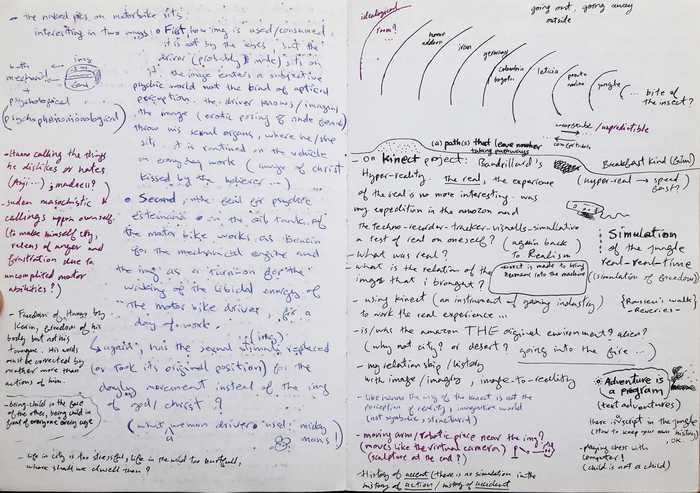
Colombia motorbike sits, libidinal energy of bikders, naked photo, Christ kissed by believer. freedom of Hanno dislikes. sudden masochistic callings. being child. going out going away, room, Iran, Germany, Colombia, Leticia, Puerto Narino, jungle, bite of the insect. kinect, Baudrillard hyper-reality, techno-recorder-tracker-visual-simulator, real-real-time simulation of jungle, kinect made to bring human into the machine. adventure is a program. there is a script in the jungle. how to keep your own history. child is not a child. history of action / history of accidenct
- 🔎
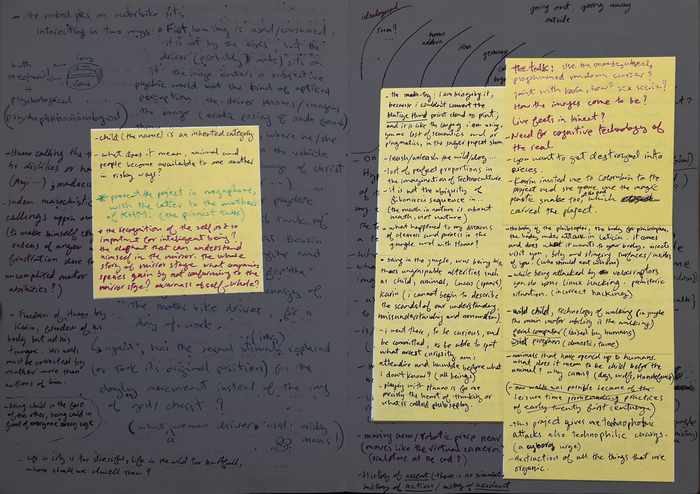
name of the child; animal and people become available; megaphone, KHM mothers; pianist talk; self recognition, intelligence, elephant, mirror-stage, whale story, awareness of self-whale; snake toy, blutige Hund, semantics, playmatics, puppet show; leash/unleash the dog; loss of perfect proportions in the imagination of technoculture; fibonacci nature; what happened to my dreams of cleanness and pureness in the jungle and with Hanno? being with Karin; I went to amazona to be curious and to be commited, to be able to spot what arrest curiosity. playing with Hanno is philosophy. kinect, cognitive technology of the real. you want to get destroyed into pieces. Karin invited me ti Colombia, and gave me the snake toy to think with. the body under attack in Leticia. insect visits you. it comes and does what it wants with your body. prehistoric incorrect hacking. wild child. feral computer. walking. what does it mean to be child before the animal? a cyborg urge.

